EP3412422B1 - Integrated method, system and machine for recycling pulper reject into raw material applicable as input for injection moulding production of various products obtained from said method and machine - Google Patents
Integrated method, system and machine for recycling pulper reject into raw material applicable as input for injection moulding production of various products obtained from said method and machine Download PDFInfo
- Publication number
- EP3412422B1 EP3412422B1 EP18176599.1A EP18176599A EP3412422B1 EP 3412422 B1 EP3412422 B1 EP 3412422B1 EP 18176599 A EP18176599 A EP 18176599A EP 3412422 B1 EP3412422 B1 EP 3412422B1
- Authority
- EP
- European Patent Office
- Prior art keywords
- machine
- reject
- pulper
- raw material
- conical screw
- Prior art date
- Legal status (The legal status is an assumption and is not a legal conclusion. Google has not performed a legal analysis and makes no representation as to the accuracy of the status listed.)
- Active
Links
Images


Classifications
-
- B—PERFORMING OPERATIONS; TRANSPORTING
- B29—WORKING OF PLASTICS; WORKING OF SUBSTANCES IN A PLASTIC STATE IN GENERAL
- B29B—PREPARATION OR PRETREATMENT OF THE MATERIAL TO BE SHAPED; MAKING GRANULES OR PREFORMS; RECOVERY OF PLASTICS OR OTHER CONSTITUENTS OF WASTE MATERIAL CONTAINING PLASTICS
- B29B17/00—Recovery of plastics or other constituents of waste material containing plastics
- B29B17/0026—Recovery of plastics or other constituents of waste material containing plastics by agglomeration or compacting
-
- B—PERFORMING OPERATIONS; TRANSPORTING
- B29—WORKING OF PLASTICS; WORKING OF SUBSTANCES IN A PLASTIC STATE IN GENERAL
- B29B—PREPARATION OR PRETREATMENT OF THE MATERIAL TO BE SHAPED; MAKING GRANULES OR PREFORMS; RECOVERY OF PLASTICS OR OTHER CONSTITUENTS OF WASTE MATERIAL CONTAINING PLASTICS
- B29B13/00—Conditioning or physical treatment of the material to be shaped
- B29B13/02—Conditioning or physical treatment of the material to be shaped by heating
-
- B—PERFORMING OPERATIONS; TRANSPORTING
- B29—WORKING OF PLASTICS; WORKING OF SUBSTANCES IN A PLASTIC STATE IN GENERAL
- B29B—PREPARATION OR PRETREATMENT OF THE MATERIAL TO BE SHAPED; MAKING GRANULES OR PREFORMS; RECOVERY OF PLASTICS OR OTHER CONSTITUENTS OF WASTE MATERIAL CONTAINING PLASTICS
- B29B13/00—Conditioning or physical treatment of the material to be shaped
- B29B13/06—Conditioning or physical treatment of the material to be shaped by drying
-
- B—PERFORMING OPERATIONS; TRANSPORTING
- B29—WORKING OF PLASTICS; WORKING OF SUBSTANCES IN A PLASTIC STATE IN GENERAL
- B29B—PREPARATION OR PRETREATMENT OF THE MATERIAL TO BE SHAPED; MAKING GRANULES OR PREFORMS; RECOVERY OF PLASTICS OR OTHER CONSTITUENTS OF WASTE MATERIAL CONTAINING PLASTICS
- B29B17/00—Recovery of plastics or other constituents of waste material containing plastics
- B29B17/02—Separating plastics from other materials
-
- B—PERFORMING OPERATIONS; TRANSPORTING
- B29—WORKING OF PLASTICS; WORKING OF SUBSTANCES IN A PLASTIC STATE IN GENERAL
- B29B—PREPARATION OR PRETREATMENT OF THE MATERIAL TO BE SHAPED; MAKING GRANULES OR PREFORMS; RECOVERY OF PLASTICS OR OTHER CONSTITUENTS OF WASTE MATERIAL CONTAINING PLASTICS
- B29B7/00—Mixing; Kneading
- B29B7/80—Component parts, details or accessories; Auxiliary operations
- B29B7/88—Adding charges, i.e. additives
- B29B7/90—Fillers or reinforcements, e.g. fibres
-
- B—PERFORMING OPERATIONS; TRANSPORTING
- B29—WORKING OF PLASTICS; WORKING OF SUBSTANCES IN A PLASTIC STATE IN GENERAL
- B29B—PREPARATION OR PRETREATMENT OF THE MATERIAL TO BE SHAPED; MAKING GRANULES OR PREFORMS; RECOVERY OF PLASTICS OR OTHER CONSTITUENTS OF WASTE MATERIAL CONTAINING PLASTICS
- B29B9/00—Making granules
- B29B9/02—Making granules by dividing preformed material
- B29B9/06—Making granules by dividing preformed material in the form of filamentary material, e.g. combined with extrusion
-
- B—PERFORMING OPERATIONS; TRANSPORTING
- B29—WORKING OF PLASTICS; WORKING OF SUBSTANCES IN A PLASTIC STATE IN GENERAL
- B29B—PREPARATION OR PRETREATMENT OF THE MATERIAL TO BE SHAPED; MAKING GRANULES OR PREFORMS; RECOVERY OF PLASTICS OR OTHER CONSTITUENTS OF WASTE MATERIAL CONTAINING PLASTICS
- B29B9/00—Making granules
- B29B9/12—Making granules characterised by structure or composition
-
- B—PERFORMING OPERATIONS; TRANSPORTING
- B29—WORKING OF PLASTICS; WORKING OF SUBSTANCES IN A PLASTIC STATE IN GENERAL
- B29C—SHAPING OR JOINING OF PLASTICS; SHAPING OF MATERIAL IN A PLASTIC STATE, NOT OTHERWISE PROVIDED FOR; AFTER-TREATMENT OF THE SHAPED PRODUCTS, e.g. REPAIRING
- B29C48/00—Extrusion moulding, i.e. expressing the moulding material through a die or nozzle which imparts the desired form; Apparatus therefor
- B29C48/25—Component parts, details or accessories; Auxiliary operations
- B29C48/36—Means for plasticising or homogenising the moulding material or forcing it through the nozzle or die
- B29C48/50—Details of extruders
- B29C48/76—Venting, drying means; Degassing means
- B29C48/761—Venting, drying means; Degassing means the vented material being in liquid form
-
- B—PERFORMING OPERATIONS; TRANSPORTING
- B29—WORKING OF PLASTICS; WORKING OF SUBSTANCES IN A PLASTIC STATE IN GENERAL
- B29B—PREPARATION OR PRETREATMENT OF THE MATERIAL TO BE SHAPED; MAKING GRANULES OR PREFORMS; RECOVERY OF PLASTICS OR OTHER CONSTITUENTS OF WASTE MATERIAL CONTAINING PLASTICS
- B29B17/00—Recovery of plastics or other constituents of waste material containing plastics
- B29B17/02—Separating plastics from other materials
- B29B2017/0213—Specific separating techniques
- B29B2017/0217—Mechanical separating techniques; devices therefor
- B29B2017/0237—Mechanical separating techniques; devices therefor using density difference
- B29B2017/0244—Mechanical separating techniques; devices therefor using density difference in liquids
-
- B—PERFORMING OPERATIONS; TRANSPORTING
- B29—WORKING OF PLASTICS; WORKING OF SUBSTANCES IN A PLASTIC STATE IN GENERAL
- B29K—INDEXING SCHEME ASSOCIATED WITH SUBCLASSES B29B, B29C OR B29D, RELATING TO MOULDING MATERIALS OR TO MATERIALS FOR MOULDS, REINFORCEMENTS, FILLERS OR PREFORMED PARTS, e.g. INSERTS
- B29K2105/00—Condition, form or state of moulded material or of the material to be shaped
- B29K2105/26—Scrap or recycled material
-
- B—PERFORMING OPERATIONS; TRANSPORTING
- B29—WORKING OF PLASTICS; WORKING OF SUBSTANCES IN A PLASTIC STATE IN GENERAL
- B29L—INDEXING SCHEME ASSOCIATED WITH SUBCLASS B29C, RELATING TO PARTICULAR ARTICLES
- B29L2031/00—Other particular articles
- B29L2031/712—Containers; Packaging elements or accessories, Packages
- B29L2031/7162—Boxes, cartons, cases
- B29L2031/7166—Cartons of the fruit juice or milk type, i.e. containers of polygonal cross sections formed by folding blanks into a tubular body with end-closing or contents-supporting elements, e.g. gable type containers
-
- Y—GENERAL TAGGING OF NEW TECHNOLOGICAL DEVELOPMENTS; GENERAL TAGGING OF CROSS-SECTIONAL TECHNOLOGIES SPANNING OVER SEVERAL SECTIONS OF THE IPC; TECHNICAL SUBJECTS COVERED BY FORMER USPC CROSS-REFERENCE ART COLLECTIONS [XRACs] AND DIGESTS
- Y02—TECHNOLOGIES OR APPLICATIONS FOR MITIGATION OR ADAPTATION AGAINST CLIMATE CHANGE
- Y02W—CLIMATE CHANGE MITIGATION TECHNOLOGIES RELATED TO WASTEWATER TREATMENT OR WASTE MANAGEMENT
- Y02W30/00—Technologies for solid waste management
- Y02W30/50—Reuse, recycling or recovery technologies
- Y02W30/52—Mechanical processing of waste for the recovery of materials, e.g. crushing, shredding, separation or disassembly
-
- Y—GENERAL TAGGING OF NEW TECHNOLOGICAL DEVELOPMENTS; GENERAL TAGGING OF CROSS-SECTIONAL TECHNOLOGIES SPANNING OVER SEVERAL SECTIONS OF THE IPC; TECHNICAL SUBJECTS COVERED BY FORMER USPC CROSS-REFERENCE ART COLLECTIONS [XRACs] AND DIGESTS
- Y02—TECHNOLOGIES OR APPLICATIONS FOR MITIGATION OR ADAPTATION AGAINST CLIMATE CHANGE
- Y02W—CLIMATE CHANGE MITIGATION TECHNOLOGIES RELATED TO WASTEWATER TREATMENT OR WASTE MANAGEMENT
- Y02W30/00—Technologies for solid waste management
- Y02W30/50—Reuse, recycling or recovery technologies
- Y02W30/62—Plastics recycling; Rubber recycling
Definitions
- the present invention relates to an integrated method, system and machine for recycling pulper reject which, after extraction of major part of cellulose, is without any further separation of its components transformed into a raw material that can be used as input material, preferably in injection-moulding-based processes.
- pulper reject is a type of wet waste coming from recycling waste paper in paper mills and includes mostly cellulose, mixed plastics, and or aluminium. More precisely, pulper reject defined by the European Commission Waste code 030307.
- Paper recycling is a widely used technology in order to reclaim cellulose from waste paper, which is then reused for production of paper.
- smaller portion of cellulose usually remains in the pulper reject.
- Plastics that is a part of pulper reject could also be recycled in dedicated facilities; however, this means that plastics must be first extracted from the pulper reject in a separate process.
- pulper reject which, in addition to cellulose and chemically different types of plastics contains also additional inorganic and organic inerts such as aluminium and rubber.
- pulper reject comes from cellulose recycling of multi-layered laminated cardboard-plastic-aluminium products. Such products are widely used especially in food packaging industry. Tetra-Pak® packages are an example of such a type of packages.
- the dry matter of said pulper reject is predominantly composed by thermoplastic film and parts of cellulosic fibres (from 5% to 40%), aluminium foil (up to 25%), mixed plastics such as Polyvinyl Chloride (PVC), Polyethylene Terephthalate (PET), Acrylonitrile Butadiene Styrene (ABS), rubber, etc. (up to 15%) and other materials (metals, stones, glass, other organic matter, etc. - up to 5%).
- PVC Polyvinyl Chloride
- PET Polyethylene Terephthalate
- ABS Acrylonitrile Butadiene Styrene
- rubber etc. (up to 15%) and other materials (metals, stones, glass, other organic matter, etc. - up to 5%).
- The_unpredictably varying and heterogeneous composition of the reject is the main reason why no technology for their recycling exists. Consequently, said reject is to a large extent considered as an industrially unusable waste and is therefore disposed of either in landfills or incinerated. However,
- the document EP 0570757 A1 discloses a method and machine for separating paper fibre from mixed waste materials which contain one or more sources of paper fibre in order to obtain substantially pure paper fibre which can be recycled to high grade end uses.
- the process and machine which separates plastics with or without metal in order to obtain substantially pure plastic which can be recycled to high grade end uses is disclosed.
- Figures 1 and 2 of EP 0570757 A1 shows a method that demands a complex machine which inter alia includes a multi-step drying process, material pulverization and filtration by extrusion, the consequence being high energy consumption.
- pulper reject contains aluminium
- aluminium is separated in order to obtain pure plastic and aluminium respectively.
- Either plastic or aluminium could then be used as raw material in separate processes, what essentially means that this method comprises three separated recycling processes (cellulose fibre, plastic, aluminium) which are usually placed in different locations.
- plastic pellets produced by this method are not intended for use in conventional plastic moulding and extrusion operations where virgin resins, or combinations of virgin resin and substantially fibre-free regrind or off-spec resin, are normally employed. Instead, the plastic pellets produced according to this method are particularly well suited for use in making extruded composite products comprising a discontinuous phase of aligned cellulosic fibres dispersed in a continuous phase of polymeric resin.
- the method of US 5084135 does not provide for recycling of pulper reject which contains a mix of organic and inorganic inerts such as aluminium and rubber and therefore the output of the described method are plastics which explicitly are not suitable to be reused as raw material in injection moulding processes but only in continuous extrusion processes.
- the method of US 5084135 is also characterized by high energy consumption due to the fact that it involves a vaporization (and complete drying) stage.
- a method for recycling waste material is known from EP 2942173 A1 .
- Different configurations of a screw for a machine for recycling waste material are described in JP 4505038 B1 and in WO 2012/100465 A1 .
- the aim and purpose of the present invention is to eliminate the shortcomings and deficiencies of known prior art by a novel integrated method, system and machine for recycling pulper reject which, after extraction of major part of cellulose, can be without any further separation of its components transformed into a raw material, applicable as input material, preferably in injection-moulding-based processes.
- This invention represents an integrated method, system and machine for pulper reject recycling to raw material applicable for the production of various products using an injection moulding process whereas an integrated moisture reduction and compacting machine from mechanically separated rejects from pulping of waste paper.
- the method and machine according to this invention is capable of recycling any pulper reject including multi-layered (laminated) cardboard packages containing a plastic film layers and/or multi-layered cardboard packages containing plastic film layers and aluminium foil layers, in a single recycling line, thus solving all the technological shortcomings and deficiencies of prior art.
- the present invention represents a method, which significantly contributes to improved environmental protection, because, by recycling currently considered non-recyclable and industrially unusable waste into an industrially useful material, which enables to make useful products from this particular waste, it makes ecologically unsuitable practice of depositing the waste either in landfills or incinerating them obsolete and unnecessary.
- Another advantage of the present invention is that it significantly reduces aggregate energy consumption during the whole method compared to currently available methods of the separate processes.
- a further advantage of the present invention is that procedures for recycling just the plastic portion of the waste alone are usually made outside the paper mills where the waste is generated, thus implying a transport of the waste thus contributing to increased costs and burden to the environment.
- the pulper reject (after paper mills have removed the cellulose portion) especially from Tetra-Pak® containers (and similar plastic laminated-coated paper consumer packaging), must be considered a distinct and higher quality raw material coming from the same process.
- the classic pulper reject plastics can be best used in injection moulding if mixed with Tetra Pak® reject treated with an integrated moisture reduction and compacting machine or similar, thus allowing the plastic end products to be made of 100% (processed) pulper reject mixed plastic material.
- the waste the invention is focusing on consist primarily of Low-density Polyethylene (LDPE) film with the residue of aluminium foil to be used to produce different finished products mainly for the transport industry, building industry and agriculture (pallets, crates, bottle boxes etc .).
- LDPE Low-density Polyethylene
- an integrated method system and machine for recycling pulper rejects from any source for example packages with thin plastic film, specially packages that also comprise an aluminium foil layer, comprising the steps of: receiving a pulper reject that shall comprise cellulose, plastic, water and impurities from a previous washing/separating process in the paper mill; moisture removing, softening and compacting the pulper reject, obtaining a plastic raw material; and feeding a thermoplastic transformation machine with the raw material to obtain a plastic product.
- One or more objectives of the present invention are also achieved by a method as defined in claim 1.
- One or more objectives of the present invention are also achieved by a machine for recycling pulper reject into raw material defined in claim 7.
- One or more objectives of the present invention are also achieved by a system for recycling pulper reject according to claim 10.
- the product is consisting of: more than 70% of plastic materials; 0 to 10% of cellulose fibre; 0,5 to 25% of aluminium; and the remaining defined by impurities, said product being obtained from a thermoplastic transformation process using the recycled raw material obtained from the method and machine above.
- the system and related machines of preparing the pulper reject to obtain raw material is represented in figure 1 , as an example of situation where the recycled package is a Tetra-Pak®, therefore comprised mainly from cellulose from cardboard, LDPE from plastic film and aluminium from the inner layer.
- the recycling of pulper reject with or without aluminium foil and inerts to manufacture of thick wall plastics products can be divided in three phases: Cleaning, separating (five machines); moisture removing, softening, compacting (one machine); Injection Moulding (one machine + moulds), especially low pressure injection moulding.
- the method of cleaning and separation is similar to the additional (secondary) cleaning by knowing methods used by paper mills to recover cellulosic fibres and reduce the weight of the rejects. These lines should be composed depending on the composition of the pulper reject.
- the typical composition includes the steps of: introducing the material 1 in a size reduction unit 2 to reduce the material 1 to a maximum dimension up to 80 x 80 mm parts, for example, in order to achieve an improved operation of the process.
- an outlet 3 allows the removal of water and cellulose.
- the material 1 is then transported by a moisture removing screw conveyor 6 to a reactor 7 where it is processed through a dynamic separation tank with hot washing to eliminate heavy materials (metal, stones, glass etc.), eliminated by an outlet 4.
- the material 1 is transported through a rotating drum for pre-wash 8, to separate some cellulosic fibres, through a washing/floating tank 9 for separation of heavy plastics (PET, PVC ...) and through a washing centrifugal machine to extract the greater part of cellulosic fibre content by an outlet 3.
- LDPE has an average density of 0,91 to 0,93 g/cm 3
- the aluminium has an average density of 2,70 g/cm 3
- the cellulose has an average density of 1,50 g/cm 3 , therefore the LDPE has more chance remain in the process.
- the output material from this cleaning/separating phase comes in form of water slurry.
- the requirements for the composition of the dry matter of this material at the end of the steps described above are:
- any percentage given herein relates to % by weight.
- thermoplastic transformation such as injection moulding
- drying densifying, compounding, cooling, and shredding. All of which requires a lot of energy and several separate machines.
- Moisture content in output material from phase 1 is in IMRC then removed so that its humidity is reduced under 12%, preferably under 5%, and simultaneously softened and compacted so that it can be then directly fed into thermoplastic transformation machine that is part of phase 3.
- the lesser requirements needed to operate a low pressure injection moulding machine 16 allow the preparation of the feed material using lower temperatures, hence with lower costs and with only one step process on a specially designed moisture removing, softening and compacting machine 11.
- the IMRC machine 11 receives the material resulted from the phase 1 and reduces moisture by an outlet 5 and delivers raw material for use in a thermoplastic transformation machine 16. Therefore, from now on the moisture removing, softening and compacting machine 11 will also be named as machine for manufacturing raw material from pulper reject.
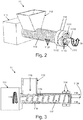
- the machine 11 comprise a main drive 111 connected to a compression means that operates inside a cylinder 113, transporting the material obtained from the phase 1 to an outlet 118 in a direction 119.
- Said compression means shall be any solution from the prior art able to allow the movement of the material.
- the compression means is formed as a conical screw 117.
- the machine 11 receives the material from a water slurry continuously loaded in a hopper 112.
- the conical screw 117 is connected to the main drive, producing a rotational movement 115 continuously with high torque on low rpm.
- the conical screw 117 rotates inside the cylinder 113, and has the fillets defining a cylindrical shape allowing its movement and juxtaposition within the cylinder 113.
- the base of the fillets comprise a conical shape defining a first end with a smaller inner diameter and a second end with a greater inner diameter. In this sense, the region defined between the inner wall of the cylinder and the conical screw 117 diameter reduces along it length.
- the smaller inner diameter is disposed in a first end of the conical screw 117 near to the feeding hopper 12, and the greater inner diameter is displaced in a second end of the conical screw 117 near to an outlet 118, in order to gradually compress the material against the inner wall of the cylinder 113.
- Said cylinder 113 comprises a plurality of holes 1131 that allow the passage of moisture or water 1121, retaining inside the cylinder 113 the material 1122.
- the compression process described above occurs basically in three stages, as follows: admission and start of compression 1131; compression 1132; and compression combined with heating 1133, as illustrated in figure 4 .
- the material 1122 and residual moisture or water 1121 obtained from the phase 1, as described above or any other equivalent process enters in the machine 11 by an opening 116 in the feeding hopper 112.
- the rotation of the conical screw 117 starts moving the material along to the cylinder 113 length and a first part of moisture or water 1121 is removed by the compression against the inner wall of the cylinder 113.
- the region between the conical screw 117 and the inner wall of the cylinder 113 reduces more, squeezing the material 1122 and removing more moisture or water 1121 by the holes 1131.
- a heating device 114 disposed close to the outlet 118 of the machine 11 starts a softening process of the material 1122 and provides the removal of the few residual moisture or water 1121 by means of evaporation, obtaining a melted recycled rejects 1123.
- the steam 1125 leaves the cylinder 113 by the holes 1131.
- said softening process is a pre-melting process, i. e. a process of heating the material to a temperature below to its melting temperature but capable to soften the material.
- Said heating device 114 is preferably an electric resistance installed surrounding the outlet 118, or any other equivalent heating source capable of heating the outlet 118 region to a temperature of at least 110 °C.
- the soft recycled rejects 1123 are pressurized by the rotation of the conical screw 117 against an extrusion plate 1112 and leave the machine 11 through holes 1113, solidifying into a recycled raw material to be used in a thermoplastic transformation machine 16 in the phase 3, detailed below.
- Said recycled raw material is composed by the remaining substances from the processes steps above, mainly plastic, aluminium and other inerts.
- the outlet 118 further comprises at least one cutting tool 1111 connected to a rotating axis 1110 to cut the recycled raw material into small pellets 1124, preferably into parts with 4 mm to 15 mm of diameter by 4 mm to 15 mm of length.
- said rotating axis 1110 is coupled to the conical screw 117, in order to obtain the rotational movement 115 from the main drive 111, having the cutting rotational movement synchronized to the ration of recycled raw material that leaves through the holes 1113, warranting a standard size of the pellets 1124. Said sequence is represented by the step 1134 of figure 4 .
- the sections 1131 and 1132 define a first moisture removing stage, where the material 1122 is squeezed between the cylinder 113 and the internal part of the screw 117 because the inner diameter of the screw 117 continuously increases.
- the material 1122 is squeezed under big pressure, and in the section 1133 the temperature of the material 1122 increase and the moisture or water 1121 leaves through the holes 1131 in the cylinder 113.
- the heating section 1133 defines a second moisture removing stage, where the material 1122 temperature reaches at least 100°C, so that the remaining water 1121 evaporates and the material 1122 has a softening process.
- the working process is similar to an extrusion process, where the material 1122 is pushed against an extrusion plate 1112 and leaves the machine through holes 1113.
- This section 1133 has also electric heaters 114 and optionally also comprises water cooling rings to control the temperature into a defined range of preferred working temperature.
- the rotating knives 1111 cut the material that comes through the holes 1113 in the extrusion plate 1112.
- These pellets 1124 are preferably transported with pneumatic system 12 to the next phase of the recycling process, so the air cools the material 1124 during the transportation, passing into a prolonged cyclone 17 until a storage 13.
- the temperature of the material before entering in the storage 13 must be under 80°C in order to avoid the melting between the storage pellets 1124.
- Temperatures are controlled with the thermal sensor in the final part and regulated with the dosing of the material and with the cooling and heating of the final part.
- the machine (16) is a multi-purpose or multifunctional machine that makes it possible to perform moisture removing, softening, compacting and extruding mixed aluminium and plastics or even plastics composed of different types of plastics, wherein said machine (16) allows the recycling of the essentially two-component waste, one component being aluminium, and the other being plastics, whereby this second component itself could be a mix of chemically different types of plastics.
- an injection moulding machine allows the thermoplastic transformation.
- the injection has advantage over other thermoplastic transformation processes due to the higher level of complexity of the products that can be obtained in comparison to other thermoplastic transformation processes, such as extrusion.
- the injection moulding machine is properly adapted and has the simultaneous function of mixing and degassing recycled raw material 1124.
- the injection moulding machine shall use a mix of the recycled raw material 1124 and plastics or additives from a storage 14, therefore these materials are mixed before entering the injection moulding machine by a dosimeter 15.
- the use of plastic and additives with the recycled raw material 1124 provides competitive technical characteristics of some products that requires higher quality standards.
- the extruder loaded by the dosing system, works in a continuous process and feeds the storage head, which allows injecting into the mould the stored load equivalent to the weight of the product.
- the aim of the extruder is to plasticize, homogenize and degas the material for the subsequent injection; the plasticization process occurs due to the mechanical action of the extruder also due to the heat input realized by means of a thermoregulation system.
- the system cools it down.
- the unit is completed by devices for opening and closing the moulds.
- the product is extracted with any appropriate method.
- this technology is able to work with different recipes using other plastics residual, recyclable plastics from the polyolefin family - Low-density polyethylene (LDPE), Linear low-density polyethylene (LLDPE), High-density polyethylene (HDPE), or Polypropylene (PP) - as raw material with or without different types of low cost fillers in accordance with the mechanical characteristic and final quality required for specifics finished products.
- LDPE Low-density polyethylene
- LLDPE Linear low-density polyethylene
- HDPE High-density polyethylene
- PP Polypropylene
- the material recycled is mainly Tetra-Pak® packages
- the final recycled raw material is stable and homogeneous having 0,1-10% cellulose content, 0,5 to 25% of Aluminium, the rest being formed by plastics from Polyolefin family of plastics (LDPE, HDPE, PP etc .).
- the present invention has good results in the manufacture of low-pressurized injection processes using a plastic recycled raw material, wherein said raw material shall be obtained from any recycled package with a plastic film layer, especially from Tetra-Pak® packages, the injected material shall be 100% from recycled raw material 1124 or a mixture of plastic new raw material or additives and recycled raw material in any proportion comprising from 1 to 99% of recycled raw material.
- the present invention also refers to a product having its composition consisting of at least 75 % of mixed plastic material, less than 10% of cellulose fibre, 0,5 to 25% of aluminium and the remaining defined by impurities.
- the range of the components are defined by the pulper reject 1 properties and by the quality of the cleaning/separation system or process used.
- plastic pallets examples of products that shall be manufactured from this recycled raw material are: plastic pallets; plastic boxes (e.g . plastic transport boxes); or any other products that does not require high dimensional precision, controlled physical properties or no impurities in the composition. Mainly, these products should be low aggregated value products.
Landscapes
- Engineering & Computer Science (AREA)
- Mechanical Engineering (AREA)
- Environmental & Geological Engineering (AREA)
- Physics & Mathematics (AREA)
- Thermal Sciences (AREA)
- Separation, Recovery Or Treatment Of Waste Materials Containing Plastics (AREA)
- Processing Of Solid Wastes (AREA)
Priority Applications (1)
| Application Number | Priority Date | Filing Date | Title |
|---|---|---|---|
| SI201830096T SI3412422T1 (sl) | 2017-06-08 | 2018-06-07 | Integriran postopek, sistem in stroj za recikliranje celuloznega izmeta v surovi material, uporabljiv kot vnos za proizvodnjo s tlačnim litjem različnih proizvodov, pridobljenih z omenjenim postopkom in strojem |
Applications Claiming Priority (1)
| Application Number | Priority Date | Filing Date | Title |
|---|---|---|---|
| BR102017012176-3A BR102017012176A2 (pt) | 2017-06-08 | 2017-06-08 | método, máquina e sistema integrado para reciclar refugo de desagregador em materia prima aplicável para produção em termoinjeção e produto obtido a partir do dito método e máquina |
Publications (2)
| Publication Number | Publication Date |
|---|---|
| EP3412422A1 EP3412422A1 (en) | 2018-12-12 |
| EP3412422B1 true EP3412422B1 (en) | 2020-05-13 |
Family
ID=62750744
Family Applications (1)
| Application Number | Title | Priority Date | Filing Date |
|---|---|---|---|
| EP18176599.1A Active EP3412422B1 (en) | 2017-06-08 | 2018-06-07 | Integrated method, system and machine for recycling pulper reject into raw material applicable as input for injection moulding production of various products obtained from said method and machine |
Country Status (5)
| Country | Link |
|---|---|
| EP (1) | EP3412422B1 (pl) |
| BR (1) | BR102017012176A2 (pl) |
| HU (1) | HUE051453T2 (pl) |
| PL (1) | PL3412422T3 (pl) |
| SI (1) | SI3412422T1 (pl) |
Families Citing this family (13)
| Publication number | Priority date | Publication date | Assignee | Title |
|---|---|---|---|---|
| JP6820202B2 (ja) | 2017-01-10 | 2021-01-27 | Toyo Tire株式会社 | 押出機、マスターバッチの製造方法およびタイヤの製造方法 |
| CN110667002A (zh) * | 2019-10-12 | 2020-01-10 | 临武县华湘再生资源回收有限公司 | 从纸厂固废中再生提炼纸塑原料的设备 |
| CN110774473B (zh) * | 2019-11-29 | 2024-11-19 | 山东东盛橡胶科技股份有限公司 | 塑化胶粉强制混合机 |
| EP3889359A1 (de) * | 2020-03-31 | 2021-10-06 | Recyplast Holding AG | Verfahren zum herstellen einer folie aus polyethylen; folie aus polyethylen |
| CN116194266A (zh) * | 2020-08-04 | 2023-05-30 | F·巴希蒂 | 回收异质塑料材料的设备和方法 |
| CN112123615A (zh) * | 2020-09-15 | 2020-12-25 | 李岑丽 | 一种橡胶材料胶料混炼工艺 |
| CZ34631U1 (cs) * | 2020-10-29 | 2020-12-02 | ITB Engineering & Production s.r.o. | Zařízení pro ekologické zpracování odpadových obalů |
| DE102021124792A1 (de) * | 2021-01-17 | 2022-07-21 | Helga Reinders | Extruder und Verfahren zur Herstellung von Kunststoffteilen |
| CN113199692B (zh) * | 2021-05-07 | 2022-03-08 | 深圳市国兰塑胶五金制品有限公司 | 一种可高效去除注塑料内水分的注塑设备 |
| IT202200001319A1 (it) * | 2022-01-26 | 2023-07-26 | Lucart Spa | Procedimento ed impianto per il recupero di cartoncini poliaccoppiati, e materiale composito ottenuto tramite tale procedimento e/o impianto |
| CN115071096A (zh) * | 2022-06-20 | 2022-09-20 | 南通市林宇电子有限公司 | 一种薄膜挤出成型装置 |
| IT202200014260A1 (it) * | 2022-07-06 | 2024-01-06 | Ecorevive S R L | Processo per il riciclo dello scarto delle cartiere in un additivo per conglomerati bituminosi |
| CN117463758B (zh) * | 2023-12-08 | 2024-07-26 | 杭州富伦生态科技有限公司 | 一种废弃复合包装材料分类回收方法及回收系统 |
Family Cites Families (16)
| Publication number | Priority date | Publication date | Assignee | Title |
|---|---|---|---|---|
| US4390645A (en) | 1979-11-23 | 1983-06-28 | The Dow Chemical Company | Stable dispersions of polymers in polyfunctional compounds having a plurality of active hydrogens and polyurethanes therefrom |
| US5084135A (en) | 1990-03-27 | 1992-01-28 | Advanced Environmental Recycling Technologies, Inc. | Recycling plastic coated paper product waste |
| US5390860A (en) | 1992-05-15 | 1995-02-21 | Tetra Laval Holdings & Finance Sa | Method and apparatus for separating paper fiber and plastics from mixed waste materials and products obtained thereby |
| DE4428867A1 (de) * | 1994-08-05 | 1996-02-08 | Joachim Dipl Ing Wagenblast | Maschine zur direkten Verarbeitung von unzerkleinerten oder grob vorzerkleinerten thermoplastischen Formteilen und Halbzeugen zu neuen Fertigteilen oder Halbzeugen aus Kunststoffen |
| US20100092794A1 (en) * | 2005-01-31 | 2010-04-15 | Treatment And Recovery Of Waste | Treatment and recovery of waste |
| EP2123418A1 (en) * | 2008-05-21 | 2009-11-25 | Eco Quadrinvest S.r.l. | Method for recycling composite material |
| JP4505038B1 (ja) * | 2009-08-05 | 2010-07-14 | 東洋ゴム工業株式会社 | ウェットマスターバッチの製造方法 |
| CA2676961A1 (en) * | 2009-08-26 | 2011-02-26 | Carlo Fascio | Resin pellet from recycled waste |
| GB2483851B (en) * | 2010-09-16 | 2015-02-18 | Massmelt Ltd | Waste processing apparatus and methods |
| ES2440319T3 (es) * | 2010-12-10 | 2014-01-28 | Sp Kloner Ecotec S.L. | Método para procesar residuos de envase de tetrabrik para fabricar piezas de plástico |
| WO2012100465A1 (zh) * | 2011-01-30 | 2012-08-02 | 张家港市联达机械有限公司 | 废塑料薄膜挤出机 |
| CN102492065A (zh) * | 2011-11-11 | 2012-06-13 | 茂名鲁华化工有限公司 | 一种溶液聚合法异戊橡胶生产的脱水干燥方法 |
| EP2821195A4 (en) * | 2012-03-02 | 2015-11-11 | Hitachi Maxell | PRODUCTION METHOD FOR A MOLDING ELEMENT, PRODUCTION METHOD FOR A FORMING ELEMENT WITH A PLATING LAYER, PRODUCTION PROCESS FOR RESIN PELLETS, MOLDING PROCESSES THROUGH FOAM INJECTION, NOZZLE UNIT AND INJECTION MOLDING DEVICE |
| DE102012206100A1 (de) * | 2012-04-13 | 2013-10-17 | Renad Kunststoffe und Entwicklung GmbH | Aufbereitungsextruder |
| EP2942173B1 (de) * | 2014-05-07 | 2017-12-20 | Gutta Werke AG | Verfahren zur Herstellung von Granulat zum Spritzgießen eines Formteils |
| JP6510770B2 (ja) * | 2014-06-19 | 2019-05-08 | Toyo Tire株式会社 | ゴムウエットマスターバッチの製造方法およびゴムウエットマスターバッチ、ならびにゴムウエットマスターバッチを含有するゴム組成物 |
-
2017
- 2017-06-08 BR BR102017012176-3A patent/BR102017012176A2/pt not_active IP Right Cessation
-
2018
- 2018-06-07 PL PL18176599.1T patent/PL3412422T3/pl unknown
- 2018-06-07 EP EP18176599.1A patent/EP3412422B1/en active Active
- 2018-06-07 SI SI201830096T patent/SI3412422T1/sl unknown
- 2018-06-07 HU HUE18176599A patent/HUE051453T2/hu unknown
Non-Patent Citations (1)
| Title |
|---|
| None * |
Also Published As
| Publication number | Publication date |
|---|---|
| SI3412422T1 (sl) | 2020-09-30 |
| PL3412422T3 (pl) | 2021-03-22 |
| BR102017012176A2 (pt) | 2018-12-26 |
| HUE051453T2 (hu) | 2021-03-01 |
| EP3412422A1 (en) | 2018-12-12 |
Similar Documents
| Publication | Publication Date | Title |
|---|---|---|
| EP3412422A1 (en) | Integrated method, system and machine for recycling pulper reject into raw material applicable as input for injection moulding production of various products obtained from said method and machine | |
| EP0593589B1 (en) | Method for preparation of composite materials | |
| Zawadiak et al. | Tetra pak recycling–current trends and new developments | |
| CA2153450C (en) | Method for preparing automobile shredder residue-synthetic plastic material composite | |
| EP2296858B1 (en) | Method for recycling composite material | |
| US5075057A (en) | Manufacture of molded composite products from scrap plastics | |
| US5951940A (en) | Method of recycling post-consumer plastic waste | |
| JP5028197B2 (ja) | ペレットの製造方法およびペレット製造装置 | |
| US12151403B2 (en) | Method for recycling a transfer product | |
| AU2011380929A1 (en) | A method for recycling waste thermoplastic materials and using this recycled thermoplastic in composite material production | |
| JP2016215145A (ja) | 微細分散複合化装置及び微細分散複合化方法 | |
| KR102183584B1 (ko) | 펄프 몰드 성형품의 제조방법 | |
| AU2018440504B2 (en) | Method and system for forming a composite material | |
| US4112038A (en) | Method for producing molded articles | |
| JP2004268942A (ja) | 再生プラスチックパレットの製造方法及びこの製造方法により製造された再生プラスチックパレット | |
| KR20160139429A (ko) | 우유팩으로부터 분리된 폴리에틸렌으로 제조된 펠릿 분쇄물을 포함하는 트레이용 수지조성물 및 이를 이용하여 제조된 트레이 | |
| US20110109007A1 (en) | Recycled post-industrial waste for plastic industrial commercial and consumer products | |
| WO2023043326A1 (en) | Method of producing polyester packaging with increased heat resistance for pouring hot food products and/or for sterilisation | |
| KR101559471B1 (ko) | 절연지 재활용 판지 제조장치 및 이를 이용한 판지 제조방법 | |
| WO2009040462A1 (en) | Making a composite product | |
| KR101047536B1 (ko) | 폐 합성수지벽지 및 폐지 코팅 비닐을 이용한 건축용 또는 공업용 합성수지 원료 제조방법 | |
| EP0720898B1 (en) | Improvement in the recycling method for the re-use of solid household and similar wastes | |
| EP4570468A1 (en) | Processes for recycling plastic laminate waste | |
| US20060267228A1 (en) | Reuse process of plastic material and paper rejected in recycling and its resultant product | |
| WO2016181376A1 (en) | Extruder equipment arrangement for producing three layers sheet of colored resin with the material composition of each layer is enhanced |
Legal Events
| Date | Code | Title | Description |
|---|---|---|---|
| PUAI | Public reference made under article 153(3) epc to a published international application that has entered the european phase |
Free format text: ORIGINAL CODE: 0009012 |
|
| STAA | Information on the status of an ep patent application or granted ep patent |
Free format text: STATUS: THE APPLICATION HAS BEEN PUBLISHED |
|
| AK | Designated contracting states |
Kind code of ref document: A1 Designated state(s): AL AT BE BG CH CY CZ DE DK EE ES FI FR GB GR HR HU IE IS IT LI LT LU LV MC MK MT NL NO PL PT RO RS SE SI SK SM TR |
|
| AX | Request for extension of the european patent |
Extension state: BA ME |
|
| STAA | Information on the status of an ep patent application or granted ep patent |
Free format text: STATUS: REQUEST FOR EXAMINATION WAS MADE |
|
| 17P | Request for examination filed |
Effective date: 20190612 |
|
| RBV | Designated contracting states (corrected) |
Designated state(s): AL AT BE BG CH CY CZ DE DK EE ES FI FR GB GR HR HU IE IS IT LI LT LU LV MC MK MT NL NO PL PT RO RS SE SI SK SM TR |
|
| GRAP | Despatch of communication of intention to grant a patent |
Free format text: ORIGINAL CODE: EPIDOSNIGR1 |
|
| STAA | Information on the status of an ep patent application or granted ep patent |
Free format text: STATUS: GRANT OF PATENT IS INTENDED |
|
| RIC1 | Information provided on ipc code assigned before grant |
Ipc: B29B 17/00 20060101AFI20191126BHEP Ipc: B29B 13/06 20060101ALI20191126BHEP Ipc: B29C 48/76 20190101ALI20191126BHEP Ipc: B29B 9/02 20060101ALI20191126BHEP |
|
| INTG | Intention to grant announced |
Effective date: 20191220 |
|
| GRAS | Grant fee paid |
Free format text: ORIGINAL CODE: EPIDOSNIGR3 |
|
| GRAA | (expected) grant |
Free format text: ORIGINAL CODE: 0009210 |
|
| STAA | Information on the status of an ep patent application or granted ep patent |
Free format text: STATUS: THE PATENT HAS BEEN GRANTED |
|
| RAP1 | Party data changed (applicant data changed or rights of an application transferred) |
Owner name: WAVA VENTURES FZCO. |
|
| AK | Designated contracting states |
Kind code of ref document: B1 Designated state(s): AL AT BE BG CH CY CZ DE DK EE ES FI FR GB GR HR HU IE IS IT LI LT LU LV MC MK MT NL NO PL PT RO RS SE SI SK SM TR |
|
| REG | Reference to a national code |
Ref country code: GB Ref legal event code: FG4D |
|
| REG | Reference to a national code |
Ref country code: CH Ref legal event code: EP |
|
| REG | Reference to a national code |
Ref country code: DE Ref legal event code: R096 Ref document number: 602018004417 Country of ref document: DE |
|
| REG | Reference to a national code |
Ref country code: AT Ref legal event code: REF Ref document number: 1269672 Country of ref document: AT Kind code of ref document: T Effective date: 20200615 |
|
| REG | Reference to a national code |
Ref country code: LT Ref legal event code: MG4D |
|
| REG | Reference to a national code |
Ref country code: NL Ref legal event code: MP Effective date: 20200513 |
|
| PG25 | Lapsed in a contracting state [announced via postgrant information from national office to epo] |
Ref country code: SE Free format text: LAPSE BECAUSE OF FAILURE TO SUBMIT A TRANSLATION OF THE DESCRIPTION OR TO PAY THE FEE WITHIN THE PRESCRIBED TIME-LIMIT Effective date: 20200513 Ref country code: PT Free format text: LAPSE BECAUSE OF FAILURE TO SUBMIT A TRANSLATION OF THE DESCRIPTION OR TO PAY THE FEE WITHIN THE PRESCRIBED TIME-LIMIT Effective date: 20200914 Ref country code: FI Free format text: LAPSE BECAUSE OF FAILURE TO SUBMIT A TRANSLATION OF THE DESCRIPTION OR TO PAY THE FEE WITHIN THE PRESCRIBED TIME-LIMIT Effective date: 20200513 Ref country code: NO Free format text: LAPSE BECAUSE OF FAILURE TO SUBMIT A TRANSLATION OF THE DESCRIPTION OR TO PAY THE FEE WITHIN THE PRESCRIBED TIME-LIMIT Effective date: 20200813 Ref country code: IS Free format text: LAPSE BECAUSE OF FAILURE TO SUBMIT A TRANSLATION OF THE DESCRIPTION OR TO PAY THE FEE WITHIN THE PRESCRIBED TIME-LIMIT Effective date: 20200913 Ref country code: LT Free format text: LAPSE BECAUSE OF FAILURE TO SUBMIT A TRANSLATION OF THE DESCRIPTION OR TO PAY THE FEE WITHIN THE PRESCRIBED TIME-LIMIT Effective date: 20200513 |
|
| PGFP | Annual fee paid to national office [announced via postgrant information from national office to epo] |
Ref country code: CZ Payment date: 20200730 Year of fee payment: 3 Ref country code: DE Payment date: 20200710 Year of fee payment: 3 |
|
| PG25 | Lapsed in a contracting state [announced via postgrant information from national office to epo] |
Ref country code: LV Free format text: LAPSE BECAUSE OF FAILURE TO SUBMIT A TRANSLATION OF THE DESCRIPTION OR TO PAY THE FEE WITHIN THE PRESCRIBED TIME-LIMIT Effective date: 20200513 Ref country code: BG Free format text: LAPSE BECAUSE OF FAILURE TO SUBMIT A TRANSLATION OF THE DESCRIPTION OR TO PAY THE FEE WITHIN THE PRESCRIBED TIME-LIMIT Effective date: 20200813 Ref country code: RS Free format text: LAPSE BECAUSE OF FAILURE TO SUBMIT A TRANSLATION OF THE DESCRIPTION OR TO PAY THE FEE WITHIN THE PRESCRIBED TIME-LIMIT Effective date: 20200513 Ref country code: HR Free format text: LAPSE BECAUSE OF FAILURE TO SUBMIT A TRANSLATION OF THE DESCRIPTION OR TO PAY THE FEE WITHIN THE PRESCRIBED TIME-LIMIT Effective date: 20200513 |
|
| PGFP | Annual fee paid to national office [announced via postgrant information from national office to epo] |
Ref country code: SI Payment date: 20200727 Year of fee payment: 3 |
|
| PG25 | Lapsed in a contracting state [announced via postgrant information from national office to epo] |
Ref country code: NL Free format text: LAPSE BECAUSE OF FAILURE TO SUBMIT A TRANSLATION OF THE DESCRIPTION OR TO PAY THE FEE WITHIN THE PRESCRIBED TIME-LIMIT Effective date: 20200513 Ref country code: AL Free format text: LAPSE BECAUSE OF FAILURE TO SUBMIT A TRANSLATION OF THE DESCRIPTION OR TO PAY THE FEE WITHIN THE PRESCRIBED TIME-LIMIT Effective date: 20200513 |
|
| REG | Reference to a national code |
Ref country code: AT Ref legal event code: UEP Ref document number: 1269672 Country of ref document: AT Kind code of ref document: T Effective date: 20200513 |
|
| PG25 | Lapsed in a contracting state [announced via postgrant information from national office to epo] |
Ref country code: RO Free format text: LAPSE BECAUSE OF FAILURE TO SUBMIT A TRANSLATION OF THE DESCRIPTION OR TO PAY THE FEE WITHIN THE PRESCRIBED TIME-LIMIT Effective date: 20200513 Ref country code: DK Free format text: LAPSE BECAUSE OF FAILURE TO SUBMIT A TRANSLATION OF THE DESCRIPTION OR TO PAY THE FEE WITHIN THE PRESCRIBED TIME-LIMIT Effective date: 20200513 Ref country code: SM Free format text: LAPSE BECAUSE OF FAILURE TO SUBMIT A TRANSLATION OF THE DESCRIPTION OR TO PAY THE FEE WITHIN THE PRESCRIBED TIME-LIMIT Effective date: 20200513 Ref country code: EE Free format text: LAPSE BECAUSE OF FAILURE TO SUBMIT A TRANSLATION OF THE DESCRIPTION OR TO PAY THE FEE WITHIN THE PRESCRIBED TIME-LIMIT Effective date: 20200513 Ref country code: ES Free format text: LAPSE BECAUSE OF FAILURE TO SUBMIT A TRANSLATION OF THE DESCRIPTION OR TO PAY THE FEE WITHIN THE PRESCRIBED TIME-LIMIT Effective date: 20200513 |
|
| PGFP | Annual fee paid to national office [announced via postgrant information from national office to epo] |
Ref country code: HU Payment date: 20200803 Year of fee payment: 3 |
|
| REG | Reference to a national code |
Ref country code: DE Ref legal event code: R097 Ref document number: 602018004417 Country of ref document: DE |
|
| PG25 | Lapsed in a contracting state [announced via postgrant information from national office to epo] |
Ref country code: SK Free format text: LAPSE BECAUSE OF FAILURE TO SUBMIT A TRANSLATION OF THE DESCRIPTION OR TO PAY THE FEE WITHIN THE PRESCRIBED TIME-LIMIT Effective date: 20200513 Ref country code: MC Free format text: LAPSE BECAUSE OF FAILURE TO SUBMIT A TRANSLATION OF THE DESCRIPTION OR TO PAY THE FEE WITHIN THE PRESCRIBED TIME-LIMIT Effective date: 20200513 |
|
| REG | Reference to a national code |
Ref country code: HU Ref legal event code: AG4A Ref document number: E051453 Country of ref document: HU |
|
| PLBE | No opposition filed within time limit |
Free format text: ORIGINAL CODE: 0009261 |
|
| STAA | Information on the status of an ep patent application or granted ep patent |
Free format text: STATUS: NO OPPOSITION FILED WITHIN TIME LIMIT |
|
| PG25 | Lapsed in a contracting state [announced via postgrant information from national office to epo] |
Ref country code: LU Free format text: LAPSE BECAUSE OF NON-PAYMENT OF DUE FEES Effective date: 20200607 |
|
| REG | Reference to a national code |
Ref country code: BE Ref legal event code: MM Effective date: 20200630 |
|
| 26N | No opposition filed |
Effective date: 20210216 |
|
| PG25 | Lapsed in a contracting state [announced via postgrant information from national office to epo] |
Ref country code: IE Free format text: LAPSE BECAUSE OF NON-PAYMENT OF DUE FEES Effective date: 20200607 Ref country code: FR Free format text: LAPSE BECAUSE OF NON-PAYMENT OF DUE FEES Effective date: 20200713 |
|
| PG25 | Lapsed in a contracting state [announced via postgrant information from national office to epo] |
Ref country code: BE Free format text: LAPSE BECAUSE OF NON-PAYMENT OF DUE FEES Effective date: 20200630 |
|
| PGFP | Annual fee paid to national office [announced via postgrant information from national office to epo] |
Ref country code: PL Payment date: 20200731 Year of fee payment: 3 |
|
| REG | Reference to a national code |
Ref country code: DE Ref legal event code: R119 Ref document number: 602018004417 Country of ref document: DE |
|
| PG25 | Lapsed in a contracting state [announced via postgrant information from national office to epo] |
Ref country code: CZ Free format text: LAPSE BECAUSE OF NON-PAYMENT OF DUE FEES Effective date: 20210607 |
|
| REG | Reference to a national code |
Ref country code: CH Ref legal event code: PL |
|
| PG25 | Lapsed in a contracting state [announced via postgrant information from national office to epo] |
Ref country code: SI Free format text: LAPSE BECAUSE OF NON-PAYMENT OF DUE FEES Effective date: 20210608 |
|
| REG | Reference to a national code |
Ref country code: SI Ref legal event code: KO00 Effective date: 20220202 |
|
| PG25 | Lapsed in a contracting state [announced via postgrant information from national office to epo] |
Ref country code: LI Free format text: LAPSE BECAUSE OF NON-PAYMENT OF DUE FEES Effective date: 20210630 Ref country code: HU Free format text: LAPSE BECAUSE OF NON-PAYMENT OF DUE FEES Effective date: 20210608 Ref country code: DE Free format text: LAPSE BECAUSE OF NON-PAYMENT OF DUE FEES Effective date: 20220101 Ref country code: CH Free format text: LAPSE BECAUSE OF NON-PAYMENT OF DUE FEES Effective date: 20210630 |
|
| PG25 | Lapsed in a contracting state [announced via postgrant information from national office to epo] |
Ref country code: TR Free format text: LAPSE BECAUSE OF FAILURE TO SUBMIT A TRANSLATION OF THE DESCRIPTION OR TO PAY THE FEE WITHIN THE PRESCRIBED TIME-LIMIT Effective date: 20200513 Ref country code: MT Free format text: LAPSE BECAUSE OF FAILURE TO SUBMIT A TRANSLATION OF THE DESCRIPTION OR TO PAY THE FEE WITHIN THE PRESCRIBED TIME-LIMIT Effective date: 20200513 Ref country code: CY Free format text: LAPSE BECAUSE OF FAILURE TO SUBMIT A TRANSLATION OF THE DESCRIPTION OR TO PAY THE FEE WITHIN THE PRESCRIBED TIME-LIMIT Effective date: 20200513 |
|
| PG25 | Lapsed in a contracting state [announced via postgrant information from national office to epo] |
Ref country code: MK Free format text: LAPSE BECAUSE OF FAILURE TO SUBMIT A TRANSLATION OF THE DESCRIPTION OR TO PAY THE FEE WITHIN THE PRESCRIBED TIME-LIMIT Effective date: 20200513 |
|
| PG25 | Lapsed in a contracting state [announced via postgrant information from national office to epo] |
Ref country code: GR Free format text: LAPSE BECAUSE OF FAILURE TO SUBMIT A TRANSLATION OF THE DESCRIPTION OR TO PAY THE FEE WITHIN THE PRESCRIBED TIME-LIMIT Effective date: 20200513 |
|
| GBPC | Gb: european patent ceased through non-payment of renewal fee |
Effective date: 20220607 |
|
| PG25 | Lapsed in a contracting state [announced via postgrant information from national office to epo] |
Ref country code: GB Free format text: LAPSE BECAUSE OF NON-PAYMENT OF DUE FEES Effective date: 20220607 |
|
| PG25 | Lapsed in a contracting state [announced via postgrant information from national office to epo] |
Ref country code: PL Free format text: LAPSE BECAUSE OF NON-PAYMENT OF DUE FEES Effective date: 20210607 |
|
| REG | Reference to a national code |
Ref country code: AT Ref legal event code: MM01 Ref document number: 1269672 Country of ref document: AT Kind code of ref document: T Effective date: 20230607 |
|
| PG25 | Lapsed in a contracting state [announced via postgrant information from national office to epo] |
Ref country code: AT Free format text: LAPSE BECAUSE OF NON-PAYMENT OF DUE FEES Effective date: 20230607 |
|
| PG25 | Lapsed in a contracting state [announced via postgrant information from national office to epo] |
Ref country code: AT Free format text: LAPSE BECAUSE OF NON-PAYMENT OF DUE FEES Effective date: 20230607 |
|
| PGFP | Annual fee paid to national office [announced via postgrant information from national office to epo] |
Ref country code: AT Payment date: 20260410 Year of fee payment: 5 |
|
| PGFP | Annual fee paid to national office [announced via postgrant information from national office to epo] |
Ref country code: IT Payment date: 20260623 Year of fee payment: 9 |