EP3411407B1 - Bispecific signaling agents and uses thereof - Google Patents
Bispecific signaling agents and uses thereof Download PDFInfo
- Publication number
- EP3411407B1 EP3411407B1 EP17705564.7A EP17705564A EP3411407B1 EP 3411407 B1 EP3411407 B1 EP 3411407B1 EP 17705564 A EP17705564 A EP 17705564A EP 3411407 B1 EP3411407 B1 EP 3411407B1
- Authority
- EP
- European Patent Office
- Prior art keywords
- seq
- targeting moiety
- chimeric protein
- antigen
- cell
- Prior art date
- Legal status (The legal status is an assumption and is not a legal conclusion. Google has not performed a legal analysis and makes no representation as to the accuracy of the status listed.)
- Active
Links
Images














Classifications
-
- A—HUMAN NECESSITIES
- A61—MEDICAL OR VETERINARY SCIENCE; HYGIENE
- A61K—PREPARATIONS FOR MEDICAL, DENTAL OR TOILETRY PURPOSES
- A61K39/00—Medicinal preparations containing antigens or antibodies
- A61K39/395—Antibodies; Immunoglobulins; Immune serum, e.g. antilymphocytic serum
-
- A—HUMAN NECESSITIES
- A61—MEDICAL OR VETERINARY SCIENCE; HYGIENE
- A61K—PREPARATIONS FOR MEDICAL, DENTAL OR TOILETRY PURPOSES
- A61K38/00—Medicinal preparations containing peptides
-
- A—HUMAN NECESSITIES
- A61—MEDICAL OR VETERINARY SCIENCE; HYGIENE
- A61P—SPECIFIC THERAPEUTIC ACTIVITY OF CHEMICAL COMPOUNDS OR MEDICINAL PREPARATIONS
- A61P25/00—Drugs for disorders of the nervous system
- A61P25/28—Drugs for disorders of the nervous system for treating neurodegenerative disorders of the central nervous system, e.g. nootropic agents, cognition enhancers, drugs for treating Alzheimer's disease or other forms of dementia
-
- A—HUMAN NECESSITIES
- A61—MEDICAL OR VETERINARY SCIENCE; HYGIENE
- A61P—SPECIFIC THERAPEUTIC ACTIVITY OF CHEMICAL COMPOUNDS OR MEDICINAL PREPARATIONS
- A61P3/00—Drugs for disorders of the metabolism
-
- A—HUMAN NECESSITIES
- A61—MEDICAL OR VETERINARY SCIENCE; HYGIENE
- A61P—SPECIFIC THERAPEUTIC ACTIVITY OF CHEMICAL COMPOUNDS OR MEDICINAL PREPARATIONS
- A61P31/00—Antiinfectives, i.e. antibiotics, antiseptics, chemotherapeutics
-
- A—HUMAN NECESSITIES
- A61—MEDICAL OR VETERINARY SCIENCE; HYGIENE
- A61P—SPECIFIC THERAPEUTIC ACTIVITY OF CHEMICAL COMPOUNDS OR MEDICINAL PREPARATIONS
- A61P35/00—Antineoplastic agents
-
- A—HUMAN NECESSITIES
- A61—MEDICAL OR VETERINARY SCIENCE; HYGIENE
- A61P—SPECIFIC THERAPEUTIC ACTIVITY OF CHEMICAL COMPOUNDS OR MEDICINAL PREPARATIONS
- A61P35/00—Antineoplastic agents
- A61P35/02—Antineoplastic agents specific for leukemia
-
- A—HUMAN NECESSITIES
- A61—MEDICAL OR VETERINARY SCIENCE; HYGIENE
- A61P—SPECIFIC THERAPEUTIC ACTIVITY OF CHEMICAL COMPOUNDS OR MEDICINAL PREPARATIONS
- A61P37/00—Drugs for immunological or allergic disorders
- A61P37/02—Immunomodulators
-
- A—HUMAN NECESSITIES
- A61—MEDICAL OR VETERINARY SCIENCE; HYGIENE
- A61P—SPECIFIC THERAPEUTIC ACTIVITY OF CHEMICAL COMPOUNDS OR MEDICINAL PREPARATIONS
- A61P9/00—Drugs for disorders of the cardiovascular system
-
- A—HUMAN NECESSITIES
- A61—MEDICAL OR VETERINARY SCIENCE; HYGIENE
- A61P—SPECIFIC THERAPEUTIC ACTIVITY OF CHEMICAL COMPOUNDS OR MEDICINAL PREPARATIONS
- A61P9/00—Drugs for disorders of the cardiovascular system
- A61P9/10—Drugs for disorders of the cardiovascular system for treating ischaemic or atherosclerotic diseases, e.g. antianginal drugs, coronary vasodilators, drugs for myocardial infarction, retinopathy, cerebrovascula insufficiency, renal arteriosclerosis
-
- C—CHEMISTRY; METALLURGY
- C07—ORGANIC CHEMISTRY
- C07K—PEPTIDES
- C07K16/00—Immunoglobulins [IG], e.g. monoclonal or polyclonal antibodies
-
- C—CHEMISTRY; METALLURGY
- C07—ORGANIC CHEMISTRY
- C07K—PEPTIDES
- C07K16/00—Immunoglobulins [IG], e.g. monoclonal or polyclonal antibodies
- C07K16/18—Immunoglobulins [IG], e.g. monoclonal or polyclonal antibodies against material from animals or humans
- C07K16/28—Immunoglobulins [IG], e.g. monoclonal or polyclonal antibodies against material from animals or humans against receptors, cell surface antigens or cell surface determinants
- C07K16/2851—Immunoglobulins [IG], e.g. monoclonal or polyclonal antibodies against material from animals or humans against receptors, cell surface antigens or cell surface determinants against the lectin superfamily, e.g. CD23, CD72
-
- A—HUMAN NECESSITIES
- A61—MEDICAL OR VETERINARY SCIENCE; HYGIENE
- A61K—PREPARATIONS FOR MEDICAL, DENTAL OR TOILETRY PURPOSES
- A61K39/00—Medicinal preparations containing antigens or antibodies
- A61K2039/505—Medicinal preparations containing antigens or antibodies comprising antibodies
-
- A—HUMAN NECESSITIES
- A61—MEDICAL OR VETERINARY SCIENCE; HYGIENE
- A61K—PREPARATIONS FOR MEDICAL, DENTAL OR TOILETRY PURPOSES
- A61K39/00—Medicinal preparations containing antigens or antibodies
- A61K2039/57—Medicinal preparations containing antigens or antibodies characterised by the type of response, e.g. Th1, Th2
-
- C—CHEMISTRY; METALLURGY
- C07—ORGANIC CHEMISTRY
- C07K—PEPTIDES
- C07K14/00—Peptides having more than 20 amino acids; Gastrins; Somatostatins; Melanotropins; Derivatives thereof
- C07K14/435—Peptides having more than 20 amino acids; Gastrins; Somatostatins; Melanotropins; Derivatives thereof from animals; from humans
- C07K14/52—Cytokines; Lymphokines; Interferons
- C07K14/555—Interferons [IFN]
- C07K14/56—IFN-alpha
-
- C—CHEMISTRY; METALLURGY
- C07—ORGANIC CHEMISTRY
- C07K—PEPTIDES
- C07K14/00—Peptides having more than 20 amino acids; Gastrins; Somatostatins; Melanotropins; Derivatives thereof
- C07K14/435—Peptides having more than 20 amino acids; Gastrins; Somatostatins; Melanotropins; Derivatives thereof from animals; from humans
- C07K14/705—Receptors; Cell surface antigens; Cell surface determinants
- C07K14/715—Receptors; Cell surface antigens; Cell surface determinants for cytokines; for lymphokines; for interferons
- C07K14/7156—Receptors; Cell surface antigens; Cell surface determinants for cytokines; for lymphokines; for interferons for interferons [IFN]
-
- C—CHEMISTRY; METALLURGY
- C07—ORGANIC CHEMISTRY
- C07K—PEPTIDES
- C07K16/00—Immunoglobulins [IG], e.g. monoclonal or polyclonal antibodies
- C07K16/18—Immunoglobulins [IG], e.g. monoclonal or polyclonal antibodies against material from animals or humans
- C07K16/24—Immunoglobulins [IG], e.g. monoclonal or polyclonal antibodies against material from animals or humans against cytokines, lymphokines or interferons
- C07K16/249—Interferons
-
- C—CHEMISTRY; METALLURGY
- C07—ORGANIC CHEMISTRY
- C07K—PEPTIDES
- C07K16/00—Immunoglobulins [IG], e.g. monoclonal or polyclonal antibodies
- C07K16/18—Immunoglobulins [IG], e.g. monoclonal or polyclonal antibodies against material from animals or humans
- C07K16/28—Immunoglobulins [IG], e.g. monoclonal or polyclonal antibodies against material from animals or humans against receptors, cell surface antigens or cell surface determinants
- C07K16/2803—Immunoglobulins [IG], e.g. monoclonal or polyclonal antibodies against material from animals or humans against receptors, cell surface antigens or cell surface determinants against the immunoglobulin superfamily
- C07K16/2815—Immunoglobulins [IG], e.g. monoclonal or polyclonal antibodies against material from animals or humans against receptors, cell surface antigens or cell surface determinants against the immunoglobulin superfamily against CD8
-
- C—CHEMISTRY; METALLURGY
- C07—ORGANIC CHEMISTRY
- C07K—PEPTIDES
- C07K16/00—Immunoglobulins [IG], e.g. monoclonal or polyclonal antibodies
- C07K16/18—Immunoglobulins [IG], e.g. monoclonal or polyclonal antibodies against material from animals or humans
- C07K16/28—Immunoglobulins [IG], e.g. monoclonal or polyclonal antibodies against material from animals or humans against receptors, cell surface antigens or cell surface determinants
- C07K16/2803—Immunoglobulins [IG], e.g. monoclonal or polyclonal antibodies against material from animals or humans against receptors, cell surface antigens or cell surface determinants against the immunoglobulin superfamily
- C07K16/2818—Immunoglobulins [IG], e.g. monoclonal or polyclonal antibodies against material from animals or humans against receptors, cell surface antigens or cell surface determinants against the immunoglobulin superfamily against CD28 or CD152
-
- C—CHEMISTRY; METALLURGY
- C07—ORGANIC CHEMISTRY
- C07K—PEPTIDES
- C07K16/00—Immunoglobulins [IG], e.g. monoclonal or polyclonal antibodies
- C07K16/18—Immunoglobulins [IG], e.g. monoclonal or polyclonal antibodies against material from animals or humans
- C07K16/28—Immunoglobulins [IG], e.g. monoclonal or polyclonal antibodies against material from animals or humans against receptors, cell surface antigens or cell surface determinants
- C07K16/2803—Immunoglobulins [IG], e.g. monoclonal or polyclonal antibodies against material from animals or humans against receptors, cell surface antigens or cell surface determinants against the immunoglobulin superfamily
- C07K16/2827—Immunoglobulins [IG], e.g. monoclonal or polyclonal antibodies against material from animals or humans against receptors, cell surface antigens or cell surface determinants against the immunoglobulin superfamily against B7 molecules, e.g. CD80, CD86
-
- C—CHEMISTRY; METALLURGY
- C07—ORGANIC CHEMISTRY
- C07K—PEPTIDES
- C07K16/00—Immunoglobulins [IG], e.g. monoclonal or polyclonal antibodies
- C07K16/18—Immunoglobulins [IG], e.g. monoclonal or polyclonal antibodies against material from animals or humans
- C07K16/28—Immunoglobulins [IG], e.g. monoclonal or polyclonal antibodies against material from animals or humans against receptors, cell surface antigens or cell surface determinants
- C07K16/2887—Immunoglobulins [IG], e.g. monoclonal or polyclonal antibodies against material from animals or humans against receptors, cell surface antigens or cell surface determinants against CD20
-
- C—CHEMISTRY; METALLURGY
- C07—ORGANIC CHEMISTRY
- C07K—PEPTIDES
- C07K2317/00—Immunoglobulins specific features
- C07K2317/20—Immunoglobulins specific features characterized by taxonomic origin
- C07K2317/22—Immunoglobulins specific features characterized by taxonomic origin from camelids, e.g. camel, llama or dromedary
-
- C—CHEMISTRY; METALLURGY
- C07—ORGANIC CHEMISTRY
- C07K—PEPTIDES
- C07K2317/00—Immunoglobulins specific features
- C07K2317/20—Immunoglobulins specific features characterized by taxonomic origin
- C07K2317/24—Immunoglobulins specific features characterized by taxonomic origin containing regions, domains or residues from different species, e.g. chimeric, humanized or veneered
-
- C—CHEMISTRY; METALLURGY
- C07—ORGANIC CHEMISTRY
- C07K—PEPTIDES
- C07K2317/00—Immunoglobulins specific features
- C07K2317/30—Immunoglobulins specific features characterized by aspects of specificity or valency
- C07K2317/31—Immunoglobulins specific features characterized by aspects of specificity or valency multispecific
-
- C—CHEMISTRY; METALLURGY
- C07—ORGANIC CHEMISTRY
- C07K—PEPTIDES
- C07K2317/00—Immunoglobulins specific features
- C07K2317/30—Immunoglobulins specific features characterized by aspects of specificity or valency
- C07K2317/33—Crossreactivity, e.g. for species or epitope, or lack of said crossreactivity
-
- C—CHEMISTRY; METALLURGY
- C07—ORGANIC CHEMISTRY
- C07K—PEPTIDES
- C07K2317/00—Immunoglobulins specific features
- C07K2317/50—Immunoglobulins specific features characterized by immunoglobulin fragments
- C07K2317/56—Immunoglobulins specific features characterized by immunoglobulin fragments variable (Fv) region, i.e. VH and/or VL
- C07K2317/569—Single domain, e.g. dAb, sdAb, VHH, VNAR or nanobody®
-
- C—CHEMISTRY; METALLURGY
- C07—ORGANIC CHEMISTRY
- C07K—PEPTIDES
- C07K2317/00—Immunoglobulins specific features
- C07K2317/60—Immunoglobulins specific features characterized by non-natural combinations of immunoglobulin fragments
- C07K2317/62—Immunoglobulins specific features characterized by non-natural combinations of immunoglobulin fragments comprising only variable region components
- C07K2317/622—Single chain antibody (scFv)
-
- C—CHEMISTRY; METALLURGY
- C07—ORGANIC CHEMISTRY
- C07K—PEPTIDES
- C07K2317/00—Immunoglobulins specific features
- C07K2317/60—Immunoglobulins specific features characterized by non-natural combinations of immunoglobulin fragments
- C07K2317/66—Immunoglobulins specific features characterized by non-natural combinations of immunoglobulin fragments comprising a swap of domains, e.g. CH3-CH2, VH-CL or VL-CH1
-
- C—CHEMISTRY; METALLURGY
- C07—ORGANIC CHEMISTRY
- C07K—PEPTIDES
- C07K2317/00—Immunoglobulins specific features
- C07K2317/70—Immunoglobulins specific features characterized by effect upon binding to a cell or to an antigen
- C07K2317/74—Inducing cell proliferation
-
- C—CHEMISTRY; METALLURGY
- C07—ORGANIC CHEMISTRY
- C07K—PEPTIDES
- C07K2317/00—Immunoglobulins specific features
- C07K2317/90—Immunoglobulins specific features characterized by (pharmaco)kinetic aspects or by stability of the immunoglobulin
-
- C—CHEMISTRY; METALLURGY
- C07—ORGANIC CHEMISTRY
- C07K—PEPTIDES
- C07K2317/00—Immunoglobulins specific features
- C07K2317/90—Immunoglobulins specific features characterized by (pharmaco)kinetic aspects or by stability of the immunoglobulin
- C07K2317/92—Affinity (KD), association rate (Ka), dissociation rate (Kd) or EC50 value
-
- C—CHEMISTRY; METALLURGY
- C07—ORGANIC CHEMISTRY
- C07K—PEPTIDES
- C07K2319/00—Fusion polypeptide
-
- C—CHEMISTRY; METALLURGY
- C07—ORGANIC CHEMISTRY
- C07K—PEPTIDES
- C07K2319/00—Fusion polypeptide
- C07K2319/01—Fusion polypeptide containing a localisation/targetting motif
- C07K2319/02—Fusion polypeptide containing a localisation/targetting motif containing a signal sequence
-
- C—CHEMISTRY; METALLURGY
- C07—ORGANIC CHEMISTRY
- C07K—PEPTIDES
- C07K2319/00—Fusion polypeptide
- C07K2319/33—Fusion polypeptide fusions for targeting to specific cell types, e.g. tissue specific targeting, targeting of a bacterial subspecies
-
- C—CHEMISTRY; METALLURGY
- C07—ORGANIC CHEMISTRY
- C07K—PEPTIDES
- C07K2319/00—Fusion polypeptide
- C07K2319/70—Fusion polypeptide containing domain for protein-protein interaction
- C07K2319/735—Fusion polypeptide containing domain for protein-protein interaction containing a domain for self-assembly, e.g. a viral coat protein (includes phage display)
-
- C—CHEMISTRY; METALLURGY
- C07—ORGANIC CHEMISTRY
- C07K—PEPTIDES
- C07K2319/00—Fusion polypeptide
- C07K2319/70—Fusion polypeptide containing domain for protein-protein interaction
- C07K2319/74—Fusion polypeptide containing domain for protein-protein interaction containing a fusion for binding to a cell surface receptor
-
- Y—GENERAL TAGGING OF NEW TECHNOLOGICAL DEVELOPMENTS; GENERAL TAGGING OF CROSS-SECTIONAL TECHNOLOGIES SPANNING OVER SEVERAL SECTIONS OF THE IPC; TECHNICAL SUBJECTS COVERED BY FORMER USPC CROSS-REFERENCE ART COLLECTIONS [XRACs] AND DIGESTS
- Y02—TECHNOLOGIES OR APPLICATIONS FOR MITIGATION OR ADAPTATION AGAINST CLIMATE CHANGE
- Y02A—TECHNOLOGIES FOR ADAPTATION TO CLIMATE CHANGE
- Y02A50/00—TECHNOLOGIES FOR ADAPTATION TO CLIMATE CHANGE in human health protection, e.g. against extreme weather
- Y02A50/30—Against vector-borne diseases, e.g. mosquito-borne, fly-borne, tick-borne or waterborne diseases whose impact is exacerbated by climate change
Definitions
- the present invention relates, in part, to chimeric proteins that can recruit effector cells and deliver signaling to provide beneficial effects.
- Cancer is a global health challenge that causes nearly 7 million deaths each year worldwide and which has, to date, proven largely untreatable despite major advances in medicine. Frustratingly, cancers appear to develop strategies to evade immune detection and destruction thereby sidestepping the body's main protection against disease.
- Immunotherapy provides the advantage of cell specificity that other treatment modalities, such as chemotherapy and radiation, lack.
- methods for enhancing the efficacy of immune based therapies can be clinically beneficial.
- costimulatory and coinhibitory molecules play a central role in the regulation of T cell immune responses.
- checkpoint inhibition therapy still fails in the overwhelming majority of patients.
- cancer treatments including immunotherapies, require complex regimens of various agents - each typically bringing a complex pattern of side effects that narrows a patient's therapeutic window for treatment and makes the patient more susceptible to other diseases.
- Garcin et al. disclose fusion proteins of mutant IFN ⁇ 2 and a targeting moiety.
- Rossi et al. disclose IFN ⁇ 2 fused to a bispecific antibody.
- the present invention relates to chimeric proteins which find use in various targeted cell methods.
- the chimeric proteins have two or more targeting moieties, selected from a single-domain antibody (sdAb), single-chain variable fragments (scFv), or Fab, which have recognition domains which specifically bind to an antigen or receptor of interest.
- sdAb single-domain antibody
- scFv single-chain variable fragments
- Fab single-chain variable fragments
- the chimeric protein further comprises a mutant human interferon alpha 2 (IFN ⁇ 2) comprising an amino acid sequence having at least 95% identity with SEQ ID NO: 336, the mutant IFNa2having one or more mutations at positions 144-154, wherein the mutant human IFNa2 has a reduced affinity or activity for its receptor relative to the wild type human IFNa2, wherein the reduced affinity or activity of the mutant human IFNa2 for its receptor is restorable by one or more of the targeting moieties, and wherein the first targeting moiety is attached to the second targeting moiety and the second targeting moiety is attached to the modified signaling agent.
- the targeting moieties and the mutant IFNa2 are optionally connected by one or more linkers.
- the targeting moieties having recognition domains that specifically bind to a target (e.g. antigen, receptor) of interest including those found on one or more immune cells, which can include, without limitation, T cells, cytotoxic T lymphocytes, T helper cells, natural killer (NK) cells, natural killer T (NKT) cells, antitumor macrophages (e.g. M1 macrophages), neutrophils, B cells, and dendritic cells.
- the recognition domains specifically bind to a target (e.g . antigen, receptor) of interest and effectively recruit one of more immune cells.
- the targets (e.g . antigens, receptors) of interest can be found on one or more tumor cells.
- the present chimeric proteins may recruit an immune cell, e.g. an immune cell that can kill and/or suppress a tumor cell, to a site of action (such as, by way of non-limiting example, the tumor microenvironment).
- the present chimeric proteins may deliver important signaling to the cells via IFNa2.
- the IFNa2 is mutated such that the signaling is controlled and provides improved safety (e.g . does not come at the cost of systemic toxicity).
- the present invention provides for various mutations to the IFNa2 that can, for example, temper activity at a site of therapeutic action (e.g . at a therapeutic receptor) and also reduce or eliminate off-target binding at a nontherapeutic receptor. That is, in some embodiments, the IFNa2 has reduced receptor promiscuity and controlled on-target action.
- the IFNa2 can modulate one or more cells that are targeted by the targeting moieties (e.g. recruited cells, such as disease cells and/or effector cells).
- the IFNa2 can modulate one or both of the targeted cells (and the targeted cells can be effector and/or disease cells), depending on whether the targeted cells express a receptor for the IFNo2.
- the present chimeric proteins are for use in the treatment of cancer.
- the present invention is based, in part, on the surprising discovery that bi-specific chimeric proteins with human IFNa2 bearing therapeutically beneficial mutations provide beneficial therapeutic properties and reduced side effects.
- these chimeric proteins may recruit the appropriate cells (e.g. immune cells) to site of in need of therapeutic action (e.g. a tumor cell) via the dual targeting moieties and, in addition, delivery one or more important signals to effect a therapeutic signal via modified IFNa2.
- the present invention provides pharmaceutical compositions comprising the chimeric proteins. Administration of the chimeric proteins and pharmaceutical compositions of the invention achieves significantly reduced side effects compared to the wild type soluble agent.
- the present invention relates to a bi-specific or multifunctional chimeric protein having two or more targeting moieties, selected from a single-domain antibody (sdAb), single-chain variable fragments (scFv), or Fab, having recognition domains that specifically bind to an antigen or receptor of interest, which optionally, and directly or indirectly, recruit cells of relevance and/or modulate the function of the recruited cells, and a mutant human IFNa2 comprising a sequence having at least 95% identity to SEQ ID NO: 336, which bears one or more mutations at positions 144-154 that render the signaling agent suitable for pharmaceutical use with minimal side effects (e.g. minimal cytokine storm-like effects, flu-like symptoms, suicidal thoughts, off-target side effects, among others).
- minimal side effects e.g. minimal cytokine storm-like effects, flu-like symptoms, suicidal thoughts, off-target side effects, among others.
- the chimeric protein directly or indirectly recruits one or more effector cells to a disease cell, e.g. via the targeting moieties, and further delivers a signal to the effector cell to modulate the disease cell in a therapeutically-relevant manner.
- the chimeric protein directly or indirectly recruits one or more effector cells to a disease cell, e.g. via the targeting moieties, and further delivers a signal to the disease cell to modulate the effector cell in a therapeutically-relevant manner.
- the chimeric protein directly or indirectly recruits one or more effector cells to a disease cell, e.g.
- the chimeric protein directly or indirectly recruits one or more effector cells to a disease cell, e.g. via the targeting moieties, and further delivers a signal to the disease cell to modulate the disease cell in a therapeutically-relevant manner.
- the signaling agent effects effector cell and/or the disease cell.
- the present chimeric protein provides at least two therapeutic benefits when used pharmaceutically.
- the present chimeric protein may effectively recruit proper cells to a site of required therapy (by way of non-limiting example, immune effector cells to a tumor, e.g. the tumor microenvironment) and deliver one or more signals to the cells - e.g. immune effector cells and/or tumor cells - to promote a cancer reducing or eliminating effect (e.g. provide immune cell stimulation from the IFN ⁇ 2, provide immune co-stimulatory signals via the targeting domains, provide reduction or silencing of immune co-inhibitory signals via the targeting domains, etc.).
- the present chimeric protein provides a platform of therapeutically-relevant options for the effective treatment of diseases via the immune system, including, without limitation, the treatment of cancer.
- the present chimeric protein in various embodiments, has pharmacodynamic and pharmacokinetic properties that make it particularly suited for use in therapies.
- the present chimeric protein has a molecular weight that allows avoidance of renal excretion to allow for therapeutic effects at a low dose (e.g . without loss of the therapeutic via the kidney).
- the present chimeric protein in various embodiments, is engineered to have a molecular mass of about 50 KDa, or about 60 KDa, or about 70 KDa, or about 80 KDa, or about 90 KDa, or about 100 KDa.
- the present constructs evade kidney filtration such that they do not require external methods of half-life extension.
- each of the individual chimeric proteins may by conjugated and/or fused with another agent to extend half-life or otherwise improve pharmacodynamic and pharmacokinetic properties.
- the chimeric proteins may be fused or conjugated with one or more of PEG, XTEN (e.g ., as rPEG), polysialic acid (POLYXEN), albumin (e.g. , human serum albumin or HAS), elastin-like protein (ELP), PAS, HAP, GLK, CTP, transferrin, and the like.
- the chimeric protein may be fused or conjugated with an antibody or an antibody fragment such as an Fc fragment.
- the chimeric protein may be fused to either the N-terminus or the C-terminus of the Fc domain of human immunoglobulin (Ig) G.
- each of the individual chimeric proteins is fused to one or more of the agents described in BioDrugs (2015) 29:215-239 .
- the present chimeric protein may have improved safety due to one of more modifications, e.g. mutations.
- improved safety means that the present chimeric protein provides lower toxicity (e.g . systemic toxicity and/or tissue/organ-associated toxicities); and/or lessened or substantially eliminated side effects; and/or increased tolerability, lessened or substantially eliminated adverse events; and/or reduced or substantially eliminated off-target effects; and/or an increased therapeutic window.
- the present chimeric protein increases the therapeutic index (e.g ., by about 2-fold, about 5-fold, about 10-fold, about 25-fold, about 50-fold, about 100-fold, about 200-fold, or more) of any protein therapeutic (e . g ., based on a naturally occurring or engineered protein or fragment thereof) by reducing the general toxicity of the protein and maintaining or increasing the selective effect of the protein on target cells or tissues.
- this increase in therapeutic index e.g ., by about 2-fold, about 5-fold, about 10-fold, about 25-fold, about 50-fold, about 100-fold, about 200-fold, or more
- the modified signaling agent e.g .
- the present chimeric protein allows for efficient binding of the targeting moieties and the IFNa2 to their receptors.
- the chimeric protein allows for efficient binding of one of the targeting moieties and the IFNa2 to receptors on the same cell ( e.g ., different receptors) as well as the efficient binding of the other targeting moiety to another cell.
- the IFNa2 is mutated to provide attenuated activity, and the binding of the targeting moiety and the IFNa2 to receptors on the same cell is sequential, e.g. targeting moiety/receptor binding preceding IFNa2/receptor binding.
- the IFNa2 by itself is significantly less active in its mutated form ( e.g . relative to wild type) because it cannot efficiently bind to its receptor(s). Accordingly, chimeric proteins of the invention are useful to avoid unwanted side effects caused by the IFNa2 binding to its natural receptor on non-target cells.
- the IFNa2 is active on target cells because the targeting moiety(ies) compensates for the missing/insufficient binding ( e.g. , without limitation and/or avidity) required for substantial activation.
- the chimeric proteins of the present invention have a mutant IFNa2 which causes the IFNa2 to be inactive en route to the site of therapeutic activity (e.g . in contact with a target cell, including a tumor cell) through the body and to have its effect substantially on specifically targeted cell types which greatly reduces undesired side effects
- the present chimeric proteins have selective bioactivity, e.g. therapeutically-relevant bioactivity, towards targeted cells (e.g . tumor cells), but not towards cells that are not targeted ( e.g . normal, nontumor cells).
- the present chimeric proteins provide synergistic activity and/or therapeutic effects.
- the activity and/or therapeutic effects of the chimeric proteins have improved therapeutic effects, e.g. synergistically greater, than the therapeutic effects of the individual components (i.e ., the targeting moieties and the signaling agent) administered alone or in combination via co-administration.
- the present chimeric proteins have two or more targeting moieties and the IFNa2 connected together via different configurations.
- both targeting moieties are linked to the amino-terminus of the s IFNa2.
- the amino-terminus of the IFNa2 may be linked to the carboxy-terminus of one of the targeting moieties, which in turn is linked to the other targeting moiety ( e.g ., via its amino-terminus).
- both targeting moieties are linked to the carboxy-terminus of the IFNa2.
- the carboxy-terminus of the IFNa2 may be linked to the amino-terminus of one of the targeting moieties, which in turn is linked to the other targeting moiety ( e.g ., via its carboxy-terminus).
- the present chimeric proteins are in the form of a fusion protein having the components described herein.
- the present chimeric proteins have two or more targeting moieties that target different antigens or receptors, and one targeting moiety may be attenuated for its antigen or receptor, e.g. the targeting moiety binds its antigen or receptor with a low affinity or avidity (including, for example, at an affinity or avidity that is less than the affinity or avidity the other targeting moiety has for its for its antigen or receptor, for instance the difference between the binding affinities may be about 10-fold, or 25-fold, or 50-fold, or 100-fold, or 300-fold, or 500-fold, or 1000-fold, or 5000-fold; for instance the lower affinity or avidity targeting moiety may bind its antigen or receptor at a K D in the mid- to high-nM or low- to mid- ⁇ M range while the higher affinity or avidity targeting moiety may bind its antigen or receptor at a K D in the mid- to high-pM or low- to mid-nM range).
- a low affinity or avidity including, for example, at
- the present chimera comprises an attenuated targeting moiety that is directed against a promiscuous antigen or receptor, which may improve targeting to a cell of interest ( e.g . via the other targeting moiety) and prevent effects across multiple types of cells, including those not being targeted for therapy (e.g . by binding promiscuous antigen or receptor at a higher affinity than what is provided in these embodiments).
- the present invention provides for an isolated nucleic acid encoding a chimeric protein as described herein.
- the chimeric proteins of the present invention have one or more targeting moieties which target different cells (e.g . to make a synapse) or the same cell ( e.g. to get a more concentrated signaling agent or therapeutic effect).
- the target antigen or receptor of interest can be found on one or more immune cells, which can include, without limitation, T cells, cytotoxic T lymphocytes, T helper cells, natural killer (NK) cells, natural killer T (NKT) cells, anti-tumor macrophages (e.g . M1 macrophages), B cells, dendritic cells, or subsets thereof.
- the recognition domains specifically bind to a target antigen or receptor of interest and effectively, directly or indirectly, recruit one of more immune cells.
- the target antigen or receptor of interest can be found on one or more tumor cells.
- the present chimeric proteins may directly or indirectly recruit an immune cell, e.g ., in some embodiments, to a therapeutic site ( e.g . a locus with one or more disease cell or cell to be modulated for a therapeutic effect).
- the present chimeric proteins may directly or indirectly recruit an immune cell, e.g . an immune cell that can kill and/or suppress a tumor cell, to a site of action (such as, by way of non-limiting example, the tumor microenvironment).
- the chimeric proteins have targeting moieties having recognition domains which specifically bind to a target antigen or receptor which is part of a non-cellular structure.
- the antigen or receptor is not an integral component of an intact cell or cellular structure.
- the antigen or receptor is an extracellular antigen or receptor.
- the target is a non-proteinaceous, non-cellular marker, including, without limitation, nucleic acids, inclusive of DNA or RNA, such as, for example, DNA released from necrotic tumor cells or extracellular deposits such as cholesterol.
- the target antigen or receptor of interest is part of the non-cellular component of the stroma or the extracellular matrix (ECM) or the markers associated therewith.
- stroma refers to the connective and supportive framework of a tissue or organ. Stroma may include a compilation of cells such as fibroblasts/myofibroblasts, glial, epithelia, fat, immune, vascular, smooth muscle, and immune cells along with the extracellular matrix (ECM) and extracellular molecules.
- the target antigen or receptor of interest is part of the non-cellular component of the stroma such as the extracellular matrix and extracellular molecules.
- the ECM refers to the non-cellular components present within all tissues and organs.
- the ECM is composed of a large collection of biochemically distinct components including, without limitation, proteins, glycoproteins, proteoglycans, and polysaccharides. These components of the ECM are usually produced by adjacent cells and secreted into the ECM via exocytosis. Once secreted, the ECM components often aggregate to form a complex network of macromolecules.
- the chimeric protein of the invention comprises a targeting moiety that recognizes an antigen or receptor located on any component of the ECM.
- Illustrative components of the ECM include, without limitation, the proteoglycans, the non-proteoglycan polysaccharides, fibers, and other ECM proteins or ECM non-proteins, e.g. polysaccharides and/or lipids, or ECM associated molecules ( e.g. proteins or non-proteins, e.g. polysaccharides, nucleic acids and/or lipids).
- the targeting moiety recognizes a target antigen or receptor on ECM proteoglycans.
- Proteoglycans are glycosylated proteins.
- the basic proteoglycan unit includes a core protein with one or more covalently attached glycosaminoglycan (GAG) chains.
- GAG glycosaminoglycan chains.
- Proteoglycans have a net negative charge that attracts positively charged sodium ions (Na+), which attracts water molecules via osmosis, keeping the ECM and resident cells hydrated. Proteoglycans may also help to trap and store growth factors within the ECM.
- Illustrative proteoglycans that may be targeted by the chimeric proteins of the invention include, but are not limited to, heparan sulfate, chondroitin sulfate, and keratan sulfate.
- the targeting moiety recognizes a target (e.g . antigen, receptor) on non-proteoglycan polysaccharides such as hyaluronic acid.
- the targeting moiety recognizes a target antigen or receptor on ECM fibers.
- ECM fibers include collagen fibers and elastin fibers.
- the targeting moiety recognizes one or more epitopes on collagens or collagen fibers.
- Collagens are the most abundant proteins in the ECM. Collagens are present in the ECM as fibrillar proteins and provide structural support to resident cells.
- the targeting moiety recognizes and binds to various types of collagens present within the ECM including, without limitation, fibrillar collagens (types I, II, III, V, XI), facit collagens (types IX, XII, XIV), short chain collagens (types VIII, X), basement membrane collagens (type IV), and/or collagen types VI, VII, or XIII.
- Elastin fibers provide elasticity to tissues, allowing them to stretch when needed and then return to their original state.
- the target moiety recognizes one or more epitopes on elastins or elastin fibers.
- the targeting moiety recognizes one or more ECM proteins including, but not limited to, a tenascin, a fibronectin, a fibrin, a laminin, or a nidogen/entactin.
- the targeting moiety recognizes and binds to tenascin.
- the tenascin (TN) family of glycoproteins includes at least four members, tenascin-C, tenascin-R, tenascin-X, and tenascin W.
- the primary structures of tenascin proteins include several common motifs ordered in the same consecutive sequence: amino-terminal heptad repeats, epidermal growth factor (EGF)-like repeats, fibronectin type III domain repeats, and a carboxylterminal fibrinogen-like globular domain. Each protein member is associated with typical variations in the number and nature of EGF-like and fibronectin type III repeats.
- Isoform variants also exist particularly with respect to tenascin-C. Over 27 splice variants and/or isoforms of tenascin-C are known. In a particular embodiment, the targeting moiety recognizes and binds to tenascin-CA1. Similarly, tenascin-R also has various splice variants and isoforms. Tenascin-R usually exists as dimers or trimers. Tenascin-X is the largest member of the tenascin family and is known to exist as trimers. Tenascin-W exists as trimers. In some embodiments, the targeting moiety recognizes one or more epitopes on a tenascin protein. In some embodiments, the targeting moiety recognizes the monomeric and/or the dimeric and/or the trimeric and/or the hexameric forms of a tenascin protein.
- the targeting moieties recognize and bind to fibronectin.
- Fibronectins are glycoproteins that connect cells with collagen fibers in the ECM, allowing cells to move through the ECM. Upon binding to integrins, fibronectins unfolds to form functional dimers.
- the targeting moiety recognizes the monomeric and/or the dimeric forms of fibronectin.
- the targeting moiety recognizes one or more epitopes on fibronectin.
- the targeting moiety recognizes fibronectin extracellular domain A (EDA) or fibronectin extracellular domain B (EDB).
- Elevated levels of EDA are associated with various diseases and disorders including psoriasis, rheumatoid arthritis, diabetes, and cancer.
- the targeting moiety recognizes fibronectin that contains the EDA isoform and may be utilized to target the chimeric protein to diseased cells including cancer cells.
- the targeting moiety recognizes fibronectin that contains the EDB isoform.
- such targeting moieties may be utilized to target the chimeric protein to tumor cells including the tumor neovasculature.
- the targeting moiety recognizes and binds to fibrin.
- Fibrin is another protein substance often found in the matrix network of the ECM. Fibrin is formed by the action of the protease thrombin on fibrinogen which causes the fibrin to polymerize.
- the targeting moiety recognizes one or more epitopes on fibrin. In some embodiments, the targeting moiety recognizes the monomeric as well as the polymerized forms of fibrin.
- the targeting moiety recognizes and binds to laminin.
- Laminin is a major component of the basal lamina, which is a protein network foundation for cells and organs.
- Laminins are heterotrimeric proteins that contain an ⁇ -chain, a ⁇ -chain, and a ⁇ -chain.
- the targeting moiety recognizes one or more epitopes on laminin.
- the targeting moiety recognizes the monomeric, the dimeric as well as the trimeric forms of laminin.
- the targeting moiety recognizes and binds to a nidogen or entactin.
- Nidogens/entactins are a family of highly conserved, sulfated glycoproteins. They make up the major structural component of the basement membranes and function to link laminin and collagen IV networks in basement membranes. Members of this family include nidogen-1 and nidogen-2.
- the targeting moiety recognizes an epitope on nidogen-1 and/or nidogen-2.
- the targeting moiety comprises an antigen recognition domain that recognizes an epitope present on any of the targets (e.g. , ECM proteins) described herein.
- the antigen-recognition domain recognizes one or more linear epitopes present on the protein.
- a linear epitope refers to any continuous sequence of amino acids present on the protein.
- the antigen-recognition domain recognizes one or more conformational epitopes present on the protein.
- a conformation epitope refers to one or more sections of amino acids (which may be discontinuous) which form a three-dimensional surface with features and/or shapes and/or tertiary structures capable of being recognized by an antigen recognition domain.
- the targeting moiety may bind to the full-length and/or mature forms and/or isoforms and/or splice variants and/or fragments and/or any other naturally occurring or synthetic analogs, variants, or mutants of any of the targets (e.g. , ECM proteins) described herein.
- the targeting moiety may bind to any forms of the proteins described herein, including monomeric, dimeric, trimeric, tetrameric, heterodimeric, multimeric and associated forms.
- the targeting moiety may bind to any post-translationally modified forms of the proteins described herein, such as glycosylated and/or phosphorylated forms.
- the targeting moiety comprises an antigen recognition domain that recognizes extracellular molecules such as DNA. In some embodiments, the targeting moiety comprises an antigen recognition domain that recognizes DNA. In an embodiment, the DNA is shed into the extracellular space from necrotic or apoptotic tumor cells or other diseased cells.
- the targeting moiety comprises an antigen recognition domain that recognizes one or more non-cellular structures associated with atherosclerotic plaques.
- the fibro-lipid (fibro-fatty) plaque is characterized by an accumulation of lipid-laden cells underneath the intima of the arteries. Beneath the endothelium there is a fibrous cap covering the atheromatous core of the plaque.
- the core includes lipid-laden cells (macrophages and smooth muscle cells) with elevated tissue cholesterol and cholesterol ester content, fibrin, proteoglycans, collagen, elastin, and cellular debris.
- the central core of the plaque usually contains extracellular cholesterol deposits (released from dead cells), which form areas of cholesterol crystals with empty, needle-like clefts.
- extracellular cholesterol deposits released from dead cells
- a fibrous plaque is also localized under the intima, within the wall of the artery resulting in thickening and expansion of the wall and, sometimes, spotty localized narrowing of the lumen with some atrophy of the muscular layer.
- the fibrous plaque contains collagen fibers (eosinophilic), precipitates of calcium (hematoxylinophilic) and lipid-laden cells.
- the targeting moiety recognizes and binds to one or more of the non-cellular components of these plaques such as the fibrin, proteoglycans, collagen, elastin, cellular debris, and calcium or other mineral deposits or precipitates.
- the cellular debris is a nucleic acid, e.g. DNA or RNA, released from dead cells.
- the targeting moiety comprises an antigen recognition domain that recognizes one or more non-cellular structures found in the brain plaques associated with neurodegenerative diseases.
- the targeting moiety recognizes and binds to one or more non-cellular structures located in the amyloid plaques found in the brains of patients with Alzheimer's disease.
- the targeting moiety may recognize and bind to the peptide amyloid beta, which is a major component of the amyloid plaques.
- the targeting moiety recognizes and binds to one or more non-cellular structures located in the brains plaques found in patients with Huntington's disease.
- the targeting moiety recognizes and binds to one or more non-cellular structures found in plaques associated with other neurodegenerative or musculoskeletal diseases such as Lewy body dementia and inclusion body myositis.
- the chimeric proteins of the invention may have two or more targeting moieties that bind to non-cellular structures. In some embodiments, there are two targeting moieties and one targets a cell while the other targets a non-cellular structure.ln various embodiments, the targeting moieties can directly or indirectly recruit cells, such as disease cells and/or effector cells.
- the signaling agent can modulate one or more cells that are targeted by the targeting moieties (e.g . recruited cells, such as disease cells and/or effector cells). For instance, the signaling agent can modulate one or both of the targeted cells (and the targeted cells can be effector and/or disease cells), depending on whether the targeted cells express a receptor for the signaling agent.
- the present chimeric proteins are capable of, or find use in methods involving, shifting the balance of immune cells in favor of immune attack of a tumor.
- the present chimeric proteins can shift the ratio of immune cells at a site of clinical importance in favor of cells that can kill and/or suppress a tumor (e.g . T cells, cytotoxic T lymphocytes, T helper cells, natural killer (NK) cells, natural killer T (NKT) cells, anti-tumor macrophages (e.g. M1 macrophages), B cells, dendritic cells, or subsets thereof) and in opposition to cells that protect tumors (e.g .
- T cells e.g cytotoxic T lymphocytes, T helper cells, natural killer (NK) cells, natural killer T (NKT) cells, anti-tumor macrophages (e.g. M1 macrophages), B cells, dendritic cells, or subsets thereof
- a tumor e.g . T cells, cytotoxic T lymphocytes, T
- the present chimeric protein is capable of increasing a ratio of effector T cells to regulatory T cells.
- the targeting moiety comprises an antigen recognition domain that specifically binds to a target antigen or receptor associated with T cells.
- the targeting moiety comprises an antigen recognition domain that directly or indirectly recruits T cells.
- the targeting moiety comprises an antigen recognition domain that specifically binds to effector T cells.
- the targeting moiety comprises an antigen recognition domain that directly or indirectly recruits effector T cells, e.g., in some embodiments, to a therapeutic site ( e.g . a locus with one or more disease cell or cell to be modulated for a therapeutic effect).
- Illustrative effector T cells include cytotoxic T cells ( e.g .
- CD4+ effector T cells e.g. ⁇ TCR, CD3+, CD4+, CCR7+, CD62Lhi, IL-7R/CD127+
- CD8+ effector T cells e.g . ⁇ TCR, CD3+, CD8+, CCR7+, CD62Lhi, IL7R/CD127+
- effector memory T cells e.g . CD62Llow, CD44+, TCR, CD3+, IL-7R/CD127+, IL-15R+, CCR7low
- central memory T cells e.g .
- CD62L+ effector T cells CD62L+ effector T cells
- CD8+ effector memory T cells TEM including early effector memory T cells (CD27+ CD62L-) and late effector memory T cells (CD27- CD62L-) (TemE and TemL, respectively); CD127(+)CD25(low/-) effector T cells; CD127()CD25() effector T cells; CD8+ stem cell memory effector cells (TSCM) (e.g .
- TH1 effector T-cells e.g. CXCR3+, CXCR6+ and CCR5+; or ⁇ TCR, CD3+, CD4+, IL-12R+, IFN ⁇ R+, CXCR3+
- TH2 effector T cells e.g . CCR3+, CCR4+ and CCR8+; or ⁇ TCR, CD3+, CD4+, IL-4R+, IL-33R+, CCR4+, IL-17RB+, CRTH2+
- TH9 effector T cells e.g .
- TH17 effector T cells e.g . ⁇ TCR, CD3+, CD4+, IL-23R+, CCR6+, IL-1R+
- CD4+CD45RO+CCR7+ effector T cells ICOS+ effector T cells
- CD4+CD45RO+CCR7( - ) effector T cells and effector T cells secreting IL-2, IL-4 and/or IFN- ⁇ .
- Illustrative T cell antigens of interest include, for example (and inclusive of the extracellular domains, where applicable): CD8, CD3, SLAMF4, IL-2Ra, 4-1BB/TNFRSF9, IL-2 R ⁇ , ALCAM, B7-1, IL-4 R, B7-H3, BLAME/SLAMFS, CEACAM1, IL-6 R, CCR3, IL-7 Ra, CCR4, CXCRI/IL-S RA, CCR5, CCR6, IL-10R a, CCR 7, IL-I 0 R ⁇ , CCRS, IL-12 R ⁇ 1, CCR9, IL-12 R ⁇ 2, CD2, IL-13 R a 1, IL-13, CD3, CD4, ILT2/CDS5j, ILT3/CDS5k, ILT4/CDS5d, ILT5/CDS5a, lutegrin a 4/CD49d, CDS, Integrin a E/CD103, CD6, Integrin a M/CD 11 b, CDS, Integr
- the present chimeric protein comprises a targeting moiety directed against CD8.
- the targeting moiety directed against CD8 is a protein-based agent capable of specific binding to CD8 without functional modulation (e.g . partial or complete neutralization) of CD8.
- CD8 is a heterodimeric type I transmembrane glycoprotein, whose a and ⁇ chains are both composed of an immunoglobulin (Ig)-like extracellular domain connected by an extended O-glycosylated stalk to a single-pass transmembrane domain and a short cytoplasmic tail (Li et al., 2013).
- the cytoplasmic region of the ⁇ -chain contains two cysteine motifs that serve as a docking site for src tyrosine kinase p56ick (Lck). In contrast, this Lck binding domain appears to be absent from the ⁇ chain, suggesting that the CD8 ⁇ chain is not involved in downstream signaling (Artyomov et al., 2010).
- CD8 functions as a co-receptor for the T-cell receptor with its principle role being the recruitment of Lck to the TCR-pMHC complex following co-receptor binding to MHC (Turner et al., 1990, Veillette et al., 1988).
- the chimeric protein of the invention comprises a targeting moiety having an antigen recognition domain that recognizes an epitope present on the CD8 a and/or ⁇ chains.
- the antigen-recognition domain recognizes one or more linear epitopes on the CD8 a and/or ⁇ chains.
- a linear epitope refers to any continuous sequence of amino acids present on the CD8 a and/or ⁇ chains.
- the antigen-recognition domain recognizes one or more conformational epitopes present on the CD8 a and/or ⁇ chains.
- a conformation epitope refers to one or more sections of amino acids (which may be discontinuous) which form a three-dimensional surface with features and/or shapes and/or tertiary structures capable of being recognized by an antigen recognition domain.
- the present chimeric protein may comprise a targeting moiety that may bind to the full-length and/or mature forms and/or isoforms and/or splice variants and/or fragments and/or any other naturally occurring or synthetic analogs, variants, or mutants of human CD8 a and/or ⁇ chains.
- the targeting moiety directed against CD8 may bind to any forms of the human CD8 a and/or ⁇ chains, including monomeric, dimeric, heterodimeric, multimeric and associated forms.
- the targeting moiety directed against CD8 may bind to the monomeric form of CD8 a chain or CD8 ⁇ chain.
- the targeting moiety directed against CD8 may bind to a homodimeric form comprised of two CD8 a chains or two CD8 ⁇ chains. In a further embodiment, the targeting moiety directed against CD8 may bind to a heterodimeric form comprised of one CD8 a chain and one CD8 ⁇ chain.
- the present chimeric protein comprises a targeting moiety with an antigen recognition domain that recognizes one or more epitopes present on the human CD8 a chain.
- the human CD8 a chain comprises the amino acid sequence of:
- the human CD8 a chain comprises the amino acid sequence of:
- the human CD8 a chain comprises the amino acid sequence of:
- the present chimeric protein comprises a targeting moiety with an antigen recognition domain that recognizes one or more epitopes present on the human CD8 ⁇ chain.
- the human CD8 ⁇ chain comprises the amino acid sequence of:
- the human CD8 ⁇ chain comprises the amino acid sequence of:
- the human CD8 ⁇ chain comprises the amino acid sequence of:
- the human CD8 ⁇ chain comprises the amino acid sequence of:
- the human CD8 ⁇ chain comprises the amino acid sequence of:
- the human CD8 ⁇ chain comprises the amino acid sequence of:
- the human CD8 ⁇ chain comprises the amino acid sequence of:
- the human CD8 ⁇ chain comprises the amino acid sequence of:
- the present chimeric protein comprises a targeting moiety directed against CD8 which is a single-domain antibody, such as a VHH.
- the VHH may be derived from, for example, an organism that produces VHH antibody such as a camelid, a shark, or the VHH may be a designed VHH.
- VHHs are antibody-derived therapeutic proteins that contain the unique structural and functional properties of naturally-occurring heavy-chain antibodies. VHH technology is based on fully functional antibodies from camelids that lack light chains. These heavy-chain antibodies contain a single variable domain (V H H) and two constant domains (CH2 and CH3). VHHs are commercially available under the trademark of NANOBODY or NANOBODIES.
- the present chimeric protein comprises a VHH.
- the present chimeric protein comprises a targeting moiety directed against CD8 which is a VHH comprising a single amino acid chain having four "framework regions” or FRs and three “complementary determining regions” or CDRs.
- framework region or “FR” refers to a region in the variable domain which is located between the CDRs.
- complementary determining region or “CDR” refers to variable regions in VHHs that contains the amino acid sequences capable of specifically binding to antigenic targets.
- the targeting moiety directed against CD8 comprises a VHH having a variable domain comprising at least one CDR1, CDR2, and/or CDR3 sequences.
- the CDR1 sequence is selected from:
- the CDR2 sequence is selected from:
- the CDR3 sequence is selected from:
- the CD8 targeting moiety comprises SEQ ID NO:12, SEQ ID NO:14, and SEQ ID NO:16.
- the CD8 targeting moiety comprises SEQ ID NO:12, SEQ ID NO:14, and SEQ ID NO:17.
- the CD8 targeting moiety comprises SEQ ID NO:12, SEQ ID NO:14, and SEQ ID NO:18.
- the CD8 targeting moiety comprises SEQ ID NO:12, SEQ ID NO:15, and SEQ ID NO:16.
- the CD8 targeting moiety comprises SEQ ID NO:12, SEQ ID NO:15, and SEQ ID NO:17.
- the CD8 targeting moiety comprises SEQ ID NO:12, SEQ ID NO:15, and SEQ ID NO:18.
- the CD8 targeting moiety comprises SEQ ID NO:13, SEQ ID NO:14, and SEQ ID NO:16.
- the CD8 targeting moiety comprises SEQ ID NO:13, SEQ ID NO:14, and SEQ ID NO:17.
- the CD8 targeting moiety comprises SEQ ID NO:13, SEQ ID NO:14, and SEQ ID NO:18.
- the CD8 targeting moiety comprises SEQ ID NO:13, SEQ ID NO:15, and SEQ ID NO:16.
- the CD8 targeting moiety comprises SEQ ID NO:13, SEQ ID NO:15, and SEQ ID NO:17.
- the CD8 targeting moiety comprises SEQ ID NO:13, SEQ ID NO:15, and SEQ ID NO:18.
- the CD8 targeting moiety comprises an amino acid sequence selected from the following sequences:
- the targeting moiety comprises an amino acid sequence described in US Patent Publication No. 2014/0271462 .
- the the CD8 targeting moiety comprises an amino acid sequence described in Table 0.1, Table 0.2, Table 0.3, and/or Figures 1A -12l of US Patent Publication No. 2014/0271462 .
- the CD8 targeting moiety comprises a HCDR1 of a HCDR1 of SEQ ID NO: 22 or 23 and/or a HCDR2 of HCDR1 of SEQ ID NO: 22 or 23 and/or a HCDR3 of HCDR1 of SEQ ID NO: 22 or 23 and/or a LCDR1 of LCDR1 of SEQ ID NO: 24 and/or a LCDR2 of LCDR1 of SEQ ID NO: 24 and/or a LCDR3 of LCDR1 of SEQ ID NO: 24, as provided below.
- the amino acid sequence of the targeting moiety that targets CD8 further includes an amino acid analog, an amino acid derivative, or other non-classical amino acids.
- the targeting moiety of the invention may comprise an amino acid sequence that targets CD8 which is at least about 60%, at least about 61%, at least about 62%, at least about 63%, at least about 64%, at least about 65%, at least about 66%, at least about 67%, at least about 68%, at least about 69%, at least about 70%, at least about 71%, at least about 72%, at least about 73%, at least about 74%, at least about 75%, at least about 76%, at least about 77%, at least about 78%, at least about 79%, at least about 80%, at least about 81%, at least about 82%, at least about 83%, at least about 84%, at least about 85%, at least about 86%, at least about 87%, at least about 88%, at least about 89%, at least about 90%, at least about 91%, at least about 92%, at least about 93%, at least about 94%, at least about 95%, at least about 96%, at least about 97%, at least about 98%,
- the targeting moiety of the invention comprises one or more mutations that do not substantially reduce the present CD8 targeting moiety's capability to specifically bind to CD8. In various embodiments, the mutations do not substantially reduce the targeting moiety's capability to specifically bind to CD8 without functionally modulating CD8.
- the binding affinity of the CD8 targeting moiety for the full-length and/or mature forms and/or isoforms and/or splice variants and/or fragments and/or any other naturally occurring or synthetic analogs, variants, or mutants (including monomeric, dimeric, heterodimeric, multimeric and/or associated forms) of human CD8 a and/or ⁇ chains may be described by the equilibrium dissociation constant (K D ).
- the present chimeric protein comprises a targeting moiety that binds to the full-length and/or mature forms and/or isoforms and/or splice variants and/or fragments and/or any other naturally occurring or synthetic analogs, variants, or mutants (including monomeric, dimeric, heterodimeric, multimeric and/or associated forms) of human CD8 a and/or ⁇ chains with a K D of less than about 1 uM, about 900 nM, about 800 nM, about 700 nM, about 600 nM, about 500 nM, about 400 nM, about 300 nM, about 200 nM, about 100 nM, about 90 nM, about 80 nM, about 70 nM, about 60 nM, about 50 nM, about 40 nM, about 30 nM, about 20 nM, about 10 nM, or about 5 nM, or about 1 nM.
- a targeting moiety that binds to the full-length and/or
- the present chimeric protein comprises a targeting moiety that binds but does not functionally modulate the antigen of interest, i.e., CD8.
- the targeting moiety simply targets the antigen but does not substantially functionally modulate the antigen, e.g .it does not substantially inhibit, reduce or neutralize a biological effect that the antigen has.
- the targeting moiety agent binds an epitope that is physically separate from an antigen site that is important for its biological activity (e.g. an antigen's active site).
- non-functionally modulating (e.g . non-neutralizing) binding finds use in various embodiments of the present invention, including methods in which the present chimeric protein is used to directly or indirectly recruit active immune cells to a site of need via an effector antigen.
- the present chimeric protein may be used to directly or indirectly recruit cytotoxic T cells via CD8 to a tumor cell in a method of reducing or eliminating a tumor (e.g. the chimeric protein may comprise a targeting moiety having an anti-CD8 antigen recognition domain and a targeting moiety having a recognition domain (e.g . an antigen recognition domain) directed against a tumor antigen or receptor).
- CD8 signaling is an important piece of the tumor reducing or eliminating effect.
- the present chimeric protein has a targeting moiety directed against a checkpoint marker expressed on a T cell, e.g. one or more of PD-1, CD28, CTLA4, ICOS, BTLA, KIR, LAG3, CD137, OX40, CD27, CD40L, TIM3, and A2aR.
- a targeting moiety directed against a checkpoint marker expressed on a T cell e.g. one or more of PD-1, CD28, CTLA4, ICOS, BTLA, KIR, LAG3, CD137, OX40, CD27, CD40L, TIM3, and A2aR.
- the targeting moiety comprises an antigen recognition domain that specifically binds to a target antigen or receptor associated with B cells.
- the recognition domains directly or indirectly recruit B cells, e.g., in some embodiments, to a therapeutic site (e.g . a locus with one or more disease cell or cell to be modulated for a therapeutic effect).
- Illustrative B cell antigens of interest include, for example, CD10, CD19, CD20, CD21, CD22, CD23, CD24, CD37, CD38, CD39, CD40, CD70, CD72, CD73, CD74, CDw75, CDw76, CD77, CD78, CD79a/b, CD80, CD81, CD82, CD83, CD84, CD85, CD86, CD89, CD98, CD126, CD127, CDw130, CD138, CDw150, and B-cell maturation antigen (BCMA).
- a targeting moiety of the chimeric protein binds one or more of these illustrative B cell antigens.
- the targeting moiety comprises an antigen recognition domain that specifically binds to a target antigen or receptor associated with Natural Killer cells.
- the recognition domains directly or indirectly recruit Natural Killer cells, e.g., in some embodiments, to a therapeutic site (e.g . a locus with one or more disease cell or cell to be modulated for a therapeutic effect).
- Illustrative Natural Killer cell antigens of interest include, for example TIGIT, 2B4/SLAMF4, KIR2DS4, CD155/PVR, KIR3DL1, CD94, LMIR1/CD300A, CD69, LMIR2/CD300c, CRACC/SLAMF7, LMIR3/CD300LF, Kir1alpha, DNAM-1, LMIR5/CD300LB, Fc-epsilon RII, LMIR6/CD300LE, Fc- ⁇ RI/CD64, MICA, Fc- ⁇ RIIB/CD32b, MICB, Fc- ⁇ RIIC/CD32c, MULT-1, Fc- ⁇ RIIA/CD32a, Nectin-2/CD112, Fc- ⁇ RIII/CD16, NKG2A, FcRH1/IRTA5, NKG2C, FcRH2/IRTA4, NKG2D, FcRH4/IRTA1, NKp30, FcRH5/IR
- the targeting moiety comprises an antigen recognition domain that specifically binds to a target antigen or receptor associated with macrophages/monocytes.
- the recognition domains directly or indirectly recruit macrophages/monocytes, e.g., in some embodiments, to a therapeutic site (e.g. a locus with one or more disease cell or cell to be modulated for a therapeutic effect).
- Illustrative macrophages/monocyte antigens of interest include, for example SIRP1a, B7-1/CD80, ILT4/CD85d, B7-H1, ILT5/CD85a, Common ⁇ Chain, Integrin a 4/CD49d, BLAME/SLAMF8, Integrin a X/CDIIc, CCL6/C10, Integrin ⁇ 2/CD18, CD155/PVR, Integrin ⁇ 3/CD61, CD31/PECAM-1, Latexin, CD36/SR-B3, Leukotriene B4 R1, CD40/TNFRSF5, LIMPIIISR-B2, CD43, LMIR1/CD300A, CD45, LMIR2/CD300c, CD68, LMIR3/CD300LF, CD84/SLAMF5, LMIR5/CD300LB, CD97, LMIR6/CD300LE, CD163, LRP-1, CD2F-10/SLAMF9, MARCO, CRACC/SLAMF7, MD-1,
- the targeting moiety comprises an antigen recognition domain that specifically binds to a target antigen or receptor associated with dendritic cells.
- the recognition domains directly or indirectly recruit dendritic cells, e.g., in some embodiments, to a therapeutic site (e.g. a locus with one or more disease cell or cell to be modulated for a therapeutic effect).
- Illustrative dendritic cell antigens of interest include, for example, CLEC9A, XCR1, RANK, CD36/SRB3, LOX-1/SR-E1, CD68, MARCO, CD163, SR-A1/MSR, CD5L, SREC-1, CL-PI/COLEC12, SREC-II, LIMPIIISRB2, RP105, TLR4, TLR1, TLR5, TLR2, TLR6, TLR3, TLR9, 4-IBB Ligand/TNFSF9, IL-12/IL-23 p40, 4-Amino-1,8-naphthalimide, ILT2/CD85j, CCL21/6Ckine, ILT3/CD85k, 8-oxo-dG, ILT4/CD85d, 8D6A, ILT5/CD85a, A2B5, lutegrin a 4/CD49d, Aag, Integrin ⁇ 2/CD18, AMICA, Langerin, B7-2/CD86, Leukotriene B
- the present chimeric protein comprises a targeting moiety directed against Clec9A.
- the targeting moiety directed against Clec9A is a protein-based agent capable of specific binding to Clec9A.
- the targeting moiety is a protein-based agent capable of specific binding to Clec9A without neutralization of Clec9A.
- Clec9A is a group V C-type lectin-like receptor (CTLR) expressed on the surface of a subset of dendritic cells (i.e ., BDCA 3 + dendritic cells) specialized for the uptake and processing of materials from dead cells.
- CLR C-type lectin-like receptor
- Clec9A recognizes a conserved component within nucleated and nonnucleated cells, exposed when cell membranes are damaged.
- CLEC9A is expressed at the cell surface as a glycosylated dimer and can mediate endocytosis, but not phagocytosis.
- CLEC9A possesses a cytoplasmic immunoreceptor tyrosine-based activation-like motif that can recruit Syk kinase and induce proinflammatory cytokine production (see Huysamen et al. (2008), JBC, 283:16693-701 ).
- the present chimeric protein comprises a targeting moiety having an antigen recognition domain that recognizes an epitope present on Clec9A.
- the antigen-recognition domain recognizes one or more linear epitopes present on Clec9A.
- a linear epitope refers to any continuous sequence of amino acids present on Clec9A.
- the antigen-recognition domain recognizes one or more conformational epitopes present on Clec9A.
- a conformation epitope refers to one or more sections of amino acids (which may be discontinuous) which form a three-dimensional surface with features and/or shapes and/or tertiary structures capable of being recognized by an antigen recognition domain.
- the present chimeric protein comprises a targeting moiety that may bind to the full-length and/or mature forms and/or isoforms and/or splice variants and/or fragments and/or any other naturally occurring or synthetic analogs, variants, or mutants of human Clec9A.
- the targeting moiety may bind to any forms of the human Clec9A, including monomeric, dimeric, heterodimeric, multimeric and associated forms.
- the targeting moiety binds to the monomeric form of Clec9A.
- the targeting moiety binds to a dimeric form of Clec9A.
- the targeting moiety binds to glycosylated form of Clec9A, which may be either monomeric or dimeric.
- the present chimeric protein comprises a targeting moiety with an antigen recognition domain that recognizes one or more epitopes present on human Clec9A.
- the human Clec9A comprises the amino acid sequence of:
- the present chimeric protein comprises a targeting moiety which is a single-domain antibody, such as a VHH (which is commercially available under the trademark of NANOBODIES) as described elsewhere herein.
- a VHH which is commercially available under the trademark of NANOBODIES
- the present chimeric protein comprises a VHH.
- the present chimeric protein comprises a targeting moiety which is a VHH comprising a single amino acid chain having four "framework regions” or FRs and three “complementary determining regions” or CDRs.
- framework region or “FR” refers to a region in the variable domain which is located between the CDRs.
- complementary determining region or “CDR” refers to variable regions in VHHs that contains the amino acid sequences capable of specifically binding to antigenic targets.
- the present chimeric protein comprises a VHH having a variable domain comprising at least one CDR1, CDR2, and/or CDR3 sequences.
- the CDR1 sequence is selected from:
- the CDR2 sequence is selected from:
- the CDR3 sequence is selected from:
- the Clec9A targeting moiety comprises SEQ ID NO:26, SEQ ID NO:46, and SEQ ID NO:68.
- the Clec9A targeting moiety comprises SEQ ID NO:27, SEQ ID NO:47, and SEQ ID NO:69.
- the Clec9A targeting moiety comprises SEQ ID NO:28, SEQ ID NO:48, and SEQ ID NO:69.
- the Clec9A targeting moiety comprises SEQ ID NO:26, SEQ ID NO:49, and SEQ ID NO:70.
- the Clec9A targeting moiety comprises SEQ ID NO:29, SEQ ID NO:50, and SEQ ID NO:71.
- the Clec9A targeting moiety comprises SEQ ID NO:30, SEQ ID NO:51, and SEQ ID NO:72.
- the Clec9A targeting moiety comprises SEQ ID NO:31, SEQ ID NO:52, and SEQ ID NO:73.
- the Clec9A targeting moiety comprises SEQ ID NO:32, SEQ ID NO:53, and SEQ ID NO:74.
- the Clec9A targeting moiety comprises SEQ ID NO:32, SEQ ID NO:53, and SEQ ID NO:75.
- the Clec9A targeting moiety comprises SEQ ID NO:32, SEQ ID NO:53, and SEQ ID NO:76.
- the Clec9A targeting moiety comprises SEQ ID NO:33, SEQ ID NO:54, and SEQ ID NO:77.
- the Clec9A targeting moiety comprises SEQ ID NO:34, SEQ ID NO:55, and SEQ ID NO:78.
- the Clec9A targeting moiety comprises SEQ ID NO:34, SEQ ID NO:55, and SEQ ID NO:79.
- the Clec9A targeting moiety comprises SEQ ID NO:35, SEQ ID NO:56, and SEQ ID NO:80.
- the Clec9A targeting moiety comprises SEQ ID NO:36, SEQ ID NO:57, and SEQ ID NO:81.
- the Clec9A targeting moiety comprises SEQ ID NO:37, SEQ ID NO:58, and SEQ ID NO:81.
- the Clec9A targeting moiety comprises SEQ ID NO:38, SEQ ID NO:59, and SEQ ID NO:81.
- the Clec9A targeting moiety comprises SEQ ID NO:39, SEQ ID NO:60, and SEQ ID NO:81.
- the Clec9A targeting moiety comprises SEQ ID NO:40, SEQ ID NO:61, and SEQ ID NO:81.
- the Clec9A targeting moiety comprises SEQ ID NO:41, SEQ ID NO:61, and SEQ ID NO:81.
- the Clec9A targeting moiety comprises SEQ ID NO:42, SEQ ID NO:62, and SEQ ID NO:82.
- the Clec9A targeting moiety comprises SEQ ID NO:43, SEQ ID NO:63, andLGR.
- the Clec9A targeting moiety comprises SEQ ID NO:43, SEQ ID NO:64, and LGR.
- the Clec9A targeting moiety comprises SEQ ID NO:43, SEQ ID NO:65, and LGR.
- the Clec9A targeting moiety comprises SEQ ID NO:44, SEQ ID NO:66, and LGR.
- the Clec9A targeting moiety comprises SEQ ID NO:45, SEQ ID NO:67, andVIK.
- the Clec9A targeting moiety comprises an amino acid sequence selected from the following sequences:
- the amino acid sequence of the targeting moiety directed against Clec9A further includes an amino acid analog, an amino acid derivative, or other non-classical amino acids.
- the present chimeric protein comprises a targeting moiety comprising an amino acid sequence that is at least 60% identical to any one of the sequences disclosed herein.
- the chimeric protein may comprise a targeting moiety comprising an amino acid sequence that is at least about 60%, at least about 61%, at least about 62%, at least about 63%, at least about 64%, at least about 65%, at least about 66%, at least about 67%, at least about 68%, at least about 69%, at least about 70%, at least about 71%, at least about 72%, at least about 73%, at least about 74%, at least about 75%, at least about 76%, at least about 77%, at least about 78%, at least about 79%, at least about 80%, at least about 81%, at least about 82%, at least about 83%, at least about 84%, at least about 85%, at least about 86%, at least about 87%, at least about 88%, at least about 89%, at least about 90%, at least about 91%, at least about
- the targeting moiety of the invention comprises one or more mutations that do not substantially reduce the Clec9A targeting moiety's capability to specifically bind to Clec9A. In various embodiments, the mutations do not substantially reduce the targeting moiety's capability to specifically bind to Clec9A without neutralizing Clec9A.
- the binding affinity of the Clec9A targeting moiety for the full-length and/or mature forms and/or isoforms and/or splice variants and/or fragments and/or monomeric and/or dimeric forms and/or any other naturally occurring or synthetic analogs, variants, or mutants (including monomeric and/or dimeric forms) of human Clec9A may be described by the equilibrium dissociation constant (K D ).
- the present chimeric protein comprises a targeting moiety that binds to the full-length and/or mature forms and/or isoforms and/or splice variants and/or fragments and/or any other naturally occurring or synthetic analogs, variants, or mutants (including monomeric and/or dimeric forms) of human Clec9A with a K D of less than about 1 uM, about 900 nM, about 800 nM, about 700 nM, about 600 nM, about 500 nM, about 400 nM, about 300 nM, about 200 nM, about 100 nM, about 90 nM, about 80 nM, about 70 nM, about 60 nM, about 50 nM, about 40 nM, about 30 nM, about 20 nM, about 10 nM, or about 5 nM, or about 1 nM.
- a targeting moiety that binds to the full-length and/or mature forms and/or isoforms and/or splic
- the present chimeric protein comprises a targeting moiety that binds but does not functionally modulate the antigen of interest, e.g., Clec9A.
- the Clec9A targeting moiety simply targets the antigen but does not substantially functionally modulate (e.g . substantially inhibit, reduce or neutralize) a biological effect that the antigen has.
- the Clec9A targeting moiety binds an epitope that is physically separate from an antigen site that is important for its biological activity (e.g. an antigen's active site).
- the present chimeric protein may be used to directly or indirectly recruit dendritic cells via Clec9A to a tumor cell in a method of reducing or eliminating a tumor (e.g . the chimeric protein may comprise a targeting moiety having an anti-Clec9A antigen recognition domain and a targeting moiety having a recognition domain ( e.g . antigen recognition domain) directed against a tumor antigen or receptor).
- the chimeric protein may comprise a targeting moiety having an anti-Clec9A antigen recognition domain and a targeting moiety having a recognition domain (e.g . antigen recognition domain) directed against a tumor antigen or receptor).
- Clec9A signaling is an important piece of the tumor reducing or eliminating effect.
- the present chimeric protein enhances antigen-presentation by dendritic cells.
- the present chimeric protein may directly or indirectly recruits dendritic cells via Clec9A to a tumor cell, where tumor antigens are subsequently endocytosed and presented on the dendritic cell for induction of potent humoral and cytotoxic T cell responses.
- the targeting moiety comprises an antigen recognition domain that specifically binds to a target antigen or receptor on immune cells selected from, but not limited to, megakaryocytes, thrombocytes, erythrocytes, mast cells, basophils, neutrophils, eosinophils, or subsets thereof.
- the recognition domains directly or indirectly recruit megakaryocytes, thrombocytes, erythrocytes, mast cells, basophils, neutrophils, eosinophils, or subsets thereof, e.g., in some embodiments, to a therapeutic site (e.g. a locus with one or more disease cell or cell to be modulated for a therapeutic effect).
- the targeting moiety comprises an antigen recognition domain that specifically binds to a target antigen or receptor associated with megakaryocytes and/or thrombocytes.
- Illustrative megakaryocyte and/or thrombocyte antigens of interest include, for example, GP IIb/IIIa, GPlb, vWF, PF4, and TSP.
- a targeting moiety of the chimeric protein binds one or more of these illustrative megakaryocyte and/or thrombocyte antigens.
- the targeting moiety comprises an antigen recognition domain that specifically binds to a target antigen or receptor associated with erythrocytes.
- Illustrative erythrocyte antigens of interest include, for example, CD34, CD36, CD38, CD41a (platelet glycoprotein llb/llla), CD41b (GPllb), CD71 (transferrin receptor), CD105, glycophorin A, glycophorin C, c-kit, HLA-DR, H2 (MHC-II), and Rhesus antigens.
- a targeting moiety of the chimeric protein binds one or more of these illustrative erythrocyte antigens.
- the targeting moiety comprises an antigen recognition domain that specifically binds to a target antigen or receptor associated with mast cells.
- Illustrative mast cells antigens of interest include, for example, SCFR/CD117, Fc ⁇ RI, CD2, CD25, CD35, CD88, CD203c, C5R1, CMAI, FCERIA, FCER2, TPSABI.
- a targeting moiety of the chimeric protein binds one or more of these mast cell antigens.
- the targeting moiety comprises an antigen recognition domain that specifically binds to a target antigen or receptor associated with basophils.
- basophils antigens of interest include, for example, Fc ⁇ RI, CD203c, CD123, CD13, CD107a, CD107b, and CD164.
- a targeting moiety of the chimeric protein binds one or more of these basophil antigens.
- the targeting moiety comprises an antigen recognition domain that specifically binds to a target antigen or receptor associated with neutrophils.
- Illustrative neutrophils antigens of interest include, for example, 7D5, CD10/CALLA, CD13, CD16 (FcRIII), CD18 proteins (LFA-1, CR3, and p150, 95), CD45, CD67, and CD177.
- a targeting moiety of the chimeric protein binds one or more of these neutrophil antigens.
- the targeting moiety comprises an antigen recognition domain that specifically binds to a target antigen or receptor associated with eosinophils.
- Illustrative eosinophils antigens of interest include, for example, CD35, CD44 and CD69.
- a targeting moiety of the chimeric protein binds one or more of these eosinophil antigens.
- the targeting moiety may comprise an antigen recognition domain may bind to any appropriate target, antigen, receptor, or cell surface markers known by the skilled artisan.
- the antigen or cell surface marker is a tissue-specific marker.
- tissue-specific markers include, but are not limited to, endothelial cell surface markers such as ACE, CD14, CD34, CDH5, ENG, ICAM2, MCAM, NOS3, PECAMI, PROCR, SELE, SELP, TEK, THBD, VCAMI, VWF; smooth muscle cell surface markers such as ACTA2, MYHIO, MYHI 1, MYH9, MYOCD; fibroblast (stromal) cell surface markers such as ALCAM, CD34, COLIAI, COL1A2, COL3A1, FAP, PH-4; epithelial cell surface markers such as CDID, K6IRS2, KRTIO, KRT13, KRT17, KRT18, KRT19, KRT4, KRT5, KRT8, MU
- the recognition domains specifically bind to a target antigen or receptor associated with tumor cells.
- the recognition domains directly or indirectly recruit tumor cells.
- the direct or indirect recruitment of the tumor cell is to one or more effector cell (e.g . an immune cell as described herein) that can kill and/or suppress the tumor cell.
- Tumor cells refer to an uncontrolled growth of cells or tissues and/or an abnormal increased in cell survival and/or inhibition of apoptosis which interferes with the normal functioning of bodily organs and systems.
- tumor cells include benign and malignant cancers, polyps, hyperplasia, as well as dormant tumors or micrometastases.
- Illustrative tumor cells include, but are not limited to cells of: basal cell carcinoma, biliary tract cancer; bladder cancer; bone cancer; brain and central nervous system cancer; breast cancer; cancer of the peritoneum; cervical cancer; choriocarcinoma; colon and rectum cancer; connective tissue cancer; cancer of the digestive system; endometrial cancer; esophageal cancer; eye cancer; cancer of the head and neck; gastric cancer (including gastrointestinal cancer); glioblastoma; hepatic carcinoma; hepatoma; intra-epithelial neoplasm; kidney or renal cancer; larynx cancer; leukemia; liver cancer; lung cancer ( e.g ., small-cell lung cancer, non-small cell lung cancer, adenocarcinoma of the lung, and squamous carcinoma of the lung); melanoma; myeloma; neuroblastoma; oral cavity cancer (lip, tongue, mouth, and pharynx); ovarian cancer; pancre
- Tumor cells, or cancer cells also include, but are not limited to, carcinomas, e.g. various subtypes, including, for example, adenocarcinoma, basal cell carcinoma, squamous cell carcinoma, and transitional cell carcinoma), sarcomas (including, for example, bone and soft tissue), leukemias (including, for example, acute myeloid, acute lymphoblastic, chronic myeloid, chronic lymphocytic, and hairy cell), lymphomas and myelomas (including, for example, Hodgkin and non-Hodgkin lymphomas, light chain, non-secretory, MGUS, and plasmacytomas), and central nervous system cancers (including, for example, brain ( e.g .
- carcinomas e.g. various subtypes, including, for example, adenocarcinoma, basal cell carcinoma, squamous cell carcinoma, and transitional cell carcinoma
- sarcomas including, for example, bone and soft tissue
- leukemias
- gliomas e.g . astrocytoma, oligodendroglioma, and ependymoma
- meningioma e.g . astrocytoma, oligodendroglioma, and ependymoma
- pituitary adenoma e.g. astrocytoma, oligodendroglioma, and ependymoma
- neuromas e.g astrocytoma, oligodendroglioma, and ependymoma
- spinal cord tumors e.g . meningiomas and neurofibroma
- Illustrative tumor antigens include, but are not limited to, MART-1/Melan-A, gp100, Dipeptidyl peptidase IV (DPPIV), adenosine deaminase-binding protein (ADAbp), cyclophilin b, Colorectal associated antigen (CRC)-0017-1A/GA733, Carcinoembryonic Antigen (CEA) and its immunogenic epitopes CAP-1 and CAP-2, etv6, aml1, Prostate Specific Antigen (PSA) and its immunogenic epitopes PSA-1, PSA-2, and PSA-3, prostate-specific membrane antigen (PSMA), T-cell receptor/CD3-zeta chain, MAGE-family of tumor antigens (e.g., MAGE-A1, MAGE-A2, MAGE-A3, MAGE-A4, MAGE-A5, MAGE-A6, MAGE-A7, MAGE-A8, MAGE-A9, MAGE-A10, MAGE-
- the present chimeric protein has (i) one or more of the targeting moieties which is directed against an immune cell selected from a T cell, a B cell, a dendritic cell, a macrophage, a NK cell, or subsets thereof and (ii) one or more of the targeting moieties which is directed against a tumor cell, along with any of the mutant IFNa2 described herein.
- the present chimeric protein has (i) a targeting moiety directed against a T cell (including, without limitation an effector T cell) and (ii) a targeting moiety is directed against a tumor cell, along with any of the mutant IFNa2 described herein.
- the present chimeric protein has (i) a targeting moiety directed against a B cell and (ii) a targeting moiety is directed against a tumor cell, along with any of the mutant IFN ⁇ 2 described herein. In one embodiment, the present chimeric protein has (i) a targeting moiety directed against a dendritic cell and (ii) a targeting moiety is directed against a tumor cell, along with any of themutant IFN ⁇ 2 described herein. In one embodiment, the present chimeric protein has (i) a targeting moiety directed against a macrophage and (ii) a targeting moiety is directed against a tumor cell, along with any of the mutant IFN ⁇ 2 described herein. In one embodiment, the present chimeric protein has (i) a targeting moiety directed against a NK cell and (ii) a targeting moiety is directed against a tumor cell, along with any of the mutant IFN ⁇ 2 described herein.
- the present chimeric protein has (i) a targeting moiety directed against a T cell, for example, mediated by targeting to CD8, SLAMF4, IL-2 R a, 4-1BB/TNFRSF9, IL-2 R ⁇ , ALCAM, B7-1, IL-4 R, B7-H3, BLAME/SLAMFS, CEACAM1, IL-6 R, CCR3, IL-7 Ra, CCR4, CXCRI/IL-S RA, CCR5, CCR6, IL-10R ⁇ , CCR 7, IL-I 0 R ⁇ , CCRS, IL-12 R ⁇ 1, CCR9, IL-12 R ⁇ 2, CD2, IL-13 R a 1, IL-13, CD3, CD4, ILT2/CDS5j, ILT3/CDS5k, ILT4/CDS5d, ILT5/CDS5a, lutegrin a 4/CD49d, CDS, Integrin a E/CD103, CD6, Integrin a
- the present chimeric protein has a targeting moiety directed against (i) a checkpoint marker expressed on a T cell, e.g. one or more of PD-1, CD28, CTLA4, ICOS, BTLA, KIR, LAG3, CD137, OX40, CD27, CD40L, TIM3, and A2aR and (ii) a targeting moiety is directed against a tumor cell, along with any of the mutant IFNa2 described herein.
- a checkpoint marker expressed on a T cell e.g. one or more of PD-1, CD28, CTLA4, ICOS, BTLA, KIR, LAG3, CD137, OX40, CD27, CD40L, TIM3, and A2aR
- a targeting moiety is directed against a tumor cell, along with any of the mutant IFNa2 described herein.
- the present chimeric protein has one or more targeting moieties directed against PD-1. In some embodiments, the chimeric protein has one or more targeting moieties which selectively bind a PD-1 polypeptide. In some embodiments, the chimeric protein comprises one or more antibodies, antibody derivatives or formats, peptides or polypeptides, or fusion proteins that selectively bind a PD-1 polypeptide.
- the targeting moiety comprises the anti-PD-1 antibody pembrolizumab (aka MK-3475, KEYTRUDA), or fragments thereof.
- pembrolizumab and other humanized anti-PD-1 antibodies are disclosed in Hamid, et al. (2013) New England Journal of Medicine 369 (2): 134-44 , US 8,354,509 , and WO 2009/114335 .
- pembrolizumab or an antigen-binding fragment thereof for use in the methods provided herein comprises a heavy chain comprising the amino acid sequence of: and/or a light chain comprising the amino acid sequence of:
- the targeting moiety comprises the anti-PD-1 antibody, nivolumab (aka BMS-936558, MDX-1106, ONO-4538, OPDIVO), or fragments thereof.
- nivolumab clone 5C4
- other human monoclonal antibodies that specifically bind to PD-1 are disclosed in US 8,008,449 and WO 2006/121168 .
- nivolumab or an antigen-binding fragment thereof comprises a heavy chain comprising the amino acid sequence of: and/or a light chain comprising the amino acid sequence of:
- the targeting moiety comprises the anti-PD-1 antibody pidilizumab (aka CT-011, hBAT or hBAT-1), or fragments thereof.
- pidilizumab aka CT-011, hBAT or hBAT-1
- the anti-PD-1 antibody or an antigen-binding fragment thereof for use in the methods provided herein comprises a light chain variable regions comprising an amino acid sequence selected from SEQ ID NOS: 15-18 of US 2008/0025980 :
- the targeting moiety comprises a light chain comprising SEQ ID NO:18 of US 2008/0025980 and a heavy chain comprising SEQ ID NO:22 of US 2008/0025980 .
- the targeting moiety comprises AMP-514 (aka MEDI-0680).
- the targeting moiety comprises the PD-L2-Fc fusion protein AMP-224, which is disclosed in WO2010/027827 and WO 2011/066342 .
- the targeting moiety may include a targeting domain which comprises SEQ ID NO:4 of WO2010/027827 (SEQ ID NO: 123): and/or the B7-DC fusion protein which comprises SEQ ID NO:83 of WO2010/027827 (SEQ ID NO: 124):
- the targeting moiety comprises the peptide AUNP 12 or any of the other peptides disclosed in US 2011/0318373 or 8,907,053 .
- the targeting moiety may comprise AUNP 12 (i.e., Compound 8 or SEQ ID NO:49 of US 2011/0318373 ) which has the sequence of SEQ ID NO: 125:
- the targeting moiety comprises the anti-PD-1 antibody 1E3, or fragments thereof, as disclosed in US 2014/0044738 .
- 1E3 or an antigen-binding fragment thereof for use in the methods provided herein comprises a heavy chain variable region comprising the amino acid sequence of: and/or a light chain variable region comprising the amino acid sequence of:
- the targeting moiety comprises the anti-PD-1 antibody 1E8, or fragments thereof, as disclosed in US 2014/0044738 .
- 1E8 or an antigen-binding fragment thereof for use in the methods provided herein comprises a heavy chain variable region comprising the amino acid sequence of: and/or a light chain variable region comprising the amino acid sequence of:
- the targeting moiety comprises the anti-PD-1 antibody 1H3, or fragments thereof, as disclosed in US 2014/0044738 .
- 1H3 or an antigen-binding fragment thereof for use in the methods provided herein comprises a heavy chain variable region comprising the amino acid sequence of: and/or light chain variable region comprising the amino acid sequence of:
- the targeting moiety comprises a VHH directed against PD-1 as disclosed, for example, in US 8,907,065 and WO 2008/071447 .
- the VHHs against PD-1 comprise SEQ ID NOS: 347-351 of US 8,907,065 :
- the targeting moiety comprises any one of the anti-PD-1 antibodies, or fragments thereof, as disclosed in US2011/0271358 and WO2010/036959 .
- the antibody or an antigen-binding fragment thereof for use in the methods provided herein comprises a heavy chain comprising an amino acid sequence selected from SEQ ID NOS: 25-29 of US2011/0271358 :
- the present chimeric protein comprises one or more antibodies directed against PD-1, or antibody fragments thereof, selected from TSR-042 (Tesaro, Inc.), REGN2810 (Regeneron Pharmaceuticals, Inc.), PDR001 (Novartis Pharmaceuticals), and BGB-A317 (BeiGene Ltd.)
- the present chimeric protein has one or more targeting moieties directed against PD-L1. In some embodiments, the chimeric protein has one or more targeting moieties which selectively bind a PD-L1 polypeptide. In some embodiments, the chimeric protein comprises one or more antibodies, antibody derivatives or formats, peptides or polypeptides, or fusion proteins that selectively bind a PD-L1 polypeptide.
- the targeting moiety comprises the anti-PD-L1 antibody MEDI4736 (aka durvalumab), or fragments thereof.
- MEDI4736 is selective for PD-L1 and blocks the binding of PD-L1 to the PD-1 and CD80 receptors.
- MEDI4736 and antigen-binding fragments thereof for use in the methods provided herein comprises a heavy chain and a light chain or a heavy chain variable region and a light chain variable region.
- the sequence of MEDI4736 is disclosed in WO/2017/06272 .
- MEDI4736 or an antigen-binding fragment thereof for use in the methods provided herein comprises a heavy chain comprising the amino acid sequence of: and/or a light chain comprising the amino acid sequence of:
- the MEDI4736 or an antigen-binding fragment thereof for use in the methods provided herein comprises a heavy chain variable region comprising the amino acid sequence of SEQ ID NO:4 of WO/2017/06272 (SEQ ID NO: 148): and/or a light chain variable region comprising the amino acid sequence of SEQ ID NO:3 of WO/2017/06272 (SEQ ID NO: 149):
- the targeting moiety comprises the anti-PD-L1 antibody atezolizumab (aka MPDL3280A, RG7446), or fragments thereof.
- atezolizumab or an antigen-binding fragment thereof for use in the methods provided herein comprises a heavy chain comprising the amino acid sequence of: and/or a light chain comprising the amino acid sequence of:
- the targeting moiety comprises the anti-PD-L1 antibody avelumab (aka MSB0010718C), or fragments thereof.
- avelumab or an antigen-binding fragment thereof for use in the methods provided herein comprises a heavy chain comprising the amino acid sequence of: and/or a light chain comprising the amino acid sequence of:
- the targeting moiety comprises the anti-PD-L1 antibody BMS-936559 (aka 12A4, MDX-1 105), or fragments thereof, as disclosed in US 2013/0309250 and WO2007/005874 .
- BMS-936559 or an antigen-binding fragment thereof for use in the methods provided herein comprises a heavy chain variable region comprising the amino acid sequence of: and/or a light chain variable region comprising the amino acid sequence of:
- the targeting moiety comprises the anti-PD-L1 antibody 3G10, or fragments thereof, as disclosed in US 2013/0309250 and WO2007/005874 .
- 3G10 or an antigen-binding fragment thereof for use in the methods provided herein comprises a heavy chain variable region comprising the amino acid sequence of: and/or a light chain variable region comprising the amino acid sequence of:
- the targeting moiety comprises the anti-PD-L1 antibody 10A5, or fragments thereof, as disclosed in US 2013/0309250 and WO2007/005874 .
- 10A5 or an antigen-binding fragment thereof for use in the methods provided herein comprises a heavy chain variable region comprising the amino acid sequence of: and/or a light chain variable region comprising the amino acid sequence of:
- the targeting moiety comprises the anti-PD-L1 antibody 5F8, or fragments thereof, as disclosed in US 2013/0309250 and WO2007/005874 .
- 5F8 or an antigen-binding fragment thereof for use in the methods provided herein comprises a heavy chain variable region comprising the amino acid sequence of: and/or a light chain variable region comprising the amino acid sequence of:
- the targeting moiety comprises the anti-PD-L1 antibody 10H10, or fragments thereof, as disclosed in US 2013/0309250 and WO2007/005874 .
- 10H10 or an antigen-binding fragment thereof for use in the methods provided herein comprises a heavy chain variable region comprising the amino acid sequence of: and/or a light chain variable region comprising the amino acid sequence of:
- the targeting moiety comprises the anti-PD-L1 antibody 1B12, or fragments thereof, as disclosed in US 2013/0309250 and WO2007/005874 .
- 1B12 or an antigen-binding fragment thereof for use in the methods provided herein comprises a heavy chain variable region comprising the amino acid sequence of: and/or a light chain variable region comprising the amino acid sequence of:
- the targeting moiety comprises the anti-PD-L1 antibody 7H1, or fragments thereof, as disclosed in US 2013/0309250 and WO2007/005874 .
- 7H1 or an antigen-binding fragment thereof for use in the methods provided herein comprises a heavy chain variable region comprising the amino acid sequence of: and/or a light chain variable region comprising the amino acid sequence of:
- the targeting moiety comprises the anti-PD-L1 antibody 11E6, or fragments thereof, as disclosed in US 2013/0309250 and WO2007/005874 .
- 11E6 or an antigen-binding fragment thereof for use in the methods provided herein comprises a heavy chain variable region comprising the amino acid sequence of: and/or a light chain variable region comprising the amino acid sequence of:
- the targeting moiety comprises the anti-PD-L1 antibody 12B7, or fragments thereof, as disclosed in US 2013/0309250 and WO2007/005874 .
- 12B7 or an antigen-binding fragment thereof for use in the methods provided herein comprises a heavy chain variable region comprising the amino acid sequence of: and/or a light chain variable region comprising the amino acid sequence of:
- the targeting moiety comprises the anti-PD-L1 antibody 13G4, or fragments thereof, as disclosed in US 2013/0309250 and WO2007/005874 .
- 13G4 or an antigen-binding fragment thereof for use in the methods provided herein comprises a heavy chain variable region comprising the amino acid sequence of: and/or a light chain variable region comprising the amino acid sequence of:
- the targeting moiety comprises the anti-PD-L1 antibody 1E12, or fragments thereof, as disclosed in US 2014/0044738 .
- 1E12 or an antigen-binding fragment thereof for use in the methods provided herein comprises a heavy chain variable region comprising the amino acid sequence of: and/or a light chain variable region comprising the amino acid sequence of:
- the targeting moiety comprises the anti-PD-L1 antibody 1F4, or fragments thereof, as disclosed in US 2014/0044738 .
- 1F4 or an antigen-binding fragment thereof for use in the methods provided herein comprises a heavy chain variable region comprising the amino acid sequence of: and/or a light chain variable region comprising the amino acid sequence of:
- the targeting moiety comprises the anti-PD-L1 antibody 2G11, or fragments thereof, as disclosed in US 2014/0044738 .
- 2G11 or an antigen-binding fragment thereof for use in the methods provided herein comprises a heavy chain variable region comprising the amino acid sequence of: and/or a light chain variable region comprising the amino acid sequence of:
- the targeting moiety comprises the anti-PD-L1 antibody 3B6, or fragments thereof, as disclosed in US 2014/0044738 .
- 3B6 or an antigen-binding fragment thereof for use in the methods provided herein comprises a heavy chain variable region comprising the amino acid sequence of: and/or a light chain variable region comprising the amino acid sequence of:
- the targeting moiety comprises the anti-PD-L1 antibody 3D10, or fragments thereof, as disclosed in US 2014/0044738 and WO2012/145493 .
- 3D10 or an antigen-binding fragment thereof for use in the methods provided herein comprises a heavy chain variable region comprising the amino acid sequence of: and/or a light chain variable region comprising the amino acid sequence of:
- the targeting moiety comprises any one of the anti-PD-L1 antibodies disclosed in US2011/0271358 and WO2010/036959 .
- the antibody or an antigen-binding fragment thereof for use in the methods provided herein comprises a heavy chain comprising an amino acid sequence selected from SEQ ID Nos: 34-38 of US2011/0271358 :
- the targeting moiety comprises the anti-PD-L1 antibody 2.7A4, or fragments thereof, as disclosed in WO 2011/066389 , US8,779,108 , and US2014/0356353 .
- 2.7A4 or an antigen-binding fragment thereof for use in the methods provided herein comprises a heavy chain variable region comprising the amino acid sequence of: SEQ ID No: 2 of WO 2011/066389 (SEQ ID NO: 193): and/or a light chain variable region comprising the amino acid sequence of: SEQ ID No: 7 of WO 2011/066389 (SEQ ID NO: 194):
- the targeting moiety comprises the anti-PD-L1 antibody 2.9D10, or fragments thereof, as disclosed in WO 2011/066389 , US8,779,108 , and US2014/0356353 .
- 2.9D10 or an antigen-binding fragment thereof for use in the methods provided herein comprises a heavy chain variable region comprising the amino acid sequence of: SEQ ID No: 12 of WO 2011/066389 (SEQ ID NO: 195): and/or a light chain variable region comprising the amino acid sequence of: SEQ ID No: 17 of WO 2011/066389 (SEQ ID NO: 196):
- the targeting moiety comprises the anti-PD-L1 antibody 2.14H9, or fragments thereof, as disclosed in WO 2011/066389 , US8,779,108 , and US2014/0356353 .
- 2.14H9 or an antigen-binding fragment thereof for use in the methods provided herein comprises a heavy chain variable region comprising the amino acid sequence of: SEQ ID No: 22 of WO 2011/066389 (SEQ ID NO: 197): and/or a light chain variable region comprising the amino acid sequence of: SEQ ID No: 27 of WO 2011/066389 (SEQ ID NO: 198):
- the targeting moiety comprises the anti-PD-L1 antibody 2.20A8, or fragments thereof, as disclosed in WO 2011/066389 , US8,779,108 , and US2014/0356353 .
- 2.20A8 or an antigen-binding fragment thereof for use in the methods provided herein comprises a heavy chain variable region comprising the amino acid sequence of: SEQ ID No: 32 of WO 2011/066389 (SEQ ID NO: 199): and/or a light chain variable region comprising the amino acid sequence of: SEQ ID No: 37 of WO 2011/066389 (SEQ ID NO: 200):
- the targeting moiety comprises the anti-PD-L1 antibody 3.15G8, or fragments thereof, as disclosed in WO 2011/066389 , US8,779,108 , and US2014/0356353 .
- 3.15G8 or an antigen-binding fragment thereof for use in the methods provided herein comprises a heavy chain variable region comprising the amino acid sequence of: SEQ ID No: 42 of WO 2011/066389 (SEQ ID NO: 201): and/or a light chain variable region comprising the amino acid sequence of: SEQ ID No: 47 of WO 2011/066389 (SEQ ID NO: 202):
- the targeting moiety comprises the anti-PD-L1 antibody 3.18G1, or fragments thereof, as disclosed in WO 2011/066389 , US8,779,108 , and US2014/0356353 .
- 3.18G1 or an antigen-binding fragment thereof for use in the methods provided herein comprises a heavy chain variable region comprising the amino acid sequence of: SEQ ID No: 52 of WO 2011/066389 (SEQ ID NO: 203): and/or a light chain variable region comprising the amino acid sequence of: SEQ ID No: 57 of WO 2011/066389 (SEQ ID NO: 204):
- the targeting moiety comprises the anti-PD-L1 antibody 2.7 MOPT, or fragments thereof, as disclosed in WO 2011/066389 , US8,779,108 , and US2014/0356353 , and US2014/0356353 .
- 2.7A4OPT or an antigen-binding fragment thereof for use in the methods provided herein comprises a heavy chain variable region comprising the amino acid sequence of: SEQ ID No: 62 of WO 2011/066389 (SEQ ID NO: 205): and/or a light chain variable region comprising the amino acid sequence of: SEQ ID No: 67 of WO 2011/066389 (SEQ ID NO: 206):
- the targeting moiety comprises the anti-PD-L1 antibody 2.14H9OPT, or fragments thereof, as disclosed in WO 2011/066389 , US8,779,108 , and US2014/0356353 .
- 2.14H9OPT or an antigen-binding fragment thereof for use in the methods provided herein comprises a heavy chain variable region comprising the amino acid sequence of: SEQ ID No: 72 of WO 2011/066389 (SEQ ID NO: 207): and/or a light chain variable region comprising the amino acid sequence of: SEQ ID No: 77 of WO 2011/066389 (SEQ ID NO: 208):
- the targeting moiety comprises any one of the anti-PD-L1 antibodies disclosed in WO2016/061142 .
- the antibody or an antigen-binding fragment thereof for use in the methods provided herein comprises a heavy chain comprising an amino acid sequence selected from SEQ ID Nos: 18, 30, 38, 46, 50, 54, 62, 70, and 78 of WO2016/061142 :
- the targeting moiety comprises any one of the anti-PD-L1 antibodies disclosed in WO2016/022630 .
- the antibody or an antigen-binding fragment thereof for use in the methods provided herein comprises a heavy chain comprising an amino acid sequence selected from SEQ ID Nos: 2, 6, 10, 14, 18, 22, 26, 30, 34, 38, 42, and 46 of WO2016/022630 :
- the targeting moiety comprises any one of the anti-PD-L1 antibodies disclosed in WO2015/112900 .
- the antibody or an antigen-binding fragment thereof for use in the methods provided herein comprises a heavy chain comprising an amino acid sequence selected from SEQ ID Nos: 38, 50, 82, and 86 of WO 2015/112900 :
- the targeting moiety comprises any one of the anti-PD-L1 antibodies disclosed in WO 2010/077634 and US 8,217,149 .
- the anti-PD-L1 antibody or an antigen-binding fragment thereof for use in the methods provided herein comprises a heavy chain region comprising the amino acid sequence of: SEQ ID No: 20 of WO 2010/077634 (SEQ ID NO: 264): and/or a light chain variable region comprising the amino acid sequence of: SEQ ID No: 21 of WO 2010/077634 (SEQ ID NO: 265):
- the targeting moiety comprises any one of the anti-PD-L1 antibodies obtainable from the hybridoma accessible under CNCM deposit numbers CNCM I-4122, CNCM I-4080 and CNCM I-4081 as disclosed in US 20120039906 .
- the targeting moiety comprises a VHH directed against PD-L1 as disclosed, for example, in US 8,907,065 and WO 2008/071447 .
- the VHHs against PD-L1 comprise SEQ ID NOS: 394-399 of US 8,907,065 :
- the present chimeric protein has one or more targeting moieties directed against PD-L2. In some embodiments, the chimeric protein has one or more targeting moieties which selectively bind a PD-L2 polypeptide. In some embodiments, the chimeric protein comprises one or more antibodies, antibody derivatives or formats, peptides or polypeptides, or fusion proteins that selectively bind a PD-L2 polypeptide.
- the targeting moiety comprises a VHH directed against PD-L2 as disclosed, for example, in US 8,907,065 and WO 2008/071447 .
- the VHHs against PD-1 comprise SEQ ID Nos: 449-455 of US 8,907,065 :
- the targeting moiety comprises any one of the anti-PD-L2 antibodies disclosed in US2011/0271358 and WO2010/036959 .
- the antibody or an antigen-binding fragment thereof for use in the methods provided herein comprises a heavy chain comprising an amino acid sequence selected from SEQ ID Nos: 43-47 of US2011/0271358 :
- the targeting moieties of the invention may comprise a sequence that targets PD-1, PD-L1, and/or PD-L2 which is at least about 60%, at least about 61%, at least about 62%, at least about 63%, at least about 64%, at least about 65%, at least about 66%, at least about 67%, at least about 68%, at least about 69%, at least about 70%, at least about 71%, at least about 72%, at least about 73%, at least about 74%, at least about 75%, at least about 76%, at least about 77%, at least about 78%, at least about 79%, at least about 80%, at least about 81%, at least about 82%, at least about 83%, at least about 84%, at least about 85%, at least about 86%, at least about 87%, at least about 88%, at least about 89%, at least about 90%, at least about 91%, at least about 92%, at least about 93%, at least about 94%, at least about 95%, at least about
- the targeting moieties of the invention may comprise any combination of heavy chain, light chain, heavy chain variable region, light chain variable region, complementarity determining region (CDR), and framework region sequences that target PD-1, PD-L1, and/or PD-L2 as disclosed herein.
- CDR complementarity determining region
- WO 2011/066389 Additional antibodies, antibody derivatives or formats, peptides or polypeptides, or fusion proteins that selectively bind or target PD-1, PD-L1 and/or PD-L2 are disclosed in WO 2011/066389 , US 2008/0025980 , US 2013/0034559 , US 8,779,108 , US 2014/0356353 , US 8,609,089 , US 2010/028330 , US 2012/0114649 , WO 2010/027827 , WO 2011 ,/ 066342 , US 8,907,065 , WO 2016/062722 , WO 2009/101611 , WO2010/027827 , WO 2011/066342 , WO 2007/005874 , WO 2001/014556 , US2011/0271358 , WO 2010/036959 , WO 2010/077634 , US 8,217,149 , US 2012/0039906 , WO
- Patent No. 8,779,108 US 20140044738 , WO 2009/089149 , WO 2007/00587 , WO 2016061142 , WO 2016,02263 , WO 2010/077634 , and WO 2015/112900 .
- the present chimeric protein has (i) a targeting moiety directed against a T cell, for example, mediated by targeting to CD8 and (ii) a targeting moiety is directed against a tumor cell, along with any of the modified (e.g. mutant) signaling agents described herein.
- the present chimeric protein has a targeting moiety directed against CD8 on T cells and a second targeting moiety directed against PD-L1 or PD-L2 on tumor cells.
- the present chimeric protein has (i) a targeting moiety directed against a T cell, for example, mediated by targeting to CD4 and (ii) a targeting moiety is directed against a tumor cell, along with any of the mutant IFN ⁇ 2 described herein.
- the present chimeric protein has a targeting moiety directed against CD4 on T cells and a second targeting moiety directed against PD-L1 or PD-L2 on tumor cells.
- the present chimeric protein has (i) a targeting moiety directed against a T cell, for example, mediated by targeting to CD3, CXCR3, CCR4, CCR9, CD70, CD103, or one or more immune checkpoint markers and (ii) a targeting moiety is directed against a tumor cell, along with any of the mutant IFN ⁇ 2 described herein.
- the present chimeric protein has a targeting moiety directed against CD3 on T cells and a second targeting moiety directed against PD-L1 or PD-L2 on tumor cells.
- the present chimeric protein has one or more targeting moieties directed against CD3 expressed on T cells. In some embodiments, the chimeric protein has one or more targeting moieties which selectively bind a CD3 polypeptide. In some embodiments, the chimeric protein comprises one or more antibodies, antibody derivatives or formats, peptides or polypeptides, or fusion proteins that selectively bind a CD3 polypeptide.
- the targeting moiety comprises the anti-CD3 antibody muromonab-CD3 (aka Orthoclone OKT3), or fragments thereof.
- Muromonab-CD3 is disclosed in U.S. Patent No. 4,361,549 and Wilde et al. (1996) 51:865-894.
- muromonab-CD3 or an antigen-binding fragment thereof for use in the methods provided herein comprises a heavy chain comprising the amino acid sequence of: and/or a light chain comprising the amino acid sequence of:
- the targeting moiety comprises the anti-CD3 antibody otelixizumab, or fragments thereof.
- Otelixizumab is disclosed in U.S. Patent Publication No. 20160000916 and Chatenoud et al. (2012) 9:372-381.
- otelixizumab or an antigen-binding fragment thereof for use in the methods provided herein comprises a heavy chain comprising the amino acid sequence of: and/or a light chain comprising the amino acid sequence of:
- the targeting moiety comprises the anti-CD3 antibody teplizumab (AKA MGA031 and hOKT3 ⁇ 1(Ala-Ala)), or fragments thereof.
- Teplizumab is disclosed in Chatenoud et al. (2012) 9:372-381 .
- teplizumab or an antigen-binding fragment thereof for use in the methods provided herein comprises a heavy chain comprising the amino acid sequence of: and/or a light chain comprising the amino acid sequence of:
- the targeting moiety comprises the anti-CD3 antibody visilizumab (AKA Nuvion ® ; HuM291), or fragments thereof.
- Visilizumab is disclosed in U.S. 5,834,597 and WO2004052397 , and Cole et al., Transplantation (1999) 68:563-571.
- visilizumab or an antigen-binding fragment thereof for use in the methods provided herein comprises a heavy chain variable region comprising the amino acid sequence of: and/or a light chain variable region comprising the amino acid sequence of:
- the targeting moiety comprises the anti-CD3 antibody foralumab (aka NI-0401), or fragments thereof. In various embodiments, the targeting moiety comprises any one of the anti-CD3 antibodies disclosed in US20140193399 , US 7,728,114 , US20100183554 , and US 8,551,478 .
- the anti-CD3 antibody or an antigen-binding fragment thereof for use in the methods provided herein comprises a heavy chain variable region comprising the amino acid sequence of SEQ ID Nos: 2 and 6 of US 7,728,114 :
- the targeting moiety comprises a heavy chain variable region comprising the amino acid sequence of SEQ ID NO:2 of US 7,728,114 and a light chain variable region comprising the amino acid sequence of SEQ ID NO:4 of US 7,728,114 .
- the targeting moiety comprises any one of the anti-CD3 antibodies disclosed in US2016/0168247 .
- the antibody or an antigen-binding fragment thereof for use in the methods provided herein comprises a heavy chain comprising an amino acid sequence selected from SEQ ID Nos: 6-9 of US2016/0168247 :
- the targeting moiety comprises any one of the anti-CD3 antibodies disclosed in US2015/0175699 .
- the antibody or an antigen-binding fragment thereof for use in the methods provided herein comprises a heavy chain comprising an amino acid sequence selected from SEQ ID No: 9 of US2015/0175699 : and/or a light chain comprising an amino acid sequence selected from SEQ ID No: 10 of US2015/0175699 :
- the targeting moiety comprises any one of the anti-CD3 antibodies disclosed in US 8,784,821 .
- the antibody or an antigen-binding fragment thereof for use in the methods provided herein comprises a heavy chain comprising an amino acid sequence selected from SEQ ID Nos: 2, 18, 34, 50, 66, 82, 98 and 114 of US 8,784,821 :
- the targeting moiety comprises any one of the anti-CD3 binding constructs disclosed in US20150118252 .
- the antibody or an antigen-binding fragment thereof for use in the methods provided herein comprises a heavy chain comprising an amino acid sequence selected from SEQ ID Nos: 6 and 86 of US20150118252 :
- the targeting moiety comprises any one of the anti-CD3 binding proteins disclosed in US2016/0039934 .
- the antibody or an antigen-binding fragment thereof for use in the methods provided herein comprises a heavy chain comprising an amino acid sequence selected from SEQ ID Nos: 6-9 of US2016/0039934 :
- the targeting moieties of the invention may comprise a sequence that targets CD3 which is at least about 60%, at least about 61%, at least about 62%, at least about 63%, at least about 64%, at least about 65%, at least about 66%, at least about 67%, at least about 68%, at least about 69%, at least about 70%, at least about 71%, at least about 72%, at least about 73%, at least about 74%, at least about 75%, at least about 76%, at least about 77%, at least about 78%, at least about 79%, at least about 80%, at least about 81%, at least about 82%, at least about 83%, at least about 84%, at least about 85%, at least about 86%, at least about 87%, at least about 88%, at least about 89%, at least about 90%, at least about 91%, at least about 92%, at least about 93%, at least about 94%, at least about 95%, at least about 96%, at least about 97%, at least about 98%,
- the targeting moieties of the invention may comprise any combination of heavy chain, light chain, heavy chain variable region, light chain variable region, complementarity determining region (CDR), and framework region sequences that target CD3 as disclosed herein.
- the targeting moieties of the invention may comprise any heavy chain, light chain, heavy chain variable region, light chain variable region, complementarity determining region (CDR), and framework region sequences of the CD3-specific antibodies including, but not limited to, X35-3, VIT3, BMA030 (BW264/56), CLB-T3/3, CRIS7, YTH12.5, Fl 11-409, CLB-T3.4.2, TR-66, WT32, SPv-T3b, 11D8, XIII-141, XIII-46, XIII-87, 12F6, T3/RW2-8C8, T3/RW2-4B6, OKT3D, M-T301, SMC2, WT31 and F101.01.
- CD3-specific antibodies are well known in the art and, inter
- the CD3 targeting moiety is a scFv. In some embodiments, the CD3 targeting moiety is:
- the present chimeric protein has (i) a targeting moiety directed against a T cell, for example, mediated by targeting to PD-1 and (ii) a targeting moiety is directed against a tumor cell, along with any of the mutant IFN ⁇ 2 described herein.
- the present chimeric protein has (i) a targeting moiety directed against a B cell, for example, mediated by targeting to CD10, CD19, CD20, CD21, CD22, CD23, CD24, CD37, CD38, CD39, CD40, CD70, CD72, CD73, CD74, CDw75, CDw76, CD77, CD78, CD79a/b, CD80, CD81, CD82, CD83, CD84, CD85, CD86, CD89, CD98, CD126, CD127, CDw130, CD138, or CDw150; and (ii) a targeting moiety is directed against a tumor cell, along with any of the mutant IFN ⁇ 2 described herein.
- the present chimeric protein has (i) a targeting moiety directed against a B cell, for example, mediated by targeting to CD19, CD20 or CD70 and (ii) a targeting moiety is directed against a tumor cell, along with any of the mutant IFN ⁇ 2 described herein.
- the present chimeric protein has (i) a targeting moiety directed against a B cell, for example, mediated by targeting to CD20 and (ii) a targeting moiety is directed against a tumor cell, along with any of the mutant IFN ⁇ 2 described herein.
- the present chimeric protein has a targeting moiety directed against CD20 on B cells and a second targeting moiety directed against PD-L1 or PD-L2 on tumor cells.
- the CD20 targeting moiety is a scFv. In some embodiments, the CD20 targeting moiety is:
- the present chimeric protein has (i) a targeting moiety directed against a NK cell, for example, mediated by targeting to 2B4/SLAMF4, KIR2DS4, CD155/PVR, KIR3DL1, CD94, LMIR1/CD300A, CD69, LMIR2/CD300c, CRACC/SLAMF7, LMIR3/CD300LF, DNAM-1, LMIR5/CD300LB, Fc-epsilon RII, LMIR6/CD300LE, Fc- ⁇ RI/CD64, MICA, Fc- ⁇ RIIB/CD32b, MICB, Fc- ⁇ RIIC/CD32c, MULT-1, Fc- ⁇ RIIA/CD32a, Nectin-2/CD112, Fc- ⁇ RIII/CD16, NKG2A, FcRH1/IRTA5, NKG2C, FcRH2/IRTA4, NKG2D, FcRH
- the present chimeric protein has (i) a targeting moiety directed against a NK cell, for example, mediated by targeting to Kir1alpha, DNAM-1 or CD64 and (ii) a targeting moiety is directed against a tumor cell, along with any of the mutant IFN ⁇ 2 described herein.
- the present chimeric protein has (i) a targeting moiety directed against a NK cell, for example, mediated by targeting to KIR1 and (ii) a targeting moiety is directed against a tumor cell, along with any of the mutant IFN ⁇ 2 described herein.
- the present chimeric protein has a targeting moiety directed against KIR1 on NK cells and a second targeting moiety directed against PD-L1 or PD-L2 on tumor cells.
- the present chimeric protein has (i) a targeting moiety directed against a NK cell, for example, mediated by targeting to TIGIT or KIR1 and (ii) a targeting moiety is directed against a tumor cell, along with any of the mutant IFN ⁇ 2 described herein.
- the present chimeric protein has a targeting moiety directed against TIGIT on NK cells and a second targeting moiety directed against PD-L1 or PD-L2 on tumor cells.
- the present chimeric protein has (i) a targeting moiety directed against a dendritic cell, for example, mediated by targeting to CLEC-9A, XCR1, RANK, CD36/SRB3, LOX-1/SR-E1, CD68, MARCO, CD163, SR-A1/MSR, CD5L, SREC-1, CL-PI/COLEC12, SREC-II, LIMPIIISRB2, RP105, TLR4, TLR1, TLR5, TLR2, TLR6, TLR3, TLR9, 4-IBB Ligand/TNFSF9, IL-12/IL-23 p40, 4-Amino-1,8-naphthalimide, ILT2/CD85j, CCL21/6Ckine, ILT3/CD85k, 8-oxo-dG, ILT4/CD85d, 8D6A, ILT5/CD85a, A2B5, lutegrin ⁇ 4/CD49d, Aag, Integrin
- the present chimeric protein has (i) a targeting moiety directed against a dendritic cell, for example, mediated by targeting to CLEC-9A, DC-SIGN, CD64, CLEC4A, or DEC205 and (ii) a targeting moiety is directed against a tumor cell, along with any of the mutant IFN ⁇ 2 described herein.
- the present chimeric protein has a targeting moiety directed against CLEC9A on dendritic cells and a second targeting moiety directed against PD-L1 or PD-L2 on tumor cells.
- the present chimeric protein has (i) a targeting moiety directed against a dendritic cell, for example, mediated by targeting to CLEC9A and (ii) a targeting moiety is directed against a tumor cell, along with any of the mutant IFN ⁇ 2 described herein.
- the present chimeric protein has a targeting moiety directed against CLEC9A on dendritic cells and a second targeting moiety directed against PD-L1 or PD-L2 on tumor cells.
- the present chimeric protein has (i) a targeting moiety directed against a dendritic cell, for example, mediated by targeting to XCR1 and (ii) a targeting moiety is directed against a tumor cell, along with any of the mutant IFN ⁇ 2 described herein.
- the present chimeric protein has a targeting moiety directed against XCR1 on dendritic cells and a second targeting moiety directed against PD-L1 or PD-L2 on tumor cells.
- the present chimeric protein has (i) a targeting moiety directed against a dendritic cell, for example, mediated by targeting to RANK and (ii) a targeting moiety is directed against a tumor cell, along with any of the mutant IFN ⁇ 2 described herein.
- the present chimeric protein has a targeting moiety directed against RANK on dendritic cells and a second targeting moiety directed against PD-L1 or PD-L2 on tumor cells.
- the present chimeric protein has (i) a targeting moiety directed against a monocyte/macrophage, for example, mediated by targeting to SIRP1a, B7-1/CD80, ILT4/CD85d, B7-H1, ILT5/CD85a, Conmmon ⁇ Chain, Integrin ⁇ 4/CD49d, BLAME/SLAMF8, Integrin ⁇ X/CDIIc, CCL6/C10, Integrin ⁇ 2/CD18, CD155/PVR, Integrin ⁇ 3/CD61, CD31/PECAM-1, Latexin, CD36/SR-B3, Leukotriene B4 R1, CD40/TNFRSF5, LIMPIIISR-B2, CD43, LMIR1/CD300A, CD45, LMIR2/CD300c, CD68, LMIR3/CD300LF, CD84/SLAMF5, LMIR5/CD300LB, CD97, LMIR6/CD300LE, CD163,
- the present chimeric protein has (i) a targeting moiety directed against a monocyte/macrophage, for example, mediated by targeting to B7-H1, CD31/PECAM-1, CD163, CCR2, or Macrophage Mannose Receptor CD206 and (ii) a targeting moiety is directed against a tumor cell, along with any of the mutant IFN ⁇ 2 described herein.
- the present chimeric protein has (i) a targeting moiety directed against a monocyte/macrophage, for example, mediated by targeting to SIRP1a and (ii) a targeting moiety is directed against a tumor cell, along with any of the mutant IFN ⁇ 2 described herein.
- the present chimeric protein has a targeting moiety directed against SIRP1a on macrophage cells and a second targeting moiety directed against PD-L1 or PD-L2 on tumor cells.
- the present chimeric protein has one or more targeting moieties directed against a checkpoint marker, e.g. one or more of PD-1/PD-L1 or PD-L2, CD28/CD80 or CD86, CTLA4/ CD80 or CD86, ICOS/ICOSL or B7RP1, BTLA/HVEM, KIR, LAG3, CD137/CD137L, OX40/OX40L, CD27, CD40L, TIM3/Gal9, and A2aR.
- a checkpoint marker e.g. one or more of PD-1/PD-L1 or PD-L2, CD28/CD80 or CD86, CTLA4/ CD80 or CD86, ICOS/ICOSL or B7RP1, BTLA/HVEM, KIR, LAG3, CD137/CD137L, OX40/OX40L, CD27, CD40L, TIM3/Gal9, and A2aR.
- the present chimeric protein has (i) a targeting moiety directed against a checkpoint marker on a T cell, for example, PD-1 and (ii) a targeting moiety directed against a tumor cell, for example, PD-L1 or PD-L2, along with any of the mutant IFN ⁇ 2 described herein.
- the present chimeric protein has a targeting moiety directed against PD-1 on T cells and a second targeting moiety directed against PD-L1 on tumor cells.
- the present chimeric protein has a targeting moiety directed against PD-1 on T cells and a second targeting moiety directed against PD-L2 on tumor cells.
- the present chimeric protein comprises two or more targeting moieties directed to the same or different immune cells.
- the present chimeric protein has (i) one or more targeting moieties directed against an immune cell selected from a T cell, a B cell, a dendritic cell, a macrophage, a NK cell, or subsets thereof and (ii) one or more targeting moieties directed against either the same or another immune cell selected from a T cell, a B cell, a dendritic cell, a macrophage, a NK cell, or subsets thereof, along with any of the mutant IFN ⁇ 2 described herein ( e.g., modified IFN- ⁇ ).
- the present chimeric protein comprises one or more targeting moieties directed against a T cell and one or more targeting moieties directed against the same or another T cell. In one embodiment, the present chimeric protein comprises one or more targeting moieties directed against a T cell and one or more targeting moieties directed against a B cell. In one embodiment, the present chimeric protein comprises one or more targeting moieties directed against a T cell and one or more targeting moieties directed against a dendritic cell. In one embodiment, the present chimeric protein comprises one or more targeting moieties against a T cell and one or more targeting moieties directed against a macrophage.
- the present chimeric protein comprises one or more targeting moieties against a T cell and one or more targeting moieties directed against a NK cell.
- the chimeric protein may include a targeting moiety against CD8 and a targeting moiety against Clec9A.
- the chimeric protein may include a targeting moiety against CD8 and a targeting moiety against CD3.
- the chimeric protein may include a targeting moiety against CD8 and a targeting moiety against PD-1.
- the present chimeric protein comprises one or more targeting moieties directed against a B cell and one or more targeting moieties directed against the same or another B cell. In one embodiment, the present chimeric protein comprises one or more targeting moieties directed against a B cell and one or more targeting moieties directed against a T cell. In one embodiment, the present chimeric protein comprises one or more targeting moieties directed against a B cell and one or more targeting moieties directed against a dendritic cell. In one embodiment, the present chimeric protein comprises one or more targeting moieties against a B cell and one or more targeting moieties directed against a macrophage. In one embodiment, the present chimeric protein comprises one or more targeting moieties against a B cell and one or more targeting moieties directed against a NK cell.
- the present chimeric protein comprises one or more targeting moieties directed against a dendritic cell and one or more targeting moieties directed against the same or another dendritic cell. In one embodiment, the present chimeric protein comprises one or more targeting moieties directed against a dendritic cell and one or more targeting moieties directed against a T cell. In one embodiment, the present chimeric protein comprises one or more targeting moieties directed against a dendritic cell and one or more targeting moieties directed against a B cell. In one embodiment, the present chimeric protein comprises one or more targeting moieties against a dendritic cell and one or more targeting moieties directed against a macrophage. In one embodiment, the present chimeric protein comprises one or more targeting moieties against a dendritic cell and one or more targeting moieties directed against a NK cell.
- the present chimeric protein comprises one or more targeting moieties directed against a macrophage and one or more targeting moieties directed against the same or another macrophage. In one embodiment, the present chimeric protein comprises one or more targeting moieties directed against a macrophage and one or more targeting moieties directed against a T cell. In one embodiment, the present chimeric protein comprises one or more targeting moieties directed against a macrophage and one or more targeting moieties directed against a B cell. In one embodiment, the present chimeric protein comprises one or more targeting moieties against a macrophage and one or more targeting moieties directed against a dendritic cell. In one embodiment, the present chimeric protein comprises one or more targeting moieties against a macrophage and one or more targeting moieties directed against a NK cell.
- the present chimeric protein comprises one or more targeting moieties directed against an NK cell and one or more targeting moieties directed against the same or another NK cell. In one embodiment, the present chimeric protein comprises one or more targeting moieties directed against an NK cell and one or more targeting moieties directed against a T cell. In one embodiment, the present chimeric protein comprises one or more targeting moieties directed against an NK cell and one or more targeting moieties directed against a B cell. In one embodiment, the present chimeric protein comprises one or more targeting moieties against an NK cell and one or more targeting moieties directed against a macrophage. In one embodiment, the present chimeric protein comprises one or more targeting moieties against an NK cell and one or more targeting moieties directed against a dendritic cell.
- the present chimeric protein comprises a targeting moiety directed against a tumor cell and a second targeting moiety directed against the same or a different tumor cell.
- the targeting moieties may bind to any of the tumor antigens described herein.
- the targeting moiety of the invention may comprise a sequence which has one or more amino acid mutations with respect to any one of the sequences disclosed herein.
- the targeting moiety comprises a sequence that has about 1, 2, 3, 4, 5, 6, 7, 8, 9, 10, 15, 20, 25, 30, 35, 40, 45, 50, 55, 60, 65, 70, 75, 80, 85, 90, 95, or 100 or more amino acid mutations with respect to any one of the amino acid sequences of targeting moieties disclosed herein.
- the one or more amino acid mutations may be independently selected from substitutions, insertions, deletions, and truncations.
- the amino acid mutations are amino acid substitutions, and may include conservative and/or non-conservative substitutions.
- Constant substitutions may be made, for instance, on the basis of similarity in polarity, charge, size, solubility, hydrophobicity, hydrophilicity, and/or the amphipathic nature of the amino acid residues involved.
- the 20 naturally occurring amino acids can be grouped into the following six standard amino acid groups: (1) hydrophobic: Met, Ala, Val, Leu, Ile; (2) neutral hydrophilic: Cys, Ser, Thr; Asn, Gln; (3) acidic: Asp, Glu; (4) basic: His, Lys, Arg; (5) residues that influence chain orientation: Gly, Pro; and (6) aromatic: Trp, Tyr, Phe.
- conservative substitutions are defined as exchanges of an amino acid by another amino acid listed within the same group of the six standard amino acid groups shown above. For example, the exchange of Asp by Glu retains one negative charge in the so modified polypeptide.
- glycine and proline may be substituted for one another based on their ability to disrupt ⁇ -helices.
- non-conservative substitutions are defined as exchanges of an amino acid by another amino acid listed in a different group of the six standard amino acid groups (1) to (6) shown above.
- the substitutions may also include non-classical amino acids (e.g. selenocysteine, pyrrolysine, N-formylmethionine ⁇ -alanine, GABA and ⁇ -Aminolevulinic acid, 4-aminobenzoic acid (PABA), D-isomers of the common amino acids, 2,4-diaminobutyric acid, ⁇ -amino isobutyric acid, 4-aminobutyric acid, Abu, 2-amino butyric acid, ⁇ -Abu, ⁇ -Ahx, 6-amino hexanoic acid, Aib, 2-amino isobutyric acid, 3-amino propionic acid, ornithine, norleucine, norvaline, hydroxyproline, sarcosme, citrulline, homocitrulline, cysteic acid, t-butylglycine, t-butylalanine, phenylglycine,
- amino acid mutation may be in the CDRs of the targeting moiety (e.g., the CDR1, CDR2 or CDR3 regions).
- amino acid alteration may be in the framework regions (FRs) of the targeting moiety (e.g., the FR1, FR2, FR3, or FR4 regions).
- Modification of the amino acid sequences may be achieved using any known technique in the art e.g., site-directed mutagenesis or PCR based mutagenesis. Such techniques are described, for example, in Sambrook et al., Molecular Cloning: A Laboratory Manual, Cold Spring Harbor Press, Plainview, N.Y., 1989 and Ausubel et al., Current Protocols in Molecular Biology, John Wiley & Sons, New York, N.Y., 1989 .
- the targeting moiety of the present chimeric protein is a single-domain antibody, a recombinant heavy-chain-only antibody (VHH), a single-chain antibody (scFv), or a shark heavy-chain-only antibody (VNAR).
- VHH recombinant heavy-chain-only antibody
- scFv single-chain antibody
- VNAR shark heavy-chain-only antibody
- the targeting moiety comprises a single-domain antibody, such as VHH from, for example, an organism that produces VHH antibody such as a camelid, a shark, or a designed VHH.
- VHHs are antibody-derived therapeutic proteins that contain the unique structural and functional properties of naturally-occurring heavy-chain antibodies. VHH technology is based on fully functional antibodies from camelids that lack light chains. These heavy-chain antibodies contain a single variable domain (VHH) and two constant domains (CH2 and CH3). VHHs are commercially available under the trademark of NANOBODIES.
- the VHH is a humanized VHH or camelized VHH.
- the recognition domain of the present chimeric protein functionally modulates (by way of non-limitation, partially or completely neutralizes) the target antigen or receptor of interest, e.g. substantially inhibiting, reducing, or neutralizing a biological effect that the antigen has.
- various recognition domains may be directed against one or more tumor antigens that are actively suppressing, or have the capacity to suppress, the immune system of, for example, a patient bearing a tumor.
- the present chimeric protein functionally modulates immune inhibitory signals (e.g.
- the present chimeric protein is engineered to disrupt, block, reduce, and/or inhibit the transmission of an immune inhibitory signal, by way of non-limiting example, the binding of PD-1 with PD-L1 or PD-L2 and/or the binding of CTLA-4 with one or more of AP2M1, CD80, CD86, SHP-2, and PPP2R5A.
- the recognition domain of the present chimeric protein binds but does not functionally modulate the target antigen or receptor of interest, e.g. the recognition domain is, or is akin to, a binding antibody.
- the recognition domain simply targets the antigen or receptor but does not substantially inhibit, reduce or functionally modulate a biological effect that the antigen or receptor has.
- some of the smaller antibody formats described above e.g. as compared to, for example, full antibodies
- the recognition domain binds an epitope that is physically separate from an antigen or receptor site that is important for its biological activity (e.g. the antigen's active site).
- non-neutralizing binding finds use in various embodiments of the present invention, including methods in which the present chimeric protein is used to directly or indirectly recruit active immune cells to a site of need via an effector antigen, such as any of those described herein.
- the present chimeric protein may be used to directly or indirectly recruit cytotoxic T cells via CD8 to a tumor cell in a method of reducing or eliminating a tumor (e.g. the chimeric protein may comprise an anti-CD8 recognition domain and a recognition domain directed against a tumor antigen).
- CD8 signaling is an important piece of the tumor reducing or eliminating effect.
- the present chimeric protein is used to directly or indirectly recruit dendritic cells (DCs) via CLEC9A (e.g. the chimeric protein may comprise an anti-CLEC9A recognition domain and a recognition domain directed against a tumor antigen).
- DCs dendritic cells
- CLEC9A signaling is an important piece of the tumor reducing or eliminating effect.
- the recognition domain of the present chimeric protein binds to XCR1 e.g. on dendritic cells.
- the recognition domain in some embodiments comprises all or part of XCL1 or a non-neutralizing anti-XCR1 agent.
- the recognition domain of the present chimeric protein binds to an immune modulatory antigen (e.g. immune stimulatory or immune inhibitory).
- the immune modulatory antigen is one or more of 4-1BB, OX-40, HVEM, GITR, CD27, CD28, CD30, CD40, ICOS ligand; OX-40 ligand, LIGHT (CD258), GITR ligand, CD70, B7-1, B7-2, CD30 ligand, CD40 ligand, ICOS, ICOS ligand, CD137 ligand and TL1A.
- such immune stimulatory antigens are expressed on a tumor cell.
- the recognition domain of the present chimeric protein binds but does not functionally modulate such immune stimulatory antigens and therefore allows recruitment of cells expressing these antigens without the reduction or loss of their potential tumor reducing or eliminating capacity.
- the recognition domain of the present chimeric protein may be in the context of chimeric protein that comprises two recognition domains that have neutralizing activity, or comprises two recognition domains that have non-neutralizing (e.g. binding) activity, or comprises one recognition domain that has neutralizing activity and one recognition domain that has non-neutralizing (e.g. binding) activity.
- the present invention provides a chimeric protein that includes an IFN ⁇ 2 that is modified to have reduced affinity or activity for one or more of its receptors, which allows for attenuation of activity (inclusive of agonism or antagonism) and/or prevents non-specific signaling or undesirable sequestration of the chimeric protein.
- the reduced affinity or activity at the receptor is restorable by attachment with one or more of the targeting moieties.
- the chimeric proteins of the present invention reduce off-target effects because their IFN ⁇ 2 has mutations that weaken or ablate binding affinity or activity at a receptor. In various embodiments, this reduction in side effects is observed relative with, for example, wild type IFN ⁇ 2.
- the IFN ⁇ 2 is active on target cells because the targeting moiety(ies) compensates for the missing/insufficient binding (e.g., without limitation and/or avidity) required for substantial activation.
- the modified IFN ⁇ 2 is substantially inactive en route to the site of therapeutic activity and has its effect substantially on specifically targeted cell types which greatly reduces undesired side effects.
- the IFN ⁇ 2 may include one or more mutations that attenuate or reduce binding or affinity for one receptor (i.e., a therapeutic receptor) and one or more mutations that substantially reduce or ablate binding or activity at a second receptor. In such embodiments, these mutations may be at the same or at different positions (i.e., the same mutation or multiple mutations). In some embodiments, the mutation(s) that reduce binding and/or activity at one receptor is different than the mutation(s) that substantially reduce or ablate at another receptor. In some embodiments, the mutation(s) that reduce binding and/or activity at one receptor is the same as the mutation(s) that substantially reduce or ablate at another receptor.
- the present chimeric proteins have a modified IFN ⁇ 2 that has both mutations that attenuate binding and/or activity at a therapeutic receptor and therefore allow for a more controlled, on-target therapeutic effect (e.g. relative wild type signaling agent) and mutations that substantially reduce or ablate binding and/or activity at another receptor and therefore reduce side effects (e.g. relative to wild type signaling agent).
- a modified IFN ⁇ 2 that has both mutations that attenuate binding and/or activity at a therapeutic receptor and therefore allow for a more controlled, on-target therapeutic effect (e.g. relative wild type signaling agent) and mutations that substantially reduce or ablate binding and/or activity at another receptor and therefore reduce side effects (e.g. relative to wild type signaling agent).
- substantially reducing or ablating binding or activity at a second receptor also may prevent deleterious effects that are mediated by the other receptor.
- substantially reducing or ablating binding or activity at the other receptor causes the therapeutic effect to improve as there is a reduced or eliminated sequestration of the therapeutic chimeric proteins away from the site of therapeutic action. For instance, in some embodiments, this obviates the need of high doses of the present chimeric proteins that compensate for loss at the other receptor. Such ability to reduce dose further provides a lower likelihood of side effects.
- the modified IFN ⁇ 2 comprises one or more mutations that cause the IFN ⁇ 2 to have reduced, substantially reduced, or ablated affinity, e.g. binding ( e.g. K D ) and/or activation (for instance, when the modified IFN ⁇ 2 is an agonist of its receptor, measurable as, for example, K A and/or EC 50 ) and/or inhibition (for instance, when the modified IFN ⁇ 2 is an antagonist of its receptor, measurable as, for example, K I and/or IC 50 ), for one or more of its receptors.
- the reduced affinity at the immumodulating agent's receptor allows for attenuation of activity (inclusive of agonism or antagonism).
- the modified IFN ⁇ 2 has about 1%, or about 3%, about 5%, about 10%, about 15%, about 20%, about 25%, about 30%, about 35%, about 40%, about 45%, about 50%, about 60%, about 65%, about 70%, about 75%, about 80%, about 85%, about 90%, about 95%, or about 10%-20%, about 20%-40%, about 50%, about 40%-60%, about 60%-80%, about 80%-100% of the affinity for the receptor relative to wild type IFN ⁇ 2.
- the binding affinity is at least about 2-fold lower, about 3-fold lower, about 4-fold lower, about 5-fold lower, about 6-fold lower, about 7-fold lower, about 8-fold lower, about 9-fold lower, at least about 10-fold lower, at least about 15-fold lower, at least about 20-fold lower, at least about 25-fold lower, at least about 30-fold lower, at least about 35-fold lower, at least about 40-fold lower, at least about 45-fold lower, at least about 50-fold lower, at least about 100-fold lower, at least about 150-fold lower, or about 10-50-fold lower, about 50-100-fold lower, about 100-150-fold lower, about 150-200-fold lower, or more than 200-fold lower relative to wild type IFN ⁇ 2.
- the attenuation or reduction in binding affinity of a modified IFN ⁇ 2 for one receptor is less than the substantial reduction or ablation in affinity for the other receptor.
- the attenuation or reduction in binding affinity of a modified IFN ⁇ 2 for one receptor is less than the substantial reduction or ablation in affinity for the other receptor by about 1%, or about 3%, about 5%, about 10%, about 15%, about 20%, about 25%, about 30%, about 35%, about 40%, about 45%, about 50%, about 60%, about 65%, about 70%, about 75%, about 80%, about 85%, about 90%, or about 95%.
- substantial reduction or ablation refers to a greater reduction in binding affinity and/or activity than attenuation or reduction.
- the modified IFNo2 comprises one or more mutations that reduce the endogenous activity of the signaling agent to about 75%, or about 70%, or about 60%, or about 50%, or about 40%, or about 30%, or about 25%, or about 20%, or about 10%, or about 5%, or about 3%, or about 1%, e.g., relative to the wild type signaling agent
- the modified IFN ⁇ 2 comprises one or more mutations that cause the signaling agent to have reduced affinity and/or activity for a receptor of any one of the cytokines, growth factors, and hormones as described herein.
- the modified IFN ⁇ 2 comprises one or more mutations that cause the signaling agent to have reduced affinity for its receptor that is lower than the binding affinity of the targeting moiety(ies) for its(their) receptor(s).
- this binding affinity differential is between IFN ⁇ 2/receptor and targeting moiety/receptor on the same cell. In some embodiments, this binding affinity differential allows for the mutated IFN ⁇ 2, to have localized, on-target effects and to minimize off-target effects that underlie side effects that are observed with wild type IFN ⁇ 2.
- this binding affinity is at least about 2-fold, or at least about 5-fold, or at least about 10-fold, or at least about 15-fold lower, or at least about 25-fold, or at least about 50-fold lower, or at least about 100-fold, or at least about 150-fold.
- Receptor binding activity may be measured using methods known in the art. For example, affinity and/or binding activity may be assessed by Scatchard plot analysis and computer-fitting of binding data ( e.g. Scatchard, 1949) or by reflectometric interference spectroscopy under flow through conditions, as described by Brecht et al. (1993).
- the modified IFNo2 comprises an amino acid sequence that has at least about 95%, or at least about 96%, or at least about 97%, or at least about 98%, or at least about 99% sequence identity with the known wild type amino acid sequence of human IFN ⁇ 2 (e.g. about 95%, or about 96%, or about 97%, or about 98%, or about 99% sequence identity).
- the modified IFN ⁇ 2 comprises an amino acid sequence having one or more amino acid mutations.
- the one or more amino acid mutations may be independently selected from substitutions, insertions, deletions, and truncations.
- the amino acid mutations are amino acid substitutions, and may include conservative and/or non-conservative substitutions as described elsewhere herein.
- the modified IFN ⁇ 2 bear mutations that substantially reduce or ablate affinity and/or activity at a receptor, e.g. a receptor through which a desired therapeutic effect is not mediated ( e.g. as the result of promiscuity of binding).
- a receptor e.g. a receptor through which a desired therapeutic effect is not mediated (e.g. as the result of promiscuity of binding).
- the receptors of any modified IFN ⁇ 2 are known in the art.
- the modified IFN- ⁇ 2 has reduced affinity and/or activity for the IFN- ⁇ / ⁇ receptor (IFNAR), i.e., IFNAR1 and/or IFNAR2 chains. In some embodiments, the modified IFN- ⁇ 2 has substantially reduced or ablated affinity and/or activity for the IFN- ⁇ / ⁇ receptor (IFNAR), i.e., IFNAR1 and/or IFNAR2 chains.
- IFNAR IFN- ⁇ / ⁇ receptor
- the modified signaling agent is the allelic form IFN- ⁇ 2a having the amino acid sequence of:
- the modified signaling agent is the allelic form IFN- ⁇ 2b having the amino acid sequence of (which differs from IFN- ⁇ 2a at amino acid position 23):
- Said IFN- ⁇ 2 mutant (IFN- ⁇ 2a or IFN- ⁇ 2b) is mutated at one or more amino acids at positions 144-154, such as amino acid positions 148, 149 and/or 153.
- the IFN- ⁇ 2 mutant comprises one or more mutations selected from L153A, R149A, and M148A. Such mutants are described, for example, in WO2013/107791 and Piehler et al., (2000) J. Biol. Chem, 275:40425-33 .
- the IFN- ⁇ 2 mutants have reduced affinity and/or activity for IFNAR1.
- the IFN- ⁇ 2 mutant comprises one or more mutations selected from F64A, N65A, T69A, L80A, Y85A, and Y89A, as described in WO2010/030671 .
- the IFN- ⁇ 2 mutant comprises one or more mutations selected from K133A, R144A, R149A, and L153A as described in WO2008/124086 .
- the IFN- ⁇ 2 mutant comprises one or more mutations selected from R120E and R120E/K121E, as described in WO2015/007520 and WO2010/030671 .
- said IFN- ⁇ 2 mutant antagonizes wild type IFN- ⁇ 2 activity.
- said mutant IFN- ⁇ 2 has reduced affinity and/or activity for IFNAR1 while affinity and/or activity of IFNR2 is retained.
- the human IFN- ⁇ 2 mutant comprises (1) one or more mutations selected from R120E and R120E/K121E, which, without wishing to be bound by theory, create an antagonistic effect and (2) one or more mutations selected from K133A, R144A, R149A, and L153A, which, without wishing to be bound by theory, allow for an attenuated effect at, for example, IFNAR2.
- the human IFN- ⁇ 2 mutant comprises R120E and L153A.
- the human IFN- ⁇ 2 mutant comprises one or more mutations selected from, L15A, A19W, R22A, R23A, L26A, F27A, L30A, L30V, K31A, D32A, R33K, R33A, R33Q, H34A, D35A, Q40A, D114R, L117A, R120A, R125A, K134A, R144A, A145G, A145M, M148A, R149A, S152A, L153A, and N156A as disclosed in WO 2013/059885 .
- the human IFN- ⁇ 2 mutant comprises the mutations H57Y, E58N, Q61S, and/or L30A as disclosed in WO 2013/059885 . In some embodiments, the human IFN- ⁇ 2 mutant comprises the mutations H57Y, E58N, Q61S, and/or R33A as disclosed in WO 2013/059885 . In some embodiments, the human IFN- ⁇ 2 mutant comprises the mutations H57Y, E58N, Q61S, and/or M148A as disclosed in WO 2013/059885 . In some embodiments, the human IFN- ⁇ 2 mutant comprises the mutations H57Y, E58N, Q61S, and/or L153A as disclosed in WO 2013/059885 .
- the human IFN- ⁇ 2 mutant comprises the mutations N65A, L80A, Y85A, and/or Y89A as disclosed in WO 2013/059885 . In some embodiments, the human IFN- ⁇ 2 mutant comprises the mutations N65A, L80A, Y85A, Y89A, and/or D114A as disclosed in WO 2013/059885 .
- the present chimeric protein has (i) a targeting moiety directed against a T cell, for example, mediated by targeting to one of CD8, CD4, and CD3 and (ii) a targeting moiety is directed against a tumor cell (e.g., mediated by targeting to, without limitation, a checkpoint inhibitor, e.g., without limitation, PD-L1 or PD-L2), along with any of the mutant IFN ⁇ 2 described herein.
- a targeting moiety directed against a T cell for example, mediated by targeting to one of CD8, CD4, and CD3
- a targeting moiety is directed against a tumor cell (e.g., mediated by targeting to, without limitation, a checkpoint inhibitor, e.g., without limitation, PD-L1 or PD-L2), along with any of the mutant IFN ⁇ 2 described herein.
- the present chimeric protein has a targeting moiety directed against CD8 on T cells, a second targeting moiety directed against a checkpoint inhibitor, e.g., without limitation, PD-L1 or PD-L2, on tumor cells, and a mutant) IFN ⁇ 2 as described herein.
- a checkpoint inhibitor e.g., without limitation, PD-L1 or PD-L2
- the present chimeric protein has (i) a targeting moiety directed against a B cell, for example, mediated by targeting to CD20 and (ii) a targeting moiety is directed against a tumor cell ( e.g., mediated by targeting to, without limitation, a checkpoint inhibitor, e.g., without limitation, PD-L1 or PD-L2), along with any of the mutant IFN ⁇ 2 described herein.
- a targeting moiety directed against a B cell for example, mediated by targeting to CD20 and
- a targeting moiety is directed against a tumor cell (e.g., mediated by targeting to, without limitation, a checkpoint inhibitor, e.g., without limitation, PD-L1 or PD-L2), along with any of the mutant IFN ⁇ 2 described herein.
- the present chimeric protein has (i) a targeting moiety directed against a dendritic cell, for example, mediated by targeting to one of CLEC9A, XCR1, and RANK and (ii) a targeting moiety is directed against a tumor cell (e.g., mediated by targeting to, without limitation, a checkpoint inhibitor, e.g., without limitation, PD-L1 or PD-L2), along with any of the modified mutant IFN ⁇ 2 described herein.
- a targeting moiety directed against a dendritic cell for example, mediated by targeting to one of CLEC9A, XCR1, and RANK
- a targeting moiety is directed against a tumor cell (e.g., mediated by targeting to, without limitation, a checkpoint inhibitor, e.g., without limitation, PD-L1 or PD-L2), along with any of the modified mutant IFN ⁇ 2 described herein.
- the present chimeric protein has a targeting moiety directed against CLEC9A on dendritic cells, a second targeting moiety directed against a checkpoint inhibitor, e.g., without limitation, PD-L1 or PD-L2, on tumor cells, and a mutant IFN ⁇ 2 as described herein.
- a checkpoint inhibitor e.g., without limitation, PD-L1 or PD-L2
- the present chimeric protein has (i) a targeting moiety directed against a macrophage, for example, mediated by targeting to SIRP1a and (ii) a targeting moiety is directed against a tumor cell ( e.g., mediated by targeting to, without limitation, a checkpoint inhibitor, e.g., without limitation, PD-L1 or PD-L2), along with any of the mutant IFN ⁇ 2 described herein.
- a targeting moiety directed against a macrophage for example, mediated by targeting to SIRP1a
- a targeting moiety is directed against a tumor cell (e.g., mediated by targeting to, without limitation, a checkpoint inhibitor, e.g., without limitation, PD-L1 or PD-L2), along with any of the mutant IFN ⁇ 2 described herein.
- the present chimeric protein has (i) a targeting moiety directed against a NK cell, for example, mediated by targeting to TIGIT or KIR1 and (ii) a targeting moiety is directed against a tumor cell ( e.g., mediated by targeting to, without limitation, a checkpoint inhibitor, e.g., without limitation, PD-L1 or PD-L2), along with any of the mutant IFN ⁇ 2 described herein.
- a targeting moiety directed against a NK cell for example, mediated by targeting to TIGIT or KIR1
- a targeting moiety is directed against a tumor cell (e.g., mediated by targeting to, without limitation, a checkpoint inhibitor, e.g., without limitation, PD-L1 or PD-L2), along with any of the mutant IFN ⁇ 2 described herein.
- the present chimeric protein optionally comprises one or more linkers. In some embodiments, the present chimeric protein comprises a linker connecting the targeting moiety and the s IFN ⁇ 2.
- vectors encoding the present chimeric proteins linked as a single nucleotide sequence to any of the linkers described herein are provided and may be used to prepare such chimeric proteins.
- the linker length allows for efficient binding of a targeting moiety and the IFN ⁇ 2 to their receptors.
- the linker length allows for efficient binding of one of the targeting moieties and the IFN ⁇ 2 to receptors on the same cell as well as the efficient binding of the other targeting moiety to another cell. Illustrative pairs of cells are provided elsewhere herein.
- the linker length is at least equal to the minimum distance between the binding sites of one of the targeting moieties and the IFN ⁇ 2 to receptors on the same cell. In some embodiments the linker length is at least twice, or three times, or four times, or five times, or ten times, or twenty times, or 25 times, or 50 times, or one hundred times, or more the minimum distance between the binding sites of one of the targeting moieties and the IFN ⁇ 2 to receptors on the same cell.
- the linker length allows for efficient binding of one of the targeting moieties and the IFN ⁇ 2 to receptors on the same cell, the binding being sequential, e.g. targeting moiety/receptor binding preceding IFN ⁇ 2/receptor binding.
- linkers there are two linkers in a single chimera, each connecting the IFN ⁇ 2 to a targeting moiety.
- the linkers have lengths that allow for the formation of a site that has a disease cell and an effector cell without steric hindrance that would prevent modulation of the either cell.
- the linker may be derived from naturally-occurring multi-domain proteins or are empirical linkers as described, for example, in Chichili et al., (2013), Protein Sci. 22(2):153-167 , Chen et al., (2013), Adv Drug Deliv Rev. 65(10):1357-1369 .
- the linker may be designed using linker designing databases and computer programs such as those described in Chen et al., (2013), Adv Drug Deliv Rev. 65(10):1357-1369 and Crasto et al., (2000), Protein Eng. 13(5):309-312 .
- the linker may be functional.
- the linker may function to improve the folding and/or stability, improve the expression, improve the pharmacokinetics, and/or improve the bioactivity of the present chimeric protein.
- the linker is a polypeptide. In some embodiments, the linker is less than about 100 amino acids long. For example, the linker may be less than about 100, about 95, about 90, about 85, about 80, about 75, about 70, about 65, about 60, about 55, about 50, about 45, about 40, about 35, about 30, about 25, about 20, about 19, about 18, about 17, about 16, about 15, about 14, about 13, about 12, about 11, about 10, about 9, about 8, about 7, about 6, about 5, about 4, about 3, or about 2 amino acids long. In some embodiments, the linker is a polypeptide. In some embodiments, the linker is greater than about 100 amino acids long.
- the linker may be greater than about 100, about 95, about 90, about 85, about 80, about 75, about 70, about 65, about 60, about 55, about 50, about 45, about 40, about 35, about 30, about 25, about 20, about 19, about 18, about 17, about 16, about 15, about 14, about 13, about 12, about 11, about 10, about 9, about 8, about 7, about 6, about 5, about 4, about 3, or about 2 amino acids long.
- the linker is flexible. In another embodiment, the linker is rigid.
- a linker connects the two targeting moieties to each other and this linker has a short length and a linker connects a targeting moiety and IFN ⁇ 2 this linker is longer than the linker connecting the two targeting moieties.
- the difference in amino acid length between the linker connecting the two targeting moieties and the linker connecting a targeting moiety and IFN ⁇ 2 may be about 100, about 95, about 90, about 85, about 80, about 75, about 70, about 65, about 60, about 55, about 50, about 45, about 40, about 35, about 30, about 25, about 20, about 19, about 18, about 17, about 16, about 15, about 14, about 13, about 12, about 11, about 10, about 9, about 8, about 7, about 6, about 5, about 4, about 3, or about 2 amino acids.
- the linker is substantially comprised of glycine and serine residues ( e.g. about 30%, or about 40%, or about 50%, or about 60%, or about 70%, or about 80%, or about 90%, or about 95%, or about 97% glycines and serines).
- the linker is (Gly 4 Ser) n , where n is from about 1 to about 8, e.g. 1, 2, 3, 4, 5, 6, 7, or 8.
- the linker sequence is GGSGGSGGGGSGGGGS (SEQ ID NO: 352).
- the linker is a hinge region of an antibody (e.g., of IgG, IgA, IgD, and IgE, inclusive of subclasses ( e.g. IgG1, IgG2, IgG3, and IgG4, and IgA1 and IgA2)).
- the linker is a hinge region of an antibody (e.g., of IgG, IgA, IgD, and IgE, inclusive of subclasses ( e.g. IgG1, IgG2, IgG3, and IgG4, and lgA1 and IgA2)).
- the hinge region acts as a flexible spacer, allowing the Fab portion to move freely in space.
- the hinge domains are structurally diverse, varying in both sequence and length among immunoglobulin classes and subclasses. For example, the length and flexibility of the hinge region varies among the IgG subclasses.
- the hinge region of IgG1 encompasses amino acids 216-231 and, because it is freely flexible, the Fab fragments can rotate about their axes of symmetry and move within a sphere centered at the first of two inter-heavy chain disulfide bridges.
- IgG2 has a shorter hinge than IgG1, with 12 amino acid residues and four disulfide bridges.
- the hinge region of IgG2 lacks a glycine residue, is relatively short, and contains a rigid poly-proline double helix, stabilized by extra inter-heavy chain disulfide bridges. These properties restrict the flexibility of the IgG2 molecule.
- IgG3 differs from the other subclasses by its unique extended hinge region (about four times as long as the IgG1 hinge), containing 62 amino acids (including 21 prolines and 11 cysteines), forming an inflexible poly-proline double helix. In IgG3, the Fab fragments are relatively far away from the Fc fragment, giving the molecule a greater flexibility.
- the elongated hinge in IgG3 is also responsible for its higher molecular weight compared to the other subclasses.
- the hinge region of IgG4 is shorter than that of IgG1 and its flexibility is intermediate between that of IgG1 and IgG2.
- the flexibility of the hinge regions reportedly decreases in the order IgG3>IgG1 >lgG4>lgG2.
- the immunoglobulin hinge region can be further subdivided functionally into three regions: the upper hinge region, the core region, and the lower hinge region.
- the upper hinge region includes amino acids from the carboxyl end of C H1 to the first residue in the hinge that restricts motion, generally the first cysteine residue that forms an interchain disulfide bond between the two heavy chains.
- the length of the upper hinge region correlates with the segmental flexibility of the antibody.
- the core hinge region contains the inter-heavy chain disulfide bridges, and the lower hinge region joins the amino terminal end of the C H2 domain and includes residues in C H2 . Id.
- the core hinge region of wild-type human IgG1 contains the sequence Cys-Pro-Pro-Cys which, when dimerized by disulfide bond formation, results in a cyclic octapeptide believed to act as a pivot, thus conferring flexibility.
- the present linker comprises, one, or two, or three of the upper hinge region, the core region, and the lower hinge region of any antibody (e.g ., of IgG, IgA, IgD, and IgE, inclusive of subclasses ( e.g. IgG1, IgG2, IgG3, and IgG4, and IgA1 and IgA2)).
- the hinge region may also contain one or more glycosylation sites, which include a number of structurally distinct types of sites for carbohydrate attachment.
- lgA1 contains five glycosylation sites within a 17-amino-acid segment of the hinge region, conferring resistance of the hinge region polypeptide to intestinal proteases, considered an advantageous property for a secretory immunoglobulin.
- the linker of the present invention comprises one or more glycosylation sites.
- the linker is a hinge-CH2-CH3 domain of a human IgG4 antibody.
- the present chimeric protein can be linked to an antibody Fc region, comprising one or both of C H 2 and C H 3 domains, and optionally a hinge region.
- an antibody Fc region comprising one or both of C H 2 and C H 3 domains, and optionally a hinge region.
- vectors encoding the present chimeric proteins linked as a single nucleotide sequence to an Fc region can be used to prepare such polypeptides.
- the linker is a synthetic linker such as PEG.
- the linker may be functional.
- the linker may function to improve the folding and/or stability, improve the expression, improve the pharmacokinetics, and/or improve the bioactivity of the present chimeric protein.
- the linker may function to target the chimeric protein to a particular cell type or location.
- DNA sequences encoding the chimeric proteins of the invention can be chemically synthesized using methods known in the art. Synthetic DNA sequences can be ligated to other appropriate nucleotide sequences, including, e.g., expression control sequences, to produce gene expression constructs encoding the desired chimeric proteins. Accordingly, in various embodiments, the present invention provides for isolated nucleic acids comprising a nucleotide sequence encoding the chimeric protein of the invention.
- Nucleic acids encoding the chimeric protein of the invention can be incorporated (ligated) into expression vectors, which can be introduced into host cells through transfection, transformation, or transduction techniques.
- nucleic acids encoding the chimeric protein of the invention can be introduced into host cells by retroviral transduction.
- Illustrative host cells are E.coli cells, Chinese hamster ovary (CHO) cells, human embryonic kidney 293 (HEK 293) cells, HeLa cells, baby hamster kidney (BHK) cells, monkey kidney cells (COS), human hepatocellular carcinoma cells (e.g., Hep G2), and myeloma cells.
- Transformed host cells can be grown under conditions that permit the host cells to express the genes that encode the chimeric protein of the invention. Accordingly, in various embodiments, the present invention provides expression vectors comprising nucleic acids that encode the chimeric protein of the invention. In various embodiments, the present invention additional provides host cells comprising such expression vectors.
- a gene is to be expressed in E. coli, it is first cloned into an expression vector by positioning the engineered gene downstream from a suitable bacterial promoter, e.g., Trp or Tac, and a prokaryotic signal sequence.
- a suitable bacterial promoter e.g., Trp or Tac
- a prokaryotic signal sequence e.g., Trp or Tac
- the engineered gene is to be expressed in eukaryotic host cells, e.g., CHO cells, it is first inserted into an expression vector containing for example, a suitable eukaryotic promoter, a secretion signal, enhancers, and various introns.
- the gene construct can be introduced into the host cells using transfection, transformation, or transduction techniques.
- the chimeric protein of the invention can be produced by growing a host cell transfected with an expression vector encoding the chimeric protein under conditions that permit expression of the protein. Following expression, the protein can be harvested and purified using techniques well known in the art, e.g., affinity tags such as glutathione-S-transferase (GST) and histidine tags or by chromatography.
- GST glutathione-S-transferase
- histidine tags or by chromatography.
- the present invention provides for a nucleic acid encoding a chimeric protein of the present invention.
- the present invention provides for a host cell comprising a nucleic acid encoding a chimeric protein of the present invention.
- the chimeric proteins described herein can possess a sufficiently basic functional group, which can react with an inorganic or organic acid, or a carboxyl group, which can react with an inorganic or organic base, to form a pharmaceutically acceptable salt.
- a pharmaceutically acceptable acid addition salt is formed from a pharmaceutically acceptable acid, as is well known in the art.
- Such salts include the pharmaceutically acceptable salts listed in, for example, Journal of Pharmaceutical Science, 66, 2-19 (1977 ) and The Handbook of Pharmaceutical Salts; Properties, Selection, and Use. P. H. Stahl and C. G. Wermuth (eds.), Verlag, Zurich (Switzerland) 2002 .
- salts include, by way of non-limiting example, sulfate, citrate, acetate, oxalate, chloride, bromide, iodide, nitrate, bisulfate, phosphate, acid phosphate, isonicotinate, lactate, salicylate, acid citrate, tartrate, oleate, tannate, pantothenate, bitartrate, ascorbate, succinate, maleate, gentisinate, fumarate, gluconate, glucaronate, saccharate, formate, benzoate, glutamate, methanesulfonate, ethanesulfonate, benzenesulfonate, p-toluenesulfonate, camphorsulfonate, pamoate, phenylacetate, trifluoroacetate, acrylate, chlorobenzoate, dinitrobenzoate, hydroxybenzoate, methoxybenzoate, methyl benzo
- Suitable bases include, but are not limited to, hydroxides of alkali metals such as sodium, potassium, and lithium; hydroxides of alkaline earth metal such as calcium and magnesium; hydroxides of other metals, such as aluminum and zinc; ammonia, and organic amines, such as unsubstituted or hydroxy-substituted mono-, di-, or tri-alkylamines, dicyclohexylamine; tributyl amine; pyridine; N-methyl, N-ethylamine; diethylamine; triethylamine; mono-, bis-, or tris-(2-OH-lower alkylamines), such as mono-; bis-, or tris-(2-hydroxyethyl)amine, 2-hydroxy-tert-butylamine, or tris-(hydroxy
- compositions described herein are in the form of a pharmaceutically acceptable salt.
- the present invention pertains to pharmaceutical compositions comprising the chimeric proteins described herein and a pharmaceutically acceptable carrier or excipient.
- Any pharmaceutical compositions described herein can be administered to a subject as a component of a composition that comprises a pharmaceutically acceptable carrier or vehicle.
- Such compositions can optionally comprise a suitable amount of a pharmaceutically acceptable excipient so as to provide the form for proper administration.
- pharmaceutical excipients can be liquids, such as water and oils, including those of petroleum, animal, vegetable, or synthetic origin, such as peanut oil, soybean oil, mineral oil, sesame oil and the like.
- the pharmaceutical excipients can be, for example, saline, gum acacia, gelatin, starch paste, talc, keratin, colloidal silica, urea and the like.
- auxiliary, stabilizing, thickening, lubricating, and coloring agents can be used.
- the pharmaceutically acceptable excipients are sterile when administered to a subject. Water is a useful excipient when any agent described herein is administered intravenously.
- Saline solutions and aqueous dextrose and glycerol solutions can also be employed as liquid excipients, specifically for injectable solutions.
- suitable pharmaceutical excipients also include starch, glucose, lactose, sucrose, gelatin, malt, rice, flour, chalk, silica gel, sodium stearate, glycerol monostearate, talc, sodium chloride, dried skim milk, glycerol, propylene, glycol, water, ethanol and the like. Any agent described herein, if desired, can also comprise minor amounts of wetting or emulsifying agents, or pH buffering agents. Other examples of suitable pharmaceutical excipients are described in Remington's Pharmaceutical Sciences 1447-1676 (Alfonso R. Gennaro eds., 19th ed. 1995 ).
- the present invention includes the described pharmaceutical compositions (and/or additional therapeutic agents) in various formulations.
- Any inventive pharmaceutical composition (and/or additional therapeutic agents) described herein can take the form of solutions, suspensions, emulsion, drops, tablets, pills, pellets, capsules, capsules containing liquids, gelatin capsules, powders, sustained-release formulations, suppositories, emulsions, aerosols, sprays, suspensions, lyophilized powder, frozen suspension, dessicated powder, or any other form suitable for use.
- the composition is in the form of a capsule.
- the composition is in the form of a tablet.
- the pharmaceutical composition is formulated in the form of a soft-gel capsule.
- the pharmaceutical composition is formulated in the form of a gelatin capsule.
- the pharmaceutical composition is formulated as a liquid.
- inventive pharmaceutical compositions can also include a solubilizing agent.
- the agents can be delivered with a suitable vehicle or delivery device as known in the art.
- Combination therapies outlined herein can be co-delivered in a single delivery vehicle or delivery device.
- compositions comprising the inventive pharmaceutical compositions (and/or additional agents) of the present invention may conveniently be presented in unit dosage forms and may be prepared by any of the methods well known in the art of pharmacy. Such methods generally include the step of bringing the therapeutic agents into association with a carrier, which constitutes one or more accessory ingredients. Typically, the formulations are prepared by uniformly and intimately bringing the therapeutic agent into association with a liquid carrier, a finely divided solid carrier, or both, and then, if necessary, shaping the product into dosage forms of the desired formulation (e.g., wet or dry granulation, powder blends, etc., followed by tableting using conventional methods known in the art).
- a carrier which constitutes one or more accessory ingredients.
- the formulations are prepared by uniformly and intimately bringing the therapeutic agent into association with a liquid carrier, a finely divided solid carrier, or both, and then, if necessary, shaping the product into dosage forms of the desired formulation (e.g., wet or dry granulation, powder blends, etc., followed by tableting
- any pharmaceutical compositions (and/or additional agents) described herein is formulated in accordance with routine procedures as a composition adapted for a mode of administration described herein.
- Routes of administration include, for example: oral, intradermal, intramuscular, intraperitoneal, intravenous, subcutaneous, intranasal, epidural, sublingual, intranasal, intracerebral, intravaginal, transdermal, rectally, by inhalation, or topically.
- Administration can be local or systemic.
- the administering is effected orally.
- the administration is by parenteral injection.
- the mode of administration can be left to the discretion of the practitioner, and depends in-part upon the site of the medical condition. In most instances, administration results in the release of any agent described herein into the bloodstream.
- compositions for oral delivery can be in the form of tablets, lozenges, aqueous or oily suspensions, granules, powders, emulsions, capsules, syrups, or elixirs, for example.
- Orally administered compositions can comprise one or more agents, for example, sweetening agents such as fructose, aspartame or saccharin; flavoring agents such as peppermint, oil of wintergreen, or cherry; coloring agents; and preserving agents, to provide a pharmaceutically palatable preparation.
- compositions can be coated to delay disintegration and absorption in the gastrointestinal tract thereby providing a sustained action over an extended period of time.
- Selectively permeable membranes surrounding an osmotically active driving any chimeric proteins described herein are also suitable for orally administered compositions. In these latter platforms, fluid from the environment surrounding the capsule is imbibed by the driving compound, which swells to displace the agent or agent composition through an aperture.
- These delivery platforms can provide an essentially zero order delivery profile as opposed to the spiked profiles of immediate release formulations.
- a time-delay material such as glycerol monostearate or glycerol stearate can also be useful.
- Oral compositions can include standard excipients such as mannitol, lactose, starch, magnesium stearate, sodium saccharin, cellulose, and magnesium carbonate.
- the excipients are of pharmaceutical grade.
- Suspensions in addition to the active compounds, may contain suspending agents such as, for example, ethoxylated isostearyl alcohols, polyoxyethylene sorbitol and sorbitan esters, microcrystalline cellulose, aluminum metahydroxide, bentonite, agar-agar, tragacanth, etc., and mixtures thereof.
- Dosage forms suitable for parenteral administration include, for example, solutions, suspensions, dispersions, emulsions, and the like. They may also be manufactured in the form of sterile solid compositions (e.g . lyophilized composition), which can be dissolved or suspended in sterile injectable medium immediately before use. They may contain, for example, suspending or dispersing agents known in the art.
- Formulation components suitable for parenteral administration include a sterile diluent such as water for injection, saline solution, fixed oils, polyethylene glycols, glycerine, propylene glycol or other synthetic solvents; antibacterial agents such as benzyl alcohol or methyl paraben; antioxidants such as ascorbic acid or sodium bisulfite; chelating agents such as EDTA; buffers such as acetates, citrates or phosphates; and agents for the adjustment of tonicity such as sodium chloride or dextrose.
- a sterile diluent such as water for injection, saline solution, fixed oils, polyethylene glycols, glycerine, propylene glycol or other synthetic solvents
- antibacterial agents such as benzyl alcohol or methyl paraben
- antioxidants such as ascorbic acid or sodium bisulfite
- chelating agents such as EDTA
- buffers such as acetates, citrates or phosphates
- suitable carriers include physiological saline, bacteriostatic water, Cremophor ELTM (BASF, Parsippany, NJ) or phosphate buffered saline (PBS).
- the carrier should be stable under the conditions of manufacture and storage, and should be preserved against microorganisms.
- the carrier can be a solvent or dispersion medium containing, for example, water, ethanol, polyol (for example, glycerol, propylene glycol, and liquid polyetheylene glycol), and suitable mixtures thereof.
- compositions provided herein can be made into aerosol formulations (i.e., "nebulized") to be administered via inhalation.
- Aerosol formulations can be placed into pressurized acceptable propellants, such as dichlorodifluoromethane, propane, nitrogen, and the like.
- compositions (and/or additional agents) described herein can be administered by controlled-release or sustained-release means or by delivery devices that are well known to those of ordinary skill in the art. Examples include, but are not limited to, those described in U.S. Patent Nos. 3,845,770 ; 3,916,899 ; 3,536,809 ; 3,598,123 ; 4,008,719 ; 5,674,533 ; 5,059,595 ; 5,591,767 ; 5,120,548 ; 5,073,543 ; 5,639,476 ; 5,354,556 ; and 5,733,556 .
- Such dosage forms can be useful for providing controlled- or sustained-release of one or more active ingredients using, for example, hydropropyl cellulose, hydropropylmethyl cellulose, polyvinylpyrrolidone, other polymer matrices, gels, permeable membranes, osmotic systems, multilayer coatings, microparticles, liposomes, microspheres, or a combination thereof to provide the desired release profile in varying proportions.
- Suitable controlled- or sustained-release formulations known to those skilled in the art, including those described herein, can be readily selected for use with the active ingredients of the agents described herein.
- the invention thus provides single unit dosage forms suitable for oral administration such as, but not limited to, tablets, capsules, gelcaps, and caplets that are adapted for controlled- or sustained-release.
- Controlled- or sustained-release of an active ingredient can be stimulated by various conditions, including but not limited to, changes in pH, changes in temperature, stimulation by an appropriate wavelength of light, concentration or availability of enzymes, concentration or availability of water, or other physiological conditions or compounds.
- a controlled-release system can be placed in proximity of the target area to be treated, thus requiring only a fraction of the systemic dose (see, e.g., Goodson, in Medical Applications of Controlled Release, supra, vol. 2, pp. 115-138 (1984 )).
- Other controlled-release systems discussed in the review by Langer, 1990, Science 249:1527-1533 ) may be used.
- compositions preferably are sterile. Sterilization can be accomplished, for example, by filtration through sterile filtration membranes. Where the composition is lyophilized, filter sterilization can be conducted prior to or following lyophilization and reconstitution.
- the actual dose of the chimeric protein to be administered according to the present invention will vary according to the particular dosage form, and the mode of administration. Many factors that may modify the action of the chimeric protein (e.g., body weight, gender, diet, time of administration, route of administration, rate of excretion, condition of the subject, drug combinations, genetic disposition and reaction sensitivities) can be taken into account by those skilled in the art. Administration can be carried out continuously or in one or more discrete doses within the maximum tolerated dose. Optimal administration rates for a given set of conditions can be ascertained by those skilled in the art using conventional dosage administration tests.
- a suitable dosage of the chimeric protein is in a range of about 0.01 mg/kg to about 10 g/kg of body weight of the subject, about 0.01 mg/kg to about 1 g/kg of body weight of the subject, about 0.01 mg/kg to about 100 mg/kg of body weight of the subject, about 0.01 mg/kg to about 10 mg/kg of body weight of the subject, for example, about 0.01 mg/kg, about 0.02 mg/kg, about 0.03 mg/kg, about 0.04 mg/kg, about 0.05 mg/kg, about 0.06 mg/kg, about 0.07 mg/kg, about 0.08 mg/kg, about 0.09 mg/kg, about 0.1 mg/kg, about 0.2 mg/kg, about 0.3 mg/kg, about 0.4 mg/kg, about 0.5 mg/kg, about 0.6 mg/kg, about 0.7 mg/kg, about 0.8 mg/kg, about 0.9 mg/kg, about 1 mg/kg, about 1.1 mg/kg, about 1.2 mg/kg, about 1.3 mg/kg,
- Individual doses of the chimeric protein can be administered in unit dosage forms (e.g., tablets or capsules) containing, for example, from about 0.01 mg to about 100 g, from about 0.01 mg to about 75 g, from about 0.01 mg to about 50 g, from about 0.01 mg to about 25 g, about 0.01 mg to about 10 g, about 0.01 mg to about 7.5 g, about 0.01 mg to about 5 g, about 0.01 mg to about 2.5 g, about 0.01 mg to about 1 g, about 0.01 mg to about 100 mg, from about 0.1 mg to about 100 mg, from about 0.1 mg to about 90 mg, from about 0.1 mg to about 80 mg, from about 0.1 mg to about 70 mg, from about 0.1 mg to about 60 mg, from about 0.1 mg to about 50 mg, from about 0.1 mg to about 40 mg active ingredient, from about 0.1 mg to about 30 mg, from about 0.1 mg to about 20 mg, from about 0.1 mg to about 10 mg, from about 0.1 mg to about 5 mg, from about 0.1 mg
- a unit dosage form can be about 0.01 mg, about 0.02 mg, about 0.03 mg, about 0.04 mg, about 0.05 mg, about 0.06 mg, about 0.07 mg, about 0.08 mg, about 0.09 mg, about 0.1 mg, about 0.2 mg, about 0.3 mg, about 0.4 mg, about 0.5 mg, about 0.6 mg, about 0.7 mg, about 0.8 mg, about 0.9 mg, about 1 mg, about 2 mg, about 3 mg, about 4 mg, about 5 mg, about 6 mg, about 7 mg, about 8 mg, about 9 mg about 10 mg, about 15 mg, about 20 mg, about 25 mg, about 30 mg, about 35 mg, about 40 mg, about 45 mg, about 50 mg, about 55 mg, about 60 mg, about 65 mg, about 70 mg, about 75 mg, about 80 mg, about 85 mg, about 90 mg, about 95 mg, about 100 mg, about 200 mg, about 500 mg, about 1 g, about 2.5 g, about 5 g, about 10 g, about 25 g, about 50 g, about 75 g, about 80 mg
- the chimeric protein is administered at an amount of from about 0.01 mg to about 100 g daily, from about 0.01 mg to about 75 g daily, from about 0.01 mg to about 50 g daily, from about 0.01 mg to about 25 g daily, from about 0.01 mg to about 10 g daily, from about 0.01 mg to about 7.5 g daily, from about 0.01 mg to about 5 g daily, from about 0.01 mg to about 2.5 g daily, from about 0.01 mg to about 1 g daily, from about 0.01 mg to about 100 mg daily, from about 0.1 mg to about 100 mg daily, from about 0.1 mg to about 95 mg daily, from about 0.1 mg to about 90 mg daily, from about 0.1 mg to about 85 mg daily, from about 0.1 mg to about 80 mg daily, from about 0.1 mg to about 75 mg daily, from about 0.1 mg to about 70 mg daily, from about 0.1 mg to about 65 mg daily, from about 0.1 mg to about 60 mg daily, from about 0.1 mg to about 55 mg daily, from about 0.1 mg to about 50 mg daily
- the chimeric protein is administered at a daily dose of about 0.01 mg, about 0.02 mg, about 0.03 mg, about 0.04 mg, about 0.05 mg, about 0.06 mg, about 0.07 mg, about 0.08 mg, about 0.09 mg, about 0.1 mg, about 0.2 mg, about 0.3 mg, about 0.4 mg, about 0.5 mg, about 0.6 mg, about 0.7 mg, about 0.8 mg, about 0.9 mg, about 1 mg, about 2 mg, about 3 mg, about 4 mg, about 5 mg, about 6 mg, about 7 mg, about 8 mg, about 9 mg about 10 mg, about 15 mg, about 20 mg, about 25 mg, about 30 mg, about 35 mg, about 40 mg, about 45 mg, about 50 mg, about 55 mg, about 60 mg, about 65 mg, about 70 mg, about 75 mg, about 80 mg, about 85 mg, about 90 mg, about 95 mg, about 100 mg, about 200 mg, about 500 mg, about 1 g, about 2.5 g, about 5 g, about 7.5 g, about 10 g, about 25
- the pharmaceutical composition comprising the chimeric protein may be administered, for example, more than once daily (e.g., about two times, about three times, about four times, about five times, about six times, about seven times, about eight times, about nine times, or about ten times daily), about once per day, about every other day, about every third day, about once a week, about once every two weeks, about once every month, about once every two months, about once every three months, about once every six months, or about once every year.
- more than once daily e.g., about two times, about three times, about four times, about five times, about six times, about seven times, about eight times, about nine times, or about ten times daily
- about once per day about every other day, about every third day, about once a week, about once every two weeks, about once every month, about once every two months, about once every three months, about once every six months, or about once every year.
- the pharmaceutical composition of the present invention is co-administered in conjunction with additional therapeutic agent(s).
- Co-administration can be simultaneous or sequential.
- the additional therapeutic agent and the chimeric protein of the present invention are administered to a subject simultaneously.
- the term "simultaneously" as used herein, means that the additional therapeutic agent and the chimeric protein are administered with a time separation of no more than about 60 minutes, such as no more than about 30 minutes, no more than about 20 minutes, no more than about 10 minutes, no more than about 5 minutes, or no more than about 1 minute.
- Administration of the additional therapeutic agent and the chimeric protein can be by simultaneous administration of a single formulation (e.g., a formulation comprising the additional therapeutic agent and the chimeric protein) or of separate formulations (e.g., a first formulation including the additional therapeutic agent and a second formulation including the chimeric protein).
- Co-administration does not require the therapeutic agents to be administered simultaneously, if the timing of their administration is such that the pharmacological activities of the additional therapeutic agent and the chimeric protein overlap in time, thereby exerting a combined therapeutic effect.
- the additional therapeutic agent and the chimeric protein can be administered sequentially.
- sequentially means that the additional therapeutic agent and the chimeric protein are administered with a time separation of more than about 60 minutes.
- the time between the sequential administration of the additional therapeutic agent and the chimeric protein can be more than about 60 minutes, more than about 2 hours, more than about 5 hours, more than about 10 hours, more than about 1 day, more than about 2 days, more than about 3 days, more than about 1 week apart, more than about 2 weeks apart, or more than about one month apart.
- the optimal administration times will depend on the rates of metabolism, excretion, and/or the pharmacodynamic activity of the additional therapeutic agent and the chimeric protein being administered. Either the additional therapeutic agent or the chimeric protein cell may be administered first.
- Co-administration also does not require the therapeutic agents to be administered to the subject by the same route of administration. Rather, each therapeutic agent can be administered by any appropriate route, for example, parenterally or non-parenterally.
- the chimeric protein described herein acts synergistically when co-administered with another therapeutic agent.
- the chimeric protein and the additional therapeutic agent may be administered at doses that are lower than the doses employed when the agents are used in the context of monotherapy.
- chemotherapeutic agents are additional therapeutic agents.
- chemotherapeutic agents include, but are not limited to, alkylating agents such as thiotepa and CYTOXAN cyclosphosphamide; alkyl sulfonates such as busulfan, improsulfan and piposulfan; aziridines such as benzodopa, carboquone, meturedopa, and uredopa; ethylenimines and methylamelamines including altretamine, triethylenemelamine, trietylenephosphoramide, triethiylenethiophosphoramide and trimethylolomelamine; acetogenins ( e.g., bullatacin and bullatacinone); a camptothecin (including the synthetic analogue topotecan); bry
- dynemicin including dynemicin A; bisphosphonates, such as clodronate; an esperamicin; as well as neocarzinostatin chromophore and related chromoprotein enediyne antibiotic chromophores), aclacinomysins, actinomycin, authramycin, azaserine, bleomycins, cactinomycin, carabicin, caminomycin, carzinophilin, chromomycinis, dactinomycin, daunorubicin, detorubicin, 6-diazo-5-oxo-L-norleucine, ADRIAMYCIN doxorubicin (including morpholino- doxorubicin, cyanomorpholino-doxorubicin, 2-pyrrolino-doxorubicin and deoxy doxorubicin), epi
- the methods of treatment can further include the following: oxaliplatin, including the oxaliplatin treatment regimen (FOLFOX); lapatinib (Tykerb); inhibitors of PKC- ⁇ , Raf, H-Ras, EGFR ( e.g., erlotinib (Tarceva)) and VEGF-A that reduce cell proliferation and pharmaceutically acceptable salts, acids or derivatives of any of the above.
- the methods of treatment can further include the
- the present bi-specific chimeras are combined with FMS-like tyrosine kinase 3 ligand (FLT3L), e.g. anti-human Clec9a VHH/anti-human PDL1 VHH/human IFN -R149A bi-specific chimera can be combined with FLT3L.
- FMS-like tyrosine kinase 3 ligand FMS-like tyrosine kinase 3 ligand
- anti-infectives are additional therapeutic agents.
- the anti-infective is an anti-viral agent including, but not limited to, Abacavir, Acyclovir, Adefovir, Amprenavir, Atazanavir, Cidofovir, Darunavir, Delavirdine, Didanosine, Docosanol, Efavirenz, Elvitegravir, Emtricitabine, Enfuvirtide, Etravirine, Famciclovir, and Foscarnet.
- the anti-infective is an anti-bacterial agent including, but not limited to, cephalosporin antibiotics (cephalexin, cefuroxime, cefadroxil, cefazolin, cephalothin, cefaclor, cefamandole, cefoxitin, cefprozil, and ceftobiprole); fluoroquinolone antibiotics (cipro, Levaquin, floxin, tequin, avelox, and norflox); tetracycline antibiotics (tetracycline, minocycline, oxytetracycline, and doxycycline); penicillin antibiotics (amoxicillin, ampicillin, penicillin V, dicloxacillin, carbenicillin, vancomycin, and methicillin); monobactam antibiotics (aztreonam); and carbapenem antibiotics (ertapenem, doripenem, imipenem/cilastatin, and meropenem).
- cephalosporin antibiotics ce
- the anti-infectives include anti-malarial agents (e.g., chloroquine, quinine, mefloquine, primaquine, doxycycline, artemether/lumefantrine, atovaquone/proguanil and sulfadoxine/pyrimethamine), metronidazole, tinidazole, ivermectin, pyrantel pamoate, and albendazole.
- anti-malarial agents e.g., chloroquine, quinine, mefloquine, primaquine, doxycycline, artemether/lumefantrine, atovaquone/proguanil and sulfadoxine/pyrimethamine
- metronidazole e.g., chloroquine, quinine, mefloquine, primaquine, doxycycline, artemether/lumefantrine, atovaquone/proguanil and sulfa
- the additional therapeutic agent is an immunosuppressive agent.
- the immunosuppressive agent is an anti-inflammatory agent such as a steroidal anti-inflammatory agent or a non-steroidal anti-inflammatory agent (NSAID).
- NSAID non-steroidal anti-inflammatory agent
- Steroids, particularly the adrenal corticosteroids and their synthetic analogues, are well known in the art.
- NSAIDS that may be used in the present invention, include but are not limited to, salicylic acid, acetyl salicylic acid, methyl salicylate, glycol salicylate, salicylmides, benzyl-2,5-diacetoxybenzoic acid, ibuprofen, fulindac, naproxen, ketoprofen, etofenamate, phenylbutazone, and indomethacin.
- the immunosupressive agent may be cytostatics such as alkylating agents, antimetabolites (e.g., azathioprine, methotrexate), cytotoxic antibiotics, antibodies (e.g., basiliximab, daclizumab, and muromonab), anti-immunophilins (e.g., cyclosporine, tacrolimus, sirolimus), inteferons, opioids, TNF binding proteins, mycophenolates, and small biological agents (e.g., fingolimod, myriocin). Additional anti-inflammatory agents are described, for example, in U.S. Patent No. 4,537,776 .
- agents used for treating obesity include, but are not limited to, orlistat (e.g. ALL1, XENICAL), loracaserin (e.g. BELVIQ), phentermine-topiramate (e.g. QSYMIA), sibutramme ( e.g. REDUCTIL or MERJDIA), rimonabant (ACOMPLLA), exenatide (e.g. BYETTA), pramlintide (e.g. SYMLIN) phentermine, benzphetamine, diethylpropion, phendimetrazme, bupropion, and metformin.
- orlistat e.g. ALL1, XENICAL
- loracaserin e.g. BELVIQ
- phentermine-topiramate e.g. QSYMIA
- sibutramme e.g. REDUCTIL or MERJDIA
- rimonabant e.g. BYETTA
- Agents that interfere with the body's ability to absorb specific nutrients in food are among the additional agents, e.g. orlistat (e.g. ALU, XENICAL), glucomannan, and guar gum.
- Agents that suppress apetite are also among the additional agents, e.g. catecholamines and their derivatives (such as phenteimine and other amphetamine-based drugs), various antidepressants and mood stabilizers (e.g. bupropion and topiramate), anorectics ( e.g. dexedrine, digoxin).
- Agents that increase the body's metabolism are also among the additional agents.
- additional therapeutic agents may be selected from among appetite suppressants, neurotransmitter reuptake inhibitors, dopaminergic agonists, serotonergic agonists, modulators of GABAergic signaling, anticonvulsants, antidepressants, monoamine oxidase inhibitors, substance P (NK1) receptor antagonists, melanocortin receptor agonists and antagonists, lipase inhibitors, inhibitors of fat absorption, regulators of energy intake or metabolism, cannabinoid receptor modulators, agents for treating addiction, agents for treating metabolic syndrome, peroxisome proliferator-activated receptor (PPAR) modulators; dipcptidyl peptidase 4 (DPP- 4) antagonists, agents for treating cardiovascular disease, agents for treating elevated triglyceride levels, agents for treating low HDL, agents for treating hypercholesterolemia, and agents for treating hypertension.
- PPAR peroxisome proliferator-activated receptor
- statins e.g. lovastatin, atorvastatin, fluvastatin, rosuvastatin, simvastatin and pravastatin
- omega-3 agents e.g. LOVAZA, EPANQVA, VASCEPA, esterified omega-3's in general, fish oils, krill oils, algal oils.
- additional agents may be selected from among amphetamines, benzodiazepines, suifonyl ureas, meglitinides, thiazolidinediones, biguanides, beta-blockers, XCE inhibitors, diuretics, nitrates, calcium channel blockers, phenlermine, sibutramine, iorcaserin, cetilistat, rimonabant, taranabant, topiramate, gabapentin, valproate, vigabatrin, bupropion, tiagabine, sertraline, fluoxetine, trazodone, zonisamide, methylphenidate, varenicline, naltrexone, diethylpropion, phendimetrazine, rcpaglini.de, nateglinide, glimepiride, metformin, pioglitazone, rosiglilazone, and sitagliptin.
- agents used for treating diabetes include, but are not limited to, sulfonylurea (e.g.. DYMELOR (acetohexamide), DIABINESE (chlorpropamide), ORINASE (tolbutamide), and TOLINASE (tolazamide), GLUCOTROL (glipizide), GLUCOTROL XL (extended release), DIABETA (glyburide), MICRONASE (glyburide), GLYNASE PRESTAB (glyburide), and AMARYL (glimepiride)); a Biguanide (e.g.
- metformin GLUCOPHAGE, GLUCOPHAGE XR, RIOMET, FORTAMET, and GLUMETZA
- a thiazolidinedione e.g. ACTOS (pioglitazone) and AVANDIA (rosiglitazone); an alpha-glucosidase inhibitor (e.g., PRECOSE (acarbose) and GLYSET (miglitol); a Meglitinide (e.g., PRANDIN (repaglinide) and STARLIX (nateglinide)); a Dipeptidyl peptidase IV (DPP-IV) inhibitor (e.g., JANUVIA (sitagliptin), NESINA (alogliptin), ONGLYZA (saxagliptin), and TRADJENTA (linagliptin)); Sodium-glucose co-transporter 2 (SGLT2) inhibitor (e.g.
- SGLT2 Sodium-glu
- INVOKANA canaglifozin
- a combination pill e.g. GLUCOVANCE, which combines glyburide (a sulfonylurea) and metformin
- METAGLIP which combines glipizide (a sulfonylurea) and metformin
- AVANDAMET which uses both metformin and rosiglitazone (AVANDIA) in one pill
- KAZANO alogliptin and metformin
- OSENI alogliptin plus pioglitazone
- METFORMIN oral ACTOS oral, BYETTA subcutaneous, JANUVIA oral, WELCHOL oral, JANUMET oral, glipizide oral, glimepiride oral, GLUCOPHAGE oral, LANTUS subcutaneous, glyburide oral, ONGLYZA oral, AMARYI oral, LANTUS SOLOSTAR subcutaneous, BYDUREON subcutaneous, LEVEMIR FLEXPEN sub
- Combination therapy may include blood transfusion.
- the present compositions may supplement a blood transfusion.
- combination therapy is with iron supplements.
- Combination therapy may include one or more EPO-based agents.
- the present compositions may be used as an adjuvant to other EPO-based agents.
- the present compositions are used as a maintenance therapy to other EPO-based agents.
- Other EPO-based agents include the following: epoetin alfa, including without limitation, DARBEPOETIN (ARANESP), EPOCEPT (LUPIN PHARMA), NANOKINE (NANOGEN PHARMACEUTICAL), EPOFIT (INTAS PHARMA), EPOGEN (AMGEN), EPOGIN, EPREX, (JANSSEN-CILAG), BINOCRIT (SANDOZ), PROCRIT; epoetin beta, including without limitation, NEORECORMON (HOFFMANN-LA ROCHE), RECORMON, Methoxy polyethylene glycol-epoetin beta (MIRCERA, ROCHE); epoetin delta, including without limitation, DYNEPO (erythropoiesis stimulating protein, SHIRE
- Combination therapy may include one or more immune-modulating agents, for example, without limitation, agents that modulate immune checkpoint.
- the immune-modulating agent targets one or more of PD-1, PD-L1, and PD-L2.
- the immune-modulating agent is PD-1 inhibitor.
- the immune-modulating agent is an antibody specific for one or more of PD-1, PD-L1, and PD-L2.
- the immune-modulating agent is an antibody such as, by way of non-limitation, nivolumab, (ONO-4538/BMS-936558, MDX1106, OPDIVO, BRISTOL MYERS SQUIBB), pembrolizumab (KEYTRUDA, MERCK), pidilizumab (CT-011, CURE TECH), MK-3475 (MERCK), BMS 936559 (BRISTOL MYERS SQUIBB), MPDL328OA (ROCHE).
- the immune-modulating agent targets one or more of CD137 or CD137L.
- the immune-modulating agent is an antibody specific for one or more of CD137 or CD137L.
- the immune-modulating agent is an antibody such as, by way of non-limitation, urelumab (also known as BMS-663513 and anti-4-1BB antibody).
- the present chimeric protein is combined with urelumab (optionally with one or more of nivolumab, lirilumab, and urelumab) for the treatment of solid tumors and/or B-cell non-Hodgkins lymphoma and/or head and neck cancer and/or multiple myeloma.
- the immune-modulating agent is an agent that targets one or more of CTLA-4, AP2M1, CD80, CD86, SHP-2, and PPP2R5A.
- the immune-modulating agent is an antibody specific for one or more of CTLA-4, AP2M1, CD80, CD86, SHP-2, and PPP2R5A.
- the immune-modulating agent is an antibody such as, by way of non-limitation, ipilimumab (MDX-010, MDX-101, Yervoy, BMS) and/or tremelimumab (Pfizer).
- the present chimeric protein is combined with ipilimumab (optionally with bavituximab) for the treatment of one or more of melanoma, prostate cancer, and lung cancer.
- the immune-modulating agent targets CD20.
- the immune-modulating agent is an antibody specific CD20.
- the immune-modulating agent is an antibody such as, by way of non-limitation, Ofatumumab (GENMAB), obinutuzumab (GAZYVA), AME-133v (APPLIED MOLECULAR EVOLUTION), Ocrelizumab (GENENTECH), TRU-015 (TRUBION/EMERGENT), veltuzumab (IMMU-106).
- Combination therapy may include one or more chimeric agents described in WO 2013/10779 , WO 2015/007536 , WO 2015/007520 , WO 2015/007542 , and WO 2015/007903 .
- the chimeric protein described herein include derivatives that are modified, i.e., by the covalent attachment of any type of molecule to the composition such that covalent attachment does not prevent the activity of the composition.
- derivatives include composition that have been modified by, inter alia, glycosylation, lipidation, acetylation, pegylation, phosphorylation, amidation, derivatization by known protecting/blocking groups, proteolytic cleavage, linkage to a cellular ligand or other protein, etc. Any of numerous chemical modifications can be carried out by known techniques, including, but not limited to specific chemical cleavage, acetylation, formylation, metabolic synthesis of tunicamycin, etc.
- the chimeric protein described herein further comprise a cytotoxic agent, comprising, in illustrative embodiments, a toxin, a chemotherapeutic agent, a radioisotope, and an agent that causes apoptosis or cell death.
- a cytotoxic agent comprising, in illustrative embodiments, a toxin, a chemotherapeutic agent, a radioisotope, and an agent that causes apoptosis or cell death.
- agents may be conjugated to a composition described herein.
- the chimeric protein described herein may thus be modified post-translationally to add effector moieties such as chemical linkers, detectable moieties such as for example fluorescent dyes, enzymes, substrates, bioluminescent materials, radioactive materials, and chemiluminescent moieties, or functional moieties such as for example streptavidin, avidin, biotin, a cytotoxin, a cytotoxic agent, and radioactive materials.
- effector moieties such as chemical linkers, detectable moieties such as for example fluorescent dyes, enzymes, substrates, bioluminescent materials, radioactive materials, and chemiluminescent moieties, or functional moieties such as for example streptavidin, avidin, biotin, a cytotoxin, a cytotoxic agent, and radioactive materials.
- Illustrative cytotoxic agents include, but are not limited to, methotrexate, aminopterin, 6-mercaptopurine, 6-thioguanine, cytarabine, 5-fluorouracil decarbazine; alkylating agents such as mechlorethamine, thioepa chlorambucil, melphalan, carmustine (BSNU), mitomycin C, lomustine (CCNU), 1-methylnitrosourea, cyclothosphamide, mechlorethamine, busulfan, dibromomannitol, streptozotocin, mitomycin C, cis-dichlorodiamine platinum (II) (DDP) cisplatin and carboplatin (paraplatin); anthracyclines include daunorubicin (formerly daunomycin), doxorubicin (adriamycin), detorubicin, carminomycin, idarubicin, epirubicin, mitoxantron
- cytotoxic agents include paclitaxel (taxol), ricin, pseudomonas exotoxin, gemcitabine, cytochalasin B, gramicidin D, ethidium bromide, emetine, etoposide, tenoposide, colchicin, dihydroxy anthracin dione, 1-dehydrotestosterone, glucocorticoids, procaine, tetracaine, lidocaine, propranolol, puromycin, procarbazine, hydroxyurea, asparaginase, corticosteroids, mytotane (O,P'-(DDD)), interferons, and mixtures of these cytotoxic agents.
- taxol taxol
- ricin pseudomonas exotoxin
- gemcitabine cytochalasin B
- gramicidin D ethidium bromide
- emetine emetine
- etoposide tenoposide
- cytotoxic agents include, but are not limited to, chemotherapeutic agents such as carboplatin, cisplatin, paclitaxel, gemcitabine, calicheamicin, doxorubicin, 5-fluorouracil, mitomycin C, actinomycin D, cyclophosphamide, vincristine, bleomycin, VEGF antagonists, EGFR antagonists, platins, taxols, irinotecan, 5-fluorouracil, gemcytabine, leucovorine, steroids, cyclophosphamide, melphalan, vinca alkaloids ( e.g., vinblastine, vincristine, vindesine and vinorelbine), mustines, tyrosine kinase inhibitors, radiotherapy, sex hormone antagonists, selective androgen receptor modulators, selective estrogen receptor modulators, PDGF antagonists, TNF antagonists, IL-1 antagonists, interleukins (e.g.
- IL-12 or IL-2 IL-12R antagonists
- Toxin conjugated monoclonal antibodies tumor antigen specific monoclonal antibodies
- Erbitux Avastin
- Pertuzumab anti-CD20 antibodies
- Rituxan ocrelizumab
- ofatumumab DXL625, HERCEPTIN ®
- Toxic enzymes from plants and bacteria such as ricin, diphtheria toxin and Pseudomonas toxin may be conjugated to the therapeutic agents (e.g. antibodies) to generate cell-type-specific-killing reagents ( Youle, et al., Proc. Nat'l Acad. Sci.
- cytotoxic agents include cytotoxic ribonucleases as described by Goldenberg in U.S. Pat. No. 6,653,104 .
- Embodiments of the invention also relate to radioimmunoconjugates where a radionuclide that emits alpha or beta particles is stably coupled to the chimeric protein, with or without the use of a complex-forming agent.
- radionuclides include beta-emitters such as Phosphorus-32, Scandium-47, Copper-67, Gallium-67, Yttrium-88, Yttrium-90, lodine-125, lodine-131, Samarium-153, Lutetium-177, Rhenium-186 or Rhenium-188, and alpha-emitters such as Astatine-211, Lead-212, Bismuth-212, Bismuth-213 or Actinium-225.
- beta-emitters such as Phosphorus-32, Scandium-47, Copper-67, Gallium-67, Yttrium-88, Yttrium-90, lodine-125, lodine-131, Samarium-153, Lutetium-177, Rhenium-186 or Rhenium-188
- alpha-emitters such as Astatine-211, Lead-212, Bismuth-212, Bismuth-213 or Actinium-225.
- Illustrative detectable moieties further include, but are not limited to, horseradish peroxidase, acetylcholinesterase, alkaline phosphatase, beta-galactosidase and luciferase.
- Further illustrative fluorescent materials include, but are not limited to, rhodamine, fluorescein, fluorescein isothiocyanate, umbelliferone, dichlorotriazinylamine, phycoerythrin and dansyl chloride.
- Further illustrative chemiluminescent moieties include, but are not limited to, luminol.
- Further illustrative bioluminescent materials include, but are not limited to, luciferin and aequorin.
- Further illustrative radioactive materials include, but are not limited to, lodine-125, Carbon-14, Sulfur-35, Tritium and Phosphorus-32.
- Methods and compositions described herein have application to treating various diseases and disorders, including, but not limited to cancer, infections, immune disorders, anemia, autoimmune diseases, cardiovascular diseases, wound healing, ischemia-related diseases, neurodegenerative diseases, metabolic diseases and many other diseases and disorders.
- any of the present agents may be for use in the treating, or the manufacture of a medicament for treating, various diseases and disorders, including, but not limited to cancer, infections, immune disorders, inflammatory diseases or conditions, and autoimmune diseases.
- Felty syndrome hemolytic uremic syndrome, myelodysplasic syndrome, nocturnal paroxysmal hemoglobinuria, osteomyelofibrosis, pancytopenia, pure red-cell aplasia, Schoenlein-Henoch purpura, malaria, protein starvation, menorrhagia, systemic sclerosis, liver cirrhosis, hypometabolic states, and congestive heart failure.
- cancer refers to any uncontrolled growth of cells that may interfere with the normal functioning of the bodily organs and systems, and includes both primary and metastatic tumors.
- Primary tumors or cancers that migrate from their original location and seed vital organs can eventually lead to the death of the subject through the functional deterioration of the affected organs.
- a metastasis is a cancer cell or group of cancer cells, distinct from the primary tumor location, resulting from the dissemination of cancer cells from the primary tumor to other parts of the body. Metastases may eventually result in death of a subject.
- cancers can include benign and malignant cancers, polyps, hyperplasia, as well as dormant tumors or micrometastases.
- Illustrative cancers that may be treated include, but are not limited to, carcinomas, e.g. various subtypes, including, for example, adenocarcinoma, basal cell carcinoma, squamous cell carcinoma, and transitional cell carcinoma), sarcomas (including, for example, bone and soft tissue), leukemias (including, for example, acute myeloid, acute lymphoblastic, chronic myeloid, chronic lymphocytic, and hairy cell), lymphomas and myelomas (including, for example, Hodgkin and non-Hodgkin lymphomas, light chain, non-secretory, MGUS, and plasmacytomas), and central nervous system cancers (including, for example, brain (e.g.
- gliomas e.g. astrocytoma, oligodendroglioma, and ependymoma
- meningioma e.g. astrocytoma, oligodendroglioma, and ependymoma
- pituitary adenoma e.g. astrocytoma, oligodendroglioma, and ependymoma
- spinal cord tumors e.g. meningiomas and neurofibroma
- Illustrative cancers that may be treated include, but are not limited to, basal cell carcinoma, biliary tract cancer; bladder cancer; bone cancer; brain and central nervous system cancer; breast cancer; cancer of the peritoneum; cervical cancer; choriocarcinoma; colon and rectum cancer; connective tissue cancer; cancer of the digestive system; endometrial cancer; esophageal cancer; eye cancer; cancer of the head and neck; gastric cancer (including gastrointestinal cancer); glioblastoma; hepatic carcinoma; hepatoma; intra-epithelial neoplasm; kidney or renal cancer; larynx cancer; leukemia; liver cancer; lung cancer ( e.g., small-cell lung cancer, non-small cell lung cancer, adenocarcinoma of the lung, and squamous carcinoma of the lung); melanoma; myeloma; neuroblastoma; oral cavity cancer (lip, tongue, mouth, and pharynx); ovarian cancer; pan
- infections include, but are not limited to, HIV/AIDS, tuberculosis, osteomyelitis, hepatitis B, hepatitis C, Epstein-Barr virus or parvovirus, T cell leukemia virus, bacterial overgrowth syndrome, fungal or parasitic infections.
- the present compositions are used to treat or prevent one or more inflammatory diseases or conditions, such as inflammation, acute inflammation, chronic inflammation, respiratory disease, atherosclerosis, restenosis, asthma, allergic rhinitis, atopic dermatitis, septic shock, rheumatoid arthritis, inflammatory bowel disease, inflammatory pelvic disease, pain, ocular inflammatory disease, celiac disease, Leigh Syndrome, Glycerol Kinase Deficiency, Familial eosinophilia (FE), autosomal recessive spastic ataxia, laryngeal inflammatory disease; Tuberculosis, Chronic cholecystitis, Bronchiectasis, Silicosis and other pneumoconioses.
- inflammatory diseases or conditions such as inflammation, acute inflammation, chronic inflammation, respiratory disease, atherosclerosis, restenosis, asthma, allergic rhinitis, atopic dermatitis, septic shock, rheumatoid arthritis
- the present compositions are used to treat or prevent one or more autoimmune diseases or conditions, such as multiple sclerosis, diabetes mellitus, lupus, celiac disease, Crohn's disease, ulcerative colitis, Guillain-Barre syndrome, scleroderms, Goodpasture's syndrome, Wegener's granulomatosis, autoimmune epilepsy, Rasmussen's encephalitis, Primary biliary sclerosis, Sclerosing cholangitis, Autoimmune hepatitis, Addison's disease, Hashimoto's thyroiditis, Fibromyalgia, Menier's syndrome; transplantation rejection ( e.g., prevention of allograft rejection) pernicious anemia, rheumatoid arthritis, systemic lupus erythematosus, dermatomyositis, Sjogren's syndrome, lupus erythematosus, multiple sclerosis, myasth autoimmune diseases or
- the present compositions are used to treat, control or prevent cardiovascular disease, such as a disease or condition affecting the heart and vasculature, including but not limited to, coronary heart disease (CHD), cerebrovascular disease (CVD), aortic stenosis, peripheral vascular disease, atherosclerosis, arteriosclerosis, myocardial infarction (heart attack), cerebrovascular diseases (stroke), transient ischaemic attacks (TIA), angina (stable and unstable), atrial fibrillation, arrhythmia, vavular disease, and/or congestive heart failure.
- cardiovascular disease such as a disease or condition affecting the heart and vasculature
- CVD cerebrovascular disease
- aortic stenosis aortic stenosis
- peripheral vascular disease atherosclerosis
- arteriosclerosis myocardial infarction
- cerebrovascular diseases stroke
- TIA transient ischaemic attacks
- angina stable and unstable
- atrial fibrillation arrhythmia, va
- the present compositions are used to treat or prevent one or more metabolic-related disorders.
- the present invention is useful for the treatment, controlling or prevention of diabetes, including Type 1 and Type 2 diabetes and diabetes associated with obesity.
- the compositions and methods of the present invention are useful for the treatment or prevention of diabetes-related disorders, including without limitation diabetic nephropathy, hyperglycemia, impaired glucose tolerance, insulin resistance, obesity, lipid disorders, dyslipidemia, hyperlipidemia, hypertriglyceridemia, hypercholesterolemia, low HDL levels, high LDL levels, atherosclerosis and its sequelae, vascular restenosis, irritable bowel syndrome, inflamatory bowel disease, including Crohn's disease and ulcerative colitis, other inflammatory conditions, pancreatitis, abdominal obesity, neurodegenerative disease, retinopathy, neoplastic conditions, adipose cell tumors, adipose cell carcinomas, such as liposarcoma, prostate cancer and other cancers, including gastric, breast,
- a person has three or more of the following disorders: abdominal obesity, hypertriglyceridemia, low HDL cholesterol, high blood pressure, and high fasting plasma glucose), ovarian hyperandrogenism (polycystic ovary syndrome), and other disorders where insulin resistance is a component, such as sleep apnea.
- the compositions and methods of the present invention are useful for the treatment, control, or prevention of obesity, including genetic or environmental, and obesity-related disorders.
- the obesity-related disorders herein are associated with, caused by, or result from obesity.
- obesity-related disorders include obesity, diabetes, overeating, binge eating, and bulimia, hypertension, elevated plasma insulin concentrations and insulin resistance, dyslipidemia, hyperlipidemia, endometrial, breast, prostate, kidney and colon cancer, osteoarthritis, obstructive sleep apnea, gallstones, heart disease, abnormal heart rhythms and arrythmias, myocardial infarction, congestive heart failure, coronary heart disease, sudden death, stroke, polycystic ovary disease, craniopharyngioma, Prader-Willi Syndrome, Frohlich's syndrome, GH-deficient subjects, normal variant short stature, Turner's syndrome, and other pathological conditions showing reduced metabolic activity or a decrease in resting energy expenditure as a percentage of total fat-free mass, e.g, children with acute lymphoblastic leukemia.
- obesity-related disorders are Metabolic Syndrome, insulin resistance syndrome, reproductive hormone abnormalities, sexual and reproductive dysfunction, such as impaired fertility, infertility, hypogonadism in males and hirsutism in females, fetal defects associated with maternal obesity, gastrointestinal motility disorders, such as obesity-related gastro-esophageal reflux, respiratory disorders, such as obesity-hypoventilation syndrome (Pickwickian syndrome), breathlessness, cardiovascular disorders, inflammation, such as systemic inflammation of the vasculature, arteriosclerosis, hypercholesterolemia, lower back pain, gallbladder disease, hyperuricemia, gout, and kidney cancer, and increased anesthetic risk.
- the compositions and methods of the present invention are also useful to treat Alzheimer's disease.
- the present compositions are used to treat or prevent one or more respiratory diseases, such as asthma, chronic obstructive pulmonary disease (COPD), bronchiectasis, allergic rhinitis, sinusitis, pulmonary vasoconstriction, inflammation, allergies, impeded respiration, respiratory distress syndrome, cystic fibrosis, pulmonary hypertension, pulmonary vasoconstriction, emphysema, Hantavirus pulmonary syndrome (HPS), Loeffler's syndrome, Goodpasture's syndrome, Pleurisy, pneumonitis, pulmonary edema, pulmonary fibrosis, Sarcoidosis, complications associated with respiratory syncitial virus infection, and other respiratory diseases.
- respiratory diseases such as asthma, chronic obstructive pulmonary disease (COPD), bronchiectasis, allergic rhinitis, sinusitis, pulmonary vasoconstriction, inflammation, allergies, impeded respiration, respiratory distress syndrome, cystic fibrosis, pulmonary hypertension,
- the present compositions are used to treat or prevent one or more neurodegenerative disease.
- neurodegenerative disease include, but are not limited to, multiple sclerosis (including without limitation, benign multiple sclerosis; relapsing-remitting multiple sclerosis (RRMS); secondary progressive multiple sclerosis (SPMS); progressive relapsing multiple sclerosis (PRMS); and primary progressive multiple sclerosis (PPMS)), Alzheimer's.
- Alzheimer's disease including, without limitation, Early-onset Alzheimer's, Late-onset Alzheimer's, and Familial Alzheimer's disease (FAD)
- Parkinson's disease and parkinsonism including, without limitation, Idiopathic Parkinson's disease, Vascular parkinsonism, Drug-induced parkinsonism, Dementia with Lewy bodies, Inherited Parkinson's, Juvenile Parkinson's
- Huntington's disease Amyotrophic lateral sclerosis (ALS, including, without limitation, Sporadic ALS, Familial ALS, Western Pacific ALS, Juvenile ALS, Hiramaya Disease).
- ALS Amyotrophic lateral sclerosis
- the present chimeric proteins find use in treating wounds, e.g., a non-healing wound, an ulcer, a burn, or frostbite, a chronic or acute wound, open or closed wound, internal or external wound (illustrative external wounds are penetrating and non-penetrating wound.
- wounds e.g., a non-healing wound, an ulcer, a burn, or frostbite, a chronic or acute wound, open or closed wound, internal or external wound (illustrative external wounds are penetrating and non-penetrating wound.
- the present chimeric proteins find use in treating ischemia, by way of non-limiting example, ischemia associated with acute coronary syndrome, acute lung injury (ALI), acute myocardial infarction (AMI), acute respiratory distress syndrome (ARDS), arterial occlusive disease, arteriosclerosis, articular cartilage defect, aseptic systemic inflammation, atherosclerotic cardiovascular disease, autoimmune disease, bone fracture, bone fracture, brain edema, brain hypoperfusion, Buerger's disease, burns, cancer, cardiovascular disease, cartilage damage, cerebral infarct, cerebral ischemia, cerebral stroke, cerebrovascular disease, chemotherapy-induced neuropathy, chronic infection, chronic mesenteric ischemia, claudication, congestive heart failure, connective tissue damage, contusion, coronary artery disease (CAD), critical limb ischemia (CLI), Crohn's disease, deep vein thrombosis, deep wound, delayed ulcer healing, delayed wound-healing, diabetes (type I and type II), diabetic neuropathy, diabetes induced
- anemia including anemia resulting from chronic kidney disease (e.g. from dialysis) and/or an anti-cancer agent (e.g . chemotherapy and/or HIV treatment (e.g. Zidovudine (INN) or azidothymidine (AZT)), inflammatory bowel disease (e.g . Crohn's disease and ulcer colitis), anemia linked to inflammatory conditions (e.g . arthritis, lupus, IBD), anemia linked to diabetes, schizophrenia, cerebral malaria, as aplastic anemia, and myelodysplasia from the treatment of cancer ( e.g . chemotherapy and/or radiation), and various myelodysplastic syndrome diseases (e.g. sickle cell anemia, hemoglobin SC disease, hemoglobin C disease, alpha- and beta-thalassemias, neonatal anemia after premature birth, and comparable conditions).
- an anti-cancer agent e.g. chemotherapy and/or HIV treatment (e.g. Zidovudine (INN) or azidoth
- anemia i.e. a condition in which the number of red blood cells and/or the amount of hemoglobin found in the red blood cells is below normal.
- the anemia may be acute or chronic.
- the present anemias include but are not limited to iron deficiency anemia, renal anemia, anemia of chronic diseases/inflammation, pernicious anemia such as macrocytic achylic anemia, juvenile pernicious anemia and congenital pernicious anemia, cancer-related anemia, anti-cancer-related anemia (e.g.
- anemia may cause serious symptoms, including hypoxia, chronic fatigue, lack of concentration, pale skin, low blood pressure, dizziness and heart failure.
- anemia results from the use of one or more renal replacement therapies, inclusive of dialysis, hemodialysis, peritoneal dialysis, hemofiltration, hemodiafiltration, and renal transplantation.
- the present invention relates to patients in stage 1 CKD, or stage 2 CKD, or stage 3 CKD, or stage 4 CKD, or stage 5 CKD.
- the present patient is stage 4 CKD or stage 5 CKD.
- the present patient has undergone a kidney transplant.
- AKI acute kidney injury
- the anemia is induced by chemotherapy.
- the chemotherapy may be any myelosuppressive chemotherapy.
- the chemotherapy is one or more of Revlimid, Thalomid, dexamethasone, Adriamycin and Doxil.
- the chemotherapy is one or more platinum-based drugs including cisplatin (e.g. PLATINOL) and carboplatin ( e.g . PARAPLATIN).
- the chemotherapy is any one of the chemotherapeutic agents described herein.
- the chemotherapy is any agent described in Groopman et al. J Natl Cancer Inst (1999) 91 (19): 1616-1634 .
- the present compositions and methods are used in the treatment of chemotherapy-related anemia in later stage cancer patients (e.g. a stage IV, or stage III, or stage II cancer). In some embodiments, the present compositions and methods are used in the treatment of chemotherapy-related anemia in cancer patients receiving dose-dense chemotherapy or other aggressive chemotherapy regimens.
- anemia in a patient having one or more blood-based cancers, such as leukemia, lymphoma, and multiple myeloma. Such cancers may affect the bone marrow directly. Further, the present disclosure relates to metastatic cancer that has spread to the bone or bone marrow. Disclosed the treatment of anemia in a patient undergoing radiation therapy. Such radiation therapy may damage the bone marrow, lowering its ability to make red blood cells. In further embodiments, the present invention relates to the treatment of anemia in a patient having a reduction or deficiency of one or more of iron, vitamin B12, and folic acid. In further embodiments, the treatment of anemia is in a patient having excessive bleeding including without limitation, after surgery or from a tumor that is causing internal bleeding. In further embodiments, the treatment of anemia is in a patient having anemia of chronic disease.
- blood-based cancers such as leukemia, lymphoma, and multiple myeloma.
- the present disclosure relates to metastatic cancer that has spread
- the present methods and compositions stimulate red blood cell production. In some embodiments, the present methods and compositions stimulate division and differentiation of committed erythroid progenitors in the bone marrow.
- the present methods and compositions are particularly useful for treating chemotherapy-induced anemia in cancer patients.
- the present methods and compositions allows for continued administration of the chimeric protein after a cancer patient's chemotherapy is finished.
- the present methods and compositions allows for treatment of a cancer patient without dose reduction relative to a non-cancer patient.
- the present methods and compositions allows for treatment of a cancer patient receiving chemotherapy and considered curable.
- the cancer patient has one or more of a history of blood clots, recent surgery, prolonged periods of bed rest or limited activity, and treatment with a chemotherapeutic agent.
- kits for the administration of any agent described herein e.g . the chimeric protein with or without various additional therapeutic agents.
- the kit is an assemblage of materials or components, including at least one of the inventive pharmaceutical compositions described herein.
- the kit contains at least one of the pharmaceutical compositions described herein.
- the kit is configured for the purpose of treating human subjects.
- Instructions for use may be included in the kit. Instructions for use typically include a tangible expression describing the technique to be employed in using the components of the kit to effect a desired outcome, such as to treat anemia.
- the kit also contains other useful components, such as, diluents, buffers, pharmaceutically acceptable carriers, syringes, catheters, applicators, pipetting or measuring tools, bandaging materials or other useful paraphernalia as will be readily recognized by those of skill in the art.
- the materials and components assembled in the kit can be provided to the practitioner stored in any convenience and suitable ways that preserve their operability and utility.
- the components can be provided at room, refrigerated or frozen temperatures.
- the components are typically contained in suitable packaging materials.
- the packaging material is constructed by well-known methods, preferably to provide a sterile, contaminant-free environment.
- the packaging material may have an external label which indicates the contents and/or purpose of the kit and/or its components.
- the term "about” when used in connection with a referenced numeric indication means the referenced numeric indication plus or minus up to 10% of that referenced numeric indication.
- the language “about 50” covers the range of 45 to 55.
- an “effective amount,” when used in connection with medical uses is an amount that is effective for providing a measurable treatment, prevention, or reduction in the rate of pathogenesis of a disease of interest.
- something is "decreased" if a read-out of activity and/or effect is reduced by a significant amount, such as by at least about 10%, at least about 20%, at least about 30%, at least about 40%, at least about 50%, at least about 60%, at least about 70%, at least about 80%, at least about 90%, at least about 95%, at least about 97%, at least about 98%, or more, up to and including at least about 100%, in the presence of an agent or stimulus relative to the absence of such modulation.
- activity is decreased and some downstream read-outs will decrease but others can increase.
- activity is "increased” if a read-out of activity and/or effect is increased by a significant amount, for example by at least about 10%, at least about 20%, at least about 30%, at least about 40%, at least about 50%, at least about 60%, at least about 70%, at least about 80%, at least about 90%, at least about 95%, at least about 97%, at least about 98%, or more, up to and including at least about 100% or more, at least about 2-fold, at least about 3-fold, at least about 4-fold, at least about 5-fold, at least about 6-fold, at least about 7-fold, at least about 8-fold, at least about 9-fold, at least about 10-fold, at least about 50-fold, at least about 100-fold, in the presence of an agent or stimulus, relative to the absence of such agent or stimulus.
- compositional percentages are by weight of the total composition, unless otherwise specified.
- the word "include,” and its variants is intended to be non-limiting, such that recitation of items in a list is not to the exclusion of other like items that may also be useful in the compositions and methods of this technology.
- the terms “can” and “may” and their variants are intended to be non-limiting, such that recitation that an embodiment can or may comprise certain elements or features does not exclude other embodiments of the present technology that do not contain those elements or features.
- the words "preferred” and “preferably” refer to embodiments of the technology that afford certain benefits, under certain circumstances. However, other embodiments may also be preferred, under the same or other circumstances. Furthermore, the recitation of one or more preferred embodiments does not imply that other embodiments are not useful, and is not intended to exclude other embodiments from the scope of the technology.
- compositions described herein needed for achieving a therapeutic effect may be determined empirically in accordance with conventional procedures for the particular purpose.
- the therapeutic agents are given at a pharmacologically effective dose.
- a “pharmacologically effective amount,” “pharmacologically effective dose,” “therapeutically effective amount,” or “effective amount” refers to an amount sufficient to produce the desired physiological effect or amount capable of achieving the desired result, particularly for treating the disorder or disease.
- An effective amount as used herein would include an amount sufficient to, for example, delay the development of a symptom of the disorder or disease, alter the course of a symptom of the disorder or disease ( e.g.
- Therapeutic benefit also includes halting or slowing the progression of the underlying disease or disorder, regardless of whether improvement is realized.
- Effective amounts, toxicity, and therapeutic efficacy can be determined by standard pharmaceutical procedures in cell cultures or experimental animals, e.g., for determining the LD50 (the dose lethal to about 50% of the population) and the ED50 (the dose therapeutically effective in about 50% of the population).
- the dosage can vary depending upon the dosage form employed and the route of administration utilized.
- the dose ratio between toxic and therapeutic effects is the therapeutic index and can be expressed as the ratio LD50/ED50.
- compositions and methods that exhibit large therapeutic indices are preferred.
- a therapeutically effective dose can be estimated initially from in vitro assays, including, for example, cell culture assays.
- a dose can be formulated in animal models to achieve a circulating plasma concentration range that includes the IC50 as determined in cell culture, or in an appropriate animal model.
- Levels of the described compositions in plasma can be measured, for example, by high performance liquid chromatography.
- the effects of any particular dosage can be monitored by a suitable bioassay. The dosage can be determined by a physician and adjusted, as necessary, to suit observed effects of the treatment.
- the effect will result in a quantifiable change of at least about 10%, at least about 20%, at least about 30%, at least about 50%, at least about 70%, or at least about 90%. In some embodiments, the effect will result in a quantifiable change of about 10%, about 20%, about 30%, about 50%, about 70%, or even about 90% or more.
- Therapeutic benefit also includes halting or slowing the progression of the underlying disease or disorder, regardless of whether improvement is realized.
- compositions for treating the diseases or disorders described herein are equally applicable to use of a composition for treating the diseases or disorders described herein and/or compositions for use and/or uses in the manufacture of a medicaments for treating the diseases or disorders described herein.
- This invention is further illustrated by the following non-limiting examples.
- AcTaferon is occasionally used herein to reference an interferon-based chimera.
- mutations to IFN are relative to human IFN- ⁇ 2 - SEQ ID NO: 336.
- the Q124R mutant is representative of an attenuated human IFN alpha 2 mutant that can be assayed in vivo in a murine model.
- Q124R is a human IFN mutation that is suitable for use in the mouse ( i.e. it is a human mutant IFN that functions in mouse). See Nat. Comm. 2014;5:3016. doi: 10.1038/ncomms4016 .
- the R33A/E120R mutant is representative of human IFN alpha 2 mutant that is non-functional (and is used as a control)
- Anti-human PD-1 VHH used in these Examples is SEQ ID NO: 132.
- Anti-human PD-L1 VHH used in these Examples is SEQ ID NO: 267.
- Anti-human CLEC9A VHH used in these Examples is R2CHCL24 (SEQ ID NO: 87)
- Anti-human CD3 scFV used in these Examples is SEQ ID NO: 365.
- Anti-human CD20 scFV used in these Examples is SEQ ID NO: 366.
- Anti-human CD8 VHH used in these Examples is R2HCD26 (SEQ ID NO:21).
- Anti-Bcll10 VHH is used in these Examples as a control (targeting an irrelevant antigen, i.e. "untargeted”).
- bispecific chimeric constructs were engineered with anti- mouse PD-L1, anti- mouse CD20, anti- mouse Clec9A, and/or anti- mouse CD8 targeting moieties and a modified interferon signaling domain (i.e., the mutant human interferon (IFN) ⁇ 2-Q124R or R149A).
- IFN human interferon
- R149A modified interferon signaling domain
- FIG. 1 shows the anti-tumor activities of an anti-CD20 VHH-human IFNalpha (Q124R) mutant-anti-PD-L1 VHH bispecific construct using a B16 tumor model.
- C57BL/6 mice were inoculated subcutaneously (50 ⁇ l) with 6 ⁇ 10 5 B16mCD20cl1 melanoma tumor cells (a mouse melanoma cell line that stably expresses mouse CD20).
- Perilesional treatment with 30 ⁇ g of various constructs (100 ⁇ l) was started when tumors reached a size of ⁇ 10 mm 2 as measured by caliper.
- the constructs tested included a monospecific anti-PD-L1 VHH, a monospecific anti-PD-L1 VHH-human IFNalpha, Q124R mutant construct, a monospecific anti-CD20 VHH-human IFNalpha, Q124R mutant construct, and the bispecific anti-CD20 VHH-human IFNalpha, Q124R mutant-anti-PD-L1 VHH construct.
- FIG. 1 panel A, shows that anti-PD-L1 had no effect in the B16 tumor model while the monospecific PD-L1-Q124R construct showed some anti-tumor activity and reduced tumor size.
- Panel B shows that a bispecific chimera that targets both CD20 and PD-L1 ("mCD20-Q124R-PD-L1”) was superior to a monospecific chimera that only targets CD20 (“mCD20-Q124R”) with respect to anti-tumor activity (panel B).
- mCD20-Q124R-PD-L1 a bispecific chimera that targets both CD20 and PD-L1
- mCD20-Q124R-PD-L1 a monospecific chimera that only targets CD20
- FIG. 2 shows the anti-tumor activities of a bispecific chimera ("Clec9A-Q124R-PD-L1”) using the B16 tumor model described above.
- the bispecific chimera Clec9A-Q124R-PD-L1 was superior to a monospecific anti-Clec9a chimera ("Clec9A-Q124R”) and PD-L1 ("PD-L1-Q124R”) chimera. All of the chimeras were fused to modified interferon: Q124R.
- panels A-G show: change in body weight of the mice in the tumor studies described above (panel A), white blood cell counts (“wbc”) and lymphocytes count (“ly”) (panel B), neutrophil count (“ne”) and monocyte count (“mo”) (panel C); red blood cell count (“rbc”) and, for FIG.
- hemoglobin (hb) (panel D); hemocrit (“hct”), mean corpuscular volume (“mcv”), mean corpuscular hemoglobin (“mch”), mean corpuscular hemoglobin concentration (“mchc”) (panel E); pitted red blood cells (“pit”) (panel F); and mean platelet volume (“mpv”) (panel G).
- FIG. 5 shows a B16 tumor model study in which a bi-specific (anti-Clec9A and anti-PD-L1) fusion to modified human IFN alpha (Q124R) provided better anti-tumor activity as compared to the co-administration of a fusion of anti-Clec9A to modified human IFN alpha (Q124R) and a fusion of anti-PD-L1 to modified human IFN alpha (Q124R) or the co-administration of a fusion of anti-Clec9A to modified human IFN alpha (Q124R) and an anti-PD-L1 VHH.
- a bi-specific (anti-Clec9A and anti-PD-L1) fusion to modified human IFN alpha Q124R
- FIG. 5 shows a B16 tumor model study in which a bi-specific (anti-Clec9A and anti-PD-L1) fusion to modified human IFN alpha (Q124R) provided better anti-tumor activity as compared to the co-administration of
- the anti-tumor activities of a bispecific chimeric (“CD8-Q124R-PD-L1") was also analyzed using the B16 melanoma model. As shown in FIG. 6 , the bi-specific (anti-CD8 and anti-PD-L1) fusion to modified human IFN alpha (Q124R) provided better anti-tumor activity as compared to a fusion of anti-CD8 to modified human IFN alpha (Q124R).
- a Batf3 knockout (Batf3-/-) mouse model was utilized to study the role of cross-presenting dendritic cells in tumorigenesis and the anti-tumor activities of the bispecific constructs.
- the Batf3 -/- C57BL6 mice lack the Batf3 gene and thus do not have CD8 ⁇ + cross-presenting dendritic cells.
- Batf3 -/- mice were inoculated subcutaneously with B16mCD20cl1 melanoma tumor cells. When tumors reached a certain size, the mice were then treated with a bi-specific (anti-Clec9A and anti-PD-L1) fusion to modified human IFN alpha (Q124R). As shown in FIG.
- the Batf3 -/- mice were more susceptible to tumor formation and formed larger tumors than wild type C57BL6 mice.
- Administration of the bispecific (anti-Clec9A and anti-PD-L1) fusion to modified human IFN alpha (Q124R) reduced tumor size in both Batf3 -/- and wild type C57BL6 mice.
- comparing the effectiveness of the bispecific (anti-Clec9A and anti-PD-L1) fusion to modified human IFN alpha (Q124R) in the two genetic backgrounds underscores the importance of dendritic cells for Clec9A targeting.
- mice were inoculated with 4T1 mammary tumor cells. Once tumors reached a certain size, the mice were treated with a monospecific anti-PD-L1 VHH or a monospecific anti-PD-L1 VHH-human IFNalpha, Q124R mutant construct. As shown in FIG. 8 , panel A, anti-PD-L1 has no effect in the 4T1 mammary tumor model while the monospecific PD-L1-Q124R construct had anti-tumor activity.
- FIG. 8 panel B shows a 4T1 mammary tumor model study in which a bi-specific (anti-Clec9A and anti-PD-L1) fusion to modified human IFN alpha (Q124R) provided better anti-tumor activity as compared to the co-administration of a fusion of anti-Clec9A to modified human IFN alpha (Q124R) and a fusion of anti-PD-L1 to modified human IFN alpha (Q124R) or the co-administration of a fusion of anti-Clec9A to modified human IFN alpha (Q124R) and an anti-PD-L1 VHH.
- a bi-specific (anti-Clec9A and anti-PD-L1) fusion to modified human IFN alpha Q124R
- FIG. 8 panel C shows a 4T1 mammary tumor model study in which a bi-specific (anti-CD8 and anti-PD-L1) fusion to modified human IFN alpha (Q124R) provided better anti-tumor activity as compared to the co-administration of a fusion of anti-CD8 to modified human IFN alpha (Q124R) and a fusion of anti-PD-L1 to modified human IFN alpha (Q124R) or the co-administration of a fusion of anti-CD8 to modified human IFN alpha (Q124R) and an anti-PD-L1 VHH.
- a bi-specific (anti-CD8 and anti-PD-L1) fusion to modified human IFN alpha Q124R
- mice were transplanted with B16 cells (a mouse melanoma cell line that stably expresses mouse CD20) to induce tumors.
- B16 cells a mouse melanoma cell line that stably expresses mouse CD20
- 4T1 mammary tumor cells the mice were transplanted with 4T1 mammary tumor cells.
- the mice were subsequently treated with a bi-specific (anti- mouse Clec9A and anti- mouse PD-L1) fusion to modified human IFN alpha (Q124R) with or without doxorubicin.
- mice were transplanted with 4T1 mammary tumor cells and subsequently treated with a bi-specific (anti-CD8 and anti-PD-L1) fusion to modified human IFN alpha (Q124R) with or without doxorubicin.
- a bi-specific (anti-CD8 and anti-PD-L1) fusion to modified human IFN alpha (Q124R) with or without doxorubicin As shown in FIG. 9 , panels A-C, in all three tumor models, combining the bispecific chimera with doxorubicin significantly reduced tumor size compared with treatment using the bispecific chimera alone or doxorubicin alone.
- FIG. 9 panels A-C, in all three tumor models, combining the bispecific chimera with doxorubicin significantly reduced tumor size compared with treatment using the bispecific chimera alone or doxorubicin alone.
- mice that remained tumor free i.e ., the 5 mice that were tumor free as demonstrated in FIG. 9 , panel B
- mice were initially inoculated with 4T1 mammary tumor cells and treated with a combination of doxorubicin and a fusion of anti-Clec9A to modified human IFN alpha (Q124R) or a bi-specific (anti-Clec9A and anti-PD-L1) fusion to modified human IFN alpha (Q124R) as described previously (for example, in FIG. 9 ).
- Mice that remained tumor free were then re-challenged with 10 5 4T1 tumor cells and monitored for tumor growth without any additional treatment.
- FIG. 10 shows that the present bi-specific (anti-Clec9A and anti-PD-L1) fusion to modified human IFN alpha (Q124R) provided an anti-tumor memory effect.
- mice were subcutaneously administered peptides corresponding to the immunodominant epitopes of MOG (MOG 35-55 ) suspended in complete Freund's adjuvant (CFA) derived from killed Mycobacterium tuberculosis bacilli (Mtb). Pertussis toxin was also administered to the mice by intraperitoneal injections on the day of and two days later.
- EAE mouse experimental autoimmune encephalomyelitis
- mice were then treated from days 7-25 with either 100 IU or 1000 IU of a monospecific fusion of anti- mouse Clec9A to modified human IFN alpha Q124R ("Clec9A-Q124R”) or a monospecific fusion of anti- mouse mCD20 to modified human IFN alpha Q124R (“mCD20-Q124R”) chimera or a combination of both mono-specific chimeras.
- the mice were treated with either 100 IU or 1000 IU of a Clec9A-Q124R-mCD20 (i.e. bi1) or Clec-9A-mCD20-Q124R (i.e.
- mice were phenotypically scored on a daily basis as depicted in FIG. 11 , panel A.
- the Clec-9A-mCD20-Q124R bispecific chimera significantly improved clinical scores compared to treatment with either of the monospecific chimeras or a combination of the monospecific chimeras.
- the Clec-9A-mCD20-Q124R bispecific chimera also exhibited superior activities compared to the Clec9A-Q124R-mCD20 bispecific chimera.
- the Clec-9A-mCD20-Q124R bispecific chimera significantly improved clinical scores compared to treatment with either of the monospecific chimeras or a combination of the monospecific chimeras ( FIG. 11 , panel C).
- the Clec9A-Q124R-mCD20 bispecific chimera also exhibited superior activities compared to treatment with either of the monospecific chimeras or a combination of the monospecific chimeras ( FIG. 11 , panel C). Additionally, it was shown that the Clec-9A-mCD20-Q124R bispecific chimera was safe to use at the 1000 IU dosage level. As shown in FIG. 11 , panel D, at this dosage, the bispecific chimera did not induce lymphopenia in treated mice.
- the Clec9A-Q124R-mCD20 bispecific chimera provided superior protection against multiple sclerosis in the EAE model at a dosage of 1000 IU.
- the Clec-9A-mCD20-Q124R bispecific chimera provided superior protection against multiple sclerosis in the EAE model at both the 100 IU and 1000 IU dosage levels and induced no lymphopenia in treated mice ( FIG. 11 , panel F).
- mice treated with 100 IU of the Clec-9A-mCD20-Q124R bispecific chimera i.e ., bi2
- 1 out 5 mice did not show any disease symptoms.
- the Clec-9A-mCD20-Q124R bispecific chimera significantly improved clinical scores compared to controls when administered at either day 7 or day 12 at a dosage level of 5000 IU. More specifically, when the bispecific chimera was administered before disease onset, i.e., at day 7, disease onset was delayed or stopped altogether. Importantly, when the bispecific chimera was administered after disease onset, i.e. at day 12, disease progression was slowed. Without wishing to be bound by theory, administration of the bispecific chimera can be utilized for both prevention and treatment ( e.g ., slowing progression) of multiple sclerosis.
- the bispecific chimera also appeared to be safe to use at this dosage level as the treated mice did not show significant loss in body weight up to day 20 of treatment ( FIG. 12 , panel B). As shown in FIG. 12 , panel C, the Clec-9A-mCD20-Q124R bispecific chimera also significantly delayed disease onset and incidence compared to controls.
- FIG. 13 shows an evaluation of tumor-antigen specific CD8 + T cell proliferation and activation both in tumor-draining lymph nodes as well as in spleen, two prime organs in the induction of anti-tumor immunity.
- T cell receptor transgenic CD8 + T cells were utilized which specifically recognized the model antigen ovalbumin (OVA) present on B16-OVA tumor cells.
- CD8 + T cells were isolated from the spleens of C57BL/6 OT-I mice using the CD8a T cell isolation kit (Miltenyi Biotec) and labeled with 5 ⁇ M carboxyfluorescein succinimidyl ester (CFSE, Thermo Fisher).
- CFSE carboxyfluorescein succinimidyl ester
- One million of CFSE-labeled CD8 purified OT-I cells were adoptively transferred to C57BL/6 mice inoculated 9 days earlier with 6 ⁇ 10 5 B16-OVA melanoma cells expressing ovalbumin.
- mice were treated perilesional with PBS or with 30 ⁇ g bispecific chimera of anti-Clec9A VHH/ anti-PD-L1 VHH /human IFN Q124R. Some mice were additionally injected perilesionaly with doxorubicin (3 mg/kg, Sigma).
- doxorubicin 3 mg/kg, Sigma.
- tumor-draining lymph nodes and spleen were isolated and OT-I CD8 T cell proliferation was assessed by flow cytometry ( FIG 13 , panels A and C). Samples were acquired on an Attune Nxt Acoustic Focusing Cytometer (Life Technologies) and analyzed using FlowJo software.
- Naive T cells were based on CD44 low CD62L high phenotype, effector T cells on CD44 high CD62L low phenotype and memory T cells based on CD44 high CD62L high phenotype ( FIG 13 , panels B and D). Samples were acquired on an Attune Nxt Acoustic Focusing Cytometer (Life Technologies) and analyzed using FlowJo software.
- mouse PD-L1 targeting by various bi-specific mouse chimeras was assessed. Specifically, FACS analysis was carried out to quantify STAT1 phosphorylation in the mouse PD-L1 positive B16 cell line.
- B16 cells were stimulated with various bispecific chimeras for 15 minutes at 37°C in DMEM medium supplemented with 10% FBS. After stimulation, cells were fixed by adding 1 volume Fix Buffer I (BD Biosciences) for 10 minutes at 37°C, and permeabilized by resuspension in 2 volumes Perm III Buffer I (BD Biosciences) for 30 minutes on ice. Samples were stained with an anti-STAT1 pY701 antibody (BD Biosciences) for 20 minutes at 4°C and analyzed with a FACSCalibur (BD Biosciences) and the Cell Quest Pro Version 4.0.2 software (BD Biosciences).
- Fix Buffer I BD Biosciences
- Perm III Buffer I BD Biosciences
- B16 cells were stimulated with 100 ng/ml of anti-mouse Sirp1 ⁇ VHH/ anti- mouse PD-L1 VHH /human IFN Q124R bi-specific chimera, anti- mouse DNAM VHH/ anti-mouse PD-L1 VHH /human IFN Q124R bi-specific chimera of BclI10 VHH-human Q124R IFN or left unstimulated for 15 minutes at 37°C. After fixation and permeabilization, cells were stained for phospho STAT1 and analyzed in FACS. Data clearly illustrate that PD-L1 targeting significantly increased STAT1 phosphorylation by the bispecific chimeras when compared to the untargeted (BclI10 VHH) chimera.
- PBMCs peripheral blood mononuclear cells
- a chimera of anti-human CD8 VHH/human IFN R149A i.e ., pmTW-SlgK-hCD8_R2HCD26 (SEQ ID NO:21)-(GGS) 20 -hIFNa2_R149A-GGS-(His) 9 construct
- anti-human CD8 VHH/human IFN R33A/E120A i.e ., pmTW-SlgK-hCD8_R2HCD26 (SEQ ID NO:21)-(GGS) 20 -hIFNa2_R33A/E120A-GGS-(His) 9 construct
- Cells were grown to a density of 0.6 ⁇ 10 6 cells per ml in Freestyle medium and transfected with 25K PEI (polyethylenimine) according to standard protocols. Three days after transfection, fresh medium was added to the cultures and cells were grown for two or three additional days. Medium was harvested, cells removed by centrifugation and filter-sterilized. Recombinant proteins were purified using Ni Excel resin (GE Healthcare) according to the manufacturer's instructions and imidazole removed from the samples with PD10 columns (GE Healthcare).
- PEI polyethylenimine
- PBMCs from buffy coats of healthy donors were isolated using density gradient centrifugation with Ficoll-Paque (GE Healthcare). Cells were washed twice with FACS buffer (2% FBS, 1 mM EDTA in PBS) and stained with anti-human CD8 APC (clone RPE-T8; BD Pharmingen) for 20 minutes at 4°C. After two washes, cells were stimulated with a serial dilution of CD8-targeting chimeras for 15 minutes at 37°C.
- Isolated PBMCs were stimulated with a serial dilution of CD8-targeting chimeras (anti-human CD8 VHH/human IFN R149A, anti-human CD8 VHH/human IFN R33A/E120A, or anti-BclI10 VHH/human IFN R149A) and stained for CD8 (APC) and pSTAT1 (PE).
- APC CD8 VHH/human IFN R149A
- anti-BclI10 VHH/human IFN R149A were comparable in CD8-negative cells
- Anti-human CD8 VHH/anti-human PD-L1 VHH/human IFN R149A bi-specific chimera i.e., pmTW-SlgK-hCD8_R2HCD26-(GGS) 10 -hPD-L1 VHH-(GGS) 20 -hIFNa2_R149A-GGS-(His) 9 construct
- anti-human CD8 VHH/anti-human PD-L1 VHH/human IFN R33A/E120A bi-specific chimera i.e., pmTW-SlgK-hCD8_R2HCD26-(GGS) 10 -hPD-L1 VHH-(GGS) 20 -hIFNa2_R33A/E120A-GGS-(His) 9 construct
- Cells were grown to a density of 0.6 ⁇ 10 6 cells per ml in Freestyle medium and transfected with 25K PEI (polyethylenimine) according to standard protocols. Three days after transfection, fresh medium was added to the cultures and cells were grown for two or three additional days. Medium was harvested, cells removed by centrifugation and filter-sterilized. Recombinant proteins were purified using Ni Excel resin (GE Healthcare) according to the manufacturer's instructions and imidazole from the samples removed with PD10 columns (GE Healthcare).
- PEI polyethylenimine
- PBMCs from buffy coats of healthy donors were isolated using density gradient centrifugation with Ficoll-Paque (GE Healthcare). Cells were washed twice with FACS buffer (2% FBS, 1 mM EDTA in PBS) and stained with anti-human CD8 APC (clone RPE-T8; BD Pharmingen) for 20 minutes at 4°C. After two washes, cells were stimulated with a serial dilution of CD8/PD-L1 bi-specific chimeras for 15 minutes at 37°C.
- Isolated PBMCs were stimulated with a serial dilution of bi-specific chimeras (anti-human CD8 VHH/anti-human PD-L1 VHH/human IFN R149A bi-specific chimera, anti-human CD8 VHH/anti-human PD-L1 VHH/human IFN R33A/E120E bi-specific chimera, or anti-human BclI10 VHH/human IFN R149A) and stained for CD8 (APC) and pSTAT1 (PE).
- bi-specific chimeras anti-human CD8 VHH/anti-human PD-L1 VHH/human IFN R149A bi-specific chimera, anti-human CD8 VHH/anti-human PD-L1 VHH/human IFN R33A/E120E bi-specific chimera, or anti-human BclI10 VHH/human IFN R149A
- APC CD8
- PE pSTAT1
- Anti-human CD8 VHH/anti-human PD-L1 VHH/human IFN R149A bi-specific chimera was approximately 100-fold more effective in STAT1 phosphorylation than anti-human BclI10 VHH/human IFN R149A in CD8-negative cells (panels D and F), pointing to a PD-L1 targeting effect on PD-L1 expressing cells.
- the effect of CD8 targeting was clearly illustrated by the difference in pSTAT1 levels in CD8 positive cells ( FIG. 15 , panel E) versus CD8 negative cells ( FIG. 15 , panel F) upon stimulation by the anti-human CD8 VHH/anti-human PD-L1 VHH/human IFN R149A bi-specific chimera.
- the combined human IFN R33A/E120A mutation completely blocked STAT1 phosphorylation and CD8 and/or PD-L1 targeting did not rescue biological activity. This was in contrast to the R149A mutation which maintained STAT1 phosphorylation.
- MDA-MB-321 cells were stimulated with human chimeras as indicated for 15 minutes at 37°C in DMEM medium supplemented with 10% FBS. After stimulation, cells were fixed by adding 1 volume Fix Buffer I (BD Biosciences) for 10 minutes at 37°C, and permeabilized by resuspension in 2 volumes Perm III Buffer I (BD Biosciences) for 30 minutes on ice. Samples were stained with an anti-STAT1 pY701 Ab (BD Biosciences) for 20 at 4°C and analyzed with a FACSCalibur (BD Biosciences) and the Cell Quest Pro Version 4.0.2 software (BD Biosciences).
- Fix Buffer I BD Biosciences
- Perm III Buffer I BD Biosciences
- MDA-MB-321 were stimulated with a serial dilution (100 ng/ml; 1 over 5) of mono- (PD-L1 VHH) and bi-specific (Clec9A and PD-L1 VHHs) chimeras for 15 minutes at 37°C. After fixation and permeabilization, cells were stained for phospho STAT1 and analyzed in FACS. Data illustrate that PD-L1 targeting (in mono- or bi-specific format) strongly increased STAT1 phosphorylation by chimeras having the IFN R149A mutation, but not the IFN R33A/E120R mutations. Untargeted (BclI10 VHH) chimera was unable to signal even at 100 ng/ml. See FIG. 16 .
- the signal peptide is underlined, scFvCD3 is bold, scFvCD20 is bold and underlined, hIFNa2(R149A)is shaded and linkers connect the targeting moieties and signaling agent.
- the efficiency of targeting by the human scFV-based bi-specific chimera was examined by quantification of STAT1 phosphorylation in Daudi (CD20 positive), Jurkat (CD3) or Wish (negative control) cells. See FIG. 17 .
- Cells were stimulated with bi-specific chimeras as indicated for 15 minutes at 37°C in DMEM medium supplemented with 10% FBS. After stimulation, cells were fixed by adding 1 volume Fix Buffer I (BD Biosciences) for 10 minutes at 37°C, and permeabilised by resuspension in 2 volumes Perm III Buffer I (BD Biosciences) for 30 minutes on ice. Samples were stained with an anti-STAT1 pY701 Ab (BD Biosciences) for 20 minutes at 4°C and analyzed with a FACSCalibur (BD Biosciences) and the Cell Quest Pro Version 4.0.2 software (BD Biosciences).
- Fix Buffer I BD Biosciences
- Perm III Buffer I BD Biosciences
- Viable mononuclear cells from human cord bloods were isolated using Fycoll (Lymphoprep, Stemcell technologies) gradient separation prior to CD34 + MACS isolation using direct CD34 + progenitor cell isolation kit (Miltenyi).
- Flow cytometric staining using human CD3-PE (BD Phamringen)/human-CD34-APC (BD Pharmingen) was used to evaluate purity of the isolated stem cells. Samples were acquired on an Attune Nxt Acoustic Focusing Cytometer (Life Technologies). Purity of injected cells reached 95-98%.
- Newborn NSG mice (1-2 days of age) were sublethally irradiated with 100 cGy prior to intrahepatic delivery of 10 5 CD34 + human stem cells.
- peripheral blood is analyzed for the presence of both human and mouse CD45 (both BD) cells to analyze the effect of engraftment.
- Samples where acquired on a LSR flow cytometer (BD) and analyzed by FACS Diva software (BD).
- mice The antitumor potential of chimeras was assessed in tumor-bearing humanized mice models.
- Newborn NSG mice (1-2 days of age) were sublethally irradiated with 100 cGy prior to intrahepatic delivery of 10 5 CD34 + human stem cells (from HLA-A2 positive cord bloods).
- mice At week 13 after stem cell transfer mice were s.c. inoculated with 2.5 ⁇ 10 6 human RL follicular lymphoma cells.
- Mice were treated i.p. daily started at day 6 after tumor inoculation with 30 ⁇ l of Flt3L protein.
- Daily perilesional chimera delivery (30 ⁇ g) was started at day 10 after tumor inoculation, when a palpable tumor was reached.
- anti-human Clec9a VHH/anti-human PDL1 VHH/human IFN-R149A bi-specific chimera showed clear antitumor effects on a human tumor (RL) grown in humanized mice (mice with a reconstituted human immune system). See FIG. 18 .
- a dendritic cell pSTAT signaling assay was undertaken. Chimeras studied were anti-human Clec9A VHH/anti-human PD-L1 VHH/human IFN R149A and anti-human Clec9A VHH/ anti-human PD-L1 VHH/human IFN R33A/E120R. Two doses of the agents were studied: 100 ng/ml and 500 ng/ml.
- PBMCs peripheral blood mononuclear cell rings were collected and cells were washed three times with DPBS (PBS Dulbecco's Phosphate Buffered Saline, Wisent, catalog #311-425-LL) and counted.
- DPBS PBS Dulbecco's Phosphate Buffered Saline, Wisent, catalog #311-425-LL
- Dendritic cells were enriched from the PBMC population using "DC- enrichment kit” containing a combination of lineage specific monoclonal antibodies in PBS and a suspension of magnetic particles (STEMCELL Technologies Catalogue number 19251), according to manufacturer's instructions.
- DC Dendritic cells
- pSTAT1 phosphorylated-STAT1
- pSTAT1 phosphorylated-STAT1
- FIG. 19 shows the data, expressed as a fold change of the percentage of pSTAT + dendritic cells.
Landscapes
- Health & Medical Sciences (AREA)
- Chemical & Material Sciences (AREA)
- Immunology (AREA)
- Organic Chemistry (AREA)
- Life Sciences & Earth Sciences (AREA)
- Medicinal Chemistry (AREA)
- General Health & Medical Sciences (AREA)
- Proteomics, Peptides & Aminoacids (AREA)
- Molecular Biology (AREA)
- Genetics & Genomics (AREA)
- Biophysics (AREA)
- Biochemistry (AREA)
- Public Health (AREA)
- Animal Behavior & Ethology (AREA)
- Veterinary Medicine (AREA)
- Pharmacology & Pharmacy (AREA)
- Engineering & Computer Science (AREA)
- Bioinformatics & Cheminformatics (AREA)
- Chemical Kinetics & Catalysis (AREA)
- Nuclear Medicine, Radiotherapy & Molecular Imaging (AREA)
- General Chemical & Material Sciences (AREA)
- Epidemiology (AREA)
- Toxicology (AREA)
- Gastroenterology & Hepatology (AREA)
- Zoology (AREA)
- Mycology (AREA)
- Microbiology (AREA)
- Biomedical Technology (AREA)
- Hematology (AREA)
- Neurosurgery (AREA)
- Neurology (AREA)
- Heart & Thoracic Surgery (AREA)
- Cardiology (AREA)
- Oncology (AREA)
- Cell Biology (AREA)
- Urology & Nephrology (AREA)
- Diabetes (AREA)
- Obesity (AREA)
- Psychiatry (AREA)
- Vascular Medicine (AREA)
Description
- The present invention relates, in part, to chimeric proteins that can recruit effector cells and deliver signaling to provide beneficial effects.
- Cancer is a global health challenge that causes nearly 7 million deaths each year worldwide and which has, to date, proven largely untreatable despite major advances in medicine. Frustratingly, cancers appear to develop strategies to evade immune detection and destruction thereby sidestepping the body's main protection against disease.
- Many recent immunotherapies have been developed to re-direct the body's immune system towards cancers. Immunotherapy provides the advantage of cell specificity that other treatment modalities, such as chemotherapy and radiation, lack. As such, methods for enhancing the efficacy of immune based therapies can be clinically beneficial. For example, costimulatory and coinhibitory molecules play a central role in the regulation of T cell immune responses. However, despite impressive patient responses to agents targeting these costimulatory and coinhibitory molecules, including, for example, clinical trials that led to the approval of YERVOY, KEYTRUDA, and OPDIVO, checkpoint inhibition therapy still fails in the overwhelming majority of patients.
- Further, most cancer treatments, including immunotherapies, require complex regimens of various agents - each typically bringing a complex pattern of side effects that narrows a patient's therapeutic window for treatment and makes the patient more susceptible to other diseases.
- Therefore, there remains a need for improved immunotherapeutic agents, including those that can effectively modulate the immune system in a multifunctional manner.
- Garcin et al. (Nature Communications 2013, 5:3016) disclose fusion proteins of mutant IFNα2 and a targeting moiety. Rossi et al. (Cancer Res. 2010, 70(19):7600-7609) disclose IFNα2 fused to a bispecific antibody.
- The invention is defined by the appended claims.
- The present invention relates to chimeric proteins which find use in various targeted cell methods. The chimeric proteins have two or more targeting moieties, selected from a single-domain antibody (sdAb), single-chain variable fragments (scFv), or Fab, which have recognition domains which specifically bind to an antigen or receptor of interest. The chimeric protein further comprises a mutant human interferon alpha 2 (IFNα2) comprising an amino acid sequence having at least 95% identity with SEQ ID NO: 336, the mutant IFNa2having one or more mutations at positions 144-154, wherein the mutant human IFNa2 has a reduced affinity or activity for its receptor relative to the wild type human IFNa2, wherein the reduced affinity or activity of the mutant human IFNa2 for its receptor is restorable by one or more of the targeting moieties, and wherein the first targeting moiety is attached to the second targeting moiety and the second targeting moiety is attached to the modified signaling agent. The targeting moieties and the mutant IFNa2 are optionally connected by one or more linkers.
- In various embodiments, the targeting moieties having recognition domains that specifically bind to a target (e.g. antigen, receptor) of interest, including those found on one or more immune cells, which can include, without limitation, T cells, cytotoxic T lymphocytes, T helper cells, natural killer (NK) cells, natural killer T (NKT) cells, antitumor macrophages (e.g. M1 macrophages), neutrophils, B cells, and dendritic cells. In some embodiments, the recognition domains specifically bind to a target (e.g. antigen, receptor) of interest and effectively recruit one of more immune cells. In some embodiments, the targets (e.g. antigens, receptors) of interest can be found on one or more tumor cells. In these embodiments, the present chimeric proteins may recruit an immune cell, e.g. an immune cell that can kill and/or suppress a tumor cell, to a site of action (such as, by way of non-limiting example, the tumor microenvironment).
- Furthermore, not only can the present chimeric proteins directly or indirectly recruit cells that increase the likelihood of a beneficial effect, e.g. an anti-tumor effect, but also the present chimeric proteins may deliver important signaling to the cells via IFNa2. Further, the IFNa2 is mutated such that the signaling is controlled and provides improved safety (e.g. does not come at the cost of systemic toxicity). Further still, in various embodiments, the present invention provides for various mutations to the IFNa2 that can, for example, temper activity at a site of therapeutic action (e.g. at a therapeutic receptor) and also reduce or eliminate off-target binding at a nontherapeutic receptor. That is, in some embodiments, the IFNa2 has reduced receptor promiscuity and controlled on-target action.
- In various embodiments, the IFNa2 can modulate one or more cells that are targeted by the targeting moieties (e.g. recruited cells, such as disease cells and/or effector cells). For instance, the IFNa2 can modulate one or both of the targeted cells (and the targeted cells can be effector and/or disease cells), depending on whether the targeted cells express a receptor for the IFNo2.
- In various embodiments, the present chimeric proteins are for use in the treatment of cancer.
-
-
FIG. 1 shows, in panel A, C57BL/6 mice were inoculated subcutaneously (50 µl) with 6×10⁵ B16mCD20cl1 melanoma tumor cells. Perilesional treatment with 120 µg of an anti-PD-L1 VHH (120 µl) or a fusion of an anti-PD-L1 VHH to human IFNalpha, Q124R mutant was started when tumors reached a size of ± 10 mm2 as measured by caliper. The curves are in the same order (top to bottom) as in the figure legend identifying the treatment types (e.g. PBS is the top curve, anti-PD-L1 is the middle curve, and the bottom curve is the fusion of an anti-PD-L1 VHH to human IFNalpha, Q124R mutant). In panel B: C57BL/6 littermates were inoculated subcutaneously (50 µl) with 6×10⁵ B16mCD20cl1 melanoma tumor cells. Perilesional treatment with 30 µg of the indicated constructs (100 µl) was started when tumors reached a size of ± 10 mm2 as measured by caliper. Black arrows indicate the treatmentschedule. The curves are in the same order (top to bottom) as in the figure legend identifying the treatment types (e.g. top curve is PBS, middle curve is a fusion of an anti-CD20 VHH to human IFNalpha, Q124R mutant, and the bottom curve is a bi-specific construct: anti-CD20 VHH-human IFNalpha, Q124R mutant-anti-PD-L1 VHH). -
FIG. 2 shows an experiment in which C57BL/6 mice were inoculated subcutaneously (50 µl) with 6×10⁵ B16mCD20cl1 melanoma tumor cells. Perilesional treatment with 30 µg of the indicated chimeras (100 µl) was started when tumors reached a size of ± 10 mm2 as measured by caliper. Top row of arrows indicate the treatmentschedule. Bottom row of arrows indicate perilesional injection of 120 µg of anti-PD-L1 VHH (120 µl). The curves are in the same order (top to bottom) as in the figure legend identifying the treatment types. "PD-L1 Q124R" is a fusion of an anti-PD-L1 VHH to human IFNalpha, Q124R mutant; "Clec9A-Q124R" is a fusion of an anti-Clec9A VHH to human IFNalpha, Q124R mutant; and "Clec9A-Q124R-PD-L1" is a bi-specific construct: anti-Clec9A VHH-human IFNalpha, Q124R mutant-anti-PD-L1 VHH. -
FIG. 3 shows various safety parameters of the bi-specific mCD20-Q124R-PD-L1 chimera. In panels B-G, the order of histograms is, left to right, PBS, "CD20-Q124R," a fusion of an anti-CD20 VHH to human IFNalpha Q124R mutant, and a bi-specific of anti-CD20 VHH-human IFNalpha, Q124R mutant-anti-PD-L1 VHH ("CD20-Q124R-PD-L1"). -
FIG. 4 shows various safety parameters of the bi-specific Clec9A-Q124R-PD-L1 chimera. In panels B-G, the order of histograms is, left to right, PBS, anti-PD-L1, "Clec9A-Q124R," a fusion of an anti-Clec9A VHH to human IFNalpha Q124R mutant, a bi-specific of anti-Clec9A VHH-human IFNalpha, Q124R mutant-anti-PD-L1 VHH ("Clec9A-Q124R-PD-L1"), and "PD-L1-Q124R," a fusion of an anti-PD-L1 VHH to human IFNalpha Q124R mutant. -
FIG. 5 shows a mouse tumor growth study in which C57BL/6 mice were inoculated subcutaneously (50 µl) with 6×10⁵ B16 melanoma tumor cells. Perilesional treatment with 30 µg of the indicated treatment agents (100 µl) was started when tumors reached a size of ± 10 mm2 as measured by caliper. Graph shows the evolution of tumor size over the indicated time. -
FIG. 6 shows a mouse tumor growth study in which C57BL/6 mice were inoculated subcutaneously with B16 melanoma tumor cells. Perilesional treatment with the indicated treatment agents was started when tumors reached certain size as measured by caliper. Graph shows the evolution of tumor size over the indicated time. -
FIG. 7 shows a mouse tumor growth study in which Batf3 knockout mice that lack cross-presenting dendritic cells were inoculated subcutaneously with B16 melanoma tumor cells. Perilesional treatment with the indicated treatment agents was started when tumors reached certain size as measured by caliper. Graph shows the evolution of tumor size over the indicated time. -
FIG. 8 , panels A-C, show a mouse tumor growth study in which mice were inoculated with 4T1 mammary tumor cells. The mice were treated with the indicated agents. Graphs show the evolution of tumor size over the indicated time. -
FIG. 9 shows a mouse tumor growth study in which mice were inoculated with either B16 melanoma tumor cells (panel A) or 4T1 mammary tumor cells (panels B and C). The mice were then treated with the indicated agents with or without doxorubicin. Graphs show the evolution of tumor size over the indicated time. -
FIG. 10 shows a mouse tumor growth study in which mice were inoculated with 4T1 mammary tumor cells. Tumor free mice fromFig. 9 , panel B were rechallenged with 105 4T1 cells, and tumor growth was monitored. Graph shows the evolution of tumor size over the indicated time. -
FIG. 11 shows the efficacy of bispecific chimeras using an experimental autoimmune encephalomyelitis (EAE) model. Panel A shows a schematic of the experimental design. Panel B shows the clinical score of mice treated with 100 IU of the indicated agents. Panel C shows the clinical score of mice treated with 1000 IU of the indicated agents. Panel D shows that the Clec9A-CD20-hIFNa2-Q124R bispecific chimera was safe and did not induce lymphopenia. The histogram bars represent, from left to right, treatment with PBS, a monospecific fusion of anti-Clec9A to modified human IFN alpha Q124R, a monospecific fusion of anti-mCD20 to modified human IFN alpha Q124R, a monospecific fusion of anti-BclI10 to modified human IFN alpha Q124R, wild type IFN, a combination of the monospecific fusion of anti-Clec9A to modified human IFN alpha Q124R and the monospecific fusion of anti-mCD20 to modified human IFN alpha Q124R, the Clec9A-hlFNa2-Q124R-CD20 bispecific chimera, and the Clec9A-CD20-hIFNa2-Q124R bispecific chimera. Panel E compares the efficacy of the Clec9A-hlFNa2-Q124R-CD20 bispecific chimera at 100 IU and 1000 IU dosages. Panel F compares the efficacy of the Clec9A-CD20-hIFNa2-Q124R bispecific chimera at 100 IU and 1000 IU dosages. -
FIG. 12 shows the efficacy of the Clec9A-CD20-hIFNa2-Q124R bispecific chimera at the 5000 IU dosage. Panel A shows the effect of the bispecific chimera on clinical score. Panel B shows the effect of the bispecific chimera on weight. Panel C shows the effect of the bispecific chimera on the incidence and onset of disease. -
FIG. 13 shows an evaluation of tumor-antigen specific CD8+ T cell proliferation and activation both in tumor-draining lymph nodes (panels A and B) as well as in spleen (panels C and D), two prime organs in the induction of antitumor immunity. B16-OVA bearing mice were injected once with PBS, bispecific chimera of anti-Clec9A VHH/ anti-PD-L1 VHH /human IFN Q124R or the same bispecific chimera in combination with doxorubicin one day after adoptive transfer of CFSE-labeled CD8+ OT-I cells carrying a CD8 TCR recognizing the model antigen ovalbumin (OVA), present on B16-OVA tumor cells. Proliferation and activation of CFSE-labeled CD8+ OT-I cells was evaluated 4 days later by flow cytometry, showing enhanced proliferation and activation status of the proliferated cells in mice receiving the bispecific chimera of anti-Clec9A VHH/ anti-PD-L1 VHH /human IFN Q124R or the same bispecific chimera in combination with doxorubicin as compared to perilesional injection with PBS (panels A and C). Data show the percentage of OT-I CD8+ cells having undergone at least one division. One representative flow cytometric profile is included. In addition, as shown in panels B and D, flow cytometric analysis of CD44 and CD62L expression was performed on CD8+ CFSE+ T cells showing activated and memory T cell phenotype upon delivery of bispecific chimera of anti-Clec9A VHH/ anti-PD-L1 VHH /human IFN Q124R either alone or in combination with doxorubicin. * P<0.05, ** P<0,01, *** P<0.001 and **** P<0.0001 compared with PBS treated animals by one-way ANOVA with Dunnett's multiple comparison test. -
FIG. 14 shows B16 cells stimulated with 100 ng/ml chimeras (or were left unstimulated) and stained for phospho STAT1. Data are plotted as mean fluorescent intensities. Chimeras analyzed are: anti-Sirp1α VHH/ anti-PD-L1 VHH /human IFN Q124R, anti-DNAM VHH/ anti-PD-L1 VHH /human IFN Q124R; and a monospecific fusion of anti-Bcll10 VHH to modified human IFN alpha Q124R (non-specific control). -
FIG. 15 shows, in panels A, B, and C, human CD8 targeting of mono-specific chimeras (anti-human CD8 VHH/human IFN R149A). Zebra-plot of CD8 versus pSTAT1 staining of stimulated PBMCs is shown in panel A. - Panels B and C: mean fluorescent intensities (MFI) of pSTAT1 staining of CD8-positive (panel B) or CD8-negative (panel C) cells are plotted.
FIG. 15 shows, in panels D, E, and F human CD8 targeting of bi-specific chimeras (anti-human CD8 VHH/anti-human PD-L1 VHH/human IFN R149A). -
FIG. 16 shows an experiment in which MDA-MB-321 cells were stimulated with a serial dilution of chimeras and stained for phospho STAT1. Data are plotted as mean fluorescent intensities (MFI). Chimeras studied were anti-human PD-L1 VHH/human IFN R149A; anti-human PD-L1 VHH/human IFN R33A/E120R; anti-human Clec9A VHH/anti-human PD-L1 VHH/human IFN R149A; anti-human Clec9A VHH/ anti-human PD-L1 VHH/human IFN R33A/E120R; and anti-human Bcl10 VHH/human IFN R149A. For reference, this is the order of the constructs inFIG. 16 , from top to bottom, when viewing the 4 ng/ml point on the X axis. -
FIG. 17 shows, Daudi, Jurkat and Wish cells were stimulated with a serial dilution scFv chimeras and stained for phospho STAT1. Data are plotted as mean fluorescent intensities (MFI). Chimeras studied were anti-human CD20 scFv/anti-human CD3 scFv/IFN R149A. When viewing the graphs atpoint 1000 on the x axis, the order of the curves is Jurkat, Daudi, and Wish cells. -
FIG. 18 shows the antitumor effects of an anti-human Clec9a VHH/anti-human PDL1 VHH/human IFN-R149A bispecific chimera on a human tumor (RL) grown in humanized mice. With reference today 18 on the X axis, the constructs studied were, from top to bottom: PBS (control); anti-human Clec9a VHH/anti-human PDL1 VHH/human IFN-R149A bi-specific chimera; and anti-human Clec9a VHH/anti-human PDL1 VHH/human IFN-R149A bi-specific chimera plus FMS-like tyrosine kinase 3 ligand (FLT3L). -
FIG. 19 shows a human dendritic cell pSTAT1 signaling assay. Chimeras studied were anti-human Clec9A VHH/anti-human PD-L1 VHH/human IFN R149A and anti-human Clec9A VHH/ anti-human PD-L1 VHH/human IFN R33A/E120R. Two doses of the agents were studied: 100 ng/ml and 500 ng/ml. PBS was the control and the data are expressed as a fold change of the percentage of pSTAT1+ dendritic cells (data is an average of a triplicate data set). - The invention is defined by the appended claims.
- The present invention is based, in part, on the surprising discovery that bi-specific chimeric proteins with human IFNa2 bearing therapeutically beneficial mutations provide beneficial therapeutic properties and reduced side effects. In various embodiments, these chimeric proteins may recruit the appropriate cells (e.g. immune cells) to site of in need of therapeutic action (e.g. a tumor cell) via the dual targeting moieties and, in addition, delivery one or more important signals to effect a therapeutic signal via modified IFNa2. The present invention provides pharmaceutical compositions comprising the chimeric proteins. Administration of the chimeric proteins and pharmaceutical compositions of the invention achieves significantly reduced side effects compared to the wild type soluble agent.
- In various embodiments, the present invention relates to a bi-specific or multifunctional chimeric protein having two or more targeting moieties, selected from a single-domain antibody (sdAb), single-chain variable fragments (scFv), or Fab, having recognition domains that specifically bind to an antigen or receptor of interest, which optionally, and directly or indirectly, recruit cells of relevance and/or modulate the function of the recruited cells, and a mutant human IFNa2 comprising a sequence having at least 95% identity to SEQ ID NO: 336, which bears one or more mutations at positions 144-154 that render the signaling agent suitable for pharmaceutical use with minimal side effects (e.g. minimal cytokine storm-like effects, flu-like symptoms, suicidal thoughts, off-target side effects, among others).
- In various embodiments, the chimeric protein, among other features, directly or indirectly recruits one or more effector cells to a disease cell, e.g. via the targeting moieties, and further delivers a signal to the effector cell to modulate the disease cell in a therapeutically-relevant manner. In various embodiments, the chimeric protein, among other features, directly or indirectly recruits one or more effector cells to a disease cell, e.g. via the targeting moieties, and further delivers a signal to the disease cell to modulate the effector cell in a therapeutically-relevant manner. In various embodiments, the chimeric protein, among other features, directly or indirectly recruits one or more effector cells to a disease cell, e.g. via the targeting moieties, and further delivers a signal to the effector cell to modulate the effector cell in a therapeutically-relevant manner. In various embodiments, the chimeric protein, among other features, directly or indirectly recruits one or more effector cells to a disease cell, e.g. via the targeting moieties, and further delivers a signal to the disease cell to modulate the disease cell in a therapeutically-relevant manner. In some embodiments, the signaling agent effects effector cell and/or the disease cell.
- In various embodiments, the present chimeric protein provides at least two therapeutic benefits when used pharmaceutically. For instance, the present chimeric protein may effectively recruit proper cells to a site of required therapy (by way of non-limiting example, immune effector cells to a tumor, e.g. the tumor microenvironment) and deliver one or more signals to the cells - e.g. immune effector cells and/or tumor cells - to promote a cancer reducing or eliminating effect (e.g. provide immune cell stimulation from the IFNα2, provide immune co-stimulatory signals via the targeting domains, provide reduction or silencing of immune co-inhibitory signals via the targeting domains, etc.). Accordingly, as described herein, the present chimeric protein provides a platform of therapeutically-relevant options for the effective treatment of diseases via the immune system, including, without limitation, the treatment of cancer.
- Furthermore, the present chimeric protein, in various embodiments, has pharmacodynamic and pharmacokinetic properties that make it particularly suited for use in therapies. For example, in various embodiments, including embodiments in which smaller antibody-based formats are used for targeting (as described elsewhere herein), the present chimeric protein has a molecular weight that allows avoidance of renal excretion to allow for therapeutic effects at a low dose (e.g. without loss of the therapeutic via the kidney). For instance, the present chimeric protein, in various embodiments, is engineered to have a molecular mass of about 50 KDa, or about 60 KDa, or about 70 KDa, or about 80 KDa, or about 90 KDa, or about 100 KDa. In various embodiments, the present constructs evade kidney filtration such that they do not require external methods of half-life extension.
- In various embodiments, each of the individual chimeric proteins may by conjugated and/or fused with another agent to extend half-life or otherwise improve pharmacodynamic and pharmacokinetic properties. In some embodiments, the chimeric proteins may be fused or conjugated with one or more of PEG, XTEN (e.g., as rPEG), polysialic acid (POLYXEN), albumin (e.g., human serum albumin or HAS), elastin-like protein (ELP), PAS, HAP, GLK, CTP, transferrin, and the like. In some embodiments, the chimeric protein may be fused or conjugated with an antibody or an antibody fragment such as an Fc fragment. For example, the chimeric protein may be fused to either the N-terminus or the C-terminus of the Fc domain of human immunoglobulin (Ig) G. In various embodiments, each of the individual chimeric proteins is fused to one or more of the agents described in BioDrugs (2015) 29:215-239.
- As described herein, the present chimeric protein may have improved safety due to one of more modifications, e.g. mutations. In various embodiments, improved safety means that the present chimeric protein provides lower toxicity (e.g. systemic toxicity and/or tissue/organ-associated toxicities); and/or lessened or substantially eliminated side effects; and/or increased tolerability, lessened or substantially eliminated adverse events; and/or reduced or substantially eliminated off-target effects; and/or an increased therapeutic window.
- In some embodiments, the present chimeric protein increases the therapeutic index (e.g., by about 2-fold, about 5-fold, about 10-fold, about 25-fold, about 50-fold, about 100-fold, about 200-fold, or more) of any protein therapeutic (e.g., based on a naturally occurring or engineered protein or fragment thereof) by reducing the general toxicity of the protein and maintaining or increasing the selective effect of the protein on target cells or tissues. For instance, this increase in therapeutic index (e.g., by about 2-fold, about 5-fold, about 10-fold, about 25-fold, about 50-fold, about 100-fold, about 200-fold, or more) may be of the modified signaling agent (e.g. relative to the wild type signaling agent, or relative to a wild type signaling agent in the context of a fusion protein with a single targeting moiety, or relative to a wild type signaling agent in the context of a fusion protein with more than one targeting moieties).
- In some embodiments, the present chimeric protein allows for efficient binding of the targeting moieties and the IFNa2 to their receptors. For instance, in some embodiments, the chimeric protein allows for efficient binding of one of the targeting moieties and the IFNa2 to receptors on the same cell (e.g., different receptors) as well as the efficient binding of the other targeting moiety to another cell. As described elsewhere herein, in various embodiments, the IFNa2 is mutated to provide attenuated activity, and the binding of the targeting moiety and the IFNa2 to receptors on the same cell is sequential, e.g. targeting moiety/receptor binding preceding IFNa2/receptor binding. For instance, the IFNa2 by itself is significantly less active in its mutated form (e.g. relative to wild type) because it cannot efficiently bind to its receptor(s). Accordingly, chimeric proteins of the invention are useful to avoid unwanted side effects caused by the IFNa2 binding to its natural receptor on non-target cells. However, the IFNa2 is active on target cells because the targeting moiety(ies) compensates for the missing/insufficient binding (e.g., without limitation and/or avidity) required for substantial activation. In various embodiments, the chimeric proteins of the present invention have a mutant IFNa2 which causes the IFNa2 to be inactive en route to the site of therapeutic activity (e.g. in contact with a target cell, including a tumor cell) through the body and to have its effect substantially on specifically targeted cell types which greatly reduces undesired side effects
- In various embodiments, the present chimeric proteins have selective bioactivity, e.g. therapeutically-relevant bioactivity, towards targeted cells (e.g. tumor cells), but not towards cells that are not targeted (e.g. normal, nontumor cells).
- In various embodiments, the present chimeric proteins provide synergistic activity and/or therapeutic effects. In such embodiments, the activity and/or therapeutic effects of the chimeric proteins have improved therapeutic effects, e.g. synergistically greater, than the therapeutic effects of the individual components (i.e., the targeting moieties and the signaling agent) administered alone or in combination via co-administration.
- In various embodiments, the present chimeric proteins have two or more targeting moieties and the IFNa2 connected together via different configurations. In an embodiment, both targeting moieties are linked to the amino-terminus of the s IFNa2. For example, the amino-terminus of the IFNa2 may be linked to the carboxy-terminus of one of the targeting moieties, which in turn is linked to the other targeting moiety (e.g., via its amino-terminus). In a further embodiment, both targeting moieties are linked to the carboxy-terminus of the IFNa2. For example, the carboxy-terminus of the IFNa2 may be linked to the amino-terminus of one of the targeting moieties, which in turn is linked to the other targeting moiety (e.g., via its carboxy-terminus).
- In various embodiments, the present chimeric proteins are in the form of a fusion protein having the components described herein.
- In various embodiments, the present chimeric proteins have two or more targeting moieties that target different antigens or receptors, and one targeting moiety may be attenuated for its antigen or receptor, e.g. the targeting moiety binds its antigen or receptor with a low affinity or avidity (including, for example, at an affinity or avidity that is less than the affinity or avidity the other targeting moiety has for its for its antigen or receptor, for instance the difference between the binding affinities may be about 10-fold, or 25-fold, or 50-fold, or 100-fold, or 300-fold, or 500-fold, or 1000-fold, or 5000-fold; for instance the lower affinity or avidity targeting moiety may bind its antigen or receptor at a KD in the mid- to high-nM or low- to mid-µM range while the higher affinity or avidity targeting moiety may bind its antigen or receptor at a KD in the mid- to high-pM or low- to mid-nM range). For instance, in some embodiments, the present chimera comprises an attenuated targeting moiety that is directed against a promiscuous antigen or receptor, which may improve targeting to a cell of interest (e.g. via the other targeting moiety) and prevent effects across multiple types of cells, including those not being targeted for therapy (e.g. by binding promiscuous antigen or receptor at a higher affinity than what is provided in these embodiments).
- In various embodiments, the present invention provides for an isolated nucleic acid encoding a chimeric protein as described herein.
- In various embodiments, the chimeric proteins of the present invention have one or more targeting moieties which target different cells (e.g. to make a synapse) or the same cell (e.g. to get a more concentrated signaling agent or therapeutic effect). The target antigen or receptor of interest can be found on one or more immune cells, which can include, without limitation, T cells, cytotoxic T lymphocytes, T helper cells, natural killer (NK) cells, natural killer T (NKT) cells, anti-tumor macrophages (e.g. M1 macrophages), B cells, dendritic cells, or subsets thereof. In some embodiments, the recognition domains specifically bind to a target antigen or receptor of interest and effectively, directly or indirectly, recruit one of more immune cells. In some embodiments, the target antigen or receptor of interest can be found on one or more tumor cells. In these embodiments, the present chimeric proteins may directly or indirectly recruit an immune cell, e.g., in some embodiments, to a therapeutic site (e.g. a locus with one or more disease cell or cell to be modulated for a therapeutic effect). In some embodiments, the present chimeric proteins may directly or indirectly recruit an immune cell, e.g. an immune cell that can kill and/or suppress a tumor cell, to a site of action (such as, by way of non-limiting example, the tumor microenvironment).
- In various embodiments, the chimeric proteins have targeting moieties having recognition domains which specifically bind to a target antigen or receptor which is part of a non-cellular structure. In some embodiments, the antigen or receptor is not an integral component of an intact cell or cellular structure. In some embodiments, the antigen or receptor is an extracellular antigen or receptor. In some embodiments, the target is a non-proteinaceous, non-cellular marker, including, without limitation, nucleic acids, inclusive of DNA or RNA, such as, for example, DNA released from necrotic tumor cells or extracellular deposits such as cholesterol.
- In some embodiments, the target antigen or receptor of interest is part of the non-cellular component of the stroma or the extracellular matrix (ECM) or the markers associated therewith. As used herein, stroma refers to the connective and supportive framework of a tissue or organ. Stroma may include a compilation of cells such as fibroblasts/myofibroblasts, glial, epithelia, fat, immune, vascular, smooth muscle, and immune cells along with the extracellular matrix (ECM) and extracellular molecules. In various embodiments, the target antigen or receptor of interest is part of the non-cellular component of the stroma such as the extracellular matrix and extracellular molecules. As used herein, the ECM refers to the non-cellular components present within all tissues and organs. The ECM is composed of a large collection of biochemically distinct components including, without limitation, proteins, glycoproteins, proteoglycans, and polysaccharides. These components of the ECM are usually produced by adjacent cells and secreted into the ECM via exocytosis. Once secreted, the ECM components often aggregate to form a complex network of macromolecules. In various embodiments, the chimeric protein of the invention comprises a targeting moiety that recognizes an antigen or receptor located on any component of the ECM. Illustrative components of the ECM include, without limitation, the proteoglycans, the non-proteoglycan polysaccharides, fibers, and other ECM proteins or ECM non-proteins, e.g. polysaccharides and/or lipids, or ECM associated molecules (e.g. proteins or non-proteins, e.g. polysaccharides, nucleic acids and/or lipids).
- In some embodiments, the targeting moiety recognizes a target antigen or receptor on ECM proteoglycans. Proteoglycans are glycosylated proteins. The basic proteoglycan unit includes a core protein with one or more covalently attached glycosaminoglycan (GAG) chains. Proteoglycans have a net negative charge that attracts positively charged sodium ions (Na+), which attracts water molecules via osmosis, keeping the ECM and resident cells hydrated. Proteoglycans may also help to trap and store growth factors within the ECM. Illustrative proteoglycans that may be targeted by the chimeric proteins of the invention include, but are not limited to, heparan sulfate, chondroitin sulfate, and keratan sulfate. In an embodiment, the targeting moiety recognizes a target (e.g. antigen, receptor) on non-proteoglycan polysaccharides such as hyaluronic acid.
- In some embodiments, the targeting moiety recognizes a target antigen or receptor on ECM fibers. ECM fibers include collagen fibers and elastin fibers. In some embodiments, the targeting moiety recognizes one or more epitopes on collagens or collagen fibers. Collagens are the most abundant proteins in the ECM. Collagens are present in the ECM as fibrillar proteins and provide structural support to resident cells. In one or more embodiments, the targeting moiety recognizes and binds to various types of collagens present within the ECM including, without limitation, fibrillar collagens (types I, II, III, V, XI), facit collagens (types IX, XII, XIV), short chain collagens (types VIII, X), basement membrane collagens (type IV), and/or collagen types VI, VII, or XIII. Elastin fibers provide elasticity to tissues, allowing them to stretch when needed and then return to their original state. In some embodiments, the target moiety recognizes one or more epitopes on elastins or elastin fibers.
- In some embodiments, the targeting moiety recognizes one or more ECM proteins including, but not limited to, a tenascin, a fibronectin, a fibrin, a laminin, or a nidogen/entactin.
- In an embodiment, the targeting moiety recognizes and binds to tenascin. The tenascin (TN) family of glycoproteins includes at least four members, tenascin-C, tenascin-R, tenascin-X, and tenascin W. The primary structures of tenascin proteins include several common motifs ordered in the same consecutive sequence: amino-terminal heptad repeats, epidermal growth factor (EGF)-like repeats, fibronectin type III domain repeats, and a carboxylterminal fibrinogen-like globular domain. Each protein member is associated with typical variations in the number and nature of EGF-like and fibronectin type III repeats. Isoform variants also exist particularly with respect to tenascin-C. Over 27 splice variants and/or isoforms of tenascin-C are known. In a particular embodiment, the targeting moiety recognizes and binds to tenascin-CA1. Similarly, tenascin-R also has various splice variants and isoforms. Tenascin-R usually exists as dimers or trimers. Tenascin-X is the largest member of the tenascin family and is known to exist as trimers. Tenascin-W exists as trimers. In some embodiments, the targeting moiety recognizes one or more epitopes on a tenascin protein. In some embodiments, the targeting moiety recognizes the monomeric and/or the dimeric and/or the trimeric and/or the hexameric forms of a tenascin protein.
- In an embodiment, the targeting moieties recognize and bind to fibronectin. Fibronectins are glycoproteins that connect cells with collagen fibers in the ECM, allowing cells to move through the ECM. Upon binding to integrins, fibronectins unfolds to form functional dimers. In some embodiments, the targeting moiety recognizes the monomeric and/or the dimeric forms of fibronectin. In some embodiments, the targeting moiety recognizes one or more epitopes on fibronectin. In illustrative embodiments, the targeting moiety recognizes fibronectin extracellular domain A (EDA) or fibronectin extracellular domain B (EDB). Elevated levels of EDA are associated with various diseases and disorders including psoriasis, rheumatoid arthritis, diabetes, and cancer. In some embodiments, the targeting moiety recognizes fibronectin that contains the EDA isoform and may be utilized to target the chimeric protein to diseased cells including cancer cells. In some embodiments, the targeting moiety recognizes fibronectin that contains the EDB isoform. In various embodiments, such targeting moieties may be utilized to target the chimeric protein to tumor cells including the tumor neovasculature.
- In an embodiment, the targeting moiety recognizes and binds to fibrin. Fibrin is another protein substance often found in the matrix network of the ECM. Fibrin is formed by the action of the protease thrombin on fibrinogen which causes the fibrin to polymerize. In some embodiments, the targeting moiety recognizes one or more epitopes on fibrin. In some embodiments, the targeting moiety recognizes the monomeric as well as the polymerized forms of fibrin.
- In an embodiment, the targeting moiety recognizes and binds to laminin. Laminin is a major component of the basal lamina, which is a protein network foundation for cells and organs. Laminins are heterotrimeric proteins that contain an α-chain, a β-chain, and a γ-chain. In some embodiments, the targeting moiety recognizes one or more epitopes on laminin. In some embodiments, the targeting moiety recognizes the monomeric, the dimeric as well as the trimeric forms of laminin.
- In an embodiment, the targeting moiety recognizes and binds to a nidogen or entactin. Nidogens/entactins are a family of highly conserved, sulfated glycoproteins. They make up the major structural component of the basement membranes and function to link laminin and collagen IV networks in basement membranes. Members of this family include nidogen-1 and nidogen-2. In various embodiments, the targeting moiety recognizes an epitope on nidogen-1 and/or nidogen-2.
- In various embodiments, the targeting moiety comprises an antigen recognition domain that recognizes an epitope present on any of the targets (e.g., ECM proteins) described herein. In an embodiment, the antigen-recognition domain recognizes one or more linear epitopes present on the protein. As used herein, a linear epitope refers to any continuous sequence of amino acids present on the protein. In another embodiment, the antigen-recognition domain recognizes one or more conformational epitopes present on the protein. As used herein, a conformation epitope refers to one or more sections of amino acids (which may be discontinuous) which form a three-dimensional surface with features and/or shapes and/or tertiary structures capable of being recognized by an antigen recognition domain.
- In various embodiments, the targeting moiety may bind to the full-length and/or mature forms and/or isoforms and/or splice variants and/or fragments and/or any other naturally occurring or synthetic analogs, variants, or mutants of any of the targets (e.g., ECM proteins) described herein. In various embodiments, the targeting moiety may bind to any forms of the proteins described herein, including monomeric, dimeric, trimeric, tetrameric, heterodimeric, multimeric and associated forms. In various embodiments, the targeting moiety may bind to any post-translationally modified forms of the proteins described herein, such as glycosylated and/or phosphorylated forms.
- In various embodiments, the targeting moiety comprises an antigen recognition domain that recognizes extracellular molecules such as DNA. In some embodiments, the targeting moiety comprises an antigen recognition domain that recognizes DNA. In an embodiment, the DNA is shed into the extracellular space from necrotic or apoptotic tumor cells or other diseased cells.
- In various embodiments, the targeting moiety comprises an antigen recognition domain that recognizes one or more non-cellular structures associated with atherosclerotic plaques. Two types of atherosclerotic plaques are known. The fibro-lipid (fibro-fatty) plaque is characterized by an accumulation of lipid-laden cells underneath the intima of the arteries. Beneath the endothelium there is a fibrous cap covering the atheromatous core of the plaque. The core includes lipid-laden cells (macrophages and smooth muscle cells) with elevated tissue cholesterol and cholesterol ester content, fibrin, proteoglycans, collagen, elastin, and cellular debris. In advanced plaques, the central core of the plaque usually contains extracellular cholesterol deposits (released from dead cells), which form areas of cholesterol crystals with empty, needle-like clefts. At the periphery of the plaque are younger foamy cells and capillaries. A fibrous plaque is also localized under the intima, within the wall of the artery resulting in thickening and expansion of the wall and, sometimes, spotty localized narrowing of the lumen with some atrophy of the muscular layer. The fibrous plaque contains collagen fibers (eosinophilic), precipitates of calcium (hematoxylinophilic) and lipid-laden cells. In some embodiments, the targeting moiety recognizes and binds to one or more of the non-cellular components of these plaques such as the fibrin, proteoglycans, collagen, elastin, cellular debris, and calcium or other mineral deposits or precipitates. In some embodiments, the cellular debris is a nucleic acid, e.g. DNA or RNA, released from dead cells.
- In various embodiments, the targeting moiety comprises an antigen recognition domain that recognizes one or more non-cellular structures found in the brain plaques associated with neurodegenerative diseases. In some embodiments, the targeting moiety recognizes and binds to one or more non-cellular structures located in the amyloid plaques found in the brains of patients with Alzheimer's disease. For example, the targeting moiety may recognize and bind to the peptide amyloid beta, which is a major component of the amyloid plaques. In some embodiments, the targeting moiety recognizes and binds to one or more non-cellular structures located in the brains plaques found in patients with Huntington's disease. In various embodiments, the targeting moiety recognizes and binds to one or more non-cellular structures found in plaques associated with other neurodegenerative or musculoskeletal diseases such as Lewy body dementia and inclusion body myositis.
- In some embodiments, the chimeric proteins of the invention may have two or more targeting moieties that bind to non-cellular structures. In some embodiments, there are two targeting moieties and one targets a cell while the other targets a non-cellular structure.ln various embodiments, the targeting moieties can directly or indirectly recruit cells, such as disease cells and/or effector cells. In various embodiments, the signaling agent can modulate one or more cells that are targeted by the targeting moieties (e.g. recruited cells, such as disease cells and/or effector cells). For instance, the signaling agent can modulate one or both of the targeted cells (and the targeted cells can be effector and/or disease cells), depending on whether the targeted cells express a receptor for the signaling agent.
- In some embodiments, the present chimeric proteins are capable of, or find use in methods involving, shifting the balance of immune cells in favor of immune attack of a tumor. For instance, the present chimeric proteins can shift the ratio of immune cells at a site of clinical importance in favor of cells that can kill and/or suppress a tumor (e.g. T cells, cytotoxic T lymphocytes, T helper cells, natural killer (NK) cells, natural killer T (NKT) cells, anti-tumor macrophages (e.g. M1 macrophages), B cells, dendritic cells, or subsets thereof) and in opposition to cells that protect tumors (e.g. myeloid-derived suppressor cells (MDSCs), regulatory T cells (Tregs); tumor associated neutrophils (TANs), M2 macrophages, tumor associated macrophages (TAMs), or subsets thereof). In some embodiments, the present chimeric protein is capable of increasing a ratio of effector T cells to regulatory T cells.
- For example, in some embodiments, the targeting moiety comprises an antigen recognition domain that specifically binds to a target antigen or receptor associated with T cells. In some embodiments, the targeting moiety comprises an antigen recognition domain that directly or indirectly recruits T cells. In an embodiment, the targeting moiety comprises an antigen recognition domain that specifically binds to effector T cells. In some embodiments, the targeting moiety comprises an antigen recognition domain that directly or indirectly recruits effector T cells, e.g., in some embodiments, to a therapeutic site (e.g. a locus with one or more disease cell or cell to be modulated for a therapeutic effect). Illustrative effector T cells include cytotoxic T cells (e.g. αβ TCR, CD3+, CD8+, CD45RO+); CD4+ effector T cells (e.g. αβ TCR, CD3+, CD4+, CCR7+, CD62Lhi, IL-7R/CD127+); CD8+ effector T cells (e.g. αβ TCR, CD3+, CD8+, CCR7+, CD62Lhi, IL7R/CD127+); effector memory T cells (e.g. CD62Llow, CD44+, TCR, CD3+, IL-7R/CD127+, IL-15R+, CCR7low); central memory T cells (e.g. CCR7+, CD62L+, CD27+; or CCR7hi, CD44+, CD62Lhi, TCR, CD3+, IL-7R/CD127+, IL-15R+); CD62L+ effector T cells; CD8+ effector memory T cells (TEM) including early effector memory T cells (CD27+ CD62L-) and late effector memory T cells (CD27- CD62L-) (TemE and TemL, respectively); CD127(+)CD25(low/-) effector T cells; CD127()CD25() effector T cells; CD8+ stem cell memory effector cells (TSCM) (e.g. CD44(low)CD62L(high)CD122(high)sca(+)); TH1 effector T-cells (e.g. CXCR3+, CXCR6+ and CCR5+; or αβ TCR, CD3+, CD4+, IL-12R+, IFNγR+, CXCR3+), TH2 effector T cells (e.g. CCR3+, CCR4+ and CCR8+; or αβ TCR, CD3+, CD4+, IL-4R+, IL-33R+, CCR4+, IL-17RB+, CRTH2+); TH9 effector T cells (e.g. αβ TCR, CD3+, CD4+); TH17 effector T cells (e.g. αβ TCR, CD3+, CD4+, IL-23R+, CCR6+, IL-1R+); CD4+CD45RO+CCR7+ effector T cells, ICOS+ effector T cells; CD4+CD45RO+CCR7(-) effector T cells; and effector T cells secreting IL-2, IL-4 and/or IFN-γ.
- Illustrative T cell antigens of interest include, for example (and inclusive of the extracellular domains, where applicable): CD8, CD3, SLAMF4, IL-2Ra, 4-1BB/TNFRSF9, IL-2 R β, ALCAM, B7-1, IL-4 R, B7-H3, BLAME/SLAMFS, CEACAM1, IL-6 R, CCR3, IL-7 Ra, CCR4, CXCRI/IL-S RA, CCR5, CCR6, IL-10R a, CCR 7, IL-I 0 R β, CCRS, IL-12 R β 1, CCR9, IL-12 R β 2, CD2, IL-13 R a 1, IL-13, CD3, CD4, ILT2/CDS5j, ILT3/CDS5k, ILT4/CDS5d, ILT5/CDS5a, lutegrin a 4/CD49d, CDS, Integrin a E/CD103, CD6, Integrin a M/CD 11 b, CDS, Integrin a X/CD11c, Integrin β 2/CDIS, KIR/CD15S, CD27/TNFRSF7, KIR2DL1, CD2S, KIR2DL3, CD30/TNFRSFS, KIR2DL4/CD15Sd, CD31/PECAM-1, KIR2DS4, CD40 Ligand/TNFSF5, LAG-3, CD43, LAIR1, CD45, LAIR2, CDS3, Leukotriene B4-R1, CDS4/SLAMF5, NCAM-L1, CD94, NKG2A, CD97, NKG2C, CD229/SLAMF3, NKG2D, CD2F-10/SLAMF9, NT-4, CD69, NTB-A/SLAMF6, Common γ Chain/IL-2 R γ, Osteopontin, CRACC/SLAMF7, SLAMF7 (CS1), PD-1, CRTAM, PSGL-1, CTLA-4, RANK/TNFRSF11A, CX3CR1, CX3CL1, L-Selectin, CXCR3, SIRP β 1, CXCR4, SLAM, CXCR6, TCCR/WSX-1, DNAM-1, Thymopoietin, EMMPRIN/CD147, TIM-1, EphB6, TIM-2, Fas/TNFRSF6, TIM-3, Fas Ligand/TNFSF6, TIM-4, Fcγ RIII/CD16, TIM-6, TNFR1/TNFRSF1A, Granulysin, TNF RIII/TNFRSF1B, TRAIL RI/TNFRSFIOA, ICAM-1/CD54, TRAIL R2/TNFRSF10B, ICAM-2/CD102, TRAILR3/TNFRSF10C,IFN-γR1, TRAILR4/TNFRSF10D, IFN-γ R2, TSLP, IL-1 R1 and TSLP R. In various embodiments, a targeting moiety of the chimeric protein binds one or more of these illustrative T cell antigens.
- In an exemplary embodiment, the present chimeric protein comprises a targeting moiety directed against CD8. In various embodiments, the targeting moiety directed against CD8 is a protein-based agent capable of specific binding to CD8 without functional modulation (e.g. partial or complete neutralization) of CD8. CD8 is a heterodimeric type I transmembrane glycoprotein, whose a and β chains are both composed of an immunoglobulin (Ig)-like extracellular domain connected by an extended O-glycosylated stalk to a single-pass transmembrane domain and a short cytoplasmic tail (Li et al., 2013). The cytoplasmic region of the α-chain contains two cysteine motifs that serve as a docking site for src tyrosine kinase p56ick (Lck). In contrast, this Lck binding domain appears to be absent from the β chain, suggesting that the CD8 β chain is not involved in downstream signaling (Artyomov et al., 2010). CD8 functions as a co-receptor for the T-cell receptor with its principle role being the recruitment of Lck to the TCR-pMHC complex following co-receptor binding to MHC (Turner et al., 1990, Veillette et al., 1988). The increase in the local concentration of this kinase activates a signaling cascade that recruits and activates ζ-chain-associated protein kinase 70 (ZAP-70), subsequently leading to the amplification or enhancement of T-cell activation signals (Purbhoo et al., 2001, Laugel et al., 2007a).
- In various embodiments, the chimeric protein of the invention comprises a targeting moiety having an antigen recognition domain that recognizes an epitope present on the CD8 a and/or β chains. In an embodiment, the antigen-recognition domain recognizes one or more linear epitopes on the CD8 a and/or β chains. As used herein, a linear epitope refers to any continuous sequence of amino acids present on the CD8 a and/or β chains. In another embodiment, the antigen-recognition domain recognizes one or more conformational epitopes present on the CD8 a and/or β chains. As used herein, a conformation epitope refers to one or more sections of amino acids (which may be discontinuous) which form a three-dimensional surface with features and/or shapes and/or tertiary structures capable of being recognized by an antigen recognition domain.
- In various embodiments, the present chimeric protein may comprise a targeting moiety that may bind to the full-length and/or mature forms and/or isoforms and/or splice variants and/or fragments and/or any other naturally occurring or synthetic analogs, variants, or mutants of human CD8 a and/or β chains. In various embodiments, the targeting moiety directed against CD8 may bind to any forms of the human CD8 a and/or β chains, including monomeric, dimeric, heterodimeric, multimeric and associated forms. In an embodiment, the targeting moiety directed against CD8 may bind to the monomeric form of CD8 a chain or CD8 β chain. In another embodiment, the targeting moiety directed against CD8 may bind to a homodimeric form comprised of two CD8 a chains or two CD8 β chains. In a further embodiment, the targeting moiety directed against CD8 may bind to a heterodimeric form comprised of one CD8 a chain and one CD8 β chain.
- In an embodiment, the present chimeric protein comprises a targeting moiety with an antigen recognition domain that recognizes one or more epitopes present on the human CD8 a chain. In an embodiment, the human CD8 a chain comprises the amino acid sequence of:

- In an embodiment, the human CD8 a chain comprises the amino acid sequence of:

- In an embodiment, the human CD8 a chain comprises the amino acid sequence of:


- In an embodiment, the present chimeric protein comprises a targeting moiety with an antigen recognition domain that recognizes one or more epitopes present on the human CD8 β chain. In an embodiment, the human CD8 β chain comprises the amino acid sequence of:

- In an embodiment, the human CD8 β chain comprises the amino acid sequence of:

- In an embodiment, the human CD8 β chain comprises the amino acid sequence of:

- In an embodiment, the human CD8 β chain comprises the amino acid sequence of:

- In an embodiment, the human CD8 β chain comprises the amino acid sequence of:

- In an embodiment, the human CD8 β chain comprises the amino acid sequence of:

- In an embodiment, the human CD8 β chain comprises the amino acid sequence of:

- In an embodiment, the human CD8 β chain comprises the amino acid sequence of:

- In some embodiments, the present chimeric protein comprises a targeting moiety directed against CD8 which is a single-domain antibody, such as a VHH. The VHH may be derived from, for example, an organism that produces VHH antibody such as a camelid, a shark, or the VHH may be a designed VHH. VHHs are antibody-derived therapeutic proteins that contain the unique structural and functional properties of naturally-occurring heavy-chain antibodies. VHH technology is based on fully functional antibodies from camelids that lack light chains. These heavy-chain antibodies contain a single variable domain (VHH) and two constant domains (CH2 and CH3). VHHs are commercially available under the trademark of NANOBODY or NANOBODIES. In an embodiment, the present chimeric protein comprises a VHH.
- In some embodiments, the present chimeric protein comprises a targeting moiety directed against CD8 which is a VHH comprising a single amino acid chain having four "framework regions" or FRs and three "complementary determining regions" or CDRs. As used herein, "framework region" or "FR" refers to a region in the variable domain which is located between the CDRs. As used herein, "complementary determining region" or "CDR" refers to variable regions in VHHs that contains the amino acid sequences capable of specifically binding to antigenic targets.
- In various embodiments, the targeting moiety directed against CD8 comprises a VHH having a variable domain comprising at least one CDR1, CDR2, and/or CDR3 sequences.
- In some embodiments, the CDR1 sequence is selected from:
- GFTFDDYAMS (SEQ ID NO:12) or
- GFTFDDYAIG (SEQ ID NO:13).
- In some embodiments, the CDR2 sequence is selected from:
- TINWNGGSAEYAEPVKG (SEQ ID NO:14) or
- CIRVSDGSTYYADPVKG (SEQ ID NO:15).
- In some embodiments, the CDR3 sequence is selected from:
- KDADLVWYNLS (SEQ ID NO:16) or
- KDADLVWYNLR (SEQ ID NO:17) or
- AGSLYTCVQSIVWPARPYYDMDY (SEQ ID NO:18).
- In various embodiments, the CD8 targeting moiety comprises SEQ ID NO:12, SEQ ID NO:14, and SEQ ID NO:16.
- In various embodiments, the CD8 targeting moiety comprises SEQ ID NO:12, SEQ ID NO:14, and SEQ ID NO:17.
- In various embodiments, the CD8 targeting moiety comprises SEQ ID NO:12, SEQ ID NO:14, and SEQ ID NO:18.
- In various embodiments, the CD8 targeting moiety comprises SEQ ID NO:12, SEQ ID NO:15, and SEQ ID NO:16.
- In various embodiments, the CD8 targeting moiety comprises SEQ ID NO:12, SEQ ID NO:15, and SEQ ID NO:17.
- In various embodiments, the CD8 targeting moiety comprises SEQ ID NO:12, SEQ ID NO:15, and SEQ ID NO:18.
- In various embodiments, the CD8 targeting moiety comprises SEQ ID NO:13, SEQ ID NO:14, and SEQ ID NO:16.
- In various embodiments, the CD8 targeting moiety comprises SEQ ID NO:13, SEQ ID NO:14, and SEQ ID NO:17.
- In various embodiments, the CD8 targeting moiety comprises SEQ ID NO:13, SEQ ID NO:14, and SEQ ID NO:18.
- In various embodiments, the CD8 targeting moiety comprises SEQ ID NO:13, SEQ ID NO:15, and SEQ ID NO:16.
- In various embodiments, the CD8 targeting moiety comprises SEQ ID NO:13, SEQ ID NO:15, and SEQ ID NO:17.
- In various embodiments, the CD8 targeting moiety comprises SEQ ID NO:13, SEQ ID NO:15, and SEQ ID NO:18.
- In various embodiments, the CD8 targeting moiety comprises an amino acid sequence selected from the following sequences:
- R3HCD27 (SEQ ID NO:19)
or

- R3HCD129 (SEQ ID NO:20)
or

- R2HCD26 (SEQ ID NO:21)

- In various embodiments, the targeting moiety comprises an amino acid sequence described in
US Patent Publication No. 2014/0271462 . In various embodiments, the the CD8 targeting moiety comprises an amino acid sequence described in Table 0.1, Table 0.2, Table 0.3, and/orFigures 1A -12l ofUS Patent Publication No. 2014/0271462 . In various embodiments, the the CD8 targeting moiety comprises a HCDR1 of a HCDR1 of SEQ ID NO: 22 or 23 and/or a HCDR2 of HCDR1 of SEQ ID NO: 22 or 23 and/or a HCDR3 of HCDR1 of SEQ ID NO: 22 or 23 and/or a LCDR1 of LCDR1 of SEQ ID NO: 24 and/or a LCDR2 of LCDR1 of SEQ ID NO: 24 and/or a LCDR3 of LCDR1 of SEQ ID NO: 24, as provided below. - SEQ ID NO: 22:

- SEQ ID NO: 23:


- SEQ ID NO: 24:

- In various embodiments, the amino acid sequence of the targeting moiety that targets CD8 further includes an amino acid analog, an amino acid derivative, or other non-classical amino acids.
- In various embodiments, the targeting moiety of the invention may comprise an amino acid sequence that targets CD8 which is at least about 60%, at least about 61%, at least about 62%, at least about 63%, at least about 64%, at least about 65%, at least about 66%, at least about 67%, at least about 68%, at least about 69%, at least about 70%, at least about 71%, at least about 72%, at least about 73%, at least about 74%, at least about 75%, at least about 76%, at least about 77%, at least about 78%, at least about 79%, at least about 80%, at least about 81%, at least about 82%, at least about 83%, at least about 84%, at least about 85%, at least about 86%, at least about 87%, at least about 88%, at least about 89%, at least about 90%, at least about 91%, at least about 92%, at least about 93%, at least about 94%, at least about 95%, at least about 96%, at least about 97%, at least about 98%, at least about 99%, or 100% identical with any one of the sequences disclosed herein (e.g. about 60%, or about 61 %, or about 62%, or about 63%, or about 64%, or about 65%, or about 66%, or about 67%, or about 68%, or about 69%, or about 70%, or about 71%, or about 72%, or about 73%, or about 74%, or about 75%, or about 76%, or about 77%, or about 78%, or about 79%, or about 80%, or about 81%, or about 82%, or about 83%, or about 84%, or about 85%, or about 86%, or about 87%, or about 88%, or about 89%, or about 90%, or about 91%, or about 92%, or about 93%, or about 94%, or about 95%, or about 96%, or about 97%, or about 98%, about 99% or about 100% sequence identity with any one of the sequences disclosed herein).
- In various embodiments, the targeting moiety of the invention comprises one or more mutations that do not substantially reduce the present CD8 targeting moiety's capability to specifically bind to CD8. In various embodiments, the mutations do not substantially reduce the targeting moiety's capability to specifically bind to CD8 without functionally modulating CD8.
- In various embodiments, the binding affinity of the CD8 targeting moiety for the full-length and/or mature forms and/or isoforms and/or splice variants and/or fragments and/or any other naturally occurring or synthetic analogs, variants, or mutants (including monomeric, dimeric, heterodimeric, multimeric and/or associated forms) of human CD8 a and/or β chains may be described by the equilibrium dissociation constant (KD). In various embodiments, the present chimeric protein comprises a targeting moiety that binds to the full-length and/or mature forms and/or isoforms and/or splice variants and/or fragments and/or any other naturally occurring or synthetic analogs, variants, or mutants (including monomeric, dimeric, heterodimeric, multimeric and/or associated forms) of human CD8 a and/or β chains with a KD of less than about 1 uM, about 900 nM, about 800 nM, about 700 nM, about 600 nM, about 500 nM, about 400 nM, about 300 nM, about 200 nM, about 100 nM, about 90 nM, about 80 nM, about 70 nM, about 60 nM, about 50 nM, about 40 nM, about 30 nM, about 20 nM, about 10 nM, or about 5 nM, or about 1 nM.
- In various embodiments, the present chimeric protein comprises a targeting moiety that binds but does not functionally modulate the antigen of interest, i.e., CD8. For instance, in various embodiments, the targeting moiety simply targets the antigen but does not substantially functionally modulate the antigen, e.g.it does not substantially inhibit, reduce or neutralize a biological effect that the antigen has. In various embodiments, the targeting moiety agent binds an epitope that is physically separate from an antigen site that is important for its biological activity (e.g. an antigen's active site).
- Such non-functionally modulating (e.g. non-neutralizing) binding finds use in various embodiments of the present invention, including methods in which the present chimeric protein is used to directly or indirectly recruit active immune cells to a site of need via an effector antigen. For example, in various embodiments, the present chimeric protein may be used to directly or indirectly recruit cytotoxic T cells via CD8 to a tumor cell in a method of reducing or eliminating a tumor (e.g. the chimeric protein may comprise a targeting moiety having an anti-CD8 antigen recognition domain and a targeting moiety having a recognition domain (e.g. an antigen recognition domain) directed against a tumor antigen or receptor). In such embodiments, it is desirable to directly or indirectly recruit CD8-expressing cytotoxic T cells but not to neutralize the CD8 activity. In these embodiments, CD8 signaling is an important piece of the tumor reducing or eliminating effect.
- By way of non-limiting example, in various embodiments, the present chimeric protein has a targeting moiety directed against a checkpoint marker expressed on a T cell, e.g. one or more of PD-1, CD28, CTLA4, ICOS, BTLA, KIR, LAG3, CD137, OX40, CD27, CD40L, TIM3, and A2aR.
- For example, in some embodiments, the targeting moiety comprises an antigen recognition domain that specifically binds to a target antigen or receptor associated with B cells. In some embodiments, the recognition domains directly or indirectly recruit B cells, e.g., in some embodiments, to a therapeutic site (e.g. a locus with one or more disease cell or cell to be modulated for a therapeutic effect). Illustrative B cell antigens of interest include, for example, CD10, CD19, CD20, CD21, CD22, CD23, CD24, CD37, CD38, CD39, CD40, CD70, CD72, CD73, CD74, CDw75, CDw76, CD77, CD78, CD79a/b, CD80, CD81, CD82, CD83, CD84, CD85, CD86, CD89, CD98, CD126, CD127, CDw130, CD138, CDw150, and B-cell maturation antigen (BCMA). In various embodiments, a targeting moiety of the chimeric protein binds one or more of these illustrative B cell antigens.
- By way of further example, in some embodiments, the targeting moiety comprises an antigen recognition domain that specifically binds to a target antigen or receptor associated with Natural Killer cells. In some embodiments, the recognition domains directly or indirectly recruit Natural Killer cells, e.g., in some embodiments, to a therapeutic site (e.g. a locus with one or more disease cell or cell to be modulated for a therapeutic effect). Illustrative Natural Killer cell antigens of interest include, for example TIGIT, 2B4/SLAMF4, KIR2DS4, CD155/PVR, KIR3DL1, CD94, LMIR1/CD300A, CD69, LMIR2/CD300c, CRACC/SLAMF7, LMIR3/CD300LF, Kir1alpha, DNAM-1, LMIR5/CD300LB, Fc-epsilon RII, LMIR6/CD300LE, Fc-γ RI/CD64, MICA, Fc-γ RIIB/CD32b, MICB, Fc-γ RIIC/CD32c, MULT-1, Fc-γ RIIA/CD32a, Nectin-2/CD112, Fc-γ RIII/CD16, NKG2A, FcRH1/IRTA5, NKG2C, FcRH2/IRTA4, NKG2D, FcRH4/IRTA1, NKp30, FcRH5/IRTA2, NKp44, Fc-Receptor-like 3/CD16-2, NKp46/NCR1, NKp80/KLRF1, NTB-A/SLAMF6, Rae-1, Rae-1 α, Rae-1 β, Rae-1 delta, H60, Rae-1 epsilon, ILT2/CD85j, Rae-1 γ, ILT3/CD85k, TREM-1, ILT4/CD85d, TREM-2, ILT5/CD85a, TREM-3, KIR/CD158, TREML1/TLT-1, KIR2DL1, ULBP-1, KIR2DL3, ULBP-2, KIR2DL4/CD158d and ULBP-3. In various embodiments, a targeting moiety of the chimeric protein binds one or more of these illustrative NK cell antigens.
- Also, in some embodiments, the targeting moiety comprises an antigen recognition domain that specifically binds to a target antigen or receptor associated with macrophages/monocytes. In some embodiments, the recognition domains directly or indirectly recruit macrophages/monocytes, e.g., in some embodiments, to a therapeutic site (e.g. a locus with one or more disease cell or cell to be modulated for a therapeutic effect). Illustrative macrophages/monocyte antigens of interest include, for example SIRP1a, B7-1/CD80, ILT4/CD85d, B7-H1, ILT5/CD85a, Common β Chain, Integrin a 4/CD49d, BLAME/SLAMF8, Integrin a X/CDIIc, CCL6/C10, Integrin β 2/CD18, CD155/PVR, Integrin β 3/CD61, CD31/PECAM-1, Latexin, CD36/SR-B3, Leukotriene B4 R1, CD40/TNFRSF5, LIMPIIISR-B2, CD43, LMIR1/CD300A, CD45, LMIR2/CD300c, CD68, LMIR3/CD300LF, CD84/SLAMF5, LMIR5/CD300LB, CD97, LMIR6/CD300LE, CD163, LRP-1, CD2F-10/SLAMF9, MARCO, CRACC/SLAMF7, MD-1, ECF-L, MD-2, EMMPRIN/CD147, MGL2, Endoglin/CD105, Osteoactivin/GPNMB, Fc-γ RI/CD64, Osteopontin, Fc-γ RIIB/CD32b, PD-L2, Fc-γ RIIC/CD32c, Siglec-3/CD33, Fc-γ RIIA/CD32a, SIGNR1/CD209, Fc-γ RIII/CD16, SLAM, GM-CSF R α, TCCR/WSX-1, ICAM-2/CD102, TLR3, IFN-γ RI, TLR4, IFNgannna R2, TREM-I, IL-I RII, TREM-2, ILT2/CD85j, TREM-3, ILT3/CD85k, TREML1/TLT-1, 2B4/SLAMF 4, IL-10 R α, ALCAM, IL-10 R β, AminopeptidaseN/ANPEP, ILT2/CD85j, Common β Chain, ILT3/CD85k, Clq R1/CD93, ILT4/CD85d, CCR1, ILT5/CD85a, CCR2, Integrin a 4/CD49d, CCR5, Integrin a M/CDII b, CCR8, Integrin a X/CDIIc, CD155/PVR, Integrin β 2/CD18, CD14, Integrin β 3/CD61, CD36/SR-B3, LAIR1, CD43, LAIR2, CD45, Leukotriene B4-R1, CD68, LIMPIIISR-B2, CD84/SLAMF5, LMIR1/CD300A, CD97, LMIR2/CD300c, CD163, LMIR3/CD300LF, Coagulation Factor III/Tissue Factor, LMIR5/CD300LB, CX3CR1, CX3CL1, LMIR6/CD300LE, CXCR4, LRP-1, CXCR6, M-CSF R, DEP-1/CD148, MD-1, DNAM-1, MD-2, EMMPRIN/CD147, MMR, Endoglin/CD105, NCAM-L1, Fc-γ RI/CD64, PSGL-1, Fc-γ RIIIICD16, RP105, G-CSF R, L-Selectin, GM-CSF R α, Siglec-3/CD33, HVEM/TNFRSF14, SLAM, ICAM-1/CD54, TCCR/WSX-1, ICAM-2/CD102, TREM-I, IL-6 R, TREM-2, CXCRI/IL-8 RA, TREM-3 and TREMLI/TLT-1. In various embodiments, a targeting moiety of the chimeric protein binds one or more of these illustrative macrophage/monocyte antigens.
- Also, in some embodiments, the targeting moiety comprises an antigen recognition domain that specifically binds to a target antigen or receptor associated with dendritic cells. In some embodiments, the recognition domains directly or indirectly recruit dendritic cells, e.g., in some embodiments, to a therapeutic site (e.g. a locus with one or more disease cell or cell to be modulated for a therapeutic effect). Illustrative dendritic cell antigens of interest include, for example, CLEC9A, XCR1, RANK, CD36/SRB3, LOX-1/SR-E1, CD68, MARCO, CD163, SR-A1/MSR, CD5L, SREC-1, CL-PI/COLEC12, SREC-II, LIMPIIISRB2, RP105, TLR4, TLR1, TLR5, TLR2, TLR6, TLR3, TLR9, 4-IBB Ligand/TNFSF9, IL-12/IL-23 p40, 4-Amino-1,8-naphthalimide, ILT2/CD85j, CCL21/6Ckine, ILT3/CD85k, 8-oxo-dG, ILT4/CD85d, 8D6A, ILT5/CD85a, A2B5, lutegrin a 4/CD49d, Aag, Integrin β 2/CD18, AMICA, Langerin, B7-2/CD86, Leukotriene B4 RI, B7-H3, LMIR1/CD300A, BLAME/SLAMF8, LMIR2/CD300c, Clq R1/CD93, LMIR3/CD300LF, CCR6, LMIR5/CD300LB CCR7, LMIR6/CD300LE, CD40/TNFRSF5, MAG/Siglec-4-a, CD43, MCAM, CD45, MD-1, CD68, MD-2, CD83, MDL-1/CLEC5A, CD84/SLAMF5, MMR, CD97, NCAMLI, CD2F-10/SLAMF9, Osteoactivin GPNMB, Chern 23, PD-L2, CLEC-1, RP105, CLEC-2, CLEC-8, Siglec-2/CD22, CRACC/SLAMF7, Siglec-3/CD33, DC-SIGN, Siglec-5, DC-SIGNR/CD299, Siglec-6, DCAR, Siglec-7, DCIR/CLEC4A, Siglec-9, DEC-205, Siglec-10, Dectin-1/CLEC7A, Siglec-F, Dectin-2/CLEC6A, SIGNR1/CD209, DEP-1/CD148, SIGNR4, DLEC, SLAM, EMMPRIN/CD147, TCCR/WSX-1, Fc-γ R1/CD64, TLR3, Fc-γ RIIB/CD32b, TREM-1, Fc-γ RIIC/CD32c, TREM-2, Fc-γ RIIA/CD32a, TREM-3, Fc-γ RIII/CD16, TREML1/TLT-1, ICAM-2/CD102, DEC205, and Vanilloid R1. In various embodiments, a targeting moiety of the chimeric protein binds one or more of these illustrative DC antigens.
- In an exemplary embodiment, the present chimeric protein comprises a targeting moiety directed against Clec9A. In various embodiments, the targeting moiety directed against Clec9A is a protein-based agent capable of specific binding to Clec9A. In various embodiments, the targeting moiety is a protein-based agent capable of specific binding to Clec9A without neutralization of Clec9A. Clec9A is a group V C-type lectin-like receptor (CTLR) expressed on the surface of a subset of dendritic cells (i.e., BDCA3+ dendritic cells) specialized for the uptake and processing of materials from dead cells. Clec9A recognizes a conserved component within nucleated and nonnucleated cells, exposed when cell membranes are damaged. CLEC9A is expressed at the cell surface as a glycosylated dimer and can mediate endocytosis, but not phagocytosis. CLEC9A possesses a cytoplasmic immunoreceptor tyrosine-based activation-like motif that can recruit Syk kinase and induce proinflammatory cytokine production (see Huysamen et al. (2008), JBC, 283:16693-701).
- In various embodiments, the present chimeric protein comprises a targeting moiety having an antigen recognition domain that recognizes an epitope present on Clec9A. In an embodiment, the antigen-recognition domain recognizes one or more linear epitopes present on Clec9A. As used herein, a linear epitope refers to any continuous sequence of amino acids present on Clec9A. In another embodiment, the antigen-recognition domain recognizes one or more conformational epitopes present on Clec9A. As used herein, a conformation epitope refers to one or more sections of amino acids (which may be discontinuous) which form a three-dimensional surface with features and/or shapes and/or tertiary structures capable of being recognized by an antigen recognition domain.
- In various embodiments, the present chimeric protein comprises a targeting moiety that may bind to the full-length and/or mature forms and/or isoforms and/or splice variants and/or fragments and/or any other naturally occurring or synthetic analogs, variants, or mutants of human Clec9A. In various embodiments, the targeting moiety may bind to any forms of the human Clec9A, including monomeric, dimeric, heterodimeric, multimeric and associated forms. In an embodiment, the targeting moiety binds to the monomeric form of Clec9A. In another embodiment, the targeting moiety binds to a dimeric form of Clec9A. In a further embodiment, the targeting moiety binds to glycosylated form of Clec9A, which may be either monomeric or dimeric.
- In an embodiment, the present chimeric protein comprises a targeting moiety with an antigen recognition domain that recognizes one or more epitopes present on human Clec9A. In an embodiment, the human Clec9A comprises the amino acid sequence of:

- In some embodiments, the present chimeric protein comprises a targeting moiety which is a single-domain antibody, such as a VHH (which is commercially available under the trademark of NANOBODIES) as described elsewhere herein. In an embodiment, the present chimeric protein comprises a VHH.
- In some embodiments, the present chimeric protein comprises a targeting moiety which is a VHH comprising a single amino acid chain having four "framework regions" or FRs and three "complementary determining regions" or CDRs. As used herein, "framework region" or "FR" refers to a region in the variable domain which is located between the CDRs. As used herein, "complementary determining region" or "CDR" refers to variable regions in VHHs that contains the amino acid sequences capable of specifically binding to antigenic targets.
- In various embodiments, the present chimeric protein comprises a VHH having a variable domain comprising at least one CDR1, CDR2, and/or CDR3 sequences.
- In some embodiments, the CDR1 sequence is selected from:
- GSISSINVMG (SEQ ID NO: 26);
- GSFSSINVMG (SEQ ID NO: 27);
- GSISSINIMG (SEQ ID NO: 28);
- GSISSINIMG (SEQ ID NO: 29);
- VSIFSINAMG (SEQ ID NO: 30);
- GSIFSLNAMG (SEQ ID NO: 31);
- GRTISNYDMA (SEQ ID NO: 32);
- GRTFTTSLMQ (SEQ ID NO: 33);
- ERNLRIYDMA (SEQ ID NO: 34);
- ERNLRSYDMA (SEQ ID NO: 35);
- GLTFSNYHMG (SEQ ID NO: 36);
- GLTFSSYHMG (SEQ ID NO: 37);
- GLTFSRYHMG (SEQ ID NO: 38);
- GLTLSSYYIA (SEQ ID NO: 39);
- GLTFSSYYTG (SEQ ID NO: 40);
- GLTLSSYHMG (SEQ ID NO: 41);
- GRTSSPYVTG (SEQ ID NO: 42);
- GFTFSGYVMS (SEQ ID NO: 43);
- GFTFSGYVMT (SEQ ID NO: 44); or
- GFTFSGYLMS (SEQ ID NO: 45).
- In some embodiments, the CDR2 sequence is selected from:
- RITNLGLPNYADWLKD (SEQ ID NO: 46);
- RITNLGLPNYADSVTG (SEQ ID NO: 47);
- RITNIGLPNYADSVKG (SEQ ID NO: 48);
- RITNLGLPNYADSVEG (SEQ ID NO: 49);
- AITSGGRWYSDSVKG (SEQ ID NO: 50);
- AITSGGRTAYADSVKG (SEQ ID NO: 51);
- HITSDGRIVYADPVKG (SEQ ID NO: 52);
- RISGSGDRTDYADSVKG (SEQ ID NO: 53);
- SITWSTGNTHYADSVKG (SEQ ID NO: 54);
- VISSSGDSTHYSDFVKG (SEQ ID NO: 55);
- VITSSGDSTHYSDFVKG (SEQ ID NO: 56);
- QITWSDASIYYAGSVKG (SEQ ID NO: 57);
- QITWSDTSIYYAGSVKG (SEQ ID NO: 58);
- QITWSDGTTYYPGSVKG (SEQ ID NO: 59);
- QIRWSDDSTYYPGSVKG (SEQ ID NO: 60);
- QISWSDDSTYYADSVKG (SEQ ID NO: 61);
- TVSWGGVTYYADSVKG (SEQ ID NO: 62);
- SIGSGGGYPSYTDSVEG (SEQ ID NO: 63);
- SIGSGGGYPSYTGSVEG (SEQ ID NO: 64);
- HIGSGGGYPSYTDSVQG (SEQ ID NO: 65);
- HIGSGGGHATYTDSVEG (SEQ ID NO: 66); or
- TIGSGGGITSYADSVKG (SEQ ID NO: 67).
- In some embodiments, the CDR3 sequence is selected from:
- VALSAEY (SEQ ID NO: 68);
- VALKAEY (SEQ ID NO: 69);
- VGLKAEY (SEQ ID NO: 70);
- KTKSAVLFGGMDY (SEQ ID NO: 71);
- YIRGEDY (SEQ ID NO: 72);
- KHYASNY (SEQ ID NO: 73);
- QDFGSPSF (SEQ ID NO: 74);
- QDFRSPDF (SEQ ID NO: 75);
- QIFGSPNF (SEQ ID NO: 76);
- LAIHGDY (SEQ ID NO: 77);
- NQIRQWP (SEQ ID NO: 78);
- NSIRQWP (SEQ ID NO: 79);
- NAIRQWP (SEQ ID NO: 80);
- RKVGGPDY (SEQ ID NO: 81);
- NTFGNVY (SEQ ID NO: 82);
- LGR; or
- VIK.
- In some embodiments, the Clec9A targeting moiety comprises SEQ ID NO:26, SEQ ID NO:46, and SEQ ID NO:68.
- In some embodiments, the Clec9A targeting moiety comprises SEQ ID NO:27, SEQ ID NO:47, and SEQ ID NO:69.
- In some embodiments, the Clec9A targeting moiety comprises SEQ ID NO:28, SEQ ID NO:48, and SEQ ID NO:69.
- In some embodiments, the Clec9A targeting moiety comprises SEQ ID NO:26, SEQ ID NO:49, and SEQ ID NO:70.
- In some embodiments, the Clec9A targeting moiety comprises SEQ ID NO:29, SEQ ID NO:50, and SEQ ID NO:71.
- In some embodiments, the Clec9A targeting moiety comprises SEQ ID NO:30, SEQ ID NO:51, and SEQ ID NO:72.
- In some embodiments, the Clec9A targeting moiety comprises SEQ ID NO:31, SEQ ID NO:52, and SEQ ID NO:73.
- In some embodiments, the Clec9A targeting moiety comprises SEQ ID NO:32, SEQ ID NO:53, and SEQ ID NO:74.
- In some embodiments, the Clec9A targeting moiety comprises SEQ ID NO:32, SEQ ID NO:53, and SEQ ID NO:75.
- In some embodiments, the Clec9A targeting moiety comprises SEQ ID NO:32, SEQ ID NO:53, and SEQ ID NO:76.
- In some embodiments, the Clec9A targeting moiety comprises SEQ ID NO:33, SEQ ID NO:54, and SEQ ID NO:77.
- In some embodiments, the Clec9A targeting moiety comprises SEQ ID NO:34, SEQ ID NO:55, and SEQ ID NO:78.
- In some embodiments, the Clec9A targeting moiety comprises SEQ ID NO:34, SEQ ID NO:55, and SEQ ID NO:79.
- In some embodiments, the Clec9A targeting moiety comprises SEQ ID NO:35, SEQ ID NO:56, and SEQ ID NO:80.
- In some embodiments, the Clec9A targeting moiety comprises SEQ ID NO:36, SEQ ID NO:57, and SEQ ID NO:81.
- In some embodiments, the Clec9A targeting moiety comprises SEQ ID NO:37, SEQ ID NO:58, and SEQ ID NO:81.
- In some embodiments, the Clec9A targeting moiety comprises SEQ ID NO:38, SEQ ID NO:59, and SEQ ID NO:81.
- In some embodiments, the Clec9A targeting moiety comprises SEQ ID NO:39, SEQ ID NO:60, and SEQ ID NO:81.
- In some embodiments, the Clec9A targeting moiety comprises SEQ ID NO:40, SEQ ID NO:61, and SEQ ID NO:81.
- In some embodiments, the Clec9A targeting moiety comprises SEQ ID NO:41, SEQ ID NO:61, and SEQ ID NO:81.
- In some embodiments, the Clec9A targeting moiety comprises SEQ ID NO:42, SEQ ID NO:62, and SEQ ID NO:82.
- In some embodiments, the Clec9A targeting moiety comprises SEQ ID NO:43, SEQ ID NO:63, andLGR.
- In some embodiments, the Clec9A targeting moiety comprises SEQ ID NO:43, SEQ ID NO:64, and LGR.
- In some embodiments, the Clec9A targeting moiety comprises SEQ ID NO:43, SEQ ID NO:65, and LGR.
- In some embodiments, the Clec9A targeting moiety comprises SEQ ID NO:44, SEQ ID NO:66, and LGR.
- In some embodiments, the Clec9A targeting moiety comprises SEQ ID NO:45, SEQ ID NO:67, andVIK.
- In various embodiments, the Clec9A targeting moiety comprises an amino acid sequence selected from the following sequences:
- R2CHCL8 (SEQ ID NO: 83)

- R1CHCL50 (SEQ ID NO: 84)

- R1CHCL21 (SEQ ID NO: 85)

- R2CHCL87 (SEQ ID NO: 86)

- R2CHCL24 (SEQ ID NO: 87)

- R2CHCL38 (SEQ ID NO: 88)

- R1CHCL16 (SEQ ID NO: 89)

- R2CHCL10 (SEQ ID NO: 90)

- R1CHCL34 (SEQ ID NO: 91)

- R1CHCL82 (SEQ ID NO: 92)

- R2CHCL3 (SEQ ID NO: 93)

- R2CHCL69 (SEQ ID NO: 94)

- R1CHCL56 (SEQ ID NO: 95)

- R2CHCL32 (SEQ ID NO: 96)

- R2CHCL49 (SEQ ID NO: 97)

- R2CHCL53 (SEQ ID NO: 98)

- R2CHCL22 (SEQ ID NO: 99)

- R2CHCL25 (SEQ ID NO: 100)

- R2CHCL18 (SEQ ID NO: 101)

- R1CHCL23 (SEQ ID NO: 102)

- R1CHCL27 (SEQ ID NO: 103)

- R2CHCL13 (SEQ ID NO: 104)

- R2CHCL14 (SEQ ID NO: 105)

- R2CHCL42 (SEQ ID NO: 106)

- R2CHCL41 (SEQ ID NO: 107)

- R2CHCL94 (SEQ ID NO: 108)

- R2CHCL27(SEQ ID NO: 109)

- In various embodiments, the amino acid sequence of the targeting moiety directed against Clec9A further includes an amino acid analog, an amino acid derivative, or other non-classical amino acids.
- In various embodiments, the present chimeric protein comprises a targeting moiety comprising an amino acid sequence that is at least 60% identical to any one of the sequences disclosed herein. For example, the chimeric protein may comprise a targeting moiety comprising an amino acid sequence that is at least about 60%, at least about 61%, at least about 62%, at least about 63%, at least about 64%, at least about 65%, at least about 66%, at least about 67%, at least about 68%, at least about 69%, at least about 70%, at least about 71%, at least about 72%, at least about 73%, at least about 74%, at least about 75%, at least about 76%, at least about 77%, at least about 78%, at least about 79%, at least about 80%, at least about 81%, at least about 82%, at least about 83%, at least about 84%, at least about 85%, at least about 86%, at least about 87%, at least about 88%, at least about 89%, at least about 90%, at least about 91%, at least about 92%, at least about 93%, at least about 94%, at least about 95%, at least about 96%, at least about 97%, at least about 98%, at least about 99%, or 100% identical to any one of the sequences discloses herein (e.g. about 60%, or about 61%, or about 62%, or about 63%, or about 64%, or about 65%, or about 66%, or about 67%, or about 68%, or about 69%, or about 70%, or about 71%, or about 72%, or about 73%, or about 74%, or about 75%, or about 76%, or about 77%, or about 78%, or about 79%, or about 80%, or about 81%, or about 82%, or about 83%, or about 84%, or about 85%, or about 86%, or about 87%, or about 88%, or about 89%, or about 90%, or about 91%, or about 92%, or about 93%, or about 94%, or about 95%, or about 96%, or about 97%, or about 98%, about 99% or about 100% sequence identity to any one of the sequences disclosed herein).
- In various embodiments, the targeting moiety of the invention comprises one or more mutations that do not substantially reduce the Clec9A targeting moiety's capability to specifically bind to Clec9A. In various embodiments, the mutations do not substantially reduce the targeting moiety's capability to specifically bind to Clec9A without neutralizing Clec9A.
- In various embodiments, the binding affinity of the Clec9A targeting moiety for the full-length and/or mature forms and/or isoforms and/or splice variants and/or fragments and/or monomeric and/or dimeric forms and/or any other naturally occurring or synthetic analogs, variants, or mutants (including monomeric and/or dimeric forms) of human Clec9A may be described by the equilibrium dissociation constant (KD). In various embodiments, the present chimeric protein comprises a targeting moiety that binds to the full-length and/or mature forms and/or isoforms and/or splice variants and/or fragments and/or any other naturally occurring or synthetic analogs, variants, or mutants (including monomeric and/or dimeric forms) of human Clec9A with a KD of less than about 1 uM, about 900 nM, about 800 nM, about 700 nM, about 600 nM, about 500 nM, about 400 nM, about 300 nM, about 200 nM, about 100 nM, about 90 nM, about 80 nM, about 70 nM, about 60 nM, about 50 nM, about 40 nM, about 30 nM, about 20 nM, about 10 nM, or about 5 nM, or about 1 nM.
- In various embodiments, the present chimeric protein comprises a targeting moiety that binds but does not functionally modulate the antigen of interest, e.g., Clec9A. For instance, in various embodiments, the Clec9A targeting moiety simply targets the antigen but does not substantially functionally modulate (e.g. substantially inhibit, reduce or neutralize) a biological effect that the antigen has. In various embodiments, the Clec9A targeting moiety binds an epitope that is physically separate from an antigen site that is important for its biological activity (e.g. an antigen's active site).
- Such binding without significant function modulation finds use in various embodiments of the present invention, including methods in which the present chimeric protein is used to directly or indirectly recruit active immune cells to a site of need via an effector antigen. For example, in various embodiments, the present chimeric protein may be used to directly or indirectly recruit dendritic cells via Clec9A to a tumor cell in a method of reducing or eliminating a tumor (e.g. the chimeric protein may comprise a targeting moiety having an anti-Clec9A antigen recognition domain and a targeting moiety having a recognition domain (e.g. antigen recognition domain) directed against a tumor antigen or receptor). In such embodiments, it is desirable to directly or indirectly recruit dendritic cells but not to functionally modulate the Clec9A activity. In these embodiments, Clec9A signaling is an important piece of the tumor reducing or eliminating effect.
- In some embodiments, the present chimeric protein enhances antigen-presentation by dendritic cells. For example, in various embodiments, the present chimeric protein may directly or indirectly recruits dendritic cells via Clec9A to a tumor cell, where tumor antigens are subsequently endocytosed and presented on the dendritic cell for induction of potent humoral and cytotoxic T cell responses.
- In some embodiments, the targeting moiety comprises an antigen recognition domain that specifically binds to a target antigen or receptor on immune cells selected from, but not limited to, megakaryocytes, thrombocytes, erythrocytes, mast cells, basophils, neutrophils, eosinophils, or subsets thereof. In some embodiments, the recognition domains directly or indirectly recruit megakaryocytes, thrombocytes, erythrocytes, mast cells, basophils, neutrophils, eosinophils, or subsets thereof, e.g., in some embodiments, to a therapeutic site (e.g. a locus with one or more disease cell or cell to be modulated for a therapeutic effect).
- In some embodiments, the targeting moiety comprises an antigen recognition domain that specifically binds to a target antigen or receptor associated with megakaryocytes and/or thrombocytes. Illustrative megakaryocyte and/or thrombocyte antigens of interest include, for example, GP IIb/IIIa, GPlb, vWF, PF4, and TSP. In various embodiments, a targeting moiety of the chimeric protein binds one or more of these illustrative megakaryocyte and/or thrombocyte antigens.
- In some embodiments, the targeting moiety comprises an antigen recognition domain that specifically binds to a target antigen or receptor associated with erythrocytes. Illustrative erythrocyte antigens of interest include, for example, CD34, CD36, CD38, CD41a (platelet glycoprotein llb/llla), CD41b (GPllb), CD71 (transferrin receptor), CD105, glycophorin A, glycophorin C, c-kit, HLA-DR, H2 (MHC-II), and Rhesus antigens. In In various embodiments, a targeting moiety of the chimeric protein binds one or more of these illustrative erythrocyte antigens.
- In some embodiments, the targeting moiety comprises an antigen recognition domain that specifically binds to a target antigen or receptor associated with mast cells. Illustrative mast cells antigens of interest include, for example, SCFR/CD117, FcεRI, CD2, CD25, CD35, CD88, CD203c, C5R1, CMAI, FCERIA, FCER2, TPSABI. In various embodiments, a targeting moiety of the chimeric protein binds one or more of these mast cell antigens.
- In some embodiments, the targeting moiety comprises an antigen recognition domain that specifically binds to a target antigen or receptor associated with basophils. Illustrative basophils antigens of interest include, for example, FcεRI, CD203c, CD123, CD13, CD107a, CD107b, and CD164. In various embodiments, a targeting moiety of the chimeric protein binds one or more of these basophil antigens.
- In some embodiments, the targeting moiety comprises an antigen recognition domain that specifically binds to a target antigen or receptor associated with neutrophils. Illustrative neutrophils antigens of interest include, for example, 7D5, CD10/CALLA, CD13, CD16 (FcRIII), CD18 proteins (LFA-1, CR3, and p150, 95), CD45, CD67, and CD177. In various embodiments, a targeting moiety of the chimeric protein binds one or more of these neutrophil antigens.
- In some embodiments, the targeting moiety comprises an antigen recognition domain that specifically binds to a target antigen or receptor associated with eosinophils. Illustrative eosinophils antigens of interest include, for example, CD35, CD44 and CD69. In various embodiments, a targeting moiety of the chimeric protein binds one or more of these eosinophil antigens.
- In various embodiments, the targeting moiety may comprise an antigen recognition domain may bind to any appropriate target, antigen, receptor, or cell surface markers known by the skilled artisan. In some embodiments, the antigen or cell surface marker is a tissue-specific marker. Illustrative tissue-specific markers include, but are not limited to, endothelial cell surface markers such as ACE, CD14, CD34, CDH5, ENG, ICAM2, MCAM, NOS3, PECAMI, PROCR, SELE, SELP, TEK, THBD, VCAMI, VWF; smooth muscle cell surface markers such as ACTA2, MYHIO,
MYHI 1, MYH9, MYOCD; fibroblast (stromal) cell surface markers such as ALCAM, CD34, COLIAI, COL1A2, COL3A1, FAP, PH-4; epithelial cell surface markers such as CDID, K6IRS2, KRTIO, KRT13, KRT17, KRT18, KRT19, KRT4, KRT5, KRT8, MUCI, TACSTDI; neovasculature markers such as CD13, TFNA, Alpha-v beta-3 (αVβ3), E-selectin; and adipocyte surface markers such as ADIPOQ, FABP4, and RETN. In various embodiments, a targeting moiety of the chimeric protein binds one or more of these antigens. In various embodiments, a targeting moiety of the chimeric protein binds one or more of cells having these antigens. - In some embodiments, the recognition domains specifically bind to a target antigen or receptor associated with tumor cells. In some embodiments, the recognition domains directly or indirectly recruit tumor cells. For instance, in some embodiments, the direct or indirect recruitment of the tumor cell is to one or more effector cell (e.g. an immune cell as described herein) that can kill and/or suppress the tumor cell.
- Tumor cells, or cancer cells refer to an uncontrolled growth of cells or tissues and/or an abnormal increased in cell survival and/or inhibition of apoptosis which interferes with the normal functioning of bodily organs and systems. For example, tumor cells include benign and malignant cancers, polyps, hyperplasia, as well as dormant tumors or micrometastases. Illustrative tumor cells include, but are not limited to cells of: basal cell carcinoma, biliary tract cancer; bladder cancer; bone cancer; brain and central nervous system cancer; breast cancer; cancer of the peritoneum; cervical cancer; choriocarcinoma; colon and rectum cancer; connective tissue cancer; cancer of the digestive system; endometrial cancer; esophageal cancer; eye cancer; cancer of the head and neck; gastric cancer (including gastrointestinal cancer); glioblastoma; hepatic carcinoma; hepatoma; intra-epithelial neoplasm; kidney or renal cancer; larynx cancer; leukemia; liver cancer; lung cancer (e.g., small-cell lung cancer, non-small cell lung cancer, adenocarcinoma of the lung, and squamous carcinoma of the lung); melanoma; myeloma; neuroblastoma; oral cavity cancer (lip, tongue, mouth, and pharynx); ovarian cancer; pancreatic cancer; prostate cancer; retinoblastoma; rhabdomyosarcoma; rectal cancer; cancer of the respiratory system; salivary gland carcinoma; sarcoma; skin cancer; squamous cell cancer; stomach cancer; testicular cancer; thyroid cancer; uterine or endometrial cancer; cancer of the urinary system; vulval cancer; lymphoma including Hodgkin's and non-Hodgkin's lymphoma, as well as B-cell lymphoma (including low grade/follicular non-Hodgkin's lymphoma (NHL); small lymphocytic (SL) NHL; intermediate grade/follicular NHL; intermediate grade diffuse NHL; high grade immunoblastic NHL; high grade lymphoblastic NHL; high grade small non-cleaved cell NHL; bulky disease NHL; mantle cell lymphoma; AIDS-related lymphoma; and Waldenstrom's Macroglobulinemia; chronic lymphocytic leukemia (CLL); acute lymphoblastic leukemia (ALL); Hairy cell leukemia; chronic myeloblastic leukemia; as well as other carcinomas and sarcomas; and post-transplant lymphoproliferative disorder (PTLD), as well as abnormal vascular proliferation associated with phakomatoses, edema (e.g. that associated with brain tumors), and Meigs' syndrome.
- Tumor cells, or cancer cells also include, but are not limited to, carcinomas, e.g. various subtypes, including, for example, adenocarcinoma, basal cell carcinoma, squamous cell carcinoma, and transitional cell carcinoma), sarcomas (including, for example, bone and soft tissue), leukemias (including, for example, acute myeloid, acute lymphoblastic, chronic myeloid, chronic lymphocytic, and hairy cell), lymphomas and myelomas (including, for example, Hodgkin and non-Hodgkin lymphomas, light chain, non-secretory, MGUS, and plasmacytomas), and central nervous system cancers (including, for example, brain (e.g. gliomas (e.g. astrocytoma, oligodendroglioma, and ependymoma), meningioma, pituitary adenoma, and neuromas, and spinal cord tumors (e.g. meningiomas and neurofibroma).
- Illustrative tumor antigens include, but are not limited to, MART-1/Melan-A, gp100, Dipeptidyl peptidase IV (DPPIV), adenosine deaminase-binding protein (ADAbp), cyclophilin b, Colorectal associated antigen (CRC)-0017-1A/GA733, Carcinoembryonic Antigen (CEA) and its immunogenic epitopes CAP-1 and CAP-2, etv6, aml1, Prostate Specific Antigen (PSA) and its immunogenic epitopes PSA-1, PSA-2, and PSA-3, prostate-specific membrane antigen (PSMA), T-cell receptor/CD3-zeta chain, MAGE-family of tumor antigens (e.g., MAGE-A1, MAGE-A2, MAGE-A3, MAGE-A4, MAGE-A5, MAGE-A6, MAGE-A7, MAGE-A8, MAGE-A9, MAGE-A10, MAGE-A11, MAGE-A12, MAGE-Xp2 (MAGE-B2), MAGE-Xp3 (MAGE-B3), MAGE-Xp4 (MAGE-B4), MAGE-C1, MAGE-C2, MAGE-C3, MAGE-C4, MAGE-C5), GAGE-family of tumor antigens (e.g., GAGE-1, GAGE-2, GAGE-3, GAGE-4, GAGE-5, GAGE-6, GAGE-7, GAGE-8, GAGE-9), BAGE, RAGE, LAGE-1, NAG, GnT-V, MUM-1, CDK4, tyrosinase, p53, MUC family, HER2/neu, p21ras, RCAS1, α-fetoprotein, E-cadherin, α-catenin, β-catenin and γ-catenin, p120ctn, gp100 Pmel117, PRAME, NY-ESO-1, cdc27, adenomatous polyposis coli protein (APC), fodrin, Connexin 37, Ig-idiotype, p15, gp75, GM2 and GD2 gangliosides, viral products such as human papilloma virus proteins, Smad family of tumor antigens, Imp-1, NA, EBV-encoded nuclear antigen (EBNA)-1, brain glycogen phosphorylase, SSX-1, SSX-2 (HOM-MEL-40), SSX-1, SSX-4, SSX-5, SCP-1 CT-7, c-erbB-2, CD19, CD20, CD22, CD30, CD33, CD37, CD56, CD70, CD74, CD138, AGS16, MUC1, GPNMB, Ep-CAM, PD-L1, PD-L2, PMSA, and BCMA (TNFRSF17). In various embodiments, a targeting moiety of the chimeric protein binds one or more of these tumor antigens.
- In some embodiments, the present chimeric protein has (i) one or more of the targeting moieties which is directed against an immune cell selected from a T cell, a B cell, a dendritic cell, a macrophage, a NK cell, or subsets thereof and (ii) one or more of the targeting moieties which is directed against a tumor cell, along with any of the mutant IFNa2 described herein. In one embodiment, the present chimeric protein has (i) a targeting moiety directed against a T cell (including, without limitation an effector T cell) and (ii) a targeting moiety is directed against a tumor cell, along with any of the mutant IFNa2 described herein. In one embodiment, the present chimeric protein has (i) a targeting moiety directed against a B cell and (ii) a targeting moiety is directed against a tumor cell, along with any of the mutant IFNα2 described herein. In one embodiment, the present chimeric protein has (i) a targeting moiety directed against a dendritic cell and (ii) a targeting moiety is directed against a tumor cell, along with any of themutant IFNα2 described herein. In one embodiment, the present chimeric protein has (i) a targeting moiety directed against a macrophage and (ii) a targeting moiety is directed against a tumor cell, along with any of the mutant IFNα2 described herein. In one embodiment, the present chimeric protein has (i) a targeting moiety directed against a NK cell and (ii) a targeting moiety is directed against a tumor cell, along with any of the mutant IFNα2 described herein.
- By way of non-limiting example, in various embodiments, the present chimeric protein has (i) a targeting moiety directed against a T cell, for example, mediated by targeting to CD8, SLAMF4, IL-2 R a, 4-1BB/TNFRSF9, IL-2 R β, ALCAM, B7-1, IL-4 R, B7-H3, BLAME/SLAMFS, CEACAM1, IL-6 R, CCR3, IL-7 Ra, CCR4, CXCRI/IL-S RA, CCR5, CCR6, IL-10R α, CCR 7, IL-I 0 R β, CCRS, IL-12 R β 1, CCR9, IL-12 R β 2, CD2, IL-13 R a 1, IL-13, CD3, CD4, ILT2/CDS5j, ILT3/CDS5k, ILT4/CDS5d, ILT5/CDS5a, lutegrin a 4/CD49d, CDS, Integrin a E/CD103, CD6, Integrin a M/CD 11 b, CDS, Integrin a X/CD11c, Integrin β 2/CDIS, KIR/CD15S, CD27/TNFRSF7, KIR2DL1, CD2S, KIR2DL3, CD30/TNFRSFS, KIR2DL4/CD15Sd, CD31/PECAM-1, KIR2DS4, CD40 Ligand/TNFSF5, LAG-3, CD43, LAIR1, CD45, LAIR2, CDS3, Leukotriene B4-R1, CDS4/SLAMF5, NCAM-L1, CD94, NKG2A, CD97, NKG2C, CD229/SLAMF3, NKG2D, CD2F-10/SLAMF9, NT-4, CD69, NTB-A/SLAMF6, Common γ Chain/IL-2 R γ, Osteopontin, CRACC/SLAMF7, PD-1, CRTAM, PSGL-1, CTLA-4, RANK/TNFRSF11A, CX3CR1, CX3CL1, L-Selectin, CXCR3, SIRP β 1, CXCR4, SLAM, CXCR6, TCCR/WSX-1, DNAM-1, Thymopoietin, EMMPRIN/CD147, TIM-1, EphB6, TIM-2, Fas/TNFRSF6, TIM-3, Fas Ligand/TNFSF6, TIM-4, Fcγ RIII/CD16, TIM-6, TNFR1/TNFRSF1A, Granulysin, TNF RIII/TNFRSF1B, TRAIL RI/TNFRSFIOA, ICAM-1/CD54, TRAIL R2/TNFRSF10B, ICAM-2/CD102, TRAILR3/TNFRSF10C,IFN-γR1, TRAILR4/TNFRSF10D, IFN-γ R2, TSLP, IL-1 R1, or TSLP R; and (ii) a targeting moiety is directed against a tumor cell, along with any of the mutant IFNa2 described herein.
- By way of non-limiting example, in various embodiments, the present chimeric protein has a targeting moiety directed against (i) a checkpoint marker expressed on a T cell, e.g. one or more of PD-1, CD28, CTLA4, ICOS, BTLA, KIR, LAG3, CD137, OX40, CD27, CD40L, TIM3, and A2aR and (ii) a targeting moiety is directed against a tumor cell, along with any of the mutant IFNa2 described herein.
- In various embodiments, the present chimeric protein has one or more targeting moieties directed against PD-1. In some embodiments, the chimeric protein has one or more targeting moieties which selectively bind a PD-1 polypeptide. In some embodiments, the chimeric protein comprises one or more antibodies, antibody derivatives or formats, peptides or polypeptides, or fusion proteins that selectively bind a PD-1 polypeptide.
- In an embodiment, the targeting moiety comprises the anti-PD-1 antibody pembrolizumab (aka MK-3475, KEYTRUDA), or fragments thereof. Pembrolizumab and other humanized anti-PD-1 antibodies are disclosed in Hamid, et al. (2013) New England Journal of Medicine 369 (2): 134-44,
US 8,354,509 , andWO 2009/114335 . In illustrative embodiments, pembrolizumab or an antigen-binding fragment thereof for use in the methods provided herein comprises a heavy chain comprising the amino acid sequence of:and/or a light chain comprising the amino acid sequence of:

- In an embodiment, the targeting moiety comprises the anti-PD-1 antibody, nivolumab (aka BMS-936558, MDX-1106, ONO-4538, OPDIVO), or fragments thereof. Nivolumab (clone 5C4) and other human monoclonal antibodies that specifically bind to PD-1 are disclosed in
US 8,008,449 andWO 2006/121168 . In illustrative embodiments, nivolumab or an antigen-binding fragment thereof comprises a heavy chain comprising the amino acid sequence of:and/or a light chain comprising the amino acid sequence of:

- In an embodiment, the targeting moiety comprises the anti-PD-1 antibody pidilizumab (aka CT-011, hBAT or hBAT-1), or fragments thereof. Pidilizumab and other humanized anti-PD-I monoclonal antibodies are disclosed in
US 2008/0025980 andWO 2009/101611 . In illustrative embodiments, the anti-PD-1 antibody or an antigen-binding fragment thereof for use in the methods provided herein comprises a light chain variable regions comprising an amino acid sequence selected from SEQ ID NOS: 15-18 ofUS 2008/0025980 : - SEQ ID No: 15 of
US 2008/0025980 (SEQ ID NO: 114):
- SEQ ID No: 16 of
US 2008/0025980 (SEQ ID NO: 115):
- SEQ ID No: 17 of
US 2008/0025980 (SEQ ID NO: 116):
- SEQ ID No: 18 of
US 2008/0025980 (SEQ ID NO: 117):
- SEQ ID No: 20 of
US 2008/0025980 (SEQ ID NO: 118):
- SEQ ID No: 21 of
US 2008/0025980 (SEQ ID NO: 119):
- SEQ ID No: 22 of
US 2008/0025980 (SEQ ID NO: 120):
- SEQ ID No: 23 of
US 2008/0025980 (SEQ ID NO: 121):
- SEQ ID No: 24 of
US 2008/0025980 (SEQ ID NO: 122):
- In an embodiment, the targeting moiety comprises a light chain comprising SEQ ID NO:18 of
US 2008/0025980 and a heavy chain comprising SEQ ID NO:22 ofUS 2008/0025980 . - In an embodiment, the targeting moiety comprises AMP-514 (aka MEDI-0680).
- In an embodiment, the targeting moiety comprises the PD-L2-Fc fusion protein AMP-224, which is disclosed in
WO2010/027827 andWO 2011/066342 . In such an embodiment, the targeting moiety may include a targeting domain which comprises SEQ ID NO:4 ofWO2010/027827 (SEQ ID NO: 123):and/or the B7-DC fusion protein which comprises SEQ ID NO:83 of
WO2010/027827 (SEQ ID NO: 124):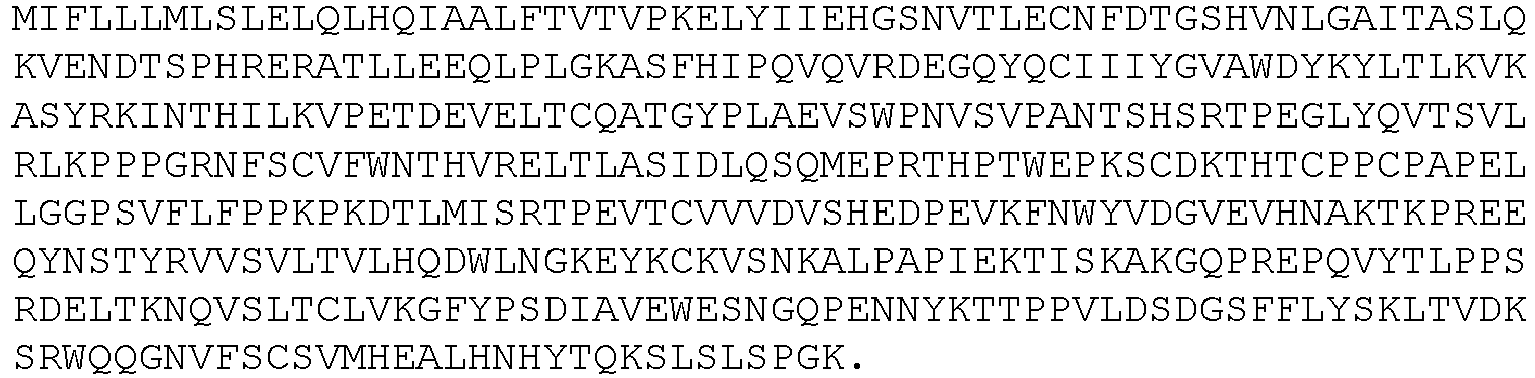
- In an embodiment, the targeting moiety comprises the
peptide AUNP 12 or any of the other peptides disclosed inUS 2011/0318373 or8,907,053 . For example, the targeting moiety may comprise AUNP 12 (i.e.,Compound 8 or SEQ ID NO:49 ofUS 2011/0318373 ) which has the sequence of SEQ ID NO: 125:
- In an embodiment, the targeting moiety comprises the anti-PD-1 antibody 1E3, or fragments thereof, as disclosed in
US 2014/0044738 . In illustrative embodiments, 1E3 or an antigen-binding fragment thereof for use in the methods provided herein comprises a heavy chain variable region comprising the amino acid sequence of:and/or a light chain variable region comprising the amino acid sequence of:

- In an embodiment, the targeting moiety comprises the anti-PD-1 antibody 1E8, or fragments thereof, as disclosed in
US 2014/0044738 . In illustrative embodiments, 1E8 or an antigen-binding fragment thereof for use in the methods provided herein comprises a heavy chain variable region comprising the amino acid sequence of: and/or a light chain variable region comprising the amino acid sequence of:

- In an embodiment, the targeting moiety comprises the anti-PD-1 antibody 1H3, or fragments thereof, as disclosed in
US 2014/0044738 . In illustrative embodiments, 1H3 or an antigen-binding fragment thereof for use in the methods provided herein comprises a heavy chain variable region comprising the amino acid sequence of:and/or light chain variable region comprising the amino acid sequence of:

- In an embodiment, the targeting moiety comprises a VHH directed against PD-1 as disclosed, for example, in
US 8,907,065 andWO 2008/071447 . In illustrative embodiments, the VHHs against PD-1 comprise SEQ ID NOS: 347-351 ofUS 8,907,065 : - SEQ ID No: 347 of
US 8,907,065 (SEQ ID NO: 132):
- SEQ ID No: 348 of
US 8,907,065 (SEQ ID NO: 133):
- SEQ ID No: 349 of
US 8,907,065 (SEQ ID NO: 134):
- SEQ ID No: 350 of
US 8,907,065 (SEQ ID NO: 135):
- SEQ ID No: 351 of
US 8,907,065 (SEQ ID NO: 136):
- In an embodiment, the targeting moiety comprises any one of the anti-PD-1 antibodies, or fragments thereof, as disclosed in
US2011/0271358 andWO2010/036959 . In illustrative embodiments, the antibody or an antigen-binding fragment thereof for use in the methods provided herein comprises a heavy chain comprising an amino acid sequence selected from SEQ ID NOS: 25-29 ofUS2011/0271358 : - SEQ ID No: 25 of
US2011/0271358 (SEQ ID NO: 137):
- SEQ ID No: 26 of
US2011/0271358 (SEQ ID NO: 138):
- SEQ ID No: 27 of
US2011/0271358 (SEQ ID NO: 139):
- SEQ ID No: 28 of
US2011/0271358 (SEQ ID NO: 140):
- SEQ ID No: 29 of
US2011/0271358 (SEQ ID NO: 141):
- SEQ ID No: 30 of
US2011/0271358 (SEQ ID NO: 142):
- SEQ ID No: 31 of
US2011/0271358 (SEQ ID NO: 143):
- SEQ ID No: 32 of
US2011/0271358 (SEQ ID NO: 144):
- SEQ ID No: 33 of
US2011/0271358 (SEQ ID NO: 145):
- In various embodiments, the present chimeric protein comprises one or more antibodies directed against PD-1, or antibody fragments thereof, selected from TSR-042 (Tesaro, Inc.), REGN2810 (Regeneron Pharmaceuticals, Inc.), PDR001 (Novartis Pharmaceuticals), and BGB-A317 (BeiGene Ltd.)
- In various embodiments, the present chimeric protein has one or more targeting moieties directed against PD-L1. In some embodiments, the chimeric protein has one or more targeting moieties which selectively bind a PD-L1 polypeptide. In some embodiments, the chimeric protein comprises one or more antibodies, antibody derivatives or formats, peptides or polypeptides, or fusion proteins that selectively bind a PD-L1 polypeptide.
- In an embodiment, the targeting moiety comprises the anti-PD-L1 antibody MEDI4736 (aka durvalumab), or fragments thereof. MEDI4736 is selective for PD-L1 and blocks the binding of PD-L1 to the PD-1 and CD80 receptors. MEDI4736 and antigen-binding fragments thereof for use in the methods provided herein comprises a heavy chain and a light chain or a heavy chain variable region and a light chain variable region. The sequence of MEDI4736 is disclosed in
WO/2016/06272 and/or a light chain comprising the amino acid sequence of:


- In illustrative embodiments, the MEDI4736 or an antigen-binding fragment thereof for use in the methods provided herein comprises a heavy chain variable region comprising the amino acid sequence of SEQ ID NO:4 of
WO/2016/06272 and/or a light chain variable region comprising the amino acid sequence of SEQ ID NO:3 of
WO/2016/06272 
- In an embodiment, the targeting moiety comprises the anti-PD-L1 antibody atezolizumab (aka MPDL3280A, RG7446), or fragments thereof. In illustrative embodiments, atezolizumab or an antigen-binding fragment thereof for use in the methods provided herein comprises a heavy chain comprising the amino acid sequence of:and/or a light chain comprising the amino acid sequence of:


- In an embodiment, the targeting moiety comprises the anti-PD-L1 antibody avelumab (aka MSB0010718C), or fragments thereof. In illustrative embodiments, avelumab or an antigen-binding fragment thereof for use in the methods provided herein comprises a heavy chain comprising the amino acid sequence of:and/or a light chain comprising the amino acid sequence of:


- In an embodiment, the targeting moiety comprises the anti-PD-L1 antibody BMS-936559 (aka 12A4, MDX-1 105), or fragments thereof, as disclosed in
US 2013/0309250 andWO2007/005874 . In illustrative embodiments, BMS-936559 or an antigen-binding fragment thereof for use in the methods provided herein comprises a heavy chain variable region comprising the amino acid sequence of:and/or a light chain variable region comprising the amino acid sequence of:

- In an embodiment, the targeting moiety comprises the anti-PD-L1 antibody 3G10, or fragments thereof, as disclosed in
US 2013/0309250 andWO2007/005874 . In illustrative embodiments, 3G10 or an antigen-binding fragment thereof for use in the methods provided herein comprises a heavy chain variable region comprising the amino acid sequence of:and/or a light chain variable region comprising the amino acid sequence of:

- In an embodiment, the targeting moiety comprises the anti-PD-L1 antibody 10A5, or fragments thereof, as disclosed in
US 2013/0309250 andWO2007/005874 . In illustrative embodiments, 10A5 or an antigen-binding fragment thereof for use in the methods provided herein comprises a heavy chain variable region comprising the amino acid sequence of:and/or a light chain variable region comprising the amino acid sequence of:

- In an embodiment, the targeting moiety comprises the anti-PD-L1 antibody 5F8, or fragments thereof, as disclosed in
US 2013/0309250 andWO2007/005874 . In illustrative embodiments, 5F8 or an antigen-binding fragment thereof for use in the methods provided herein comprises a heavy chain variable region comprising the amino acid sequence of:and/or a light chain variable region comprising the amino acid sequence of:

- In an embodiment, the targeting moiety comprises the anti-PD-L1 antibody 10H10, or fragments thereof, as disclosed in
US 2013/0309250 andWO2007/005874 . In illustrative embodiments, 10H10 or an antigen-binding fragment thereof for use in the methods provided herein comprises a heavy chain variable region comprising the amino acid sequence of:and/or a light chain variable region comprising the amino acid sequence of:

- In an embodiment, the targeting moiety comprises the anti-PD-L1 antibody 1B12, or fragments thereof, as disclosed in
US 2013/0309250 andWO2007/005874 . In illustrative embodiments, 1B12 or an antigen-binding fragment thereof for use in the methods provided herein comprises a heavy chain variable region comprising the amino acid sequence of:and/or a light chain variable region comprising the amino acid sequence of:

- In an embodiment, the targeting moiety comprises the anti-PD-L1 antibody 7H1, or fragments thereof, as disclosed in
US 2013/0309250 andWO2007/005874 . In illustrative embodiments, 7H1 or an antigen-binding fragment thereof for use in the methods provided herein comprises a heavy chain variable region comprising the amino acid sequence of:and/or a light chain variable region comprising the amino acid sequence of:

- In an embodiment, the targeting moiety comprises the anti-PD-L1 antibody 11E6, or fragments thereof, as disclosed in
US 2013/0309250 andWO2007/005874 . In illustrative embodiments, 11E6 or an antigen-binding fragment thereof for use in the methods provided herein comprises a heavy chain variable region comprising the amino acid sequence of:and/or a light chain variable region comprising the amino acid sequence of:

- In an embodiment, the targeting moiety comprises the anti-PD-L1 antibody 12B7, or fragments thereof, as disclosed in
US 2013/0309250 andWO2007/005874 . In illustrative embodiments, 12B7 or an antigen-binding fragment thereof for use in the methods provided herein comprises a heavy chain variable region comprising the amino acid sequence of:and/or a light chain variable region comprising the amino acid sequence of:

- In an embodiment, the targeting moiety comprises the anti-PD-L1 antibody 13G4, or fragments thereof, as disclosed in
US 2013/0309250 andWO2007/005874 . In illustrative embodiments, 13G4 or an antigen-binding fragment thereof for use in the methods provided herein comprises a heavy chain variable region comprising the amino acid sequence of:and/or a light chain variable region comprising the amino acid sequence of:

- In an embodiment, the targeting moiety comprises the anti-PD-L1 antibody 1E12, or fragments thereof, as disclosed in
US 2014/0044738 . In illustrative embodiments, 1E12 or an antigen-binding fragment thereof for use in the methods provided herein comprises a heavy chain variable region comprising the amino acid sequence of:and/or a light chain variable region comprising the amino acid sequence of:

- In an embodiment, the targeting moiety comprises the anti-PD-L1 antibody 1F4, or fragments thereof, as disclosed in
US 2014/0044738 . In illustrative embodiments, 1F4 or an antigen-binding fragment thereof for use in the methods provided herein comprises a heavy chain variable region comprising the amino acid sequence of:and/or a light chain variable region comprising the amino acid sequence of:

- In an embodiment, the targeting moiety comprises the anti-PD-L1 antibody 2G11, or fragments thereof, as disclosed in
US 2014/0044738 . In illustrative embodiments, 2G11 or an antigen-binding fragment thereof for use in the methods provided herein comprises a heavy chain variable region comprising the amino acid sequence of:and/or a light chain variable region comprising the amino acid sequence of:

- In an embodiment, the targeting moiety comprises the anti-PD-L1 antibody 3B6, or fragments thereof, as disclosed in
US 2014/0044738 . In illustrative embodiments, 3B6 or an antigen-binding fragment thereof for use in the methods provided herein comprises a heavy chain variable region comprising the amino acid sequence of:and/or a light chain variable region comprising the amino acid sequence of:

- In an embodiment, the targeting moiety comprises the anti-PD-L1 antibody 3D10, or fragments thereof, as disclosed in
US 2014/0044738 andWO2012/145493 . In illustrative embodiments, 3D10 or an antigen-binding fragment thereof for use in the methods provided herein comprises a heavy chain variable region comprising the amino acid sequence of:and/or a light chain variable region comprising the amino acid sequence of:

- In an embodiment, the targeting moiety comprises any one of the anti-PD-L1 antibodies disclosed in
US2011/0271358 andWO2010/036959 . In illustrative embodiments, the antibody or an antigen-binding fragment thereof for use in the methods provided herein comprises a heavy chain comprising an amino acid sequence selected from SEQ ID Nos: 34-38 ofUS2011/0271358 : - SEQ ID No: 34 of
US2011/0271358 (SEQ ID NO: 184):
- SEQ ID No: 35 of
US2011/0271358 (SEQ ID NO: 185):
- SEQ ID No: 36 of
US2011/0271358 (SEQ ID NO: 186):

- SEQ ID No: 37 of
US2011/0271358 (SEQ ID NO: 187):
- SEQ ID No: 38 of
US2011/0271358 (SEQ ID NO: 188):
- SEQ ID No: 39 of
US2011/0271358 (SEQ ID NO: 189):
- SEQ ID No: 40 of
US2011/0271358 (SEQ ID NO: 190):
- SEQ ID No: 41 of
US2011/0271358 (SEQ ID NO: 191):
- SEQ ID No: 42 of
US2011/0271358 (SEQ ID NO: 192):
- In an embodiment, the targeting moiety comprises the anti-PD-L1 antibody 2.7A4, or fragments thereof, as disclosed in
WO 2011/066389 ,US8,779,108 , andUS2014/0356353 . In illustrative embodiments, 2.7A4 or an antigen-binding fragment thereof for use in the methods provided herein comprises a heavy chain variable region comprising the amino acid sequence of:
SEQ ID No: 2 ofWO 2011/066389 (SEQ ID NO: 193):and/or a light chain variable region comprising the amino acid sequence of:
SEQ ID No: 7 ofWO 2011/066389 (SEQ ID NO: 194):

- In an embodiment, the targeting moiety comprises the anti-PD-L1 antibody 2.9D10, or fragments thereof, as disclosed in
WO 2011/066389 ,US8,779,108 , andUS2014/0356353 . In illustrative embodiments, 2.9D10 or an antigen-binding fragment thereof for use in the methods provided herein comprises a heavy chain variable region comprising the amino acid sequence of:
SEQ ID No: 12 ofWO 2011/066389 (SEQ ID NO: 195):and/or a light chain variable region comprising the amino acid sequence of:
SEQ ID No: 17 ofWO 2011/066389 (SEQ ID NO: 196):
- In an embodiment, the targeting moiety comprises the anti-PD-L1 antibody 2.14H9, or fragments thereof, as disclosed in
WO 2011/066389 ,US8,779,108 , andUS2014/0356353 . In illustrative embodiments, 2.14H9 or an antigen-binding fragment thereof for use in the methods provided herein comprises a heavy chain variable region comprising the amino acid sequence of:
SEQ ID No: 22 ofWO 2011/066389 (SEQ ID NO: 197):and/or a light chain variable region comprising the amino acid sequence of:
SEQ ID No: 27 ofWO 2011/066389 (SEQ ID NO: 198):
- In an embodiment, the targeting moiety comprises the anti-PD-L1 antibody 2.20A8, or fragments thereof, as disclosed in
WO 2011/066389 ,US8,779,108 , andUS2014/0356353 . In illustrative embodiments, 2.20A8 or an antigen-binding fragment thereof for use in the methods provided herein comprises a heavy chain variable region comprising the amino acid sequence of:
SEQ ID No: 32 ofWO 2011/066389 (SEQ ID NO: 199):and/or a light chain variable region comprising the amino acid sequence of:
SEQ ID No: 37 ofWO 2011/066389 (SEQ ID NO: 200):
- In an embodiment, the targeting moiety comprises the anti-PD-L1 antibody 3.15G8, or fragments thereof, as disclosed in
WO 2011/066389 ,US8,779,108 , andUS2014/0356353 . In illustrative embodiments, 3.15G8 or an antigen-binding fragment thereof for use in the methods provided herein comprises a heavy chain variable region comprising the amino acid sequence of:
SEQ ID No: 42 ofWO 2011/066389 (SEQ ID NO: 201):and/or a light chain variable region comprising the amino acid sequence of:
SEQ ID No: 47 ofWO 2011/066389 (SEQ ID NO: 202):
- In an embodiment, the targeting moiety comprises the anti-PD-L1 antibody 3.18G1, or fragments thereof, as disclosed in
WO 2011/066389 ,US8,779,108 , andUS2014/0356353 . In illustrative embodiments, 3.18G1 or an antigen-binding fragment thereof for use in the methods provided herein comprises a heavy chain variable region comprising the amino acid sequence of:
SEQ ID No: 52 ofWO 2011/066389 (SEQ ID NO: 203):and/or a light chain variable region comprising the amino acid sequence of:
SEQ ID No: 57 ofWO 2011/066389 (SEQ ID NO: 204):
- In an embodiment, the targeting moiety comprises the anti-PD-L1 antibody 2.7 MOPT, or fragments thereof, as disclosed in
WO 2011/066389 ,US8,779,108 , andUS2014/0356353 , andUS2014/0356353 . In illustrative embodiments, 2.7A4OPT or an antigen-binding fragment thereof for use in the methods provided herein comprises a heavy chain variable region comprising the amino acid sequence of:
SEQ ID No: 62 ofWO 2011/066389 (SEQ ID NO: 205):and/or a light chain variable region comprising the amino acid sequence of:
SEQ ID No: 67 ofWO 2011/066389 (SEQ ID NO: 206):
- In an embodiment, the targeting moiety comprises the anti-PD-L1 antibody 2.14H9OPT, or fragments thereof, as disclosed in
WO 2011/066389 ,US8,779,108 , andUS2014/0356353 . In illustrative embodiments, 2.14H9OPT or an antigen-binding fragment thereof for use in the methods provided herein comprises a heavy chain variable region comprising the amino acid sequence of:
SEQ ID No: 72 ofWO 2011/066389 (SEQ ID NO: 207):and/or a light chain variable region comprising the amino acid sequence of:
SEQ ID No: 77 ofWO 2011/066389 (SEQ ID NO: 208):
- In an embodiment, the targeting moiety comprises any one of the anti-PD-L1 antibodies disclosed in
WO2016/061142 . In illustrative embodiments, the antibody or an antigen-binding fragment thereof for use in the methods provided herein comprises a heavy chain comprising an amino acid sequence selected from SEQ ID Nos: 18, 30, 38, 46, 50, 54, 62, 70, and 78 ofWO2016/061142 : - SEQ ID No: 18 of
WO2016/061142 (SEQ ID NO: 209):
- SEQ ID No: 30 of
WO2016/061142 (SEQ ID NO: 210):
- SEQ ID No: 38 of
WO2016/061142 (SEQ ID NO: 211):

- SEQ ID No: 46 of
WO2016/061142 (SEQ ID NO: 212):
- SEQ ID No: 50 of
WO2016/061142 (SEQ ID NO: 213):
- SEQ ID No: 54 of
WO2016/061142 (SEQ ID NO: 214):
- SEQ ID No: 62 of
WO2016/061142 : (SEQ ID NO: 215)
- SEQ ID No: 70 of
WO2016/061142 (SEQ ID NO: 216):
- SEQ ID No: 78 of
WO2016/061142 (SEQ ID NO: 217):
- SEQ ID No: 22 of
WO2016/061142 (SEQ ID NO: 218):
- SEQ ID No: 26 of
WO2016/061142 (SEQ ID NO: 219):
- SEQ ID No: 34 of
WO2016/061142 (SEQ ID NO: 220):
- SEQ ID No: 42 of
WO2016/061142 (SEQ ID NO: 221):
- SEQ ID No: 58 of
WO2016/061142 (SEQ ID NO: 222):
- SEQ ID No: 66 of
WO2016/061142 (SEQ ID NO: 223):
- SEQ ID No: 74 of
WO2016/061142 (SEQ ID NO: 224):
- SEQ ID No: 82 of
WO2016/061142 (SEQ ID NO: 225):
- SEQ ID No: 86 of
WO2016/061142 (SEQ ID NO: 226):
- In an embodiment, the targeting moiety comprises any one of the anti-PD-L1 antibodies disclosed in
WO2016/022630 . In illustrative embodiments, the antibody or an antigen-binding fragment thereof for use in the methods provided herein comprises a heavy chain comprising an amino acid sequence selected from SEQ ID Nos: 2, 6, 10, 14, 18, 22, 26, 30, 34, 38, 42, and 46 ofWO2016/022630 : - SEQ ID No: 2 of
WO2016/022630 (SEQ ID NO: 227):
- SEQ ID No: 6 of
WO2016/022630 (SEQ ID NO: 228):
- SEQ ID No: 10 of
WO2016/022630 (SEQ ID NO: 229):
- SEQ ID No: 14 of
WO2016/022630 (SEQ ID NO: 230):
- SEQ ID No: 18 of
WO2016/022630 (SEQ ID NO: 231):
- SEQ ID No: 22 of
WO2016/022630 (SEQ ID NO: 232):
- SEQ ID No: 26 of
WO2016/022630 (SEQ ID NO: 233):
- SEQ ID No: 30 of
WO2016/022630 (SEQ ID NO: 234):
- SEQ ID No: 34 of
WO2016/022630 (SEQ ID NO: 235):
- SEQ ID No: 38 of
WO2016/022630 (SEQ ID NO: 236):
- SEQ ID No: 42 of
WO2016/022630 (SEQ ID NO: 237):
- SEQ ID No: 46 of
WO2016/022630 (SEQ ID NO: 238):
- SEQ ID No: 4 of
WO2016/022630 (SEQ ID NO: 239):
- SEQ ID No: 8 of
WO2016/022630 (SEQ ID NO: 240):
- SEQ ID No: 12 of
WO2016/022630 (SEQ ID NO: 241):
- SEQ ID No: 16 of
WO2016/022630 (SEQ ID NO: 242):
- SEQ ID No: 20 of
WO2016/022630 (SEQ ID NO: 243):
- SEQ ID No: 24 of
WO2016/022630 (SEQ ID NO: 244):
- SEQ ID No: 28 of
WO2016/022630 (SEQ ID NO: 245):
- SEQ ID No: 32 of
WO2016/022630 (SEQ ID NO: 246):
- SEQ ID No: 36 of
WO2016/022630 (SEQ ID NO: 247):
- SEQ ID No: 40 of
WO2016/022630 (SEQ ID NO: 248):
- SEQ ID No: 44 of
WO2016/022630 (SEQ ID NO: 249):
- SEQ ID No: 48 of
WO2016/022630 (SEQ ID NO: 250):
- In an embodiment, the targeting moiety comprises any one of the anti-PD-L1 antibodies disclosed in
WO2015/112900 . In illustrative embodiments, the antibody or an antigen-binding fragment thereof for use in the methods provided herein comprises a heavy chain comprising an amino acid sequence selected from SEQ ID Nos: 38, 50, 82, and 86 ofWO 2015/112900 : - SEQ ID No: 38 of
WO2015/112900 (SEQ ID NO: 251):
- SEQ ID No: 50 of
WO 2015/112900 (SEQ ID NO: 252):
- SEQ ID No: 82 of
WO 2015/112900 (SEQ ID NO: 253):
- SEQ ID No: 86 of
WO 2015/112900 (SEQ ID NO: 254):
- SEQ ID No: 42 of
WO2015/112900 (SEQ ID NO: 255):
- SEQ ID No: 46 of
WO 2015/112900 (SEQ ID NO: 256):
- SEQ ID No: 54 of
WO 2015/112900 (SEQ ID NO: 257):
- SEQ ID No: 58 of
WO 2015/112900 (SEQ ID NO: 258):
- SEQ ID No: 62 of
WO 2015/112900 (SEQ ID NO: 259):
- SEQ ID No: 66 of
WO 2015/112900 (SEQ ID NO: 260):
- SEQ ID No: 70 of
WO 2015/112900 (SEQ ID NO: 261):
- SEQ ID No: 74 of
WO 2015/112900 (SEQ ID NO: 262):
- SEQ ID No: 78 of
WO 2015/112900 (SEQ ID NO: 263):
- In an embodiment, the targeting moiety comprises any one of the anti-PD-L1 antibodies disclosed in
WO 2010/077634 andUS 8,217,149 . In illustrative embodiments, the anti-PD-L1 antibody or an antigen-binding fragment thereof for use in the methods provided herein comprises a heavy chain region comprising the amino acid sequence of:
SEQ ID No: 20 ofWO 2010/077634 (SEQ ID NO: 264):and/or a light chain variable region comprising the amino acid sequence of:
SEQ ID No: 21 ofWO 2010/077634 (SEQ ID NO: 265):
- In an embodiment, the targeting moiety comprises any one of the anti-PD-L1 antibodies obtainable from the hybridoma accessible under CNCM deposit numbers CNCM I-4122, CNCM I-4080 and CNCM I-4081 as disclosed in
US 20120039906 . - In an embodiment, the targeting moiety comprises a VHH directed against PD-L1 as disclosed, for example, in
US 8,907,065 andWO 2008/071447 . In illustrative embodiments, the VHHs against PD-L1 comprise SEQ ID NOS: 394-399 ofUS 8,907,065 : - SEQ ID No: 394 of
US 8,907,065 (SEQ ID NO: 266):
- SEQ ID No: 395 of
US 8,907,065 (SEQ ID NO: 267):
- SEQ ID No: 396 of
US 8,907,065 (SEQ ID NO: 268):
- SEQ ID No: 397 of
US 8,907,065 (SEQ ID NO: 269):
- SEQ ID No: 398 of
US 8,907,065 (SEQ ID NO: 270):
- SEQ ID No: 399 of
US 8,907,065 (SEQ ID NO: 271):
- In various embodiments, the present chimeric protein has one or more targeting moieties directed against PD-L2. In some embodiments, the chimeric protein has one or more targeting moieties which selectively bind a PD-L2 polypeptide. In some embodiments, the chimeric protein comprises one or more antibodies, antibody derivatives or formats, peptides or polypeptides, or fusion proteins that selectively bind a PD-L2 polypeptide.
- In an embodiment, the targeting moiety comprises a VHH directed against PD-L2 as disclosed, for example, in
US 8,907,065 andWO 2008/071447 . In illustrative embodiments, the VHHs against PD-1 comprise SEQ ID Nos: 449-455 ofUS 8,907,065 : - SEQ ID No: 449 of
US 8,907,065 (SEQ ID NO: 272):
- SEQ ID No: 450 of
US 8,907,065 (SEQ ID NO: 273):
- SEQ ID No: 451 of
US 8,907,065 (SEQ ID NO: 274):
- SEQ ID No: 452 of
US 8,907,065 (SEQ ID NO: 275):
- SEQ ID No: 453 of
US 8,907,065 (SEQ ID NO: 276):
- SEQ ID No: 454 of
US 8,907,065 (SEQ ID NO: 277):
- SEQ ID No: 455 of
US 8,907,065 (SEQ ID NO: 278):
- In an embodiment, the targeting moiety comprises any one of the anti-PD-L2 antibodies disclosed in
US2011/0271358 andWO2010/036959 . In illustrative embodiments, the antibody or an antigen-binding fragment thereof for use in the methods provided herein comprises a heavy chain comprising an amino acid sequence selected from SEQ ID Nos: 43-47 ofUS2011/0271358 : - SEQ ID No: 43 of
US2011/0271358 (SEQ ID NO: 279):
- SEQ ID No: 44 of
US2011/0271358 (SEQ ID NO: 280):
- SEQ ID No: 45 of
US2011/0271358 (SEQ ID NO: 281):
- SEQ ID No: 46 of
US2011/0271358 (SEQ ID NO: 282):
- SEQ ID No: 47 of
US2011/0271358 (SEQ ID NO: 283):
- SEQ ID No: 48 of
US2011/0271358 (SEQ ID NO: 284):
- SEQ ID No: 49 of
US2011/0271358 (SEQ ID NO: 285):
- SEQ ID No: 50 of
US2011/0271358 (SEQ ID NO: 286):
- SEQ ID No: 51 of
US2011/0271358 (SEQ ID NO: 287):

- In various embodiments, the targeting moieties of the invention may comprise a sequence that targets PD-1, PD-L1, and/or PD-L2 which is at least about 60%, at least about 61%, at least about 62%, at least about 63%, at least about 64%, at least about 65%, at least about 66%, at least about 67%, at least about 68%, at least about 69%, at least about 70%, at least about 71%, at least about 72%, at least about 73%, at least about 74%, at least about 75%, at least about 76%, at least about 77%, at least about 78%, at least about 79%, at least about 80%, at least about 81%, at least about 82%, at least about 83%, at least about 84%, at least about 85%, at least about 86%, at least about 87%, at least about 88%, at least about 89%, at least about 90%, at least about 91%, at least about 92%, at least about 93%, at least about 94%, at least about 95%, at least about 96%, at least about 97%, at least about 98%, at least about 99%, or 100% identical to any of the sequences disclosed herein (e.g. about 60%, or about 61%, or about 62%, or about 63%, or about 64%, or about 65%, or about 66%, or about 67%, or about 68%, or about 69%, or about 70%, or about 71%, or about 72%, or about 73%, or about 74%, or about 75%, or about 76%, or about 77%, or about 78%, or about 79%, or about 80%, or about 81%, or about 82%, or about 83%, or about 84%, or about 85%, or about 86%, or about 87%, or about 88%, or about 89%, or about 90%, or about 91%, or about 92%, or about 93%, or about 94%, or about 95%, or about 96%, or about 97%, or about 98%, about 99% or about 100% sequence identity with any of the sequences disclosed herein).
- In various embodiments, the targeting moieties of the invention may comprise any combination of heavy chain, light chain, heavy chain variable region, light chain variable region, complementarity determining region (CDR), and framework region sequences that target PD-1, PD-L1, and/or PD-L2 as disclosed herein.
- Additional antibodies, antibody derivatives or formats, peptides or polypeptides, or fusion proteins that selectively bind or target PD-1, PD-L1 and/or PD-L2 are disclosed in
WO 2011/066389 ,US 2008/0025980 ,US 2013/0034559 ,US 8,779,108 ,US 2014/0356353 ,US 8,609,089 ,US 2010/028330 ,US 2012/0114649 ,WO 2010/027827 ,WO 2011 066342 US 8,907,065 ,WO 2016/062722 ,WO 2009/101611 ,WO2010/027827 ,WO 2011/066342 ,WO 2007/005874 ,WO 2001/014556 ,US2011/0271358 ,WO 2010/036959 ,WO 2010/077634 ,US 8,217,149 ,US 2012/0039906 ,WO 2012/145493 ,US 2011/0318373 ,U.S. Patent No. 8,779,108 ,US 20140044738 ,WO 2009/089149 ,WO 2007/00587 WO 2016061142 ,WO 2016,02263 WO 2010/077634 , andWO 2015/112900 . - In one embodiment, the present chimeric protein has (i) a targeting moiety directed against a T cell, for example, mediated by targeting to CD8 and (ii) a targeting moiety is directed against a tumor cell, along with any of the modified (e.g. mutant) signaling agents described herein. In an embodiment, the present chimeric protein has a targeting moiety directed against CD8 on T cells and a second targeting moiety directed against PD-L1 or PD-L2 on tumor cells.
- In one embodiment, the present chimeric protein has (i) a targeting moiety directed against a T cell, for example, mediated by targeting to CD4 and (ii) a targeting moiety is directed against a tumor cell, along with any of the mutant IFNα2 described herein. In an embodiment, the present chimeric protein has a targeting moiety directed against CD4 on T cells and a second targeting moiety directed against PD-L1 or PD-L2 on tumor cells.
- In one embodiment, the present chimeric protein has (i) a targeting moiety directed against a T cell, for example, mediated by targeting to CD3, CXCR3, CCR4, CCR9, CD70, CD103, or one or more immune checkpoint markers and (ii) a targeting moiety is directed against a tumor cell, along with any of the mutant IFNα2 described herein. In an embodiment, the present chimeric protein has a targeting moiety directed against CD3 on T cells and a second targeting moiety directed against PD-L1 or PD-L2 on tumor cells.
- In some embodiments, the present chimeric protein has one or more targeting moieties directed against CD3 expressed on T cells. In some embodiments, the chimeric protein has one or more targeting moieties which selectively bind a CD3 polypeptide. In some embodiments, the chimeric protein comprises one or more antibodies, antibody derivatives or formats, peptides or polypeptides, or fusion proteins that selectively bind a CD3 polypeptide.
- In an embodiment, the targeting moiety comprises the anti-CD3 antibody muromonab-CD3 (aka Orthoclone OKT3), or fragments thereof. Muromonab-CD3 is disclosed in
U.S. Patent No. 4,361,549 and Wilde et al. (1996) 51:865-894. In illustrative embodiments, muromonab-CD3 or an antigen-binding fragment thereof for use in the methods provided herein comprises a heavy chain comprising the amino acid sequence of:and/or a light chain comprising the amino acid sequence of:

- In an embodiment, the targeting moiety comprises the anti-CD3 antibody otelixizumab, or fragments thereof. Otelixizumab is disclosed in
U.S. Patent Publication No. 20160000916 and Chatenoud et al. (2012) 9:372-381. In illustrative embodiments, otelixizumab or an antigen-binding fragment thereof for use in the methods provided herein comprises a heavy chain comprising the amino acid sequence of:and/or a light chain comprising the amino acid sequence of:

- In an embodiment, the targeting moiety comprises the anti-CD3 antibody teplizumab (AKA MGA031 and hOKT3γ1(Ala-Ala)), or fragments thereof. Teplizumab is disclosed in Chatenoud et al. (2012) 9:372-381. In illustrative embodiments, teplizumab or an antigen-binding fragment thereof for use in the methods provided herein comprises a heavy chain comprising the amino acid sequence of:and/or a light chain comprising the amino acid sequence of:


- In an embodiment, the targeting moiety comprises the anti-CD3 antibody visilizumab (AKA Nuvion®; HuM291), or fragments thereof. Visilizumab is disclosed in
U.S. 5,834,597 andWO2004052397 , and Cole et al., Transplantation (1999) 68:563-571. In illustrative embodiments, visilizumab or an antigen-binding fragment thereof for use in the methods provided herein comprises a heavy chain variable region comprising the amino acid sequence of:and/or a light chain variable region comprising the amino acid sequence of:

- In an embodiment, the targeting moiety comprises the anti-CD3 antibody foralumab (aka NI-0401), or fragments thereof. In various embodiments, the targeting moiety comprises any one of the anti-CD3 antibodies disclosed in
US20140193399 ,US 7,728,114 ,US20100183554 , andUS 8,551,478 . - In illustrative embodiments, the anti-CD3 antibody or an antigen-binding fragment thereof for use in the methods provided herein comprises a heavy chain variable region comprising the amino acid sequence of SEQ ID Nos: 2 and 6 of
US 7,728,114 : - SEQ ID No: 2 of
US 7,728,114 (SEQ ID NO: 296):
- SEQ ID No: 6 of
US 7,728,114 (SEQ ID NO: 297):
- SEQ ID No: 4 of
US 7,728,114 (SEQ ID NO: 298):
- SEQ ID No: 8 of
US 7,728,114 (SEQ ID NO: 299):
- In an embodiment, the targeting moiety comprises a heavy chain variable region comprising the amino acid sequence of SEQ ID NO:2 of
US 7,728,114 and a light chain variable region comprising the amino acid sequence of SEQ ID NO:4 ofUS 7,728,114 . In an embodiment, the targeting moiety comprises any one of the anti-CD3 antibodies disclosed inUS2016/0168247 . In illustrative embodiments, the antibody or an antigen-binding fragment thereof for use in the methods provided herein comprises a heavy chain comprising an amino acid sequence selected from SEQ ID Nos: 6-9 ofUS2016/0168247 : - SEQ ID No: 6 of
US2016/0168247 (SEQ ID NO: 300):
- SEQ ID No: 7 of
US2016/0168247 (SEQ ID NO: 301):
- SEQ ID No: 8 of
US2016/0168247 (SEQ ID NO: 302):
- SEQ ID No: 9 of
US2016/0168247 (SEQ ID NO: 303):
- SEQ ID No: 10 of
US2016/0168247 (SEQ ID NO: 304):
- SEQ ID No: 11 of
US2016/0168247 (SEQ ID NO: 305):
- SEQ ID No: 12 of
US2016/0168247 (SEQ ID NO: 306):
- In an embodiment, the targeting moiety comprises any one of the anti-CD3 antibodies disclosed in
US2015/0175699 . In illustrative embodiments, the antibody or an antigen-binding fragment thereof for use in the methods provided herein comprises a heavy chain comprising an amino acid sequence selected from SEQ ID No: 9 ofUS2015/0175699 : and/or a light chain comprising an amino acid sequence selected from SEQ ID No: 10 of
US2015/0175699 :
- In an embodiment, the targeting moiety comprises any one of the anti-CD3 antibodies disclosed in
US 8,784,821 . In illustrative embodiments, the antibody or an antigen-binding fragment thereof for use in the methods provided herein comprises a heavy chain comprising an amino acid sequence selected from SEQ ID Nos: 2, 18, 34, 50, 66, 82, 98 and 114 ofUS 8,784,821 : - SEQ ID No: 2 of
US 8,784,821 (SEQ ID NO: 309):
- SEQ ID No: 18 of
US 8,784,821 (SEQ ID NO: 310):
- SEQ ID No: 34 of
US 8,784,821 (SEQ ID NO: 311):
- SEQ ID No: 50 of
US 8,784,821 (SEQ ID NO: 312):
- SEQ ID No: 66 of
US 8,784,821 (SEQ ID NO: 313):
- SEQ ID No: 82 of
US 8,784,821 (SEQ ID NO: 314):
- SEQ ID No: 98 of
US 8,784,821 (SEQ ID NO: 315):
- SEQ ID No: 114 of
US 8,784,821 (SEQ ID NO: 316):
- SEQ ID No: 10 of
US 8,784,821 (SEQ ID NO: 317):
- SEQ ID No: 26 of
US 8,784,821 (SEQ ID NO: 318):
- SEQ ID No: 42 of
US 8,784,821 (SEQ ID NO: 319):
- SEQ ID No: 58 of
US 8,784,821 (SEQ ID NO: 320):
- SEQ ID No: 74 of
US 8,784,821 (SEQ ID NO: 321):
- SEQ ID No: 90 of
US 8,784,821 (SEQ ID NO: 322):
- SEQ ID No: 106 of
US 8,784,821 (SEQ ID NO: 323):
- SEQ ID No: 122 of
US 8,784,821 (SEQ ID NO: 324):
- In an embodiment, the targeting moiety comprises any one of the anti-CD3 binding constructs disclosed in
US20150118252 . In illustrative embodiments, the antibody or an antigen-binding fragment thereof for use in the methods provided herein comprises a heavy chain comprising an amino acid sequence selected from SEQ ID Nos: 6 and 86 ofUS20150118252 : - SEQ ID No: 6 of
US20150118252 (SEQ ID NO: 325):
- SEQ ID No: 86 of
US20150118252 (SEQ ID NO: 326):
- In an embodiment, the targeting moiety comprises any one of the anti-CD3 binding proteins disclosed in
US2016/0039934 . In illustrative embodiments, the antibody or an antigen-binding fragment thereof for use in the methods provided herein comprises a heavy chain comprising an amino acid sequence selected from SEQ ID Nos: 6-9 ofUS2016/0039934 : - SEQ ID No: 6 of
US2016/0039934 (SEQ ID NO: 328):
- SEQ ID No: 7 of
US2016/0039934 (SEQ ID NO: 329):
- SEQ ID No: 8 of
US2016/0039934 (SEQ ID NO: 330):
- SEQ ID No: 9 of
US2016/0039934 (SEQ ID NO: 331):
- SEQ ID No: 1 of
US2016/0039934 (SEQ ID NO: 332):
- SEQ ID No: 2 of
US2016/0039934 (SEQ ID NO: 333):
- SEQ ID No: 3 of
US2016/0039934 (SEQ ID NO: 334):
- SEQ ID No: 4 of
US2016/0039934 (SEQ ID NO: 335):
- In various embodiments, the targeting moieties of the invention may comprise a sequence that targets CD3 which is at least about 60%, at least about 61%, at least about 62%, at least about 63%, at least about 64%, at least about 65%, at least about 66%, at least about 67%, at least about 68%, at least about 69%, at least about 70%, at least about 71%, at least about 72%, at least about 73%, at least about 74%, at least about 75%, at least about 76%, at least about 77%, at least about 78%, at least about 79%, at least about 80%, at least about 81%, at least about 82%, at least about 83%, at least about 84%, at least about 85%, at least about 86%, at least about 87%, at least about 88%, at least about 89%, at least about 90%, at least about 91%, at least about 92%, at least about 93%, at least about 94%, at least about 95%, at least about 96%, at least about 97%, at least about 98%, at least about 99%, or 100% identical to any of the sequences disclosed herein (e.g. about 60%, or about 61%, or about 62%, or about 63%, or about 64%, or about 65%, or about 66%, or about 67%, or about 68%, or about 69%, or about 70%, or about 71%, or about 72%, or about 73%, or about 74%, or about 75%, or about 76%, or about 77%, or about 78%, or about 79%, or about 80%, or about 81%, or about 82%, or about 83%, or about 84%, or about 85%, or about 86%, or about 87%, or about 88%, or about 89%, or about 90%, or about 91%, or about 92%, or about 93%, or about 94%, or about 95%, or about 96%, or about 97%, or about 98%, about 99% or about 100% sequence identity with any of the sequences disclosed herein).
- In various embodiments, the targeting moieties of the invention may comprise any combination of heavy chain, light chain, heavy chain variable region, light chain variable region, complementarity determining region (CDR), and framework region sequences that target CD3 as disclosed herein. In various embodiments, the targeting moieties of the invention may comprise any heavy chain, light chain, heavy chain variable region, light chain variable region, complementarity determining region (CDR), and framework region sequences of the CD3-specific antibodies including, but not limited to, X35-3, VIT3, BMA030 (BW264/56), CLB-T3/3, CRIS7, YTH12.5, Fl 11-409, CLB-T3.4.2, TR-66, WT32, SPv-T3b, 11D8, XIII-141, XIII-46, XIII-87, 12F6, T3/RW2-8C8, T3/RW2-4B6, OKT3D, M-T301, SMC2, WT31 and F101.01. These CD3-specific antibodies are well known in the art and, inter alia, described in Tunnacliffe (1989), Int. Immunol. 1, 546-550.
- Additional antibodies, antibody derivatives or formats, peptides or polypeptides, or fusion proteins that selectively bind or target CD3 are disclosed in
US Patent Publication No. 2016/0000916 ,US Patent Nos. 4,361,549 ,5,834,597 ,6,491,916 ,6,406,696 ,6,143,297 ,6,750,325 and International Publication No.WO 2004/052397 . - In some embodiments, the CD3 targeting moiety is a scFv. In some embodiments, the CD3 targeting moiety is:

- In one embodiment, the present chimeric protein has (i) a targeting moiety directed against a T cell, for example, mediated by targeting to PD-1 and (ii) a targeting moiety is directed against a tumor cell, along with any of the mutant IFNα2 described herein.
- By way of non-limiting example, in various embodiments, the present chimeric protein has (i) a targeting moiety directed against a B cell, for example, mediated by targeting to CD10, CD19, CD20, CD21, CD22, CD23, CD24, CD37, CD38, CD39, CD40, CD70, CD72, CD73, CD74, CDw75, CDw76, CD77, CD78, CD79a/b, CD80, CD81, CD82, CD83, CD84, CD85, CD86, CD89, CD98, CD126, CD127, CDw130, CD138, or CDw150; and (ii) a targeting moiety is directed against a tumor cell, along with any of the mutant IFNα2 described herein.
- In one embodiment, the present chimeric protein has (i) a targeting moiety directed against a B cell, for example, mediated by targeting to CD19, CD20 or CD70 and (ii) a targeting moiety is directed against a tumor cell, along with any of the mutant IFNα2 described herein.
- In one embodiment, the present chimeric protein has (i) a targeting moiety directed against a B cell, for example, mediated by targeting to CD20 and (ii) a targeting moiety is directed against a tumor cell, along with any of the mutant IFNα2 described herein. In an embodiment, the present chimeric protein has a targeting moiety directed against CD20 on B cells and a second targeting moiety directed against PD-L1 or PD-L2 on tumor cells.
- In some embodiments, the CD20 targeting moiety is a scFv. In some embodiments, the CD20 targeting moiety is:

- By way of non-limiting example, in various embodiments, the present chimeric protein has (i) a targeting moiety directed against a NK cell, for example, mediated by targeting to 2B4/SLAMF4, KIR2DS4, CD155/PVR, KIR3DL1, CD94, LMIR1/CD300A, CD69, LMIR2/CD300c, CRACC/SLAMF7, LMIR3/CD300LF, DNAM-1, LMIR5/CD300LB, Fc-epsilon RII, LMIR6/CD300LE, Fc-γ RI/CD64, MICA, Fc-γ RIIB/CD32b, MICB, Fc-γ RIIC/CD32c, MULT-1, Fc-γ RIIA/CD32a, Nectin-2/CD112, Fc-γ RIII/CD16, NKG2A, FcRH1/IRTA5, NKG2C, FcRH2/IRTA4, NKG2D, FcRH4/IRTA1, NKp30, FcRH5/IRTA2, NKp44, Fc-Receptor-like 3/CD16-2, NKp46/NCR1, NKp80/KLRF1, NTB-A/SLAMF6, Rae-1, Rae-1 α, Rae-1 β, Rae-1 delta, H60, Rae-1 epsilon, ILT2/CD85j, Rae-1 γ, ILT3/CD85k, TREM-1, ILT4/CD85d, TREM-2, ILT5/CD85a, TREM-3, KIR/CD158, TREML1/TLT-1, KIR2DL1, ULBP-1, KIR2DL3, ULBP-2, KIR2DL4/CD158d, or ULBP-3; and (ii) a targeting moiety is directed against a tumor cell, along with any of the mutant IFNα2 described herein.
- In one embodiment, the present chimeric protein has (i) a targeting moiety directed against a NK cell, for example, mediated by targeting to Kir1alpha, DNAM-1 or CD64 and (ii) a targeting moiety is directed against a tumor cell, along with any of the mutant IFNα2 described herein.
- In one embodiment, the present chimeric protein has (i) a targeting moiety directed against a NK cell, for example, mediated by targeting to KIR1 and (ii) a targeting moiety is directed against a tumor cell, along with any of the mutant IFNα2 described herein. In an embodiment, the present chimeric protein has a targeting moiety directed against KIR1 on NK cells and a second targeting moiety directed against PD-L1 or PD-L2 on tumor cells.
- In one embodiment, the present chimeric protein has (i) a targeting moiety directed against a NK cell, for example, mediated by targeting to TIGIT or KIR1 and (ii) a targeting moiety is directed against a tumor cell, along with any of the mutant IFNα2 described herein. In an embodiment, the present chimeric protein has a targeting moiety directed against TIGIT on NK cells and a second targeting moiety directed against PD-L1 or PD-L2 on tumor cells.
- By way of non-limiting example, in various embodiments, the present chimeric protein has (i) a targeting moiety directed against a dendritic cell, for example, mediated by targeting to CLEC-9A, XCR1, RANK, CD36/SRB3, LOX-1/SR-E1, CD68, MARCO, CD163, SR-A1/MSR, CD5L, SREC-1, CL-PI/COLEC12, SREC-II, LIMPIIISRB2, RP105, TLR4, TLR1, TLR5, TLR2, TLR6, TLR3, TLR9, 4-IBB Ligand/TNFSF9, IL-12/IL-23 p40, 4-Amino-1,8-naphthalimide, ILT2/CD85j, CCL21/6Ckine, ILT3/CD85k, 8-oxo-dG, ILT4/CD85d, 8D6A, ILT5/CD85a, A2B5, lutegrin α 4/CD49d, Aag, Integrin β 2/CD18, AMICA, Langerin, B7-2/CD86, Leukotriene B4 RI, B7-H3, LMIR1/CD300A, BLAME/SLAMF8, LMIR2/CD300c, Clq R1/CD93, LMIR3/CD300LF, CCR6, LMIR5/CD300LB CCR7, LMIR6/CD300LE, CD40/TNFRSF5, MAG/Siglec-4-a, CD43, MCAM, CD45, MD-1, CD68, MD-2, CD83, MDL-1/CLEC5A, CD84/SLAMF5, MMR, CD97, NCAMLI, CD2F-10/SLAMF9, Osteoactivin GPNMB, Chern 23, PD-L2, CLEC-1, RP105, CLEC-2, Siglec-2/CD22, CRACC/SLAMF7, Siglec-3/CD33, DC-SIGN, Siglec-5, DC-SIGNR/CD299, Siglec-6, DCAR, Siglec-7, DCIR/CLEC4A, Siglec-9, DEC-205, Siglec-10, Dectin-1/CLEC7A, Siglec-F, Dectin-2/CLEC6A, SIGNR1/CD209, DEP-1/CD148, SIGNR4, DLEC, SLAM, EMMPRIN/CD147, TCCR/WSX-1, Fc-γ R1/CD64, TLR3, Fc-γ RIIB/CD32b, TREM-1, Fc-γ RIIC/CD32c, TREM-2, Fc-γ RIIA/CD32a, TREM-3, Fc-γ RIII/CD16, TREML1/TLT-1, ICAM-2/CD102, or Vanilloid R1; and (ii) a targeting moiety is directed against a tumor cell, along with any of the mutant IFNα2 described herein.
- In one embodiment, the present chimeric protein has (i) a targeting moiety directed against a dendritic cell, for example, mediated by targeting to CLEC-9A, DC-SIGN, CD64, CLEC4A, or DEC205 and (ii) a targeting moiety is directed against a tumor cell, along with any of the mutant IFNα2 described herein. In an embodiment, the present chimeric protein has a targeting moiety directed against CLEC9A on dendritic cells and a second targeting moiety directed against PD-L1 or PD-L2 on tumor cells.
- In one embodiment, the present chimeric protein has (i) a targeting moiety directed against a dendritic cell, for example, mediated by targeting to CLEC9A and (ii) a targeting moiety is directed against a tumor cell, along with any of the mutant IFNα2 described herein. In an embodiment, the present chimeric protein has a targeting moiety directed against CLEC9A on dendritic cells and a second targeting moiety directed against PD-L1 or PD-L2 on tumor cells.
- In one embodiment, the present chimeric protein has (i) a targeting moiety directed against a dendritic cell, for example, mediated by targeting to XCR1 and (ii) a targeting moiety is directed against a tumor cell, along with any of the mutant IFNα2 described herein. In an embodiment, the present chimeric protein has a targeting moiety directed against XCR1 on dendritic cells and a second targeting moiety directed against PD-L1 or PD-L2 on tumor cells.
- In one embodiment, the present chimeric protein has (i) a targeting moiety directed against a dendritic cell, for example, mediated by targeting to RANK and (ii) a targeting moiety is directed against a tumor cell, along with any of the mutant IFNα2 described herein. In an embodiment, the present chimeric protein has a targeting moiety directed against RANK on dendritic cells and a second targeting moiety directed against PD-L1 or PD-L2 on tumor cells.
- By way of non-limiting example, in various embodiments, the present chimeric protein has (i) a targeting moiety directed against a monocyte/macrophage, for example, mediated by targeting to SIRP1a, B7-1/CD80, ILT4/CD85d, B7-H1, ILT5/CD85a, Conmmon β Chain, Integrin α 4/CD49d, BLAME/SLAMF8, Integrin α X/CDIIc, CCL6/C10, Integrin β 2/CD18, CD155/PVR, Integrin β 3/CD61, CD31/PECAM-1, Latexin, CD36/SR-B3, Leukotriene B4 R1, CD40/TNFRSF5, LIMPIIISR-B2, CD43, LMIR1/CD300A, CD45, LMIR2/CD300c, CD68, LMIR3/CD300LF, CD84/SLAMF5, LMIR5/CD300LB, CD97, LMIR6/CD300LE, CD163, LRP-1, CD2F-10/SLAMF9, MARCO, CRACC/SLAMF7, MD-1, ECF-L, MD-2, EMMPRIN/CD147, MGL2, Endoglin/CD105, Osteoactivin/GPNMB, Fc-γ RI/CD64, Osteopontin, Fc-γ RIIB/CD32b, PD-L2, Fc-γ RIIC/CD32c, Siglec-3/CD33, Fc-γ RIIA/CD32a, SIGNR1/CD209, Fc-γ RIII/CD16, SLAM, GM-CSF R α, TCCR/WSX-1, ICAM-2/CD102, TLR3, IFN-γ RI, TLR4, IFN-gannna R2, TREM-I, IL-I RII, TREM-2, ILT2/CD85j, TREM-3, ILT3/CD85k, TREML1/TLT-1, 2B4/SLAMF 4, IL-10 R α, ALCAM, IL-10 R β, AminopeptidaseN/ANPEP, ILT2/CD85j, Common β Chain, ILT3/CD85k, Clq R1/CD93, ILT4/CD85d, CCR1, ILT5/CD85a, CCR2, CD206, Integrin α 4/CD49d, CCR5, Integrin α M/CDII b, CCR8, Integrin α X/CDIIc, CD155/PVR, Integrin β 2/CD18, CD14, Integrin β 3/CD61, CD36/SR-B3, LAIR1, CD43, LAIR2, CD45, Leukotriene B4-R1, CD68, LIMPIIISR-B2, CD84/SLAMF5, LMIR1/CD300A, CD97, LMIR2/CD300c, CD163, LMIR3/CD300LF, Coagulation Factor III/Tissue Factor, LMIR5/CD300LB, CX3CR1, CX3CL1, LMIR6/CD300LE, CXCR4, LRP-1, CXCR6, M-CSF R, DEP-1/CD148, MD-1, DNAM-1, MD-2, EMMPRIN/CD147, MMR, Endoglin/CD105, NCAM-L1, Fc-γ RI/CD64, PSGL-1, Fc-γ RIIIICD16, RP105, G-CSF R, L-Selectin, GM-CSF R α, Siglec-3/CD33, HVEM/TNFRSF14, SLAM, ICAM-1/CD54, TCCR/WSX-1, ICAM-2/CD102, TREM-I, IL-6 R, TREM-2, CXCRI/IL-8 RA, TREM-3, or TREMLI/TLT-1; and (ii) a targeting moiety is directed against a tumor cell, along with any of the mutant IFNα2 described herein.
- In one embodiment, the present chimeric protein has (i) a targeting moiety directed against a monocyte/macrophage, for example, mediated by targeting to B7-H1, CD31/PECAM-1, CD163, CCR2, or Macrophage Mannose Receptor CD206 and (ii) a targeting moiety is directed against a tumor cell, along with any of the mutant IFNα2 described herein.
- In one embodiment, the present chimeric protein has (i) a targeting moiety directed against a monocyte/macrophage, for example, mediated by targeting to SIRP1a and (ii) a targeting moiety is directed against a tumor cell, along with any of the mutant IFNα2 described herein. In an embodiment, the present chimeric protein has a targeting moiety directed against SIRP1a on macrophage cells and a second targeting moiety directed against PD-L1 or PD-L2 on tumor cells.
- In various embodiments, the present chimeric protein has one or more targeting moieties directed against a checkpoint marker, e.g. one or more of PD-1/PD-L1 or PD-L2, CD28/CD80 or CD86, CTLA4/ CD80 or CD86, ICOS/ICOSL or B7RP1, BTLA/HVEM, KIR, LAG3, CD137/CD137L, OX40/OX40L, CD27, CD40L, TIM3/Gal9, and A2aR. In one embodiment, the present chimeric protein has (i) a targeting moiety directed against a checkpoint marker on a T cell, for example, PD-1 and (ii) a targeting moiety directed against a tumor cell, for example, PD-L1 or PD-L2, along with any of the mutant IFNα2 described herein. In an embodiment, the present chimeric protein has a targeting moiety directed against PD-1 on T cells and a second targeting moiety directed against PD-L1 on tumor cells. In another embodiment, the present chimeric protein has a targeting moiety directed against PD-1 on T cells and a second targeting moiety directed against PD-L2 on tumor cells.
- In some embodiments, the present chimeric protein comprises two or more targeting moieties directed to the same or different immune cells. In some embodiments, the present chimeric protein has (i) one or more targeting moieties directed against an immune cell selected from a T cell, a B cell, a dendritic cell, a macrophage, a NK cell, or subsets thereof and (ii) one or more targeting moieties directed against either the same or another immune cell selected from a T cell, a B cell, a dendritic cell, a macrophage, a NK cell, or subsets thereof, along with any of the mutant IFNα2 described herein (e.g., modified IFN-β).
- In one embodiment, the present chimeric protein comprises one or more targeting moieties directed against a T cell and one or more targeting moieties directed against the same or another T cell. In one embodiment, the present chimeric protein comprises one or more targeting moieties directed against a T cell and one or more targeting moieties directed against a B cell. In one embodiment, the present chimeric protein comprises one or more targeting moieties directed against a T cell and one or more targeting moieties directed against a dendritic cell. In one embodiment, the present chimeric protein comprises one or more targeting moieties against a T cell and one or more targeting moieties directed against a macrophage. In one embodiment, the present chimeric protein comprises one or more targeting moieties against a T cell and one or more targeting moieties directed against a NK cell. For example, in an illustrative embodiment, the chimeric protein may include a targeting moiety against CD8 and a targeting moiety against Clec9A. In another illustrative embodiment, the chimeric protein may include a targeting moiety against CD8 and a targeting moiety against CD3. In another illustrative embodiment, the chimeric protein may include a targeting moiety against CD8 and a targeting moiety against PD-1.
- In one embodiment, the present chimeric protein comprises one or more targeting moieties directed against a B cell and one or more targeting moieties directed against the same or another B cell. In one embodiment, the present chimeric protein comprises one or more targeting moieties directed against a B cell and one or more targeting moieties directed against a T cell. In one embodiment, the present chimeric protein comprises one or more targeting moieties directed against a B cell and one or more targeting moieties directed against a dendritic cell. In one embodiment, the present chimeric protein comprises one or more targeting moieties against a B cell and one or more targeting moieties directed against a macrophage. In one embodiment, the present chimeric protein comprises one or more targeting moieties against a B cell and one or more targeting moieties directed against a NK cell.
- In one embodiment, the present chimeric protein comprises one or more targeting moieties directed against a dendritic cell and one or more targeting moieties directed against the same or another dendritic cell. In one embodiment, the present chimeric protein comprises one or more targeting moieties directed against a dendritic cell and one or more targeting moieties directed against a T cell. In one embodiment, the present chimeric protein comprises one or more targeting moieties directed against a dendritic cell and one or more targeting moieties directed against a B cell. In one embodiment, the present chimeric protein comprises one or more targeting moieties against a dendritic cell and one or more targeting moieties directed against a macrophage. In one embodiment, the present chimeric protein comprises one or more targeting moieties against a dendritic cell and one or more targeting moieties directed against a NK cell.
- In one embodiment, the present chimeric protein comprises one or more targeting moieties directed against a macrophage and one or more targeting moieties directed against the same or another macrophage. In one embodiment, the present chimeric protein comprises one or more targeting moieties directed against a macrophage and one or more targeting moieties directed against a T cell. In one embodiment, the present chimeric protein comprises one or more targeting moieties directed against a macrophage and one or more targeting moieties directed against a B cell. In one embodiment, the present chimeric protein comprises one or more targeting moieties against a macrophage and one or more targeting moieties directed against a dendritic cell. In one embodiment, the present chimeric protein comprises one or more targeting moieties against a macrophage and one or more targeting moieties directed against a NK cell.
- In one embodiment, the present chimeric protein comprises one or more targeting moieties directed against an NK cell and one or more targeting moieties directed against the same or another NK cell. In one embodiment, the present chimeric protein comprises one or more targeting moieties directed against an NK cell and one or more targeting moieties directed against a T cell. In one embodiment, the present chimeric protein comprises one or more targeting moieties directed against an NK cell and one or more targeting moieties directed against a B cell. In one embodiment, the present chimeric protein comprises one or more targeting moieties against an NK cell and one or more targeting moieties directed against a macrophage. In one embodiment, the present chimeric protein comprises one or more targeting moieties against an NK cell and one or more targeting moieties directed against a dendritic cell.
- In one embodiment, the present chimeric protein comprises a targeting moiety directed against a tumor cell and a second targeting moiety directed against the same or a different tumor cell. In such embodiments, the targeting moieties may bind to any of the tumor antigens described herein.
- In various embodiments, the targeting moiety of the invention may comprise a sequence which has one or more amino acid mutations with respect to any one of the sequences disclosed herein. In various embodiments, the targeting moiety comprises a sequence that has about 1, 2, 3, 4, 5, 6, 7, 8, 9, 10, 15, 20, 25, 30, 35, 40, 45, 50, 55, 60, 65, 70, 75, 80, 85, 90, 95, or 100 or more amino acid mutations with respect to any one of the amino acid sequences of targeting moieties disclosed herein. In some embodiments, the one or more amino acid mutations may be independently selected from substitutions, insertions, deletions, and truncations.
- In some embodiments, the amino acid mutations are amino acid substitutions, and may include conservative and/or non-conservative substitutions.
- "Conservative substitutions" may be made, for instance, on the basis of similarity in polarity, charge, size, solubility, hydrophobicity, hydrophilicity, and/or the amphipathic nature of the amino acid residues involved. The 20 naturally occurring amino acids can be grouped into the following six standard amino acid groups: (1) hydrophobic: Met, Ala, Val, Leu, Ile; (2) neutral hydrophilic: Cys, Ser, Thr; Asn, Gln; (3) acidic: Asp, Glu; (4) basic: His, Lys, Arg; (5) residues that influence chain orientation: Gly, Pro; and (6) aromatic: Trp, Tyr, Phe.
- As used herein, "conservative substitutions" are defined as exchanges of an amino acid by another amino acid listed within the same group of the six standard amino acid groups shown above. For example, the exchange of Asp by Glu retains one negative charge in the so modified polypeptide. In addition, glycine and proline may be substituted for one another based on their ability to disrupt α-helices.
- As used herein, "non-conservative substitutions" are defined as exchanges of an amino acid by another amino acid listed in a different group of the six standard amino acid groups (1) to (6) shown above.
- In various embodiments, the substitutions may also include non-classical amino acids (e.g. selenocysteine, pyrrolysine, N-formylmethionine β-alanine, GABA and δ-Aminolevulinic acid, 4-aminobenzoic acid (PABA), D-isomers of the common amino acids, 2,4-diaminobutyric acid, α-amino isobutyric acid, 4-aminobutyric acid, Abu, 2-amino butyric acid, γ-Abu, ε-Ahx, 6-amino hexanoic acid, Aib, 2-amino isobutyric acid, 3-amino propionic acid, ornithine, norleucine, norvaline, hydroxyproline, sarcosme, citrulline, homocitrulline, cysteic acid, t-butylglycine, t-butylalanine, phenylglycine, cyclohexylalanine, β-alanine, fluoro-amino acids, designer amino acids such as β methyl amino acids, C α-methyl amino acids, N α-methyl amino acids, and amino acid analogs in general).
- In various embodiments, the amino acid mutation may be in the CDRs of the targeting moiety (e.g., the CDR1, CDR2 or CDR3 regions). In another embodiment, amino acid alteration may be in the framework regions (FRs) of the targeting moiety (e.g., the FR1, FR2, FR3, or FR4 regions).
- Modification of the amino acid sequences may be achieved using any known technique in the art e.g., site-directed mutagenesis or PCR based mutagenesis. Such techniques are described, for example, in Sambrook et al., Molecular Cloning: A Laboratory Manual, Cold Spring Harbor Press, Plainview, N.Y., 1989 and Ausubel et al., Current Protocols in Molecular Biology, John Wiley & Sons, New York, N.Y., 1989.
- The targeting moiety of the present chimeric protein is a single-domain antibody, a recombinant heavy-chain-only antibody (VHH), a single-chain antibody (scFv), or a shark heavy-chain-only antibody (VNAR).
- In one embodiment, the targeting moiety comprises a single-domain antibody, such as VHH from, for example, an organism that produces VHH antibody such as a camelid, a shark, or a designed VHH. VHHs are antibody-derived therapeutic proteins that contain the unique structural and functional properties of naturally-occurring heavy-chain antibodies. VHH technology is based on fully functional antibodies from camelids that lack light chains. These heavy-chain antibodies contain a single variable domain (VHH) and two constant domains (CH2 and CH3). VHHs are commercially available under the trademark of NANOBODIES.
- In some embodiments, the VHH is a humanized VHH or camelized VHH.
- In various embodiments, the recognition domain of the present chimeric protein functionally modulates (by way of non-limitation, partially or completely neutralizes) the target antigen or receptor of interest, e.g. substantially inhibiting, reducing, or neutralizing a biological effect that the antigen has. For example, various recognition domains may be directed against one or more tumor antigens that are actively suppressing, or have the capacity to suppress, the immune system of, for example, a patient bearing a tumor. For example, in some embodiments, the present chimeric protein functionally modulates immune inhibitory signals (e.g. checkpoint inhibitors), for example, one or more of TIM-3, BTLA, PD-1, CTLA-4, B7-H4, GITR, galectin-9, HVEM, PD-L1, PD-L2, B7-H3, CD244, CD160, TIGIT, SIRPα, ICOS, CD172a, and TMIGD2. For example, in some embodiments, the present chimeric protein is engineered to disrupt, block, reduce, and/or inhibit the transmission of an immune inhibitory signal, by way of non-limiting example, the binding of PD-1 with PD-L1 or PD-L2 and/or the binding of CTLA-4 with one or more of AP2M1, CD80, CD86, SHP-2, and PPP2R5A.
- In various embodiments, the recognition domain of the present chimeric protein binds but does not functionally modulate the target antigen or receptor of interest, e.g. the recognition domain is, or is akin to, a binding antibody. For instance, in various embodiments, the recognition domain simply targets the antigen or receptor but does not substantially inhibit, reduce or functionally modulate a biological effect that the antigen or receptor has. For example, some of the smaller antibody formats described above (e.g. as compared to, for example, full antibodies) have the ability to target hard to access epitopes and provide a larger spectrum of specific binding locales. In various embodiments, the recognition domain binds an epitope that is physically separate from an antigen or receptor site that is important for its biological activity (e.g. the antigen's active site).
- Such non-neutralizing binding finds use in various embodiments of the present invention, including methods in which the present chimeric protein is used to directly or indirectly recruit active immune cells to a site of need via an effector antigen, such as any of those described herein. For example, in various embodiments, the present chimeric protein may be used to directly or indirectly recruit cytotoxic T cells via CD8 to a tumor cell in a method of reducing or eliminating a tumor (e.g. the chimeric protein may comprise an anti-CD8 recognition domain and a recognition domain directed against a tumor antigen). In such embodiments, it is desirable to directly or indirectly recruit CD8-expressing cytotoxic T cells but not to functionally modulate the CD8 activity. On the contrary, in these embodiments, CD8 signaling is an important piece of the tumor reducing or eliminating effect. By way of further example, in various methods of reducing or eliminating tumors, the present chimeric protein is used to directly or indirectly recruit dendritic cells (DCs) via CLEC9A (e.g. the chimeric protein may comprise an anti-CLEC9A recognition domain and a recognition domain directed against a tumor antigen). In such embodiments, it is desirable to directly or indirectly recruit CLEC9A-expressing DCs but not to functionally modulate the CLEC9A activity. On the contrary, in these embodiments, CLEC9A signaling is an important piece of the tumor reducing or eliminating effect.
- In various embodiments, the recognition domain of the present chimeric protein binds to XCR1 e.g. on dendritic cells. For instance, the recognition domain, in some embodiments comprises all or part of XCL1 or a non-neutralizing anti-XCR1 agent.
- In various embodiments, the recognition domain of the present chimeric protein binds to an immune modulatory antigen (e.g. immune stimulatory or immune inhibitory). In various embodiments, the immune modulatory antigen is one or more of 4-1BB, OX-40, HVEM, GITR, CD27, CD28, CD30, CD40, ICOS ligand; OX-40 ligand, LIGHT (CD258), GITR ligand, CD70, B7-1, B7-2, CD30 ligand, CD40 ligand, ICOS, ICOS ligand, CD137 ligand and TL1A. In various embodiments, such immune stimulatory antigens are expressed on a tumor cell. In various embodiments, the recognition domain of the present chimeric protein binds but does not functionally modulate such immune stimulatory antigens and therefore allows recruitment of cells expressing these antigens without the reduction or loss of their potential tumor reducing or eliminating capacity.
- In various embodiments, the recognition domain of the present chimeric protein may be in the context of chimeric protein that comprises two recognition domains that have neutralizing activity, or comprises two recognition domains that have non-neutralizing (e.g. binding) activity, or comprises one recognition domain that has neutralizing activity and one recognition domain that has non-neutralizing (e.g. binding) activity.
- The present invention provides a chimeric protein that includes an IFNα2 that is modified to have reduced affinity or activity for one or more of its receptors, which allows for attenuation of activity (inclusive of agonism or antagonism) and/or prevents non-specific signaling or undesirable sequestration of the chimeric protein.
- The reduced affinity or activity at the receptor is restorable by attachment with one or more of the targeting moieties.
- The chimeric proteins of the present invention reduce off-target effects because their IFNα2 has mutations that weaken or ablate binding affinity or activity at a receptor. In various embodiments, this reduction in side effects is observed relative with, for example, wild type IFNα2. The IFNα2 is active on target cells because the targeting moiety(ies) compensates for the missing/insufficient binding (e.g., without limitation and/or avidity) required for substantial activation. In various embodiments, the modified IFNα2 is substantially inactive en route to the site of therapeutic activity and has its effect substantially on specifically targeted cell types which greatly reduces undesired side effects.
- In some embodiments, the IFNα2 may include one or more mutations that attenuate or reduce binding or affinity for one receptor (i.e., a therapeutic receptor) and one or more mutations that substantially reduce or ablate binding or activity at a second receptor. In such embodiments, these mutations may be at the same or at different positions (i.e., the same mutation or multiple mutations). In some embodiments, the mutation(s) that reduce binding and/or activity at one receptor is different than the mutation(s) that substantially reduce or ablate at another receptor. In some embodiments, the mutation(s) that reduce binding and/or activity at one receptor is the same as the mutation(s) that substantially reduce or ablate at another receptor. In some embodiments, the present chimeric proteins have a modified IFNα2 that has both mutations that attenuate binding and/or activity at a therapeutic receptor and therefore allow for a more controlled, on-target therapeutic effect (e.g. relative wild type signaling agent) and mutations that substantially reduce or ablate binding and/or activity at another receptor and therefore reduce side effects (e.g. relative to wild type signaling agent).
- The substantial reduction or ablation of binding or activity is restorable with a targeting moiety. In various embodiments, substantially reducing or ablating binding or activity at a second receptor also may prevent deleterious effects that are mediated by the other receptor. Alternatively, or in addition, substantially reducing or ablating binding or activity at the other receptor causes the therapeutic effect to improve as there is a reduced or eliminated sequestration of the therapeutic chimeric proteins away from the site of therapeutic action. For instance, in some embodiments, this obviates the need of high doses of the present chimeric proteins that compensate for loss at the other receptor. Such ability to reduce dose further provides a lower likelihood of side effects.
- The modified IFNα2 comprises one or more mutations that cause the IFNα2 to have reduced, substantially reduced, or ablated affinity, e.g. binding (e.g. KD) and/or activation (for instance, when the modified IFNα2 is an agonist of its receptor, measurable as, for example, KA and/or EC50) and/or inhibition (for instance, when the modified IFNα2 is an antagonist of its receptor, measurable as, for example, KI and/or IC50), for one or more of its receptors. In various embodiments, the reduced affinity at the immumodulating agent's receptor allows for attenuation of activity (inclusive of agonism or antagonism). In such embodiments, the modified IFNα2 has about 1%, or about 3%, about 5%, about 10%, about 15%, about 20%, about 25%, about 30%, about 35%, about 40%, about 45%, about 50%, about 60%, about 65%, about 70%, about 75%, about 80%, about 85%, about 90%, about 95%, or about 10%-20%, about 20%-40%, about 50%, about 40%-60%, about 60%-80%, about 80%-100% of the affinity for the receptor relative to wild type IFNα2. In some embodiments, the binding affinity is at least about 2-fold lower, about 3-fold lower, about 4-fold lower, about 5-fold lower, about 6-fold lower, about 7-fold lower, about 8-fold lower, about 9-fold lower, at least about 10-fold lower, at least about 15-fold lower, at least about 20-fold lower, at least about 25-fold lower, at least about 30-fold lower, at least about 35-fold lower, at least about 40-fold lower, at least about 45-fold lower, at least about 50-fold lower, at least about 100-fold lower, at least about 150-fold lower, or about 10-50-fold lower, about 50-100-fold lower, about 100-150-fold lower, about 150-200-fold lower, or more than 200-fold lower relative to wild type IFNα2.
- In embodiments wherein the chimeric protein has mutations that reduce binding at one receptor and substantially reduce or ablate binding at a second receptor, the attenuation or reduction in binding affinity of a modified IFNα2 for one receptor is less than the substantial reduction or ablation in affinity for the other receptor. In some embodiments, the attenuation or reduction in binding affinity of a modified IFNα2 for one receptor is less than the substantial reduction or ablation in affinity for the other receptor by about 1%, or about 3%, about 5%, about 10%, about 15%, about 20%, about 25%, about 30%, about 35%, about 40%, about 45%, about 50%, about 60%, about 65%, about 70%, about 75%, about 80%, about 85%, about 90%, or about 95%. In various embodiments, substantial reduction or ablation refers to a greater reduction in binding affinity and/or activity than attenuation or reduction.
- In various embodiments, the modified IFNo2 comprises one or more mutations that reduce the endogenous activity of the signaling agent to about 75%, or about 70%, or about 60%, or about 50%, or about 40%, or about 30%, or about 25%, or about 20%, or about 10%, or about 5%, or about 3%, or about 1%, e.g., relative to the wild type signaling agent
- In various embodiments, the modified IFNα2 comprises one or more mutations that cause the signaling agent to have reduced affinity and/or activity for a receptor of any one of the cytokines, growth factors, and hormones as described herein.
- In some embodiments, the modified IFNα2 comprises one or more mutations that cause the signaling agent to have reduced affinity for its receptor that is lower than the binding affinity of the targeting moiety(ies) for its(their) receptor(s). In some embodiments, this binding affinity differential is between IFNα2/receptor and targeting moiety/receptor on the same cell. In some embodiments, this binding affinity differential allows for the mutated IFNα2, to have localized, on-target effects and to minimize off-target effects that underlie side effects that are observed with wild type IFNα2. In some embodiments, this binding affinity is at least about 2-fold, or at least about 5-fold, or at least about 10-fold, or at least about 15-fold lower, or at least about 25-fold, or at least about 50-fold lower, or at least about 100-fold, or at least about 150-fold.
- Receptor binding activity may be measured using methods known in the art. For example, affinity and/or binding activity may be assessed by Scatchard plot analysis and computer-fitting of binding data (e.g. Scatchard, 1949) or by reflectometric interference spectroscopy under flow through conditions, as described by Brecht et al. (1993).
- The amino acid sequence of the wild type human IFNα2 is well known in the art. Accordingly, in various embodiments the modified IFNo2 comprises an amino acid sequence that has at least about 95%, or at least about 96%, or at least about 97%, or at least about 98%, or at least about 99% sequence identity with the known wild type amino acid sequence of human IFNα2 (e.g. about 95%, or about 96%, or about 97%, or about 98%, or about 99% sequence identity).
- The modified IFNα2 comprises an amino acid sequence having one or more amino acid mutations. In some embodiments, the one or more amino acid mutations may be independently selected from substitutions, insertions, deletions, and truncations.
- In some embodiments, the amino acid mutations are amino acid substitutions, and may include conservative and/or non-conservative substitutions as described elsewhere herein.
- The modified IFNα2 bear mutations that substantially reduce or ablate affinity and/or activity at a receptor, e.g. a receptor through which a desired therapeutic effect is not mediated (e.g. as the result of promiscuity of binding). The receptors of any modified IFNα2 are known in the art.
- Illustrative mutations which provide reduced affinity and/or activity (e.g. agonistic) at a receptor are found in
WO 2013/107791 with regard to interferons. - The modified IFN-α2 has reduced affinity and/or activity for the IFN-α/β receptor (IFNAR), i.e., IFNAR1 and/or IFNAR2 chains. In some embodiments, the modified IFN-α2 has substantially reduced or ablated affinity and/or activity for the IFN-α/β receptor (IFNAR), i.e., IFNAR1 and/or IFNAR2 chains.
- Mutant forms of interferon α are known to the person skilled in the art. In an illustrative embodiment, the modified signaling agent is the allelic form IFN-α2a having the amino acid sequence of:

- In an illustrative embodiment, the modified signaling agent is the allelic form IFN-α2b having the amino acid sequence of (which differs from IFN-α2a at amino acid position 23):

- Said IFN-α2 mutant (IFN-α2a or IFN-α2b) is mutated at one or more amino acids at positions 144-154, such as amino acid positions 148, 149 and/or 153. In some embodiments, the IFN-α2 mutant comprises one or more mutations selected from L153A, R149A, and M148A. Such mutants are described, for example, in
WO2013/107791 and Piehler et al., (2000) J. Biol. Chem, 275:40425-33. - In some embodiments, the IFN-α2 mutants have reduced affinity and/or activity for IFNAR1. In some embodiments, the IFN-α2 mutant comprises one or more mutations selected from F64A, N65A, T69A, L80A, Y85A, and Y89A, as described in
WO2010/030671 . - In some embodiments, the IFN-α2 mutant comprises one or more mutations selected from K133A, R144A, R149A, and L153A as described in
WO2008/124086 . - In some embodiments, the IFN-α2 mutant comprises one or more mutations selected from R120E and R120E/K121E, as described in
WO2015/007520 andWO2010/030671 . In such embodiments, said IFN-α2 mutant antagonizes wild type IFN-α2 activity. In such embodiments, said mutant IFN-α2 has reduced affinity and/or activity for IFNAR1 while affinity and/or activity of IFNR2 is retained. - In some embodiments, the human IFN-α2 mutant comprises (1) one or more mutations selected from R120E and R120E/K121E, which, without wishing to be bound by theory, create an antagonistic effect and (2) one or more mutations selected from K133A, R144A, R149A, and L153A, which, without wishing to be bound by theory, allow for an attenuated effect at, for example, IFNAR2. In an embodiment, the human IFN-α2 mutant comprises R120E and L153A.
- In some embodiments, the human IFN-α2 mutant comprises one or more mutations selected from, L15A, A19W, R22A, R23A, L26A, F27A, L30A, L30V, K31A, D32A, R33K, R33A, R33Q, H34A, D35A, Q40A, D114R, L117A, R120A, R125A, K134A, R144A, A145G, A145M, M148A, R149A, S152A, L153A, and N156A as disclosed in
WO 2013/059885 . In some embodiments, the human IFN-α2 mutant comprises the mutations H57Y, E58N, Q61S, and/or L30A as disclosed inWO 2013/059885 . In some embodiments, the human IFN-α2 mutant comprises the mutations H57Y, E58N, Q61S, and/or R33A as disclosed inWO 2013/059885 . In some embodiments, the human IFN-α2 mutant comprises the mutations H57Y, E58N, Q61S, and/or M148A as disclosed inWO 2013/059885 . In some embodiments, the human IFN-α2 mutant comprises the mutations H57Y, E58N, Q61S, and/or L153A as disclosed inWO 2013/059885 . In some embodiments, the human IFN-α2 mutant comprises the mutations N65A, L80A, Y85A, and/or Y89A as disclosed inWO 2013/059885 . In some embodiments, the human IFN-α2 mutant comprises the mutations N65A, L80A, Y85A, Y89A, and/or D114A as disclosed inWO 2013/059885 . - By way of non-limiting example, in one embodiment, the present chimeric protein has (i) a targeting moiety directed against a T cell, for example, mediated by targeting to one of CD8, CD4, and CD3 and (ii) a targeting moiety is directed against a tumor cell (e.g., mediated by targeting to, without limitation, a checkpoint inhibitor, e.g., without limitation, PD-L1 or PD-L2), along with any of the mutant IFNα2 described herein. In an embodiment, the present chimeric protein has a targeting moiety directed against CD8 on T cells, a second targeting moiety directed against a checkpoint inhibitor, e.g., without limitation, PD-L1 or PD-L2, on tumor cells, and a mutant) IFNα2 as described herein.
- By way of non-limiting example, in one embodiment, the present chimeric protein has (i) a targeting moiety directed against a B cell, for example, mediated by targeting to CD20 and (ii) a targeting moiety is directed against a tumor cell (e.g., mediated by targeting to, without limitation, a checkpoint inhibitor, e.g., without limitation, PD-L1 or PD-L2), along with any of the mutant IFNα2 described herein.
- By way of non-limiting example, in one embodiment, the present chimeric protein has (i) a targeting moiety directed against a dendritic cell, for example, mediated by targeting to one of CLEC9A, XCR1, and RANK and (ii) a targeting moiety is directed against a tumor cell (e.g., mediated by targeting to, without limitation, a checkpoint inhibitor, e.g., without limitation, PD-L1 or PD-L2), along with any of the modified mutant IFNα2 described herein. In an embodiment, the present chimeric protein has a targeting moiety directed against CLEC9A on dendritic cells, a second targeting moiety directed against a checkpoint inhibitor, e.g., without limitation, PD-L1 or PD-L2, on tumor cells, and a mutant IFNα2 as described herein.
- By way of non-limiting example, in one embodiment, the present chimeric protein has (i) a targeting moiety directed against a macrophage, for example, mediated by targeting to SIRP1a and (ii) a targeting moiety is directed against a tumor cell (e.g., mediated by targeting to, without limitation, a checkpoint inhibitor, e.g., without limitation, PD-L1 or PD-L2), along with any of the mutant IFNα2 described herein.
- By way of non-limiting example, in one embodiment, the present chimeric protein has (i) a targeting moiety directed against a NK cell, for example, mediated by targeting to TIGIT or KIR1 and (ii) a targeting moiety is directed against a tumor cell (e.g., mediated by targeting to, without limitation, a checkpoint inhibitor, e.g., without limitation, PD-L1 or PD-L2), along with any of the mutant IFNα2 described herein.
- In some embodiments, the present chimeric protein optionally comprises one or more linkers. In some embodiments, the present chimeric protein comprises a linker connecting the targeting moiety and the s IFNα2.
- In some embodiments vectors encoding the present chimeric proteins linked as a single nucleotide sequence to any of the linkers described herein are provided and may be used to prepare such chimeric proteins.
- In some embodiments, the linker length allows for efficient binding of a targeting moiety and the IFNα2 to their receptors. For instance, in some embodiments, the linker length allows for efficient binding of one of the targeting moieties and the IFNα2 to receptors on the same cell as well as the efficient binding of the other targeting moiety to another cell. Illustrative pairs of cells are provided elsewhere herein.
- In some embodiments the linker length is at least equal to the minimum distance between the binding sites of one of the targeting moieties and the IFNα2 to receptors on the same cell. In some embodiments the linker length is at least twice, or three times, or four times, or five times, or ten times, or twenty times, or 25 times, or 50 times, or one hundred times, or more the minimum distance between the binding sites of one of the targeting moieties and the IFNα2 to receptors on the same cell.
- As described herein, the linker length allows for efficient binding of one of the targeting moieties and the IFNα2 to receptors on the same cell, the binding being sequential, e.g. targeting moiety/receptor binding preceding IFNα2/receptor binding.
- In some embodiments, there are two linkers in a single chimera, each connecting the IFNα2 to a targeting moiety. In various embodiments, the linkers have lengths that allow for the formation of a site that has a disease cell and an effector cell without steric hindrance that would prevent modulation of the either cell.
- The invention contemplates the use of a variety of linker sequences. In various embodiments, the linker may be derived from naturally-occurring multi-domain proteins or are empirical linkers as described, for example, in Chichili et al., (2013), Protein Sci. 22(2):153-167, Chen et al., (2013), Adv Drug Deliv Rev. 65(10):1357-1369. In some embodiments, the linker may be designed using linker designing databases and computer programs such as those described in Chen et al., (2013), Adv Drug Deliv Rev. 65(10):1357-1369 and Crasto et al., (2000), Protein Eng. 13(5):309-312. In various embodiments, the linker may be functional. For example, without limitation, the linker may function to improve the folding and/or stability, improve the expression, improve the pharmacokinetics, and/or improve the bioactivity of the present chimeric protein.
- In some embodiments, the linker is a polypeptide. In some embodiments, the linker is less than about 100 amino acids long. For example, the linker may be less than about 100, about 95, about 90, about 85, about 80, about 75, about 70, about 65, about 60, about 55, about 50, about 45, about 40, about 35, about 30, about 25, about 20, about 19, about 18, about 17, about 16, about 15, about 14, about 13, about 12, about 11, about 10, about 9, about 8, about 7, about 6, about 5, about 4, about 3, or about 2 amino acids long. In some embodiments, the linker is a polypeptide. In some embodiments, the linker is greater than about 100 amino acids long. For example, the linker may be greater than about 100, about 95, about 90, about 85, about 80, about 75, about 70, about 65, about 60, about 55, about 50, about 45, about 40, about 35, about 30, about 25, about 20, about 19, about 18, about 17, about 16, about 15, about 14, about 13, about 12, about 11, about 10, about 9, about 8, about 7, about 6, about 5, about 4, about 3, or about 2 amino acids long. In some embodiments, the linker is flexible. In another embodiment, the linker is rigid.
- In some embodiments, a linker connects the two targeting moieties to each other and this linker has a short length and a linker connects a targeting moiety and IFNα2 this linker is longer than the linker connecting the two targeting moieties. For example, the difference in amino acid length between the linker connecting the two targeting moieties and the linker connecting a targeting moiety and IFNα2 may be about 100, about 95, about 90, about 85, about 80, about 75, about 70, about 65, about 60, about 55, about 50, about 45, about 40, about 35, about 30, about 25, about 20, about 19, about 18, about 17, about 16, about 15, about 14, about 13, about 12, about 11, about 10, about 9, about 8, about 7, about 6, about 5, about 4, about 3, or about 2 amino acids.
- In various embodiments, the linker is substantially comprised of glycine and serine residues (e.g. about 30%, or about 40%, or about 50%, or about 60%, or about 70%, or about 80%, or about 90%, or about 95%, or about 97% glycines and serines). For example, in some embodiments, the linker is (Gly4Ser)n, where n is from about 1 to about 8, e.g. 1, 2, 3, 4, 5, 6, 7, or 8. In an embodiment, the linker sequence is GGSGGSGGGGSGGGGS (SEQ ID NO: 352). Additional illustrative linkers include, but are not limited to, linkers having the sequence LE, GGGGS (SEQ ID NO: 353), (GGGGS)n (n=1-4) (SEQ ID NO: 354), (Gly)8 (SEQ ID NO: 355), (Gly)6 (SEQ ID NO: 356), (EAAAK)n (n=1-3) (SEQ ID NO: 357), A(EAAAK)nA (n = 2-5) (SEQ ID NO: 358), AEAAAKEAAAKA (SEQ ID NO: 359), A(EAAAK)4ALEA(EAAAK)4A (SEQ ID NO: 360), PAPAP (SEQ ID NO: 361), KESGSVSSEQLAQFRSLD (SEQ ID NO: 362), EGKSSGSGSESKST (SEQ ID NO: 363), GSAGSAAGSGEF (SEQ ID NO: 364), and (XP)n, with X designating any amino acid, e.g., Ala, Lys, or Glu. In various embodiments, the linker is GGS.
- In some embodiments, the linker is a hinge region of an antibody (e.g., of IgG, IgA, IgD, and IgE, inclusive of subclasses (e.g. IgG1, IgG2, IgG3, and IgG4, and IgA1 and IgA2)). In various embodiments, the linker is a hinge region of an antibody (e.g., of IgG, IgA, IgD, and IgE, inclusive of subclasses (e.g. IgG1, IgG2, IgG3, and IgG4, and lgA1 and IgA2)). The hinge region, found in IgG, IgA, IgD, and IgE class antibodies, acts as a flexible spacer, allowing the Fab portion to move freely in space. In contrast to the constant regions, the hinge domains are structurally diverse, varying in both sequence and length among immunoglobulin classes and subclasses. For example, the length and flexibility of the hinge region varies among the IgG subclasses. The hinge region of IgG1 encompasses amino acids 216-231 and, because it is freely flexible, the Fab fragments can rotate about their axes of symmetry and move within a sphere centered at the first of two inter-heavy chain disulfide bridges. IgG2 has a shorter hinge than IgG1, with 12 amino acid residues and four disulfide bridges. The hinge region of IgG2 lacks a glycine residue, is relatively short, and contains a rigid poly-proline double helix, stabilized by extra inter-heavy chain disulfide bridges. These properties restrict the flexibility of the IgG2 molecule. IgG3 differs from the other subclasses by its unique extended hinge region (about four times as long as the IgG1 hinge), containing 62 amino acids (including 21 prolines and 11 cysteines), forming an inflexible poly-proline double helix. In IgG3, the Fab fragments are relatively far away from the Fc fragment, giving the molecule a greater flexibility. The elongated hinge in IgG3 is also responsible for its higher molecular weight compared to the other subclasses. The hinge region of IgG4 is shorter than that of IgG1 and its flexibility is intermediate between that of IgG1 and IgG2. The flexibility of the hinge regions reportedly decreases in the order IgG3>IgG1 >lgG4>lgG2.
- According to crystallographic studies, the immunoglobulin hinge region can be further subdivided functionally into three regions: the upper hinge region, the core region, and the lower hinge region. See Shin et al., 1992 Immunological Reviews 130:87. The upper hinge region includes amino acids from the carboxyl end of CH1 to the first residue in the hinge that restricts motion, generally the first cysteine residue that forms an interchain disulfide bond between the two heavy chains. The length of the upper hinge region correlates with the segmental flexibility of the antibody. The core hinge region contains the inter-heavy chain disulfide bridges, and the lower hinge region joins the amino terminal end of the CH2 domain and includes residues in CH2. Id. The core hinge region of wild-type human IgG1 contains the sequence Cys-Pro-Pro-Cys which, when dimerized by disulfide bond formation, results in a cyclic octapeptide believed to act as a pivot, thus conferring flexibility. In various embodiments, the present linker comprises, one, or two, or three of the upper hinge region, the core region, and the lower hinge region of any antibody (e.g., of IgG, IgA, IgD, and IgE, inclusive of subclasses (e.g. IgG1, IgG2, IgG3, and IgG4, and IgA1 and IgA2)). The hinge region may also contain one or more glycosylation sites, which include a number of structurally distinct types of sites for carbohydrate attachment. For example, lgA1 contains five glycosylation sites within a 17-amino-acid segment of the hinge region, conferring resistance of the hinge region polypeptide to intestinal proteases, considered an advantageous property for a secretory immunoglobulin. In various embodiments, the linker of the present invention comprises one or more glycosylation sites. In various embodiments, the linker is a hinge-CH2-CH3 domain of a human IgG4 antibody.
- If desired, the present chimeric protein can be linked to an antibody Fc region, comprising one or both of
C H2 andC H3 domains, and optionally a hinge region. For example, vectors encoding the present chimeric proteins linked as a single nucleotide sequence to an Fc region can be used to prepare such polypeptides. - In some embodiments, the linker is a synthetic linker such as PEG.
- In various embodiments, the linker may be functional. For example, without limitation, the linker may function to improve the folding and/or stability, improve the expression, improve the pharmacokinetics, and/or improve the bioactivity of the present chimeric protein. In another example, the linker may function to target the chimeric protein to a particular cell type or location.
- Methods for producing the chimeric proteins of the invention are described herein. For example, DNA sequences encoding the chimeric proteins of the invention (e.g., DNA sequences encoding the modified IFNα2 and the targeting moieties and the linker) can be chemically synthesized using methods known in the art. Synthetic DNA sequences can be ligated to other appropriate nucleotide sequences, including, e.g., expression control sequences, to produce gene expression constructs encoding the desired chimeric proteins. Accordingly, in various embodiments, the present invention provides for isolated nucleic acids comprising a nucleotide sequence encoding the chimeric protein of the invention.
- Nucleic acids encoding the chimeric protein of the invention can be incorporated (ligated) into expression vectors, which can be introduced into host cells through transfection, transformation, or transduction techniques. For example, nucleic acids encoding the chimeric protein of the invention can be introduced into host cells by retroviral transduction. Illustrative host cells are E.coli cells, Chinese hamster ovary (CHO) cells, human embryonic kidney 293 (HEK 293) cells, HeLa cells, baby hamster kidney (BHK) cells, monkey kidney cells (COS), human hepatocellular carcinoma cells (e.g., Hep G2), and myeloma cells. Transformed host cells can be grown under conditions that permit the host cells to express the genes that encode the chimeric protein of the invention. Accordingly, in various embodiments, the present invention provides expression vectors comprising nucleic acids that encode the chimeric protein of the invention. In various embodiments, the present invention additional provides host cells comprising such expression vectors.
- Specific expression and purification conditions will vary depending upon the expression system employed. For example, if a gene is to be expressed in E. coli, it is first cloned into an expression vector by positioning the engineered gene downstream from a suitable bacterial promoter, e.g., Trp or Tac, and a prokaryotic signal sequence. In another example, if the engineered gene is to be expressed in eukaryotic host cells, e.g., CHO cells, it is first inserted into an expression vector containing for example, a suitable eukaryotic promoter, a secretion signal, enhancers, and various introns. The gene construct can be introduced into the host cells using transfection, transformation, or transduction techniques.
- The chimeric protein of the invention can be produced by growing a host cell transfected with an expression vector encoding the chimeric protein under conditions that permit expression of the protein. Following expression, the protein can be harvested and purified using techniques well known in the art, e.g., affinity tags such as glutathione-S-transferase (GST) and histidine tags or by chromatography.
- Accordingly, in various embodiments, the present invention provides for a nucleic acid encoding a chimeric protein of the present invention. In various embodiments, the present invention provides for a host cell comprising a nucleic acid encoding a chimeric protein of the present invention.
- The chimeric proteins described herein can possess a sufficiently basic functional group, which can react with an inorganic or organic acid, or a carboxyl group, which can react with an inorganic or organic base, to form a pharmaceutically acceptable salt. A pharmaceutically acceptable acid addition salt is formed from a pharmaceutically acceptable acid, as is well known in the art. Such salts include the pharmaceutically acceptable salts listed in, for example, Journal of Pharmaceutical Science, 66, 2-19 (1977) and The Handbook of Pharmaceutical Salts; Properties, Selection, and Use. P. H. Stahl and C. G. Wermuth (eds.), Verlag, Zurich (Switzerland) 2002.
- Pharmaceutically acceptable salts include, by way of non-limiting example, sulfate, citrate, acetate, oxalate, chloride, bromide, iodide, nitrate, bisulfate, phosphate, acid phosphate, isonicotinate, lactate, salicylate, acid citrate, tartrate, oleate, tannate, pantothenate, bitartrate, ascorbate, succinate, maleate, gentisinate, fumarate, gluconate, glucaronate, saccharate, formate, benzoate, glutamate, methanesulfonate, ethanesulfonate, benzenesulfonate, p-toluenesulfonate, camphorsulfonate, pamoate, phenylacetate, trifluoroacetate, acrylate, chlorobenzoate, dinitrobenzoate, hydroxybenzoate, methoxybenzoate, methyl benzoate, o-acetoxybenzoate, naphthalene-2-benzoate, isobutyrate, phenylbutyrate, α-hydroxybutyrate, butyne-1,4-dicarboxylate, hexyne-1,4-dicarboxylate, caprate, caprylate, cinnamate, glycollate, heptanoate, hippurate, malate, hydroxymaleate, malonate, mandelate, mesylate, nicotinate, phthalate, teraphthalate, propiolate, propionate, phenylpropionate, sebacate, suberate, p-bromobenzenesulfonate, chlorobenzenesulfonate, ethylsulfonate, 2-hydroxyethylsulfonate, methylsulfonate, naphthalene-1-sulfonate, naphthalene-2-sulfonate, naphthalene-1,5-sulfonate, xylenesulfonate, and tartarate salts.
- The term "pharmaceutically acceptable salt" also refers to a salt of the compositions of the present invention having an acidic functional group, such as a carboxylic acid functional group, and a base. Suitable bases include, but are not limited to, hydroxides of alkali metals such as sodium, potassium, and lithium; hydroxides of alkaline earth metal such as calcium and magnesium; hydroxides of other metals, such as aluminum and zinc; ammonia, and organic amines, such as unsubstituted or hydroxy-substituted mono-, di-, or tri-alkylamines, dicyclohexylamine; tributyl amine; pyridine; N-methyl, N-ethylamine; diethylamine; triethylamine; mono-, bis-, or tris-(2-OH-lower alkylamines), such as mono-; bis-, or tris-(2-hydroxyethyl)amine, 2-hydroxy-tert-butylamine, or tris-(hydroxymethyl)methylamine, N,N-di-lower alkyl-N-(hydroxyl-lower alkyl)-amines, such as N,N-dimethyl-N-(2-hydroxyethyl)amine or tri-(2-hydroxyethyl)amine; N-methyl-D-glucamine; and amino acids such as arginine, lysine, and the like.
- In some embodiments, the compositions described herein are in the form of a pharmaceutically acceptable salt.
- In various embodiments, the present invention pertains to pharmaceutical compositions comprising the chimeric proteins described herein and a pharmaceutically acceptable carrier or excipient. Any pharmaceutical compositions described herein can be administered to a subject as a component of a composition that comprises a pharmaceutically acceptable carrier or vehicle. Such compositions can optionally comprise a suitable amount of a pharmaceutically acceptable excipient so as to provide the form for proper administration.
- In various embodiments, pharmaceutical excipients can be liquids, such as water and oils, including those of petroleum, animal, vegetable, or synthetic origin, such as peanut oil, soybean oil, mineral oil, sesame oil and the like. The pharmaceutical excipients can be, for example, saline, gum acacia, gelatin, starch paste, talc, keratin, colloidal silica, urea and the like. In addition, auxiliary, stabilizing, thickening, lubricating, and coloring agents can be used. In one embodiment, the pharmaceutically acceptable excipients are sterile when administered to a subject. Water is a useful excipient when any agent described herein is administered intravenously. Saline solutions and aqueous dextrose and glycerol solutions can also be employed as liquid excipients, specifically for injectable solutions. Suitable pharmaceutical excipients also include starch, glucose, lactose, sucrose, gelatin, malt, rice, flour, chalk, silica gel, sodium stearate, glycerol monostearate, talc, sodium chloride, dried skim milk, glycerol, propylene, glycol, water, ethanol and the like. Any agent described herein, if desired, can also comprise minor amounts of wetting or emulsifying agents, or pH buffering agents. Other examples of suitable pharmaceutical excipients are described in Remington's Pharmaceutical Sciences 1447-1676 (Alfonso R. Gennaro eds., 19th ed. 1995).
- The present invention includes the described pharmaceutical compositions (and/or additional therapeutic agents) in various formulations. Any inventive pharmaceutical composition (and/or additional therapeutic agents) described herein can take the form of solutions, suspensions, emulsion, drops, tablets, pills, pellets, capsules, capsules containing liquids, gelatin capsules, powders, sustained-release formulations, suppositories, emulsions, aerosols, sprays, suspensions, lyophilized powder, frozen suspension, dessicated powder, or any other form suitable for use. In one embodiment, the composition is in the form of a capsule. In another embodiment, the composition is in the form of a tablet. In yet another embodiment, the pharmaceutical composition is formulated in the form of a soft-gel capsule. In a further embodiment, the pharmaceutical composition is formulated in the form of a gelatin capsule. In yet another embodiment, the pharmaceutical composition is formulated as a liquid.
- Where necessary, the inventive pharmaceutical compositions (and/or additional agents) can also include a solubilizing agent. Also, the agents can be delivered with a suitable vehicle or delivery device as known in the art. Combination therapies outlined herein can be co-delivered in a single delivery vehicle or delivery device.
- The formulations comprising the inventive pharmaceutical compositions (and/or additional agents) of the present invention may conveniently be presented in unit dosage forms and may be prepared by any of the methods well known in the art of pharmacy. Such methods generally include the step of bringing the therapeutic agents into association with a carrier, which constitutes one or more accessory ingredients. Typically, the formulations are prepared by uniformly and intimately bringing the therapeutic agent into association with a liquid carrier, a finely divided solid carrier, or both, and then, if necessary, shaping the product into dosage forms of the desired formulation (e.g., wet or dry granulation, powder blends, etc., followed by tableting using conventional methods known in the art).
- In various embodiments, any pharmaceutical compositions (and/or additional agents) described herein is formulated in accordance with routine procedures as a composition adapted for a mode of administration described herein.
- Routes of administration include, for example: oral, intradermal, intramuscular, intraperitoneal, intravenous, subcutaneous, intranasal, epidural, sublingual, intranasal, intracerebral, intravaginal, transdermal, rectally, by inhalation, or topically. Administration can be local or systemic. In some embodiments, the administering is effected orally. In another embodiment, the administration is by parenteral injection. The mode of administration can be left to the discretion of the practitioner, and depends in-part upon the site of the medical condition. In most instances, administration results in the release of any agent described herein into the bloodstream.
- In one embodiment, the chimeric protein described herein is formulated in accordance with routine procedures as a composition adapted for oral administration. Compositions for oral delivery can be in the form of tablets, lozenges, aqueous or oily suspensions, granules, powders, emulsions, capsules, syrups, or elixirs, for example. Orally administered compositions can comprise one or more agents, for example, sweetening agents such as fructose, aspartame or saccharin; flavoring agents such as peppermint, oil of wintergreen, or cherry; coloring agents; and preserving agents, to provide a pharmaceutically palatable preparation. Moreover, where in tablet or pill form, the compositions can be coated to delay disintegration and absorption in the gastrointestinal tract thereby providing a sustained action over an extended period of time. Selectively permeable membranes surrounding an osmotically active driving any chimeric proteins described herein are also suitable for orally administered compositions. In these latter platforms, fluid from the environment surrounding the capsule is imbibed by the driving compound, which swells to displace the agent or agent composition through an aperture. These delivery platforms can provide an essentially zero order delivery profile as opposed to the spiked profiles of immediate release formulations. A time-delay material such as glycerol monostearate or glycerol stearate can also be useful. Oral compositions can include standard excipients such as mannitol, lactose, starch, magnesium stearate, sodium saccharin, cellulose, and magnesium carbonate. In one embodiment, the excipients are of pharmaceutical grade. Suspensions, in addition to the active compounds, may contain suspending agents such as, for example, ethoxylated isostearyl alcohols, polyoxyethylene sorbitol and sorbitan esters, microcrystalline cellulose, aluminum metahydroxide, bentonite, agar-agar, tragacanth, etc., and mixtures thereof.
- Dosage forms suitable for parenteral administration (e.g. intravenous, intramuscular, intraperitoneal, subcutaneous and intra-articular injection and infusion) include, for example, solutions, suspensions, dispersions, emulsions, and the like. They may also be manufactured in the form of sterile solid compositions (e.g. lyophilized composition), which can be dissolved or suspended in sterile injectable medium immediately before use. They may contain, for example, suspending or dispersing agents known in the art. Formulation components suitable for parenteral administration include a sterile diluent such as water for injection, saline solution, fixed oils, polyethylene glycols, glycerine, propylene glycol or other synthetic solvents; antibacterial agents such as benzyl alcohol or methyl paraben; antioxidants such as ascorbic acid or sodium bisulfite; chelating agents such as EDTA; buffers such as acetates, citrates or phosphates; and agents for the adjustment of tonicity such as sodium chloride or dextrose.
- For intravenous administration, suitable carriers include physiological saline, bacteriostatic water, Cremophor ELTM (BASF, Parsippany, NJ) or phosphate buffered saline (PBS). The carrier should be stable under the conditions of manufacture and storage, and should be preserved against microorganisms. The carrier can be a solvent or dispersion medium containing, for example, water, ethanol, polyol (for example, glycerol, propylene glycol, and liquid polyetheylene glycol), and suitable mixtures thereof.
- The compositions provided herein, alone or in combination with other suitable components, can be made into aerosol formulations (i.e., "nebulized") to be administered via inhalation. Aerosol formulations can be placed into pressurized acceptable propellants, such as dichlorodifluoromethane, propane, nitrogen, and the like.
- Any inventive pharmaceutical compositions (and/or additional agents) described herein can be administered by controlled-release or sustained-release means or by delivery devices that are well known to those of ordinary skill in the art. Examples include, but are not limited to, those described in
U.S. Patent Nos. 3,845,770 ;3,916,899 ;3,536,809 ;3,598,123 ;4,008,719 ;5,674,533 ;5,059,595 ;5,591,767 ;5,120,548 ;5,073,543 ;5,639,476 ;5,354,556 ; and5,733,556 . Such dosage forms can be useful for providing controlled- or sustained-release of one or more active ingredients using, for example, hydropropyl cellulose, hydropropylmethyl cellulose, polyvinylpyrrolidone, other polymer matrices, gels, permeable membranes, osmotic systems, multilayer coatings, microparticles, liposomes, microspheres, or a combination thereof to provide the desired release profile in varying proportions. Suitable controlled- or sustained-release formulations known to those skilled in the art, including those described herein, can be readily selected for use with the active ingredients of the agents described herein. The invention thus provides single unit dosage forms suitable for oral administration such as, but not limited to, tablets, capsules, gelcaps, and caplets that are adapted for controlled- or sustained-release. - Controlled- or sustained-release of an active ingredient can be stimulated by various conditions, including but not limited to, changes in pH, changes in temperature, stimulation by an appropriate wavelength of light, concentration or availability of enzymes, concentration or availability of water, or other physiological conditions or compounds.
- In another embodiment, a controlled-release system can be placed in proximity of the target area to be treated, thus requiring only a fraction of the systemic dose (see, e.g., Goodson, in Medical Applications of Controlled Release, supra, vol. 2, pp. 115-138 (1984)). Other controlled-release systems discussed in the review by Langer, 1990, Science 249:1527-1533) may be used.
- Pharmaceutical formulations preferably are sterile. Sterilization can be accomplished, for example, by filtration through sterile filtration membranes. Where the composition is lyophilized, filter sterilization can be conducted prior to or following lyophilization and reconstitution.
- It will be appreciated that the actual dose of the chimeric protein to be administered according to the present invention will vary according to the particular dosage form, and the mode of administration. Many factors that may modify the action of the chimeric protein (e.g., body weight, gender, diet, time of administration, route of administration, rate of excretion, condition of the subject, drug combinations, genetic disposition and reaction sensitivities) can be taken into account by those skilled in the art. Administration can be carried out continuously or in one or more discrete doses within the maximum tolerated dose. Optimal administration rates for a given set of conditions can be ascertained by those skilled in the art using conventional dosage administration tests.
- In some embodiments, a suitable dosage of the chimeric protein is in a range of about 0.01 mg/kg to about 10 g/kg of body weight of the subject, about 0.01 mg/kg to about 1 g/kg of body weight of the subject, about 0.01 mg/kg to about 100 mg/kg of body weight of the subject, about 0.01 mg/kg to about 10 mg/kg of body weight of the subject, for example, about 0.01 mg/kg, about 0.02 mg/kg, about 0.03 mg/kg, about 0.04 mg/kg, about 0.05 mg/kg, about 0.06 mg/kg, about 0.07 mg/kg, about 0.08 mg/kg, about 0.09 mg/kg, about 0.1 mg/kg, about 0.2 mg/kg, about 0.3 mg/kg, about 0.4 mg/kg, about 0.5 mg/kg, about 0.6 mg/kg, about 0.7 mg/kg, about 0.8 mg/kg, about 0.9 mg/kg, about 1 mg/kg, about 1.1 mg/kg, about 1.2 mg/kg, about 1.3 mg/kg, about 1.4 mg/kg, about 1.5 mg/kg, about 1.6 mg/kg, about 1.7 mg/kg, about 1.8 mg/kg, 1.9 mg/kg, about 2 mg/kg, about 3 mg/kg, about 4 mg/kg, about 5 mg/kg, about 6 mg/kg, about 7 mg/kg, about 8 mg/kg, about 9 mg/kg, about 10 mg/kg body weight, about 100 mg/kg body weight, about 1 g/kg of body weight, about 10 g/kg of body weight, inclusive of all values and ranges therebetween.
- Individual doses of the chimeric protein can be administered in unit dosage forms (e.g., tablets or capsules) containing, for example, from about 0.01 mg to about 100 g, from about 0.01 mg to about 75 g, from about 0.01 mg to about 50 g, from about 0.01 mg to about 25 g, about 0.01 mg to about 10 g, about 0.01 mg to about 7.5 g, about 0.01 mg to about 5 g, about 0.01 mg to about 2.5 g, about 0.01 mg to about 1 g, about 0.01 mg to about 100 mg, from about 0.1 mg to about 100 mg, from about 0.1 mg to about 90 mg, from about 0.1 mg to about 80 mg, from about 0.1 mg to about 70 mg, from about 0.1 mg to about 60 mg, from about 0.1 mg to about 50 mg, from about 0.1 mg to about 40 mg active ingredient, from about 0.1 mg to about 30 mg, from about 0.1 mg to about 20 mg, from about 0.1 mg to about 10 mg, from about 0.1 mg to about 5 mg, from about 0.1 mg to about 3 mg, from about 0.1 mg to about 1 mg per unit dosage form, or from about 5 mg to about 80 mg per unit dosage form. For example, a unit dosage form can be about 0.01 mg, about 0.02 mg, about 0.03 mg, about 0.04 mg, about 0.05 mg, about 0.06 mg, about 0.07 mg, about 0.08 mg, about 0.09 mg, about 0.1 mg, about 0.2 mg, about 0.3 mg, about 0.4 mg, about 0.5 mg, about 0.6 mg, about 0.7 mg, about 0.8 mg, about 0.9 mg, about 1 mg, about 2 mg, about 3 mg, about 4 mg, about 5 mg, about 6 mg, about 7 mg, about 8 mg, about 9 mg about 10 mg, about 15 mg, about 20 mg, about 25 mg, about 30 mg, about 35 mg, about 40 mg, about 45 mg, about 50 mg, about 55 mg, about 60 mg, about 65 mg, about 70 mg, about 75 mg, about 80 mg, about 85 mg, about 90 mg, about 95 mg, about 100 mg, about 200 mg, about 500 mg, about 1 g, about 2.5 g, about 5 g, about 10 g, about 25 g, about 50 g, about 75 g, about 100 g, inclusive of all values and ranges therebetween.
- In one embodiment, the chimeric protein is administered at an amount of from about 0.01 mg to about 100 g daily, from about 0.01 mg to about 75 g daily, from about 0.01 mg to about 50 g daily, from about 0.01 mg to about 25 g daily, from about 0.01 mg to about 10 g daily, from about 0.01 mg to about 7.5 g daily, from about 0.01 mg to about 5 g daily, from about 0.01 mg to about 2.5 g daily, from about 0.01 mg to about 1 g daily, from about 0.01 mg to about 100 mg daily, from about 0.1 mg to about 100 mg daily, from about 0.1 mg to about 95 mg daily, from about 0.1 mg to about 90 mg daily, from about 0.1 mg to about 85 mg daily, from about 0.1 mg to about 80 mg daily, from about 0.1 mg to about 75 mg daily, from about 0.1 mg to about 70 mg daily, from about 0.1 mg to about 65 mg daily, from about 0.1 mg to about 60 mg daily, from about 0.1 mg to about 55 mg daily, from about 0.1 mg to about 50 mg daily, from about 0.1 mg to about 45 mg daily, from about 0.1 mg to about 40 mg daily, from about 0.1 mg to about 35 mg daily, from about 0.1 mg to about 30 mg daily, from about 0.1 mg to about 25 mg daily, from about 0.1 mg to about 20 mg daily, from about 0.1 mg to about 15 mg daily, from about 0.1 mg to about 10 mg daily, from about 0.1 mg to about 5 mg daily, from about 0.1 mg to about 3 mg daily, from about 0.1 mg to about 1 mg daily, or from about 5 mg to about 80 mg daily. In various embodiments, the chimeric protein is administered at a daily dose of about 0.01 mg, about 0.02 mg, about 0.03 mg, about 0.04 mg, about 0.05 mg, about 0.06 mg, about 0.07 mg, about 0.08 mg, about 0.09 mg, about 0.1 mg, about 0.2 mg, about 0.3 mg, about 0.4 mg, about 0.5 mg, about 0.6 mg, about 0.7 mg, about 0.8 mg, about 0.9 mg, about 1 mg, about 2 mg, about 3 mg, about 4 mg, about 5 mg, about 6 mg, about 7 mg, about 8 mg, about 9 mg about 10 mg, about 15 mg, about 20 mg, about 25 mg, about 30 mg, about 35 mg, about 40 mg, about 45 mg, about 50 mg, about 55 mg, about 60 mg, about 65 mg, about 70 mg, about 75 mg, about 80 mg, about 85 mg, about 90 mg, about 95 mg, about 100 mg, about 200 mg, about 500 mg, about 1 g, about 2.5 g, about 5 g, about 7.5 g, about 10 g, about 25 g, about 50 g, about 75 g, about 100 g, inclusive of all values and ranges therebetween.
- In accordance with certain embodiments of the invention, the pharmaceutical composition comprising the chimeric protein may be administered, for example, more than once daily (e.g., about two times, about three times, about four times, about five times, about six times, about seven times, about eight times, about nine times, or about ten times daily), about once per day, about every other day, about every third day, about once a week, about once every two weeks, about once every month, about once every two months, about once every three months, about once every six months, or about once every year.
- In various embodiments, the pharmaceutical composition of the present invention is co-administered in conjunction with additional therapeutic agent(s). Co-administration can be simultaneous or sequential.
- In one embodiment, the additional therapeutic agent and the chimeric protein of the present invention are administered to a subject simultaneously. The term "simultaneously" as used herein, means that the additional therapeutic agent and the chimeric protein are administered with a time separation of no more than about 60 minutes, such as no more than about 30 minutes, no more than about 20 minutes, no more than about 10 minutes, no more than about 5 minutes, or no more than about 1 minute. Administration of the additional therapeutic agent and the chimeric protein can be by simultaneous administration of a single formulation (e.g., a formulation comprising the additional therapeutic agent and the chimeric protein) or of separate formulations (e.g., a first formulation including the additional therapeutic agent and a second formulation including the chimeric protein).
- Co-administration does not require the therapeutic agents to be administered simultaneously, if the timing of their administration is such that the pharmacological activities of the additional therapeutic agent and the chimeric protein overlap in time, thereby exerting a combined therapeutic effect. For example, the additional therapeutic agent and the chimeric protein can be administered sequentially. The term "sequentially" as used herein means that the additional therapeutic agent and the chimeric protein are administered with a time separation of more than about 60 minutes. For example, the time between the sequential administration of the additional therapeutic agent and the chimeric protein can be more than about 60 minutes, more than about 2 hours, more than about 5 hours, more than about 10 hours, more than about 1 day, more than about 2 days, more than about 3 days, more than about 1 week apart, more than about 2 weeks apart, or more than about one month apart. The optimal administration times will depend on the rates of metabolism, excretion, and/or the pharmacodynamic activity of the additional therapeutic agent and the chimeric protein being administered. Either the additional therapeutic agent or the chimeric protein cell may be administered first.
- Co-administration also does not require the therapeutic agents to be administered to the subject by the same route of administration. Rather, each therapeutic agent can be administered by any appropriate route, for example, parenterally or non-parenterally.
- In some embodiments, the chimeric protein described herein acts synergistically when co-administered with another therapeutic agent. In such embodiments, the chimeric protein and the additional therapeutic agent may be administered at doses that are lower than the doses employed when the agents are used in the context of monotherapy.
- In some embodiments, chemotherapeutic agents are additional therapeutic agents. For example, without limitation, such combination of the present chimeric proteins and chemotherapeutic agent find use in the treatment of cancers, as described elsewhere herein. Examples of chemotherapeutic agents include, but are not limited to, alkylating agents such as thiotepa and CYTOXAN cyclosphosphamide; alkyl sulfonates such as busulfan, improsulfan and piposulfan; aziridines such as benzodopa, carboquone, meturedopa, and uredopa; ethylenimines and methylamelamines including altretamine, triethylenemelamine, trietylenephosphoramide, triethiylenethiophosphoramide and trimethylolomelamine; acetogenins (e.g., bullatacin and bullatacinone); a camptothecin (including the synthetic analogue topotecan); bryostatin; cally statin; CC-1065 (including its adozelesin, carzelesin and bizelesin synthetic analogues); cryptophycins (e.g.,
cryptophycin 1 and cryptophycin 8); dolastatin; duocarmycin (including the synthetic analogues, KW-2189 and CB 1-TM1); eleutherobin; pancratistatin; a sarcodictyin; spongistatin; nitrogen mustards such as chlorambucil, chlornaphazine, cholophosphamide, estramustine, ifosfamide, mechlorethamine, mechlorethamine oxide hydrochloride, melphalan, novembichin, phenesterine, prednimustine, trofosfamide, uracil mustard; nitrosureas such as carmustine, chlorozotocin, fotemustine, lomustine, nimustine, and ranimnustine; antibiotics such as the enediyne antibiotics (e.g., calicheamicin, especially calicheamicin gammall and calicheamicin omegall (see, e.g., Agnew, Chem. Intl. Ed. Engl., 33: 183-186 (1994)); dynemicin, including dynemicin A; bisphosphonates, such as clodronate; an esperamicin; as well as neocarzinostatin chromophore and related chromoprotein enediyne antibiotic chromophores), aclacinomysins, actinomycin, authramycin, azaserine, bleomycins, cactinomycin, carabicin, caminomycin, carzinophilin, chromomycinis, dactinomycin, daunorubicin, detorubicin, 6-diazo-5-oxo-L-norleucine, ADRIAMYCIN doxorubicin (including morpholino- doxorubicin, cyanomorpholino-doxorubicin, 2-pyrrolino-doxorubicin and deoxy doxorubicin), epirubicin, esorubicin, idarubicin, marcellomycin, mitomycins such as mitomycin C, mycophenolic acid, nogalamycin, olivomycins, peplomycin, potfiromycin, puromycin, quelamycin, rodorubicin, streptonigrin, streptozocin, tubercidin, ubenimex, zinostatin, zorubicin; anti-metabolites such as methotrexate and 5-fluorouracil (5-FU); folic acid analogues such as denopterin, methotrexate, pteropterin, trimetrexate; purine analogs such as fludarabine, 6-mercaptopurine, thiamiprine, thioguanine; pyrimidine analogs such as ancitabine, azacitidine, 6-azauridine, carmofur, cytarabine, dideoxyuridine, doxifluridine, enocitabine, floxuridine; androgens such as calusterone, dromostanolone propionate, epitiostanol, mepitiostane, testolactone; anti-adrenals such as minoglutethimide, mitotane, trilostane; folic acid replenisher such as frolinic acid; aceglatone; aldophosphamide glycoside; aminolevulinic acid; eniluracil; amsacrine; bestrabucil; bisantrene; edatraxate; demecolcine; diaziquone; elformithine; elliptinium acetate; an epothilone; etoglucid; gallium nitrate; hydroxyurea; lentinan; lonidainine; maytansinoids such as maytansine and ansamitocins; mitoguazone; mitoxantrone; mopidanmol; nitraerine; pentostatin; phenamet; pirarubicin; losoxantrone; podophyllinic acid; 2-ethylhydrazide; procarbazine; PSK polysaccharide complex (JHS Natural Products, Eugene, Oreg.); razoxane; rhizoxin; sizofuran; spirogermanium; tenuazonic acid; triaziquone; 2,2',2"-trichlorotriethylamine; trichothecenes (e.g., T-2 toxin, verracurin A, roridin A and anguidine); urethan; vindesine; dacarbazine; mannomustine; mitobronitol; mitolactol; pipobroman; gacytosine; arabinoside ("Ara-C"); cyclophosphamide; thiotepa; taxoids, e.g., TAXOL paclitaxel (Bristol-Myers Squibb Oncology, Princeton, N.J.), ABRAXANE Cremophor-free, albumin-engineered nanoparticle formulation of paclitaxel (American Pharmaceutical Partners, Schaumberg, 111.), and TAXOTERE doxetaxel (Rhone-Poulenc Rorer, Antony, France); chloranbucil; GEMZAR gemcitabine; 6-thioguanine; mercaptopurine; methotrexate; platinum analogs such as cisplatin, oxaliplatin and carboplatin; vinblastine; platinum; etoposide (VP-16); ifosfamide; mitoxantrone; vincristine; NAVELBINE. vinorelbine; novantrone; teniposide; edatrexate; daunomycin; aminopterin; xeloda; ibandronate; irinotecan (Camptosar, CPT-11) (including the treatment regimen of irinotecan with 5-FU and leucovorin); topoisomerase inhibitor RFS 2000; difluoromethylornithine (DMFO); retinoids such as retinoic acid; capecitabine; combretastatin; leucovorin (LV); oxaliplatin, including the oxaliplatin treatment regimen (FOLFOX); lapatinib (Tykerb); inhibitors of PKC-α, Raf, H-Ras, EGFR (e.g., erlotinib (Tarceva)) and VEGF-A that reduce cell proliferation and pharmaceutically acceptable salts, acids or derivatives of any of the above. In addition, the methods of treatment can further include the use of radiation. In addition, the methods of treatment can further include the use of photodynamic therapy. - In some embodiments, the present bi-specific chimeras are combined with FMS-
like tyrosine kinase 3 ligand (FLT3L), e.g. anti-human Clec9a VHH/anti-human PDL1 VHH/human IFN -R149A bi-specific chimera can be combined with FLT3L. - In some embodiments, inclusive of, without limitation, infectious disease applications, anti-infectives are additional therapeutic agents. In some embodiments, the anti-infective is an anti-viral agent including, but not limited to, Abacavir, Acyclovir, Adefovir, Amprenavir, Atazanavir, Cidofovir, Darunavir, Delavirdine, Didanosine, Docosanol, Efavirenz, Elvitegravir, Emtricitabine, Enfuvirtide, Etravirine, Famciclovir, and Foscarnet. In some embodiments, the anti-infective is an anti-bacterial agent including, but not limited to, cephalosporin antibiotics (cephalexin, cefuroxime, cefadroxil, cefazolin, cephalothin, cefaclor, cefamandole, cefoxitin, cefprozil, and ceftobiprole); fluoroquinolone antibiotics (cipro, Levaquin, floxin, tequin, avelox, and norflox); tetracycline antibiotics (tetracycline, minocycline, oxytetracycline, and doxycycline); penicillin antibiotics (amoxicillin, ampicillin, penicillin V, dicloxacillin, carbenicillin, vancomycin, and methicillin); monobactam antibiotics (aztreonam); and carbapenem antibiotics (ertapenem, doripenem, imipenem/cilastatin, and meropenem). In some embodiments, the anti-infectives include anti-malarial agents (e.g., chloroquine, quinine, mefloquine, primaquine, doxycycline, artemether/lumefantrine, atovaquone/proguanil and sulfadoxine/pyrimethamine), metronidazole, tinidazole, ivermectin, pyrantel pamoate, and albendazole.
- In some embodiments, inclusive, without limitation, of autoimmmune applications, the additional therapeutic agent is an immunosuppressive agent. In some embodiments, the immunosuppressive agent is an anti-inflammatory agent such as a steroidal anti-inflammatory agent or a non-steroidal anti-inflammatory agent (NSAID). Steroids, particularly the adrenal corticosteroids and their synthetic analogues, are well known in the art. Examples of corticosteroids useful in the present invention include, without limitation, hydroxyltriamcinolone, alpha-methyl dexamethasone, beta-methyl betamethasone, beclomethasone dipropionate, betamethasone benzoate, betamethasone dipropionate, betamethasone valerate, clobetasol valerate, desonide, desoxymethasone, dexamethasone, diflorasone diacetate, diflucortolone valerate, fluadrenolone, fluclorolone acetonide, flumethasone pivalate, fluosinolone acetonide, fluocinonide, flucortine butylester, fluocortolone, fluprednidene (fluprednylidene) acetate, flurandrenolone, halcinonide, hydrocortisone acetate, hydrocortisone butyrate, methylprednisolone, triamcinolone acetonide, cortisone, cortodoxone, flucetonide, fludrocortisone, difluorosone diacetate, fluradrenolone acetonide, medrysone, amcinafel, amcinafide, betamethasone and the balance of its esters, chloroprednisone, clocortelone, clescinolone, dichlorisone, difluprednate, flucloronide, flunisolide, fluoromethalone, fluperolone, fluprednisolone, hydrocortisone, meprednisone, paramethasone, prednisolone, prednisone, beclomethasone dipropionate. (NSAIDS) that may be used in the present invention, include but are not limited to, salicylic acid, acetyl salicylic acid, methyl salicylate, glycol salicylate, salicylmides, benzyl-2,5-diacetoxybenzoic acid, ibuprofen, fulindac, naproxen, ketoprofen, etofenamate, phenylbutazone, and indomethacin. In some embodiments, the immunosupressive agent may be cytostatics such as alkylating agents, antimetabolites (e.g., azathioprine, methotrexate), cytotoxic antibiotics, antibodies (e.g., basiliximab, daclizumab, and muromonab), anti-immunophilins (e.g., cyclosporine, tacrolimus, sirolimus), inteferons, opioids, TNF binding proteins, mycophenolates, and small biological agents (e.g., fingolimod, myriocin). Additional anti-inflammatory agents are described, for example, in
U.S. Patent No. 4,537,776 . - Disclosed are various agents used for treating obesity as additional therapeutic agents. Illustrative agents used for treating obesity include, but are not limited to, orlistat (e.g. ALL1, XENICAL), loracaserin (e.g. BELVIQ), phentermine-topiramate (e.g. QSYMIA), sibutramme (e.g. REDUCTIL or MERJDIA), rimonabant (ACOMPLLA), exenatide (e.g. BYETTA), pramlintide (e.g. SYMLIN) phentermine, benzphetamine, diethylpropion, phendimetrazme, bupropion, and metformin. Agents that interfere with the body's ability to absorb specific nutrients in food are among the additional agents, e.g. orlistat (e.g. ALU, XENICAL), glucomannan, and guar gum. Agents that suppress apetite are also among the additional agents, e.g. catecholamines and their derivatives (such as phenteimine and other amphetamine-based drugs), various antidepressants and mood stabilizers (e.g. bupropion and topiramate), anorectics (e.g. dexedrine, digoxin). Agents that increase the body's metabolism are also among the additional agents.
- In some embodiments, additional therapeutic agents may be selected from among appetite suppressants, neurotransmitter reuptake inhibitors, dopaminergic agonists, serotonergic agonists, modulators of GABAergic signaling, anticonvulsants, antidepressants, monoamine oxidase inhibitors, substance P (NK1) receptor antagonists, melanocortin receptor agonists and antagonists, lipase inhibitors, inhibitors of fat absorption, regulators of energy intake or metabolism, cannabinoid receptor modulators, agents for treating addiction, agents for treating metabolic syndrome, peroxisome proliferator-activated receptor (PPAR) modulators; dipcptidyl peptidase 4 (DPP- 4) antagonists, agents for treating cardiovascular disease, agents for treating elevated triglyceride levels, agents for treating low HDL, agents for treating hypercholesterolemia, and agents for treating hypertension. Some agents for cardiovascular disease include statins (e.g. lovastatin, atorvastatin, fluvastatin, rosuvastatin, simvastatin and pravastatin) and omega-3 agents (e.g. LOVAZA, EPANQVA, VASCEPA, esterified omega-3's in general, fish oils, krill oils, algal oils). In some embodiments, additional agents may be selected from among amphetamines, benzodiazepines, suifonyl ureas, meglitinides, thiazolidinediones, biguanides, beta-blockers, XCE inhibitors, diuretics, nitrates, calcium channel blockers, phenlermine, sibutramine, iorcaserin, cetilistat, rimonabant, taranabant, topiramate, gabapentin, valproate, vigabatrin, bupropion, tiagabine, sertraline, fluoxetine, trazodone, zonisamide, methylphenidate, varenicline, naltrexone, diethylpropion, phendimetrazine, rcpaglini.de, nateglinide, glimepiride, metformin, pioglitazone, rosiglilazone, and sitagliptin.
- Disclosed are agents used for treating diabetes as additional therapeutic agents. Illustrative anti-diabetic agents include, but are not limited to, sulfonylurea (e.g.. DYMELOR (acetohexamide), DIABINESE (chlorpropamide), ORINASE (tolbutamide), and TOLINASE (tolazamide), GLUCOTROL (glipizide), GLUCOTROL XL (extended release), DIABETA (glyburide), MICRONASE (glyburide), GLYNASE PRESTAB (glyburide), and AMARYL (glimepiride)); a Biguanide (e.g. metformin (GLUCOPHAGE, GLUCOPHAGE XR, RIOMET, FORTAMET, and GLUMETZA)); a thiazolidinedione (e.g. ACTOS (pioglitazone) and AVANDIA (rosiglitazone); an alpha-glucosidase inhibitor (e.g., PRECOSE (acarbose) and GLYSET (miglitol); a Meglitinide (e.g., PRANDIN (repaglinide) and STARLIX (nateglinide)); a Dipeptidyl peptidase IV (DPP-IV) inhibitor (e.g., JANUVIA (sitagliptin), NESINA (alogliptin), ONGLYZA (saxagliptin), and TRADJENTA (linagliptin)); Sodium-glucose co-transporter 2 (SGLT2) inhibitor (e.g. INVOKANA (canaglifozin)); and a combination pill (e.g. GLUCOVANCE, which combines glyburide (a sulfonylurea) and metformin, METAGLIP, which combines glipizide (a sulfonylurea) and metformin, and AVANDAMET, which uses both metformin and rosiglitazone (AVANDIA) in one pill, KAZANO (alogliptin and metformin), OSENI (alogliptin plus pioglitazone), METFORMIN oral, ACTOS oral, BYETTA subcutaneous, JANUVIA oral, WELCHOL oral, JANUMET oral, glipizide oral, glimepiride oral, GLUCOPHAGE oral, LANTUS subcutaneous, glyburide oral, ONGLYZA oral, AMARYI oral, LANTUS SOLOSTAR subcutaneous, BYDUREON subcutaneous, LEVEMIR FLEXPEN subcutaneous, ACTOPLUS MET oral, GLUMETZA oral, TRADJENTA oral, bromocriptine oral, KOMBIGLYZE XR oral, INVOKANAoral, PRANDIN oral, LEVEMIR subcutaneous, PARLODEL oral, pioglitazone oral, NOVOLOG subcutaneous, NOVOLOG FLEXPEN subcutaneous, VICTOZA 2-PAK subcutaneous, HUMALOG subcutaneous, STARLIX oral, FORTAMET oral, GLUCOVANCE oral, GLUCOPHAGE XR oral, NOVOLOG Mix 70-30 FLEXPEN subcutaneous, GLYBURIDE-METFORMIN oral, acarbose oral, SYMLINPEN 60 subcutaneous, GLUCOTROI XL oral, NOVOLIN R inj, GLUCOTROL oral, DUETACT oral, sitagliptin oral, SYMLINPEN 120 subcutaneous, HUMALOG KWIKPEN subcutaneous, JANUMET XR oral, GLIPIZIDE-METFORMIN oral, CYCLOSET oral, HUMALOG MIX 75-25 subcutaneous, nateglinide oral, HUMALOG Mix 75-25 KWIKPEN subcutaneous, HUMULIN 70/30 subcutaneous, PRECOSE oral, APIDRA subcutaneous, Humulin R inj, Jentadueto oral, Victoza 3-Pak subcutaneous, Novolin 70/30 subcutaneous, NOVOLIN N subcutaneous, insulin detemir subcutaneous, glyburide micronized oral, GLYNASE oral, HUMULIN N subcutaneous, insulin glargine subcutaneous, RIOMET oral, pioglitazone-metformin oral, APIDRA SOLOSTAR subcutaneous, insulin lispro subcutaneous, GLYSET oral, HUMULIN 70/30 Pen subcutaneous, colesevelam oral, sitagliptin-metformin oral, DIABETA oral, insulin regular human inj, HUMULIN N Pen subcutaneous, exenatide subcutaneous, HUMALOG Mix 50-50 KWIKPEN subcutaneous, liraglutide subcutaneous, KAZANO oral, repaglinide oral, chlorpropamide oral, insulin aspart subcutaneous, NOVOLOG Mix 70-30 subcutaneous, HUMALOG Mix 50-50 subcutaneous, saxagliptin oral, ACTOPLUS Met XR oral, miglitol oral, NPH insulin human recomb subcutaneous, insulin NPH and regular human subcutaneous, tolazamide oral, mifepristone oral, insulin aspart protam-insulin aspart subcutaneous, repaglinide-metformin oral, saxagliptin-metformin oral, linagliptin-metformin oral, NESINA oral, OSENI oral, tolbutamide oral, insulin lispro protamine and lispro subcutaneous, pramlintide subcutaneous, insulin glulisine subcutaneous, pioglitazone-glimepiride oral, PRANDIMET oral, NOVOLOG PenFill subcutaneous, linagliptin oral, exenatide microspheres subcutaneous, KORLYM oral, alogliptin oral, alogliptin-pioglitazone oral, alogliptin-metformin oral, canagliflozin oral, Lispro (HUMALOG); Aspart (NOVOLOG); Glulisine (APIDRA); Regular (NOVOLIN R or HUMULIN R); NPH (NOVOLIN N or HUMULIN N); Glargine (LANTUS); Detemir (LEVEMIR); HUMULIN or NOVOLIN 70/30; and NOVOLOG Mix 70/30 HUMALOG Mix 75/25 or 50/50.
- Combination therapy may include blood transfusion. For instance, the present compositions may supplement a blood transfusion. In some embodiments, combination therapy is with iron supplements.
- Combination therapy may include one or more EPO-based agents. For example, the present compositions may be used as an adjuvant to other EPO-based agents. In some embodiments, the present compositions are used as a maintenance therapy to other EPO-based agents. Other EPO-based agents include the following: epoetin alfa, including without limitation, DARBEPOETIN (ARANESP), EPOCEPT (LUPIN PHARMA), NANOKINE (NANOGEN PHARMACEUTICAL), EPOFIT (INTAS PHARMA), EPOGEN (AMGEN), EPOGIN, EPREX, (JANSSEN-CILAG), BINOCRIT (SANDOZ), PROCRIT; epoetin beta, including without limitation, NEORECORMON (HOFFMANN-LA ROCHE), RECORMON, Methoxy polyethylene glycol-epoetin beta (MIRCERA, ROCHE); epoetin delta, including without limitation, DYNEPO (erythropoiesis stimulating protein, SHIRE PLC); epoetin omega, including without limitation, EPOMAX; epoetin zeta, including without limitation, SILAPO (STADA) and RETACRIT (HOSPIRA) and other EPOs, including without limitation, EPOCEPT (LUPIN PHARMACEUTICALS), EPOTRUST (PANACEA BIOTEC LTD), ERYPRO SAFE (BIOCON LTD.), REPOITIN (SERUM INSTITUTE OF INDIA LIMITED), VINTOR (EMCURE PHARMACEUTICALS), EPOFIT (INTAS PHARMA), ERYKINE (INTAS BIOPHARMACEUTICA), WEPOX (WOCKHARDT BIOTECH), ESPOGEN (LG LIFE SCIENCES), RELIPOIETIN (RELIANCE LIFE SCIENCES), SHANPOIETIN (SHANTHA BIOTECHNICS LTD), ZYROP (CADILA HEALTHCARE LTD.), EPIAO (RHUEPO) (SHENYANG SUNSHINE PHARMACEUTICAL CO. LTD), CINNAPOIETIN (CINNAGEN).
- Combination therapy may include one or more immune-modulating agents, for example, without limitation, agents that modulate immune checkpoint. In various embodiments, the immune-modulating agent targets one or more of PD-1, PD-L1, and PD-L2. In various embodiments, the immune-modulating agent is PD-1 inhibitor. In various embodiments, the immune-modulating agent is an antibody specific for one or more of PD-1, PD-L1, and PD-L2. For instance, in some embodiments, the immune-modulating agent is an antibody such as, by way of non-limitation, nivolumab, (ONO-4538/BMS-936558, MDX1106, OPDIVO, BRISTOL MYERS SQUIBB), pembrolizumab (KEYTRUDA, MERCK), pidilizumab (CT-011, CURE TECH), MK-3475 (MERCK), BMS 936559 (BRISTOL MYERS SQUIBB), MPDL328OA (ROCHE). In some embodiments, the immune-modulating agent targets one or more of CD137 or CD137L. In various embodiments, the immune-modulating agent is an antibody specific for one or more of CD137 or CD137L. For instance, in some embodiments, the immune-modulating agent is an antibody such as, by way of non-limitation, urelumab (also known as BMS-663513 and anti-4-1BB antibody). In some embodiments, the present chimeric protein is combined with urelumab (optionally with one or more of nivolumab, lirilumab, and urelumab) for the treatment of solid tumors and/or B-cell non-Hodgkins lymphoma and/or head and neck cancer and/or multiple myeloma. In some embodiments, the immune-modulating agent is an agent that targets one or more of CTLA-4, AP2M1, CD80, CD86, SHP-2, and PPP2R5A. In various embodiments, the immune-modulating agent is an antibody specific for one or more of CTLA-4, AP2M1, CD80, CD86, SHP-2, and PPP2R5A. For instance, in some embodiments, the immune-modulating agent is an antibody such as, by way of non-limitation, ipilimumab (MDX-010, MDX-101, Yervoy, BMS) and/or tremelimumab (Pfizer). In some embodiments, the present chimeric protein is combined with ipilimumab (optionally with bavituximab) for the treatment of one or more of melanoma, prostate cancer, and lung cancer. In various embodiments, the immune-modulating agent targets CD20. In various embodiments, the immune-modulating agent is an antibody specific CD20. For instance, in some embodiments, the immune-modulating agent is an antibody such as, by way of non-limitation, Ofatumumab (GENMAB), obinutuzumab (GAZYVA), AME-133v (APPLIED MOLECULAR EVOLUTION), Ocrelizumab (GENENTECH), TRU-015 (TRUBION/EMERGENT), veltuzumab (IMMU-106).
- Combination therapy may include one or more chimeric agents described in
WO 2013/10779 WO 2015/007536 ,WO 2015/007520 ,WO 2015/007542 , andWO 2015/007903 . - In some embodiments, the chimeric protein described herein, include derivatives that are modified, i.e., by the covalent attachment of any type of molecule to the composition such that covalent attachment does not prevent the activity of the composition. For example, but not by way of limitation, derivatives include composition that have been modified by, inter alia, glycosylation, lipidation, acetylation, pegylation, phosphorylation, amidation, derivatization by known protecting/blocking groups, proteolytic cleavage, linkage to a cellular ligand or other protein, etc. Any of numerous chemical modifications can be carried out by known techniques, including, but not limited to specific chemical cleavage, acetylation, formylation, metabolic synthesis of tunicamycin, etc.
- In still other embodiments, the chimeric protein described herein further comprise a cytotoxic agent, comprising, in illustrative embodiments, a toxin, a chemotherapeutic agent, a radioisotope, and an agent that causes apoptosis or cell death. Such agents may be conjugated to a composition described herein.
- The chimeric protein described herein may thus be modified post-translationally to add effector moieties such as chemical linkers, detectable moieties such as for example fluorescent dyes, enzymes, substrates, bioluminescent materials, radioactive materials, and chemiluminescent moieties, or functional moieties such as for example streptavidin, avidin, biotin, a cytotoxin, a cytotoxic agent, and radioactive materials.
- Illustrative cytotoxic agents include, but are not limited to, methotrexate, aminopterin, 6-mercaptopurine, 6-thioguanine, cytarabine, 5-fluorouracil decarbazine; alkylating agents such as mechlorethamine, thioepa chlorambucil, melphalan, carmustine (BSNU), mitomycin C, lomustine (CCNU), 1-methylnitrosourea, cyclothosphamide, mechlorethamine, busulfan, dibromomannitol, streptozotocin, mitomycin C, cis-dichlorodiamine platinum (II) (DDP) cisplatin and carboplatin (paraplatin); anthracyclines include daunorubicin (formerly daunomycin), doxorubicin (adriamycin), detorubicin, carminomycin, idarubicin, epirubicin, mitoxantrone and bisantrene; antibiotics include dactinomycin (actinomycin D), bleomycin, calicheamicin, mithramycin, and anthramycin (AMC); and antimytotic agents such as the vinca alkaloids, vincristine and vinblastine. Other cytotoxic agents include paclitaxel (taxol), ricin, pseudomonas exotoxin, gemcitabine, cytochalasin B, gramicidin D, ethidium bromide, emetine, etoposide, tenoposide, colchicin, dihydroxy anthracin dione, 1-dehydrotestosterone, glucocorticoids, procaine, tetracaine, lidocaine, propranolol, puromycin, procarbazine, hydroxyurea, asparaginase, corticosteroids, mytotane (O,P'-(DDD)), interferons, and mixtures of these cytotoxic agents.
- Further cytotoxic agents include, but are not limited to, chemotherapeutic agents such as carboplatin, cisplatin, paclitaxel, gemcitabine, calicheamicin, doxorubicin, 5-fluorouracil, mitomycin C, actinomycin D, cyclophosphamide, vincristine, bleomycin, VEGF antagonists, EGFR antagonists, platins, taxols, irinotecan, 5-fluorouracil, gemcytabine, leucovorine, steroids, cyclophosphamide, melphalan, vinca alkaloids (e.g., vinblastine, vincristine, vindesine and vinorelbine), mustines, tyrosine kinase inhibitors, radiotherapy, sex hormone antagonists, selective androgen receptor modulators, selective estrogen receptor modulators, PDGF antagonists, TNF antagonists, IL-1 antagonists, interleukins (e.g. IL-12 or IL-2), IL-12R antagonists, Toxin conjugated monoclonal antibodies, tumor antigen specific monoclonal antibodies, Erbitux, Avastin, Pertuzumab, anti-CD20 antibodies, Rituxan, ocrelizumab, ofatumumab, DXL625, HERCEPTIN®, or any combination thereof. Toxic enzymes from plants and bacteria such as ricin, diphtheria toxin and Pseudomonas toxin may be conjugated to the therapeutic agents (e.g. antibodies) to generate cell-type-specific-killing reagents (Youle, et al., Proc. Nat'l Acad. Sci. USA 77:5483 (1980); Gilliland, et al., Proc. Nat'l Acad. Sci. USA 77:4539 (1980); Krolick, et al., Proc. Nat'l Acad. Sci. USA 77:5419 (1980)).
- Other cytotoxic agents include cytotoxic ribonucleases as described by Goldenberg in
U.S. Pat. No. 6,653,104 . Embodiments of the invention also relate to radioimmunoconjugates where a radionuclide that emits alpha or beta particles is stably coupled to the chimeric protein, with or without the use of a complex-forming agent. Such radionuclides include beta-emitters such as Phosphorus-32, Scandium-47, Copper-67, Gallium-67, Yttrium-88, Yttrium-90, lodine-125, lodine-131, Samarium-153, Lutetium-177, Rhenium-186 or Rhenium-188, and alpha-emitters such as Astatine-211, Lead-212, Bismuth-212, Bismuth-213 or Actinium-225. - Illustrative detectable moieties further include, but are not limited to, horseradish peroxidase, acetylcholinesterase, alkaline phosphatase, beta-galactosidase and luciferase. Further illustrative fluorescent materials include, but are not limited to, rhodamine, fluorescein, fluorescein isothiocyanate, umbelliferone, dichlorotriazinylamine, phycoerythrin and dansyl chloride. Further illustrative chemiluminescent moieties include, but are not limited to, luminol. Further illustrative bioluminescent materials include, but are not limited to, luciferin and aequorin. Further illustrative radioactive materials include, but are not limited to, lodine-125, Carbon-14, Sulfur-35, Tritium and Phosphorus-32.
- Methods and compositions described herein have application to treating various diseases and disorders, including, but not limited to cancer, infections, immune disorders, anemia, autoimmune diseases, cardiovascular diseases, wound healing, ischemia-related diseases, neurodegenerative diseases, metabolic diseases and many other diseases and disorders.
- Further, any of the present agents may be for use in the treating, or the manufacture of a medicament for treating, various diseases and disorders, including, but not limited to cancer, infections, immune disorders, inflammatory diseases or conditions, and autoimmune diseases.
- Disclosed is the treatment of, or a patient having one or more of cancer, heart failure, autoimmune disease, sickle cell disease, thalassemia, blood loss, transfusion reaction, diabetes, vitamin B12 deficiency, collagen vascular disease, Shwachman syndrome, thrombocytopenic purpura, Celiac disease, endocrine deficiency state such as hypothyroidism or Addison's disease, autoimmune disease such as Crohn's Disease, systemic lupus erythematosis, rheumatoid arthritis or juvenile rheumatoid arthritis, ulcerative colitis immune disorders such as eosinophilic fasciitis, hypoimmunoglobulinemia, or thymoma/thymic carcinoma, graft versus host disease, preleukemia, Nonhematologic syndrome (e.g. Down's, Dubowwitz, Seckel), Felty syndrome, hemolytic uremic syndrome, myelodysplasic syndrome, nocturnal paroxysmal hemoglobinuria, osteomyelofibrosis, pancytopenia, pure red-cell aplasia, Schoenlein-Henoch purpura, malaria, protein starvation, menorrhagia, systemic sclerosis, liver cirrhosis, hypometabolic states, and congestive heart failure.
- Disclosed is the treatment of, or a patient having cancer. As used herein, cancer refers to any uncontrolled growth of cells that may interfere with the normal functioning of the bodily organs and systems, and includes both primary and metastatic tumors. Primary tumors or cancers that migrate from their original location and seed vital organs can eventually lead to the death of the subject through the functional deterioration of the affected organs. A metastasis is a cancer cell or group of cancer cells, distinct from the primary tumor location, resulting from the dissemination of cancer cells from the primary tumor to other parts of the body. Metastases may eventually result in death of a subject. For example, cancers can include benign and malignant cancers, polyps, hyperplasia, as well as dormant tumors or micrometastases.
- Illustrative cancers that may be treated include, but are not limited to, carcinomas, e.g. various subtypes, including, for example, adenocarcinoma, basal cell carcinoma, squamous cell carcinoma, and transitional cell carcinoma), sarcomas (including, for example, bone and soft tissue), leukemias (including, for example, acute myeloid, acute lymphoblastic, chronic myeloid, chronic lymphocytic, and hairy cell), lymphomas and myelomas (including, for example, Hodgkin and non-Hodgkin lymphomas, light chain, non-secretory, MGUS, and plasmacytomas), and central nervous system cancers (including, for example, brain (e.g. gliomas (e.g. astrocytoma, oligodendroglioma, and ependymoma), meningioma, pituitary adenoma, and neuromas, and spinal cord tumors (e.g. meningiomas and neurofibroma).
- Illustrative cancers that may be treated include, but are not limited to, basal cell carcinoma, biliary tract cancer; bladder cancer; bone cancer; brain and central nervous system cancer; breast cancer; cancer of the peritoneum; cervical cancer; choriocarcinoma; colon and rectum cancer; connective tissue cancer; cancer of the digestive system; endometrial cancer; esophageal cancer; eye cancer; cancer of the head and neck; gastric cancer (including gastrointestinal cancer); glioblastoma; hepatic carcinoma; hepatoma; intra-epithelial neoplasm; kidney or renal cancer; larynx cancer; leukemia; liver cancer; lung cancer (e.g., small-cell lung cancer, non-small cell lung cancer, adenocarcinoma of the lung, and squamous carcinoma of the lung); melanoma; myeloma; neuroblastoma; oral cavity cancer (lip, tongue, mouth, and pharynx); ovarian cancer; pancreatic cancer; prostate cancer; retinoblastoma; rhabdomyosarcoma; rectal cancer; cancer of the respiratory system; salivary gland carcinoma; sarcoma; skin cancer; squamous cell cancer; stomach cancer; testicular cancer; thyroid cancer; uterine or endometrial cancer; cancer of the urinary system; vulval cancer; lymphoma including Hodgkin's and non-Hodgkin's lymphoma, as well as B-cell lymphoma (including low grade/follicular non-Hodgkin's lymphoma (NHL); small lymphocytic (SL) NHL; intermediate grade/follicular NHL; intermediate grade diffuse NHL; high grade immunoblastic NHL; high grade lymphoblastic NHL; high grade small non-cleaved cell NHL; bulky disease NHL; mantle cell lymphoma; AIDS-related lymphoma; and Waldenstrom's Macroglobulinemia; chronic lymphocytic leukemia (CLL); acute lymphoblastic leukemia (ALL); Hairy cell leukemia; chronic myeloblastic leukemia; as well as other carcinomas and sarcomas; and post-transplant lymphoproliferative disorder (PTLD), as well as abnormal vascular proliferation associated with phakomatoses, edema (e.g. that associated with brain tumors), and Meigs' syndrome.
- Disclosed is the treatment of, or a patient having a microbial infection and/or chronic infection. Illustrative infections include, but are not limited to, HIV/AIDS, tuberculosis, osteomyelitis, hepatitis B, hepatitis C, Epstein-Barr virus or parvovirus, T cell leukemia virus, bacterial overgrowth syndrome, fungal or parasitic infections.
- In various embodiments, the present compositions are used to treat or prevent one or more inflammatory diseases or conditions, such as inflammation, acute inflammation, chronic inflammation, respiratory disease, atherosclerosis, restenosis, asthma, allergic rhinitis, atopic dermatitis, septic shock, rheumatoid arthritis, inflammatory bowel disease, inflammatory pelvic disease, pain, ocular inflammatory disease, celiac disease, Leigh Syndrome, Glycerol Kinase Deficiency, Familial eosinophilia (FE), autosomal recessive spastic ataxia, laryngeal inflammatory disease; Tuberculosis, Chronic cholecystitis, Bronchiectasis, Silicosis and other pneumoconioses.
- In various embodiments, the present compositions are used to treat or prevent one or more autoimmune diseases or conditions, such as multiple sclerosis, diabetes mellitus, lupus, celiac disease, Crohn's disease, ulcerative colitis, Guillain-Barre syndrome, scleroderms, Goodpasture's syndrome, Wegener's granulomatosis, autoimmune epilepsy, Rasmussen's encephalitis, Primary biliary sclerosis, Sclerosing cholangitis, Autoimmune hepatitis, Addison's disease, Hashimoto's thyroiditis, Fibromyalgia, Menier's syndrome; transplantation rejection (e.g., prevention of allograft rejection) pernicious anemia, rheumatoid arthritis, systemic lupus erythematosus, dermatomyositis, Sjogren's syndrome, lupus erythematosus, multiple sclerosis, myasthenia gravis, Reiter's syndrome, Grave's disease, and other autoimmune diseases.
- In various embodiments, the present compositions are used to treat, control or prevent cardiovascular disease, such as a disease or condition affecting the heart and vasculature, including but not limited to, coronary heart disease (CHD), cerebrovascular disease (CVD), aortic stenosis, peripheral vascular disease, atherosclerosis, arteriosclerosis, myocardial infarction (heart attack), cerebrovascular diseases (stroke), transient ischaemic attacks (TIA), angina (stable and unstable), atrial fibrillation, arrhythmia, vavular disease, and/or congestive heart failure.
- In various embodiments, the present compositions are used to treat or prevent one or more metabolic-related disorders. In various embodiments, the present invention is useful for the treatment, controlling or prevention of diabetes, including
Type 1 andType 2 diabetes and diabetes associated with obesity. The compositions and methods of the present invention are useful for the treatment or prevention of diabetes-related disorders, including without limitation diabetic nephropathy, hyperglycemia, impaired glucose tolerance, insulin resistance, obesity, lipid disorders, dyslipidemia, hyperlipidemia, hypertriglyceridemia, hypercholesterolemia, low HDL levels, high LDL levels, atherosclerosis and its sequelae, vascular restenosis, irritable bowel syndrome, inflamatory bowel disease, including Crohn's disease and ulcerative colitis, other inflammatory conditions, pancreatitis, abdominal obesity, neurodegenerative disease, retinopathy, neoplastic conditions, adipose cell tumors, adipose cell carcinomas, such as liposarcoma, prostate cancer and other cancers, including gastric, breast, bladder and colon cancers, angiogenesis, Alzheimer's disease, psoriasis, high blood pressure, Metabolic Syndrome (e.g. a person has three or more of the following disorders: abdominal obesity, hypertriglyceridemia, low HDL cholesterol, high blood pressure, and high fasting plasma glucose), ovarian hyperandrogenism (polycystic ovary syndrome), and other disorders where insulin resistance is a component, such as sleep apnea. The compositions and methods of the present invention are useful for the treatment, control, or prevention of obesity, including genetic or environmental, and obesity-related disorders. The obesity-related disorders herein are associated with, caused by, or result from obesity. Examples of obesity-related disorders include obesity, diabetes, overeating, binge eating, and bulimia, hypertension, elevated plasma insulin concentrations and insulin resistance, dyslipidemia, hyperlipidemia, endometrial, breast, prostate, kidney and colon cancer, osteoarthritis, obstructive sleep apnea, gallstones, heart disease, abnormal heart rhythms and arrythmias, myocardial infarction, congestive heart failure, coronary heart disease, sudden death, stroke, polycystic ovary disease, craniopharyngioma, Prader-Willi Syndrome, Frohlich's syndrome, GH-deficient subjects, normal variant short stature, Turner's syndrome, and other pathological conditions showing reduced metabolic activity or a decrease in resting energy expenditure as a percentage of total fat-free mass, e.g, children with acute lymphoblastic leukemia. Further examples of obesity-related disorders are Metabolic Syndrome, insulin resistance syndrome, reproductive hormone abnormalities, sexual and reproductive dysfunction, such as impaired fertility, infertility, hypogonadism in males and hirsutism in females, fetal defects associated with maternal obesity, gastrointestinal motility disorders, such as obesity-related gastro-esophageal reflux, respiratory disorders, such as obesity-hypoventilation syndrome (Pickwickian syndrome), breathlessness, cardiovascular disorders, inflammation, such as systemic inflammation of the vasculature, arteriosclerosis, hypercholesterolemia, lower back pain, gallbladder disease, hyperuricemia, gout, and kidney cancer, and increased anesthetic risk. The compositions and methods of the present invention are also useful to treat Alzheimer's disease. - In various embodiments, the present compositions are used to treat or prevent one or more respiratory diseases, such as asthma, chronic obstructive pulmonary disease (COPD), bronchiectasis, allergic rhinitis, sinusitis, pulmonary vasoconstriction, inflammation, allergies, impeded respiration, respiratory distress syndrome, cystic fibrosis, pulmonary hypertension, pulmonary vasoconstriction, emphysema, Hantavirus pulmonary syndrome (HPS), Loeffler's syndrome, Goodpasture's syndrome, Pleurisy, pneumonitis, pulmonary edema, pulmonary fibrosis, Sarcoidosis, complications associated with respiratory syncitial virus infection, and other respiratory diseases.
- In some embodiments, the present compositions are used to treat or prevent one or more neurodegenerative disease. Illustrative neurodegenerative disease include, but are not limited to, multiple sclerosis (including without limitation, benign multiple sclerosis; relapsing-remitting multiple sclerosis (RRMS); secondary progressive multiple sclerosis (SPMS); progressive relapsing multiple sclerosis (PRMS); and primary progressive multiple sclerosis (PPMS)), Alzheimer's. disease (including, without limitation, Early-onset Alzheimer's, Late-onset Alzheimer's, and Familial Alzheimer's disease (FAD), Parkinson's disease and parkinsonism (including, without limitation, Idiopathic Parkinson's disease, Vascular parkinsonism, Drug-induced parkinsonism, Dementia with Lewy bodies, Inherited Parkinson's, Juvenile Parkinson's), Huntington's disease, Amyotrophic lateral sclerosis (ALS, including, without limitation, Sporadic ALS, Familial ALS, Western Pacific ALS, Juvenile ALS, Hiramaya Disease).
- In various embodiments, the present chimeric proteins find use in treating wounds, e.g., a non-healing wound, an ulcer, a burn, or frostbite, a chronic or acute wound, open or closed wound, internal or external wound (illustrative external wounds are penetrating and non-penetrating wound. In various embodiments, the present chimeric proteins find use in treating ischemia, by way of non-limiting example, ischemia associated with acute coronary syndrome, acute lung injury (ALI), acute myocardial infarction (AMI), acute respiratory distress syndrome (ARDS), arterial occlusive disease, arteriosclerosis, articular cartilage defect, aseptic systemic inflammation, atherosclerotic cardiovascular disease, autoimmune disease, bone fracture, bone fracture, brain edema, brain hypoperfusion, Buerger's disease, burns, cancer, cardiovascular disease, cartilage damage, cerebral infarct, cerebral ischemia, cerebral stroke, cerebrovascular disease, chemotherapy-induced neuropathy, chronic infection, chronic mesenteric ischemia, claudication, congestive heart failure, connective tissue damage, contusion, coronary artery disease (CAD), critical limb ischemia (CLI), Crohn's disease, deep vein thrombosis, deep wound, delayed ulcer healing, delayed wound-healing, diabetes (type I and type II), diabetic neuropathy, diabetes induced ischemia, disseminated intravascular coagulation (DIC), embolic brain ischemia, frostbite, graft-versus-host disease, hereditary hemorrhagic telengiectasiaischemic vascular disease, hyperoxic injury, hypoxia, inflammation, inflammatory bowel disease, inflammatory disease, injured tendons, intermittent claudication, intestinal ischemia, ischemia, ischemic brain disease, ischemic heart disease, ischemic peripheral vascular disease, ischemic placenta, ischemic renal disease, ischemic vascular disease, ischemic-reperfusion injury, laceration, left main coronary artery disease, limb ischemia, lower extremity ischemia, myocardial infarction, myocardial ischemia, organ ischemia, osteoarthritis, osteoporosis, osteosarcoma, Parkinson's disease, peripheral arterial disease (PAD), peripheral artery disease, peripheral ischemia, peripheral neuropathy, peripheral vascular disease, pre-cancer, pulmonary edema, pulmonary embolism, remodeling disorder, renal ischemia, retinal ischemia, retinopathy, sepsis, skin ulcers, solid organ transplantation, spinal cord injury, stroke, subchondral-bone cyst, thrombosis, thrombotic brain ischemia, tissue ischemia, transient ischemic attack (TIA), traumatic brain injury, ulcerative colitis, vascular disease of the kidney, vascular inflammatory conditions, von Hippel-Lindau syndrome, or wounds to tissues or organs
- Disclosed is the treatment of one or more of anemia, including anemia resulting from chronic kidney disease (e.g. from dialysis) and/or an anti-cancer agent (e.g. chemotherapy and/or HIV treatment (e.g. Zidovudine (INN) or azidothymidine (AZT)), inflammatory bowel disease (e.g. Crohn's disease and ulcer colitis), anemia linked to inflammatory conditions (e.g. arthritis, lupus, IBD), anemia linked to diabetes, schizophrenia, cerebral malaria, as aplastic anemia, and myelodysplasia from the treatment of cancer (e.g. chemotherapy and/or radiation), and various myelodysplastic syndrome diseases (e.g. sickle cell anemia, hemoglobin SC disease, hemoglobin C disease, alpha- and beta-thalassemias, neonatal anemia after premature birth, and comparable conditions).
- Disclosed is the treatment of, or a patient having anemia, i.e. a condition in which the number of red blood cells and/or the amount of hemoglobin found in the red blood cells is below normal. In various embodiments, the anemia may be acute or chronic. For example, the present anemias include but are not limited to iron deficiency anemia, renal anemia, anemia of chronic diseases/inflammation, pernicious anemia such as macrocytic achylic anemia, juvenile pernicious anemia and congenital pernicious anemia, cancer-related anemia, anti-cancer-related anemia (e.g. chemotherapy-related anemia, radiotherapy-related anemia), pure red cell aplasia, refractory anemia with excess of blasts, aplastic anemia, X-lined siderobalstic anemia, hemolytic anemia, sickle cell anemia, anemia caused by impaired production of ESA, myelodysplasia syndromes, hypochromic anemia, microcytic anemia, sideroblastic anemia, autoimmune hemolytic anemia, Cooley's anemia, Mediterranean anemia, Diamond Blackfan anemia, Fanconi's anemia and drug-induced immune hemolytic anemia. Anemia may cause serious symptoms, including hypoxia, chronic fatigue, lack of concentration, pale skin, low blood pressure, dizziness and heart failure.
- Disclosed is the treatment of anemia resulting from chronic renal failure. In some embodiments, the anemia results from the use of one or more renal replacement therapies, inclusive of dialysis, hemodialysis, peritoneal dialysis, hemofiltration, hemodiafiltration, and renal transplantation.
- Disclosed is the treatment of anemia in patients with chronic kidney disease who are not on dialysis. For instance, the present invention relates to patients in
stage 1 CKD, orstage 2 CKD, orstage 3 CKD, orstage 4 CKD, orstage 5 CKD. In some embodiments, the present patient isstage 4 CKD orstage 5 CKD. In some embodiments, the present patient has undergone a kidney transplant. Disclosed is the treatment of anemia in a patient having an acute kidney injury (AKI). - In some embodiments, the anemia is induced by chemotherapy. For instance, the chemotherapy may be any myelosuppressive chemotherapy. In some embodiment, the chemotherapy is one or more of Revlimid, Thalomid, dexamethasone, Adriamycin and Doxil. In some embodiments, the chemotherapy is one or more platinum-based drugs including cisplatin (e.g. PLATINOL) and carboplatin (e.g. PARAPLATIN). In some embodiments, the chemotherapy is any one of the chemotherapeutic agents described herein. In some embodiments, the chemotherapy is any agent described in Groopman et al. J Natl Cancer Inst (1999) 91 (19): 1616-1634. In some embodiments, the present compositions and methods are used in the treatment of chemotherapy-related anemia in later stage cancer patients (e.g. a stage IV, or stage III, or stage II cancer). In some embodiments, the present compositions and methods are used in the treatment of chemotherapy-related anemia in cancer patients receiving dose-dense chemotherapy or other aggressive chemotherapy regimens.
- Disclosed is the treatment of anemia in a patient having one or more blood-based cancers, such as leukemia, lymphoma, and multiple myeloma. Such cancers may affect the bone marrow directly. Further, the present disclosure relates to metastatic cancer that has spread to the bone or bone marrow. Disclosed the treatment of anemia in a patient undergoing radiation therapy. Such radiation therapy may damage the bone marrow, lowering its ability to make red blood cells. In further embodiments, the present invention relates to the treatment of anemia in a patient having a reduction or deficiency of one or more of iron, vitamin B12, and folic acid. In further embodiments, the treatment of anemia is in a patient having excessive bleeding including without limitation, after surgery or from a tumor that is causing internal bleeding. In further embodiments, the treatment of anemia is in a patient having anemia of chronic disease.
- In some embodiments, the present methods and compositions stimulate red blood cell production. In some embodiments, the present methods and compositions stimulate division and differentiation of committed erythroid progenitors in the bone marrow.
- Certain embodiments of the present invention are particularly useful for treating chemotherapy-induced anemia in cancer patients. In some embodiments, the present methods and compositions allows for continued administration of the chimeric protein after a cancer patient's chemotherapy is finished. In some embodiments, the present methods and compositions allows for treatment of a cancer patient without dose reduction relative to a non-cancer patient. In some embodiments, the present methods and compositions allows for treatment of a cancer patient receiving chemotherapy and considered curable. In various embodiments, the cancer patient has one or more of a history of blood clots, recent surgery, prolonged periods of bed rest or limited activity, and treatment with a chemotherapeutic agent.
- The invention also provides kits for the administration of any agent described herein (e.g. the chimeric protein with or without various additional therapeutic agents). The kit is an assemblage of materials or components, including at least one of the inventive pharmaceutical compositions described herein. Thus, in some embodiments, the kit contains at least one of the pharmaceutical compositions described herein.
- The exact nature of the components configured in the kit depends on its intended purpose. In one embodiment, the kit is configured for the purpose of treating human subjects.
- Instructions for use may be included in the kit. Instructions for use typically include a tangible expression describing the technique to be employed in using the components of the kit to effect a desired outcome, such as to treat anemia. Optionally, the kit also contains other useful components, such as, diluents, buffers, pharmaceutically acceptable carriers, syringes, catheters, applicators, pipetting or measuring tools, bandaging materials or other useful paraphernalia as will be readily recognized by those of skill in the art.
- The materials and components assembled in the kit can be provided to the practitioner stored in any convenience and suitable ways that preserve their operability and utility. For example, the components can be provided at room, refrigerated or frozen temperatures. The components are typically contained in suitable packaging materials. In various embodiments, the packaging material is constructed by well-known methods, preferably to provide a sterile, contaminant-free environment. The packaging material may have an external label which indicates the contents and/or purpose of the kit and/or its components.
- As used herein, "a," "an," or "the" can mean one or more than one.
- Further, the term "about" when used in connection with a referenced numeric indication means the referenced numeric indication plus or minus up to 10% of that referenced numeric indication. For example, the language "about 50" covers the range of 45 to 55.
- An "effective amount," when used in connection with medical uses is an amount that is effective for providing a measurable treatment, prevention, or reduction in the rate of pathogenesis of a disease of interest.
- As used herein, something is "decreased" if a read-out of activity and/or effect is reduced by a significant amount, such as by at least about 10%, at least about 20%, at least about 30%, at least about 40%, at least about 50%, at least about 60%, at least about 70%, at least about 80%, at least about 90%, at least about 95%, at least about 97%, at least about 98%, or more, up to and including at least about 100%, in the presence of an agent or stimulus relative to the absence of such modulation. As will be understood by one of ordinary skill in the art, in some embodiments, activity is decreased and some downstream read-outs will decrease but others can increase.
- Conversely, activity is "increased" if a read-out of activity and/or effect is increased by a significant amount, for example by at least about 10%, at least about 20%, at least about 30%, at least about 40%, at least about 50%, at least about 60%, at least about 70%, at least about 80%, at least about 90%, at least about 95%, at least about 97%, at least about 98%, or more, up to and including at least about 100% or more, at least about 2-fold, at least about 3-fold, at least about 4-fold, at least about 5-fold, at least about 6-fold, at least about 7-fold, at least about 8-fold, at least about 9-fold, at least about 10-fold, at least about 50-fold, at least about 100-fold, in the presence of an agent or stimulus, relative to the absence of such agent or stimulus.
- As referred to herein, all compositional percentages are by weight of the total composition, unless otherwise specified. As used herein, the word "include," and its variants, is intended to be non-limiting, such that recitation of items in a list is not to the exclusion of other like items that may also be useful in the compositions and methods of this technology. Similarly, the terms "can" and "may" and their variants are intended to be non-limiting, such that recitation that an embodiment can or may comprise certain elements or features does not exclude other embodiments of the present technology that do not contain those elements or features.
- Although the open-ended term "comprising," as a synonym of terms such as including, containing, or having, is used herein to describe and claim the invention, the present invention, or embodiments thereof, may alternatively be described using alternative terms such as "consisting of" or "consisting essentially of."
- As used herein, the words "preferred" and "preferably" refer to embodiments of the technology that afford certain benefits, under certain circumstances. However, other embodiments may also be preferred, under the same or other circumstances. Furthermore, the recitation of one or more preferred embodiments does not imply that other embodiments are not useful, and is not intended to exclude other embodiments from the scope of the technology.
- The amount of compositions described herein needed for achieving a therapeutic effect may be determined empirically in accordance with conventional procedures for the particular purpose. Generally, for administering therapeutic agents for therapeutic purposes, the therapeutic agents are given at a pharmacologically effective dose. A "pharmacologically effective amount," "pharmacologically effective dose," "therapeutically effective amount," or "effective amount" refers to an amount sufficient to produce the desired physiological effect or amount capable of achieving the desired result, particularly for treating the disorder or disease. An effective amount as used herein would include an amount sufficient to, for example, delay the development of a symptom of the disorder or disease, alter the course of a symptom of the disorder or disease (e.g., slow the progression of a symptom of the disease), reduce or eliminate one or more symptoms or manifestations of the disorder or disease, and reverse a symptom of a disorder or disease. Therapeutic benefit also includes halting or slowing the progression of the underlying disease or disorder, regardless of whether improvement is realized.
- Effective amounts, toxicity, and therapeutic efficacy can be determined by standard pharmaceutical procedures in cell cultures or experimental animals, e.g., for determining the LD50 (the dose lethal to about 50% of the population) and the ED50 (the dose therapeutically effective in about 50% of the population). The dosage can vary depending upon the dosage form employed and the route of administration utilized. The dose ratio between toxic and therapeutic effects is the therapeutic index and can be expressed as the ratio LD50/ED50. In some embodiments, compositions and methods that exhibit large therapeutic indices are preferred. A therapeutically effective dose can be estimated initially from in vitro assays, including, for example, cell culture assays. Also, a dose can be formulated in animal models to achieve a circulating plasma concentration range that includes the IC50 as determined in cell culture, or in an appropriate animal model. Levels of the described compositions in plasma can be measured, for example, by high performance liquid chromatography. The effects of any particular dosage can be monitored by a suitable bioassay. The dosage can be determined by a physician and adjusted, as necessary, to suit observed effects of the treatment.
- In certain embodiments, the effect will result in a quantifiable change of at least about 10%, at least about 20%, at least about 30%, at least about 50%, at least about 70%, or at least about 90%. In some embodiments, the effect will result in a quantifiable change of about 10%, about 20%, about 30%, about 50%, about 70%, or even about 90% or more. Therapeutic benefit also includes halting or slowing the progression of the underlying disease or disorder, regardless of whether improvement is realized.
- As used herein, "methods of treatment" are equally applicable to use of a composition for treating the diseases or disorders described herein and/or compositions for use and/or uses in the manufacture of a medicaments for treating the diseases or disorders described herein.This invention is further illustrated by the following non-limiting examples.
- The term "AcTaferon" is occasionally used herein to reference an interferon-based chimera.
- In the following examples, unless noted, mutations to IFN are relative to human IFN-α2 - SEQ ID NO: 336.
- The Q124R mutant is representative of an attenuated
human IFN alpha 2 mutant that can be assayed in vivo in a murine model. Specifically, Q124R is a human IFN mutation that is suitable for use in the mouse (i.e. it is a human mutant IFN that functions in mouse). See Nat. Comm. 2014;5:3016. doi: 10.1038/ncomms4016. - The R33A/E120R mutant is representative of
human IFN alpha 2 mutant that is non-functional (and is used as a control) - Anti-human PD-1 VHH used in these Examples is SEQ ID NO: 132.
- Anti-human PD-L1 VHH used in these Examples is SEQ ID NO: 267.
- Anti-human CLEC9A VHH used in these Examples is R2CHCL24 (SEQ ID NO: 87)
- Anti-human CD3 scFV used in these Examples is SEQ ID NO: 365.
- Anti-human CD20 scFV used in these Examples is SEQ ID NO: 366.
- Anti-human CD8 VHH used in these Examples is R2HCD26 (SEQ ID NO:21).
- Anti-Bcll10 VHH is used in these Examples as a control (targeting an irrelevant antigen, i.e. "untargeted").
- Various bispecific chimeric constructs were engineered with anti- mouse PD-L1, anti- mouse CD20, anti- mouse Clec9A, and/or anti- mouse CD8 targeting moieties and a modified interferon signaling domain (i.e., the mutant human interferon (IFN) α2-Q124R or R149A). A list of the chimeric constructs is provided below. The in vivo activities of the chimera were characterized using an in vivo B16 melanoma model.
- PBS - BCII.10-Q124R (10120) - PD-L1-Q124R (12246) - CLEC9A-Q124R (10666) - CLEC9A-R149A (10685) - CLEC9A-Q124R-PD-L1 (11645) - CLEC9A-R149A-PD-L1 (13305) - PD-L1-Q124R-CLEC9A (12938) - PD-L1-R149A-CLEC9A - CLEC9A-PD-L1-Q124R (13271) - CLEC9A-PD-L1-R149A (13331) - PD-L1-CLEC9A-Q124R (13272) - PD-L1-CLEC9A-R149A (13332) - CD8-Q124R (11487) - CD8-R149A (13339) - CD8-Q12.4R-PD-L1 (12277) - CD8-R149A-PD-L1 (13306) - PD-L1-Q124R-CD8 (12939) - PD-L1-R149A-CD8 - CD8-PD-L1-Q124R (13309) - CD8-PD-L1_R149A (13337) - PD-L1-CD8-Q124R (13310) - PD-L1-CD8-R149A (13338) - CLEC9A-Q124R-CD8 (12942) - CLEC9A-R149A-CD8 - CD8-Q124R-CLEC9A (12941) - CD8-R149A-CLEC9A - CLEC9A-CD8-Q124R - CLEC9A-CD8-R149A - CD8-CLEC9A-Q124R - CD8-CLEC9A-R149A -
FIG. 1 shows the anti-tumor activities of an anti-CD20 VHH-human IFNalpha (Q124R) mutant-anti-PD-L1 VHH bispecific construct using a B16 tumor model. In the experiment, C57BL/6 mice were inoculated subcutaneously (50 µl) with 6×10⁵ B16mCD20cl1 melanoma tumor cells (a mouse melanoma cell line that stably expresses mouse CD20). Perilesional treatment with 30 µg of various constructs (100 µl) was started when tumors reached a size of ± 10 mm2 as measured by caliper. The constructs tested included a monospecific anti-PD-L1 VHH, a monospecific anti-PD-L1 VHH-human IFNalpha, Q124R mutant construct, a monospecific anti-CD20 VHH-human IFNalpha, Q124R mutant construct, and the bispecific anti-CD20 VHH-human IFNalpha, Q124R mutant-anti-PD-L1 VHH construct.FIG. 1 , panel A, shows that anti-PD-L1 had no effect in the B16 tumor model while the monospecific PD-L1-Q124R construct showed some anti-tumor activity and reduced tumor size. Panel B shows that a bispecific chimera that targets both CD20 and PD-L1 ("mCD20-Q124R-PD-L1") was superior to a monospecific chimera that only targets CD20 ("mCD20-Q124R") with respect to anti-tumor activity (panel B). In both the bispecific and monospecific constructs, a modified interferon signaling domain was present (Q124R). -
FIG. 2 shows the anti-tumor activities of a bispecific chimera ("Clec9A-Q124R-PD-L1") using the B16 tumor model described above. As shown inFIG. 2 , the bispecific chimera Clec9A-Q124R-PD-L1 was superior to a monospecific anti-Clec9a chimera ("Clec9A-Q124R") and PD-L1 ("PD-L1-Q124R") chimera. All of the chimeras were fused to modified interferon: Q124R. - Both mCD20-Q124R-PD-L1 and Clec9A-Q124R-PD-L1 bi-specific constructs were shown to be safe (
FIG. 3 andFIG. 4 ). In each figure, panels A-G show: change in body weight of the mice in the tumor studies described above (panel A), white blood cell counts ("wbc") and lymphocytes count ("ly") (panel B), neutrophil count ("ne") and monocyte count ("mo") (panel C); red blood cell count ("rbc") and, forFIG. 4 , hemoglobin ("hb") (panel D); hemocrit ("hct"), mean corpuscular volume ("mcv"), mean corpuscular hemoglobin ("mch"), mean corpuscular hemoglobin concentration ("mchc") (panel E); pitted red blood cells ("pit") (panel F); and mean platelet volume ("mpv") (panel G). -
FIG. 5 shows a B16 tumor model study in which a bi-specific (anti-Clec9A and anti-PD-L1) fusion to modified human IFN alpha (Q124R) provided better anti-tumor activity as compared to the co-administration of a fusion of anti-Clec9A to modified human IFN alpha (Q124R) and a fusion of anti-PD-L1 to modified human IFN alpha (Q124R) or the co-administration of a fusion of anti-Clec9A to modified human IFN alpha (Q124R) and an anti-PD-L1 VHH. - The anti-tumor activities of a bispecific chimeric ("CD8-Q124R-PD-L1") was also analyzed using the B16 melanoma model. As shown in
FIG. 6 , the bi-specific (anti-CD8 and anti-PD-L1) fusion to modified human IFN alpha (Q124R) provided better anti-tumor activity as compared to a fusion of anti-CD8 to modified human IFN alpha (Q124R). - A Batf3 knockout (Batf3-/-) mouse model was utilized to study the role of cross-presenting dendritic cells in tumorigenesis and the anti-tumor activities of the bispecific constructs. The Batf3 -/- C57BL6 mice lack the Batf3 gene and thus do not have CD8α+ cross-presenting dendritic cells. In the experiment, Batf3 -/- mice were inoculated subcutaneously with B16mCD20cl1 melanoma tumor cells. When tumors reached a certain size, the mice were then treated with a bi-specific (anti-Clec9A and anti-PD-L1) fusion to modified human IFN alpha (Q124R). As shown in
FIG. 7 , the Batf3 -/- mice were more susceptible to tumor formation and formed larger tumors than wild type C57BL6 mice. Administration of the bispecific (anti-Clec9A and anti-PD-L1) fusion to modified human IFN alpha (Q124R) reduced tumor size in both Batf3 -/- and wild type C57BL6 mice. Further, without wishing to be bound by theory, comparing the effectiveness of the bispecific (anti-Clec9A and anti-PD-L1) fusion to modified human IFN alpha (Q124R) in the two genetic backgrounds underscores the importance of dendritic cells for Clec9A targeting. - The antitumor activities of the various mono-specific and bi-specific chimeric constructs were also tested using a 4T1 mammary tumor model. In the experiment, mice were inoculated with 4T1 mammary tumor cells. Once tumors reached a certain size, the mice were treated with a monospecific anti-PD-L1 VHH or a monospecific anti-PD-L1 VHH-human IFNalpha, Q124R mutant construct. As shown in
FIG. 8 , panel A, anti-PD-L1 has no effect in the 4T1 mammary tumor model while the monospecific PD-L1-Q124R construct had anti-tumor activity. -
FIG. 8 , panel B shows a 4T1 mammary tumor model study in which a bi-specific (anti-Clec9A and anti-PD-L1) fusion to modified human IFN alpha (Q124R) provided better anti-tumor activity as compared to the co-administration of a fusion of anti-Clec9A to modified human IFN alpha (Q124R) and a fusion of anti-PD-L1 to modified human IFN alpha (Q124R) or the co-administration of a fusion of anti-Clec9A to modified human IFN alpha (Q124R) and an anti-PD-L1 VHH. -
FIG. 8 , panel C shows a 4T1 mammary tumor model study in which a bi-specific (anti-CD8 and anti-PD-L1) fusion to modified human IFN alpha (Q124R) provided better anti-tumor activity as compared to the co-administration of a fusion of anti-CD8 to modified human IFN alpha (Q124R) and a fusion of anti-PD-L1 to modified human IFN alpha (Q124R) or the co-administration of a fusion of anti-CD8 to modified human IFN alpha (Q124R) and an anti-PD-L1 VHH. - The anti-tumor effects of a combination therapy using doxorubicin and bispecific constructs were tested. In one set of experiments, mice were transplanted with B16 cells (a mouse melanoma cell line that stably expresses mouse CD20) to induce tumors. In a second set of experiments, the mice were transplanted with 4T1 mammary tumor cells. The mice were subsequently treated with a bi-specific (anti- mouse Clec9A and anti- mouse PD-L1) fusion to modified human IFN alpha (Q124R) with or without doxorubicin. In a third set of experiment, the mice were transplanted with 4T1 mammary tumor cells and subsequently treated with a bi-specific (anti-CD8 and anti-PD-L1) fusion to modified human IFN alpha (Q124R) with or without doxorubicin. As shown in
FIG. 9 , panels A-C, in all three tumor models, combining the bispecific chimera with doxorubicin significantly reduced tumor size compared with treatment using the bispecific chimera alone or doxorubicin alone. Notably as shown inFIG. 9 , panel B, in the 4T1 mammary tumor model, the use of the bi-specific (anti-Clec9A and anti-PD-L1) fusion to modified human IFN alpha (Q124R) with doxorubicin resulted in a curative effect in 5 out of 6 mice (i.e., the mice were completely tumor free). Similarly, as shown inFIG. 9 , panel C, in the 4T1 mammary tumor model, the use of the bi-specific (anti-CD8 and anti-PD-L1) fusion to modified human IFN alpha (Q124R) with doxorubicin also resulted in a curative effect in 3 out of 6 mice (i.e., the mice were completely tumor free). Without wishing to be bound by theory, it is believed that the combination of the bispecific agent and doxorubicin resulted in a synergistic effect (i.e., complete eradiation of tumors) compared to use of the agents individually. - The 4T1 tumor model was utilized conduct a tumor re-challenge experiment, in which mice that remained tumor free (i.e., the 5 mice that were tumor free as demonstrated in
FIG. 9 , panel B) were re-challenged with additional 4T1 tumor cells. Specifically, in the experiment, mice were initially inoculated with 4T1 mammary tumor cells and treated with a combination of doxorubicin and a fusion of anti-Clec9A to modified human IFN alpha (Q124R) or a bi-specific (anti-Clec9A and anti-PD-L1) fusion to modified human IFN alpha (Q124R) as described previously (for example, inFIG. 9 ). Mice that remained tumor free were then re-challenged with 105 4T1 tumor cells and monitored for tumor growth without any additional treatment. - Without wishing to be bound by theory,
FIG. 10 shows that the present bi-specific (anti-Clec9A and anti-PD-L1) fusion to modified human IFN alpha (Q124R) provided an anti-tumor memory effect. - The efficacy of the bispecific constructs in treating multiple sclerosis was tested using an established mouse experimental autoimmune encephalomyelitis (EAE) model. Specifically, the mice were subcutaneously administered peptides corresponding to the immunodominant epitopes of MOG (MOG35-55) suspended in complete Freund's adjuvant (CFA) derived from killed Mycobacterium tuberculosis bacilli (Mtb). Pertussis toxin was also administered to the mice by intraperitoneal injections on the day of and two days later. The mice were then treated from days 7-25 with either 100 IU or 1000 IU of a monospecific fusion of anti- mouse Clec9A to modified human IFN alpha Q124R ("Clec9A-Q124R") or a monospecific fusion of anti- mouse mCD20 to modified human IFN alpha Q124R ("mCD20-Q124R") chimera or a combination of both mono-specific chimeras. Alternatively, the mice were treated with either 100 IU or 1000 IU of a Clec9A-Q124R-mCD20 (i.e. bi1) or Clec-9A-mCD20-Q124R (i.e. bi2) bispecific chimera, which differ in the configuration of the targeting moieties (i.e., the anti-Clec9A and anti-mCD20 VHHs) and the signaling agent (i.e., IFNalpha, Q124R mutant). The mice were phenotypically scored on a daily basis as depicted in
FIG. 11 , panel A. - As shown in
FIG. 11 , panel B, at the 100 IU dosage, the Clec-9A-mCD20-Q124R bispecific chimera significantly improved clinical scores compared to treatment with either of the monospecific chimeras or a combination of the monospecific chimeras. The Clec-9A-mCD20-Q124R bispecific chimera also exhibited superior activities compared to the Clec9A-Q124R-mCD20 bispecific chimera. Similarly, at the 1000 IU dosage level, the Clec-9A-mCD20-Q124R bispecific chimera significantly improved clinical scores compared to treatment with either of the monospecific chimeras or a combination of the monospecific chimeras (FIG. 11 , panel C). At this dosage level, the Clec9A-Q124R-mCD20 bispecific chimera also exhibited superior activities compared to treatment with either of the monospecific chimeras or a combination of the monospecific chimeras (FIG. 11 , panel C). Additionally, it was shown that the Clec-9A-mCD20-Q124R bispecific chimera was safe to use at the 1000 IU dosage level. As shown inFIG. 11 , panel D, at this dosage, the bispecific chimera did not induce lymphopenia in treated mice. - In summary, as further shown in
FIG. 11 , panel E, the Clec9A-Q124R-mCD20 bispecific chimera provided superior protection against multiple sclerosis in the EAE model at a dosage of 1000 IU. In comparison, the Clec-9A-mCD20-Q124R bispecific chimera provided superior protection against multiple sclerosis in the EAE model at both the 100 IU and 1000 IU dosage levels and induced no lymphopenia in treated mice (FIG. 11 , panel F). Notably, in mice treated with 100 IU of the Clec-9A-mCD20-Q124R bispecific chimera (i.e., bi2), 1 out 5 mice did not show any disease symptoms. - Experiments were also carried out to assess the efficacy of the Clec-9A-mCD20-Q124R bispecific chimera at the 5000 IU dosage level. In these experiments, a control Clec-9A-mCD20-R149A bispecific chimera was also used. In these experiments, the bispecific chimeras were administered starting at
day 7 orday 12 and continued untilday 25. - As shown in
FIG. 12 , panel A, the Clec-9A-mCD20-Q124R bispecific chimera significantly improved clinical scores compared to controls when administered at eitherday 7 orday 12 at a dosage level of 5000 IU. More specifically, when the bispecific chimera was administered before disease onset, i.e., atday 7, disease onset was delayed or stopped altogether. Importantly, when the bispecific chimera was administered after disease onset, i.e. atday 12, disease progression was slowed. Without wishing to be bound by theory, administration of the bispecific chimera can be utilized for both prevention and treatment (e.g., slowing progression) of multiple sclerosis. The bispecific chimera also appeared to be safe to use at this dosage level as the treated mice did not show significant loss in body weight up today 20 of treatment (FIG. 12 , panel B). As shown inFIG. 12 , panel C, the Clec-9A-mCD20-Q124R bispecific chimera also significantly delayed disease onset and incidence compared to controls. -
FIG. 13 shows an evaluation of tumor-antigen specific CD8+ T cell proliferation and activation both in tumor-draining lymph nodes as well as in spleen, two prime organs in the induction of anti-tumor immunity. - To evaluate proliferation of tumor-antigen specific T cells, T cell receptor transgenic CD8+ T cells (OT-I cells) were utilized which specifically recognized the model antigen ovalbumin (OVA) present on B16-OVA tumor cells. CD8+ T cells were isolated from the spleens of C57BL/6 OT-I mice using the CD8a T cell isolation kit (Miltenyi Biotec) and labeled with 5 µM carboxyfluorescein succinimidyl ester (CFSE, Thermo Fisher). One million of CFSE-labeled CD8 purified OT-I cells were adoptively transferred to C57BL/6 mice inoculated 9 days earlier with 6×10⁵ B16-OVA melanoma cells expressing ovalbumin. One day after OT-I transfer, mice were treated perilesional with PBS or with 30 µg bispecific chimera of anti-Clec9A VHH/ anti-PD-L1 VHH /human IFN Q124R. Some mice were additionally injected perilesionaly with doxorubicin (3 mg/kg, Sigma). Five days post adoptive OT-I transfer, tumor-draining lymph nodes and spleen were isolated and OT-I CD8 T cell proliferation was assessed by flow cytometry (
FIG 13 , panels A and C). Samples were acquired on an Attune Nxt Acoustic Focusing Cytometer (Life Technologies) and analyzed using FlowJo software. - To analyze the phenotype of the proliferated OT-I CD8 T cells, single cell suspension of tumor-draining lymph nodes and spleens were stained for different T cell activation markers. Therefore, Fc receptors were blocked using CD16/CD32 antibody (eBioscience) prior to staining with CD8-APC (clone 53-6.7, BD Pharmingen), CD44-PercP-Cy5.5 (clone IMF7, Biolegend) and CD62L-APC-Cy7 (clone MEL-14, Biolegend). Gating strategy was first performed on CD8+ cells of which the CFSE diluting (proliferating) T cells were selected. Naive T cells were based on CD44low CD62Lhigh phenotype, effector T cells on CD44high CD62Llow phenotype and memory T cells based on CD44high CD62Lhigh phenotype (
FIG 13 , panels B and D). Samples were acquired on an Attune Nxt Acoustic Focusing Cytometer (Life Technologies) and analyzed using FlowJo software. - It is well established that CD8+ cytotoxic T lymphocytes play a crucial role in eradicating tumor cells. The data of this Example shows, inter alia, that the bispecific chimera of anti-Clec9AVHH/ anti-PD-L1 VHH /human IFN Q124R induced tumor-antigen specific CD8+ T cell proliferation and activation both in tumor-draining lymph nodes (
FIG 13 , panels A and B) as well as in spleen (bFIG 13 , panels C and D). - The efficiency of mouse PD-L1 targeting by various bi-specific mouse chimeras was assessed. Specifically, FACS analysis was carried out to quantify STAT1 phosphorylation in the mouse PD-L1 positive B16 cell line.
- B16 cells were stimulated with various bispecific chimeras for 15 minutes at 37°C in DMEM medium supplemented with 10% FBS. After stimulation, cells were fixed by adding 1 volume Fix Buffer I (BD Biosciences) for 10 minutes at 37°C, and permeabilized by resuspension in 2 volumes Perm III Buffer I (BD Biosciences) for 30 minutes on ice. Samples were stained with an anti-STAT1 pY701 antibody (BD Biosciences) for 20 minutes at 4°C and analyzed with a FACSCalibur (BD Biosciences) and the Cell Quest Pro Version 4.0.2 software (BD Biosciences).
- As shown in
FIG. 14 , B16 cells were stimulated with 100 ng/ml of anti-mouse Sirp1α VHH/ anti- mouse PD-L1 VHH /human IFN Q124R bi-specific chimera, anti- mouse DNAM VHH/ anti-mouse PD-L1 VHH /human IFN Q124R bi-specific chimera of BclI10 VHH-human Q124R IFN or left unstimulated for 15 minutes at 37°C. After fixation and permeabilization, cells were stained for phospho STAT1 and analyzed in FACS. Data clearly illustrate that PD-L1 targeting significantly increased STAT1 phosphorylation by the bispecific chimeras when compared to the untargeted (BclI10 VHH) chimera. - The efficiency of human CD8 targeting of mono-specific human chimeras was examined by quantification of STAT1 phosphorylation in CD8-positive and CD8-negative peripheral blood mononuclear cells (PBMCs) by FACS.
- A chimera of anti-human CD8 VHH/human IFN R149A (i.e., pmTW-SlgK-hCD8_R2HCD26 (SEQ ID NO:21)-(GGS)20-hIFNa2_R149A-GGS-(His)9 construct) and anti-human CD8 VHH/human IFN R33A/E120A (i.e., pmTW-SlgK-hCD8_R2HCD26 (SEQ ID NO:21)-(GGS)20-hIFNa2_R33A/E120A-GGS-(His)9 construct) were produced in Hek293F cells. Cells were grown to a density of 0.6×10⁶ cells per ml in Freestyle medium and transfected with 25K PEI (polyethylenimine) according to standard protocols. Three days after transfection, fresh medium was added to the cultures and cells were grown for two or three additional days. Medium was harvested, cells removed by centrifugation and filter-sterilized. Recombinant proteins were purified using Ni Excel resin (GE Healthcare) according to the manufacturer's instructions and imidazole removed from the samples with PD10 columns (GE Healthcare).
- PBMCs from buffy coats of healthy donors were isolated using density gradient centrifugation with Ficoll-Paque (GE Healthcare). Cells were washed twice with FACS buffer (2% FBS, 1 mM EDTA in PBS) and stained with anti-human CD8 APC (clone RPE-T8; BD Pharmingen) for 20 minutes at 4°C. After two washes, cells were stimulated with a serial dilution of CD8-targeting chimeras for 15 minutes at 37°C. After fixation (10 minutes, 37°C, Fix Buffer I; BD Biosciences) and permeabilisation (30 minutes, on ice, Perm III Buffer I; BD Biosciences) and washing, cells were stained with anti-STAT1 pY701 Ab (BD Biosciences). Samples were acquired with a FACSCalibur (BD Biosciences), with the Cell Quest Pro Version 4.0.2 software (BD Biosciences).
- Isolated PBMCs were stimulated with a serial dilution of CD8-targeting chimeras (anti-human CD8 VHH/human IFN R149A, anti-human CD8 VHH/human IFN R33A/E120A, or anti-BclI10 VHH/human IFN R149A) and stained for CD8 (APC) and pSTAT1 (PE). Data clearly showed that the biological activity of anti-human CD8 VHH/human IFN R149A and anti-BclI10 VHH- human IFN R149A were comparable in CD8-negative cells (
FIG. 15 , panel C), but CD8 targeting resulted in a clear and pronounced increase (at least 500 fold) in STAT1 phosphorylation by anti-human CD8 VHH/human IFN R149A (FIG. 15 , panels A and B). The combined IFN mutations in the anti-human CD8 VHH/human IFN R33A/E120A chimera completely blocked STAT1 phosphorylation and CD8 targeting did not rescue biological activity. This was in contrast to the IFN R149A mutation which maintained STAT1 phosphorylation. - The efficiency of human CD8 targeting of bi-specific human chimeras (anti-human CD8 VHH/anti-human PD-L1 VHH/human IFN R149A) was also examined by quantification of STAT1 phosphorylation in CD8-positive and CD8-negative peripheral blood mononuclear cells (PBMCs) in FACS.
- Anti-human CD8 VHH/anti-human PD-L1 VHH/human IFN R149A bi-specific chimera (i.e., pmTW-SlgK-hCD8_R2HCD26-(GGS)10-hPD-L1 VHH-(GGS)20-hIFNa2_R149A-GGS-(His)9 construct) and anti-human CD8 VHH/anti-human PD-L1 VHH/human IFN R33A/E120A bi-specific chimera (i.e., pmTW-SlgK-hCD8_R2HCD26-(GGS)10-hPD-L1 VHH-(GGS)20-hIFNa2_R33A/E120A-GGS-(His)9 construct) were produced in Hek293F cells. Cells were grown to a density of 0.6×10⁶ cells per ml in Freestyle medium and transfected with 25K PEI (polyethylenimine) according to standard protocols. Three days after transfection, fresh medium was added to the cultures and cells were grown for two or three additional days. Medium was harvested, cells removed by centrifugation and filter-sterilized. Recombinant proteins were purified using Ni Excel resin (GE Healthcare) according to the manufacturer's instructions and imidazole from the samples removed with PD10 columns (GE Healthcare).
- PBMCs from buffy coats of healthy donors were isolated using density gradient centrifugation with Ficoll-Paque (GE Healthcare). Cells were washed twice with FACS buffer (2% FBS, 1 mM EDTA in PBS) and stained with anti-human CD8 APC (clone RPE-T8; BD Pharmingen) for 20 minutes at 4°C. After two washes, cells were stimulated with a serial dilution of CD8/PD-L1 bi-specific chimeras for 15 minutes at 37°C. After fixation (10 minutes, 37°C, Fix Buffer I; BD Biosciences) and permeabilisation (30 minutes, on ice, Perm III Buffer I; BD Biosciences) and washing, cells were stained with anti-STAT1 pY701 Ab (BD Biosciences). Samples were acquired with a FACSCalibur (BD Biosciences), with the Cell Quest Pro Version 4.0.2 software (BD Biosciences).
- Isolated PBMCs were stimulated with a serial dilution of bi-specific chimeras (anti-human CD8 VHH/anti-human PD-L1 VHH/human IFN R149A bi-specific chimera, anti-human CD8 VHH/anti-human PD-L1 VHH/human IFN R33A/E120E bi-specific chimera, or anti-human BclI10 VHH/human IFN R149A) and stained for CD8 (APC) and pSTAT1 (PE). Anti-human CD8 VHH/anti-human PD-L1 VHH/human IFN R149A bi-specific chimera was approximately 100-fold more effective in STAT1 phosphorylation than anti-human BclI10 VHH/human IFN R149A in CD8-negative cells (panels D and F), pointing to a PD-L1 targeting effect on PD-L1 expressing cells. The effect of CD8 targeting was clearly illustrated by the difference in pSTAT1 levels in CD8 positive cells (
FIG. 15 , panel E) versus CD8 negative cells (FIG. 15 , panel F) upon stimulation by the anti-human CD8 VHH/anti-human PD-L1 VHH/human IFN R149A bi-specific chimera. The combined human IFN R33A/E120A mutation completely blocked STAT1 phosphorylation and CD8 and/or PD-L1 targeting did not rescue biological activity. This was in contrast to the R149A mutation which maintained STAT1 phosphorylation. - The efficiency of human PD-L1 targeting of (bi-specific) human chimeras was examined by quantification of STAT1 phosphorylation in the human PD-L1 positive MDA-MB-321 cell-line by FACS analysis. Chimeras studied were anti-human PD-L1 VHH/human IFN R149A; anti-human PD-L1 VHH/human IFN R33A/E120R; anti-human Clec9A VHH/anti-human PD-L1 VHH/human IFN R149A; anti-human Clec9A VHH/ anti-human PD-L1 VHH/human IFN R33A/E120R; and anti-human Bcl10 VHH/human IFN R149A.
- MDA-MB-321 cells were stimulated with human chimeras as indicated for 15 minutes at 37°C in DMEM medium supplemented with 10% FBS. After stimulation, cells were fixed by adding 1 volume Fix Buffer I (BD Biosciences) for 10 minutes at 37°C, and permeabilized by resuspension in 2 volumes Perm III Buffer I (BD Biosciences) for 30 minutes on ice. Samples were stained with an anti-STAT1 pY701 Ab (BD Biosciences) for 20 at 4°C and analyzed with a FACSCalibur (BD Biosciences) and the Cell Quest Pro Version 4.0.2 software (BD Biosciences).
- MDA-MB-321 were stimulated with a serial dilution (100 ng/ml; 1 over 5) of mono- (PD-L1 VHH) and bi-specific (Clec9A and PD-L1 VHHs) chimeras for 15 minutes at 37°C. After fixation and permeabilization, cells were stained for phospho STAT1 and analyzed in FACS. Data illustrate that PD-L1 targeting (in mono- or bi-specific format) strongly increased STAT1 phosphorylation by chimeras having the IFN R149A mutation, but not the IFN R33A/E120R mutations. Untargeted (BclI10 VHH) chimera was unable to signal even at 100 ng/ml. See
FIG. 16 . - Expansion of the bi-specific concept beyond VHHs was undertaken. An anti-human CD20 scFv/anti-human CD3 scFv/IFN R149A of the following sequence was generated:

- The signal peptide is underlined, scFvCD3 is bold, scFvCD20 is bold and underlined, hIFNa2(R149A)is shaded and linkers connect the targeting moieties and signaling agent.
- The efficiency of targeting by the human scFV-based bi-specific chimera was examined by quantification of STAT1 phosphorylation in Daudi (CD20 positive), Jurkat (CD3) or Wish (negative control) cells. See
FIG. 17 . - Cells were stimulated with bi-specific chimeras as indicated for 15 minutes at 37°C in DMEM medium supplemented with 10% FBS. After stimulation, cells were fixed by adding 1 volume Fix Buffer I (BD Biosciences) for 10 minutes at 37°C, and permeabilised by resuspension in 2 volumes Perm III Buffer I (BD Biosciences) for 30 minutes on ice. Samples were stained with an anti-STAT1 pY701 Ab (BD Biosciences) for 20 minutes at 4°C and analyzed with a FACSCalibur (BD Biosciences) and the Cell Quest Pro Version 4.0.2 software (BD Biosciences).
- As shown in
FIG. 17 , Daudi, Jurkat and Wish cells were stimulated with a serial dilution (5000 ng/ml; 1 over 5) of scFv chimera for 15 minutes at 37°C. After fixation and permeabilization, cells were stained for phospho STAT1 and analyzed by FACS analysis. Data clearly illustrated that STAT1 phosphorylation was more efficient in Jurkat (CD3-expressing) and Daudi (CD20-expressing) cells compared to Wish cells due to CD3 and CD20 targeting, respectively. - Stem cells were HLA-type matched with the expression of HLA-A2 by the tumor cells used during the experiments. To that end, only HLA-A2 positive cord bloods were selected to proceed with CD34 stem cell purification. Cells were stained with HLA-A2-FITC (BD Pharmingen) or HLA-ABC-PE (BD Pharmingen), the latter as a positive control. Samples were acquired on an Attune Nxt Acoustic Focusing Cytometer (Life Technologies).
- Viable mononuclear cells from human cord bloods were isolated using Fycoll (Lymphoprep, Stemcell technologies) gradient separation prior to CD34+ MACS isolation using direct CD34+ progenitor cell isolation kit (Miltenyi). Flow cytometric staining using human CD3-PE (BD Phamringen)/human-CD34-APC (BD Pharmingen) was used to evaluate purity of the isolated stem cells. Samples were acquired on an Attune Nxt Acoustic Focusing Cytometer (Life Technologies). Purity of injected cells reached 95-98%.
- Newborn NSG mice (1-2 days of age) were sublethally irradiated with 100 cGy prior to intrahepatic delivery of 105 CD34+ human stem cells. At 6 weeks after CD34 transfer, peripheral blood is analyzed for the presence of both human and mouse CD45 (both BD) cells to analyze the effect of engraftment. Samples where acquired on a LSR flow cytometer (BD) and analyzed by FACS Diva software (BD).
- The antitumor potential of chimeras was assessed in tumor-bearing humanized mice models. Newborn NSG mice (1-2 days of age) were sublethally irradiated with 100 cGy prior to intrahepatic delivery of 105 CD34+ human stem cells (from HLA-A2 positive cord bloods). At
week 13 after stem cell transfer mice were s.c. inoculated with 2.5 × 10⁶ human RL follicular lymphoma cells. Mice were treated i.p. daily started atday 6 after tumor inoculation with 30 µl of Flt3L protein. Daily perilesional chimera delivery (30 µg) was started atday 10 after tumor inoculation, when a palpable tumor was reached. Treatment with the anti-human Clec9a VHH/anti-human PDL1 VHH/human IFN-R149A bi-specific chimera resulted in stabilization of the tumor growth, which was even more pronounced when combined with Flt3L injections in contrast to injection of PBS. The graph shows tumor growth as mean ± SEM. - Importantly, anti-human Clec9a VHH/anti-human PDL1 VHH/human IFN-R149A bi-specific chimera showed clear antitumor effects on a human tumor (RL) grown in humanized mice (mice with a reconstituted human immune system). See
FIG. 18 . - A dendritic cell pSTAT signaling assay was undertaken. Chimeras studied were anti-human Clec9A VHH/anti-human PD-L1 VHH/human IFN R149A and anti-human Clec9A VHH/ anti-human PD-L1 VHH/human IFN R33A/E120R. Two doses of the agents were studied: 100 ng/ml and 500 ng/ml.
- Briefly, human PBMCs were isolated from blood obtained from healthy donors. Approximately 120 ml of blood was collected from each donor using heparin coated tubes (12 tubes). The blood was kept at room temperature and processed immediately Briefly, blood was diluted 1:1 with DPBS and 25 ml was gently layered onto 15 ml of Lympholyte H. After centrifugation, the mononuclear cell rings were collected and cells were washed three times with DPBS (PBS Dulbecco's Phosphate Buffered Saline, Wisent, catalog #311-425-LL) and counted. Dendritic cells were enriched from the PBMC population using "DC- enrichment kit" containing a combination of lineage specific monoclonal antibodies in PBS and a suspension of magnetic particles (STEMCELL Technologies Catalogue number 19251), according to manufacturer's instructions.
- Dendritic cells (DC) were stimulated for 15 minutes in the presence or absence of test items and controls (PBS) and the level of phosphorylated-STAT1 (pSTAT1, specifically pY701-STAT1) was determined in isolated DC cell populations (Lin-(CD14/CD16/CD20/CD56/CD3)/HLA-DR+) by flow cytometry. Post stimulation, cells were fixed (BD Cytofix fixation buffer, BD Bioscience, catalog #554655), then permeabilized with Perm buffer II (BD PhosFlow Perm Buffer, BD Bioscience, catalog #558052). Cells were then stained for phosphoSTAT1 and for DC surface markers (Lin-/HLA-DR+) (see table below). Both intra-cellular and surface staining were performed at the same time. Flow cytometry and data acquisition was performed after cell washing with DPBS.
- Table showing list of antibodies for flow cytometry staining
Marker/ Product Name Fluorochro me Clone Purpose Supplier-Catalog Number pSTAT1 AlexaFluor647 4a phospho-STAT1 BD-562070 Anti-human CD3 PE UCHT1 T cells marker Lineage depletion BD-561809 Anti-human CD14 PE M5E2 Monocytes markers Lineage depletion BD-555398 anti-human CD16 PE B73.1 NK, Neutrophils, Monocytes marker Lineage depletion BD-561313 anti-human CD19 PE HIB19 B cells marker Lineage depletion BD-555413 anti-human CD56 PE B159 NK cells marker Lineage depletion BD-555516 Anti-human HLA-DR FITC TU36 MHC II marker DC discrimination BD-555560 Anti-human CD11c BV421 B-Ly6 DC discrimination BD-562561 LIVE/DEAD Fixable Aqua Dead Cell Stain Aqua N/Ap Viability dye ThermoFisher-L34957 Normal mouse IgG Nlap N/Ap Fc receptor blocker Blocking agent ThermoFisher-10400C -
FIG. 19 shows the data, expressed as a fold change of the percentage of pSTAT+ dendritic cells. - This study clearly shows that a dual (bi-specific) human CLEC9A/PD-L1 antigen-targeting construct comprising an IFN signaling agent whose activity is recoverable upon cell targeting (IFN R149A) promotes IFN signaling in human dendritic cells (as determined by pSTAT1 induction). In contrast, no IFN signaling activation is observed with a bi-specific CLEC9A/PD-L1 antigen-targeting construct that incorporates an IFN signaling agent whose activity is not recoverable (IFN R33A/E120R). Thus, as observed for comparable IFN fusion constructs targeting mouse CLEC9A and PD-L1 antigens, targeting IFN to human dendritic cells using a targeting moiety directed at human CLEC9A antigen results in triggering of a pronounced IFN signal transduction.

Claims (11)
- A chimeric protein comprising:(a) a modified signaling agent, wherein the modified signaling agent is a mutant human interferon alpha 2 (IFNo2) comprising an amino acid sequence having at least 95% identity with SEQ ID NO: 336 and having one or more mutations at positions 144-154;(b) a first targeting moiety comprising a recognition domain selected from a single-domain antibody (sdAb), single-chain variable fragment (scFv), or Fab that specifically binds to a first antigen or receptor of interest; and(c) a second targeting moiety comprising a recognition domain selected from a single-domain antibody (sdAb), single-chain variable fragment (scFv), or Fab that specifically binds to a second antigen or receptor of interest;wherein the mutant human IFNα2 has a reduced affinity or activity for its receptor relative to the wild type human IFNo2; andwherein the reduced affinity or activity of the mutant human IFNα2 for its receptor is restorable by one or more of the targeting moieties,wherein the first targeting moiety is attached to the second targeting moiety and the second targeting moiety is attached to the modified signaling agent.
- The chimeric protein of claim 1, wherein the human IFNα2 comprises one or more mutations at position R149, M148, or L153.
- The chimeric protein of claim 2, wherein the mutation is R149A.
- The chimeric protein of claim 2, wherein the mutation is M148A.
- The chimeric protein of claim 2, wherein the mutation is L153A.
- The chimeric protein of claim 1, wherein the second antigen or receptor of interest is C-type lectin domain family 9 member A (Clec9A), Programmed Death-Ligand 1 (PD-L1), Cluster of Differentiation 3 (CD3), Cluster of Differentiation 8 (CD8), Cluster of Differentiation 20 (CD20), Signal Regulatory Protein Alpha (Sirp1α), or DNAX Accessory Molecule (DNAM).
- The chimeric protein of claim 1, wherein the first antigen or receptor of interest is PD-L1 and the second antigen or receptor of interest is CD20, Clec9A, CD8, or Sirp1α.
- The chimeric protein of claim 1, wherein the first antigen or receptor of interest is PD-L1 and the second antigen or receptor of interest is Clec9A.
- The chimeric protein of any of the claims above, wherein the recognition domain:(a) functionally modulates the antigen or receptor of interest; or(b) does not functionally modulate the antigen or receptor of interest.
- The chimeric protein of any one of the claims above, wherein the single domain antibody is a VHH, or a humanized VHH.
- The chimeric protein of any one of claims above for the use in the treatment of cancer.
Priority Applications (1)
| Application Number | Priority Date | Filing Date | Title |
|---|---|---|---|
| EP22160584.3A EP4059957A1 (en) | 2016-02-05 | 2017-02-06 | Bispecific signaling agents and uses thereof |
Applications Claiming Priority (13)
| Application Number | Priority Date | Filing Date | Title |
|---|---|---|---|
| US201662291776P | 2016-02-05 | 2016-02-05 | |
| US201662291772P | 2016-02-05 | 2016-02-05 | |
| US201662291774P | 2016-02-05 | 2016-02-05 | |
| US201662291769P | 2016-02-05 | 2016-02-05 | |
| US201662291779P | 2016-02-05 | 2016-02-05 | |
| US201662335880P | 2016-05-13 | 2016-05-13 | |
| US201662335979P | 2016-05-13 | 2016-05-13 | |
| US201662335968P | 2016-05-13 | 2016-05-13 | |
| US201662335965P | 2016-05-13 | 2016-05-13 | |
| US201662336030P | 2016-05-13 | 2016-05-13 | |
| US201662353607P | 2016-06-23 | 2016-06-23 | |
| US201662411805P | 2016-10-24 | 2016-10-24 | |
| PCT/EP2017/052550 WO2017134305A1 (en) | 2016-02-05 | 2017-02-06 | Bispecific signaling agents and uses thereof |
Related Child Applications (2)
| Application Number | Title | Priority Date | Filing Date |
|---|---|---|---|
| EP22160584.3A Division EP4059957A1 (en) | 2016-02-05 | 2017-02-06 | Bispecific signaling agents and uses thereof |
| EP22160584.3A Division-Into EP4059957A1 (en) | 2016-02-05 | 2017-02-06 | Bispecific signaling agents and uses thereof |
Publications (2)
| Publication Number | Publication Date |
|---|---|
| EP3411407A1 EP3411407A1 (en) | 2018-12-12 |
| EP3411407B1 true EP3411407B1 (en) | 2024-04-03 |
Family
ID=57995193
Family Applications (8)
| Application Number | Title | Priority Date | Filing Date |
|---|---|---|---|
| EP21195070.4A Pending EP3998281A1 (en) | 2016-02-05 | 2017-02-06 | Cd8 binding agents |
| EP22160584.3A Pending EP4059957A1 (en) | 2016-02-05 | 2017-02-06 | Bispecific signaling agents and uses thereof |
| EP17704207.4A Withdrawn EP3411397A1 (en) | 2016-02-05 | 2017-02-06 | Cd8 binding agents |
| EP17704697.6A Active EP3411398B1 (en) | 2016-02-05 | 2017-02-06 | Targeted therapeutic agents and uses thereof |
| EP24168089.1A Pending EP4421094A3 (en) | 2016-02-05 | 2017-02-06 | Targeted therapeutic agents and uses thereof |
| EP17705564.7A Active EP3411407B1 (en) | 2016-02-05 | 2017-02-06 | Bispecific signaling agents and uses thereof |
| EP17703965.8A Active EP3411065B1 (en) | 2016-02-05 | 2017-02-06 | Clec9a binding agents |
| EP21165264.9A Pending EP3909978A1 (en) | 2016-02-05 | 2017-02-06 | Clec9a binding agents and use thereof |
Family Applications Before (5)
| Application Number | Title | Priority Date | Filing Date |
|---|---|---|---|
| EP21195070.4A Pending EP3998281A1 (en) | 2016-02-05 | 2017-02-06 | Cd8 binding agents |
| EP22160584.3A Pending EP4059957A1 (en) | 2016-02-05 | 2017-02-06 | Bispecific signaling agents and uses thereof |
| EP17704207.4A Withdrawn EP3411397A1 (en) | 2016-02-05 | 2017-02-06 | Cd8 binding agents |
| EP17704697.6A Active EP3411398B1 (en) | 2016-02-05 | 2017-02-06 | Targeted therapeutic agents and uses thereof |
| EP24168089.1A Pending EP4421094A3 (en) | 2016-02-05 | 2017-02-06 | Targeted therapeutic agents and uses thereof |
Family Applications After (2)
| Application Number | Title | Priority Date | Filing Date |
|---|---|---|---|
| EP17703965.8A Active EP3411065B1 (en) | 2016-02-05 | 2017-02-06 | Clec9a binding agents |
| EP21165264.9A Pending EP3909978A1 (en) | 2016-02-05 | 2017-02-06 | Clec9a binding agents and use thereof |
Country Status (8)
| Country | Link |
|---|---|
| US (8) | US11236166B2 (en) |
| EP (8) | EP3998281A1 (en) |
| JP (7) | JP6991979B2 (en) |
| CN (9) | CN116769054A (en) |
| CA (4) | CA3013555A1 (en) |
| DK (3) | DK3411407T3 (en) |
| ES (3) | ES2877568T3 (en) |
| WO (4) | WO2017134306A1 (en) |
Families Citing this family (105)
| Publication number | Priority date | Publication date | Assignee | Title |
|---|---|---|---|---|
| CN116769054A (en) * | 2016-02-05 | 2023-09-19 | 奥里尼斯生物科学私人有限公司 | Bispecific signaling agents and uses thereof |
| US11753463B2 (en) * | 2016-05-13 | 2023-09-12 | Orionis Biosciences BV | Therapeutic targeting of non-cellular structures |
| MX2019009255A (en) | 2017-02-06 | 2019-11-05 | Orionis Biosciences Nv | Targeted chimeric proteins and uses thereof. |
| CN110573172A (en) | 2017-02-06 | 2019-12-13 | 奥里尼斯生物科学有限公司 | Targeted engineered interferon and uses thereof |
| JP7165717B2 (en) | 2017-03-15 | 2022-11-04 | パンディオン・オペレーションズ・インコーポレイテッド | target immune tolerance |
| AU2018273914A1 (en) | 2017-05-24 | 2019-11-14 | Pandion Operations, Inc. | Targeted immunotolerance |
| CN111094330A (en) | 2017-07-03 | 2020-05-01 | 转矩医疗股份有限公司 | Polynucleotides encoding immunostimulatory fusion molecules and uses thereof |
| TWI901940B (en) | 2017-08-03 | 2025-10-21 | 美商安進公司 | Interleukin-21 muteins and methods of treatment |
| BR112020002706A2 (en) | 2017-08-09 | 2020-08-25 | Orionis Biosciences Inc. | bonding agents and use thereof |
| WO2019032661A1 (en) * | 2017-08-09 | 2019-02-14 | Orionis Biosciences Inc. | Cd8 binding agents |
| JP7423511B2 (en) | 2017-08-09 | 2024-01-29 | オリオンズ バイオサイエンス インコーポレイテッド | PD-1 and PD-L1 binding substances |
| US20200216544A1 (en) * | 2017-08-16 | 2020-07-09 | Dragonfly Therapeutics, Inc. | Proteins binding nkg2d, cd16, and egfr, hla-e, ccr4, or pd-l1 |
| US10946068B2 (en) | 2017-12-06 | 2021-03-16 | Pandion Operations, Inc. | IL-2 muteins and uses thereof |
| USRE50550E1 (en) | 2017-12-06 | 2025-08-26 | Pandion Operations, Inc. | IL-2 muteins and uses thereof |
| US10174091B1 (en) | 2017-12-06 | 2019-01-08 | Pandion Therapeutics, Inc. | IL-2 muteins |
| JP2019122373A (en) | 2018-01-12 | 2019-07-25 | アムジエン・インコーポレーテツド | Anti-pd-1 antibodies and methods of treatment |
| WO2020113403A1 (en) * | 2018-12-04 | 2020-06-11 | Beijing Percans Oncology Co. Ltd. | Cytokine fusion proteins |
| CN112105632A (en) | 2018-01-24 | 2020-12-18 | 北京智康博药肿瘤医学研究有限公司 | Cytokine fusion proteins |
| WO2019148089A1 (en) * | 2018-01-26 | 2019-08-01 | Orionis Biosciences Inc. | Xcr1 binding agents and uses thereof |
| CN112074267B (en) | 2018-02-05 | 2024-06-28 | 奥里尼斯生物科学公司股份有限公司 | Fibroblast binding agent and use thereof |
| US20210024631A1 (en) * | 2018-03-28 | 2021-01-28 | Orionis Biosciences, Inc. | Bi-functional proteins and construction thereof |
| CN108727504B (en) | 2018-04-16 | 2021-08-27 | 泉州向日葵生物科技有限公司 | Fusion protein of IFN and anti-PD-L1 antibody and application thereof |
| SG11202010262TA (en) * | 2018-04-19 | 2020-11-27 | Baylor College Medicine | Reprogramming cd4 t cells into cytotoxic cd8 cells by forced expression of cd8ab and class 1 restricted t cell receptors |
| WO2019228514A1 (en) | 2018-06-01 | 2019-12-05 | Tayu Huaxia Biotech Medical Group Co., Ltd. | Compositions and uses thereof for treating disease or condition |
| WO2019227490A1 (en) | 2018-06-01 | 2019-12-05 | Tayu Huaxia Biotech Medical Group Co., Ltd. | Compositions and methods for imaging |
| CN112399973B (en) | 2018-06-05 | 2022-12-16 | 江苏康宁杰瑞生物制药有限公司 | Dimers and their uses |
| CN112543644A (en) * | 2018-07-24 | 2021-03-23 | 古德T细胞有限公司 | A composition for preventing and treating immune related diseases |
| CN112638415B (en) * | 2018-07-26 | 2024-07-02 | 大有华夏生物医药集团有限公司 | Compositions and methods for imaging |
| US12084497B2 (en) | 2018-08-08 | 2024-09-10 | Orionis Biosciences, Inc. | SIRP1α targeted chimeric proteins and uses thereof |
| WO2020041720A1 (en) | 2018-08-24 | 2020-02-27 | Codiak Biosciences, Inc. | Extracellular vesicles targeting dendritic cells and uses thereof |
| US12162947B2 (en) * | 2018-09-04 | 2024-12-10 | Nanjing Umab-Biopharma Co., Ltd. | Fusion protein and its applicaton in preparing medicine for treating tumor and/or viral infection |
| EP3848397A4 (en) * | 2018-09-04 | 2022-07-20 | Nanjing Umab-Biopharma Co., Ltd. | FUSION PROTEIN AND ITS APPLICATION IN THE PREPARATION OF A MEDICINE FOR THE TREATMENT OF A TUMOR AND/OR A VIRAL INFECTION |
| WO2020077257A1 (en) * | 2018-10-11 | 2020-04-16 | Inhibrx, Inc. | Pd-1 single domain antibodies and therapeutic compositions thereof |
| CA3118892A1 (en) | 2018-11-08 | 2020-05-14 | Orionis Biosciences, Inc. | Modulation of dendritic cell lineages |
| JP7797198B2 (en) * | 2018-12-21 | 2026-01-13 | オーエスイー・イミュノセラピューティクス | Bifunctional molecules against human PD-1 |
| CN113614109A (en) * | 2018-12-21 | 2021-11-05 | Ose免疫疗法公司 | Bifunctional anti-PD-1/IL-7 molecules |
| JP2022516964A (en) * | 2019-01-07 | 2022-03-03 | シャタック ラボ,インコーポレイテッド | Heterodimer protein for regulating gamma delta T cells |
| WO2020151572A1 (en) | 2019-01-23 | 2020-07-30 | Tayu Huaxia Biotech Medical Group Co., Ltd. | Anti-pd-l1 diabodies and the use thereof |
| CN111499718B (en) * | 2019-01-30 | 2022-06-14 | 复旦大学 | Human alpha interferon receptor binding related site mutant and application thereof |
| EP3939610A4 (en) | 2019-03-15 | 2023-01-11 | Chia Tai Tianqing Pharmaceutical Group Co., Ltd. | Combined pharmaceutical composition for treating small cell lung cancer |
| JP7773372B2 (en) | 2019-03-28 | 2025-11-19 | オリオニス バイオサイエンシズ,インコーポレイテッド | Fibroblast activation protein binding substances and uses thereof |
| US20220177550A1 (en) * | 2019-03-28 | 2022-06-09 | Orionis Biosciences, Inc. | Chimeric proteins and chimeric protein complexes directed to fms-like tyrosine kinase 3 (flt3) |
| JP7689079B2 (en) * | 2019-03-28 | 2025-06-05 | オリオニス バイオサイエンシズ,インコーポレイテッド | Therapeutic interferon alpha 1 protein |
| US12351614B2 (en) * | 2019-03-28 | 2025-07-08 | Orionis Biosciences, Inc. | CLEC9A-based chimeric protein complexes |
| US11162079B2 (en) | 2019-05-10 | 2021-11-02 | The Regents Of The University Of California | Blood type O Rh-hypo-immunogenic pluripotent cells |
| CA3141327A1 (en) | 2019-05-20 | 2020-11-26 | Pandion Operations, Inc. | Madcam targeted immunotolerance |
| MA56036A (en) | 2019-05-27 | 2022-04-06 | Immatics Us Inc | VIRAL VECTORS AND THEIR USE IN ADOPTIVE CELL THERAPY |
| CA3142738A1 (en) * | 2019-06-05 | 2020-12-10 | Asher Biotherapeutics, Inc. | Fusions of mutant interleukin-2 polypeptides with antigen binding molecules for modulating immune cell function |
| CA3143218A1 (en) * | 2019-06-10 | 2020-12-17 | Apollomics Inc. (Hangzhou) | Antibody-interleukin fusion protein and methods of use |
| US12544426B2 (en) * | 2019-06-19 | 2026-02-10 | Orionis Biosciences, Inc. | Combination therapy with CD13-targeted chimeric proteins or chimeric protein complexes |
| CN118126195A (en) * | 2019-08-30 | 2024-06-04 | 正大天晴药业集团南京顺欣制药有限公司 | A fusion protein targeting PD-L1 and TGF-β and its use |
| PE20221449A1 (en) * | 2019-09-04 | 2022-09-21 | Genentech Inc | CD8 BINDING AGENTS AND USES THEREOF |
| WO2021062181A1 (en) * | 2019-09-26 | 2021-04-01 | Orionis Biosciences, Inc. | Conjugated chimeric proteins |
| CN114761430A (en) * | 2019-09-26 | 2022-07-15 | 奥里尼斯生物科学股份有限公司 | Chimeric protein targeting PD-L1 and application thereof |
| AU2020383176B2 (en) * | 2019-11-15 | 2023-10-19 | Genexine, Inc. | Fusion protein including modified interleukin-7 and TGF beta receptor II and use thereof |
| EP4069291A1 (en) | 2019-12-03 | 2022-10-12 | Evotec International GmbH | Interferon-associated antigen binding proteins and uses thereof |
| CN118562007A (en) * | 2019-12-19 | 2024-08-30 | 苏州方德门达新药开发有限公司 | Engineered T cells, their preparation and use |
| WO2021168079A1 (en) | 2020-02-21 | 2021-08-26 | Pandion Operations, Inc. | Tissue targeted immunotolerance with a cd39 effector |
| DE102020111571A1 (en) * | 2020-03-11 | 2021-09-16 | Immatics US, Inc. | WPRE MUTANT CONSTRUCTS, COMPOSITIONS, AND RELATED PROCEDURES |
| US20230233701A1 (en) * | 2020-06-02 | 2023-07-27 | Children's Medical Center Corporation | Nanobody (vhh) conjugates and uses there of |
| EP4174087A4 (en) * | 2020-06-30 | 2024-08-07 | Chia Tai Tianqing Pharmaceutical Group Co., Ltd. | MEDICATION FOR TUMOR TREATMENT |
| US20230293652A1 (en) * | 2020-07-07 | 2023-09-21 | Orionis Biosciences, Inc. | Immunostimulatory adjuvants |
| CA3192236A1 (en) | 2020-09-10 | 2022-03-17 | Tony Lahoutte | Antibody fragment against fap |
| EP4228693A4 (en) * | 2020-10-13 | 2024-12-18 | Janssen Biotech, Inc. | Bioengineered t cell mediated immunity, materials and other methods for modulating cluster of differentiation iv &/or viii |
| WO2022109611A1 (en) | 2020-11-20 | 2022-05-27 | Simcere Innovation, Inc. | Armed dual car-t compositions and methods for cancer immunotherapy |
| WO2022111562A1 (en) * | 2020-11-26 | 2022-06-02 | 上海医药集团生物治疗技术有限公司 | Modified immune cell and use thereof |
| CN116437957A (en) * | 2020-11-26 | 2023-07-14 | 正大天晴药业集团股份有限公司 | Combination pharmaceutical composition of anti-PD-L1 antibody and c-Met kinase inhibitor for treating lung cancer |
| CN116601175A (en) * | 2020-12-18 | 2023-08-15 | 豪夫迈·罗氏有限公司 | Precursor Proteins and Kits for Targeted Therapies |
| CN112724199B (en) * | 2020-12-30 | 2023-01-24 | 郑州大学 | Polypeptide with affinity Clec9a and application thereof |
| CA3204161A1 (en) | 2021-01-11 | 2022-07-14 | Jagesh Vijaykumar SHAH | Use of cd8-targeted viral vectors |
| KR20230152032A (en) | 2021-02-03 | 2023-11-02 | 모차르트 쎄라퓨틱스 인코포레이티드 | Binding agents and how to use them |
| IL286430A (en) | 2021-09-14 | 2023-04-01 | Yeda Res & Dev | Multispecific antibodies for use in treating diseases |
| WO2023076876A1 (en) | 2021-10-26 | 2023-05-04 | Mozart Therapeutics, Inc. | Modulation of immune responses to viral vectors |
| WO2023114949A1 (en) | 2021-12-16 | 2023-06-22 | Sana Biotechnology, Inc. | Methods and systems of particle production |
| CN116375868A (en) * | 2021-12-31 | 2023-07-04 | 康源博创生物科技(北京)有限公司 | Humanized antibody against CD3 and application thereof in preparation of bispecific antibody |
| WO2023133595A2 (en) | 2022-01-10 | 2023-07-13 | Sana Biotechnology, Inc. | Methods of ex vivo dosing and administration of lipid particles or viral vectors and related systems and uses |
| CN115583995B (en) * | 2022-01-30 | 2024-12-13 | 立凌生物制药(苏州)有限公司 | Bispecific antibodies and preparation methods and applications thereof |
| WO2023150647A1 (en) | 2022-02-02 | 2023-08-10 | Sana Biotechnology, Inc. | Methods of repeat dosing and administration of lipid particles or viral vectors and related systems and uses |
| EP4476254A4 (en) * | 2022-02-10 | 2026-01-07 | Orionis Biosciences Inc | IL-2 trap molecules |
| US20250222027A1 (en) | 2022-04-01 | 2025-07-10 | Sana Biotechnology, Inc. | Cytokine receptor agonist and viral vector combination therapies |
| WO2023203135A1 (en) | 2022-04-22 | 2023-10-26 | Precirix N.V. | Improved radiolabelled antibody |
| AU2023264245A1 (en) | 2022-05-02 | 2024-12-19 | Precirix N.V. | Pre-targeting |
| US20260027145A1 (en) | 2022-07-27 | 2026-01-29 | Sana Biotechnology, Inc. | Methods of transduction using a viral vector and inhibitors of antiviral restriction factors |
| WO2024040195A1 (en) | 2022-08-17 | 2024-02-22 | Capstan Therapeutics, Inc. | Conditioning for in vivo immune cell engineering |
| US20260055146A1 (en) | 2022-08-24 | 2026-02-26 | Sana Biotechnology, Inc. | Delivery of heterologous proteins |
| WO2024064838A1 (en) | 2022-09-21 | 2024-03-28 | Sana Biotechnology, Inc. | Lipid particles comprising variant paramyxovirus attachment glycoproteins and uses thereof |
| JP2024047762A (en) | 2022-09-27 | 2024-04-08 | セイコーエプソン株式会社 | Molding materials |
| WO2024119157A1 (en) | 2022-12-02 | 2024-06-06 | Sana Biotechnology, Inc. | Lipid particles with cofusogens and methods of producing and using the same |
| WO2024145108A1 (en) * | 2022-12-28 | 2024-07-04 | Binacea Pharma, Inc. | Anti-cd8 antibodies and methods of use thereof |
| EP4655323A1 (en) | 2023-01-27 | 2025-12-03 | Vrije Universiteit Brussel | Cd8b-binding polypeptides |
| WO2024220597A2 (en) | 2023-04-18 | 2024-10-24 | Sana Biotechnology, Inc. | Digital droplet based assay for detecting replication competent lentiviral vector |
| WO2024231320A1 (en) * | 2023-05-08 | 2024-11-14 | F. Hoffmann-La Roche Ag | Targeted interferon alpha fusion proteins and methods of use |
| AU2024274792A1 (en) | 2023-05-23 | 2025-10-23 | Sana Biotechnology, Inc. | Tandem fusogens and related lipid particles |
| AU2024279278A1 (en) | 2023-05-31 | 2025-12-18 | Capstan Therapeutics, Inc. | Lipid nanoparticle formulations and compositions |
| CN116875550B (en) * | 2023-09-08 | 2023-12-26 | 天津市肿瘤医院(天津医科大学肿瘤医院) | FABP4+C1q+ macrophage and preparation method and use thereof |
| IL327045A (en) | 2023-10-05 | 2026-05-01 | Capstan Therapeutics Inc | Constrained ionizable cationic lipids and lipid nanoparticles |
| WO2025076113A1 (en) | 2023-10-05 | 2025-04-10 | Capstan Therapeutics, Inc. | Ionizable cationic lipids with conserved spacing and lipid nanoparticles |
| US20250302763A1 (en) | 2024-02-22 | 2025-10-02 | Capstan Therapeutics, Inc. | Immune engineering amplification |
| WO2025184529A1 (en) | 2024-03-01 | 2025-09-04 | Sana Biotechnology, Inc. | Viral particles with fusogen display and related compositions and methods |
| WO2025217454A2 (en) | 2024-04-11 | 2025-10-16 | Capstan Therapeutics, Inc. | Ionizable cationic lipids and lipid nanoparticles |
| WO2025217452A1 (en) | 2024-04-11 | 2025-10-16 | Capstan Therapeutics, Inc. | Constrained ionizable cationic lipids and lipid nanoparticles |
| WO2025260013A1 (en) | 2024-06-13 | 2025-12-18 | Yale University | Compositions and methods of mrna-based adjuvants for mrna vaccines |
| CN121378484A (en) * | 2024-10-14 | 2026-01-23 | 北京大学 | Antigen-binding proteins and their applications |
| CN120248112B (en) * | 2025-06-04 | 2025-08-05 | 天津龙晟生物科技有限公司 | Folic acid monoclonal antibody, application thereof and folic acid detection kit |
| CN120699170B (en) * | 2025-08-22 | 2025-11-25 | 中生康元生物科技(北京)有限公司 | A trispecific single-chain antibody and its uses |
Family Cites Families (155)
| Publication number | Priority date | Publication date | Assignee | Title |
|---|---|---|---|---|
| US3536809A (en) | 1969-02-17 | 1970-10-27 | Alza Corp | Medication method |
| US3598123A (en) | 1969-04-01 | 1971-08-10 | Alza Corp | Bandage for administering drugs |
| US3845770A (en) | 1972-06-05 | 1974-11-05 | Alza Corp | Osmatic dispensing device for releasing beneficial agent |
| US3916899A (en) | 1973-04-25 | 1975-11-04 | Alza Corp | Osmotic dispensing device with maximum and minimum sizes for the passageway |
| US4008719A (en) | 1976-02-02 | 1977-02-22 | Alza Corporation | Osmotic system having laminar arrangement for programming delivery of active agent |
| US4361549A (en) | 1979-04-26 | 1982-11-30 | Ortho Pharmaceutical Corporation | Complement-fixing monoclonal antibody to human T cells, and methods of preparing same |
| US4537776A (en) | 1983-06-21 | 1985-08-27 | The Procter & Gamble Company | Penetrating topical pharmaceutical compositions containing N-(2-hydroxyethyl) pyrrolidone |
| IE58110B1 (en) | 1984-10-30 | 1993-07-14 | Elan Corp Plc | Controlled release powder and process for its preparation |
| DE3853740T2 (en) | 1987-06-10 | 1995-11-09 | Dana Farber Cancer Inst Inc | Bifunctional antibody designs and methods for the selective killing of cell populations. |
| US5073543A (en) | 1988-07-21 | 1991-12-17 | G. D. Searle & Co. | Controlled release formulations of trophic factors in ganglioside-lipsome vehicle |
| IT1229203B (en) | 1989-03-22 | 1991-07-25 | Bioresearch Spa | USE OF 5 METHYLTHETRAHYDROPHOLIC ACID, 5 FORMYLTHETRAHYDROPHOLIC ACID AND THEIR PHARMACEUTICALLY ACCEPTABLE SALTS FOR THE PREPARATION OF PHARMACEUTICAL COMPOSITIONS IN THE FORM OF CONTROLLED RELEASE ACTIVE IN THE THERAPY OF MENTAL AND ORGANIC DISORDERS. |
| JP3115318B2 (en) | 1989-08-22 | 2000-12-04 | イミュネックス・コーポレーション | Fusion protein containing GM-CSF and IL-3 |
| DE69032484D1 (en) | 1989-10-27 | 1998-08-20 | Arch Dev Corp | COMPOSITIONS AND THE USE THEREOF TO PROMOTE IMMUNOPOTENTIATION |
| US6406696B1 (en) | 1989-10-27 | 2002-06-18 | Tolerance Therapeutics, Inc. | Methods of stimulating the immune system with anti-CD3 antibodies |
| US5120548A (en) | 1989-11-07 | 1992-06-09 | Merck & Co., Inc. | Swelling modulated polymeric drug delivery device |
| US6750325B1 (en) | 1989-12-21 | 2004-06-15 | Celltech R&D Limited | CD3 specific recombinant antibody |
| KR970002255B1 (en) | 1990-06-11 | 1997-02-26 | 넥스스타 파아마슈티컬드, 인크. | Nucleic acid ligands |
| US6277969B1 (en) | 1991-03-18 | 2001-08-21 | New York University | Anti-TNF antibodies and peptides of human tumor necrosis factor |
| US5580578A (en) | 1992-01-27 | 1996-12-03 | Euro-Celtique, S.A. | Controlled release formulations coated with aqueous dispersions of acrylic polymers |
| SE9201966D0 (en) | 1992-06-25 | 1992-06-25 | Trion Forskning & Utveckling | INTERLEUKIN-1BETA DELETION MUTANT |
| PT1621554E (en) | 1992-08-21 | 2009-07-13 | Univ Bruxelles | IMMUNOGLOBTAINES OF LIGHT CHAINS |
| US5591767A (en) | 1993-01-25 | 1997-01-07 | Pharmetrix Corporation | Liquid reservoir transdermal patch for the administration of ketorolac |
| US6491916B1 (en) | 1994-06-01 | 2002-12-10 | Tolerance Therapeutics, Inc. | Methods and materials for modulation of the immunosuppresive activity and toxicity of monoclonal antibodies |
| US5914254A (en) | 1993-08-02 | 1999-06-22 | Celtrix Pharmaceuticals, Inc. | Expression of fusion polypeptides transported out of the cytoplasm without leader sequences |
| US5595756A (en) * | 1993-12-22 | 1997-01-21 | Inex Pharmaceuticals Corporation | Liposomal compositions for enhanced retention of bioactive agents |
| SE9400088D0 (en) | 1994-01-14 | 1994-01-14 | Kabi Pharmacia Ab | Bacterial receptor structures |
| IT1270594B (en) | 1994-07-07 | 1997-05-07 | Recordati Chem Pharm | CONTROLLED RELEASE PHARMACEUTICAL COMPOSITION OF LIQUID SUSPENSION MOGUISTEIN |
| EP0773952B1 (en) | 1994-07-20 | 2003-11-12 | The General Hospital Corporation | Interaction trap systems for detecting protein interactions |
| EP0739981A1 (en) | 1995-04-25 | 1996-10-30 | Vrije Universiteit Brussel | Variable fragments of immunoglobulins - use for therapeutic or veterinary purposes |
| AU6961796A (en) | 1995-09-12 | 1997-04-01 | Chiron Corporation | Improved interleukin-6 receptor antagonist |
| EP0770397B1 (en) | 1995-10-18 | 2004-04-21 | Akzo Nobel N.V. | Newcastle disease virus combination vaccine |
| US5716946A (en) | 1996-02-13 | 1998-02-10 | Wisconsin Alumni Research Foundation | Multiple sclerosis treatment |
| US5834597A (en) | 1996-05-20 | 1998-11-10 | Protein Design Labs, Inc. | Mutated nonactivating IgG2 domains and anti CD3 antibodies incorporating the same |
| US5986059A (en) | 1996-06-14 | 1999-11-16 | Bayer Corporation | T-cell selective interleukin-4 agonists |
| US6653104B2 (en) | 1996-10-17 | 2003-11-25 | Immunomedics, Inc. | Immunotoxins, comprising an internalizing antibody, directed against malignant and normal cells |
| DE19742706B4 (en) | 1997-09-26 | 2013-07-25 | Pieris Proteolab Ag | lipocalin muteins |
| WO1999037681A2 (en) | 1998-01-26 | 1999-07-29 | Unilever Plc | Method for producing antibody fragments |
| AUPP221098A0 (en) | 1998-03-06 | 1998-04-02 | Diatech Pty Ltd | V-like domain binding molecules |
| US6818418B1 (en) | 1998-12-10 | 2004-11-16 | Compound Therapeutics, Inc. | Protein scaffolds for antibody mimics and other binding proteins |
| AU2291700A (en) | 1999-01-19 | 2000-08-07 | Unilever Plc | Method for producing antibody fragments |
| CA2372464C (en) | 1999-05-05 | 2012-07-31 | Phylogica Limited | Isolating biological modulators from biodiverse gene fragment libraries |
| ATE488584T1 (en) | 1999-05-26 | 2010-12-15 | Next Biomed Technologies Nbt Oy | METHOD AND MATERIALS FOR GENERATING SH3 DOMAINS WITH CUSTOMIZED BINDING PROPERTIES |
| JP2001026545A (en) * | 1999-07-09 | 2001-01-30 | Takara Shuzo Co Ltd | Immune response activating preparation |
| MXPA02001878A (en) | 1999-08-23 | 2003-08-20 | Dana Farber Cancer Inst Inc | Novel b74 molecules and uses therefor. |
| US7101974B2 (en) | 2000-03-02 | 2006-09-05 | Xencor | TNF-αvariants |
| US6613756B2 (en) | 2000-05-05 | 2003-09-02 | Wisconsin Alumni Research Foundation | Use of tetracycline derivatives in treating multiple sclerosis |
| SE0001877D0 (en) | 2000-05-22 | 2000-05-22 | Klaus Mosbach | Molecular imprinting |
| US20030190598A1 (en) | 2000-05-26 | 2003-10-09 | Jasmid Tanha | Single-domain antigen-binding antibody fragments derived from llama antibodies |
| GB0014356D0 (en) | 2000-06-12 | 2000-08-02 | Colover Jack | Treatment of multiple sclerosis |
| US20020025304A1 (en) | 2000-06-16 | 2002-02-28 | Croze Edward M. | Novel interferon for the treatment of multiple sclerosis |
| JP4863150B2 (en) | 2000-08-30 | 2012-01-25 | ザ・ペン・ステート・リサーチ・ファンデーション | Amino acid substitution mutant of interleukin-13 |
| JP5291279B2 (en) | 2000-09-08 | 2013-09-18 | ウニヴェルジテート・チューリッヒ | A collection of repetitive proteins containing repetitive modules |
| DE10053224A1 (en) | 2000-10-26 | 2002-05-08 | Univ Goettingen Georg August | Procedure for the exposure of peptides and polypeptides to the cell surface of bacteria |
| EP2284270A3 (en) | 2000-12-13 | 2012-07-25 | Anaphore, Inc. | Method for the identification and isolation of binding polypeptides from combinatorial libraries of proteins having the scaffold structure of C-type lectin-like domains |
| GB0110029D0 (en) | 2001-04-24 | 2001-06-13 | Grosveld Frank | Transgenic animal |
| BR0212256A (en) | 2001-08-30 | 2004-08-31 | Biorexis Pharmaceutical Corp | Modified transferrin fusion proteins |
| US7371849B2 (en) | 2001-09-13 | 2008-05-13 | Institute For Antibodies Co., Ltd. | Methods of constructing camel antibody libraries |
| JP2005289809A (en) | 2001-10-24 | 2005-10-20 | Vlaams Interuniversitair Inst Voor Biotechnologie Vzw (Vib Vzw) | Mutant heavy chain antibody |
| IL149820A0 (en) | 2002-05-23 | 2002-11-10 | Curetech Ltd | Humanized immunomodulatory monoclonal antibodies for the treatment of neoplastic disease or immunodeficiency |
| PT1537878E (en) | 2002-07-03 | 2010-11-18 | Ono Pharmaceutical Co | IMMUNOPOTENTIAL COMPOSITIONS |
| MXPA05003493A (en) | 2002-10-02 | 2005-09-30 | Catalyst Biosciences | Methods of generating and screenign for porteases with altered specificity. |
| EP2284192A3 (en) | 2002-11-08 | 2011-07-20 | Ablynx N.V. | Camelidae antibodies for sublingual administration |
| GB0228210D0 (en) | 2002-12-03 | 2003-01-08 | Babraham Inst | Single chain antibodies |
| KR20050091713A (en) | 2002-12-05 | 2005-09-15 | 프로테인 디자인 랩스 인코포레이티드 | Methods of treatment of ulcerative colitis with anti-cd3 antibodies |
| WO2004056875A1 (en) | 2002-12-23 | 2004-07-08 | Wyeth | Antibodies against pd-1 and uses therefor |
| JP4490290B2 (en) | 2002-12-31 | 2010-06-23 | ネクター セラピューティクス アラバマ,コーポレイション | Hydrolytically stable maleimide terminated polymer |
| JP2007524348A (en) | 2003-01-07 | 2007-08-30 | ダイアックス、コープ | Kunitz domain library |
| DK1629011T3 (en) | 2003-05-31 | 2010-05-03 | Micromet Ag | Human anti-human DC3 binding molecules |
| TW200526780A (en) | 2004-01-06 | 2005-08-16 | Hayashibara Biochem Lab | TNF antagonists and TNF inhibitors comprising the same as the active ingredient |
| US20110020273A1 (en) * | 2005-04-06 | 2011-01-27 | Ibc Pharmaceuticals, Inc. | Bispecific Immunocytokine Dock-and-Lock (DNL) Complexes and Therapeutic Use Thereof |
| CA2566247A1 (en) * | 2004-05-19 | 2005-12-01 | Maxygen, Inc. | Interferon-alpha polypeptides and conjugates |
| MXPA06014075A (en) | 2004-06-03 | 2007-03-15 | Novimmune Sa | Anti-cd3 antibodies and methods of use thereof. |
| US20060008844A1 (en) | 2004-06-17 | 2006-01-12 | Avidia Research Institute | c-Met kinase binding proteins |
| JPWO2006006342A1 (en) | 2004-07-12 | 2008-04-24 | 三菱電機株式会社 | Optical encoder |
| DE102004049479A1 (en) | 2004-10-11 | 2006-04-13 | Scil Proteins Gmbh | Protein conjugates for use in therapy, diagnosis and chromatography |
| EP1812038A1 (en) | 2004-11-18 | 2007-08-01 | VIB vzw | Fibronectin iii domain as leptin receptor antagonists |
| JP2008520717A (en) | 2004-11-19 | 2008-06-19 | バイオジェン・アイデック・エムエイ・インコーポレイテッド | Treatment for multiple sclerosis |
| WO2006115800A2 (en) | 2005-04-15 | 2006-11-02 | The Regents Of The University Of California | Enhanced wound healing utilizing an anti-her2 antibody coupled to a tnf alpha |
| PL2161336T5 (en) | 2005-05-09 | 2017-10-31 | Ono Pharmaceutical Co | Human monoclonal antibodies to programmed death 1(PD-1) and methods for treating cancer using anti-PD-1 antibodies alone or in combination with other immunotherapeutics |
| AU2006249144B2 (en) | 2005-05-18 | 2011-11-17 | Ablynx Nv | Improved NanobodiesTM against Tumor Necrosis Factor-alpha |
| KR101510065B1 (en) * | 2005-06-08 | 2015-04-07 | 다나-파버 캔서 인스티튜트 인크. | Methods and compositions for the treatment of persistent infections and cancer by inhibiting the programmed cell death 1 (pd-1) pathway |
| GB0513047D0 (en) | 2005-06-27 | 2005-08-03 | Thermo Finnigan Llc | Electronic ion trap |
| CA2612241C (en) | 2005-07-01 | 2018-11-06 | Medarex, Inc. | Human monoclonal antibodies to programmed death ligand 1 (pd-l1) |
| TW200732347A (en) | 2005-10-06 | 2007-09-01 | Trophogen Inc | VEGF analogs and methods of use |
| CA2693326A1 (en) | 2006-08-02 | 2008-02-07 | Mcgill University | Gm-csf and il-15 fusokines and methods for modulation of the immune response |
| EP1892248A1 (en) | 2006-08-21 | 2008-02-27 | Eidgenössische Technische Hochschule Zürich | Specific and high affinity binding proteins comprising modified SH3 domains of FYN kinase |
| AU2007331672A1 (en) | 2006-12-15 | 2008-06-19 | Ablynx N.V. | Amino acid sequences that modulate the interaction between cells of the immune system |
| US9023352B2 (en) | 2007-02-20 | 2015-05-05 | Tufts University | Methods, compositions and kits for treating a subject using a recombinant heteromultimeric neutralizing binding protein |
| US11535673B2 (en) | 2007-04-05 | 2022-12-27 | President and Fellows of Harvard CoHege | Chimeric activators: quantitatively designed protein therapeutics and uses thereof |
| CN103897063B (en) | 2007-06-01 | 2017-04-12 | 马里兰大学巴尔的摩分校 | Immunoglobulin constant region Fc receptor binding agents |
| KR101586617B1 (en) | 2007-06-18 | 2016-01-20 | 머크 샤프 앤 도메 비.브이. | Antibodies to human programmed death receptor PD-1 |
| EP2173377B1 (en) | 2007-06-26 | 2017-11-29 | University of Miami | Antibody-endostatin fusion protein and its variants |
| GB0805159D0 (en) * | 2008-03-19 | 2008-04-23 | Sancho Madrid David | Immune modulation via C-type lectin |
| CN101868246A (en) | 2007-09-21 | 2010-10-20 | 加利福尼亚大学董事会 | Targeted interferons exhibit potent apoptotic and antitumor activity |
| PL2492355T3 (en) | 2007-11-29 | 2015-09-30 | Molecular Health Gmbh | Tissue protective erythropoietin receptor (nepor) and methods of use |
| WO2009089149A1 (en) | 2008-01-03 | 2009-07-16 | The Johns Hopkins University | B7-h1 (cd274) antagonists induce apoptosis of tumor cells |
| RU2531758C2 (en) | 2008-02-11 | 2014-10-27 | Куретек Лтд. | Monoclonal antibodies for tumour treatment |
| US8168757B2 (en) | 2008-03-12 | 2012-05-01 | Merck Sharp & Dohme Corp. | PD-1 binding proteins |
| JP2012500652A (en) | 2008-08-25 | 2012-01-12 | アンプリミューン、インコーポレーテッド | Targeted costimulatory polypeptides and methods of use for treating cancer |
| ES2545609T3 (en) | 2008-08-25 | 2015-09-14 | Amplimmune, Inc. | PD-1 antagonist compositions and methods of use |
| WO2010030671A1 (en) | 2008-09-09 | 2010-03-18 | University Of Medicine And Dentistry Of New Jersey | Type i interferon antagonists |
| WO2010036918A2 (en) | 2008-09-26 | 2010-04-01 | University Of Massachusetts | Intracellular dna receptor |
| PL2342226T3 (en) | 2008-09-26 | 2017-01-31 | Dana-Farber Cancer Institute, Inc. | Human anti-pd-1, pd-l1, and pd-l2 antibodies and uses thereof |
| CA2749558C (en) | 2008-12-08 | 2019-01-15 | Complix Nv | Single-chain antiparallel coiled coil proteins |
| EP4209510B1 (en) | 2008-12-09 | 2024-01-31 | F. Hoffmann-La Roche AG | Anti-pd-l1 antibodies and their use to enhance t-cell function |
| EP3192811A1 (en) | 2009-02-09 | 2017-07-19 | Université d'Aix-Marseille | Pd-1 antibodies and pd-l1 antibodies and uses thereof |
| US20120039806A1 (en) * | 2009-03-23 | 2012-02-16 | Mireille Hanna Lahoud | Compounds and Methods for Modulating an Immune Response |
| PE20120630A1 (en) | 2009-08-17 | 2012-05-26 | Roche Glycart Ag | TARGETED IMMUNOCONJUGATES |
| CN102481348A (en) * | 2009-08-31 | 2012-05-30 | Ibc药品公司 | Bispecific immunocytokine docking-and-locking (DNL) complexes and therapeutic uses thereof |
| JP2013504539A (en) | 2009-09-10 | 2013-02-07 | サイトス バイオテクノロジー アーゲー | Use of interleukin 1β mutein conjugate in the treatment of diabetes |
| NO2504364T3 (en) | 2009-11-24 | 2018-01-06 | ||
| US20130017199A1 (en) | 2009-11-24 | 2013-01-17 | AMPLIMMUNE ,Inc. a corporation | Simultaneous inhibition of pd-l1/pd-l2 |
| US20110262348A1 (en) | 2010-03-29 | 2011-10-27 | Vrije Universiteit Brussel | Selective targeting of intratumoral cells |
| US8907053B2 (en) | 2010-06-25 | 2014-12-09 | Aurigene Discovery Technologies Limited | Immunosuppression modulating compounds |
| RU2577299C2 (en) | 2011-07-04 | 2016-03-10 | Олег Ильич Эпштейн | Method for treating infectious diseases and complex medication for treatment of infectious diseases |
| HUE029139T2 (en) | 2011-02-10 | 2017-02-28 | Roche Glycart Ag | Mutant interleukin-2 polypeptides |
| SI2699264T1 (en) | 2011-04-20 | 2018-08-31 | Medimmune Llc | Antibodies and other molecules that bind B7-H1 and PD-1 |
| EP2718457A4 (en) | 2011-06-06 | 2014-12-24 | Immungene Inc | Engineered antibody-tnfsf member ligand fusion molecules |
| SE535863C2 (en) | 2011-07-18 | 2013-01-22 | Atlas Copco Ind Tech Ab | Motor-driven tool holder including clamping parts with through holes |
| WO2013053008A2 (en) * | 2011-10-14 | 2013-04-18 | The Walter And Eliza Hall Institute Of Medical Research | Molecules which bind clec9a |
| WO2013059885A2 (en) * | 2011-10-28 | 2013-05-02 | Cephalon Australia Pty Ltd | Polypeptide constructs and uses thereof |
| AU2013211059B8 (en) | 2012-01-20 | 2017-12-21 | Centre Hospitalier Regional Universitaire De Montpellier | Targeted mutant alpha-helical bundle cytokines |
| CA2866126A1 (en) * | 2012-03-03 | 2013-09-12 | Immungene, Inc. | Engineered antibody-interferon mutant fusion molecules |
| WO2013163689A1 (en) | 2012-05-01 | 2013-11-07 | The University Of Sydney | Vaccine and uses thereof |
| AU2013263076B2 (en) | 2012-05-15 | 2017-08-31 | Bristol-Myers Squibb Company | Cancer immunotherapy by disrupting PD-1/PD-L1 signaling |
| CA2915412A1 (en) | 2012-06-14 | 2013-12-19 | Therapix Biosciences Ltd. | Humanized antibodies to cluster of differentiation 3 (cd3) |
| EP2895203A4 (en) | 2012-06-15 | 2016-09-28 | Imaginab Inc | ANTIGEN BINDING CONSTRUCTIONS FOR CD3 |
| WO2014028502A1 (en) * | 2012-08-13 | 2014-02-20 | ImmunGene Inc. | Engineered antibody-interferon fusion molecules for treatment of autoimmune diseases |
| CN102775502A (en) * | 2012-08-16 | 2012-11-14 | 天津禹王生物医药科技有限公司 | Alpha-interferon fusion protein |
| JP6815196B2 (en) | 2013-03-13 | 2021-01-20 | イマジナブ、 インコーポレイテッド | Antigen-binding construct for CD8 |
| KR20150132332A (en) | 2013-03-15 | 2015-11-25 | 글락소스미스클라인 인털렉츄얼 프로퍼티 (넘버 2) 리미티드 | Low concentration antibody formulations |
| KR102363220B1 (en) | 2013-07-05 | 2022-02-15 | 젠맵 에이/에스 | Humanized or chimeric cd3 antibodies |
| MX375441B (en) | 2013-07-18 | 2025-03-06 | Vib Vzw | FUSOCINS INVOLVING CYTOKINES WITH A CONSIDERABLY LOWER RECEPTOR BINDING AFFINITY. |
| AU2014291961B2 (en) | 2013-07-19 | 2018-09-27 | Centre Hospitalier Regional Universitaire De Montpellier | Targeted modified TNF family members |
| DK3022226T3 (en) | 2013-07-19 | 2019-03-25 | Vib Vzw | TARGETED MODIFIED IL-1 FAMILY MEMBERS |
| US9732135B2 (en) | 2013-07-19 | 2017-08-15 | Vib Vzw | Targeting of human interferon antagonists |
| CA2919725C (en) * | 2013-08-08 | 2023-04-18 | Cytune Pharma | An il-15 and il-15r.aplha. sushi domain based modulokines |
| TWI617309B (en) | 2013-10-25 | 2018-03-11 | 製藥公司 | Treatment using bruton's tyrosine kinase inhibitors and immunotherapy |
| CN103536917B (en) * | 2013-10-30 | 2015-03-11 | 苏州丁孚靶点生物技术有限公司 | Use of interferon in treatment of tumor, and related product and method |
| CA2935423C (en) | 2014-01-24 | 2023-11-07 | Dana-Farber Cancer Institute, Inc. | Antibody molecules to pd-1 and uses thereof |
| UA119352C2 (en) | 2014-05-01 | 2019-06-10 | Тева Фармасьютикалз Острейліа Пті Лтд | COMBINATION OF LENALIDOMIDE OR POMALIDOMIDE AND STRUCTURES OF ANTI-CD38 ANTIBODY-ATHENED INTERPHERONE ALPHA-2B AND METHOD OF TREATMENT38 |
| KR102503476B1 (en) | 2014-06-30 | 2023-02-24 | 알토 바이오사이언스 코포레이션 | Il-15-based molecules and methods of use thereof |
| WO2016002263A1 (en) | 2014-06-30 | 2016-01-07 | ソニー株式会社 | Wireless communications device, wireless communications method, and program |
| CN106462263B (en) | 2014-07-11 | 2020-07-17 | 株式会社和冠 | Position indicator, position detection device, and input control method of position detection device |
| MA40344A (en) * | 2014-07-18 | 2016-01-21 | Advaxis Inc | Combination of a pd-1 antagonist and a listeria-based vaccine for treating prostate cancer |
| JP6909153B2 (en) | 2014-08-05 | 2021-07-28 | アポロミクス インコーポレイテッド | Anti-PD-L1 antibody |
| EP2982693A1 (en) | 2014-08-07 | 2016-02-10 | Affimed Therapeutics AG | CD3 binding domain |
| WO2016061142A1 (en) | 2014-10-14 | 2016-04-21 | Novartis Ag | Antibody molecules to pd-l1 and uses thereof |
| ES2727154T3 (en) | 2014-10-24 | 2019-10-14 | Astrazeneca Ab | Combination |
| UA125637C2 (en) | 2014-10-29 | 2022-05-11 | Тева Фармасьютікалз Острейліа Пті Лтд | MERGER INTERFERON POLYPEPTIDE <font face = "Symbol"> a2 </font> b |
| CN104403004B (en) * | 2014-11-24 | 2017-10-13 | 苏州丁孚靶点生物技术有限公司 | Preparation and use of antibody-interferon heterodimer |
| WO2017077382A1 (en) | 2015-11-06 | 2017-05-11 | Orionis Biosciences Nv | Bi-functional chimeric proteins and uses thereof |
| CN116769054A (en) * | 2016-02-05 | 2023-09-19 | 奥里尼斯生物科学私人有限公司 | Bispecific signaling agents and uses thereof |
| US11661455B2 (en) * | 2016-02-05 | 2023-05-30 | Orionis Biosciences BV | Chimeric protein comprising an interferon alpha 2mutant and a PD-L1 binding moiety |
| US11753463B2 (en) * | 2016-05-13 | 2023-09-12 | Orionis Biosciences BV | Therapeutic targeting of non-cellular structures |
-
2017
- 2017-02-06 CN CN202310688728.7A patent/CN116769054A/en active Pending
- 2017-02-06 US US16/075,317 patent/US11236166B2/en active Active
- 2017-02-06 CN CN201780021559.4A patent/CN109071627B/en active Active
- 2017-02-06 WO PCT/EP2017/052553 patent/WO2017134306A1/en not_active Ceased
- 2017-02-06 CN CN201780021194.5A patent/CN108883180B/en active Active
- 2017-02-06 CA CA3013555A patent/CA3013555A1/en active Pending
- 2017-02-06 EP EP21195070.4A patent/EP3998281A1/en active Pending
- 2017-02-06 EP EP22160584.3A patent/EP4059957A1/en active Pending
- 2017-02-06 CN CN202211603239.9A patent/CN115850521A/en active Pending
- 2017-02-06 JP JP2018540141A patent/JP6991979B2/en active Active
- 2017-02-06 CN CN202310792382.5A patent/CN116854826A/en active Pending
- 2017-02-06 CA CA3013554A patent/CA3013554A1/en active Pending
- 2017-02-06 DK DK17705564.7T patent/DK3411407T3/en active
- 2017-02-06 ES ES17703965T patent/ES2877568T3/en active Active
- 2017-02-06 DK DK17704697.6T patent/DK3411398T3/en active
- 2017-02-06 WO PCT/EP2017/052545 patent/WO2017134302A2/en not_active Ceased
- 2017-02-06 JP JP2018541289A patent/JP7166923B2/en active Active
- 2017-02-06 EP EP17704207.4A patent/EP3411397A1/en not_active Withdrawn
- 2017-02-06 EP EP17704697.6A patent/EP3411398B1/en active Active
- 2017-02-06 CN CN201780021264.7A patent/CN109071663B/en active Active
- 2017-02-06 JP JP2018541357A patent/JP7030704B2/en active Active
- 2017-02-06 DK DK17703965.8T patent/DK3411065T3/en active
- 2017-02-06 CA CA3013558A patent/CA3013558C/en active Active
- 2017-02-06 ES ES17705564T patent/ES2981745T3/en active Active
- 2017-02-06 ES ES17704697T patent/ES2981730T3/en active Active
- 2017-02-06 WO PCT/EP2017/052550 patent/WO2017134305A1/en not_active Ceased
- 2017-02-06 EP EP24168089.1A patent/EP4421094A3/en active Pending
- 2017-02-06 CN CN202310792348.8A patent/CN116813799A/en active Pending
- 2017-02-06 JP JP2018541133A patent/JP7236273B2/en active Active
- 2017-02-06 US US16/075,318 patent/US11001631B2/en active Active
- 2017-02-06 CN CN202310688724.9A patent/CN117024599A/en active Pending
- 2017-02-06 US US16/075,312 patent/US10988538B2/en active Active
- 2017-02-06 CN CN201780021480.1A patent/CN109071632B/en active Active
- 2017-02-06 CA CA3013551A patent/CA3013551A1/en active Pending
- 2017-02-06 EP EP17705564.7A patent/EP3411407B1/en active Active
- 2017-02-06 EP EP17703965.8A patent/EP3411065B1/en active Active
- 2017-02-06 WO PCT/EP2017/052544 patent/WO2017134301A1/en not_active Ceased
- 2017-02-06 EP EP21165264.9A patent/EP3909978A1/en active Pending
-
2020
- 2020-12-21 US US17/128,599 patent/US20210139586A1/en active Pending
-
2021
- 2021-04-05 US US17/222,043 patent/US12453770B2/en active Active
- 2021-12-17 US US17/554,180 patent/US12364753B2/en active Active
-
2022
- 2022-02-22 JP JP2022025686A patent/JP7386277B2/en active Active
- 2022-07-08 JP JP2022110687A patent/JP2022153437A/en active Pending
-
2024
- 2024-08-09 JP JP2024133824A patent/JP2024164840A/en active Pending
-
2025
- 2025-06-16 US US19/238,731 patent/US20260069686A1/en active Pending
- 2025-09-29 US US19/342,911 patent/US20260124298A1/en active Pending
Non-Patent Citations (7)
| Title |
|---|
| E. A. ROSSI ET AL: "A Bispecific Antibody-IFN 2b Immunocytokine Targeting CD20 and HLA-DR Is Highly Toxic to Human Lymphoma and Multiple Myeloma Cells", CANCER RESEARCH, vol. 70, no. 19, 28 September 2010 (2010-09-28), pages 7600 - 7609, XP055685155, ISSN: 0008-5472, DOI: 10.1158/0008-5472.CAN-10-2126 * |
| E. A. ROSSI ET AL: "A Bispecific Antibody-IFN 2b Immunocytokine Targeting CD20 and HLA-DR Is Highly Toxic to Human Lymphoma and Multiple Myeloma Cells", CANCER RESEARCH, vol. 70, no. 19, 28 September 2010 (2010-09-28), US, pages 7600 - 7609, XP055685155, ISSN: 0008-5472, DOI: 10.1158/0008-5472.CAN-10-2126 * |
| FOURNIER PHILIPPE ET AL: "Bispecific antibodies and trispecific immunocytokines for targeting the immune system against cancer: preparing for the future", BIODRUGS, ADIS INTERNATIONAL LTD, NZ, vol. 27, no. 1, 1 February 2013 (2013-02-01), pages 35 - 53, XP009178816, ISSN: 1173-8804, DOI: 10.1007/S40259-012-0008-Z * |
| GENEVI?VE GARCIN ET AL: "High efficiency cell-specific targeting of cytokine activity", NATURE COMMUNICATIONS, vol. 5, 8 January 2014 (2014-01-08), XP055142158, DOI: 10.1038/ncomms4016 * |
| JOSEPH M TUSCANO ET AL: "The Bs20x22 anti-CD20-CD22 bispecific antibody has more lymphomacidal activity than do the parent antibodies alone", CANCER IMMUNOLOGY, IMMUNOTHERAPY, SPRINGER, BERLIN, DE, vol. 60, no. 6, 24 February 2011 (2011-02-24), pages 771 - 780, XP019906892, ISSN: 1432-0851, DOI: 10.1007/S00262-011-0978-6 * |
| RUPAK DOSHI ET AL: "In vitro nanobody discovery for integral membrane protein targets", SCIENTIFIC REPORTS, vol. 4, 24 October 2014 (2014-10-24), pages 6760, XP055334236, DOI: 10.1038/srep06760 * |
| YARIV MAZOR ET AL: "Enhanced tumor-targeting selectivity by modulating bispecific antibody binding affinity and format valence", SCIENTIFIC REPORTS, vol. 7, 9 January 2017 (2017-01-09), pages 40098, XP055374452, DOI: 10.1038/srep40098 * |
Also Published As
Similar Documents
| Publication | Publication Date | Title |
|---|---|---|
| JP7386277B2 (en) | Bispecific signaling substances and their uses | |
| US20230287131A1 (en) | Bi-functional chimeric proteins and uses thereof | |
| US11753463B2 (en) | Therapeutic targeting of non-cellular structures | |
| WO2017194783A1 (en) | Targeted mutant interferon-beta and uses thereof | |
| WO2022221746A1 (en) | Il-2 based constructs | |
| US20240400633A1 (en) | Split human ifn-gamma and tnf-alpha constructs and uses thereof | |
| HK40081287A (en) | Bispecific signaling agents and uses thereof | |
| WO2026076282A1 (en) | Antagonistic interleukin-6 chimeric proteins | |
| CA3003969C (en) | Bi-functional chimeric proteins and uses thereof |
Legal Events
| Date | Code | Title | Description |
|---|---|---|---|
| STAA | Information on the status of an ep patent application or granted ep patent |
Free format text: STATUS: UNKNOWN |
|
| STAA | Information on the status of an ep patent application or granted ep patent |
Free format text: STATUS: THE INTERNATIONAL PUBLICATION HAS BEEN MADE |
|
| PUAI | Public reference made under article 153(3) epc to a published international application that has entered the european phase |
Free format text: ORIGINAL CODE: 0009012 |
|
| STAA | Information on the status of an ep patent application or granted ep patent |
Free format text: STATUS: REQUEST FOR EXAMINATION WAS MADE |
|
| 17P | Request for examination filed |
Effective date: 20180905 |
|
| AK | Designated contracting states |
Kind code of ref document: A1 Designated state(s): AL AT BE BG CH CY CZ DE DK EE ES FI FR GB GR HR HU IE IS IT LI LT LU LV MC MK MT NL NO PL PT RO RS SE SI SK SM TR |
|
| AX | Request for extension of the european patent |
Extension state: BA ME |
|
| DAV | Request for validation of the european patent (deleted) | ||
| DAX | Request for extension of the european patent (deleted) | ||
| STAA | Information on the status of an ep patent application or granted ep patent |
Free format text: STATUS: EXAMINATION IS IN PROGRESS |
|
| 17Q | First examination report despatched |
Effective date: 20190808 |
|
| RAP1 | Party data changed (applicant data changed or rights of an application transferred) |
Owner name: ORIONIS BIOSCIENCES BV Owner name: UNIVERSITEIT GENT Owner name: VIB VZW |
|
| RAP1 | Party data changed (applicant data changed or rights of an application transferred) |
Owner name: ORIONIS BIOSCIENCES BV Owner name: UNIVERSITEIT GENT Owner name: VIB VZW |
|
| P01 | Opt-out of the competence of the unified patent court (upc) registered |
Effective date: 20230523 |
|
| GRAP | Despatch of communication of intention to grant a patent |
Free format text: ORIGINAL CODE: EPIDOSNIGR1 |
|
| STAA | Information on the status of an ep patent application or granted ep patent |
Free format text: STATUS: GRANT OF PATENT IS INTENDED |
|
| INTG | Intention to grant announced |
Effective date: 20231020 |
|
| RAP3 | Party data changed (applicant data changed or rights of an application transferred) |
Owner name: UNIVERSITEIT GENT Owner name: VIB VZW Owner name: ORIONIS BIOSCIENCES BV |
|
| GRAS | Grant fee paid |
Free format text: ORIGINAL CODE: EPIDOSNIGR3 |
|
| GRAA | (expected) grant |
Free format text: ORIGINAL CODE: 0009210 |
|
| STAA | Information on the status of an ep patent application or granted ep patent |
Free format text: STATUS: THE PATENT HAS BEEN GRANTED |
|
| AK | Designated contracting states |
Kind code of ref document: B1 Designated state(s): AL AT BE BG CH CY CZ DE DK EE ES FI FR GB GR HR HU IE IS IT LI LT LU LV MC MK MT NL NO PL PT RO RS SE SI SK SM TR |
|
| REG | Reference to a national code |
Ref country code: GB Ref legal event code: FG4D |
|
| REG | Reference to a national code |
Ref country code: CH Ref legal event code: EP |
|
| REG | Reference to a national code |
Ref country code: DE Ref legal event code: R096 Ref document number: 602017080561 Country of ref document: DE |
|
| REG | Reference to a national code |
Ref country code: IE Ref legal event code: FG4D |
|
| RAP4 | Party data changed (patent owner data changed or rights of a patent transferred) |
Owner name: UNIVERSITEIT GENT Owner name: VIB VZW Owner name: ORIONIS BIOSCIENCES BV |
|
| REG | Reference to a national code |
Ref country code: DK Ref legal event code: T3 Effective date: 20240628 |
|
| REG | Reference to a national code |
Ref country code: SE Ref legal event code: TRGR |
|
| REG | Reference to a national code |
Ref country code: LT Ref legal event code: MG9D |
|
| REG | Reference to a national code |
Ref country code: NL Ref legal event code: FP |
|
| REG | Reference to a national code |
Ref country code: AT Ref legal event code: MK05 Ref document number: 1672242 Country of ref document: AT Kind code of ref document: T Effective date: 20240403 |
|
| PG25 | Lapsed in a contracting state [announced via postgrant information from national office to epo] |
Ref country code: IS Free format text: LAPSE BECAUSE OF FAILURE TO SUBMIT A TRANSLATION OF THE DESCRIPTION OR TO PAY THE FEE WITHIN THE PRESCRIBED TIME-LIMIT Effective date: 20240803 |
|
| PG25 | Lapsed in a contracting state [announced via postgrant information from national office to epo] |
Ref country code: BG Free format text: LAPSE BECAUSE OF FAILURE TO SUBMIT A TRANSLATION OF THE DESCRIPTION OR TO PAY THE FEE WITHIN THE PRESCRIBED TIME-LIMIT Effective date: 20240403 |
|
| PG25 | Lapsed in a contracting state [announced via postgrant information from national office to epo] |
Ref country code: HR Free format text: LAPSE BECAUSE OF FAILURE TO SUBMIT A TRANSLATION OF THE DESCRIPTION OR TO PAY THE FEE WITHIN THE PRESCRIBED TIME-LIMIT Effective date: 20240403 Ref country code: FI Free format text: LAPSE BECAUSE OF FAILURE TO SUBMIT A TRANSLATION OF THE DESCRIPTION OR TO PAY THE FEE WITHIN THE PRESCRIBED TIME-LIMIT Effective date: 20240403 |
|
| REG | Reference to a national code |
Ref country code: ES Ref legal event code: FG2A Ref document number: 2981745 Country of ref document: ES Kind code of ref document: T3 Effective date: 20241010 |
|
| PG25 | Lapsed in a contracting state [announced via postgrant information from national office to epo] |
Ref country code: GR Free format text: LAPSE BECAUSE OF FAILURE TO SUBMIT A TRANSLATION OF THE DESCRIPTION OR TO PAY THE FEE WITHIN THE PRESCRIBED TIME-LIMIT Effective date: 20240704 |
|
| PG25 | Lapsed in a contracting state [announced via postgrant information from national office to epo] |
Ref country code: PT Free format text: LAPSE BECAUSE OF FAILURE TO SUBMIT A TRANSLATION OF THE DESCRIPTION OR TO PAY THE FEE WITHIN THE PRESCRIBED TIME-LIMIT Effective date: 20240805 |
|
| PG25 | Lapsed in a contracting state [announced via postgrant information from national office to epo] |
Ref country code: CZ Free format text: LAPSE BECAUSE OF FAILURE TO SUBMIT A TRANSLATION OF THE DESCRIPTION OR TO PAY THE FEE WITHIN THE PRESCRIBED TIME-LIMIT Effective date: 20240403 |
|
| PG25 | Lapsed in a contracting state [announced via postgrant information from national office to epo] |
Ref country code: AT Free format text: LAPSE BECAUSE OF FAILURE TO SUBMIT A TRANSLATION OF THE DESCRIPTION OR TO PAY THE FEE WITHIN THE PRESCRIBED TIME-LIMIT Effective date: 20240403 |
|
| PG25 | Lapsed in a contracting state [announced via postgrant information from national office to epo] |
Ref country code: PL Free format text: LAPSE BECAUSE OF FAILURE TO SUBMIT A TRANSLATION OF THE DESCRIPTION OR TO PAY THE FEE WITHIN THE PRESCRIBED TIME-LIMIT Effective date: 20240403 |
|
| PG25 | Lapsed in a contracting state [announced via postgrant information from national office to epo] |
Ref country code: LV Free format text: LAPSE BECAUSE OF FAILURE TO SUBMIT A TRANSLATION OF THE DESCRIPTION OR TO PAY THE FEE WITHIN THE PRESCRIBED TIME-LIMIT Effective date: 20240403 |
|
| PG25 | Lapsed in a contracting state [announced via postgrant information from national office to epo] |
Ref country code: PT Free format text: LAPSE BECAUSE OF FAILURE TO SUBMIT A TRANSLATION OF THE DESCRIPTION OR TO PAY THE FEE WITHIN THE PRESCRIBED TIME-LIMIT Effective date: 20240805 Ref country code: PL Free format text: LAPSE BECAUSE OF FAILURE TO SUBMIT A TRANSLATION OF THE DESCRIPTION OR TO PAY THE FEE WITHIN THE PRESCRIBED TIME-LIMIT Effective date: 20240403 Ref country code: LV Free format text: LAPSE BECAUSE OF FAILURE TO SUBMIT A TRANSLATION OF THE DESCRIPTION OR TO PAY THE FEE WITHIN THE PRESCRIBED TIME-LIMIT Effective date: 20240403 Ref country code: IS Free format text: LAPSE BECAUSE OF FAILURE TO SUBMIT A TRANSLATION OF THE DESCRIPTION OR TO PAY THE FEE WITHIN THE PRESCRIBED TIME-LIMIT Effective date: 20240803 Ref country code: HR Free format text: LAPSE BECAUSE OF FAILURE TO SUBMIT A TRANSLATION OF THE DESCRIPTION OR TO PAY THE FEE WITHIN THE PRESCRIBED TIME-LIMIT Effective date: 20240403 Ref country code: GR Free format text: LAPSE BECAUSE OF FAILURE TO SUBMIT A TRANSLATION OF THE DESCRIPTION OR TO PAY THE FEE WITHIN THE PRESCRIBED TIME-LIMIT Effective date: 20240704 Ref country code: FI Free format text: LAPSE BECAUSE OF FAILURE TO SUBMIT A TRANSLATION OF THE DESCRIPTION OR TO PAY THE FEE WITHIN THE PRESCRIBED TIME-LIMIT Effective date: 20240403 Ref country code: CZ Free format text: LAPSE BECAUSE OF FAILURE TO SUBMIT A TRANSLATION OF THE DESCRIPTION OR TO PAY THE FEE WITHIN THE PRESCRIBED TIME-LIMIT Effective date: 20240403 Ref country code: BG Free format text: LAPSE BECAUSE OF FAILURE TO SUBMIT A TRANSLATION OF THE DESCRIPTION OR TO PAY THE FEE WITHIN THE PRESCRIBED TIME-LIMIT Effective date: 20240403 Ref country code: AT Free format text: LAPSE BECAUSE OF FAILURE TO SUBMIT A TRANSLATION OF THE DESCRIPTION OR TO PAY THE FEE WITHIN THE PRESCRIBED TIME-LIMIT Effective date: 20240403 Ref country code: RS Free format text: LAPSE BECAUSE OF FAILURE TO SUBMIT A TRANSLATION OF THE DESCRIPTION OR TO PAY THE FEE WITHIN THE PRESCRIBED TIME-LIMIT Effective date: 20240703 |
|
| REG | Reference to a national code |
Ref country code: DE Ref legal event code: R097 Ref document number: 602017080561 Country of ref document: DE |
|
| PG25 | Lapsed in a contracting state [announced via postgrant information from national office to epo] |
Ref country code: EE Free format text: LAPSE BECAUSE OF FAILURE TO SUBMIT A TRANSLATION OF THE DESCRIPTION OR TO PAY THE FEE WITHIN THE PRESCRIBED TIME-LIMIT Effective date: 20240403 |
|
| PG25 | Lapsed in a contracting state [announced via postgrant information from national office to epo] |
Ref country code: SK Free format text: LAPSE BECAUSE OF FAILURE TO SUBMIT A TRANSLATION OF THE DESCRIPTION OR TO PAY THE FEE WITHIN THE PRESCRIBED TIME-LIMIT Effective date: 20240403 Ref country code: RO Free format text: LAPSE BECAUSE OF FAILURE TO SUBMIT A TRANSLATION OF THE DESCRIPTION OR TO PAY THE FEE WITHIN THE PRESCRIBED TIME-LIMIT Effective date: 20240403 |
|
| PG25 | Lapsed in a contracting state [announced via postgrant information from national office to epo] |
Ref country code: SM Free format text: LAPSE BECAUSE OF FAILURE TO SUBMIT A TRANSLATION OF THE DESCRIPTION OR TO PAY THE FEE WITHIN THE PRESCRIBED TIME-LIMIT Effective date: 20240403 |
|
| PG25 | Lapsed in a contracting state [announced via postgrant information from national office to epo] |
Ref country code: SM Free format text: LAPSE BECAUSE OF FAILURE TO SUBMIT A TRANSLATION OF THE DESCRIPTION OR TO PAY THE FEE WITHIN THE PRESCRIBED TIME-LIMIT Effective date: 20240403 Ref country code: SK Free format text: LAPSE BECAUSE OF FAILURE TO SUBMIT A TRANSLATION OF THE DESCRIPTION OR TO PAY THE FEE WITHIN THE PRESCRIBED TIME-LIMIT Effective date: 20240403 Ref country code: RO Free format text: LAPSE BECAUSE OF FAILURE TO SUBMIT A TRANSLATION OF THE DESCRIPTION OR TO PAY THE FEE WITHIN THE PRESCRIBED TIME-LIMIT Effective date: 20240403 Ref country code: EE Free format text: LAPSE BECAUSE OF FAILURE TO SUBMIT A TRANSLATION OF THE DESCRIPTION OR TO PAY THE FEE WITHIN THE PRESCRIBED TIME-LIMIT Effective date: 20240403 |
|
| PLBE | No opposition filed within time limit |
Free format text: ORIGINAL CODE: 0009261 |
|
| STAA | Information on the status of an ep patent application or granted ep patent |
Free format text: STATUS: NO OPPOSITION FILED WITHIN TIME LIMIT |
|
| 26N | No opposition filed |
Effective date: 20250106 |
|
| PG25 | Lapsed in a contracting state [announced via postgrant information from national office to epo] |
Ref country code: SI Free format text: LAPSE BECAUSE OF FAILURE TO SUBMIT A TRANSLATION OF THE DESCRIPTION OR TO PAY THE FEE WITHIN THE PRESCRIBED TIME-LIMIT Effective date: 20240403 |
|
| PGFP | Annual fee paid to national office [announced via postgrant information from national office to epo] |
Ref country code: ES Payment date: 20250331 Year of fee payment: 9 |
|
| PG25 | Lapsed in a contracting state [announced via postgrant information from national office to epo] |
Ref country code: MC Free format text: LAPSE BECAUSE OF FAILURE TO SUBMIT A TRANSLATION OF THE DESCRIPTION OR TO PAY THE FEE WITHIN THE PRESCRIBED TIME-LIMIT Effective date: 20240403 |
|
| PG25 | Lapsed in a contracting state [announced via postgrant information from national office to epo] |
Ref country code: LU Free format text: LAPSE BECAUSE OF NON-PAYMENT OF DUE FEES Effective date: 20250206 |
|
| PG25 | Lapsed in a contracting state [announced via postgrant information from national office to epo] |
Ref country code: IT Free format text: LAPSE BECAUSE OF NON-PAYMENT OF DUE FEES Effective date: 20250206 |
|
| REG | Reference to a national code |
Ref country code: CH Ref legal event code: U11 Free format text: ST27 STATUS EVENT CODE: U-0-0-U10-U11 (AS PROVIDED BY THE NATIONAL OFFICE) Effective date: 20260301 |
|
| PGFP | Annual fee paid to national office [announced via postgrant information from national office to epo] |
Ref country code: NL Payment date: 20260218 Year of fee payment: 10 |
|
| PGFP | Annual fee paid to national office [announced via postgrant information from national office to epo] |
Ref country code: SE Payment date: 20260218 Year of fee payment: 10 |
|
| PGFP | Annual fee paid to national office [announced via postgrant information from national office to epo] |
Ref country code: GB Payment date: 20260219 Year of fee payment: 10 |
|
| PGFP | Annual fee paid to national office [announced via postgrant information from national office to epo] |
Ref country code: NO Payment date: 20260220 Year of fee payment: 10 Ref country code: DE Payment date: 20260218 Year of fee payment: 10 Ref country code: DK Payment date: 20260220 Year of fee payment: 10 Ref country code: IE Payment date: 20260218 Year of fee payment: 10 |
|
| PG25 | Lapsed in a contracting state [announced via postgrant information from national office to epo] |
Ref country code: IT Free format text: LAPSE BECAUSE OF NON-PAYMENT OF DUE FEES Effective date: 20250206 |
|
| PGFP | Annual fee paid to national office [announced via postgrant information from national office to epo] |
Ref country code: BE Payment date: 20260218 Year of fee payment: 10 Ref country code: IT Payment date: 20260224 Year of fee payment: 10 |
|
| PGRI | Patent reinstated in contracting state [announced from national office to epo] |
Ref country code: IT Effective date: 20250630 |
|
| PGFP | Annual fee paid to national office [announced via postgrant information from national office to epo] |
Ref country code: FR Payment date: 20260218 Year of fee payment: 10 |
|
| PGFP | Annual fee paid to national office [announced via postgrant information from national office to epo] |
Ref country code: CH Payment date: 20260301 Year of fee payment: 10 |