The present application claims the benefit of the following U.S. provisional patent application numbers: 62/291,769 submitted at 5/2/2016; 62/335,880 submitted at 5/13 of 2016; 62/411,805 submitted at 10/24/2016; 62/291,772 submitted at day 2016, 2, 5; 62/291,774 submitted at day 2016, 2, 5; 62/335,965 submitted at 5/13 of 2016; 62/291,776 submitted at 5/2/2016; 62/335,968 submitted at 5/13 of 2016; 62/335,979 submitted at 5/13 of 2016; 62/336,030 submitted at 5/13 of 2016; 62/353,607 submitted at 6/23/2016; and 62/291,779 filed on 5/2/2016, the entire contents of which are incorporated herein by reference.
Detailed Description
The present invention is based, in part, on the surprising discovery that bispecific chimeric proteins with signaling agents carrying therapeutically beneficial mutations provide beneficial therapeutic properties and reduced side effects. In various embodiments, these chimeric proteins can recruit appropriate cells (e.g., immune cells) to a site (e.g., tumor cells) in need of therapeutic action via the dual targeting moiety plus delivery of one or more important signals to effect a therapeutic signal (e.g., via one or more modified signaling agents). The present invention provides pharmaceutical compositions comprising said chimeric proteins and their use in the treatment of a variety of diseases. Administration of the chimeric proteins and pharmaceutical compositions of the invention achieves significantly reduced side effects compared to wild-type soluble agents.
Chimeric proteins
In various embodiments, the invention relates to a bispecific or multifunctional chimeric protein having: two or more targeting moieties having a recognition domain that specifically binds to a target of interest, the recognition domain optionally and directly or indirectly recruiting related cells and/or modulating the function of the recruited cells; and modified signaling agents carrying one or more mutations that render the signaling agents suitable for pharmaceutical use with minimal side effects (e.g., minimal cytokine storm-like effects, influenza-like symptoms, suicidal ideation, off-target side effects, among others).
In various embodiments, the chimeric proteins recruit, among other features, one or more effector cells directly or indirectly to a disease cell, e.g., via a targeting moiety, and also deliver a signal to the effector cell to modulate the disease cell in a therapeutically relevant manner. In various embodiments, the chimeric proteins recruit, among other features, one or more effector cells directly or indirectly to a disease cell, e.g., via a targeting moiety, and also deliver a signal to the disease cell to modulate the effector cell in a therapeutically relevant manner. In various embodiments, the chimeric proteins recruit, among other features, one or more effector cells directly or indirectly to a disease cell, e.g., via a targeting moiety, and also deliver a signal to the effector cell to modulate the effector cell in a therapeutically relevant manner. In various embodiments, the chimeric proteins recruit, among other features, one or more effector cells directly or indirectly to a disease cell, e.g., via a targeting moiety, and also deliver a signal to the disease cell to modulate the disease cell in a therapeutically relevant manner. In some embodiments, the signaling agent affects effector cells and/or disease cells.
In various embodiments, the chimeric proteins of the invention provide at least two therapeutic benefits when used pharmaceutically. For example, the chimeric proteins of the invention can effectively recruit appropriate cells to a site in need of treatment (as a non-limiting example, recruit immune effector cells to a tumor, such as a tumor microenvironment), and deliver one or more signals to cells, such as immune effector cells and/or tumor cells, to promote cancer reduction or elimination (e.g., immune cell stimulation provided by the signaling agent, immune co-stimulatory signals provided via the targeting domain, reduction or silencing of immune co-inhibitory signals provided via the targeting domain, etc.). Thus, as described herein, the chimeric proteins of the invention provide a platform for effectively treating a number of diseases via the immune system, including but not limited to the treatment of cancer.
In addition, in various embodiments, the chimeric proteins of the invention have pharmacodynamic and pharmacokinetic properties that make them particularly suitable for use in a variety of therapies. For example, in various embodiments, including embodiments that use smaller forms of antibody-based targeting (as described elsewhere herein), the chimeric proteins of the invention have a molecular weight that allows for avoiding renal excretion, thereby allowing therapeutic effects to be achieved at low doses (e.g., without loss of therapeutic agent through the kidney). For example, in various embodiments, the chimeric proteins of the invention are engineered to have a molecular mass of about 50KDa, or about 60KDa, or about 70KDa, or about 80KDa, or about 90KDa, or about 100 KDa. In various embodiments, the constructs of the invention bypass kidney filtration such that they do not require external half-life extension methods.
In various embodiments, each individual chimeric protein may have an extended half-life or otherwise improved pharmacodynamic and pharmacokinetic properties by conjugation and/or fusion with another agent. In some embodiments, the chimeric protein can be fused or conjugated to one or more of PEG, XTEN (e.g., in the form of rPEG), polysialic acid (polysialic acid), albumin (e.g., human serum albumin or HAS), elastin-like protein (ELP), PAS, HAP, GLK, CTP, transferrin, and the like. In some embodiments, the chimeric protein may be fused or conjugated to an antibody or antibody fragment, such as an Fc fragment. For example, the chimeric protein may be fused to the N-terminus or C-terminus of the Fc domain of a human immunoglobulin (Ig) G. In various embodiments, each individual chimeric protein is fused to one or more of the agents described in Biodrugs (2015) 29:215-239, the entire contents of which are incorporated herein by reference.
As described herein, the chimeric proteins of the invention may have increased safety due to one or more modifications, such as mutations. In various embodiments, increased safety means that the chimeric proteins of the invention provide lower toxicity (e.g., systemic toxicity and/or tissue/organ related toxicity); and/or reducing or substantially eliminating side effects; and/or increased tolerance, reduced or substantially eliminated adverse events; and/or reducing or substantially eliminating off-target effects; and/or an increased therapeutic window.
In some embodiments, the chimeric proteins of the invention increase the therapeutic index (e.g., about 2-fold, about 5-fold, about 10-fold, about 25-fold, about 50-fold, about 100-fold, about 200-fold, or more) of any protein therapeutic (e.g., based on naturally occurring or engineered proteins or fragments thereof) by reducing the systemic toxicity of the protein and maintaining or increasing the selective effect of the protein on a target cell or tissue. For example, such an increase in therapeutic index (e.g., about 2-fold, about 5-fold, about 10-fold, about 25-fold, about 50-fold, about 100-fold, about 200-fold, or more) may pertain to a modified signaling agent (e.g., relative to a wild-type signaling agent, or relative to a wild-type signaling agent in the case of a fusion protein having a single targeting moiety, or relative to a wild-type signaling agent in the case of a fusion protein having more than one targeting moiety).
In some embodiments, the chimeric proteins of the invention allow for effective binding of the targeting moiety and the signaling agent to its receptor. For example, in some embodiments, the chimeric protein allows one of the targeting moieties and the signaling agent to bind efficiently to a receptor (e.g., a different receptor) on the same cell and the other targeting moiety to bind efficiently to another cell. In various embodiments, the signaling agent is mutated to provide reduced activity, and binding of the targeting moiety and the signaling agent to a receptor on the same cell occurs sequentially, e.g., targeting moiety/receptor binding precedes signaling agent/receptor binding, as described elsewhere herein. For example, in some embodiments, the signaling agent itself has significantly lower activity in its mutated form (e.g., relative to wild-type) because it is not able to bind efficiently to its receptor. Thus, the chimeric proteins of the invention can be used to avoid unwanted side effects caused by binding of a signaling agent to its natural receptor on non-target cells. However, the signaling agent is active against the target cell because the targeting moiety compensates for the lack/deficiency of binding (e.g., without limitation and/or avidity) required for substantial activation. In various embodiments, the chimeric proteins of the invention have modified (e.g., mutated) signaling agents that render the signaling agents inactive in pathways to therapeutically active sites (e.g., in contact with target cells, including tumor cells), and whose actions are directed substantially against specifically targeted cell types, thereby greatly reducing undesirable side effects.
In various embodiments, the chimeric proteins of the invention have selective biological activity, e.g., therapeutically relevant biological activity, on target cells (e.g., tumor cells), but not on non-target cells (e.g., normal non-tumor cells).
In various embodiments, the chimeric proteins of the invention provide synergistic activity and/or therapeutic effect. In such embodiments, the activity and/or therapeutic effect of the chimeric protein has an improved therapeutic effect, e.g., synergy is better compared to the therapeutic effect of the individual components (i.e., the targeting moiety and the signaling agent) administered alone or in combination via co-administration.
In various embodiments, the chimeric proteins of the invention have two or more targeting moieties and signaling agents linked together via different conformations. In one embodiment, one of the targeting moieties is attached to the amino terminus of the signaling agent and the other targeting moiety is attached to the carboxy terminus of the signaling agent. In another embodiment, both targeting moieties are attached to the amino terminus of the signaling agent. For example, the amino terminus of the signaling agent may be linked to the carboxy terminus of one of the targeting moieties, in turn linked to (e.g., via the amino terminus of) the other targeting moiety. In another embodiment, both targeting moieties are attached to the carboxy terminus of the signaling agent. For example, the carboxy terminus of the signaling agent can be linked to the amino terminus of one of the targeting moieties, in turn linked to (e.g., via) the carboxy terminus of the other targeting moiety.
In various embodiments, the chimeric proteins of the invention are in the form of fusion proteins having the components described herein.
In various embodiments, chimeric proteins of the invention have two or more targeting moieties that target different antigens or receptors, and one targeting moiety may be attenuated for its antigen or receptor, e.g., the targeting moiety binds its antigen or receptor with low affinity or avidity (including, e.g., with less affinity or avidity than the other targeting moiety has for its antigen or receptor, e.g., the difference between binding affinities may be about 10-fold, or 25-fold, or 50-fold, or 100-fold, or 300-fold, or 500-fold, or 1000-fold, or 5000-fold; e.g., the lower affinity or avidity targeting moiety may be capable of binding K in the range of medium to high nM or low to medium μM) D Binding to its antigen or receptor, whereas the higher affinity or avidity targeting moiety is capable of K in the medium to high pM or low to medium nM range D Binding to its antigen or receptor). For example, in some embodiments, the chimeras of the present invention comprise an attenuated targeting moiety thatTargeting the promiscuous antigen or receptor, thereby improving targeting to the target cell (e.g., via another targeting moiety) and preventing effects of multiple types of cells, including those not targeted by the therapy (e.g., by binding the promiscuous antigen or receptor with higher affinity than provided in these embodiments).
In various embodiments, the invention provides an isolated nucleic acid encoding a chimeric protein as described herein.
Targeting partial cell recruitment
In various embodiments, the chimeric proteins of the invention have a targeting moiety in which there is a recognition domain that specifically binds to a target of interest (e.g., antigen, receptor). In various embodiments, the chimeric proteins of the invention have one or more targeting moieties that target different cells (e.g., to form synapses) or the same cells (e.g., to obtain a more concentrated signaling or therapeutic effect). The target of interest (e.g., antigen, receptor) can be found on one or more immune cells, which can include, but are not limited to, T cells, cytotoxic T lymphocytes, T helper cells, natural Killer (NK) cells, natural Killer T (NKT) cells, anti-tumor macrophages (e.g., M1 macrophages), B cells, dendritic cells, or a subset thereof. In some embodiments, the recognition domain specifically binds to a target of interest (e.g., antigen, receptor), and effectively recruits one or more immune cells, directly or indirectly. In some embodiments, the target of interest (e.g., antigen, receptor) is found on one or more tumor cells. In these embodiments, the chimeric proteins of the invention can recruit immune cells directly or indirectly, e.g., in some embodiments, to a treatment site (e.g., a location with one or more disease cells or cells modulated for therapeutic effect). In some embodiments, the chimeric proteins of the invention can recruit immune cells, such as immune cells that can kill and/or inhibit tumor cells, directly or indirectly to the site of action (as a non-limiting example, such as a tumor microenvironment).
In various embodiments, the chimeric proteins have a targeting moiety that has a recognition domain that specifically binds to a target (e.g., antigen, receptor) that is part of a non-cellular structure. In some embodiments, the antigen or receptor is not an integral component of an intact cell or cell structure. In some embodiments, the antigen or receptor is an extracellular antigen or receptor. In some embodiments, the target is a non-protein, non-cellular marker, including but not limited to nucleic acids, including DNA or RNA, for example, such as DNA released from necrotic tumor cells, or extracellular deposits, such as cholesterol.
In some embodiments, the target of interest (e.g., antigen, receptor) is part of or a marker associated with a non-cellular component of the matrix or extracellular matrix (ECM). As used herein, a matrix refers to a connective and supportive framework of a tissue or organ. The matrix may include cells such as fibroblasts/myofibroblasts, glial cells, epithelial cells, adipocytes, immune cells, vascular cells, smooth muscle cells and immune cells, as well as extracellular matrix (ECM) and extracellular molecule pooling. In various embodiments, the target of interest (e.g., antigen, receptor) is part of a matrix such as extracellular matrix and non-cellular components of extracellular molecules. As used herein, ECM refers to non-cellular components present within all tissues and organs. ECM is made up of a large collection of biochemically distinct components including, but not limited to, proteins, glycoproteins, proteoglycans, and polysaccharides. These components of the ECM are typically produced by adjacent cells and secreted into the ECM via exocytosis. Once secreted, ECM components tend to aggregate to form complex macromolecular networks. In various embodiments, the chimeric proteins of the invention comprise a targeting moiety that recognizes a target (e.g., an antigen or receptor or a nonproteinaceous molecule) located on any component of the ECM. Illustrative components of ECM include, but are not limited to, proteoglycans, non-proteoglycans, fibers, and other ECM proteins or ECM non-proteins, such as polysaccharides and/or lipids, or ECM related molecules (e.g., proteins or non-proteins, such as polysaccharides, nucleic acids, and/or lipids).
In some embodiments, the targeting moiety recognizes a target (e.g., antigen, receptor) on ECM proteoglycans. Proteoglycans are glycosylated proteins. The basic proteoglycan unit includes a core protein with one or more covalently attached glycosaminoglycan (GAG) chains. Proteoglycans have a net negative charge, thereby attracting positively charged sodium ions (na+), which attract water molecules via osmosis, thereby keeping ECM and resident cells hydrated. Proteoglycans may also help to capture and store growth factors within the ECM. Illustrative proteoglycans to which the chimeric proteins of the invention can target include, but are not limited to, heparan sulfate, chondroitin sulfate, and keratan sulfate. In one embodiment, the targeting moiety recognizes a target (e.g., antigen, receptor) on a non-proteoglycan polysaccharide such as hyaluronic acid.
In some embodiments, the targeting moiety recognizes a target (e.g., antigen, receptor) on ECM fibers. ECM fibers include collagen fibers and elastin fibers. In some embodiments, the targeting moiety recognizes one or more epitopes on collagen or collagen fibers. Collagen is the most abundant protein in the ECM. Collagen exists in the ECM in the form of fibrous proteins and provides structural support to reside cells. In one or more embodiments, the targeting moiety recognizes and binds to various types of collagen present in the ECM, including, but not limited to, fibrillar collagen (type I, type II, type III, type V, type XI), inter-triple helix fibril-associated collagen (type IX, type XII, type XIV), short chain collagen (type VIII, type X), basement membrane collagen (type IV) and/or type VI, type VII or type XIII collagen. Elastin fibers provide elasticity to tissue, allowing them to stretch when needed and then return to their original state. In some embodiments, the targeting moiety recognizes one or more epitopes on elastin or elastin fiber.
In some embodiments, the targeting moiety recognizes one or more ECM proteins, including but not limited to tenascin, fibronectin, fibrin, laminin (laminin) or entactin (nidogen)/endonectin (entactin).
In one embodiment, the targeting moiety recognizes and binds to tenascin. Glycoproteins of the Tenascin (TN) family include at least four members, namely tenascin C, tenascin R, tenascin X, and tenascin W. The primary structure of tenascin includes several common motifs, which are in sequence in the same contiguous sequence: an amino-terminal heptavalent repeat, an Epidermal Growth Factor (EGF) -like repeat, a fibronectin type III domain repeat, and a carboxy-terminal fibrinogen-like globular domain. Each protein member is associated with typical variations in the number and nature of EGF-like repeats and fibronectin type III repeats. Isoform variants also exist, particularly with respect to tenascin C. More than 27 splice variants and/or isoforms of tenascin C are known. In a particular embodiment, the targeting moiety recognizes and binds to tenascin CA1. Similarly, tenascin R also has different splice variants and isoforms. Tenascin R is usually present in the form of dimers or trimers. Tenascin X is the largest member of the tenascin family and is known to exist in trimeric form. Tenascin W exists in the form of a trimer. In some embodiments, the targeting moiety recognizes one or more epitopes on tenascin. In some embodiments, the targeting moiety recognizes monomeric and/or dimeric and/or trimeric and/or hexameric forms of tenascin.
In one embodiment, the targeting moiety recognizes and binds to fibronectin. Fibronectin is a glycoprotein that links cells to collagen fibers in the ECM, allowing cells to pass through the ECM. Upon binding to integrins, fibronectin unfolds to form functional dimers. In some embodiments, the targeting moiety recognizes monomeric and/or dimeric forms of fibronectin. In some embodiments, the targeting moiety recognizes one or more epitopes on fibronectin. In an illustrative embodiment, the targeting moiety recognizes fibronectin Extracellular Domain A (EDA) or fibronectin Extracellular Domain B (EDB). Elevated EDA levels are associated with a variety of diseases and conditions, including psoriasis, rheumatoid arthritis, diabetes and cancer. In some embodiments, the targeting moiety recognizes fibronectin containing EDA isoforms, and may be used to target the chimeric protein to diseased cells, including cancer cells. In some embodiments, the targeting moiety recognizes fibronectin containing the EDB isoform. In various embodiments, such targeting moieties can be used to target the chimeric proteins to tumor cells, including tumor neovasculature.
In one embodiment, the targeting moiety recognizes and binds to fibrin. Fibrin is another proteinaceous substance often found in the matrix network of the ECM. Fibrin is formed by the action of the protease thrombin on fibrinogen, which causes the polymerization of fibrin. In some embodiments, the targeting moiety recognizes one or more epitopes on fibrin. In some embodiments, the targeting moiety recognizes monomeric as well as polymeric forms of fibrin.
In one embodiment, the targeting moiety recognizes and binds to laminin. Laminin is the major component of the basal layer, which is the basis of the protein network of cells and organs. Laminin is a heterotrimeric protein containing an alpha chain, a beta chain and a gamma chain. In some embodiments, the targeting moiety recognizes one or more epitopes on laminin. In some embodiments, the targeting moiety recognizes monomeric, dimeric, and trimeric forms of laminin.
In one embodiment, the targeting moiety recognizes and binds to nestin or integrin. Nestin/integrin is a highly conserved family of sulfated glycoproteins. They constitute the main structural components of the basement membrane and function to connect the laminin and collagen IV network in the basement membrane. Members of this family include nestin-1 and nestin-2. In various embodiments, the targeting moiety recognizes an epitope on nestin-1 and/or nestin-2.
In various embodiments, the targeting moiety comprises an antigen recognition domain that recognizes an epitope present on any of the targets described herein (e.g., ECM proteins). In one embodiment, the antigen recognition domain recognizes one or more linear epitopes present on the protein. As used herein, a linear epitope refers to any contiguous amino acid sequence present on the protein. In another embodiment, the antigen recognition domain recognizes one or more conformational epitopes present on the protein. As used herein, conformational epitope refers to one or more amino acid segments (possibly discontinuous) that form a three-dimensional surface having features and/or shape and/or tertiary structure that are capable of being recognized by an antigen recognition domain.
In various embodiments, the targeting moiety may bind to the full length and/or mature form and/or isoform and/or splice variant and/or fragment and/or any other naturally occurring or synthetic analog, variant or mutant of any of the targets described herein (e.g., ECM proteins). In various embodiments, the targeting moiety can bind to any form of the proteins described herein, including monomeric, dimeric, trimeric, tetrameric, heterodimeric, multimeric, and related forms. In various embodiments, the targeting moiety can bind to any translationally modified form of the proteins described herein, such as glycosylated and/or phosphorylated forms.
In various embodiments, the targeting moiety comprises an antigen recognition domain that recognizes an extracellular molecule, such as DNA. In some embodiments, the targeting moiety comprises an antigen recognition domain that recognizes DNA. In one embodiment, the DNA is shed into the interstitial space from necrotic or apoptotic tumor cells or other diseased cells.
In various embodiments, the targeting moiety comprises an antigen recognition domain that recognizes one or more non-cellular structures associated with an atherosclerotic plaque. Two types of atherosclerotic plaques are known. Fibrolipid (fibrofat) plaques are characterized by accumulation of lipid-laden cells under the intima of the artery. Below the endothelium is a fibrous cap covering the atherogenic core of the plaque. The core includes lipid-laden cells (macrophages and smooth muscle cells), fibrin, proteoglycans, collagen, elastin, and cellular debris with elevated levels of tissue cholesterol and cholesterol esters. In advanced plaques, the central core of the plaque typically contains extracellular cholesterol deposits (released from dead cells), forming regions of cholesterol crystals with hollow needle-like slits. At the periphery of the plaque are younger foam cells and capillaries. Fibrous plaque is also localized under the intima, within the arterial wall, causing the wall to thicken and distend, and sometimes causing plaque-fast localized narrowing of the lumen and a degree of muscular layer atrophy. Fibrous plaques contain collagen fibers (eosinophilic), precipitating calcium (hematoxylin) and lipid-laden cells. In some embodiments, the targeting moiety recognizes and binds to one or more non-cellular components of these plaques, such as fibrin, proteoglycans, collagen, elastin, cellular debris, and calcium or other inorganic deposits or precipitates. In some embodiments, the cellular debris is nucleic acid, such as DNA or RNA, released from dead cells.
In various embodiments, the targeting moiety comprises an antigen recognition domain that recognizes one or more non-cellular structures found in brain plaques associated with neurodegenerative diseases. In some embodiments, the targeting moiety recognizes and binds to one or more non-cellular structures located in amyloid plaques found in the brain of a patient suffering from alzheimer's disease. For example, the targeting moiety may recognize and bind to the peptide amyloid β, which is the major component of amyloid plaques. In some embodiments, the targeting moiety recognizes and binds to one or more non-cellular structures located in brain plaques found in huntington's disease patients. In various embodiments, the targeting moiety recognizes and binds to one or more non-cellular structures found in plaques associated with other neurodegenerative or musculoskeletal diseases such as dementia with lewy bodies and inclusion body myositis.
In some embodiments, the chimeric proteins of the invention may have two or more targeting moieties that bind to non-cellular structures. In some embodiments, there are two targeting moieties, and one targets a cell and the other targets a non-cellular structure. In various embodiments, the targeting moiety can recruit cells, such as disease cells and/or effector cells, directly or indirectly. In various embodiments, the signaling agent can modulate one or more cells (e.g., recruited cells, such as disease cells and/or effector cells) targeted by the targeting moiety. For example, the signaling agent may modulate one or both of the target cells (and the target cells may be effector cells and/or disease cells) depending on whether the target cells express the receptor for the signaling agent.
In some embodiments, the chimeric proteins of the invention can be used or obtained in methods involving altering the balance of immune cells that facilitate immune attack of a tumor. For example, the chimeric proteins of the invention can alter the immune cell ratio at clinically significant sites, thereby facilitating cells that can kill and/or inhibit tumors (e.g., T cells, cytotoxic T lymphocytes, T helper cells, natural Killer (NK) cells, natural Killer T (NKT) cells, anti-tumor macrophages (e.g., M1 macrophages), B cells, dendritic cells, or a subset thereof), and combat tumor-protecting cells (e.g., bone marrow-derived suppressor cells (MDSCs), regulatory T cells (tregs), tumor-associated neutrophils (TAN), M2 macrophages, tumor-associated macrophages (TAMs), or a subset thereof). In some embodiments, the chimeric proteins of the invention are capable of increasing the ratio of effector T cells to regulatory T cells.
For example, in some embodiments, the targeting moiety comprises an antigen recognition domain that specifically binds to a target (e.g., antigen, receptor) associated with a T cell. In some embodiments, the targeting moiety comprises an antigen recognition domain that recruits T cells directly or indirectly. In one embodiment, the targeting moiety comprises an antigen recognition domain that specifically binds to effector T cells. In some embodiments, the targeting moiety comprises recruiting effector T cells directly or indirectly, e.g., in some embodiments recruiting to a treatment site (e.g., with one or more disease cells or for therapeutic effect The location of the cell to be modulated). Illustrative effector T cells include cytotoxic T cells (e.g., αβ TCR, CD3 + 、CD8 + 、CD45RO + );CD4 + Effector T cells (e.g., αβ TCR, CD3 + 、CD4 + 、CCR7 + 、CD62Lhi、IL-7R/CD127 + );CD8 + Effector T cells (e.g., αβ TCR, CD3 + 、CD8 + 、CCR7 + 、CD62Lhi、IL-7R/CD127 + ) The method comprises the steps of carrying out a first treatment on the surface of the Effector memory T cells (e.g., CD62L low, CD44 + 、TCR、CD3 + 、IL-7R/CD127 + 、IL-15R + CCR7 low); central memory T cells (e.g. CCR7 + 、CD62L + 、CD27 + The method comprises the steps of carrying out a first treatment on the surface of the Or CCR7hi, CD44 + 、CD62Lhi、TCR、CD3 + 、IL-7R/CD127 + 、IL-15R + );CD62L + Effector T cells; CD8 + Effector memory T cells (TEM), including early effector memory T cells (CD 27 + CD62L - ) And late effector memory T cells (CD 27) - CD62L - ) (TemE and TemL, respectively); CD 127% + ) CD25 (low/-) effector T cells; CD 127% - )CD25( - ) Effector T cells; CD8 + Stem cell memory effector cells (TSCM) (e.g., CD44 (Low) CD62L (high) CD122 (high) sca ] + ) A) is provided; TH1 effector T cells (e.g. CXCR3 + 、CXCR6 + And CCR5 + The method comprises the steps of carrying out a first treatment on the surface of the Or alpha beta TCR, CD3 + 、CD4 + 、IL-12R + 、IFNγR + 、CXCR3 + ) TH2 effector T cells (e.g. CCR3 + 、CCR4 + And CCR8 + The method comprises the steps of carrying out a first treatment on the surface of the Or alpha beta TCR, CD3 + 、CD4 + 、IL-4R + 、IL-33R + 、CCR4 + 、IL-17RB + 、CRTH2 + ) The method comprises the steps of carrying out a first treatment on the surface of the TH9 effector T cells (e.g., αβTCR, CD3 + 、CD4 + ) The method comprises the steps of carrying out a first treatment on the surface of the TH17 effector T cells (e.g., αβ TCR, CD3 + 、CD4 + 、IL-23R + 、CCR6 + 、IL-1R + );CD4 + CD45RO + CCR7 + Effector T cells, ICOS + Effector T cells; CD4 + CD45RO + CCR7( - ) Effector T cells; and secretion of IL-2, IL-4 and/or IFN-gammaEffector T cells of (a).
Illustrative T cell antigens of interest include, for example (and where appropriate, extracellular domains): CD8, CD3, SLAMF4, IL-2Rα, 4-1BB/TNFRSF9, IL-2Rβ, ALCAM, B7-1, IL-4R, B-H3, BLAME/SLAMFS, CEACAM1, IL-6R, CCR3, IL-7Rα, CCR4, CXCR1/IL-SRA, CCR5, CCR6, IL-10Rα, CCR7, IL-10Rβ, CCRS, IL-12Rβ 1, CCR9, IL-12Rβ 2, CD2, IL-13Rα 1, IL-13, CD3, CD4 ILT2/CDS5j, ILT3/CDS5k, ILT4/CDS5d, ILT5/CDS5 ase:Sub>A, luteglin (luteglin) α4/CD49d, CDS, integrin αE/CD103, CD6, integrin αM/CD11B, CDS, integrin αX/CD11c, integrin β2/CD1S, KIR/CD15S, CD27/TNFRSF7, KIR2DL1, CD2S, KIR2DL3, CD30/TNFRSFS, KIR2DL4/CD15Sd CD31/PECAM-1, KIR2DS4, CD40 ligand/TNFSF 5, LAG-3, CD43, LAIR1, CD45, LAIR2, CDS3, leukotriene B4-R1, CDS4/SLAMF5, NCAM-L1, CD94, NKG2A, CD97, NKG2C, CD229/SLAMF3, NKG2D, CD2F-10/SLAMF9, NT-4, CD69, NTB-A/SLAMF6, common gammase:Sub>A chain/IL-2 Rgammase:Sub>A, osteomodulin, CRACC/SLAMF7 SLAMF7 (CS 1), PD-1, CRTAM, PSGL-1, CTLA-4, RANK/TNFRSF11A, CX CR1, CX3CL1, L-selectin, CXCR3, SIRP betase:Sub>A 1, CXCR4, SLAM, CXCR6, TCCR/WSX-1, DNAM-1, thyminogen, EMMPRIN/CD147, TIM-1, ephB6, TIM-2, fas/TNFRSF6, TIM-3, fas ligand/TNFSF 6, TIM-4, TNFSF6, fcgammaRIII/CD 16, TIM-6, TNFR1/TNFRSF1A, granulysin, TNF RIII/TNFRSF1B, TRAIL Rl/TNFRSFlOA, ICAM-1/CD54, TRAIL R2/TNFRSF10B, ICAM-2/CD102, TRAIL R3/TNFRSF10C, IFN- γR1, TRAIL R4/TNFRSF10D, IFN- γR2, TSLP, IL-1R1 and TSLPR. In various embodiments, the targeting moiety of the chimeric protein binds to one or more of these illustrative T cell antigens.
In one exemplary embodiment, the chimeric proteins of the invention comprise a targeting moiety to CD 8. In various embodiments, the targeting moiety to CD8 is a protein-based agent capable of specifically binding to CD8 without functional modulation (e.g., partial or complete neutralization) of CD 8. CD8 is a heterodimeric type I transmembrane glycoprotein, both the α and β chains of which are composed of an immunoglobulin (Ig) -like extracellular domain and a short cytoplasmic tail linked to a single pass transmembrane domain by an extended O-glycosylation handle (Li et al, 2013). The cytoplasmic region of the alpha chain contains two cysteine motifs that serve as docking sites for the src tyrosine kinase p56Lck (Lck). In contrast, the Lck binding domain does not appear to be present in the β chain, suggesting that the CD8 β chain is not involved in downstream signaling (artyokov et al, 2010). CD8 functions as a helper receptor for the T cell receptor, and its primary role is to recruit Lck to the TCR-pMHC complex after binding of the helper receptor to MHC (Turner et al, 1990; veilette et al, 1988). This increase in local concentration of kinase activates the signaling cascade, recruiting and activating zeta-chain related protein kinase 70 (ZAP-70), which in turn leads to an amplification or enhancement of the T-cell activation signal (Purbhoo et al, 2001; laugel et al, 2007 a).
In various embodiments, the chimeric proteins of the invention comprise a targeting moiety having an antigen recognition domain that recognizes an epitope present on the CD8 a and/or β chain. In one embodiment, the antigen recognition domain recognizes one or more linear epitopes on the CD8 a and/or β chains. As used herein, a linear epitope refers to any contiguous amino acid sequence present on the CD8 a and/or β chains. In another embodiment, the antigen recognition domain recognizes one or more conformational epitopes present on the CD8 a and/or β chain. As used herein, conformational epitope refers to one or more amino acid segments (possibly discontinuous) that form a three-dimensional surface having features and/or shape and/or tertiary structure that are capable of being recognized by an antigen recognition domain.
In various embodiments, the chimeric proteins of the invention may comprise targeting moieties capable of binding to full length and/or mature forms and/or isoforms and/or splice variants and/or fragments of the human CD8 a and/or β chain and/or any other naturally occurring or synthetic analog, variant or mutant. In various embodiments, the targeting moiety to CD8 may bind to any form of the human CD8 a and/or β chain, including monomeric, dimeric, heterodimeric, multimeric, and related forms. In one embodiment, the targeting moiety to CD8 may bind to a monomeric form of the CD8 a chain or the CD8 β chain. In another embodiment, the targeting moiety to CD8 may bind to a homodimeric form consisting of two CD8 a chains or two CD8 β chains. In another embodiment, the targeting moiety for CD8 may bind to a heterodimeric form consisting of one CD8 a chain and one CD8 β chain.
In one embodiment, the chimeric proteins of the invention comprise a targeting moiety having an antigen recognition domain that recognizes one or more epitopes present on the human CD8 a chain. In one embodiment, the human CD8 a chain comprises the following amino acid sequence:
isotype 1 (SEQ ID NO: 1)
In one embodiment, the human CD8 a chain comprises the following amino acid sequence:
isotype 2 (SEQ ID NO: 2)
In one embodiment, the human CD8 a chain comprises the following amino acid sequence:
isotype 3 (SEQ ID NO: 3)
In one embodiment, the chimeric proteins of the invention comprise a targeting moiety having an antigen recognition domain that recognizes one or more epitopes present on the human CD8 β chain. In one embodiment, the human CD8 β chain comprises the following amino acid sequence:
isotype 1 (SEQ ID NO: 4)
In one embodiment, the human CD8 β chain comprises the following amino acid sequence:
isotype 2 (SEQ ID NO: 5)
In one embodiment, the human CD8 β chain comprises the following amino acid sequence:
isotype 3 (SEQ ID NO: 6)
In one embodiment, the human CD8 β chain comprises the following amino acid sequence:
isotype 4 (SEQ ID NO: 7)
In one embodiment, the human CD8 β chain comprises the following amino acid sequence:
Isotype 5 (SEQ ID NO: 8)
In one embodiment, the human CD8 β chain comprises the following amino acid sequence:
isotype 6 (SEQ ID NO: 9)
In one embodiment, the human CD8 β chain comprises the following amino acid sequence:
isotype 7 (SEQ ID NO: 10)
In one embodiment, the human CD8 β chain comprises the following amino acid sequence:
isotype 8 (SEQ ID NO: 11)
In various embodiments, the chimeric proteins of the invention comprise a targeting moiety capable of specific binding. In various embodiments, the chimeric proteins comprise a targeting moiety, such as an antibody or derivative thereof, having an antigen recognition domain. In one embodiment, the CD8 binding agent comprises a targeting moiety, which is an antibody. In various embodiments, the antibody is a full length multimeric protein comprising two heavy chains and two light chains as described elsewhere herein. In some embodiments, the antibody is a chimeric antibody. In some embodiments, the antibody is a humanized antibody.
In some embodiments, the chimeric proteins of the invention comprise a targeting moiety to CD8 that is a single domain antibody, such as a VHH. The VHH may originate from, for example, a VHH antibody-producing organism, such as a camel, a shark, or the VHH may be a designed VHH. VHH is an antibody-derived therapeutic protein that contains the unique structural and functional properties of naturally occurring heavy chain antibodies. VHH technology is based on fully functional antibodies from camels that lack light chains. These heavy chain antibodies contain a single variable domain (V H H) And two constant domains (CH 2 and CH 3). VHH are commercially available under the trademark NANOBODY or NANOBODY ies. In one embodiment, the chimeric proteins of the invention comprise VHH.
In some embodiments, the chimeric proteins of the invention comprise a targeting moiety to CD8 that is a VHH comprising a single amino acid chain having four "framework regions" or FR and three "complementarity determining regions" or CDRs. As used herein, "framework region" or "FR" refers to the region of the variable domain located between CDRs. As used herein, "complementarity determining regions" or "CDRs" refer to variable regions in VHHs that contain amino acid sequences capable of specifically binding to an antigenic target.
In various embodiments, the targeting moiety for CD8 comprises a VHH having a variable domain comprising at least one CDR1, CDR2 and/or CDR3 sequence.
In some embodiments, the CDR1 sequence is selected from the group consisting of:
GFTFDDYAMS (SEQ ID NO: 12) or
GFTFDDYAIG(SEQ ID NO:13)。
In some embodiments, the CDR2 sequence is selected from the group consisting of:
TINWNGGSAEYAEPVKG (SEQ ID NO: 14) or
CIRVSDGSTYYADPVKG(SEQ ID NO:15)。
In some embodiments, the CDR3 sequence is selected from the group consisting of:
KDADLVWYNLS (SEQ ID NO: 16) or
KDADLVWYNLR (SEQ ID NO: 17) or
AGSLYTCVQSIVVVPARPYYDMDY(SEQ ID NO:18)。
In various embodiments, the CD8 targeting moiety comprises SEQ ID NO. 12, SEQ ID NO. 14 and SEQ ID NO. 16. In various embodiments, the CD8 targeting moiety comprises SEQ ID NO. 12, SEQ ID NO. 14 and SEQ ID NO. 17. In various embodiments, the CD8 targeting moiety comprises SEQ ID NO:12, SEQ ID NO:14 and SEQ ID NO:18.
In various embodiments, the CD8 targeting moiety comprises SEQ ID NO. 12, SEQ ID NO. 15 and SEQ ID NO. 16. In various embodiments, the CD8 targeting moiety comprises SEQ ID NO. 12, SEQ ID NO. 15 and SEQ ID NO. 17. In various embodiments, the CD8 targeting moiety comprises SEQ ID NO. 12, SEQ ID NO. 15 and SEQ ID NO. 18.
In various embodiments, the CD8 targeting moiety comprises SEQ ID NO. 13, SEQ ID NO. 14 and SEQ ID NO. 16. In various embodiments, the CD8 targeting moiety comprises SEQ ID NO. 13, SEQ ID NO. 14 and SEQ ID NO. 17. In various embodiments, the CD8 targeting moiety comprises SEQ ID NO. 13, SEQ ID NO. 14 and SEQ ID NO. 18.
In various embodiments, the CD8 targeting moiety comprises SEQ ID NO. 13, SEQ ID NO. 15 and SEQ ID NO. 16. In various embodiments, the CD8 targeting moiety comprises SEQ ID NO. 13, SEQ ID NO. 15 and SEQ ID NO. 17. In various embodiments, the CD8 targeting moiety comprises SEQ ID NO. 13, SEQ ID NO. 15 and SEQ ID NO. 18.
In various embodiments, the CD8 targeting moiety comprises an amino acid sequence selected from the group consisting of:
R3HCD27(SEQ ID NO:19)
or (b)
R3HCD129(SEQ ID NO:20)
Or (b)
R2HCD26(SEQ ID NO:21)
In various embodiments, the targeting moiety comprises an amino acid sequence described in U.S. patent publication No. 2014/0271462, the entire contents of which are incorporated by reference. In various embodiments, the CD8 targeting moiety comprises an amino acid sequence described in table 0.1, table 0.2, table 0.3, and/or fig. 1A-12I of U.S. patent publication No. 2014/0271462, which is incorporated by reference in its entirety. In various embodiments, the CD8 targeting moiety comprises the sequence of SEQ ID NO:22 or 23 and/or HCDR1 of SEQ ID NO:22 or 23 and/or HCDR2 of HCDR1 of SEQ ID NO:22 or 23 and/or HCDR3 of HCDR1 of SEQ ID NO:24 and/or LCDR1 of SEQ ID NO:24 and/or LCDR2 of LCDR1 of SEQ ID NO: LCDR3 of LCDR1 of 24.
SEQ ID NO:22:
SEQ ID NO:23
SEQ ID NO:24
In various embodiments, the invention contemplates the use of any natural or synthetic analog, mutant, variant, allele, homolog, and ortholog (collectively referred to herein as "analogs") of a targeting moiety for CD8 as described herein. In various embodiments, the amino acid sequence of the targeting moiety that targets CD8 further comprises an amino acid analog, an amino acid derivative, or other non-classical amino acid.
In various embodiments, the targeting moiety of the invention may comprise an amino acid sequence that targets CD8 that has at least about 60%, at least about 61%, at least about 62%, at least about 63%, at least about 64%, at least about 65%, at least about 66%, at least about 67%, at least about 68%, at least about 69%, at least about 70%, at least about 71%, at least about 72%, at least about 73%, at least about 74%, at least about 75%, at least about 76%, at least about 77%, at least about 78%, at least about 79%, at least about 80%, at least about 81%, at least about 82%, at least about 83%, at least about 84%, at least about 85%, at least about 86%, at least about 87%, at least about 88%, at least about 89%, at least about 90%, at least about 91%, at least about 92%, at least about 93%, at least about 94%, at least about 95%, at least about 96%, at least about 97%, at least about 98%, at least about 99% or 100% identity (e.g., about 60%, or about 61%, or about 62%, or about 63%, or about 64%, or about 65%, or about 66%, or about 67%, or about 68%, or about 69%, or about 70%, or about 71%, or about 72%, or about 73%, or about 74%, or about 75%, or about 76%, or about 77%, or about 78%, or about 79%, or about 80%, or about 81%, or about 82%, or about 83%, or about 84%, or about 85%, or about 86%, or about 87%, or about 88%, or about 89%, or about 90%, or about 91%, or about 92%, or about 93%, or about 94%, or about 95%, or about 96%, or about 97%, or about 98%, or about, about 99% or about 100% sequence identity).
In various embodiments, the targeting moiety of the invention comprises one or more mutations that do not substantially reduce the ability of the CD8 targeting moiety of the invention to specifically bind to CD 8. In various embodiments, the mutation does not substantially reduce the ability of the targeting moiety to specifically bind to CD8 but does not functionally modulate CD 8.
In various embodiments, an equilibrium dissociation constant (K D ) To describe the binding affinity of the CD8 targeting moiety to the full length and/or mature form and/or isotype and/or splice variant and/or fragment of the human CD8 a and/or β chain and/or any other naturally occurring or synthetic analogue, variant or mutant (including monomeric, dimeric, heterodimeric, multimeric and/or related forms). In various embodiments, the chimeric proteins of the invention comprise a targeting moiety that binds to the full length and/or mature form and/or isotype and/or splice variant and/or fragment of the human CD8 a and/or β chain and/or any other naturally occurring or synthetic analog, variant or mutant (including monomer, diPolymeric, heterodimeric, multimeric and/or related forms), wherein K D Less than about 1uM, about 900nM, about 800nM, about 700nM, about 600nM, about 500nM, about 400nM, about 300nM, about 200nM, about 100nM, about 90nM, about 80nM, about 70nM, about 60nM, about 50nM, about 40nM, about 30nM, about 20nM, about 10nM, or about 5nM, or about 1nM.
In various embodiments, the chimeric proteins of the invention comprise a targeting moiety that binds to but does not functionally modulate the antigen of interest, i.e., CD8. For example, in various embodiments, the targeting moiety targets only the antigen without substantially functionally modulating the antigen, e.g., it does not substantially inhibit, reduce, or neutralize the biological effects that the antigen has. In various embodiments, the targeting moiety binds to an epitope that is physically separated from an antigenic site (e.g., an active site of an antigen) that is important for its biological activity.
Such non-functional regulatory (e.g., non-neutralizing) binding is useful in various embodiments of the invention, including methods of using the chimeric proteins of the invention to recruit active immune cells to a site in need thereof, either directly or indirectly, via effector antigens. For example, in various embodiments, the chimeric proteins of the invention may be used in methods of reducing or eliminating tumors in order to recruit cytotoxic T cells directly or indirectly to tumor cells via CD8 (e.g., the chimeric proteins may comprise a targeting moiety having an anti-CD 8 antigen recognition domain and a targeting moiety having a recognition domain (e.g., an antigen recognition domain) for a tumor antigen or receptor). In such embodiments, it is desirable to recruit cytotoxic T cells expressing CD8 directly or indirectly but not neutralize CD8 activity. In these embodiments, CD8 signaling is an important part of tumor reduction or elimination.
As a non-limiting example, in various embodiments, the chimeric proteins of the invention have a targeting moiety to one or more of the checkpoint markers expressed on T cells, e.g., PD-1, CD28, CTLA4, ICOS, BTLA, KIR, LAG3, CD137, OX40, CD27, CD40L, TIM3, and A2 aR.
For example, in some embodiments, the targeting moiety comprises an antigen recognition domain that specifically binds to a target (e.g., antigen, receptor) associated with a B cell. In some embodiments, the recognition domain recruits B cells directly or indirectly, e.g., in some embodiments, to a treatment site (e.g., a location with one or more disease cells or cells modulated for therapeutic effect). Illustrative B cell antigens of interest include, for example, CD10, CD19, CD20, CD21, CD22, CD23, CD24, CD37, CD38, CD39, CD40, CD70, CD72, CD73, CD74, CDw75, CDw76, CD77, CD78, CD79a/B, CD80, CD81, CD82, CD83, CD84, CD85, CD86, CD89, CD98, CD126, CD127, CDw130, CD138, CDw150, and B Cell Maturation Antigen (BCMA). In various embodiments, the targeting moiety of the chimeric protein binds to one or more of these illustrative B cell antigens.
As another example, in some embodiments, the targeting moiety comprises an antigen recognition domain that specifically binds to a target (e.g., antigen, receptor) associated with a natural killer cell. In some embodiments, the recognition domain recruits natural killer cells directly or indirectly, e.g., in some embodiments, to a treatment site (e.g., a location with one or more disease cells or cells modulated for therapeutic effect). Illustrative target natural killer cell antigens include, for example, TIGIT, 2B4/SLAMF4, KIR2DS4, CD155/PVR, KIR3DL1, CD94, LMIR1/CD300A, CD69, LMIR2/CD300c, CRACC/SLAMF7, LMIR3/CD300LF, kir1α, DNAM-1, LMIR5/CD300LB, fc- εRII, LMIR6/CD300LE, fc- γRl/CD64, MICA, fc- γRIIB/CD32B, MICB, fc- γRIIC/CD32c, MULT-1, fc- γRIIA/CD32 ase:Sub>A, fibronectin-2/CD 112, fc- γRIII/CD16, NKG2A, fcRH1/IRTA5 NKG2C, fcRH/IRTA 4, NKG2D, fcRH4/IRTA1, NKp30, fcRH5/IRTA2, NKp44, fc receptor-like protein 3/CD16-2, NKp46/NCR1, NKp80/KLRF1, NTB-A/SLAMF6, rae-1, rae-1α, rae-1β, rae-1δ, H60, rae-1ε, ILT2/CD85j, rae-1γ, ILT3/CD85k, TREM-1, ILT4/CD85d, TREM-2, ILT5/CD85 ase:Sub>A, TREM-3, KIR/CD158, TRL 1/TLT-1, KIR2DL1, ULBP-1, KIR2DL3, ULBP-2, KIR2DL4/CD158d, and ULBP-3. In various embodiments, the targeting moiety of the chimeric protein binds to one or more of these illustrative NK cell antigens.
Moreover, in some embodiments, the targeting moiety comprises an antigen recognition domain that specifically binds to a target (e.g., antigen, receptor) associated with macrophages/monocytes. In some embodiments, the recognition domain recruits macrophages/monocytes directly or indirectly, e.g., in some embodiments, to a treatment site (e.g., a location with one or more disease cells or cells modulated for therapeutic effect). Illustrative target macrophage/monocyte antigens include, for example, SIRP1a, B7-1/CD80, ILT4/CD85d, B7-H1, ILT5/CD85a, commonly used beta chain, integrin alpha 4/CD49d, BLAME/SLAMF8, integrin alpha X/CDllc, CCL6/C10, integrin beta 2/CD18, CD155/PVR, integrin beta 3/CD61, CD31/PECAM-1, latex, CD36/SR-B3, leukotriene B4R1, CD40/TNFRSF5, LIMPIIISR-B2, CD43, LMIR1/CD300A, CD, LMIR2/CD300C, CD68, LMIR3/CD300LF, CD84/SLAMF5, LMIR5/CD300LB, CD97, LMIR6/CD300LE, CD163, LRP-1, CD2F-10/SLAMF9, MARC, CC/AMF 7, ECF 2, CD 35F-35F 2, ECF-2 EMMPRIN/CD147, MGL2, endothelin/CD 105, ossein/GPNMB, fc-gamma RI/CD64, ossein, fc-gamma RIIB/CD32B, PD-L2, fc-gamma RIIC/CD32C, siglec-3/CD33, fc-gamma RIIA/CD32a, SIGNR1/CD209, fc-gamma RIII/CD16, SLAM, GM-CSF Ralpha, TCCR/WSX-1, ICAM-2/CD102, TLR3, TLR IFN- γRl, TLR4, IFN- γR2, TREM-L, IL-lRII, TREM-2, ILT2/CD85j, TREM-3, ILT3/CD85k, TREML1/TLT-1, 2B4/SLAMF 4, IL-10Rα, ALCAM, IL-10Rβ, aminopeptidase N/ANPEP, ILT2/CD85j, common β chain, ILT3/CD85k, clq R1/CD93, ILT4/CD85d, CCR1, and, ILT5/CD85a, CCR2, integrin α4/CD49d, CCR5, integrin αM/CDll B, CCR8, integrin αX/CDllc, CD155/PVR, integrin β2/CD18, CD14, integrin β3/CD61, CD36/SR-B3, LAIR1, CD43, LAIR2, CD45, leukotriene B4-R1, CD68, LIMPIIISR-B2, CD84/SLAMF5, LMIR1/CD300A, CD97, LMIR2/CD300c, CD163, LMIR3/CD300LF, coagulation factor III/tissue factor, LMIR5/CD300LB, CX3CR1, CX3CL1 LMIR6/CD300LE, CXCR4, LRP-1, CXCR6, M-CSFR, DEP-1/CD148, MD-1, DNAM-1, MD-2, EMMPRIN/CD147, MMR, endothelin/CD 105, NCAM-L1, fc- γRI/CD64, PSGL-1, fc- γRIIICD 16, RP105, G-CSF R, L-selectin, GM-CSF Rα, siglec-3/CD33, HVEM/TNFRSF14, SLAM, ICAM-1/CD54, TCCR/WSX-1, ICAM-2/CD102, TREM-L, IL-6R, TREM-2, CXCRl/IL-8RA, TREM-3 and TREMLl/TLT-1. In various embodiments, the targeting moiety of the chimeric protein binds to one or more of these illustrative macrophage/monocyte antigens.
Moreover, in some embodiments, the targeting moiety comprises an antigen recognition domain that specifically binds to a target (e.g., antigen, receptor) associated with a dendritic cell. In some embodiments, the recognition domain recruits dendritic cells directly or indirectly, e.g., in some embodiments, to a treatment site (e.g., a location with one or more disease cells or cells modulated for therapeutic effect). Illustrative target dendritic cell antigens include, for example, CLEC9A, XCR1, RANK, CD36/SRB3, LOX-1/SR-E1, CD68, MARCO, CD163, SR-A1/MSR, CD5L, SREC-1, CL-Pl/COLEC12, SREC-II, LIMPIIISRB, RP105, TLR4, TLR1, TLR5, TLR2, TLR6, TLR3, TLR9, 4-IBB ligand/TNFSF 9, IL-12/IL-23p40, 4-amino-1, 8-naphthalimide, ILT2/CD85j, CCL21/6Ckine, ILT3/CD85k, 8-oxo-dG, ILT4/CD85D, 8D6A, ILT5/CD85a, A2B5, lutegline alpha 4/CD49D, aag, integrin beta 2/CD18, AMICA, langerhan protein (Larin) B7/CD 86, leukotriene B7/CD 7, 3H 7, 3-B7, 3H 7 LMIR1/CD300A, BLAME/SLAMF8, LMIR2/CD300c, clq R1/CD93, LMIR3/CD300LF, CCR6, LMIR5/CD300LB CCR7, LMIR6/CD300LE, CD40/TNFRSF5, MAG/Siglec-4-a, CD43, MCAM, CD45, MD-1, CD68, MD-2, CD83, MDL-1/CLEC5A, CD/SLAMF 5, MMR, CD97, NCAML, CD2F-10/SLAMF9, bone activin GPB, chern 23, PD-L2, CLEC-1, RP105, CLEC-2, CLEC-8, siglec-2/CD22, CRAC/SLAMF 7, siglec-3/CD33, DC-SIGN Siglec-5, DC-SIGNR/CD299, siglec-6, DCAR-205, DCEC-205/CLEC-4, CLEC-6/CLEC-36, CLEC-6/6-35, de-6/CLEC-6/35 SIGNR1/CD209, DEP-1/CD148, SIGNR4, DLEC, SLAM, EMMPRIN/CD147, TCCR/WSX-1, fc- γR1/CD64, TLR3, fc- γRIIB/CD32b, TREM-1, fc- γRIIC/CD32c, TREM-2, fc- γRIIA/CD32a, TREM-3, fc- γRIII/CD16, TREML1/TLT-1, ICAM-2/CD102, DEC205, and capsaicin R1. In various embodiments, the targeting moiety of the chimeric protein binds to one or more of these illustrative DC antigens.
In one exemplary embodiment, the chimeric proteins of the invention comprise a targeting moiety to Clec 9A. In various embodiments, the targeting moiety to Clec9A is a protein-based agent capable of specifically binding to Clec 9A. In various embodiments, the targeting moiety is a protein-based agent capable of specifically binding to Clec9A without neutralizing Clec 9A. Clec9A is a subset of dendritic cells that is dedicated to the uptake and processing of material from dead cells (i.e., BDCA 3 + dendritic cells), group V C lectin-like receptors (CTLR) expressed on the surface. Clec9A recognizes conserved components of nucleated and non-nucleated cells that are exposed when the cell membrane is damaged. CLEC9A is expressed as a glycosylated dimer on the cell surface and may mediate endocytosis rather than phagocytosis. CLEC9A has a cytoplasmic immunoreceptor tyrosine based activin-like motif that recruits Syk kinase and induces pro-inflammatory cytokine production (see huysemen et al (2008), JBC, 283:16693-701).
In various embodiments, the chimeric proteins of the invention comprise a targeting moiety having an antigen recognition domain that recognizes an epitope present on Clec 9A. In one embodiment, the antigen recognition domain recognizes one or more linear epitopes present on Clec 9A. As used herein, a linear epitope refers to any contiguous amino acid sequence present on Clec 9A. In another embodiment, the antigen recognition domain recognizes one or more conformational epitopes present on Clec 9A. As used herein, conformational epitope refers to one or more amino acid segments (possibly discontinuous) that form a three-dimensional surface having features and/or shape and/or tertiary structure that are capable of being recognized by an antigen recognition domain.
In various embodiments, the chimeric proteins of the invention comprise targeting moieties that can bind to full length and/or mature forms and/or isoforms and/or splice variants and/or fragments of human Clec9A and/or any other naturally occurring or synthetic analogs, variants or mutants. In various embodiments, the targeting moiety can bind to any form of human Clec9A, including monomeric, dimeric, heterodimeric, multimeric, and related forms. In one embodiment, the targeting moiety binds to a monomeric form of Clec 9A. In another embodiment, the targeting moiety binds to a dimeric form of Clec 9A. In another embodiment, the targeting moiety binds to a glycosylated form of Clec9A, which may be monomeric or dimeric.
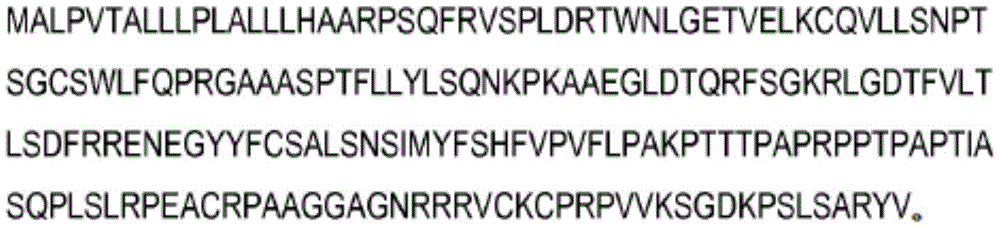
In one embodiment, the chimeric proteins of the invention comprise a targeting moiety having an antigen recognition domain that recognizes one or more epitopes present on human Clec 9A. In one embodiment, the human Clec9A comprises the following amino acid sequence:
in various embodiments, the chimeric proteins of the invention comprise a targeting moiety capable of specific binding. In various embodiments, the chimeric proteins comprise a targeting moiety, such as an antibody or derivative thereof, having an antigen recognition domain. In one embodiment, the chimeric protein comprises a targeting moiety that is an antibody. In various embodiments, the antibody is a full length multimeric protein comprising two heavy chains and two light chains as described elsewhere herein. In some embodiments, the antibody is a chimeric antibody. In some embodiments, the antibody is a humanized antibody.
In some embodiments, the chimeric proteins of the invention comprise a targeting moiety in the form of a single domain antibody, such as VHH (commercially available under the trademark NANOBODIES) as described elsewhere herein. In one embodiment, the chimeric proteins of the invention comprise VHH.
In some embodiments, the chimeric proteins of the invention comprise a targeting moiety in the form of a VHH comprising a single amino acid chain having four "framework regions" or FR and three "complementarity determining regions" or CDRs. As used herein, "framework region" or "FR" refers to the region of the variable domain located between CDRs. As used herein, "complementarity determining regions" or "CDRs" refer to variable regions in VHHs that contain amino acid sequences capable of specifically binding to an antigenic target.
In various embodiments, the chimeric proteins of the invention comprise VHHs having variable domains comprising at least one CDR1, CDR2 and/or CDR3 sequence.
In some embodiments, the CDR1 sequence is selected from the group consisting of:
GSISSINVMG(SEQ ID NO:26);
GSFSSINVMG(SEQ ID NO:27);
GSISSINIMG(SEQ ID NO:28);
GSISSINIMG(SEQ ID NO:29);
VSIFSINAMG(SEQ ID NO:30);
GSIFSLNAMG(SEQ ID NO:31);
GRTISNYDMA(SEQ ID NO:32);
GRTFTTSLMQ(SEQ ID NO:33);
ERNLRIYDMA(SEQ ID NO:34);
ERNLRSYDMA(SEQ ID NO:35);
GLTFSNYHMG(SEQ ID NO:36);
GLTFSSYHMG(SEQ ID NO:37);
GLTFSRYHMG(SEQ ID NO:38);
GLTLSSYYIA(SEQ ID NO:39);
GLTFSSYYTG(SEQ ID NO:40);
GLTLSSYHMG(SEQ ID NO:41);
GRTSSPYVTG(SEQ ID NO:42);
GFTFSGYVMS(SEQ ID NO:43);
GFTFSGYVMT (SEQ ID NO: 44); or (b)
GFTFSGYLMS(SEQ ID NO:45)。
In some embodiments, the CDR2 sequence is selected from the group consisting of:
RITNLGLPNYADWLKD(SEQ ID NO:46);
RITNLGLPNYADSVTG(SEQ ID NO:47);
RITNIGLPNYADSVKG(SEQ ID NO:48);
RITNLGLPNYADSVEG(SEQ ID NO:49);
AITSGGRVVYSDSVKG(SEQ ID NO:50);
AITSGGRTAYADSVKG(SEQ ID NO:51);
HITSDGRIVYADPVKG(SEQ ID NO:52);
RISGSGDRTDYADSVKG(SEQ ID NO:53);
SITWSTGNTHYADSVKG(SEQ ID NO:54);
VISSSGDSTHYSDFVKG(SEQ ID NO:55);
VITSSGDSTHYSDFVKG(SEQ ID NO:56);
QITWSDASIYYAGSVKG(SEQ ID NO:57);
QITWSDTSIYYAGSVKG(SEQ ID NO:58);
QITWSDGTTYYPGSVKG(SEQ ID NO:59);
QIRWSDDSTYYPGSVKG(SEQ ID NO:60);
QISWSDDSTYYADSVKG(SEQ ID NO:61);
TVSWGGVTYYADSVKG(SEQ ID NO:62);
SIGSGGGYPSYTDSVEG(SEQ ID NO:63);
SIGSGGGYPSYTGSVEG(SEQ ID NO:64);
HIGSGGGYPSYTDSVQG(SEQ ID NO:65);
HIGSGGGHATYTDSVEG (SEQ ID NO: 66); or (b)
TIGSGGGITSYADSVKG(SEQ ID NO:67)。
In some embodiments, the CDR3 sequence is selected from the group consisting of:
VALSAEY(SEQ ID NO:68);
VALKAEY(SEQ ID NO:69);
VGLKAEY(SEQ ID NO:70);
KTKSAVLFGGMDY(SEQ ID NO:71);
YIRGEDY(SEQ ID NO:72);
KHYASNY(SEQ ID NO:73);
QDFGSPSF(SEQ ID NO:74);
QDFRSPDF(SEQ ID NO:75);
QIFGSPNF(SEQ ID NO:76);
LAIHGDY(SEQ ID NO:77);
NQIRQWP(SEQ ID NO:78);
NSIRQWP(SEQ ID NO:79);
NAIRQWP(SEQ ID NO:80);
RKVGGPDY(SEQ ID NO:81);
NTFGNVY(SEQ ID NO:82);
LGR; or (b)
VIK。
In some embodiments, the Clec9A targeting moiety comprises SEQ ID NO:26, SEQ ID NO:46 and SEQ ID NO:68.
In some embodiments, the Clec9A targeting moiety comprises SEQ ID No. 27, SEQ ID No. 47, and SEQ ID No. 69.
In some embodiments, the Clec9A targeting moiety comprises SEQ ID No. 28, SEQ ID No. 48, and SEQ ID No. 69.
In some embodiments, the Clec9A targeting moiety comprises SEQ ID No. 26, SEQ ID No. 49, and SEQ ID No. 70.
In some embodiments, the Clec9A targeting moiety comprises SEQ ID No. 29, SEQ ID No. 50, and SEQ ID No. 71.
In some embodiments, the Clec9A targeting moiety comprises SEQ ID No. 30, SEQ ID No. 51, and SEQ ID No. 72.
In some embodiments, the Clec9A targeting moiety comprises SEQ ID No. 31, SEQ ID No. 52, and SEQ ID No. 73.
In some embodiments, the Clec9A targeting moiety comprises SEQ ID No. 32, SEQ ID No. 53, and SEQ ID No. 74.
In some embodiments, the Clec9A targeting moiety comprises SEQ ID No. 32, SEQ ID No. 53, and SEQ ID No. 75.
In some embodiments, the Clec9A targeting moiety comprises SEQ ID No. 32, SEQ ID No. 53, and SEQ ID No. 76.
In some embodiments, the Clec9A targeting moiety comprises SEQ ID No. 33, SEQ ID No. 54, and SEQ ID No. 77.
In some embodiments, the Clec9A targeting moiety comprises SEQ ID No. 34, SEQ ID No. 55, and SEQ ID No. 78.
In some embodiments, the Clec9A targeting moiety comprises SEQ ID No. 34, SEQ ID No. 55, and SEQ ID No. 79.
In some embodiments, the Clec9A targeting moiety comprises SEQ ID No. 35, SEQ ID No. 56, and SEQ ID No. 80.
In some embodiments, the Clec9A targeting moiety comprises SEQ ID No. 36, SEQ ID No. 57, and SEQ ID No. 81.
In some embodiments, the Clec9A targeting moiety comprises SEQ ID No. 37, SEQ ID No. 58, and SEQ ID No. 81.
In some embodiments, the Clec9A targeting moiety comprises SEQ ID No. 38, SEQ ID No. 59, and SEQ ID No. 81.
In some embodiments, the Clec9A targeting moiety comprises SEQ ID No. 39, SEQ ID No. 60, and SEQ ID No. 81.
In some embodiments, the Clec9A targeting moiety comprises SEQ ID No. 40, SEQ ID No. 61, and SEQ ID No. 81.
In some embodiments, the Clec9A targeting moiety comprises SEQ ID No. 41, SEQ ID No. 61, and SEQ ID No. 81.
In some embodiments, the Clec9A targeting moiety comprises SEQ ID No. 42, SEQ ID No. 62, and SEQ ID No. 82.
In some embodiments, the Clec9A targeting moiety comprises SEQ ID No. 43, SEQ ID No. 63, and LGR.
In some embodiments, the Clec9A targeting moiety comprises SEQ ID No. 43, SEQ ID No. 64, and LGR.
In some embodiments, the Clec9A targeting moiety comprises SEQ ID No. 43, SEQ ID No. 65, and LGR.
In some embodiments, the Clec9A targeting moiety comprises SEQ ID No. 44, SEQ ID No. 66, and LGR.
In some embodiments, the Clec9A targeting moiety comprises SEQ ID No. 45, SEQ ID No. 67, and VIK.
In various embodiments, the Clec9A targeting moiety comprises an amino acid sequence selected from the group consisting of:
R2CHCL8(SEQ ID NO:83)
QVQLVESGGGLVHPGGSLRLSCAASGSISSINVMGWYRQAPGKERELVARITNLGLPNYADWLKDRFTISRDNAKNTVYLQMNSLKPEDTAVYYCYLVALSAEYWGQGTQVTVSS;
R1CHCL50(SEQ ID NO:84)
QVQLVESGGGLVHPGGSLRLSCAASGSFSSINVMGWYRQAPGKERELVARITNLGLPNYADSVTGRFTISRDNAKNTVYLQMNSLKPEDTAVYYCYLVALKAEYWGQGTQVTVSS;
R1CHCL21(SEQ ID NO:85)
QVQLVESGGGLVHRGGSLRLSCAASGSISSINIMGWYRQAPGKERELVARITNIGLPNYADSVKGRFTISRDNAKSTVYLQMNSLNAEDTAVYYCYLVALKAEYWGQGTQVTVSS;
R2CHCL87(SEQ ID NO:86)
QVQLVESGGGLVQPGGSLRLSCAASGSISSINVMGWYRQAPGKERELVARITNLGLPNYADSVEGRFTISRDKDENTVYLEMNTLKPEDTAVYYCYLVGLKAEYWGQGTQVTVSS;
R2CHCL24(SEQ ID NO:87)
QVQLVESGGGLVQPGGSLRLSCAASGSSDSINAMGWYRQAPGKERELVAAITSGGRVVYSDSVKGRGTISRDNAKNTVYLQIASLKPEDTAVYYCNVKTKSAVLFGGMDYWGKGTQVTVSS;
R2CHCL38(SEQ ID NO:88)
QVQLVESGGGLVQPGGSLRLSCAASVSIFSINAMGWYRQAPGKERELVAAITSGGRTAYADSVKGRFTISRDNSKNTVYLQMDSLKPEDTDVYYCKAYIRGEDYWGKGTQVTVSS;
R1CHCL16(SEQ ID NO:89)
DVQLVESGGGLVQPGGSLRLSCAASGSIFSLNAMGWYRQAPGKERELVAHITSDGRIVYADPVKGRFTISRVDGKNMVTLQMNSLKPEDTAVYYCNAKHYASNYWGQGTQVTVSS;
R2CHCL10(SEQ ID NO:90)
QVQLVESGGGSVQAGGSLRLSCAASGRTISNYDMAWSRQAPGKEREFVARISGSGDRTDYADSVKGRFTISRDNAKNTVYLQMNSLKPEDTAIYYCQIQDFGSPSFSGQGTQVTVSS;
R1CHCL34(SEQ ID NO:91)
DVQLVESGGGSVQAGGSLRLSCAASGRTISNYDMAWSRQAPGKEREFVARISGSGDRTDYADSVKGRFTISRDNAKNTVYLQMNSLKPEDTAIYYCQIQDFRSPDFWSQGTQVTVSS;
R1CHCL82(SEQ ID NO:92)
QVQLVESGGESVQAGGSLRLSCAASGRTISNYDMAWSRQAPGKEREFVARISGSGDRTDYADSVKGRFTISRDNAKNTVYLQMNSLKPEDTAIYNCQTQIFGSPNFSGQGTQVTVSS;
R2CHCL3(SEQ ID NO:93)
QVQLVESGGGLVQAGDSLRLSCAASGRTFTTSLMQWHRQAPGKEREFVASITWSTGNTHYADSVKGRFTISRDNARNTVYLQMNSLKPEDTAIYTCRVLAIHGDYWGQGTQVTVSS;
R2CHCL69(SEQ ID NO:94)
DVQLVESGGGLVQAGDSLRLSCAASERNLRIYDMAWYRQAPGKEREYVAVISSSGDSTHYSDFVKGRFTISRDNAKNTVSLQMDSLKPEDTAFYYCNVNQIRQWPWGQGTQVTVSS;
R1CHCL56(SEQ ID NO:95)
QVQLVESGGGLVQAGDSLRLSCAASERNLRIYDMAWYRQAPGKEREYVAVISSSGDSTHYSDFVKGRFTISRDNAKNTVSLQMDSLKPEDTAFYYCNVNSIRQWPWGQGTQVTVSS;
R2CHCL32(SEQ ID NO:96)
QVQLVESGGGLVQAGDSLRLSCTASERNLRSYDMAWWRQAPGKEREYVAVITSSGDSTHYSDFVKGRFTISRDNAKNTVSLQMDSLKPEDTASYYCNVNAIRQWPWGQGTQVTVSS;
R2CHCL49(SEQ ID NO:97)
DVQLVESGGGSVQAGGSLRLSCAISGLTFSNYHMGWYRQAPGREREFVAQITWSDASIYYAGSVKGRFTISRDNVKNIVYLQIDNLKPEDTAIYYCDARKVGGPDYWGQGTQVTVSS;
R2CHCL53(SEQ ID NO:98)
QVQLVESGGGLVQAGGSLTLSCAISGLTFSSYHMGWYRQAPGREREFVAQITWSDTSIYYAGSVKGRFTISRDNVKNIVYLQIDNLKPEDTAIYYCDARKVGGPDYWGQGTQVTVSS;
R2CHCL22(SEQ ID NO:99)
DVQLVESGGGLVQAGGSLRLSCAISGLTFSRYHMGWYRQAPGREREFVAQITWSDGTTYYPGSVKGRFTISRDNARNTVYLQIDNLKPEDTAIYYCDARKVGGPDYWGQGTQVTVSS;
R2CHCL25(SEQ ID NO:100)
QVQLVESGGGLVQAGGSLRLSCATSGLTLSSYYIAWYRQAPGREREFVAQIRWSDDSTYYPGSVKGRFTISRDNARNTVYLRMDNLKPEDTARYYCDARKVGGPDYWGQGTQVTVSS;
R2CHCL18(SEQ ID NO:101)
DVQLVESGGGLVQAGGSLRLSCATSGLTFSSYYTGWYRQAPGREREFVAQISWSDDSTYYADSVKGRFTISRDNARNTVYLQMNNLKPGDTAIYYCDARKVGGPDYWGQGTQVTVSS;
R1CHCL23(SEQ ID NO:102)
DVQLVESGGGLVQAGGSLRLSCATSGLTLSSYHMGWYRQAPGREREFVAQISWSDDSTYYADSVKGRFTISRDNARNTVYLQMNNLKPEDTAIYYCDARKVGGPDYWGQGTQVTVSS;
R1CHCL27(SEQ ID NO:103)
DVQLVESGGGLVQAGGSLRLSCAASGRTSSPYVTGWYRQTPGKEREPVATVSWGGVTYYADSVKGRFTISRDNAKNTVYLQMNALKPEDTAIYYCNVNTFGNVYWGQGTQVTVSS;
R2CHCL13(SEQ ID NO:104)
QVQLVESGGGLVQPGGSLRLSCAASGFTFSGYVMSWVRQAPGKGLEWVASIGSGGGYPSYTDSVEGRFTISRDNAKNTLYLLMDNLKPDDTAVYYCEMLGRRGQGTQVTVSS;
R2CHCL14(SEQ ID NO:105)
QVQLVESGGGLVQPGGSLRLSCAASGFTFSGYVMSWVRQAPGKGLEWVASIGSGGGYPSYTDSVEGRFTISRDNAKNTLYLQMNNLKPDDTAVYYCEMLGRRGQGTQVTVSS;
R2CHCL42(SEQ ID NO:106)
QVQLVESGGGLVQPGGSLRLSCAASGFTFSGYVMSWVRQAPGKGLEWVASIGSGGGYPSYTGSVEGRFTISRDNAKNTLYLLMNNLKPDDTAVYYCEMLGRRGQGTQVTVSS;
R2CHCL41(SEQ ID NO:107)
QVQLVESGGGLVQPGGSLRLSCAASGFTFSGYVMSWVRQAPGKGLEWVAHIGSGGGYPSYTDSVQGRFTISRDNAKNTLYLQMNNLKPEDTAVYYCEMLGRRGQGTQVTVSS;
R2CHCL94(SEQ ID NO:108)
QVQLVESGGGLVQPGGSLRLSCAASGFTFSGYVMTWVRQAPGKGLEWVAHIGSGGGHATYTDSVEGRFTISRDNAKNTLYLQMNNLKAEDTAVYYCEFLGRRGQGTQVTVSS; or (b)
R2CHCL27(SEQ ID NO:109)
QVQLVESGGGLVQPGGSLRLSCAASGFTFSGYLMSWVRQAPGKGLEWVATIGSGGGITSYADSVKGRFTISRDNAKNTLYLQMNNLKHEDTAVYYCETVIKRGQGTQVTVSS。
In various embodiments, the present invention contemplates the use of any natural or synthetic analogs, mutants, variants, alleles, homologs, and orthologs (collectively referred to herein as "analogs") of the targeting moiety for Clec9A as described herein. In various embodiments, the amino acid sequence of the targeting moiety to Clec9A further includes amino acid analogs, amino acid derivatives, or other non-classical amino acids.
In various embodiments, the chimeric proteins of the invention comprise a targeting moiety comprising an amino acid sequence having at least 60% identity to any one of the sequences disclosed herein. For example, the chimeric protein comprises a targeting moiety that can comprise a polypeptide having at least about 60%, at least about 61%, at least about 62%, at least about 63%, at least about 64%, at least about 65%, at least about 66%, at least about 67%, at least about 68%, at least about 69%, at least about 70%, at least about 71%, at least about 72%, at least about 73%, at least about 74%, at least about 75%, at least about 76%, at least about 77%, at least about 78%, at least about 79%, at least about 80%, at least about 81%, at least about 82%, at least about 83%, at least about 84%, at least about 85%, at least about 86%, at least about 87%, at least about 88%, at least about 89%, at least about 90%, at least about 91%, at least about 92%, at least about 93%, at least about 94%, at least about 95%, at least about 96%, at least about 97%, at least about 98%, at least about 99% or 100% identity (e.g., about 60%, or about 61%, or about 62%, or about 63%, or about 64%, or about 65%, or about 66%, or about 67%, or about 68%, or about 69%, or about 70%, or about 71%, or about 72%, or about 73%, or about 74%, or about 75%, or about 76%, or about 77%, or about 78%, or about 79%, or about 80%, or about 81%, or about 82%, or about 83%, or about 84%, or about 85%, or about 86%, or about 87%, or about 88%, or about 89%, or about 90%, or about 91%, or about 92%, or about 93%, or about 94%, or about 95%, or about 96%, or about 97%, or about 98%, or about, about 99% or about 100% sequence identity).
In various embodiments, the targeting moiety of the invention comprises one or more mutations that do not substantially reduce the ability of the Clec9A targeting moiety to specifically bind to Clec 9A. In various embodiments, the mutation does not substantially reduce the ability of the targeting moiety to specifically bind to Clec9A without neutralizing Clec 9A.
In various embodiments, an equilibrium dissociation constant (K D ) To describe the binding affinity of the Clec9A targeting moiety to the full length and/or mature form and/or isotype and/or splice variant and/or fragment and/or monomeric and/or dimeric form and/or any other naturally occurring or synthetic analogue, variant or mutant (including monomeric and/or dimeric forms) of human Clec 9A. In various embodiments, the chimeric proteins of the invention comprise a targeting moiety that binds to the full length and/or mature form and/or isotype and/or splice variant and/or fragment of human Clec9A and/or any other naturally occurring or synthetic analog, variant or mutant (including monomeric and/or dimeric forms), wherein K D Less than about 1uM, about 900nM, about 800nM, about 700nM, about 600nM, about 500nM, about 400nM, about 300nM, about 200nM, about 100nM, about 90nM, about 80nM, about 70nM, about 60nM, about 50nM, about 40nM, about 30nM, about 20nM, about 10nM, or about 5nM, or about 1nM.
In various embodiments, the chimeric proteins of the invention comprise a targeting moiety that binds to but does not functionally modulate an antigen of interest, such as Clec9A. For example, in various embodiments, the Clec9A targeting moiety targets only the antigen but does not substantially functionally modulate (e.g., substantially inhibit, reduce, or neutralize) the biological effect that the antigen has. In various embodiments, the Clec9A targeting moiety binds to an epitope that is physically separated from an antigenic site (e.g., the active site of an antigen) that is important for its biological activity.
Such binding without significant functional modulation is useful in various embodiments of the invention, including methods of recruiting active immune cells directly or indirectly to a site in need thereof via effector antigens using chimeric proteins of the invention. For example, in various embodiments, the chimeric proteins of the invention can be used in methods of reducing or eliminating tumors to recruit dendritic cells to tumor cells directly or indirectly via Clec9A (e.g., the chimeric proteins can comprise a targeting moiety having an anti-Clec 9A antigen recognition domain and a targeting moiety having a recognition domain (e.g., an antigen recognition domain) for a tumor antigen or receptor). In such embodiments, it is desirable to recruit dendritic cells directly or indirectly but not functionally modulate Clec9A activity. In these embodiments, clec9A signaling is an important part of tumor reduction or elimination.
In some embodiments, the chimeric proteins of the invention enhance antigen presentation by dendritic cells. For example, in various embodiments, the chimeric proteins of the invention can recruit dendritic cells to tumor cells directly or indirectly via Clec9A, wherein tumor antigens are then endocytosed and presented on the dendritic cells in order to induce an effective humoral and cytotoxic T cell response.
In some embodiments, the targeting moiety comprises an antigen recognition domain that specifically binds to a target (e.g., antigen, receptor) on an immune cell selected from, but not limited to, megakaryocytes, platelets, erythrocytes, mast cells, basophils, neutrophils, and eosinophils, or a subset thereof. In some embodiments, the antigen recognition domain recruits megakaryocytes, platelets, erythrocytes, mast cells, basophils, neutrophils, and eosinophils, or a subset thereof, directly or indirectly, e.g., in some embodiments, to a treatment site (e.g., a location with one or more disease cells or cells modulated for therapeutic effect).
In some embodiments, the targeting moiety comprises an antigen recognition domain that specifically binds to a target (e.g., antigen, receptor) associated with megakaryocytes and/or platelets. Illustrative megakaryocyte and/or platelet antigens of interest include, for example, GP IIb/IIIa, GPIb, vWF, PF4 and TSP. In various embodiments, the targeting moiety of the chimeric protein binds to one or more of these illustrative megakaryocyte and/or platelet antigens.
In some embodiments, the targeting moiety comprises an antigen recognition domain that specifically binds to a target (e.g., antigen, receptor) associated with a red blood cell. Illustrative target erythrocyte antigens include, for example, CD34, CD36, CD38, CD41a (platelet glycoprotein IIb/IIIa), CD41b (GPIIb), CD71 (transferrin receptor), CD105, glycophorin A, glycophorin C, c-kit, HLA-DR, H2 (MHC-II), and cynomolgus monkey antigen. In various embodiments, the targeting moiety of the chimeric protein binds to one or more of these illustrative erythrocyte antigens.
In some embodiments, the targeting moiety comprises an antigen recognition domain that specifically binds to a target (e.g., antigen, receptor) associated with a mast cell. Illustrative target mast cell antigens include, for example, SCFR/CD117, fc ε RI, CD2, CD25, CD35, CD88, CD203C, C5R1, CMA1, FCER1A, FCER2, TPSAB1. In various embodiments, the targeting moiety of the chimeric protein binds to one or more of these mast cell antigens.
In some embodiments, the targeting moiety comprises an antigen recognition domain that specifically binds to a target (e.g., antigen, receptor) associated with basophils. Illustrative target basophil antigens include, for example, fc ε RI, CD203c, CD123, CD13, CD107a, CD107b, and CD164. In various embodiments, the targeting moiety of the chimeric protein binds to one or more of these basophil antigens.
In some embodiments, the targeting moiety comprises an antigen recognition domain that specifically binds to a target (e.g., antigen, receptor) associated with neutrophils. Illustrative target neutrophil antigens include, for example, 7D5, CD10/CALLA, CD13, CD16 (FcRIII), CD18 protein (LFA-1, CR3 and p150, 95), CD45, CD67 and CD177. In various embodiments, the targeting moiety of the chimeric protein binds to one or more of these neutrophil antigens.
In some embodiments, the targeting moiety comprises an antigen recognition domain that specifically binds to a target (e.g., antigen, receptor) associated with eosinophils. Illustrative eosinophil antigens of interest include, for example, CD35, CD44, and CD69. In various embodiments, the targeting moiety of the chimeric protein binds to one or more of these eosinophil antigens.
In various embodiments, the targeting moiety may comprise an antigen recognition domain capable of binding to any suitable target, antigen, receptor, or cell surface marker known to those of skill in the art. In some embodiments, the antigen or cell surface marker is a tissue specific marker. Illustrative tissue-specific markers include, but are not limited to, endothelial cell surface markers such as ACE, CD14, CD34, CDH5, ENG, ICAM2, MCAM, NOS3, PECAMl, PROCR, SELE, SELP, TEK, THBD, VCAMl, VWF; smooth muscle cell surface markers such as ACTA2, MYH10, MYH11, MYH9, MYOCD; fibroblast (stromal) cell surface markers such as ALCAM, CD34, COL1A1, COL1A2, COL3A1, FAP, PH-4; epithelial cell surface markers such as CDlD, K6IRS2, KRT10, KRT13, KRT17, KRT18, KRT19, KRT4, KRT5, KRT8, MUC1, TACSTD1; neovascular markers, e.g. CD13, TFNA, alpha-vbeta-3 (alpha-vbeta) 3 ) E-selectin; and adipocyte surface markers such as ADIPOQ, FABP4, and RETN. In various embodiments, the targeting moiety of the chimeric protein binds to one or more of these antigens. In various embodiments, the targeting moiety of the chimeric protein binds to one or more cells having these antigens.
In some embodiments, the recognition domain specifically binds to a target (e.g., antigen, receptor) associated with a tumor cell. In some embodiments, the recognition domain recruits tumor cells directly or indirectly. For example, in some embodiments, tumor cells are recruited directly or indirectly to one or more effector cells (e.g., immune cells described herein) that may kill and/or inhibit the tumor cells.
Tumor cells or cancer cells refer to uncontrolled growth of cells or tissues and/or abnormal increases in cell survival time and/or inhibition of apoptosis that interfere with normal function of body organs and systems. For example, tumor cells include benign and malignant cancers, polyps, hyperplasia, dormant tumors, or micrometastases. Illustrative tumor cells include, but are not limited to, the following: basal cell carcinoma, biliary tract carcinoma; bladder cancer; bone cancer; brain and central nervous system cancers; breast cancer; peritoneal cancer; cervical cancer; choriocarcinoma; colorectal and rectal cancer; connective tissue cancer; digestive system cancer; endometrial cancer; esophageal cancer; eye cancer; cancer of the head and neck; gastric cancer (including gastrointestinal cancer); glioblastoma; liver cancer; hepatoma; intraepithelial neoplasia; kidney cancer or renal cancer; laryngeal carcinoma; leukemia; liver cancer; lung cancer (e.g., small cell lung cancer, non-small cell lung cancer, lung adenocarcinoma, and lung squamous cell carcinoma); melanoma; a myeloma; neuroblastoma; oral cancer (lip, tongue, mouth and pharynx); ovarian cancer; pancreatic cancer; prostate cancer; retinoblastoma; rhabdomyosarcoma; rectal cancer; respiratory system cancer; salivary gland cancer; sarcoma; skin cancer; squamous cell carcinoma; stomach cancer; testicular cancer; thyroid cancer; uterine or endometrial cancer; urinary system cancer; vulvar cancer; lymphomas, including hodgkin's and non-hodgkin's lymphomas, as well as B-cell lymphomas (including low grade/follicular non-hodgkin's lymphomas (NHL), small Lymphocytic (SL) lymphocytic NHL, medium grade/follicular NHL, medium grade diffuse NHL, high grade immunocytogenic NHL, high grade lymphoblastic NHL, high grade small non-dividing cellular NHL, giant tumor NHL, mantle cell lymphomas, AIDS-related lymphomas, and warrior macroglobulinemia, chronic Lymphocytic Leukemia (CLL), acute Lymphoblastic Leukemia (ALL), hairy cell leukemia, chronic myeloblastic leukemia, and other carcinomas and sarcomas, and post-transplant lymphoproliferative disorders (PTLD), and abnormal vascular hyperplasia, edema (e.g., brain tumor-associated edema) and metwo syndrome associated with nevus.
Tumor cells or cancer cells also include, but are not limited to, carcinomas such as various subtypes including, for example, adenocarcinomas, basal cell carcinomas, squamous cell carcinomas, and transitional cell carcinomas), sarcomas (including, for example, osteosarcomas and soft tissue sarcomas), leukemias (including, for example, acute myelogenous leukemia, acute lymphoblastic leukemia, chronic myelogenous leukemia, chronic lymphocytic leukemia, and hairy cell leukemia), lymphomas and myelomas (including, for example, hodgkin's and non-hodgkin's lymphomas, light chain, non-secretory, MGUS, and plasmacytoma) and central nervous system cancers (including, for example, brain cancers (such as gliomas (e.g., astrocytomas, oligogliomas, and ependymomas), meningiomas, pituitary adenomas, and neuromas and spinal cord tumors (e.g., meningiomas and fibrogliomas).
Illustrative tumor antigens include, but are not limited to MART-1/Melan-A, gp100, dipeptidyl peptidase IV (DPPIV), adenosine deaminase binding protein (ADAbp), cyclophilin B, colorectal associated antigen (CRC) -0017-1A/GA733, carcinoembryonic antigen (CEA) and immunogenic epitopes CAP-1 and CAP-2, etv, aml1, prostate Specific Antigen (PSA) and immunogenic epitopes PSA-1, PSA-2 and PSA-3, prostate Specific Membrane Antigen (PSMA), T cell receptor/CD 3-zeta chain, MAGE family tumor antigens (e.g., MAGE-A1, MAGE-A2, MAGE-A3, MAGE-A4, MAGE-A5) MAGE-A6, MAGE-A7, MAGE-A8, MAGE-A9, MAGE-A10, MAGE-A11, MAGE-A12, MAGE-Xp2 (MAGE-B2), MAGE-Xp3 (MAGE-B3), MAGE-Xp4 (MAGE-B4), MAGE-C1, MAGE-C2, MAGE-C3, MAGE-C4, MAGE-C5), GAGE family tumor antigens (e.g., GAGE-1, GAGE-2, GAGE-3, GAGE-4, GAGE-5, GAGE-6, GAGE-7, GAGE-8, GAGE-9), BAGE, RAGE, LAGE-1, NAG, gnT-V, MUM-1, CDK4, tyrosinase, p53, MUC family, HER2/neu, p21ras, RCAS1, alpha-fetoprotein, E-cadherin, alpha-linked protein, beta-and gamma-linked proteins, p120ctn, gp100Pmel117, PRAME, NY-ESO-1, cdc27, adenomatous polyposis coli protein (APC), cytosol, connexin 37, ig idiotypes, p15, gp75, GM2 and GD2 gangliosides, viral products such as human papilloma virus proteins, smad family tumor antigens, lmp-1, NA, EBV encoded nuclear antigen (EBNA) -1, brain glycogen phosphorylase, SSX-1, SSX-2 (HOM-MEL-40), SSX-1, SSX-4, SSX-5, SCP-1CT-7, c-erbB-2, CD19, CD20, CD22, CD30, CD33, CD37, CD56, CD70, CD74, CD138, AGS16, MUC1, GPNMB, ep-CAM, PD-L1, PD-L2, PMSA and BCMA (TNFRSF 17). In various embodiments, the targeting moiety of the chimeric protein binds to one or more of these tumor antigens.
In some embodiments, the chimeric proteins of the invention have (i) one or more targeting moieties to immune cells selected from T cells, B cells, dendritic cells, macrophages, NK cells, or a subset thereof; and (ii) a signaling agent directed against one or more of the targeting moieties of the tumor cells, and a modification (e.g., mutation) described herein. In one embodiment, the chimeric proteins of the invention have any of (i) a targeting moiety to a T cell (including but not limited to an effector T cell) and (ii) a targeting moiety to a tumor cell, as well as modified (e.g., mutated) signaling agents described herein. In one embodiment, the chimeric proteins of the invention have any of (i) a targeting moiety to a B cell and (ii) a targeting moiety to a tumor cell, and a modified (e.g., mutated) signaling agent described herein. In one embodiment, the chimeric proteins of the invention have any of (i) a targeting moiety to a dendritic cell and (ii) a targeting moiety to a tumor cell, and a modified (e.g., mutated) signaling agent described herein. In one embodiment, the chimeric proteins of the invention have any of (i) a targeting moiety to macrophages and (ii) a targeting moiety to tumor cells, and the modified (e.g., mutated) signaling agents described herein. In one embodiment, the chimeric proteins of the invention have any of (i) a targeting moiety to NK cells and (ii) a targeting moiety to tumor cells, and the modified (e.g., mutated) signaling agents described herein.
By way of non-limiting example, in various embodiments, the chimeric proteins of the invention have (i) ase:Sub>A target T cell (e.g., by targeting CD8, SLAMF4, IL-2Rα, 4-1BB/TNFRSF9, IL-2Rβ, ALCAM, B7-1, IL-4R, B7-H3, BLAME/SLAMFS, CEACAM1, IL-6R, CCR3, IL-7Rα, CCR4, CXCRl/IL-SRA, CCR5, CCR6, IL-10Rα, CCR7, IL-10Rβ, CCRS, IL-12Rβ1, CCR9, IL-12Rβ2, CD2, IL-13Rα1, IL-13, CD3, CD4, ILT2/CDS5j, ILT3/CDS5k, ILT4/CDS5d, ILT5/CDS5 ase:Sub>A, rutegrin α4/CD49d, CDS, integrin αE/CD103, CD6, integrin αM/CD11B, CDS, integrin αX/CD11c, integrin β2/CD1S, KIR/CD15S, CD/TNFRSF 7, and pharmaceutical compositions containing the same CCR9, IL-12Rβ2, CD2, IL-13Rα1, IL-13, CD3, CD4, ILT2/CDS5j, ILT3/CDS5k, ILT4/CDS5d, ILT5/CDS5 ase:Sub>A, rutegrin α4/CD49d CDS, integrin αE/CD103, CD6, integrin αM/CD11B, CDS, integrin αX/CD11c, integrin β2/CD1S, KIR/CD15S, CD/TNFRSF 7, ephB6, TIM-2, fas/TNFRSF6, TIM-3, fas ligand/TNFSF 6, TIM-4, fcgammaRIII/CD 16, TIM-6, TNFR1/TNFRSF1A, granulysin, TNF RIII/TNFRSF1B, TRAIL R1/TNFRSF10A, ICAM-1/CD54, TRAIL R2/TNFRSF10B, ICAM-2/CD102, TRAIL R3/TNFRSF10C, IFN- γR1, TRAIL R4/TNFRSF10D, IFN- γR2, TSLP, IL-1R1 or TSLPR). And (ii) a targeting moiety to a tumor cell, and any of the modified (e.g., mutated) signaling agents described herein.
As a non-limiting example, in various embodiments, the chimeric proteins of the invention have targeting moieties directed against: (i) Checkpoint markers expressed on T cells, such as one or more of PD-1, CD28, CTLA4, ICOS, BTLA, KIR, LAG3, CD137, OX40, CD27, CD40L, TIM3 and A2 aR; and (ii) a targeting moiety to a tumor cell, and any of the modified (e.g., mutated) signaling agents described herein.
In various embodiments, the chimeric proteins of the invention have one or more targeting moieties to PD-1. In some embodiments, the chimeric proteins have one or more targeting moieties that selectively bind to a PD-1 polypeptide. In some embodiments, the chimeric proteins comprise one or more antibodies, antibody derivatives or forms, peptides or polypeptides, or fusion proteins that selectively bind to PD-1 polypeptides.
In one embodiment, the targeting moiety comprises the anti-PD-1 antibody, certolizumab (aka MK-3475, keyruda) or a fragment thereof. The disclosure of the pentazumab and other humanized anti-PD-1 antibodies is disclosed in Hamid et al, (2013) New England Journal of Medicine 369 (2): 134-44, US 8,354,509 and WO 2009/114335, the entire disclosures of which are incorporated herein by reference. In an illustrative embodiment, the plagiozumab or antigen-binding fragment thereof for use in the methods provided herein comprises a heavy chain comprising the amino acid sequence:
And/or a light chain comprising the amino acid sequence:
in one embodiment, the targeting moiety comprises the anti-PD-1 antibody nivolumab (aka BMS-936558, MDX-1106, ONO-4538, OPDIVO) or fragments thereof. Nivolumab (clone 5C 4) and other human monoclonal antibodies that specifically bind to PD-1 are disclosed in US 8,008,449 and WO 2006/121168, the entire disclosures of which are incorporated herein by reference. In an illustrative embodiment, the nivolumab or antigen binding fragment thereof comprises a heavy chain comprising the amino acid sequence:
and/or a light chain comprising the amino acid sequence:
in one embodiment, the targeting moiety comprises the anti-PD-1 antibody Pidilizumab (also known as CT-011, hBAT or hBAT-1) or a fragment thereof. Pi Deli bead monoclonal antibodies and other humanized anti-PD-1 monoclonal antibodies are disclosed in US 2008/0025980 and WO 2009/101611, the entire disclosures of which are incorporated herein by reference. In an illustrative embodiment, an anti-PD-1 antibody or antigen-binding fragment thereof for use in the methods provided herein comprises a light chain variable region comprising an amino acid sequence selected from SEQ ID NOs 15-18 of US 2008/0025980:
SEQ ID No. 15 (SEQ ID NO: 114) of US 2008/0025980:
SEQ ID No. 16 (SEQ ID NO: 115) of US 2008/0025980:
SEQ ID No. 17 (SEQ ID NO: 116) of US 2008/0025980:
SEQ ID No. 18 (SEQ ID NO: 117) of US 2008/0025980:
and/or a heavy chain comprising an amino acid sequence selected from the group consisting of SEQ ID NOs 20-24 of US 2008/0025980:
SEQ ID No. 20 of US 2008/0025980 (SEQ ID NO: 118):
SEQ ID No. 21 (SEQ ID NO: 119) of US 2008/0025980:
SEQ ID No. 22 (SEQ ID NO: 120) of US 2008/0025980:
SEQ ID No. 23 (SEQ ID NO: 121) of US 2008/0025980:
SEQ ID No. 24 (SEQ ID NO: 122) of US 2008/0025980:
in one embodiment, the targeting moiety comprises a light chain comprising SEQ ID NO:18 of US 2008/0025980 and a heavy chain comprising SEQ ID NO:22 of US 2008/0025980.
In one embodiment, the targeting moiety comprises AMP-514 (also known as MEDI-0680).
In one embodiment, the targeting moiety comprises the PD-L2-Fc fusion protein AMP-224 disclosed in WO2010/027827 and WO 2011/066342, the entire disclosures of which are incorporated herein by reference. In such embodiments, the targeting moiety may comprise a targeting domain comprising SEQ ID NO:4 of WO2010/027827 (SEQ ID NO: 123):
And/or a B7-DC fusion protein comprising SEQ ID NO:83 of WO2010/027827 (SEQ ID NO: 124):
in one embodiment, the targeting moiety comprises any of the peptides AUNP 12 or other peptides disclosed in US 2011/0318373 or 8,907,053. For example, the targeting moiety may comprise AUNP 12 having the sequence of SEQ ID NO:125 (i.e., compound 8 of US 2011/0318373 or SEQ ID NO: 49):
SNTSESFK(SNTSESF)FRVTQLAPKAQIKR-NH2
in one embodiment, the targeting moiety comprises an anti-PD-1 antibody 1E3, or fragment thereof, as disclosed in US 2014/0044738, the entire disclosure of which is incorporated herein by reference. In an illustrative embodiment, 1E3 or antigen binding fragment thereof for use in the methods provided herein comprises a heavy chain variable region comprising the amino acid sequence:
and/or a light chain variable region comprising the amino acid sequence:
in one embodiment, the targeting moiety comprises an anti-PD-1 antibody 1E8, or fragment thereof, as disclosed in US 2014/0044738, the entire disclosure of which is incorporated herein by reference. In an illustrative embodiment, 1E8 or antigen binding fragment thereof for use in the methods provided herein comprises a heavy chain variable region comprising the amino acid sequence:
And/or a light chain variable region comprising the amino acid sequence:
in one embodiment, the targeting moiety comprises an anti-PD-1 antibody 1H3, or fragment thereof, as disclosed in US 2014/0044738, the entire disclosure of which is incorporated herein by reference. In an illustrative embodiment, 1H3 or antigen binding fragment thereof for use in the methods provided herein comprises a heavy chain variable region comprising the amino acid sequence:
and/or a light chain variable region comprising the amino acid sequence:
in one embodiment, the targeting moiety comprises a VHH for PD-1 as disclosed, for example, in US 8,907,065 and WO 2008/071447, the entire disclosures of which are incorporated herein by reference. In an illustrative embodiment, the VHH against PD-1 comprises SEQ ID NO 347-351 of US 8,907,065:
SEQ ID No. 347 (SEQ ID NO: 132) of US 8,907,065:
SEQ ID No. 348 of US 8,907,065 (SEQ ID No. 133):
SEQ ID No. 349 of US 8,907,065 (SEQ ID No. 134):
SEQ ID No. 350 of US 8,907,065 (SEQ ID No. 135):
SEQ ID No. 351 (SEQ ID NO: 136) of US 8,907,065:
in one embodiment, the targeting moiety comprises any one of the anti-PD-1 antibodies or fragments thereof as disclosed in US2011/0271358 and WO2010/036959, the entire contents of which are incorporated herein by reference. In an illustrative embodiment, an antibody or antigen binding fragment thereof for use in the methods provided herein comprises a heavy chain comprising an amino acid sequence selected from the group consisting of SEQ ID NOs 25-29 of US 2011/0271358:
SEQ ID No. 25 (SEQ ID NO: 137) of US 2011/0271358:
SEQ ID No. 26 (SEQ ID NO: 138) of US 2011/0271358:
SEQ ID No. 27 (SEQ ID NO: 139) of US 2011/0271358:
SEQ ID No. 28 (SEQ ID NO: 140) of US 2011/0271358:
SEQ ID No. 29 of US2011/0271358 (SEQ ID NO: 141):
and/or a light chain comprising an amino acid sequence selected from SEQ ID NO:30-33 of US 2011/0271358:
SEQ ID No. 30 of US2011/0271358 (SEQ ID NO: 142):
SEQ ID No. 31 (SEQ ID NO: 143) of US 2011/0271358:
SEQ ID No. 32 of US2011/0271358 (SEQ ID NO: 144):
SEQ ID No. of US2011/0271358 (SEQ ID NO: 145):
in various embodiments, the chimeric proteins of the invention comprise one or more antibodies or antibody fragments thereof directed against PD-1 selected from TSR-042 (Tesaro, inc.), REGN2810 (Regeneron Pharmaceuticals, inc.), PDR001 (Novartis Pharmaceuticals), and BGB-a317 (BeiGene ltd.).
In various embodiments, the chimeric proteins of the invention have one or more targeting moieties to PD-L1. In some embodiments, the chimeric proteins have one or more targeting moieties that selectively bind to PD-L1 polypeptides. In some embodiments, the chimeric proteins comprise one or more antibodies, antibody derivatives or forms, peptides or polypeptides, or fusion proteins that selectively bind to PD-L1 polypeptides.
In one embodiment, the targeting moiety comprises the anti-PD-L1 antibody MEDI4736 (also known as durvalumab) or a fragment thereof. MEDI4736 is selective for PD-L1 and blocks binding of PD-L1 to PD-1 and CD80 receptors. MEDI4736 and antigen-binding fragments thereof for use in the methods provided herein comprise heavy and light chains or heavy and light chain variable regions. The sequence of MEDI4736 is disclosed in WO/2016/06272, the entire content of which is incorporated herein by reference. In an illustrative embodiment, MEDI4736 or an antigen-binding fragment thereof for use in the methods provided herein comprises a heavy chain comprising the amino acid sequence of seq id no:
and/or a light chain comprising the amino acid sequence:
in an illustrative embodiment, MEDI4736 or an antigen-binding fragment thereof for use in the methods provided herein comprises a heavy chain variable region (SEQ ID NO: 148) comprising an amino acid sequence of SEQ ID NO:4 selected from WO/2016/06272:
and/or a light chain variable region (SEQ ID NO: 149) comprising the amino acid sequence of SEQ ID NO:3 of WO/2016/06272:
in one embodiment, the targeting moiety comprises the anti-PD-L1 antibody alemtuzumab (atezolizumab) (also known as MPDL3280A, RG 7446) or a fragment thereof. In an illustrative embodiment, the alemtuzumab or antigen-binding fragment thereof for use in the methods provided herein comprises a heavy chain comprising the amino acid sequence of seq id no:
And/or a light chain comprising the amino acid sequence:
in one embodiment, the targeting moiety comprises the anti-PD-L1 antibody avermectin (avelumab) (also known as MSB 0010718C) or fragment thereof. In an illustrative embodiment, the avermectin or antigen binding fragment thereof for use in the methods provided herein comprises a heavy chain comprising the amino acid sequence:
and/or a light chain comprising the amino acid sequence:
in one embodiment, the targeting moiety comprises the anti-PD-L1 antibody BMS-936559 (also known as 12A4, MDX-1105) or a fragment thereof as disclosed in US 2013/0309250 and WO2007/005874, the entire disclosures of which are incorporated herein by reference. In an illustrative embodiment, the BMS-936559 or antigen binding fragment thereof used in the methods provided herein comprises a heavy chain variable region comprising the amino acid sequence:
and/or a light chain variable region comprising the amino acid sequence:
in one embodiment, the targeting moiety comprises an anti-PD-L1 antibody 3G10, or fragment thereof, as disclosed in US 2013/0309250 and WO2007/005874, the entire disclosures of which are incorporated herein by reference. In an illustrative embodiment, the 3G10 or antigen binding fragment thereof used in the methods provided herein comprises a heavy chain variable region comprising the amino acid sequence:
And/or a light chain variable region comprising the amino acid sequence:
in one embodiment, the targeting moiety comprises an anti-PD-L1 antibody 10A5, or fragment thereof, as disclosed in US 2013/0309250 and WO2007/005874, the entire disclosures of which are incorporated herein by reference. In an illustrative embodiment, 10A5 or antigen binding fragment thereof for use in the methods provided herein comprises a heavy chain variable region comprising the amino acid sequence:
and/or a light chain variable region comprising the amino acid sequence:
in one embodiment, the targeting moiety comprises an anti-PD-L1 antibody 5F8, or fragment thereof, as disclosed in US 2013/0309250 and WO2007/005874, the entire disclosures of which are incorporated herein by reference. In an illustrative embodiment, the 5F8 or antigen binding fragment thereof used in the methods provided herein comprises a heavy chain variable region comprising the amino acid sequence:
and/or a light chain variable region comprising the amino acid sequence:
in one embodiment, the targeting moiety comprises an anti-PD-L1 antibody 10H10, or fragment thereof, as disclosed in US 2013/0309250 and WO2007/005874, the entire disclosures of which are incorporated herein by reference. In an illustrative embodiment, the 10H10 or antigen binding fragment thereof used in the methods provided herein comprises a heavy chain variable region comprising the amino acid sequence:
And/or a light chain variable region comprising the amino acid sequence:
in one embodiment, the targeting moiety comprises an anti-PD-L1 antibody 1B12, or fragment thereof, as disclosed in US 2013/0309250 and WO2007/005874, the entire disclosures of which are incorporated herein by reference. In an illustrative embodiment, 1B12 or antigen binding fragment thereof for use in the methods provided herein comprises a heavy chain variable region comprising the amino acid sequence:
and/or a light chain variable region comprising the amino acid sequence:
in one embodiment, the targeting moiety comprises an anti-PD-L1 antibody 7H1 or fragment thereof as disclosed in US 2013/0309250 and WO2007/005874, the entire disclosures of which are incorporated herein by reference. In an illustrative embodiment, the 7H1 or antigen binding fragment thereof used in the methods provided herein comprises a heavy chain variable region comprising the amino acid sequence:
and/or a light chain variable region comprising the amino acid sequence:
in one embodiment, the targeting moiety comprises the anti-PD-L1 antibody 11E6 or a fragment thereof as disclosed in US 2013/0309250 and WO2007/005874, the entire disclosures of which are incorporated herein by reference. In an illustrative embodiment, the 11E6 or antigen binding fragment thereof used in the methods provided herein comprises a heavy chain variable region comprising the amino acid sequence:
And/or a light chain variable region comprising the amino acid sequence:
in one embodiment, the targeting moiety comprises an anti-PD-L1 antibody 12B7, or fragment thereof, as disclosed in US 2013/0309250 and WO2007/005874, the entire disclosures of which are incorporated herein by reference. In an illustrative embodiment, 12B7 or antigen binding fragment thereof for use in the methods provided herein comprises a heavy chain variable region comprising the amino acid sequence:
and/or a light chain variable region comprising the amino acid sequence:
in one embodiment, the targeting moiety comprises an anti-PD-L1 antibody 13G4 or fragment thereof as disclosed in US 2013/0309250 and WO2007/005874, the entire disclosures of which are incorporated herein by reference. In an illustrative embodiment, the 13G4 or antigen binding fragment thereof used in the methods provided herein comprises a heavy chain variable region comprising the amino acid sequence:
and/or a light chain variable region comprising the amino acid sequence:
in one embodiment, the targeting moiety comprises the anti-PD-L1 antibody 1E12, or fragment thereof, as disclosed in US 2014/0044738, the entire disclosure of which is incorporated herein by reference. In an illustrative embodiment, 1E12 or antigen binding fragment thereof for use in the methods provided herein comprises a heavy chain variable region comprising the amino acid sequence:
And/or a light chain variable region comprising the amino acid sequence:
in one embodiment, the targeting moiety comprises the anti-PD-L1 antibody 1F4, or a fragment thereof, as disclosed in US 2014/0044738, the entire disclosure of which is incorporated herein by reference. In an illustrative embodiment, 1F4 or antigen binding fragment thereof for use in the methods provided herein comprises a heavy chain variable region comprising the amino acid sequence:
and/or a light chain variable region comprising the amino acid sequence:
in one embodiment, the targeting moiety comprises the anti-PD-L1 antibody 2G11, or a fragment thereof, as disclosed in US 2014/0044738, the entire disclosure of which is incorporated herein by reference. In an illustrative embodiment, the 2G11 or antigen binding fragment thereof used in the methods provided herein comprises a heavy chain variable region comprising the amino acid sequence:
and/or a light chain variable region comprising the amino acid sequence:
in one embodiment, the targeting moiety comprises an anti-PD-L1 antibody 3B6, or fragment thereof, as disclosed in US 2014/0044738, the entire disclosure of which is incorporated herein by reference. In an illustrative embodiment, the 3B6 or antigen binding fragment thereof used in the methods provided herein comprises a heavy chain variable region comprising the amino acid sequence:
And/or a light chain variable region comprising the amino acid sequence:
in one embodiment, the targeting moiety comprises an anti-PD-L1 antibody 3D10, or fragment thereof, as disclosed in US 2014/0044738 and WO2012/145493, the entire disclosures of which are incorporated herein by reference. In an illustrative embodiment, the 3D10 or antigen binding fragment thereof used in the methods provided herein comprises a heavy chain variable region comprising the amino acid sequence:
and/or a light chain variable region comprising the amino acid sequence:
in one embodiment, the targeting moiety comprises any of the anti-PD-L1 antibodies disclosed in US2011/0271358 and WO2010/036959, the entire contents of which are incorporated herein by reference. In an illustrative embodiment, an antibody or antigen binding fragment thereof for use in the methods provided herein comprises a heavy chain comprising an amino acid sequence selected from SEQ ID nos. 34-38 of US 2011/0271358:
SEQ ID No. 34 (SEQ ID NO: 184) of US 2011/0271358:
SEQ ID No. 35 (SEQ ID NO: 185) of US 2011/0271358:
SEQ ID No. 36 (SEQ ID NO: 186) of US 2011/0271358:
SEQ ID No. 37 of US2011/0271358 (SEQ ID NO: 187):
SEQ ID No. 38 (SEQ ID NO: 188) of US 2011/0271358:
And/or a light chain comprising an amino acid sequence selected from SEQ ID Nos. 39-42 of US 2011/0271358:
SEQ ID No. 39 (SEQ ID NO: 189) of US 2011/0271358:
SEQ ID No. 40 (SEQ ID NO: 190) of US 2011/0271358:
SEQ ID No. 41 (SEQ ID NO: 191) of US 2011/0271358:
SEQ ID No. 42 (SEQ ID NO: 192) of US 2011/0271358:
in one embodiment, the targeting moiety comprises anti-PD-L1 antibody 2.7a4 or a fragment thereof as disclosed in WO 2011/066389, US8,779,108 and US2014/0356353, the entire disclosures of which are incorporated herein by reference. In an illustrative embodiment, 2.7a4, or antigen binding fragment thereof, for use in the methods provided herein comprises a heavy chain variable region comprising the amino acid sequence:
SEQ ID No. 2 (SEQ ID NO: 193) of WO 2011/066389:
and/or a light chain variable region comprising the amino acid sequence:
SEQ ID No. 7 (SEQ ID NO: 194) of WO 2011/066389:
in one embodiment, the targeting moiety comprises an anti-PD-L1 antibody 2.9d10, or fragment thereof, as disclosed in WO 2011/066389, US8,779,108, and US2014/0356353, the entire disclosures of which are incorporated herein by reference. In an illustrative embodiment, 2.9d10 or antigen binding fragment thereof used in the methods provided herein comprises a heavy chain variable region comprising the amino acid sequence:
SEQ ID No. 12 (SEQ ID NO: 195) of WO 2011/066389:
and/or a light chain variable region comprising the amino acid sequence:
SEQ ID No. 17 (SEQ ID NO: 196) of WO 2011/066389:
in one embodiment, the targeting moiety comprises an anti-PD-L1 antibody 2.14h9 or fragment thereof as disclosed in WO 2011/066389, US8,779,108 and US2014/0356353, the entire disclosures of which are incorporated herein by reference. In an illustrative embodiment, 2.14h9 or antigen binding fragment thereof for use in the methods provided herein comprises a heavy chain variable region comprising the amino acid sequence:
SEQ ID No. 22 (SEQ ID NO: 197) of WO 2011/066389:
and/or a light chain variable region comprising the amino acid sequence:
SEQ ID No. 27 of WO 2011/066389 (SEQ ID NO: 198):
in one embodiment, the targeting moiety comprises anti-PD-L1 antibody 2.20a8 or fragment thereof as disclosed in WO 2011/066389, US8,779,108 and US2014/0356353, the entire disclosures of which are incorporated herein by reference. In an illustrative embodiment, 2.20a8 or antigen binding fragment thereof for use in the methods provided herein comprises a heavy chain variable region comprising the amino acid sequence:
SEQ ID No. 32 (SEQ ID NO: 199) of WO 2011/066389:
And/or a light chain variable region comprising the amino acid sequence:
SEQ ID No. 37 of WO 2011/066389 (SEQ ID NO: 200):
in one embodiment, the targeting moiety comprises anti-PD-L1 antibody 3.15g8 or fragment thereof as disclosed in WO 2011/066389, US8,779,108 and US2014/0356353, the entire disclosures of which are incorporated herein by reference. In an illustrative embodiment, 3.15g8 or antigen binding fragment thereof for use in the methods provided herein comprises a heavy chain variable region comprising the amino acid sequence:
SEQ ID No. 42 (SEQ ID NO: 201) of WO 2011/066389:
and/or a light chain variable region comprising the amino acid sequence:
SEQ ID No. 47 (SEQ ID NO: 202) of WO 2011/066389:
in one embodiment, the targeting moiety comprises an anti-PD-L1 antibody 3.18g1 or fragment thereof as disclosed in WO 2011/066389, US8,779,108 and US2014/0356353, the entire disclosures of which are incorporated herein by reference. In an illustrative embodiment, 3.18g1 or antigen binding fragment thereof for use in the methods provided herein comprises a heavy chain variable region comprising the amino acid sequence:
SEQ ID No. 52 (SEQ ID NO: 203) of WO 2011/066389:
and/or a light chain variable region comprising the amino acid sequence:
SEQ ID No. 57 (SEQ ID NO: 204) of WO 2011/066389:
in one embodiment, the targeting moiety comprises an anti-PD-L1 antibody 2.7a4opt, or fragment thereof, as disclosed in WO 2011/066389, US8,779,108 and US2014/0356353, the entire disclosures of which are incorporated herein by reference. In an illustrative embodiment, the 2.7a4opt, or antigen binding fragment thereof, used in the methods provided herein comprises a heavy chain variable region comprising the amino acid sequence:
SEQ ID No. 62 (SEQ ID NO: 205) of WO 2011/066389:
and/or a light chain variable region comprising the amino acid sequence:
SEQ ID No. 67 (SEQ ID NO: 206) of WO 2011/066389:
in one embodiment, the targeting moiety comprises an anti-PD-L1 antibody 2.14h9opt or fragment thereof as disclosed in WO 2011/066389, US8,779,108 and US2014/0356353, the entire disclosures of which are incorporated herein by reference. In an illustrative embodiment, the 2.14h9opt or antigen binding fragment thereof used in the methods provided herein comprises a heavy chain variable region comprising the amino acid sequence:
SEQ ID No. 72 (SEQ ID NO: 207) of WO 2011/066389:
and/or a light chain variable region comprising the amino acid sequence:
SEQ ID No. 77 (SEQ ID NO: 208) of WO 2011/066389:
in one embodiment, the targeting moiety comprises any of the anti-PD-L1 antibodies disclosed in WO2016/061142, the entire contents of which are incorporated herein by reference. In an illustrative embodiment, an antibody or antigen binding fragment thereof for use in the methods provided herein comprises a heavy chain comprising an amino acid sequence selected from the group consisting of SEQ ID nos 18, 30, 38, 46, 50, 54, 62, 70 and 78 of WO 2016/061142:
SEQ ID No. 18 (SEQ ID NO: 209) of WO 2016/061142:
SEQ ID No. 30 (SEQ ID NO: 210) of WO 2016/061142:
SEQ ID No. 38 (SEQ ID NO: 211) of WO 2016/061142:
SEQ ID No. 46 (SEQ ID NO: 212) of WO 2016/061142:
SEQ ID No. 50 (SEQ ID NO: 213) of WO 2016/061142:
SEQ ID No. 54 (SEQ ID NO: 214) of WO 2016/061142:
SEQ ID No. 62 (SEQ ID NO: 215) of WO 2016/061142:
SEQ ID No. 70 (SEQ ID NO: 216) of WO 2016/061142:
SEQ ID No. 78 (SEQ ID NO: 217) of WO 2016/061142:
and/or a light chain comprising an amino acid sequence selected from the group consisting of SEQ ID Nos. 22, 26, 34, 42, 58, 66, 74, 82 and 86 of WO 2016/061142:
SEQ ID No. 22 (SEQ ID NO: 218) of WO 2016/061142:
SEQ ID No. 26 (SEQ ID NO: 219) of WO 2016/061142:
SEQ ID No. 34 (SEQ ID NO: 220) of WO 2016/061142:
SEQ ID No. 42 (SEQ ID NO: 221) of WO 2016/061142:
SEQ ID No. 58 (SEQ ID NO: 222) of WO 2016/061142:
SEQ ID No. 66 (SEQ ID NO: 223) of WO 2016/061142:
SEQ ID No. 74 (SEQ ID NO: 224) of WO 2016/061142:
SEQ ID No. 82 (SEQ ID NO: 225) of WO 2016/061142:
SEQ ID No. 86 (SEQ ID NO: 226) of WO 2016/061142:
in one embodiment, the targeting moiety comprises any of the anti-PD-L1 antibodies disclosed in WO2016/022630, the entire contents of which are incorporated herein by reference. In an illustrative embodiment, an antibody or antigen binding fragment thereof for use in the methods provided herein comprises a heavy chain comprising an amino acid sequence selected from the group consisting of SEQ ID nos. 2, 6, 10, 14, 18, 22, 26, 30, 34, 38, 42 and 46 of WO 2016/022630:
SEQ ID No. 2 (SEQ ID NO: 227) of WO 2016/022630:
SEQ ID No. 6 (SEQ ID NO: 228) of WO 2016/022630:
SEQ ID No. 10 (SEQ ID NO: 229) of WO 2016/022630:
SEQ ID No. 14 (SEQ ID NO: 230) of WO 2016/022630:
SEQ ID No. 18 (SEQ ID NO: 231) of WO 2016/022630:
SEQ ID No. 22 (SEQ ID NO: 232) of WO 2016/022630:
SEQ ID No. 26 (SEQ ID NO: 233) of WO 2016/022630:
SEQ ID No. 30 (SEQ ID NO: 234) of WO 2016/022630:
SEQ ID No. 34 (SEQ ID NO: 235) of WO 2016/022630:
SEQ ID No. 38 (SEQ ID NO: 236) of WO 2016/022630:
SEQ ID No. 42 (SEQ ID NO: 237) of WO 2016/022630:
SEQ ID No. 46 (SEQ ID NO: 238) of WO 2016/022630:
and/or a light chain comprising an amino acid sequence selected from the group consisting of SEQ ID Nos. 4, 8, 12, 16, 20, 24, 28, 32, 36, 40, 44 and 48 of WO 2016/022630:
SEQ ID No. 4 (SEQ ID NO: 239) of WO 2016/022630:
SEQ ID No. 8 (SEQ ID NO: 240) of WO 2016/022630:
SEQ ID No. 12 (SEQ ID NO: 241) of WO 2016/022630:
SEQ ID No. 16 (SEQ ID NO: 242) of WO 2016/022630:
SEQ ID No. 20 (SEQ ID NO: 243) of WO 2016/022630:
SEQ ID No. 24 (SEQ ID NO: 244) of WO 2016/022630:
SEQ ID No. 28 (SEQ ID No. 245) of WO 2016/022630:
SEQ ID No. 32 (SEQ ID No: 246) of WO 2016/022630:
SEQ ID No. 36 (SEQ ID NO: 247) of WO 2016/022630:
SEQ ID No. 40 (SEQ ID NO: 248) of WO 2016/022630:
SEQ ID No. 44 (SEQ ID No. 249) of WO 2016/022630:
SEQ ID No. 48 (SEQ ID No. 250) of WO 2016/022630:
in one embodiment, the targeting moiety comprises any of the anti-PD-L1 antibodies disclosed in WO2015/112900, the entire contents of which are incorporated herein by reference. In an illustrative embodiment, an antibody or antigen binding fragment thereof for use in the methods provided herein comprises a heavy chain comprising an amino acid sequence selected from the group consisting of SEQ ID nos 38, 50, 82 and 86 of WO 2015/112900:
SEQ ID No. 38 (SEQ ID NO: 251) of WO 2015/112900:
SEQ ID No. 50 (SEQ ID NO: 252) of WO 2015/112900:
SEQ ID No. 82 (SEQ ID No: 253) of WO 2015/112900:
SEQ ID No. 86 (SEQ ID NO: 254) of WO 2015/112900:
and/or a light chain comprising an amino acid sequence selected from the group consisting of SEQ ID Nos. 42, 46, 54, 58, 62, 66, 70, 74 and 78 of WO 2015/112900:
SEQ ID No. 42 (SEQ ID NO: 255) of WO 2015/112900:
SEQ ID No. 46 (SEQ ID NO: 256) of WO 2015/112900:
SEQ ID No. 54 (SEQ ID NO: 257) of WO 2015/112900:
SEQ ID No. 58 (SEQ ID NO: 258) of WO 2015/112900:
SEQ ID No. 62 (SEQ ID NO: 259) of WO 2015/112900:
SEQ ID No. 66 (SEQ ID No: 260) of WO 2015/112900:
SEQ ID No. 70 (SEQ ID NO: 261) of WO 2015/112900:
SEQ ID No. 74 (SEQ ID No: 262) of WO 2015/112900:
SEQ ID No. 78 (SEQ ID NO: 263) of WO 2015/112900:
in one embodiment, the targeting moiety comprises any of the anti-PD-L1 antibodies disclosed in WO 2010/077634 and US 8,217,149, the entire disclosures of which are incorporated herein by reference. In an illustrative embodiment, an anti-PD-L1 antibody or antigen-binding fragment thereof for use in the methods provided herein comprises a heavy chain region comprising the amino acid sequence:
SEQ ID No. 20 (SEQ ID NO: 264) of WO 2010/077634:
and/or a light chain variable region comprising the amino acid sequence:
SEQ ID No. 21 (SEQ ID NO: 265) of WO 2010/077634:
in one embodiment, the targeting moiety comprises any one of the anti-PD-L1 antibodies obtainable from hybridomas obtainable under the CNCM deposit numbers CNCM I-4122, CNCM I-4080 and CNCM I-4081 as disclosed in US 20120039906, the entire disclosure of which is incorporated herein by reference.
In one embodiment, the targeting moiety comprises a VHH for PD-L1 as disclosed, for example, in US 8,907,065 and WO 2008/071447, the entire disclosures of which are incorporated herein by reference. In an illustrative embodiment, the VHH for PD-L1 comprises SEQ ID NO 394-399 of US 8,907,065:
SEQ ID No. 394 of US 8,907,065 (SEQ ID No. 266):
SEQ ID No. 395 (SEQ ID NO: 267) of US 8,907,065:
SEQ ID No. 396 (SEQ ID NO: 268) of US 8,907,065:
SEQ ID No. 397 (SEQ ID NO: 269) of US 8,907,065:
SEQ ID No. 398 (SEQ ID NO: 270) of US 8,907,065:
SEQ ID No. 399 of US 8,907,065 (SEQ ID No: 271):
in various embodiments, the chimeric proteins of the invention have one or more targeting moieties to PD-L2. In some embodiments, the chimeric proteins have one or more targeting moieties that selectively bind to PD-L2 polypeptides. In some embodiments, the chimeric proteins comprise one or more antibodies, antibody derivatives or forms, peptides or polypeptides, or fusion proteins that selectively bind to PD-L2 polypeptides.
In one embodiment, the targeting moiety comprises a VHH for PD-L2 as disclosed, for example, in US 8,907,065 and WO 2008/071447, the entire disclosures of which are incorporated herein by reference. In an illustrative embodiment, the VHH for PD-1 comprises SEQ ID No. 449-455 of US 8,907,065:
SEQ ID No. 449 of US 8,907,065 (SEQ ID No: 272):
SEQ ID No. 450 of US 8,907,065 (SEQ ID NO: 273):
SEQ ID No. 451 of US 8,907,065 (SEQ ID No. 274):
SEQ ID No. 452 of US 8,907,065 (SEQ ID NO: 275):
SEQ ID No. 453 of U.S. Pat. No. 8,907,065 (SEQ ID No. 276):
SEQ ID No. 454 (SEQ ID NO: 277) of US 8,907,065:
SEQ ID No. 455 (SEQ ID NO: 278) of US 8,907,065:
in one embodiment, the targeting moiety comprises any of the anti-PD-L2 antibodies as disclosed in US2011/0271358 and WO2010/036959, the entire contents of which are incorporated herein by reference. In an illustrative embodiment, an antibody or antigen binding fragment thereof for use in the methods provided herein comprises a heavy chain comprising an amino acid sequence selected from SEQ ID nos. 43-47 of US 2011/0271358:
SEQ ID No. 43 (SEQ ID NO: 279) of US 2011/0271358:
SEQ ID No. 44 (SEQ ID NO: 280) of US 2011/0271358:
SEQ ID No. 45 of US2011/0271358 (SEQ ID NO: 281):
SEQ ID No. 46 (SEQ ID NO: 282) of US 2011/0271358:
SEQ ID No. 47 (SEQ ID NO: 283) of US 2011/0271358:
and/or a light chain comprising an amino acid sequence selected from SEQ ID No. 48-51 of US 2011/0271358:
SEQ ID No. 48 (SEQ ID NO: 284) of US 2011/0271358:
SEQ ID No. 49 of US2011/0271358 (SEQ ID NO: 285):
SEQ ID No. 50 of US2011/0271358 (SEQ ID NO: 286):
SEQ ID No. 51 (SEQ ID NO: 287) of US 2011/0271358:
in various embodiments, a targeting moiety of the invention may comprise a sequence that targets PD-1, PD-L1, and/or PD-L2 that has at least about 60%, at least about 61%, at least about 62%, at least about 63%, at least about 64%, at least about 65%, at least about 66%, at least about 67%, at least about 68%, at least about 69%, at least about 70%, at least about 71%, at least about 72%, at least about 73%, at least about 74%, at least about 75%, at least about 76%, at least about 77%, at least about 78%, at least about 79%, at least about 80%, at least about 81%, at least about 82%, at least about 83%, at least about 84%, at least about 85%, at least about 86%, at least about 87%, at least about 88%, at least about 89%, at least about 90%, at least about 91%, at least about 92%, at least about 93%, at least about 94%, at least about 95%, at least about 96%, at least about 97%, at least about 98%, at least about 99%, or 100% identity to any of the sequences disclosed herein (e.g., about 60%, or about 61%, or about 62%, or about 63%, or about 64%, or about 65%, or about 66%, or about 67%, or about 68%, or about 69%, or about 70%, or about 71%, or about 72%, or about 73%, or about 74%, or about 75%, or about 76%, or about 77%, or about 78%, or about 79%, or about 80%, or about 81%, or about 82%, or about 83%, or about 84%, or about 85%, or about 86%, or about 87%, or about 88%, or about 89%, or about 90%, or about 91%, or about 92%, or about 93%, or about 94%, or about 95%, or about 96%, or about, or about 97%, or about 98%, about 99%, or about 100% sequence identity).
In various embodiments, the targeting moiety of the invention may comprise any combination of heavy, light, heavy chain variable, light chain variable, complementarity Determining Regions (CDRs) and framework region sequences that target PD-1, PD-L1 and/or PD-L2 as disclosed herein.
Other antibodies, antibody derivatives or forms, peptides or polypeptides or fusion proteins that selectively bind or target PD-1, PD-L1 and/or PD-L2 are disclosed in the following documents: WO 2011/066389, US 2008/0025980, US 2013/0034559, US 8,779,108, US 2014/0356353, US 8,609,089, US 2010/028330, US 2012/011020449, WO2010/027827, WO 2011,/066342, US 8,907,065, WO 2016/062722, WO 2009/101611, WO2010/027827, WO 2011/066342, WO 2007/005874, WO 2001/014556, US2011/0271358, WO 2010/036959, WO 2010/077634, US 8,217,149, US 2012/0039906, WO 2012/145493, US 2011/0318373, US 8,779,108, US 20140044738, WO 2009/089149, WO 2007/00587, WO 2016061142, WO 2016,02263, WO 2010/077634 and WO 2015/112900, the entire disclosures of which are incorporated herein by reference.
In one embodiment, the chimeric proteins of the invention have any of (i) a targeting moiety directed against T cells (e.g., mediated by targeting CD 8), and (ii) a targeting moiety directed against tumor cells, and a modified (e.g., mutated) signaling agent described herein. In one embodiment, the chimeric proteins of the invention have a targeting moiety directed against CD8 on T cells and a second targeting moiety directed against PD-L1 or PD-L2 on tumor cells.
In one embodiment, the chimeric proteins of the invention have any of (i) a targeting moiety directed against T cells (e.g., mediated by targeting CD 4), and (ii) a targeting moiety directed against tumor cells, and a modified (e.g., mutated) signaling agent described herein. In one embodiment, the chimeric proteins of the invention have a targeting moiety directed against CD4 on T cells and a second targeting moiety directed against PD-L1 or PD-L2 on tumor cells.
In one embodiment, the chimeric proteins of the invention have (i) a targeting moiety directed against a T cell (e.g., mediated by targeting CD3, CXCR3, CCR4, CCR9, CD70, CD103, or one or more immune checkpoint markers), and (ii) a targeting moiety directed against a tumor cell, as well as any of the modified (e.g., mutated) signaling agents described herein. In one embodiment, the chimeric proteins of the invention have a targeting moiety directed against CD3 on T cells and a second targeting moiety directed against PD-L1 or PD-L2 on tumor cells.
In some embodiments, the chimeric proteins of the invention have one or more targeting moieties to CD3 expressed on T cells. In some embodiments, the chimeric proteins have one or more targeting moieties that selectively bind to CD3 polypeptides. In some embodiments, the chimeric protein comprises one or more antibodies, antibody derivatives or forms, peptides or polypeptides, or fusion proteins that selectively bind to a CD3 polypeptide.
In one embodiment, the targeting moiety comprises the anti-CD 3 antibody moromonab (muromonab) -CD3 (also known as Orthoclone OKT 3) or a fragment thereof. Moromolizumab-CD 3 is disclosed in U.S. Pat. No. 4,361,549 and Wilde et al, (1996) 51:865-894, the entire disclosures of which are incorporated herein by reference. In an illustrative embodiment, the moromilast-CD 3, or antigen-binding fragment thereof, used in the methods provided herein comprises a heavy chain variable region comprising the amino acid sequence:
and/or a light chain comprising the amino acid sequence:
in one embodiment, the targeting moiety comprises the anti-CD 3 antibody oxybutynin (Otelixizumab) or a fragment thereof. Oxybutyumab is disclosed in U.S. patent publication No. 20160000916 and Chatenoud et al, (2012) 9:372-381, the entire disclosures of which are incorporated herein by reference. In an illustrative embodiment, the oxybutynin or antigen binding fragment thereof used in the methods provided herein comprises a heavy chain variable region comprising the amino acid sequence:
and/or a light chain comprising the amino acid sequence:
in one embodiment, the targeting moiety comprises the anti-CD 3 antibody telizumab (also known as MGA031 and hOKT3 γ1 (Ala-Ala)) or a fragment thereof. Tilicarbazemab is disclosed in Chatenoud et al, (2012) 9:372-381, the entire disclosure of which is incorporated herein by reference. In an illustrative embodiment, the telithromab or antigen-binding fragment thereof for use in the methods provided herein comprises a heavy chain variable region comprising the amino acid sequence of seq id no:
And/or a light chain comprising the amino acid sequence:
in one embodiment, the targeting moiety comprises the anti-CD 3 antibody, victimuzumab (also known as visilizumab)
HuM 291) or a fragment thereof. Wiceizumab is disclosed in U.S. Pat. No. 5,834,597 and WO2004052397 and Cole et al, transformation (1999) 68:563-571, the entire disclosures of which are incorporated herein by reference. In an illustrative embodiment, the velutinab or antigen binding fragment thereof used in the methods provided herein comprises a heavy chain variable region comprising the amino acid sequence:
and/or a light chain variable region comprising the amino acid sequence:
in one embodiment, the targeting moiety comprises the anti-CD 3 antibody, foralumab (also known as NI-0401) or a fragment thereof. In various embodiments, the targeting moiety comprises any of the anti-CD 3 antibodies disclosed in US20140193399, US 7,728,114, US20100183554 and US 8,551,478, the entire disclosures of which are incorporated herein by reference.
In an illustrative embodiment, the anti-CD 3 antibody or antigen-binding fragment thereof for use in the methods provided herein comprises a heavy chain variable region comprising the amino acid sequences of SEQ ID nos. 2 and 6 of US 7,728,114:
SEQ ID No. 2 of US 7,728,114 (SEQ ID NO: 296):
SEQ ID No. 6 of US 7,728,114 (SEQ ID No. 297):
and/or a light chain variable region comprising the amino acid sequences of SEQ ID NOs 4 and 8 of US 7,728,114:
SEQ ID No. 4 of US 7,728,114 (SEQ ID No. 298):
SEQ ID No. 8 (SEQ ID NO: 299) of US 7,728,114:
in one embodiment, the targeting moiety comprises a heavy chain variable region comprising the amino acid sequence of SEQ ID NO. 2 of US 7,728,114 and a light chain variable region comprising the amino acid sequence of SEQ ID NO. 4 of US 7,728,114. In one embodiment, the targeting moiety comprises any of the anti-CD 3 antibodies disclosed in US2016/0168247, the entire contents of which are incorporated herein by reference. In an illustrative embodiment, an antibody or antigen binding fragment thereof for use in the methods provided herein comprises a heavy chain comprising an amino acid sequence selected from the group consisting of SEQ ID nos. 6-9 of US 2016/0168247:
SEQ ID No. 6 (SEQ ID NO: 300) of US 2016/0168247:
SEQ ID No. 7 of US2016/0168247 (SEQ ID NO: 301):
SEQ ID No. 8 (SEQ ID NO: 302) of US 2016/0168247:
SEQ ID No. 9 of US2016/0168247 (SEQ ID NO: 303):
and/or a light chain comprising an amino acid sequence selected from SEQ ID No. 10-12 of US 2016/0168247:
SEQ ID No. 10 of US2016/0168247 (SEQ ID NO: 304):
SEQ ID No. 11 of US2016/0168247 (SEQ ID No: 305):
SEQ ID No. 12 of US2016/0168247 (SEQ ID NO):
in one embodiment, the targeting moiety comprises any of the anti-CD 3 antibodies disclosed in US2015/0175699, the entire contents of which are incorporated herein by reference. In an illustrative embodiment, an antibody or antigen binding fragment thereof for use in the methods provided herein comprises a heavy chain comprising an amino acid sequence selected from the group consisting of SEQ ID nos. 9 of US 2015/0175699:
SEQ ID No. 9 of US2015/0175699 (SEQ ID NO: 307):
and/or a light chain comprising an amino acid sequence selected from the group consisting of SEQ ID No. 10 of US 2015/0175699:
SEQ ID No. 10 of US2015/0175699 (SEQ ID NO: 308):
in one embodiment, the targeting moiety comprises any of the anti-CD 3 antibodies disclosed in US 8,784,821, the entire contents of which are incorporated herein by reference. In an illustrative embodiment, an antibody or antigen binding fragment thereof for use in the methods provided herein comprises a heavy chain comprising an amino acid sequence selected from the group consisting of SEQ ID nos. 2, 18, 34, 50, 66, 82, 98 and 114 of US 8,784,821:
SEQ ID No. 2 (SEQ ID NO: 309) of US 8,784,821:
SEQ ID No. 18 of US 8,784,821 (SEQ ID No. 310):
SEQ ID No. 34 of US 8,784,821 (SEQ ID No. 311):
SEQ ID No. 50 of US 8,784,821 (SEQ ID No: 312):
SEQ ID No. 66 of US 8,784,821 (SEQ ID No. 313):
SEQ ID No. 82 (SEQ ID NO: 314) of US 8,784,821:
SEQ ID No. 98 (SEQ ID NO: 315) of US 8,784,821:
SEQ ID No. 114 (SEQ ID NO: 316) of US 8,784,821:
and/or a light chain comprising an amino acid sequence selected from the group consisting of SEQ ID nos. 10, 26, 42, 58, 74, 90, 106 and 122 of US 8,784,821:
SEQ ID No. 10 of US 8,784,821 (SEQ ID NO: 317):
SEQ ID No. 26 of US 8,784,821 (SEQ ID No. 318):
SEQ ID No. 42 (SEQ ID NO: 319) of US 8,784,821:
SEQ ID No. 58 of US 8,784,821 (SEQ ID No. 320):
SEQ ID No. 74 (SEQ ID NO: 321) of US 8,784,821:
SEQ ID No. 90 of US 8,784,821 (SEQ ID No. 322):
SEQ ID No. 106 of US 8,784,821 (SEQ ID No. 323):
SEQ ID No. 122 (SEQ ID NO: 324) of US 8,784,821:
in one embodiment, the targeting moiety comprises any of the anti-CD 3 binding constructs disclosed in US20150118252, the entire contents of which are incorporated herein by reference. In an illustrative embodiment, an antibody or antigen binding fragment thereof for use in the methods provided herein comprises a heavy chain comprising an amino acid sequence selected from the group consisting of SEQ ID nos. 6 and 86 of US 20150118252:
SEQ ID No. 6 (SEQ ID NO: 325) of US 20150118252:
SEQ ID No. 86 of US20150118252 (SEQ ID No. 326):
and/or a light chain comprising an amino acid sequence selected from the group consisting of SEQ ID No. 3 of US 2015/0175699:
SEQ ID No. 3 of US20150118252 (SEQ ID NO: 327):
in one embodiment, the targeting moiety comprises any of the anti-CD 3 binding proteins disclosed in US2016/0039934, the entire contents of which are incorporated herein by reference. In an illustrative embodiment, an antibody or antigen binding fragment thereof for use in the methods provided herein comprises a heavy chain comprising an amino acid sequence selected from the group consisting of SEQ ID nos. 6-9 of US 2016/0039934:
SEQ ID No. 6 (SEQ ID NO: 328) of US 2016/0039934:
SEQ ID No. 7 of US2016/0039934 (SEQ ID NO: 329):
SEQ ID No. 8 (SEQ ID NO: 330) of US 2016/0039934:
SEQ ID No. 9 of US2016/0039934 (SEQ ID No: 331):
and/or a light chain comprising an amino acid sequence selected from SEQ ID Nos. 1-4 of US 2016/0039934:
SEQ ID No. 1 (SEQ ID NO: 332) of US 2016/0039934:
SEQ ID No. 2 (SEQ ID NO: 333) of US 2016/0039934:
SEQ ID No. 3 (SEQ ID NO: 334) of US 2016/0039934:
SEQ ID No. 4 (SEQ ID NO: 335) of US 2016/0039934:
in various embodiments, a targeting moiety of the invention may comprise a sequence that targets CD3 that has at least about 60%, at least about 61%, at least about 62%, at least about 63%, at least about 64%, at least about 65%, at least about 66%, at least about 67%, at least about 68%, at least about 69%, at least about 70%, at least about 71%, at least about 72%, at least about 73%, at least about 74%, at least about 75%, at least about 76%, at least about 77%, at least about 78%, at least about 79%, at least about 80%, at least about 81%, at least about 82%, at least about 83%, at least about 84%, at least about 85%, at least about 86%, at least about 87%, at least about 88%, at least about 89%, at least about 90%, at least about 91%, at least about 92%, at least about 93%, at least about 94%, at least about 95%, at least about 96%, at least about 97%, at least about 98%, at least about 99% or 100% identity (e.g., about 60%, or about 61%, or about 62%, or about 63%, or about 64%, or about 65%, or about 66%, or about 67%, or about 68%, or about 69%, or about 70%, or about 71%, or about 72%, or about 73%, or about 74%, or about 75%, or about 76%, or about 77%, or about 78%, or about 79%, or about 80%, or about 81%, or about 82%, or about 83%, or about 84%, or about 85%, or about 86%, or about 87%, or about 88%, or about 89%, or about 90%, or about 91%, or about 92%, or about 93%, or about 94%, or about 95%, or about 96%, or about 97%, or about 98%, or about, about 99% or about 100% sequence identity).
In various embodiments, the targeting moiety of the invention may comprise any combination of heavy chain, light chain, heavy chain variable region, light chain variable region, complementarity Determining Region (CDR), and framework region sequences that target CD3 as disclosed herein. In various embodiments, the targeting moiety of the present invention may comprise a CD3 specific antibody, including but not limited to any of the heavy chain, light chain, heavy chain variable region, light chain variable region, complementarity Determining Region (CDR) and framework region sequences of X35-3, VIT3, BMA030 (BW 264/56), CLB-T3/3, CRIS7, YTH12.5, F111-409, CLB-T3.4.2, TR-66, WT32, SPv-T3B, 11D8, XIII-141, XIII-46, XIII-87, 12F6, T3/RW2-8C8, T3/RW2-4B6, OKT3D, M-T301, SMC2, WT31 and F101.01. These CD 3-specific antibodies are well known in the art and are described, inter alia, in tunepaliffe (1989), int.immunol.1,546-550, the entire disclosure of which is incorporated herein by reference.
Other antibodies, antibody derivatives or forms, peptides or polypeptides, or fusion proteins that selectively bind or target CD3 are disclosed in U.S. patent publication nos. 2016/0000916, 4,361,549, 5,834,597, 6,491,916, 6,406,696, 6,143,297, 6,750,325, and international publication No. WO 2004/052397, the entire disclosures of which are incorporated herein by reference.
In some embodiments, the CD3 targeting moiety is an scFv. In some embodiments, the CD3 targeting moiety is:
in one embodiment, the chimeric proteins of the invention have any of (i) a targeting moiety directed against T cells (e.g., mediated by targeting PD-1), and (ii) a targeting moiety directed against tumor cells, and a modified (e.g., mutated) signaling agent described herein.
As a non-limiting example, in various embodiments, a chimeric protein of the invention has (i) a targeting moiety for a B cell (e.g., mediated by targeting CD10, CD19, CD20, CD21, CD22, CD23, CD24, CD37, CD38, CD39, CD40, CD70, CD72, CD73, CD74, CDw75, CDw76, CD77, CD78, CD79a/B, CD80, CD81, CD82, CD83, CD84, CD85, CD86, CD89, CD98, CD126, CD127, CDw130, CD138, or CDw 150); and (ii) a targeting moiety to a tumor cell, and any of the modified (e.g., mutated) signaling agents described herein.
In one embodiment, the chimeric proteins of the invention have (i) a targeting moiety directed against B cells (e.g., mediated by targeting CD19, CD20 or CD 70), and (ii) a targeting moiety directed against tumor cells, as well as any of the modified (e.g., mutated) signaling agents described herein.
In one embodiment, the chimeric proteins of the invention have any of (i) a targeting moiety directed against B cells (e.g., mediated by targeting CD 20), and (ii) a targeting moiety directed against tumor cells, and a modified (e.g., mutated) signaling agent described herein. In one embodiment, the chimeric proteins of the invention have a targeting moiety directed against CD20 on B cells and a second targeting moiety directed against PD-L1 or PD-L2 on tumor cells.
In some embodiments, the CD20 targeting moiety is a scFv. In some embodiments, the CD20 targeting moiety is:
by way of non-limiting example, in various embodiments, the chimeric proteins of the invention have (i) ase:Sub>A therapeutic effect against NK cells (e.g., by targeting 2B4/SLAMF4, KIR2DS4, CD155/PVR, KIR3DL1, CD94, LMIR1/CD300A, CD, LMIR2/CD300c, CRACC/SLAMF7, LMIR3/CD300LF, DNAM-1, LMIR5/CD300LB, fc- εRII, LMIR6/CD300LE, fc- γR1/CD64, MICA, fc- γRIIB/CD32B, MICB, fc- γRIIB/CD32 c, MULT-1, fc- γRIIA/CD32 ase:Sub>A, fibronectin-2/CD 112, fc- γRIII/CD16, NKG2A, fcRH1/IRTA5, NKG2C, fcRH2/IRTA 4) NKG2D, fcRH4/IRTA1, NKp30, fcRH5/IRTA2, NKp44, fc receptor-like protein 3/CD16-2, NKp46/NCR1, NKp80/KLRF1, NTB-A/SLAMF6, rae-1. Betase:Sub>A., rae-1. Deltase:Sub>A., H60, rae-1. Epsilon., ILT2/CD85j, rae-1. Gammase:Sub>A., ILT3/CD85k, TREM-1, ILT4/CD85d, TREM-2, ILT5/CD85 ase:Sub>A, TREM-3, KIR/CD158, TREML1/TLT-1, KIR2DL1, ULBP-1, KIR2DL3, ULBP-2, KIR2DL4/CD158d, or ULBP-3; and (ii) a targeting moiety to a tumor cell, and any of the modified (e.g., mutated) signaling agents described herein.
In one embodiment, the chimeric proteins of the invention have (i) a targeting moiety directed against NK cells (e.g., mediated by targeting Kir1 a, DNAM-1 or CD 64), and (ii) a targeting moiety directed against tumor cells, as well as any of the modified (e.g., mutated) signaling agents described herein.
In one embodiment, the chimeric proteins of the invention have any of (i) a targeting moiety directed against NK cells (e.g., mediated by targeting KIR 1), and (ii) a targeting moiety directed against tumor cells, and a modified (e.g., mutated) signaling agent described herein. In one embodiment, the chimeric proteins of the invention have a targeting moiety directed against KIR1 on NK cells and a second targeting moiety directed against PD-L1 or PD-L2 on tumor cells.
In one embodiment, the chimeric proteins of the invention have (i) a targeting moiety directed against NK cells (e.g., mediated by targeting TIGIT or KIR 1), and (ii) a targeting moiety directed against tumor cells, as well as any of the modified (e.g., mutated) signaling agents described herein. In one embodiment, the chimeric proteins of the invention have a targeting moiety directed against TIGIT on NK cells and a second targeting moiety directed against PD-L1 or PD-L2 on tumor cells.
By way of non-limiting example, in various embodiments, the chimeric proteins of the invention have (i) a binding activity against dendritic cells (e.g., by targeting CLEC-9A, XCR1, RANK, CD36/SRB3, LOX-1/SR-E1, CD68, MARCO, CD163, SR-A1/MSR, CD5L, SREC-1, CL-P1/COLEC12, SREC-II, LIMPIIISRB2, RP105, TLR4, TLR1, TLR5, TLR2, TLR6, TLR3, TLR9, 4-IBB ligand/TNFSF 9, IL-12/IL-23P40, 4-amino-1, 8-naphthalimide, ILT2/CD85j, CCL21/6Ckine, ILT3/CD85k, 8-oxo-dG, ILT4/CD85D, 8D6A, ILT/CD 85a, A2B5, lutegreen alpha 4/CD49D, aag, integrin beta 2/CD18, AMICA, langerd 7-2/CD86, langerd, langerhans 2/CD 86) leukotriene B4R1, B7-H3, LMIR1/CD300A, BLAME/SLAMF8, LMIR2/CD300c, clq R1/CD93, LMIR3/CD300LF, CCR6, LMIR5/CD300LB CCR7, LMIR6/CD300LE, CD40/TNFRSF5, MAG/Siglec-4-a, CD43, MCAM, CD45, MD-1, CD68, MD-2, CD83, MDL-1/CLEC5A, CD/SLAMF 5 MMR, CD97, NCAML, CD2F-10/SLAMF9, ossein GPNMB, chern 23, PD-L2, CLEC-1, RP105, CLEC-2, siglec-2/CD22, CRACC/SLAMF7, siglec-3/CD33, DC-SIGN, siglec-5, DC-SIGNR/CD299, siglec-6, DCAR, siglec-7, DCIR/CLEC4A, siglec-9, DEC-205, siglec-10, dectin-1/CLEC7A, siglec-F, dectin-2/CLEC6A, SIGNR1/CD209, DEP-1/CD148, SIGNR4, DLEC, SLAM, EMMPRIN/CD147, TCCR/WSX-1, fc- γR1/CD64, TLR3, fc- γRIIB/CD32b, TREM-1, fc- γRIIC/CD32c, TREM-2, fc- γRIIA/CD32a, TREM-3, fc- γRIII/CD16, TREML1/TLT-1, ICAM-2/CD102 or capsaicin R1; and (ii) a targeting moiety to a tumor cell, and any of the modified (e.g., mutated) signaling agents described herein.
In one embodiment, the chimeric proteins of the invention have (i) a targeting moiety directed against dendritic cells (e.g., mediated by targeting CLEC-9A, DC-SIGN, CD64, CLEC4A or DEC 205), and (ii) a targeting moiety directed against tumor cells, as well as any of the modified (e.g., mutated) signaling agents described herein. In one embodiment, the chimeric proteins of the invention have a targeting moiety directed against CLEC9A on dendritic cells and a second targeting moiety directed against PD-L1 or PD-L2 on tumor cells.
In one embodiment, the chimeric proteins of the invention have (i) a targeting moiety directed against dendritic cells (e.g., mediated by targeting CLEC 9A), and (ii) a targeting moiety directed against tumor cells, as well as any of the modified (e.g., mutated) signaling agents described herein. In one embodiment, the chimeric proteins of the invention have a targeting moiety directed against CLEC9A on dendritic cells and a second targeting moiety directed against PD-L1 or PD-L2 on tumor cells.
In one embodiment, the chimeric proteins of the invention have (i) a targeting moiety directed against dendritic cells (e.g., mediated by targeting XCR 1), and (ii) a targeting moiety directed against tumor cells, as well as any of the modified (e.g., mutated) signaling agents described herein. In one embodiment, the chimeric proteins of the invention have a targeting moiety directed against XCR1 on dendritic cells and a second targeting moiety directed against PD-L1 or PD-L2 on tumor cells.
In one embodiment, the chimeric proteins of the invention have any of (i) a targeting moiety directed against dendritic cells (e.g., mediated by targeting RANK), and (ii) a targeting moiety directed against tumor cells, and a modified (e.g., mutated) signaling agent described herein. In one embodiment, the chimeric proteins of the invention have a targeting moiety directed against RANK on dendritic cells and a second targeting moiety directed against PD-L1 or PD-L2 on tumor cells.
By way of non-limiting example, in various embodiments, the chimeric proteins of the invention have (i) a target for monocytes/macrophages (e.g., by targeting SIRP1a, B7-1/CD80, ILT4/CD85d, B7-H1, ILT5/CD85a, common beta chain, integrin alpha 4/CD49d, BLAME/SLAMF8, integrin alpha X/CDllc, CCL6/C10, integrin beta 2/CD18, CD155/PVR, integrin beta 3/CD61, CD31/PECAM-1, latex, CD36/SR-B3, leukotriene B4R1, CD40/TNFRSF5, LIMPIIISR-B2, CD43, LMIR1/CD300A, CD, LMIR2/CD300C, CD68, LMIR3/CD300LF, CD84/SLAMF5, LMIR5/CD300LB, CD97, LM6/CD 300LE, CD163, LRP-1, LMIR 4/CD 300LB CD2F-10/SLAMF9, MARCO, CRACC/SLAMF7, MD-1, ECF-L, MD-2, EMMPRIN/CD147, MGL2, endothelin/CD 105, ossein/GPNMB, fc-gamma RI/CD64, hepcidin, fc-gamma RIIB/CD32B, PD-L2, fc-gamma RIIB/CD 32C, siglec-3/CD33, fc-gamma RIIA/CD32a, SIGNR1/CD209, fc-gamma RIII/CD16, SLAM, GM-CSF R alpha, TCCR/WSX-1, ICAM-2/CD102, TLR3, IFN-gamma R1, TLR4, IFN-gamma R2, TREM-1, IL-1RII, TREM-2, ILT2/CD85j, TREM-3, ILT3/CD85k, TREML1/TLT-1, 2B4/SLAMF4, IL-10 alpha, IL-beta, and amino peptides, ILT2/CD85j, consensus beta chain, ILT3/CD85k, clq R1/CD93, ILT4/CD85d, CCR1, ILT5/CD85a, CCR2, CD206, integrin alpha 4/CD49d, CCR5, integrin alpha M/CD11B, CCR8, integrin alpha X/CDllc, CD155/PVR, integrin beta 2/CD18, CD14, integrin beta 3/CD61, CD36/SR-B3, LAIR1, CD43, LAIR2, CD45, leukotriene B4-R1, CD68, LIMPIIISR-B2, CD84/SLAMF5, LMIR1/CD300A, CD97, LMIR2/CD300c, CD163, LMIR3/CD300LF, coagulation factor III/tissue factor LMIR5/CD300LB, CX3CR1, CX3CL1, LMIR6/CD300LE, CXCR4, LRP-1, CXCR6, M-CSFR, DEP-1/CD148, MD-1, DNAM-1, MD-2, EMMPRIN/CD147, MMR, endothelin/CD 105, NCAM-L1, fc-gamma RI/CD64, PSGL-1, fc-gamma RIIICD 16, RP105, G-CSFR, L-selectin, GM-CSFR alpha, siglec-3/CD33, HVEM/TNFRSF14, SLAM, ICAM-1/CD54, TCCR/WSX-1, ICAM-2/CD102, TREM-L, IL-6R, TREM-2, CXCR1/IL-8RA, TREM-3 or TREML 1/TLT-1; and (ii) a targeting moiety to a tumor cell, and any of the modified (e.g., mutated) signaling agents described herein.
In one embodiment, the chimeric proteins of the invention have (i) a targeting moiety directed against monocytes/macrophages (e.g., mediated by targeting B7-H1, CD31/PECAM-1, CD163, CCR2 or macrophage mannose receptor CD 206), and (ii) a targeting moiety directed against tumor cells, as well as any of the modified (e.g., mutated) signaling agents described herein.
In one embodiment, the chimeric proteins of the invention have any of (i) a targeting moiety directed against monocytes/macrophages (e.g., mediated by targeting SIRP1 a), and (ii) a targeting moiety directed against tumor cells, as well as modified (e.g., mutated) signaling agents described herein. In one embodiment, the chimeric proteins of the invention have a targeting moiety to SIRP1a on macrophages and a second targeting moiety to PD-L1 or PD-L2 on tumor cells.
In various embodiments, the chimeric proteins of the invention have one or more targeting moieties to one or more of checkpoint markers, e.g., PD-1/PD-L1 or PD-L2, CD28/CD80 or CD86, CTLA4/CD80 or CD86, ICOS/ICOSL or B7RP1, BTLA/HVEM, KIR, LAG3, CD137/CD137L, OX/OX 40L, CD27, CD40L, TIM3/Gal9, and A2 aR. In one embodiment, the chimeric proteins of the invention have (i) a targeting moiety directed against a checkpoint marker on a T cell, e.g., PD-1, and (ii) a targeting moiety directed against a tumor cell, e.g., PD-L1 or PD-L2, and any of the modified (e.g., mutated) signaling agents described herein. In one embodiment, the chimeric proteins of the invention have a targeting moiety directed against PD-1 on T cells and a second targeting moiety directed against PD-L1 on tumor cells. In another embodiment, the chimeric proteins of the invention have a targeting moiety directed against PD-1 on T cells and a second targeting moiety directed against PD-L2 on tumor cells.
In some embodiments, the chimeric proteins of the invention comprise two or more targeting moieties to the same or different immune cells. In some embodiments, the chimeric proteins of the invention have (i) one or more targeting moieties to an immune cell selected from a T cell, B cell, dendritic cell, macrophage, NK cell, or subset thereof, and (ii) one or more targeting moieties to the same or another immune cell selected from a T cell, B cell, dendritic cell, macrophage, NK cell, or subset thereof, and any of the modified (e.g., mutated) signaling agents described herein (e.g., modified IFN- β).
In one embodiment, the chimeric proteins of the invention comprise one or more targeting moieties to a T cell and one or more targeting moieties to the same or another T cell. In one embodiment, the chimeric proteins of the invention comprise one or more targeting moieties to T cells and one or more targeting moieties to B cells. In one embodiment, the chimeric proteins of the invention comprise one or more targeting moieties to T cells and one or more targeting moieties to dendritic cells. In one embodiment, the chimeric proteins of the invention comprise one or more targeting moieties to T cells and one or more targeting moieties to macrophages. In one embodiment, the chimeric proteins of the invention comprise one or more targeting moieties to T cells and one or more targeting moieties to NK cells. For example, in one illustrative embodiment, the chimeric protein may include a targeting moiety to CD8 and a targeting moiety to Clec 9A. In another illustrative embodiment, the chimeric protein may include a targeting moiety directed against CD8 and a targeting moiety directed against CD 3. In another illustrative embodiment, the chimeric protein may include a targeting moiety directed against CD8 and a targeting moiety directed against PD-1.
In one embodiment, the chimeric proteins of the invention comprise one or more targeting moieties to B cells and one or more targeting moieties to the same or another B cell. In one embodiment, the chimeric proteins of the invention comprise one or more targeting moieties to B cells and one or more targeting moieties to T cells. In one embodiment, the chimeric proteins of the invention comprise one or more targeting moieties to B cells and one or more targeting moieties to dendritic cells. In one embodiment, the chimeric proteins of the invention comprise one or more targeting moieties to B cells and one or more targeting moieties to macrophages. In one embodiment, the chimeric proteins of the invention comprise one or more targeting moieties to B cells and one or more targeting moieties to NK cells.
In one embodiment, the chimeric proteins of the invention comprise one or more targeting moieties to a dendritic cell and one or more targeting moieties to the same or another dendritic cell. In one embodiment, the chimeric proteins of the invention comprise one or more targeting moieties directed against dendritic cells and one or more targeting moieties directed against T cells. In one embodiment, the chimeric proteins of the invention comprise one or more targeting moieties directed against dendritic cells and one or more targeting moieties directed against B cells. In one embodiment, the chimeric proteins of the invention comprise one or more targeting moieties directed against dendritic cells and one or more targeting moieties directed against macrophages. In one embodiment, the chimeric proteins of the invention comprise one or more targeting moieties directed against dendritic cells and one or more targeting moieties directed against NK cells.
In one embodiment, the chimeric proteins of the invention comprise one or more targeting moieties to macrophages and one or more targeting moieties to the same or another macrophage. In one embodiment, the chimeric proteins of the invention comprise one or more targeting moieties to macrophages and one or more targeting moieties to T cells. In one embodiment, the chimeric proteins of the invention comprise one or more targeting moieties to macrophages and one or more targeting moieties to B cells. In one embodiment, the chimeric proteins of the invention comprise one or more targeting moieties to macrophages and one or more targeting moieties to dendritic cells. In one embodiment, the chimeric proteins of the invention comprise one or more targeting moieties to macrophages and one or more targeting moieties to NK cells.
In one embodiment, the chimeric proteins of the invention comprise one or more targeting moieties to NK cells and one or more targeting moieties to the same or another NK cell. In one embodiment, the chimeric proteins of the invention comprise one or more targeting moieties directed against NK cells and one or more targeting moieties directed against T cells. In one embodiment, the chimeric proteins of the invention comprise one or more targeting moieties directed against NK cells and one or more targeting moieties directed against B cells. In one embodiment, the chimeric proteins of the invention comprise one or more targeting moieties to NK cells and one or more targeting moieties to macrophages. In one embodiment, the chimeric proteins of the invention comprise one or more targeting moieties directed against NK cells and one or more targeting moieties directed against dendritic cells.
In one embodiment, the chimeric proteins of the invention comprise a targeting moiety to a tumor cell and a second targeting moiety to the same or a different tumor cell. In such embodiments, the targeting moiety may bind to any of the tumor antigens described herein.
In various embodiments, the targeting moiety of the invention may comprise a sequence having one or more amino acid mutations relative to any of the sequences disclosed herein. In various embodiments, the targeting moiety comprises a sequence having about 1, 2, 3, 4, 5, 6, 7, 8, 9, 10, 15, 20, 25, 30, 35, 40, 45, 50, 55, 60, 65, 70, 75, 80, 85, 90, 95, or 100 or more amino acid mutations relative to any of the amino acid sequences of the targeting moieties disclosed herein. In some embodiments, the one or more amino acid mutations may be independently selected from the group consisting of substitutions, insertions, deletions, and truncations.
In some embodiments, the amino acid mutation is an amino acid substitution, and may include conservative and/or non-conservative substitutions.
"conservative substitutions" may be made, for example, based on similarity in polarity, charge, size, solubility, hydrophobicity, hydrophilicity, and/or the amphipathic nature of the amino acid residues involved. The 20 naturally occurring amino acids can be grouped into the following six standard amino acid groups: (1) hydrophobicity: met, ala, val, leu, ile; (2) neutral hydrophilicity: cys, ser, thr, asn, gln; (3) acidity: asp, glu; (4) alkaline: his, lys, arg; (5) residues that affect chain orientation: gly, pro; and (6) aromatic: trp, tyr, phe.
As used herein, "conservative substitutions" are defined as the exchange of one amino acid for another listed within the same set of six standard amino acid sets shown above. For example, asp is exchanged for Glu such that one negative charge is retained in the polypeptide so modified. In addition, glycine and proline may be substituted for each other based on their ability to disrupt the alpha helix.
As used herein, "non-conservative substitution" is defined as the exchange of one amino acid listed in a different one of the six standard amino acid groups (1) to (6) shown above for another amino acid.
In various embodiments, the substitutions may also include non-classical amino acids (such as selenocysteine, pyrrolysine, N-formylmethionine beta alanine, GABA and delta-aminolevulinic acid, 4-aminobenzoic acid (PABA), D-isomers of common amino acids, 2, 4-diaminobutyric acid, alpha-aminoisobutyric acid, 4-aminobutyric acid, abu, 2-aminobutyric acid, gamma-Abu, epsilon-Ahx, 6-aminocaproic acid, aib, 2-aminoisobutyric acid, 3-aminopropionic acid, ornithine, norleucine, norvaline, hydroxyproline, sarcosine, citrulline, homogine, sulfoalanine, t-butylglycine, t-butylalanine, phenylglycine, cyclohexylalanine, beta-alanine, fluoroaminoacids, designer amino acids such as beta-methylaminoacids, C alpha-methylaminoacids, N alpha-methylaminoacids and amino acid analogs.
In various embodiments, the amino acid mutation can be in a CDR (e.g., CDR1 region, CDR2 region, or CDR3 region) of the targeting moiety. In another embodiment, the amino acid change may be in a Framework Region (FR) of the targeting moiety (e.g., FR1 region, FR2 region, FR3 region, or FR4 region).
Modification of the amino acid sequence may be accomplished using any technique known in the art, such as site-directed mutagenesis or PCR-based mutagenesis. Such techniques are described, for example, in the following documents: sambrook et al Molecular Cloning: A Laboratory Manual, cold Spring Harbor Press, plainview, n.y.,1989; and Ausubel et al, current Protocols in Molecular Biology, john Wiley & Sons, new York, n.y.,1989.
Targeting moiety forms
In various embodiments, the targeting moiety of the chimeric proteins of the invention is a protein-based agent, such as an antibody or derivative thereof, capable of specific binding. In one embodiment, the targeting moiety comprises an antibody. In various embodiments, the antibody is a full length multimeric protein comprising two heavy chains and two light chains. Each heavy chain comprises a variable region (e.g., V H ) And at least three constant regions (e.g., CH 1 、CH 2 And CH (CH) 3 ) And each light chain comprises a variable region (V L ) And a constant region (C L ). The variable region determines the specificity of the antibody. Each variable region comprises three hypervariable regions, also known as Complementarity Determining Regions (CDRs), flanked by four relatively conserved Framework Regions (FR). The three CDRs, referred to as CDR1, CDR2, and CDR3, contribute to antibody binding specificity. In some embodiments, the antibody is a chimeric antibody. In some embodiments, the antibody is a humanized antibody.
In some embodiments, the targeting moiety comprises a plurality of antibody derivatives or antibody forms. In some embodiments, the targeting moiety of the chimeric proteins of the invention is a single domain antibody, a heavy chain-only recombinant antibody (VHH), a single chain antibody (scFv), a heavy chain-only shark antibody (VNAR), a micro protein (cysteine knot protein, knottin), DARPin; tetranectin (Tetranectin); affibodies (affibodies); trans bodies (trans bodies); an Anticalin; adNectin; affilin; a microsome (Microbody); a peptide aptamer; altrex (alterase); a plastic antibody; fei Luoti (phylomer); stradobody (stradobody); giant body (maxibody); ivermectin (eviody); a feinula (fynomer), armadillo-repeat, kunitz domain, high affinity multimer (avimer), atrimer, pra Luo Ti (probody), immunomer (immunobody), qu Aoshan anti (triomab), troybody; pepbody (pepbody); vaccinal bodies (vaccinal bodies), monospecific bodies (UniBody); affimer, bispecific (DuoBody), fv, fab, fab ', F (ab') 2 A peptidomimetic or synthetic molecule, as described in U.S. patent or patent publication No.: US 7,417,130, US 2004/132094, US 5,831,012, US 2004/023634, US 7,250,297, US 6,818,418, US 2004/209443, US 7,838,629, US 7,186,524, US 6,004,746, US 5,475,096, US 2004/146938, US 2004/157209, US 6,994,982, US 6,794,144, US 2010/239633, US 7,803,907, US 2010/119446 and/or US 7,166,697, the contents of which are incorporated herein by reference in their entirety. See also Storz MAbs.2011, 5 months-6 months; 3 (3):310-317.
In one embodiment, the targeting moiety comprises a single domain antibody, such as a VHH or engineered VHH from, for example, a VHH antibody-producing organism, such as a camel, shark. VHH are therapeutic proteins derived from antibodies that contain the unique structural and functional properties of naturally occurring heavy chain antibodies. VHH technology is based on fully functional antibodies from camels that lack light chains. These heavy chain antibodies contain a single variable domain (VHH) and two constant domains (CH 2 and CH 3). VHH are commercially available under the trademark NANOBODIES.
In some embodiments, the VHH is a humanized VHH or a camelized VHH.
In various embodiments, the targeting moiety of the chimeric proteins of the invention is a protein-based agent capable of specifically binding to a cellular receptor, such as a natural ligand of the cellular receptor. In various embodiments, the cellular receptor is found on one or more immune cells, which may include, but are not limited to, T cells, cytotoxic T lymphocytes, T helper cells, natural Killer (NK) cells, natural Killer T (NKT) cells, anti-tumor macrophages (e.g., M1 macrophages), B cells, dendritic cells, or a subset thereof. In some embodiments, the cellular receptor is found on megakaryocytes, platelets, erythrocytes, mast cells, basophils, neutrophils, eosinophils, or a subset thereof.
In some embodiments, the targeting moiety is a natural ligand, such as a chemokine. Exemplary chemokines that may be included in the chimeric proteins of the invention include, but are not limited to, CCL1, CCL2, CCL4, CCL5, CCL6, CCL7, CCL8, CCL9, CCL10, CCL11, CCL12, CCL13, CCL14, CCL15, CCL16, CL17, CCL18, CCL19, CCL20, CCL21, CCL22, CCL23, CCL24, CLL25, CCL26, CCL27, CXCL1, CXCL2, CXCL3, CXCL4, CXCL5, CXCL6, CXCL7, CXCL8, CXCL9, CXCL10, CXCL11, CXCL12, CXCL13, CXCL14, CXCL15, CXCL16, CXCL17, XCL1, XCL2, CX3CL1, HCC-4, and LDGF-PBP. In one illustrative embodiment, the targeting moiety may be XCL1, which is a chemokine that recognizes and binds to the dendritic cell receptor XCR 1. In another illustrative embodiment, the targeting moiety is CCL1, which is a chemokine that recognizes and binds to CCR 8. In another illustrative embodiment, the targeting moiety is CCL2, which is a chemokine that recognizes and binds to CCR2 or CCR 9. In another illustrative embodiment, the targeting moiety is CCL3, which is a chemokine that recognizes and binds to CCR1, CCR5, or CCR 9. In another illustrative embodiment, the targeting moiety is CCL4, which is a chemokine that recognizes and binds to CCR1 or CCR5 or CCR 9. In another illustrative embodiment, the targeting moiety is CCL5, which is a chemokine that recognizes and binds to CCR1 or CCR3 or CCR4 or CCR 5. In another illustrative embodiment, the targeting moiety is CCL6, which is a chemokine that recognizes and binds to CCR 1. In another illustrative embodiment, the targeting moiety is CCL7, which is a chemokine that recognizes and binds to CCR2 or CCR 9. In another illustrative embodiment, the targeting moiety is CCL8, which is a chemokine that recognizes and binds to CCR1 or CCR2B or CCR5 or CCR 9. In another illustrative embodiment, the targeting moiety is CCL9, which is a chemokine that recognizes and binds to CCR 1. In another illustrative embodiment, the targeting moiety is CCL10, which is a chemokine that recognizes and binds to CCR 1. In another illustrative embodiment, the targeting moiety is CCL11, which is a chemokine that recognizes and binds to CCR2 or CCR3 or CCR5 or CCR 9. In another illustrative embodiment, the targeting moiety is CCL13, which is a chemokine that recognizes and binds to CCR2 or CCR3 or CCR5 or CCR 9. In another illustrative embodiment, the targeting moiety is CCL14, which is a chemokine that recognizes and binds to CCR1 or CCR 9. In another illustrative embodiment, the targeting moiety is CCL15, which is a chemokine that recognizes and binds to CCR1 or CCR 3. In another illustrative embodiment, the targeting moiety is CCL16, which is a chemokine that recognizes and binds to CCR1, CCR2, CCR5, or CCR 8. In another illustrative embodiment, the targeting moiety is CCL17, which is a chemokine that recognizes and binds to CCR 4. In another illustrative embodiment, the targeting moiety is CCL19, which is a chemokine that recognizes and binds to CCR 7. In another illustrative embodiment, the targeting moiety is CCL20, which is a chemokine that recognizes and binds to CCR 6. In another illustrative embodiment, the targeting moiety is CCL21, which is a chemokine that recognizes and binds to CCR 7. In another illustrative embodiment, the targeting moiety is CCL22, which is a chemokine that recognizes and binds to CCR 4. In another illustrative embodiment, the targeting moiety is CCL23, which is a chemokine that recognizes and binds to CCR 1. In another illustrative embodiment, the targeting moiety is CCL24, which is a chemokine that recognizes and binds to CCR 3. In another illustrative embodiment, the targeting moiety is CCL25, which is a chemokine that recognizes and binds to CCR 9. In another illustrative embodiment, the targeting moiety is CCL26, which is a chemokine that recognizes and binds to CCR 3. In another illustrative embodiment, the targeting moiety is CCL27, which is a chemokine that recognizes and binds to CCR 10. In another illustrative embodiment, the targeting moiety is CCL28, which is a chemokine that recognizes and binds to CCR3 or CCR 10. In another illustrative embodiment, the targeting moiety is CXCL1, which is a chemokine that recognizes and binds to CXCR1 or CXCR 2. In another illustrative embodiment, the targeting moiety is CXCL2, which is a chemokine that recognizes and binds to CXCR 2. In another illustrative embodiment, the targeting moiety is CXCL3, which is a chemokine that recognizes and binds to CXCR 2. In another illustrative embodiment, the targeting moiety is CXCL4, which is a chemokine that recognizes and binds to CXCR 3B. In another illustrative embodiment, the targeting moiety is CXCL5, which is a chemokine that recognizes and binds to CXCR 2. In another illustrative embodiment, the targeting moiety is CXCL6, which is a chemokine that recognizes and binds to CXCR1 or CXCR 2. In another illustrative embodiment, the targeting moiety is CXCL8, which is a chemokine that recognizes and binds to CXCR1 or CXCR 2. In another illustrative embodiment, the targeting moiety is CXCL9, which is a chemokine that recognizes and binds to CXCR 3. In another illustrative embodiment, the targeting moiety is CXCL10, which is a chemokine that recognizes and binds to CXCR 3. In another illustrative embodiment, the targeting moiety is CXCL11, which is a chemokine that recognizes and binds to CXCR3 or CXCR 7. In another illustrative embodiment, the targeting moiety is CXCL12, which is a chemokine that recognizes and binds to CXCR4 or CXCR 7. In another illustrative embodiment, the targeting moiety is CXCL13, which is a chemokine that recognizes and binds to CXCR 5. In another illustrative embodiment, the targeting moiety is CXCL16, which is a chemokine that recognizes and binds to CXCR 6. In another illustrative embodiment, the targeting moiety is LDGF-PBP, which is a chemokine that recognizes and binds to CXCR 2. In another illustrative embodiment, the targeting moiety is XCL2, which is a chemokine that recognizes and binds to XCR 1. In another illustrative embodiment, the targeting moiety is CX3CL1, which is a chemokine that recognizes and binds to CX3CR 1.
In various embodiments, the chimeric proteins of the invention comprise various combinations of targeting moieties. In one illustrative embodiment, a chimeric protein of the invention may comprise two targeting moieties, wherein both targeting moieties are antibodies or derivatives thereof. In another illustrative embodiment, a chimeric protein of the invention can comprise two targeting moieties, wherein both targeting moieties are natural ligands for a cellular receptor. In another illustrative embodiment, a chimeric protein of the invention may comprise two targeting moieties, wherein one of the targeting moieties is an antibody or derivative thereof and the other targeting moiety is a natural ligand for a cellular receptor.
In various embodiments, the recognition domains of the chimeric proteins of the invention functionally modulate (partially or fully neutralize, as non-limiting examples) a target of interest (e.g., antigen, receptor), e.g., substantially inhibit, reduce, or neutralize, a biological effect that the antigen has. For example, the various recognition domains can be directed against one or more tumor antigens that are actively inhibiting or capable of inhibiting, for example, the immune system of a patient carrying a tumor. For example, in some embodiments, the chimeric proteins of the invention functionally modulate an immunosuppressive signal (e.g., a checkpoint inhibitor), such as one or more of TIM-3, BTLA, PD-1, CTLA-4, B7-H4, GITR, galectin-9, HVEM, PD-L1, PD-L2, B7-H3, CD244, CD160, TIGIT, sirpa, ICOS, CD172a, and TMIGD 2. For example, in some embodiments, the chimeric proteins of the invention are engineered to disrupt, block, reduce, and/or inhibit immunosuppressive signaling, as non-limiting examples, the binding of PD-1 to PD-L1 or PD-L2 and/or the binding of CTLA-4 to one or more of AP2M1, CD80, CD86, SHP-2, and PPP2R 5A.
In various embodiments, the recognition domain of the chimeric proteins of the invention bind to, but do not functionally modulate, a target of interest (e.g., antigen, receptor), e.g., the recognition domain is or approximates to binding an antibody. For example, in various embodiments, the recognition domain targets only the antigen or receptor, but does not substantially inhibit, reduce, or functionally modulate the biological effect that the antigen or receptor has. For example, some of the smaller antibody formats described above (e.g., as compared to, e.g., full length antibodies) are capable of being targeted securely to access an epitope and provide a greater range of specific binding sites. In various embodiments, the recognition domain binds to an epitope that is physically separated from an antigen or receptor site (e.g., an active site of an antigen) that is important for its biological activity.
Such non-neutralizing binding is useful in various embodiments of the invention, including methods of recruiting active immune cells directly or indirectly to a site in need thereof via effector antigens, such as any of those described herein, using chimeric proteins of the invention. For example, in various embodiments, the chimeric proteins of the invention may be used in methods of reducing or eliminating tumors to recruit cytotoxic T cells to tumor cells directly or indirectly via CD8 (e.g., the chimeric proteins may comprise an anti-CD 8 recognition domain and a recognition domain for a tumor antigen). In such embodiments, it is desirable to recruit cytotoxic T cells that express CD8 directly or indirectly but not to functionally modulate CD8 activity. In contrast, in these embodiments, CD8 signaling is an important part of tumor reduction or elimination. As another example, in various methods of reducing or eliminating tumors, dendritic Cells (DCs) are recruited directly or indirectly via CLEC9A using the chimeric proteins of the invention (e.g., the chimeric proteins may comprise an anti-CLEC 9A recognition domain and a recognition domain for a tumor antigen). In such embodiments, it is desirable to recruit DCs expressing CLEC9A directly or indirectly but not functionally modulate CLEC9A activity. In contrast, CLEC9A signaling is an important part of tumor reduction or elimination in these embodiments.
In various embodiments, the domain of the chimeric proteins of the invention binds to XCR1 on, for example, dendritic cells. For example, in some embodiments, the recognition domain comprises all or a portion of XCL1 or a non-neutralizing anti-XCR 1 agent. .
In various embodiments, the recognition domain of the chimeric proteins of the invention binds to an immunomodulatory antigen (e.g., immunostimulatory or immunosuppressive). In various embodiments, the immunomodulatory antigen is one or more of 4-1BB, OX-40, HVEM, GITR, CD27, CD28, CD30, CD40, ICOS ligand, OX-40 ligand, LIGHT (CD 258), GITR ligand, CD70, B7-1, B7-2, CD30 ligand, CD40 ligand, ICOS ligand, CD137 ligand, and TL 1A. In various embodiments, such immunostimulatory antigens are expressed on tumor cells. In various embodiments, the recognition domains of the chimeric proteins of the invention bind to, but do not functionally modulate, such immunostimulatory antigens, and thus allow recruitment of cells expressing these antigens without reducing or losing their potential tumor reduction or elimination ability.
In various embodiments, the recognition domain of a chimeric protein of the invention may be in the range of a chimeric protein comprising two recognition domains with neutralizing activity, or comprising two recognition domains with non-neutralizing (e.g., binding) activity, or comprising one recognition domain with neutralizing activity and one recognition domain with non-neutralizing (e.g., binding) activity.
Signal transduction agents
In one aspect, the invention provides a chimeric protein comprising a signaling agent (e.g., an immunomodulatory agent). In various embodiments, the signaling agent is modified so as to have a reduced affinity or activity for one or more of its receptors, thereby allowing for attenuation of the activity (including agonism or antagonism) of the chimeric protein and/or preventing non-specific signaling or undesired chelation.
In various embodiments, the signaling agent is antagonistic in its wild-type form and carries one or more mutations that attenuate its antagonistic activity. In various embodiments, the signaling agent is antagonistic due to one or more mutations, e.g., an agonistic signaling agent is converted to an antagonistic signaling agent, and optionally such a converted signaling agent also carries one or more mutations that attenuate its antagonistic activity (e.g., as described in WO 2015/007520, the entire contents of which are incorporated herein by reference).
In various embodiments, the signaling agent is a modified form selected from the group consisting of cytokines, growth factors, and hormones. Illustrative examples of such cytokines, growth factors, and hormones include, but are not limited to, lymphokines, monokines, traditional polypeptide hormones such as human growth hormone, N-methionyl human growth hormone, and bovine growth hormone; parathyroid hormone; thyroxine; insulin; proinsulin; relaxin; a relaxin source; glycoprotein hormones such as Follicle Stimulating Hormone (FSH), thyroid Stimulating Hormone (TSH) and Luteinizing Hormone (LH); liver growth factors; fibroblast growth factor; prolactin; placental lactogen; tumor necrosis factor-alpha and tumor necrosis factor-beta; miaole tube inhibitors; a mouse gonadotrophin-related peptide; inhibin; an activin; vascular endothelial growth factor; an integrin; thrombopoietin (TPO); nerve growth factors such as NGF-alpha; platelet growth factors; transforming Growth Factors (TGFs) such as TGF- α and TGF- β; insulin-like growth factor I and insulin-like growth factor II; an osteoinductive factor; interferons such as, for example, interferon- α, interferon- β and interferon- γ (as well as type I, type II and type III interferons), colony Stimulating Factors (CSF) such as macrophage-CSF (M-CSF); granulocyte-macrophage-CSF (GM-CSF); and granulocyte-CSF (G-CSF); interleukins (IL), such as, for example, IL-1, IL-1α, IL-2, IL-3, IL-4, IL-5, IL-6, IL-7, IL-8, IL-9, IL-10, IL-11, IL-12, IL-13 and IL-18; tumor necrosis factors such as, for example, TNF- α or TNF- β; and other polypeptide factors including, for example, LIF and Kit Ligand (KL). As used herein, cytokines, growth factors, and hormones include biologically active equivalents of proteins and native sequence cytokines obtained from natural sources or produced by recombinant bacterial, eukaryotic, or mammalian cell culture systems.
In some embodiments, the signaling agent is a modified version of a growth factor selected from, but not limited to, transforming Growth Factors (TGFs) such as TGF- α and TGF- β, epidermal Growth Factor (EGF), insulin-like growth factors such as insulin-like growth factor I and insulin-like growth factor II, fibroblast Growth Factor (FGF), genetic-regulatory protein (heregulin), platelet-derived growth factor (PDGF), vascular Endothelial Growth Factor (VEGF).
In one embodiment, the growth factor is a modified version of a Fibroblast Growth Factor (FGF). Illustrative FGF includes, but is not limited to, FGF1, FGF2, FGF3, FGF4, FGF5, FGF6, FGF7, FGF8, FGF9, FGF10, FGF11, FGF12, FGF13, FGF14, murine FGF15, FGF16, FGF17, FGF18, FGF19, FGF20, FGF21, FGF22, and FGF23.
In one embodiment, the growth factor is a modified version of Vascular Endothelial Growth Factor (VEGF). Illustrative VEGF include, but are not limited to, VEGF-A, VEGF-B, VEGF-C, VEGF-D and PGF and isoforms thereof, including individual isoforms of VEGF-A, such as VEGF 121 、VEGF 121 b、VEGF 145 、VEGF 165 、VEGF 165 b、VEGF 189 And VEGF (vascular endothelial growth factor) 206 。
In one embodiment, the growth factor is a modified version of a Transforming Growth Factor (TGF). Illustrative TGFs include, but are not limited to, TGF- α and TGF- β and subtypes thereof, including individual subtypes of TGF- β, including tgfβ1, tgfβ2, and tgfβ3.
In some embodiments, the signaling agent is a modified version of a hormone selected from, but not limited to: human chorionic gonadotropin, gonadotrophin releasing hormone, androgen, estrogen, thyroid stimulating hormone, follicle stimulating hormone, luteinizing hormone, prolactin, growth hormone, adrenocorticotropic hormone, antidiuretic hormone, oxytocin, thyrotropin releasing hormone, growth hormone releasing hormone, adrenocorticotropic hormone releasing hormone, somatostatin, dopamine, melatonin, thyroxine, calcitonin, parathyroid hormone, glucocorticoid, mineralocorticoid, epinephrine, norepinephrine, progesterone, insulin, ascending hormone, pullulan, calcitriol, calciferol, atrial natriuretic peptide, gastrin, secretin, cholecystokinin, neuropeptides Y, ghrelin, PYY3-36, insulin-like growth factor (IGF), leptin, thrombopoietin, erythropoietin (EPO), and angiotensinogen. In some embodiments, the signaling agent is EPO.
In some embodiments, the signaling agent is an immunomodulatory agent, such as one or more of an interleukin, an interferon, and a tumor necrosis factor.
In some embodiments, the signaling agent is an interleukin or modified interleukin, including, for example, IL-1, IL-2, IL-3, IL-4, IL-5, IL-6, IL-7, IL-8, IL-9, IL-10, IL-11, IL-12, IL-13, IL-14, IL-15, IL-16, IL-17, IL-18, IL-19, IL-20, IL-21, IL-22, IL-23, IL-24, IL-25, IL-26, IL-27, IL-28, IL-29, IL-30, IL-31, IL-32, IL-33, IL-35, IL-36, or fragments, variants, analogs, or family members thereof. Interleukins are a group of multifunctional cytokines synthesized by lymphocytes, monocytes and macrophages. Known functions include stimulation of proliferation of immune cells (e.g., T helper cells, B cells, eosinophils and lymphocytes), chemotaxis of neutrophils and T lymphocytes, and/or inhibition of interferon. Interleukin activity can be measured using assays known in the art: matthews et al Lymphokines and Interferens: A Practical Approach, clemens et al, IRL Press, washington, D.C.1987, pages 221-225; orenecole and Dinarello (1989) Cytokine 1,14-20.
In some embodiments, the signaling agent is an interferon or a modified version of an interferon, such as a type I interferon, a type II interferon, and a type III interferon. Illustrative interferons include, for example, interferon-alpha-1, interferon-alpha-2, interferon-alpha 0-4, interferon-alpha 1-5, interferon-alpha 2-6, interferon-alpha-7, interferon-alpha-8, interferon-alpha-10, interferon-alpha-13, interferon-alpha-14, interferon-alpha-16, interferon-alpha-17 and interferon-alpha-21, interferon-
alpha 3 and interferon -gamma, interferon kappa, interferon epsilon, interferon tau and interferon
In some embodiments, the signaling agent is Tumor Necrosis Factor (TNF) or a TNF family protein, including but not limited to modified versions of TNF- α, TNF- β, LT- β, CD40L, CD27L, CD L, FASL, 4-1BBL, OX40L, and TRAIL.
In various embodiments, the signaling agent is a modified (e.g., mutated) form of the signaling agent having one or more mutations. In various embodiments, the mutation allows the modified signaling agent to have one or more reduced activities, such as one or more of reduced binding affinity, reduced endogenous activity, and reduced specific biological activity, relative to the unmodified or unmutated, i.e., wild-type form of the same signaling agent (e.g., comparing wild-type to modified (e.g., mutated) forms of the same signaling agent). In some embodiments, mutations that reduce or decrease binding or affinity include those that substantially reduce or eliminate binding or activity. In some embodiments, mutations that reduce or decrease binding or affinity are different from those that substantially reduce or eliminate binding or activity. As a result, in various embodiments, the mutations allow for increased safety of the signaling agent relative to an unmutated, i.e., wild-type, signaling agent, e.g., with reduced systemic toxicity, reduced side effects, and reduced off-target effects (e.g., comparing wild-type versus modified (e.g., mutated) forms of the same signaling agent).
In various embodiments, the signaling agent is modified to have one or more mutations that reduce its binding affinity or activity for one or more of its receptors. In some embodiments, the signaling agent is modified to have one or more mutations that substantially reduce or eliminate binding affinity or activity for the receptor. In some embodiments, the activity provided by the wild-type signaling agent is agonism at the receptor (e.g., activating a cellular effect at the treatment site). For example, the wild-type signaling agent may activate its receptor. In such embodiments, the mutation results in reduced or eliminated activation activity of the modified signaling agent at the receptor. For example, the mutation may cause the modified signaling agent to deliver a reduced activation signal to the target cell, or may eliminate the activation signal. In some embodiments, the activity provided by the wild-type signaling agent is antagonism at the receptor (e.g., blocking or suppressing a cellular effect at the treatment site). For example, the wild-type signaling agent may antagonize or inhibit the receptor. In these embodiments, the mutation results in a reduction or elimination of the antagonistic activity of the modified signaling agent at the receptor. For example, the mutation may cause the modified signaling agent to deliver a reduced inhibitory signal to the target cell, or may eliminate the inhibitory signal. In various embodiments, the signaling agent is antagonistic due to one or more mutations, e.g., converting an agonistic signaling agent into an antagonistic signaling agent (e.g., as described in WO 2015/007520, the entire contents of which are incorporated herein by reference), and optionally such converted signaling agent further carries one or more mutations that reduce or substantially reduce or eliminate its binding affinity or activity to one or more of its receptors.
In some embodiments, attachment to one or more targeting moieties restores reduced affinity or activity at the receptor. In other embodiments, the activity of one or more of the targeting moieties is substantially incapable of restoring reduced affinity or activity at the receptor.
In various embodiments, the chimeric proteins of the invention have reduced off-target effects because their signaling agents have mutations that impair or eliminate binding affinity or activity at the receptor. In various embodiments, such a reduction in side effects is observed relative to, for example, the presence of a wild-type signaling agent. In various embodiments, the signaling agent is active against the target cell because the targeting moiety compensates for the lack/deficiency of binding (e.g., without limitation, and/or avidity) required for substantial activation. In various embodiments, the modified signaling agent is substantially inactive for the pathway of the therapeutically active site and its effect is substantially directed against the specifically targeted cell type, thereby greatly reducing unwanted side effects.
In some embodiments, the signaling agent may include one or more mutations that reduce or decrease binding or affinity for one receptor (i.e., a therapeutic receptor) and one or more mutations that substantially reduce or eliminate binding or activity at a second receptor. In such embodiments, the mutations may be at the same or different positions (i.e., the same mutation or mutations). In some embodiments, a mutation that reduces binding and/or activity at one receptor is different from a mutation that substantially reduces or eliminates binding and/or activity at another receptor. In some embodiments, the mutation that reduces binding and/or activity at one receptor is the same as a mutation that substantially reduces or eliminates binding and/or activity at another receptor. In some embodiments, the chimeric proteins of the invention have a modified signaling agent that combines mutations that attenuate binding and/or activity at a therapeutic receptor and thus allow for a more controlled in-target therapeutic effect (e.g., relative to a wild-type signaling agent) with mutations that substantially reduce or eliminate binding and/or activity at another receptor and thus reduce side effects (e.g., relative to a wild-type signaling agent).
In some embodiments, substantial reduction or elimination of binding or activity is substantially not restored with the targeting moiety. In some embodiments, the targeting moiety is capable of restoring a substantial reduction or elimination of binding or activity. In various embodiments, substantially reducing or eliminating binding or activity at the second receptor may also prevent adverse effects mediated by another receptor. Alternatively or additionally, substantially reducing or eliminating binding or activity at another receptor improves the therapeutic effect, as the reduced or eliminated chelation of the therapeutic chimeric protein is remote from the site of therapeutic action. For example, in some embodiments, this circumvents the need for high doses of the chimeric proteins of the invention that can compensate for losses at another receptor. Such dose-reducing ability also provides a lower likelihood of side effects.
In various embodiments, the modified signaling agent comprises one or more mutations that cause the signaling agent to have reduced, substantially reduced, or eliminated affinity for one or more of its receptors, e.g., bind (e.g., K D ) And/or activation (e.g., when the modified signaling agent is an agonist of its receptor, measurable as, for example, K) A And/or EC(s) 50 ) And/or inhibition (e.g., when the modified signaling agent is an antagonist of its receptor, measurable as, for example, K) I And/or IC 50 ). In various embodiments, reduced affinity at the immunomodulator receptor allows for reduced activity (including agonism or antagonism). In such embodiments, the modified signaling agent has an affinity for the receptor of about 1% or about 3%, about 5%, about 10%, about 15%, about 20%, about 25%, about 30%, about 35%, about 40%, about 45%, about 50%, about 60%, about 65%, about 70%, about 75%, about 80%, about 85%, about 90%, about 95% or about 10% -20%, about 20% -40%, about 50%, about 40% -60%, about 60% -80%, about 80% -100% relative to the wild-type signaling agent. In some embodiments, the binding affinity is at least about 2-fold lower, about 3-fold lower, about 4-fold lower, about 5-fold lower, about 6-fold lower, about 7-fold lower, about 8-fold lower, about 9-fold lower, at least about 10-fold lower, at least about 15-fold lower, at least about 20-fold lower, at least about 25-fold lower, at least about 30-fold lower, at least about 35-fold lower, at least about 40-fold lower, at least about 45-fold lower, at least about 50-fold lower, at least about 100-fold lower, at least about 150-fold lower, or about 10-50-fold lower, about 50-100-fold lower, about 100-150-fold lower, about 150-200-fold lower, or more than 200-fold lower relative to the wild-type signaling agent.
In embodiments where the chimeric protein has a mutation that reduces binding at one receptor and substantially reduces or eliminates binding at a second receptor, the modified signaling agent reduces or reduces the binding affinity for one receptor to a lesser extent than the substantial reduction or elimination of the affinity for the other receptor. In some embodiments, the decrease or decrease in binding affinity of the modified signaling agent for one receptor is about 1%, or about 3%, about 5%, about 10%, about 15%, about 20%, about 25%, about 30%, about 35%, about 40%, about 45%, about 50%, about 60%, about 65%, about 70%, about 75%, about 80%, about 85%, about 90%, or about 95% less than the substantial decrease or elimination in affinity for the other receptor. In various embodiments, substantially reduced or eliminated refers to a greater reduction in binding affinity and/or activity than a decrease or decrease.
In various embodiments, the modified signaling agent comprises one or more mutations that reduce the endogenous activity of the signaling agent, e.g., to about 75%, or about 70%, or about 60%, or about 50%, or about 40%, or about 30%, or about 25%, or about 20%, or about 10%, or about 5%, or about 3%, or about 1%, relative to the wild-type signaling agent.
In various embodiments, the modified signaling agent comprises one or more mutations that cause the signaling agent to have reduced affinity and/or activity for a receptor of any of the cytokines, growth factors, and hormones as described herein.
In some embodiments, the modified signaling agent comprises one or more mutations that result in the signaling agent having a reduced affinity for its receptor, lower than the binding affinity of the targeting moiety for its receptor. In some embodiments, this difference in binding affinity exists between a signaling agent/receptor and a targeting moiety/receptor on the same cell. In some embodiments, this difference in binding affinity allows the signaling agent, e.g., a mutated signaling agent, to have a localized off-target effect and minimizes off-target effects that underlie the side effects observed with wild-type signaling agents. In some embodiments, such binding affinity is at least about 2-fold, or at least about 5-fold, or at least about 10-fold, or at least about 15-fold, or at least about 25-fold, or at least about 50-fold, or at least about 100-fold, or at least about 150-fold lower.
Receptor binding activity can be measured using methods known in the art. Affinity and/or binding activity can be assessed, for example, by conducting a Scatchard plot analysis and computer fitting (e.g., scatchard, 1949) of the binding data or by conducting reflectance interferometry under flow conditions as described by Brecht et al (1993), the entire contents of which are incorporated herein by reference.
The amino acid sequences of the wild-type signaling agents described herein are well known in the art. Thus, in various embodiments, the first and second substrates, the modified signaling agent comprises a polypeptide having at least about 60%, or at least about 61%, or at least about 62%, or at least about 63%, or at least about 64%, or at least about 65%, or at least about 66%, or at least about 67%, or at least about 68%, or at least about 69%, or at least about 70%, or at least about 71%, or at least about 72%, or at least about 73%, or at least about 74%, or at least about 75%, or at least about 76%, or at least about 77%, or at least about 78%, or at least about 79%, or at least about 80%, or at least about 81%, or at least about 82%, or at least about 83%, or at least about 84%, or at least about 85%, or at least about 86%, or at least about 87%, or at least about 88%, or at least about 89%, or at least about 90%, or at least about or at least about 91%, or at least about 92%, or at least about 93%, or at least about 94%, or at least about 95%, or at least about 96%, or at least about 97%, or at least about 98%, or at least about 99% sequence identity (e.g., about 60%, or about 61%, or about 62%, or about 63%, or about 64%, or about 65%, or about 66%, or about 67%, or about 68%, or about 69%, or about 70%, or about 71%, or about 72%, or about 73%, or about 74%, or about 75%, or about 76%, or about 77%, or about 78%, or about 79%, or about 80%, or about 81%, or about 82%, or about 83%, or about 84%, or about 85%, or about 86%, or about 87%, or about 88%, or about 89%, or about 90%, or about 91%, or about 92%, or about 93%, or about 94%, or about 95%, or about, or about 96%, or about 97%, or about 98%, or about 99% sequence identity).
In the context of the various embodiments of the present invention, the modified signaling agent comprises a polypeptide having at least about 60%, or at least about 61%, or at least about 62%, or at least about 63%, or at least about 64%, or at least about 65%, or at least about 66%, or at least about 67%, or at least about 68%, or at least about 69%, or at least about 70%, or at least about 71%, or at least about 72%, or at least about 73%, or at least about 74%, or at least about 75%, or at least about 76%, or at least about 77%, or at least about 78%, or at least about 79%, or at least about 80%, or at least about 81%, or at least about 82%, or at least about 83%, or at least about 84%, or at least about 85%, or at least about 86%, or at least about 87%, or at least about 88%, or at least about 89%, or at least about 90% >, or at least about 86%, or at least about 87%, or at least about 88%, or at least about 77%, or at least about 83%, or at least about 90% amino acid sequence of any of the signaling agent disclosed herein. Or at least about 91%, or at least about 92%, or at least about 93%, or at least about 94%, or at least about 95%, or at least about 96%, or at least about 97%, or at least about 98%, or at least about 99% sequence identity (e.g., about 60%, or about 61%, or about 62%, or about 63%, or about 64%, or about 65%, or about 66%, or about 67%, or about 68%, or about 69%, or about 70%, or about 71%, or about 72%, or about 73%, or about 74%, or about 75%, or about 76%, or about 77%, or about 78%, or about 79%, or about 80%, or about 81%, or about 82%, or about 83%, or about 84%, or about 85%, or about 86%, or about 87%, or about 88%, or about 89%, or about 90%, or about 91%, or about 92%, or about 93%, or about 94%, or about 95%, or about 96%, or about, or about 97%, or about 98%, or about 99% sequence identity).
In various embodiments, the modified signaling agent comprises an amino acid sequence having one or more amino acid mutations. In some embodiments, the one or more amino acid mutations may be independently selected from the group consisting of substitutions, insertions, deletions, and truncations.
In some embodiments, the amino acid mutation is an amino acid substitution, and may include conservative and/or non-conservative substitutions as described elsewhere herein.
As described herein, the modified signaling agents carry mutations that affect affinity and/or activity at one or more receptors. In various embodiments, the affinity and/or activity at the therapeutic receptor, e.g., a receptor that mediates a desired therapeutic effect (e.g., agonism or antagonism), is reduced. In various embodiments, the modified signaling agent carries a mutation that substantially reduces or eliminates the receptor, e.g., at the receptor that does not mediate the desired therapeutic effect (e.g., due to binding confusion). Receptors for any of the modified signaling agents, such as one of cytokines, growth factors, and hormones, as described herein are known in the art.
Illustrative mutations that provide reduced affinity and/or activity (e.g., agonism) at the receptor are found in WO 2013/107791 (e.g., for interferon), WO 2015/007542 (e.g., for interleukin), and WO 2015/007903 (e.g., for TNF), the entire contents of each of which are incorporated herein by reference. Illustrative mutations that provide reduced affinity and/or activity (e.g., antagonism) at therapeutic receptors are found in WO 2015/007520, the entire contents of which are incorporated herein by reference.
In some embodiments, the modified signaling agent comprises one or more mutations that cause the signaling agent to have reduced affinity and/or activity for a type I cytokine receptor, a type II cytokine receptor, a chemokine receptor, a receptor in the Tumor Necrosis Factor Receptor (TNFR) superfamily, a TGF- β receptor, a receptor in the immunoglobulin (Ig) superfamily, and/or a receptor in the tyrosine kinase superfamily.
In various embodiments, the receptor for the signaling agent is a type I cytokine receptor. Type I cytokine receptors are known in the art and include, but are not limited to, receptors for IL2 (beta subunit), IL3, IL4, IL5, IL6, IL7, IL9, IL11, IL12, GM-CSF, G-CSF, LIF, CNTF, and receptors for Thrombopoietin (TPO), prolactin, and growth hormone. Illustrative type I cytokine receptors include, but are not limited to, GM-CSF receptor, G-CSF receptor, LIF receptor, CNTF receptor, TPO receptor, and type I IL receptor.
In various embodiments, the receptor for the signaling agent is a type II cytokine receptor. Type II cytokine receptors are multimeric receptors composed of heterologous subunits and are directed primarily to interferon receptors. This family of receptors includes, but is not limited to, the receptors for interferon-alpha, interferon-beta and interferon-gamma, IL10, IL22 and tissue factor. Illustrative type II cytokine receptors include, but are not limited to, IFN- α receptors (e.g., IFNAR1 and IFNAR 2), IFN- β receptors, IFN- γ receptors (e.g., IFNGR1 and IFNGR 2), and type II IL receptors.
In various embodiments, the receptor of the signaling agent is a G protein-coupled receptor. Chemokine receptors are G protein-coupled receptors that have seven transmembrane structures and are coupled to G proteins for signal transduction. Chemokine receptors include, but are not limited to, the CC chemokine receptor, CXC chemokine receptor, CX3C chemokine receptor, and XC chemokine receptor (XCR 1). Exemplary chemokine receptors include, but are not limited to, CCR1, CCR2, CCR3, CCR4, CCR5, CCR6, CCR7, CCR8, CCR9, CCR10, CXCR1, CXCR2, CXCR3B, CXCR, CXCR5, CSCR6, CXCR7, XCR1, and CX3CR1.
In various embodiments, the receptor for the signaling agent is a TNFR family member. Tumor Necrosis Factor Receptor (TNFR) family members share a cysteine-rich domain (CRD) formed by three disulfide bonds around the core motif CXXCXXC, thereby producing an elongate molecule. Exemplary tumor necrosis factor receptor family members include: CD120a (TNFRSF 1A), CD 120B (TNFRSFlB), lymphotoxin β receptor (LTBR, TNFRSF 3), CD 134 (TNFRSF 4), CD40 (CD 40, TNFRSF 5), FAS (FAS, TNFRSF 6), TNFRSF6B (TNFRSF 6B), CD27 (CD 27, TNFRSF 7), CD30 (TNFRSF 8), CD137 (TNFRSF 9), TNFRSFlOA (TNFRSFlOA), TNFRSFlOB, (TNFRSFlOB), TNFRSFlOC (TNFRSFlOC), TNFRSFlOD (TNFRSFlOD), RANK (TNFRSFI lA), osteoprotegerin (TNFRSFl IB), TNFRSF12A (TNFRSF 12A), TNFRSF13B (TNFRSF 13B), TNFRSF13C (TNFRSF 13C), TNFRSF14 (TNFRSF 14), nerve growth factor receptor (tnfr, TNFRSF 16), TNFRSF17 (TNFRSF 17), frf 18 (TNFRSF 18), TNFRSF19 (TNFRSF 19), TNFRSF21 (TNFRSF 21) and 25 (TNFRSF 25).
In various embodiments, the receptor for the signaling agent is a TGF-beta receptor. The TGF-beta receptor is a single pass serine/threonine kinase receptor. TGF-beta receptors include, but are not limited to, TGFBR1, TGFBR2, and TGFBR3.
In various embodiments, the receptor for the signaling agent is an Ig superfamily receptor. Receptors in the immunoglobulin (Ig) superfamily share structural homology with immunoglobulins. Receptors in the Ig superfamily include, but are not limited to interleukin-1 receptor, CSF-1R, PDGFR (e.g., PDGFRA and PDGFRB), and SCFR.
In various embodiments, the receptor of the signaling agent is a tyrosine kinase superfamily receptor. Receptors in the tyrosine kinase superfamily are well known in the art. There are approximately 58 known Receptor Tyrosine Kinases (RTKs) grouped into 20 subfamilies. Receptors in the tyrosine kinase superfamily include, but are not limited to, FGF receptors and their various isoforms, such as FGFR1, FGFR2, FGFR3, FGFR4, and FGFR5.
In one embodiment, the modified signaling agent is interferon alpha. In such embodiments, the modified IFN- α agent has reduced affinity and/or activity for the IFN- α/β receptor (IFNAR), i.e., IFNAR1 and/or IFNAR2 chain. In some embodiments, the modified IFN- α agent has substantially reduced or eliminated affinity and/or activity for the IFN- α/β receptor (IFNAR), i.e., IFNAR1 and/or IFNAR2 chain.
Mutant forms of interferon alpha are known to those skilled in the art. In one illustrative embodiment, the modified signaling agent is an allelic form of IFN- α2a having the amino acid sequence:
IFN-α2a(SEQ ID NO:336):
CDLPQTHSLGSRRTLMLLAQMRKISLFSCLKDRHDFGFPQEEFGNQFQKAETIPVLHEMIQQIFNLFSTKDSSAAWDETLLDKFYTELYQQLNDLEACVIQGVGVTETPLMKEDSILAVRKYFQRITLYLKEKKYSPCAWEVVRAEIMRSFSLSTNLQESLRSKE
in one illustrative embodiment, the modified signaling agent is an allelic form of IFN- α2b (which differs from IFN- α2a at amino acid position 23) having the amino acid sequence:
IFN-α2b(SEQ ID NO:337):
CDLPQTHSLGSRRTLMLLAQMRRISLFSCLKDRHDFGFPQEEFGNQFQKAETIPVLHEMIQQIFNLFSTKDSSAAWDETLLDKFYTELYQQLNDLEACVIQGVGVTETPLMKEDSILAVRKYFQRITLYLKEKKYSPCAWEVVRAEIMRSFSLSTNLQESLRSKE
in some embodiments, the IFN-alpha 2 mutant (IFN-alpha 2a or IFN-alpha 2 b) is mutated at one or more amino acids at positions 144-154, such as amino acid positions 148, 149 and/or 153. In some embodiments, the IFN- α2 mutant comprises one or more mutations selected from the group consisting of L153A, R149A and M148A. Such mutants are described, for example, in WO2013/107791 and Piehler et al, (2000) J.biol.chem,275:40425-33, the entire contents of all documents being incorporated herein by reference.
In some embodiments, IFN-alpha 2 mutants on IFNAR1 with reduced affinity and/or activity. In some embodiments, the IFN- α2 mutant comprises one or more mutations selected from F64A, N65A, T69A, T A, L80A, Y a and Y89A as described in WO2010/030671, the entire contents of which are incorporated herein by reference.
In some embodiments, the IFN- α2 mutant comprises one or more mutations selected from K133A, R144A, R a and L153A as described in WO2008/124086, the entire contents of which are incorporated herein by reference.
In some embodiments, the IFN- α2 mutant comprises one or more mutations selected from R120E and R120E/K121E as described in WO2015/007520 and WO2010/030671, the entire contents of which are incorporated herein by reference. In such embodiments, the IFN- α2 mutant antagonizes wild-type IFN- α2 activity. In such embodiments, the mutant IFN- α2 has reduced affinity and/or activity for IFNAR1 while retaining affinity and/or activity for IFNR 2.
In some embodiments, the human IFN- α2 mutant comprises (1) one or more mutations selected from the group consisting of R120E and R120E/K121E, which are capable of producing an antagonistic effect, without wishing to be bound by theory; and (2) one or more mutations selected from K133A, R144A, R149A and L153A, which allow attenuation of the effect at IFNAR2, for example, without wishing to be bound by theory. In one embodiment, the human IFN-alpha 2 mutant comprises R120E and L153A.
In some embodiments, the human IFN-alpha 2 mutant comprises one or more mutations, the one or more mutations are selected from L15A, A19W, R22A, R23A, L A, F A, L A, L30V, K31A, D32 7933K, R33A, R33 32323235 3575A, D40A, D114R, L117A, R120A, R125 134A, R145/37A, R/149A, R/A, R a and N156A as disclosed in WO 2013/059885, the entire disclosure of which is incorporated herein by reference. In some embodiments, the human IFN- α2 mutant comprises the mutation H57Y, E58N, Q S and/or L30A as disclosed in WO 2013/059885. In some embodiments, the human IFN- α2 mutant comprises the mutation H57Y, E58N, Q S and/or R33A as disclosed in WO 2013/059885. In some embodiments, the human IFN- α2 mutant comprises the mutation H57Y, E58N, Q S and/or M148A as disclosed in WO 2013/059885. In some embodiments, the human IFN- α2 mutant comprises the mutation H57Y, E58N, Q S and/or L153A as disclosed in WO 2013/059885. In some embodiments, the human IFN-alpha 2 mutant comprises mutations N65A, L80A, Y85A and/or Y89A as disclosed in WO 2013/059885. In some embodiments, the human IFN- α2 mutant comprises the mutation N65A, L80A, Y A, Y89A and/or D114A as disclosed in WO 2013/059885.
In one embodiment, the modified signaling agent is interferon beta. In such embodiments, the modified interferon beta agent has reduced affinity and/or activity for the IFN- α/β receptor (IFNAR), i.e., IFNAR1 and/or IFNAR2 chains. In some embodiments, the modified interferon beta agent has substantially reduced or eliminated affinity and/or activity for the IFN- α/β receptor (IFNAR), i.e., IFNAR1 and/or IFNAR2 chain.
In one embodiment, the modified signaling agent is interferon gamma. In such embodiments, the modified interferon gamma agent has reduced affinity and/or activity for the interferon gamma receptor (IFNGR), i.e., IFNGR1 and IFNGR2 chains. In some embodiments, the modified interferon gamma agent has substantially reduced or eliminated affinity and/or activity for an interferon gamma receptor (IFNGR), i.e., IFNGR1 and IFNGR2 chains.
In some embodiments, the modified signaling agent is Vascular Endothelial Growth Factor (VEGF). VEGF is a potent growth factor that plays an important role in physiological as well as pathological angiogenesis, regulates vascular permeability, and can act as a growth factor on cells expressing VEGF receptors. Other functions include, inter alia, stimulating cell migration in macrophage cell lines and endothelial cells. There are several members of the VEGF growth factor family, as well as at least three receptors (VEGFR-1, VEGFR-2 and VEGFR-3). VEGF family members may bind to and activate more than one VEGFR type. For example, VEGF-A binds to VEGFR-1 and VEGFR-2, while VEGF-C may bind to VEGFR-2 and VEGFR-3.VEGFR-1 and VEGFR-2 activation regulate angiogenesis, whereas VEGFR-3 activation is associated with lymphangiogenesis. The primary pro-angiogenic signal is generated by activating VEGFR-2. It has been reported that VEGFR-1 activation may be associated with negative effects in angiogenesis. VEGFR-1 signaling has also been reported to be important for tumor development in vivo via bone marrow-derived VEGFR-1 positive cells (which contribute to the formation of a pre-metastatic environment in bone). Several therapies based on VEGF-Sub>A targeted/neutralizing therapeutic antibodies have been developed, primarily for the treatment of various angiogenesis-dependent human tumors. These therapies are not without side effects. This may not be surprising given that these therapies act as systemic non-cell/tissue specific VEGF/VEGFR interaction inhibitors. Thus, it would be desirable to limit VEGF (e.g., VEGF-Sub>A)/VEGFR-2 inhibition to specific target cells (e.g., tumor vascular endothelial cells).
In some embodiments, the VEGF is VEGF-A, VEGF-B. VEFG-C, VEGF-D or VEGF-E and isoforms thereof, including the various isoforms of VEGF-A, e.g. VEGF 121 、VEGF 121 b、VEGF 145 、VEGF 165 、VEGF 165 b、VEGF 189 And VEGF (vascular endothelial growth factor) 206 . In some embodiments, the modified signaling agent has reduced affinity and/or activity for VEGFR-1 (Flt-1) and/or VEGFR-2 (KDR/Flk-1). In some embodiments, the modified signaling agent has substantially reduced or eliminated affinity and/or activity for VEGFR-1 (Flt-1) and/or VEGFR-2 (KDR/Flk-1). In one embodiment, the modified signaling agent has reduced affinity and/or activity for VEGFR-2 (KDR/Flk-1) and/or substantially reduced or eliminated affinity and/or activity for VEGFR-1 (Flt-1). Such embodiments find use, for example, in wound healing methods or in the treatment of ischemia-related diseases (without wishing to be bound by theory, mediated by the effect of VEGFR-2 on endothelial cell function and angiogenesis). In various embodiments, the binding of VEGFR-1 (Flt-1) associated with cancer and pro-inflammatory activity is avoided. In various embodiments, VEGFR-1 (Flt-1) acts as a decoy receptor and thus substantially reducing or eliminating affinity at this receptor can avoid chelation of the therapeutic agent. In one embodiment, the modified signaling agent has substantially reduced or eliminated affinity and/or activity for VEGFR-1 (Flt-1) and/or substantially reduced or eliminated affinity and/or activity for VEGFR-2 (KDR/Flk-1). In some embodiments, the VEGF is VEGF-C or VEGF-D. In such embodiments, the modified signaling agent has reduced affinity and/or activity for VEGFR-3. Optionally, the modified signaling agent has substantially reduced or eliminated affinity and/or activity for VEGFR-3.
Pro-angiogenic therapies are also important in a variety of diseases (e.g., ischemic heart disease, hemorrhage, etc.), and include VEGF-based therapeutics. VEGFR-2 activation has a pro-angiogenic effect (on endothelial cells). VEFGR-1 activation can stimulate migration of inflammatory cells (including, for example, macrophages) and cause inflammation-related multi-vascular penetration. VEFGR-1 activation may also promote bone marrow-related tumor environment formation. Thus, a VEGF-based therapeutic agent that is selective for VEGFR-2 activation would be desirable in such a situation. In addition, cell-specific targeting to, for example, endothelial cells would be desirable.
In some embodiments, the modified signaling agent has reduced affinity and/or activity (e.g., antagonism) for VEGFR-2, and/or has substantially reduced or eliminated affinity and/or activity for VEGFR-1. For example, when targeted to tumor vascular endothelial cells via targeting moieties that bind to tumor endothelial cell markers (e.g., PSMA, etc.), such constructs specifically inhibit VEGFR-2 activation on such marker positive cells without activating VEGFR-1 in the pathway and on the target cells (if the activity is abrogated), thus abrogating inflammatory response induction. This would provide Sub>A more selective and safe anti-angiogenic therapy for Sub>A number of tumor types than VEGF-Sub>A neutralization therapy.
In some embodiments, the modified signaling agent has reduced affinity and/or activity (e.g., agonism) for VEGFR-2, and/or has substantially reduced or eliminated affinity and/or activity for VEGFR-1. In some embodiments, such constructs promote angiogenesis without causing induction of VEGFR-1 related inflammatory responses by targeting to vascular endothelial cells. Thus, such constructs would have a targeted pro-angiogenic effect, substantially reducing the risk of side effects caused by systemic activation of VEGFR-2 as well as VEGFR-1.
In one illustrative embodiment, the modified signaling agent is VEGF 165 It has the following amino acid sequence:
VEGF 165 (wild type) (SEQ ID NO: 338)
APMAEGGGQNHHEVVKFMDVYQRSYCHPIETLVDIFQEYPDEIEYIFKPSCVPLMRCGGCCNDEGLECVPTEESNITMQIMRIKPHQGQHIGEMSFLQHNKCECRPKKDRARQENPCGPCSERRKHLFVQDPQTCKCSCKNTDSRCKARQLELNERTCRCDKPRR
In another illustrative embodiment, the modified signaling agent is VEGF 165b It has the following amino acid sequence:
VEGF 165b (wild type) (SEQ ID NO: 339)
APMAEGGGQNHHEVVKFMDVYQRSYCHPIETLVDIFQEYPDEIEYIFKPSCVPLMRCGGCCNDEGLECVPTEESNITMQIMRIKPHQGQHIGEMSFLQHNKCECRPKKDRARQENPCGPCSERRKHLFVQDPQTCKCSCKNTDSRCKARQLELNERTCRSLTRKD
In these embodiments, the modified signaling agent has a mutation at amino acid I83 (e.g., a substitution mutation at I83, such as I83K, I83R or I83H). Without wishing to be bound by theory, it is believed that such mutations may cause reduced receptor binding affinity. See, for example, U.S. patent No. 9,078,860, the entire contents of which are incorporated herein by reference.
In one embodiment, the modified signaling agent is TNF- α. TNF is a pleiotropic granulocyte factor that has a number of different functions including regulating cell growth, differentiation, apoptosis, tumorigenesis, viral replication, autoimmunity, immune cell function and migration, inflammation, and septic shock. It binds to two unique membrane receptors on target cells: TNFR1 (p 55) and TNFR2 (p 75). TNFR1 exhibits a very broad expression pattern, whereas TNFR2 is preferentially expressed on certain populations of lymphocytes, tregs, endothelial cells, certain neurons, microglia, cardiomyocytes and mesenchymal stem cells. There is also a certain overlap in activating very unique biological pathways in response to receptor activation. In general, without wishing to be bound by theory, TNFR1 signaling is associated with the induction of apoptosis (cell death), while TNFR2 signaling is associated with the activation of cell survival signals (e.g., activation of the NFkB pathway). The administration of TNF is systemically toxic and this is mainly due to TNFR1 dosing. However, it should be noted that activation of TNFR2 is also associated with a variety of activities, and as with TNFR1, control of TNF targeting and activity is important in the case of developing TNF-based therapeutics.
In some embodiments, the modified signaling agent has reduced affinity and/or activity for TNFR1 and/or TNFR 2. In some embodiments, the modified signaling agent has substantially reduced or eliminated affinity and/or activity for TNFR1 and/or TNFR 2. TNFR1 is expressed in most tissues and is involved in cell death signaling, while TNFR2 is in contrast involved in cell survival signaling. Thus, in embodiments directed to methods of treating cancer, the modified signaling agent has reduced affinity and/or activity for TNFR1 and/or substantially reduced or eliminated affinity and/or activity for TNFR 2. In these embodiments, the chimeric protein may be targeted to cells in need of apoptosis, such as tumor cells or tumor vascular endothelial cells. In embodiments directed to methods of promoting cell survival, for example, in neurogenesis for treating neurodegenerative disorders, the modified signaling agent has reduced affinity and/or activity for TNFR2 and/or substantially reduced or eliminated affinity and/or activity for TNFR 1. In other words, in some embodiments, the chimeric proteins of the invention comprise a modified TNF- α agent that allows for a beneficial death or survival signal.
In some embodiments, the chimeric protein has a modified TNF having reduced affinity and/or activity for TNFR1 and/or substantially reduced or eliminated affinity and/or activity for TNFR 2. In some embodiments, such chimeras are more potent apoptosis inducers than wild-type TNF and/or chimeras carrying only mutations that promote reduced affinity and/or activity for TNFR 1. In some embodiments, such chimeras are useful for inducing tumor cell death or tumor vascular endothelial cell death (e.g., for treating cancer). Furthermore, in some embodiments, for example, these chimeras avoid or reduce activation of T via TNFR2 reg Cells, thus further supporting TNFR 1-mediated antitumor activity in vivo.
In some embodiments, the chimeric protein has a modified TNF having reduced affinity and/or activity for TNFR2 and/or substantially reduced or eliminated affinity and/or activity for TNFR 1. In some embodiments, such chimeras are more potent cell survival activators in some cell types that may be the target of a particular treatment under stimulation of neurogenesis, including but not limited to various disease settings. In addition Such TNFR 2-beneficial chimeras may also be useful in the treatment of autoimmune diseases (e.g., crohn's disease, diabetes, MS, colitis, etc., and numerous other autoimmune diseases described herein). In some embodiments, the chimera targets autoreactive T cells. In some embodiments, the chimera promotes T reg Cell activation and indirect inhibition of cytotoxic T cells.
In some embodiments, the chimera causes death of autoreactive T cells, for example, by activating TNFR2 and/or avoiding TNFR1 (e.g., modified TNF having reduced affinity and/or activity for TNFR2 and/or substantially reduced or eliminated affinity and/or activity for TNFR 1). Without wishing to be bound by theory, these autoreactive T cells have their apoptosis/survival signal altered, for example, by NFkB pathway activity/signaling changes. In some embodiments, the chimera causes death of autoreactive T cells with NFkB pathway failure or modification, which forms the basis for an imbalance in their cell death (apoptosis)/survival signaling properties and optionally altered sensitivity to certain death-inducing signals (e.g., TNFR2 activation).
In some embodiments, TNFR 2-based chimeras have additional therapeutic applications in a variety of diseases, including, inter alia, various autoimmune diseases, heart diseases, demyelinating and neurodegenerative disorders, and infectious diseases.
In one embodiment, the wild-type TNF- α has the amino acid sequence:
TNF-α(SEQ ID NO:340)
in such embodiments, the modified TNF- α agent has mutations at one or more of amino acid positions 29, 31, 32, 84, 85, 86, 87, 88, 89, 145, 146 and 147, thereby producing a modified TNF- α with reduced receptor binding affinity. See, for example, U.S. patent No. 7,993,636, the entire contents of which are incorporated herein by reference.
In some embodiments, the modified human TNF- α moiety has mutations at one or more amino acid positions R32, N34, Q67, H73, L75, T77, S86, Y87, V91, I97, T105, P106, a109, P113, Y115, E127, N137, D143, and a145 as described, for example, in WO/2015/007903, the entire contents of which are incorporated herein by reference (numbering according to the human TNF sequence, genbank accession No. BAG70306, version BAG70306.1, GI: 197692685). In some embodiments of the present invention, in some embodiments, the modified human TNF-alpha moiety has a sequence selected from R32G, N34G, Q G, H67 3573G, L G, L75A, L S, T77A, S86G, Y87Q, Y L, Y7987A, Y87F, V substitution mutations of 91G, V91A, I97A, I97S, T105G, P97S, T G, P109G, P113G, P115G, P115G, P127G, P143G, P145G and a 145T. In one embodiment, the human TNF- α moiety has a mutation selected from Y87Q, Y87L, Y87A and Y87F. In another embodiment, the human TNF- α moiety has a mutation selected from the group consisting of I97A, I Q and I97S. In another embodiment, the human TNF- α moiety has a mutation selected from Y115A and Y115G.
In some embodiments, the modified TNF- α agent has one or more mutations selected from N39Y, S147Y and Y87H as described in WO2008/124086, the entire contents of which are incorporated herein by reference.
In some embodiments, the modified human TNF- α moiety has a mutation that provides receptor selectivity as described in PCT/IB2016/001668, the entire contents of which are incorporated herein by reference. In some embodiments, the TNF mutation is TNF-R1 selective. In some embodiments, a TNF-R1-selective TNF mutation is at one or more of positions R32, S86 and E146. In some embodiments, a TNF-R1 selective TNF mutation is on one or more of R32W, S T and E146K. In some embodiments, TNF-R1-selective TNF mutations are at one or more of R32W, R W/S86T, R W/E146K and E146K. In some embodiments, the TNF mutation is TNF-R2 selective. In some embodiments, TNF-R2 is selectively mutated at one or more of positions A145, E146 and S147. In some embodiments, the TNF-R2-selective TNF mutation is on one or more of A145T, A145R, E146D and S147D. In some embodiments, TNF-R2-selective TNF mutations are at one or more of A145R, A T/S147D and A145T/E146D/S147D.
In one embodiment, the modified signaling agent is TNF- β. TNF-beta may form homotrimers or heterotrimers with LT-beta (LT- α1β2). In some embodiments, the modified signaling agent has substantially reduced or eliminated affinity and/or activity for TNFR1 and/or TNFR2 and/or herpes virus entry mediator (HEVM) and/or LT- βR.
In one embodiment, the wild-type TNF- β has the following amino acid sequence:
TNF-β(SEQ ID NO:341)
in such embodiments, the modified TNF- β agent may comprise a mutation at one or more amino acids at positions 106 to 113, thereby producing a modified TNF- β having reduced receptor binding affinity for TNFR 2. In one embodiment, the modified signaling agent has one or more substitution mutations at amino acid positions 106 through 113. In an illustrative embodiment, the substitution mutation is selected from the group consisting of Q107E, Q107D, S E, S D, Q107R, Q107N, Q E/S106E, Q107E/S106D, Q107D/S106E and Q107D/S106D. In another embodiment, the modified signaling agent has an insertion of about 1 to about 3 amino acids at positions 106 to 113.
In some embodiments, the modifying agent is a TNF family member (e.g., TNF- α, TNF- β), which may be a single chain trimerization version as described in WO2015/007903, the entire contents of which are incorporated by reference.
In some embodiments, the modified agent is a TNF family member (e.g., TNF- α, TNF- β) having reduced affinity and/or activity, i.e., antagonistic activity, at TNFR1 (e.g., natural antagonistic activity or antagonistic activity due to one or more mutations, see, e.g., WO2015/007520, the entire contents of which are incorporated herein by reference). In these embodiments, the modifying agent is a TNF family member (e.g., TNF- α, TNF- β), which also optionally has substantially reduced or eliminated affinity and/or activity for TNFR 2. In some embodiments, the modified agent is a TNF family member (e.g., TNF- α, TNF- β) having reduced affinity and/or activity, i.e., antagonistic activity, at TNFR2 (e.g., natural antagonistic activity or antagonistic activity due to one or more mutations, see, e.g., WO2015/007520, the entire contents of which are incorporated herein by reference). In these embodiments, the modifying agent is a TNF family member (e.g., TNF- α, TNF- β), which also optionally has substantially reduced or eliminated affinity and/or activity for TNFR 1. Constructs of such embodiments find use, for example, in methods of suppressing TNF responses in a cell-specific manner. In some embodiments, the antagonistic TNF family member (e.g., TNF- α, TNF- β) is a single chain trimeric version as described in WO 2015/007903.
In one embodiment, the modified signaling agent is TRAIL. In some embodiments, the modified TRAIL agent has reduced affinity and/or activity for DR4 (TRAIL-RI) and/or DR5 (TRAIL-RII) and/or DcR1 and/or DcR 2. In some embodiments, the modified TRAIL agent has substantially reduced or eliminated affinity and/or activity for DR4 (TRAIL-RI) and/or DR5 (TRAIL-RII) and/or DcR1 and/or DcR 2.
In one embodiment, the wild-type TRAIL has the following amino acid sequence:
TRAIL(SEQ ID NO:342)
in such embodiments, the modified TRAIL agent may comprise mutations at amino acid positions T127-R132, E144-R149, E155-H161, Y189-Y209, T214-1220, K224-A226, W231, E236-L239, E249-K251, T261-H264 and H270-E271 (numbering based on human sequence, genbank accession number NP-003801, version 10NP-003801.1, GI:4507593; see above).
In one embodiment, the modified signaling agent is tgfα. In such embodiments, the modified tgfα agents have reduced affinity and/or activity for Epidermal Growth Factor Receptor (EGFR). In some embodiments, the modified tgfα agents have substantially reduced or eliminated affinity and/or activity for Epidermal Growth Factor Receptor (EGFR).
In one embodiment, the modified signaling agent is tgfβ. In such embodiments, the modified signaling agent has reduced affinity and/or activity for TGFBR1 and/or TGFBR 2. In some embodiments, the modified signaling agent has substantially reduced or eliminated affinity and/or activity for TGFBR1 and/or TGFBR 2. In some embodiments, the modified signaling agent optionally has reduced or substantially reduced or eliminated affinity and/or activity for TGFBR3, and thus may act as a reservoir for ligands of tgfβ receptors, without being bound by theory. In some embodiments, the tgfβ may favor TGFBR1 over TGFBR2 or favor TGFBR2 over TGFBR1. Similarly, without wishing to be bound by theory, LAP may act as a reservoir for ligands of TGF- β receptors. In some embodiments, the modified signaling agent has reduced affinity and/or activity for TGFBR1 and/or TGFBR2, and/or substantially reduced or eliminated affinity and/or activity for latency-related peptide (Latency Associated Peptide, LAP). In some embodiments, such chimeras are useful in Kamurati-Engelmann disease or other diseases associated with inappropriate TGF beta signaling.
In some embodiments, the modified agent is a family member (e.g., tgfα, tgfβ) that has reduced affinity and/or activity, i.e., antagonistic activity, at one or more of TGFBR1, TGFBR2, TGFBR3 (e.g., natural antagonistic activity or antagonistic activity due to one or more mutations, see, e.g., WO2015/007520, the entire contents of which are incorporated herein by reference). In these embodiments, the modified agent is a tgffamily member (e.g., tgfα, tgfβ), which also optionally has substantially reduced or eliminated affinity and/or activity at one or more of TGFBR1, TGFBR2, TGFBR 3.
In some embodiments, the modified agent is a tgffamily member (e.g., tgfα, tgfβ) that has reduced affinity and/or activity, i.e., antagonistic activity, at TGFBR1 and/or TGFBR2 (e.g., natural antagonistic activity or antagonistic activity due to one or more mutations, see, e.g., WO2015/007520, the entire contents of which are incorporated herein by reference). In these embodiments, the modified agent is a TGF family member (e.g., tgfα, tgfβ), which also optionally has substantially reduced or eliminated affinity and/or activity at TGFBR 3.
In one embodiment, the modified signaling agent is an interleukin. In one embodiment, the modified signaling agent is IL-1. In one embodiment, the modified signaling agent is IL-1α or IL-1β. In some embodiments, the modified signaling agent has reduced affinity and/or activity for IL-1R1 and/or IL-1 RAcP. In some embodiments, the modified signaling agent has substantially reduced or eliminated affinity and/or activity for IL-1R1 and/or IL-1 RAcP. In some embodiments, the modified signaling agent has reduced affinity and/or activity for IL-1R 2. In some embodiments, the modified signaling agent has substantially reduced or eliminated affinity and/or activity for IL-1R 2. For example, in some embodiments, the modified IL-1 agents of the invention avoid interactions at IL-1R2 and thus substantially reduce their function as attractants and/or recipients of therapeutic agents.
In one embodiment, the wild-type IL-1β has the following amino acid sequence:
IL-1β (mature form, wild type) (SEQ ID NO: 343)
IL1 is a pro-inflammatory cytokine and an important immune system modulator. It is a potent activator of the CD4T cell response, increasing the proportion of Th17 cells and expanding cells that produce IFNγ and IL-4. IL-1 or CD8 + Potent modulators of T cells, thereby enhancing antigen-specific CD8 + T cells expand, differentiate, migrate to the periphery and memory. IL-1 receptors include IL-1R1 and IL-1R2. Binding to IL-1R1 and signaling via IL-1R1 constitute the mechanism by which IL-1 mediates a wide variety of its biological (and pathological) activities. IL1-R2 may act as a decoy receptor, thereby reducing the availability of IL-1 for interaction and signaling via IL-1R 1.
In some embodiments, the modified IL-1 has reduced affinity and/or activity (e.g., agonistic activity) for IL-1R 1. In some embodiments, the modified IL-1 has substantially reduced or eliminated affinity and/or activity for IL-1R2. In such embodiments, there is recoverable IL-1/IL-1R1 signaling and loss of therapeutic chimeras at IL-R2 is prevented, and thus the dosage of IL-1 required is reduced (e.g., relative to wild-type or chimeras carrying only attenuating mutations to IL-R1). Such constructs are useful, for example, in methods of treating cancer, including, for example, stimulating the immune system to mount an anti-cancer response.
In some embodiments, the modified IL-1 has reduced affinity and/or activity (e.g., antagonistic activity, such as natural antagonistic activity or antagonistic activity due to one or more mutations) for IL-1R1, see, e.g., WO 2015/007520, the entire contents of which are incorporated herein by reference. In some embodiments, the modified IL-1 has substantially reduced or eliminated affinity and/or activity for IL-1R2. In such embodiments, there is unrecoverable IL-1/IL-1R1 signaling and loss of therapeutic chimera at IL-R2 is prevented, and thus the dose of IL-1 required is reduced (e.g., relative to wild-type or chimeras carrying only attenuating mutations to IL-R1). Such constructs find use, for example, in methods of treating autoimmune diseases, including, for example, inhibiting the immune system.
In such embodiments, the modified signaling agent has a deletion of amino acids 52-54, which results in modified human IL-1β having reduced binding affinity for type I IL-1R and reduced biological activity. See, for example, WO 1994/000491, the entire contents of which are incorporated herein by reference. In some embodiments, the modified human IL-1β has one or more substitution mutations selected from a117G/P118G, R120X, L122A, T G/L126G, R127G, Q130X, Q131G, K132G/Q138G, K145/146G, K a/L147G, K148G/Q150G/D151G, K152G, K162A/Q164G, K166E/E167G, K G/D170G, K172G, K209G, K174G, K208G, K209A/K210G, K219/G, K221S/N224G, K225 244G, K S245Q (wherein X may be any amino acid change, e.g., non-conservative change), thereby exhibiting reduced binding to IL-1R, as described, for example, in WO 2015/542 and WO 2015/007536, the entire contents of which are incorporated herein by reference in the manner of IL-56007035 b sequence of IL-0007, NP-3537 b, N224S/K225, N-57, N-35,00035 b, and the sequence of the present disclosure. In some embodiments, the modified human IL-1β may have one or more mutations selected from R120A, R120G, Q A, Q130W, H146A, H146G, H146E, H146N, H146R, Q148E, Q148G, Q L, K209A, K209D, K219S, K219Q, E S and E221K. In one embodiment, the modified human IL-1β comprises mutations Q131G and Q148G. In one embodiment, the modified human IL-1β comprises mutations Q148G and K208E. In one embodiment, the modified human IL-1β comprises mutations R120G and Q131G. In one embodiment, the modified human IL-1β comprises the mutations R120G and H146A. In one embodiment, the modified human IL-1β comprises the mutations R120G and H146N. In one embodiment, the modified human IL-1β comprises mutations R120G and H146R. In one embodiment, the modified human IL-1β comprises mutations R120G and H146E. In one embodiment, the modified human IL-1β comprises mutations R120G and H146G. In one embodiment, the modified human IL-1β comprises mutations R120G and K208E. In one embodiment, the modified human IL-1β comprises mutations R120G, F a and Q164E.
In one embodiment, the modified signaling agent is IL-2. In such embodiments, the modified signaling agent has reduced affinity and/or activity for IL-2Rα and/or IL-2Rβ and/or IL-2Rγ. In some embodiments, the modified signaling agent has reduced affinity and/or activity for IL-2Rβ and/or IL-2Rγ. In some embodiments, the modified signaling agent has substantially reduced or eliminated affinity and/or activity for IL-2Rα. Such embodiments may be of relevance to the treatment of cancer, for example, when the modified IL-2 has agonism at IL-2rβ and/or IL-2rγ. For example, the constructs of the invention may be advantageous for attenuating CD8 with IL2 receptors beta and gamma + Activation of T cells (which may provide anti-tumor effects) is detrimental to T with IL2 receptors α, β and γ reg (this may provide immunosuppressive, oncological effects). Furthermore, in some embodiments, a preference for IL-2Rβ and/or IL-2Rγ over IL-2Rα avoids a number of IL-2 side effects, such as pulmonary edema. Furthermore, IL-2-based chimeras are useful in the treatment of autoimmune diseases, for example, when the modified IL-2 is antagonistic at IL-2Rβ and/or IL-2Rγ (e.g., natural antagonistic activity or antagonistic activity due to one or more mutations, see, e.g., WO2015/007520, the entire contents of which are incorporated herein by reference). For example, the constructs of the invention may be advantageous for attenuating CD8 with IL2 receptors beta and gamma + Inhibition of T cells (and thus suppress immune responses) is detrimental to T with IL2 receptors α, β and γ reg . Alternatively, in some embodiments, IL-2-bearing chimeras favor T reg And thus favors immunosuppression, rather than CD8 + Activation of T cells. For example, these constructs are useful in the treatment of diseases or conditions that would benefit from immunosuppression, such as autoimmune disorders.
In some embodiments, the chimeric protein has the following propertiesDescribed herein for CD8 + A modified IL-2 agent having a reduced affinity and/or activity for IL-2rβ and/or IL-2rγ and/or a substantially reduced or eliminated affinity and/or activity for IL-2rα for a targeting moiety of a T cell. In some embodiments, these constructs provide targeted CD8 + T cell activity, and generally for T reg Cells are inactive (or have substantially reduced activity). In some embodiments, such constructs have enhanced immunostimulatory effects (e.g., without wishing to be bound by theory, by not stimulating tregs) as compared to wild-type IL-2, while eliminating or reducing systemic toxicity associated with IL-2.
In one embodiment, the wild-type IL-2 has the following amino acid sequence:
IL-2 (mature form, wild-type) (SEQ ID NO: 344)
In such embodiments, the modified IL-2 agent has one or more mutations at amino acids L72 (L72G, L A, L72S, L T, L72Q, L72E, L72N, L72D, L R or L72K), F42 (F42A, F42G, F42S, F42T, F42Q, F42E, F42N, F42D, F R or F42K) and Y45 (Y45A, Y45G, Y45S, Y45T, Y45Q, Y45E, Y45N, Y45D, Y45R or Y45K). Without wishing to be bound by theory, it is believed that these modified IL-2 agents have a reduced affinity for high affinity IL-2 receptors and retain affinity for medium affinity IL-2 receptors compared to wild-type IL-2. See, for example, U.S. patent publication No. 2012/024112, the entire contents of which are incorporated herein by reference.
In one embodiment, the modified signaling agent is IL-3. In some embodiments, the modified signaling agent has reduced affinity and/or activity for an IL-3 receptor that is a heterodimer with a unique alpha chain paired with a common beta (βc or CD 131) subunit. In some embodiments, the modified signaling agent has substantially reduced or eliminated affinity and/or activity for an IL-3 receptor that is a heterodimer with a unique alpha chain paired with a shared beta (βc or CD 131) subunit.
In one embodiment, the modified signaling agent is IL-4. In such embodiments, the modified signaling agent has reduced affinity and/or activity for type 1 and/or type 2 IL-4 receptors. In such embodiments, the modified signaling agent has substantially reduced or eliminated affinity and/or activity for type 1 and/or type 2 IL-4 receptors. Type 1 IL-4 receptors are composed of IL-4Rα subunits with a common gamma chain and bind specifically to IL-4. Type 2 IL-4 receptors include IL-4Rα subunits that bind to a different subunit known as IL-13Rα 1. In some embodiments, the modified signaling agent has substantially reduced or eliminated affinity and/or activity for a type 2 IL-4 receptor.
In one embodiment, the wild-type IL-4 has the following amino acid sequence:
IL-4 (mature form, wild-type) (SEQ ID NO: 345)
In such embodiments, the modified IL-4 agent has one or more mutations at amino acids R121 (R121A, R121D, R121E, R121F, R121H, R121I, R121K, R121N, R121P, R121T, R W), E122 (E122F), Y124 (Y124A, Y124Q, Y124R, Y124S, Y T) and S125 (S125A). Without wishing to be bound by theory, it is believed that these modified IL-4 agents maintain type I receptor-mediated activity, but significantly reduce other receptor-mediated biological activity. See, for example, U.S. patent No. 6,433,157, the entire contents of which are incorporated herein by reference.
In one embodiment, the modified signaling agent is IL-6.IL-6 signals through a cell surface type I cytokine receptor complex, including ligand binding IL-6R chain (CD 126) and a signal transduction component gp130.IL-6 may also bind to soluble forms of IL-6R (sIL-6R), the latter being the extracellular portion of IL-6R. The sIL-6R/IL-6 complex may be involved in neurite outgrowth and neuronal survival, and thus may be important in nerve regeneration by remyelination. Thus, in some embodiments, the modified signaling agent has reduced affinity and/or activity for IL-6R/gp130 and/or sIL-6R. In some embodiments, the modified signaling agent has substantially reduced or eliminated affinity and/or activity for IL-6R/gp130 and/or sIL-6R.
In one embodiment, the wild-type IL-6 has the following amino acid sequence:
IL-6 (mature form, wild-type) (SEQ ID NO: 346)
In such embodiments, the modified signaling agent has one or more mutations at amino acids 58, 160, 163, 171, or 177. Without wishing to be bound by theory, it is believed that these modified IL-6 agents exhibit reduced binding affinity for IL-6rα and reduced biological activity. See, for example, WO 97/10338, the entire contents of which are incorporated herein by reference.
In one embodiment, the modified signaling agent is IL-10. In such embodiments, the modified signaling agent has reduced affinity and/or activity for IL-10 receptor 1 and IL-10 receptor 2. In some embodiments, the modified signaling agent has substantially reduced or eliminated affinity and/or activity for IL-10 receptor 1 and IL-10 receptor 2.
In one embodiment, the modified signaling agent is IL-11. In such embodiments, the modified signaling agent has reduced affinity and/or activity for IL-11Rα and/or IL-11Rβ and/or gp 130. In such embodiments, the modified signaling agent has substantially reduced or eliminated affinity and/or activity for IL-11Rα and/or IL-11Rβ and/or gp 130.
In one embodiment, the modified signaling agent is IL-12. In such embodiments, the modified signaling agent has reduced affinity and/or activity for IL-12Rβ1 and/or IL-12Rβ2. In such embodiments, the modified signaling agent has substantially reduced or eliminated affinity and/or activity for IL-12Rβ1 and/or IL-12Rβ2.
In one embodiment, the modified signaling agent is IL-13. In such embodiments, the modified signaling agent has reduced affinity and/or activity for IL-4 receptor (IL-4Rα) and IL-13Rα1. In some embodiments, the modified signaling agent has substantially reduced or eliminated affinity and/or activity for IL-4 receptor (IL-4Rα) or IL-13Rα1.
In one embodiment, the wild-type IL-13 has the following amino acid sequence:
IL-13 (mature form, wild-type) (SEQ ID NO: 347)
In such embodiments, the modified IL-13 agent has one or more mutations at amino acids 13, 16, 17, 66, 69, 99, 102, 104, 105, 106, 107, 108, 109, 112, 113, and 114. Without wishing to be bound by theory, it is believed that these modified IL-13 agents exhibit reduced biological activity. See, for example, WO 2002/018422, the entire contents of which are incorporated herein by reference.
In one embodiment, the modified signaling agent is IL-18. In some embodiments, the modified signaling agent has reduced affinity and/or activity for IL-18Rα and/or IL-18Rβ. In some embodiments, the modified signaling agent has substantially reduced or eliminated affinity and/or activity for IL-18Rα and/or IL-18Rβ. In some embodiments, the modified signaling agent has substantially reduced or eliminated affinity and/or activity for type II IL-18rα, i.e., an IL-18rα isoform lacking the TIR domain required for signaling.
In one embodiment, the wild-type IL-18 has the following amino acid sequence:
IL-18 (wild type) (SEQ ID NO: 348)
In such embodiments, the modified IL-18 agent may comprise one or more mutations at an amino acid or amino acid region selected from Y37-K44, R49-Q54, D59-R63, E67-C74, R80, M87-A97, N127-K129, Q139-M149, K165-K171, R183, and Q190-N191 as described in WO/2015/007542, the entire contents of which are incorporated herein by reference (numbering based on human IL-18 sequence, genbank accession number AAV38697, version AAV38697.1, GI: 54696650).
In one embodiment, the modified signaling agent is IL-33. In such embodiments, the modified signaling agent has reduced affinity and/or activity for ST-2 receptors and IL-1 RAcP. In some embodiments, the modified signaling agent has substantially reduced or eliminated affinity and/or activity for ST-2 receptor and IL-1 RAcP.
In one embodiment, the wild-type IL-33 has the following amino acid sequence:
in such embodiments, the modified IL-33 agent may comprise one or more mutations at an amino acid or amino acid region selected from I113-Y122, S127-E139, E144-D157, Y163-M183, E200, Q215, L220-C227, and T260-E269 as described in WO/2015/007542, the entire contents of which are incorporated herein by reference (numbering based on human sequences, genbank accession No. np_254274, version np_254274.1, gi: 15559209).
In one embodiment, the modified signaling agent is Epidermal Growth Factor (EGF). EGF is a member of the family of potent growth factors. Members include EGF, HB-EGF and others such as TGF alpha, amphiregulin, neuregulin, epithelial regulin, betacellulin. EGF family receptors include EGFR (ErbB 1), erbB2, erbB3 and ErbB4. These may act as homodimeric and/or heterodimeric receptor subtypes. Different EGF family members exhibit different selectivities for different receptor subtypes. For example, EGF associates with ErbB1/ErbB1, erbB1/ErbB2, erbB4/ErbB2 and some other heterodimeric subtypes. HB-EGF has similar properties, but it also associates with ErbB 4/4. There is considerable interest in upregulating or downregulating EGF (EGF-like) growth factor signaling during treatment. For example, inhibition of EGFR signaling is of interest in treating various cancers where EGFR signaling constitutes the primary growth promoting signal. Alternatively, stimulation of EGFR signaling is of interest in, for example, promoting wound healing (acute and chronic), treating oral mucositis (a major side effect of various cancer therapies including, but not limited to, radiation therapy).
In some embodiments, the modified signaling agent has reduced affinity and/or activity for ErbB1, erbB2, erbB3, and/or ErbB4. Such embodiments find use, for example, in methods of treating wounds. In some embodiments, the modified signaling agent binds to one or more of ErbB1, erbB2, erbB3, and ErbB4 and antagonizes the activity of the receptor. In such embodiments, the modified signaling agent has reduced affinity and/or activity for ErbB1, erbB2, erbB3, and/or ErbB4, thereby allowing antagonism of the activity of the receptor in a reduced manner. Such embodiments find use, for example, in the treatment of cancer. In one embodiment, the modified signaling agent has reduced affinity and/or activity for ErbB 1. ErbB1 is a therapeutic target for kinase inhibitors, mostly with side effects, because they are not very selective (e.g. gefitinib, erlotinib, afatinib, bucatinib (brinatinib) and icotinib (icotinib)). In some embodiments, reduced antagonistic ErbB1 signaling has higher mid-targeting and fewer side effects than other EGF receptor-targeting agents.
In some embodiments, the modified signaling agent has reduced affinity and/or activity for ErbB1 (e.g., antagonistic activity, e.g., natural antagonistic activity or antagonistic activity due to one or more mutations, see, e.g., WO 2015/007520, the entire contents of which are incorporated herein by reference), and/or substantially reduced or eliminated affinity and/or activity for ErbB4 or other isoforms capable of interacting therewith. By specific targeting via the targeting moiety, cell selective inhibition of ErbB1/ErbB1 receptor activation will be achieved (antagonism, e.g. natural antagonism or antagonism due to one or more mutations, see e.g. WO 2015/007520, the entire contents of which are incorporated herein by reference), without engaging other receptor subtypes may be associated with inhibition-related side effects. Thus, in contrast to EGFR kinase inhibitors, which inhibit EGFR activity in all cell types in the body, such constructs will provide cell-selective (e.g., tumor cells that activate EGFR signaling due to receptor expansion, overexpression, etc.) anti-EGFR (ErbB 1) drug effects with reduced side effects.
In some embodiments, the modified signaling agent has reduced affinity and/or activity (e.g., agonism) for ErbB4 and/or other isoforms capable of interacting therewith. By targeting to specific target cells via the targeting moiety, selective activation of ErbB1 signaling (e.g., epithelial cells) is achieved. In some embodiments, such constructs are useful for treating wounds (promoting wound healing), with reduced side effects, particularly for treating chronic conditions and applications other than topical administration of therapeutic agents (e.g., systemic wound healing).
In one embodiment, the modified signaling agent is insulin or an insulin analog. In some embodiments, the modified insulin or insulin analog has reduced affinity and/or activity for insulin receptor and/or IGF1 or IGF2 receptor. In some embodiments, the modified insulin or insulin analog has substantially reduced or eliminated affinity and/or activity for insulin receptor and/or IGF1 or IGF2 receptor. The reduced response at the insulin receptor allows for control of diabetes, obesity, metabolic disorders, and the like, while directing off-insulin 1 or IGF2 receptors avoids pro-cancerous effects.
In one embodiment, the modified signaling agent is insulin-like growth factor-I or insulin-like growth factor-II (IGF-1 or IGF-2). In one embodiment, the modified signaling agent is IGF-1. In such embodiments, the modified signaling agent has reduced affinity and/or activity for insulin receptor and/or IGF1 receptor. In one embodiment, the modified signaling agent may bind to IGF1 receptor and antagonize the activity of the receptor. In such embodiments, the modified signaling agent has reduced affinity and/or activity for IGF1 receptor, thereby allowing antagonism of the receptor's activity in a attenuated manner. In some embodiments, the modified signaling agent has substantially reduced or eliminated affinity and/or activity for insulin receptor and/or IGF1 receptor. In some embodiments, the modified signaling agent has reduced affinity and/or activity for IGF2 receptor, thereby allowing antagonism of the receptor's activity in a attenuated manner. In one embodiment, the modified signaling agent has substantially reduced or eliminated affinity and/or activity for insulin receptor and thus does not interfere with insulin signaling. In various embodiments, this applies to cancer treatment. In various embodiments, the agents of the invention may prevent IR isoform a from causing resistance to cancer treatment.
In one embodiment, the modified signaling agent is EPO. In various embodiments, the modified EPO agents have reduced affinity and/or activity for EPO receptor (EPOR) and/or ephrin receptor (EphR) relative to wild-type EPO-or other EPO-based agents described herein. In some embodiments, the modified EPO agent has substantially reduced or eliminated affinity and/or activity for EPO receptor (EPOR) and/or Eph receptor (EphR). Illustrative EPO receptors include, but are not limited to, EPOR homodimers or EPOR/CD131 heterodimers. EPO receptors also include the β -common receptor (βcr). Illustrative Eph receptors include, but are not limited to, EPHA1, EPHA2, EPHA3, EPHA4, EPHA5, EPHA6, EPHA7, EPHA8, EPHA9, EPHA10, EPHB1, EPHB2, EPHB3, EPHB4, EPHB5, and EPHB6. In some embodiments, the modified EPO protein comprises one or more mutations that result in the EPO protein having a reduced affinity for a receptor (e.g., heterodimer, heterotrimer, etc., including, but not limited to, EPOR-EPHB4, EPOR- βcR-EPOR) comprising one or more different EPO receptors or Eph receptors. Receptors for European patent publication No. 2492355, including but not limited to NEPOR, are also provided, the entire contents of which are incorporated herein by reference.
In one embodiment, the human EPO has the following amino acid sequence (signal peptide underlined):
in one embodiment, the human EPO protein is a mature form of EPO (signal peptide cleaved off) which is a 166 amino acid residue glycoprotein having the sequence:
the structure of the human EPO protein is expected to contain four helical bundles including helix a, helix B, helix C and helix D. In various embodiments, the modified EPO protein comprises one or more mutations located in four regions of the EPO protein important for biological activity, namely amino acid residues 10-20, 44-51, 96-108 and 142-156. In some embodiments, the one or more mutations are located at residues 11-15, 44-51, 100-108, and 147-151. These residues are limited to helix A (Val 11, arg14 and Tyr 15), helix C (Ser 100, arg103, ser104 and Leu 108), helix D (Asn 147, arg150, gly151 and Leu 155) and the A/B linker loop (residues 42-51). In some embodiments, the modified EPO protein comprises mutations between amino acids 41-52 and at residues of amino acids 147, 150, 151 and 155. Without wishing to be bound by theory, it is believed that mutations in these residues have a substantial effect on both receptor binding and in vitro biological activity. In some embodiments, the modified EPO protein comprises mutations at residues 11, 14, 15, 100, 103, 104 and 108. Without wishing to be bound by theory, it is believed that mutations at these residues have a moderate effect on receptor binding activity, but also a greater effect on biological activity in vitro. Illustrative substitutions include, but are not limited to, one or more of Val11Ser, arg14Ala, arg14Gln, tyr15lle, pro42Asn, thr44lle, lys45Asp, val46Ala, tyr51Phe, ser100Glu, ser100Thr, arg103Ala, ser104lle, ser104Ala, leu108Lys, asn147Lys, arg150Ala, gly151Ala and Leu155 Ala.
In some embodiments, the modified EPO protein comprises a mutation that affects biological activity without affecting binding, e.g., eliot et al Mapping of the Active Site of Recombinant Human Erythropoietin,1997, month 1, 15; blood 89 (2), the entire content of which is incorporated herein by reference.
In some embodiments, the modified EPO protein comprises one or more mutations involving surface residues in the EPO protein that are involved in receptor contact. Without wishing to be bound by theory, it is believed that mutations in these surface residues are unlikely to affect protein folding, thereby preserving some biological activity. Illustrative surface residues that may be mutated include, but are not limited to, residues 147 and 150. In illustrative embodiments, the mutation is a substitution, including one or more of N147A, N147K, R a and R150E.
In some embodiments, the modified EPO protein comprises one or more mutations at residues N59, E62, L67 and L70 and one or more mutations that affect disulfide bond formation. Without wishing to be bound by theory, it is believed that these mutations affect folding and/or are expected to be at the embedded site and thus indirectly affect biological activity.
In one embodiment, the modified EPO protein comprises a K20E substitution that significantly reduces receptor binding. See Elliott et al, (1997) Blood,89:493-502, the entire contents of which are incorporated herein by reference.
Other EPO mutations that can be incorporated into the chimeric EPO proteins of the invention are disclosed, for example, in the following documents: elliott et al, (1997) Blood,89:493-502, the entire contents of which are incorporated herein by reference; and Taylor et al, (2010) PEDS,23 (4): 251-260, the entire contents of which are incorporated herein by reference.
In some embodiments, the chimeric proteins of the invention comprise modified IL-1 (e.g., IL-1α and/or IL-1β) as a signaling agent. In such embodiments, the chimeric protein affects (and one targeting moiety targets) T cells, such as T helper cells (e.g., for co-stimulation and activation) and/or B cells (e.g., for maturation, proliferation) and/or NK cells (e.g., for activation) and/or macrophages (e.g., for activation).
In some embodiments, the chimeric proteins of the invention comprise modified IL-2 as a signaling agent. In such embodiments, the chimeric protein affects (and one targeting moiety targets) T cells (e.g., for growth and differentiation) and/or B cells (e.g., for growth) and/or NK cells (e.g., for growth) and/or macrophages.
In some embodiments, the chimeric proteins of the invention comprise modified IL-3 as a signaling agent. In such embodiments, the chimeric protein affects (and one targeting moiety targets) hematopoietic stem cells (e.g., for growth, differentiation, and proliferation) and/or myeloid progenitor cells (e.g., for differentiation and proliferation) and/or mast cells (e.g., for growth).
In some embodiments, the chimeric proteins of the invention comprise modified IL-4 as a signaling agent. In such embodiments, the chimeric protein affects (and one targeting moiety targets) T cells (e.g., for growth, proliferation, and survival) and/or B cells (e.g., for activation, growth, differentiation, and proliferation) and/or mast cells (e.g., for growth) and/or macrophages (e.g., for inhibition of activation).
In some embodiments, the chimeric proteins of the invention comprise modified IL-5 as a signaling agent. In such embodiments, the chimeric protein affects (and one targeting moiety targets) eosinophils (e.g., for growth and differentiation) and/or B cells (e.g., for differentiation and production).
In some embodiments, the chimeric proteins of the invention comprise modified IL-6 as a signaling agent. In such embodiments, the chimeric protein affects (and one targeting moiety targets) B cells (e.g., for growth and differentiation) and/or plasma cells (e.g., for antibody secretion) and/or hematopoietic stem cells (e.g., for differentiation) and/or T cells (e.g., for growth and differentiation).
In some embodiments, the chimeric proteins of the invention comprise modified IL-7 as a signaling agent. In such embodiments, the chimeric protein affects (and one targeting moiety targets) T cells (e.g., for growth and differentiation and survival) and/or B cells (e.g., for growth and differentiation and survival) and/or NK cells (e.g., for growth and differentiation and survival).
In some embodiments, the chimeric proteins of the invention comprise modified IL-8 as a signaling agent. In such embodiments, the chimeric protein affects (and one targeting moiety targets) neutrophils and/or basophils and/or B cells and/or T cells and/or NK cells.
In some embodiments, the chimeric proteins of the invention comprise modified IL-9 as a signaling agent. In such embodiments, the chimeric protein affects (and one targeting moiety targets) T cells and/or B cells (e.g., activates) and/or mast cells (e.g., stimulates).
In some embodiments, the chimeric proteins of the invention comprise modified IL-10 as a signaling agent. In such embodiments, the chimeric protein affects (and one targeting moiety targets) macrophages (e.g., so as to inhibit) and/or B cells (e.g., so as to activate) and/or mast cells (e.g., so as to co-stimulate growth) and/or Th 1 Cells (e.g., for inhibition) and/or Th 2 Cells (e.g., for stimulation).
In some embodiments, the chimeric proteins of the invention comprise modified IL-12 as a signaling agent. In such embodiments, the chimeric protein affects (and one targeting moiety targets) T cells (e.g., so as to differentiate) and/or NK cells (e.g., so as to activate).
In some embodiments, the chimeric proteins of the invention comprise modified IL-13 as a signaling agent. In such embodiments, the chimeric protein affects (and one targeting moiety targets) T cells (e.g., th 1 And Th (Th) 2 A cell; for example, to suppress Th 1 Cells) and/or B cells (e.g., for growth and differentiation) and/or macrophages (e.g., for inhibition).
In some embodiments, the chimeric proteins of the invention comprise modified IL-14 as a signaling agent. In such embodiments, the chimeric protein affects (and one targeting moiety targets) B cells (e.g., for growth and proliferation).
In some embodiments, the chimeric proteins of the invention comprise modified IL-15 as a signaling agent. In such embodiments, the chimeric protein affects (and one targeting moiety targets) T cells (e.g., for growth) and/or B cells and or NK cells (e.g., for growth).
In some embodiments, the chimeric proteins of the invention comprise modified IL-16 as a signaling agent. In such embodiments, the chimeric protein affects (and one targeting moiety targets) T cells (e.g., CD4+ T cells; e.g., for survival).
In some embodiments, the chimeric proteins of the invention comprise modified IL-18 as a signaling agent. In such embodiments, the chimeric protein affects (and one targeting moiety targets) Th 1 Cells (e.g., to induce) and/or NK cells (e.g., to induce ifnγ production).
In some embodiments, the chimeric proteins of the invention comprise modified IL-21 as a signaling agent. In such embodiments, the chimeric protein affects (and one targeting moiety targets) T cells (e.g., so as to activate and proliferate and/or differentiate) and/or B cells (e.g., so as to proliferate and differentiate) and/or NK cells and/or dendritic cells.
In some embodiments, the chimeric proteins of the invention comprise modified IL-27 as a signaling agent. In such embodiments, the chimeric protein affects (and one targeting moiety targets) T cells and/or B cells.
In some embodiments, the chimeric proteins of the invention comprise modified IL-32 as a signaling agent. In such embodiments, the chimeric protein affects (and one targeting moiety targets) monocytes and/or macrophages.
In some embodiments, the chimeric proteins of the invention comprise modified IL-33 as a signaling agent. In such embodiments, the chimeric protein affects (and one targeting moiety targets) T cells (e.g., T helper cells).
In some embodiments, the chimeric proteins of the invention comprise modified IL-35 as a signaling agent. In such embodiments, the chimeric protein affects (and one targeting moiety targets) T cells (e.g., T helper cells).
In some embodiments, the chimeric proteins of the invention comprise modified IL-36 as a signaling agent. In such embodiments, the chimeric protein affects (and one targeting moiety targets) T cells and/or dendritic cells.
In some embodiments, the chimeric proteins of the invention comprise modified TNF- α as a signaling agent. In such embodiments, the chimeric protein affects (and one targeting moiety targets) macrophages (e.g., for activation).
In some embodiments, the chimeric proteins of the invention comprise modified TNF- β as a signaling agent. In such embodiments, the chimeric protein affects (and one targeting moiety targets) T cells (e.g., so as to kill) and/or B cells (e.g., so as to inhibit) and/or macrophages (e.g., so as to activate) and/or neutrophils (e.g., so as to activate).
In some embodiments, the chimeric proteins of the invention comprise modified CD40L as a signaling agent. In such embodiments, the chimeric protein affects (and one targeting moiety targets) B cells (e.g., so as to activate).
In some embodiments, the chimeric proteins of the invention comprise modified CD27L as a signaling agent. In such embodiments, the chimeric protein affects (and one targeting moiety targets) T cells (e.g., so as to proliferate).
In some embodiments, the chimeric proteins of the invention comprise modified CD30L as a signaling agent. In such embodiments, the chimeric protein affects (and one targeting moiety targets) T cells (e.g., for proliferation) and/or B cells (e.g., for proliferation).
In some embodiments, the chimeric proteins of the invention comprise a modified 4-1BBL as a signaling agent. In such embodiments, the chimeric protein affects (and one targeting moiety targets) T cells (e.g., so as to co-stimulate) and/or B cells (e.g., so as to co-stimulate).
In some embodiments, the chimeric proteins of the invention comprise modified TGF- β as a signaling agent. In such embodiments, the chimeric protein affects (and one targeting moiety targets) B cells (e.g., so as to inhibit growth) and/or macrophages (e.g., so as to inhibit activation) and/or neutrophils (e.g., so as to activate).
In some embodiments, the chimeric proteins of the invention comprise modified IFN-gamma as a signaling agent. In such embodiments, the chimeric protein affects (and one targeting moiety targets) T cells (e.g., so as to inhibit Th 2 Growth) and/or B cells (e.g., to differentiate) and/or NK cells (e.g., to activate) and/or macrophages (e.g., to activate).
In some embodiments, the chimeric proteins of the invention comprise modified GM-CSF as a signaling agent. In such embodiments, the chimeric protein affects (and one targeting moiety targets) T cells (e.g., so as to inhibit growth) and/or B cells (e.g., so as to differentiate) and/or macrophages (e.g., so as to activate and differentiate) and hematopoietic stem cells (e.g., so as to differentiate) and/or myeloid progenitor cells (e.g., so as to grow and differentiate).
In some embodiments, the chimeric proteins of the invention comprise modified G-CSF as a signaling agent. In such embodiments, the chimeric protein affects (and one targeting moiety targets) neutrophils (e.g., for development and differentiation).
In some embodiments, the chimeric proteins of the invention comprise modified EPO as a signaling agent. In such embodiments, the chimeric protein affects (and one targeting moiety targets) hematopoietic progenitor cells and/or precursor cells and/or erythrocyte progenitor cells and/or precursor cells (e.g., BFU-E (erythrocyte burst forming unit) and/or CFU-E (erythrocyte colony forming unit)).
As a non-limiting example, in one embodiment, the chimeric proteins of the invention have (i) a targeting moiety for T cells (e.g., mediated by targeting one of CD8, CD4, and CD 3) and (ii) a targeting moiety for tumor cells (e.g., mediated by targeting without limitation to checkpoint inhibitors, e.g., without limitation to PD-L1 or PD-L2), and any of the modified (e.g., mutated) signaling agents described herein, e.g., a modified (e.g., mutated) signaling agent that can alter T cell activity, e.g., interferon α, including one or more of the following mutations F64A, N A, T69A, L A, Y85A, Y3589A, R120E, R E/K121E, K133A, R144A, M148A, R149A and L153A. In one embodiment, the chimeric proteins of the invention have a targeting moiety directed against CD8 on T cells, a second targeting moiety directed against a checkpoint inhibitor (e.g., without limitation, PD-L1 or PD-L2) on tumor cells, and a modified (e.g., mutated) interferon agent as described herein.
As a non-limiting example, in one embodiment, the chimeric proteins of the invention have (i) a targeting moiety for B cells (e.g., mediated by targeting CD 20) and (ii) a targeting moiety for tumor cells (e.g., mediated by targeting not limited to checkpoint inhibitors, e.g., not limited to PD-L1 or PD-L2), and any of the modified (e.g., mutated) signaling agents described herein, e.g., a modified (e.g., mutated) signaling agent that can alter B cell activity, e.g., interferon α, including one or more of the following mutations F64A, N65A, T69A, L80A, Y85A, Y89A, R120E, R E/K121E, K133A, R144A, M A, R149A and L153A.
As a non-limiting example, in one embodiment, the chimeric proteins of the invention have (i) a targeting moiety for B cells (e.g., mediated by targeting to CD 20) and (ii) a targeting moiety for tumor cells (e.g., mediated by targeting to a checkpoint inhibitor, such as but not limited to PD-L1 or PD-L2), as well as any of the modified (e.g., mutated) signaling agents described herein, e.g., a modified (e.g., mutated) signaling agent that can alter the activity of B cells, e.g., including, interferon α not limited to one or more of the following mutations F64A, N65A, T69A, L80A, Y85A, Y89A, R120E, R E/K121E, K133A, R144A, M A, R149A and L153A.
As a non-limiting example, in one embodiment, the chimeric proteins of the invention have (i) a targeting moiety directed against a dendritic cell (e.g., mediated by targeting to one of CLEC9A, XCR and RANK) and (ii) a targeting moiety directed against a tumor cell (e.g., mediated by targeting to a checkpoint inhibitor, such as but not limited to PD-L1 or PD-L2), and any of the modified (e.g., mutated) signaling agents described herein, e.g., modified (e.g., mutated) signaling agents that can alter the activity of a dendritic cell, e.g., including, for example, interferon α not limited to one or more of the following mutations F64A, N65A, T69A, L A, Y85A, Y A, R120E, R E/K121E, K133A, R144A, M148A, R149A and L153A. In one embodiment, the chimeric proteins of the invention have a targeting moiety to CLEC9A on a dendritic cell, a second targeting moiety to a checkpoint inhibitor (e.g., without limitation, PD-L1 or PD-L2) on a tumor cell, and a modified (e.g., mutated) interferon agent as described herein.
As a non-limiting example, in one embodiment, the chimeric proteins of the invention have (i) a targeting moiety to macrophages (e.g., mediated by targeting to SIRP1 a) and (ii) a targeting moiety to tumor cells (e.g., mediated by targeting to a checkpoint inhibitor, such as but not limited to PD-L1 or PD-L2), as well as any of the modified (e.g., mutated) signaling agents described herein, e.g., a modified (e.g., mutated) signaling agent that can alter macrophage activity, e.g., including, for example, interferon α not limited to one or more of the following mutations F64A, N65A, T69A, L80A, Y A, Y89A, R120E, R E/K121E, K133A, R144A, M35148A, R149A and L153A.
As a non-limiting example, in one embodiment, the chimeric proteins of the invention have (i) a targeting moiety to NK cells (e.g., mediated by targeting to TIGIT or KIR 1) and (ii) a targeting moiety to tumor cells (e.g., mediated by targeting to a checkpoint inhibitor, such as but not limited to PD-L1 or PD-L2), as well as any of the modified (e.g., mutated) signaling agents described herein, e.g., a modified (e.g., mutated) signaling agent that can alter the activity of NK cells, e.g., including, inter-interferon α not limited to one or more of the following mutations F64A, N65A, T69A, L A, Y A, Y89A, R120E, R E/K121E, K133A, R144A, M148A, R149A and L153A.
In various embodiments, the signaling agent is a toxin or a toxic enzyme. In some embodiments, the toxins or toxic enzymes are derived from plants and bacteria. Illustrative toxins or toxic enzymes include, but are not limited to, diphtheria toxin, pseudomonas toxin, anthrax toxin, ribosome Inactivating Proteins (RIPs) such as ricin and saporin, curculin, abrin, gelonin, and pokeweed antiviral protein. Other toxins include those disclosed in Mathew et al, (2009) Cancer Sci 100 (8): 1359-65, the entire disclosure of which is incorporated herein by reference. In such embodiments, the chimeric proteins of the invention may be used to induce cell death in a cell type specific manner. In such embodiments, the toxin may be modified, e.g., mutated, to reduce the affinity and/or activity of the toxin in order to attenuate effects, as described for other signaling agents herein.
Joint
In some embodiments, the chimeric proteins of the invention optionally comprise one or more linkers. In some embodiments, the chimeric proteins of the invention comprise a linker connecting the targeting moiety and the signaling agent. In some embodiments, the chimeric proteins of the invention comprise a linker within the signaling agent (e.g., in the case of single-chain TNF, it may comprise two linkers to produce a trimer).
In some embodiments, vectors encoding the chimeric proteins of the invention linked to any of the linkers described herein in the form of a single nucleotide sequence are provided and can be used to prepare such chimeric proteins.
In some embodiments, the linker length allows for effective binding of the targeting moiety and the signaling agent to its receptor. For example, in some embodiments, the linker length allows one of the targeting moieties and the signaling agent to bind efficiently to a receptor on the same cell and the other targeting moiety to bind efficiently to another cell. The remainder of this document provides illustrative paired cells.
In some embodiments, the linker length is at least equal to the minimum distance between one of the targeting moieties and the binding site of the signaling agent to a receptor on the same cell. In some embodiments, the linker length is at least two times, or three times, or four times, or five times, or ten times, or twenty times, or 25 times, or 50 times, or one hundred times, or more the minimum distance between one of the targeting moieties and the binding site of the signaling agent to the receptor on the same cell.
As described herein, the linker length allows for efficient binding of one of the targeting moieties and the signaling agent to a receptor on the same cell, which binding occurs sequentially, e.g., targeting moiety/receptor binding precedes signaling agent/receptor binding.
In some embodiments, there are two linkers in a single chimera, each linker linking the signaling agent to a targeting moiety. In various embodiments, the length of the linker allows the formation of sites where disease cells and effector cells are present, but where there are no steric hindrance that would interfere with the regulation of either cell.
The present invention contemplates the use of a variety of linker sequences. In various embodiments, the linker may be derived from a naturally occurring multidomain protein or an empirical linker as described, for example, in the following documents: chichili et al, (2013) Protein Sci.22 (2): 153-167; chen et al, (2013) Adv Drug Deliv rev.65 (10): 1357-1369, the entire contents of which are incorporated herein by reference. In some embodiments, the joints may be designed using a joint design database and computer program, such as those described in the following documents: chen et al, (2013) Adv Drug Deliv Rev.65 (10): 1357-1369; and Crasto et al, (2000) Protein Eng.13 (5): 309-312, the entire contents of which are incorporated herein by reference. In various embodiments, the linker may be functional. For example, but not limited to, the linker may function to improve folding and/or stability of the chimeric proteins of the invention, improve expression, improve pharmacokinetics, and/or improve biological activity.
In some embodiments, the linker is a polypeptide. In some embodiments, the linker is less than about 100 amino acids long. For example, the linker may be less than about 100, about 95, about 90, about 85, about 80, about 75, about 70, about 65, about 60, about 55, about 50, about 45, about 40, about 35, about 30, about 25, about 20, about 19, about 18, about 17, about 16, about 15, about 14, about 13, about 12, about 11, about 10, about 9, about 8, about 7, about 6, about 5, about 4, about 3, or about 2 amino acids long. In some embodiments, the linker is a polypeptide. In some embodiments, the linker is more than about 100 amino acids long. For example, the linker can be more than about 100, about 95, about 90, about 85, about 80, about 75, about 70, about 65, about 60, about 55, about 50, about 45, about 40, about 35, about 30, about 25, about 20, about 19, about 18, about 17, about 16, about 15, about 14, about 13, about 12, about 11, about 10, about 9, about 8, about 7, about 6, about 5, about 4, about 3, or about 2 amino acids long. In some embodiments, the joint is flexible. In another embodiment, the joint is rigid.
In some embodiments, one linker connects two targeting moieties to each other and this linker has a shorter length, while one linker connects a targeting moiety and a signaling agent, this linker is longer than the linker connecting the two targeting moieties. For example, the difference in amino acid length between the linker connecting the two targeting moieties and the linker connecting the targeting moiety and the signaling agent can be about 100, about 95, about 90, about 85, about 80, about 75, about 70, about 65, about 60, about 55, about 50, about 45, about 40, about 35, about 30, about 25, about 20, about 19, about 18, about 17, about 16, about 15, about 14, about 13, about 12, about 11, about 10, about 9, about 8, about 7, about 6, about 5, about 4, about 3, or about 2 amino acids.
In various embodiments, the linker consists essentially of glycine and serine residues (e.g., about 30%, or about 40%, or about 50%, or about 60%, or about 70%, or about 80%, or about 90%, or about 95%, or about 97% glycine and serine). For example, in some embodiments, the linker is (Gly 4 Ser) n Wherein n is from about 1 to about 8, such as 1, 2, 3, 4, 5, 6, 7, or 8. In one embodiment, the linker sequence is GGSGGSGGGGSGGGGS (SEQ ID NO: 352). Other illustrative linkers include, but are not limited to, those having the sequences LE, GGGGS (SEQ ID NO: 353), (GGGGS) n (n=1-4)(SEQ ID NO:354)、(Gly) 8 (SEQ ID NO:355)、(Gly) 6 (SEQ ID NO:356)、(EAAAK) n (n=1-3)(SEQ ID NO:357)、A(EAAAK) n A(n=2-5)(SEQ ID NO:358)、AEAAAKEAAAKA(SEQ ID NO:359)、A(EAAAK) 4 ALEA(EAAAK) 4 A (SEQ ID NO: 360), PAAP (SEQ ID NO: 361), KESGSVSSEQLAQFRSLD (SEQ ID NO: 362), EGKSSGSGSESKST (SEQ ID NO: 363), GSAGSAAGSGEF (SEQ ID NO: 364) and(XP) n wherein X represents any amino acid, such as Ala, lys or Glu. In various embodiments, the linker is GGS.
In some embodiments, the linker is a hinge region of an antibody (e.g., igG, igA, igD and IgE, including subclasses (e.g., igG1, igG2, igG3, and IgG4, and IgA1 and IgA 2)). In various embodiments, the linker is a hinge region of an antibody (e.g., igG, igA, igD and IgE, including subclasses (e.g., igG1, igG2, igG3, and IgG4, and IgA1 and IgA 2)). The hinge region found in IgG, igA, igD and IgE class antibodies acts as a flexible spacer allowing the Fab portion to move freely in space. In contrast to the constant region, the hinge domains are structurally diverse, varying in both sequence and length by immunoglobulin class and subclass. For example, the length and flexibility of the hinge region varies from IgG class to IgG class. The hinge region of IgG1 encompasses amino acids 216-231 and because it is free and flexible, the Fab fragment can rotate about its axis of symmetry and move within a sphere centered on the first of the two inter-heavy chain disulfide bridges. IgG2 has a shorter hinge than IgG1, with 12 amino acid residues and four disulfide bridges. The hinge region of IgG2 lacks glycine residues, is relatively short, and contains a rigid polyproline duplex that is stabilized by an additional inter-heavy chain disulfide bridge. These properties constrain the flexibility of IgG2 molecules. IgG3 contains 62 amino acids (including 21 prolines and 11 cysteines) due to its unique extended hinge region (up to about four times the hinge of IgG 1), forming a non-flexible polyproline duplex unlike other subclasses. In IgG3, the Fab fragment is relatively far from the Fc fragment, thereby imparting greater flexibility to the molecule. The elongated hinge in IgG3 is also responsible for its higher molecular weight compared to other subclasses. The hinge region of IgG4 is shorter than IgG1 and its flexibility is between that of IgG1 and IgG2. The flexibility of the hinge region is reported in decreasing order as IgG3> IgG1> IgG4> IgG2.
According to crystallographic studies, the immunoglobulin hinge region can be functionally further subdivided into three regions: an upper hinge region, a core region, and a lower hinge region. See Shin et al, 1992Immunological Reviews 130:87. The upper hinge region includes a hinge region of C H1 The first residue in the hinge that constrains movement is typically the amino acid of the first cysteine residue that forms an interchain disulfide bond between two heavy chains. The length of the upper hinge region is related to the segment flexibility of the antibody. The core hinge region contains a heavy interchain disulfide bridge, while the lower hinge region joins C H2 Amino terminal to the domain and includes C H2 Residues in (a). As before. The core hinge region of wild-type human IgG1 contains the sequence Cys-Pro-Cys, which when dimerized by disulfide bond formation, produces a cyclic octapeptide that is thought to act as a pivot, thus imparting flexibility. In various embodiments, the linker of the invention comprises one or two or three of the upper hinge, core and lower hinge regions of any antibody, e.g., igG, igA, igD and IgE, including subclasses (e.g., igG1, igG2, igG3 and IgG4, and IgA1 and IgA 2). The hinge region may also contain one or more glycosylation sites, including numerous types of structurally unique sites for carbohydrate attachment. For example, igA1 contains five glycosylation sites within a 17 amino acid segment of the hinge region, conferring resistance of the hinge region polypeptide to intestinal proteases, which is considered to secrete an advantageous property of immunoglobulins. In various embodiments, the linker of the invention comprises one or more glycosylation sites. In various embodiments, the linker is a hinge-CH 2-CH3 domain of a human IgG4 antibody.
If desired, the chimeric proteins of the invention may be linked to a polypeptide comprising C H 2 and C H An antibody Fc region of one or both of the 3 domains and optionally a hinge region. For example, vectors encoding chimeric proteins of the invention linked as a single nucleotide sequence to an Fc region can be used to prepare such polypeptides.
In some embodiments, the linker is a synthetic linker, such as PEG.
In various embodiments, the linker may be functional. For example, but not limited to, the linker may function to improve folding and/or stability of the chimeric proteins of the invention, improve expression, improve pharmacokinetics, and/or improve biological activity. In another example, the linker may function to target the chimeric protein to a particular cell type or location.
Production of chimeric proteins
Described herein are methods for producing the chimeric proteins of the invention. For example, DNA sequences encoding the chimeric proteins of the invention (e.g., DNA sequences encoding the modified signaling agent and the targeting moiety and the linker) can be chemically synthesized using methods known in the art. The synthetic DNA sequence may be linked to other suitable nucleotide sequences, including, for example, expression control sequences, to produce a gene expression construct encoding the desired chimeric protein. Thus, in various embodiments, the invention provides an isolated nucleic acid comprising a nucleotide sequence encoding a chimeric protein of the invention.
The nucleic acids encoding the chimeric proteins of the invention may be incorporated (linked) into expression vectors, whereby they may be introduced into host cells by transfection, transformation or transduction techniques. For example, nucleic acids encoding chimeric proteins of the invention can be introduced into host cells by retroviral transduction. Illustrative host cells are E.coli cells, chinese Hamster Ovary (CHO) cells, human embryonic kidney 293 (HEK 293) cells, heLa cells, baby Hamster Kidney (BHK) cells, monkey kidney Cells (COS), human hepatocellular carcinoma cells (e.g., hep G2), and myeloma cells. The transformed host cell may be grown under conditions that allow the host cell to express the gene encoding the chimeric protein of the invention. Thus, in various embodiments, the invention provides expression vectors comprising nucleic acids encoding chimeric proteins of the invention. In various embodiments, the invention additionally provides host cells comprising such expression vectors.
The specific expression and purification conditions will vary depending on the expression system employed. For example, if a gene is expressed in E.coli, it is first cloned into an expression vector by placing the engineered gene downstream of a suitable bacterial promoter such as Trp or Tac and a prokaryotic signal sequence. In another example, if an engineered gene is to be expressed in a eukaryotic host cell, such as a CHO cell, it is first inserted into an expression vector containing, for example, a suitable eukaryotic promoter, secretion signal, enhancer, and various introns. Transfection, transformation or transduction techniques may be used to introduce the genetic construct into a host cell.
The chimeric proteins of the invention may be produced by growing host cells transfected with expression vectors encoding the chimeric proteins under conditions that allow expression of the proteins. After expression, the proteins may be collected and purified using techniques well known in the art, for example, affinity tags such as glutathione-S-transferase (GST) and histidine tags, or by chromatography.
Thus, in various embodiments, the invention provides a nucleic acid encoding a chimeric protein of the invention. In various embodiments, the invention provides a host cell comprising a nucleic acid encoding a chimeric protein of the invention.
Pharmaceutically acceptable salts and excipients
The chimeric proteins described herein can have a sufficiently basic functional group that can react with an inorganic or organic acid, or a carboxyl group that can react with an inorganic or organic base, to form a pharmaceutically acceptable salt. As is well known in the art, pharmaceutically acceptable acid addition salts are formed from pharmaceutically acceptable acids. Such salts include, for example, pharmaceutically acceptable salts listed in the following documents: journal of Pharmaceutical Science,66,2-19 (1977); and The Handbook of Pharmaceutical Salts; properties, selection, and use.P.H.Stahl and C.G.Wermuth (eds.), verlag, zurich (Switzerland) 2002, which are incorporated herein by reference in their entirety.
As a non-limiting example of this, pharmaceutically acceptable salts include sulfate, citrate, acetate, oxalate, chloride, bromide, iodide, nitrate, bisulfate, phosphate, acid phosphate, isonicotinate, lactate, salicylate, acid citrate, tartrate, oleate, tannate, pantothenate, bitartrate, ascorbate, succinate, maleate, gentisate, fumarate, gluconate, glucuronate, gluconate, formate, benzoate, glutamate, methanesulfonate, ethanesulfonate, benzenesulfonate, p-toluenesulfonate, camphorsulfonate, pamoate, phenylacetate, trifluoroacetate, acrylate, chlorobenzoate, dinitrobenzoate, hydroxybenzoate, methoxybenzoate, methylbenzoate, o-acetoxybenzoate, naphthalene-2-benzoate, isobutyrate, phenylbutyrate, alpha-hydroxybutyrate, butyne-1, 4-dicarboxylic acid, hexyne-1, 4-dicarboxylic acid, decanoate, octanoate, cinnamate, glycolate, heptanoate, hippurate, malate, hydroxymaleate, malonate, mandelate, methanesulfonate, nicotinate, phthalate, terephthalate, propiolate, propionate, phenylpropionate, sebacate, suberate, p-bromobenzenesulfonate, chlorobenzenesulfonate, ethylsulfonate, 2-hydroxyethylsulfonate, methylsulfonate, naphthalene-1-sulfonate, naphthalene-2-sulfonate, naphthalene-1, 5-sulfonate, xylenesulfonate, and tartrate.
The term "pharmaceutically acceptable salt" also refers to salts of the compositions of the present invention having an acidic functional group, such as a carboxylic acid functional group, with a base. Suitable bases include, but are not limited to, hydroxides of alkali metals such as sodium, potassium, and lithium; hydroxides of alkaline earth metals such as calcium and magnesium; hydroxides of other metals such as aluminum and zinc; ammonia and organic amines, such as unsubstituted or hydroxy-substituted mono-, di-or trialkylamines, dicyclohexylamines; tributylamine; pyridine; n-methyl, N-ethylamine; diethyl amine; triethylamine; mono (2-OH-lower alkylamine), bis (2-OH-lower alkylamine) or tris (2-OH-lower alkylamine), such as mono (2-hydroxyethyl) amine, bis (2-hydroxyethyl) amine or tris (2-hydroxyethyl) amine, 2-hydroxy-tert-butylamine or tris (hydroxymethyl) methylamine, N-di-lower alkyl-N- (hydroxy-lower alkyl) -amine, such as N, N-dimethyl-N- (2-hydroxyethyl) amine or tris (2-hydroxyethyl) amine; N-methyl-D-glucamine; and amino acids such as arginine, lysine, and the like.
In some embodiments, the compositions described herein are in the form of a pharmaceutically acceptable salt.
Pharmaceutical composition and formulation
In various embodiments, the invention relates to pharmaceutical compositions comprising a chimeric protein described herein and a pharmaceutically acceptable carrier or excipient. Any of the pharmaceutical compositions described herein can be administered to a subject as a component of a composition comprising a pharmaceutically acceptable carrier or vehicle. Such compositions may optionally comprise an appropriate amount of pharmaceutically acceptable excipients in order to provide a form for proper administration.
In various embodiments, the pharmaceutical excipients may be liquids, such as water and oils, including those of petroleum, animal, vegetable or synthetic origin, such as peanut oil, soybean oil, mineral oil, sesame oil and the like. The pharmaceutical excipient may be, for example, physiological saline, gum arabic, gelatin, starch paste, talc, keratin, colloidal silica, urea, and the like. In addition, adjuvants, stabilizers, thickeners, lubricants and colorants can be used. In one embodiment, the pharmaceutically acceptable excipient is sterile when administered to a subject. Water is a useful excipient when any of the agents described herein are administered intravenously. Physiological saline solution and aqueous dextrose and glycerol solutions can also be employed as liquid excipients, particularly for injectable solutions. Suitable pharmaceutical excipients also include starch, glucose, lactose, sucrose, gelatin, malt, rice, flour, chalk, silica gel, sodium stearate, glycerol monostearate, talc, sodium chloride, dried skim milk, glycerol, propylene, glycol, water, ethanol and the like. Any of the agents described herein may also contain minor amounts of wetting or emulsifying agents, or pH buffering agents, if desired. Other examples of suitable pharmaceutical excipients are described in Remington's Pharmaceutical Sciences 1447-1676 (Alfonso r. Gennaro, 19 th edition, 1995), which is incorporated herein by reference.
The invention includes various formulations of the described pharmaceutical compositions (and/or other therapeutic agents). Any of the inventive pharmaceutical compositions (and/or other therapeutic agents) described herein may be in the form of solutions, suspensions, emulsions, drops, tablets, pills, pellets, capsules, liquid-containing capsules, gelatin capsules, powders, sustained release formulations, suppositories, emulsions, aerosols, sprays, suspensions, lyophilized powders, frozen suspensions, dried powders, or any other suitable form. In one embodiment, the composition is in the form of a capsule. In another embodiment, the composition is in the form of a lozenge. In another embodiment, the pharmaceutical composition is formulated in the form of a soft gel capsule. In another embodiment, the pharmaceutical composition is formulated in the form of a gelatin capsule. In another embodiment, the pharmaceutical composition is formulated as a liquid.
The pharmaceutical compositions (and/or additional agents) of the present invention may also include a solubilizing agent, if desired. The agent may also be delivered with a suitable vehicle or delivery device as known in the art. The combination therapies outlined herein may be co-delivered in a single delivery vehicle or delivery device.
The formulations of the present invention comprising the pharmaceutical compositions (and/or additional agents) of the present invention may suitably be presented in unit dosage form and may be prepared by any method well known in the pharmaceutical arts. Such methods generally include the step of associating the therapeutic agent with a carrier that constitutes one or more accessory ingredients. Typically, the formulations are prepared by uniformly and intimately bringing into association the therapeutic agent with liquid carriers, finely divided solid carriers, or both, and then, if necessary, shaping the product into dosage forms (e.g., wet or dry granulation, powder blends, etc., followed by tableting using conventional methods known in the art) of the desired formulation.
In various embodiments, any of the pharmaceutical compositions (and/or additional agents) described herein are formulated according to conventional procedures into compositions suitable for the mode of administration described herein.
Routes of administration include, for example: oral, intradermal, intramuscular, intraperitoneal, intravenous, subcutaneous, intranasal, epidural, sublingual, intranasal, intracerebral, intrathecal, transdermal, rectal, by inhalation or topical. Administration may be local or systemic. In some embodiments, the administration is achieved orally. In another embodiment, the administration is by parenteral injection. The mode of administration may be left to the discretion of the physician and depends in part on the site of the medical condition. In most cases, administration causes any of the agents described herein to be released into the blood stream.
In one embodiment, the chimeric proteins described herein are formulated according to conventional procedures into compositions suitable for oral administration. For example, compositions for oral delivery may be in the form of tablets, troches, aqueous or oily suspensions, granules, powders, emulsions, capsules, syrups or elixirs. Compositions for oral administration may comprise one or more agents, for example a sweetener, such as fructose, aspartame or saccharin; flavoring agents, such as peppermint, oil of wintergreen or cherry; a color-developing agent; and a preservative to provide a pharmaceutically palatable preparation. Furthermore, when in tablet or pill form, the composition may be coated to delay disintegration and absorption in the gastrointestinal tract and thereby provide a sustained action over a longer period. Permselective membranes around osmotically active agents driving any of the chimeric proteins described herein are also suitable for compositions for oral administration. In these latter platforms, fluid from the environment surrounding the capsule is imbibed by the driving compound, thereby expanding to displace the agent or agent composition through the orifice. These delivery platforms can provide essentially zero order delivery profiles, as opposed to spike profiles of immediate release formulations. Time delay materials such as glyceryl monostearate or glyceryl stearate are also useful. Oral compositions may include standard excipients such as mannitol, lactose, starch, magnesium stearate, sodium saccharine, cellulose, and magnesium carbonate. In one embodiment, the excipient is of pharmaceutical grade. Suspensions and active compounds may contain suspending agents as, for example, ethoxylated isostearyl alcohols, polyoxyethylene sorbitol and sorbitan esters, microcrystalline cellulose, aluminum metahydroxide, bentonite, agar-agar, tragacanth, and the like, as well as mixtures thereof.
Dosage forms suitable for parenteral administration (e.g., intravenous, intramuscular, intraperitoneal, subcutaneous, and intra-articular injection and infusion) include, for example, solutions, suspensions, dispersions, emulsions, and the like. They may also be manufactured in the form of sterile solid compositions (e.g., lyophilized compositions) which may be dissolved or suspended in a sterile injectable medium immediately prior to use. They may contain, for example, suspending or dispersing agents known in the art. Formulation components suitable for parenteral administration include sterile diluents such as water for injection, physiological saline solution, fixed oils, polyethylene glycols, glycerol, propylene glycol or other synthetic solvents; antibacterial agents such as benzyl alcohol or methylparaben; antioxidants such as ascorbic acid or sodium bisulphite; chelating agents such as EDTA; buffers such as acetate, citrate or phosphate; and tonicity adjusting agents such as sodium chloride or dextrose.
For intravenous administration, suitable carriers include physiological saline, bacteriostatic water, cremophor (Cremophor) ELTM (BASF, parippany, NJ) or phosphate buffered physiological saline (PBS). The carrier should be stable under the conditions of manufacture and storage and should be preserved from microorganisms. The carrier may be a solvent or dispersion medium containing, for example, water, ethanol, polyols (e.g., glycerol, propylene glycol, and liquid polyethylene glycol), and suitable mixtures thereof.
The compositions provided herein may be formulated as aerosol formulations (i.e., "sprays") for administration via inhalation, alone or in combination with other suitable components. The aerosol formulation may be placed in a pressurized acceptable propellant, such as dichlorodifluoromethane, propane, nitrogen, and the like.
Any of the inventive pharmaceutical compositions (and/or additional agents) described herein may be administered by controlled release or sustained release means or by delivery devices well known to those of ordinary skill in the art. Examples include, but are not limited to, those described in U.S. Pat. nos. 3,845,770, 3,916,899, 3,536,809, 3,598,123, 4,008,719, 5,674,533, 5,059,595, 5,591,767, 5,120,548, 5,073,543, 5,639,476, 5,354,556, and 5,733,556, each of which is incorporated herein by reference in its entirety. Such dosage forms may be used to provide controlled or sustained release of one or more active ingredients using, for example, hydroxypropyl cellulose, hydroxypropyl methylcellulose, polyvinylpyrrolidone, other polymer matrices, gels, osmotic membranes, osmotic systems, multilayer coatings, microparticles, liposomes, microspheres, or combinations thereof, to provide a desired release profile at varying ratios. Suitable controlled release or sustained release formulations known to those skilled in the art, including those described herein, may be readily selected for use with the active ingredients of the agents described herein. The present invention thus provides single unit dosage forms suitable for oral administration, such as, but not limited to, tablets, capsules, caplets and caplets suitable for controlled or sustained release.
The controlled or sustained release of the active ingredient may be stimulated by a variety of conditions including, but not limited to, a change in pH, a change in temperature, by the wavelength of appropriate light, concentration or availability of enzymes, concentration or availability of water, or other physiological conditions or compounds.
In another embodiment, the controlled release system may be placed in the vicinity of the target area to be treated, thus requiring only a portion of the systemic dose (see, e.g., goodson, medical Applications of Controlled Release, supra, volume 2, pages 115-138 (1984)). Other controlled release systems discussed in the review of Langer,1990,Science 249:1527-1533) may be used.
The pharmaceutical formulation is preferably sterile. Sterilization may be achieved, for example, by filtration through a sterile filtration membrane. In the case where the composition is lyophilized, filter sterilization may be performed before or after lyophilization and reconstitution.
Administration and dosage
It will be appreciated that the actual dosage of chimeric proteins administered according to the present invention will vary depending upon the particular dosage form and mode of administration. Those skilled in the art can consider many factors (e.g., body weight, sex, diet, time of administration, route of administration, rate of excretion, condition of the subject, drug combination, genetic predisposition, and sensitivity to response) that can modulate the effect of the chimeric protein. The administration may be performed continuously or in one or more discrete doses within the maximum tolerated dose. One skilled in the art can use conventional dosing tests to determine the optimal rate of administration for a given set of conditions.
In some embodiments, a suitable dosage of the chimeric protein is in the range of about 0.01mg/kg to about 10g/kg of subject body weight, about 0.01mg/kg to about 1g/kg of subject body weight, about 0.01mg/kg to about 100mg/kg of subject body weight, for example about 0.01mg/kg, about 0.02mg/kg, about 0.03mg/kg, about 0.04mg/kg, about 0.05mg/kg, about 0.06mg/kg, about 0.07mg/kg, about 0.08mg/kg, about 0.09mg/kg, about 0.1mg/kg, about 0.2mg/kg, about 0.3mg/kg, about 0.4mg/kg, about 0.5mg/kg, about 0.6mg/kg, about 0.7mg/kg, about 0.8mg/kg, about 0.9mg/kg, about 1.07 mg/kg, about 1.2mg/kg, about 1.3mg/kg, about 1.5mg/kg, about 1.3mg/kg, about 1.5mg, about 1.9mg/kg, about 1.2mg, about 1.3mg, about 1.2mg/kg, about 1.3mg, about 1mg/kg, about 1.2mg, about 1.3mg, about 1mg and about 2 mg.
The individual doses of the chimeric proteins may be in a form containing, for example, from about 0.01mg to about 100g, from about 0.01mg to about 75g, from about 0.01mg to about 50g, from about 0.01mg to about 25g, from about 0.01mg to about 10g, from about 0.01mg to about 7.5g, from about 0.01mg to about 5g, from about 0.01mg to about 2.5g, from about 0.01mg to about 1g, from about 0.01mg to about 100mg, from about 0.1mg to about 90mg, from about 0.1mg to about 80mg, from about 0.1mg to about 70mg, from about 0.1mg to about 60mg, from about 0.1mg to about 50mg, from about 0.1mg to about 40mg of the active ingredient, from about 0.1mg to about 30mg, from about 0.1mg to about 20mg, from about 0.1mg to about 10mg, from about 0.1mg to about 5mg, from about 1mg to about 3mg, from about 0.1mg to about 1mg, or about 80mg per unit dosage form of the chimeric protein, for example, each unit dosage form. For example, a unit dosage form may be about 0.01mg, about 0.02mg, about 0.03mg, about 0.04mg, about 0.05mg, about 0.06mg, about 0.07mg, about 0.08mg, about 0.09mg, about 0.1mg, about 0.2mg, about 0.3mg, about 0.4mg, about 0.5mg, about 0.6mg, about 0.7mg, about 0.8mg, about 0.9mg, about 1mg, about 2mg, about 3mg, about 4mg, about 5mg, about 6mg, about 7mg, about 8mg, about 9mg about 10mg, about 15mg, about 20mg, about 25mg, about 30mg, about 35mg, about 40mg, about 45mg, about 50mg, about 55mg, about 60mg, about 65mg, about 70mg, about 75mg, about 80mg, about 85mg, about 90mg, about 95mg, about 100mg, about 200mg, about 1g, about 5g, about 25g, about 50g, and all ranges therebetween.
In one embodiment, the chimeric protein is administered in an amount of from about 0.01mg to about 100g per day, from about 0.01mg to about 75g per day, from about 0.01mg to about 50g per day, from about 0.01mg to about 25g per day, from about 0.01mg to about 10g per day, from about 0.01mg to about 7.5g per day, from about 0.01mg to about 5g per day, from about 0.01mg to about 2.5g per day, from about 0.01mg to about 1g per day, from about 0.01mg to about 100mg per day, from about 0.1mg to about 95mg per day, from about 0.1mg to about 90mg per day, from about 0.1mg to about 85mg per day, from about 0.1mg to about 80mg per day, from about 0.1mg to about 75mg per day, from about 0.1mg to about 70mg per day, from about 0.1mg to about 65mg per day, from about 0.1mg to about 60mg per day, from about 0.1mg to about 55mg per day, from about 1mg to about 1mg, from about 1.1 mg to about 0.5mg per day, from about 0.1mg to about 0.1mg per day, from about 0.1mg to about 5mg, from about 0.1mg to about 0.1mg, from about 0.1mg to about 5 g. In the context of the various embodiments of the present invention, the chimeric protein is administered in a dose of about 0.01mg, about 0.02mg, about 0.03mg, about 0.04mg, about 0.05mg, about 0.06mg, about 0.07mg, about 0.08mg, about 0.09mg, about 0.1mg, about 0.2mg, about 0.3mg, about 0.4mg, about 0.5mg, about 0.6mg, about 0.7mg, about 0.8mg, about 0.9mg, about 1mg, about 2mg, about 3mg, about 4mg, about 5mg, about 6mg, about 7mg, about 8mg, about 9mg about 10mg, about 15mg, about 20mg, about 25mg, about 30mg, about 35mg, about 40mg, about 45mg, about 50mg, about 55mg, about 60mg, about 65mg, about 70mg, about 75mg, about 80mg, about 85mg, about 90mg, about 95mg, about 100mg, about 200mg, about 1g, about 500 g, about 5g, about 25g, about 50g, including all values and ranges therebetween.
According to certain embodiments of the invention, pharmaceutical compositions comprising the chimeric proteins may be administered, for example, more than once daily (e.g., about twice, about three times, about four times, about five times, about six times, about seven times, about eight times, about nine times, or about ten times per day), about once daily, about once every other day, about once every third day, about once a week, about once every two weeks, about once every month, about once every two months, about once every three months, about once every six months, or about once every year.
Combination therapy and other therapeutic agents
In various embodiments, the pharmaceutical compositions of the present invention are co-administered in combination with other therapeutic agents. Co-administration may be performed simultaneously or sequentially.
In one embodiment, the additional therapeutic agent and the chimeric protein of the invention are administered to the subject simultaneously. As used herein, the term "simultaneously" means that the other therapeutic agent and chimeric protein are administered at a time interval of no more than about 60 minutes, such as no more than about 30 minutes, no more than about 20 minutes, no more than about 10 minutes, no more than about 5 minutes, or no more than about 1 minute. Administration of the additional therapeutic agent and chimeric protein may be performed by simultaneous administration of a single formulation (e.g., a formulation comprising the additional therapeutic agent and chimeric protein) or separate formulations (e.g., a first formulation comprising the additional therapeutic agent and a second formulation comprising the chimeric protein).
Co-administration does not require simultaneous administration of each therapeutic agent, so long as the administration is timed such that the pharmacological activities of the other therapeutic agent and chimeric protein overlap in time, thereby exerting a combined therapeutic effect. For example, the additional therapeutic agent and chimeric protein may be administered sequentially. As used herein, the term "sequentially" means that the other therapeutic agent and chimeric protein are administered at intervals of more than about 60 minutes. For example, the time between sequential administration of the additional therapeutic agent and the chimeric protein may be greater than about 60 minutes, greater than about 2 hours, greater than about 5 hours, greater than about 10 hours, greater than about 1 day, greater than about 2 days, greater than about 3 days, greater than about 1 week apart, greater than about 2 weeks apart, or greater than about one month apart. The optimal time of administration will depend on the metabolic rate, excretion rate, and/or the pharmacokinetic activity of the other therapeutic agent and chimeric protein being administered. Other therapeutic agents or chimeric proteins may be administered first.
Co-administration also does not require administration of the therapeutic agent to the subject by the same route of administration. In practice, each therapeutic agent may be administered by any suitable route, such as parenterally or parenterally.
In some embodiments, the chimeric proteins described herein act synergistically when co-administered with another therapeutic agent. In such embodiments, the chimeric protein and other therapeutic agent may be administered at a lower dose than would be employed if each agent were used in a monotherapy setting.
In some embodiments, the invention relates to chemotherapeutic agents as other therapeutic agents. For example, but not limited to, such a combination of a chimeric protein of the invention and a chemotherapeutic agent can be used to treat cancer, as described elsewhere herein. Examples of chemotherapeutic agents include, but are not limited to, alkylating agents such as thiotepa and CYTOXAN cyclophosphamide; alkyl sulfonates such as busulfan (busulfan), imperoshu (imposulfan) and piposulfan (piposulfan); aziridines such as benzotepa (benzodopa), carboquinone (carboquone), mettussidine (meturedopa) and uratepa (uredopa); ethyleneimines and methylmelamines, including hexamethylenemelamine (altretamine), triteramine (triethylenemelamine), triethylenephosphoramide, triethylenethiophosphamide and trimethylol melamine (trimethylol melamine); polyacetyl (acetogenins) (e.g., bullatacin and bullatacin); camptothecins (including the synthetic analog topotecan); bryostatin (bryostatin); sponge statin (call statin); CC-1065 (including adozelesin, carbozelesin, and bizelesin synthetic analogs thereof); candidiasis cyclic peptides (cryptophycins) (e.g., candidiasis cyclic peptide 1 and candidiasis cyclic peptide 8); dolastatin (dolastatin); duocarmycin (including synthetic analogs, KW-2189 and CB 1-TM 1); eosporin (eleutherobin); a podocarpine (pancratistatin); sarcandyl alcohol (sarcandylin); spongostatin (sponsin); nitrogen mustards, such as chlorambucil (chloramabilin), napthalamus (chloronapthalazine), cholesteryl phosphoramide (cholosphamide), estramustine (estramustine), ifosfamide (ifosfamide), mechlorethamine, nitrogen mustard oxide hydrochloride (mechlorethamine oxide hydrochloride), melphalan (melphalan), novobic (novembichin), benseryl cholesterol (phenesterine), prednisone (prednisone), triamcinolone (trofosfamide), uratemustine (uracil mustard); nitrosoureas such as carmustine (carmustine), chlorouremycin (chlorozotocin), fotemustine (fotemustine), lomustine (lomustine), nimustine (nimustine) and Lei Mosi (ranimustine); antibiotics, such as enediyne antibiotics (e.g., calicheamicin), especially spinosad γII and spinosad ωII (see, e.g., agnew, chem. Intl. Ed. Engl.,33:183-186 (1994)); daptomycin (dyneimicin), including daptomycin a; bisphosphonates, such as clodronate; epothilone (esperamicin), and neocarcinomycin chromophore (neocarzinostatin chromophore) and related chromoprotein enediyne antibiotic chromophore), aclacinomycin (aclacinomycin), actinomycin (actinomycin), amamycin (authamycin), azaserine (azaserine), bleomycin (bleomycin), actinomycin C (cactinomycin), carborubicin (carabin), carminomycin (caminomycin), eosinophil (carzinophilin), chromomycins (chromomycins), actinomycin D (dactinomycin), zorubicin (dactinomycin), ditorubicin (deubicin), 6-diazo-5-oxo-L-norleucine, ADAMYC doxorubicin (doxorubicin) (including morpholino-doxorubicin), cyano morpholino-doxorubicin, 2-pyrrolinyl-doxorubicin and deoxydoxorubicin (dactinomycin), mitomycin (mitomycin), and the like, and the like, olivomycin (olvomycin), pelomycin (peplomycin), prednisomycin (potfiromycin), puromycin (puromycin), quinamycin (quelamycin), rodobicin (rodorubicin), streptozocin (streptozocin), tubercidin (tubercidin), ubenimex (ubenimex), jingstatin (zinostatin), zorubicin (zorubicin); antimetabolites such as methotrexate (methotrexate) and 5-fluorouracil (5-FU); folic acid analogues such as denopterin (denopterin), methotrexate, ptertrexate (pteroprerin), trimeoxate (trimetrexate); purine analogs such as fludarabine (fludarabine), 6-mercaptopurine, thiamiprinne, thioguanine; pyrimidine analogs such as cyclocytidine (ancitabine), azacytidine (azacitidine), 6-azauridine, carmofur (carmofur), cytarabine, dideoxyuridine (dideoxyuridine), doxifluridine, enocitabine (enocitidine), fluorouridine (floxuridine); androgens, such as carbosterone (calibretone), droxithrone propionate (dromostanolone propionate), epithiostanol (epiostanol), melandrane (mepistostane), testosterone (testolactone); anti-adrenal agents such as aminoglutethimide (aminoglutethimide), mitotane (mitotane), trilostane (trilostane); folic acid supplements such as folinic acid (folinic acid); acetoglucurolactone (aceglatone); aldehyde phosphoramidate glycoside (aldophosphamide glycoside); aminolevulinic acid (aminolevulinic acid); enuracil (eniluracil); amsacrine (amacrine); bei Sibu western (bestrebicil); bisantrene (bisantrene); edatraxate (edatraxate); colchicine (demecolcine); deaquinone (diaziquone); erlotinib (elformithin); ammonium elide (elliptinium acetate); epothilone (epothilone); etodolac (etoglucid); gallium nitrate; hydroxyurea; mushroom polysaccharide (lentinan); lonidamine (lonidamine); maytansinoids (maytansinoids) such as maytansine (maytansine) and ansamitocins (ansamitocins); mitoguazone (mitoguazone); mitoxantrone (mitoxantrone); mo Pai darol (mopidanmol); diamine nitroacridine (nitroane); penstatin (pentastatin); egg ammonia nitrogen mustard (phenol); pirarubicin (pirarubicin); losoxantrone (losoxantrone); podophylloic acid (podophyllinic acid); 2-ethyl hydrazide; procarbazine (procarbazine); PSK polysaccharide complex (JHS Natural Products, eugene, oreg.); raschig (razoxane); rhizomycin (rhizoxin); dorzolopyran (sizofuran); germanium spiroamine (spirogmanium); tenozolic acid (tenuazonic acid); triiminoquinone (triaziquone); 2,2',2 "-trichlorotriethylamine; trichothecenes (e.g., T-2 toxin, myxomycin A (verracurin A), cyclosporin a (roridin a), and serpentine (anguidine)); uratam (urethan); vindesine (vindeline); dacarbazine (dacarbazine); mannomustine (mannomustine); dibromomannitol (mitobronitol); dibromodulcitol (mitolactol); pipobromine (pipobroman); gacetin (gacytosine); cytarabine (arabinoside) ("Ara-C"); cyclophosphamide; thiotepa; taxoids (taxoids), such as TAXOL paclitaxel (paclitaxel) (Bristol-Myers Squibb Oncology, priceton, n.j.), albumin-engineered nanoparticle formulations of ABRAXANE paclitaxel without polyoxyethylated castor oil (Cremophor) (American Pharmaceutical Partners, schaumberg, ill.) and TAXOTERE docetaxel (Rhone-Poulenc roller, antny, france); chlorambucil; GEMZAR gemcitabine (gemcitabine); 6-thioguanine; mercaptopurine; methotrexate; platinum analogues such as cisplatin (cispratin), oxaliplatin (oxaliplatin) and carboplatin (carboplatin); vinblastine (vinblastine); platinum; etoposide (VP-16); ifosfamide; mitoxantrone; vincristine (vincristine); NAVELBINE vinorelbine (vinorelbine); norxiaoling (novantrone); teniposide (teniposide); eda traxas; daunorubicin (daunomycin); aminopterin (aminopterin); hilded (xeloda); ibandronate (ibandronate); irinotecan (irinotecan) (Camptosar, CPT-11) (including irinotecan with 5-FU treatment regimen) and leucovorin; topoisomerase inhibitor RFS 2000; difluoromethyl ornithine (DMFO); retinoids (retinoids), such as retinoic acid (retinoid acid); capecitabine (capecitabine); combretastatin (combretastatin); folinic acid (LV); oxaliplatin, including oxaliplatin treatment regimen (FOLFOX); lapatinib (Tykerb); inhibitors of PKC- α, raf, H-Ras, EGFR (e.g., erlotinib (TarcevSub>A)) and VEGF-A, which reduce cell proliferation; and pharmaceutically acceptable salts, acids or derivatives of any of the above. In addition, the method of treatment may further comprise the use of radiation. In addition, the method of treatment may further comprise administering photodynamic therapy.
In some embodiments, bispecific chimeras of the invention are combined with FMS-like tyrosine kinase 3 ligand (FLT 3L), e.g., anti-human Clec9A VHH/anti-human PDL1 VHH/human IFN-R149A bispecific chimeras may be combined with FLT 3L.
In some embodiments, including but not limited to infectious disease applications, the present invention relates to anti-infective agents as other therapeutic agents. In some embodiments, the anti-infective agent is an antiviral agent, including, but not limited to, abacavir (abaavir), acyclovir (Acyclovir), adefovir (Adefovir), amprenavir (Amprenavir), atazanavir (Atazanavir), cidofovir (Cidofovir), darunavir (Darunavir), delavirdine (Delavirdine), didanosine (Didanosine), doconazole Sha Nuo (doconol), efavirenz (Efavirenz), etidine (elvirigvir), emtricitabine (Emtricitabine), enfuvirtide (Enfuvirtide), etruvir, famciclovir (Famciclovir), and Foscarnet (foscanet). In some embodiments, the anti-infective agent is an antibacterial agent, including, but not limited to, cephalosporin antibiotics (cefalexin), cefuroxime (cefuroxime), cefadroxil (cefadroxil), cefazolin (cefazolin), cefalotin (cefalotin), cefaclor (cefaclor), cefamandole (cefamandole), cefoxitin (cefoxil), cefprozil, and ceftobiprole); fluoroquinolone antibiotics (fluoroquinolone antibiotics) (ciprofloxacin (ciprof), levofloxacin (Levaquin), ofloxacin (floxin), gatifloxacin (tequin), moxifloxacin (avelox), and norfloxacin (norflox)); tetracyclines (tetracyclines, minocycline (minocycline), hydroxytetracycline (oxytetracycline), and doxycycline (doxycycline)); penicillin antibiotics (amoxicillin), ampicillin (ampicillin), penicillin V, dicloxacillin (dicarbacilin), vancomycin (vancomycin) and methicillin (methicillin)); monoamide ring antibiotics (aztreonam); carbapenem antibiotics (ertapenem), doripenem (doripenem), imipenem (imipenem)/cilastatin (cilastatin) and meropenem). In some embodiments, anti-infective agents include antimalarial agents such as chloroquine, quinine, mefloquine, primary amine quinoline, doxycycline, artemether, lumefantrine, atovaquone, proguanil, and sulfadoxine, pyrimethamine, metronidazole, tinidazole, ivermectin, thiapyrimide, and albendazole.
In some embodiments, including but not limited to autoimmune applications, the other therapeutic agent is an immunosuppressant. In some embodiments, the immunosuppressant is an anti-inflammatory agent, such as a steroidal anti-inflammatory agent or a non-steroidal anti-inflammatory agent (NSAID). Steroids, particularly adrenocortical steroids and synthetic analogs thereof, are well known in the art. Examples of corticosteroids that may be used in the present invention include, but are not limited to, hydroxytriamcinolone (hydroxytriamcinolone), alpha-methyl dexamethasone (alpha-methyl dexamethasone), beta-methyl dexamethasone, beclomethasone dipropionate (beclomethasone dipropionate), betamethasone benzoate (betamethasone benzoate), betamethasone dipropionate, betamethasone valerate, clobetasol valerate (clobetasol valerate), desonide (desonide), desoximetasone (desoxymethyl), dexamethasone (desomethasone), diflorasone diacetate (diflorasone diacetate), difluolone valerate (diflucortolone valerate), fludrolone (fludrolone), fluclonide (fluclorolone acetonide), flumetasone (flumethasone pivalate), fluocinolone acetonide (fluosinolone acetonide), fluocinolone acetate (fluocinonide) Fluocort butyl ester (flucortine butylester), flucorolone, fluprednisone acetate (fluprerendene/fluprerendene), fludrolide (flurenulone), halcinonide (halcinonide), hydrocortisone acetate (hydrocortisone acetate), hydrocortisone butyrate (hydrocortisone butyrate), methylprednisolone (methylprednisolone), triamcinolone (triamcinolone acetonide), cortisone (cortisone), cortisone (cortoxone), fluocinolone acetonide, fludrocortisone (fludrocortisone), difluprolide diacetate (difluorosone diacetate), fluocinolone acetonide (fluradrenolone acetonide), medrosone (medrosone), ambroxol (ambrofel), ambroferet (ambrofend), betamethasone and corresponding esters thereof, and the like, prednisone (chloroprednisone), clocortolone (closcortelone), clecinolone (clestinone), dichloropine (dichlorsone), difluprednate (difluprednate), fluclonide (fludronide), flunisolide (flushinolide), fluorometholone (fludromedolone), fluprednisolone (fluprednisolone), hydrocortisone (hydrocortisone), methylprednisone (meprednisone), perasone (paramethasone), prednisone dipropionate. (NSAIDS) that may be used in the present invention include, but are not limited to, salicylic acid, acetylsalicylic acid, methyl salicylate, ethylene glycol salicylate, salicylamide, benzyl-2, 5-diacetoxybenzoic acid, ibuprofen (ibuprofen), sulindac (fulindac), naproxen (naproxen), ketoprofen (ketoprofen), etofenamate (etofenamate), phenylbutazone (phenylbutazone), and indomethacin (indomethacin). In some embodiments, the immunosuppressant may be a cytostatic agent, such as alkylating agents, antimetabolites (e.g., azathioprine, methotrexate), cytotoxic antibiotics, antibodies (e.g., basiliximab), daclizumab (daclizumab) and moromiab (muromonab)), anti-immunophilins (anti-immunophilins) (e.g., cyclosporins (cycloporins), tacrolimus (tacrolimus), sirolimus (sirolimus), interferons, opioids (TNF binding proteins, mycophenolic esters (mycophenolates), and microbiocides (e.g., fingolimod, myriocin)). Other anti-inflammatory agents are described, for example, in U.S. patent No. 4,537,776, the entire contents of which are incorporated herein by reference.
In some embodiments, the invention relates to various agents for treating obesity as additional therapeutic agents. Illustrative agents for the treatment of obesity include, but are not limited to, orlistat (orlistat) (e.g., ALL1, XENICAL), lorcaserin (lorcaserin) (e.g., BELVIQ), phentermine (topiramate) (e.g., qsyia), sibutramine (sibutramine) (e.g., ductil or merjdii), rimonabant (actmpla), exenatide (e.g., BYETTA), pramlintide (e.g., SYMLIN) phentermine, benzphetamine (benzofuranamine), diethylpropion (diethyl propion), phendimetrazine (phendimetazme), bupropion (buproprion), and metformin (metformin). Agents that interfere with the body's ability to absorb specific nutrients in food are among the additional agents, such as orlistat (e.g., ALU, XENICAL), glucomannan, and guar gum. Agents that suppress appetite are also among the additional agents, such as catecholamines and derivatives thereof (e.g., phentermine (phenteimine) and other amphetamine-based drugs), various antidepressants and mood stabilizers (e.g., bupropion and topiramate), anorectics (e.g., dexedrine, digoxin). Agents that increase bodily metabolism are also among the additional agents.
In some embodiments, the other therapeutic agent may be selected from appetite suppressants, neurotransmitter re-uptake inhibitors, dopaminergic agonists, serotonergic agonists, gabaergic signaling modulators, anticonvulsants, antidepressants, monoamine oxidase inhibitors, substance P (NK 1) receptor antagonists, melanocortin receptor agonists and antagonists, lipase inhibitors, fat absorption inhibitors, energy intake or metabolism modulators, camel receptor modulators, agents for the treatment of addiction, agents for the treatment of metabolic syndrome, peroxisome proliferator-activated receptor (PPAR) modulators; dipeptidyl peptidase 4 (DPP-4) antagonists, agents for treating cardiovascular diseases, agents for treating elevated triglyceride levels, agents for treating low HDL, agents for treating hypercholesterolemia, and agents for treating hypertension. Some agents for cardiovascular disease include statins (e.g., lovastatin, atorvastatin, fluvastatin, rosuvastatin, simvastatin, and pravastatin) and omega-3 agents (e.g., LOVAZA, EPANQVA, VASCEPA, esterified omega-3, typically fish oil, krill oil, algae oil). In some embodiments, the additional agent may be selected from amphetamine, benzodiazepine, sulfonylurea, meglitinide (meglitinide), thiazolidinedione, biguanide, beta-blocker, XCE inhibitor, diuretic, nitrate, calcium channel blocker, phentermine, sibutramine, lobapline, cetiristat, rimonabant, tylonabant (taranabant), topiramate, gabapentin (gabapentin), valproate, vilabatrin (vigabatrin), bupropion, tiagabine, sertraline (sertraline), fei Luoke statin (fluoxoine), trazodone, zonisamide (zonisamide), methylphenidate (methenate), valprozone (vanirisone), diethylpropineb (naltrexone), benzoglinide (Lei Page), fluglinide (meglitine), and meglitinide (meglitinide).
In some embodiments, the invention relates to agents for treating diabetes as additional therapeutic agents. Illustrative antidiabetic agents include, but are not limited to, sulfonylureas (e.g., dymelos (acetochlor-sulfonylurea), dibazene (chlorpropamide), ORINASE (methylsulfonyl urea) and TOLINASE (methylsulfonyl nitrogen Zhuo Niao), glucotrollol (gliclazide), glucotrollol XL (prolonged release), dibeta (glibenclamide), MICRONASE (glibenclamide), glinase prestara (glibenclamide), and AMARYL (glimepiride)); biguanides (e.g., metformin (glucopyranose, glucopyranose XR, RIOMET, FORTAMET, and glucoetza)); thiazolidinediones (e.g. ACTOS (pioglitazone) and AVANDIA (rosiglitazone); alpha-glucosidase inhibitors (e.g., PRECOSE (acarbose) and GLYSET (miglitol); meglitinide (e.g., PRANDIN (repaglinide) and STARLIX (nateglinide)); an oral preparation of a combination pill (e.g., a combination of glibenclamide and METFORMIN, and an oral preparation of a combination pill (e.g., a combination of glibenclamide and METFORMIN, a combination of glibenclamide and meglumine and meglitinid in a single pill (anggliptin and meglitinides), a combination of glibenclamide and meglitinides in a combination of gliptin and meglitinides, a combination of glibenclamide and meglities, a combination of gliptin and meglities in a single pill, a combination of gliptin and meglities, a combination of osclerine with gliptin, a combination of osclerine and meglities, a combination of osclerine and flugliptin, a combination of osclerine and meglities and flugliptin), a combination of osclerine, a combination of meglities and meglities, victoza 2-PAK subcutaneous, HUMALOG subcutaneous, STARLIX oral, FORTAMET oral, GLUCOVANCE oral, GLUCOPHAGE XR oral, NOVOLOG Mix 70-30FLEXPEN subcutaneous, GLYBURIDE-METROMIN oral, acarbose oral, SYMLINPEN 60 subcutaneous, GLUCOTROL XL oral, NOVOLIN R injection, GLUCOTROL oral, DUETACT oral, sitagliptin oral, SYMLINPEN subcutaneous, HUMALOG KWIKPEN subcutaneous JANUMET XR oral, GLIPIZIDE-METROMEIN oral, CYCLOSET oral, HUMALOG MIX 75-25 subcutaneous, nateglinide oral, HUMALOG Mix 75-25 KWIKWIKPEN subcutaneous, HUMULIN 70/30 subcutaneous, PRECASE oral, APIDRA subcutaneous, humulin R injection, jentadato oral, victorza 3-Pak subcutaneous, novolin 70/30 subcutaneous, NOVOLIN N subcutaneous, hyperinsulin subcutaneous, micronized glibenclamide oral GLYNASE oral agent, HUMULIN N subcutaneous agent, insulin glargine subcutaneous agent, RIOMET oral agent, pioglitazone-METFORMIN oral agent, APIDRA SOLOSTAR subcutaneous agent, lispro insulin subcutaneous agent, GLYSET oral agent, HUMULIN 70/30Pen subcutaneous agent, colesevelam oral agent, sitagliptin-METFORMIN oral agent, DIABETA oral agent, conventional human insulin injection, HUMULIN N Pen subcutaneous agent, exenatide subcutaneous agent, HUKWog Mix 50-50 IKPEN subcutaneous agent, liraglutide subcutaneous agent, KAZANO oral agent, RAGLY oral agent, chlorpropamide oral agent, insulin aspart subcutaneous agent, NOVOLOG Mix 70-30 subcutaneous agent, HUMALOG Mix 50-50 subcutaneous agent, sajogliptin oral agent, ACTOPLUS Met oral agent, miglitol oral agent, NPH recombinant human insulin, NPH subcutaneous agent and conventional insulin, the oral dosage forms include, but are not limited to, a methanesulfonnitrogen Zhuo Niao oral dosage form, a mifepristone oral dosage form, an insulin aspart subcutaneous dosage form, a repagliptin-metformin oral dosage form, a saxagliptin-metformin oral dosage form, a linagliptin-metformin oral dosage form, a nesia oral dosage form, an OSENI oral dosage form, a methanesulfonbuurea oral dosage form, a lispro insulin lispro-protamine subcutaneous dosage form, a pram Lin Taipi lower dosage form, a insulin lispro-drug dosage form, a pioglitazone-glimepiride oral dosage form, a PRANDIMET oral dosage form, a NOVOLOG PenFill subcutaneous dosage form, a gliptin oral dosage form, an exenatide microsphere subcutaneous dosage form, a korllym oral dosage form, an alogliptin-pioglitazone oral dosage form, an alogliptin oral dosage form, a gliptin-metformin oral dosage form, a canagliptin oral dosage form, a insulin lispro (huMALOG); insulin aspart (NOVOLOG); insulin glulisine (apidri); regulatory (NOVOLIN R or HUMULIN R); NPH (NOVOLIN N or HUMULIN N); insulin glargine (LANTUS); insulin detention (level); HUMULIN or NOVOLIN 70/30; and NOVOLOG Mix 70/30HUMALOG Mix 75/25 or 50/50.
In some embodiments, the invention relates to combination therapies utilizing blood transfusion. For example, the compositions of the invention may be used to supplement blood transfusion. In some embodiments, the invention relates to combination therapies utilizing iron supplementation.
In some embodiments, the invention relates to combination therapies utilizing one or more EPO-based agents. For example, the compositions of the present invention may be used as adjuvants for other EPO-based agents. In some embodiments, the compositions of the invention are used as maintenance therapies for other EPO-based agents. Other EPO-based agents include the following: erythropoietin α, including but not limited to DARBEPOETIN (ARANESP), EPOCEPT (LUPIN PHARMA), NANOKINE (NANOGEN PHARMACEUTICAL), EPOFIT (INTAS PHARMA), EPOGEN (amben), EPOGIN, EPREX (JANSSEN-CILAG), BINOCRIT (SANDOZ), procit; erythropoietin beta, including but not limited to NEORECORMON (HOFFMANN-LA ROCHE), RECOMON, methoxy polyethylene glycol-erythropoietin beta (MIRCERA, ROCHE); erythropoietin delta, including but not limited to dynopo (erythropoiesis stimulating protein, SHIRE PLC); erythropoietin omega, including but not limited to EPOMAX; erythropoietin ζ, including but not limited to SILAPO (STADA) and RETACRIT (HOSPIRA) and other EPO, including but not limited to EPOCEPT (LUPINPHARMACEUTICALS), EPOTRUST (PANACEA BIOTEC LTD), ERYPRO SAFE (BIOCON LTD.), REPOITIN (SERUM INSTITUTE OF INDIALIMITED), VINTOR (EMCURE PHARMACEUTICALS), EPOFIT (INTAS PHARMA), ERYKINE (INTAS BIOPHARMACEUTICA), WEPOX (WOCKHARDT BIOTECH), ESPOGEN (LG LIFE SCIENCES), RELIPOIETIN (RELIANCE LIFE SCIENCES), SHANPOIETIN (SHANTHA BIOTECHNICS LTD), ZYROP (CADILA HEALTHCARE LTD.), EPIAO (RHEPO) (SHENYANG SUNSHINE PHARMACEUTICAL CO.LTD), CINNAPOIETIN (CINNAGEN).
In some embodiments, the invention relates to combination therapies utilizing one or more immune modulating agents, such as, but not limited to, agents that modulate immune checkpoints. In various embodiments, the immunomodulatory agent targets one or more of PD-1, PD-L1, and PD-L2. In various embodiments, the immunomodulatory agent is a PD-1 inhibitor. In various embodiments, the immunomodulatory agent is an antibody specific for one or more of PD-1, PD-L1, and PD-L2. For example, in some embodiments, the immunomodulatory agent is an antibody, such as, but not limited to, nivolumab (ONO-4538/BMS-936558, MDX1106, OPDIVO, briston myrs SQUIBB), pembrolizumab (keyruda, MERCK), pituzumab (CT-011, cure TECH), MK-3475 (MERCK), BMS 936559 (BRISTOL MYERS SQUIBB), MPDL328OA (ROCHE). In some embodiments, the immunomodulatory agent targets one or more of CD137 or CD 137L. In various embodiments, the immunomodulator is an antibody specific for one or more of CD137 or CD 137L. For example, in some embodiments, the immunomodulatory agent is an antibody, such as, but not limited to, wu Ruilu mab (urelumab) (also known as BMS-663513 and anti-4-1 BB antibodies). In some embodiments, the chimeric proteins of the invention are combined with Wu Ruilu mab (optionally with one or more of nivolumab, li Lishan anti (lirilumab) and Wu Ruilu mab) to treat solid tumors and/or B cell non-hodgkin's lymphoma and/or head and neck cancer and/or multiple myeloma. In some embodiments, the immunomodulatory agent is an agent that targets one or more of the following: CTLA-4, AP2M1, CD80, CD86, SHP-2 and PPP2R5A. In various embodiments, the immunomodulator is an antibody specific for one or more of the following: CTLA-4, AP2M1, CD80, CD86, SHP-2 and PPP2R5A. For example, in some embodiments, the immunomodulatory agent is an antibody, such as, but not limited to, ipilimumab (MDX-010, MDX-101, yervoy, BMS) and/or tremelimumab (Pfizer). In some embodiments, the chimeric proteins of the invention are combined with ipilimumab (optionally with bavituximab) to treat one or more of melanoma, prostate cancer, and lung cancer. In various embodiments, the immunomodulator targets CD20. In various embodiments, the immunomodulator is an antibody specific for CD20. For example, in some embodiments, the immunomodulatory agent is an antibody, such as, but not limited to, ofatuzumab (GENMAB), obround You Tuozhu mab (obinutuzumab) (GAZYVA), AME-133v (APPLIED MOLECULAR EVOLUTION), ocreluzumab (ocreluzumab) (GENENTECH), TRU-015 (trubase/EMERGENT), veltuzumab (IMMU-106).
In some embodiments, the present invention relates to combination therapies utilizing one or more of the intercalators described in WO 2013/10779, WO 2015/007536, WO 2015/007518, WO 2015/007542 and WO 2015/007903, the entire contents of which are incorporated herein by reference in their entirety.
In some embodiments, the chimeric proteins described herein include modified derivatives by covalently attaching any type of molecule to the composition such that covalent attachment does not interfere with the activity of the composition. By way of example and not limitation, derivatives include compositions modified by, inter alia, glycosylation, lipidation, acetylation, pegylation, phosphorylation, amidation, derivatization with known protecting/blocking groups, proteolytic cleavage, attachment to cellular ligands or other proteins, and the like. Any of a variety of chemical modifications may be made using known techniques, including, but not limited to, specific chemical cleavage, acetylation, formylation, metabolic synthesis of tunicamycin (tunicamycin), and the like.
In other embodiments, the chimeric proteins described herein further comprise a cytotoxic agent, which in illustrative embodiments comprises a toxin, a chemotherapeutic agent, a radioisotope, and an agent that causes apoptosis or cell death. Such agents may be conjugated to the compositions described herein.
Thus, the chimeric proteins described herein may undergo post-translational modifications to add effector moieties, such as chemical linkers; detectable moieties such as fluorescent dyes, enzymes, substrates, bioluminescent materials, radioactive materials, and chemiluminescent moieties; or functional moieties such as streptavidin, avidin, biotin, cytotoxins, cytotoxic agents, and radioactive materials.
Illustrative cytotoxic agents include, but are not limited to, methotrexate, aminopterin, 6-mercaptopurine, 6-thioguanine, cytarabine, 5-fluorouracil, dacarbazine; alkylating agents such as nitrogen mustard, thiotepa, chlorambucil, melphalan, carmustine (BSNU), mitomycin C, lomustine (CCNU), 1-methylnitrosourea, cyclophosphamide, nitrogen mustard, busulfan, dibromomannitol, streptozotocin, mitomycin C, cis-dichlorodiammonium platinum (II) (DDP), cisplatin and carboplatin (parallatin); anthracyclines include zorubicin (formerly daunomycin), doxorubicin (adriamycin), ditubicin, carbomycin (carminomycin), idarubicin, epirubicin, mitoxantrone, and bisacodyl; antibiotics include dactinomycin (dactinomycin/actinomycin D), bleomycin, spinosyn (mithramycin) and Amphotericin (AMC); and antimitotic agents such as vinca alkaloids, vincristine and vinblastine. Other cytotoxic agents include paclitaxel (paclitaxel), ricin, pseudomonas exotoxin, gemcitabine, cytochalasin B, gramicidin D, ethidium bromide, emetidine (emetine), etoposide, teniposide, colchicine (colchicine), dihydroxyanthracenedione, 1-dehydrotestosterone, glucocorticoids, procaine (procaine), tetracaine (tetracaine), lidocaine (lidocaine), propranolol, puromycin (puromycin), procarbazine, hydroxyurea, asparaginase, corticosteroids, mitotane (O, P' - (DDD)), interferons, and mixtures of these cytotoxic agents.
Other cytotoxic agents include, but are not limited to, chemotherapeutic agents such as carboplatin, cisplatin, paclitaxel, gemcitabine, spinosad, doxorubicin, 5-fluorouracil, mitomycin C, actinomycin D, cyclophosphamide, vincristine, bleomycin, VEGF antagonists, EGFR antagonists, platins, taxoids, irinotecan, 5-fluorouracil, gemcitabine, folinic acid, steroids, cyclophosphamide, melphalan, vinca alkaloids (e.g., vinblastine, vincristine, vindesine, and vinorelbine), mustine (mustins), tyrosine kinase inhibitors, radiation therapy, sex hormone antagonists, selective androgen receptor modulators, selective estrogen receptor modulators, PDGF antagonists, TNF antagonists, IL-1 antagonists, interleukins (e.g., IL-12 or IL-2), IL-12R antagonists, toxin conjugated monoclonal antibodies, tumor antigen specific monoclonal antibodies, erbitux (Abex), oxaden (Ab), oxaden (Ubber), ofzetim), ofzement (Peruzumab), offuzumab (20. RTU), peruzumab (Peruzumab)

Or any combination thereof. Toxic enzymes from plants and bacteria, such as ricin, diphtheria toxin and pseudomonas toxin, can be conjugated to these therapeutic agents (e.g., antibodies) to generate cell type specific killing agents (you et al, proc.Nat ' l Acad.Sci.USA 77:5483 (1980); gilliland et al, proc.Nat ' l Acad.Sci.USA 77:4539 (1980); krolick et al, proc.Nat ' l Acad.Sci.USA 77:5419 (1980)).
Other cytotoxic agents include cytotoxic ribonucleases as described by Goldenberg in U.S. patent No. 6,653,104. Embodiments of the invention also relate to radioimmunoconjugates in which the radionuclide emitting alpha or beta particles are stably coupled to the chimeric protein with or without the use of a complex forming agent. Such radionuclides include beta-emitters such as phosphorus-32, scandium-47, copper-67, gallium-67, yttrium-88, yttrium-90, iodine-125, iodine-131, samarium-153, lutetium-177, rhenium-186, or rhenium-188; and an alpha-emitter such as astatine-211, lead-212, bismuth-213, or actinium-225.
Illustrative detectable moieties also include, but are not limited to, horseradish peroxidase, acetylcholinesterase, alkaline phosphatase, beta-galactosidase, and luciferase. Other illustrative fluorescent materials include, but are not limited to, rhodamine (rhodoamine), fluorescein isothiocyanate, umbelliferone, dichlorotriazinylamine, phycoerythrin, and dansyl chloride. Other illustrative chemiluminescent moieties include, but are not limited to, luminol (luminol). Other illustrative bioluminescent materials include, but are not limited to, fluorescein and aequorin (aequorin). Other illustrative radioactive materials include, but are not limited to, iodine-125, carbon-14, sulfur-35, tritium, and phosphorus-32.
Therapeutic method
The methods and compositions described herein are applicable to the treatment of a variety of diseases and conditions, including, but not limited to, cancer, infection, immune conditions, anemia, autoimmune diseases, cardiovascular diseases, wound healing, ischemia-related diseases, neurodegenerative diseases, metabolic diseases, and numerous other diseases and conditions.
In addition, any of the agents of the present invention may be used to treat or manufacture a medicament for treating a variety of diseases and conditions, including, but not limited to, cancer, infection, immune disorders, inflammatory diseases or conditions, and autoimmune diseases.
In some embodiments, the invention relates to the treatment of or patients suffering from one or more of the following diseases: cancer, heart failure, autoimmune diseases, sickle cell Disease, thalassemia, blood loss, transfusion reactions, diabetes, vitamin B12 deficiency, collagen vascular Disease, shu Wake man syndrome (Shwachman syndrome), thrombocytopenic purpura, celiac Disease, endocrine deficient states such as hypothyroidism or edison's Disease, autoimmune diseases such as Crohn's Disease, systemic lupus erythematosus, rheumatoid arthritis or juvenile rheumatoid arthritis, ulcerative colitis immune disorders such as eosinophilic fasciitis, hypoimmunoglobulin blood or thymoma/thymus, graft versus host Disease, pre-leukemia, non-blood syndromes such as Down's, du Bowei z syndrome (Dubowwitz), seckel's syndrome (Seckel), felter's syndrome (Felty syndrome), hemolytic deficiency syndrome, myelodysplastic syndrome, nocturnal reddish urine, cirrhosis of the liver, multiple sclerosis, hypermenopause, hypermenotic hypermenorrhea, and hypomenorrhea.
In some embodiments, the invention relates to a treatment for treating a patient suffering from cancer or a patient suffering from cancer. As used herein, cancer refers to any uncontrolled cell growth that may interfere with the normal function of body organs and systems, and includes both primary and metastatic tumors. The primary tumor or cancer migrates from its original location and the vital organs can eventually lead to death of the subject by hypofunction of the affected organ. Metastasis is a cancer cell or group of cancer cells that occurs at a location remote from the primary tumor due to the spread of the cancer cells from the primary tumor to other parts of the body. Metastasis may ultimately lead to death of the subject. For example, cancers may include benign and malignant cancers, polyps, hyperplasia, dormant tumors, or micrometastases.
Illustrative cancers that may be treated include, but are not limited to, carcinoma (e.g., various subtypes including, for example, adenocarcinoma, basal cell carcinoma, squamous cell carcinoma, and transitional cell carcinoma), sarcomas (including, for example, osteosarcoma and soft tissue sarcoma), leukemias (including, for example, acute myelogenous, acute lymphoblastic, chronic myelogenous, chronic lymphocytic, and hairy cell leukemia), lymphomas and myelomas (including, for example, hodgkin's and non-hodgkin's lymphomas, light chain, non-secretory, MGUS, and plasmacytoma), and central nervous system cancers (including, for example, brain cancers (e.g., gliomas (e.g., astrocytomas, oligogliomas, and ependymomas)), meningiomas, pituitary adenomas, and neuromas, and spinal tumors (e.g., meningiomas and fibrogliomas)).
Illustrative cancers that may be treated include, but are not limited to, basal cell carcinoma, biliary tract carcinoma; bladder cancer; bone cancer; brain and central nervous system cancers; breast cancer; peritoneal cancer; cervical cancer; choriocarcinoma; colorectal and rectal cancer; connective tissue cancer; digestive system cancer; endometrial cancer; esophageal cancer; eye cancer; cancer of the head and neck; gastric cancer (including gastrointestinal cancer); glioblastoma; liver cancer; hepatoma; intraepithelial neoplasia; kidney cancer or renal cancer; laryngeal carcinoma; leukemia; liver cancer; lung cancer (e.g., small cell lung cancer, non-small cell lung cancer, lung adenocarcinoma, and lung squamous cell carcinoma); melanoma; a myeloma; neuroblastoma; oral cancer (lip, tongue, mouth and pharynx); ovarian cancer; pancreatic cancer; prostate cancer; retinoblastoma; rhabdomyosarcoma; rectal cancer; respiratory system cancer; salivary gland cancer; sarcoma; skin cancer; squamous cell carcinoma; stomach cancer; testicular cancer; thyroid cancer; uterine or endometrial cancer; urinary system cancer; vulvar cancer; lymphomas, including hodgkin's and non-hodgkin's lymphomas, as well as B-cell lymphomas (including low grade/follicular non-hodgkin's lymphomas (NHL), small Lymphocytic (SL) NHL, medium grade/follicular NHL, medium grade diffuse NHL, high grade immunoblastic NHL, high grade lymphoblastic NHL, high grade small non-nucleated schizophrenic NHL, giant tumor NHL, mantle cell lymphomas, AIDS-related lymphomas, and warrior macroglobulinemia, chronic Lymphocytic Leukemia (CLL), acute Lymphoblastic Leukemia (ALL), hairy cell leukemia, chronic myeloblastic leukemia, and other carcinomas and sarcomas, and post-transplant lymphoproliferative disorders (PTLD), as well as abnormal vascular hyperplasia, edema (e.g., brain tumor-related edema) and meyer's syndrome associated with zebra nevus.
In some embodiments, the invention relates to the treatment of a patient suffering from a microbial infection and/or a chronic infection, or a patient suffering from a microbial infection and/or a chronic infection. Illustrative infections include, but are not limited to, HIV/AIDS, tuberculosis, osteomyelitis, hepatitis B, hepatitis C, epstein-Barr virus (Epstein-Barr virus) or parvovirus, T-cell leukemia virus, bacterial overgrowth syndrome, fungal or parasitic infections.
In various embodiments, the compositions of the invention are used to treat or prevent one or more inflammatory diseases or conditions, such as inflammation, acute inflammation, chronic inflammation, respiratory disease, atherosclerosis, restenosis, asthma, allergic rhinitis, atopic dermatitis, septic shock, rheumatoid arthritis, inflammatory bowel disease, inflammatory pelvic disease, pain, ocular inflammatory disease, celiac disease, leigh Syndrome (Leigh syncrome), glycerol kinase deficiency, familial Eosinophilia (FE), autosomal recessive spasticity, laryngeal inflammatory disease; tuberculosis, chronic cholecystitis, bronchiectasis, silicosis and other pneumoconiosis.
In various embodiments, the compositions of the invention are used to treat or prevent one or more autoimmune diseases or disorders, such as multiple sclerosis, diabetes, lupus, celiac disease, crohn's disease, ulcerative colitis, guillain-Barre syndrome (Guillain-Barre syndrome), scleroderma, goodpasture's syndrome, wegener's granulomatosis, autoimmune epilepsy, rassmassen's encephalitis, primary biliary sclerosis, sclerosing cholangitis, autoimmune hepatitis, edison's disease, hashimoto's thyroiditis (Hashimoto's disease), fibromyalgia, meniere's syndrome (Meniere's syndrome); graft rejection (e.g., prevention of allograft rejection), pernicious anemia, rheumatoid arthritis, systemic lupus erythematosus, dermatomyositis, sjogren's syndrome, lupus erythematosus, multiple sclerosis, myasthenia gravis, reiter's syndrome, grave's disease, and other autoimmune diseases.
In various embodiments, the compositions of the invention are used to treat, control, or prevent cardiovascular diseases, such as diseases or conditions affecting the heart and blood vessels, including, but not limited to, coronary Heart Disease (CHD), cerebrovascular disease (CVD), aortic stenosis, peripheral vascular disease, atherosclerosis, arteriosclerosis, myocardial infarction (heart attack), cerebrovascular disease (stroke), transient Ischemic Attacks (TIA), angina (stable and unstable), atrial fibrillation, arrhythmia, vascular disease, and/or congestive heart failure.
In various embodiments, the compositions of the invention are used to treat or prevent one or more metabolic-related disorders. In various embodiments, the invention is useful for treating, controlling or preventing diabetes, including type 1 diabetes and type 2 diabetes, as well as diabetes associated with obesity. The compositions and methods of the invention are useful for treating or preventing diabetes-related disorders including, but not limited to, diabetic nephropathy, hyperglycemia, impaired glucose tolerance, insulin resistance, obesity, dyslipidemia, hyperlipidemia, hypertriglyceridemia, hypercholesterolemia, low HDL levels, high LDL levels, atherosclerosis and its sequelae, vascular restenosis, irritable bowel syndrome (including Crohn's disease and ulcerative colitis), other inflammatory disorders, pancreatitis, abdominal obesity, neurodegenerative disorders, retinopathy, neoplastic disorders, adipose cell tumors, adipose cell cancers such as liposarcoma, prostate cancer and other cancers (including gastric cancer, breast cancer, bladder cancer and colon cancer), angiogenesis, alzheimer's disease, psoriasis, hypertension, metabolic syndrome (e.g., three or more of the following conditions in humans: abdominal obesity, hypertriglyceridemia, low cholesterol, hypertension and high plasma glucose), ovarian hyperandrogenism (polycystic ovary syndrome), and disorders where resistance is a part of other component such as sleep apnea. The compositions and methods of the invention are useful for treating, controlling or preventing obesity (including genetic or environmental) and obesity-related disorders. The obesity-related disorders herein are associated with, caused by, or a result of obesity. Examples of obesity-related disorders include obesity, diabetes, overeating, binge eating and bulimia, hypertension, elevated plasma insulin concentrations and insulin resistance, dyslipidemia, hyperlipidemia, endometrial cancer, breast cancer, prostate cancer, renal and colon cancer, osteoarthritis, obstructive sleep apnea, gallstones, heart disease, abnormal heart rhythm and arrhythmia, myocardial infarction, congestive heart failure, coronary heart disease, sudden death, stroke, polycystic ovary disease, craniopharyngeal neoplasia, prader-Willi Syndrome (Prader-Willi Syndrome), friehlich's Syndrome, GH deficient subjects, short stature, tenna's Syndrome, and other pathological conditions that exhibit reduced metabolic activity or reduced energy consumption at rest (percentage of total free fatty matter), such as children suffering from acute lymphoblastic leukemia. Other examples of obesity related disorders are metabolic syndrome, insulin resistance syndrome, abnormal genital hormones, sexual dysfunction and reproductive dysfunction such as impaired fertility, infertility, male hypogonadism and female hirsutism, fetal defects associated with maternal obesity, gastrointestinal motility disorders such as gastroesophageal reflux associated with obesity, respiratory disorders such as obese pulmonary hypoventilation syndrome (picket syndrome (Pickwickian syndrome)), shortness of breath, cardiovascular disorders, inflammation such as systemic vasculitis, arteriosclerosis, hypercholesterolemia, low back pain, gallbladder disease, hyperuricemia, gout and renal cancer, and increased risk of numbness. The compositions and methods of the invention are also useful for treating Alzheimer's disease.
In various embodiments, the compositions of the invention are used to treat or prevent one or more respiratory diseases, such as asthma, chronic Obstructive Pulmonary Disease (COPD), bronchiectasis, allergic rhinitis, sinusitis, pulmonary vasoconstriction, inflammation, allergy, respiratory distress syndrome, cystic fibrosis, pulmonary hypertension, pulmonary vasoconstriction, emphysema, hantavirus lung syndrome (Hantavirus pulmonary syndrome, HPS), loeffler's syndrome, goodpasture's syndrome, pneumonitis, pulmonary edema, pulmonary fibrosis, sarcoidosis, complications associated with respiratory syncytial virus infection, and other respiratory diseases.
In some embodiments, the invention is used to treat or prevent one or more neurodegenerative diseases. Illustrative neurodegenerative diseases include, but are not limited to, multiple sclerosis (including, but not limited to, benign multiple sclerosis; relapsing-remitting multiple sclerosis (RRMS); secondary Progressive Multiple Sclerosis (SPMS); progressive Relapsing Multiple Sclerosis (PRMS); and Primary Progressive Multiple Sclerosis (PPMS)), alzheimer's Disease (including, but not limited to, early onset Alzheimer's Disease, late onset Alzheimer's Disease, and Familial Alzheimer's Disease (FAD)), parkinson's Disease, and parkinsonism (including, but not limited to, idiopathic parkinsonism, vascular parkinsonism, drug-induced parkinsonism, lewy body dementia, hereditary parkinsonism, juvenile parkinsonism), huntington's Disease, amyotrophic Lateral Sclerosis (ALS), including, but not limited to, sporadic ALS, familial ALS, pacific ALS, juvenile onset ALS, ping Shan Disease (Hirayase).
In various embodiments, the chimeric proteins of the invention are useful for treating wounds, such as non-healing wounds, ulcers, burns or frostbite, chronic or acute wounds, open or closed wounds, internal wounds or trauma (illustrative wounds include penetrating and non-penetrating wounds). In various embodiments, the chimeric proteins of the invention are useful for treating ischemia, as non-limiting examples, ischemia associated with acute coronary syndrome, acute Lung Injury (ALI), acute Myocardial Infarction (AMI), acute Respiratory Distress Syndrome (ARDS), arterial occlusive disease, arteriosclerosis, articular cartilage defect, aseptic systemic inflammation, atherosclerosis cardiovascular disease, autoimmune disease, bone fracture, cerebral edema, cerebral hypoperfusion, buerger's disease, burn, cancer, cardiovascular disease, cartilage injury, cerebral infarction, cerebral ischemia, stroke, cerebrovascular disease, chemotherapy-induced neuropathy, chronic infection, chronic mesenteric ischemia, lameness, congestive heart failure, connective tissue injury, contusions, coronary Artery Disease (CAD), critical Limb Ischemia (CLI) Crohn's disease, deep vein thrombosis, deep trauma, delayed ulcer healing, delayed wound healing, diabetes (type I and type II), diabetic neuropathy, diabetes-induced ischemia, disseminated Intravascular Coagulation (DIC), embolic cerebral ischemia, frostbite, graft versus host disease, hereditary hemorrhagic telangiectasia ischemic vascular disease, high oxygen injury, hypoxia, inflammation, inflammatory bowel disease, inflammatory disease, tendon injury, intermittent claudication, intestinal ischemia, ischemic encephalopathy, ischemic heart disease, ischemic peripheral vascular disease, placental ischemia, ischemic nephropathy, ischemic vascular disease, ischemic reperfusion injury, laceration, left main coronary artery disease, intermittent claudication, intestinal ischemia, ischemic cerebral infarction, ischemic peripheral vascular disease, ischemic reperfusion injury, and vascular disease, limb ischemia, lower limb ischemia, myocardial infarction, myocardial ischemia, organ ischemia, osteoarthritis, osteoporosis, osteosarcoma, parkinson's disease, peripheral Arterial Disease (PAD), peripheral arterial disease, peripheral ischemia, peripheral neuropathy, peripheral vascular disease, precancerous, pulmonary edema, pulmonary embolism, remodeling disorders, renal ischemia, retinal ischemia, retinopathy, sepsis, skin ulcers, solid organ transplantation, spinal cord injury, stroke, subchondral bone cyst, thrombosis, thrombotic cerebral ischemia, tissue ischemia, transient Ischemic Attacks (TIA), traumatic brain injury, ulcerative colitis, renal vascular disease, vascular inflammatory disorders, hippel-lin syndrome (von Hippel-Lindau syndrome), or tissue or organ trauma.
In various embodiments, the invention relates to the treatment of one or more anemias, including anemias caused by chronic kidney disease (e.g., by dialysis) and/or anticancer agents (e.g., chemotherapy and/or HIV treatment (e.g., zidovudine (INN) or Azidothymidine (AZT)), inflammatory bowel disease (e.g., crohn's disease and ulcerative colitis), anemias associated with inflammatory disorders (e.g., arthritis, lupus, IBD), anemias associated with diabetes, schizophrenia, cerebral malaria, aplastic anemia, and myelodysplastic syndromes resulting from cancer therapies (e.g., chemotherapy and/or radiation) and various myelodysplastic syndromes (e.g., sickle cell anemia, hemoglobinopathy C, alpha-thalassemia and beta-thalassemia, post-premature neonatal anemia, and corresponding disorders).
In some embodiments, the invention relates to treating anemia, i.e., a condition in which the number of red blood cells and/or the amount of hemoglobin found in red blood cells is below normal, or in patients suffering from anemia. In various embodiments, anemia may be acute or chronic. For example, the anemias of the invention include, but are not limited to, iron deficiency anemias, renal anemias, chronic disease/inflammatory anemias, pernicious anemias such as megaloblastic anemias, juvenile pernicious anemias and congenital pernicious anemias, cancer-related anemias, anticancer-related anemias (e.g., chemotherapy-related anemias, radiotherapy-related anemias), simple red cell dysplasia, refractory anemias with excessive blasts, aplastic anemias, X-linked iron-particle-young-cell anemias, hemolytic anemias, sickle-cell anemias, anemias caused by impaired ESA production, myelodysplastic syndrome, hypochromatic anemias, microcytic anemias, iron-particle-young-anemia, autoimmune hemolytic anemias, cooley's, thalassemias, wear-Buddia (Diamond Blackfan anemia), fanconi's anemia, and drug-induced immune hemolytic anemias. Anemia can lead to severe symptoms including hypoxia, chronic fatigue, inattention, pale skin, hypotension, dizziness and heart failure.
In some embodiments, the invention relates to treating anemia arising from chronic renal failure. In some embodiments, the invention relates to treating anemia arising from the use of one or more renal replacement therapies, including dialysis, hemodialysis, peritoneal dialysis, hemofiltration, hemodiafiltration, and renal transplantation.
In some embodiments, the invention relates to treating anemia in chronic kidney disease patients who have not undergone dialysis. For example, the present invention relates to patients in stage 1 CKD or stage 2 CKD or stage 3 CKD or stage 4 CKD or stage 5 CKD. In some embodiments, the patient of the invention is stage 4 CKD or stage 5 CKD. In some embodiments, the patient of the invention has undergone kidney transplantation. In some embodiments, the invention relates to treating anemia in patients with Acute Kidney Injury (AKI).
In some embodiments, the anemia is chemotherapy-induced. For example, the chemotherapy may be any myelosuppressive chemotherapy. In some embodiments, the chemotherapy is one or more of Revlimid, thalomid, dexamethasone, doxorubicin (Adriamycin), and Doxil. In some embodiments, chemotherapy is one or more platinum-based drugs, including cisplatin (e.g., PLATINOL) and carboplatin (e.g., parapin). In some embodiments, the chemotherapy is any of the chemotherapeutic agents described herein. In some embodiments, the chemotherapy is a Groopman et al J Natl Cancer Inst (1999) 91 (19): 1616-1634, the contents of which are incorporated herein by reference in their entirety. In some embodiments, the compositions and methods of the invention are used to treat chemotherapy-related anemia in patients with advanced stage cancer (e.g., stage IV or stage III or stage II cancer). In some embodiments, the compositions and methods of the invention are used to treat chemotherapy-related anemia in cancer patients receiving dose-intensive chemotherapy or other invasive chemotherapy regimens.
In some embodiments, the invention relates to treating anemia in patients with one or more hematological-based cancers, such as leukemia, lymphoma, and multiple myeloma. Such cancers may directly affect bone marrow. In addition, the present invention relates to metastatic cancers that have spread to bone or bone marrow. In some embodiments, the invention relates to treating anemia in a patient undergoing radiation therapy. Such radiation therapy may damage bone marrow, thereby reducing its ability to make red blood cells. In other embodiments, the invention relates to treating anemia in a patient with a decrease or deficiency in one or more of iron, vitamin B12, and folic acid. In other embodiments, the invention relates to treating anemia in patients with excessive blood loss (including but not limited to post-surgery or caused by tumors that cause internal bleeding). In other embodiments, the invention relates to treating anemia in a patient suffering from chronic anemia.
In some embodiments, the methods and compositions of the invention stimulate erythropoiesis. In some embodiments, the methods and compositions of the invention stimulate the division and differentiation of committed erythrocyte progenitors in the bone marrow.
Certain embodiments of the invention are particularly useful for treating chemotherapy-induced anemia in cancer patients. In some embodiments, the methods and compositions of the invention allow for continued administration of the chimeric protein after the cancer patient has completed chemotherapy. In some embodiments, the methods and compositions of the invention allow for the treatment of cancer patients at doses that are not reduced relative to non-cancer patients. In some embodiments, the methods and compositions of the present invention allow for the treatment of cancer patients who are receiving chemotherapy and are considered curable. In various embodiments, the cancer patient has one or more of a history of thrombosis, recent surgery, long-term bedridden or restricted activity, and is treated with a chemotherapeutic agent.
Medicine box
The invention also provides kits for administering any of the agents described herein (e.g., chimeric proteins with or without a variety of other therapeutic agents). The kit is a combination of materials or components comprising at least one of the pharmaceutical compositions of the invention described herein. Thus, in some embodiments, the kit contains at least one pharmaceutical composition described herein.
The exact nature of the components disposed in the kit depends on their intended purpose. In one embodiment, the kit is configured for the purpose of treating a human subject.
Instructions for use may be included in the kit. Instructions for use typically include a tangible representation describing the techniques that will be employed in achieving a desired result, such as treating anemia, using the components of the kit. Optionally, the kit also contains other useful components as would be readily understood by one skilled in the art, such as diluents, buffers, pharmaceutically acceptable carriers, syringes, catheters, applicators, pipetting or measuring tools, bandaging materials, or other useful attachments.
The materials and components assembled in the kit may be provided to the practitioner for storage in any convenient and suitable manner that preserves their operability and utility. For example, these components may be provided at room temperature, at refrigeration temperatures, or at refrigeration temperatures. These components are typically contained in a suitable packaging material. In various embodiments, the packaging material is constructed by well known methods, preferably to provide a sterile, non-contaminating environment. The packaging material may have an external label indicating the contents and/or purpose of the kit and/or its components.
Definition of the definition
As used herein, "a/an" or "the" may mean one or more than one.
Furthermore, the term "about" when used in connection with a numerical indication of a reference means that the numerical indication of the reference plus or minus the numerical indication of the reference is at most 10%. For example, the language "about 50" covers the range of 45 to 55.
An "effective amount" when used in conjunction with a medical use is an amount effective to provide a measurable treatment, prevention, or reduction in the incidence of a disease of interest.
As used herein, a property is "reduced" if a readout of activity and/or effect is reduced by a significant amount, such as at least about 10%, at least about 20%, at least about 30%, at least about 40%, at least about 50%, at least about 60%, at least about 70%, at least about 80%, at least about 90%, at least about 95%, at least about 97%, at least about 98% or more, up to and including at least about 100%, in the presence of an agent or stimulus relative to the absence of such modulation. As will be appreciated by those of ordinary skill in the art, in some embodiments, activity decreases and some downstream reads will decrease but other downstream reads may increase.
Conversely, an activity is "increased" if the readout of the activity and/or effect is increased by a significant amount, e.g., at least about 10%, at least about 20%, at least about 30%, at least about 40%, at least about 50%, at least about 60%, at least about 70%, at least about 80%, at least about 90%, at least about 95%, at least about 97%, at least about 98% or more, up to and including at least about 100% or more, at least about 2-fold, at least about 3-fold, at least about 4-fold, at least about 5-fold, at least about 6-fold, at least about 7-fold, at least about 8-fold, at least about 9-fold, at least about 10-fold, at least about 50-fold, at least about 100-fold, in the presence of an agent or stimulus relative to the absence of such agent or stimulus.
As referred to herein, all compositional percentages are by weight of the total composition unless otherwise specified. As used herein, the word "comprise" and variations thereof are intended to be non-limiting, such that recitation of items in a list is not to the exclusion of other like items that may also be useful in the compositions and methods of this technology. Similarly, the term "can/make" and variations thereof are intended to be non-limiting such that recitation of one embodiment as including certain elements or features does not exclude other embodiments of the present technology that do not include those elements or features.
Although the term "comprising" is used herein as a synonym for the term comprising, containing or having the meaning of describing and claiming the present invention, the present invention or embodiments thereof may alternatively be described using alternative terms such as "consisting of … …" or "consisting essentially of … …".
As used herein, the words "preferred" and "preferably" refer to implementations of the technology that provide certain benefits in certain circumstances. However, other embodiments may be preferred under the same or other circumstances. Moreover, recitation of one or more preferred embodiments does not mean that other embodiments are not useful, and is not intended to exclude other embodiments from the scope of the technology.
The amount of the compositions described herein required for achieving a therapeutic effect may be determined empirically according to routine procedures for a particular purpose. Generally, for administration of a therapeutic agent for therapeutic purposes, the therapeutic agent is administered in a pharmacologically effective dose. "pharmacologically effective amount," "pharmacologically effective dose," "therapeutically effective amount," or "effective amount" refers to an amount sufficient to produce the desired physiological effect or to achieve the desired result, particularly for the treatment of a condition or disease. As used herein, an effective amount will include an amount sufficient to, for example, delay the progression of symptoms of a disorder or disease, alter the course of symptoms of a disorder or disease (e.g., slow the progression of symptoms of a disease), reduce or eliminate one or more symptoms or manifestations of a disorder or disease, and reverse symptoms of a disorder or disease. Therapeutic benefits also include interrupting or slowing the progression of the underlying disease or condition, regardless of whether improvement is achieved.
Effective amounts, toxicity and therapeutic efficacy can be determined by standard pharmaceutical procedures in cell cultures or experimental animals, for example, to determine the LD50 (the dose lethal to about 50% of the population) and the ED50 (the dose therapeutically effective in about 50% of the population). The dosage may vary depending upon the dosage form employed and the route of administration employed. The dose ratio between toxic and therapeutic effects is the therapeutic index and can be expressed as the ratio LD50/ED50. In some embodiments, compositions and methods that exhibit a greater therapeutic index are preferred. The therapeutically effective dose can be estimated initially by in vitro assays, including, for example, cell culture assays. In addition, the dose may be formulated in animal models to achieve a circulating plasma concentration range that includes IC50 as determined in cell culture or in an appropriate animal model. The content of the described composition in plasma can be measured, for example, by high performance liquid chromatography. The effect of any particular dose can be monitored by appropriate biological analysis. The dosage may be determined by a physician and adjusted as necessary to accommodate the observed therapeutic effect.
In certain embodiments, the effect will cause a quantifiable change of at least about 10%, at least about 20%, at least about 30%, at least about 50%, at least about 70%, or at least about 90%. In some embodiments, the effect will cause a quantifiable change of about 10%, about 20%, about 30%, about 50%, about 70%, or even about 90% or more. Therapeutic benefits also include interrupting or slowing the progression of the underlying disease or condition, regardless of whether improvement is achieved.
As used herein, "method of treatment" is equally applicable to the use of the composition for treating a disease or disorder described herein and/or the use of the composition for the manufacture of a medicament for treating a disease or disorder described herein. The invention is further illustrated by the following non-limiting examples.
Examples
The term "AcTaferon" is occasionally used herein to refer to interferon-based chimeras.
In the following examples, unless indicated, IFN mutations were relative to human IFN-. Alpha.2-SEQ ID NO:336.
The Q124R mutant representing can be in murine model in vivo determination of attenuated human IFN alpha 2 mutant. In particular, Q124R is a human IFN mutation suitable for use in mice (i.e., this is a human mutant IFN that functions in mice). See Nat.Comm.2014;5:3016.Doi:10.1038/ncomms4016, the entire contents of which are incorporated herein by reference.
The R33A/E120R mutant representing the nonfunctional human IFN alpha 2 mutant (and used as a control).
The anti-human PD-1 VHH used in these examples is SEQ ID NO. 132.
The anti-human PD-L1 VHH used in these examples is SEQ ID NO 267.
The anti-human CLEC9A VHH used in these examples was R2CHCL24 (SEQ ID NO: 87).
The anti-human CD3 scFV used in these examples is SEQ ID NO:365.
The anti-human CD20 scFV used in these examples is SEQ ID NO 366.
The anti-human CD8 VHH used in these examples was R2HCD26 (SEQ ID NO: 21).
In these examples anti-Bcll 10 VHH was used as a control (targeting unrelated antigens, i.e. "non-targeted").
Example 1: bispecific chimeras were characterized using the in vivo B16 melanoma model.
The various bispecific chimeric constructs were engineered with anti-mouse PD-L1, anti-mouse CD20, anti-mouse Clec9A, and/or anti-mouse CD8 targeting moieties and modified interferon signaling domains (i.e., mutant human Interferon (IFN) α2-Q124R or R149A). A list of the chimeric constructs is provided below. The in vivo activity of the chimeras was characterized using the in vivo B16 melanoma model.
FIG. 1 shows the anti-tumor activity of the anti-CD 20 VHH-human IFN alpha (Q124R) mutant-anti-PD-L1 VHH bispecific construct using the B16 tumor model. In the experiments, C57BL/6 mice were inoculated subcutaneously (50. Mu.l) with 6X 10 5 B16mCD20cl1 melanoma tumor cells (mouse melanoma cell line stably expressing mouse CD 20). When the tumor reaches + -10 mm 2 At the beginning of the peri-lesion treatment with 30 μg of each construct (100 μl) as measured by caliper. The constructs tested included monospecific anti-PD-L1 VHH, monospecific anti-PD-L1 VHH-human IFN alpha Q124R mutant constructs, monospecific anti-CD 20 VHH-human IFN alpha Q124R mutant constructs and bispecific anti-CD 20 VHH-human IFN alpha Q124R mutant-anti-PD-L1 VHH constructs. FIG. 1 panel A shows that anti-PD-L1 has no effect in the B16 tumor model, whereas the monospecific PD-L1-Q124R construct shows some degree of anti-tumor activity and reduced tumor size. Panel B shows that bispecific chimeras targeting CD20 and PD-L1 ("mCD 20-Q124R-PD-L1") are superior to monospecific chimeras targeting CD20 alone ("mCD 20-Q124R") (Panel B) in terms of antitumor activity. In both the bispecific and monospecific constructs, a modified interferon signaling domain (Q124R) is present.
FIG. 2 shows the anti-tumor activity of bispecific chimeras ("Clec 9A-Q124R-PD-L1") using the B16 tumor model described above. As shown in FIG. 2, the bispecific chimeric Clec9A-Q124R-PD-L1 was superior to the monospecific anti-Clec 9A chimeric ("Clec 9A-Q124R") and PD-L1 ("PD-L1-Q124R") chimeric. All chimeras were fused to modified interferon Q124R.
Both the mCD20-Q124R-PD-L1 and Clec9A-Q124R-PD-L1 bispecific constructs proved to be safe (FIGS. 3 and 4). In each of the figures, the division diagrams a to G show: mouse body weight changes in the tumor study described above (panel a); white blood cell count ("wbc") and lymphocyte count ("ly") (panel B); neutrophil count ("ne") and monocyte count ("mo") (panel C); red cell count ("rbc") and, for fig. 4, hemoglobin ("hb") (panel D); hematocrit ("hct"), average red blood cell volume ("mcv"), average red blood cell hemoglobin ("mch"), average red blood cell hemoglobin concentration ("mchc") (panel E); vaccinia red blood cells ("pit") (panel F); and average platelet volume ("mpv") (panel G).
FIG. 5 shows B16 tumor model studies, wherein co-administration of anti-Clec 9A and modified human IFN alpha (Q124R) fusion or co-administration of anti-Clec 9A and modified human IFN alpha (Q124R) and anti-PD-L1 VHH fusion provides better anti-tumor activity than co-administration of anti-Clec 9A and modified human IFN alpha (Q124R) fusion or co-administration of anti-Clec 9A and modified human IFN alpha (Q124R) and anti-PD-L1 fusion.
The anti-tumor activity of the bispecific chimeric ("CD 8-Q124R-PD-L1") was also analyzed using the B16 melanoma model. As shown in fig. 6, bispecific (anti-CD 8 and anti-PD-L1) fusions with modified human ifnα (Q124R) provided better anti-tumor activity than fusions of anti-CD 8 with modified human ifnα (Q124R).
The role of cross-presenting dendritic cells in tumorigenesis and the antitumor activity of bispecific constructs was studied using a Batf3 knockout (Batf 3-/-) mouse model. Batf3-/-C57BL6 mice lack the Batf3 gene and therefore do not have dendritic cells that cross-present CD8α+. In the experiments, batf 3-/-mice were inoculated subcutaneously with B16mCD20cl1 melanoma tumor cells. When the tumor reached a certain size, mice were then treated with bispecific (anti Clec9A and anti PD-L1) fusions with modified human ifnα (Q124R). As shown in FIG. 7, batf 3-/-mice were more prone to tumor formation and formed larger tumors than wild-type C57BL6 mice. Administration of bispecific (anti-Clec 9A and anti-PD-L1) fusions with modified human ifnα (Q124R) reduced the tumor size of Batf 3-/-and wild-type C57BL6 mice. In addition, without wishing to be bound by theory, comparing the effectiveness of bispecific (anti-Clec 9A and anti-PD-L1) fusions with modified human ifnα (Q124R) highlights the importance of dendritic cells to Clec9A targeting in two genetic contexts.
Example 2: characterization of bispecific chimeras using in vivo 4T1 mammary tumor models
The anti-tumor activity of various monospecific and bispecific chimeric constructs was also examined using the 4T1 breast tumor model. In the experiments, mice were vaccinated with 4T1 breast tumor cells. Once the tumor reaches a certain size, mice are treated with a monospecific anti-PD-L1 VHH or monospecific anti-PD-L1 VHH-human ifnαq124R mutant construct. As shown in figure 8 panel a, anti-PD-L1 had no effect in the 4T1 breast tumor model, whereas the monospecific PD-L1-Q124R construct had anti-tumor activity.
FIG. 8 panel B shows a 4T1 breast tumor model study in which bispecific (anti-Clec 9A and anti-PD-L1) fusions with modified human IFN alpha (Q124R) provided better anti-tumor activity than co-administration of anti-Clec 9A and modified human IFN alpha (Q124R) fusions with anti-PD-L1 and modified human IFN alpha (Q124R) or co-administration of anti-Clec 9A and modified human IFN alpha (Q124R) and anti-PD-L1 VHH fusions.
Figure 8 panel C shows a 4T1 breast tumor model study in which bispecific (anti-CD 8 and anti-PD-L1) fusions with modified human ifnα (Q124R) provided better anti-tumor activity than co-administration of anti-CD 8 and modified human ifnα (Q124R) fusions with anti-PD-L1 and modified human ifnα (Q124R) or co-administration of anti-CD 8 and modified human ifnα (Q124R) and anti-PD-L1 VHH fusions.
Example 3: bispecific chimeras and doxorubicin use in B16 melanoma and 4T1 breast tumor models
Combination therapy
The anti-tumor effect of combination therapy using doxorubicin and bispecific constructs was examined. In one set of experiments, mice were transplanted with B16 cells (a mouse melanoma cell line that stably expressed mouse CD 20) to induce tumors. In a second set of experiments, mice were transplanted with 4T1 breast tumor cells. Mice were then treated with bispecific (anti-mouse Clec9A and anti-mouse PD-L1) fusions with modified human ifnα (Q124R) with or without doxorubicin. In a third set of experiments, mice were transplanted with 4T1 breast tumor cells and subsequently treated with bispecific (anti-CD 8 and anti-PD-L1) fusions with modified human ifnα (Q124R) with or without doxorubicin. As shown in fig. 9 panels a-C, combining bispecific chimeras with doxorubicin significantly reduced tumor size in all three tumor models compared to treatment with either the bispecific chimeras alone or doxorubicin alone. Notably, as shown in figure 9 panel B, in the 4T1 breast tumor model, the use of bispecific (anti Clec9A and anti PD-L1) fusions with modified human ifnα (Q124R) together with doxorubicin resulted in a cure effect in 5 of 6 mice (i.e., mice were completely tumor free). Similarly, as shown in fig. 9 panel C, in the 4T1 breast tumor model, the use of bispecific (anti-CD 8 and anti-PD-L1) fusions with modified human ifnα (Q124R) together with doxorubicin also achieved a cure effect in 3 out of 6 mice (i.e., mice were completely tumor-free). Without wishing to be bound by theory, it is believed that the combination of the bispecific agent with doxorubicin produces a synergistic effect (i.e., complete elimination of the tumor) compared to the agents used alone.
Tumor re-challenge experiments were performed using a 4T1 tumor model in which tumor-free mice were re-challenged with additional 4T1 tumor cells (i.e., 5 tumor-free mice as shown in figure 9 panel B). Specifically, in the experiments, mice were initially vaccinated with 4T1 breast tumor cells and treated with doxorubicin and a fusion of anti-Clec 9A with modified human ifnα (Q124R) or a combination with a dual specific (anti-Clec 9A and anti-PD-L1) fusion of modified human ifnα (Q124R) as described previously (e.g., in fig. 9). Then use 10 5 The 4T1 tumor cells re-challenged tumor-free mice and tumor growth was monitored without any additional treatment.
Without wishing to be bound by theory, fig. 10 shows that the bispecific (anti Clec9A and anti PD-L1) fusions of the invention with modified human ifnα (Q124R) provide anti-tumor memory effects.
Example 4: efficacy of bispecific chimeras in a mouse multiple sclerosis model
Established mouse Experimental Autoimmune Encephalomyelitis (EAE) models were used to examine the efficacy of bispecific constructs in the treatment of multiple sclerosis. Specifically, mice are subcutaneously administered immunodominant epitopes (MOGs) corresponding to MOGs derived from inactivated mycobacterium tuberculosis (Mtb) suspended in Complete Freund's Adjuvant (CFA) 35-55 ) Is a peptide of (a). The mice were also administered pertussis toxin by intraperitoneal injection on and after the day and two. Mice were then treated from day 7 to day 25 with 100IU or 1000IU of monospecific fusion of anti-mouse Clec9A with modified human ifnαq124R ("Clec 9A-Q124R") or monospecific fusion of anti-mouse mCD20 with modified human ifnαq124R ("mCD 20-Q124R") chimeras or a combination of both monospecific chimeras. Alternatively, mice are treated with 100IU or 1000IU of Clec9A-Q124R-mCD20 (i.e., bi 1) or Clec-9A-mCD20-Q124R (i.e., bi 2) bispecific chimeras that differ in the conformational aspects of the targeting moiety (i.e., anti-Clec 9A and anti-mCD 20 VHH) and the signaling agent (i.e., ifnαq124R mutant). Mice were phenotypically scored daily as depicted in figure 11 panel a.
As shown in figure 11 panel B, clec-9A-mCD20-Q124R bispecific chimeras significantly improved clinical scores at a dose of 100IU compared to treatment with either monospecific chimera or a combination of monospecific chimeras. The Clec-9A-mCD20-Q124R bispecific chimeras also exhibit superior activity compared to Clec9A-Q124R-mCD20 bispecific chimeras. Similarly, at a dose level of 1000IU, clec-9A-mCD20-Q124R bispecific chimera significantly improved clinical scores compared to treatment with either monospecific chimera or a combination of monospecific chimeras (fig. 11, panel C). At this dose level, clec9A-Q124R-mCD20 bispecific chimeras also showed superior activity compared to treatment with either monospecific chimera or a combination of monospecific chimeras (fig. 11, panel C). In addition, clec-9A-mCD20-Q124R bispecific chimeras have been demonstrated to be safe for use at 1000IU dose levels. As shown in figure 11 panel D, at this dose, the bispecific chimera did not induce lymphopenia in the treated mice.
Overall, as further shown in panel E of fig. 11, clec9A-Q124R-mCD20 bispecific chimeras provided superior protection against multiple sclerosis in EAE models at a dose of 1000 IU. In contrast, clec-9A-mCD20-Q124R bispecific chimeras provided superior protection against multiple sclerosis in EAE models at dose levels of 100IU and 1000IU, and did not induce lymphopenia in treated mice (fig. 11 panel F). Notably, of the mice treated with 100IU Clec-9A-mCD20-Q124R bispecific chimera (i.e., bi 2), 1 out of 5 mice showed no disease symptoms.
Experiments were also performed to evaluate the efficacy of Clec-9A-mCD20-Q124R bispecific chimeras at 5000IU dose levels. In these experiments, the control Clec-9A-mCD20-R149A bispecific chimera was also used. In these experiments, bispecific chimeras were administered beginning on day 7 or day 12 and continuing until day 25.
As shown in figure 12 panel a, clec-9A-mCD20-Q124R bispecific chimeras significantly improved clinical scores compared to controls when administered at a dose level of 5000IU on day 7 or day 12. More specifically, onset of disease is delayed or completely terminated when the bispecific chimera is administered prior to onset of disease, i.e. on day 7. Importantly, when the bispecific chimera was administered after onset of the disease, i.e. on day 12, disease progression was slowed. Without wishing to be bound by theory, administration of bispecific chimeras may be used for the prevention and treatment of multiple sclerosis (e.g., slowing progression). Bispecific chimeras appear to be safe for use at this dose level as well, since the treated mice did not show significant weight loss until day 20 of treatment (fig. 12, panel B). As shown in panel C of FIG. 12, the Clec-9A-mCD20-Q124R bispecific chimera also significantly delayed the onset and incidence of disease compared to the control.
+ Example 5 in double casesTumor antigen specific CD8T cell proliferation and activation under specific chimeras
FIG. 13 shows tumor antigen-specific CD8 in two major organs in induction of immunity against tumors, namely tumor-draining lymph nodes and spleen + Assessment of T cell proliferation and activation.
Proliferation of tumor antigen specific T cells
To assess proliferation of tumor antigen specific T cells, T cell receptor transgenic CD8 utilizing the model antigen Ovalbumin (OVA) that specifically recognizes the presence on B16-OVA tumor cells + T cells (OT-I cells). CD8 isolation from spleen of C57BL/6OT-I mice using CD 8. Alpha. T cell isolation kit (Miltenyi Biotec) + T cells and were labeled with 5. Mu.M carboxyfluorescein succinimidyl ester (CFSE, thermo Fisher). One million CFSE-labeled CD 8-purified OT-I cells were inoculated 6X 10 before adoptive transfer to 9 days 5 C57BL/6 mice expressing ovalbumin B16-OVA melanoma cells. One day after OT-I transfer, mice were treated perilesionally with PBS or with 30. Mu.g of anti-Clec 9A VHH/anti-PD-L1 VHH/human IFN Q124R bispecific chimera. In addition, doxorubicin (3 mg/kg, sigma) was injected around some mouse lesions. Five days after adoptive OT-I metastasis, tumor draining lymph nodes and spleens were isolated and OT-I CD8T cell proliferation was assessed by flow cytometry (fig. 13, panels a and C). Samples were taken on an Attune Nxt acoustic focus cytometer (Life Technologies) and analyzed using FlowJo software.
Activation of tumor antigen specific T cells
To analyze the phenotype of the proliferated OT-I CD8T cells, single cell suspensions of tumor draining lymph nodes and spleen were stained for different T cell activation markers. Thus, the Fc receptor was blocked using CD16/CD32 antibody (eBioscience) followed by staining with CD8-APC (clone 53-6.7,BD Pharmingen), CD44-PercP-Cy5.5 (clone IMF7, bioleged) and CD62L-APC-Cy7 (clone MEL-14, bioleged). First to CD8 + Cells perform a gating strategy in which CFSE diluted (proliferated) T cells are selected. Natural T cells based on CD44 Low and low CD62L High height Phenotype, effector T cells based on CD44 High height CD62L Low and low Phenotype, whereas memory T cells are based on CD44 High height CD62L High height Phenotypes (FIG. 13, panel B and panel D). Samples were taken on an Attune Nxt acoustic focus cytometer (Life Technologies) and analyzed using FlowJo software.
Very certain CD8 + Cytotoxic T lymphocytes play an important role in eliminating tumor cells. The data of this example especially demonstrate that anti-Clec 9A VHH/anti-PD-L1 VHH/human IFN Q124R bispecific chimeras induce tumor antigen specific CD8 in both tumor draining lymph nodes (fig. 13, panel a and panel B) and spleen (fig. 13, panel C and panel D) + T cell proliferation and activation.
EXAMPLE 6 Sirp1 alpha and DNAM bispecific chimeras
The efficiency of mouse PD-L1 targeting of various bispecific mouse chimeras was evaluated. Specifically, FACS analysis was performed to quantify STAT1 phosphorylation in mouse PD-L1 positive B16 cell lines.
B16 was stimulated with various bispecific chimeras for 15 minutes at 37 ℃ in DMEM medium supplemented with 10% fbs. Following stimulation, cells were fixed for 10 min at 37 ℃ by adding 1 volume of fixation buffer I (BD Biosciences) and permeabilized for 30 min on ice by re-suspending in 2 volumes of Perm III buffer I (BD Biosciences). Samples were stained with anti-STAT 1pY701 antibody (BD Biosciences) at 4 ℃ for 20 minutes and analyzed with FACSCalibur (BD Biosciences) and CellQuest Pro 4.0.2 version of software (BD Biosciences).
As shown in FIG. 14, B16 cells were stimulated or not stimulated with 100ng/ml of anti-mouse Sirp1αVHH/anti-mouse PD-L1 VHH/human IFN Q124R bispecific chimera, anti-mouse DNAM VHH/anti-mouse PD-L1 VHH/human IFN Q124R bispecific chimera or BcII10 VHH-human Q124R IFN at 37℃for 15 min. After fixation and infiltration, cells were stained for phosphorylated STAT1 and analyzed in FACS. The data clearly show that PD-L1 targeting significantly increases STAT1 phosphorylation of bispecific chimeras when compared to non-targeted (BcII 10 VHH) chimeras.
Example 7 human CD8 targeting of monospecific and bispecific chimeras
The efficiency of human CD8 targeting monospecific human chimeras was tested by quantifying STAT1 phosphorylation in CD8 positive and CD8 negative Peripheral Blood Mononuclear Cells (PBMCs) by FACS.
Production of anti-human CD8 VHH/human IFN R149A (i.e., pm TW-SIgK-hCD8_R2HCD26 (SEQ ID NO: 21) - (GGS) in Hek293F cells 20 -hIFNa2_R149A-GGS-(His) 9 Construct) and anti-human CD8 VHH/human IFN R33A/E120A (i.e., p mTW-SIgK-hCD8_R2HCD26 (SEQ ID NO: 21) - (GGS) 20 -hIFNa2_R33A/E120A-GGS-(His) 9 Constructs). Cells were grown to 0.6X10 in Freshlle medium 6 The density of individual cells/ml and transfection with 25K PEI (polyethylenimine) was performed according to standard protocols. Three days after transfection, fresh medium was added to the culture and the cells were allowed to grow for two or three more days. The medium was collected, the cells were removed by centrifugation, and filter sterilized. Recombinant proteins were purified using Ni Excel resin (GE Healthcare) according to manufacturer's instructions, and imidazole was removed from the samples using PD10 column (GE Healthcare).
PBMC were isolated from the buffy coat of healthy donors using Ficoll-Paque (GE Healthcare) density gradient centrifugation. Cells were washed twice with FACS buffer (PBS containing 2% FBS, 1mM EDTA) and stained with anti-human CD8APC (clone RPE-T8; BD Pharmingen) for 20 min at 4 ℃. After two washes, cells were stimulated with serial dilutions of CD8 targeting chimeras for 15 min at 37 ℃. After fixation (10 min, 37 ℃, fixation buffer I; BD Biosciences) and permeation (30 min, on ice, perm III buffer I; BD Biosciences) and washing, cells were stained with anti-STAT 1pY701Ab (BD Biosciences). Samples were obtained with FACSCalibur (BD Biosciences) and CellQuest Pro 4.0.2 version of software (BD Biosciences).
Isolated PBMC were stimulated with serial dilutions of CD8 targeting chimeras (anti-human CD8 VHH/human IFN R149A, anti-human CD8 VHH/human IFN R33A/E120A or anti-BcII 10 VHH/human IFN R149A) and stained for CD8 (APC) and pSTAT1 (PE). The data clearly demonstrate that the anti-human CD8 VHH/human IFN R149A and anti-BcII 10 VHH-human IFN R149A in CD8 negative cells were biologically equivalent (fig. 15, panel C), but CD8 targeting resulted in a significant and significant increase (at least 500 fold) in STAT1 phosphorylation of anti-human CD8 VHH/human IFN R149A (fig. 15, panels a and B). The combined IFN mutations in the anti-human CD8 VHH/human IFN R33A/E120A chimera completely blocked STAT1 phosphorylation, and CD8 targeting did not rescue biological activity. This is in contrast to IFN R149A mutations which maintain STAT1 phosphorylation.
The efficiency of human CD8 targeting of bispecific human chimeras (anti-human CD8 VHH/anti-human PD-L1 VHH/human IFN R149A) was also examined by quantifying STAT1 phosphorylation in CD8 positive and CD8 negative Peripheral Blood Mononuclear Cells (PBMC) in FACS.
Generation of anti-human CD8 VHH/anti-human PD-L1 VHH/human IF N R149A bispecific chimera in Hek293F cells (i.e., pmTW-SIgK-hCD8_R2HCD26- (GGS) 10 -hPD-L1 VHH-(GGS) 20 -hIFNa2_R149A-GGS-(His) 9 Construct) and an anti-human CD8 VHH/anti-human PD-L1 VHH/human IFN R33A/E120A bispecific chimera (i.e., pmTW-SIgK-hCD8_R2HCD26- (GGS) 10 -hPD-L1 VHH-(GGS) 20 -hIFNa2_R33A/E120A-GGS-(His) 9 A construct). Cells were grown to 0.6X10 in Freshlle medium 6 The density of individual cells/ml and transfection with 25K PEI (polyethylenimine) was performed according to standard protocols. Three days after transfection, fresh medium was added to the culture and the cells were allowed to grow for two or three more days. The medium was collected, cells removed by centrifugation and filter sterilized. Recombinant proteins were purified using Ni Excel resin (GE Healthcare) according to manufacturer's instructions and imidazole was removed from the samples using PD10 column (GE Healthcare).
PBMC were isolated from the buffy coat of healthy donors using density gradient centrifugation with Ficoll-Paque (GE Healthcare). Cells were washed twice with FACS buffer (PBS containing 2% FBS, 1mM EDTA) and stained with anti-human CD8APC (clone RPE-T8; BD Pharmingen) for 20 min at 4 ℃. After two washes, cells were stimulated with serial dilutions of CD8/PD-L1 bispecific chimeras at 37 ℃ for 15 minutes. After fixation (10 min, 37 ℃, fixation buffer I; BD Biosciences) and permeation (30 min, on ice, perm III buffer I; BD Biosciences) and washing, cells were stained with anti-STAT 1 pY701 Ab (BD Biosciences). Samples were obtained using FACSCalibur (BD Biosciences) using CellQuest Pro 4.0.2 version of software (BD Biosciences).
Isolated PBMCs were stimulated with serial dilutions of bispecific chimeras (anti-human CD8 VHH/anti-human PD-L1 VHH/human IFN R149A bispecific chimeras, anti-human CD8 VHH/anti-human PD-L1 VHH/human IFN R33A/E120E bispecific chimeras or anti-human BcII10 VHH/human IFN R149A) and stained for CD8 (APC) and pSTAT1 (PE). In CD8 negative cells, the anti-human CD8 VHH/anti-human PD-L1 VHH/human IFN R149A bispecific chimera was about 100-fold more potent in STAT1 phosphorylation than anti-human BcII10 VHH/human IFN R149A (panels D and F), indicating PD-L1 targeting to PD-L1 expressing cells. The effect of CD8 targeting is clearly demonstrated by the difference in pSTAT1 levels in CD8 positive cells (fig. 15, panel E) versus CD8 negative cells (fig. 15, panel F) after stimulation with the anti-human CD8 VHH/anti-human PD-L1 VHH/human IFN R149A bispecific chimera. The combination of human IFN R33A/E120A mutations completely blocked STAT1 phosphorylation, whereas CD8 and/or PD-L1 targeting did not rescue biological activity. This is in contrast to the R149A mutation which maintains STAT1 phosphorylation.
Example 8 human PD-L1 targeting of monospecific and bispecific chimeras
The efficiency of human PD-L1 targeting of (bispecific) human chimeras was examined by quantifying STAT1 phosphorylation in a human PD-L1 positive MDA-MB-321 cell line by FACS analysis. The chimeras studied were anti-human PD-L1 VHH/human IFN R149A, anti-human PD-L1 VHH/human IFN R33A/E120R, anti-human Clec9A VHH/anti-human PD-L1 VHH/human IFN R149A, anti-human Clec9A VHH/anti-human PD-L1 VHH/human IFN R33A/E120R and anti-human Bcl10 VHH/human IFN R149A.
MDA-MB-321 cells were stimulated with the indicated human chimeras in DMEM medium supplemented with 10% FBS at 37℃for 15 min. Following stimulation, cells were fixed for 10 min at 37 ℃ by adding 1 volume of fixation buffer I (BD Biosciences) and permeabilized for 30 min on ice by re-suspending in 2 volumes of Perm III buffer I (BD Biosciences). Samples were stained 20 with anti-STAT 1 pY701 Ab (BD Biosciences) at 4 ℃ and analyzed with FACSCalibur (BD Biosciences) and CellQuest Pro 4.0.2 edition software (BD Biosciences).
MDA-MB-321 was stimulated with serial dilutions (100 ng/ml; 1:5) of monospecific (PD-L1 VHH) and bispecific (Clec 9A and PD-L1 VHH) chimeras at 37℃for 15 min. After fixation and infiltration, cells were stained for phosphorylated STAT1 and analyzed in FACS. The data demonstrate that PD-L1 targeting (in monospecific or bispecific format) significantly increases STAT1 phosphorylation of chimeras with IFN R149A mutations but not IFN R33A/E120R mutations. Non-targeting (BcII 10 VHH) chimeras are not capable of signaling even at 100 ng/ml. See fig. 16.
Example 9 bispecific constructs with scFv targeting moiety
The bispecific concept beyond VHH was amplified. An anti-human CD20 scFv/anti-human CD3scFv/IFN R149A was generated with the following sequence:
the signal peptide is underlined, scFvCD3 is bolded, scFvCD20 is bolded and underlined, hIFNa2 (R149A) is shaded, and the linker connects the targeting moiety and the signaling agent.
Targeting efficiency of human scFV-based bispecific chimeras was examined by quantifying STAT1 phosphorylation in Daudi cells (CD 20 positive), jurkat cells (CD 3), or Wish cells (negative control). See fig. 17.
Cells were stimulated with the indicated bispecific chimeras in DMEM medium supplemented with 10% fbs at 37 ℃ for 15 minutes. Following stimulation, cells were fixed for 10 min at 37 ℃ by adding 1 volume of fixation buffer I (BD Biosciences) and permeabilized for 30 min on ice by re-suspending in 2 volumes of Perm III buffer I (BD Biosciences). Samples were stained with anti-STAT 1pY701Ab (BD Biosciences) at 4 ℃ for 20 min and analyzed with FACSCalibur (BD Biosciences) and CellQuest Pro 4.0.2 edition software (BD Biosciences).
As shown in FIG. 17, daudi cells, jurkat cells and Wish cells were stimulated with serial dilutions of scFv chimeras (5000 ng/ml; 1:5) at 37℃for 15 minutes. After fixation and infiltration, cells were stained for phosphorylated STAT1 and analyzed by FACS analysis. The data clearly demonstrate that STAT1 phosphorylation in Jurkat cells (expressing CD 3) and Daudi cells (expressing CD 20) was more efficient than with Wish cells due to CD3 and CD20 targeting, respectively.
EXAMPLE 10 simulated human anti-tumor Effect
Selection of human umbilical cord blood
Stem cells are HLa types that match HLA-A2 expression of tumor cells used during the experiment. For this, only HLA-A2 positive cord blood was selected for continued CD34 stem cell purification. Cells were stained with HLA-A2-FITC (BD Pharmingen) or HLA-ABC-PE (BD Pharmingen), the latter serving as positive control. Samples were taken on an Attune Nxt acoustically focused cytometer (Life Technologies).
CD34 from human umbilical cord blood + Purification of Stem cells
Isolation of viable monocytes from human umbilical cord blood using Fycoll (Lymphoprep, stemcell technologies) gradient separation followed by direct CD34 + CD34 by progenitor cell isolation kit (Miltenyi) + MACS isolation. Flow cytometry staining using human CD3-PE (BD Phamringen)/human CD34-APC (BD Pharmingen) was used to assess the purity of isolated stem cells. Samples were taken on an Attune Nxt acoustically focused cytometer (Life Technologies). The purity of the injected cells reaches 95-98%.
Generation of humanized mice
New NSG mice (1-2 days old) were sub-lethally irradiated with 100cGy and then delivered intrahepaticly 10 5 CD34 + Human stem cells. At 6 weeks post-CD 34 transfer, the presence of human CD45 cells (BD) and mouse CD45 cells (BD) in peripheral blood was analyzed to analyze the effect of implantation. Samples were taken on an LSR flow cytometer (BD) and analyzed by FACS Diva software (BD).
The anti-tumor potential of the chimeras was evaluated in a humanized mouse model carrying tumors. New NSG mice (1-2 days old) were sub-lethally irradiated with 100cGy and then delivered intrahepaticly 10 5 CD34 + Human stem cells (from HLA-A2 positive cord blood). At week 13 post stem cell transfer, mice were inoculated subcutaneously 2.5X10 6 Individual RL follicular lymphoma cells. Mice were intraperitoneally treated with 30 μl Flt3L protein daily beginning on day 6 post tumor inoculation. Daily perilesional chimeric delivery (30 μg) was initiated on day 10 post tumor inoculation (when a palpable tumor was reached). Treatment with anti-human Clec9A VHH/anti-human PDL1 VHH/human IFN-R149A bispecific chimera stabilizes tumor growth, which is even more pronounced in combination with Flt3L injection, in sharp contrast to PBS injection. Tumor growth is shown as mean ± SEM on the graph.
Importantly, the anti-human Clec9A VHH/anti-human PDL1 VHH/human IFN-R149A bispecific chimera showed a pronounced anti-tumor effect on human tumors (RL) grown in humanized mice (mice with reconstituted human immune system). See fig. 18.
Example 11 dendritic cell signaling induced by anti-human bispecific VHH chimeras
Dendritic cells pSTAT signaling assays were performed. The chimeras studied were anti-human Clec9A VHH/anti-human PD-L1 VHH/human IFN R149A and anti-human Clec9A VHH/anti-human PD-L1 VHH/human IFN R33A/E120R. Two doses of the doses were studied: 100ng/ml and 500ng/ml.
Briefly, human PBMCs were isolated from blood obtained from healthy donors. Approximately 120ml of blood was collected from each donor using heparin-coated tubes (12 tubes). Blood was kept at room temperature and immediately treated. Briefly, blood was 1:1 diluted with DPBS and 25ml of the light stratum was plated onto 15ml of lymphocyte H. After centrifugation, the monocyte rings were collected, cells were washed three times with DPBS (PBS Du phosphate buffered saline, wisent, catalog number 311-425-LL), and counted. Dendritic cells were enriched from the PBMC population using a "DC enrichment kit" containing a combination of lineage specific monoclonal antibodies in PBS and magnetic particle suspensions (STEMCELL Technologies, catalog No. 19251) according to manufacturer's instructions.
Dendritic Cells (DCs) were stimulated for 15 min in the presence or absence of test items and control (PBS), and the level of phosphorylated STAT1 (pSTAT 1, specifically pY701-STAT 1) in the isolated DC cell population (Lin- (CD 14/CD16/CD20/CD56/CD 3)/HLA-dr+) was determined by flow cytometry. After stimulation, cells were fixed (BD Cytofix fixation buffer, BD Bioscience, catalog No. 554655) and then permeabilized with Perm buffer II (BD photosflow Perm buffer, BD Bioscience, catalog No. 558052). Cells were then stained for phosphorylated STAT1 and DC surface markers (Lin-/HLA-dr+) (see table below). Intracellular staining and surface staining were performed simultaneously. After cell washing with DPBS, flow cytometry and data acquisition were performed.
Table showing a list of antibodies for flow cytometry staining
FIG. 19 shows a representation of pSTAT + Data on fold change in percent dendritic cells.
This study clearly shows that a dual (bispecific) human CLEC9A/PD-L1 antigen targeting construct comprising an IFN signaling agent (IFN R149A) that can restore activity after cell targeting promotes IFN signaling in human dendritic cells (as determined by pSTAT1 induction). In contrast, no IFN signaling activation was observed with the bispecific CLEC9A/PD-L1 antigen targeting construct incorporating an IFN signaling agent that was unable to restore activity (IFN R33A/E120R). Thus, targeting IFN to human dendritic cells using targeting moieties to human CLEC9A antigen triggered significant IFN signal transduction as observed for the corresponding IFN fusion constructs targeting mouse CLEC9A and PD-L1.
Equivalent scheme
While the invention has been described in connection with specific embodiments thereof, it will be understood that, in general, further modifications can be made and this application is intended to cover any variations, uses, or adaptations of the invention following, in general, the principles of the invention and including such departures from the present disclosure as come within known or customary practice within the art to which the invention pertains and as may be applied to the essential features hereinbefore set forth, and as follows in the scope of the appended claims.
Those skilled in the art will recognize, or be able to ascertain using no more than routine experimentation, numerous equivalents to the specific embodiments described specifically herein. Such equivalents are intended to be encompassed by the scope of the following claims.
Incorporated by reference
All patents and publications cited herein are incorporated by reference in their entirety.
The publications discussed herein are provided solely for their disclosure prior to the filing date of the present application. Nothing herein is to be construed as an admission that the invention is not entitled to antedate such publication by virtue of prior invention.
As used herein, all headings are for organization only and are not intended to limit the disclosure in any way. The contents of any individual section can be equally applicable to all sections.
Sequence listing
<110> Orionis Biosciences Inc.
<120> bispecific signaling agents and uses thereof
<130> 237-039P
<150> 62/291,779
<151> 2016-02-05
<150> 62/353,607
<151> 2016-06-23
<150> 62/336,030
<151> 2016-05-13
<150> 62/335,979
<151> 2016-05-13
<150> 62/335,968
<151> 2016-05-13
<150> 62/291,776
<151> 2016-02-05
<150> 62/335,965
<151> 2016-05-13
<150> 62/291,774
<151> 2016-02-05
<150> 62/291,772
<151> 2016-02-05
<150> 62/411,805
<151> 2016-10-24
<150> 62/335,880
<151> 2016-05-13
<150> 62/291,769
<151> 2016-02-05
<160> 367
<170> patent in version 3.5
<210> 1
<211> 235
<212> PRT
<213> human beings
<400> 1
Met Ala Leu Pro Val Thr Ala Leu Leu Leu Pro Leu Ala Leu Leu Leu
1 5 10 15
His Ala Ala Arg Pro Ser Gln Phe Arg Val Ser Pro Leu Asp Arg Thr
20 25 30
Trp Asn Leu Gly Glu Thr Val Glu Leu Lys Cys Gln Val Leu Leu Ser
35 40 45
Asn Pro Thr Ser Gly Cys Ser Trp Leu Phe Gln Pro Arg Gly Ala Ala
50 55 60
Ala Ser Pro Thr Phe Leu Leu Tyr Leu Ser Gln Asn Lys Pro Lys Ala
65 70 75 80
Ala Glu Gly Leu Asp Thr Gln Arg Phe Ser Gly Lys Arg Leu Gly Asp
85 90 95
Thr Phe Val Leu Thr Leu Ser Asp Phe Arg Arg Glu Asn Glu Gly Tyr
100 105 110
Tyr Phe Cys Ser Ala Leu Ser Asn Ser Ile Met Tyr Phe Ser His Phe
115 120 125
Val Pro Val Phe Leu Pro Ala Lys Pro Thr Thr Thr Pro Ala Pro Arg
130 135 140
Pro Pro Thr Pro Ala Pro Thr Ile Ala Ser Gln Pro Leu Ser Leu Arg
145 150 155 160
Pro Glu Ala Cys Arg Pro Ala Ala Gly Gly Ala Val His Thr Arg Gly
165 170 175
Leu Asp Phe Ala Cys Asp Ile Tyr Ile Trp Ala Pro Leu Ala Gly Thr
180 185 190
Cys Gly Val Leu Leu Leu Ser Leu Val Ile Thr Leu Tyr Cys Asn His
195 200 205
Arg Asn Arg Arg Arg Val Cys Lys Cys Pro Arg Pro Val Val Lys Ser
210 215 220
Gly Asp Lys Pro Ser Leu Ser Ala Arg Tyr Val
225 230 235
<210> 2
<211> 198
<212> PRT
<213> human beings
<400> 2
Met Ala Leu Pro Val Thr Ala Leu Leu Leu Pro Leu Ala Leu Leu Leu
1 5 10 15
His Ala Ala Arg Pro Ser Gln Phe Arg Val Ser Pro Leu Asp Arg Thr
20 25 30
Trp Asn Leu Gly Glu Thr Val Glu Leu Lys Cys Gln Val Leu Leu Ser
35 40 45
Asn Pro Thr Ser Gly Cys Ser Trp Leu Phe Gln Pro Arg Gly Ala Ala
50 55 60
Ala Ser Pro Thr Phe Leu Leu Tyr Leu Ser Gln Asn Lys Pro Lys Ala
65 70 75 80
Ala Glu Gly Leu Asp Thr Gln Arg Phe Ser Gly Lys Arg Leu Gly Asp
85 90 95
Thr Phe Val Leu Thr Leu Ser Asp Phe Arg Arg Glu Asn Glu Gly Tyr
100 105 110
Tyr Phe Cys Ser Ala Leu Ser Asn Ser Ile Met Tyr Phe Ser His Phe
115 120 125
Val Pro Val Phe Leu Pro Ala Lys Pro Thr Thr Thr Pro Ala Pro Arg
130 135 140
Pro Pro Thr Pro Ala Pro Thr Ile Ala Ser Gln Pro Leu Ser Leu Arg
145 150 155 160
Pro Glu Ala Cys Arg Pro Ala Ala Gly Gly Ala Gly Asn Arg Arg Arg
165 170 175
Val Cys Lys Cys Pro Arg Pro Val Val Lys Ser Gly Asp Lys Pro Ser
180 185 190
Leu Ser Ala Arg Tyr Val
195
<210> 3
<211> 276
<212> PRT
<213> human beings
<400> 3
Met Arg Asn Gln Ala Pro Gly Arg Pro Lys Gly Ala Thr Phe Pro Pro
1 5 10 15
Arg Arg Pro Thr Gly Ser Arg Ala Pro Pro Leu Ala Pro Glu Leu Arg
20 25 30
Ala Lys Gln Arg Pro Gly Glu Arg Val Met Ala Leu Pro Val Thr Ala
35 40 45
Leu Leu Leu Pro Leu Ala Leu Leu Leu His Ala Ala Arg Pro Ser Gln
50 55 60
Phe Arg Val Ser Pro Leu Asp Arg Thr Trp Asn Leu Gly Glu Thr Val
65 70 75 80
Glu Leu Lys Cys Gln Val Leu Leu Ser Asn Pro Thr Ser Gly Cys Ser
85 90 95
Trp Leu Phe Gln Pro Arg Gly Ala Ala Ala Ser Pro Thr Phe Leu Leu
100 105 110
Tyr Leu Ser Gln Asn Lys Pro Lys Ala Ala Glu Gly Leu Asp Thr Gln
115 120 125
Arg Phe Ser Gly Lys Arg Leu Gly Asp Thr Phe Val Leu Thr Leu Ser
130 135 140
Asp Phe Arg Arg Glu Asn Glu Gly Tyr Tyr Phe Cys Ser Ala Leu Ser
145 150 155 160
Asn Ser Ile Met Tyr Phe Ser His Phe Val Pro Val Phe Leu Pro Ala
165 170 175
Lys Pro Thr Thr Thr Pro Ala Pro Arg Pro Pro Thr Pro Ala Pro Thr
180 185 190
Ile Ala Ser Gln Pro Leu Ser Leu Arg Pro Glu Ala Cys Arg Pro Ala
195 200 205
Ala Gly Gly Ala Val His Thr Arg Gly Leu Asp Phe Ala Cys Asp Ile
210 215 220
Tyr Ile Trp Ala Pro Leu Ala Gly Thr Cys Gly Val Leu Leu Leu Ser
225 230 235 240
Leu Val Ile Thr Leu Tyr Cys Asn His Arg Asn Arg Arg Arg Val Cys
245 250 255
Lys Cys Pro Arg Pro Val Val Lys Ser Gly Asp Lys Pro Ser Leu Ser
260 265 270
Ala Arg Tyr Val
275
<210> 4
<211> 210
<212> PRT
<213> human beings
<400> 4
Met Arg Pro Arg Leu Trp Leu Leu Leu Ala Ala Gln Leu Thr Val Leu
1 5 10 15
His Gly Asn Ser Val Leu Gln Gln Thr Pro Ala Tyr Ile Lys Val Gln
20 25 30
Thr Asn Lys Met Val Met Leu Ser Cys Glu Ala Lys Ile Ser Leu Ser
35 40 45
Asn Met Arg Ile Tyr Trp Leu Arg Gln Arg Gln Ala Pro Ser Ser Asp
50 55 60
Ser His His Glu Phe Leu Ala Leu Trp Asp Ser Ala Lys Gly Thr Ile
65 70 75 80
His Gly Glu Glu Val Glu Gln Glu Lys Ile Ala Val Phe Arg Asp Ala
85 90 95
Ser Arg Phe Ile Leu Asn Leu Thr Ser Val Lys Pro Glu Asp Ser Gly
100 105 110
Ile Tyr Phe Cys Met Ile Val Gly Ser Pro Glu Leu Thr Phe Gly Lys
115 120 125
Gly Thr Gln Leu Ser Val Val Asp Phe Leu Pro Thr Thr Ala Gln Pro
130 135 140
Thr Lys Lys Ser Thr Leu Lys Lys Arg Val Cys Arg Leu Pro Arg Pro
145 150 155 160
Glu Thr Gln Lys Gly Pro Leu Cys Ser Pro Ile Thr Leu Gly Leu Leu
165 170 175
Val Ala Gly Val Leu Val Leu Leu Val Ser Leu Gly Val Ala Ile His
180 185 190
Leu Cys Cys Arg Arg Arg Arg Ala Arg Leu Arg Phe Met Lys Gln Phe
195 200 205
Tyr Lys
210
<210> 5
<211> 221
<212> PRT
<213> human beings
<400> 5
Met Arg Pro Arg Leu Trp Leu Leu Leu Ala Ala Gln Leu Thr Val Leu
1 5 10 15
His Gly Asn Ser Val Leu Gln Gln Thr Pro Ala Tyr Ile Lys Val Gln
20 25 30
Thr Asn Lys Met Val Met Leu Ser Cys Glu Ala Lys Ile Ser Leu Ser
35 40 45
Asn Met Arg Ile Tyr Trp Leu Arg Gln Arg Gln Ala Pro Ser Ser Asp
50 55 60
Ser His His Glu Phe Leu Ala Leu Trp Asp Ser Ala Lys Gly Thr Ile
65 70 75 80
His Gly Glu Glu Val Glu Gln Glu Lys Ile Ala Val Phe Arg Asp Ala
85 90 95
Ser Arg Phe Ile Leu Asn Leu Thr Ser Val Lys Pro Glu Asp Ser Gly
100 105 110
Ile Tyr Phe Cys Met Ile Val Gly Ser Pro Glu Leu Thr Phe Gly Lys
115 120 125
Gly Thr Gln Leu Ser Val Val Asp Phe Leu Pro Thr Thr Ala Gln Pro
130 135 140
Thr Lys Lys Ser Thr Leu Lys Lys Arg Val Cys Arg Leu Pro Arg Pro
145 150 155 160
Glu Thr Gln Lys Gly Pro Leu Cys Ser Pro Ile Thr Leu Gly Leu Leu
165 170 175
Val Ala Gly Val Leu Val Leu Leu Val Ser Leu Gly Val Ala Ile His
180 185 190
Leu Cys Cys Arg Arg Arg Arg Ala Arg Leu Arg Phe Met Lys Gln Leu
195 200 205
Arg Leu His Pro Leu Glu Lys Cys Ser Arg Met Asp Tyr
210 215 220
<210> 6
<211> 213
<212> PRT
<213> human beings
<400> 6
Met Arg Pro Arg Leu Trp Leu Leu Leu Ala Ala Gln Leu Thr Val Leu
1 5 10 15
His Gly Asn Ser Val Leu Gln Gln Thr Pro Ala Tyr Ile Lys Val Gln
20 25 30
Thr Asn Lys Met Val Met Leu Ser Cys Glu Ala Lys Ile Ser Leu Ser
35 40 45
Asn Met Arg Ile Tyr Trp Leu Arg Gln Arg Gln Ala Pro Ser Ser Asp
50 55 60
Ser His His Glu Phe Leu Ala Leu Trp Asp Ser Ala Lys Gly Thr Ile
65 70 75 80
His Gly Glu Glu Val Glu Gln Glu Lys Ile Ala Val Phe Arg Asp Ala
85 90 95
Ser Arg Phe Ile Leu Asn Leu Thr Ser Val Lys Pro Glu Asp Ser Gly
100 105 110
Ile Tyr Phe Cys Met Ile Val Gly Ser Pro Glu Leu Thr Phe Gly Lys
115 120 125
Gly Thr Gln Leu Ser Val Val Asp Phe Leu Pro Thr Thr Ala Gln Pro
130 135 140
Thr Lys Lys Ser Thr Leu Lys Lys Arg Val Cys Arg Leu Pro Arg Pro
145 150 155 160
Glu Thr Gln Lys Gly Arg Arg Arg Arg Ala Arg Leu Arg Phe Met Lys
165 170 175
Gln Pro Gln Gly Glu Gly Ile Ser Gly Thr Phe Val Pro Gln Cys Leu
180 185 190
His Gly Tyr Tyr Ser Asn Thr Thr Thr Ser Gln Lys Leu Leu Asn Pro
195 200 205
Trp Ile Leu Lys Thr
210
<210> 7
<211> 246
<212> PRT
<213> human beings
<400> 7
Met Arg Pro Arg Leu Trp Leu Leu Leu Ala Ala Gln Leu Thr Val Leu
1 5 10 15
His Gly Asn Ser Val Leu Gln Gln Thr Pro Ala Tyr Ile Lys Val Gln
20 25 30
Thr Asn Lys Met Val Met Leu Ser Cys Glu Ala Lys Ile Ser Leu Ser
35 40 45
Asn Met Arg Ile Tyr Trp Leu Arg Gln Arg Gln Ala Pro Ser Ser Asp
50 55 60
Ser His His Glu Phe Leu Ala Leu Trp Asp Ser Ala Lys Gly Thr Ile
65 70 75 80
His Gly Glu Glu Val Glu Gln Glu Lys Ile Ala Val Phe Arg Asp Ala
85 90 95
Ser Arg Phe Ile Leu Asn Leu Thr Ser Val Lys Pro Glu Asp Ser Gly
100 105 110
Ile Tyr Phe Cys Met Ile Val Gly Ser Pro Glu Leu Thr Phe Gly Lys
115 120 125
Gly Thr Gln Leu Ser Val Val Asp Phe Leu Pro Thr Thr Ala Gln Pro
130 135 140
Thr Lys Lys Ser Thr Leu Lys Lys Arg Val Cys Arg Leu Pro Arg Pro
145 150 155 160
Glu Thr Gln Lys Gly Pro Leu Cys Ser Pro Ile Thr Leu Gly Leu Leu
165 170 175
Val Ala Gly Val Leu Val Leu Leu Val Ser Leu Gly Val Ala Ile His
180 185 190
Leu Cys Cys Arg Arg Arg Arg Ala Arg Leu Arg Phe Met Lys Gln Lys
195 200 205
Phe Asn Ile Val Cys Leu Lys Ile Ser Gly Phe Thr Thr Cys Cys Cys
210 215 220
Phe Gln Ile Leu Gln Ile Ser Arg Glu Tyr Gly Phe Gly Val Leu Leu
225 230 235 240
Gln Lys Asp Ile Gly Gln
245
<210> 8
<211> 243
<212> PRT
<213> human beings
<400> 8
Met Arg Pro Arg Leu Trp Leu Leu Leu Ala Ala Gln Leu Thr Val Leu
1 5 10 15
His Gly Asn Ser Val Leu Gln Gln Thr Pro Ala Tyr Ile Lys Val Gln
20 25 30
Thr Asn Lys Met Val Met Leu Ser Cys Glu Ala Lys Ile Ser Leu Ser
35 40 45
Asn Met Arg Ile Tyr Trp Leu Arg Gln Arg Gln Ala Pro Ser Ser Asp
50 55 60
Ser His His Glu Phe Leu Ala Leu Trp Asp Ser Ala Lys Gly Thr Ile
65 70 75 80
His Gly Glu Glu Val Glu Gln Glu Lys Ile Ala Val Phe Arg Asp Ala
85 90 95
Ser Arg Phe Ile Leu Asn Leu Thr Ser Val Lys Pro Glu Asp Ser Gly
100 105 110
Ile Tyr Phe Cys Met Ile Val Gly Ser Pro Glu Leu Thr Phe Gly Lys
115 120 125
Gly Thr Gln Leu Ser Val Val Asp Phe Leu Pro Thr Thr Ala Gln Pro
130 135 140
Thr Lys Lys Ser Thr Leu Lys Lys Arg Val Cys Arg Leu Pro Arg Pro
145 150 155 160
Glu Thr Gln Lys Gly Pro Leu Cys Ser Pro Ile Thr Leu Gly Leu Leu
165 170 175
Val Ala Gly Val Leu Val Leu Leu Val Ser Leu Gly Val Ala Ile His
180 185 190
Leu Cys Cys Arg Arg Arg Arg Ala Arg Leu Arg Phe Met Lys Gln Pro
195 200 205
Gln Gly Glu Gly Ile Ser Gly Thr Phe Val Pro Gln Cys Leu His Gly
210 215 220
Tyr Tyr Ser Asn Thr Thr Thr Ser Gln Lys Leu Leu Asn Pro Trp Ile
225 230 235 240
Leu Lys Thr
<210> 9
<211> 180
<212> PRT
<213> human beings
<400> 9
Met Arg Pro Arg Leu Trp Leu Leu Leu Ala Ala Gln Leu Thr Val Leu
1 5 10 15
His Gly Asn Ser Val Leu Gln Gln Thr Pro Ala Tyr Ile Lys Val Gln
20 25 30
Thr Asn Lys Met Val Met Leu Ser Cys Glu Ala Lys Ile Ser Leu Ser
35 40 45
Asn Met Arg Ile Tyr Trp Leu Arg Gln Arg Gln Ala Pro Ser Ser Asp
50 55 60
Ser His His Glu Phe Leu Ala Leu Trp Asp Ser Ala Lys Gly Thr Ile
65 70 75 80
His Gly Glu Glu Val Glu Gln Glu Lys Ile Ala Val Phe Arg Asp Ala
85 90 95
Ser Arg Phe Ile Leu Asn Leu Thr Ser Val Lys Pro Glu Asp Ser Gly
100 105 110
Ile Tyr Phe Cys Met Ile Val Gly Ser Pro Glu Leu Thr Phe Gly Lys
115 120 125
Gly Thr Gln Leu Ser Val Val Asp Phe Leu Pro Thr Thr Ala Gln Pro
130 135 140
Thr Lys Lys Ser Thr Leu Lys Lys Arg Val Cys Arg Leu Pro Arg Pro
145 150 155 160
Glu Thr Gln Lys Gly Arg Arg Arg Arg Ala Arg Leu Arg Phe Met Lys
165 170 175
Gln Phe Tyr Lys
180
<210> 10
<211> 206
<212> PRT
<213> human beings
<400> 10
Met Arg Pro Arg Leu Trp Leu Leu Leu Ala Ala Gln Leu Thr Val Leu
1 5 10 15
His Gly Asn Ser Val Leu Gln Gln Thr Pro Ala Tyr Ile Lys Val Gln
20 25 30
Thr Asn Lys Met Val Met Leu Ser Cys Glu Ala Lys Ile Ser Leu Ser
35 40 45
Asn Met Arg Ile Tyr Trp Leu Arg Gln Arg Gln Ala Pro Ser Ser Asp
50 55 60
Ser His His Glu Phe Leu Ala Leu Trp Asp Ser Ala Lys Gly Thr Ile
65 70 75 80
His Gly Glu Glu Val Glu Gln Glu Lys Ile Ala Val Phe Arg Asp Ala
85 90 95
Ser Arg Phe Ile Leu Asn Leu Thr Ser Val Lys Pro Glu Asp Ser Gly
100 105 110
Ile Tyr Phe Cys Met Ile Val Gly Ser Pro Glu Leu Thr Phe Gly Lys
115 120 125
Gly Thr Gln Leu Ser Val Val Asp Phe Leu Pro Thr Thr Ala Gln Pro
130 135 140
Thr Lys Lys Ser Thr Leu Lys Lys Arg Val Cys Arg Leu Pro Arg Pro
145 150 155 160
Glu Thr Gln Lys Asp Phe Thr Asn Lys Gln Arg Ile Gly Phe Trp Cys
165 170 175
Pro Ala Thr Lys Arg His Arg Ser Val Met Ser Thr Met Trp Lys Asn
180 185 190
Glu Arg Arg Asp Thr Phe Asn Pro Gly Glu Phe Asn Gly Cys
195 200 205
<210> 11
<211> 198
<212> PRT
<213> human beings
<400> 11
Met Arg Pro Arg Leu Trp Leu Leu Leu Ala Ala Gln Leu Thr Val Leu
1 5 10 15
His Gly Asn Ser Val Leu Gln Gln Thr Pro Ala Tyr Ile Lys Val Gln
20 25 30
Thr Asn Lys Met Val Met Leu Ser Cys Glu Ala Lys Ile Ser Leu Ser
35 40 45
Asn Met Arg Ile Tyr Trp Leu Arg Gln Arg Gln Ala Pro Ser Ser Asp
50 55 60
Ser His His Glu Phe Leu Ala Leu Trp Asp Ser Ala Lys Gly Thr Ile
65 70 75 80
His Gly Glu Glu Val Glu Gln Glu Lys Ile Ala Val Phe Arg Asp Ala
85 90 95
Ser Arg Phe Ile Leu Asn Leu Thr Ser Val Lys Pro Glu Asp Ser Gly
100 105 110
Ile Tyr Phe Cys Met Ile Val Gly Ser Pro Glu Leu Thr Phe Gly Lys
115 120 125
Gly Thr Gln Leu Ser Val Val Asp Phe Leu Pro Thr Thr Ala Gln Pro
130 135 140
Thr Lys Lys Ser Thr Leu Lys Lys Arg Val Cys Arg Leu Pro Arg Pro
145 150 155 160
Glu Thr Gln Lys Gly Leu Lys Gly Lys Val Tyr Gln Glu Pro Leu Ser
165 170 175
Pro Asn Ala Cys Met Asp Thr Thr Ala Ile Leu Gln Pro His Arg Ser
180 185 190
Cys Leu Thr His Gly Ser
195
<210> 12
<211> 10
<212> PRT
<213> artificial sequence
<220>
<223> synthetic sequence
<400> 12
Gly Phe Thr Phe Asp Asp Tyr Ala Met Ser
1 5 10
<210> 13
<211> 10
<212> PRT
<213> artificial sequence
<220>
<223> synthetic sequence
<400> 13
Gly Phe Thr Phe Asp Asp Tyr Ala Ile Gly
1 5 10
<210> 14
<211> 17
<212> PRT
<213> artificial sequence
<220>
<223> synthetic sequence
<400> 14
Thr Ile Asn Trp Asn Gly Gly Ser Ala Glu Tyr Ala Glu Pro Val Lys
1 5 10 15
Gly
<210> 15
<211> 17
<212> PRT
<213> artificial sequence
<220>
<223> synthetic sequence
<400> 15
Cys Ile Arg Val Ser Asp Gly Ser Thr Tyr Tyr Ala Asp Pro Val Lys
1 5 10 15
Gly
<210> 16
<211> 11
<212> PRT
<213> artificial sequence
<220>
<223> synthetic sequence
<400> 16
Lys Asp Ala Asp Leu Val Trp Tyr Asn Leu Ser
1 5 10
<210> 17
<211> 11
<212> PRT
<213> artificial sequence
<220>
<223> synthetic sequence
<400> 17
Lys Asp Ala Asp Leu Val Trp Tyr Asn Leu Arg
1 5 10
<210> 18
<211> 24
<212> PRT
<213> artificial sequence
<220>
<223> synthetic sequence
<400> 18
Ala Gly Ser Leu Tyr Thr Cys Val Gln Ser Ile Val Val Val Pro Ala
1 5 10 15
Arg Pro Tyr Tyr Asp Met Asp Tyr
20
<210> 19
<211> 132
<212> PRT
<213> artificial sequence
<220>
<223> synthetic sequence
<400> 19
Gln Val Gln Leu Gln Glu Ser Gly Gly Gly Ser Val Gln Pro Gly Gly
1 5 10 15
Ser Leu Arg Leu Ser Cys Ala Ala Ser Gly Phe Thr Phe Asp Asp Tyr
20 25 30
Ala Met Ser Trp Val Arg Gln Val Pro Gly Lys Gly Leu Glu Trp Val
35 40 45
Ser Thr Ile Asn Trp Asn Gly Gly Ser Ala Glu Tyr Ala Glu Pro Val
50 55 60
Lys Gly Arg Phe Thr Ile Ser Arg Asp Asn Ala Lys Asn Thr Val Tyr
65 70 75 80
Leu Gln Met Asn Ser Leu Lys Leu Glu Asp Thr Ala Val Tyr Tyr Cys
85 90 95
Ala Lys Asp Ala Asp Leu Val Trp Tyr Asn Leu Ser Thr Gly Gln Gly
100 105 110
Thr Gln Val Thr Val Ser Ser Ala Ala Ala Tyr Pro Tyr Asp Val Pro
115 120 125
Asp Tyr Gly Ser
130
<210> 20
<211> 132
<212> PRT
<213> artificial sequence
<220>
<223> synthetic sequence
<400> 20
Gln Val Gln Leu Gln Glu Ser Gly Gly Gly Leu Val Gln Pro Gly Gly
1 5 10 15
Ser Leu Arg Leu Ser Cys Ala Ala Ser Gly Phe Thr Phe Asp Asp Tyr
20 25 30
Ala Met Ser Trp Val Arg Gln Val Pro Gly Lys Gly Leu Glu Trp Val
35 40 45
Ser Thr Ile Asn Trp Asn Gly Gly Ser Ala Glu Tyr Ala Glu Pro Val
50 55 60
Lys Gly Arg Phe Thr Ile Ser Arg Asp Asn Ala Lys Asn Thr Val Tyr
65 70 75 80
Leu Gln Met Asn Ser Leu Lys Leu Glu Asp Thr Ala Val Tyr Tyr Cys
85 90 95
Ala Lys Asp Ala Asp Leu Val Trp Tyr Asn Leu Arg Thr Gly Gln Gly
100 105 110
Thr Gln Val Thr Val Ser Ser Ala Ala Ala Tyr Pro Tyr Asp Val Pro
115 120 125
Asp Tyr Gly Ser
130
<210> 21
<211> 145
<212> PRT
<213> artificial sequence
<220>
<223> synthetic sequence
<400> 21
Gln Val Gln Leu Gln Glu Ser Gly Gly Gly Leu Val Gln Ala Gly Gly
1 5 10 15
Ser Leu Arg Leu Ser Cys Ala Ala Ser Gly Phe Thr Phe Asp Asp Tyr
20 25 30
Ala Ile Gly Trp Phe Arg Gln Ala Pro Gly Lys Glu Arg Glu Gly Val
35 40 45
Ser Cys Ile Arg Val Ser Asp Gly Ser Thr Tyr Tyr Ala Asp Pro Val
50 55 60
Lys Gly Arg Phe Thr Ile Ser Ser Asp Asn Ala Lys Asn Thr Val Tyr
65 70 75 80
Leu Gln Met Asn Ser Leu Lys Pro Glu Asp Ala Ala Val Tyr Tyr Cys
85 90 95
Ala Ala Gly Ser Leu Tyr Thr Cys Val Gln Ser Ile Val Val Val Pro
100 105 110
Ala Arg Pro Tyr Tyr Asp Met Asp Tyr Trp Gly Lys Gly Thr Gln Val
115 120 125
Thr Val Ser Ser Ala Ala Ala Tyr Pro Tyr Asp Val Pro Asp Tyr Gly
130 135 140
Ser
145
<210> 22
<211> 118
<212> PRT
<213> artificial sequence
<220>
<223> synthetic sequence
<400> 22
Glu Val Gln Leu Val Glu Ser Gly Gly Gly Leu Val Gln Pro Gly Gly
1 5 10 15
Ser Leu Arg Leu Ser Cys Ala Ala Ser Gly Phe Asn Ile Lys Asp Thr
20 25 30
Tyr Ile His Trp Val Arg Gln Ala Pro Gly Lys Gly Leu Glu Trp Val
35 40 45
Ala Arg Ile Asp Pro Ala Asn Asp Asn Thr Leu Tyr Ala Ser Lys Phe
50 55 60
Gln Gly Arg Ala Thr Ile Ser Ala Asp Thr Ser Lys Asn Thr Ala Tyr
65 70 75 80
Leu Gln Met Asn Ser Leu Arg Ala Glu Asp Thr Ala Val Tyr Tyr Cys
85 90 95
Gly Arg Gly Tyr Gly Tyr Tyr Val Phe Asp His Trp Gly Gln Gly Thr
100 105 110
Leu Val Thr Val Ser Ser
115
<210> 23
<211> 118
<212> PRT
<213> artificial sequence
<220>
<223> synthetic sequence
<400> 23
Gln Val Gln Leu Val Gln Ser Gly Ala Glu Val Lys Lys Pro Gly Ala
1 5 10 15
Thr Val Lys Ile Ser Cys Lys Val Ser Gly Phe Asn Ile Lys Asp Thr
20 25 30
Tyr Ile His Trp Val Gln Gln Ala Pro Gly Lys Gly Leu Glu Trp Met
35 40 45
Gly Arg Ile Asp Pro Ala Asn Asp Asn Thr Leu Tyr Ala Ser Lys Phe
50 55 60
Gln Gly Arg Val Thr Ile Thr Ala Asp Thr Ser Thr Asp Thr Ala Tyr
65 70 75 80
Met Glu Leu Ser Ser Leu Arg Ser Glu Asp Thr Ala Val Tyr Tyr Cys
85 90 95
Ala Arg Gly Tyr Gly Tyr Tyr Val Phe Asp His Trp Gly Gln Gly Thr
100 105 110
Leu Val Thr Val Ser Ser
115
<210> 24
<211> 107
<212> PRT
<213> artificial sequence
<220>
<223> synthetic sequence
<400> 24
Asp Val Gln Ile Thr Gln Ser Pro Ser Ser Leu Ser Ala Ser Val Gly
1 5 10 15
Asp Arg Val Thr Ile Thr Cys Arg Thr Ser Arg Ser Ile Ser Gln Tyr
20 25 30
Leu Ala Trp Tyr Gln Gln Lys Pro Gly Lys Val Pro Lys Leu Leu Ile
35 40 45
Tyr Ser Gly Ser Thr Leu Gln Ser Gly Val Pro Ser Arg Phe Ser Gly
50 55 60
Ser Gly Ser Gly Thr Asp Phe Thr Leu Thr Ile Ser Ser Leu Gln Pro
65 70 75 80
Glu Asp Val Ala Thr Tyr Tyr Cys Gln Gln His Asn Glu Asn Pro Leu
85 90 95
Thr Phe Gly Gly Gly Thr Lys Val Glu Ile Lys
100 105
<210> 25
<211> 241
<212> PRT
<213> human beings
<400> 25
Met His Glu Glu Glu Ile Tyr Thr Ser Leu Gln Trp Asp Ser Pro Ala
1 5 10 15
Pro Asp Thr Tyr Gln Lys Cys Leu Ser Ser Asn Lys Cys Ser Gly Ala
20 25 30
Cys Cys Leu Val Met Val Ile Ser Cys Val Phe Cys Met Gly Leu Leu
35 40 45
Thr Ala Ser Ile Phe Leu Gly Val Lys Leu Leu Gln Val Ser Thr Ile
50 55 60
Ala Met Gln Gln Gln Glu Lys Leu Ile Gln Gln Glu Arg Ala Leu Leu
65 70 75 80
Asn Phe Thr Glu Trp Lys Arg Ser Cys Ala Leu Gln Met Lys Tyr Cys
85 90 95
Gln Ala Phe Met Gln Asn Ser Leu Ser Ser Ala His Asn Ser Ser Pro
100 105 110
Cys Pro Asn Asn Trp Ile Gln Asn Arg Glu Ser Cys Tyr Tyr Val Ser
115 120 125
Glu Ile Trp Ser Ile Trp His Thr Ser Gln Glu Asn Cys Leu Lys Glu
130 135 140
Gly Ser Thr Leu Leu Gln Ile Glu Ser Lys Glu Glu Met Asp Phe Ile
145 150 155 160
Thr Gly Ser Leu Arg Lys Ile Lys Gly Ser Tyr Asp Tyr Trp Val Gly
165 170 175
Leu Ser Gln Asp Gly His Ser Gly Arg Trp Leu Trp Gln Asp Gly Ser
180 185 190
Ser Pro Ser Pro Gly Leu Leu Pro Ala Glu Arg Ser Gln Ser Ala Asn
195 200 205
Gln Val Cys Gly Tyr Val Lys Ser Asn Ser Leu Leu Ser Ser Asn Cys
210 215 220
Ser Thr Trp Lys Tyr Phe Ile Cys Glu Lys Tyr Ala Leu Arg Ser Ser
225 230 235 240
Val
<210> 26
<211> 10
<212> PRT
<213> artificial sequence
<220>
<223> synthetic sequence
<400> 26
Gly Ser Ile Ser Ser Ile Asn Val Met Gly
1 5 10
<210> 27
<211> 10
<212> PRT
<213> artificial sequence
<220>
<223> synthetic sequence
<400> 27
Gly Ser Phe Ser Ser Ile Asn Val Met Gly
1 5 10
<210> 28
<211> 10
<212> PRT
<213> artificial sequence
<220>
<223> synthetic sequence
<400> 28
Gly Ser Ile Ser Ser Ile Asn Ile Met Gly
1 5 10
<210> 29
<211> 10
<212> PRT
<213> artificial sequence
<220>
<223> synthetic sequence
<400> 29
Gly Ser Ile Ser Ser Ile Asn Ile Met Gly
1 5 10
<210> 30
<211> 10
<212> PRT
<213> artificial sequence
<220>
<223> synthetic sequence
<400> 30
Val Ser Ile Phe Ser Ile Asn Ala Met Gly
1 5 10
<210> 31
<211> 10
<212> PRT
<213> artificial sequence
<220>
<223> synthetic sequence
<400> 31
Gly Ser Ile Phe Ser Leu Asn Ala Met Gly
1 5 10
<210> 32
<211> 10
<212> PRT
<213> artificial sequence
<220>
<223> synthetic sequence
<400> 32
Gly Arg Thr Ile Ser Asn Tyr Asp Met Ala
1 5 10
<210> 33
<211> 10
<212> PRT
<213> artificial sequence
<220>
<223> synthetic sequence
<400> 33
Gly Arg Thr Phe Thr Thr Ser Leu Met Gln
1 5 10
<210> 34
<211> 10
<212> PRT
<213> artificial sequence
<220>
<223> synthetic sequence
<400> 34
Glu Arg Asn Leu Arg Ile Tyr Asp Met Ala
1 5 10
<210> 35
<211> 10
<212> PRT
<213> artificial sequence
<220>
<223> synthetic sequence
<400> 35
Glu Arg Asn Leu Arg Ser Tyr Asp Met Ala
1 5 10
<210> 36
<211> 10
<212> PRT
<213> artificial sequence
<220>
<223> synthetic sequence
<400> 36
Gly Leu Thr Phe Ser Asn Tyr His Met Gly
1 5 10
<210> 37
<211> 10
<212> PRT
<213> artificial sequence
<220>
<223> synthetic sequence
<400> 37
Gly Leu Thr Phe Ser Ser Tyr His Met Gly
1 5 10
<210> 38
<211> 10
<212> PRT
<213> artificial sequence
<220>
<223> synthetic sequence
<400> 38
Gly Leu Thr Phe Ser Arg Tyr His Met Gly
1 5 10
<210> 39
<211> 10
<212> PRT
<213> artificial sequence
<220>
<223> synthetic sequence
<400> 39
Gly Leu Thr Leu Ser Ser Tyr Tyr Ile Ala
1 5 10
<210> 40
<211> 10
<212> PRT
<213> artificial sequence
<220>
<223> synthetic sequence
<400> 40
Gly Leu Thr Phe Ser Ser Tyr Tyr Thr Gly
1 5 10
<210> 41
<211> 10
<212> PRT
<213> artificial sequence
<220>
<223> synthetic sequence
<400> 41
Gly Leu Thr Leu Ser Ser Tyr His Met Gly
1 5 10
<210> 42
<211> 10
<212> PRT
<213> artificial sequence
<220>
<223> synthetic sequence
<400> 42
Gly Arg Thr Ser Ser Pro Tyr Val Thr Gly
1 5 10
<210> 43
<211> 10
<212> PRT
<213> artificial sequence
<220>
<223> synthetic sequence
<400> 43
Gly Phe Thr Phe Ser Gly Tyr Val Met Ser
1 5 10
<210> 44
<211> 10
<212> PRT
<213> artificial sequence
<220>
<223> synthetic sequence
<400> 44
Gly Phe Thr Phe Ser Gly Tyr Val Met Thr
1 5 10
<210> 45
<211> 10
<212> PRT
<213> artificial sequence
<220>
<223> synthetic sequence
<400> 45
Gly Phe Thr Phe Ser Gly Tyr Leu Met Ser
1 5 10
<210> 46
<211> 16
<212> PRT
<213> artificial sequence
<220>
<223> synthetic sequence
<400> 46
Arg Ile Thr Asn Leu Gly Leu Pro Asn Tyr Ala Asp Trp Leu Lys Asp
1 5 10 15
<210> 47
<211> 16
<212> PRT
<213> artificial sequence
<220>
<223> synthetic sequence
<400> 47
Arg Ile Thr Asn Leu Gly Leu Pro Asn Tyr Ala Asp Ser Val Thr Gly
1 5 10 15
<210> 48
<211> 16
<212> PRT
<213> artificial sequence
<220>
<223> synthetic sequence
<400> 48
Arg Ile Thr Asn Ile Gly Leu Pro Asn Tyr Ala Asp Ser Val Lys Gly
1 5 10 15
<210> 49
<211> 16
<212> PRT
<213> artificial sequence
<220>
<223> synthetic sequence
<400> 49
Arg Ile Thr Asn Leu Gly Leu Pro Asn Tyr Ala Asp Ser Val Glu Gly
1 5 10 15
<210> 50
<211> 16
<212> PRT
<213> artificial sequence
<220>
<223> synthetic sequence
<400> 50
Ala Ile Thr Ser Gly Gly Arg Val Val Tyr Ser Asp Ser Val Lys Gly
1 5 10 15
<210> 51
<211> 16
<212> PRT
<213> artificial sequence
<220>
<223> synthetic sequence
<400> 51
Ala Ile Thr Ser Gly Gly Arg Thr Ala Tyr Ala Asp Ser Val Lys Gly
1 5 10 15
<210> 52
<211> 16
<212> PRT
<213> artificial sequence
<220>
<223> synthetic sequence
<400> 52
His Ile Thr Ser Asp Gly Arg Ile Val Tyr Ala Asp Pro Val Lys Gly
1 5 10 15
<210> 53
<211> 17
<212> PRT
<213> artificial sequence
<220>
<223> synthetic sequence
<400> 53
Arg Ile Ser Gly Ser Gly Asp Arg Thr Asp Tyr Ala Asp Ser Val Lys
1 5 10 15
Gly
<210> 54
<211> 17
<212> PRT
<213> artificial sequence
<220>
<223> synthetic sequence
<400> 54
Ser Ile Thr Trp Ser Thr Gly Asn Thr His Tyr Ala Asp Ser Val Lys
1 5 10 15
Gly
<210> 55
<211> 17
<212> PRT
<213> artificial sequence
<220>
<223> synthetic sequence
<400> 55
Val Ile Ser Ser Ser Gly Asp Ser Thr His Tyr Ser Asp Phe Val Lys
1 5 10 15
Gly
<210> 56
<211> 17
<212> PRT
<213> artificial sequence
<220>
<223> synthetic sequence
<400> 56
Val Ile Thr Ser Ser Gly Asp Ser Thr His Tyr Ser Asp Phe Val Lys
1 5 10 15
Gly
<210> 57
<211> 17
<212> PRT
<213> artificial sequence
<220>
<223> synthetic sequence
<400> 57
Gln Ile Thr Trp Ser Asp Ala Ser Ile Tyr Tyr Ala Gly Ser Val Lys
1 5 10 15
Gly
<210> 58
<211> 17
<212> PRT
<213> artificial sequence
<220>
<223> synthetic sequence
<400> 58
Gln Ile Thr Trp Ser Asp Thr Ser Ile Tyr Tyr Ala Gly Ser Val Lys
1 5 10 15
Gly
<210> 59
<211> 17
<212> PRT
<213> artificial sequence
<220>
<223> synthetic sequence
<400> 59
Gln Ile Thr Trp Ser Asp Gly Thr Thr Tyr Tyr Pro Gly Ser Val Lys
1 5 10 15
Gly
<210> 60
<211> 17
<212> PRT
<213> artificial sequence
<220>
<223> synthetic sequence
<400> 60
Gln Ile Arg Trp Ser Asp Asp Ser Thr Tyr Tyr Pro Gly Ser Val Lys
1 5 10 15
Gly
<210> 61
<211> 17
<212> PRT
<213> artificial sequence
<220>
<223> synthetic sequence
<400> 61
Gln Ile Ser Trp Ser Asp Asp Ser Thr Tyr Tyr Ala Asp Ser Val Lys
1 5 10 15
Gly
<210> 62
<211> 16
<212> PRT
<213> artificial sequence
<220>
<223> synthetic sequence
<400> 62
Thr Val Ser Trp Gly Gly Val Thr Tyr Tyr Ala Asp Ser Val Lys Gly
1 5 10 15
<210> 63
<211> 17
<212> PRT
<213> artificial sequence
<220>
<223> synthetic sequence
<400> 63
Ser Ile Gly Ser Gly Gly Gly Tyr Pro Ser Tyr Thr Asp Ser Val Glu
1 5 10 15
Gly
<210> 64
<211> 17
<212> PRT
<213> artificial sequence
<220>
<223> synthetic sequence
<400> 64
Ser Ile Gly Ser Gly Gly Gly Tyr Pro Ser Tyr Thr Gly Ser Val Glu
1 5 10 15
Gly
<210> 65
<211> 17
<212> PRT
<213> artificial sequence
<220>
<223> synthetic sequence
<400> 65
His Ile Gly Ser Gly Gly Gly Tyr Pro Ser Tyr Thr Asp Ser Val Gln
1 5 10 15
Gly
<210> 66
<211> 17
<212> PRT
<213> artificial sequence
<220>
<223> synthetic sequence
<400> 66
His Ile Gly Ser Gly Gly Gly His Ala Thr Tyr Thr Asp Ser Val Glu
1 5 10 15
Gly
<210> 67
<211> 17
<212> PRT
<213> artificial sequence
<220>
<223> synthetic sequence
<400> 67
Thr Ile Gly Ser Gly Gly Gly Ile Thr Ser Tyr Ala Asp Ser Val Lys
1 5 10 15
Gly
<210> 68
<211> 7
<212> PRT
<213> artificial sequence
<220>
<223> synthetic sequence
<400> 68
Val Ala Leu Ser Ala Glu Tyr
1 5
<210> 69
<211> 7
<212> PRT
<213> artificial sequence
<220>
<223> synthetic sequence
<400> 69
Val Ala Leu Lys Ala Glu Tyr
1 5
<210> 70
<211> 7
<212> PRT
<213> artificial sequence
<220>
<223> synthetic sequence
<400> 70
Val Gly Leu Lys Ala Glu Tyr
1 5
<210> 71
<211> 13
<212> PRT
<213> artificial sequence
<220>
<223> synthetic sequence
<400> 71
Lys Thr Lys Ser Ala Val Leu Phe Gly Gly Met Asp Tyr
1 5 10
<210> 72
<211> 7
<212> PRT
<213> artificial sequence
<220>
<223> synthetic sequence
<400> 72
Tyr Ile Arg Gly Glu Asp Tyr
1 5
<210> 73
<211> 7
<212> PRT
<213> artificial sequence
<220>
<223> synthetic sequence
<400> 73
Lys His Tyr Ala Ser Asn Tyr
1 5
<210> 74
<211> 8
<212> PRT
<213> artificial sequence
<220>
<223> synthetic sequence
<400> 74
Gln Asp Phe Gly Ser Pro Ser Phe
1 5
<210> 75
<211> 8
<212> PRT
<213> artificial sequence
<220>
<223> synthetic sequence
<400> 75
Gln Asp Phe Arg Ser Pro Asp Phe
1 5
<210> 76
<211> 8
<212> PRT
<213> artificial sequence
<220>
<223> synthetic sequence
<400> 76
Gln Ile Phe Gly Ser Pro Asn Phe
1 5
<210> 77
<211> 7
<212> PRT
<213> artificial sequence
<220>
<223> synthetic sequence
<400> 77
Leu Ala Ile His Gly Asp Tyr
1 5
<210> 78
<211> 7
<212> PRT
<213> artificial sequence
<220>
<223> synthetic sequence
<400> 78
Asn Gln Ile Arg Gln Trp Pro
1 5
<210> 79
<211> 7
<212> PRT
<213> artificial sequence
<220>
<223> synthetic sequence
<400> 79
Asn Ser Ile Arg Gln Trp Pro
1 5
<210> 80
<211> 7
<212> PRT
<213> artificial sequence
<220>
<223> synthetic sequence
<400> 80
Asn Ala Ile Arg Gln Trp Pro
1 5
<210> 81
<211> 8
<212> PRT
<213> artificial sequence
<220>
<223> synthetic sequence
<400> 81
Arg Lys Val Gly Gly Pro Asp Tyr
1 5
<210> 82
<211> 7
<212> PRT
<213> artificial sequence
<220>
<223> synthetic sequence
<400> 82
Asn Thr Phe Gly Asn Val Tyr
1 5
<210> 83
<211> 115
<212> PRT
<213> artificial sequence
<220>
<223> synthetic sequence
<400> 83
Gln Val Gln Leu Val Glu Ser Gly Gly Gly Leu Val His Pro Gly Gly
1 5 10 15
Ser Leu Arg Leu Ser Cys Ala Ala Ser Gly Ser Ile Ser Ser Ile Asn
20 25 30
Val Met Gly Trp Tyr Arg Gln Ala Pro Gly Lys Glu Arg Glu Leu Val
35 40 45
Ala Arg Ile Thr Asn Leu Gly Leu Pro Asn Tyr Ala Asp Trp Leu Lys
50 55 60
Asp Arg Phe Thr Ile Ser Arg Asp Asn Ala Lys Asn Thr Val Tyr Leu
65 70 75 80
Gln Met Asn Ser Leu Lys Pro Glu Asp Thr Ala Val Tyr Tyr Cys Tyr
85 90 95
Leu Val Ala Leu Ser Ala Glu Tyr Trp Gly Gln Gly Thr Gln Val Thr
100 105 110
Val Ser Ser
115
<210> 84
<211> 115
<212> PRT
<213> artificial sequence
<220>
<223> synthetic sequence
<400> 84
Gln Val Gln Leu Val Glu Ser Gly Gly Gly Leu Val His Pro Gly Gly
1 5 10 15
Ser Leu Arg Leu Ser Cys Ala Ala Ser Gly Ser Phe Ser Ser Ile Asn
20 25 30
Val Met Gly Trp Tyr Arg Gln Ala Pro Gly Lys Glu Arg Glu Leu Val
35 40 45
Ala Arg Ile Thr Asn Leu Gly Leu Pro Asn Tyr Ala Asp Ser Val Thr
50 55 60
Gly Arg Phe Thr Ile Ser Arg Asp Asn Ala Lys Asn Thr Val Tyr Leu
65 70 75 80
Gln Met Asn Ser Leu Lys Pro Glu Asp Thr Ala Val Tyr Tyr Cys Tyr
85 90 95
Leu Val Ala Leu Lys Ala Glu Tyr Trp Gly Gln Gly Thr Gln Val Thr
100 105 110
Val Ser Ser
115
<210> 85
<211> 115
<212> PRT
<213> artificial sequence
<220>
<223> synthetic sequence
<400> 85
Gln Val Gln Leu Val Glu Ser Gly Gly Gly Leu Val His Arg Gly Gly
1 5 10 15
Ser Leu Arg Leu Ser Cys Ala Ala Ser Gly Ser Ile Ser Ser Ile Asn
20 25 30
Ile Met Gly Trp Tyr Arg Gln Ala Pro Gly Lys Glu Arg Glu Leu Val
35 40 45
Ala Arg Ile Thr Asn Ile Gly Leu Pro Asn Tyr Ala Asp Ser Val Lys
50 55 60
Gly Arg Phe Thr Ile Ser Arg Asp Asn Ala Lys Ser Thr Val Tyr Leu
65 70 75 80
Gln Met Asn Ser Leu Asn Ala Glu Asp Thr Ala Val Tyr Tyr Cys Tyr
85 90 95
Leu Val Ala Leu Lys Ala Glu Tyr Trp Gly Gln Gly Thr Gln Val Thr
100 105 110
Val Ser Ser
115
<210> 86
<211> 115
<212> PRT
<213> artificial sequence
<220>
<223> synthetic sequence
<400> 86
Gln Val Gln Leu Val Glu Ser Gly Gly Gly Leu Val Gln Pro Gly Gly
1 5 10 15
Ser Leu Arg Leu Ser Cys Ala Ala Ser Gly Ser Ile Ser Ser Ile Asn
20 25 30
Val Met Gly Trp Tyr Arg Gln Ala Pro Gly Lys Glu Arg Glu Leu Val
35 40 45
Ala Arg Ile Thr Asn Leu Gly Leu Pro Asn Tyr Ala Asp Ser Val Glu
50 55 60
Gly Arg Phe Thr Ile Ser Arg Asp Lys Asp Glu Asn Thr Val Tyr Leu
65 70 75 80
Glu Met Asn Thr Leu Lys Pro Glu Asp Thr Ala Val Tyr Tyr Cys Tyr
85 90 95
Leu Val Gly Leu Lys Ala Glu Tyr Trp Gly Gln Gly Thr Gln Val Thr
100 105 110
Val Ser Ser
115
<210> 87
<211> 121
<212> PRT
<213> artificial sequence
<220>
<223> synthetic sequence
<400> 87
Gln Val Gln Leu Val Glu Ser Gly Gly Gly Leu Val Gln Pro Gly Gly
1 5 10 15
Ser Leu Arg Leu Ser Cys Ala Ala Ser Gly Ser Ser Asp Ser Ile Asn
20 25 30
Ala Met Gly Trp Tyr Arg Gln Ala Pro Gly Lys Glu Arg Glu Leu Val
35 40 45
Ala Ala Ile Thr Ser Gly Gly Arg Val Val Tyr Ser Asp Ser Val Lys
50 55 60
Gly Arg Gly Thr Ile Ser Arg Asp Asn Ala Lys Asn Thr Val Tyr Leu
65 70 75 80
Gln Ile Ala Ser Leu Lys Pro Glu Asp Thr Ala Val Tyr Tyr Cys Asn
85 90 95
Val Lys Thr Lys Ser Ala Val Leu Phe Gly Gly Met Asp Tyr Trp Gly
100 105 110
Lys Gly Thr Gln Val Thr Val Ser Ser
115 120
<210> 88
<211> 115
<212> PRT
<213> artificial sequence
<220>
<223> synthetic sequence
<400> 88
Gln Val Gln Leu Val Glu Ser Gly Gly Gly Leu Val Gln Pro Gly Gly
1 5 10 15
Ser Leu Arg Leu Ser Cys Ala Ala Ser Val Ser Ile Phe Ser Ile Asn
20 25 30
Ala Met Gly Trp Tyr Arg Gln Ala Pro Gly Lys Glu Arg Glu Leu Val
35 40 45
Ala Ala Ile Thr Ser Gly Gly Arg Thr Ala Tyr Ala Asp Ser Val Lys
50 55 60
Gly Arg Phe Thr Ile Ser Arg Asp Asn Ser Lys Asn Thr Val Tyr Leu
65 70 75 80
Gln Met Asp Ser Leu Lys Pro Glu Asp Thr Asp Val Tyr Tyr Cys Lys
85 90 95
Ala Tyr Ile Arg Gly Glu Asp Tyr Trp Gly Lys Gly Thr Gln Val Thr
100 105 110
Val Ser Ser
115
<210> 89
<211> 115
<212> PRT
<213> artificial sequence
<220>
<223> synthetic sequence
<400> 89
Asp Val Gln Leu Val Glu Ser Gly Gly Gly Leu Val Gln Pro Gly Gly
1 5 10 15
Ser Leu Arg Leu Ser Cys Ala Ala Ser Gly Ser Ile Phe Ser Leu Asn
20 25 30
Ala Met Gly Trp Tyr Arg Gln Ala Pro Gly Lys Glu Arg Glu Leu Val
35 40 45
Ala His Ile Thr Ser Asp Gly Arg Ile Val Tyr Ala Asp Pro Val Lys
50 55 60
Gly Arg Phe Thr Ile Ser Arg Val Asp Gly Lys Asn Met Val Thr Leu
65 70 75 80
Gln Met Asn Ser Leu Lys Pro Glu Asp Thr Ala Val Tyr Tyr Cys Asn
85 90 95
Ala Lys His Tyr Ala Ser Asn Tyr Trp Gly Gln Gly Thr Gln Val Thr
100 105 110
Val Ser Ser
115
<210> 90
<211> 117
<212> PRT
<213> artificial sequence
<220>
<223> synthetic sequence
<400> 90
Gln Val Gln Leu Val Glu Ser Gly Gly Gly Ser Val Gln Ala Gly Gly
1 5 10 15
Ser Leu Arg Leu Ser Cys Ala Ala Ser Gly Arg Thr Ile Ser Asn Tyr
20 25 30
Asp Met Ala Trp Ser Arg Gln Ala Pro Gly Lys Glu Arg Glu Phe Val
35 40 45
Ala Arg Ile Ser Gly Ser Gly Asp Arg Thr Asp Tyr Ala Asp Ser Val
50 55 60
Lys Gly Arg Phe Thr Ile Ser Arg Asp Asn Ala Lys Asn Thr Val Tyr
65 70 75 80
Leu Gln Met Asn Ser Leu Lys Pro Glu Asp Thr Ala Ile Tyr Tyr Cys
85 90 95
Gln Ile Gln Asp Phe Gly Ser Pro Ser Phe Ser Gly Gln Gly Thr Gln
100 105 110
Val Thr Val Ser Ser
115
<210> 91
<211> 117
<212> PRT
<213> artificial sequence
<220>
<223> synthetic sequence
<400> 91
Asp Val Gln Leu Val Glu Ser Gly Gly Gly Ser Val Gln Ala Gly Gly
1 5 10 15
Ser Leu Arg Leu Ser Cys Ala Ala Ser Gly Arg Thr Ile Ser Asn Tyr
20 25 30
Asp Met Ala Trp Ser Arg Gln Ala Pro Gly Lys Glu Arg Glu Phe Val
35 40 45
Ala Arg Ile Ser Gly Ser Gly Asp Arg Thr Asp Tyr Ala Asp Ser Val
50 55 60
Lys Gly Arg Phe Thr Ile Ser Arg Asp Asn Ala Lys Asn Thr Val Tyr
65 70 75 80
Leu Gln Met Asn Ser Leu Lys Pro Glu Asp Thr Ala Ile Tyr Tyr Cys
85 90 95
Gln Ile Gln Asp Phe Arg Ser Pro Asp Phe Trp Ser Gln Gly Thr Gln
100 105 110
Val Thr Val Ser Ser
115
<210> 92
<211> 117
<212> PRT
<213> artificial sequence
<220>
<223> synthetic sequence
<400> 92
Gln Val Gln Leu Val Glu Ser Gly Gly Glu Ser Val Gln Ala Gly Gly
1 5 10 15
Ser Leu Arg Leu Ser Cys Ala Ala Ser Gly Arg Thr Ile Ser Asn Tyr
20 25 30
Asp Met Ala Trp Ser Arg Gln Ala Pro Gly Lys Glu Arg Glu Phe Val
35 40 45
Ala Arg Ile Ser Gly Ser Gly Asp Arg Thr Asp Tyr Ala Asp Ser Val
50 55 60
Lys Gly Arg Phe Thr Ile Ser Arg Asp Asn Ala Lys Asn Thr Val Tyr
65 70 75 80
Leu Gln Met Asn Ser Leu Lys Pro Glu Asp Thr Ala Ile Tyr Asn Cys
85 90 95
Gln Thr Gln Ile Phe Gly Ser Pro Asn Phe Ser Gly Gln Gly Thr Gln
100 105 110
Val Thr Val Ser Ser
115
<210> 93
<211> 116
<212> PRT
<213> artificial sequence
<220>
<223> synthetic sequence
<400> 93
Gln Val Gln Leu Val Glu Ser Gly Gly Gly Leu Val Gln Ala Gly Asp
1 5 10 15
Ser Leu Arg Leu Ser Cys Ala Ala Ser Gly Arg Thr Phe Thr Thr Ser
20 25 30
Leu Met Gln Trp His Arg Gln Ala Pro Gly Lys Glu Arg Glu Phe Val
35 40 45
Ala Ser Ile Thr Trp Ser Thr Gly Asn Thr His Tyr Ala Asp Ser Val
50 55 60
Lys Gly Arg Phe Thr Ile Ser Arg Asp Asn Ala Arg Asn Thr Val Tyr
65 70 75 80
Leu Gln Met Asn Ser Leu Lys Pro Glu Asp Thr Ala Ile Tyr Thr Cys
85 90 95
Arg Val Leu Ala Ile His Gly Asp Tyr Trp Gly Gln Gly Thr Gln Val
100 105 110
Thr Val Ser Ser
115
<210> 94
<211> 116
<212> PRT
<213> artificial sequence
<220>
<223> synthetic sequence
<400> 94
Asp Val Gln Leu Val Glu Ser Gly Gly Gly Leu Val Gln Ala Gly Asp
1 5 10 15
Ser Leu Arg Leu Ser Cys Ala Ala Ser Glu Arg Asn Leu Arg Ile Tyr
20 25 30
Asp Met Ala Trp Tyr Arg Gln Ala Pro Gly Lys Glu Arg Glu Tyr Val
35 40 45
Ala Val Ile Ser Ser Ser Gly Asp Ser Thr His Tyr Ser Asp Phe Val
50 55 60
Lys Gly Arg Phe Thr Ile Ser Arg Asp Asn Ala Lys Asn Thr Val Ser
65 70 75 80
Leu Gln Met Asp Ser Leu Lys Pro Glu Asp Thr Ala Phe Tyr Tyr Cys
85 90 95
Asn Val Asn Gln Ile Arg Gln Trp Pro Trp Gly Gln Gly Thr Gln Val
100 105 110
Thr Val Ser Ser
115
<210> 95
<211> 116
<212> PRT
<213> artificial sequence
<220>
<223> synthetic sequence
<400> 95
Gln Val Gln Leu Val Glu Ser Gly Gly Gly Leu Val Gln Ala Gly Asp
1 5 10 15
Ser Leu Arg Leu Ser Cys Ala Ala Ser Glu Arg Asn Leu Arg Ile Tyr
20 25 30
Asp Met Ala Trp Tyr Arg Gln Ala Pro Gly Lys Glu Arg Glu Tyr Val
35 40 45
Ala Val Ile Ser Ser Ser Gly Asp Ser Thr His Tyr Ser Asp Phe Val
50 55 60
Lys Gly Arg Phe Thr Ile Ser Arg Asp Asn Ala Lys Asn Thr Val Ser
65 70 75 80
Leu Gln Met Asp Ser Leu Lys Pro Glu Asp Thr Ala Phe Tyr Tyr Cys
85 90 95
Asn Val Asn Ser Ile Arg Gln Trp Pro Trp Gly Gln Gly Thr Gln Val
100 105 110
Thr Val Ser Ser
115
<210> 96
<211> 116
<212> PRT
<213> artificial sequence
<220>
<223> synthetic sequence
<400> 96
Gln Val Gln Leu Val Glu Ser Gly Gly Gly Leu Val Gln Ala Gly Asp
1 5 10 15
Ser Leu Arg Leu Ser Cys Thr Ala Ser Glu Arg Asn Leu Arg Ser Tyr
20 25 30
Asp Met Ala Trp Trp Arg Gln Ala Pro Gly Lys Glu Arg Glu Tyr Val
35 40 45
Ala Val Ile Thr Ser Ser Gly Asp Ser Thr His Tyr Ser Asp Phe Val
50 55 60
Lys Gly Arg Phe Thr Ile Ser Arg Asp Asn Ala Lys Asn Thr Val Ser
65 70 75 80
Leu Gln Met Asp Ser Leu Lys Pro Glu Asp Thr Ala Ser Tyr Tyr Cys
85 90 95
Asn Val Asn Ala Ile Arg Gln Trp Pro Trp Gly Gln Gly Thr Gln Val
100 105 110
Thr Val Ser Ser
115
<210> 97
<211> 117
<212> PRT
<213> artificial sequence
<220>
<223> synthetic sequence
<400> 97
Asp Val Gln Leu Val Glu Ser Gly Gly Gly Ser Val Gln Ala Gly Gly
1 5 10 15
Ser Leu Arg Leu Ser Cys Ala Ile Ser Gly Leu Thr Phe Ser Asn Tyr
20 25 30
His Met Gly Trp Tyr Arg Gln Ala Pro Gly Arg Glu Arg Glu Phe Val
35 40 45
Ala Gln Ile Thr Trp Ser Asp Ala Ser Ile Tyr Tyr Ala Gly Ser Val
50 55 60
Lys Gly Arg Phe Thr Ile Ser Arg Asp Asn Val Lys Asn Ile Val Tyr
65 70 75 80
Leu Gln Ile Asp Asn Leu Lys Pro Glu Asp Thr Ala Ile Tyr Tyr Cys
85 90 95
Asp Ala Arg Lys Val Gly Gly Pro Asp Tyr Trp Gly Gln Gly Thr Gln
100 105 110
Val Thr Val Ser Ser
115
<210> 98
<211> 117
<212> PRT
<213> artificial sequence
<220>
<223> synthetic sequence
<400> 98
Gln Val Gln Leu Val Glu Ser Gly Gly Gly Leu Val Gln Ala Gly Gly
1 5 10 15
Ser Leu Thr Leu Ser Cys Ala Ile Ser Gly Leu Thr Phe Ser Ser Tyr
20 25 30
His Met Gly Trp Tyr Arg Gln Ala Pro Gly Arg Glu Arg Glu Phe Val
35 40 45
Ala Gln Ile Thr Trp Ser Asp Thr Ser Ile Tyr Tyr Ala Gly Ser Val
50 55 60
Lys Gly Arg Phe Thr Ile Ser Arg Asp Asn Val Lys Asn Ile Val Tyr
65 70 75 80
Leu Gln Ile Asp Asn Leu Lys Pro Glu Asp Thr Ala Ile Tyr Tyr Cys
85 90 95
Asp Ala Arg Lys Val Gly Gly Pro Asp Tyr Trp Gly Gln Gly Thr Gln
100 105 110
Val Thr Val Ser Ser
115
<210> 99
<211> 117
<212> PRT
<213> artificial sequence
<220>
<223> synthetic sequence
<400> 99
Asp Val Gln Leu Val Glu Ser Gly Gly Gly Leu Val Gln Ala Gly Gly
1 5 10 15
Ser Leu Arg Leu Ser Cys Ala Ile Ser Gly Leu Thr Phe Ser Arg Tyr
20 25 30
His Met Gly Trp Tyr Arg Gln Ala Pro Gly Arg Glu Arg Glu Phe Val
35 40 45
Ala Gln Ile Thr Trp Ser Asp Gly Thr Thr Tyr Tyr Pro Gly Ser Val
50 55 60
Lys Gly Arg Phe Thr Ile Ser Arg Asp Asn Ala Arg Asn Thr Val Tyr
65 70 75 80
Leu Gln Ile Asp Asn Leu Lys Pro Glu Asp Thr Ala Ile Tyr Tyr Cys
85 90 95
Asp Ala Arg Lys Val Gly Gly Pro Asp Tyr Trp Gly Gln Gly Thr Gln
100 105 110
Val Thr Val Ser Ser
115
<210> 100
<211> 117
<212> PRT
<213> artificial sequence
<220>
<223> synthetic sequence
<400> 100
Gln Val Gln Leu Val Glu Ser Gly Gly Gly Leu Val Gln Ala Gly Gly
1 5 10 15
Ser Leu Arg Leu Ser Cys Ala Thr Ser Gly Leu Thr Leu Ser Ser Tyr
20 25 30
Tyr Ile Ala Trp Tyr Arg Gln Ala Pro Gly Arg Glu Arg Glu Phe Val
35 40 45
Ala Gln Ile Arg Trp Ser Asp Asp Ser Thr Tyr Tyr Pro Gly Ser Val
50 55 60
Lys Gly Arg Phe Thr Ile Ser Arg Asp Asn Ala Arg Asn Thr Val Tyr
65 70 75 80
Leu Arg Met Asp Asn Leu Lys Pro Glu Asp Thr Ala Arg Tyr Tyr Cys
85 90 95
Asp Ala Arg Lys Val Gly Gly Pro Asp Tyr Trp Gly Gln Gly Thr Gln
100 105 110
Val Thr Val Ser Ser
115
<210> 101
<211> 117
<212> PRT
<213> artificial sequence
<220>
<223> synthetic sequence
<400> 101
Asp Val Gln Leu Val Glu Ser Gly Gly Gly Leu Val Gln Ala Gly Gly
1 5 10 15
Ser Leu Arg Leu Ser Cys Ala Thr Ser Gly Leu Thr Phe Ser Ser Tyr
20 25 30
Tyr Thr Gly Trp Tyr Arg Gln Ala Pro Gly Arg Glu Arg Glu Phe Val
35 40 45
Ala Gln Ile Ser Trp Ser Asp Asp Ser Thr Tyr Tyr Ala Asp Ser Val
50 55 60
Lys Gly Arg Phe Thr Ile Ser Arg Asp Asn Ala Arg Asn Thr Val Tyr
65 70 75 80
Leu Gln Met Asn Asn Leu Lys Pro Gly Asp Thr Ala Ile Tyr Tyr Cys
85 90 95
Asp Ala Arg Lys Val Gly Gly Pro Asp Tyr Trp Gly Gln Gly Thr Gln
100 105 110
Val Thr Val Ser Ser
115
<210> 102
<211> 117
<212> PRT
<213> artificial sequence
<220>
<223> synthetic sequence
<400> 102
Asp Val Gln Leu Val Glu Ser Gly Gly Gly Leu Val Gln Ala Gly Gly
1 5 10 15
Ser Leu Arg Leu Ser Cys Ala Thr Ser Gly Leu Thr Leu Ser Ser Tyr
20 25 30
His Met Gly Trp Tyr Arg Gln Ala Pro Gly Arg Glu Arg Glu Phe Val
35 40 45
Ala Gln Ile Ser Trp Ser Asp Asp Ser Thr Tyr Tyr Ala Asp Ser Val
50 55 60
Lys Gly Arg Phe Thr Ile Ser Arg Asp Asn Ala Arg Asn Thr Val Tyr
65 70 75 80
Leu Gln Met Asn Asn Leu Lys Pro Glu Asp Thr Ala Ile Tyr Tyr Cys
85 90 95
Asp Ala Arg Lys Val Gly Gly Pro Asp Tyr Trp Gly Gln Gly Thr Gln
100 105 110
Val Thr Val Ser Ser
115
<210> 103
<211> 115
<212> PRT
<213> artificial sequence
<220>
<223> synthetic sequence
<400> 103
Asp Val Gln Leu Val Glu Ser Gly Gly Gly Leu Val Gln Ala Gly Gly
1 5 10 15
Ser Leu Arg Leu Ser Cys Ala Ala Ser Gly Arg Thr Ser Ser Pro Tyr
20 25 30
Val Thr Gly Trp Tyr Arg Gln Thr Pro Gly Lys Glu Arg Glu Pro Val
35 40 45
Ala Thr Val Ser Trp Gly Gly Val Thr Tyr Tyr Ala Asp Ser Val Lys
50 55 60
Gly Arg Phe Thr Ile Ser Arg Asp Asn Ala Lys Asn Thr Val Tyr Leu
65 70 75 80
Gln Met Asn Ala Leu Lys Pro Glu Asp Thr Ala Ile Tyr Tyr Cys Asn
85 90 95
Val Asn Thr Phe Gly Asn Val Tyr Trp Gly Gln Gly Thr Gln Val Thr
100 105 110
Val Ser Ser
115
<210> 104
<211> 112
<212> PRT
<213> artificial sequence
<220>
<223> synthetic sequence
<400> 104
Gln Val Gln Leu Val Glu Ser Gly Gly Gly Leu Val Gln Pro Gly Gly
1 5 10 15
Ser Leu Arg Leu Ser Cys Ala Ala Ser Gly Phe Thr Phe Ser Gly Tyr
20 25 30
Val Met Ser Trp Val Arg Gln Ala Pro Gly Lys Gly Leu Glu Trp Val
35 40 45
Ala Ser Ile Gly Ser Gly Gly Gly Tyr Pro Ser Tyr Thr Asp Ser Val
50 55 60
Glu Gly Arg Phe Thr Ile Ser Arg Asp Asn Ala Lys Asn Thr Leu Tyr
65 70 75 80
Leu Leu Met Asp Asn Leu Lys Pro Asp Asp Thr Ala Val Tyr Tyr Cys
85 90 95
Glu Met Leu Gly Arg Arg Gly Gln Gly Thr Gln Val Thr Val Ser Ser
100 105 110
<210> 105
<211> 112
<212> PRT
<213> artificial sequence
<220>
<223> synthetic sequence
<400> 105
Gln Val Gln Leu Val Glu Ser Gly Gly Gly Leu Val Gln Pro Gly Gly
1 5 10 15
Ser Leu Arg Leu Ser Cys Ala Ala Ser Gly Phe Thr Phe Ser Gly Tyr
20 25 30
Val Met Ser Trp Val Arg Gln Ala Pro Gly Lys Gly Leu Glu Trp Val
35 40 45
Ala Ser Ile Gly Ser Gly Gly Gly Tyr Pro Ser Tyr Thr Asp Ser Val
50 55 60
Glu Gly Arg Phe Thr Ile Ser Arg Asp Asn Ala Lys Asn Thr Leu Tyr
65 70 75 80
Leu Gln Met Asn Asn Leu Lys Pro Asp Asp Thr Ala Val Tyr Tyr Cys
85 90 95
Glu Met Leu Gly Arg Arg Gly Gln Gly Thr Gln Val Thr Val Ser Ser
100 105 110
<210> 106
<211> 112
<212> PRT
<213> artificial sequence
<220>
<223> synthetic sequence
<400> 106
Gln Val Gln Leu Val Glu Ser Gly Gly Gly Leu Val Gln Pro Gly Gly
1 5 10 15
Ser Leu Arg Leu Ser Cys Ala Ala Ser Gly Phe Thr Phe Ser Gly Tyr
20 25 30
Val Met Ser Trp Val Arg Gln Ala Pro Gly Lys Gly Leu Glu Trp Val
35 40 45
Ala Ser Ile Gly Ser Gly Gly Gly Tyr Pro Ser Tyr Thr Gly Ser Val
50 55 60
Glu Gly Arg Phe Thr Ile Ser Arg Asp Asn Ala Lys Asn Thr Leu Tyr
65 70 75 80
Leu Leu Met Asn Asn Leu Lys Pro Asp Asp Thr Ala Val Tyr Tyr Cys
85 90 95
Glu Met Leu Gly Arg Arg Gly Gln Gly Thr Gln Val Thr Val Ser Ser
100 105 110
<210> 107
<211> 112
<212> PRT
<213> artificial sequence
<220>
<223> synthetic sequence
<400> 107
Gln Val Gln Leu Val Glu Ser Gly Gly Gly Leu Val Gln Pro Gly Gly
1 5 10 15
Ser Leu Arg Leu Ser Cys Ala Ala Ser Gly Phe Thr Phe Ser Gly Tyr
20 25 30
Val Met Ser Trp Val Arg Gln Ala Pro Gly Lys Gly Leu Glu Trp Val
35 40 45
Ala His Ile Gly Ser Gly Gly Gly Tyr Pro Ser Tyr Thr Asp Ser Val
50 55 60
Gln Gly Arg Phe Thr Ile Ser Arg Asp Asn Ala Lys Asn Thr Leu Tyr
65 70 75 80
Leu Gln Met Asn Asn Leu Lys Pro Glu Asp Thr Ala Val Tyr Tyr Cys
85 90 95
Glu Met Leu Gly Arg Arg Gly Gln Gly Thr Gln Val Thr Val Ser Ser
100 105 110
<210> 108
<211> 112
<212> PRT
<213> artificial sequence
<220>
<223> synthetic sequence
<400> 108
Gln Val Gln Leu Val Glu Ser Gly Gly Gly Leu Val Gln Pro Gly Gly
1 5 10 15
Ser Leu Arg Leu Ser Cys Ala Ala Ser Gly Phe Thr Phe Ser Gly Tyr
20 25 30
Val Met Thr Trp Val Arg Gln Ala Pro Gly Lys Gly Leu Glu Trp Val
35 40 45
Ala His Ile Gly Ser Gly Gly Gly His Ala Thr Tyr Thr Asp Ser Val
50 55 60
Glu Gly Arg Phe Thr Ile Ser Arg Asp Asn Ala Lys Asn Thr Leu Tyr
65 70 75 80
Leu Gln Met Asn Asn Leu Lys Ala Glu Asp Thr Ala Val Tyr Tyr Cys
85 90 95
Glu Phe Leu Gly Arg Arg Gly Gln Gly Thr Gln Val Thr Val Ser Ser
100 105 110
<210> 109
<211> 112
<212> PRT
<213> artificial sequence
<220>
<223> synthetic sequence
<400> 109
Gln Val Gln Leu Val Glu Ser Gly Gly Gly Leu Val Gln Pro Gly Gly
1 5 10 15
Ser Leu Arg Leu Ser Cys Ala Ala Ser Gly Phe Thr Phe Ser Gly Tyr
20 25 30
Leu Met Ser Trp Val Arg Gln Ala Pro Gly Lys Gly Leu Glu Trp Val
35 40 45
Ala Thr Ile Gly Ser Gly Gly Gly Ile Thr Ser Tyr Ala Asp Ser Val
50 55 60
Lys Gly Arg Phe Thr Ile Ser Arg Asp Asn Ala Lys Asn Thr Leu Tyr
65 70 75 80
Leu Gln Met Asn Asn Leu Lys His Glu Asp Thr Ala Val Tyr Tyr Cys
85 90 95
Glu Thr Val Ile Lys Arg Gly Gln Gly Thr Gln Val Thr Val Ser Ser
100 105 110
<210> 110
<211> 447
<212> PRT
<213> artificial sequence
<220>
<223> synthetic sequence
<400> 110
Gln Val Gln Leu Val Gln Ser Gly Val Glu Val Lys Lys Pro Gly Ala
1 5 10 15
Ser Val Lys Val Ser Cys Lys Ala Ser Gly Tyr Thr Phe Thr Asn Tyr
20 25 30
Tyr Met Tyr Trp Val Arg Gln Ala Pro Gly Gln Gly Leu Glu Trp Met
35 40 45
Gly Gly Ile Asn Pro Ser Asn Gly Gly Thr Asn Phe Asn Glu Lys Phe
50 55 60
Lys Asn Arg Val Thr Leu Thr Thr Asp Ser Ser Thr Thr Thr Ala Tyr
65 70 75 80
Met Glu Leu Lys Ser Leu Gln Phe Asp Asp Thr Ala Val Tyr Tyr Cys
85 90 95
Ala Arg Arg Asp Tyr Arg Phe Asp Met Gly Phe Asp Tyr Trp Gly Gln
100 105 110
Gly Thr Thr Val Thr Val Ser Ser Ala Ser Thr Lys Gly Pro Ser Val
115 120 125
Phe Pro Leu Ala Pro Cys Ser Arg Ser Thr Ser Glu Ser Thr Ala Ala
130 135 140
Leu Gly Cys Leu Val Lys Asp Tyr Phe Pro Glu Pro Val Thr Val Ser
145 150 155 160
Trp Asn Ser Gly Ala Leu Thr Ser Gly Val His Thr Phe Pro Ala Val
165 170 175
Leu Gln Ser Ser Gly Leu Tyr Ser Leu Ser Ser Val Val Thr Val Pro
180 185 190
Ser Ser Ser Leu Gly Thr Lys Thr Tyr Thr Cys Asn Val Asp His Lys
195 200 205
Pro Ser Asn Thr Lys Val Asp Lys Arg Val Glu Ser Lys Tyr Gly Pro
210 215 220
Pro Cys Pro Pro Cys Pro Ala Pro Glu Phe Leu Gly Gly Pro Ser Val
225 230 235 240
Phe Leu Phe Pro Pro Lys Pro Lys Asp Thr Leu Met Ile Ser Arg Thr
245 250 255
Pro Glu Val Thr Cys Val Val Val Asp Val Ser Gln Glu Asp Pro Glu
260 265 270
Val Gln Phe Asn Trp Tyr Val Asp Gly Val Glu Val His Asn Ala Lys
275 280 285
Thr Lys Pro Arg Glu Glu Gln Phe Asn Ser Thr Tyr Arg Val Val Ser
290 295 300
Val Leu Thr Val Leu His Gln Asp Trp Leu Asn Gly Lys Glu Tyr Lys
305 310 315 320
Cys Lys Val Ser Asn Lys Gly Leu Pro Ser Ser Ile Glu Lys Thr Ile
325 330 335
Ser Lys Ala Lys Gly Gln Pro Arg Glu Pro Gln Val Tyr Thr Leu Pro
340 345 350
Pro Ser Gln Glu Glu Met Thr Lys Asn Gln Val Ser Leu Thr Cys Leu
355 360 365
Val Lys Gly Phe Tyr Pro Ser Asp Ile Ala Val Glu Trp Glu Ser Asn
370 375 380
Gly Gln Pro Glu Asn Asn Tyr Lys Thr Thr Pro Pro Val Leu Asp Ser
385 390 395 400
Asp Gly Ser Phe Phe Leu Tyr Ser Arg Leu Thr Val Asp Lys Ser Arg
405 410 415
Trp Gln Glu Gly Asn Val Phe Ser Cys Ser Val Met His Glu Ala Leu
420 425 430
His Asn His Tyr Thr Gln Lys Ser Leu Ser Leu Ser Leu Gly Lys
435 440 445
<210> 111
<211> 218
<212> PRT
<213> artificial sequence
<220>
<223> synthetic sequence
<400> 111
Glu Ile Val Leu Thr Gln Ser Pro Ala Thr Leu Ser Leu Ser Pro Gly
1 5 10 15
Glu Arg Ala Thr Leu Ser Cys Arg Ala Ser Lys Gly Val Ser Thr Ser
20 25 30
Gly Tyr Ser Tyr Leu His Trp Tyr Gln Gln Lys Pro Gly Gln Ala Pro
35 40 45
Arg Leu Leu Ile Tyr Leu Ala Ser Tyr Leu Glu Ser Gly Val Pro Ala
50 55 60
Arg Phe Ser Gly Ser Gly Ser Gly Thr Asp Phe Thr Leu Thr Ile Ser
65 70 75 80
Ser Leu Glu Pro Glu Asp Phe Ala Val Tyr Tyr Cys Gln His Ser Arg
85 90 95
Asp Leu Pro Leu Thr Phe Gly Gly Gly Thr Lys Val Glu Ile Lys Arg
100 105 110
Thr Val Ala Ala Pro Ser Val Phe Ile Phe Pro Pro Ser Asp Glu Gln
115 120 125
Leu Lys Ser Gly Thr Ala Ser Val Val Cys Leu Leu Asn Asn Phe Tyr
130 135 140
Pro Arg Glu Ala Lys Val Gln Trp Lys Val Asp Asn Ala Leu Gln Ser
145 150 155 160
Gly Asn Ser Gln Glu Ser Val Thr Glu Gln Asp Ser Lys Asp Ser Thr
165 170 175
Tyr Ser Leu Ser Ser Thr Leu Thr Leu Ser Lys Ala Asp Tyr Glu Lys
180 185 190
His Lys Val Tyr Ala Cys Glu Val Thr His Gln Gly Leu Ser Ser Pro
195 200 205
Val Thr Lys Ser Phe Asn Arg Gly Glu Cys
210 215
<210> 112
<211> 440
<212> PRT
<213> artificial sequence
<220>
<223> synthetic sequence
<400> 112
Gln Val Gln Leu Val Glu Ser Gly Gly Gly Val Val Gln Pro Gly Arg
1 5 10 15
Ser Leu Arg Leu Asp Cys Lys Ala Ser Gly Ile Thr Phe Ser Asn Ser
20 25 30
Gly Met His Trp Val Arg Gln Ala Pro Gly Lys Gly Leu Glu Trp Val
35 40 45
Ala Val Ile Trp Tyr Asp Gly Ser Lys Arg Tyr Tyr Ala Asp Ser Val
50 55 60
Lys Gly Arg Phe Thr Ile Ser Arg Asp Asn Ser Lys Asn Thr Leu Phe
65 70 75 80
Leu Gln Met Asn Ser Leu Arg Ala Glu Asp Thr Ala Val Tyr Tyr Cys
85 90 95
Ala Thr Asn Asp Asp Tyr Trp Gly Gln Gly Thr Leu Val Thr Val Ser
100 105 110
Ser Ala Ser Thr Lys Gly Pro Ser Val Phe Pro Leu Ala Pro Cys Ser
115 120 125
Arg Ser Thr Ser Glu Ser Thr Ala Ala Leu Gly Cys Leu Val Lys Asp
130 135 140
Tyr Phe Pro Glu Pro Val Thr Val Ser Trp Asn Ser Gly Ala Leu Thr
145 150 155 160
Ser Gly Val His Thr Phe Pro Ala Val Leu Gln Ser Ser Gly Leu Tyr
165 170 175
Ser Leu Ser Ser Val Val Thr Val Pro Ser Ser Ser Leu Gly Thr Lys
180 185 190
Thr Tyr Thr Cys Asn Val Asp His Lys Pro Ser Asn Thr Lys Val Asp
195 200 205
Lys Arg Val Glu Ser Lys Tyr Gly Pro Pro Cys Pro Pro Cys Pro Ala
210 215 220
Pro Glu Phe Leu Gly Gly Pro Ser Val Phe Leu Phe Pro Pro Lys Pro
225 230 235 240
Lys Asp Thr Leu Met Ile Ser Arg Thr Pro Glu Val Thr Cys Val Val
245 250 255
Val Asp Val Ser Gln Glu Asp Pro Glu Val Gln Phe Asn Trp Tyr Val
260 265 270
Asp Gly Val Glu Val His Asn Ala Lys Thr Lys Pro Arg Glu Glu Gln
275 280 285
Phe Asn Ser Thr Tyr Arg Val Val Ser Val Leu Thr Val Leu His Gln
290 295 300
Asp Trp Leu Asn Gly Lys Glu Tyr Lys Cys Lys Val Ser Asn Lys Gly
305 310 315 320
Leu Pro Ser Ser Ile Glu Lys Thr Ile Ser Lys Ala Lys Gly Gln Pro
325 330 335
Arg Glu Pro Gln Val Tyr Thr Leu Pro Pro Ser Gln Glu Glu Met Thr
340 345 350
Lys Asn Gln Val Ser Leu Thr Cys Leu Val Lys Gly Phe Tyr Pro Ser
355 360 365
Asp Ile Ala Val Glu Trp Glu Ser Asn Gly Gln Pro Glu Asn Asn Tyr
370 375 380
Lys Thr Thr Pro Pro Val Leu Asp Ser Asp Gly Ser Phe Phe Leu Tyr
385 390 395 400
Ser Arg Leu Thr Val Asp Lys Ser Arg Trp Gln Glu Gly Asn Val Phe
405 410 415
Ser Cys Ser Val Met His Glu Ala Leu His Asn His Tyr Thr Gln Lys
420 425 430
Ser Leu Ser Leu Ser Leu Gly Lys
435 440
<210> 113
<211> 214
<212> PRT
<213> artificial sequence
<220>
<223> synthetic sequence
<400> 113
Glu Ile Val Leu Thr Gln Ser Pro Ala Thr Leu Ser Leu Ser Pro Gly
1 5 10 15
Glu Arg Ala Thr Leu Ser Cys Arg Ala Ser Gln Ser Val Ser Ser Tyr
20 25 30
Leu Ala Trp Tyr Gln Gln Lys Pro Gly Gln Ala Pro Arg Leu Leu Ile
35 40 45
Tyr Asp Ala Ser Asn Arg Ala Thr Gly Ile Pro Ala Arg Phe Ser Gly
50 55 60
Ser Gly Ser Gly Thr Asp Phe Thr Leu Thr Ile Ser Ser Leu Glu Pro
65 70 75 80
Glu Asp Phe Ala Val Tyr Tyr Cys Gln Gln Ser Ser Asn Trp Pro Arg
85 90 95
Thr Phe Gly Gln Gly Thr Lys Val Glu Ile Lys Arg Thr Val Ala Ala
100 105 110
Pro Ser Val Phe Ile Phe Pro Pro Ser Asp Glu Gln Leu Lys Ser Gly
115 120 125
Thr Ala Ser Val Val Cys Leu Leu Asn Asn Phe Tyr Pro Arg Glu Ala
130 135 140
Lys Val Gln Trp Lys Val Asp Asn Ala Leu Gln Ser Gly Asn Ser Gln
145 150 155 160
Glu Ser Val Thr Glu Gln Asp Ser Lys Asp Ser Thr Tyr Ser Leu Ser
165 170 175
Ser Thr Leu Thr Leu Ser Lys Ala Asp Tyr Glu Lys His Lys Val Tyr
180 185 190
Ala Cys Glu Val Thr His Gln Gly Leu Ser Ser Pro Val Thr Lys Ser
195 200 205
Phe Asn Arg Gly Glu Cys
210
<210> 114
<211> 106
<212> PRT
<213> artificial sequence
<220>
<223> synthetic sequence
<400> 114
Glu Ile Val Leu Thr Gln Ser Pro Ser Ser Leu Ser Ala Ser Val Gly
1 5 10 15
Asp Arg Val Thr Ile Thr Cys Ser Ala Arg Ser Ser Val Ser Tyr Met
20 25 30
His Trp Tyr Gln Gln Lys Pro Gly Lys Ala Pro Lys Leu Leu Ile Tyr
35 40 45
Arg Thr Ser Asn Leu Ala Ser Gly Val Pro Ser Arg Phe Ser Gly Ser
50 55 60
Gly Ser Gly Thr Asp Phe Thr Leu Thr Ile Asn Ser Leu Gln Pro Glu
65 70 75 80
Asp Phe Ala Thr Tyr Tyr Cys Gln Gln Arg Ser Ser Phe Pro Leu Thr
85 90 95
Phe Gly Gly Gly Thr Lys Leu Glu Ile Lys
100 105
<210> 115
<211> 106
<212> PRT
<213> artificial sequence
<220>
<223> synthetic sequence
<400> 115
Glu Ile Val Leu Thr Gln Ser Pro Ser Ser Leu Ser Ala Ser Val Gly
1 5 10 15
Asp Arg Val Thr Ile Thr Cys Ser Ala Arg Ser Ser Val Ser Tyr Met
20 25 30
His Trp Phe Gln Gln Lys Pro Gly Lys Ala Pro Lys Leu Trp Ile Tyr
35 40 45
Arg Thr Ser Asn Leu Ala Ser Gly Val Pro Ser Arg Phe Ser Gly Ser
50 55 60
Gly Ser Gly Thr Asp Tyr Thr Leu Thr Ile Asn Ser Leu Gln Pro Glu
65 70 75 80
Asp Phe Ala Thr Tyr Tyr Cys Gln Gln Arg Ser Ser Phe Pro Leu Thr
85 90 95
Phe Gly Gly Gly Thr Lys Leu Glu Ile Lys
100 105
<210> 116
<211> 106
<212> PRT
<213> artificial sequence
<220>
<223> synthetic sequence
<400> 116
Glu Ile Val Leu Thr Gln Ser Pro Ser Ser Leu Ser Ala Ser Val Gly
1 5 10 15
Asp Arg Val Thr Ile Thr Cys Ser Ala Arg Ser Ser Val Ser Tyr Met
20 25 30
His Trp Phe Gln Gln Lys Pro Gly Lys Ala Pro Lys Leu Trp Ile Tyr
35 40 45
Arg Thr Ser Asn Leu Ala Ser Gly Val Pro Ser Arg Phe Ser Gly Ser
50 55 60
Gly Ser Gly Thr Asp Tyr Cys Leu Thr Ile Asn Ser Leu Gln Pro Glu
65 70 75 80
Asp Phe Ala Thr Tyr Tyr Cys Gln Gln Arg Ser Ser Phe Pro Leu Thr
85 90 95
Phe Gly Gly Gly Thr Lys Leu Glu Ile Lys
100 105
<210> 117
<211> 106
<212> PRT
<213> artificial sequence
<220>
<223> synthetic sequence
<400> 117
Glu Ile Val Leu Thr Gln Ser Pro Ser Ser Leu Ser Ala Ser Val Gly
1 5 10 15
Asp Arg Val Thr Ile Thr Cys Ser Ala Arg Ser Ser Val Ser Tyr Met
20 25 30
His Trp Phe Gln Gln Lys Pro Gly Lys Ala Pro Lys Leu Trp Ile Tyr
35 40 45
Arg Thr Ser Asn Leu Ala Ser Gly Val Pro Ser Arg Phe Ser Gly Ser
50 55 60
Gly Ser Gly Thr Ser Tyr Cys Leu Thr Ile Asn Ser Leu Gln Pro Glu
65 70 75 80
Asp Phe Ala Thr Tyr Tyr Cys Gln Gln Arg Ser Ser Phe Pro Leu Thr
85 90 95
Phe Gly Gly Gly Thr Lys Leu Glu Ile Lys
100 105
<210> 118
<211> 117
<212> PRT
<213> artificial sequence
<220>
<223> synthetic sequence
<400> 118
Gln Val Gln Leu Val Gln Ser Gly Ser Glu Leu Lys Lys Pro Gly Ala
1 5 10 15
Ser Val Lys Ile Ser Cys Lys Ala Ser Gly Tyr Ser Phe Ser Asn Tyr
20 25 30
Gly Met Asn Trp Val Arg Gln Ala Pro Gly Gln Gly Leu Gln Trp Met
35 40 45
Gly Trp Ile Asn Thr Asp Ser Gly Glu Ser Thr Tyr Ala Glu Glu Phe
50 55 60
Lys Gly Arg Phe Val Phe Ser Leu Asp Thr Ser Val Ser Thr Ala Tyr
65 70 75 80
Leu Gln Ile Thr Ser Leu Thr Ala Glu Asp Thr Gly Met Tyr Phe Cys
85 90 95
Ala Lys Val Gly Tyr Asp Ala Leu Asp Tyr Trp Gly Gln Gly Thr Leu
100 105 110
Val Thr Val Ser Ser
115
<210> 119
<211> 117
<212> PRT
<213> artificial sequence
<220>
<223> synthetic sequence
<400> 119
Gln Val Gln Leu Val Gln Ser Gly Ser Glu Leu Lys Lys Pro Gly Ala
1 5 10 15
Ser Val Lys Ile Ser Cys Lys Ala Ser Gly Tyr Thr Phe Thr Asn Tyr
20 25 30
Gly Met Asn Trp Val Arg Gln Ala Pro Gly Gln Gly Leu Gln Trp Met
35 40 45
Gly Trp Ile Asn Thr Asp Ser Gly Glu Ser Thr Tyr Ala Glu Glu Phe
50 55 60
Lys Gly Arg Phe Val Phe Ser Leu Asp Thr Ser Val Ser Thr Ala Tyr
65 70 75 80
Leu Gln Ile Thr Ser Leu Thr Ala Glu Asp Thr Gly Met Tyr Phe Cys
85 90 95
Ala Lys Val Gly Tyr Asp Ala Leu Asp Tyr Trp Gly Gln Gly Thr Leu
100 105 110
Val Thr Val Ser Ser
115
<210> 120
<211> 117
<212> PRT
<213> artificial sequence
<220>
<223> synthetic sequence
<400> 120
Gln Val Gln Leu Val Gln Ser Gly Ser Glu Leu Lys Lys Pro Gly Ala
1 5 10 15
Ser Val Lys Ile Ser Cys Lys Ala Ser Gly Tyr Thr Phe Thr Asn Tyr
20 25 30
Gly Met Asn Trp Val Arg Gln Ala Pro Gly Gln Gly Leu Gln Trp Met
35 40 45
Gly Trp Ile Asn Thr Asp Ser Gly Glu Ser Thr Tyr Ala Glu Glu Phe
50 55 60
Lys Gly Arg Phe Val Phe Ser Leu Asp Thr Ser Val Asn Thr Ala Tyr
65 70 75 80
Leu Gln Ile Thr Ser Leu Thr Ala Glu Asp Thr Gly Met Tyr Phe Cys
85 90 95
Val Arg Val Gly Tyr Asp Ala Leu Asp Tyr Trp Gly Gln Gly Thr Leu
100 105 110
Val Thr Val Ser Ser
115
<210> 121
<211> 117
<212> PRT
<213> artificial sequence
<220>
<223> synthetic sequence
<400> 121
Gln Ile Gln Leu Val Gln Ser Gly Ser Glu Leu Lys Lys Pro Gly Ala
1 5 10 15
Ser Val Lys Ile Ser Cys Lys Ala Ser Gly Tyr Thr Phe Thr Asn Tyr
20 25 30
Gly Met Asn Trp Val Arg Gln Ala Pro Gly Gln Gly Leu Gln Trp Met
35 40 45
Gly Trp Ile Asn Thr Asp Ser Gly Glu Ser Thr Tyr Ala Glu Glu Phe
50 55 60
Lys Gly Arg Phe Val Phe Ser Leu Asp Thr Ser Val Asn Thr Ala Tyr
65 70 75 80
Leu Gln Ile Thr Ser Leu Thr Ala Glu Asp Thr Gly Met Tyr Phe Cys
85 90 95
Val Arg Val Gly Tyr Asp Ala Leu Asp Tyr Trp Gly Gln Gly Thr Leu
100 105 110
Val Thr Val Ser Ser
115
<210> 122
<211> 117
<212> PRT
<213> artificial sequence
<220>
<223> synthetic sequence
<400> 122
Gln Ile Gln Leu Val Gln Ser Gly Ser Glu Leu Lys Lys Pro Gly Ala
1 5 10 15
Ser Val Lys Ile Ser Cys Lys Ala Ser Gly Tyr Thr Phe Thr Asn Tyr
20 25 30
Gly Met Asn Trp Val Lys Gln Ala Pro Gly Gln Gly Leu Lys Trp Met
35 40 45
Gly Trp Ile Asn Thr Asp Ser Gly Glu Ser Thr Tyr Ala Glu Glu Phe
50 55 60
Lys Gly Arg Phe Ala Phe Ser Leu Asp Thr Ser Val Asn Thr Ala Tyr
65 70 75 80
Leu Gln Ile Thr Ser Leu Asn Ala Glu Asp Thr Gly Met Tyr Phe Cys
85 90 95
Val Arg Val Gly Tyr Asp Ala Leu Asp Tyr Trp Gly Gln Gly Thr Leu
100 105 110
Val Thr Val Ser Ser
115
<210> 123
<211> 254
<212> PRT
<213> artificial sequence
<220>
<223> synthetic sequence
<400> 123
Leu Phe Thr Val Thr Val Pro Lys Glu Leu Tyr Ile Ile Glu His Gly
1 5 10 15
Ser Asn Val Thr Leu Glu Cys Asn Phe Asp Thr Gly Ser His Val Asn
20 25 30
Leu Gly Ala Ile Thr Ala Ser Leu Gln Lys Val Glu Asn Asp Thr Ser
35 40 45
Pro His Arg Glu Arg Ala Thr Leu Leu Glu Glu Gln Leu Pro Leu Gly
50 55 60
Lys Ala Ser Phe His Ile Pro Gln Val Gln Val Arg Asp Glu Gly Gln
65 70 75 80
Tyr Gln Cys Ile Ile Ile Tyr Gly Val Ala Trp Asp Tyr Lys Tyr Leu
85 90 95
Thr Leu Lys Val Lys Ala Ser Tyr Arg Lys Ile Asn Thr His Ile Leu
100 105 110
Lys Val Pro Glu Thr Asp Glu Val Glu Leu Thr Cys Gln Ala Thr Gly
115 120 125
Tyr Pro Leu Ala Glu Val Ser Trp Pro Asn Val Ser Val Pro Ala Asn
130 135 140
Thr Ser His Ser Arg Thr Pro Glu Gly Leu Tyr Gln Val Thr Ser Val
145 150 155 160
Leu Arg Leu Lys Pro Pro Pro Gly Arg Asn Phe Ser Cys Val Phe Trp
165 170 175
Asn Thr His Val Arg Glu Leu Thr Leu Ala Ser Ile Asp Leu Gln Ser
180 185 190
Gln Met Glu Pro Arg Thr His Pro Thr Trp Leu Leu His Ile Phe Ile
195 200 205
Pro Phe Cys Ile Ile Ala Phe Ile Phe Ile Ala Thr Val Ile Ala Leu
210 215 220
Arg Lys Gln Leu Cys Gln Lys Leu Tyr Ser Ser Lys Asp Thr Thr Lys
225 230 235 240
Arg Pro Val Thr Thr Thr Lys Arg Glu Val Asn Ser Ala Ile
245 250
<210> 124
<211> 453
<212> PRT
<213> artificial sequence
<220>
<223> synthetic sequence
<400> 124
Met Ile Phe Leu Leu Leu Met Leu Ser Leu Glu Leu Gln Leu His Gln
1 5 10 15
Ile Ala Ala Leu Phe Thr Val Thr Val Pro Lys Glu Leu Tyr Ile Ile
20 25 30
Glu His Gly Ser Asn Val Thr Leu Glu Cys Asn Phe Asp Thr Gly Ser
35 40 45
His Val Asn Leu Gly Ala Ile Thr Ala Ser Leu Gln Lys Val Glu Asn
50 55 60
Asp Thr Ser Pro His Arg Glu Arg Ala Thr Leu Leu Glu Glu Gln Leu
65 70 75 80
Pro Leu Gly Lys Ala Ser Phe His Ile Pro Gln Val Gln Val Arg Asp
85 90 95
Glu Gly Gln Tyr Gln Cys Ile Ile Ile Tyr Gly Val Ala Trp Asp Tyr
100 105 110
Lys Tyr Leu Thr Leu Lys Val Lys Ala Ser Tyr Arg Lys Ile Asn Thr
115 120 125
His Ile Leu Lys Val Pro Glu Thr Asp Glu Val Glu Leu Thr Cys Gln
130 135 140
Ala Thr Gly Tyr Pro Leu Ala Glu Val Ser Trp Pro Asn Val Ser Val
145 150 155 160
Pro Ala Asn Thr Ser His Ser Arg Thr Pro Glu Gly Leu Tyr Gln Val
165 170 175
Thr Ser Val Leu Arg Leu Lys Pro Pro Pro Gly Arg Asn Phe Ser Cys
180 185 190
Val Phe Trp Asn Thr His Val Arg Glu Leu Thr Leu Ala Ser Ile Asp
195 200 205
Leu Gln Ser Gln Met Glu Pro Arg Thr His Pro Thr Trp Glu Pro Lys
210 215 220
Ser Cys Asp Lys Thr His Thr Cys Pro Pro Cys Pro Ala Pro Glu Leu
225 230 235 240
Leu Gly Gly Pro Ser Val Phe Leu Phe Pro Pro Lys Pro Lys Asp Thr
245 250 255
Leu Met Ile Ser Arg Thr Pro Glu Val Thr Cys Val Val Val Asp Val
260 265 270
Ser His Glu Asp Pro Glu Val Lys Phe Asn Trp Tyr Val Asp Gly Val
275 280 285
Glu Val His Asn Ala Lys Thr Lys Pro Arg Glu Glu Gln Tyr Asn Ser
290 295 300
Thr Tyr Arg Val Val Ser Val Leu Thr Val Leu His Gln Asp Trp Leu
305 310 315 320
Asn Gly Lys Glu Tyr Lys Cys Lys Val Ser Asn Lys Ala Leu Pro Ala
325 330 335
Pro Ile Glu Lys Thr Ile Ser Lys Ala Lys Gly Gln Pro Arg Glu Pro
340 345 350
Gln Val Tyr Thr Leu Pro Pro Ser Arg Asp Glu Leu Thr Lys Asn Gln
355 360 365
Val Ser Leu Thr Cys Leu Val Lys Gly Phe Tyr Pro Ser Asp Ile Ala
370 375 380
Val Glu Trp Glu Ser Asn Gly Gln Pro Glu Asn Asn Tyr Lys Thr Thr
385 390 395 400
Pro Pro Val Leu Asp Ser Asp Gly Ser Phe Phe Leu Tyr Ser Lys Leu
405 410 415
Thr Val Asp Lys Ser Arg Trp Gln Gln Gly Asn Val Phe Ser Cys Ser
420 425 430
Val Met His Glu Ala Leu His Asn His Tyr Thr Gln Lys Ser Leu Ser
435 440 445
Leu Ser Pro Gly Lys
450
<210> 125
<211> 29
<212> PRT
<213> artificial sequence
<220>
<223> synthetic sequence
<220>
<221> branch
<222> (9)..(15)
<223> SNTSESFK(SNTSESF)FRVTQLAPKAQIKE
<400> 125
Ser Asn Thr Ser Glu Ser Phe Lys Ser Asn Thr Ser Glu Ser Phe Phe
1 5 10 15
Arg Val Thr Gln Leu Ala Pro Lys Ala Gln Ile Lys Glu
20 25
<210> 126
<211> 119
<212> PRT
<213> artificial sequence
<220>
<223> synthetic sequence
<400> 126
Glu Val Gln Leu Gln Gln Ser Gly Pro Val Leu Val Lys Pro Gly Ala
1 5 10 15
Ser Val Lys Met Ser Cys Lys Ala Ser Gly Tyr Thr Phe Thr Asp Tyr
20 25 30
Tyr Met Asn Trp Val Lys Gln Ser His Gly Lys Ser Leu Glu Trp Ile
35 40 45
Gly Asn Ile Asn Pro Tyr Asn Gly Gly Thr Thr Tyr Asn Gln Lys Phe
50 55 60
Lys Gly Lys Ala Thr Leu Thr Val Asp Lys Ser Ser Arg Thr Ala Tyr
65 70 75 80
Met Glu Ile Asn Ser Leu Thr Ser Glu Asp Ser Ala Val Tyr Tyr Cys
85 90 95
Ala Arg Gly Arg Ile Tyr Asp Gly Ser Leu Asp Tyr Trp Gly Gln Gly
100 105 110
Thr Ala Leu Thr Val Ser Ser
115
<210> 127
<211> 106
<212> PRT
<213> artificial sequence
<220>
<223> synthetic sequence
<400> 127
Asp Ile Gln Met Thr Gln Phe Pro Ser Ser Leu Cys Ala Ser Gln Gly
1 5 10 15
Gly Lys Val Thr Val Thr Cys Lys Ala Ser Gln Asp Ile Asn Asn Tyr
20 25 30
Met Ala Trp Tyr Gln His Lys Pro Gly Lys Gly Pro Arg Leu Leu Ile
35 40 45
His Tyr Thr Ser Thr Leu Leu Ser Gly Ile Pro Ser Arg Phe Ser Gly
50 55 60
Ser Gly Ser Gly Arg Asp Tyr Ser Phe Ser Ile Ser Asn Leu Glu Pro
65 70 75 80
Glu Asp Ile Ala Thr Tyr Tyr Cys Leu Gln Tyr Asp Asn Leu Trp Thr
85 90 95
Phe Gly Gly Gly Thr Lys Leu Glu Ile Lys
100 105
<210> 128
<211> 116
<212> PRT
<213> artificial sequence
<220>
<223> synthetic sequence
<400> 128
Gln Val Gln Leu Gln Gln Ser Gly Ala Glu Leu Ala Lys Pro Gly Ala
1 5 10 15
Ser Val Arg Leu Ser Cys Lys Ala Ser Gly Tyr Thr Phe Thr Asn Tyr
20 25 30
Trp Met His Trp Val Lys Gln Arg Pro Gly Gln Gly Leu Glu Trp Ile
35 40 45
Gly His Ile Asn Pro Ser Ser Gly Phe Thr Thr Tyr Asn Gln Asn Phe
50 55 60
Lys Asp Lys Ala Thr Leu Thr Ala Asp Lys Ser Ser Asn Thr Ala Tyr
65 70 75 80
Met Gln Leu Ser Ser Leu Thr Tyr Glu Asp Ser Ala Val Tyr Phe Cys
85 90 95
Ala Arg Glu Asp Tyr Asp Val Asp Tyr Trp Gly Gln Gly Thr Thr Leu
100 105 110
Thr Val Ser Ser
115
<210> 129
<211> 107
<212> PRT
<213> artificial sequence
<220>
<223> synthetic sequence
<400> 129
Asp Ile Val Met Thr Gln Ser Gln Lys Phe Met Ser Thr Ser Val Gly
1 5 10 15
Asp Arg Val Ser Val Thr Cys Lys Ala Ser Gln Ser Val Asp Thr Asn
20 25 30
Val Ala Trp Tyr Gln Gln Lys Pro Gly Gln Ser Pro Lys Ala Leu Ile
35 40 45
Phe Ser Ala Ser Tyr Arg Tyr Ser Gly Val Pro Asp Arg Phe Thr Gly
50 55 60
Ser Gly Ser Gly Thr Asp Phe Thr Leu Thr Ile Asn Ser Val Gln Ser
65 70 75 80
Glu Asp Leu Ala Glu Tyr Phe Cys Gln Gln Tyr Asn Ser Tyr Pro Tyr
85 90 95
Thr Phe Gly Ser Gly Thr Lys Leu Glu Ile Lys
100 105
<210> 130
<211> 122
<212> PRT
<213> artificial sequence
<220>
<223> synthetic sequence
<400> 130
Glu Val Gln Leu Val Glu Ser Gly Gly Gly Leu Val Lys Pro Gly Gly
1 5 10 15
Ser Leu Lys Leu Ser Cys Ala Ala Ser Gly Phe Thr Phe Ser Asp Tyr
20 25 30
Gly Met His Trp Val Arg Gln Ala Pro Glu Lys Gly Leu Glu Trp Val
35 40 45
Ala Tyr Ile Ser Ser Gly Ser Tyr Thr Ile Tyr Tyr Thr Asp Thr Val
50 55 60
Lys Gly Arg Phe Thr Ile Ser Arg Asp Asn Ala Lys Asn Thr Leu Phe
65 70 75 80
Leu Gln Met Thr Ser Leu Arg Ser Glu Asp Thr Ala Met Tyr Tyr Cys
85 90 95
Ala Arg Arg Gly Tyr Gly Ser Phe Tyr Glu Tyr Tyr Phe Asp Tyr Trp
100 105 110
Gly Gln Gly Thr Thr Leu Thr Val Ser Ser
115 120
<210> 131
<211> 106
<212> PRT
<213> artificial sequence
<220>
<223> synthetic sequence
<400> 131
Gln Ile Val Leu Thr Gln Ser Pro Ala Leu Met Ser Ala Ser Pro Gly
1 5 10 15
Glu Lys Val Thr Met Thr Cys Ser Ala Ser Ser Ser Val Ser Tyr Met
20 25 30
Tyr Trp Tyr Gln Gln Lys Pro Arg Ser Ser Pro Lys Pro Trp Ile Tyr
35 40 45
Leu Thr Ser Asn Leu Ala Ser Gly Val Pro Ala Arg Phe Ser Gly Ser
50 55 60
Gly Ser Gly Thr Ser Tyr Ser Leu Thr Ile Ser Ser Met Glu Ala Glu
65 70 75 80
Asp Ala Ala Thr Tyr Tyr Cys Gln Gln Trp Ser Ser Asn Pro Phe Thr
85 90 95
Phe Gly Ser Gly Thr Lys Leu Glu Ile Lys
100 105
<210> 132
<211> 119
<212> PRT
<213> artificial sequence
<220>
<223> synthetic sequence
<400> 132
Glu Val Gln Leu Val Glu Ser Gly Gly Gly Leu Val Gln Ala Gly Lys
1 5 10 15
Ser Leu Arg Leu Ser Cys Ala Ala Ser Gly Ser Ile Phe Ser Ile His
20 25 30
Ala Met Gly Trp Phe Arg Gln Ala Pro Gly Lys Glu Arg Glu Phe Val
35 40 45
Ala Ala Ile Thr Trp Ser Gly Gly Ile Thr Tyr Tyr Glu Asp Ser Val
50 55 60
Lys Gly Arg Phe Thr Ile Ser Arg Asp Asn Ala Lys Asn Thr Val Tyr
65 70 75 80
Leu Gln Met Asn Ser Leu Lys Pro Glu Asp Thr Ala Ile Tyr Tyr Cys
85 90 95
Ala Ala Asp Arg Ala Glu Ser Ser Trp Tyr Asp Tyr Trp Gly Gln Gly
100 105 110
Thr Gln Val Thr Val Ser Ser
115
<210> 133
<211> 119
<212> PRT
<213> artificial sequence
<220>
<223> synthetic sequence
<400> 133
Glu Val Gln Leu Val Glu Ser Gly Gly Gly Leu Val Gln Ala Gly Gly
1 5 10 15
Ser Leu Arg Leu Ser Cys Ala Ala Ser Gly Ser Ile Ala Ser Ile His
20 25 30
Ala Met Gly Trp Phe Arg Gln Ala Pro Gly Lys Glu Arg Glu Phe Val
35 40 45
Ala Val Ile Thr Trp Ser Gly Gly Ile Thr Tyr Tyr Ala Asp Ser Val
50 55 60
Lys Gly Arg Phe Thr Ile Ser Arg Asp Asn Ala Lys Asn Thr Val Tyr
65 70 75 80
Leu Gln Met Asn Ser Leu Lys Pro Glu Asp Thr Ala Ile Tyr Tyr Cys
85 90 95
Ala Gly Asp Lys His Gln Ser Ser Trp Tyr Asp Tyr Trp Gly Gln Gly
100 105 110
Thr Gln Val Thr Val Ser Ser
115
<210> 134
<211> 119
<212> PRT
<213> artificial sequence
<220>
<223> synthetic sequence
<400> 134
Glu Val Gln Leu Val Glu Ser Gly Gly Gly Leu Val Gln Ala Gly Gly
1 5 10 15
Ser Leu Arg Leu Ser Cys Ala Ala Ser Gly Ser Ile Ser Ser Ile His
20 25 30
Ala Met Gly Trp Phe Arg Gln Ala Pro Gly Lys Glu Arg Glu Phe Val
35 40 45
Ala Ala Ile Thr Trp Ser Gly Gly Ile Thr Tyr Tyr Ala Asp Ser Leu
50 55 60
Lys Gly Arg Phe Thr Ile Ser Arg Asp Asn Ala Lys Asn Thr Gly Tyr
65 70 75 80
Leu Gln Met Asn Ser Leu Lys Pro Glu Asp Thr Ala Ile Tyr Tyr Cys
85 90 95
Ala Ala Asp Arg Ala Gln Ser Ser Trp Tyr Asp Tyr Trp Gly Gln Gly
100 105 110
Thr Gln Val Thr Val Ser Ser
115
<210> 135
<211> 119
<212> PRT
<213> artificial sequence
<220>
<223> synthetic sequence
<400> 135
Glu Val Gln Leu Val Glu Ser Gly Gly Gly Leu Val Gln Ala Gly Gly
1 5 10 15
Ser Leu Gly Leu Ser Cys Ala Ala Ser Gly Ser Ile Phe Ser Ile Asn
20 25 30
Ala Met Ala Trp Phe Arg Gln Ala Pro Gly Lys Glu Arg Glu Phe Val
35 40 45
Ala Leu Ile Ser Trp Ser Gly Gly Ser Thr Tyr Tyr Glu Asp Ser Val
50 55 60
Lys Gly Arg Phe Thr Ile Ser Arg Asp Asn Ala Lys Asn Thr Val Tyr
65 70 75 80
Leu Gln Met Asn Ser Leu Lys Pro Glu Asp Thr Ala Ile Tyr Tyr Cys
85 90 95
Ala Ala Asp Arg Val Asp Ser Asn Trp Tyr Asp Tyr Trp Gly Gln Gly
100 105 110
Thr Gln Val Thr Val Ser Ser
115
<210> 136
<211> 120
<212> PRT
<213> artificial sequence
<220>
<223> synthetic sequence
<400> 136
Glu Val Gln Leu Val Glu Ser Gly Gly Gly Leu Val Gln Ala Gly Gly
1 5 10 15
Ser Leu Arg Leu Ser Cys Ala Ala Ser Gly Arg Ala Phe Ser Ser Gly
20 25 30
Thr Met Gly Trp Phe Arg Arg Ala Pro Gly Lys Glu Arg Glu Phe Val
35 40 45
Ala Ser Ile Pro Trp Ser Gly Gly Arg Ile Tyr Tyr Ala Asp Ser Val
50 55 60
Lys Gly Arg Phe Thr Ile Ser Arg Asp Asn Ala Gln Asn Thr Val Tyr
65 70 75 80
Leu Gln Met Asn Ser Leu Lys Pro Glu Asp Thr Ala Val Tyr Tyr Cys
85 90 95
Ala Val Lys Glu Arg Ser Thr Gly Trp Asp Phe Ala Ser Trp Gly Gln
100 105 110
Cys Thr Gln Val Thr Val Ser Ser
115 120
<210> 137
<211> 121
<212> PRT
<213> artificial sequence
<220>
<223> synthetic sequence
<400> 137
Gln Val Gln Leu Val Gln Ser Gly Ala Glu Leu Lys Gln Pro Gly Ala
1 5 10 15
Ser Val Lys Met Ser Cys Lys Ala Ser Gly Tyr Ser Phe Thr Ser Ser
20 25 30
Trp Ile His Trp Val Lys Gln Ala Pro Gly Gln Gly Leu Glu Trp Ile
35 40 45
Gly Tyr Ile Tyr Pro Ser Thr Gly Phe Thr Glu Tyr Asn Gln Lys Phe
50 55 60
Lys Asp Arg Ala Thr Leu Thr Ala Asp Lys Ser Thr Ser Thr Ala Tyr
65 70 75 80
Met Glu Leu Ser Ser Leu Arg Ser Glu Asp Ser Ala Val Tyr Tyr Cys
85 90 95
Ala Arg Trp Arg Asp Ser Ser Gly Tyr His Ala Met Asp Tyr Trp Gly
100 105 110
Gln Gly Thr Ser Val Thr Val Ser Ser
115 120
<210> 138
<211> 122
<212> PRT
<213> artificial sequence
<220>
<223> synthetic sequence
<400> 138
Gln Val Gln Leu Val Gln Ser Gly Ala Glu Val Lys Gln Pro Gly Ala
1 5 10 15
Ser Val Lys Met Ser Cys Lys Ala Ser Gly Tyr Ser Phe Thr Ser Ser
20 25 30
Trp Ile His Trp Val Lys Gln Ala Pro Gly Gln Gly Leu Glu Trp Ile
35 40 45
Gly Tyr Ile Tyr Pro Ser Thr Gly Phe Thr Glu Tyr Asn Gln Lys Phe
50 55 60
Lys Asp Arg Ala Thr Leu Thr Ala Asp Lys Ser Thr Ser Thr Ala Tyr
65 70 75 80
Met Glu Leu Ser Ser Leu Arg Ser Glu Asp Thr Ala Val Tyr Tyr Asp
85 90 95
Cys Ala Arg Trp Arg Asp Ser Ser Gly Tyr His Ala Met Asp Tyr Trp
100 105 110
Gly Gln Gly Thr Ser Val Thr Val Ser Ser
115 120
<210> 139
<211> 121
<212> PRT
<213> artificial sequence
<220>
<223> synthetic sequence
<400> 139
Gln Val Gln Leu Val Gln Ser Gly His Glu Val Lys Gln Pro Gly Ala
1 5 10 15
Ser Val Lys Met Ser Cys Lys Ala Ser Gly Tyr Ser Phe Thr Ser Ser
20 25 30
Trp Ile His Trp Val Lys Gln Ala Pro Gly Gln Gly Leu Glu Trp Ile
35 40 45
Gly Tyr Ile Tyr Pro Ser Thr Gly Phe Thr Glu Tyr Asn Gln Lys Phe
50 55 60
Lys Asp Arg Ala Thr Leu Thr Ala Asp Lys Ser Thr Ser Thr Ala Tyr
65 70 75 80
Met Glu Leu Ser Ser Leu Arg Ser Glu Asp Thr Ala Val Tyr Tyr Cys
85 90 95
Ala Arg Trp Arg Asp Ser Ser Gly Tyr His Ala Met Asp Tyr Trp Gly
100 105 110
Gln Gly Thr Leu Val Thr Val Ser Ser
115 120
<210> 140
<211> 121
<212> PRT
<213> artificial sequence
<220>
<223> synthetic sequence
<400> 140
Gln Val Gln Leu Val Gln Ser Gly His Glu Val Lys Gln Pro Gly Ala
1 5 10 15
Ser Val Lys Met Ser Cys Lys Ala Ser Gly Tyr Ser Phe Thr Ser Ser
20 25 30
Trp Ile His Trp Val Arg Gln Ala Pro Gly Gln Gly Leu Glu Trp Ile
35 40 45
Gly Tyr Ile Tyr Pro Ser Thr Gly Phe Thr Glu Tyr Asn Gln Lys Phe
50 55 60
Lys Asp Arg Ala Thr Leu Thr Ala Asp Lys Ser Thr Ser Thr Ala Tyr
65 70 75 80
Met Glu Leu Ser Ser Leu Arg Ser Glu Asp Thr Ala Val Tyr Tyr Cys
85 90 95
Ala Arg Trp Arg Asp Ser Ser Gly Tyr His Ala Met Asp Tyr Trp Gly
100 105 110
Gln Gly Thr Leu Val Thr Val Ser Ser
115 120
<210> 141
<211> 121
<212> PRT
<213> artificial sequence
<220>
<223> synthetic sequence
<400> 141
Gln Val Gln Leu Val Gln Ser Gly His Glu Val Lys Gln Pro Gly Ala
1 5 10 15
Ser Val Lys Val Ser Cys Lys Ala Ser Gly Tyr Ser Phe Thr Ser Ser
20 25 30
Trp Ile His Trp Val Arg Gln Ala Pro Gly Gln Gly Leu Glu Trp Ile
35 40 45
Gly Tyr Ile Tyr Pro Ser Thr Gly Phe Thr Glu Tyr Asn Gln Lys Phe
50 55 60
Lys Asp Arg Ala Thr Ile Thr Ala Asp Lys Ser Thr Ser Thr Ala Tyr
65 70 75 80
Met Glu Leu Ser Ser Leu Arg Ser Glu Asp Thr Ala Val Tyr Tyr Cys
85 90 95
Ala Arg Trp Arg Asp Ser Ser Gly Tyr His Ala Met Asp Tyr Trp Gly
100 105 110
Gln Gly Thr Leu Val Thr Val Ser Ser
115 120
<210> 142
<211> 111
<212> PRT
<213> artificial sequence
<220>
<223> synthetic sequence
<400> 142
Asp Ile Val Leu Thr Gln Ser Pro Ala Ser Leu Thr Leu Ser Pro Gly
1 5 10 15
Gln Arg Leu Thr Ile Ser Cys Arg Ala Ser Gln Ser Val Ser Thr Ser
20 25 30
Gly Tyr Ser Tyr Met His Trp Tyr Gln Gln Lys Pro Asp Gln Ser Pro
35 40 45
Lys Leu Leu Ile Lys Phe Gly Ser Asn Leu Glu Ser Gly Ile Pro Ala
50 55 60
Arg Phe Ser Gly Ser Gly Ser Gly Thr Asp Phe Thr Leu Thr Ile Ser
65 70 75 80
Ser Leu Glu Glu Glu Asp Phe Ala Thr Tyr Tyr Cys Gln His Ser Trp
85 90 95
Glu Ile Pro Tyr Thr Phe Gly Gln Gly Thr Lys Leu Glu Ile Lys
100 105 110
<210> 143
<211> 111
<212> PRT
<213> artificial sequence
<220>
<223> synthetic sequence
<400> 143
Asp Ile Val Leu Thr Gln Ser Pro Ala Thr Leu Ser Leu Ser Pro Gly
1 5 10 15
Gln Arg Leu Thr Ile Ser Cys Arg Ala Ser Gln Ser Val Ser Thr Ser
20 25 30
Gly Tyr Ser Tyr Met His Trp Tyr Gln Gln Lys Pro Asp Gln Ser Pro
35 40 45
Lys Leu Leu Ile Lys Phe Gly Ser Asn Leu Glu Ser Gly Ile Pro Ala
50 55 60
Arg Phe Ser Gly Ser Gly Ser Gly Thr Asp Phe Thr Leu Thr Ile Ser
65 70 75 80
Ser Leu Glu Pro Glu Asp Phe Ala Thr Tyr Tyr Cys Gln His Ser Trp
85 90 95
Glu Ile Pro Tyr Thr Phe Gly Gln Gly Thr Lys Leu Glu Ile Lys
100 105 110
<210> 144
<211> 111
<212> PRT
<213> artificial sequence
<220>
<223> synthetic sequence
<400> 144
Glu Ile Val Leu Thr Gln Ser Pro Ala Thr Leu Ser Leu Ser Pro Gly
1 5 10 15
Gln Arg Leu Thr Ile Ser Cys Arg Ala Ser Gln Ser Val Ser Thr Ser
20 25 30
Gly Tyr Ser Tyr Met His Trp Tyr Gln Gln Lys Pro Asp Gln Ser Pro
35 40 45
Lys Leu Leu Ile Lys Phe Gly Ser Asn Leu Glu Ser Gly Ile Pro Ala
50 55 60
Arg Phe Ser Gly Ser Gly Ser Gly Thr Asp Phe Thr Leu Thr Ile Ser
65 70 75 80
Ser Leu Glu Pro Glu Asp Phe Ala Thr Tyr Tyr Cys Gln His Ser Trp
85 90 95
Glu Ile Pro Tyr Thr Phe Gly Gln Gly Thr Lys Leu Glu Ile Lys
100 105 110
<210> 145
<211> 111
<212> PRT
<213> artificial sequence
<220>
<223> synthetic sequence
<400> 145
Asp Ile Val Leu Thr Gln Ser Pro Ala Thr Leu Ser Leu Ser Pro Gly
1 5 10 15
Gln Arg Leu Thr Ile Ser Cys Arg Ala Ser Gln Ser Val Ser Thr Ser
20 25 30
Gly Tyr Ser Tyr Met His Trp Tyr Gln Gln Lys Pro Asp Gln Ser Pro
35 40 45
Lys Leu Leu Ile Lys Phe Gly Ser Asn Leu Glu Ser Gly Ile Pro Ala
50 55 60
Arg Phe Ser Gly Ser Gly Ser Gly Thr Asp Phe Thr Leu Thr Ile Ser
65 70 75 80
Ser Leu Glu Pro Glu Asp Phe Ala Val Tyr Tyr Cys Gln His Ser Trp
85 90 95
Glu Ile Pro Tyr Thr Phe Gly Gln Gly Thr Lys Leu Glu Ile Lys
100 105 110
<210> 146
<211> 451
<212> PRT
<213> artificial sequence
<220>
<223> synthetic sequence
<400> 146
Glu Val Gln Leu Val Glu Ser Gly Gly Gly Leu Val Gln Pro Gly Gly
1 5 10 15
Ser Leu Arg Leu Ser Cys Ala Ala Ser Gly Phe Thr Phe Ser Arg Tyr
20 25 30
Trp Met Ser Trp Val Arg Gln Ala Pro Gly Lys Gly Leu Glu Trp Val
35 40 45
Ala Asn Ile Lys Gln Asp Gly Ser Glu Lys Tyr Tyr Val Asp Ser Val
50 55 60
Lys Gly Arg Phe Thr Ile Ser Arg Asp Asn Ala Lys Asn Ser Leu Tyr
65 70 75 80
Leu Gln Met Asn Ser Leu Arg Ala Glu Asp Thr Ala Val Tyr Tyr Cys
85 90 95
Ala Arg Glu Gly Gly Trp Phe Gly Glu Leu Ala Phe Asp Tyr Trp Gly
100 105 110
Gln Gly Thr Leu Val Thr Val Ser Ser Ala Ser Thr Lys Gly Pro Ser
115 120 125
Val Phe Pro Leu Ala Pro Ser Ser Lys Ser Thr Ser Gly Gly Thr Ala
130 135 140
Ala Leu Gly Cys Leu Val Lys Asp Tyr Phe Pro Glu Pro Val Thr Val
145 150 155 160
Ser Trp Asn Ser Gly Ala Leu Thr Ser Gly Val His Thr Phe Pro Ala
165 170 175
Val Leu Gln Ser Ser Gly Leu Tyr Ser Leu Ser Ser Val Val Thr Val
180 185 190
Pro Ser Ser Ser Leu Gly Thr Gln Thr Tyr Ile Cys Asn Val Asn His
195 200 205
Lys Pro Ser Asn Thr Lys Val Asp Lys Arg Val Glu Pro Lys Ser Cys
210 215 220
Asp Lys Thr His Thr Cys Pro Pro Cys Pro Ala Pro Glu Phe Glu Gly
225 230 235 240
Gly Pro Ser Val Phe Leu Phe Pro Pro Lys Pro Lys Asp Thr Leu Met
245 250 255
Ile Ser Arg Thr Pro Glu Val Thr Cys Val Val Val Asp Val Ser His
260 265 270
Glu Asp Pro Glu Val Lys Phe Asn Trp Tyr Val Asp Gly Val Glu Val
275 280 285
His Asn Ala Lys Thr Lys Pro Arg Glu Glu Gln Tyr Asn Ser Thr Tyr
290 295 300
Arg Val Val Ser Val Leu Thr Val Leu His Gln Asp Trp Leu Asn Gly
305 310 315 320
Lys Glu Tyr Lys Cys Lys Val Ser Asn Lys Ala Leu Pro Ala Ser Ile
325 330 335
Glu Lys Thr Ile Ser Lys Ala Lys Gly Gln Pro Arg Glu Pro Gln Val
340 345 350
Tyr Thr Leu Pro Pro Ser Arg Glu Glu Met Thr Lys Asn Gln Val Ser
355 360 365
Leu Thr Cys Leu Val Lys Gly Phe Tyr Pro Ser Asp Ile Ala Val Glu
370 375 380
Trp Glu Ser Asn Gly Gln Pro Glu Asn Asn Tyr Lys Thr Thr Pro Pro
385 390 395 400
Val Leu Asp Ser Asp Gly Ser Phe Phe Leu Tyr Ser Lys Leu Thr Val
405 410 415
Asp Lys Ser Arg Trp Gln Gln Gly Asn Val Phe Ser Cys Ser Val Met
420 425 430
His Glu Ala Leu His Asn His Tyr Thr Gln Lys Ser Leu Ser Leu Ser
435 440 445
Pro Gly Lys
450
<210> 147
<211> 215
<212> PRT
<213> artificial sequence
<220>
<223> synthetic sequence
<400> 147
Glu Ile Val Leu Thr Gln Ser Pro Gly Thr Leu Ser Leu Ser Pro Gly
1 5 10 15
Glu Arg Ala Thr Leu Ser Cys Arg Ala Ser Gln Arg Val Ser Ser Ser
20 25 30
Tyr Leu Ala Trp Tyr Gln Gln Lys Pro Gly Gln Ala Pro Arg Leu Leu
35 40 45
Ile Tyr Asp Ala Ser Ser Arg Ala Thr Gly Ile Pro Asp Arg Phe Ser
50 55 60
Gly Ser Gly Ser Gly Thr Asp Phe Thr Leu Thr Ile Ser Arg Leu Glu
65 70 75 80
Pro Glu Asp Phe Ala Val Tyr Tyr Cys Gln Gln Tyr Gly Ser Leu Pro
85 90 95
Trp Thr Phe Gly Gln Gly Thr Lys Val Glu Ile Lys Arg Thr Val Ala
100 105 110
Ala Pro Ser Val Phe Ile Phe Pro Pro Ser Asp Glu Gln Leu Lys Ser
115 120 125
Gly Thr Ala Ser Val Val Cys Leu Leu Asn Asn Phe Tyr Pro Arg Glu
130 135 140
Ala Lys Val Gln Trp Lys Val Asp Asn Ala Leu Gln Ser Gly Asn Ser
145 150 155 160
Gln Glu Ser Val Thr Glu Gln Asp Ser Lys Asp Ser Thr Tyr Ser Leu
165 170 175
Ser Ser Thr Leu Thr Leu Ser Lys Ala Asp Tyr Glu Lys His Lys Val
180 185 190
Tyr Ala Cys Glu Val Thr His Gln Gly Leu Ser Ser Pro Val Thr Lys
195 200 205
Ser Phe Asn Arg Gly Glu Cys
210 215
<210> 148
<211> 121
<212> PRT
<213> artificial sequence
<220>
<223> synthetic sequence
<400> 148
Glu Val Gln Leu Val Glu Ser Gly Gly Gly Leu Val Gln Pro Gly Gly
1 5 10 15
Ser Leu Arg Leu Ser Cys Ala Ala Ser Gly Phe Thr Phe Ser Arg Tyr
20 25 30
Trp Met Ser Trp Val Arg Gln Ala Pro Gly Lys Gly Leu Glu Trp Val
35 40 45
Ala Asn Ile Lys Gln Asp Gly Ser Glu Lys Tyr Tyr Val Asp Ser Val
50 55 60
Lys Gly Arg Phe Thr Ile Ser Arg Asp Asn Ala Lys Asn Ser Leu Tyr
65 70 75 80
Leu Gln Met Asn Ser Leu Arg Ala Glu Asp Thr Ala Val Tyr Tyr Cys
85 90 95
Ala Arg Glu Gly Gly Trp Phe Gly Glu Leu Ala Phe Asp Tyr Trp Gly
100 105 110
Gln Gly Thr Leu Val Thr Val Ser Ser
115 120
<210> 149
<211> 108
<212> PRT
<213> artificial sequence
<220>
<223> synthetic sequence
<400> 149
Glu Ile Val Leu Thr Gln Ser Pro Gly Thr Leu Ser Leu Ser Pro Gly
1 5 10 15
Glu Arg Ala Thr Leu Ser Cys Arg Ala Ser Gln Arg Val Ser Ser Ser
20 25 30
Tyr Leu Ala Trp Tyr Gln Gln Lys Pro Gly Gln Ala Pro Arg Leu Leu
35 40 45
Ile Tyr Asp Ala Ser Ser Arg Ala Thr Gly Ile Pro Asp Arg Phe Ser
50 55 60
Gly Ser Gly Ser Gly Thr Asp Phe Thr Leu Thr Ile Ser Arg Leu Glu
65 70 75 80
Pro Glu Asp Phe Ala Val Tyr Tyr Cys Gln Gln Tyr Gly Ser Leu Pro
85 90 95
Trp Thr Phe Gly Gln Gly Thr Lys Val Glu Ile Lys
100 105
<210> 150
<211> 448
<212> PRT
<213> artificial sequence
<220>
<223> synthetic sequence
<400> 150
Glu Val Gln Leu Val Glu Ser Gly Gly Gly Leu Val Gln Pro Gly Gly
1 5 10 15
Ser Leu Arg Leu Ser Cys Ala Ala Ser Gly Phe Thr Phe Ser Asp Ser
20 25 30
Trp Ile His Trp Val Arg Gln Ala Pro Gly Lys Gly Leu Glu Trp Val
35 40 45
Ala Trp Ile Ser Pro Tyr Gly Gly Ser Thr Tyr Tyr Ala Asp Ser Val
50 55 60
Lys Gly Arg Phe Thr Ile Ser Ala Asp Thr Ser Lys Asn Thr Ala Tyr
65 70 75 80
Leu Gln Met Asn Ser Leu Arg Ala Glu Asp Thr Ala Val Tyr Tyr Cys
85 90 95
Ala Arg Arg His Trp Pro Gly Gly Phe Asp Tyr Trp Gly Gln Gly Thr
100 105 110
Leu Val Thr Val Ser Ser Ala Ser Thr Lys Gly Pro Ser Val Phe Pro
115 120 125
Leu Ala Pro Ser Ser Lys Ser Thr Ser Gly Gly Thr Ala Ala Leu Gly
130 135 140
Cys Leu Val Lys Asp Tyr Phe Pro Glu Pro Val Thr Val Ser Trp Asn
145 150 155 160
Ser Gly Ala Leu Thr Ser Gly Val His Thr Phe Pro Ala Val Leu Gln
165 170 175
Ser Ser Gly Leu Tyr Ser Leu Ser Ser Val Val Thr Val Pro Ser Ser
180 185 190
Ser Leu Gly Thr Gln Thr Tyr Ile Cys Asn Val Asn His Lys Pro Ser
195 200 205
Asn Thr Lys Val Asp Lys Lys Val Glu Pro Lys Ser Cys Asp Lys Thr
210 215 220
His Thr Cys Pro Pro Cys Pro Ala Pro Glu Leu Leu Gly Gly Pro Ser
225 230 235 240
Val Phe Leu Phe Pro Pro Lys Pro Lys Asp Thr Leu Met Ile Ser Arg
245 250 255
Thr Pro Glu Val Thr Cys Val Val Val Asp Val Ser His Glu Asp Pro
260 265 270
Glu Val Lys Phe Asn Trp Tyr Val Asp Gly Val Glu Val His Asn Ala
275 280 285
Lys Thr Lys Pro Arg Glu Glu Gln Tyr Ala Ser Thr Tyr Arg Val Val
290 295 300
Ser Val Leu Thr Val Leu His Gln Asp Trp Leu Asn Gly Lys Glu Tyr
305 310 315 320
Lys Cys Lys Val Ser Asn Lys Ala Leu Pro Ala Pro Ile Glu Lys Thr
325 330 335
Ile Ser Lys Ala Lys Gly Gln Pro Arg Glu Pro Gln Val Tyr Thr Leu
340 345 350
Pro Pro Ser Arg Glu Glu Met Thr Lys Asn Gln Val Ser Leu Thr Cys
355 360 365
Leu Val Lys Gly Phe Tyr Pro Ser Asp Ile Ala Val Glu Trp Glu Ser
370 375 380
Asn Gly Gln Pro Glu Asn Asn Tyr Lys Thr Thr Pro Pro Val Leu Asp
385 390 395 400
Ser Asp Gly Ser Phe Phe Leu Tyr Ser Lys Leu Thr Val Asp Lys Ser
405 410 415
Arg Trp Gln Gln Gly Asn Val Phe Ser Cys Ser Val Met His Glu Ala
420 425 430
Leu His Asn His Tyr Thr Gln Lys Ser Leu Ser Leu Ser Pro Gly Lys
435 440 445
<210> 151
<211> 214
<212> PRT
<213> artificial sequence
<220>
<223> synthetic sequence
<400> 151
Asp Ile Gln Met Thr Gln Ser Pro Ser Ser Leu Ser Ala Ser Val Gly
1 5 10 15
Asp Arg Val Thr Ile Thr Cys Arg Ala Ser Gln Asp Val Ser Thr Ala
20 25 30
Val Ala Trp Tyr Gln Gln Lys Pro Gly Lys Ala Pro Lys Leu Leu Ile
35 40 45
Tyr Ser Ala Ser Phe Leu Tyr Ser Gly Val Pro Ser Arg Phe Ser Gly
50 55 60
Ser Gly Ser Gly Thr Asp Phe Thr Leu Thr Ile Ser Ser Leu Gln Pro
65 70 75 80
Glu Asp Phe Ala Thr Tyr Tyr Cys Gln Gln Tyr Leu Tyr His Pro Ala
85 90 95
Thr Phe Gly Gln Gly Thr Lys Val Glu Ile Lys Arg Thr Val Ala Ala
100 105 110
Pro Ser Val Phe Ile Phe Pro Pro Ser Asp Glu Gln Leu Lys Ser Gly
115 120 125
Thr Ala Ser Val Val Cys Leu Leu Asn Asn Phe Tyr Pro Arg Glu Ala
130 135 140
Lys Val Gln Trp Lys Val Asp Asn Ala Leu Gln Ser Gly Asn Ser Gln
145 150 155 160
Glu Ser Val Thr Glu Gln Asp Ser Lys Asp Ser Thr Tyr Ser Leu Ser
165 170 175
Ser Thr Leu Thr Leu Ser Lys Ala Asp Tyr Glu Lys His Lys Val Tyr
180 185 190
Ala Cys Glu Val Thr His Gln Gly Leu Ser Ser Pro Val Thr Lys Ser
195 200 205
Phe Asn Arg Gly Glu Cys
210
<210> 152
<211> 450
<212> PRT
<213> artificial sequence
<220>
<223> synthetic sequence
<400> 152
Glu Val Gln Leu Leu Glu Ser Gly Gly Gly Leu Val Gln Pro Gly Gly
1 5 10 15
Ser Leu Arg Leu Ser Cys Ala Ala Ser Gly Phe Thr Phe Ser Ser Tyr
20 25 30
Ile Met Met Trp Val Arg Gln Ala Pro Gly Lys Gly Leu Glu Trp Val
35 40 45
Ser Ser Ile Tyr Pro Ser Gly Gly Ile Thr Phe Tyr Ala Asp Thr Val
50 55 60
Lys Gly Arg Phe Thr Ile Ser Arg Asp Asn Ser Lys Asn Thr Leu Tyr
65 70 75 80
Leu Gln Met Asn Ser Leu Arg Ala Glu Asp Thr Ala Val Tyr Tyr Cys
85 90 95
Ala Arg Ile Lys Leu Gly Thr Val Thr Thr Val Asp Tyr Trp Gly Gln
100 105 110
Gly Thr Leu Val Thr Val Ser Ser Ala Ser Thr Lys Gly Pro Ser Val
115 120 125
Phe Pro Leu Ala Pro Ser Ser Lys Ser Thr Ser Gly Gly Thr Ala Ala
130 135 140
Leu Gly Cys Leu Val Lys Asp Tyr Phe Pro Glu Pro Val Thr Val Ser
145 150 155 160
Trp Asn Ser Gly Ala Leu Thr Ser Gly Val His Thr Phe Pro Ala Val
165 170 175
Leu Gln Ser Ser Gly Leu Tyr Ser Leu Ser Ser Val Val Thr Val Pro
180 185 190
Ser Ser Ser Leu Gly Thr Gln Thr Tyr Ile Cys Asn Val Asn His Lys
195 200 205
Pro Ser Asn Thr Lys Val Asp Lys Lys Val Glu Pro Lys Ser Cys Asp
210 215 220
Lys Thr His Thr Cys Pro Pro Cys Pro Ala Pro Glu Leu Leu Gly Gly
225 230 235 240
Pro Ser Val Phe Leu Phe Pro Pro Lys Pro Lys Asp Thr Leu Met Ile
245 250 255
Ser Arg Thr Pro Glu Val Thr Cys Val Val Val Asp Val Ser His Glu
260 265 270
Asp Pro Glu Val Lys Phe Asn Trp Tyr Val Asp Gly Val Glu Val His
275 280 285
Asn Ala Lys Thr Lys Pro Arg Glu Glu Gln Tyr Asn Ser Thr Tyr Arg
290 295 300
Val Val Ser Val Leu Thr Val Leu His Gln Asp Trp Leu Asn Gly Lys
305 310 315 320
Glu Tyr Lys Cys Lys Val Ser Asn Lys Ala Leu Pro Ala Pro Ile Glu
325 330 335
Lys Thr Ile Ser Lys Ala Lys Gly Gln Pro Arg Glu Pro Gln Val Tyr
340 345 350
Thr Leu Pro Pro Ser Arg Asp Glu Leu Thr Lys Asn Gln Val Ser Leu
355 360 365
Thr Cys Leu Val Lys Gly Phe Tyr Pro Ser Asp Ile Ala Val Glu Trp
370 375 380
Glu Ser Asn Gly Gln Pro Glu Asn Asn Tyr Lys Thr Thr Pro Pro Val
385 390 395 400
Leu Asp Ser Asp Gly Ser Phe Phe Leu Tyr Ser Lys Leu Thr Val Asp
405 410 415
Lys Ser Arg Trp Gln Gln Gly Asn Val Phe Ser Cys Ser Val Met His
420 425 430
Glu Ala Leu His Asn His Tyr Thr Gln Lys Ser Leu Ser Leu Ser Pro
435 440 445
Gly Lys
450
<210> 153
<211> 216
<212> PRT
<213> artificial sequence
<220>
<223> synthetic sequence
<400> 153
Gln Ser Ala Leu Thr Gln Pro Ala Ser Val Ser Gly Ser Pro Gly Gln
1 5 10 15
Ser Ile Thr Ile Ser Cys Thr Gly Thr Ser Ser Asp Val Gly Gly Tyr
20 25 30
Asn Tyr Val Ser Trp Tyr Gln Gln His Pro Gly Lys Ala Pro Lys Leu
35 40 45
Met Ile Tyr Asp Val Ser Asn Arg Pro Ser Gly Val Ser Asn Arg Phe
50 55 60
Ser Gly Ser Lys Ser Gly Asn Thr Ala Ser Leu Thr Ile Ser Gly Leu
65 70 75 80
Gln Ala Glu Asp Glu Ala Asp Tyr Tyr Cys Ser Ser Tyr Thr Ser Ser
85 90 95
Ser Thr Arg Val Phe Gly Thr Gly Thr Lys Val Thr Val Leu Gly Gln
100 105 110
Pro Lys Ala Asn Pro Thr Val Thr Leu Phe Pro Pro Ser Ser Glu Glu
115 120 125
Leu Gln Ala Asn Lys Ala Thr Leu Val Cys Leu Ile Ser Asp Phe Tyr
130 135 140
Pro Gly Ala Val Thr Val Ala Trp Lys Ala Asp Gly Ser Pro Val Lys
145 150 155 160
Ala Gly Val Glu Thr Thr Lys Pro Ser Lys Gln Ser Asn Asn Lys Tyr
165 170 175
Ala Ala Ser Ser Tyr Leu Ser Leu Thr Pro Glu Gln Trp Lys Ser His
180 185 190
Arg Ser Tyr Ser Cys Gln Val Thr His Glu Gly Ser Thr Val Glu Lys
195 200 205
Thr Val Ala Pro Thr Glu Cys Ser
210 215
<210> 154
<211> 123
<212> PRT
<213> artificial sequence
<220>
<223> synthetic sequence
<400> 154
Gln Val Gln Leu Val Gln Ser Gly Ala Glu Val Lys Lys Pro Gly Ser
1 5 10 15
Ser Val Lys Val Ser Cys Lys Thr Ser Gly Asp Thr Phe Ser Thr Tyr
20 25 30
Ala Ile Ser Trp Val Arg Gln Ala Pro Gly Gln Gly Leu Glu Trp Met
35 40 45
Gly Gly Ile Ile Pro Ile Phe Gly Lys Ala His Tyr Ala Gln Lys Phe
50 55 60
Gln Gly Arg Val Thr Ile Thr Ala Asp Glu Ser Thr Ser Thr Ala Tyr
65 70 75 80
Met Glu Leu Ser Ser Leu Arg Ser Glu Asp Thr Ala Val Tyr Phe Cys
85 90 95
Ala Arg Lys Phe His Phe Val Ser Gly Ser Pro Phe Gly Met Asp Val
100 105 110
Trp Gly Gln Gly Thr Thr Val Thr Val Ser Ser
115 120
<210> 155
<211> 106
<212> PRT
<213> artificial sequence
<220>
<223> synthetic sequence
<400> 155
Glu Ile Val Leu Thr Gln Ser Pro Ala Thr Leu Ser Leu Ser Pro Gly
1 5 10 15
Glu Arg Ala Thr Leu Ser Cys Arg Ala Ser Gln Ser Val Ser Ser Tyr
20 25 30
Leu Ala Trp Tyr Gln Gln Lys Pro Gly Gln Ala Pro Arg Leu Leu Ile
35 40 45
Tyr Asp Ala Ser Asn Arg Ala Thr Gly Ile Pro Ala Arg Phe Ser Gly
50 55 60
Ser Gly Ser Gly Thr Asp Phe Thr Leu Thr Ile Ser Ser Leu Glu Pro
65 70 75 80
Glu Asp Phe Ala Val Tyr Tyr Cys Gln Gln Arg Ser Asn Trp Pro Thr
85 90 95
Phe Gly Gln Gly Thr Lys Val Glu Ile Lys
100 105
<210> 156
<211> 117
<212> PRT
<213> artificial sequence
<220>
<223> synthetic sequence
<400> 156
Gln Val Gln Leu Val Gln Ser Gly Ala Glu Val Lys Lys Pro Gly Ala
1 5 10 15
Ser Val Lys Val Ser Cys Lys Ala Ser Gly Tyr Thr Phe Thr Asp Tyr
20 25 30
Gly Phe Ser Trp Val Arg Gln Ala Pro Gly Gln Gly Leu Glu Trp Met
35 40 45
Gly Trp Ile Thr Ala Tyr Asn Gly Asn Thr Asn Tyr Ala Gln Lys Leu
50 55 60
Gln Gly Arg Val Thr Met Thr Thr Asp Thr Ser Thr Ser Thr Val Tyr
65 70 75 80
Met Glu Leu Arg Ser Leu Arg Ser Asp Asp Thr Ala Val Tyr Tyr Cys
85 90 95
Ala Arg Asp Tyr Phe Tyr Gly Met Asp Val Trp Gly Gln Gly Thr Thr
100 105 110
Val Thr Val Ser Ser
115
<210> 157
<211> 107
<212> PRT
<213> artificial sequence
<220>
<223> synthetic sequence
<400> 157
Glu Ile Val Leu Thr Gln Ser Pro Ala Thr Leu Ser Leu Ser Pro Gly
1 5 10 15
Glu Arg Ala Thr Leu Ser Cys Arg Ala Ser Gln Ser Val Ser Ser Tyr
20 25 30
Leu Val Trp Tyr Gln Gln Lys Pro Gly Gln Ala Pro Arg Leu Leu Ile
35 40 45
Tyr Asp Ala Ser Asn Arg Ala Thr Gly Ile Pro Ala Arg Phe Ser Gly
50 55 60
Ser Gly Ser Gly Thr Asp Phe Thr Leu Thr Ile Ser Ser Leu Glu Pro
65 70 75 80
Glu Asp Phe Ala Val Tyr Tyr Cys Gln Gln Arg Ser Asn Trp Pro Arg
85 90 95
Thr Phe Gly Gln Gly Thr Lys Val Glu Ile Lys
100 105
<210> 158
<211> 118
<212> PRT
<213> artificial sequence
<220>
<223> synthetic sequence
<400> 158
Gln Val Gln Leu Val Gln Ser Gly Ala Glu Val Lys Lys Pro Gly Ala
1 5 10 15
Ser Val Lys Val Ser Cys Lys Ala Ser Gly Tyr Thr Phe Thr Ser Tyr
20 25 30
Asp Val His Trp Val Arg Gln Ala Pro Gly Gln Arg Leu Glu Trp Met
35 40 45
Gly Trp Leu His Ala Asp Thr Gly Ile Thr Lys Phe Ser Gln Lys Phe
50 55 60
Gln Gly Arg Val Thr Ile Thr Arg Asp Thr Ser Ala Ser Thr Ala Tyr
65 70 75 80
Met Glu Leu Ser Ser Leu Arg Ser Glu Asp Thr Ala Val Tyr Tyr Cys
85 90 95
Ala Arg Glu Arg Ile Gln Leu Trp Phe Asp Tyr Trp Gly Gln Gly Thr
100 105 110
Leu Val Thr Val Ser Ser
115
<210> 159
<211> 107
<212> PRT
<213> artificial sequence
<220>
<223> synthetic sequence
<400> 159
Asp Ile Gln Met Thr Gln Ser Pro Ser Ser Leu Ser Ala Ser Val Gly
1 5 10 15
Asp Arg Val Thr Ile Thr Cys Arg Ala Ser Gln Gly Ile Ser Ser Trp
20 25 30
Leu Ala Trp Tyr Gln Gln Lys Pro Glu Lys Ala Pro Lys Ser Leu Ile
35 40 45
Tyr Ala Ala Ser Ser Leu Gln Ser Gly Val Pro Ser Arg Phe Ser Gly
50 55 60
Ser Gly Ser Gly Thr Asp Phe Thr Leu Thr Ile Ser Ser Leu Gln Pro
65 70 75 80
Glu Asp Phe Ala Thr Tyr Tyr Cys Gln Gln Tyr Asn Ser Tyr Pro Tyr
85 90 95
Thr Phe Gly Gln Gly Thr Lys Leu Glu Ile Lys
100 105
<210> 160
<211> 120
<212> PRT
<213> artificial sequence
<220>
<223> synthetic sequence
<400> 160
Gln Val Gln Leu Val Gln Ser Gly Ala Glu Val Lys Lys Pro Gly Ser
1 5 10 15
Ser Val Lys Val Ser Cys Lys Val Ser Gly Gly Ile Phe Ser Thr Tyr
20 25 30
Ala Ile Asn Trp Val Arg Gln Ala Pro Gly Gln Gly Leu Glu Trp Met
35 40 45
Gly Gly Ile Ile Pro Ile Phe Gly Thr Ala Asn His Ala Gln Lys Phe
50 55 60
Gln Gly Arg Val Thr Ile Thr Ala Asp Glu Ser Thr Ser Thr Ala Tyr
65 70 75 80
Met Glu Leu Ser Ser Leu Arg Ser Glu Asp Thr Ala Val Tyr Tyr Cys
85 90 95
Ala Arg Asp Gln Gly Ile Ala Ala Ala Leu Phe Asp Tyr Trp Gly Gln
100 105 110
Gly Thr Leu Val Thr Val Ser Ser
115 120
<210> 161
<211> 108
<212> PRT
<213> artificial sequence
<220>
<223> synthetic sequence
<400> 161
Glu Ile Val Leu Thr Gln Ser Pro Gly Thr Leu Ser Leu Ser Pro Gly
1 5 10 15
Glu Arg Ala Thr Leu Ser Cys Arg Ala Ser Gln Ser Val Ser Ser Ser
20 25 30
Tyr Leu Ala Trp Tyr Gln Gln Lys Pro Gly Gln Ala Pro Arg Leu Leu
35 40 45
Ile Tyr Gly Ala Ser Ser Arg Ala Thr Gly Ile Pro Asp Arg Phe Ser
50 55 60
Gly Ser Gly Ser Gly Thr Asp Phe Thr Leu Thr Ile Ser Arg Leu Glu
65 70 75 80
Pro Glu Asp Phe Ala Val Tyr Tyr Cys Gln Gln Tyr Gly Ser Ser Pro
85 90 95
Trp Thr Phe Gly Gln Gly Thr Lys Val Glu Ile Lys
100 105
<210> 162
<211> 113
<212> PRT
<213> artificial sequence
<220>
<223> synthetic sequence
<400> 162
Glu Val Gln Leu Val Glu Ser Gly Gly Gly Leu Val Gln Pro Gly Arg
1 5 10 15
Ser Leu Arg Leu Ser Cys Ala Val Ser Gly Phe Thr Phe Asp Asp Tyr
20 25 30
Val Val His Trp Val Arg Gln Ala Pro Gly Lys Gly Leu Glu Trp Val
35 40 45
Ser Gly Ile Ser Gly Asn Ser Gly Asn Ile Gly Tyr Ala Asp Ser Val
50 55 60
Lys Gly Arg Phe Thr Ile Ser Arg Asp Asn Ala Lys Asn Ser Leu Tyr
65 70 75 80
Leu Gln Met Asn Ser Leu Arg Ala Glu Asp Thr Ala Leu Tyr Tyr Cys
85 90 95
Ala Val Pro Phe Asp Tyr Trp Gly Gln Gly Thr Leu Val Thr Val Ser
100 105 110
Ser
<210> 163
<211> 107
<212> PRT
<213> artificial sequence
<220>
<223> synthetic sequence
<400> 163
Asp Ile Gln Met Thr Gln Ser Pro Ser Ser Leu Ser Ala Ser Val Gly
1 5 10 15
Asp Arg Val Thr Ile Thr Cys Arg Ala Ser Gln Gly Ile Ser Ser Trp
20 25 30
Leu Ala Trp Tyr Gln Gln Lys Pro Glu Lys Ala Pro Lys Ser Leu Ile
35 40 45
Tyr Ala Ala Ser Ser Leu Gln Ser Gly Val Pro Ser Arg Phe Ser Gly
50 55 60
Ser Gly Ser Gly Thr Asp Phe Thr Leu Thr Ile Ser Ser Leu Gln Pro
65 70 75 80
Glu Asp Phe Ala Thr Tyr Tyr Cys Gln Gln Tyr Asn Ser Tyr Pro Tyr
85 90 95
Thr Phe Gly Gln Gly Thr Lys Leu Glu Ile Lys
100 105
<210> 164
<211> 123
<212> PRT
<213> artificial sequence
<220>
<223> synthetic sequence
<400> 164
Gln Val Gln Leu Val Gln Ser Gly Ala Glu Val Lys Lys Pro Gly Ser
1 5 10 15
Ser Val Lys Val Ser Cys Lys Thr Ser Gly Asp Thr Phe Ser Ser Tyr
20 25 30
Ala Ile Ser Trp Val Arg Gln Ala Pro Gly Gln Gly Leu Glu Trp Met
35 40 45
Gly Gly Ile Ile Pro Ile Phe Gly Arg Ala His Tyr Ala Gln Lys Phe
50 55 60
Gln Gly Arg Val Thr Ile Thr Ala Asp Glu Ser Thr Ser Thr Ala Tyr
65 70 75 80
Met Glu Leu Ser Ser Leu Arg Ser Glu Asp Thr Ala Val Tyr Phe Cys
85 90 95
Ala Arg Lys Phe His Phe Val Ser Gly Ser Pro Phe Gly Met Asp Val
100 105 110
Trp Gly Gln Gly Thr Thr Val Thr Val Ser Ser
115 120
<210> 165
<211> 106
<212> PRT
<213> artificial sequence
<220>
<223> synthetic sequence
<400> 165
Glu Ile Val Leu Thr Gln Ser Pro Ala Thr Leu Ser Leu Ser Pro Gly
1 5 10 15
Glu Arg Ala Thr Leu Ser Cys Arg Ala Ser Gln Ser Val Ser Ser Tyr
20 25 30
Leu Ala Trp Tyr Gln Gln Lys Pro Gly Gln Ala Pro Arg Leu Leu Ile
35 40 45
Tyr Asp Ala Ser Asn Arg Ala Thr Gly Ile Pro Ala Arg Phe Ser Gly
50 55 60
Ser Gly Ser Gly Thr Asp Phe Thr Leu Thr Ile Ser Ser Leu Glu Pro
65 70 75 80
Glu Asp Phe Ala Val Tyr Tyr Cys Gln Gln Arg Ser Asn Trp Pro Thr
85 90 95
Phe Gly Gln Gly Thr Lys Val Glu Ile Lys
100 105
<210> 166
<211> 123
<212> PRT
<213> artificial sequence
<220>
<223> synthetic sequence
<400> 166
Gln Val Gln Leu Val Gln Ser Gly Ala Glu Val Lys Lys Pro Gly Ser
1 5 10 15
Ser Val Lys Val Ser Cys Lys Thr Ser Gly Gly Thr Phe Ser Ser Tyr
20 25 30
Ala Ile Ser Trp Val Arg Gln Ala Pro Gly Gln Gly Leu Glu Trp Met
35 40 45
Gly Gly Ile Ile Pro Ile Phe Gly Lys Ala His Tyr Ala Gln Lys Phe
50 55 60
Gln Gly Arg Val Thr Ile Thr Ala Asp Glu Ser Thr Thr Thr Ala Tyr
65 70 75 80
Met Glu Leu Ser Ser Leu Arg Ser Glu Asp Thr Ala Val Tyr Tyr Cys
85 90 95
Ala Arg Lys Tyr Asp Tyr Val Ser Gly Ser Pro Phe Gly Met Asp Val
100 105 110
Trp Gly Gln Gly Thr Thr Val Thr Val Ser Ser
115 120
<210> 167
<211> 106
<212> PRT
<213> artificial sequence
<220>
<223> synthetic sequence
<400> 167
Glu Ile Val Leu Thr Gln Ser Pro Ala Thr Leu Ser Leu Ser Pro Gly
1 5 10 15
Glu Arg Ala Thr Leu Ser Cys Arg Ala Ser Gln Ser Val Ser Ser Tyr
20 25 30
Leu Ala Trp Tyr Gln Gln Lys Pro Gly Gln Ala Pro Arg Leu Leu Ile
35 40 45
Tyr Asp Ala Ser Asn Arg Ala Thr Gly Ile Pro Ala Arg Phe Ser Gly
50 55 60
Ser Gly Ser Gly Thr Asp Phe Thr Leu Thr Ile Ser Ser Leu Glu Pro
65 70 75 80
Glu Asp Phe Ala Val Tyr Tyr Cys Gln Gln Arg Ser Asn Trp Pro Thr
85 90 95
Phe Gly Gln Gly Thr Lys Val Glu Ile Lys
100 105
<210> 168
<211> 121
<212> PRT
<213> artificial sequence
<220>
<223> synthetic sequence
<400> 168
Gln Val Gln Leu Val Gln Ser Gly Ala Glu Val Lys Lys Pro Gly Ser
1 5 10 15
Ser Val Lys Val Ser Cys Lys Ala Ser Gly Gly Thr Phe Ser Ser Tyr
20 25 30
Ala Ile Asn Trp Val Arg Gln Ala Pro Gly Gln Gly Leu Glu Trp Met
35 40 45
Gly Gly Ile Ile Pro Ile Phe Gly Ser Ala Asn Tyr Ala Gln Lys Phe
50 55 60
Gln Asp Arg Val Thr Ile Thr Ala Asp Glu Ser Thr Ser Ala Ala Tyr
65 70 75 80
Met Glu Leu Ser Ser Leu Arg Ser Glu Asp Thr Ala Val Tyr Tyr Cys
85 90 95
Ala Arg Asp Ser Ser Gly Trp Ser Arg Tyr Tyr Met Asp Val Trp Gly
100 105 110
Gln Gly Thr Thr Val Thr Val Ser Ser
115 120
<210> 169
<211> 106
<212> PRT
<213> artificial sequence
<220>
<223> synthetic sequence
<400> 169
Glu Ile Val Leu Thr Gln Ser Pro Gly Thr Leu Ser Leu Ser Pro Gly
1 5 10 15
Glu Arg Ala Thr Leu Ser Cys Arg Ala Ser Gln Ser Val Ser Ser Ser
20 25 30
Tyr Leu Ala Trp Tyr Gln Gln Lys Pro Gly Gln Ala Pro Arg Leu Leu
35 40 45
Ile Tyr Gly Ala Ser Ser Arg Ala Thr Gly Ile Pro Asp Arg Phe Ser
50 55 60
Gly Ser Gly Ser Gly Thr Asp Phe Thr Leu Thr Ile Ser Arg Leu Glu
65 70 75 80
Pro Glu Asp Phe Ala Val Tyr Tyr Cys Gln Gln Tyr Gly Ser Ser Pro
85 90 95
Phe Gly Gly Gly Thr Lys Val Glu Ile Lys
100 105
<210> 170
<211> 123
<212> PRT
<213> artificial sequence
<220>
<223> synthetic sequence
<400> 170
Gln Val Gln Leu Val Gln Ser Gly Ala Glu Val Lys Glu Pro Gly Ser
1 5 10 15
Ser Val Lys Val Ser Cys Lys Ala Ser Gly Gly Thr Phe Asn Ser Tyr
20 25 30
Ala Ile Ser Trp Val Arg Gln Ala Pro Gly Gln Gly Leu Glu Trp Met
35 40 45
Gly Gly Ile Ile Pro Leu Phe Gly Ile Ala His Tyr Ala Gln Lys Phe
50 55 60
Gln Gly Arg Val Thr Ile Thr Ala Asp Glu Ser Thr Asn Thr Ala Tyr
65 70 75 80
Met Asp Leu Ser Ser Leu Arg Ser Glu Asp Thr Ala Val Tyr Tyr Cys
85 90 95
Ala Arg Lys Tyr Ser Tyr Val Ser Gly Ser Pro Phe Gly Met Asp Val
100 105 110
Trp Gly Gln Gly Thr Thr Val Thr Val Ser Ser
115 120
<210> 171
<211> 106
<212> PRT
<213> artificial sequence
<220>
<223> synthetic sequence
<400> 171
Glu Ile Val Leu Thr Gln Ser Pro Ala Thr Leu Ser Leu Ser Pro Gly
1 5 10 15
Glu Arg Ala Thr Leu Ser Cys Arg Ala Ser Gln Ser Val Ser Ser Tyr
20 25 30
Leu Ala Trp Tyr Gln Gln Lys Pro Gly Gln Ala Pro Arg Leu Leu Ile
35 40 45
Tyr Asp Ala Ser Asn Arg Ala Thr Gly Ile Pro Ala Arg Phe Ser Gly
50 55 60
Ser Gly Ser Gly Thr Asp Phe Thr Leu Thr Ile Ser Ser Leu Glu Pro
65 70 75 80
Glu Asp Phe Ala Val Tyr Tyr Cys Gln Gln Arg Ser Asn Trp Pro Thr
85 90 95
Phe Gly Gln Gly Thr Arg Leu Glu Ile Lys
100 105
<210> 172
<211> 121
<212> PRT
<213> artificial sequence
<220>
<223> synthetic sequence
<400> 172
Glu Val Gln Leu Val Glu Ser Gly Gly Gly Leu Val Gln Pro Gly Arg
1 5 10 15
Ser Leu Arg Leu Ser Cys Ala Ala Ser Gly Ile Thr Phe Asp Asp Tyr
20 25 30
Gly Met His Trp Val Arg Gln Ala Pro Gly Lys Gly Leu Glu Trp Val
35 40 45
Ser Gly Ile Ser Trp Asn Arg Gly Arg Ile Glu Tyr Ala Asp Ser Val
50 55 60
Lys Gly Arg Phe Thr Ile Ser Arg Asp Asn Ala Lys Asn Ser Leu Tyr
65 70 75 80
Leu Gln Met Asn Ser Leu Arg Ala Glu Asp Thr Ala Leu Tyr Tyr Cys
85 90 95
Ala Lys Gly Arg Phe Arg Tyr Phe Asp Trp Phe Leu Asp Tyr Trp Gly
100 105 110
Gln Gly Thr Leu Val Thr Val Ser Ser
115 120
<210> 173
<211> 107
<212> PRT
<213> artificial sequence
<220>
<223> synthetic sequence
<400> 173
Ala Ile Gln Leu Thr Gln Ser Pro Ser Ser Leu Ser Ala Ser Val Gly
1 5 10 15
Asp Arg Val Thr Ile Thr Cys Arg Ala Ser Gln Gly Ile Ser Ser Ala
20 25 30
Leu Ala Trp Tyr Gln Gln Lys Pro Gly Lys Ala Pro Lys Leu Leu Ile
35 40 45
Tyr Asp Ala Ser Ser Leu Glu Ser Gly Val Pro Ser Arg Phe Ser Gly
50 55 60
Ser Gly Ser Gly Thr Asp Phe Thr Leu Thr Ile Ser Ser Leu Gln Pro
65 70 75 80
Glu Asp Phe Ala Thr Tyr Tyr Cys Gln Gln Phe Asn Ser Tyr Pro Phe
85 90 95
Thr Phe Gly Pro Gly Thr Lys Val Asp Ile Lys
100 105
<210> 174
<211> 118
<212> PRT
<213> artificial sequence
<220>
<223> synthetic sequence
<400> 174
Glu Val Lys Leu Gln Glu Ser Gly Pro Ser Leu Val Lys Pro Ser Gln
1 5 10 15
Thr Leu Ser Leu Thr Cys Ser Val Thr Gly Tyr Ser Ile Thr Ser Asp
20 25 30
Tyr Trp Asn Trp Ile Arg Lys Phe Pro Gly Asn Lys Leu Glu Tyr Val
35 40 45
Gly Tyr Ile Ser Tyr Thr Gly Ser Thr Tyr Tyr Asn Pro Ser Leu Lys
50 55 60
Ser Arg Ile Ser Ile Thr Arg Asp Thr Ser Lys Asn Gln Tyr Tyr Leu
65 70 75 80
Gln Leu Asn Ser Val Thr Ser Glu Asp Thr Ala Thr Tyr Tyr Cys Ala
85 90 95
Arg Tyr Gly Gly Trp Leu Ser Pro Phe Asp Tyr Trp Gly Gln Gly Thr
100 105 110
Thr Leu Thr Val Ser Ser
115
<210> 175
<211> 107
<212> PRT
<213> artificial sequence
<220>
<223> synthetic sequence
<400> 175
Asp Ile Val Met Thr Gln Ser His Lys Leu Met Ser Thr Ser Val Gly
1 5 10 15
Asp Arg Val Ser Ile Thr Cys Lys Ala Ser Gln Asp Val Gly Thr Ala
20 25 30
Val Ala Trp Tyr Gln Gln Lys Pro Gly Gln Ser Pro Lys Leu Leu Ile
35 40 45
Tyr Trp Ala Ser Thr Arg His Thr Gly Val Pro Asp Arg Phe Thr Gly
50 55 60
Ser Gly Ser Gly Thr Asp Phe Thr Leu Thr Ile Ser Asn Val Gln Ser
65 70 75 80
Glu Asp Leu Ala Asp Tyr Phe Cys Gln Gln Asp Ser Ser Tyr Pro Leu
85 90 95
Thr Phe Gly Ala Gly Thr Lys Val Glu Leu Lys
100 105
<210> 176
<211> 120
<212> PRT
<213> artificial sequence
<220>
<223> synthetic sequence
<400> 176
Glu Val Gln Leu Gln Glu Ser Gly Pro Gly Leu Val Ala Pro Ser Gln
1 5 10 15
Ser Leu Ser Ile Thr Cys Thr Val Ser Gly Phe Ser Leu Thr Thr Tyr
20 25 30
Ser Ile Asn Trp Ile Arg Gln Pro Pro Gly Lys Gly Leu Glu Trp Leu
35 40 45
Gly Val Met Trp Ala Gly Gly Gly Thr Asn Ser Asn Ser Val Leu Lys
50 55 60
Ser Arg Leu Ile Ile Ser Lys Asp Asn Ser Lys Ser Gln Val Phe Leu
65 70 75 80
Lys Met Asn Ser Leu Gln Thr Asp Asp Thr Ala Arg Tyr Tyr Cys Ala
85 90 95
Arg Tyr Tyr Gly Asn Ser Pro Tyr Tyr Ala Ile Asp Tyr Trp Gly Gln
100 105 110
Gly Thr Ser Val Thr Val Ser Ser
115 120
<210> 177
<211> 107
<212> PRT
<213> artificial sequence
<220>
<223> synthetic sequence
<400> 177
Asp Ile Val Thr Thr Gln Ser His Lys Leu Met Ser Thr Ser Val Gly
1 5 10 15
Asp Arg Val Ser Ile Thr Cys Lys Ala Ser Gln Asp Val Gly Thr Ala
20 25 30
Val Ala Trp Tyr Gln Gln Lys Pro Gly Gln Ser Pro Lys Leu Leu Ile
35 40 45
Tyr Trp Ala Ser Thr Arg His Thr Gly Val Pro Asp Arg Phe Thr Gly
50 55 60
Ser Gly Ser Gly Thr Asp Phe Thr Leu Thr Ile Ser Asn Val Gln Ser
65 70 75 80
Glu Asp Leu Ala Asp Tyr Phe Cys Gln Gln Asp Ser Ser Tyr Pro Leu
85 90 95
Thr Phe Gly Ala Gly Thr Lys Val Glu Leu Lys
100 105
<210> 178
<211> 118
<212> PRT
<213> artificial sequence
<220>
<223> synthetic sequence
<400> 178
Glu Val Lys Leu Gln Glu Ser Gly Pro Ser Leu Val Lys Pro Ser Gln
1 5 10 15
Thr Leu Ser Leu Thr Cys Ser Val Thr Gly Tyr Ser Ile Ile Ser Asp
20 25 30
Tyr Trp Asn Trp Ile Arg Lys Phe Pro Gly Asn Lys Leu Glu Tyr Leu
35 40 45
Gly Tyr Ile Ser Tyr Thr Gly Ser Thr Tyr Tyr Asn Pro Ser Leu Lys
50 55 60
Ser Arg Ile Ser Ile Thr Arg Asp Thr Ser Lys Asn Gln Tyr Tyr Leu
65 70 75 80
Gln Leu Asn Ser Val Thr Thr Glu Asp Thr Ala Thr Tyr Tyr Cys Ala
85 90 95
Arg Arg Gly Gly Trp Leu Leu Pro Phe Asp Tyr Trp Gly Gln Gly Thr
100 105 110
Thr Leu Thr Val Ser Ser
115
<210> 179
<211> 113
<212> PRT
<213> artificial sequence
<220>
<223> synthetic sequence
<400> 179
Asp Ile Val Met Thr Gln Ser Pro Ser Ser Leu Ala Val Ser Val Gly
1 5 10 15
Glu Lys Val Ser Met Gly Cys Lys Ser Ser Gln Ser Leu Leu Tyr Ser
20 25 30
Ser Asn Gln Lys Asn Ser Leu Ala Trp Tyr Gln Gln Lys Pro Gly Gln
35 40 45
Ser Pro Lys Leu Leu Ile Asp Trp Ala Ser Thr Arg Glu Ser Gly Val
50 55 60
Pro Asp Arg Phe Thr Gly Ser Gly Ser Gly Thr Asp Phe Thr Leu Thr
65 70 75 80
Ile Ser Ser Val Lys Ala Glu Asp Leu Ala Val Tyr Tyr Cys Gln Gln
85 90 95
Tyr Tyr Gly Tyr Pro Leu Thr Phe Gly Ala Gly Thr Lys Leu Glu Leu
100 105 110
Lys
<210> 180
<211> 118
<212> PRT
<213> artificial sequence
<220>
<223> synthetic sequence
<400> 180
Glu Val Lys Leu Gln Glu Ser Gly Pro Ser Leu Val Lys Pro Gly Ala
1 5 10 15
Ser Val Lys Leu Ser Cys Lys Ala Ser Gly Tyr Thr Phe Thr Ser Tyr
20 25 30
Asp Ile Asn Trp Val Lys Gln Arg Pro Gly Gln Gly Leu Glu Trp Ile
35 40 45
Gly Trp Ile Phe Pro Arg Asp Asn Asn Thr Lys Tyr Asn Glu Asn Phe
50 55 60
Lys Gly Lys Ala Thr Leu Thr Val Asp Thr Ser Ser Thr Thr Ala Tyr
65 70 75 80
Met Glu Leu His Ser Leu Thr Ser Glu Asp Ser Ala Val Tyr Phe Cys
85 90 95
Thr Lys Glu Asn Trp Val Gly Asp Phe Asp Tyr Trp Gly Gln Gly Thr
100 105 110
Thr Leu Thr Leu Ser Ser
115
<210> 181
<211> 106
<212> PRT
<213> artificial sequence
<220>
<223> synthetic sequence
<400> 181
Asp Ile Val Met Thr Gln Ser Pro Ala Ile Met Ser Ala Ser Pro Gly
1 5 10 15
Glu Lys Val Thr Met Thr Cys Ser Ala Ser Ser Ser Ile Arg Tyr Met
20 25 30
His Trp Tyr Gln Gln Lys Pro Gly Thr Ser Pro Lys Arg Trp Ile Ser
35 40 45
Asp Thr Ser Lys Leu Thr Ser Gly Val Pro Ala Arg Phe Ser Gly Ser
50 55 60
Gly Ser Gly Thr Ser Tyr Ala Leu Thr Ile Ser Ser Met Glu Ala Glu
65 70 75 80
Asp Ala Ala Thr Tyr Tyr Cys His Gln Arg Ser Ser Tyr Pro Trp Thr
85 90 95
Phe Gly Gly Gly Thr Lys Leu Glu Ile Lys
100 105
<210> 182
<211> 114
<212> PRT
<213> artificial sequence
<220>
<223> synthetic sequence
<400> 182
Glu Val Gln Leu Gln Gln Ser Gly Pro Asp Leu Val Thr Pro Gly Ala
1 5 10 15
Ser Val Arg Ile Ser Cys Gln Ala Ser Gly Tyr Thr Phe Pro Asp Tyr
20 25 30
Tyr Met Asn Trp Val Lys Gln Ser His Gly Lys Ser Leu Glu Trp Ile
35 40 45
Gly Asp Ile Asp Pro Asn Tyr Gly Gly Thr Thr Tyr Asn Gln Lys Phe
50 55 60
Lys Gly Lys Ala Ile Leu Thr Val Asp Arg Ser Ser Ser Thr Ala Tyr
65 70 75 80
Met Glu Leu Arg Ser Leu Thr Ser Glu Asp Ser Ala Val Tyr Tyr Cys
85 90 95
Ala Arg Gly Ala Leu Thr Asp Trp Gly Gln Gly Thr Ser Leu Thr Val
100 105 110
Ser Ser
<210> 183
<211> 106
<212> PRT
<213> artificial sequence
<220>
<223> synthetic sequence
<400> 183
Gln Ile Val Leu Ser Gln Ser Pro Ala Ile Leu Ser Ala Ser Pro Gly
1 5 10 15
Glu Lys Val Thr Met Thr Cys Arg Ala Ser Ser Ser Val Ser Tyr Ile
20 25 30
Tyr Trp Phe Gln Gln Lys Pro Gly Ser Ser Pro Lys Pro Trp Ile Tyr
35 40 45
Ala Thr Phe Asn Leu Ala Ser Gly Val Pro Ala Arg Phe Ser Gly Ser
50 55 60
Gly Ser Gly Thr Ser Tyr Ser Leu Thr Ile Ser Arg Val Glu Thr Glu
65 70 75 80
Asp Ala Ala Thr Tyr Tyr Cys Gln Gln Trp Ser Asn Asn Pro Leu Thr
85 90 95
Phe Gly Ala Gly Thr Lys Leu Glu Leu Lys
100 105
<210> 184
<211> 115
<212> PRT
<213> artificial sequence
<220>
<223> synthetic sequence
<400> 184
Glu Val Gln Leu Val Gln Ser Gly Pro Glu Leu Lys Lys Pro Gly Ala
1 5 10 15
Ser Val Lys Met Ser Cys Lys Ala Ser Gly Tyr Thr Phe Thr Ser Tyr
20 25 30
Val Met His Trp Val Lys Gln Ala Pro Gly Gln Arg Leu Glu Trp Ile
35 40 45
Gly Tyr Val Asn Pro Phe Asn Asp Gly Thr Lys Tyr Asn Glu Met Phe
50 55 60
Lys Gly Arg Ala Thr Leu Thr Ser Asp Lys Ser Thr Ser Thr Ala Tyr
65 70 75 80
Met Glu Leu Ser Ser Leu Arg Ser Glu Asp Ser Ala Val Tyr Tyr Cys
85 90 95
Ala Arg Gln Ala Trp Gly Tyr Pro Trp Gly Gln Gly Thr Leu Val Thr
100 105 110
Val Ser Ser
115
<210> 185
<211> 115
<212> PRT
<213> artificial sequence
<220>
<223> synthetic sequence
<400> 185
Glu Val Gln Leu Val Gln Ser Gly Ala Glu Val Lys Lys Pro Gly Ala
1 5 10 15
Ser Val Lys Met Ser Cys Lys Ala Ser Gly Tyr Thr Phe Thr Ser Tyr
20 25 30
Val Met His Trp Val Lys Gln Ala Pro Gly Gln Arg Leu Glu Trp Ile
35 40 45
Gly Tyr Val Asn Pro Phe Asn Asp Gly Thr Lys Tyr Asn Glu Met Phe
50 55 60
Lys Gly Arg Ala Thr Leu Thr Ser Asp Lys Ser Thr Ser Thr Ala Tyr
65 70 75 80
Met Glu Leu Ser Ser Leu Arg Ser Glu Asp Thr Ala Val Tyr Tyr Cys
85 90 95
Ala Arg Gln Ala Trp Gly Tyr Pro Trp Gly Gln Gly Thr Leu Val Thr
100 105 110
Val Ser Ser
115
<210> 186
<211> 115
<212> PRT
<213> artificial sequence
<220>
<223> synthetic sequence
<400> 186
Glu Val Gln Leu Val Gln Ser Gly Ala Glu Val Lys Lys Pro Gly Ala
1 5 10 15
Ser Val Lys Met Ser Cys Lys Ala Ser Gly Tyr Thr Phe Thr Ser Tyr
20 25 30
Val Met His Trp Val Arg Gln Ala Pro Gly Gln Arg Leu Glu Trp Ile
35 40 45
Gly Tyr Val Asn Pro Phe Asn Asp Gly Thr Lys Tyr Asn Glu Met Phe
50 55 60
Lys Gly Arg Ala Thr Leu Thr Ser Asp Lys Ser Thr Ser Thr Ala Tyr
65 70 75 80
Met Glu Leu Ser Ser Leu Arg Ser Glu Asp Thr Ala Val Tyr Tyr Cys
85 90 95
Ala Arg Gln Ala Trp Gly Tyr Pro Trp Gly Gln Gly Thr Leu Val Thr
100 105 110
Val Ser Ser
115
<210> 187
<211> 115
<212> PRT
<213> artificial sequence
<220>
<223> synthetic sequence
<400> 187
Glu Val Gln Leu Val Gln Ser Gly Ala Glu Val Lys Lys Pro Gly Ala
1 5 10 15
Ser Val Lys Val Ser Cys Lys Ala Ser Gly Tyr Thr Phe Thr Ser Tyr
20 25 30
Val Met His Trp Val Arg Gln Ala Pro Gly Gln Arg Leu Glu Trp Ile
35 40 45
Gly Tyr Val Asn Pro Phe Asn Asp Gly Thr Lys Tyr Asn Glu Met Phe
50 55 60
Lys Gly Arg Ala Thr Leu Thr Ser Asp Lys Ser Thr Ser Thr Ala Tyr
65 70 75 80
Met Glu Leu Ser Ser Leu Arg Ser Glu Asp Thr Ala Val Tyr Tyr Cys
85 90 95
Ala Arg Gln Ala Trp Gly Tyr Pro Trp Gly Gln Gly Thr Leu Val Thr
100 105 110
Val Ser Ser
115
<210> 188
<211> 115
<212> PRT
<213> artificial sequence
<220>
<223> synthetic sequence
<400> 188
Glu Val Gln Leu Val Gln Ser Gly Ala Glu Val Lys Lys Pro Gly Ala
1 5 10 15
Ser Val Lys Val Ser Cys Lys Ala Ser Gly Tyr Thr Phe Thr Ser Tyr
20 25 30
Val Met His Trp Val Arg Gln Ala Pro Gly Gln Arg Leu Glu Trp Ile
35 40 45
Gly Tyr Val Asn Pro Phe Asn Asp Gly Thr Lys Tyr Asn Glu Met Phe
50 55 60
Lys Gly Arg Ala Thr Ile Thr Ser Asp Lys Ser Thr Ser Thr Ala Tyr
65 70 75 80
Met Glu Leu Ser Ser Leu Arg Ser Glu Asp Thr Ala Val Tyr Tyr Cys
85 90 95
Ala Arg Gln Ala Trp Gly Tyr Pro Trp Gly Gln Gly Thr Leu Val Thr
100 105 110
Val Ser Ser
115
<210> 189
<211> 111
<212> PRT
<213> artificial sequence
<220>
<223> synthetic sequence
<400> 189
Asp Ile Val Leu Thr Gln Ser Pro Ala Ser Leu Ala Leu Ser Pro Gly
1 5 10 15
Glu Arg Ala Thr Leu Ser Cys Arg Ala Thr Glu Ser Val Glu Tyr Tyr
20 25 30
Gly Thr Ser Leu Val Gln Trp Tyr Gln Gln Lys Pro Gly Gln Pro Pro
35 40 45
Lys Leu Leu Ile Tyr Ala Ala Ser Ser Val Asp Ser Gly Val Pro Ser
50 55 60
Arg Phe Ser Gly Ser Gly Ser Gly Thr Asp Phe Thr Leu Thr Ile Asn
65 70 75 80
Ser Leu Glu Glu Glu Asp Ala Ala Met Tyr Phe Cys Gln Gln Ser Arg
85 90 95
Arg Val Pro Tyr Thr Phe Gly Gln Gly Thr Lys Leu Glu Ile Lys
100 105 110
<210> 190
<211> 111
<212> PRT
<213> artificial sequence
<220>
<223> synthetic sequence
<400> 190
Asp Ile Val Leu Thr Gln Ser Pro Ala Thr Leu Ser Leu Ser Pro Gly
1 5 10 15
Glu Arg Ala Thr Leu Ser Cys Arg Ala Thr Glu Ser Val Glu Tyr Tyr
20 25 30
Gly Thr Ser Leu Val Gln Trp Tyr Gln Gln Lys Pro Gly Gln Pro Pro
35 40 45
Lys Leu Leu Ile Tyr Ala Ala Ser Ser Val Asp Ser Gly Val Pro Ser
50 55 60
Arg Phe Ser Gly Ser Gly Ser Gly Thr Asp Phe Thr Leu Thr Ile Asn
65 70 75 80
Ser Leu Glu Ala Glu Asp Ala Ala Met Tyr Phe Cys Gln Gln Ser Arg
85 90 95
Arg Val Pro Tyr Thr Phe Gly Gln Gly Thr Lys Leu Glu Ile Lys
100 105 110
<210> 191
<211> 111
<212> PRT
<213> artificial sequence
<220>
<223> synthetic sequence
<400> 191
Glu Ile Val Leu Thr Gln Ser Pro Ala Thr Leu Ser Leu Ser Pro Gly
1 5 10 15
Glu Arg Ala Thr Leu Ser Cys Arg Ala Thr Glu Ser Val Glu Tyr Tyr
20 25 30
Gly Thr Ser Leu Val Gln Trp Tyr Gln Gln Lys Pro Gly Gln Pro Pro
35 40 45
Lys Leu Leu Ile Tyr Ala Ala Ser Ser Val Asp Ser Gly Val Pro Ser
50 55 60
Arg Phe Ser Gly Ser Gly Ser Gly Thr Asp Phe Thr Leu Thr Ile Asn
65 70 75 80
Ser Leu Glu Ala Glu Asp Ala Ala Met Tyr Phe Cys Gln Gln Ser Arg
85 90 95
Arg Val Pro Tyr Thr Phe Gly Gln Gly Thr Lys Leu Glu Ile Lys
100 105 110
<210> 192
<211> 111
<212> PRT
<213> artificial sequence
<220>
<223> synthetic sequence
<400> 192
Asp Ile Val Leu Thr Gln Ser Pro Ala Thr Leu Ser Leu Ser Pro Gly
1 5 10 15
Glu Arg Ala Thr Leu Ser Cys Arg Ala Thr Glu Ser Val Glu Tyr Tyr
20 25 30
Gly Thr Ser Leu Val Gln Trp Tyr Gln Gln Lys Pro Gly Gln Pro Pro
35 40 45
Lys Leu Leu Ile Tyr Ala Ala Ser Ser Val Asp Ser Gly Val Pro Ser
50 55 60
Arg Phe Ser Gly Ser Gly Ser Gly Thr Asp Phe Thr Leu Thr Ile Asn
65 70 75 80
Ser Leu Glu Ala Glu Asp Ala Ala Thr Tyr Phe Cys Gln Gln Ser Arg
85 90 95
Arg Val Pro Tyr Thr Phe Gly Gln Gly Thr Lys Leu Glu Ile Lys
100 105 110
<210> 193
<211> 120
<212> PRT
<213> artificial sequence
<220>
<223> synthetic sequence
<400> 193
Glu Val Gln Leu Val Glu Ser Gly Gly Gly Leu Val Lys Pro Gly Gly
1 5 10 15
Ser Leu Arg Leu Ser Cys Ala Ala Ser Gly Phe Thr Phe Ser Thr Tyr
20 25 30
Ser Met Asn Trp Val Arg Gln Ala Pro Gly Lys Gly Leu Glu Trp Val
35 40 45
Ser Ser Ile Ser Ser Ser Gly Asp Tyr Ile Tyr Tyr Ala Asp Ser Val
50 55 60
Lys Gly Arg Phe Thr Ile Ser Arg Asp Asn Ala Lys Asn Ser Leu Phe
65 70 75 80
Leu Gln Met Asn Ser Leu Lys Ala Glu Asp Thr Ala Val Tyr Tyr Cys
85 90 95
Ala Arg Asp Leu Val Thr Ser Met Val Ala Phe Asp Tyr Trp Gly Gln
100 105 110
Gly Thr Leu Val Thr Val Ser Ser
115 120
<210> 194
<211> 108
<212> PRT
<213> artificial sequence
<220>
<223> synthetic sequence
<400> 194
Ser Tyr Glu Leu Thr Gln Pro Pro Ser Val Ser Val Ser Pro Gly Gln
1 5 10 15
Ala Ala Arg Ile Thr Cys Ser Gly Asp Ala Leu Pro Gln Lys Tyr Val
20 25 30
Phe Trp Tyr Gln Gln Lys Ser Gly Gln Ala Pro Val Leu Val Ile Tyr
35 40 45
Glu Asp Ser Lys Arg Pro Ser Gly Ile Pro Glu Arg Phe Ser Gly Ser
50 55 60
Ser Ser Gly Thr Met Ala Thr Leu Thr Ile Ser Gly Ala Gln Val Glu
65 70 75 80
Asp Glu Ala Asp Tyr Tyr Cys Tyr Ser Thr Asp Arg Ser Gly Asn His
85 90 95
Arg Val Phe Gly Gly Gly Thr Arg Leu Thr Val Leu
100 105
<210> 195
<211> 120
<212> PRT
<213> artificial sequence
<220>
<223> synthetic sequence
<400> 195
Glu Val Gln Leu Val Glu Ser Gly Gly Gly Leu Val Gln Pro Gly Gly
1 5 10 15
Ser Leu Arg Leu Ser Cys Ala Ala Ser Gly Phe Thr Phe Ser Ser Tyr
20 25 30
Trp Met Ser Trp Val Arg Gln Ala Pro Gly Lys Gly Leu Glu Trp Val
35 40 45
Ala Asn Ile Lys Gln Asp Gly Gly Glu Gln Tyr Tyr Val Asp Ser Val
50 55 60
Lys Gly Arg Phe Thr Ile Ser Arg Asp Asn Ala Lys Asn Ser Leu Tyr
65 70 75 80
Leu Gln Met Asn Ser Leu Arg Ala Glu Asp Thr Ala Val Tyr Tyr Cys
85 90 95
Ala Arg Asp Trp Asn Tyr Gly Tyr Tyr Asp Met Asp Val Trp Gly Gln
100 105 110
Gly Thr Thr Val Thr Val Ser Ser
115 120
<210> 196
<211> 108
<212> PRT
<213> artificial sequence
<220>
<223> synthetic sequence
<400> 196
Glu Ile Val Leu Thr Gln Ser Pro Gly Thr Leu Ser Leu Ser Pro Gly
1 5 10 15
Glu Arg Ala Thr Leu Ser Cys Arg Ala Ser Gln Ser Val Ser Ser Asn
20 25 30
Tyr Leu Ala Trp Phe Gln Gln Lys Pro Gly Gln Ala Pro Arg Leu Leu
35 40 45
Ile Phe Gly Thr Ser Ser Arg Ala Thr Gly Ile Pro Asp Arg Phe Ser
50 55 60
Gly Ser Gly Ser Gly Thr Asp Phe Thr Leu Thr Ile Ser Arg Leu Glu
65 70 75 80
Pro Glu Asp Phe Ala Val Tyr Tyr Cys Gln Gln Tyr Gly Ser Ser Ile
85 90 95
Phe Thr Phe Gly Pro Gly Thr Lys Val Asp Ile Lys
100 105
<210> 197
<211> 121
<212> PRT
<213> artificial sequence
<220>
<223> synthetic sequence
<400> 197
Glu Val Gln Leu Val Glu Ser Gly Gly Gly Leu Val Gln Pro Gly Gly
1 5 10 15
Ser Leu Arg Leu Ser Cys Ala Ala Ser Gly Phe Thr Phe Ser Arg Tyr
20 25 30
Trp Met Ser Trp Val Arg Gln Ala Pro Gly Lys Gly Leu Glu Trp Val
35 40 45
Ala Asn Ile Lys Gln Asp Gly Ser Glu Lys Tyr Tyr Val Asp Ser Val
50 55 60
Lys Gly Arg Phe Thr Ile Ser Arg Asp Asn Ala Lys Asn Ser Leu Tyr
65 70 75 80
Leu Gln Met Asn Ser Leu Arg Ala Glu Asp Thr Ala Val Tyr Tyr Cys
85 90 95
Ala Arg Glu Gly Gly Trp Phe Gly Glu Leu Ala Phe Asp Tyr Trp Gly
100 105 110
Gln Gly Thr Leu Val Thr Val Ser Ser
115 120
<210> 198
<211> 108
<212> PRT
<213> artificial sequence
<220>
<223> synthetic sequence
<400> 198
Glu Ile Val Leu Thr Gln Ser Pro Gly Thr Leu Ser Leu Ser Pro Gly
1 5 10 15
Glu Arg Ala Thr Leu Ser Cys Arg Ala Ser Gln Arg Val Ser Ser Ser
20 25 30
Tyr Leu Ala Trp Tyr Gln Gln Lys Pro Gly Gln Ala Pro Arg Leu Leu
35 40 45
Ile Tyr Asp Ala Ser Ser Arg Ala Thr Gly Ile Pro Asp Arg Phe Ser
50 55 60
Gly Ser Gly Ser Gly Thr Asp Phe Thr Leu Thr Ile Ser Arg Leu Glu
65 70 75 80
Pro Glu Asp Phe Ala Val Tyr Tyr Cys Gln Gln Tyr Gly Ser Leu Pro
85 90 95
Trp Thr Phe Gly Gln Gly Thr Glu Val Glu Ile Lys
100 105
<210> 199
<211> 121
<212> PRT
<213> artificial sequence
<220>
<223> synthetic sequence
<400> 199
Glu Val Gln Leu Leu Glu Ser Gly Gly Gly Leu Val Gln Pro Gly Gly
1 5 10 15
Ser Leu Arg Leu Ser Cys Ala Ala Ser Gly Phe Thr Phe Ser Asn Tyr
20 25 30
Ala Met Ser Trp Val Arg Gln Ala Pro Gly Lys Gly Leu Glu Trp Val
35 40 45
Ser Ala Ile Arg Gly Ser Gly Gly Ser Thr Tyr Tyr Ala Asp Ser Val
50 55 60
Lys Gly Arg Phe Thr Ile Ser Arg Asp Asn Ser Lys Asn Thr Leu Tyr
65 70 75 80
Leu Gln Met Asn Ser Leu Arg Ala Glu Asp Thr Ala Val Tyr Tyr Cys
85 90 95
Ala Lys Asp Leu His Tyr Asp Ser Ser Gly Tyr Leu Asp Tyr Trp Gly
100 105 110
Gln Gly Thr Leu Val Thr Val Ser Ser
115 120
<210> 200
<211> 107
<212> PRT
<213> artificial sequence
<220>
<223> synthetic sequence
<400> 200
Asp Ile Gln Met Thr Gln Ser Pro Ser Ser Val Ser Ala Ser Val Gly
1 5 10 15
Asp Arg Val Thr Ile Thr Cys Arg Ala Ser Gln Gly Ile Arg Ser Trp
20 25 30
Leu Ala Trp Tyr Gln Gln Lys Pro Gly Lys Ala Pro Lys Leu Leu Ile
35 40 45
Tyr Ala Ile Ser Arg Leu Gln Ser Gly Val Pro Ser Arg Phe Ser Gly
50 55 60
Ser Gly Ser Gly Thr Asp Phe Thr Leu Thr Ile Ser Ser Leu Gln Pro
65 70 75 80
Glu Asp Phe Ala Thr Tyr Tyr Cys Gln Gln Ala Asn Ser Phe Pro Leu
85 90 95
Thr Phe Gly Gly Gly Thr Lys Val Glu Ile Lys
100 105
<210> 201
<211> 119
<212> PRT
<213> artificial sequence
<220>
<223> synthetic sequence
<400> 201
Glu Val Gln Leu Val Glu Ser Gly Gly Gly Leu Val Gln Pro Gly Gly
1 5 10 15
Ser Leu Arg Leu Ser Cys Ala Ala Ser Gly Phe Thr Phe Ser Ser Tyr
20 25 30
Trp Met Ser Trp Val Arg Gln Ala Pro Gly Lys Gly Leu Glu Trp Val
35 40 45
Ala Asn Ile Lys Gln Asp Gly Gly Glu Lys Tyr Tyr Val Asp Ser Val
50 55 60
Lys Gly Arg Phe Thr Ile Ser Arg Asp Asn Ala Lys Asn Ser Leu Phe
65 70 75 80
Leu Gln Met Asn Ser Leu Arg Ala Glu Asp Thr Ala Val Tyr Tyr Cys
85 90 95
Ala Arg Val Gln Leu Tyr Ser Asp Tyr Phe Asp Tyr Trp Gly Gln Gly
100 105 110
Thr Leu Val Thr Val Ser Ser
115
<210> 202
<211> 107
<212> PRT
<213> artificial sequence
<220>
<223> synthetic sequence
<400> 202
Asp Ile Gln Met Thr Gln Ser Pro Ser Ser Val Ser Ala Ser Val Gly
1 5 10 15
Asp Arg Val Thr Ile Thr Cys Arg Ala Ser Gln Gly Ile Ser Ser Trp
20 25 30
Leu Ala Trp Tyr Gln Gln Lys Ser Gly Lys Ala Pro Lys Leu Leu Ile
35 40 45
Tyr Ala Ala Ser Gly Leu Gln Ser Gly Val Pro Ser Arg Phe Ser Gly
50 55 60
Ser Gly Ser Gly Thr Asp Phe Thr Leu Thr Ile Ser Ser Leu Gln Pro
65 70 75 80
Glu Asp Leu Ala Thr Tyr Tyr Cys Gln Gln Ser His Ser Leu Pro Pro
85 90 95
Thr Phe Gly Gln Gly Thr Lys Val Glu Ile Lys
100 105
<210> 203
<211> 121
<212> PRT
<213> artificial sequence
<220>
<223> synthetic sequence
<400> 203
Glu Val Gln Leu Leu Glu Ser Gly Gly Asp Leu Val Gln Pro Gly Gly
1 5 10 15
Ser Leu Arg Leu Ser Cys Ala Ala Ser Gly Phe Thr Phe Asn Ser Tyr
20 25 30
Ala Met Ser Trp Val Arg Gln Ala Pro Gly Lys Gly Leu Glu Trp Val
35 40 45
Ser Thr Ile Ser Gly Ser Gly Gly Phe Thr Phe Ser Ala Asp Ser Val
50 55 60
Lys Gly Arg Phe Thr Ile Ser Arg Asp Asn Ser Lys Asn Thr Leu Phe
65 70 75 80
Leu Gln Met Asn Ser Leu Arg Val Glu Asp Ser Ala Val Tyr Ser Cys
85 90 95
Ala Lys Val Leu Val Gly Phe Asn Asn Gly Cys Trp Asp Tyr Trp Gly
100 105 110
Gln Gly Thr Leu Val Thr Val Ser Ser
115 120
<210> 204
<211> 108
<212> PRT
<213> artificial sequence
<220>
<223> synthetic sequence
<400> 204
Ser Tyr Val Leu Thr Gln Pro Pro Ser Val Ser Val Ala Pro Gly Gln
1 5 10 15
Thr Ala Arg Ile Thr Cys Gly Gly Asn Asn Ile Gly Ser Lys Ser Val
20 25 30
His Trp Tyr Gln Gln Lys Pro Gly Gln Ala Pro Val Leu Val Val Tyr
35 40 45
Asp Asp Ser Asp Arg Pro Ser Gly Ile Pro Glu Arg Phe Ser Gly Ser
50 55 60
Asn Ser Gly Asn Thr Ala Thr Leu Thr Ile Ser Arg Val Glu Ala Gly
65 70 75 80
Asp Glu Ala Asp Tyr Tyr Cys Gln Val Trp Asp Ser Ser Asn Asp His
85 90 95
Val Val Phe Gly Gly Gly Thr Lys Leu Thr Val Leu
100 105
<210> 205
<211> 120
<212> PRT
<213> artificial sequence
<220>
<223> synthetic sequence
<400> 205
Glu Val Gln Leu Val Glu Ser Gly Gly Gly Leu Val Lys Pro Gly Gly
1 5 10 15
Ser Leu Arg Leu Ser Cys Ala Ala Ser Gly Phe Thr Phe Ser Thr Tyr
20 25 30
Ser Met Asn Trp Val Arg Gln Ala Pro Gly Lys Gly Leu Glu Trp Val
35 40 45
Ser Ser Ile Ser Ser Ser Gly Asp Tyr Ile Tyr Tyr Ala Asp Ser Val
50 55 60
Lys Gly Arg Phe Thr Ile Ser Arg Asp Asn Ala Lys Asn Ser Leu Tyr
65 70 75 80
Leu Gln Met Asn Ser Leu Arg Ala Glu Asp Thr Ala Val Tyr Tyr Cys
85 90 95
Ala Arg Asp Leu Val Thr Ser Met Val Ala Phe Asp Tyr Trp Gly Gln
100 105 110
Gly Thr Leu Val Thr Val Ser Ser
115 120
<210> 206
<211> 108
<212> PRT
<213> artificial sequence
<220>
<223> synthetic sequence
<400> 206
Ser Tyr Glu Leu Thr Gln Pro Pro Ser Val Ser Val Ser Pro Gly Gln
1 5 10 15
Thr Ala Arg Ile Thr Cys Ser Gly Asp Ala Leu Pro Gln Lys Tyr Val
20 25 30
Phe Trp Tyr Gln Gln Lys Ser Gly Gln Ala Pro Val Leu Val Ile Tyr
35 40 45
Glu Asp Ser Lys Arg Pro Ser Gly Ile Pro Glu Arg Phe Ser Gly Ser
50 55 60
Ser Ser Gly Thr Met Ala Thr Leu Thr Ile Ser Gly Ala Gln Val Glu
65 70 75 80
Asp Glu Ala Asp Tyr Tyr Cys Tyr Ser Thr Asp Arg Ser Gly Asn His
85 90 95
Arg Val Phe Gly Gly Gly Thr Lys Leu Thr Val Leu
100 105
<210> 207
<211> 121
<212> PRT
<213> artificial sequence
<220>
<223> synthetic sequence
<400> 207
Glu Val Gln Leu Val Glu Ser Gly Gly Gly Leu Val Gln Pro Gly Gly
1 5 10 15
Ser Leu Arg Leu Ser Cys Ala Ala Ser Gly Phe Thr Phe Ser Arg Tyr
20 25 30
Trp Met Ser Trp Val Arg Gln Ala Pro Gly Lys Gly Leu Glu Trp Val
35 40 45
Ala Asn Ile Lys Gln Asp Gly Ser Glu Lys Tyr Tyr Val Asp Ser Val
50 55 60
Lys Gly Arg Phe Thr Ile Ser Arg Asp Asn Ala Lys Asn Ser Leu Tyr
65 70 75 80
Leu Gln Met Asn Ser Leu Arg Ala Glu Asp Thr Ala Val Tyr Tyr Cys
85 90 95
Ala Arg Glu Gly Gly Trp Phe Gly Glu Leu Ala Phe Asp Tyr Trp Gly
100 105 110
Gln Gly Thr Leu Val Thr Val Ser Ser
115 120
<210> 208
<211> 108
<212> PRT
<213> artificial sequence
<220>
<223> synthetic sequence
<400> 208
Glu Ile Val Leu Thr Gln Ser Pro Gly Thr Leu Ser Leu Ser Pro Gly
1 5 10 15
Glu Arg Ala Thr Leu Ser Cys Arg Ala Ser Gln Arg Val Ser Ser Ser
20 25 30
Tyr Leu Ala Trp Tyr Gln Gln Lys Pro Gly Gln Ala Pro Arg Leu Leu
35 40 45
Ile Tyr Asp Ala Ser Ser Arg Ala Thr Gly Ile Pro Asp Arg Phe Ser
50 55 60
Gly Ser Gly Ser Gly Thr Asp Phe Thr Leu Thr Ile Ser Arg Leu Glu
65 70 75 80
Pro Glu Asp Phe Ala Val Tyr Tyr Cys Gln Gln Tyr Gly Ser Leu Pro
85 90 95
Trp Thr Phe Gly Gln Gly Thr Lys Val Glu Ile Lys
100 105
<210> 209
<211> 120
<212> PRT
<213> artificial sequence
<220>
<223> synthetic sequence
<400> 209
Gln Val Gln Leu Val Gln Ser Gly Ala Glu Val Lys Lys Pro Gly Ala
1 5 10 15
Ser Val Lys Val Ser Cys Lys Ala Ser Gly Tyr Thr Phe Thr Ser Tyr
20 25 30
Trp Met Tyr Trp Val Arg Gln Ala Thr Gly Gln Gly Leu Glu Trp Met
35 40 45
Gly Arg Ile Asp Pro Asn Ser Gly Ser Thr Lys Tyr Asn Glu Lys Phe
50 55 60
Lys Asn Arg Phe Thr Ile Ser Arg Asp Asp Ser Lys Asn Thr Ala Tyr
65 70 75 80
Leu Gln Met Asn Ser Leu Lys Thr Glu Asp Thr Ala Val Tyr Tyr Cys
85 90 95
Ala Arg Asp Tyr Arg Lys Gly Leu Tyr Ala Met Asp Tyr Trp Gly Gln
100 105 110
Gly Thr Thr Val Thr Val Ser Ser
115 120
<210> 210
<211> 120
<212> PRT
<213> artificial sequence
<220>
<223> synthetic sequence
<400> 210
Glu Val Gln Leu Val Gln Ser Gly Ala Glu Val Lys Lys Pro Gly Ala
1 5 10 15
Thr Val Lys Ile Ser Cys Lys Val Ser Gly Tyr Thr Phe Thr Ser Tyr
20 25 30
Trp Met Tyr Trp Val Arg Gln Ala Thr Gly Gln Gly Leu Glu Trp Met
35 40 45
Gly Arg Ile Asp Pro Asn Ser Gly Ser Thr Lys Tyr Asn Glu Lys Phe
50 55 60
Lys Asn Arg Val Thr Ile Thr Ala Asp Lys Ser Thr Ser Thr Ala Tyr
65 70 75 80
Met Glu Leu Ser Ser Leu Arg Ser Glu Asp Thr Ala Val Tyr Tyr Cys
85 90 95
Ala Arg Asp Tyr Arg Lys Gly Leu Tyr Ala Met Asp Tyr Trp Gly Gln
100 105 110
Gly Thr Thr Val Thr Val Ser Ser
115 120
<210> 211
<211> 120
<212> PRT
<213> artificial sequence
<220>
<223> synthetic sequence
<400> 211
Glu Val Gln Leu Val Gln Ser Gly Ala Glu Val Lys Lys Pro Gly Glu
1 5 10 15
Ser Leu Arg Ile Ser Cys Lys Gly Ser Gly Tyr Thr Phe Thr Ser Tyr
20 25 30
Trp Met Tyr Trp Val Arg Gln Ala Pro Gly Gln Gly Leu Glu Trp Met
35 40 45
Gly Arg Ile Asp Pro Asn Ser Gly Ser Thr Lys Tyr Asn Glu Lys Phe
50 55 60
Lys Asn Arg Val Thr Ile Ser Val Asp Thr Ser Lys Asn Gln Phe Ser
65 70 75 80
Leu Lys Leu Ser Ser Val Thr Ala Ala Asp Thr Ala Val Tyr Tyr Cys
85 90 95
Ala Arg Asp Tyr Arg Lys Gly Leu Tyr Ala Met Asp Tyr Trp Gly Gln
100 105 110
Gly Thr Thr Val Thr Val Ser Ser
115 120
<210> 212
<211> 120
<212> PRT
<213> artificial sequence
<220>
<223> synthetic sequence
<400> 212
Glu Val Gln Leu Val Gln Ser Gly Ala Glu Val Lys Lys Pro Gly Ala
1 5 10 15
Thr Val Lys Ile Ser Cys Lys Val Ser Gly Tyr Thr Phe Thr Ser Tyr
20 25 30
Trp Met Tyr Trp Ile Arg Gln Ser Pro Ser Arg Gly Leu Glu Trp Leu
35 40 45
Gly Arg Ile Asp Pro Asn Ser Gly Ser Thr Lys Tyr Asn Glu Lys Phe
50 55 60
Lys Asn Arg Leu Thr Ile Ser Lys Asp Thr Ser Lys Asn Gln Val Val
65 70 75 80
Leu Thr Met Thr Asn Met Asp Pro Val Asp Thr Ala Thr Tyr Tyr Cys
85 90 95
Ala Arg Asp Tyr Arg Lys Gly Leu Tyr Ala Met Asp Tyr Trp Gly Gln
100 105 110
Gly Thr Thr Val Thr Val Ser Ser
115 120
<210> 213
<211> 120
<212> PRT
<213> artificial sequence
<220>
<223> synthetic sequence
<400> 213
Glu Val Gln Leu Val Gln Ser Gly Ala Glu Val Lys Lys Pro Gly Glu
1 5 10 15
Ser Leu Arg Ile Ser Cys Lys Gly Ser Gly Tyr Thr Phe Thr Ser Tyr
20 25 30
Trp Met Tyr Trp Ile Arg Gln Pro Pro Gly Lys Gly Leu Glu Trp Ile
35 40 45
Gly Arg Ile Asp Pro Asn Ser Gly Ser Thr Lys Tyr Asn Glu Lys Phe
50 55 60
Lys Asn Arg Val Thr Ile Thr Ala Asp Lys Ser Thr Ser Thr Ala Tyr
65 70 75 80
Met Glu Leu Ser Ser Leu Arg Ser Glu Asp Thr Ala Val Tyr Tyr Cys
85 90 95
Ala Arg Asp Tyr Arg Lys Gly Leu Tyr Ala Met Asp Tyr Trp Gly Gln
100 105 110
Gly Thr Thr Val Thr Val Ser Ser
115 120
<210> 214
<211> 120
<212> PRT
<213> artificial sequence
<220>
<223> synthetic sequence
<400> 214
Gln Val Gln Leu Val Gln Ser Gly Ala Glu Val Lys Lys Pro Gly Ala
1 5 10 15
Ser Val Lys Val Ser Cys Lys Ala Ser Gly Tyr Thr Phe Thr Ser Tyr
20 25 30
Trp Met Tyr Trp Ile Arg Gln Ser Pro Ser Arg Gly Leu Glu Trp Leu
35 40 45
Gly Arg Ile Asp Pro Asn Ser Gly Ser Thr Lys Tyr Asn Glu Lys Phe
50 55 60
Lys Asn Arg Phe Thr Ile Ser Arg Asp Asp Ser Lys Asn Thr Ala Tyr
65 70 75 80
Leu Gln Met Asn Ser Leu Lys Thr Glu Asp Thr Ala Val Tyr Tyr Cys
85 90 95
Ala Arg Asp Tyr Arg Lys Gly Leu Tyr Ala Met Asp Tyr Trp Gly Gln
100 105 110
Gly Thr Thr Val Thr Val Ser Ser
115 120
<210> 215
<211> 120
<212> PRT
<213> artificial sequence
<220>
<223> synthetic sequence
<400> 215
Glu Val Gln Leu Val Gln Ser Gly Ala Glu Val Lys Lys Pro Gly Glu
1 5 10 15
Ser Leu Arg Ile Ser Cys Lys Gly Ser Gly Tyr Thr Phe Thr Ser Tyr
20 25 30
Trp Met Tyr Trp Val Arg Gln Ala Arg Gly Gln Arg Leu Glu Trp Ile
35 40 45
Gly Arg Ile Asp Pro Asn Ser Gly Ser Thr Lys Tyr Asn Glu Lys Phe
50 55 60
Lys Asn Arg Leu Thr Ile Ser Lys Asp Thr Ser Lys Asn Gln Val Val
65 70 75 80
Leu Thr Met Thr Asn Met Asp Pro Val Asp Thr Ala Thr Tyr Tyr Cys
85 90 95
Ala Arg Asp Tyr Arg Lys Gly Leu Tyr Ala Met Asp Tyr Trp Gly Gln
100 105 110
Gly Thr Thr Val Thr Val Ser Ser
115 120
<210> 216
<211> 120
<212> PRT
<213> artificial sequence
<220>
<223> synthetic sequence
<400> 216
Gln Ile Thr Leu Lys Glu Ser Gly Pro Thr Leu Val Lys Pro Thr Gln
1 5 10 15
Thr Leu Thr Leu Thr Cys Thr Phe Ser Gly Tyr Thr Phe Thr Ser Tyr
20 25 30
Trp Met Tyr Trp Val Arg Gln Ala Pro Gly Lys Gly Leu Glu Trp Val
35 40 45
Ser Arg Ile Asp Pro Asn Ser Gly Ser Thr Lys Tyr Asn Glu Lys Phe
50 55 60
Lys Asn Arg Val Thr Ile Thr Ala Asp Lys Ser Thr Ser Thr Ala Tyr
65 70 75 80
Met Glu Leu Ser Ser Leu Arg Ser Glu Asp Thr Ala Val Tyr Tyr Cys
85 90 95
Ala Arg Asp Tyr Arg Lys Gly Leu Tyr Ala Met Asp Tyr Trp Gly Gln
100 105 110
Gly Thr Thr Val Thr Val Ser Ser
115 120
<210> 217
<211> 120
<212> PRT
<213> artificial sequence
<220>
<223> synthetic sequence
<400> 217
Glu Val Gln Leu Val Gln Ser Gly Ala Glu Val Lys Lys Pro Gly Ala
1 5 10 15
Thr Val Lys Ile Ser Cys Lys Val Ser Gly Tyr Thr Phe Thr Ser Tyr
20 25 30
Trp Met Tyr Trp Val Arg Gln Ala Arg Gly Gln Arg Leu Glu Trp Ile
35 40 45
Gly Arg Ile Asp Pro Asn Ser Gly Ser Thr Lys Tyr Asn Glu Lys Phe
50 55 60
Lys Asn Arg Phe Thr Ile Ser Arg Asp Asn Ser Lys Asn Thr Leu Tyr
65 70 75 80
Leu Gln Met Asn Ser Leu Arg Ala Glu Asp Thr Ala Val Tyr Tyr Cys
85 90 95
Ala Arg Asp Tyr Arg Lys Gly Leu Tyr Ala Met Asp Tyr Trp Gly Gln
100 105 110
Gly Thr Thr Val Thr Val Ser Ser
115 120
<210> 218
<211> 107
<212> PRT
<213> artificial sequence
<220>
<223> synthetic sequence
<400> 218
Asp Ile Val Met Thr Gln Thr Pro Leu Ser Leu Pro Val Thr Pro Gly
1 5 10 15
Glu Pro Ala Ser Ile Ser Cys Lys Ala Ser Gln Asp Val Gly Thr Ala
20 25 30
Val Ala Trp Tyr Leu Gln Lys Pro Gly Gln Ser Pro Gln Leu Leu Ile
35 40 45
Tyr Trp Ala Ser Thr Arg His Thr Gly Ile Pro Ala Arg Phe Ser Gly
50 55 60
Ser Gly Ser Gly Thr Glu Phe Thr Leu Thr Ile Ser Ser Leu Gln Ser
65 70 75 80
Glu Asp Phe Ala Val Tyr Tyr Cys Gln Gln Tyr Asn Ser Tyr Pro Leu
85 90 95
Thr Phe Gly Gln Gly Thr Lys Val Glu Ile Lys
100 105
<210> 219
<211> 107
<212> PRT
<213> artificial sequence
<220>
<223> synthetic sequence
<400> 219
Asp Ile Gln Met Thr Gln Ser Pro Ser Ser Leu Ser Ala Ser Val Gly
1 5 10 15
Asp Arg Val Thr Ile Thr Cys Lys Ala Ser Gln Asp Val Gly Thr Ala
20 25 30
Val Ala Trp Tyr Leu Gln Lys Pro Gly Gln Ser Pro Gln Leu Leu Ile
35 40 45
Tyr Trp Ala Ser Thr Arg His Thr Gly Val Pro Ser Arg Phe Ser Gly
50 55 60
Ser Gly Ser Gly Thr Asp Phe Thr Leu Thr Ile Ser Ser Leu Gln Pro
65 70 75 80
Glu Asp Phe Ala Thr Tyr Tyr Cys Gln Gln Tyr Asn Ser Tyr Pro Leu
85 90 95
Thr Phe Gly Gln Gly Thr Lys Val Glu Ile Lys
100 105
<210> 220
<211> 107
<212> PRT
<213> artificial sequence
<220>
<223> synthetic sequence
<400> 220
Glu Ile Val Leu Thr Gln Ser Pro Asp Phe Gln Ser Val Thr Pro Lys
1 5 10 15
Glu Lys Val Thr Ile Thr Cys Lys Ala Ser Gln Asp Val Gly Thr Ala
20 25 30
Val Ala Trp Tyr Leu Gln Lys Pro Gly Gln Ser Pro Gln Leu Leu Ile
35 40 45
Tyr Trp Ala Ser Thr Arg His Thr Gly Val Pro Asp Arg Phe Ser Gly
50 55 60
Ser Gly Ser Gly Thr Asp Phe Thr Leu Lys Ile Ser Arg Val Glu Ala
65 70 75 80
Glu Asp Val Gly Val Tyr Tyr Cys Gln Gln Tyr Asn Ser Tyr Pro Leu
85 90 95
Thr Phe Gly Gln Gly Thr Lys Val Glu Ile Lys
100 105
<210> 221
<211> 107
<212> PRT
<213> artificial sequence
<220>
<223> synthetic sequence
<400> 221
Glu Ile Val Leu Thr Gln Ser Pro Asp Phe Gln Ser Val Thr Pro Lys
1 5 10 15
Glu Lys Val Thr Ile Thr Cys Lys Ala Ser Gln Asp Val Gly Thr Ala
20 25 30
Val Ala Trp Tyr Leu Gln Lys Pro Gly Gln Ser Pro Gln Leu Leu Ile
35 40 45
Tyr Trp Ala Ser Thr Arg His Thr Gly Val Pro Ser Arg Phe Ser Gly
50 55 60
Ser Gly Ser Gly Thr Asp Phe Thr Phe Thr Ile Ser Ser Leu Gln Pro
65 70 75 80
Glu Asp Ile Ala Thr Tyr Tyr Cys Gln Gln Tyr Asn Ser Tyr Pro Leu
85 90 95
Thr Phe Gly Gln Gly Thr Lys Val Glu Ile Lys
100 105
<210> 222
<211> 107
<212> PRT
<213> artificial sequence
<220>
<223> synthetic sequence
<400> 222
Glu Ile Val Leu Thr Gln Ser Pro Ala Thr Leu Ser Leu Ser Pro Gly
1 5 10 15
Glu Arg Ala Thr Leu Ser Cys Lys Ala Ser Gln Asp Val Gly Thr Ala
20 25 30
Val Ala Trp Tyr Leu Gln Lys Pro Gly Gln Ser Pro Gln Leu Leu Ile
35 40 45
Tyr Trp Ala Ser Thr Arg His Thr Gly Ile Pro Pro Arg Phe Ser Gly
50 55 60
Ser Gly Tyr Gly Thr Asp Phe Thr Leu Thr Ile Asn Asn Ile Glu Ser
65 70 75 80
Glu Asp Ala Ala Tyr Tyr Phe Cys Gln Gln Tyr Asn Ser Tyr Pro Leu
85 90 95
Thr Phe Gly Gln Gly Thr Lys Val Glu Ile Lys
100 105
<210> 223
<211> 107
<212> PRT
<213> artificial sequence
<220>
<223> synthetic sequence
<400> 223
Asp Val Val Met Thr Gln Ser Pro Leu Ser Leu Pro Val Thr Leu Gly
1 5 10 15
Gln Pro Ala Ser Ile Ser Cys Lys Ala Ser Gln Asp Val Gly Thr Ala
20 25 30
Val Ala Trp Tyr Gln Gln Lys Pro Gly Gln Ala Pro Arg Leu Leu Ile
35 40 45
Tyr Trp Ala Ser Thr Arg His Thr Gly Val Pro Ser Arg Phe Ser Gly
50 55 60
Ser Gly Ser Gly Thr Glu Phe Thr Leu Thr Ile Ser Ser Leu Gln Pro
65 70 75 80
Asp Asp Phe Ala Thr Tyr Tyr Cys Gln Gln Tyr Asn Ser Tyr Pro Leu
85 90 95
Thr Phe Gly Gln Gly Thr Lys Val Glu Ile Lys
100 105
<210> 224
<211> 107
<212> PRT
<213> artificial sequence
<220>
<223> synthetic sequence
<400> 224
Asp Ile Gln Met Thr Gln Ser Pro Ser Ser Leu Ser Ala Ser Val Gly
1 5 10 15
Asp Arg Val Thr Ile Thr Cys Lys Ala Ser Gln Asp Val Gly Thr Ala
20 25 30
Val Ala Trp Tyr Gln Gln Lys Pro Gly Gln Ala Pro Arg Leu Leu Ile
35 40 45
Tyr Trp Ala Ser Thr Arg His Thr Gly Val Pro Ser Arg Phe Ser Gly
50 55 60
Ser Gly Ser Gly Thr Asp Phe Thr Phe Thr Ile Ser Ser Leu Gln Pro
65 70 75 80
Glu Asp Ile Ala Thr Tyr Tyr Cys Gln Gln Tyr Asn Ser Tyr Pro Leu
85 90 95
Thr Phe Gly Gln Gly Thr Lys Val Glu Ile Lys
100 105
<210> 225
<211> 107
<212> PRT
<213> artificial sequence
<220>
<223> synthetic sequence
<400> 225
Ala Ile Gln Leu Thr Gln Ser Pro Ser Ser Leu Ser Ala Ser Val Gly
1 5 10 15
Asp Arg Val Thr Ile Thr Cys Lys Ala Ser Gln Asp Val Gly Thr Ala
20 25 30
Val Ala Trp Tyr Leu Gln Lys Pro Gly Gln Ser Pro Gln Leu Leu Ile
35 40 45
Tyr Trp Ala Ser Thr Arg His Thr Gly Val Pro Ser Arg Phe Ser Gly
50 55 60
Ser Gly Ser Gly Thr Asp Phe Thr Phe Thr Ile Ser Ser Leu Glu Ala
65 70 75 80
Glu Asp Ala Ala Thr Tyr Tyr Cys Gln Gln Tyr Asn Ser Tyr Pro Leu
85 90 95
Thr Phe Gly Gln Gly Thr Lys Val Glu Ile Lys
100 105
<210> 226
<211> 107
<212> PRT
<213> artificial sequence
<220>
<223> synthetic sequence
<400> 226
Glu Ile Val Leu Thr Gln Ser Pro Asp Phe Gln Ser Val Thr Pro Lys
1 5 10 15
Glu Lys Val Thr Ile Thr Cys Lys Ala Ser Gln Asp Val Gly Thr Ala
20 25 30
Val Ala Trp Tyr Gln Gln Lys Pro Gly Gln Ala Pro Arg Leu Leu Ile
35 40 45
Tyr Trp Ala Ser Thr Arg His Thr Gly Val Pro Ser Arg Phe Ser Gly
50 55 60
Ser Gly Ser Gly Thr Glu Phe Thr Leu Thr Ile Ser Ser Leu Gln Pro
65 70 75 80
Asp Asp Phe Ala Thr Tyr Tyr Cys Gln Gln Tyr Asn Ser Tyr Pro Leu
85 90 95
Thr Phe Gly Gln Gly Thr Lys Val Glu Ile Lys
100 105
<210> 227
<211> 116
<212> PRT
<213> artificial sequence
<220>
<223> synthetic sequence
<400> 227
Glu Val Lys Leu Val Glu Ser Gly Gly Gly Leu Val Lys Pro Gly Gly
1 5 10 15
Ser Leu Lys Leu Ser Cys Ala Ala Ser Gly Phe Ile Phe Arg Ser Tyr
20 25 30
Gly Met Ser Trp Val Arg Gln Thr Pro Glu Lys Arg Leu Glu Trp Val
35 40 45
Ala Ser Ile Ser Ser Gly Gly Ser Thr Tyr Tyr Pro Asp Ser Val Lys
50 55 60
Gly Arg Phe Thr Ile Ser Arg Asp Asn Ala Arg Asn Ile Leu Tyr Leu
65 70 75 80
Gln Met Ser Ser Leu Arg Ser Glu Asp Thr Ala Met Tyr Asp Cys Ala
85 90 95
Arg Gly Tyr Asp Ser Gly Phe Ala Tyr Trp Gly Gln Gly Thr Leu Val
100 105 110
Thr Val Ser Glu
115
<210> 228
<211> 116
<212> PRT
<213> artificial sequence
<220>
<223> synthetic sequence
<400> 228
Glu Val Lys Leu Val Glu Ser Gly Gly Gly Leu Val Lys Pro Gly Gly
1 5 10 15
Ser Leu Lys Leu Ser Cys Ala Ala Ser Gly Phe Thr Phe Arg Ser Tyr
20 25 30
Gly Met Ser Trp Val Arg Gln Thr Pro Glu Lys Arg Leu Glu Trp Val
35 40 45
Ala Ser Ile Ser Ser Gly Gly Thr Thr Tyr Tyr Pro Asp Ser Val Lys
50 55 60
Gly Arg Phe Ile Ile Ser Arg Asp Asn Ala Arg Asn Ile Leu Tyr Leu
65 70 75 80
Gln Met Ser Ser Leu Arg Ser Glu Asp Thr Ala Met Tyr Tyr Cys Ala
85 90 95
Lys Gly Tyr Asp Ser Gly Phe Ala Tyr Trp Gly Gln Gly Thr Leu Val
100 105 110
Ile Val Ser Ala
115
<210> 229
<211> 116
<212> PRT
<213> artificial sequence
<220>
<223> synthetic sequence
<400> 229
Gln Val Gln Leu Lys Gln Ser Gly Pro Gly Leu Val Gln Pro Ser Gln
1 5 10 15
Ser Leu Ser Ile Thr Cys Thr Val Ser Gly Phe Ser Leu Thr Thr Tyr
20 25 30
Gly Val His Trp Val Arg Gln Ser Pro Gly Lys Gly Leu Glu Trp Leu
35 40 45
Gly Val Ile Trp Arg Gly Val Thr Thr Asp Tyr Asn Ala Ala Phe Met
50 55 60
Ser Arg Leu Thr Ile Thr Lys Asp Asn Ser Lys Ser Gln Val Phe Phe
65 70 75 80
Lys Met Asn Ser Leu Gln Ala Asn Asp Thr Ala Ile Tyr Tyr Cys Ala
85 90 95
Arg Leu Gly Phe Tyr Ala Met Asp Tyr Trp Gly Gln Gly Thr Ser Val
100 105 110
Thr Val Ser Ser
115
<210> 230
<211> 116
<212> PRT
<213> artificial sequence
<220>
<223> synthetic sequence
<400> 230
Gln Val Gln Leu Lys Gln Ser Gly Pro Gly Leu Val Gln Pro Ser Gln
1 5 10 15
Ser Leu Ser Ile Thr Cys Thr Val Ser Gly Phe Ser Leu Thr Ser Tyr
20 25 30
Gly Val His Trp Val Arg Gln Ser Pro Gly Lys Gly Leu Glu Trp Leu
35 40 45
Gly Val Ile Trp Ser Gly Gly Val Thr Asp Tyr Asn Ala Ala Phe Ile
50 55 60
Ser Arg Leu Ser Ile Ser Lys Asp Asn Ser Lys Ser Gln Val Phe Phe
65 70 75 80
Lys Met Asn Ser Leu Gln Ala Asn Asp Thr Ala Ile Tyr Tyr Cys Ala
85 90 95
Arg Leu Gly Phe Tyr Ala Met Asp Tyr Trp Gly Gln Gly Thr Ser Val
100 105 110
Thr Val Ser Ser
115
<210> 231
<211> 119
<212> PRT
<213> artificial sequence
<220>
<223> synthetic sequence
<400> 231
Glu Val Lys Leu Phe Glu Ser Gly Gly Gly Leu Val Gln Pro Gly Gly
1 5 10 15
Ser Leu Lys Leu Ser Cys Val Ala Ser Gly Phe Asp Phe Ser Thr Tyr
20 25 30
Trp Met His Trp Val Arg Gln Ala Pro Gly Gln Gly Leu Glu Trp Ile
35 40 45
Gly Gln Ile Asn Pro Asp Ser Thr Thr Ile Asn Tyr Ala Pro Ser Leu
50 55 60
Lys Asp Arg Phe Ile Ile Ser Arg Asp Asn Ala Lys Asn Thr Leu Phe
65 70 75 80
Leu Gln Met Ser Lys Val Arg Ser Glu Asp Thr Ala Leu Tyr Tyr Cys
85 90 95
Ala Lys Pro Gly Asp Tyr Gly Tyr Asp Phe Asp Cys Trp Gly Gln Gly
100 105 110
Thr Thr Leu Thr Val Ser Ser
115
<210> 232
<211> 119
<212> PRT
<213> artificial sequence
<220>
<223> synthetic sequence
<400> 232
Glu Val Gln Leu Gln Glu Ser Gly Pro Ser Leu Val Lys Pro Ser Gln
1 5 10 15
Thr Leu Ser Leu Thr Cys Ser Val Thr Gly Asp Ser Ile Thr Ser Gly
20 25 30
Tyr Trp Asn Trp Ile Arg Lys Phe Pro Gly Asn Lys Leu Glu Tyr Met
35 40 45
Gly Tyr Ile Ser Tyr Ser Gly Ser Thr Tyr Tyr Asn Pro Ser Leu Lys
50 55 60
Ser Arg Ile Ser Ile Thr Arg Asp Thr Ser Lys Asn Gln Tyr Tyr Leu
65 70 75 80
Gln Leu Asn Ser Val Thr Thr Glu Asp Thr Ala Thr Tyr Tyr Cys Ala
85 90 95
Arg Ser Leu Leu Trp Phe Ser Thr Gly Phe Ala Tyr Trp Gly Gln Gly
100 105 110
Thr Leu Val Thr Val Ser Ala
115
<210> 233
<211> 116
<212> PRT
<213> artificial sequence
<220>
<223> synthetic sequence
<400> 233
Gln Val Gln Leu Lys Gln Ser Gly Pro Gly Leu Val Gln Pro Ser Gln
1 5 10 15
Ser Leu Ser Ile Thr Cys Thr Val Ser Gly Phe Ser Leu Thr Ser Tyr
20 25 30
Gly Val His Trp Val Arg Gln Ser Pro Gly Lys Gly Leu Glu Trp Leu
35 40 45
Gly Val Ile Trp Ser Gly Gly Ile Thr Asp Tyr Asn Ala Ala Phe Lys
50 55 60
Ser Arg Leu Ser Ile Ser Lys Asp Asn Ser Lys Ser Gln Val Phe Phe
65 70 75 80
Lys Met Asn Ser Leu Gln Ala Asn Asp Thr Ala Ile Tyr Phe Cys Ala
85 90 95
Arg Leu Gly Phe Tyr Ala Met Asp Tyr Trp Gly Gln Gly Thr Ser Val
100 105 110
Thr Val Ser Ser
115
<210> 234
<211> 116
<212> PRT
<213> artificial sequence
<220>
<223> synthetic sequence
<400> 234
Glu Val Lys Leu Val Glu Ser Gly Gly Gly Leu Val Lys Pro Gly Gly
1 5 10 15
Ser Leu Lys Leu Ser Cys Ala Ala Ser Gly Phe Thr Phe Arg Ser Tyr
20 25 30
Gly Met Ser Trp Ala Arg Gln Ile Pro Glu Lys Arg Leu Glu Trp Val
35 40 45
Ala Ser Ile Ser Ser Gly Gly Thr Thr Tyr Tyr Leu Gly Ser Val Gln
50 55 60
Gly Arg Phe Thr Ile Ser Arg Asp Asn Ala Arg Asn Ile Leu Tyr Leu
65 70 75 80
Gln Met Ser Ser Leu Arg Ser Glu Asp Thr Ala Met Tyr Tyr Cys Ala
85 90 95
Arg Gly Tyr Asp Ala Gly Phe Ala Tyr Trp Gly Gln Gly Thr Leu Val
100 105 110
Ser Val Ser Glu
115
<210> 235
<211> 117
<212> PRT
<213> artificial sequence
<220>
<223> synthetic sequence
<400> 235
Glu Val Gln Leu Gln Glu Ser Gly Pro Ser Leu Val Lys Pro Ser Gln
1 5 10 15
Thr Leu Ser Leu Thr Cys Ser Val Thr Gly Asp Ser Ile Thr Ser Gly
20 25 30
Tyr Trp Thr Trp Ile Arg Lys Phe Pro Gly Asn Lys Leu Glu Tyr Met
35 40 45
Gly Tyr Ile Ser Tyr Thr Gly Ser Thr Tyr Tyr Asn Pro Ser Leu Lys
50 55 60
Ser Arg Ile Ser Ile Ser Arg Asp Thr Ser Lys Ser Gln Tyr Tyr Leu
65 70 75 80
Gln Leu Asn Ser Val Thr Thr Glu Asp Thr Ala Thr Tyr Tyr Cys Ala
85 90 95
Arg Gln Arg Asp Trp Leu Gly Phe Ala Tyr Trp Gly Gln Gly Thr Leu
100 105 110
Val Thr Val Ser Ala
115
<210> 236
<211> 116
<212> PRT
<213> artificial sequence
<220>
<223> synthetic sequence
<400> 236
Glu Glu Lys Leu Val Glu Ser Gly Gly Gly Leu Val Lys Pro Gly Gly
1 5 10 15
Ser Leu Lys Leu Ser Cys Ala Ala Ser Gly Phe Ser Phe Ser Ser Tyr
20 25 30
Gly Met Ser Trp Val Arg Gln Thr Pro Glu Lys Arg Leu Glu Trp Val
35 40 45
Ala Ser Ile Ser Ser Gly Gly Ser Ile Tyr Tyr Pro Asp Ser Val Lys
50 55 60
Gly Arg Phe Thr Ile Ser Arg Asp Asn Ala Arg Asn Ile Leu Tyr Leu
65 70 75 80
Gln Met Ser Ser Leu Arg Ser Glu Asp Thr Ala Met Tyr Tyr Cys Ala
85 90 95
Arg Gly Tyr Asp Ala Gly Phe Ala Phe Trp Gly Gln Gly Thr Leu Val
100 105 110
Thr Ala Ser Ala
115
<210> 237
<211> 116
<212> PRT
<213> artificial sequence
<220>
<223> synthetic sequence
<400> 237
Gln Ile Thr Leu Lys Glu Ser Gly Pro Thr Leu Val Lys Pro Thr Gln
1 5 10 15
Thr Leu Thr Leu Thr Cys Thr Val Ser Gly Phe Ser Leu Ser Thr Tyr
20 25 30
Gly Val His Trp Ile Arg Gln Pro Pro Gly Lys Ala Leu Glu Trp Leu
35 40 45
Gly Val Ile Trp Arg Gly Val Thr Thr Asp Tyr Asn Ala Ala Phe Met
50 55 60
Ser Arg Leu Thr Ile Thr Lys Asp Asn Ser Lys Asn Gln Val Val Leu
65 70 75 80
Thr Met Asn Asn Met Asp Pro Val Asp Thr Ala Thr Tyr Tyr Cys Ala
85 90 95
Arg Leu Gly Phe Tyr Ala Met Asp Tyr Trp Gly Gln Gly Thr Leu Val
100 105 110
Thr Val Ser Ser
115
<210> 238
<211> 116
<212> PRT
<213> artificial sequence
<220>
<223> synthetic sequence
<400> 238
Glu Val Gln Leu Val Glu Ser Gly Gly Gly Leu Val Lys Pro Gly Gly
1 5 10 15
Ser Leu Arg Leu Ser Cys Ala Ala Ser Gly Phe Ile Phe Arg Ser Tyr
20 25 30
Gly Met Ser Trp Val Arg Gln Ala Pro Gly Lys Gly Leu Glu Trp Val
35 40 45
Ala Ser Ile Ser Ser Gly Gly Ser Thr Tyr Tyr Pro Asp Ser Val Lys
50 55 60
Gly Arg Phe Thr Ile Ser Arg Asp Asn Ala Lys Asn Ser Leu Tyr Leu
65 70 75 80
Gln Met Asn Ser Leu Arg Ala Glu Asp Thr Ala Val Tyr Asp Cys Ala
85 90 95
Arg Gly Tyr Asp Ser Gly Phe Ala Tyr Trp Gly Gln Gly Thr Leu Val
100 105 110
Thr Val Ser Ser
115
<210> 239
<211> 112
<212> PRT
<213> artificial sequence
<220>
<223> synthetic sequence
<400> 239
Asp Ile Val Leu Thr Gln Ser Pro Ala Ser Leu Ala Val Ser Leu Gly
1 5 10 15
Gln Arg Ala Thr Ile Ser Cys Arg Ala Ser Gln Ser Val Ser Thr Ser
20 25 30
Ser Ser Ser Phe Met His Trp Tyr Gln Gln Lys Pro Gly Gln Pro Pro
35 40 45
Lys Leu Leu Ile Lys Tyr Ala Ser Asn Leu Glu Ser Gly Val Pro Ala
50 55 60
Arg Phe Ser Gly Ser Gly Ser Gly Thr Asp Phe Thr Leu Asn Ile His
65 70 75 80
Pro Val Glu Glu Glu Asp Thr Ala Thr Tyr Tyr Cys Gln His Ser Trp
85 90 95
Glu Ile Pro Tyr Thr Phe Gly Gly Gly Thr Lys Leu Glu Ile Lys Arg
100 105 110
<210> 240
<211> 111
<212> PRT
<213> artificial sequence
<220>
<223> synthetic sequence
<400> 240
Asp Ile Val Leu Thr Gln Ser Pro Pro Ser Leu Ala Val Ser Leu Gly
1 5 10 15
Gln Arg Ala Thr Ile Ser Cys Arg Ala Ser Gln Ser Val Ser Thr Ser
20 25 30
Ser Ser Ser Tyr Met His Trp Tyr Gln Gln Lys Pro Gly Gln Pro Pro
35 40 45
Lys Leu Leu Ile Lys Tyr Ala Ser Asn Leu Glu Ser Gly Val Pro Ala
50 55 60
Arg Phe Ser Gly Ser Gly Ser Gly Thr Asp Phe Thr Leu Asn Ile His
65 70 75 80
Pro Val Glu Glu Glu Asp Thr Ala Thr Tyr Tyr Cys Gln His Ser Trp
85 90 95
Glu Ile Pro Tyr Thr Phe Gly Gly Gly Thr Lys Leu Glu Ile Lys
100 105 110
<210> 241
<211> 107
<212> PRT
<213> artificial sequence
<220>
<223> synthetic sequence
<400> 241
Ser Ile Val Met Thr Gln Thr Pro Lys Phe Leu Leu Val Ser Ala Gly
1 5 10 15
Asp Arg Val Thr Ile Thr Cys Lys Ala Ser Gln Ser Val Ser Asn Asp
20 25 30
Val Ala Trp Tyr Gln Gln Lys Pro Gly Gln Ser Pro Lys Leu Leu Ile
35 40 45
Tyr Tyr Ala Ala Asn Arg Tyr Thr Gly Val Pro Asp Arg Phe Thr Gly
50 55 60
Ser Gly Tyr Gly Thr Asp Phe Thr Phe Thr Ile Ser Ile Val Gln Ala
65 70 75 80
Glu Asp Leu Ala Val Tyr Phe Cys Gln Gln Asp Tyr Thr Ser Pro Tyr
85 90 95
Thr Phe Gly Gly Gly Thr Lys Leu Glu Ile Lys
100 105
<210> 242
<211> 107
<212> PRT
<213> artificial sequence
<220>
<223> synthetic sequence
<400> 242
Ser Ile Val Met Thr Gln Thr Pro Lys Phe Leu Leu Val Ser Ala Gly
1 5 10 15
Asp Arg Val Thr Ile Thr Cys Lys Ala Ser Gln Ser Val Ser Asn Asp
20 25 30
Val Gly Trp Tyr Gln Gln Lys Pro Gly Gln Ser Pro Lys Leu Leu Ile
35 40 45
Tyr Tyr Ala Ser Asn Arg Tyr Ser Gly Val Pro Asp Arg Phe Thr Gly
50 55 60
Ser Gly Tyr Gly Thr Asp Phe Thr Phe Thr Ile Ser Thr Val Gln Ala
65 70 75 80
Glu Asp Leu Ala Val Tyr Phe Cys Gln Gln Asp Tyr Thr Ser Pro Tyr
85 90 95
Thr Phe Gly Gly Gly Thr Lys Leu Glu Ile Lys
100 105
<210> 243
<211> 112
<212> PRT
<213> artificial sequence
<220>
<223> synthetic sequence
<400> 243
Asp Val Leu Met Thr Gln Thr Pro Leu Tyr Leu Pro Val Ser Leu Gly
1 5 10 15
Asp Gln Ala Ser Ile Ser Cys Arg Ser Ser Gln Ile Ile Val His Ser
20 25 30
Asn Ala Asn Thr Tyr Leu Glu Trp Phe Leu Gln Lys Pro Gly Gln Ser
35 40 45
Pro Lys Leu Leu Ile Tyr Lys Val Ser Asn Arg Phe Ser Gly Val Pro
50 55 60
Asp Arg Phe Ser Gly Ser Gly Ser Gly Thr Asp Phe Thr Leu Lys Ile
65 70 75 80
Ser Arg Val Glu Ala Glu Asp Leu Gly Val Tyr Tyr Cys Phe Gln Gly
85 90 95
Ser His Val Pro Tyr Thr Phe Gly Gly Gly Thr Lys Leu Glu Ile Lys
100 105 110
<210> 244
<211> 108
<212> PRT
<213> artificial sequence
<220>
<223> synthetic sequence
<400> 244
Gln Ile Val Leu Thr Gln Ser Pro Ala Ile Met Ser Ala Ser Pro Gly
1 5 10 15
Glu Lys Val Thr Leu Thr Cys Ser Ala Ser Ser Ser Val Ser Ser Ser
20 25 30
Tyr Leu Tyr Trp Asn Gln Gln Lys Pro Gly Ser Ser Pro Lys Val Trp
35 40 45
Ile Tyr Asn Thr Ser Asn Leu Ala Ser Gly Val Pro Ala Arg Phe Ser
50 55 60
Gly Ser Gly Ser Gly Thr Ser Tyr Ser Leu Thr Ile Ser Ser Met Glu
65 70 75 80
Ala Glu Asp Ala Ala Ser Tyr Phe Cys His Gln Trp Arg Ser Tyr Pro
85 90 95
Pro Thr Leu Gly Ala Gly Thr Lys Leu Glu Leu Lys
100 105
<210> 245
<211> 106
<212> PRT
<213> artificial sequence
<220>
<223> synthetic sequence
<400> 245
Gln Ile Val Leu Thr Gln Ser Pro Ala Ile Met Ser Ala Ser Pro Gly
1 5 10 15
Glu Lys Val Thr Met Thr Cys Ser Ala Asn Ser Ser Val Ser Tyr Met
20 25 30
His Trp Tyr Gln Gln Lys Ser Gly Thr Ser Pro Lys Arg Trp Ile Tyr
35 40 45
Asp Thr Ser Lys Leu Ala Ser Gly Val Pro Ala Arg Phe Ser Gly Ser
50 55 60
Gly Ser Gly Thr Ser Tyr Ser Leu Thr Ile Ser Ser Met Gly Ala Glu
65 70 75 80
Asp Ala Ala Thr Tyr Tyr Cys Gln Gln Trp Ser Ser Asn Pro Trp Thr
85 90 95
Phe Gly Gly Gly Thr Lys Leu Glu Ile Lys
100 105
<210> 246
<211> 111
<212> PRT
<213> artificial sequence
<220>
<223> synthetic sequence
<400> 246
Asp Ile Val Leu Thr Gln Ser Pro Ala Ser Leu Ala Val Ser Leu Gly
1 5 10 15
Gln Arg Ala Thr Ile Ser Cys Arg Ala Ser Gln Ser Val Ser Thr Ser
20 25 30
Ser Tyr Ser Tyr Met His Trp Tyr Gln Gln Lys Pro Gly Gln Pro Pro
35 40 45
Lys Leu Leu Ile Lys Tyr Ala Ser Asn Leu Glu Ser Gly Val Pro Ala
50 55 60
Arg Phe Ser Gly Ser Gly Ser Gly Thr Asp Phe Thr Leu Asn Ile His
65 70 75 80
Pro Val Glu Glu Glu Asp Thr Ala Thr Tyr Tyr Cys Gln Asn Ser Trp
85 90 95
Glu Ile Pro Tyr Thr Phe Gly Gly Gly Thr Lys Leu Glu Ile Lys
100 105 110
<210> 247
<211> 113
<212> PRT
<213> artificial sequence
<220>
<223> synthetic sequence
<400> 247
Asp Ile Val Met Thr Gln Thr Pro Ser Ser Leu Ala Val Ser Leu Gly
1 5 10 15
Glu Lys Val Thr Met Ser Cys Lys Ser Ser Gln Ser Leu Leu Tyr Ser
20 25 30
Ser Asn Gln Lys Asn Ser Leu Ala Trp Tyr Gln Gln Lys Pro Gly Gln
35 40 45
Ser Pro Lys Leu Leu Ile Tyr Trp Ala Ser Asn Arg Glu Ser Gly Val
50 55 60
Pro Asp Arg Phe Thr Gly Ser Ser Ser Gly Thr Asp Phe Thr Leu Thr
65 70 75 80
Ile Ser Ser Val Lys Ala Glu Asp Leu Ala Val Tyr Tyr Cys Gln Gln
85 90 95
Tyr Tyr Ser Tyr Pro Leu Thr Phe Gly Ala Gly Thr Lys Leu Glu Leu
100 105 110
Lys
<210> 248
<211> 111
<212> PRT
<213> artificial sequence
<220>
<223> synthetic sequence
<400> 248
Asp Ile Val Leu Thr Gln Ser Pro Ala Ser Leu Ala Val Ser Leu Gly
1 5 10 15
Gln Arg Ala Thr Ile Ser Cys Arg Ala Ser Gln Ser Val Ser Thr Ser
20 25 30
Ser Tyr Ser Tyr Val His Trp Tyr Gln Gln Lys Pro Gly Gln Pro Pro
35 40 45
Lys Leu Leu Ile Lys Tyr Ala Ser Asn Leu Glu Ser Gly Val Pro Ala
50 55 60
Arg Phe Ser Gly Ser Gly Ser Gly Thr Asp Phe Thr Leu Asn Ile His
65 70 75 80
Pro Val Glu Glu Glu Asp Thr Ala Thr Tyr Tyr Cys Gln His Ser Trp
85 90 95
Glu Ile Pro Tyr Thr Phe Gly Gly Gly Thr Lys Leu Glu Ile Lys
100 105 110
<210> 249
<211> 107
<212> PRT
<213> artificial sequence
<220>
<223> synthetic sequence
<400> 249
Asp Ile Gln Met Thr Gln Ser Pro Ser Ser Leu Ser Ala Ser Val Gly
1 5 10 15
Asp Arg Val Thr Ile Thr Cys Lys Ala Ser Gln Ser Val Ser Asn Asp
20 25 30
Val Ala Trp Tyr Gln Gln Lys Pro Gly Lys Ala Pro Lys Leu Leu Ile
35 40 45
Tyr Tyr Ala Ala Asn Arg Tyr Thr Gly Val Pro Asp Arg Phe Ser Gly
50 55 60
Ser Gly Tyr Gly Thr Asp Phe Thr Phe Thr Ile Ser Ser Leu Gln Pro
65 70 75 80
Glu Asp Ile Ala Thr Tyr Phe Cys Gln Gln Asp Tyr Thr Ser Pro Tyr
85 90 95
Thr Phe Gly Gln Gly Thr Lys Leu Glu Ile Lys
100 105
<210> 250
<211> 111
<212> PRT
<213> artificial sequence
<220>
<223> synthetic sequence
<400> 250
Asp Ile Val Leu Thr Gln Ser Pro Ala Ser Leu Ala Val Ser Pro Gly
1 5 10 15
Gln Arg Ala Thr Ile Thr Cys Arg Ala Ser Gln Ser Val Ser Thr Ser
20 25 30
Ser Ser Ser Phe Met His Trp Tyr Gln Gln Lys Pro Gly Gln Pro Pro
35 40 45
Lys Leu Leu Ile Lys Tyr Ala Ser Asn Leu Glu Ser Gly Val Pro Ala
50 55 60
Arg Phe Ser Gly Ser Gly Ser Gly Thr Asp Phe Thr Leu Thr Ile Asn
65 70 75 80
Pro Val Glu Ala Asn Asp Thr Ala Asn Tyr Tyr Cys Gln His Ser Trp
85 90 95
Glu Ile Pro Tyr Thr Phe Gly Gln Gly Thr Lys Leu Glu Ile Lys
100 105 110
<210> 251
<211> 117
<212> PRT
<213> artificial sequence
<220>
<223> synthetic sequence
<400> 251
Glu Val Gln Leu Val Gln Ser Gly Ala Glu Val Lys Lys Pro Gly Glu
1 5 10 15
Ser Leu Arg Ile Ser Cys Lys Gly Ser Gly Tyr Thr Phe Thr Thr Tyr
20 25 30
Trp Met His Trp Val Arg Gln Ala Thr Gly Gln Gly Leu Glu Trp Met
35 40 45
Gly Asn Ile Tyr Pro Gly Thr Gly Gly Ser Asn Phe Asp Glu Lys Phe
50 55 60
Lys Asn Arg Val Thr Ile Thr Ala Asp Lys Ser Thr Ser Thr Ala Tyr
65 70 75 80
Met Glu Leu Ser Ser Leu Arg Ser Glu Asp Thr Ala Val Tyr Tyr Cys
85 90 95
Thr Arg Trp Thr Thr Gly Thr Gly Ala Tyr Trp Gly Gln Gly Thr Thr
100 105 110
Val Thr Val Ser Ser
115
<210> 252
<211> 117
<212> PRT
<213> artificial sequence
<220>
<223> synthetic sequence
<400> 252
Glu Val Gln Leu Val Gln Ser Gly Ala Glu Val Lys Lys Pro Gly Glu
1 5 10 15
Ser Leu Arg Ile Ser Cys Lys Gly Ser Gly Tyr Thr Phe Thr Thr Tyr
20 25 30
Trp Met His Trp Ile Arg Gln Ser Pro Ser Arg Gly Leu Glu Trp Leu
35 40 45
Gly Asn Ile Tyr Pro Gly Thr Gly Gly Ser Asn Phe Asp Glu Lys Phe
50 55 60
Lys Asn Arg Phe Thr Ile Ser Arg Asp Asn Ser Lys Asn Thr Leu Tyr
65 70 75 80
Leu Gln Met Asn Ser Leu Arg Ala Glu Asp Thr Ala Val Tyr Tyr Cys
85 90 95
Thr Arg Trp Thr Thr Gly Thr Gly Ala Tyr Trp Gly Gln Gly Thr Thr
100 105 110
Val Thr Val Ser Ser
115
<210> 253
<211> 117
<212> PRT
<213> artificial sequence
<220>
<223> synthetic sequence
<400> 253
Gln Val Gln Leu Val Gln Ser Gly Ala Glu Val Lys Lys Pro Gly Ala
1 5 10 15
Ser Val Lys Val Ser Cys Lys Ala Ser Gly Tyr Thr Phe Thr Thr Tyr
20 25 30
Trp Met His Trp Ile Arg Gln Ser Pro Ser Arg Gly Leu Glu Trp Leu
35 40 45
Gly Asn Ile Tyr Pro Gly Thr Gly Gly Ser Asn Phe Asp Glu Lys Phe
50 55 60
Lys Asn Arg Phe Thr Ile Ser Arg Asp Asn Ser Lys Asn Thr Leu Tyr
65 70 75 80
Leu Gln Met Asn Ser Leu Arg Ala Glu Asp Thr Ala Val Tyr Tyr Cys
85 90 95
Thr Arg Trp Thr Thr Gly Thr Gly Ala Tyr Trp Gly Gln Gly Thr Thr
100 105 110
Val Thr Val Ser Ser
115
<210> 254
<211> 117
<212> PRT
<213> artificial sequence
<220>
<223> synthetic sequence
<400> 254
Glu Val Gln Leu Val Gln Ser Gly Ala Glu Val Lys Lys Pro Gly Glu
1 5 10 15
Ser Leu Arg Ile Ser Cys Lys Gly Ser Gly Tyr Thr Phe Thr Thr Tyr
20 25 30
Trp Met His Trp Val Arg Gln Ala Pro Gly Gln Gly Leu Glu Trp Met
35 40 45
Gly Asn Ile Tyr Pro Gly Thr Gly Gly Ser Asn Phe Asp Glu Lys Phe
50 55 60
Lys Asn Arg Phe Thr Ile Ser Arg Asp Asn Ser Lys Asn Thr Leu Tyr
65 70 75 80
Leu Gln Met Asn Ser Leu Arg Ala Glu Asp Thr Ala Val Tyr Tyr Cys
85 90 95
Thr Arg Trp Thr Thr Gly Thr Gly Ala Tyr Trp Gly Gln Gly Thr Thr
100 105 110
Val Thr Val Ser Ser
115
<210> 255
<211> 113
<212> PRT
<213> artificial sequence
<220>
<223> synthetic sequence
<400> 255
Glu Ile Val Leu Thr Gln Ser Pro Ala Thr Leu Ser Leu Ser Pro Gly
1 5 10 15
Glu Arg Ala Thr Leu Ser Cys Lys Ser Ser Gln Ser Leu Leu Asp Ser
20 25 30
Gly Asn Gln Lys Asn Phe Leu Thr Trp Tyr Gln Gln Lys Pro Gly Gln
35 40 45
Ala Pro Arg Leu Leu Ile Tyr Trp Ala Ser Thr Arg Glu Ser Gly Val
50 55 60
Pro Ser Arg Phe Ser Gly Ser Gly Ser Gly Thr Glu Phe Thr Leu Thr
65 70 75 80
Ile Ser Ser Leu Gln Pro Asp Asp Phe Ala Thr Tyr Tyr Cys Gln Asn
85 90 95
Asp Tyr Ser Tyr Pro Tyr Thr Phe Gly Gln Gly Thr Lys Val Glu Ile
100 105 110
Lys
<210> 256
<211> 113
<212> PRT
<213> artificial sequence
<220>
<223> synthetic sequence
<400> 256
Asp Ile Gln Met Thr Gln Ser Pro Ser Ser Leu Ser Ala Ser Val Gly
1 5 10 15
Asp Arg Val Thr Ile Thr Cys Lys Ser Ser Gln Ser Leu Leu Asp Ser
20 25 30
Gly Asn Gln Lys Asn Phe Leu Thr Trp Tyr Gln Gln Lys Pro Gly Gln
35 40 45
Ala Pro Arg Leu Leu Ile Tyr Trp Ala Ser Thr Arg Glu Ser Gly Ile
50 55 60
Pro Pro Arg Phe Ser Gly Ser Gly Tyr Gly Thr Asp Phe Thr Leu Thr
65 70 75 80
Ile Asn Asn Ile Glu Ser Glu Asp Ala Ala Tyr Tyr Phe Cys Gln Asn
85 90 95
Asp Tyr Ser Tyr Pro Tyr Thr Phe Gly Gln Gly Thr Lys Val Glu Ile
100 105 110
Lys
<210> 257
<211> 113
<212> PRT
<213> artificial sequence
<220>
<223> synthetic sequence
<400> 257
Glu Ile Val Leu Thr Gln Ser Pro Ala Thr Leu Ser Leu Ser Pro Gly
1 5 10 15
Glu Arg Ala Thr Leu Ser Cys Lys Ser Ser Gln Ser Leu Leu Asp Ser
20 25 30
Gly Asn Gln Lys Asn Phe Leu Thr Trp Tyr Gln Gln Lys Pro Gly Lys
35 40 45
Ala Pro Lys Leu Leu Ile Tyr Trp Ala Ser Thr Arg Glu Ser Gly Val
50 55 60
Pro Ser Arg Phe Ser Gly Ser Gly Ser Gly Thr Asp Phe Thr Phe Thr
65 70 75 80
Ile Ser Ser Leu Gln Pro Glu Asp Ile Ala Thr Tyr Tyr Cys Gln Asn
85 90 95
Asp Tyr Ser Tyr Pro Tyr Thr Phe Gly Gln Gly Thr Lys Val Glu Ile
100 105 110
Lys
<210> 258
<211> 113
<212> PRT
<213> artificial sequence
<220>
<223> synthetic sequence
<400> 258
Asp Ile Val Met Thr Gln Thr Pro Leu Ser Leu Pro Val Thr Pro Gly
1 5 10 15
Glu Pro Ala Ser Ile Ser Cys Lys Ser Ser Gln Ser Leu Leu Asp Ser
20 25 30
Gly Asn Gln Lys Asn Phe Leu Thr Trp Tyr Gln Gln Lys Pro Gly Gln
35 40 45
Ala Pro Arg Leu Leu Ile Tyr Trp Ala Ser Thr Arg Glu Ser Gly Val
50 55 60
Pro Ser Arg Phe Ser Gly Ser Gly Ser Gly Thr Asp Phe Thr Phe Thr
65 70 75 80
Ile Ser Ser Leu Glu Ala Glu Asp Ala Ala Thr Tyr Tyr Cys Gln Asn
85 90 95
Asp Tyr Ser Tyr Pro Tyr Thr Phe Gly Gln Gly Thr Lys Val Glu Ile
100 105 110
Lys
<210> 259
<211> 113
<212> PRT
<213> artificial sequence
<220>
<223> synthetic sequence
<400> 259
Glu Ile Val Leu Thr Gln Ser Pro Ala Thr Leu Ser Leu Ser Pro Gly
1 5 10 15
Glu Arg Ala Thr Leu Ser Cys Lys Ser Ser Gln Ser Leu Leu Asp Ser
20 25 30
Gly Asn Gln Lys Asn Phe Leu Thr Trp Tyr Gln Gln Lys Pro Gly Lys
35 40 45
Ala Pro Lys Leu Leu Ile Tyr Trp Ala Ser Thr Arg Glu Ser Gly Val
50 55 60
Pro Ser Arg Phe Ser Gly Ser Gly Ser Gly Thr Asp Phe Thr Phe Thr
65 70 75 80
Ile Ser Ser Leu Glu Ala Glu Asp Ala Ala Thr Tyr Tyr Cys Gln Asn
85 90 95
Asp Tyr Ser Tyr Pro Tyr Thr Phe Gly Gln Gly Thr Lys Val Glu Ile
100 105 110
Lys
<210> 260
<211> 113
<212> PRT
<213> artificial sequence
<220>
<223> synthetic sequence
<400> 260
Glu Ile Val Leu Thr Gln Ser Pro Asp Phe Gln Ser Val Thr Pro Lys
1 5 10 15
Glu Lys Val Thr Ile Thr Cys Lys Ser Ser Gln Ser Leu Leu Asp Ser
20 25 30
Gly Asn Gln Lys Asn Phe Leu Thr Trp Tyr Gln Gln Lys Pro Gly Gln
35 40 45
Ala Pro Arg Leu Leu Ile Tyr Trp Ala Ser Thr Arg Glu Ser Gly Val
50 55 60
Pro Ser Arg Phe Ser Gly Ser Gly Ser Gly Thr Asp Phe Thr Phe Thr
65 70 75 80
Ile Ser Ser Leu Glu Ala Glu Asp Ala Ala Thr Tyr Tyr Cys Gln Asn
85 90 95
Asp Tyr Ser Tyr Pro Tyr Thr Phe Gly Gln Gly Thr Lys Val Glu Ile
100 105 110
Lys
<210> 261
<211> 113
<212> PRT
<213> artificial sequence
<220>
<223> synthetic sequence
<400> 261
Glu Ile Val Leu Thr Gln Ser Pro Ala Thr Leu Ser Leu Ser Pro Gly
1 5 10 15
Glu Arg Ala Thr Leu Ser Cys Lys Ser Ser Gln Ser Leu Leu Asp Ser
20 25 30
Gly Asn Gln Lys Asn Phe Leu Thr Trp Tyr Gln Gln Lys Pro Gly Gln
35 40 45
Ala Pro Arg Leu Leu Ile Tyr Trp Ala Ser Thr Arg Glu Ser Gly Val
50 55 60
Pro Ser Arg Phe Ser Gly Ser Gly Ser Gly Thr Asp Phe Thr Phe Thr
65 70 75 80
Ile Ser Ser Leu Glu Ala Glu Asp Ala Ala Thr Tyr Tyr Cys Gln Asn
85 90 95
Asp Tyr Ser Tyr Pro Tyr Thr Phe Gly Gln Gly Thr Lys Val Glu Ile
100 105 110
Lys
<210> 262
<211> 113
<212> PRT
<213> artificial sequence
<220>
<223> synthetic sequence
<400> 262
Asp Ile Gln Met Thr Gln Ser Pro Ser Ser Leu Ser Ala Ser Val Gly
1 5 10 15
Asp Arg Val Thr Ile Thr Cys Lys Ser Ser Gln Ser Leu Leu Asp Ser
20 25 30
Gly Asn Gln Lys Asn Phe Leu Thr Trp Tyr Leu Gln Lys Pro Gly Gln
35 40 45
Ser Pro Gln Leu Leu Ile Tyr Trp Ala Ser Thr Arg Glu Ser Gly Val
50 55 60
Pro Ser Arg Phe Ser Gly Ser Gly Ser Gly Thr Asp Phe Thr Phe Thr
65 70 75 80
Ile Ser Ser Leu Glu Ala Glu Asp Ala Ala Thr Tyr Tyr Cys Gln Asn
85 90 95
Asp Tyr Ser Tyr Pro Tyr Thr Phe Gly Gln Gly Thr Lys Val Glu Ile
100 105 110
Lys
<210> 263
<211> 113
<212> PRT
<213> artificial sequence
<220>
<223> synthetic sequence
<400> 263
Asp Val Val Met Thr Gln Ser Pro Leu Ser Leu Pro Val Thr Leu Gly
1 5 10 15
Gln Pro Ala Ser Ile Ser Cys Lys Ser Ser Gln Ser Leu Leu Asp Ser
20 25 30
Gly Asn Gln Lys Asn Phe Leu Thr Trp Tyr Gln Gln Lys Pro Gly Lys
35 40 45
Ala Pro Lys Leu Leu Ile Tyr Trp Ala Ser Thr Arg Glu Ser Gly Val
50 55 60
Pro Ser Arg Phe Ser Gly Ser Gly Ser Gly Thr Asp Phe Thr Phe Thr
65 70 75 80
Ile Ser Ser Leu Glu Ala Glu Asp Ala Ala Thr Tyr Tyr Cys Gln Asn
85 90 95
Asp Tyr Ser Tyr Pro Tyr Thr Phe Gly Gln Gly Thr Lys Val Glu Ile
100 105 110
Lys
<210> 264
<211> 118
<212> PRT
<213> artificial sequence
<220>
<223> synthetic sequence
<400> 264
Glu Val Gln Leu Val Glu Ser Gly Gly Gly Leu Val Gln Pro Gly Gly
1 5 10 15
Ser Leu Arg Leu Ser Cys Ala Ala Ser Gly Phe Thr Phe Ser Asp Ser
20 25 30
Trp Ile His Trp Val Arg Gln Ala Pro Gly Lys Gly Leu Glu Trp Val
35 40 45
Ala Trp Ile Ser Pro Tyr Gly Gly Ser Thr Tyr Tyr Ala Asp Ser Val
50 55 60
Lys Gly Arg Phe Thr Ile Ser Ala Asp Thr Ser Lys Asn Thr Ala Tyr
65 70 75 80
Leu Gln Met Asn Ser Leu Arg Ala Glu Asp Thr Ala Val Tyr Tyr Cys
85 90 95
Ala Arg Arg His Trp Pro Gly Gly Phe Asp Tyr Trp Gly Gln Gly Thr
100 105 110
Leu Val Thr Val Ser Ala
115
<210> 265
<211> 108
<212> PRT
<213> artificial sequence
<220>
<223> synthetic sequence
<400> 265
Asp Ile Gln Met Thr Gln Ser Pro Ser Ser Leu Ser Ala Ser Val Gly
1 5 10 15
Asp Arg Val Thr Ile Thr Cys Arg Ala Ser Gln Asp Val Ser Thr Ala
20 25 30
Val Ala Trp Tyr Gln Gln Lys Pro Gly Lys Ala Pro Lys Leu Leu Ile
35 40 45
Tyr Ser Ala Ser Phe Leu Tyr Ser Gly Val Pro Ser Arg Phe Ser Gly
50 55 60
Ser Gly Ser Gly Thr Asp Phe Thr Leu Thr Ile Ser Ser Leu Gln Pro
65 70 75 80
Glu Asp Phe Ala Thr Tyr Tyr Cys Gln Gln Tyr Leu Tyr His Pro Ala
85 90 95
Thr Phe Gly Gln Gly Thr Lys Val Glu Ile Lys Arg
100 105
<210> 266
<211> 126
<212> PRT
<213> artificial sequence
<220>
<223> synthetic sequence
<400> 266
Glu Val Gln Leu Val Glu Ser Gly Gly Gly Leu Val Gln Pro Gly Gly
1 5 10 15
Ser Leu Arg Leu Ser Cys Ala Ala Ser Gly Phe Thr Leu Asp Tyr Tyr
20 25 30
Ala Ile Gly Trp Phe Arg Gln Ala Pro Gly Lys Glu Arg Glu Trp Ala
35 40 45
Ser Ser Ile Ser Ser Ser Asp Gly Ser Thr Tyr Tyr Ala Asp Ser Val
50 55 60
Lys Gly Arg Phe Thr Ile Ser Arg Asp Asn Ala Lys Asn Thr Val Phe
65 70 75 80
Leu Gln Met Asn Ser Leu Lys Pro Glu Asp Thr Ala Val Tyr Ser Cys
85 90 95
Ala Ala Ser Gln Ala Pro Ile Thr Ile Ala Thr Met Met Lys Pro Phe
100 105 110
Tyr Asp Tyr Trp Gly Gln Gly Thr Gln Val Thr Val Ser Ser
115 120 125
<210> 267
<211> 123
<212> PRT
<213> artificial sequence
<220>
<223> synthetic sequence
<400> 267
Glu Val Gln Leu Val Glu Ser Gly Gly Gly Leu Val Gln Pro Gly Gly
1 5 10 15
Ser Leu Arg Leu Ser Cys Ala Ala Ser Gly Phe Thr Leu Asp Tyr Tyr
20 25 30
Ala Lys Cys Trp Phe Arg Gln Ala Pro Gly Lys Glu Arg Glu Trp Val
35 40 45
Ser Cys Ile Ser Ser Ser Asp Gly Ser Thr Tyr Tyr Ala Asp Ser Val
50 55 60
Lys Gly Arg Phe Thr Ile Ser Arg Asp Asn Ala Lys Asn Thr Val Tyr
65 70 75 80
Leu Gln Met Asn Ser Leu Lys Pro Glu Asp Thr Ala Val Tyr Phe Cys
85 90 95
Ala Ala Arg His Gly Gly Pro Leu Thr Val Glu Tyr Phe Phe Asp Tyr
100 105 110
Trp Gly Gln Gly Thr Gln Val Thr Val Ser Ser
115 120
<210> 268
<211> 124
<212> PRT
<213> artificial sequence
<220>
<223> synthetic sequence
<400> 268
Glu Val Gln Leu Val Glu Ser Gly Gly Gly Leu Val Gln Pro Gly Gly
1 5 10 15
Ser Leu Arg Leu Ser Cys Ala Ala Ser Gly Phe Thr Phe Asp Tyr Tyr
20 25 30
Ala Ile Gly Trp Phe Arg Gln Ala Pro Gly Lys Ala Arg Glu Gly Val
35 40 45
Ser Cys Ile Ser Gly Gly Asp Asn Ser Thr Tyr Tyr Ala Asp Ser Val
50 55 60
Lys Gly Arg Phe Thr Ile Ser Arg Asp Asn Ala Lys Asn Thr Val Tyr
65 70 75 80
Leu Gln Met Asn Ser Leu Lys Pro Glu Asp Thr Ala Val Tyr Tyr Cys
85 90 95
Ala Thr Gly Gly Trp Lys Tyr Cys Ser Gly Tyr Asp Pro Glu Tyr Ile
100 105 110
Tyr Trp Gly Gln Gly Thr Gln Val Thr Val Ser Ser
115 120
<210> 269
<211> 115
<212> PRT
<213> artificial sequence
<220>
<223> synthetic sequence
<400> 269
Glu Val Gln Leu Val Glu Ser Gly Gly Gly Leu Val Gln Ala Gly Gly
1 5 10 15
Ser Leu Arg Leu Ser Cys Ala Ala Ser Gly Ser Thr Phe Ser Gln Tyr
20 25 30
Asp Val Gly Trp Tyr Arg Gln Ala Pro Gly Lys Gln Arg Glu Leu Val
35 40 45
Ala Phe Ser Ser Ser Gly Gly Arg Thr Ile Tyr Pro Asp Ser Val Lys
50 55 60
Gly Arg Phe Thr Phe Ser Arg Asp Asn Thr Lys Asn Thr Val Tyr Leu
65 70 75 80
Gln Met Thr Ser Leu Lys Pro Glu Asp Thr Ala Val Tyr Tyr Cys Lys
85 90 95
Ile Asp Trp Tyr Leu Asn Ser Tyr Trp Gly Gln Gly Thr Gln Val Thr
100 105 110
Val Ser Ser
115
<210> 270
<211> 114
<212> PRT
<213> artificial sequence
<220>
<223> synthetic sequence
<400> 270
Glu Val Gln Leu Val Glu Ser Gly Gly Gly Leu Val Gln Ala Gly Gly
1 5 10 15
Ser Leu Arg Leu Ser Cys Ala Ala Ser Gly Val Asp Ala Ser Asn Ser
20 25 30
Ala Met Gly Trp Tyr Arg Gln Ala Pro Gly Lys Gln Arg Glu Trp Val
35 40 45
Ala Arg Ile Thr Gly Gly Gly Leu Ile Ala Tyr Thr Asp Ser Val Lys
50 55 60
Gly Arg Phe Thr Ile Ser Arg Asp Asn Ala Lys Ser Thr Val Tyr Leu
65 70 75 80
Gln Met Asn Ser Leu Glu Pro Glu Asp Thr Ala Val Tyr Tyr Cys Asn
85 90 95
Thr Ile Asn Ser Arg Asp Gly Trp Gly Gln Gly Thr Gln Val Thr Val
100 105 110
Ser Ser
<210> 271
<211> 111
<212> PRT
<213> artificial sequence
<220>
<223> synthetic sequence
<400> 271
Glu Val Gln Leu Val Glu Ser Gly Gly Gly Leu Val Gln Ala Gly Gly
1 5 10 15
Ser Leu Thr Ile Ser Cys Ala Ala Ser Gly Ile Thr Phe Ser Asp Ser
20 25 30
Ile Val Ser Trp Tyr Arg Arg Ala Arg Gly Lys Gln Arg Glu Trp Val
35 40 45
Ala Gly Ile Ser Asn Gly Gly Thr Thr Lys Tyr Ala Glu Ser Val Leu
50 55 60
Gly Arg Phe Thr Ile Ser Arg Asp Asn Ala Lys Asn Asn Val Tyr Leu
65 70 75 80
Gln Met Asn Gly Leu Asn Pro Glu Asp Thr Ala Val Tyr Leu Cys Lys
85 90 95
Val Arg Gln Tyr Trp Gly Gln Gly Thr Gln Val Thr Val Ser Ser
100 105 110
<210> 272
<211> 130
<212> PRT
<213> artificial sequence
<220>
<223> synthetic sequence
<400> 272
Glu Val Gln Leu Val Glu Ser Gly Gly Gly Leu Val Gln Ala Gly Gly
1 5 10 15
Ser Leu Arg Leu Ser Cys Ala Ala Ser Glu Ser Thr Val Leu Ile Asn
20 25 30
Ala Met Gly Trp Tyr Arg Gln Ala Pro Gly Lys Gln Arg Glu Leu Val
35 40 45
Ala Ser Ile Ser Ser Gly Gly Ser Thr Asn Tyr Ala Asp Ser Val Lys
50 55 60
Gly Arg Phe Thr Ile Ser Arg Asp Asn Ala Lys Asn Thr Val Tyr Leu
65 70 75 80
Gln Met Asn Ser Leu Lys Pro Glu Asp Thr Ala Val Tyr Tyr Cys Asn
85 90 95
Ala Asp Val Tyr Pro Gln Asp Tyr Gly Leu Gly Tyr Val Glu Gly Lys
100 105 110
Val Tyr Tyr Gly His Asp Tyr Trp Gly Thr Gly Thr Leu Val Thr Val
115 120 125
Ser Ser
130
<210> 273
<211> 119
<212> PRT
<213> artificial sequence
<220>
<223> synthetic sequence
<400> 273
Glu Val Gln Leu Val Glu Ser Gly Gly Gly Leu Val Gln Ala Gly Gly
1 5 10 15
Ser Leu Arg Leu Ser Cys Ala Ala Ser Gly Ser Thr Phe Ser Asn Tyr
20 25 30
Val Ser Asn Tyr Ala Met Gly Trp Gly Arg Gln Ala Pro Gly Thr Gln
35 40 45
Arg Glu Leu Val Ala Ser Ile Ser Asn Gly Asp Thr Thr Asn Tyr Ala
50 55 60
Asp Ser Val Lys Gly Arg Phe Thr Ile Ser Arg Asp Asn Ala Lys Asn
65 70 75 80
Thr Val Tyr Leu Gln Met Asn Ser Leu Lys Pro Glu Asp Thr Ala Val
85 90 95
Tyr Tyr Cys Phe Glu His Gln Val Ala Gly Leu Thr Trp Gly Gln Gly
100 105 110
Thr Gln Val Thr Val Ser Ser
115
<210> 274
<211> 118
<212> PRT
<213> artificial sequence
<220>
<223> synthetic sequence
<220>
<221> misc_feature
<222> (27)..(27)
<223> Xaa can be any naturally occurring amino acid
<220>
<221> misc_feature
<222> (32)..(32)
<223> Xaa can be any naturally occurring amino acid
<220>
<221> misc_feature
<222> (75)..(75)
<223> Xaa can be any naturally occurring amino acid
<400> 274
Glu Val Gln Leu Val Glu Ser Gly Gly Gly Leu Val Gln Ala Gly Gly
1 5 10 15
Ser Leu Arg Leu Ser Cys Val Ala Ser Gly Xaa Ala Leu Lys Ile Xaa
20 25 30
Val Met Gly Trp Tyr Arg Gln Ala Pro Gly Lys Gln Arg Glu Leu Val
35 40 45
Ala Ala Ile Thr Ser Gly Gly Arg Thr Asn Tyr Ser Asp Ser Val Lys
50 55 60
Gly Arg Phe Thr Ile Ser Gly Asp Asn Ala Xaa Asn Thr Val Tyr Leu
65 70 75 80
Gln Met Asn Ser Leu Lys Ser Glu Asp Thr Ala Val Tyr Tyr Cys Arg
85 90 95
Glu Trp Asn Ser Gly Tyr Pro Pro Val Asp Tyr Trp Gly Gln Gly Thr
100 105 110
Gln Val Thr Val Ser Ser
115
<210> 275
<211> 120
<212> PRT
<213> artificial sequence
<220>
<223> synthetic sequence
<400> 275
Glu Val Gln Leu Val Glu Ser Gly Gly Gly Leu Val Gln Ala Gly Gly
1 5 10 15
Ser Leu Arg Leu Ser Cys Ala Ala Ser Gly Arg Thr Phe Ser Ser Gly
20 25 30
Thr Met Gly Trp Phe Arg Arg Ala Pro Gly Lys Glu Arg Glu Phe Val
35 40 45
Ala Ser Ile Pro Trp Ser Gly Gly Arg Thr Tyr Tyr Ala Asp Ser Val
50 55 60
Lys Asp Arg Phe Thr Ile Ser Arg Asp Asn Ala Gln Asn Thr Val Phe
65 70 75 80
Leu Gln Met Asn Ser Leu Lys Pro Glu Asp Thr Ala Val Tyr Tyr Cys
85 90 95
Ala Phe Lys Glu Arg Ser Thr Gly Trp Asp Phe Ala Ser Trp Gly Gln
100 105 110
Gly Ile Gln Val Thr Val Ser Ser
115 120
<210> 276
<211> 127
<212> PRT
<213> artificial sequence
<220>
<223> synthetic sequence
<400> 276
Glu Val Gln Leu Val Glu Ser Gly Gly Gly Leu Val Gln Thr Gly Gly
1 5 10 15
Ser Leu Arg Leu Ser Cys Ala Ala Ser Gly Phe Thr Leu Asp Tyr Tyr
20 25 30
Gly Ile Gly Trp Phe Arg Gln Ala Pro Gly Lys Glu Arg Glu Gly Val
35 40 45
Ser Phe Ile Ser Gly Ser Asp Gly Ser Thr Tyr Tyr Ala Glu Ser Val
50 55 60
Lys Gly Arg Phe Thr Ile Ser Arg Asp Lys Ala Lys Asn Thr Val Tyr
65 70 75 80
Leu Gln Met Asn Ser Leu Lys Pro Glu Asp Thr Ala Val Tyr Tyr Cys
85 90 95
Ala Ala Asp Pro Trp Gly Pro Pro Ser Ile Ala Thr Met Thr Ser Tyr
100 105 110
Glu Tyr Lys His Trp Gly Gln Gly Thr Gln Val Thr Val Ser Ser
115 120 125
<210> 277
<211> 113
<212> PRT
<213> artificial sequence
<220>
<223> synthetic sequence
<400> 277
Glu Val Gln Leu Val Glu Ser Gly Gly Gly Leu Val Gln Pro Gly Gly
1 5 10 15
Ser Leu Arg Leu Ser Cys Ala Ala Ser Gly Phe Thr Phe Ser Thr Tyr
20 25 30
Thr Met Ile Trp Leu Arg Arg Ala Pro Gly Lys Gly Phe Glu Trp Val
35 40 45
Ser Thr Ile Asp Lys Asp Gly Asn Thr Asn Tyr Val Asp Ser Val Lys
50 55 60
Gly Arg Phe Ala Val Ser Arg Asp Asn Thr Lys Asn Thr Leu Tyr Leu
65 70 75 80
Gln Met Asn Ser Leu Lys Pro Glu Asp Thr Ala Met Tyr Tyr Cys Thr
85 90 95
Lys His Gly Ser Ser Ala Arg Gly Gln Gly Thr Arg Val Thr Val Ser
100 105 110
Ser
<210> 278
<211> 114
<212> PRT
<213> artificial sequence
<220>
<223> synthetic sequence
<400> 278
Glu Val Gln Leu Val Glu Ser Gly Gly Gly Leu Val Glu Pro Gly Gly
1 5 10 15
Ser Leu Arg Leu Ser Cys Val Ala Ser Gly Phe Thr Phe Ser Ser Tyr
20 25 30
Asp Met Ser Trp Val Arg Gln Ala Pro Gly Lys Gly Leu Glu Trp Val
35 40 45
Ser Thr Ile Asn Ser Gly Gly Gly Ile Thr Tyr Arg Gly Ser Val Lys
50 55 60
Gly Arg Phe Thr Ile Ser Arg Asp Asn Ala Lys Asn Thr Leu Tyr Leu
65 70 75 80
Gln Met Asn Ser Leu Lys Pro Glu Asp Thr Ala Val Tyr Tyr Cys Glu
85 90 95
Asn Gly Gly Ser Ser Tyr Arg Arg Gly Gln Gly Thr Gln Val Thr Val
100 105 110
Ser Ser
<210> 279
<211> 114
<212> PRT
<213> artificial sequence
<220>
<223> synthetic sequence
<400> 279
Gln Val Gln Leu Val Gln Ser Gly Ala Glu Leu Lys Lys Pro Gly Ala
1 5 10 15
Ser Val Lys Met Ser Cys Lys Ala Ser Gly Tyr Thr Phe Thr Gly Tyr
20 25 30
Thr Met His Trp Val Lys Gln Ala Pro Gly Gln Gly Leu Glu Trp Ile
35 40 45
Gly Tyr Ile Asn Pro Arg Ser Gly Tyr Thr Glu Tyr Asn Gln Lys Phe
50 55 60
Lys Asp Arg Thr Thr Leu Thr Ala Asp Lys Ser Thr Ser Thr Ala Tyr
65 70 75 80
Met Glu Leu Ser Ser Leu Arg Ser Glu Asp Ser Ala Val Tyr Tyr Cys
85 90 95
Ala Arg Pro Trp Phe Ala Tyr Trp Gly Gln Gly Thr Leu Val Thr Val
100 105 110
Ser Ser
<210> 280
<211> 114
<212> PRT
<213> artificial sequence
<220>
<223> synthetic sequence
<400> 280
Gln Val Gln Leu Val Gln Ser Gly Ala Glu Val Lys Lys Pro Gly Ala
1 5 10 15
Ser Val Lys Met Ser Cys Lys Ala Ser Gly Tyr Thr Phe Thr Gly Tyr
20 25 30
Thr Met His Trp Val Lys Gln Ala Pro Gly Gln Gly Leu Glu Trp Ile
35 40 45
Gly Tyr Ile Asn Pro Arg Ser Gly Tyr Thr Glu Tyr Asn Gln Lys Phe
50 55 60
Lys Asp Arg Thr Thr Leu Thr Ala Asp Lys Ser Thr Ser Thr Ala Tyr
65 70 75 80
Met Glu Leu Ser Ser Leu Arg Ser Glu Asp Thr Ala Val Tyr Tyr Cys
85 90 95
Ala Arg Pro Trp Phe Ala Tyr Trp Gly Gln Gly Thr Leu Val Thr Val
100 105 110
Ser Ser
<210> 281
<211> 114
<212> PRT
<213> artificial sequence
<220>
<223> synthetic sequence
<400> 281
Gln Val Gln Leu Val Gln Ser Gly Ala Glu Val Lys Lys Pro Gly Ala
1 5 10 15
Ser Val Lys Met Ser Cys Lys Ala Ser Gly Tyr Thr Phe Thr Gly Tyr
20 25 30
Thr Met His Trp Val Arg Gln Ala Pro Gly Gln Gly Leu Glu Trp Ile
35 40 45
Gly Tyr Ile Asn Pro Arg Ser Gly Tyr Thr Glu Tyr Asn Gln Lys Phe
50 55 60
Lys Asp Arg Thr Thr Leu Thr Ala Asp Lys Ser Thr Ser Thr Ala Tyr
65 70 75 80
Met Glu Leu Ser Ser Leu Arg Ser Glu Asp Thr Ala Val Tyr Tyr Cys
85 90 95
Ala Arg Pro Trp Phe Ala Tyr Trp Gly Gln Gly Thr Leu Val Thr Val
100 105 110
Ser Ser
<210> 282
<211> 114
<212> PRT
<213> artificial sequence
<220>
<223> synthetic sequence
<400> 282
Gln Val Gln Leu Val Gln Ser Gly Ala Glu Val Lys Lys Pro Gly Ala
1 5 10 15
Ser Val Lys Val Ser Cys Lys Ala Ser Gly Tyr Thr Phe Thr Gly Tyr
20 25 30
Thr Met His Trp Val Arg Gln Ala Pro Gly Gln Gly Leu Glu Trp Ile
35 40 45
Gly Tyr Ile Asn Pro Arg Ser Gly Tyr Thr Glu Tyr Asn Gln Lys Phe
50 55 60
Lys Asp Arg Thr Thr Leu Thr Ala Asp Lys Ser Thr Ser Thr Ala Tyr
65 70 75 80
Met Glu Leu Ser Ser Leu Arg Ser Glu Asp Thr Ala Val Tyr Tyr Cys
85 90 95
Ala Arg Pro Trp Phe Ala Tyr Trp Gly Gln Gly Thr Leu Val Thr Val
100 105 110
Ser Ser
<210> 283
<211> 114
<212> PRT
<213> artificial sequence
<220>
<223> synthetic sequence
<400> 283
Gln Val Gln Leu Val Gln Ser Gly Ala Glu Val Lys Lys Pro Gly Ala
1 5 10 15
Ser Val Lys Val Ser Cys Lys Ala Ser Gly Tyr Thr Phe Thr Gly Tyr
20 25 30
Thr Met His Trp Val Arg Gln Ala Pro Gly Gln Gly Leu Glu Trp Ile
35 40 45
Gly Tyr Ile Asn Pro Arg Ser Gly Tyr Thr Glu Tyr Asn Gln Lys Phe
50 55 60
Lys Asp Arg Thr Thr Ile Thr Ala Asp Lys Ser Thr Ser Thr Ala Tyr
65 70 75 80
Met Glu Leu Ser Ser Leu Arg Ser Glu Asp Thr Ala Val Tyr Tyr Cys
85 90 95
Ala Arg Pro Trp Phe Ala Tyr Trp Gly Gln Gly Thr Leu Val Thr Val
100 105 110
Ser Ser
<210> 284
<211> 113
<212> PRT
<213> artificial sequence
<220>
<223> synthetic sequence
<400> 284
Asp Ile Val Met Thr Gln Ser Pro Ala Ser Leu Thr Val Thr Pro Gly
1 5 10 15
Glu Lys Val Thr Ile Thr Cys Lys Ser Ser Gln Ser Leu Leu Asn Ser
20 25 30
Gly Asn Gln Lys Asn Tyr Leu Thr Trp Tyr Gln Gln Lys Pro Gly Gln
35 40 45
Pro Pro Lys Leu Leu Ile Tyr Trp Ala Ser Thr Arg Glu Ser Gly Val
50 55 60
Pro Asp Arg Phe Thr Gly Ser Gly Ser Gly Thr Asp Phe Thr Leu Thr
65 70 75 80
Ile Ser Ser Leu Gln Ala Glu Asp Val Ala Val Tyr Tyr Cys Gln Asn
85 90 95
Asp Tyr Ser Tyr Pro Leu Thr Phe Gly Gln Gly Thr Lys Leu Glu Ile
100 105 110
Lys
<210> 285
<211> 113
<212> PRT
<213> artificial sequence
<220>
<223> synthetic sequence
<400> 285
Asp Ile Val Met Thr Gln Ser Pro Ala Ser Leu Ser Val Thr Pro Gly
1 5 10 15
Glu Lys Val Thr Ile Thr Cys Lys Ser Ser Gln Ser Leu Leu Asn Ser
20 25 30
Gly Asn Gln Lys Asn Tyr Leu Thr Trp Tyr Gln Gln Lys Pro Gly Gln
35 40 45
Pro Pro Lys Leu Leu Ile Tyr Trp Ala Ser Thr Arg Glu Ser Gly Val
50 55 60
Pro Asp Arg Phe Thr Gly Ser Gly Ser Gly Thr Asp Phe Thr Leu Thr
65 70 75 80
Ile Ser Ser Leu Gln Ala Glu Asp Val Ala Val Tyr Tyr Cys Gln Asn
85 90 95
Asp Tyr Ser Tyr Pro Leu Thr Phe Gly Gln Gly Thr Lys Leu Glu Ile
100 105 110
Lys
<210> 286
<211> 113
<212> PRT
<213> artificial sequence
<220>
<223> synthetic sequence
<400> 286
Asp Ile Val Met Thr Gln Ser Pro Ala Phe Leu Ser Val Thr Pro Gly
1 5 10 15
Glu Lys Val Thr Ile Thr Cys Lys Ser Ser Gln Ser Leu Leu Asn Ser
20 25 30
Gly Asn Gln Lys Asn Tyr Leu Thr Trp Tyr Gln Gln Lys Pro Gly Gln
35 40 45
Pro Pro Lys Leu Leu Ile Tyr Trp Ala Ser Thr Arg Glu Ser Gly Val
50 55 60
Pro Asp Arg Phe Thr Gly Ser Gly Ser Gly Thr Asp Phe Thr Leu Thr
65 70 75 80
Ile Ser Ser Leu Gln Ala Glu Asp Val Ala Val Tyr Tyr Cys Gln Asn
85 90 95
Asp Tyr Ser Tyr Pro Leu Thr Phe Gly Gln Gly Thr Lys Leu Glu Ile
100 105 110
Lys
<210> 287
<211> 113
<212> PRT
<213> artificial sequence
<220>
<223> synthetic sequence
<400> 287
Asp Ile Val Met Thr Gln Ser Pro Ala Phe Leu Ser Val Thr Pro Gly
1 5 10 15
Glu Lys Val Thr Ile Thr Cys Lys Ser Ser Gln Ser Leu Leu Asn Ser
20 25 30
Gly Asn Gln Lys Asn Tyr Leu Thr Trp Tyr Gln Gln Lys Pro Gly Gln
35 40 45
Pro Pro Lys Leu Leu Ile Tyr Trp Ala Ser Thr Arg Glu Ser Gly Val
50 55 60
Pro Asp Arg Phe Ser Gly Ser Gly Ser Gly Thr Asp Phe Thr Leu Thr
65 70 75 80
Ile Ser Ser Leu Gln Ala Glu Asp Val Ala Val Tyr Tyr Cys Gln Asn
85 90 95
Asp Tyr Ser Tyr Pro Leu Thr Phe Gly Gln Gly Thr Lys Leu Glu Ile
100 105 110
Lys
<210> 288
<211> 450
<212> PRT
<213> artificial sequence
<220>
<223> synthetic sequence
<400> 288
Gln Val Gln Leu Gln Gln Ser Gly Ala Glu Leu Ala Arg Pro Gly Ala
1 5 10 15
Ser Val Lys Met Ser Cys Lys Ala Ser Gly Tyr Thr Phe Thr Arg Tyr
20 25 30
Thr Met His Trp Val Lys Gln Arg Pro Gly Gln Gly Leu Glu Trp Ile
35 40 45
Gly Tyr Ile Asn Pro Ser Arg Gly Tyr Thr Asn Tyr Asn Gln Lys Phe
50 55 60
Lys Asp Lys Ala Thr Leu Thr Thr Asp Lys Ser Ser Ser Thr Ala Tyr
65 70 75 80
Met Gln Leu Ser Ser Leu Thr Ser Glu Asp Ser Ala Val Tyr Tyr Cys
85 90 95
Ala Arg Tyr Tyr Asp Asp His Tyr Cys Leu Asp Tyr Trp Gly Gln Gly
100 105 110
Thr Thr Leu Thr Val Ser Ser Ala Lys Thr Thr Ala Pro Ser Val Tyr
115 120 125
Pro Leu Ala Pro Val Cys Gly Gly Thr Thr Gly Ser Ser Val Thr Leu
130 135 140
Gly Cys Leu Val Lys Gly Tyr Phe Pro Glu Pro Val Thr Leu Thr Trp
145 150 155 160
Asn Ser Gly Ser Leu Ser Ser Gly Val His Thr Phe Pro Ala Val Leu
165 170 175
Gln Ser Asp Leu Tyr Thr Leu Ser Ser Ser Val Thr Val Thr Ser Ser
180 185 190
Thr Trp Pro Ser Gln Ser Ile Thr Cys Asn Val Ala His Pro Ala Ser
195 200 205
Ser Thr Lys Val Asp Lys Lys Ile Glu Pro Arg Pro Lys Ser Cys Asp
210 215 220
Lys Thr His Thr Cys Pro Pro Cys Pro Ala Pro Glu Leu Leu Gly Gly
225 230 235 240
Pro Ser Val Phe Leu Phe Pro Pro Lys Pro Lys Asp Thr Leu Met Ile
245 250 255
Ser Arg Thr Pro Glu Val Thr Cys Val Val Val Asp Val Ser His Glu
260 265 270
Asp Pro Glu Val Lys Phe Asn Trp Tyr Val Asp Gly Val Glu Val His
275 280 285
Asn Ala Lys Thr Lys Pro Arg Glu Glu Gln Tyr Asn Ser Thr Tyr Arg
290 295 300
Val Val Ser Val Leu Thr Val Leu His Gln Asp Trp Leu Asn Gly Lys
305 310 315 320
Glu Tyr Lys Cys Lys Val Ser Asn Lys Ala Leu Pro Ala Pro Ile Glu
325 330 335
Lys Thr Ile Ser Lys Ala Lys Gly Gln Pro Arg Glu Pro Gln Val Tyr
340 345 350
Thr Leu Pro Pro Ser Arg Asp Glu Leu Thr Lys Asn Gln Val Ser Leu
355 360 365
Thr Cys Leu Val Lys Gly Phe Tyr Pro Ser Asp Ile Ala Val Glu Trp
370 375 380
Glu Ser Asn Gly Gln Pro Glu Asn Asn Tyr Lys Thr Thr Pro Pro Val
385 390 395 400
Leu Asp Ser Asp Gly Ser Phe Phe Leu Tyr Ser Lys Leu Thr Val Asp
405 410 415
Lys Ser Arg Trp Gln Gln Gly Asn Val Phe Ser Cys Ser Val Met His
420 425 430
Glu Ala Leu His Asn His Tyr Thr Gln Lys Ser Leu Ser Leu Ser Pro
435 440 445
Gly Lys
450
<210> 289
<211> 213
<212> PRT
<213> artificial sequence
<220>
<223> synthetic sequence
<400> 289
Gln Ile Val Leu Thr Gln Ser Pro Ala Ile Met Ser Ala Ser Pro Gly
1 5 10 15
Glu Lys Val Thr Met Thr Cys Ser Ala Ser Ser Ser Val Ser Tyr Met
20 25 30
Asn Trp Tyr Gln Gln Lys Ser Gly Thr Ser Pro Lys Arg Trp Ile Tyr
35 40 45
Asp Thr Ser Lys Leu Ala Ser Gly Val Pro Ala His Phe Arg Gly Ser
50 55 60
Gly Ser Gly Thr Ser Tyr Ser Leu Thr Ile Ser Gly Met Glu Ala Glu
65 70 75 80
Asp Ala Ala Thr Tyr Tyr Cys Gln Gln Trp Ser Ser Asn Pro Phe Thr
85 90 95
Phe Gly Ser Gly Thr Lys Leu Glu Ile Asn Arg Ala Asp Thr Ala Pro
100 105 110
Thr Val Ser Ile Phe Pro Pro Ser Ser Glu Gln Leu Thr Ser Gly Gly
115 120 125
Ala Ser Val Val Cys Phe Leu Asn Asn Phe Tyr Pro Lys Asp Ile Asn
130 135 140
Val Lys Trp Lys Ile Asp Gly Ser Glu Arg Gln Asn Gly Val Leu Asn
145 150 155 160
Ser Trp Thr Asp Gln Asp Ser Lys Asp Ser Thr Tyr Ser Met Ser Ser
165 170 175
Thr Leu Thr Leu Thr Lys Asp Glu Tyr Glu Arg His Asn Ser Tyr Thr
180 185 190
Cys Glu Ala Thr His Lys Thr Ser Thr Ser Pro Ile Val Lys Ser Phe
195 200 205
Asn Arg Asn Glu Cys
210
<210> 290
<211> 449
<212> PRT
<213> artificial sequence
<220>
<223> synthetic sequence
<400> 290
Glu Val Gln Leu Leu Glu Ser Gly Gly Gly Leu Val Gln Pro Gly Gly
1 5 10 15
Ser Leu Arg Leu Ser Cys Ala Ala Ser Gly Phe Thr Phe Ser Ser Phe
20 25 30
Pro Met Ala Trp Val Arg Gln Ala Pro Gly Lys Gly Leu Glu Trp Val
35 40 45
Ser Thr Ile Ser Thr Ser Gly Gly Arg Thr Tyr Tyr Arg Asp Ser Val
50 55 60
Lys Gly Arg Phe Thr Ile Ser Arg Asp Asn Ser Lys Asn Thr Leu Tyr
65 70 75 80
Leu Gln Met Asn Ser Leu Arg Ala Glu Asp Thr Ala Val Tyr Tyr Cys
85 90 95
Ala Lys Phe Arg Gln Tyr Ser Gly Gly Phe Asp Tyr Trp Gly Gln Gly
100 105 110
Thr Leu Val Thr Val Ser Ser Ala Ser Thr Lys Gly Pro Ser Val Phe
115 120 125
Pro Leu Ala Pro Ser Ser Lys Ser Thr Ser Gly Gly Thr Ala Ala Leu
130 135 140
Gly Cys Leu Val Lys Asp Tyr Phe Pro Glu Pro Val Thr Val Ser Trp
145 150 155 160
Asn Ser Gly Ala Leu Thr Ser Gly Val His Thr Phe Pro Ala Val Leu
165 170 175
Gln Ser Ser Gly Leu Tyr Ser Leu Ser Ser Val Val Thr Val Pro Ser
180 185 190
Ser Ser Leu Gly Thr Gln Thr Tyr Ile Cys Asn Val Asn His Lys Pro
195 200 205
Ser Asn Thr Lys Val Asp Lys Lys Val Glu Pro Lys Ser Cys Asp Lys
210 215 220
Thr His Thr Cys Pro Pro Cys Pro Ala Pro Glu Leu Leu Gly Gly Pro
225 230 235 240
Ser Val Phe Leu Phe Pro Pro Lys Pro Lys Asp Thr Leu Met Ile Ser
245 250 255
Arg Thr Pro Glu Val Thr Cys Val Val Val Asp Val Ser His Glu Asp
260 265 270
Pro Glu Val Lys Phe Asn Trp Tyr Val Asp Gly Val Glu Val His Asn
275 280 285
Ala Lys Thr Lys Pro Arg Glu Glu Gln Tyr Ala Ser Thr Tyr Arg Val
290 295 300
Val Ser Val Leu Thr Val Leu His Gln Asp Trp Leu Asn Gly Lys Glu
305 310 315 320
Tyr Lys Cys Lys Val Ser Asn Lys Ala Leu Pro Ala Pro Ile Glu Lys
325 330 335
Thr Ile Ser Lys Ala Lys Gly Gln Pro Arg Glu Pro Gln Val Tyr Thr
340 345 350
Leu Pro Pro Ser Arg Asp Glu Leu Thr Lys Asn Gln Val Ser Leu Thr
355 360 365
Cys Leu Val Lys Gly Phe Tyr Pro Ser Asp Ile Ala Val Glu Trp Glu
370 375 380
Ser Asn Gly Gln Pro Glu Asn Asn Tyr Lys Thr Thr Pro Pro Val Leu
385 390 395 400
Asp Ser Asp Gly Ser Phe Phe Leu Tyr Ser Lys Leu Thr Val Asp Lys
405 410 415
Ser Arg Trp Gln Gln Gly Asn Val Phe Ser Cys Ser Val Met His Glu
420 425 430
Ala Leu His Asn His Tyr Thr Gln Lys Ser Leu Ser Leu Ser Pro Gly
435 440 445
Lys
<210> 291
<211> 216
<212> PRT
<213> artificial sequence
<220>
<223> synthetic sequence
<400> 291
Asp Ile Gln Leu Thr Gln Pro Asn Ser Val Ser Thr Ser Leu Gly Ser
1 5 10 15
Thr Val Lys Leu Ser Cys Thr Leu Ser Ser Gly Asn Ile Glu Asn Asn
20 25 30
Tyr Val His Trp Tyr Gln Leu Tyr Glu Gly Arg Ser Pro Thr Thr Met
35 40 45
Ile Tyr Asp Asp Asp Lys Arg Pro Asp Gly Val Pro Asp Arg Phe Ser
50 55 60
Gly Ser Ile Asp Arg Ser Ser Asn Ser Ala Phe Leu Thr Ile His Asn
65 70 75 80
Val Ala Ile Glu Asp Glu Ala Ile Tyr Phe Cys His Ser Tyr Val Ser
85 90 95
Ser Phe Asn Val Phe Gly Gly Gly Thr Lys Leu Thr Val Leu Arg Gln
100 105 110
Pro Lys Ala Ala Pro Ser Val Thr Leu Phe Pro Pro Ser Ser Glu Glu
115 120 125
Leu Gln Ala Asn Lys Ala Thr Leu Val Cys Leu Ile Ser Asp Phe Tyr
130 135 140
Pro Gly Ala Val Thr Val Ala Trp Lys Ala Asp Ser Ser Pro Val Lys
145 150 155 160
Ala Gly Val Glu Thr Thr Thr Pro Ser Lys Gln Ser Asn Asn Lys Tyr
165 170 175
Ala Ala Ser Ser Tyr Leu Ser Leu Thr Pro Glu Gln Trp Lys Ser His
180 185 190
Arg Ser Tyr Ser Cys Gln Val Thr His Glu Gly Ser Thr Val Glu Lys
195 200 205
Thr Val Ala Pro Thr Glu Cys Ser
210 215
<210> 292
<211> 449
<212> PRT
<213> artificial sequence
<220>
<223> synthetic sequence
<400> 292
Gln Val Gln Leu Val Gln Ser Gly Gly Gly Val Val Gln Pro Gly Arg
1 5 10 15
Ser Leu Arg Leu Ser Cys Lys Ala Ser Gly Tyr Thr Phe Thr Arg Tyr
20 25 30
Thr Met His Trp Val Arg Gln Ala Pro Gly Lys Gly Leu Glu Trp Ile
35 40 45
Gly Tyr Ile Asn Pro Ser Arg Gly Tyr Thr Asn Tyr Asn Gln Lys Val
50 55 60
Lys Asp Arg Phe Thr Ile Ser Arg Asp Asn Ser Lys Asn Thr Ala Phe
65 70 75 80
Leu Gln Met Asp Ser Leu Arg Pro Glu Asp Thr Gly Val Tyr Phe Cys
85 90 95
Ala Arg Tyr Tyr Asp Asp His Tyr Cys Leu Asp Tyr Trp Gly Gln Gly
100 105 110
Thr Pro Val Thr Val Ser Ser Ala Ser Thr Lys Gly Pro Ser Val Phe
115 120 125
Pro Leu Ala Pro Ser Ser Lys Ser Thr Ser Gly Gly Thr Ala Ala Leu
130 135 140
Gly Cys Leu Val Lys Asp Tyr Phe Pro Glu Pro Val Thr Val Ser Trp
145 150 155 160
Asn Ser Gly Ala Leu Thr Ser Gly Val His Thr Phe Pro Ala Val Leu
165 170 175
Gln Ser Ser Gly Leu Tyr Ser Leu Ser Ser Val Val Thr Val Pro Ser
180 185 190
Ser Ser Leu Gly Thr Gln Thr Tyr Ile Cys Asn Val Asn His Lys Pro
195 200 205
Ser Asn Thr Lys Val Asp Lys Lys Val Glu Pro Lys Ser Cys Asp Lys
210 215 220
Thr His Thr Cys Pro Pro Cys Pro Ala Pro Glu Ala Ala Gly Gly Pro
225 230 235 240
Ser Val Phe Leu Phe Pro Pro Lys Pro Lys Asp Thr Leu Met Ile Ser
245 250 255
Arg Thr Pro Glu Val Thr Cys Val Val Val Asp Val Ser His Glu Asp
260 265 270
Pro Glu Val Lys Phe Asn Trp Tyr Val Asp Gly Val Glu Val His Asn
275 280 285
Ala Lys Thr Lys Pro Arg Glu Glu Gln Tyr Asn Ser Thr Tyr Arg Val
290 295 300
Val Ser Val Leu Thr Val Leu His Gln Asp Trp Leu Asn Gly Lys Glu
305 310 315 320
Tyr Lys Cys Lys Val Ser Asn Lys Ala Leu Pro Ala Pro Ile Glu Lys
325 330 335
Thr Ile Ser Lys Ala Lys Gly Gln Pro Arg Glu Pro Gln Val Tyr Thr
340 345 350
Leu Pro Pro Ser Arg Asp Glu Leu Thr Lys Asn Gln Val Ser Leu Thr
355 360 365
Cys Leu Val Lys Gly Phe Tyr Pro Ser Asp Ile Ala Val Glu Trp Glu
370 375 380
Ser Asn Gly Gln Pro Glu Asn Asn Tyr Lys Thr Thr Pro Pro Val Leu
385 390 395 400
Asp Ser Asp Gly Ser Phe Phe Leu Tyr Ser Lys Leu Thr Val Asp Lys
405 410 415
Ser Arg Trp Gln Gln Gly Asn Val Phe Ser Cys Ser Val Met His Glu
420 425 430
Ala Leu His Asn His Tyr Thr Gln Lys Ser Leu Ser Leu Ser Pro Gly
435 440 445
Lys
<210> 293
<211> 213
<212> PRT
<213> artificial sequence
<220>
<223> synthetic sequence
<400> 293
Asp Ile Gln Met Thr Gln Ser Pro Ser Ser Leu Ser Ala Ser Val Gly
1 5 10 15
Asp Arg Val Thr Ile Thr Cys Ser Ala Ser Ser Ser Val Ser Tyr Met
20 25 30
Asn Trp Tyr Gln Gln Thr Pro Gly Lys Ala Pro Lys Arg Trp Ile Tyr
35 40 45
Asp Thr Ser Lys Leu Ala Ser Gly Val Pro Ser Arg Phe Ser Gly Ser
50 55 60
Gly Ser Gly Thr Asp Tyr Thr Phe Thr Ile Ser Ser Leu Gln Pro Glu
65 70 75 80
Asp Ile Ala Thr Tyr Tyr Cys Gln Gln Trp Ser Ser Asn Pro Phe Thr
85 90 95
Phe Gly Gln Gly Thr Lys Leu Gln Ile Thr Arg Thr Val Ala Ala Pro
100 105 110
Ser Val Phe Ile Phe Pro Pro Ser Asp Glu Gln Leu Lys Ser Gly Thr
115 120 125
Ala Ser Val Val Cys Leu Leu Asn Asn Phe Tyr Pro Arg Glu Ala Lys
130 135 140
Val Gln Trp Lys Val Asp Asn Ala Leu Gln Ser Gly Asn Ser Gln Glu
145 150 155 160
Ser Val Thr Glu Gln Asp Ser Lys Asp Ser Thr Tyr Ser Leu Ser Ser
165 170 175
Thr Leu Thr Leu Ser Lys Ala Asp Tyr Glu Lys His Lys Val Tyr Ala
180 185 190
Cys Glu Val Thr His Gln Gly Leu Ser Ser Pro Val Thr Lys Ser Phe
195 200 205
Asn Arg Gly Glu Cys
210
<210> 294
<211> 120
<212> PRT
<213> artificial sequence
<220>
<223> synthetic sequence
<400> 294
Gln Val Gln Leu Val Gln Ser Gly Ala Glu Val Lys Lys Pro Gly Ala
1 5 10 15
Ser Val Lys Val Ser Cys Lys Ala Ser Gly Tyr Thr Phe Ile Ser Tyr
20 25 30
Thr Met His Trp Val Arg Gln Ala Pro Gly Gln Gly Leu Glu Trp Met
35 40 45
Gly Tyr Ile Asn Pro Arg Ser Gly Tyr Thr His Tyr Asn Gln Lys Leu
50 55 60
Lys Asp Lys Ala Thr Leu Thr Ala Asp Lys Ser Ala Ser Thr Ala Tyr
65 70 75 80
Met Glu Leu Ser Ser Leu Arg Ser Glu Asp Thr Ala Val Tyr Tyr Cys
85 90 95
Ala Arg Ser Ala Tyr Tyr Asp Tyr Asp Gly Phe Ala Tyr Trp Gly Gln
100 105 110
Gly Thr Leu Val Thr Val Ser Ser
115 120
<210> 295
<211> 106
<212> PRT
<213> artificial sequence
<220>
<223> synthetic sequence
<400> 295
Asp Ile Gln Met Thr Gln Ser Pro Ser Ser Leu Ser Ala Ser Val Gly
1 5 10 15
Asp Arg Val Thr Ile Thr Cys Ser Ala Ser Ser Ser Val Ser Tyr Met
20 25 30
Asn Trp Tyr Gln Gln Lys Pro Gly Lys Ala Pro Lys Arg Leu Ile Tyr
35 40 45
Asp Thr Ser Lys Leu Ala Ser Gly Val Pro Ser Arg Phe Ser Gly Ser
50 55 60
Gly Ser Gly Thr Asp Phe Thr Leu Thr Ile Ser Ser Leu Gln Pro Glu
65 70 75 80
Asp Phe Ala Thr Tyr Tyr Cys Gln Gln Trp Ser Ser Asn Pro Pro Thr
85 90 95
Phe Gly Gly Gly Thr Lys Val Glu Ile Lys
100 105
<210> 296
<211> 118
<212> PRT
<213> artificial sequence
<220>
<223> synthetic sequence
<400> 296
Gln Val Gln Leu Val Glu Ser Gly Gly Gly Val Val Gln Pro Gly Arg
1 5 10 15
Ser Leu Arg Leu Ser Cys Ala Ala Ser Gly Phe Lys Phe Ser Gly Tyr
20 25 30
Gly Met His Trp Val Arg Gln Ala Pro Gly Lys Gly Leu Glu Trp Val
35 40 45
Ala Val Ile Trp Tyr Asp Gly Ser Lys Lys Tyr Tyr Val Asp Ser Val
50 55 60
Lys Gly Arg Phe Thr Ile Ser Arg Asp Asn Ser Lys Asn Thr Leu Tyr
65 70 75 80
Leu Gln Met Asn Ser Leu Arg Ala Glu Asp Thr Ala Val Tyr Tyr Cys
85 90 95
Ala Arg Gln Met Gly Tyr Trp His Phe Asp Leu Trp Gly Arg Gly Thr
100 105 110
Leu Val Thr Val Ser Ser
115
<210> 297
<211> 118
<212> PRT
<213> artificial sequence
<220>
<223> synthetic sequence
<400> 297
Gln Val Gln Leu Val Gln Ser Gly Gly Gly Val Val Gln Ser Gly Arg
1 5 10 15
Ser Leu Arg Leu Ser Cys Ala Ala Ser Gly Phe Lys Phe Ser Gly Tyr
20 25 30
Gly Met His Trp Val Arg Gln Ala Pro Gly Lys Gly Leu Glu Trp Val
35 40 45
Ala Val Ile Trp Tyr Asp Gly Ser Lys Lys Tyr Tyr Val Asp Ser Val
50 55 60
Lys Gly Arg Phe Thr Ile Ser Arg Asp Asn Ser Lys Asn Thr Leu Tyr
65 70 75 80
Leu Gln Met Asn Ser Leu Arg Gly Glu Asp Thr Ala Val Tyr Tyr Cys
85 90 95
Ala Arg Gln Met Gly Tyr Trp His Phe Asp Leu Trp Gly Arg Gly Thr
100 105 110
Leu Val Thr Val Ser Ser
115
<210> 298
<211> 108
<212> PRT
<213> artificial sequence
<220>
<223> synthetic sequence
<400> 298
Glu Ile Val Leu Thr Gln Ser Pro Ala Thr Leu Ser Leu Ser Pro Gly
1 5 10 15
Glu Arg Ala Thr Leu Ser Cys Arg Ala Ser Gln Ser Val Ser Ser Tyr
20 25 30
Leu Ala Trp Tyr Gln Gln Lys Pro Gly Gln Ala Pro Arg Leu Leu Ile
35 40 45
Tyr Asp Ala Ser Asn Arg Ala Thr Gly Ile Pro Ala Arg Phe Ser Gly
50 55 60
Ser Gly Ser Gly Thr Asp Phe Thr Leu Thr Ile Ser Ser Leu Glu Pro
65 70 75 80
Glu Asp Phe Ala Val Tyr Tyr Cys Gln Gln Arg Ser Asn Trp Pro Pro
85 90 95
Leu Thr Phe Gly Gly Gly Thr Lys Val Glu Ile Lys
100 105
<210> 299
<211> 108
<212> PRT
<213> artificial sequence
<220>
<223> tic sequence
<400> 299
Glu Ile Val Leu Thr Gln Ser Pro Ala Thr Leu Ser Leu Ser Pro Gly
1 5 10 15
Glu Arg Ala Thr Leu Ser Cys Arg Ala Ser Gln Ser Val Ser Ser Tyr
20 25 30
Leu Ala Trp Tyr Gln Gln Lys Pro Gly Gln Ala Pro Arg Leu Leu Ile
35 40 45
Tyr Asp Ala Ser Asn Arg Ala Thr Gly Ile Pro Ala Arg Phe Ser Gly
50 55 60
Ser Gly Ser Gly Thr Asp Phe Thr Leu Thr Ile Ser Ser Leu Glu Pro
65 70 75 80
Glu Asp Phe Ala Val Tyr Tyr Cys Gln Gln Arg Ser Asn Trp Pro Pro
85 90 95
Leu Thr Phe Gly Gly Gly Thr Lys Val Glu Ile Lys
100 105
<210> 300
<211> 125
<212> PRT
<213> artificial sequence
<220>
<223> synthetic sequence
<400> 300
Glu Val Lys Leu Val Glu Ser Gly Gly Gly Leu Val Gln Pro Gly Gly
1 5 10 15
Ser Leu Arg Leu Ser Cys Ala Ala Ser Gly Phe Thr Phe Asn Thr Tyr
20 25 30
Ala Met Asn Trp Val Arg Gln Ala Pro Gly Lys Gly Leu Glu Trp Val
35 40 45
Ala Arg Ile Arg Ser Lys Tyr Asn Asn Tyr Ala Thr Tyr Tyr Ala Asp
50 55 60
Ser Val Lys Asp Arg Phe Thr Ile Ser Arg Asp Asp Ser Lys Ser Ser
65 70 75 80
Leu Tyr Leu Gln Met Asn Asn Leu Lys Thr Glu Asp Thr Ala Met Tyr
85 90 95
Tyr Cys Val Arg His Gly Asn Phe Gly Asn Ser Tyr Val Ser Trp Phe
100 105 110
Ala Tyr Trp Gly Gln Gly Thr Leu Val Thr Val Ser Ser
115 120 125
<210> 301
<211> 125
<212> PRT
<213> artificial sequence
<220>
<223> synthetic sequence
<400> 301
Glu Val Lys Leu Val Glu Ser Gly Gly Gly Leu Val Lys Pro Gly Arg
1 5 10 15
Ser Leu Arg Leu Ser Cys Ala Ala Ser Gly Phe Thr Phe Asn Thr Tyr
20 25 30
Ala Met Asn Trp Val Arg Gln Ala Pro Gly Lys Gly Leu Glu Trp Val
35 40 45
Ala Arg Ile Arg Ser Lys Tyr Asn Asn Tyr Ala Thr Tyr Tyr Ala Asp
50 55 60
Ser Val Lys Asp Arg Phe Thr Ile Ser Arg Asp Asp Ser Lys Ser Ile
65 70 75 80
Leu Tyr Leu Gln Met Asn Asn Leu Lys Thr Glu Asp Thr Ala Met Tyr
85 90 95
Tyr Cys Val Arg His Gly Asn Phe Gly Asn Ser Tyr Val Ser Trp Phe
100 105 110
Ala Tyr Trp Gly Gln Gly Thr Leu Val Thr Val Ser Ser
115 120 125
<210> 302
<211> 125
<212> PRT
<213> artificial sequence
<220>
<223> synthetic sequence
<400> 302
Glu Val Lys Leu Val Glu Ser Gly Gly Gly Leu Val Lys Pro Gly Arg
1 5 10 15
Ser Leu Arg Leu Ser Cys Ala Ala Ser Gly Phe Thr Phe Asn Thr Tyr
20 25 30
Ala Met Asn Trp Val Arg Gln Ala Pro Gly Lys Gly Leu Glu Trp Val
35 40 45
Ala Arg Ile Arg Ser Lys Tyr Asn Asn Tyr Ala Thr Tyr Tyr Ala Asp
50 55 60
Ser Val Lys Asp Arg Phe Thr Ile Ser Arg Asp Asp Ser Lys Ser Ile
65 70 75 80
Leu Tyr Leu Gln Met Asn Ser Leu Lys Thr Glu Asp Thr Ala Met Tyr
85 90 95
Tyr Cys Val Arg His Gly Asn Phe Gly Asn Ser Tyr Val Ser Trp Phe
100 105 110
Ala Tyr Trp Gly Gln Gly Thr Leu Val Thr Val Ser Ser
115 120 125
<210> 303
<211> 125
<212> PRT
<213> artificial sequence
<220>
<223> synthetic sequence
<400> 303
Glu Val Lys Leu Val Glu Ser Gly Gly Gly Leu Val Lys Pro Gly Arg
1 5 10 15
Ser Leu Arg Leu Ser Cys Ala Ala Ser Gly Phe Thr Phe Asn Thr Tyr
20 25 30
Ala Met Asn Trp Val Arg Gln Ala Pro Gly Lys Gly Leu Glu Trp Val
35 40 45
Ala Arg Ile Arg Ser Lys Tyr Asn Asn Tyr Ala Thr Tyr Tyr Ala Asp
50 55 60
Ser Val Lys Asp Arg Phe Thr Ile Ser Arg Asp Asp Ser Lys Ser Ile
65 70 75 80
Leu Tyr Leu Gln Met Asn Ser Leu Lys Thr Glu Asp Thr Ala Met Tyr
85 90 95
Tyr Cys Val Arg His Gly Asn Phe Gly Asn Ser Tyr Val Ser Trp Phe
100 105 110
Ala Tyr Trp Gly Gln Gly Thr Met Val Thr Val Ser Ser
115 120 125
<210> 304
<211> 109
<212> PRT
<213> artificial sequence
<220>
<223> synthetic sequence
<400> 304
Gln Ala Val Val Thr Gln Glu Pro Ser Phe Ser Val Ser Pro Gly Gly
1 5 10 15
Thr Val Thr Leu Thr Cys Arg Ser Ser Thr Gly Ala Val Thr Thr Ser
20 25 30
Asn Tyr Ala Asn Trp Val Gln Gln Thr Pro Gly Gln Ala Phe Arg Gly
35 40 45
Leu Ile Gly Gly Thr Asn Lys Arg Ala Pro Gly Val Pro Ala Arg Phe
50 55 60
Ser Gly Ser Leu Ile Gly Asp Lys Ala Ala Leu Thr Ile Thr Gly Ala
65 70 75 80
Gln Ala Asp Asp Glu Ser Ile Tyr Phe Cys Ala Leu Trp Tyr Ser Asn
85 90 95
Leu Trp Val Phe Gly Gly Gly Thr Lys Leu Thr Val Leu
100 105
<210> 305
<211> 109
<212> PRT
<213> artificial sequence
<220>
<223> synthetic sequence
<400> 305
Gln Ala Val Val Thr Gln Glu Pro Ser Phe Ser Val Ser Pro Gly Gly
1 5 10 15
Thr Val Thr Leu Thr Cys Arg Ser Ser Thr Gly Ala Val Thr Thr Ser
20 25 30
Asn Tyr Ala Asn Trp Val Gln Gln Thr Pro Gly Gln Ala Phe Arg Gly
35 40 45
Leu Ile Gly Gly Thr Asn Lys Arg Ala Pro Gly Val Pro Ala Arg Phe
50 55 60
Ser Gly Ser Ile Leu Gly Asn Lys Ala Ala Leu Thr Ile Thr Gly Ala
65 70 75 80
Gln Ala Asp Asp Glu Ser Ile Tyr Phe Cys Ala Leu Trp Tyr Ser Asn
85 90 95
Leu Trp Val Phe Gly Gly Gly Thr Lys Leu Thr Val Leu
100 105
<210> 306
<211> 109
<212> PRT
<213> artificial sequence
<220>
<223> synthetic sequence
<400> 306
Gln Ala Val Val Thr Gln Glu Pro Ser Phe Ser Val Ser Pro Gly Gly
1 5 10 15
Thr Val Thr Leu Thr Cys Arg Ser Ser Thr Gly Ala Val Thr Thr Ser
20 25 30
Asn Tyr Ala Asn Trp Val Gln Gln Thr Pro Gly Gln Ala Phe Arg Gly
35 40 45
Leu Ile Gly Gly Thr Asn Lys Arg Ala Pro Gly Val Pro Ala Arg Phe
50 55 60
Ser Gly Ser Ile Leu Gly Asn Lys Ala Ala Leu Thr Ile Thr Gly Ala
65 70 75 80
Gln Ala Asp Asp Glu Ser Asp Tyr Tyr Cys Ala Leu Trp Tyr Ser Asn
85 90 95
Leu Trp Val Phe Gly Gly Gly Thr Lys Leu Thr Val Leu
100 105
<210> 307
<211> 119
<212> PRT
<213> artificial sequence
<220>
<223> synthetic sequence
<400> 307
Gln Val Gln Leu Val Gln Ser Gly Ser Glu Leu Lys Lys Pro Gly Ala
1 5 10 15
Ser Val Lys Met Ser Cys Lys Ala Ser Gly Tyr Thr Phe Thr Arg Tyr
20 25 30
Thr Met His Trp Val Arg Gln Ala Pro Gly Lys Gly Leu Glu Trp Ile
35 40 45
Gly Tyr Ile Asn Pro Ser Arg Gly Tyr Thr Asn Tyr Asn Gln Lys Phe
50 55 60
Lys Asp Arg Ala Thr Leu Thr Thr Asp Lys Ser Thr Ser Thr Ala Tyr
65 70 75 80
Met Gln Leu Ser Ser Leu Arg Ser Glu Asp Thr Ala Val Tyr Tyr Cys
85 90 95
Ala Arg Tyr Tyr Asp Asp His Tyr Ser Leu Asp Tyr Trp Gly Gln Gly
100 105 110
Thr Leu Val Thr Val Ser Ser
115
<210> 308
<211> 106
<212> PRT
<213> artificial sequence
<220>
<223> synthetic sequence
<400> 308
Gln Ile Val Leu Thr Gln Ser Pro Ala Thr Leu Ser Leu Ser Pro Gly
1 5 10 15
Glu Arg Ala Thr Met Ser Cys Ser Ala Ser Ser Ser Val Ser Tyr Met
20 25 30
Asn Trp Tyr Gln Gln Lys Pro Gly Lys Ala Pro Lys Arg Trp Ile Tyr
35 40 45
Asp Thr Ser Lys Leu Ala Ser Gly Val Pro Ser Arg Phe Arg Gly Ser
50 55 60
Gly Ser Gly Thr Asp Tyr Thr Leu Thr Ile Ser Ser Leu Gln Pro Glu
65 70 75 80
Asp Phe Ala Thr Tyr Tyr Cys Gln Gln Trp Ser Ser Asn Pro Phe Thr
85 90 95
Phe Gly Gly Gly Thr Lys Val Glu Ile Lys
100 105
<210> 309
<211> 125
<212> PRT
<213> artificial sequence
<220>
<223> synthetic sequence
<400> 309
Glu Leu Gln Leu Val Glu Ser Gly Gly Gly Val Val Gln Pro Gly Arg
1 5 10 15
Ser Leu Arg Leu Ser Cys Ala Ala Ser Gly Phe Thr Phe Ser Ser Tyr
20 25 30
Gly Met His Trp Val Arg Gln Ala Pro Gly Lys Gly Leu Glu Trp Val
35 40 45
Ala Val Ile Ser Tyr Asp Gly Ser Asn Lys Tyr Tyr Ala Asp Ser Val
50 55 60
Lys Gly Arg Phe Thr Ile Ser Arg Asp Asn Ser Lys Asn Thr Leu Tyr
65 70 75 80
Leu Gln Met Asn Ser Leu Arg Ser Glu Asp Thr Ala Val Tyr Tyr Cys
85 90 95
Ala Arg Leu Ser Pro Tyr Cys Thr Asn Gly Val Cys Trp Asp Ala Phe
100 105 110
Asp Ile Trp Gly Gln Gly Thr Met Val Thr Val Ser Ser
115 120 125
<210> 310
<211> 122
<212> PRT
<213> artificial sequence
<220>
<223> synthetic sequence
<400> 310
Glu Leu Gln Leu Val Glu Ser Gly Gly Gly Leu Val Lys Pro Gly Arg
1 5 10 15
Ser Leu Arg Leu Ser Cys Thr Ala Ser Gly Phe Thr Phe Gly Asp Tyr
20 25 30
Ala Met Ser Trp Phe Arg Gln Ala Pro Gly Lys Gly Leu Glu Trp Val
35 40 45
Gly Phe Ile Arg Ser Lys Ala Tyr Gly Gly Thr Thr Glu Tyr Ala Ala
50 55 60
Ser Val Lys Gly Arg Phe Thr Ile Ser Arg Asp Asp Ser Lys Ser Ile
65 70 75 80
Ala Tyr Leu Gln Met Asn Ser Leu Lys Thr Glu Asp Thr Ala Val Tyr
85 90 95
Tyr Cys Thr Pro Gln Leu Trp Leu Leu Gln Asp Ala Phe Asp Ile Trp
100 105 110
Gly Gln Gly Thr Met Val Thr Val Ser Ser
115 120
<210> 311
<211> 120
<212> PRT
<213> artificial sequence
<220>
<223> synthetic sequence
<400> 311
Glu Leu Gln Leu Val Glu Ser Gly Pro Gly Leu Val Lys Pro Ser Gly
1 5 10 15
Thr Leu Ser Leu Thr Cys Ala Val Ser Gly Gly Ser Ile Ser Ser Arg
20 25 30
Asn Trp Trp Ser Trp Val Arg Gln Pro Pro Gly Lys Gly Leu Glu Trp
35 40 45
Ile Gly Asp Ile Tyr His Ser Gly Ser Thr Asn Tyr Asn Pro Ser Leu
50 55 60
Lys Ser Arg Val Thr Ile Ser Val Asp Lys Ser Lys Asn Gln Phe Ser
65 70 75 80
Leu Lys Leu Ser Ser Val Thr Ala Ala Asp Thr Ala Val Tyr Tyr Cys
85 90 95
Ala Ser Gly Tyr Thr Ser Cys Arg Asp Ala Phe Asp Ile Trp Gly Gln
100 105 110
Gly Thr Met Val Thr Val Ser Ser
115 120
<210> 312
<211> 126
<212> PRT
<213> artificial sequence
<220>
<223> synthetic sequence
<400> 312
Glu Leu Gln Leu Val Glu Trp Gly Ala Gly Leu Leu Lys Pro Ser Glu
1 5 10 15
Thr Leu Ser Leu Thr Cys Ala Val Tyr Gly Gly Ser Phe Ser Gly Tyr
20 25 30
Tyr Trp Ser Trp Ile Arg Gln Pro Pro Gly Lys Gly Leu Glu Trp Ile
35 40 45
Gly Glu Ile Asn His Ser Gly Ser Thr Asn Tyr Asn Pro Ser Leu Lys
50 55 60
Ser Arg Val Thr Ile Ser Val Asp Thr Ser Lys Asn Gln Phe Ser Leu
65 70 75 80
Lys Leu Ser Ser Val Thr Ala Ala Asp Thr Ala Val Tyr Tyr Cys Ala
85 90 95
Arg Gly Arg Gly Arg Phe Leu Gly Trp Leu Leu Gly Gly Ser Asn Trp
100 105 110
Phe Asp Pro Trp Gly Gln Gly Thr Leu Val Thr Val Ser Ser
115 120 125
<210> 313
<211> 119
<212> PRT
<213> artificial sequence
<220>
<223> synthetic sequence
<400> 313
Glu Leu Gln Leu Val Glu Trp Gly Ala Gly Leu Leu Lys Pro Ser Glu
1 5 10 15
Thr Leu Ser Leu Thr Cys Ala Val Tyr Gly Gly Ser Phe Ser Gly Tyr
20 25 30
Tyr Trp Ser Trp Ile Arg Gln Pro Pro Gly Lys Gly Leu Glu Trp Ile
35 40 45
Gly Glu Ile Asn His Ser Gly Ser Thr Asn Tyr Asn Pro Ser Leu Lys
50 55 60
Ser Arg Val Thr Ile Ser Val Asp Thr Ser Lys Asn Gln Phe Ser Leu
65 70 75 80
Lys Leu Ser Ser Val Thr Ala Ala Asp Thr Ala Val Tyr Tyr Cys Ala
85 90 95
Arg Gly Pro Asp Arg Met Gly His Gly Phe Asp Ile Trp Gly Gln Gly
100 105 110
Thr Met Val Thr Val Ser Ser
115
<210> 314
<211> 127
<212> PRT
<213> artificial sequence
<220>
<223> synthetic sequence
<400> 314
Glu Leu Gln Leu Val Glu Ser Gly Pro Gly Leu Val Lys Pro Ser Gln
1 5 10 15
Thr Leu Ser Leu Thr Cys Ala Ile Ser Gly Asp Ser Val Ser Ser Asn
20 25 30
Ser Ala Ala Trp Asn Trp Ile Arg Gln Ser Pro Ser Arg Gly Leu Glu
35 40 45
Trp Leu Gly Arg Thr Tyr Tyr Arg Ser Lys Trp Tyr Asn Asp Tyr Ala
50 55 60
Val Ser Val Lys Ser Arg Ile Thr Ile Asn Pro Asp Thr Ser Lys Asn
65 70 75 80
Gln Phe Ser Leu Gln Leu Asn Ser Val Thr Pro Glu Asp Thr Ala Val
85 90 95
Tyr Tyr Cys Ala Arg Asp Arg Arg Arg Ile Ala Ala Arg Gln Tyr Tyr
100 105 110
Gly Met Asp Val Trp Gly Gln Gly Thr Thr Val Thr Val Ser Ser
115 120 125
<210> 315
<211> 121
<212> PRT
<213> artificial sequence
<220>
<223> synthetic sequence
<400> 315
Glu Leu Gln Leu Val Glu Ser Gly Gly Gly Leu Val Gln Pro Gly Gly
1 5 10 15
Ser Leu Arg Leu Ser Cys Ala Ala Ser Gly Phe Thr Phe Ser Ser Tyr
20 25 30
Ala Met Gly Trp Val Arg Gln Ala Pro Gly Lys Gly Leu Glu Trp Val
35 40 45
Ser Ala Val Ser Gly Ser Gly Gly Ser Thr Tyr Tyr Ala Asp Ser Val
50 55 60
Lys Gly Arg Phe Thr Ile Ser Arg Asp Asn Ser Lys Asn Thr Leu Tyr
65 70 75 80
Leu Gln Met Asn Ser Leu Arg Ala Glu Asp Thr Ala Val Tyr Tyr Cys
85 90 95
Ala Lys Ala Lys Phe Leu Gly His Tyr Tyr Gly Met Asp Val Trp Gly
100 105 110
Gln Gly Thr Thr Val Thr Val Ser Ser
115 120
<210> 316
<211> 123
<212> PRT
<213> artificial sequence
<220>
<223> synthetic sequence
<400> 316
Glu Leu Gln Leu Val Glu Ser Gly Pro Val Leu Val Lys Pro Thr Asp
1 5 10 15
Thr Leu Thr Leu Thr Cys Thr Val Ser Gly Phe Ser Leu Asn Asn Pro
20 25 30
Arg Met Gly Val Ser Trp Ile Arg Gln Pro Pro Gly Lys Thr Leu Glu
35 40 45
Trp Leu Ala His Ile Phe Pro Ser Asp Ala Lys Ala His Ser Ala Ser
50 55 60
Leu Lys Ser Arg Leu Thr Ile Ser Lys Asp Thr Ser Lys Ser Gln Val
65 70 75 80
Val Pro Thr Met Thr Asn Met Asp Pro Val Asp Thr Ala Thr Tyr Tyr
85 90 95
Cys Ala Arg Ile Leu Gly Glu Tyr Tyr Pro Pro Ala Trp Phe Asp Pro
100 105 110
Trp Gly Gln Gly Thr Leu Val Thr Val Ser Ser
115 120
<210> 317
<211> 107
<212> PRT
<213> artificial sequence
<220>
<223> synthetic sequence
<400> 317
Glu Leu Gln Met Thr Gln Ser Pro Ser Ser Leu Ser Ala Ser Val Gly
1 5 10 15
Asp Arg Val Ser Ile Thr Cys Arg Ala Ser Gln Thr Ile Ser Asn Tyr
20 25 30
Leu Asn Trp Tyr Gln Leu Lys Pro Gly Lys Ala Pro Lys Leu Leu Ile
35 40 45
Tyr Ala Ala Ser Thr Leu Gln Ser Glu Val Pro Thr Arg Phe Ser Gly
50 55 60
Ser Gly Ser Gly Thr Asp Phe Thr Leu Thr Ile Ser Gly Leu His Pro
65 70 75 80
Glu Asp Phe Ala Thr Tyr Tyr Cys Gln Gln Phe Asn Ser Tyr Pro Arg
85 90 95
Thr Phe Gly Gln Gly Thr Lys Val Glu Ile Lys
100 105
<210> 318
<211> 107
<212> PRT
<213> artificial sequence
<220>
<223> synthetic sequence
<400> 318
Glu Leu Gln Met Thr Gln Ser Pro Ser Ser Leu Ser Ala Ser Val Gly
1 5 10 15
Asp Arg Val Thr Ile Thr Cys Arg Ala Ser Gln Gly Ile Ser Asn Tyr
20 25 30
Leu Ala Trp Tyr Gln Gln Lys Pro Gly Lys Val Pro Lys Leu Leu Ile
35 40 45
Tyr Ala Ala Ser Thr Leu Gln Ser Gly Val Pro Ser Arg Phe Ser Gly
50 55 60
Ser Gly Ser Gly Thr Asp Phe Thr Leu Thr Ile Ser Ser Leu Gln Pro
65 70 75 80
Glu Asp Phe Ala Thr Tyr Tyr Cys Gln Gln Ser Tyr Ser Thr Pro Pro
85 90 95
Thr Phe Gly Gln Gly Thr Lys Leu Glu Ile Lys
100 105
<210> 319
<211> 107
<212> PRT
<213> artificial sequence
<220>
<223> synthetic sequence
<400> 319
Glu Leu Val Met Thr Gln Ser Pro Ser Ser Leu Ser Ala Ser Val Gly
1 5 10 15
Asp Arg Val Thr Ile Thr Cys Arg Ala Ser Gln Gly Ile Gly Asn Tyr
20 25 30
Leu Ala Trp Tyr Gln Gln Lys Pro Gly Gln Pro Pro Lys Met Leu Ile
35 40 45
Tyr Trp Ala Ser Ile Arg Glu Ser Gly Val Pro Asp Arg Phe Ser Gly
50 55 60
Ser Gly Ser Gly Thr Asp Phe Thr Leu Thr Ile Ser Ser Leu Gln Ala
65 70 75 80
Glu Asp Val Ala Val Tyr Tyr Cys Gln Gln Tyr Tyr Ser Asn Pro Gln
85 90 95
Thr Phe Gly Gln Gly Thr Lys Val Glu Ile Lys
100 105
<210> 320
<211> 107
<212> PRT
<213> artificial sequence
<220>
<223> synthetic sequence
<400> 320
Glu Leu Val Met Thr Gln Ser Pro Ser Ser Leu Ser Ala Ser Val Gly
1 5 10 15
Asp Arg Val Thr Ile Thr Cys Arg Ala Ser Gln Gly Ile Ser Asn Tyr
20 25 30
Leu Asn Trp Tyr Gln Gln Lys Pro Gly Lys Ala Pro Lys Leu Leu Ile
35 40 45
Tyr Asp Ala Ser Asn Leu Glu Thr Gly Val Pro Ser Arg Phe Ser Gly
50 55 60
Ser Gly Ser Gly Thr Asp Phe Thr Leu Thr Ile Ser Ser Leu Gln Pro
65 70 75 80
Glu Asp Phe Ala Thr Tyr Tyr Cys Gln Gln Ser Tyr Ser Thr Pro Tyr
85 90 95
Thr Phe Gly Gln Gly Thr Lys Val Asp Ile Lys
100 105
<210> 321
<211> 107
<212> PRT
<213> artificial sequence
<220>
<223> synthetic sequence
<400> 321
Glu Leu Gln Met Thr Gln Ser Pro Ser Ser Leu Ser Ala Ser Val Gly
1 5 10 15
Asp Arg Val Thr Ile Thr Cys Arg Ala Ser Gln Ser Ile Ser Ser Tyr
20 25 30
Leu Asn Trp Tyr Gln Gln Lys Ser Gly Lys Ala Pro Lys Leu Leu Ile
35 40 45
Tyr Ala Ala Ser Ser Leu Gln Ser Gly Val Pro Ser Arg Phe Ser Gly
50 55 60
Ser Gly Ser Gly Thr Asp Phe Thr Leu Thr Ile Ser Ser Leu Gln Pro
65 70 75 80
Glu Asp Phe Ala Thr Tyr Tyr Cys Gln Gln Ser Tyr Ser Ser Pro Trp
85 90 95
Thr Phe Gly Gln Gly Thr Lys Val Glu Ile Lys
100 105
<210> 322
<211> 108
<212> PRT
<213> artificial sequence
<220>
<223> synthetic sequence
<400> 322
Glu Leu Val Leu Thr Gln Ser Pro Gly Thr Leu Ser Leu Ser Pro Gly
1 5 10 15
Glu Arg Ala Thr Leu Ser Cys Arg Ala Ser Gln Ser Val Ser Ser Asn
20 25 30
Tyr Leu Ala Trp Tyr Gln Gln Lys Pro Gly Gln Ala Pro Arg Leu Leu
35 40 45
Ile Tyr Gly Ala Ser Ser Arg Ala Thr Gly Ile Pro Asp Arg Phe Ser
50 55 60
Gly Ser Gly Ser Gly Thr Asp Phe Thr Leu Thr Ile Ser Ser Leu Gln
65 70 75 80
Pro Glu Asp Val Ala Thr Tyr Tyr Cys Gln Lys Tyr Asn Ser Ala Pro
85 90 95
Leu Thr Phe Gly Gly Gly Thr Lys Val Glu Ile Lys
100 105
<210> 323
<211> 107
<212> PRT
<213> artificial sequence
<220>
<223> synthetic sequence
<400> 323
Glu Leu Gln Met Thr Gln Ser Pro Ser Ser Leu Ser Ala Ser Val Gly
1 5 10 15
Asp Arg Val Thr Ile Thr Cys Arg Ala Ser Gln Ser Ile Ser Ser Tyr
20 25 30
Leu Asn Trp Tyr Gln Gln Lys Pro Gly Lys Ala Pro Lys Leu Leu Ile
35 40 45
Tyr Ala Ala Ser Ser Leu Gln Ser Gly Val Pro Ser Arg Phe Ser Gly
50 55 60
Ser Gly Ser Gly Thr Glu Phe Thr Leu Thr Ile Ser Ser Leu Gln Pro
65 70 75 80
Glu Asp Phe Ala Thr Tyr Tyr Cys Leu Gln His Asn Ala Tyr Pro Tyr
85 90 95
Thr Phe Gly Gln Gly Thr Lys Val Glu Ile Lys
100 105
<210> 324
<211> 113
<212> PRT
<213> artificial sequence
<220>
<223> synthetic sequence
<400> 324
Glu Leu Val Met Thr Gln Ser Pro Asp Ser Leu Ala Val Ser Leu Gly
1 5 10 15
Glu Arg Ala Thr Ile Asn Cys Lys Ser Ser Gln Ser Val Leu Tyr Ser
20 25 30
Ser Asn Asn Lys Asn Tyr Leu Ala Trp Tyr Gln Gln Lys Pro Gly Gln
35 40 45
Pro Pro Lys Leu Leu Ile Tyr Trp Ala Ser Thr Arg Glu Ser Gly Val
50 55 60
Pro Asp Arg Phe Ser Gly Ser Gly Ser Gly Thr Asp Phe Thr Leu Thr
65 70 75 80
Ile Ser Ser Leu Gln Ala Glu Asp Val Ala Val Tyr Tyr Cys Gln Gln
85 90 95
Tyr Leu Lys Ile Pro Tyr Thr Phe Gly Gln Gly Thr Lys Val Glu Ile
100 105 110
Lys
<210> 325
<211> 119
<212> PRT
<213> artificial sequence
<220>
<223> synthetic sequence
<400> 325
Gln Val Gln Leu Val Gln Ser Gly Ala Glu Val Lys Lys Pro Gly Ala
1 5 10 15
Ser Val Lys Val Ser Cys Lys Ala Ser Gly Tyr Thr Phe Thr Arg Tyr
20 25 30
Thr Met His Trp Val Arg Gln Ala Pro Gly Gln Gly Leu Glu Trp Met
35 40 45
Gly Tyr Ile Asn Pro Ser Arg Gly Tyr Thr Asn Tyr Asn Gln Lys Phe
50 55 60
Lys Asp Arg Val Thr Met Thr Thr Asp Thr Ser Ile Ser Thr Ala Tyr
65 70 75 80
Met Glu Leu Ser Arg Leu Arg Ser Asp Asp Thr Ala Val Tyr Tyr Cys
85 90 95
Ala Arg Tyr Tyr Asp Asp His Tyr Cys Leu Asp Tyr Trp Gly Gln Gly
100 105 110
Thr Leu Val Thr Val Ser Ser
115
<210> 326
<211> 119
<212> PRT
<213> artificial sequence
<220>
<223> synthetic sequence
<400> 326
Gln Val Gln Leu Val Gln Ser Gly Ala Glu Val Lys Lys Pro Gly Ala
1 5 10 15
Ser Val Lys Val Ser Cys Lys Ala Ser Gly Tyr Thr Phe Thr Arg Tyr
20 25 30
Thr Met His Trp Val Arg Gln Ala Pro Gly Gln Gly Leu Glu Trp Met
35 40 45
Gly Tyr Ile Asn Pro Ser Arg Gly Tyr Thr Asn Tyr Asn Gln Lys Phe
50 55 60
Lys Asp Arg Val Thr Met Thr Thr Asp Thr Ser Ile Ser Thr Ala Tyr
65 70 75 80
Met Glu Leu Ser Arg Leu Arg Ser Asp Asp Thr Ala Val Tyr Tyr Cys
85 90 95
Ala Arg Tyr Tyr Asp Asp His Tyr Ser Leu Asp Tyr Trp Gly Gln Gly
100 105 110
Thr Leu Val Thr Val Ser Ser
115
<210> 327
<211> 106
<212> PRT
<213> artificial sequence
<220>
<223> synthetic sequence
<400> 327
Glu Ile Val Leu Thr Gln Ser Pro Ala Thr Leu Ser Leu Ser Pro Gly
1 5 10 15
Glu Arg Ala Thr Leu Ser Cys Ser Ala Ser Ser Ser Val Ser Tyr Met
20 25 30
Asn Trp Tyr Gln Gln Lys Pro Gly Gln Ala Pro Arg Leu Leu Ile Tyr
35 40 45
Asp Thr Ser Lys Leu Ala Ser Gly Val Pro Ala His Phe Arg Gly Ser
50 55 60
Gly Ser Gly Thr Asp Tyr Thr Leu Thr Ile Ser Ser Leu Glu Pro Glu
65 70 75 80
Asp Phe Ala Val Tyr Tyr Cys Gln Gln Trp Ser Ser Asn Pro Phe Thr
85 90 95
Phe Gly Gln Gly Thr Lys Val Glu Ile Lys
100 105
<210> 328
<211> 125
<212> PRT
<213> artificial sequence
<220>
<223> synthetic sequence
<400> 328
Glu Val Gln Leu Val Glu Ser Gly Gly Gly Leu Val Gln Pro Gly Gly
1 5 10 15
Ser Leu Arg Leu Ser Cys Ala Ala Ser Gly Phe Thr Phe Ser Thr Tyr
20 25 30
Ala Met Asn Trp Val Arg Gln Ala Pro Gly Lys Gly Leu Glu Trp Val
35 40 45
Gly Arg Ile Arg Ser Lys Tyr Asn Asn Tyr Ala Thr Tyr Tyr Ala Asp
50 55 60
Ser Val Lys Asp Arg Phe Thr Ile Ser Arg Asp Asp Ser Lys Asn Ser
65 70 75 80
Leu Tyr Leu Gln Met Asn Ser Leu Lys Thr Glu Asp Thr Ala Val Tyr
85 90 95
Tyr Cys Ala Arg His Gly Asn Phe Gly Asn Ser Tyr Val Ser Trp Phe
100 105 110
Ala Tyr Trp Gly Gln Gly Thr Leu Val Thr Val Ser Ser
115 120 125
<210> 329
<211> 125
<212> PRT
<213> artificial sequence
<220>
<223> synthetic sequence
<400> 329
Glu Val Gln Leu Val Glu Ser Gly Gly Gly Leu Val Gln Pro Gly Gly
1 5 10 15
Ser Leu Arg Leu Ser Cys Ala Ala Ser Gly Phe Thr Phe Ser Thr Tyr
20 25 30
Ala Met Asn Trp Val Arg Gln Ala Pro Gly Lys Gly Leu Glu Trp Val
35 40 45
Gly Arg Ile Arg Ser Lys Tyr Asn Asn Tyr Ala Thr Tyr Tyr Ala Asp
50 55 60
Ser Val Lys Asp Arg Phe Thr Ile Ser Arg Asp Asp Ser Lys Asn Ser
65 70 75 80
Leu Tyr Leu Gln Met Asn Ser Leu Lys Thr Glu Asp Thr Ala Val Tyr
85 90 95
Tyr Cys Ala Arg His Gly Asn Phe Gly Asn Ser Tyr Val Ser Trp Phe
100 105 110
Ala Tyr Trp Gly Gln Gly Thr Leu Val Thr Val Ser Ser
115 120 125
<210> 330
<211> 125
<212> PRT
<213> artificial sequence
<220>
<223> synthetic sequence
<400> 330
Glu Val Gln Leu Val Glu Ser Gly Gly Gly Leu Val Gln Pro Gly Gly
1 5 10 15
Ser Leu Arg Leu Ser Cys Ala Ala Ser Gly Phe Thr Phe Ser Thr Tyr
20 25 30
Ala Met Asn Trp Val Arg Gln Ala Pro Gly Lys Gly Leu Glu Trp Val
35 40 45
Gly Arg Ile Arg Ser Lys Tyr Asn Asn Tyr Ala Thr Tyr Tyr Ala Asp
50 55 60
Ser Val Lys Asp Arg Phe Thr Ile Ser Arg Asp Asp Ser Lys Asn Ser
65 70 75 80
Leu Tyr Leu Gln Met Asn Ser Leu Lys Thr Glu Asp Thr Ala Val Tyr
85 90 95
Tyr Cys Ala Arg His Gly Asn Phe Gly Asn Ser Tyr Val Ser Tyr Phe
100 105 110
Ala Tyr Trp Gly Gln Gly Thr Leu Val Thr Val Ser Ser
115 120 125
<210> 331
<211> 125
<212> PRT
<213> artificial sequence
<220>
<223> synthetic sequence
<400> 331
Glu Val Gln Leu Val Glu Ser Gly Gly Gly Leu Val Gln Pro Gly Gly
1 5 10 15
Ser Leu Arg Leu Ser Cys Ala Ala Ser Gly Phe Thr Phe Ser Thr Tyr
20 25 30
Ala Met Asn Trp Val Arg Gln Ala Pro Gly Lys Gly Leu Glu Trp Val
35 40 45
Gly Arg Ile Arg Ser Lys Tyr Asn Asn Tyr Ala Thr Tyr Tyr Ala Asp
50 55 60
Ser Val Lys Asp Arg Phe Thr Ile Ser Arg Asp Asp Ser Lys Asn Ser
65 70 75 80
Leu Tyr Leu Gln Met Asn Ser Leu Lys Thr Glu Asp Thr Ala Val Tyr
85 90 95
Tyr Cys Ala Arg His Gly Asn Phe Gly Asn Ser Tyr Val Ser His Phe
100 105 110
Ala Tyr Trp Gly Gln Gly Thr Leu Val Thr Val Ser Ser
115 120 125
<210> 332
<211> 110
<212> PRT
<213> artificial sequence
<220>
<223> synthetic sequence
<400> 332
Asp Ile Gln Met Thr Gln Ser Pro Ser Ser Leu Ser Ala Ser Val Gly
1 5 10 15
Asp Arg Val Thr Ile Thr Cys Arg Ser Ser Thr Gly Ala Val Thr Thr
20 25 30
Ser Asn Tyr Ala Asn Trp Val Gln Gln Lys Pro Gly Lys Ala Pro Lys
35 40 45
Gly Leu Ile Gly Gly Thr Asn Lys Arg Ala Pro Gly Val Pro Ser Arg
50 55 60
Phe Ser Gly Ser Leu Ile Gly Asp Lys Ala Thr Leu Thr Ile Ser Ser
65 70 75 80
Leu Gln Pro Glu Asp Phe Ala Thr Tyr Tyr Cys Ala Leu Trp Tyr Ser
85 90 95
Asn Leu Trp Val Phe Gly Gln Gly Thr Lys Val Glu Ile Lys
100 105 110
<210> 333
<211> 110
<212> PRT
<213> artificial sequence
<220>
<223> synthetic sequence
<400> 333
Asp Ile Gln Met Thr Gln Ser Pro Ser Ser Leu Ser Ala Ser Val Gly
1 5 10 15
Asp Arg Val Thr Ile Thr Cys Arg Ser Ser Thr Gly Ala Val Thr Thr
20 25 30
Ser Asn Tyr Ala Asn Trp Val Gln Gln Lys Pro Gly Lys Ala Pro Lys
35 40 45
Gly Leu Ile Gly Gly Thr Asn Lys Arg Ala Pro Gly Val Pro Ala Arg
50 55 60
Phe Ser Gly Ser Gly Ser Gly Thr Asp Phe Thr Leu Thr Ile Ser Ser
65 70 75 80
Leu Gln Pro Glu Asp Phe Ala Thr Tyr Tyr Cys Ala Leu Trp Tyr Ser
85 90 95
Asn Leu Trp Val Phe Gly Gln Gly Thr Lys Val Glu Ile Lys
100 105 110
<210> 334
<211> 110
<212> PRT
<213> artificial sequence
<220>
<223> synthetic sequence
<400> 334
Asp Ile Gln Met Thr Gln Ser Pro Ser Ser Leu Ser Ala Ser Val Gly
1 5 10 15
Asp Arg Val Thr Ile Thr Cys Arg Ser Ser Thr Gly Ala Val Thr Thr
20 25 30
Ser Asn Tyr Ala Asn Trp Val Gln Gln Lys Pro Gly Lys Ala Pro Lys
35 40 45
Ala Leu Ile Gly Gly Thr Asn Lys Arg Ala Pro Gly Val Pro Ser Arg
50 55 60
Phe Ser Gly Ser Leu Ile Gly Asp Lys Ala Thr Leu Thr Ile Ser Ser
65 70 75 80
Leu Gln Pro Glu Asp Phe Ala Thr Tyr Tyr Cys Ala Leu Trp Tyr Ser
85 90 95
Asn Leu Trp Val Phe Gly Gln Gly Thr Lys Val Glu Ile Lys
100 105 110
<210> 335
<211> 110
<212> PRT
<213> artificial sequence
<220>
<223> synthetic sequence
<400> 335
Asp Ile Gln Met Thr Gln Ser Pro Ser Ser Leu Ser Ala Ser Val Gly
1 5 10 15
Asp Arg Val Thr Ile Thr Cys Arg Ser Ser Thr Gly Ala Val Thr Thr
20 25 30
Ser Asn Tyr Ala Asn Trp Val Gln Gln Lys Pro Gly Lys Ala Pro Lys
35 40 45
Gly Leu Ile Gly Gly Thr Asn Lys Arg Ala Pro Gly Val Pro Ser Arg
50 55 60
Phe Ser Gly Ser Leu Ile Gly Asp Lys Ala Thr Leu Thr Ile Ser Ser
65 70 75 80
Leu Gln Pro Glu Asp Phe Ala Thr Tyr Tyr Cys Ala Leu Trp Tyr Ser
85 90 95
Asn Leu Trp Val Phe Gly Gln Gly Thr Lys Val Glu Ile Lys
100 105 110
<210> 336
<211> 165
<212> PRT
<213> artificial sequence
<220>
<223> synthetic sequence
<400> 336
Cys Asp Leu Pro Gln Thr His Ser Leu Gly Ser Arg Arg Thr Leu Met
1 5 10 15
Leu Leu Ala Gln Met Arg Lys Ile Ser Leu Phe Ser Cys Leu Lys Asp
20 25 30
Arg His Asp Phe Gly Phe Pro Gln Glu Glu Phe Gly Asn Gln Phe Gln
35 40 45
Lys Ala Glu Thr Ile Pro Val Leu His Glu Met Ile Gln Gln Ile Phe
50 55 60
Asn Leu Phe Ser Thr Lys Asp Ser Ser Ala Ala Trp Asp Glu Thr Leu
65 70 75 80
Leu Asp Lys Phe Tyr Thr Glu Leu Tyr Gln Gln Leu Asn Asp Leu Glu
85 90 95
Ala Cys Val Ile Gln Gly Val Gly Val Thr Glu Thr Pro Leu Met Lys
100 105 110
Glu Asp Ser Ile Leu Ala Val Arg Lys Tyr Phe Gln Arg Ile Thr Leu
115 120 125
Tyr Leu Lys Glu Lys Lys Tyr Ser Pro Cys Ala Trp Glu Val Val Arg
130 135 140
Ala Glu Ile Met Arg Ser Phe Ser Leu Ser Thr Asn Leu Gln Glu Ser
145 150 155 160
Leu Arg Ser Lys Glu
165
<210> 337
<211> 165
<212> PRT
<213> artificial sequence
<220>
<223> synthetic sequence
<400> 337
Cys Asp Leu Pro Gln Thr His Ser Leu Gly Ser Arg Arg Thr Leu Met
1 5 10 15
Leu Leu Ala Gln Met Arg Arg Ile Ser Leu Phe Ser Cys Leu Lys Asp
20 25 30
Arg His Asp Phe Gly Phe Pro Gln Glu Glu Phe Gly Asn Gln Phe Gln
35 40 45
Lys Ala Glu Thr Ile Pro Val Leu His Glu Met Ile Gln Gln Ile Phe
50 55 60
Asn Leu Phe Ser Thr Lys Asp Ser Ser Ala Ala Trp Asp Glu Thr Leu
65 70 75 80
Leu Asp Lys Phe Tyr Thr Glu Leu Tyr Gln Gln Leu Asn Asp Leu Glu
85 90 95
Ala Cys Val Ile Gln Gly Val Gly Val Thr Glu Thr Pro Leu Met Lys
100 105 110
Glu Asp Ser Ile Leu Ala Val Arg Lys Tyr Phe Gln Arg Ile Thr Leu
115 120 125
Tyr Leu Lys Glu Lys Lys Tyr Ser Pro Cys Ala Trp Glu Val Val Arg
130 135 140
Ala Glu Ile Met Arg Ser Phe Ser Leu Ser Thr Asn Leu Gln Glu Ser
145 150 155 160
Leu Arg Ser Lys Glu
165
<210> 338
<211> 165
<212> PRT
<213> artificial sequence
<220>
<223> synthetic sequence
<400> 338
Ala Pro Met Ala Glu Gly Gly Gly Gln Asn His His Glu Val Val Lys
1 5 10 15
Phe Met Asp Val Tyr Gln Arg Ser Tyr Cys His Pro Ile Glu Thr Leu
20 25 30
Val Asp Ile Phe Gln Glu Tyr Pro Asp Glu Ile Glu Tyr Ile Phe Lys
35 40 45
Pro Ser Cys Val Pro Leu Met Arg Cys Gly Gly Cys Cys Asn Asp Glu
50 55 60
Gly Leu Glu Cys Val Pro Thr Glu Glu Ser Asn Ile Thr Met Gln Ile
65 70 75 80
Met Arg Ile Lys Pro His Gln Gly Gln His Ile Gly Glu Met Ser Phe
85 90 95
Leu Gln His Asn Lys Cys Glu Cys Arg Pro Lys Lys Asp Arg Ala Arg
100 105 110
Gln Glu Asn Pro Cys Gly Pro Cys Ser Glu Arg Arg Lys His Leu Phe
115 120 125
Val Gln Asp Pro Gln Thr Cys Lys Cys Ser Cys Lys Asn Thr Asp Ser
130 135 140
Arg Cys Lys Ala Arg Gln Leu Glu Leu Asn Glu Arg Thr Cys Arg Cys
145 150 155 160
Asp Lys Pro Arg Arg
165
<210> 339
<211> 165
<212> PRT
<213> artificial sequence
<220>
<223> synthetic sequence
<400> 339
Ala Pro Met Ala Glu Gly Gly Gly Gln Asn His His Glu Val Val Lys
1 5 10 15
Phe Met Asp Val Tyr Gln Arg Ser Tyr Cys His Pro Ile Glu Thr Leu
20 25 30
Val Asp Ile Phe Gln Glu Tyr Pro Asp Glu Ile Glu Tyr Ile Phe Lys
35 40 45
Pro Ser Cys Val Pro Leu Met Arg Cys Gly Gly Cys Cys Asn Asp Glu
50 55 60
Gly Leu Glu Cys Val Pro Thr Glu Glu Ser Asn Ile Thr Met Gln Ile
65 70 75 80
Met Arg Ile Lys Pro His Gln Gly Gln His Ile Gly Glu Met Ser Phe
85 90 95
Leu Gln His Asn Lys Cys Glu Cys Arg Pro Lys Lys Asp Arg Ala Arg
100 105 110
Gln Glu Asn Pro Cys Gly Pro Cys Ser Glu Arg Arg Lys His Leu Phe
115 120 125
Val Gln Asp Pro Gln Thr Cys Lys Cys Ser Cys Lys Asn Thr Asp Ser
130 135 140
Arg Cys Lys Ala Arg Gln Leu Glu Leu Asn Glu Arg Thr Cys Arg Ser
145 150 155 160
Leu Thr Arg Lys Asp
165
<210> 340
<211> 157
<212> PRT
<213> artificial sequence
<220>
<223> synthetic sequence
<400> 340
Val Arg Ser Ser Ser Arg Thr Pro Ser Asp Lys Pro Val Ala His Val
1 5 10 15
Val Ala Asn Pro Gln Ala Glu Gly Gln Leu Gln Trp Leu Asn Arg Arg
20 25 30
Ala Asn Ala Leu Leu Ala Asn Gly Val Glu Leu Arg Asp Asn Gln Leu
35 40 45
Val Val Pro Ser Glu Gly Leu Tyr Leu Ile Tyr Ser Gln Val Leu Phe
50 55 60
Lys Gly Gln Gly Cys Pro Ser Thr His Val Leu Leu Thr His Thr Ile
65 70 75 80
Ser Arg Ile Ala Val Ser Tyr Gln Thr Lys Val Asn Leu Leu Ser Ala
85 90 95
Ile Lys Ser Pro Cys Gln Arg Glu Thr Pro Glu Gly Ala Glu Ala Lys
100 105 110
Pro Trp Tyr Glu Pro Ile Tyr Leu Gly Gly Val Phe Gln Leu Glu Lys
115 120 125
Gly Asp Arg Leu Ser Ala Glu Ile Asn Arg Pro Asp Tyr Leu Asp Phe
130 135 140
Ala Glu Ser Gly Gln Val Tyr Phe Gly Ile Ile Ala Leu
145 150 155
<210> 341
<211> 171
<212> PRT
<213> artificial sequence
<220>
<223> synthetic sequence
<400> 341
Leu Pro Gly Val Gly Leu Thr Pro Ser Ala Ala Gln Thr Ala Arg Gln
1 5 10 15
His Pro Lys Met His Leu Ala His Ser Asn Leu Lys Pro Ala Ala His
20 25 30
Leu Ile Gly Asp Pro Ser Lys Gln Asn Ser Leu Leu Trp Arg Ala Asn
35 40 45
Thr Asp Arg Ala Phe Leu Gln Asp Gly Phe Ser Leu Ser Asn Asn Ser
50 55 60
Leu Leu Val Pro Thr Ser Gly Ile Tyr Phe Val Tyr Ser Gln Val Val
65 70 75 80
Phe Ser Gly Lys Ala Tyr Ser Pro Lys Ala Thr Ser Ser Pro Leu Tyr
85 90 95
Leu Ala His Glu Val Gln Leu Phe Ser Ser Gln Tyr Pro Phe His Val
100 105 110
Pro Leu Leu Ser Ser Gln Lys Met Val Tyr Pro Gly Leu Gln Glu Pro
115 120 125
Trp Leu His Ser Met Tyr His Gly Ala Ala Phe Gln Leu Thr Gln Gly
130 135 140
Asp Gln Leu Ser Thr His Thr Asp Gly Ile Pro His Leu Val Leu Ser
145 150 155 160
Pro Ser Thr Val Phe Phe Gly Ala Phe Ala Leu
165 170
<210> 342
<211> 281
<212> PRT
<213> artificial sequence
<220>
<223> synthetic sequence
<400> 342
Met Ala Met Met Glu Val Gln Gly Gly Pro Ser Leu Gly Gln Thr Cys
1 5 10 15
Val Leu Ile Val Ile Phe Thr Val Leu Leu Gln Ser Leu Cys Val Ala
20 25 30
Val Thr Tyr Val Tyr Phe Thr Asn Glu Leu Lys Gln Met Gln Asp Lys
35 40 45
Tyr Ser Lys Ser Gly Ile Ala Cys Phe Leu Lys Glu Asp Asp Ser Tyr
50 55 60
Trp Asp Pro Asn Asp Glu Glu Ser Met Asn Ser Pro Cys Trp Gln Val
65 70 75 80
Lys Trp Gln Leu Arg Gln Leu Val Arg Lys Met Ile Leu Arg Thr Ser
85 90 95
Glu Glu Thr Ile Ser Thr Val Gln Glu Lys Gln Gln Asn Ile Ser Pro
100 105 110
Leu Val Arg Glu Arg Gly Pro Gln Arg Val Ala Ala His Ile Thr Gly
115 120 125
Thr Arg Gly Arg Ser Asn Thr Leu Ser Ser Pro Asn Ser Lys Asn Glu
130 135 140
Lys Ala Leu Gly Arg Lys Ile Asn Ser Trp Glu Ser Ser Arg Ser Gly
145 150 155 160
His Ser Phe Leu Ser Asn Leu His Leu Arg Asn Gly Glu Leu Val Ile
165 170 175
His Glu Lys Gly Phe Tyr Tyr Ile Tyr Ser Gln Thr Tyr Phe Arg Phe
180 185 190
Gln Glu Glu Ile Lys Glu Asn Thr Lys Asn Asp Lys Gln Met Val Gln
195 200 205
Tyr Ile Tyr Lys Tyr Thr Ser Tyr Pro Asp Pro Ile Leu Leu Met Lys
210 215 220
Ser Ala Arg Asn Ser Cys Trp Ser Lys Asp Ala Glu Tyr Gly Leu Tyr
225 230 235 240
Ser Ile Tyr Gln Gly Gly Ile Phe Glu Leu Lys Glu Asn Asp Arg Ile
245 250 255
Phe Val Ser Val Thr Asn Glu His Leu Ile Asp Met Asp His Glu Ala
260 265 270
Ser Phe Phe Gly Ala Phe Leu Val Gly
275 280
<210> 343
<211> 153
<212> PRT
<213> artificial sequence
<220>
<223> synthetic sequence
<400> 343
Ala Pro Val Arg Ser Leu Asn Cys Thr Leu Arg Asp Ser Gln Gln Lys
1 5 10 15
Ser Leu Val Met Ser Gly Pro Tyr Glu Leu Lys Ala Leu His Leu Gln
20 25 30
Gly Gln Asp Met Glu Gln Gln Val Val Phe Ser Met Ser Phe Val Gln
35 40 45
Gly Glu Glu Ser Asn Asp Lys Ile Pro Val Ala Leu Gly Leu Lys Glu
50 55 60
Lys Asn Leu Tyr Leu Ser Cys Val Leu Lys Asp Asp Lys Pro Thr Leu
65 70 75 80
Gln Leu Glu Ser Val Asp Pro Lys Asn Tyr Pro Lys Lys Lys Met Glu
85 90 95
Lys Arg Phe Val Phe Asn Lys Ile Glu Ile Asn Asn Lys Leu Glu Phe
100 105 110
Glu Ser Ala Gln Phe Pro Asn Trp Tyr Ile Ser Thr Ser Gln Ala Glu
115 120 125
Asn Met Pro Val Phe Leu Gly Gly Thr Lys Gly Gly Gln Asp Ile Thr
130 135 140
Asp Phe Thr Met Gln Phe Val Ser Ser
145 150
<210> 344
<211> 133
<212> PRT
<213> artificial sequence
<220>
<223> synthetic sequence
<400> 344
Ala Pro Thr Ser Ser Ser Thr Lys Lys Thr Gln Leu Gln Leu Glu His
1 5 10 15
Leu Leu Leu Asp Leu Gln Met Ile Leu Asn Gly Ile Asn Asn Tyr Lys
20 25 30
Asn Pro Lys Leu Thr Arg Met Leu Thr Phe Lys Phe Tyr Met Pro Lys
35 40 45
Lys Ala Thr Glu Leu Lys His Leu Gln Cys Leu Glu Glu Glu Leu Lys
50 55 60
Pro Leu Glu Glu Val Leu Asn Leu Ala Gln Ser Lys Asn Phe His Leu
65 70 75 80
Arg Pro Arg Asp Leu Ile Ser Asn Ile Asn Val Ile Val Leu Glu Leu
85 90 95
Lys Gly Ser Glu Thr Thr Phe Met Cys Glu Tyr Ala Asp Glu Thr Ala
100 105 110
Thr Ile Val Glu Phe Leu Asn Arg Trp Ile Thr Phe Cys Gln Ser Ile
115 120 125
Ile Ser Thr Leu Thr
130
<210> 345
<211> 129
<212> PRT
<213> artificial sequence
<220>
<223> synthetic sequence
<400> 345
His Lys Cys Asp Ile Thr Leu Gln Glu Ile Ile Lys Thr Leu Asn Ser
1 5 10 15
Leu Thr Glu Gln Lys Thr Leu Cys Thr Glu Leu Thr Val Thr Asp Ile
20 25 30
Phe Ala Ala Ser Lys Asn Thr Thr Glu Lys Glu Thr Phe Cys Arg Ala
35 40 45
Ala Thr Val Leu Arg Gln Phe Tyr Ser His His Glu Lys Asp Thr Arg
50 55 60
Cys Leu Gly Ala Thr Ala Gln Gln Phe His Arg His Lys Gln Leu Ile
65 70 75 80
Arg Phe Leu Lys Arg Leu Asp Arg Asn Leu Trp Gly Leu Ala Gly Leu
85 90 95
Asn Ser Cys Pro Val Lys Glu Ala Asn Gln Ser Thr Leu Glu Asn Phe
100 105 110
Leu Glu Arg Leu Lys Thr Ile Met Arg Glu Lys Tyr Ser Lys Cys Ser
115 120 125
Ser
<210> 346
<211> 185
<212> PRT
<213> artificial sequence
<220>
<223> synthetic sequence
<400> 346
Ala Pro Val Pro Pro Gly Glu Asp Ser Lys Asp Val Ala Ala Pro His
1 5 10 15
Arg Gln Pro Leu Thr Ser Ser Glu Arg Ile Asp Lys Gln Ile Arg Tyr
20 25 30
Ile Leu Asp Gly Ile Ser Ala Leu Arg Lys Glu Thr Cys Asn Lys Ser
35 40 45
Asn Met Cys Glu Ser Ser Lys Glu Ala Leu Ala Glu Asn Asn Leu Asn
50 55 60
Leu Pro Lys Met Ala Glu Lys Asp Gly Cys Phe Gln Ser Gly Phe Asn
65 70 75 80
Glu Glu Thr Cys Leu Val Lys Ile Ile Thr Gly Leu Leu Glu Phe Glu
85 90 95
Val Tyr Leu Glu Tyr Leu Gln Asn Arg Phe Glu Ser Ser Glu Glu Gln
100 105 110
Ala Arg Ala Val Gln Met Ser Thr Lys Val Leu Ile Gln Phe Leu Gln
115 120 125
Lys Lys Ala Lys Asn Leu Asp Ala Ile Thr Thr Pro Asp Pro Thr Thr
130 135 140
Asn Ala Ser Leu Thr Thr Lys Leu Gln Ala Gln Asn Gln Trp Leu Gln
145 150 155 160
Asp Met Thr Thr His Leu Ile Leu Arg Ser Phe Lys Glu Phe Leu Gln
165 170 175
Ser Ser Leu Arg Ala Leu Arg Gln Met
180 185
<210> 347
<211> 114
<212> PRT
<213> artificial sequence
<220>
<223> synthetic sequence
<400> 347
Ser Pro Gly Pro Val Pro Pro Ser Thr Ala Leu Arg Glu Leu Ile Glu
1 5 10 15
Glu Leu Val Asn Ile Thr Gln Asn Gln Lys Ala Pro Leu Cys Asn Gly
20 25 30
Ser Met Val Trp Ser Ile Asn Leu Thr Ala Gly Met Tyr Cys Ala Ala
35 40 45
Leu Glu Ser Leu Ile Asn Val Ser Gly Cys Ser Ala Ile Glu Lys Thr
50 55 60
Gln Arg Met Leu Ser Gly Phe Cys Pro His Lys Val Ser Ala Gly Gln
65 70 75 80
Phe Ser Ser Leu His Val Arg Asp Thr Lys Ile Glu Val Ala Gln Phe
85 90 95
Val Lys Asp Leu Leu Leu His Leu Lys Lys Leu Phe Arg Glu Gly Arg
100 105 110
Phe Asn
<210> 348
<211> 194
<212> PRT
<213> artificial sequence
<220>
<223> synthetic sequence
<400> 348
Met Ala Ala Glu Pro Val Glu Asp Asn Cys Ile Asn Phe Val Ala Met
1 5 10 15
Lys Phe Ile Asp Asn Thr Leu Tyr Phe Ile Ala Glu Asp Asp Glu Asn
20 25 30
Leu Glu Ser Asp Tyr Phe Gly Lys Leu Glu Ser Lys Leu Ser Val Ile
35 40 45
Arg Asn Leu Asn Asp Gln Val Leu Phe Ile Asp Gln Gly Asn Arg Pro
50 55 60
Leu Phe Glu Asp Met Thr Asp Ser Asp Cys Arg Asp Asn Ala Pro Arg
65 70 75 80
Thr Ile Phe Ile Ile Ser Met Tyr Lys Asp Ser Gln Pro Arg Gly Met
85 90 95
Ala Val Thr Ile Ser Val Lys Cys Glu Lys Ile Ser Thr Leu Ser Cys
100 105 110
Glu Asn Lys Ile Ile Ser Phe Lys Glu Met Asn Pro Pro Asp Asn Ile
115 120 125
Lys Asp Thr Lys Ser Asp Ile Ile Phe Phe Gln Arg Ser Val Pro Gly
130 135 140
His Asp Asn Lys Met Gln Phe Glu Ser Ser Ser Tyr Glu Gly Tyr Phe
145 150 155 160
Leu Ala Cys Glu Lys Glu Arg Asp Leu Phe Lys Leu Ile Leu Lys Lys
165 170 175
Glu Asp Glu Leu Gly Asp Arg Ser Ile Met Phe Thr Val Gln Asn Glu
180 185 190
Asp Leu
<210> 349
<211> 270
<212> PRT
<213> artificial sequence
<220>
<223> synthetic sequence
<400> 349
Met Lys Pro Lys Met Lys Tyr Ser Thr Asn Lys Ile Ser Thr Ala Lys
1 5 10 15
Trp Lys Asn Thr Ala Ser Lys Ala Leu Cys Phe Lys Leu Gly Lys Ser
20 25 30
Gln Gln Lys Ala Lys Glu Val Cys Pro Met Tyr Phe Met Lys Leu Arg
35 40 45
Ser Gly Leu Met Ile Lys Lys Glu Ala Cys Tyr Phe Arg Arg Glu Thr
50 55 60
Thr Lys Arg Pro Ser Leu Lys Thr Gly Arg Lys His Lys Arg His Leu
65 70 75 80
Val Leu Ala Ala Cys Gln Gln Gln Ser Thr Val Glu Cys Phe Ala Phe
85 90 95
Gly Ile Ser Gly Val Gln Lys Tyr Thr Arg Ala Leu His Asp Ser Ser
100 105 110
Ile Thr Gly Ile Ser Pro Ile Thr Glu Tyr Leu Ala Ser Leu Ser Thr
115 120 125
Tyr Asn Asp Gln Ser Ile Thr Phe Ala Leu Glu Asp Glu Ser Tyr Glu
130 135 140
Ile Tyr Val Glu Asp Leu Lys Lys Asp Glu Lys Lys Asp Lys Val Leu
145 150 155 160
Leu Ser Tyr Tyr Glu Ser Gln His Pro Ser Asn Glu Ser Gly Asp Gly
165 170 175
Val Asp Gly Lys Met Leu Met Val Thr Leu Ser Pro Thr Lys Asp Phe
180 185 190
Trp Leu His Ala Asn Asn Lys Glu His Ser Val Glu Leu His Lys Cys
195 200 205
Glu Lys Pro Leu Pro Asp Gln Ala Phe Phe Val Leu His Asn Met His
210 215 220
Ser Asn Cys Val Ser Phe Glu Cys Lys Thr Asp Pro Gly Val Phe Ile
225 230 235 240
Gly Val Lys Asp Asn His Leu Ala Leu Ile Lys Val Asp Ser Ser Glu
245 250 255
Asn Leu Cys Thr Glu Asn Ile Leu Phe Lys Leu Ser Glu Thr
260 265 270
<210> 350
<211> 193
<212> PRT
<213> artificial sequence
<220>
<223> synthetic sequence
<400> 350
Met Gly Val His Glu Cys Pro Ala Trp Leu Trp Leu Leu Leu Ser Leu
1 5 10 15
Leu Ser Leu Pro Leu Gly Leu Pro Val Leu Gly Ala Pro Pro Arg Leu
20 25 30
Ile Cys Asp Ser Arg Val Leu Glu Arg Tyr Leu Leu Glu Ala Lys Glu
35 40 45
Ala Glu Asn Ile Thr Thr Gly Cys Ala Glu His Cys Ser Leu Asn Glu
50 55 60
Asn Ile Thr Val Pro Asp Thr Lys Val Asn Phe Tyr Ala Trp Lys Arg
65 70 75 80
Met Glu Val Gly Gln Gln Ala Val Glu Val Trp Gln Gly Leu Ala Leu
85 90 95
Leu Ser Glu Ala Val Leu Arg Gly Gln Ala Leu Leu Val Asn Ser Ser
100 105 110
Gln Pro Trp Glu Pro Leu Gln Leu His Val Asp Lys Ala Val Ser Gly
115 120 125
Leu Arg Ser Leu Thr Thr Leu Leu Arg Ala Leu Gly Ala Gln Lys Glu
130 135 140
Ala Ile Ser Pro Pro Asp Ala Ala Ser Ala Ala Pro Leu Arg Thr Ile
145 150 155 160
Thr Ala Asp Thr Phe Arg Lys Leu Phe Arg Val Tyr Ser Asn Phe Leu
165 170 175
Arg Gly Lys Leu Lys Leu Tyr Thr Gly Glu Ala Cys Arg Thr Gly Asp
180 185 190
Arg
<210> 351
<211> 166
<212> PRT
<213> artificial sequence
<220>
<223> synthetic sequence
<400> 351
Ala Pro Pro Arg Leu Ile Cys Asp Ser Arg Val Leu Glu Arg Tyr Leu
1 5 10 15
Leu Glu Ala Lys Glu Ala Glu Asn Ile Thr Thr Gly Cys Ala Glu His
20 25 30
Cys Ser Leu Asn Glu Asn Ile Thr Val Pro Asp Thr Lys Val Asn Phe
35 40 45
Tyr Ala Trp Lys Arg Met Glu Val Gly Gln Gln Ala Val Glu Val Trp
50 55 60
Gln Gly Leu Ala Leu Leu Ser Glu Ala Val Leu Arg Gly Gln Ala Leu
65 70 75 80
Leu Val Asn Ser Ser Gln Pro Trp Glu Pro Leu Gln Leu His Val Asp
85 90 95
Lys Ala Val Ser Gly Leu Arg Ser Leu Thr Thr Leu Leu Arg Ala Leu
100 105 110
Gly Ala Gln Lys Glu Ala Ile Ser Pro Pro Asp Ala Ala Ser Ala Ala
115 120 125
Pro Leu Arg Thr Ile Thr Ala Asp Thr Phe Arg Lys Leu Phe Arg Val
130 135 140
Tyr Ser Asn Phe Leu Arg Gly Lys Leu Lys Leu Tyr Thr Gly Glu Ala
145 150 155 160
Cys Arg Thr Gly Asp Arg
165
<210> 352
<211> 16
<212> PRT
<213> artificial sequence
<220>
<223> synthetic sequence
<400> 352
Gly Gly Ser Gly Gly Ser Gly Gly Gly Gly Ser Gly Gly Gly Gly Ser
1 5 10 15
<210> 353
<211> 5
<212> PRT
<213> artificial sequence
<220>
<223> synthetic sequence
<400> 353
Gly Gly Gly Gly Ser
1 5
<210> 354
<211> 20
<212> PRT
<213> artificial sequence
<220>
<223> synthetic sequence
<220>
<221> repeat sequence
<222> (1)..(5)
<223> (GGGGS)n (n=1-4)
<400> 354
Gly Gly Gly Gly Ser Gly Gly Gly Gly Ser Gly Gly Gly Gly Ser Gly
1 5 10 15
Gly Gly Gly Ser
20
<210> 355
<211> 8
<212> PRT
<213> artificial sequence
<220>
<223> synthetic sequence
<400> 355
Gly Gly Gly Gly Gly Gly Gly Gly
1 5
<210> 356
<211> 6
<212> PRT
<213> artificial sequence
<220>
<223> synthetic sequence
<400> 356
Gly Gly Gly Gly Gly Gly
1 5
<210> 357
<211> 15
<212> PRT
<213> artificial sequence
<220>
<223> synthetic sequence
<220>
<221> repeat sequence
<222> (1)..(5)
<223> (EAAAK)n (n=1-3)
<400> 357
Glu Ala Ala Ala Lys Glu Ala Ala Ala Lys Glu Ala Ala Ala Lys
1 5 10 15
<210> 358
<211> 28
<212> PRT
<213> artificial sequence
<220>
<223> synthetic sequence
<220>
<221> repeat sequence
<222> (2)..(6)
<223> A(EAAAK)nA (n = 2-5)
<400> 358
Ala Glu Ala Ala Ala Lys Glu Ala Ala Ala Lys Glu Ala Ala Ala Lys
1 5 10 15
Glu Ala Ala Ala Lys Glu Ala Ala Ala Lys Asn Ala
20 25
<210> 359
<211> 12
<212> PRT
<213> artificial sequence
<220>
<223> synthetic sequence
<400> 359
Ala Glu Ala Ala Ala Lys Glu Ala Ala Ala Lys Ala
1 5 10
<210> 360
<211> 46
<212> PRT
<213> artificial sequence
<220>
<223> synthetic sequence
<400> 360
Ala Glu Ala Ala Ala Lys Glu Ala Ala Ala Lys Glu Ala Ala Ala Lys
1 5 10 15
Glu Ala Ala Ala Lys Ala Leu Glu Ala Glu Ala Ala Ala Lys Glu Ala
20 25 30
Ala Ala Lys Glu Ala Ala Ala Lys Glu Ala Ala Ala Lys Ala
35 40 45
<210> 361
<211> 5
<212> PRT
<213> artificial sequence
<220>
<223> synthetic sequence
<400> 361
Pro Ala Pro Ala Pro
1 5
<210> 362
<211> 18
<212> PRT
<213> artificial sequence
<220>
<223> synthetic sequence
<400> 362
Lys Glu Ser Gly Ser Val Ser Ser Glu Gln Leu Ala Gln Phe Arg Ser
1 5 10 15
Leu Asp
<210> 363
<211> 14
<212> PRT
<213> artificial sequence
<220>
<223> synthetic sequence
<400> 363
Glu Gly Lys Ser Ser Gly Ser Gly Ser Glu Ser Lys Ser Thr
1 5 10
<210> 364
<211> 12
<212> PRT
<213> artificial sequence
<220>
<223> synthetic sequence
<400> 364
Gly Ser Ala Gly Ser Ala Ala Gly Ser Gly Glu Phe
1 5 10
<210> 365
<211> 244
<212> PRT
<213> artificial sequence
<220>
<223> synthetic sequence
<400> 365
Gln Val Gln Leu Gln Gln Ser Gly Ala Glu Leu Ala Arg Pro Gly Ala
1 5 10 15
Ser Val Lys Met Ser Cys Lys Ala Ser Gly Tyr Thr Phe Thr Arg Tyr
20 25 30
Thr Met His Trp Val Lys Gln Arg Pro Gly Gln Gly Leu Glu Trp Ile
35 40 45
Gly Tyr Ile Asn Pro Ser Arg Gly Tyr Thr Asn Tyr Asn Gln Lys Phe
50 55 60
Lys Asp Lys Ala Thr Leu Thr Thr Asp Lys Ser Ser Ser Thr Ala Tyr
65 70 75 80
Met Gln Leu Ser Ser Leu Thr Ser Glu Asp Ser Ala Val Tyr Tyr Cys
85 90 95
Ala Arg Tyr Tyr Asp Asp His Tyr Ser Leu Asp Tyr Trp Gly Gln Gly
100 105 110
Thr Thr Leu Thr Val Ser Ser Gly Ser Thr Gly Gly Gly Gly Ser Gly
115 120 125
Gly Gly Gly Ser Gly Gly Gly Gly Ser Asp Ile Val Leu Thr Gln Ser
130 135 140
Pro Ala Ile Met Ser Ala Ser Pro Gly Glu Lys Val Thr Met Thr Cys
145 150 155 160
Ser Ala Ser Ser Ser Val Ser Tyr Met Asn Trp Tyr Gln Gln Lys Ser
165 170 175
Gly Thr Ser Pro Lys Arg Trp Ile Tyr Asp Thr Ser Lys Leu Ala Ser
180 185 190
Gly Val Pro Ala His Phe Arg Gly Ser Gly Ser Gly Thr Ser Tyr Ser
195 200 205
Leu Thr Ile Ser Gly Met Glu Ala Glu Asp Ala Ala Thr Tyr Tyr Cys
210 215 220
Gln Gln Trp Ser Ser Asn Pro Phe Thr Phe Gly Ser Gly Thr Lys Leu
225 230 235 240
Glu Ile Asn Arg
<210> 366
<211> 246
<212> PRT
<213> artificial sequence
<220>
<223> synthetic sequence
<400> 366
Gln Ile Val Leu Ser Gln Ser Pro Ala Ile Leu Ser Ala Ser Pro Gly
1 5 10 15
Glu Lys Val Thr Met Thr Cys Arg Ala Ser Ser Ser Val Ser Tyr Ile
20 25 30
His Trp Phe Gln Gln Lys Pro Gly Ser Ser Pro Lys Pro Trp Ile Tyr
35 40 45
Ala Thr Ser Asn Leu Ala Ser Gly Val Pro Val Arg Phe Ser Gly Ser
50 55 60
Gly Ser Gly Thr Ser Tyr Ser Leu Thr Ile Ser Arg Val Glu Ala Glu
65 70 75 80
Asp Ala Ala Thr Tyr Tyr Cys Gln Gln Trp Thr Ser Asn Pro Pro Thr
85 90 95
Phe Gly Gly Gly Thr Lys Leu Glu Ile Lys Arg Gly Ser Thr Gly Gly
100 105 110
Gly Gly Ser Gly Gly Gly Gly Ser Gly Gly Gly Gly Ser Gln Val Gln
115 120 125
Leu Gln Gln Pro Gly Ala Glu Leu Val Lys Pro Gly Ala Ser Val Lys
130 135 140
Met Ser Cys Lys Ala Ser Gly Tyr Thr Phe Thr Ser Tyr Asn Met His
145 150 155 160
Trp Val Lys Gln Thr Pro Gly Arg Gly Leu Glu Trp Ile Gly Ala Ile
165 170 175
Tyr Pro Gly Asn Gly Asp Thr Ser Tyr Asn Gln Lys Phe Lys Gly Lys
180 185 190
Ala Thr Leu Thr Ala Asp Lys Ser Ser Ser Thr Ala Tyr Met Gln Leu
195 200 205
Ser Ser Leu Thr Ser Glu Asp Ser Ala Val Tyr Tyr Cys Ala Arg Ser
210 215 220
Thr Tyr Tyr Gly Gly Asp Trp Tyr Phe Asn Val Trp Gly Ala Gly Thr
225 230 235 240
Thr Val Thr Val Ser Ser
245
<210> 367
<211> 753
<212> PRT
<213> artificial sequence
<220>
<223> synthetic sequence
<400> 367
Met Glu Thr Asp Thr Leu Leu Leu Trp Val Leu Leu Leu Trp Val Pro
1 5 10 15
Gly Ser Thr Gly Gln Val Gln Leu Gln Gln Ser Gly Ala Glu Leu Ala
20 25 30
Arg Pro Gly Ala Ser Val Lys Met Ser Cys Lys Ala Ser Gly Tyr Thr
35 40 45
Phe Thr Arg Tyr Thr Met His Trp Val Lys Gln Arg Pro Gly Gln Gly
50 55 60
Leu Glu Trp Ile Gly Tyr Ile Asn Pro Ser Arg Gly Tyr Thr Asn Tyr
65 70 75 80
Asn Gln Lys Phe Lys Asp Lys Ala Thr Leu Thr Thr Asp Lys Ser Ser
85 90 95
Ser Thr Ala Tyr Met Gln Leu Ser Ser Leu Thr Ser Glu Asp Ser Ala
100 105 110
Val Tyr Tyr Cys Ala Arg Tyr Tyr Asp Asp His Tyr Ser Leu Asp Tyr
115 120 125
Trp Gly Gln Gly Thr Thr Leu Thr Val Ser Ser Gly Ser Thr Gly Gly
130 135 140
Gly Gly Ser Gly Gly Gly Gly Ser Gly Gly Gly Gly Ser Asp Ile Val
145 150 155 160
Leu Thr Gln Ser Pro Ala Ile Met Ser Ala Ser Pro Gly Glu Lys Val
165 170 175
Thr Met Thr Cys Ser Ala Ser Ser Ser Val Ser Tyr Met Asn Trp Tyr
180 185 190
Gln Gln Lys Ser Gly Thr Ser Pro Lys Arg Trp Ile Tyr Asp Thr Ser
195 200 205
Lys Leu Ala Ser Gly Val Pro Ala His Phe Arg Gly Ser Gly Ser Gly
210 215 220
Thr Ser Tyr Ser Leu Thr Ile Ser Gly Met Glu Ala Glu Asp Ala Ala
225 230 235 240
Thr Tyr Tyr Cys Gln Gln Trp Ser Ser Asn Pro Phe Thr Phe Gly Ser
245 250 255
Gly Thr Lys Leu Glu Ile Asn Arg Gly Gly Ser Gly Gly Gln Ile Val
260 265 270
Leu Ser Gln Ser Pro Ala Ile Leu Ser Ala Ser Pro Gly Glu Lys Val
275 280 285
Thr Met Thr Cys Arg Ala Ser Ser Ser Val Ser Tyr Ile His Trp Phe
290 295 300
Gln Gln Lys Pro Gly Ser Ser Pro Lys Pro Trp Ile Tyr Ala Thr Ser
305 310 315 320
Asn Leu Ala Ser Gly Val Pro Val Arg Phe Ser Gly Ser Gly Ser Gly
325 330 335
Thr Ser Tyr Ser Leu Thr Ile Ser Arg Val Glu Ala Glu Asp Ala Ala
340 345 350
Thr Tyr Tyr Cys Gln Gln Trp Thr Ser Asn Pro Pro Thr Phe Gly Gly
355 360 365
Gly Thr Lys Leu Glu Ile Lys Arg Gly Ser Thr Gly Gly Gly Gly Ser
370 375 380
Gly Gly Gly Gly Ser Gly Gly Gly Gly Ser Gln Val Gln Leu Gln Gln
385 390 395 400
Pro Gly Ala Glu Leu Val Lys Pro Gly Ala Ser Val Lys Met Ser Cys
405 410 415
Lys Ala Ser Gly Tyr Thr Phe Thr Ser Tyr Asn Met His Trp Val Lys
420 425 430
Gln Thr Pro Gly Arg Gly Leu Glu Trp Ile Gly Ala Ile Tyr Pro Gly
435 440 445
Asn Gly Asp Thr Ser Tyr Asn Gln Lys Phe Lys Gly Lys Ala Thr Leu
450 455 460
Thr Ala Asp Lys Ser Ser Ser Thr Ala Tyr Met Gln Leu Ser Ser Leu
465 470 475 480
Thr Ser Glu Asp Ser Ala Val Tyr Tyr Cys Ala Arg Ser Thr Tyr Tyr
485 490 495
Gly Gly Asp Trp Tyr Phe Asn Val Trp Gly Ala Gly Thr Thr Val Thr
500 505 510
Val Ser Ser Val Asp Gly Gly Ser Gly Gly Ser Gly Gly Ser Gly Gly
515 520 525
Ser Gly Gly Ser Gly Gly Ser Arg Ser Gly Gly Ser Gly Gly Ser Gly
530 535 540
Gly Ser Gly Gly Ser Gly Gly Ser Gly Gly Ser Gly Gly Ser Gly Gly
545 550 555 560
Ser Gly Gly Ser Gly Gly Ser Gly Gly Ser Gly Gly Ser Gly Gly Ser
565 570 575
Ala Ala Ala Met Cys Asp Leu Pro Gln Thr His Ser Leu Gly Ser Arg
580 585 590
Arg Thr Leu Met Leu Leu Ala Gln Met Arg Arg Ile Ser Leu Phe Ser
595 600 605
Cys Leu Lys Asp Arg His Asp Phe Gly Phe Pro Gln Glu Glu Phe Gly
610 615 620
Asn Gln Phe Gln Lys Ala Glu Thr Ile Pro Val Leu His Glu Met Ile
625 630 635 640
Gln Gln Ile Phe Asn Leu Phe Ser Thr Lys Asp Ser Ser Ala Ala Trp
645 650 655
Asp Glu Thr Leu Leu Asp Lys Phe Tyr Thr Glu Leu Tyr Gln Gln Leu
660 665 670
Asn Asp Leu Glu Ala Cys Val Ile Gln Gly Val Gly Val Thr Glu Thr
675 680 685
Pro Leu Met Lys Glu Asp Ser Ile Leu Ala Val Arg Lys Tyr Phe Gln
690 695 700
Arg Ile Thr Leu Tyr Leu Lys Glu Lys Lys Tyr Ser Pro Cys Ala Trp
705 710 715 720
Glu Val Val Arg Ala Glu Ile Met Ala Ser Phe Ser Leu Ser Thr Asn
725 730 735
Leu Gln Glu Ser Leu Arg Ser Lys Glu Leu Glu His His His His His
740 745 750
His