EP3402564B1 - Impedance monitoring during electrostimulation - Google Patents
Impedance monitoring during electrostimulation Download PDFInfo
- Publication number
- EP3402564B1 EP3402564B1 EP17702959.2A EP17702959A EP3402564B1 EP 3402564 B1 EP3402564 B1 EP 3402564B1 EP 17702959 A EP17702959 A EP 17702959A EP 3402564 B1 EP3402564 B1 EP 3402564B1
- Authority
- EP
- European Patent Office
- Prior art keywords
- circuitry
- stimulation
- electrodes
- intraprocedural
- pass
- Prior art date
- Legal status (The legal status is an assumption and is not a legal conclusion. Google has not performed a legal analysis and makes no representation as to the accuracy of the status listed.)
- Active
Links
Images
Classifications
-
- A—HUMAN NECESSITIES
- A61—MEDICAL OR VETERINARY SCIENCE; HYGIENE
- A61B—DIAGNOSIS; SURGERY; IDENTIFICATION
- A61B5/00—Measuring for diagnostic purposes; Identification of persons
- A61B5/05—Detecting, measuring or recording for diagnosis by means of electric currents or magnetic fields; Measuring using microwaves or radio waves
- A61B5/053—Measuring electrical impedance or conductance of a portion of the body
- A61B5/0531—Measuring skin impedance
-
- A—HUMAN NECESSITIES
- A61—MEDICAL OR VETERINARY SCIENCE; HYGIENE
- A61B—DIAGNOSIS; SURGERY; IDENTIFICATION
- A61B5/00—Measuring for diagnostic purposes; Identification of persons
- A61B5/48—Other medical applications
- A61B5/4836—Diagnosis combined with treatment in closed-loop systems or methods
-
- A—HUMAN NECESSITIES
- A61—MEDICAL OR VETERINARY SCIENCE; HYGIENE
- A61B—DIAGNOSIS; SURGERY; IDENTIFICATION
- A61B5/00—Measuring for diagnostic purposes; Identification of persons
- A61B5/68—Arrangements of detecting, measuring or recording means, e.g. sensors, in relation to patient
- A61B5/6801—Arrangements of detecting, measuring or recording means, e.g. sensors, in relation to patient specially adapted to be attached to or worn on the body surface
- A61B5/6843—Monitoring or controlling sensor contact pressure
-
- A—HUMAN NECESSITIES
- A61—MEDICAL OR VETERINARY SCIENCE; HYGIENE
- A61N—ELECTROTHERAPY; MAGNETOTHERAPY; RADIATION THERAPY; ULTRASOUND THERAPY
- A61N1/00—Electrotherapy; Circuits therefor
- A61N1/02—Details
- A61N1/04—Electrodes
- A61N1/0404—Electrodes for external use
- A61N1/0408—Use-related aspects
- A61N1/0452—Specially adapted for transcutaneous muscle stimulation [TMS]
-
- A—HUMAN NECESSITIES
- A61—MEDICAL OR VETERINARY SCIENCE; HYGIENE
- A61N—ELECTROTHERAPY; MAGNETOTHERAPY; RADIATION THERAPY; ULTRASOUND THERAPY
- A61N1/00—Electrotherapy; Circuits therefor
- A61N1/02—Details
- A61N1/04—Electrodes
- A61N1/0404—Electrodes for external use
- A61N1/0408—Use-related aspects
- A61N1/0456—Specially adapted for transcutaneous electrical nerve stimulation [TENS]
-
- A—HUMAN NECESSITIES
- A61—MEDICAL OR VETERINARY SCIENCE; HYGIENE
- A61N—ELECTROTHERAPY; MAGNETOTHERAPY; RADIATION THERAPY; ULTRASOUND THERAPY
- A61N1/00—Electrotherapy; Circuits therefor
- A61N1/18—Applying electric currents by contact electrodes
- A61N1/32—Applying electric currents by contact electrodes alternating or intermittent currents
- A61N1/36—Applying electric currents by contact electrodes alternating or intermittent currents for stimulation
- A61N1/36014—External stimulators, e.g. with patch electrodes
- A61N1/3603—Control systems
- A61N1/36031—Control systems using physiological parameters for adjustment
-
- A—HUMAN NECESSITIES
- A61—MEDICAL OR VETERINARY SCIENCE; HYGIENE
- A61N—ELECTROTHERAPY; MAGNETOTHERAPY; RADIATION THERAPY; ULTRASOUND THERAPY
- A61N1/00—Electrotherapy; Circuits therefor
- A61N1/18—Applying electric currents by contact electrodes
- A61N1/32—Applying electric currents by contact electrodes alternating or intermittent currents
- A61N1/36—Applying electric currents by contact electrodes alternating or intermittent currents for stimulation
- A61N1/36014—External stimulators, e.g. with patch electrodes
- A61N1/3603—Control systems
- A61N1/36034—Control systems specified by the stimulation parameters
Definitions
- the present invention relates to medical procedures, and specifically to electrostimulation of tissue.
- Transcutaneous electrical nerve stimulation is the use of electric current produced by a device to stimulate the nerves for therapeutic purposes.
- Electrical muscle stimulation also known as neuromuscular electrical stimulation (NMES) or electromyostimulation, is the elicitation of muscle contraction using electric impulses.
- NMES neuromuscular electrical stimulation
- electromyostimulation is the elicitation of muscle contraction using electric impulses.
- US Patent 8 ,620,434 describes a device and method for applying transcutaneous electrical nerve stimulation via an electrode.
- the device includes the electrode being arranged for detecting a change of a skin impedance and being configured for switching from a stimulation mode of operation for stimulating the nerve, into a recalibration mode of operation upon detection of the changed skin impedance.
- the device may include a plurality of electrodes being configured for detecting the change of the skin impedance and being configured for adjusting an electrical current flowing through the skin via the plurality of electrodes.
- US Patent Application Publication 2004/0015212 describes improved operating features for an electrotherapy device are provided by the use of a peel off detection system which monitors device operation and provides necessary corrective action where appropriate. More specifically, the electrotherapy device monitors the connection characteristics of the electrodes, in order to determine if acceptable connections are being maintained to the patient. In order to monitor these connections, a baseline signal measurement is made when the system is first started. Subsequent measurements are then compared to this baseline measurement, to insure that the magnitude stays within an acceptable range. If the measurement shows a non-acceptable connection condition, the electrotherapy device is shut down and appropriate warning signals are provided to the user. Where multiple output channels are used, isolation circuits are included in the feedback network in order to insure no signal coupling exists.
- US Patent 6,217,574 describes an RF ablation system comprising an irrigated split tip electrode catheter, an RF generator and a signal processor.
- the catheter comprises four orthogonally arranged electrodes at the distal tip.
- the catheter is used to map the electrical activity of a heart chamber to locate site(s) of aberrant electrical pathways to be ablated.
- the signal processor activates the RF generator to transmit a low level RF current to each electrode member of the split tip electrode.
- the signal processor receives signals indicative of the impedance between each electrode member and one or more surface indifferent electrodes and determines which electrode members are associated with the highest impedance. Such electrode members are those in greatest contact with the myocardium.
- the signal processor then automatically activates the RF generator to transmit an RF ablation current to the electrode members in contact with the myocardium to create a lesion.
- apparatus for use with (i) stimulation circuitry that includes a pair of electrodes, and (ii) measuring circuitry, the apparatus including: a controller including:
- the controller circuitry is configured to control the stimulation procedure in response to the measured impedance by adjusting an amplitude of the stimulating pulses.
- the controller circuitry is configured to control the stimulation procedure in response to the measured impedance by generating an alert indicative of a required adjustment to the coupling of the electrodes to the skin.
- the controller circuitry is configured to drive the stimulation circuitry to pass the one or more reference pulses between the pair of electrodes by driving the stimulation circuitry to pass one or more symmetric reference pulses.
- the controller circuitry is configured to drive the stimulation circuitry to pass the one or more reference pulses between the pair of electrodes by driving the stimulation circuitry to pass one or more asymmetric reference pulses.
- control circuitry is configured to receive, from the measuring circuitry, the impedance between the electrodes that is measured using the reference pulses by receiving, from the measuring circuitry, a voltage between the pair of electrodes during the passing of the reference pulses.
- control circuitry is configured to receive, from the measuring circuitry, the impedance between the electrodes that is measured using the reference pulses by receiving, from the measuring circuitry, a current between the pair of electrodes during the passing of the reference pulses.
- the controller circuitry is configured to drive the stimulation circuitry to pass the plurality of stimulating pulses between the pair of electrodes by driving the stimulation circuitry to pass a plurality of current-regulated stimulating pulses.
- the controller circuitry is configured to drive the stimulation circuitry to pass the plurality of stimulating pulses between the pair of electrodes by driving the stimulation circuitry to pass a plurality of voltage-regulated stimulating pulses.
- the controller circuitry is configured to control the stimulation procedure in response to the measured impedance by controlling a supplied voltage that is used to pass the stimulating pulses between the pair of electrodes.
- the controller circuitry is configured to drive the stimulation circuitry to pass the one or more reference pulses between the pair of electrodes by driving the stimulation circuitry to substitute at least one pulse of the stimulation procedure with one of the reference pulses.
- the controller circuitry is configured to drive the stimulation circuitry to pass the one or more reference pulses without substituting any pulse of the stimulation procedure with one of the reference pulses.
- the controller circuitry is configured to drive the stimulation circuitry to pass the one or more reference pulses between the pair of electrodes by driving the stimulation circuitry to pass at least one reference pulse having an amplitude that varies less than an amplitude of at least one of the stimulating pulses.
- the controller circuitry is configured to drive the stimulation circuitry to pass the one or more reference pulses between the electrodes during the stimulation procedure.
- controller circuitry is configured to control the stimulation procedure in response to the measured impedance by stopping the stimulation procedure.
- the controller circuitry is configured to drive the stimulation circuitry to pass the one or more reference pulses between the pair of electrodes by driving the stimulation circuitry to pass a plurality of reference pulses between respective pairs of the stimulating pulses.
- the controller circuitry is configured to drive the stimulation circuitry to pass the one or more reference pulses between the pair of electrodes by driving the stimulation circuitry to pass the plurality of reference pulses at regular intervals.
- controller circuitry is configured to:
- controller circuitry is further configured to adaptively adjust the threshold during the stimulation procedure.
- the controller circuitry is configured to drive the stimulation circuitry to pass one of the reference pulses before the stimulation procedure, the baseline impedance being measured using the reference pulse that is passed before the stimulation procedure.
- the controller circuitry is configured to drive the stimulation circuitry to pass the reference pulse before the stimulation procedure using a first supplied voltage that is lower than a second supplied voltage that is used to pass the stimulating pulses between the pair of electrodes.
- the controller circuitry is configured to drive the stimulation circuitry to pass the one or more reference pulses between the pair of electrodes by driving the stimulation circuitry to pass at least one reference pulse having a lower amplitude than an amplitude of at least one of the stimulating pulses.
- the controller circuitry is configured to drive the stimulation circuitry to pass the at least one reference pulse by driving the stimulation circuitry to pass at least one reference pulse having a current that is less than 15 mA.
- the controller circuitry is configured to drive the stimulation circuitry to pass the at least one reference pulse by driving the stimulation circuitry to pass at least one reference pulse having a current that is less than 10 mA.
- the controller circuitry is configured to drive the stimulation circuitry to pass the at least one reference pulse by driving the stimulation circuitry to pass at least one reference pulse having a current that is less than 5 mA.
- the controller circuitry is configured to drive the stimulation circuitry to pass the at least one reference pulse by driving the stimulation circuitry to pass at least one reference pulse having a voltage that is less than 15 V.
- the controller circuitry is configured to drive the stimulation circuitry to pass the at least one reference pulse by driving the stimulation circuitry to pass at least one reference pulse having a voltage that is less than 9 V.
- the controller circuitry is configured to drive the stimulation circuitry to pass the one or more reference pulses between the pair of electrodes by driving the stimulation circuitry to pass at least one reference pulse having a shorter duration than a duration of at least one of the stimulating pulses.
- the controller circuitry is configured to drive the stimulation circuitry to pass the at least one reference pulse by driving the stimulation circuitry to pass at least one reference pulse having a duration of less than 25 microseconds.
- apparatus including:
- At least two electrodes are coupled (e.g., attached) to the skin of the subject, and subsequently, a plurality of stimulating pulses are passed between the electrodes.
- a plurality of stimulating pulses are passed between the electrodes.
- current-regulated stimulation a predefined amount of current is passed between the electrodes during each the stimulating pulses.
- voltage-regulated stimulation a predefined amount of voltage is applied between the electrodes during each of the stimulating pulses.
- the electrodes might not be properly coupled (e.g., attached) to the skin before the procedure.
- the electrodes may become at least partially uncoupled from the skin, or shorted to one another, during the procedure, e.g., due to movement of the subject or degradation of the adhesive material that keeps the electrodes coupled to the skin.
- Such a scenario may lead to inefficient power consumption, and/or lessen the effectiveness of the stimulation.
- the impedance between the electrodes is higher than normal due to improper coupling of the electrodes to the skin, it may be necessary, for current-regulated stimulation, to increase the supplied voltage that supplies the stimulating current, thus consuming more power than would otherwise be necessary.
- the increased impedance may cause a smaller amount of current to pass between the electrodes, thus lessening the effectiveness of the stimulation.
- the coupling (e.g., attachment) of the electrodes to the skin may be adjusted.
- the voltage between the electrodes may be measured while a current of known amplitude is passed between the electrodes.
- the current between the electrodes may be measured while a voltage of known amplitude is applied between the electrodes.
- One implementation of the above-described impedance measurement is to measure the voltage or current between the electrodes while the stimulating pulses are passed between the electrodes.
- pulse parameters that are suitable for stimulation are not necessarily suitable for impedance measurement, and vice versa.
- the amplitude of the stimulating pulses varies over time in an "intra-pulse” and/or “inter-pulse” manner, thus rendering it difficult to use the stimulating pulses to accurately measure the impedance. That is, at least some of the stimulating pulses may have a varying amplitude, and/or the respective amplitudes of the stimulating pulses may be varied during the stimulation procedure, as the subject tries to find his "comfort zone.”
- embodiments of the present invention provide an improved implementation, in which one or more reference pulses are passed between the electrodes, in addition to the stimulating pulses.
- the reference pulses, but not the stimulating pulses are used for impedance measurement, while the stimulating pulses, but typically not the reference pulses, are used for stimulation.
- Parameters such as pulse amplitude, duration, and frequency may be "tailored" differently for each type of pulse, thus facilitating effective stimulation and impedance monitoring.
- the amplitude of the reference pulses is less time-varying than that of the stimulating pulses (and in fact, is often set to a constant value), thus allowing the reference pulses to be used to accurately measure the impedance between the electrodes.
- FIG. 1 is a block diagram of a system 20 for applying, and monitoring impedance during electrostimulation, in accordance with some embodiments of the present invention.
- System 20 comprises a controller 22 (e.g., a programmable controller configured to execute, for example, microcode), stimulation circuitry 24 comprising at least a pair of electrodes 26a and 26b, and measuring circuitry 28.
- Controller 22 comprises at least one interface 62 (e.g., an electric interface, such as a plug or socket) that couples the controller to stimulation circuitry 24 and measuring circuitry 28, and further comprises controller circuitry 64.
- interface 62 e.g., an electric interface, such as a plug or socket
- Electrodes 26a and 26b are coupled (e.g., attached) to skin of the subject who is to be electrostimulated. Subsequently, to execute the stimulation procedure, controller circuitry 64 drives stimulation circuitry 24 to pass a plurality of stimulating pulses between the electrodes. As further described hereinbelow, controller circuitry 64 may also drive the stimulation circuitry to pass one or more reference pulses between the pair of electrodes before and/or during the electrostimulation procedure, the reference pulses being different from each of the stimulating pulses. During the application of the reference pulses, but not during the application of the stimulating pulses, the controller circuitry drives measuring circuitry 28 to measure a voltage or current between the electrodes.
- the measuring circuitry passes the measured voltage or current to the controller circuitry, which then uses the quantity from the measuring circuitry to measure the impedance between the electrodes.
- the reference pulses but not the stimulating pulses, are used to measure the impedance.
- the controller circuitry controls the stimulation procedure in response to impedance(s) measured using the reference pulses, but not in response to any impedance measured using the stimulating pulses.
- At least one of the reference pulses is used to measure a baseline impedance between the electrodes.
- This reference pulse may be passed before the stimulation procedure (after coupling the electrodes to the skin), or during the procedure (e.g., near the beginning of the procedure).
- at least one reference pulse is used to measure a subsequent impedance between the electrodes, which, for ease of description, is referred to below as the "intraprocedural impedance.”
- the intraprocedural impedance may be compared to a threshold that is based on the baseline impedance, and, in response thereto, the stimulation procedure may be controlled.
- the controller circuitry may generate an alert that indicates that the coupling of the electrodes to the skin needs to be adjusted.
- the controller circuitry may generate the alert by wirelessly or wiredly driving a smartphone 66 of the subject to display an appropriate message to the subject.
- the subject may adjust the coupling (e.g., attachment) of the electrodes to the skin, e.g., by reapplying adhesive material at the electrode-skin interface for at least one of the electrodes.
- the controller circuitry stops the stimulation procedure, alternatively or additionally to generating the alert. While the stimulation procedure is stopped, the coupling (e.g., attachment) of the electrodes to the skin may be adjusted, and subsequently, the stimulation procedure may be restarted.
- the above-described threshold may, for example, be a range of values having a lower bound that is slightly less than the baseline impedance, and an upper bound that is slightly greater than the baseline impedance, such that the intraprocedural impedance is considered to deviate from the threshold whether it is greater than the upper bound or lower than the lower bound.
- the threshold may be a single value (e.g., the baseline impedance plus or minus some margin), and the intraprocedural impedance may be considered to deviate from the threshold if it is greater than the threshold, or alternatively, if it is lower than the threshold.
- the threshold is adaptively adjusted during the stimulation procedure. For example, in some embodiments, the threshold is periodically lowered during the stimulation procedure, to account for the expected decrease in impedance during the procedure caused by sweating of the subject. Alternatively or additionally, the threshold may be adjusted in response to any other relevant factors.
- the amplitude of the stimulating pulses may be adjusted.
- the amplitude of the stimulating current may be set as an increasing function of the measured impedance, since a higher impedance may be indicative of a greater amount of body fat in the subject, which, in turn, indicates that a stronger current is needed to reach the subject's nerve or muscle.
- the controller circuitry is configured to differentiate a stable, high-but-normal impedance from an abnormally high and/or increasing impedance. For the former type of impedance, the controller circuitry typically adjusts the amplitude of the stimulating pulses, as described immediately above. For the latter type of impedance, on the other hand, the controller circuitry typically generates an alert and/or stops the procedure, as described above.
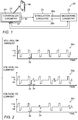
- Fig. 2 is a schematic illustration of various pulse sequences that may be passed between electrodes 26a and 26b, in accordance with some embodiments of the present invention.
- the pulses shown in Fig. 2 may be voltage pulses used for voltage-regulated stimulation, or alternatively, current pulses used for current-regulated stimulation. (Thus, the units of the vertical axes may be any appropriate unit for voltage or current.)
- First sequence 30a is a sequence of stimulating pulses 32, which may be passed between the electrodes while executing a stimulation procedure.
- stimulating pulses 32 have varying intra-pulse amplitudes, such that it may be difficult to use the stimulating pulses to measure the impedance between the electrodes.
- the stimulating pulses may also vary in an inter-pulse manner, such that a particular pulse may have a different amplitude from that of a neighboring pulse.
- a sequence such as second sequence 30b or third sequence 30c, each of which includes a plurality of reference pulses 34 between respective pairs of stimulating pulses, is used, instead of first sequence 30a.
- Reference pulses 34 typically have an amplitude that varies less than the amplitude of the stimulating pulses.
- each reference pulse may have a constant (i.e., "flat") positive ("+ve") amplitude, and a constant negative (“-ve") amplitude.
- reference pulses 34 rather than stimulating pulses 32, may be more easily used to measure the impedance.
- at least some of the reference pulses are passed at regular intervals (i.e., periodically), such that the impedance may be measured at regular intervals.
- At least one pulse of the stimulation procedure is substituted with one of the reference pulses.
- two of the stimulating pulses of sequence 30a are substituted with respective reference pulses.
- no pulse of the stimulation procedure is substituted with a reference pulse.
- sequence 30b two reference pulses are added to sequence 30a, without replacing any of the stimulating pulses.
- the references pulses are added to the stimulating-pulse sequence (as in sequence 30b), rather than substituted for stimulating pulses (as in sequence 30c), unless the frequency of delivery of the stimulating pulses is too high to accommodate the addition of the reference pulses.
- one or more of the reference pulses are symmetric. That is, for one or more of the reference pulses, the duration and amplitude of the positive portion of the pulse are equal to, respectively, the duration and amplitude of the negative portion of the pulse.
- one or more of the reference pulses may be asymmetric. (Even though the integral over an asymmetric pulse is typically zero, the amplitude and duration of the positive portion of the asymmetric pulse are different from the amplitude and duration of the negative portion of the pulse.)
- the reference pulses have an amplitude that is lower than that of the stimulating pulses, and/or a duration that is shorter than that of the stimulating pulses.
- the reference pulses are unlikely to stimulate the subject, and in fact, may not be noticed by the subject at all.
- the amplitude of the current of the reference pulses is less than 15 mA, such as less than 10 mA, e.g., less than 5 mA, and/or the voltage of the reference pulses is less than 15 V, e.g., less than 9 V.
- the duration of the reference pulses may be less than 25 microseconds, e.g., less than 20 microseconds.
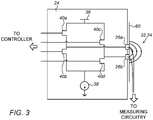
- Fig. 3 is a schematic illustration of stimulation circuitry 24 coupled (e.g., attached) to skin 60 of a subject, in accordance with some embodiments of the present invention. It is noted that the particular configuration shown in Fig. 3 is provided purely by way of example. In practice, any suitable circuitry may be used to apply the stimulating and reference pulses described herein, for either current-regulated or voltage-regulated applications.
- stimulation circuitry 24 comprises the half-bridge circuit shown in Fig. 3 .
- a current source 38 supplies the current that is passed between electrodes 26a and 26b, while the voltage between the electrodes is limited to the voltage supplied by voltage supply 36.
- the current that is passed between the electrodes is the minimum of "I” and "V/R,” where "I” is the current supplied by current source 38, "V” is the voltage supplied by voltage supply 36, and "R” is the impedance of the tissue.
- the controller controls switches (e.g., transistor switches) 40a, 40b, 40c, and 40d.
- the controller closes switches 40a and 40d, thus connecting electrode 26a to voltage supply 36 and electrode 26b to current source 38, while switches 40b and 40c remain open.
- the controller closes switches 40b and 40c, thus connecting electrode 26b to voltage supply 36 and electrode 26a to current source 38, while switches 40a and 40d remain open.
- the direction of current determines the polarity of the pulse.
- the respective positive portions of the pulses shown in Fig. 2 may be obtained by passing current from electrode 26a to electrode 26b, while the respective negative portions may be obtained by passing current from electrode 26b to electrode 26a.
- the degree to which the switches are closed determines the amplitudes of the pulses.
- the voltage supplied by voltage supply 36 is controlled, in response to the measured impedance.
- a "calibration procedure" is performed.
- At least one reference pulse, passed between the electrodes prior to the stimulation procedure, is used to measure the baseline impedance between the electrodes.
- the voltage supply 36 may be set to a voltage that is slightly higher than the product of the measured baseline impedance and the maximum desired stimulation current.
- the above-described calibration procedure is advantageous, in that it facilitates setting a voltage limit that is high enough to accommodate the stimulation of the subject, yet not too high as to consume a relatively large amount of excess power.
- the voltage supply would need to be set, for every subject, as high as needed to accommodate the "worst case scenario," i.e., the highest expected skin impedance.
- the voltage supply would be too high, such that excess power would be needlessly consumed.
- an appropriate voltage limit may be set for each subject, thus facilitating more efficient consumption of power.
- the voltage supply when passing the reference pulse that is used to measure the baseline impedance, the voltage supply is set to a lower voltage than the voltage to which it is subsequently set for the stimulation procedure.
- the voltage supply may be set to a voltage that is slightly higher than the product of the maximum estimated impedance and the desired reference current.
- the voltage supply may be increased in order to accommodate the stimulation, as described above. Since the precision of measuring circuitry 28 ( Fig. 1 ) is typically greater for smaller supplied voltages than for larger supplied voltages, the above-described technique may facilitate a more precise measurement of the baseline impedance. (During the stimulation procedure, however, the voltage supply typically remains at the higher stimulation-accommodating value, even during the application of the reference pulses.)
- reference pulses such as those shown in Fig. 2 may have an amplitude of 10 mA, while skin impedance of human subjects is typically no higher than 1500 Ohm.
- the voltage supply may be set to 18 V, which is slightly higher than the product of 10 mA and 1500 Ohm.
- Stimulation pulses such as those shown in Fig. 2 may have a maximum amplitude of 30 mA.
- the voltage supply for the stimulation procedure may be set to 35 V, which is slightly higher than the product of 30 mA and 1000 Ohm.
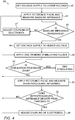
- Fig. 4 is a flow diagram showing a method 58 practiced in accordance with some embodiments of the present invention. Most of the steps in method 58 were already described above, but, for clarity, are again described hereinbelow, with reference to Fig. 4 .
- Method 58 begins with a first voltage-setting step 42, in which voltage supply 36 is set to a voltage that is high enough to accommodate a reference pulse, yet lower than the voltage used subsequently during the stimulation procedure. (As noted above, such a lower voltage may facilitate a more precise measurement of the baseline impedance.) Subsequently, in a baseline-impedance-measuring step 44, at least one reference pulse is applied to the subject by being passed between the electrodes, and during the application of the reference pulse, the baseline impedance is measured, by measuring the voltage between the electrodes.
- the controller assesses whether the measured baseline impedance is reasonable, i.e., whether it falls within an expected range of normal human skin impedance, e.g., 300 - 1500 Ohm. If the baseline impedance is not reasonable (i.e., it is higher than expected, thus indicating that the electrodes may not have been properly coupled to the skin, or it is lower than expected, thus indicating a possible shorting of the electrodes), an alert may be generated, and subsequently, in response to the alert, the coupling (e.g., attachment) of the electrodes to the skin may be adjusted, at a first adjusting step 47. Subsequently, steps 44 and 45 are repeated. (Steps 42, 44, 45, and 47 collectively form part of the calibration procedure referred to above.)
- a second voltage-setting step 46 voltage supply 36 is set, in response to the baseline impedance, to a higher voltage that is high enough to accommodate the stimulation.
- a stimulating step 48 one or more stimulating pulses are applied to the subject, by being passed between the electrodes.
- the controller, or the subject decides whether the stimulation procedure is over, i.e., whether enough stimulating pulses have been applied to the subject. If the answer is affirmative, the stimulation procedure ends.
- the controller compares the intraprocedural impedance to a threshold that is based on the baseline impedance.
- an alert may be generated, and subsequently, in response to the alert, the coupling (e.g., attachment) of the electrodes to the skin may be adjusted, at a second adjusting step 56. Following the adjustment, the stimulation may continue, at stimulating step 48.
- controller circuitry 64 is embodied as a programmable digital computing device comprising a central processing unit (CPU) and random access memory (RAM).
- Program code including software programs, and/or data are loaded into the RAM for execution and processing by the CPU.
- the program code and/or data may be downloaded to the controller in electronic form, over a network, for example, or it may, alternatively or additionally, be provided and/or stored on non-transitory tangible media, such as magnetic, optical, or electronic memory.
- Such program code and/or data when provided to the controller, produce a machine or special-purpose computer, configured to perform the tasks described herein.
- the computer is typically a hardware device programmed with computer program instructions to produce a special purpose computer.
- the operations that are performed by the computer transform the physical state of a memory, which is a real physical article, to have a different magnetic polarity, electrical charge, or the like depending on the technology of the memory that is used.
Landscapes
- Health & Medical Sciences (AREA)
- Life Sciences & Earth Sciences (AREA)
- General Health & Medical Sciences (AREA)
- Animal Behavior & Ethology (AREA)
- Veterinary Medicine (AREA)
- Public Health (AREA)
- Engineering & Computer Science (AREA)
- Biomedical Technology (AREA)
- Biophysics (AREA)
- Nuclear Medicine, Radiotherapy & Molecular Imaging (AREA)
- Radiology & Medical Imaging (AREA)
- Heart & Thoracic Surgery (AREA)
- Medical Informatics (AREA)
- Surgery (AREA)
- Molecular Biology (AREA)
- Pathology (AREA)
- Physics & Mathematics (AREA)
- Dermatology (AREA)
- Physiology (AREA)
- Electrotherapy Devices (AREA)
- Neurology (AREA)
Applications Claiming Priority (2)
| Application Number | Priority Date | Filing Date | Title |
|---|---|---|---|
| US14/992,046 US9895533B2 (en) | 2016-01-11 | 2016-01-11 | Impedance monitoring during electrostimulation |
| PCT/IL2017/050028 WO2017122195A1 (en) | 2016-01-11 | 2017-01-10 | Impedance monitoring during electrostimulation |
Publications (2)
| Publication Number | Publication Date |
|---|---|
| EP3402564A1 EP3402564A1 (en) | 2018-11-21 |
| EP3402564B1 true EP3402564B1 (en) | 2020-03-25 |
Family
ID=57960568
Family Applications (1)
| Application Number | Title | Priority Date | Filing Date |
|---|---|---|---|
| EP17702959.2A Active EP3402564B1 (en) | 2016-01-11 | 2017-01-10 | Impedance monitoring during electrostimulation |
Country Status (5)
| Country | Link |
|---|---|
| US (1) | US9895533B2 (enExample) |
| EP (1) | EP3402564B1 (enExample) |
| JP (1) | JP6674046B2 (enExample) |
| ES (1) | ES2794833T3 (enExample) |
| WO (1) | WO2017122195A1 (enExample) |
Families Citing this family (29)
| Publication number | Priority date | Publication date | Assignee | Title |
|---|---|---|---|---|
| US10213602B2 (en) | 2015-01-13 | 2019-02-26 | Theranica Bio-Electronics Ltd. | Treatment of headaches by electrical stimulation |
| US10695575B1 (en) | 2016-05-10 | 2020-06-30 | Btl Medical Technologies S.R.O. | Aesthetic method of biological structure treatment by magnetic field |
| US20180001107A1 (en) | 2016-07-01 | 2018-01-04 | Btl Holdings Limited | Aesthetic method of biological structure treatment by magnetic field |
| US11266850B2 (en) | 2015-07-01 | 2022-03-08 | Btl Healthcare Technologies A.S. | High power time varying magnetic field therapy |
| US11464993B2 (en) | 2016-05-03 | 2022-10-11 | Btl Healthcare Technologies A.S. | Device including RF source of energy and vacuum system |
| US11534619B2 (en) | 2016-05-10 | 2022-12-27 | Btl Medical Solutions A.S. | Aesthetic method of biological structure treatment by magnetic field |
| US12654023B2 (en) | 2016-05-10 | 2026-06-16 | Btl Medical Solutions A.S. | Aesthetic method of biological structure treatment by magnetic field |
| ES2828065T3 (es) | 2016-09-29 | 2021-05-25 | Theranica Bio Electronics Ltd | Aparato para aplicar una señal eléctrica a un sujeto |
| JP7270554B2 (ja) | 2017-05-21 | 2023-05-10 | セラニカ バイオ-エレクトロニクス リミティド | 疼痛緩和療法を提供するための装置 |
| JP6907783B2 (ja) * | 2017-07-27 | 2021-07-21 | オムロンヘルスケア株式会社 | 電気治療器、制御方法、および治療システム |
| BR102017026510A2 (pt) * | 2017-12-08 | 2019-06-25 | Fundação Universidade De Brasilia/Centro De Apoio Ao Desenvolvimento Tecnológico | Dispositivo para eletroestimulação neuromuscular de longa duração multicanais com recalibração por meio de biofeedback |
| WO2019122905A1 (en) * | 2017-12-20 | 2019-06-27 | Galvani Bioelectronics Limited | Neural interface device for stimulation of a nerve and measuring impedance |
| WO2019138407A1 (en) | 2018-01-11 | 2019-07-18 | Theranica Bio-Electronics Ltd. | Electrode patch |
| RU185257U1 (ru) * | 2018-08-06 | 2018-11-28 | Василий Викторович Дьяконов | Съемный блок костюма для электромиостимуляции |
| EP4137198B1 (en) | 2018-08-31 | 2026-01-07 | Avation Medical, Inc. | System and apparatus for applying transcutaneous electrical stimulation |
| US11571569B2 (en) | 2019-02-15 | 2023-02-07 | Pulse Biosciences, Inc. | High-voltage catheters for sub-microsecond pulsing |
| US12558146B2 (en) | 2019-04-11 | 2026-02-24 | Btl Medical Solutions A.S. | Methods and devices for aesthetic treatment of biological structures by radiofrequency and magnetic energy |
| EP3842094B1 (en) | 2019-12-23 | 2024-05-22 | STIMVIA s.r.o. | Neuromodulation apparatus |
| US12611545B2 (en) | 2020-05-04 | 2026-04-28 | Btl Healthcare Technologies A.S. | Device and method for unattended treatment of a patient |
| HRP20250160T1 (hr) | 2020-05-04 | 2025-03-28 | Btl Healthcare Technologies A.S. | Uređaj za liječenje pacijenata bez prisutnosti liječnika |
| US11878167B2 (en) | 2020-05-04 | 2024-01-23 | Btl Healthcare Technologies A.S. | Device and method for unattended treatment of a patient |
| GB2608006B (en) * | 2020-08-20 | 2024-04-10 | Actegy Ltd | Apparatus for detecting electrical conductivity |
| US20230330415A1 (en) * | 2020-08-28 | 2023-10-19 | Carol Cole Company | Skin treatment device |
| EP4225424B1 (en) * | 2020-10-10 | 2025-12-31 | NMES Group AB | NEUROMUSCULAR ELECTRICAL STIMULATION DEVICE WITH AUTOMATED AND SWITCHABLE REGULATION TECHNOLOGIES |
| EP4026483A1 (en) * | 2021-01-12 | 2022-07-13 | Koninklijke Philips N.V. | Stimulation of sweat generation |
| CA3260012A1 (en) | 2021-10-13 | 2023-04-20 | Btl Medical Solutions A.S. | AESTHETIC TREATMENT DEVICES FOR BIOLOGICAL STRUCTURES USING RADIOFREQUENCY AND MAGNETIC ENERGY |
| CN114010941B (zh) * | 2021-10-20 | 2025-08-12 | 南京麦澜德医疗科技股份有限公司 | 一种对皮肤电刺激的系统、刺激方法及评估方法 |
| WO2026053203A1 (en) | 2024-09-03 | 2026-03-12 | Theranica Bio-Electronics Ltd. | Patch electrode connectors |
| US20260097226A1 (en) | 2024-10-08 | 2026-04-09 | Btl Medical Solutions A.S. | Devices and methods for application of a magnetic field to the nervous system |
Family Cites Families (10)
| Publication number | Priority date | Publication date | Assignee | Title |
|---|---|---|---|---|
| DE3346744A1 (de) * | 1983-12-23 | 1985-07-04 | MEDEL Medizinische Elektronik Handelsges. mbH, 2000 Hamburg | Schaltungsanordnung zum ueberpruefen der lage von elektroden |
| US6210406B1 (en) | 1998-12-03 | 2001-04-03 | Cordis Webster, Inc. | Split tip electrode catheter and signal processing RF ablation system |
| US20040015212A1 (en) | 2002-05-31 | 2004-01-22 | Empi, Corp. | Electrotherapy stimulation device having electrode peel off detection capabilities |
| EP2288408B1 (en) | 2008-05-16 | 2013-07-17 | Koninklijke Philips Electronics N.V. | A method and system for dynamic recalibration of tens stimulation points to compensate for changing electrode conditions with fail-safe and auto-recovery functionality |
| US8311639B2 (en) * | 2009-07-08 | 2012-11-13 | Nevro Corporation | Systems and methods for adjusting electrical therapy based on impedance changes |
| US9020589B2 (en) | 2010-04-27 | 2015-04-28 | Medtronic, Inc. | Electrical stimulator with voltage mode emulation using regulated current |
| US20130093501A1 (en) * | 2010-06-07 | 2013-04-18 | The University Of Electro-Communications | Electrical stimulation device and electrical stimulation method |
| WO2012110248A2 (de) | 2011-02-17 | 2012-08-23 | Muecke Martin | Vorrichtung und verfahren zur reduktion von schmerzen |
| CA2885175A1 (en) | 2012-07-28 | 2014-02-06 | Thimble Bioelectronics, Inc. | System and method for managing pain |
| CN105377359B (zh) | 2013-03-29 | 2019-02-01 | Gsk消费者健康有限公司 | 使用电极-皮肤阻抗来检测皮肤电极脱落 |
-
2016
- 2016-01-11 US US14/992,046 patent/US9895533B2/en active Active
-
2017
- 2017-01-10 EP EP17702959.2A patent/EP3402564B1/en active Active
- 2017-01-10 JP JP2018555316A patent/JP6674046B2/ja active Active
- 2017-01-10 WO PCT/IL2017/050028 patent/WO2017122195A1/en not_active Ceased
- 2017-01-10 ES ES17702959T patent/ES2794833T3/es active Active
Non-Patent Citations (1)
| Title |
|---|
| None * |
Also Published As
| Publication number | Publication date |
|---|---|
| US20170197077A1 (en) | 2017-07-13 |
| JP6674046B2 (ja) | 2020-04-01 |
| ES2794833T3 (es) | 2020-11-19 |
| JP2019501003A (ja) | 2019-01-17 |
| US9895533B2 (en) | 2018-02-20 |
| EP3402564A1 (en) | 2018-11-21 |
| WO2017122195A1 (en) | 2017-07-20 |
Similar Documents
| Publication | Publication Date | Title |
|---|---|---|
| US9895533B2 (en) | Impedance monitoring during electrostimulation | |
| US20250367451A1 (en) | Systems and methods for detecting faults and/or adjusting electrical therapy based on impedance changes | |
| US8131357B2 (en) | Apparatus and methods for detecting migration of neurostimulation leads | |
| US9132272B2 (en) | Methods and systems for automatically turning on and off DRG stimulation and adjusting DRG stimulation parameters | |
| US9044611B2 (en) | Systems and methods for selectively migrating cells using electric fields | |
| CN110382040A (zh) | 堆叠电位电穿孔 | |
| AU2010270830A1 (en) | Systems and methods for adjusting electrical therapy based on impedance changes | |
| US12465767B2 (en) | Systems and methods for direct suppression of nerve cells | |
| US20250099767A1 (en) | Neurostimulation waveforms having a base component and a high frequency component, and associated systems and methods | |
| CN219109714U (zh) | 一种电治疗发生器、系统 | |
| EP4727638A1 (en) | Long pulse width spinal cord stimulation for treating diabetic neuropathy, and associated systems and methods | |
| JP2014176532A (ja) | 神経刺激装置 |
Legal Events
| Date | Code | Title | Description |
|---|---|---|---|
| STAA | Information on the status of an ep patent application or granted ep patent |
Free format text: STATUS: UNKNOWN |
|
| STAA | Information on the status of an ep patent application or granted ep patent |
Free format text: STATUS: THE INTERNATIONAL PUBLICATION HAS BEEN MADE |
|
| PUAI | Public reference made under article 153(3) epc to a published international application that has entered the european phase |
Free format text: ORIGINAL CODE: 0009012 |
|
| STAA | Information on the status of an ep patent application or granted ep patent |
Free format text: STATUS: REQUEST FOR EXAMINATION WAS MADE |
|
| 17P | Request for examination filed |
Effective date: 20180716 |
|
| AK | Designated contracting states |
Kind code of ref document: A1 Designated state(s): AL AT BE BG CH CY CZ DE DK EE ES FI FR GB GR HR HU IE IS IT LI LT LU LV MC MK MT NL NO PL PT RO RS SE SI SK SM TR |
|
| AX | Request for extension of the european patent |
Extension state: BA ME |
|
| DAV | Request for validation of the european patent (deleted) | ||
| DAX | Request for extension of the european patent (deleted) | ||
| GRAP | Despatch of communication of intention to grant a patent |
Free format text: ORIGINAL CODE: EPIDOSNIGR1 |
|
| STAA | Information on the status of an ep patent application or granted ep patent |
Free format text: STATUS: GRANT OF PATENT IS INTENDED |
|
| INTG | Intention to grant announced |
Effective date: 20191106 |
|
| GRAS | Grant fee paid |
Free format text: ORIGINAL CODE: EPIDOSNIGR3 |
|
| GRAA | (expected) grant |
Free format text: ORIGINAL CODE: 0009210 |
|
| STAA | Information on the status of an ep patent application or granted ep patent |
Free format text: STATUS: THE PATENT HAS BEEN GRANTED |
|
| AK | Designated contracting states |
Kind code of ref document: B1 Designated state(s): AL AT BE BG CH CY CZ DE DK EE ES FI FR GB GR HR HU IE IS IT LI LT LU LV MC MK MT NL NO PL PT RO RS SE SI SK SM TR |
|
| REG | Reference to a national code |
Ref country code: GB Ref legal event code: FG4D |
|
| REG | Reference to a national code |
Ref country code: AT Ref legal event code: REF Ref document number: 1247863 Country of ref document: AT Kind code of ref document: T Effective date: 20200415 Ref country code: IE Ref legal event code: FG4D |
|
| REG | Reference to a national code |
Ref country code: DE Ref legal event code: R096 Ref document number: 602017013591 Country of ref document: DE |
|
| PG25 | Lapsed in a contracting state [announced via postgrant information from national office to epo] |
Ref country code: FI Free format text: LAPSE BECAUSE OF FAILURE TO SUBMIT A TRANSLATION OF THE DESCRIPTION OR TO PAY THE FEE WITHIN THE PRESCRIBED TIME-LIMIT Effective date: 20200325 Ref country code: NO Free format text: LAPSE BECAUSE OF FAILURE TO SUBMIT A TRANSLATION OF THE DESCRIPTION OR TO PAY THE FEE WITHIN THE PRESCRIBED TIME-LIMIT Effective date: 20200625 Ref country code: RS Free format text: LAPSE BECAUSE OF FAILURE TO SUBMIT A TRANSLATION OF THE DESCRIPTION OR TO PAY THE FEE WITHIN THE PRESCRIBED TIME-LIMIT Effective date: 20200325 |
|
| PG25 | Lapsed in a contracting state [announced via postgrant information from national office to epo] |
Ref country code: GR Free format text: LAPSE BECAUSE OF FAILURE TO SUBMIT A TRANSLATION OF THE DESCRIPTION OR TO PAY THE FEE WITHIN THE PRESCRIBED TIME-LIMIT Effective date: 20200626 Ref country code: HR Free format text: LAPSE BECAUSE OF FAILURE TO SUBMIT A TRANSLATION OF THE DESCRIPTION OR TO PAY THE FEE WITHIN THE PRESCRIBED TIME-LIMIT Effective date: 20200325 Ref country code: LV Free format text: LAPSE BECAUSE OF FAILURE TO SUBMIT A TRANSLATION OF THE DESCRIPTION OR TO PAY THE FEE WITHIN THE PRESCRIBED TIME-LIMIT Effective date: 20200325 Ref country code: SE Free format text: LAPSE BECAUSE OF FAILURE TO SUBMIT A TRANSLATION OF THE DESCRIPTION OR TO PAY THE FEE WITHIN THE PRESCRIBED TIME-LIMIT Effective date: 20200325 Ref country code: BG Free format text: LAPSE BECAUSE OF FAILURE TO SUBMIT A TRANSLATION OF THE DESCRIPTION OR TO PAY THE FEE WITHIN THE PRESCRIBED TIME-LIMIT Effective date: 20200625 |
|
| REG | Reference to a national code |
Ref country code: NL Ref legal event code: MP Effective date: 20200325 |
|
| REG | Reference to a national code |
Ref country code: LT Ref legal event code: MG4D |
|
| PG25 | Lapsed in a contracting state [announced via postgrant information from national office to epo] |
Ref country code: NL Free format text: LAPSE BECAUSE OF FAILURE TO SUBMIT A TRANSLATION OF THE DESCRIPTION OR TO PAY THE FEE WITHIN THE PRESCRIBED TIME-LIMIT Effective date: 20200325 |
|
| PG25 | Lapsed in a contracting state [announced via postgrant information from national office to epo] |
Ref country code: LT Free format text: LAPSE BECAUSE OF FAILURE TO SUBMIT A TRANSLATION OF THE DESCRIPTION OR TO PAY THE FEE WITHIN THE PRESCRIBED TIME-LIMIT Effective date: 20200325 Ref country code: CZ Free format text: LAPSE BECAUSE OF FAILURE TO SUBMIT A TRANSLATION OF THE DESCRIPTION OR TO PAY THE FEE WITHIN THE PRESCRIBED TIME-LIMIT Effective date: 20200325 Ref country code: RO Free format text: LAPSE BECAUSE OF FAILURE TO SUBMIT A TRANSLATION OF THE DESCRIPTION OR TO PAY THE FEE WITHIN THE PRESCRIBED TIME-LIMIT Effective date: 20200325 Ref country code: PT Free format text: LAPSE BECAUSE OF FAILURE TO SUBMIT A TRANSLATION OF THE DESCRIPTION OR TO PAY THE FEE WITHIN THE PRESCRIBED TIME-LIMIT Effective date: 20200818 Ref country code: IS Free format text: LAPSE BECAUSE OF FAILURE TO SUBMIT A TRANSLATION OF THE DESCRIPTION OR TO PAY THE FEE WITHIN THE PRESCRIBED TIME-LIMIT Effective date: 20200725 Ref country code: SK Free format text: LAPSE BECAUSE OF FAILURE TO SUBMIT A TRANSLATION OF THE DESCRIPTION OR TO PAY THE FEE WITHIN THE PRESCRIBED TIME-LIMIT Effective date: 20200325 Ref country code: EE Free format text: LAPSE BECAUSE OF FAILURE TO SUBMIT A TRANSLATION OF THE DESCRIPTION OR TO PAY THE FEE WITHIN THE PRESCRIBED TIME-LIMIT Effective date: 20200325 Ref country code: SM Free format text: LAPSE BECAUSE OF FAILURE TO SUBMIT A TRANSLATION OF THE DESCRIPTION OR TO PAY THE FEE WITHIN THE PRESCRIBED TIME-LIMIT Effective date: 20200325 |
|
| REG | Reference to a national code |
Ref country code: AT Ref legal event code: MK05 Ref document number: 1247863 Country of ref document: AT Kind code of ref document: T Effective date: 20200325 |
|
| REG | Reference to a national code |
Ref country code: ES Ref legal event code: FG2A Ref document number: 2794833 Country of ref document: ES Kind code of ref document: T3 Effective date: 20201119 |
|
| REG | Reference to a national code |
Ref country code: DE Ref legal event code: R097 Ref document number: 602017013591 Country of ref document: DE |
|
| PG25 | Lapsed in a contracting state [announced via postgrant information from national office to epo] |
Ref country code: DK Free format text: LAPSE BECAUSE OF FAILURE TO SUBMIT A TRANSLATION OF THE DESCRIPTION OR TO PAY THE FEE WITHIN THE PRESCRIBED TIME-LIMIT Effective date: 20200325 Ref country code: AT Free format text: LAPSE BECAUSE OF FAILURE TO SUBMIT A TRANSLATION OF THE DESCRIPTION OR TO PAY THE FEE WITHIN THE PRESCRIBED TIME-LIMIT Effective date: 20200325 |
|
| PLBE | No opposition filed within time limit |
Free format text: ORIGINAL CODE: 0009261 |
|
| STAA | Information on the status of an ep patent application or granted ep patent |
Free format text: STATUS: NO OPPOSITION FILED WITHIN TIME LIMIT |
|
| PG25 | Lapsed in a contracting state [announced via postgrant information from national office to epo] |
Ref country code: PL Free format text: LAPSE BECAUSE OF FAILURE TO SUBMIT A TRANSLATION OF THE DESCRIPTION OR TO PAY THE FEE WITHIN THE PRESCRIBED TIME-LIMIT Effective date: 20200325 |
|
| 26N | No opposition filed |
Effective date: 20210112 |
|
| PG25 | Lapsed in a contracting state [announced via postgrant information from national office to epo] |
Ref country code: SI Free format text: LAPSE BECAUSE OF FAILURE TO SUBMIT A TRANSLATION OF THE DESCRIPTION OR TO PAY THE FEE WITHIN THE PRESCRIBED TIME-LIMIT Effective date: 20200325 |
|
| PG25 | Lapsed in a contracting state [announced via postgrant information from national office to epo] |
Ref country code: MC Free format text: LAPSE BECAUSE OF FAILURE TO SUBMIT A TRANSLATION OF THE DESCRIPTION OR TO PAY THE FEE WITHIN THE PRESCRIBED TIME-LIMIT Effective date: 20200325 |
|
| REG | Reference to a national code |
Ref country code: CH Ref legal event code: PL |
|
| PG25 | Lapsed in a contracting state [announced via postgrant information from national office to epo] |
Ref country code: LU Free format text: LAPSE BECAUSE OF NON-PAYMENT OF DUE FEES Effective date: 20210110 |
|
| REG | Reference to a national code |
Ref country code: BE Ref legal event code: MM Effective date: 20210131 |
|
| PG25 | Lapsed in a contracting state [announced via postgrant information from national office to epo] |
Ref country code: CH Free format text: LAPSE BECAUSE OF NON-PAYMENT OF DUE FEES Effective date: 20210131 Ref country code: LI Free format text: LAPSE BECAUSE OF NON-PAYMENT OF DUE FEES Effective date: 20210131 |
|
| PG25 | Lapsed in a contracting state [announced via postgrant information from national office to epo] |
Ref country code: IE Free format text: LAPSE BECAUSE OF NON-PAYMENT OF DUE FEES Effective date: 20210110 |
|
| PG25 | Lapsed in a contracting state [announced via postgrant information from national office to epo] |
Ref country code: BE Free format text: LAPSE BECAUSE OF NON-PAYMENT OF DUE FEES Effective date: 20210131 |
|
| P01 | Opt-out of the competence of the unified patent court (upc) registered |
Effective date: 20230503 |
|
| PG25 | Lapsed in a contracting state [announced via postgrant information from national office to epo] |
Ref country code: CY Free format text: LAPSE BECAUSE OF FAILURE TO SUBMIT A TRANSLATION OF THE DESCRIPTION OR TO PAY THE FEE WITHIN THE PRESCRIBED TIME-LIMIT Effective date: 20200325 |
|
| PG25 | Lapsed in a contracting state [announced via postgrant information from national office to epo] |
Ref country code: HU Free format text: LAPSE BECAUSE OF FAILURE TO SUBMIT A TRANSLATION OF THE DESCRIPTION OR TO PAY THE FEE WITHIN THE PRESCRIBED TIME-LIMIT; INVALID AB INITIO Effective date: 20170110 |
|
| PG25 | Lapsed in a contracting state [announced via postgrant information from national office to epo] |
Ref country code: MK Free format text: LAPSE BECAUSE OF FAILURE TO SUBMIT A TRANSLATION OF THE DESCRIPTION OR TO PAY THE FEE WITHIN THE PRESCRIBED TIME-LIMIT Effective date: 20200325 |
|
| PG25 | Lapsed in a contracting state [announced via postgrant information from national office to epo] |
Ref country code: MT Free format text: LAPSE BECAUSE OF FAILURE TO SUBMIT A TRANSLATION OF THE DESCRIPTION OR TO PAY THE FEE WITHIN THE PRESCRIBED TIME-LIMIT Effective date: 20200325 |
|
| PG25 | Lapsed in a contracting state [announced via postgrant information from national office to epo] |
Ref country code: TR Free format text: LAPSE BECAUSE OF FAILURE TO SUBMIT A TRANSLATION OF THE DESCRIPTION OR TO PAY THE FEE WITHIN THE PRESCRIBED TIME-LIMIT Effective date: 20200325 |
|
| PGFP | Annual fee paid to national office [announced via postgrant information from national office to epo] |
Ref country code: GB Payment date: 20251222 Year of fee payment: 10 |
|
| PGFP | Annual fee paid to national office [announced via postgrant information from national office to epo] |
Ref country code: FR Payment date: 20251224 Year of fee payment: 10 |
|
| PGFP | Annual fee paid to national office [announced via postgrant information from national office to epo] |
Ref country code: DE Payment date: 20251211 Year of fee payment: 10 |
|
| PGFP | Annual fee paid to national office [announced via postgrant information from national office to epo] |
Ref country code: IT Payment date: 20260128 Year of fee payment: 10 |
|
| PGFP | Annual fee paid to national office [announced via postgrant information from national office to epo] |
Ref country code: ES Payment date: 20260428 Year of fee payment: 10 |