EP3395992A1 - Super strength hot-rolled steel sheet excellent ductility and manufacturing therefor - Google Patents
Super strength hot-rolled steel sheet excellent ductility and manufacturing therefor Download PDFInfo
- Publication number
- EP3395992A1 EP3395992A1 EP16879189.5A EP16879189A EP3395992A1 EP 3395992 A1 EP3395992 A1 EP 3395992A1 EP 16879189 A EP16879189 A EP 16879189A EP 3395992 A1 EP3395992 A1 EP 3395992A1
- Authority
- EP
- European Patent Office
- Prior art keywords
- hot
- steel sheet
- rolled steel
- steel
- sol
- Prior art date
- Legal status (The legal status is an assumption and is not a legal conclusion. Google has not performed a legal analysis and makes no representation as to the accuracy of the status listed.)
- Granted
Links
Images

Classifications
-
- C—CHEMISTRY; METALLURGY
- C22—METALLURGY; FERROUS OR NON-FERROUS ALLOYS; TREATMENT OF ALLOYS OR NON-FERROUS METALS
- C22C—ALLOYS
- C22C38/00—Ferrous alloys, e.g. steel alloys
- C22C38/18—Ferrous alloys, e.g. steel alloys containing chromium
- C22C38/38—Ferrous alloys, e.g. steel alloys containing chromium with more than 1.5% by weight of manganese
-
- C—CHEMISTRY; METALLURGY
- C21—METALLURGY OF IRON
- C21D—MODIFYING THE PHYSICAL STRUCTURE OF FERROUS METALS; GENERAL DEVICES FOR HEAT TREATMENT OF FERROUS OR NON-FERROUS METALS OR ALLOYS; MAKING METAL MALLEABLE, e.g. BY DECARBURISATION OR TEMPERING
- C21D6/00—Heat treatment of ferrous alloys
- C21D6/002—Heat treatment of ferrous alloys containing Cr
-
- C—CHEMISTRY; METALLURGY
- C21—METALLURGY OF IRON
- C21D—MODIFYING THE PHYSICAL STRUCTURE OF FERROUS METALS; GENERAL DEVICES FOR HEAT TREATMENT OF FERROUS OR NON-FERROUS METALS OR ALLOYS; MAKING METAL MALLEABLE, e.g. BY DECARBURISATION OR TEMPERING
- C21D6/00—Heat treatment of ferrous alloys
- C21D6/005—Heat treatment of ferrous alloys containing Mn
-
- C—CHEMISTRY; METALLURGY
- C21—METALLURGY OF IRON
- C21D—MODIFYING THE PHYSICAL STRUCTURE OF FERROUS METALS; GENERAL DEVICES FOR HEAT TREATMENT OF FERROUS OR NON-FERROUS METALS OR ALLOYS; MAKING METAL MALLEABLE, e.g. BY DECARBURISATION OR TEMPERING
- C21D6/00—Heat treatment of ferrous alloys
- C21D6/008—Heat treatment of ferrous alloys containing Si
-
- C—CHEMISTRY; METALLURGY
- C21—METALLURGY OF IRON
- C21D—MODIFYING THE PHYSICAL STRUCTURE OF FERROUS METALS; GENERAL DEVICES FOR HEAT TREATMENT OF FERROUS OR NON-FERROUS METALS OR ALLOYS; MAKING METAL MALLEABLE, e.g. BY DECARBURISATION OR TEMPERING
- C21D8/00—Modifying the physical properties of ferrous metals or ferrous alloys by deformation combined with, or followed by, heat treatment
- C21D8/02—Modifying the physical properties of ferrous metals or ferrous alloys by deformation combined with, or followed by, heat treatment during manufacturing of plates or strips
-
- C—CHEMISTRY; METALLURGY
- C21—METALLURGY OF IRON
- C21D—MODIFYING THE PHYSICAL STRUCTURE OF FERROUS METALS; GENERAL DEVICES FOR HEAT TREATMENT OF FERROUS OR NON-FERROUS METALS OR ALLOYS; MAKING METAL MALLEABLE, e.g. BY DECARBURISATION OR TEMPERING
- C21D8/00—Modifying the physical properties of ferrous metals or ferrous alloys by deformation combined with, or followed by, heat treatment
- C21D8/02—Modifying the physical properties of ferrous metals or ferrous alloys by deformation combined with, or followed by, heat treatment during manufacturing of plates or strips
- C21D8/0247—Modifying the physical properties of ferrous metals or ferrous alloys by deformation combined with, or followed by, heat treatment during manufacturing of plates or strips characterised by the heat treatment
- C21D8/0263—Modifying the physical properties of ferrous metals or ferrous alloys by deformation combined with, or followed by, heat treatment during manufacturing of plates or strips characterised by the heat treatment following hot rolling
-
- C—CHEMISTRY; METALLURGY
- C21—METALLURGY OF IRON
- C21D—MODIFYING THE PHYSICAL STRUCTURE OF FERROUS METALS; GENERAL DEVICES FOR HEAT TREATMENT OF FERROUS OR NON-FERROUS METALS OR ALLOYS; MAKING METAL MALLEABLE, e.g. BY DECARBURISATION OR TEMPERING
- C21D9/00—Heat treatment, e.g. annealing, hardening, quenching or tempering, adapted for particular articles; Furnaces therefor
- C21D9/46—Heat treatment, e.g. annealing, hardening, quenching or tempering, adapted for particular articles; Furnaces therefor for sheet metals
-
- C—CHEMISTRY; METALLURGY
- C22—METALLURGY; FERROUS OR NON-FERROUS ALLOYS; TREATMENT OF ALLOYS OR NON-FERROUS METALS
- C22C—ALLOYS
- C22C38/00—Ferrous alloys, e.g. steel alloys
-
- C—CHEMISTRY; METALLURGY
- C22—METALLURGY; FERROUS OR NON-FERROUS ALLOYS; TREATMENT OF ALLOYS OR NON-FERROUS METALS
- C22C—ALLOYS
- C22C38/00—Ferrous alloys, e.g. steel alloys
- C22C38/001—Ferrous alloys, e.g. steel alloys containing N
-
- C—CHEMISTRY; METALLURGY
- C22—METALLURGY; FERROUS OR NON-FERROUS ALLOYS; TREATMENT OF ALLOYS OR NON-FERROUS METALS
- C22C—ALLOYS
- C22C38/00—Ferrous alloys, e.g. steel alloys
- C22C38/002—Ferrous alloys, e.g. steel alloys containing In, Mg, or other elements not provided for in one single group C22C38/001 - C22C38/60
-
- C—CHEMISTRY; METALLURGY
- C22—METALLURGY; FERROUS OR NON-FERROUS ALLOYS; TREATMENT OF ALLOYS OR NON-FERROUS METALS
- C22C—ALLOYS
- C22C38/00—Ferrous alloys, e.g. steel alloys
- C22C38/02—Ferrous alloys, e.g. steel alloys containing silicon
-
- C—CHEMISTRY; METALLURGY
- C22—METALLURGY; FERROUS OR NON-FERROUS ALLOYS; TREATMENT OF ALLOYS OR NON-FERROUS METALS
- C22C—ALLOYS
- C22C38/00—Ferrous alloys, e.g. steel alloys
- C22C38/04—Ferrous alloys, e.g. steel alloys containing manganese
-
- C—CHEMISTRY; METALLURGY
- C22—METALLURGY; FERROUS OR NON-FERROUS ALLOYS; TREATMENT OF ALLOYS OR NON-FERROUS METALS
- C22C—ALLOYS
- C22C38/00—Ferrous alloys, e.g. steel alloys
- C22C38/06—Ferrous alloys, e.g. steel alloys containing aluminium
-
- C—CHEMISTRY; METALLURGY
- C22—METALLURGY; FERROUS OR NON-FERROUS ALLOYS; TREATMENT OF ALLOYS OR NON-FERROUS METALS
- C22C—ALLOYS
- C22C38/00—Ferrous alloys, e.g. steel alloys
- C22C38/18—Ferrous alloys, e.g. steel alloys containing chromium
- C22C38/22—Ferrous alloys, e.g. steel alloys containing chromium with molybdenum or tungsten
-
- C—CHEMISTRY; METALLURGY
- C22—METALLURGY; FERROUS OR NON-FERROUS ALLOYS; TREATMENT OF ALLOYS OR NON-FERROUS METALS
- C22C—ALLOYS
- C22C38/00—Ferrous alloys, e.g. steel alloys
- C22C38/18—Ferrous alloys, e.g. steel alloys containing chromium
- C22C38/24—Ferrous alloys, e.g. steel alloys containing chromium with vanadium
-
- C—CHEMISTRY; METALLURGY
- C22—METALLURGY; FERROUS OR NON-FERROUS ALLOYS; TREATMENT OF ALLOYS OR NON-FERROUS METALS
- C22C—ALLOYS
- C22C38/00—Ferrous alloys, e.g. steel alloys
- C22C38/18—Ferrous alloys, e.g. steel alloys containing chromium
- C22C38/26—Ferrous alloys, e.g. steel alloys containing chromium with niobium or tantalum
-
- C—CHEMISTRY; METALLURGY
- C22—METALLURGY; FERROUS OR NON-FERROUS ALLOYS; TREATMENT OF ALLOYS OR NON-FERROUS METALS
- C22C—ALLOYS
- C22C38/00—Ferrous alloys, e.g. steel alloys
- C22C38/18—Ferrous alloys, e.g. steel alloys containing chromium
- C22C38/28—Ferrous alloys, e.g. steel alloys containing chromium with titanium or zirconium
-
- C—CHEMISTRY; METALLURGY
- C22—METALLURGY; FERROUS OR NON-FERROUS ALLOYS; TREATMENT OF ALLOYS OR NON-FERROUS METALS
- C22C—ALLOYS
- C22C38/00—Ferrous alloys, e.g. steel alloys
- C22C38/18—Ferrous alloys, e.g. steel alloys containing chromium
- C22C38/32—Ferrous alloys, e.g. steel alloys containing chromium with boron
-
- C—CHEMISTRY; METALLURGY
- C22—METALLURGY; FERROUS OR NON-FERROUS ALLOYS; TREATMENT OF ALLOYS OR NON-FERROUS METALS
- C22C—ALLOYS
- C22C38/00—Ferrous alloys, e.g. steel alloys
- C22C38/18—Ferrous alloys, e.g. steel alloys containing chromium
- C22C38/34—Ferrous alloys, e.g. steel alloys containing chromium with more than 1.5% by weight of silicon
-
- C—CHEMISTRY; METALLURGY
- C23—COATING METALLIC MATERIAL; COATING MATERIAL WITH METALLIC MATERIAL; CHEMICAL SURFACE TREATMENT; DIFFUSION TREATMENT OF METALLIC MATERIAL; COATING BY VACUUM EVAPORATION, BY SPUTTERING, BY ION IMPLANTATION OR BY CHEMICAL VAPOUR DEPOSITION, IN GENERAL; INHIBITING CORROSION OF METALLIC MATERIAL OR INCRUSTATION IN GENERAL
- C23C—COATING METALLIC MATERIAL; COATING MATERIAL WITH METALLIC MATERIAL; SURFACE TREATMENT OF METALLIC MATERIAL BY DIFFUSION INTO THE SURFACE, BY CHEMICAL CONVERSION OR SUBSTITUTION; COATING BY VACUUM EVAPORATION, BY SPUTTERING, BY ION IMPLANTATION OR BY CHEMICAL VAPOUR DEPOSITION, IN GENERAL
- C23C2/00—Hot-dipping or immersion processes for applying the coating material in the molten state without affecting the shape; Apparatus therefor
- C23C2/04—Hot-dipping or immersion processes for applying the coating material in the molten state without affecting the shape; Apparatus therefor characterised by the coating material
- C23C2/06—Zinc or cadmium or alloys based thereon
-
- C—CHEMISTRY; METALLURGY
- C21—METALLURGY OF IRON
- C21D—MODIFYING THE PHYSICAL STRUCTURE OF FERROUS METALS; GENERAL DEVICES FOR HEAT TREATMENT OF FERROUS OR NON-FERROUS METALS OR ALLOYS; MAKING METAL MALLEABLE, e.g. BY DECARBURISATION OR TEMPERING
- C21D2211/00—Microstructure comprising significant phases
- C21D2211/001—Austenite
-
- C—CHEMISTRY; METALLURGY
- C21—METALLURGY OF IRON
- C21D—MODIFYING THE PHYSICAL STRUCTURE OF FERROUS METALS; GENERAL DEVICES FOR HEAT TREATMENT OF FERROUS OR NON-FERROUS METALS OR ALLOYS; MAKING METAL MALLEABLE, e.g. BY DECARBURISATION OR TEMPERING
- C21D2211/00—Microstructure comprising significant phases
- C21D2211/002—Bainite
-
- C—CHEMISTRY; METALLURGY
- C21—METALLURGY OF IRON
- C21D—MODIFYING THE PHYSICAL STRUCTURE OF FERROUS METALS; GENERAL DEVICES FOR HEAT TREATMENT OF FERROUS OR NON-FERROUS METALS OR ALLOYS; MAKING METAL MALLEABLE, e.g. BY DECARBURISATION OR TEMPERING
- C21D2211/00—Microstructure comprising significant phases
- C21D2211/005—Ferrite
-
- C—CHEMISTRY; METALLURGY
- C21—METALLURGY OF IRON
- C21D—MODIFYING THE PHYSICAL STRUCTURE OF FERROUS METALS; GENERAL DEVICES FOR HEAT TREATMENT OF FERROUS OR NON-FERROUS METALS OR ALLOYS; MAKING METAL MALLEABLE, e.g. BY DECARBURISATION OR TEMPERING
- C21D2211/00—Microstructure comprising significant phases
- C21D2211/008—Martensite
-
- C—CHEMISTRY; METALLURGY
- C21—METALLURGY OF IRON
- C21D—MODIFYING THE PHYSICAL STRUCTURE OF FERROUS METALS; GENERAL DEVICES FOR HEAT TREATMENT OF FERROUS OR NON-FERROUS METALS OR ALLOYS; MAKING METAL MALLEABLE, e.g. BY DECARBURISATION OR TEMPERING
- C21D8/00—Modifying the physical properties of ferrous metals or ferrous alloys by deformation combined with, or followed by, heat treatment
- C21D8/02—Modifying the physical properties of ferrous metals or ferrous alloys by deformation combined with, or followed by, heat treatment during manufacturing of plates or strips
- C21D8/0221—Modifying the physical properties of ferrous metals or ferrous alloys by deformation combined with, or followed by, heat treatment during manufacturing of plates or strips characterised by the working steps
- C21D8/0226—Hot rolling
-
- Y—GENERAL TAGGING OF NEW TECHNOLOGICAL DEVELOPMENTS; GENERAL TAGGING OF CROSS-SECTIONAL TECHNOLOGIES SPANNING OVER SEVERAL SECTIONS OF THE IPC; TECHNICAL SUBJECTS COVERED BY FORMER USPC CROSS-REFERENCE ART COLLECTIONS [XRACs] AND DIGESTS
- Y02—TECHNOLOGIES OR APPLICATIONS FOR MITIGATION OR ADAPTATION AGAINST CLIMATE CHANGE
- Y02P—CLIMATE CHANGE MITIGATION TECHNOLOGIES IN THE PRODUCTION OR PROCESSING OF GOODS
- Y02P10/00—Technologies related to metal processing
- Y02P10/20—Recycling
Definitions
- the present inventive concept relates to a ultra high strength hot-rolled steel sheet having excellent ductility and method for manufacturing the same.
- Ultra high strength steels are used in impact absorption members, bumpers, and reinforcing members for automobiles, and have a tensile strength of 1 GPa or more. Such steels may contain an appropriate amount of a retained austenite phase, thereby being easily molded to become parts and having superior impact resistance characteristics due to high strength thereof, even after molding.
- the Q&P steel may be fabricated by heating a steel to a temperature at which an austenite single phase or an austenite-ferrite dual phase exists to perform a heat treatment for homogenization for a certain period of time, quenching the heated steel to a temperature between a martensite transformation start temperature (Ms) and a martensite transformation end temperature (Mf) thereby forming a martensite phase and a retained austenite phase, and maintaining the quenched steel at a cooling end temperature or heating the quenched steel to a temperature slightly higher than Ms to perform a heat-treatment thereby stabilizing the retained austenite phase.
- Ms martensite transformation start temperature
- Mf martensite transformation end temperature
- Non-Patent Document 1 Such a concept of fabricating the Q&P steel has been suggested by a professor J.G. Speer (Colorado School of Mines, US), et al., as disclosed in Non-Patent Document 1 and Non-Patent Document 2 below.
- the method in which the process of reheating the steel to a temperature at which the austenite-ferrite dual phase or the austenite single phase exists is added to an ordinary hot-rolling process may require high manufacturing costs.
- Patent Documents 1 to 3 a method of obtaining the Q&P steel by use of Cr, Ti, Al, and the like, during a cooling process after the ordinary hot-rolling process, has been suggested as disclosed in Patent Documents 1 to 3.
- Cr and Al are additionally used, the weldability of the steel may deteriorate and material differences between an edge portion and a center portion in a steel sheet may become severe due to an abnormal increase in hardenability of the steel.
- Ti it is difficult to obtain sufficient ductility and bending properties since a fraction of the retained austenite phase decreases due to formation of carbide at a high temperature.
- An aspect of the present inventive concept may provide a ultra high strength hot-rolled steel sheet having excellent ductility by precisely controlling alloy compositions, and a manufacturing method thereof, without significantly changing existing processes of fabricating a hot-rolled steel sheet, and a method of manufacturing the same.
- a ultra high strength hot-rolled steel sheet having excellent ductility includes 0.15% to 0.25% carbon (C), 0.6% to 2.0% silicon (Si), 1.5% to 3.0% manganese (Mn), 0.01% to 0.1% aluminum (Al), 0.01% to 0.5% chrome (Cr), 0.005% to 0.2% molybdenum (Mo), 0.001% to 0.05% phosphorus (P), 0.001% to 0.05% sulfur (S), 0.001% to 0.01% nitrogen (N), 0.003% to 0.1% niobium (Nb), 0.003% to 0.1% titanium (Ti), 0.003% to 0.1% vanadium (V), 0.0005% to 0.005% boron (B), a balance of iron (Fe) and unavoidable impurities, by weight percentage, and satisfies following relational expressions 1 and 2.
- a method of fabricating a ultra high strength hot-rolled steel sheet having excellent ductility includes heating a slab which includes 0.15% to 0.25% carbon (C), 0.6% to 2.0% silicon (Si), 1.5% to 3.0% manganese (Mn), 0.01% to 0.1% aluminum (Al), 0.01% to 0.5% chrome (Cr), 0.005% to 0.2% molybdenum (Mo), 0.001% to 0.05% phosphorus (P), 0.001% to 0.05% sulfur (S), 0.001% to 0.01% nitrogen (N), 0.003% to 0.1% niobium (Nb), 0.003% to 0.1% titanium (Ti), 0.003% to 0.1% vanadium (V), 0.0005% to 0.005% boron (B), a balance of iron (Fe) and unavoidable impurities, by weight percentage, at a temperature in a range between 1200°C and 1350°C and satisfies following relational expressions 1 and 2, forming a hot-rolled
- each element symbol represents a content (% by weight) of the element in Relational Expression 1 and Relational Expression 2, and Temp and Time respectively represent a temperature (°C) and time (minutes) of the heating furnace after coiling in Relational Expression 3.
- a ultra high strength hot-rolled steel sheet having excellent ductility according to the present inventive concept can be usefully applied to impact absorption members, bumpers, and reinforcing members for automobiles, and a method of fabricating the same.
- Inventors of the present inventive concept have deeply studied to solve the above-described problems, resulting in providing a ultra high strength hot-rolled steel sheet having excellent ductility by precisely controlling alloy compositions, and a manufacturing method thereof, without significantly changing existing processes of fabricating a hot-rolled steel sheet, and a method of manufacturing the same.
- the ultra high strength hot-rolled steel sheet having excellent ductility may include 0.15% to 0.25% carbon (C), 0.6% to 2.0% silicon (Si), 1.5% to 3.0% manganese (Mn), 0.01% to 0.1% aluminum (Al), 0.01% to 0.5% chrome (Cr), 0.005% to 0.2% molybdenum (Mo), 0.001% to 0.05% phosphorus (P), 0.001% to 0.05% sulfur (S), 0.001% to 0.01% nitrogen (N), 0.003% to 0.1% niobium (Nb), 0.003% to 0.1% titanium (Ti), 0.003% to 0.1% vanadium (V), 0.0005% to 0.005% boron (B), a balance of iron (Fe) and unavoidable impurities, by weight percentage, and satisfy the following relational expressions 1 and 2.
- C C ⁇ 0.25 Ti + 0.13
- each element symbol represents a content (% by weight) of the element in Relational Expression 1 and Relational Expression 2.
- alloy compositions of the ultra high strength hot-rolled steel sheet having excellent ductility according to the example embodiment of the present invention will be described in detail.
- a unit of each alloy element is % by weight.
- Carbon (C) is the most economical and effective element for increasing the hardenability of a steel to strengthen the steel and easily secure the stability of a retained austenite phase. As the content of C increases, a martensite phase and a bainite phase may increase and thereby a tensile strength of the steel may increase.
- the content of C When the content of C is lower than 0.15%, the retained austenite phase may become unstable. On the other hand, when the content of C exceeds 0.25%, there may be problems in that the hot-rolled steel sheet may have poor weldability, material differences by position in the hot-rolled steel sheet may increase, since microstructural variations increase with a cooling rate, and ductility and shearing workability may be decreased. Accordingly, the content of C may preferably be in the range of 0.15% to 0.25%.
- Silicon (Si) functions to deoxidize molten steel, has a solid solution strengthening effect, and is advantageous for forming a retained austenite phase by retarding the formation of coarse carbides.
- the content of Si When the content of Si is lower than 0.6%, it is difficult to stabilize the retained austenite phase since the effect of retarding the formation of coarse carbides is insignificant. On the other hand, when the content of Si exceeds 2.0%, the hot-rolled steel sheet may have poor weldability. Accordingly, the content of Si may preferably be in the range of 0.6% to 2.0%.
- Manganese (Mn), as well as silicon (Si), is an effective element for strengthening a solid solution of steel, and enhances hardenability of a steel to facilitate formation of a martensite phase.
- the content of Mn When the content of Mn is lower than 1.5%, the above-described effects may not be obtained.
- the content of Mn exceeds 3.0% the hardenability of the steel may excessively increase and thereby it may become difficult to obtain a preferred microstructure of the hot-rolled steel sheet.
- segregation may be greatly developed in a mid-thickness region during a slab-molding operation in a continuous casting process, and the quality of the slab may deteriorate.
- the microstructure may become nonuniform in a thickness direction during cooling after hot rolling, and the hot-rolled steel sheet may have poor weldability.
- the content of Mn may preferably be in the range of 1.5% to 3.0%.
- Chrome (Cr) may strengthen solid solution of steel and increase hardenability of the steel, resulting in strengthening of the steel.
- the content of Cr is lower than 0.01%, the above-described effects may not be obtained.
- the content of Cr exceeds 0.5%, segregation may be greatly developed at a mid-thickness region and the microstructures may become nonuniform in the thickness direction, similarly to the case of Mn. Therefore, formability and weldability may deteriorate. Accordingly, the content of Cr may preferably be restricted within the range of 0.01% to 0.5%.
- Molybdenum (Mo) may strengthen a solid solution of steel and increase hardenability of the steel, thereby strengthening the steel.
- Mo when Mo is added together with niobium (Nb), titanium (Ti), or the like, it may also contribute to formation of carbide thereby stabilizing solid solution carbon.
- the content of Mo when the content of Mo is lower than 0.005%, the above-described effects may not be obtained.
- the content of Mo exceeds 0.2%, quenching properties may abnormally increase and thereby the martensite phase may be easily formed while the stable retained austenite phase is barely formed.
- economic efficiency may be lowered and weldability may also deteriorate.
- the content of Mo may preferably be in the range of 0.005% to 0.2%.
- Phosphorus (P), similar to Si, may have a solid solution strengthening effect and a ferrite-transformation promoting effect simultaneously.
- excessive manufacturing costs may be required to maintain the content of P at a level lower than 0.001%, which is disadvantageous in economical aspects.
- a content of P lower than 0.001% is insufficient to obtain high strength.
- embrittlement may increase due to segregation in grain boundaries to generate microcracks during a shearing process and greatly degrade ductility and impact resistance characteristics. Accordingly, the content of P may preferably be restricted within the range of 0.001% to 0.05%.
- S Sulfur
- the content of S may preferably be in the range of 0.001% to 0.01%.
- Soluble aluminum may be a component added mainly for deoxidation of the steel.
- the content of Sol.Al is lower than 0.01%, the effect of addition of Sol.Al may be negligible.
- the content of Sol.Al exceeds 0.1%, it may combine with N to form AlN, which generates corner cracks in the slab during a continuous casting process and defects due to formation of inclusions at edge portions of the hot-rolled steel sheet. Accordingly, the content of Sol.Al may preferably be in the range of 0.01% to 0.1%.
- N Nitrogen (N), as well as C, is a representative solid solution strengthening element, and forms coarse precipitates together with Ti, Al, and the like. Normally, the solid solution strengthening effect of N may be superior to that of C, but there is a problem in that toughness greatly decreases as the content of N in steel increases. In addition, since it takes a large amount of time to maintain the content of N at a level lower than 0.001% in a steel manufacturing process, productivity may decrease. Accordingly, the content of N may preferably be in the range of 0.001% to 0.01%.
- Titanium (Ti), as well as niobium (Nb) and vanadium (V), is a representative precipitation strengthening element, and has strong affinity with N to form coarse TiN in the steel.
- TiN may have an effect of suppressing grain growth during a heating process for the hot rolling of the steel.
- Ti remaining after reacting with N may combine with solid solution C in the steel to form TiC precipitates, which may improve the strength of the steel.
- the content of Ti when the content of Ti is lower than 0.003%, the above-described effects may not be obtained.
- the content of Ti exceeds 0.10%, coarse TiN may be formed to generate microcracks during the shearing process and decrease the solid solution carbon in the steel thereby reducing the stability of the retained austenite phase. Accordingly, the content of Ti may preferably be in the range of 0.003% to 0.1%.
- Niobium (Nb), as well as Ti and vanadium (V), is a representative precipitation strengthening element, and may be precipitated during hot rolling, which leads to the refinement of grains through retarding recrystallization. Accordingly, Nb is an effective element for enhancing the strength and impact toughness of the steel.
- Nb is lower than 0.003%, the above-described effects may not be obtained.
- the content of Ti exceeds 0.1%, there are problems in that recrystallization during hot rolling may be abnormally retarded resulting in formation of elongated grains, and deformation resistance may increase resulting in difficulties in hot rolling of the steel sheet and degradation in shape quality.
- the solid solution carbon may decrease and the stability of the retained austenite phase may also decrease. Accordingly, the content of Nb may preferably be in the range of 0.003% to 0.1%.
- Vanadium (V), as well as Ti and Nb, is a representative precipitation strengthening element, and mainly forms precipitates after coiling to improve the strength of the steel and also increase hardenability of the steel.
- V vanadium
- the content of V may preferably be in the range of 0.003% to 0.1%.
- Boron (B) is a representative grain boundary stabilizing element which retards recrystallization during hot rolling and ferrite transformation during cooling after hot rolling, and thereby increasing hardenability. Even a very small amount of B may markedly increase hardenability. However, when the content of B is lower than 0.0005%, the above-described effects may not be obtained. On the other hand, when the content of B exceeds 0.005%, it may be difficult to hot-roll the steel sheet due to the increase in the deformation resistance during hot rolling. In addition, it may be difficult to control microstructures of the steel due to the abnormal increase in hardenability. Accordingly, the content of B may preferably be in the range of 0.0005% to 0.005%.
- Another component according to the example embodiments of the present inventive concept is iron (Fe).
- Fe iron
- each element symbol represents a content (% by weight) of the element.
- Relational Expression 1 relates to quenching properties and segregation of steel.
- each component included in Relational Expression 1 may improve hardenability of the steel thereby facilitating formation of the martensite phase.
- C, Mn, and Cr may be easily segregated in a center portion of a steel sheet to form nonuniform microstructures in a thickness direction and degrade weldability.
- a value of Relational Expression 1 is lower than 4.5, the quenching properties of the steel may be degraded, and when the value of Relational Expression 1 exceeds 5.3, microstructures of the steel may become nonuniform, and thereby weldability may be degraded.
- sol . C C ⁇ 0.25 Ti + 0.13 Nb + 0.125 Mo , 0.17 ⁇ sol.C ⁇ 0.22
- Relational Expression 2 may define components related to formation of precipitates in a steel. Since the formation of precipitates relates to the contents of Ti, Nb, Mo, and C in the steel, confirmation of the content of solid solution carbon ([sol.C]) contributing the stability of the retained austenite phase may be required. When the content of [sol.C] is lower than 0.17, it is difficult to sufficiently stabilize the retained austenite phase. When the content of [sol.C] is higher than 0.25, the formation of a large amount of fine precipitates may contribute to an increase in yield strength and formation of fine grains. However, quenching properties of the steel may increase thereby degrading weldability.
- [sol.C] solid solution carbon
- the hot-rolled steel sheet according to the example embodiment of the present inventive concept may have microstructures consisting of 85% or more the martensite phase, 3% to 15% the retained austenite phase, and other unavoidable phases, by area fraction.
- the unavoidable phases may include ferrite, bainite, and the like, and the sum of the ferrite and bainite may preferably be lower than 5%.
- the sum of the ferrite and bainite is 5% or more, the strength of the hot-rolled steel sheet may decrease.
- the hot-rolled steel sheet according to the example embodiment of the present inventive concept may have a tensile strength of 1200MPa or greater, and an elongation of 10% or greater.
- the hot-rolled steel sheet according to the example embodiment of the present inventive concept may include a galvanized layer formed on a surface thereof.
- a method of fabricating a ultra high strength hot-rolled steel sheet having excellent ductility according to another example embodiment of the present inventive concept will be described in detail.
- the method of fabricating a ultra high strength hot-rolled steel sheet having excellent ductility includes heating a slab satisfying the above-described alloy composition conditions and the Relational Expressions 1 and 2 at a temperature in a range between 1200°C and 1350°C, forming a hot-rolled steel sheet by hot rolling the heated slab at a temperature in a range between 850°C and 1150°C, cooling the hot-rolled steel sheet to a cooling end temperature in a range between 200°C and 400°C at an average cooling rate of 50 to 100°C/sec and coiling the cooled hot-rolled steel sheet, and loading the coiled hot-rolled steel sheet into a heating furnace to be heat-insulated or heated to a temperature in a range between 200°C to 400°C so as to satisfy a following relational expression 3.
- a slab having the above-described alloy compositions and satisfying Relational Expression 1 and Relational Expression 2 is heated to a temperature between 1200°C and 1350°C.
- the heating temperature of the slab When the heating temperature of the slab is lower than 1200°C, since carbides, nitrides, and precipitates consisting of Ti, Nb, V, Mo, and the like may not be sufficiently re-solid-soluted, formation of precipitates may decrease in a subsequent process after hot-rolling, thereby retaining coarse TiN. On the other hand, when the heating temperature of the slab exceeds 1350°C, austenite grains may be abnormally grown thereby lowering the strength of the steel. Accordingly, the heating temperature of the slab may preferably be in the range between 1200°C and 1350°C.
- the slab may be produced in a process in which a continuous casting process and a hot-rolling process are directly combined. Since it is important to maintain the temperature of the steel slab in the range between 1200°C and 1350°C in order to maintain a proper hot-rolling temperature, the process in which the continuous casting process and the hot-rolling process are directly combined may preferably be applied.
- the heated slab is hot-rolled at a temperature between 850°C and 1150°C to obtain a hot-rolled steel sheet.
- the temperature of the hot-rolled steel sheet is increased, thereby increasing the grain size of the hot-rolled steel sheet and degrading the surface quality of the hot-rolled steel sheet.
- the hot-rolling process is started at a temperature lower than 850°C, elongated grains may be developed, thereby degrading the shape of the hot-rolled sheet since recrystallization may be abnormally delayed.
- quenching properties of the hot-rolled steel sheet may be reduced due to the formation of precipitates during the hot-rolling process, and stability of the retained austenite phase may decrease.
- the hot-rolling process may preferably be performed at a temperature in the range between 850°C and 1150°C.
- the hot-rolled steel sheet is cooled to a cooling end temperature in a range between 200°C to 400°C at an average cooling rate in a range between 50 to 100°C/sec, and coiled.
- the microstructures of the steel may be fully phase-transitioned to the martensite phase, thereby increasing strength of the steel while decreasing ductility of the steel.
- the bainite phase may be formed thereby decreasing both of the strength and ductility of the steel.
- the average cooling rate when the average cooling rate is lower than 50°C/sec, it is difficult to secure a target quality of the steel since the ferrite phase or bainite phase may be formed resulting in nonuniform microstructures.
- average cooling rate exceeds 100°C/sec, the microstructures of the steel sheet may be nonuniform in a thickness direction and a width direction, and shape quality may be degraded.
- the coiled hot-rolled steel sheet is loaded into a heating furnace, and heat-insulated or heated to a temperature in a range between 200°C and 400°C so as to satisfy the following Relational Expression 3. After the heat treatment, such as heat-insulating or heating, the hot-rolled steel sheet may be cooled.
- T Temp 25 sol . C + Log Time , 2000 ⁇ T ⁇ 2500
- Temp and Time in Relational Expression 3 respectively represent a temperature(°C) and time (minutes) of the heating furnace after the coiling process.
- untransformed phases may remain in the steel.
- the untransformed phases may form a stable retained austenite phase or be fully transformed into a martensite phase depending on subsequent thermal conditions.
- the coiled hot-rolled steel sheet into the heating furnace in a state in which the temperature of the coiled hot-rolled steel sheet is 200°C or higher.
- the temperature is lower than 200°C before loading, the untransformed phases in the hot-rolled steel sheet may be partially or fully transformed into the martensite phase.
- the retained austenite phase is not sufficiently formed, ductility and formability of the steel may significantly decrease while the strength of the steel significantly increases.
- the heat treatment such as heat-insulating or heating
- the temperature satisfying Relational Expression 3 so that the stable retained austenite phase is formed in the steel.
- the temperature of the heat treatment may not be higher than 400°C, since the content of the solid solution carbon is high in the untransformed phases due to the sufficient cooling rate of 50°C/sec or higher and the quenching properties of the steel. Accordingly, the stable retained austenite phase may be sufficiently secured only by the heat treatment satisfying Relational Expression 3.
- Relational Expression 3 when the value of Relational Expression 3 is lower than 2000, the effect of the heat treatment may not be sufficient. As a result, the retained austenite phase may not be stabilized, thereby being transformed into the martensite phase.
- the value of Relational Expression 3 exceeds 2500, the bainite phase may be formed due to diffusion of the solid solution carbon. Accordingly, the strength and ductility of the steel may decrease at the same time, and it may be economically disadvantageous to perform the heat treatment for an extended period of time.
- the hot-rolled steel sheet by the above-described processes may have excellent ductility and strength such that the tensile strength thereof is 1200MPa or more and the ductility thereof is 10% or more.
- a process of pickling and oiling the hot-rolled steel sheet may additionally be performed.
- a process of heating the hot-rolled steel sheet to a temperature between 450°C and 480°C and hot-dip galvanizing the heated hot-rolled steel sheet may be added after the pickling process.
- Hot-rolled steel sheets were fabricated by heating slabs having compositions listed in Table 1 below at a temperature of 1250°C under manufacturing conditions listed in Table 2 below.
- each alloy element is weight percentage (wt%).
- FDT and CT represent a final hot-rolling ending temperature and a coiling temperature in a hot-rolling process, respectively
- Temp and Time represent a heat treatment temperature and a heat treatment time in a coil heating furnace, respectively.
- a cooling rate of the cooling process performed immediately after hot rolling was controlled to be in a range of 70 to 90°C/sec.
- YS, TS, and T-El represent yield strength, tensile strength, and elongation, respectively.
- the tensile test was carried out on test pieces prepared according to Japanese Industrial Standard (JIS) #5 in a direction parallel to a rolling direction of a rolled steel sheet. The tensile test was carried out three times, and average values of the results thereof are listed in Table 3 below.
- Comparative Steel 1 had a high value of Relational Expression 1 and did not satisfy the content of Cr. Accordingly, most of the microstructures of Comparative Steel 1 were formed as the martensite phase due to excessively high hardenability thereof. Comparative Steel 1 had low elongation while having high strength.
- Comparative Steel 2 had a low value of Relational Expression 1, and thereby had low hardenability. Accordingly, Comparative Steel 2 did not have sufficient martensite and retained austenite phases since bainite phase transition occurred during the cooling process.
- Comparative Steel 3 satisfied Relational Expression 1 and has sufficient hardenability. However, since it did not satisfy Relational Expression 2, the bainite phase increased while the stable retained austenite phase decreased. Accordingly, Comparative Steel 3 had a low strength.
- Comparative Steel 4 satisfied all of Relational Expressions 1 to 3, it was loaded into the heating furnace and heated in a state the steel coiled after the hot-rolling and cooling were completed was cooled to a temperature lower than 200°C, the temperature suggested according to the present inventive concept. Accordingly, most of untransformed phases were transformed into the martensite phase, thereby having a low elongation while having a high strength.
- Comparative Steel 5 had an abnormally high value of Relational Expression 3 and it was heated in the heating furnace at an excessively high temperature for an extended period of time after the cooling process. Accordingly, Comparative Steel 5 had a large amount of bainite phase while having a small amount of retained austenite phase. This was because portions of the retained austenite phase were not stabilized but transformed into the bainite phase. Therefore, Comparative Steel 5 did not have a sufficiently high strength.
- Comparative Steel 6 had a low value of Relational Expression 3, and the retained austenite phase was not sufficiently stabilized but transformed into the bainite phase since temperature and time of the heat treatment were insufficient. Accordingly, Comparative Steel 6 had low ductility.
- Comparative Steel 7 and Comparative Steel 8 did not satisfy the coiling temperature conditions. Comparative Steel 7 fabricated at a temperature higher than the coiling temperature suggested according to the present inventive concept had a microstructure mostly formed as the bainite phase and thereby had inferior strength. In addition, Comparative Steel 8 fabricated at a temperature lower than the coiling temperature suggested according to the present inventive concept had a microstructure mostly formed as the martensite phase and thereby had inferior elongation.
- FIG. 1 is a graph illustrating values of Relational Expressions 1 and 2 in Inventive Steels and Comparative Steels
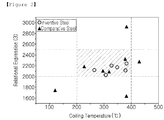
- FIG. 2 is a graph illustrating coiling temperatures and values of Relational Expression 3 in Inventive Steels and Comparative Steels. It can be seen that the present inventive concept is effective when Relational Expression 3, as well as Relational Expressions 1 and 2 related to the alloy compositions, are satisfied.
Landscapes
- Chemical & Material Sciences (AREA)
- Engineering & Computer Science (AREA)
- Materials Engineering (AREA)
- Mechanical Engineering (AREA)
- Metallurgy (AREA)
- Organic Chemistry (AREA)
- Physics & Mathematics (AREA)
- Thermal Sciences (AREA)
- Crystallography & Structural Chemistry (AREA)
- Chemical Kinetics & Catalysis (AREA)
- Heat Treatment Of Sheet Steel (AREA)
- Heat Treatment Of Steel (AREA)
Abstract
Description
- The present inventive concept relates to a ultra high strength hot-rolled steel sheet having excellent ductility and method for manufacturing the same.
- Ultra high strength steels are used in impact absorption members, bumpers, and reinforcing members for automobiles, and have a tensile strength of 1 GPa or more. Such steels may contain an appropriate amount of a retained austenite phase, thereby being easily molded to become parts and having superior impact resistance characteristics due to high strength thereof, even after molding.
- Recently, various methods of fabricating ultra high strength steels have been suggested. In particular, in order to obtain a tensile strength of 1GPa or more and simultaneously secure an elongation of 10% or more, a hot-rolled quenching and partitioning (Q&P) steel utilizing a transformation induced plasticity (TRIP) phenomenon caused by the retained austenite phase has been developed. The Q&P steel may be fabricated by heating a steel to a temperature at which an austenite single phase or an austenite-ferrite dual phase exists to perform a heat treatment for homogenization for a certain period of time, quenching the heated steel to a temperature between a martensite transformation start temperature (Ms) and a martensite transformation end temperature (Mf) thereby forming a martensite phase and a retained austenite phase, and maintaining the quenched steel at a cooling end temperature or heating the quenched steel to a temperature slightly higher than Ms to perform a heat-treatment thereby stabilizing the retained austenite phase.
- Such a concept of fabricating the Q&P steel has been suggested by a professor J.G. Speer (Colorado School of Mines, US), et al., as disclosed in Non-Patent
Document 1 and Non-PatentDocument 2 below. However, there is a problem in that the method in which the process of reheating the steel to a temperature at which the austenite-ferrite dual phase or the austenite single phase exists is added to an ordinary hot-rolling process may require high manufacturing costs. - In order to solve the problem, a method of obtaining the Q&P steel by use of Cr, Ti, Al, and the like, during a cooling process after the ordinary hot-rolling process, has been suggested as disclosed in
Patent Documents 1 to 3. However, when Cr and Al are additionally used, the weldability of the steel may deteriorate and material differences between an edge portion and a center portion in a steel sheet may become severe due to an abnormal increase in hardenability of the steel. In addition, when Ti is additionally used, it is difficult to obtain sufficient ductility and bending properties since a fraction of the retained austenite phase decreases due to formation of carbide at a high temperature. -
- (Patent Document 1) Chinese Patent Application No.
2012-10461655 - (Patent Document 2) Chinese Patent Application No.
2012-10461022 - (Patent Document 3) Chinese Patent Application No.
2013-10121568 - (Non-Patent Document 1) J.G. Speer, D.V. Edmonds, F.C.Rizzo, D.K.Matlock: Curr. Opin. Solid State Mater. Sci. 8(2004) 219-237.
- (Non-Patent Document 2) G.A. Thomas, J.G. Speer, and D.K.Matlock: AIST Trans., 2008, vol. 5 (5), pp. 209-217.
- An aspect of the present inventive concept may provide a ultra high strength hot-rolled steel sheet having excellent ductility by precisely controlling alloy compositions, and a manufacturing method thereof, without significantly changing existing processes of fabricating a hot-rolled steel sheet, and a method of manufacturing the same.
- However, aspects of the present inventive concept are not limited to those set forth herein. The above and other aspects of the present inventive concept will become more apparent to one of ordinary skill in the art to which the present inventive concept pertains by referencing the detailed description of the present inventive concept.
- According to an aspect of the present inventive concept, a ultra high strength hot-rolled steel sheet having excellent ductility includes 0.15% to 0.25% carbon (C), 0.6% to 2.0% silicon (Si), 1.5% to 3.0% manganese (Mn), 0.01% to 0.1% aluminum (Al), 0.01% to 0.5% chrome (Cr), 0.005% to 0.2% molybdenum (Mo), 0.001% to 0.05% phosphorus (P), 0.001% to 0.05% sulfur (S), 0.001% to 0.01% nitrogen (N), 0.003% to 0.1% niobium (Nb), 0.003% to 0.1% titanium (Ti), 0.003% to 0.1% vanadium (V), 0.0005% to 0.005% boron (B), a balance of iron (Fe) and unavoidable impurities, by weight percentage, and satisfies following
relational expressions - According to another aspect of the present inventive concept, a method of fabricating a ultra high strength hot-rolled steel sheet having excellent ductility includes heating a slab which includes 0.15% to 0.25% carbon (C), 0.6% to 2.0% silicon (Si), 1.5% to 3.0% manganese (Mn), 0.01% to 0.1% aluminum (Al), 0.01% to 0.5% chrome (Cr), 0.005% to 0.2% molybdenum (Mo), 0.001% to 0.05% phosphorus (P), 0.001% to 0.05% sulfur (S), 0.001% to 0.01% nitrogen (N), 0.003% to 0.1% niobium (Nb), 0.003% to 0.1% titanium (Ti), 0.003% to 0.1% vanadium (V), 0.0005% to 0.005% boron (B), a balance of iron (Fe) and unavoidable impurities, by weight percentage, at a temperature in a range between 1200°C and 1350°C and satisfies following
relational expressions relational expression 3.


- (Here, each element symbol represents a content (% by weight) of the element in
Relational Expression 1 andRelational Expression 2, and Temp and Time respectively represent a temperature (°C) and time (minutes) of the heating furnace after coiling inRelational Expression 3.) - In addition, the above-described technical solution does not list all the features of the present inventive concept. Various features, advantages, and effects of the present inventive concept can be understood in more detail with reference to following example embodiments.
- A ultra high strength hot-rolled steel sheet having excellent ductility according to the present inventive concept can be usefully applied to impact absorption members, bumpers, and reinforcing members for automobiles, and a method of fabricating the same.
-
-
FIG. 1 is a graph illustrating values ofRelational Expressions -
FIG. 2 is a graph illustrating coiling temperatures and values ofRelational Expression 3 according to inventive steels and comparative steels. - Hereinafter, example embodiments of the present inventive concept will be described with reference to the accompanying drawings. The present inventive concept may, however, be exemplified in many different forms and should not be construed as being limited to the specific embodiments set forth herein. Rather, these embodiments are provided so that this disclosure will be thorough and complete, and will fully convey the scope of the disclosure to those skilled in the art.
- Inventors of the present inventive concept have deeply studied to solve the above-described problems, resulting in providing a ultra high strength hot-rolled steel sheet having excellent ductility by precisely controlling alloy compositions, and a manufacturing method thereof, without significantly changing existing processes of fabricating a hot-rolled steel sheet, and a method of manufacturing the same.
- Hereinafter, a ultra high strength hot-rolled steel sheet having excellent ductility according to an example embodiment of the present invention will be described in detail.
- The ultra high strength hot-rolled steel sheet having excellent ductility according to the example embodiment of the present invention may include 0.15% to 0.25% carbon (C), 0.6% to 2.0% silicon (Si), 1.5% to 3.0% manganese (Mn), 0.01% to 0.1% aluminum (Al), 0.01% to 0.5% chrome (Cr), 0.005% to 0.2% molybdenum (Mo), 0.001% to 0.05% phosphorus (P), 0.001% to 0.05% sulfur (S), 0.001% to 0.01% nitrogen (N), 0.003% to 0.1% niobium (Nb), 0.003% to 0.1% titanium (Ti), 0.003% to 0.1% vanadium (V), 0.0005% to 0.005% boron (B), a balance of iron (Fe) and unavoidable impurities, by weight percentage, and satisfy the following
relational expressions 

- (Here, each element symbol represents a content (% by weight) of the element in
Relational Expression 1 andRelational Expression 2.) - First, alloy compositions of the ultra high strength hot-rolled steel sheet having excellent ductility according to the example embodiment of the present invention will be described in detail. Hereinafter, a unit of each alloy element is % by weight.
- Carbon (C) is the most economical and effective element for increasing the hardenability of a steel to strengthen the steel and easily secure the stability of a retained austenite phase. As the content of C increases, a martensite phase and a bainite phase may increase and thereby a tensile strength of the steel may increase.
- When the content of C is lower than 0.15%, the retained austenite phase may become unstable. On the other hand, when the content of C exceeds 0.25%, there may be problems in that the hot-rolled steel sheet may have poor weldability, material differences by position in the hot-rolled steel sheet may increase, since microstructural variations increase with a cooling rate, and ductility and shearing workability may be decreased. Accordingly, the content of C may preferably be in the range of 0.15% to 0.25%.
- Silicon (Si) functions to deoxidize molten steel, has a solid solution strengthening effect, and is advantageous for forming a retained austenite phase by retarding the formation of coarse carbides.
- When the content of Si is lower than 0.6%, it is difficult to stabilize the retained austenite phase since the effect of retarding the formation of coarse carbides is insignificant. On the other hand, when the content of Si exceeds 2.0%, the hot-rolled steel sheet may have poor weldability. Accordingly, the content of Si may preferably be in the range of 0.6% to 2.0%.
- Manganese (Mn), as well as silicon (Si), is an effective element for strengthening a solid solution of steel, and enhances hardenability of a steel to facilitate formation of a martensite phase.
- When the content of Mn is lower than 1.5%, the above-described effects may not be obtained. On the other hand, when the content of Mn exceeds 3.0%, the hardenability of the steel may excessively increase and thereby it may become difficult to obtain a preferred microstructure of the hot-rolled steel sheet. In addition, segregation may be greatly developed in a mid-thickness region during a slab-molding operation in a continuous casting process, and the quality of the slab may deteriorate. Further, the microstructure may become nonuniform in a thickness direction during cooling after hot rolling, and the hot-rolled steel sheet may have poor weldability. Accordingly, the content of Mn may preferably be in the range of 1.5% to 3.0%.
- Chrome (Cr) may strengthen solid solution of steel and increase hardenability of the steel, resulting in strengthening of the steel. However, when the content of Cr is lower than 0.01%, the above-described effects may not be obtained. On the other hand, when the content of Cr exceeds 0.5%, segregation may be greatly developed at a mid-thickness region and the microstructures may become nonuniform in the thickness direction, similarly to the case of Mn. Therefore, formability and weldability may deteriorate. Accordingly, the content of Cr may preferably be restricted within the range of 0.01% to 0.5%.
- Molybdenum (Mo) may strengthen a solid solution of steel and increase hardenability of the steel, thereby strengthening the steel. In addition, when Mo is added together with niobium (Nb), titanium (Ti), or the like, it may also contribute to formation of carbide thereby stabilizing solid solution carbon. However, when the content of Mo is lower than 0.005%, the above-described effects may not be obtained. On the other hand, when the content of Mo exceeds 0.2%, quenching properties may abnormally increase and thereby the martensite phase may be easily formed while the stable retained austenite phase is barely formed. In addition, economic efficiency may be lowered and weldability may also deteriorate. Accordingly, the content of Mo may preferably be in the range of 0.005% to 0.2%.
- Phosphorus (P), similar to Si, may have a solid solution strengthening effect and a ferrite-transformation promoting effect simultaneously. However, excessive manufacturing costs may be required to maintain the content of P at a level lower than 0.001%, which is disadvantageous in economical aspects. In addition, a content of P lower than 0.001% is insufficient to obtain high strength. On the other hand, when the content of P exceeds 0.05%, embrittlement may increase due to segregation in grain boundaries to generate microcracks during a shearing process and greatly degrade ductility and impact resistance characteristics. Accordingly, the content of P may preferably be restricted within the range of 0.001% to 0.05%.
- Sulfur (S) exists in steel as an impurity. When the content of S exceeds 0.01%, it may form nonmetallic inclusions by combining with Mn or the like. As a result, microcracks may occur during a shearing process of steel, and elongation flange formability and impact resistance may significantly deteriorate. In addition, since it takes a large amount of time to maintain the content of S at a level lower than 0.001% in a steel manufacturing process, productivity may decrease. Accordingly, the content of S may preferably be in the range of 0.001% to 0.01%.
- Soluble aluminum (Sol.Al) may be a component added mainly for deoxidation of the steel. When the content of Sol.Al is lower than 0.01%, the effect of addition of Sol.Al may be negligible. On the other hand, when the content of Sol.Al exceeds 0.1%, it may combine with N to form AlN, which generates corner cracks in the slab during a continuous casting process and defects due to formation of inclusions at edge portions of the hot-rolled steel sheet. Accordingly, the content of Sol.Al may preferably be in the range of 0.01% to 0.1%.
- Nitrogen (N), as well as C, is a representative solid solution strengthening element, and forms coarse precipitates together with Ti, Al, and the like. Normally, the solid solution strengthening effect of N may be superior to that of C, but there is a problem in that toughness greatly decreases as the content of N in steel increases. In addition, since it takes a large amount of time to maintain the content of N at a level lower than 0.001% in a steel manufacturing process, productivity may decrease. Accordingly, the content of N may preferably be in the range of 0.001% to 0.01%.
- Titanium (Ti), as well as niobium (Nb) and vanadium (V), is a representative precipitation strengthening element, and has strong affinity with N to form coarse TiN in the steel. TiN may have an effect of suppressing grain growth during a heating process for the hot rolling of the steel. In addition, Ti remaining after reacting with N may combine with solid solution C in the steel to form TiC precipitates, which may improve the strength of the steel.
- However, when the content of Ti is lower than 0.003%, the above-described effects may not be obtained. On the other hand, when the content of Ti exceeds 0.10%, coarse TiN may be formed to generate microcracks during the shearing process and decrease the solid solution carbon in the steel thereby reducing the stability of the retained austenite phase. Accordingly, the content of Ti may preferably be in the range of 0.003% to 0.1%.
- Niobium (Nb), as well as Ti and vanadium (V), is a representative precipitation strengthening element, and may be precipitated during hot rolling, which leads to the refinement of grains through retarding recrystallization. Accordingly, Nb is an effective element for enhancing the strength and impact toughness of the steel. However, when the content of Nb is lower than 0.003%, the above-described effects may not be obtained. On the other hand, when the content of Ti exceeds 0.1%, there are problems in that recrystallization during hot rolling may be abnormally retarded resulting in formation of elongated grains, and deformation resistance may increase resulting in difficulties in hot rolling of the steel sheet and degradation in shape quality. In addition, the solid solution carbon may decrease and the stability of the retained austenite phase may also decrease. Accordingly, the content of Nb may preferably be in the range of 0.003% to 0.1%.
- Vanadium (V), as well as Ti and Nb, is a representative precipitation strengthening element, and mainly forms precipitates after coiling to improve the strength of the steel and also increase hardenability of the steel. However, when the content of V is lower than 0.003%, the above-described effects may not be obtained, and when the content of V exceeds 0.1%, shearing workability may deteriorate due to the formation of coarse complex precipitates and it may be difficult to control microstructures due to an abnormal increase in hardenability. In addition, it may be unfavorable in economical aspects to maintain the content of P at a level higher than 0.1%. Accordingly, the content of V may preferably be in the range of 0.003% to 0.1%.
- Boron (B) is a representative grain boundary stabilizing element which retards recrystallization during hot rolling and ferrite transformation during cooling after hot rolling, and thereby increasing hardenability. Even a very small amount of B may markedly increase hardenability. However, when the content of B is lower than 0.0005%, the above-described effects may not be obtained. On the other hand, when the content of B exceeds 0.005%, it may be difficult to hot-roll the steel sheet due to the increase in the deformation resistance during hot rolling. In addition, it may be difficult to control microstructures of the steel due to the abnormal increase in hardenability. Accordingly, the content of B may preferably be in the range of 0.0005% to 0.005%.
- Another component according to the example embodiments of the present inventive concept is iron (Fe). However, in an ordinary steel manufacturing process, it is inevitable that unintended impurities may be introduced from raw materials and the surrounding environment. Since such impurities are commonly known to those skilled in the art, the entire contents thereof will not be specifically described in the present specification.
- It is necessary that a ultra high strength hot-rolled steel sheet having excellent ductility according to example embodiments of the present invention satisfies the following
Relational Expressions - When the following
Relational Expression 1 andRelational Expression 2 are satisfied, it is easy to form uniform martensite structures and to stabilize untransformed retained austenite phases. - In the following
Relational Expression 1 andRelational Expression 2, each element symbol represents a content (% by weight) of the element.
-
Relational Expression 1 relates to quenching properties and segregation of steel. In particular, each component included inRelational Expression 1 may improve hardenability of the steel thereby facilitating formation of the martensite phase. However, C, Mn, and Cr may be easily segregated in a center portion of a steel sheet to form nonuniform microstructures in a thickness direction and degrade weldability. Accordingly, when a value ofRelational Expression 1 is lower than 4.5, the quenching properties of the steel may be degraded, and when the value ofRelational Expression 1 exceeds 5.3, microstructures of the steel may become nonuniform, and thereby weldability may be degraded.
-
Relational Expression 2 may define components related to formation of precipitates in a steel. Since the formation of precipitates relates to the contents of Ti, Nb, Mo, and C in the steel, confirmation of the content of solid solution carbon ([sol.C]) contributing the stability of the retained austenite phase may be required. When the content of [sol.C] is lower than 0.17, it is difficult to sufficiently stabilize the retained austenite phase. When the content of [sol.C] is higher than 0.25, the formation of a large amount of fine precipitates may contribute to an increase in yield strength and formation of fine grains. However, quenching properties of the steel may increase thereby degrading weldability. - Meanwhile, the hot-rolled steel sheet according to the example embodiment of the present inventive concept may have microstructures consisting of 85% or more the martensite phase, 3% to 15% the retained austenite phase, and other unavoidable phases, by area fraction.
- When the content of the martensite phase is lower than 85%, it is difficult to secure sufficient tensile strength. In addition, when the content of the retained austenite phase is lower than 3%, elongation and formability may deteriorate, and when the content of the retained austenite phase exceeds 15%, it is difficult to form a sufficient martensite phase, resulting in degradation of the tensile strength.
- Here, the unavoidable phases may include ferrite, bainite, and the like, and the sum of the ferrite and bainite may preferably be lower than 5%. When the sum of the ferrite and bainite is 5% or more, the strength of the hot-rolled steel sheet may decrease.
- In addition, the hot-rolled steel sheet according to the example embodiment of the present inventive concept may have a tensile strength of 1200MPa or greater, and an elongation of 10% or greater.
- Meanwhile the hot-rolled steel sheet according to the example embodiment of the present inventive concept may include a galvanized layer formed on a surface thereof. Hereinafter, a method of fabricating a ultra high strength hot-rolled steel sheet having excellent ductility according to another example embodiment of the present inventive concept will be described in detail. The method of fabricating a ultra high strength hot-rolled steel sheet having excellent ductility according to the example embodiment of the present inventive concept includes heating a slab satisfying the above-described alloy composition conditions and the
Relational Expressions relational expression 3. - A slab having the above-described alloy compositions and
satisfying Relational Expression 1 andRelational Expression 2 is heated to a temperature between 1200°C and 1350°C. - When the heating temperature of the slab is lower than 1200°C, since carbides, nitrides, and precipitates consisting of Ti, Nb, V, Mo, and the like may not be sufficiently re-solid-soluted, formation of precipitates may decrease in a subsequent process after hot-rolling, thereby retaining coarse TiN. On the other hand, when the heating temperature of the slab exceeds 1350°C, austenite grains may be abnormally grown thereby lowering the strength of the steel. Accordingly, the heating temperature of the slab may preferably be in the range between 1200°C and 1350°C.
- Here, the slab may be produced in a process in which a continuous casting process and a hot-rolling process are directly combined. Since it is important to maintain the temperature of the steel slab in the range between 1200°C and 1350°C in order to maintain a proper hot-rolling temperature, the process in which the continuous casting process and the hot-rolling process are directly combined may preferably be applied.
- The heated slab is hot-rolled at a temperature between 850°C and 1150°C to obtain a hot-rolled steel sheet.
- When the hot-rolling process is started at a temperature higher than 1150°C, the temperature of the hot-rolled steel sheet is increased, thereby increasing the grain size of the hot-rolled steel sheet and degrading the surface quality of the hot-rolled steel sheet. In addition, when the hot-rolling process is started at a temperature lower than 850°C, elongated grains may be developed, thereby degrading the shape of the hot-rolled sheet since recrystallization may be abnormally delayed. In addition, quenching properties of the hot-rolled steel sheet may be reduced due to the formation of precipitates during the hot-rolling process, and stability of the retained austenite phase may decrease.
- Accordingly, the hot-rolling process may preferably be performed at a temperature in the range between 850°C and 1150°C.
- The hot-rolled steel sheet is cooled to a cooling end temperature in a range between 200°C to 400°C at an average cooling rate in a range between 50 to 100°C/sec, and coiled.
- When the cooling end temperature is lower than 200°C, the microstructures of the steel may be fully phase-transitioned to the martensite phase, thereby increasing strength of the steel while decreasing ductility of the steel. When the cooling end temperature exceeds 400°C, the bainite phase may be formed thereby decreasing both of the strength and ductility of the steel.
- In addition, when the average cooling rate is lower than 50°C/sec, it is difficult to secure a target quality of the steel since the ferrite phase or bainite phase may be formed resulting in nonuniform microstructures. When average cooling rate exceeds 100°C/sec, the microstructures of the steel sheet may be nonuniform in a thickness direction and a width direction, and shape quality may be degraded.
- The coiled hot-rolled steel sheet is loaded into a heating furnace, and heat-insulated or heated to a temperature in a range between 200°C and 400°C so as to satisfy the following
Relational Expression 3. After the heat treatment, such as heat-insulating or heating, the hot-rolled steel sheet may be cooled.
- (Here, Temp and Time in
Relational Expression 3 respectively represent a temperature(°C) and time (minutes) of the heating furnace after the coiling process.) - Immediately after the coiling process is completed by hot rolling and cooling the steel sheet, untransformed phases may remain in the steel. The untransformed phases may form a stable retained austenite phase or be fully transformed into a martensite phase depending on subsequent thermal conditions.
- Here, it is preferable to load the coiled hot-rolled steel sheet into the heating furnace in a state in which the temperature of the coiled hot-rolled steel sheet is 200°C or higher. When the temperature is lower than 200°C before loading, the untransformed phases in the hot-rolled steel sheet may be partially or fully transformed into the martensite phase. In this case, since the retained austenite phase is not sufficiently formed, ductility and formability of the steel may significantly decrease while the strength of the steel significantly increases.
- Accordingly, the heat treatment, such as heat-insulating or heating, may be performed at the temperature satisfying
Relational Expression 3 so that the stable retained austenite phase is formed in the steel. - Here, the temperature of the heat treatment may not be higher than 400°C, since the content of the solid solution carbon is high in the untransformed phases due to the sufficient cooling rate of 50°C/sec or higher and the quenching properties of the steel. Accordingly, the stable retained austenite phase may be sufficiently secured only by the heat treatment satisfying
Relational Expression 3. However, when the value ofRelational Expression 3 is lower than 2000, the effect of the heat treatment may not be sufficient. As a result, the retained austenite phase may not be stabilized, thereby being transformed into the martensite phase. When the value ofRelational Expression 3 exceeds 2500, the bainite phase may be formed due to diffusion of the solid solution carbon. Accordingly, the strength and ductility of the steel may decrease at the same time, and it may be economically disadvantageous to perform the heat treatment for an extended period of time. - The hot-rolled steel sheet by the above-described processes may have excellent ductility and strength such that the tensile strength thereof is 1200MPa or more and the ductility thereof is 10% or more.
- Meanwhile, after the heat-insulating or heating process, a process of pickling and oiling the hot-rolled steel sheet may additionally be performed.
- In addition, a process of heating the hot-rolled steel sheet to a temperature between 450°C and 480°C and hot-dip galvanizing the heated hot-rolled steel sheet may be added after the pickling process.
- Hereinafter, example embodiments of the present inventive concept will be described in more detail. The present inventive concept may, however, be exemplified in many different forms and should not be construed as being limited to the specific embodiments set forth herein. The scope of the present invention may be defined by the appended claims, and modifications and variations reasonably made therefrom.
- Hot-rolled steel sheets were fabricated by heating slabs having compositions listed in Table 1 below at a temperature of 1250°C under manufacturing conditions listed in Table 2 below.
- In Table 1 below, the unit of each alloy element is weight percentage (wt%). In Table 2 below, FDT and CT represent a final hot-rolling ending temperature and a coiling temperature in a hot-rolling process, respectively, and Temp and Time represent a heat treatment temperature and a heat treatment time in a coil heating furnace, respectively. A cooling rate of the cooling process performed immediately after hot rolling, which is not illustrated in Table 2 below, was controlled to be in a range of 70 to 90°C/sec.
- In addition, mechanical properties and microstructures of the fabricated hot-rolled steel sheets are listed in Table 3 below.
- In Table 3 below, YS, TS, and T-El represent yield strength, tensile strength, and elongation, respectively. The tensile test was carried out on test pieces prepared according to Japanese Industrial Standard (JIS) #5 in a direction parallel to a rolling direction of a rolled steel sheet. The tensile test was carried out three times, and average values of the results thereof are listed in Table 3 below.
- In addition, in Table 3 below, area fractions of bainite, martensite, ferrite, and retained austenite were measured at test pieces respectively obtained from center portions of rolled steel sheets. Each test piece was prepared and etched, and then observed using an optical microscope and a scanning electron microscope (SEM) and analyzed using an image analyzer. The area fraction of the retained austenite phase was obtained by analyzing the center portion of each rolled steel sheet using an electron back scattering diffraction (EBSD) method.
[Table 1] Division C Si Mn Cr Al P S N Mo Ti Nb V B C.Steel 1 0.22 1.01 1.62 0.7 0.03 0.012 0.003 0.005 0.01 0.02 0.03 0.004 0.001 C.Steel 2 0.19 0.8 1.7 0.1 0.03 0.011 0.003 0.005 0.01 0.02 0.015 0.004 0.001 C.Steel 3 0.19 0.62 1.55 0.2 0.035 0.015 0.003 0.004 0.1 0.03 0.015 0.005 0.001 C.Steel 4 0.21 0.65 1.8 0.15 0.03 0.01 0.006 0.005 0.07 0.025 0.02 0.001 0.001 C.Steel 5 0.23 0.7 1.6 0.4 0.03 0.01 0.004 0.004 0.01 0.04 0.03 0.001 0.0005 C.Steel 6 0.18 0.8 1.82 0.1 0.035 0.01 0.003 0.005 0.06 0.005 0.005 0.001 0.001 C.Steel 7 0.21 0.6 1.88 0.1 0.027 0.009 0.003 0.004 0.01 0.05 0.04 0.05 0.0015 C.Steel 8 0.2 0.7 1.65 0.15 0.03 0.01 0.003 0.004 0.1 0.02 0.03 0.003 0.002 I.Steel 1 0.2 0.8 1.6 0.3 0.025 0.006 0.002 0.004 0.01 0.02 0.02 0.005 0.001 I.Steel 2 0.21 1.1 1.8 0.2 0.027 0.007 0.003 0.003 0.01 0.025 0.02 0.01 0.0005 I.Steel 3 0.19 1 1.7 0.25 0.025 0.006 0.003 0.005 0.1 0.015 0.02 0.005 0.001 I.Steel 4 0.2 1.45 1.7 0.4 0.025 0.01 0.003 0.004 0.1 0.01 0.02 0.005 0.0005 I.Steel 5 0.18 1.5 1.8 0.45 0.028 0.006 0.003 0.003 0.01 0.015 0.01 0.006 0.001 I.Steel 6 0.19 1 2 0.35 0.032 0.006 0.002 0.004 0.01 0.03 0.025 0.005 0.0005 * C. Steel: Comparative Steel, I.Steel: Inventive Steel [Table 2] Specimen Relational Relational Relational FDT CT Loading Temp Time Ex. (1) Ex. (2) Ex. (3) (°C) (°C) Temp. (°C) (°C) (min.) C.Steel 1 5.87 0.210 2308.0 883 379 203 300 280 C.Steel 2 4.41 0.182 2077.6 889 319 211 300 240 C.Steel 3 4.52 0.168 2093.8 897 296 216 300 600 C.Steel 4 4.88 0.192 2174.0 901 228 165 280 900 C.Steel 5 5.15 0.215 2913.9 892 383 220 350 900 C.Steel 6 4.52 0.171 1630.1 909 382 250 250 180 C.Steel 7 4.90 0.191 2266.3 900 430 300 300 600 C.Steel 8 4.95 0.179 1735.5 914 120 85 250 300 I.Steel 1 4.82 0.191 2115.9 910 265 226 280 600 I.Steel 2 4.78 0.200 2242.4 917 383 313 300 300 I.Steel 3 4.81 0.171 2026.8 903 307 257 300 300 I.Steel 4 5.09 0.182 2201.4 898 328 274 300 600 I.Steel 5 5.12 0.174 2112.4 912 379 315 300 500 I.Steel 6 5.02 0.178 2168.4 892 349 249 300 600 * Relational Ex.: Relational Expression [Table 3] Specimen YS (MPa) TS (MPa) T-El (%) Bainite (%) Martensite (%) Ferrite (%) Retained Austenite (%) C.Steel 1 1255 1427 7.3 2 95 0 3 C.Steel 2 765 986 16.5 26 72 1 1 C.Steel 3 1021 1159 10.4 15 83 0 2 C.Steel 4 1143 1406 7.8 2 98 0 0 C.Steel 5 895 1055 14.0 9 89 0 2 C.Steel 6 1010 1344 8.2 5 94 0 1 C.Steel 7 654 889 18.3 75 20 3 2 C.Steel 8 1180 1405 7.6 2 98 0 0 I.Steel 1 1062 1209 12.1 0 92 0 8 I.Steel 2 1108 1298 11.5 1 89 0 10 I.Steel 3 1070 1244 11.2 1 94 0 5 I.Steel 4 1195 1388 10.9 0 93 0 7 I.Steel 5 1176 1354 10.4 1 93 0 6 I.Steel 6 1189 1376 10.8 0 94 0 6 - It is found that
Inventive Steels 1 to 6 satisfying all of the alloy compositions,Relational Expressions 1 to 3, and manufacturing conditions had tensile strengths of 1200 MPa or more and elongations of 10% or more. - In the other hand,
Comparative Steel 1 had a high value ofRelational Expression 1 and did not satisfy the content of Cr. Accordingly, most of the microstructures ofComparative Steel 1 were formed as the martensite phase due to excessively high hardenability thereof.Comparative Steel 1 had low elongation while having high strength. -
Comparative Steel 2 had a low value ofRelational Expression 1, and thereby had low hardenability. Accordingly,Comparative Steel 2 did not have sufficient martensite and retained austenite phases since bainite phase transition occurred during the cooling process. -
Comparative Steel 3satisfied Relational Expression 1 and has sufficient hardenability. However, since it did not satisfyRelational Expression 2, the bainite phase increased while the stable retained austenite phase decreased. Accordingly,Comparative Steel 3 had a low strength. - Although
Comparative Steel 4 satisfied all ofRelational Expressions 1 to 3, it was loaded into the heating furnace and heated in a state the steel coiled after the hot-rolling and cooling were completed was cooled to a temperature lower than 200°C, the temperature suggested according to the present inventive concept. Accordingly, most of untransformed phases were transformed into the martensite phase, thereby having a low elongation while having a high strength. - Comparative Steel 5 had an abnormally high value of
Relational Expression 3 and it was heated in the heating furnace at an excessively high temperature for an extended period of time after the cooling process. Accordingly, Comparative Steel 5 had a large amount of bainite phase while having a small amount of retained austenite phase. This was because portions of the retained austenite phase were not stabilized but transformed into the bainite phase. Therefore, Comparative Steel 5 did not have a sufficiently high strength. - Comparative Steel 6 had a low value of
Relational Expression 3, and the retained austenite phase was not sufficiently stabilized but transformed into the bainite phase since temperature and time of the heat treatment were insufficient. Accordingly, Comparative Steel 6 had low ductility. - Comparative Steel 7 and Comparative Steel 8 did not satisfy the coiling temperature conditions. Comparative Steel 7 fabricated at a temperature higher than the coiling temperature suggested according to the present inventive concept had a microstructure mostly formed as the bainite phase and thereby had inferior strength. In addition, Comparative Steel 8 fabricated at a temperature lower than the coiling temperature suggested according to the present inventive concept had a microstructure mostly formed as the martensite phase and thereby had inferior elongation.
-
FIG. 1 is a graph illustrating values ofRelational Expressions FIG. 2 is a graph illustrating coiling temperatures and values ofRelational Expression 3 in Inventive Steels and Comparative Steels. It can be seen that the present inventive concept is effective whenRelational Expression 3, as well asRelational Expressions
Claims (9)
- A ultra high strength hot-rolled steel sheet having excellent ductility, comprising:0.15% to 0.25% carbon (C), 0.6% to 2.0% silicon (Si), 1.5% to 3.0% manganese (Mn), 0.01% to 0.1% aluminum (Al), 0.01% to 0.5% chrome (Cr), 0.005% to 0.2% molybdenum (Mo), 0.001% to 0.05% phosphorus (P), 0.001% to 0.05% sulfur (S), 0.001% to 0.01% nitrogen (N), 0.003% to 0.1% niobium (Nb), 0.003% to 0.1% titanium (Ti), 0.003% to 0.1% vanadium (V), 0.0005% to 0.005% boron (B), a balance of iron (Fe) and unavoidable impurities, by weight percentage, andsatisfying following relational expressions 1 and 2:


- The ultra high strength hot-rolled steel sheet of claim 1, wherein a microstructure of the hot-rolled steel sheet includes 85% or more martensite, 3% to 5% retained austenite, and other unavoidable phases, by area fraction.
- The ultra high strength hot-rolled steel sheet of claim 2, wherein the unavoidable phases includes ferrite and bainite, and a sum of the ferrite and bainite is lower than 5% by area fraction.
- The ultra high strength hot-rolled steel sheet of claim 1, wherein the hot-rolled steel sheet has a tensile strength of 1200 MPa or greater, and an elongation rate of 10% or greater.
- The ultra high strength hot-rolled steel sheet of claim 3, wherein the hot-rolled steel sheet further comprises a galvanized layer formed on a surface thereof.
- A method of fabricating a ultra high strength hot-rolled steel sheet having excellent ductility, comprising:heating a slab at a temperature in a range between 1200°C and 1350°C, wherein the slab includes 0.15% to 0.25% carbon (C), 0.6% to 2.0% silicon (Si), 1.5% to 3.0% manganese (Mn), 0.01% to 0.1% aluminum (Al), 0.01% to 0.5% chrome (Cr), 0.005% to 0.2% molybdenum (Mo), 0.001% to 0.05% phosphorus (P), 0.001% to 0.05% sulfur (S), 0.001% to 0.01% nitrogen (N), 0.003% to 0.1% niobium (Nb), 0.003% to 0.1% titanium (Ti), 0.003% to 0.1% vanadium (V), 0.0005% to 0.005% boron (B), a balance of iron (Fe) and unavoidable impurities, by weight percentage, and satisfies the following relational expressions 1 and 2;forming a hot-rolled steel sheet by hot rolling the heated slab at a temperature in a range between 850°C and 1150°C;cooling the hot-rolled steel sheet to a cooling end temperature in a range between 200°C and 400°C at an average cooling rate of 50 to 100°C/s and coiling the cooled hot-rolled steel sheet; andloading the coiled hot-rolled steel sheet into a heating furnace to be heat-insulated or heated to a temperature in a range between 200°C to 400°C so as to satisfy the following relational expression 3,


 wherein each element symbol represents a content (% by weight) of the element in Relational Expression 1 and Relational Expression 2, andthe Temp and the Time represent a temperature (°C) or time (minutes) of the heating furnace after coiling in Relational Expression 3.
 - The method of claim 6, further comprising pickling and oiling the hot-rolled steel sheet after heat-insulating or heating.
- The method of claim 6, further comprising heating the hot-rolled steel sheet until a temperature of the hot-rolled steel is in a range between 450°C to 480°C and hot-dip galvanizing the heated hot-rolled steel sheet, after pickling.
- The method of claim 6, wherein the slab is fabricated in a process in which a continuous casting process and a hot-rolling process are directly combined.
Applications Claiming Priority (2)
| Application Number | Priority Date | Filing Date | Title |
|---|---|---|---|
| KR1020150184512A KR101767773B1 (en) | 2015-12-23 | 2015-12-23 | Utlra high strength hot-rolled steel sheet having excellent ductility and method of manufacturing the same |
| PCT/KR2016/013407 WO2017111322A1 (en) | 2015-12-23 | 2016-11-21 | Super strength hot-rolled steel sheet excellent ductility and manufacturing therefor |
Publications (3)
| Publication Number | Publication Date |
|---|---|
| EP3395992A1 true EP3395992A1 (en) | 2018-10-31 |
| EP3395992A4 EP3395992A4 (en) | 2018-12-05 |
| EP3395992B1 EP3395992B1 (en) | 2020-04-15 |
Family
ID=59090740
Family Applications (1)
| Application Number | Title | Priority Date | Filing Date |
|---|---|---|---|
| EP16879189.5A Active EP3395992B1 (en) | 2015-12-23 | 2016-11-21 | Super strength hot-rolled steel sheet excellent ductility and manufacturing therefor |
Country Status (6)
| Country | Link |
|---|---|
| US (1) | US11203796B2 (en) |
| EP (1) | EP3395992B1 (en) |
| JP (1) | JP6688392B2 (en) |
| KR (1) | KR101767773B1 (en) |
| CN (1) | CN108474088B (en) |
| WO (1) | WO2017111322A1 (en) |
Cited By (3)
| Publication number | Priority date | Publication date | Assignee | Title |
|---|---|---|---|---|
| EP3670682A1 (en) * | 2018-12-20 | 2020-06-24 | Primetals Technologies Austria GmbH | Production of a metal strip with an austenite-martensite compound structure |
| EP3901312A4 (en) * | 2018-12-18 | 2021-10-27 | Posco | HIGH STRENGTH HOT ROLLED SHEET OF EXCELLENT WORKABILITY AND ITS MANUFACTURING PROCESS |
| EP4527963A4 (en) * | 2022-06-22 | 2025-12-03 | Baoshan Iron & Steel | High-plasticity steel and manufacturing method therefor |
Families Citing this family (4)
| Publication number | Priority date | Publication date | Assignee | Title |
|---|---|---|---|---|
| EP3686296B8 (en) * | 2017-09-20 | 2024-12-11 | Baosteel Zhanjiang Iron & Steel Co., Ltd. | Softening method for high-strength q & p steel hot roll |
| KR102109271B1 (en) * | 2018-10-01 | 2020-05-11 | 주식회사 포스코 | Ultra high strength hot rolled steel sheet having excellent surface qualities and low mechanical properties deviation and method of manufacturing the same |
| CN117305685A (en) * | 2022-06-22 | 2023-12-29 | 宝山钢铁股份有限公司 | A kind of high-strength ultra-high plasticity steel and its manufacturing method |
| CN120443063B (en) * | 2025-07-11 | 2025-10-14 | 马鞍山钢铁有限公司 | Hot-rolled ultrahigh-strength steel for automobiles, manufacturing method thereof, hot forming method and cold forming method |
Family Cites Families (17)
| Publication number | Priority date | Publication date | Assignee | Title |
|---|---|---|---|---|
| JP3793490B2 (en) | 2002-08-07 | 2006-07-05 | 新日本製鐵株式会社 | High-strength hot-rolled steel sheet for processing excellent in strength-hole expansion ratio balance and shape freezing property, and method for producing the same |
| JP4161935B2 (en) * | 2004-04-16 | 2008-10-08 | 住友金属工業株式会社 | Hot-rolled steel sheet and manufacturing method thereof |
| JP4682822B2 (en) * | 2004-11-30 | 2011-05-11 | Jfeスチール株式会社 | High strength hot rolled steel sheet |
| JP4291860B2 (en) * | 2006-07-14 | 2009-07-08 | 株式会社神戸製鋼所 | High-strength steel sheet and manufacturing method thereof |
| JP4646881B2 (en) | 2006-09-15 | 2011-03-09 | 株式会社神戸製鋼所 | Hot-rolled steel sheet with excellent stretch flangeability |
| KR20140027451A (en) * | 2011-06-10 | 2014-03-06 | 가부시키가이샤 고베 세이코쇼 | Hot press molded article, method for producing same, and thin steel sheet for hot press molding |
| FI20115702L (en) | 2011-07-01 | 2013-01-02 | Rautaruukki Oyj | METHOD FOR PRODUCING HIGH STRENGTH STRUCTURAL STEEL AND A HIGH STRENGTH STRUCTURAL STEEL PRODUCT |
| CA2843186C (en) | 2011-07-27 | 2017-04-18 | Nippon Steel & Sumitomo Metal Corporation | High-strength cold-rolled steel sheet having excellent stretch flangeability and precision punchability and manufacturing method thereof |
| JP5267638B2 (en) | 2011-11-17 | 2013-08-21 | Jfeスチール株式会社 | Hot-rolled steel sheet for high-strength hot-dip galvanized steel sheet or high-strength galvannealed steel sheet and method for producing the same |
| JP5756773B2 (en) * | 2012-03-09 | 2015-07-29 | 株式会社神戸製鋼所 | Steel sheet for hot pressing, press-formed product, and method for producing press-formed product |
| CN103805869B (en) | 2012-11-15 | 2016-01-27 | 宝山钢铁股份有限公司 | A kind of high-strength hot-rolled Q & P steel and manufacture method thereof |
| CN103805851B (en) | 2012-11-15 | 2016-03-30 | 宝山钢铁股份有限公司 | A kind of superstrength low cost hot rolling Q & P steel and production method thereof |
| KR101461729B1 (en) | 2012-12-21 | 2014-11-14 | 주식회사 포스코 | Boron-added high carbon steel having superior strength and ductility and method for manufacturing the same |
| KR101461765B1 (en) | 2012-12-27 | 2014-11-13 | 주식회사 포스코 | Hot rolled steel sheet having superior strength and ductility and manufacturing method thereof |
| CN103215516B (en) | 2013-04-09 | 2015-08-26 | 宝山钢铁股份有限公司 | A kind of 700MPa grade high-strength hot-rolled Q & P steel and manufacture method thereof |
| JP6062352B2 (en) * | 2013-12-12 | 2017-01-18 | 株式会社神戸製鋼所 | Hot press parts |
| KR101560944B1 (en) | 2013-12-24 | 2015-10-15 | 주식회사 포스코 | High strength hot rolled steel sheet having excellent surface property and method for manufacturing the same |
-
2015
- 2015-12-23 KR KR1020150184512A patent/KR101767773B1/en active Active
-
2016
- 2016-11-21 EP EP16879189.5A patent/EP3395992B1/en active Active
- 2016-11-21 JP JP2018532464A patent/JP6688392B2/en active Active
- 2016-11-21 CN CN201680075938.7A patent/CN108474088B/en active Active
- 2016-11-21 US US16/061,514 patent/US11203796B2/en active Active
- 2016-11-21 WO PCT/KR2016/013407 patent/WO2017111322A1/en not_active Ceased
Cited By (4)
| Publication number | Priority date | Publication date | Assignee | Title |
|---|---|---|---|---|
| EP3901312A4 (en) * | 2018-12-18 | 2021-10-27 | Posco | HIGH STRENGTH HOT ROLLED SHEET OF EXCELLENT WORKABILITY AND ITS MANUFACTURING PROCESS |
| EP3670682A1 (en) * | 2018-12-20 | 2020-06-24 | Primetals Technologies Austria GmbH | Production of a metal strip with an austenite-martensite compound structure |
| WO2020127925A1 (en) * | 2018-12-20 | 2020-06-25 | Primetals Technologies Austria GmbH | Producing a metal strip having an austenite-martensite mixed microstructure |
| EP4527963A4 (en) * | 2022-06-22 | 2025-12-03 | Baoshan Iron & Steel | High-plasticity steel and manufacturing method therefor |
Also Published As
| Publication number | Publication date |
|---|---|
| EP3395992A4 (en) | 2018-12-05 |
| WO2017111322A1 (en) | 2017-06-29 |
| WO2017111322A8 (en) | 2017-10-12 |
| JP6688392B2 (en) | 2020-04-28 |
| US11203796B2 (en) | 2021-12-21 |
| CN108474088A (en) | 2018-08-31 |
| KR101767773B1 (en) | 2017-08-14 |
| US20200263270A1 (en) | 2020-08-20 |
| KR20170075824A (en) | 2017-07-04 |
| EP3395992B1 (en) | 2020-04-15 |
| JP2019504202A (en) | 2019-02-14 |
| CN108474088B (en) | 2020-06-05 |
Similar Documents
| Publication | Publication Date | Title |
|---|---|---|
| EP3559298B1 (en) | Tempered and coated steel sheet having excellent formability and a method of manufacturing the same | |
| EP3559296B1 (en) | Tempered and coated steel sheet having excellent formability and a method of manufacturing the same | |
| EP3395992B1 (en) | Super strength hot-rolled steel sheet excellent ductility and manufacturing therefor | |
| EP3556889B1 (en) | High strength multi-phase steel having excellent burring properties at low temperature, and method for producing same | |
| KR101232972B1 (en) | Method of producing high-strength steel plates with excellent ductility and plates thus produced | |
| CN103517996B (en) | Sheet material or the parts manufacturing the method for high elastic limit martensite steel and so obtain | |
| JP7357691B2 (en) | Ultra-high strength cold-rolled steel sheet and its manufacturing method | |
| EP3144406A1 (en) | High-strength cold rolled steel sheet having excellent ductility, hot-dip galvanized steel sheet and method for manufacturing same | |
| KR102109265B1 (en) | Ultra high strength and high ductility steel sheet having excellent yield ratio and manufacturing method for the same | |
| KR101449134B1 (en) | Ultra high strength cold rolled steel sheet having excellent weldability and bendability and method for manufacturinf the same | |
| JP6684905B2 (en) | High-strength cold-rolled steel sheet excellent in shear workability and method for producing the same | |
| EP3730652B1 (en) | Ultrahigh strength cold-rolled steel sheet and manufacturing method thereof | |
| KR101560948B1 (en) | High strength multi-matrix hot rolled steel sheet having excellent impact resistance and formability of edge part and method for manufacturing the same | |
| KR101630977B1 (en) | High strength hot rolled steel sheet having excellent formability and method for manufacturing the same | |
| KR20210009606A (en) | Austenitic stainless steel with imporoved strength and method for manufacturing the same | |
| KR101382908B1 (en) | Thin steel sheet having ultra high strength and manufacturing method of the same | |
| EP4438761A1 (en) | Hot-rolled steel sheet and method for manufacturing same | |
| EP3298175B1 (en) | High manganese third generation advanced high strength steels | |
| KR101657835B1 (en) | High strength hot-rolled steel sheet having excellent press formability and method for manufacturing the same | |
| KR101523966B1 (en) | Method of manufacturing steel sheet | |
| KR101505293B1 (en) | Steel sheet | |
| JP6806101B2 (en) | High-strength steel sheet with low yield strength and its manufacturing method | |
| KR101735941B1 (en) | High strength cold-rolled steel sheet and method of manufacturing the same | |
| KR20140130258A (en) | HIGH STRENGTH COLD-ROLLED STEEL SHEET FOR AUTOMOBILE WITH EXCELLENT FORMABILITY and Bendability and METHOD OF MANUFACTURING THE STEEL SHEET |
Legal Events
| Date | Code | Title | Description |
|---|---|---|---|
| STAA | Information on the status of an ep patent application or granted ep patent |
Free format text: STATUS: THE INTERNATIONAL PUBLICATION HAS BEEN MADE |
|
| PUAI | Public reference made under article 153(3) epc to a published international application that has entered the european phase |
Free format text: ORIGINAL CODE: 0009012 |
|
| STAA | Information on the status of an ep patent application or granted ep patent |
Free format text: STATUS: REQUEST FOR EXAMINATION WAS MADE |
|
| 17P | Request for examination filed |
Effective date: 20180716 |
|
| AK | Designated contracting states |
Kind code of ref document: A1 Designated state(s): AL AT BE BG CH CY CZ DE DK EE ES FI FR GB GR HR HU IE IS IT LI LT LU LV MC MK MT NL NO PL PT RO RS SE SI SK SM TR |
|
| AX | Request for extension of the european patent |
Extension state: BA ME |
|
| A4 | Supplementary search report drawn up and despatched |
Effective date: 20181025 |
|
| RIC1 | Information provided on ipc code assigned before grant |
Ipc: C22C 38/24 20060101ALI20181020BHEP Ipc: C21D 6/00 20060101ALI20181020BHEP Ipc: C22C 38/04 20060101ALI20181020BHEP Ipc: C22C 38/26 20060101ALI20181020BHEP Ipc: C23C 2/06 20060101ALI20181020BHEP Ipc: C22C 38/38 20060101AFI20181020BHEP Ipc: C21D 8/02 20060101ALI20181020BHEP Ipc: C22C 38/00 20060101ALI20181020BHEP Ipc: C22C 38/34 20060101ALI20181020BHEP Ipc: C22C 38/28 20060101ALI20181020BHEP Ipc: C22C 38/02 20060101ALI20181020BHEP Ipc: C22C 38/32 20060101ALI20181020BHEP Ipc: C21D 9/46 20060101ALI20181020BHEP Ipc: C22C 38/22 20060101ALI20181020BHEP Ipc: C21D 6/02 20060101ALI20181020BHEP Ipc: C22C 38/06 20060101ALI20181020BHEP |
|
| DAV | Request for validation of the european patent (deleted) | ||
| DAX | Request for extension of the european patent (deleted) | ||
| GRAP | Despatch of communication of intention to grant a patent |
Free format text: ORIGINAL CODE: EPIDOSNIGR1 |
|
| STAA | Information on the status of an ep patent application or granted ep patent |
Free format text: STATUS: GRANT OF PATENT IS INTENDED |
|
| INTG | Intention to grant announced |
Effective date: 20191010 |
|
| GRAS | Grant fee paid |
Free format text: ORIGINAL CODE: EPIDOSNIGR3 |
|
| GRAJ | Information related to disapproval of communication of intention to grant by the applicant or resumption of examination proceedings by the epo deleted |
Free format text: ORIGINAL CODE: EPIDOSDIGR1 |
|
| GRAL | Information related to payment of fee for publishing/printing deleted |
Free format text: ORIGINAL CODE: EPIDOSDIGR3 |
|
| STAA | Information on the status of an ep patent application or granted ep patent |
Free format text: STATUS: REQUEST FOR EXAMINATION WAS MADE |
|
| GRAR | Information related to intention to grant a patent recorded |
Free format text: ORIGINAL CODE: EPIDOSNIGR71 |
|
| STAA | Information on the status of an ep patent application or granted ep patent |
Free format text: STATUS: GRANT OF PATENT IS INTENDED |
|
| GRAA | (expected) grant |
Free format text: ORIGINAL CODE: 0009210 |
|
| STAA | Information on the status of an ep patent application or granted ep patent |
Free format text: STATUS: THE PATENT HAS BEEN GRANTED |
|
| INTC | Intention to grant announced (deleted) | ||
| INTG | Intention to grant announced |
Effective date: 20200305 |
|
| AK | Designated contracting states |
Kind code of ref document: B1 Designated state(s): AL AT BE BG CH CY CZ DE DK EE ES FI FR GB GR HR HU IE IS IT LI LT LU LV MC MK MT NL NO PL PT RO RS SE SI SK SM TR |
|
| REG | Reference to a national code |
Ref country code: CH Ref legal event code: EP |
|
| REG | Reference to a national code |
Ref country code: DE Ref legal event code: R096 Ref document number: 602016034299 Country of ref document: DE |
|
| REG | Reference to a national code |
Ref country code: IE Ref legal event code: FG4D |
|
| REG | Reference to a national code |
Ref country code: AT Ref legal event code: REF Ref document number: 1257365 Country of ref document: AT Kind code of ref document: T Effective date: 20200515 |
|
| REG | Reference to a national code |
Ref country code: NL Ref legal event code: MP Effective date: 20200415 |
|
| REG | Reference to a national code |
Ref country code: LT Ref legal event code: MG4D |
|
| PG25 | Lapsed in a contracting state [announced via postgrant information from national office to epo] |
Ref country code: GR Free format text: LAPSE BECAUSE OF FAILURE TO SUBMIT A TRANSLATION OF THE DESCRIPTION OR TO PAY THE FEE WITHIN THE PRESCRIBED TIME-LIMIT Effective date: 20200716 Ref country code: FI Free format text: LAPSE BECAUSE OF FAILURE TO SUBMIT A TRANSLATION OF THE DESCRIPTION OR TO PAY THE FEE WITHIN THE PRESCRIBED TIME-LIMIT Effective date: 20200415 Ref country code: PT Free format text: LAPSE BECAUSE OF FAILURE TO SUBMIT A TRANSLATION OF THE DESCRIPTION OR TO PAY THE FEE WITHIN THE PRESCRIBED TIME-LIMIT Effective date: 20200817 Ref country code: NO Free format text: LAPSE BECAUSE OF FAILURE TO SUBMIT A TRANSLATION OF THE DESCRIPTION OR TO PAY THE FEE WITHIN THE PRESCRIBED TIME-LIMIT Effective date: 20200715 Ref country code: IS Free format text: LAPSE BECAUSE OF FAILURE TO SUBMIT A TRANSLATION OF THE DESCRIPTION OR TO PAY THE FEE WITHIN THE PRESCRIBED TIME-LIMIT Effective date: 20200815 Ref country code: SE Free format text: LAPSE BECAUSE OF FAILURE TO SUBMIT A TRANSLATION OF THE DESCRIPTION OR TO PAY THE FEE WITHIN THE PRESCRIBED TIME-LIMIT Effective date: 20200415 Ref country code: NL Free format text: LAPSE BECAUSE OF FAILURE TO SUBMIT A TRANSLATION OF THE DESCRIPTION OR TO PAY THE FEE WITHIN THE PRESCRIBED TIME-LIMIT Effective date: 20200415 Ref country code: LT Free format text: LAPSE BECAUSE OF FAILURE TO SUBMIT A TRANSLATION OF THE DESCRIPTION OR TO PAY THE FEE WITHIN THE PRESCRIBED TIME-LIMIT Effective date: 20200415 |
|
| REG | Reference to a national code |
Ref country code: AT Ref legal event code: MK05 Ref document number: 1257365 Country of ref document: AT Kind code of ref document: T Effective date: 20200415 |
|
| PG25 | Lapsed in a contracting state [announced via postgrant information from national office to epo] |
Ref country code: HR Free format text: LAPSE BECAUSE OF FAILURE TO SUBMIT A TRANSLATION OF THE DESCRIPTION OR TO PAY THE FEE WITHIN THE PRESCRIBED TIME-LIMIT Effective date: 20200415 Ref country code: LV Free format text: LAPSE BECAUSE OF FAILURE TO SUBMIT A TRANSLATION OF THE DESCRIPTION OR TO PAY THE FEE WITHIN THE PRESCRIBED TIME-LIMIT Effective date: 20200415 Ref country code: RS Free format text: LAPSE BECAUSE OF FAILURE TO SUBMIT A TRANSLATION OF THE DESCRIPTION OR TO PAY THE FEE WITHIN THE PRESCRIBED TIME-LIMIT Effective date: 20200415 Ref country code: BG Free format text: LAPSE BECAUSE OF FAILURE TO SUBMIT A TRANSLATION OF THE DESCRIPTION OR TO PAY THE FEE WITHIN THE PRESCRIBED TIME-LIMIT Effective date: 20200715 |
|
| PG25 | Lapsed in a contracting state [announced via postgrant information from national office to epo] |
Ref country code: AL Free format text: LAPSE BECAUSE OF FAILURE TO SUBMIT A TRANSLATION OF THE DESCRIPTION OR TO PAY THE FEE WITHIN THE PRESCRIBED TIME-LIMIT Effective date: 20200415 |
|
| REG | Reference to a national code |
Ref country code: DE Ref legal event code: R097 Ref document number: 602016034299 Country of ref document: DE |
|
| PG25 | Lapsed in a contracting state [announced via postgrant information from national office to epo] |
Ref country code: ES Free format text: LAPSE BECAUSE OF FAILURE TO SUBMIT A TRANSLATION OF THE DESCRIPTION OR TO PAY THE FEE WITHIN THE PRESCRIBED TIME-LIMIT Effective date: 20200415 Ref country code: AT Free format text: LAPSE BECAUSE OF FAILURE TO SUBMIT A TRANSLATION OF THE DESCRIPTION OR TO PAY THE FEE WITHIN THE PRESCRIBED TIME-LIMIT Effective date: 20200415 Ref country code: DK Free format text: LAPSE BECAUSE OF FAILURE TO SUBMIT A TRANSLATION OF THE DESCRIPTION OR TO PAY THE FEE WITHIN THE PRESCRIBED TIME-LIMIT Effective date: 20200415 Ref country code: EE Free format text: LAPSE BECAUSE OF FAILURE TO SUBMIT A TRANSLATION OF THE DESCRIPTION OR TO PAY THE FEE WITHIN THE PRESCRIBED TIME-LIMIT Effective date: 20200415 Ref country code: IT Free format text: LAPSE BECAUSE OF FAILURE TO SUBMIT A TRANSLATION OF THE DESCRIPTION OR TO PAY THE FEE WITHIN THE PRESCRIBED TIME-LIMIT Effective date: 20200415 Ref country code: SM Free format text: LAPSE BECAUSE OF FAILURE TO SUBMIT A TRANSLATION OF THE DESCRIPTION OR TO PAY THE FEE WITHIN THE PRESCRIBED TIME-LIMIT Effective date: 20200415 Ref country code: RO Free format text: LAPSE BECAUSE OF FAILURE TO SUBMIT A TRANSLATION OF THE DESCRIPTION OR TO PAY THE FEE WITHIN THE PRESCRIBED TIME-LIMIT Effective date: 20200415 |
|
| PLBE | No opposition filed within time limit |
Free format text: ORIGINAL CODE: 0009261 |
|
| STAA | Information on the status of an ep patent application or granted ep patent |
Free format text: STATUS: NO OPPOSITION FILED WITHIN TIME LIMIT |
|
| PG25 | Lapsed in a contracting state [announced via postgrant information from national office to epo] |
Ref country code: SK Free format text: LAPSE BECAUSE OF FAILURE TO SUBMIT A TRANSLATION OF THE DESCRIPTION OR TO PAY THE FEE WITHIN THE PRESCRIBED TIME-LIMIT Effective date: 20200415 Ref country code: PL Free format text: LAPSE BECAUSE OF FAILURE TO SUBMIT A TRANSLATION OF THE DESCRIPTION OR TO PAY THE FEE WITHIN THE PRESCRIBED TIME-LIMIT Effective date: 20200415 |
|
| 26N | No opposition filed |
Effective date: 20210118 |
|
| PG25 | Lapsed in a contracting state [announced via postgrant information from national office to epo] |
Ref country code: SI Free format text: LAPSE BECAUSE OF FAILURE TO SUBMIT A TRANSLATION OF THE DESCRIPTION OR TO PAY THE FEE WITHIN THE PRESCRIBED TIME-LIMIT Effective date: 20200415 |
|
| PG25 | Lapsed in a contracting state [announced via postgrant information from national office to epo] |
Ref country code: MC Free format text: LAPSE BECAUSE OF FAILURE TO SUBMIT A TRANSLATION OF THE DESCRIPTION OR TO PAY THE FEE WITHIN THE PRESCRIBED TIME-LIMIT Effective date: 20200415 |
|
| REG | Reference to a national code |
Ref country code: CH Ref legal event code: PL |
|
| GBPC | Gb: european patent ceased through non-payment of renewal fee |
Effective date: 20201121 |
|
| PG25 | Lapsed in a contracting state [announced via postgrant information from national office to epo] |
Ref country code: LU Free format text: LAPSE BECAUSE OF NON-PAYMENT OF DUE FEES Effective date: 20201121 |
|
| REG | Reference to a national code |
Ref country code: BE Ref legal event code: MM Effective date: 20201130 |
|
| PG25 | Lapsed in a contracting state [announced via postgrant information from national office to epo] |
Ref country code: LI Free format text: LAPSE BECAUSE OF NON-PAYMENT OF DUE FEES Effective date: 20201130 Ref country code: CH Free format text: LAPSE BECAUSE OF NON-PAYMENT OF DUE FEES Effective date: 20201130 |
|
| PG25 | Lapsed in a contracting state [announced via postgrant information from national office to epo] |
Ref country code: IE Free format text: LAPSE BECAUSE OF NON-PAYMENT OF DUE FEES Effective date: 20201121 Ref country code: FR Free format text: LAPSE BECAUSE OF NON-PAYMENT OF DUE FEES Effective date: 20201130 |
|
| PG25 | Lapsed in a contracting state [announced via postgrant information from national office to epo] |
Ref country code: GB Free format text: LAPSE BECAUSE OF NON-PAYMENT OF DUE FEES Effective date: 20201121 |
|
| PG25 | Lapsed in a contracting state [announced via postgrant information from national office to epo] |
Ref country code: TR Free format text: LAPSE BECAUSE OF FAILURE TO SUBMIT A TRANSLATION OF THE DESCRIPTION OR TO PAY THE FEE WITHIN THE PRESCRIBED TIME-LIMIT Effective date: 20200415 Ref country code: MT Free format text: LAPSE BECAUSE OF FAILURE TO SUBMIT A TRANSLATION OF THE DESCRIPTION OR TO PAY THE FEE WITHIN THE PRESCRIBED TIME-LIMIT Effective date: 20200415 Ref country code: CY Free format text: LAPSE BECAUSE OF FAILURE TO SUBMIT A TRANSLATION OF THE DESCRIPTION OR TO PAY THE FEE WITHIN THE PRESCRIBED TIME-LIMIT Effective date: 20200415 |
|
| PG25 | Lapsed in a contracting state [announced via postgrant information from national office to epo] |
Ref country code: MK Free format text: LAPSE BECAUSE OF FAILURE TO SUBMIT A TRANSLATION OF THE DESCRIPTION OR TO PAY THE FEE WITHIN THE PRESCRIBED TIME-LIMIT Effective date: 20200415 |
|
| PG25 | Lapsed in a contracting state [announced via postgrant information from national office to epo] |
Ref country code: BE Free format text: LAPSE BECAUSE OF NON-PAYMENT OF DUE FEES Effective date: 20201130 |
|
| REG | Reference to a national code |
Ref country code: DE Ref legal event code: R081 Ref document number: 602016034299 Country of ref document: DE Owner name: POSCO CO., LTD, POHANG-SI, KR Free format text: FORMER OWNER: POSCO, POHANG-SI, GYEONGSANGBUK-DO, KR Ref country code: DE Ref legal event code: R081 Ref document number: 602016034299 Country of ref document: DE Owner name: POSCO CO., LTD, POHANG- SI, KR Free format text: FORMER OWNER: POSCO, POHANG-SI, GYEONGSANGBUK-DO, KR Ref country code: DE Ref legal event code: R081 Ref document number: 602016034299 Country of ref document: DE Owner name: POSCO HOLDINGS INC., KR Free format text: FORMER OWNER: POSCO, POHANG-SI, GYEONGSANGBUK-DO, KR |
|
| REG | Reference to a national code |
Ref country code: DE Ref legal event code: R081 Ref document number: 602016034299 Country of ref document: DE Owner name: POSCO CO., LTD, POHANG-SI, KR Free format text: FORMER OWNER: POSCO HOLDINGS INC., SEOUL, KR Ref country code: DE Ref legal event code: R081 Ref document number: 602016034299 Country of ref document: DE Owner name: POSCO CO., LTD, POHANG- SI, KR Free format text: FORMER OWNER: POSCO HOLDINGS INC., SEOUL, KR |
|
| PG25 | Lapsed in a contracting state [announced via postgrant information from national office to epo] |
Ref country code: IS Free format text: LAPSE BECAUSE OF NON-PAYMENT OF DUE FEES Effective date: 20200815 |
|
| PGFP | Annual fee paid to national office [announced via postgrant information from national office to epo] |
Ref country code: DE Payment date: 20251120 Year of fee payment: 10 |
|
| PGFP | Annual fee paid to national office [announced via postgrant information from national office to epo] |
Ref country code: CZ Payment date: 20251113 Year of fee payment: 10 |