EP3392091A1 - Battery fixing device - Google Patents
Battery fixing device Download PDFInfo
- Publication number
- EP3392091A1 EP3392091A1 EP15910724.2A EP15910724A EP3392091A1 EP 3392091 A1 EP3392091 A1 EP 3392091A1 EP 15910724 A EP15910724 A EP 15910724A EP 3392091 A1 EP3392091 A1 EP 3392091A1
- Authority
- EP
- European Patent Office
- Prior art keywords
- batteries
- fixing device
- battery fixing
- retainer
- battery
- Prior art date
- Legal status (The legal status is an assumption and is not a legal conclusion. Google has not performed a legal analysis and makes no representation as to the accuracy of the status listed.)
- Granted
Links
Images



Classifications
-
- B—PERFORMING OPERATIONS; TRANSPORTING
- B60—VEHICLES IN GENERAL
- B60R—VEHICLES, VEHICLE FITTINGS, OR VEHICLE PARTS, NOT OTHERWISE PROVIDED FOR
- B60R16/00—Electric or fluid circuits specially adapted for vehicles and not otherwise provided for; Arrangement of elements of electric or fluid circuits specially adapted for vehicles and not otherwise provided for
- B60R16/02—Electric or fluid circuits specially adapted for vehicles and not otherwise provided for; Arrangement of elements of electric or fluid circuits specially adapted for vehicles and not otherwise provided for electric constitutive elements
- B60R16/04—Arrangement of batteries
-
- H—ELECTRICITY
- H01—ELECTRIC ELEMENTS
- H01M—PROCESSES OR MEANS, e.g. BATTERIES, FOR THE DIRECT CONVERSION OF CHEMICAL ENERGY INTO ELECTRICAL ENERGY
- H01M50/00—Constructional details or processes of manufacture of the non-active parts of electrochemical cells other than fuel cells, e.g. hybrid cells
- H01M50/20—Mountings; Secondary casings or frames; Racks, modules or packs; Suspension devices; Shock absorbers; Transport or carrying devices; Holders
- H01M50/204—Racks, modules or packs for multiple batteries or multiple cells
-
- H—ELECTRICITY
- H01—ELECTRIC ELEMENTS
- H01M—PROCESSES OR MEANS, e.g. BATTERIES, FOR THE DIRECT CONVERSION OF CHEMICAL ENERGY INTO ELECTRICAL ENERGY
- H01M50/00—Constructional details or processes of manufacture of the non-active parts of electrochemical cells other than fuel cells, e.g. hybrid cells
- H01M50/20—Mountings; Secondary casings or frames; Racks, modules or packs; Suspension devices; Shock absorbers; Transport or carrying devices; Holders
- H01M50/249—Mountings; Secondary casings or frames; Racks, modules or packs; Suspension devices; Shock absorbers; Transport or carrying devices; Holders specially adapted for aircraft or vehicles, e.g. cars or trains
-
- H—ELECTRICITY
- H01—ELECTRIC ELEMENTS
- H01M—PROCESSES OR MEANS, e.g. BATTERIES, FOR THE DIRECT CONVERSION OF CHEMICAL ENERGY INTO ELECTRICAL ENERGY
- H01M50/00—Constructional details or processes of manufacture of the non-active parts of electrochemical cells other than fuel cells, e.g. hybrid cells
- H01M50/20—Mountings; Secondary casings or frames; Racks, modules or packs; Suspension devices; Shock absorbers; Transport or carrying devices; Holders
- H01M50/262—Mountings; Secondary casings or frames; Racks, modules or packs; Suspension devices; Shock absorbers; Transport or carrying devices; Holders with fastening means, e.g. locks
-
- B—PERFORMING OPERATIONS; TRANSPORTING
- B60—VEHICLES IN GENERAL
- B60Y—INDEXING SCHEME RELATING TO ASPECTS CROSS-CUTTING VEHICLE TECHNOLOGY
- B60Y2200/00—Type of vehicle
- B60Y2200/10—Road Vehicles
- B60Y2200/14—Trucks; Load vehicles, Busses
-
- Y—GENERAL TAGGING OF NEW TECHNOLOGICAL DEVELOPMENTS; GENERAL TAGGING OF CROSS-SECTIONAL TECHNOLOGIES SPANNING OVER SEVERAL SECTIONS OF THE IPC; TECHNICAL SUBJECTS COVERED BY FORMER USPC CROSS-REFERENCE ART COLLECTIONS [XRACs] AND DIGESTS
- Y02—TECHNOLOGIES OR APPLICATIONS FOR MITIGATION OR ADAPTATION AGAINST CLIMATE CHANGE
- Y02E—REDUCTION OF GREENHOUSE GAS [GHG] EMISSIONS, RELATED TO ENERGY GENERATION, TRANSMISSION OR DISTRIBUTION
- Y02E60/00—Enabling technologies; Technologies with a potential or indirect contribution to GHG emissions mitigation
- Y02E60/10—Energy storage using batteries
Definitions
- the present invention relates to a fixing device for two batteries in parallel to each other.
- a battery fixing device which fixes two batteries disposed parallel to each other is, for example, used in a vehicle such as a heavy truck so as to drive a starter motor that consumes large amounts of power.
- This battery fixing device includes a receiving member on which two batteries disposed parallel to each other are placed, three retainers (holding members) to retain the outer side shoulder portions and the portions opposed to each other of the parallel-disposed batteries, and six rods which urge these retainers toward the receiving member.
- Patent Document 1 JP 2003-312394 A
- the abovementioned battery fixing device is configured to urge the batteries against the receiving member with the six rods, when attaching and detaching the batteries, it is necessary to fasten and loosen nuts which are threadably engaged with the six rods, and thus, the operation for attaching and detaching the batteries requires much effort. Especially when the gap between the upper face of the retainers and the vehicle body is narrow, a space for the operation to fasten or loosen the nuts is narrow, and thus, such an operation requires great effort.
- an object of the present invention is to provide a battery fixing device for which the operation of attaching and detaching batteries is improved.
- a battery fixing device includes: a receiving member on which two batteries are placed so that the batteries are apart from and disposed parallel to each other; one retainer having a portion hanging down between the two batteries to retain mutually opposed shoulder portions of the two batteries: two rods, in each of which a proximal end is fixed to the receiving member in the extending direction of the retainer, and in each of which a distal end passes through each end of the retainer; and two nuts threadably engaged with the distal ends of the rods passed through the retainer.
- the rods penetrate through the retainer within the range in which the two batteries are opposed.
- a battery fixing device includes: a receiving member on which a plurality of batteries are placed parallel to each other; two retainers, each configured to retain an outer side shoulder portion of one of the plurality of batteries; and two rotating plates that are rotatably fixed on a plane perpendicular to the direction in which the plurality of batteries is disposed to rotate about an axis parallel to a plane on which the plurality of batteries is placed.
- the battery fixing device further includes; four rods each having a proximal end and a distal end, the proximal ends being fixed to relatively rotate at positions on opposite sides of a center of the rotation of each rotary plate, and the distal ends penetrating through both ends of the retainers; and four nuts each threadably engaged with the distal end of the rod passed through the retainer.
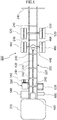
- FIG. 1 illustrates one example of the layout of a truck. The following describes the truck as one example of the vehicle.
- the truck 100 includes a parallel-ladder shaped frame 200 and a cabin 300 placed in front of the frame 200.
- the frame 200 has a pair of left and right side frames 220 extending parallel to the vehicle front-rear direction, and a plurality of cross members 240 extending in the vehicle width direction to couple the pair of left and right side frames 220.
- being "parallel” is not limited to being perfectly parallel, and it may be what is visually recognizable as being parallel (the same will apply hereinafter).
- the frame 200 functions as the base framework of the truck 100, to which an engine, a power transmission device, a suspension and the like are attached.
- An engine (not illustrated) is mounted below the cabin 300.
- the output from the engine is transmitted to left and right rear wheels 480 as the driven wheels via a transmission 400, a propeller shaft 420, a differential carrier 440, and a drive axle 460.
- a dead axle 500 is disposed at the rear side of the left and right wheels 480, and the dead axle 500 rotatably supports left and right rear wheels 520 as driving wheels at both ends of the dead axle 500.
- an exhaust emission purifying apparatus 540 On an outer side surface of the side frame 220 at the right side of the vehicle, between the cabin 300 and the rear wheel 480, an exhaust emission purifying apparatus 540, a battery fixing device 560 and an air reservoir tank 580 are attached in this order from the front side to the rear side of the vehicle.
- a reducing-agent tank 600 On an outer side surface of the side frame 220 on the left side of the vehicle, between the cabin 300 and the rear wheel 480, a reducing-agent tank 600 which stores the reducing agent used at the exhaust emission purifying apparatus 540 and a fuel tank 620 are attached in this order from the front side to the rear side of the vehicle.
- the battery fixing device 560 is not limited to being attached at the position as in the drawing, and may be attached at other positions, such as in front of the exhaust emission purifying apparatus 540 or the outer side surface of the side frame 220 on the left side of the vehicle.
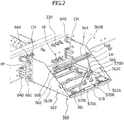
- FIGs. 2 to 4 illustrate the battery fixing device 560 according to the first embodiment.
- the battery fixing device 560 is attached to the outer side surface of the side frame 220 via a bracket 640 having bosses at two vertically apart positions, with fasteners 660 such as a bolt, a washer, and a nut.
- the battery fixing device 560 includes a receiving member 562 on which two batteries 680 are placed so that the batteries are apart from and disposed parallel to each other, and one retainer 564 having a portion hanging down between the two batteries 680 to retain mutually opposed shoulder portions of the two batteries 680.
- the battery fixing device 560 further includes: two rods 566, in each of which a proximal end is fixed to the receiving member 562 in the extending direction of the retainer 564, and in each of which a distal end passes through each end of the retainer 564; and two nuts 568 each threadably engaged with the distal end of the rod 566 passed through the retainer 564.
- the rods 566 penetrate through the retainer 564 within the range in which the two batteries 680 are opposed.
- the battery fixing device 560 fixes the two batteries 680 that are disposed in parallel in the width direction of the vehicle, and the two batteries 680 may be disposed in parallel in the vehicle front-rear direction (the same will apply hereinafter).
- the receiving member 562 has a rectangular parallelepiped shape of which the outer side in the vehicle width direction is open and of which the upper side is open.
- the receiving member 562 includes a bottom plate 562A, a pair of side plates 562B and a pair of battery holders 562C, which are made of thin steel plate, for example.
- a rectangular parallelepiped shape is not limited to a perfect rectangular solid, and may be one visually recognizable as a rectangular solid (the same will apply hereinafter).
- the bottom plate 562A is a rectangular plate located in a horizontal plane defined in the vehicle width direction and the vehicle front-rear direction. On the upper face of the bottom plate 562A, the two batteries 680 are placed parallel to each other.
- a rectangular shape is not limited to a perfect rectangle, and it may be one visually recognizable as a rectangle (the same will apply hereinafter).
- the bottom plate 562A has a plurality of beads (concave and convex portions) BD that extend in at least one of the vehicle front-rear direction and the vehicle width direction.
- the bottom plate 562A may have ribs that stand upward from both ends on the inner side and the outer side in the vehicle width direction.
- Each side plate 562B stands upward from both ends of the bottom plate 562A in the vehicle front-rear direction and has a trapezoidal shape having a corner at right angles (right angle trapezoid) and having a diagonally cut shoulder portion on the outer side in the vehicle width direction.
- a fixing plate FP is integrated with the side plate 562B.
- This fixing plate FP is a long member for fixing to the bracket 640 and has an L-shaped cross section (like an angle member).
- an L shape is not limited to a perfect L shape, and it may be one visually recognizable as an L shape (the same will apply hereinafter).
- the fixing plate FP has a plurality of holes for insertion of bolts at positions which correspond to the bosses of the bracket 640.
- a cover holder CH is integrated with the side plate 562B.
- the cover holder CH is a rectangular plate extending horizontally to retain the upper face of a battery cover 700 at a position located on the inner side in the vehicle width direction.
- the battery holder 562C is a long member having an L-shaped cross section.
- the battery holders 562C are fixed at both ends of the bottom plate 562A in the vehicle front-rear direction while maintaining the axis of the member of the battery holder 562C along the vehicle width direction.
- Two battery holders 562C are disposed apart from each other by the distance corresponding to the width of the batteries 680 so as to hold both side faces of the batteries 680 between the parts of the battery holders 562C standing upward from the bottom plate 562A.
- the ends of the pair of the battery holders 562C on the inner side in the vehicle width direction are bent at right angles so as to be closer to each other.
- right angles are not limited to perfect right angles and may be ones visually recognizable as right angles (the same will apply hereinafter).
- the pair of battery holders 562C can limit the movement of the two batteries 680 placed on the bottom plate 562A in the vehicle front-rear direction as well as in the inward movement in the vehicle width direction.
- At a middle portion of the battery holder 562C at least one long hole LH is formed. This long hole extends vertically to detachably and swingably fix the proximal end of the rod 566.
- the retainer 564 is a long member having a hat-shaped cross section that protrudes downward, and has an overall length that corresponds to the width of the batteries 680.
- a hat shape is not limited to a perfect hat shape, and it may be one visually recognizable as a hat shape.
- through holes through which the axis of the rods 566 is passed are formed. Accordingly, when the pair of rods 566 pass through these through holes of the retainer 564, the rods are inclined while approaching each other in an inverted V shape as illustrated in FIG. 2 .
- the upper face of the retainer 564 has a slanted face SF that is slanted according to the inclination angle of the rod 566, that is, perpendicular to the axis line of the rod 566.
- This slanted face SF has a through hole through which the axis of the rod 566 passes.
- the slanted face SF may be formed by welding a member made of steel that bends in an L shape to the retainer 564, for example.
- the rod 566 is a J bolt having a J-shaped proximal end in a J shape, and the J-shaped proximal end is detachably fitted into the long hole LH of the battery holder 562C.
- the rod 566 therefore is swingable at a predetermined angle at least in the vehicle front-rear direction.
- the distal end of the rod 566 passes through the through holes of the retainer 564 and of the slanted face SF, and protrudes upward from the upper face of the slanted face SF.
- a nut 568 is threadably engaged with the distal end of the rod 566 to be detachable, so as to change the position of the retainer 564 relative to the bottom plate 562A integrated with the battery holders 562C.
- a washer may fit to the distal end of the rod 566 to suppress loosening.
- a battery cover bracket 570 is attached to the end portion of the bottom plate 562A positioned at the outer side in the vehicle width direction.
- This battery cover bracket 570 limits the outward movement of the batteries 680 in the vehicle width direction and detachably fixes the battery cover 700 that covers the upper portion of the battery 680.
- the battery cover bracket 570 has a rectangular first member 570A which is a fixing portion to fix the battery cover bracket 570 to the bottom plate 562A, an isosceles trapezoidal second member 570B standing upward from one end of the first member 570A, and a triangular third member 570C outwardly extending in the vehicle width direction from the upper end of the second member 570B.
- an isosceles trapezoidal shape and a triangular shape are not limited to perfect isosceles trapezoidal shape and triangular shapes, and they may be ones visually recognizable as an isosceles trapezoidal shape and a triangular shape (the same will apply hereinafter).
- a butterfly nut 570D is threadably engaged to be detachable. This butterfly nut 570D fixes the battery cover 700 to the receiving member 562 via a fixing hole formed at an outer side portion of the battery cover 700 in the vehicle width direction.
- an operator places one of the batteries 680 on the upper face of the receiving member 562, and moves this battery 680 toward the inside in the vehicle width direction.
- the operator moves the battery 680 to a predetermined position, the lower portion of the battery 680 in the vehicle front-rear direction and on the inner side in the vehicle width direction comes in contact with the battery holders 562C, so that the battery holder 562C limits the movement of the battery 680 in the vehicle front-rear direction and toward the inside in the vehicle width direction.
- each rod 566 The operator fits the proximal end of each rod 566 to the long hole LH of the battery holder 562C, and then places the other battery 680 on the upper face of the receiving member 562. Then the operator passes the distal end of each rod 566 through the through hole of each end of the retainer 564 and the through hole of the slanted face SF, and threadably engages the nut 568 loosely with the distal end. The operator puts the protrusion of the retainer 564 in between the two batteries 680, and tightens each nut 568 that is threadably engaged with the distal end of the rod 566.
- the outer surface of the battery 680 on the outer side in the vehicle width direction comes in contact with the battery cover bracket 570.
- the rods 566 work on the retainer 564 are within the area in which the two batteries 680 are opposed, and thus, even if the tensile force of the rod 566 increases, it is difficult to deform the retainer 564 to bow. Accordingly, the strength to fix the batteries 680 can be improved.
- the upper face of the retainer 564 includes the slanted face SF according to the inclination angle of the rods 566.
- the tensile force of the rod 566 can be transmitted effectively to the retainer 564, to thereby fix the batteries 680 securely.
- the batteries 680 can be fixed to the receiving member 562 with one retainer 564 and a pair of rods 566.
- the number of nuts involved in the operation can be reduced, and the operations of attaching and detaching the batteries 680 are easily performed.
- the operator places a portion of the battery cover 700 to be located on the inner side in the vehicle width direction in between the upper face of the battery 680 and the cover holder CH of the side plate 562B, and fixes a portion of the battery cover on the outer side in the vehicle width direction with the butterfly nut 570D of the battery cover bracket 570.
- the operator may perform the above operation in reverse order.
- the above operation may be modified to some extent. For instance, the order of the steps may be changed, or before the batteries 680 are attached or detached, the operator may detach the battery cover bracket 570.
- FIGs. 5 and 6 illustrate a second embodiment of the battery fixing device 560.
- the following description assigns reference numeral 720 to the battery fixing device of the second embodiment.
- the battery fixing device 720 includes a receiving member 722 on which two batteries 680 are placed parallel to each other, and two retainers 724 each configured to respectively retain the outer side shoulder portions of the two batteries 680.
- the battery fixing device 720 further includes: two V-shaped levers 726 that are fixed rotatably about the axis perpendicular to the direction in which the two batteries 680 are disposed (i.e., the vehicle width direction) on the boundary face between the two batteries 680; four rods 728 each having the proximal end and the distal end, the proximal ends being fixed to relatively rotate at positions on the opposite sides of the center of the rotation of the V-shaped levers 726, and the distal ends penetrating through the both ends of the retainers 724; and four nuts 730 each threadably engaged with the distal end of the rod 728 passed through the retainer 724.
- the V-shaped levers 726 are one example of a rotating plate.
- the receiving member 722 has a rectangular parallelepiped shape of which the outer side in the vehicle width direction is open and of which the upper side is open.
- the receiving member 722 includes a bottom plate 722A and a pair of side plates 722B, which are made of thin steel plate, for example.
- the bottom plate 722A has a rectangular plate located in a horizontal plane defined in the vehicle width direction and the vehicle front-rear direction. On the upper face of the bottom plate722A, the two batteries 680 are placed parallel to each other. In order to improve the strength of the bottom plate 722A, the bottom plate 722A has a plurality of beads BD that extends in at least one of the vehicle front-rear direction and the vehicle width direction. The bottom plate 722A may have ribs that stand upward from both ends on the inner side and the outer side in the vehicle width direction.
- Each side plate 722B stands upward from both ends of the bottom plate 722A in the vehicle front-rear direction and has a trapezoidal shape having a corner at right angles and having a diagonally-cut shoulder portion on the outer side in the vehicle width direction.
- a fixing plate FP is integrated with the side plate 722B.
- This fixing plate FP is a long member for fixing to the bracket 640 and has an L-shaped cross section.
- the fixing plate FP has a plurality of holes for insertion of bolts at positions which correspond to the bosses of the bracket 640.
- Each retainer 724 is a long member having an L-shaped cross section and has an overall length slightly longer than the width of the batteries 680.
- Each retainer 724 has through holes at both ends that protrude from the battery 680 when the retainer 724 retains the outer side shoulder portion of the battery 680, and the axis of the rods 728 pass through these through holes.
- the upper face of each retainer 724 at least at both ends may have slanted faces SF according to the inclination angle of the rods 728.
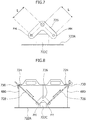
- each V-shaped lever 726 is a V-shaped thin-plate member having arms extending at right angles (90 degrees).
- Each arm has a fixing hole FH at the distal end portion which detachably fixes the proximal end of the rod 728 to be swingable.
- These fixing holes FH are formed at positions (distance L) equally apart from the center portion of the V-shaped lever 726, that is, from the center of the rotation of the V-shaped lever 726 at which the axis lines of the arms intersect. Accordingly, the proximal ends of the rods 728 are fixed at the positions equally apart from the center of the rotation of the V-shaped lever 726.
- the V-shaped lever 726 is symmetrical with respect to the line that divides the angle between the axis lines of the arms into halves. Instead of the fixing holes FH, the arms of the V-shaped lever 726 may have long holes at their distal ends that extend in the direction orthogonal to the extending direction of the arms.
- the center of the rotation of the V-shaped lever 726 is fixed rotatably to the distal end of a lever bracket 722C having an L-shaped cross section so that the V-shaped lever 726 has an inverted V-shape, that is, to be projected upward.
- the proximal end of the lever bracket 722C that is, the lower face of the lever bracket 722C which corresponds to the shorter side of the L-shape, is fixed to the upper face of the bottom plate 722A so that the side face of the lever bracket722C which corresponds to the longer side extends in the vehicle width direction.
- the lever bracket 722C is placed so that the rotation axis of the V-shaped lever 726 is located on the boundary face of the two batteries 680 and so that the plate face of the V-shaped lever 726 is coplanar with the through holes of the retainers 724 which retains the outer side shoulder portions of the two batteries 680.
- the lever bracket 722C is integrally formed with a rectangular battery holder BH at the leading edge of the proximal end, that is, at the position which corresponds to the width of the batteries 680. This battery holder BH standing upward from the position limits the movement of the batteries 680 in the vehicle front-rear direction.
- each rod 728 is a J bolt having a J-shaped proximal end, and the J-shaped proximal end is detachably fitted into the fixing hole FH of the V-shaped lever 726.
- the rod 728 is swingable at least in the vehicle width direction.
- the distal end of the rod 728 passes through the through hole of the retainer 724 and protrudes upward from the upper face of the retainer 724.
- a nut 730 is threadably engaged with the distal end of the rod 728 so as to be detachable, so as to allow change of the position of the retainer 724 relative to the fixing hole FH of the V-shaped lever 726.
- a washer may fit to the distal end of the rod 728 to suppress loosening.
- the dimensions of various portions of the V-shaped lever 726 and the attachment position of the lever bracket 722C, for example, are set appropriately so that the axis line of each rod 728 extends at an angle of 90 degrees (right angle) relative to the axis line of the corresponding arm of the V-shaped lever 726.
- the tensile force of the rods 728 is effectively transmitted to the V-shaped lever 726.
- each rod 728 Prior to the operation to attach and detach the batteries 680, as illustrated in FIG. 5 , the proximal end of each rod 728 is fitted into the fixing hole FH of the V-shaped lever 726, and the distal end of the rod 728 is passed through the through hole of the retainer 724, and the nut 730 is threadably engaged with the distal end of the rod 728.
- the retainer 724 located inside in the vehicle width direction the position of the nut 730 threadably engaged with the distal end of each rod 728 passing through the retainer 724 may be adjusted according to the dimensions of the batteries 680.
- the operator places one of the batteries 680 on the receiving member 722, and moves this battery toward the inside in the vehicle width direction while the retainer 724 retains the outer side shoulder portion of the battery 680. Then, while the operator holds the retainer 724 upward, which is to retain the outer side shoulder portion of the other battery 680 to be placed on the outer side in the vehicle width direction, and places the other battery 680 on the receiving member 722. Then, the operator moves this battery 680 until it comes in contact with the battery 680 placed inside in the vehicle width direction. Then, the operator lowers the retainer 724 held upward to retain the outer side shoulder portion of the battery 680 placed on the outer side in the vehicle width direction.
- the position of the retainer 724 relative to the fixing holes FH of the V-shaped lever 726 accordingly changes, and thus, as illustrated in FIG. 8 , the V-shaped lever 726 rotates according to a change in the relative position.
- the tensile force of the rods 728 passing through the retainer 724 which retains the outer side shoulder portion of the battery 680 placed inside in the vehicle width increases. Since the V-shaped lever 726 is symmetrical with respect to the line passing through the center of the rotation, the tensile force is substantially the same between the rods 728.
- both of the lower parts of the batteries 680 located on the front and the rear of the vehicle come in contact with the battery holders BH of the lever brackets 722C, and thus, the movement of the batteries 680 in the vehicle front-rear direction is limited.
- the retainers 724 and the rods 728 urge both of the outer side shoulder portion of the two batteries 680 placed parallel to each other toward the fixing holes FH of the V-shaped levers 726, and thus, the movement of the batteries 680 in the vehicle width direction and in the vehicle vertical direction is limited.
- the batteries 680 can be fixed to the receiving member 722 simply by tightening the nuts 730 of the rods 728 passing through the retainers 724 located on the outer side in the vehicle width direction.
- such a battery fixing device 720 allows the operator to fix the batteries mainly from the outer side in the vehicle width direction, and therefore even when the gap between the batteries 680 and the vehicle body is small, the operator can fix the batteries 680 securely.
- each side plate 722B may have a cover holder, and a battery cover bracket may be attached at the end of the bottom plate 722A on the outer side in the vehicle width direction to detachably attach a battery cover.
- the structure to rotatably support the V-shaped lever 726 is not limited to the lever bracket 722C as stated above, and the following structure may be used.
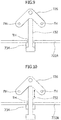
- the bottom plate 722A of the receiving member 722 has a circular through hole TH at a predetermined position.
- a cylindrical member 732 passes to be vertically movable, and this cylindrical member 732 has a stepped shape having a large-diameter portion at the bottom thereof and a small-diameter portion having an external thread formed at least at a lower part of the small-diameter portion.
- the external thread at the small-diameter portion of this cylindrical member 732 located between the large-diameter portion and the bottom plate 722A threadably engages with a nut 734 having an internal thread on the inner circumference.
- a distal end of the cylindrical member 732 at the small-diameter part protrudes upward from the bottom plate 722A, and a center part of the V-shaped lever 726 is rotatably fixed to this distal end.
- the cylindrical member 732 When the two batteries 680 are placed on the receiving member 722 and the retainers 724 retain the outer side shoulder portions of the batteries 680, the operator rotates the nut 734, the cylindrical member 732 then moves vertically relative to the bottom plate 722A, as illustrated in FIG. 10 . As the cylindrical member 732 moves vertically, the V-shaped lever 726 also moves vertically because it is rotatably fixed to the distal end of the small-diameter portion, so that the rods 728 of which their proximal ends are fixed to the fixing holes FH have a greater tensile force.
- the structure as illustrated in FIG. 11 may be used.
- the bottom plate 722A of the receiving member 722 has a circular through hole TH at a predetermined position.
- a weld nut 736 is welded at the lower surface of the bottom plate 722A at a position which corresponds to the through hole TH.
- a bolt 738 such as a hexagon socket head cap bolt or a hexagon head bolt, is threadably engaged with the weld nut 736 from below.
- the bolt 738 has a shaft portion protruding upward from the bottom plate 722A, and a nut 740 having an internal thread at least on the inner circumference is threadably engaged with the shaft portion.
- the nut 740 has a peripheral wall, to which the center portion of the V-shaped lever 726 is rotatably fixed.
- the bolt 738 moves vertically relative to the weld nut 736 as illustrated in FIG. 12 .
- the nut 740 moves vertically relative to the receiving member 722 because the rod 728 limits the rotation of the nut 740 threadably engaged with the shaft portion.
- the V-shaped lever 726 which is rotatably fixed to the nut 740, also moves vertically.
- the rods 728 having their proximal ends fixed to the fixing holes FH have a greater tensile force.
- the lever to fix the proximal ends of the rods 728 is not limited to the V-shaped lever 726, which may be a rotating plate having other shapes, such as a rectangular, circular or elliptical shape.
- fixing holes FH are formed at appropriate positions of the rotating plate, to which the proximal ends of the rods 728 can be detachable fixed to be swingable.
- the battery fixing device 720 may fix not only the two batteries 680, but a plurality of batteries 680.
- the V-shaped lever 726 may be fixed on the plane perpendicular to the direction in which the plurality of batteries 680 is disposed (the vehicle width direction) to be rotatable about the axis parallel to the plane in which the plurality of batteries 680 is placed, that is, the axis extending in the vehicle front-rear direction.
Landscapes
- Engineering & Computer Science (AREA)
- Chemical & Material Sciences (AREA)
- Chemical Kinetics & Catalysis (AREA)
- Electrochemistry (AREA)
- General Chemical & Material Sciences (AREA)
- Mechanical Engineering (AREA)
- Aviation & Aerospace Engineering (AREA)
- Battery Mounting, Suspending (AREA)
- Arrangement Or Mounting Of Propulsion Units For Vehicles (AREA)
Abstract
Description
- The present invention relates to a fixing device for two batteries in parallel to each other.
- As disclosed in
JP 2003-312394 A - Patent Document 1:
JP 2003-312394 A - Since the abovementioned battery fixing device is configured to urge the batteries against the receiving member with the six rods, when attaching and detaching the batteries, it is necessary to fasten and loosen nuts which are threadably engaged with the six rods, and thus, the operation for attaching and detaching the batteries requires much effort. Especially when the gap between the upper face of the retainers and the vehicle body is narrow, a space for the operation to fasten or loosen the nuts is narrow, and thus, such an operation requires great effort.
- Therefore, an object of the present invention is to provide a battery fixing device for which the operation of attaching and detaching batteries is improved.
- A battery fixing device includes: a receiving member on which two batteries are placed so that the batteries are apart from and disposed parallel to each other; one retainer having a portion hanging down between the two batteries to retain mutually opposed shoulder portions of the two batteries: two rods, in each of which a proximal end is fixed to the receiving member in the extending direction of the retainer, and in each of which a distal end passes through each end of the retainer; and two nuts threadably engaged with the distal ends of the rods passed through the retainer. The rods penetrate through the retainer within the range in which the two batteries are opposed.
- A battery fixing device includes: a receiving member on which a plurality of batteries are placed parallel to each other; two retainers, each configured to retain an outer side shoulder portion of one of the plurality of batteries; and two rotating plates that are rotatably fixed on a plane perpendicular to the direction in which the plurality of batteries is disposed to rotate about an axis parallel to a plane on which the plurality of batteries is placed. The battery fixing device further includes; four rods each having a proximal end and a distal end, the proximal ends being fixed to relatively rotate at positions on opposite sides of a center of the rotation of each rotary plate, and the distal ends penetrating through both ends of the retainers; and four nuts each threadably engaged with the distal end of the rod passed through the retainer.
- According to the present invention, it is possible to improve the operation of attaching and detaching batteries.
-
-
FIG. 1 is a plan view illustrating one example of the layout of a truck. -
FIG. 2 is a perspective view of the battery fixing device according to the first embodiment. -
FIG. 3 is a perspective view of the battery fixing device on which batteries are mounted according to the first embodiment. -
FIG. 4 is a perspective view of the battery fixing device to which a battery cover is attached according to the first embodiment. -
FIG. 5 is a perspective view of the battery fixing device according to the second embodiment. -
FIG. 6 is a perspective view of the battery fixing device on which batteries are mounted according to the second embodiment. -
FIG. 7 is a detailed view of a V-shaped lever in the second embodiment. -
FIG. 8 is an explanatory view of the operation of the battery fixing device according to the second embodiment. -
FIG. 9 is an explanatory view of a mechanism enabling vertical movement of the V-shaped lever. -
FIG. 10 is an explanatory view of the operation of the mechanism enabling vertical movement of the V-shaped lever. -
FIG. 11 is an explanatory view of another mechanism enabling vertical movement of the V-shaped lever. -
FIG. 12 is an explanatory view of the operation of another mechanism enabling vertical movement of the V-shaped lever. - Hereinafter, an embodiment for implementing the present invention is explained with reference to the accompanying drawings.
-
FIG. 1 illustrates one example of the layout of a truck. The following describes the truck as one example of the vehicle. - The
truck 100 includes a parallel-ladder shapedframe 200 and acabin 300 placed in front of theframe 200. Theframe 200 has a pair of left andright side frames 220 extending parallel to the vehicle front-rear direction, and a plurality ofcross members 240 extending in the vehicle width direction to couple the pair of left andright side frames 220. Here, being "parallel" is not limited to being perfectly parallel, and it may be what is visually recognizable as being parallel (the same will apply hereinafter). Theframe 200 functions as the base framework of thetruck 100, to which an engine, a power transmission device, a suspension and the like are attached. - An engine (not illustrated) is mounted below the
cabin 300. The output from the engine is transmitted to left and rightrear wheels 480 as the driven wheels via atransmission 400, apropeller shaft 420, adifferential carrier 440, and adrive axle 460. Adead axle 500 is disposed at the rear side of the left andright wheels 480, and thedead axle 500 rotatably supports left and rightrear wheels 520 as driving wheels at both ends of thedead axle 500. - On an outer side surface of the
side frame 220 at the right side of the vehicle, between thecabin 300 and therear wheel 480, an exhaust emission purifyingapparatus 540, abattery fixing device 560 and anair reservoir tank 580 are attached in this order from the front side to the rear side of the vehicle. On an outer side surface of theside frame 220 on the left side of the vehicle, between thecabin 300 and therear wheel 480, a reducing-agent tank 600 which stores the reducing agent used at the exhaust emission purifyingapparatus 540 and afuel tank 620 are attached in this order from the front side to the rear side of the vehicle. Thebattery fixing device 560 is not limited to being attached at the position as in the drawing, and may be attached at other positions, such as in front of the exhaust emission purifyingapparatus 540 or the outer side surface of theside frame 220 on the left side of the vehicle. -
FIGs. 2 to 4 illustrate thebattery fixing device 560 according to the first embodiment. - The
battery fixing device 560 is attached to the outer side surface of theside frame 220 via abracket 640 having bosses at two vertically apart positions, withfasteners 660 such as a bolt, a washer, and a nut. - The
battery fixing device 560 includes a receivingmember 562 on which twobatteries 680 are placed so that the batteries are apart from and disposed parallel to each other, and oneretainer 564 having a portion hanging down between the twobatteries 680 to retain mutually opposed shoulder portions of the twobatteries 680. Thebattery fixing device 560 further includes: tworods 566, in each of which a proximal end is fixed to thereceiving member 562 in the extending direction of theretainer 564, and in each of which a distal end passes through each end of theretainer 564; and twonuts 568 each threadably engaged with the distal end of therod 566 passed through theretainer 564. Therods 566 penetrate through theretainer 564 within the range in which the twobatteries 680 are opposed. In the drawings, thebattery fixing device 560 fixes the twobatteries 680 that are disposed in parallel in the width direction of the vehicle, and the twobatteries 680 may be disposed in parallel in the vehicle front-rear direction (the same will apply hereinafter). - The
receiving member 562 has a rectangular parallelepiped shape of which the outer side in the vehicle width direction is open and of which the upper side is open. The receivingmember 562 includes abottom plate 562A, a pair ofside plates 562B and a pair ofbattery holders 562C, which are made of thin steel plate, for example. Here, a rectangular parallelepiped shape is not limited to a perfect rectangular solid, and may be one visually recognizable as a rectangular solid (the same will apply hereinafter). - The
bottom plate 562A is a rectangular plate located in a horizontal plane defined in the vehicle width direction and the vehicle front-rear direction. On the upper face of thebottom plate 562A, the twobatteries 680 are placed parallel to each other. Here, a rectangular shape is not limited to a perfect rectangle, and it may be one visually recognizable as a rectangle (the same will apply hereinafter). In order to improve the strength of thebottom plate 562A, thebottom plate 562A has a plurality of beads (concave and convex portions) BD that extend in at least one of the vehicle front-rear direction and the vehicle width direction. Thebottom plate 562A may have ribs that stand upward from both ends on the inner side and the outer side in the vehicle width direction. - Each
side plate 562B stands upward from both ends of thebottom plate 562A in the vehicle front-rear direction and has a trapezoidal shape having a corner at right angles (right angle trapezoid) and having a diagonally cut shoulder portion on the outer side in the vehicle width direction. At the end of theside plate 562B on the inner side in the vehicle width direction, a fixing plate FP is integrated with theside plate 562B. This fixing plate FP is a long member for fixing to thebracket 640 and has an L-shaped cross section (like an angle member). Here, an L shape is not limited to a perfect L shape, and it may be one visually recognizable as an L shape (the same will apply hereinafter). The fixing plate FP has a plurality of holes for insertion of bolts at positions which correspond to the bosses of thebracket 640. At a shoulder portion of theside plate 562B on the inner side in the vehicle width direction, a cover holder CH is integrated with theside plate 562B. The cover holder CH is a rectangular plate extending horizontally to retain the upper face of abattery cover 700 at a position located on the inner side in the vehicle width direction. - The
battery holder 562C is a long member having an L-shaped cross section. Thebattery holders 562C are fixed at both ends of thebottom plate 562A in the vehicle front-rear direction while maintaining the axis of the member of thebattery holder 562C along the vehicle width direction. Twobattery holders 562C are disposed apart from each other by the distance corresponding to the width of thebatteries 680 so as to hold both side faces of thebatteries 680 between the parts of thebattery holders 562C standing upward from thebottom plate 562A. The ends of the pair of thebattery holders 562C on the inner side in the vehicle width direction are bent at right angles so as to be closer to each other. Here, right angles are not limited to perfect right angles and may be ones visually recognizable as right angles (the same will apply hereinafter). With this configuration, the pair ofbattery holders 562C can limit the movement of the twobatteries 680 placed on thebottom plate 562A in the vehicle front-rear direction as well as in the inward movement in the vehicle width direction. At a middle portion of thebattery holder 562C, at least one long hole LH is formed. This long hole extends vertically to detachably and swingably fix the proximal end of therod 566. - The
retainer 564 is a long member having a hat-shaped cross section that protrudes downward, and has an overall length that corresponds to the width of thebatteries 680. Here, a hat shape is not limited to a perfect hat shape, and it may be one visually recognizable as a hat shape. At the protrusions located on both ends of theretainer 564, through holes through which the axis of therods 566 is passed are formed. Accordingly, when the pair ofrods 566 pass through these through holes of theretainer 564, the rods are inclined while approaching each other in an inverted V shape as illustrated inFIG. 2 . The upper face of theretainer 564 has a slanted face SF that is slanted according to the inclination angle of therod 566, that is, perpendicular to the axis line of therod 566. This slanted face SF has a through hole through which the axis of therod 566 passes. The slanted face SF may be formed by welding a member made of steel that bends in an L shape to theretainer 564, for example. - For example, the
rod 566 is a J bolt having a J-shaped proximal end in a J shape, and the J-shaped proximal end is detachably fitted into the long hole LH of thebattery holder 562C. Therod 566 therefore is swingable at a predetermined angle at least in the vehicle front-rear direction. The distal end of therod 566 passes through the through holes of theretainer 564 and of the slanted face SF, and protrudes upward from the upper face of the slanted face SF. - After passing through the
retainer 564, anut 568 is threadably engaged with the distal end of therod 566 to be detachable, so as to change the position of theretainer 564 relative to thebottom plate 562A integrated with thebattery holders 562C. In addition to thenut 568 to be threadably engaged, a washer may fit to the distal end of therod 566 to suppress loosening. - To the end portion of the
bottom plate 562A positioned at the outer side in the vehicle width direction, abattery cover bracket 570 is attached. Thisbattery cover bracket 570 limits the outward movement of thebatteries 680 in the vehicle width direction and detachably fixes thebattery cover 700 that covers the upper portion of thebattery 680. Thebattery cover bracket 570 has a rectangularfirst member 570A which is a fixing portion to fix thebattery cover bracket 570 to thebottom plate 562A, an isosceles trapezoidalsecond member 570B standing upward from one end of thefirst member 570A, and a triangularthird member 570C outwardly extending in the vehicle width direction from the upper end of thesecond member 570B. Here, an isosceles trapezoidal shape and a triangular shape are not limited to perfect isosceles trapezoidal shape and triangular shapes, and they may be ones visually recognizable as an isosceles trapezoidal shape and a triangular shape (the same will apply hereinafter). On the upper face of thethird member 570C, abutterfly nut 570D is threadably engaged to be detachable. Thisbutterfly nut 570D fixes thebattery cover 700 to the receivingmember 562 via a fixing hole formed at an outer side portion of thebattery cover 700 in the vehicle width direction. - Next, an example of the method of using the
battery fixing device 560 according to the first embodiment is described. - To attach the
batteries 680, an operator places one of thebatteries 680 on the upper face of the receivingmember 562, and moves thisbattery 680 toward the inside in the vehicle width direction. When the operator moves thebattery 680 to a predetermined position, the lower portion of thebattery 680 in the vehicle front-rear direction and on the inner side in the vehicle width direction comes in contact with thebattery holders 562C, so that thebattery holder 562C limits the movement of thebattery 680 in the vehicle front-rear direction and toward the inside in the vehicle width direction. - The operator fits the proximal end of each
rod 566 to the long hole LH of thebattery holder 562C, and then places theother battery 680 on the upper face of the receivingmember 562. Then the operator passes the distal end of eachrod 566 through the through hole of each end of theretainer 564 and the through hole of the slanted face SF, and threadably engages thenut 568 loosely with the distal end. The operator puts the protrusion of theretainer 564 in between the twobatteries 680, and tightens eachnut 568 that is threadably engaged with the distal end of therod 566. - In this state, the outer surface of the
battery 680 on the outer side in the vehicle width direction comes in contact with thebattery cover bracket 570. Thus, it is possible to limit the movement of thebatteries 680 to the outside in the vehicle width direction. The points of application at which therods 566 work on theretainer 564 are within the area in which the twobatteries 680 are opposed, and thus, even if the tensile force of therod 566 increases, it is difficult to deform theretainer 564 to bow. Accordingly, the strength to fix thebatteries 680 can be improved. Additionally, the upper face of theretainer 564 includes the slanted face SF according to the inclination angle of therods 566. Thus, the tensile force of therod 566 can be transmitted effectively to theretainer 564, to thereby fix thebatteries 680 securely. Thebatteries 680 can be fixed to the receivingmember 562 with oneretainer 564 and a pair ofrods 566. Thus, compared to conventional battery fixing devices, the number of nuts involved in the operation can be reduced, and the operations of attaching and detaching thebatteries 680 are easily performed. - After that, as illustrated in
FIG. 4 , the operator places a portion of thebattery cover 700 to be located on the inner side in the vehicle width direction in between the upper face of thebattery 680 and the cover holder CH of theside plate 562B, and fixes a portion of the battery cover on the outer side in the vehicle width direction with thebutterfly nut 570D of thebattery cover bracket 570. - When the
batteries 680 are detached from thebattery fixing device 560, the operator may perform the above operation in reverse order. The above operation may be modified to some extent. For instance, the order of the steps may be changed, or before thebatteries 680 are attached or detached, the operator may detach thebattery cover bracket 570. -
FIGs. 5 and6 illustrate a second embodiment of thebattery fixing device 560. To avoid confusion with thebattery fixing device 560 of the first embodiment, the following description assignsreference numeral 720 to the battery fixing device of the second embodiment. - The
battery fixing device 720 includes a receivingmember 722 on which twobatteries 680 are placed parallel to each other, and tworetainers 724 each configured to respectively retain the outer side shoulder portions of the twobatteries 680. Thebattery fixing device 720 further includes: two V-shapedlevers 726 that are fixed rotatably about the axis perpendicular to the direction in which the twobatteries 680 are disposed (i.e., the vehicle width direction) on the boundary face between the twobatteries 680; fourrods 728 each having the proximal end and the distal end, the proximal ends being fixed to relatively rotate at positions on the opposite sides of the center of the rotation of the V-shapedlevers 726, and the distal ends penetrating through the both ends of theretainers 724; and fournuts 730 each threadably engaged with the distal end of therod 728 passed through theretainer 724. The V-shapedlevers 726 are one example of a rotating plate. - The receiving
member 722 has a rectangular parallelepiped shape of which the outer side in the vehicle width direction is open and of which the upper side is open. The receivingmember 722 includes abottom plate 722A and a pair ofside plates 722B, which are made of thin steel plate, for example. - The
bottom plate 722A has a rectangular plate located in a horizontal plane defined in the vehicle width direction and the vehicle front-rear direction. On the upper face of the bottom plate722A, the twobatteries 680 are placed parallel to each other. In order to improve the strength of thebottom plate 722A, thebottom plate 722A has a plurality of beads BD that extends in at least one of the vehicle front-rear direction and the vehicle width direction. Thebottom plate 722A may have ribs that stand upward from both ends on the inner side and the outer side in the vehicle width direction. - Each
side plate 722B stands upward from both ends of thebottom plate 722A in the vehicle front-rear direction and has a trapezoidal shape having a corner at right angles and having a diagonally-cut shoulder portion on the outer side in the vehicle width direction. At the end of theside plate 722B on the inner side of the vehicle width, a fixing plate FP is integrated with theside plate 722B. This fixing plate FP is a long member for fixing to thebracket 640 and has an L-shaped cross section. The fixing plate FP has a plurality of holes for insertion of bolts at positions which correspond to the bosses of thebracket 640. - Each
retainer 724 is a long member having an L-shaped cross section and has an overall length slightly longer than the width of thebatteries 680. Eachretainer 724 has through holes at both ends that protrude from thebattery 680 when theretainer 724 retains the outer side shoulder portion of thebattery 680, and the axis of therods 728 pass through these through holes. The upper face of eachretainer 724 at least at both ends may have slanted faces SF according to the inclination angle of therods 728. - As illustrated in
FIG. 7 , each V-shapedlever 726 is a V-shaped thin-plate member having arms extending at right angles (90 degrees). Each arm has a fixing hole FH at the distal end portion which detachably fixes the proximal end of therod 728 to be swingable. These fixing holes FH are formed at positions (distance L) equally apart from the center portion of the V-shapedlever 726, that is, from the center of the rotation of the V-shapedlever 726 at which the axis lines of the arms intersect. Accordingly, the proximal ends of therods 728 are fixed at the positions equally apart from the center of the rotation of the V-shapedlever 726. The V-shapedlever 726 is symmetrical with respect to the line that divides the angle between the axis lines of the arms into halves. Instead of the fixing holes FH, the arms of the V-shapedlever 726 may have long holes at their distal ends that extend in the direction orthogonal to the extending direction of the arms. - The center of the rotation of the V-shaped
lever 726 is fixed rotatably to the distal end of alever bracket 722C having an L-shaped cross section so that the V-shapedlever 726 has an inverted V-shape, that is, to be projected upward. The proximal end of thelever bracket 722C, that is, the lower face of thelever bracket 722C which corresponds to the shorter side of the L-shape, is fixed to the upper face of thebottom plate 722A so that the side face of the lever bracket722C which corresponds to the longer side extends in the vehicle width direction. Thelever bracket 722C is placed so that the rotation axis of the V-shapedlever 726 is located on the boundary face of the twobatteries 680 and so that the plate face of the V-shapedlever 726 is coplanar with the through holes of theretainers 724 which retains the outer side shoulder portions of the twobatteries 680. Thelever bracket 722C is integrally formed with a rectangular battery holder BH at the leading edge of the proximal end, that is, at the position which corresponds to the width of thebatteries 680. This battery holder BH standing upward from the position limits the movement of thebatteries 680 in the vehicle front-rear direction. - For example, each
rod 728 is a J bolt having a J-shaped proximal end, and the J-shaped proximal end is detachably fitted into the fixing hole FH of the V-shapedlever 726. Thus, therod 728 is swingable at least in the vehicle width direction. The distal end of therod 728 passes through the through hole of theretainer 724 and protrudes upward from the upper face of theretainer 724. - After passing through the
retainer 724, anut 730 is threadably engaged with the distal end of therod 728 so as to be detachable, so as to allow change of the position of theretainer 724 relative to the fixing hole FH of the V-shapedlever 726. In addition to thenut 730 to be threadably engaged, a washer may fit to the distal end of therod 728 to suppress loosening. - When the two
batteries 680 are fixed on the receivingmember 722, the dimensions of various portions of the V-shapedlever 726 and the attachment position of thelever bracket 722C, for example, are set appropriately so that the axis line of eachrod 728 extends at an angle of 90 degrees (right angle) relative to the axis line of the corresponding arm of the V-shapedlever 726. In this configuration, the tensile force of therods 728 is effectively transmitted to the V-shapedlever 726. - Next, an example of the method of using the
battery fixing device 720 according to the second embodiment is described. Prior to the operation to attach and detach thebatteries 680, as illustrated inFIG. 5 , the proximal end of eachrod 728 is fitted into the fixing hole FH of the V-shapedlever 726, and the distal end of therod 728 is passed through the through hole of theretainer 724, and thenut 730 is threadably engaged with the distal end of therod 728. For theretainer 724 located inside in the vehicle width direction, the position of thenut 730 threadably engaged with the distal end of eachrod 728 passing through theretainer 724 may be adjusted according to the dimensions of thebatteries 680. - To attach the
batteries 680, the operator places one of thebatteries 680 on the receivingmember 722, and moves this battery toward the inside in the vehicle width direction while theretainer 724 retains the outer side shoulder portion of thebattery 680. Then, while the operator holds theretainer 724 upward, which is to retain the outer side shoulder portion of theother battery 680 to be placed on the outer side in the vehicle width direction, and places theother battery 680 on the receivingmember 722. Then, the operator moves thisbattery 680 until it comes in contact with thebattery 680 placed inside in the vehicle width direction. Then, the operator lowers theretainer 724 held upward to retain the outer side shoulder portion of thebattery 680 placed on the outer side in the vehicle width direction. - When the operator tightens the
nuts 730 of theretainer 724 which retains the outer side shoulder portion of thebattery 680 placed outside in the vehicle width direction, the position of theretainer 724 relative to the fixing holes FH of the V-shapedlever 726 accordingly changes, and thus, as illustrated inFIG. 8 , the V-shapedlever 726 rotates according to a change in the relative position. When the V-shapedlever 726 rotates, the tensile force of therods 728 passing through theretainer 724 which retains the outer side shoulder portion of thebattery 680 placed inside in the vehicle width increases. Since the V-shapedlever 726 is symmetrical with respect to the line passing through the center of the rotation, the tensile force is substantially the same between therods 728. - In this state, both of the lower parts of the
batteries 680 located on the front and the rear of the vehicle come in contact with the battery holders BH of thelever brackets 722C, and thus, the movement of thebatteries 680 in the vehicle front-rear direction is limited. Theretainers 724 and therods 728 urge both of the outer side shoulder portion of the twobatteries 680 placed parallel to each other toward the fixing holes FH of the V-shapedlevers 726, and thus, the movement of thebatteries 680 in the vehicle width direction and in the vehicle vertical direction is limited. Thebatteries 680 can be fixed to the receivingmember 722 simply by tightening thenuts 730 of therods 728 passing through theretainers 724 located on the outer side in the vehicle width direction. Accordingly, the number of the nuts involved in the operation can be reduced as compared with the conventional battery fixing device, so that the operator can easily attach and detach thebatteries 680. Especially, such abattery fixing device 720 allows the operator to fix the batteries mainly from the outer side in the vehicle width direction, and therefore even when the gap between thebatteries 680 and the vehicle body is small, the operator can fix thebatteries 680 securely. - To detach the
batteries 680 from thebattery fixing device 720, the operator may perform the above operation in reverse order. The above operation may be modified to some extent. For instance, the order of the steps may be changed. Similarly to the first embodiment, eachside plate 722B may have a cover holder, and a battery cover bracket may be attached at the end of thebottom plate 722A on the outer side in the vehicle width direction to detachably attach a battery cover. - The structure to rotatably support the V-shaped
lever 726 is not limited to thelever bracket 722C as stated above, and the following structure may be used. - As illustrated in
FIG. 9 , thebottom plate 722A of the receivingmember 722 has a circular through hole TH at a predetermined position. Through this through hole TH, acylindrical member 732 passes to be vertically movable, and thiscylindrical member 732 has a stepped shape having a large-diameter portion at the bottom thereof and a small-diameter portion having an external thread formed at least at a lower part of the small-diameter portion. The external thread at the small-diameter portion of thiscylindrical member 732 located between the large-diameter portion and thebottom plate 722A, threadably engages with anut 734 having an internal thread on the inner circumference. A distal end of thecylindrical member 732 at the small-diameter part protrudes upward from thebottom plate 722A, and a center part of the V-shapedlever 726 is rotatably fixed to this distal end. - When the two
batteries 680 are placed on the receivingmember 722 and theretainers 724 retain the outer side shoulder portions of thebatteries 680, the operator rotates thenut 734, thecylindrical member 732 then moves vertically relative to thebottom plate 722A, as illustrated inFIG. 10 . As thecylindrical member 732 moves vertically, the V-shapedlever 726 also moves vertically because it is rotatably fixed to the distal end of the small-diameter portion, so that therods 728 of which their proximal ends are fixed to the fixing holes FH have a greater tensile force. - With this configuration, when the operator may appropriately set the position of the
nut 730 threadably engaged with the distal end of eachrod 728, it is possible to adjust the force to urge thebatteries 680 against the receivingmember 722 simply by rotating thenut 734 threadably engaged with thecylindrical member 732. In this configuration, since the V-shapedlever 726 is rotatably fixed to thecylindrical member 732, even if the position of theretainers 724 relative to the V-shapedlever 726 may be different to some extent, the rotation of the V-shapedlever 726 can absorb such a difference, and thus, the twobatteries 680 can be fixed at the receivingmember 722 with substantially equal urging force. - To rotatably support the V-shaped
lever 726, the structure as illustrated inFIG. 11 may be used. - The
bottom plate 722A of the receivingmember 722 has a circular through hole TH at a predetermined position. Aweld nut 736 is welded at the lower surface of thebottom plate 722A at a position which corresponds to the through hole TH. Abolt 738, such as a hexagon socket head cap bolt or a hexagon head bolt, is threadably engaged with theweld nut 736 from below. Thebolt 738 has a shaft portion protruding upward from thebottom plate 722A, and anut 740 having an internal thread at least on the inner circumference is threadably engaged with the shaft portion. Thenut 740 has a peripheral wall, to which the center portion of the V-shapedlever 726 is rotatably fixed. - When the two
batteries 680 are placed on the receivingmember 722, and theretainers 724 retains the outer side shoulder portions of thebatteries 680, the operator rotates thebolt 738, thebolt 738 then moves vertically relative to theweld nut 736 as illustrated inFIG. 12 . As thebolt 738 moves vertically, thenut 740 moves vertically relative to the receivingmember 722 because therod 728 limits the rotation of thenut 740 threadably engaged with the shaft portion. Then, the V-shapedlever 726, which is rotatably fixed to thenut 740, also moves vertically. As the V-shapedlever 726 moves vertically, therods 728 having their proximal ends fixed to the fixing holes FH have a greater tensile force. - With this configuration, when the operator may appropriately set the position of the
nut 730 threadably engaged with the distal end of eachrod 728, it is possible to adjust the force to urge thebatteries 680 against the receivingmember 722 simply by rotating thebolt 738 threadably engaged with theweld nut 736. This configuration has similar functions and advantageous effects to those of the supporting structure of the V-shapedlever 726 illustrated inFIG. 9 , and so descriptions thereof are omitted. - The lever to fix the proximal ends of the
rods 728 is not limited to the V-shapedlever 726, which may be a rotating plate having other shapes, such as a rectangular, circular or elliptical shape. In this case, fixing holes FH are formed at appropriate positions of the rotating plate, to which the proximal ends of therods 728 can be detachable fixed to be swingable. - The
battery fixing device 720 may fix not only the twobatteries 680, but a plurality ofbatteries 680. In this case, the V-shapedlever 726 may be fixed on the plane perpendicular to the direction in which the plurality ofbatteries 680 is disposed (the vehicle width direction) to be rotatable about the axis parallel to the plane in which the plurality ofbatteries 680 is placed, that is, the axis extending in the vehicle front-rear direction. -
- 100
- Truck (vehicle)
- 220
- Side frame
- 560
- Battery fixing device
- 562
- Receiving member
- 562C
- Battery holder
- 564
- Retainer
- 566
- Rod
- 568
- Nut
- 570
- Battery cover bracket
- 680
- Battery
- 722
- Receiving member
- 722C
- Lever bracket
- 724
- Retainer
- 726
- V-shaped lever (rotating plate)
- 728
- Rod
- 730
- Nut
- 732
- Cylindrical member
- 734
- Nut
- 736
- Weld nut
- 738
- Bolt
- 740
- Nut
- SF
- Slanted face
- FH
- Fixing hole
Claims (15)
- A battery fixing device comprising:a receiving member on which two batteries are placed so that the batteries are apart from, and parallel to, each other;one retainer having a portion hanging down from, and between, the two batteries to retain mutually opposed shoulder portions of the two batteries;two rods each having a proximal end and a distal end, the proximal end being fixed to the receiving member in an extending direction of the retainer and the distal end passing through each end of the retainer; andtwo nuts each configured to be threadably engaged with the distal end of the rod passed through the retainer,wherein the rods penetrate through the retainer within a range in which the two batteries are opposed.
- The battery fixing device according to claim 1, wherein the receiving member limits movement of the batteries at least toward a direction in which the two batteries are disposed in a horizontal plane defined in a vehicle front-rear direction and a vehicle width direction.
- The battery fixing device according to claim 1 or 2, wherein the retainer has a slanted face at an upper face thereof, the slanted face being perpendicular to an axis line of each rod, and the rod penetrates through the slanted face.
- The battery fixing device according to any one of claims 1 to 3, wherein each rod is a J bolt.
- The battery fixing device according to any one of claims 1 to 4, wherein the receiving member is attached to an outer side surface of a side frame of a vehicle.
- The battery fixing device according to any one of claims 1 to 5, wherein the two batteries are placed parallel in the vehicle width direction.
- A battery fixing device comprising:a receiving member on which a plurality of batteries are placed parallel to each other;two retainers each configured to retain an outer side shoulder portion of one of the plurality of batteries;two rotating plates that are fixed on a plane perpendicular to the direction in which the plurality of batteries is disposed to be rotatable about an axis parallel to a plane in which the plurality of batteries is placed;four rods each having a proximal end and a distal end, the proximal ends being fixed to be relatively rotate at positions on opposite sides of a rotation center of each rotating plate, and the distal ends penetrating through both ends of the retainers; andfour nuts each threadably engaged with the distal end of the rod passed through the retainer.
- The battery fixing device according to claim 7, wherein the proximal ends of the rods are fixed at positions equally apart from the rotation center of the rotating plate.
- The battery fixing device according to claim 7 or 8, wherein the rotating plate has an inverted V shape.
- The battery fixing device according to claim 9, wherein the inverted V shape has an angle of 90 degrees.
- The battery fixing device according to claim 10, wherein when the plurality of batteries are fixed with the rods, the rods extend to have an angle of 90 degrees relative to an extending part of the inverted V shape of the rotating plate.
- The battery fixing device according to any one of claims 7 to 11, wherein the rotating plate can be adjusted in a vertical position relative to the receiving member.
- The battery fixing device according to any one of claims 7 to 12, wherein each rod is a J bolt.
- The battery fixing device according to any one of claims 7 to 13, wherein the receiving member is attached to an outer side surface of a side frame of a vehicle.
- The battery fixing device according to any one of claims 7 to 14, wherein the plurality of batteries are placed parallel in the vehicle width direction.
Applications Claiming Priority (1)
| Application Number | Priority Date | Filing Date | Title |
|---|---|---|---|
| PCT/JP2015/085294 WO2017104034A1 (en) | 2015-12-16 | 2015-12-16 | Battery fixing device |
Publications (3)
| Publication Number | Publication Date |
|---|---|
| EP3392091A1 true EP3392091A1 (en) | 2018-10-24 |
| EP3392091A4 EP3392091A4 (en) | 2019-08-14 |
| EP3392091B1 EP3392091B1 (en) | 2020-12-09 |
Family
ID=59056096
Family Applications (1)
| Application Number | Title | Priority Date | Filing Date |
|---|---|---|---|
| EP15910724.2A Active EP3392091B1 (en) | 2015-12-16 | 2015-12-16 | Battery fixing device |
Country Status (5)
| Country | Link |
|---|---|
| US (1) | US10840488B2 (en) |
| EP (1) | EP3392091B1 (en) |
| JP (1) | JP6710221B2 (en) |
| CN (1) | CN108430834B (en) |
| WO (1) | WO2017104034A1 (en) |
Cited By (1)
| Publication number | Priority date | Publication date | Assignee | Title |
|---|---|---|---|---|
| US11548363B2 (en) | 2018-06-27 | 2023-01-10 | Daimler Truck AG | Vehicle battery pack support device |
Families Citing this family (21)
| Publication number | Priority date | Publication date | Assignee | Title |
|---|---|---|---|---|
| JP6544311B2 (en) * | 2016-07-14 | 2019-07-17 | トヨタ自動車株式会社 | In-vehicle equipment fixed structure |
| WO2018141513A1 (en) * | 2017-01-31 | 2018-08-09 | Volvo Truck Corporation | A fastening element |
| JP2019217891A (en) * | 2018-06-19 | 2019-12-26 | ダイムラー・アクチェンゲゼルシャフトDaimler AG | Vehicle battery pack support device |
| JP7122889B2 (en) * | 2018-06-27 | 2022-08-22 | メルセデス・ベンツ グループ アクチェンゲゼルシャフト | Vehicle battery pack support device |
| CN110364652B (en) * | 2019-06-24 | 2022-04-19 | 浙江畅通科技有限公司 | Adjustable storage battery plastic shell |
| DE102020121828A1 (en) * | 2020-08-20 | 2022-02-24 | Man Truck & Bus Se | Motor mount and vehicle with such a motor mount |
| JP7205778B2 (en) * | 2020-09-30 | 2023-01-17 | いすゞ自動車株式会社 | Vehicle battery support structure |
| JP7294291B2 (en) * | 2020-09-30 | 2023-06-20 | いすゞ自動車株式会社 | In-vehicle fixing bracket |
| US11745681B2 (en) * | 2020-11-30 | 2023-09-05 | Nissan North America, Inc. | Battery bracket assembly for a vehicle |
| CN112713359B (en) * | 2020-12-14 | 2022-11-18 | 江苏伟复能源有限公司 | Combined gel battery |
| JP7294360B2 (en) * | 2021-03-23 | 2023-06-20 | いすゞ自動車株式会社 | In-vehicle equipment mounting device |
| JP7322914B2 (en) * | 2021-03-24 | 2023-08-08 | いすゞ自動車株式会社 | In-vehicle equipment mounting device |
| JP7307113B2 (en) * | 2021-04-02 | 2023-07-11 | プライムプラネットエナジー&ソリューションズ株式会社 | VEHICLE BATTERY PACK UNIT AND VEHICLE INCLUDING THE SAME |
| JP7563358B2 (en) * | 2021-10-06 | 2024-10-08 | トヨタ自動車株式会社 | Battery pack |
| AU2021470182A1 (en) | 2021-10-22 | 2024-03-28 | Crown Equipment Corporation | Battery retention blocks for a battery receiving space of a materials handling vehicle, and materials handling vehicles incorporating the same |
| JP7249527B1 (en) * | 2021-12-02 | 2023-03-31 | いすゞ自動車株式会社 | Vehicle battery fixing structure |
| CN114475198A (en) * | 2022-01-27 | 2022-05-13 | 东风商用车有限公司 | Battery support assembly and truck |
| WO2024054908A1 (en) | 2022-09-07 | 2024-03-14 | Harbinger Motors Inc. | Electric commercial vehicle rear axle |
| USD1103851S1 (en) | 2022-09-08 | 2025-12-02 | Harbinger Motors Inc. | Beam axle |
| EP4451440A1 (en) * | 2023-04-19 | 2024-10-23 | Volvo Truck Corporation | An energy storage assembly for a vehicle |
| US12594990B1 (en) | 2025-05-08 | 2026-04-07 | Harbinger Motors Inc. | Commercial electric vehicle steering |
Family Cites Families (52)
| Publication number | Priority date | Publication date | Assignee | Title |
|---|---|---|---|---|
| USRE25480E (en) * | 1963-11-12 | Battery retainer means | ||
| US2022595A (en) * | 1932-12-19 | 1935-11-26 | Gowing Nathan Howard | Battery protector |
| US2009199A (en) * | 1934-05-07 | 1935-07-23 | Milton W Pehotsky | Battery bracket |
| US2104768A (en) * | 1936-08-21 | 1938-01-11 | American Forging & Socket Co | Storage battery installation |
| US2326481A (en) * | 1941-07-21 | 1943-08-10 | Harvey E Meyer | Battery hold-down |
| US2514056A (en) * | 1947-10-20 | 1950-07-04 | Hatfield Samuel | Battery support |
| US2480202A (en) * | 1948-02-10 | 1949-08-30 | Elmer D Stassen | Battery holder |
| US2802540A (en) * | 1954-04-19 | 1957-08-13 | Gen Motors Corp | Load support mounted for retraction into vehicle compartment |
| US2833363A (en) * | 1955-10-07 | 1958-05-06 | Gen Motors Corp | Retainer means for batteries and the like |
| US2849074A (en) * | 1956-07-12 | 1958-08-26 | Gen Motors Corp | Battery retainer means |
| JPS4324007Y1 (en) * | 1965-05-20 | 1968-10-09 | ||
| US3557895A (en) * | 1969-01-24 | 1971-01-26 | Frank W Thomas | Battery securing means |
| US3894607A (en) * | 1972-11-15 | 1975-07-15 | James E Brock | Clamping apparatus for a plurality of batteries |
| US3866704A (en) * | 1973-02-08 | 1975-02-18 | East Penn Manufacturing Compan | Battery holddown |
| JPS5538057Y2 (en) * | 1974-07-20 | 1980-09-05 | ||
| FR2292338A1 (en) * | 1974-11-25 | 1976-06-18 | Accumulateurs Fixes | PROCESS FOR MAINTAINING AN ACCUMULATOR BATTERY |
| JPS5551636Y2 (en) * | 1975-12-27 | 1980-12-01 | ||
| US4129194A (en) * | 1977-07-28 | 1978-12-12 | Eaton Corporation | Hold-down device for storage batteries |
| US4317497A (en) * | 1980-07-28 | 1982-03-02 | General Motors Corporation | Battery tray for electric vehicle |
| JPS60136263A (en) | 1983-12-24 | 1985-07-19 | Toshiba Corp | Manufacture of semiconductor device |
| JPS60138263U (en) * | 1984-02-27 | 1985-09-12 | 株式会社小松製作所 | Battery mounting device |
| US4808495A (en) * | 1987-11-09 | 1989-02-28 | Perma Power Electronics, Inc. | Shock-protected battery cover assembly |
| JPH0743951Y2 (en) * | 1989-03-23 | 1995-10-09 | 日産ディーゼル工業株式会社 | Vehicle battery holding device |
| USD321856S (en) * | 1989-09-28 | 1991-11-26 | Attwood Corporation | Battery storage tray |
| US5004081A (en) * | 1989-12-20 | 1991-04-02 | Caterpillar Inc. | Battery restraint system |
| US5040627A (en) | 1990-06-14 | 1991-08-20 | Caterpillar Inc. | Mounting apparatus for a battery |
| JP2552570Y2 (en) * | 1991-08-13 | 1997-10-29 | 日野自動車工業株式会社 | Battery fixing spacer |
| US5228532A (en) * | 1992-01-22 | 1993-07-20 | Itw-Nifco | Battery hold down strap |
| US5547160A (en) * | 1993-08-23 | 1996-08-20 | Quick Cable Corporation | Battery holddown |
| JP3144295B2 (en) | 1995-03-24 | 2001-03-12 | トヨタ車体株式会社 | Battery mounting structure |
| US6102356A (en) * | 1998-03-02 | 2000-08-15 | Huntley; William F. | Battery retainer |
| US6189635B1 (en) * | 1998-03-09 | 2001-02-20 | Navistar International Transportation Corp. | Polyurethane/polyurea elastomer coated steel battery box for hybrid electric vehicle applications |
| JP3520768B2 (en) | 1998-04-30 | 2004-04-19 | 三菱ふそうトラック・バス株式会社 | Vehicle battery and air tank mounting structure |
| JP3749396B2 (en) | 1999-04-28 | 2006-02-22 | 日野自動車株式会社 | Battery mounting device |
| JP4259694B2 (en) * | 1999-09-29 | 2009-04-30 | 富士重工業株式会社 | Vehicle battery mounting structure |
| US6439329B1 (en) * | 1999-10-08 | 2002-08-27 | Ford Global Tech., Inc. | Integrated battery tray and reservoir assembly |
| JP2001329567A (en) | 2000-05-19 | 2001-11-30 | Hitachi Constr Mach Co Ltd | Fixing device of battery for construction machine |
| JP2003312394A (en) | 2002-04-23 | 2003-11-06 | Komatsu Ltd | Battery box |
| US6639800B1 (en) * | 2002-04-30 | 2003-10-28 | Advanced Micro Devices, Inc. | Heat sink subassembly |
| JP3754016B2 (en) * | 2002-10-16 | 2006-03-08 | 川崎重工業株式会社 | Vehicle battery mounting structure |
| US6871829B2 (en) * | 2003-01-23 | 2005-03-29 | Quick Cable Corporation | Telescopically adjustable battery holddown |
| JP2005297861A (en) | 2004-04-14 | 2005-10-27 | Toyota Motor Corp | Battery assembly mounting structure |
| US7543666B2 (en) * | 2006-10-06 | 2009-06-09 | Chrysler Llc | Battery mount |
| USD611413S1 (en) * | 2009-06-17 | 2010-03-09 | Camco Manufacturing Inc. | Battery hold down tray |
| JP5517595B2 (en) | 2009-12-17 | 2014-06-11 | Udトラックス株式会社 | Battery fixing device |
| EP2565330A4 (en) * | 2010-04-26 | 2017-08-16 | Hitachi Construction Machinery Co., Ltd. | Construction machine |
| JP5618747B2 (en) | 2010-10-06 | 2014-11-05 | アイシン軽金属株式会社 | Battery stack fixing structure |
| KR101373599B1 (en) * | 2012-06-29 | 2014-03-13 | 한국항공대학교산학협력단 | Fixing structure for battery mount of electric vehicle |
| CN203026563U (en) * | 2012-08-24 | 2013-06-26 | 硕维科技(杭州)有限公司 | Battery fastening device of electric automobile |
| DE102013108735B4 (en) * | 2013-08-12 | 2022-03-31 | Phoenix Contact Gmbh & Co. Kg | battery holding device |
| US20150280187A1 (en) * | 2014-03-31 | 2015-10-01 | Deere & Company | Battery compartments with service platforms |
| CN104347834B (en) * | 2014-10-22 | 2016-06-08 | 上海中聚佳华电池科技有限公司 | Cylinder type lithium ion battery modules fixed mount and include its battery component |
-
2015
- 2015-12-16 WO PCT/JP2015/085294 patent/WO2017104034A1/en not_active Ceased
- 2015-12-16 EP EP15910724.2A patent/EP3392091B1/en active Active
- 2015-12-16 US US16/060,971 patent/US10840488B2/en active Active
- 2015-12-16 JP JP2017555936A patent/JP6710221B2/en active Active
- 2015-12-16 CN CN201580085391.4A patent/CN108430834B/en active Active
Cited By (1)
| Publication number | Priority date | Publication date | Assignee | Title |
|---|---|---|---|---|
| US11548363B2 (en) | 2018-06-27 | 2023-01-10 | Daimler Truck AG | Vehicle battery pack support device |
Also Published As
| Publication number | Publication date |
|---|---|
| CN108430834A (en) | 2018-08-21 |
| JPWO2017104034A1 (en) | 2018-10-04 |
| EP3392091B1 (en) | 2020-12-09 |
| US20180366703A1 (en) | 2018-12-20 |
| CN108430834B (en) | 2021-08-13 |
| JP6710221B2 (en) | 2020-06-17 |
| EP3392091A4 (en) | 2019-08-14 |
| US10840488B2 (en) | 2020-11-17 |
| WO2017104034A1 (en) | 2017-06-22 |
Similar Documents
| Publication | Publication Date | Title |
|---|---|---|
| EP3392091B1 (en) | Battery fixing device | |
| CN103282266B (en) | Cover fastening structure | |
| US8628103B2 (en) | Vehicle handlebar support structure | |
| US20130264132A1 (en) | Power plant for hybrid motor vehicle | |
| WO2016092846A1 (en) | Structure for attaching in-vehicle apparatus | |
| JP2011126396A (en) | Battery fixing device | |
| US9188279B2 (en) | Supporting structure for reserve tank | |
| US10093381B2 (en) | Component mounting structure of vehicle | |
| JP6515800B2 (en) | Battery compartment structure | |
| JP3608753B2 (en) | Electrical equipment mounting device for motorcycles | |
| KR20130033405A (en) | Safety sign board for vehicle | |
| CN106275081A (en) | The support connection structure of fore sub frame and the vehicle body assemble method of fore sub frame | |
| JP2017094817A (en) | Electronic equipment mounting structure for motorcycles | |
| JPH04117907U (en) | Connection structure of flanged members | |
| CN210852641U (en) | Sub vehicle frame rear suspension mounting structure, automobile frame and automobile | |
| CN106625622A (en) | Mechanical paw for clamping workpieces | |
| CN209095478U (en) | A kind of multi link formula independent suspension spring link offset bolt auxiliary fastening device | |
| JP2016032973A (en) | Fixture for vehicle assembling work | |
| JP2017024656A (en) | License plate bracket mounting structure | |
| JP2017081457A (en) | Mounting structure of on-vehicle device | |
| JPH0532069U (en) | Vehicle fuel tank mounting structure | |
| KR0137503B1 (en) | Impact Jig | |
| JPH0220487A (en) | Fitting structure for shock absorber of motor cycle | |
| JP2001260826A (en) | Correction jig for automobile | |
| CN208759483U (en) | Dismantling device |
Legal Events
| Date | Code | Title | Description |
|---|---|---|---|
| STAA | Information on the status of an ep patent application or granted ep patent |
Free format text: STATUS: THE INTERNATIONAL PUBLICATION HAS BEEN MADE |
|
| PUAI | Public reference made under article 153(3) epc to a published international application that has entered the european phase |
Free format text: ORIGINAL CODE: 0009012 |
|
| STAA | Information on the status of an ep patent application or granted ep patent |
Free format text: STATUS: REQUEST FOR EXAMINATION WAS MADE |
|
| 17P | Request for examination filed |
Effective date: 20180711 |
|
| AK | Designated contracting states |
Kind code of ref document: A1 Designated state(s): AL AT BE BG CH CY CZ DE DK EE ES FI FR GB GR HR HU IE IS IT LI LT LU LV MC MK MT NL NO PL PT RO RS SE SI SK SM TR |
|
| AX | Request for extension of the european patent |
Extension state: BA ME |
|
| DAV | Request for validation of the european patent (deleted) | ||
| DAX | Request for extension of the european patent (deleted) | ||
| A4 | Supplementary search report drawn up and despatched |
Effective date: 20190711 |
|
| RIC1 | Information provided on ipc code assigned before grant |
Ipc: B60R 16/04 20060101AFI20190705BHEP Ipc: H01M 2/10 20060101ALI20190705BHEP |
|
| GRAP | Despatch of communication of intention to grant a patent |
Free format text: ORIGINAL CODE: EPIDOSNIGR1 |
|
| STAA | Information on the status of an ep patent application or granted ep patent |
Free format text: STATUS: GRANT OF PATENT IS INTENDED |
|
| INTG | Intention to grant announced |
Effective date: 20200717 |
|
| GRAS | Grant fee paid |
Free format text: ORIGINAL CODE: EPIDOSNIGR3 |
|
| GRAA | (expected) grant |
Free format text: ORIGINAL CODE: 0009210 |
|
| STAA | Information on the status of an ep patent application or granted ep patent |
Free format text: STATUS: THE PATENT HAS BEEN GRANTED |
|
| AK | Designated contracting states |
Kind code of ref document: B1 Designated state(s): AL AT BE BG CH CY CZ DE DK EE ES FI FR GB GR HR HU IE IS IT LI LT LU LV MC MK MT NL NO PL PT RO RS SE SI SK SM TR |
|
| REG | Reference to a national code |
Ref country code: GB Ref legal event code: FG4D |
|
| REG | Reference to a national code |
Ref country code: AT Ref legal event code: REF Ref document number: 1343102 Country of ref document: AT Kind code of ref document: T Effective date: 20201215 Ref country code: CH Ref legal event code: EP |
|
| REG | Reference to a national code |
Ref country code: DE Ref legal event code: R096 Ref document number: 602015063414 Country of ref document: DE |
|
| REG | Reference to a national code |
Ref country code: IE Ref legal event code: FG4D |
|
| REG | Reference to a national code |
Ref country code: SE Ref legal event code: TRGR |
|
| REG | Reference to a national code |
Ref country code: NL Ref legal event code: FP |
|
| PG25 | Lapsed in a contracting state [announced via postgrant information from national office to epo] |
Ref country code: GR Free format text: LAPSE BECAUSE OF FAILURE TO SUBMIT A TRANSLATION OF THE DESCRIPTION OR TO PAY THE FEE WITHIN THE PRESCRIBED TIME-LIMIT Effective date: 20210310 Ref country code: RS Free format text: LAPSE BECAUSE OF FAILURE TO SUBMIT A TRANSLATION OF THE DESCRIPTION OR TO PAY THE FEE WITHIN THE PRESCRIBED TIME-LIMIT Effective date: 20201209 Ref country code: FI Free format text: LAPSE BECAUSE OF FAILURE TO SUBMIT A TRANSLATION OF THE DESCRIPTION OR TO PAY THE FEE WITHIN THE PRESCRIBED TIME-LIMIT Effective date: 20201209 Ref country code: NO Free format text: LAPSE BECAUSE OF FAILURE TO SUBMIT A TRANSLATION OF THE DESCRIPTION OR TO PAY THE FEE WITHIN THE PRESCRIBED TIME-LIMIT Effective date: 20210309 |
|
| REG | Reference to a national code |
Ref country code: AT Ref legal event code: MK05 Ref document number: 1343102 Country of ref document: AT Kind code of ref document: T Effective date: 20201209 |
|
| PG25 | Lapsed in a contracting state [announced via postgrant information from national office to epo] |
Ref country code: BG Free format text: LAPSE BECAUSE OF FAILURE TO SUBMIT A TRANSLATION OF THE DESCRIPTION OR TO PAY THE FEE WITHIN THE PRESCRIBED TIME-LIMIT Effective date: 20210309 Ref country code: LV Free format text: LAPSE BECAUSE OF FAILURE TO SUBMIT A TRANSLATION OF THE DESCRIPTION OR TO PAY THE FEE WITHIN THE PRESCRIBED TIME-LIMIT Effective date: 20201209 |
|
| PG25 | Lapsed in a contracting state [announced via postgrant information from national office to epo] |
Ref country code: HR Free format text: LAPSE BECAUSE OF FAILURE TO SUBMIT A TRANSLATION OF THE DESCRIPTION OR TO PAY THE FEE WITHIN THE PRESCRIBED TIME-LIMIT Effective date: 20201209 |
|
| REG | Reference to a national code |
Ref country code: LT Ref legal event code: MG9D |
|
| PG25 | Lapsed in a contracting state [announced via postgrant information from national office to epo] |
Ref country code: SK Free format text: LAPSE BECAUSE OF FAILURE TO SUBMIT A TRANSLATION OF THE DESCRIPTION OR TO PAY THE FEE WITHIN THE PRESCRIBED TIME-LIMIT Effective date: 20201209 Ref country code: RO Free format text: LAPSE BECAUSE OF FAILURE TO SUBMIT A TRANSLATION OF THE DESCRIPTION OR TO PAY THE FEE WITHIN THE PRESCRIBED TIME-LIMIT Effective date: 20201209 Ref country code: PT Free format text: LAPSE BECAUSE OF FAILURE TO SUBMIT A TRANSLATION OF THE DESCRIPTION OR TO PAY THE FEE WITHIN THE PRESCRIBED TIME-LIMIT Effective date: 20210409 Ref country code: CZ Free format text: LAPSE BECAUSE OF FAILURE TO SUBMIT A TRANSLATION OF THE DESCRIPTION OR TO PAY THE FEE WITHIN THE PRESCRIBED TIME-LIMIT Effective date: 20201209 Ref country code: EE Free format text: LAPSE BECAUSE OF FAILURE TO SUBMIT A TRANSLATION OF THE DESCRIPTION OR TO PAY THE FEE WITHIN THE PRESCRIBED TIME-LIMIT Effective date: 20201209 Ref country code: LT Free format text: LAPSE BECAUSE OF FAILURE TO SUBMIT A TRANSLATION OF THE DESCRIPTION OR TO PAY THE FEE WITHIN THE PRESCRIBED TIME-LIMIT Effective date: 20201209 Ref country code: SM Free format text: LAPSE BECAUSE OF FAILURE TO SUBMIT A TRANSLATION OF THE DESCRIPTION OR TO PAY THE FEE WITHIN THE PRESCRIBED TIME-LIMIT Effective date: 20201209 |
|
| REG | Reference to a national code |
Ref country code: CH Ref legal event code: PL |
|
| PG25 | Lapsed in a contracting state [announced via postgrant information from national office to epo] |
Ref country code: PL Free format text: LAPSE BECAUSE OF FAILURE TO SUBMIT A TRANSLATION OF THE DESCRIPTION OR TO PAY THE FEE WITHIN THE PRESCRIBED TIME-LIMIT Effective date: 20201209 Ref country code: AT Free format text: LAPSE BECAUSE OF FAILURE TO SUBMIT A TRANSLATION OF THE DESCRIPTION OR TO PAY THE FEE WITHIN THE PRESCRIBED TIME-LIMIT Effective date: 20201209 |
|
| REG | Reference to a national code |
Ref country code: BE Ref legal event code: MM Effective date: 20201231 |
|
| REG | Reference to a national code |
Ref country code: DE Ref legal event code: R097 Ref document number: 602015063414 Country of ref document: DE |
|
| PG25 | Lapsed in a contracting state [announced via postgrant information from national office to epo] |
Ref country code: MC Free format text: LAPSE BECAUSE OF FAILURE TO SUBMIT A TRANSLATION OF THE DESCRIPTION OR TO PAY THE FEE WITHIN THE PRESCRIBED TIME-LIMIT Effective date: 20201209 Ref country code: IS Free format text: LAPSE BECAUSE OF FAILURE TO SUBMIT A TRANSLATION OF THE DESCRIPTION OR TO PAY THE FEE WITHIN THE PRESCRIBED TIME-LIMIT Effective date: 20210409 |
|
| PLBE | No opposition filed within time limit |
Free format text: ORIGINAL CODE: 0009261 |
|
| STAA | Information on the status of an ep patent application or granted ep patent |
Free format text: STATUS: NO OPPOSITION FILED WITHIN TIME LIMIT |
|
| PG25 | Lapsed in a contracting state [announced via postgrant information from national office to epo] |
Ref country code: LU Free format text: LAPSE BECAUSE OF NON-PAYMENT OF DUE FEES Effective date: 20201216 Ref country code: AL Free format text: LAPSE BECAUSE OF FAILURE TO SUBMIT A TRANSLATION OF THE DESCRIPTION OR TO PAY THE FEE WITHIN THE PRESCRIBED TIME-LIMIT Effective date: 20201209 Ref country code: IT Free format text: LAPSE BECAUSE OF FAILURE TO SUBMIT A TRANSLATION OF THE DESCRIPTION OR TO PAY THE FEE WITHIN THE PRESCRIBED TIME-LIMIT Effective date: 20201209 Ref country code: IE Free format text: LAPSE BECAUSE OF NON-PAYMENT OF DUE FEES Effective date: 20201216 |
|
| 26N | No opposition filed |
Effective date: 20210910 |
|
| GBPC | Gb: european patent ceased through non-payment of renewal fee |
Effective date: 20210309 |
|
| PG25 | Lapsed in a contracting state [announced via postgrant information from national office to epo] |
Ref country code: DK Free format text: LAPSE BECAUSE OF FAILURE TO SUBMIT A TRANSLATION OF THE DESCRIPTION OR TO PAY THE FEE WITHIN THE PRESCRIBED TIME-LIMIT Effective date: 20201209 Ref country code: CH Free format text: LAPSE BECAUSE OF NON-PAYMENT OF DUE FEES Effective date: 20201231 Ref country code: SI Free format text: LAPSE BECAUSE OF FAILURE TO SUBMIT A TRANSLATION OF THE DESCRIPTION OR TO PAY THE FEE WITHIN THE PRESCRIBED TIME-LIMIT Effective date: 20201209 Ref country code: LI Free format text: LAPSE BECAUSE OF NON-PAYMENT OF DUE FEES Effective date: 20201231 |
|
| PG25 | Lapsed in a contracting state [announced via postgrant information from national office to epo] |
Ref country code: ES Free format text: LAPSE BECAUSE OF FAILURE TO SUBMIT A TRANSLATION OF THE DESCRIPTION OR TO PAY THE FEE WITHIN THE PRESCRIBED TIME-LIMIT Effective date: 20201209 Ref country code: GB Free format text: LAPSE BECAUSE OF NON-PAYMENT OF DUE FEES Effective date: 20210309 |
|
| PG25 | Lapsed in a contracting state [announced via postgrant information from national office to epo] |
Ref country code: IS Free format text: LAPSE BECAUSE OF FAILURE TO SUBMIT A TRANSLATION OF THE DESCRIPTION OR TO PAY THE FEE WITHIN THE PRESCRIBED TIME-LIMIT Effective date: 20210409 Ref country code: TR Free format text: LAPSE BECAUSE OF FAILURE TO SUBMIT A TRANSLATION OF THE DESCRIPTION OR TO PAY THE FEE WITHIN THE PRESCRIBED TIME-LIMIT Effective date: 20201209 Ref country code: MT Free format text: LAPSE BECAUSE OF FAILURE TO SUBMIT A TRANSLATION OF THE DESCRIPTION OR TO PAY THE FEE WITHIN THE PRESCRIBED TIME-LIMIT Effective date: 20201209 Ref country code: CY Free format text: LAPSE BECAUSE OF FAILURE TO SUBMIT A TRANSLATION OF THE DESCRIPTION OR TO PAY THE FEE WITHIN THE PRESCRIBED TIME-LIMIT Effective date: 20201209 |
|
| PG25 | Lapsed in a contracting state [announced via postgrant information from national office to epo] |
Ref country code: MK Free format text: LAPSE BECAUSE OF FAILURE TO SUBMIT A TRANSLATION OF THE DESCRIPTION OR TO PAY THE FEE WITHIN THE PRESCRIBED TIME-LIMIT Effective date: 20201209 |
|
| PG25 | Lapsed in a contracting state [announced via postgrant information from national office to epo] |
Ref country code: BE Free format text: LAPSE BECAUSE OF NON-PAYMENT OF DUE FEES Effective date: 20201231 |
|
| PGFP | Annual fee paid to national office [announced via postgrant information from national office to epo] |
Ref country code: SE Payment date: 20221223 Year of fee payment: 8 Ref country code: NL Payment date: 20221226 Year of fee payment: 8 Ref country code: FR Payment date: 20221222 Year of fee payment: 8 |
|
| REG | Reference to a national code |
Ref country code: SE Ref legal event code: EUG |
|
| REG | Reference to a national code |
Ref country code: NL Ref legal event code: MM Effective date: 20240101 |
|
| PG25 | Lapsed in a contracting state [announced via postgrant information from national office to epo] |
Ref country code: NL Free format text: LAPSE BECAUSE OF NON-PAYMENT OF DUE FEES Effective date: 20240101 |
|
| PG25 | Lapsed in a contracting state [announced via postgrant information from national office to epo] |
Ref country code: NL Free format text: LAPSE BECAUSE OF NON-PAYMENT OF DUE FEES Effective date: 20240101 |
|
| REG | Reference to a national code |
Ref country code: DE Ref legal event code: R081 Ref document number: 602015063414 Country of ref document: DE Owner name: UD TRUCKS CORP., AGEO-SHI, JP Free format text: FORMER OWNER: VOLVO TRUCK CORPORATION, GOETEBORG, SE |
|
| PG25 | Lapsed in a contracting state [announced via postgrant information from national office to epo] |
Ref country code: FR Free format text: LAPSE BECAUSE OF NON-PAYMENT OF DUE FEES Effective date: 20231231 |
|
| PG25 | Lapsed in a contracting state [announced via postgrant information from national office to epo] |
Ref country code: FR Free format text: LAPSE BECAUSE OF NON-PAYMENT OF DUE FEES Effective date: 20231231 |
|
| REG | Reference to a national code |
Ref country code: DE Ref legal event code: R082 Ref document number: 602015063414 Country of ref document: DE Representative=s name: DENNEMEYER & ASSOCIATES RECHTSANWALTSGESELLSCH, DE |
|
| PG25 | Lapsed in a contracting state [announced via postgrant information from national office to epo] |
Ref country code: SE Free format text: LAPSE BECAUSE OF NON-PAYMENT OF DUE FEES Effective date: 20231217 |
|
| PGFP | Annual fee paid to national office [announced via postgrant information from national office to epo] |
Ref country code: DE Payment date: 20251126 Year of fee payment: 11 |