EP3389472B1 - Wearable device and method for determining electro-dermal activity of a subject - Google Patents
Wearable device and method for determining electro-dermal activity of a subject Download PDFInfo
- Publication number
- EP3389472B1 EP3389472B1 EP16806093.7A EP16806093A EP3389472B1 EP 3389472 B1 EP3389472 B1 EP 3389472B1 EP 16806093 A EP16806093 A EP 16806093A EP 3389472 B1 EP3389472 B1 EP 3389472B1
- Authority
- EP
- European Patent Office
- Prior art keywords
- light
- wearable device
- electro
- wavelength range
- subject
- Prior art date
- Legal status (The legal status is an assumption and is not a legal conclusion. Google has not performed a legal analysis and makes no representation as to the accuracy of the status listed.)
- Active
Links
Images

Classifications
-
- A—HUMAN NECESSITIES
- A61—MEDICAL OR VETERINARY SCIENCE; HYGIENE
- A61B—DIAGNOSIS; SURGERY; IDENTIFICATION
- A61B5/00—Measuring for diagnostic purposes; Identification of persons
- A61B5/44—Detecting, measuring or recording for evaluating the integumentary system, e.g. skin, hair or nails
- A61B5/441—Skin evaluation, e.g. for skin disorder diagnosis
-
- A—HUMAN NECESSITIES
- A61—MEDICAL OR VETERINARY SCIENCE; HYGIENE
- A61B—DIAGNOSIS; SURGERY; IDENTIFICATION
- A61B5/00—Measuring for diagnostic purposes; Identification of persons
-
- A—HUMAN NECESSITIES
- A61—MEDICAL OR VETERINARY SCIENCE; HYGIENE
- A61B—DIAGNOSIS; SURGERY; IDENTIFICATION
- A61B5/00—Measuring for diagnostic purposes; Identification of persons
- A61B5/0059—Measuring for diagnostic purposes; Identification of persons using light, e.g. diagnosis by transillumination, diascopy, fluorescence
-
- A—HUMAN NECESSITIES
- A61—MEDICAL OR VETERINARY SCIENCE; HYGIENE
- A61B—DIAGNOSIS; SURGERY; IDENTIFICATION
- A61B5/00—Measuring for diagnostic purposes; Identification of persons
- A61B5/0059—Measuring for diagnostic purposes; Identification of persons using light, e.g. diagnosis by transillumination, diascopy, fluorescence
- A61B5/0062—Arrangements for scanning
- A61B5/0064—Body surface scanning
-
- A—HUMAN NECESSITIES
- A61—MEDICAL OR VETERINARY SCIENCE; HYGIENE
- A61B—DIAGNOSIS; SURGERY; IDENTIFICATION
- A61B5/00—Measuring for diagnostic purposes; Identification of persons
- A61B5/145—Measuring characteristics of blood in vivo, e.g. gas concentration or pH-value ; Measuring characteristics of body fluids or tissues, e.g. interstitial fluid or cerebral tissue
- A61B5/14507—Measuring characteristics of blood in vivo, e.g. gas concentration or pH-value ; Measuring characteristics of body fluids or tissues, e.g. interstitial fluid or cerebral tissue specially adapted for measuring characteristics of body fluids other than blood
-
- A—HUMAN NECESSITIES
- A61—MEDICAL OR VETERINARY SCIENCE; HYGIENE
- A61B—DIAGNOSIS; SURGERY; IDENTIFICATION
- A61B5/00—Measuring for diagnostic purposes; Identification of persons
- A61B5/145—Measuring characteristics of blood in vivo, e.g. gas concentration or pH-value ; Measuring characteristics of body fluids or tissues, e.g. interstitial fluid or cerebral tissue
- A61B5/1455—Measuring characteristics of blood in vivo, e.g. gas concentration or pH-value ; Measuring characteristics of body fluids or tissues, e.g. interstitial fluid or cerebral tissue using optical sensors, e.g. spectral photometrical oximeters
-
- A—HUMAN NECESSITIES
- A61—MEDICAL OR VETERINARY SCIENCE; HYGIENE
- A61B—DIAGNOSIS; SURGERY; IDENTIFICATION
- A61B5/00—Measuring for diagnostic purposes; Identification of persons
- A61B5/16—Devices for psychotechnics; Testing reaction times ; Devices for evaluating the psychological state
- A61B5/165—Evaluating the state of mind, e.g. depression, anxiety
-
- A—HUMAN NECESSITIES
- A61—MEDICAL OR VETERINARY SCIENCE; HYGIENE
- A61B—DIAGNOSIS; SURGERY; IDENTIFICATION
- A61B5/00—Measuring for diagnostic purposes; Identification of persons
- A61B5/42—Detecting, measuring or recording for evaluating the gastrointestinal, the endocrine or the exocrine systems
- A61B5/4261—Evaluating exocrine secretion production
- A61B5/4266—Evaluating exocrine secretion production sweat secretion
-
- A—HUMAN NECESSITIES
- A61—MEDICAL OR VETERINARY SCIENCE; HYGIENE
- A61B—DIAGNOSIS; SURGERY; IDENTIFICATION
- A61B5/00—Measuring for diagnostic purposes; Identification of persons
- A61B5/68—Arrangements of detecting, measuring or recording means, e.g. sensors, in relation to patient
- A61B5/6801—Arrangements of detecting, measuring or recording means, e.g. sensors, in relation to patient specially adapted to be attached to or worn on the body surface
- A61B5/6802—Sensor mounted on worn items
- A61B5/681—Wristwatch-type devices
-
- A—HUMAN NECESSITIES
- A61—MEDICAL OR VETERINARY SCIENCE; HYGIENE
- A61B—DIAGNOSIS; SURGERY; IDENTIFICATION
- A61B5/00—Measuring for diagnostic purposes; Identification of persons
- A61B5/05—Detecting, measuring or recording for diagnosis by means of electric currents or magnetic fields; Measuring using microwaves or radio waves
- A61B5/053—Measuring electrical impedance or conductance of a portion of the body
- A61B5/0531—Measuring skin impedance
- A61B5/0533—Measuring galvanic skin response
Definitions
- the present invention relates to a wearable device and a corresponding method for determining electro-dermal activity of a subject.
- ANS autonomic nervous system
- ANS autonomic nervous system
- sympathetic nervous system stimulates increased metabolic output to deal with external challenges.
- increased sympathetic activity elevates heart rate, blood pressure, and sweating, as well as redirects blood from the intestinal reservoir toward skeletal muscles, lungs, heart, and brain in preparation for motor action.
- Sympathetic postganglionic fibers consisting of non-myelinated class C nerve fibers surround eccrine sweat glands and their activity modulates sweat secretion.
- EDA electro-dermal activity
- Stress is generally defined as a disruption of the autonomic balance involving a state of high sympathetic activation. Since EDA is solely determined by the activity of the sympathetic branch of the ANS, which is predominant in stress states, tonic EDA parameters may be regarded as suitable measures of ANS activity induced by stress. Autonomic responses in the skin such as sweating, piloerection, and vasomotor changes can thus be elicited by various emotional states via the Papez circuit in the limbic system. In addition, it is widely recognized that attention-grabbing stimuli and attention-demanding tasks also evoke increased EDA responses. Despite improvements in measuring equipment since the discovery of electro-dermal phenomena more than 100 years ago, much of the research in this area is limited to observational measurements performed over short periods of time in laboratory settings or artificial clinical environments.
- wearable technologies - unobtrusive wearable devices that can be worn during normal daily activity to gather physiological data over periods of several weeks or months.
- Long-term monitoring of EDA will allow the observation of patterns of sympathetic arousal and regulation at a significantly longer time scale (days to months) compared to existing studies (minutes to hours) and could potentially reveal previously unobservable trends.
- long-term measurements taken in a person's natural home environment also provide a clearer picture of the person's physiological state than a short period of assessment in an unnatural clinical setting.
- wearable EDA sensors can be used in psychopathology, dermatology, and neurology for diagnostic purposes and therapy evaluation.
- WO 2007/144817 A1 discloses a skin monitoring device for application near the skin, comprising a processing circuit connecting means and at least one photosensor configured to detect at least one approximate wavelength of light reflected and/or emitted by the skin, wherein a signal receiving circuit is provided for receiving signals from the at least one photosensor.
- a wearable device for determining electro-dermal activity of a subject comprising
- the device and method according to the present invention uses an optical principle, particularly by use of infrared light.
- This principle is passive since the light emitted into the skin is harmless.
- This optical principle for monitoring vital signs, e.g. heart rate, SpO2, etc., of a subject is generally known and used in wearable devices, such as a wrist-worn device, a finger-clip device, etc.
- wearable devices such as a wrist-worn device, a finger-clip device, etc.
- a wearable device may also be modified as disclosed herein to be able to determine a subject's EDA, in particular by making use of infrared light in a particular region of the spectrum.
- a wearable device may solely be constructed for this purpose, or other existing wearable devices may be provided with additional means as disclosed herein.
- Sweat does not flow continuously through the duct to the skin surface, but rather in a pulsatile manner with pulsations of 12 - 21 Hz.
- a particular part of the infrared spectrum is evaluated, in particular a wavelength range between 750 and 950 nm, which has been found to see the correlation between the sensed light and the subject's electro-dermal activity.
- This wavelength range has the further advantage that the heart beat pulse is less visible so that it would not interfere with the measurement signal, and further, that the measurement signal does not accumulate noise.
- the light source in particular a light source (e.g. an LED) for emitting incoherent light
- the light sensor e.g. a photodiode
- the evaluation unit e.g. a processor
- the light source is configured to emit, receive and/or evaluate only infrared light in the wavelength range between 750 and 950 nm, in particular in the wavelength range between 775 and 825 nm or at a wavelength of 800 nm.
- a wavelength range of 800 nm ⁇ 50 nm has been found to deliver the best results.
- the light source and the light sensor are arranged at a distance (preferably between their centers) in the range between 0.5 mm and 5 mm, in particular in the range between 1 mm and 4 mm, from each other. It has been found that the distance has a large impact on the reliability and accuracy of the measurement.
- the optimal distance of the light source and the light sensor which are preferably arranged such that they are in contact with the skin (or at least in close proximity (i.e. less than 2 mm) to the skin) when the wearable device is worn by the subject, has been found to be in the range of 4 mm. At a very small distance or the desired effect was too small or even not measurable. The same holds for much larger distances, where the light scattered or reflected by the skin and/or tissue would even not sufficiently reach the light sensor.
- said evaluation unit is configured to evaluate the intensity of the received light to determine the electro-dermal activity.
- the amplitude of the measured signal i.e. the received light
- the amplitude of the received signals may generally depend on the color used, the time of the measurement and the properties of the physical layer that created EDA (like sweat).
- the spectroscopic results can be used to determine what type of sweat it is, leaving open the possibility to discriminate the physical circumstances creating the EDA (emotion, stress, sport, etc.).
- a trend of the EDA may be determined over time and a threshold may be used to decide if there is EDA or not.
- the wearable device may further comprise a holding element for holding the wearable device at the subject's body.
- a holding element for holding the wearable device at the subject's body.
- Options for holding elements may include a wristband, a belt, a sticker, a band, or a clip, but other options are possible.
- the holding element may also be an external element provided separately and/or not fixedly arranged at the wearable device.
- the wearable device may further comprise a user interface for issuing information about the determined electro-dermal activity.
- a user interface may e.g. include a display or loudspeaker, but may also include a transmitter for transmitting the output to an external device, such as a computer, laptop, smartphone, physician's workstation, etc. for being issued and/or processed there.
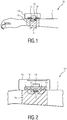
- Fig. 1 shows a schematic diagram of a first embodiment of a wearable device 10 according to present invention for determining electro-dermal activity of a subject 1.
- the wearable device 10 comprises a light source 11 for emitting light including infrared light in the wavelength range between 750 and 950 nm into tissue of the subject 1, a light sensor 12 for receiving at least part of the emitted light after an interaction of the emitted light with the tissue, and an evaluation unit 13 for determining the electro-dermal activity from the received light.
- a support 14, such as a casing or housing, is provided for carrying the light source 11, the light sensor 12 and the evaluation unit 13, wherein the light source and the light sensor are arranged at a predetermined distance from each other.
- the light source 11 may comprise one (or more) LED(s), e.g. infrared LED(s), that emit(s) light into a skin portion of the subject 1, e.g., the skin portion at the subject's wrist or face.
- This emitted light interacts with the tissue of the subject 1 and in particular with the pulsating blood in this tissue. Part of the emitted light may be transmitted through the tissue and part of it may be reflected. After this interaction, at least part of the emitted light is received by means of the light sensor 12, e.g. a photosensor.
- the evaluation unit 13 e.g. a processor.
- changes in the intensity of the light received by the light sensor 12 are correlated with the electro-dermal activity.
- a sudden increase in the received light signal which lasted few tens of seconds, may be seen if the electro-dermal activity suddenly changes. This may particularly be a response from the sweat accumulated at the moment.
- the light source 11 includes an LED, which may be operated in pulsed mode, i.e. emits light in short pulses. This may also be referred to as burst mode.
- the LED may be operated periodically, e.g. 0.5 ms on per 8 ms period time. Continuously operating the optical sensor arrangement particularly refers to operating the LED in such a pulsed mode. Normally, it is not required that the LED is powered on all the time. Power considerations require the LED to be in its on state as little as possible. It may, however, also be possible that the LED is operated in a continuous mode, i.e. always on.
- An embodiment of the wearable device 10 is a wrist-worn device as shown in Fig. 1 .
- the wearable device 10 is placed, preferably, above the radial artery of the wrist, because there the electro dermal response is maximal.
- Others preferred sites may be the flexor side of fingers and toes, and the forehead.
- the wearable device 10 further comprises a holding element 15, which may e.g. comprise a wristband, a belt, a sticker, a band, or a clip.
- a holding element 15 may e.g. comprise a wristband, a belt, a sticker, a band, or a clip.
- the distance d between the light source and the light sensor (both preferably in contact with the skin or at a small distance from the skin less than 5 mm, preferably less than 1mm).
- the distance d is preferably the distance between the centers of the light source and the light sensor and is in the range between 0.5 mm and 5 mm, in particular in the range between 1 mm and 4 mm, from each other.
- An optimal distance d may e.g. be about 4mm. If the distance is smaller than 1 mm, the desired effect may not be present or not strong enough. If the distance is larger than 5mm, the light would be lost into the skin, and few light would reach the light sensor.
- Fig. 2 shows a schematic diagram of a second embodiment of a wearable device 10' according to present invention.
- the sweat is measured by means not only of a single wavelength (or wavelength range), in particular an infrared wavelength, but via at least a second wavelength (or wavelength range).
- the wearable device 10' comprises at least a second light source 11' for emitting light at a second wavelength (or wavelength range), e.g. in a wavelength range of green light.
- the richer content of the sweat spectrum can be addressed, and additional properties of the sweat can be measured additionally, like the salt content.
- each light source 11, 11' not only a single element may be provided, but two or more of the same type may be provided to increase the amount of light emitted into the tissue.
- a single light source is provided for emitting light in a broad (full) spectrum, wherein the light sensor 12 is configured to sense only light in the desired part(s) of the spectrum and/or wherein the evaluation unit is configured to evaluate only sensed light in the desired part(s) of the spectrum.
- the wearable device 10' further comprises a user interface 16 for issuing information about the determined electro-dermal activity, e.g. a value indicative of the strength of the electro-dermal activity or an indicator indicating the trend (e.g. rising, falling, stable, etc.) of the strength of the electro-dermal activity.
- a user interface 16 for issuing information about the determined electro-dermal activity, e.g. a value indicative of the strength of the electro-dermal activity or an indicator indicating the trend (e.g. rising, falling, stable, etc.) of the strength of the electro-dermal activity.
- Such an interface may comprise a display.
- a transmission unit may be provided for transmitting the information to another entity, e.g. a smartphone, a workstation, a computer, etc. for issuance or further processing.
- the wearable device itself can be placed on other parts of the skin (like forehead, or foot), which respond strongly with sweat to emotions. Further, the wearable device can be also integrated into garments like helmets (for athletes), headbands, gloves, jewelry, glasses (like google glasses), into the bra or in the sole (because the lower part of the feet respond also well with sweat to emotions).
- the wearable device may be worn at the radial artery. Because the wrist-worn device representing the wearable device may change its position during wearing, some measures may be taken additionally to keep the same location of the measurement. For example, the wrist-worn device may be tightened. Further, a multisensory approach may be applied, where more sensors measure around radial artery and the best signal is chosen. This embodiment can be extended further with a camera in contact with the skin.
- the present invention seeks to detect a fluid layer or galvanic skin response of the skin. It is the property of the human body that causes continuous variation in the electrical characteristics of the skin. Conventionally, electro-dermal activity has also been known as skin conductance, galvanic skin response (GSR), electro-dermal response (EDR), psycho-galvanic reflex (PGR), skin conductance response (SCR), and skin conductance level (SCL).
- GSR galvanic skin response
- EDR electro-dermal response
- PGR psycho-galvanic reflex
- SCR skin conductance response
- SCL skin conductance level
- Incoherent light is emitted into the skin (preferably via one or more LEDs).
- the light is preferably chosen in a wavelength of the infrared light where the heart beat pulse was less visible.
- a preferred wavelength range is between 750 and 950 nm, in particular a wavelength range between 775 and 825 nm or at a wavelength of 800 nm. With this choice the light does not interfere with the measurement.
- the wavelength shall also not very because the signal would accumulate noise that would be less than 900nm. It turned out that 800 nm (plus/min 50nm) is a good choice.
- Fig. 3 shows a flowchart of a method according to the present invention for determining electro-dermal activity of a subject.
- a first step S10 light including infrared light in the wavelength range between 750 and 950 nm is emitted into tissue of the subject.
- a second step S12 at least part of the emitted light is received after an interaction of the emitted light with the tissue.
- the electro-dermal activity is determined from the received light.
- a computer program may be stored/distributed on a suitable non-transitory medium, such as an optical storage medium or a solid-state medium supplied together with or as part of other hardware, but may also be distributed in other forms, such as via the Internet or other wired or wireless telecommunication systems.
- a suitable non-transitory medium such as an optical storage medium or a solid-state medium supplied together with or as part of other hardware, but may also be distributed in other forms, such as via the Internet or other wired or wireless telecommunication systems.
Landscapes
- Health & Medical Sciences (AREA)
- Life Sciences & Earth Sciences (AREA)
- Physics & Mathematics (AREA)
- Engineering & Computer Science (AREA)
- Animal Behavior & Ethology (AREA)
- Veterinary Medicine (AREA)
- Public Health (AREA)
- General Health & Medical Sciences (AREA)
- Surgery (AREA)
- Biophysics (AREA)
- Pathology (AREA)
- Biomedical Technology (AREA)
- Heart & Thoracic Surgery (AREA)
- Medical Informatics (AREA)
- Molecular Biology (AREA)
- Optics & Photonics (AREA)
- Psychiatry (AREA)
- Physiology (AREA)
- Endocrinology (AREA)
- Spectroscopy & Molecular Physics (AREA)
- Dermatology (AREA)
- Gastroenterology & Hepatology (AREA)
- Developmental Disabilities (AREA)
- Educational Technology (AREA)
- Social Psychology (AREA)
- Hospice & Palliative Care (AREA)
- Psychology (AREA)
- Child & Adolescent Psychology (AREA)
- Nuclear Medicine, Radiotherapy & Molecular Imaging (AREA)
- Radiology & Medical Imaging (AREA)
- Measuring Pulse, Heart Rate, Blood Pressure Or Blood Flow (AREA)
- Measurement Of The Respiration, Hearing Ability, Form, And Blood Characteristics Of Living Organisms (AREA)
- Measurement And Recording Of Electrical Phenomena And Electrical Characteristics Of The Living Body (AREA)
Applications Claiming Priority (2)
| Application Number | Priority Date | Filing Date | Title |
|---|---|---|---|
| EP15199717 | 2015-12-14 | ||
| PCT/EP2016/079802 WO2017102412A1 (en) | 2015-12-14 | 2016-12-06 | Wearable device and method for determining electro-dermal activity of a subject |
Publications (2)
| Publication Number | Publication Date |
|---|---|
| EP3389472A1 EP3389472A1 (en) | 2018-10-24 |
| EP3389472B1 true EP3389472B1 (en) | 2019-05-08 |
Family
ID=55023880
Family Applications (1)
| Application Number | Title | Priority Date | Filing Date |
|---|---|---|---|
| EP16806093.7A Active EP3389472B1 (en) | 2015-12-14 | 2016-12-06 | Wearable device and method for determining electro-dermal activity of a subject |
Country Status (6)
| Country | Link |
|---|---|
| US (1) | US20180360373A1 (enExample) |
| EP (1) | EP3389472B1 (enExample) |
| JP (1) | JP6559910B2 (enExample) |
| CN (1) | CN108366731B (enExample) |
| RU (1) | RU2736841C2 (enExample) |
| WO (1) | WO2017102412A1 (enExample) |
Families Citing this family (15)
| Publication number | Priority date | Publication date | Assignee | Title |
|---|---|---|---|---|
| KR102335766B1 (ko) * | 2014-10-08 | 2021-12-06 | 삼성전자주식회사 | 생체 신호를 검출하는 센서를 착탈할 수 있는 웨어러블 디바이스 및 웨어러블 디바이스를 제어하는 방법 |
| CA2996196C (en) | 2015-08-31 | 2024-06-11 | Masimo Corporation | Wireless patient monitoring systems and methods |
| EP3505048A1 (en) * | 2017-12-28 | 2019-07-03 | Koninklijke Philips N.V. | Optical skin sensor using optimal spectral bands to minimize the effect of probe pressure |
| US10517536B1 (en) * | 2018-03-28 | 2019-12-31 | Senstream, Inc. | Biometric wearable and EDA method for acquiring biomarkers in perspiration |
| US11701043B2 (en) | 2019-04-17 | 2023-07-18 | Masimo Corporation | Blood pressure monitor attachment assembly |
| USD919100S1 (en) | 2019-08-16 | 2021-05-11 | Masimo Corporation | Holder for a patient monitor |
| USD985498S1 (en) | 2019-08-16 | 2023-05-09 | Masimo Corporation | Connector |
| USD919094S1 (en) | 2019-08-16 | 2021-05-11 | Masimo Corporation | Blood pressure device |
| USD917704S1 (en) | 2019-08-16 | 2021-04-27 | Masimo Corporation | Patient monitor |
| USD921202S1 (en) | 2019-08-16 | 2021-06-01 | Masimo Corporation | Holder for a blood pressure device |
| USD927699S1 (en) | 2019-10-18 | 2021-08-10 | Masimo Corporation | Electrode pad |
| USD933232S1 (en) | 2020-05-11 | 2021-10-12 | Masimo Corporation | Blood pressure monitor |
| USD979516S1 (en) | 2020-05-11 | 2023-02-28 | Masimo Corporation | Connector |
| WO2022030116A1 (ja) * | 2020-08-07 | 2022-02-10 | ソニーグループ株式会社 | 生体センサ及び生体状態判別方法 |
| KR102515325B1 (ko) * | 2021-02-04 | 2023-03-29 | 아주대학교산학협력단 | 광전 소자를 구비하는 바이오 센싱 장치 |
Family Cites Families (11)
| Publication number | Priority date | Publication date | Assignee | Title |
|---|---|---|---|---|
| JPS61198039A (ja) * | 1985-02-28 | 1986-09-02 | Fujitsu Ltd | 発汗センサ |
| KR100580618B1 (ko) * | 2002-01-23 | 2006-05-16 | 삼성전자주식회사 | 생리 신호의 단시간 모니터링을 통한 사용자 정서 인식장치 및 방법 |
| JP2009539541A (ja) * | 2006-06-12 | 2009-11-19 | コーニンクレッカ フィリップス エレクトロニクス エヌ ヴィ | 皮膚観察装置、皮膚を観察する方法、観察装置、皮膚を照射治療する方法、及びoledの使用 |
| US20090269003A1 (en) * | 2006-08-10 | 2009-10-29 | Patricia Jane Scully | Fibre optic sweat sensor |
| WO2011076886A2 (en) * | 2009-12-23 | 2011-06-30 | Delta, Dansk Elektronik, Lys Og Akustik | A monitoring device |
| US20120041283A1 (en) * | 2010-08-13 | 2012-02-16 | Conopco, Inc., D/B/A Unilever | Device for evaluating condition of skin or hair |
| CN102283656A (zh) * | 2011-05-23 | 2011-12-21 | 中国人民解放军空军航空医学研究所 | 一体化ppg和gsr信号传感器结构 |
| EP2734109B1 (en) * | 2011-07-20 | 2022-09-07 | Koninklijke Philips N.V. | Wearable device and a method of manufacturing the same |
| US20160021425A1 (en) * | 2013-06-26 | 2016-01-21 | Thomson Licensing | System and method for predicting audience responses to content from electro-dermal activity signals |
| CN105510238B (zh) * | 2014-09-28 | 2019-04-05 | 天津先阳科技发展有限公司 | 多位置漫射光谱数据的处理、建模、预测方法和处理装置 |
| CN204839483U (zh) * | 2015-01-26 | 2015-12-09 | 周常安 | 穿戴式生理检测装置 |
-
2016
- 2016-12-06 WO PCT/EP2016/079802 patent/WO2017102412A1/en not_active Ceased
- 2016-12-06 EP EP16806093.7A patent/EP3389472B1/en active Active
- 2016-12-06 RU RU2018125892A patent/RU2736841C2/ru active
- 2016-12-06 JP JP2018549608A patent/JP6559910B2/ja active Active
- 2016-12-06 US US16/061,015 patent/US20180360373A1/en not_active Abandoned
- 2016-12-06 CN CN201680073399.3A patent/CN108366731B/zh active Active
Non-Patent Citations (1)
| Title |
|---|
| None * |
Also Published As
| Publication number | Publication date |
|---|---|
| JP2019503827A (ja) | 2019-02-14 |
| RU2018125892A3 (enExample) | 2020-04-24 |
| WO2017102412A1 (en) | 2017-06-22 |
| JP6559910B2 (ja) | 2019-08-14 |
| EP3389472A1 (en) | 2018-10-24 |
| RU2018125892A (ru) | 2020-01-20 |
| RU2736841C2 (ru) | 2020-11-20 |
| US20180360373A1 (en) | 2018-12-20 |
| CN108366731B (zh) | 2021-01-26 |
| CN108366731A (zh) | 2018-08-03 |
Similar Documents
| Publication | Publication Date | Title |
|---|---|---|
| EP3389472B1 (en) | Wearable device and method for determining electro-dermal activity of a subject | |
| US12279892B2 (en) | Methods and apparatus for detecting motion via optomechanics | |
| US10194808B1 (en) | Correlated hemodynamic measurements | |
| KR101560287B1 (ko) | 생체신호 측정 수단을 포함하는 이어폰 및 이러한 이어폰을 포함하는 생체신호 모니터링 시스템 | |
| JP6571664B2 (ja) | センサの最適な位置付けのための方法、システム、及びデバイス | |
| US10656009B2 (en) | Context discrimination using ambient light signal | |
| KR101000467B1 (ko) | 손목 착용형 맥박 측정 장치 및 그 제어 방법 | |
| US10820859B2 (en) | Systems and methods for detecting pulse wave velocity | |
| US20130267854A1 (en) | Optical Monitoring and Computing Devices and Methods of Use | |
| US20140051941A1 (en) | Obtaining physiological measurements using a portable device | |
| US20190038142A1 (en) | Optical sensor device and electric device comprising an optical sensor device | |
| AU2016234986A1 (en) | Biosignal measurement apparatus utilizing a plurality of electrodes for biosignal measurements as touch sensors | |
| US20160361016A1 (en) | Clip sensor device for measurement of vital signs | |
| WO2014153200A1 (en) | Systems and methods of multispectral blood measurement | |
| KR101686070B1 (ko) | 바이오피드백 가능하도록 웰니스 지수를 모니터링하는 헬스 케어 방법 및 이를 수행하는 홈 헬스 미러-웨어러블 연동 시스템 | |
| US20180235489A1 (en) | Photoplethysmographic wearable blood pressure monitoring system and methods | |
| KR20190029889A (ko) | 생체정보 추정 장치 및 방법 | |
| Mahmud et al. | SensoRing: An integrated wearable system for continuous measurement of physiological biomarkers | |
| EP3417771A1 (en) | A method for monitoring blood pressure, and a device thereof | |
| CN110192846A (zh) | 可穿戴设备 | |
| JP7462572B2 (ja) | ストレスおよび/または疼痛レベルを決定するための装置、システム、該システムの作動方法、該システムの作動方法を実行するコンピュータ可読コードを有するコンピュータ可読媒体 | |
| KR20140112989A (ko) | 생체신호 측정장치 | |
| GR1010442B (el) | Φορετο (wearable) συστημα παρακολουθησης | |
| KR101571418B1 (ko) | 생체 신호 측정 모듈 및 생체 신호 모니터링을 위한 기능성 속옷 | |
| US20250261905A1 (en) | Hormonal health coaching based on cardiac amplitude |
Legal Events
| Date | Code | Title | Description |
|---|---|---|---|
| STAA | Information on the status of an ep patent application or granted ep patent |
Free format text: STATUS: UNKNOWN |
|
| STAA | Information on the status of an ep patent application or granted ep patent |
Free format text: STATUS: THE INTERNATIONAL PUBLICATION HAS BEEN MADE |
|
| PUAI | Public reference made under article 153(3) epc to a published international application that has entered the european phase |
Free format text: ORIGINAL CODE: 0009012 |
|
| STAA | Information on the status of an ep patent application or granted ep patent |
Free format text: STATUS: REQUEST FOR EXAMINATION WAS MADE |
|
| 17P | Request for examination filed |
Effective date: 20180716 |
|
| AK | Designated contracting states |
Kind code of ref document: A1 Designated state(s): AL AT BE BG CH CY CZ DE DK EE ES FI FR GB GR HR HU IE IS IT LI LT LU LV MC MK MT NL NO PL PT RO RS SE SI SK SM TR |
|
| AX | Request for extension of the european patent |
Extension state: BA ME |
|
| GRAP | Despatch of communication of intention to grant a patent |
Free format text: ORIGINAL CODE: EPIDOSNIGR1 |
|
| STAA | Information on the status of an ep patent application or granted ep patent |
Free format text: STATUS: GRANT OF PATENT IS INTENDED |
|
| DAV | Request for validation of the european patent (deleted) | ||
| DAX | Request for extension of the european patent (deleted) | ||
| INTG | Intention to grant announced |
Effective date: 20181129 |
|
| GRAS | Grant fee paid |
Free format text: ORIGINAL CODE: EPIDOSNIGR3 |
|
| GRAA | (expected) grant |
Free format text: ORIGINAL CODE: 0009210 |
|
| STAA | Information on the status of an ep patent application or granted ep patent |
Free format text: STATUS: THE PATENT HAS BEEN GRANTED |
|
| AK | Designated contracting states |
Kind code of ref document: B1 Designated state(s): AL AT BE BG CH CY CZ DE DK EE ES FI FR GB GR HR HU IE IS IT LI LT LU LV MC MK MT NL NO PL PT RO RS SE SI SK SM TR |
|
| REG | Reference to a national code |
Ref country code: GB Ref legal event code: FG4D |
|
| REG | Reference to a national code |
Ref country code: CH Ref legal event code: EP Ref country code: AT Ref legal event code: REF Ref document number: 1128897 Country of ref document: AT Kind code of ref document: T Effective date: 20190515 |
|
| REG | Reference to a national code |
Ref country code: DE Ref legal event code: R096 Ref document number: 602016013802 Country of ref document: DE Ref country code: IE Ref legal event code: FG4D |
|
| REG | Reference to a national code |
Ref country code: NL Ref legal event code: MP Effective date: 20190508 |
|
| REG | Reference to a national code |
Ref country code: LT Ref legal event code: MG4D |
|
| PG25 | Lapsed in a contracting state [announced via postgrant information from national office to epo] |
Ref country code: NO Free format text: LAPSE BECAUSE OF FAILURE TO SUBMIT A TRANSLATION OF THE DESCRIPTION OR TO PAY THE FEE WITHIN THE PRESCRIBED TIME-LIMIT Effective date: 20190808 Ref country code: FI Free format text: LAPSE BECAUSE OF FAILURE TO SUBMIT A TRANSLATION OF THE DESCRIPTION OR TO PAY THE FEE WITHIN THE PRESCRIBED TIME-LIMIT Effective date: 20190508 Ref country code: LT Free format text: LAPSE BECAUSE OF FAILURE TO SUBMIT A TRANSLATION OF THE DESCRIPTION OR TO PAY THE FEE WITHIN THE PRESCRIBED TIME-LIMIT Effective date: 20190508 Ref country code: NL Free format text: LAPSE BECAUSE OF FAILURE TO SUBMIT A TRANSLATION OF THE DESCRIPTION OR TO PAY THE FEE WITHIN THE PRESCRIBED TIME-LIMIT Effective date: 20190508 Ref country code: PT Free format text: LAPSE BECAUSE OF FAILURE TO SUBMIT A TRANSLATION OF THE DESCRIPTION OR TO PAY THE FEE WITHIN THE PRESCRIBED TIME-LIMIT Effective date: 20190908 Ref country code: AL Free format text: LAPSE BECAUSE OF FAILURE TO SUBMIT A TRANSLATION OF THE DESCRIPTION OR TO PAY THE FEE WITHIN THE PRESCRIBED TIME-LIMIT Effective date: 20190508 Ref country code: ES Free format text: LAPSE BECAUSE OF FAILURE TO SUBMIT A TRANSLATION OF THE DESCRIPTION OR TO PAY THE FEE WITHIN THE PRESCRIBED TIME-LIMIT Effective date: 20190508 Ref country code: HR Free format text: LAPSE BECAUSE OF FAILURE TO SUBMIT A TRANSLATION OF THE DESCRIPTION OR TO PAY THE FEE WITHIN THE PRESCRIBED TIME-LIMIT Effective date: 20190508 Ref country code: SE Free format text: LAPSE BECAUSE OF FAILURE TO SUBMIT A TRANSLATION OF THE DESCRIPTION OR TO PAY THE FEE WITHIN THE PRESCRIBED TIME-LIMIT Effective date: 20190508 |
|
| PG25 | Lapsed in a contracting state [announced via postgrant information from national office to epo] |
Ref country code: GR Free format text: LAPSE BECAUSE OF FAILURE TO SUBMIT A TRANSLATION OF THE DESCRIPTION OR TO PAY THE FEE WITHIN THE PRESCRIBED TIME-LIMIT Effective date: 20190809 Ref country code: LV Free format text: LAPSE BECAUSE OF FAILURE TO SUBMIT A TRANSLATION OF THE DESCRIPTION OR TO PAY THE FEE WITHIN THE PRESCRIBED TIME-LIMIT Effective date: 20190508 Ref country code: BG Free format text: LAPSE BECAUSE OF FAILURE TO SUBMIT A TRANSLATION OF THE DESCRIPTION OR TO PAY THE FEE WITHIN THE PRESCRIBED TIME-LIMIT Effective date: 20190808 Ref country code: RS Free format text: LAPSE BECAUSE OF FAILURE TO SUBMIT A TRANSLATION OF THE DESCRIPTION OR TO PAY THE FEE WITHIN THE PRESCRIBED TIME-LIMIT Effective date: 20190508 |
|
| REG | Reference to a national code |
Ref country code: AT Ref legal event code: MK05 Ref document number: 1128897 Country of ref document: AT Kind code of ref document: T Effective date: 20190508 |
|
| PG25 | Lapsed in a contracting state [announced via postgrant information from national office to epo] |
Ref country code: SK Free format text: LAPSE BECAUSE OF FAILURE TO SUBMIT A TRANSLATION OF THE DESCRIPTION OR TO PAY THE FEE WITHIN THE PRESCRIBED TIME-LIMIT Effective date: 20190508 Ref country code: EE Free format text: LAPSE BECAUSE OF FAILURE TO SUBMIT A TRANSLATION OF THE DESCRIPTION OR TO PAY THE FEE WITHIN THE PRESCRIBED TIME-LIMIT Effective date: 20190508 Ref country code: RO Free format text: LAPSE BECAUSE OF FAILURE TO SUBMIT A TRANSLATION OF THE DESCRIPTION OR TO PAY THE FEE WITHIN THE PRESCRIBED TIME-LIMIT Effective date: 20190508 Ref country code: CZ Free format text: LAPSE BECAUSE OF FAILURE TO SUBMIT A TRANSLATION OF THE DESCRIPTION OR TO PAY THE FEE WITHIN THE PRESCRIBED TIME-LIMIT Effective date: 20190508 Ref country code: AT Free format text: LAPSE BECAUSE OF FAILURE TO SUBMIT A TRANSLATION OF THE DESCRIPTION OR TO PAY THE FEE WITHIN THE PRESCRIBED TIME-LIMIT Effective date: 20190508 Ref country code: DK Free format text: LAPSE BECAUSE OF FAILURE TO SUBMIT A TRANSLATION OF THE DESCRIPTION OR TO PAY THE FEE WITHIN THE PRESCRIBED TIME-LIMIT Effective date: 20190508 |
|
| REG | Reference to a national code |
Ref country code: DE Ref legal event code: R097 Ref document number: 602016013802 Country of ref document: DE |
|
| PG25 | Lapsed in a contracting state [announced via postgrant information from national office to epo] |
Ref country code: IT Free format text: LAPSE BECAUSE OF FAILURE TO SUBMIT A TRANSLATION OF THE DESCRIPTION OR TO PAY THE FEE WITHIN THE PRESCRIBED TIME-LIMIT Effective date: 20190508 Ref country code: SM Free format text: LAPSE BECAUSE OF FAILURE TO SUBMIT A TRANSLATION OF THE DESCRIPTION OR TO PAY THE FEE WITHIN THE PRESCRIBED TIME-LIMIT Effective date: 20190508 |
|
| PLBE | No opposition filed within time limit |
Free format text: ORIGINAL CODE: 0009261 |
|
| STAA | Information on the status of an ep patent application or granted ep patent |
Free format text: STATUS: NO OPPOSITION FILED WITHIN TIME LIMIT |
|
| RAP2 | Party data changed (patent owner data changed or rights of a patent transferred) |
Owner name: KONINKLIJKE PHILIPS N.V. |
|
| PG25 | Lapsed in a contracting state [announced via postgrant information from national office to epo] |
Ref country code: TR Free format text: LAPSE BECAUSE OF FAILURE TO SUBMIT A TRANSLATION OF THE DESCRIPTION OR TO PAY THE FEE WITHIN THE PRESCRIBED TIME-LIMIT Effective date: 20190508 |
|
| 26N | No opposition filed |
Effective date: 20200211 |
|
| PG25 | Lapsed in a contracting state [announced via postgrant information from national office to epo] |
Ref country code: PL Free format text: LAPSE BECAUSE OF FAILURE TO SUBMIT A TRANSLATION OF THE DESCRIPTION OR TO PAY THE FEE WITHIN THE PRESCRIBED TIME-LIMIT Effective date: 20190508 |
|
| REG | Reference to a national code |
Ref country code: CH Ref legal event code: PL |
|
| REG | Reference to a national code |
Ref country code: BE Ref legal event code: MM Effective date: 20191231 |
|
| PG25 | Lapsed in a contracting state [announced via postgrant information from national office to epo] |
Ref country code: MC Free format text: LAPSE BECAUSE OF FAILURE TO SUBMIT A TRANSLATION OF THE DESCRIPTION OR TO PAY THE FEE WITHIN THE PRESCRIBED TIME-LIMIT Effective date: 20190508 |
|
| PG25 | Lapsed in a contracting state [announced via postgrant information from national office to epo] |
Ref country code: IE Free format text: LAPSE BECAUSE OF NON-PAYMENT OF DUE FEES Effective date: 20191206 Ref country code: LU Free format text: LAPSE BECAUSE OF NON-PAYMENT OF DUE FEES Effective date: 20191206 |
|
| PG25 | Lapsed in a contracting state [announced via postgrant information from national office to epo] |
Ref country code: CH Free format text: LAPSE BECAUSE OF NON-PAYMENT OF DUE FEES Effective date: 20191231 Ref country code: LI Free format text: LAPSE BECAUSE OF NON-PAYMENT OF DUE FEES Effective date: 20191231 Ref country code: BE Free format text: LAPSE BECAUSE OF NON-PAYMENT OF DUE FEES Effective date: 20191231 |
|
| PG25 | Lapsed in a contracting state [announced via postgrant information from national office to epo] |
Ref country code: CY Free format text: LAPSE BECAUSE OF FAILURE TO SUBMIT A TRANSLATION OF THE DESCRIPTION OR TO PAY THE FEE WITHIN THE PRESCRIBED TIME-LIMIT Effective date: 20190508 |
|
| PG25 | Lapsed in a contracting state [announced via postgrant information from national office to epo] |
Ref country code: IS Free format text: LAPSE BECAUSE OF FAILURE TO SUBMIT A TRANSLATION OF THE DESCRIPTION OR TO PAY THE FEE WITHIN THE PRESCRIBED TIME-LIMIT Effective date: 20190908 |
|
| PG25 | Lapsed in a contracting state [announced via postgrant information from national office to epo] |
Ref country code: MT Free format text: LAPSE BECAUSE OF FAILURE TO SUBMIT A TRANSLATION OF THE DESCRIPTION OR TO PAY THE FEE WITHIN THE PRESCRIBED TIME-LIMIT Effective date: 20190508 Ref country code: HU Free format text: LAPSE BECAUSE OF FAILURE TO SUBMIT A TRANSLATION OF THE DESCRIPTION OR TO PAY THE FEE WITHIN THE PRESCRIBED TIME-LIMIT; INVALID AB INITIO Effective date: 20161206 |
|
| PG25 | Lapsed in a contracting state [announced via postgrant information from national office to epo] |
Ref country code: SI Free format text: LAPSE BECAUSE OF FAILURE TO SUBMIT A TRANSLATION OF THE DESCRIPTION OR TO PAY THE FEE WITHIN THE PRESCRIBED TIME-LIMIT Effective date: 20190508 |
|
| PG25 | Lapsed in a contracting state [announced via postgrant information from national office to epo] |
Ref country code: MK Free format text: LAPSE BECAUSE OF FAILURE TO SUBMIT A TRANSLATION OF THE DESCRIPTION OR TO PAY THE FEE WITHIN THE PRESCRIBED TIME-LIMIT Effective date: 20190508 |
|
| PGFP | Annual fee paid to national office [announced via postgrant information from national office to epo] |
Ref country code: GB Payment date: 20231219 Year of fee payment: 8 |
|
| PGFP | Annual fee paid to national office [announced via postgrant information from national office to epo] |
Ref country code: FR Payment date: 20231226 Year of fee payment: 8 |
|
| PGFP | Annual fee paid to national office [announced via postgrant information from national office to epo] |
Ref country code: DE Payment date: 20241227 Year of fee payment: 9 |
|
| GBPC | Gb: european patent ceased through non-payment of renewal fee |
Effective date: 20241206 |
|
| PG25 | Lapsed in a contracting state [announced via postgrant information from national office to epo] |
Ref country code: GB Free format text: LAPSE BECAUSE OF NON-PAYMENT OF DUE FEES Effective date: 20241206 |
|
| PG25 | Lapsed in a contracting state [announced via postgrant information from national office to epo] |
Ref country code: FR Free format text: LAPSE BECAUSE OF NON-PAYMENT OF DUE FEES Effective date: 20241231 |