EP3387445B1 - Isobaric mass labels - Google Patents
Isobaric mass labels Download PDFInfo
- Publication number
- EP3387445B1 EP3387445B1 EP16816622.1A EP16816622A EP3387445B1 EP 3387445 B1 EP3387445 B1 EP 3387445B1 EP 16816622 A EP16816622 A EP 16816622A EP 3387445 B1 EP3387445 B1 EP 3387445B1
- Authority
- EP
- European Patent Office
- Prior art keywords
- mass
- subset
- tmt
- labels
- tags
- Prior art date
- Legal status (The legal status is an assumption and is not a legal conclusion. Google has not performed a legal analysis and makes no representation as to the accuracy of the status listed.)
- Active
Links
Images


Classifications
-
- C—CHEMISTRY; METALLURGY
- C07—ORGANIC CHEMISTRY
- C07B—GENERAL METHODS OF ORGANIC CHEMISTRY; APPARATUS THEREFOR
- C07B59/00—Introduction of isotopes of elements into organic compounds ; Labelled organic compounds per se
- C07B59/002—Heterocyclic compounds
-
- C—CHEMISTRY; METALLURGY
- C07—ORGANIC CHEMISTRY
- C07D—HETEROCYCLIC COMPOUNDS
- C07D403/00—Heterocyclic compounds containing two or more hetero rings, having nitrogen atoms as the only ring hetero atoms, not provided for by group C07D401/00
- C07D403/02—Heterocyclic compounds containing two or more hetero rings, having nitrogen atoms as the only ring hetero atoms, not provided for by group C07D401/00 containing two hetero rings
- C07D403/12—Heterocyclic compounds containing two or more hetero rings, having nitrogen atoms as the only ring hetero atoms, not provided for by group C07D401/00 containing two hetero rings linked by a chain containing hetero atoms as chain links
-
- G—PHYSICS
- G01—MEASURING; TESTING
- G01N—INVESTIGATING OR ANALYSING MATERIALS BY DETERMINING THEIR CHEMICAL OR PHYSICAL PROPERTIES
- G01N33/00—Investigating or analysing materials by specific methods not covered by groups G01N1/00 - G01N31/00
- G01N33/48—Biological material, e.g. blood, urine; Haemocytometers
- G01N33/50—Chemical analysis of biological material, e.g. blood, urine; Testing involving biospecific ligand binding methods; Immunological testing
- G01N33/58—Chemical analysis of biological material, e.g. blood, urine; Testing involving biospecific ligand binding methods; Immunological testing involving labelled substances
-
- G—PHYSICS
- G01—MEASURING; TESTING
- G01N—INVESTIGATING OR ANALYSING MATERIALS BY DETERMINING THEIR CHEMICAL OR PHYSICAL PROPERTIES
- G01N33/00—Investigating or analysing materials by specific methods not covered by groups G01N1/00 - G01N31/00
- G01N33/48—Biological material, e.g. blood, urine; Haemocytometers
- G01N33/50—Chemical analysis of biological material, e.g. blood, urine; Testing involving biospecific ligand binding methods; Immunological testing
- G01N33/68—Chemical analysis of biological material, e.g. blood, urine; Testing involving biospecific ligand binding methods; Immunological testing involving proteins, peptides or amino acids
- G01N33/6893—Chemical analysis of biological material, e.g. blood, urine; Testing involving biospecific ligand binding methods; Immunological testing involving proteins, peptides or amino acids related to diseases not provided for elsewhere
-
- C—CHEMISTRY; METALLURGY
- C07—ORGANIC CHEMISTRY
- C07B—GENERAL METHODS OF ORGANIC CHEMISTRY; APPARATUS THEREFOR
- C07B2200/00—Indexing scheme relating to specific properties of organic compounds
- C07B2200/05—Isotopically modified compounds, e.g. labelled
-
- C—CHEMISTRY; METALLURGY
- C12—BIOCHEMISTRY; BEER; SPIRITS; WINE; VINEGAR; MICROBIOLOGY; ENZYMOLOGY; MUTATION OR GENETIC ENGINEERING
- C12Q—MEASURING OR TESTING PROCESSES INVOLVING ENZYMES, NUCLEIC ACIDS OR MICROORGANISMS; COMPOSITIONS OR TEST PAPERS THEREFOR; PROCESSES OF PREPARING SUCH COMPOSITIONS; CONDITION-RESPONSIVE CONTROL IN MICROBIOLOGICAL OR ENZYMOLOGICAL PROCESSES
- C12Q1/00—Measuring or testing processes involving enzymes, nucleic acids or microorganisms; Compositions therefor; Processes of preparing such compositions
- C12Q1/68—Measuring or testing processes involving enzymes, nucleic acids or microorganisms; Compositions therefor; Processes of preparing such compositions involving nucleic acids
- C12Q1/6869—Methods for sequencing
- C12Q1/6872—Methods for sequencing involving mass spectrometry
-
- C—CHEMISTRY; METALLURGY
- C40—COMBINATORIAL TECHNOLOGY
- C40B—COMBINATORIAL CHEMISTRY; LIBRARIES, e.g. CHEMICAL LIBRARIES
- C40B40/00—Libraries per se, e.g. arrays, mixtures
- C40B40/04—Libraries containing only organic compounds
-
- G—PHYSICS
- G01—MEASURING; TESTING
- G01N—INVESTIGATING OR ANALYSING MATERIALS BY DETERMINING THEIR CHEMICAL OR PHYSICAL PROPERTIES
- G01N2458/00—Labels used in chemical analysis of biological material
- G01N2458/15—Non-radioactive isotope labels, e.g. for detection by mass spectrometry
-
- G—PHYSICS
- G01—MEASURING; TESTING
- G01N—INVESTIGATING OR ANALYSING MATERIALS BY DETERMINING THEIR CHEMICAL OR PHYSICAL PROPERTIES
- G01N2560/00—Chemical aspects of mass spectrometric analysis of biological material
Definitions
- This invention relates to useful reactive labels for labelling peptides and to methods for using these reactive labels, to identify and quantify peptides particularly peptides derived from complex protein mixtures.
- These reactive labels are of particular value for the analysis of peptides by high resolution and high mass accuracy mass analysers such as orbitraps, time-of-flight and ion cyclotron resonance mass analysers.
- members of tag sets are either isotopic having the same chemical structure but different absolute masses, or isobaric and isotopomeric, having both identical structure and absolute mass.
- Isotopic tags are typically used for quantification in MS mode whilst isobaric tags must be fragmented in MS/MS mode to release reporter fragments with a unique mass.
- ICAT Isotope-Coded Affinity Tags
- the ICAT method also illustrates 'sampling' methods, which are useful as a way of reconciling the need to deal with small populations of peptides to reduce the complexity of the mass spectra generated while retaining sufficient information about the original sample to identify its components.
- the 'isotope encoded affinity tags' used in the ICAT procedure comprise a pair of biotin linker isotopes, which are reactive to thiols, for the capture peptides comprising cysteine.
- Typically 90 to 95% or proteins in a proteome will have at least one cysteine-containing peptide and typically cysteine-containing peptides represent about 1 in 10 peptides overall so analysis of cysteine- containing peptides greatly reduces sample complexity without losing significant information about the sample.
- a sample of protein from one source is reacted with a 'light' isotope biotin linker while a sample of protein from a second source is reacted with a 'heavy' isotope biotin linker, which is typically 4 to 8 Daltons heavier than the light isotope.
- the two samples are then pooled and cleaved with an endopeptidase.
- the biotinylated cysteine-containing peptides can then be isolated on avidinated beads for subsequent analysis by mass spectrometry.
- the two samples can be compared quantitatively: corresponding peptide pairs act as reciprocal standards allowing their ratios to be quantified.
- the ICAT sampling procedure produces a mixture of peptides that still accurately represents the source sample while being less complex than MudPIT, but large numbers of peptides are still isolated and their analysis by LC-MS/MS generates complex spectra. With 2 ICAT tags, the number of peptide ions in the mass spectrum is doubled compared to a label-free analysis.
- isotopic tags include the ICPL reagents that provide up to four different reagents, and with ICPL the number of peptide ions in the mass spectrum is quadrupled compared to a label-free analysis. For this reason, it is unlikely to be practical to develop very high levels of multiplexing with simple heavy isotope tag design.
- isotopic tags allow quantification in proteomic studies and assist with experimental reproducibility, this is achieved at the cost of increasing the complexity of the mass spectrum.
- isobaric mass tags Since their introduction in 2000 ( WO01/68664 ), isobaric mass tags have provided improved means of proteomic expression profiling by universal labelling of amines and other reactive functions in proteins and peptides prior to mixing and simultaneous analysis of multiple samples. Because the tags are isobaric, having the same mass, they do not increase the complexity of the mass spectrum since all precursors of the same peptide will appear at exactly the same point in the chromatographic separation and have the same aggregate mass. Only when the molecules are fragmented prior to tandem mass spectrometry are unique mass reporters released, thereby allowing the relative or absolute amount of the peptide present in each of the original samples to be determined.
- WO01/68664 sets out the underlying principles of isobaric mass tags and provides specific examples of suitable tags wherein different specific atoms within the molecules are substituted with heavy isotope forms including 13 C and 15 N respectively. WO01/68664 further describes the use of offset masses to make multiple isobaric sets to increase the overall multiplexing rates available without unduly increasing the size of the individual tags.
- WO2007/012849 describes further sets of isobaric mass tags including 3-[2-(2,6-Dimethyl-piperidin-1-yl)-acetylamino]-propanoic acid-(2,5-dioxo-pyrrolidine-1-yl)-ester (DMPip- ⁇ Ala-OSu).
- tags comprising very small mass differences would be useful because labelled ions that are related to each other, e.g. corresponding peptides from different samples, would cluster closely in the same ion envelope with very distinctive and unnatural isotope patterns that would be readily recognisable and which will be much less likely to interfere with the identification of other different peptides.
- the present invention relates to a set of mass labels, wherein each mass label comprises the formula: X-L-M-Re; wherein: X is a reporter moiety having an exact mass, L is a bond cleavable by collision in a mass spectrometer, M is a mass modifier, and Re is a) a reactive functionality for attaching the mass label to an analyte or b) the analyte; wherein each mass label in the set has an integer mass, wherein each mass label in the set has the same integer mass; wherein the set comprises two or more subsets of mass labels, each subset comprising one, two or more mass labels; wherein, when the subset comprises two or more mass labels, the exact mass of the reporter moiety X of each mass label in the subset is different from the exact mass of the reporter moiety X of the other mass labels in the same subset and in all other subsets; wherein each mass label is distinguishable by mass spectrometry, and wherein each mass label has the following structure: where
- the present invention relates to a method of mass spectrometry analysis, which method comprises detecting an analyte by identifying by mass spectrometry mass labels relatable to the analyte, wherein the mass labels are a set of mass labels according to the invention.
- the present invention provides sets of isotopomeric reactive tags for the purposes of labelling peptides and other biomolecules with multiplexing rates greatly in excess of 10-plex.
- Co-selectable isotopologue arrays of isotomoperic reactive tags have masses differences in the range of millidalton which supports even higher levels of multiplexing.
- the set of mass labels of the present invention as defined in claim 1 can be considered to be a subset of a set of mass labels in which each mass label has the formula: X-L-M-Re wherein:
- the "exact mass” takes account of mass defects.
- the integer mass of an isotope is the sum of protons and neutrons that make up the nucleus of the isotope, i.e. 12 C comprises 6 protons and 6 neutrons while 13 C comprises 6 protons and 7 neutrons. This is often also referred to as the nominal mass, or atomic mass number or nucleon number of an isotope.
- isobaric often refers to species that have the same integer mass and are co-selectable for MS/MS but in the context of this invention we will use the term “isobaric” refer to species that have the same exact mass and we will use the term “pseudo-isobaric" for species that have the same integer mass but may have slightly differing exact masses.
- the difference in exact mass between at least two of the mass labels in a subset is usually less than 100 millidaltons, preferably less than 50 millidaltons, most preferably less than 20 millidaltons (mDa).
- the difference in exact mass between at least two of the mass labels in a set is 2.5 mDa, 2.9 mDa, 6.3mDa, 8.3 mDa, 9.3 mDa, or 10.2 mDa due to common isotope substitutions.
- a first label comprises a 13 C isotope
- this 13 C isotope is replaced by 12 C but a 14 N isotope is replaced by a 15 N isotope
- the difference in exact mass between the two labels will be 6.3 mDa.
- reporter moiety X is used to refer to a moiety of the mass label to be detected independently, typically after cleavage, by mass spectrometry, however, it will be understood that the remainder of the mass label attached to the analyte as a complement ion may also be detected in methods of the invention.
- the mass modifier X is a moiety which is incorporated into the mass label to ensure that the mass label has a desired integer mass.
- the reporter moiety X of each mass label may in some embodiments comprise no heavy isotopes.
- the components of the reporter moiety according to the invention are preferably fragmentation resistant so that the site of fragmentation of the reporter moiety can be controlled by the introduction of a cleavable bond L that is easily broken by Collision Induced Dissociation (CID), Surface Induced Dissociation, Electron Capture Dissociation (ECD), Electron Transfer Dissociation (ETD), or Fast Atom Bombardment.
- CID Collision Induced Dissociation
- ECD Electron Capture Dissociation
- ETD Electron Transfer Dissociation
- Fast Atom Bombardment the linkage is easily broken by CID.
- the reactive functionality Re or the analyte may be modified with heavy isotopes.
- the heavy isotopes are selected from 2 H, 13 C, 15 N or 18 O.
- the reporter moiety of each mass label in a subset is an isotopologue of the reporter
- the mass labels are isotopologues of Tandem Mass Tags as defined in WO01/68664 .
- the aggregate molecular weight of the mass label is 600 Daltons or less, more preferably 500 Daltons or less, still more preferably 400 Daltons or less, most preferably from 300 to 500 Daltons.
- the molecular weight of the reporter moiety is 400 Daltons or less, preferably 250 Daltons or less, more preferably 100 to 250 Daltons, most preferably 100-220 Daltons.
- a reporter moiety of small size is particularly advantageous because it produces a peak in the silent region of a mass spectrum, which allows the reporter moiety to be easily identified from the mass spectrum and also allows sensitive quantification.
- silent region of a mass spectrum used in the present context is intended to refer to the region of a mass spectrum with low background "noise” caused by peaks relating to the presence of fragments generated by fragmentation of the labelled peptides.
- silent region is intended to refer to the region of the mass spectrum with low "noise” caused by peaks relating to the peptide to be detected.
- the silent region of the mass spectrum is less than 220, preferably less than 200 Daltons.
- the mass labels according to the invention are designed to be reacted with a biomolecule, such as a protein to form a labelled biomolecule, e.g. a labelled protein.
- R 1 and R 4 are methyl.
- R 2 is H.
- R 3 is selected from the group consisting of H, methyl, isopropyl, isobutyl.
- R 5 is H or methyl.
- the reporter moiety X is selected from:
- the reporter moiety X is selected from: wherein * is an isotopic mass adjuster moiety and represents that carbon is 13 C, nitrogen is 15 N or hydrogen is 2 H, and wherein one or more * may be present.
- the cleavable bond L comprises, without limitation, an amide bond, a urea linkage, an ester linkage or an ether linkage. In a preferred embodiment, cleavable bond L comprises an amide bond. In another preferred embodiment, the cleavable bond L comprises a urea linkage. In another preferred embodiment, the cleavable bond L comprises an ester linkage. In another preferred embodiment, the cleavable bond L comprises an ether bond.
- mass modifier M refers to a moiety that ensures that each mass label in the set has a desired integer mass.
- the mass modifier M is not necessarily to be detected by mass spectrometry. However, the mass modifier M may be detected as part of a complement ion (see below).
- the mass modifier M is not particularly limited structurally, but merely serves to vary the overall mass of the mass label.
- mass modifier M is selected from:
- the mass modifier M is selected from:
- each mass label additionally comprises at least one mass series modifying group, wherein the mass series modifying group is part of the reporter moiety X and/or part of the mass modifier M.
- Each mass label may comprise a mass series modifying group, wherein the at least one mass series modifying group is part of the reporter moiety X or of the mass modifier M or both.
- the mass series modifying group may be part of the reporter moiety X.
- the mass series modifying group may be selected from:
- the mass series modifying group is selected from -CH 3 , - 13 CH 3 , -CHD 2 , - 13 CHD 2 , - 13 CD 3 or-CD 3 .
- each mass label comprises at least one mass series modifying group having the following structure: wherein:
- Re may either be a reactive functionality for attaching the mass label to an analyte or be an analyte.
- the mass tags additionally comprise a reactive functionality to allow the mass label to be conjugated to an analyte.
- the reactive functionality for attaching the mass label to the analyte is not especially limited and may comprise any appropriate reactive group.
- the reactive functionality may react with an amino group on the biological molecule, for example the ⁇ -amino group of a lysine residue. In the simplest embodiments this may be an N-hydroxysuccinimide ester.
- Other reactive functionalities are contemplated herein such as those which react with thiol groups in biological molecules. In particular these reactive functionalities are designed to react with the thiol group of a cysteine residue.
- Examples of reactive groups of the present invention which are able to react with cysteine residues are the maleimido, haloacetyl and 2-dithiopyridine groups. The thiol group of cysteine undergoes nucleophilic addition across the double bond of the maleimido group and undergoes nucleophilic substitution with the haloacetyl or 2-dithiopyridine group.
- Reactive functionalities which are capable of reacting with carbonyl or hydroxyl groups in biological molecules are also contemplated herein.
- these reactive functionalities are designed to react with the carbonyl or hydroxyl groups of steroid hormones.
- Reactive groups of the present invention which are able to react with carbonyl or hydroxyl groups in a biological molecule are hydrazide or -CONH-(CH 2 ) n -ONH 2 , wherein n is from 1 to 6, and preferably n is 3 i.e. aminoxypropyl amide. These groups react with carbonyl groups to form hydrazones or O-alkyloximes respectively. Examples of reactive functionalities are shown in WO2011/036059 , to which further reference should be made.
- the reactive functionality is an N-hydroxysuccinimide ester, a 2,3,5,6-tetrafluorophenyl ester or a sulphodichlorophenyl ester.
- the analyte preferably comprises amino acids, peptides, polypeptides, nucleotides, oligonucleotides, polynucleotides, carbohydrates, lipids, phospholipids or combination thereof.
- Improving multiplexing is a highly sought characteristic of isobaric mass labels as it allows labelling of a high number of sample and analysis is one single experiments thus reducing time of analysis, costs and also standardizing the analysis conditions for a higher number of samples.
- the number of A positions should be greater than or equal to the number of B positions.
- Each reporter moiety comprises (x-1) positions substituted with heavy isotopes from either the first or second element and where the w th mass label in each subset of mass labels comprises y atoms of the first heavy isotope element and z atoms of the second heavy isotope element different from the first, x will have values from 1 to (P+1).
- P (A+B) and the total number of mass labels will be (A+1) multiplied by (B + 1).
- B is greater than or equal to 2.
- the reporter moiety groups can be substituted with different R-groups different isomers of the mass labels are possible, providing options for different fragmentation behaviours.
- each mass label is named TMT-1-21-"reporter mass", where TMT stands for Tandem Mass Tag, i.e. tags for tandem mass spectrometry, the digit 1 refers to the Set number, the 21 refers to the number of mass labels in the set and the reporter mass is the mass-to-charge ratio of the expected reporter ion under Collision Induced Dissociation conditions.
- Different reporter ions may be obtained by Electron Transfer Dissociation (ETD) or Electron Capture Dissociation (ECD).
- the mass label has structure: wherein * represents that oxygen is 18 O, carbon is 13 C, nitrogen is 15 N or hydrogen is 2 H, and wherein one or more ⁇ may be present.
- subset 2 there is one heavy isotope mass adjuster in the reporter ion, shifting the mass of the reporter by approximately 1 dalton relative to subset 1.
- There are 2 ways to introduce the mass adjuster by introduction of a single 15 N nucleus or by introduction of a single 13 C nucleus and hence there are two tags in subset 2 differing in mass from each other by 6.3 millidaltons.
- subset 3 there are two heavy isotope mass adjusters in the reporter ion, shifting the mass of the reporter by approximately 1 dalton relative to subset 2.
- subset 4 There are 3 ways to introduce the 2 mass adjusters into subset 3, by introduction of two 15 N nuclei or by introduction of a single 15 N nucleus and a single 13 C nucleus or by introduction of two 13 C nuclei and hence there are 3 tags in subset 3.
- subset 4 there are three heavy isotope mass adjusters in the reporter ion, shifting the mass of the reporter by approximately 1 dalton relative to subset 3.
- 3 mass adjusters into subset 3, by introduction of two 15 N nuclei and a single 13 C or by introduction of a single 15 N nucleus and a two 13 C nuclei or by introduction of three 15 N nuclei and hence there are 3 tags in subset 4.
- the number of tags in each subset is limited by which of the mass adjuster nuclei is present less frequently in the structure.
- b 2 as defined above and the number of tags in each subset of tags is lower than or equal to ( b +1), which is a maximum of 3 tags per subset.
- the mass normalizer group which comprises two beta-alanine residues in this tag, could be varied considerably.
- Obvious substitution include, replacement with other amino acids such as alanine, valine, leucine or with longer amino acids such as gamma-aminobutyric acid, aminopentanoic acid or aminohexaminoic acid.
- Polyethylene glycol linkers might also be appropriate with an amino and a carboxylic acid terminus. The preparation of benzyl esters and use of these esters for all these alternatives would be essentially the same as shown in Figure 7 for beta-alanine.
- the limitation on the multiplexing rate for a single isobaric mass tag set, such as Embodiment Set 1 described above can be overcome by providing multiple sets each carrying a unique additional mass.
- the additional mass is provided by a mass series modifying group according to the second aspect of this invention.
- the concept of introducing a mass series modifier into the mass normalising linker is described in US 7,294,456 and also in WO2011036059 , to both of which further reference should be made.
- WO2011036059 the inventors found that it was possible to develop arrays of isobaric mass tag sets by adding additional beta-alanine moieties into the linker region of the commercially available 6-plex Tandem Mass Tag Dimethylpiperazine-Beta-Alanine tag structure.
- Such a unitary approach provides a rapid and inexpensive means of increasing the multiplexing rate from 6 to 12, 18, 24 or more samples.
- the isobaric mass tag sets of this invention may also be modified by introduction of additional linkers into the mass normaliser, as previously disclosed.
- Embodiment Set 1 can be modified by introduction of a further undoped GABA linker to every tag in Embodiment set 1 as shown below to give a different set of 21 tags that is differentiated from the tags in Embodiment Set 1 by the mass of a GABA linker.
- a further set of 24 tags can be created by adding a doped beta-alanine linker to every tag in Embodiment Set 1, where the additional beta-alanine linker comprises a fixed substitution of three 13 C nuclei and a 15 N nucleus as shown below:
- This invention discloses a further method of introducing a mass series modifier into the tags of this invention. It has been found by the present inventors that mass series modification of the reporter group is highly advantageous as will be discussed in Embodiment Sets 2 to 4 below:
- the mass label has structure: wherein ⁇ represents that oxygen is 18 O, carbon is 13 C, nitrogen is 15 N or hydrogen is 2 H, and wherein one or more ⁇ may be present.
- the tags in Embodiment Set 2 are all isotopes of the tags in Embodiment Set 1 with tags in Embodiment set 2 (Parent Tag Mass of Tag 1 in Embodiment Set 2 is: 405.21618 Daltons) being approximately isobaric with tags in Embodiment Set 1 (Parent Tag Mass of Tag 1 in Embodiment Set 1 is: 405.21033 Daltons).
- This means that peptides labelled with tags from Embodiment Set 2 would be co-selectable with peptides labelled with tags from Embodiment Set 1 when these peptides are selected for sequencing in a mass spectrometer.
- the reporter moieties X in Embodiment Set 1 are all different from the reporter moieties X in Embodiment Set 2.
- Embodiment Set 1 can be used together with Embodiment Set 2 to label up to 28 samples for multiplexing.
- Peptides labelled with tags from Embodiment Set 2 will mostly co-elute with peptides labelled with tags from Embodiment Set 1, although with the possibility of a small mobility shift due to the presence of deuterium in the tags of Embodiment Set 2.
- tags are isotopes of each other and will mostly co-elute, and the tags are co-selectable, then peptides labelled with Embodiment Set 2 will be analyzed simultaneously with peptides of Embodiment Set 1 and the tags will behave as if they are single pseudo-isobaric sets of tags.
- These two sets of tags comprise mass series modified reporter ions which all give different reporter ions so when peptides labelled with tags from Embodiment Sets 1 and 2, reporter ions can still be assigned to their correct peptides because the reporters are all different.
- the mass label has structure: wherein ⁇ represents that oxygen is 18 O, carbon is 13 C, nitrogen is 15 N or hydrogen is 2 H, and wherein one or more ⁇ may be present.
- the N-methyl groups substituted into the piperazine ring both have a fixed reporter mass series modifier substitution of 2 deuterium atoms.
- These fixed substitutions in this embodiment mean that the reporter ions of Embodiment Set 3 have a minimum mass offset relative to the reporter ions of Embodiment Set 2, thus the heaviest reporter in Embodiment Set 3 will be approximately 5.9 millidaltons heavier than the heaviest reporter in Embodiment Set 2.
- the deuterium substitutions in Embodiment Set 3 also mean that all the reporters in Embodiment Set 3 will have a different mass from every reporter in Embodiment Set 2.
- the mass label has the structure: wherein * represents that oxygen is 18 O, carbon is 13 C, nitrogen is 15 N or hydrogen is 2 H, and wherein one or more * may be present.
- the N-methyl groups substituted into the piperazine ring both have a fixed reporter mass series modifier of 3 deuterium atoms.
- These fixed substitutions in this Embodiment mean that the reporter ions of Embodiment Set 4 have a minimum mass offset relative to the reporter ions of Embodiment Set 3, thus the heaviest reporter in Embodiment Set 4 will be approximately 5.9 millidaltons heavier than the heaviest reporter in Embodiment Set 3.
- the deuterium substitutions in Embodiment Set 4 also mean that all the reporters in Embodiment Set 4 will have a different mass from every reporter in Embodiment Set 4.
- the mass label has structure: wherein ⁇ represents that oxygen is 18 O, carbon is 13 C, nitrogen is 15 N or hydrogen is 2 H, and wherein one or more ⁇ may be present.
- the mass label has structure: wherein * represents that oxygen is 18 O, carbon is 13 C, nitrogen is 15 N or hydrogen is 2 H, and wherein one or more * may be present.
- the set of mass labels of the present invention defines a first set of mass labels and a further set of mass labels is provided (hereinafter referred to as a "second set of mass labels "), wherein each label of the second set of mass labels comprises the formula: X-L-M-Re wherein X, L, M and Re are as defined above with respect to the reference examples and embodiments.
- the array of mass labels comprising a set of mass labels according to the invention and a second set of mass labels as defined above.
- the integer mass of each of the mass labels of the second set in the array is different from the integer mass of each of the mass labels of the set of mass labels of the invention and every other set in the array.
- the reporter moiety X of the second set comprises the mass series modifying group.
- each mass label in the second set comprises the same mass series modifying group. In another embodiment, each mass label in the second set comprises a mass series modifying group which is:
- each mass label of the second set comprises a mass series modifying group which is an isotopologue of the mass series modifying group of all other mass labels of the array.
- the present invention also provides for a method of mass spectrometry analysis, hereinafter referred to as "the method of mass spectrometry analysis of the invention ", which method comprises detecting an analyte by identifying by mass spectrometry mass labels relatable to the analyte, wherein the mass labels are the set of mass labels of the invention, or the array of mass labels including the set of mass labels of the invention.
- the method of mass spectrometry analysis of the invention comprises:
- the dissociation is, preferably, collision induced dissociation in a mass spectrometer.
- a complement ion is formed in step d) by neutral loss of carbon monoxide from the linker L.
- the methods described herein may be performed in a mass spectrometer with a resolution of greater than 60,000 at a mass-to-charge ratio of 400, preferably a resolution of greater than 100,000 at a mass-to-charge ratio of 400, most preferably greater than 250,000 at a mass-to- charge ratio of 400.
- the analytes may be identified on the basis of i) the mass spectrum of the labelled analytes; or ii) the mass spectrum of the mass labels and/or analyte fragments comprising an intact mass label; or iii the mass spectrum of the reporter moieties or fragments of reporter moieties.
- the analyte fragment preferably comprises an intact mass label is a b-series ion comprising an intact mass label, preferably a b1 ion.
- the analytes may be identified on the basis of the mass spectrum of the reporter moieties X or fragments of reporter moieties X.
- the analytes may be identified on the basis of the mass spectrum of the labelled analytes.
- the analytes may be identified on the basis of the mass spectrum of the mass labels and/or analyte fragments comprising an intact mass label.
- the analyte fragment comprising an intact mass label is a b-series ion comprising an intact mass label, preferably a b1 ion.
- the method of mass spectrometry analysis of the invention comprises:
- the dissociation is, preferably, collision induced dissociation in a mass spectrometer.
- a complement ion is formed in step d) by neutral loss of carbon monoxide from the linker L.
- the methods described herein may be performed in a mass spectrometer with a resolution of greater than 60,000 at a mass-to-charge ratio of 400, preferably a resolution of greater than 100,000 at a mass-to-charge ratio of 400, most preferably greater than 250,000 at a mass-to-charge ratio of 400.
- mass labels of this invention are differentiated from each other by very small mass difference, sometimes of the order of only 1 millidalton. It has already be established that current Orbitrap instrumentation can resolve reporter ions with 6.3 millidalton mass differences (Marshall et al., 1998, cited supra). However, for mass labels that are differentiated from each other by the smallest mass differences, higher resolution may be necessary and this can currently be achieved routinely on commercially available Fourier Transform Ion Cyclotron Resonance mass spectrometers.
- Time-of-Flight (TOF) mass spectrometers are a further example of a type of mass spectrometer from which high resolution, high mass accuracy data may be obtained depending on the length of the flight tube.
- TOF Time-of-Flight
- Commercially available, Multi-turn ( Okumura, D. et al., (2005) Eur J Mass Spectrom (Chichester, Eng), 11, 261-266 ) and Spiral TOF ( Shimma, S. et al., (2012) PLoS One, 7, e37107 ) geometries can already achieve mass resolution similar to Orbitraps.
- the Orbitrap mass spectrometer consists of an outer barrel-like electrode and a coaxial inner spindle-like electrode that form an electrostatic field with quadro-logarithmic potential distribution ( Hu, Q. et al., (2005) J Mass Spectrom, 40, 430-443 & Makarov, A. (2000) Anal Chem, 72, 1156- 1162 ). Image currents from dynamically trapped ions are detected, digitized and converted using Fourier transforms into frequency domain data and then into mass spectra. Ions are injected into the Orbitrap, where they settle into orbital pathways around the inner electrode. The frequencies of the orbital oscillations around the inner electrode are recorded as image currents to which Fourier Transform algorithms can be applied to convert the frequency domain signals into mass spectra with very high resolutions.
- FTICR Fourier Transform Ion Cyclotron Resonance
- the box is contained in the field of a superconducting magnet which in conjunction with the two plates, the trapping plates, constrain injected ions to a circular trajectory between the trapping plates, perpendicular to the applied magnetic field.
- the ions are excited to larger orbits by applying a radio- frequency pulse to two 'transmitter plates', which form two further opposing sides of the box.
- the cycloidal motion of the ions generate corresponding electric fields in the remaining two opposing sides of the box which comprise the 'receiver plates'.
- the excitation pulses excite ions to larger orbits which decay as the coherent motions of the ions is lost through collisions.
- the corresponding signals detected by the receiver plates are converted to a mass spectrum by Fourier Transform (FT) analysis.
- FT Fourier Transform
- FTICR instruments can perform in a similar manner to an ion trap - all ions except a single species of interest can be ejected from the FTICR cavity.
- a collision gas can be introduced into the FTICR cavity and fragmentation can be induced.
- the fragment ions can be subsequently analysed.
- fragmentation products and bath gas combine to give poor resolution if analysed by FT analysis of signals detected by the 'receiver plates', however the fragment ions can be ejected from the cavity and analysed in a tandem configuration with a quadrupole or Time-of-Flight instrument, for example.
- ions with different mass-to-charge ratios in each pulse travel with different velocities and therefore arrive at an ion detector positioned at the end of the drift region at different times.
- the length of the drift region determines mass resolution of TOF instruments and this may be readily increased.
- the analogue signal generated by the detector in response to arriving ions is immediately digitised by a time-to-digital converter. Measurement of the ion flight-time determines mass-to-charge ratio of each arriving ion.
- MALDI TOF Matrix Assisted Laser Desorption Ionisation Time-of- Flight
- an orthogonal axis TOF (oaTOF) geometry is used. Pulses of ions, generated in the electrospray ion source, are sampled from a continuous stream by a 'pusher' plate. The pusher plate injects ions into the Time-Of-Flight mass analyser by the use of a transient potential difference that accelerates ions from the source into the orthogonally positioned flight tube. The flight times from the pusher plate to the detector are recorded to produce a histogram of the number of ion arrivals against mass-to-charge ratio. This data is recorded digitally using a time-to-digital converter.
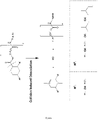
- the ring-opening reaction can give rise to either the amide or the amine and the selectivity of this reaction is sensitive to solvents and nucleophile ( Ratemi &Vederas, 1994, Tetrahedron Letters 35:7605-8 ).
- the resulting secondary amine is protected with a CBz group using standard Schotten-Baumann conditions to give product 3.
- Product 3 is then induced to undergo a ring-closing reaction by ozonolysis of the alkene and work-up with dimethylsulphide to give the aldehyde, which then spontaneously undergoes ring closure to form product 4, the ring hemiaminal.
- Chemoselective reduction of the hemiaminal can be effected using triethylsilane and boron trifluoride diethyl etherate in CH 2 Cl 2 ( Pedregal et al., 1994, Tetrahedron Letters 35:2053-6 ) to afford product 5.
- the BOC group at 1' position of the doubly protected ring can be selectively removed with Trifluoroacetic Acid (TFA) in Dichloromethane (DCM) to give product 6. Removal of the BOC is followed by reductive methylation using formaldehyde with triacetoxyborohydride to give product 7.
- the CBz group is then removed from the 4' position by reduction with hydrogen using a palladium/charcoal catalyst in methanol to give product 8.
- N,N'-dimethyl- piperazine-2-carboxylic acid product 9.
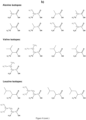
- isotopes of serine and formaldehyde see figure 6 although this is not a fully comprehensive list
- heavy isotopes of allylamine could be fairly readily made.
- Deuterated forms of formaldehyde are commercially available and additional deuterium can be introduced into the ring by using triacetoxyborodeuteride for the reductive methylation steps.
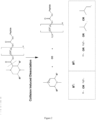
- Figure 4 illustrates a variation of the route shown in Figure 3 .
- BOC-protected serine i.e. R 5 is hydrogen
- DMP Dess Martin Periodinane
- R 3 is hydrogen in Figure 4
- triacetoxyborohydride is protected with a CBz protecting group using standard Schotten-Baumann conditions to give product 3.
- Product 3 is then induced to undergo a ring-closing reaction by conversion of the alcohol with DMP to the aldehyde, which then spontaneously undergoes ring closure to form product 4, the ring hemiaminal.
- Chemoselective reduction of the aminal can be effected using triethylsilane and boron trifluoride diethyl etherate in CH 2 Cl 2 (Pedregal et al., 1994, cited supra) to afford product 5.
- the BOC group at 1' position of the doubly protected ring can be selectively removed with Trifluoroacetic Acid (TFA) in Dichloromethane (DCM) to give product 6.
- TFA Trifluoroacetic Acid
- DCM Dichloromethane
- Piperazine rings with more substituents can be synthesized using the same synthetic route as that shown in Figure 4 but with different starting components.
- serine can be substituted for threonine (i.e. R 5 is CH 3 ) to give N,N'-dimethyl-5-methyl-piperazine-2-carboxylic acid.
- ethanolamine can be substituted for L-alaninol (where R 3 is CH 3 ), which can be derived from alanine as shown in Figure 5 .
- ethanolamine can be substituted for L-valinol (where R 3 is isopropyl), which can be derived from valine as shown in Figure 5 .
- ethanolamine can be substituted for L-leucinol (where R 3 is isobutyl), which can be derived from leucine as shown in Figure 5 .
- L-leucinol where R 3 is isobutyl
- a variety of heavy stable isotope versions of threonine, alanine, valine and leucine are commercially available (see Figure 6 for a non-comprehensive list of available heavy isotopes) enabling the synthesis of a multitude of tags according to this invention. It should be apparent to one of ordinary skill in the art that a large number of alternative alpha-amino acids could be converted to the corresponding alpha-amino alcohol for the synthesis of the mass tags of this invention.
- the substituted piperazine-2-carboxylic acid rings that form the basis of this invention are used as reporter ions in isobaric mass tags as shown in Figure 1 .
- Figure 2 shows reference tags.
- the reporter moieties X are linked to mass normalizer groups M to create isobaric and pseudo-isobaric tags and mass series offset tags, as explained previously.
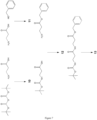
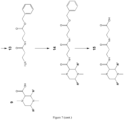
- Figure 7 illustrates the coupling of a double beta-alanine linker to a substituted piperazine-2- carboxylic acid ring.
- Beta-alanine protected at the amino group with a BOC protecting group (product 10) is coupled to beta-alanine protected at the carboxyl group with a Benzyl protecting group (product 11) to give the protected double-beta alanine linker (product 12).
- the BOC group is removed to give the linker with a free amine (product 13), which is in turn coupled to the substituted piperazine-2- carboxylic acid ring (9).
- the benzyl protecting group is then removed to afford the free acid which can then be converted to an active ester for reaction with amino groups or the carboxylic acid group can be used to introduce other reactive groups as discussed below.
- Multiple isotopes of beta-alanine are commercially available enabling the production of any of the double beta-alanine linkers depicted in this document.
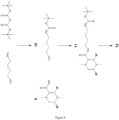
- Figure 8 illustrates the coupling of a 1,4-diaminobutane linker to a substituted piperazine-2- carboxylic acid ring.
- 1,4-diaminobutane protected at one of the amino groups with a BOC protecting group (product 10) is directly coupled to the substituted piperazine-2-carboxylic acid ring (9) to give the BOC protected product (11).
- Preparation of mono-BOC protected symmetric diamines is well known in the literature ( Lee et al., 2007, Synthetic Communications: Communications: An International Journal for Rapid Communication of Synthetic Organic Chemistry 37:737-42 ).
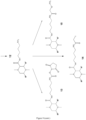
- the BOC protecting group is then removed to afford the free amine (product 12) which can then be converted to an NHS Carbamate (product 13) by reaction with disuccinimidyl carbonate (DSC).
- the NHS carbamate is reactive to free amino groups.
- the free amino group can be used to introduce other reactive groups shown in Figure 8 .
- the free amine 12 can be reacted with iodoacetic acid anhydride to give the iodoacetmide product (14).
- the free amine product 12 can be coupled to (BOC-aminooxy)acetic acid (SigmaAldrich).
- the BOC group can be removed with TCA/DCM to give the aminooxy-derivatised tag (15).
- the example tag shown in Figure 7 is shown functionalized with a free carboxylic acid.
- a carboxylic acid tag can be coupled to amino groups with a suitable coupling agent such as a carbodiimide like N,N'-dicyclohexylcarbodiimide.
- the free carboxylic acids are modified to form so-called active esters, which are stable reagents that will react readily with free amino groups without requiring an additional coupling agent.
- the mass label with a free carboxylic acid could be activated to the N-hydroxysuccinimide ester by contacting the free acid with N,N'-disuccinimidyl carbonate in a suitable organic solvent such as dichloromethane.
- sulphodichlorophenol (SDP) ester can be prepared by reacting the acid chloride of a mass tag with 3,5-dichloro-4-hydroxybenzenesulphonic acid.
- the 1-hydroxy-7-azabenzotriazole ester, the N-hydroxysulphosuccinimidyl ester, the 2,3,5,6-tetrafluorophenol ester, the 4-sulpho-2,3,5,6- tetrafluorophenol ester and the 3,4-dehydro-4-oxo-1,2,3-benzotriazinyl (DEBT) ester can all be prepared from the corresponding alcohols.
- the DEBT ester is not typically prepared as a reagent that can be stored or distributed. It is typically prepared in situ immediately prior to use.
- Aminoxy-activated forms of mass labels can be prepared by coupling Boc- protected aminoxypropylamine to the NHS ester activated forms of two of the mass labels of this invention. The BOC protecting group is then removed under acid conditions to provide the aminoxy reagent.
- aminoxy group reacts with carbonyl functions to form an oxime bond, which is quite stable.
- Carbonyl functions appear in oxidised carbohydrates and steroids and various methods are known in the art for preparing steroid-containing samples, carbohydrate-containing samples or glycoprotein containing samples for labelling with aminoxy-functionalised tagging reagents.
- hydrazide-activated reagents react with carbonyl groups to form a hydrazone linkage.
- the hydrazone is moderately stable and compounds labelled this way can be analysed directly or to avoid any chance of the coupling reaction being reversed, the hydrazone may be reduced to a secondary amine.
- the synthesis of hydrazide-activated forms of mass labels can be effected by coupling hydrazine to the NHS ester activated forms of two of the mass labels.
- Pyridyldithio-activated forms of mass labels may be prepared by coupling of thiopyridine-protected cysteamine to the active ester forms of the mass tag.
- thiopyridine-protected cysteamine is prepared by reacting cysteamine with dithiopyridine to produce the protected thiol with leaving a free amino group:
- This amine intermediate is then coupled to the NHS ester activated forms of two of the mass labels to yield the pyridyldithio-activated form of the mass labels.
- the pyridyldithio-activated form of mass labels may be used to couple the mass labels to thiol functions such as reduced cysteine residues in proteins or peptides.
- the 2-dithiopyridine group and has several advantages: it shows a high selectivity to label cysteine residues, even at increased pH as often used in buffer solutions useful in proteomic investigations (eg. Triethylammonium bicarbonate TEAB) and it is not labile to exposure to water. Furthermore, this group can be re-cleaved from peptides easily if desired by treatment with any disulfide-reducing reagents.
- Amino-functionalised forms of the mass labels can also be prepared from carboxylic acid derivatised tags.
- BOC-protected ethylenediamine is reacted with the NHS-ester activated forms of the mass labels followed by removal of the BOC group to yield amino-functionalised form of the mass labels.
- Amino-functionalised mass labels are useful in their own right and may be used to couple the mass labels to carbonyl groups with reduction of the resulting imines.
- the amino-functionalised forms of the mass labels may be reacted further to produce haloacetyl forms of the mass tags by coupling haloacetic acid anhydrides, such as iodoacetic acid anhydride, to the amino-functionalised tags.
- haloacetic acid anhydrides such as iodoacetic acid anhydride
- the resulting iodoacetamide- activated form of the mass labels may be used to couple the mass labels to thiol functions such as reduced cysteine residues in proteins or peptides.
- Maleimide compounds are also excellent reagents for thiol labeling and can be readily introduced into tags according to this invention by reaction of amine-modified tags with maleic anhydride in an inert solvent such as dimethylformamide (DMF) followed by dehydration with phosphorus pentoxide to effect ring closure.
- an inert solvent such as dimethylformamide (DMF)
- Alkyne-functionalized mass labels may be reacted with azide functionalities via Copper-catalyzed Azide Alkyne Cycloaddition (CuAAC) reaction to form triazole linkages.
- CuAAC Copper-catalyzed Azide Alkyne Cycloaddition
- This is sometimes referred to as the ⁇ Sharpless Reaction' ( Rostovtsev et al., 2002, Angew Chem Int Ed 41:2596-9 ).
- a variety of azide-based reagents for metabolic labelling of live cells are commercially available and allowing azide-labelled molecules derived from such cells to be labelled with mass labels.
- the amino-functionalised forms of the mass labels may be reacted further to produce azide-functionalized forms of the mass labels by coupling a commercially available NHS-Azide reagent (Thermo Scientific's Pierce Biotechnology division, Rockford, Illinois, USA), to the amino-functionalised mass labels.
- the amino-functionalized mass labels can be converted directly to the azide by reaction with azidification reagent imidazole-1-sulfonyl azide.
- Imidazole-1-sulfonyl azide is prepared by treating sulfuryl chloride with sodium azide in acetonitrile, followed by the addition of excess imidazole ( Goddard-Borger & Stick, 2007, Org Lett 9:3797-800 ).
- Azide-functionalized tags may be reacted with alkyne functionalities via the ⁇ Sharpless Reaction' or Copper-catalyzed Azide Alkyne Cycloaddition (CuAAC) reaction to form triazole linkages.
- CuAAC Copper-catalyzed Azide Alkyne Cycloaddition
Landscapes
- Chemical & Material Sciences (AREA)
- Life Sciences & Earth Sciences (AREA)
- Health & Medical Sciences (AREA)
- Organic Chemistry (AREA)
- Engineering & Computer Science (AREA)
- Molecular Biology (AREA)
- Biomedical Technology (AREA)
- Hematology (AREA)
- Immunology (AREA)
- Urology & Nephrology (AREA)
- Cell Biology (AREA)
- Biochemistry (AREA)
- Biotechnology (AREA)
- Food Science & Technology (AREA)
- Medicinal Chemistry (AREA)
- Physics & Mathematics (AREA)
- Analytical Chemistry (AREA)
- Microbiology (AREA)
- General Health & Medical Sciences (AREA)
- General Physics & Mathematics (AREA)
- Pathology (AREA)
- Proteomics, Peptides & Aminoacids (AREA)
- Other Investigation Or Analysis Of Materials By Electrical Means (AREA)
- Plural Heterocyclic Compounds (AREA)
- Investigating Or Analysing Biological Materials (AREA)
Applications Claiming Priority (2)
| Application Number | Priority Date | Filing Date | Title |
|---|---|---|---|
| GBGB1521903.3A GB201521903D0 (en) | 2015-12-11 | 2015-12-11 | Isorbaric mass labels |
| PCT/EP2016/080534 WO2017098029A1 (en) | 2015-12-11 | 2016-12-09 | Isobaric mass labels |
Publications (2)
| Publication Number | Publication Date |
|---|---|
| EP3387445A1 EP3387445A1 (en) | 2018-10-17 |
| EP3387445B1 true EP3387445B1 (en) | 2023-02-08 |
Family
ID=55274607
Family Applications (1)
| Application Number | Title | Priority Date | Filing Date |
|---|---|---|---|
| EP16816622.1A Active EP3387445B1 (en) | 2015-12-11 | 2016-12-09 | Isobaric mass labels |
Country Status (7)
| Country | Link |
|---|---|
| US (1) | US11453621B2 (enExample) |
| EP (1) | EP3387445B1 (enExample) |
| JP (1) | JP6793196B2 (enExample) |
| CN (1) | CN108463728B (enExample) |
| CA (1) | CA3007430C (enExample) |
| GB (1) | GB201521903D0 (enExample) |
| WO (1) | WO2017098029A1 (enExample) |
Families Citing this family (4)
| Publication number | Priority date | Publication date | Assignee | Title |
|---|---|---|---|---|
| EP3859340B1 (en) | 2017-07-06 | 2025-04-09 | Thermo Finnigan LLC | Methods of mass spectrometry quantitation using cleavable isobaric tags and neutral loss fragmentation |
| JP7518765B2 (ja) | 2017-11-22 | 2024-07-18 | コンサート ファーマシューティカルズ インコーポレイテッド | D-セリンの重水素化類似体およびその使用 |
| CN110297056A (zh) * | 2019-06-29 | 2019-10-01 | 南京谱利健生物技术有限公司 | 一种同量异位标签试剂的制备及应用 |
| WO2021124272A1 (en) * | 2019-12-19 | 2021-06-24 | Liminal Biosciences Limited | Cycloalkyl-containing carboxylic acids and uses thereof |
Citations (1)
| Publication number | Priority date | Publication date | Assignee | Title |
|---|---|---|---|---|
| WO2013138210A1 (en) * | 2012-03-14 | 2013-09-19 | Ning Xi | Substituted cyclic compounds and methods of use |
Family Cites Families (33)
| Publication number | Priority date | Publication date | Assignee | Title |
|---|---|---|---|---|
| CA1248531A (en) * | 1984-04-17 | 1989-01-10 | Jeffrey C. Watkins | 4-substituted piperazine-2-carboxylic acids |
| GB0006141D0 (en) | 2000-03-14 | 2000-05-03 | Brax Group Ltd | Mass labels |
| CN1313328A (zh) | 2000-03-15 | 2001-09-19 | 上海博德基因开发有限公司 | 一种新的多肽——人原钙粘素14和编码这种多肽的多核苷酸 |
| WO2003013571A1 (en) | 2001-08-10 | 2003-02-20 | Palatin Technologies, Inc. | Peptidomimetics of biologically active metallopeptides |
| US7354923B2 (en) | 2001-08-10 | 2008-04-08 | Palatin Technologies, Inc. | Piperazine melanocortin-specific compounds |
| MXPA04009784A (es) | 2002-04-08 | 2004-12-13 | Torrent Pharmaceuticlas Ltd | Tiazolidin-4-carbonitrilos y analogos y su uso como inhibidores de dipeptidil-peptidas. |
| US20040106802A1 (en) | 2002-04-08 | 2004-06-03 | Torrent Pharmaceuticals Ltd. | Novel compounds and therapeutic uses thereof |
| JP4613299B2 (ja) * | 2003-01-30 | 2011-01-12 | ディーエイチ テクノロジーズ デベロップメント プライベート リミテッド | 分析物分析に関する方法、混合物、キット、および組成物 |
| GB0306756D0 (en) * | 2003-03-24 | 2003-04-30 | Xzillion Gmbh & Co Kg | Mass labels |
| DE602004009824T2 (de) * | 2003-11-26 | 2008-03-06 | Applera Corp., Framingham | Analyse von massenspektraldaten in den ruhigen gebieten |
| US7307169B2 (en) * | 2004-01-05 | 2007-12-11 | Applera Corporation | Isotopically enriched N-substituted piperazines and methods for the preparation thereof |
| US20050148087A1 (en) * | 2004-01-05 | 2005-07-07 | Applera Corporation | Isobarically labeled analytes and fragment ions derived therefrom |
| GB0414233D0 (en) * | 2004-06-25 | 2004-07-28 | Bioinvent Int Ab | Analysis method |
| GB0515323D0 (en) * | 2005-07-26 | 2005-08-31 | Electrophoretics Ltd | Mass labels |
| GB0525957D0 (en) * | 2005-12-21 | 2006-02-01 | Astrazeneca Ab | Methods |
| US8975404B2 (en) * | 2006-01-24 | 2015-03-10 | Dh Technologies Development Pte. Ltd. | Labeling reagents for analyte determination and methods and compounds used in making the same |
| CA2667854C (en) * | 2006-05-26 | 2015-04-07 | Applied Biosystems, Llc | Tagging reagents and methods for hydroxylated compounds |
| US8362242B2 (en) * | 2006-06-30 | 2013-01-29 | Dh Technologies Development Pte. Ltd. | Analyte determination utilizing mass tagging reagents comprising a non-encoded detectable label |
| US7906341B2 (en) * | 2006-06-30 | 2011-03-15 | Dh Technologies Development Pte, Ltd. | Methods, mixtures, kits and compositions pertaining to analyte determination |
| EP1918714A1 (en) * | 2006-11-02 | 2008-05-07 | Koninklijke Philips Electronics N.V. | Compounds and methods for double labelling of polypeptides to allow multiplexing in mass spectrometric analysis |
| GB0811298D0 (en) * | 2008-06-19 | 2008-07-30 | Trillion Genomics Ltd | Characterising polypeptides |
| GB0811574D0 (en) * | 2008-06-24 | 2008-07-30 | Trillion Genomics Ltd | Characterising planar samples by mass spectrometry |
| EP2373977A1 (en) * | 2008-12-17 | 2011-10-12 | The Lubrizol Corporation | Optically active functional fluid markers |
| US8486712B2 (en) * | 2009-03-10 | 2013-07-16 | University Of Maryland, College Park | Deuterium isobaric tag reagents for quantitative analysis |
| US20110003395A1 (en) * | 2009-05-31 | 2011-01-06 | Dh Technologies Development Pte. Ltd. | Specific analysis of analytes using reagent compounds, labeling strategies, and mass spectrometry workflow |
| GB0916881D0 (en) | 2009-09-25 | 2009-11-11 | Electrophoretics Ltd | Mass labels |
| US8492163B2 (en) * | 2011-01-31 | 2013-07-23 | Dh Technologies Development Pte. Ltd. | Methods, mixtures, kits and compositions pertaining to analyte determination |
| US9388132B2 (en) * | 2011-09-15 | 2016-07-12 | Wisconsin Alumni Research Foundation | Isobaric tandem mass tags for quantitative proteomics and peptidomics |
| EP2847594B1 (en) * | 2012-05-10 | 2016-06-22 | Thermo Finnigan LLC | Method for highly multiplexed quantitation of peptides by mass spectrometry and labeling reagent sets therefor |
| US9835629B2 (en) * | 2012-05-18 | 2017-12-05 | Pierce Biotechnology, Inc. | Methods and reagents for biomolecule labeling, enrichment and gentle elution |
| GB201308765D0 (en) * | 2013-05-15 | 2013-06-26 | Electrophoretics Ltd | Mass Tag Reagents |
| GB201322567D0 (en) * | 2013-12-19 | 2014-02-05 | Electrophoretics Ltd | Mass labels |
| GB201410523D0 (en) * | 2014-06-12 | 2014-07-30 | Electrophoretics Ltd | Mass labels |
-
2015
- 2015-12-11 GB GBGB1521903.3A patent/GB201521903D0/en not_active Ceased
-
2016
- 2016-12-09 WO PCT/EP2016/080534 patent/WO2017098029A1/en not_active Ceased
- 2016-12-09 EP EP16816622.1A patent/EP3387445B1/en active Active
- 2016-12-09 CN CN201680078597.9A patent/CN108463728B/zh active Active
- 2016-12-09 JP JP2018529642A patent/JP6793196B2/ja active Active
- 2016-12-09 CA CA3007430A patent/CA3007430C/en active Active
- 2016-12-09 US US16/061,136 patent/US11453621B2/en active Active
Patent Citations (1)
| Publication number | Priority date | Publication date | Assignee | Title |
|---|---|---|---|---|
| WO2013138210A1 (en) * | 2012-03-14 | 2013-09-19 | Ning Xi | Substituted cyclic compounds and methods of use |
Also Published As
| Publication number | Publication date |
|---|---|
| CN108463728A (zh) | 2018-08-28 |
| US11453621B2 (en) | 2022-09-27 |
| CA3007430C (en) | 2023-10-17 |
| CA3007430A1 (en) | 2017-06-15 |
| JP2019505764A (ja) | 2019-02-28 |
| JP6793196B2 (ja) | 2020-12-02 |
| CN108463728B (zh) | 2023-03-24 |
| WO2017098029A1 (en) | 2017-06-15 |
| US20180362416A1 (en) | 2018-12-20 |
| GB201521903D0 (en) | 2016-01-27 |
| EP3387445A1 (en) | 2018-10-17 |
Similar Documents
| Publication | Publication Date | Title |
|---|---|---|
| JP6374931B2 (ja) | 質量標識体 | |
| EP3387445B1 (en) | Isobaric mass labels | |
| JP5054694B2 (ja) | 質量標識体 | |
| EP3155436B1 (en) | Isobaric mass labels | |
| US11360095B2 (en) | Isobaric mass labels |
Legal Events
| Date | Code | Title | Description |
|---|---|---|---|
| STAA | Information on the status of an ep patent application or granted ep patent |
Free format text: STATUS: UNKNOWN |
|
| STAA | Information on the status of an ep patent application or granted ep patent |
Free format text: STATUS: THE INTERNATIONAL PUBLICATION HAS BEEN MADE |
|
| PUAI | Public reference made under article 153(3) epc to a published international application that has entered the european phase |
Free format text: ORIGINAL CODE: 0009012 |
|
| STAA | Information on the status of an ep patent application or granted ep patent |
Free format text: STATUS: REQUEST FOR EXAMINATION WAS MADE |
|
| 17P | Request for examination filed |
Effective date: 20180710 |
|
| AK | Designated contracting states |
Kind code of ref document: A1 Designated state(s): AL AT BE BG CH CY CZ DE DK EE ES FI FR GB GR HR HU IE IS IT LI LT LU LV MC MK MT NL NO PL PT RO RS SE SI SK SM TR |
|
| AX | Request for extension of the european patent |
Extension state: BA ME |
|
| DAV | Request for validation of the european patent (deleted) | ||
| DAX | Request for extension of the european patent (deleted) | ||
| STAA | Information on the status of an ep patent application or granted ep patent |
Free format text: STATUS: EXAMINATION IS IN PROGRESS |
|
| 17Q | First examination report despatched |
Effective date: 20190926 |
|
| GRAP | Despatch of communication of intention to grant a patent |
Free format text: ORIGINAL CODE: EPIDOSNIGR1 |
|
| STAA | Information on the status of an ep patent application or granted ep patent |
Free format text: STATUS: GRANT OF PATENT IS INTENDED |
|
| INTG | Intention to grant announced |
Effective date: 20220708 |
|
| GRAS | Grant fee paid |
Free format text: ORIGINAL CODE: EPIDOSNIGR3 |
|
| RIN1 | Information on inventor provided before grant (corrected) |
Inventor name: THOMPSON, ANDREW, HUGIN |
|
| RAP3 | Party data changed (applicant data changed or rights of an application transferred) |
Owner name: ELECTROPHORETICS LIMITED |
|
| GRAA | (expected) grant |
Free format text: ORIGINAL CODE: 0009210 |
|
| STAA | Information on the status of an ep patent application or granted ep patent |
Free format text: STATUS: THE PATENT HAS BEEN GRANTED |
|
| AK | Designated contracting states |
Kind code of ref document: B1 Designated state(s): AL AT BE BG CH CY CZ DE DK EE ES FI FR GB GR HR HU IE IS IT LI LT LU LV MC MK MT NL NO PL PT RO RS SE SI SK SM TR |
|
| REG | Reference to a national code |
Ref country code: GB Ref legal event code: FG4D |
|
| REG | Reference to a national code |
Ref country code: CH Ref legal event code: EP Ref country code: AT Ref legal event code: REF Ref document number: 1547582 Country of ref document: AT Kind code of ref document: T Effective date: 20230215 |
|
| REG | Reference to a national code |
Ref country code: DE Ref legal event code: R096 Ref document number: 602016077780 Country of ref document: DE |
|
| REG | Reference to a national code |
Ref country code: IE Ref legal event code: FG4D |
|
| REG | Reference to a national code |
Ref country code: LT Ref legal event code: MG9D |
|
| REG | Reference to a national code |
Ref country code: NL Ref legal event code: MP Effective date: 20230208 |
|
| P01 | Opt-out of the competence of the unified patent court (upc) registered |
Effective date: 20230512 |
|
| REG | Reference to a national code |
Ref country code: AT Ref legal event code: MK05 Ref document number: 1547582 Country of ref document: AT Kind code of ref document: T Effective date: 20230208 |
|
| PG25 | Lapsed in a contracting state [announced via postgrant information from national office to epo] |
Ref country code: RS Free format text: LAPSE BECAUSE OF FAILURE TO SUBMIT A TRANSLATION OF THE DESCRIPTION OR TO PAY THE FEE WITHIN THE PRESCRIBED TIME-LIMIT Effective date: 20230208 Ref country code: PT Free format text: LAPSE BECAUSE OF FAILURE TO SUBMIT A TRANSLATION OF THE DESCRIPTION OR TO PAY THE FEE WITHIN THE PRESCRIBED TIME-LIMIT Effective date: 20230609 Ref country code: NO Free format text: LAPSE BECAUSE OF FAILURE TO SUBMIT A TRANSLATION OF THE DESCRIPTION OR TO PAY THE FEE WITHIN THE PRESCRIBED TIME-LIMIT Effective date: 20230508 Ref country code: NL Free format text: LAPSE BECAUSE OF FAILURE TO SUBMIT A TRANSLATION OF THE DESCRIPTION OR TO PAY THE FEE WITHIN THE PRESCRIBED TIME-LIMIT Effective date: 20230208 Ref country code: LV Free format text: LAPSE BECAUSE OF FAILURE TO SUBMIT A TRANSLATION OF THE DESCRIPTION OR TO PAY THE FEE WITHIN THE PRESCRIBED TIME-LIMIT Effective date: 20230208 Ref country code: LT Free format text: LAPSE BECAUSE OF FAILURE TO SUBMIT A TRANSLATION OF THE DESCRIPTION OR TO PAY THE FEE WITHIN THE PRESCRIBED TIME-LIMIT Effective date: 20230208 Ref country code: HR Free format text: LAPSE BECAUSE OF FAILURE TO SUBMIT A TRANSLATION OF THE DESCRIPTION OR TO PAY THE FEE WITHIN THE PRESCRIBED TIME-LIMIT Effective date: 20230208 Ref country code: ES Free format text: LAPSE BECAUSE OF FAILURE TO SUBMIT A TRANSLATION OF THE DESCRIPTION OR TO PAY THE FEE WITHIN THE PRESCRIBED TIME-LIMIT Effective date: 20230208 Ref country code: AT Free format text: LAPSE BECAUSE OF FAILURE TO SUBMIT A TRANSLATION OF THE DESCRIPTION OR TO PAY THE FEE WITHIN THE PRESCRIBED TIME-LIMIT Effective date: 20230208 |
|
| PG25 | Lapsed in a contracting state [announced via postgrant information from national office to epo] |
Ref country code: SE Free format text: LAPSE BECAUSE OF FAILURE TO SUBMIT A TRANSLATION OF THE DESCRIPTION OR TO PAY THE FEE WITHIN THE PRESCRIBED TIME-LIMIT Effective date: 20230208 Ref country code: PL Free format text: LAPSE BECAUSE OF FAILURE TO SUBMIT A TRANSLATION OF THE DESCRIPTION OR TO PAY THE FEE WITHIN THE PRESCRIBED TIME-LIMIT Effective date: 20230208 Ref country code: IS Free format text: LAPSE BECAUSE OF FAILURE TO SUBMIT A TRANSLATION OF THE DESCRIPTION OR TO PAY THE FEE WITHIN THE PRESCRIBED TIME-LIMIT Effective date: 20230608 Ref country code: GR Free format text: LAPSE BECAUSE OF FAILURE TO SUBMIT A TRANSLATION OF THE DESCRIPTION OR TO PAY THE FEE WITHIN THE PRESCRIBED TIME-LIMIT Effective date: 20230509 Ref country code: FI Free format text: LAPSE BECAUSE OF FAILURE TO SUBMIT A TRANSLATION OF THE DESCRIPTION OR TO PAY THE FEE WITHIN THE PRESCRIBED TIME-LIMIT Effective date: 20230208 |
|
| PG25 | Lapsed in a contracting state [announced via postgrant information from national office to epo] |
Ref country code: SM Free format text: LAPSE BECAUSE OF FAILURE TO SUBMIT A TRANSLATION OF THE DESCRIPTION OR TO PAY THE FEE WITHIN THE PRESCRIBED TIME-LIMIT Effective date: 20230208 Ref country code: RO Free format text: LAPSE BECAUSE OF FAILURE TO SUBMIT A TRANSLATION OF THE DESCRIPTION OR TO PAY THE FEE WITHIN THE PRESCRIBED TIME-LIMIT Effective date: 20230208 Ref country code: EE Free format text: LAPSE BECAUSE OF FAILURE TO SUBMIT A TRANSLATION OF THE DESCRIPTION OR TO PAY THE FEE WITHIN THE PRESCRIBED TIME-LIMIT Effective date: 20230208 Ref country code: DK Free format text: LAPSE BECAUSE OF FAILURE TO SUBMIT A TRANSLATION OF THE DESCRIPTION OR TO PAY THE FEE WITHIN THE PRESCRIBED TIME-LIMIT Effective date: 20230208 Ref country code: CZ Free format text: LAPSE BECAUSE OF FAILURE TO SUBMIT A TRANSLATION OF THE DESCRIPTION OR TO PAY THE FEE WITHIN THE PRESCRIBED TIME-LIMIT Effective date: 20230208 |
|
| REG | Reference to a national code |
Ref country code: DE Ref legal event code: R097 Ref document number: 602016077780 Country of ref document: DE |
|
| PG25 | Lapsed in a contracting state [announced via postgrant information from national office to epo] |
Ref country code: SK Free format text: LAPSE BECAUSE OF FAILURE TO SUBMIT A TRANSLATION OF THE DESCRIPTION OR TO PAY THE FEE WITHIN THE PRESCRIBED TIME-LIMIT Effective date: 20230208 |
|
| PLBE | No opposition filed within time limit |
Free format text: ORIGINAL CODE: 0009261 |
|
| STAA | Information on the status of an ep patent application or granted ep patent |
Free format text: STATUS: NO OPPOSITION FILED WITHIN TIME LIMIT |
|
| 26N | No opposition filed |
Effective date: 20231109 |
|
| PG25 | Lapsed in a contracting state [announced via postgrant information from national office to epo] |
Ref country code: SI Free format text: LAPSE BECAUSE OF FAILURE TO SUBMIT A TRANSLATION OF THE DESCRIPTION OR TO PAY THE FEE WITHIN THE PRESCRIBED TIME-LIMIT Effective date: 20230208 |
|
| PG25 | Lapsed in a contracting state [announced via postgrant information from national office to epo] |
Ref country code: IT Free format text: LAPSE BECAUSE OF FAILURE TO SUBMIT A TRANSLATION OF THE DESCRIPTION OR TO PAY THE FEE WITHIN THE PRESCRIBED TIME-LIMIT Effective date: 20230208 |
|
| REG | Reference to a national code |
Ref country code: CH Ref legal event code: PL |
|
| PG25 | Lapsed in a contracting state [announced via postgrant information from national office to epo] |
Ref country code: LU Free format text: LAPSE BECAUSE OF NON-PAYMENT OF DUE FEES Effective date: 20231209 |
|
| PG25 | Lapsed in a contracting state [announced via postgrant information from national office to epo] |
Ref country code: MC Free format text: LAPSE BECAUSE OF FAILURE TO SUBMIT A TRANSLATION OF THE DESCRIPTION OR TO PAY THE FEE WITHIN THE PRESCRIBED TIME-LIMIT Effective date: 20230208 |
|
| REG | Reference to a national code |
Ref country code: BE Ref legal event code: MM Effective date: 20231231 |
|
| PG25 | Lapsed in a contracting state [announced via postgrant information from national office to epo] |
Ref country code: MC Free format text: LAPSE BECAUSE OF FAILURE TO SUBMIT A TRANSLATION OF THE DESCRIPTION OR TO PAY THE FEE WITHIN THE PRESCRIBED TIME-LIMIT Effective date: 20230208 Ref country code: LU Free format text: LAPSE BECAUSE OF NON-PAYMENT OF DUE FEES Effective date: 20231209 |
|
| REG | Reference to a national code |
Ref country code: IE Ref legal event code: MM4A |
|
| PG25 | Lapsed in a contracting state [announced via postgrant information from national office to epo] |
Ref country code: IE Free format text: LAPSE BECAUSE OF NON-PAYMENT OF DUE FEES Effective date: 20231209 |
|
| PG25 | Lapsed in a contracting state [announced via postgrant information from national office to epo] |
Ref country code: BE Free format text: LAPSE BECAUSE OF NON-PAYMENT OF DUE FEES Effective date: 20231231 |
|
| PG25 | Lapsed in a contracting state [announced via postgrant information from national office to epo] |
Ref country code: CH Free format text: LAPSE BECAUSE OF NON-PAYMENT OF DUE FEES Effective date: 20231231 |
|
| PG25 | Lapsed in a contracting state [announced via postgrant information from national office to epo] |
Ref country code: IE Free format text: LAPSE BECAUSE OF NON-PAYMENT OF DUE FEES Effective date: 20231209 Ref country code: CH Free format text: LAPSE BECAUSE OF NON-PAYMENT OF DUE FEES Effective date: 20231231 Ref country code: BE Free format text: LAPSE BECAUSE OF NON-PAYMENT OF DUE FEES Effective date: 20231231 |
|
| PG25 | Lapsed in a contracting state [announced via postgrant information from national office to epo] |
Ref country code: BG Free format text: LAPSE BECAUSE OF FAILURE TO SUBMIT A TRANSLATION OF THE DESCRIPTION OR TO PAY THE FEE WITHIN THE PRESCRIBED TIME-LIMIT Effective date: 20230208 |
|
| PG25 | Lapsed in a contracting state [announced via postgrant information from national office to epo] |
Ref country code: BG Free format text: LAPSE BECAUSE OF FAILURE TO SUBMIT A TRANSLATION OF THE DESCRIPTION OR TO PAY THE FEE WITHIN THE PRESCRIBED TIME-LIMIT Effective date: 20230208 |
|
| PGFP | Annual fee paid to national office [announced via postgrant information from national office to epo] |
Ref country code: GB Payment date: 20241227 Year of fee payment: 9 |
|
| PGFP | Annual fee paid to national office [announced via postgrant information from national office to epo] |
Ref country code: FR Payment date: 20241226 Year of fee payment: 9 |
|
| PGFP | Annual fee paid to national office [announced via postgrant information from national office to epo] |
Ref country code: DE Payment date: 20241227 Year of fee payment: 9 |
|
| PG25 | Lapsed in a contracting state [announced via postgrant information from national office to epo] |
Ref country code: CY Free format text: LAPSE BECAUSE OF FAILURE TO SUBMIT A TRANSLATION OF THE DESCRIPTION OR TO PAY THE FEE WITHIN THE PRESCRIBED TIME-LIMIT; INVALID AB INITIO Effective date: 20161209 |
|
| PG25 | Lapsed in a contracting state [announced via postgrant information from national office to epo] |
Ref country code: HU Free format text: LAPSE BECAUSE OF FAILURE TO SUBMIT A TRANSLATION OF THE DESCRIPTION OR TO PAY THE FEE WITHIN THE PRESCRIBED TIME-LIMIT; INVALID AB INITIO Effective date: 20161209 |
|
| PG25 | Lapsed in a contracting state [announced via postgrant information from national office to epo] |
Ref country code: TR Free format text: LAPSE BECAUSE OF FAILURE TO SUBMIT A TRANSLATION OF THE DESCRIPTION OR TO PAY THE FEE WITHIN THE PRESCRIBED TIME-LIMIT Effective date: 20230208 |