EP3383522B1 - Composition à base d'urée pour le traitement des gaz d'échappement - Google Patents
Composition à base d'urée pour le traitement des gaz d'échappement Download PDFInfo
- Publication number
- EP3383522B1 EP3383522B1 EP16816724.5A EP16816724A EP3383522B1 EP 3383522 B1 EP3383522 B1 EP 3383522B1 EP 16816724 A EP16816724 A EP 16816724A EP 3383522 B1 EP3383522 B1 EP 3383522B1
- Authority
- EP
- European Patent Office
- Prior art keywords
- composition
- mono
- poly
- chosen
- urea
- Prior art date
- Legal status (The legal status is an assumption and is not a legal conclusion. Google has not performed a legal analysis and makes no representation as to the accuracy of the status listed.)
- Active
Links
- 0 C*(CCOC(C)(C)*)OC(COC12)C1OCC2[U]C(C)(C)CCOC(C)(C)* Chemical compound C*(CCOC(C)(C)*)OC(COC12)C1OCC2[U]C(C)(C)CCOC(C)(C)* 0.000 description 1
Images

Classifications
-
- B—PERFORMING OPERATIONS; TRANSPORTING
- B01—PHYSICAL OR CHEMICAL PROCESSES OR APPARATUS IN GENERAL
- B01D—SEPARATION
- B01D53/00—Separation of gases or vapours; Recovering vapours of volatile solvents from gases; Chemical or biological purification of waste gases, e.g. engine exhaust gases, smoke, fumes, flue gases, aerosols
- B01D53/34—Chemical or biological purification of waste gases
- B01D53/92—Chemical or biological purification of waste gases of engine exhaust gases
- B01D53/94—Chemical or biological purification of waste gases of engine exhaust gases by catalytic processes
- B01D53/9404—Removing only nitrogen compounds
- B01D53/9409—Nitrogen oxides
-
- F—MECHANICAL ENGINEERING; LIGHTING; HEATING; WEAPONS; BLASTING
- F01—MACHINES OR ENGINES IN GENERAL; ENGINE PLANTS IN GENERAL; STEAM ENGINES
- F01N—GAS-FLOW SILENCERS OR EXHAUST APPARATUS FOR MACHINES OR ENGINES IN GENERAL; GAS-FLOW SILENCERS OR EXHAUST APPARATUS FOR INTERNAL-COMBUSTION ENGINES
- F01N3/00—Exhaust or silencing apparatus having means for purifying, rendering innocuous, or otherwise treating exhaust
- F01N3/08—Exhaust or silencing apparatus having means for purifying, rendering innocuous, or otherwise treating exhaust for rendering innocuous
- F01N3/10—Exhaust or silencing apparatus having means for purifying, rendering innocuous, or otherwise treating exhaust for rendering innocuous by thermal or catalytic conversion of noxious components of exhaust
- F01N3/18—Exhaust or silencing apparatus having means for purifying, rendering innocuous, or otherwise treating exhaust for rendering innocuous by thermal or catalytic conversion of noxious components of exhaust characterised by methods of operation; Control
- F01N3/20—Exhaust or silencing apparatus having means for purifying, rendering innocuous, or otherwise treating exhaust for rendering innocuous by thermal or catalytic conversion of noxious components of exhaust characterised by methods of operation; Control specially adapted for catalytic conversion
- F01N3/206—Adding periodically or continuously substances to exhaust gases for promoting purification, e.g. catalytic material in liquid form, NOx reducing agents
- F01N3/2066—Selective catalytic reduction [SCR]
-
- B—PERFORMING OPERATIONS; TRANSPORTING
- B01—PHYSICAL OR CHEMICAL PROCESSES OR APPARATUS IN GENERAL
- B01D—SEPARATION
- B01D2251/00—Reactants
- B01D2251/20—Reductants
- B01D2251/206—Ammonium compounds
-
- B—PERFORMING OPERATIONS; TRANSPORTING
- B01—PHYSICAL OR CHEMICAL PROCESSES OR APPARATUS IN GENERAL
- B01D—SEPARATION
- B01D2251/00—Reactants
- B01D2251/20—Reductants
- B01D2251/206—Ammonium compounds
- B01D2251/2067—Urea
-
- B—PERFORMING OPERATIONS; TRANSPORTING
- B01—PHYSICAL OR CHEMICAL PROCESSES OR APPARATUS IN GENERAL
- B01D—SEPARATION
- B01D2251/00—Reactants
- B01D2251/20—Reductants
- B01D2251/208—Hydrocarbons
-
- F—MECHANICAL ENGINEERING; LIGHTING; HEATING; WEAPONS; BLASTING
- F01—MACHINES OR ENGINES IN GENERAL; ENGINE PLANTS IN GENERAL; STEAM ENGINES
- F01N—GAS-FLOW SILENCERS OR EXHAUST APPARATUS FOR MACHINES OR ENGINES IN GENERAL; GAS-FLOW SILENCERS OR EXHAUST APPARATUS FOR INTERNAL-COMBUSTION ENGINES
- F01N2610/00—Adding substances to exhaust gases
- F01N2610/02—Adding substances to exhaust gases the substance being ammonia or urea
-
- F—MECHANICAL ENGINEERING; LIGHTING; HEATING; WEAPONS; BLASTING
- F01—MACHINES OR ENGINES IN GENERAL; ENGINE PLANTS IN GENERAL; STEAM ENGINES
- F01N—GAS-FLOW SILENCERS OR EXHAUST APPARATUS FOR MACHINES OR ENGINES IN GENERAL; GAS-FLOW SILENCERS OR EXHAUST APPARATUS FOR INTERNAL-COMBUSTION ENGINES
- F01N2610/00—Adding substances to exhaust gases
- F01N2610/03—Adding substances to exhaust gases the substance being hydrocarbons, e.g. engine fuel
-
- Y—GENERAL TAGGING OF NEW TECHNOLOGICAL DEVELOPMENTS; GENERAL TAGGING OF CROSS-SECTIONAL TECHNOLOGIES SPANNING OVER SEVERAL SECTIONS OF THE IPC; TECHNICAL SUBJECTS COVERED BY FORMER USPC CROSS-REFERENCE ART COLLECTIONS [XRACs] AND DIGESTS
- Y02—TECHNOLOGIES OR APPLICATIONS FOR MITIGATION OR ADAPTATION AGAINST CLIMATE CHANGE
- Y02T—CLIMATE CHANGE MITIGATION TECHNOLOGIES RELATED TO TRANSPORTATION
- Y02T10/00—Road transport of goods or passengers
- Y02T10/10—Internal combustion engine [ICE] based vehicles
- Y02T10/12—Improving ICE efficiencies
Definitions
- the present invention relates to a composition for the treatment of exhaust gases at the outlet of on-board or stationary diesel engines. It also relates to its use in any device for treating these exhaust gases, whether the engines are heavy-duty engines or engines for light vehicles or even engines for stationary industrial applications.
- SCR post-treatment consists in reducing NOx or nitrogen oxides (NO, NO 2 ) on a catalyst containing platinum and palladium, and in the presence of a reducing agent, generally ammonia gas.
- a reducing agent generally ammonia gas.
- gaseous ammonia into the exhaust, it is known to produce it directly in the pipe before the SCR system by vaporizing an aqueous urea solution.
- Urea being injected at an average temperature generally ranging from 150 to 400 ° C, gradually hydrolyzes into gaseous ammonia.
- other ammonia precursors can be used under similar conditions.
- WO 2008/125745 describes an aqueous solution comprising a major part of a constituent capable of releasing gaseous ammonia above 200 ° C and a minor part of at least one polyfunctional additive whose HLB varies from 7 to 17 to limit the formation of deposits based on cyanuric acid in any spraying device aimed at the post-treatment of exhaust gases, more particularly SCR devices.
- the polyfunctional additives used are in particular ethers of polyalkoxylated fatty alcohols and esters of polyalkoxylated fatty alcohols.
- EP2337625 describes a mixture of surfactants making it possible to reduce the droplet diameter of an aqueous urea solution, and thus to promote its vaporization and the transformation of urea into gaseous ammonia in an SCR system.
- the proposed solution consists of a mixture of polyalkoxylated fatty alcohols, with controlled degrees of alkoxylation.
- EP2488283 describes additives for urea solution of the particular polyalkoxylated fatty alcohol type. These additives are also intended to promote a reduction in the formation of deposits resulting from the decomposition of urea in SCR systems.
- aqueous solutions based on a NOx reducing agent for example ammonia or a precursor of said reducing agent, such as urea
- a reducing agent for example ammonia or a precursor of said reducing agent, such as urea
- This composition is expected to be able to avoid or reduce deposits when used on an SCR line.
- This composition is also expected to exhibit reduced foaming compared to additive compositions based on an NOx reducing agent or a precursor of said reducing agent, such as urea of the prior art.
- This composition is also expected to allow precise dosing of the amounts of composition injected.
- the document DE 10 2008 041 903 describes a composition for treating exhaust gases comprising NOx, this aqueous composition comprising a NOx reducing agent or a precursor of an NOx reducing agent and a solvent having a melting point lower than that of the aqueous solution.
- the composition is an emulsion based on hydrocarbon and on a urea solution, the hydrocarbon phase forming the continuous phase. This emulsion avoids the effects of cooling the urea solution such as fluidity problems and difficulty pumping this solution.
- the document US 2003/0226312 describes an aqueous composition for improving the treatment of exhaust gases, this composition comprising a metallic compound.
- the composition is introduced either into the combustion chamber in the form of an emulsion with the fuel, or in emulsion or alone in the form of an aqueous flow in the exhaust gas.
- the metal compound neutralizes the secondary products of combustion.
- an emulsion is used it is a water-in-fuel emulsion.
- the document US 5,809,774 describes a method for reducing NOx emissions in a diesel engine, this method comprising forming an emulsion of an aqueous composition of a NOx reducing agent in a fuel, the composition being separated (by decantation) into two main constituents before use. The fuel part is then injected into the engine and the aqueous solution of a NOx reducing agent is injected into the exhaust gases.
- This invention aims to reduce storage equipment.
- the document JP 2007 145796 describes an aqueous composition for reducing NO x emissions, comprising urea, guanidine, biuret and a hydrocarbon oil.
- the invention relates to an aqueous composition
- aqueous composition comprising at least urea, characterized in that it comprises at least one C20-C36 paraffin dispersed in the aqueous phase, said paraffin representing at least 90% by mass relative to the total mass. paraffins in the composition and from 50 to 10,000 ppm by mass relative to the mass of urea.
- the composition comprises at least one surfactant, and optionally an emulsion stabilizing agent.
- the composition comprises at least one nonionic surfactant.
- the composition comprises at least one nonionic surfactant chosen from C4-C20 oxygenated hydrocarbon molecules comprising one or two furanose or pyranose rings, and one or more hydroxyl groups, at least one of the hydroxyl groups being substituted by a mono- or poly-alkoxylated group.
- the nonionic surfactant is chosen from polyethoxylated sorbitans and polyethoxylated isosorbides.
- the C4-C20 oxygenated hydrocarbon surfactants comprising one or two furanose or pyranose rings, and one or more hydroxyl groups, mono or polyalkoxylated, are present in amounts ranging from 1 to 70% by mass relative to the total mass of paraffins in the composition.
- the composition also comprises at least one agent for stabilizing emulsions chosen from fatty acids.
- the fatty acid is present in amounts ranging from 1 to 50% by mass relative to the total mass of paraffins in the composition.
- the composition comprises at least one nonionic surfactant chosen from esters of fatty acids and of C4-C20 oxygenated hydrocarbon molecules comprising one or two furanose or pyranose rings, and one or more hydroxyl groups, at least one of the hydroxyl groups being substituted by a mono- or poly-alkoxylated group.
- the non-ionic surfactant (s) are chosen from fatty acid esters of mono- or poly-ethoxylated sorbitans and fatty acid esters of mono- or poly-ethoxylated isosorbides .
- esters of fatty acids and of oxygenated C4-C20 hydrocarbon molecules comprising one or two furanose or pyranose rings, and one or more hydroxyl groups, mono or polyalkoxylated are present in amounts ranging from 1 to 70% by mass relative to the total mass of paraffins in the composition.
- all of the surfactants and stabilizers of emulsions represent from 1 to 100% by mass relative to the total mass of paraffin (s) in the composition.
- the invention also relates to the use of a composition as defined above, for the post-treatment of exhaust gases by reducing catalyst.
- Selective Catalytic also designated SCR catalyst for Selective Catalytic Reducer in English.
- the composition is used to prevent, limit, prevent the formation of deposits in an SCR exhaust line.
- the invention also relates to the use of a composition as defined above, to avoid or reduce foaming when filling a reservoir with the composition.
- the invention also relates to a method for treating exhaust gases in an internal combustion engine, preferably a diesel engine, equipped with an SCR system, this method being characterized in that it comprises at least one step of introduction of a composition as defined above in the SCR line, upstream of the SCR system.
- the exhaust gas treatment method makes it possible to reduce the deposits in an SCR line, in particular the deposits of cyanuric acid.
- the method comprises a step of preparing an aqueous composition of urea, and of paraffin (s) as defined above.
- an emulsion or of an aqueous dispersion or suspension of C20-C36 paraffin as an additive in an aqueous urea solution, for use in a system.
- SCR said paraffin representing from 50 to 10,000 ppm by mass relative to the mass of urea, the paraffin being used, in particular, as an emulsion or dispersed or in suspension in the aqueous phase.
- compositions of the invention have many advantages: they can be used in the same way and in the same equipment as the solutions of the art prior. They are at least as effective, or even for some more effective, than the solutions of the prior art, in particular urea-based solutions in reducing or preventing the formation of deposits in SCR systems. They cause little or no foaming during their handling and therefore make it possible to avoid overflows when filling the tank. They are stable in storage. They allow precise control of the amount of composition injected.
- the invention is based on the development of aqueous compositions comprising urea, and further comprising one or more C20-C36 paraffins dispersed in said composition.
- This dispersion is advantageously stabilized by means of one or more surfactants, preferably nonionic.
- aqueous compositions comprising paraffin also include emulsions, suspensions, and more generally any form of composition in which the paraffin and water form a mixture substantially homogeneous.
- composition is prepared from an aqueous solution comprising at least one precursor of an NOx reducing agent which is urea
- NOx reducing agent is meant a compound capable of reducing at least partially, if not entirely, the NOx to gaseous ammonia, under the operating conditions of an SCR line, that is to say at a temperature ranging from 150 to 400 ° C.
- NOx reducing agents there may be mentioned ammonia.
- precursor of a NOx reducing agent is meant a compound capable of releasing the NOx reducing agent under the effect of temperature and / or by catalytic reaction.
- ammonia precursors mention may be made of urea which, by hydrolysis reaction, produces ammonia (NOx reducing agent) according to a well known process.
- An SCR exhaust line can comprise, upstream of the SCR catalytic system, a catalyst whose function is to transform a precursor of a NOx reducing agent into a NOx reducing agent, in particular into gaseous ammonia.
- the composition is prepared from an aqueous urea solution.
- Urea has the advantage of being stable, non-volatile, non-explosive and non-flammable. It can be transported without risk, stored and handled by an operator without specific training.
- the solution implemented in the SCR lines comprises 32.5% by mass of urea, so as to satisfy the ISO 22241-1 standard concerning the reduction of NOx in diesel engines.
- the composition for this use, provision is therefore made for the composition to have a urea concentration substantially equal to 32.5% by mass.
- aqueous compositions based on urea with a concentration greater than 32.5%, which is diluted before implementation. This variant allows savings to be made during the transport of these urea-based compositions.
- the composition also comprises at least one C20-C36 paraffin.
- Paraffins are alkanes, the crude formula of which is C n H 2n + 2 , with n an integer ranging from 8 to 40. They include normal (linear) and isoparaffins (branched). They can be liquid, pasty or solid.
- the C20-C36 paraffins represent at least 90% by mass of all the paraffins of the composition. Even better, the C22-C32 paraffins represent at least 90% by mass of the total paraffins of the composition.
- the C20-C36 paraffins represent at least 95% by mass of all the paraffins of the composition. Even better, the C22-C32 paraffins represent at least 95% by mass of the total paraffins of the composition.
- the C20-C36 paraffins are introduced into the aqueous composition in amounts ranging from 50 to 10000 ppm by mass of paraffins relative to the amount of urea by mass, preferably from 150 to 5000 ppm, even better from 300 to 3000 ppm, even more advantageously from 300 to 1500 ppm.
- the C20-C36 paraffins are introduced into the aqueous composition in amounts ranging from 15 to 3300 ppm by mass of paraffins relative to the mass of aqueous solution, preferably from 50 to 1500 ppm, even better from 100 to 1000 ppm, even more advantageously from 100 to 500 ppm.
- the surfactant system The surfactant system :
- the aqueous composition advantageously comprises at least one surfactant system which makes it possible to maintain the paraffin in dispersed form.
- the surfactant system makes it possible to form a paraffin emulsion in water.
- the surfactant system comprises at least one nonionic surfactant.
- the nonionic surfactant (s) are chosen from C4-C20 oxygenated hydrocarbon molecules comprising one or two furanose or pyranose rings, and one or more hydroxyl groups, at least one of the hydroxyl groups being substituted by a group mono- or poly-alkoxylated.
- oxygenated hydrocarbon molecule means a chain consisting exclusively of carbon, hydrogen and oxygen atoms, said chain being able to be linear or branched, cyclic, polycyclic or acyclic, saturated or unsaturated, and optionally aromatic or polyaromatic.
- An oxygenated hydrocarbon chain can comprise a linear or branched part and a cyclic part. It can include an aliphatic part and an aromatic part.
- the oxygenated hydrocarbon molecules are advantageously saturated.
- the oxygenated hydrocarbon molecules advantageously comprise a linear part and a cyclic part.
- the cyclic part can be monocyclic or polycyclic.
- the carbons of the mono- or polyalkoxylated groups are not counted in the C4-C20 oxygenated hydrocarbon molecule.
- the nonionic surfactants are chosen from C4-C10 oxygenated hydrocarbon molecules comprising one or two furanose or pyranose rings, and one or more hydroxyl groups, at least one of the hydroxyl groups being substituted by a mono- or poly- group. alkoxylated.
- the surfactants used have an average degree of alkoxylation ranging from 1 to 80, better from 1 to 50, even better from 5 to 25 and advantageously from 10 to 20.
- the mono- or poly-alkoxylated groups are formed by the condensation reaction of alkylene oxide on the cyclic molecule carrying hydroxyl functions. They may be ethylene oxide, propylene oxide or mixtures of these monomers which form copolymers of ethylene oxide and propylene oxide, optionally block polymers.
- the grafting of alkoxylated groups onto the hydroxyl functions can be done by condensation reaction on a hydroxyl function or on several hydroxyl functions of the molecule, depending on the number of hydroxyl functions present, their reactivity, and the reaction conditions.
- the average degree of alkoxylation is defined as the number of moles of alkylene oxide which have been reacted with the molecule to be grafted.
- the surfactant system can also comprise polyalkylene oxide polymers and copolymers, in particular polyethylene oxides, propylene polyoxides, copolymers of ethylene oxide and propylene oxide, optionally block polymers, or mixtures of these polymers. These polymers are sometimes formed in parallel with the grafting of the alkylene oxides onto the hydroxyl functions of the C4-C20 oxygenated hydrocarbon molecule and remain in admixture with them. Commercial products of the C4-C20 oxygenated hydrocarbon molecule type carrying hydroxyl functions grafted with alkylene oxides generally include minor amounts of these polyalkylene oxide polymers and copolymers.
- the nonionic surfactant (s) are chosen from mono- or poly-alkoxylated sorbitans and mono- or poly-alkoxylated isosorbides as well as their mixtures. Even more preferably, the nonionic surfactant (s) are chosen from mono- or poly-ethoxylated sorbitans and mono- or poly-ethoxylated isosorbides, as well as their mixtures. These can be represented by the following formulas (I) and (II):
- n, p and q identical or different, integers ranging from 0 to 20, the sum m + n + p + q ranging from 1 to 80, preferably from 1 to 50.
- n identical or different, integers ranging from 0 to 20, the sum m + n ranging from 1 to 40.
- the mono- or poly-ethoxylated sorbitans and the mono- or poly-ethoxylated isosorbides used have an average degree of alkoxylation ranging from 1 to 50, advantageously from 5 to 25 and even more preferably from 10 to 20.
- Alkoxylated C4-C20 oxygenated hydrocarbon molecules in particular mono- or poly-ethoxylated sorbitans and mono- or poly-ethoxylated isosorbides, as well as their mixtures, are advantageously introduced into the aqueous composition in amounts ranging from 1 to 70% mass relative to the total mass of paraffins in the composition, better from 1 to 50%, preferably from 5 to 40%, even better from 10 to 30%.
- the composition advantageously further comprises at least one or more emulsion stabilizers.
- these emulsion stabilizers can be chosen in particular from C8-C30 fatty acids, saturated or unsaturated, as well as their mixtures.
- the fatty acid (s) may be saturated or unsaturated and may be linear or branched, and their number of carbons may be from 8 to 30, preferably from 10 to 24.
- the fatty acid can for example be a saturated fatty acid such as n-caproic acid, caprylic acid, n-capric acid, lauric acid, myristic acid, palmitic acid, stearic acid, isostearic acid, arachidic acid or an unsaturated fatty acid such as palmitoleic acid, oleic acid, linoleic acid, linolenic acid, arachidonic acid or docosahexaenoic acid.
- preferred fatty acids are stearic acid, myristic acid and palmitic acid.
- the emulsion stabilizer is chosen from mixtures of C10-C24 fatty acids, even more preferably C12- C20.
- the invention uses a mixture of fatty acids comprising stearic acid, myristic acid and palmitic acid.
- the invention uses a mixture of fatty acids essentially consisting of stearic acid, myristic acid and palmitic acid.
- the emulsion stabilizers are advantageously introduced into the aqueous composition in amounts ranging from 1 to 50% by mass relative to the total mass of paraffins in the composition, preferably from 5 to 40%, even better from 10 to 30%.
- the nonionic surfactant (s) are chosen from esters of fatty acids and of C4-C20 oxygenated hydrocarbon molecules comprising one or two furanose or pyranose rings, and one or more hydroxyl groups, at least one of the hydroxyl groups being substituted by a mono- or poly-alkoxylated group.
- the fatty acid can be grafted onto a hydroxyl group in the ring or at the end of an alkoxylated chain.
- the oxygenated hydrocarbon molecules are advantageously saturated.
- the oxygenated hydrocarbon molecules advantageously comprise a linear part and a cyclic part.
- the cyclic part can be monocyclic or polycyclic.
- the carbons of the mono- or polyalkoxylated groups are not counted in the C4-C20 oxygenated hydrocarbon molecule.
- the nonionic surfactants are chosen from esters of fatty acids and of oxygenated hydrocarbon molecules in C4-C10 comprising one or two furanose or pyranose rings, and one or more hydroxyl groups, at least one of the hydroxyl groups being substituted by a mono- or poly-alkoxylated group.
- the surfactants used have an average degree of alkoxylation ranging from 1 to 80, better from 1 to 50, even better from 5 to 25, and advantageously from 10 to 20.
- the mono- or poly-alkoxylated groups are formed by the condensation reaction of alkylene oxide on the cyclic molecule carrying hydroxyl functions. They may be ethylene oxide, propylene oxide or mixtures of these monomers which form copolymers of ethylene oxide and propylene oxide, optionally block polymers.
- the grafting of alkoxylated groups on the hydroxyl functions can be done by condensation reaction on a hydroxyl function or on several functions hydroxyls of the molecule, depending on the number of hydroxyl functions present, their reactivity, and the reaction conditions.
- the average degree of alkoxylation is defined as the number of moles of alkylene oxide which have been reacted with the molecule to be grafted.
- the surfactant system can also comprise polyalkylene oxide polymers and copolymers, in particular polyethylene oxides, propylene polyoxides, copolymers of ethylene oxide and propylene oxide, optionally block polymers, or mixtures of these polymers. These polymers are sometimes formed in parallel with the grafting of the alkylene oxides onto the hydroxyl functions of the C4-C20 oxygenated hydrocarbon molecule and remain in admixture with them. Commercial products of the C4-C20 oxygenated hydrocarbon molecule type carrying hydroxyl functions grafted with alkylene oxides generally include minor amounts of these polyalkylene oxide polymers and copolymers.
- the surfactant system may optionally include minor amounts of the fatty acid esters and these polyalkylene oxide polymers and copolymers.
- the number of fatty acid molecules which has reacted with the hydrogenated oxygenated C4-C20 molecule can be greater than 1.
- the ester can thus be a monoester, a diester, a triester, a tetraester.
- the molecule is a polyester, distinct fatty acid groups may have reacted with distinct hydroxyl groups.
- the ester is a monoester.
- the fatty acid fragment of the fatty acid ester of alkoxylated sorbitan can be saturated or unsaturated and can be linear or branched, and its carbon number can be from 8 to 30, preferably from 10 to 24, even better from 12 to 20.
- the fatty acid can for example be a saturated fatty acid such as n-caproic acid, caprylic acid, n-capric acid, lauric acid, myristic acid, acid palmitic, stearic acid, isostearic acid, arachidic acid or an unsaturated fatty acid such as palmitoleic acid, oleic acid, linoleic acid, linolenic acid, arachidonic acid or docosahexaenoic acid.
- Examples of preferred fatty acids are stearic acid, myristic acid and palmitic acid.
- the invention uses a mixture of fatty acid esters based on a mixture of acids comprising stearic acid, myristic acid and palmitic acid.
- the invention uses a mixture of esters fatty acids based on a mixture of acids consisting of stearic acid, myristic acid and palmitic acid.
- the non-ionic surfactant (s) are chosen from esters of fatty acids and of mono- or poly-alkoxylated sorbitans or of mono- or poly-alkoxylated isosorbides.
- the fatty acid and mono- or poly-alkoxylated sorbitan esters and the mono- or poly-alkoxylated isosorbides used have an average degree of alkoxylation ranging from 1 to 80, better still from 1 to 50, advantageously from 5 to 25, and advantageously from 10 to 20.
- the nonionic surfactant (s) are chosen from esters of fatty acids and of mono- or poly-ethoxylated sorbitans or of mono- or poly-ethoxylated isosorbides.
- n, p and q identical or different, integers ranging from 0 to 20, the sum m + n + p + q ranging from 1 to 80, preferably from 1 to 50.
- R1, R2, R3, R4 independently represent a hydrogen atom or a C8-C30 alkylcarboxylic group, at least one of R1, R2, R3 and R4 being distinct from H.
- R1, R2 independently represent a hydrogen atom or a C8-C30 alkylcarboxylic group, at least one of R1 and R2 being distinct from H.
- Such molecules are commercially available in particular under the name Polysorbate or under the brand Radiasurf® marketed by the company Oleon.
- Esters of fatty acids and alkoxylated C4-C20 oxygenated hydrocarbon molecules are advantageously introduced into the aqueous composition in amounts ranging from 1 to 70% by mass relative to the total mass of paraffins in the composition, better from 1 to 50%, preferably from 5 to 40%, even better from 10 to 30% .
- the surfactant system essentially consists of: One or more esters of fatty acids and of C4-C20 oxygenated hydrocarbon molecules comprising one or two furanose or pyranose rings, and one or more hydroxyl groups, at least one of the hydroxyl groups being substituted by a mono- or poly-alkoxylated group .
- the surfactant system essentially consists of: One or more esters of fatty acids and of mono- or poly-ethoxylated sorbitans or of mono- or poly-ethoxylated isosorbides.
- the surfactant system essentially consists of: One or more molecules chosen from esters of fatty acids and mono- or poly-ethoxylated sorbitans of formula (III) or of mono- or poly-ethoxylated isosorbides of formula (IV) as defined above.
- the surfactants and stabilizers are used in sufficient quantities to allow the dispersion of the paraffin in the aqueous composition.
- a person skilled in the art knows how to adapt their dosage according to the chosen paraffin and its quantity in the composition.
- all of the surfactants and stabilizers represent from 1 to 100% by mass relative to the total mass of paraffin (s) in the composition, better still from 5 to 50% by mass.
- R1, R2, R3, R4 independently represent a hydrogen atom or a C8-C30 alkylcarboxylic group, at least one of R1, R2, R3 and R4 being distinct from H.
- R1, R2 independently represent a hydrogen atom or a C8-C30 alkylcarboxylic group, at least one of R1 and R2 being distinct from H.
- the surfactants and stabilizers are used in sufficient quantities to allow the dispersion of the paraffin in the aqueous composition.
- a person skilled in the art knows how to adapt their dosage according to the chosen paraffin and its quantity in the composition.
- all of the surfactants and stabilizers represent from 1 to 100% by mass relative to the total mass of paraffin (s) in the composition, better still from 5 to 50% by mass.
- composition The composition :
- the aqueous composition may contain one or more additives other than the polyfunctional additives as defined above, such as for example co-solvents intended to promote the dissolution of the surfactant (s) in the aqueous composition.
- the aqueous composition is prepared in the usual way by mixing its constituents, preferably at room temperature, typically in a temperature range generally ranging from 10 to 60 ° C.
- Polyfunctional water-soluble additives are generally preferred. For reasons of rapid mixing of the constituents of the aqueous solution, it is preferred to avoid the pasty and / or solid components.
- the aqueous compositions comply with standard ISO 22241-1 with regard to the quantities indicated in table 1 of said standard: aldehydes, insoluble matter, phosphate, calcium, iron, copper, zinc, chromium, nickel, aluminum , sodium, potassium.
- the aqueous compositions contain any element and / or component in an amount such that it is not likely to be a poison of the SCR catalyst.
- the aqueous composition is a concentrated composition comprising urea, the paraffin (s) and the surfactant (s) and stabilizer (s), in the proportions set out above which can be diluted with water before its implementation.
- the aqueous composition is a composition comprising urea, the paraffin (s) and the surfactant (s) and stabilizer (s), in the proportions set out above, the urea concentration being that recommended by an injection into the SCR system. Such a composition is injected without prior dilution.
- the aqueous composition is a composition comprising urea, the paraffin (s) and the surfactant (s) and stabilizer (s), in the proportions set out above, the concentration of urea being 32.5%.
- the aqueous composition is prepared from a preformulated aqueous urea solution, such as for example a commercial composition known under the name of AdBlue® comprising 32.5% by mass of urea, and a preformulated aqueous composition of paraffin (s).
- the aqueous paraffin composition comprises the paraffin (s) and the surfactant system described above.
- the aqueous paraffin composition advantageously has a concentration of active materials of 10 to 90% by mass relative to the total mass of the composition, the active materials including the paraffin (s) and the surfactant (s) as defined above. above, and in the relative proportions which have been defined above.
- the aqueous paraffin composition has a concentration of active materials of 25 to 75% by mass per relative to the total mass of the composition. The two compositions are mixed before injection into the SCR system.
- the amounts of paraffin and of surfactant being small compared to the rest of the composition can be defined as an aqueous composition comprising substantially 32.5% by mass of urea.
- Another subject of the invention is the use of the aqueous composition according to the invention in any spraying device aimed at the post-treatment of exhaust gases, more particularly SCR devices.
- the invention also relates to a method for treating an exhaust flow from an engine, this method comprising the injection of a composition based on urea, as described above.
- the composition of the invention is injected upstream relative to the positioning of the SCR device in the exhaust pipe. This process reduces deposits in the exhaust pipe, especially deposits of cyanuric acid.
- the process of the invention allows the composition to be handled, in particular the filling of the reservoir, without foaming or with reduced foaming.
- the method of the invention allows better control of the quantity of urea injected.
- the aqueous composition is injected, while certain previous compositions, by their foaming, promote the injection of air into the tank and cause imprecise operation of the filling gauge.
- the invention also relates to the use of an aqueous paraffin dispersion or emulsion or suspension as defined above as an additive in an aqueous urea solution, for use in an SCR system.
- This use aims to reduce or avoid deposits in the SCR device while also reducing or avoiding foaming of the aqueous urea solution during its handling, in particular during its introduction into a tank.
- This use also aims to allow better control of the amount of urea injected.
- AdBlue® A commercial aqueous solution containing 32.5% by mass of urea: AdBlue® was used as the base of the composition.
- Radiasurf 7137 ® ethoxylated sorbitan monolaurate (20EO) sold by the company Oleon
- Proppabort alkoxylated fatty alcohol sold by the company Proppabort AB
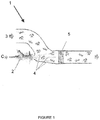
- composition C is sprayed via an injector 2 located slightly behind the flow 3 of the exhaust gases.
- the droplets of solution 4 then come to impact on the mixer 5 in order to facilitate its homogenization and the hydrolysis reaction of the urea in the flow of hot gases.
- the exhaust line is supplied with air by a hot air gun (not shown), the temperature of the gases and their flow are controlled.
- Thermocouples placed at the level of the injector, at the end of the line and near the line allow the monitoring of the thermal conditions during the test.
- Table 1 Operating conditions selected for the SCR bench Duration [h] 2.5 Air flow [L / min] 500 AdBlue ® flow rate [g / h] 60 Injector temperature [° C] 250
- the deposits were therefore collected and weighed on the “injector” and “mixer” zones of the SCR line. The total deposits collected for each test were calculated.
- the method is based on the use of a device 10 comprising a reservoir 11 (injection column) in which the product 12 is stored under pressure, a graduated cylinder 13 of 250 ml glass, a detection cell 14 of photoelectric type , a solenoid valve 15 controlling the opening and closing of the tank and a timer (not shown).
- the method consists in injecting a quantity of product 12 (100 mL) at a pressure of 400 millibars into the graduated cylinder 13.
- the detection cell 14 detects when the 100mL of product 12 initially present in the injection column 11 have emptied into the test tube 13.
- the solenoid valve 15 closes and the stopwatch is started.
- the volume of foam formed is visually identified using the graduations 16 present on the test piece 13.
- the time after which the foam has completely disappeared is also noted.
- the test is stopped after 300 seconds if foam is still present.
- Tests C1 and C2 are according to the invention.
- Tests D1 to D6 are comparative.
- Table 2 formulations produced Test No. Additive Amount of active ingredient additive (ppm) Amount of additive (ppm) Observations Ref (*) - - - Clear and limpid C1 Emulsion P 250 500 Opalescent C2 Emulsion P 500 1000 Opalescent D1 Polyaldo TM TMSH KFG (3-1-SH) 500 500 Trouble D2 Marlipal O13 / 30 ® 500 500 Clear and limpid D3 Marlipal ® (70% O13 / 120 + 30% O13 / 30) 500 500 Clear and limpid D4 Radiasurf 7157 ® 500 500 Clear and limpid D5 Radiasurf 7137 ® 500 500 Clear and limpid D6 PROPPABORT 1000 1000 Slightly cloudy (*) ADBLUE ® 32.5% aqueous urea solution
- Table 3 test results Test No. Moss disappearance time (s) Foam volume [mL] Total amount of deposits Quantity of mixer deposits Quantity of injector deposits Ref (*) 0 0 884 803 81 C1 14 30 221 136 85 C2 198 30 204 127 77 D1 > 300 40 222 174 48 D2 150 40 367 251 116 D3 > 300 68 228 77 151 D4 > 300 92 342 241 101 D5 > 300 90 463 356 107 D6 > 300 30 537 379 158
- the examples according to the invention C1 and C2 have a reduced amount of deposits compared to the reference and compared to the majority of the comparative examples (D2 to D6).
- the examples according to the invention exhibit little foaming, and this disappears rapidly, unlike the compositions of the prior art.
Landscapes
- Chemical & Material Sciences (AREA)
- Engineering & Computer Science (AREA)
- Chemical Kinetics & Catalysis (AREA)
- Combustion & Propulsion (AREA)
- Health & Medical Sciences (AREA)
- Oil, Petroleum & Natural Gas (AREA)
- General Engineering & Computer Science (AREA)
- General Chemical & Material Sciences (AREA)
- Environmental & Geological Engineering (AREA)
- Biomedical Technology (AREA)
- Toxicology (AREA)
- Mechanical Engineering (AREA)
- Analytical Chemistry (AREA)
- Cosmetics (AREA)
- Exhaust Gas Treatment By Means Of Catalyst (AREA)
- Colloid Chemistry (AREA)
- Treating Waste Gases (AREA)
- Paints Or Removers (AREA)
- Exhaust Gas After Treatment (AREA)
Priority Applications (1)
| Application Number | Priority Date | Filing Date | Title |
|---|---|---|---|
| PL16816724T PL3383522T3 (pl) | 2015-12-02 | 2016-11-28 | Kompozycja na bazie mocznika do oczyszczania gazów spalinowych |
Applications Claiming Priority (2)
| Application Number | Priority Date | Filing Date | Title |
|---|---|---|---|
| FR1561762A FR3044564B1 (fr) | 2015-12-02 | 2015-12-02 | Composition a base d’uree pour le traitement des gaz d’echappement |
| PCT/FR2016/053118 WO2017093644A1 (fr) | 2015-12-02 | 2016-11-28 | Composition a base d'uree pour le traitement des gaz d'echappement |
Publications (2)
| Publication Number | Publication Date |
|---|---|
| EP3383522A1 EP3383522A1 (fr) | 2018-10-10 |
| EP3383522B1 true EP3383522B1 (fr) | 2020-06-24 |
Family
ID=55411557
Family Applications (1)
| Application Number | Title | Priority Date | Filing Date |
|---|---|---|---|
| EP16816724.5A Active EP3383522B1 (fr) | 2015-12-02 | 2016-11-28 | Composition à base d'urée pour le traitement des gaz d'échappement |
Country Status (11)
| Country | Link |
|---|---|
| US (1) | US10399035B2 (pl) |
| EP (1) | EP3383522B1 (pl) |
| JP (1) | JP2019503843A (pl) |
| CN (1) | CN108367239A (pl) |
| BR (1) | BR112018011284A2 (pl) |
| CA (1) | CA3006335A1 (pl) |
| ES (1) | ES2815538T3 (pl) |
| FR (1) | FR3044564B1 (pl) |
| PL (1) | PL3383522T3 (pl) |
| PT (1) | PT3383522T (pl) |
| WO (1) | WO2017093644A1 (pl) |
Cited By (1)
| Publication number | Priority date | Publication date | Assignee | Title |
|---|---|---|---|---|
| US12378505B2 (en) | 2021-07-05 | 2025-08-05 | Tunap Gmbh & Co. Kg | Additive for cleaning SCR systems |
Families Citing this family (8)
| Publication number | Priority date | Publication date | Assignee | Title |
|---|---|---|---|---|
| US10267196B1 (en) | 2016-09-14 | 2019-04-23 | Southwest Research Institute | Treatment of reductant urea solutions with catalyst precursors to assist selective catalytic reduction |
| US10378411B1 (en) | 2018-01-03 | 2019-08-13 | Southwest Research Institute | Dosing method and apparatus for reductant urea solutions with catalyst precursors to assist selective catalytic reduction |
| US10774715B1 (en) | 2018-03-27 | 2020-09-15 | Southwest Research Institute | Stabilization of aqueous urea solutions containing organometallic catalyst precursors |
| US11391190B2 (en) | 2020-03-20 | 2022-07-19 | Southwest Research Institute | Combined catalyst precursor/surfactant mixture for reductant urea solution for selective catalytic reduction |
| FR3108529A1 (fr) * | 2020-03-30 | 2021-10-01 | Total Marketing Services | Utilisation d’une composition comprenant un agent réducteur, au moins une paraffine et un composé métallique pour prévenir les dépôts dans les lignes d’échappement comprenant un catalyseur SCR |
| PL243193B1 (pl) * | 2020-12-30 | 2023-07-17 | Storage Partners Spolka Z Ograniczona Odpowiedzialnoscia Spolka Komandytowa | Sposób wytwarzania preparatu wspomagającego oczyszczanie spalin z tlenków azotu, zwłaszcza spalin emitowanych przez silniki wysokoprężne |
| FR3138048A1 (fr) * | 2022-07-19 | 2024-01-26 | Totalenergies Onetech | Composition aqueuse pour le traitement des gaz d’échappement à propriétés améliorées |
| JP2025531045A (ja) * | 2022-08-30 | 2025-09-19 | トタルエナジーズ・ワンテック | 改善された特性を有する、排気ガスを処理するための水性組成物 |
Family Cites Families (10)
| Publication number | Priority date | Publication date | Assignee | Title |
|---|---|---|---|---|
| US6003303A (en) * | 1993-01-11 | 1999-12-21 | Clean Diesel Technologies, Inc. | Methods for reducing harmful emissions from a diesel engine |
| US5404841A (en) * | 1993-08-30 | 1995-04-11 | Valentine; James M. | Reduction of nitrogen oxides emissions from diesel engines |
| US5809774A (en) * | 1996-11-19 | 1998-09-22 | Clean Diesel Technologies, Inc. | System for fueling and feeding chemicals to internal combustion engines for NOx reduction |
| US20030226312A1 (en) * | 2002-06-07 | 2003-12-11 | Roos Joseph W. | Aqueous additives in hydrocarbonaceous fuel combustion systems |
| JP2007145796A (ja) * | 2005-03-17 | 2007-06-14 | Mitsui Chemicals Inc | 尿素水及びそれを用いた脱硝装置 |
| FR2912932B1 (fr) | 2007-02-23 | 2011-06-10 | Total France | Solution aqueuse pour traitement des gaz d'echappement des moteurs diesel |
| DE102008041903A1 (de) * | 2008-09-09 | 2010-03-11 | Robert Bosch Gmbh | Verfahren und Vorrichtung zur Nachbehandlung des Abgases einer Brennkraftmaschine |
| ES2439191T3 (es) | 2008-10-14 | 2014-01-21 | Yara International Asa | Procedimiento de minimización del diámetro de las gotitas de una solución de urea mediante la utilización de una mezcla de surfactantes de compuestos alcoxilados |
| SE534217E (sv) | 2009-10-16 | 2015-06-23 | Proppabort Ab | Ämne att tillsätta urealösningar |
| CN104226093A (zh) * | 2014-07-17 | 2014-12-24 | 赵根华 | 用于车用尿素溶液的复合添加剂 |
-
2015
- 2015-12-02 FR FR1561762A patent/FR3044564B1/fr active Active
-
2016
- 2016-11-28 BR BR112018011284-4A patent/BR112018011284A2/pt not_active IP Right Cessation
- 2016-11-28 CN CN201680070942.4A patent/CN108367239A/zh active Pending
- 2016-11-28 ES ES16816724T patent/ES2815538T3/es active Active
- 2016-11-28 CA CA3006335A patent/CA3006335A1/fr not_active Abandoned
- 2016-11-28 WO PCT/FR2016/053118 patent/WO2017093644A1/fr not_active Ceased
- 2016-11-28 PL PL16816724T patent/PL3383522T3/pl unknown
- 2016-11-28 EP EP16816724.5A patent/EP3383522B1/fr active Active
- 2016-11-28 JP JP2018528336A patent/JP2019503843A/ja not_active Withdrawn
- 2016-11-28 US US15/778,604 patent/US10399035B2/en not_active Expired - Fee Related
- 2016-11-28 PT PT168167245T patent/PT3383522T/pt unknown
Non-Patent Citations (1)
| Title |
|---|
| None * |
Cited By (1)
| Publication number | Priority date | Publication date | Assignee | Title |
|---|---|---|---|---|
| US12378505B2 (en) | 2021-07-05 | 2025-08-05 | Tunap Gmbh & Co. Kg | Additive for cleaning SCR systems |
Also Published As
| Publication number | Publication date |
|---|---|
| ES2815538T3 (es) | 2021-03-30 |
| CN108367239A (zh) | 2018-08-03 |
| US20180353904A1 (en) | 2018-12-13 |
| JP2019503843A (ja) | 2019-02-14 |
| PL3383522T3 (pl) | 2020-12-14 |
| PT3383522T (pt) | 2020-09-22 |
| EP3383522A1 (fr) | 2018-10-10 |
| WO2017093644A1 (fr) | 2017-06-08 |
| CA3006335A1 (fr) | 2017-06-08 |
| FR3044564A1 (fr) | 2017-06-09 |
| BR112018011284A2 (pt) | 2018-11-27 |
| FR3044564B1 (fr) | 2021-01-22 |
| US10399035B2 (en) | 2019-09-03 |
Similar Documents
| Publication | Publication Date | Title |
|---|---|---|
| EP3383522B1 (fr) | Composition à base d'urée pour le traitement des gaz d'échappement | |
| EP3600618B1 (fr) | Composition pour le traitement des gaz d'echappement | |
| EP2129452B1 (fr) | Utilisation d'une solution aqueuse dans des dispositifs scr pour le traitment des gaz d'echappement des moteurs diesel et procédé scr | |
| EP2670966B1 (fr) | Dispositif de distribution d'un additif | |
| WO2021198578A1 (fr) | Utilisation d'une composition comprenant un agent réducteur et un composé métallique pour prévenir les dépôts dans les lignes d'échappement comprenant un catalyseur scr | |
| WO2021198577A1 (fr) | Utilisation d'une composition comprenant un agent réducteur, un tensioactif et un composé métallique pour prévenir les dépôts dans les lignes d'échappement comprenant un catalyseur scr | |
| EP4309768B1 (fr) | Composition aqueuse pour le traitement des gaz d'échappement à propriétés améliorées | |
| WO2021198580A1 (fr) | Utilisation d'une composition comprenant un agent réducteur, au moins une paraffine et un composé métallique pour prévenir les dépôts dans les lignes d'échappement comprenant un catalyseur scr | |
| EP4373603B1 (fr) | Composition aqueuse pour le traitement des gaz d'échappement à propriétés anti-mousse améliorées | |
| EP3374062A1 (fr) | Fluide pour la depollution des moteurs thermiques et modes de preparation desdits fluides par emulsification | |
| EP4580783A1 (fr) | Composition aqueuse pour le traitement des gaz d'échappement à propriétés améliorées | |
| WO2022269168A1 (fr) | Méthode de détection de la présence d'un additif dans une composition de traitement des gaz d'échappement | |
| CN106635202A (zh) | 一种提高家具运输车辆汽油燃烧率的添加剂及其使用方法 | |
| EP2954031A1 (fr) | Utilisation d'une composition pour ameliorer la pulverisation des injecteurs d'un moteur a combustion |
Legal Events
| Date | Code | Title | Description |
|---|---|---|---|
| STAA | Information on the status of an ep patent application or granted ep patent |
Free format text: STATUS: UNKNOWN |
|
| STAA | Information on the status of an ep patent application or granted ep patent |
Free format text: STATUS: THE INTERNATIONAL PUBLICATION HAS BEEN MADE |
|
| PUAI | Public reference made under article 153(3) epc to a published international application that has entered the european phase |
Free format text: ORIGINAL CODE: 0009012 |
|
| STAA | Information on the status of an ep patent application or granted ep patent |
Free format text: STATUS: REQUEST FOR EXAMINATION WAS MADE |
|
| 17P | Request for examination filed |
Effective date: 20180604 |
|
| AK | Designated contracting states |
Kind code of ref document: A1 Designated state(s): AL AT BE BG CH CY CZ DE DK EE ES FI FR GB GR HR HU IE IS IT LI LT LU LV MC MK MT NL NO PL PT RO RS SE SI SK SM TR |
|
| AX | Request for extension of the european patent |
Extension state: BA ME |
|
| DAV | Request for validation of the european patent (deleted) | ||
| DAX | Request for extension of the european patent (deleted) | ||
| STAA | Information on the status of an ep patent application or granted ep patent |
Free format text: STATUS: EXAMINATION IS IN PROGRESS |
|
| 17Q | First examination report despatched |
Effective date: 20190521 |
|
| GRAP | Despatch of communication of intention to grant a patent |
Free format text: ORIGINAL CODE: EPIDOSNIGR1 |
|
| STAA | Information on the status of an ep patent application or granted ep patent |
Free format text: STATUS: GRANT OF PATENT IS INTENDED |
|
| INTG | Intention to grant announced |
Effective date: 20200318 |
|
| GRAS | Grant fee paid |
Free format text: ORIGINAL CODE: EPIDOSNIGR3 |
|
| GRAA | (expected) grant |
Free format text: ORIGINAL CODE: 0009210 |
|
| STAA | Information on the status of an ep patent application or granted ep patent |
Free format text: STATUS: THE PATENT HAS BEEN GRANTED |
|
| AK | Designated contracting states |
Kind code of ref document: B1 Designated state(s): AL AT BE BG CH CY CZ DE DK EE ES FI FR GB GR HR HU IE IS IT LI LT LU LV MC MK MT NL NO PL PT RO RS SE SI SK SM TR |
|
| REG | Reference to a national code |
Ref country code: GB Ref legal event code: FG4D Free format text: NOT ENGLISH |
|
| REG | Reference to a national code |
Ref country code: CH Ref legal event code: EP |
|
| REG | Reference to a national code |
Ref country code: AT Ref legal event code: REF Ref document number: 1283338 Country of ref document: AT Kind code of ref document: T Effective date: 20200715 |
|
| REG | Reference to a national code |
Ref country code: DE Ref legal event code: R096 Ref document number: 602016038841 Country of ref document: DE |
|
| REG | Reference to a national code |
Ref country code: IE Ref legal event code: FG4D Free format text: LANGUAGE OF EP DOCUMENT: FRENCH |
|
| REG | Reference to a national code |
Ref country code: CH Ref legal event code: NV Representative=s name: DENNEMEYER AG, CH |
|
| REG | Reference to a national code |
Ref country code: NL Ref legal event code: FP |
|
| REG | Reference to a national code |
Ref country code: PT Ref legal event code: SC4A Ref document number: 3383522 Country of ref document: PT Date of ref document: 20200922 Kind code of ref document: T Free format text: AVAILABILITY OF NATIONAL TRANSLATION Effective date: 20200915 |
|
| PG25 | Lapsed in a contracting state [announced via postgrant information from national office to epo] |
Ref country code: SE Free format text: LAPSE BECAUSE OF FAILURE TO SUBMIT A TRANSLATION OF THE DESCRIPTION OR TO PAY THE FEE WITHIN THE PRESCRIBED TIME-LIMIT Effective date: 20200624 Ref country code: LT Free format text: LAPSE BECAUSE OF FAILURE TO SUBMIT A TRANSLATION OF THE DESCRIPTION OR TO PAY THE FEE WITHIN THE PRESCRIBED TIME-LIMIT Effective date: 20200624 Ref country code: FI Free format text: LAPSE BECAUSE OF FAILURE TO SUBMIT A TRANSLATION OF THE DESCRIPTION OR TO PAY THE FEE WITHIN THE PRESCRIBED TIME-LIMIT Effective date: 20200624 Ref country code: NO Free format text: LAPSE BECAUSE OF FAILURE TO SUBMIT A TRANSLATION OF THE DESCRIPTION OR TO PAY THE FEE WITHIN THE PRESCRIBED TIME-LIMIT Effective date: 20200924 Ref country code: GR Free format text: LAPSE BECAUSE OF FAILURE TO SUBMIT A TRANSLATION OF THE DESCRIPTION OR TO PAY THE FEE WITHIN THE PRESCRIBED TIME-LIMIT Effective date: 20200925 |
|
| REG | Reference to a national code |
Ref country code: LT Ref legal event code: MG4D |
|
| PG25 | Lapsed in a contracting state [announced via postgrant information from national office to epo] |
Ref country code: LV Free format text: LAPSE BECAUSE OF FAILURE TO SUBMIT A TRANSLATION OF THE DESCRIPTION OR TO PAY THE FEE WITHIN THE PRESCRIBED TIME-LIMIT Effective date: 20200624 Ref country code: RS Free format text: LAPSE BECAUSE OF FAILURE TO SUBMIT A TRANSLATION OF THE DESCRIPTION OR TO PAY THE FEE WITHIN THE PRESCRIBED TIME-LIMIT Effective date: 20200624 Ref country code: BG Free format text: LAPSE BECAUSE OF FAILURE TO SUBMIT A TRANSLATION OF THE DESCRIPTION OR TO PAY THE FEE WITHIN THE PRESCRIBED TIME-LIMIT Effective date: 20200924 Ref country code: HR Free format text: LAPSE BECAUSE OF FAILURE TO SUBMIT A TRANSLATION OF THE DESCRIPTION OR TO PAY THE FEE WITHIN THE PRESCRIBED TIME-LIMIT Effective date: 20200624 |
|
| REG | Reference to a national code |
Ref country code: AT Ref legal event code: MK05 Ref document number: 1283338 Country of ref document: AT Kind code of ref document: T Effective date: 20200624 |
|
| PG25 | Lapsed in a contracting state [announced via postgrant information from national office to epo] |
Ref country code: AL Free format text: LAPSE BECAUSE OF FAILURE TO SUBMIT A TRANSLATION OF THE DESCRIPTION OR TO PAY THE FEE WITHIN THE PRESCRIBED TIME-LIMIT Effective date: 20200624 |
|
| PG25 | Lapsed in a contracting state [announced via postgrant information from national office to epo] |
Ref country code: RO Free format text: LAPSE BECAUSE OF FAILURE TO SUBMIT A TRANSLATION OF THE DESCRIPTION OR TO PAY THE FEE WITHIN THE PRESCRIBED TIME-LIMIT Effective date: 20200624 Ref country code: CZ Free format text: LAPSE BECAUSE OF FAILURE TO SUBMIT A TRANSLATION OF THE DESCRIPTION OR TO PAY THE FEE WITHIN THE PRESCRIBED TIME-LIMIT Effective date: 20200624 Ref country code: EE Free format text: LAPSE BECAUSE OF FAILURE TO SUBMIT A TRANSLATION OF THE DESCRIPTION OR TO PAY THE FEE WITHIN THE PRESCRIBED TIME-LIMIT Effective date: 20200624 Ref country code: SM Free format text: LAPSE BECAUSE OF FAILURE TO SUBMIT A TRANSLATION OF THE DESCRIPTION OR TO PAY THE FEE WITHIN THE PRESCRIBED TIME-LIMIT Effective date: 20200624 Ref country code: AT Free format text: LAPSE BECAUSE OF FAILURE TO SUBMIT A TRANSLATION OF THE DESCRIPTION OR TO PAY THE FEE WITHIN THE PRESCRIBED TIME-LIMIT Effective date: 20200624 |
|
| PG25 | Lapsed in a contracting state [announced via postgrant information from national office to epo] |
Ref country code: SK Free format text: LAPSE BECAUSE OF FAILURE TO SUBMIT A TRANSLATION OF THE DESCRIPTION OR TO PAY THE FEE WITHIN THE PRESCRIBED TIME-LIMIT Effective date: 20200624 Ref country code: IS Free format text: LAPSE BECAUSE OF FAILURE TO SUBMIT A TRANSLATION OF THE DESCRIPTION OR TO PAY THE FEE WITHIN THE PRESCRIBED TIME-LIMIT Effective date: 20201024 |
|
| REG | Reference to a national code |
Ref country code: DE Ref legal event code: R097 Ref document number: 602016038841 Country of ref document: DE |
|
| REG | Reference to a national code |
Ref country code: ES Ref legal event code: FG2A Ref document number: 2815538 Country of ref document: ES Kind code of ref document: T3 Effective date: 20210330 |
|
| PG25 | Lapsed in a contracting state [announced via postgrant information from national office to epo] |
Ref country code: DK Free format text: LAPSE BECAUSE OF FAILURE TO SUBMIT A TRANSLATION OF THE DESCRIPTION OR TO PAY THE FEE WITHIN THE PRESCRIBED TIME-LIMIT Effective date: 20200624 |
|
| PLBE | No opposition filed within time limit |
Free format text: ORIGINAL CODE: 0009261 |
|
| STAA | Information on the status of an ep patent application or granted ep patent |
Free format text: STATUS: NO OPPOSITION FILED WITHIN TIME LIMIT |
|
| 26N | No opposition filed |
Effective date: 20210325 |
|
| PG25 | Lapsed in a contracting state [announced via postgrant information from national office to epo] |
Ref country code: MC Free format text: LAPSE BECAUSE OF FAILURE TO SUBMIT A TRANSLATION OF THE DESCRIPTION OR TO PAY THE FEE WITHIN THE PRESCRIBED TIME-LIMIT Effective date: 20200624 |
|
| PG25 | Lapsed in a contracting state [announced via postgrant information from national office to epo] |
Ref country code: LU Free format text: LAPSE BECAUSE OF NON-PAYMENT OF DUE FEES Effective date: 20201128 |
|
| PG25 | Lapsed in a contracting state [announced via postgrant information from national office to epo] |
Ref country code: SI Free format text: LAPSE BECAUSE OF FAILURE TO SUBMIT A TRANSLATION OF THE DESCRIPTION OR TO PAY THE FEE WITHIN THE PRESCRIBED TIME-LIMIT Effective date: 20200624 |
|
| PG25 | Lapsed in a contracting state [announced via postgrant information from national office to epo] |
Ref country code: IE Free format text: LAPSE BECAUSE OF NON-PAYMENT OF DUE FEES Effective date: 20201128 |
|
| PG25 | Lapsed in a contracting state [announced via postgrant information from national office to epo] |
Ref country code: TR Free format text: LAPSE BECAUSE OF FAILURE TO SUBMIT A TRANSLATION OF THE DESCRIPTION OR TO PAY THE FEE WITHIN THE PRESCRIBED TIME-LIMIT Effective date: 20200624 Ref country code: MT Free format text: LAPSE BECAUSE OF FAILURE TO SUBMIT A TRANSLATION OF THE DESCRIPTION OR TO PAY THE FEE WITHIN THE PRESCRIBED TIME-LIMIT Effective date: 20200624 Ref country code: CY Free format text: LAPSE BECAUSE OF FAILURE TO SUBMIT A TRANSLATION OF THE DESCRIPTION OR TO PAY THE FEE WITHIN THE PRESCRIBED TIME-LIMIT Effective date: 20200624 |
|
| PG25 | Lapsed in a contracting state [announced via postgrant information from national office to epo] |
Ref country code: MK Free format text: LAPSE BECAUSE OF FAILURE TO SUBMIT A TRANSLATION OF THE DESCRIPTION OR TO PAY THE FEE WITHIN THE PRESCRIBED TIME-LIMIT Effective date: 20200624 |
|
| PG25 | Lapsed in a contracting state [announced via postgrant information from national office to epo] |
Ref country code: PL Free format text: LAPSE BECAUSE OF NON-PAYMENT OF DUE FEES Effective date: 20201128 |
|
| P01 | Opt-out of the competence of the unified patent court (upc) registered |
Effective date: 20230523 |
|
| PGFP | Annual fee paid to national office [announced via postgrant information from national office to epo] |
Ref country code: NL Payment date: 20231120 Year of fee payment: 8 |
|
| PGFP | Annual fee paid to national office [announced via postgrant information from national office to epo] |
Ref country code: GB Payment date: 20231123 Year of fee payment: 8 |
|
| PGFP | Annual fee paid to national office [announced via postgrant information from national office to epo] |
Ref country code: PT Payment date: 20231116 Year of fee payment: 8 Ref country code: IT Payment date: 20231124 Year of fee payment: 8 Ref country code: FR Payment date: 20231120 Year of fee payment: 8 Ref country code: DE Payment date: 20231121 Year of fee payment: 8 Ref country code: CH Payment date: 20231202 Year of fee payment: 8 |
|
| PGFP | Annual fee paid to national office [announced via postgrant information from national office to epo] |
Ref country code: BE Payment date: 20231120 Year of fee payment: 8 |
|
| PGFP | Annual fee paid to national office [announced via postgrant information from national office to epo] |
Ref country code: ES Payment date: 20240129 Year of fee payment: 8 |
|
| REG | Reference to a national code |
Ref country code: DE Ref legal event code: R119 Ref document number: 602016038841 Country of ref document: DE |
|
| REG | Reference to a national code |
Ref country code: CH Ref legal event code: PL |
|
| REG | Reference to a national code |
Ref country code: NL Ref legal event code: MM Effective date: 20241201 |
|
| REG | Reference to a national code |
Ref country code: CH Ref legal event code: PL |
|
| PG25 | Lapsed in a contracting state [announced via postgrant information from national office to epo] |
Ref country code: PT Free format text: LAPSE BECAUSE OF NON-PAYMENT OF DUE FEES Effective date: 20250528 |
|
| GBPC | Gb: european patent ceased through non-payment of renewal fee |
Effective date: 20241128 |
|
| PG25 | Lapsed in a contracting state [announced via postgrant information from national office to epo] |
Ref country code: CH Free format text: LAPSE BECAUSE OF NON-PAYMENT OF DUE FEES Effective date: 20241130 |
|
| PG25 | Lapsed in a contracting state [announced via postgrant information from national office to epo] |
Ref country code: NL Free format text: LAPSE BECAUSE OF NON-PAYMENT OF DUE FEES Effective date: 20241201 |
|
| REG | Reference to a national code |
Ref country code: BE Ref legal event code: MM Effective date: 20241130 |
|
| PG25 | Lapsed in a contracting state [announced via postgrant information from national office to epo] |
Ref country code: DE Free format text: LAPSE BECAUSE OF NON-PAYMENT OF DUE FEES Effective date: 20250603 |
|
| PG25 | Lapsed in a contracting state [announced via postgrant information from national office to epo] |
Ref country code: IT Free format text: LAPSE BECAUSE OF NON-PAYMENT OF DUE FEES Effective date: 20241128 |
|
| PG25 | Lapsed in a contracting state [announced via postgrant information from national office to epo] |
Ref country code: GB Free format text: LAPSE BECAUSE OF NON-PAYMENT OF DUE FEES Effective date: 20241128 Ref country code: BE Free format text: LAPSE BECAUSE OF NON-PAYMENT OF DUE FEES Effective date: 20241130 |
|
| PG25 | Lapsed in a contracting state [announced via postgrant information from national office to epo] |
Ref country code: FR Free format text: LAPSE BECAUSE OF NON-PAYMENT OF DUE FEES Effective date: 20241130 |
|
| REG | Reference to a national code |
Ref country code: ES Ref legal event code: FD2A Effective date: 20260107 |
|
| PG25 | Lapsed in a contracting state [announced via postgrant information from national office to epo] |
Ref country code: ES Free format text: LAPSE BECAUSE OF NON-PAYMENT OF DUE FEES Effective date: 20241129 |