EP3381635A1 - Hopper assembly - Google Patents
Hopper assembly Download PDFInfo
- Publication number
- EP3381635A1 EP3381635A1 EP18163910.5A EP18163910A EP3381635A1 EP 3381635 A1 EP3381635 A1 EP 3381635A1 EP 18163910 A EP18163910 A EP 18163910A EP 3381635 A1 EP3381635 A1 EP 3381635A1
- Authority
- EP
- European Patent Office
- Prior art keywords
- hopper
- assembly
- vehicle
- configuration
- coupled
- Prior art date
- Legal status (The legal status is an assumption and is not a legal conclusion. Google has not performed a legal analysis and makes no representation as to the accuracy of the status listed.)
- Withdrawn
Links
- 239000000463 material Substances 0.000 claims abstract description 9
- 238000005406 washing Methods 0.000 description 12
- 239000004615 ingredient Substances 0.000 description 6
- 230000036541 health Effects 0.000 description 4
- XLYOFNOQVPJJNP-UHFFFAOYSA-N water Substances O XLYOFNOQVPJJNP-UHFFFAOYSA-N 0.000 description 4
- 230000007246 mechanism Effects 0.000 description 3
- 230000000712 assembly Effects 0.000 description 1
- 238000000429 assembly Methods 0.000 description 1
- 230000008901 benefit Effects 0.000 description 1
- 238000004140 cleaning Methods 0.000 description 1
- 230000001010 compromised effect Effects 0.000 description 1
- 238000013016 damping Methods 0.000 description 1
- 239000000446 fuel Substances 0.000 description 1
- 230000005484 gravity Effects 0.000 description 1
- 231100001261 hazardous Toxicity 0.000 description 1
- 238000007689 inspection Methods 0.000 description 1
- 238000012423 maintenance Methods 0.000 description 1
- 230000000116 mitigating effect Effects 0.000 description 1
- 238000012986 modification Methods 0.000 description 1
- 230000004048 modification Effects 0.000 description 1
- 230000008439 repair process Effects 0.000 description 1
Images



Classifications
-
- B—PERFORMING OPERATIONS; TRANSPORTING
- B28—WORKING CEMENT, CLAY, OR STONE
- B28C—PREPARING CLAY; PRODUCING MIXTURES CONTAINING CLAY OR CEMENTITIOUS MATERIAL, e.g. PLASTER
- B28C5/00—Apparatus or methods for producing mixtures of cement with other substances, e.g. slurries, mortars, porous or fibrous compositions
- B28C5/42—Apparatus specially adapted for being mounted on vehicles with provision for mixing during transport
- B28C5/4203—Details; Accessories
- B28C5/4234—Charge or discharge systems therefor
- B28C5/4237—Charging, e.g. hoppers
-
- B—PERFORMING OPERATIONS; TRANSPORTING
- B28—WORKING CEMENT, CLAY, OR STONE
- B28C—PREPARING CLAY; PRODUCING MIXTURES CONTAINING CLAY OR CEMENTITIOUS MATERIAL, e.g. PLASTER
- B28C7/00—Controlling the operation of apparatus for producing mixtures of clay or cement with other substances; Supplying or proportioning the ingredients for mixing clay or cement with other substances; Discharging the mixture
- B28C7/04—Supplying or proportioning the ingredients
- B28C7/06—Supplying the solid ingredients, e.g. by means of endless conveyors or jigging conveyors
- B28C7/068—Supplying the solid ingredients, e.g. by means of endless conveyors or jigging conveyors having means to elevate or hoist a charging-bin or container
-
- B—PERFORMING OPERATIONS; TRANSPORTING
- B60—VEHICLES IN GENERAL
- B60P—VEHICLES ADAPTED FOR LOAD TRANSPORTATION OR TO TRANSPORT, TO CARRY, OR TO COMPRISE SPECIAL LOADS OR OBJECTS
- B60P3/00—Vehicles adapted to transport, to carry or to comprise special loads or objects
- B60P3/16—Vehicles adapted to transport, to carry or to comprise special loads or objects for carrying mixed concrete, e.g. having rotatable drums
Definitions
- This invention relates generally to a hopper assembly, particularly but not necessarily exclusively suitable for a vehicle such as a concrete mixer truck or the like, and also to such a vehicle including a hopper assembly.
- a typical transit mixing vehicle such as concrete mixer truck, comprises a drum mounted for rotation about an inclined axis and an opening at the raised end which serves to receive ingredients to be mixed and to discharge the mixed material during a pour operation.
- the drum is typically provided with internal mixing blades that move the ingredients toward the lower end of the drum for mixing as the drum is rotated in a first direction, and which move the mixed material upward for discharge when the drum is rotated in the opposite direction.
- a charge hopper is mounted, externally and adjacent, in relation to the drum opening, and is used to feed ingredients into the drum for mixing.
- a chute may also be provided for facilitating discharge of mixed material (e.g. concrete) from the drum for use.
- a hopper assembly for a transit mixing vehicle, the hopper assembly comprising a charge hopper shaped and configured to, in an operable orientation, receive therein and discharge therefrom material, a mounting assembly coupled at one end to the charge hopper and mountable for use at an opposing end to said vehicle for movement, in use, between a first configuration in which said charge hopper is adjacent a drum opening at an upper region of said vehicle and in said operable orientation, and a second configuration in which said charge hopper is in a vertically lower position relative to said drum opening and accessible at ground level.
- the term "accessible at ground level” is intended to refer to height above ground level that enables an average operative to access the hopper to clean it without needing any form of ladder or step to reach it. It is thought that this "height" between the lowermost point of the hopper in the second configuration and the ground would be between 1.5 (or a little less) and 2m (or a little more).
- said mounting assembly may be configured, during movement thereof from said first configuration to said second configuration, to rotate said charge hopper from said first orientation to a second orientation.
- the longitudinal axis of said charge hopper may be substantially vertical, when the hopper assembly is mounted to a vehicle and the vehicle is oriented for use.
- the mounting assembly may comprise a link arm, coupled at one end to said charge hopper and configured to be pivotally mounted to said vehicle at an opposing end, and further comprising drive means configured to be coupled to said link arm for moving, in use, said link arm between said first and second configurations.
- the path of movement of said mounting assembly between said first and second configurations may, advantageously, be substantially arcuate (outwardly and rearwardly relative to the vehicle on which it is mounted), such that there is sufficient clearance between the rear components of the vehicle and the hopper assembly during movement thereof between the first and second configurations.
- a transit mixing vehicle comprising a drum mounted on a support assembly for rotation about an inclined axis and having an opening at an upper end thereof, and further comprising a hopper assembly substantially as described above, wherein said mounting assembly is coupled at its said opposing end to said support assembly and, wherein, in said first configuration, said charge hopper is located adjacent to said drum opening and in said first orientation.
- the mounting assembly may comprise a link arm, said charge hopper being coupled to an upper end of said link arm and an opposing lower end of said link arm being pivotally mounted to said support assembly for pivotal movement between said first and second configurations.
- the charge hopper may be fixedly mounted on a substantially horizontal support arm and an upper end of a respective link arm is coupled at each end of said support arm, wherein an opposing lower end of each link arm is pivotally mounted at a pivot point to a respective side of said support assembly.
- Drive means may be coupled to at least one of said link arms and configured to selectively move said link arms between said first and second configurations.
- Such drive means may be connected to at least one of said link arms, at said pivot point, via a lever arm, and wherein said drive means is configured to cause linear movement of said lever arm and linear movement of said lever arm causes rotational movement of said link arm.
- the lever arm may be generally arcuate.
- a transit mixing vehicle arrangement that comprises a chassis 10 on which is mounted a support assembly (indicated generally at 12).
- a drum 14 is mounted for rotation about an inclined axis, with the upper portion thereof carried on the support assembly 12, and an opening 16 (referred to hereinafter as the drum mouth) on the raised end which serves to receive ingredients to be mixed and to discharge the mixed material during a pour operation.
- the drum 14 is typically provided with internal mixing blades (which cannot be seen in the views of Figures 1 to 6 ), that move the ingredients toward the lower end of the drum 14 for mixing as the drum is rotated in a first direction, and which move the mixed material upward for discharge when the drum is rotated in the opposite direction.
- a charge hopper 18 is mounted in relation to the drum opening 16, and is used to feed ingredients into the drum for mixing.
- a chute 20 is also provided for facilitating discharge of mixed material (e.g. concrete) from the drum 14 for use, the chute 20 being mounted on the support assembly 12 and fixed at a location below the drum mouth 16.
- a ladder assembly In a conventional transit mixing vehicle, a ladder assembly would be provided, typically vertically along the side of, and mounted to, the support assembly 12, with a work platform provided at the upper end thereof and located adjacent to the drum opening 16.
- the ladder/work platform assembly is conventionally deemed to be an essential element of a transit mixing vehicle, as the operative is required to repeatedly and routinely perform a number of tasks that include washing off the charge hopper and back blades of the mixer after loading, washing off the drum mouth and discharge hopper after concrete delivery, and estimating the slump of the concrete in the drum.
- the washing tasks described above are typically performed by an operative, standing on the above-described work platform at the top of the ladder and directing water from a hose, as required, onto the areas to be washed.
- the hopper 18 is typically fixed in an operable configuration adjacent the drum mouth 16, i.e. in the general position illustrated in Figure 1 and at a significant height above ground level with the inner surfaces thereof facing inward toward the drum mouth 16, such that the drum mouth and back blades are (at least partially) blocked thereby.
- the back blades and drum mouth are known to be the most difficult to keep clean, at least partially for these reasons, and yet they also have the biggest influence on discharge performance.
- the charge hopper 18 is clamped, at its lower surface (when oriented for use) to a substantially horizontal bar 22.
- a respective link arm 24 is fixedly coupled at one end to each end of the horizontal bar 22.
- the opposite end of each link arm 24 is pivotally coupled, at a pivot point 26, to the support assembly 12.
- a respective ram 26, or other linear drive means, is provided on each side of the support assembly 12, each ram 27 comprising a piston cylinder 28 and a piston rod assembly 30.
- the piston cylinder 28 of each ram 27 is mounted on a respective side of the support assembly 12, with the distal end of each piston rod 30 coupled to a respective link arm 24.
- the charge hopper 18 is located, for use, within the drum mouth 16, adjacent the uppermost region of the vehicle, and the piston rod 30 of each ram 26 is fully extended.
- the rams 27 (which may, for example, be pneumatic or hydraulic) are operated to retract the respective piston rods 30.
- Each piston rod 30 is coupled to a respective link arm 24.
- each piston rod 30 is coupled, at the respective pivot point 26, to a respective link arm 24 by means of a curved lever arm 32, fixedly connected between the distal end of the piston rod 30 and the link arm 24 at the pivot point 26.
- the respective lever arm 32 operates as a lever to the respective link arm 24 such that, as it is pulled linearly rearward, it causes the link arm 24 to rotate 'downwardly' to lower the hopper 18.
- the shape and configuration of the lever arm 32 thus ensures that the outward/rearward curvature of the downward movement of the hopper 18 relative to the rear components of the vehicle is such that there is sufficient clearance therebetween, whereas the pivotal operation of the link arm 24 additionally causes the orientation of the hopper 18 to be rotated through over 90°.
- the inner surfaces of the hopper 18 are outwardly/rearwardly facing so that they are fully accessible (from ground level) for quick and effective washing thereof.
- the drum mouth 16 is fully open and unobstructed, and can be effectively and adequately washed, from ground level, by directing water from a hose pipe, upwardly, into and around it.
- the slump of concrete in the drum 14 is estimated by an operative viewing the inside of the drum from a conventional work platform located at roughly the same height as, and adjacent to, the drum mouth 16.
- a conventional work platform located at roughly the same height as, and adjacent to, the drum mouth 16.
- Such a view could equally be obtained from one or more cameras mounted at a suitable location, externally of and adjacent the drum mouth 16.
- the operation of the present invention is such that, when the hopper assembly is in the 'open', lowered configuration, an unobstructed view into the drum from the drum mouth is afforded and can be utilised in this manner.
- aspects of the present invention can be used to eliminate altogether the need for a ladder/work platform assembly on a transit mixing vehicle, or at least significantly reduce the need for its routine and repeated us, thus mitigating the health and safety risks associated with working at height and, potentially, reducing the overall weight of the vehicle, with clear advantage in terms of efficiency and economy.
- washing processes performed in respect of a transit mixing vehicle having a hopper assembly according to an exemplary embodiment of the present invention are more effective and thorough, as well as quicker, due to the ease of access to the regions required to be washed.
- the means for causing movement of the hopper assembly from the closed or operable configuration to the open or lowered configuration is not necessarily limited to a ram assembly.
- Other suitable linear drive means will be apparent to a person skilled in the art. Indeed, such drive means need not necessarily be powered: for example, a manual (or electronic) locking mechanism may be provided to lock the assembly in the closed configuration and which, when released, allows the hopper assembly to 'fall' under gravity to the open configuration. Damping means may be provided to control the rate at which the assembly moves from the closed to the open configuration.
- a mechanical lever may be provided to enable the hopper assembly to be returned to the closed configuration, as required.
- the present invention is not necessarily limited in relation to the specific configuration of the link and lever arms, and other suitable configurations will be readily apparent to a person skilled in the art, that will facilitate movement of the hopper assembly along a path that provides suitable clearance between it and the components at the rear of the vehicle between the closed and open configurations.
- the present invention is not necessarily intended to be limited in relation to the additional feature whereby the orientation of the hopper itself is rotated from the operable position to a position in which its inner surfaces are outward/rearward facing. In some exemplary embodiments, at least, it may be adequate to simply lower the hopper to a location that is accessible from ground level and wherein there is sufficient clearance between the inner surfaces thereof and the rear components of the vehicle to enable an operative to direct water where it is required.
Landscapes
- Engineering & Computer Science (AREA)
- Mechanical Engineering (AREA)
- Structural Engineering (AREA)
- Chemical & Material Sciences (AREA)
- Dispersion Chemistry (AREA)
- Preparation Of Clay, And Manufacture Of Mixtures Containing Clay Or Cement (AREA)
Abstract
This invention relates to a hopper assembly for a transit mixing vehicle, the hopper assembly comprising a charge hopper (18) shaped and configured to, in an operable orientation, receive therein and discharge therefrom material, a mounting assembly (24) coupled at one end to the charge hopper (18) and mountable for use at an opposing end to said vehicle for movement, in use, between a first configuration in which said charge hopper (18) is adjacent a drum opening (16) at an upper region of said vehicle and in said operable orientation, and a second configuration in which said charge hopper (18) is in a vertically lower position relative to said drum opening (16) and accessible at ground level.
Description
- This invention relates generally to a hopper assembly, particularly but not necessarily exclusively suitable for a vehicle such as a concrete mixer truck or the like, and also to such a vehicle including a hopper assembly.
- A typical transit mixing vehicle, such as concrete mixer truck, comprises a drum mounted for rotation about an inclined axis and an opening at the raised end which serves to receive ingredients to be mixed and to discharge the mixed material during a pour operation. The drum is typically provided with internal mixing blades that move the ingredients toward the lower end of the drum for mixing as the drum is rotated in a first direction, and which move the mixed material upward for discharge when the drum is rotated in the opposite direction. A charge hopper is mounted, externally and adjacent, in relation to the drum opening, and is used to feed ingredients into the drum for mixing. A chute may also be provided for facilitating discharge of mixed material (e.g. concrete) from the drum for use.
- There is a frequent need for an operative to access the uppermost regions of the truck in order to observe, repair, maintain and service components such as the chute, charge hopper and mixing blades mentioned above. Indeed, there is a repeated need for such access for the purposes of (at least):
- Washing off the charge hopper and back blades of the mixer after loading;
- Washing off the drum mouth and discharge hopper after concrete delivery; and
- Estimating the slump of the concrete in the drum.
- However, there are a number of issues associated with such ladder assemblies. Firstly, they tend to be provided in (at least) two parts, namely an upper part and a lower part, wherein the lower part is configured for movement relative to the upper part between a raised (stowed) configuration, for transit, and a lowered (operable) configuration, for use. The raising and lowering operations inevitably introduce a risk of the operative (or someone else) trapping their fingers in the mechanism between the two ladder parts and injuring themselves. Also, any impact or debris to which the mounting mechanism is subjected can result in it being damaged, or otherwise compromised, thus preventing effective deployment or stowing of the ladder.
- Furthermore, there is always a significant health and safety risk associated with the need to work at heights, and also the existence of the ladder offers a temptation to operatives seeking (unauthorised) entry to, and egress from, the drum for the purposes of inspection, maintenance and cleaning, which is considered to be exceptionally dangerous and thus actively discouraged.
- Still further, the need to provide a ladder assembly for the purposes described above (and others) adds significant weight to the overall vehicle, which is clearly undesirable, particularly from the point of view of efficiency and economy.
- Thus, and more generally, there is an ongoing desire and endeavour in the field of transit mixing vehicle and the like, to a) mitigate potentially hazardous operations and improve health and safety conditions for both operatives and others, and b) improve the overall efficiency and economy of transit mixing vehicles; and aspects of the present invention seek to address at least some of the issues described above.
- In accordance with a first aspect of the present invention, there is provided a hopper assembly for a transit mixing vehicle, the hopper assembly comprising a charge hopper shaped and configured to, in an operable orientation, receive therein and discharge therefrom material, a mounting assembly coupled at one end to the charge hopper and mountable for use at an opposing end to said vehicle for movement, in use, between a first configuration in which said charge hopper is adjacent a drum opening at an upper region of said vehicle and in said operable orientation, and a second configuration in which said charge hopper is in a vertically lower position relative to said drum opening and accessible at ground level.
It will be appreciated that the term "accessible at ground level" is intended to refer to height above ground level that enables an average operative to access the hopper to clean it without needing any form of ladder or step to reach it. It is thought that this "height" between the lowermost point of the hopper in the second configuration and the ground would be between 1.5 (or a little less) and 2m (or a little more). - In an exemplary embodiment, said mounting assembly may be configured, during movement thereof from said first configuration to said second configuration, to rotate said charge hopper from said first orientation to a second orientation. Optionally, in said second orientation, the longitudinal axis of said charge hopper may be substantially vertical, when the hopper assembly is mounted to a vehicle and the vehicle is oriented for use.
- The mounting assembly may comprise a link arm, coupled at one end to said charge hopper and configured to be pivotally mounted to said vehicle at an opposing end, and further comprising drive means configured to be coupled to said link arm for moving, in use, said link arm between said first and second configurations.
- The path of movement of said mounting assembly between said first and second configurations may, advantageously, be substantially arcuate (outwardly and rearwardly relative to the vehicle on which it is mounted), such that there is sufficient clearance between the rear components of the vehicle and the hopper assembly during movement thereof between the first and second configurations.
- In accordance with a second exemplary embodiment of the present invention, there is provided a transit mixing vehicle comprising a drum mounted on a support assembly for rotation about an inclined axis and having an opening at an upper end thereof, and further comprising a hopper assembly substantially as described above, wherein said mounting assembly is coupled at its said opposing end to said support assembly and, wherein, in said first configuration, said charge hopper is located adjacent to said drum opening and in said first orientation.
- In an exemplary embodiment of the invention, the mounting assembly may comprise a link arm, said charge hopper being coupled to an upper end of said link arm and an opposing lower end of said link arm being pivotally mounted to said support assembly for pivotal movement between said first and second configurations. The charge hopper may be fixedly mounted on a substantially horizontal support arm and an upper end of a respective link arm is coupled at each end of said support arm, wherein an opposing lower end of each link arm is pivotally mounted at a pivot point to a respective side of said support assembly.
- Drive means may be coupled to at least one of said link arms and configured to selectively move said link arms between said first and second configurations. Such drive means may be connected to at least one of said link arms, at said pivot point, via a lever arm, and wherein said drive means is configured to cause linear movement of said lever arm and linear movement of said lever arm causes rotational movement of said link arm. The lever arm may be generally arcuate.
- These, and other, aspects of the present invention will be apparent from the following specific description, in which embodiments of the present invention are described, by way of examples only, and with reference to the accompanying drawings, in which:
-
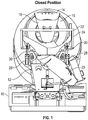
Figure 1 is a schematic rear view of a transit mixing vehicle according to an exemplary embodiment of the present invention, with the hopper assembly in the closed or operable configuration; -
Figure 2 is a schematic partial perspective view of the vehicle ofFigure 1 ; -
Figure 3 is a schematic partial side view of the vehicle ofFigure 1 ; -
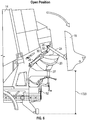
Figure 4 is a schematic rear view of a transit mixing vehicle according to an exemplary embodiment of the present invention, with the hopper assembly in the open or lowered configuration; -
Figure 5 is a schematic partial perspective view of the vehicle ofFigure 4 ; -
Figure 6 is a schematic partial side view of the vehicle ofFigure 4 ; and -
Figure 7 is a schematic perspective view of a transit mixer assembly according to an exemplary embodiment of the present invention, with the hopper in the open, lowered configuration. - Referring to
Figure 1 of the drawings, a transit mixing vehicle arrangement is illustrated, that comprises achassis 10 on which is mounted a support assembly (indicated generally at 12). Adrum 14 is mounted for rotation about an inclined axis, with the upper portion thereof carried on thesupport assembly 12, and an opening 16 (referred to hereinafter as the drum mouth) on the raised end which serves to receive ingredients to be mixed and to discharge the mixed material during a pour operation. As explained above, thedrum 14 is typically provided with internal mixing blades (which cannot be seen in the views ofFigures 1 to 6 ), that move the ingredients toward the lower end of thedrum 14 for mixing as the drum is rotated in a first direction, and which move the mixed material upward for discharge when the drum is rotated in the opposite direction. Acharge hopper 18 is mounted in relation to thedrum opening 16, and is used to feed ingredients into the drum for mixing. Achute 20 is also provided for facilitating discharge of mixed material (e.g. concrete) from thedrum 14 for use, thechute 20 being mounted on thesupport assembly 12 and fixed at a location below thedrum mouth 16. - In a conventional transit mixing vehicle, a ladder assembly would be provided, typically vertically along the side of, and mounted to, the
support assembly 12, with a work platform provided at the upper end thereof and located adjacent to thedrum opening 16. There are a number of reasons why the ladder/work platform assembly is conventionally deemed to be an essential element of a transit mixing vehicle, as the operative is required to repeatedly and routinely perform a number of tasks that include washing off the charge hopper and back blades of the mixer after loading, washing off the drum mouth and discharge hopper after concrete delivery, and estimating the slump of the concrete in the drum. - The washing tasks described above are typically performed by an operative, standing on the above-described work platform at the top of the ladder and directing water from a hose, as required, onto the areas to be washed. It will be apparent that, in conventional transit mixing vehicles, the
hopper 18 is typically fixed in an operable configuration adjacent thedrum mouth 16, i.e. in the general position illustrated inFigure 1 and at a significant height above ground level with the inner surfaces thereof facing inward toward thedrum mouth 16, such that the drum mouth and back blades are (at least partially) blocked thereby. Indeed, the back blades and drum mouth are known to be the most difficult to keep clean, at least partially for these reasons, and yet they also have the biggest influence on discharge performance. It is, therefore, highly desirable to ensure that the back blades of the mixer are adequately washed after loading, to optimise discharge speed and, therefore, save time and fuel. Thus, it is conventionally thought that the only way to adequately achieve this is to perform the washing operations at a height close to that of the drum mouth, so as to ensure that water reaches the critical locations behind the fixed hopper. However, not only does the need for a ladder/work platform assembly significantly increase the overall weight of the vehicle, but also the need for the operative performing these washing tasks to work at height introduces a significant health and safety risk. - Thus, the present invention seeks to address these issues and, referring back to
Figure 1 and, additionallyFigures 2 and3 , of the drawings, thecharge hopper 18 is clamped, at its lower surface (when oriented for use) to a substantiallyhorizontal bar 22. Arespective link arm 24 is fixedly coupled at one end to each end of thehorizontal bar 22. The opposite end of eachlink arm 24 is pivotally coupled, at apivot point 26, to thesupport assembly 12. Arespective ram 26, or other linear drive means, is provided on each side of thesupport assembly 12, eachram 27 comprising apiston cylinder 28 and apiston rod assembly 30. Thepiston cylinder 28 of eachram 27 is mounted on a respective side of thesupport assembly 12, with the distal end of eachpiston rod 30 coupled to arespective link arm 24. - In the 'closed', operable configuration illustrated in
Figures 1 to 3 of the drawings, thecharge hopper 18 is located, for use, within thedrum mouth 16, adjacent the uppermost region of the vehicle, and thepiston rod 30 of eachram 26 is fully extended. When it is required to, for example, perform a washing operation, such as washing off the charge hopper 18 and back blades of the mixer after loading or washing off thedrum mouth 16 and hopper 18 after concrete delivery, the rams 27 (which may, for example, be pneumatic or hydraulic) are operated to retract therespective piston rods 30. Eachpiston rod 30 is coupled to arespective link arm 24. Thus, when thepiston rods 30 are retracted, they cause thelink arms 24 to pivot about theirrespective pivot points 26, causing them to rotate 'downwardly' and thus lowering thehorizontal bar 22 and hopper 18 mounted thereon to a height where an operative can conveniently wash thehopper 18 from ground level, e.g. around 1.5 - 2m above ground level. In the specific example illustrated, this height (i.e. from the bottom of thehopper 18 to ground level) is around 1.72m, but the present invention is not necessarily intended to be limited in this regard. - As best seen in
Figures 3 and6 of the drawings, the distal end of eachpiston rod 30 is coupled, at therespective pivot point 26, to arespective link arm 24 by means of acurved lever arm 32, fixedly connected between the distal end of thepiston rod 30 and thelink arm 24 at thepivot point 26. Thus, when thepiston rod 30 is retracted, therespective lever arm 32 operates as a lever to therespective link arm 24 such that, as it is pulled linearly rearward, it causes thelink arm 24 to rotate 'downwardly' to lower thehopper 18. The shape and configuration of thelever arm 32 thus ensures that the outward/rearward curvature of the downward movement of thehopper 18 relative to the rear components of the vehicle is such that there is sufficient clearance therebetween, whereas the pivotal operation of thelink arm 24 additionally causes the orientation of thehopper 18 to be rotated through over 90°. thus, in the 'open', lowered configuration illustrated inFigures 4 to 7 of the drawings, the inner surfaces of thehopper 18 are outwardly/rearwardly facing so that they are fully accessible (from ground level) for quick and effective washing thereof. In this configuration, thedrum mouth 16 is fully open and unobstructed, and can be effectively and adequately washed, from ground level, by directing water from a hose pipe, upwardly, into and around it. - Typically, the slump of concrete in the
drum 14 is estimated by an operative viewing the inside of the drum from a conventional work platform located at roughly the same height as, and adjacent to, thedrum mouth 16. However, it is envisaged that such a view could equally be obtained from one or more cameras mounted at a suitable location, externally of and adjacent thedrum mouth 16. The operation of the present invention is such that, when the hopper assembly is in the 'open', lowered configuration, an unobstructed view into the drum from the drum mouth is afforded and can be utilised in this manner. - Thus, it can be seen that aspects of the present invention can be used to eliminate altogether the need for a ladder/work platform assembly on a transit mixing vehicle, or at least significantly reduce the need for its routine and repeated us, thus mitigating the health and safety risks associated with working at height and, potentially, reducing the overall weight of the vehicle, with clear advantage in terms of efficiency and economy. Furthermore, washing processes performed in respect of a transit mixing vehicle having a hopper assembly according to an exemplary embodiment of the present invention, are more effective and thorough, as well as quicker, due to the ease of access to the regions required to be washed.
- It will be apparent to a person skilled in the art, from the foregoing description, that modifications and variations can be made to the described embodiments without departing from the scope of the invention as defined by the appended claims. For example, the means for causing movement of the hopper assembly from the closed or operable configuration to the open or lowered configuration (or vice versa) is not necessarily limited to a ram assembly. Other suitable linear drive means will be apparent to a person skilled in the art. Indeed, such drive means need not necessarily be powered: for example, a manual (or electronic) locking mechanism may be provided to lock the assembly in the closed configuration and which, when released, allows the hopper assembly to 'fall' under gravity to the open configuration. Damping means may be provided to control the rate at which the assembly moves from the closed to the open configuration. A mechanical lever may be provided to enable the hopper assembly to be returned to the closed configuration, as required.
- Furthermore, the present invention is not necessarily limited in relation to the specific configuration of the link and lever arms, and other suitable configurations will be readily apparent to a person skilled in the art, that will facilitate movement of the hopper assembly along a path that provides suitable clearance between it and the components at the rear of the vehicle between the closed and open configurations. Whilst it is considered to be advantageous, the present invention is not necessarily intended to be limited in relation to the additional feature whereby the orientation of the hopper itself is rotated from the operable position to a position in which its inner surfaces are outward/rearward facing. In some exemplary embodiments, at least, it may be adequate to simply lower the hopper to a location that is accessible from ground level and wherein there is sufficient clearance between the inner surfaces thereof and the rear components of the vehicle to enable an operative to direct water where it is required.
Claims (12)
- A hopper assembly for a transit mixing vehicle, the hopper assembly comprising a charge hopper shaped and configured to, in an operable orientation, receive therein and discharge therefrom material, a mounting assembly coupled at one end to the charge hopper and mountable for use at an opposing end to said vehicle for movement, in use, between a first configuration in which said charge hopper is adjacent a drum opening at an upper region of said vehicle and in said operable orientation, and a second configuration in which said charge hopper is in a vertically lower position relative to said drum opening and accessible at ground level.
- A hopper assembly according to claim 1, wherein said mounting assembly is configured, during movement thereof from said first configuration to said second configuration, to rotate said charge hopper from said first orientation to a second orientation.
- A hopper assembly according to claim 2, wherein, in said second orientation, the longitudinal axis of said charge hopper is substantially vertical.
- A hopper assembly according to any of the preceding claims, wherein said mounting assembly comprises a link arm, coupled at one end to said charge hopper and configured to be pivotally mounted to said vehicle at an opposing end, and further comprising drive means configured to be coupled to said link arm for moving, in use, said link arm between said first and second configurations.
- A hopper assembly according to any of the preceding claims, wherein the path of movement of said mounting assembly between said first and second configurations is substantially arcuate.
- A transit mixing vehicle comprising a drum mounted on a support assembly for rotation about an inclined axis and having an opening at an upper end thereof, and further comprising a hopper assembly according to any of the preceding claims, wherein said mounting assembly is coupled at its said opposing end to said support assembly and, wherein, in said first configuration, said charge hopper is located adjacent to said drum opening and in said first orientation.
- A transit mixing vehicle according to claim 6, wherein said mounting assembly comprises a link arm, said charge hopper being coupled to an upper end of said link arm and an opposing lower end of said link arm being pivotally mounted to said support assembly for pivotal movement between said first and second configurations.
- A transit mixing vehicle according to claim 7, wherein said charge hopper is fixedly mounted on a substantially horizontal support arm and an upper end of a respective link arm is coupled at each end of said support arm, wherein an opposing lower end of each link arm is pivotally mounted at a pivot point to a respective side of said support assembly.
- A transit mixing vehicle according to claim 8, wherein drive means are coupled to at least one of said link arms and configured to selectively move said link arms between said first and second configurations.
- A transit mixing vehicle according to claim 9, wherein said drive means is connected to at least one of said link arms, at said pivot point, via a lever arm, and wherein said drive means is configured to cause linear movement of said lever arm and linear movement of said lever arm causes rotational movement of said link arm.
- A transit mixing vehicle according to claim 10, wherein said lever arm is generally arcuate.
- A transit mixer vehicle according to any of the preceding claims, wherein the distance between a lowermost point of the hopper in the second configuration and the ground on which the vehicle is supported is between 1.5 and 2m.
Applications Claiming Priority (1)
| Application Number | Priority Date | Filing Date | Title |
|---|---|---|---|
| GB1705065.9A GB2562207A (en) | 2017-03-30 | 2017-03-30 | Hopper assembly |
Publications (1)
| Publication Number | Publication Date |
|---|---|
| EP3381635A1 true EP3381635A1 (en) | 2018-10-03 |
Family
ID=58682592
Family Applications (1)
| Application Number | Title | Priority Date | Filing Date |
|---|---|---|---|
| EP18163910.5A Withdrawn EP3381635A1 (en) | 2017-03-30 | 2018-03-26 | Hopper assembly |
Country Status (2)
| Country | Link |
|---|---|
| EP (1) | EP3381635A1 (en) |
| GB (1) | GB2562207A (en) |
Cited By (5)
| Publication number | Priority date | Publication date | Assignee | Title |
|---|---|---|---|---|
| CN111002471A (en) * | 2019-12-25 | 2020-04-14 | 东阳普润保温容器有限公司 | Container device for cement storage |
| CN112092195A (en) * | 2020-09-10 | 2020-12-18 | 刘培泉 | Engineering mixer truck |
| CN113290706A (en) * | 2021-06-25 | 2021-08-24 | 佛山市新利海混凝土有限公司 | Blanking mechanism for producing concrete and control method |
| CN115351912A (en) * | 2022-08-30 | 2022-11-18 | 招远市水利建设工程有限公司 | Concrete mixing device for hydraulic engineering |
| GB2634276A (en) * | 2023-10-04 | 2025-04-09 | Sterling Mixers Ltd | A guide jig for use in fitting a charge hopper onto a cement mixer truck |
Families Citing this family (2)
| Publication number | Priority date | Publication date | Assignee | Title |
|---|---|---|---|---|
| CN111070417A (en) * | 2020-02-28 | 2020-04-28 | 山东精砼工程机械股份有限公司 | Concrete mixer truck feeding manipulator |
| DE102020107005A1 (en) | 2020-03-13 | 2021-09-16 | Liebherr-Mischtechnik Gmbh | Device and method for filling truck mixers |
Citations (7)
| Publication number | Priority date | Publication date | Assignee | Title |
|---|---|---|---|---|
| US1640174A (en) * | 1926-02-01 | 1927-08-23 | T L Smith Co | Flexible seal for mixers |
| US2331037A (en) * | 1940-10-03 | 1943-10-05 | Chain Belt Co | Hopper for building mixers |
| DE1158428B (en) * | 1961-10-03 | 1963-11-28 | Alfred Laske | Mobile concrete mixer with a rotating mixing drum that is open on one side |
| US4268175A (en) * | 1980-02-07 | 1981-05-19 | Norlie Robert N | Tractor mounted self-loading concrete mixing apparatus |
| US6039468A (en) * | 1998-04-02 | 2000-03-21 | Kowalcyzk; Dennis | Washout assembly for cement mixer vehicle |
| DE202012009634U1 (en) * | 2012-10-08 | 2012-10-30 | Stetter Gmbh | Truck mixer for concrete, with a mixer drum |
| CN203062953U (en) * | 2012-12-19 | 2013-07-17 | 三一汽车制造有限公司 | Charging and discharging device and stirring vehicle |
Family Cites Families (4)
| Publication number | Priority date | Publication date | Assignee | Title |
|---|---|---|---|---|
| GB994113A (en) * | 1962-05-31 | 1965-06-02 | Challenge Cook Bros Inc | Load-carrying vehicle |
| CN204525789U (en) * | 2015-04-14 | 2015-08-05 | 阎军吉 | Fully automatic feeding trucd mixer |
| CN104985695B (en) * | 2015-06-29 | 2017-08-01 | 句容泰博尔机械制造有限公司 | Mobile tilt bed trucd mixer |
| CN104985696A (en) * | 2015-06-29 | 2015-10-21 | 句容泰博尔机械制造有限公司 | Two-way movement concrete mixer truck |
-
2017
- 2017-03-30 GB GB1705065.9A patent/GB2562207A/en not_active Withdrawn
-
2018
- 2018-03-26 EP EP18163910.5A patent/EP3381635A1/en not_active Withdrawn
Patent Citations (7)
| Publication number | Priority date | Publication date | Assignee | Title |
|---|---|---|---|---|
| US1640174A (en) * | 1926-02-01 | 1927-08-23 | T L Smith Co | Flexible seal for mixers |
| US2331037A (en) * | 1940-10-03 | 1943-10-05 | Chain Belt Co | Hopper for building mixers |
| DE1158428B (en) * | 1961-10-03 | 1963-11-28 | Alfred Laske | Mobile concrete mixer with a rotating mixing drum that is open on one side |
| US4268175A (en) * | 1980-02-07 | 1981-05-19 | Norlie Robert N | Tractor mounted self-loading concrete mixing apparatus |
| US6039468A (en) * | 1998-04-02 | 2000-03-21 | Kowalcyzk; Dennis | Washout assembly for cement mixer vehicle |
| DE202012009634U1 (en) * | 2012-10-08 | 2012-10-30 | Stetter Gmbh | Truck mixer for concrete, with a mixer drum |
| CN203062953U (en) * | 2012-12-19 | 2013-07-17 | 三一汽车制造有限公司 | Charging and discharging device and stirring vehicle |
Cited By (6)
| Publication number | Priority date | Publication date | Assignee | Title |
|---|---|---|---|---|
| CN111002471A (en) * | 2019-12-25 | 2020-04-14 | 东阳普润保温容器有限公司 | Container device for cement storage |
| CN112092195A (en) * | 2020-09-10 | 2020-12-18 | 刘培泉 | Engineering mixer truck |
| CN113290706A (en) * | 2021-06-25 | 2021-08-24 | 佛山市新利海混凝土有限公司 | Blanking mechanism for producing concrete and control method |
| CN113290706B (en) * | 2021-06-25 | 2022-06-07 | 佛山市新利海混凝土有限公司 | Blanking mechanism for producing concrete and control method |
| CN115351912A (en) * | 2022-08-30 | 2022-11-18 | 招远市水利建设工程有限公司 | Concrete mixing device for hydraulic engineering |
| GB2634276A (en) * | 2023-10-04 | 2025-04-09 | Sterling Mixers Ltd | A guide jig for use in fitting a charge hopper onto a cement mixer truck |
Also Published As
| Publication number | Publication date |
|---|---|
| GB2562207A (en) | 2018-11-14 |
| GB201705065D0 (en) | 2017-05-17 |
Similar Documents
| Publication | Publication Date | Title |
|---|---|---|
| EP3381635A1 (en) | Hopper assembly | |
| CN105270318B (en) | Hinge devices and hood devices for hoods | |
| KR101764396B1 (en) | Safety deice for cargo box of the armroll truck | |
| WO2013112324A1 (en) | Moldboard lock | |
| CN109137804B (en) | Multifunctional road sweeper | |
| CN100436232C (en) | Combined engine cover and tailgate | |
| EP1214980B1 (en) | Timber crusher | |
| KR20150129434A (en) | Get on and off of the lift device for heavy trucks | |
| US2648918A (en) | Oyster dredge hoist gear | |
| CN104213631A (en) | Mandril grab bucket dredging vehicle | |
| CN210822165U (en) | Self-dumping truck with self-cleaning function | |
| KR20190027145A (en) | lift system for high place operation car | |
| JP5683331B2 (en) | Cab front guard with construction machine steps | |
| CN110905015A (en) | Special excavator of unloading of train | |
| CN116985746A (en) | Protective net device, cab and operating machinery | |
| CN210944558U (en) | Safe hydraulic grab bucket for block materials | |
| CN112295711B (en) | Rock processing equipment | |
| RU2014103962A (en) | DEVICE FOR HORIZONTAL LOAD LEVELING FOR MODIFICATION OF FRONT DRAIN CARRIAGE WITH FRONT LOAD | |
| KR102871157B1 (en) | Cabin of heavy equipment | |
| CN114261660A (en) | Garbage collection system and garbage transfer trolley thereof | |
| CN223073166U (en) | Tipping bucket type garbage compression vehicle | |
| CN106829738B (en) | The lifting accessory of loading machine | |
| KR101284660B1 (en) | Loading and unloading vehicle with structure for preventing shake of container | |
| CN214028371U (en) | Protection device with adjusting function for dumper | |
| CN118835658B (en) | Loader bucket and working method |
Legal Events
| Date | Code | Title | Description |
|---|---|---|---|
| PUAI | Public reference made under article 153(3) epc to a published international application that has entered the european phase |
Free format text: ORIGINAL CODE: 0009012 |
|
| STAA | Information on the status of an ep patent application or granted ep patent |
Free format text: STATUS: THE APPLICATION HAS BEEN PUBLISHED |
|
| AK | Designated contracting states |
Kind code of ref document: A1 Designated state(s): AL AT BE BG CH CY CZ DE DK EE ES FI FR GB GR HR HU IE IS IT LI LT LU LV MC MK MT NL NO PL PT RO RS SE SI SK SM TR |
|
| AX | Request for extension of the european patent |
Extension state: BA ME |
|
| STAA | Information on the status of an ep patent application or granted ep patent |
Free format text: STATUS: THE APPLICATION IS DEEMED TO BE WITHDRAWN |
|
| 18D | Application deemed to be withdrawn |
Effective date: 20190404 |