EP3380590B1 - A method for manufacturing biomass based fuel configured to reduce a chemical and/or mechanical effect of flue gas on heat transfer surfaces - Google Patents
A method for manufacturing biomass based fuel configured to reduce a chemical and/or mechanical effect of flue gas on heat transfer surfaces Download PDFInfo
- Publication number
- EP3380590B1 EP3380590B1 EP16809452.2A EP16809452A EP3380590B1 EP 3380590 B1 EP3380590 B1 EP 3380590B1 EP 16809452 A EP16809452 A EP 16809452A EP 3380590 B1 EP3380590 B1 EP 3380590B1
- Authority
- EP
- European Patent Office
- Prior art keywords
- biomass
- steam
- reactor
- exploded
- combustion additive
- Prior art date
- Legal status (The legal status is an assumption and is not a legal conclusion. Google has not performed a legal analysis and makes no representation as to the accuracy of the status listed.)
- Active
Links
Images


Classifications
-
- C—CHEMISTRY; METALLURGY
- C10—PETROLEUM, GAS OR COKE INDUSTRIES; TECHNICAL GASES CONTAINING CARBON MONOXIDE; FUELS; LUBRICANTS; PEAT
- C10L—FUELS NOT OTHERWISE PROVIDED FOR; NATURAL GAS; SYNTHETIC NATURAL GAS OBTAINED BY PROCESSES NOT COVERED BY SUBCLASSES C10G OR C10K; LIQUIFIED PETROLEUM GAS; USE OF ADDITIVES TO FUELS OR FIRES; FIRE-LIGHTERS
- C10L10/00—Use of additives to fuels or fires for particular purposes
- C10L10/06—Use of additives to fuels or fires for particular purposes for facilitating soot removal
-
- C—CHEMISTRY; METALLURGY
- C10—PETROLEUM, GAS OR COKE INDUSTRIES; TECHNICAL GASES CONTAINING CARBON MONOXIDE; FUELS; LUBRICANTS; PEAT
- C10G—CRACKING HYDROCARBON OILS; PRODUCTION OF LIQUID HYDROCARBON MIXTURES, e.g. BY DESTRUCTIVE HYDROGENATION, OLIGOMERISATION, POLYMERISATION; RECOVERY OF HYDROCARBON OILS FROM OIL-SHALE, OIL-SAND, OR GASES; REFINING MIXTURES MAINLY CONSISTING OF HYDROCARBONS; REFORMING OF NAPHTHA; MINERAL WAXES
- C10G1/00—Production of liquid hydrocarbon mixtures from oil-shale, oil-sand, or non-melting solid carbonaceous or similar materials, e.g. wood, coal
-
- C—CHEMISTRY; METALLURGY
- C10—PETROLEUM, GAS OR COKE INDUSTRIES; TECHNICAL GASES CONTAINING CARBON MONOXIDE; FUELS; LUBRICANTS; PEAT
- C10B—DESTRUCTIVE DISTILLATION OF CARBONACEOUS MATERIALS FOR PRODUCTION OF GAS, COKE, TAR, OR SIMILAR MATERIALS
- C10B53/00—Destructive distillation, specially adapted for particular solid raw materials or solid raw materials in special form
- C10B53/02—Destructive distillation, specially adapted for particular solid raw materials or solid raw materials in special form of cellulose-containing material
-
- C—CHEMISTRY; METALLURGY
- C10—PETROLEUM, GAS OR COKE INDUSTRIES; TECHNICAL GASES CONTAINING CARBON MONOXIDE; FUELS; LUBRICANTS; PEAT
- C10J—PRODUCTION OF PRODUCER GAS, WATER-GAS, SYNTHESIS GAS FROM SOLID CARBONACEOUS MATERIAL, OR MIXTURES CONTAINING THESE GASES; CARBURETTING AIR OR OTHER GASES
- C10J3/00—Production of combustible gases containing carbon monoxide from solid carbonaceous fuels
- C10J3/46—Gasification of granular or pulverulent flues in suspension
-
- C—CHEMISTRY; METALLURGY
- C10—PETROLEUM, GAS OR COKE INDUSTRIES; TECHNICAL GASES CONTAINING CARBON MONOXIDE; FUELS; LUBRICANTS; PEAT
- C10J—PRODUCTION OF PRODUCER GAS, WATER-GAS, SYNTHESIS GAS FROM SOLID CARBONACEOUS MATERIAL, OR MIXTURES CONTAINING THESE GASES; CARBURETTING AIR OR OTHER GASES
- C10J3/00—Production of combustible gases containing carbon monoxide from solid carbonaceous fuels
- C10J3/46—Gasification of granular or pulverulent flues in suspension
- C10J3/48—Apparatus; Plants
-
- C—CHEMISTRY; METALLURGY
- C10—PETROLEUM, GAS OR COKE INDUSTRIES; TECHNICAL GASES CONTAINING CARBON MONOXIDE; FUELS; LUBRICANTS; PEAT
- C10L—FUELS NOT OTHERWISE PROVIDED FOR; NATURAL GAS; SYNTHETIC NATURAL GAS OBTAINED BY PROCESSES NOT COVERED BY SUBCLASSES C10G OR C10K; LIQUIFIED PETROLEUM GAS; USE OF ADDITIVES TO FUELS OR FIRES; FIRE-LIGHTERS
- C10L10/00—Use of additives to fuels or fires for particular purposes
- C10L10/02—Use of additives to fuels or fires for particular purposes for reducing smoke development
-
- C—CHEMISTRY; METALLURGY
- C10—PETROLEUM, GAS OR COKE INDUSTRIES; TECHNICAL GASES CONTAINING CARBON MONOXIDE; FUELS; LUBRICANTS; PEAT
- C10L—FUELS NOT OTHERWISE PROVIDED FOR; NATURAL GAS; SYNTHETIC NATURAL GAS OBTAINED BY PROCESSES NOT COVERED BY SUBCLASSES C10G OR C10K; LIQUIFIED PETROLEUM GAS; USE OF ADDITIVES TO FUELS OR FIRES; FIRE-LIGHTERS
- C10L10/00—Use of additives to fuels or fires for particular purposes
- C10L10/04—Use of additives to fuels or fires for particular purposes for minimising corrosion or incrustation
-
- C—CHEMISTRY; METALLURGY
- C10—PETROLEUM, GAS OR COKE INDUSTRIES; TECHNICAL GASES CONTAINING CARBON MONOXIDE; FUELS; LUBRICANTS; PEAT
- C10L—FUELS NOT OTHERWISE PROVIDED FOR; NATURAL GAS; SYNTHETIC NATURAL GAS OBTAINED BY PROCESSES NOT COVERED BY SUBCLASSES C10G OR C10K; LIQUIFIED PETROLEUM GAS; USE OF ADDITIVES TO FUELS OR FIRES; FIRE-LIGHTERS
- C10L5/00—Solid fuels
- C10L5/02—Solid fuels such as briquettes consisting mainly of carbonaceous materials of mineral or non-mineral origin
- C10L5/34—Other details of the shaped fuels, e.g. briquettes
- C10L5/36—Shape
- C10L5/363—Pellets or granulates
-
- C—CHEMISTRY; METALLURGY
- C10—PETROLEUM, GAS OR COKE INDUSTRIES; TECHNICAL GASES CONTAINING CARBON MONOXIDE; FUELS; LUBRICANTS; PEAT
- C10L—FUELS NOT OTHERWISE PROVIDED FOR; NATURAL GAS; SYNTHETIC NATURAL GAS OBTAINED BY PROCESSES NOT COVERED BY SUBCLASSES C10G OR C10K; LIQUIFIED PETROLEUM GAS; USE OF ADDITIVES TO FUELS OR FIRES; FIRE-LIGHTERS
- C10L5/00—Solid fuels
- C10L5/40—Solid fuels essentially based on materials of non-mineral origin
- C10L5/44—Solid fuels essentially based on materials of non-mineral origin on vegetable substances
- C10L5/442—Wood or forestry waste
-
- C—CHEMISTRY; METALLURGY
- C10—PETROLEUM, GAS OR COKE INDUSTRIES; TECHNICAL GASES CONTAINING CARBON MONOXIDE; FUELS; LUBRICANTS; PEAT
- C10L—FUELS NOT OTHERWISE PROVIDED FOR; NATURAL GAS; SYNTHETIC NATURAL GAS OBTAINED BY PROCESSES NOT COVERED BY SUBCLASSES C10G OR C10K; LIQUIFIED PETROLEUM GAS; USE OF ADDITIVES TO FUELS OR FIRES; FIRE-LIGHTERS
- C10L5/00—Solid fuels
- C10L5/40—Solid fuels essentially based on materials of non-mineral origin
- C10L5/44—Solid fuels essentially based on materials of non-mineral origin on vegetable substances
- C10L5/445—Agricultural waste, e.g. corn crops, grass clippings, nut shells or oil pressing residues
-
- C—CHEMISTRY; METALLURGY
- C10—PETROLEUM, GAS OR COKE INDUSTRIES; TECHNICAL GASES CONTAINING CARBON MONOXIDE; FUELS; LUBRICANTS; PEAT
- C10L—FUELS NOT OTHERWISE PROVIDED FOR; NATURAL GAS; SYNTHETIC NATURAL GAS OBTAINED BY PROCESSES NOT COVERED BY SUBCLASSES C10G OR C10K; LIQUIFIED PETROLEUM GAS; USE OF ADDITIVES TO FUELS OR FIRES; FIRE-LIGHTERS
- C10L5/00—Solid fuels
- C10L5/40—Solid fuels essentially based on materials of non-mineral origin
- C10L5/48—Solid fuels essentially based on materials of non-mineral origin on industrial residues and waste materials
-
- C—CHEMISTRY; METALLURGY
- C10—PETROLEUM, GAS OR COKE INDUSTRIES; TECHNICAL GASES CONTAINING CARBON MONOXIDE; FUELS; LUBRICANTS; PEAT
- C10L—FUELS NOT OTHERWISE PROVIDED FOR; NATURAL GAS; SYNTHETIC NATURAL GAS OBTAINED BY PROCESSES NOT COVERED BY SUBCLASSES C10G OR C10K; LIQUIFIED PETROLEUM GAS; USE OF ADDITIVES TO FUELS OR FIRES; FIRE-LIGHTERS
- C10L9/00—Treating solid fuels to improve their combustion
- C10L9/10—Treating solid fuels to improve their combustion by using additives
-
- C—CHEMISTRY; METALLURGY
- C10—PETROLEUM, GAS OR COKE INDUSTRIES; TECHNICAL GASES CONTAINING CARBON MONOXIDE; FUELS; LUBRICANTS; PEAT
- C10L—FUELS NOT OTHERWISE PROVIDED FOR; NATURAL GAS; SYNTHETIC NATURAL GAS OBTAINED BY PROCESSES NOT COVERED BY SUBCLASSES C10G OR C10K; LIQUIFIED PETROLEUM GAS; USE OF ADDITIVES TO FUELS OR FIRES; FIRE-LIGHTERS
- C10L9/00—Treating solid fuels to improve their combustion
- C10L9/10—Treating solid fuels to improve their combustion by using additives
- C10L9/12—Oxidation means, e.g. oxygen-generating compounds
-
- C—CHEMISTRY; METALLURGY
- C10—PETROLEUM, GAS OR COKE INDUSTRIES; TECHNICAL GASES CONTAINING CARBON MONOXIDE; FUELS; LUBRICANTS; PEAT
- C10L—FUELS NOT OTHERWISE PROVIDED FOR; NATURAL GAS; SYNTHETIC NATURAL GAS OBTAINED BY PROCESSES NOT COVERED BY SUBCLASSES C10G OR C10K; LIQUIFIED PETROLEUM GAS; USE OF ADDITIVES TO FUELS OR FIRES; FIRE-LIGHTERS
- C10L2200/00—Components of fuel compositions
- C10L2200/02—Inorganic or organic compounds containing atoms other than C, H or O, e.g. organic compounds containing heteroatoms or metal organic complexes
- C10L2200/0204—Metals or alloys
- C10L2200/0213—Group II metals: Be, Mg, Ca, Sr, Ba, Ra, Zn, Cd, Hg
-
- C—CHEMISTRY; METALLURGY
- C10—PETROLEUM, GAS OR COKE INDUSTRIES; TECHNICAL GASES CONTAINING CARBON MONOXIDE; FUELS; LUBRICANTS; PEAT
- C10L—FUELS NOT OTHERWISE PROVIDED FOR; NATURAL GAS; SYNTHETIC NATURAL GAS OBTAINED BY PROCESSES NOT COVERED BY SUBCLASSES C10G OR C10K; LIQUIFIED PETROLEUM GAS; USE OF ADDITIVES TO FUELS OR FIRES; FIRE-LIGHTERS
- C10L2200/00—Components of fuel compositions
- C10L2200/02—Inorganic or organic compounds containing atoms other than C, H or O, e.g. organic compounds containing heteroatoms or metal organic complexes
- C10L2200/0272—Silicon containing compounds
-
- C—CHEMISTRY; METALLURGY
- C10—PETROLEUM, GAS OR COKE INDUSTRIES; TECHNICAL GASES CONTAINING CARBON MONOXIDE; FUELS; LUBRICANTS; PEAT
- C10L—FUELS NOT OTHERWISE PROVIDED FOR; NATURAL GAS; SYNTHETIC NATURAL GAS OBTAINED BY PROCESSES NOT COVERED BY SUBCLASSES C10G OR C10K; LIQUIFIED PETROLEUM GAS; USE OF ADDITIVES TO FUELS OR FIRES; FIRE-LIGHTERS
- C10L2200/00—Components of fuel compositions
- C10L2200/02—Inorganic or organic compounds containing atoms other than C, H or O, e.g. organic compounds containing heteroatoms or metal organic complexes
- C10L2200/029—Salts, such as carbonates, oxides, hydroxides, percompounds, e.g. peroxides, perborates, nitrates, nitrites, sulfates, and silicates
-
- C—CHEMISTRY; METALLURGY
- C10—PETROLEUM, GAS OR COKE INDUSTRIES; TECHNICAL GASES CONTAINING CARBON MONOXIDE; FUELS; LUBRICANTS; PEAT
- C10L—FUELS NOT OTHERWISE PROVIDED FOR; NATURAL GAS; SYNTHETIC NATURAL GAS OBTAINED BY PROCESSES NOT COVERED BY SUBCLASSES C10G OR C10K; LIQUIFIED PETROLEUM GAS; USE OF ADDITIVES TO FUELS OR FIRES; FIRE-LIGHTERS
- C10L2230/00—Function and purpose of a components of a fuel or the composition as a whole
- C10L2230/02—Absorbents, e.g. in the absence of an actual absorbent column or scavenger
-
- C—CHEMISTRY; METALLURGY
- C10—PETROLEUM, GAS OR COKE INDUSTRIES; TECHNICAL GASES CONTAINING CARBON MONOXIDE; FUELS; LUBRICANTS; PEAT
- C10L—FUELS NOT OTHERWISE PROVIDED FOR; NATURAL GAS; SYNTHETIC NATURAL GAS OBTAINED BY PROCESSES NOT COVERED BY SUBCLASSES C10G OR C10K; LIQUIFIED PETROLEUM GAS; USE OF ADDITIVES TO FUELS OR FIRES; FIRE-LIGHTERS
- C10L2290/00—Fuel preparation or upgrading, processes or apparatus therefore, comprising specific process steps or apparatus units
- C10L2290/08—Drying or removing water
-
- C—CHEMISTRY; METALLURGY
- C10—PETROLEUM, GAS OR COKE INDUSTRIES; TECHNICAL GASES CONTAINING CARBON MONOXIDE; FUELS; LUBRICANTS; PEAT
- C10L—FUELS NOT OTHERWISE PROVIDED FOR; NATURAL GAS; SYNTHETIC NATURAL GAS OBTAINED BY PROCESSES NOT COVERED BY SUBCLASSES C10G OR C10K; LIQUIFIED PETROLEUM GAS; USE OF ADDITIVES TO FUELS OR FIRES; FIRE-LIGHTERS
- C10L2290/00—Fuel preparation or upgrading, processes or apparatus therefore, comprising specific process steps or apparatus units
- C10L2290/14—Injection, e.g. in a reactor or a fuel stream during fuel production
- C10L2290/141—Injection, e.g. in a reactor or a fuel stream during fuel production of additive or catalyst
-
- C—CHEMISTRY; METALLURGY
- C10—PETROLEUM, GAS OR COKE INDUSTRIES; TECHNICAL GASES CONTAINING CARBON MONOXIDE; FUELS; LUBRICANTS; PEAT
- C10L—FUELS NOT OTHERWISE PROVIDED FOR; NATURAL GAS; SYNTHETIC NATURAL GAS OBTAINED BY PROCESSES NOT COVERED BY SUBCLASSES C10G OR C10K; LIQUIFIED PETROLEUM GAS; USE OF ADDITIVES TO FUELS OR FIRES; FIRE-LIGHTERS
- C10L2290/00—Fuel preparation or upgrading, processes or apparatus therefore, comprising specific process steps or apparatus units
- C10L2290/14—Injection, e.g. in a reactor or a fuel stream during fuel production
- C10L2290/148—Injection, e.g. in a reactor or a fuel stream during fuel production of steam
-
- C—CHEMISTRY; METALLURGY
- C10—PETROLEUM, GAS OR COKE INDUSTRIES; TECHNICAL GASES CONTAINING CARBON MONOXIDE; FUELS; LUBRICANTS; PEAT
- C10L—FUELS NOT OTHERWISE PROVIDED FOR; NATURAL GAS; SYNTHETIC NATURAL GAS OBTAINED BY PROCESSES NOT COVERED BY SUBCLASSES C10G OR C10K; LIQUIFIED PETROLEUM GAS; USE OF ADDITIVES TO FUELS OR FIRES; FIRE-LIGHTERS
- C10L2290/00—Fuel preparation or upgrading, processes or apparatus therefore, comprising specific process steps or apparatus units
- C10L2290/22—Impregnation or immersion of a fuel component or a fuel as a whole
-
- C—CHEMISTRY; METALLURGY
- C10—PETROLEUM, GAS OR COKE INDUSTRIES; TECHNICAL GASES CONTAINING CARBON MONOXIDE; FUELS; LUBRICANTS; PEAT
- C10L—FUELS NOT OTHERWISE PROVIDED FOR; NATURAL GAS; SYNTHETIC NATURAL GAS OBTAINED BY PROCESSES NOT COVERED BY SUBCLASSES C10G OR C10K; LIQUIFIED PETROLEUM GAS; USE OF ADDITIVES TO FUELS OR FIRES; FIRE-LIGHTERS
- C10L2290/00—Fuel preparation or upgrading, processes or apparatus therefore, comprising specific process steps or apparatus units
- C10L2290/28—Cutting, disintegrating, shredding or grinding
-
- C—CHEMISTRY; METALLURGY
- C10—PETROLEUM, GAS OR COKE INDUSTRIES; TECHNICAL GASES CONTAINING CARBON MONOXIDE; FUELS; LUBRICANTS; PEAT
- C10L—FUELS NOT OTHERWISE PROVIDED FOR; NATURAL GAS; SYNTHETIC NATURAL GAS OBTAINED BY PROCESSES NOT COVERED BY SUBCLASSES C10G OR C10K; LIQUIFIED PETROLEUM GAS; USE OF ADDITIVES TO FUELS OR FIRES; FIRE-LIGHTERS
- C10L2290/00—Fuel preparation or upgrading, processes or apparatus therefore, comprising specific process steps or apparatus units
- C10L2290/30—Pressing, compressing or compacting
-
- C—CHEMISTRY; METALLURGY
- C10—PETROLEUM, GAS OR COKE INDUSTRIES; TECHNICAL GASES CONTAINING CARBON MONOXIDE; FUELS; LUBRICANTS; PEAT
- C10L—FUELS NOT OTHERWISE PROVIDED FOR; NATURAL GAS; SYNTHETIC NATURAL GAS OBTAINED BY PROCESSES NOT COVERED BY SUBCLASSES C10G OR C10K; LIQUIFIED PETROLEUM GAS; USE OF ADDITIVES TO FUELS OR FIRES; FIRE-LIGHTERS
- C10L2290/00—Fuel preparation or upgrading, processes or apparatus therefore, comprising specific process steps or apparatus units
- C10L2290/46—Compressors or pumps
-
- C—CHEMISTRY; METALLURGY
- C10—PETROLEUM, GAS OR COKE INDUSTRIES; TECHNICAL GASES CONTAINING CARBON MONOXIDE; FUELS; LUBRICANTS; PEAT
- C10L—FUELS NOT OTHERWISE PROVIDED FOR; NATURAL GAS; SYNTHETIC NATURAL GAS OBTAINED BY PROCESSES NOT COVERED BY SUBCLASSES C10G OR C10K; LIQUIFIED PETROLEUM GAS; USE OF ADDITIVES TO FUELS OR FIRES; FIRE-LIGHTERS
- C10L2290/00—Fuel preparation or upgrading, processes or apparatus therefore, comprising specific process steps or apparatus units
- C10L2290/48—Expanders, e.g. throttles or flash tanks
-
- C—CHEMISTRY; METALLURGY
- C10—PETROLEUM, GAS OR COKE INDUSTRIES; TECHNICAL GASES CONTAINING CARBON MONOXIDE; FUELS; LUBRICANTS; PEAT
- C10L—FUELS NOT OTHERWISE PROVIDED FOR; NATURAL GAS; SYNTHETIC NATURAL GAS OBTAINED BY PROCESSES NOT COVERED BY SUBCLASSES C10G OR C10K; LIQUIFIED PETROLEUM GAS; USE OF ADDITIVES TO FUELS OR FIRES; FIRE-LIGHTERS
- C10L2290/00—Fuel preparation or upgrading, processes or apparatus therefore, comprising specific process steps or apparatus units
- C10L2290/54—Specific separation steps for separating fractions, components or impurities during preparation or upgrading of a fuel
- C10L2290/545—Washing, scrubbing, stripping, scavenging for separating fractions, components or impurities during preparation or upgrading of a fuel
-
- Y—GENERAL TAGGING OF NEW TECHNOLOGICAL DEVELOPMENTS; GENERAL TAGGING OF CROSS-SECTIONAL TECHNOLOGIES SPANNING OVER SEVERAL SECTIONS OF THE IPC; TECHNICAL SUBJECTS COVERED BY FORMER USPC CROSS-REFERENCE ART COLLECTIONS [XRACs] AND DIGESTS
- Y02—TECHNOLOGIES OR APPLICATIONS FOR MITIGATION OR ADAPTATION AGAINST CLIMATE CHANGE
- Y02E—REDUCTION OF GREENHOUSE GAS [GHG] EMISSIONS, RELATED TO ENERGY GENERATION, TRANSMISSION OR DISTRIBUTION
- Y02E50/00—Technologies for the production of fuel of non-fossil origin
- Y02E50/10—Biofuels, e.g. bio-diesel
-
- Y—GENERAL TAGGING OF NEW TECHNOLOGICAL DEVELOPMENTS; GENERAL TAGGING OF CROSS-SECTIONAL TECHNOLOGIES SPANNING OVER SEVERAL SECTIONS OF THE IPC; TECHNICAL SUBJECTS COVERED BY FORMER USPC CROSS-REFERENCE ART COLLECTIONS [XRACs] AND DIGESTS
- Y02—TECHNOLOGIES OR APPLICATIONS FOR MITIGATION OR ADAPTATION AGAINST CLIMATE CHANGE
- Y02E—REDUCTION OF GREENHOUSE GAS [GHG] EMISSIONS, RELATED TO ENERGY GENERATION, TRANSMISSION OR DISTRIBUTION
- Y02E50/00—Technologies for the production of fuel of non-fossil origin
- Y02E50/30—Fuel from waste, e.g. synthetic alcohol or diesel
Definitions
- the invention relates to production of energy from biomass.
- the invention relates to burnable solid biomass based fuel, such as briquettes or pellets, and combustion of such solid biomass based fuel.
- the invention relates to solid biomass based fuel configured to reduce chemical and/or mechanical effects of flue gas on heat transfer surfaces.
- An embodiment relates to solid biomass based fuel having improved fouling behaviour, when burned in a furnace.
- An embodiment relates to solid biomass based fuel having reduced corrosion potential, when burned in a furnace.
- the invention relates to methods for manufacturing such solid biomass based fuel.
- the invention relates to devices and systems for manufacturing such solid biomass based fuel.
- Coal is commonly burned in power plants to produce heat and/or electricity.
- Coal is a fossil fuel, typically black or brownish-black sedimentary rock. Before combustion, the coal is typically pulverized. Because of environmental issues, there is interest for replacing at least some of the coal with biomass, such as wood, wood residues, agricultural residues, and similar. When co-firing coal and biomass, the biomass is typically also ground to small size. Biomass or biomass based fuel may be supplied to the power plant in the form of pellets or briquettes, which are ground before combustion.
- biomass can be steam exploded before use when co-fired with coal. It has been found that this simplifies the grinding process of the solid biomass based fuel at the power plant. Moreover, it has been found that by adding suitable combustion additives to the solid biomass based fuel, the chemical and/or mechanical effects of flue gas, including all its components, on heat transfer surfaces can be reduced. In particular, fouling-behaviour and/or corrosion-tendency on the heat transfer surfaces can be improved.
- the invention is primarily characterized by the independent claim.
- biomass refers to biomass that originates from plants.
- Biomass may typically comprise virgin and/or waste materials of plant origin, such as virgin wood, wood residues, forest residues, industrial waste or by-products, agricultural waste or by-products, residues or by-products of the wood-processing industry, organic components of municipal solid waste (MSW), and any combinations thereof.
- said biomass comprises waste and by-products of the wood-processing industry such as slash, urban wood waste, lumber waste, wood chips, wood waste, sawdust, straw, firewood, or wood materials.
- the biomass comprises some residue of wood-processing industry, such as sawdust, chips, splinters, chippings, shavings, or cuttings.
- the biomass comprises at least one of wood, bamboo, bagasse, straw, and grass.
- biomass, at least before pre-treatment comprises cellulose fibres.
- a pre-treatment of the biomass may result in breaking and/or defibrillation of cellulose fibres.
- the biomass, at least before pre-treatment comprises lignin. After a pre-treatment, when the treated biomass is hot, the lignin may be softened at least to some extent.
- biomass comprises cellulose.
- biomass, at least before a steam treatment comprises hemicellulose.
- biomass, at least before a steam treatment comprises lignin.
- biomass based fuel refers burnable material that has been obtained from at least biomass.
- the biomass may have been treated by an industrial process.
- the biomass based fuel is in solid form.
- the term solid refers to a state that is neither gas nor liquid in the pressure 1 atm and at the temperature 30 °C.
- the biomass based fuel may be in granular or powdered form (in this temperature/pressure).
- the biomass based fuel is in solid form in such environments, wherein the pressure is 1 atm and the temperature is less than 60 °C; e.g. from -35 °C to 60 °C.
- the temperature of the biomass based fuel is at most 150 °C or at most 90 °C.
- biomass When biomass is co-fired with coal in a furnace, both of them are typically ground to fine powder before combustion.
- the biomass may be pelletized before grinding.
- the biomass for the pellets may be ground to sufficiently small particle size before pelletizing, and/or the biomass may be thermally treated.
- the resulting pellets When the biomass is not thermally treated, the resulting pellets are referred to as white pellets, because of their light brown colour.
- the biomass may be thermally treated, which typically darkens the biomass and the resulting pellets. Such pellets are commonly referred to as "black" pellets, because of their dark brown colour.
- Thermal treatment methods include torrefaction and steam explosion.
- biomass based fuel refers to also other forms than pellets.
- Steam explosion is a process, in which biomass is first steam treated in a reasonably high pressure, and then the pressure is rapidly decreased, whereby the steam treated biomass becomes steam-exploded.
- the moisture content of the biomass may be e.g. in the range from 0 w-% to 70 w-%, preferably from 0 w-% to 60 w-%, and most preferably in the range from 0 w-% to 30 w-%. This is to ensure that a reasonable amount of steam penetrates into the biomass in the steam treatment.
- Biomass may be dried before steam treatment.
- the size of the pieces of biomass before steam treatment is preferably less than 3 cm, less than 2 cm, such as less than 1 cm or less than 5 mm. The size refers to sieve size. Suitable size may have been obtained by sawing, chipping, grinding, or other suitable means, if needed.
- both biomass and steam are provided into a reactor to treat the biomass with the steam.
- the biomass and the steam are maintained simultaneously in the reactor in a pressure of at least 10 bar(a) and at a temperature from 180 °C to 250 °C for at least 2 minutes.
- the unit bar(a) refers to absolute pressure in bars.
- the biomass is exposed to an environment with a lower pressure, such as at most 5 bar(a), preferably to an environment with atmospheric pressure, or even to vacuum.
- the decrement of pressure is done rapidly.
- biomass and steam are let out from the reactor 110, whereby the pressure drops to the lower level instantaneously, or in more precise words, in less than 5 seconds, or more typically, in less than one second.
- the biomass and the steam are preferably maintained simultaneously in the reactor 110 for at least 10 minutes or at least 15 minutes.
- the pressure and temperature inside the reactor correspond to water vapour saturation temperature and pressure.
- the biomass and the steam are maintained simultaneously in the reactor for at most 1 hour or at most 30 minutes. This ensures effective use of the equipment.
- the pressure in the reactor is kept below 35 bar(a) or below 25 bar(a) to reduce investment costs.
- the pressure in the reactor may be e.g. from 15 bar(a) to 25 bar(a) to decrease the steam treatment time.
- a suitable pressure may thus belong to a range 10 bar(a) - 35 bar(a) or to a range 15 bar(a) - 25 bar(a).
- the process may be a batch process or a continuous process.
- the pressure in the reactor is decreased such that the pressure of the environment of the biomass decreases to the aforementioned lower pressure.
- the reactor 110 may be a pressure vessel.
- Biomass is fed to the reactor 110 with means 121 for feeding biomass, such as a feeding screw 121.
- a valve 122 may be open while feeding biomass, and closed during steam treatment of biomass.
- steam is fed to the reactor 110 with means 123 for feeding steam, such as a pipeline 123.
- a valve 124 may be open while feeding steam, and closed during steam treatment of biomass.
- the reactor 110 comprises an outlet 140 for letting out steam treated biomass.
- a valve 142 may be arranged to the outlet.
- the valve 142 may be opened to let out the steam and the steam treated biomass to a vessel 150; and closed while steam treating the biomass.
- the vessel 150 is configured to receive the steam treated biomass from the reactor 110.
- the vessel 150 comprises an outlet 152, such as a pipeline 152 for letting out steam from the vessel. In this way, the pressure of the vessel 150 is significantly lower than in the reactor 110.
- the arrangement may comprise a condenser 154 to recover heat from the steam.
- the arrangement may comprise means 156 for utilizing the condensate, such as a pipeline 156. It is also possible to utilize the steam without a condenser 154.
- the vessel 150 further comprises an outlet 160 for letting out steam-exploded biomass from the vessel 150.
- a valve 162 may be opened for letting out the steam-exploded biomass.
- a batch reactor may comprise two vessels (110, 150), as in Fig. 1a , or only one reactor 110, of which pressure is decreased for steam explosion.
- biomass is conveyed out of the reactor such that the pressure of the environment of the biomass decreases to the aforementioned lower pressure.
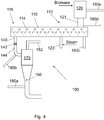
- biomass is fed to the reactor 110 with means 121 for feeding biomass, such as a feeding screw 121.
- Biomass may be fed from a container 120.
- steam is fed to the reactor 110 with means 123 for feeding steam, such as a pipeline 123.
- the steam and biomass may be fed to an inlet end 112 of the reactor 110.
- the reactor comprises means 114 for moving biomass from the inlet end 112 to the outlet end 116 of the reactor 110.
- the means 114 for moving the biomass may comprise e.g. a screw conveyor 114 or another conveyor.
- the reactor 110 comprises an outlet 140 for letting out steam treated biomass.
- a valve 142 may be arranged to the outlet.
- the opening of the valve 142 may be arranged such that the pressure in the reactor 110 remains in the aforementioned pressure level.
- the screw conveyor 114 may be configured to transport the biomass at such a speed that the biomass is treated with steam for a sufficiently long time as discussed above.
- the pressure is at the aforementioned lower level, whereby the biomass will be steam exploded when coming through the valve 142.
- Steam may be separated from steam-exploded biomass in a means 170 for separating steam-exploded biomass from steam, such as a cyclone 170.
- the cyclone may comprise an outlet 152 for letting out steam and an outlet 160 for letting out steam-exploded biomass.
- any separation method e.g. a filter or a sieve may be used.
- biomass comprises fibres comprising cellulose embedded in a matrix of lignin and cross connected with hemicellulose.
- the cellulose is partly amorphous and partly crystalline. This composite structure of the biomass (e.g. wood cell wall) is destroyed during steam explosion and the individual components of the fibres are released.
- the major role of hemicelluloses in wood is to impart viscoelastic properties.
- the degradation of hemicellulose makes wood more brittle and rigid, compared to untreated wood.
- the removal of OH groups (dehydration reactions) results in a more hydrophobic surface, compared to hydrophobicity of surfaces of untreated biomass.
- the brittleness (better grindability) and higher moisture resistance are important properties for use of steam-exploded biomass.
- Use of steam-exploded biomass may comprise substitution of at least some coal in power plants.
- Use of steam-exploded biomass may comprise formation of pellets from steam-exploded biomass.
- Cellulose and lignin are also affected by steam explosion conditions. At high pressures cellulose molecules are deconstructed and degraded to furfural (5-hydroxymethylfurfural).
- Lignin undergoes cleavage reactions of the acid insoluble (high molecular weight) lignin and low molecular weight lignin are formed due to condensation reactions. It has also been suggested that in steam explosion, lignin is melting, flowing and condensing in form of beads on the surface of the cellulose microfibrils and as such increases porosity. In addition, the lignin may undergo depolymerisation and re-polymerization.
- the solid biomass based fuel 300 comprises steam-exploded biomass comprising defibrillated cellulose.
- the solid biomass based fuel 300 comprises steam-exploded biomass comprising broken cellulose fibres.
- the solid biomass based fuel 300 may be used to form pellets 310.
- the density of pellets comprising steam-exploded biomass is typically reasonably large, e.g. in the order of from 630 kg/m 3 to 1200 kg/m 3 or from 630 kg/m 3 to 750 kg/m 3 . However, when additives are added, the density may become even higher, say up to 1300 kg/m 3 or up to 1000 kg/m 3 (i.e. 1.0 ⁇ 10 3 kg/m 3 ).
- hemicelluloses of the biomass decompose to monomers. Still further, some of the lignin of the biomass is softened. Lignin and sugars form pseudolignin upon steam explosion. Because of the decomposition of hemicellulose and cellulose, the steam-exploded biomass is more brittle than raw biomass. The brittleness may be seen as a factor for improving the grindability of the steam-exploded biomass. In addition, because of the softening of the lignin, at least some of the cellulose fibres may be more accessible to such additives that will be discussed below.
- pellet refers to a solid piece of material having a shape of a profile extending in a longitudinal direction.
- a pellet is typically pressed from fine grained solid material.
- the size of the piece in a direction perpendicular to the longitudinal direction e.g. a diameter of a circular pellet
- the length of a pellet is typically e.g. from 5 mm to 30 mm.
- Pellets are commonly produced by pressing fine material through holes, whereby the size of the holes define the transverse size of the pellet.
- a briquette also is a solid piece of material.
- the size of a briquette is typically larger than the size of a pellet.
- a briquette may be e.g. pressed into a form using grained material.
- Pelletizing increases the density of the material. Moreover, pellets are more easily handled than biomass or biomass based fuel in its original form, which is typically powder with small grain size. Still further, pelletizing can be used to reduce dust formation during transportation. Similar benefits can be seen for briquettes. In short, from the point of view of logistics, pellets (or briquettes) are superior compared to powdered biomass, granular biomass, powdered biomass based fuel, or granular biomass based fuel having a smaller granule size than the pellets.
- the steam-exploded biomass 160 may be used for the production of pellets or briquettes.
- Figure 1c shows a process of pelletization.
- the steam-exploded biomass Before pelletization, the steam-exploded biomass may be ground to sufficiently small size, unless already ground before the steam-explosion process.
- the biomass e.g. steam-exploded biomass
- the steam-exploded biomass may be conveyed from the outlet 160 to a pelletizing device 200.
- the pelletizing device 200 comprises means 230 for pressing the steam-exploded biomass towards on orifice 222.
- the means 230 may comprise a pressure plate 231 and a piston 233.
- the means 230 may comprise a screw.
- the orifice 222 may be arranged in a plate 220 having multiple orifices 222.
- the pelletizing device 200 may comprise means 210 for adding polymer additives to the steam-exploded biomass before producing the pellets.
- flue gas means all the components of the flue gas flowing through a flue gas duct in use of a furnace.
- flue gas comprises gaseous compounds.
- flue gas further comprises fly ash, which may be solid or at least partly molten.
- Flue gas may further comprise other liquid compounds, e.g. resulting from condensing of said gaseous compounds.
- flue gas refers to such flue gas that is obtainable by burning said steam-exploded biomass or the biomass based fuel.
- combustion additive is added to the biomass and/or the steam-exploded biomass.
- the combustion additive is selected from a group of additives that are capable of reducing a chemical and/or mechanical effect of flue gas on a heat transfer surface.
- the combustion additive is configured to reduce a chemical and/or mechanical effect of flue gas on a heat transfer surface.
- the heat transfer surface refers to a surface, that is, in use, configured to be in contact with the flue gases produced by combustion of the steam-exploded biomass or the biomass based fuel.
- the heat transfer surface may be e.g. an inner surface of a furnace or a flue gas channel, or a surface of a heat exchanger.
- the combustion additive comprises fouling-reducing additive. Fouling is a mechanical effect of the flue gas on a heat transfer surface. In an embodiment, the combustion additive comprises additive that reduces the corrosion potential of biomass. Corrosion is a chemical effect the flue gas has on a heat transfer surface. In an embodiment, the combustion additive comprises both a fouling-reducing additive and an additive that reduces the corrosion potential of biomass. Moreover, the combustion additive may comprise substance or substances suitable for use as nutrients.
- the intensive fouling on heat transfer surfaces when biomass is used as fuel, seem to result from the low melting temperature of the ash of the biomass; or the low melting temperature of the ash resulting from burning a combination of coal and biomass.
- the melting point of the ash may be characterized by an initial deformation temperature, i.e. a temperature at which ash starts to deform.
- the initial deformation temperature of ash is determined by testing. Such a test is performed in a laboratory and for samples of fuel comprising the ash.
- Fig. 2 indicates the initial deformation temperature of the ash as a function of the content of steam-exploded biomass in a fuel consisting of steam-exploded biomass and coal, as analysed in a laboratory.
- the melting point decreases by about 150 K when the amount of coal changed from 100 w-% to 0 w-%. It is assumed that the lower melting point of the ash results in melting of the ash in the furnace. The molten ash then adheres onto the heat transfer surfaces more easily than solid ash would, which is evidenced by increased fouling in real boiler conditions.
- fouling behaviour can be improved, e.g. the formation of foul on heat transfer surfaces reduced, by adding a suitable fouling-reducing additive to the feedstock (i.e. biomass or steam-exploded biomass).
- a suitable fouling-reducing additive can be added e.g. during steam treatment, after steam explosion, or during pelletizing or briquetting.
- the fouling-reducing additive can also reduce slagging in the furnace.
- a suitable fouling-reducing additive is capable of increasing an ash melting temperature.
- the ash melting temperature refers to the initial deformation temperature of the ash remaining after burning the pellet.
- the ash remaining after burning the pellet comprises the ash from the biomass, and the ash resulting from the fouling-reducing additive.
- the fouling-reducing additive comprises only a little burnable material. This is in order to have a sufficient amount of remaining material in the ash, to increase the melting point of the ash.
- the fouling-reducing additive may comprise e.g. less than 30 w-% or less than 10 w-% burnable material.
- the fouling-reducing additive may be heat resistant up to at least 1650 K.
- the fouling-reducing additive may be selected such that, when heated up to 1650 K in the presence of at most 20 mol-% oxygen, at most 30 % or at most 10 % of the fouling-reducing additive will be oxidized.
- the material of the fouling-reducing additive is selected such that, when the fouling-reducing additive is burned, the fouling-reducing additive forms ash having a melting point of at least 1650 K under oxidizing conditions. This may have the effect that if the ash from the biomass melts, some of it will be adhered onto the ash of the fouling-reducing additive.
- the additive will flow away from the furnace with the foul.
- the fouling-reducing additive when flowing away from the furnace, may clean heat transfer surfaces of the furnace by adhering onto themselves molten ash from the heat transfer surfaces.
- the fouling-reducing additive may chemically react with such components of the ash that a responsible for fouling.
- the fouling-reducing additive may be capable of chemically reacting with the steam-exploded biomass in such a way that the melting point of the ash of the combination of the additive and the steam-exploded biomass is higher than the melting point of the ash of the steam-exploded biomass.
- Compounds that are responsible for fouling include alkali metals, especially light alkali metals such as sodium and potassium.
- aluminium silicates may react with potassium, which is known to adhere on heat transfer surfaces and cause corrosion.
- Aluminium silicates include various substances having a chemical formula of the form x(Al 2 O 3 )•y(SiO 2 )•z(H 2 O), wherein x and y are integers at least one, and z is an integer at least zero, such as andalusite, kyanite, sillimanite, kaolinite, metakaolinite, and mullite.
- heat resistant materials may affect the melting point of the ash of the burned biomass, such as pellet.
- Such materials include sand (sufficiently small, e.g. a sieve size of 0.1 mm - 0.2 mm), chalk (i.e.
- limestone CaCO 3
- clay in general
- kaolin type of clay
- aluminium silicate any type
- rolovite clay fraction
- bentonite clay fraction
- dolomite CaMg(CO 3 ) 2
- magnesium carbonate MgCO 3
- coal fly ash aluminium sulphate, mono calcium phosphate, dicalcium phosphate, calcite, bauxite, bentonite, bauxite, emalthite, gibbsite, hectorite, and halloysite.
- These materials are substantially free of burnable material, such as carbon.
- they are heat resistant, as discussed above.
- the fouling-reducing additive comprises at least one of kaolin, lime stone (CaCO 3 ), dolomite (CaMg(CO 3 ) 2 ), magnesium carbonate (MgCO 3 ), clay, and coal fly ash. These materials have been seen to perform well and they are also commonly available.
- the substances of the combustion additive may be selected also from the point of view of exploiting the ash as a nutrient for land and farming.
- the combustion additive comprises at least one of calcium (Ca), magnesium (Mg), potassium (K) and phosphorus (P), optionally bound to other elements.
- the additive affecting the corrosion potential of biomass may be comprised by the combustion additive.
- the corrosion might be based on chlorine content of the fuel.
- An example of such additive is sulphur.
- the combustion additive comprises some additive affecting the corrosion potential.
- an embodiment of solid biomass based fuel 300 comprises sulphur.
- Such solid biomass based fuel 300 may comprise from 0.1 w-% to 1 w-% sulphur.
- sulphur may also improve combustion efficiency.
- An embodiment of a method for manufacturing solid biomass based fuel 300 configured to reduce chemical and/or mechanical effects of flue gas on heat transfer surfaces comprises adding some combustion additive to the biomass or the steam-exploded biomass, wherein the combustion additive is capable of reducing chemical and/or mechanical effects of flue gas on heat transfer surfaces, e.g. heat transfer surfaces of a boiler. Also here the flue gas is considered to include all its components (see above).
- the combustion additive comprises fouling-reducing additive that is capable of increasing an ash melting temperature. Such additives, when burned, form ash having a higher melting point than the ash of the biomass.
- the ash of the biomass refers to the residual of the biomass, when burned.
- an embodiment of solid biomass based fuel 300 having reduced fouling behaviour comprises steam-exploded biomass and some fouling-reducing additive, wherein the fouling-reducing additive is capable of increasing an ash melting temperature of the steam-exploded biomass.
- An embodiment of solid biomass based fuel 300 configured to reduce chemical and/or mechanical effects of flue gas on heat transfer surfaces comprises steam-exploded biomass and some combustion additive, wherein the combustion additive is selected from a group of additives that are capable of reducing chemical and/or mechanical effects of flue gas on heat transfer surfaces, e.g. heat transfer surfaces of a boiler.
- the flue gas is considered to include all its components (see above).
- An embodiment of solid biomass based fuel 300 comprises steam-exploded biomass and some fouling-reducing additive, wherein the fouling-reducing additive selected from a group of additives that, when burned, form ash having a higher melting point than the ash of the biomass.
- the fouling-reducing additive selected from a group of additives that, when burned, form ash having a higher melting point than the ash of the biomass.
- Such solid biomass based fuel 300 configured to reduce chemical and/or mechanical effects of flue gas on heat transfer surfaces can be used to produce pellets 310 or briquettes 320, as indicated in Fig. 3a .
- the solid biomass based fuel 300 can be burned without making briquettes 320 or pellets 310 therefrom (see Fig. 3a ).
- a system 400 for producing pellets comprises an apparatus 100 for producing steam-exploded biomass configured to reduce chemical and/or mechanical effects of flue gas on heat transfer surfaces and a pelletizing device 200.
- the apparatus 100 for producing steam-exploded biomass comprises the reactor 110 as indicated above.
- the reactor may be a batch reactor or a continuous reactor.
- the system may further comprise a pelletizing device 200 (cf. Fig. 3b ), or a briquetting device 250 (cf. Fig. 3c ).
- the solid biomass based fuel 300 may be used as such. As indicated in Fig.
- the system 400 may comprise a second feeding means 180f configured to feed the combustion additive directly into a pelletization device 200.
- a briquetting device 250 may comprise a compressing plate 260 and a mould, such as a space limited by walls 265. The plate 260 may be used to compress (a) steam-exploded biomass and the additive or (b) the solid biomass based fuel 300 to briquettes.
- a second feeding means 180g may be configured to feed the additive directly into the briquetting device 250.
- the apparatus 100 comprises a first feeding apparatus 121 configured to feed biomass into the reactor 110.
- the apparatus 100 comprises a second feeding apparatus 180 (i.e. 180a, 180b, 180c, 180d, 180e) configured to feed at least some combustion additive to the biomass or the steam-exploded biomass.
- the system 400 comprises a second feeding apparatus 180 (i.e. 180f, 180g) configured to feed at least some combustion additive into the pelletizing device 200 or the briquetting device 250.
- the system may comprise only one of the second feeding apparatuses 180a, 180b, 180c, 180d, 180e, 180f, 180g of Figs. 3 and 4 , or a suitable number of them.
- the second feeding apparatus 180 may be configured to feed the combustion additive to the means 121 for feeding biomass to the reactor or to the container 120 for biomass. If fed to such locations, the combustion additive will be introduced into the reactor 110 with the biomass.
- the combustion additive may increase erosion of the reactor 110, if fed therein.
- the combustion additive (or additives) is/are added to the steam-exploded biomass, i.e. after the reactor 110. Because of the softening of the lignin in steam-explosion, the additive/additives is/are preferably fed to the steam-exploded biomass when the lignin is still soft.
- the combustion additive (or at least some of the combustion additives) is added to such steam-exploded biomass that the temperature of the steam-exploded biomass is above 90 °C.
- the combustion additive (or at least some of the combustion additives) is added to such steam-exploded biomass that the temperature of the steam-exploded biomass is from 90 °C to 250 °C or from from 90 °C to 180 °C; or within limits defined later. In an embodiment, the combustion additive (or at least some of the combustion additives) is added to such steam-exploded biomass that the temperature of the steam-exploded biomass at most 250 °C or at most 180 °C.
- the combustion additive is added to biomass comprising softened lignin, the additives are intermixed with the softened lignin. When the lignin hardens, i.e. the temperature of the biomass decreases, the additives become bound to the biomass.
- the additives When bound to biomass, the additives cause less erosion to the subsequent process equipment, such as a pelletization device 200 or a briquetting device 250. Moreover, in steam-explosion, the particle size of the biomass decreases, because at least some particles are torn into pieces. This increases the surface area of the biomass and helps the combustion additive/additives adhere into and/or onto the biomass.
- the apparatus 100 comprises the second feeding apparatus 180a that is configured to feed the combustion additive to the steam-exploded biomass after, and preferably substantially immediately after, the steam-exploded biomass has been separated from the steam with the means 170 such as a cyclone.
- the term substantially immediately refers to such a location after the cyclone 170, wherein, in use, the temperature of the steam-exploded biomass is at least 90 °C, or within the aforementioned limits.
- the temperature of the steam-exploded biomass, to which the combustion additive is add may be from 90 °C to 110 °C, such as from 95 °C to 105 °C.
- the second feeding apparatus 180a may be located e.g. at most 25 metres away from the cyclone 170. As indicated in Fig.
- the solid biomass based fuel 300 which comprises both the combustion additive and the steam-exploded biomass, is conveyed with e.g. a screw conveyor 185 to a storage or use.
- a screw conveyor 185 to a storage or use.
- the screw conveyor 185 is a paddle screw conveyor 185, which even more effectively mixes the constituents.
- the screws are not continuous, whereby the parts of the screws constitute paddles that are configured to propel the material in the conveyor.
- an embodiment of the apparatus 100 comprises a second feeding apparatus 180b configured to feed at least some combustion additive to the steam-exploded biomass, but before separation of steam.
- the apparatus 100 comprises a second feeding apparatus 180c configured to feed at least some combustion additive directly into the reactor 110.
- An embodiment of the apparatus 100 comprise a second feeding apparatus 180d configured to feed at least some combustion additive to the means 121 for feed biomass into the reactor 110.
- the second feeding apparatus 180d is configured to feed some combustion additive into the reactor 110 via the means 121.
- An embodiment of the apparatus 100 comprises a second feeding apparatus 180e configured to feed at least some combustion additive to the container 120 for storing biomass.
- the apparatus 180e is configured to convey some combustion additive into the reactor 110 via the container 120 and the means 121.
- the second feeding apparatus 180 may be a conveyor, e.g. a screw conveyor or a belt conveyor.
- the means 180 may be configured to feed only a part of the combustion additive, such as only the fouling-reducing additive, to the biomass or steam exploded biomass.
- the system may comprise separate feeding apparatus 190 (190a, 190b) configured to feed another part of the combustion additive, such as the additive affecting the corrosion potential. Suitable positions for feeding the other part include those already discussed in connection with the means 180.
- the separate feeding apparatus 190, 190a, 190b may be a conveyor, e.g. a screw conveyor or a belt conveyor.
- the fouling-reducing additives when at least the fouling-reducing additives are fed to the reactor 110, in which the biomass is steam treated, the additives impregnate well into the biomass, and the ash forms in a homogeneous manner. As a result, a smaller amount of fouling reducing additive may suffice. Thus, the fouling-reducing additive may be fed into the reactor 110; directly or with biomass.
- Such solid biomass based fuel has many practical advantages.
- the solid biomass based fuel can be used to replace at least some of the coal, thereby affecting the CO 2 effect of energy production. For example up to 70 w-% of the coal may be replaced.
- the solid biomass based fuel can be used without separate additives, and any special adding equipment, since the additives are included in the solid biomass based fuel. This makes the replacement of coal more easy as compared to using additives separately. In particular, no investments are needed at the power plant to the adding equipment.
- the control of the amount of additives is more accurate, since the amount of additives can be selected according to the type of the biomass applied.
- the control of the type of additives is more accurate, since the type of additives can be selected according to the type of the biomass applied.
- the combustion additive may comprise only fouling-reducing additive; while for another type of biomass in addition sulphur can be used.
- the amount can be selected according to e.g. the ash content of the biomass.
- the total amount of additives may be reduced, as in the case of poor control the amount of the additive has to be selected by the worst possible scenario.
- the combustion additive As a result of the combustion additive, the chemical and/or mechanical effects of flue gas on heat transfer surfaces will be reduced.
- the fouling may be reduced, and thus the need for soot blowing may be decreased.
- the tendency for corrosion may be reduced, and thus the expected life of the equipment may be increased.
- the reduction of fouling also affects the applicability of wider range of biomass.
- biomass originating from hay and/or straw can be utilized as solid biomass based fuel.
- the corrosion of the furnace and heat exchange surfaces is reduced.
- the solid biomass based fuel can be easily ground to small size, as the solid biomass based fuel comprises steam-exploded biomass. This increases the milling capacity and reduces the operating costs.
- the quality of the ash can be improved, whereby its use as a fertilizer becomes possible. This reduces the ash deposition costs or even forms positive revenue.
- the amount (i.e. mass) of the combustion additive (in particular fouling-reducing additive), compared to the mass of the steam-exploded biomass is from 0.1 % to 15 %.
- the solid biomass based fuel 300 comprises from 0.1 w-% to 15 w-% fouling-reducing additives in total.
- the combustion additive may further comprise sulphur or other additives affecting the corrosion potential.
- the amount of such additives may be e.g. at most 1 w-%, as discussed above.
- the solid biomass based fuel 300 comprises from 0.1 w-% to 16 w-% combustion additives in total.
- an embodiment of the solid biomass based fuel comprises at least 70 w-% burnable material, preferably at least 74 w-% or at least 79 w-% burnable material, such as steam-exploded biomass.
- the amount of ash of the biomass contains depends on the type of the biomass. Typically, biomass originating from wood comprises only a little ash, such as 0.3 w-% to 1 w-%; while biomass originating from hay or straw or some waste fraction may contain much more ash, such as from 2 w-% to 10 w-%.
- biomass originating from wood comprises only a little ash, such as 0.3 w-% to 1 w-%; while biomass originating from hay or straw or some waste fraction may contain much more ash, such as from 2 w-% to 10 w-%.
- different amounts of fouling-reducing additives may be needed, depending on the type of the biomass.
- the total content of the fouling-reducing additive of solid biomass based fuel is selected based on the type of the biomass.
- the total content of combustion additive of solid biomass based fuel is selected based on the type of the biomass.
- the biomass that will be steam exploded comprises at least 50 w-% wood-based biomass
- the solid biomass based fuel may comprise up to 2 w-% fouling-reducing additive, which is comprised by the combustion additive/additives.
- the combustion additive may comprise additive that reduces the corrosion potential.
- the biomass that will be steam exploded comprises at least 50 w-% of some combination of hay and straw
- the solid biomass based fuel may comprise from 1 w-% to 15 w-% fouling-reducing additive, which is comprised by the combustion additive/additives.
- the combustion additive may comprise additive that reduces the corrosion potential.
- the combustion additive is fed in solid form. Suitable locations for feeding were discussed above.
- the combustion additive is fed in pulverized, solid form.
- the average particle size of the pulverized combustion additive may be e.g. at most 100 ⁇ m. Size of the particle refers to a sieve size. The average size refers to the average sieve size, the average calculated as a weight average (i.e. the average being [ ⁇ m i d i ]/[ ⁇ m i ], wherein m i is the mass of a particle and d i is its sieve size).
Landscapes
- Chemical & Material Sciences (AREA)
- Oil, Petroleum & Natural Gas (AREA)
- Organic Chemistry (AREA)
- Engineering & Computer Science (AREA)
- Combustion & Propulsion (AREA)
- Life Sciences & Earth Sciences (AREA)
- Wood Science & Technology (AREA)
- Forests & Forestry (AREA)
- Ecology (AREA)
- Agronomy & Crop Science (AREA)
- Biodiversity & Conservation Biology (AREA)
- Geochemistry & Mineralogy (AREA)
- General Life Sciences & Earth Sciences (AREA)
- Environmental & Geological Engineering (AREA)
- Geology (AREA)
- Chemical Kinetics & Catalysis (AREA)
- General Chemical & Material Sciences (AREA)
- Materials Engineering (AREA)
- Solid Fuels And Fuel-Associated Substances (AREA)
- Processing Of Solid Wastes (AREA)
Applications Claiming Priority (2)
| Application Number | Priority Date | Filing Date | Title |
|---|---|---|---|
| FI20155876A FI126555B (en) | 2015-11-26 | 2015-11-26 | Biomass-based fuel arranged to reduce the chemical and / or mechanical influence of the flue gas on heat transfer surfaces and the method for its production |
| PCT/FI2016/050792 WO2017089648A1 (en) | 2015-11-26 | 2016-11-10 | Biomass based fuel configured to reduce a chemical and/or mechanical effect of flue gas on heat transfer surfaces and a method for making the same |
Publications (2)
| Publication Number | Publication Date |
|---|---|
| EP3380590A1 EP3380590A1 (en) | 2018-10-03 |
| EP3380590B1 true EP3380590B1 (en) | 2021-04-21 |
Family
ID=57539273
Family Applications (1)
| Application Number | Title | Priority Date | Filing Date |
|---|---|---|---|
| EP16809452.2A Active EP3380590B1 (en) | 2015-11-26 | 2016-11-10 | A method for manufacturing biomass based fuel configured to reduce a chemical and/or mechanical effect of flue gas on heat transfer surfaces |
Country Status (7)
| Country | Link |
|---|---|
| US (1) | US10584298B2 (enExample) |
| EP (1) | EP3380590B1 (enExample) |
| JP (1) | JP7186614B2 (enExample) |
| CN (1) | CN108368443A (enExample) |
| CA (1) | CA3006401C (enExample) |
| FI (1) | FI126555B (enExample) |
| WO (1) | WO2017089648A1 (enExample) |
Families Citing this family (21)
| Publication number | Priority date | Publication date | Assignee | Title |
|---|---|---|---|---|
| US11149221B2 (en) * | 2017-11-07 | 2021-10-19 | Kiram Ab | Thermochemical conversion of biomass |
| SE541264C2 (en) * | 2017-11-09 | 2019-05-28 | Valmet Oy | Method and system for processing lignocellulose material |
| FR3087790B1 (fr) * | 2018-10-29 | 2021-06-25 | Europeenne De Biomasse | Procede de fabrication en continu d'une matiere combustible pour chaudiere industrielle, matiere et installation correspondantes |
| CN109593590A (zh) * | 2018-11-10 | 2019-04-09 | 绵阳市源动力节能环保科技有限公司 | 一种洁净煤强化增效剂及其制备方法 |
| EP3696253B1 (en) | 2019-02-12 | 2021-04-21 | Valmet Ab | Process for improving structural integrity of hardwood black pellets |
| FR3095649B1 (fr) * | 2019-05-03 | 2022-09-16 | Europeenne De Biomasse | Substrat pulvérulent obtenu par vapocraquage d’une biomasse sans auxiliaire chimique et ses utilisations |
| FR3095654B1 (fr) * | 2019-05-03 | 2022-01-21 | Europeenne De Biomasse | Contrôle du vapocraquage en vue d’améliorer le PCI des granulés noirs |
| SE1950534A1 (en) * | 2019-05-06 | 2020-10-06 | Valmet Oy | Screw assembly for disintegration of lignocellulosic material |
| FR3097556B1 (fr) | 2019-06-24 | 2021-11-26 | Europeenne De Biomasse | Procédé de vapocraquage comprenant une étape de séparation et traitement différentiel des particules obtenues en fonction d’une valeur seuil. |
| WO2021038585A1 (en) * | 2019-08-24 | 2021-03-04 | Rana Sukhdeep Singh | Bio-fuel pellets with industrial dolochar and method thereof |
| CN110423638B (zh) * | 2019-08-25 | 2020-12-04 | 永新县华纬生物质能源有限公司 | 一种抗结渣复合生物质颗粒燃料的制备方法 |
| CN111073719A (zh) * | 2019-11-18 | 2020-04-28 | 广州环峰能源科技股份有限公司 | 一种生物质充分燃烧工艺 |
| FR3109390B1 (fr) * | 2020-04-17 | 2022-07-22 | Europeenne De Biomasse | Procédé de production de granulés combustibles par vapocraquage amélioré par utilisation de biomasse hétérogène |
| CN111534351B (zh) * | 2020-05-14 | 2021-09-03 | 太原理工大学 | 一种废油脂煮煤的装置及其使用方法 |
| CN111944551A (zh) * | 2020-08-04 | 2020-11-17 | 仲恺农业工程学院 | 一种用于生物质的多功能预处理装置及其预处理方法 |
| KR102513233B1 (ko) * | 2020-12-04 | 2023-03-24 | 낙우산업(주) | 고령토의 할로이사이트 특성을 이용한 발전소 첨가제 및 그 이용방법 |
| FR3123362B1 (fr) | 2021-05-25 | 2025-10-24 | Europeenne De Biomasse | Procédé de fabrication en continu d’une matière combustible par décompression explosive s’opérant par paliers |
| SE2250042A1 (en) * | 2022-01-19 | 2023-07-20 | Valmet Oy | Method and system for processing biomass material |
| JP7717106B2 (ja) * | 2022-07-19 | 2025-08-01 | 株式会社ブルーオーシャン産業 | ブラックペレット及びその製造方法 |
| US20240246128A1 (en) * | 2023-01-23 | 2024-07-25 | Bouldin Corporation | Anaerobic digestion of aggregate cellulose pulp |
| EP4524253A1 (en) | 2023-09-14 | 2025-03-19 | Fibers365 GmbH | Method of obtaining a solution containing free sugars from a second-generation feedstock and solution obtained thereby |
Family Cites Families (16)
| Publication number | Priority date | Publication date | Assignee | Title |
|---|---|---|---|---|
| US4159683A (en) | 1978-03-13 | 1979-07-03 | American Colloid Company | Method for reducing the formation of slag and soot formed from the combustion of carbonaceous waste material |
| JPS61228096A (ja) * | 1985-04-02 | 1986-10-11 | Fuso Kogyo Kk | 木質固形化燃料の製造方法 |
| BE1019595A3 (nl) | 2007-09-06 | 2012-09-04 | Leer Energy B V Van | Mengsel van biomassa en werkwijze voor de verbranding daarvan. |
| CN106929117A (zh) * | 2008-12-15 | 2017-07-07 | 齐尔可生物质科技有限公司 | 产生颗粒或压块的方法 |
| EP2516926B1 (en) | 2009-12-22 | 2017-03-29 | Accordant Energy, LLC | Sorbent-containing engineered fuel feed stocks |
| JP2012149140A (ja) * | 2011-01-18 | 2012-08-09 | Taihokohzai:Kk | 固形状燃料 |
| US9920929B2 (en) * | 2011-06-13 | 2018-03-20 | Ecolab Usa Inc. | Method for reducing slag in biomass combustion |
| KR102010490B1 (ko) * | 2011-12-21 | 2019-08-13 | 켄터키-테네시 클레이 컴퍼니 | 응집, 침적, 부식과 같은 문제점들을 회피하고 배출들을 감소시키기 위한 미네랄 첨가제 배합 조성물들 및 연소실들의 작동 방법들 |
| GB2507949B (en) | 2012-09-16 | 2017-03-29 | Lawrence Timothy Richard Hall Philip | Apparatus and method for processing municipal waste into bio-ethanol |
| CN102816621A (zh) * | 2012-09-19 | 2012-12-12 | 中国科学院广州能源研究所 | 一种家具厂废弃木料制备成型燃料的方法 |
| US9523056B2 (en) * | 2012-12-05 | 2016-12-20 | Ube Industries, Ltd. | Biomass solid fuel |
| NO342736B1 (no) * | 2013-02-20 | 2018-08-06 | Arbaflame Tech As | Fremgangsmåte og apparatur for fremstilling av brensel fra biomasse |
| CN103483596A (zh) | 2013-08-21 | 2014-01-01 | 安徽格义循环经济产业园有限公司 | 生化木素生产方法 |
| CN103409199B (zh) | 2013-08-22 | 2015-04-15 | 华北电力大学 | 一种生物质锅炉防腐蚀剂及其制备和应用 |
| CN104212531A (zh) * | 2014-09-25 | 2014-12-17 | 江南大学 | 一种利用外源气体辅助蒸汽爆破生物质废弃物制备固体燃料的方法 |
| CN104629848B (zh) | 2014-12-31 | 2017-07-04 | 海聚高分子材料科技(广州)有限公司 | 一种生物质颗粒燃料及其制备方法 |
-
2015
- 2015-11-26 FI FI20155876A patent/FI126555B/en active IP Right Grant
-
2016
- 2016-11-10 JP JP2018526652A patent/JP7186614B2/ja active Active
- 2016-11-10 CA CA3006401A patent/CA3006401C/en active Active
- 2016-11-10 US US15/776,700 patent/US10584298B2/en active Active
- 2016-11-10 WO PCT/FI2016/050792 patent/WO2017089648A1/en not_active Ceased
- 2016-11-10 CN CN201680068931.2A patent/CN108368443A/zh active Pending
- 2016-11-10 EP EP16809452.2A patent/EP3380590B1/en active Active
Non-Patent Citations (1)
| Title |
|---|
| None * |
Also Published As
| Publication number | Publication date |
|---|---|
| WO2017089648A1 (en) | 2017-06-01 |
| FI126555B (en) | 2017-02-15 |
| US20190203134A1 (en) | 2019-07-04 |
| US10584298B2 (en) | 2020-03-10 |
| CN108368443A (zh) | 2018-08-03 |
| JP2019500446A (ja) | 2019-01-10 |
| FI20155876A7 (fi) | 2017-02-15 |
| CA3006401C (en) | 2023-03-07 |
| JP7186614B2 (ja) | 2022-12-09 |
| CA3006401A1 (en) | 2017-06-01 |
| EP3380590A1 (en) | 2018-10-03 |
Similar Documents
| Publication | Publication Date | Title |
|---|---|---|
| EP3380590B1 (en) | A method for manufacturing biomass based fuel configured to reduce a chemical and/or mechanical effect of flue gas on heat transfer surfaces | |
| EP2027233B1 (en) | Method for the preparation of solid fuels by means of torrefaction as well as the solid fuels thus obtained and the use of these fuels | |
| US8753410B2 (en) | Method for producing fuel briquettes from high moisture fine coal or blends of high moisture fine coal and biomass | |
| US20070251143A1 (en) | Synthetic fuel pellet and methods | |
| KR102028442B1 (ko) | 바이오매스 혼소율 향상을 위한 보일러용 반탄화 연료 생산 시스템 | |
| Lam | Steam explosion of biomass to produce durable wood pellets | |
| WO2015091861A1 (en) | Process for washing solid cellulosic biomass material | |
| US20170121620A1 (en) | Processed Biomass Pellets From Organic-Carbon-Containing Feedstock | |
| CA3084813A1 (en) | Torrefied biomass briquettes and related methods | |
| US12049598B2 (en) | Mixture of steam-cracked biomass and lignin for granule production | |
| EP3696253B1 (en) | Process for improving structural integrity of hardwood black pellets | |
| KR20230004625A (ko) | 이종 바이오매스를 이용한 개선된 증기 분해에 의한 가연성 펠릿의 제조 방법 | |
| NO320094B1 (no) | Sammensetning for fremstilling av brennstoffbriketter | |
| US20240352369A1 (en) | Methods and systems for treating biomass compositions | |
| AU2012203711B2 (en) | Method for the preparation of solid fuels by means of torrefaction as well as the solid fuels thus obtained and the use of these fuels | |
| Dedy | Efficient Pretreatment Technology and Ash Handling for Co-firing Pulverized Coal with Biomass | |
| Zhu | Development of a Binder from Hydrolyzed Specified Risk Materials for Pelletization of Torrefied Wood | |
| HK40063568A (en) | Mixture of steam-cracked biomass and lignin for granule production | |
| CN1187845A (zh) | 附聚物 | |
| MXPA97010284A (en) | Aglomera |
Legal Events
| Date | Code | Title | Description |
|---|---|---|---|
| STAA | Information on the status of an ep patent application or granted ep patent |
Free format text: STATUS: UNKNOWN |
|
| STAA | Information on the status of an ep patent application or granted ep patent |
Free format text: STATUS: THE INTERNATIONAL PUBLICATION HAS BEEN MADE |
|
| PUAI | Public reference made under article 153(3) epc to a published international application that has entered the european phase |
Free format text: ORIGINAL CODE: 0009012 |
|
| STAA | Information on the status of an ep patent application or granted ep patent |
Free format text: STATUS: REQUEST FOR EXAMINATION WAS MADE |
|
| 17P | Request for examination filed |
Effective date: 20180509 |
|
| AK | Designated contracting states |
Kind code of ref document: A1 Designated state(s): AL AT BE BG CH CY CZ DE DK EE ES FI FR GB GR HR HU IE IS IT LI LT LU LV MC MK MT NL NO PL PT RO RS SE SI SK SM TR |
|
| AX | Request for extension of the european patent |
Extension state: BA ME |
|
| DAV | Request for validation of the european patent (deleted) | ||
| DAX | Request for extension of the european patent (deleted) | ||
| STAA | Information on the status of an ep patent application or granted ep patent |
Free format text: STATUS: EXAMINATION IS IN PROGRESS |
|
| 17Q | First examination report despatched |
Effective date: 20190802 |
|
| GRAP | Despatch of communication of intention to grant a patent |
Free format text: ORIGINAL CODE: EPIDOSNIGR1 |
|
| STAA | Information on the status of an ep patent application or granted ep patent |
Free format text: STATUS: GRANT OF PATENT IS INTENDED |
|
| INTG | Intention to grant announced |
Effective date: 20200805 |
|
| GRAJ | Information related to disapproval of communication of intention to grant by the applicant or resumption of examination proceedings by the epo deleted |
Free format text: ORIGINAL CODE: EPIDOSDIGR1 |
|
| STAA | Information on the status of an ep patent application or granted ep patent |
Free format text: STATUS: EXAMINATION IS IN PROGRESS |
|
| GRAP | Despatch of communication of intention to grant a patent |
Free format text: ORIGINAL CODE: EPIDOSNIGR1 |
|
| STAA | Information on the status of an ep patent application or granted ep patent |
Free format text: STATUS: GRANT OF PATENT IS INTENDED |
|
| INTC | Intention to grant announced (deleted) | ||
| INTG | Intention to grant announced |
Effective date: 20201204 |
|
| GRAS | Grant fee paid |
Free format text: ORIGINAL CODE: EPIDOSNIGR3 |
|
| GRAA | (expected) grant |
Free format text: ORIGINAL CODE: 0009210 |
|
| STAA | Information on the status of an ep patent application or granted ep patent |
Free format text: STATUS: THE PATENT HAS BEEN GRANTED |
|
| AK | Designated contracting states |
Kind code of ref document: B1 Designated state(s): AL AT BE BG CH CY CZ DE DK EE ES FI FR GB GR HR HU IE IS IT LI LT LU LV MC MK MT NL NO PL PT RO RS SE SI SK SM TR |
|
| REG | Reference to a national code |
Ref country code: GB Ref legal event code: FG4D |
|
| REG | Reference to a national code |
Ref country code: CH Ref legal event code: EP |
|
| REG | Reference to a national code |
Ref country code: DE Ref legal event code: R096 Ref document number: 602016056585 Country of ref document: DE Ref country code: IE Ref legal event code: FG4D |
|
| REG | Reference to a national code |
Ref country code: AT Ref legal event code: REF Ref document number: 1384651 Country of ref document: AT Kind code of ref document: T Effective date: 20210515 |
|
| REG | Reference to a national code |
Ref country code: FI Ref legal event code: FGE |
|
| REG | Reference to a national code |
Ref country code: LT Ref legal event code: MG9D |
|
| REG | Reference to a national code |
Ref country code: NO Ref legal event code: T2 Effective date: 20210421 |
|
| REG | Reference to a national code |
Ref country code: NL Ref legal event code: MP Effective date: 20210421 |
|
| PG25 | Lapsed in a contracting state [announced via postgrant information from national office to epo] |
Ref country code: NL Free format text: LAPSE BECAUSE OF FAILURE TO SUBMIT A TRANSLATION OF THE DESCRIPTION OR TO PAY THE FEE WITHIN THE PRESCRIBED TIME-LIMIT Effective date: 20210421 Ref country code: LT Free format text: LAPSE BECAUSE OF FAILURE TO SUBMIT A TRANSLATION OF THE DESCRIPTION OR TO PAY THE FEE WITHIN THE PRESCRIBED TIME-LIMIT Effective date: 20210421 Ref country code: BG Free format text: LAPSE BECAUSE OF FAILURE TO SUBMIT A TRANSLATION OF THE DESCRIPTION OR TO PAY THE FEE WITHIN THE PRESCRIBED TIME-LIMIT Effective date: 20210721 Ref country code: HR Free format text: LAPSE BECAUSE OF FAILURE TO SUBMIT A TRANSLATION OF THE DESCRIPTION OR TO PAY THE FEE WITHIN THE PRESCRIBED TIME-LIMIT Effective date: 20210421 |
|
| PG25 | Lapsed in a contracting state [announced via postgrant information from national office to epo] |
Ref country code: IS Free format text: LAPSE BECAUSE OF FAILURE TO SUBMIT A TRANSLATION OF THE DESCRIPTION OR TO PAY THE FEE WITHIN THE PRESCRIBED TIME-LIMIT Effective date: 20210821 Ref country code: LV Free format text: LAPSE BECAUSE OF FAILURE TO SUBMIT A TRANSLATION OF THE DESCRIPTION OR TO PAY THE FEE WITHIN THE PRESCRIBED TIME-LIMIT Effective date: 20210421 Ref country code: GR Free format text: LAPSE BECAUSE OF FAILURE TO SUBMIT A TRANSLATION OF THE DESCRIPTION OR TO PAY THE FEE WITHIN THE PRESCRIBED TIME-LIMIT Effective date: 20210722 Ref country code: PT Free format text: LAPSE BECAUSE OF FAILURE TO SUBMIT A TRANSLATION OF THE DESCRIPTION OR TO PAY THE FEE WITHIN THE PRESCRIBED TIME-LIMIT Effective date: 20210823 Ref country code: PL Free format text: LAPSE BECAUSE OF FAILURE TO SUBMIT A TRANSLATION OF THE DESCRIPTION OR TO PAY THE FEE WITHIN THE PRESCRIBED TIME-LIMIT Effective date: 20210421 Ref country code: SE Free format text: LAPSE BECAUSE OF FAILURE TO SUBMIT A TRANSLATION OF THE DESCRIPTION OR TO PAY THE FEE WITHIN THE PRESCRIBED TIME-LIMIT Effective date: 20210421 Ref country code: RS Free format text: LAPSE BECAUSE OF FAILURE TO SUBMIT A TRANSLATION OF THE DESCRIPTION OR TO PAY THE FEE WITHIN THE PRESCRIBED TIME-LIMIT Effective date: 20210421 |
|
| REG | Reference to a national code |
Ref country code: DE Ref legal event code: R097 Ref document number: 602016056585 Country of ref document: DE |
|
| PG25 | Lapsed in a contracting state [announced via postgrant information from national office to epo] |
Ref country code: CZ Free format text: LAPSE BECAUSE OF FAILURE TO SUBMIT A TRANSLATION OF THE DESCRIPTION OR TO PAY THE FEE WITHIN THE PRESCRIBED TIME-LIMIT Effective date: 20210421 Ref country code: DK Free format text: LAPSE BECAUSE OF FAILURE TO SUBMIT A TRANSLATION OF THE DESCRIPTION OR TO PAY THE FEE WITHIN THE PRESCRIBED TIME-LIMIT Effective date: 20210421 Ref country code: EE Free format text: LAPSE BECAUSE OF FAILURE TO SUBMIT A TRANSLATION OF THE DESCRIPTION OR TO PAY THE FEE WITHIN THE PRESCRIBED TIME-LIMIT Effective date: 20210421 Ref country code: ES Free format text: LAPSE BECAUSE OF FAILURE TO SUBMIT A TRANSLATION OF THE DESCRIPTION OR TO PAY THE FEE WITHIN THE PRESCRIBED TIME-LIMIT Effective date: 20210421 Ref country code: RO Free format text: LAPSE BECAUSE OF FAILURE TO SUBMIT A TRANSLATION OF THE DESCRIPTION OR TO PAY THE FEE WITHIN THE PRESCRIBED TIME-LIMIT Effective date: 20210421 Ref country code: SM Free format text: LAPSE BECAUSE OF FAILURE TO SUBMIT A TRANSLATION OF THE DESCRIPTION OR TO PAY THE FEE WITHIN THE PRESCRIBED TIME-LIMIT Effective date: 20210421 Ref country code: SK Free format text: LAPSE BECAUSE OF FAILURE TO SUBMIT A TRANSLATION OF THE DESCRIPTION OR TO PAY THE FEE WITHIN THE PRESCRIBED TIME-LIMIT Effective date: 20210421 |
|
| PLBE | No opposition filed within time limit |
Free format text: ORIGINAL CODE: 0009261 |
|
| STAA | Information on the status of an ep patent application or granted ep patent |
Free format text: STATUS: NO OPPOSITION FILED WITHIN TIME LIMIT |
|
| 26N | No opposition filed |
Effective date: 20220124 |
|
| PG25 | Lapsed in a contracting state [announced via postgrant information from national office to epo] |
Ref country code: IS Free format text: LAPSE BECAUSE OF FAILURE TO SUBMIT A TRANSLATION OF THE DESCRIPTION OR TO PAY THE FEE WITHIN THE PRESCRIBED TIME-LIMIT Effective date: 20210821 Ref country code: AL Free format text: LAPSE BECAUSE OF FAILURE TO SUBMIT A TRANSLATION OF THE DESCRIPTION OR TO PAY THE FEE WITHIN THE PRESCRIBED TIME-LIMIT Effective date: 20210421 |
|
| PG25 | Lapsed in a contracting state [announced via postgrant information from national office to epo] |
Ref country code: MC Free format text: LAPSE BECAUSE OF FAILURE TO SUBMIT A TRANSLATION OF THE DESCRIPTION OR TO PAY THE FEE WITHIN THE PRESCRIBED TIME-LIMIT Effective date: 20210421 |
|
| REG | Reference to a national code |
Ref country code: CH Ref legal event code: PL |
|
| PG25 | Lapsed in a contracting state [announced via postgrant information from national office to epo] |
Ref country code: LU Free format text: LAPSE BECAUSE OF NON-PAYMENT OF DUE FEES Effective date: 20211110 Ref country code: IT Free format text: LAPSE BECAUSE OF FAILURE TO SUBMIT A TRANSLATION OF THE DESCRIPTION OR TO PAY THE FEE WITHIN THE PRESCRIBED TIME-LIMIT Effective date: 20210421 Ref country code: BE Free format text: LAPSE BECAUSE OF NON-PAYMENT OF DUE FEES Effective date: 20211130 |
|
| REG | Reference to a national code |
Ref country code: BE Ref legal event code: MM Effective date: 20211130 |
|
| PG25 | Lapsed in a contracting state [announced via postgrant information from national office to epo] |
Ref country code: LI Free format text: LAPSE BECAUSE OF NON-PAYMENT OF DUE FEES Effective date: 20211130 Ref country code: CH Free format text: LAPSE BECAUSE OF NON-PAYMENT OF DUE FEES Effective date: 20211130 |
|
| PG25 | Lapsed in a contracting state [announced via postgrant information from national office to epo] |
Ref country code: IE Free format text: LAPSE BECAUSE OF NON-PAYMENT OF DUE FEES Effective date: 20211110 |
|
| PG25 | Lapsed in a contracting state [announced via postgrant information from national office to epo] |
Ref country code: HU Free format text: LAPSE BECAUSE OF FAILURE TO SUBMIT A TRANSLATION OF THE DESCRIPTION OR TO PAY THE FEE WITHIN THE PRESCRIBED TIME-LIMIT; INVALID AB INITIO Effective date: 20161110 |
|
| PG25 | Lapsed in a contracting state [announced via postgrant information from national office to epo] |
Ref country code: CY Free format text: LAPSE BECAUSE OF FAILURE TO SUBMIT A TRANSLATION OF THE DESCRIPTION OR TO PAY THE FEE WITHIN THE PRESCRIBED TIME-LIMIT Effective date: 20210421 |
|
| PG25 | Lapsed in a contracting state [announced via postgrant information from national office to epo] |
Ref country code: MK Free format text: LAPSE BECAUSE OF FAILURE TO SUBMIT A TRANSLATION OF THE DESCRIPTION OR TO PAY THE FEE WITHIN THE PRESCRIBED TIME-LIMIT Effective date: 20210421 |
|
| PG25 | Lapsed in a contracting state [announced via postgrant information from national office to epo] |
Ref country code: MT Free format text: LAPSE BECAUSE OF FAILURE TO SUBMIT A TRANSLATION OF THE DESCRIPTION OR TO PAY THE FEE WITHIN THE PRESCRIBED TIME-LIMIT Effective date: 20210421 |
|
| PGFP | Annual fee paid to national office [announced via postgrant information from national office to epo] |
Ref country code: DE Payment date: 20241121 Year of fee payment: 9 |
|
| PGFP | Annual fee paid to national office [announced via postgrant information from national office to epo] |
Ref country code: NO Payment date: 20241125 Year of fee payment: 9 |
|
| PGFP | Annual fee paid to national office [announced via postgrant information from national office to epo] |
Ref country code: FI Payment date: 20241122 Year of fee payment: 9 |
|
| PGFP | Annual fee paid to national office [announced via postgrant information from national office to epo] |
Ref country code: GB Payment date: 20241120 Year of fee payment: 9 |
|
| PGFP | Annual fee paid to national office [announced via postgrant information from national office to epo] |
Ref country code: FR Payment date: 20241128 Year of fee payment: 9 |
|
| PGFP | Annual fee paid to national office [announced via postgrant information from national office to epo] |
Ref country code: AT Payment date: 20241121 Year of fee payment: 9 |
|
| PG25 | Lapsed in a contracting state [announced via postgrant information from national office to epo] |
Ref country code: TR Free format text: LAPSE BECAUSE OF FAILURE TO SUBMIT A TRANSLATION OF THE DESCRIPTION OR TO PAY THE FEE WITHIN THE PRESCRIBED TIME-LIMIT Effective date: 20210421 |