EP3369604A1 - Method and system for estimating remaining range of electric car, and electric car - Google Patents
Method and system for estimating remaining range of electric car, and electric car Download PDFInfo
- Publication number
- EP3369604A1 EP3369604A1 EP16859092.5A EP16859092A EP3369604A1 EP 3369604 A1 EP3369604 A1 EP 3369604A1 EP 16859092 A EP16859092 A EP 16859092A EP 3369604 A1 EP3369604 A1 EP 3369604A1
- Authority
- EP
- European Patent Office
- Prior art keywords
- electric vehicle
- range
- power battery
- denotes
- economic mode
- Prior art date
- Legal status (The legal status is an assumption and is not a legal conclusion. Google has not performed a legal analysis and makes no representation as to the accuracy of the status listed.)
- Granted
Links
Images

Classifications
-
- B—PERFORMING OPERATIONS; TRANSPORTING
- B60—VEHICLES IN GENERAL
- B60L—PROPULSION OF ELECTRICALLY-PROPELLED VEHICLES; SUPPLYING ELECTRIC POWER FOR AUXILIARY EQUIPMENT OF ELECTRICALLY-PROPELLED VEHICLES; ELECTRODYNAMIC BRAKE SYSTEMS FOR VEHICLES IN GENERAL; MAGNETIC SUSPENSION OR LEVITATION FOR VEHICLES; MONITORING OPERATING VARIABLES OF ELECTRICALLY-PROPELLED VEHICLES; ELECTRIC SAFETY DEVICES FOR ELECTRICALLY-PROPELLED VEHICLES
- B60L3/00—Electric devices on electrically-propelled vehicles for safety purposes; Monitoring operating variables, e.g. speed, deceleration or energy consumption
-
- B—PERFORMING OPERATIONS; TRANSPORTING
- B60—VEHICLES IN GENERAL
- B60L—PROPULSION OF ELECTRICALLY-PROPELLED VEHICLES; SUPPLYING ELECTRIC POWER FOR AUXILIARY EQUIPMENT OF ELECTRICALLY-PROPELLED VEHICLES; ELECTRODYNAMIC BRAKE SYSTEMS FOR VEHICLES IN GENERAL; MAGNETIC SUSPENSION OR LEVITATION FOR VEHICLES; MONITORING OPERATING VARIABLES OF ELECTRICALLY-PROPELLED VEHICLES; ELECTRIC SAFETY DEVICES FOR ELECTRICALLY-PROPELLED VEHICLES
- B60L58/00—Methods or circuit arrangements for monitoring or controlling batteries or fuel cells, specially adapted for electric vehicles
- B60L58/10—Methods or circuit arrangements for monitoring or controlling batteries or fuel cells, specially adapted for electric vehicles for monitoring or controlling batteries
- B60L58/12—Methods or circuit arrangements for monitoring or controlling batteries or fuel cells, specially adapted for electric vehicles for monitoring or controlling batteries responding to state of charge [SoC]
-
- B—PERFORMING OPERATIONS; TRANSPORTING
- B60—VEHICLES IN GENERAL
- B60L—PROPULSION OF ELECTRICALLY-PROPELLED VEHICLES; SUPPLYING ELECTRIC POWER FOR AUXILIARY EQUIPMENT OF ELECTRICALLY-PROPELLED VEHICLES; ELECTRODYNAMIC BRAKE SYSTEMS FOR VEHICLES IN GENERAL; MAGNETIC SUSPENSION OR LEVITATION FOR VEHICLES; MONITORING OPERATING VARIABLES OF ELECTRICALLY-PROPELLED VEHICLES; ELECTRIC SAFETY DEVICES FOR ELECTRICALLY-PROPELLED VEHICLES
- B60L3/00—Electric devices on electrically-propelled vehicles for safety purposes; Monitoring operating variables, e.g. speed, deceleration or energy consumption
- B60L3/12—Recording operating variables ; Monitoring of operating variables
-
- B—PERFORMING OPERATIONS; TRANSPORTING
- B60—VEHICLES IN GENERAL
- B60L—PROPULSION OF ELECTRICALLY-PROPELLED VEHICLES; SUPPLYING ELECTRIC POWER FOR AUXILIARY EQUIPMENT OF ELECTRICALLY-PROPELLED VEHICLES; ELECTRODYNAMIC BRAKE SYSTEMS FOR VEHICLES IN GENERAL; MAGNETIC SUSPENSION OR LEVITATION FOR VEHICLES; MONITORING OPERATING VARIABLES OF ELECTRICALLY-PROPELLED VEHICLES; ELECTRIC SAFETY DEVICES FOR ELECTRICALLY-PROPELLED VEHICLES
- B60L50/00—Electric propulsion with power supplied within the vehicle
- B60L50/50—Electric propulsion with power supplied within the vehicle using propulsion power supplied by batteries or fuel cells
- B60L50/60—Electric propulsion with power supplied within the vehicle using propulsion power supplied by batteries or fuel cells using power supplied by batteries
-
- B—PERFORMING OPERATIONS; TRANSPORTING
- B60—VEHICLES IN GENERAL
- B60L—PROPULSION OF ELECTRICALLY-PROPELLED VEHICLES; SUPPLYING ELECTRIC POWER FOR AUXILIARY EQUIPMENT OF ELECTRICALLY-PROPELLED VEHICLES; ELECTRODYNAMIC BRAKE SYSTEMS FOR VEHICLES IN GENERAL; MAGNETIC SUSPENSION OR LEVITATION FOR VEHICLES; MONITORING OPERATING VARIABLES OF ELECTRICALLY-PROPELLED VEHICLES; ELECTRIC SAFETY DEVICES FOR ELECTRICALLY-PROPELLED VEHICLES
- B60L58/00—Methods or circuit arrangements for monitoring or controlling batteries or fuel cells, specially adapted for electric vehicles
- B60L58/10—Methods or circuit arrangements for monitoring or controlling batteries or fuel cells, specially adapted for electric vehicles for monitoring or controlling batteries
-
- B—PERFORMING OPERATIONS; TRANSPORTING
- B60—VEHICLES IN GENERAL
- B60L—PROPULSION OF ELECTRICALLY-PROPELLED VEHICLES; SUPPLYING ELECTRIC POWER FOR AUXILIARY EQUIPMENT OF ELECTRICALLY-PROPELLED VEHICLES; ELECTRODYNAMIC BRAKE SYSTEMS FOR VEHICLES IN GENERAL; MAGNETIC SUSPENSION OR LEVITATION FOR VEHICLES; MONITORING OPERATING VARIABLES OF ELECTRICALLY-PROPELLED VEHICLES; ELECTRIC SAFETY DEVICES FOR ELECTRICALLY-PROPELLED VEHICLES
- B60L58/00—Methods or circuit arrangements for monitoring or controlling batteries or fuel cells, specially adapted for electric vehicles
- B60L58/10—Methods or circuit arrangements for monitoring or controlling batteries or fuel cells, specially adapted for electric vehicles for monitoring or controlling batteries
- B60L58/16—Methods or circuit arrangements for monitoring or controlling batteries or fuel cells, specially adapted for electric vehicles for monitoring or controlling batteries responding to battery ageing, e.g. to the number of charging cycles or the state of health [SoH]
-
- B—PERFORMING OPERATIONS; TRANSPORTING
- B60—VEHICLES IN GENERAL
- B60L—PROPULSION OF ELECTRICALLY-PROPELLED VEHICLES; SUPPLYING ELECTRIC POWER FOR AUXILIARY EQUIPMENT OF ELECTRICALLY-PROPELLED VEHICLES; ELECTRODYNAMIC BRAKE SYSTEMS FOR VEHICLES IN GENERAL; MAGNETIC SUSPENSION OR LEVITATION FOR VEHICLES; MONITORING OPERATING VARIABLES OF ELECTRICALLY-PROPELLED VEHICLES; ELECTRIC SAFETY DEVICES FOR ELECTRICALLY-PROPELLED VEHICLES
- B60L2240/00—Control parameters of input or output; Target parameters
- B60L2240/40—Drive Train control parameters
- B60L2240/54—Drive Train control parameters related to batteries
- B60L2240/547—Voltage
-
- B—PERFORMING OPERATIONS; TRANSPORTING
- B60—VEHICLES IN GENERAL
- B60L—PROPULSION OF ELECTRICALLY-PROPELLED VEHICLES; SUPPLYING ELECTRIC POWER FOR AUXILIARY EQUIPMENT OF ELECTRICALLY-PROPELLED VEHICLES; ELECTRODYNAMIC BRAKE SYSTEMS FOR VEHICLES IN GENERAL; MAGNETIC SUSPENSION OR LEVITATION FOR VEHICLES; MONITORING OPERATING VARIABLES OF ELECTRICALLY-PROPELLED VEHICLES; ELECTRIC SAFETY DEVICES FOR ELECTRICALLY-PROPELLED VEHICLES
- B60L2240/00—Control parameters of input or output; Target parameters
- B60L2240/40—Drive Train control parameters
- B60L2240/54—Drive Train control parameters related to batteries
- B60L2240/549—Current
-
- B—PERFORMING OPERATIONS; TRANSPORTING
- B60—VEHICLES IN GENERAL
- B60L—PROPULSION OF ELECTRICALLY-PROPELLED VEHICLES; SUPPLYING ELECTRIC POWER FOR AUXILIARY EQUIPMENT OF ELECTRICALLY-PROPELLED VEHICLES; ELECTRODYNAMIC BRAKE SYSTEMS FOR VEHICLES IN GENERAL; MAGNETIC SUSPENSION OR LEVITATION FOR VEHICLES; MONITORING OPERATING VARIABLES OF ELECTRICALLY-PROPELLED VEHICLES; ELECTRIC SAFETY DEVICES FOR ELECTRICALLY-PROPELLED VEHICLES
- B60L2260/00—Operating Modes
- B60L2260/40—Control modes
- B60L2260/50—Control modes by future state prediction
- B60L2260/52—Control modes by future state prediction drive range estimation, e.g. of estimation of available travel distance
-
- B—PERFORMING OPERATIONS; TRANSPORTING
- B60—VEHICLES IN GENERAL
- B60L—PROPULSION OF ELECTRICALLY-PROPELLED VEHICLES; SUPPLYING ELECTRIC POWER FOR AUXILIARY EQUIPMENT OF ELECTRICALLY-PROPELLED VEHICLES; ELECTRODYNAMIC BRAKE SYSTEMS FOR VEHICLES IN GENERAL; MAGNETIC SUSPENSION OR LEVITATION FOR VEHICLES; MONITORING OPERATING VARIABLES OF ELECTRICALLY-PROPELLED VEHICLES; ELECTRIC SAFETY DEVICES FOR ELECTRICALLY-PROPELLED VEHICLES
- B60L2260/00—Operating Modes
- B60L2260/40—Control modes
- B60L2260/50—Control modes by future state prediction
- B60L2260/54—Energy consumption estimation
-
- Y—GENERAL TAGGING OF NEW TECHNOLOGICAL DEVELOPMENTS; GENERAL TAGGING OF CROSS-SECTIONAL TECHNOLOGIES SPANNING OVER SEVERAL SECTIONS OF THE IPC; TECHNICAL SUBJECTS COVERED BY FORMER USPC CROSS-REFERENCE ART COLLECTIONS [XRACs] AND DIGESTS
- Y02—TECHNOLOGIES OR APPLICATIONS FOR MITIGATION OR ADAPTATION AGAINST CLIMATE CHANGE
- Y02T—CLIMATE CHANGE MITIGATION TECHNOLOGIES RELATED TO TRANSPORTATION
- Y02T10/00—Road transport of goods or passengers
- Y02T10/60—Other road transportation technologies with climate change mitigation effect
- Y02T10/70—Energy storage systems for electromobility, e.g. batteries
Definitions
- the present disclosure generally relates to the vehicle technical field, and more particularly, to a method and a system for estimating a remaining endurance range of an electric vehicle, and an electric vehicle.
- Electric vehicles have advantage of zero emissions.
- electric vehicles are limited by the development of power batteries, an endurance range of the electric vehicle is limited, and charging the power batteries is relatively time consuming. Therefore, how to manage energy of the power battery to prolong the endurance range of the electric vehicle is an urgent problem to be solved.
- the remaining endurance range of the electric vehicle is usually estimated based on a linear model of state of charge of the power battery.
- the remaining endurance range of the electric vehicle is not only related to the state of charge of the power battery, but also related to the driving propensities, attenuation of performances of the power battery, and the like, the remaining endurance range of the electric vehicle estimated based on based on the linear model of the state of charge of the power battery is not accurate and reliable, thereby affecting an energy management of the power battery.
- a first objective of embodiments of the present disclosure is to provide a method for estimating a remaining endurance range of an electric vehicle.
- the method may precisely computer a remaining endurance range of an electric vehicle, for providing a reliable basis to a subsequent energy management of the electric vehicle.
- a second objective of embodiments of the present disclosure is to provide a method for estimating a remaining endurance range of an electric vehicle.
- a third objective of embodiments of the present disclosure is to provide an electric vehicle.
- the method for estimating a remaining endurance range of an electric vehicle includes the followings.
- a discharging current and a discharging voltage of a power battery are acquired, and current discharging energy of the power battery is computed according to the discharging current and the discharging voltage.
- a state of charge and a number of charging-discharging cycles of the power battery are acquired.
- the state of charge and the number of charging-discharging cycles of the power battery and overall discharging energy of the power battery within a unit time duration are input to a neural network, to obtain an endurance range compensation coefficient.
- a traveling distance of the electric vehicle within the unit time duration is computed when the electric vehicle is in a traveling state.
- the remaining endurance range of the electric vehicle is obtained according to the traveling distance of the electric vehicle within the unit time duration, the endurance range compensation coefficient, the state of charge of the power battery, and a difference between the state of charge of the power battery before the unit time duration and the state of charge of the power battery after the unit time duration.
- an attenuation situation of the battery i.e., the attenuation situation is indicated by the number of charging-discharging cycles
- a driving propensity i.e., the driving propensity is indicated by energy consumption of the power battery within the unit time duration
- a mathematic model thereof has a strong non-linear characteristic, by integrally considering the state of charge of the power battery, the attenuation situation of the power battery (i.e., the attenuation situation is indicated by the number of charging-discharging cycles) and the driving propensity (i.e., the driving propensity is indicated by energy consumption of the power battery within the unit time duration) by the method according to the present disclosure and through the neural network, the endurance range compensation coefficient is obtained.
- the neural network may provide a corresponding output in response to an external excitation due to a characteristic of nonlinearity, a parallel structure and a learning ability , which has a natural advantage in solving a nonlinear problem. Therefore, the method may precisely compute the remaining endurance range of the electric vehicle, thereby providing a reliable basis to an energy management of the power battery.
- the method for estimating a remaining endurance range of an electric vehicle according to the above embodiment of the present disclosure may further have following additional technical features.
- L denotes the remaining endurance range of the electric vehicle
- ⁇ SOC denotes the difference between the state of charge of the power battery before the unit time duration and the state of charge of the power battery after the unit time duration
- SOC denotes the state of charge of the power battery
- S denotes the traveling distance of the electric vehicle within the unit time duration
- K denotes the endurance range compensation coefficient.
- the method further includes the followings.
- L old denotes the remaining endurance range of the electric vehicle before the unit time duration
- W Batt _60 s denotes the overall discharging energy of the power battery within the unit time duration
- W Batt_old denotes the overall discharging energy of the power battery within a previous unit time duration.
- the endurance range compensation coefficient is obtained by the followings.
- the radial basis function neural network is trained according to a plurality of sets of overall discharging energy, the state of charge, the number of charging-discharging cycles of the power battery.
- the endurance range compensation coefficient is obtained according to a completely trained radial basis function neural network.
- the method further includes when the remaining endurance range of the electric vehicle is smaller than a first predetermined traveling range, prompting a user whether to enter an economic mode, controlling the electric vehicle to enter the economic mode when receiving an instruction for entering the economic mode, and controlling the electric vehicle to quit from the economic mode when receiving an instruction for quitting from the economic mode; and when the remaining endurance range of the electric vehicle is smaller than a second predetermined traveling range, prompting the user whether to enter a deep-economic mode, controlling the electric vehicle to enter the deep-economic mode when receiving an instruction for entering the deep-economic mode, and controlling the electric vehicle to quit from the deep-economic mode when receiving an instruction for quitting from the deep-economic mode, in which the first predetermined traveling range is greater than the second predetermined traveling range.
- the method further includes reducing a torque response speed; reducing energy consumption of a part of components of the electric vehicle; when the obtained remaining endurance range of the electric vehicle in the economic mode is greater than a third predetermined traveling range, prompting the user whether to quit from the economic mode, and controlling the electric vehicle to quit from the economic mode when receiving the instruction for quitting from the economic mode, in which the third predetermined traveling range is greater the first predetermined traveling range.
- the method further includes: limiting a traveling speed of the electric vehicle within a predetermined traveling speed; further reducing the energy consumption of the part of the components of the electric vehicle and/or deactivating the part of the components of the electric vehicle; and when the obtained remaining endurance range of the electric vehicle in the deep-economic mode is greater than a fourth predetermined traveling range, prompting the user whether to quit from the deep-economic mode, and controlling the electric vehicle to quit from the deep-economic mode when receiving the instruction for quitting from the deep-economic mode, in which the fourth predetermined traveling range is smaller than the third predetermined traveling range and greater than the first predetermined traveling range.
- a system for estimating a remaining endurance range of an electric vehicle includes an energy computing module, an endurance range compensation coefficient computing module, and a remaining endurance range estimating module.
- the energy computing module is configured to acquire a discharging current and a discharging voltage of a power battery, and to compute current discharging energy of the power battery according to the discharging current and the discharging voltage.
- the endurance range compensation coefficient computing module is configured to acquire a state of charge and the number of charging-discharging cycles of the power battery, and to input the state of charge and the number of charging-discharging cycles of the power battery and overall discharging energy of the power battery within a unit time duration to a neural network to obtain an endurance range compensation coefficient.
- the remaining endurance range estimating module is configured to compute a traveling distance of the electric vehicle within the unit time duration when the electric vehicle is in a traveling state, and to obtain the remaining endurance range of the electric vehicle according to the traveling distance of the electric vehicle within the unit time duration, the endurance range compensation coefficient, the state of charge of the power battery, and a difference between the state of charge of the power battery before the unit time duration and the state of charge of the power battery after the unit time duration.
- an attenuation situation of the battery i.e., the attenuation situation is indicated by the number of charging-discharging cycles
- a driving propensity i.e., the driving propensity is indicated by energy consumption of the power battery within the unit time duration
- a mathematic model thereof has a strong non-linear characteristic, by integrally considering the state of charge of the power battery, the attenuation situation of the power battery (i.e., the attenuation situation is indicated by the number of charging-discharging cycles) and the driving propensity (i.e., the driving propensity is indicated by energy consumption of the power battery within the unit time duration) by the method according to the present disclosure and through the neural network, the endurance range compensation coefficient is obtained.
- the neural network may provide a corresponding output in response to an external excitation due to a characteristic of nonlinearity, a parallel structure and a learning ability, which has a natural advantage in solving a nonlinear problem. Therefore, the system may precisely compute the remaining endurance range of the electric vehicle, thereby providing a reliable basis to an energy management of the power battery.
- system for estimating a remaining endurance range of an electric vehicle may further have following additional technical features.
- L denotes the remaining endurance range of the electric vehicle
- ⁇ SOC denotes the difference between the state of charge of the power battery before the unit time duration and the state of charge of the power battery after the unit time duration
- SOC denotes the state of charge of the power battery
- S denotes the traveling distance of the electric vehicle within the unit time duration
- K denotes the endurance range compensation coefficient.
- L old denotes the remaining endurance range of the electric vehicle before the unit time duration
- W Batt_ 60 s denotes the overall discharging energy of the power battery within the unit time duration
- W Batt_old denotes the overall discharging energy of the power battery within a previous unit time duration.
- the endurance range compensation coefficient is obtained by the followings.
- the endurance range compensation coefficient is obtained according to a completely trained radial basis function neural network.
- the system further includes a controlling module.
- the controlling module is configured, when the remaining endurance range of the electric vehicle is smaller than a first predetermined traveling range, to prompt a user whether to enter an economic mode, to control the electric vehicle to enter the economic mode when an instruction for entering the economic mode is received, and to control the electric vehicle to quit from the economic mode when an instruction for quitting from the economic mode is received; when the remaining endurance range of the electric vehicle is smaller than a second predetermined traveling range, to prompt the user whether to enter a deep-economic mode, to control the electric vehicle to enter the deep-economic mode when an instruction for entering the deep-economic mode is received, and to control the electric vehicle to quit from the deep-economic mode when an instruction for quitting from the deep-economic mode is received, in which the first predetermined traveling range is greater than the second predetermined traveling range.
- the controlling module is further configured, after the electric vehicle enters the economic mode, to reduce a torque response speed; to reduce energy consumption of a part of components of the electric vehicle; when the obtained remaining endurance range of the electric vehicle in the economic mode is greater than a third predetermined traveling range, to prompt the user whether to quit from the economic mode, and to control the electric vehicle to quit from the economic mode when the instruction for quitting from the economic mode is received, in which the third predetermined traveling range is greater the first predetermined traveling range.
- the controlling module is further configured, after the electric vehicle enters the deep-economic mode, to limit a traveling speed of the electric vehicle within a predetermined traveling speed; to further reduce the energy consumption of the a part of components of the electric vehicle and/or deactivate the part of components of the electric vehicle; and when the obtained remaining endurance range of the electric vehicle in the deep-economic mode is greater than a fourth predetermined traveling range, to prompt the user whether to quit from the deep-economic mode, and to control the electric vehicle to quit from the deep-economic mode when the instruction for quitting from the deep-economic mode is received, in which the fourth predetermined traveling range is smaller than the third predetermined traveling range and greater than the first predetermined traveling range.
- An electric vehicle includes the system for estimating a remaining endurance range of an electric vehicle according to embodiments of the second aspect of the present disclosure.
- the electric vehicle may precisely compute the remaining endurance range of the electric vehicle, and make the user to accurately know a situation of the electric vehicle, on the basis of this, a plurality of power-saving modes (such as the economic mode and the deep-economic mode) are provided, thereby prolonging the endurance range of the electric vehicle, satisfying various demands of the user and improving market competitiveness of the electric vehicle.
- a fourth objective of embodiments of the present disclosure is to provide a device.
- the device includes one or more processors, a memory, and one or more programs.
- the one or more programs are stored in the memory, and when the one or more programs are executed by the one or more processors, the method for estimating a remaining endurance range of an electric vehicle according to above embodiments is executed.
- a fifth objective of embodiments of the present disclosure is to provide a non-volatile computer storage medium.
- the computer storage medium has one or more programs stored therein, and when the one or more programs are executed by a device, the method for estimating a remaining endurance range of an electric vehicle according to above embodiments is executed by the device.
- an attenuation situation of the battery i.e., the attenuation situation is indicated by the number of charging-discharging cycles
- a driving propensity i.e., the driving propensity is indicated by energy consumption of the power battery within the unit time duration
- a mathematic model thereof has a strong non-linear characteristic, by integrally considering the state of charge of the power battery, the attenuation situation of the power battery (i.e., the attenuation situation is indicated by the number of charging-discharging cycles) and the driving propensity (i.e., the driving propensity is indicated by energy consumption of the power battery within the unit time duration) by the method according to the present disclosure and through the neural network, the endurance range compensation coefficient is obtained.
- the neural network may provide a corresponding output in response to an external excitation due to a characteristic of nonlinearity, a parallel structure and a learning ability, which has a natural advantage in solving a nonlinear problem. Therefore, the system may precisely compute the remaining endurance range of the electric vehicle, thereby providing a reliable basis to an energy management of the power battery.
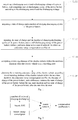
- Fig. 1 is a flow chart illustrating a method for estimating a remaining endurance range of an electric vehicle according to an embodiment of the present disclosure.
- the method for estimating a remaining endurance range of an electric vehicle includes the followings.
- a discharging current and a discharging voltage of a power battery are acquired, and current discharging energy of the power battery is computed according to the discharging current and the discharging voltage.
- the discharging current of the battery i.e., an external overall current of the power battery
- the discharging voltage of the power battery i.e., an external overall voltage of the power battery
- CAN Controller Area Network
- BMS Battery Management System
- a SOC (State of Charge) of the power battery and the number N of charging-discharging cycles of the power battery are obtained, where N is a positive integer.
- the state of charge SOC and the number N of charging-discharging cycles of the power battery may be obtained from the CAN network message reported by the BMS of the vehicle as well.
- the state of charge SOC and the number N of charging-discharging cycles of the power battery and overall discharging energy of the power battery within a unit time duration are input to a neural network, to obtain an endurance range compensation coefficient.
- the state of charge SOC of the power battery the number N of charging-discharging cycles of the power battery (i.e., the number N of cycles for completely charging and completely discharging the power battery) and the overall discharging power energy of the power battery within 60 seconds are taken as inputs of the neural network, and an output value of the neural network is the endurance range compensation coefficient K.
- Fig. 2 a schematic diagram of computing the endurance range compensation coefficient through the neural network is illustrated, where the three input variants are the number N of completely charging-discharging cycles of the power battery (i.e., the number N of cycles for completely charging and completely discharging the power battery), the battery SOC (i.e. the SOC of the power battery) and the battery energy consumption (i.e., the overall discharging energy of the power battery within 60 seconds), and the compensation coefficient K (i.e., the endurance range compensation coefficient K) is output.
- the endurance range compensation coefficient is obtained by followings.
- a radial basis function (RBF) neural network is designed.
- the radial basis function neural network includes an input layer, a hidden layer, and an output layer.
- the radial basis function neural network is trained according to a plurality of sets of overall discharging energy, the state of charge, and the number of charging-discharging cycles of the power battery.
- the endurance range compensation coefficient is obtained according to a completely trained radial basis function neural network.
- the external overall voltage of the power battery is accordingly decreased after the battery SOC is decreased, additional energy consumption of the vehicle may be resulted from activating a device with a rapid acceleration, a rapid deceleration and a high consumption (mainly including heat dissipation of a battery pack and heat dissipation of a drive system), and performances of the power battery attenuate as the number of charging-discharging of the battery is increased, the above factors may lead to a rapid decrease of the remaining endurance range.
- the above three variants are quantized specifically as the battery SOC, the energy consumption W Batt when the vehicle travels a distance within the unit time duration (60 seconds), and the number N of cycles for completely charging and completely discharging the power battery (corresponding to the battery attenuation degree).
- the neural network is designed to compute the endurance range compensation coefficient K .
- the RBF neural network may approximate any non-linear function with an arbitrary precision, has a compact topology, a global approximation ability, and may solve a local optimum problem of a back-propagation (BP) network as well. Therefore, the RBF neural network is designed to compute the endurance range compensation coefficient K .
- the designed RBF neural network is divided into three layers, including the input layer, the hidden layer and the output layer.
- the number of neurons of the hidden layer is 3.
- the neural network is trained. 250 sets (1000 sets totally) of driving data SOC, N and W Batt (obtained under different driving propensities and with different SOCs) are sampled respectively from driving data corresponding to four intervals for the number of completely charging-discharging cycles N ⁇ [0 250), N ⁇ [250 500), N ⁇ [500 1000), and N ⁇ [1000 ⁇ ). 1000 sets of real compensation coefficients K are computed according to actual endurance ranges and estimated endurance ranges. These 1000 sets of data [ SOC W Batt N K ] are taken as basis data to train the RBP neural network, and the trained neural network is finally used for computing the endurance range compensation coefficient K .
- a traveling distance S of the electric vehicle within the unit time duration is computed.
- the traveling distance S of the vehicle within the unit time duration (60 seconds) may be obtained by performing an integral operation on a result of dividing a rotational speed of a drive motor of the vehicle by a reduction ratio.
- the rotational speed of the drive motor of the vehicle may be obtained from the CAN message reported by a motor controller.
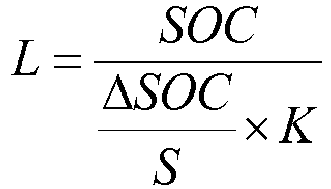
- the remaining endurance range of the electric vehicle is obtained according to the traveling distance S of the electric vehicle within the unit time duration, the endurance range compensation coefficient K, the state of charge SOC of the power battery, and a difference ⁇ SOC between the state of charge of the power battery before the unit time duration and the state of charge of the power battery after the unit time duration.
- L denotes the remaining endurance range of the electric vehicle
- ⁇ SOC denotes the difference between the SOC of the power battery before the unit time duration (such as 60 seconds) and the SOC of the power battery after the unit time duration
- SOC denotes the state of charge of the power battery (i.e., the state of charge of the power battery before the unit time duration)
- S denotes the traveling distance of the electric vehicle within the unit time duration
- K denotes the endurance range compensation coefficient.
- the endurance range compensation coefficient K may be increased with the decrease of the state of charge SOC of the power battery, the increase of the energy consumption of the battery within the unit time duration, and the increase of the number of completely charging-discharging cycles, which is obtained through neural network specifically.
- the above formula used for computing the remaining endurance range of the vehicle is only applicable to a traveling process of the vehicle. That is, only when the vehicle is in the traveling state, the remaining endurance range of the vehicle may be precisely computed according to the above formula.
- L old denotes the remaining endurance range of the electric vehicle before the unit time duration (such as 60 seconds)
- W Batt_ 60 s denotes the overall discharging energy of the power battery within the unit time duration
- W Batt_old denotes the overall discharging energy of the power battery within a previous unit time duration.
- the remaining endurance range of the vehicle when the vehicle is in the static state within the previous 60 seconds may be obtained using the formula (1), i.e., the L old . Then, the remaining endurance range of the vehicle when the vehicle is in the current static state may be precisely obtained using the formula (2).
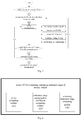
- Fig. 3 an overall flow chart of a method for estimating a remaining endurance range of the electric vehicle is illustrated as Fig. 3 .
- the method includes the followings.
- the compensation coefficient K is computed. That is, the endurance range compensation coefficient K is computed through the neural network.
- a block S303 is performed, otherwise a block S304 is performed.
- the endurance range in the moving state is computed. That is, the remaining endurance range of the vehicle is computed through the formula (1).
- the endurance range in the static state is computed. That is, the remaining endurance range of the vehicle is computed through the formula (2).
- the remaining endurance range is displayed on a meter. That is, the remaining endurance range of the vehicle is displayed in real time through the meter.
- an attenuation situation of the battery i.e., the attenuation situation is indicated by the number of charging-discharging cycles
- a driving propensity i.e., the driving propensity is indicated by energy consumption of the power battery within the unit time duration
- a mathematic model thereof has a strong non-linear characteristic, by integrally considering the state of charge of the power battery, the attenuation situation of the power battery (i.e., the attenuation situation is indicated by the number of charging-discharging cycles) and the driving propensity (i.e., the driving propensity is indicated by energy consumption of the power battery within the unit time duration) by the method according to the present disclosure and through the neural network, the endurance range compensation coefficient is obtained.
- the neural network may provide a corresponding output in response to an external excitation due to a characteristic of nonlinearity, a parallel structure and a learning ability, which has a natural advantage in solving a nonlinear problem. Therefore, the method may precisely compute the remaining endurance range of the electric vehicle, thereby providing a reliable basis to an energy management of the power battery.
- the method further includes the followings.
- the remaining endurance range of the electric vehicle is smaller than a first predetermined traveling range, it is prompted to a user whether to enter an economic mode (i.e., a common economic mode), the electric vehicle is controlled to enter the economic mode when receiving an instruction for entering the economic mode, and the electric vehicle is controlled to quit from the economic mode when receiving an instruction for quitting from the economic mode.
- an economic mode i.e., a common economic mode
- the remaining endurance range of the electric vehicle is smaller than a second predetermined traveling range, it is prompted to the user whether to enter a deep-economic mode, the electric vehicle is controlled to enter the deep-economic mode when receiving an instruction for entering the deep-economic mode, and the electric vehicle is controlled to quit from the deep-economic mode when receiving an instruction for quitting from the deep-economic mode.
- the first predetermined traveling range is greater than the second predetermined traveling range.
- the first predetermined traveling range is for example 50 kilometers.
- the second predetermined traveling range is for example 25 kilometers.
- the method when the vehicle enters the economic mode, the method further includes reducing a torque response speed; reducing energy consumption of a part of components of the electric vehicle.
- the method further includes when the obtained remaining endurance range of the electric vehicle in the economic mode is greater than a third predetermined traveling range, prompting the user whether to quit from the economic mode, and controlling the electric vehicle to quit from the economic mode when receiving the instruction for quitting from the economic mode.
- the third predetermined traveling range is greater the first predetermined traveling range.
- the second predetermined traveling range is for example 70 kilometers.
- the driver may quit from the common economic mode at any time via the multi-function steering wheel when the driver does not satisfy with driving experience corresponding to the common economic mode.
- the method further includes limiting traveling speed of the electric vehicle within a predetermined traveling speed, and further reducing the energy consumption of the part of the components of the electric vehicle is further reduced and/or deactivating the part of the components of the electric vehicle.
- the method further includes when the obtained remaining endurance range of the electric vehicle in the deep-economic mode is greater than a fourth predetermined traveling range, prompting the user whether to quit from the deep-economic mode, and controlling the electric vehicle to quit from the deep-economic mode when receiving the instruction for quitting from the deep-economic mode.
- the fourth predetermined traveling range is smaller than the third predetermined traveling range and greater than the first predetermined traveling range.
- the fourth predetermined traveling range is for example 55 kilometers.
- control strategies may be executed.
- the driver may quit from the deep-economic mode at any time via the multi-function steering wheel when the driver does not satisfy with driving experience the deep-economic mode, so as to improve driving experience.
- the method for estimating the remaining endurance range of an electric vehicle may precisely compute the remaining endurance range of the electric vehicle, and make the user to accurately know a situation of the electric vehicle.
- a plurality of power-saving modes (such as the economic mode and the deep-economic mode) are provided, thereby prolonging the endurance range of the electric vehicle, satisfying various demands of the user and improving market competitiveness of the electric vehicle.
- Fig. 6 is a block diagram illustrating a system for estimating a remaining endurance range of an electric vehicle according to an embodiment of the present disclosure.
- the system 600 for estimating a remaining endurance range of an electric vehicle according to an embodiment of the present disclosure includes an energy computing module 610, an endurance range compensation coefficient computing module 620 and a remaining endurance range estimating module 630.
- the energy computing module 610 is configured to acquire a discharging current and a discharging voltage of a power battery, and to compute current discharging energy of the power battery according to the discharging current and the discharging voltage.
- the endurance range compensation coefficient computing module 620 is configured to acquire a state of charge and the number of charging-discharging cycles of the power battery, and to input the state of charge and the number of charging-discharging cycles of the power battery and overall discharging energy of the power battery within a unit time duration to a neural network, to obtain an endurance range compensation coefficient.
- the remaining endurance range estimating module 630 is configured to compute a traveling distance of the electric vehicle within the unit time duration when the electric vehicle is in a traveling state, and to obtain the remaining endurance range of the electric vehicle according to the traveling distance of the electric vehicle within the unit time duration, the endurance range compensation coefficient, the state of charge of the power battery, and a difference between the state of charge of the power battery before the unit time duration and the state of charge of the power battery after the unit time duration.
- an attenuation situation of the battery i.e., the attenuation situation is indicated by the number of charging-discharging cycles
- a driving propensity i.e., the driving propensity is indicated by energy consumption of the power battery within the unit time duration
- a mathematic model thereof has a strong non-linear characteristic, by integrally considering the state of charge of the power battery, the attenuation situation of the power battery (i.e., the attenuation situation is indicated by the number of charging-discharging cycles) and the driving propensity (i.e., the driving propensity is indicated by energy consumption of the power battery within the unit time duration) by the method according to the present disclosure and through the neural network, the endurance range compensation coefficient K is obtained.
- the neural network may provide a corresponding output in response to an external excitation due to a characteristic of nonlinearity, a parallel structure and a learning ability, which has a natural advantage in solving a nonlinear problem. Therefore, the system may precisely compute the remaining endurance range of the electric vehicle, thereby providing a reliable basis to an energy management of the power battery.
- the endurance range compensation coefficient is obtained by the followings.
- a radial basis function neural network is designed.
- the radial basis function neural network includes an input layer, a hidden layer, and an output layer.
- the radial basis function neural network is trained according to a plurality of sets of overall discharging energy, the state of charge, the number of charging-discharging cycles of the power battery.
- the endurance range compensation coefficient is obtained according to a completely trained radial basis function neural network.
- L denotes the remaining endurance range of the electric vehicle
- ⁇ SOC denotes the difference between the state of charge of the power battery before the unit time duration and the state of charge of the power battery after the unit time duration
- SOC denotes the state of charge of the power battery
- S denotes the traveling distance of the electric vehicle within the unit time duration
- K denotes the endurance range compensation coefficient.
- L old denotes the remaining endurance range of the electric vehicle before the unit time duration
- W Batt _60 s denotes the overall discharging energy of the power battery within the unit time duration
- W Batt_old denotes the overall discharging energy of the power battery within a previous unit time duration.
- the system is further includes a controlling module (not illustrated in drawings).
- the controlling module is configured, when the remaining endurance range of the electric vehicle is smaller than a first predetermined traveling range, to prompt a user whether to enter an economic mode, to control the electric vehicle to enter the economic mode when an instruction for entering the economic mode is received, and to control the electric vehicle to quit from the economic mode when an instruction for quitting from the economic mode is received.
- the controlling module is further configured, when the remaining endurance range of the electric vehicle is smaller than a second predetermined traveling range, to prompt the user whether to enter a deep-economic mode, to control the electric vehicle to enter the deep-economic mode when an instruction for entering the deep-economic mode is received, and to control the electric vehicle to quit from the deep-economic mode when an instruction for quitting from the deep-economic mode is received.
- the first predetermined traveling range is greater than the second predetermined traveling range.
- controlling module is further configured, after the electric vehicle enters the economic mode, to reduce a torque response speed; and to reduce energy consumption of a part of components of the electric vehicle.
- the controlling module is configured, when the obtained remaining endurance range of the electric vehicle in the economic mode is greater than a third predetermined traveling range, to prompt the user whether to quit from the economic mode, and to control the electric vehicle to quit from the economic mode when the instruction for quitting from the economic mode is received.
- the third predetermined traveling range is greater the first predetermined traveling range.
- the controlling module is configured, after the electric vehicle enters the deep-economic mode, to limit a traveling speed of the electric vehicle within a predetermined traveling speed; and to further reduce the energy consumption of the a part of components of the electric vehicle and/or deactivate the part of components of the electric vehicle.
- the controlling module is configured, when the obtained remaining endurance range of the electric vehicle in the deep-economic mode is greater than a fourth predetermined traveling range, to prompt the user whether to quit from the deep-economic mode, and to control the electric vehicle to quit from the deep-economic mode when the instruction for quitting from the deep-economic mode is received.
- the fourth predetermined traveling range is smaller than the third predetermined traveling range and greater than the first predetermined traveling range.
- the system for estimating a remaining endurance range of an electric vehicle may precisely compute the remaining endurance range of the electric vehicle, and make the user to accurately know a situation of the electric vehicle.
- a plurality of power-saving modes (such as the economic mode and the deep-economic mode) are provided, thereby prolonging the endurance range of the electric vehicle, satisfying various demands of the user and improving market competitiveness of the electric vehicle.
- a specific implementation of the system for estimating a remaining endurance range of an electric vehicle provided in embodiments of the present disclosure is similar to a specific implementation of the method for estimating a remaining endurance range of an electric vehicle provided in embodiments of the present disclosure, and may be referred to descriptions corresponding to the method in detail, which is not elaborated for redundancy reduction.
- inventions of the present disclosure provide an electric vehicle.
- the electric vehicle includes the system for estimating a remaining endurance range of an electric vehicle according to above embodiments of the present disclosure.
- the vehicle may precisely compute the remaining endurance range of the electric vehicle, and make the user to accurately know a situation of the electric vehicle.
- a plurality of power-saving modes (such as the economic mode and the deep-economic mode) are provided, thereby prolonging the endurance range of the electric vehicle, satisfying various demands of the user and improving market competitiveness of the electric vehicle.
- Embodiments of the present disclosure further provide a device.
- the device includes one or more processors, a memory and one or more programs.
- the one or more programs are stored in the memory.
- the method for estimating a remaining endurance range of an electric vehicle according to above embodiments is executed.
- Embodiments of the present disclosure further provide a non-volatile computer storage medium.
- the computer storage medium has one or more programs stored therein.
- the method for estimating a remaining endurance range of an electric vehicle according to above embodiments is executed by the device.
- each part of the present disclosure may be realized by hardware, software, firmware or a combination thereof.
- a plurality of steps or methods may be realized by the software or firmware stored in the memory and executed by the appropriate instruction execution system.
- the steps or methods may be realized by one or a combination of the following techniques known in the art: a discrete logic circuit having a logic gate circuit for realizing a logic function of a data signal, an application-specific integrated circuit having an appropriate combination logic gate circuit, a programmable gate array (PGA), a field programmable gate array (FPGA), etc.
Landscapes
- Engineering & Computer Science (AREA)
- Life Sciences & Earth Sciences (AREA)
- Sustainable Development (AREA)
- Sustainable Energy (AREA)
- Power Engineering (AREA)
- Transportation (AREA)
- Mechanical Engineering (AREA)
- Electric Propulsion And Braking For Vehicles (AREA)
- Secondary Cells (AREA)
- Charge And Discharge Circuits For Batteries Or The Like (AREA)
Abstract
Description
- The present application claims a priority to Chinese Patent Application Serial No.
201510726116.8 - The present disclosure generally relates to the vehicle technical field, and more particularly, to a method and a system for estimating a remaining endurance range of an electric vehicle, and an electric vehicle.
- At present, with an increasing depletion of non-renewable energy sources and increasingly serious environmental pollutions, developments are increasingly made to vehicles in low energy consumption and low emissions. Electric vehicles have advantage of zero emissions. However, electric vehicles are limited by the development of power batteries, an endurance range of the electric vehicle is limited, and charging the power batteries is relatively time consuming. Therefore, how to manage energy of the power battery to prolong the endurance range of the electric vehicle is an urgent problem to be solved.
- In related arts, the remaining endurance range of the electric vehicle is usually estimated based on a linear model of state of charge of the power battery. However, since the remaining endurance range of the electric vehicle is not only related to the state of charge of the power battery, but also related to the driving propensities, attenuation of performances of the power battery, and the like, the remaining endurance range of the electric vehicle estimated based on based on the linear model of the state of charge of the power battery is not accurate and reliable, thereby affecting an energy management of the power battery.
- A first objective of embodiments of the present disclosure is to provide a method for estimating a remaining endurance range of an electric vehicle. The method may precisely computer a remaining endurance range of an electric vehicle, for providing a reliable basis to a subsequent energy management of the electric vehicle.
- A second objective of embodiments of the present disclosure is to provide a method for estimating a remaining endurance range of an electric vehicle.
- A third objective of embodiments of the present disclosure is to provide an electric vehicle.
- In order to achieve the above objectives, the method for estimating a remaining endurance range of an electric vehicle according to embodiments of a first aspect of the present disclosure includes the followings. A discharging current and a discharging voltage of a power battery are acquired, and current discharging energy of the power battery is computed according to the discharging current and the discharging voltage. A state of charge and a number of charging-discharging cycles of the power battery are acquired. The state of charge and the number of charging-discharging cycles of the power battery and overall discharging energy of the power battery within a unit time duration are input to a neural network, to obtain an endurance range compensation coefficient. A traveling distance of the electric vehicle within the unit time duration is computed when the electric vehicle is in a traveling state. The remaining endurance range of the electric vehicle is obtained according to the traveling distance of the electric vehicle within the unit time duration, the endurance range compensation coefficient, the state of charge of the power battery, and a difference between the state of charge of the power battery before the unit time duration and the state of charge of the power battery after the unit time duration.
- With the method for estimating the remaining endurance range of an electric vehicle, since an actual remaining endurance range of the electric vehicle is related to the state of charge of the battery, an attenuation situation of the battery (i.e., the attenuation situation is indicated by the number of charging-discharging cycles) and a driving propensity (i.e., the driving propensity is indicated by energy consumption of the power battery within the unit time duration), and a mathematic model thereof has a strong non-linear characteristic, by integrally considering the state of charge of the power battery, the attenuation situation of the power battery (i.e., the attenuation situation is indicated by the number of charging-discharging cycles) and the driving propensity (i.e., the driving propensity is indicated by energy consumption of the power battery within the unit time duration) by the method according to the present disclosure and through the neural network, the endurance range compensation coefficient is obtained. The neural network may provide a corresponding output in response to an external excitation due to a characteristic of nonlinearity, a parallel structure and a learning ability , which has a natural advantage in solving a nonlinear problem. Therefore, the method may precisely compute the remaining endurance range of the electric vehicle, thereby providing a reliable basis to an energy management of the power battery.
- In addition, the method for estimating a remaining endurance range of an electric vehicle according to the above embodiment of the present disclosure may further have following additional technical features.
- In some examples, the remaining endurance range of the electric vehicle is obtained by a formula of:

- In some example, the method further includes the followings. When the electric vehicle is in a static state, the remaining endurance range of the electric vehicle is obtained by a formula of:

- In some examples, the endurance range compensation coefficient is obtained by the followings.
- A radial basis function neural network is designed, the radial basis function neural network includes an input layer, a hidden layer, and an output layer, and the radial basis function neural network is denoted by a formula of:

- In addition, the radial basis function neural network is trained according to a plurality of sets of overall discharging energy, the state of charge, the number of charging-discharging cycles of the power battery.
- Furthermore, the endurance range compensation coefficient is obtained according to a completely trained radial basis function neural network.
- In some examples, after the remaining endurance range of the electric vehicle is obtained, the method further includes when the remaining endurance range of the electric vehicle is smaller than a first predetermined traveling range, prompting a user whether to enter an economic mode, controlling the electric vehicle to enter the economic mode when receiving an instruction for entering the economic mode, and controlling the electric vehicle to quit from the economic mode when receiving an instruction for quitting from the economic mode; and when the remaining endurance range of the electric vehicle is smaller than a second predetermined traveling range, prompting the user whether to enter a deep-economic mode, controlling the electric vehicle to enter the deep-economic mode when receiving an instruction for entering the deep-economic mode, and controlling the electric vehicle to quit from the deep-economic mode when receiving an instruction for quitting from the deep-economic mode, in which the first predetermined traveling range is greater than the second predetermined traveling range.
- In some examples, after the electric vehicle enters the economic mode, the method further includes reducing a torque response speed; reducing energy consumption of a part of components of the electric vehicle; when the obtained remaining endurance range of the electric vehicle in the economic mode is greater than a third predetermined traveling range, prompting the user whether to quit from the economic mode, and controlling the electric vehicle to quit from the economic mode when receiving the instruction for quitting from the economic mode, in which the third predetermined traveling range is greater the first predetermined traveling range. After the electric vehicle enters the deep-economic mode, the method further includes: limiting a traveling speed of the electric vehicle within a predetermined traveling speed; further reducing the energy consumption of the part of the components of the electric vehicle and/or deactivating the part of the components of the electric vehicle; and when the obtained remaining endurance range of the electric vehicle in the deep-economic mode is greater than a fourth predetermined traveling range, prompting the user whether to quit from the deep-economic mode, and controlling the electric vehicle to quit from the deep-economic mode when receiving the instruction for quitting from the deep-economic mode, in which the fourth predetermined traveling range is smaller than the third predetermined traveling range and greater than the first predetermined traveling range.
- A system for estimating a remaining endurance range of an electric vehicle according to embodiments of a second aspect of the present disclosure includes an energy computing module, an endurance range compensation coefficient computing module, and a remaining endurance range estimating module. The energy computing module is configured to acquire a discharging current and a discharging voltage of a power battery, and to compute current discharging energy of the power battery according to the discharging current and the discharging voltage. The endurance range compensation coefficient computing module is configured to acquire a state of charge and the number of charging-discharging cycles of the power battery, and to input the state of charge and the number of charging-discharging cycles of the power battery and overall discharging energy of the power battery within a unit time duration to a neural network to obtain an endurance range compensation coefficient. The remaining endurance range estimating module is configured to compute a traveling distance of the electric vehicle within the unit time duration when the electric vehicle is in a traveling state, and to obtain the remaining endurance range of the electric vehicle according to the traveling distance of the electric vehicle within the unit time duration, the endurance range compensation coefficient, the state of charge of the power battery, and a difference between the state of charge of the power battery before the unit time duration and the state of charge of the power battery after the unit time duration.
- With the system for estimating the remaining endurance range of an electric vehicle, since an actual remaining endurance range of the electric vehicle is related to the state of charge of the battery, an attenuation situation of the battery (i.e., the attenuation situation is indicated by the number of charging-discharging cycles) and a driving propensity (i.e., the driving propensity is indicated by energy consumption of the power battery within the unit time duration), and a mathematic model thereof has a strong non-linear characteristic, by integrally considering the state of charge of the power battery, the attenuation situation of the power battery (i.e., the attenuation situation is indicated by the number of charging-discharging cycles) and the driving propensity (i.e., the driving propensity is indicated by energy consumption of the power battery within the unit time duration) by the method according to the present disclosure and through the neural network, the endurance range compensation coefficient is obtained. The neural network may provide a corresponding output in response to an external excitation due to a characteristic of nonlinearity, a parallel structure and a learning ability, which has a natural advantage in solving a nonlinear problem. Therefore, the system may precisely compute the remaining endurance range of the electric vehicle, thereby providing a reliable basis to an energy management of the power battery.
- In addition, the system for estimating a remaining endurance range of an electric vehicle according to the above embodiment of the present disclosure may further have following additional technical features.
- In some examples, the remaining endurance range of the electric vehicle is obtained by a formula of:
- In some examples, the remaining endurance range estimating module is further configured, when the electric vehicle is in a static state, to obtain the remaining endurance range of the electric vehicle by a formula of:

- In some examples, the endurance range compensation coefficient is obtained by the followings.
- A radial basis function neural network is designed, the radial basis function neural network includes an input layer, a hidden layer, and an output layer, and the radial basis function neural network is denoted by a formula of:

In addition, the radial basis function neural network is trained according to a plurality of sets of overall discharging energy, the state of charge, the number of charging-discharging cycles of the power battery. - Furthermore, the endurance range compensation coefficient is obtained according to a completely trained radial basis function neural network.
- In some examples, the system further includes a controlling module. The controlling module is configured, when the remaining endurance range of the electric vehicle is smaller than a first predetermined traveling range, to prompt a user whether to enter an economic mode, to control the electric vehicle to enter the economic mode when an instruction for entering the economic mode is received, and to control the electric vehicle to quit from the economic mode when an instruction for quitting from the economic mode is received; when the remaining endurance range of the electric vehicle is smaller than a second predetermined traveling range, to prompt the user whether to enter a deep-economic mode, to control the electric vehicle to enter the deep-economic mode when an instruction for entering the deep-economic mode is received, and to control the electric vehicle to quit from the deep-economic mode when an instruction for quitting from the deep-economic mode is received, in which the first predetermined traveling range is greater than the second predetermined traveling range.
- In some examples, the controlling module is further configured, after the electric vehicle enters the economic mode, to reduce a torque response speed; to reduce energy consumption of a part of components of the electric vehicle; when the obtained remaining endurance range of the electric vehicle in the economic mode is greater than a third predetermined traveling range, to prompt the user whether to quit from the economic mode, and to control the electric vehicle to quit from the economic mode when the instruction for quitting from the economic mode is received, in which the third predetermined traveling range is greater the first predetermined traveling range. The controlling module is further configured, after the electric vehicle enters the deep-economic mode, to limit a traveling speed of the electric vehicle within a predetermined traveling speed; to further reduce the energy consumption of the a part of components of the electric vehicle and/or deactivate the part of components of the electric vehicle; and when the obtained remaining endurance range of the electric vehicle in the deep-economic mode is greater than a fourth predetermined traveling range, to prompt the user whether to quit from the deep-economic mode, and to control the electric vehicle to quit from the deep-economic mode when the instruction for quitting from the deep-economic mode is received, in which the fourth predetermined traveling range is smaller than the third predetermined traveling range and greater than the first predetermined traveling range.
- An electric vehicle according to embodiments of a third aspect of the present disclosure includes the system for estimating a remaining endurance range of an electric vehicle according to embodiments of the second aspect of the present disclosure. The electric vehicle may precisely compute the remaining endurance range of the electric vehicle, and make the user to accurately know a situation of the electric vehicle, on the basis of this, a plurality of power-saving modes (such as the economic mode and the deep-economic mode) are provided, thereby prolonging the endurance range of the electric vehicle, satisfying various demands of the user and improving market competitiveness of the electric vehicle.
- A fourth objective of embodiments of the present disclosure is to provide a device. The device includes one or more processors, a memory, and one or more programs. The one or more programs are stored in the memory, and when the one or more programs are executed by the one or more processors, the method for estimating a remaining endurance range of an electric vehicle according to above embodiments is executed.
- A fifth objective of embodiments of the present disclosure is to provide a non-volatile computer storage medium. The computer storage medium has one or more programs stored therein, and when the one or more programs are executed by a device, the method for estimating a remaining endurance range of an electric vehicle according to above embodiments is executed by the device.
- With embodiments of the present disclosure, since an actual remaining endurance range of the electric vehicle is related to the state of charge of the battery, an attenuation situation of the battery (i.e., the attenuation situation is indicated by the number of charging-discharging cycles) and a driving propensity (i.e., the driving propensity is indicated by energy consumption of the power battery within the unit time duration), and a mathematic model thereof has a strong non-linear characteristic, by integrally considering the state of charge of the power battery, the attenuation situation of the power battery (i.e., the attenuation situation is indicated by the number of charging-discharging cycles) and the driving propensity (i.e., the driving propensity is indicated by energy consumption of the power battery within the unit time duration) by the method according to the present disclosure and through the neural network, the endurance range compensation coefficient is obtained. The neural network may provide a corresponding output in response to an external excitation due to a characteristic of nonlinearity, a parallel structure and a learning ability, which has a natural advantage in solving a nonlinear problem. Therefore, the system may precisely compute the remaining endurance range of the electric vehicle, thereby providing a reliable basis to an energy management of the power battery.
- Additional aspects and advantages of embodiments of present disclosure will be given in part in the following descriptions, become apparent in part from the following descriptions, or be learned from the practice of the embodiments of the present disclosure.
- In order to more explicitly illustrate technical solutions in embodiments of the present disclosure, a brief introduction for the accompanying drawings used in descriptions of the embodiments and prior arts will be listed as follows. Apparently, the drawings described below are only corresponding to some embodiments of the present disclosure, and those skilled in the art may obtain other drawings according to these drawings without creative labor.
-
Fig. 1 is a flow chart illustrating a method for estimating a remaining endurance range of an electric vehicle according to an embodiment of the present disclosure; -
Fig. 2 is a principle diagram illustrating a computation of an endurance range through a neural network included in a method for estimating a remaining endurance range of an electric vehicle according to an embodiment of the present disclosure; -
Fig. 3 is an overall flow chart illustrating a method for estimating a remaining endurance range of an electric vehicle according to another embodiment of the present disclosure; -
Fig. 4 is a management strategy logic diagram after entering an economic mode (a common economic mode) included in a method for estimating a remaining endurance range of an electric vehicle according to an embodiment of the present disclosure; -
Fig. 5 is a management strategy logic diagram after entering a deep-economic mode included in a method for estimating a remaining endurance range of an electric vehicle according to an embodiment of the present disclosure; and -
Fig. 6 is a block diagram illustrating a system for estimating a remaining endurance range of an electric vehicle according to an embodiment of the present disclosure. - Descriptions will be made in detail to embodiments of the present disclosure. Examples of the embodiments are illustrated in the drawings. The same or similar elements and the elements having same or similar functions are denoted by like reference numerals throughout the descriptions. The embodiments described herein with reference to drawings are exemplary, only used to illustrate the present disclosure, but not construed to limit the present disclosure. Instead, the embodiments of the present disclosure comprise all the variants, modifications and their equivalents within the spirit and scope of the present disclosure as defined by the claims.
- In the description of the present disclosure, it is to be understood that, terms of "first" and "second" are only used for description and cannot be seen as indicating or implying relative importance. In the description of the present disclosure, unless otherwise stipulated and restricted, terms of "linkage" and "connection" shall be understood broadly, for example, it could be fixed connection, detachable connection or integral connection; it could be mechanical connection or electrical connection; it could be direct linkage, indirect linkage via intermediate medium. Those skilled in the art shall understand the concrete notations of the terms mentioned above according to specific circumstances. Furthermore, in the description of the present disclosure, unless otherwise illustrated, a term of "a plurality of' means to two or more than two.
- A method and a system for estimating a remaining endurance range of an electric vehicle and an electric vehicle according to embodiments of the present disclosure will be described in combination with drawings.
-
Fig. 1 is a flow chart illustrating a method for estimating a remaining endurance range of an electric vehicle according to an embodiment of the present disclosure. - As illustrated in
Fig. 1 , the method for estimating a remaining endurance range of an electric vehicle according to an embodiment of the present disclosure includes the followings. - At block S101, a discharging current and a discharging voltage of a power battery are acquired, and current discharging energy of the power battery is computed according to the discharging current and the discharging voltage.
- In detail, the discharging current of the battery (i.e., an external overall current of the power battery) and the discharging voltage of the power battery (i.e., an external overall voltage of the power battery) may be obtained from a CAN (Controller Area Network) network message reported by a BMS (Battery Management System) of the vehicle.
- When the discharging current and the discharging voltage of the power battery are acquired, a multiply operation is performed on the discharging current of the power battery and the discharging voltage of the power battery to obtain a discharging power PBatt of the power battery. An integral operation is performed on the discharging power PBatt to obtain battery consumption energy WBatt (i.e., the current discharging energy WBatt of the power battery).
- At block S102, a SOC (State of Charge) of the power battery and the number N of charging-discharging cycles of the power battery are obtained, where N is a positive integer.
- In a detailed example of the present disclosure, the state of charge SOC and the number N of charging-discharging cycles of the power battery may be obtained from the CAN network message reported by the BMS of the vehicle as well.
- At block S103, the state of charge SOC and the number N of charging-discharging cycles of the power battery and overall discharging energy of the power battery within a unit time duration are input to a neural network, to obtain an endurance range compensation coefficient.
- Taking the unit time duration to be 60 seconds as an example, the state of charge SOC of the power battery, the number N of charging-discharging cycles of the power battery (i.e., the number N of cycles for completely charging and completely discharging the power battery) and the overall discharging power energy of the power battery within 60 seconds are taken as inputs of the neural network, and an output value of the neural network is the endurance range compensation coefficient K. As illustrated in
Fig. 2 , a schematic diagram of computing the endurance range compensation coefficient through the neural network is illustrated, where the three input variants are the number N of completely charging-discharging cycles of the power battery (i.e., the number N of cycles for completely charging and completely discharging the power battery), the battery SOC (i.e. the SOC of the power battery) and the battery energy consumption (i.e., the overall discharging energy of the power battery within 60 seconds), and the compensation coefficient K (i.e., the endurance range compensation coefficient K) is output. - In detail, the endurance range compensation coefficient is obtained by followings.
- A radial basis function (RBF) neural network is designed. The radial basis function neural network includes an input layer, a hidden layer, and an output layer. The radial basis function neural network is denoted by a formula of:

- The radial basis function neural network is trained according to a plurality of sets of overall discharging energy, the state of charge, and the number of charging-discharging cycles of the power battery.
- The endurance range compensation coefficient is obtained according to a completely trained radial basis function neural network.
- In more detail, it is considered that the external overall voltage of the power battery is accordingly decreased after the battery SOC is decreased, additional energy consumption of the vehicle may be resulted from activating a device with a rapid acceleration, a rapid deceleration and a high consumption (mainly including heat dissipation of a battery pack and heat dissipation of a drive system), and performances of the power battery attenuate as the number of charging-discharging of the battery is increased, the above factors may lead to a rapid decrease of the remaining endurance range. To this end, the above three variants are quantized specifically as the battery SOC, the energy consumption WBatt when the vehicle travels a distance within the unit time duration (60 seconds), and the number N of cycles for completely charging and completely discharging the power battery (corresponding to the battery attenuation degree). According to the above three quantized variants, the neural network is designed to compute the endurance range compensation coefficient K.
- As a feedforward neural network with a good performance, the RBF neural network may approximate any non-linear function with an arbitrary precision, has a compact topology, a global approximation ability, and may solve a local optimum problem of a back-propagation (BP) network as well. Therefore, the RBF neural network is designed to compute the endurance range compensation coefficient K.
- The designed RBF neural network is divided into three layers, including the input layer, the hidden layer and the output layer. The number of neurons of the hidden layer is 3. The RBF neural network is denoted by a formula of:

- After the neural network is designed, the neural network is trained. 250 sets (1000 sets totally) of driving data SOC, N and WBatt (obtained under different driving propensities and with different SOCs) are sampled respectively from driving data corresponding to four intervals for the number of completely charging-discharging cycles N∈[0 250), N∈[250 500), N∈[500 1000), and N∈[1000 ∞). 1000 sets of real compensation coefficients K are computed according to actual endurance ranges and estimated endurance ranges. These 1000 sets of data [SOC WBatt N K] are taken as basis data to train the RBP neural network, and the trained neural network is finally used for computing the endurance range compensation coefficient K.
- At block S104, when the electric vehicle is in a traveling state, a traveling distance S of the electric vehicle within the unit time duration is computed.
- The traveling distance S of the vehicle within the unit time duration (60 seconds) may be obtained by performing an integral operation on a result of dividing a rotational speed of a drive motor of the vehicle by a reduction ratio. The rotational speed of the drive motor of the vehicle may be obtained from the CAN message reported by a motor controller.
- At block S105, the remaining endurance range of the electric vehicle is obtained according to the traveling distance S of the electric vehicle within the unit time duration, the endurance range compensation coefficient K, the state of charge SOC of the power battery, and a difference ΔSOC between the state of charge of the power battery before the unit time duration and the state of charge of the power battery after the unit time duration.
- For example, the remaining endurance range of the vehicle is obtained by a formula of:

- It is to be illustrated that, the endurance range compensation coefficient K may be increased with the decrease of the state of charge SOC of the power battery, the increase of the energy consumption of the battery within the unit time duration, and the increase of the number of completely charging-discharging cycles, which is obtained through neural network specifically.
- In addition, the above formula used for computing the remaining endurance range of the vehicle is only applicable to a traveling process of the vehicle. That is, only when the vehicle is in the traveling state, the remaining endurance range of the vehicle may be precisely computed according to the above formula.
- However, in a case where the vehicle may be in a static state, for example, when the vehicle waits traffic lights, although the vehicle is not traveling, the energy of the power battery is also consumed. In this case, the remaining endurance range of the vehicle may be computed by a following formula:

- In conclusion, an overall flow chart of a method for estimating a remaining endurance range of the electric vehicle is illustrated as
Fig. 3 . The method includes the followings. - At block S301, the compensation coefficient K is computed. That is, the endurance range compensation coefficient K is computed through the neural network.
- At block S302, it is determined whether the vehicle is in a moving state, i.e., the traveling state. If the vehicle is in the moving state, a block S303 is performed, otherwise a block S304 is performed.
- At block S303, the endurance range in the moving state is computed. That is, the remaining endurance range of the vehicle is computed through the formula (1).
- At block S304, the endurance range in the static state is computed. That is, the remaining endurance range of the vehicle is computed through the formula (2).
- At block S305, the remaining endurance range is displayed on a meter. That is, the remaining endurance range of the vehicle is displayed in real time through the meter.
- With the method for estimating the remaining endurance range of an electric vehicle, since an actual remaining endurance range of the electric vehicle is related to the state of charge of the battery, an attenuation situation of the battery (i.e., the attenuation situation is indicated by the number of charging-discharging cycles) and a driving propensity (i.e., the driving propensity is indicated by energy consumption of the power battery within the unit time duration), and a mathematic model thereof has a strong non-linear characteristic, by integrally considering the state of charge of the power battery, the attenuation situation of the power battery (i.e., the attenuation situation is indicated by the number of charging-discharging cycles) and the driving propensity (i.e., the driving propensity is indicated by energy consumption of the power battery within the unit time duration) by the method according to the present disclosure and through the neural network, the endurance range compensation coefficient is obtained. The neural network may provide a corresponding output in response to an external excitation due to a characteristic of nonlinearity, a parallel structure and a learning ability, which has a natural advantage in solving a nonlinear problem. Therefore, the method may precisely compute the remaining endurance range of the electric vehicle, thereby providing a reliable basis to an energy management of the power battery.
- In an embodiment of the present disclosure, after the remaining endurance range of the vehicle is obtained, the method further includes the followings. When the remaining endurance range of the electric vehicle is smaller than a first predetermined traveling range, it is prompted to a user whether to enter an economic mode (i.e., a common economic mode), the electric vehicle is controlled to enter the economic mode when receiving an instruction for entering the economic mode, and the electric vehicle is controlled to quit from the economic mode when receiving an instruction for quitting from the economic mode. When the remaining endurance range of the electric vehicle is smaller than a second predetermined traveling range, it is prompted to the user whether to enter a deep-economic mode, the electric vehicle is controlled to enter the deep-economic mode when receiving an instruction for entering the deep-economic mode, and the electric vehicle is controlled to quit from the deep-economic mode when receiving an instruction for quitting from the deep-economic mode. The first predetermined traveling range is greater than the second predetermined traveling range. The first predetermined traveling range is for example 50 kilometers. The second predetermined traveling range is for example 25 kilometers.
- In detail, as illustrated in
Fig. 4 , when the vehicle enters the economic mode, the method further includes reducing a torque response speed; reducing energy consumption of a part of components of the electric vehicle. The method further includes when the obtained remaining endurance range of the electric vehicle in the economic mode is greater than a third predetermined traveling range, prompting the user whether to quit from the economic mode, and controlling the electric vehicle to quit from the economic mode when receiving the instruction for quitting from the economic mode. The third predetermined traveling range is greater the first predetermined traveling range. The second predetermined traveling range is for example 70 kilometers. - For example, when it is determined to enter the common economic mode, following strategies are executed.
- (1) A torque response gradient of an accelerator pedal is performed at 0.3 times of an original one, to reduce the torque response speed and thus reduce energy consumption.
- (2) Temperature thresholds of turning a radiator pump and a fan on by the drive motor and the motor controller are increased to reduce the energy consumption of accessories.
- (3) Considering that after the vehicle enters the common economic mode, the driver may change the driving way (for example, from frequent acceleration and braking to constant speed driving), the remaining endurance range may be increased and may exceed for example 50 km. For this reason, in this strategy, when the remaining endurance range exceeds 70km, the meter may prompt whether to quit from the common economy mode. The driver may select or refuse to quit from the common economy mode via a multi-function steering wheel.
- In addition, the driver may quit from the common economic mode at any time via the multi-function steering wheel when the driver does not satisfy with driving experience corresponding to the common economic mode.
- As illustrated in
Fig. 5 , after the vehicle enters the deep-economic mode, the method further includes limiting traveling speed of the electric vehicle within a predetermined traveling speed, and further reducing the energy consumption of the part of the components of the electric vehicle is further reduced and/or deactivating the part of the components of the electric vehicle. The method further includes when the obtained remaining endurance range of the electric vehicle in the deep-economic mode is greater than a fourth predetermined traveling range, prompting the user whether to quit from the deep-economic mode, and controlling the electric vehicle to quit from the deep-economic mode when receiving the instruction for quitting from the deep-economic mode. The fourth predetermined traveling range is smaller than the third predetermined traveling range and greater than the first predetermined traveling range. The fourth predetermined traveling range is for example 55 kilometers. - For example, when it is selected to enter the deep-economic mode, following control strategies may be executed.
- (1) A maximum traveling speed of the electric vehicle is limited, for example to 30km/h.
- (2) A DC/DC (direct current to direct current conversion module) is deactivated, to reduce the power consumption of the vehicle.
- (3) An electronic power steering (EPS) system provides power to the vehicle with minimal power consumption.
- (4) The EPS is a low voltage component, powered for example by a 12V battery. This strategy may greatly reduce a pressure of the 12V battery after deactivating the DC/DC so as to prolong the endurance range of the vehicle.
- (5) The radiator pump and the fan are disabled. Since there is no demand of water cooling by the drive system after the traveling speed of the vehicle is limited, the radiator pump and the fun are disabled to reduce the energy consumption. At the same time, since the pump and the fun are powered by the 12V battery, this strategy may reduce a load of the 12V battery after the DC/DC is disabled.
- (6) An air conditioning including a compressor and a heater is deactivated. By disabling the air conditioning, the power consumption of the vehicle is further reduced.
- (7) Considering that after the vehicle enters the common economic mode, the driver may change the driving way (for example, from frequent acceleration and braking to constant speed driving), the remaining endurance range may be increased and may exceed for example 25 km. For this reason, when the remaining endurance range exceeds 55km, the meter may prompt whether to quit from the deep-economy mode. The driver may select or refuse to quit from the common economy mode via a multi-function steering wheel.
- In addition, the driver may quit from the deep-economic mode at any time via the multi-function steering wheel when the driver does not satisfy with driving experience the deep-economic mode, so as to improve driving experience.
- The method for estimating the remaining endurance range of an electric vehicle according to embodiments of the present disclosure may precisely compute the remaining endurance range of the electric vehicle, and make the user to accurately know a situation of the electric vehicle. On the basis of this, a plurality of power-saving modes (such as the economic mode and the deep-economic mode) are provided, thereby prolonging the endurance range of the electric vehicle, satisfying various demands of the user and improving market competitiveness of the electric vehicle.
-
Fig. 6 is a block diagram illustrating a system for estimating a remaining endurance range of an electric vehicle according to an embodiment of the present disclosure. As illustrated inFig. 6 , thesystem 600 for estimating a remaining endurance range of an electric vehicle according to an embodiment of the present disclosure includes anenergy computing module 610, an endurance range compensationcoefficient computing module 620 and a remaining endurance range estimating module 630. - The
energy computing module 610 is configured to acquire a discharging current and a discharging voltage of a power battery, and to compute current discharging energy of the power battery according to the discharging current and the discharging voltage. The endurance range compensationcoefficient computing module 620 is configured to acquire a state of charge and the number of charging-discharging cycles of the power battery, and to input the state of charge and the number of charging-discharging cycles of the power battery and overall discharging energy of the power battery within a unit time duration to a neural network, to obtain an endurance range compensation coefficient. The remaining endurance range estimating module 630 is configured to compute a traveling distance of the electric vehicle within the unit time duration when the electric vehicle is in a traveling state, and to obtain the remaining endurance range of the electric vehicle according to the traveling distance of the electric vehicle within the unit time duration, the endurance range compensation coefficient, the state of charge of the power battery, and a difference between the state of charge of the power battery before the unit time duration and the state of charge of the power battery after the unit time duration. - With the system for estimating the remaining endurance range of an electric vehicle, since an actual remaining endurance range of the electric vehicle is related to the state of charge of the battery, an attenuation situation of the battery (i.e., the attenuation situation is indicated by the number of charging-discharging cycles) and a driving propensity (i.e., the driving propensity is indicated by energy consumption of the power battery within the unit time duration), and a mathematic model thereof has a strong non-linear characteristic, by integrally considering the state of charge of the power battery, the attenuation situation of the power battery (i.e., the attenuation situation is indicated by the number of charging-discharging cycles) and the driving propensity (i.e., the driving propensity is indicated by energy consumption of the power battery within the unit time duration) by the method according to the present disclosure and through the neural network, the endurance range compensation coefficient K is obtained. The neural network may provide a corresponding output in response to an external excitation due to a characteristic of nonlinearity, a parallel structure and a learning ability, which has a natural advantage in solving a nonlinear problem. Therefore, the system may precisely compute the remaining endurance range of the electric vehicle, thereby providing a reliable basis to an energy management of the power battery.
- In an embodiment of the present disclosure, the endurance range compensation coefficient is obtained by the followings.
- A radial basis function neural network is designed. The radial basis function neural network includes an input layer, a hidden layer, and an output layer. The radial basis function neural network is denoted by a formula of:

- The radial basis function neural network is trained according to a plurality of sets of overall discharging energy, the state of charge, the number of charging-discharging cycles of the power battery.
- The endurance range compensation coefficient is obtained according to a completely trained radial basis function neural network.
- In an embodiment of the present disclosure, the remaining endurance range of the electric vehicle is obtained by a formula of:

- In an embodiment of the present disclosure, the remaining endurance range estimating module is further configured, when the electric vehicle is in a static state, to obtain the remaining endurance range of the electric vehicle by a formula of:

- In an embodiment of the present disclosure, the system is further includes a controlling module (not illustrated in drawings). The controlling module is configured, when the remaining endurance range of the electric vehicle is smaller than a first predetermined traveling range, to prompt a user whether to enter an economic mode, to control the electric vehicle to enter the economic mode when an instruction for entering the economic mode is received, and to control the electric vehicle to quit from the economic mode when an instruction for quitting from the economic mode is received. The controlling module is further configured, when the remaining endurance range of the electric vehicle is smaller than a second predetermined traveling range, to prompt the user whether to enter a deep-economic mode, to control the electric vehicle to enter the deep-economic mode when an instruction for entering the deep-economic mode is received, and to control the electric vehicle to quit from the deep-economic mode when an instruction for quitting from the deep-economic mode is received. The first predetermined traveling range is greater than the second predetermined traveling range.
- Further, the controlling module is further configured, after the electric vehicle enters the economic mode, to reduce a torque response speed; and to reduce energy consumption of a part of components of the electric vehicle. The controlling module is configured, when the obtained remaining endurance range of the electric vehicle in the economic mode is greater than a third predetermined traveling range, to prompt the user whether to quit from the economic mode, and to control the electric vehicle to quit from the economic mode when the instruction for quitting from the economic mode is received. The third predetermined traveling range is greater the first predetermined traveling range. The controlling module is configured, after the electric vehicle enters the deep-economic mode, to limit a traveling speed of the electric vehicle within a predetermined traveling speed; and to further reduce the energy consumption of the a part of components of the electric vehicle and/or deactivate the part of components of the electric vehicle. The controlling module is configured, when the obtained remaining endurance range of the electric vehicle in the deep-economic mode is greater than a fourth predetermined traveling range, to prompt the user whether to quit from the deep-economic mode, and to control the electric vehicle to quit from the deep-economic mode when the instruction for quitting from the deep-economic mode is received. The fourth predetermined traveling range is smaller than the third predetermined traveling range and greater than the first predetermined traveling range.
- The system for estimating a remaining endurance range of an electric vehicle according to embodiments of the present disclosure may precisely compute the remaining endurance range of the electric vehicle, and make the user to accurately know a situation of the electric vehicle. On the basis of this, a plurality of power-saving modes (such as the economic mode and the deep-economic mode) are provided, thereby prolonging the endurance range of the electric vehicle, satisfying various demands of the user and improving market competitiveness of the electric vehicle.
- It is to be illustrated that, a specific implementation of the system for estimating a remaining endurance range of an electric vehicle provided in embodiments of the present disclosure is similar to a specific implementation of the method for estimating a remaining endurance range of an electric vehicle provided in embodiments of the present disclosure, and may be referred to descriptions corresponding to the method in detail, which is not elaborated for redundancy reduction.
- Further, embodiments of the present disclosure provide an electric vehicle. The electric vehicle includes the system for estimating a remaining endurance range of an electric vehicle according to above embodiments of the present disclosure. The vehicle may precisely compute the remaining endurance range of the electric vehicle, and make the user to accurately know a situation of the electric vehicle. On the basis of this, a plurality of power-saving modes (such as the economic mode and the deep-economic mode) are provided, thereby prolonging the endurance range of the electric vehicle, satisfying various demands of the user and improving market competitiveness of the electric vehicle.
- In addition, other constitutes and functions of a system for estimating a remaining endurance range of an electric vehicle are known for those skilled in the art, which are not elaborated for redundancy reduction.
- Embodiments of the present disclosure further provide a device. The device includes one or more processors, a memory and one or more programs. The one or more programs are stored in the memory. When the one or more programs are executed by the one or more processors, the method for estimating a remaining endurance range of an electric vehicle according to above embodiments is executed.
- Embodiments of the present disclosure further provide a non-volatile computer storage medium. The computer storage medium has one or more programs stored therein. When the one or more programs are executed by a device, the method for estimating a remaining endurance range of an electric vehicle according to above embodiments is executed by the device.
- In addition, other constitutes and functions of the system for estimating a remaining endurance range of an electric vehicle and the non-volatile computer storage medium provided in embodiments of the present disclosure are known for those skilled in the art, which are not elaborated for redundancy reduction.
- It is to be understood that, each part of the present disclosure may be realized by hardware, software, firmware or a combination thereof. In the above implementations, a plurality of steps or methods may be realized by the software or firmware stored in the memory and executed by the appropriate instruction execution system. For example, if it is realized by the hardware, likewise in another embodiment, the steps or methods may be realized by one or a combination of the following techniques known in the art: a discrete logic circuit having a logic gate circuit for realizing a logic function of a data signal, an application-specific integrated circuit having an appropriate combination logic gate circuit, a programmable gate array (PGA), a field programmable gate array (FPGA), etc.
- In the description of the specification, description referring to "an embodiment," "some embodiments," "example," "a specific example," or "some examples," intends to mean that a particular feature, structure, material, or characteristic described in connection with the embodiment or example is included in at least one embodiment or example of the present disclosure. In the specification, the schematic representations of the above terms mentioned above are not necessarily referring to the same embodiment or example of the present disclosure. Furthermore, the particular features, structures, materials, or characteristics may be combined in any suitable manner in one or more embodiments or examples.
- Although explanatory embodiments have been shown and described, it would be appreciated by those skilled in the art that changes, modifications, alternatives, and variants can be made in the embodiments without departing from scope of the present disclosure, and the scope of the present disclosure is defined by claims and their equivalents.
Claims (15)
- A method for estimating a remaining endurance range of an electric vehicle, comprising:acquiring a discharging current and a discharging voltage of a power battery, and computing current discharging energy of the power battery according to the discharging current and the discharging voltage;acquiring a state of charge and a number of charging-discharging cycles of the power battery;inputting the state of charge and the number of charging-discharging cycles of the power battery and overall discharging energy of the power battery within a unit time duration to a neural network, to obtain an endurance range compensation coefficient;computing a traveling distance of the electric vehicle within the unit time duration when the electric vehicle is in a traveling state; andobtaining the remaining endurance range of the electric vehicle according to the traveling distance of the electric vehicle within the unit time duration, the endurance range compensation coefficient, the state of charge of the power battery, and a difference between the state of charge of the power battery before the unit time duration and the state of charge of the power battery after the unit time duration.
- The method according to claim 1, wherein the remaining endurance range of the electric vehicle is obtained by a formula of:

- The method according to claim 2, further comprising:
when the electric vehicle is in a static state, the remaining endurance range of the electric vehicle is obtained by a formula of:
- The method according to claim 1, wherein the endurance range compensation coefficient is obtained by:designing a radial basis function neural network, the radial basis function neural network comprising an input layer, a hidden layer, and an output layer, and the radial basis function neural network being denoted by a formula of:
 training the radial basis function neural network according to a plurality of sets of overall discharging energy, the state of charge, and the number of charging-discharging cycles of the power battery; andobtaining the endurance range compensation coefficient according to a completely trained radial basis function neural network.
 - The method according to claim 1, after obtaining the remaining endurance range of the electric vehicle, further comprising:when the remaining endurance range of the electric vehicle is smaller than a first predetermined traveling range, prompting a user whether to enter an economic mode, controlling the electric vehicle to enter the economic mode when receiving an instruction for entering the economic mode, and controlling the electric vehicle to quit from the economic mode when receiving an instruction for quitting from the economic mode;when the remaining endurance range of the electric vehicle is smaller than a second predetermined traveling range, prompting the user whether to enter a deep-economic mode, controlling the electric vehicle to enter the deep-economic mode when receiving an instruction for entering the deep-economic mode, and controlling the electric vehicle to quit from the deep-economic mode when receiving an instruction for quitting from the deep-economic mode, wherein the first predetermined traveling range is greater than the second predetermined traveling range.
- The method according to claim 5, wherein after the electric vehicle enters the economic mode, the method further comprises:reducing a torque response speed;reducing energy consumption of a part of components of the electric vehicle;when the obtained remaining endurance range of the electric vehicle in the economic mode is greater than a third predetermined traveling range, prompting the user whether to quit from the economic mode, and controlling the electric vehicle to quit from the economic mode when receiving the instruction for quitting from the economic mode, wherein the third predetermined traveling range is greater the first predetermined traveling range;wherein after the electric vehicle enters the deep-economic mode, the method further comprises:limiting a traveling speed of the electric vehicle within a predetermined traveling speed;further reducing the energy consumption of the part of the components of the electric vehicle and/or deactivating the part of the components of the electric vehicle; andwhen the obtained remaining endurance range of the electric vehicle in the deep-economic mode is greater than a fourth predetermined traveling range, prompting the user whether to quit from the deep-economic mode, and controlling the electric vehicle to quit from the deep-economic mode when receiving the instruction for quitting from the deep-economic mode, wherein the fourth predetermined traveling range is smaller than the third predetermined traveling range and greater than the first predetermined traveling range.
- A system for estimating a remaining endurance range of an electric vehicle, comprising:an energy computing module, configured to acquire a discharging current and a discharging voltage of a power battery, and to compute current discharging energy of the power battery according to the discharging current and the discharging voltage;an endurance range compensation coefficient computing module, configured to acquire a state of charge and the number of charging-discharging cycles of the power battery, and input the state of charge and the number of charging-discharging cycles of the power battery and overall discharging energy of the power battery within a unit time duration to a neural network, to obtain an endurance range compensation coefficient;a remaining endurance range estimating module, configured to compute a traveling distance of the electric vehicle within the unit time duration when the electric vehicle is in a traveling state, and obtain the remaining endurance range of the electric vehicle according to the traveling distance of the electric vehicle within the unit time duration, the endurance range compensation coefficient, the state of charge of the power battery, and a difference between the state of charge of the power battery before the unit time duration and the state of charge of the power battery after the unit time duration.
- The system according to claim 7, wherein the remaining endurance range of the electric vehicle is obtained by a formula of:

- The system according to claim 8, wherein the remaining endurance range estimating module is further configured:
when the electric vehicle is in a static state, to obtain the remaining endurance range of the electric vehicle by a formula of: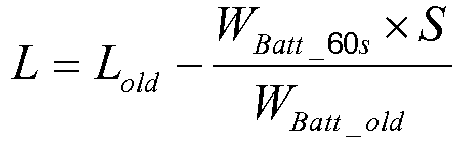
- The system according to claim 7, wherein the endurance range compensation coefficient is obtained by:designing a radial basis function neural network, the radial basis function neural network comprising an input layer, a hidden layer, and an output layer, and the radial basis function neural network being denoted by a formula of:
 training the radial basis function neural network according to a plurality of sets of overall discharging energy, the state of charge, the number of charging-discharging cycles of the power battery; andobtaining the endurance range compensation coefficient according to a completely trained radial basis function neural network.
 - The system according to claim 7, further comprising a controlling module, wherein the controlling module is configured:when the remaining endurance range of the electric vehicle is smaller than a first predetermined traveling range, to prompt a user whether to enter an economic mode, to control the electric vehicle to enter the economic mode when an instruction for entering the economic mode is received, and to control the electric vehicle to quit from the economic mode when an instruction for quitting from the economic mode is received;when the remaining endurance range of the electric vehicle is smaller than a second predetermined traveling range, to prompt the user whether to enter a deep-economic mode, to control the electric vehicle to enter the deep-economic mode when an instruction for entering the deep-economic mode is received, and to control the electric vehicle to quit from the deep-economic mode when an instruction for quitting from the deep-economic mode is received, wherein the first predetermined traveling range is greater than the second predetermined traveling range.
- The system according to claim 11, wherein the controlling module is further configured, after the electric vehicle enters the economic mode,
to reduce a torque response speed;
to reduce energy consumption of a part of components of the electric vehicle;
when the obtained remaining endurance range of the electric vehicle in the economic mode is greater than a third predetermined traveling range, to prompt the user whether to quit from the economic mode, and to control the electric vehicle to quit from the economic mode when the instruction for quitting from the economic mode is received, wherein the third predetermined traveling range is greater the first predetermined traveling range;
wherein the controlling module is further configured, after the electric vehicle enters the deep-economic mode,
to limit a traveling speed of the electric vehicle within a predetermined traveling speed;
to further reduce the energy consumption of the a part of components of the electric vehicle and/or deactivate the part of components of the electric vehicle; and
when the obtained remaining endurance range of the electric vehicle in the deep-economic mode is greater than a fourth predetermined traveling range, to prompt the user whether to quit from the deep-economic mode, and to control the electric vehicle to quit from the deep-economic mode when the instruction for quitting from the deep-economic mode is received, wherein the fourth predetermined traveling range is smaller than the third predetermined traveling range and greater than the first predetermined traveling range. - An electric vehicle, comprising a system for estimating a remaining endurance range of an electric vehicle according to any one of claims 7 to 12.
- A device, comprising:one or more processors,a memory,one or more programs, wherein the one or more programs are stored in the memory, and when the one or more programs are executed by the one or more processors, a method for estimating a remaining endurance range of an electric vehicle according to any one of claims 1 to 6 is executed.
- A non-volatile computer storage medium, wherein the computer storage medium has one or more programs stored therein, and when the one or more programs are executed by a device, the method for estimating a remaining endurance range of an electric vehicle according to any one of claims 1 to 6 is executed by the device.
Applications Claiming Priority (2)
| Application Number | Priority Date | Filing Date | Title |
|---|---|---|---|
| CN201510726116.8A CN105365592B (en) | 2015-10-30 | 2015-10-30 | Method and system for estimating remaining endurance mileage of electric automobile and electric automobile |
| PCT/CN2016/103823 WO2017071657A1 (en) | 2015-10-30 | 2016-10-28 | Method and system for estimating remaining range of electric car, and electric car |
Publications (3)
| Publication Number | Publication Date |
|---|---|
| EP3369604A1 true EP3369604A1 (en) | 2018-09-05 |
| EP3369604A4 EP3369604A4 (en) | 2019-07-17 |
| EP3369604B1 EP3369604B1 (en) | 2022-05-11 |
Family
ID=55368418
Family Applications (1)
| Application Number | Title | Priority Date | Filing Date |
|---|---|---|---|
| EP16859092.5A Active EP3369604B1 (en) | 2015-10-30 | 2016-10-28 | Method and system for estimating remaining range of electric car, and electric car |
Country Status (3)
| Country | Link |
|---|---|
| EP (1) | EP3369604B1 (en) |
| CN (1) | CN105365592B (en) |
| WO (1) | WO2017071657A1 (en) |
Cited By (4)
| Publication number | Priority date | Publication date | Assignee | Title |
|---|---|---|---|---|
| CN110861502A (en) * | 2019-12-02 | 2020-03-06 | 安徽江淮汽车集团股份有限公司 | Method, device and equipment for calculating remaining mileage of electric automobile and storage medium |
| WO2020211456A1 (en) * | 2019-04-16 | 2020-10-22 | 北京嘀嘀无限科技发展有限公司 | Method of measuring remaining range of electric vehicle, electronic device, and storage medium |
| EP3835115A1 (en) * | 2019-12-12 | 2021-06-16 | Permobil AB | Method of estimating the remaining driving distance available from a charge for a powered mobility device |
| CN116985646A (en) * | 2023-09-28 | 2023-11-03 | 江西五十铃汽车有限公司 | Vehicle supercapacitor control method, device and medium |
Families Citing this family (48)
| Publication number | Priority date | Publication date | Assignee | Title |
|---|---|---|---|---|
| CN105365592B (en) * | 2015-10-30 | 2018-01-09 | 北京新能源汽车股份有限公司 | Method and system for estimating remaining endurance mileage of electric automobile and electric automobile |
| CN105548912A (en) * | 2016-03-03 | 2016-05-04 | 合肥国轩高科动力能源有限公司 | A Battery State of Charge Calibration Method Based on Battery Aging Characteristics |
| CN105882452A (en) * | 2016-04-22 | 2016-08-24 | 郑州宇通客车股份有限公司 | Electric vehicle drive motor efficiency optimizing control method and system |
| CN107662510B (en) * | 2016-07-29 | 2020-10-02 | 蜂巢能源科技有限公司 | Remaining driving range detection method and device and vehicle |
| CN106740867A (en) * | 2016-11-22 | 2017-05-31 | 天津梦琪科技有限公司 | A kind of electric automobile vehicle mileage computing system |
| CN106740260B (en) * | 2016-11-28 | 2019-07-12 | 北京新能源汽车股份有限公司 | Control method and device for insulated gate bipolar transistor IGBT |
| CN106915270B (en) * | 2017-02-27 | 2019-05-14 | 北京新能源汽车股份有限公司 | Method and device for detecting driving range of automobile and automobile |
| CN107264303B (en) * | 2017-05-08 | 2020-03-17 | 广东硅岳能源科技有限公司 | Method and system for converting vehicle running condition into power battery running condition |
| CN107599844B (en) * | 2017-09-07 | 2020-05-08 | 深圳埃瑞斯瓦特新能源有限公司 | Remaining mileage detection method for electric automobile |
| CN109693545B (en) * | 2017-10-24 | 2021-02-23 | 河南森源重工有限公司 | A method and device for estimating remaining battery energy and vehicle remaining mileage |
| CN109302844B (en) * | 2017-12-13 | 2022-04-15 | 深圳配天智能技术研究院有限公司 | Method and device for estimating remaining mileage of pure electric vehicle |
| CN110015142A (en) * | 2017-12-21 | 2019-07-16 | 北京长城华冠汽车科技股份有限公司 | A kind of calculation method and equipment of electric car residue course continuation mileage |
| CN108621844B (en) * | 2018-05-10 | 2020-01-03 | 中南大学 | Electric quantity prediction method and early warning system for unmanned vehicle on rainstorm road |
| CN108549037B (en) * | 2018-05-10 | 2019-09-27 | 中南大学 | A method and system for power prediction of unmanned vehicles based on parallel neural network |
| CN108710084A (en) * | 2018-06-01 | 2018-10-26 | 王泽霖 | A kind of monitoring of electric car power supply and energy management system |
| CN109557475B (en) * | 2018-11-30 | 2022-01-04 | 北京新能源汽车股份有限公司 | Method and device for determining available capacity SOC of battery |
| CN113167837B (en) * | 2018-11-30 | 2024-08-16 | 康明斯公司 | Vehicle range estimator |
| CN109606119B (en) * | 2019-01-15 | 2020-05-12 | 深圳四海万联科技有限公司 | Method and system for calibrating endurance mileage of electric automobile |
| CN109747428A (en) * | 2019-02-27 | 2019-05-14 | 合肥国轩高科动力能源有限公司 | A method for estimating the remaining capacity of an electric vehicle battery pack |
| CN111746352B (en) * | 2019-03-29 | 2022-01-28 | 北京新能源汽车股份有限公司 | Method and device for determining battery of power hybrid electric vehicle and upper computer |
| CN109887292B (en) * | 2019-04-04 | 2022-01-25 | 上海赢科信息技术有限公司 | Vehicle type identification method and system |
| CN110018427A (en) * | 2019-05-24 | 2019-07-16 | 福建工程学院 | A kind of battery health of electric automobile appraisal procedure based on travelling data |
| CN112693359A (en) * | 2019-10-22 | 2021-04-23 | 北京新能源汽车股份有限公司 | Charging prompting method and device and automobile |
| CN110901468B (en) * | 2019-11-26 | 2022-11-29 | 神龙汽车有限公司 | Method for calculating remaining endurance mileage of electric learner-driven vehicle |
| CN113002300B (en) * | 2019-12-20 | 2022-08-05 | 比亚迪股份有限公司 | Electric vehicle power consumption management method, electric vehicle, and computer storage medium |
| CN113119761B (en) * | 2019-12-31 | 2023-06-16 | 北京新能源汽车股份有限公司 | Power battery charging rate adjusting method and device |
| CN111199104B (en) * | 2019-12-31 | 2024-04-16 | 浙江吉利新能源商用车集团有限公司 | A battery residual performance analysis method, device, equipment and storage medium |
| CN111591141B (en) * | 2020-05-29 | 2022-06-14 | 重庆长安新能源汽车科技有限公司 | Electric automobile remaining mileage estimation method and device and electric automobile |
| CN111775771B (en) * | 2020-06-18 | 2023-03-31 | 合肥国轩高科动力能源有限公司 | New energy electric vehicle endurance early warning method |
| CN111812401B (en) * | 2020-06-19 | 2022-04-22 | 北京国网普瑞特高压输电技术有限公司 | Vehicle-mounted power battery high-power direct-current electric energy metering method and system |
| CN113829958B (en) * | 2020-06-23 | 2023-11-21 | 北京新能源汽车股份有限公司 | Control method and device for temperature of vehicle battery pack, control equipment and automobile |
| CN113910975A (en) * | 2020-07-09 | 2022-01-11 | 上海墨泉网络科技有限公司 | Pure electric vehicle parking electricity changing reminding method and system |
| CN114056113B (en) * | 2020-08-09 | 2024-06-21 | 广汽埃安新能源汽车有限公司 | Electric vehicle energy-saving mode control method and system |
| CN112009307A (en) * | 2020-09-03 | 2020-12-01 | 三一专用汽车有限责任公司 | Voice prompt method and voice prompt system of vehicle and vehicle |
| CN112444750B (en) * | 2020-09-23 | 2023-05-02 | 中汽研汽车检验中心(天津)有限公司 | Rapid test method for driving range of electric automobile |
| CN112590556B (en) * | 2021-01-06 | 2022-08-23 | 潍柴动力股份有限公司 | Method for calculating driving range of automobile |
| CN113263954B (en) * | 2021-05-10 | 2022-07-22 | 中国汽车技术研究中心有限公司 | Electric vehicle driving range prediction method, device, device and readable storage medium |
| CN113459896B (en) * | 2021-06-28 | 2022-11-08 | 岚图汽车科技有限公司 | Method and device for determining endurance mileage of electric vehicle |
| CN113442788B (en) * | 2021-06-29 | 2023-02-21 | 中国第一汽车股份有限公司 | Electric vehicle charging control method and system and storage medium |
| CN113479116A (en) * | 2021-07-09 | 2021-10-08 | 东风柳州汽车有限公司 | Method and device for calculating cruising mileage of hydrogen fuel cell vehicle |
| CN114013285B (en) * | 2021-11-08 | 2023-11-21 | 北京理工新源信息科技有限公司 | A method for evaluating the actual driving range of electric vehicles |
| CN114537203A (en) * | 2022-01-28 | 2022-05-27 | 重庆金康赛力斯新能源汽车设计院有限公司 | Vehicle charging or battery replacing method and device and storage medium |
| CN115214379A (en) * | 2022-04-22 | 2022-10-21 | 一汽奔腾轿车有限公司 | A power-saving control method, system, device and storage medium for an electric vehicle |
| CN114889492B (en) * | 2022-05-09 | 2024-06-18 | 潍柴动力股份有限公司 | A method, device, system and storage medium for estimating the cruising range of an electric vehicle |
| CN114791564B (en) * | 2022-06-22 | 2022-10-18 | 广州万协通信息技术有限公司 | Mileage calibration method, device and equipment based on Internet of vehicles and storage medium |
| CN116707098B (en) * | 2023-08-05 | 2024-05-14 | 速源芯(东莞)能源科技有限公司 | Power supply charging and discharging display control system and method |
| US12613286B2 (en) | 2024-01-22 | 2026-04-28 | Garrett Transportation I Inc. | System and method for battery parameter recharacterization |
| CN119858452B (en) * | 2025-01-06 | 2025-11-04 | 奇瑞新能源汽车股份有限公司 | Methods, devices, equipment, storage media, and products for determining vehicle driving range |
Family Cites Families (11)
| Publication number | Priority date | Publication date | Assignee | Title |
|---|---|---|---|---|
| JPH06189402A (en) * | 1992-12-16 | 1994-07-08 | Chugoku Electric Power Co Inc:The | Measuring instrument for remaining travelable distance for electric vehicle |
| JP3375511B2 (en) * | 1997-04-14 | 2003-02-10 | 本田技研工業株式会社 | Battery remaining capacity detection device |
| CN101879886A (en) * | 2009-05-08 | 2010-11-10 | 孙鸿辉 | Full-automatic intelligent rolling code anti-theft electronic lock for automobile |
| JP5385719B2 (en) * | 2009-07-29 | 2014-01-08 | プライムアースEvエナジー株式会社 | Battery management device |
| US8433455B2 (en) * | 2010-10-29 | 2013-04-30 | GM Global Technology Operations LLC | Electrical vehicle range prediction |
| KR101154308B1 (en) * | 2010-12-03 | 2012-06-13 | 기아자동차주식회사 | Estimation method of remaining distance of electric vehicle |
| CN102358190A (en) * | 2011-09-08 | 2012-02-22 | 重庆长安汽车股份有限公司 | Method for estimating surplus mileage of pure electric vehicle based on power consumption per kilometer |
| US20150081237A1 (en) * | 2013-09-19 | 2015-03-19 | Seeo, Inc | Data driven/physical hybrid model for soc determination in lithium batteries |
| CN103707777B (en) * | 2013-11-20 | 2015-09-23 | 奇瑞新能源汽车技术有限公司 | Extended-range electric vehicle course continuation mileage display system |
| CN104459551A (en) * | 2014-11-28 | 2015-03-25 | 山东理工大学 | Electric vehicle power battery state-of-energy estimation method |
| CN105365592B (en) * | 2015-10-30 | 2018-01-09 | 北京新能源汽车股份有限公司 | Method and system for estimating remaining endurance mileage of electric automobile and electric automobile |
-
2015
- 2015-10-30 CN CN201510726116.8A patent/CN105365592B/en active Active
-
2016
- 2016-10-28 WO PCT/CN2016/103823 patent/WO2017071657A1/en not_active Ceased
- 2016-10-28 EP EP16859092.5A patent/EP3369604B1/en active Active
Cited By (7)
| Publication number | Priority date | Publication date | Assignee | Title |
|---|---|---|---|---|
| WO2020211456A1 (en) * | 2019-04-16 | 2020-10-22 | 北京嘀嘀无限科技发展有限公司 | Method of measuring remaining range of electric vehicle, electronic device, and storage medium |
| CN110861502A (en) * | 2019-12-02 | 2020-03-06 | 安徽江淮汽车集团股份有限公司 | Method, device and equipment for calculating remaining mileage of electric automobile and storage medium |
| CN110861502B (en) * | 2019-12-02 | 2021-10-29 | 安徽江淮汽车集团股份有限公司 | Method, device and equipment for calculating remaining mileage of electric automobile and storage medium |
| EP3835115A1 (en) * | 2019-12-12 | 2021-06-16 | Permobil AB | Method of estimating the remaining driving distance available from a charge for a powered mobility device |
| WO2021116084A1 (en) * | 2019-12-12 | 2021-06-17 | Permobil Ab | Method of estimating the remaining driving distance available from a charge for a powered mobility device |
| CN116985646A (en) * | 2023-09-28 | 2023-11-03 | 江西五十铃汽车有限公司 | Vehicle supercapacitor control method, device and medium |
| CN116985646B (en) * | 2023-09-28 | 2024-01-12 | 江西五十铃汽车有限公司 | Vehicle supercapacitor control method, device and medium |
Also Published As
| Publication number | Publication date |
|---|---|
| CN105365592B (en) | 2018-01-09 |
| EP3369604A4 (en) | 2019-07-17 |
| EP3369604B1 (en) | 2022-05-11 |
| CN105365592A (en) | 2016-03-02 |
| WO2017071657A1 (en) | 2017-05-04 |
Similar Documents
| Publication | Publication Date | Title |
|---|---|---|
| EP3369604B1 (en) | Method and system for estimating remaining range of electric car, and electric car | |
| US8423211B2 (en) | Protection method for limited charging/discharging current of hybrid electric vehicle battery and a device and a system thereof | |
| Chen et al. | Energy management for a power-split plug-in hybrid electric vehicle based on dynamic programming and neural networks | |
| EP3760469A1 (en) | Electric vehicle and driving mileage calculation method and device therefor | |
| CN107406004B (en) | Method and apparatus for determining the value of the energy state of a battery in a vehicle | |
| Han et al. | Energy management in plug-in hybrid electric vehicles: preheating the battery packs in low-temperature driving scenarios | |
| CN109532556B (en) | Method and system for acquiring endurance mileage of pure electric vehicle | |
| CN101478172B (en) | Method for determining optimal operation point with respect to state of charge in hybrid electric vehicle | |
| CN114914584B (en) | Thermal management control method, device and vehicle | |
| US8768553B2 (en) | Method and system for controlling charging of battery for hybrid electric vehicle | |
| CN106274894B (en) | Apparatus and method for controlling operation mode of hybrid vehicle | |
| CN117841966B (en) | Range extender control strategy determination method, device, electronic device and storage medium | |
| CN114954009B (en) | Vehicle charging torque calculation method, device, vehicle and storage medium | |
| CN116749834B (en) | Energy monitoring method and device for range-extended automobile | |
| US20170136914A1 (en) | Systems and methods for visualizing battery data | |
| CN108382247A (en) | The control method and electric vehicle of electric vehicle | |
| CN119705121B (en) | Vehicle power generation control method and device | |
| CN106476795B (en) | Engine control apparatus and method for hybrid vehicle | |
| KR101486629B1 (en) | Apparatus and method of estimating state of health for battery | |
| Dinçmen et al. | A control strategy for parallel hybrid electric vehicles based on extremum seeking | |
| CN116749978A (en) | Control methods, devices, electronic equipment and storage media for limp driving of vehicles | |
| US11827208B2 (en) | Driving guide setting system of electric operating vehicle and method of setting the driving guide | |
| Pagerit et al. | Global optimization to real time control of HEV power flow: Example of a fuel cell hybrid vehicle | |
| CN115346289B (en) | Method and apparatus for propulsion system prognostics due to boost operation | |
| CN119773720A (en) | Vehicle range extender control method, device, vehicle and computer readable storage medium |
Legal Events
| Date | Code | Title | Description |
|---|---|---|---|
| STAA | Information on the status of an ep patent application or granted ep patent |
Free format text: STATUS: THE INTERNATIONAL PUBLICATION HAS BEEN MADE |
|
| PUAI | Public reference made under article 153(3) epc to a published international application that has entered the european phase |
Free format text: ORIGINAL CODE: 0009012 |
|
| STAA | Information on the status of an ep patent application or granted ep patent |
Free format text: STATUS: REQUEST FOR EXAMINATION WAS MADE |
|
| 17P | Request for examination filed |
Effective date: 20180529 |
|
| AK | Designated contracting states |
Kind code of ref document: A1 Designated state(s): AL AT BE BG CH CY CZ DE DK EE ES FI FR GB GR HR HU IE IS IT LI LT LU LV MC MK MT NL NO PL PT RO RS SE SI SK SM TR |
|
| AX | Request for extension of the european patent |
Extension state: BA ME |
|
| DAV | Request for validation of the european patent (deleted) | ||
| DAX | Request for extension of the european patent (deleted) | ||
| REG | Reference to a national code |
Ref country code: DE Ref legal event code: R079 Ref document number: 602016072117 Country of ref document: DE Free format text: PREVIOUS MAIN CLASS: B60L0011180000 Ipc: B60L0050500000 |
|
| A4 | Supplementary search report drawn up and despatched |
Effective date: 20190618 |
|
| RIC1 | Information provided on ipc code assigned before grant |
Ipc: B60L 3/00 20190101ALI20190612BHEP Ipc: B60L 50/50 20190101AFI20190612BHEP |
|
| STAA | Information on the status of an ep patent application or granted ep patent |
Free format text: STATUS: EXAMINATION IS IN PROGRESS |
|
| 17Q | First examination report despatched |
Effective date: 20210503 |
|
| GRAP | Despatch of communication of intention to grant a patent |
Free format text: ORIGINAL CODE: EPIDOSNIGR1 |
|
| STAA | Information on the status of an ep patent application or granted ep patent |
Free format text: STATUS: GRANT OF PATENT IS INTENDED |
|
| INTG | Intention to grant announced |
Effective date: 20220111 |
|
| GRAS | Grant fee paid |
Free format text: ORIGINAL CODE: EPIDOSNIGR3 |
|
| GRAA | (expected) grant |
Free format text: ORIGINAL CODE: 0009210 |
|
| STAA | Information on the status of an ep patent application or granted ep patent |
Free format text: STATUS: THE PATENT HAS BEEN GRANTED |
|
| AK | Designated contracting states |
Kind code of ref document: B1 Designated state(s): AL AT BE BG CH CY CZ DE DK EE ES FI FR GB GR HR HU IE IS IT LI LT LU LV MC MK MT NL NO PL PT RO RS SE SI SK SM TR |
|
| REG | Reference to a national code |
Ref country code: GB Ref legal event code: FG4D |
|
| REG | Reference to a national code |
Ref country code: CH Ref legal event code: EP |
|
| REG | Reference to a national code |
Ref country code: AT Ref legal event code: REF Ref document number: 1491135 Country of ref document: AT Kind code of ref document: T Effective date: 20220515 |
|
| REG | Reference to a national code |
Ref country code: DE Ref legal event code: R096 Ref document number: 602016072117 Country of ref document: DE |
|
| REG | Reference to a national code |
Ref country code: IE Ref legal event code: FG4D |
|
| REG | Reference to a national code |
Ref country code: NO Ref legal event code: T2 Effective date: 20220511 |
|
| REG | Reference to a national code |
Ref country code: LT Ref legal event code: MG9D |
|
| REG | Reference to a national code |
Ref country code: NL Ref legal event code: MP Effective date: 20220511 |
|
| REG | Reference to a national code |
Ref country code: AT Ref legal event code: MK05 Ref document number: 1491135 Country of ref document: AT Kind code of ref document: T Effective date: 20220511 |
|
| PG25 | Lapsed in a contracting state [announced via postgrant information from national office to epo] |
Ref country code: SE Free format text: LAPSE BECAUSE OF FAILURE TO SUBMIT A TRANSLATION OF THE DESCRIPTION OR TO PAY THE FEE WITHIN THE PRESCRIBED TIME-LIMIT Effective date: 20220511 Ref country code: PT Free format text: LAPSE BECAUSE OF FAILURE TO SUBMIT A TRANSLATION OF THE DESCRIPTION OR TO PAY THE FEE WITHIN THE PRESCRIBED TIME-LIMIT Effective date: 20220912 Ref country code: NL Free format text: LAPSE BECAUSE OF FAILURE TO SUBMIT A TRANSLATION OF THE DESCRIPTION OR TO PAY THE FEE WITHIN THE PRESCRIBED TIME-LIMIT Effective date: 20220511 Ref country code: LT Free format text: LAPSE BECAUSE OF FAILURE TO SUBMIT A TRANSLATION OF THE DESCRIPTION OR TO PAY THE FEE WITHIN THE PRESCRIBED TIME-LIMIT Effective date: 20220511 Ref country code: HR Free format text: LAPSE BECAUSE OF FAILURE TO SUBMIT A TRANSLATION OF THE DESCRIPTION OR TO PAY THE FEE WITHIN THE PRESCRIBED TIME-LIMIT Effective date: 20220511 Ref country code: GR Free format text: LAPSE BECAUSE OF FAILURE TO SUBMIT A TRANSLATION OF THE DESCRIPTION OR TO PAY THE FEE WITHIN THE PRESCRIBED TIME-LIMIT Effective date: 20220812 Ref country code: FI Free format text: LAPSE BECAUSE OF FAILURE TO SUBMIT A TRANSLATION OF THE DESCRIPTION OR TO PAY THE FEE WITHIN THE PRESCRIBED TIME-LIMIT Effective date: 20220511 Ref country code: ES Free format text: LAPSE BECAUSE OF FAILURE TO SUBMIT A TRANSLATION OF THE DESCRIPTION OR TO PAY THE FEE WITHIN THE PRESCRIBED TIME-LIMIT Effective date: 20220511 Ref country code: BG Free format text: LAPSE BECAUSE OF FAILURE TO SUBMIT A TRANSLATION OF THE DESCRIPTION OR TO PAY THE FEE WITHIN THE PRESCRIBED TIME-LIMIT Effective date: 20220811 Ref country code: AT Free format text: LAPSE BECAUSE OF FAILURE TO SUBMIT A TRANSLATION OF THE DESCRIPTION OR TO PAY THE FEE WITHIN THE PRESCRIBED TIME-LIMIT Effective date: 20220511 |
|
| PG25 | Lapsed in a contracting state [announced via postgrant information from national office to epo] |
Ref country code: RS Free format text: LAPSE BECAUSE OF FAILURE TO SUBMIT A TRANSLATION OF THE DESCRIPTION OR TO PAY THE FEE WITHIN THE PRESCRIBED TIME-LIMIT Effective date: 20220511 Ref country code: PL Free format text: LAPSE BECAUSE OF FAILURE TO SUBMIT A TRANSLATION OF THE DESCRIPTION OR TO PAY THE FEE WITHIN THE PRESCRIBED TIME-LIMIT Effective date: 20220511 Ref country code: LV Free format text: LAPSE BECAUSE OF FAILURE TO SUBMIT A TRANSLATION OF THE DESCRIPTION OR TO PAY THE FEE WITHIN THE PRESCRIBED TIME-LIMIT Effective date: 20220511 Ref country code: IS Free format text: LAPSE BECAUSE OF FAILURE TO SUBMIT A TRANSLATION OF THE DESCRIPTION OR TO PAY THE FEE WITHIN THE PRESCRIBED TIME-LIMIT Effective date: 20220911 |
|
| PG25 | Lapsed in a contracting state [announced via postgrant information from national office to epo] |
Ref country code: SM Free format text: LAPSE BECAUSE OF FAILURE TO SUBMIT A TRANSLATION OF THE DESCRIPTION OR TO PAY THE FEE WITHIN THE PRESCRIBED TIME-LIMIT Effective date: 20220511 Ref country code: SK Free format text: LAPSE BECAUSE OF FAILURE TO SUBMIT A TRANSLATION OF THE DESCRIPTION OR TO PAY THE FEE WITHIN THE PRESCRIBED TIME-LIMIT Effective date: 20220511 Ref country code: RO Free format text: LAPSE BECAUSE OF FAILURE TO SUBMIT A TRANSLATION OF THE DESCRIPTION OR TO PAY THE FEE WITHIN THE PRESCRIBED TIME-LIMIT Effective date: 20220511 Ref country code: EE Free format text: LAPSE BECAUSE OF FAILURE TO SUBMIT A TRANSLATION OF THE DESCRIPTION OR TO PAY THE FEE WITHIN THE PRESCRIBED TIME-LIMIT Effective date: 20220511 Ref country code: DK Free format text: LAPSE BECAUSE OF FAILURE TO SUBMIT A TRANSLATION OF THE DESCRIPTION OR TO PAY THE FEE WITHIN THE PRESCRIBED TIME-LIMIT Effective date: 20220511 Ref country code: CZ Free format text: LAPSE BECAUSE OF FAILURE TO SUBMIT A TRANSLATION OF THE DESCRIPTION OR TO PAY THE FEE WITHIN THE PRESCRIBED TIME-LIMIT Effective date: 20220511 |
|
| REG | Reference to a national code |
Ref country code: DE Ref legal event code: R097 Ref document number: 602016072117 Country of ref document: DE |
|
| PLBE | No opposition filed within time limit |
Free format text: ORIGINAL CODE: 0009261 |
|
| STAA | Information on the status of an ep patent application or granted ep patent |
Free format text: STATUS: NO OPPOSITION FILED WITHIN TIME LIMIT |
|
| PG25 | Lapsed in a contracting state [announced via postgrant information from national office to epo] |
Ref country code: AL Free format text: LAPSE BECAUSE OF FAILURE TO SUBMIT A TRANSLATION OF THE DESCRIPTION OR TO PAY THE FEE WITHIN THE PRESCRIBED TIME-LIMIT Effective date: 20220511 |
|
| 26N | No opposition filed |
Effective date: 20230214 |
|
| PG25 | Lapsed in a contracting state [announced via postgrant information from national office to epo] |
Ref country code: SI Free format text: LAPSE BECAUSE OF FAILURE TO SUBMIT A TRANSLATION OF THE DESCRIPTION OR TO PAY THE FEE WITHIN THE PRESCRIBED TIME-LIMIT Effective date: 20220511 Ref country code: MC Free format text: LAPSE BECAUSE OF FAILURE TO SUBMIT A TRANSLATION OF THE DESCRIPTION OR TO PAY THE FEE WITHIN THE PRESCRIBED TIME-LIMIT Effective date: 20220511 |
|
| REG | Reference to a national code |
Ref country code: CH Ref legal event code: PL |
|
| REG | Reference to a national code |
Ref country code: BE Ref legal event code: MM Effective date: 20221031 |
|
| PG25 | Lapsed in a contracting state [announced via postgrant information from national office to epo] |
Ref country code: LU Free format text: LAPSE BECAUSE OF NON-PAYMENT OF DUE FEES Effective date: 20221028 |
|
| PG25 | Lapsed in a contracting state [announced via postgrant information from national office to epo] |
Ref country code: LI Free format text: LAPSE BECAUSE OF NON-PAYMENT OF DUE FEES Effective date: 20221031 Ref country code: FR Free format text: LAPSE BECAUSE OF NON-PAYMENT OF DUE FEES Effective date: 20221031 Ref country code: CH Free format text: LAPSE BECAUSE OF NON-PAYMENT OF DUE FEES Effective date: 20221031 |
|
| PG25 | Lapsed in a contracting state [announced via postgrant information from national office to epo] |
Ref country code: BE Free format text: LAPSE BECAUSE OF NON-PAYMENT OF DUE FEES Effective date: 20221031 |
|
| PG25 | Lapsed in a contracting state [announced via postgrant information from national office to epo] |
Ref country code: IE Free format text: LAPSE BECAUSE OF NON-PAYMENT OF DUE FEES Effective date: 20221028 |
|
| PG25 | Lapsed in a contracting state [announced via postgrant information from national office to epo] |
Ref country code: IT Free format text: LAPSE BECAUSE OF FAILURE TO SUBMIT A TRANSLATION OF THE DESCRIPTION OR TO PAY THE FEE WITHIN THE PRESCRIBED TIME-LIMIT Effective date: 20220511 |
|
| PG25 | Lapsed in a contracting state [announced via postgrant information from national office to epo] |
Ref country code: HU Free format text: LAPSE BECAUSE OF FAILURE TO SUBMIT A TRANSLATION OF THE DESCRIPTION OR TO PAY THE FEE WITHIN THE PRESCRIBED TIME-LIMIT; INVALID AB INITIO Effective date: 20161028 |
|
| PG25 | Lapsed in a contracting state [announced via postgrant information from national office to epo] |
Ref country code: CY Free format text: LAPSE BECAUSE OF FAILURE TO SUBMIT A TRANSLATION OF THE DESCRIPTION OR TO PAY THE FEE WITHIN THE PRESCRIBED TIME-LIMIT Effective date: 20220511 |
|
| PG25 | Lapsed in a contracting state [announced via postgrant information from national office to epo] |
Ref country code: MK Free format text: LAPSE BECAUSE OF FAILURE TO SUBMIT A TRANSLATION OF THE DESCRIPTION OR TO PAY THE FEE WITHIN THE PRESCRIBED TIME-LIMIT Effective date: 20220511 |
|
| PG25 | Lapsed in a contracting state [announced via postgrant information from national office to epo] |
Ref country code: TR Free format text: LAPSE BECAUSE OF FAILURE TO SUBMIT A TRANSLATION OF THE DESCRIPTION OR TO PAY THE FEE WITHIN THE PRESCRIBED TIME-LIMIT Effective date: 20220511 |
|
| PG25 | Lapsed in a contracting state [announced via postgrant information from national office to epo] |
Ref country code: MT Free format text: LAPSE BECAUSE OF FAILURE TO SUBMIT A TRANSLATION OF THE DESCRIPTION OR TO PAY THE FEE WITHIN THE PRESCRIBED TIME-LIMIT Effective date: 20220511 |
|
| PGFP | Annual fee paid to national office [announced via postgrant information from national office to epo] |
Ref country code: GB Payment date: 20240930 Year of fee payment: 9 |
|
| PG25 | Lapsed in a contracting state [announced via postgrant information from national office to epo] |
Ref country code: BG Free format text: LAPSE BECAUSE OF FAILURE TO SUBMIT A TRANSLATION OF THE DESCRIPTION OR TO PAY THE FEE WITHIN THE PRESCRIBED TIME-LIMIT Effective date: 20220511 |
|
| PG25 | Lapsed in a contracting state [announced via postgrant information from national office to epo] |
Ref country code: BG Free format text: LAPSE BECAUSE OF FAILURE TO SUBMIT A TRANSLATION OF THE DESCRIPTION OR TO PAY THE FEE WITHIN THE PRESCRIBED TIME-LIMIT Effective date: 20220511 |
|
| PGFP | Annual fee paid to national office [announced via postgrant information from national office to epo] |
Ref country code: DE Payment date: 20241022 Year of fee payment: 9 |
|
| PGFP | Annual fee paid to national office [announced via postgrant information from national office to epo] |
Ref country code: NO Payment date: 20241001 Year of fee payment: 9 |