EP3366629A1 - Method for detecting trapped passengers in elevator car - Google Patents
Method for detecting trapped passengers in elevator car Download PDFInfo
- Publication number
- EP3366629A1 EP3366629A1 EP18157835.2A EP18157835A EP3366629A1 EP 3366629 A1 EP3366629 A1 EP 3366629A1 EP 18157835 A EP18157835 A EP 18157835A EP 3366629 A1 EP3366629 A1 EP 3366629A1
- Authority
- EP
- European Patent Office
- Prior art keywords
- elevator
- elevator car
- sound
- level
- car
- Prior art date
- Legal status (The legal status is an assumption and is not a legal conclusion. Google has not performed a legal analysis and makes no representation as to the accuracy of the status listed.)
- Withdrawn
Links
- 238000000034 method Methods 0.000 title claims abstract description 14
- 238000012986 modification Methods 0.000 description 1
- 230000004048 modification Effects 0.000 description 1
- 230000001960 triggered effect Effects 0.000 description 1
Images


Classifications
-
- B—PERFORMING OPERATIONS; TRANSPORTING
- B66—HOISTING; LIFTING; HAULING
- B66B—ELEVATORS; ESCALATORS OR MOVING WALKWAYS
- B66B5/00—Applications of checking, fault-correcting, or safety devices in elevators
- B66B5/0006—Monitoring devices or performance analysers
- B66B5/0012—Devices monitoring the users of the elevator system
-
- B—PERFORMING OPERATIONS; TRANSPORTING
- B66—HOISTING; LIFTING; HAULING
- B66B—ELEVATORS; ESCALATORS OR MOVING WALKWAYS
- B66B5/00—Applications of checking, fault-correcting, or safety devices in elevators
- B66B5/02—Applications of checking, fault-correcting, or safety devices in elevators responsive to abnormal operating conditions
- B66B5/027—Applications of checking, fault-correcting, or safety devices in elevators responsive to abnormal operating conditions to permit passengers to leave an elevator car in case of failure, e.g. moving the car to a reference floor or unlocking the door
-
- B—PERFORMING OPERATIONS; TRANSPORTING
- B66—HOISTING; LIFTING; HAULING
- B66B—ELEVATORS; ESCALATORS OR MOVING WALKWAYS
- B66B3/00—Applications of devices for indicating or signalling operating conditions of elevators
- B66B3/002—Indicators
-
- B—PERFORMING OPERATIONS; TRANSPORTING
- B66—HOISTING; LIFTING; HAULING
- B66B—ELEVATORS; ESCALATORS OR MOVING WALKWAYS
- B66B5/00—Applications of checking, fault-correcting, or safety devices in elevators
- B66B5/02—Applications of checking, fault-correcting, or safety devices in elevators responsive to abnormal operating conditions
Definitions
- the present invention generally relates to an elevator system, and more particularly to a method for detecting trapped passengers in an elevator car.
- Elevator systems are widely known and used in various places.
- the elevator system includes an elevator car that moves between landings in a building to transport passengers between different building levels.
- the elevator car is provided with a car operating panel which includes a car door open button, a car door close button and destination floor buttons, etc.
- the car operating panel includes an emergency button and an intercom such that a passenger can make an emergency call to a help desk by pressing the emergency button when the passenger is trapped in the elevator car due to the failure of the elevator system or disasters such as earthquakes, for example.
- the emergency stop button is usually placed on the upper part of the car operating panel; therefore, passengers such as children or ones who use wheelchairs may not reach to the emergency stop button. Accordingly, such trapped passengers may not make an emergency call to the help desk so that operators in the help desk may not notice the trapped passengers.
- a method for detecting trapped passengers in an elevator car comprises collecting a sound in the interior of the elevator car when any failure of an elevator is detected; comparing the level of the sound with a threshold level; and determining that there is a trapped passenger in the elevator car when the level of the sound exceeds the threshold level.
- the method further comprises automatically making a call to a help desk when the level of the sound exceeds the threshold level.
- the method further comprises taking pictures of the interior of the elevator car and outputting picture images to the help desk.
- an elevator system comprising an elevator controller controlling the movement of an elevator car and detecting a failure of an elevator; an alarming unit providing a communication network between an elevator car and a help desk remote from the elevator and receiving a failure signal output from the elevator controller; and an analyzer unit collecting a sound in the interior of the elevator car.
- the analyzer unit compares the level of the sound with a threshold level and outputs a result to the alarming unit.
- the analyzer unit automatically makes a call to a help desk when the level of the sound exceeds the threshold level.
- the system further comprises a camera provided within an elevator car and wherein the camera takes pictures of the interior of the elevator car when the level of the sound exceeds the threshold level.
- the system further comprises an intercom through which the sound in the interior of the elevator car is collected.
- An elevator system includes an elevator car 1 movable within a hoistway (not shown) to provide elevator service to a plurality of landings, and an elevator controller 2 (see FIG.2 ) which controls the movement of the elevator car 1 and detects the failure of an elevator.
- the elevator controller 2 is disposed in a machine room (not shown) which is built above the hoistway.
- the elevator car 1 includes car doors 4 configured to move along the entrance of the elevator car 1 to open and close the entrance.
- the elevator car 1 includes a car operating panel 6 provided on a wall portion 8 which is located on one side of the car doors 4.
- the car operating panel 6 includes, from top to bottom, a car position indicator 10, an intercom 12, an emergency button 14, a car door open button 16, a car door close button 18 and destination floor buttons 20.
- the car position indicator 10 shows the current position and the direction of the elevator car 1.
- the car door open button 16 and the car door close button 18 are used to open and close the car doors 4, respectively.
- the destination floor buttons 20 allow passengers to select desired destination floors.
- the intercom 12 includes a speaker 22 and a microphone 24 which allow passengers to communicate with an operator in a help desk 26 (see FIG. 3 ) located remote from the building.
- the emergency button 14 is used to give an alarm to the help desk 26 and to activate the intercom 12 when passengers are in trouble, for example, trapped in the elevator car 1. In this embodiment, the position of the emergency button 14 is too high for passengers such as small children to reach the emergency button 14.
- the elevator car 1 includes a camera 28 which is disposed on a ceiling 30 of the elevator car 1 to take pictures of the interior of the elevator car 1 and passengers if any.
- the camera 28 may be an analog camera, a digital camera, a TOF (Time of Flight) camera or an infrared light camera, etc.
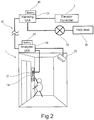
- FIG. 2 shows a sound trigger alarming system 32 which is used in conjunction with the elevator car 1.
- the sound trigger alarming system 32 comprises the intercom 12, the camera 28, an alarming unit 34 and an analyzer unit 36.
- the alarming unit 34 is located in the machine room and provides a communication network between the elevator car 1 and the help desk 26.
- the alarming unit 34 is connected to the elevator controller 2 and receives a failure signal which is transmitted from the elevator controller 2 when the elevator controller 2 detects any failure of the elevator system.
- the alarming unit 34 is also connected to the help desk 26 via a network 38 such as a telephone line, a VoIP network, the Internet, etc.
- the alarming unit 34 makes an alert message and sends failure information to the help desk 26 via the network 38 when the alarming unit 34 receives the failure signal from the controller 2.
- the alarming unit 34 also receives an input signal from the emergency button 14.
- the alarming unit 34 includes a battery 40 so that the alarming unit 34 can be used during the power failure.
- the analyzer unit 36 is deposed on the top of the elevator car 1 and connected to the alarming unit 34, the intercom 12 and the camera 28. The power of the analyzer unit 36 remains off until the alarming unit 34 turns it on in accordance with the reception of the failure signal from the elevator controller 2.
- the analyzer unit 36 is configured to collect a sound in the interior of the elevator car 1 and analyzes the collected sound.
- the analyzer unit 36 is activated for a predetermined period of time to collect and analyzes the sound. In one embodiment, the predetermined period of time is one minute.
- the sound which includes a passenger's voice is collected via the microphone 24. The analysis of the collected sound is performed by comparing the level of the collected sound with a threshold level.
- the analyzer unit 36 automatically makes an emergency call to the help desk 26 via the alarming unit 34 and the network 38 when the level of the sound exceeds the threshold level and also gives a command to the camera 28 to take pictures of the interior of the elevator car 1. In other words, the intercom 12 and the camera 28 are triggered by a predetermined sound level in the interior of the elevator car 1.
- the analyzer unit 36 includes a battery 42 so that the analyzer unit 36 can be used during the power failure.
- FIG. 3 is a flowchart showing a procedure for detecting trapped passengers in the elevator car 1.
- the elevator controller 2 determines whether there is any failure in the elevator system. If the elevator controller 2 does not detect any failure, the flow returns to Step 100. Detecting any failure, the elevator controller 2 outputs a failure signal to the alarming unit 34 in Step 101. In accordance with the reception of the failure signal, the alarming unit 34 makes an alert message, and sends failure information to the help desk 26 in Step 102 and turns on the analyzer unit 36 and the analyzer unit 36 starts collecting a sound in the interior of the elevator car 1 in Step 103.
- Step 104 it is determined whether the alarming unit 34 receives from the elevator controller 2 a restoration signal which indicates the restoration of the elevator system. If the alarming unit 34 receives the restoration signal, the alarming unit 34 turns off the analyzer unit 36 in Step 105 and the flow is terminated. If the alarming unit 34 does not receive the restoration signal, the flow moves to Step 106.
- Step 106 the analyzer unit 36 compares the level of the collected sound with a threshold level. If the level of the sound does not exceed the threshold level, the flow moves to Step 107 and the analyzer unit 36 determines whether a predetermined period of time is elapsed. If the predetermined period of time is not elapsed, the flow returns to Step 104. If it is elapsed, the flow returns to Step 105.
- Step 106 if the level of the sound exceeds the threshold level, the analyzer unit 36 automatically makes an emergency call to the help desk 26 in Step 108. Simultaneously, the analyzer unit 36 gives a command to the camera 28 to take pictures of the interior of the elevator car 1 in Step 109 and outputs picture images to the help desk 26 via the alarming unit 34 and the network 38 in Step 110.
- Step 111 an operator in the help desk 26 determines whether there is a trapped passenger in the elevator car 1 by checking the picture images and/or the sound transmitted through the intercom 12. If no passenger is trapped in the elevator car 1, the flow is terminated. If there is a trapped passenger in the elevator car 1, the operator talks to the trapped passenger in Step 112 and performs necessary procedures. Then, in Step 113, the alarming unit 34 turns off the analyzer unit 36 and the flow is terminated.
- the trapped passenger can talk to an operator in the help desk 26 without pressing the emergency button 14. Accordingly, even trapped passengers who cannot reach the emergency button 14 can make an emergency call to the help desk 26 and the existence of such passengers can be noticed by the operator.
- the trapped passenger is illustrated as a small child in drawings; however, the trapped passenger may be one who uses a wheelchair or a pet such as a dog.
- the analyzer unit 36 may either make an emergency call to the help desk 26, or give a command to the camera 28 to take pictures of the interior of the elevator car 1 and output picture images to the help desk 26 if the level of the sound exceeds the threshold level.
Landscapes
- Indicating And Signalling Devices For Elevators (AREA)
- Maintenance And Inspection Apparatuses For Elevators (AREA)
Abstract
A method for detecting trapped passengers in an elevator car (1) comprises collecting a sound in the elevator car (1) when an elevator controller (2) detects any failure of an elevator and comparing the level of the sound a threshold level. The method further includes automatically making a call to a help desk (26) and taking pictures in the interior of the elevator car (1) when the level of the sound exceeds the threshold level.
Description
- The present invention generally relates to an elevator system, and more particularly to a method for detecting trapped passengers in an elevator car.
- Elevator systems are widely known and used in various places. The elevator system includes an elevator car that moves between landings in a building to transport passengers between different building levels. The elevator car is provided with a car operating panel which includes a car door open button, a car door close button and destination floor buttons, etc. Along with these buttons, the car operating panel includes an emergency button and an intercom such that a passenger can make an emergency call to a help desk by pressing the emergency button when the passenger is trapped in the elevator car due to the failure of the elevator system or disasters such as earthquakes, for example.
- However, with the conventional elevator system, the emergency stop button is usually placed on the upper part of the car operating panel; therefore, passengers such as children or ones who use wheelchairs may not reach to the emergency stop button. Accordingly, such trapped passengers may not make an emergency call to the help desk so that operators in the help desk may not notice the trapped passengers.
- According to one embodiment of the invention, a method for detecting trapped passengers in an elevator car is provided. The method comprises collecting a sound in the interior of the elevator car when any failure of an elevator is detected; comparing the level of the sound with a threshold level; and determining that there is a trapped passenger in the elevator car when the level of the sound exceeds the threshold level.
- According to another embodiment of the invention, the method further comprises automatically making a call to a help desk when the level of the sound exceeds the threshold level.
- According to yet another embodiment of the invention, the method further comprises taking pictures of the interior of the elevator car and outputting picture images to the help desk.
- According to another embodiment of the invention, an elevator system is provided. The elevator system comprises an elevator controller controlling the movement of an elevator car and detecting a failure of an elevator; an alarming unit providing a communication network between an elevator car and a help desk remote from the elevator and receiving a failure signal output from the elevator controller; and an analyzer unit collecting a sound in the interior of the elevator car. The analyzer unit compares the level of the sound with a threshold level and outputs a result to the alarming unit.
- According to another embodiment of the invention, the analyzer unit automatically makes a call to a help desk when the level of the sound exceeds the threshold level.
- According to another embodiment of the invention, the system further comprises a camera provided within an elevator car and wherein the camera takes pictures of the interior of the elevator car when the level of the sound exceeds the threshold level.
- According to yet another embodiment of the invention, the system further comprises an intercom through which the sound in the interior of the elevator car is collected.
- The foregoing and other objects, features and advantages of the present invention become more apparent in light of the following detailed description of the exemplary embodiments thereof, as illustrated in the accompanying drawings.
-
Figure 1 shows selected portions of an elevator car according to an embodiment of the invention. -
Figure 2 shows a sound trigger alarming system according to an embodiment of the invention. -
Figure 3 is a flowchart showing a procedure for detecting trapped passengers in the elevator car according to an embodiment of the invention. - An elevator system includes an elevator car 1 movable within a hoistway (not shown) to provide elevator service to a plurality of landings, and an elevator controller 2 (see
FIG.2 ) which controls the movement of the elevator car 1 and detects the failure of an elevator. The elevator controller 2 is disposed in a machine room (not shown) which is built above the hoistway. As shown inFIG. 1 , the elevator car 1 includescar doors 4 configured to move along the entrance of the elevator car 1 to open and close the entrance. Further, the elevator car 1 includes acar operating panel 6 provided on awall portion 8 which is located on one side of thecar doors 4. In this embodiment, thecar operating panel 6 includes, from top to bottom, acar position indicator 10, anintercom 12, anemergency button 14, a car dooropen button 16, a car doorclose button 18 anddestination floor buttons 20. Thecar position indicator 10 shows the current position and the direction of the elevator car 1. The car dooropen button 16 and the car doorclose button 18 are used to open and close thecar doors 4, respectively. Thedestination floor buttons 20 allow passengers to select desired destination floors. - The
intercom 12 includes aspeaker 22 and a microphone 24 which allow passengers to communicate with an operator in a help desk 26 (seeFIG. 3 ) located remote from the building. Theemergency button 14 is used to give an alarm to thehelp desk 26 and to activate theintercom 12 when passengers are in trouble, for example, trapped in the elevator car 1. In this embodiment, the position of theemergency button 14 is too high for passengers such as small children to reach theemergency button 14. - In addition, the elevator car 1 includes a
camera 28 which is disposed on aceiling 30 of the elevator car 1 to take pictures of the interior of the elevator car 1 and passengers if any. Thecamera 28 may be an analog camera, a digital camera, a TOF (Time of Flight) camera or an infrared light camera, etc. -
FIG. 2 shows a sound triggeralarming system 32 which is used in conjunction with the elevator car 1. The sound triggeralarming system 32 comprises theintercom 12, thecamera 28, analarming unit 34 and ananalyzer unit 36. - The
alarming unit 34 is located in the machine room and provides a communication network between the elevator car 1 and thehelp desk 26. Thealarming unit 34 is connected to the elevator controller 2 and receives a failure signal which is transmitted from the elevator controller 2 when the elevator controller 2 detects any failure of the elevator system. Thealarming unit 34 is also connected to thehelp desk 26 via anetwork 38 such as a telephone line, a VoIP network, the Internet, etc. Thealarming unit 34 makes an alert message and sends failure information to thehelp desk 26 via thenetwork 38 when thealarming unit 34 receives the failure signal from the controller 2. Not shown in theFIG. 2 , thealarming unit 34 also receives an input signal from theemergency button 14. Thealarming unit 34 includes abattery 40 so that thealarming unit 34 can be used during the power failure. - The
analyzer unit 36 is deposed on the top of the elevator car 1 and connected to thealarming unit 34, theintercom 12 and thecamera 28. The power of theanalyzer unit 36 remains off until thealarming unit 34 turns it on in accordance with the reception of the failure signal from the elevator controller 2. Theanalyzer unit 36 is configured to collect a sound in the interior of the elevator car 1 and analyzes the collected sound. Theanalyzer unit 36 is activated for a predetermined period of time to collect and analyzes the sound. In one embodiment, the predetermined period of time is one minute. The sound which includes a passenger's voice is collected via the microphone 24. The analysis of the collected sound is performed by comparing the level of the collected sound with a threshold level. Theanalyzer unit 36 automatically makes an emergency call to thehelp desk 26 via thealarming unit 34 and thenetwork 38 when the level of the sound exceeds the threshold level and also gives a command to thecamera 28 to take pictures of the interior of the elevator car 1. In other words, theintercom 12 and thecamera 28 are triggered by a predetermined sound level in the interior of the elevator car 1. Theanalyzer unit 36 includes abattery 42 so that theanalyzer unit 36 can be used during the power failure. -
FIG. 3 is a flowchart showing a procedure for detecting trapped passengers in the elevator car 1. InStep 100, the elevator controller 2 determines whether there is any failure in the elevator system. If the elevator controller 2 does not detect any failure, the flow returns toStep 100. Detecting any failure, the elevator controller 2 outputs a failure signal to thealarming unit 34 inStep 101. In accordance with the reception of the failure signal, thealarming unit 34 makes an alert message, and sends failure information to thehelp desk 26 inStep 102 and turns on theanalyzer unit 36 and theanalyzer unit 36 starts collecting a sound in the interior of the elevator car 1 inStep 103. - In
Step 104, it is determined whether thealarming unit 34 receives from the elevator controller 2 a restoration signal which indicates the restoration of the elevator system. If thealarming unit 34 receives the restoration signal, thealarming unit 34 turns off theanalyzer unit 36 inStep 105 and the flow is terminated. If thealarming unit 34 does not receive the restoration signal, the flow moves toStep 106. - In
Step 106, theanalyzer unit 36 compares the level of the collected sound with a threshold level. If the level of the sound does not exceed the threshold level, the flow moves toStep 107 and theanalyzer unit 36 determines whether a predetermined period of time is elapsed. If the predetermined period of time is not elapsed, the flow returns toStep 104. If it is elapsed, the flow returns toStep 105. - In
Step 106, if the level of the sound exceeds the threshold level, theanalyzer unit 36 automatically makes an emergency call to thehelp desk 26 inStep 108. Simultaneously, theanalyzer unit 36 gives a command to thecamera 28 to take pictures of the interior of the elevator car 1 inStep 109 and outputs picture images to thehelp desk 26 via thealarming unit 34 and thenetwork 38 inStep 110. - In
Step 111, an operator in thehelp desk 26 determines whether there is a trapped passenger in the elevator car 1 by checking the picture images and/or the sound transmitted through theintercom 12. If no passenger is trapped in the elevator car 1, the flow is terminated. If there is a trapped passenger in the elevator car 1, the operator talks to the trapped passenger inStep 112 and performs necessary procedures. Then, inStep 113, thealarming unit 34 turns off theanalyzer unit 36 and the flow is terminated. - According to one embodiment of the invention, the trapped passenger can talk to an operator in the
help desk 26 without pressing theemergency button 14. Accordingly, even trapped passengers who cannot reach theemergency button 14 can make an emergency call to thehelp desk 26 and the existence of such passengers can be noticed by the operator. - While the present invention has been particularly shown and described with reference to the exemplary embodiment as illustrated in the drawings, it will be recognized by those skilled in the art that various modifications may be made without departing from the spirit and scope of the invention as disclosed in the accompanying claims. For example, the trapped passenger is illustrated as a small child in drawings; however, the trapped passenger may be one who uses a wheelchair or a pet such as a dog. Further, in another embodiment, the
analyzer unit 36 may either make an emergency call to thehelp desk 26, or give a command to thecamera 28 to take pictures of the interior of the elevator car 1 and output picture images to thehelp desk 26 if the level of the sound exceeds the threshold level.
Claims (7)
- A method for detecting trapped passengers in an elevator car comprising:collecting a sound in the interior of the elevator car when any failure of an elevator is detected;comparing the level of the sound with a threshold level; anddetermining that there is a trapped passenger in the elevator car when the level of the sound exceeds the threshold level.
- The method of claim 1, further comprising automatically making a call to a help desk when the level of the sound exceeds the threshold level.
- The method of claim 1 or 2, further comprising taking pictures of the interior of the elevator car and outputting picture images to the help desk.
- An elevator system comprising:an elevator controller controlling the movement of an elevator car and detecting a failure of an elevator;an alarming unit providing a communication network between an elevator car and a help desk remote from the elevator, and receiving a failure signal output from the elevator controller; andan analyzer unit collecting a sound in the interior of the elevator car, comparing the level of the sound with a threshold level and outputting a result to the alarming unit.
- The system of claim 4 wherein the analyzer unit automatically makes a call to a help desk when the level of the sound exceeds the threshold level.
- The system of claim 4 or 5, further comprising a camera provided within an elevator car and wherein the camera takes pictures of the interior of the elevator car when the level of the sound exceeds the threshold level.
- The system of any of claims 4 to 6, further comprising an intercom through which the sound in the interior of the elevator car is collected.
Applications Claiming Priority (1)
| Application Number | Priority Date | Filing Date | Title |
|---|---|---|---|
| US15/438,900 US20180237259A1 (en) | 2017-02-22 | 2017-02-22 | Method for detecting trapped passengers in elevator car |
Publications (1)
| Publication Number | Publication Date |
|---|---|
| EP3366629A1 true EP3366629A1 (en) | 2018-08-29 |
Family
ID=61256671
Family Applications (1)
| Application Number | Title | Priority Date | Filing Date |
|---|---|---|---|
| EP18157835.2A Withdrawn EP3366629A1 (en) | 2017-02-22 | 2018-02-21 | Method for detecting trapped passengers in elevator car |
Country Status (4)
| Country | Link |
|---|---|
| US (1) | US20180237259A1 (en) |
| EP (1) | EP3366629A1 (en) |
| JP (1) | JP2018135216A (en) |
| CN (1) | CN108455398A (en) |
Cited By (1)
| Publication number | Priority date | Publication date | Assignee | Title |
|---|---|---|---|---|
| CN114955761A (en) * | 2022-06-18 | 2022-08-30 | 宁波昊鸿电子有限公司 | Elevator trapped-state detection method and system, storage medium and intelligent terminal |
Families Citing this family (5)
| Publication number | Priority date | Publication date | Assignee | Title |
|---|---|---|---|---|
| US10544007B2 (en) | 2017-03-23 | 2020-01-28 | International Business Machines Corporation | Risk-aware management of elevator operations |
| CN109368435A (en) * | 2018-12-21 | 2019-02-22 | 深圳技术大学(筹) | Monitoring method and device for elevator trapped fault |
| US11535491B2 (en) * | 2019-03-28 | 2022-12-27 | Otis Elevator Company | Verification of trapped passenger alarm |
| CN110054060A (en) * | 2019-05-09 | 2019-07-26 | 甘肃博程技术咨询服务有限公司 | A kind of oppressive automatic alarm device of lift car |
| US20260097928A1 (en) * | 2024-10-08 | 2026-04-09 | Otis Elevator Company | Gateway for elevator system with dual control units to manage power drain from voice communications |
Citations (5)
| Publication number | Priority date | Publication date | Assignee | Title |
|---|---|---|---|---|
| EP0528187A2 (en) * | 1991-07-23 | 1993-02-24 | Otis Elevator Company | Voice communications for elevator |
| EP1873108A1 (en) * | 2005-04-20 | 2008-01-02 | Mitsubishi Denki Kabushiki Kaisha | Crime preventive operation system of elevator |
| WO2010086960A1 (en) * | 2009-01-27 | 2010-08-05 | 三菱電機株式会社 | Elevator device |
| CN104925614A (en) * | 2015-06-26 | 2015-09-23 | 广州日滨科技发展有限公司 | Elevator passenger trapping failure monitoring system |
| CN105967018A (en) * | 2016-07-19 | 2016-09-28 | 宁夏电通物联网科技股份有限公司 | Elevator accident trapping alarm system and method |
Family Cites Families (13)
| Publication number | Priority date | Publication date | Assignee | Title |
|---|---|---|---|---|
| US5345046A (en) * | 1991-07-23 | 1994-09-06 | Otis Elevator Company | Voice communication for elevator |
| JPH06144730A (en) * | 1992-10-30 | 1994-05-24 | Toshiba Corp | Elevator remote monitoring device |
| JPH05301685A (en) * | 1993-01-11 | 1993-11-16 | Osaka Gas Co Ltd | Elevator in-car abnormality generation detecting device |
| WO2009126140A1 (en) * | 2008-04-08 | 2009-10-15 | Otis Elevator Company | Remotely observable analysis for an elevator system |
| TWI469910B (en) * | 2011-03-15 | 2015-01-21 | Via Tech Inc | Control method and device of a simple node transportation system |
| US9114953B2 (en) * | 2011-12-29 | 2015-08-25 | Inventio Ag | Emergency operation of elevators based on an indicated emergency condition |
| SMT202100257T1 (en) * | 2012-01-09 | 2021-07-12 | Innocoll Pharm Ltd | A modified collagen |
| KR101580637B1 (en) * | 2013-10-28 | 2015-12-28 | 주식회사 케이티 | Elevator security system |
| US20150284214A1 (en) * | 2014-04-07 | 2015-10-08 | Thyssenkrupp Elevator Ag | Elevator health check |
| CN106315316A (en) * | 2015-06-16 | 2017-01-11 | 奥的斯电梯公司 | Elevator system and control method for same |
| US20170018163A1 (en) * | 2015-07-16 | 2017-01-19 | Wen Pu | Method for triggering of the emergency responding system by using human scream |
| US20180053504A1 (en) * | 2016-08-19 | 2018-02-22 | Otis Elevator Company | Intention recognition for triggering voice recognition system |
| US20180090138A1 (en) * | 2016-09-28 | 2018-03-29 | Otis Elevator Company | System and method for localization and acoustic voice interface |
-
2017
- 2017-02-22 US US15/438,900 patent/US20180237259A1/en not_active Abandoned
-
2018
- 2018-02-19 JP JP2018026607A patent/JP2018135216A/en active Pending
- 2018-02-21 EP EP18157835.2A patent/EP3366629A1/en not_active Withdrawn
- 2018-02-22 CN CN201810153890.8A patent/CN108455398A/en active Pending
Patent Citations (5)
| Publication number | Priority date | Publication date | Assignee | Title |
|---|---|---|---|---|
| EP0528187A2 (en) * | 1991-07-23 | 1993-02-24 | Otis Elevator Company | Voice communications for elevator |
| EP1873108A1 (en) * | 2005-04-20 | 2008-01-02 | Mitsubishi Denki Kabushiki Kaisha | Crime preventive operation system of elevator |
| WO2010086960A1 (en) * | 2009-01-27 | 2010-08-05 | 三菱電機株式会社 | Elevator device |
| CN104925614A (en) * | 2015-06-26 | 2015-09-23 | 广州日滨科技发展有限公司 | Elevator passenger trapping failure monitoring system |
| CN105967018A (en) * | 2016-07-19 | 2016-09-28 | 宁夏电通物联网科技股份有限公司 | Elevator accident trapping alarm system and method |
Cited By (1)
| Publication number | Priority date | Publication date | Assignee | Title |
|---|---|---|---|---|
| CN114955761A (en) * | 2022-06-18 | 2022-08-30 | 宁波昊鸿电子有限公司 | Elevator trapped-state detection method and system, storage medium and intelligent terminal |
Also Published As
| Publication number | Publication date |
|---|---|
| CN108455398A (en) | 2018-08-28 |
| JP2018135216A (en) | 2018-08-30 |
| US20180237259A1 (en) | 2018-08-23 |
Similar Documents
| Publication | Publication Date | Title |
|---|---|---|
| US20180237259A1 (en) | Method for detecting trapped passengers in elevator car | |
| US6000505A (en) | Multiple level building with an elevator system operable as a means of emergency egress and evacuation during a fire incident | |
| US5131508A (en) | Apparatus for monitoring elevator cages for crime prevention | |
| JP5516742B2 (en) | Elevator monitor controller | |
| AU745755B2 (en) | Multiple level building with an elevator system operable as a means of emergency egress and evacuation during a fire incident | |
| KR20100056726A (en) | A control system and method for fire | |
| JP5683019B2 (en) | Elevator landing control panel | |
| JP7260068B2 (en) | elevator emergency contact system | |
| JP2013052935A (en) | Operation panel in car for elevator, and operation panel of evacuation floor for elevator | |
| KR101281126B1 (en) | Emergency escaping control system and method thereof | |
| EP3290373A1 (en) | Method of operating an elevator arrangement with an emergency priority function and elevator arrangement implementing such method | |
| US10150646B2 (en) | Elevator device including evacuation operation mode request switch | |
| KR20170133595A (en) | A method for determining the elevator car layer by the sensor value | |
| KR101263368B1 (en) | Elevator Management System | |
| KR20120078340A (en) | Elevator management system | |
| JP2012197126A (en) | Call registering device for elevator | |
| JP7226665B2 (en) | elevator emergency contact system | |
| CN204173713U (en) | Elevator for disabled persons | |
| JP2007246230A (en) | Rescue system for elevator | |
| WO2019064371A1 (en) | Landing destination floor input device for elevators, elevator control system, and elevator system | |
| JP2618102B2 (en) | Security device and method for elevator | |
| JP2016008106A (en) | Device for controlling elevator and method for controlling elevator | |
| JP2001302123A (en) | Elevator security equipment | |
| KR100546655B1 (en) | Elevator control system and its control method | |
| KR102681625B1 (en) | Elevator with self―rescue function in case of breakdown or stuck |
Legal Events
| Date | Code | Title | Description |
|---|---|---|---|
| PUAI | Public reference made under article 153(3) epc to a published international application that has entered the european phase |
Free format text: ORIGINAL CODE: 0009012 |
|
| AK | Designated contracting states |
Kind code of ref document: A1 Designated state(s): AL AT BE BG CH CY CZ DE DK EE ES FI FR GB GR HR HU IE IS IT LI LT LU LV MC MK MT NL NO PL PT RO RS SE SI SK SM TR |
|
| AX | Request for extension of the european patent |
Extension state: BA ME |
|
| STAA | Information on the status of an ep patent application or granted ep patent |
Free format text: STATUS: THE APPLICATION IS DEEMED TO BE WITHDRAWN |
|
| 18D | Application deemed to be withdrawn |
Effective date: 20190301 |