EP3365158B1 - Verfahren zum herstellen eines bauteils aus einem faserverbundwerkstoff - Google Patents
Verfahren zum herstellen eines bauteils aus einem faserverbundwerkstoff Download PDFInfo
- Publication number
- EP3365158B1 EP3365158B1 EP16782256.8A EP16782256A EP3365158B1 EP 3365158 B1 EP3365158 B1 EP 3365158B1 EP 16782256 A EP16782256 A EP 16782256A EP 3365158 B1 EP3365158 B1 EP 3365158B1
- Authority
- EP
- European Patent Office
- Prior art keywords
- press
- membrane
- organic sheet
- mould
- mold
- Prior art date
- Legal status (The legal status is an assumption and is not a legal conclusion. Google has not performed a legal analysis and makes no representation as to the accuracy of the status listed.)
- Active
Links
Images


Classifications
-
- B—PERFORMING OPERATIONS; TRANSPORTING
- B29—WORKING OF PLASTICS; WORKING OF SUBSTANCES IN A PLASTIC STATE IN GENERAL
- B29C—SHAPING OR JOINING OF PLASTICS; SHAPING OF MATERIAL IN A PLASTIC STATE, NOT OTHERWISE PROVIDED FOR; AFTER-TREATMENT OF THE SHAPED PRODUCTS, e.g. REPAIRING
- B29C70/00—Shaping composites, i.e. plastics material comprising reinforcements, fillers or preformed parts, e.g. inserts
- B29C70/04—Shaping composites, i.e. plastics material comprising reinforcements, fillers or preformed parts, e.g. inserts comprising reinforcements only, e.g. self-reinforcing plastics
- B29C70/28—Shaping operations therefor
- B29C70/40—Shaping or impregnating by compression not applied
- B29C70/42—Shaping or impregnating by compression not applied for producing articles of definite length, i.e. discrete articles
- B29C70/44—Shaping or impregnating by compression not applied for producing articles of definite length, i.e. discrete articles using isostatic pressure, e.g. pressure difference-moulding, vacuum bag-moulding, autoclave-moulding or expanding rubber-moulding
-
- B—PERFORMING OPERATIONS; TRANSPORTING
- B29—WORKING OF PLASTICS; WORKING OF SUBSTANCES IN A PLASTIC STATE IN GENERAL
- B29C—SHAPING OR JOINING OF PLASTICS; SHAPING OF MATERIAL IN A PLASTIC STATE, NOT OTHERWISE PROVIDED FOR; AFTER-TREATMENT OF THE SHAPED PRODUCTS, e.g. REPAIRING
- B29C70/00—Shaping composites, i.e. plastics material comprising reinforcements, fillers or preformed parts, e.g. inserts
- B29C70/04—Shaping composites, i.e. plastics material comprising reinforcements, fillers or preformed parts, e.g. inserts comprising reinforcements only, e.g. self-reinforcing plastics
- B29C70/28—Shaping operations therefor
- B29C70/30—Shaping by lay-up, i.e. applying fibres, tape or broadsheet on a mould, former or core; Shaping by spray-up, i.e. spraying of fibres on a mould, former or core
- B29C70/34—Shaping by lay-up, i.e. applying fibres, tape or broadsheet on a mould, former or core; Shaping by spray-up, i.e. spraying of fibres on a mould, former or core and shaping or impregnating by compression, i.e. combined with compressing after the lay-up operation
- B29C70/342—Shaping by lay-up, i.e. applying fibres, tape or broadsheet on a mould, former or core; Shaping by spray-up, i.e. spraying of fibres on a mould, former or core and shaping or impregnating by compression, i.e. combined with compressing after the lay-up operation using isostatic pressure
-
- B—PERFORMING OPERATIONS; TRANSPORTING
- B30—PRESSES
- B30B—PRESSES IN GENERAL
- B30B5/00—Presses characterised by the use of pressing means other than those mentioned in the preceding groups
- B30B5/02—Presses characterised by the use of pressing means other than those mentioned in the preceding groups wherein the pressing means is in the form of a flexible element, e.g. diaphragm, urged by fluid pressure
-
- B—PERFORMING OPERATIONS; TRANSPORTING
- B32—LAYERED PRODUCTS
- B32B—LAYERED PRODUCTS, i.e. PRODUCTS BUILT-UP OF STRATA OF FLAT OR NON-FLAT, e.g. CELLULAR OR HONEYCOMB, FORM
- B32B37/00—Methods or apparatus for laminating, e.g. by curing or by ultrasonic bonding
-
- B—PERFORMING OPERATIONS; TRANSPORTING
- B32—LAYERED PRODUCTS
- B32B—LAYERED PRODUCTS, i.e. PRODUCTS BUILT-UP OF STRATA OF FLAT OR NON-FLAT, e.g. CELLULAR OR HONEYCOMB, FORM
- B32B37/00—Methods or apparatus for laminating, e.g. by curing or by ultrasonic bonding
- B32B37/10—Methods or apparatus for laminating, e.g. by curing or by ultrasonic bonding characterised by the pressing technique, e.g. using action of vacuum or fluid pressure
-
- B—PERFORMING OPERATIONS; TRANSPORTING
- B32—LAYERED PRODUCTS
- B32B—LAYERED PRODUCTS, i.e. PRODUCTS BUILT-UP OF STRATA OF FLAT OR NON-FLAT, e.g. CELLULAR OR HONEYCOMB, FORM
- B32B37/00—Methods or apparatus for laminating, e.g. by curing or by ultrasonic bonding
- B32B37/10—Methods or apparatus for laminating, e.g. by curing or by ultrasonic bonding characterised by the pressing technique, e.g. using action of vacuum or fluid pressure
- B32B37/1009—Methods or apparatus for laminating, e.g. by curing or by ultrasonic bonding characterised by the pressing technique, e.g. using action of vacuum or fluid pressure using vacuum and fluid pressure
-
- B—PERFORMING OPERATIONS; TRANSPORTING
- B32—LAYERED PRODUCTS
- B32B—LAYERED PRODUCTS, i.e. PRODUCTS BUILT-UP OF STRATA OF FLAT OR NON-FLAT, e.g. CELLULAR OR HONEYCOMB, FORM
- B32B37/00—Methods or apparatus for laminating, e.g. by curing or by ultrasonic bonding
- B32B37/10—Methods or apparatus for laminating, e.g. by curing or by ultrasonic bonding characterised by the pressing technique, e.g. using action of vacuum or fluid pressure
- B32B37/1027—Pressing using at least one press band
-
- B—PERFORMING OPERATIONS; TRANSPORTING
- B32—LAYERED PRODUCTS
- B32B—LAYERED PRODUCTS, i.e. PRODUCTS BUILT-UP OF STRATA OF FLAT OR NON-FLAT, e.g. CELLULAR OR HONEYCOMB, FORM
- B32B37/00—Methods or apparatus for laminating, e.g. by curing or by ultrasonic bonding
- B32B37/14—Methods or apparatus for laminating, e.g. by curing or by ultrasonic bonding characterised by the properties of the layers
-
- B—PERFORMING OPERATIONS; TRANSPORTING
- B32—LAYERED PRODUCTS
- B32B—LAYERED PRODUCTS, i.e. PRODUCTS BUILT-UP OF STRATA OF FLAT OR NON-FLAT, e.g. CELLULAR OR HONEYCOMB, FORM
- B32B37/00—Methods or apparatus for laminating, e.g. by curing or by ultrasonic bonding
- B32B37/14—Methods or apparatus for laminating, e.g. by curing or by ultrasonic bonding characterised by the properties of the layers
- B32B37/16—Methods or apparatus for laminating, e.g. by curing or by ultrasonic bonding characterised by the properties of the layers with all layers existing as coherent layers before laminating
- B32B37/18—Methods or apparatus for laminating, e.g. by curing or by ultrasonic bonding characterised by the properties of the layers with all layers existing as coherent layers before laminating involving the assembly of discrete sheets or panels only
-
- B—PERFORMING OPERATIONS; TRANSPORTING
- B32—LAYERED PRODUCTS
- B32B—LAYERED PRODUCTS, i.e. PRODUCTS BUILT-UP OF STRATA OF FLAT OR NON-FLAT, e.g. CELLULAR OR HONEYCOMB, FORM
- B32B38/00—Ancillary operations in connection with laminating processes
- B32B38/18—Handling of layers or the laminate
- B32B38/1808—Handling of layers or the laminate characterised by the laying up of the layers
-
- B—PERFORMING OPERATIONS; TRANSPORTING
- B29—WORKING OF PLASTICS; WORKING OF SUBSTANCES IN A PLASTIC STATE IN GENERAL
- B29K—INDEXING SCHEME ASSOCIATED WITH SUBCLASSES B29B, B29C OR B29D, RELATING TO MOULDING MATERIALS OR TO MATERIALS FOR MOULDS, REINFORCEMENTS, FILLERS OR PREFORMED PARTS, e.g. INSERTS
- B29K2101/00—Use of unspecified macromolecular compounds as moulding material
- B29K2101/12—Thermoplastic materials
-
- B—PERFORMING OPERATIONS; TRANSPORTING
- B29—WORKING OF PLASTICS; WORKING OF SUBSTANCES IN A PLASTIC STATE IN GENERAL
- B29K—INDEXING SCHEME ASSOCIATED WITH SUBCLASSES B29B, B29C OR B29D, RELATING TO MOULDING MATERIALS OR TO MATERIALS FOR MOULDS, REINFORCEMENTS, FILLERS OR PREFORMED PARTS, e.g. INSERTS
- B29K2105/00—Condition, form or state of moulded material or of the material to be shaped
- B29K2105/25—Solid
- B29K2105/253—Preform
- B29K2105/256—Sheets, plates, blanks or films
-
- B—PERFORMING OPERATIONS; TRANSPORTING
- B32—LAYERED PRODUCTS
- B32B—LAYERED PRODUCTS, i.e. PRODUCTS BUILT-UP OF STRATA OF FLAT OR NON-FLAT, e.g. CELLULAR OR HONEYCOMB, FORM
- B32B38/00—Ancillary operations in connection with laminating processes
- B32B2038/0052—Other operations not otherwise provided for
- B32B2038/0072—Orienting fibers
-
- B—PERFORMING OPERATIONS; TRANSPORTING
- B32—LAYERED PRODUCTS
- B32B—LAYERED PRODUCTS, i.e. PRODUCTS BUILT-UP OF STRATA OF FLAT OR NON-FLAT, e.g. CELLULAR OR HONEYCOMB, FORM
- B32B2305/00—Condition, form or state of the layers or laminate
- B32B2305/07—Parts immersed or impregnated in a matrix
- B32B2305/076—Prepregs
-
- B—PERFORMING OPERATIONS; TRANSPORTING
- B32—LAYERED PRODUCTS
- B32B—LAYERED PRODUCTS, i.e. PRODUCTS BUILT-UP OF STRATA OF FLAT OR NON-FLAT, e.g. CELLULAR OR HONEYCOMB, FORM
- B32B2309/00—Parameters for the laminating or treatment process; Apparatus details
- B32B2309/12—Pressure
Definitions
- the invention relates to a method for producing a (three-dimensional) component from a fiber composite material by forming a (two-dimensional) thermoplastic organic sheet.
- organic sheet means a plate-shaped (consolidated) semi-finished product consisting of fibers embedded in a matrix of thermoplastic.
- the fibers can be in the form of continuous fibers or long fibers, for example in the form of a fiber fabric or fiber layup.
- the fibers can be, for example, carbon fibers, glass fibers or aramid fibers.
- Such organic sheets are used as fiber composite materials for the production of components (e.g. lightweight construction) for aerospace technology (e.g. aircraft construction) and for vehicle technology (e.g. in automobile construction). Due to the thermoplastic fiber matrix, such organic sheets can be formed (hot) in a similar way to metal sheets, so that in practice, methods of metal sheet processing are used when processing organic sheets or when producing components from such organic sheets.
- the DE 10 2011 115 730 A1 a method for forming thermoplastic semi-finished fiber plates with oriented fibers into three-dimensionally shaped thermoplastic semi-finished products with defined degrees of orientation, wherein the semi-finished fiber plate formed as an organic sheet is heated by a heating device to a temperature below a softening temperature of the thermoplastic, wherein the semi-finished fiber plate is positioned on a molding module that reproduces the three-dimensional shape. A fluid is then fed into the molding chamber and thereby the heated semi-finished fiber plate is pressed onto the forming module and thereby transformed into the three-dimensionally shaped thermoplastic semi-finished product.
- the EP 2 561 978 A2 a method and an apparatus for compression molding and curing composite materials.
- a device having an elastic layer and a mold is used to produce a cured composite material.
- the elastic layer is arranged on a rigid carrier.
- the mold in turn is arranged on the elastic layer and the carrier and comprises an inner surface which, together with a part of the elastic layer, defines the molding chamber.
- a prepreg is arranged within the molding chamber, which is molded into the composite material and then cured. The molding takes place by introducing a fluid which acts on the elastic layer in such a way that it expands and presses the prepreg into the mold.
- the EP 0 584 017 A1 a press for forming an object made of composite material with reinforcing fibers in a polymer matrix. Forming takes place between an elastic membrane and a mold that determines the shape of the component to be formed.
- the press has a lower plate and an upper plate, with the upper plate serving to generate a pressing force.
- Heating and cooling means are integrated into the mold, for example the mold has channels through which a heating or cooling fluid can be passed.
- An elastic membrane is attached to the upper plate, onto which pressure is exerted by feeding in a fluid in order to produce the molded part. The pressure generated causes the membrane to deform and presses the material used into the mold.
- a method for producing molded parts using flat and/or preformed plates by means of hot pressing is also known.
- a heatable mold cavity with a cover and a release film are used for this.
- the release film offers greater resistance to deformation than the semi-finished product made of fiber-reinforced thermoplastic, so that the film determines the drawing behavior and the quality of the result.
- the release film serves as a transmitter of uniform stretch properties due to its higher strength and prevents uncontrolled expansion of the thermoplastic semi-finished product.
- the release film should preferably be made of an aluminum alloy. Alternatively, a release film made of rubber or plastic can be used.
- the WO 90/03880 a process for producing fiber-reinforced plastic products is known.
- sheets consisting of a thermoplastic and reinforcing fibers are produced, which are heated to the softening temperature and then pressed into a mold.
- the molding is preferably carried out in a porous vacuum mold using a barrier layer that prevents air from being sucked through the sheet.
- a mold consisting of an upper and a lower part is used.
- the DE 198 59 798 C1 a method for producing molded bodies from fiber composite materials is described, which is based on an RTM process.
- a fiber mat is applied to a rigid negative mold and the fiber mat is covered with a flexible membrane.
- the membrane is sealed around the fiber mat relative to the negative mold and the space sealed in this way between the negative mold and the membrane is evacuated and a static overpressure is applied to the back of the membrane facing away from the negative mold.
- a quantity of liquid resin is then injected into the space between the negative mold and the membrane at an injection pressure that is greater than the overpressure on the back of the membrane.
- the resin is heated by the heated negative mold under the influence of the overpressure on the back of the membrane and at least partially cured.
- the overpressure on the back of the membrane is then released and the molded body with the fiber mat embedded in the at least partially cured resin is demolded.
- the negative mold can be heated continuously and the membrane can be cooled on its back.
- the DE 40 40 746 A1 describes a method for compacting a composite material body having a structure of undensified layers of reinforcing fibers embedded in a matrix in a membrane press.
- a mold and a method for producing preforms and fiber-reinforced plastics with the mold as part of an RTM process are known.
- the mold has two plates that form a cavity. Lines are integrated into the mold through which a heating medium is passed, which serves to heat the mold and the material used.
- a rubber cord is attached to a lower plate, which serves as a membrane for deforming the material used. This rubber membrane covers the material used and presses it against the mold after the interior has been evacuated to generate pressure.
- the invention is based on the object of creating a method for producing (lightweight) components made of fiber composite materials with high quality and high stability.
- the invention teaches a method for producing a component from a fiber composite material by forming a thermoplastic organic sheet in a membrane press according to claim 1.
- the invention is based on the finding that three-dimensional fiber composite components with high stability and high precision can be produced economically from organic sheets in a membrane press, whereby such organic sheets are available as (two-dimensional) plate-shaped consolidated semi-finished products and can be excellently formed in the membrane press using pressure and heat to form three-dimensional structures that can be used, for example, in aircraft construction, vehicle construction or the like.
- the process does not work with only partially cured mats, but with consolidated semi-finished products in the form of organic sheets, so that no liquid resins or the like are injected into the press.
- An organic sheet is used as a prefabricated semi-finished product that consists of several layers of organic sheets that are put together and, if necessary, connected to one another before being placed in the press.
- a perfect forming is achieved in the membrane press, since a (highly) elastically stretchable membrane is clamped into the press, which is elastically stretched with the interposition of the organic sheet and stretched over the mold.
- a perfect forming is then carried out, whereby the highly elastic membrane stretches greatly and fits perfectly to the desired contour or, with the interposition of the organic sheet, to the contour of the mold.
- consolidated organic sheets can be formed into components with a complex structure and small radii, so that, for example, U-shaped profiles with and without undercuts can also be produced perfectly.
- High pressures in the membrane press ensure perfect ventilation of the workpiece, so that pore formation is avoided. or pores can be removed.
- the manufactured components are characterized by very high surface quality and high stability.
- Organic sheets are preferably used, the fibers of which are carbon fibers, glass fibers and/or aramid fibers.
- High-temperature-resistant thermoplastics such as polyetheretherketone (PEEK) or polyphenylene sulfide (PPS), are particularly preferred as thermoplastics.
- PEEK polyetheretherketone
- PPS polyphenylene sulfide
- PP polypropylene
- PA polyamide
- TPU polyurethane
- thermoplastic material it is expedient to heat the mold or at least its surface facing the organic sheet before and/or during the forming process.
- the pressure medium with which the membrane is acted upon for example a compressed gas, is also heated in order to optimize the heat input and improve the hot forming.
- the side of the membrane facing away is also subjected to an overpressure, whereby an overpressure of at least 10 bar, for example at least 20 bar, can be generated particularly preferably.
- high pressures are therefore used in order to take into account the fact that consolidated organic sheets are being processed or formed.
- a vacuum bag is not used - as is usual with membrane presses for processing prepregs or for injecting resin - but the highly elastic membrane is stretched over the mold.
- the membrane is attached to the upper part of the press in an elastically pre-tensioned manner and is then stretched over the mold as the press closes.
- membranes made of rubber can be used.
- the invention recommends the use of a membrane made of a highly elastic and at the same time temperature-resistant material, for example silicone or silicone-based.
- existing silicone membranes can be used that have a breaking strain of at least 500%, preferably at least 600%.
- the membrane preferably has a thickness of at least 1 mm, particularly preferably at least 2 mm.
- the organic sheet is a prefabricated semi-finished product made of several organic sheet layers or a large number of organic sheet layers, which are put together and optionally connected to one another before being placed in the press. It is within the scope of the invention to put the organic sheet layers together individually and press them together. However, the organic sheet layers are preferably connected to one another beforehand (in a desired arrangement), for example by welding and/or gluing, with an intimate connection then subsequently taking place during the forming process in the membrane press. Alternatively, it is within the scope of the invention to connect the individual organic sheet layers in a pre-press to form a uniform organic sheet.
- a large number of layers can be used, for example at least five layers, preferably at least ten layers.
- more than twenty layers can be combined to form an organic sheet.
- the properties and geometry of the component can be influenced excellently by the selection and arrangement of the individual layers. For example, it is possible to stack individual layers in different sizes to form an organic sheet with Area of varying thickness. For example, in areas where there are more layers than in other areas, workpieces with greater thickness or wall thickness are created. In a similar way, it is possible to arrange the individual layers in such a way that during the forming process, when the individual layers are shifted relative to one another, the desired edge geometry of the component is created.
- the forming can produce an oblique edge geometry and conversely, a straight edge geometry can be achieved by forming an oblique arrangement of the individual layers in the edge area.
- a straight edge geometry can be achieved by forming an oblique arrangement of the individual layers in the edge area.
- the method according to the invention can be carried out using a press for producing a component from a fiber composite material using a method of the type described.
- a press for producing a component from a fiber composite material using a method of the type described.
- a press is constructed as a membrane press, which has a lower press part on which a mold is arranged and which has an upper press part which has a pressure case which can be sealed against the lower press part.
- a membrane is provided which can be stretched over the mold.
- the press has at least one press cylinder that acts on the upper part of the press and/or the lower part of the press.
- the press also has a vacuum pump with which a negative pressure can be generated on one side of the membrane, for example the underside, and an overpressure pump with which an overpressure can be generated on the other side of the membrane.
- the press can be designed in such a way that the mold or the lower part of the press can be heated and is therefore equipped like a heating device.
- the press is designed in such a way that the pressure medium that is applied to the membrane can be heated, for example by arranging a heating device in the area of the supply for the pressure medium.
- the membrane is elastically pre-tensioned and attached to the upper part of the press, for example to the pressure case.
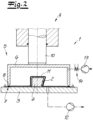
- the figures show a membrane press 1 for the production of a component made of a fiber composite material.
- a component made of a fiber composite material is produced by forming a thermoplastic organic sheet 2.
- the membrane press 1 has a lower press part 3 which is designed as a press table on which a mold 4 is arranged as a negative mold of the component to be produced.
- the press 1 has an upper press part 5 which has a hood-like pressure case 6 which can be sealed against the lower press part 3.
- the lower circumferential end face 7 of the pressure case 6 which can be placed on the press table is provided with a circumferential seal 8.
- a press cylinder 9 acts on the upper press part 5, wherein in the exemplary embodiment the piston 10 of the press cylinder 9 is connected to the pressure case 6 so that the pressure case 6 is pressed against the lower press part 3 with the cylinder 9 or its piston 10.
- the membrane press 1 is equipped with an elastically stretchable membrane 11 which can be tensioned over the mold 4.
- a vacuum pump 12 is provided, which in the exemplary embodiment is connected to the press lower part 3.
- an overpressure pump 13 is provided, which in the exemplary embodiment is connected to the press upper part 5 or to the pressure case 6.
- this organic sheet is placed on the mold 4 and the membrane 11 is stretched and prestressed over the mold 4 with the organic sheet 2 interposed.
- the organic sheet is formed to form the component by applying a negative pressure to the membrane 11 on the side facing the mold 4 via the vacuum pump 12 and applying an overpressure to the side facing away from the mold 4 using the overpressure pump 13, so that the organic sheet 2 conforms to the mold 4 to form the component.
- the organic sheet 2 is heated before being placed in the press 1. It is also preferably provided that the mold 4 or at least its surface facing the organic sheet 2 is heated before and/or during the forming process. Finally, it is expedient if the pressure medium with which the membrane is subjected to excess pressure is heated. For this purpose, a heating device 14 is indicated in the figures. The heating devices for heating the organic sheet and for heating the mold are not shown.
- Fig. 1 shows an embodiment of such a membrane press, in which the membrane 11 is attached to the press base 3 and stretched over the mold 4.
- Fig. 1 shows the press after the organic sheet 2 has been placed on the mold 4 and the membrane 11 has been stretched over the mold 4 with the organic sheet 2 interposed.
- the upper press part 5 was lowered and sealed after the organic sheet 2 had been inserted and after the membrane 11 had been stretched onto the lower press part 3.
- the negative pressure can be generated with the vacuum pump 12 before and/or after the upper press part is lowered. After the upper press part 5 has been lowered against the lower press part 3 and sealed, the interior of the pressure case 6 is subjected to the overpressure.
- Fig. 2 shows the press after the overpressure and the negative pressure have been built up with formed organic sheet 2.
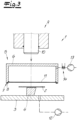
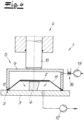
- Fig. 3 and 4 show an embodiment of a membrane press for carrying out the method according to the invention, in which the membrane is not attached to the lower press part 3, but to the upper press part 5, namely to its Pressure case 6 is attached and elastically pre-tensioned ( Fig. 3 ).
- the pressure case 6 is lowered and the membrane is stretched over the mold with the organic sheet 2 in between ( Fig. 4 ).
- the press has been closed, the negative pressure on the one hand and the positive pressure on the other hand are built up, thus forming the organic sheet 2 and producing the component.
- the organic sheet 2 consists of several individual organic sheet layers 2a, which are put together to form the organic sheet 2 and formed in the press.
- the layers 2a can be coordinated in their geometry so that the individual layers 2a move against each other during the forming process, changing the edge geometry of the component. This option is available in the Fig. 5 and 6 According to Fig. 5 the individual layers 2a are combined to form an organic sheet 2 with straight edges. During the forming process, the individual layers are shifted relative to one another, resulting in a component with bevelled edges.
- Fig. 6 an embodiment in which the individual layers 2a of the organic sheet 2 do not lie flush on top of each other, but form beveled edges, so that in the course of the forming process a component with straight edges without bevels is created.
Landscapes
- Engineering & Computer Science (AREA)
- Mechanical Engineering (AREA)
- Physics & Mathematics (AREA)
- Fluid Mechanics (AREA)
- Chemical & Material Sciences (AREA)
- Composite Materials (AREA)
- Casting Or Compression Moulding Of Plastics Or The Like (AREA)
- Moulding By Coating Moulds (AREA)
Applications Claiming Priority (2)
| Application Number | Priority Date | Filing Date | Title |
|---|---|---|---|
| DE102015117857.5A DE102015117857A1 (de) | 2015-10-20 | 2015-10-20 | Verfahren zum Herstellen eines Bauteils aus einem Faserverbundwerkstoff |
| PCT/EP2016/074988 WO2017067934A1 (de) | 2015-10-20 | 2016-10-18 | Verfahren zum herstellen eines bauteils aus einem faserverbundwerkstoff |
Publications (3)
| Publication Number | Publication Date |
|---|---|
| EP3365158A1 EP3365158A1 (de) | 2018-08-29 |
| EP3365158C0 EP3365158C0 (de) | 2024-12-04 |
| EP3365158B1 true EP3365158B1 (de) | 2024-12-04 |
Family
ID=57144980
Family Applications (1)
| Application Number | Title | Priority Date | Filing Date |
|---|---|---|---|
| EP16782256.8A Active EP3365158B1 (de) | 2015-10-20 | 2016-10-18 | Verfahren zum herstellen eines bauteils aus einem faserverbundwerkstoff |
Country Status (8)
| Country | Link |
|---|---|
| US (1) | US20180281319A1 (enExample) |
| EP (1) | EP3365158B1 (enExample) |
| JP (1) | JP6689377B2 (enExample) |
| CN (1) | CN108349174B (enExample) |
| BR (1) | BR112018007957B1 (enExample) |
| DE (1) | DE102015117857A1 (enExample) |
| ES (1) | ES3012789T3 (enExample) |
| WO (1) | WO2017067934A1 (enExample) |
Families Citing this family (13)
| Publication number | Priority date | Publication date | Assignee | Title |
|---|---|---|---|---|
| US10639855B2 (en) * | 2017-02-07 | 2020-05-05 | General Electric Company | Applicator systems for applying pressure to a structure |
| DE102017113505A1 (de) * | 2017-06-20 | 2018-12-20 | Cotesa Gmbh | Vorrichtung und Verfahren zur Warmumformung von Faserlagenstapeln |
| DE102017113595A1 (de) * | 2017-06-20 | 2018-12-20 | Siempelkamp Maschinen- Und Anlagenbau Gmbh | Verfahren und Vorrichtung zum Herstellen eines Bauteils aus einem Faserverbundwerkstoff |
| DE102018213778A1 (de) | 2018-08-16 | 2020-02-20 | Airbus Operations Gmbh | Werkzeugvorrichtung und Verfahren zur Herstellung eines flächigen Strukturbauteils für ein Luftfahrzeug |
| CN112172192B (zh) * | 2019-07-04 | 2022-05-27 | 中国航发商用航空发动机有限责任公司 | 预压实装置及预压实方法 |
| EP4017710B1 (de) * | 2019-08-22 | 2023-08-30 | Siempelkamp Maschinen- und Anlagenbau GmbH | Verfahren zur herstellung von formteilen aus faserverbund-werkstoff |
| DE102019005913A1 (de) * | 2019-08-22 | 2021-02-25 | Siempelkamp Maschinen- Und Anlagenbau Gmbh | Verfahren und Vorrichtung zum Herstellen eines Bauteils aus einem Faserverbundwerkstoff |
| KR102292292B1 (ko) * | 2020-02-04 | 2021-08-23 | 최석영 | 소재 성형 장치 및 소재 성형 방법 |
| US11801621B2 (en) * | 2020-05-29 | 2023-10-31 | The Boeing Company | System and method for curing thermoset composites |
| CN114474683B (zh) * | 2020-11-12 | 2024-03-29 | 东莞永湖复合材料有限公司 | 复合材料成型的行李箱及其制造方法 |
| US11938689B2 (en) * | 2020-11-18 | 2024-03-26 | The Boeing Company | Apparatus and method for processing a composite structure |
| CN114851525A (zh) * | 2022-03-28 | 2022-08-05 | 南昌航空大学 | 一种pmi泡沫真空热吸成型设备及运行方式 |
| CN119319164A (zh) * | 2024-11-19 | 2025-01-17 | 索菲亚家居股份有限公司 | 一种圆弧板件的加工工艺 |
Citations (3)
| Publication number | Priority date | Publication date | Assignee | Title |
|---|---|---|---|---|
| WO1990003880A1 (en) * | 1988-10-07 | 1990-04-19 | A. Ahlstrom Corporation | Method of manufacturing reinforced plastics material products |
| EP0584017A1 (fr) * | 1992-08-20 | 1994-02-23 | Gec Alsthom Acb | Presse pour le formage d'une pièce en matériau composite comportant des renforts fibreux dans une matrice en polymère |
| EP2070678A1 (en) * | 2006-09-29 | 2009-06-17 | Toray Industries, Inc. | Shaping mold and process for the production of preforms and fiber-reinforced plastics with the mold |
Family Cites Families (18)
| Publication number | Priority date | Publication date | Assignee | Title |
|---|---|---|---|---|
| DE3727926A1 (de) * | 1986-08-27 | 1988-03-10 | Dornier Gmbh | Verfahren zur herstellung von formteilen |
| US5145621A (en) | 1990-04-20 | 1992-09-08 | General Electric Company | Crossover mold tool for consolidating composite material |
| FR2713979B1 (fr) | 1993-12-21 | 1996-03-15 | Aerospatiale | Procédé et dispositif de fabrication de pièces stratifiées injectées basse pression, notamment à emboutis profonds. |
| DE19859798C2 (de) | 1998-12-23 | 2003-06-05 | Deutsch Zentr Luft & Raumfahrt | Verfahren und Vorrichtung zum Herstellen von Formkörpern aus Faserverbundwerkstoffen |
| DE10140166B4 (de) | 2001-08-22 | 2009-09-03 | Eads Deutschland Gmbh | Verfahren und Vorrichtung zur Herstellung von faserverstärkten Bauteilen mittels eines Injektionsverfahrens |
| NL1029471C2 (nl) * | 2005-07-08 | 2007-01-09 | Crehabo Belgium N V | Werkwijze en inrichting voor het vervaardigen van een vormdeel uit een kunststof. |
| JP2007131494A (ja) * | 2005-11-11 | 2007-05-31 | Toyo Tire & Rubber Co Ltd | 真空バッグ用伸縮性素材及び真空バッグ |
| JP4967405B2 (ja) * | 2006-03-27 | 2012-07-04 | 東レ株式会社 | 繊維強化プラスチックの製造方法 |
| DE102006031334A1 (de) * | 2006-07-06 | 2008-01-10 | Airbus Deutschland Gmbh | Verfahren zur Herstellung eines Faserverbundbauteils für die Luft- und Raumfahrt |
| DE102008044069B3 (de) * | 2008-11-26 | 2010-08-05 | Airbus Deutschland Gmbh | Formkörper zur Herstellung eines Faserverbundbauteils |
| JP5292445B2 (ja) * | 2010-11-26 | 2013-09-18 | 株式会社芦田製作所 | オートクレーブ成形方法及びオートクレーブ成形装置 |
| DE102011111233A1 (de) | 2011-08-20 | 2013-02-21 | GM Global Technology Operations LLC (n. d. Gesetzen des Staates Delaware) | Verfahren zur Herstellung eines Leichtbauteils, insbesondere einer Karosserieverstärkung für ein Kraftfahrzeug, wie einen Personenkraftwagen |
| DE102011111232A1 (de) | 2011-08-20 | 2013-02-21 | GM Global Technology Operations LLC (n. d. Gesetzen des Staates Delaware) | Leichtbauteil, insbesondere Karosseriesäulenverstärkung und Verfahren zur Herstellung des Leichtbauteils |
| US8591796B2 (en) * | 2011-08-25 | 2013-11-26 | General Electric Company | Methods and apparatus for molding and curing of composites |
| DE102011115730A1 (de) | 2011-10-11 | 2013-04-11 | Daimler Ag | Thermoplastisches dreidimensonal geformtes Faser-Halbzeug und Verfahren zur Umformung von thermoplastischen Faserhalbzeugplatten |
| GB201223032D0 (en) * | 2012-12-20 | 2013-02-06 | Cytec Ind Inc | Method for forming shaped preform |
| DE102013105080B4 (de) | 2013-05-17 | 2016-06-23 | Thyssenkrupp Steel Europe Ag | Verfahren zur Herstellung von Halbzeugen oder Bauteilen aus faserverstärktem thermoplastischen Kunststoff, nach dem Verfahren hergestelltes Halbzeug und daraus hergestelltes Bauteil |
| CN104175569A (zh) * | 2014-07-21 | 2014-12-03 | 青岛顺益新材料科技有限公司 | 一种纤维增强热塑性复合材料的制备方法 |
-
2015
- 2015-10-20 DE DE102015117857.5A patent/DE102015117857A1/de not_active Withdrawn
-
2016
- 2016-10-18 WO PCT/EP2016/074988 patent/WO2017067934A1/de not_active Ceased
- 2016-10-18 US US15/763,171 patent/US20180281319A1/en not_active Abandoned
- 2016-10-18 CN CN201680061105.5A patent/CN108349174B/zh active Active
- 2016-10-18 ES ES16782256T patent/ES3012789T3/es active Active
- 2016-10-18 EP EP16782256.8A patent/EP3365158B1/de active Active
- 2016-10-18 BR BR112018007957-0A patent/BR112018007957B1/pt active IP Right Grant
- 2016-10-18 JP JP2018520142A patent/JP6689377B2/ja active Active
Patent Citations (3)
| Publication number | Priority date | Publication date | Assignee | Title |
|---|---|---|---|---|
| WO1990003880A1 (en) * | 1988-10-07 | 1990-04-19 | A. Ahlstrom Corporation | Method of manufacturing reinforced plastics material products |
| EP0584017A1 (fr) * | 1992-08-20 | 1994-02-23 | Gec Alsthom Acb | Presse pour le formage d'une pièce en matériau composite comportant des renforts fibreux dans une matrice en polymère |
| EP2070678A1 (en) * | 2006-09-29 | 2009-06-17 | Toray Industries, Inc. | Shaping mold and process for the production of preforms and fiber-reinforced plastics with the mold |
Also Published As
| Publication number | Publication date |
|---|---|
| JP6689377B2 (ja) | 2020-04-28 |
| JP2018531168A (ja) | 2018-10-25 |
| EP3365158C0 (de) | 2024-12-04 |
| DE102015117857A1 (de) | 2017-04-20 |
| CN108349174A (zh) | 2018-07-31 |
| CN108349174B (zh) | 2020-12-18 |
| ES3012789T3 (en) | 2025-04-10 |
| WO2017067934A1 (de) | 2017-04-27 |
| CA3001945A1 (en) | 2017-04-27 |
| BR112018007957B1 (pt) | 2022-02-08 |
| EP3365158A1 (de) | 2018-08-29 |
| US20180281319A1 (en) | 2018-10-04 |
| BR112018007957A2 (pt) | 2018-10-30 |
Similar Documents
| Publication | Publication Date | Title |
|---|---|---|
| EP3365158B1 (de) | Verfahren zum herstellen eines bauteils aus einem faserverbundwerkstoff | |
| EP3408075B1 (de) | Verfahren zum herstellen eines bauteils aus einem faserverbundwerkstoff | |
| EP3408080B1 (de) | Presse zum herstellen eines bauteils aus einem faserverbundwerkstoff | |
| DE102010033627B4 (de) | Geformtes Kunststoff-Mehrschicht-Bauteil mit endlosverstärkten Faserlagen und Verfahren zu dessen Herstellung | |
| EP2227377B1 (de) | Verfahren zur herstellung eines mehrzelligen fahrzeugchassis und dadurch hergestelltes fahrzeugchassis | |
| DE3727926C2 (enExample) | ||
| EP2516137A1 (de) | Verfahren zur herstellung von endlosfaserverstärkten formteilen aus thermoplastischem kunststoff sowie kraftfahrzeugformteil | |
| DE102017107908A1 (de) | MGI-Verfahren und entsprechendes Formwerkzeug | |
| DE102014004359B4 (de) | Verfahren zur Herstellung eines Materialverbunds durch Verpressung eines metallischen Werkstoffs mit einem oder mehreren faserverstärkten Kunststoffen | |
| DE19959654A1 (de) | Verfahren zur Herstellung von Innenausstattungskomponenten von Kraftfahrzeugen | |
| WO2017129395A1 (de) | Presse zum herstellen eines bauteils aus einem faserverbundwerkstoff | |
| DE102011110206B4 (de) | Formwerkzeug | |
| EP3188885B1 (de) | Verfahren zur herstellung mehrschaliger verbundwerkstoffbauteile mit integrierter verstärkungsstruktur | |
| DE102015014512B4 (de) | Verfahren und Vorrichtung zur Konsolidierung von imprägnierten Faserverbundstrukturen | |
| DE102005003713B4 (de) | Verfahren zur Herstellung von faserverstärkten Hohlkörperkern-Sandwichbauteilen im vakuumunterstützten Harz-Infusionsprozess | |
| WO2016020252A1 (de) | Sandwich-bauteile aus poly(meth)acrylat-basierten schaumkörpern und reversibel vernetzbaren composites | |
| DE102018125716A1 (de) | Vorrichtung und Verfahren zur Herstellen eines Kunststoffbauteils | |
| WO2019101396A1 (de) | Verfahren zur herstellung eines faserverbundbauteils und faserverbundbauteil | |
| DE10258935A1 (de) | Verfahren zur Herstellung von dreidimensionalen Bauteilen | |
| EP2934866B1 (de) | Verfahren für die herstellung komplexer geometrischer strukturen aus mehreren formteilen | |
| DE202005005475U1 (de) | Werkstück und Vorrichtung zur Schaffung | |
| DE102016120864A1 (de) | Herstellung eines einen Faser-Kunststoff-Verbund aufweisenden Bauteils | |
| DE102024201574A1 (de) | Herstellung von Zellenrahmen, insbesondere Anoden- und/oder Kathodenrahmen | |
| DE102016210064A1 (de) | Verfahren und Herstellanordnung zur Herstellung eines Werkstücks durch Pressformen, sowie Verfahren und Schweißanordnung zum Verschweißen | |
| EP4501606A1 (de) | Werkzeug, vorrichtung und verfahren zum herstellen eines laminierten faser-kunststoff-verbund-bauteils |
Legal Events
| Date | Code | Title | Description |
|---|---|---|---|
| STAA | Information on the status of an ep patent application or granted ep patent |
Free format text: STATUS: THE INTERNATIONAL PUBLICATION HAS BEEN MADE |
|
| PUAI | Public reference made under article 153(3) epc to a published international application that has entered the european phase |
Free format text: ORIGINAL CODE: 0009012 |
|
| STAA | Information on the status of an ep patent application or granted ep patent |
Free format text: STATUS: REQUEST FOR EXAMINATION WAS MADE |
|
| 17P | Request for examination filed |
Effective date: 20180426 |
|
| AK | Designated contracting states |
Kind code of ref document: A1 Designated state(s): AL AT BE BG CH CY CZ DE DK EE ES FI FR GB GR HR HU IE IS IT LI LT LU LV MC MK MT NL NO PL PT RO RS SE SI SK SM TR |
|
| AX | Request for extension of the european patent |
Extension state: BA ME |
|
| DAV | Request for validation of the european patent (deleted) | ||
| DAX | Request for extension of the european patent (deleted) | ||
| STAA | Information on the status of an ep patent application or granted ep patent |
Free format text: STATUS: EXAMINATION IS IN PROGRESS |
|
| 17Q | First examination report despatched |
Effective date: 20210914 |
|
| GRAP | Despatch of communication of intention to grant a patent |
Free format text: ORIGINAL CODE: EPIDOSNIGR1 |
|
| STAA | Information on the status of an ep patent application or granted ep patent |
Free format text: STATUS: GRANT OF PATENT IS INTENDED |
|
| INTG | Intention to grant announced |
Effective date: 20240709 |
|
| RIC1 | Information provided on ipc code assigned before grant |
Ipc: B29C 51/28 20060101ALI20240702BHEP Ipc: B30B 5/02 20060101ALI20240702BHEP Ipc: B29C 70/44 20060101ALI20240702BHEP Ipc: B29C 70/34 20060101AFI20240702BHEP |
|
| GRAS | Grant fee paid |
Free format text: ORIGINAL CODE: EPIDOSNIGR3 |
|
| GRAA | (expected) grant |
Free format text: ORIGINAL CODE: 0009210 |
|
| STAA | Information on the status of an ep patent application or granted ep patent |
Free format text: STATUS: THE PATENT HAS BEEN GRANTED |
|
| AK | Designated contracting states |
Kind code of ref document: B1 Designated state(s): AL AT BE BG CH CY CZ DE DK EE ES FI FR GB GR HR HU IE IS IT LI LT LU LV MC MK MT NL NO PL PT RO RS SE SI SK SM TR |
|
| REG | Reference to a national code |
Ref country code: GB Ref legal event code: FG4D Free format text: NOT ENGLISH |
|
| REG | Reference to a national code |
Ref country code: CH Ref legal event code: EP |
|
| REG | Reference to a national code |
Ref country code: DE Ref legal event code: R096 Ref document number: 502016016823 Country of ref document: DE |
|
| REG | Reference to a national code |
Ref country code: IE Ref legal event code: FG4D Free format text: LANGUAGE OF EP DOCUMENT: GERMAN |
|
| U01 | Request for unitary effect filed |
Effective date: 20241230 |
|
| U07 | Unitary effect registered |
Designated state(s): AT BE BG DE DK EE FI FR IT LT LU LV MT NL PT RO SE SI Effective date: 20250114 |
|
| REG | Reference to a national code |
Ref country code: ES Ref legal event code: FG2A Ref document number: 3012789 Country of ref document: ES Kind code of ref document: T3 Effective date: 20250410 |
|
| PG25 | Lapsed in a contracting state [announced via postgrant information from national office to epo] |
Ref country code: HR Free format text: LAPSE BECAUSE OF FAILURE TO SUBMIT A TRANSLATION OF THE DESCRIPTION OR TO PAY THE FEE WITHIN THE PRESCRIBED TIME-LIMIT Effective date: 20241204 |
|
| PG25 | Lapsed in a contracting state [announced via postgrant information from national office to epo] |
Ref country code: NO Free format text: LAPSE BECAUSE OF FAILURE TO SUBMIT A TRANSLATION OF THE DESCRIPTION OR TO PAY THE FEE WITHIN THE PRESCRIBED TIME-LIMIT Effective date: 20250304 |
|
| PG25 | Lapsed in a contracting state [announced via postgrant information from national office to epo] |
Ref country code: GR Free format text: LAPSE BECAUSE OF FAILURE TO SUBMIT A TRANSLATION OF THE DESCRIPTION OR TO PAY THE FEE WITHIN THE PRESCRIBED TIME-LIMIT Effective date: 20250305 |
|
| PG25 | Lapsed in a contracting state [announced via postgrant information from national office to epo] |
Ref country code: RS Free format text: LAPSE BECAUSE OF FAILURE TO SUBMIT A TRANSLATION OF THE DESCRIPTION OR TO PAY THE FEE WITHIN THE PRESCRIBED TIME-LIMIT Effective date: 20250304 |
|
| PG25 | Lapsed in a contracting state [announced via postgrant information from national office to epo] |
Ref country code: SM Free format text: LAPSE BECAUSE OF FAILURE TO SUBMIT A TRANSLATION OF THE DESCRIPTION OR TO PAY THE FEE WITHIN THE PRESCRIBED TIME-LIMIT Effective date: 20241204 |
|
| PG25 | Lapsed in a contracting state [announced via postgrant information from national office to epo] |
Ref country code: PL Free format text: LAPSE BECAUSE OF FAILURE TO SUBMIT A TRANSLATION OF THE DESCRIPTION OR TO PAY THE FEE WITHIN THE PRESCRIBED TIME-LIMIT Effective date: 20241204 |
|
| PG25 | Lapsed in a contracting state [announced via postgrant information from national office to epo] |
Ref country code: IS Free format text: LAPSE BECAUSE OF FAILURE TO SUBMIT A TRANSLATION OF THE DESCRIPTION OR TO PAY THE FEE WITHIN THE PRESCRIBED TIME-LIMIT Effective date: 20250404 |
|
| PG25 | Lapsed in a contracting state [announced via postgrant information from national office to epo] |
Ref country code: SK Free format text: LAPSE BECAUSE OF FAILURE TO SUBMIT A TRANSLATION OF THE DESCRIPTION OR TO PAY THE FEE WITHIN THE PRESCRIBED TIME-LIMIT Effective date: 20241204 |
|
| PG25 | Lapsed in a contracting state [announced via postgrant information from national office to epo] |
Ref country code: CZ Free format text: LAPSE BECAUSE OF FAILURE TO SUBMIT A TRANSLATION OF THE DESCRIPTION OR TO PAY THE FEE WITHIN THE PRESCRIBED TIME-LIMIT Effective date: 20241204 |
|
| PLBE | No opposition filed within time limit |
Free format text: ORIGINAL CODE: 0009261 |
|
| STAA | Information on the status of an ep patent application or granted ep patent |
Free format text: STATUS: NO OPPOSITION FILED WITHIN TIME LIMIT |
|
| 26N | No opposition filed |
Effective date: 20250905 |
|
| U20 | Renewal fee for the european patent with unitary effect paid |
Year of fee payment: 10 Effective date: 20251027 |