EP3361516B1 - Device for emitting single photons or entangled photon pairs - Google Patents
Device for emitting single photons or entangled photon pairs Download PDFInfo
- Publication number
- EP3361516B1 EP3361516B1 EP17382061.4A EP17382061A EP3361516B1 EP 3361516 B1 EP3361516 B1 EP 3361516B1 EP 17382061 A EP17382061 A EP 17382061A EP 3361516 B1 EP3361516 B1 EP 3361516B1
- Authority
- EP
- European Patent Office
- Prior art keywords
- semiconductor material
- layer
- quantum
- light
- type semiconductor
- Prior art date
- Legal status (The legal status is an assumption and is not a legal conclusion. Google has not performed a legal analysis and makes no representation as to the accuracy of the status listed.)
- Active
Links
Images




Classifications
-
- H—ELECTRICITY
- H10—SEMICONDUCTOR DEVICES; ELECTRIC SOLID-STATE DEVICES NOT OTHERWISE PROVIDED FOR
- H10H—INORGANIC LIGHT-EMITTING SEMICONDUCTOR DEVICES HAVING POTENTIAL BARRIERS
- H10H20/00—Individual inorganic light-emitting semiconductor devices having potential barriers, e.g. light-emitting diodes [LED]
- H10H20/80—Constructional details
- H10H20/81—Bodies
- H10H20/811—Bodies having quantum effect structures or superlattices, e.g. tunnel junctions
- H10H20/812—Bodies having quantum effect structures or superlattices, e.g. tunnel junctions within the light-emitting regions, e.g. having quantum confinement structures
-
- H—ELECTRICITY
- H10—SEMICONDUCTOR DEVICES; ELECTRIC SOLID-STATE DEVICES NOT OTHERWISE PROVIDED FOR
- H10H—INORGANIC LIGHT-EMITTING SEMICONDUCTOR DEVICES HAVING POTENTIAL BARRIERS
- H10H20/00—Individual inorganic light-emitting semiconductor devices having potential barriers, e.g. light-emitting diodes [LED]
- H10H20/01—Manufacture or treatment
- H10H20/011—Manufacture or treatment of bodies, e.g. forming semiconductor layers
- H10H20/012—Manufacture or treatment of bodies, e.g. forming semiconductor layers having light-emitting regions comprising only Group II-IV materials
-
- H—ELECTRICITY
- H10—SEMICONDUCTOR DEVICES; ELECTRIC SOLID-STATE DEVICES NOT OTHERWISE PROVIDED FOR
- H10H—INORGANIC LIGHT-EMITTING SEMICONDUCTOR DEVICES HAVING POTENTIAL BARRIERS
- H10H20/00—Individual inorganic light-emitting semiconductor devices having potential barriers, e.g. light-emitting diodes [LED]
- H10H20/01—Manufacture or treatment
- H10H20/011—Manufacture or treatment of bodies, e.g. forming semiconductor layers
- H10H20/013—Manufacture or treatment of bodies, e.g. forming semiconductor layers having light-emitting regions comprising only Group III-V materials
-
- H—ELECTRICITY
- H10—SEMICONDUCTOR DEVICES; ELECTRIC SOLID-STATE DEVICES NOT OTHERWISE PROVIDED FOR
- H10H—INORGANIC LIGHT-EMITTING SEMICONDUCTOR DEVICES HAVING POTENTIAL BARRIERS
- H10H20/00—Individual inorganic light-emitting semiconductor devices having potential barriers, e.g. light-emitting diodes [LED]
- H10H20/80—Constructional details
- H10H20/81—Bodies
-
- H—ELECTRICITY
- H10—SEMICONDUCTOR DEVICES; ELECTRIC SOLID-STATE DEVICES NOT OTHERWISE PROVIDED FOR
- H10H—INORGANIC LIGHT-EMITTING SEMICONDUCTOR DEVICES HAVING POTENTIAL BARRIERS
- H10H20/00—Individual inorganic light-emitting semiconductor devices having potential barriers, e.g. light-emitting diodes [LED]
- H10H20/80—Constructional details
- H10H20/81—Bodies
- H10H20/813—Bodies having a plurality of light-emitting regions, e.g. multi-junction LEDs or light-emitting devices having photoluminescent regions within the bodies
-
- H—ELECTRICITY
- H10—SEMICONDUCTOR DEVICES; ELECTRIC SOLID-STATE DEVICES NOT OTHERWISE PROVIDED FOR
- H10H—INORGANIC LIGHT-EMITTING SEMICONDUCTOR DEVICES HAVING POTENTIAL BARRIERS
- H10H20/00—Individual inorganic light-emitting semiconductor devices having potential barriers, e.g. light-emitting diodes [LED]
- H10H20/80—Constructional details
- H10H20/81—Bodies
- H10H20/814—Bodies having reflecting means, e.g. semiconductor Bragg reflectors
-
- H—ELECTRICITY
- H10—SEMICONDUCTOR DEVICES; ELECTRIC SOLID-STATE DEVICES NOT OTHERWISE PROVIDED FOR
- H10H—INORGANIC LIGHT-EMITTING SEMICONDUCTOR DEVICES HAVING POTENTIAL BARRIERS
- H10H20/00—Individual inorganic light-emitting semiconductor devices having potential barriers, e.g. light-emitting diodes [LED]
- H10H20/80—Constructional details
- H10H20/84—Coatings, e.g. passivation layers or antireflective coatings
-
- H—ELECTRICITY
- H10—SEMICONDUCTOR DEVICES; ELECTRIC SOLID-STATE DEVICES NOT OTHERWISE PROVIDED FOR
- H10H—INORGANIC LIGHT-EMITTING SEMICONDUCTOR DEVICES HAVING POTENTIAL BARRIERS
- H10H20/00—Individual inorganic light-emitting semiconductor devices having potential barriers, e.g. light-emitting diodes [LED]
- H10H20/80—Constructional details
- H10H20/85—Packages
- H10H20/855—Optical field-shaping means, e.g. lenses
- H10H20/856—Reflecting means
-
- H—ELECTRICITY
- H10—SEMICONDUCTOR DEVICES; ELECTRIC SOLID-STATE DEVICES NOT OTHERWISE PROVIDED FOR
- H10W—GENERIC PACKAGES, INTERCONNECTIONS, CONNECTORS OR OTHER CONSTRUCTIONAL DETAILS OF DEVICES COVERED BY CLASS H10
- H10W90/00—Package configurations
Definitions
- the object of the invention relates to the field of physics, specifically quantum physics.
- the present invention is directed to a quantum light source, more specifically to a device capable of generating single photons or entangled photon pairs.
- one-time-pad cryptography is secure against adversaries with infinite computation power. Its only flaw being that the method to exchange private keys must be proven unbreakable. Fortunately, quantum information theory not only causes a problem, the security breach of public key algorithms, but also offers “inviolable” methods for private key exchange.
- the best known cryptographic quantum protocol is the BB84, which is based on the "no cloning theorem of quantum states" which in turn derives from the principle of uncertainty. Information encoded in a quantum state is irreversibly modified during the measurement process. This enables various methods for two legitimate partners to exchange information encoded in quantum states and to notice when its privacy has been compromised. This exclusive property of quantum information protocols allows the inviolable exchange of absolutely private keys between legitimate interlocutors.
- quantum states of light like single photons or entangled photon pairs, are the preferred carriers of quantum information.
- the so-called 'quantum modems' already exist outside the laboratory as prototypes oriented to large corporations and institutional clients. For popularizing them, it is necessary that such technology pass through cycles of miniaturization and integration as has happened with other digital technologies since the invention of the microprocessor and Moore's Law.
- the key question is how to make a reliable, integrated and scalable quantum light source that can be used generally in new quantum information technologies.
- Quantum properties of light were postulated by Einstein and Planck to explain black body radiation and the photoelectric effect in the early twentieth century. However, it was not until the 70s that the first experimental evidence of the quantum nature of light involving the detection of individual photons was found. It derives from this pioneering research that, from the point of view of a local observer, a light stream emitted by an individual quantum state of an atom is made of single photons (photons emitted one by one), but most light sources do not generally fulfil this rule. A simple way to look at it is that two unrelated individual atoms present in a certain light source can emit two unrelated photons simultaneously.
- Yuan in "Electrically Driven Single-Photon Source” Science 295 (5552) 102 - 5 February 2002 discloses a radiation source electrically induced of single photon generated from the electroluminescence of a single quantum dot disclosed in the intrinsic region of a p-i-n junction type, that is a PIN diode having two differently doped regions and two terminals.
- This document details how under low levels of injection current, the spectrum of the quantum dot electroluminescence reveals a single sharp line due to recombination of excitons.
- the second order autocorrelation function of the emitted light shows that single-photon emission on-demand can be stimulated by sub-nanosecond-long voltage pulses.
- a photon source comprising: a quantum dot; electrical contacts configured to apply an electric field through said quantum dot: and a power source coupled to said contacts, said electrical source is configured to apply a potential such that the carriers are supplied to said quantum dot to form a bi-exciton or an exciton of higher order.
- the said source of photons further comprises a barrier configured to increase the time that a carrier takes to get to and from said quantum dot, and that time being greater than the lifetime of radiation of an exciton in the quantum dot, the quantum dot being suitable for photon emission during the disintegration of a bi-exciton, exciton or higher order.
- WO2011009465 describes a source of photon quantum light based on an essentially conical nanowire that is made from a semiconductor material; the nanowire is complemented by a pair of electrodes electrically connected to a photon emitter that is integrated into the nanowire and can generate or emit a single photon when a driving voltage is applied between the electrodes.
- the nanowire is surrounded by air or vacuum, so that you can take advantage of the resulting relationship between the refractive index of the nanowires and the material surrounding (air). It also details that the electrodes are optically transparent so that can be used as part of an anti reflective element.
- US5583349A and US2016064439A1 discloses light emitting diode (LED) stacks.
- a LED stack allows to combine light from different wavelengths in a monolithic device, producing new colors as a combination of the light produced by each LED of the LED stack.
- the device is manufactured using different processes which could be used for generating a monolithic device having different semiconductor layers.
- the tunable monolithic quantum light source device which is a quantum light emitting device, provides a new terminal and a new device active layer.
- the in situ conversion of classical light into quantum light is performed without involving any non-linear optical process; which can be said to be one of the key elements of the quantum light emitting device object of the invention.
- Several non-linear optical processes like parametric down-conversion can produce single photons and entangled photon pairs by frequency conversion within a non-linear medium of a pumping light source.
- the pump light is typically provided by an external high power laser source.
- the object of the invention is a monolithic device capable of generating quantum light from a voltage source, such as a battery, while tuning independently its key properties, like wavelength and brightness.
- a voltage source such as a battery
- our device will convert an electrical current into highly indistinguishable single photons or entangled photon pairs without requiring other active components apart of the said monolithic device.
- the object of invention finds a solution for a well-known problem of existing electrically driven quantum light sources which have limited performance when implemented in ultrathin membranes, photonic crystal microcavities and waveguides or more generally, nanodevices sensitive to its dielectric environment.
- the new design solves the problem without compromising the monolithic character of the source.
- the object of the invention improves the current monolithic sources of quantum light, and have great potential in quantum communications, but also opens the door to more feasible photonic integrated circuits for quantum information processing and metrology.
- the device of the invention comprises a set of diodes, preferably two, and a set of intrinsic areas, preferably two, in a monolithic structure "p-i-n-i-p".
- the lower intrinsic and doped layers comprise one or more quantum wells (QW), while the upper intrinsic layers contain preferably a single layer comprising quantum light emitters (for instance epitaxial QDs).
- QW quantum wells
- the bottom diode operates in forward bias, that is, by injecting majority carriers producing "electroluminescence in QW”.
- This classic light (Clight) is in fact the conventional light emitted by a light emitting diode (LED) which propagates through the device until it reaches the upper active zone containing the quantum light emitters.
- LED light emitting diode
- the classical light is absorbed generating electron-hole pairs which are captured by the quantum light emitters and re-emitted as quantum light.
- the quantum light is then collected following the known methods for time, spatial and spectral filtering of quantum light sources as needed.
- the upper diode can be driven independently and enable a number of functionalities not present in the two-terminal design:
- the three-terminal design enables the implementation of complex vertical and/or lateral electrical gating of the quantum light emitter states independently of the injection level of the monolithically embedded pumping light source. This is of paramount importance to fulfill the feasible tune-in and space-saving requirements of highly integrated quantum photonic circuits. More specifically, it enables:
- the three-terminals concept do not impose any particular restriction to the construction of the monolithically embedded pumping light source neither to the design of the quantum light source.
- the three-terminals concept do not impose any particular restriction to the construction of the monolithically embedded pumping light source neither to the design of the quantum light source.
- a device capable of emitting quantum light as shown in Figures 1b and 4 having at least a lower diode (1), which must be partially transparent to the light emitted by at least a quantum well (4), and at least one upper diode (3) that should partially or completely absorb said emitted light; wherein quantum light emitters.
- a lower diode (1) which must be partially transparent to the light emitted by at least a quantum well (4), and at least one upper diode (3) that should partially or completely absorb said emitted light; wherein quantum light emitters.
- the device of the invention comprises several zones with different doping p-i-n-i-p or alternatively n-i-p-i-n ; although a device can be developed with a number of specific zones, as five as in the device shown in Figure 1b ; in this way they have alternating layers of p-type, intrinsic or n-type semiconductor, pairs of layers with respective layers of p-type semiconductor and n-type semiconductor between which diodes (1,3) are arranged.
- a basic design of the device shown in either Figure 1b or figure 4 may comprise, on a substrate that may be doped ( n-type or p-type ) or intrinsic, block (2) of semiconductor material which in turn may be respectively doped and selected between n-type or p-type semiconductor materials; it is worth mentioning that the material of the substrate depends on that of the block (2), so the substrate is made of a n-type or intrinsic material when block (2) is of n-type, or p-type or intrinsic material when the block (2) is made of p-type.
- n-type or p-type semiconductor materials rendered the abovementioned p-i-n-i-p or alternatively n-i-p-i-n structures;
- This basic design is the cornerstone of a preferred embodiment of the invention where, regardless of the semiconductor materials which are preferably selected from III-V compound semiconductor materials and taking into the account possible different arrangements of n-type, p-type and intrinsic material layers, a quantum light emitting device is formed which is monolithic and comprises on said block (2), being in this preferred embodiment a p-type semiconductor material block (2):
- the device of the invention may be provided with possible different arrangements of n-type, p-type and intrinsic semiconductor materials for the layers of semiconductor material (11, 12, 13, 31, 32, 33); in this sense in possible alternative embodiments of the device of the invention, the block (2) and the first layer of semiconductor material (11) is made of n-type semiconductor material, the second (12) and fifth (32) layers of semiconductor materials are made of intrinsic semiconductor material, the third (13) and fourth (31) layers of semiconductor material is made of p-type semiconductor material and the sixth semiconductor layer (33) is made of n-type semiconductor material. Reversing the configuration of semiconductor materials renders configurations p-i-n-i-p or alternatively n-i-p-i-n; where i denotes an intrinsic layer.
- the device of the invention may render different configurations based on the base model above described; accordingly, the third layer of semiconductor material (13), which is located on the second layer of semiconductor material (12), may be made of p-type semiconductor material when first layer of semiconductor material (11) is of n-type semiconductor material, or n-type semiconductor material when the first layer of semiconductor material (11) is of p-type semiconductor material.
- the fourth layer of semiconductor material (31), which is arranged on the third layer of semiconductor material (13) maybe made of p-type semiconductor material when first layer of semiconductor material (11) is of n-type semiconductor material, or n-type semiconductor material when the first layer of semiconductor material (11) is of p-type semiconductor material.
- fifth layer of semiconductor material (32) located on top of the fourth layer of semiconductor material (31) and comprising in turn at least one quantum well (4) when the second layer of semiconductor material (12) comprises at least one quantum emitter (5), or at least one quantum emitter (5) when the second layer of semiconductor material (12) comprises at least one quantum well (4). All the possible embodiments of the device of the invention may start from any one of the above initial configurations.
- the third metal layer (23) and sixth layer of semiconductor material (33) may be removed or the sixth layer of semiconductor material (33) may be replaced by an electrical isolating layer or a metallic layer.
- the device is designed to emit quantum light at around 980 nm
- the lower diode (1) is made of a combination of III-V compound semiconductors -in this case Al x Ga 1-x As of varying composition-, and it contains quantum wells (4) of GaAs with emission at around 785 nm
- the upper diode (3) is made of a combination of III-V compound semiconductors -in this case GaAs and its absorption coefficient is > 10 5 cm -1 to this wavelength.
- the fourth layer 32 contains one or more quantum dots made of In x Ga 1-x As whose emission is around 980 nm.
- 785 nm is a standard wavelength to excite InGaAs/GaAs quantum dots (5) and a layer of GaAs only 100-nm-thick is enough to absorb> 64% of light.
- the quantum light emitting device object of the invention can be adapted to other spectral windows like fiber telecommunications windows (1.31 microns, 1.55 microns, etc.) or free space telecommunications in the visible and ultraviolet ranges.
- spectral windows like fiber telecommunications windows (1.31 microns, 1.55 microns, etc.) or free space telecommunications in the visible and ultraviolet ranges.
- the invention provides the upper diode (3) with the capacity of applying an electric field to the quantum light emitters (5) without affecting the process of electrical carrier injection (which occurs in the lower diode (1)).
- This electric field is used to modulate the emission of quantum light emitters (5) in intensity and energy through the Stark effect and to control its charge by Coulomb blockade mechanism.
- the emission control of quantum light emitters (5) can be performed regardless of the level of current and carrier injection that is one of the fundamental problems of the design of two terminals.
- photonic structures like a photonic crystal microcavity on the device of the invention, as well as any other photonic component such as: mirrors, waveguides, light couplers and dividers, ... or mechanical component such as: pillars, membranes (61), cantilevers (62),
- any other photonic component such as: mirrors, waveguides, light couplers and dividers, ... or mechanical component such as: pillars, membranes (61), cantilevers (62)
- the implementation of such features requires from no additional efforts to those already existing in conventional designs using known fabrication techniques. By implementing said features, the whole device still acts as a monolithic quantum light source without intervention of external light sources.
- An insertion photonic structures is preferably primed in the fifth layer of semiconductor material (32), hence embedding the quantum light emitters (5) when present in the fifth layer of semiconductor material (32). It must be noted though, that the sixth layer of semiconductor material (33) may be provided on top of said fifth layer of semiconductor material (32); in this very case the photonic structures may be comprised in both said fifth and sixth layers of semiconductor material (32, 33).
- the electronic design of the device of the invention is similar to a BJT type transistor in common base configuration.
- the design of the device should be modified in order to eliminate the parasitic transistor effect.
- the intermediate doped regions (13+31) base of the bipolar transistor
- the interconnection between the two diodes is purely optical avoiding accumulation of unwanted charge in the quantum light emitters.
- the device of the invention may be manufactured in such a way that enables the device as a tunable monolithic quantum light source, like the device depicted in figure 4 which corresponds to a p-i-n-i-p configuration.
- the device of figure 4 provides independent source brightness and voltage control of the quantum emitter properties.
- a tunable monolithic quantum light source p-i-n-i-Schottky configuration as the one depicted in figure 5 may be obtained by replacing the sixth layer of semiconductor material (33) with a metallic Schottky contact; this allows the device to provide independent source brightness and voltage control of the quantum emitter properties.
- the quantum light emitters comprised in the fifth layer of semiconductor material (32) might be of non-epitaxial nature and deposited by several methods on the fourth layer of semiconductor material (31).
- voltage tune ability of quantum light emitter properties might be still accomplished replacing the sixth layer of semiconductor material (33) with an electrical isolating material and applying gating voltages through metallic layer (23) like in a metal-insulator-semiconductor transistor; this allows the device to provide independent source brightness and voltage control of the quantum emitter properties.
- the device of the invention may be also provided with Bragg reflectors and mirrors (51, 52, 53) encompassing optically active layers, as depicted in figure 6 .
- Bragg reflectors and mirrors 51, 52, 53
- a single bottom Bragg mirror (51) reflects the light emitted by the quantum wells (2) in the substrate direction back to the quantum emitter (5) regions.
- a second Bragg mirror (51) can be allocated in between the two diodes (1,3) to selectively reflect the quantum light upwards.
- a top metallic mirror (53) might reflect all light back down to the block (2).
- Bragg reflectors and mirrors allow to manage the propagation of classical and quantum light streams in an essentially vertical direction (namely, parallel to the growth direction); as the skilled person would appreciate the configuration of the Bragg reflectors and mirrors (51,52,53) may depend on the arrangement of quantum wells (4) and quantum emitters (5). Their location and number might also be designed to narrow the spectral bandwidth and increase the modulation rate and depth of the source.
- a typical configuration is depicted on figure 7 , where the device has a p-i-n-i-p configuration with Bragg reflectors and/or mirrors of different types allowing the reflection of quantum light (QL) through the block (2) towards the optically engineered substrate.
- optical fiber shroud couplers 41
- antireflection coatings 42
- QL quantum light
- the device of the invention may further comprise one or more thin membranes (61) which in turn may comprise the quantum emitters (5), such as quantum dots (5).
- the membranes (61) may be fabricated on the sixth layer of semiconductor material (33) or the fifth layer of semiconductor material (32) creating an air gap underneath the quantum dots (5).
- the membranes (61) may also comprise photonic structures like photonic crystals (PC) to furnish the quantum emitter (5) with a dielectric environment that modifies the light-matter coupling and/or the light propagation.
- Figure 8 shows the resulting device with the membranes (61) on the fifth layer of semiconductor material (32) modified to allocate one or more photonic structures each, in this embodiment there may be or not further layers on top of the fifth layer of semiconductor material (32).
- the photonic structures may comprise one or more quantum emitters (5).
- the whole device is able to emit quantum light without the intervention of external light sources while enhancing the light-matter coupling and/or tailoring the light propagation.
- the device resulting from this embodiment may present one membrane (61) fabricated on the fifth layer of semiconductor material (32) defining an air gap underneath the quantum emitters (5), as earlier stated, said membrane (61) may comprise photonic structure being a light trapping or guiding structures like photonic crystal structures embedding the quantum light emitters (5). As the skilled person would acknowledge this may solve any existing limitations of prior art in order to perform the same task.
- the device of Figure 8 can be completed restoring back the sixth layer of semiconductor material (33) and third metal layer (23) or adding a top Schottky contact or metal-insulator structure as abovementioned.
- the upper diode (3) structure may embed the fifth layer of semiconductor material (32) in turn comprising the quantum emitters (5).
- the membranes (61) and/or the photonic structures may be manufactured directly on this upper diode (3) structure.
- the whole device, shown in Figure 9 is able to emit quantum light without the intervention of external light sources and at the same time quantum emitters are electrically tuned while embedded in PC structures.
- Membranes (61) are also useful to modify the quantum emitter properties thorough external elements like stress transducers (63) preferably piezotransducers, electrical resistances acting as heaters, etc. allocated on top or nearby. In these embodiments, there may be no further layer on top of the sixth layer of semiconductor material (33) as shown in Fig 10 or the full upper diode structure (3) might be preserved as shown in Fig 11 . External stress and/or heat is applied locally by said transducers (63) to further modify the properties of embedded quantum emitters (5) and increase the tuning capabilities of the device without affecting its other functions. The whole device is a tunable quantum light emitting device which works without the intervention of external light sources.
- the quantum light emitting device of the invention would be manufactured using a substrate from which different components of the device are defined using epitaxy, more than one device could be generated on the substrate defining an integrated optical circuit or quantum photonic circuit which comprises at least two devices like the ones hereby described.
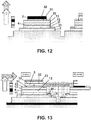
- Figure 12 shows an example of an array of two such devices where monolithic quantum light sources have their semiconductor and metal layers selectively removed or modified to implement independent voltage bias schemes and integrate different functionalities in the same wafer.
- the devices can be driven independently channeling the current and the voltage to emit or detect quantum light or alter the properties of quantum emitters.
- the quantum light emission can be electrically driven within the circuit.
- FIG 13 shows an example of quantum optical circuit where two or more devices in the same substrate are connected by light waveguides and absorbers.
- the functionality of such circuits can be largely enhanced by adding membranes (61) which hold photonic structures and/or external transducers as described above.
- the result is shown in Figure 14 .
- Each device in the circuit can be driven independently to emit, detect or alter the properties of quantum light.
- the quantum light emission can be electrically driven within the circuit.
- any of the above embodiments can be modified to contain nano-optomechanical systems such as cantilevers (62) with embedded quantum light emitters (5).
- An example is shown in Figure 15 where part of the fifth layer of semiconductor material (32) has been shaped in the form of a cantilever (62) embedding one or more quantum emitters (5).
- the whole device will emit quantum light in an environment suitable for quantum optomechanical metrology and sensor applications. It does so without the intervention of external light sources.
- the resulting device provides the fifth layer of semiconductor material (32) comprising a mechanical oscillator, such as a cantilever (62).
- the fifth layer of semiconductor material (32) may be the one comprising the quantum light emitters (5); in this case, said quantum light emitters (5) may be located either on top of said fifth semiconductor material (32) or below said fifth semiconductor material (32).
- the device of the invention may be further furnished with one or more current blocking layers to channel the electrical current flow through the device.
- These current blocking layers may be incorporated in any of the embodiment above described.
- the substrate and the layers of semiconductor material may be made of a material or combination of materials selected from the group consisting of: III-V compound semiconductors, II-VI compound semiconductors, and group IV semiconductors.
- an integrated optical circuit or quantum photonic circuit comprising at least two devices as the device of the first aspect of the invention is provided.
Landscapes
- Led Devices (AREA)
- Optical Modulation, Optical Deflection, Nonlinear Optics, Optical Demodulation, Optical Logic Elements (AREA)
- Semiconductor Lasers (AREA)
Priority Applications (6)
| Application Number | Priority Date | Filing Date | Title |
|---|---|---|---|
| ES17382061T ES2792076T3 (es) | 2017-02-08 | 2017-02-08 | Dispositivo monolítico fuente de luz cuántica ajustable y circuito óptico cuántico del mismo |
| EP17382061.4A EP3361516B1 (en) | 2017-02-08 | 2017-02-08 | Device for emitting single photons or entangled photon pairs |
| KR1020197023141A KR102461670B1 (ko) | 2017-02-08 | 2018-02-06 | 양자 광원 장치 및 이의 양자 광학 회로 |
| US16/479,773 US11152535B2 (en) | 2017-02-08 | 2018-02-06 | Monolithic quantum light source device and quantum optical circuit thereof |
| JP2019542719A JP7212621B2 (ja) | 2017-02-08 | 2018-02-06 | 量子光光源素子およびその量子光学回路 |
| PCT/EP2018/052960 WO2018146096A1 (en) | 2017-02-08 | 2018-02-06 | Quantum light source device and quantum optical circuit thereof |
Applications Claiming Priority (1)
| Application Number | Priority Date | Filing Date | Title |
|---|---|---|---|
| EP17382061.4A EP3361516B1 (en) | 2017-02-08 | 2017-02-08 | Device for emitting single photons or entangled photon pairs |
Publications (2)
| Publication Number | Publication Date |
|---|---|
| EP3361516A1 EP3361516A1 (en) | 2018-08-15 |
| EP3361516B1 true EP3361516B1 (en) | 2019-12-18 |
Family
ID=58057078
Family Applications (1)
| Application Number | Title | Priority Date | Filing Date |
|---|---|---|---|
| EP17382061.4A Active EP3361516B1 (en) | 2017-02-08 | 2017-02-08 | Device for emitting single photons or entangled photon pairs |
Country Status (6)
| Country | Link |
|---|---|
| US (1) | US11152535B2 (https=) |
| EP (1) | EP3361516B1 (https=) |
| JP (1) | JP7212621B2 (https=) |
| KR (1) | KR102461670B1 (https=) |
| ES (1) | ES2792076T3 (https=) |
| WO (1) | WO2018146096A1 (https=) |
Families Citing this family (14)
| Publication number | Priority date | Publication date | Assignee | Title |
|---|---|---|---|---|
| CN107731971B (zh) * | 2017-10-24 | 2023-07-21 | 江门市奥伦德光电有限公司 | 一种基于光子晶体的垂直结构led芯片及其制备方法 |
| WO2020180391A1 (en) * | 2019-03-05 | 2020-09-10 | Massachusetts Institute Of Technology | Scalable integration of hybrid optoelectronic and quantum optical systems into photonic circuits |
| CN114303088B (zh) * | 2019-09-20 | 2023-04-04 | 柏林洪堡大学 | 用于产生单光子的装置 |
| KR102745348B1 (ko) * | 2019-09-23 | 2024-12-23 | 삼성전자주식회사 | 광 변조 소자, 이를 포함하는 빔 스티어링 장치 및 빔 스티어링 장치를 포함하는 전자 장치 |
| US11594656B2 (en) | 2019-10-21 | 2023-02-28 | Electronics And Telecommunications Research Institute | Quantum light source device and optical communication apparatus including the same |
| KR102375861B1 (ko) * | 2020-07-28 | 2022-03-16 | 광운대학교 산학협력단 | 백투백 구조의 초소형 이중 led 소자 및 그 제조 방법과 백투백 구조의 초소형 이중 led 의 전극 어셈블리 및 그 제조방법 |
| CN112904351B (zh) * | 2021-01-20 | 2023-10-24 | 重庆邮电大学 | 一种基于量子纠缠光关联特性的单源定位方法 |
| US11575065B2 (en) | 2021-01-29 | 2023-02-07 | Applied Materials, Inc. | Tuning of emission properties of quantum emission devices using strain-tuned piezoelectric template layers |
| EP4044261A1 (en) | 2021-02-12 | 2022-08-17 | ETH Zurich | Confinement of neutral excitons in a semiconductor layer structure |
| CN114442340B (zh) * | 2022-01-17 | 2024-09-24 | 哈尔滨工业大学 | 一种基于p-n结的近场辐射热流调制器 |
| KR102654365B1 (ko) * | 2022-04-18 | 2024-04-04 | 한국광기술원 | 발광 소자 및 그 제조 방법 |
| CN115394883A (zh) * | 2022-09-30 | 2022-11-25 | 中国电子科技集团公司第四十四研究所 | 基于量子阱及量子点混合有源区的超宽谱高增益饱和增益芯片 |
| WO2025042446A2 (en) * | 2023-04-04 | 2025-02-27 | The Regents Of The University Of Michigan | Heterostructures with two-dimensional active region |
| WO2026004394A1 (ja) * | 2024-06-25 | 2026-01-02 | ソニーグループ株式会社 | 発光装置 |
Family Cites Families (16)
| Publication number | Priority date | Publication date | Assignee | Title |
|---|---|---|---|---|
| US5583349A (en) * | 1995-11-02 | 1996-12-10 | Motorola | Full color light emitting diode display |
| GB2354368B (en) * | 1999-09-14 | 2001-12-05 | Toshiba Res Europ Ltd | A photon source |
| TW459371B (en) * | 1999-12-02 | 2001-10-11 | United Epitaxy Co Ltd | Quantum well device with anti-electrostatic discharge and the manufacturing method thereof |
| JP2003202529A (ja) | 2001-03-13 | 2003-07-18 | Ricoh Co Ltd | 半導体光変調器および半導体発光装置および波長可変レーザ装置および多波長レーザ装置および光伝送システム |
| US7132676B2 (en) | 2001-05-15 | 2006-11-07 | Kabushiki Kaisha Toshiba | Photon source and a method of operating a photon source |
| GB2420908B (en) | 2004-12-03 | 2008-01-23 | Toshiba Res Europ Ltd | Photon source |
| JP2006216722A (ja) | 2005-02-02 | 2006-08-17 | Tokyo Institute Of Technology | 変調器集積面発光レーザ |
| JP4867621B2 (ja) | 2006-11-29 | 2012-02-01 | 日本電気株式会社 | 量子もつれ光子対発生器 |
| WO2011009465A1 (en) | 2009-07-23 | 2011-01-27 | Danmarks Tekniske Universitet | An electrically driven single photon source |
| GB2475099B (en) | 2009-11-06 | 2012-09-05 | Toshiba Res Europ Ltd | A photon source for producing entangled photons |
| GB2476926B (en) * | 2009-11-06 | 2012-05-02 | Toshiba Res Europ Ltd | Tuneable quantum light source |
| US9941319B2 (en) * | 2010-10-13 | 2018-04-10 | Monolithic 3D Inc. | Semiconductor and optoelectronic methods and devices |
| JP2013062354A (ja) | 2011-09-13 | 2013-04-04 | Hamamatsu Photonics Kk | 半導体発光素子 |
| US9696133B2 (en) | 2014-08-14 | 2017-07-04 | Kabushiki Kaisha Toshiba | Interference system and an interference method |
| GB2531568B (en) | 2014-10-22 | 2018-07-04 | Toshiba Res Europe Limited | An optical device and method of fabricating an optical device |
| GB2535197B (en) | 2015-02-12 | 2019-11-06 | Toshiba Res Europe Limited | An optical device and a method of fabricating an optical device |
-
2017
- 2017-02-08 EP EP17382061.4A patent/EP3361516B1/en active Active
- 2017-02-08 ES ES17382061T patent/ES2792076T3/es active Active
-
2018
- 2018-02-06 JP JP2019542719A patent/JP7212621B2/ja active Active
- 2018-02-06 WO PCT/EP2018/052960 patent/WO2018146096A1/en not_active Ceased
- 2018-02-06 US US16/479,773 patent/US11152535B2/en active Active
- 2018-02-06 KR KR1020197023141A patent/KR102461670B1/ko active Active
Non-Patent Citations (1)
| Title |
|---|
| None * |
Also Published As
| Publication number | Publication date |
|---|---|
| US20200279972A1 (en) | 2020-09-03 |
| US11152535B2 (en) | 2021-10-19 |
| ES2792076T3 (es) | 2020-11-10 |
| KR20190116299A (ko) | 2019-10-14 |
| WO2018146096A1 (en) | 2018-08-16 |
| EP3361516A1 (en) | 2018-08-15 |
| KR102461670B1 (ko) | 2022-10-31 |
| JP7212621B2 (ja) | 2023-01-25 |
| JP2020506556A (ja) | 2020-02-27 |
Similar Documents
| Publication | Publication Date | Title |
|---|---|---|
| EP3361516B1 (en) | Device for emitting single photons or entangled photon pairs | |
| US6728281B1 (en) | Quantum-dot photon turnstile device | |
| US6864501B2 (en) | Photon source and method of its fabrication and operation | |
| Capellini et al. | Tensile Ge microstructures for lasing fabricated by means of a silicon complementary metal-oxide-semiconductor process | |
| Shields | Semiconductor quantum light sources | |
| Strauf et al. | High-frequency single-photon source with polarization control | |
| Boretti et al. | Electrically driven quantum light sources | |
| Lodahl et al. | A deterministic source of single photons | |
| WO2018193248A1 (en) | A photonic device | |
| Sato et al. | Room temperature electrical control of single photon sources at 4H-SiC surface | |
| JP4972733B2 (ja) | 選択分布周波数型放出源による単一光子光源 | |
| US9219191B2 (en) | Tuneable quantum light source | |
| Seidel et al. | Continuous-wave electrically pumped multi-quantum-well laser based on group-IV semiconductors | |
| Loh et al. | Towards quantum light-emitting devices based on van der Waals materials | |
| Bimberg | Semiconductor nanostructures for flying q-bits and green photonics | |
| Hazari et al. | An InN/InGaN/GaN nanowire array guided wave photodiode on silicon | |
| Camacho-Aguilera | Ge-on-Si laser for silicon photonics | |
| De Vittorio et al. | Recent advances on single photon sources based on single colloidal nanocrystals | |
| Neogi et al. | Intersubband transitions and ultrafast all-optical modulation using multiple InGaAs-AlAsSb-InP coupled double-quantum-well structures | |
| Alén et al. | Quantum light source device and quantum optical circuit thereof | |
| KR102231085B1 (ko) | 수직 공진 표면 발광 레이저 | |
| Becher et al. | Special topic on non-classical light emitters and single-photon detectors | |
| Nakwaski et al. | Single-photon devices in quantum cryptography | |
| Tekin | Type-II GaAs/GaSb Quantum-Ring Light Emitting Diodes for Telecom-Band Emission | |
| JP2008512873A (ja) | エネルギー帯エンジニアリングに基づく超格子を有する能動光デバイスを具備した集積回路、及びその製造方法 |
Legal Events
| Date | Code | Title | Description |
|---|---|---|---|
| PUAI | Public reference made under article 153(3) epc to a published international application that has entered the european phase |
Free format text: ORIGINAL CODE: 0009012 |
|
| STAA | Information on the status of an ep patent application or granted ep patent |
Free format text: STATUS: THE APPLICATION HAS BEEN PUBLISHED |
|
| AK | Designated contracting states |
Kind code of ref document: A1 Designated state(s): AL AT BE BG CH CY CZ DE DK EE ES FI FR GB GR HR HU IE IS IT LI LT LU LV MC MK MT NL NO PL PT RO RS SE SI SK SM TR |
|
| AX | Request for extension of the european patent |
Extension state: BA ME |
|
| STAA | Information on the status of an ep patent application or granted ep patent |
Free format text: STATUS: REQUEST FOR EXAMINATION WAS MADE |
|
| RBV | Designated contracting states (corrected) |
Designated state(s): AL AT BE BG CH CY CZ DE DK EE ES FI FR GB GR HR HU IE IS IT LI LT LU LV MC MK MT NL NO PL PT RO RS SE SI SK SM TR |
|
| 17P | Request for examination filed |
Effective date: 20190215 |
|
| GRAP | Despatch of communication of intention to grant a patent |
Free format text: ORIGINAL CODE: EPIDOSNIGR1 |
|
| STAA | Information on the status of an ep patent application or granted ep patent |
Free format text: STATUS: GRANT OF PATENT IS INTENDED |
|
| INTG | Intention to grant announced |
Effective date: 20190910 |
|
| GRAS | Grant fee paid |
Free format text: ORIGINAL CODE: EPIDOSNIGR3 |
|
| GRAA | (expected) grant |
Free format text: ORIGINAL CODE: 0009210 |
|
| STAA | Information on the status of an ep patent application or granted ep patent |
Free format text: STATUS: THE PATENT HAS BEEN GRANTED |
|
| AK | Designated contracting states |
Kind code of ref document: B1 Designated state(s): AL AT BE BG CH CY CZ DE DK EE ES FI FR GB GR HR HU IE IS IT LI LT LU LV MC MK MT NL NO PL PT RO RS SE SI SK SM TR |
|
| REG | Reference to a national code |
Ref country code: CH Ref legal event code: EP |
|
| REG | Reference to a national code |
Ref country code: IE Ref legal event code: FG4D |
|
| REG | Reference to a national code |
Ref country code: AT Ref legal event code: REF Ref document number: 1215551 Country of ref document: AT Kind code of ref document: T Effective date: 20200115 |
|
| REG | Reference to a national code |
Ref country code: DE Ref legal event code: R096 Ref document number: 602017009838 Country of ref document: DE |
|
| REG | Reference to a national code |
Ref country code: CH Ref legal event code: NV Representative=s name: STOLMAR AND PARTNER INTELLECTUAL PROPERTY S.A., CH |
|
| REG | Reference to a national code |
Ref country code: NL Ref legal event code: FP |
|
| PG25 | Lapsed in a contracting state [announced via postgrant information from national office to epo] |
Ref country code: LV Free format text: LAPSE BECAUSE OF FAILURE TO SUBMIT A TRANSLATION OF THE DESCRIPTION OR TO PAY THE FEE WITHIN THE PRESCRIBED TIME-LIMIT Effective date: 20191218 Ref country code: SE Free format text: LAPSE BECAUSE OF FAILURE TO SUBMIT A TRANSLATION OF THE DESCRIPTION OR TO PAY THE FEE WITHIN THE PRESCRIBED TIME-LIMIT Effective date: 20191218 Ref country code: BG Free format text: LAPSE BECAUSE OF FAILURE TO SUBMIT A TRANSLATION OF THE DESCRIPTION OR TO PAY THE FEE WITHIN THE PRESCRIBED TIME-LIMIT Effective date: 20200318 Ref country code: GR Free format text: LAPSE BECAUSE OF FAILURE TO SUBMIT A TRANSLATION OF THE DESCRIPTION OR TO PAY THE FEE WITHIN THE PRESCRIBED TIME-LIMIT Effective date: 20200319 Ref country code: FI Free format text: LAPSE BECAUSE OF FAILURE TO SUBMIT A TRANSLATION OF THE DESCRIPTION OR TO PAY THE FEE WITHIN THE PRESCRIBED TIME-LIMIT Effective date: 20191218 Ref country code: NO Free format text: LAPSE BECAUSE OF FAILURE TO SUBMIT A TRANSLATION OF THE DESCRIPTION OR TO PAY THE FEE WITHIN THE PRESCRIBED TIME-LIMIT Effective date: 20200318 Ref country code: LT Free format text: LAPSE BECAUSE OF FAILURE TO SUBMIT A TRANSLATION OF THE DESCRIPTION OR TO PAY THE FEE WITHIN THE PRESCRIBED TIME-LIMIT Effective date: 20191218 |
|
| REG | Reference to a national code |
Ref country code: LT Ref legal event code: MG4D |
|
| PG25 | Lapsed in a contracting state [announced via postgrant information from national office to epo] |
Ref country code: RS Free format text: LAPSE BECAUSE OF FAILURE TO SUBMIT A TRANSLATION OF THE DESCRIPTION OR TO PAY THE FEE WITHIN THE PRESCRIBED TIME-LIMIT Effective date: 20191218 Ref country code: HR Free format text: LAPSE BECAUSE OF FAILURE TO SUBMIT A TRANSLATION OF THE DESCRIPTION OR TO PAY THE FEE WITHIN THE PRESCRIBED TIME-LIMIT Effective date: 20191218 |
|
| PG25 | Lapsed in a contracting state [announced via postgrant information from national office to epo] |
Ref country code: AL Free format text: LAPSE BECAUSE OF FAILURE TO SUBMIT A TRANSLATION OF THE DESCRIPTION OR TO PAY THE FEE WITHIN THE PRESCRIBED TIME-LIMIT Effective date: 20191218 |
|
| PG25 | Lapsed in a contracting state [announced via postgrant information from national office to epo] |
Ref country code: EE Free format text: LAPSE BECAUSE OF FAILURE TO SUBMIT A TRANSLATION OF THE DESCRIPTION OR TO PAY THE FEE WITHIN THE PRESCRIBED TIME-LIMIT Effective date: 20191218 Ref country code: RO Free format text: LAPSE BECAUSE OF FAILURE TO SUBMIT A TRANSLATION OF THE DESCRIPTION OR TO PAY THE FEE WITHIN THE PRESCRIBED TIME-LIMIT Effective date: 20191218 Ref country code: PT Free format text: LAPSE BECAUSE OF FAILURE TO SUBMIT A TRANSLATION OF THE DESCRIPTION OR TO PAY THE FEE WITHIN THE PRESCRIBED TIME-LIMIT Effective date: 20200513 Ref country code: CZ Free format text: LAPSE BECAUSE OF FAILURE TO SUBMIT A TRANSLATION OF THE DESCRIPTION OR TO PAY THE FEE WITHIN THE PRESCRIBED TIME-LIMIT Effective date: 20191218 |
|
| PG25 | Lapsed in a contracting state [announced via postgrant information from national office to epo] |
Ref country code: IS Free format text: LAPSE BECAUSE OF FAILURE TO SUBMIT A TRANSLATION OF THE DESCRIPTION OR TO PAY THE FEE WITHIN THE PRESCRIBED TIME-LIMIT Effective date: 20200418 Ref country code: SM Free format text: LAPSE BECAUSE OF FAILURE TO SUBMIT A TRANSLATION OF THE DESCRIPTION OR TO PAY THE FEE WITHIN THE PRESCRIBED TIME-LIMIT Effective date: 20191218 Ref country code: SK Free format text: LAPSE BECAUSE OF FAILURE TO SUBMIT A TRANSLATION OF THE DESCRIPTION OR TO PAY THE FEE WITHIN THE PRESCRIBED TIME-LIMIT Effective date: 20191218 |
|
| REG | Reference to a national code |
Ref country code: DE Ref legal event code: R097 Ref document number: 602017009838 Country of ref document: DE |
|
| REG | Reference to a national code |
Ref country code: AT Ref legal event code: MK05 Ref document number: 1215551 Country of ref document: AT Kind code of ref document: T Effective date: 20191218 |
|
| PLBE | No opposition filed within time limit |
Free format text: ORIGINAL CODE: 0009261 |
|
| STAA | Information on the status of an ep patent application or granted ep patent |
Free format text: STATUS: NO OPPOSITION FILED WITHIN TIME LIMIT |
|
| REG | Reference to a national code |
Ref country code: BE Ref legal event code: MM Effective date: 20200229 |
|
| PG25 | Lapsed in a contracting state [announced via postgrant information from national office to epo] |
Ref country code: LU Free format text: LAPSE BECAUSE OF NON-PAYMENT OF DUE FEES Effective date: 20200208 Ref country code: DK Free format text: LAPSE BECAUSE OF FAILURE TO SUBMIT A TRANSLATION OF THE DESCRIPTION OR TO PAY THE FEE WITHIN THE PRESCRIBED TIME-LIMIT Effective date: 20191218 Ref country code: MC Free format text: LAPSE BECAUSE OF FAILURE TO SUBMIT A TRANSLATION OF THE DESCRIPTION OR TO PAY THE FEE WITHIN THE PRESCRIBED TIME-LIMIT Effective date: 20191218 |
|
| REG | Reference to a national code |
Ref country code: ES Ref legal event code: FG2A Ref document number: 2792076 Country of ref document: ES Kind code of ref document: T3 Effective date: 20201110 |
|
| 26N | No opposition filed |
Effective date: 20200921 |
|
| PG25 | Lapsed in a contracting state [announced via postgrant information from national office to epo] |
Ref country code: SI Free format text: LAPSE BECAUSE OF FAILURE TO SUBMIT A TRANSLATION OF THE DESCRIPTION OR TO PAY THE FEE WITHIN THE PRESCRIBED TIME-LIMIT Effective date: 20191218 Ref country code: AT Free format text: LAPSE BECAUSE OF FAILURE TO SUBMIT A TRANSLATION OF THE DESCRIPTION OR TO PAY THE FEE WITHIN THE PRESCRIBED TIME-LIMIT Effective date: 20191218 |
|
| PG25 | Lapsed in a contracting state [announced via postgrant information from national office to epo] |
Ref country code: IE Free format text: LAPSE BECAUSE OF NON-PAYMENT OF DUE FEES Effective date: 20200208 Ref country code: IT Free format text: LAPSE BECAUSE OF FAILURE TO SUBMIT A TRANSLATION OF THE DESCRIPTION OR TO PAY THE FEE WITHIN THE PRESCRIBED TIME-LIMIT Effective date: 20191218 Ref country code: FR Free format text: LAPSE BECAUSE OF NON-PAYMENT OF DUE FEES Effective date: 20200218 |
|
| PG25 | Lapsed in a contracting state [announced via postgrant information from national office to epo] |
Ref country code: PL Free format text: LAPSE BECAUSE OF FAILURE TO SUBMIT A TRANSLATION OF THE DESCRIPTION OR TO PAY THE FEE WITHIN THE PRESCRIBED TIME-LIMIT Effective date: 20191218 Ref country code: BE Free format text: LAPSE BECAUSE OF NON-PAYMENT OF DUE FEES Effective date: 20200229 |
|
| PG25 | Lapsed in a contracting state [announced via postgrant information from national office to epo] |
Ref country code: TR Free format text: LAPSE BECAUSE OF FAILURE TO SUBMIT A TRANSLATION OF THE DESCRIPTION OR TO PAY THE FEE WITHIN THE PRESCRIBED TIME-LIMIT Effective date: 20191218 Ref country code: MT Free format text: LAPSE BECAUSE OF FAILURE TO SUBMIT A TRANSLATION OF THE DESCRIPTION OR TO PAY THE FEE WITHIN THE PRESCRIBED TIME-LIMIT Effective date: 20191218 Ref country code: CY Free format text: LAPSE BECAUSE OF FAILURE TO SUBMIT A TRANSLATION OF THE DESCRIPTION OR TO PAY THE FEE WITHIN THE PRESCRIBED TIME-LIMIT Effective date: 20191218 |
|
| PG25 | Lapsed in a contracting state [announced via postgrant information from national office to epo] |
Ref country code: MK Free format text: LAPSE BECAUSE OF FAILURE TO SUBMIT A TRANSLATION OF THE DESCRIPTION OR TO PAY THE FEE WITHIN THE PRESCRIBED TIME-LIMIT Effective date: 20191218 |
|
| REG | Reference to a national code |
Ref country code: DE Ref legal event code: R079 Ref document number: 602017009838 Country of ref document: DE Free format text: PREVIOUS MAIN CLASS: H01L0033000000 Ipc: H10H0020000000 |
|
| REG | Reference to a national code |
Ref country code: CH Ref legal event code: U11 Free format text: ST27 STATUS EVENT CODE: U-0-0-U10-U11 (AS PROVIDED BY THE NATIONAL OFFICE) Effective date: 20260301 |
|
| PGFP | Annual fee paid to national office [announced via postgrant information from national office to epo] |
Ref country code: NL Payment date: 20260226 Year of fee payment: 10 |
|
| PGFP | Annual fee paid to national office [announced via postgrant information from national office to epo] |
Ref country code: GB Payment date: 20260227 Year of fee payment: 10 |
|
| PGFP | Annual fee paid to national office [announced via postgrant information from national office to epo] |
Ref country code: ES Payment date: 20260302 Year of fee payment: 10 |
|
| PGFP | Annual fee paid to national office [announced via postgrant information from national office to epo] |
Ref country code: DE Payment date: 20260227 Year of fee payment: 10 |
|
| PGFP | Annual fee paid to national office [announced via postgrant information from national office to epo] |
Ref country code: CH Payment date: 20260301 Year of fee payment: 10 |