EP3350797B1 - Kampfsportausrüstung, systeme und zugehörige verfahren - Google Patents
Kampfsportausrüstung, systeme und zugehörige verfahren Download PDFInfo
- Publication number
- EP3350797B1 EP3350797B1 EP16845840.4A EP16845840A EP3350797B1 EP 3350797 B1 EP3350797 B1 EP 3350797B1 EP 16845840 A EP16845840 A EP 16845840A EP 3350797 B1 EP3350797 B1 EP 3350797B1
- Authority
- EP
- European Patent Office
- Prior art keywords
- target
- trainee
- handle
- log file
- log
- Prior art date
- Legal status (The legal status is an assumption and is not a legal conclusion. Google has not performed a legal analysis and makes no representation as to the accuracy of the status listed.)
- Active
Links
Images


Classifications
-
- A—HUMAN NECESSITIES
- A63—SPORTS; GAMES; AMUSEMENTS
- A63B—APPARATUS FOR PHYSICAL TRAINING, GYMNASTICS, SWIMMING, CLIMBING, OR FENCING; BALL GAMES; TRAINING EQUIPMENT
- A63B69/00—Training appliances or apparatus for special sports
- A63B69/20—Punching balls, e.g. for boxing; Other devices for striking used during training of combat sports, e.g. bags
-
- A—HUMAN NECESSITIES
- A63—SPORTS; GAMES; AMUSEMENTS
- A63B—APPARATUS FOR PHYSICAL TRAINING, GYMNASTICS, SWIMMING, CLIMBING, OR FENCING; BALL GAMES; TRAINING EQUIPMENT
- A63B24/00—Electric or electronic controls for exercising apparatus of preceding groups; Controlling or monitoring of exercises, sportive games, training or athletic performances
- A63B24/0087—Electric or electronic controls for exercising apparatus of groups A63B21/00 - A63B23/00, e.g. controlling load
-
- A—HUMAN NECESSITIES
- A63—SPORTS; GAMES; AMUSEMENTS
- A63B—APPARATUS FOR PHYSICAL TRAINING, GYMNASTICS, SWIMMING, CLIMBING, OR FENCING; BALL GAMES; TRAINING EQUIPMENT
- A63B69/00—Training appliances or apparatus for special sports
- A63B69/20—Punching balls, e.g. for boxing; Other devices for striking used during training of combat sports, e.g. bags
- A63B69/32—Punching balls, e.g. for boxing; Other devices for striking used during training of combat sports, e.g. bags with indicating devices
-
- A—HUMAN NECESSITIES
- A63—SPORTS; GAMES; AMUSEMENTS
- A63B—APPARATUS FOR PHYSICAL TRAINING, GYMNASTICS, SWIMMING, CLIMBING, OR FENCING; BALL GAMES; TRAINING EQUIPMENT
- A63B69/00—Training appliances or apparatus for special sports
- A63B69/20—Punching balls, e.g. for boxing; Other devices for striking used during training of combat sports, e.g. bags
- A63B69/32—Punching balls, e.g. for boxing; Other devices for striking used during training of combat sports, e.g. bags with indicating devices
- A63B69/322—Punching balls, e.g. for boxing; Other devices for striking used during training of combat sports, e.g. bags with indicating devices to instruct user where to strike
-
- A—HUMAN NECESSITIES
- A63—SPORTS; GAMES; AMUSEMENTS
- A63B—APPARATUS FOR PHYSICAL TRAINING, GYMNASTICS, SWIMMING, CLIMBING, OR FENCING; BALL GAMES; TRAINING EQUIPMENT
- A63B71/00—Games or sports accessories not covered in groups A63B1/00 - A63B69/00
- A63B71/06—Indicating or scoring devices for games or players, or for other sports activities
- A63B71/0619—Displays, user interfaces and indicating devices, specially adapted for sport equipment, e.g. display mounted on treadmills
- A63B71/0622—Visual, audio or audio-visual systems for entertaining, instructing or motivating the user
-
- G—PHYSICS
- G09—EDUCATION; CRYPTOGRAPHY; DISPLAY; ADVERTISING; SEALS
- G09B—EDUCATIONAL OR DEMONSTRATION APPLIANCES; APPLIANCES FOR TEACHING, OR COMMUNICATING WITH, THE BLIND, DEAF OR MUTE; MODELS; PLANETARIA; GLOBES; MAPS; DIAGRAMS
- G09B19/00—Teaching not covered by other main groups of this subclass
-
- G—PHYSICS
- G09—EDUCATION; CRYPTOGRAPHY; DISPLAY; ADVERTISING; SEALS
- G09B—EDUCATIONAL OR DEMONSTRATION APPLIANCES; APPLIANCES FOR TEACHING, OR COMMUNICATING WITH, THE BLIND, DEAF OR MUTE; MODELS; PLANETARIA; GLOBES; MAPS; DIAGRAMS
- G09B19/00—Teaching not covered by other main groups of this subclass
- G09B19/003—Repetitive work cycles; Sequence of movements
- G09B19/0038—Sports
-
- A—HUMAN NECESSITIES
- A63—SPORTS; GAMES; AMUSEMENTS
- A63B—APPARATUS FOR PHYSICAL TRAINING, GYMNASTICS, SWIMMING, CLIMBING, OR FENCING; BALL GAMES; TRAINING EQUIPMENT
- A63B71/00—Games or sports accessories not covered in groups A63B1/00 - A63B69/00
- A63B71/06—Indicating or scoring devices for games or players, or for other sports activities
- A63B71/0619—Displays, user interfaces and indicating devices, specially adapted for sport equipment, e.g. display mounted on treadmills
- A63B71/0622—Visual, audio or audio-visual systems for entertaining, instructing or motivating the user
- A63B2071/0625—Emitting sound, noise or music
-
- A—HUMAN NECESSITIES
- A63—SPORTS; GAMES; AMUSEMENTS
- A63B—APPARATUS FOR PHYSICAL TRAINING, GYMNASTICS, SWIMMING, CLIMBING, OR FENCING; BALL GAMES; TRAINING EQUIPMENT
- A63B71/00—Games or sports accessories not covered in groups A63B1/00 - A63B69/00
- A63B71/06—Indicating or scoring devices for games or players, or for other sports activities
- A63B71/0619—Displays, user interfaces and indicating devices, specially adapted for sport equipment, e.g. display mounted on treadmills
- A63B71/0622—Visual, audio or audio-visual systems for entertaining, instructing or motivating the user
- A63B2071/0625—Emitting sound, noise or music
- A63B2071/0633—Emitting sound, noise or music without electronic means
-
- A—HUMAN NECESSITIES
- A63—SPORTS; GAMES; AMUSEMENTS
- A63B—APPARATUS FOR PHYSICAL TRAINING, GYMNASTICS, SWIMMING, CLIMBING, OR FENCING; BALL GAMES; TRAINING EQUIPMENT
- A63B71/00—Games or sports accessories not covered in groups A63B1/00 - A63B69/00
- A63B71/06—Indicating or scoring devices for games or players, or for other sports activities
- A63B71/0619—Displays, user interfaces and indicating devices, specially adapted for sport equipment, e.g. display mounted on treadmills
- A63B2071/0658—Position or arrangement of display
- A63B2071/0661—Position or arrangement of display arranged on the user
- A63B2071/0663—Position or arrangement of display arranged on the user worn on the wrist, e.g. wrist bands
-
- A—HUMAN NECESSITIES
- A63—SPORTS; GAMES; AMUSEMENTS
- A63B—APPARATUS FOR PHYSICAL TRAINING, GYMNASTICS, SWIMMING, CLIMBING, OR FENCING; BALL GAMES; TRAINING EQUIPMENT
- A63B2209/00—Characteristics of used materials
-
- A—HUMAN NECESSITIES
- A63—SPORTS; GAMES; AMUSEMENTS
- A63B—APPARATUS FOR PHYSICAL TRAINING, GYMNASTICS, SWIMMING, CLIMBING, OR FENCING; BALL GAMES; TRAINING EQUIPMENT
- A63B2220/00—Measuring of physical parameters relating to sporting activity
- A63B2220/40—Acceleration
-
- A—HUMAN NECESSITIES
- A63—SPORTS; GAMES; AMUSEMENTS
- A63B—APPARATUS FOR PHYSICAL TRAINING, GYMNASTICS, SWIMMING, CLIMBING, OR FENCING; BALL GAMES; TRAINING EQUIPMENT
- A63B2220/00—Measuring of physical parameters relating to sporting activity
- A63B2220/50—Force related parameters
- A63B2220/51—Force
- A63B2220/53—Force of an impact, e.g. blow or punch
-
- A—HUMAN NECESSITIES
- A63—SPORTS; GAMES; AMUSEMENTS
- A63B—APPARATUS FOR PHYSICAL TRAINING, GYMNASTICS, SWIMMING, CLIMBING, OR FENCING; BALL GAMES; TRAINING EQUIPMENT
- A63B2220/00—Measuring of physical parameters relating to sporting activity
- A63B2220/62—Time or time measurement used for time reference, time stamp, master time or clock signal
-
- A—HUMAN NECESSITIES
- A63—SPORTS; GAMES; AMUSEMENTS
- A63B—APPARATUS FOR PHYSICAL TRAINING, GYMNASTICS, SWIMMING, CLIMBING, OR FENCING; BALL GAMES; TRAINING EQUIPMENT
- A63B2220/00—Measuring of physical parameters relating to sporting activity
- A63B2220/70—Measuring or simulating ambient conditions, e.g. weather, terrain or surface conditions
- A63B2220/73—Altitude
-
- A—HUMAN NECESSITIES
- A63—SPORTS; GAMES; AMUSEMENTS
- A63B—APPARATUS FOR PHYSICAL TRAINING, GYMNASTICS, SWIMMING, CLIMBING, OR FENCING; BALL GAMES; TRAINING EQUIPMENT
- A63B2225/00—Miscellaneous features of sport apparatus, devices or equipment
- A63B2225/50—Wireless data transmission, e.g. by radio transmitters or telemetry
-
- A—HUMAN NECESSITIES
- A63—SPORTS; GAMES; AMUSEMENTS
- A63B—APPARATUS FOR PHYSICAL TRAINING, GYMNASTICS, SWIMMING, CLIMBING, OR FENCING; BALL GAMES; TRAINING EQUIPMENT
- A63B2225/00—Miscellaneous features of sport apparatus, devices or equipment
- A63B2225/74—Miscellaneous features of sport apparatus, devices or equipment with powered illuminating means, e.g. lights
-
- A—HUMAN NECESSITIES
- A63—SPORTS; GAMES; AMUSEMENTS
- A63B—APPARATUS FOR PHYSICAL TRAINING, GYMNASTICS, SWIMMING, CLIMBING, OR FENCING; BALL GAMES; TRAINING EQUIPMENT
- A63B2244/00—Sports without balls
- A63B2244/10—Combat sports
-
- A—HUMAN NECESSITIES
- A63—SPORTS; GAMES; AMUSEMENTS
- A63B—APPARATUS FOR PHYSICAL TRAINING, GYMNASTICS, SWIMMING, CLIMBING, OR FENCING; BALL GAMES; TRAINING EQUIPMENT
- A63B2244/00—Sports without balls
- A63B2244/10—Combat sports
- A63B2244/102—Boxing
Definitions
- KR20130085868 relates to an electronic mitt.
- EP 2025370 describes a sports electronic training system, and applications thereof.
- the system comprises at least one monitor and an electronic processing device for receiving data from the at least one monitor and providing feedback to an individual based on the received data.
- the monitor can be a motion monitor that measures an individual's performance such as, for example, speed, pace and distance for a runner.
- WO2015186132 discloses a system for providing physical activity training, such as martial arts training, comprises sensor module to execute real-time measurements of aspect of trainee interaction, where processor monitors the trainee interaction with the target.
- the present invention relates to a martial arts target handle, a martial art training system and the method as defined in the corresponding independent claims 1, 6 and 7 respectively.
- the invention relates to a modular tae kwon do paddle.
- the handle is provided separately from the strike-target portion of the paddle.
- Hardware for log-in of a trainee and/or log-in of trainee performance parameters during a workout are housed in the handle.
- the hardware includes an accelerometer and/or altimeter and/or CPU and/or power source (e.g. a battery).
- the CPU includes a clock and a time stamp module adapted to apply a time stamp to the first data output signal and the second data output signal.
- a user interface for the trainer is housed in the handle.
- a waveguide e.g. optical fiber
- the waveguide conducts light to a display on the target when the paddle is connected to the handle.
- a strain relief mechanism is positioned between the handle and the target of a tae kwon do paddle.
- the strain relief mechanism includes a spring and/or a hinge and/or a flexible polymer.
- the strain relief mechanism is provided separately, as part of a handle adapted for connection to a strike-target, as part of a strike-target adapted for connection to a handle, or as an integral part of a fully assembled tae kwon do paddle.
- a hand held martial arts target is equipped with hardware that logs-in a trainee for a training session.
- trainees are provided with wearable devices adapted to communicate with the hardware that logs in a trainee.
- the hardware for logging in a trainee relies on NFC (near field contact), IR (Infra-red), RF (Radio Frequency), Bluetooth or a physical connection.
- hardware for logging of trainee performance parameters during a workout is housed in the handle.
- the logging hardware includes an accelerometer and/or altimeter and/or CPU and/or power source (e.g. a battery).
- a hand held martial arts target includes a data link to a remote device. According to the embodiments, log files concerning trainee performance during a training session are transmitted to the remote device.
- a method includes transmitting altimeter and accelerometer data to a memory associated with a CPU residing in a hand held target; storing the data in a log file; associating the log file with a user identity acquired by trainee log-in hardware installed in the hand held target to create a user log file; and transmitting the user log file to an external device.
- a martial arts target handle including; (a) an accelerometer providing a first data output signal; (b) an altimeter providing a second data output signal; (c) a CPU receiving and storing the first and second data output signals; and (d) a power source providing power the accelerometer, altimeter and CPU.
- the handle includes a connector to a strike-target.
- the handle is integrally formed with or connected to a strike target.
- AIAISE the handle includes a display.
- the handle includes a wave guide extending from the handle.
- the handle includes a connector compatible with an external charging source.
- the handle includes a user interface positioned to receive commands from a hand holding the handle.
- a martial arts target including: (a) a handle; (b) a strike-target; and (c) a strain relief mechanism positioned between the handle and the strike target.
- the strain relief mechanism includes a spring.
- the strain relief mechanism includes a hinge.
- the strain relief mechanism includes a polymer having a 10% compression value (ISO 844) between 105kPA and 347kPA.
- the strain relief mechanism includes two pieces that slide against one another.
- a martial arts training system including: (a) one or more hand held targets; (b) one or more wearable devices; and (c) trainee log-in hardware installed in the target(s) and the wearable device(s).
- the trainee log-in hardware includes near field contact (NFC) hardware.
- NFC near field contact
- active NFC hardware is installed in the target(s) and passive NFC hardware is installed in the wearable device(s).
- passive NFC hardware is installed in the target(s) and active NFC hardware is installed in the wearable device(s).
- the target(s) include communication hardware that opens a channel of communication to an external data processing device.
- a method including: (a) transmitting altimeter and accelerometer data to a memory associated with a CPU residing in a hand held target; (b) storing the data in a log file; (c) associating the log file with a trainee identity acquired by log-in hardware installed in the hand held target to create a trainee log file; and (d) transmitting the trainee log file to an external device.
- the external device is external to the hand held target and/or to the system.
- the transmitting the trainee log file to an external device relies on at least one member of the group consisting of NFC (near field contact), IR (Infra-red), RF (Radio Frequency),Wi-Fi, 3G, 4G, LTE, Bluetooth and a physical connection.
- the memory associated with the CPU includes an integral memory.
- the memory associated with the CPU includes a connectable memory.
- the external device is a wearable device.
- the associating includes applying a time stamp to the log file.
- the associating includes assembling two or more log files belonging to a single trainee into a composite trainee log file.
- the terms “comprising” and “including” or grammatical variants thereof are to be taken as specifying inclusion of the stated features, integers, actions or components without precluding the addition of one or more additional features, integers, actions, components or groups thereof.
- This term is broader than, and includes the terms “consisting of” and “consisting essentially of” as defined by the Manual of Patent Examination Procedure of the United States Patent and Trademark Office.
- any recitation that an embodiment "includes” or “comprises” a feature is a specific statement that sub embodiments “consist essentially of” and/or “consist of” the recited feature.
- method refers to manners, means, techniques and procedures for accomplishing a given task including, but not limited to, those manners, means, techniques and procedures either known to, or readily developed from known manners, means, techniques and procedures by practitioners of architecture and/or computer science.
- Implementation of the method and system according to embodiments of the invention involves performing or completing selected tasks or steps manually, automatically, or a combination thereof.
- several selected steps could be implemented by hardware or by software on any operating system of any firmware or a combination thereof.
- selected steps of the invention could be implemented as a chip or a circuit.
- selected steps of the invention could be implemented as a plurality of software instructions being executed by a computer using any suitable operating system.
- selected steps of the method and system of the invention could be described as being performed by a data processor, such as a computing platform for executing a plurality of instructions.
- Embodiments of the invention relate to hand held martial arts targets (e.g. tae kwon do paddles), portions thereof, and systems including such targets and methods which use such targets.
- hand held martial arts targets e.g. tae kwon do paddles
- systems including such targets and methods which use such targets.
- some embodiments of the invention can be used to log data from a trainee workout and/or contribute to a reduction to wear and tear on the target and/or contribute to a reduction in force transmitted to a hand holding the target.
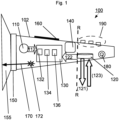
- Fig. 1 is a schematic representation of a handle of a martial arts target, indicated generally as 100, according to some exemplary embodiments of the invention.
- the term "handle” indicates that the entire target is a hand held device. This definition excludes pole mounted or platform mounted devices.
- Depicted exemplary handle 100 includes a main body 102 containing electronics components that act in concert to gather data pertaining to trainee performance during a workout.
- one electronics component is an accelerometer 110 providing a first data output signal 112.
- Signal 112 indicates strike force of a blow delivered to a strike target.
- another electronics component is an altimeter 120 providing a second data output signal 122.
- altimeter function is provided by an ultrasonic transducer.
- altimeter function is provided by a laser range finder.
- the altimeter is positioned in the handle so that it can send a signal 121 to, and receive a reflection 123 of that signal from, the floor.
- handle 120 is equipped with a rotation mechanism (indicated as dashed line R-R). According to the depicted embodiment, the trainer grasps the handle on the opposite side of line R-R from altimeter 120.
- the rear portion of the handle containing altimeter 120 rotates at line R-R so that signal 121 is aimed perpendicular to the floor.
- the weight of altimeter 120 is sufficient to cause the rotation at R-R.
- an additional weight (not depicted) is installed to insure appropriate rotation.
- CPU 130 receives and stores first and second data output signals 112 and 122.
- storage is in memory 132.
- a power source (depicted as battery 140) provides power to accelerometer 110, altimeter 120 and CPU 130.
- CPU 130 includes a clock 134 and a time stamp module 136 adapted to apply a time stamp to first data output signal 112 and second data output signal 122.
- the time stamped signals are stored in memory 132.
- handle 100 includes a connector 150 to a strike-target (partially depicted as 155). In some embodiments handle 100 is integrally formed with or connected to a strike target (partially depicted as 155).
- handle 100 includes a display 160.
- display 160 includes an LCD panel and/or LCD indicators and/or an audio output device such as a buzzer or bell.
- handle 100 includes one or more wave guides 170 extending from the handle.
- handle 100 includes one or more light sources 172.
- wave guide 170 is provided as an optical fiber.
- the wave guide conducts light to one or more trainee facing displays (not depicted) in strike target 155.
- target 155 has a left trainee facing display and a right trainee facing display.
- the trainee facing display comprises a translucent or transparent panel which is visibly brighter when light from source 172 propagates through wave guide 170 (e.g. an optical fiber).
- handle 100 includes a connector 180 compatible with an external charging source.
- connector 180 is configured as a USB port or a DC jack. Connection of connector180 to the external power source charges power supply 140.
- handle 100 includes a user interface 190 positioned to receive commands from a hand holding the handle.
- interface 190 includes a touch screen and/or pushbuttons and/or switches.
- user interface 190 is configured to accept a small number of input commands (e.g. left kick, right kick and a set of predefined combinations (e.g. Left/Left; Left/Right; Right/Left and Right/Right).
- use of interface 190 contributes to a reduction in vocal commands from the trainer to the trainee.
- input of a command via user interface 190 operates a light 172 causing light to propagate through a wave guide 170 to a trainee facing display.
- an input received at 190 is time stamped by time stamp module 136 and stored in memory 132.
- This practice contributes to an ability to evaluate a trainee in terms of delay between trainer input received at interface 190 and impact of a kick as registered by accelerometer 110 (which is also time stamped).
- this practice contributes to an ability to evaluate a trainee in terms of height (altitude) of a kick as indicated by signal 122 of altimeter 120 (which is also time stamped) for each trainer input received at interface 190.
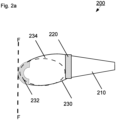
- Fig. 2a is a schematic representation of a martial arts target, indicated generally as 200, according to some exemplary embodiments of the invention.
- martial arts target 200 is configured as a tae kwon do paddle.
- Depicted exemplary target 200 includes a handle 210, a strike-target 230 and a strain relief mechanism 220 positioned between handle 210 and strike target 230.
- strike target 230 is padded.
- strike target 230 includes one or more trainee facing displays 232.
- one trainee facing display 232 is visible on the front side of strike target 230.
- a corresponding trainee facing display is present on the opposite (back) side of strike target 230.
- display(s) 232 are lighted by light propagated from a light source 172 through a wave guide 170 (See Fig. 1 and explanation above). In some embodiments at least a portion of the light is visually perceptible to a trainee standing on the opposite side of line F-F relative to strike target 230.
- strain relief mechanism 220 includes a spring (not depicted).
- the spring includes a leaf spring portion and/or a coil spring portion. The spring is configured and positioned to allow strike target 230 to move from side to side relative to handle 210 in response to an impact received at impact zone 234.
- strain relief mechanism 220 includes a hinge (not depicted).
- the hinge is configured and positioned to define a maximum side to side range of motion for strike target 230 relative to handle 210 in response to an impact received at impact zone 234.
- strain relief mechanism 220 includes a flexible polymer.
- Strain relief mechanism 220 contributes to a reduction in wear and tear and/or breakage of target 200 and/or injuries to the hand and/or wrist of a trainer holding handle 210.
- Figs. 2b1, 2b2 , 2c , 2d1 and 2d2 illustrate a strain relief mechanism of a martial arts target, indicated generally as 222 according to some exemplary embodiments of the invention.
- Mechanism 222 is one exemplary way to provide mechanism 220 in Fig. 2a .
- Fig. 2b1 is a schematic representation of a strain relief mechanism, indicated generally as 222, of a martial arts target according to some exemplary embodiments of the invention.
- This perspective view shows mechanism 222 in conjunction with a strike target 230 having a right half (230R) and a left half (230L).
- Fig. 2b2 is a schematic representation of exemplary strain relief mechanism 222 in conjunction with a strike target (Right half 230R is visible in the figure) and a handle 210.
- Fig. 2c is cross sectional view of strain relief mechanism 222 of Fig 2b2 through line S-S enlarged to show detail.
- Depicted exemplary strain release mechanism 222 is depicted assembled between two halves of handle 210. In the depicted embodiment, retention and engagement by the handle contributes to function of the mechanism.
- Depicted exemplary strain release mechanism 222 includes two plates 223, each of which has a plate foot 225 at the terminus installed in handle 210.
- Plates 223 protrude from handle 210 and extend between right strike target 230R and left strike target 230L (see Fig. 2b1 ).
- plate feet 225 are engaged and retained by elastomeric shoes 224.
- Shoes 224 are, in turn, engaged and retained by the two halves of handle 210.
- the two halves of handle 210 each include a protrusion 211extending inwardly towards plates 223.
- Depicted exemplary mechanism 222 includes plate movement governors 226 attached to the inner wall of handle 210.
- plate movement governors 226 include springs and/or blocks of elastomeric material.
- mechanism 222 includes a support rib 500 in the area of resistance.
- Figs. 2d1 and 2d2 are top views of strain relief mechanism 222 in conjunction with a strike target in two different operational states.
- Fig. 2d1 shows mechanism 222 at rest and Fig. 2d2 shoes mechanism 222 responding to a kick or other blow as indicated by leftward facing white arrow.
- left and right plate feet (225L and 225R) are aligned and in contact with shoe 224 at line X-X.
- Plates 223L and 223R are likewise aligned and coextensive between strike targets 230L and 230R.
- Line Y-Y defines the distal end of both plates 223L and 223R.
- both plates 223L and 223R flex leftward as depicted in Fig. 2d2 .
- the pates slide along one another so that plate foot 225L drops slightly below line X-X and plate foot 225R rises slightly above line X-X.
- At line Y-Y plate 223R extends slightly beyond Y-Y and plate 223L retracts slightly below Y-Y.
- the motion of plate feet 225L and 225R is restricted by shoes 224 and/or plate movement governors 226.
- Shoes 224 and/or plate movement governors 226 absorb much of the force of the kick (or other blow) that was delivered to target 230R. As a result, less force from the blow is transmitted via handle 210 (see Fig. 2a ) to the hand or wrist of a trainer holding handle 210.
- Depicted exemplary strain relief mechanism 222 includes two pieces 223R and 223L that slide against one another.
- accelerometer 110 corrects output signal 112 to correct for the force absorbed by mechanism 220.
- Fig. 3 is a schematic representation of a system, indicated generally as 300, according to some exemplary embodiments of the invention.
- Depicted exemplary system 300 includes one or more hand held targets 310.
- targets 310 include features described hereinabove in the context of Figs. 1 and/or 2a and/or 2b and/or 2c and/or 2d.
- Depicted exemplary system 300 also includes one or more wearable devices 320.
- wearable devices 320 are configured as bracelets (e.g. FIT-BIT or SAMSUNG GEAR FIT) and/or watches (e.g. APPLE watch or SAMSUNG smart watch) and/or rings and/or belts and/or as tags attachable to such items or other articles of clothing.
- Depicted exemplary system 300 also includes trainee log-in hardware (312 and 322) installed in target(s) 310 and wearable device(s) 320 respectively.
- a single wearable device 320 and a single target 310 are depicted, although a larger number would typically be present in actual use.
- many users log in sequentially with one, or a small number, of trainer held targets.
- a single user logs in with several trainer held targets concurrently.
- trainee log-in hardware (312 and 322) includes near field contact (NFC) hardware.
- NFC near field contact
- active NFC hardware is installed in target(s) 310 and passive NFC hardware is installed in the wearable device(s) 320.
- passive NFC hardware is installed in the target(s) 310 and active NFC hardware is installed in the wearable device(s) 320.
- target(s) 310 include communication hardware 330 designed and configured to open a channel of communication 332 to an external data processing device 340.
- external data processing device 340 includes a smart phone and/or laptop and/or wearable device and/or desktop computer and/or tablet device and/or a cloud storage device.
- external data processing device 340 includes a first device that receives data via channel 332 and relays the data to a second device (e.g. a cloud storage server).
- channel of communication 332 is wireless or wired.
- we3arable device 320 functions also as device 340.
- Fig. 4 is a simplified flow diagram of a method for recording an objective evaluation of a martial arts workout, indicated generally as 400, according to some exemplary embodiments of the invention.
- Depicted exemplary method 400 includes transmitting 410 altimeter and accelerometer data to a memory associated with a CPU residing in a hand held target.
- the altimeter data originates from an ultrasound transducer or laser range finder provided in the hand held target.
- Depicted exemplary method 400 includes storing 420 the data in a log file.
- Depicted exemplary method 400 includes associating 430 the log file with a trainee identity acquired by log-in hardware installed in the hand held target to create a trainee log file.
- Depicted exemplary method 400 includes transmitting 440 the trainee log file to an external device.
- transmitting 440 the trainee log file to an external device relies on NFC (near field contact) and/or IR (Infra-red) and/or RF (Radio Frequency) and/or Wi-Fi and/or 3G and/or 4G and/or LTE and/or Bluetooth and/or a physical (wired) connection.
- NFC near field contact
- IR Infra-red
- RF Radio Frequency
- Wi-Fi wireless Fidelity
- 3G and/or 4G and/or LTE and/or Bluetooth and/or a physical (wired) connection.
- the memory associated with said CPU is an integral memory.
- the memory associated with the CPU is a connectable memory (for example a flash drive).
- the external device is a wearable device.
- associating 430 includes applying a time stamp to the log file.
- associating comprises assembling two or more log files belonging to a single trainee into a composite trainee log file.
- Systems and/or targets and/or handles and/or methods described hereinabove are expected to find utility in a variety of martial arts workout settings in which a trainer induces a trainee to deliver a series of blows.
- a trainer stands opposite a trainee.
- the trainee approaches and brings a wearable device 320 ( Fig. 3 ) bearing log-in hardware 322 into proximity with matching log-in hardware 312 in a target 310 held by the trainer.
- Proximity causes a log-in event which opens a log file in memory 132 of CPU 130 ( Fig. 1 ).
- the log file is associated with the name of the trainee.
- the trainee name is stored in a memory of log-in hardware 322.
- the log file is associated with an alphanumeric string.
- the alphanumeric string is stored in a memory of log-in hardware 322.
- Translation of the alphanumeric string to a trainee name is performed later by external device 340.
- external device 340 communicates with a remote server to perform the translation.
- wearable device 320 and external device 340 are the same device. According to these embodiments, nether trainee name nor alphanumeric string are required for log-in. According to these embodiments, the system presumes that all training sessions associated with a specific wearable device 320 belong to the same trainee.
- the trainer inputs a "start session" command via user input 190 ( Fig. 1 ).
- trainee log-in occurs at the end of the session.
- the trainer inputs a command via user interface 190 ( Fig. 1 ).
- the command input is time stamped and stored in memory 132.
- the command input also activates a light 172 which propagates light via an optical fiber 170 (or other waveguide) to a trainee facing display 232 ( Fig. 2a ).
- the trainee sees trainee facing display 232 light up.
- display 232 is side specific with respect to strike target 230 (i.e. Left or Right).
- the trainee responds by delivering a kick to impact area 234 of strike target 230.
- Accelerometer 110 registers acceleration caused by the kick and sends a signal 112 to CPU 130 which is time stamped and stored in memory 132 together with height information provided by altimeter 120 as part of signal 122.
- the end of a session is marked by an "end session" input provided by the trainer via user input 190 and/or by trainee log-in (log-out in this case) as described hereinabove.
- the trainer sees data on display 160 during the training session.
- data examples include, but are not limited to, strike force (individual or average), delay between trainer input and kick delivery (individual or average) and strike height (individual or average).
- the log file associated with a specific trainee and/or a specific wearable device 320 ( Fig. 3 ) is transmitted via a channel of communication 332 to an external device 340.
- external device 340 analyzes the log file and/or compares the log file with previous log files from the same trainee and/or compares the log file with performance data from one or more other trainees. Examples of statistics that can are reported according to various exemplary embodiments include, but are not limited to, strike force (individual or average), delay between trainer input and kick delivery (individual or average) and strike height (individual or average). Alternatively or additionally, the log file provide s information on misses.
- composite data is reported (e.g. strike force as a function of height or strike force as a function of time within the training session).
- Systems and/or targets and/or handles and/or methods described hereinabove are expected to find utility in a variety of martial arts workout settings in which a trainer induces a trainee to deliver a series of blows.
- a boxing trainer stands opposite a trainee.
- the trainee approaches and brings a wearable device 320 ( Fig. 3 ) bearing log-in hardware 322 into proximity with matching log-in hardware in a one of two targets 310 held by the trainer. Proximity causes a log-in event as described hereinabove.
- the trainer inputs a "start session" command via user input 190 ( Fig. 1 ).
- the trainer inputs a command via user interface 190 ( Fig. 1 ).
- the two targets share a single interface 190.
- each target has its own interface 190.
- a single log-in as described hereinabove and/or a single "start session" command activates both targets.
- the command input is time stamped and stored in memory 132.
- the command input also activates a light 172 which propagates light via an optical fiber 170 (or other waveguide) to a trainee facing display 232 ( Fig. 2a ).
- display 232 is side specific with respect to strike target 230 (i.e. Left or Right).
- the trainee responds by delivering a blow to impact area 234 of strike target 230.
- Accelerometer 110 registers acceleration caused by the punch and sends a signal 112 to CPU 130 which is time stamped and stored in memory 132 together with height information provided by altimeter 120 as part of signal 122. Time stamped data concerning trainer inputs and trainee responses in terms of punch strength (as reflected by accelerometer data) and height continues to accumulate in memory 132 throughout the training session in a trainee log file. In some embodiments a single log file stores data pertaining to both targets.
- the end of a session is marked by an "end session" input provided by the trainer via user input 190 and/or by trainee log-in as described hereinabove.
- the trainer sees data on display 160 during the training session.
- data examples include, but are not limited to, strike force (individual or average), delay between trainer input and punch delivery (individual or average) and strike height (individual or average).
- the log file, associated with a specific trainee and/or a specific wearable device 320 is transmitted via a channel of communication 332 to an external device 340.
- external device 340 analyzes the log file and/or compares the log file with previous log files from the same trainee and/or compares the log file with performance data from one or more other trainees. Examples of statistics that can be reported include, but are not limited to, strike force (individual or average), delay between trainer input and punch delivery (individual or average) and strike height (individual or average). Alternatively or additionally, in some embodiments composite data is reported (e.g. strike force as a function of height or strike force as a function of time within the training session).
- the targets 310 are equipped with strain relief mechanisms (e.g. 220 in Fig. 2 ).
- strain relief mechanisms e.g. 220 in Fig. 2 .
- use of a strain relief mechanism contributes to an ability of a small trainer to absorb blows delivered by a larger trainee.
- altimeter 120, accelerometer 110, CPU 130 and power source 140 are all installed in main body 102 of handle 100. Since handle 100 is to be held, and moved, by a trainer during a training session, this imposes size and weight limitations on each of the components.
- the aggregate weight of altimeter 120, accelerometer 110, CPU 130 and power source 140 is less than 50 grams, 40 grams, 30 grams, 20 grams or 10 grams or intermediate or lesser number of grams.
- power source 140 is a battery. In addition to the weight constraints discussed above, some embodiments require the battery to have sufficient life to power other components through one or more training sessions of 10 minutes, 20 minutes, 30 minutes, 40 minutes, 50 minutes or 60 minutes or intermediate or greater lengths of time.
- batteries with short recharge times relative to the length of a training session are used in some embodiments.
- a trainer performing 60 minute training sessions can work indefinitely with two tae kwon do paddles equipped with handles 100 ( Fig. 1 ) if the recharge time for power source 140 is less than 60 minutes.
- the trainer switches the paddle in her hand for the paddle in the charger at the end of each session.
- configuration of other components of the system contribute to an extension in battery life.
- light source 172 uses of low power elements such as LEDs in display 160 and/or light source 172 contributes to a reduction in power consumption that extends battery life.
- light source 172 is configured with a duty cycle of less than 100% to further reduce power consumption.
- altimeter 120 transmits signal 122 only in response to an input from user interface 190, power consumption by the altimeter is reduced, contributing to an increase in battery life.
- TEXAS INSTRUMENTS - PGA450TPWRQ1 TEXAS INSTRUMENTS; USA.
- the PGA450-Q1 device is a fully integrated system-on-a-chip analog front-end for ultrasonic sensing and distance measurements.
- the LIS3DH is an ultra-low-power high performance three axes nano accelerometer featuring digital I 2 C / SPI serial interface standard output.
- the LIS3DH three axes accelerometer features ultra-low-power operational modes that allow advanced power saving and smart embedded functions.
- the LIS3DH accelerometer has dynamically user selectable full scales of ⁇ 2g / ⁇ 4g / ⁇ 8g / ⁇ 16g and is capable of measuring applications with output data rates from 1 Hz to 5 kHz.
- One example of a commercially available CPU 130 suitable for use in the context of exemplary embodiments of the invention is STMICROELECTRONICS - STM32L152V8T6-A.
- This Ultra-Low-Power MCU is ARM ® Cortex ® -M3-based STM32 using ST's ultra-low-leakage process technology with an innovative autonomous dynamic voltage scaling and 5 low-power modes offering platform flexibility to fit any application.
- One example of a commercially available power source 140 suitable for use in the context of exemplary embodiments of the invention is a SOSHINE RCR123-3.7-700 (SOSHINE, Shenzhen, and P.R China). This battery provides 700mAh at 3.7 Volts for up to 6 hours with a recharge time of 2 hours.
- shoes 224 and/or governors 226 are constructed of elastomeric polymers.
- Table 1 summarizes the relevant properties of three commercially available elastomeric polymers (PA 60; PA 80 and PA 100) produced by the PALZIV group in Israel.
- Table 1 Polymer Properties polymer Density Kg/m3 ISO 845 Tensile strength kPa ISO 1798 Elongation % ISO 1798 Compression 10%; 25%; 50% kPa ISO 844 Shore A/OO ASTMD2240 PA60 60 572 163 105; 122; 197 70 (OO by ISO868) PA80 80 957 172 124;155;245 25/70 PA100 100 1476 133 198;233;347 70 (A by ISO868)
- PA80 is employed.
- sheets 223 are constructed of nylon and/or polyethylene. According to various exemplary embodiments of the invention t hickness is adjusted to achieve the desired degree of flexibility.
- preparation and review of a user log file as described hereinabove contributes to an increase in objectivity of evaluation of trainee performance.
- the user log file clearly indicate limitations on strike height and/or a tendency to tire after a certain amount of time and/or differences in performance between right side and left side.
- comparison of a user log files as described hereinabove for the same user over a period of time contributes to an increase in objectivity of evaluation of trainee performance improvement.
- comparison of a user log files as described hereinabove for different users contributes to an increase in objectivity of ranking of different trainees. This is useful, for example, in seeding competitors for a competition and/or in identifying well matched opponents for a spectator event.
- installation of a strain release mechanism 220 in a martial arts target 220 contributes to a reduction in damage to the target itself.
- installation of a strain release mechanism 220 in a martial arts target 220 contributes to a reduction in injury to the hand and/or wrist of a trainer holding the target.
- features used to describe a method can be used to characterize an apparatus and features used to describe an apparatus can be used to characterize a method.
Landscapes
- Engineering & Computer Science (AREA)
- Health & Medical Sciences (AREA)
- Physical Education & Sports Medicine (AREA)
- General Health & Medical Sciences (AREA)
- Business, Economics & Management (AREA)
- Educational Technology (AREA)
- Theoretical Computer Science (AREA)
- Entrepreneurship & Innovation (AREA)
- Physics & Mathematics (AREA)
- Educational Administration (AREA)
- General Physics & Mathematics (AREA)
- Multimedia (AREA)
- Human Computer Interaction (AREA)
- Measurement Of The Respiration, Hearing Ability, Form, And Blood Characteristics Of Living Organisms (AREA)
- Telephone Function (AREA)
- Life Sciences & Earth Sciences (AREA)
- Biophysics (AREA)
- Orthopedic Medicine & Surgery (AREA)
- User Interface Of Digital Computer (AREA)
- Electrically Operated Instructional Devices (AREA)
Claims (13)
- Zielgriff für einen Kampfsport, aufweisend:(a) einen Beschleunigungsmesser (110), der ein erstes Datenausgangssignal (112) bereitstellt;(b) einen Höhenmesser (120), der ein zweites Datenausgangssignal (122) bereitstellt, wobei der Höhenmesser in dem Griff positioniert ist, um ein Signal (121) zu einem Boden zu senden und eine Reflexion (123) des Signals (121) von dem Boden zu empfangen,(c) eine CPU (130), die das erste und das zweite Datenausgangssignal empfängt und speichert; wobei die CPU einen Taktgeber (134) und ein Zeitstempelmodul (136) umfasst, das so eingerichtet ist, dass es einen Zeitstempel auf das erste Datenausgangssignal und das zweite Datenausgangssignal anwendet;(d) eine Stromquelle (140), die den Beschleunigungsmesser, den Höhenmesser und die CPU mit Strom versorgt; und(e) einen Zugentlastungsmechanismus (220) zur Verringerung der Abnutzung eines Ziels (200).
- Griff gemäß Anspruch 1, der ein Verbindungsstück zu einem Schlagziel umfasst.
- Griff gemäß Anspruch 1, der integral mit einem Schlagziel ausgebildet oder mit diesem verbunden ist.
- Griff gemäß Anspruch 1, der eine Anzeige umfasst.
- Griff gemäß Anspruch 1, der eine Benutzerschnittstelle umfasst, die so positioniert ist, dass sie Befehle von einer Hand empfängt, die den Griff hält.
- Ein Kampfsport-Trainingssystem, aufweisend:(a) ein oder mehrere handgehaltene Ziele gemäß Anspruch 1;(b) ein oder mehrere tragbare Geräte; und(c) eine in dem/den Ziel(en) und dem/den tragbaren Gerät(en) installierte Anmeldehardware für den Trainierenden.
- Verfahren, aufweisend:(a) Speichern des ersten Datenausgangssignals und des zweiten Datenausgangssignals von einem Zielgriff für einen Kampfsport gemäß Anspruch 1 in einer Log-Datei;(b) Assoziieren der Log-Datei mit einer Trainierenden-Identität, die durch in dem handgehaltenen Ziel installierte Anmeldehardware erfasst wird, um eine Trainierenden-Log-Datei zu erstellen; und(c) Übertragen der Trainierenden-Log-Datei an ein externes Gerät.
- Verfahren nach Anspruch 7, wobei das Übertragen der Trainierenden-Log-Datei an ein externes Gerät auf mindestens einem Mitglied der Gruppe basiert, die aus NFC (Nahfeldkontakt), IR (Infrarot), RF (Radiofrequenz), Wi-Fi, 3G, 4G, LTE, Bluetooth und einer physischen Verbindung besteht.
- Verfahren nach Anspruch 7, wobei der mit der CPU verbundene Speicher ein integraler Speicher ist.
- Verfahren nach Anspruch 7, wobei der mit der CPU verbundene Speicher ein anschließbarer Speicher ist.
- Verfahren nach Anspruch 7, wobei das externe Gerät ein tragbares Gerät ist.
- Verfahren nach Anspruch 7, wobei das Assoziieren das Anbringen eines Zeitstempels an der Log-Datei umfasst.
- Verfahren nach Anspruch 7, wobei das Assoziieren das Verknüpfen von zwei oder mehr Log-Dateien, die zu einem einzelnen Schulungsteilnehmer gehören, in eine zusammengesetzte Schulungsteilnehmer-Log-Datei umfasst.
Applications Claiming Priority (3)
| Application Number | Priority Date | Filing Date | Title |
|---|---|---|---|
| US201562219701P | 2015-09-17 | 2015-09-17 | |
| US201562221228P | 2015-09-21 | 2015-09-21 | |
| PCT/IL2016/051026 WO2017046800A1 (en) | 2015-09-17 | 2016-09-15 | Martial arts equipment, systems and related methods |
Publications (4)
| Publication Number | Publication Date |
|---|---|
| EP3350797A1 EP3350797A1 (de) | 2018-07-25 |
| EP3350797A4 EP3350797A4 (de) | 2019-03-13 |
| EP3350797B1 true EP3350797B1 (de) | 2025-04-23 |
| EP3350797C0 EP3350797C0 (de) | 2025-04-23 |
Family
ID=58288287
Family Applications (1)
| Application Number | Title | Priority Date | Filing Date |
|---|---|---|---|
| EP16845840.4A Active EP3350797B1 (de) | 2015-09-17 | 2016-09-15 | Kampfsportausrüstung, systeme und zugehörige verfahren |
Country Status (6)
| Country | Link |
|---|---|
| US (2) | US10668349B2 (de) |
| EP (1) | EP3350797B1 (de) |
| JP (1) | JP2018532471A (de) |
| KR (1) | KR102601664B1 (de) |
| RU (1) | RU2703128C1 (de) |
| WO (1) | WO2017046800A1 (de) |
Families Citing this family (4)
| Publication number | Priority date | Publication date | Assignee | Title |
|---|---|---|---|---|
| US10831013B2 (en) | 2013-08-26 | 2020-11-10 | S.D. Sight Diagnostics Ltd. | Digital microscopy systems, methods and computer program products |
| US11291900B2 (en) * | 2016-07-08 | 2022-04-05 | Alexandra Allred | Audible exercise system for striking and method of use |
| WO2020095301A1 (en) * | 2018-11-05 | 2020-05-14 | Ludus Materials Ltd. | Performance evaluation equipment, systems and related methods |
| KR102901858B1 (ko) * | 2019-10-30 | 2025-12-19 | 루두스 머터리얼스 리미티드 | 수행 평가 장비, 시스템 및 관련 방법 |
Family Cites Families (32)
| Publication number | Priority date | Publication date | Assignee | Title |
|---|---|---|---|---|
| KR200245616Y1 (ko) | 2001-05-08 | 2001-10-15 | (주)비트라마 | 타격미트 |
| GB2400917B (en) * | 2002-01-24 | 2005-09-21 | Sensorpad Systems Inc | Method and system for detecting and displaying the impact of a blow |
| FR2842744B1 (fr) * | 2002-07-24 | 2006-06-30 | Michel Desroses | Dispositif de detection de la nature d'un coup et de mesure de sa force, procede pour ca mise en oeuvre et son application a l'arbitrage d'un sport |
| EP1896145A2 (de) | 2005-03-14 | 2008-03-12 | Brian Kang | Interaktiver virtueller persönlicher trainer und verwendungsverfahren dafür |
| US7402743B2 (en) | 2005-06-30 | 2008-07-22 | Body Harp Interactive Corporation | Free-space human interface for interactive music, full-body musical instrument, and immersive media controller |
| AT504851B1 (de) * | 2006-11-07 | 2009-03-15 | Arc Seibersdorf Res Gmbh | Schlagpolster |
| US8360904B2 (en) | 2007-08-17 | 2013-01-29 | Adidas International Marketing Bv | Sports electronic training system with sport ball, and applications thereof |
| US20080174548A1 (en) * | 2008-03-27 | 2008-07-24 | Scott Jones | Punching bag apparatus and method |
| US7651447B2 (en) * | 2008-04-22 | 2010-01-26 | Chuang Yii Enterprise Co., Ltd. | Strike Trainer |
| US7988598B2 (en) * | 2008-07-08 | 2011-08-02 | Michael Trzecieski | Method and apparatus for interfacing between a wearable electronic device and a server and an article of fitness equipment |
| KR101086505B1 (ko) * | 2008-08-25 | 2011-11-25 | 조응호 | 격투기 타격 용구 |
| US7935034B2 (en) | 2009-07-24 | 2011-05-03 | Pioneer Interstate, Inc. | Clapping martial arts striking target |
| US8079938B2 (en) * | 2009-10-30 | 2011-12-20 | Nexersys Corporation | Boxing and martial arts fight, trainer, and game system and method |
| US8337366B2 (en) | 2010-11-01 | 2012-12-25 | Nexersys Corporation | Interactive system and method for boxing and martial arts |
| US8988398B2 (en) | 2011-02-11 | 2015-03-24 | Microsoft Corporation | Multi-touch input device with orientation sensing |
| US20120238407A1 (en) | 2011-03-18 | 2012-09-20 | Dilworth David S | Methods and apparatus for accurately measuring strike impact on a martial arts training bag |
| US20120313296A1 (en) * | 2011-06-10 | 2012-12-13 | Aliphcom | Component protective overmolding |
| KR101347787B1 (ko) | 2011-06-24 | 2014-01-07 | 문옥례가 영농조합법인 | Gaba를 함유하며 피부미용효과를 갖는 고추장 |
| US20150077234A1 (en) * | 2011-07-12 | 2015-03-19 | Aliphcom | System of wearable devices with sensors for synchronization of body motions based on haptic prompts |
| KR20130000922U (ko) * | 2011-07-30 | 2013-02-07 | 윤종채 | 센서미트 |
| KR101355657B1 (ko) * | 2012-01-20 | 2014-01-29 | 주식회사 소닉월드 | 컨트롤러 분리형 전자 미트 및 이를 이용한 유비쿼터스 스포츠 제공 시스템 |
| US9082312B2 (en) | 2012-05-09 | 2015-07-14 | Antennasys, Inc. | Physical activity instructional apparatus |
| US9579048B2 (en) | 2012-07-30 | 2017-02-28 | Treefrog Developments, Inc | Activity monitoring system with haptic feedback |
| WO2014052929A1 (en) * | 2012-09-27 | 2014-04-03 | Gary Rayner | Health, lifestyle and fitness management system |
| US9498693B1 (en) * | 2012-12-05 | 2016-11-22 | Krausko, LLC | Apparatus and method for athletic training |
| CN202961795U (zh) * | 2012-12-18 | 2013-06-05 | 刘鹏 | 数字式手持击打靶 |
| US20140248594A1 (en) * | 2013-03-01 | 2014-09-04 | Victor Xavier Navas | Smart Boxing Gloves and Methods of Use |
| US9478146B2 (en) | 2013-03-04 | 2016-10-25 | Xerox Corporation | Method and system for capturing reading assessment data |
| RU145881U1 (ru) * | 2013-04-05 | 2014-09-27 | Федеральное государственное бюджетное образовательное учреждение высшего профессионального образования Иркутский государственный университет путей сообщения (ФГБОУ ВПО ИрГУПС) | Спортивные боксерские "лапы" "светлячок" |
| KR101465334B1 (ko) * | 2013-05-15 | 2014-11-25 | 조영우 | 발차기 미트 |
| KR101993065B1 (ko) * | 2014-06-05 | 2019-06-25 | 루두스 머터리얼스 리미티드 | 신체 훈련 시스템 및 그와 함께 사용시 유용한 방법들 |
| CN204522207U (zh) * | 2015-03-27 | 2015-08-05 | 三明学院 | 新型智能脚靶 |
-
2016
- 2016-09-15 US US15/761,097 patent/US10668349B2/en active Active
- 2016-09-15 JP JP2018515098A patent/JP2018532471A/ja active Pending
- 2016-09-15 EP EP16845840.4A patent/EP3350797B1/de active Active
- 2016-09-15 KR KR1020187010865A patent/KR102601664B1/ko active Active
- 2016-09-15 RU RU2018113318A patent/RU2703128C1/ru active
- 2016-09-15 WO PCT/IL2016/051026 patent/WO2017046800A1/en not_active Ceased
-
2020
- 2020-05-13 US US15/930,460 patent/US11660518B2/en active Active
Also Published As
| Publication number | Publication date |
|---|---|
| US10668349B2 (en) | 2020-06-02 |
| EP3350797A1 (de) | 2018-07-25 |
| KR20180055862A (ko) | 2018-05-25 |
| US20200269115A1 (en) | 2020-08-27 |
| EP3350797C0 (de) | 2025-04-23 |
| JP2018532471A (ja) | 2018-11-08 |
| WO2017046800A1 (en) | 2017-03-23 |
| US20180272219A1 (en) | 2018-09-27 |
| RU2703128C1 (ru) | 2019-10-15 |
| KR102601664B1 (ko) | 2023-11-13 |
| EP3350797A4 (de) | 2019-03-13 |
| US11660518B2 (en) | 2023-05-30 |
Similar Documents
| Publication | Publication Date | Title |
|---|---|---|
| US11660518B2 (en) | Martial arts equipment, systems and related methods | |
| US20230089962A1 (en) | Training system and methods for designing, monitoring and providing feedback of training | |
| US12083380B2 (en) | Bendable sensor device for monitoring joint extension and flexion | |
| US10417932B2 (en) | Biometric data gathering | |
| US10102345B2 (en) | Personal wellness management platform | |
| US20080090703A1 (en) | Automated Personal Exercise Regimen Tracking Apparatus | |
| US11027172B2 (en) | Device and methods for improved resistance training | |
| US20060047447A1 (en) | System, method and device for monitoring an athlete | |
| EP2025368A3 (de) | Sporttrainingsystem | |
| AU2014366902A1 (en) | Exercise tracking and analysis systems and related methods of use | |
| CN105828711A (zh) | 配置为提供目标激励的健身设备 | |
| CN104871163A (zh) | 用于远程联合练习训练的用户界面和健身仪表 | |
| CN207950567U (zh) | 一种游泳姿势监测系统 | |
| WO2013040424A1 (en) | System and methods for evaluating and providing feedback regarding movement of a subject | |
| US8645085B2 (en) | System and method for simulating a billiard cue stroke | |
| AU2012307022B2 (en) | Punching bag systems, accessories and methods | |
| KR102726057B1 (ko) | 모션 센싱 장치 | |
| US9724564B2 (en) | Exercise contact counter display tracking repetitive hits | |
| US12053687B2 (en) | Performance evaluation equipment, systems and related methods | |
| US20150306484A1 (en) | Training device | |
| CN202315111U (zh) | 基于加速度传感器的无线跑步训练机 | |
| CN207950459U (zh) | 一种防跑偏的安全跑步机 | |
| JP2019139324A (ja) | 栄養管理システム、及び栄養管理方法 | |
| CN113747951A (zh) | 绩效评估设备、系统和相关方法 | |
| US20230157583A1 (en) | System, method, and apparatus for sexual performance sensing |
Legal Events
| Date | Code | Title | Description |
|---|---|---|---|
| STAA | Information on the status of an ep patent application or granted ep patent |
Free format text: STATUS: THE INTERNATIONAL PUBLICATION HAS BEEN MADE |
|
| PUAI | Public reference made under article 153(3) epc to a published international application that has entered the european phase |
Free format text: ORIGINAL CODE: 0009012 |
|
| STAA | Information on the status of an ep patent application or granted ep patent |
Free format text: STATUS: REQUEST FOR EXAMINATION WAS MADE |
|
| 17P | Request for examination filed |
Effective date: 20180417 |
|
| AK | Designated contracting states |
Kind code of ref document: A1 Designated state(s): AL AT BE BG CH CY CZ DE DK EE ES FI FR GB GR HR HU IE IS IT LI LT LU LV MC MK MT NL NO PL PT RO RS SE SI SK SM TR |
|
| AX | Request for extension of the european patent |
Extension state: BA ME |
|
| DAV | Request for validation of the european patent (deleted) | ||
| DAX | Request for extension of the european patent (deleted) | ||
| A4 | Supplementary search report drawn up and despatched |
Effective date: 20190212 |
|
| RIC1 | Information provided on ipc code assigned before grant |
Ipc: G09B 19/00 20060101AFI20190206BHEP Ipc: A63B 69/00 20060101ALI20190206BHEP Ipc: G08B 6/00 20060101ALI20190206BHEP Ipc: A63B 69/32 20060101ALI20190206BHEP Ipc: A63B 69/20 20060101ALI20190206BHEP Ipc: A63B 71/06 20060101ALI20190206BHEP |
|
| STAA | Information on the status of an ep patent application or granted ep patent |
Free format text: STATUS: EXAMINATION IS IN PROGRESS |
|
| 17Q | First examination report despatched |
Effective date: 20200618 |
|
| GRAP | Despatch of communication of intention to grant a patent |
Free format text: ORIGINAL CODE: EPIDOSNIGR1 |
|
| STAA | Information on the status of an ep patent application or granted ep patent |
Free format text: STATUS: GRANT OF PATENT IS INTENDED |
|
| INTG | Intention to grant announced |
Effective date: 20241118 |
|
| GRAS | Grant fee paid |
Free format text: ORIGINAL CODE: EPIDOSNIGR3 |
|
| GRAA | (expected) grant |
Free format text: ORIGINAL CODE: 0009210 |
|
| STAA | Information on the status of an ep patent application or granted ep patent |
Free format text: STATUS: THE PATENT HAS BEEN GRANTED |
|
| AK | Designated contracting states |
Kind code of ref document: B1 Designated state(s): AL AT BE BG CH CY CZ DE DK EE ES FI FR GB GR HR HU IE IS IT LI LT LU LV MC MK MT NL NO PL PT RO RS SE SI SK SM TR |
|
| REG | Reference to a national code |
Ref country code: GB Ref legal event code: FG4D |
|
| REG | Reference to a national code |
Ref country code: CH Ref legal event code: EP |
|
| REG | Reference to a national code |
Ref country code: DE Ref legal event code: R096 Ref document number: 602016092017 Country of ref document: DE |
|
| REG | Reference to a national code |
Ref country code: IE Ref legal event code: FG4D |
|
| U01 | Request for unitary effect filed |
Effective date: 20250513 |
|
| U07 | Unitary effect registered |
Designated state(s): AT BE BG DE DK EE FI FR IT LT LU LV MT NL PT RO SE SI Effective date: 20250519 |
|
| PG25 | Lapsed in a contracting state [announced via postgrant information from national office to epo] |
Ref country code: ES Free format text: LAPSE BECAUSE OF FAILURE TO SUBMIT A TRANSLATION OF THE DESCRIPTION OR TO PAY THE FEE WITHIN THE PRESCRIBED TIME-LIMIT Effective date: 20250423 |
|
| PG25 | Lapsed in a contracting state [announced via postgrant information from national office to epo] |
Ref country code: NO Free format text: LAPSE BECAUSE OF FAILURE TO SUBMIT A TRANSLATION OF THE DESCRIPTION OR TO PAY THE FEE WITHIN THE PRESCRIBED TIME-LIMIT Effective date: 20250723 Ref country code: GR Free format text: LAPSE BECAUSE OF FAILURE TO SUBMIT A TRANSLATION OF THE DESCRIPTION OR TO PAY THE FEE WITHIN THE PRESCRIBED TIME-LIMIT Effective date: 20250724 |
|
| PG25 | Lapsed in a contracting state [announced via postgrant information from national office to epo] |
Ref country code: PL Free format text: LAPSE BECAUSE OF FAILURE TO SUBMIT A TRANSLATION OF THE DESCRIPTION OR TO PAY THE FEE WITHIN THE PRESCRIBED TIME-LIMIT Effective date: 20250423 |
|
| U20 | Renewal fee for the european patent with unitary effect paid |
Year of fee payment: 10 Effective date: 20250905 |
|
| PGFP | Annual fee paid to national office [announced via postgrant information from national office to epo] |
Ref country code: GB Payment date: 20250905 Year of fee payment: 10 |
|
| PG25 | Lapsed in a contracting state [announced via postgrant information from national office to epo] |
Ref country code: HR Free format text: LAPSE BECAUSE OF FAILURE TO SUBMIT A TRANSLATION OF THE DESCRIPTION OR TO PAY THE FEE WITHIN THE PRESCRIBED TIME-LIMIT Effective date: 20250423 |
|
| PG25 | Lapsed in a contracting state [announced via postgrant information from national office to epo] |
Ref country code: RS Free format text: LAPSE BECAUSE OF FAILURE TO SUBMIT A TRANSLATION OF THE DESCRIPTION OR TO PAY THE FEE WITHIN THE PRESCRIBED TIME-LIMIT Effective date: 20250723 |
|
| PG25 | Lapsed in a contracting state [announced via postgrant information from national office to epo] |
Ref country code: IS Free format text: LAPSE BECAUSE OF FAILURE TO SUBMIT A TRANSLATION OF THE DESCRIPTION OR TO PAY THE FEE WITHIN THE PRESCRIBED TIME-LIMIT Effective date: 20250823 |
|
| PG25 | Lapsed in a contracting state [announced via postgrant information from national office to epo] |
Ref country code: SM Free format text: LAPSE BECAUSE OF FAILURE TO SUBMIT A TRANSLATION OF THE DESCRIPTION OR TO PAY THE FEE WITHIN THE PRESCRIBED TIME-LIMIT Effective date: 20250423 |
|
| PG25 | Lapsed in a contracting state [announced via postgrant information from national office to epo] |
Ref country code: CZ Free format text: LAPSE BECAUSE OF FAILURE TO SUBMIT A TRANSLATION OF THE DESCRIPTION OR TO PAY THE FEE WITHIN THE PRESCRIBED TIME-LIMIT Effective date: 20250423 |
|
| PG25 | Lapsed in a contracting state [announced via postgrant information from national office to epo] |
Ref country code: SK Free format text: LAPSE BECAUSE OF FAILURE TO SUBMIT A TRANSLATION OF THE DESCRIPTION OR TO PAY THE FEE WITHIN THE PRESCRIBED TIME-LIMIT Effective date: 20250423 |