EP3349990B1 - Compound for use in colour change compositions - Google Patents
Compound for use in colour change compositions Download PDFInfo
- Publication number
- EP3349990B1 EP3349990B1 EP16774628.8A EP16774628A EP3349990B1 EP 3349990 B1 EP3349990 B1 EP 3349990B1 EP 16774628 A EP16774628 A EP 16774628A EP 3349990 B1 EP3349990 B1 EP 3349990B1
- Authority
- EP
- European Patent Office
- Prior art keywords
- colour
- temperature
- composition
- change
- independently selected
- Prior art date
- Legal status (The legal status is an assumption and is not a legal conclusion. Google has not performed a legal analysis and makes no representation as to the accuracy of the status listed.)
- Active
Links
Images


Classifications
-
- C—CHEMISTRY; METALLURGY
- C07—ORGANIC CHEMISTRY
- C07C—ACYCLIC OR CARBOCYCLIC COMPOUNDS
- C07C69/00—Esters of carboxylic acids; Esters of carbonic or haloformic acids
- C07C69/34—Esters of acyclic saturated polycarboxylic acids having an esterified carboxyl group bound to an acyclic carbon atom
-
- C—CHEMISTRY; METALLURGY
- C07—ORGANIC CHEMISTRY
- C07C—ACYCLIC OR CARBOCYCLIC COMPOUNDS
- C07C69/00—Esters of carboxylic acids; Esters of carbonic or haloformic acids
- C07C69/76—Esters of carboxylic acids having a carboxyl group bound to a carbon atom of a six-membered aromatic ring
- C07C69/78—Benzoic acid esters
-
- C—CHEMISTRY; METALLURGY
- C09—DYES; PAINTS; POLISHES; NATURAL RESINS; ADHESIVES; COMPOSITIONS NOT OTHERWISE PROVIDED FOR; APPLICATIONS OF MATERIALS NOT OTHERWISE PROVIDED FOR
- C09B—ORGANIC DYES OR CLOSELY-RELATED COMPOUNDS FOR PRODUCING DYES, e.g. PIGMENTS; MORDANTS; LAKES
- C09B57/00—Other synthetic dyes of known constitution
-
- C—CHEMISTRY; METALLURGY
- C09—DYES; PAINTS; POLISHES; NATURAL RESINS; ADHESIVES; COMPOSITIONS NOT OTHERWISE PROVIDED FOR; APPLICATIONS OF MATERIALS NOT OTHERWISE PROVIDED FOR
- C09B—ORGANIC DYES OR CLOSELY-RELATED COMPOUNDS FOR PRODUCING DYES, e.g. PIGMENTS; MORDANTS; LAKES
- C09B67/00—Influencing the physical, e.g. the dyeing or printing properties of dyestuffs without chemical reactions, e.g. by treating with solvents grinding or grinding assistants, coating of pigments or dyes; Process features in the making of dyestuff preparations; Dyestuff preparations of a special physical nature, e.g. tablets, films
- C09B67/0097—Dye preparations of special physical nature; Tablets, films, extrusion, microcapsules, sheets, pads, bags with dyes
-
- C—CHEMISTRY; METALLURGY
- C09—DYES; PAINTS; POLISHES; NATURAL RESINS; ADHESIVES; COMPOSITIONS NOT OTHERWISE PROVIDED FOR; APPLICATIONS OF MATERIALS NOT OTHERWISE PROVIDED FOR
- C09D—COATING COMPOSITIONS, e.g. PAINTS, VARNISHES OR LACQUERS; FILLING PASTES; CHEMICAL PAINT OR INK REMOVERS; INKS; CORRECTING FLUIDS; WOODSTAINS; PASTES OR SOLIDS FOR COLOURING OR PRINTING; USE OF MATERIALS THEREFOR
- C09D11/00—Inks
-
- C—CHEMISTRY; METALLURGY
- C09—DYES; PAINTS; POLISHES; NATURAL RESINS; ADHESIVES; COMPOSITIONS NOT OTHERWISE PROVIDED FOR; APPLICATIONS OF MATERIALS NOT OTHERWISE PROVIDED FOR
- C09D—COATING COMPOSITIONS, e.g. PAINTS, VARNISHES OR LACQUERS; FILLING PASTES; CHEMICAL PAINT OR INK REMOVERS; INKS; CORRECTING FLUIDS; WOODSTAINS; PASTES OR SOLIDS FOR COLOURING OR PRINTING; USE OF MATERIALS THEREFOR
- C09D11/00—Inks
- C09D11/02—Printing inks
- C09D11/03—Printing inks characterised by features other than the chemical nature of the binder
- C09D11/037—Printing inks characterised by features other than the chemical nature of the binder characterised by the pigment
-
- C—CHEMISTRY; METALLURGY
- C09—DYES; PAINTS; POLISHES; NATURAL RESINS; ADHESIVES; COMPOSITIONS NOT OTHERWISE PROVIDED FOR; APPLICATIONS OF MATERIALS NOT OTHERWISE PROVIDED FOR
- C09D—COATING COMPOSITIONS, e.g. PAINTS, VARNISHES OR LACQUERS; FILLING PASTES; CHEMICAL PAINT OR INK REMOVERS; INKS; CORRECTING FLUIDS; WOODSTAINS; PASTES OR SOLIDS FOR COLOURING OR PRINTING; USE OF MATERIALS THEREFOR
- C09D11/00—Inks
- C09D11/16—Writing inks
- C09D11/17—Writing inks characterised by colouring agents
-
- C—CHEMISTRY; METALLURGY
- C09—DYES; PAINTS; POLISHES; NATURAL RESINS; ADHESIVES; COMPOSITIONS NOT OTHERWISE PROVIDED FOR; APPLICATIONS OF MATERIALS NOT OTHERWISE PROVIDED FOR
- C09D—COATING COMPOSITIONS, e.g. PAINTS, VARNISHES OR LACQUERS; FILLING PASTES; CHEMICAL PAINT OR INK REMOVERS; INKS; CORRECTING FLUIDS; WOODSTAINS; PASTES OR SOLIDS FOR COLOURING OR PRINTING; USE OF MATERIALS THEREFOR
- C09D11/00—Inks
- C09D11/50—Sympathetic, colour changing or similar inks
-
- C—CHEMISTRY; METALLURGY
- C09—DYES; PAINTS; POLISHES; NATURAL RESINS; ADHESIVES; COMPOSITIONS NOT OTHERWISE PROVIDED FOR; APPLICATIONS OF MATERIALS NOT OTHERWISE PROVIDED FOR
- C09D—COATING COMPOSITIONS, e.g. PAINTS, VARNISHES OR LACQUERS; FILLING PASTES; CHEMICAL PAINT OR INK REMOVERS; INKS; CORRECTING FLUIDS; WOODSTAINS; PASTES OR SOLIDS FOR COLOURING OR PRINTING; USE OF MATERIALS THEREFOR
- C09D5/00—Coating compositions, e.g. paints, varnishes or lacquers, characterised by their physical nature or the effects produced; Filling pastes
- C09D5/004—Reflecting paints; Signal paints
-
- C—CHEMISTRY; METALLURGY
- C09—DYES; PAINTS; POLISHES; NATURAL RESINS; ADHESIVES; COMPOSITIONS NOT OTHERWISE PROVIDED FOR; APPLICATIONS OF MATERIALS NOT OTHERWISE PROVIDED FOR
- C09D—COATING COMPOSITIONS, e.g. PAINTS, VARNISHES OR LACQUERS; FILLING PASTES; CHEMICAL PAINT OR INK REMOVERS; INKS; CORRECTING FLUIDS; WOODSTAINS; PASTES OR SOLIDS FOR COLOURING OR PRINTING; USE OF MATERIALS THEREFOR
- C09D5/00—Coating compositions, e.g. paints, varnishes or lacquers, characterised by their physical nature or the effects produced; Filling pastes
- C09D5/26—Thermosensitive paints
-
- C—CHEMISTRY; METALLURGY
- C09—DYES; PAINTS; POLISHES; NATURAL RESINS; ADHESIVES; COMPOSITIONS NOT OTHERWISE PROVIDED FOR; APPLICATIONS OF MATERIALS NOT OTHERWISE PROVIDED FOR
- C09K—MATERIALS FOR MISCELLANEOUS APPLICATIONS, NOT PROVIDED FOR ELSEWHERE
- C09K9/00—Tenebrescent materials, i.e. materials for which the range of wavelengths for energy absorption is changed as a result of excitation by some form of energy
- C09K9/02—Organic tenebrescent materials
-
- G—PHYSICS
- G01—MEASURING; TESTING
- G01N—INVESTIGATING OR ANALYSING MATERIALS BY DETERMINING THEIR CHEMICAL OR PHYSICAL PROPERTIES
- G01N21/00—Investigating or analysing materials by the use of optical means, i.e. using sub-millimetre waves, infrared, visible or ultraviolet light
- G01N21/75—Systems in which material is subjected to a chemical reaction, the progress or the result of the reaction being investigated
- G01N21/77—Systems in which material is subjected to a chemical reaction, the progress or the result of the reaction being investigated by observing the effect on a chemical indicator
- G01N21/78—Systems in which material is subjected to a chemical reaction, the progress or the result of the reaction being investigated by observing the effect on a chemical indicator producing a change of colour
-
- C—CHEMISTRY; METALLURGY
- C09—DYES; PAINTS; POLISHES; NATURAL RESINS; ADHESIVES; COMPOSITIONS NOT OTHERWISE PROVIDED FOR; APPLICATIONS OF MATERIALS NOT OTHERWISE PROVIDED FOR
- C09K—MATERIALS FOR MISCELLANEOUS APPLICATIONS, NOT PROVIDED FOR ELSEWHERE
- C09K2211/00—Chemical nature of organic luminescent or tenebrescent compounds
- C09K2211/10—Non-macromolecular compounds
- C09K2211/1003—Carbocyclic compounds
- C09K2211/1007—Non-condensed systems
Definitions
- This invention is set out in the appended set of claims and relates to a compound for use in a colour-change composition, preferably a thermochromic composition, a microencapsulated colour material, such as a pigment comprising the colour-change composition and an article comprising the said composition or microencapsulated pigment.
- Colour change compositions are widely known and change between a discoloured state and coloured state colour or between a first and second coloured state. Colour-change compositions may change colour upon the application of energy for example with a change in temperature or with a change in pressure. Colour-change compositions which change colour with a change in temperature are widely known as thermochromic compositions. Colour-change compositions may also be referred to as colour memory compositions.
- Colour-change compositions typically comprise an electron-donating colour-developing organic compound or leuco dye, an electron-accepting compound or colour developer and a compound acting as a reaction medium for reversible electron exchange between the electron-accepting and electron-donating compounds or colour change temperature regulator.
- the components of the composition are typically micronized or enclosed in microcapsules and may be formulated to produce an ink composition.
- composition may be employed in any applications in which temperature dependent colour-change is required or desirable for example in toys, printed materials, decoration, writing instruments, temperature indicators in packaging of medical products such as vaccines and in a wide range of industrial applications such as in curing or bonding processes, pipes, measurement of surface temperature, indication of overheating for example of machinery, plant or the like.
- Thermochromic compositions reversibly change colour or change between a coloured and discoloured state when subjected to a change in temperature of a sufficient magnitude.
- an increase in temperature will lead to the ink having a discoloured state while cooling will lead to reappearance of colour.
- the thermochromic composition will retain colour until the temperature reaches a maximum temperature for retention of the complete coloured state, known as the "maximum colour-retaining temperature” or T 3 as shown in Figure 1 of the accompanying drawings.
- the composition will then become progressively discoloured as the temperature increases until it reaches a completely discoloured state at a temperature known as the "complete discolouring temperature" or T 4 , the minimum temperature for achieving the completely discoloured state.
- the mean temperature between T 3 and T 4 is known as T G .
- thermochromic composition As the thermochromic composition cools from a discoloured state, the composition remains discoloured until a temperature is reached below which colour reappears, known as the "minimum discoloured state retaining temperature) or T 2 as the temperature decreases, colour reappears fully at a temperature known as the "complete colouring temperature” or T 1 .
- the mean temperature between T 1 and T 2 is referred to as T H .
- the thermochromic composition has a hysteresis width, known as ⁇ H which is the temperature difference between T H and T G .
- the coloured state or discoloured state of the thermochromic composition may be retained after removal of the source of heat or cold required for respectively discoloration or coloration.
- the composition may be coloured or discoloured at that particular temperature.
- thermochromic composition Where the thermochromic composition is heated above a certain temperature, in the discoloured state, the coloured state may not reappear on cooling the composition until temperatureT 1 is reached. This may be referred to as the "locking temperature" This provides a means of determining whether the composition has been subjected to the locking temperature which may be beneficial especially in medical applications or other applications where health or safety considerations are important.
- the hysteresis width, locking temperature and the minimum temperature at which colour reappears are dependent on the components of the composition.
- thermochromic colouring colour-memory compositions comprising an electron donative colouring organic compound (A), an electron accepting colouring organic compound (B) to form the thermochromic and (C) a reaction medium of formula I, II or III below:
- the components of the composition may be selected to achieve a desired colour memory effect and hysteresis width and T4 temperature dependent on the intended use.
- the invention provides a compound of formula (I): wherein:
- R 1 , and R 2 are independently selected from a linear or branched alkyl group, alkenyl group, alkoxy group, and an alkylene aryl group having 6 to 22 carbon atoms.
- R 1 , and R 2 independently selected from C 5 - 22 alkyl, especially C 9 to C 17 alkyl for example C 6 alkyl, C 10 alkyl, C 12 alkyl, C 14 alkyl, C 16 alkyl.
- the C 1-4 alkyl group is methyl.
- a is 1.
- alkyl groups include methyl, ethyl, isopropyl, n-propyl, butyl, tert-butyl, n-hexyl, n -decyl, n -dodecyl, cyclohexyl, octyl, iso -octyl, hexadecyl, octadecyl, iso -octadecyl and docosyl.
- alkenyl groups include ethenyl, 2-propenyl, cyclohexenyl, octenyl, iso -octenyl, hexadecenyl, octadecenyl, iso -octadecenyl and docosenyl.
- alkoxy groups include methoxy, ethoxy, propoxy, tert -butoxy and n -butoxy.
- aryl refers to a five or six membered cyclic, 8-10 membered bicyclic or 10-14 membered tricyclic group with aromatic character and includes groups which contain only hydrogen and carbon atoms and also heteroaromatic groups which contain hydrogen, carbon and one or more heteroatoms, for example, N, O or S.
- suitable aryl groups include phenyl, pyridinyl and furanyl.
- alkylaryl is employed herein, the immediately preceding carbon atom range refers to the alkyl substituent only and does not include any aryl carbon atoms.
- alkaryl groups include benzyl, phenylethyl and pyridylmethyl.
- the aryl group is a phenyl group.
- optional substituents are selected from halogen, for example chlorine, halo alkyl, for example C 1-6 halo alkyl and C 1-4 alkoxy, for example methoxy
- the phenyl moieties of compound (I) may independently be unsubstituted where Y 1 Y 2 Y 3 and Y 4 are hydrogen or substituted by one or more groups of Y 1 , Y 2 , Y 3 and Y 4 other than hydrogen. Where x or y are 0, the respective phenyl moieties are suitably unsubstituted.
- Each aryl ring of compound (I), preferably phenyl ring, may have 2 or more Y 1 , Y 2 , Y 3 and Y 4 substituents respectively. Where one or more aryl ring has 2 or more substituents, the substituents are suitably selected from hydroxyl and C 1-4 alkyl, preferably methyl.
- the compound (I) has a formula (II) wherein a, b, x and y are 1: wherein Y 1 , Y 2 , Y 3 , Y 4 , R 1 , R 2 , R 3 , R 4 , R 5 , R 6 , X 1 and X 2 are as defined above.
- R 3 , R 4 , R 5 and R 6 are as defined above.
- the moieties -CR 3 R 4 - and -CR 5 R 6 - are in a meta or para relationship to each other,.
- the moieties -CR 3 R 4 - and R 1 X 1 - and the moieties -CR 5 R 6 and R 2 X 2 -respectively are in a para relationship to each other,.
- Y 1 , Y 2 , Y 3 and Y 4 are all hydrogen
- R 1 and R 2 are independently selected from C 9 to C 15 alkyl and X 1 and X 2 are -OCO-.
- compound (II) has the following formula compound (III): in which Y 1 , Y 2 Y 3 and y 4 are all hydrogen, and in which R 1 CO 2 - and -O 2 CR 2 are both in a para position and the two -C(CH 3 ) 2 - moieties are in a para or meta relationship as shown in formulae (IV) and (V) below.
- R 1 and R 2 are independently selected from C 9 to C 15 alkyl for example C 10 alkyl.
- the compounds of formula (IV) are selected from compounds of formulae (IVa), (IVb) and (IVc) as shown below:
- the compounds of formula (I) to (V) as defined above and in particular of formulae (IVa), (IVb) and (IVc) are particularly useful as components of a colour change, preferably thermochromic, composition.
- the invention provides for use of a compound as defined in claim 4, in a colour-change composition, preferably thermochromic composition.
- the invention provides in a second aspect a colour change, preferably thermochromic, composition
- a colour change preferably thermochromic, composition
- the compound as defined in claim 5 is suitably a compound selected from a compound of formulae (I) to (V) defined above and in particular of formulae (IVa), (IVb) and (IVc) defined above.
- compositions and pigments as defined in claims 5 to 10 provide a wide hysteresis and a tuneable hysteresis.
- the width of the hysteresis may be varied and the complete decolouring temperature T4 may be varied, allowing excellent flexibility in the design of the colour-change microcapsule pigment.
- Any suitable known or future electron donating colouring compounds, component A) of the composition and conventionally known as a colour former, may be employed.
- suitable classes of compounds include indolyles, phthalides, azaphthalides, fluorans, styrylquinoline and diazarhodamine lactones.
- component A) include 2'-chloro-6'-diethylaminofluoran, 6'-(diethylamino)-2'-(phenylamino)-3H-spiro[2-benzofuran-1,9'-xanthen]-3-one, 3-(4-diethylamino-2-hexyloxyphenyl)-3-(1-ethyl-2-methylindol-3-yl)-4-azaphthalide, 3,3-bis(p-dimethylaminophenyl)-6-dimethylaminophthalide, 3-(4-diethylaminophenyl)-3-(1-ethyl-2-methylindol-3-yl)phthalide, 3,3-bis(1-n-butyl-2-methylindol-3-yl)phthalide, 3,3-bis(2-ethoxy-4-diethylaminophenyl)-4-azaphthalide, 3-[2-ethoxy-4-(N-ethylan
- component A) is selected from the group consisting of 3-(4-diethylamino-2-hexyloxyphenyl)-3-(1-ethyl-2-methylindol-3-yl)-4-azaphthalide, 2'-chloro-6'-diethylaminofluoran, 6'-(diethylamino)-2'-(phenylamino)-3H-spiro[2-benzofuran-1,9'-xanthen]-3-one, 3,3-bis(1-n-butyl-2-methylindol-3-yl)phthalide and2-(2-chloroanilino)-6-di-n-butylaminofluoran.
- Any suitable known or future electron accepting group component B) of the composition may be employed.
- suitable classes of compounds include compounds having labile or active protons, pseudo-acidic compounds, or electron voids.
- classes of compounds having active protons include compounds having a phenolic group such as mono- and poly- phenols bearing substituents known in the art and their metal salts.
- suitable component B) compounds include: phenol, o-cresol, tertiary butyl catechol, nonylphenol, n-octylphenol, n-dodecylphenol, n-stearylphenol, p-chlorophenol, p-bromophenol, o-phenylphenol, 4,4'-cyclohexylidenebisphenol, n-butyl p-hydroxybenzoate, n-octyl p-hydroxybenzoate, resorcin, dodecyl gallate, 2,2-bis(4-hydroxyphenyl)propane, 4,4-dihydroxydiphenylsulfone, 1,1-bis(4-hydroxyphenyl) ethane, 2,2-bis(4-hydroxy-3-methylphenyl)propane, bis(4-hydroxyphenyl) sulfide, 1-phenyl-1,1,-bis(4-hydroxyphenyl)ethane, 1,1-bis(4-bis
- Advantageously component B) can be a mixture of at least two of the above-mentioned component.
- Advantageously component B) is selected from the group consisting of 2,2-bis(4'-hydroxyphenyl)hexafluoropropane, 1,1-bis(4'-hydroxyphenyl)-2-methylpropane and mixture thereof, more advantageously it is a mixture of 2,2-bis(4'-hydroxyphenyl)hexafluoropropane and 1,1-bis(4'-hydroxyphenyl)-2-methylpropane
- the ratio of components B) to C) In parts by weights is in the range 0.5 to 40 and preferably within 1 to 20.
- the ratio of components A) to C) In parts by weights is suitably in the range 0.5 to 30 and preferably within 1 to 20.
- Each component may comprise 2 or more components.
- Conventional additives for example emulsifiers, antioxidants, UV absorbers, metal chelates may also be included in the composition.
- the invention provides in a further aspect for the use of a non-ionic surfactant in a colour-change composition or a colour change microencapsulated pigment as defined in claim 15, which has a coloured state and a clear state to provide increased stability or resistance to colour-change when subjected to pressure, particularly when the composition is in a clear or colourless state.
- surfactant refers to a compound which has a hydrophilic group or region and a hydrophobic group or region.
- the non-ionic surfactant is preferably an alkoxylate which has a hydrophobic terminal group.
- the hydrophobic terminal group is suitably a hydrocarbyl and preferably an alkyl, group.
- the alkyl group is preferably a C 1 to C 22 group, more preferably C 7 to C 22 especially a C 9 to C 15 group for example a mixed C 9 /C 11 group and a mixed C 13 /C 15 group.
- the alkyl group is suitably derived from an alcohol or an amine, preferably a primary amine.
- the alkoxylate is suitably based on multiple units of alkylene oxide and is preferably an ethoxylate, a propoxylate, a butoxylate or a mixture of two or more alkoxylates.
- the alkoxylate is an ethoxylate.
- the mixture may be a random or block arrangement of the different alkoxylates.
- the alkoxylate preferably comprises from 2 to 30, more preferably 2 to 15 and desirably 3 to 12 alkylene oxide units.
- the non-ionic surfactant has a formula Q: R'[Het][(CH 2 ) q O] r R" (Q) wherein R' is a hydrocarboyl, for example an alkyl group, alkenyl group, aryl group and alkylaryl group having from 1 to 22 carbon atoms, more preferably a C 1 to C 22 group, more preferably a C 7 to C 22 and especially a C 9 to C 15 alkyl, alkenyl or alkylaryl group; Het is O, S or NH or NR'; g is 2 to 4, preferably 2; r is 2 to 30, preferably 3 to 12; and R" is selected independently from R' and H.
- R' is a hydrocarboyl, for example an alkyl group, alkenyl group, aryl group and alkylaryl group having from 1 to 22 carbon atoms, more preferably a C 1 to C 22 group, more preferably a C 7 to C 22 and especially a C 9 to C 15
- the non-ionic surfactant may be "end-capped” which refers to the case where R" is selected from the substituents defining R'.
- the terminal groups R' and R" may be the same or different.
- the non-ionic surfactant has a molecular weight from 300 to 1500, preferably 500 to 1000.
- the non-ionic surfactant comprises an alcohol alkoxylate.
- suitable non-ionic surfactants include those available under the BIOSOFT trade name from Stepan, the LUTENSOL trade name from BASF, the EMULSOGEN and GENAPOL trade names from Clariant and products available under the EMPILAN, HYDRAPOL, SURFONIC, BIONIC and TERIC trade names from Huntsman
- Fig 1 of the accompanying drawings shows a typical hysteresis profile for a reversible colour-change composition. Colour density is plotted against temperature. The colour density advancement due to temperature change on heating and cooling cycles is illustrated and progresses in the direction of the arrow.
- Point A at T4 is the fully decolourised state (herein will be called fully decolorized temperature);
- point B at T3 is the point at which the composition is in a fully coloured state during heating.
- Point C shows the last point at which the composition is fully discoloured during cooling at T2;
- Point D is the point at which the composition is in a fully coloured state during cooling at T1 ((herein will be called fully coloured temperature).
- thermochromic composition may be in fully coloured state or a fully discoloured state at a said temperature between T2 and T3 depending on whether the composition is being heated from a lower temperature or cooled form a higher temperature.
- the difference between temperatures T3 and T2 ( ⁇ H T3-T2 ) is the practical value for hysteresis (herein will be called practical hysteresis).
- T1 and T2 are related to the sensitivity of the colour change mechanism.
- ⁇ H T2-T1 the sharper the transition between the last point of the fully coloured state and the fully discoloured state and also the sharper the transition between last point of the fully discoloured state and the fully coloured state.
- Colour density difference or colour contrast is measured by the difference of colour between E and F as shown in Figure 1 .
- the components A), B) and C) of the composition may be selected and the relative amounts employed to tailor properties of the composition to the desired use.
- the component is suitably selected to provide the desired practical hysteresis and the sensitivity of the colour change, as well as the temperature T1 and T4.
- the practical hysteresis range may be from 10 to 80° C and preferably is at least 50° C.
- the fully coloured temperature T4 is suitably higher than ambient temperature, preferably higher than 50° C.
- the fully decolorized temperature T1 is suitably lower than 20° C, preferably lower than 0° C.
- composition of the invention suitably comprises a homogeneous solubilised mixture of the components A), B) and C) of the composition.
- components A) and B) are dissolved in component C) to produce the composition.
- Component C is suitably synthesised by stirring a mixture of 1 mole of bisphenol (biphenol) and 2.5 moles of triethyl amine in acetone and cooling to 5° C. 2.2 moles of acid chloride is added gradually so that temperature does not rise above 35° C during the addition. After the addition is complete the reaction is brought to room temperature and stirred for 24-48 hours. The resulting reaction medium is then poured into 7% aqueous ice cold HCI. The precipitate is filtered off and washed with water and saturated sodium bicarbonate solution. The solid precipitate is crystallised from isopropanol. Suitably, the relative quantities of bisphenol (biphenol)/ acid chloride / triethylamine are 1/2.2/2.5 moles. Bisphenols are available from Mitsui Chemical. Biphenol is available from Chemos (Germany).. Bisphenol P and bisphenol M are available from Mitsui Chemical,
- Bisphenol P may be produced by reacting: or an analogue thereof with phenol for example as set out in Stetson, Christopher M.; Nishikawa, Shiro; Purkiss, David W.; Dalley; Bartsch, Richard A. Journal of Physical Organic Chemistry, 2005 , vol. 18, # 11 p. 1107 - 1115 or as described in Hung; mostl European Journal of Medicinal Chemistry, 1983 , vol. 18, # 1 p. 61 - 66 ..
- a corresponding aromatic compound may be employed.
- WO2015/033750 describes compounds of formula: in which R1 and R2 independently have 7 to 21 carbon atoms and R3 is hydrogen or an alkyl group having 1 to 7 carbon atoms.
- the colour-change composition is microencapsulated to provide a colour-change microcapsule pigment by a known method.
- the invention further provides a colour-change microencapsulated pigment comprising a composition as defined in claims 5 to 7 which is microencapsulated.
- the composition is homogeneous.
- the composition comprises components A), B), C) and a non-ionic surfactant to provide improved stability or resistance to colour-change in the clear state as described above.
- microcapsules suitably have a particle size from 0.5 to 50 microns, preferably 1 to 20 microns so as to provide suitable dispersion stability and processing characteristics whilst providing high density colour.
- composition may be microencapsulated by any known method, for example by using isocyanate interfacial polymerisation, melamine or urea formaldehyde interfacial polymerisation, free radical interfacial polymerisation, polycondensation of epoxy or complex coacervation.
- Microencapsulation allows the colour-change composition to retain its composition when in contact with chemicals or heat. Chemicals are blocked by the microcapsule walls and the formulation of the composition is retained. The microencapsulation may also have a practical benefit on the way the colour-change composition performs.
- the microencapsulated pigment enables the colour-change colour memory composition to be used in paint, coating and plastic vehicle either as water based pigment dispersion or a pigment powder.
- the composition or microencapsulated pigment may be employed in any applications in which temperature dependent colour-change is required or desirable for example in toys, printed materials, decoration, writing instruments, temperature indicators in packaging of medical products such as vaccines and in a wide range of industrial applications such as in curing or bonding processes, pipes, measurement of surface temperature, indication of overheating for example of machinery, plant or the like.
- compositions and pigments of the present invention may be employed in inks for multiple printing mode offset, flexo, gravure, screen, 3D printing, pad printing, spray coating and other coating modes and ink jet.
- the compositions and pigments may be provided as an ink composition for use in writing implements such as ball point pen, marking pen, fountain pen, gel pen, roller ball pen and other inks vehicles.
- an ink composition for a writing implement which comprises a colour-change microencapsulated pigment as defined in claim 10.
- the ink composition may contain also a carrier, such as a solvent for example an aqueous or organic solvent, advantageously an aqueous solvent.
- a carrier such as a solvent for example an aqueous or organic solvent, advantageously an aqueous solvent.
- the ink composition may also contain other additives known to one skilled in the art to be useful for preparing an ink composition for example a dispersing agent, an emulsifying agent, a surface-tension modifier, a surfactant, a humectant, a resin, a biocide and the like.
- the invention further provides a writing implement comprising a writing implement containing an ink composition as defined in claim 12.
- the writing implement may be a ball point pen, a marking pen, a fountain pen, a gel pen or a roller ball pen.
- the writing implement contains a means for erasing the ink composition.
- the invention provides in combination, a writing implement adapted to receive an ink composition according to the invention and an ink composition as defined in claim 10 for charging to the writing implement.
- the colour-change composition or pigment may be used in vehicles such as wax, polymer resins, thermosetting resins where the melt blending of the colour-change colour memory pigment allows manufacturing of pellet, powder of moulded or injected articles such as toys.
- the present memory colour-change composition pigment can give memory colour change property to a variety of different substrates and materials: gel, inks, paper, synthetic paper, coated paper, fiber, plastics, glass metal ceramic, wood, stone, plastics, concrete, synthetic glass.
- Colour-change compositions of the invention are especially useful in the production of printing inks for preparation of labels to provide a temperature indicator.
- Prior art with conventional colour-change compositions typically indicate when a particular temperature is reached without any further indication.
- a colour-change composition or pigment of this invention provides an indication of when temperature T4 is exceeded by remaining colourless, until the composition is subjected to temperature T1 and regaining colour at this point.
- the invention provides a colour-change composition or pigment where component C) is such that the composition or pigment temperature has a T2 temperature at a first temperature, for example 0° C and a T3 temperature above a second temperature, for example 50° C.
- a composition with these characteristics allows the design of an indicator which provides an indication of whether the indicator has been subjected to a particular temperature.
- the invention further provides an indicator as defined in claim 13 comprising a first portion of a colour-change composition in its coloured state and a second portion of the same colour-change composition in its discoloured state wherein the composition is according to the present invention.
- the indicator is printed with a memory composition pigment, preferably converted into printed ink, heated to temperature exceeding temperature T4 prior to the printing process.
- a second sample of the composition is then suitably cooled to below temperature T1 and printed on the indicator, suitably next to the first print of the thermochromic composition.
- the printed label is allowed to dry at temperature not exceeding temperature T3 and not below temperature T2.
- the invention provides a process as defined in claim 14 for producing an indicator comprising providing a support with a first portion of the colour-change composition, pigment or ink having colour change temperatures T1, T2, T3 and T4, heating the first portion of the colour-change composition, pigment or ink to a temperature exceeding T4, cooling a second portion of the colour-change composition, pigment or ink composition to a temperature below T1, applying the said second portion to the support and drying the colour-change composition, pigment or ink composition at temperature not exceeding temperature T3 and not below temperature T2.
- the colour- change composition is preferably a thermochromic composition.
- the indicator may be employed to provide a visual or readable indication of when the indicator and any article or material to which it is applied has been subjected to a temperature of less than 0° C. In this way, the indicator may act as a "freeze indicator".
- the indicator may also be configured so it may not be reset and provides a single use indicator.
- the invention provides for a single use indicator comprising a first portion of a colour-change composition in its coloured state and a second portion of the same colour-change composition in its discoloured state wherein the composition is as defined in claims 5 to 9.
- the indicator has a thermochromic composition or pigment according to the invention suitably in the form of a printable ink applied to it and heated to a temperature exceeding T4 prior to application to the indicator, for example in a printing process.
- An ink showing permanent colour change at a desired temperature, for example 50° C is applied to the indicator, for example printed next to the memory composition pigment converted into printed ink.
- Any known permanent colour change ink may be employed and a preferred example is available from TMC Hallcrest, under the brand name Kromagen.
- the printed label is allowed to dry at temperature not exceeding T3 or 50° C and preferably not below T 2 .
- the combination on the label is now suitable for indication of temperature below zero, of what can be cold a "freeze indicator".
- the indicator used a single time.
- Figures 3a, 3b and 3c illustrate the various forms of the indicator where the indicator comprises a composition according to the invention comprising Kromagen ink.
- Figure 3a shows the initial state at ambient temperature above T2 and below the temperature of colour transition of Kromagen.
- Figure 3b shows the indicator as the temperature drops below T2 and below the temperature at which Kromagen changes colour and
- Figure 3c shows the indicator as it appears after heating above T4.
- thermochromic colour memory composition was obtained by homogeneously compatibilizing: 4 parts of 3-(4-diethylamino-2-hexyloxyphenyl)-3-(1-ethyl-2-methylindol-3-yl)-4-azaphthalide (component A)) available from Yamada Chemicals and 6 parts 2,2-bis(4'-hydroxyphenyl)hexafluoropropane and 6 parts of 1,1-bis(4'-hydroxyphenyl)-2-methylpropane (both components B)) available from Sigma Aldrich and 84 parts of 4,4'-[1,4-Phenylenebis(1-methylethylydene)]bis(4-phenyldecanoate) (Component C, specifically component IVa) as shown below) :
- Component IVa is suitably synthesised by stirring a mixture of 1 mole of 4,4'-(1,4-Phenylenediisopropylidene)bisphenol, commercially available from Mitsui Chemicals, and 2.5 moles of triethyl amine in acetone and cooling to 5° C. 2.2 moles of decanoyl chloride is added gradually so that temperature does not rise above 35° C during the addition. After the addition is complete the reaction is brought to room temperature and stirred for 24-48 hours. The resulting reaction medium is then poured into 7% aqueous ice cold HCI. The precipitate is filtered off and washed with water and saturated sodium bicarbonate solution. The solid precipitate is crystallised from isopropanol. The relative quantities of bisphenol / acid chloride / triethylamine are 1/2.2/2.5 moles.
- the resulting memory composition changed colour from blue to colourless.
- thermochromic colour memory composition was heated above T4. 100 parts of the hot thermochromic colour memory composition was then dispersed into 100 parts of a 10 % solution of methyl vinyl ether-maleic anhydride copolymerized resin neutralised with sodium hydroxide to pH 4 by means of a high speed homogeniser. The resulting emulsion was maintained at temperature above T4 and slowly added 25 parts of a solution of melamine formaldehyde resin. The resulting emulsion was stirred and heated to a temperature of 80° C for 6 hours.
- thermochromic colour memory pigment having a particle size of 2 microns changed colour from blue to colourless.
- thermochromic colour memory composition was obtained by homogeneously compatibilizing: 4 parts of 3,3-bis(1-n-butyl-2-methylindol-3-yl)phthalide (Component A)) available from Yamamoto Chemicals and 6 parts 2,2-bis(4'-hydroxyphenyl)hexafluoropropane and 6 parts of 1,1-bis(4'-hydroxyphenyl)-2-methylpropane (both Component B)) available from Sigma Aldrich and 84 parts of 4,4'-[1,4-Phenylenebis(1-methylethylydene)]bis(4-phenyldodecanoate) (Component C) specifically component IVb) as shown below) :
- Component IVb was prepared using the same procedure as described in Example 1 for Component IVa save that dodecanoyl chloride was employed rather than decanoyl chloride.
- thermochromic colour memory composition changed colour from magenta to colourless.
- the thermochromic colour memory composition was heated above T4. 100 parts of the hot thermochromic colour memory composition was then dispersed into 100 parts of a 10 % solution of methyl vinyl ether-maleic anhydride copolymerized resin neutralised with sodium hydroxide to pH 4 by means of a high speed homogeniser. The resulting emulsion was maintained at temperature above T4 and slowly added 25 parts of a solution of melamine formaldehyde resin. The resulting emulsion was stirred and heated to a temperature of 80° C for 6 hours.
- thermochromic colour memory pigment having a particle size of 2.5 microns changed colour from magenta to colourless.
- thermochromic colour memory composition was obtained by homogeneously compatibilizing: 4 parts of 2-(2-chloroanilino)-6-di-n-butylaminofluoran (Component A)) available from Hodogaya Chemical Co. Ltd. and 6 parts 2,2-bis(4'-hydroxyphenyl)hexafluoropropane and 6 parts of 1,1-bis(4'-hydroxyphenyl)-2-methylpropane (Component B)) available from Sigma Aldrich and 84 parts of 4,4'-[1,4-Phenylenebis(1-methylethylydene)]bis(4-phenylhexadecanoate) (Component C) specifically component IVc) as shown below).
- the resulting memory composition changed colour from black to colourless.
- Component IVc was prepared using the same procedure as described in Example 1 for Component IVa save that hexadecanoyl chloride was employed rather than decanoyl chloride.
- thermochromic colour memory composition was heated above T4. 100 parts of the hot thermochromic colour memory composition was then dispersed into 100 parts of a 10 % solution of methyl vinyl ether-maleic anhydride copolymerized resin neutralised with sodium hydroxide to pH 4 by means of a high speed homogeniser. The resulting emulsion was maintained at temperature above T4 and slowly added 25 parts of a solution of melamine formaldehyde resin. The resulting emulsion was stirred and heated to a temperature of 80° C for 6 hours.
- thermochromic colour memory pigment having a particle size of 4 microns changed colour from black to colourless.
- thermochromic colour memory composition was obtained by homogeneously compatibilizing: 4.1 parts of 3-Diethylamino-6-methyl-7-(2,4-xylidino)fluoran (component A) available from Yamamoto Chemicals and 4.75 parts 4,4'-Cyclohexylidenebisphenol and 4.75 parts of 4-Hydroxyphenyl-4'-isopropoxyphenyl sulfone (both components B) available from Sigma Aldrich and 86.4 parts of 4,4'-[1,4-Phenylenebis(1-methylethylydene)]bis(4-phenyldecanoate) (Component C, specifically component IVa) as shown below) :
- Component IVa is synthesised as per example 1
- the resulting memory composition changed colour from black to colourless.
- thermochromic colour memory composition was heated above 100 degrees. 100 parts of the hot thermochromic colour memory composition was then dispersed into 100 parts of a 10 % solution of methyl vinyl ether-maleic anhydride copolymerized resin neutralised with sodium hydroxide to pH 4 by means of a high speed homogeniser. The resulting emulsion was maintained at temperature above 80° C and slowly added 25 parts of a solution of melamine formaldehyde resin. The resulting emulsion was stirred and heated to a temperature of 80° C for 6 hours.
- thermochromic colour memory composition was obtained by homogeneously compatibilizing: 4.1 parts of 3,3-Bis(1-butyl-2-methylindol-3-yl)phthalide (component A) available from Yamamoto Chemicals and 5.3 parts 4,4'-Cyclohexylidenebisphenol and 4.1 parts of 4,4'-(1-Phenylethylidene)bisphenol (both components B)) available from Sigma Aldrich and 86.5 parts of 4,4'-[1,4-Phenylenebis(1-methylethylydene)]bis(4-phenyldecanoate) (Component C, specifically component IVa) as shown below) :
- Component IVa is synthesised as per example 1
- the resulting memory composition changed colour from magenta to colourless.
- thermochromic colour memory composition was heated above 100 degrees. 100 parts of the hot thermochromic colour memory composition was then dispersed into 100 parts of a 10 % solution of methyl vinyl ether-maleic anhydride copolymerized resin neutralised with sodium hydroxide to pH 4 by means of a high speed homogeniser. The resulting emulsion was maintained at temperature above 80° C and slowly added 25 parts of a solution of melamine formaldehyde resin. The resulting emulsion was stirred and heated to a temperature of 80° C for 6 hours.
- thermochromic colour memory composition was obtained by homogeneously compatibilizing: 4.1 parts of 3,3-bis(2-ethoxy-4-diethylaminophenyl)-4-azaphthalide (component A) available from Yamamoto Chemicals and 3 parts 4,4'-Cyclohexylidenebisphenol, 6.5 parts of 4,4'-(1-Phenylethylidene)bisphenol, 2 parts of 4,4'-Thiodiphenol and 2 parts of 2-hydroxy-4-methoxy benzophenone (all components B)) available from Sigma Aldrich and 82.4 parts of 4,4'-[1,4-Phenylenebis(1-methylethylydene)]bis(4-phenyldecanoate) (Component C, specifically component IVa) as shown below) :
- Component IVa is synthesised as per example 1
- the resulting memory composition changed colour from turquoise to colourless.
- thermochromic colour memory composition was heated above 100 degrees. 100 parts of the hot thermochromic colour memory composition was then dispersed into 100 parts of a 10 % solution of methyl vinyl ether-maleic anhydride copolymerized resin neutralised with sodium hydroxide to pH 4 by means of a high speed homogeniser. The resulting emulsion was maintained at temperature above 80° C and slowly added 25 parts of a solution of melamine formaldehyde resin. The resulting emulsion was stirred and heated to a temperature of 80° C for 6 hours.
- thermochromic colour memory composition was obtained by homogeneously compatibilizing: 7 parts 2'-chloro-6'-diethylaminofluoran (component A) available from Yamamoto Chemicals and 6 parts 4,4'-Cyclohexylidenebisphenol, 6 parts of 4,4'-(1-Phenylethylidene)bisphenol, 4 parts of 4,4'-Thiodiphenol and 2 parts of 2-hydroxy-4-methoxy benzophenone (all components B)) available from Sigma Aldrich and 75 parts of 4,4'-[1,4-Phenylenebis(1-methylethylydene)]bis(4-phenyldecanoate) (Component C, specifically component IVa) as shown below) :
- Component IVa is synthesised as per example 1
- the resulting memory composition changed colour from red to colourless.
- thermochromic colour memory composition was heated above 100 degrees. 100 parts of the hot thermochromic colour memory composition was then dispersed into 100 parts of a 10 % solution of methyl vinyl ether-maleic anhydride copolymerized resin neutralised with sodium hydroxide to pH 4 by means of a high speed homogeniser. The resulting emulsion was maintained at temperature above 80° C and slowly added 25 parts of a solution of melamine formaldehyde resin. The resulting emulsion was stirred and heated to a temperature of 80° C for 6 hours.
- thermochromic colour memory composition was obtained by homogeneously compatibilizing: 3.1 parts of 6'-(diethylamino)-2'-(phenylamino)-3H-spiro[2-benzofuran-1,9'-xanthen]-3-one (component A) and 5.1 parts 4,4'-Cyclohexylidenebisphenol, 5.1 parts of 4,4'-(1-Phenylethylidene)bisphenol and 1.9 parts of 2-hydroxy-4-methoxy benzophenone (all components B) available from Sigma Aldrich and 84.8 parts of 4,4'-[1,4-Phenylenebis(1-methylethylydene)]bis(4-phenyldecanoate) (Component C, specifically component IVa) as shown below):
- Component IVa is synthesised as per example 1
- the resulting memory composition changed colour from green to colourless.
- thermochromic colour memory composition was heated above 100 degrees. 100 parts of the hot thermochromic colour memory composition was then dispersed into 100 parts of a 10 % solution of methyl vinyl ether-maleic anhydride copolymerized resin neutralised with sodium hydroxide to pH 4 by means of a high speed homogeniser. The resulting emulsion was maintained at temperature above 80° C and slowly added 25 parts of a solution of melamine formaldehyde resin. The resulting emulsion was stirred and heated to a temperature of 80° C for 6 hours.
- thermochromic colour memory composition was obtained by homogeneously compatibilizing: 3 parts of 3-(4-diethylamino-2-hexyloxyphenyl)-3-(1-ethyl-2-methylindol-3-yl)-4-azaphthalide (component A) available from Yamada Chemicals and 12.6 parts 4,4'-Isopropylidenedi-o-cresol available from Sigma Aldrich (components B) and 84.4 parts of 4,4'-[1,4-Phenylenebis(1-methylethylydene)]bis(4-phenylundecanoate) (Component C, specifically component IVd) as shown below) :
- Component IVd is suitably synthesised by stirring a mixture of 1 mole of 4,4'-(1,4-Phenylenediisopropylidene)bisphenol, commercially available from Mitsui Chemicals, and 2.5 moles of triethyl amine in acetone and cooling to 5° C. 2.2 moles of undecanoyl chloride is added gradually so that temperature does not rise above 35° C during the addition. After the addition is complete the reaction is brought to room temperature and stirred for 24-48 hours. The resulting reaction medium is then poured into 7% aqueous ice cold HCI. The precipitate is filtered off and washed with water and saturated sodium bicarbonate solution. The solid precipitate is crystallised from isopropanol. The relative quantities of bisphenol / acid chloride / triethylamine are 1/2.2/2.5 moles.
- the resulting memory composition changed colour from blue to colourless.
- thermochromic colour memory composition was heated above 100° C. 100 parts of the hot thermochromic colour memory composition was then dispersed into 100 parts of a 10 % solution of methyl vinyl ether-maleic anhydride copolymerized resin neutralised with sodium hydroxide to pH 4 by means of a high speed homogeniser. The resulting emulsion was maintained at temperature above 80° C and slowly added 25 parts of a solution of melamine formaldehyde resin. The resulting emulsion was stirred and heated to a temperature of 80° C for 6 hours.
- thermochromic colour memory pigment having a particle size of 2 microns changed colour from blue to colourless.
- thermochromic colour memory composition was obtained by homogeneously compatibilizing: 4 parts of 3-(4-diethylamino-2-hexyloxyphenyl)-3-(1-ethyl-2-methylindol-3-yl)-4-azaphthalide (component A)) available from Yamada Chemicals, 6.4 parts 2,2-bis(4'-hydroxyphenyl)hexafluoropropane and 6.4 parts of butyl 4-hydroxybenzoate available from Sigma Aldrich (both components B) and 83.2 parts of 4,4'-[1,4-Phenylenebis(1-methylethylydene)]bis(4-phenyltetradecanoate) (Component C, specifically component IVe) as shown below):
- Component IVe is suitably synthesised by stirring a mixture of 1 mole of 4,4'-(1,4-Phenylenediisopropylidene)bisphenol, commercially available from Mitsui Chemicals, and 2.5 moles of triethyl amine in acetone and cooling to 5° C. 2.2 moles of tetradecanoyl chloride is added gradually so that temperature does not rise above 35° C during the addition. After the addition is complete the reaction is brought to room temperature and stirred for 24-48 hours. The resulting reaction medium is then poured into 7% aqueous ice cold HCI. The precipitate is filtered off and washed with water and saturated sodium bicarbonate solution. The solid precipitate is crystallised from isopropanol. The relative quantities of bisphenol / acid chloride / triethylamine are 1/2.2/2.5 moles.
- the resulting memory composition changed colour from blue to colourless.
- thermochromic colour memory composition was heated above 100° C. 100 parts of the hot thermochromic colour memory composition was then dispersed into 100 parts of a 10 % solution of methyl vinyl ether-maleic anhydride copolymerized resin neutralised with sodium hydroxide to pH 4 by means of a high speed homogeniser. The resulting emulsion was maintained at temperature above 80° C and slowly added 25 parts of a solution of melamine formaldehyde resin. The resulting emulsion was stirred and heated to a temperature of 80° C for 6 hours.
- thermochromic colour memory pigment having a particle size of 2 microns changed colour from blue to colourless.
- thermochromic colour memory composition was obtained by homogeneously compatibilizing: 4.1 parts of 3-(4-diethylamino-2-hexyloxyphenyl)-3-(1-ethyl-2-methylindol-3-yl)-4-azaphthalide (component A) available from Yamada Chemicals, 4.85 parts 2,2-bis(4'-hydroxyphenyl)hexafluoropropane, 4.85 parts 4,4'-(1-Phenylethylidene)bisphenol and 8.6 parts of lauric acid (all components B) available from Sigma Aldrich and 77.6 parts of 4,4'-[1,4-Phenylenebis(1-methylethylydene)]bis(4-phenylhexanoate) (Component C, specifically component IVf) as shown below) :
- Component IVf is suitably synthesised by stirring a mixture of 1 mole of 4,4'-(1,4-Phenylenediisopropylidene)bisphenol, commercially available from Mitsui Chemicals, and 2.5 moles of triethyl amine in acetone and cooling to 5° C. 2.2 moles of hexanoyl chloride is added gradually so that temperature does not rise above 35° C during the addition. After the addition is complete the reaction is brought to room temperature and stirred for 24-48 hours. The resulting reaction medium is then poured into 7% aqueous ice cold HCI. The precipitate is filtered off and washed with water and saturated sodium bicarbonate solution. The solid precipitate is crystallised from isopropanol. The relative quantities of bisphenol / acid chloride / triethylamine are 1/2.2/2.5 moles.
- the resulting memory composition changed colour from blue to colourless.
- thermochromic colour memory composition was heated above 100° C. 100 parts of the hot thermochromic colour memory composition was then dispersed into 100 parts of a 10 % solution of methyl vinyl ether-maleic anhydride copolymerized resin neutralised with sodium hydroxide to pH 4 by means of a high speed homogeniser. The resulting emulsion was maintained at temperature above 80° C and slowly added 25 parts of a solution of melamine formaldehyde resin. The resulting emulsion was stirred and heated to a temperature of 80° C for 6 hours.
- thermochromic colour memory pigment having a particle size of 2 microns changed colour from blue to colourless.
- thermochromic colour memory composition was obtained by homogeneously compatibilizing: 4.15 parts of 3-(4-diethylamino-2-hexyloxyphenyl)-3-(1-ethyl-2-methylindol-3-yl)-4-azaphthalide (component A)) available from Yamada Chemicals and 4.85 parts 2,2-bis(4'-hydroxyphenyl)hexafluoropropane and 4.85 parts of 1,1-bis(4'-hydroxyphenyl)-2-methylpropane (both components B)) available from Sigma Aldrich and 86.15 parts of 4,4'-[1,3-Phenylenebis(1-methylethylydene)]bis(4-phenylhexadecanoate) (Component C, specifically component Va) as shown below) :
- Component Va is suitably synthesised by stirring a mixture of 1 mole of 4,4'-(1,3-Phenylenediisopropylidene)bisphenol, commercially available from Mitsui Chemicals, and 2.5 moles of triethyl amine in acetone and cooling to 5° C. 2.2 moles of hexadecanoyl chloride is added gradually so that temperature does not rise above 35° C during the addition. After the addition is complete the reaction is brought to room temperature and stirred for 24-48 hours. The resulting reaction medium is then poured into 7% aqueous ice cold HCI. The precipitate is filtered off and washed with water and saturated sodium bicarbonate solution. The solid precipitate is crystallised from isopropanol. The relative quantities of bisphenol / acid chloride / triethylamine are 1/2.2/2.5 moles.
- the resulting memory composition changed colour from blue to colourless.
- thermochromic colour memory composition was heated above 100° C. 100 parts of the hot thermochromic colour memory composition was then dispersed into 100 parts of a 10 % solution of methyl vinyl ether-maleic anhydride copolymerized resin neutralised with sodium hydroxide to pH 4 by means of a high speed homogeniser. The resulting emulsion was maintained at temperature above 80° C and slowly added 25 parts of a solution of melamine formaldehyde resin. The resulting emulsion was stirred and heated to a temperature of 80° C for 6 hours.
- thermochromic colour memory pigment having a particle size of 2 microns changed colour from blue to colourless.
- thermochromic colour memory composition was obtained by homogeneously compatibilizing: 4.1 parts of 3-(4-diethylamino-2-hexyloxyphenyl)-3-(1-ethyl-2-methylindol-3-yl)-4-azaphthalide (component A) available from Yamada Chemicals, 4.85 parts 4,4'-(1-Phenylethylidene)bisphenol and 4.85 parts 4,4'-lsopropylidenedi-o-cresol available from Sigma Aldrich (both components B) and 86.2 parts of 4,4'-[1,3-Phenylenebis(1-methylethylydene)]bis(4-phenyltetradecanoateanoate) (Component C, specifically component Vb) as shown below) :
- Component Va is suitably synthesised by stirring a mixture of 1 mole of 4,4'-(1,3-Phenylenediisopropylidene)bisphenol, commercially available from Mitsui Chemicals, and 2.5 moles of triethyl amine in acetone and cooling to 5° C. 2.2 moles of tetradecanoyl chloride is added gradually so that temperature does not rise above 35° C during the addition. After the addition is complete the reaction is brought to room temperature and stirred for 24-48 hours. The resulting reaction medium is then poured into 7% aqueous ice cold HCI. The precipitate is filtered off and washed with water and saturated sodium bicarbonate solution. The solid precipitate is crystallised from isopropanol. The relative quantities of bisphenol / acid chloride / triethylamine are 1/2.2/2.5 moles.
- the resulting memory composition changed colour from blue to colourless.
- thermochromic colour memory composition was heated above 100° C. 100 parts of the hot thermochromic colour memory composition was then dispersed into 100 parts of a 10 % solution of methyl vinyl ether-maleic anhydride copolymerized resin neutralised with sodium hydroxide to pH 4 by means of a high speed homogeniser. The resulting emulsion was maintained at temperature above 80° C and slowly added 25 parts of a solution of melamine formaldehyde resin. The resulting emulsion was stirred and heated to a temperature of 80° C for 6 hours.
- thermochromic colour memory pigment having a particle size of 2 microns changed colour from blue to colourless.
- thermochromic colour memory composition was obtained by homogeneously compatibilizing: 3.1 parts of 6'-(diethylamino)-2'-(phenylamino)-3H-spiro[2-benzofuran-1,9'-xanthen]-3-one (component A) and 5.1 parts 4,4'-Cyclohexylidenebisphenol, 5.1 parts of 4,4'-(1-Phenylethylidene)bisphenol and 1.9 parts of 2-hydroxy-4-methoxy benzophenone (all components B) available from Sigma Aldrich and 70 parts of 4,4'-[1,4-Phenylenebis(1-methylethylydene)]bis(4-phenyldecanoate) and 14.8 parts of 4,4'-[1,4-Phenylenebis(1-methylethylydene)]bis(4-phenyloctanoate) (Components C, respectively component IVa and lVg as shown below):
- the resulting memory composition changed colour from green to colourless.
- thermochromic colour memory composition was heated above 100 degrees. 100 parts of the hot thermochromic colour memory composition was then dispersed into 100 parts of a 10 % solution of methyl vinyl ether-maleic anhydride copolymerized resin neutralised with sodium hydroxide to pH 4 by means of a high speed homogeniser. The resulting emulsion was maintained at temperature above 80° C and slowly added 25 parts of a solution of melamine formaldehyde resin. The resulting emulsion was stirred and heated to a temperature of 80° C for 6 hours.
- thermochromic colour memory composition of the water dispersion obtained in Example 1 in encapsulated form were dispersed in 10 parts of a polyvinyl alcohol solution was screen printed onto sheet of copy paper, thereby obtaining a test sample.
- thermochromic colour memory composition of Examples 2 to 13 in encapsulated form.
- Each of the test samples was heated and cooled by the below described method.
- the measuring sample thus prepared was set on a predetermined position of a Linkam (manufactured by linkam, UK) and the colour density at each temperature was measured by heating and cooling at a rate of 5° C./min with a temperature width of 100° C.
- Example 1 the sample was heated up to 100° C. at a rate of 5° C./min from a measurement starting temperature of 0° C., and then cooled to -20° C. at a rate of 5° C./min.
- the brightness of the colour displayed at each temperature was plotted on a graph to prepare the colour density-temperature curve as illustrated in FIG. 1 , and each of T 1 , T2, T3, T 4 , and ⁇ H was obtained.
- Example T1 T2 T3 T4 ⁇ H Example 1 -20 -5 55 71 60
- Example 2 18 60 78 42
- Example 3 30 40 75 87 35
- Example 5 -25 -10 43 70 53
- Example 6 -18 -10 45 70
- Example 8 -15 -10 55 73 65
- Example 9 2 19
- Example 10 20 27
- Example 12 18 21 55 65 34
Landscapes
- Chemical & Material Sciences (AREA)
- Organic Chemistry (AREA)
- Engineering & Computer Science (AREA)
- Materials Engineering (AREA)
- Life Sciences & Earth Sciences (AREA)
- Wood Science & Technology (AREA)
- Chemical Kinetics & Catalysis (AREA)
- General Chemical & Material Sciences (AREA)
- Physics & Mathematics (AREA)
- Biochemistry (AREA)
- Pathology (AREA)
- Analytical Chemistry (AREA)
- Plasma & Fusion (AREA)
- General Health & Medical Sciences (AREA)
- General Physics & Mathematics (AREA)
- Immunology (AREA)
- Health & Medical Sciences (AREA)
- Inks, Pencil-Leads, Or Crayons (AREA)
- Heat Sensitive Colour Forming Recording (AREA)
- Organic Low-Molecular-Weight Compounds And Preparation Thereof (AREA)
- Plural Heterocyclic Compounds (AREA)
- Color Printing (AREA)
- Measuring Temperature Or Quantity Of Heat (AREA)
- Nitrogen Condensed Heterocyclic Rings (AREA)
Description
- This invention is set out in the appended set of claims and relates to a compound for use in a colour-change composition, preferably a thermochromic composition, a microencapsulated colour material, such as a pigment comprising the colour-change composition and an article comprising the said composition or microencapsulated pigment.
- Colour change compositions are widely known and change between a discoloured state and coloured state colour or between a first and second coloured state. Colour-change compositions may change colour upon the application of energy for example with a change in temperature or with a change in pressure. Colour-change compositions which change colour with a change in temperature are widely known as thermochromic compositions. Colour-change compositions may also be referred to as colour memory compositions.
- In this specification, reference will be made to change between a discoloured and coloured state for convenience but this also encompasses a change between a first coloured state and a second coloured state. Colour-change compositions typically comprise an electron-donating colour-developing organic compound or leuco dye, an electron-accepting compound or colour developer and a compound acting as a reaction medium for reversible electron exchange between the electron-accepting and electron-donating compounds or colour change temperature regulator. The components of the composition are typically micronized or enclosed in microcapsules and may be formulated to produce an ink composition. The composition may be employed in any applications in which temperature dependent colour-change is required or desirable for example in toys, printed materials, decoration, writing instruments, temperature indicators in packaging of medical products such as vaccines and in a wide range of industrial applications such as in curing or bonding processes, pipes, measurement of surface temperature, indication of overheating for example of machinery, plant or the like.
- Thermochromic compositions reversibly change colour or change between a coloured and discoloured state when subjected to a change in temperature of a sufficient magnitude. Typically, an increase in temperature will lead to the ink having a discoloured state while cooling will lead to reappearance of colour. As temperature increases, the thermochromic composition will retain colour until the temperature reaches a maximum temperature for retention of the complete coloured state, known as the "maximum colour-retaining temperature" or T3 as shown in
Figure 1 of the accompanying drawings. The composition will then become progressively discoloured as the temperature increases until it reaches a completely discoloured state at a temperature known as the "complete discolouring temperature" or T4, the minimum temperature for achieving the completely discoloured state. The mean temperature between T3 and T4 is known as TG. - As the thermochromic composition cools from a discoloured state, the composition remains discoloured until a temperature is reached below which colour reappears, known as the "minimum discoloured state retaining temperature) or T2 as the temperature decreases, colour reappears fully at a temperature known as the "complete colouring temperature" or T1. The mean temperature between T1 and T2 is referred to as TH. The thermochromic composition has a hysteresis width, known as ΔH which is the temperature difference between TH and TG.
- As the composition is subject to heating or cooling, the coloured state or discoloured state of the thermochromic composition may be retained after removal of the source of heat or cold required for respectively discoloration or coloration. Depending on whether the composition approaches a particular temperature from a lower or higher temperature, the composition may be coloured or discoloured at that particular temperature.
- Where the thermochromic composition is heated above a certain temperature, in the discoloured state, the coloured state may not reappear on cooling the composition until temperatureT1 is reached. This may be referred to as the "locking temperature" This provides a means of determining whether the composition has been subjected to the locking temperature which may be beneficial especially in medical applications or other applications where health or safety considerations are important. The hysteresis width, locking temperature and the minimum temperature at which colour reappears are dependent on the components of the composition.
-
US 7494537 B2 describes thermochromic colouring colour-memory compositions comprising an electron donative colouring organic compound (A), an electron accepting colouring organic compound (B) to form the thermochromic and (C) a reaction medium of formula I, II or III below:


- The components of the composition may be selected to achieve a desired colour memory effect and hysteresis width and T4 temperature dependent on the intended use.
- There remains a need for Colour-change compositions and especially thermochromic compositions which provide good thermal and chemical stability and a large hysteresis width. We have now found that novel compounds of a certain structure provide an excellent combination of characteristics suitable for use in a colour-change composition including compatibility with a wide range of electron accepting and electron donating components and enabling control of the colour and discolour characteristics of the composition, stability and which may be tailored to provide desired hysteresis characteristics and flexibility in formulating the colour-change composition..
- In a first aspect, the invention provides a compound of formula (I):

- R1, and R2 are independently selected from a linear or branched alkyl group, alkenyl group, alkoxy group and an alkylene aryl group having from 5 to 22carbon atoms, wherein "aryl group" refers to a five or six membered cyclic, 8-10 membered bicyclic or 10-14 membered tricyclic group with aromatic character and includes groups which contain only hydrogen and carbon atoms and also heteroaromatic groups which contain hydrogen, carbon and one or more heteroatoms such as N, O or S;
- X1 and X2 are independently selected from -OC(O)-;
- R3, R4, R5 and R6 are independently selected from hydrogen and C1-4 alkyl group;
- Y1, Y2, Y3 and Y4 are independently selected from hydrogen, halogen, R3, -OR3 provided that -OR3 is not -O-alkenyl;
- a is 1 to 4; b is 0 or 1; x and y are independently selected from 0 or 1 provided that at least one of x and y is 1.
- In some embodiments, R1, and R2 are independently selected from a linear or branched alkyl group, alkenyl group, alkoxy group, and an alkylene aryl group having 6 to 22 carbon atoms.
- In some embodiments R1, and R2 independently selected from C5-22 alkyl, especially C9 to C17 alkyl for example C6 alkyl, C10 alkyl, C12 alkyl, C14 alkyl, C16 alkyl.
- In some embodiments the C1-4 alkyl group is methyl.
- In some embodiments, a is 1.
- Examples of alkyl groups include methyl, ethyl, isopropyl, n-propyl, butyl, tert-butyl, n-hexyl, n-decyl, n-dodecyl, cyclohexyl, octyl, iso-octyl, hexadecyl, octadecyl, iso-octadecyl and docosyl. Examples of alkenyl groups include ethenyl, 2-propenyl, cyclohexenyl, octenyl, iso-octenyl, hexadecenyl, octadecenyl, iso-octadecenyl and docosenyl. Examples of alkoxy groups include methoxy, ethoxy, propoxy, tert-butoxy and n-butoxy.
- The term aryl refers to a five or six membered cyclic, 8-10 membered bicyclic or 10-14 membered tricyclic group with aromatic character and includes groups which contain only hydrogen and carbon atoms and also heteroaromatic groups which contain hydrogen, carbon and one or more heteroatoms, for example, N, O or S. Examples of suitable aryl groups include phenyl, pyridinyl and furanyl. Where the term "alkylaryl" is employed herein, the immediately preceding carbon atom range refers to the alkyl substituent only and does not include any aryl carbon atoms. Examples of alkaryl groups include benzyl, phenylethyl and pyridylmethyl. Advantageously the aryl group is a phenyl group.
- In preferred embodiments, optional substituents are selected from halogen, for example chlorine, halo alkyl, for example C1-6 halo alkyl and C1-4 alkoxy, for example methoxy
- The phenyl moieties of compound (I) may independently be unsubstituted where Y1 Y2 Y3 and Y4 are hydrogen or substituted by one or more groups of Y1, Y2, Y3 and Y4 other than hydrogen. Where x or y are 0, the respective phenyl moieties are suitably unsubstituted.
- Each aryl ring of compound (I), preferably phenyl ring, may have 2 or more Y1, Y2, Y3 and Y4 substituents respectively. Where one or more aryl ring has 2 or more substituents, the substituents are suitably selected from hydroxyl and C1-4 alkyl, preferably methyl.
- In one preferred embodiment, the compound (I) has a formula (II) wherein a, b, x and y are 1:

- In a preferred embodiment of compound (II), R3, R4, R5 and R6 are as defined above. The moieties -CR3R4- and -CR5R6- are in a meta or para relationship to each other,. Suitably, the moieties -CR3R4- and R1X1- and the moieties -CR5R6 and R2X2-respectively are in a para relationship to each other,. Y1, Y2, Y3 and Y4 are all hydrogen, R1 and R2 are independently selected from C9 to C15 alkyl and X1 and X2 are -OCO-.
- Preferably compound (II) has the following formula compound (III):


- Preferably the compounds of formula (IV) are selected from compounds of formulae (IVa), (IVb) and (IVc) as shown below:


- The compounds of formula (I) to (V) as defined above and in particular of formulae (IVa), (IVb) and (IVc) are particularly useful as components of a colour change, preferably thermochromic, composition.
- The invention provides for use of a compound as defined in claim 4, in a colour-change composition, preferably thermochromic composition.
- The invention provides in a second aspect a colour change, preferably thermochromic, composition comprising: A) an electron donating organic colouring compound, B) an electron accepting compound and C) a compound as defined in claim 5.
- In preferred embodiments of the second invention, the compound as defined in claim 5 is suitably a compound selected from a compound of formulae (I) to (V) defined above and in particular of formulae (IVa), (IVb) and (IVc) defined above.
- Compositions and pigments as defined in claims 5 to 10 provide a wide hysteresis and a tuneable hysteresis. By varying the colour-change composition formulation the width of the hysteresis may be varied and the complete decolouring temperature T4 may be varied, allowing excellent flexibility in the design of the colour-change microcapsule pigment.
- Any suitable known or future electron donating colouring compounds, component A) of the composition and conventionally known as a colour former, may be employed. Examples of suitable classes of compounds include indolyles, phthalides, azaphthalides, fluorans, styrylquinoline and diazarhodamine lactones.
- Particular examples of component A) include 2'-chloro-6'-diethylaminofluoran, 6'-(diethylamino)-2'-(phenylamino)-3H-spiro[2-benzofuran-1,9'-xanthen]-3-one, 3-(4-diethylamino-2-hexyloxyphenyl)-3-(1-ethyl-2-methylindol-3-yl)-4-azaphthalide, 3,3-bis(p-dimethylaminophenyl)-6-dimethylaminophthalide, 3-(4-diethylaminophenyl)-3-(1-ethyl-2-methylindol-3-yl)phthalide, 3,3-bis(1-n-butyl-2-methylindol-3-yl)phthalide, 3,3-bis(2-ethoxy-4-diethylaminophenyl)-4-azaphthalide, 3-[2-ethoxy-4-(N-ethylanilino)phenyl]-3-(1-ethyl-2-methylindol-3-yl)-4-azaphthalide, 3,6-diphenylaminofluoran, 3,6-dimethoxyfluoran, 3,6-di-n-butoxyfluoran, 2-methyl-6-(N-ethyl-N-p-tolylamino)fluoran, 3-chloro-6-cyclohexylaminofluoran, 2-methyl-6-cyclohexylaminofluoran, 2-(2-chloroanilino)-6-di-n-butylaminofluoran, 2-(3-trifluoromethylanilino)-6-diethylaminofluoran, 2-(N-methylanilino)-6-(N-ethyl-N-p-tolylamino)fluoran, 1,3-dimethyl-6-diethylaminofluoran, 2-chloro-3-methyl-6-diethylaminofluoran, 2-anilino-3-methyl-6-diethylaminofluoran, 2-anilino-3-methyl-6-di-n-butylaminofluoran, 2-xylidino-3-methyl-6-diethylaminofluoran, 1-2-benz-6-diethylaminofluoran, 1,2-benz-6-(N-ethyl-N-isobutylamino)fluoran, 1,2-benz-6-(N-ethyl-N-isoamylamino)fluoran, 2-(3-methoxy-4-dodecoxystyryl)quinoline, spiro[5H-(1)benzopyrano(2,3-d)pyrimidine-5,1'(3'H)isobenzofuran]-3'-one, 2-(diethylamino)-8-(diethylamino)-4-methyl-, spiro[5H-(1)benzopyrano(2,3-d)pyrimidine-5,1'(3'H)isobenzofuran]-3'-one, 2-(di-n-butylamino)-8-(di-n-butylamino)-4-methyl-, spiro[5H-(1)benzopyrano(2,3-d)pyrimidine-5,1'(3'H)isobenzofuran]-3'-one, 2-(di-n-butylamino)-8-(diethylamino)-4-methyl-, spiro[5H-(1)benzopyrano(2,3-d)pyrimidine-5,1'(3'H)isobenzofuran]-3'-one, 2-(di-n-butylamino)-8-(N-ethyl-N-i-amylamino)-4-methyl-, spiro[5H-(1)benzopyrano(2,3-d)pyrimidine-5,1'(3'H)isobenzofuran]-3'-one, 2-(di-n-butylamino)-8-(din-butylamino)-4-phenyl, 3-(2-methoxy-4-dimethylaminophenyl)-3-(1-butyl-2-methylindol-3-yl)-4,5,6,7-tetrachlorophthalide, 3-(2-ethoxy-4-diethylaminophenyl)-3-(1-ethyl-2-methylindol-3-yl)-4,5,6,7-tetrachlorophthalide, and 3-(2-ethoxy-4-diethylaminophenyl)-3-(1-pentyl-2-methylindol-3-yl)-4,5,6,7-tetrachlorophthalide.
- Advantageously, component A) is selected from the group consisting of 3-(4-diethylamino-2-hexyloxyphenyl)-3-(1-ethyl-2-methylindol-3-yl)-4-azaphthalide, 2'-chloro-6'-diethylaminofluoran, 6'-(diethylamino)-2'-(phenylamino)-3H-spiro[2-benzofuran-1,9'-xanthen]-3-one, 3,3-bis(1-n-butyl-2-methylindol-3-yl)phthalide and2-(2-chloroanilino)-6-di-n-butylaminofluoran.
- Any suitable known or future electron accepting group component B) of the composition may be employed. Examples of suitable classes of compounds include compounds having labile or active protons, pseudo-acidic compounds, or electron voids. Examples of classes of compounds having active protons include compounds having a phenolic group such as mono- and poly- phenols bearing substituents known in the art and their metal salts.
- Examples of suitable component B) compounds include:
phenol, o-cresol, tertiary butyl catechol, nonylphenol, n-octylphenol, n-dodecylphenol, n-stearylphenol, p-chlorophenol, p-bromophenol, o-phenylphenol, 4,4'-cyclohexylidenebisphenol, n-butyl p-hydroxybenzoate, n-octyl p-hydroxybenzoate, resorcin, dodecyl gallate, 2,2-bis(4-hydroxyphenyl)propane, 4,4-dihydroxydiphenylsulfone, 1,1-bis(4-hydroxyphenyl) ethane, 2,2-bis(4-hydroxy-3-methylphenyl)propane, bis(4-hydroxyphenyl) sulfide, 1-phenyl-1,1,-bis(4-hydroxyphenyl)ethane, 1,1-bis(4-hydroxyphenyl)-3-methylbutane, 1,1-bis(4-hydroxyphenyl)-2-methylpropane, 1,1-bis(4-hydroxyphenyl)-n-hexane, 1,1-bis(4-hydroxyphenyl)-n-heptane, 1,1-bis(4-hydroxyphenyl)-n-octane, 1,1-bis(4-hydroxyphenyl)-n-nonane, 1,1-bis(4-hydroxyphenyl)-n-decane, 1,1-bis(4-hydroxyphenyl)-n-dodecane, 2,2-bis(4-hydroxyphenyl)butane, 2,2-bis(4-hydroxyphenyl)ethyl propionate, 2,2-bis(4-hydroxyphenyl)-4-methylpentane, 2,2-bis(4-hydroxyphenyl)hexafluoropropane, 2,2-bis(4-hydroxyphenyl)-n-heptane, 2,2-bis(4-hydroxyphenyl)-n-nonane, 4,4',4"-methylidenetrisphenol, 2,6-bis[(2-hydroxy-5-methylphenol)methyl]-4-methylphenol, 4,4'-[1-[4-[1-(4-hydroxyphenyl)-1-methylethyl]phenyl]ethylidene]bisphenol, 4,4',4"-methylidenetris[2-methylphenol], 4,4'-[(2-hydroxyphenyl)methylene]bis[2,3,6-triphenylphenol], 2,2-methylenebis[6-[(2-hydroxy-5-methylphenyl)methyl]-4-methylphenol], 2,4,6-tris(4-hydroxyphenylmethyl)1,3-benzenediol, 4,4',4"-ethyl idenetrisphenol, 4,4'-[(4-hydroxyphenyl)methylene]bis[2-methylphenol], 4,4-[(4-hydroxyphenyl)methylene]bis[2,6-dimethylphenol], 4,4'-[(4-hydroxyphenyl)methylene]bis[2-methylphenol], 4,4'-[(4-hydroxyphenyl)methylene]bis[2,6-dimethylphenol], 4,4'-[(4-hydroxy-3-methoxyphenyl)methylene]bis[2,6-dimethylphenol], 2,4-bis[(5-methyl-2-hydroxyphenyl)methyl)-6-cyclohexylphenol, 4,4'-[1-[4-[1-(4-hydroxy-3-methylphenol)-1-methylethyl]phenyl]ethylidene]bis[2-methylphenol], 4,4'-[(4-hydroxyphenyl)methylene]bis[2-cyclohexyl-5-methylphenol], 4,6-bis[(4-hydroxyphenyl)methyl]1,3-benzenediol, 4,4'-[(3,4-di-hydroxyphenyl)methylene]bis[2,6-dimethylphenol], 4,4'-(1-phenylethylidene)bisphenol, 5,5'-(1-methylethylidene)bis[1-phenyl-2-ol], 4,4',4"-methylidenetrisphenol, 4,4'-[1-[4-[1-(4-hydroxyphenyl)-1-methylethyl]phenyl]ethylidene]bisphenol, 4,4'-(phenylmethylene)bisphenol, 4,4'-[1,4-phenylenebis(1-methylethylidene)]bis[2-methylphenol], 5,5'-(1,1-cyclohexylidene)bis[1-biphenyl-2-ol], bis(3-methyl-4-hydroxyphenyl)sulfide, bis(3,5-dimethyl-4-hydroxyphenyl), bis(3-ethyl-4-hydroxyphenyl)sulfide, bis(3,5-diethyl-4-hydroxyphenyl)sulfide, bis(3-propyl-4-hydroxyphenyl)sulfide, bis(3,5-dipropyl-4-hydroxyphenyl)sulfide, bis(3-t-butyl-4-hydroxyphenyl)sulfide, bis(3,5-t-butyl-4-hydroxyphenyl)sulfide, bis(3-pentyl-4-hydroxyphenyl)sulfide, bis(3-hexyl-4-hydroxyphenyl)sulfide, bis(3-heptyl-4-hydroxyphenyl)sulfide and bis(5-octyl-2-hydroxyphenyl)sulfide. - Advantageously component B) can be a mixture of at least two of the above-mentioned component. Advantageously component B) is selected from the group consisting of 2,2-bis(4'-hydroxyphenyl)hexafluoropropane, 1,1-bis(4'-hydroxyphenyl)-2-methylpropane and mixture thereof, more advantageously it is a mixture of 2,2-bis(4'-hydroxyphenyl)hexafluoropropane and 1,1-bis(4'-hydroxyphenyl)-2-methylpropane
- Suitably, the ratio of components B) to C) In parts by weights is in the range 0.5 to 40 and preferably within 1 to 20. The ratio of components A) to C) In parts by weights is suitably in the range 0.5 to 30 and preferably within 1 to 20.
- Each component may comprise 2 or more components. Conventional additives for example emulsifiers, antioxidants, UV absorbers, metal chelates may also be included in the composition.
- We have found that by including a non-ionic surfactant in the composition, improved stability against colour change when the composition is subjected to pressure in the clear state may be secured.
- The invention provides in a further aspect for the use of a non-ionic surfactant in a colour-change composition or a colour change microencapsulated pigment as defined in claim 15, which has a coloured state and a clear state to provide increased stability or resistance to colour-change when subjected to pressure, particularly when the composition is in a clear or colourless state.
- The term "surfactant" refers to a compound which has a hydrophilic group or region and a hydrophobic group or region. The non-ionic surfactant is preferably an alkoxylate which has a hydrophobic terminal group.
- The hydrophobic terminal group is suitably a hydrocarbyl and preferably an alkyl, group. The alkyl group is preferably a C1 to C22 group, more preferably C7 to C22 especially a C9 to C15 group for example a mixed C9/C11 group and a mixed C13/C15 group. The alkyl group is suitably derived from an alcohol or an amine, preferably a primary amine.
- The alkoxylate is suitably based on multiple units of alkylene oxide and is preferably an ethoxylate, a propoxylate, a butoxylate or a mixture of two or more alkoxylates. Preferably the alkoxylate is an ethoxylate. The mixture may be a random or block arrangement of the different alkoxylates. The alkoxylate preferably comprises from 2 to 30, more preferably 2 to 15 and desirably 3 to 12 alkylene oxide units.
- Suitably the non-ionic surfactant has a formula Q:
R'[Het][(CH2)qO]rR" (Q)
wherein R' is a hydrocarboyl, for example an alkyl group, alkenyl group, aryl group and alkylaryl group having from 1 to 22 carbon atoms, more preferably a C1 to C22 group, more preferably a C7 to C22 and especially a C9 to C15 alkyl, alkenyl or alkylaryl group; Het is O, S or NH or NR'; g is 2 to 4, preferably 2; r is 2 to 30, preferably 3 to 12; and R" is selected independently from R' and H. - The non-ionic surfactant may be "end-capped" which refers to the case where R" is selected from the substituents defining R'. The terminal groups R' and R" may be the same or different.
- Suitably, the non-ionic surfactant has a molecular weight from 300 to 1500, preferably 500 to 1000. Preferably the non-ionic surfactant comprises an alcohol alkoxylate. Examples of suitable non-ionic surfactants include those available under the BIOSOFT trade name from Stepan, the LUTENSOL trade name from BASF, the EMULSOGEN and GENAPOL trade names from Clariant and products available under the EMPILAN, HYDRAPOL, SURFONIC, BIONIC and TERIC trade names from Huntsman
-
Fig 1 of the accompanying drawings shows a typical hysteresis profile for a reversible colour-change composition. Colour density is plotted against temperature. The colour density advancement due to temperature change on heating and cooling cycles is illustrated and progresses in the direction of the arrow. Point A at T4 is the fully decolourised state (herein will be called fully decolorized temperature); point B at T3 is the point at which the composition is in a fully coloured state during heating. Point C shows the last point at which the composition is fully discoloured during cooling at T2; Point D is the point at which the composition is in a fully coloured state during cooling at T1 ((herein will be called fully coloured temperature). It will be apparent that the thermochromic composition may be in fully coloured state or a fully discoloured state at a said temperature between T2 and T3 depending on whether the composition is being heated from a lower temperature or cooled form a higher temperature. The difference between temperatures T3 and T2 (ΔH T3-T2) is the practical value for hysteresis (herein will be called practical hysteresis). - The difference between T1 and T2 (ΔH T2-T1) is related to the sensitivity of the colour change mechanism. The lower the value of ΔH T2-T1, the sharper the transition between the last point of the fully coloured state and the fully discoloured state and also the sharper the transition between last point of the fully discoloured state and the fully coloured state. Colour density difference or colour contrast is measured by the difference of colour between E and F as shown in
Figure 1 . - The components A), B) and C) of the composition may be selected and the relative amounts employed to tailor properties of the composition to the desired use. The component is suitably selected to provide the desired practical hysteresis and the sensitivity of the colour change, as well as the temperature T1 and T4.
- Suitably, the practical hysteresis range may be from 10 to 80° C and preferably is at least 50° C. The fully coloured temperature T4 is suitably higher than ambient temperature, preferably higher than 50° C. The fully decolorized temperature T1 is suitably lower than 20° C, preferably lower than 0° C.
- The composition of the invention suitably comprises a homogeneous solubilised mixture of the components A), B) and C) of the composition. Preferably, components A) and B) are dissolved in component C) to produce the composition.
- Component C is suitably synthesised by stirring a mixture of 1 mole of bisphenol (biphenol) and 2.5 moles of triethyl amine in acetone and cooling to 5° C. 2.2 moles of acid chloride is added gradually so that temperature does not rise above 35° C during the addition. After the addition is complete the reaction is brought to room temperature and stirred for 24-48 hours. The resulting reaction medium is then poured into 7% aqueous ice cold HCI. The precipitate is filtered off and washed with water and saturated sodium bicarbonate solution. The solid precipitate is crystallised from isopropanol. Suitably, the relative quantities of bisphenol (biphenol)/ acid chloride / triethylamine are 1/2.2/2.5 moles. Bisphenols are available from Mitsui Chemical. Biphenol is available from Chemos (Germany).. Bisphenol P and bisphenol M are available from Mitsui Chemical,
-
US 2010/075253 describes phenol-based compounds that may be employed in the synthesis of Bisphenol P and Bisphenol M and analogues thereof. - Bisphenol P may be produced by reacting:

- The synthesis of Bisphenol M is described in
US 6326522 B1 .WO2015/033750 describes compounds of formula:
-
US 3979462 andUS 6992166 describe the synthesis of compounds of the general formula below:
- Suitably, the colour-change composition is microencapsulated to provide a colour-change microcapsule pigment by a known method.
- The invention further provides a colour-change microencapsulated pigment comprising a composition as defined in claims 5 to 7 which is microencapsulated. Suitably, the composition is homogeneous. Preferably the composition comprises components A), B), C) and a non-ionic surfactant to provide improved stability or resistance to colour-change in the clear state as described above.
- The microcapsules suitably have a particle size from 0.5 to 50 microns, preferably 1 to 20 microns so as to provide suitable dispersion stability and processing characteristics whilst providing high density colour.
- Unless otherwise stated, all particle sizes referred to herein are measured by volume using a Coulter particle size analyser by laser diffraction, All figures given for particle size represents the 90 % fraction of particles showing diameter no larger than the specified size.
- The composition may be microencapsulated by any known method, for example by using isocyanate interfacial polymerisation, melamine or urea formaldehyde interfacial polymerisation, free radical interfacial polymerisation, polycondensation of epoxy or complex coacervation.
- Microencapsulation allows the colour-change composition to retain its composition when in contact with chemicals or heat. Chemicals are blocked by the microcapsule walls and the formulation of the composition is retained. The microencapsulation may also have a practical benefit on the way the colour-change composition performs.
- The microencapsulated pigment enables the colour-change colour memory composition to be used in paint, coating and plastic vehicle either as water based pigment dispersion or a pigment powder. The composition or microencapsulated pigment may be employed in any applications in which temperature dependent colour-change is required or desirable for example in toys, printed materials, decoration, writing instruments, temperature indicators in packaging of medical products such as vaccines and in a wide range of industrial applications such as in curing or bonding processes, pipes, measurement of surface temperature, indication of overheating for example of machinery, plant or the like.
- As further examples, the compositions and pigments of the present invention may be employed in inks for multiple printing mode offset, flexo, gravure, screen, 3D printing, pad printing, spray coating and other coating modes and ink jet. The compositions and pigments may be provided as an ink composition for use in writing implements such as ball point pen, marking pen, fountain pen, gel pen, roller ball pen and other inks vehicles.
- In a further aspect of the invention, there is provided an ink composition for a writing implement which comprises a colour-change microencapsulated pigment as defined in claim 10.
- Advantageously, the ink composition may contain also a carrier, such as a solvent for example an aqueous or organic solvent, advantageously an aqueous solvent. The ink composition may also contain other additives known to one skilled in the art to be useful for preparing an ink composition for example a dispersing agent, an emulsifying agent, a surface-tension modifier, a surfactant, a humectant, a resin, a biocide and the like.
- The invention further provides a writing implement comprising a writing implement containing an ink composition as defined in claim 12.
- In particular the writing implement may be a ball point pen, a marking pen, a fountain pen, a gel pen or a roller ball pen.
- Advantageously the writing implement contains a means for erasing the ink composition.
- In a further aspect, the invention provides in combination, a writing implement adapted to receive an ink composition according to the invention and an ink composition as defined in claim 10 for charging to the writing implement.
- The colour-change composition or pigment may be used in vehicles such as wax, polymer resins, thermosetting resins where the melt blending of the colour-change colour memory pigment allows manufacturing of pellet, powder of moulded or injected articles such as toys.
- The present memory colour-change composition pigment can give memory colour change property to a variety of different substrates and materials: gel, inks, paper, synthetic paper, coated paper, fiber, plastics, glass metal ceramic, wood, stone, plastics, concrete, synthetic glass.
- Colour-change compositions of the invention are especially useful in the production of printing inks for preparation of labels to provide a temperature indicator. Prior art with conventional colour-change compositions typically indicate when a particular temperature is reached without any further indication.
- A colour-change composition or pigment of this invention provides an indication of when temperature T4 is exceeded by remaining colourless, until the composition is subjected to temperature T1 and regaining colour at this point.
- The invention provides a colour-change composition or pigment where component C) is such that the composition or pigment temperature has a T2 temperature at a first temperature, for example 0° C and a T3 temperature above a second temperature, for example 50° C.
- A composition with these characteristics allows the design of an indicator which provides an indication of whether the indicator has been subjected to a particular temperature.
- The invention further provides an indicator as defined in claim 13 comprising a first portion of a colour-change composition in its coloured state and a second portion of the same colour-change composition in its discoloured state wherein the composition is according to the present invention.
- Suitably, the indicator is printed with a memory composition pigment, preferably converted into printed ink, heated to temperature exceeding temperature T4 prior to the printing process. A second sample of the composition is then suitably cooled to below temperature T1 and printed on the indicator, suitably next to the first print of the thermochromic composition. The printed label is allowed to dry at temperature not exceeding temperature T3 and not below temperature T2.
- In a further aspect, the invention provides a process as defined in claim 14 for producing an indicator comprising providing a support with a first portion of the colour-change composition, pigment or ink having colour change temperatures T1, T2, T3 and T4, heating the first portion of the colour-change composition, pigment or ink to a temperature exceeding T4, cooling a second portion of the colour-change composition, pigment or ink composition to a temperature below T1, applying the said second portion to the support and drying the colour-change composition, pigment or ink composition at temperature not exceeding temperature T3 and not below temperature T2.
- The colour- change composition is preferably a thermochromic composition.
- The combination on the label is now suitable for indication of temperature below T2. By tuning the temperature T2 to 0° C, the indicator may be employed to provide a visual or readable indication of when the indicator and any article or material to which it is applied has been subjected to a temperature of less than 0° C. In this way, the indicator may act as a "freeze indicator".
- In the accompanying illustrative drawings:
-
Figure 1 shows a typical plot of changes in colour density against temperature for thermochromic compositions; -
Figures 2a to 2c show a temperature freezing indicator label according to the invention based on a memory composition according to the invention; -
Figures 3a to 3c show examples of a temperature indicator label according to the invention based on a memory composition containing Kromagen ink according to the invention. - By way of illustration, in the initial state at ambient temperature above T2 and below T3 is represented in
Figure 2a . As the temperature drops below the temperature T2, and is kept below T4 at all times, the state of the indicator changes to that shown inFigure 2b . By raising the temperature to greater than T3 the indicator provides two colourless compositions as shown inFigure 2c ). - The indicator may also be configured so it may not be reset and provides a single use indicator.
- The invention provides for a single use indicator comprising a first portion of a colour-change composition in its coloured state and a second portion of the same colour-change composition in its discoloured state wherein the composition is as defined in claims 5 to 9.
- Suitably, the indicator has a thermochromic composition or pigment according to the invention suitably in the form of a printable ink applied to it and heated to a temperature exceeding T4 prior to application to the indicator, for example in a printing process. An ink showing permanent colour change at a desired temperature, for example 50° C is applied to the indicator, for example printed next to the memory composition pigment converted into printed ink. Any known permanent colour change ink may be employed and a preferred example is available from TMC Hallcrest, under the brand name Kromagen. The printed label is allowed to dry at temperature not exceeding T3 or 50° C and preferably not below T2. The combination on the label is now suitable for indication of temperature below zero, of what can be cold a "freeze indicator". The indicator used a single time.
- By way of illustration,
Figures 3a, 3b and 3c illustrate the various forms of the indicator where the indicator comprises a composition according to the invention comprising Kromagen ink.Figure 3a shows the initial state at ambient temperature above T2 and below the temperature of colour transition of Kromagen.Figure 3b shows the indicator as the temperature drops below T2 and below the temperature at which Kromagen changes colour andFigure 3c shows the indicator as it appears after heating above T4. - The invention is now illustrated by the following non-limiting examples in which parts are by weight unless otherwise stated.
- A thermochromic colour memory composition was obtained by homogeneously compatibilizing:
4 parts of 3-(4-diethylamino-2-hexyloxyphenyl)-3-(1-ethyl-2-methylindol-3-yl)-4-azaphthalide (component A)) available from Yamada Chemicals and 6 parts 2,2-bis(4'-hydroxyphenyl)hexafluoropropane and 6 parts of 1,1-bis(4'-hydroxyphenyl)-2-methylpropane (both components B)) available from Sigma Aldrich and 84 parts of 4,4'-[1,4-Phenylenebis(1-methylethylydene)]bis(4-phenyldecanoate) (Component C, specifically component IVa) as shown below) :
- Component IVa is suitably synthesised by stirring a mixture of 1 mole of 4,4'-(1,4-Phenylenediisopropylidene)bisphenol, commercially available from Mitsui Chemicals, and 2.5 moles of triethyl amine in acetone and cooling to 5° C. 2.2 moles of decanoyl chloride is added gradually so that temperature does not rise above 35° C during the addition. After the addition is complete the reaction is brought to room temperature and stirred for 24-48 hours. The resulting reaction medium is then poured into 7% aqueous ice cold HCI. The precipitate is filtered off and washed with water and saturated sodium bicarbonate solution. The solid precipitate is crystallised from isopropanol. The relative quantities of bisphenol / acid chloride / triethylamine are 1/2.2/2.5 moles.
- The resulting memory composition changed colour from blue to colourless.
- The thermochromic colour memory composition was heated above T4. 100 parts of the hot thermochromic colour memory composition was then dispersed into 100 parts of a 10 % solution of methyl vinyl ether-maleic anhydride copolymerized resin neutralised with sodium hydroxide to pH 4 by means of a high speed homogeniser. The resulting emulsion was maintained at temperature above T4 and slowly added 25 parts of a solution of melamine formaldehyde resin. The resulting emulsion was stirred and heated to a temperature of 80° C for 6 hours.
- Some of the resulting dispersion was then drum dried and the pigment in encapsulated form was isolated, the thermochromic colour memory pigment having a particle size of 2 microns changed colour from blue to colourless.
- A thermochromic colour memory composition was obtained by homogeneously compatibilizing:
4 parts of 3,3-bis(1-n-butyl-2-methylindol-3-yl)phthalide (Component A)) available from Yamamoto Chemicals and 6 parts 2,2-bis(4'-hydroxyphenyl)hexafluoropropane and 6 parts of 1,1-bis(4'-hydroxyphenyl)-2-methylpropane (both Component B)) available from Sigma Aldrich and 84 parts of 4,4'-[1,4-Phenylenebis(1-methylethylydene)]bis(4-phenyldodecanoate) (Component C) specifically component IVb) as shown below) :
- Component IVb was prepared using the same procedure as described in Example 1 for Component IVa save that dodecanoyl chloride was employed rather than decanoyl chloride.
- The resulting memory composition changed colour from magenta to colourless. The thermochromic colour memory composition was heated above T4. 100 parts of the hot thermochromic colour memory composition was then dispersed into 100 parts of a 10 % solution of methyl vinyl ether-maleic anhydride copolymerized resin neutralised with sodium hydroxide to pH 4 by means of a high speed homogeniser. The resulting emulsion was maintained at temperature above T4 and slowly added 25 parts of a solution of melamine formaldehyde resin. The resulting emulsion was stirred and heated to a temperature of 80° C for 6 hours.
- The resulting dispersion was then drum dried and the pigment was isolated in encapsulated form, the thermochromic colour memory pigment having a particle size of 2.5 microns changed colour from magenta to colourless.
- A thermochromic colour memory composition was obtained by homogeneously compatibilizing:
4 parts of 2-(2-chloroanilino)-6-di-n-butylaminofluoran (Component A)) available from Hodogaya Chemical Co. Ltd. and 6 parts 2,2-bis(4'-hydroxyphenyl)hexafluoropropane and 6 parts of 1,1-bis(4'-hydroxyphenyl)-2-methylpropane (Component B)) available from Sigma Aldrich and 84 parts of 4,4'-[1,4-Phenylenebis(1-methylethylydene)]bis(4-phenylhexadecanoate) (Component C) specifically component IVc) as shown below). The resulting memory composition changed colour from black to colourless.
- Component IVc was prepared using the same procedure as described in Example 1 for Component IVa save that hexadecanoyl chloride was employed rather than decanoyl chloride.
- The thermochromic colour memory composition was heated above T4. 100 parts of the hot thermochromic colour memory composition was then dispersed into 100 parts of a 10 % solution of methyl vinyl ether-maleic anhydride copolymerized resin neutralised with sodium hydroxide to pH 4 by means of a high speed homogeniser. The resulting emulsion was maintained at temperature above T4 and slowly added 25 parts of a solution of melamine formaldehyde resin. The resulting emulsion was stirred and heated to a temperature of 80° C for 6 hours.
- The resulting dispersion was then air dried and the pigment was isolated in encapsulated form, the thermochromic colour memory pigment having a particle size of 4 microns changed colour from black to colourless.
- A thermochromic colour memory composition was obtained by homogeneously compatibilizing:
4.1 parts of 3-Diethylamino-6-methyl-7-(2,4-xylidino)fluoran (component A) available from Yamamoto Chemicals and 4.75 parts 4,4'-Cyclohexylidenebisphenol and 4.75 parts of 4-Hydroxyphenyl-4'-isopropoxyphenyl sulfone (both components B) available from Sigma Aldrich and 86.4 parts of 4,4'-[1,4-Phenylenebis(1-methylethylydene)]bis(4-phenyldecanoate) (Component C, specifically component IVa) as shown below) :
- The resulting memory composition changed colour from black to colourless.
- The thermochromic colour memory composition was heated above 100 degrees. 100 parts of the hot thermochromic colour memory composition was then dispersed into 100 parts of a 10 % solution of methyl vinyl ether-maleic anhydride copolymerized resin neutralised with sodium hydroxide to pH 4 by means of a high speed homogeniser. The resulting emulsion was maintained at temperature above 80° C and slowly added 25 parts of a solution of melamine formaldehyde resin. The resulting emulsion was stirred and heated to a temperature of 80° C for 6 hours.
- A thermochromic colour memory composition was obtained by homogeneously compatibilizing:
4.1 parts of 3,3-Bis(1-butyl-2-methylindol-3-yl)phthalide (component A) available from Yamamoto Chemicals and 5.3 parts 4,4'-Cyclohexylidenebisphenol and 4.1 parts of 4,4'-(1-Phenylethylidene)bisphenol (both components B)) available from Sigma Aldrich and 86.5 parts of 4,4'-[1,4-Phenylenebis(1-methylethylydene)]bis(4-phenyldecanoate) (Component C, specifically component IVa) as shown below) :
- The resulting memory composition changed colour from magenta to colourless.
- The thermochromic colour memory composition was heated above 100 degrees. 100 parts of the hot thermochromic colour memory composition was then dispersed into 100 parts of a 10 % solution of methyl vinyl ether-maleic anhydride copolymerized resin neutralised with sodium hydroxide to pH 4 by means of a high speed homogeniser. The resulting emulsion was maintained at temperature above 80° C and slowly added 25 parts of a solution of melamine formaldehyde resin. The resulting emulsion was stirred and heated to a temperature of 80° C for 6 hours.
- A thermochromic colour memory composition was obtained by homogeneously compatibilizing:
4.1 parts of 3,3-bis(2-ethoxy-4-diethylaminophenyl)-4-azaphthalide (component A) available from Yamamoto Chemicals and 3 parts 4,4'-Cyclohexylidenebisphenol, 6.5 parts of 4,4'-(1-Phenylethylidene)bisphenol, 2 parts of 4,4'-Thiodiphenol and 2 parts of 2-hydroxy-4-methoxy benzophenone (all components B)) available from Sigma Aldrich and 82.4 parts of 4,4'-[1,4-Phenylenebis(1-methylethylydene)]bis(4-phenyldecanoate) (Component C, specifically component IVa) as shown below) :
- The resulting memory composition changed colour from turquoise to colourless.
- The thermochromic colour memory composition was heated above 100 degrees. 100 parts of the hot thermochromic colour memory composition was then dispersed into 100 parts of a 10 % solution of methyl vinyl ether-maleic anhydride copolymerized resin neutralised with sodium hydroxide to pH 4 by means of a high speed homogeniser. The resulting emulsion was maintained at temperature above 80° C and slowly added 25 parts of a solution of melamine formaldehyde resin. The resulting emulsion was stirred and heated to a temperature of 80° C for 6 hours.
- A thermochromic colour memory composition was obtained by homogeneously compatibilizing:
7 parts 2'-chloro-6'-diethylaminofluoran (component A) available from Yamamoto Chemicals and 6 parts 4,4'-Cyclohexylidenebisphenol, 6 parts of 4,4'-(1-Phenylethylidene)bisphenol, 4 parts of 4,4'-Thiodiphenol and 2 parts of 2-hydroxy-4-methoxy benzophenone (all components B)) available from Sigma Aldrich and 75 parts of 4,4'-[1,4-Phenylenebis(1-methylethylydene)]bis(4-phenyldecanoate) (Component C, specifically component IVa) as shown below) :
- The resulting memory composition changed colour from red to colourless.
- The thermochromic colour memory composition was heated above 100 degrees. 100 parts of the hot thermochromic colour memory composition was then dispersed into 100 parts of a 10 % solution of methyl vinyl ether-maleic anhydride copolymerized resin neutralised with sodium hydroxide to pH 4 by means of a high speed homogeniser. The resulting emulsion was maintained at temperature above 80° C and slowly added 25 parts of a solution of melamine formaldehyde resin. The resulting emulsion was stirred and heated to a temperature of 80° C for 6 hours.
- A thermochromic colour memory composition was obtained by homogeneously compatibilizing:
3.1 parts of 6'-(diethylamino)-2'-(phenylamino)-3H-spiro[2-benzofuran-1,9'-xanthen]-3-one (component A) and 5.1 parts 4,4'-Cyclohexylidenebisphenol, 5.1 parts of 4,4'-(1-Phenylethylidene)bisphenol and 1.9 parts of 2-hydroxy-4-methoxy benzophenone (all components B) available from Sigma Aldrich and 84.8 parts of 4,4'-[1,4-Phenylenebis(1-methylethylydene)]bis(4-phenyldecanoate) (Component C, specifically component IVa) as shown below):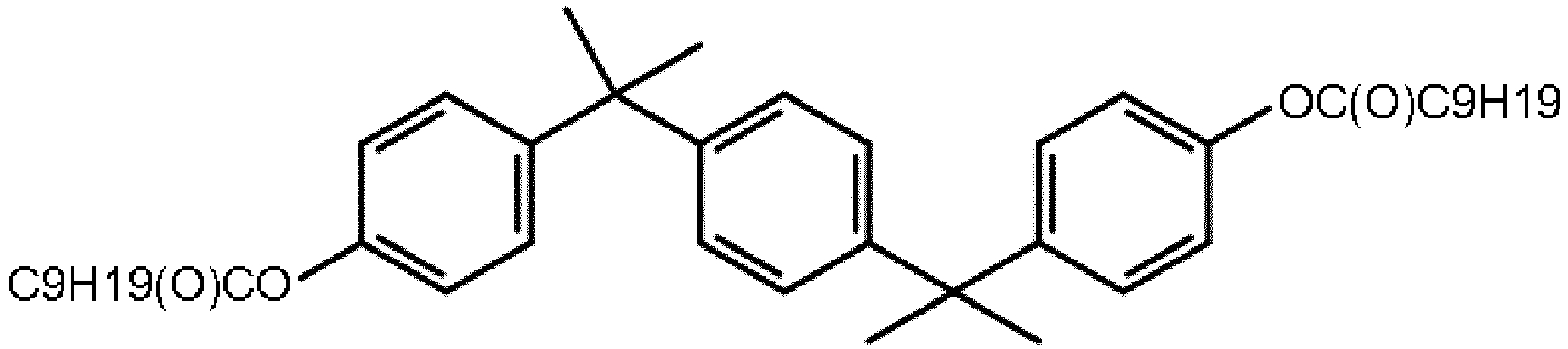
- The resulting memory composition changed colour from green to colourless.
- The thermochromic colour memory composition was heated above 100 degrees. 100 parts of the hot thermochromic colour memory composition was then dispersed into 100 parts of a 10 % solution of methyl vinyl ether-maleic anhydride copolymerized resin neutralised with sodium hydroxide to pH 4 by means of a high speed homogeniser. The resulting emulsion was maintained at temperature above 80° C and slowly added 25 parts of a solution of melamine formaldehyde resin. The resulting emulsion was stirred and heated to a temperature of 80° C for 6 hours.
- A thermochromic colour memory composition was obtained by homogeneously compatibilizing:
3 parts of 3-(4-diethylamino-2-hexyloxyphenyl)-3-(1-ethyl-2-methylindol-3-yl)-4-azaphthalide (component A) available from Yamada Chemicals and 12.6 parts 4,4'-Isopropylidenedi-o-cresol available from Sigma Aldrich (components B) and 84.4 parts of 4,4'-[1,4-Phenylenebis(1-methylethylydene)]bis(4-phenylundecanoate) (Component C, specifically component IVd) as shown below) :
- Component IVd is suitably synthesised by stirring a mixture of 1 mole of 4,4'-(1,4-Phenylenediisopropylidene)bisphenol, commercially available from Mitsui Chemicals, and 2.5 moles of triethyl amine in acetone and cooling to 5° C. 2.2 moles of undecanoyl chloride is added gradually so that temperature does not rise above 35° C during the addition. After the addition is complete the reaction is brought to room temperature and stirred for 24-48 hours. The resulting reaction medium is then poured into 7% aqueous ice cold HCI. The precipitate is filtered off and washed with water and saturated sodium bicarbonate solution. The solid precipitate is crystallised from isopropanol. The relative quantities of bisphenol / acid chloride / triethylamine are 1/2.2/2.5 moles.
- The resulting memory composition changed colour from blue to colourless.
- The thermochromic colour memory composition was heated above 100° C. 100 parts of the hot thermochromic colour memory composition was then dispersed into 100 parts of a 10 % solution of methyl vinyl ether-maleic anhydride copolymerized resin neutralised with sodium hydroxide to pH 4 by means of a high speed homogeniser. The resulting emulsion was maintained at temperature above 80° C and slowly added 25 parts of a solution of melamine formaldehyde resin. The resulting emulsion was stirred and heated to a temperature of 80° C for 6 hours.
- Some of the resulting dispersion was then drum dried and the pigment in encapsulated form was isolated, the thermochromic colour memory pigment having a particle size of 2 microns changed colour from blue to colourless.
- A thermochromic colour memory composition was obtained by homogeneously compatibilizing:
4 parts of 3-(4-diethylamino-2-hexyloxyphenyl)-3-(1-ethyl-2-methylindol-3-yl)-4-azaphthalide (component A)) available from Yamada Chemicals, 6.4 parts 2,2-bis(4'-hydroxyphenyl)hexafluoropropane and 6.4 parts of butyl 4-hydroxybenzoate available from Sigma Aldrich (both components B) and 83.2 parts of 4,4'-[1,4-Phenylenebis(1-methylethylydene)]bis(4-phenyltetradecanoate) (Component C, specifically component IVe) as shown below):
- Component IVe is suitably synthesised by stirring a mixture of 1 mole of 4,4'-(1,4-Phenylenediisopropylidene)bisphenol, commercially available from Mitsui Chemicals, and 2.5 moles of triethyl amine in acetone and cooling to 5° C. 2.2 moles of tetradecanoyl chloride is added gradually so that temperature does not rise above 35° C during the addition. After the addition is complete the reaction is brought to room temperature and stirred for 24-48 hours. The resulting reaction medium is then poured into 7% aqueous ice cold HCI. The precipitate is filtered off and washed with water and saturated sodium bicarbonate solution. The solid precipitate is crystallised from isopropanol. The relative quantities of bisphenol / acid chloride / triethylamine are 1/2.2/2.5 moles.
- The resulting memory composition changed colour from blue to colourless.
- The thermochromic colour memory composition was heated above 100° C. 100 parts of the hot thermochromic colour memory composition was then dispersed into 100 parts of a 10 % solution of methyl vinyl ether-maleic anhydride copolymerized resin neutralised with sodium hydroxide to pH 4 by means of a high speed homogeniser. The resulting emulsion was maintained at temperature above 80° C and slowly added 25 parts of a solution of melamine formaldehyde resin. The resulting emulsion was stirred and heated to a temperature of 80° C for 6 hours.
- Some of the resulting dispersion was then drum dried and the pigment in encapsulated form was isolated, the thermochromic colour memory pigment having a particle size of 2 microns changed colour from blue to colourless.
- A thermochromic colour memory composition was obtained by homogeneously compatibilizing:
4.1 parts of 3-(4-diethylamino-2-hexyloxyphenyl)-3-(1-ethyl-2-methylindol-3-yl)-4-azaphthalide (component A) available from Yamada Chemicals, 4.85 parts 2,2-bis(4'-hydroxyphenyl)hexafluoropropane, 4.85 parts 4,4'-(1-Phenylethylidene)bisphenol and 8.6 parts of lauric acid (all components B) available from Sigma Aldrich and 77.6 parts of 4,4'-[1,4-Phenylenebis(1-methylethylydene)]bis(4-phenylhexanoate) (Component C, specifically component IVf) as shown below) :
- Component IVf is suitably synthesised by stirring a mixture of 1 mole of 4,4'-(1,4-Phenylenediisopropylidene)bisphenol, commercially available from Mitsui Chemicals, and 2.5 moles of triethyl amine in acetone and cooling to 5° C. 2.2 moles of hexanoyl chloride is added gradually so that temperature does not rise above 35° C during the addition. After the addition is complete the reaction is brought to room temperature and stirred for 24-48 hours. The resulting reaction medium is then poured into 7% aqueous ice cold HCI. The precipitate is filtered off and washed with water and saturated sodium bicarbonate solution. The solid precipitate is crystallised from isopropanol. The relative quantities of bisphenol / acid chloride / triethylamine are 1/2.2/2.5 moles.
- The resulting memory composition changed colour from blue to colourless.
- The thermochromic colour memory composition was heated above 100° C. 100 parts of the hot thermochromic colour memory composition was then dispersed into 100 parts of a 10 % solution of methyl vinyl ether-maleic anhydride copolymerized resin neutralised with sodium hydroxide to pH 4 by means of a high speed homogeniser. The resulting emulsion was maintained at temperature above 80° C and slowly added 25 parts of a solution of melamine formaldehyde resin. The resulting emulsion was stirred and heated to a temperature of 80° C for 6 hours.
- Some of the resulting dispersion was then drum dried and the pigment in encapsulated form was isolated, the thermochromic colour memory pigment having a particle size of 2 microns changed colour from blue to colourless.
- A thermochromic colour memory composition was obtained by homogeneously compatibilizing:
4.15 parts of 3-(4-diethylamino-2-hexyloxyphenyl)-3-(1-ethyl-2-methylindol-3-yl)-4-azaphthalide (component A)) available from Yamada Chemicals and 4.85 parts 2,2-bis(4'-hydroxyphenyl)hexafluoropropane and 4.85 parts of 1,1-bis(4'-hydroxyphenyl)-2-methylpropane (both components B)) available from Sigma Aldrich and 86.15 parts of 4,4'-[1,3-Phenylenebis(1-methylethylydene)]bis(4-phenylhexadecanoate) (Component C, specifically component Va) as shown below) :
- Component Va is suitably synthesised by stirring a mixture of 1 mole of 4,4'-(1,3-Phenylenediisopropylidene)bisphenol, commercially available from Mitsui Chemicals, and 2.5 moles of triethyl amine in acetone and cooling to 5° C. 2.2 moles of hexadecanoyl chloride is added gradually so that temperature does not rise above 35° C during the addition. After the addition is complete the reaction is brought to room temperature and stirred for 24-48 hours. The resulting reaction medium is then poured into 7% aqueous ice cold HCI. The precipitate is filtered off and washed with water and saturated sodium bicarbonate solution. The solid precipitate is crystallised from isopropanol. The relative quantities of bisphenol / acid chloride / triethylamine are 1/2.2/2.5 moles.
- The resulting memory composition changed colour from blue to colourless.
- The thermochromic colour memory composition was heated above 100° C. 100 parts of the hot thermochromic colour memory composition was then dispersed into 100 parts of a 10 % solution of methyl vinyl ether-maleic anhydride copolymerized resin neutralised with sodium hydroxide to pH 4 by means of a high speed homogeniser. The resulting emulsion was maintained at temperature above 80° C and slowly added 25 parts of a solution of melamine formaldehyde resin. The resulting emulsion was stirred and heated to a temperature of 80° C for 6 hours.
- Some of the resulting dispersion was then drum dried and the pigment in encapsulated form was isolated, the thermochromic colour memory pigment having a particle size of 2 microns changed colour from blue to colourless.
- A thermochromic colour memory composition was obtained by homogeneously compatibilizing:
4.1 parts of 3-(4-diethylamino-2-hexyloxyphenyl)-3-(1-ethyl-2-methylindol-3-yl)-4-azaphthalide (component A) available from Yamada Chemicals, 4.85 parts 4,4'-(1-Phenylethylidene)bisphenol and 4.85 parts 4,4'-lsopropylidenedi-o-cresol available from Sigma Aldrich (both components B) and 86.2 parts of 4,4'-[1,3-Phenylenebis(1-methylethylydene)]bis(4-phenyltetradecanoateanoate) (Component C, specifically component Vb) as shown below) :
- Component Va is suitably synthesised by stirring a mixture of 1 mole of 4,4'-(1,3-Phenylenediisopropylidene)bisphenol, commercially available from Mitsui Chemicals, and 2.5 moles of triethyl amine in acetone and cooling to 5° C. 2.2 moles of tetradecanoyl chloride is added gradually so that temperature does not rise above 35° C during the addition. After the addition is complete the reaction is brought to room temperature and stirred for 24-48 hours. The resulting reaction medium is then poured into 7% aqueous ice cold HCI. The precipitate is filtered off and washed with water and saturated sodium bicarbonate solution. The solid precipitate is crystallised from isopropanol. The relative quantities of bisphenol / acid chloride / triethylamine are 1/2.2/2.5 moles.
- The resulting memory composition changed colour from blue to colourless.
- The thermochromic colour memory composition was heated above 100° C. 100 parts of the hot thermochromic colour memory composition was then dispersed into 100 parts of a 10 % solution of methyl vinyl ether-maleic anhydride copolymerized resin neutralised with sodium hydroxide to pH 4 by means of a high speed homogeniser. The resulting emulsion was maintained at temperature above 80° C and slowly added 25 parts of a solution of melamine formaldehyde resin. The resulting emulsion was stirred and heated to a temperature of 80° C for 6 hours.
- Some of the resulting dispersion was then drum dried and the pigment in encapsulated form was isolated, the thermochromic colour memory pigment having a particle size of 2 microns changed colour from blue to colourless.
- A thermochromic colour memory composition was obtained by homogeneously compatibilizing:
3.1 parts of 6'-(diethylamino)-2'-(phenylamino)-3H-spiro[2-benzofuran-1,9'-xanthen]-3-one (component A) and 5.1 parts 4,4'-Cyclohexylidenebisphenol, 5.1 parts of 4,4'-(1-Phenylethylidene)bisphenol and 1.9 parts of 2-hydroxy-4-methoxy benzophenone (all components B) available from Sigma Aldrich and 70 parts of 4,4'-[1,4-Phenylenebis(1-methylethylydene)]bis(4-phenyldecanoate) and 14.8 parts of 4,4'-[1,4-Phenylenebis(1-methylethylydene)]bis(4-phenyloctanoate) (Components C, respectively component IVa and lVg as shown below):

- The resulting memory composition changed colour from green to colourless.
- The thermochromic colour memory composition was heated above 100 degrees. 100 parts of the hot thermochromic colour memory composition was then dispersed into 100 parts of a 10 % solution of methyl vinyl ether-maleic anhydride copolymerized resin neutralised with sodium hydroxide to pH 4 by means of a high speed homogeniser. The resulting emulsion was maintained at temperature above 80° C and slowly added 25 parts of a solution of melamine formaldehyde resin. The resulting emulsion was stirred and heated to a temperature of 80° C for 6 hours.
- 10 parts of the thermochromic colour memory composition of the water dispersion obtained in Example 1 in encapsulated form were dispersed in 10 parts of a polyvinyl alcohol solution was screen printed onto sheet of copy paper, thereby obtaining a test sample.
- The same method has been carried out in order to obtain a test sample for the thermochromic colour memory composition of Examples 2 to 13 in encapsulated form. Each of the test samples was heated and cooled by the below described method. The measuring sample thus prepared was set on a predetermined position of a Linkam (manufactured by linkam, UK) and the colour density at each temperature was measured by heating and cooling at a rate of 5° C./min with a temperature width of 100° C.
- For example, in the case of Example 1, the sample was heated up to 100° C. at a rate of 5° C./min from a measurement starting temperature of 0° C., and then cooled to -20° C. at a rate of 5° C./min. The brightness of the colour displayed at each temperature was plotted on a graph to prepare the colour density-temperature curve as illustrated in
FIG. 1 , and each of T1, T2, T3, T4, and ΔH was obtained. - The results of the temperature analysis in °C of the microcapsules is reported below as per their temperature of full clearing (T4) and temperature of full colour return (T1) as well as practical hysteresis ΔH. The results are reported below for the Components C) with different R1 groups as shown in the formula below.
Example T1 T2 T3 T4 ΔH Example 1 -20 -5 55 71 60 Example 2 4 18 60 78 42 Example 3 30 40 75 87 35 Example 4 -20 -15 55 71 70 Example 5 -25 -10 43 70 53 Example 6 -18 -10 45 70 55 Example 7 -20 -10 40 67 50 Example 8 -15 -10 55 73 65 Example 9 2 19 45 72 26 Example 10 20 27 55 82 28 Example 11 -20 -15 35 60 50 Example 12 18 21 55 65 34 Example 13 -3 2 45 60 43 Example 14 -20 -16 45 65 61
Claims (15)
- A compound of formula (I):
 R1, and R2 are independently selected from linear or branched alkyl group, alkenyl group, alkoxy group and an alkylene aryl group having from 5 to 22 carbon atoms, wherein "aryl group" refers to a five or six membered cyclic, 8-10 membered bicyclic or 10-14 membered tricyclic group with aromatic character and includes groups which contain only hydrogen and carbon atoms and also heteroaromatic groups which contain hydrogen, carbon and one or more heteroatoms such as N, O or S;X1 and X2 are independently selected from -OC(O)- ;R3, R4, R5 and R6 are independently selected from hydrogen and C1-4 alkyl group;Y1, Y2, Y3 and Y4 are independently selected from hydrogen, halogen, R3, -OR3 provided that -OR3 is not -O-alkenyl;a is 1 to 4; b is 0 or 1; x and y are independently selected from 0 or 1 provided that at least one of x and y is 1.
 - A compound according to claim 1 wherein the compound (I) has a formula (II):

- A compound according to claim 2 wherein:i) R3, R4, R5 and R6 are as defined in claim 1;ii) the moieties -CR3R4- and -CR5R6- are in a meta or para relationship to each other;iii) the moieties -CR3R4- and R1X1- and the moieties -CR5R6 and R2X2-respectively are in a para relationship to each other; and/oriv) Y1, Y2, Y3 and Y4 are all hydrogen, R1 and R2 are independently selected from C9 to C15 alkyl and X1 and X2 are -OCO-.
- Use of a compound of formula (I) in a colour-change composition:
 R1, and R2 are independently selected from a linear or branched alkyl group, alkenyl group, alkoxy group, aryl group and an alkylene aryl group having from 5 to 22 carbon atoms, wherein "aryl group" refers to a five or six membered cyclic, 8-10 membered bicyclic or 10-14 membered tricyclic group with aromatic character and includes groups which contain only hydrogen and carbon atoms and also heteroaromatic groups which contain hydrogen, carbon and one or more heteroatoms such as N, O or S;X1 and X2 are independently selected from -OC(O)-, -CO2- and O provided that R1X1 and R2X2 are not -O-alkenyl;R3, R4, R5 and R6 are independently selected from hydrogen and C1-4 alkyl group ;Y1, Y2, Y3 and Y4 are independently selected from hydrogen, halogen, R3, -OR3; anda is 1 to 4; b is 0 or 1; x and y are independently selected from 0 or 1 provided that at least one of x and y is 1.
 - A colour-change composition comprising: A) an electron donating organic colouring compound, B) an electron accepting compound and C) a compound of formula (I):
 R1, and R2 are independently selected from a linear or branched alkyl group, alkenyl group, alkoxy group, aryl group and an alkylene aryl group having from 5 to 22 carbon atoms, wherein "aryl group" refers to a five or six membered cyclic, 8-10 membered bicyclic or 10-14 membered tricyclic group with aromatic character and includes groups which contain only hydrogen and carbon atoms and also heteroaromatic groups which contain hydrogen, carbon and one or more heteroatoms such as N, O or S;X1 and X2 are independently selected from -OC(O)-, -CO2- and O provided that R1X1 and R2X2 are not -O-alkenyl;R3, R4, R5 and R6 are independently selected from hydrogen and C1-4 alkyl group ;Y1, Y2, Y3 and Y4 are independently selected from hydrogen, halogen, R3, -OR3; anda is 1 to 4; b is 0 or 1; x and y are independently selected from 0 or 1 provided that at least one of x and y is 1.
 - A colour-change composition according to claim 5 which has a hysteresis range from 10 to 80° C.
- A colour-change composition according to claim 6 further comprising a non-ionic surfactant.
- A colour-change pigment composition comprising a colour-change composition according to any one of claims 5 to 7 wherein the said composition is microencapsulated.
- A colour-change composition according to any one of claims 5 to 7 or a colour-change microencapsulated pigment composition according to claim 8 wherein component C) is such that the said composition has a T2 temperature, which is the minimum discoloured state retaining temperature, at 0° C and a T3 temperature, which is the maximum coloured state retaining temperature, above 50° C.
- An ink composition for a writing implement which comprises a colour-change microencapsulated pigment composition according to claim 8.
- Use of a composition according to any one of claims 5 to 10 in toys, printed materials, decoration, writing instruments, temperature indicators in packaging of medical products or in an industrial application.
- A writing implement comprising an ink composition according to claim 10.
- An indicator comprising a first portion of a colour-change composition, according to any one of claims 5 to 10 in its coloured state and a second portion of the same colour-change composition in its discoloured state.
- A process for producing an indicator according to claim 13 comprising providing a support with a first portion of the colour-change composition according to any one of claims 5 to 10 having colour change temperatures T1, T2, T3 and T4, heating the first portion of the colour-change composition, pigment or ink to a temperature exceeding T4, which is the complete discoloring temperature, cooling a second portion of the colour-change composition, pigment or ink composition to a temperature below T1, which is the complete colouring temperature, applying the said second portion to the support and drying the colour-change composition, pigment or ink composition at temperature not exceeding temperature T3, which is the maximum coloured state retaining temperature and not below temperature T2, which is the minimum discoloured state retaining temperature.
- Use of a non-ionic surfactant in a colour-change composition according to any one of claims 5 to 10 which has a coloured state and a clear state to provide increased stability against colour change when the composition or pigment is subjected to pressure in the clear state.
Applications Claiming Priority (2)
| Application Number | Priority Date | Filing Date | Title |
|---|---|---|---|
| GB1515610.2A GB2541910B (en) | 2015-09-03 | 2015-09-03 | Thermochromic composition |
| PCT/EP2016/070834 WO2017037282A1 (en) | 2015-09-03 | 2016-09-05 | Compound for use in colour change compositions |
Publications (2)
| Publication Number | Publication Date |
|---|---|
| EP3349990A1 EP3349990A1 (en) | 2018-07-25 |
| EP3349990B1 true EP3349990B1 (en) | 2024-10-30 |
Family
ID=54345713
Family Applications (3)
| Application Number | Title | Priority Date | Filing Date |
|---|---|---|---|
| EP16774863.1A Active EP3344468B1 (en) | 2015-09-03 | 2016-09-05 | Compound for use in colour change compositions |
| EP16774628.8A Active EP3349990B1 (en) | 2015-09-03 | 2016-09-05 | Compound for use in colour change compositions |
| EP16788424.6A Pending EP3349991A1 (en) | 2015-09-03 | 2016-09-05 | Temperature-sensitive indicator |
Family Applications Before (1)
| Application Number | Title | Priority Date | Filing Date |
|---|---|---|---|
| EP16774863.1A Active EP3344468B1 (en) | 2015-09-03 | 2016-09-05 | Compound for use in colour change compositions |
Family Applications After (1)
| Application Number | Title | Priority Date | Filing Date |
|---|---|---|---|
| EP16788424.6A Pending EP3349991A1 (en) | 2015-09-03 | 2016-09-05 | Temperature-sensitive indicator |
Country Status (12)
| Country | Link |
|---|---|
| US (5) | US11225577B2 (en) |
| EP (3) | EP3344468B1 (en) |
| JP (1) | JP6995753B2 (en) |
| KR (1) | KR102706896B1 (en) |
| CN (1) | CN108136804B (en) |
| AR (2) | AR105928A1 (en) |
| BR (1) | BR112018004364B1 (en) |
| CA (1) | CA2997568A1 (en) |
| GB (2) | GB2541910B (en) |
| TW (2) | TW201718788A (en) |
| UY (2) | UY36885A (en) |
| WO (3) | WO2017037284A1 (en) |
Families Citing this family (13)
| Publication number | Priority date | Publication date | Assignee | Title |
|---|---|---|---|---|
| GB2541910B (en) * | 2015-09-03 | 2021-10-27 | Thermographic Measurements Ltd | Thermochromic composition |
| KR101988916B1 (en) * | 2017-05-25 | 2019-06-13 | 주식회사 엑티브온 | Irreversible thermochromic molded object for preventing overheating and process for the preparation thereof |
| GB201716605D0 (en) * | 2017-10-10 | 2017-11-22 | Gh Innovation Ltd | An electrical component |
| AU2019234578B2 (en) * | 2018-03-14 | 2024-12-12 | Zebra Technologies Corporation | Descending and ascending temperature indicators utilizing deep eutectics |
| WO2020064537A1 (en) * | 2018-09-24 | 2020-04-02 | Societe Bic | Diester of bisphenol fluorene compounds and thermochromic pigment compositions comprising the same |
| GB201910904D0 (en) | 2019-07-31 | 2019-09-11 | Thermographic Measurements Ltd | Colour change composition and compounds |
| KR102438034B1 (en) * | 2019-11-28 | 2022-08-30 | 주식회사 인실리코 | Thermochromic Composition, Thermochromic Microcapsule having the Same and Time-Temperature Indicator Using the Same |
| EP3904468B1 (en) * | 2020-04-30 | 2022-10-19 | Société BIC | Method for preparing thermochromic water-based gel ink compositions, and thermochromic water-based gel ink compositions thereof |
| JP7640383B2 (en) * | 2020-06-30 | 2025-03-05 | パイロットインキ株式会社 | Temperature control indicators and their uses |
| EP4219186A4 (en) * | 2020-09-28 | 2025-05-14 | The Pilot Ink Co., Ltd | REVERSIBLE THERMOCHROMIC COMPOSITION AND REVERSIBLE THERMOCHROMIC MICROCAPSULE PIGMENT ENCAPSULATING SAID COMPOSITION |
| JP7602343B2 (en) * | 2020-09-28 | 2024-12-18 | パイロットインキ株式会社 | Reversible thermochromic composition and reversible thermochromic microcapsule pigment containing the same |
| KR20230084481A (en) * | 2020-09-28 | 2023-06-13 | 파일롯트 잉크 가부시키가이샤 | Reversible thermochromic composition and reversible thermochromic microcapsule pigment containing the same |
| WO2025107052A1 (en) * | 2023-11-23 | 2025-05-30 | Biehl Hamerschmidt Marcio | Thermochromic barcode |
Citations (2)
| Publication number | Priority date | Publication date | Assignee | Title |
|---|---|---|---|---|
| GB1390945A (en) * | 1971-11-10 | 1975-04-16 | Bayer Ag | Polyesters their production and their use |
| JPH09235265A (en) * | 1995-12-27 | 1997-09-09 | Fuji Photo Film Co Ltd | Hydrazide compound and silver halide photosensitive material containing the same |
Family Cites Families (79)
| Publication number | Priority date | Publication date | Assignee | Title |
|---|---|---|---|---|
| US730890A (en) * | 1902-10-15 | 1903-06-16 | Charles A Eck | Fan. |
| DE908496C (en) | 1951-07-20 | 1954-04-05 | Henkel & Cie Gmbh | Process for the preparation of aryl esters |
| NL172829B (en) | 1951-10-03 | Catalyse Soc Prod Francais | PROCESS FOR THE PREPARATION OF A CATALYST, PROCEDURE FOR THE HYDROGENING CONVERSION OF HYDROCARBONS USING THIS CATALYST AND FORMED PRODUCTS CONSISTING OF THE CATALYST SO OBTAINED. | |
| US3106570A (en) * | 1961-03-02 | 1963-10-08 | United States Steel Corp | Method of making esters |
| US3205270A (en) * | 1961-06-22 | 1965-09-07 | United States Steel Corp | Derivatives of 2, 2'-biphenol |
| DE1231688B (en) * | 1965-04-17 | 1967-01-05 | Bayer Ag | Process for the preparation of isocyanatocarboxylic acid esters of polyfunctional hydroxy compounds |
| US3510431A (en) | 1967-08-24 | 1970-05-05 | Sinclair Research Inc | High temperature synthetic ester base lubricant composition blends with liquid diesters of dihydroxy biphenyls |
| US3979462A (en) | 1973-04-19 | 1976-09-07 | Bayer Aktiengesellschaft | Condensation resins of phenols and α,α'-dihydroxy-diisopropyl benzenes |
| US4188437A (en) | 1978-05-25 | 1980-02-12 | American Can Company | Thermotropic adhesive tape |
| AU541738B2 (en) | 1979-09-20 | 1985-01-17 | Nippon Chemiphar Co. Ltd. | Cyclohexane carboxylic acid derivatives |
| JPS5790085A (en) | 1980-11-27 | 1982-06-04 | Pilot Ink Co Ltd | Thermochromic material |
| JPS57167380A (en) | 1981-04-08 | 1982-10-15 | Pilot Ink Co Ltd | Thermochromic material |
| JPS60264285A (en) * | 1984-06-13 | 1985-12-27 | Pilot Ink Co Ltd | Reversible thermal recording composition |
| US4659946A (en) | 1986-04-14 | 1987-04-21 | Tektronix, Inc. | Memory gate for error sampler |
| JP3086231B2 (en) * | 1989-11-01 | 2000-09-11 | ポリプラスチックス株式会社 | Polyester resin and resin composition showing anisotropy when melted |
| US5480482A (en) * | 1991-11-04 | 1996-01-02 | The United States Of America As Represented By The Secretary Of The Navy | Reversible thermochromic pigments |
| JPH05310953A (en) | 1992-05-11 | 1993-11-22 | Kao Corp | Dispersant for pigmenting polyester resin, polyester resin composition and polyester fiber |
| JPH0641399A (en) * | 1992-07-27 | 1994-02-15 | Kao Corp | Polyester resin composition and molded article |
| JPH0665479A (en) | 1992-08-19 | 1994-03-08 | Kao Corp | Polyester resin composition and molded article |
| GB2280681B (en) * | 1993-08-06 | 1998-03-11 | Merck Patent Gmbh | Thermochromic media |
| US5719155A (en) | 1993-11-10 | 1998-02-17 | Japan Tobacco Inc. | Chroman derivative and pharmaceutical use thereof |
| US5591255A (en) | 1993-12-29 | 1997-01-07 | Chromatic Technologies, Inc. | Thermochromic ink formulations, nail lacquer and methods of use |
| US5997849A (en) | 1993-12-29 | 1999-12-07 | Chromatic Technologies, Inc. | Thermochromic ink formulations, nail lacquer and methods of use |
| JPH08259486A (en) * | 1995-03-20 | 1996-10-08 | Fuji Photo Film Co Ltd | Alchol compound, isocyanate prepolymer, heat responding microcapsule, heat-sensitive recording material and multi-color heat-sensitive recording material using the same |
| US5755997A (en) * | 1996-10-03 | 1998-05-26 | Samsung Display Devices Co., Ltd. | Chiral compounds with liquid crystalline nature |
| NL1009791C2 (en) | 1998-08-03 | 2000-02-04 | Oce Tech Bv | Ink composition for a fusible ink. |
| US6326522B1 (en) | 1999-06-14 | 2001-12-04 | Honshu Chemical Industry Co. Ltd. | Process for production of 1,3-di(2-p-hydroxyphenyl-2-propyl)benzene |
| JP3962531B2 (en) | 1999-06-14 | 2007-08-22 | 本州化学工業株式会社 | Method for producing 1,3-di (2-p-hydroxyphenyl-2-propyl) benzene |
| US6264033B1 (en) | 1999-07-09 | 2001-07-24 | Sealed Air Corporation | Article with improved tamper evidence |
| WO2001004221A1 (en) | 1999-07-09 | 2001-01-18 | Sealed Air Corporation (Us) | Thermochromic ink composition, and article made therefrom |
| US6441248B1 (en) | 2000-02-23 | 2002-08-27 | Wiley Organics, Inc. | Preparation of biphenols by oxidative coupling of alkylphenols using copper catalyst |
| US7534547B2 (en) * | 2001-03-29 | 2009-05-19 | Osaka Gas Company Limited | Optically active compound and photosensitive resin composition |
| US6648506B2 (en) * | 2001-09-07 | 2003-11-18 | Board Of Trustees Of Michigan State University | Fluorescence emission ratio imaging thermography for use in heat transfer analysis |
| JP2003246778A (en) | 2001-12-21 | 2003-09-02 | Nitto Denko Corp | Photocarrier generating compound and organic photorefractive material using the same |
| WO2003101927A1 (en) * | 2002-05-31 | 2003-12-11 | Proteotech, Inc. | Compounds, compositions and methods for the treatment of amyloid diseases and synucleinopathies such as alzheimer's disease, type 2 diabetes, and parkinson's disease |
| TW200307712A (en) | 2002-06-14 | 2003-12-16 | Sumitomo Chemical Co | Phenolic resin and method of producing the same |
| JP2004352938A (en) | 2002-06-14 | 2004-12-16 | Sumitomo Chem Co Ltd | Phenolic resin, its production method and its use |
| JP2004090231A (en) * | 2002-08-29 | 2004-03-25 | Fuji Photo Film Co Ltd | Inkjet recording sheet |
| KR20060000274A (en) * | 2004-06-28 | 2006-01-06 | 삼성에스디아이 주식회사 | Lithium secondary battery |
| US7494537B2 (en) | 2004-11-15 | 2009-02-24 | The Pilot Ink Co., Ltd. | Thermochromic coloring color-memory composition and thermochromic coloring color-memory microcapsule pigment containing the same |
| JP4851159B2 (en) * | 2005-10-25 | 2012-01-11 | パイロットインキ株式会社 | Reversible thermochromic microcapsule pigment |
| JP4934373B2 (en) * | 2006-08-18 | 2012-05-16 | パイロットインキ株式会社 | Temperature-sensitive color change color memory microcapsule pigment |
| US8669030B2 (en) | 2006-12-11 | 2014-03-11 | Ricoh Company, Limited | Electrophotographic photoreceptor, and image forming method and apparatus using the same |
| US9645494B2 (en) | 2006-12-13 | 2017-05-09 | Nissan Chemical Industries, Ltd. | Resist underlayer film forming composition containing low molecular weight dissolution accelerator |
| RU2010101236A (en) * | 2007-06-19 | 2011-07-27 | Новартис АГ (CH) | ORGANIC COMPOUNDS |
| JP5557432B2 (en) | 2008-02-29 | 2014-07-23 | パイロットインキ株式会社 | Reversible thermochromic water-based ink composition, writing instrument using the same, and writing instrument set |
| WO2010048067A2 (en) | 2008-10-22 | 2010-04-29 | 3M Innovative Properties Company | Dental composition comprising biphenyl di(meth)acrylate monomer comprising urethane moieties |
| JP5366044B2 (en) | 2008-12-05 | 2013-12-11 | 株式会社松井色素化学工業所 | Reversible thermochromic hysteresis composition |
| EP2431444B1 (en) * | 2009-05-12 | 2019-11-13 | The Pilot Ink Co., Ltd. | Thermochromic color-memory composition, and thermochromic color-memory microcapsule pigment having the composition encapsulated therein |
| JP5511259B2 (en) | 2009-08-18 | 2014-06-04 | パイロットインキ株式会社 | Reversible thermochromic water-based ink composition, writing instrument using the same, and writing instrument set |
| US8816135B2 (en) | 2009-09-09 | 2014-08-26 | Honshu Chemical Industry Co., Ltd. | Trisphenol compound |
| KR101731134B1 (en) * | 2009-11-13 | 2017-04-27 | 파일롯트 잉크 가부시키가이샤 | Thermochromic color-memorization type toner, cartridge including same housed therein, image formation apparatus, cartridge set, and image formation apparatus set |
| WO2011065228A1 (en) * | 2009-11-30 | 2011-06-03 | 株式会社タムラ製作所 | Curable composition, cured material therefrom, and use thereof |
| JP2011256271A (en) * | 2010-06-09 | 2011-12-22 | Jnc Corp | Curable composition, use thereof and new compound |
| US8287841B2 (en) | 2010-06-18 | 2012-10-16 | S.C. Johnson & Son, Inc. | Aerosol odor eliminating compositions containing alkylene glycol(s) |
| JP5181004B2 (en) | 2010-08-27 | 2013-04-10 | Jsr株式会社 | Polyarylene block copolymer having sulfonic acid group and use thereof |
| EP2626398B1 (en) | 2010-10-07 | 2018-01-24 | The Pilot Ink Co., Ltd | Thermochromic color-memory composition and thermochromic color-memory microcapsule pigment encapsulating the same |
| JP5833457B2 (en) | 2011-02-24 | 2015-12-16 | 株式会社サクラクレパス | Temperature-sensitive discoloration composition |
| KR101947441B1 (en) | 2011-06-30 | 2019-02-13 | 다우 글로벌 테크놀로지스 엘엘씨 | Biphenol ether compounds |
| US8640546B2 (en) | 2011-09-12 | 2014-02-04 | Del Monte Corporation | Sensor for high pressure processing of articles |
| JP5595449B2 (en) | 2011-10-25 | 2014-09-24 | 三菱鉛筆株式会社 | Dye, microcapsule pigment using the same, and ink composition for writing instrument |
| WO2013061814A1 (en) * | 2011-10-25 | 2013-05-02 | 株式会社パイロットコーポレーション | Reversibly thermochromic composition |
| US8652996B2 (en) * | 2011-12-31 | 2014-02-18 | Sanford, L.P. | Irreversible thermochromic pigment capsules |
| US20130177703A1 (en) | 2012-01-09 | 2013-07-11 | Chromatic Technologies Inc. | Reversible thermochromic and photochromic ink pens and markers |
| US20130193386A1 (en) * | 2012-01-31 | 2013-08-01 | Timothy Owen | Thermochromic systems with controlled hysteresis |
| KR101350997B1 (en) | 2012-08-21 | 2014-01-14 | 주식회사 신아티앤씨 | Epoxy compound having excellent electrical properities and manufacturing method thereof |
| JP6048211B2 (en) | 2013-02-27 | 2016-12-21 | セイコーエプソン株式会社 | Pigment printing ink jet recording method |
| JP6227892B2 (en) * | 2013-04-30 | 2017-11-08 | 株式会社パイロットコーポレーション | Solid cursive |
| EP3009493B1 (en) * | 2013-06-14 | 2018-01-31 | The Pilot Ink Co., Ltd. | Thermochromic color-memorizing composition and thermochromic color-memorizing microcapsule pigment encapsulating same |
| JP6231351B2 (en) | 2013-09-03 | 2017-11-15 | 三菱鉛筆株式会社 | Microcapsule coloring material and ink composition for writing instrument |
| WO2015033920A1 (en) * | 2013-09-05 | 2015-03-12 | 旭硝子株式会社 | Granulated body, production method therefor, and production method for glass article |
| EP2873708B1 (en) * | 2013-11-19 | 2019-02-13 | Artimelt AG | Adhesive composition |
| JP2017518407A (en) * | 2014-05-06 | 2017-07-06 | ミリケン・アンド・カンパニーMilliken & Company | Laundry care composition |
| EP3192845B1 (en) * | 2014-08-18 | 2019-05-01 | The Pilot Ink Co., Ltd. | Thermochromic color-memory composition and thermochromic color-memory microcapsule pigment including same |
| US20160074904A1 (en) | 2014-09-16 | 2016-03-17 | Michael J. Chapman | Efficient Infrared Absorption System for Edge Sealing Medium Density Fiberboard (MDF) and Other Engineered Wood Laminates Using Powder and Liquid Coatings |
| EP3121814A1 (en) * | 2015-07-24 | 2017-01-25 | Sound object techology S.A. in organization | A method and a system for decomposition of acoustic signal into sound objects, a sound object and its use |
| US10358570B2 (en) * | 2015-08-03 | 2019-07-23 | The Pilot Ink Co., Ltd. | Thermochromic color-memory composition and thermochromic color-memory microcapsule pigment encapsulating same |
| GB2541910B (en) * | 2015-09-03 | 2021-10-27 | Thermographic Measurements Ltd | Thermochromic composition |
| JP6477646B2 (en) | 2016-09-29 | 2019-03-06 | 住友大阪セメント株式会社 | Dispersion and method for producing the same, paint, coating film |
-
2015
- 2015-09-03 GB GB1515610.2A patent/GB2541910B/en active Active
-
2016
- 2016-09-02 TW TW105128496A patent/TW201718788A/en unknown
- 2016-09-02 TW TW105128500A patent/TW201718775A/en unknown
- 2016-09-05 AR ARP160102715A patent/AR105928A1/en unknown
- 2016-09-05 UY UY0001036885A patent/UY36885A/en not_active Application Discontinuation
- 2016-09-05 KR KR1020187009361A patent/KR102706896B1/en active Active
- 2016-09-05 GB GBGB1615058.3A patent/GB201615058D0/en not_active Ceased
- 2016-09-05 CA CA2997568A patent/CA2997568A1/en not_active Abandoned
- 2016-09-05 WO PCT/EP2016/070838 patent/WO2017037284A1/en not_active Ceased
- 2016-09-05 UY UY0001036886A patent/UY36886A/en not_active Application Discontinuation
- 2016-09-05 CN CN201680060830.0A patent/CN108136804B/en active Active
- 2016-09-05 BR BR112018004364-8A patent/BR112018004364B1/en active IP Right Grant
- 2016-09-05 JP JP2018530960A patent/JP6995753B2/en active Active
- 2016-09-05 WO PCT/EP2016/070834 patent/WO2017037282A1/en not_active Ceased
- 2016-09-05 EP EP16774863.1A patent/EP3344468B1/en active Active
- 2016-09-05 AR ARP160102714A patent/AR105927A1/en unknown
- 2016-09-05 US US15/757,260 patent/US11225577B2/en active Active
- 2016-09-05 US US15/757,136 patent/US11339296B2/en active Active
- 2016-09-05 EP EP16774628.8A patent/EP3349990B1/en active Active
- 2016-09-05 WO PCT/EP2016/001495 patent/WO2017036604A1/en not_active Ceased
- 2016-09-05 EP EP16788424.6A patent/EP3349991A1/en active Pending
- 2016-09-05 US US15/757,247 patent/US11608440B2/en active Active
-
2022
- 2022-01-14 US US17/576,263 patent/US12297357B2/en active Active
- 2022-05-17 US US17/746,283 patent/US12202981B2/en active Active
Patent Citations (2)
| Publication number | Priority date | Publication date | Assignee | Title |
|---|---|---|---|---|
| GB1390945A (en) * | 1971-11-10 | 1975-04-16 | Bayer Ag | Polyesters their production and their use |
| JPH09235265A (en) * | 1995-12-27 | 1997-09-09 | Fuji Photo Film Co Ltd | Hydrazide compound and silver halide photosensitive material containing the same |
Also Published As
Similar Documents
| Publication | Publication Date | Title |
|---|---|---|
| US12202981B2 (en) | Compound for use in colour change compositions | |
| CN103391984B (en) | Thermochromic composition | |
| KR102215243B1 (en) | Thermochromic composition and thermochromic microcapsule comprising the same | |
| JP5819773B2 (en) | Reversible thermochromic microcapsule pigment | |
| JP5968755B2 (en) | Reversible thermochromic microcapsule pigment | |
| KR102438034B1 (en) | Thermochromic Composition, Thermochromic Microcapsule having the Same and Time-Temperature Indicator Using the Same | |
| KR102172624B1 (en) | Thermochromic composition and thermochromic microcapsule comprising the same | |
| JP6535236B2 (en) | Reversible thermochromic microcapsule pigment | |
| US12497558B2 (en) | Colour change composition and compounds | |
| EP3856855B1 (en) | Diester of bisphenol fluorene compounds and thermochromic pigment compositions comprising the same |
Legal Events
| Date | Code | Title | Description |
|---|---|---|---|
| STAA | Information on the status of an ep patent application or granted ep patent |
Free format text: STATUS: THE INTERNATIONAL PUBLICATION HAS BEEN MADE |
|
| PUAI | Public reference made under article 153(3) epc to a published international application that has entered the european phase |
Free format text: ORIGINAL CODE: 0009012 |
|
| STAA | Information on the status of an ep patent application or granted ep patent |
Free format text: STATUS: REQUEST FOR EXAMINATION WAS MADE |
|
| 17P | Request for examination filed |
Effective date: 20180406 |
|
| AK | Designated contracting states |
Kind code of ref document: A1 Designated state(s): AL AT BE BG CH CY CZ DE DK EE ES FI FR GB GR HR HU IE IS IT LI LT LU LV MC MK MT NL NO PL PT RO RS SE SI SK SM TR |
|
| AX | Request for extension of the european patent |
Extension state: BA ME |
|
| DAV | Request for validation of the european patent (deleted) | ||
| DAX | Request for extension of the european patent (deleted) | ||
| RAP1 | Party data changed (applicant data changed or rights of an application transferred) |
Owner name: SOCIETE BIC |
|
| STAA | Information on the status of an ep patent application or granted ep patent |
Free format text: STATUS: EXAMINATION IS IN PROGRESS |
|
| 17Q | First examination report despatched |
Effective date: 20210113 |
|
| RAP3 | Party data changed (applicant data changed or rights of an application transferred) |
Owner name: SOCIETE BIC |
|
| P01 | Opt-out of the competence of the unified patent court (upc) registered |
Effective date: 20230524 |
|
| REG | Reference to a national code |
Ref country code: DE Ref legal event code: R079 Free format text: PREVIOUS MAIN CLASS: B41M0005300000 Ipc: C09B0067020000 Ref country code: DE Ref legal event code: R079 Ref document number: 602016090043 Country of ref document: DE Free format text: PREVIOUS MAIN CLASS: B41M0005300000 Ipc: C09B0067020000 |
|
| GRAP | Despatch of communication of intention to grant a patent |
Free format text: ORIGINAL CODE: EPIDOSNIGR1 |
|
| STAA | Information on the status of an ep patent application or granted ep patent |
Free format text: STATUS: GRANT OF PATENT IS INTENDED |
|
| RIC1 | Information provided on ipc code assigned before grant |
Ipc: C09K 9/02 20060101ALI20240502BHEP Ipc: C09D 11/17 20140101ALI20240502BHEP Ipc: C09B 67/00 20060101ALI20240502BHEP Ipc: C09D 11/50 20140101ALI20240502BHEP Ipc: C09B 67/02 20060101AFI20240502BHEP |
|
| INTG | Intention to grant announced |
Effective date: 20240527 |
|
| GRAS | Grant fee paid |
Free format text: ORIGINAL CODE: EPIDOSNIGR3 |
|
| GRAA | (expected) grant |
Free format text: ORIGINAL CODE: 0009210 |
|
| STAA | Information on the status of an ep patent application or granted ep patent |
Free format text: STATUS: THE PATENT HAS BEEN GRANTED |
|
| AK | Designated contracting states |
Kind code of ref document: B1 Designated state(s): AL AT BE BG CH CY CZ DE DK EE ES FI FR GB GR HR HU IE IS IT LI LT LU LV MC MK MT NL NO PL PT RO RS SE SI SK SM TR |
|
| REG | Reference to a national code |
Ref country code: GB Ref legal event code: FG4D |
|
| REG | Reference to a national code |
Ref country code: CH Ref legal event code: EP |
|
| REG | Reference to a national code |
Ref country code: IE Ref legal event code: FG4D |
|
| REG | Reference to a national code |
Ref country code: DE Ref legal event code: R096 Ref document number: 602016090043 Country of ref document: DE |
|
| REG | Reference to a national code |
Ref country code: LT Ref legal event code: MG9D |
|
| REG | Reference to a national code |
Ref country code: NL Ref legal event code: MP Effective date: 20241030 |
|
| PG25 | Lapsed in a contracting state [announced via postgrant information from national office to epo] |
Ref country code: HR Free format text: LAPSE BECAUSE OF FAILURE TO SUBMIT A TRANSLATION OF THE DESCRIPTION OR TO PAY THE FEE WITHIN THE PRESCRIBED TIME-LIMIT Effective date: 20241030 Ref country code: IS Free format text: LAPSE BECAUSE OF FAILURE TO SUBMIT A TRANSLATION OF THE DESCRIPTION OR TO PAY THE FEE WITHIN THE PRESCRIBED TIME-LIMIT Effective date: 20250228 Ref country code: PT Free format text: LAPSE BECAUSE OF FAILURE TO SUBMIT A TRANSLATION OF THE DESCRIPTION OR TO PAY THE FEE WITHIN THE PRESCRIBED TIME-LIMIT Effective date: 20250228 |
|
| PG25 | Lapsed in a contracting state [announced via postgrant information from national office to epo] |
Ref country code: FI Free format text: LAPSE BECAUSE OF FAILURE TO SUBMIT A TRANSLATION OF THE DESCRIPTION OR TO PAY THE FEE WITHIN THE PRESCRIBED TIME-LIMIT Effective date: 20241030 Ref country code: NL Free format text: LAPSE BECAUSE OF FAILURE TO SUBMIT A TRANSLATION OF THE DESCRIPTION OR TO PAY THE FEE WITHIN THE PRESCRIBED TIME-LIMIT Effective date: 20241030 |
|
| REG | Reference to a national code |
Ref country code: AT Ref legal event code: MK05 Ref document number: 1736867 Country of ref document: AT Kind code of ref document: T Effective date: 20241030 |
|
| PG25 | Lapsed in a contracting state [announced via postgrant information from national office to epo] |
Ref country code: BG Free format text: LAPSE BECAUSE OF FAILURE TO SUBMIT A TRANSLATION OF THE DESCRIPTION OR TO PAY THE FEE WITHIN THE PRESCRIBED TIME-LIMIT Effective date: 20241030 |
|
| PG25 | Lapsed in a contracting state [announced via postgrant information from national office to epo] |
Ref country code: ES Free format text: LAPSE BECAUSE OF FAILURE TO SUBMIT A TRANSLATION OF THE DESCRIPTION OR TO PAY THE FEE WITHIN THE PRESCRIBED TIME-LIMIT Effective date: 20241030 |
|
| PG25 | Lapsed in a contracting state [announced via postgrant information from national office to epo] |
Ref country code: NO Free format text: LAPSE BECAUSE OF FAILURE TO SUBMIT A TRANSLATION OF THE DESCRIPTION OR TO PAY THE FEE WITHIN THE PRESCRIBED TIME-LIMIT Effective date: 20250130 |
|
| PG25 | Lapsed in a contracting state [announced via postgrant information from national office to epo] |
Ref country code: GR Free format text: LAPSE BECAUSE OF FAILURE TO SUBMIT A TRANSLATION OF THE DESCRIPTION OR TO PAY THE FEE WITHIN THE PRESCRIBED TIME-LIMIT Effective date: 20250131 Ref country code: AT Free format text: LAPSE BECAUSE OF FAILURE TO SUBMIT A TRANSLATION OF THE DESCRIPTION OR TO PAY THE FEE WITHIN THE PRESCRIBED TIME-LIMIT Effective date: 20241030 Ref country code: LV Free format text: LAPSE BECAUSE OF FAILURE TO SUBMIT A TRANSLATION OF THE DESCRIPTION OR TO PAY THE FEE WITHIN THE PRESCRIBED TIME-LIMIT Effective date: 20241030 |
|
| PG25 | Lapsed in a contracting state [announced via postgrant information from national office to epo] |
Ref country code: PL Free format text: LAPSE BECAUSE OF FAILURE TO SUBMIT A TRANSLATION OF THE DESCRIPTION OR TO PAY THE FEE WITHIN THE PRESCRIBED TIME-LIMIT Effective date: 20241030 |
|
| PG25 | Lapsed in a contracting state [announced via postgrant information from national office to epo] |
Ref country code: RS Free format text: LAPSE BECAUSE OF FAILURE TO SUBMIT A TRANSLATION OF THE DESCRIPTION OR TO PAY THE FEE WITHIN THE PRESCRIBED TIME-LIMIT Effective date: 20250130 |
|
| PG25 | Lapsed in a contracting state [announced via postgrant information from national office to epo] |
Ref country code: SM Free format text: LAPSE BECAUSE OF FAILURE TO SUBMIT A TRANSLATION OF THE DESCRIPTION OR TO PAY THE FEE WITHIN THE PRESCRIBED TIME-LIMIT Effective date: 20241030 |
|
| PG25 | Lapsed in a contracting state [announced via postgrant information from national office to epo] |
Ref country code: DK Free format text: LAPSE BECAUSE OF FAILURE TO SUBMIT A TRANSLATION OF THE DESCRIPTION OR TO PAY THE FEE WITHIN THE PRESCRIBED TIME-LIMIT Effective date: 20241030 |
|
| PG25 | Lapsed in a contracting state [announced via postgrant information from national office to epo] |
Ref country code: EE Free format text: LAPSE BECAUSE OF FAILURE TO SUBMIT A TRANSLATION OF THE DESCRIPTION OR TO PAY THE FEE WITHIN THE PRESCRIBED TIME-LIMIT Effective date: 20241030 |
|
| PG25 | Lapsed in a contracting state [announced via postgrant information from national office to epo] |
Ref country code: RO Free format text: LAPSE BECAUSE OF FAILURE TO SUBMIT A TRANSLATION OF THE DESCRIPTION OR TO PAY THE FEE WITHIN THE PRESCRIBED TIME-LIMIT Effective date: 20241030 |
|
| PG25 | Lapsed in a contracting state [announced via postgrant information from national office to epo] |
Ref country code: SK Free format text: LAPSE BECAUSE OF FAILURE TO SUBMIT A TRANSLATION OF THE DESCRIPTION OR TO PAY THE FEE WITHIN THE PRESCRIBED TIME-LIMIT Effective date: 20241030 |
|
| PG25 | Lapsed in a contracting state [announced via postgrant information from national office to epo] |
Ref country code: CZ Free format text: LAPSE BECAUSE OF FAILURE TO SUBMIT A TRANSLATION OF THE DESCRIPTION OR TO PAY THE FEE WITHIN THE PRESCRIBED TIME-LIMIT Effective date: 20241030 |
|
| PG25 | Lapsed in a contracting state [announced via postgrant information from national office to epo] |
Ref country code: IT Free format text: LAPSE BECAUSE OF FAILURE TO SUBMIT A TRANSLATION OF THE DESCRIPTION OR TO PAY THE FEE WITHIN THE PRESCRIBED TIME-LIMIT Effective date: 20241030 |
|
| REG | Reference to a national code |
Ref country code: DE Ref legal event code: R097 Ref document number: 602016090043 Country of ref document: DE |
|
| PLBE | No opposition filed within time limit |
Free format text: ORIGINAL CODE: 0009261 |
|
| STAA | Information on the status of an ep patent application or granted ep patent |
Free format text: STATUS: NO OPPOSITION FILED WITHIN TIME LIMIT |
|
| PG25 | Lapsed in a contracting state [announced via postgrant information from national office to epo] |
Ref country code: SE Free format text: LAPSE BECAUSE OF FAILURE TO SUBMIT A TRANSLATION OF THE DESCRIPTION OR TO PAY THE FEE WITHIN THE PRESCRIBED TIME-LIMIT Effective date: 20241030 |
|
| 26N | No opposition filed |
Effective date: 20250731 |
|
| REG | Reference to a national code |
Ref country code: CH Ref legal event code: H13 Free format text: ST27 STATUS EVENT CODE: U-0-0-H10-H13 (AS PROVIDED BY THE NATIONAL OFFICE) Effective date: 20260504 |