EP3348254A1 - Composition for alleviating skin inflammation caused by yellow dust and fine particulate, comprising natural plant extract - Google Patents
Composition for alleviating skin inflammation caused by yellow dust and fine particulate, comprising natural plant extract Download PDFInfo
- Publication number
- EP3348254A1 EP3348254A1 EP16844684.7A EP16844684A EP3348254A1 EP 3348254 A1 EP3348254 A1 EP 3348254A1 EP 16844684 A EP16844684 A EP 16844684A EP 3348254 A1 EP3348254 A1 EP 3348254A1
- Authority
- EP
- European Patent Office
- Prior art keywords
- extract
- ternatum
- composition
- fine particulate
- peel
- Prior art date
- Legal status (The legal status is an assumption and is not a legal conclusion. Google has not performed a legal analysis and makes no representation as to the accuracy of the status listed.)
- Withdrawn
Links
Images






Classifications
-
- A—HUMAN NECESSITIES
- A61—MEDICAL OR VETERINARY SCIENCE; HYGIENE
- A61K—PREPARATIONS FOR MEDICAL, DENTAL OR TOILETRY PURPOSES
- A61K36/00—Medicinal preparations of undetermined constitution containing material from algae, lichens, fungi or plants, or derivatives thereof, e.g. traditional herbal medicines
- A61K36/18—Magnoliophyta (angiosperms)
- A61K36/185—Magnoliopsida (dicotyledons)
- A61K36/75—Rutaceae (Rue family)
- A61K36/752—Citrus, e.g. lime, orange or lemon
-
- A—HUMAN NECESSITIES
- A23—FOODS OR FOODSTUFFS; TREATMENT THEREOF, NOT COVERED BY OTHER CLASSES
- A23L—FOODS, FOODSTUFFS OR NON-ALCOHOLIC BEVERAGES, NOT OTHERWISE PROVIDED FOR; PREPARATION OR TREATMENT THEREOF
- A23L33/00—Modifying nutritive qualities of foods; Dietetic products; Preparation or treatment thereof
- A23L33/10—Modifying nutritive qualities of foods; Dietetic products; Preparation or treatment thereof using additives
- A23L33/105—Plant extracts, their artificial duplicates or their derivatives
-
- A—HUMAN NECESSITIES
- A61—MEDICAL OR VETERINARY SCIENCE; HYGIENE
- A61K—PREPARATIONS FOR MEDICAL, DENTAL OR TOILETRY PURPOSES
- A61K36/00—Medicinal preparations of undetermined constitution containing material from algae, lichens, fungi or plants, or derivatives thereof, e.g. traditional herbal medicines
- A61K36/11—Pteridophyta or Filicophyta (ferns)
- A61K36/12—Filicopsida or Pteridopsida
-
- A—HUMAN NECESSITIES
- A61—MEDICAL OR VETERINARY SCIENCE; HYGIENE
- A61K—PREPARATIONS FOR MEDICAL, DENTAL OR TOILETRY PURPOSES
- A61K36/00—Medicinal preparations of undetermined constitution containing material from algae, lichens, fungi or plants, or derivatives thereof, e.g. traditional herbal medicines
- A61K36/18—Magnoliophyta (angiosperms)
- A61K36/185—Magnoliopsida (dicotyledons)
-
- A—HUMAN NECESSITIES
- A61—MEDICAL OR VETERINARY SCIENCE; HYGIENE
- A61K—PREPARATIONS FOR MEDICAL, DENTAL OR TOILETRY PURPOSES
- A61K8/00—Cosmetics or similar toiletry preparations
- A61K8/02—Cosmetics or similar toiletry preparations characterised by special physical form
- A61K8/04—Dispersions; Emulsions
- A61K8/06—Emulsions
-
- A—HUMAN NECESSITIES
- A61—MEDICAL OR VETERINARY SCIENCE; HYGIENE
- A61K—PREPARATIONS FOR MEDICAL, DENTAL OR TOILETRY PURPOSES
- A61K8/00—Cosmetics or similar toiletry preparations
- A61K8/18—Cosmetics or similar toiletry preparations characterised by the composition
- A61K8/96—Cosmetics or similar toiletry preparations characterised by the composition containing materials, or derivatives thereof of undetermined constitution
- A61K8/97—Cosmetics or similar toiletry preparations characterised by the composition containing materials, or derivatives thereof of undetermined constitution from algae, fungi, lichens or plants; from derivatives thereof
- A61K8/9741—Pteridophyta [ferns]
-
- A—HUMAN NECESSITIES
- A61—MEDICAL OR VETERINARY SCIENCE; HYGIENE
- A61K—PREPARATIONS FOR MEDICAL, DENTAL OR TOILETRY PURPOSES
- A61K8/00—Cosmetics or similar toiletry preparations
- A61K8/18—Cosmetics or similar toiletry preparations characterised by the composition
- A61K8/96—Cosmetics or similar toiletry preparations characterised by the composition containing materials, or derivatives thereof of undetermined constitution
- A61K8/97—Cosmetics or similar toiletry preparations characterised by the composition containing materials, or derivatives thereof of undetermined constitution from algae, fungi, lichens or plants; from derivatives thereof
- A61K8/9741—Pteridophyta [ferns]
- A61K8/9749—Filicopsida or Pteridopsida
-
- A—HUMAN NECESSITIES
- A61—MEDICAL OR VETERINARY SCIENCE; HYGIENE
- A61K—PREPARATIONS FOR MEDICAL, DENTAL OR TOILETRY PURPOSES
- A61K8/00—Cosmetics or similar toiletry preparations
- A61K8/18—Cosmetics or similar toiletry preparations characterised by the composition
- A61K8/96—Cosmetics or similar toiletry preparations characterised by the composition containing materials, or derivatives thereof of undetermined constitution
- A61K8/97—Cosmetics or similar toiletry preparations characterised by the composition containing materials, or derivatives thereof of undetermined constitution from algae, fungi, lichens or plants; from derivatives thereof
- A61K8/9783—Angiosperms [Magnoliophyta]
- A61K8/9789—Magnoliopsida [dicotyledons]
-
- A—HUMAN NECESSITIES
- A61—MEDICAL OR VETERINARY SCIENCE; HYGIENE
- A61K—PREPARATIONS FOR MEDICAL, DENTAL OR TOILETRY PURPOSES
- A61K8/00—Cosmetics or similar toiletry preparations
- A61K8/18—Cosmetics or similar toiletry preparations characterised by the composition
- A61K8/96—Cosmetics or similar toiletry preparations characterised by the composition containing materials, or derivatives thereof of undetermined constitution
- A61K8/97—Cosmetics or similar toiletry preparations characterised by the composition containing materials, or derivatives thereof of undetermined constitution from algae, fungi, lichens or plants; from derivatives thereof
- A61K8/9783—Angiosperms [Magnoliophyta]
- A61K8/9794—Liliopsida [monocotyledons]
-
- A—HUMAN NECESSITIES
- A61—MEDICAL OR VETERINARY SCIENCE; HYGIENE
- A61K—PREPARATIONS FOR MEDICAL, DENTAL OR TOILETRY PURPOSES
- A61K9/00—Medicinal preparations characterised by special physical form
- A61K9/0012—Galenical forms characterised by the site of application
- A61K9/0014—Skin, i.e. galenical aspects of topical compositions
-
- A—HUMAN NECESSITIES
- A61—MEDICAL OR VETERINARY SCIENCE; HYGIENE
- A61K—PREPARATIONS FOR MEDICAL, DENTAL OR TOILETRY PURPOSES
- A61K9/00—Medicinal preparations characterised by special physical form
- A61K9/10—Dispersions; Emulsions
- A61K9/107—Emulsions ; Emulsion preconcentrates; Micelles
-
- A—HUMAN NECESSITIES
- A61—MEDICAL OR VETERINARY SCIENCE; HYGIENE
- A61P—SPECIFIC THERAPEUTIC ACTIVITY OF CHEMICAL COMPOUNDS OR MEDICINAL PREPARATIONS
- A61P17/00—Drugs for dermatological disorders
-
- A—HUMAN NECESSITIES
- A61—MEDICAL OR VETERINARY SCIENCE; HYGIENE
- A61Q—SPECIFIC USE OF COSMETICS OR SIMILAR TOILETRY PREPARATIONS
- A61Q17/00—Barrier preparations; Preparations brought into direct contact with the skin for affording protection against external influences, e.g. sunlight, X-rays or other harmful rays, corrosive materials, bacteria or insect stings
-
- A—HUMAN NECESSITIES
- A61—MEDICAL OR VETERINARY SCIENCE; HYGIENE
- A61Q—SPECIFIC USE OF COSMETICS OR SIMILAR TOILETRY PREPARATIONS
- A61Q19/00—Preparations for care of the skin
-
- A—HUMAN NECESSITIES
- A61—MEDICAL OR VETERINARY SCIENCE; HYGIENE
- A61K—PREPARATIONS FOR MEDICAL, DENTAL OR TOILETRY PURPOSES
- A61K2800/00—Properties of cosmetic compositions or active ingredients thereof or formulation aids used therein and process related aspects
- A61K2800/40—Chemical, physico-chemical or functional or structural properties of particular ingredients
- A61K2800/59—Mixtures
- A61K2800/592—Mixtures of compounds complementing their respective functions
- A61K2800/5922—At least two compounds being classified in the same subclass of A61K8/18
Definitions
- the present invention relates to a composition comprising natural plant extract for alleviating skin inflammation caused by yellow dust and fine particulate, and more particularly, to a composition for alleviating skin inflammation caused from harmful atmospheric environments, comprising one or more extracts selected from the group consisting of a Citrus sunki peel extract, a Sceptridium ternatum (or Botrychium ternatum ) extract and a Korthalsellajaponica extract as an effective ingredient.
- Inflammatory responses in skin begin to take place as an action for defending the skin from damages, when they are caused by physical stimuli, chemical substances, germs, etc.
- keratinocytes or Langerhans cells send out various types of cytokine, thereby launching such inflammatory responses.
- Interleukin-8 (IL-8), interleukin-6 (IL-6), interleukin-1 (IL-1), tumor necrosis factor-a (TNF- ⁇ ), etc. are representative of the cytokine, by which activated macrophages excessively produce nitricoxide (NO) or prostaglandin E2 (PGE2) to aggravate an inflammatory process more.
- NO nitricoxide
- PGE2 prostaglandin E2
- Fine particulate collectively refers to dusts having a particle size of 10 ⁇ m or less and its abbreviation is PM10 (Particulate Matter 10), which also includes PM2.5 (Particulate Matter 2.5), ultra-fine particulate having a particle size of 2.5 ⁇ m or less.
- the fine particulate mainly occurs when burning fossil fuel, and a considerable portion thereof is occupied by the one coming from China, of which dependence on coal accounts for 70%.
- yellow dust refers to a phenomenon in which fine sand, yellow soil or dust in deserts and yellow soil zones at the center of Asia Continent including China, Mongol or the like float in the sky, fly away by the upper wind and drop in remote areas. These long-range migratory air pollutants can move far away down to Jeju Island.
- Steroids are mainly used to treat skin inflammation, but their long-term administration causes various side effects such as skin atrophy, potential growth retardation or the like.
- non-steroids have recently been used more.
- the non-steroids exhibit side effects such as symptoms like erythema, itchiness, etc., weak immunity and the like, thus it is still difficult to fundamentally treat dermatitis.
- Sorbus commixta extract KR 10-0563548
- Gallnut extract KR 10-1309172
- Spirulina extract KR 10-2009-0079468
- Glehnia littoralis extract KR 10-0919852
- the present inventors have identified that a Citrus sunki peel extract, a Sceptridium ternatum (or Botrychium ternatum ) extract and a Korthalsella japonica extract alleviate skin inflammation caused by the yellow dust and the fine particulate, thus completing the present invention.
- an object to be solved by the present invention is to provide a composition for alleviating skin inflammation caused from the yellow dust or the fine particulate, comprising one or more extracts selected from the group consisting of the Citrus sunki peel extract, the Sceptridium ternatum (or Botrychium ternatum ) extract and the Korthalsellajaponica extract as an effective ingredient.
- Another object to be solved by the present invention is to provide a method for alleviating skin inflammation by using the above composition.
- yet another object to be solved by the present invention is to provide a method for alleviating a degree of skin redness, an amount of skin erythema or an amount of transepidermal water loss, wherein the method comprises a step of applying the above composition to skin.
- the present invention provides a composition for alleviating skin inflammation caused from yellow dust or fine particulate, comprising one or more extracts selected from the group consisting of a Citrus sunki peel extract, a Sceptridium ternatum (or Botrychium ternatum ) extract and a Korthalsella japonica extract as an effective ingredient.
- the present invention provides a method for alleviating skin inflammation by using the above composition.
- the present invention provides a method for alleviating a degree of skin redness, an amount of skin erythema or an amount of transepidermal water loss, wherein the method comprises a step of applying the above composition to skin.
- the present invention provides a composition for alleviating skin inflammation caused from harmful atmospheric environments, comprising one or more extracts selected from the group consisting of a Citrus sunki peel extract, a Sceptridium ternatum (or Botrychium ternatum ) extract and a Korthalsellajaponica extract as an effective ingredient.
- the above Citrus sunki peel means a peel of Citrus sunki, which is a native mandarin wildly grown in Jeju Island, but it is distinguished from a Japanese species of Citrus unshiu, which is popularly used in recent days. Its fruits have such a unique scent and taste that they could belong to a high class of indigenous products of Jeju Island, which were presented to kings in old days. It is called “sanmul” or “sangyul” in Jeju regions and belongs to a Rutaceae family of dicotyledonous plants in the order of Geraniales.
- Sceptridium ternatum (or Botrychium ternatum) is also called “flowery gosari (flowery bracken fern),” and it is a perennial fern belonging to an Ophioglossaceae family in the order of Ophioglossales. It is wildly grown in mountains of Korea, Japan, Taiwan and China and it is 15-40 cm high without fuzz as a whole. Its root is thick and flesh and spreads in all directions, out of which one stem springs and stands upright.
- the above Korthalsella Japonica which is an evergreen hemi-parasitic shrub parasitic on camellia, belongs to a Loranthaceae family along with Loranthus chinensis Danser (mulberry mistletoe), alder tree mistletoe and Usnea longissima (pine tree mistletoe).
- the Korthalsellajaponica can be seen on Jeju Island and some islands of the south coast of South Korea. It is 6-15 cm long and its leave has atrophied into a node shape at the both ends of a joint and its branch takes on a green color.
- the above skin inflammation may comprise, without limitation, all the skin inflammatory diseases accompanied by inflammatory responses, which may occur to skin in contact with yellow dust or fine particulate, and it may be contact dermatitis, but not limited thereto.
- the above extract may be obtained in such a way that it is extracted by means of water, C 1 to C 4 lower carbon alcohols or a mixed solvent thereof, wherein these lower carbon alcohols may be ethanol or methanol, more particularly ethanol.
- the present invention provides a composition for alleviating skin inflammation caused from harmful atmospheric environments, comprising a Citrus sunki peel extract as an effective ingredient.
- the present invention provides a composition for alleviating skin inflammation caused from harmful atmospheric environments, comprising a Sceptridium ternatum (or Botrychium ternatum ) extract as an effective ingredient.
- the present invention provides a composition for alleviating skin inflammation caused from harmful atmospheric environments, comprising a Korthalsellajaponica extract as an effective ingredient.
- the present invention provides a composition for alleviating skin inflammation caused from harmful atmospheric environments, further comprising any one or more of the Citrus sunki peel extract and the Sceptridium ternatum (or Botrychium ternatum ) extract in addition to the Korthalsellajaponica extract as an effective ingredient.
- the present invention provides a composition for alleviating skin inflammation, characterized in that the above extract is i) the Citrus sunki peel extract comprising one or more compounds selected from the group consisting of hesperidine, tetramethyl-O-isoscutellarein, nobiletin and tangeretin; ii) the Sceptridium ternatum (or Botrychium ternatum ) extract comprising one or more compounds selected from the group consisting of quercetin-3-O- ⁇ -glucosyl(1 ⁇ 2)- ⁇ -rhamnoside-7-O- ⁇ -rhamnoside, quercetin-3-O- ⁇ -glucosyl(1 ⁇ 2)- ⁇ -rhamnoside-7-O- ⁇ -glucoside, ternatumoside VI, ternatumoside XI and ternatumoside XII; or iii) the Korthalsellajaponica extract comprising one or more compounds selected from the group consisting of lucenin
- the Citrus sunki peel extract of the present invention may comprise one or more compounds selected from the group consisting of hesperidine, tetramethyl-O-isoscutellarein, nobiletin and tangeretin as an effective ingredient.
- the Sceptridium ternatum (or Botrychium ternatum ) extract of the present invention may comprises one or more compounds selected from the group consisting of quercetin-3-O- ⁇ -glucosyl(1 ⁇ 2)- ⁇ -rhamnoside-7-O- ⁇ -rhamnoside, quercetin-3-O- ⁇ -glucosyl(1 ⁇ 2)- ⁇ -rhamnoside-7-O- ⁇ -glucoside, ternatumoside VI, ternatumoside XI and ternatumoside XII as an effective ingredient.
- the Korthalsellajaponica extract of the present invention may comprise one or more compounds selected from the group consisting of lucenin-2, vicenin-2 and stellarin-2 as an effective ingredient.
- the above extract may be a mixture that combines the Citrus sunki peel extract, the Sceptridium ternatum (or Botrychium ternatum ) extract and the Korthalsellajaponica extract all together.
- the ethanol extracts of Citrus sunki peel, Sceptridium ternatum (or Botrychium ternatum ) and Korthalsellajaponica make a relative difference of effects in inhibiting each production of their inflammation-causing substances.
- a use of a mixture that combines all the ethanol extracts of Citrus sunki peel, Sceptridium ternatum (or Botrychium ternatum ) and Korthalsellajaponica may give a complementary effect on alleviating skin inflammation caused by harmful atmospheric environments mixed with various harmful substances such as yellow dust, fine particulate, etc.
- the above inflammation-causing substance means a factor related to inflammatory responses in vivo such as a pro-inflammatory mediator NO or an inflammatory cytokine.
- composition ratio of Citrus sunki peel extract: Sceptridium ternatum (or Botrychium ternatum ) extract: Korthalsellajaponica may be a weight ratio of 1:1:1 to 2:1:1.
- the above harmful atmospheric environments may be the yellow dust or the fine particulate.
- the above harmful atmospheric environments which comprise air pollutants, refer to atmospheric environments comprising heavy metal, the fine particulate, the yellow dust, etc.
- the above yellow dust refers to a phenomenon in which fine sand, yellow soil or dust in deserts and yellow soil zones at the center of Asia Continent including China, Mongol or the like float in the sky, fly away by the upper wind and drop in remote areas as long-range migratory air pollutants, or sandy dust falling down therein.
- the above fine particulate may comprise one or more fine particulates selected from the group consisting of TSP, PM10 and PM2.5.
- the above yellow dust or fine particulate may increase a production amount of one or more cytokines selected from the group consisting of G-CSF, GM-CSF, GRO, GRO- ⁇ , IL-1 ⁇ IL-2, IL-3, IL-5, IL-6, IL-8, IL-15, MCP-1, MCP-2 and TNF- ⁇ .
- cytokines selected from the group consisting of G-CSF, GM-CSF, GRO, GRO- ⁇ , IL-1 ⁇ IL-2, IL-3, IL-5, IL-6, IL-8, IL-15, MCP-1, MCP-2 and TNF- ⁇ .
- the above fine particulate collectively refers to dusts having a particle size of 10 ⁇ m or less and its abbreviation is PM10 (Particulate Matter 10), which also includes PM2.5 (Particulate Matter 2.5), ultra-fine particulate having a particle size of 2.5 ⁇ m or less. It mainly occurs when burning fossil fuel, and its considerable portion is occupied by fine particulate coming from China, of which dependence on coal accounts for 70%. Also, total suspended particles (TSP) (all dusts generally having a size of 50 ⁇ m or less and floating in air) is comprised in the fine particulate in a broad sense.
- TSP total suspended particles
- the above extract may inhibit a production of NO, which is a pro-inflammatory mediator.
- the above extract may reduce a production amount of factors related to inflammatory responses in vivo such as inflammatory cytokines.
- the above extract may reduce a production amount of IL-1 ⁇ , IL-2, IL-6, IL-8, GRO- ⁇ , GM-CSF and TNF- ⁇ as representative inflammatory cytokines.
- the above inflammatory cytokines may be G-CSF (granulocyte colony stimulating factor), GM-CSF (granulocyte-macrophage colony stimulating factor), GRO (growth-regulated protein), GRO- ⁇ (growth-regulated protein- ⁇ ), IL-1 ⁇ (interleukin-1 ⁇ ), IL-2 (interleukin-2), IL-3 (interleukin-3), IL-5 (interleukin-5), IL-6 (interleukin-6), IL-7 (interleukin-7), IL-8 (interleukin-8), IL-10 (interleukin-10), IL-13 (interleukin-13), IL-15 (interleukin-15), INF- ⁇ (interferon-y), MCP-1 (monocyte chemoattractant protein-1), MCP-2 (monocyte chemoattractant protein-2), MCP-3 (monocyte chemoattractant protein-3), CXCL9 (chemokine ligand 9; MIG), CCL5 (chemokine ligand 5; RANTES), T
- the above Citrus sunki peel extract, the Sceptridium ternatum (or Botrychium ternatum ) extract and the Korthalsellajaponica extract may be prepared by means of a manufacturing method comprising following steps, but not limited thereto:
- the Citrus sunki peel, Sceptridium ternatum (or Botrychium ternatum ) or Korthalsella japonica of the step 1) may be used a cultivated one, a commercially available one or the like without limitation.
- an extraction method may be a conventional method in the art, such as filtration, hot water extraction, immersion extraction, reflux extraction, ultrasonic extraction, supercritical fluid extraction, etc., and an extract thereof may be prepared under a conventional condition of temperature and pressure known in the art.
- the extract may be obtained in such a way that it is extracted by using water, C 1 to C 4 lower carbon alcohols or a mixed solvent thereof as an extraction solvent and the above lower carbon alcohols may be ethanol or methanol.
- the extract may be obtained by adding the extraction solvent that amounts to 1 to 20 times of each quantity of the Citrus sunki peel, Sceptridium ternatum (or Botrychium ternatum ) or Korthalsella japonica , particularly 5 to 15 times thereof, but is not limited thereto.
- an extraction temperature may be 20 to 70°C, particularly 25 to 65°C, and more particularly 30 to 60°C, but is not limited thereto.
- an extraction time may be 1 to 40 hours, particularly 10 to 30 hours, but is not limited thereto.
- the extract of the step 2) may be filtered 1 to 5 times.
- the extraction method may be a conventional method in the art, such as sieve filtration, suction filtration, ultra-filtration, filter press, etc., but is not limited thereto.
- the concentration under reduced pressure of the step 3) may be performed by means of a vacuum evaporator or a rotary evaporator, but is not limited thereto.
- the drying may be reduced pressure drying, vacuum drying, boiling drying, spray drying or freeze drying, but is not limited thereto.
- the above composition may be a cosmetic composition, a pharmaceutical composition or a health functional food composition.
- the above cosmetic composition may comprise ingredients conventionally used in a cosmetic composition, wherein as one specific example for these ingredients, this may be conventional adjuvants such as antioxidant, stabilizer, solubilizer, vitamin, pigment and flavoring, as well as carrier.
- this may be conventional adjuvants such as antioxidant, stabilizer, solubilizer, vitamin, pigment and flavoring, as well as carrier.
- the above cosmetic composition may be prepared into a formulation conventionally prepared in the art.
- this may be any one formulation selected from the group consisting of a high-viscosity emulsion formulation, a low-viscosity emulsion formulation and a solubilized formulation, but is not limited thereto.
- the cosmetic composition may comprise a blend ingredient of the cosmetic composition conventionally used in the art, to which the present invention pertains, depending on a formulation to be prepared.
- the cosmetic composition may be prepared into a formulation such as solution, suspension, emulsion, paste, gel, cream, lotion, powder, soap, surfactant-containing cleansing oil, powder foundation, emulsion foundation, wax foundation, pack, massage cream, spray, and the like, but is not limited thereto. More particularly, the cosmetic composition may be prepared into a formulation such as skin lotion, nutrition lotion, nutrition cream, massage cream, essence, eye cream, sun lotion, sun cream, makeup base, BB cream, cleansing cream, cleansing foam, cleansing water, pack, a stick-type product, a balm type product, spray or powder.
- a formulation such as solution, suspension, emulsion, paste, gel, cream, lotion, powder, soap, surfactant-containing cleansing oil, powder foundation, emulsion foundation, wax foundation, pack, massage cream, spray, and the like, but is not limited thereto. More particularly, the cosmetic composition may be prepared into a formulation such as skin lotion, nutrition lotion, nutrition cream, massage cream, essence, eye cream, sun lotion, sun cream, makeup base, BB
- the cosmetic composition may be prepared by further selecting, blending and adding a water phase ingredient, an oil phase ingredient, surfactant, moisturizer, lower carbon alcohols, thickener, a chelating agent, preservative, flavoring, etc., depending on a formulation to be prepared.
- the above pharmaceutical composition may further contain pharmaceutical adjuvants such as preservative, stabilizer, hydrating agent or emulsification accelerator, salt and/or buffer for adjusting osmotic pressure, etc., and other therapeutically useful substances, and may be formulated into various forms of oral administration or parenteral administration according to a conventional method.
- parenteral administration this may be a local application to skin, an intravenous infusion, a subcutaneous infusion, an intramuscular infusion, an intraperitoneal infusion, a transdermal administration, etc.
- the pharmaceutical composition of the present invention may be a formulation for external use on skin.
- This formulation for external use on skin may be powder, gel, ointment, cream, lotion, liquid or aerosol formulation, but is not limited thereto.
- the above health functional food composition its formulation is not particularly limited, but this may be formulated into, for example, tablet, granule, drink, caramel, diet bar, etc.
- the health functional food composition of each formulation may be prepared in such a way that those skilled in the art may select and blend optimal ingredients conventionally used in the art in addition to effective ones without any difficulty according to its formulation or purpose of use. And if such ingredients are applied at the same time with other raw materials, a synergy effect may occur.
- each of the above Citrus sunki peel extract, the Sceptridium ternatum (or Botrychium ternatum ) extract and the Korthalsellajaponica extract or mixtures thereof may be comprised 0.001 to 30 wt% with regard to the total weight of the composition. If each of the above Citrus sunki peel extract, the Sceptridium ternatum (or Botrychium ternatum ) extract and the Korthalsellajaponica extract or mixtures thereof is comprised less than 0.001 wt% with regard to the total weight of the composition, this does not exhibit an effect of alleviating skin inflammation. In case of exceeding 30 wt%, a degree of increase in an effect of alleviating skin inflammation was insignificant with regard to an increase in content, and also it is not economical along with a problem of stability in formulation.
- the Citrus sunki peel extract, the Sceptridium ternatum (or Botrychium ternatum ) extract, the Korthalsellajaponica extract and mixtures thereof inhibited a production of NO caused by yellow dust or fine particulate, which are harmful atmospheric environments, as well as a production of inflammatory cytokines, thus having an excellent effect on preventing and alleviating skin inflammation caused by the yellow dust, the fine particulate and other pollutants.
- the Citrus sunki peel extract the Sceptridium ternatum (or Botrychium ternatum ) extract, the Korthalsella japonica and mixtures thereof show an excellent effect on alleviating skin inflammation caused by fine particulate.
- the present invention provides a method for alleviating skin inflammation by using the above composition.
- the above method may comprise a step of applying the composition to skin.
- the above skin inflammation may comprise, without limitation, all the skin inflammatory diseases accompanied by inflammatory responses, which may occur to skin in contact with yellow dust or fine particulate, and may be contact dermatitis, but not limited thereto.
- the present invention provides a method for alleviating a degree of skin redness, an amount of skin erythema or an amount of transepidermal water loss, comprising a step of applying the above composition to skin.
- the above method may be characterized in that this may be i) a method for alleviating a degree of skin redness by about 20.0%, ii) a method for alleviating an amount of skin erythema by about 16.8%; or iii) a method for alleviating an amount of transepidermal water loss by about 33.2% in 7 days after an application of a fine particulate solution compared to a control without application.
- application means all the methods for bringing the inventive composition in contact with an individual skin in any appropriate means, through which the present invention aims to let the composition absorbed into the skin.
- the natural plant extracts of the present invention inhibit a production of NO caused by yellow dust and fine particulate and a production of inflammatory cytokines, thus having an excellent effect on preventing or alleviating skin inflammation caused by the yellow dust, the fine particulate and other harmful substances.
- Example 1 Preparing of Citrus sunki peel, Sceptridium ternatum (or Botrychium ternatum ) and Korthalsella japonica extracts
- a Low Volume Air Sampler installed in Bucheon city, Gyeonggi-do province in March 2013 was used, and samples collected from the Sampler equipped with a 47 mm Teflon filter for 24 hours at a flow rate of 16.7 L per minute were used.
- the samples were collected separately with regard to yellow dust, TSP, PM10 and PM2.5 depending on filter types.
- Each of distilled water, ethanol and chloroform was added to a filter cut in about 1 m 2 size, after which resulting filtrates were stirred for 12 hours to obtain extracts.
- the resulting extracts were separated, after which an extraction solvent was added again to extraction residues to obtain extracts again with ultrasonic waves for 4 hours.
- the extracts were combined together and concentrated under reduced pressure to evaporate and remove the extraction solvent therefrom, after which the samples extracted with distilled water and ethanol were dissolved again with respective solvents, while the sample extracted with chloroform was dissolved in DMSO.
- NO which is a pro-inflammatory mediator
- Raw 264.7 cells were seeded at 6 x 10 4 cells/well into a 96-well plate, after which the resulting cells were cultured under a condition of 37°C and 5% CO ⁇ for 24 hours.
- the resulting cells were treated with the yellow dust, TSP, PM10 or PM2.5 samples, which were diluted at each concentration, such that resulting treated cells were cultured again for 24 hours.
- the resulting cell culture media were mixed with Griess reagent at a ratio of 1:1, after which their optical densities were measured at 540 nm by means of a Microplate Reader to measure a NO production. At that time, no cytotoxicity was detected from the Raw 264.7 cells of the samples for causing the NO production.
- IL-8, TNF- ⁇ , IL-1 ⁇ , IL-2, IL-6, GRO- ⁇ and GM-CSF are representative of inflammatory cytokines, and the following method was performed in order to identify if the yellow dust and fine particulate extracts caused a production of TNF- ⁇ and IL-8.
- HaCaT cells were seeded at 2.5 x 10 4 cells/well into a 96-well plate, after which the resulting cells were cultured under a condition of 37°C and 5% CO ⁇ for 24 hours. The resulting cells were treated with the yellow dust, TSP, PM10 or PM2.5 samples, which were diluted at each concentration, such that resulting treated cells were cultured for 24 hours.
- the resulting culture media were collected to evaluate their abilities to cause a production of cytokines by using an ELISA kit with regard to a fixed quantity of IL-1 ⁇ , IL-2, IL-6, GRO- ⁇ , GM-CSF, IL-8 and TNF- ⁇ , wherein results thereof were shown in following Tables 2 to 4.
- no cytotoxicity was detected from the HaCaT cells of the samples for causing a production of IL-1 ⁇ , IL-2, IL-6, GRO- ⁇ , GM-CSF, IL-8 and TNF- ⁇ .
- the resulting cultured cells were treated with the ethanol extracts of Citrus sunki peel , Sceptridium ternatum (or Botrychium ternatum) or Korthalsella japonica at a concentration of 50-1,600 ⁇ g/ml, after which resulting treated cells were treated and reacted with a WST-1 solution in 24 hours later, such that their optical densities were measured at 450 nm by means of a Microplate Reader to identify a cell viability, wherein results of the ethanol extracts of Citrus sunki peel, Sceptridium ternatum (or Botrychium ternatum ) and Korthalsella japonica were shown in following Tables 5 to 7.
- Raw 264.7 cells were seeded at 6.0 x 10 4 cells/well into a 96-well plate, after which the resulting cells were cultured under a condition of 37°C and 5% CO ⁇ for 24 hours.
- the resulting cultured cells were treated with the ethanol extracts of Citrus sunki peel, Sceptridium ternatum (or Botrychium ternatum ) or Korthalsella japonica at a concentration of 100, 200 and 400 ⁇ g/ml, after which resulting treated cells were treated with 100x diluted distilled water extracts of the yellow dust, TSP, PM10 or PM2.5, such that the resulting treated cells were cultured again for 24 hours.
- the resulting cell culture media were mixed with Griess reagent at a ratio of 1:1, after which their optical densities were measured at 540 nm by means of a Microplate Reader to measure a NO production.
- a control was the group treated only with the yellow dust, TSP, PM10 or PM2.5, which are air pollutants
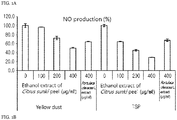
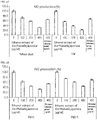
- the results of the ethanol extracts of Citrus sunki peel, Sceptridium ternatum (or Botrychium ternatum ), Korthalsella japonica and Portulaca oleracea L. with regard to a degree of reduction in NO production amounts were shown in FIGS. 1 to 3 .
- the ethanol extracts of Citrus sunki peel, Sceptridium ternatum (or Botrychium ternatum ) and Korthalsella japonica showed an effect of inhibiting a NO production in a concentration-dependent way and showed a more excellent effect than the Portulaca oleracea L. extract at the same concentration. Based on such results, it was identified that the ethanol extracts of Citrus sunki peel, Sceptridium ternatum (or Botrychium ternatum ) and Korthalsella japonica could effectively inhibit the pro-inflammatory mediator NO.
- the ethanol extract of Korthalsella japonica had a relatively more excellent effect on the yellow dust and TSP
- the ethanol extract of Sceptridium ternatum (or Botrychium ternatum ) had a relatively more excellent effect on the PM10
- the ethanol extract of Korthalsella japonica had a relatively more excellent effect on the PM2.5 than other extracts.
- the 100x-diluted chloroform extracts of yellow dust, TSP and PM10 and the 100x-diluted distilled water extracts of PM2.5 were used as a stimulus-causing agent for TNF- ⁇ .
- the 100x-diluted distilled water extracts of yellow water, PM10, PM2.5 and TSP were used as a stimulus-causing agent for IL-1 ⁇ , IL-2, IL-6 and GM-CSF, which were the rest of cytokines.
- the above ethanol extracts of Citrus sunki peel, Sceptridium ternatum (or Botrychium ternatum ) and Korthalsella japonica were treated at 100-400 ⁇ g/ml, such that their abilities to inhibit a production of inflammatory cytokines were evaluated as follows.
- HaCaT cells were seeded at 2.5 x 10 4 cells/well into a 96-well plate, after which the resulting cells were cultured under a condition of 37°C and 5% COD for 24 hours. Each well plates was treated with the above stimulus-causing agent, after which the resulting cells were cultured again for 24 hours. After that, the resulting culture media were collected to quantify their cytokines by using an ELISA kit with regard to a fixed quantity of IL-1 ⁇ , IL-2, IL-6, IL-8, GRO- ⁇ , GM-CSF and TNF- ⁇ .
- IL-1 ⁇ , IL-2, IL-6, GRO- ⁇ and GM-CSF the production amounts of IL-1 ⁇ , IL-2, IL-6, GRO- ⁇ and GM-CSF were measured with regard to a untreated group, a group treated only with the yellow dust, TSP, PM10 or PM2.5, which are air pollutants, and a group treated with ethanol extracts of Citrus sunki peel, Sceptridium ternatum (or Botrychium ternatum ) or Korthalsellajaponica at a concentration of 100, 200 and 400 ⁇ g/ml, wherein results thereof were shown in following Tables 8 to 12.
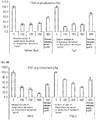
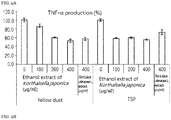
- the ethanol extracts of Citrus sunki peel, Sceptridium ternatum (or Botrychium ternatum ) and Korthalsella japonica showed an effect of inhibiting a production of IL-8 and TNF- ⁇ in a concentration-dependent way and showed a more excellent effect than the Portulaca oleracea L. extract at the same concentration.
- the ethanol extract of Sceptridium ternatum (or Botrychium ternatum ) had a relatively more excellent effect than other extracts.
- the ethanol extract of Citrus sunki peel had a relatively more excellent effect than other extracts.
- the ethanol extracts of Sceptridium ternatum (or Botrychium ternatum ), Korthalsella japonica and Citrus sunki peel and mixtures thereof were treated at a concentration of 52.5 ⁇ g/ml, 105 ⁇ g/ml and 210 ⁇ g/ml, respectively, wherein their abilities to inhibit the NO production were evaluated by means of a following method.
- HaCaT cells were seeded at 2.5 x 10 4 cells/well into a 96-well plate, after which the resulting cells were cultured under a condition of 37°C and 5% CO ⁇ for 24 hours.
- the resulting cultured cells were treated with the ethanol extracts of Sceptridium ternatum (or Botrychium ternatum), Korthalsella japonica or Citrus sunki peel, or mixtures thereof at a concentration of 52.5, 105 and 210 ⁇ g/ml, after which resulting treated cells were treated with 100x-diluted distilled water extracts of yellow dust, PM10, PM2.5 or TSP, such that resulting treated cells were cultured again for 24 hours.
- the mixture of ethanol extracts of Citrus sunki peel, Sceptridium ternatum (or Botrychium ternatum) and Korthalsella japonica showed an inhibitory effect on a NO production in a concentration-dependent way, and it was identified that the existing ethanol extracts of Sceptridium ternatum (or Botrychium ternatum ), Korthalsella japonica and Citrus sunki peel as well as mixtures thereof had the same tendency to inhibit the NO production.
- the 2:1:1 mixture tended to show a more excellent effect than the 1:1:1 mixture.
- the 100x-diluted distilled water extracts of yellow dust and PM2.5 were used as a stimulus-causing agent for IL-8 and GRO- ⁇
- the 100x-diluted chloroform extracts of yellow dust, TSP and PM10 and the 100x-diluted distilled water extract of PM2.5 were used as a stimulus-causing agent for TNF- ⁇
- the distilled water extracts of yellow dust, PM10, PM2.5 and TSP were used as a stimulus-causing agent for IL-1 ⁇ , IL-2 and GM-CSF.
- a 1:1:1 mixture and a 2:1:1 mixture of the ethanol extracts of Sceptridium ternatum (or Botrychium ternatum), Korthalsella japonica and Citrus sunki peel were prepared and used respectively.
- the ethanol extracts of Sceptridium ternatum (or Botrychium ternatum ), Korthalsella japonica and Citrus sunki peel as well as mixtures thereof were treated at a concentration of 52.5 ⁇ g/ml, 105 ⁇ g/ml and 210 ⁇ g/ml respectively, such that their abilities to inhibit the production of inflammatory cytokines were evaluated as follows.
- the HaCaT cells were seeded at 2.5 x 10 4 cells/well into a 96-well plate, after which the resulting cells were cultured under a condition of 37°C and 5% CO ⁇ for 24 hours.
- the ethanol extracts of Citrus sunki peel, Sceptridium ternatum (or Botrychium ternatum ) or Korthalsellajaponica, or mixtures thereof were treated at a concentration of 52.5, 105 and 210 ⁇ g/ml respectively, and each well plates was treated with the above stimulus-causing agent, after which resulting treated cells were cultured again for 24 hours.
- the resulting culture media were collected to quantify their cytokines by using an ELISA kit with regard to a fixed quantity of IL-1 ⁇ , IL-2, IL-6, IL-8, GRO- ⁇ , GM-CSF and TNF- ⁇ , wherein results thereof with regard to the ethanol extracts of Citrus sunki peel, Sceptridium ternatum (or Botrychium ternatum) and Korthalsella japonica as well as mixtures thereof were shown in following Tables 14 to 19.
- the 2:1:1 mixture tended to show a more excellent effect than the 1:1:1 mixture at the same concentration. Also, it was identified that according to each of air pollutants, the mixtures had a relatively more excellent effect on the yellow dust for IL-1 ⁇ , PM10 for TNF- ⁇ , IL-2 and GM-CSF and TSP for IL-1 ⁇ and IL-2 than the single extracts at the same concentration.
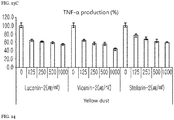
- the Raw 264.7 cells and HaCaT cells were cultured for 24 hours, after which resulting cells were treated with each substance at a concentration of 125-1000 ⁇ g/ml, in which its cytotoxicity does not appear. Then, resulting cells were treated with 100x-diluted distilled water extract of yellow dust and 100x-diluted chloroform extract of yellow dust, after which resulting treated cells were cultured again for 24 hours. As shown in Experimental Example 3, the inhibitory effect on the production of NO, IL-8 and TNF- ⁇ was measured, wherein results thereof were shown in FIG. 13 .
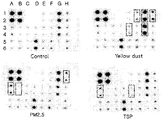
- a cytokine array experiment was performed in order to see which cytokines were further produced in addition to the inflammatory cytokines produced by yellow dust and fine particulate identified in the above Experimental Example 1 and how they varied depending on types of yellow dust and fine particulate.
- the HaCaT cells were seeded at 2.0 x 10 5 cells/well into a 96-well plate, after which resulting cells were cultured under a condition of 37°C and 5% CO ⁇ for 24 hours.
- the resulting cells were treated respectively with 100x-diluted distilled water extracts of yellow dust, TSP and PM2.5, after which resulting treated cells were further cultured for 24 hours, such that the resulting culture media thereof were collected to evaluate their production amounts of G-CSF (Granulocyte Colony Stimulating Factor), GM-CSF (Granulocyte-Macrophage Colony Stimulating Factor), GRO (Growth-Regulated Protein), GRO- ⁇ (Growth-Regulated Protein- ⁇ ), IL-1 ⁇ (Interleukin-1 ⁇ ), IL-2 (Interleukin-2), IL-3 (Interleukin-3), IL-5 (Interleukin-5), IL-6 (Interleukin-6), IL-7 (Interleukin-7), IL-8 (Interleukin-8), IL-10 (Interleukin-10), IL-13 (Interleukin-13), IL-15 (Interleukin-15), INF- ⁇ (Interferon-y), MCP-1 (Monocyte Chemoattractant
- Results of production rate of each cytokine compared to a control untreated with the distilled water extracts of yellow dust, TSP and PM2.5 were shown in Table 21 and FIG. 14 .
- a positive control was treated with biotinylated antibody to identify if an experiment was well performed, a negative control was treated only with buffer to see its response baseline, and a blank was not treated at all to see background responses.
- the yellow dust extract increased a production amount of G-CSF, GM-CSF, GRO, GRO- ⁇ , IL-1 ⁇ , IL-2, IL-6, IL-8 and MCP-1
- the TSP extract increased a production amount of G-CSF, GM-CSF, IL-1 ⁇ , IL-2, IL-3, IL-5, IL-6, IL-15 and MCP-2
- the PM2.5 extract increased a production amount of G-CSF, GM-CSF, GRO, GRO- ⁇ , IL-1 ⁇ , IL-2, IL-3, IL-5, IL-6, IL-8, IL-15, MCP-2 and TNF- ⁇ compared to a production amount of the control.
- composition comprising ethanol extracts of Citrus sunki peel, Sceptridium ternatum (or Botrychium ternatum ) and Korthalsella japonica
- the ethanol extracts of Citrus sunki peel, Sceptridium ternatum (or Botrychium ternatum ) and Korthalsella japonica showed a difference in relative effects in inhibiting the production of NO and the production of inflammatory cytokines according to each of air pollutants (yellow dust, TSP, PM10 and PM2.5), which are causes of inflammation.
- a cosmetic composition comprising a mixture that combines all the ethanol extracts of Citrus sunki peel, Sceptridium ternatum (or Botrychium ternatum) and Korthalsella japonica.
- Phase Ingredient Content (%) Water phase Purified water To 100 Moisturizing ingredient 10 - 25 Thickener Suitable amount Chelating agent Suitable amount Oil phase PEG-100 stearate 0.1 - 2 Glyceryl stearate 0.1 - 2 Polysorbate 60 0.1 - 2 Stearic acid 0.1 - 2 Cetearyl alcohol 0.1 - 2 Caprylic/Capric Triglyceride 10 - 30 Tocopheryl acetate 0.1 - 0.5 Additive phase I Ethanol extract of Citrus sunki peel 0.25 Additive phase II Fragrance Suitable amount Preservative Suitable amount Other additive Suitable amount [Table 23] Phase Ingredient Content (%) Water phase Purified water To 100 Moisturizing ingredient 10 - 25 Thickener Suitable amount Chelating agent Suitable amount Oil phase PEG-100 stearate 0.1 - 2 Glyceryl stearate 0.1 - 2 Polysorbate 60 0.1 - 2 Stearic acid 0.1 - 2 Cetearyl alcohol 0.1 -
- Phase Ingredient Content (%) Water phase Purified water To 100 Moisturizing ingredient 10 - 25 Thickener Suitable amount Chelating agent Suitable amount Solubilizatio n phase PEG-60 hydrogenated castor oil 0 - 2 PEG-40 hydrogenated castor oil 0 - 2 Polyhydric alcohol 0 - 10 Fragrance Suitable amount Ethanol 0 - 20 Additive phase I Ethanol extract of Citrus sunki peel 0.25 Additive phase II Preservative Suitable amount Other additive Suitable amount [Table 31] Phase Ingredient Content (%) Water phase Purified water To 100 Moisturizing ingredient 10 - 25 Thickener Suitable amount Chelating agent Suitable amount Solubilizatio n phase PEG-60 hydrogenated castor oil 0 - 2 PEG-40 hydrogenated castor oil 0 - 2 Polyhydric alcohol 0 - 10 Fragrance Suitable amount Ethanol 0 - 20 Additive phase I Ethanol extract of Sceptridium ternatum (or Botrychium tern
- Cosmetic compositions of the above Formulation Examples 1, 2 and 3 were stored for 12 weeks under a condition of 4°C, 30°C, 45°C and sunlight, and changes in the color, odor and property of a formulation were observed through visual and sensory evaluations, wherein results thereof were indicated in Tables 34 to 36.
- cosmetic compositions with the high viscosity emulsion formulation, the low viscosity emulsion formulation and the solubilization formulation of the mixture containing each or all of the ethanol extracts of Citrus sunki peel, Sceptridium ternatum (or Botrychium ternatum ) and Korthalsella japonica had an excellent stability without any change in the color, odor and property, even if they were stored for a long period of time under high temperature and sunlight conditions.
- a clinical evaluation was performed after being divided into two parts: first and second evaluations.
- the first test was performed with a total of 20 subjects (11 males and 9 females), while the second test was performed with a total of 22 subjects (9 males and 13 females).
- a sodium lauryl sulfate (SLS) solution and an SLS + fine particulate solution were applied to different regions respectively to measure a change in a degree of skin redness (a*), which is a factor to identify whether the skin inflammatory responses occur or not, before application, in 1 day after application and in 2 days after application.
- SLS sodium lauryl sulfate
- a* degree of skin redness
- an SLS + fine particulate solution and an SLS + fine particulate solution + test product were applied to different regions respectively to measure a degree of skin redness (a*), an amount of skin erythema (E.I) or an amount of transepidermal water loss (TEWL), which are factors to identify whether the skin inflammatory responses occur or not, in 1 day after use, 2 days after use and 7 days after use.
- a* degree of skin redness
- E.I skin erythema
- TEWL transepidermal water loss
- the SLS was a product at a concentration of 98% prepared by Wako Inc., Japan, the fine particulate solution was prepared from Example 2, in which the yellow dust, TSP, PM2.5 and PM10 extracts were 100x to 500x diluted.
- the test product was a cosmetic composition comprising ethanol extracts of Citrus sunki peel, Sceptridium ternatum (or Botrychium ternatum) and Korthalsella japonica in Table 25 of the above Formulation Example 1.
- the application was performed on the left musculus biceps region of a subject, while the application of the second test was performed on the right musculus biceps region of the subject.
- a skin color was measured before the application, right after the application, in one day after the application and in two days after the application by using Chroma Meter CM700d (Konica Minolta Sensing Americas, Inc, USA). At every measurement, a degree of skin redness on the same region was measured three times, such that an average thereof was used as evaluation data.
- the degree of skin redness was indicated by measuring a* value, which indicates a degree of redness in a CIE L*a*b* color space based on human color perception. If the a* value increases, it means that a corresponding color is visually more red.
- an amount of the skin erythema was measured before application, right after application, in one day after application, in two days after application and in seven days after application in such a way that an amount of hemoglobin under the skin was measured with light reflected from a probe at 568 nm (green), 660 nm (red) and 880 nm (near-infrared) by using a skin color measuring instrument (narrow-band reflectance spectrophotometer) called Mexameter (Courage+Khazaka Electronic GmbH, Germany), which uses only a narrow band wavelength.
- a skin color measuring instrument narrow-band reflectance spectrophotometer
- TEWL transepidermal water loss
- a measured value for the application of SLS + fine particulate solution was significantly increased (p ⁇ 0.025) in one day after the application, and was significantly decreased (p ⁇ 0.025) in two days and seven days after the application.
- a measured value for the application of SLS + fine particulate solution + test product was significantly decreased (p ⁇ 0.025) in two days and seven days after the application. It was identified that the application of SLS + fine particulate solution + test product significantly decreased the TEWL (p ⁇ 0.05) compared to the application of SLS + fine particulate in two days and seven days after the application.
- test product all decreased a degree of skin redness (a*), an amount of skin erythema (E.I) or an amount of transepidermal water loss (TEWL), which are skin inflammation factors by means of fine particulate in seven days later, based on which it was identified that the test product alleviated skin inflammation caused from fine particulate.
- a* degree of skin redness
- E.I skin erythema
- TEWL transepidermal water loss
Landscapes
- Health & Medical Sciences (AREA)
- Life Sciences & Earth Sciences (AREA)
- Veterinary Medicine (AREA)
- Public Health (AREA)
- General Health & Medical Sciences (AREA)
- Animal Behavior & Ethology (AREA)
- Natural Medicines & Medicinal Plants (AREA)
- Epidemiology (AREA)
- Engineering & Computer Science (AREA)
- Chemical & Material Sciences (AREA)
- Mycology (AREA)
- Botany (AREA)
- Microbiology (AREA)
- Biotechnology (AREA)
- Pharmacology & Pharmacy (AREA)
- Medicinal Chemistry (AREA)
- Birds (AREA)
- Dermatology (AREA)
- Medical Informatics (AREA)
- Alternative & Traditional Medicine (AREA)
- Dispersion Chemistry (AREA)
- General Chemical & Material Sciences (AREA)
- Chemical Kinetics & Catalysis (AREA)
- Nuclear Medicine, Radiotherapy & Molecular Imaging (AREA)
- Organic Chemistry (AREA)
- Bioinformatics & Cheminformatics (AREA)
- Nutrition Science (AREA)
- Food Science & Technology (AREA)
- Polymers & Plastics (AREA)
- Medicines Containing Plant Substances (AREA)
- Cosmetics (AREA)
- Pharmaceuticals Containing Other Organic And Inorganic Compounds (AREA)
Abstract
Description
- The present invention relates to a composition comprising natural plant extract for alleviating skin inflammation caused by yellow dust and fine particulate, and more particularly, to a composition for alleviating skin inflammation caused from harmful atmospheric environments, comprising one or more extracts selected from the group consisting of a Citrus sunki peel extract, a Sceptridium ternatum (or Botrychium ternatum) extract and a Korthalsellajaponica extract as an effective ingredient.
- Inflammatory responses in skin begin to take place as an action for defending the skin from damages, when they are caused by physical stimuli, chemical substances, germs, etc. In response, keratinocytes or Langerhans cells send out various types of cytokine, thereby launching such inflammatory responses. Interleukin-8 (IL-8), interleukin-6 (IL-6), interleukin-1 (IL-1), tumor necrosis factor-a (TNF-α), etc. are representative of the cytokine, by which activated macrophages excessively produce nitricoxide (NO) or prostaglandin E2 (PGE2) to aggravate an inflammatory process more.
- Fine particulate collectively refers to dusts having a particle size of 10 µm or less and its abbreviation is PM10 (Particulate Matter 10), which also includes PM2.5 (Particulate Matter 2.5), ultra-fine particulate having a particle size of 2.5 µm or less. The fine particulate mainly occurs when burning fossil fuel, and a considerable portion thereof is occupied by the one coming from China, of which dependence on coal accounts for 70%. Moreover, yellow dust refers to a phenomenon in which fine sand, yellow soil or dust in deserts and yellow soil zones at the center of Asia Continent including China, Mongol or the like float in the sky, fly away by the upper wind and drop in remote areas. These long-range migratory air pollutants can move far away down to Jeju Island.
- It is estimated that about 25 to 33% of diseases in industrial countries are caused by environmentally hazardous factors and that about 310,000 people per year die early due to polluted air in Europe. The American Cancer Society announced its research results that a rise in ultra-fine particulate by 10 µg per m3 results in 7% increase in a total death rate. According to results of a joint research (Journal of Allergy and Clinical Immunology. 132(2), 2013, 495-498) conducted in 2013 by the Ministry of Environment, it was shown that a rising concentration of the fine particulate or the air pollutants aggravates dermatitis symptoms more. Whenever the fine particulate (PM10) was increased by 1 µg/m3, the dermatitis symptoms rose by 0.4% on average, too. As total volatile organic compounds (TVOC) and benzene, ones of air pollutants, were increased by 0.1 ppb, the symptoms rose 2.59% and 2.74% on average, respectively. Also, if the yellow dust occurs, its cloud of dust contaminates air, which turns yellowish brown, and an amount of dust in air increases four times on average, thus making skin easily tired and lifeless. What is worse, the yellow dust has a smaller particle size than other general dusts, such that it can penetrate deep into pores of the skin, thus causing skin troubles and more aggravating various symptoms such as dry skin, irritant dermatitis, allergic dermatitis, acne, freckles, melasma, etc. Thus, it is thought that there will be a rise in an occurrence of dermatitis caused by the yellow dust and the fine particulate and there will be a growing need for a material that can alleviate skin inflammatory responses caused by the yellow dust and the fine particulate.
- Steroids are mainly used to treat skin inflammation, but their long-term administration causes various side effects such as skin atrophy, potential growth retardation or the like. Thus, non-steroids have recently been used more. However, the non-steroids exhibit side effects such as symptoms like erythema, itchiness, etc., weak immunity and the like, thus it is still difficult to fundamentally treat dermatitis. Thus, there have been a number of researches conducted to find novel substances with a high remedial effect and less side effects from natural product-derived materials, which have been proven safe. Representatively there are Sorbus commixta extract (
KR 10-0563548 KR 10-1309172 KR 10-2009-0079468 KR 10-0919852 - Accordingly, there has been a growing need for a novel substance with a high remedial effect and less side effects from natural plant-derived materials, which have been proven safe, but there have not been any reported study results about the natural plant-derived materials having an effect of alleviating inflammation caused by the yellow dust and the fine particulate.
- Accordingly, as a result of conducting an exemplary research on natural product-derived materials capable of alleviating skin inflammation caused by yellow dust and fine particulate and solving problems of existing skin anti-inflammatory agents, the present inventors have identified that a Citrus sunki peel extract, a Sceptridium ternatum (or Botrychium ternatum) extract and a Korthalsella japonica extract alleviate skin inflammation caused by the yellow dust and the fine particulate, thus completing the present invention.
- Thus, an object to be solved by the present invention is to provide a composition for alleviating skin inflammation caused from the yellow dust or the fine particulate, comprising one or more extracts selected from the group consisting of the Citrus sunki peel extract, the Sceptridium ternatum (or Botrychium ternatum) extract and the Korthalsellajaponica extract as an effective ingredient.
- Also, another object to be solved by the present invention is to provide a method for alleviating skin inflammation by using the above composition.
- Further, yet another object to be solved by the present invention is to provide a method for alleviating a degree of skin redness, an amount of skin erythema or an amount of transepidermal water loss, wherein the method comprises a step of applying the above composition to skin.
- To solve the above objects, the present invention provides a composition for alleviating skin inflammation caused from yellow dust or fine particulate, comprising one or more extracts selected from the group consisting of a Citrus sunki peel extract, a Sceptridium ternatum (or Botrychium ternatum) extract and a Korthalsella japonica extract as an effective ingredient.
- Also, the present invention provides a method for alleviating skin inflammation by using the above composition.
- Further, the present invention provides a method for alleviating a degree of skin redness, an amount of skin erythema or an amount of transepidermal water loss, wherein the method comprises a step of applying the above composition to skin.
- Hereinafter, the present invention will be described in more detail.
- The present invention provides a composition for alleviating skin inflammation caused from harmful atmospheric environments, comprising one or more extracts selected from the group consisting of a Citrus sunki peel extract, a Sceptridium ternatum (or Botrychium ternatum) extract and a Korthalsellajaponica extract as an effective ingredient.
- The above Citrus sunki peel means a peel of Citrus sunki, which is a native mandarin wildly grown in Jeju Island, but it is distinguished from a Japanese species of Citrus unshiu, which is popularly used in recent days. Its fruits have such a unique scent and taste that they could belong to a high class of indigenous products of Jeju Island, which were presented to kings in old days. It is called "sanmul" or "sangyul" in Jeju regions and belongs to a Rutaceae family of dicotyledonous plants in the order of Geraniales.
- The above Sceptridium ternatum (or Botrychium ternatum) is also called "flowery gosari (flowery bracken fern)," and it is a perennial fern belonging to an Ophioglossaceae family in the order of Ophioglossales. It is wildly grown in mountains of Korea, Japan, Taiwan and China and it is 15-40 cm high without fuzz as a whole. Its root is thick and flesh and spreads in all directions, out of which one stem springs and stands upright.
- The above Korthalsella Japonica, which is an evergreen hemi-parasitic shrub parasitic on camellia, belongs to a Loranthaceae family along with Loranthus chinensis Danser (mulberry mistletoe), alder tree mistletoe and Usnea longissima (pine tree mistletoe). The Korthalsellajaponica can be seen on Jeju Island and some islands of the south coast of South Korea. It is 6-15 cm long and its leave has atrophied into a node shape at the both ends of a joint and its branch takes on a green color.
- The above skin inflammation may comprise, without limitation, all the skin inflammatory diseases accompanied by inflammatory responses, which may occur to skin in contact with yellow dust or fine particulate, and it may be contact dermatitis, but not limited thereto.
- In case of the above skin inflammation, their occurrence may be identified by measuring a degree of skin redness, an amount of skin erythema or an amount of transepidermal water loss, but not limited thereto.
- The above extract may be obtained in such a way that it is extracted by means of water, C1 to C4 lower carbon alcohols or a mixed solvent thereof, wherein these lower carbon alcohols may be ethanol or methanol, more particularly ethanol.
- In one specific embodiment of the present invention, the present invention provides a composition for alleviating skin inflammation caused from harmful atmospheric environments, comprising a Citrus sunki peel extract as an effective ingredient.
- In one specific embodiment of the present invention, the present invention provides a composition for alleviating skin inflammation caused from harmful atmospheric environments, comprising a Sceptridium ternatum (or Botrychium ternatum) extract as an effective ingredient.
- In one specific embodiment of the present invention, the present invention provides a composition for alleviating skin inflammation caused from harmful atmospheric environments, comprising a Korthalsellajaponica extract as an effective ingredient.
- In one specific embodiment of the present invention, the present invention provides a composition for alleviating skin inflammation caused from harmful atmospheric environments, further comprising any one or more of the Citrus sunki peel extract and the Sceptridium ternatum (or Botrychium ternatum) extract in addition to the Korthalsellajaponica extract as an effective ingredient.
- In one specific embodiment of the present invention, the present invention provides a composition for alleviating skin inflammation, characterized in that the above extract is i) the Citrus sunki peel extract comprising one or more compounds selected from the group consisting of hesperidine, tetramethyl-O-isoscutellarein, nobiletin and tangeretin; ii) the Sceptridium ternatum (or Botrychium ternatum) extract comprising one or more compounds selected from the group consisting of quercetin-3-O-β-glucosyl(1→2)-α-rhamnoside-7-O-α-rhamnoside, quercetin-3-O-β-glucosyl(1→2)-α-rhamnoside-7-O-β-glucoside, ternatumoside VI, ternatumoside XI and ternatumoside XII; or iii) the Korthalsellajaponica extract comprising one or more compounds selected from the group consisting of lucenin-2, vicenin-2 and stellarin-2.
- In one specific embodiment of the present invention, the Citrus sunki peel extract of the present invention may comprise one or more compounds selected from the group consisting of hesperidine, tetramethyl-O-isoscutellarein, nobiletin and tangeretin as an effective ingredient.
- In one specific embodiment of the present invention, the Sceptridium ternatum (or Botrychium ternatum) extract of the present invention may comprises one or more compounds selected from the group consisting of quercetin-3-O-β-glucosyl(1→2)-α-rhamnoside-7-O-α-rhamnoside, quercetin-3-O-β-glucosyl(1→2)-α-rhamnoside-7-O-β-glucoside, ternatumoside VI, ternatumoside XI and ternatumoside XII as an effective ingredient.
- In one specific embodiment of the present invention, the Korthalsellajaponica extract of the present invention may comprise one or more compounds selected from the group consisting of lucenin-2, vicenin-2 and stellarin-2 as an effective ingredient.
- In one specific embodiment of the present invention, the above extract may be a mixture that combines the Citrus sunki peel extract, the Sceptridium ternatum (or Botrychium ternatum) extract and the Korthalsellajaponica extract all together. The ethanol extracts of Citrus sunki peel, Sceptridium ternatum (or Botrychium ternatum) and Korthalsellajaponica make a relative difference of effects in inhibiting each production of their inflammation-causing substances. Thus, a use of a mixture that combines all the ethanol extracts of Citrus sunki peel, Sceptridium ternatum (or Botrychium ternatum) and Korthalsellajaponica may give a complementary effect on alleviating skin inflammation caused by harmful atmospheric environments mixed with various harmful substances such as yellow dust, fine particulate, etc.
- The above inflammation-causing substance means a factor related to inflammatory responses in vivo such as a pro-inflammatory mediator NO or an inflammatory cytokine.
- In one specific embodiment of the present invention, in case of the above mixture, its composition ratio of Citrus sunki peel extract: Sceptridium ternatum (or Botrychium ternatum) extract: Korthalsellajaponica may be a weight ratio of 1:1:1 to 2:1:1.
- In one specific embodiment of the present invention, the above harmful atmospheric environments may be the yellow dust or the fine particulate.
- The above harmful atmospheric environments, which comprise air pollutants, refer to atmospheric environments comprising heavy metal, the fine particulate, the yellow dust, etc.
- The above yellow dust refers to a phenomenon in which fine sand, yellow soil or dust in deserts and yellow soil zones at the center of Asia Continent including China, Mongol or the like float in the sky, fly away by the upper wind and drop in remote areas as long-range migratory air pollutants, or sandy dust falling down therein.
- In one specific embodiment of the present invention, the above fine particulate may comprise one or more fine particulates selected from the group consisting of TSP, PM10 and PM2.5.
- In one specific embodiment of the present invention, the above yellow dust or fine particulate may increase a production amount of one or more cytokines selected from the group consisting of G-CSF, GM-CSF, GRO, GRO-α, IL-1α IL-2, IL-3, IL-5, IL-6, IL-8, IL-15, MCP-1, MCP-2 and TNF-α.
- The above fine particulate collectively refers to dusts having a particle size of 10 µm or less and its abbreviation is PM10 (Particulate Matter 10), which also includes PM2.5 (Particulate Matter 2.5), ultra-fine particulate having a particle size of 2.5 µm or less. It mainly occurs when burning fossil fuel, and its considerable portion is occupied by fine particulate coming from China, of which dependence on coal accounts for 70%. Also, total suspended particles (TSP) (all dusts generally having a size of 50 µm or less and floating in air) is comprised in the fine particulate in a broad sense.
- In one specific embodiment of the present invention, the above extract may inhibit a production of NO, which is a pro-inflammatory mediator.
- In one specific embodiment of the present invention, the above extract may reduce a production amount of factors related to inflammatory responses in vivo such as inflammatory cytokines.
- In one specific embodiment of the present invention, the above extract may reduce a production amount of IL-1α, IL-2, IL-6, IL-8, GRO-α, GM-CSF and TNF-α as representative inflammatory cytokines.
- The above inflammatory cytokines may be G-CSF (granulocyte colony stimulating factor), GM-CSF (granulocyte-macrophage colony stimulating factor), GRO (growth-regulated protein), GRO-α (growth-regulated protein-α), IL-1α (interleukin-1α), IL-2 (interleukin-2), IL-3 (interleukin-3), IL-5 (interleukin-5), IL-6 (interleukin-6), IL-7 (interleukin-7), IL-8 (interleukin-8), IL-10 (interleukin-10), IL-13 (interleukin-13), IL-15 (interleukin-15), INF-γ (interferon-y), MCP-1 (monocyte chemoattractant protein-1), MCP-2 (monocyte chemoattractant protein-2), MCP-3 (monocyte chemoattractant protein-3), CXCL9 (chemokine ligand 9; MIG), CCL5 (
chemokine ligand 5; RANTES), TGF-β1 (transforming growth factor-β1), TNF-α (tumor necrosis factor-a) and TNF-β (tumor necrosis factor-β), but not limited thereto. - In one specific embodiment of the present invention, the above Citrus sunki peel extract, the Sceptridium ternatum (or Botrychium ternatum) extract and the Korthalsellajaponica extract may be prepared by means of a manufacturing method comprising following steps, but not limited thereto:
- 1) adding an extraction solvent to Citrus sunki peel, Sceptridium ternatum (or Botrychium ternatum) or Korthalsellajaponica to obtain each extract;
- 2) filtering each extract of a step 1); and
- 3) concentrating each filtered extract of a step 2) under reduced pressure and drying each resulting concentrate to prepare powder thereof.
- In the above method, the Citrus sunki peel, Sceptridium ternatum (or Botrychium ternatum) or Korthalsella japonica of the step 1) may be used a cultivated one, a commercially available one or the like without limitation.
- In the above method, an extraction method may be a conventional method in the art, such as filtration, hot water extraction, immersion extraction, reflux extraction, ultrasonic extraction, supercritical fluid extraction, etc., and an extract thereof may be prepared under a conventional condition of temperature and pressure known in the art. Also, the extract may be obtained in such a way that it is extracted by using water, C1 to C4 lower carbon alcohols or a mixed solvent thereof as an extraction solvent and the above lower carbon alcohols may be ethanol or methanol. The extract may be obtained by adding the extraction solvent that amounts to 1 to 20 times of each quantity of the Citrus sunki peel, Sceptridium ternatum (or Botrychium ternatum) or Korthalsella japonica, particularly 5 to 15 times thereof, but is not limited thereto. Also, an extraction temperature may be 20 to 70°C, particularly 25 to 65°C, and more particularly 30 to 60°C, but is not limited thereto. Furthermore, an extraction time may be 1 to 40 hours, particularly 10 to 30 hours, but is not limited thereto.
- In the above method, the extract of the step 2) may be filtered 1 to 5 times. Also, the extraction method may be a conventional method in the art, such as sieve filtration, suction filtration, ultra-filtration, filter press, etc., but is not limited thereto.
- In the above method, the concentration under reduced pressure of the step 3) may be performed by means of a vacuum evaporator or a rotary evaporator, but is not limited thereto. Also, the drying may be reduced pressure drying, vacuum drying, boiling drying, spray drying or freeze drying, but is not limited thereto.
- In one specific embodiment of the present invention, the above composition may be a cosmetic composition, a pharmaceutical composition or a health functional food composition.
- The above cosmetic composition may comprise ingredients conventionally used in a cosmetic composition, wherein as one specific example for these ingredients, this may be conventional adjuvants such as antioxidant, stabilizer, solubilizer, vitamin, pigment and flavoring, as well as carrier.
- The above cosmetic composition may be prepared into a formulation conventionally prepared in the art. As one specific example for the cosmetic composition, this may be any one formulation selected from the group consisting of a high-viscosity emulsion formulation, a low-viscosity emulsion formulation and a solubilized formulation, but is not limited thereto. The cosmetic composition may comprise a blend ingredient of the cosmetic composition conventionally used in the art, to which the present invention pertains, depending on a formulation to be prepared. As one specific example, the cosmetic composition may be prepared into a formulation such as solution, suspension, emulsion, paste, gel, cream, lotion, powder, soap, surfactant-containing cleansing oil, powder foundation, emulsion foundation, wax foundation, pack, massage cream, spray, and the like, but is not limited thereto. More particularly, the cosmetic composition may be prepared into a formulation such as skin lotion, nutrition lotion, nutrition cream, massage cream, essence, eye cream, sun lotion, sun cream, makeup base, BB cream, cleansing cream, cleansing foam, cleansing water, pack, a stick-type product, a balm type product, spray or powder. The cosmetic composition may be prepared by further selecting, blending and adding a water phase ingredient, an oil phase ingredient, surfactant, moisturizer, lower carbon alcohols, thickener, a chelating agent, preservative, flavoring, etc., depending on a formulation to be prepared.
- The above pharmaceutical composition may further contain pharmaceutical adjuvants such as preservative, stabilizer, hydrating agent or emulsification accelerator, salt and/or buffer for adjusting osmotic pressure, etc., and other therapeutically useful substances, and may be formulated into various forms of oral administration or parenteral administration according to a conventional method. In case of the parenteral administration, this may be a local application to skin, an intravenous infusion, a subcutaneous infusion, an intramuscular infusion, an intraperitoneal infusion, a transdermal administration, etc.
- The pharmaceutical composition of the present invention may be a formulation for external use on skin. This formulation for external use on skin may be powder, gel, ointment, cream, lotion, liquid or aerosol formulation, but is not limited thereto.
- In case of the above health functional food composition, its formulation is not particularly limited, but this may be formulated into, for example, tablet, granule, drink, caramel, diet bar, etc. The health functional food composition of each formulation may be prepared in such a way that those skilled in the art may select and blend optimal ingredients conventionally used in the art in addition to effective ones without any difficulty according to its formulation or purpose of use. And if such ingredients are applied at the same time with other raw materials, a synergy effect may occur.
- In one specific embodiment of the present invention, each of the above Citrus sunki peel extract, the Sceptridium ternatum (or Botrychium ternatum) extract and the Korthalsellajaponica extract or mixtures thereof may be comprised 0.001 to 30 wt% with regard to the total weight of the composition. If each of the above Citrus sunki peel extract, the Sceptridium ternatum (or Botrychium ternatum) extract and the Korthalsellajaponica extract or mixtures thereof is comprised less than 0.001 wt% with regard to the total weight of the composition, this does not exhibit an effect of alleviating skin inflammation. In case of exceeding 30 wt%, a degree of increase in an effect of alleviating skin inflammation was insignificant with regard to an increase in content, and also it is not economical along with a problem of stability in formulation.
- In one specific embodiment of the present invention, it was identified that the Citrus sunki peel extract, the Sceptridium ternatum (or Botrychium ternatum) extract, the Korthalsellajaponica extract and mixtures thereof inhibited a production of NO caused by yellow dust or fine particulate, which are harmful atmospheric environments, as well as a production of inflammatory cytokines, thus having an excellent effect on preventing and alleviating skin inflammation caused by the yellow dust, the fine particulate and other pollutants.
- In one specific embodiment of the present invention, it was identified through clinical tests that the Citrus sunki peel extract, the Sceptridium ternatum (or Botrychium ternatum) extract, the Korthalsella japonica and mixtures thereof show an excellent effect on alleviating skin inflammation caused by fine particulate.
- Also, the present invention provides a method for alleviating skin inflammation by using the above composition.
- In one specific embodiment of the present invention, the above method may comprise a step of applying the composition to skin.
- In one specific embodiment of the present invention, the above skin inflammation may comprise, without limitation, all the skin inflammatory diseases accompanied by inflammatory responses, which may occur to skin in contact with yellow dust or fine particulate, and may be contact dermatitis, but not limited thereto.
- Also, the present invention provides a method for alleviating a degree of skin redness, an amount of skin erythema or an amount of transepidermal water loss, comprising a step of applying the above composition to skin.
- In one specific embodiment of the present invention, the above method may be characterized in that this may be i) a method for alleviating a degree of skin redness by about 20.0%, ii) a method for alleviating an amount of skin erythema by about 16.8%; or iii) a method for alleviating an amount of transepidermal water loss by about 33.2% in 7 days after an application of a fine particulate solution compared to a control without application.
- The term "application" used in the present specifications means all the methods for bringing the inventive composition in contact with an individual skin in any appropriate means, through which the present invention aims to let the composition absorbed into the skin.
- The natural plant extracts of the present invention inhibit a production of NO caused by yellow dust and fine particulate and a production of inflammatory cytokines, thus having an excellent effect on preventing or alleviating skin inflammation caused by the yellow dust, the fine particulate and other harmful substances.
-
-
FIGS. 1 to 3 are graphs indicating effects of ethanol extracts of Citrus sunki peel (FIG. 1 ), Sceptridium ternatum (or Botrychium ternatum) (FIG. 2 ) and Korthalsella japonica (FIG. 3 ) on inhibiting productions of NOs caused by yellow dust, TSP, PM10 and PM2.5. -
FIGS. 4 to 6 are graphs indicating effects of ethanol extracts of Citrus sunki peel (FIG. 4 ), Sceptridium ternatum (or Botrychium ternatum) (FIG. 5 ) and Korthalsella japonica (FIG. 6 ) on inhibiting productions of IL-8 caused by yellow dust and PM2.5. -
FIGS. 7 to 9 are graphs indicating effects of ethanol extracts of Citrus sunki peel (FIG. 7 ), Sceptridium ternatum (or Botrychium ternatum) (FIG. 8 ) and Korthalsella japonica (FIG. 9 ) on inhibiting productions of TNF-α caused by yellow dust, TSP, PM10 and PM2.5. -
FIGS. 10 to 12 are chromatograms of ethanol extracts of Citrus sunki peel (FIG. 10 ), Sceptridium ternatum (or Botrychium ternatum) (FIG. 11 ) and Korthalsella japonica (FIG. 12 ), as analyzed by means of HPLC-UVD. -
FIG. 13 is a graph indicating effects of 3 kinds of flavonoid glycoside separated from an ethanol extract of Korthalsella japonica on inhibiting a production of NO and a production of IL-8 and TNF-α by means of yellow dust and fine particulate. -
FIG. 14 indicates experimental results of a cytokine array conducted to see whether inflammatory cytokines are produced or not according to types of yellow dust and fine particulate. - Hereinafter, the present invention will be described in more detail through examples. The following examples are set forth just as the illustrative description of the present invention, but are not to be construed to limit the content of the present invention.
- 500 ml of 70% ethanol (with purified water and ethanol mixed at a volume ratio of 30:70) was added to each 50 g of dry pulverized Citrus sunki peel, Sceptridium ternatum (or Botrychium ternatum) or Korthalsella japonica, after which resulting mixtures were shaken at room temperature for 20 hours to obtain extracts. These extracts were filtered and concentrated under reduced pressure to eliminate ethanol therefrom, such that resulting concentrates were freeze-dried to obtain ethanol extracts of Citrus sunki peel, Sceptridium ternatum (or Botrychium ternatum) and Korthalsella japonica at a yield of 17.9%, 18.3% and 15%, respectively.
- A Low Volume Air Sampler installed in Bucheon city, Gyeonggi-do province in March 2013 was used, and samples collected from the Sampler equipped with a 47 mm Teflon filter for 24 hours at a flow rate of 16.7 L per minute were used. The samples were collected separately with regard to yellow dust, TSP, PM10 and PM2.5 depending on filter types.
- Each of distilled water, ethanol and chloroform was added to a filter cut in about 1 m2 size, after which resulting filtrates were stirred for 12 hours to obtain extracts. The resulting extracts were separated, after which an extraction solvent was added again to extraction residues to obtain extracts again with ultrasonic waves for 4 hours. The extracts were combined together and concentrated under reduced pressure to evaporate and remove the extraction solvent therefrom, after which the samples extracted with distilled water and ethanol were dissolved again with respective solvents, while the sample extracted with chloroform was dissolved in DMSO.
- Following experiments were performed in order to identify if the yellow dust, TSP, PM10 and PM2.5 extracts cause inflammation in cells.
- NO, which is a pro-inflammatory mediator, is produced by means of various inflammatory stimuli and is known to cause continuous inflammatory responses and contribute to tissue damages. Thus, it was identified if the yellow dust and fine particulate extracts caused a production of NO. Raw 264.7 cells were seeded at 6 x 10⁴ cells/well into a 96-well plate, after which the resulting cells were cultured under a condition of 37°C and 5% CO□ for 24 hours. The resulting cells were treated with the yellow dust, TSP, PM10 or PM2.5 samples, which were diluted at each concentration, such that resulting treated cells were cultured again for 24 hours. After that, the resulting cell culture media were mixed with Griess reagent at a ratio of 1:1, after which their optical densities were measured at 540 nm by means of a Microplate Reader to measure a NO production. At that time, no cytotoxicity was detected from the Raw 264.7 cells of the samples for causing the NO production.
- As shown in a following Table 1, it was identified that the distilled water extracts of yellow dust, TSP, PM10 and PM2.5 caused skin inflammation. When it comes to each of extraction solvents, it was shown that an extraction with distilled water caused the NO production most.
[Table 1] Sample Concentration NO production (%) Yellow dust TSP PM10 PM2.5 Control 100.0±2.1 Chloroform extract 500x-dilution 122.6±3.2 114.3±5.4 110.5±3.9 46.8±2.0 100x-dilution 83.9±2.2 86.3±2.8 79.4±2.7 74.3±12.4 Ethanol extract 500x-dilution 126.0±8.5 130.4±3.0 123-9±1.0 134.2±19.1 100x-dilution 134.1±11.3 120.07±4.9 129.2±2.0 199.7±13.3 Distilled extract 500x-dilution 192.7±1.3 225.9±5.7 136.6±2.3 196.2±5.1 100x-dilution 223.4±6.1 231.2±2.6 176.4±5.0 265.6±9.5 - IL-8, TNF-α, IL-1α, IL-2, IL-6, GRO-α and GM-CSF are representative of inflammatory cytokines, and the following method was performed in order to identify if the yellow dust and fine particulate extracts caused a production of TNF-α and IL-8. HaCaT cells were seeded at 2.5 x 10⁴ cells/well into a 96-well plate, after which the resulting cells were cultured under a condition of 37°C and 5% CO□ for 24 hours. The resulting cells were treated with the yellow dust, TSP, PM10 or PM2.5 samples, which were diluted at each concentration, such that resulting treated cells were cultured for 24 hours. After that, the resulting culture media were collected to evaluate their abilities to cause a production of cytokines by using an ELISA kit with regard to a fixed quantity of IL-1α, IL-2, IL-6, GRO-α, GM-CSF, IL-8 and TNF-α, wherein results thereof were shown in following Tables 2 to 4. At that time, no cytotoxicity was detected from the HaCaT cells of the samples for causing a production of IL-1α, IL-2, IL-6, GRO-α, GM-CSF, IL-8 and TNF-α.
- As shown in following Tables 2 and 3, in case of IL-8, the yellow dust and PM2.5 only caused its production and the yellow dust caused such production most when being extracted with distilled water. In case of TNF-α, it was identified that the yellow dust, TSP and PM10, extracted with chloroform, as well as PM2.5, extracted with distilled water, caused its production most.
- As shown in a following Table 4, it was identified that IL-1α, IL-2, IL-6 and GM-CSF were increased by means of the yellow dust, PM10, PM2.5 and TSP extracts, which were obtained by means of distilled water. In case of GRO-α, it was identified that only the distilled water extracts of the yellow dust and PM2.5 caused its production.
[Table 2] Sample Concentration IL-8 production (%) Yellow dust TSP PM10 PM2.5 Control 100.0±8.6 Chloroform extract 500x-dilution 155.8±3.6 58.3±5.0 45.8±9.0 88.0±1.9 100x-dilution 118.8±11.1 55.5±11.1 41.2±5.7 84.0±2.2 Ethanol extract 500x-dilution 181.8±7.6 62.6±2.0 67.1±6.0 98.8±4.0 100x-dilution 148.2±9.1 71.3±4.0 53.0±3.0 89.5±0.4 Distilled extract 500x-dilution 225.0±11.6 85.5±2.1 74.2±4.5 118.7±3.0 100x-dilution 234.8±13.2 85.0±9.4 84.8±7.7 127.4±5.5 [Table 3] Sample Concentration TNF-α production (%) Yellow dust TSP PM10 PM2.5 Control 100.0±8.4 Chloroform extract 500x-dilution 177.4±7.0 135.3±5.6 165.5±6.3 90.3±4.6 100x-dilution 217.8±8.8 162.7±4.5 176.2±10.5 75.3±6.2 Ethanol extract 500x-dilution 137.8±3.0 115.1±1.8 129.2±1.7 91.9±5.0 100x-dilution 155.7±12.0 136.7±3.6 142.8±2.9 117.6±6.3 Distilled extract 500x-dilution 98.1±5.0 146.7±4.0 124.1±1.3 115.9±6.1 100x-dilution 119.1±3.3 108.1±4.2 134.0±5.2 146.3±4.4 [Table 4] Sample Concentration Cytokine production (%) 1L-1α IL-2 IL-6 GRO-α GM-CSF Control 100.0±4.8 100.0±7.9 100.0±4.0 100.0±6.8 100.0±4.3 Yellow dust 100x-dilution 160.6±1.8 150.1±9.7 558.0±11.3 173.4±2.0 435.2±16.0 TSP 100x-dilution 123.2±5.1 190.2±12.2 283.7=14.3 87.5±5.2 122.7±6.0 PM10 100x-dilution 139.4±8.1 174.6±7.7 374.4±11.3 75.4±3.3 123.3±5.7 PM2.5 100x-dilution 166.9±4.2 155.7±5.7 140.1±7.1 120.2±2.8 121.4±2.5 - An experiment was performed by means of a following method in order to identify if the ethanol extracts of Citrus sunki peel, Sceptridium ternatum (or Botrychium ternatum) and Korthalsellajaponica have cytotoxicity. Raw 264.7 cells and HaCaT cells were seeded at 6.0 x 10⁴ cells/well and 2.5 x 10⁴ cells/well respectively, after which the resulting cells were cultured under a condition of 37°C and 5% CO□ for 24 hours. The resulting cultured cells were treated with the ethanol extracts of Citrus sunki peel, Sceptridium ternatum (or Botrychium ternatum) or Korthalsella japonica at a concentration of 50-1,600 µg/ml, after which resulting treated cells were treated and reacted with a WST-1 solution in 24 hours later, such that their optical densities were measured at 450 nm by means of a Microplate Reader to identify a cell viability, wherein results of the ethanol extracts of Citrus sunki peel, Sceptridium ternatum (or Botrychium ternatum) and Korthalsella japonica were shown in following Tables 5 to 7.
- As shown in following Tables 5 to 7, it was identified that the ethanol extracts of Citrus sunki peel, Sceptridium ternatum (or Botrychium ternatum) and Korthalsella japonica did not show cytotoxicity at 50-400 µg/ml.
[Table 5] Sample concentration (µg/ml) Raw 264.7 cell viability (%) HaCaT cell viability (%) Control 100.0±2.7 100.0±3.9 Citrus sunki peel 1,600 33.6±2.7 45.3±2.2 800 75.6±0.7 88.1±1.5 400 92.2±1.4 96.7±1.3 200 98.0±3.5 95.8±4.1 100 107.0±1.6 96.2±0.5 50 99.9±3.4 92.5±0.8 [Table 6] Sample concentration (µ/ml) Raw 264.7 cell viability (%) HaCaT cell viability (%) Control 100.0±2.7 100.0±3.9 Sceptridium ternatum (or Botrychium ternatum) 1,600 34.6±1.4 44.3±4.1 800 83.0±1.3 88.7±0.8 400 93.4±1.2 101.4±3.3 200 95.5±0.9 98.5±3.5 100 99.2±2.3 97.5±3.3 50 100.7±0.9 100.6±0.7 [Table 7] Sample concentration (µ/ml) Raw 264.7 cell viability (%) HaCaT cell viability (%) Control 100.0±2.7 100.0±3.9 Korthalsella japonica 1,600 24.7±0.4 29.0±1.9 800 67.8±2.6 68.9±1.0 400 94.7±2.1 93.9±1.6 200 104.5±2.3 96.8±1.6 100 103.2±0.9 101.4±2.1 50 103.0±1.3 98.0±3.8 - In the above Experimental Example 1, it was identified that the yellow dust, TSP, PM10 and PM2.5 caused a production of NO in cells, and in result the distilled water extract for each sample caused the NO production most. Thus, the 100x diluted distilled water extracts of the yellow dust, TSP, PM10 and PM2.5 were used as a stimulus-causing agent, after which the Citrus sunki peel, Sceptridium ternatum (or Botrychium ternatum) and Korthalsella japonica extracts were treated at a concentration of 100-400 µg/ml without cytotoxicity, such that their abilities to inhibit a NO production were evaluated by means of a following method. An extract of Portulaca oleracea L., generally known to soothe skin and have an excellent anti-inflammatory action was treated together as a positive control with regard to an effect of alleviating inflammation.
- Raw 264.7 cells were seeded at 6.0 x 10⁴ cells/well into a 96-well plate, after which the resulting cells were cultured under a condition of 37°C and 5% CO□ for 24 hours. The resulting cultured cells were treated with the ethanol extracts of Citrus sunki peel, Sceptridium ternatum (or Botrychium ternatum) or Korthalsella japonica at a concentration of 100, 200 and 400 µg/ml, after which resulting treated cells were treated with 100x diluted distilled water extracts of the yellow dust, TSP, PM10 or PM2.5, such that the resulting treated cells were cultured again for 24 hours. After that, the resulting cell culture media were mixed with Griess reagent at a ratio of 1:1, after which their optical densities were measured at 540 nm by means of a Microplate Reader to measure a NO production. When a control was the group treated only with the yellow dust, TSP, PM10 or PM2.5, which are air pollutants, the results of the ethanol extracts of Citrus sunki peel, Sceptridium ternatum (or Botrychium ternatum), Korthalsella japonica and Portulaca oleracea L. with regard to a degree of reduction in NO production amounts were shown in
FIGS. 1 to 3 . - As shown in
FIGS. 1 to 3 , the ethanol extracts of Citrus sunki peel, Sceptridium ternatum (or Botrychium ternatum) and Korthalsella japonica showed an effect of inhibiting a NO production in a concentration-dependent way and showed a more excellent effect than the Portulaca oleracea L. extract at the same concentration. Based on such results, it was identified that the ethanol extracts of Citrus sunki peel, Sceptridium ternatum (or Botrychium ternatum) and Korthalsella japonica could effectively inhibit the pro-inflammatory mediator NO. - Also, when it comes to an inhibitory effect on the NO production according to each of air pollutants at the same concentration, it was identified that the ethanol extract of Korthalsella japonica had a relatively more excellent effect on the yellow dust and TSP, the ethanol extract of Sceptridium ternatum (or Botrychium ternatum) had a relatively more excellent effect on the PM10, and the ethanol extract of Korthalsella japonica had a relatively more excellent effect on the PM2.5 than other extracts.
- As shown in the above Experimental Example 1, in case of IL-8 and GRO-α, the distilled water extracts of yellow dust and PM2.5 caused their production. In case of the chloroform extracts of yellow dust, TSP and PM10 and the distilled water extract of PM2.5 caused its production. Also, in case of IL-1α, IL-2, IL-6 and GM-CSF, the distilled water extracts of yellow dust, PM10, PM2.5 and TSP caused their production. Thus, the 100x-diluted distilled water extracts of yellow dust and PM2.5 were used as a stimulus-causing agent for IL-8 and GRO-α. The 100x-diluted chloroform extracts of yellow dust, TSP and PM10 and the 100x-diluted distilled water extracts of PM2.5 were used as a stimulus-causing agent for TNF-α. The 100x-diluted distilled water extracts of yellow water, PM10, PM2.5 and TSP were used as a stimulus-causing agent for IL-1α, IL-2, IL-6 and GM-CSF, which were the rest of cytokines. The above ethanol extracts of Citrus sunki peel, Sceptridium ternatum (or Botrychium ternatum) and Korthalsella japonica were treated at 100-400 µg/ml, such that their abilities to inhibit a production of inflammatory cytokines were evaluated as follows.
- HaCaT cells were seeded at 2.5 x 10⁴ cells/well into a 96-well plate, after which the resulting cells were cultured under a condition of 37°C and 5% COD for 24 hours. Each well plates was treated with the above stimulus-causing agent, after which the resulting cells were cultured again for 24 hours. After that, the resulting culture media were collected to quantify their cytokines by using an ELISA kit with regard to a fixed quantity of IL-1α, IL-2, IL-6, IL-8, GRO-α, GM-CSF and TNF-α.
- In case of IL-8 and an extract of Portulaca oleracea L., generally known to soothe skin and have an excellent anti-inflammatory action, was treated together as a positive control with regard to an effect of alleviating inflammation. When a control was the group treated only with the yellow dust, TSP, PM10 or PM2.5, which are air pollutants, the results thereof with regard to a degree of reduction in IL-8 and TNF-α production amounts were shown in
FIGS 4 to 9 . - In case of IL-1α, IL-2, IL-6, GRO-α and GM-CSF, the production amounts of IL-1α, IL-2, IL-6, GRO-α and GM-CSF were measured with regard to a untreated group, a group treated only with the yellow dust, TSP, PM10 or PM2.5, which are air pollutants, and a group treated with ethanol extracts of Citrus sunki peel, Sceptridium ternatum (or Botrychium ternatum) or Korthalsellajaponica at a concentration of 100, 200 and 400 µg/ml, wherein results thereof were shown in following Tables 8 to 12.
- As shown in
FIGS. 4 to 9 , the ethanol extracts of Citrus sunki peel, Sceptridium ternatum (or Botrychium ternatum) and Korthalsella japonica showed an effect of inhibiting a production of IL-8 and TNF-α in a concentration-dependent way and showed a more excellent effect than the Portulaca oleracea L. extract at the same concentration. Also, as shown in following Tables 8 to 12, it was identified that the production amounts of IL-1α, IL-2, IL-8 and GRO-α, which were increased by means of air pollutants, were also inhibited by the ethanol extracts of Sceptridium ternatum (or Botrychium ternatum), Korthalsella japonica and Citrus sunki peel in a concentration-dependent way. Based on such results, it was identified that the ethanol extracts of Sceptridium ternatum (or Botrychium ternatum) and Korthalsella japonica could effectively inhibit the inflammatory cytokines IL-1α, IL-2, IL-6, IL-8, GRO-α, GM-CSF and TNF-α. In case of the Citrus sunki peel, it failed to produce results due to some problem in process of the IL-6 experiment and it was identified that it could inhibit the inflammatory cytokines IL-1α, IL-2, IL-8, GRO-α, GM-CSF and TNF-α except IL-6. - When it comes to an inhibitory effect on the IL-8 production according to each of the air pollutants at the same concentration, it was identified that the ethanol extract of Sceptridium ternatum (or Botrychium ternatum) was relatively more excellent with regard to the yellow dust, while the ethanol extracts of Sceptridium ternatum (or Botrychium ternatum) and Korthalsella japonica were relatively more excellent with regard to the PM2.5 than other extracts. When it comes to an inhibitory effect on the TNF-α production according to each of the air pollutants at the same concentration, it was identified that the ethanol extract of Citrus sunki peel was relatively more excellent with regard to the yellow dust, while the ethanol extract of Sceptridium ternatum (or Botrychium ternatum) was relatively more excellent with regard to the TSP, PM10 and PM2.5 than other extracts. When it comes to an inhibitory effect on the IL-1α production according to each of the air pollutants at the same concentration, it was identified that the ethanol extract of Sceptridium ternatum (or Botrychium ternatum) was relatively more excellent with regard to the PM2.5 and TSP than other extracts. When it comes to an inhibitory effect on the IL-2 production according to each of the air pollutants at the same concentration, it was identified that the ethanol extracts of Sceptridium ternatum (or Botrychium ternatum) and Citrus sunki peel were relatively more excellent with regard to the yellow dust and PM10, while the ethanol extract of Sceptridium ternatum (or Botrychium ternatum) was relatively more excellent with regard to the PM2.5 and TSP than other extracts. When it comes to an inhibitory effect on the production of IL-6 and GRO-α for all the air pollutants at the same concentration, it was identified that the ethanol extract of Sceptridium ternatum (or Botrychium ternatum) was relatively more excellent with regard to other extracts. When it comes to an inhibitory effect on the IL-6 production, the ethanol extract of Sceptridium ternatum (or Botrychium ternatum) had a relatively more excellent effect than other extracts. When it comes to an inhibitory effect on the GM-CSF production for all the air pollutants at the same concentration, the ethanol extract of Citrus sunki peel had a relatively more excellent effect than other extracts.
[Table 8] Sample concentration (µg/ml) IL-1α production (%) Yellow dust TSP PM10 PM2.5 Control 100.0±5.0 Group treated with air pollutants 163.6±8.9 157.4±10.3 124.6±1.8 168.3±5.6 Citrus sunki peel 100 145.4±5.9 156.8±6.0 100.2±2.4 138.0±6.3 200 132.3±4.1 127.2±5.7 97.8±1.6 132.9±3.0 400 128.7±3.1 116.2±2.6 94.4±1.9 125.0±0.6 Sceptridium ternatum (or Botrychium ternatum) 100 118.9±3.8 120.6±4.2 96.7±4.2 110.8±3.5 200 112.1±2.1 111.4±0.9 91.3±3.0 99.5±1.6 400 100.1±4.1 97.8±1.3 83.1±1.2 92.5±4.6 Korthalsella japonica 100 150.7±6.9 166.7±6.0 114.8±1.2 143.9±9.1 200 129.0±5.6 157.6±4.7 103.7±2.3 133.9±4.8 400 112.4±3.7 143.3±2.8 97.4±4.4 120.2±2.2 [Table 9] Sample concentration (µg/ml) IL-2 production (%) Yellow dust TSP PM10 PM2.5 Control 100.0±0.6 Group treated with air pollutants 146.5±4.9 152.9±1.7 122.9±5.2 126.5±2.7 Citrus sunki peel 100 94.6±4.2 112.7±4.1 91.9±1.5 100.0±1.9 200 86.3±2.9 96.8±3.5 77.3±3.4 89.4±1.2 400 78.1±5.2 91.6±6.1 71.8±2.0 85.1±2.5 Sceptridium ternatum (or Botrychium ternatum) 100 106.7±3.8 112.5±3.1 94.0±5.3 104.6±4.0 200 83.8±1.5 103.6±2.4 74.2±3.2 83.6±3.0 400 71.6±2.0 81.6±4.2 65.7±2.3 72.0±2.4 Korthalsella japonica 100 137.6±1.3 150.2±4.9 121.2±4.5 132.1±2.5 200 107.3±5.4 135.5±2.4 98.6±5.1 124.2±3.3 400 99.1±2.5 116.6±5.9 89.9±5.5 109.4±3.1 [Table 10] Sample concentration (µg/ml) IL-6 production (%) Yellow dust TSP PM10 PM2.5 Control 100.0±6.9 Group treated with air pollutants 344.6±9.6 244.0±9.3 299.8±12.0 131.9±5.6 Sceptridium 100 208.5±7.5 215.6±10.3 198.2±11.0 227.4±14.5 ternatum (or Botrychium ternatum) 200 177.8±10.0 202.3±6.2 166.8±5.5 198.2±16.3 400 153.3±7.7 154.7±3.3 151.5±3.0 182.8±12.4 Korthalsella japonica 100 287.3±9.9 256.9±13.8 315.8±2.4 251.5±7.3 200 228.7±10.0 229.4±5.8 265.5±2.8 237.7±11.4 400 211.2±4.1 190.5±11.9 238.8±7.9 220.1±1.8 [Table 11] Sample concentration (µg/ml) GRO-α production (%) Yellow dust PM2.5 Control 100.0±1.5 Group treated with air pollutants 188.7±5.5 151.2±4.7 Citrus sunki peel 100 91.7±3.5 73.8±4.2 200 76.8±4.4 62.5±3.0 400 30.6±0.9 42.1±2.2 Sceptridium ternatum (or Botrychium ternatum) 100 56.3±2.3 84.6±6.7 200 30.9±1.5 45.9±2.5 400 13.1±0.8 23.2±1.1 Korthalsella japonica 100 58.1±5.1 48.9±1.7 200 39.7±0.7 29.2±1.9 400 17.5±0.3 24.2±2.4 [Table 12] Sample concentration (µg/ml) GM-CSF production (%) Yellow dust TSP PM10 PM2.5 Control 100.0±1.5 Group treated with air pollutants 288.3±11.3 224.3±2.0 223.8±8.5 187.5±9.7 Citrus sunki peel 100 104.1±8.0 60.1±5.3 48.0±0.6 59.4±2.3 200 83.0±5.8 54.8±2.2 45·8±1.2 53.7±1.3 400 69.3±7.0 53.6±2.4 47.1±1.7 51.1±1.9 Sceptridium ternatum (or Botrychium ternatum) 100 249.8±11.2 172.4±10.8 254.5±10.8 213.3±6.3 200 214.2±10.2 160.9±10.9 197.9±12.18 146.2±1.6 400 180.3±11.9 92.3±5.3 151.9±2.2 108.5±9.9 Korthalsella japonica 100 417.7±14.8 382.0±18.2 400.9±11.2 331.5±14.7 200 328.3±9.6 348.7±4.3 312.0±14.5 314.4±10.3 400 312.1±3.8 221.7±13.7 269.6±11.8 269.0±5.9 - As seen in the above Experimental Example 3, the effects of Citrus sunki peel, Sceptridium ternatum (or Botrychium ternatum) and Korthalsella japonica extracts are not equal to each other depending on air pollutants and inflammatory cytokines. Thus, it was thought that using a mixture of Citrus sunki peel, Sceptridium ternatum (or Botrychium ternatum) and Korthalsella japonica extracts might exhibit an effect on inflammatory cytokines produced and caused by all the air pollutants, so an experiment was performed on its ability to inhibit a production of NO and inhibit a production of inflammatory cytokines. Also, the experiment was performed on each extract of the same amount in order to identify a synergy effect of the mixture.
- The same 100x-diluted distilled water extract as used in the above Experimental Example 3(1) was used as a stimulus-causing agent for NO. Mixtures used herein were prepared in such a way that the ethanol extracts of Sceptridium ternatum (or Botrychium ternatum), Korthalsella japonica and Citrus sunki peel were mixed at the same ratio (hereinafter, a 1:1:1 mixture) or that the ethanol extract of Citrus sunki peel was mixed twice as much as the ethanol extract of Sceptridium ternatum (or Botrychium ternatum) and the ethanol extract of Korthalsella japonica (hereinafter, a 2:1:1 mixture), respectively. The ethanol extracts of Sceptridium ternatum (or Botrychium ternatum), Korthalsella japonica and Citrus sunki peel and mixtures thereof were treated at a concentration of 52.5 µg/ml, 105 µg/ml and 210 µg/ml, respectively, wherein their abilities to inhibit the NO production were evaluated by means of a following method.
- HaCaT cells were seeded at 2.5 x 10⁴ cells/well into a 96-well plate, after which the resulting cells were cultured under a condition of 37°C and 5% CO□ for 24 hours. The resulting cultured cells were treated with the ethanol extracts of Sceptridium ternatum (or Botrychium ternatum), Korthalsella japonica or Citrus sunki peel, or mixtures thereof at a concentration of 52.5, 105 and 210 µg/ml, after which resulting treated cells were treated with 100x-diluted distilled water extracts of yellow dust, PM10, PM2.5 or TSP, such that resulting treated cells were cultured again for 24 hours. After that, the resulting culture media were collected to quantify a NO amount by using a NO assay, wherein results thereof with regard to the mixtures of ethanol extracts of Citrus sunki peel, Sceptridium ternatum (or Botrychium ternatum) and Korthalsella japonica were shown in a following Table 13.
- As shown in a following Table 13, the mixture of ethanol extracts of Citrus sunki peel, Sceptridium ternatum (or Botrychium ternatum) and Korthalsella japonica showed an inhibitory effect on a NO production in a concentration-dependent way, and it was identified that the existing ethanol extracts of Sceptridium ternatum (or Botrychium ternatum), Korthalsella japonica and Citrus sunki peel as well as mixtures thereof had the same tendency to inhibit the NO production. At the same concentration, the 2:1:1 mixture tended to show a more excellent effect than the 1:1:1 mixture. Also, in case of the inhibitory effect on the NO production, it was identified that the mixtures had a more excellent effect than single extracts with regard to TSP at the same concentration.
[Table 13] Sample concentration (ug/ml) NO production (%) Yellow dust TSP PM10 PM2.5 Control 100.0±5.4 100.0±1.0 100.0±3.3 100.0±3.2 Group treated with air pollutants 136.5±1.8 151.4±2.0 147.1±3.9 147.1±1.5 Citrus sunki peel 52.5 124.9±2.2 111.4±5.5 118.9±4.4 150.9±4.8 105 113.3±5.0 100.1±1.6 99.9±3.7 127.2±6.4 210 104.2±3.3 83.5±2.7 80.1±3.1 106.7±2.6 Sceptridium ternatum (or Botrychium ternatum) 52.5 128.6±0.9 118.0±2.9 125.6±6.0 158.3±1.7 105 116.6±1.8 98.9±2.2 117.2±6.5 131.6±8.2 210 104.0±1.6 79.2±3.2 94.3±2.1 108.6±2.9 Korthalsella japonica 52.5 123.4±3.3 117.2±3.4 116.3±6.8 134.0±5.1 105 104.3±5.2 99.4±2.3 91.5±3.5 112.7±4.3 210 90.2±6.5 79.9±3.2 71.5±2.7 95.7±5.7 Mixture (1:1:1) 52.5 125.9±5.2 126.3±2.4 126.0±2.1 146.2±2.8 105 110.7±2.4 86.8±2.2 114.5±3.5 126.9±6.1 210 95.4±4.6 52.8±1.1 96.3±4.2 111.1±6.3 Mixture (1:1:2) 52.5 117.8±2.6 103.1±1.5 125.0±1.3 152.2±3.9 105 107.7±5.4 83.6±0.8 99.8±2.5 122.7±6.5 210 94.8±6.0 58.5±1.9 86.1±2.2 100.1±3.4 - As shown in the above Experimental Example 1, the 100x-diluted distilled water extracts of yellow dust and PM2.5 were used as a stimulus-causing agent for IL-8 and GRO-α, the 100x-diluted chloroform extracts of yellow dust, TSP and PM10 and the 100x-diluted distilled water extract of PM2.5 were used as a stimulus-causing agent for TNF-α, and the distilled water extracts of yellow dust, PM10, PM2.5 and TSP were used as a stimulus-causing agent for IL-1α, IL-2 and GM-CSF. A 1:1:1 mixture and a 2:1:1 mixture of the ethanol extracts of Sceptridium ternatum (or Botrychium ternatum), Korthalsella japonica and Citrus sunki peel were prepared and used respectively. The ethanol extracts of Sceptridium ternatum (or Botrychium ternatum), Korthalsella japonica and Citrus sunki peel as well as mixtures thereof were treated at a concentration of 52.5 µg/ml, 105 µg/ml and 210 µg/ml respectively, such that their abilities to inhibit the production of inflammatory cytokines were evaluated as follows.
- The HaCaT cells were seeded at 2.5 x 10⁴ cells/well into a 96-well plate, after which the resulting cells were cultured under a condition of 37°C and 5% CO□ for 24 hours. The ethanol extracts of Citrus sunki peel, Sceptridium ternatum (or Botrychium ternatum) or Korthalsellajaponica, or mixtures thereof were treated at a concentration of 52.5, 105 and 210 µg/ml respectively, and each well plates was treated with the above stimulus-causing agent, after which resulting treated cells were cultured again for 24 hours. After that, the resulting culture media were collected to quantify their cytokines by using an ELISA kit with regard to a fixed quantity of IL-1α, IL-2, IL-6, IL-8, GRO-α, GM-CSF and TNF-α, wherein results thereof with regard to the ethanol extracts of Citrus sunki peel, Sceptridium ternatum (or Botrychium ternatum) and Korthalsella japonica as well as mixtures thereof were shown in following Tables 14 to 19.
- As shown in following Tables 14 to 19, the mixtures of ethanol extracts of Citrus sunki peel, Sceptridium ternatum (or Botrychium ternatum) and Korthalsellajaponica showed an inhibitory effect in a concentration-dependent way on the production of IL-1α, IL-2, IL-8, GRO-α, GM-CSF and TNF-α except IL-6, which is largely influenced by the ethanol extract of Citrus sunki peel, and it was identified that single ethanol extracts of Citrus sunki peel, Sceptridium ternatum (or Botrychium ternatum) and Korthalsella japonica as well as mixtures thereof had the same tendency to inhibit the production of cytokines. The 2:1:1 mixture tended to show a more excellent effect than the 1:1:1 mixture at the same concentration. Also, it was identified that according to each of air pollutants, the mixtures had a relatively more excellent effect on the yellow dust for IL-1α, PM10 for TNF-α, IL-2 and GM-CSF and TSP for IL-1α and IL-2 than the single extracts at the same concentration.
[Table 14] Sample concentration (µg/ml) IL-1α production (%) Yellow dust TSP PM10 PM2.5 Control 100.0±4.0 100.0±4.0 100.0±4.0 100.0±4.0 Group treated with air pollutants 144.8±3.0 141.0±3.4 128.5±3.8 141.6±6.1 Citrus sunki peel 52.5 109.6±2.1 94.6±3.0 79.7±3.5 97.1±3.5 105 96.1±2.6 81.6±1.6 73.8±3.4 80.1±0.5 210 83.8±4.4 73.2±4.0 67.2±3.1 72.4±1.5 Sceptridium ternatum (or Botrychium ternatum) 52.5 93.5±1.9 87.5± 2.9 79.7±1.2 76.4±1.8 105 84.3±0.8 67.9±0.7 68.6±1.2 70.6±2.1 210 80.9±1.3 62.2± 3.0 62.9±3.0 60.1±1.2 Korthalsella japonica 52.5 109.1±2.3 97.5±1.5 74.3±3.5 96.2±1.5 105 95.0±1.2 83.6±2.9 70.4±2.2 77.4±1.8 210 84.0±3.1 73.4±3.0 62.6±1.6 67.1±0.9 Mixture (1:1:1) 52.5 95.7±1.4 73.9± 1.0 79.8±3.2 73.5±3.6 105 87.6±2.8 64.3±2.8 73.7±0.8 65.2±0.9 210 77.4±3.5 59.5±1.9 66.7±1.0 58.8±1.5 Mixture (1:1:2) 52.5 82.4±1.5 73.4±1.3 71.8±2.3 71.3±1.2 105 77.8±2.9 67.8±1.2 68.1±2.0 66.7±0.5 210 70.2±1.5 62.9±0.4 60.7±2.9 63.5±2.7 [Table 15] Sample concentration (µg/ml) IL-2 production (%) Yellow dust TSP PM10 PM2.5 Control 100.0±6.9 100.00±6.93 100.0±6.9 100.0±6.93 Group treated with air pollutants 178.5±7.9 178.22±3.49 134.4±6.2 139.0±6.52 Citrus sunki peel 52.5 108.6±2.6 159.3±5.7 115.3±1.2 110.7±5.5 105 98.3±5.2 137.9±2.6 95.0±5.6 82.5±5.7 210 75.9±6.7 105.6±4.6 75.2±3.3 57.0±2.7 Sceptridium ternatum (or Botrychium ternatum) 52.5 105.2±1.4 137.41±5.33 104.1±1.7 90.3±5.21 105 80.0±2.7 105.75±5.87 82.6±3.2 67.1±1.93 210 65.0±5.0 83.26±9.52 64.5±2.3 49.7±3.30 Korthalsella japonica 52.5 140.0±2.6 158.04±5.03 130.8±6.9 120.5±2.31 105 109.7±2.8 135.0±6.5 116.2±3.4 88.9±1.4 210 93.8±5.8 102.0±4.5 91.0±6.1 77.0±4.1 Mixture (1:1:1) 52.5 100.9±4.5 132.8±2.2 77.7±5.1 98.6±5.2 105 82.8±7.9 102.5±2.0 66.8±2.5 72.5±1.0 210 61.5±5.0 75.3±5.3 48.9±4.4 46.4±3.9 Mixture (1:1:2) 52.5 98.6±3.4 121.6±0.9 75.6±4.3 100.5±3.6 105 79.3±6.9 105.2±6.9 65.6±2.9 71.3±7.4 210 66.5±3.6 64.8±3.2 46.0±6.2 33.2±4.3 [Table 16] Sample concentration (µg/ml) IL-8 production (%) Yellow dust PM2.5 Control 100.0±3.6 100.0±3.4 Group treated with air pollutants 133.0±3.3 133.5±3.7 Citrus sunki peel 52.5 80.5±4.7 67.0±5.3 105 67.7±3.0 75.3±3.8 210 58.0±1.5 87.1±3.8 Sceptridium ternatum (or Botrychium ternatum) 52.5 81.1±6.6 66.5±1.7 105 68.0±4.5 85.8±3.7 210 58.9±4.4 92.9±3.4 Korthalsella japonica 52.5 92.8±7.6 60.6±2.3 105 77.8±5.0 80.5±2.1 210 47.9±3.4 100.1±3.1 Mixture (1:1:1) 52.5 73.7±3.5 62.5±2.3 105 60.1±1.3 79.2±2.8 210 46.1±1.7 91.2±2.9 Mixture (1:1:2) 52.5 83.3±3.2 54.0±0.8 105 72.4±2.6 77.1±2.6 210 58.6±2.4 100.9±3.7 [Table 17] Sample concentration (µg/ml) TNF-α production (%) Yellow dust TSP PM10 PM2.5 Control 100.0±6.2 100.0±4.9 100.0±3.4 100.0±4.9 Group treated with air pollutants 161.6±4.7 140.8±0.7 149.8±8.2 171.9±7.2 Citrus sunki peel 52.5 120.0±2.3 126.5±5.5 113.4±7.9 154.9±7.4 105 110.9±7.8 110.4±4.6 78.4±1.6 116.2±12.7 210 81.8±4.7 96.7±4.3 52.0±5.7 89.1±7.9 Sceptridium ternatum (or Botrychium ternatum) 52.5 132.1±3.1 123.0±6.0 119.8±6.1 146.9±11.4 105 100.3±6.2 106.8±3.4 93.2±5.8 95.6±6.3 210 82.1±1.9 90.1±2.9 60.5±1.3 71.7±2.6 Korthalsella japonica 52.5 116.9±5.7 112.1±2.3 133.8±2.2 143.6±5.2 105 88.6±6.1 98.6±4.9 101.1±8.9 116.7±9.9 210 73.5±4.9 91.6±2.9 73.0±5.0 95.4±7.1 Mixture (1:1:1) 52.5 108.5±4.9 121.0±5.7 125.6±4.0 130.4±3.4 105 91.9±8.4 96.0±0.9 71.0±3.0 105.2±2.3 210 72.7±6.5 80.0±4.0 39.4±4.6 76.6±5.3 Mixture (1:1:2) 52.5 115.0±4.5 128.5±1.6 117.0±2.9 140.6±6.1 105 97.5±3.1 111.7±3.3 75.7±2.9 115.1±7.6 210 69.1±4.4 93.2±3.4 46.4±6.1 84.0±5.4 [Table 18] Sample concentration (µg/ml) GRO-α production (%) Yellow dust PM2.5 Control 100.0±6.0 100.0±6.0 Group treated with air pollutants 186.7±7.8 156.2±4.5 Citrus sunki peel 52.5 75.8±3.2 92.2±2.9 105 62.6±4.1 64.9±4.3 210 52.8±2.9 32.1±4.3 Sceptridium ternatum (or Botrychium ternatum) 52.5 90.2±1.7 98.2±3.2 105 75.8±2.9 81.8±1.4 210 68.7±2.2 65.6±3.5 Korthalsella japonica 52.5 53.3±1.3 74.3±2.7 105 43.5±1.5 38.9±1.2 210 39.6±2.6 27.2±2.6 Mixture (1:1:1) 52.5 58.1±5.6 55.7±2.9 105 53.0±3.7 37.3±6.0 210 45.5±1.1 20.0±1.6 Mixture (1:1:2) 52.5 68.9±2.2 66.8±5.2 105 64.1±2.2 52.7±2.6 210 55.6±1.4 28.8±1.9 [Table 19] Sample concentration (µg/ml) GM-CSF production (%) Yellow dust TSP PM2.5 TSP Control 100.0±8.4 100.0±8.4 100.0±8.4 100.0±8.4 Group treated with air pollutants 254.8±10.7 165.0±5.0 149.6±7.9 165.0±5.0 Citrus sunki peel 52.5 61.2±3.7 72.1±5.0 70.0±3.8 61.2±3.7 105 54.4±0.7 64.6±1.3 63.2±1.4 54.4±0.7 210 52.5±2.0 59.1±4.6 56.1±1.2 52.5±2.0 Sceptridium ternatum (or Botrychium ternatum) 52.5 146.4±3.4 147.6±3.3 127.2±2.2 146.4±3.4 105 129.2±4.0 133.4±0.6 113.6±4.3 129.2±4.0 210 118.6±7.1 113.7±4.1 105.8±1.6 118.6±7.1 Korthalsella japonica 52.5 175.8±3.3 202.5±2.6 167.2±2.5 175.8±3.3 105 165.1±4.5 181.7±9.4 153.1±2.3 165.1±4.5 210 149.0±3.2 148.2±6.5 132.4±2.5 149.0±3.2 Mixture (1:1:1) 52.5 68.8±2.8 69.6±2.5 81.5±3.3 68.8±2.8 105 63.3±3.0 60.6±0.2 67.8±0.5 63.3±3.0 210 60.5±2.0 55.3±3.4 62.5±1.2 60.5±2.0 Mixture (1:1:2) 52.5 64.3±1.0 64.6±2.0 72.2±2.2 64.3±1.0 105 60.4±1.8 58.9±2.9 63.2±0.6 60.4±1.8 210 53.7±0.7 53.4±3.2 58.0±0.8 53.7±0.7 - A chromatogram of the ethanol extract of Citrus sunki peel obtained through Example 1, which was analyzed with HPLC-UVD at 280nm under a concentration gradient condition of acetonitrile and distilled water by using a C18 column having a diameter of 4.6 mm and a length of 25 cm, was shown in
FIG. 10 , and it was identified that each peak was hesperidine (peak no. 1), tetramethyl-O-isoscutellarein (peak no. 2), nobiletin (peak no. 3) and tangeretin (peak no. 4) by analyzing spectroscopic data for four major peaks through HPLC-ESI-MS. - A chromatogram of the ethanol extract of Sceptridium ternatum (or Botrychium ternatum) obtained through Example 1, which was analyzed with HPLC-UVD at 350 nm under a concentration gradient condition of methanol and distilled water by using a C18 column having a diameter of 4.6 mm and a length of 10 cm, was shown in
FIG. 11 , and flavonoid glycosides were identified by analyzing spectroscopic data for four major peaks through HPLC-ESI-MS, wherein results thereof were shown in a following Table 20.[Table 20] Peak No. Compound [M+H]+ Theoretical mass Observed mass Mass difference 1 Quercetin-3-O-β-glucosyl(1→2)-α-rhamnoside-7-O-α-rhamnoside C33H41O20 757.2191 757.2241 5 mmu 2 Quercetin-3-O-β-glucosyl(1→2)-α-rhamnoside-7-O-β-glucoside C33H41O21 773.2140 773.2181 4 mmu 3 Ternatumoside XI C48H57O27 1065.3087 1065.3270 18 mmu 4 Ternatumoside VI or Ternatumoside XII C57H63O29 1211.3455 1211.3664 20 mmu - A chromatogram of the ethanol extract of Korthalsella japonica obtained through Example 1, which was analyzed with HPLC-UVD at 330 nm under a concentration gradient condition of acetonitrile and distilled water by using a C18 column having a diameter of 3.9 mm and a length of 30 cm, was shown in
FIG. 12 , and three flavonoid glycosides of Lucenin-2 (peak no. 1), Vicenin-2 (peak no. 2) and Stellarin-2 (peak no. 3) were identified and separated by comparing and analyzing spectroscopic data through HPLC-ESI-MS, MS/MS and existing documents (Ferreres et al., 2003, Parejo et al., 2004) for three major peaks, wherein a chemical structural formula thereof was shown in a followingFormula 1.

- A following experiment was performed to identify if three types of flavonoid glycoside separated from the ethanol extract of Korthalsella japonica are major ingredients exhibiting an anti-inflammatory effect.
- The Raw 264.7 cells and HaCaT cells were cultured for 24 hours, after which resulting cells were treated with each substance at a concentration of 125-1000µg/ml, in which its cytotoxicity does not appear. Then, resulting cells were treated with 100x-diluted distilled water extract of yellow dust and 100x-diluted chloroform extract of yellow dust, after which resulting treated cells were cultured again for 24 hours. As shown in Experimental Example 3, the inhibitory effect on the production of NO, IL-8 and TNF-α was measured, wherein results thereof were shown in
FIG. 13 . - As shown in
FIG. 13 , three types of flavonoid glycoside separated from the ethanol extract of Korthalsella japonica exhibited an inhibitory effect on the production of NO, IL-8 and TNF-α in a concentration-dependent way. Based on such results, it was identified that the three types of flavonoid glycoside separated from the ethanol extract of Korthalsella japonica could effectively inhibit the production of NO, IL-8 and TNF-α. - A cytokine array experiment was performed in order to see which cytokines were further produced in addition to the inflammatory cytokines produced by yellow dust and fine particulate identified in the above Experimental Example 1 and how they varied depending on types of yellow dust and fine particulate. The HaCaT cells were seeded at 2.0 x 10⁵ cells/well into a 96-well plate, after which resulting cells were cultured under a condition of 37°C and 5% CO□ for 24 hours. The resulting cells were treated respectively with 100x-diluted distilled water extracts of yellow dust, TSP and PM2.5, after which resulting treated cells were further cultured for 24 hours, such that the resulting culture media thereof were collected to evaluate their production amounts of G-CSF (Granulocyte Colony Stimulating Factor), GM-CSF (Granulocyte-Macrophage Colony Stimulating Factor), GRO (Growth-Regulated Protein), GRO-α (Growth-Regulated Protein-α), IL-1α (Interleukin-1α), IL-2 (Interleukin-2), IL-3 (Interleukin-3), IL-5 (Interleukin-5), IL-6 (Interleukin-6), IL-7 (Interleukin-7), IL-8 (Interleukin-8), IL-10 (Interleukin-10), IL-13 (Interleukin-13), IL-15 (Interleukin-15), INF-γ (Interferon-y), MCP-1 (Monocyte Chemoattractant Protein-1), MCP-2 (Monocyte Chemoattractant Protein-2), MCP-3 (Monocyte Chemoattractant Protein-3), CXCL9 (Chemokine Ligand 9; MIG), CCL5 (Chemokine Ligand 5; RANTES), TGF-β1 (Transforming Growth Factor-β1), TNF-α (Tumor Necrosis Factor-a) and TNF-β (Tumor Necrosis Factor-β) by using a Human Cytokine Antibody Array Kit (Raybiotech).
- Results of production rate of each cytokine compared to a control untreated with the distilled water extracts of yellow dust, TSP and PM2.5 were shown in Table 21 and
FIG. 14 . A positive control was treated with biotinylated antibody to identify if an experiment was well performed, a negative control was treated only with buffer to see its response baseline, and a blank was not treated at all to see background responses.[Table 21] A B C D E F G H 1 Positive control Positive control Negative control Negative control G-CSF GM-CSF GRO GRO- α 2 Yellow dust:120.2 Yellow dust:290.8 Yellow dust:132.5 Yellow dust:255.7 TSP:116.9 TSP:117.1 TSP:95.2 TSP:76.3 PM2.5:122.8 PM2.5:120. 2 PM2.5:115. 0 PM2.5:135. 9 3 IL-1α IL-2 IL-3 IL-5 IL-6 IL-7 IL-8 IL-10 4 Yellow dust:119.0 Yellow dust:118.7 Yellow dust:113.8 Yellow dust:102.3 Yellow dust:263.9 Yellow dust:94.8 Yellow dust:437.7 Yellow dust:94.6 TSP:121.1 TSP:147.3 TSP:123.7 TSP:120.0 TSP:1.35.3 TSP:111.6 TSP:91.2 TSP:111.8 PM2.5:145. 7 PM2.5:132. 7 PM2.5:124. 0 PM2.5:115. 2 PM2.5:116. 4 PM2.5:108. 7 PM2.5:120. 9 PM2.5:102. 5 5 IL-13 IL-15 IFN-γ MCP-1 MCP-2 MCP-3 CXCL9 CCL5 6 Yellow dust:108.1 Yellow dust: 109.8 Yellow dust:96.5 Yellow dust:127.0 Yellow dust: 101.3 Yellow dust:93.0 Yellow dust:97.8 Yellow dust:100.4 TSP:112.7 TSP:121.7 TSP:106.8 TSP:113.0 TSP:115.8 TSP:101.8 TSP:98.4 TSP:104.1 PM2.5:112. 4 PM2.5:126. 3 PM2.5:100. 3 PM2.5:105. 8 PM2.5:123. 3 PM2.5:110. 4 PM2.5:112. 7 PM2.5:111. 3 7 TGF β 1TNF α TNF β Blank Blank Blank Blank Positive control 8 Yellow dust:105.3 Yellow dust:108.4 Yellow dust:97.6 TSP:113.2 TSP:104.1 TSP:107.0 PM2.5:101. 1 PM2.5:126. 1 PM2.5:111. 3 * The figures of the above Table indicate a production rate of each cytokine compared to the control 100. - As shown in Table 21 and
FIG. 14 , it was shown that the yellow dust extract increased a production amount of G-CSF, GM-CSF, GRO, GRO-α, IL-1α, IL-2, IL-6, IL-8 and MCP-1, the TSP extract increased a production amount of G-CSF, GM-CSF, IL-1α, IL-2, IL-3, IL-5, IL-6, IL-15 and MCP-2, the PM2.5 extract increased a production amount of G-CSF, GM-CSF, GRO, GRO-α, IL-1α, IL-2, IL-3, IL-5, IL-6, IL-8, IL-15, MCP-2 and TNF-α compared to a production amount of the control. - Accordingly, it was identified that the production of different cytokines occurred depending on types of yellow dust and fine particulate. This means that inflammatory responses with different properties occurred depending on stimulus-causing substances, and that the inflammatory responses caused by yellow dust and fine particulate were distinctively different from general inflammatory responses.
- On the grounds of the above Experimental Examples, various formulations of cosmetic composition were prepared, comprising the ethanol extracts of Citrus sunki peel, Sceptridium ternatum (or Botrychium ternatum) and Korthalsella japonica obtained from Example 1 as described in following Tables 22 to 33. Following Formulation Examples are set forth just as an example for the more specific description of the present invention, but are not to be construed to limit the content of the present invention
- As seen in the above Experimental Examples, the ethanol extracts of Citrus sunki peel, Sceptridium ternatum (or Botrychium ternatum) and Korthalsella japonica showed a difference in relative effects in inhibiting the production of NO and the production of inflammatory cytokines according to each of air pollutants (yellow dust, TSP, PM10 and PM2.5), which are causes of inflammation. Thus, it is possible to prepare a cosmetic composition comprising a mixture that combines all the ethanol extracts of Citrus sunki peel, Sceptridium ternatum (or Botrychium ternatum) and Korthalsella japonica.
- A high viscosity emulsion formulation of a mixture containing each or all of the ethanol extracts of Citrus sunki peel, Sceptridium ternatum (or Botrychium ternatum) and Korthalsella japonica, obtained from Example 1, was prepared by means of a conventional method according to composition ingredients and ratios shown in following Tables 22 to 25.
-
① Water and oil phases were respectively heated to be uniformly mixed and dissolved.
② The oil phase was inserted into the water phase at 75°C to be mixed and solubilized together.
③ An additive phase I, in which a mixture containing each or all of the ethanol extracts of Citrus sunki peel, Sceptridium ternatum (or Botrychium ternatum) and Korthalsella japonica was dissolved, was inserted into the resulting mixed phase of ② at 50°C and mixed together, after which an additive phase II was mixed therein together.[Table 22] Phase Ingredient Content (%) Water phase Purified water To 100 Moisturizing ingredient 10 - 25 Thickener Suitable amount Chelating agent Suitable amount Oil phase PEG-100 stearate 0.1 - 2 Glyceryl stearate 0.1 - 2 Polysorbate 60 0.1 - 2 Stearic acid 0.1 - 2 Cetearyl alcohol 0.1 - 2 Caprylic/Capric Triglyceride 10 - 30 Tocopheryl acetate 0.1 - 0.5 Additive phase I Ethanol extract of Citrus sunki peel 0.25 Additive phase II Fragrance Suitable amount Preservative Suitable amount Other additive Suitable amount [Table 23] Phase Ingredient Content (%) Water phase Purified water To 100 Moisturizing ingredient 10 - 25 Thickener Suitable amount Chelating agent Suitable amount Oil phase PEG-100 stearate 0.1 - 2 Glyceryl stearate 0.1 - 2 Polysorbate 60 0.1 - 2 Stearic acid 0.1 - 2 Cetearyl alcohol 0.1 - 2 Caprylic/Capric Triglyceride 10 - 30 Tocopheryl acetate 0.1 - 0.5 Additive phase I Ethanol extract of Sceptridium ternatum (or Botrychium ternatum) 0.25 Additive phase II Fragrance Suitable amount Preservative Suitable amount Other additive Suitable amount [Table 24] Phase Ingredient Content (%) Water phase Purified water To 100 Moisturizing ingredient 10 - 25 Thickener Suitable amount Chelating agent Suitable amount Oil phase PEG-100 stearate 0.1 - 2 Glyceryl stearate 0.1 - 2 Polysorbate 60 0.1 - 2 Stearic acid 0.1 - 2 Cetearyl alcohol 0.1 - 2 Caprylic/Capric Triglyceride 10 - 30 Tocopheryl acetate 0.1 - 0.5 Additive phase I Ethanol extract of Korthalsella japonica 0.25 Additive phase II Fragrance Suitable amount Preservative Suitable amount Other additive Suitable amount [Table 25] Phase Ingredient Content (%) Water phase Purified water To 100 Moisturizing ingredient 10 - 25 Thickener Suitable amount Chelating agent Suitable amount Oil phase PEG-100 stearate 0.1 - 2 Glyceryl stearate 0.1 - 2 Polysorbate 60 0.1 - 2 Stearic acid 0.1 - 2 Cetearyl alcohol 0.1 - 2 Caprylic/Capric Triglyceride 10 - 30 Tocopheryl acetate 0.1 - 0.5 Additive phase I Ethanol extract of Citrus sunki peel 0.25 Ethanol extract of Sceptridium ternatum (or Botrychium ternatum) Ethanol extract of Korthalsella japonica Additive phase II Fragrance Suitable amount Preservative Suitable amount Other additive Suitable amount - A low viscosity emulsion formulation of a mixture containing each or all of the ethanol extracts of Citrus sunki peel, Sceptridium ternatum (or Botrychium ternatum) and Korthalsella japonica, obtained from Example 1, was prepared by means of a conventional method according to composition ingredients and ratios shown in following Tables 26 to 29.
-
① Water and oil phases were respectively heated to be uniformly mixed and dissolved.
② The oil phase was inserted into the water phase at 75°C to be mixed and solubilized together.
③ An additive phase I, in which a mixture containing each or all of the ethanol extracts of Citrus sunki peel, Sceptridium ternatum (or Botrychium ternatum) and Korthalsella japonica was dissolved, was inserted into the resulting mixed phase of ② at 50°C and mixed together, after which an additive phase II was mixed therein together.[Table 26] Phase Ingredient Content (%) Water phase Purified water To 100 Ceteareth-6 olivate 0.1 - 3 Moisturizing ingredient 10 - 25 Thickener Suitable amount Chelating agent Suitable amount Oil phase PEG-100 stearate 0.1 - 1 Glyceryl stearate 0.1 - 1 Polysorbate 60 0.1 - 1 Cetyl alcohol 0.1 - 1 Behenyl alcohol 0.1 - 1 Squalane 5-20 Tocopheryl acetate 0.1 - 0.5 Additive phase I Ethanol extract of Citrus sunki peel 0.25 Additive phase II Fragrance Suitable amount Preservative Suitable amount Other additive Suitable amount [Table 27] Phase Ingredient Content (%) Water phase Purified water To 100 Ceteareth-6 olivate 0.1 - 3 Moisturizing ingredient 10 - 25 Thickener Suitable amount Chelating agent Suitable amount Oil phase PEG-100 stearate 0.1 - 1 Glyceryl stearate 0.1 - 1 Polysorbate 60 0.1 - 1 Cetyl alcohol 0.1 - 1 Behenyl alcohol 0.1 - 1 Squalane 5 - 20 Tocopheryl acetate 0.1 - 0.5 Additive phase I Ethanol extract of Sceptridium ternatum (or Botrychium ternatum) 0.25 Additive phase II Fragrance Suitable amount Preservative Suitable amount Other additive Suitable amount [Table 28] Phase Ingredient Content (%) Water phase Purified water To 100 Ceteareth-6 olivate 0.1 - 3 Moisturizing ingredient 10 - 25 Thickener Suitable amount Chelating agent Suitable amount Oil phase PEG-100 stearate 0.1 - 1 Glyceryl stearate 0.1 - 1 Polysorbate 60 0.1 - 1 Cetyl alcohol 0.1 - 1 Behenyl alcohol 0.1 - 1 Squalane 5 - 20 Tocopheryl acetate 0.1 - 0.5 Additive phase I Ethanol extract of Korthalsella japonica 0.25 Additive phase II Fragrance Suitable amount Preservative Suitable amount Other additive Suitable amount [Table 29] Phase Ingredient Content (%) Water phase Purified water To 100 Ceteareth-6 olivate 0.1 - 3 Moisturizing ingredient 10 - 25 Thickener Suitable amount Chelating agent Suitable amount Oil phase PEG-100 stearate 0.1 - 1 Glyceryl stearate 0.1 - 1 Polysorbate 60 0.1 - 1 Cetyl alcohol 0.1 - 1 Behenyl alcohol 0.1 - 1 Squalane 5 - 20 Tocopheryl acetate 0.1 - 0.5 Additive phase I Ethanol extract of Citrus sunki peel 0.25 Ethanol extract of Sceptridium ternatum (or Botrychium ternatum) Ethanol extract of Korthalsella japonica Additive phase II Fragrance Suitable amount Preservative Suitable amount Other additive Suitable amount - A solubilization formulation of a mixture containing each or all of the ethanol extracts of Citrus sunki peel, Sceptridium ternatum (or Botrychium ternatum) and Korthalsella japonica, obtained from Example 1, was prepared by means of a conventional method according to composition ingredients and ratios shown in following Tables 30 to 33.
-
① Water and solubilization phases were respectively and uniformly mixed and dissolved.
② The solubilization phase was inserted into the water phase and mixed together to obtain an oil-in-water type emulsion.
③ An additive phase I, in which a mixture containing each or all of the ethanol extracts of Citrus sunki peel, Sceptridium ternatum (or Botrychium ternatum) and Korthalsella japonica was dissolved, was solubilized, after which the resulting additive phase I was inserted into the resulting mixed phase of ② above and mixed together, such that an additive phase II was mixed therein together and completed.[Table 30] Phase Ingredient Content (%) Water phase Purified water To 100 Moisturizing ingredient 10 - 25 Thickener Suitable amount Chelating agent Suitable amount Solubilizatio n phase PEG-60 hydrogenated castor oil 0 - 2 PEG-40 hydrogenated castor oil 0 - 2 Polyhydric alcohol 0 - 10 Fragrance Suitable amount Ethanol 0 - 20 Additive phase I Ethanol extract of Citrus sunki peel 0.25 Additive phase II Preservative Suitable amount Other additive Suitable amount [Table 31] Phase Ingredient Content (%) Water phase Purified water To 100 Moisturizing ingredient 10 - 25 Thickener Suitable amount Chelating agent Suitable amount Solubilizatio n phase PEG-60 hydrogenated castor oil 0 - 2 PEG-40 hydrogenated castor oil 0 - 2 Polyhydric alcohol 0 - 10 Fragrance Suitable amount Ethanol 0 - 20 Additive phase I Ethanol extract of Sceptridium ternatum (or Botrychium ternatum) 0.25 Additive phase II Preservative Suitable amount Other additive Suitable amount [Table 32] Phase Ingredient Content (%) Water phase Purified water To 100 Moisturizing ingredient 10 - 25 Thickener Suitable amount Chelating agent Suitable amount Solubilizatio n phase PEG-60 hydrogenated castor oil 0 - 2 PEG-40 hydrogenated castor oil 0 - 2 Polyhydric alcohol 0 - 10 Fragrance Suitable amount Ethanol 0 - 20 Additive phase I Ethanol extract of Korthalsella japonica 0.25 Additive phase II Preservative Suitable amount Other additive Suitable amount [Table 33] Phase Ingredient Content (%) Water phase Purified water To 100 Moisturizing ingredient 10 - 25 Thickener Suitable amount Chelating agent Suitable amount Solubilizatio n phase PEG-60 hydrogenated castor oil 0 - 2 PEG-40 hydrogenated castor oil 0 - 2 Polyhydric alcohol 0 - 10 Fragrance Suitable amount Ethanol 0 - 20 Additive phase I Ethanol extract of Citrus sunki peel 0.25 Ethanol extract of Sceptridium ternatum (or Botrychium ternatum) Ethanol extract of Korthalsella japonica Additive phase II Preservative Suitable amount Other additive Suitable amount - Cosmetic compositions of the above Formulation Examples 1, 2 and 3 were stored for 12 weeks under a condition of 4°C, 30°C, 45°C and sunlight, and changes in the color, odor and property of a formulation were observed through visual and sensory evaluations, wherein results thereof were indicated in Tables 34 to 36.
- As shown in Tables 34 to 36, it was identified that cosmetic compositions with the high viscosity emulsion formulation, the low viscosity emulsion formulation and the solubilization formulation of the mixture containing each or all of the ethanol extracts of Citrus sunki peel, Sceptridium ternatum (or Botrychium ternatum) and Korthalsella japonica had an excellent stability without any change in the color, odor and property, even if they were stored for a long period of time under high temperature and sunlight conditions.
-
No change: ○
Slight change: Δ
Significant change: X[Table 34] Elapsed time (weeks) Extract High viscosity emulsion formulation Change in odor Change in color Change in formulation 4°C 30°C 45°C Sunlig ht 4°C 30°C 45°C Sunlig ht 4°C 30°C 45°C Sunlig ht 1 Citrus sunki peel ○ ○ ○ ○ ○ ○ ○ ○ ○ ○ ○ ○ 2 ○ ○ ○ ○ ○ ○ ○ ○ ○ ○ ○ ○ 4 ○ ○ ○ ○ ○ ○ ○ ○ ○ ○ ○ ○ 8 ○ ○ ○ ○ ○ ○ ○ ○ ○ ○ ○ ○ 12 ○ ○ ○ ○ ○ ○ ○ ○ ○ ○ ○ ○ 1 Sceptridiu m ternatum (or Botrychium ternatum) ○ ○ ○ ○ ○ ○ ○ ○ ○ ○ ○ ○ 2 ○ ○ ○ ○ ○ ○ ○ ○ ○ ○ ○ ○ 4 ○ ○ ○ ○ ○ ○ ○ ○ ○ ○ ○ ○ 8 ○ ○ ○ ○ ○ ○ ○ ○ ○ ○ ○ ○ 12 ○ ○ ○ ○ ○ ○ ○ ○ ○ ○ ○ ○ 1 Korthalsell a japonica ○ ○ ○ ○ ○ ○ ○ ○ ○ ○ ○ ○ 2 ○ ○ ○ ○ ○ ○ ○ ○ ○ ○ ○ ○ 4 ○ ○ ○ ○ ○ ○ ○ ○ ○ ○ ○ ○ 8 ○ ○ ○ ○ ○ ○ ○ ○ ○ ○ ○ ○ 12 ○ ○ ○ ○ ○ ○ ○ ○ ○ ○ ○ ○ 1 Mixture (1:1:1) ○ ○ ○ ○ ○ ○ ○ ○ ○ ○ ○ ○ 2 ○ ○ ○ ○ ○ ○ ○ ○ ○ ○ ○ ○ 4 ○ ○ ○ ○ ○ ○ ○ ○ ○ ○ ○ ○ 8 ○ ○ ○ ○ ○ ○ ○ ○ ○ ○ ○ ○ 12 ○ ○ ○ ○ ○ ○ ○ ○ ○ ○ ○ ○ [Table 35] Elapsed time (weeks) Extract Low viscosity emulsion formulation Change in odor Change in color Change in formulation 4°C 30°C 45°C Sunlig ht 4°C 30°C 45°C Sunlig ht 4°C 30°C 45°C Sunlig ht 1 Citrus sunki peel ○ ○ ○ ○ ○ ○ ○ ○ ○ ○ ○ ○ 2 ○ ○ ○ ○ ○ ○ ○ ○ ○ ○ ○ ○ 4 ○ ○ ○ ○ ○ ○ ○ ○ ○ ○ ○ ○ 8 ○ ○ ○ ○ ○ ○ ○ ○ ○ ○ ○ ○ 12 ○ ○ ○ ○ ○ ○ ○ ○ ○ ○ ○ ○ 1 Sceptridiu m ternatum (or Botrychium ternatum) ○ ○ ○ ○ ○ ○ ○ ○ ○ ○ ○ ○ 2 ○ ○ ○ ○ ○ ○ ○ ○ ○ ○ ○ ○ 4 ○ ○ ○ ○ ○ ○ ○ ○ ○ ○ ○ ○ 8 ○ ○ ○ ○ ○ ○ ○ ○ ○ ○ ○ ○ 12 ○ ○ ○ ○ ○ ○ ○ ○ ○ ○ ○ ○ 1 Korthalsell a japonica ○ ○ ○ ○ ○ ○ ○ ○ ○ ○ ○ ○ 2 ○ ○ ○ ○ ○ ○ ○ ○ ○ ○ ○ ○ 4 ○ ○ ○ ○ ○ ○ ○ ○ ○ ○ ○ ○ 8 ○ ○ ○ ○ ○ ○ ○ ○ ○ ○ ○ ○ 12 ○ ○ ○ ○ ○ ○ ○ ○ ○ ○ ○ ○ 1 Mixture (1:1:1) ○ ○ ○ ○ ○ ○ ○ ○ ○ ○ ○ ○ 2 ○ ○ ○ ○ ○ ○ ○ ○ ○ ○ ○ ○ 4 ○ ○ ○ ○ ○ ○ ○ ○ ○ ○ ○ ○ 8 ○ ○ ○ ○ ○ ○ ○ ○ ○ ○ ○ ○ 12 ○ ○ ○ ○ ○ ○ ○ ○ ○ ○ ○ ○ [Table 36] Elapsed time (weeks) Extract Solubilization formulation Change in odor Change in color Change in formulation 4°C 30°C 45°C Sunlig ht 4°C 30°C 45°C Sunlig ht 4°C 30°C 45°C Sunlig ht 1 Citrus sunki peel ○ ○ ○ ○ ○ ○ ○ ○ ○ ○ ○ ○ 2 ○ ○ ○ ○ ○ ○ ○ ○ ○ ○ ○ ○ 4 ○ ○ ○ ○ ○ ○ ○ ○ ○ ○ ○ ○ 8 ○ ○ ○ ○ ○ ○ ○ ○ ○ ○ ○ ○ 12 ○ ○ ○ ○ ○ ○ ○ ○ ○ ○ ○ ○ 1 Sceptridiu m ternatum (or Botrychium ternatum) ○ ○ ○ ○ ○ ○ ○ ○ ○ ○ ○ ○ 2 ○ ○ ○ ○ ○ ○ ○ ○ ○ ○ ○ ○ 4 ○ ○ ○ ○ ○ ○ ○ ○ ○ ○ ○ ○ 8 ○ ○ ○ ○ ○ ○ ○ ○ ○ ○ ○ ○ 12 ○ ○ ○ ○ ○ ○ ○ ○ ○ ○ ○ ○ 1 Korthalsell a japonica ○ ○ ○ ○ ○ ○ ○ ○ ○ ○ ○ ○ 2 ○ ○ ○ ○ ○ ○ ○ ○ ○ ○ ○ ○ 4 ○ ○ ○ ○ ○ ○ ○ ○ ○ ○ ○ ○ 8 ○ ○ ○ ○ ○ ○ ○ ○ ○ ○ ○ ○ 12 ○ ○ ○ ○ ○ ○ ○ ○ ○ ○ ○ ○ 1 Mixture (1:1:1) ○ ○ ○ ○ ○ ○ ○ ○ ○ ○ ○ ○ 2 ○ ○ ○ ○ ○ ○ ○ ○ ○ ○ ○ ○ 4 ○ ○ ○ ○ ○ ○ ○ ○ ○ ○ ○ ○ 8 ○ ○ ○ ○ ○ ○ ○ ○ ○ ○ ○ ○ 12 ○ ○ ○ ○ ○ ○ ○ ○ ○ ○ ○ ○ - To evaluate effectiveness of a cosmetic composition comprising ethanol extracts of Citrus sunki peel, Sceptridium ternatum (or Botrychium ternatum) and Korthalsella japonica, a clinical evaluation was performed after being divided into two parts: first and second evaluations. The first test was performed with a total of 20 subjects (11 males and 9 females), while the second test was performed with a total of 22 subjects (9 males and 13 females).
- In the first test, to identify if skin inflammatory responses are caused from yellow dust or fine particulate, a sodium lauryl sulfate (SLS) solution and an SLS + fine particulate solution were applied to different regions respectively to measure a change in a degree of skin redness (a*), which is a factor to identify whether the skin inflammatory responses occur or not, before application, in 1 day after application and in 2 days after application.
- In the second test, to identify if a composition comprising natural plant extracts of the present invention is effective in skin inflammation caused from yellow dust or fine particulate, an SLS + fine particulate solution and an SLS + fine particulate solution + test product were applied to different regions respectively to measure a degree of skin redness (a*), an amount of skin erythema (E.I) or an amount of transepidermal water loss (TEWL), which are factors to identify whether the skin inflammatory responses occur or not, in 1 day after use, 2 days after use and 7 days after use.
- In the first and second tests, the SLS was a product at a concentration of 98% prepared by Wako Inc., Japan, the fine particulate solution was prepared from Example 2, in which the yellow dust, TSP, PM2.5 and PM10 extracts were 100x to 500x diluted. The test product was a cosmetic composition comprising ethanol extracts of Citrus sunki peel, Sceptridium ternatum (or Botrychium ternatum) and Korthalsella japonica in Table 25 of the above Formulation Example 1. In the above first test, the application was performed on the left musculus biceps region of a subject, while the application of the second test was performed on the right musculus biceps region of the subject.
- In case of the first experiment, a total of four visits were made. In the first visit, a measurement before product use and an attachment of skin damage patch were performed. In the second visit, a removal of the patch, a measurement of skin right after caused damage and an application of fine particulate solution were performed. In the third visit, a measurement in one day after the application of fine particulate solution was performed. In the fourth visit, a measurement in two days after the application of the fine particulate solution as well as an identification of abnormal responses were performed.
- In case of the second experiment, a total of five visits were made. In the first visit, a measurement before product use and an attachment of skin damage patch were performed. In the second visit, a removal of the patch, a measurement of skin right after caused damage, an application of fine particulate solution and an application of the product were performed. In the third visit, a measurement in one day after the application of fine particulate solution was performed. In the fourth visit, a measurement in two days after the application of the fine particulate solution was performed. In the fifth visit, a measurement in seven days after the application of the fine particulate solution as well as an identification of abnormal responses were performed.
- To identify changes in a degree of skin redness by means of an application of SLS and an application of SLS + fine particulate solution, a skin color was measured before the application, right after the application, in one day after the application and in two days after the application by using Chroma Meter CM700d (Konica Minolta Sensing Americas, Inc, USA). At every measurement, a degree of skin redness on the same region was measured three times, such that an average thereof was used as evaluation data. The degree of skin redness was indicated by measuring a* value, which indicates a degree of redness in a CIE L*a*b* color space based on human color perception. If the a* value increases, it means that a corresponding color is visually more red. Results of the degree of skin redness measured for 20 subjects were indicated as average ± standard error (SE), which were shown in a following Table 37.
[Table 37] Classification Application of SLS Application of SLS + fine particulate solution Significance probability between application of SLS and application of SLS + fine particulate solution Degree of skin redness (a*) Significance Probability Degree of skin redness (a*) Significance Probability Test of within-subject effect - 0.022# - 0.000* Before application 6.357±1.231 - 6.714±0.972 - Right after application 9.578±1.891 - 10.175±1.923 - 0.329 1 day after application 10.423+1.981 0.008# 12.099±2.010 0.000* 0.011+ 2 days after application 10.753±1.953 0.033 12.158±1.974 0.001* 0.029+ *: p<0.05 Post-hoc test results of a non-parametric test, which was repeatedly measured by means of a parametric method ANOVA according to a test of normality
#: p<0.025 Results of conducting a Friedman test as a non-parametric method and then a post-hoc test as a non-parametric test method according to a test of normality
+: p<0.05 Independent sample t test result - As shown in Table 37, a measured value for the application of SLS and the application of SLS + fine particulate solution was significantly increased (p<0.025, p<0.05) in one day after the application, and the measured value for the application of SLS +fine particulate solution was significantly increased (p<0.05) even in two days after the application. It was identified that the measured value for the application of SLS + fine particulate solution was significantly higher (p<0.05) than the measured value for the application of SLS in one day and two days after the application.
- Thus, it was identified that the degree of skin redness was significantly increased more in the application of the additional fine particulate solution compared to the application of SLS.
- Based on the above results, it was identified that the fine particulate solution comprising yellow dust or fine particulate (TSP, PM2.5 and PM10) significantly increased the degree of skin redness, which is an inflammatory response factor.
- As seen from the changes in the degree of skin redness in the above Experimental Example 8-1, it was identified that a significant inflammatory response occurred to skin by means of the fine particulate solution, and a clinical test was performed to see if the natural plant extracts of the present invention were effective in skin inflammation caused from fine particulate.
- To identify changes in the degree of skin redness by means of an application of SLS + fine particulate solution and an application of SLS + fine particulate solution + test product, a skin color was measured before the application, right after the application, in one day after the application, in two days after the application and in seven days after the application by using Chroma Meter CM700d, which is a skin color measuring instrument. At every measurement, the degree of skin redness on the same region was measured three times. Results of the degree of skin redness measured for 22 subjects were indicated as average ± standard error (SE), which were shown in a following Table 38.
[Table 38] Classification Application of SLS + fine particulate solution Application of SLS + fine particulate solution + test product Significance probability between application of SLS + fine particulate solution and application of SLS + fine particulate solution + test product Degree of skin redness (a*) Significance Probability Degree of skin redness (a*) Significance Probability Test of within-subject effect - 0.001* - 0.000* Before application 6.473±1.121 - 6.516±1.132 - Right after application 10.639±1.947 - 10.586±1.928 - 0.928 1 day after application 12.073±1.920 0.000* 11.886±2.033 0.000* 0.756 2 days after application 11.470±2.204 0.094 10.556±1.961 1 0.154 7 days after application 10.845±2.193 1 8.870±2.033 0.000* 0.003+ *: p<0.05 Post-hoc test results of a non-parametric test, which was repeatedly measured by means of a parametric method ANOVA according to a test of normality
#: p<0.025 Results of conducting a Friedman test as a non-parametric method and then a post-hoc test as a non-parametric test method according to a test of normality
+: p<0.05 Independent sample t test result - As shown in Table 38, a measured value for the application of SLS + fine particulate solution and the application of SLS + fine particulate solution + test product was significantly increased (p<0.05) in one day after the application, and the measured value for the application of SLS + fine particulate solution + test product was significantly decreased (p<0.05) in seven days after use. It was identified that the measured value for the application of SLS + fine particulate solution + test product was significantly decreased (p<0.05) compared to the measured value for the application of SLS + fine particulate solution in seven days after the application.
- Thus, it was identified that the application of the additional test product significantly decreased the degree of skin redness, and it was identified that the application of SLS + fine particulate solution + test product decreased the degree about 20.0% in seven days after the application compared to the application of SLS + fine particulate solution.
- To identify changes in an amount of skin erythema by means of application of SLS + fine particulate solution and application of SLS + fine particulate solution + test product, an amount of the skin erythema was measured before application, right after application, in one day after application, in two days after application and in seven days after application in such a way that an amount of hemoglobin under the skin was measured with light reflected from a probe at 568 nm (green), 660 nm (red) and 880 nm (near-infrared) by using a skin color measuring instrument (narrow-band reflectance spectrophotometer) called Mexameter (Courage+Khazaka Electronic GmbH, Germany), which uses only a narrow band wavelength. At every measurement, the degree of skin erythema (E.I) on the same region was measured three times, such that an average thereof was used as evaluation data. Results of the degree of skin erythema measured for 22 subjects were indicated as average ± standard error (SE), which were shown in a following Table 39.
[Table 39] Classification Application of SLS + fine particulate solution Application of SLS + fine particulate solution + test product Significance probability between application of SLS + fine particulate solution and application of SLS + fine particulate solution SLS+ test product Skin erythema (E.I) Significance Probability Skin erythema (E.I) Significance Probability Test of within-subject effect - 0.000* - 0.000* Before application 155.230±32.531 - 159.894±49.908 - Right after application 230.320±50.246 - 231.682±50.240 - 0.938 1 day after application 301.000±61.231 0.000* 291.720±67.237 0.000* 0.636 2 days after application 303.682±66.220 0.000* 287.545±68.626 0.000* 0.432 7 days after application 303.182±83.330 0.000* 251.652±78.974 0.534 0.040+ *: p<0.05 Post-hoc test results of a non-parametric test, which was repeatedly measured by means of a parametric method ANOVA according to a test of normality
#: p<0.025 Results of conducting a Friedman test as a non-parametric method and then a post-hoc test as a non-parametric test method according to a test of normality
+: p<0.05 Independent sample t test result - As shown in Table 39, a measured value for the application of SLS + fine particulate and the application of SLS + fine particulate + test product was significantly increased (p<0.05) in one day and two days after the application, and the measured value for the application of SLS + fine particulate was significantly increased (p<0.05) in seven days after use. It was identified that the measured value for the application of SLS + fine particulate solution + test product was significantly decreased (p<0.05) compared to the measured value for the application of SLS + fine particulate in seven days after the application of fine particulate.
- Thus, it was identified that the application of the additional test product significantly decreased a degree of skin erythema (E.I) and the application of SLS + fine particulate solution + test product decreased the degree about 16.8% in seven days after the application compared to the application of SLS + fine particulate solution.
- To identify changes in a transepidermal water loss (TEWL) by means of application of SLS + fine particulate solution and application of SLS + fine particulate solution + test product, the TEWL was measured by means of a vapometer (Delfin Technologies Ltd, Finland) before application, right after application, in one day after application, in two days after application and in seven days after application. At every measurement, the TEWL on the same region was measured three times, such that an average thereof was used as evaluation data. Results of the degree of skin erythema measured for 22 subjects were indicated as average ± standard error (SE), which were shown in a following Table 40.
[Table 40] Classification Application of SLS + fine particulate solution Application of SLS + fine particulate solution + test product Significance probability between application of SLS + fine particulate solution and application of SLS + fine particulate solution + test product Transepidermal water loss (TEWL) Significance Probability Transepidermal water loss (TEWL) Significance Probability Test of within-subject effect - 0.000# - 0.000# Before application 7.682±2.286 - 7.650±1.840 - Right after application 44.818±23.304 - 46.055±26.923 - 1 1 day after application 58.227±34.123 0.001# 47.500±24.141 0.921 0.213 2 days after application 28.086±9.246 0.000# 23.770±8.255 0.000# 0.017** 7 days after application 18.368±8.376 0.000# 11.968±3.439 0.000# 0.005** *: p<0.05 Post-hoc test results of a non-parametric test, which was repeatedly measured by means of a parametric method ANOVA according to a test of normality
#: p<0.025 Results of conducting a Friedman test as a non-parametric method and then a post-hoc test as a non-parametric test method according to a test of normality
+: p<0.05 Independent sample t test result
**: p<0.05 Mann-Whitney U test result - As shown in Table 40, a measured value for the application of SLS + fine particulate solution was significantly increased (p<0.025) in one day after the application, and was significantly decreased (p<0.025) in two days and seven days after the application. A measured value for the application of SLS + fine particulate solution + test product was significantly decreased (p<0.025) in two days and seven days after the application. It was identified that the application of SLS + fine particulate solution + test product significantly decreased the TEWL (p<0.05) compared to the application of SLS + fine particulate in two days and seven days after the application.
- Thus, it was identified that the application of the additional test product significantly decreased the TEWL, and it was identified that the application of SLS + fine particulate solution decreased the degree about 33.2% in seven days after the application compared to the application of SLS + fine particulate solution.
- As seen in the above Experimental Example 8-2, it was identified that the test product all decreased a degree of skin redness (a*), an amount of skin erythema (E.I) or an amount of transepidermal water loss (TEWL), which are skin inflammation factors by means of fine particulate in seven days later, based on which it was identified that the test product alleviated skin inflammation caused from fine particulate.
Claims (14)
- A composition for alleviating skin inflammation caused from yellow dust or fine particulate, comprising one or more extracts selected from the group consisting of Citrus sunki peel extract, Sceptridium ternatum (or Botrychium ternatum) extract and Korthalsellajaponica extract as an effective ingredient.
- The composition for alleviating skin inflammation according to claim 1, characterized in that the extract is the Korthalsellajaponica extract.
- The composition for alleviating skin inflammation according to claim 2, further comprising one or more of the Citrus sunki peel extract or the Sceptridium ternatum (or Botrychium ternatum) extract.
- The composition for alleviating skin inflammation according to claim 1, characterized in that the extract is a mixture that combines the Citrus sunki peel extract, the Sceptridium ternatum (or Botrychium ternatum) extract and the Korthalsellajaponica extract.
- The composition for alleviating skin inflammation according to claim 4, characterized in that, in case of the mixture, a composition ratio of the Citrus sunki peel extract: the Sceptridium ternatum (or Botrychium ternatum) extract: the Korthalsellajaponica extract is 1:1:1 to 2:1:1 by weight.
- The composition for alleviating skin inflammation according to claim 1, characterized in that the extract is i) the Citrus sunki peel extract comprising one or more compounds selected from the group consisting of hesperidine, tetramethyl-O-isoscutellarein, nobiletin and tangeretin; ii) the Sceptridium ternatum (or Botrychium ternatum) extract comprising one or more compounds selected from the group consisting of quercetin-3-O-β-glucosyl(1→2)-α-rhamnoside-7-O-α-rhamnoside, quercetin-3-O-β-glucosyl(1→2)-α-rhamnoside-7-O-β-glucoside, ternatumoside VI, ternatumoside XI and ternatumoside XII; or iii) the Korthalsellajaponica extract comprising one or more compounds selected from the group consisting of lucenin-2, vicenin-2 and stellarin-2.
- The composition for alleviating skin inflammation according to any one of claims 1 to 4, characterized in that the yellow dust or fine particulate increases a production amount of one or more cytokines selected from the group consisting of G-CSF, GM-CSF, GRO, GRO-α, IL-1α, IL-2, IL-3, IL-5, IL-6, IL-8, IL-15, MCP-1, MCP-2 and TNF-α.
- The composition for alleviating skin inflammation according to any one of claims 1 to 4, characterized in that the fine particulate comprises one or more fine particulates selected from the group consisting of TSP (total suspended particle), PM10 (particulate matter 10) and PM2.5 (particulate matter 2.5).
- The composition for alleviating skin inflammation according to any one of claims 1 to 4, characterized in that the extract inhibits a production of NO.
- The composition for alleviating skin inflammation according to any one of claims 1 to 4, characterized in that the extract reduces a production amount of one or more cytokines selected from the group consisting of IL-1α, IL-2, IL-6, IL-8, GRO-α, GM-CSF and TNF-α.
- The composition for alleviating skin inflammation according to any one of claims 1 to 4, characterized in that the extract is comprised by 0.001 to 30 wt% compared to the total weight of the composition.
- The composition for alleviating skin inflammation according to any one of claims 1 to 4, characterized in that the skin inflammation is contact dermatitis.
- A method for alleviating skin inflammation, comprising a step of applying a composition of any one of claims 1 to 4 to skin.
- A method for decreasing a degree of skin redness, an amount of skin erythema or an amount of transepidermal water loss, comprising a step of applying a composition of any one of claims 1 to 4 to skin.
Applications Claiming Priority (2)
| Application Number | Priority Date | Filing Date | Title |
|---|---|---|---|
| KR1020150126832A KR101629706B1 (en) | 2015-09-08 | 2015-09-08 | Composition containing natural plant extract for alleviating inflammation by yellow sand and fine dust |
| PCT/KR2016/010037 WO2017043868A1 (en) | 2015-09-08 | 2016-09-07 | Composition for alleviating skin inflammation caused by yellow dust and fine particulate, comprising natural plant extract |
Publications (2)
| Publication Number | Publication Date |
|---|---|
| EP3348254A1 true EP3348254A1 (en) | 2018-07-18 |
| EP3348254A4 EP3348254A4 (en) | 2019-04-24 |
Family
ID=56191425
Family Applications (1)
| Application Number | Title | Priority Date | Filing Date |
|---|---|---|---|
| EP16844684.7A Withdrawn EP3348254A4 (en) | 2015-09-08 | 2016-09-07 | COMPOSITION FOR ALLEVIATING THE SKIN INFLAMMATION CAUSED BY YELLOW DUST AND FINE PARTICLES COMPRISING A NATURAL EXTRACT OF PLANTS |
Country Status (5)
| Country | Link |
|---|---|
| US (2) | US20180207222A1 (en) |
| EP (1) | EP3348254A4 (en) |
| KR (1) | KR101629706B1 (en) |
| CN (1) | CN108024948A (en) |
| WO (1) | WO2017043868A1 (en) |
Families Citing this family (9)
| Publication number | Priority date | Publication date | Assignee | Title |
|---|---|---|---|---|
| MY206472A (en) | 2017-09-29 | 2024-12-18 | Amorepacific Corp | Composition for treating fine dust-caused skin cell damage, comprising hibiscus syriacus extract |
| KR101973950B1 (en) * | 2018-01-09 | 2019-04-30 | (주)셀트리온 | Composition comprising mixture of a citrus unshiu peel extract and chamaecyparis obtuse extract for alleviating skin inflammation or skin hyperpigmentation by yellow sand or fine dust |
| KR102046654B1 (en) | 2018-05-18 | 2019-11-20 | 이철우 | Novel lactobacillus brevis omj-46 and composition for detoxificating heavy metal toxicity comprising the fermentation broth of omija manufactured by the same |
| KR20200002528A (en) | 2018-06-29 | 2020-01-08 | 재단법인 전남생물산업진흥원 | A method of preparing ginseng leaf extract and ginseng leaf extract prepared thereby |
| TW202017583A (en) * | 2018-11-05 | 2020-05-16 | 大江生醫股份有限公司 | Extract of citrus reticulata fruitlet and uses thereof |
| WO2020158800A1 (en) * | 2019-01-31 | 2020-08-06 | 株式会社ジャバララボラトリー | Floating particulate matter-induced inflammation suppressant, and food for suppressing floating particulate matter-induced inflammation |
| JP7690181B2 (en) * | 2019-01-31 | 2025-06-10 | 株式会社ジャバララボラトリー | MCP-1 production inhibitor, food for inhibiting MCP-1 production, and oral agent for inhibiting MCP-1 production |
| CN114605368B (en) * | 2022-03-27 | 2023-05-26 | 中国药科大学 | Method for preparing luteolin ultrafine particles by using supercritical fluid enhanced solution dispersion technology |
| CN120514700A (en) * | 2025-07-15 | 2025-08-22 | 川北医学院附属医院 | Application of Vecinin-2 in the preparation of pharmaceutical preparations for treating and/or preventing rosacea |
Family Cites Families (7)
| Publication number | Priority date | Publication date | Assignee | Title |
|---|---|---|---|---|
| US20090304828A1 (en) * | 2006-02-22 | 2009-12-10 | Kands R&D Corporation | Pharmaceutical Composition and Functional Food for Suppressing and Relieving Itching and Inflammation |
| KR100829729B1 (en) * | 2007-01-29 | 2008-05-15 | 한불화장품주식회사 | Skin external preparation composition containing extracts of medicinal herbs as main active ingredients |
| KR100891986B1 (en) * | 2007-08-23 | 2009-04-08 | 최진일 | Herbal cosmetic composition containing herbal extract and herbal powder |
| KR20110134742A (en) * | 2010-06-09 | 2011-12-15 | 제주대학교 산학협력단 | Inflammatory skin extract or composition for preventing or treating inflammation containing polymethoxyflavones isolated therefrom as an active ingredient |
| KR20130099610A (en) * | 2012-02-29 | 2013-09-06 | (주)아모레퍼시픽 | Skin external composition containing sceptridium ternatum extract |
| KR101567633B1 (en) * | 2013-07-03 | 2015-11-10 | 바이오스펙트럼 주식회사 | Composition for treatment or prevention of inflammatory skin diseases comprising unripe Citurs unshiu extract, or synephrine or salts thereof |
| KR101546336B1 (en) * | 2014-10-24 | 2015-08-25 | 주식회사 두래 | Composition for Preventing Skin aging Using Enzyme Treatments of Citrus sunki Rind and Those Extracts |
-
2015
- 2015-09-08 KR KR1020150126832A patent/KR101629706B1/en active Active
-
2016
- 2016-09-07 CN CN201680052098.2A patent/CN108024948A/en active Pending
- 2016-09-07 WO PCT/KR2016/010037 patent/WO2017043868A1/en not_active Ceased
- 2016-09-07 EP EP16844684.7A patent/EP3348254A4/en not_active Withdrawn
- 2016-09-07 US US15/758,617 patent/US20180207222A1/en not_active Abandoned
-
2020
- 2020-06-19 US US16/906,844 patent/US20200390842A1/en not_active Abandoned
Also Published As
| Publication number | Publication date |
|---|---|
| US20180207222A1 (en) | 2018-07-26 |
| EP3348254A4 (en) | 2019-04-24 |
| CN108024948A (en) | 2018-05-11 |
| US20200390842A1 (en) | 2020-12-17 |
| KR101629706B1 (en) | 2016-06-13 |
| WO2017043868A1 (en) | 2017-03-16 |
Similar Documents
| Publication | Publication Date | Title |
|---|---|---|
| US20200390842A1 (en) | Composition for alleviating skin inflammation caused by yellow dust and fine particulate, comprising natural plant extract | |
| KR100982883B1 (en) | Cosmetic composition comprising a mixed extract and a method for preparing the same | |
| KR101310980B1 (en) | The cosmetics and functional food composition for improving anti-oxidant, anti-inflammatory and anti-wrinkling containing lycium chinense mill stem extracts | |
| KR20220058361A (en) | Cosmetic composition for moisturizing and improvement of skin itching comprising the extract of natural products | |
| JP2011088845A (en) | Involucrin expression inhibitor | |
| KR101821712B1 (en) | Composition for Preventing, Improving or Treating of Th2-Mediated Immune Disease Comprising Extracts from Panax notoginseug, Saponaria officinalis L. , Glycine max L., Phaseolus radiatus L., Phaseolus vulgaris L. | |
| KR101987421B1 (en) | Cosmetic composition for improving antioxidation and skin wrinkle comprising bertholletia excelsa seed oil, plukenetia volubilis seed oil, mangifera indica extract and fragaria chiloensis extract | |
| KR20190037631A (en) | Cosmetic and pharmaceutical compositins comprising aloe extracts and upland rice extracts | |
| KR101751590B1 (en) | An anti-inflammatory Cosmetic Composition comprising the extracts of Allium sativum L. stems | |
| KR101973950B1 (en) | Composition comprising mixture of a citrus unshiu peel extract and chamaecyparis obtuse extract for alleviating skin inflammation or skin hyperpigmentation by yellow sand or fine dust | |
| KR101994663B1 (en) | Cosmetic composition for anti-inflammatory, antioxidant and improving atopic dermatitis and manufacturing method for the same | |
| CN113952259A (en) | Soothing and repairing essence oil and preparation method and application thereof | |
| KR102213723B1 (en) | Cosmetic composition for improving anti-wrinkle containing the extract mori radicis cortex, Lindera obtusiloba and Lespedeza cuneata | |
| KR102886977B1 (en) | Cosmetic composition for soothing skin comprising mixed extracts of citrus paradisi fruit, althaea rosea flower, houttuynia cordata, eucalyptus globulus and lavan dula augustifolia as acitve ingredient | |
| KR101976415B1 (en) | Composition for External Use Comprising Chionanthus Retusus Extracts for Alleviating Skin Irritation or Skin Inflammation | |
| CN109464317A (en) | A kind of composition and its preparation method and application containing Thuja extract | |
| KR101757457B1 (en) | Cosmetic composition containing natural complex extract for anti-thermal skin aging and skin soothing | |
| KR20150057378A (en) | Composition containing natural plant extracts, external skin preparation comprising the same, cosmetic preparation comprising the same and pharmaceutical preparation comprising the same | |
| JP5047511B2 (en) | Granulocyte-macrophage colony-stimulating factor (GM-CSF) production inhibitor I | |
| JP2015086168A (en) | Lipase inhibitor and skin cosmetic for sebum control | |
| KR101988586B1 (en) | Functional Mask Pack Comprising Complex Extract Of Sprout Ginseng And Cassia Mimosides | |
| KR101986008B1 (en) | Pharmaceutical composition for preventing or treating atopic dermatitis comprising extract of resveratrol-enriched rice or resveratrol enriched rice callus as an active ingredient | |
| KR101724530B1 (en) | Cosmetic composition for skin moisturizing and stimulating biosynthesis aquaporin 3 containing phyllostachys nigra juice | |
| CN120919003B (en) | Emulsion containing golden flower sunflower essential oil and preparation method thereof | |
| CN111184667A (en) | Composition with moistening and moisture-keeping and anti-allergy effects and preparation method thereof |
Legal Events
| Date | Code | Title | Description |
|---|---|---|---|
| STAA | Information on the status of an ep patent application or granted ep patent |
Free format text: STATUS: THE INTERNATIONAL PUBLICATION HAS BEEN MADE |
|
| PUAI | Public reference made under article 153(3) epc to a published international application that has entered the european phase |
Free format text: ORIGINAL CODE: 0009012 |
|
| STAA | Information on the status of an ep patent application or granted ep patent |
Free format text: STATUS: REQUEST FOR EXAMINATION WAS MADE |
|
| 17P | Request for examination filed |
Effective date: 20180326 |
|
| AK | Designated contracting states |
Kind code of ref document: A1 Designated state(s): AL AT BE BG CH CY CZ DE DK EE ES FI FR GB GR HR HU IE IS IT LI LT LU LV MC MK MT NL NO PL PT RO RS SE SI SK SM TR |
|
| AX | Request for extension of the european patent |
Extension state: BA ME |
|
| DAV | Request for validation of the european patent (deleted) | ||
| DAX | Request for extension of the european patent (deleted) | ||
| A4 | Supplementary search report drawn up and despatched |
Effective date: 20190322 |
|
| RIC1 | Information provided on ipc code assigned before grant |
Ipc: A61Q 19/00 20060101ALI20190315BHEP Ipc: A61P 17/00 20060101ALI20190315BHEP Ipc: A61K 36/185 20060101ALI20190315BHEP Ipc: A61K 9/107 20060101ALI20190315BHEP Ipc: A61K 36/752 20060101AFI20190315BHEP Ipc: A61K 9/00 20060101ALI20190315BHEP Ipc: A61K 8/97 20170101ALI20190315BHEP Ipc: A61K 36/12 20060101ALI20190315BHEP |
|
| STAA | Information on the status of an ep patent application or granted ep patent |
Free format text: STATUS: EXAMINATION IS IN PROGRESS |
|
| 17Q | First examination report despatched |
Effective date: 20200429 |
|
| STAA | Information on the status of an ep patent application or granted ep patent |
Free format text: STATUS: THE APPLICATION IS DEEMED TO BE WITHDRAWN |
|
| 18D | Application deemed to be withdrawn |
Effective date: 20210401 |