EP3337774B1 - High temperature amine-stabilized dcd and/or alkyl thiophosphoric triamide solvent systems and use in agricultural applications - Google Patents
High temperature amine-stabilized dcd and/or alkyl thiophosphoric triamide solvent systems and use in agricultural applications Download PDFInfo
- Publication number
- EP3337774B1 EP3337774B1 EP16837740.6A EP16837740A EP3337774B1 EP 3337774 B1 EP3337774 B1 EP 3337774B1 EP 16837740 A EP16837740 A EP 16837740A EP 3337774 B1 EP3337774 B1 EP 3337774B1
- Authority
- EP
- European Patent Office
- Prior art keywords
- composition
- group
- alkyl group
- formula
- alkyl
- Prior art date
- Legal status (The legal status is an assumption and is not a legal conclusion. Google has not performed a legal analysis and makes no representation as to the accuracy of the status listed.)
- Active
Links
Images


Classifications
-
- C—CHEMISTRY; METALLURGY
- C05—FERTILISERS; MANUFACTURE THEREOF
- C05B—PHOSPHATIC FERTILISERS
- C05B15/00—Organic phosphatic fertilisers
-
- C—CHEMISTRY; METALLURGY
- C05—FERTILISERS; MANUFACTURE THEREOF
- C05C—NITROGENOUS FERTILISERS
- C05C11/00—Other nitrogenous fertilisers
-
- C—CHEMISTRY; METALLURGY
- C05—FERTILISERS; MANUFACTURE THEREOF
- C05C—NITROGENOUS FERTILISERS
- C05C9/00—Fertilisers containing urea or urea compounds
-
- C—CHEMISTRY; METALLURGY
- C05—FERTILISERS; MANUFACTURE THEREOF
- C05G—MIXTURES OF FERTILISERS COVERED INDIVIDUALLY BY DIFFERENT SUBCLASSES OF CLASS C05; MIXTURES OF ONE OR MORE FERTILISERS WITH MATERIALS NOT HAVING A SPECIFIC FERTILISING ACTIVITY, e.g. PESTICIDES, SOIL-CONDITIONERS, WETTING AGENTS; FERTILISERS CHARACTERISED BY THEIR FORM
- C05G3/00—Mixtures of one or more fertilisers with additives not having a specially fertilising activity
- C05G3/90—Mixtures of one or more fertilisers with additives not having a specially fertilising activity for affecting the nitrification of ammonium compounds or urea in the soil
-
- C—CHEMISTRY; METALLURGY
- C05—FERTILISERS; MANUFACTURE THEREOF
- C05G—MIXTURES OF FERTILISERS COVERED INDIVIDUALLY BY DIFFERENT SUBCLASSES OF CLASS C05; MIXTURES OF ONE OR MORE FERTILISERS WITH MATERIALS NOT HAVING A SPECIFIC FERTILISING ACTIVITY, e.g. PESTICIDES, SOIL-CONDITIONERS, WETTING AGENTS; FERTILISERS CHARACTERISED BY THEIR FORM
- C05G5/00—Fertilisers characterised by their form
- C05G5/20—Liquid fertilisers
-
- C—CHEMISTRY; METALLURGY
- C09—DYES; PAINTS; POLISHES; NATURAL RESINS; ADHESIVES; COMPOSITIONS NOT OTHERWISE PROVIDED FOR; APPLICATIONS OF MATERIALS NOT OTHERWISE PROVIDED FOR
- C09K—MATERIALS FOR MISCELLANEOUS APPLICATIONS, NOT PROVIDED FOR ELSEWHERE
- C09K15/00—Anti-oxidant compositions; Compositions inhibiting chemical change
- C09K15/04—Anti-oxidant compositions; Compositions inhibiting chemical change containing organic compounds
- C09K15/16—Anti-oxidant compositions; Compositions inhibiting chemical change containing organic compounds containing nitrogen
- C09K15/18—Anti-oxidant compositions; Compositions inhibiting chemical change containing organic compounds containing nitrogen containing an amine or imine moiety
-
- Y—GENERAL TAGGING OF NEW TECHNOLOGICAL DEVELOPMENTS; GENERAL TAGGING OF CROSS-SECTIONAL TECHNOLOGIES SPANNING OVER SEVERAL SECTIONS OF THE IPC; TECHNICAL SUBJECTS COVERED BY FORMER USPC CROSS-REFERENCE ART COLLECTIONS [XRACs] AND DIGESTS
- Y02—TECHNOLOGIES OR APPLICATIONS FOR MITIGATION OR ADAPTATION AGAINST CLIMATE CHANGE
- Y02P—CLIMATE CHANGE MITIGATION TECHNOLOGIES IN THE PRODUCTION OR PROCESSING OF GOODS
- Y02P60/00—Technologies relating to agriculture, livestock or agroalimentary industries
- Y02P60/20—Reduction of greenhouse gas [GHG] emissions in agriculture, e.g. CO2
- Y02P60/21—Dinitrogen oxide [N2O], e.g. using aquaponics, hydroponics or efficiency measures
Definitions
- This invention relates to liquid compositions comprising dicyandiamide and/or an alkyl thiophosphoric triamide, methods for stabilizing such liquid compositions at high temperatures by incorporating an amine stabilizer, and the use of such compositions.
- Nitrogen, phosphorus, potassium, calcium, magnesium, and sulfur are macronutrients that must be supplied to the plants and soil manually by farmers. In many crops, the amount of nitrogen supplied is critical to the overall quality and growth of the crop. Nitrogen is typically supplied in the form of nitrogenous, i.e., nitrogen precursor-containing, fertilizer compounds, such as urea, ammonium nitrate, or ammonium phosphate fertilizer compounds. Due to the high water solubility of these salts, however, applied nitrogen values may be lost due to run-off and leaching of the nitrogenous fertilizer compounds.
- the nitrogenous fertilizer compounds are typically degraded, for example, by microorganisms present in the soil, to nitrogenous species such as NH 4 + , NO 2 - , NO 3 - , and ammonia gas, that may be even more readily lost through evaporation, run-off, and leaching than the fertilizer compounds themselves. If degradation of the fertilizer compounds occurs at a rate that is faster than the nitrogenous degradation products can be used by the plants, then the nitrogen values in the degradation products are at increased risk of being lost.
- Nitrification and/or urease inhibitors are of potential use in delaying degradation of fertilizer compounds and thereby reducing losses of nitrogenous degradation products that would otherwise occurred in the absence of the inhibitors.
- the use of nitrification and/or urease inhibitors in combination with nitrogenous fertilizer compounds tends to increase the amount of time the nitrogen source remains in the soil and available for absorption by the plants, which tends to increase the effectiveness of the fertilizer and positively impact crop yield and quality.
- Aqueous end use fertilizer solutions are typically prepared in the field by diluting commercially available concentrated fertilizer compositions with water.
- Commonly used concentrated fertilizer compositions include concentrated ammonium nitrate compositions, such as, for example, UAN 18, UAN 28, UAN 30 and UAN 32.
- Dicyandiamide is potentially useful as a nitrification inhibitor in such aqueous end use fertilizer compositions, but has very low solubility (about 41 grams per liter (“g/l”)) in water and so is difficult to incorporate into the aqueous end use fertilizer compositions, particularly under field conditions.
- Liquid compositions comprising DCD as nitrification inhibitor, alkyl thiophosphoric triamide as urease inhibitor dissolved liquid medium comprising organic solvent are known from WO 2014/100561 A1 or US 2014/174140 A1 for example.
- a fertilizer composition can comprise one or a combination of the fertilizers described herein.
- Dicyandiamide is useful as a nitrification inhibitor in aqueous agricultural applications, e.g., end use fertilizer compositions, but similar to urease inhibitors face similar drawbacks.
- Nitrification inhibitors such as dicyandiamide
- dicyandiamide generally have very low solubility (about 41 grams per liter (“g/l”)) in water and so it is difficult to incorporate into the aqueous end use fertilizer compositions, particularly under field conditions.
- nitrification inhibitors, such as dicyandiamide have a generally low solubility, they are used at low concentrations in water making it difficult to evenly distribute on urea-containing prills (i.e., large granules) and in soil.
- the dicyandiamide By introducing the dicyandiamide to liquid fertilizers containing urea (for example, urea-ammonium nitrate solutions or UAN) in a solvent system, the dicyandiamide is capable of being better dispersed in the liquid fertilizer.
- urea for example, urea-ammonium nitrate solutions or UAN
- concentrated fertilizer compositions include concentrated ammonium nitrate compositions, such as, for example, UAN 18, UAN 28, UAN 30 and UAN 32.
- a solvent system containing alkyl thiophosphoric triamide and in particular, (N-(n-butyl)-thiophosphoric triamide), that has a favorable toxicological and/or ecological profile and desirable characteristics in terms of low volatility, biodegradability or ready biodegradability (i.e., readily biodegradable), low toxicity or low hazard level.
- a solvent system containing dicyandiamide that has a favorable toxicological and/or ecological profile and desirable characteristics in terms of low volatility, biodegradability or ready biodegradability (i.e., readily biodegradable), low toxicity or low hazard level.
- NBPT - a urease inhibitor degrades rapidly at higher temperature, typically, above 45°C.
- temperatures in agricultural fields e.g., corn fields, wheat fields, etc.
- temperatures in agricultural fields reach in excess of 35°C and sometimes can reach up to 45°C or higher.
- NBPT formulated in different solvents changes color in days from colorless to a darker green/brown, followed by sludge/precipitate formation after weeks had been exposed to high heat.
- nitrification inhibitors and/or urease inhibitors that are stabilized at high temperatures, such as those unitized in hot climates or weather.
- This invention addresses the addition of stabilizers to prolong the chemical and physical stability of formulated liquid agricultural compositions containing (i) one or more nitrification inhibitors, (ii) one or more urease inhibitors or (iii) a combination of both (i) and (ii).
- the urease inhibitor is NBPT.
- liquid composition for use in agricultural applications comprising: at least one urease inhibitor; at least one solvent; and at least one amine stabilizer.
- the amine stabilizer is a monoalkanolamine.
- the alkanol group is chosen from methanol, ethanol, propanol, butanol.
- a solid or concentrated liquid fertilizer compositions comprising treating (e.g., contacting or spray applying) one or more nitrogenous fertilizer compounds with a liquid inhibitor composition.
- the liquid inhibitor composition comprises at least one urease inhibitor, homogenously dissolved or dispersed in a solvent comprising at least one amine stabilizer as described above.
- the liquid inhibitor composition in one embodiment, further comprises at least one organic co-solvent selected from polar aprotic solvents, amine solvents, heterocyclic alcohol solvents, and mixtures thereof.
- treating includes spray applying the liquid inhibitor composition with the one or more nitrogenous fertilizer compounds.
- treating includes but is not limited to contacting the inhibitor composition with the one or more nitrogenous fertilizer compounds.
- the nitrification inhibitor is dicyandiamide.
- the urease inhibitor is an alkyl thiophosphoric triamide.
- concentrated liquid fertilizer compositions comprising, based on weight of the composition: (a) up to about 99 wt%, by weight of composition, of one or more nitrogenous fertilizer compounds, (b) at least one alkyl thiophosphoric triamide or an alkyl thiophosphoric triamide in combination with dicyandiamide, (c) a solvent as described herein and (d) an amine stabilizer.
- concentrated liquid fertilizer compositions comprising, based on weight of the composition: (a) up to about 99 wt%, by weight of composition, of one or more nitrogenous fertilizer compounds, (b) at least one of a dicyandiamide or an alkyl thiophosphoric triamide, (c) optionally, at least one organophosphate compound according to formula (I.a), (d) at least one solvent selected from polar aprotic solvents, heterocyclic alcohol solvents, and mixtures thereof, (e) an amine stabilizer and (f) optionally, water.
- the concentrated liquid fertilizer compositions can further comprise one or more stabilizers.
- solid or substantially solid fertilizer compositions comprising: (a) solid particles of one or more nitrogenous fertilizer compounds, and (b) an inhibitor composition comprising at least one of a dicyandiamide or an alkyl thiophosphoric triamide supported on at least a portion of the solid particles.
- a high temperature stable liquid or aqueous fertilizer composition comprising contacting one or more nitrogenous fertilizer compounds, with a liquid inhibitor composition that comprises at least one of a nitrification inhibitor or a urease inhibitor, homogenously dissolved or dispersed in a solvent comprising an amine stabilizer.
- the amine stabilizer is monoethanolamine.
- the solvent can, optionally, further comprise an organic co-solvent selected from polar aprotic solvents, amine solvents, heterocyclic alcohol solvents, and mixtures thereof.
- the organophosphate compound has the formula (I.a) wherein wherein R 1 , R 2 and R 3 , are each independently chosen from H, a C 1 -C 16 alkyl group, a C 1 -C 16 alkenyl, group, a C 1 -C 16 alkoxyalkyl group, a C 7 -C 30 alkylarylalkyl group, a C 7 -C 30 arylalkyl group, or an aryl group; provided that at least one of R 1 , R 2 or R 3 is not H.
- R 1 , R 2 and R 3 are each independently chosen from H, a C 1 -C 12 alkyl group, a C 1 -C 12 alkenyl, group, a C 1 -C 12 alkoxyalkyl group, a C 7 -C 30 alkylarylalkyl group, a C 7 -C 30 arylalkyl group, or an aryl group; provided that at least one of R 1 , R 2 or R 3 is not H.
- R 1 , R 2 and R 3 are each independently chosen from H, a C 1 -C 4 alkyl group, a C 4 -C 8 alkyl group, a C 1 -C 12 alkenyl, group, a C 1 -C 4 alkoxyalkyl group, a C 7 -C 30 alkylarylalkyl group, a C 7 -C 30 arylalkyl group, or an aryl group; provided that at least one of R 1 , R 2 or R 3 is not H.
- R 1 , R 2 and R 3 are each independently chosen from a C 1 -C 12 alkyl group, a C 1 -C 12 alkenyl, group, a C 1 -C 12 alkoxyalkyl group, a C 7 -C 30 alkylarylalkyl group, a C 7 -C 30 arylalkyl group, or an aryl group.
- R 1 , R 2 and R 3 are each independently chosen from a C 1 -C 12 alkyl group, more typically, a C 2 -C 8 alkyl group.
- an aqueous end use fertilizer composition that comprises: (a) one or more nitrogenous fertilizer compounds, (b) at least one of a dicyandiamide or an alkyl thiophosphoric triamide, typically, alkyl thiophosphoric triamide, (c) at least one solvent comprising dimethyl sulfoxide, dimethyl formamide, the dimethyl ester of succinic acid, dimethyl ester of ethyl succinic acid, the dimethyl ester of glutaric acid, the dimethyl ester of methyl glutaric acid, and the dimethyl ester of adipic acid, diethylene triamine, or monoethanolamine, methyl-5-(dimethylamino)-2-methyl-oxopentanoate, dimethylaminoethanol, triethanol amine, a heterocyclic alcohol according to formula (II.a): or mixtures thereof, (d) an amine stabilizer, and optionally, (e) water, to formula (II.a): or mixtures thereof, (d) an
- the alkyl thiophosphoric triamide is N-(n-butyl)-thiophosphoric triamide.
- the liquid composition comprises at least one solvent selected from the group consisting of: (a) at least one dioxolane compound of formula (II.b): wherein R 6 and R 7 individually comprises a hydrogen, an alkyl group, an alkenyl group, or a phenyl group, wherein n is an integer of from 1 to 10; b) at least one dibasic ester; c) at least one compound of formula (II.b): R 3 OOC-A-CONR 4 R 5 (III), wherein R 3 comprises a C 1 -C 36 alkyl group; wherein R 4 and R 5 individually comprise a C 1 -C 36 alkyl group, wherein R 4 and R 5 can optionally together form a ring; and wherein A is a linear or a branched divalent C 2 -C 6 alkyl group; d) at least one solvent selected from the group
- the present invention is directed to a concentrated liquid fertilizer composition
- a concentrated liquid fertilizer composition comprising, by weight of the composition:
- the blend of dibasic esters can be derived from one or more by-products in the reaction, synthesis and/or production of adipic acid utilized in the production of polyamide, the composition comprising a blend of dialkyl esters of adipic diacids, glutaric diacids, and succinic diacids (herein referred to sometimes as "AGS" or the “AGS blend”).
- the blend of esters is derived from by-products in the reaction, synthesis and/or production of hexamethylenediamine utilized in the production of polyamide, typically polyamide 6,6.
- the composition comprises a blend of dialkyl esters of adipic diacids, methylglutaric diacids, and ethylsuccinic diacids (herein referred to sometimes as "MGA”, “MGN”, “MGN blend” or "MGA blend”).
- the dibasic ester blend comprises:
- R1 and/or R2 can individually comprise a hydrocarbon having from about 1 to about 8 carbon atoms, typically, methyl, ethyl, propyl, isopropyl, butyl, isobutyl, n-butyl, isoamyl, hexyl, heptyl or octyl.
- the dibasic ester blend comprises:
- the blend comprises (by weight of the blend): (i) about 9% of the diester of formula (IV.d), (ii) about 89% of the diester of formula (IV.e), and (iii) about 1% of the diester of formula (IV.c).
- the blend is generally characterized by a flash point of of 98 °C, a vapor pressure at 20 °C of less than about 10 Pa, and a distillation temperature range of about 200-275 °C.
- the at least one of alkyl thiophosphoric triamide or dicyandiamide or combination thereof can be present in the liquid agricultural composition at an upper range of 70% by weight of the composition. In another embodiment, the at least one of alkyl thiophosphoric triamide or dicyandiamide or combination thereof can be present in the liquid agricultural composition at an upper range of 65% by weight of the composition. In another embodiment, the at least one of alkyl thiophosphoric triamide or dicyandiamide or combination thereof can be present in the liquid agricultural composition at an upper range of 60% by weight of the composition.
- the at least one of alkyl thiophosphoric triamide or dicyandiamide or combination thereof can be present in the liquid agricultural composition at an upper range of 55% by weight of the composition. In another embodiment, the at least one of alkyl thiophosphoric triamide or dicyandiamide or combination thereof can be present in the liquid agricultural composition at an upper range of 40% by weight of the composition. In another embodiment, the at least one of alkyl thiophosphoric triamide or dicyandiamide or combination thereof can be present in the liquid agricultural composition at an upper range of 35% by weight of the composition.
- the at least one of alkyl thiophosphoric triamide or dicyandiamide can be present in the liquid agricultural composition in an amount between about 7% by weight of the composition to about 55% by weight of the composition. In another embodiment, the at least one of alkyl thiophosphoric triamide or dicyandiamide can be present in the composition in an amount between about 8% by weight of the composition to about 50% by weight of the composition. In another embodiment, the at least one of alkyl thiophosphoric triamide or dicyandiamide can be present in the liquid agricultural composition in an amount between about 7% by weight of the composition to about 45% by weight of the composition.
- the at least one of alkyl thiophosphoric triamide or dicyandiamide can be present in the liquid agricultural composition in an amount between about 7% by weight of the composition to about 40% by weight of the composition. In another embodiment, the at least one of alkyl thiophosphoric triamide or dicyandiamide can be present in the liquid agricultural composition in an amount between about 7% by weight of the composition to about 35% by weight of the composition.
- the liquid fertilizer compositions contains an organophosphate compound according to formula (I.a) (wherein R 1 , R 2 and R 3 are as described above).
- the dibasic ester solvent component of the compositions and methods of the present invention comprises one or more dialkyl esters of saturated linear or branched (C 4 -C 6 )aliphatic carboxylic acids, such the dialkyl ester of succinic acid, dialkyl ester of ethylsuccinic acid, the dialkyl ester of glutaric acid, the dialkyl ester of methylglutaric acid, and the dialkyl ester of adipic acid, and mixtures thereof.
- dialkyl esters of saturated linear or branched (C 4 -C 6 )aliphatic carboxylic acids such the dialkyl ester of succinic acid, dialkyl ester of ethylsuccinic acid, the dialkyl ester of glutaric acid, the dialkyl ester of methylglutaric acid, and the dialkyl ester of adipic acid, and mixtures thereof.
- the dibasic ester component comprises the dialkyl ester of succinic acid, the dialkyl ester of glutaric acid, and optionally, the dimethyl ester of adipic acid
- the dibasic ester component comprises the dialkyl dimethyl ester of ethylsuccinic acid, the dialkyl ester of methylglutaric acid, and optionally, the dialkyl ester of adipic acid.
- Each alkyl group in the dialkyl group one embodiment, individually comprise a C 1 -C 8 alkyl.
- each alkyl group in the dialkyl group one embodiment, individually comprise a C 1 -C 4 alkyl.
- each alkyl group in the dialkyl group one embodiment, individually comprise a C 1 -C 6 alkyl.
- Suitable amine solvents include primary amines, including monoalkylamines, such as propylamine, secondary amines, including dialkyl amines and diaryl amines, such as dimethylamine and diphenylamine, and tertiary amines, such as diethylene triamine and methyl-5-(dimethylamino)-2-methyl-oxopentanoate.
- the organic solvent component of the compositions and methods of the present invention comprises an amino alcohol.
- Compounds suitable as the amino alcohol solvent component of the compositions and methods of the present invention are those compounds that comprise at least one primary, secondary, or tertiary amino moiety per molecule and at least one hydroxyalkyl moiety per molecule, more typically
- the amino alcohol is a linear, branched, or cyclic, saturated or unsaturated hydrocarbon that is substituted on at least one carbon atom with an amino group and on at least one other carbon atom with hydroxyalkyl or hydroxyl group, such as monoethanolamine, ethylaminoethanol, dimethylaminoethanol, isopropylaminoethanol, diethanolamine, triethanolamine, methylaminoethanol, aminopropanol, methylaminopropanol, dimethylaminopropanol, aminobutanol, dimethylaminobutanol, aminobutanediol, trihydroxymethylaminoethane,
- Suitable heterocyclic alcohol solvents include, for example, 5- or 6-membered heterocyclic rings that include 1 or 2 oxygen atoms as ring member, that are substituted on at least one carbon atom of the ring with a (C 1 -C 6 )hydroxyalkyl group, and that may optionally be substituted on one or more carbon atoms of the ring with one or more (C 1 -C 4 )alkyl groups. It is understood that the term heterocyclic alcohol includes dioxolane compounds.
- the organic solvent component comprises one or more dibasic ester compounds according to any of formula (III) or formula (IV), one or more amino alcohols, one or more tertiary amines, one or more heterocyclic alcohols according to formulas (II.a-II.g), or mixtures thereof.
- the organic solvent component of the composition and methods of the present invention comprises dimethyl sulfoxide, dimethyl formamide, the dimethyl ester of succinic acid, dimethyl ester of ethyl succinic acid, the dimethyl ester of glutaric acid, the dimethyl ester of methyl glutaric acid, and the dimethyl ester of adipic acid, diethylene triamine, or monoethanolamine, methyl-5-(dimethylamino)-2-methyl-oxopentanoate, dimethylaminoethanol, triethanol amine, a heterocyclic alcohol according to any of formulas (II.a-II.g), or a mixture thereof.
- a compound utilized as the solvent or as a component in the solvent blend is a compound of general formula (III): R 3 OOC-A-CONR 4 R 5 (III),
- the expression “compound” denotes any compound corresponding to the general formula (III).
- the term “compound” also refers to mixtures of several molecules corresponding to general formula (III). It may therefore be a molecule of formula (III) or a mixture of several molecules of formula (III), wherein both fall under the definition of the term “compound” when referring to formula (III).
- the R 3 , R 4 and R 5 groups can be, in some embodiments, identical or, in other embodiment, different. In one embodiment, may be groups chosen from C 1 -C 20 alkyl, aryl, alkaryl or arylalkyl groups or the phenyl group. In another embodiment, may be groups chosen from C 1 -C 12 alkyl, aryl, alkaryl or arylalkyl groups or the phenyl group. Mention is made especially of Rhodiasolv ® PolarClean (Manufactured by Solvay USA Inc., Cranbury, NJ). The R 4 and R 5 groups may optionally be substituted. In one particular embodiment, the groups are substituted with hydroxyl groups.
- R 3 group is chosen from methyl, ethyl, propyl, isopropyl, n-butyl, isobutyl, n-pentyl, isopentyl, isoamyl, n-hexyl, cyclohexyl, 2-ethylbutyl, n-octyl, isooctyl, 2-ethylhexyl, tridecyl groups.
- R 4 and R 5 groups which are identical or different, in one embodiment, may especially be chosen from methyl, ethyl, propyl (n-propyl), isopropyl, n-butyl, isobutyl, n-pentyl, amyl, isoamyl, hexyl, cyclohexyl or hydroxyethyl groups.
- the R 4 and R 5 groups may also be such that they form, together with the nitrogen atom, a morpholine, piperazine or piperidine group.
- R 4 and R 5 are each methyl, or R 4 and R 5 are each ethyl, or R 4 and R 5 are each hydroxyethyl.
- A comprises a linear group of formula -- CH 2 -CH 2 -- and/or of formula -- CH 2 -- CH 2 -- CH 2 -- CH 2 -- and/or of formula --( CH 2 ) 8 -- then it is a mixture of A groups.
- A is linear, then it is a mixture of A groups, for example a mixture of two or three -- CH 2 -- CH 2 -- (ethylene);-CH 2 -- CH 2 -- CH 2 -- (n-propylene); and -- CH 2 -- CH 2 -- CH 2 -- CH 2 -- (n-butylene) groups (or isomers thereof).
- the A group is a divalent linear alkyl group chosen from the groups of the following formulae: -- CH 2 -CH 2 -- (ethylene); -- CH 2 -- CH 2 -- CH 2 -- (n-propylene); -- CH 2 -- CH 2 -- CH 2 -- CH 2 -- (n-butylene), and mixtures thereof.
- the nitrogenous fertilizer composition is in solid particulate form, and the contacting of the nitrogenous fertilizer composition with the inhibitor composition is conducted by, for example, spraying the composition of the present invention on the particles of solid fertilizer composition.
- the fertilizer compound is in liquid form and the contacting of the fertilizer composition with the inhibitor composition is conducted by mixing the inhibitor composition with the liquid fertilizer composition.
- the end use fertilizer composition is applied to target plants or to an environment for the target plants, i.e., to ground on or within which the target plants are growing or to be grown, at a rate of from about 4.5 g to 2.3 kg ( 0.01 pounds to about 5 pounds) of the fertilizer composition, more typically from about 22.68 g to 0.9 kg (0.05 pounds to about 2 pounds) of the fertilizer composition, per 9.29 m 2 ( 100 square feet) of ground.
- the end use fertilizer composition is applied to target plants or to an environment for the target plants at a rate effective to provide a dosage of nitrogenous fertilizer compound of from about 4.5 g to 2.3 kg ( 0.01 pounds to about 5 pounds) of fertilizer compound, more typically from about 22.68 g to 0.9 kg ( 0.05 pounds to 2 pounds) 2. of fertilizer compound, per 9.29 m 2 (100 square feet) of ground.
- the end use fertilizer composition is applied to target plants or to an environment for the target plants at a rate effective to provide a dosage of dicyandiamide of from about 4.5 g to 2.3 kg (0.01 pounds to about 5 pounds) of dicyandiamide, more typically from about 22.68 g to 0.9 kg (0.05 pounds to about 2 pounds) of dicyandiamide, per 92.9 m 2 (1000 square feet) of ground.
- composition of the present invention provides improved ease of handling of dicyandiamide, improved solubility characteristics, low toxicity of the organic solvents; good storage characteristics, and excellent miscibility with aqueous compositions, such as aqueous nitrogenous fertilizer formulations.
- the composition comprises, by weight of composition, greater than 50 wt% of DCD and/or NBPT, the remainder being solvent or a mixture of solvents with the amine stabilizer.
- the fertilizer composition comprises, by weight of composition, 50 wt% of DCD and 50 wt% of a solvent blend of DMSO and at least one amine stabilizer as described above.
- the composition comprises, by weight of composition, greater than 50 wt% of NBPT, the remainder being solvent or a mixture of solvents with the amine stabilizer. In one embodiment the composition comprises, by weight of composition, greater than 51 wt%, 52 wt%, 53 wt%, 54 wt% of NBPT, the remainder being solvent or a mixture of solvents with the amine stabilizer. In one embodiment the composition comprises, by weight of composition, greater than 55 wt%, 56 wt%, 57 wt%, 58 wt%, 59 wt% of NBPT, the remainder being solvent or a mixture of solvents with the amine stabilizer.
- the composition comprises, by weight of composition, greater than 60 wt% of NBPT, the remainder being solvent or a mixture of solvents with the amine stabilizer. In one embodiment the composition comprises, by weight of composition, greater than 65 wt% of NBPT, the remainder being solvent or a mixture of solvents with the amine stabilizer. In one embodiment the composition comprises, by weight of composition, greater than 70 wt% of NBPT, the remainder being solvent or a mixture of solvents with the amine stabilizer.. In one embodiment the composition comprises, by weight of composition, greater than 75wt% of NBPT, the remainder being solvent or a mixture of solvents with the amine stabilizer.
- the composition comprises, by weight of composition, greater than 60 wt% of NBPT in combination with DCD, the remainder being solvent or a mixture of solvents with the amine stabilizer. In one embodiment the composition comprises, by weight of composition, greater than 65 wt% of NBPT in combination with DCD, the remainder being solvent or a mixture of solvents with the amine stabilizer. In one embodiment the composition comprises, by weight of composition, greater than 70 wt% of NBPT in combination with DCD, the remainder being solvent or a mixture of solvents with the amine stabilizer.. In one embodiment the composition comprises, by weight of composition, greater than 75wt% of NBPT in combination with DCD, the remainder being solvent or a mixture of solvents with the amine stabilizer.
- the composition comprises, by weight of composition, greater than 30 wt% of DCD and/or NBPT, the remainder being solvent or a mixture of solvents with the amine stabilizer.
- the fertilizer composition comprises, by weight of composition, 30 wt% of DCD and 70 wt% of a solvent blend of: (i) at least one dioxolane compound of formula (II.b): wherein R 6 and R 7 individually comprises a hydrogen, an alkyl group, an alkenyl group, or a phenyl group, wherein n is an integer of from 1 to 10.
- the composition comprises, by weight of composition, greater than 40 pbw of NBPT (or NBPT in combination with DCD), the remainder being solvent or a mixture of solvents.
- the composition comprises, by weight of composition, greater than 35 pbw of NBPT (or NBPT in combination with DCD), the remainder being solvent or a mixture of solvents.
- the composition comprises, by weight of composition, greater than 45 pbw of DCD and/or NBPT, the remainder being solvent or a mixture of solvents.
- the fertilizer composition comprises, by weight of composition, 45 wt% of DCD and 55 wt% of a solvent blend of:
- the composition comprises, by weight of composition, greater than 55 pbw of DCD and/or NBPT, the remainder being solvent or a mixture of solvents.
- the fertilizer composition comprises, by weight of composition, 55 wt% of DCD and 45 wt% of a solvent blend of:
Landscapes
- Chemical & Material Sciences (AREA)
- Organic Chemistry (AREA)
- Life Sciences & Earth Sciences (AREA)
- Pest Control & Pesticides (AREA)
- Soil Sciences (AREA)
- Engineering & Computer Science (AREA)
- Materials Engineering (AREA)
- Fertilizers (AREA)
- Agricultural Chemicals And Associated Chemicals (AREA)
Description
- This invention relates to liquid compositions comprising dicyandiamide and/or an alkyl thiophosphoric triamide, methods for stabilizing such liquid compositions at high temperatures by incorporating an amine stabilizer, and the use of such compositions.
- In the agrochemical industry, farmers use various fertilizers to impart macronutrients to plants either by application to the soil or application to plant leaves. Nitrogen, phosphorus, potassium, calcium, magnesium, and sulfur are macronutrients that must be supplied to the plants and soil manually by farmers. In many crops, the amount of nitrogen supplied is critical to the overall quality and growth of the crop. Nitrogen is typically supplied in the form of nitrogenous, i.e., nitrogen precursor-containing, fertilizer compounds, such as urea, ammonium nitrate, or ammonium phosphate fertilizer compounds. Due to the high water solubility of these salts, however, applied nitrogen values may be lost due to run-off and leaching of the nitrogenous fertilizer compounds. Once applied, the nitrogenous fertilizer compounds are typically degraded, for example, by microorganisms present in the soil, to nitrogenous species such as NH4 +, NO2 -, NO3 -, and ammonia gas, that may be even more readily lost through evaporation, run-off, and leaching than the fertilizer compounds themselves. If degradation of the fertilizer compounds occurs at a rate that is faster than the nitrogenous degradation products can be used by the plants, then the nitrogen values in the degradation products are at increased risk of being lost.
- Nitrification and/or urease inhibitors are of potential use in delaying degradation of fertilizer compounds and thereby reducing losses of nitrogenous degradation products that would otherwise occurred in the absence of the inhibitors. The use of nitrification and/or urease inhibitors in combination with nitrogenous fertilizer compounds tends to increase the amount of time the nitrogen source remains in the soil and available for absorption by the plants, which tends to increase the effectiveness of the fertilizer and positively impact crop yield and quality.
- Aqueous end use fertilizer solutions are typically prepared in the field by diluting commercially available concentrated fertilizer compositions with water. Commonly used concentrated fertilizer compositions include concentrated ammonium nitrate compositions, such as, for example, UAN 18, UAN 28, UAN 30 and UAN 32.
- Dicyandiamide is potentially useful as a nitrification inhibitor in such aqueous end use fertilizer compositions, but has very low solubility (about 41 grams per liter ("g/l")) in water and so is difficult to incorporate into the aqueous end use fertilizer compositions, particularly under field conditions. Liquid compositions comprising DCD as nitrification inhibitor, alkyl thiophosphoric triamide as urease inhibitor dissolved liquid medium comprising organic solvent are known from
WO 2014/100561 A1 orUS 2014/174140 A1 for example. - Urease inhibitors can be used with a fertilizer (i.e., incorporated into a urea-containing fertilizer, e.g., urea and urea ammonium nitrate (UAN)) to slow the conversion of ammonium to ammonia gas and thus slow the loss of ammonia to volatilization, thus making ammonium available to plants in the soil for longer periods of time. In many crops, the amount of nitrogen supplied is critical to the overall quality and growth of the crop. Nitrogen is supplied in either urea or ammonium phosphate forms.
- Due to the high water solubility of these salts, however, much of the nitrogen applied is lost to run-off and leaching. In ammonium-based products, if the nitrogen is not lost to leaching or run-off, it is being converted to ammonia gas by an enzyme called urease where the ammonia can bind to soil particles. Conversion occurring near the surface of the soil, however, does not allow for binding and this ammonia is lost to the atmosphere. Urease inhibitors are used to protect a farmer's investment in fertilizers by preventing the breakdown of urea by urease, the soil microbe responsible for converting urea to usable ammonia in the soil. This increases the amount of time the nitrogen remains in the soil and is available to the plant for absorption.
- Similarly, nitrification inhibitors can be used with a fertilizer (i.e., incorporated into a urea-containing fertilizer, e.g., urea and urea ammonium nitrate (UAN)) to slow the process of ammonium conversion to nitrate, and subsequently the loss of nitrate to leeching, thus making ammonium available to plants in the soil for longer periods of time. Ammonium is one of the main forms of nitrogen that can be utilized by plants. Increasing the amount of time that the nitrogen is available to the plant increases the effectiveness of the fertilizer which positively impacts crop yield and quality.
- Fertilizers, in one embodiment, are common water soluble inorganic fertilizers that provide nutrients such as phosphorus-based, nitrogen-based, potassium-based or sulphur-based fertilizers. Examples of such fertilizers include: for nitrogen as the nutrient: nitrates and or ammonium salts such as ammonium nitrate, including in combination with urea e.g. as Uram type materials, calcium ammonium nitrate, ammonium suphate nitrate, ammonium phosphates, particularly mono-ammonium phosphate, di-ammonium phosphate and ammonium polyphosphate, ammonium sulphate, and the less commonly used calcium nitrate, sodium nitrate, potassium nitrate and ammonium chloride. It is understood that a fertilizer composition can comprise one or a combination of the fertilizers described herein.
- A typical urease inhibitor, alkyl thiophosphoric triamide (for example, N-(n-butyl)-thiophosphoric triamide or otherwise "NBPT"), however, faces drawbacks in its use as NBPT is extremely difficult to handle. NBPT is a sticky, waxy, heat and water sensitive material, which cannot be used in its solid form, as it is used at low concentrations making it difficult to evenly distribute on urea prills (i.e., large granules) and in soil. In order to evenly distribute the NBPT onto the urea, the NBPT should be dispersed into a carrier prior to being sprayed onto the urea. Thus, the use of a solvent system containing the NBPT is desirable as, in its liquid form, the solvent system is capable of distributing the NBPT into granular urea (e.g., urea prills) and into liquid fertilizers containing urea. By introducing the NBPT to liquid fertilizers containing urea (for example, urea-ammonium nitrate solutions or UAN) in a solvent system, the NBPT is capable of being better dispersed in the liquid fertilizer.
- Dicyandiamide is useful as a nitrification inhibitor in aqueous agricultural applications, e.g., end use fertilizer compositions, but similar to urease inhibitors face similar drawbacks. Nitrification inhibitors, such as dicyandiamide, generally have very low solubility (about 41 grams per liter ("g/l")) in water and so it is difficult to incorporate into the aqueous end use fertilizer compositions, particularly under field conditions. As nitrification inhibitors, such as dicyandiamide, have a generally low solubility, they are used at low concentrations in water making it difficult to evenly distribute on urea-containing prills (i.e., large granules) and in soil. In order to evenly distribute the dicyandiamide onto the urea-containing prills or granules, dicyandiamide should be dispersed into a solvent carrier prior to being sprayed onto the urea. Thus, the use of a solvent system containing dicyandiamide (herein, also termed "DCD") is desirable as, in its liquid form, the solvent system is capable of distributing the dicyandiamide onto urea granules or prills, urea ammonium nitrate granules or prills or, otherwise, urea-containing granules or prills, and into liquid fertilizers containing urea or urea ammonium nitrate. By introducing the dicyandiamide to liquid fertilizers containing urea (for example, urea-ammonium nitrate solutions or UAN) in a solvent system, the dicyandiamide is capable of being better dispersed in the liquid fertilizer.
- In one embodiment, concentrated fertilizer compositions include concentrated ammonium nitrate compositions, such as, for example, UAN 18, UAN 28, UAN 30 and UAN 32.
- Thus, it is desirable to have a solvent system containing alkyl thiophosphoric triamide, and in particular, (N-(n-butyl)-thiophosphoric triamide), that has a favorable toxicological and/or ecological profile and desirable characteristics in terms of low volatility, biodegradability or ready biodegradability (i.e., readily biodegradable), low toxicity or low hazard level. It is desirable to have a solvent system containing dicyandiamide, that has a favorable toxicological and/or ecological profile and desirable characteristics in terms of low volatility, biodegradability or ready biodegradability (i.e., readily biodegradable), low toxicity or low hazard level. It is also desirable to have a solvent system containing a combination of dicyandiamide and an alkyl thiophosphoric triamide, in particular, (N-(n-butyl)-thiophosphoric triamide), that has a favorable toxicological and/or ecological profile and desirable characteristics in terms of low volatility, biodegradability or ready biodegradability (i.e., readily biodegradable), low toxicity or low hazard level.
- Another problem is that certain nitrification inhibitors and/or urease inhibitors degrade at high temperatures. For example, NBPT - a urease inhibitor -- degrades rapidly at higher temperature, typically, above 45°C. Often times temperatures in agricultural fields (e.g., corn fields, wheat fields, etc.) reach in excess of 35°C and sometimes can reach up to 45°C or higher. For example, at 45°C NBPT formulated in different solvents changes color in days from colorless to a darker green/brown, followed by sludge/precipitate formation after weeks had been exposed to high heat. Thus, it is also desirable to have solvent systems containing nitrification inhibitors and/or urease inhibitors that are stabilized at high temperatures, such as those unitized in hot climates or weather. This invention addresses the addition of stabilizers to prolong the chemical and physical stability of formulated liquid agricultural compositions containing (i) one or more nitrification inhibitors, (ii) one or more urease inhibitors or (iii) a combination of both (i) and (ii). In one embodiment, the urease inhibitor is NBPT.
- The present invention described herein will become apparent from the following detailed description and examples, which comprises in one aspect, a liquid composition for use in agricultural applications comprising: at least one urease inhibitor; at least one solvent; and at least one amine stabilizer.
- The amine stabilizer is a monoalkanolamine. In an embodiment, the alkanol group is chosen from methanol, ethanol, propanol, butanol.
- In another aspect, described herein are methods of making a solid or concentrated liquid fertilizer compositions comprising treating (e.g., contacting or spray applying) one or more nitrogenous fertilizer compounds with a liquid inhibitor composition. The liquid inhibitor composition comprises at least one urease inhibitor, homogenously dissolved or dispersed in a solvent comprising at least one amine stabilizer as described above. The liquid inhibitor composition, in one embodiment, further comprises at least one organic co-solvent selected from polar aprotic solvents, amine solvents, heterocyclic alcohol solvents, and mixtures thereof.
- The term treating, in one embodiment, includes spray applying the liquid inhibitor composition with the one or more nitrogenous fertilizer compounds. The term treating, in one embodiment, includes but is not limited to contacting the inhibitor composition with the one or more nitrogenous fertilizer compounds. In one embodiment, the nitrification inhibitor is dicyandiamide. In another embodiment, the urease inhibitor is an alkyl thiophosphoric triamide.
- In yet another aspect, described herein are concentrated liquid fertilizer compositions comprising, based on weight of the composition: (a) up to about 99 wt%, by weight of composition, of one or more nitrogenous fertilizer compounds, (b) at least one alkyl thiophosphoric triamide or an alkyl thiophosphoric triamide in combination with dicyandiamide, (c) a solvent as described herein and (d) an amine stabilizer.
- In a further aspect, described herein are concentrated liquid fertilizer compositions comprising, based on weight of the composition: (a) up to about 99 wt%, by weight of composition, of one or more nitrogenous fertilizer compounds, (b) at least one of a dicyandiamide or an alkyl thiophosphoric triamide, (c) optionally, at least one organophosphate compound according to formula (I.a), (d) at least one solvent selected from polar aprotic solvents, heterocyclic alcohol solvents, and mixtures thereof, (e) an amine stabilizer and (f) optionally, water. The concentrated liquid fertilizer compositions can further comprise one or more stabilizers.
- In yet another aspect, described herein are solid or substantially solid fertilizer compositions comprising: (a) solid particles of one or more nitrogenous fertilizer compounds, and (b) an inhibitor composition comprising at least one of a dicyandiamide or an alkyl thiophosphoric triamide supported on at least a portion of the solid particles.
- In another aspect, described herein are methods of making a high temperature stable liquid or aqueous fertilizer composition comprising contacting one or more nitrogenous fertilizer compounds, with a liquid inhibitor composition that comprises at least one of a nitrification inhibitor or a urease inhibitor, homogenously dissolved or dispersed in a solvent comprising an amine stabilizer. The amine stabilizer is monoethanolamine.
- The solvent can, optionally, further comprise an organic co-solvent selected from polar aprotic solvents, amine solvents, heterocyclic alcohol solvents, and mixtures thereof.
- In another aspect, the organophosphate compound has the formula (I.a)

- In yet another embodiment, R1, R2 and R3, are each independently chosen from a C1-C12 alkyl group, a C1-C12 alkenyl, group, a C1-C12 alkoxyalkyl group, a C7-C30 alkylarylalkyl group, a C7-C30 arylalkyl group, or an aryl group. In one embodiment, R1, R2 and R3, are each independently chosen from a C1-C12 alkyl group, more typically, a C2-C8 alkyl group.
- In another aspect, described herein are methods for fertilizing target plants, comprising applying an aqueous end use fertilizer composition that comprises: (a) one or more nitrogenous fertilizer compounds, (b) at least one of a dicyandiamide or an alkyl thiophosphoric triamide, typically, alkyl thiophosphoric triamide, (c) at least one solvent comprising dimethyl sulfoxide, dimethyl formamide, the dimethyl ester of succinic acid, dimethyl ester of ethyl succinic acid, the dimethyl ester of glutaric acid, the dimethyl ester of methyl glutaric acid, and the dimethyl ester of adipic acid, diethylene triamine, or monoethanolamine, methyl-5-(dimethylamino)-2-methyl-oxopentanoate, dimethylaminoethanol, triethanol amine, a heterocyclic alcohol according to formula (II.a):

- In one embodiment, the alkyl thiophosphoric triamide is N-(n-butyl)-thiophosphoric triamide. In another embodiment, the liquid composition comprises at least one solvent selected from the group consisting of: (a) at least one dioxolane compound of formula (II.b):

R3OOC-A-CONR4R5 (III),
wherein R3 comprises a C1-C36 alkyl group; wherein R4 and R5 individually comprise a C1-C36 alkyl group, wherein R4 and R5 can optionally together form a ring; and wherein A is a linear or a branched divalent C2-C6 alkyl group; d) at least one alkyldimethylamide; e) at least one alkyl lactate; f) ethyl levulinate; g) at least one alkyoxyalcohol, ether alcohol, amine alcohol, amino alcohol or alcohol; h) at least one glycerine or glycerine derivative; i) at least one alkylene carbonate; j) dimethylsulfoxide; and k) any combination thereof. In one embodiment, the organic solvent is dimethylsulfoxide. - In a further aspect, the present invention is directed to a concentrated liquid fertilizer composition comprising, by weight of the composition:
- (a) up to about 99 wt% of one or more nitrogenous fertilizer compounds,
- (b) an alkyl thiophosphoric triamide or, less typically, a dicyandiamide (or a combination thereof);
- (c) at least one amine stabilizer as described above (monoethanolamine);
- (d) at least one solvent selected from polar aprotic solvents, amine solvents, heterocyclic alcohol solvents, or mixtures thereof, and
- (d) optionally, water.
- In yet another aspect, the present invention is directed to a method of making an high temperature stable, aqueous end use fertilizer composition comprising contacting one or more nitrogenous fertilizer compounds with a urease inhibitor composition that comprises an alkyl thiophosphoric triamide dissolved in a liquid medium that comprises an organic solvent selected from polar aprotic solvents, amine solvents, heterocyclic alcohol solvents, or mixtures thereof, in addition to an amine stabilizer, which is a monoethanolamine. In another embodiment, the amine stabilizer is diethanolamine. In yet another embodiment, the amine stabilizer is triethanolamine.
- In a further aspect, the present invention is directed to a method for fertilizing target plants, comprising applying an aqueous end use fertilizer composition that comprises:
- (a) one or more nitrogenous fertilizer compounds;
- (b) dicyandiamide, an alkyl thiophosphoric triamide, or a mixture thereof;
- (c) an amine stabilizer (which is monoethanolamine),
- (d) at least one organic solvent selected from dimethyl sulfoxide, dimethyl formamide, the dimethyl ester of succinic acid, dimethyl ester of ethyl succinic acid, the dimethyl ester of glutaric acid, the dimethyl ester of methyl glutaric acid, and the dimethyl ester of adipic acid, diethylene triamine, or monoethanolamine, methyl-5-(dimethylamino)-2-methyl-oxopentanoate, dimethylaminoethanol, triethanol amine, a heterocyclic alcohol according to formula (II.a):

- (e) optionally, water,
to the target plants or to an environment for the target plants. -
-
FIG. 1 is a photograph of Several amines or amides were tested to check if they can stabilize NBPT degradation at high temperatures (at greater than 45°C) in NBPT/DMSO formulation. Each sample was prepared with 2% of amine stabilizer added. -
FIG. 2 is a photograph showing the results from 10 weeks storage of 2% monoethanolamine in 1:1 NBPT:DMSO at two different temperatures, 45 °C and Room Temperature (20 °C). -
FIG 3 . is a chart of the degradation product, i.e., dimethyl sulfide (DMS) in parts per million (ppm), measured at varying high temperatures for a period of weeks. The results indicate the liquid fertilizer composition with the amine stabilizer exhibited higher stability over time versus a liquid fertilizer composition without the stabilizer. - As used herein, the term "alkyl" means a saturated straight chain, branched chain, or cyclic hydrocarbon radical, including but not limited to, methyl, ethyl, n-propyl, iso-propyl, n-butyl, sec-butyl, t-butyl, pentyl, n-hexyl, and cyclohexyl.
- As used herein, the term "aryl" means a monovalent unsaturated hydrocarbon radical containing one or more six-membered carbon rings in which the unsaturation may be represented by three conjugated double bonds, which may be substituted one or more of carbons of the ring with hydroxy, alkyl, alkenyl, halo, haloalkyl, or amino, including but not limited to, phenoxy, phenyl, methylphenyl, dimethylphenyl, trimethylphenyl, chlorophenyl, trichloromethylphenyl, aminophenyl, and tristyrylphenyl.
- As used herein, the term "alkylene" means a divalent saturated straight or branched chain hydrocarbon radical, such as for example, methylene, dimethylene, trimethylene.
- As used herein, the term "alkoxyl" means an oxy radical that is substituted with an alkyl group, such as for example, methoxyl, ethoxyl, propoxyl, isopropoxyl, or butoxyl, which may optionally be further substituted on one or more of the carbon atoms of the radical.
- As used herein, the term "alkoxyalkyl" means an alkyl radical that is substituted with one or more alkoxy substituents, more typically a (C1-C22)alkyloxy-(C1-C6)alkyl radical, such as methoxymethyl, and ethoxybutyl.
- As used herein, the term "alkenyl" means an unsaturated straight or branched hydrocarbon radical, more typically an unsaturated straight, branched, (which, in one particular embodiment, is C1-C75) hydrocarbon radical, that contains one or more carbon-carbon double bonds, such as, for example, ethenyl, n-propenyl, iso-propenyl.
- As used herein, the term "arylalkyl" means an alkyl group substituted with one or more aryl groups, more typically a (C1-C18)alkyl substituted with one or more (C6-C14)aryl substituents, such as, for example, phenylmethyl, phenylethyl, and triphenylmethyl.
- As used herein, the term "aryloxy" means an oxy radical substituted with an aryl group, such as for example, phenyloxy, methylphenyl oxy, isopropylmethylphenyloxy.
- As used herein, the terminology "(Cr-Cs)" in reference to an organic group, wherein r and s are each integers, indicates that the group may contain from r carbon atoms to s carbon atoms per group.
- Dicyandiamide is a known compound according to formula (I.b):

- Dicyandiamide, also known as "2-cyanoguanidine", is typically made by treating cyanamide with base and is commercially available.
- In one embodiment, the compositions according to the present invention comprise a urease inhibitor, such as an alkyl thiophosphoric triamide or ammonium thiosulfate, a nitrification inhibitor, or a combination of both a urease inhibitor and a nitrification inhibitor.
- In one embodiment, alkyl thiophosphoric triamide is N-(n-butyl)-thiophosphoric triamide ("NBPT"). The at least one of alkyl thiophosphoric triamide or dicyandiamide or combination thereof can be present in the liquid agricultural composition at a lower range of 2% by weight of the composition. In another embodiment, the at least one of alkyl thiophosphoric triamide or dicyandiamide or combination thereof can be present in the liquid agricultural composition at a lower range of 3% by weight of the composition. The at least one of alkyl thiophosphoric triamide or dicyandiamide or combination thereof can be present in the liquid agricultural composition at a lower range of 5% by weight of the composition.
- In another embodiment, at least one of alkyl thiophosphoric triamide and/or dicyandiamide can be present in the liquid agricultural composition at a lower range of 0.5%, or 1%, or 2%, or 3%, or 4%, or 5%, 6%, or 8%, or 10% or 12 % or 14%, by weight of the composition. The at least one of alkyl thiophosphoric triamide or dicyandiamide or combination thereof can be present in the liquid agricultural composition at an upper range of 75%, or 65%, or 60% by weight of the composition. In another embodiment, the at least one of alkyl thiophosphoric triamide or dicyandiamide or combination thereof can be present in the liquid agricultural composition at an upper range of 60% by weight of the composition. In another embodiment, the at least one of alkyl thiophosphoric triamide or dicyandiamide or combination thereof can be present in the liquid agricultural composition at an upper range of 55% by weight of the composition. In another embodiment, at least one of alkyl thiophosphoric triamide and/or dicyandiamide can be present in the liquid agricultural composition at an upper range of 59%, or 57%, or 55% or 53 % or 50%, by weight of the composition. In another embodiment, at least one of alkyl thiophosphoric triamide and/or dicyandiamide can be present in the liquid agricultural composition at an upper range of 48%, or 46%, or 45% or 42 % or 40%, by weight of the composition.
- In some embodiments, the dibasic ester or blend of dibasic esters comprises adducts of alcohol and linear diacids, the adducts having the formula (IV):
R-OOC-A-COO-R (IV)
wherein R is an alkyl group (e.g., methyl, ethyl, etc.) and A is a mixture of-(CH2)4-, -(CH2)3, and -(CH2)2-. In other embodiments, the blend comprises adducts of alcohol, typically ethanol, and linear diacids, the adducts having the formula R1-OOC-A-COO-R2, wherein at least part of R1 and/or R2 are residues of at least one linear alcohol having 4 carbon atoms, and/or at least one linear or branched alcohol having at least 5 carbon atoms, and wherein A is a divalent linear hydrocarbon. In some embodiments A is one or a mixture of -(CH2)4-, -(CH2)3, and -(CH2)2-. In other embodiments, the dibasic ester comprises adducts of an alcohol and linear or branched diacids, the adducts having the formula (IV): R-OOC-A-COO-R, wherein R is an alkyl group (e.g., methyl, ethyl, etc.) and A one of the following:-(CH2)4-, -(CH2)3, -(CH2)2-, -CH2-, or any mixture thereof. - Dibasic esters of the present invention may be derived from one or more by-products in the production of polyamide, for example,
polyamide - Generally, polyamide is a copolymer prepared by a condensation reaction formed by reacting a diamine and a dicarboxylic acid. Specifically,
polyamide - In one embodiment, the blend of dibasic esters can be derived from one or more by-products in the reaction, synthesis and/or production of adipic acid utilized in the production of polyamide, the composition comprising a blend of dialkyl esters of adipic diacids, glutaric diacids, and succinic diacids (herein referred to sometimes as "AGS" or the "AGS blend").
- In one embodiment, the blend of esters is derived from by-products in the reaction, synthesis and/or production of hexamethylenediamine utilized in the production of polyamide, typically polyamide 6,6. The composition comprises a blend of dialkyl esters of adipic diacids, methylglutaric diacids, and ethylsuccinic diacids (herein referred to sometimes as "MGA", "MGN", "MGN blend" or "MGA blend").
- In certain embodiments, the dibasic ester blend comprises:
- a diester of formula (IV.a):

- a diester of formula (IV.b):

- a diester of formula (IV.c):

- R1 and/or R2 can individually comprise a hydrocarbon having from about 1 to about 8 carbon atoms, typically, methyl, ethyl, propyl, isopropyl, butyl, isobutyl, n-butyl, isoamyl, hexyl, heptyl or octyl. In such embodiments, the blend typically comprises (by weight of the blend) (i) about 15% to about 35% of the diester of formula (IV.a), (ii) about 55% to about 70% of the diester of formula (IV.b), and (iii) about 7% to about 20% of the diester of formula (IV.c), and more typically, (i) about 20% to about 28% of the diester of formula (IV.a), (ii) about 59% to about 67% of the diester of formula (IV.b), and (iii) about 9% to about 17% of the diester of formula (IV.c). The blend is generally characterized by a flash point of 98 °C, a vapor pressure at 20 °C of less than about 10 Pa, and a distillation temperature range of about 200-300 °C.
- In certain other embodiments, the dibasic ester blend comprises:
- a diester of the formula (IV.d):

- a diester of the formula (IV.e):

- a diester of the formula (IV.c):

- R1 and/or R2 can individually comprise a hydrocarbon having from about 1 to about 8 carbon atoms, typically, methyl, ethyl, propyl, isopropyl, butyl, isobutyl, n-butyl, isoamyl, hexyl, heptyl, or octyl. In such embodiments, the blend typically comprises (by weight of the blend) (i) from about 5% to about 30% of the diester of formula (IV.d), (ii) from about 70% to about 95% of the diester of formula (IV.e), and (iii) from about 0% to about 10% of the diester of formula (IV.c). More typically, the blend typically comprises (by weight of the blend): (i) from about 6% to about 12% of the diester of formula (IV.d), (ii) from about 86% to about 92% of the diester of formula (IV.e), and (iii) from about 0.5% to about 4% of the diester of formula (IV.c).
- Most typically, the blend comprises (by weight of the blend): (i) about 9% of the diester of formula (IV.d), (ii) about 89% of the diester of formula (IV.e), and (iii) about 1% of the diester of formula (IV.c). The blend is generally characterized by a flash point of of 98 °C, a vapor pressure at 20 °C of less than about 10 Pa, and a distillation temperature range of about 200-275 °C.
- In another embodiment, the at least one of alkyl thiophosphoric triamide or dicyandiamide or combination thereof can be present in the liquid agricultural composition at an upper range of 70% by weight of the composition. In another embodiment, the at least one of alkyl thiophosphoric triamide or dicyandiamide or combination thereof can be present in the liquid agricultural composition at an upper range of 65% by weight of the composition. In another embodiment, the at least one of alkyl thiophosphoric triamide or dicyandiamide or combination thereof can be present in the liquid agricultural composition at an upper range of 60% by weight of the composition. In another embodiment, the at least one of alkyl thiophosphoric triamide or dicyandiamide or combination thereof can be present in the liquid agricultural composition at an upper range of 55% by weight of the composition. In another embodiment, the at least one of alkyl thiophosphoric triamide or dicyandiamide or combination thereof can be present in the liquid agricultural composition at an upper range of 40% by weight of the composition. In another embodiment, the at least one of alkyl thiophosphoric triamide or dicyandiamide or combination thereof can be present in the liquid agricultural composition at an upper range of 35% by weight of the composition. In another embodiment, the at least one of alkyl thiophosphoric triamide or dicyandiamide or combination thereof can be present in the liquid agricultural composition at an upper range of 30% by weight of the composition. In another embodiment, the at least one of alkyl thiophosphoric triamide or dicyandiamide or combination thereof can be present in the liquid agricultural composition at an upper range of 25% by weight of the composition.
- In another embodiment, the at least one of alkyl thiophosphoric triamide or dicyandiamide can be present in the liquid agricultural composition in an amount between about 7% by weight of the composition to about 55% by weight of the composition. In another embodiment, the at least one of alkyl thiophosphoric triamide or dicyandiamide can be present in the composition in an amount between about 8% by weight of the composition to about 50% by weight of the composition. In another embodiment, the at least one of alkyl thiophosphoric triamide or dicyandiamide can be present in the liquid agricultural composition in an amount between about 7% by weight of the composition to about 45% by weight of the composition. In another embodiment, the at least one of alkyl thiophosphoric triamide or dicyandiamide can be present in the liquid agricultural composition in an amount between about 7% by weight of the composition to about 40% by weight of the composition. In another embodiment, the at least one of alkyl thiophosphoric triamide or dicyandiamide can be present in the liquid agricultural composition in an amount between about 7% by weight of the composition to about 35% by weight of the composition.
- The at least one of alkyl thiophosphoric triamide or dicyandiamide can be present in the composition in an amount between about 0.5 % by weight of the composition and about 60 % by weight of the composition or, in another embodiment, can be present in the composition in an amount between about 1 % by weight of the composition and about 40 % by weight of the composition, and, in another embodiment, can be present in the composition in an amount between about 0.5 % by weight of the composition and about 20 % by weight of the composition. In one particular embodiment, the at least one of alkyl thiophosphoric triamide or dicyandiamide is present in the composition in an amount between about 1 % by weight of the composition and about 30 % by weight of the composition. The at least one of alkyl thiophosphoric triamide or dicyandiamide means that alkyl thiophosphoric triamide can be solely present, dicyandiamide can be solely present, or a combination of alkyl thiophosphoric triamide and dicyandiamide is present.
- Compounds suitable as the amine stabilizer component of the composition and methods of the present invention are monoalkanolamines. In an embodiment, the alkanol group is chosen from methanol, ethanol, propanol, butanol. The amine stabilizer component forms stable compositions at high temperatures with the nitrification and/or urease inhibitor, which in some embodiments means stability at temperatures ranging from -16 °C to 54 °C, in other embodiments, -10 °C to 40 °C, in other embodiments, -5 °C to 40 °C, in other embodiments, -2°C to 40 °C, or in other embodiments, 0 °C to 40 °C.
- In another embodiment, compounds suitable as the organic solvent are polar aprotic solvents, heterocyclic alcohol solvents, and/or mixtures thereof, that form liquid, or otherwise stable, compositions with the nitrification and/or urease inhibitor at temperatures at or greater than -16 °C, in alternative embodiments, greater than -14 °C, in other embodiments, greater than -12 °C, in other embodiments, greater than -10 °C, in further embodiments, greater than -8 °C, in other embodiments, greater than -5 °C, in other embodiments, greater than -3 °C, in other embodiments, greater than -2 °C, in other embodiments, greater than 0 °C, in other embodiments, greater than 2 °C, in other embodiments, greater than 4 °C, in other embodiments, greater than 5 °C.
- In some embodiments, at high temperature ranges or at greater than a specified temperature (as described herein), the liquid fertilizer composition is stable, meaning the urease and/or nitrification inhibitor(s) do not react with the solvent or solvent component under anticipated manufacturing, storage, and use conditions. In one embodiment, the liquid fertilizer compositions are stable at a temperature greater than 25°C. In one embodiment, the liquid fertilizer compositions are stable at a temperature greater than 27°C. In one embodiment, the liquid fertilizer compositions are stable at a temperature greater than 29°C. In one embodiment, the liquid fertilizer compositions are stable at a temperature greater than 30°C. In one embodiment, the liquid fertilizer compositions are stable at a temperature greater than 32°C. In one embodiment, the liquid fertilizer compositions are stable at a temperature greater than 34°C. In one embodiment, the liquid fertilizer compositions are stable at a temperature greater than 35°C. In one embodiment, the liquid fertilizer compositions are stable at a temperature greater than 37°C. In one embodiment, the liquid fertilizer compositions are stable at a temperature greater than 40°C. In one embodiment, the liquid fertilizer compositions are stable at a temperature greater than 42°C. In one embodiment, the liquid fertilizer compositions are stable at a temperature greater than 44°C. In one embodiment, the liquid fertilizer compositions are stable at a temperature greater than 45°C. In one embodiment, the liquid fertilizer compositions are stable at a temperature greater than 47°C. In one embodiment, the liquid fertilizer compositions are stable at a temperature greater than 50°C.
- In one embodiment, at the specified temperature ranges or at greater than a specified temperature (as described herein), the liquid fertilizer composition is stable, meaning the liquid fertilizer composition is or substantially is in one phase, i.e., no visible crystals, no visible precipitation, and/or no visible multiple liquid phases. In another embodiment, the liquid fertilizer composition is stable, meaning the liquid fertilizer composition is or substantially is in one phase and shows little or slight discoloration.
- In one embodiment, the liquid fertilizer compositions contains an organophosphate compound according to formula (I.a) (wherein R1, R2 and R3 are as described above).
- Suitable polar aprotic organic solvents include, for example, dichloromethane, dimethyl acetamide, dimethyl formamide, dimethyl sulfoxide, ethyl acetate, hexamethylphosphoramide, dimethyl sulfone, sulfolane, 1,3-dimethyl-2-imidazoidinone, 1,3-dimethyl-3,4,5,6-tetrahydro-2(1H)-pyrimidone, methyl acetate, ethyl lactate, methylpyrrolidone, tetrahydrofuran, propylene carbonate, and dibasic ester solvents.
- Suitable dibasic ester solvents include, for example, dialkyl esters of dicarboxylic acids, more typically, the di(C1-C12)alkyl esters of saturated linear or branched (C2-C8)aliphatic carboxylic acids or a mixture thereof. In one embodiment, the dibasic ester component comprises one or more compounds according to formula (III):
R1OOC-A-CONR2R3 (III)
wherein: - A is a divalent linear or branched (C2-C8)aliphatic group, and
- R1, R2, and R3 are each independently (C1-C12)alkyl, (C1-C12)aryl, (C1-C12)alkaryl or (C1-C12)arylalkyl, and R2 and R3 may each optionally be substituted with one or more hydroxyl groups.
- In one embodiment, the dibasic ester solvent component of the compositions and methods of the present invention comprises one or more dimethyl esters of saturated linear or branched (C4-C6)aliphatic carboxylic acids, such the dimethyl ester of succinic acid, dimethyl ester of ethyl succinic acid, the dimethyl ester of glutaric acid, the dimethyl ester of methyl glutaric acid, and the dimethyl ester of adipic acid, and mixtures thereof. In one embodiment, the dibasic ester component comprises the dimethyl ester of succinic acid, the dimethyl ester of glutaric acid, and optionally, the dimethyl ester of adipic acid, In another embodiment, the dibasic ester component comprises the dimethyl ester of ethyl succinic acid, the dimethyl ester of methyl glutaric acid, and optionally, the dimethyl ester of adipic acid.
- In one embodiment, the dibasic ester solvent component of the compositions and methods of the present invention comprises one or more dialkyl esters of saturated linear or branched (C4-C6)aliphatic carboxylic acids, such the dialkyl ester of succinic acid, dialkyl ester of ethylsuccinic acid, the dialkyl ester of glutaric acid, the dialkyl ester of methylglutaric acid, and the dialkyl ester of adipic acid, and mixtures thereof. In one embodiment, the dibasic ester component comprises the dialkyl ester of succinic acid, the dialkyl ester of glutaric acid, and optionally, the dimethyl ester of adipic acid, In another embodiment, the dibasic ester component comprises the dialkyl dimethyl ester of ethylsuccinic acid, the dialkyl ester of methylglutaric acid, and optionally, the dialkyl ester of adipic acid. Each alkyl group in the dialkyl group, one embodiment, individually comprise a C1-C8 alkyl. In another embodiment, each alkyl group in the dialkyl group, one embodiment, individually comprise a C1-C4 alkyl. In another embodiment, each alkyl group in the dialkyl group, one embodiment, individually comprise a C1-C6 alkyl.
- Suitable amine solvents include primary amines, including monoalkylamines, such as propylamine, secondary amines, including dialkyl amines and diaryl amines, such as dimethylamine and diphenylamine, and tertiary amines, such as diethylene triamine and methyl-5-(dimethylamino)-2-methyl-oxopentanoate.
- In one embodiment, the amine solvent component of the compositions and methods of the present invention is selected from aliphatic or aromatic primary, secondary, or tertiary amines may optionally further comprise one or more additional functional groups, such as hydroxyalkyl groups, hydroxyl groups, carbonyl groups, or alkyl ester groups, other than one or more amino groups.
- In one embodiment, the organic solvent component of the compositions and methods of the present invention comprises an amino alcohol. Compounds suitable as the amino alcohol solvent component of the compositions and methods of the present invention are those compounds that comprise at least one primary, secondary, or tertiary amino moiety per molecule and at least one hydroxyalkyl moiety per molecule, more typically In one embodiment, the amino alcohol is a linear, branched, or cyclic, saturated or unsaturated hydrocarbon that is substituted on at least one carbon atom with an amino group and on at least one other carbon atom with hydroxyalkyl or hydroxyl group, such as monoethanolamine, ethylaminoethanol, dimethylaminoethanol, isopropylaminoethanol, diethanolamine, triethanolamine, methylaminoethanol, aminopropanol, methylaminopropanol, dimethylaminopropanol, aminobutanol, dimethylaminobutanol, aminobutanediol, trihydroxymethylaminoethane, diethylaminopropanediol, 1-amino-cyclopentane methanol, and aminobenzyl alcohol, or a heterocyclic ring that comprises at least one nitrogen atom as a ring member and/or is substituted on at least one carbon atom with an amino group and that is substituted on at least one other carbon atom with a hydroxyalkyl or hydroxyl group, such as methylaminomethyl-1,3-dioxolane.
- Suitable heterocyclic alcohol solvents include, for example, 5- or 6-membered heterocyclic rings that include 1 or 2 oxygen atoms as ring member, that are substituted on at least one carbon atom of the ring with a (C1-C6)hydroxyalkyl group, and that may optionally be substituted on one or more carbon atoms of the ring with one or more (C1-C4)alkyl groups. It is understood that the term heterocyclic alcohol includes dioxolane compounds. In one embodiment, the heterocyclic alcohol component of the present invention comprises a one or more compounds selected from heterocyclic alcohols according to formulas (II.c), (II.d), (II.e), (II.f), and (II.g):


- In one embodiment, the organic solvent component comprises one or more dibasic ester compounds according to any of formula (III) or formula (IV), one or more amino alcohols, one or more tertiary amines, one or more heterocyclic alcohols according to formulas (II.a-II.g), or mixtures thereof.
- In one embodiment, the organic solvent component of the composition and methods of the present invention comprises dimethyl sulfoxide, dimethyl formamide, the dimethyl ester of succinic acid, dimethyl ester of ethyl succinic acid, the dimethyl ester of glutaric acid, the dimethyl ester of methyl glutaric acid, and the dimethyl ester of adipic acid, diethylene triamine, or monoethanolamine, methyl-5-(dimethylamino)-2-methyl-oxopentanoate, dimethylaminoethanol, triethanol amine, a heterocyclic alcohol according to any of formulas (II.a-II.g), or a mixture thereof.
- In one embodiment, the organic solvent component of the composition and methods of the present invention comprises dimethyl sulfoxide, dimethyl formamide, diethylene triamine, monoethanolamine, or a mixture thereof.
- In one embodiment, the organic solvent component of the composition and methods of the present invention comprises a mixture of at least one organophosphate solvent according to formula (I.a), wherein R1, R2 and R3 are as described above, and dimethyl sulfoxide.
- In one embodiment, a compound utilized as the solvent or as a component in the solvent blend is a compound of general formula (III):
R3OOC-A-CONR4R5 (III),
- According to one embodiment, the expression "compound" denotes any compound corresponding to the general formula (III). In other embodiments, the term "compound" also refers to mixtures of several molecules corresponding to general formula (III). It may therefore be a molecule of formula (III) or a mixture of several molecules of formula (III), wherein both fall under the definition of the term "compound" when referring to formula (III).
- The R3, R4 and R5 groups can be, in some embodiments, identical or, in other embodiment, different. In one embodiment, may be groups chosen from C1-C20 alkyl, aryl, alkaryl or arylalkyl groups or the phenyl group. In another embodiment, may be groups chosen from C1-C12 alkyl, aryl, alkaryl or arylalkyl groups or the phenyl group. Mention is made especially of Rhodiasolv® PolarClean (Manufactured by Solvay USA Inc., Cranbury, NJ). The R4 and R5 groups may optionally be substituted. In one particular embodiment, the groups are substituted with hydroxyl groups.
- In one embodiment, R3 group is chosen from methyl, ethyl, propyl, isopropyl, n-butyl, isobutyl, n-pentyl, isopentyl, isoamyl, n-hexyl, cyclohexyl, 2-ethylbutyl, n-octyl, isooctyl, 2-ethylhexyl, tridecyl groups.
- R4 and R5 groups, which are identical or different, in one embodiment, may especially be chosen from methyl, ethyl, propyl (n-propyl), isopropyl, n-butyl, isobutyl, n-pentyl, amyl, isoamyl, hexyl, cyclohexyl or hydroxyethyl groups. The R4 and R5 groups may also be such that they form, together with the nitrogen atom, a morpholine, piperazine or piperidine group. According to some embodiments, R4 and R5 are each methyl, or R4 and R5 are each ethyl, or R4 and R5 are each hydroxyethyl.
- According to one embodiment, if A comprises a linear group of formula -- CH2-CH2-- and/or of formula -- CH2-- CH2-- CH2-- CH2-- and/or of formula --( CH2)8-- then it is a mixture of A groups. According to one particular embodiment, if A is linear, then it is a mixture of A groups, for example a mixture of two or three -- CH2-- CH2-- (ethylene);-CH2-- CH2-- CH2-- (n-propylene); and -- CH2-- CH2-- CH2-- CH2-- (n-butylene) groups (or isomers thereof).
- According to a first particular embodiment of the invention, the A group is a divalent linear alkyl group chosen from the groups of the following formulae: -- CH2-CH2-- (ethylene); -- CH2-- CH2-- CH2-- (n-propylene); -- CH2-- CH2-- CH2-- CH2-- (n-butylene), and mixtures thereof.
- The nitrogenous fertilizer compound is treated with the inhibitor composition by contacting the nitrogenous fertilizer composition with the inhibitor composition described herein (e.g., nitrification inhibitor or urease inhibitor or a combination of both). The nitrogenous fertilizer composition may be in solid or liquid form.
- Suitable nitrogenous fertilizers are those containing a nitrogenous compound such as urea, nitrate salts, ammonium salt, or a mixture thereof, such as ammonium nitrate, ammonium sulfate, ammonium thiosulfate, ammonium polysulfide, ammonium phosphates, ammonium chloride, ammonium bicarbonate, anhydrous ammonia, calcium nitrate, nitrate soda, calcium cyanamide. In one embodiment, the nitrogenous fertilizer comprises ammonium nitrate. Suitable ammonium nitrate-containing fertilizers include, for example, UAN 18, UAN 28, and UAN 30.
- In one embodiment, the nitrogenous fertilizer composition is in solid particulate form, and the contacting of the nitrogenous fertilizer composition with the inhibitor composition is conducted by, for example, spraying the composition of the present invention on the particles of solid fertilizer composition.
- In one embodiment, the end use fertilizer composition of the present invention is made by combining the inhibitor composition of the present invention with a solid nitrogenous fertilizer to form a solid nitrification-inhibited fertilizer composition and subsequently dissolving the solid nitrification-inhibited fertilizer composition in an aqueous medium, typically water, in a ratio of up to about 500 pbw, more typically from 100 to 500 pbw and even more typically from about 100 to about 300 pbw, of the aqueous medium per 1 pbw of the solid nitrification-inhibited fertilizer composition.
- In one embodiment, the fertilizer compound is in liquid form and the contacting of the fertilizer composition with the inhibitor composition is conducted by mixing the inhibitor composition with the liquid fertilizer composition.
- The end use fertilizer composition of the present invention is made by combining the inhibitor composition of the present invention with a concentrated nitrogenous fertilizer to form a concentrated liquid nitrification-inhibited fertilizer composition and subsequently diluting the concentrated liquid nitrification-inhibited fertilizer composition with an aqueous medium, typically water in a ratio of up to about 500 pbw, more typically from about 10 to about 500 pbw and even more typically from about 100 to about 300 pbw, of the aqueous medium per 1 pbw concentrated liquid nitrogenous fertilizer composition.
- The end use fertilizer composition of the present invention is made by combining the inhibitor composition of the present invention, a solid or concentrated liquid nitrogenous fertilizer, and an aqueous medium.
- In one embodiment, the end use fertilizer composition is applied to target plants or to an environment for the target plants, i.e., to ground on or within which the target plants are growing or to be grown, at a rate of from about 4.5 g to 2.3 kg ( 0.01 pounds to about 5 pounds) of the fertilizer composition, more typically from about 22.68 g to 0.9 kg (0.05 pounds to about 2 pounds) of the fertilizer composition, per 9.29 m2 ( 100 square feet) of ground.
- In one embodiment, the end use fertilizer composition is applied to target plants or to an environment for the target plants at a rate effective to provide a dosage of nitrogenous fertilizer compound of from about 4.5 g to 2.3 kg ( 0.01 pounds to about 5 pounds) of fertilizer compound, more typically from about 22.68 g to 0.9 kg ( 0.05 pounds to 2 pounds) 2. of fertilizer compound, per 9.29 m2 (100 square feet) of ground.
- In one embodiment, the end use fertilizer composition is applied to target plants or to an environment for the target plants at a rate effective to provide a dosage of dicyandiamide of from about 4.5 g to 2.3 kg (0.01 pounds to about 5 pounds) of dicyandiamide, more typically from about 22.68 g to 0.9 kg (0.05 pounds to about 2 pounds) of dicyandiamide, per 92.9 m2 (1000 square feet) of ground.
- The composition of the present invention provides improved ease of handling of dicyandiamide, improved solubility characteristics, low toxicity of the organic solvents; good storage characteristics, and excellent miscibility with aqueous compositions, such as aqueous nitrogenous fertilizer formulations.
- In one embodiment the composition comprises, by weight of composition, greater than 50 wt% of DCD and/or NBPT, the remainder being solvent or a mixture of solvents with the amine stabilizer. By way of example, in one embodiment, the fertilizer composition comprises, by weight of composition, 50 wt% of DCD and 50 wt% of a solvent blend of DMSO and at least one amine stabilizer as described above.
- In one embodiment the composition comprises, by weight of composition, greater than 50 wt% of NBPT, the remainder being solvent or a mixture of solvents with the amine stabilizer. In one embodiment the composition comprises, by weight of composition, greater than 51 wt%, 52 wt%, 53 wt%, 54 wt% of NBPT, the remainder being solvent or a mixture of solvents with the amine stabilizer. In one embodiment the composition comprises, by weight of composition, greater than 55 wt%, 56 wt%, 57 wt%, 58 wt%, 59 wt% of NBPT, the remainder being solvent or a mixture of solvents with the amine stabilizer. In one embodiment the composition comprises, by weight of composition, greater than 60 wt% of NBPT, the remainder being solvent or a mixture of solvents with the amine stabilizer. In one embodiment the composition comprises, by weight of composition, greater than 65 wt% of NBPT, the remainder being solvent or a mixture of solvents with the amine stabilizer. In one embodiment the composition comprises, by weight of composition, greater than 70 wt% of NBPT, the remainder being solvent or a mixture of solvents with the amine stabilizer.. In one embodiment the composition comprises, by weight of composition, greater than 75wt% of NBPT, the remainder being solvent or a mixture of solvents with the amine stabilizer.
- In one embodiment the composition comprises, by weight of composition, greater than 50 wt% of NBPT in combination with DCD, the remainder being solvent or a mixture of solvents with the amine stabilizer. In one embodiment the composition comprises, by weight of composition, greater than 51 wt%, 52 wt%, 53 wt%, 54 wt% of NBPT in combination with DCD, the remainder being solvent or a mixture of solvents with the amine stabilizer. In one embodiment the composition comprises, by weight of composition, greater than 55 wt%, 56 wt%, 57 wt%, 58 wt%, 59 wt% of NBPT in combination with DCD, the remainder being solvent or a mixture of solvents with the amine stabilizer. In one embodiment the composition comprises, by weight of composition, greater than 60 wt% of NBPT in combination with DCD, the remainder being solvent or a mixture of solvents with the amine stabilizer. In one embodiment the composition comprises, by weight of composition, greater than 65 wt% of NBPT in combination with DCD, the remainder being solvent or a mixture of solvents with the amine stabilizer. In one embodiment the composition comprises, by weight of composition, greater than 70 wt% of NBPT in combination with DCD, the remainder being solvent or a mixture of solvents with the amine stabilizer.. In one embodiment the composition comprises, by weight of composition, greater than 75wt% of NBPT in combination with DCD, the remainder being solvent or a mixture of solvents with the amine stabilizer.
- In one embodiment the composition comprises, by weight of composition, greater than 30 wt% of DCD and/or NBPT, the remainder being solvent or a mixture of solvents with the amine stabilizer.. By way of example, in one embodiment, the fertilizer composition comprises, by weight of composition, 30 wt% of DCD and 70 wt% of a solvent blend of: (i) at least one dioxolane compound of formula (II.b):
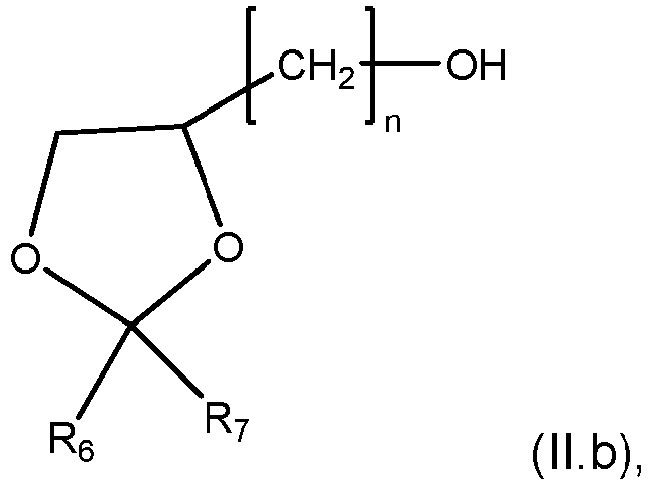
- In one embodiment the composition comprises, by weight of composition, greater than 40 pbw of NBPT (or NBPT in combination with DCD), the remainder being solvent or a mixture of solvents.
- In one embodiment the composition comprises, by weight of composition, greater than 35 pbw of NBPT (or NBPT in combination with DCD), the remainder being solvent or a mixture of solvents.
- In one embodiment the composition comprises, by weight of composition, greater than 45 pbw of DCD and/or NBPT, the remainder being solvent or a mixture of solvents. By way of example, in one embodiment, the fertilizer composition comprises, by weight of composition, 45 wt% of DCD and 55 wt% of a solvent blend of:
- (i) at least one dioxolane compound of formula (II.b) or formula (II.a), wherein R6 and R7 are as described above; and
- (ii) at least one amine stabilizer as described herein.
- In one embodiment the composition comprises, by weight of composition, greater than 55 pbw of DCD and/or NBPT, the remainder being solvent or a mixture of solvents.. By way of example, in one embodiment, the fertilizer composition comprises, by weight of composition, 55 wt% of DCD and 45 wt% of a solvent blend of:
- (i) at least one dioxolane compound of formula (II.b) or formula (II.a), wherein R6 and R7 are as described above; and
- (ii) at least one amine stabilizer as described herein.
- Referring to
FIG. 1 , Several amines or amides were tested to check if they can stabilize NBPT degradation at high temperatures (at greater than 45°C) in NBPT/DMSO formulation. Each sample was prepared with 2 wt% of amine stabilizer added. From visual observation, samples prepared with monoethanolamine showed better physical stability (less dark appearance), which is believed to be as a result of less formation of dimethyl sulfide (degradation product from solvent). - Referring to
FIG. 2 , the photograph shows the results from 10 weeks storage of 2% monoethanolamine in 1:1 NBPT:DMSO at two different temperatures, 45 °C and Room Temperature, "RT" (20 °C). - Referring to
FIG. 3 , it shows a chart of the degradation product, i.e., dimethyl sulfide (DMS) in parts per million (ppm), measured at varying high temperatures for a period of weeks. The results indicate the liquid fertilizer composition with the amine stabilizer exhibited higher stability over time versus a liquid fertilizer composition without the stabilizer.
Claims (15)
- A high temperature stable liquid agricultural composition comprising- at least one urease inhibitor;- at least one solvent selected from:(a) at least one dioxolane compound of formula (IIb):
 b) at least one dibasic ester;c) at least one compound of formula (III):
R3OOC-A-CONR4R5 (III),
wherein R3 comprises a C1-C36 alkyl group; wherein R4 and R5 individually comprise a C1-C36 alkyl group, wherein R4 and R5 can optionally together form a ring; and wherein A is a linear or a branched divalent C2-C6 alkyl group;d) at least one alkyldimethylamide;e) at least one alkyl lactate;f) ethyl levulinate;g) at least one alkyoxyalcohol, ether alcohol, amine alcohol, amino alcohol or alcohol;h) at least one glycerine or glycerine derivative;i) at least one alkylene carbonate; orj) dimethylsulfoxide; and- at least one amine stabilizer, wherein the amine stabilizer is a monoalkanolamine. - The liquid agricultural composition of claim 1 wherein the urease inhibitor is N-(n-butyl)-thiophosphoric triamide (NBPT).
- The liquid agricultural composition of claim 1 further comprising at least one nitrification inhibitor.
- The liquid agricultural composition of claim 1 wherein the amine stabilizer is monoethanolamine and optionally wherein the at least one solvent comprises at least one dioxolane compound of formula (II.b):

- The liquid agricultural composition of claim 1 wherein the composition comprises:- the at least one urease inhibitor;- dimethylsulfoxide; and- at least one amine stabilizer, wherein the amine stabilizer is a monoalkanolamine.
- The liquid agricultural composition of claim 1 wherein the at least one a urease inhibitor is present in an amount less than about 75 wt%, by total weight of composition, preferably in an amount less than about 65 wt%, by total weight of composition, more preferably in an amount less than about 60 wt%, by total weight of composition, even more preferably in an amount less than about 55 wt%, by total weight of composition, and most preferably in an amount less than about 50 wt%, by total weight of composition.
- The liquid agricultural composition of claim 1 wherein the amine stabilizer is present in an amount less than 3 wt% by weight of the liquid fertilizer composition.
- The liquid agricultural composition of claim 1 further comprising a second stabilizer of formula (I.a):

- A method of making a solid or concentrated liquid fertilizer composition comprising contacting one or more nitrogenous fertilizer compounds with a liquid inhibitor composition that comprises at least one of an alkyl thiophosphoric triamide or dicyandiamide, which is dissolved in a liquid medium comprising- at least one solvent selected from:(a) at least one dioxolane compound of formula (II.b):
 b) at least one dibasic ester;c) at least one compound of formula (III):
R3OOC-A-CONR4R5 (III),
wherein R3 comprises a C1-C36 alkyl group; wherein R4 and R5 individually comprise a C1-C36 alkyl group, wherein R4 and R5 can optionally together form a ring; and wherein A is a linear or a branched divalent C2-C6 alkyl group;d) at least one alkyldimethylamide;e) at least one alkyl lactate;f) ethyl levulinate;g) at least one alkyoxyalcohol, ether alcohol, amine alcohol, amino alcohol or alcohol;h) at least one glycerine or glycerine derivative;i) at least one alkylene carbonate; orj) dimethylsulfoxide; and- at least one amine stabilizer, wherein the amine stabilizer is a monoalkanolamine. - The method of claim 9 wherein the solvent comprises dimethylsulfoxide.
- The method of claim 9 wherein the solvent comprises:- at least one dioxolane compound of formula (II.b):
 - dimethylsulfoxide.
 - A method of stabilizing a liquid fertilizer composition at high temperatures comprising contacting- an amine stabilizer, wherein the amine stabilizer is a monoalkanolamine, with- a liquid inhibitor composition that comprises one or more nitrogenous fertilizer compounds and at least one of a dicyandiamide or an alkyl thiophosphoric triamide dissolved in a liquid medium comprising at least one solvent selected from:(a) at least one dioxolane compound of formula (II.b):
 b) at least one dibasic ester;c) at least one compound of formula (III):
R3OOC-A-CONR4R5 (III),
wherein R3 comprises a C1-C36 alkyl group; wherein R4 and R5 individually comprise a C1-C36 alkyl group, wherein R4 and R5 can optionally together form a ring; and wherein A is a linear or a branched divalent C2-C6 alkyl group;d) at least one alkyldimethylamide;e) at least one alkyl lactate;f) ethyl levulinate;g) at least one alkyoxyalcohol, ether alcohol, amine alcohol, amino alcohol or alcohol;h) at least one glycerine or glycerine derivative;i) at least one alkylene carbonate; orj) dimethylsulfoxide. - The method of claim 12 wherein the amine stabilizer is present in an amount less than 5% by weight of the liquid fertilizer composition, preferably in an amount less than 4% by weight of the liquid fertilizer composition, more preferably in an amount less than 3% be weight of the liquid fertilizer composition, even more preferably in an amount less than 2% be weight of the liquid fertilizer composition, and most preferably in an amount less than 1% be weight of the liquid fertilizer composition.
- A concentrated liquid fertilizer composition comprising, based on 100 parts by weight of the composition:(a) up to about 99 parts by weight of one or more nitrogenous fertilizer compounds,(b) at least one of an alkyl thiophosphoric triamide or a dicyandiamide,(c) at least one solvent selected from:(a) at least one dioxolane compound of formula (IIb):
 b) at least one dibasic ester;c) at least one compound of formula (III):
R3OOC-A-CONR4R5 (III),
wherein R3 comprises a C1-C36 alkyl group; wherein R4 and R5 individually comprise a C1-C36 alkyl group, wherein R4 and R5 can optionally together form a ring; and wherein A is a linear or a branched divalent C2-C6 alkyl group;d) at least one alkyldimethylamide;e) at least one alkyl lactate;f) ethyl levulinate;g) at least one alkyoxyalcohol, ether alcohol, amine alcohol, amino alcohol or alcohol;h) at least one glycerine or glycerine derivative;i) at least one alkylene carbonate; orj) dimethylsulfoxide; and(d) at least one amine stabilizer, wherein the amine stabilizer is a monoalkanolamine. - The concentrated liquid fertilizer composition of claim 14 wherein the (c) at least one solvent comprises:(a) at least one dioxolane compound of formula (II.b):
 b) at least one dibasic ester;c) at least one compound of formula (III):
R3OOC-A-CONR4R5 (III),
wherein R3 comprises a C1-C36 alkyl group; wherein R4 and R5 individually comprise a C1-C36 alkyl group, wherein R4 and R5 can optionally together form a ring; and wherein A is a linear or a branched divalent C2-C6 alkyl group;d) at least one alkyldimethylamide;e) at least one alkyl lactate;f) ethyl levulinate;g) at least one alkyoxyalcohol, ether alcohol, amine alcohol, amino alcohol or alcohol;h) at least one glycerine or glycerine derivative;i) at least one alkylene carbonate;j) dimethylsulfoxide; ork) any combination thereof;
preferably- at least one dioxolane compound of formula (II.b): j) dimethylsulfoxide;
or
dimethylsulfoxide.
Applications Claiming Priority (2)
| Application Number | Priority Date | Filing Date | Title |
|---|---|---|---|
| US201562205837P | 2015-08-17 | 2015-08-17 | |
| PCT/US2016/047310 WO2017031186A1 (en) | 2015-08-17 | 2016-08-17 | High temperature amine-stabilized dcd and/or alkyl thiophosphoric triamide solvent systems and use in agricultural applications |
Publications (3)
| Publication Number | Publication Date |
|---|---|
| EP3337774A1 EP3337774A1 (en) | 2018-06-27 |
| EP3337774A4 EP3337774A4 (en) | 2019-04-10 |
| EP3337774B1 true EP3337774B1 (en) | 2023-12-06 |
Family
ID=58050935
Family Applications (1)
| Application Number | Title | Priority Date | Filing Date |
|---|---|---|---|
| EP16837740.6A Active EP3337774B1 (en) | 2015-08-17 | 2016-08-17 | High temperature amine-stabilized dcd and/or alkyl thiophosphoric triamide solvent systems and use in agricultural applications |
Country Status (11)
| Country | Link |
|---|---|
| US (2) | US10435333B2 (en) |
| EP (1) | EP3337774B1 (en) |
| KR (1) | KR20180031771A (en) |
| CN (1) | CN108137426A (en) |
| AU (1) | AU2016308719B2 (en) |
| BR (1) | BR112018002904B1 (en) |
| CA (1) | CA2995831C (en) |
| ES (1) | ES2972612T3 (en) |
| HU (1) | HUE065506T2 (en) |
| PL (1) | PL3337774T3 (en) |
| WO (1) | WO2017031186A1 (en) |
Families Citing this family (15)
| Publication number | Priority date | Publication date | Assignee | Title |
|---|---|---|---|---|
| KR20180031771A (en) * | 2015-08-17 | 2018-03-28 | 로디아 오퍼레이션스 | High temperature amine-stabilized DCD and / or alkylthiophosphoric triamide solvent systems and their use in agricultural applications |
| WO2017176696A1 (en) * | 2016-04-04 | 2017-10-12 | Rhodia Operations | Alkyl thiophosphoric triamide and neem oil solvent systems for use in agricultural applications |
| EP3478647B1 (en) | 2016-06-29 | 2024-12-04 | Specialty Operations France | Stabilized dcd and/or alkyl thiophosphoric triamide solvent systems and use in agricultural applications |
| US11198655B2 (en) * | 2018-02-11 | 2021-12-14 | Gary David McKnight | Non-aqueous Organo Liquid Delivery Systems containing dispersed Organo Polycarboxylate Functionalities that improves efficiencies and properties of nitrogen sources |
| WO2019204163A1 (en) | 2018-04-20 | 2019-10-24 | Tessenderlo Kerley, Inc. | Liquid nitrogen fertilizer compositions and additives therefore |
| EP3575278A1 (en) * | 2018-05-31 | 2019-12-04 | Tessenderlo Kerley, Inc. | Liquid nitrogen fertilizer compositions and additives therefor |
| WO2020025474A1 (en) * | 2018-07-31 | 2020-02-06 | Rhodia Operations | Liquid agrochemical composition and methods of preparing and using the same |
| EP3626696A1 (en) * | 2018-09-19 | 2020-03-25 | Tessenderlo Kerley, Inc. | Compositions comprising solid thiosulfates, polysulfides and/or (bi)sulfites and methods for preparing same |
| EP3626697A1 (en) * | 2018-09-19 | 2020-03-25 | Tessenderlo Kerley, Inc. | Stabilized fertilizer compositions and methods for preparing same |
| CN110041140A (en) * | 2019-05-30 | 2019-07-23 | 湖北兴福电子材料有限公司 | A kind of nitrogenous compound fertilizer synergist and preparation method thereof |
| HRP20240103T1 (en) | 2020-01-15 | 2024-05-24 | Grupa Azoty S.A. | Liquid compositions containing n-(n-butyl)thiophosphoric triamide (nbpt) and their use as an additive to fertilisers containing amide nitrogen |
| CN111515215B (en) * | 2020-05-07 | 2021-10-29 | 甘肃金创绿丰环境技术有限公司 | A kind of harmless treatment method of n-butyl thiophosphoric triamide hazardous waste |
| US20230339826A1 (en) * | 2020-06-16 | 2023-10-26 | Verdesian Life Sciences U.S., Llc | Formulation system for compositions for enhancing nitrogen stabilizers |
| US11236026B1 (en) * | 2020-10-15 | 2022-02-01 | Rosen's, Inc. | Fertigation process |
| MX2024004120A (en) | 2021-10-04 | 2024-04-22 | Koch Agronomic Services Llc | AGRICULTURAL COMPOSITIONS AND METHODS FOR PREPARING AND USING THEM. |
Family Cites Families (57)
| Publication number | Priority date | Publication date | Assignee | Title |
|---|---|---|---|---|
| US3152039A (en) | 1960-11-23 | 1964-10-06 | Dow Chemical Co | Germicidal compositions |
| GB960109A (en) | 1961-02-02 | 1964-06-10 | Dow Chemical Co | Soil nitrification fertilizer compositions and process for making same |
| US3415908A (en) | 1964-05-07 | 1968-12-10 | Vnii Fitopatologii | Method of preparing trialkyl phosphates |
| US3353949A (en) | 1964-07-06 | 1967-11-21 | American Cyanamid Co | Method for preventing the segregation of mixed fertilizer |
| US3425819A (en) | 1965-05-24 | 1969-02-04 | Int Minerals & Chem Corp | Method of preparing a complex fertilizer comprising urea coated with ammonium phosphate |
| US3986859A (en) | 1970-02-06 | 1976-10-19 | Societe Nationale Des Petroles D'aquitaine | Synergic compositions for the curative treatment of plant deficiencies |
| US4480692A (en) | 1982-10-27 | 1984-11-06 | Phillips Petroleum Company | Phosphorus containing ester cosurfactants in enhanced oil recovery processes |
| US4530714A (en) | 1983-03-16 | 1985-07-23 | Allied Corporation | N-aliphatic and N,N-aliphatic phosphoric triamide urease inhibitors and urease inhibited urea based fertilizer compositions |
| US5435821A (en) | 1985-12-12 | 1995-07-25 | Exxon Research & Engineering Co. | Controlled release vegetation enhancement agents coated with sulfonated polymers, method of production and prcesses of use |
| JP2634657B2 (en) | 1987-02-26 | 1997-07-30 | マサチユセツツ・インスチチユート・オブ・テクノロジー | Method for producing hydroxamic acid polymer from primary amide polymer |
| HU207197B (en) | 1987-07-16 | 1993-03-29 | Chinoin Gyogyszer Es Vegyeszet | Plant protecting solution and aquous suspension containing water insoluble active component |
| US5024689A (en) | 1988-02-08 | 1991-06-18 | Freeport Mcmoran Resource Partners | Nitrogen fertilizer |
| US5160528A (en) | 1989-12-11 | 1992-11-03 | Isp Investments Inc. | Delivery system for agricultural chemicals |
| US5071463A (en) | 1989-12-11 | 1991-12-10 | Isp Investments Inc. | Delivery system for agricultural chemicals |
| US5352265A (en) | 1993-11-12 | 1994-10-04 | Freeport-Mcmoran Resource Partners, Limited Partnership | Granular urea-based fertilizer |
| US5364438A (en) | 1993-11-12 | 1994-11-15 | Freeport-Mcmoran Resource Partners, Limited Partnership | Fluid urea-containing fertilizer |
| US5698003A (en) | 1995-12-19 | 1997-12-16 | Imc-Agrico Company | Formulation for fertilizer additive concentrate |
| US5770771A (en) | 1997-01-21 | 1998-06-23 | Albemarle Corporation | Preparation of N-hydrocarbylthiophosphoric triamides |
| US5883297A (en) | 1997-01-21 | 1999-03-16 | Albemarle Corporation | Preparation and recovery of N-hydrocarbylthiophosphoric triamides or N-hydrocarbylphosphoric triamides |
| NZ511606A (en) | 2001-05-09 | 2002-11-26 | Summit Quinphos Nz Ltd | Fertiliser compositions comprising urea granules coated with wet ground sulphur |
| CN1184173C (en) | 2001-11-07 | 2005-01-12 | 中国科学院沈阳应用生态研究所 | Release controlling fertilizer and its prepn |
| US6825151B2 (en) | 2002-01-30 | 2004-11-30 | Nufarm Americas Inc. | Liquid herbicidal compositions and use thereof in a granular herbicide |
| US6830603B2 (en) | 2002-08-07 | 2004-12-14 | Whitehurst Associates, Inc. | Volatility-inhibited urea fertilizers |
| US7494525B2 (en) | 2005-02-22 | 2009-02-24 | Tessenderlo Kerley, Inc. | Calcium polysulfide, potassium polysulfide, calcium thiosulfate, and magnesium thiosulfate as urease inhibitors |
| US8138106B2 (en) | 2005-09-30 | 2012-03-20 | Rayonier Trs Holdings Inc. | Cellulosic fibers with odor control characteristics |
| BRPI0707108A2 (en) | 2006-01-12 | 2011-04-19 | Agrotain International L L C | fluid fertilizer composition, dry runoff additive, and method of preparation of a dry runoff additive |
| EP1820788A1 (en) | 2006-02-16 | 2007-08-22 | BASF Aktiengesellschaft | Preparations with improved urease-inhibiting properties and those preparations containing urea based fertilizers. |
| WO2008002503A2 (en) | 2006-06-23 | 2008-01-03 | Agrotain International, L.L.C. | Solid urea fertilizer |
| CZ301509B6 (en) | 2006-06-28 | 2010-03-31 | Agra Group, A. S. | Solvent system for preparing solutions of thiophosphoric acid N-alkyl triamides, compositions containing thiophosphoric acid N-alkyl triamides and use thereof |
| CN101108781B (en) | 2006-07-21 | 2011-03-23 | 中国科学院沈阳应用生态研究所 | Slow release, long-acting urea manure and technique of manufacturing the same |
| CN101200400B (en) | 2006-12-15 | 2012-01-04 | 中国科学院沈阳应用生态研究所 | Acetic ester coated controlled-release urea fertilizer and preparation technique |
| US20110105333A1 (en) | 2007-08-16 | 2011-05-05 | Rafel Israels | Seed Treatment Compositions and Methods |
| DE102007062614C5 (en) | 2007-12-22 | 2019-03-14 | Eurochem Agro Gmbh | Mixture for the treatment of urea-containing fertilizers, uses of the mixture and urea-containing fertilizer containing the mixture |
| FR2925826B1 (en) | 2007-12-31 | 2010-01-29 | Agrofinance Internationale | UREASE AND NITRIFICATION INHIBITOR COMPOSITION |
| CN101328097B (en) | 2008-06-20 | 2012-03-07 | 钟成虎 | Compound film controlled release fertilizer and organic polymer coating material thereof |
| US20120148752A1 (en) | 2008-09-12 | 2012-06-14 | Albemarle Corporation | Process for coating an active ingredient with a urea-formaldehyde polymer |
| CN101723752A (en) | 2008-10-17 | 2010-06-09 | 中国科学院沈阳应用生态研究所 | Biodegradable coated compound fertilizer and preparation method thereof |
| CZ302400B6 (en) | 2008-10-20 | 2011-05-04 | Agra Group, A.S. | Process for preparing N-(hydrocarbyl)triamides of phosphoric or thiophosphoric acid |
| CZ2008842A3 (en) | 2008-12-23 | 2010-06-30 | Agra Group, A. S. | Liquid composition ontaining derivative of phosphoric or thiophosphoric acid thiamide and use thereof |
| US20100206031A1 (en) | 2009-02-17 | 2010-08-19 | Whitehurst Associates, Inc. | Amino alcohol solutions of N-(n-butyl)thiophosphoric triamide (NBPT) and urea fertilizers using such solutions as urease inhibitors |
| US8048189B2 (en) | 2009-02-17 | 2011-11-01 | Whitehurst Associates Inc. | Buffered amino alcohol solutions of N-(n-butyl)thiophosphoric triamide (NBPT) and urea fertilizers using such solutions as urease inhibitors |
| EP2266400A1 (en) | 2009-06-15 | 2010-12-29 | Nufarm | NMP-free formulations of neonicotinoids |
| AU2013202217B2 (en) * | 2011-11-14 | 2014-09-25 | Incitec Fertilisers Operations Pty Ltd | Urease inhibitor formulations |
| US10173935B2 (en) | 2011-12-12 | 2019-01-08 | Rhodia Operations | Solvent systems of N-alkyl thiophosphoric triamides and methods of use in agricultural applications |
| WO2013123229A1 (en) | 2012-02-14 | 2013-08-22 | Albemarle Corporation | A process for producing a powder comprising an extruded carrier with an active compound |
| CN102746073A (en) | 2012-07-25 | 2012-10-24 | 武秀英 | Nitrogen stabilizing agent and application thereof |
| US20140037570A1 (en) | 2012-08-02 | 2014-02-06 | Whitehurst Associates Inc. | NBPT solution for preparing urease inhibited urea fertilizers prepared from N-alkyl; N, N-alkyl; and N-alkyl-N-alkoxy amino alcohols |
| CA2881465C (en) | 2012-08-15 | 2021-01-05 | Koch Agronomic Services, Llc | Compositions of substantially spherical particles and methods of making thereof |
| US9090516B2 (en) | 2012-08-16 | 2015-07-28 | Helena Holding Company | Solvent free N-alkyl thiosphoric triamide formulations for use in the stabilization of nitrogen fertilizer |
| WO2014036278A1 (en) * | 2012-08-31 | 2014-03-06 | Helena Holding Company | Stabilized n-alkyl thiosphoric triamide solvent systems for use in nitrogen fertilizer |
| US9732008B2 (en) | 2012-10-01 | 2017-08-15 | Gary David McKnight | Liquid formulations of urease inhibitors for fertilizers |
| CN105209407A (en) * | 2012-12-20 | 2015-12-30 | 罗地亚经营管理公司 | Liquid dicyandiamide and/or alkyl thiophosphoric triamide compositions and their use in agricultural applications |
| WO2015001457A2 (en) | 2013-07-04 | 2015-01-08 | Basf Se | Compositions with improved urease-inhibiting effect comprising (thio)phosphoric acid triamide and further compounds |
| CA2931450C (en) | 2013-11-26 | 2020-04-14 | Gary David Mcknight | Nitrification inhibitors designed for urea and manure based fertilizers |
| US10196322B2 (en) * | 2014-10-21 | 2019-02-05 | Rhodia Operations | Solvent systems for dicyandiamide and/or alkyl thiophosphoric triamide and use in agricultural applications |
| CN104671999B (en) | 2015-02-02 | 2017-07-14 | 济南大学 | A kind of enhanced slow-release fertilizer for concrete for plant growth |
| KR20180031771A (en) * | 2015-08-17 | 2018-03-28 | 로디아 오퍼레이션스 | High temperature amine-stabilized DCD and / or alkylthiophosphoric triamide solvent systems and their use in agricultural applications |
-
2016
- 2016-08-17 KR KR1020187005701A patent/KR20180031771A/en not_active Withdrawn
- 2016-08-17 CA CA2995831A patent/CA2995831C/en active Active
- 2016-08-17 CN CN201680060782.5A patent/CN108137426A/en active Pending
- 2016-08-17 PL PL16837740.6T patent/PL3337774T3/en unknown
- 2016-08-17 HU HUE16837740A patent/HUE065506T2/en unknown
- 2016-08-17 AU AU2016308719A patent/AU2016308719B2/en active Active
- 2016-08-17 WO PCT/US2016/047310 patent/WO2017031186A1/en not_active Ceased
- 2016-08-17 BR BR112018002904-1A patent/BR112018002904B1/en active IP Right Grant
- 2016-08-17 ES ES16837740T patent/ES2972612T3/en active Active
- 2016-08-17 US US15/239,215 patent/US10435333B2/en active Active
- 2016-08-17 EP EP16837740.6A patent/EP3337774B1/en active Active
-
2019
- 2019-08-07 US US16/534,473 patent/US10934228B2/en active Active
Also Published As
| Publication number | Publication date |
|---|---|
| AU2016308719A1 (en) | 2018-03-01 |
| US10934228B2 (en) | 2021-03-02 |
| CA2995831A1 (en) | 2017-02-23 |
| EP3337774A4 (en) | 2019-04-10 |
| HUE065506T2 (en) | 2024-05-28 |
| PL3337774T3 (en) | 2024-04-29 |
| BR112018002904A2 (en) | 2018-09-18 |
| US20190359539A1 (en) | 2019-11-28 |
| US20170050895A1 (en) | 2017-02-23 |
| CA2995831C (en) | 2024-05-28 |
| EP3337774A1 (en) | 2018-06-27 |
| KR20180031771A (en) | 2018-03-28 |
| AU2016308719B2 (en) | 2021-01-21 |
| ES2972612T3 (en) | 2024-06-13 |
| BR112018002904B1 (en) | 2023-04-11 |
| WO2017031186A1 (en) | 2017-02-23 |
| US10435333B2 (en) | 2019-10-08 |
| CN108137426A (en) | 2018-06-08 |
Similar Documents
| Publication | Publication Date | Title |
|---|---|---|
| US10934228B2 (en) | High temperature amine-stabilized DCD and/or alkyl thiophosphoric triamide solvent systems and use in agricultural applications | |
| EP2935159B1 (en) | Liquid dicyandiamide and/or alkyl thiophosphoric triamide compositions and their use in agricultural applications | |
| US11214527B2 (en) | Solvent systems for dicyandiamide and/or alkyl thiophosphoric triamide and use in agricultural applications | |
| EP3478647B1 (en) | Stabilized dcd and/or alkyl thiophosphoric triamide solvent systems and use in agricultural applications | |
| WO2021013582A1 (en) | Liquid dicyandiamide and/or alkyl thiophosphoric triamide compositions and their use in agricultural applications |
Legal Events
| Date | Code | Title | Description |
|---|---|---|---|
| STAA | Information on the status of an ep patent application or granted ep patent |
Free format text: STATUS: THE INTERNATIONAL PUBLICATION HAS BEEN MADE |
|
| PUAI | Public reference made under article 153(3) epc to a published international application that has entered the european phase |
Free format text: ORIGINAL CODE: 0009012 |
|
| STAA | Information on the status of an ep patent application or granted ep patent |
Free format text: STATUS: REQUEST FOR EXAMINATION WAS MADE |
|
| 17P | Request for examination filed |
Effective date: 20180319 |
|
| AK | Designated contracting states |
Kind code of ref document: A1 Designated state(s): AL AT BE BG CH CY CZ DE DK EE ES FI FR GB GR HR HU IE IS IT LI LT LU LV MC MK MT NL NO PL PT RO RS SE SI SK SM TR |
|
| AX | Request for extension of the european patent |
Extension state: BA ME |
|
| DAV | Request for validation of the european patent (deleted) | ||
| DAX | Request for extension of the european patent (deleted) | ||
| A4 | Supplementary search report drawn up and despatched |
Effective date: 20190313 |
|
| RIC1 | Information provided on ipc code assigned before grant |
Ipc: C05C 9/00 20060101ALI20190306BHEP Ipc: C05G 3/00 20060101ALI20190306BHEP Ipc: C05B 15/00 20060101AFI20190306BHEP Ipc: C05G 3/08 20060101ALI20190306BHEP |
|
| RAP1 | Party data changed (applicant data changed or rights of an application transferred) |
Owner name: RHODIA OPERATIONS |
|
| STAA | Information on the status of an ep patent application or granted ep patent |
Free format text: STATUS: EXAMINATION IS IN PROGRESS |
|
| 17Q | First examination report despatched |
Effective date: 20210702 |
|
| RAP3 | Party data changed (applicant data changed or rights of an application transferred) |
Owner name: RHODIA OPERATIONS |
|
| REG | Reference to a national code |
Ref country code: DE Free format text: PREVIOUS MAIN CLASS: C05B0015000000 Ref country code: DE Ref legal event code: R079 Ref document number: 602016084614 Country of ref document: DE Free format text: PREVIOUS MAIN CLASS: C05B0015000000 Ipc: C05G0003900000 |
|
| GRAP | Despatch of communication of intention to grant a patent |
Free format text: ORIGINAL CODE: EPIDOSNIGR1 |
|
| STAA | Information on the status of an ep patent application or granted ep patent |
Free format text: STATUS: GRANT OF PATENT IS INTENDED |
|
| RIC1 | Information provided on ipc code assigned before grant |
Ipc: C05G 5/20 20200101ALI20230428BHEP Ipc: C05C 9/00 20060101ALI20230428BHEP Ipc: C05C 11/00 20060101ALI20230428BHEP Ipc: C05G 3/00 20060101ALI20230428BHEP Ipc: C05B 15/00 20060101ALI20230428BHEP Ipc: C05G 3/90 20200101AFI20230428BHEP |
|
| INTG | Intention to grant announced |
Effective date: 20230517 |
|
| P01 | Opt-out of the competence of the unified patent court (upc) registered |
Effective date: 20230809 |
|
| GRAJ | Information related to disapproval of communication of intention to grant by the applicant or resumption of examination proceedings by the epo deleted |
Free format text: ORIGINAL CODE: EPIDOSDIGR1 |
|
| STAA | Information on the status of an ep patent application or granted ep patent |
Free format text: STATUS: EXAMINATION IS IN PROGRESS |
|
| RAP1 | Party data changed (applicant data changed or rights of an application transferred) |
Owner name: SPECIALTY OPERATIONS FRANCE |
|
| GRAP | Despatch of communication of intention to grant a patent |
Free format text: ORIGINAL CODE: EPIDOSNIGR1 |
|
| STAA | Information on the status of an ep patent application or granted ep patent |
Free format text: STATUS: GRANT OF PATENT IS INTENDED |
|
| GRAS | Grant fee paid |
Free format text: ORIGINAL CODE: EPIDOSNIGR3 |
|
| INTC | Intention to grant announced (deleted) | ||
| GRAA | (expected) grant |
Free format text: ORIGINAL CODE: 0009210 |
|
| STAA | Information on the status of an ep patent application or granted ep patent |
Free format text: STATUS: THE PATENT HAS BEEN GRANTED |
|
| INTG | Intention to grant announced |
Effective date: 20231023 |
|
| AK | Designated contracting states |
Kind code of ref document: B1 Designated state(s): AL AT BE BG CH CY CZ DE DK EE ES FI FR GB GR HR HU IE IS IT LI LT LU LV MC MK MT NL NO PL PT RO RS SE SI SK SM TR |
|
| REG | Reference to a national code |
Ref country code: GB Ref legal event code: FG4D |
|
| REG | Reference to a national code |
Ref country code: DE Ref legal event code: R096 Ref document number: 602016084614 Country of ref document: DE |
|
| REG | Reference to a national code |
Ref country code: CH Ref legal event code: EP |
|
| REG | Reference to a national code |
Ref country code: IE Ref legal event code: FG4D |
|
| REG | Reference to a national code |
Ref country code: NL Ref legal event code: FP |
|
| REG | Reference to a national code |
Ref country code: LT Ref legal event code: MG9D |
|
| PG25 | Lapsed in a contracting state [announced via postgrant information from national office to epo] |
Ref country code: GR Free format text: LAPSE BECAUSE OF FAILURE TO SUBMIT A TRANSLATION OF THE DESCRIPTION OR TO PAY THE FEE WITHIN THE PRESCRIBED TIME-LIMIT Effective date: 20240307 |
|
| PG25 | Lapsed in a contracting state [announced via postgrant information from national office to epo] |
Ref country code: LT Free format text: LAPSE BECAUSE OF FAILURE TO SUBMIT A TRANSLATION OF THE DESCRIPTION OR TO PAY THE FEE WITHIN THE PRESCRIBED TIME-LIMIT Effective date: 20231206 |
|
| PG25 | Lapsed in a contracting state [announced via postgrant information from national office to epo] |
Ref country code: LT Free format text: LAPSE BECAUSE OF FAILURE TO SUBMIT A TRANSLATION OF THE DESCRIPTION OR TO PAY THE FEE WITHIN THE PRESCRIBED TIME-LIMIT Effective date: 20231206 Ref country code: GR Free format text: LAPSE BECAUSE OF FAILURE TO SUBMIT A TRANSLATION OF THE DESCRIPTION OR TO PAY THE FEE WITHIN THE PRESCRIBED TIME-LIMIT Effective date: 20240307 Ref country code: BG Free format text: LAPSE BECAUSE OF FAILURE TO SUBMIT A TRANSLATION OF THE DESCRIPTION OR TO PAY THE FEE WITHIN THE PRESCRIBED TIME-LIMIT Effective date: 20240306 |
|
| REG | Reference to a national code |
Ref country code: AT Ref legal event code: MK05 Ref document number: 1638270 Country of ref document: AT Kind code of ref document: T Effective date: 20231206 |
|
| REG | Reference to a national code |
Ref country code: HU Ref legal event code: AG4A Ref document number: E065506 Country of ref document: HU |
|
| PG25 | Lapsed in a contracting state [announced via postgrant information from national office to epo] |
Ref country code: SE Free format text: LAPSE BECAUSE OF FAILURE TO SUBMIT A TRANSLATION OF THE DESCRIPTION OR TO PAY THE FEE WITHIN THE PRESCRIBED TIME-LIMIT Effective date: 20231206 Ref country code: RS Free format text: LAPSE BECAUSE OF FAILURE TO SUBMIT A TRANSLATION OF THE DESCRIPTION OR TO PAY THE FEE WITHIN THE PRESCRIBED TIME-LIMIT Effective date: 20231206 Ref country code: NO Free format text: LAPSE BECAUSE OF FAILURE TO SUBMIT A TRANSLATION OF THE DESCRIPTION OR TO PAY THE FEE WITHIN THE PRESCRIBED TIME-LIMIT Effective date: 20240306 Ref country code: LV Free format text: LAPSE BECAUSE OF FAILURE TO SUBMIT A TRANSLATION OF THE DESCRIPTION OR TO PAY THE FEE WITHIN THE PRESCRIBED TIME-LIMIT Effective date: 20231206 Ref country code: HR Free format text: LAPSE BECAUSE OF FAILURE TO SUBMIT A TRANSLATION OF THE DESCRIPTION OR TO PAY THE FEE WITHIN THE PRESCRIBED TIME-LIMIT Effective date: 20231206 |
|
| REG | Reference to a national code |
Ref country code: ES Ref legal event code: FG2A Ref document number: 2972612 Country of ref document: ES Kind code of ref document: T3 Effective date: 20240613 |
|
| PG25 | Lapsed in a contracting state [announced via postgrant information from national office to epo] |
Ref country code: IS Free format text: LAPSE BECAUSE OF FAILURE TO SUBMIT A TRANSLATION OF THE DESCRIPTION OR TO PAY THE FEE WITHIN THE PRESCRIBED TIME-LIMIT Effective date: 20240406 |
|
| PG25 | Lapsed in a contracting state [announced via postgrant information from national office to epo] |
Ref country code: CZ Free format text: LAPSE BECAUSE OF FAILURE TO SUBMIT A TRANSLATION OF THE DESCRIPTION OR TO PAY THE FEE WITHIN THE PRESCRIBED TIME-LIMIT Effective date: 20231206 Ref country code: AT Free format text: LAPSE BECAUSE OF FAILURE TO SUBMIT A TRANSLATION OF THE DESCRIPTION OR TO PAY THE FEE WITHIN THE PRESCRIBED TIME-LIMIT Effective date: 20231206 |
|
| PG25 | Lapsed in a contracting state [announced via postgrant information from national office to epo] |
Ref country code: SK Free format text: LAPSE BECAUSE OF FAILURE TO SUBMIT A TRANSLATION OF THE DESCRIPTION OR TO PAY THE FEE WITHIN THE PRESCRIBED TIME-LIMIT Effective date: 20231206 |
|
| PG25 | Lapsed in a contracting state [announced via postgrant information from national office to epo] |
Ref country code: SM Free format text: LAPSE BECAUSE OF FAILURE TO SUBMIT A TRANSLATION OF THE DESCRIPTION OR TO PAY THE FEE WITHIN THE PRESCRIBED TIME-LIMIT Effective date: 20231206 Ref country code: SK Free format text: LAPSE BECAUSE OF FAILURE TO SUBMIT A TRANSLATION OF THE DESCRIPTION OR TO PAY THE FEE WITHIN THE PRESCRIBED TIME-LIMIT Effective date: 20231206 Ref country code: RO Free format text: LAPSE BECAUSE OF FAILURE TO SUBMIT A TRANSLATION OF THE DESCRIPTION OR TO PAY THE FEE WITHIN THE PRESCRIBED TIME-LIMIT Effective date: 20231206 Ref country code: IS Free format text: LAPSE BECAUSE OF FAILURE TO SUBMIT A TRANSLATION OF THE DESCRIPTION OR TO PAY THE FEE WITHIN THE PRESCRIBED TIME-LIMIT Effective date: 20240406 Ref country code: EE Free format text: LAPSE BECAUSE OF FAILURE TO SUBMIT A TRANSLATION OF THE DESCRIPTION OR TO PAY THE FEE WITHIN THE PRESCRIBED TIME-LIMIT Effective date: 20231206 Ref country code: CZ Free format text: LAPSE BECAUSE OF FAILURE TO SUBMIT A TRANSLATION OF THE DESCRIPTION OR TO PAY THE FEE WITHIN THE PRESCRIBED TIME-LIMIT Effective date: 20231206 Ref country code: AT Free format text: LAPSE BECAUSE OF FAILURE TO SUBMIT A TRANSLATION OF THE DESCRIPTION OR TO PAY THE FEE WITHIN THE PRESCRIBED TIME-LIMIT Effective date: 20231206 |
|
| PG25 | Lapsed in a contracting state [announced via postgrant information from national office to epo] |
Ref country code: PT Free format text: LAPSE BECAUSE OF FAILURE TO SUBMIT A TRANSLATION OF THE DESCRIPTION OR TO PAY THE FEE WITHIN THE PRESCRIBED TIME-LIMIT Effective date: 20240408 |
|
| PG25 | Lapsed in a contracting state [announced via postgrant information from national office to epo] |
Ref country code: PT Free format text: LAPSE BECAUSE OF FAILURE TO SUBMIT A TRANSLATION OF THE DESCRIPTION OR TO PAY THE FEE WITHIN THE PRESCRIBED TIME-LIMIT Effective date: 20240408 |
|
| REG | Reference to a national code |
Ref country code: DE Ref legal event code: R097 Ref document number: 602016084614 Country of ref document: DE |
|
| PG25 | Lapsed in a contracting state [announced via postgrant information from national office to epo] |
Ref country code: DK Free format text: LAPSE BECAUSE OF FAILURE TO SUBMIT A TRANSLATION OF THE DESCRIPTION OR TO PAY THE FEE WITHIN THE PRESCRIBED TIME-LIMIT Effective date: 20231206 |
|
| PLBE | No opposition filed within time limit |
Free format text: ORIGINAL CODE: 0009261 |
|
| STAA | Information on the status of an ep patent application or granted ep patent |
Free format text: STATUS: NO OPPOSITION FILED WITHIN TIME LIMIT |
|
| PG25 | Lapsed in a contracting state [announced via postgrant information from national office to epo] |
Ref country code: SI Free format text: LAPSE BECAUSE OF FAILURE TO SUBMIT A TRANSLATION OF THE DESCRIPTION OR TO PAY THE FEE WITHIN THE PRESCRIBED TIME-LIMIT Effective date: 20231206 |
|
| PG25 | Lapsed in a contracting state [announced via postgrant information from national office to epo] |
Ref country code: SI Free format text: LAPSE BECAUSE OF FAILURE TO SUBMIT A TRANSLATION OF THE DESCRIPTION OR TO PAY THE FEE WITHIN THE PRESCRIBED TIME-LIMIT Effective date: 20231206 Ref country code: DK Free format text: LAPSE BECAUSE OF FAILURE TO SUBMIT A TRANSLATION OF THE DESCRIPTION OR TO PAY THE FEE WITHIN THE PRESCRIBED TIME-LIMIT Effective date: 20231206 |
|
| 26N | No opposition filed |
Effective date: 20240909 |
|
| REG | Reference to a national code |
Ref country code: CH Ref legal event code: PL |
|
| PG25 | Lapsed in a contracting state [announced via postgrant information from national office to epo] |
Ref country code: LU Free format text: LAPSE BECAUSE OF NON-PAYMENT OF DUE FEES Effective date: 20240817 |
|
| PG25 | Lapsed in a contracting state [announced via postgrant information from national office to epo] |
Ref country code: MC Free format text: LAPSE BECAUSE OF FAILURE TO SUBMIT A TRANSLATION OF THE DESCRIPTION OR TO PAY THE FEE WITHIN THE PRESCRIBED TIME-LIMIT Effective date: 20231206 Ref country code: CH Free format text: LAPSE BECAUSE OF NON-PAYMENT OF DUE FEES Effective date: 20240831 |
|
| PG25 | Lapsed in a contracting state [announced via postgrant information from national office to epo] |
Ref country code: IE Free format text: LAPSE BECAUSE OF NON-PAYMENT OF DUE FEES Effective date: 20240817 |
|
| PGFP | Annual fee paid to national office [announced via postgrant information from national office to epo] |
Ref country code: NL Payment date: 20250704 Year of fee payment: 10 |
|
| PGFP | Annual fee paid to national office [announced via postgrant information from national office to epo] |
Ref country code: HU Payment date: 20250728 Year of fee payment: 10 |
|
| PG25 | Lapsed in a contracting state [announced via postgrant information from national office to epo] |
Ref country code: FI Free format text: LAPSE BECAUSE OF FAILURE TO SUBMIT A TRANSLATION OF THE DESCRIPTION OR TO PAY THE FEE WITHIN THE PRESCRIBED TIME-LIMIT Effective date: 20231207 |
|
| PGFP | Annual fee paid to national office [announced via postgrant information from national office to epo] |
Ref country code: ES Payment date: 20250901 Year of fee payment: 10 |
|
| PGFP | Annual fee paid to national office [announced via postgrant information from national office to epo] |
Ref country code: DE Payment date: 20250702 Year of fee payment: 10 |
|
| PGFP | Annual fee paid to national office [announced via postgrant information from national office to epo] |
Ref country code: TR Payment date: 20250801 Year of fee payment: 10 Ref country code: PL Payment date: 20250714 Year of fee payment: 10 Ref country code: IT Payment date: 20250722 Year of fee payment: 10 |
|
| PGFP | Annual fee paid to national office [announced via postgrant information from national office to epo] |
Ref country code: BE Payment date: 20250703 Year of fee payment: 10 Ref country code: GB Payment date: 20250703 Year of fee payment: 10 |
|
| PGFP | Annual fee paid to national office [announced via postgrant information from national office to epo] |
Ref country code: FR Payment date: 20250703 Year of fee payment: 10 |
|
| PG25 | Lapsed in a contracting state [announced via postgrant information from national office to epo] |
Ref country code: CY Free format text: LAPSE BECAUSE OF FAILURE TO SUBMIT A TRANSLATION OF THE DESCRIPTION OR TO PAY THE FEE WITHIN THE PRESCRIBED TIME-LIMIT; INVALID AB INITIO Effective date: 20160817 |