EP3333337B1 - Elektrochromische struktur von zementösem material und verfahren zu ihrer produktion - Google Patents
Elektrochromische struktur von zementösem material und verfahren zu ihrer produktion Download PDFInfo
- Publication number
- EP3333337B1 EP3333337B1 EP16767013.2A EP16767013A EP3333337B1 EP 3333337 B1 EP3333337 B1 EP 3333337B1 EP 16767013 A EP16767013 A EP 16767013A EP 3333337 B1 EP3333337 B1 EP 3333337B1
- Authority
- EP
- European Patent Office
- Prior art keywords
- electrochromic
- cementitious material
- electrically conductive
- cavity
- electroactive
- Prior art date
- Legal status (The legal status is an assumption and is not a legal conclusion. Google has not performed a legal analysis and makes no representation as to the accuracy of the status listed.)
- Active
Links
Images
Classifications
-
- E—FIXED CONSTRUCTIONS
- E04—BUILDING
- E04F—FINISHING WORK ON BUILDINGS, e.g. STAIRS, FLOORS
- E04F13/00—Coverings or linings, e.g. for walls or ceilings
- E04F13/07—Coverings or linings, e.g. for walls or ceilings composed of covering or lining elements; Sub-structures therefor; Fastening means therefor
- E04F13/08—Coverings or linings, e.g. for walls or ceilings composed of covering or lining elements; Sub-structures therefor; Fastening means therefor composed of a plurality of similar covering or lining elements
- E04F13/14—Coverings or linings, e.g. for walls or ceilings composed of covering or lining elements; Sub-structures therefor; Fastening means therefor composed of a plurality of similar covering or lining elements stone or stone-like materials, e.g. ceramics concrete; of glass or with an outer layer of stone or stone-like materials or glass
- E04F13/141—Coverings or linings, e.g. for walls or ceilings composed of covering or lining elements; Sub-structures therefor; Fastening means therefor composed of a plurality of similar covering or lining elements stone or stone-like materials, e.g. ceramics concrete; of glass or with an outer layer of stone or stone-like materials or glass with an outer layer of concrete
-
- C—CHEMISTRY; METALLURGY
- C04—CEMENTS; CONCRETE; ARTIFICIAL STONE; CERAMICS; REFRACTORIES
- C04B—LIME, MAGNESIA; SLAG; CEMENTS; COMPOSITIONS THEREOF, e.g. MORTARS, CONCRETE OR LIKE BUILDING MATERIALS; ARTIFICIAL STONE; CERAMICS; REFRACTORIES; TREATMENT OF NATURAL STONE
- C04B28/00—Compositions of mortars, concrete or artificial stone, containing inorganic binders or the reaction product of an inorganic and an organic binder, e.g. polycarboxylate cements
- C04B28/02—Compositions of mortars, concrete or artificial stone, containing inorganic binders or the reaction product of an inorganic and an organic binder, e.g. polycarboxylate cements containing hydraulic cements other than calcium sulfates
-
- G—PHYSICS
- G02—OPTICS
- G02F—OPTICAL DEVICES OR ARRANGEMENTS FOR THE CONTROL OF LIGHT BY MODIFICATION OF THE OPTICAL PROPERTIES OF THE MEDIA OF THE ELEMENTS INVOLVED THEREIN; NON-LINEAR OPTICS; FREQUENCY-CHANGING OF LIGHT; OPTICAL LOGIC ELEMENTS; OPTICAL ANALOGUE/DIGITAL CONVERTERS
- G02F1/00—Devices or arrangements for the control of the intensity, colour, phase, polarisation or direction of light arriving from an independent light source, e.g. switching, gating or modulating; Non-linear optics
- G02F1/01—Devices or arrangements for the control of the intensity, colour, phase, polarisation or direction of light arriving from an independent light source, e.g. switching, gating or modulating; Non-linear optics for the control of the intensity, phase, polarisation or colour
- G02F1/15—Devices or arrangements for the control of the intensity, colour, phase, polarisation or direction of light arriving from an independent light source, e.g. switching, gating or modulating; Non-linear optics for the control of the intensity, phase, polarisation or colour based on an electrochromic effect
-
- C—CHEMISTRY; METALLURGY
- C04—CEMENTS; CONCRETE; ARTIFICIAL STONE; CERAMICS; REFRACTORIES
- C04B—LIME, MAGNESIA; SLAG; CEMENTS; COMPOSITIONS THEREOF, e.g. MORTARS, CONCRETE OR LIKE BUILDING MATERIALS; ARTIFICIAL STONE; CERAMICS; REFRACTORIES; TREATMENT OF NATURAL STONE
- C04B2111/00—Mortars, concrete or artificial stone or mixtures to prepare them, characterised by specific function, property or use
- C04B2111/00474—Uses not provided for elsewhere in C04B2111/00
- C04B2111/00482—Coating or impregnation materials
-
- C—CHEMISTRY; METALLURGY
- C04—CEMENTS; CONCRETE; ARTIFICIAL STONE; CERAMICS; REFRACTORIES
- C04B—LIME, MAGNESIA; SLAG; CEMENTS; COMPOSITIONS THEREOF, e.g. MORTARS, CONCRETE OR LIKE BUILDING MATERIALS; ARTIFICIAL STONE; CERAMICS; REFRACTORIES; TREATMENT OF NATURAL STONE
- C04B2111/00—Mortars, concrete or artificial stone or mixtures to prepare them, characterised by specific function, property or use
- C04B2111/80—Optical properties, e.g. transparency or reflexibility
- C04B2111/82—Coloured materials
Definitions
- the present invention is in the field of chemistry and of cementitious materials, such as cement or concrete, with application in the sectors of construction, coating of surfaces such as floors, walls and ceilings, decoration and furniture.
- the present invention is concerned with a structure of cementitious material having color change capability, by means of electrochromic technology, as well as with its method of production.
- cementitious materials are a material comprising a mixture of cement, aggregates and water. In addition to these basic components, it may also contain various additives.
- concrete goes through two different states: fresh concrete and hardened concrete.
- the first is defined as concrete still in the plastic state and able to be compressed by methods considered conventional ones.
- the second is defined as concrete that has hardened and developed a certain resistance. Concrete hardening begins within hours after its manufacture and reaches 60 to 90% of its final strength after 28 days of curing, depending on the cement type and on the type of curing used.
- Hardened concrete is classified according to its apparent density into three categories:
- Concretes are also classified into different strength classes, according to the compressive strength measured on cylinders or cubes.
- a C35/45 is a normal concrete with a characteristics compressive strength equal to 35 MPa when measured in cylinders and equal to 45 MPa when measured in cubes.
- the concrete composition in addition to ensuring a particular strength class, must be specified depending on the durability requirements for each work. That is, once the life span of the construction is defined, limits on the composition and various parameters are indicated as a function of environmental exposure classes (environmental aggression).
- the water reacts very quickly with C3A (tricalcium aluminate), yielding fast and instantaneous setting, this being the reason for the addition of gypsum to clinker to produce cement.
- the gypsum will moderate or delay the action of water on C3A, because this reacts faster with sulfate than with water, forming a hydrated calcium sulfoaluminate also known as ettringite (3CaO.Al2O3.3CaSO4.32H2O).
- Gypsum also reacts with C4AF (tetracalcium ferroaluminate), forming calcium sulfoferrate which, together with the calcium sulfoaluminate accelerates the hydration of silicates.
- C3S tricalcium silicate
- C2S diicalcium silicate
- the concrete has to have a high wall effect.
- This wall effect is the result of the migration of concrete fines to its surface, promoting compactness.
- additions, in particular fillers also came in support of this development, allowing dosages of cement compatible with shrinkage and elastic modulus compatible with allowable deformations and minimum slit opening, without prejudice to a good capacity and homogeneity of the skin of these concretes.
- a smooth architectural concrete with a high level of finishing is associated with high durability, which is characterized by low values of capillary absorption, permeability to chlorides and shrinkage of the concrete after 28 days.
- silanes and siloxanes are commonly used and in the case of risk of graffiti, acrylic based films are used as a surface film, to be removed from the support with a solvent, in the case of the occurrence of graffiti.
- surface deactivation which can work either on the positive side (application of deactivator on a floor, for example, before the initial setting) or on the negative side when the application of the deactivator is performed directly on the formwork.
- the effect of the surface retarder does not allow hardening to occur to the desired depth of attack.
- formwork removal or surface hardening if the concrete has adequate strength, it is washed and the surface brushed, removing laitance and exposing the aggregate of the matrix.
- thermochromics With regard to the integration of other chromogenic materials such as thermochromics in concrete, there are some reports in the literature on scientific developments in this area.
- This change of temperatures may indicate the need for heat in winter or cooling in summer, in buildings where this type of cement is applied. It is however necessary to take into consideration that mechanical properties of cements with additives decrease by about 20%-40%, so that their application in a certain typology of buildings may be conditioned.
- This system consists of mixing a thermochromic paint in the cement, and setting beneath the surface of the concrete chromium and nickel wires which are heated when crossed by an electric current. Thus, the surface above these chromium and nickel wires also heats, causing the thermochromic paint to change color and exposing the design formed by the copper and nickel wires.
- Patent US 5,771,617 discloses a display device which may be incorporated in the structure of a building, namely consisting of a block with a light emitting diode (LED) molded therein.
- the block is incorporated within the building structure such that the display surface is exposed at and protrudes from at least one surface of the building structure.
- Such display device may be in the form of a single illuminable device embedded in a disc of robust composition and is described as particularly useful in precast concrete surfaces or terrazzo surfaces such as stairs or steps.
- Patent application JPS 61203428 discloses an electrochromic element formed on a substrate to permit easy color change and control of color density. It is described as comprising an electrochromic film consisting of tungsten oxide which is formed on a transparent electrode and a white electrode facing the transparent electrode, formed thereon via a solid electrolyte. Other elements providing change and control of color are described.
- the present invention aims at taking a step towards pervasive interactivity and computing using a structure of cementitious material, achieving modulation of the color of its surfaces in uniform patterns or in the form of user-defined messages.
- the object is to obtain structures with color change capability by automatic or human control means.
- the present invention is an innovative solution for the creation of structures of cementitious material which change their color by taking advantage of the characteristics of the cementitious materials synergistically with the characteristics of electrochromic technology.
- the technical solution as defined above provides that a structure of cementitious material, which may be molded to the desired shape and aspect, be created so to have embedded or formed in itself certain components that provide a color change effect.
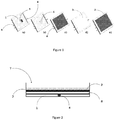
- the electrochromic technology presents itself as a novel solution for obtaining this effect, the creation of a difference of potential to the terminals of the electrochromic device (7), namely the first electrochromic element (2) - which is conductive - and the electroactive element (8), also electrically conductive, leading to a color change and therefore of the structure of cementitious material, because the first electrochromic element (2) is visible from the outside of said structure.
- the means of application of a difference of potential (4) comprise at least two electrical conductors partially embedded in the cementitious material, arranged in such a way that a portion of each of said conductors is electrically accessible in cavity (1).
- This feature is also directed, in an advantageous embodiment of the present invention, at taking advantage of the molding capability of cementitious materials which, embedding electrical conductors, enable remote or local control solutions of the color of the structure.
- the at least one electrochromic device (7) further contains a filling electrical contact (6) disposed on one of the at least two electrical conductors and in contact with the electroactive element (8).
- This feature in another advantageous embodiment of the present invention allows that, on the one hand, no bad contact occurs between one of the at least two electrical conductors and the electroactive element (8). On the other hand, it improves achieving the final color, through the symmetry between the two electrodes of the electrochromic device (7) (the electroactive element (8) and the first electrochromic element (2)).
- the electroactive element (8) could have a volume and shape different from the first electrochromic element (2), generating lack of symmetry and a color different from the desired one. It should however be noted that this is only an advantageous embodiment of the present invention as previously formulated, that would work even without this additional feature.
- one of the at least two electrical conductors is in electrical contact with the first electrochromic element (2).
- the present invention also includes a method of production, specifically of the electrochromic structure of cementitious material previously defined, in its different variations, which includes the following steps:
- the present invention has its most general embodiments in the forms defined above, in the Summary of the Invention.
- the first electrochromic element (2) consists of the association of an electrochromic element with an electrically conductive element. This is the preferred form of construction of the electrochromic device (7).
- the electroactive element (8) is in electrically conductive association of an electroactive element with an electrically conductive element.
- the electroactive element (8) consists of a second electrochromic element, which is electrically conductive or which consists in associating an electrochromic element with an electrically conductive element.
- the portion of each of said conductors which is electrically accessible in cavity (1) is specifically at least in another smaller cavity (5) formed in cavity (1), suitable to expose at least one of said conductors in contact with the electroactive element (8).
- the inclusion of the smaller cavity (5) consists in an advantageous embodiment of the invention, in which the connection to the means of application of a difference of potential (4) is facilitated. Considering the configuration in which an electrical contact of filler is included, it is on the smaller cavity (5) that the the electrical contact of filler (5) is located, filling it.
- any one of the components of the electrochromic device (7) is disposed as a layer having a substantially planar shape.
- Each layer performs a specific function, namely electrical conduction, ionic conduction and electrochromic functionality (color change, through changes in the redox state of the material).
- the electrochromic device (7) is arranged parallel to at least one surface of the structure of cementitious material in order to make the structure a single element, wherein at least a portion changes color without discontinuity.
- the structure of cementitious material contains a plurality of cavities (1) in the cementitious material and a plurality of electrochromic devices (7) arranged aligned along a direction or grid on the surface of the electrochromic structure of cementitious material.
- They may also consist of conventional electronics, flexible electronics or hybrid electronics (with printed components) integrated in the structure itself.
- Activation of the electrochromic device (7) can be done by action resulting from the event detection via different types of sensors such as pressure, motion, moisture, temperature sensors, etc. which may also be incorporated in the structure of cementitious material.
- the structure of cementitious material further comprises power supply means consisting of one or more of the following:
- the present invention also includes a method of production, defined there in its most general form, but which also includes advantageous details or of operation, which are defined now.
- the method of production of the present invention additionally comprises between steps b) and c) a deposition step for depositing a filling electrical contact (6) over at least part of the means of application of a difference of potential (4), which provides the advantageous solution already explained for the structure of the present invention, enabling better symmetry and electrical contact between the electroactive element (8) and the means of application of a difference of potential (4).
- step c) consists in depositing a second electrically conductive electrochromic element or in depositing an electrically conductive element on which is an electrochromic element is deposited.
- step e) consists in depositing an electrochromic element on which an electrically conductive element is deposited.
- any deposition step comprises deposition of a layer of material.
- depositing a layer of a filling electrical contact (6) is specifically carried out on one of at least two electrical conductors comprising the means of application of a difference of potential (4).
- the deposition of a first electrochromic element (2) places it in contact with the other of the at least two electrical conductors.
- step b) includes forming in cavity (1) a smaller cavity (5) in which a portion of the means of application of a difference of potential (4) is electrically accessible.
- the smaller cavity (5) is suitable to expose at least one of said conductors to contact with the electroactive element (8).
- a filling electrical contact (6) is deposited, it is on the smaller cavity (2) that such deposition occurs, thereby filling it.
- the deposition steps of any electrochromic or electroactive element include drying of these elements, and the step of depositing the electrolyte layer (3) includes solidification of the electrolyte (3) by curing with radiation or drying with heat.
- any of the elements with electrochromic properties comprises an electrochromic material from one of the following groups:
- electrolyte (3) is a good ionic conductor and simultaneously an electric insulator, being formed by admixing a salt at 2-15 % w/w, at least one resin, at least one solvent and a suitable additive to change the appearance and rigidity, wherein the salt consists of one of the following compounds: LiClO 4 , ZnCl 2 , LiBF 4 , LiAsF 6 , LiI, LiBr, LiCF 3 SO 3 , potassium salt, sodium salts or acids.
- the cementitious material consists of concrete, mortar or micro-concrete.
- the filling electrical contact (6) is silver ink.
- the material that makes up any electrochromic elements may be in the form of pigment, ink, or dye.
- the energy storage means comprise one or more of the following: battery, supercapacitor, or any other energy storage means known in the art.
- any of the deposition steps is accomplished by coating, printing or spraying.
- the cementitious material consists of concrete, mortar or micro concrete.
Landscapes
- Engineering & Computer Science (AREA)
- Physics & Mathematics (AREA)
- Chemical & Material Sciences (AREA)
- Ceramic Engineering (AREA)
- Architecture (AREA)
- Nonlinear Science (AREA)
- Structural Engineering (AREA)
- Civil Engineering (AREA)
- Optics & Photonics (AREA)
- General Physics & Mathematics (AREA)
- Chemical Kinetics & Catalysis (AREA)
- Organic Chemistry (AREA)
- Materials Engineering (AREA)
- Inorganic Chemistry (AREA)
- Electrochromic Elements, Electrophoresis, Or Variable Reflection Or Absorption Elements (AREA)
Claims (15)
- Elektrochrome Struktur aus zementösem Material, die mindestens ein elektrochromes Gerät (7), in mindestens einem Hohlraum (1) gebildet, umfasst, worin das mindestens eine elektrochrome Gerät (7) ein erstes elektrochromes Element (2) und ein elektrisch leitendes elektroaktives Element (8) beinhaltet, voneinander durch ein Elektrolyt (3) isoliert, und weiterhin Mittel für Anwendung einer Potentialdifferenz (4) zwischen dem ersten elektrochromen Element (2) und dem elektroaktiven Element (8) umfasst, und worin:a) die Mittel für Anwendung einer Potentialdifferenz (4) in dem zementösen Material integriert sind;b) der Hohlraum (1) an der Oberfläche der Struktur aus zementösem Material gebildet ist;c) das elektrisch leitende elektroaktive Element (8) auf dem Hohlraum (1) abgelagert ist;d) das Elektrolyt (3) auf dem elektroaktiven Element (8) abgelagert ist;e) das erste elektrochrome Element (2) auf dem Elektrolyt (3) abgelagert ist.
- Elektrochrome Struktur aus zementösem Material nach dem vorhergehenden Anspruch, worin die Mittel für Anwendung einer Potentialdifferenz (4) mindestens zwei elektrische Leiter umfassen, teilweise in dem zementösen Material eingebettet, auf solche Weise angeordnet, dass ein Teil jeder der besagten Leiter in dem besagten Hohlraum (1) elektrisch zugänglich ist.
- Struktur nach dem vorhergehenden Anspruch, worin das mindestens eine elektrochrome Gerät (7) weiterhin einen füllenden elektrischen Kontakt (6) umfasst, an einem der besagten mindestens zwei elektrischen Leitern angebracht, und mit dem elektroaktiven Element (8) in Kontakt ist.
- Struktur nach dem vorhergehenden Anspruch, worin der andere der mindestens zwei elektrischen Leitern in elektrischem Kontakt mit dem ersten elektrochromen Element (2) ist, und, wahlweise:
das Teil des mindestens einem der elektrischen Leitern, der in dem besagten Hohlraum (1) elektrisch zugänglich ist, befindet sich gezielt in mindestens einem anderen kleineren Hohlraum (5), der im Hohlraum (1) gebildet ist, geeignet, um mindestens einen der besagten Leitern dem Kontakt mit dem elektroaktiven Element (8) auszusetzten. - Struktur nach jedem der vorhergehenden Ansprüche, worin das erste elektrochrome Element (2) aus der Zusammenstellung eines elektrochromen Elements mit einem elektrischen Leitelement besteht, und/oder:
das elektrisch leitende elektroaktive Element (8) aus der Zusammenstellung eines elektroaktiven Elements mit einem elektrischen Leitelement besteht. - Struktur nach jedem der vorhergehenden Ansprüche, worin das elektroaktive Element (8) aus einem zweiten elektrochromen Element besteht, welches elektrisch leitfähig ist oder welches aus einer Zusammenstellung eines elektrochromen Elements mit einem elektrischen Leitelement besteht.
- Struktur nach jedem der vorhergehenden Ansprüche, worin jede der Komponenten des elektrochromen Geräts (7) auf einer Schicht, mit einer im Wesentlichen planen Form, angeordnet ist und, vorzugsweise, ist das elektrochrome Gerät (7) parallel zu mindestens einer Oberfläche der Struktur aus zementösem Material angeordnet, und/oder:jedes der Elemente mit elektrochromen Eigenschaften umfasst ein elektrochromes Material aus einem der folgenden Gruppen:• Metalle, Lanthaniden, Polyoxometallate und Kombinationen davon;• organische Moleküle;• konjugierte Polymere;• Koordinationsverbindungen von Metallenund vorzugsweise, wird das Elektrolyt (3) gebildet, indem ein Salz 2-15% w/w, mindestens ein Harz, mindestens ein Lösungsmittel und ein geeignetes Additiv, um das Aussehen und die Festigkeit zu verändern, beigemischt werden, worin das Salz aus folgenden Komponenten besteht: LiClO4, ZnCl2, LiBF4; LiAsF6, LiI, LiBr, LiCF3SO3, Kalium, Natrium oder Säuren.
- Struktur nach jedem der vorhergehenden Ansprüche, welche eine Vielzahl von Hohlräumen (1) in dem zementösen Material und eine Vielzahl von elektrochromen Geräten (7), die in eine Richtung ausgerichtet oder in einem Gitter angeordnet sind, auf einer Oberfläche der elektrochromen Struktur aus zementösem Material, beinhaltet und/oder:
weiterhin Kontrollmittel, die für die Kontrolle der Potentialdifferenz geeignet sind, durch die Mittel für Anwendung einer Potentialdifferenz (4) auferlegt, umfasst und/oder:- lokale oder Fernkommunikationsmittel, die an die Kontrollmittel verbunden sind,- Stromversorgungsmittel, die aus einem oder mehreren der folgenden bestehen:• Stromnetz, Energiespeichermittel, zugehöriges Energieerfassungssystem. - Struktur nach jedem der vorhergehenden Ansprüche, worin das zementöse Material aus Beton, Mörtel oder Mikrobeton besteht.
- Produktionsmethode der elektrochromen Struktur aus zementösem Material nach jedem der vorhergehenden Ansprüche, dadurch gekennzeichnet, dass es die folgenden Schritte umfasst:a) Eingliederung der Mittel für Anwendung einer Potentialdifferenz (4) in dem zementösen Material;b) Bildung eines Hohlraums (1) in der Oberfläche der Struktur aus zementösem Material;c) Ablagerung eines elektrisch leitenden elektroaktiven Elements (8);d) Ablagerung eines Elektrolyten (3) auf dem elektroaktiven Element (8);e) Ablagerung eines ersten elektrochromen Elements (2) auf dem Elektrolyten (3).
- Produktionsmethode nach dem vorhergenden Anspruch, welche zusätzlich zwischen Schritten b) und c) den Schritt der Ablagerung eines füllenden elektrischen Kontakts (6) über mindestens Teil der Mittel für Anwendung einer Potentialdifferenz (4), umfasst.
- Produktionsmethode nach dem vorhergenden Anspruch, worin Schritt b) in dem besagten Hohlraum (1) die Bildung eines kleineren Hohlraums (5), in dem ein Teil von mindestens einem der mindestens zwei elektrischen Leitern elektrisch zugänglich ist, umfasst, worin der kleinere Hohlraum (5) geeignet ist, um mindestens einen der besagten Leitern dem Kontakt mit dem elektroaktiven Element (8) auszusetzten.
- Produktionsmethode nach jedem der Ansprüche 11-12, worin Schritt e) aus der Ablagerung eines elektrochromen Elements, auf dem ein elektrisch leitendes Element abgelagert ist, besteht, und/oder:
Schritt c) aus der Ablagerung eines elektroaktivem Elements, auf dem ein elektrisch leitendes Element abgelagert ist, besteht, und/oder:
Schritt c) aus der Ablagerung eines zweitem elektrisch leitenden elektrochromen Elements oder der Ablagerung eines elektrisch leitendem Elements auf dem ein elektrochromes Element abgelagert ist. - Produktionsmethode nach jedem der Ansprüche 11-13, worin jeder Ablagerungsschritt aus der Ablagerung einer Schicht des Materials, die, im Wesentlichen, aus planer Form besteht und worin, vorzugsweise, die Ablagerung einer Schicht eines füllenden elektrischen Kontakts (6) gezielt an einem der mindestens zwei elektrischen Leitern, welche die Mittel für Anwendung einer Potentialdifferenz (4) umfassen, ausgeführt wird.
- Produktionsmethode nach jedem der Ansprüche 11-14, worin die Ablagerung eines ersten elektrochromen Elements (2) dieses mit dem anderen der besagten mindestens zwei elektrischen Leitern in Kontakt setzt, und, wahlweise:
die Ablagerungsschritte jedes elektroaktiven oder elektrochromen Elements die Trocknung dieser Elemente einschließt, und der Ablagerungsschritt der Elektrolytschicht (3) die Festigung des Elektrolyts (3) durch Strahlenhärtung oder Trocknung durch Temperatur einschließt und, vorzugsweise, wird jeder der Ablagerungsschritte durch Beschichtung, Bedruckung oder Besprühung ausgeführt und/oder besteht das zementöse Material aus Beton, Mörtel oder Mikrobeton.
Applications Claiming Priority (2)
| Application Number | Priority Date | Filing Date | Title |
|---|---|---|---|
| PT10874915A PT108749B (pt) | 2015-08-03 | 2015-08-03 | Estrutura de material cimentício electrocrómica e seu método de produção |
| PCT/IB2016/054637 WO2017021877A1 (pt) | 2015-08-03 | 2016-08-02 | Estrutura de material cimentício electrocrómica e seu método de produção |
Publications (2)
| Publication Number | Publication Date |
|---|---|
| EP3333337A1 EP3333337A1 (de) | 2018-06-13 |
| EP3333337B1 true EP3333337B1 (de) | 2021-03-03 |
Family
ID=56943879
Family Applications (1)
| Application Number | Title | Priority Date | Filing Date |
|---|---|---|---|
| EP16767013.2A Active EP3333337B1 (de) | 2015-08-03 | 2016-08-02 | Elektrochromische struktur von zementösem material und verfahren zu ihrer produktion |
Country Status (3)
| Country | Link |
|---|---|
| EP (1) | EP3333337B1 (de) |
| PT (1) | PT108749B (de) |
| WO (1) | WO2017021877A1 (de) |
Families Citing this family (1)
| Publication number | Priority date | Publication date | Assignee | Title |
|---|---|---|---|---|
| CN112624684B (zh) * | 2020-10-26 | 2022-05-20 | 西安科技大学 | 一种电致变色混凝土砖及其生产工艺与制造设备 |
Family Cites Families (8)
| Publication number | Priority date | Publication date | Assignee | Title |
|---|---|---|---|---|
| JPS61203428A (ja) * | 1985-03-05 | 1986-09-09 | Mitsubishi Electric Corp | カラ−ボ−ド |
| GB9223223D0 (en) * | 1992-11-05 | 1992-12-16 | Gradus Ltd | Display device |
| DE19706918A1 (de) * | 1997-02-20 | 1998-08-27 | Flachglas Ag | Verfahren zum Betreiben eines elektrochromen Elementes |
| SE518964C2 (sv) * | 2000-08-03 | 2002-12-10 | Gerrit Boschloo | Behållaranordning för förvaring av riskmaterial och sätt för dess framställning |
| GB0314176D0 (en) * | 2003-06-18 | 2003-07-23 | Royal College Of Art | Method of producing patterns in concrete and other building materials |
| WO2008134019A2 (en) * | 2007-04-25 | 2008-11-06 | Tesserae Technologies Corporation | System and method for color-changing decorative construction materials |
| US8085460B2 (en) * | 2008-08-28 | 2011-12-27 | Ppg Industries Ohio, Inc | Electrochromic device |
| WO2014109759A1 (en) * | 2013-01-11 | 2014-07-17 | Morgan Adhesives Comapny | Kit for providing a self-adhesive electrochromic device and self-adhesive electrochromic device manufactured therefrom |
-
2015
- 2015-08-03 PT PT10874915A patent/PT108749B/pt active IP Right Grant
-
2016
- 2016-08-02 WO PCT/IB2016/054637 patent/WO2017021877A1/pt not_active Ceased
- 2016-08-02 EP EP16767013.2A patent/EP3333337B1/de active Active
Non-Patent Citations (1)
| Title |
|---|
| None * |
Also Published As
| Publication number | Publication date |
|---|---|
| WO2017021877A1 (pt) | 2017-02-09 |
| PT108749A (pt) | 2017-02-03 |
| PT108749B (pt) | 2019-08-12 |
| EP3333337A1 (de) | 2018-06-13 |
Similar Documents
| Publication | Publication Date | Title |
|---|---|---|
| KR100421255B1 (ko) | 합성고무 라텍스를 함유하는 콘크리트 또는 몰탈 및 그들을 이용한 방수포장방법 | |
| CN105298133A (zh) | 提升大体积混凝土底板抗裂性的施工方法 | |
| CN105110716A (zh) | 一种柔性饰面砖用粘结砂浆及其制备方法 | |
| WO2015039614A1 (zh) | 一种柔性面材、柔性石材复合保温板及其应用 | |
| US20120031308A1 (en) | Cement Mortar Body | |
| EP3333337B1 (de) | Elektrochromische struktur von zementösem material und verfahren zu ihrer produktion | |
| CN201485989U (zh) | 一种装饰保温复合砌块砌筑的外墙体结构 | |
| JP6283214B2 (ja) | 遮熱用セメント組成物及び遮熱用積層体 | |
| CN111635185A (zh) | 一种夜光功能无机人造大理石板材及其微波养护制备工艺 | |
| RU2475355C2 (ru) | Способ изготовления декоративной поверхности бетонных изделий (варианты) | |
| EP3993976B1 (de) | Verfahren zur herstellung eines konstruktionselements | |
| CN2880963Y (zh) | 多功能陶粒板体结构 | |
| KR102276164B1 (ko) | 콘크리트 표면에 문양을 형성하는 방법 | |
| CN104563379A (zh) | 一种eps-发泡水泥复合自保温直墙砌块的制备方法 | |
| CN103737944B (zh) | 一种水性聚氨酯防水复合材料的制备方法 | |
| CN111660407A (zh) | 一种夜光功能无机人造大理石荒料及其微波养护制备工艺 | |
| TWI869646B (zh) | 製造用於強化壁磚的強化材料的方法及其所形成之材料及貼附該強化材料之壁磚 | |
| CN213204579U (zh) | 一种基于自流平水泥的混凝墙 | |
| CN109503091B (zh) | 一种水洗石砖及其制备方法和一种水洗石墙体 | |
| CN204826521U (zh) | 地面用复合硅酸钙板 | |
| CN212053534U (zh) | 一种hf外墙外保温的铺贴面砖装置 | |
| CN114439241A (zh) | 一种装饰水泥石板材中泛霜离子定向扩散方法 | |
| CN105256907A (zh) | 一种防火防水隔热一体化的现浇板 | |
| JP3009279U (ja) | 軽量石目調タイル | |
| CN114908627A (zh) | 一种碱式硫酸镁水泥基自发光砖材及其制备方法 |
Legal Events
| Date | Code | Title | Description |
|---|---|---|---|
| STAA | Information on the status of an ep patent application or granted ep patent |
Free format text: STATUS: UNKNOWN |
|
| STAA | Information on the status of an ep patent application or granted ep patent |
Free format text: STATUS: THE INTERNATIONAL PUBLICATION HAS BEEN MADE |
|
| PUAI | Public reference made under article 153(3) epc to a published international application that has entered the european phase |
Free format text: ORIGINAL CODE: 0009012 |
|
| STAA | Information on the status of an ep patent application or granted ep patent |
Free format text: STATUS: REQUEST FOR EXAMINATION WAS MADE |
|
| 17P | Request for examination filed |
Effective date: 20180222 |
|
| AK | Designated contracting states |
Kind code of ref document: A1 Designated state(s): AL AT BE BG CH CY CZ DE DK EE ES FI FR GB GR HR HU IE IS IT LI LT LU LV MC MK MT NL NO PL PT RO RS SE SI SK SM TR |
|
| AX | Request for extension of the european patent |
Extension state: BA ME |
|
| DAV | Request for validation of the european patent (deleted) | ||
| DAX | Request for extension of the european patent (deleted) | ||
| STAA | Information on the status of an ep patent application or granted ep patent |
Free format text: STATUS: EXAMINATION IS IN PROGRESS |
|
| 17Q | First examination report despatched |
Effective date: 20191127 |
|
| GRAP | Despatch of communication of intention to grant a patent |
Free format text: ORIGINAL CODE: EPIDOSNIGR1 |
|
| STAA | Information on the status of an ep patent application or granted ep patent |
Free format text: STATUS: GRANT OF PATENT IS INTENDED |
|
| RIC1 | Information provided on ipc code assigned before grant |
Ipc: G02F 1/15 20190101ALI20201014BHEP Ipc: C04B 111/00 20060101ALI20201014BHEP Ipc: C04B 111/82 20060101ALI20201014BHEP Ipc: E04F 13/14 20060101AFI20201014BHEP Ipc: C04B 28/02 20060101ALI20201014BHEP |
|
| INTG | Intention to grant announced |
Effective date: 20201104 |
|
| GRAS | Grant fee paid |
Free format text: ORIGINAL CODE: EPIDOSNIGR3 |
|
| GRAA | (expected) grant |
Free format text: ORIGINAL CODE: 0009210 |
|
| STAA | Information on the status of an ep patent application or granted ep patent |
Free format text: STATUS: THE PATENT HAS BEEN GRANTED |
|
| AK | Designated contracting states |
Kind code of ref document: B1 Designated state(s): AL AT BE BG CH CY CZ DE DK EE ES FI FR GB GR HR HU IE IS IT LI LT LU LV MC MK MT NL NO PL PT RO RS SE SI SK SM TR |
|
| REG | Reference to a national code |
Ref country code: GB Ref legal event code: FG4D |
|
| REG | Reference to a national code |
Ref country code: CH Ref legal event code: EP Ref country code: AT Ref legal event code: REF Ref document number: 1367353 Country of ref document: AT Kind code of ref document: T Effective date: 20210315 |
|
| REG | Reference to a national code |
Ref country code: DE Ref legal event code: R096 Ref document number: 602016053609 Country of ref document: DE |
|
| REG | Reference to a national code |
Ref country code: IE Ref legal event code: FG4D |
|
| REG | Reference to a national code |
Ref country code: NL Ref legal event code: FP |
|
| REG | Reference to a national code |
Ref country code: LT Ref legal event code: MG9D |
|
| PG25 | Lapsed in a contracting state [announced via postgrant information from national office to epo] |
Ref country code: NO Free format text: LAPSE BECAUSE OF FAILURE TO SUBMIT A TRANSLATION OF THE DESCRIPTION OR TO PAY THE FEE WITHIN THE PRESCRIBED TIME-LIMIT Effective date: 20210603 Ref country code: FI Free format text: LAPSE BECAUSE OF FAILURE TO SUBMIT A TRANSLATION OF THE DESCRIPTION OR TO PAY THE FEE WITHIN THE PRESCRIBED TIME-LIMIT Effective date: 20210303 Ref country code: HR Free format text: LAPSE BECAUSE OF FAILURE TO SUBMIT A TRANSLATION OF THE DESCRIPTION OR TO PAY THE FEE WITHIN THE PRESCRIBED TIME-LIMIT Effective date: 20210303 Ref country code: GR Free format text: LAPSE BECAUSE OF FAILURE TO SUBMIT A TRANSLATION OF THE DESCRIPTION OR TO PAY THE FEE WITHIN THE PRESCRIBED TIME-LIMIT Effective date: 20210604 Ref country code: BG Free format text: LAPSE BECAUSE OF FAILURE TO SUBMIT A TRANSLATION OF THE DESCRIPTION OR TO PAY THE FEE WITHIN THE PRESCRIBED TIME-LIMIT Effective date: 20210603 Ref country code: LT Free format text: LAPSE BECAUSE OF FAILURE TO SUBMIT A TRANSLATION OF THE DESCRIPTION OR TO PAY THE FEE WITHIN THE PRESCRIBED TIME-LIMIT Effective date: 20210303 |
|
| REG | Reference to a national code |
Ref country code: AT Ref legal event code: MK05 Ref document number: 1367353 Country of ref document: AT Kind code of ref document: T Effective date: 20210303 |
|
| PG25 | Lapsed in a contracting state [announced via postgrant information from national office to epo] |
Ref country code: SE Free format text: LAPSE BECAUSE OF FAILURE TO SUBMIT A TRANSLATION OF THE DESCRIPTION OR TO PAY THE FEE WITHIN THE PRESCRIBED TIME-LIMIT Effective date: 20210303 Ref country code: PL Free format text: LAPSE BECAUSE OF FAILURE TO SUBMIT A TRANSLATION OF THE DESCRIPTION OR TO PAY THE FEE WITHIN THE PRESCRIBED TIME-LIMIT Effective date: 20210303 Ref country code: RS Free format text: LAPSE BECAUSE OF FAILURE TO SUBMIT A TRANSLATION OF THE DESCRIPTION OR TO PAY THE FEE WITHIN THE PRESCRIBED TIME-LIMIT Effective date: 20210303 Ref country code: LV Free format text: LAPSE BECAUSE OF FAILURE TO SUBMIT A TRANSLATION OF THE DESCRIPTION OR TO PAY THE FEE WITHIN THE PRESCRIBED TIME-LIMIT Effective date: 20210303 |
|
| PG25 | Lapsed in a contracting state [announced via postgrant information from national office to epo] |
Ref country code: CZ Free format text: LAPSE BECAUSE OF FAILURE TO SUBMIT A TRANSLATION OF THE DESCRIPTION OR TO PAY THE FEE WITHIN THE PRESCRIBED TIME-LIMIT Effective date: 20210303 Ref country code: EE Free format text: LAPSE BECAUSE OF FAILURE TO SUBMIT A TRANSLATION OF THE DESCRIPTION OR TO PAY THE FEE WITHIN THE PRESCRIBED TIME-LIMIT Effective date: 20210303 Ref country code: SM Free format text: LAPSE BECAUSE OF FAILURE TO SUBMIT A TRANSLATION OF THE DESCRIPTION OR TO PAY THE FEE WITHIN THE PRESCRIBED TIME-LIMIT Effective date: 20210303 Ref country code: AT Free format text: LAPSE BECAUSE OF FAILURE TO SUBMIT A TRANSLATION OF THE DESCRIPTION OR TO PAY THE FEE WITHIN THE PRESCRIBED TIME-LIMIT Effective date: 20210303 |
|
| REG | Reference to a national code |
Ref country code: ES Ref legal event code: FG2A Ref document number: 2873114 Country of ref document: ES Kind code of ref document: T3 Effective date: 20211103 |
|
| PG25 | Lapsed in a contracting state [announced via postgrant information from national office to epo] |
Ref country code: SK Free format text: LAPSE BECAUSE OF FAILURE TO SUBMIT A TRANSLATION OF THE DESCRIPTION OR TO PAY THE FEE WITHIN THE PRESCRIBED TIME-LIMIT Effective date: 20210303 Ref country code: RO Free format text: LAPSE BECAUSE OF FAILURE TO SUBMIT A TRANSLATION OF THE DESCRIPTION OR TO PAY THE FEE WITHIN THE PRESCRIBED TIME-LIMIT Effective date: 20210303 Ref country code: PT Free format text: LAPSE BECAUSE OF FAILURE TO SUBMIT A TRANSLATION OF THE DESCRIPTION OR TO PAY THE FEE WITHIN THE PRESCRIBED TIME-LIMIT Effective date: 20210705 Ref country code: IS Free format text: LAPSE BECAUSE OF FAILURE TO SUBMIT A TRANSLATION OF THE DESCRIPTION OR TO PAY THE FEE WITHIN THE PRESCRIBED TIME-LIMIT Effective date: 20210703 |
|
| REG | Reference to a national code |
Ref country code: DE Ref legal event code: R097 Ref document number: 602016053609 Country of ref document: DE |
|
| PLBE | No opposition filed within time limit |
Free format text: ORIGINAL CODE: 0009261 |
|
| STAA | Information on the status of an ep patent application or granted ep patent |
Free format text: STATUS: NO OPPOSITION FILED WITHIN TIME LIMIT |
|
| PG25 | Lapsed in a contracting state [announced via postgrant information from national office to epo] |
Ref country code: DK Free format text: LAPSE BECAUSE OF FAILURE TO SUBMIT A TRANSLATION OF THE DESCRIPTION OR TO PAY THE FEE WITHIN THE PRESCRIBED TIME-LIMIT Effective date: 20210303 Ref country code: AL Free format text: LAPSE BECAUSE OF FAILURE TO SUBMIT A TRANSLATION OF THE DESCRIPTION OR TO PAY THE FEE WITHIN THE PRESCRIBED TIME-LIMIT Effective date: 20210303 |
|
| 26N | No opposition filed |
Effective date: 20211206 |
|
| PG25 | Lapsed in a contracting state [announced via postgrant information from national office to epo] |
Ref country code: SI Free format text: LAPSE BECAUSE OF FAILURE TO SUBMIT A TRANSLATION OF THE DESCRIPTION OR TO PAY THE FEE WITHIN THE PRESCRIBED TIME-LIMIT Effective date: 20210303 |
|
| REG | Reference to a national code |
Ref country code: CH Ref legal event code: PL |
|
| PG25 | Lapsed in a contracting state [announced via postgrant information from national office to epo] |
Ref country code: MC Free format text: LAPSE BECAUSE OF FAILURE TO SUBMIT A TRANSLATION OF THE DESCRIPTION OR TO PAY THE FEE WITHIN THE PRESCRIBED TIME-LIMIT Effective date: 20210303 |
|
| PG25 | Lapsed in a contracting state [announced via postgrant information from national office to epo] |
Ref country code: LI Free format text: LAPSE BECAUSE OF NON-PAYMENT OF DUE FEES Effective date: 20210831 Ref country code: IT Free format text: LAPSE BECAUSE OF FAILURE TO SUBMIT A TRANSLATION OF THE DESCRIPTION OR TO PAY THE FEE WITHIN THE PRESCRIBED TIME-LIMIT Effective date: 20210303 Ref country code: CH Free format text: LAPSE BECAUSE OF NON-PAYMENT OF DUE FEES Effective date: 20210831 |
|
| PG25 | Lapsed in a contracting state [announced via postgrant information from national office to epo] |
Ref country code: IS Free format text: LAPSE BECAUSE OF FAILURE TO SUBMIT A TRANSLATION OF THE DESCRIPTION OR TO PAY THE FEE WITHIN THE PRESCRIBED TIME-LIMIT Effective date: 20210703 Ref country code: LU Free format text: LAPSE BECAUSE OF NON-PAYMENT OF DUE FEES Effective date: 20210802 |
|
| PG25 | Lapsed in a contracting state [announced via postgrant information from national office to epo] |
Ref country code: IE Free format text: LAPSE BECAUSE OF NON-PAYMENT OF DUE FEES Effective date: 20210802 |
|
| PG25 | Lapsed in a contracting state [announced via postgrant information from national office to epo] |
Ref country code: HU Free format text: LAPSE BECAUSE OF FAILURE TO SUBMIT A TRANSLATION OF THE DESCRIPTION OR TO PAY THE FEE WITHIN THE PRESCRIBED TIME-LIMIT; INVALID AB INITIO Effective date: 20160802 |
|
| PG25 | Lapsed in a contracting state [announced via postgrant information from national office to epo] |
Ref country code: CY Free format text: LAPSE BECAUSE OF FAILURE TO SUBMIT A TRANSLATION OF THE DESCRIPTION OR TO PAY THE FEE WITHIN THE PRESCRIBED TIME-LIMIT Effective date: 20210303 |
|
| PG25 | Lapsed in a contracting state [announced via postgrant information from national office to epo] |
Ref country code: MK Free format text: LAPSE BECAUSE OF FAILURE TO SUBMIT A TRANSLATION OF THE DESCRIPTION OR TO PAY THE FEE WITHIN THE PRESCRIBED TIME-LIMIT Effective date: 20210303 |
|
| PG25 | Lapsed in a contracting state [announced via postgrant information from national office to epo] |
Ref country code: TR Free format text: LAPSE BECAUSE OF FAILURE TO SUBMIT A TRANSLATION OF THE DESCRIPTION OR TO PAY THE FEE WITHIN THE PRESCRIBED TIME-LIMIT Effective date: 20210303 |
|
| PG25 | Lapsed in a contracting state [announced via postgrant information from national office to epo] |
Ref country code: MT Free format text: LAPSE BECAUSE OF FAILURE TO SUBMIT A TRANSLATION OF THE DESCRIPTION OR TO PAY THE FEE WITHIN THE PRESCRIBED TIME-LIMIT Effective date: 20210303 |
|
| PGFP | Annual fee paid to national office [announced via postgrant information from national office to epo] |
Ref country code: FR Payment date: 20250207 Year of fee payment: 10 |
|
| PGFP | Annual fee paid to national office [announced via postgrant information from national office to epo] |
Ref country code: NL Payment date: 20250613 Year of fee payment: 10 Ref country code: BE Payment date: 20250619 Year of fee payment: 10 |
|
| PGFP | Annual fee paid to national office [announced via postgrant information from national office to epo] |
Ref country code: ES Payment date: 20250902 Year of fee payment: 10 |
|
| PGFP | Annual fee paid to national office [announced via postgrant information from national office to epo] |
Ref country code: DE Payment date: 20250611 Year of fee payment: 10 |
|
| PGFP | Annual fee paid to national office [announced via postgrant information from national office to epo] |
Ref country code: GB Payment date: 20250710 Year of fee payment: 10 |