EP3332233B1 - Datenaufzeichner, insbesondere zur überwachung eines umgebungsparameters zur aufbewahrung von medikamenten - Google Patents
Datenaufzeichner, insbesondere zur überwachung eines umgebungsparameters zur aufbewahrung von medikamenten Download PDFInfo
- Publication number
- EP3332233B1 EP3332233B1 EP16745750.6A EP16745750A EP3332233B1 EP 3332233 B1 EP3332233 B1 EP 3332233B1 EP 16745750 A EP16745750 A EP 16745750A EP 3332233 B1 EP3332233 B1 EP 3332233B1
- Authority
- EP
- European Patent Office
- Prior art keywords
- range
- data logger
- data
- criterion
- sample
- Prior art date
- Legal status (The legal status is an assumption and is not a legal conclusion. Google has not performed a legal analysis and makes no representation as to the accuracy of the status listed.)
- Active
Links
Images


Classifications
-
- G—PHYSICS
- G01—MEASURING; TESTING
- G01K—MEASURING TEMPERATURE; MEASURING QUANTITY OF HEAT; THERMALLY-SENSITIVE ELEMENTS NOT OTHERWISE PROVIDED FOR
- G01K1/00—Details of thermometers not specially adapted for particular types of thermometer
- G01K1/02—Means for indicating or recording specially adapted for thermometers
- G01K1/022—Means for indicating or recording specially adapted for thermometers for recording
-
- G—PHYSICS
- G01—MEASURING; TESTING
- G01D—MEASURING NOT SPECIALLY ADAPTED FOR A SPECIFIC VARIABLE; ARRANGEMENTS FOR MEASURING TWO OR MORE VARIABLES NOT COVERED IN A SINGLE OTHER SUBCLASS; TARIFF METERING APPARATUS; MEASURING OR TESTING NOT OTHERWISE PROVIDED FOR
- G01D9/00—Recording measured values
- G01D9/005—Solid-state data loggers
- G01D9/007—Data loggers attached to transport containers for perishable products, e.g. food or medicines
-
- G—PHYSICS
- G06—COMPUTING OR CALCULATING; COUNTING
- G06F—ELECTRIC DIGITAL DATA PROCESSING
- G06F11/00—Error detection; Error correction; Monitoring
- G06F11/30—Monitoring
- G06F11/3003—Monitoring arrangements specially adapted to the computing system or computing system component being monitored
- G06F11/3013—Monitoring arrangements specially adapted to the computing system or computing system component being monitored where the computing system is an embedded system, i.e. a combination of hardware and software dedicated to perform a certain function in mobile devices, printers, automotive or aircraft systems
-
- G—PHYSICS
- G06—COMPUTING OR CALCULATING; COUNTING
- G06F—ELECTRIC DIGITAL DATA PROCESSING
- G06F11/00—Error detection; Error correction; Monitoring
- G06F11/30—Monitoring
- G06F11/3058—Monitoring arrangements for monitoring environmental properties or parameters of the computing system or of the computing system component, e.g. monitoring of power, currents, temperature, humidity, position, vibrations
-
- G—PHYSICS
- G06—COMPUTING OR CALCULATING; COUNTING
- G06F—ELECTRIC DIGITAL DATA PROCESSING
- G06F11/00—Error detection; Error correction; Monitoring
- G06F11/30—Monitoring
- G06F11/34—Recording or statistical evaluation of computer activity, e.g. of down time, of input/output operation ; Recording or statistical evaluation of user activity, e.g. usability assessment
- G06F11/3466—Performance evaluation by tracing or monitoring
- G06F11/3476—Data logging
-
- G—PHYSICS
- G01—MEASURING; TESTING
- G01K—MEASURING TEMPERATURE; MEASURING QUANTITY OF HEAT; THERMALLY-SENSITIVE ELEMENTS NOT OTHERWISE PROVIDED FOR
- G01K2207/00—Application of thermometers in household appliances
- G01K2207/02—Application of thermometers in household appliances for measuring food temperature
- G01K2207/04—Application of thermometers in household appliances for measuring food temperature for conservation purposes
Definitions
- Data logger in particular for monitoring an environment parameter for storing medication.
- the invention relates to a data logger for logging values of a physical environment parameter as a function of time, which data logger comprises: a sampling subsystem for acquiring a sequence of sample values of the physical environment parameter at sampling moments which are separated by sample intervals, an encoding subsystem arranged for converting the sequence of sample values in data records comprising a representative value representing groups of one sample value or a number of successive sample values with variations which meet a stability criterion, whereby the data records comprises information representative of the lengths of the groups, and a memory subsystem for storing a sequence of defined data records into a memory.
- the invention also relates to a package including a medication and provided with a data logger.
- the invention further relates to a reading device for reading the logged data from the data logger and a method for making software for the reading device available for downloading.
- a data logger as mentioned in the openings part of the description is disclosed in US20070267509 .
- This document discloses a data logger for use in refrigerated trailer for transporting goods which need cooled transport.
- the disclosed data logger is less suitable for monitoring the environment parameters for goods, in particular medications, which are packed in small volumes.
- US5836982 discloses a system and method of data compression and non-linear sampling for implantable and battery-powered devices.
- the use of the data logger is in particular beneficial for monitoring the environment conditions in which a medication is stored.
- the efficacy of the medication is guaranteed until the so called expiry date as long as the temperature stays within a predetermined storage range. When the temperature exceeds the boundary of this range this affects the efficacy of the medication.
- the extent to which the efficacy is affected depends on the time duration that the temperature left the storage range and to which extent the temperature exceeds the boundaries of the storage range during this time duration. If the exposure of the medication to a temperature outside the first range stays limited then the reduction of the efficacy of the medication will be small, so that the medication can still be used. However, if the duration and /or the extent of the exceeding is substantial, then the efficacy of the medication can be so low that it cannot be used anymore. On the basis of the behaviour of the temperature outside the first range it can be determined whether the medication can be still being used or not. For an accurate estimation of the reduction of the efficacy it is important that the behaviour of the temperature outside the storage range is known accurately, this in contrast with the behaviour of the temperature within the storage range, where the effect of the temperature on the efficacy is limited.
- the range dependent stability criterion is such that the criterion is met as long as the physical environment parameter remains within the said one range.
- this embodiment it is beneficial to select this at least one range such that it corresponds with the prescribed storage range of the medication. In that case a very good use is made of the fact that the exact temperature within the storage range is not crucial, which results in a very high reduction of the required storage capacity.
- An embodiment of the data logger is arranged to set different criteria for at least three subsequent adjacent ranges, of which a first one is located between a second one and third one of the three ranges, whereby the range dependent stability criterion for the first range prescribes a less stable behaviour of the sample values than the range dependent stability criteria for the second and third range.
- a further embodiment of the data logger is arranged to set criterion parameters for at least a fourth range which is adjacent to the second or third range, whereby the value of the criterion parameter for fourth range prescribes a less stable behaviour of samples values than the value of the criterion parameter for the range the adjacent of the second or third range.
- This embodiment is based on the insight that for some medications a maximum and/or minimum storage temperature exist. If this maximum or minimum temperature has been reached it is not allowed to use the medication any more, which makes the medication useless. When the fourth range is selected such that it corresponds with temperature range which makes the medication useless then a further reduction of the storage capacity is realized.
- the invention has the benefit that for the periods that the temperature has a less stable behaviour the sample rate is increased. This reduces the risk that excursions of the temperature to extreme values are missed by the data logger.
- the lower sample rate is allowed for the stable periods, which results in a very efficient use of the storage capacity.
- the reader comprises a decoder for reconstructing the time behaviour of the environment parameter on the basis of the sample values comprised by the data records and the information in the data records representing the lengths of the groups.
- the decoder is arranged to reconstruct the time behaviour of the environment parameter based on flag bits in the data records indicating with which of a plurality of sampling intervals the sample values are obtained, so as to reconstruct the time behaviour with a uniform time scale.
- This embodiment enables a reliable interpretation of the effect of the behaviour of the monitored environment parameter in case the samples are taken with different sampling intervals.
- a further embodiment of the reading device comprises a program controlled processor and a program memory with a program having command codes, which cause the reconverting and or creation of the function when the command codes are executed by the program controlled processor.
- the use of the program controlled processor makes it possible to add the reader functionality to a programmable device that is already available for other functions, such as for example a Smartphone provided with an interface which is connectable to the data logger.
- a suitable way of coupling the reading device to a Smartphone makes use of NFC-technology, whereby both the data logger and the Smartphone are NFC-enabled.
- This embodiment has further the benefit that the reading device can be easily updated by updating the software.
- a further embodiment of the reading device comprises a display subsystem and wherein the program comprises command codes, which when executed by the processor, cause the display of a graph or table on a screen of the display subsystem, which represents the reconstructed tie behaviour.
- a further embodiment of the reading device is arranged to read data records form the memory of the data logger which represents a physical environment parameter of a stored medication, and wherein the program comprises command codes, which when executed by the processor estimate the efficacy of the medication on the basis of the reconstructed time behaviour and for displaying a message whether the estimated efficacy exceeds a minimum level.
- the invention relates to a data logger for logging values of a physical environment parameter as a function of time.
- a physical environment parameter can be an ambient temperature, humidity, light intensity, movements, noise etc.
- the data logger is suitable for logging different physical environment parameters the invention will be explained referring to a data logger for logging the ambient temperature of a product, in particular the ambient temperature of a medication.
- Many medications are temperature sensitive, which means that the efficacy of the medication is reduced if the medication is stored in an environment in which the temperature is not kept within a certain temperature range. In order to monitor the quality of the medication it is important to know whether the medication is not exposed too long to temperatures outside a prescribed temperature range. Logging the ambient temperature during the storage period is a very helpful tool to monitor the quality of the medication.
- There is a need for low cost data loggers which can be packaged together with the medication, for example by attaching a small sized data logger to a syringe with medication, a medication container or other package including a medication
- Fig. 1 shows schematically an embodiment of a data logger 1 according to the invention.
- the data logger comprises a sampling subsystem 2 for acquiring sample values T n of an ambient temperature at successive sampling moments t n which are separated by sample intervals.
- the sampling subsystem is coupled to an encoding subsystem 3 which converts the successive sample values into data records which are stored by a memory subsystem 4 in a memory 7 of the memory subsystem 4.
- the data logger 1 can further be provided with an interface 5 which enables the read out of the data records by means of a reading device.
- the interface can be of any type enabling the read out, but is preferably of at type which uses a wireless connection between the reading device and the interface 5.
- a very suitable interface is an NFC interface, which makes use of the so-called Near Field Communication-technology.
- the encoding subsystem 3 is preferably implemented as a program controlled processer 8 which encodes the sequence of sample values under control of firmware stored in a program memory 9 of the encoding subsystem 3.
- the encoding subsystem can also be implemented as a hard-wired encoding subsystem.
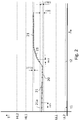
- Fig. 2 shows an environment parameter in the form of the ambient temperature T, indicated by a line 20, as function of a time t. Sample values of the samples acquired by the sampling subsystem 2 are indicated by the dots 21 on line 20.
- the sampling is started at t1.
- the first sample taken is indicated by reference sign 21a.
- the sample value of the first sample is stored in predetermined bits of a data record in a memory by a memory subsystem 4. This value is also used as a reference value T ref as will explained later on in description in more detail.
- the length of the sample intervals at the beginning of the sampling is set to a value INT1.
- a suitable value for INT1 is 20 minutes.
- a first stability criterion is to check whether the difference between a sample value t n and the sample value T ref stays within a stability range Tr, determined by an upper limit and a lower limit.
- Trx The stability ranges for the different temperature ranges are hereinafter indicated by Trx, with x referring to the corresponding temperature range.
- TRDx The distance between the limits of the stability range Trx and the reference value T ref are determined by a criterion parameter TRDx.
- the criterion parameter TRD1 shown belongs to the temperature range between LL1 and HL1.
- TRD1 lies symmetric around the T ref and when this first stability criteria is met and the samples values T n stays between T ref - TRD1 and T ref + TRD1 the stability criterion for the temperature range HL1-LL1 is met and a count is incremented.
- the count is stored in predetermined bits of an actual opened data record.
- a suitable value for TRD1 is e.g. 2.5 °C.
- Stability of the temperature T can also be determined by means of a dedicated sensor which measures the change of temperature as function of the time.
- the counter in the actual data record is increased with an increment each time a new sample is acquired until the counter reaches a predetermined end count C end . Then the data in the actual opened data record is frozen and a new data record is opened in the memory subsystem 4.
- a suitable counter is a 4 bits counter and suitable value for the end count C end is "16". However, counters with another counting range and another end count can be used.
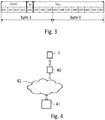
- FIG. 3 An example of a suitable format for the data record defined when the predetermined count is reached, is shown in Fig. 3 .
- the format comprises a 16-bit word consisting of 2 bytes (byte 0 and byte 1). 4 bits (b12 to b15) are reserved for storing the count of the counter. One bit (b11) is available for indicating which of two different sample intervals INT1 or INT2 is used for the samples represented by the data record. The counts represent the number of samples of the group of successive samples taken since the start of the counting. 11 bits (b00 - b10) are reserved for storing a representative value T ref , for the sample values of the samples belonging to this group. In this embodiment this is the value of the first sample of the group.
- each data record can represent a group of 16 successive stable sample values at the most. It will be clear for the person skilled in the art that the maximum can be set to any value but limited by the counting range of the counter.
- first temperature range In Fig. 2 boundaries of a first temperature range are indicated by a lower value LL1 and a higher value HL1.
- This first temperature range defines a prescribed storage range for the temperature T. As long as the temperature T stays within the first range the efficacy of the medication is guaranteed sufficient until the so called expiry date. If the temperature T exceeds the boundary of the first range this affects the efficacy of the medication. The extent to which the efficacy is affected depends on the time duration that the temperature left the first temperature range HL1-LL1 and to which extent the temperature exceeds the boundaries of the first temperature range HL1-LL1 during this time duration.
- the exposure of the medication to a temperature outside the first temperature range HL1-LL1 stays limited then the reduction of the efficacy of the medication will be small, so that the medication can still be used. However if the duration and /or the extent of the exceeding is substantial than the effect on efficacy of the medication can be so high that it cannot be used anymore.
- the behaviour of the temperature outside the first range it can be determined whether the medication can be still be used or not.
- the behaviour of the temperature T outside the first range the usual storage range HL1-LL1
- the measurement interval time is important and it therefore beneficial to set the sampling to a shorter sampling interval INT2 in case a fast temperature change is detected for temperatures outside the range HL1-LL1.
- the use of the shorter sampling interval is indicated in the data record by setting bit b11.
- These absolute maximum and absolute minimum temperatures HL2 and LL2 are indicated in Fig. 2 . In case one of these temperatures LL2 or HL2 are reached then the efficacy cannot be guaranteed anymore and the medication may not be used anymore.
- stability range HL1 - HL2 and range LL1 - LL2 the effect of excursions on the efficacy (usually by means of the so-called Mean Kinetic Temperature) can be accurately calculated) when the measure interval time is short and when the temperature passes the border of HL1 or HL2 or LL1 or LL2, the interval time INT2 may be switched in.
- the inventor had the insight that the stability range Tr of the first stability criterion can be different for the different ranges without that this effects inaccuracy for medication monitoring.
- the width of the stability range for samples within the range HL1-LL1 can be relative large compared with the stability range for samples outside the range HL1-LL1. It results in a substantial reduction of the required storage capacity of the memory 7.
- the first range with temperature values between HL1 and LL1 a second range between HL1 and HL2, a third range between LL1 and LL2, a fourth range with temperatures above HL2 and a fifth range for temperatures below LL2.
- the value of TRD2 for the second and third range may be smaller chosen than for the other ranges.
- a tight setting of the first stability criterion may be required.
- a less tight setting of the first stability criterion suffices.
- the criterion parameter TRDx can be set independently from each other. A less tight setting for the ranges outside the second and third range results in that the sequences of samples which meets the first stability criterion are longer and consequently less code words are required to represent the temperature behaviour.
- the data logger is arranged to use different stability criteria for different ranges of the temperature. This can be realized by setting at least one parameter of the first stability criterion to different values for different ranges of the physical environment parameter, which criterion parameter determines a condition which has to be fulfilled to meet the criterion.
- the settable parameter of the first stability criterion is TRDx, which indicates the allowable variation of values the subsequent samples of the environment parameter around the reference value Tref.
- Suitable values for the settable parameter TRD1 of the first stability criterion are e.g. 2.5°C and a suitable value for the criterion parameter TRD2 for the second and third range e.g. 0.5 °C.
- a data logger which is arranged to set different criterion parameters for at least three subsequent adjacent ranges, of which a first one is located between a second one and third one of the three ranges, whereby the value of the criterion parameter for the first range prescribes a less stable behaviour of the sample values than the values of the criterion parameter for the second and third range.
- the value of the criterion parameter can be kept the same for the environment parameter values in second and fourth range on both sides of the maximum HL2 and/or in third and fifth range on both sides of the minimum LL2.
- the data logger is preferably arranged to set criterion parameters for at least a fourth range which is adjacent to the second or third range, whereby the value of the criterion parameter for fourth range prescribes a less stable behaviour of samples values than the value of the criterion parameter for the range the adjacent of the second or third range.
- the stability range Trx used for the determination whether the temperature is considered to be stable, is located symmetrically around the value of the sample value T ref .
- this stability range Tr1 is symmetrically around T ref (in this embodiment to ⁇ 2.5 °C).
- the stability range can be set automatically to a tighter value when the temperature is substantial above the required storage temperatures, indicated by HL1 in Fig 2 .
- the stability range is changed to e.g. +0.125 °C and -0.5 °C around the sample value T ref .
- the stability range Tr is also made more tight.
- the stability range Tr is changed to e.g. -0.125 °C and +0.5 °C around the previous sample value T ref .
- TRD1, TRD2, TRD3 HL1, HL2, HL3, LL1, LL2 and LL3 are stored in the data logger, for example in the firmware.
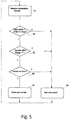
- Fig. 5 shows a flow diagram of an embodiment of a program stored in the program memory 9 of the data logger 1, which when executed take care of the encoding of the sample values.
- step S1 a new sample is taken.
- step S2 it is detected whether the sample is still within same temperature range belonging to the actual T ref .
- step S3 the stability range TRx belonging to the actual value of T ref is determined using a look up table which comprises a value TRDx for each of the temperature ranges. Finally, it is checked whether the sample is within the this determined stability range TRx.
- the result is "No"
- a new record with the sample value T ref stored in the bits b00-b10 of the newly opened data record
- step S4 it will be checked whether the counter is to its end value C end from the previous samples and if not, the counter will be incremented. If the counter has reached its end value, a new record with the sample value T ref will be started.
- a criterion parameter TRDx defining the stability range Trx is used for the determination whether the temperature is considered to be stable, is located around the value of the sample value T ref .
- the exact value of the temperature is not critical for temperature within the usual storage range, i.e. between LL1 and HL1.
- Trx can be used which allows any values between LL1 and HL1. This can be simply realized by choosing a value for TRD1 which is equal to the range temperature range HL1- LL1, as illustrated in Figure 6 .
- a line 50 indicates the behaviour of the temperature T as function of time t.
- the temperature T is sampled by the sampling subsystem 2 at regular sampling intervals. (samples are not shown).
- step S2 it is determined that the sample is within the range LL1 - HL1.
- step S3 the corresponding value criterion parameter TRD1 defining of TRD1 is read from the look up table.
- the value of TRD1 is chosen equal to width of the range LL1- HL1.
- the process of checking in S2 and S3 and incrementing the count continues until at t1, the counter reaches its end value C end .
- step S6 the data in the actual data record is frozen and definitely stored and new data record with the latest sample value as T ref is stored in the newly opened data record.
- the start value (C start ) for the counter represented by the bits b12-b15 for the counter is equal to zero. (All bits of a new data record have an initial value equal to 0).
- the program loop consisting of the steps S1, S2, S3 and S4 is repeated until the counter reaches its end value C end again at t2, resulting in the definite storage of the data of the actual data record and opening a new data record with an initial count value zero (C start ) and a new T ref equal to the latest sample taken.
- each data record represents 16 samples as long as the samples remain within the range LL1 -HL1, resulting in a high data compression and long interval time for the samples in this range.
- the temperature behaviour represented by the stored data records is in Fig. 5 indicated by line 51.
- the deviation between the real behaviour (line 50) and the behaviour represented by the data records is relative large for the temperatures within the range LL1 and HL2.
- the exact behaviour within this range is not crucial.
- the Temperature leaves the range LL1 - HL1 the monitoring becomes accurate due to a much narrower variation range.
- tight stability criteria may be used for the temperature range between HL1 and HL2 and the temperature range between LL1 and LL2. Less tight stability criteria may be used for the temperature range between LL1 and HL1 and the temperature range above HL2 and the temperature range below LL2. It will be clear for the skilled person that the invention is applicable to embodiments wherein the number of ranges with different stability criteria is at least two. The maximum number of ranges is not limited to five as described hereinbefore. The invention is applicable for any number of ranges greater than two. Further the invention gives the option to the user to define ranges for which an accurate monitoring is required and ranges for which a less accurate suffice and define a stability criterion for each range dependent on the required accuracy. For example, in Fig. 6 seven temperature ranges can be distinguished. These are the range with
- TFD is greater than TRD.
- a suitable value for TFD may be 2 °C.
- the length of the sample interval is set to INT2 which is in most cases smaller than INT1 i.e. samples will be taken more frequently.
- INT2 is chosen equal to 2 minutes as an example.
- the counter will reach again its end value C end after which a new 2 byte data record will be defined in which the bit 11 is set to "0" indicating that the longer sampling interval INT1 is used. Moreover, the sampling interval is set back to INT1.
- this is solved means of a flag Fb in the data record.
- bit b11 is reserved for the flag Fb.
- the flag Fb is set to the binary value "0" for samples based on samples with sample interval INT1 and set to binary value "1" for samples bases on samples with sample interval INT2.
- the application of different sample interval and/or the use of the different settings of the stability criterion is not limited to the embodiments in which a compression is as described hereinbefore, wherein the compression is realized by an encoding in which groups of subsequent samples, which meets the stability criterion, are represented by a code word in which predetermined bits are used for the sample value and other predetermined bits are used for the number of samples in the sequence of samples represented by the code word.
- the application of different sample intervals and/or the use of the different settings can also be used for any data logger for logging values of a physical environment parameter as a function of time, which comprises a sampling subsystem for acquiring sample values of the physical environment parameter at sampling moments which are separated by sample intervals, an encoding subsystem for defining data records representing groups of one sample value or a number of successive sample values with variations which meet a first stability criterion, and a memory subsystem for storing a sequence of defined data records into a memory.
- a further embodiment of the data logger is arranged to store in a memory start information indicating a moment in time, for example the date and time, that the monitor process is started.
- a memory start information indicating a moment in time, for example the date and time, that the monitor process is started.
- the benefits of this solution is that only the information for one moment in time must be stored and all other sample times and dates can be calculated based on this moment in time and the code words stored in the memory.
- This memory for storing the time and date can be a part of the memory used for storing the data packets.
- data logger 1 can be provided with a separate memory 6 for storing this information.
- data logger is arranged to disable overwriting of the start information after it has been stored for the first time, for example by using a write once memory, this start information cannot be changed anymore after it is written into the memory, so that the start information is stored in a very secure and reliable way.
- the subsystems are indicated as separate parts.
- the subsystems can use partly or completely the same components of the data logger, which will usually be the case when a software controlled processor is used. In that case the subsystems make use of the same processor which is controlled with different programs for the different subsystems, which programs are stored in the same program memory.
- Fig. 4 shows a preferred context in which the data logger according to the invention is used.
- This Fig. 4 shows a combination of a data logger 1 according to the invention in combination with a reading device 40 according the invention.
- the reading device 40 is of a type which is able to read the data records stored in the data logger 1.
- a very suitable reading device is a Smartphone with can read the record dates from the data logger. This can be via a wired connection between the reader device 40 and the data logger 1.
- a reading device is provided with a decoder for reconverting the data records into the sample values of the sampled physical environment parameter so as to reconstruct the time behaviour of the monitored environment parameter.
- the reading device is arranged to convert data records in a sequence of M sample values having the representative value defined in the example by the bits b00-b10 of the data records. The number of the successive sample values is derived from the count stored in the bits b12-b15.
- the reconstructed time behaviour Based on the reconstructed time behaviour it can estimated how much the efficacy of the medication is reduced during the storage period. For a reliable interpretation of the time behaviour it is crucial that the reconstructed time behaviour has a uniform time scale for the complete period. In other words for each reconverted sample value the correct time difference t def between the start of the data logging has to be known. For each reconverted sample this time difference t def is the sum of the sampling intervals of all preceding samples.
- sampling interval dt n is derived on the basis of the flag bit Fb in the data record.
- the decoder is implemented by means of a software controlled processor and a program memory with command codes, which when executed performs the reconstruction as described hereinbefore.
- the Smartphone can be loaded with an App for reading and decoding the data records and display the logged temperature behaviour as a list, table or graph on the display of the Smartphone.
- the App By assessing the logged temperature behaviour shown on the display it can be determined whether or not the efficacy of the medication is still sufficient to use the medication.
- This assessment can be supported by the App in case it is provided with an algorithm which estimates on the basis of the reconstructed temperature behaviour the effect of the behaviour on the efficacy of the medication and displays the result of the estimation on the display, for example by a visible indication such as an message (in words or symbol) indicating whether the efficacy of the medication is still sufficient to be used or not.
- a visible indication such as an message (in words or symbol) indicating whether the efficacy of the medication is still sufficient to be used or not.
- a reading device which displays an indication of the efficacy of the medication on the basis of data, stored in a data logger, is not limited to encoding methods described. This feature is in principle applicable for each data logger with data from which the time behaviour of the environment parameter can be reconstructed.
- the algorithms for estimating the effect of the temperature behaviour on the efficacy on the medication are well known. Usual these algorithms calculates the Mean Kinetic Temperature (MKT).
- MKT Mean Kinetic Temperature
- the App is made available for downloading on a server 41, which is connected to a communication network 42, such as for example the internet.
- the Smartphone By downloading the App onto the Smartphone the Smartphone is transformed into a reading device which is able to make the logged data visible for the user in comfortable way.
- the data logger is very suitable for monitoring the storage conditions of medication and food and for instance flowers. Due to miniaturization of the electronic circuitry the sampling and encoding part of the data logger can be very small and consequently very cheap. Moreover, by using the encoding method according to the invention very efficient use is made of the memory capacity, so that a memory of only a limited size is required for storing the sampled data over a very long period (e.g. several years). So overall the data logger can be produced with only a very small fraction of the costs of the medications monitored.
- the invention offers a cheap, easy to use, high quality solution for monitoring the storage conditions of medications.
- application field of the invention is not limited to monitoring the storage conditions of medications.
- the invention is very beneficial for all applications for which there is a need to monitor the storage conditions of a product over a long period against limited costs.
Landscapes
- Engineering & Computer Science (AREA)
- Physics & Mathematics (AREA)
- General Physics & Mathematics (AREA)
- Theoretical Computer Science (AREA)
- General Engineering & Computer Science (AREA)
- Quality & Reliability (AREA)
- Computing Systems (AREA)
- Medical Informatics (AREA)
- Health & Medical Sciences (AREA)
- Computer Hardware Design (AREA)
- Mathematical Physics (AREA)
- Recording Measured Values (AREA)
- Measuring And Recording Apparatus For Diagnosis (AREA)
Claims (19)
- Datenlogger zum Aufzeichnen von Werten eines physikalischen Umgebungsparameters als Funktion der Zeit, wobei der Datenlogger Folgendes umfasst:- ein Abtast-Subsystem zum Erfassen einer Sequenz von Abtastwerten des physikalischen Umgebungsparameters zu Abtastzeitpunkten, die durch Abtastintervalle getrennt sind,- ein Codier-Subsystem, das zur Umwandlung der Sequenz von Abtastwerten in Datensätzen angeordnet ist, die repräsentative Werte umfassen, die Gruppen eines Abtastwertes oder einer Anzahl von aufeinanderfolgenden Abtastwerten mit Variationen repräsentieren, die ein Stabilitätskriterium erfüllen, wobei die Datensätze Informationen umfassen, die für die Längen der Gruppen repräsentativ sind- ein Speicher-Subsystem zum Speichern einer Sequenz der definierten Datensätze in einen Speicher,wobei der Datenlogger angeordnet ist, um zu bestimmen, in welchem Bereich aus mehreren Bereichen sich ein Abtastwert des Umgebungsparameters befindet, und um ein Stabilitätskriterium für die Codierung zu verwenden, das von dem bestimmten Bereich abhängt, und dadurch gekennzeichnet, dass eine Länge des Abtastintervalls auf eine erste Länge und auf eine zweite Länge, die sich von der ersten Länge unterscheidet, einstellbar ist, wobei das Abtast-Subsystem so angeordnet ist, dass es die Länge der Abtastintervallzeit auf die zweite Länge einstellt, wenn festgestellt wird, dass ein von der Variationsgeschwindigkeit abhängiges Stabilitätskriterium nicht erfüllt ist, wobei das von der Variationsgeschwindigkeit abhängige Stabilitätskriterium anzeigt, dass die Geschwindigkeit mit den Änderungen der physikalischen Umgebungsparameter im Laufe der Zeit einen vordefinierten Wert überschreitet.
- Datenlogger nach Anspruch 1, wobei der Datenlogger so angeordnet ist, dass er mindestens einen Parameter des bereichsabhängigen Stabilitätskriteriums auf verschiedene Werte für verschiedene Bereiche des physikalischen Umgebungsparameters einstellt, wobei der Kriteriumsparameter eine Bedingung bestimmt, die erfüllt sein muss, um das Kriterium zu erfüllen.
- Datenlogger nach Anspruch 1 oder 2, wobei der Datenlogger so angeordnet ist, dass er unterschiedliche Kriterien für mindestens drei aufeinanderfolgende benachbarte Bereiche festlegt, von denen sich ein erster zwischen einem zweiten und einem dritten der drei Bereiche befindet, wobei das bereichsabhängige Stabilitätskriterium für den ersten Bereich ein weniger stabiles Verhalten der Abtastwerte vorschreibt als die bereichsabhängigen Stabilitätskriterien für den zweiten und dritten Bereich.
- Datenlogger nach Anspruch 1, wobei der Datenlogger mindestens zwei benachbarte Bereiche aufweist und wobei das bereichsabhängige Stabilitätskriterium eines ersten von zwei Bereichen ein stabileres Verhalten des Umgebungsparameters vorschreibt als das bereichsabhängige Stabilitätskriterium für den anderen der beiden benachbarten Bereiche, wobei das Kriterium, das das stabilere Verhalten vorschreibt, einen Stabilitätsbereich um den repräsentativen Wert herum definiert, wobei das Stabilitätskriterium für nachfolgende Abtastwerte erfüllt ist, wenn alle Abtastwerte der Sequenz innerhalb des Stabilitätsbereichs liegen, wobei der Stabilitätsbereich asymmetrisch um den repräsentativen Wert herum angeordnet ist, so dass der Teil des Stabilitätsbereichs, der zwischen dem Referenzwert und der Grenze zwischen den benachbarten Bereichen liegt, größer ist als der Teil des Stabilitätsbereichs, der auf der anderen Seite des repräsentativen Wertes liegt.
- Datenlogger nach Anspruch 3, wobei der Datenlogger so angeordnet ist, dass er Kriteriumsparameter für mindestens einen vierten Bereich festlegt, der an den zweiten oder dritten Bereich angrenzt, wobei der Wert des Kriteriumsparameters für den vierten Bereich ein weniger stabiles Verhalten von Abtastwerten vorschreibt als der Wert des Kriteriumsparameters für den Bereich, der an den zweiten oder dritten Bereich angrenzt.
- Datenlogger nach einem der vorhergehenden Ansprüche, wobei mindestens für einen Bereich das bereichsabhängige Stabilitätskriterium so beschaffen ist, dass das Kriterium erfüllt ist, solange der physikalische Umgebungsparameter innerhalb des genannten einen Bereichs bleibt.
- Datenlogger nach einem der vorhergehenden Ansprüche, wobei der Datenlogger so angeordnet ist, dass er die Sequenz von Abtastwerten in eine Sequenz von Datensätzen umwandelt, wobei jeder Datensatz eine erste Anzahl von Bits, die den repräsentativen Wert der Gruppe von Abtastwerten repräsentiert, die durch das Datenwort repräsentiert wird, eine zweite Anzahl von Bits, die einen Zählwert repräsentiert, der die Anzahl von Abtastwerten in der Gruppe angibt, und mindestens ein Bit umfasst, das die Länge des Abtastintervalls angibt.
- Datenlogger nach einem der vorhergehenden Ansprüche, wobei der Datenlogger so angeordnet ist, dass er die Länge des Abtastintervalls auf die erste Länge zurücksetzt, wenn festgestellt wird, dass eine Anzahl nachfolgender Abtastwerte, die das entsprechende bereichsabhängige Stabilitätskriterium erfüllt, einen Schwellenwert erreicht hat.
- Datenlogger nach einem der vorhergehenden Ansprüche, wobei das Codier-Subsystem so angeordnet ist, dass es mindestens ein Flag-Bit in den Datensatz einschließt, das das Abtastintervall für die durch den Datensatz repräsentierten Abtastwerte anzeigt.
- Datenlogger nach einem der vorhergehenden Ansprüche, umfassend eine Schnittstelle, vorzugsweise eine NFC-Schnittstelle, die einen Transport der im Speicher gespeicherten Datensätze zu einer Datenlesevorrichtung ermöglicht.
- Datenlogger nach einem der vorhergehenden Ansprüche, der angeordnet ist, um ein Startdatum und eine Startzeit, zu der der Überwachungsprozess gestartet wird, in einem Speicher des Datenloggers zu speichern.
- Datenlogger nach Anspruch 11, wobei der Datenlogger so angeordnet ist, dass er das Überschreiben des Startdatums und der Startzeit deaktiviert.
- Packung, umfassend ein Medikament, wobei die Packung mit einem Datenlogger nach einem der Ansprüche 1 bis 12 ausgestattet ist.
- Packung nach Anspruch 13, wobei die Packung eine Spritze oder Ampulle mit Medikament umfasst.
- Lesevorrichtung zum Lesen der Datensätze aus dem Speicher des Datenloggers nach einem der Ansprüche 1 bis 12, wobei die Lesevorrichtung einen Decodierer zum Rekonstruieren des Zeitverhaltens des Umgebungsparameters auf der Grundlage der Abtastwerte, die die Datensätze enthalten, und der Informationen in den Datensätzen, die die Längen der Gruppen repräsentieren, umfasst.
- Lesevorrichtung nach Anspruch 15, wobei der Decodierer so angeordnet ist, dass er das Zeitverhalten des Umgebungsparameters auf der Grundlage von Flagbits in den Datensätzen rekonstruiert, die angeben, mit welchem von mehreren Abtastintervallen die Abtastwerte erhalten werden, um so das Zeitverhalten mit einer einheitlichen Zeitskala zu rekonstruieren.
- Lesevorrichtung nach Anspruch 15 oder 16, umfassend einen programmgesteuerten Prozessor und einen Programmspeicher mit einem Programm mit Befehlscodes, die bei ihrer Ausführung durch den programmgesteuerten Prozessor die Rekonstruktion des Zeitverhaltens bewirken.
- Lesevorrichtung nach Anspruch 17, umfassend ein Anzeige-Subsystem, und wobei das Programm Befehlscodes umfasst, die bei ihrer Ausführung durch den Prozessor die Anzeige eines Graphen oder einer Tabelle auf einem Bildschirm des Anzeige-Subsystems bewirken, die das rekonstruierte Zeitverhalten repräsentiert.
- Lesevorrichtung nach einem der Ansprüche 15 bis 18, die so angeordnet ist, dass sie Datensätze aus dem Speicher des Datenloggers liest, der einen physikalischen Umgebungsparameter eines gespeicherten Medikaments repräsentiert, und wobei das Programm Befehlscodes umfasst, die bei ihrer Ausführung durch den Prozessor die Wirksamkeit des Medikaments auf der Grundlage des rekonstruierten Zeitverhaltens abschätzen, und zum Anzeigen einer Meldung, ob die abgeschätzte Wirksamkeit ein Mindestmaß überschreitet.
Applications Claiming Priority (3)
| Application Number | Priority Date | Filing Date | Title |
|---|---|---|---|
| EP15179510 | 2015-08-03 | ||
| PCT/EP2015/077905 WO2017020973A1 (en) | 2015-08-03 | 2015-11-27 | Data loggger and sampling and encoding methods for use in a data logger |
| PCT/EP2016/068398 WO2017021396A1 (en) | 2015-08-03 | 2016-08-02 | Data logger, in particular for monitoring an environment parameter for storing medication |
Publications (2)
| Publication Number | Publication Date |
|---|---|
| EP3332233A1 EP3332233A1 (de) | 2018-06-13 |
| EP3332233B1 true EP3332233B1 (de) | 2020-10-28 |
Family
ID=53783101
Family Applications (2)
| Application Number | Title | Priority Date | Filing Date |
|---|---|---|---|
| EP15813708.3A Active EP3332232B1 (de) | 2015-08-03 | 2015-11-27 | Datenaufzeichner sowie abtast- und codierungsverfahren zur verwendung in einem datenaufzeichner |
| EP16745750.6A Active EP3332233B1 (de) | 2015-08-03 | 2016-08-02 | Datenaufzeichner, insbesondere zur überwachung eines umgebungsparameters zur aufbewahrung von medikamenten |
Family Applications Before (1)
| Application Number | Title | Priority Date | Filing Date |
|---|---|---|---|
| EP15813708.3A Active EP3332232B1 (de) | 2015-08-03 | 2015-11-27 | Datenaufzeichner sowie abtast- und codierungsverfahren zur verwendung in einem datenaufzeichner |
Country Status (3)
| Country | Link |
|---|---|
| US (2) | US11215482B2 (de) |
| EP (2) | EP3332232B1 (de) |
| WO (1) | WO2017020973A1 (de) |
Families Citing this family (17)
| Publication number | Priority date | Publication date | Assignee | Title |
|---|---|---|---|---|
| CN108604307A (zh) | 2016-02-12 | 2018-09-28 | 开利公司 | 冷链配送系统的自适应传感器采样 |
| JP6865616B2 (ja) * | 2017-03-31 | 2021-04-28 | 株式会社クボタ | 端末装置 |
| JP6865618B2 (ja) * | 2017-03-31 | 2021-04-28 | 株式会社クボタ | 端末装置 |
| US10801897B2 (en) | 2018-02-12 | 2020-10-13 | Grandex International Corporation | Thermometer and temperature monitoring system |
| DE102018108223B4 (de) * | 2018-04-06 | 2022-12-08 | Grandex International Corporation | Thermometer und Temperaturüberwachungssystem |
| JP6842487B2 (ja) | 2019-03-08 | 2021-03-17 | 株式会社メディパルホールディングス | 品質管理システム |
| US11361221B2 (en) * | 2019-06-14 | 2022-06-14 | Storart Technology Co., Ltd. | Method of training artificial intelligence to estimate lifetime of storage device |
| JP7500263B2 (ja) * | 2020-04-27 | 2024-06-17 | キオクシア株式会社 | メモリデバイス、および温度センサのキャリブレーション方法 |
| US11995562B2 (en) | 2020-12-03 | 2024-05-28 | International Business Machines Corporation | Integrating documentation knowledge with log mining for system diagnosis |
| US11599404B2 (en) | 2020-12-03 | 2023-03-07 | International Business Machines Corporation | Correlation-based multi-source problem diagnosis |
| US11797538B2 (en) | 2020-12-03 | 2023-10-24 | International Business Machines Corporation | Message correlation extraction for mainframe operation |
| US11403326B2 (en) | 2020-12-03 | 2022-08-02 | International Business Machines Corporation | Message-based event grouping for a computing operation |
| US11243835B1 (en) | 2020-12-03 | 2022-02-08 | International Business Machines Corporation | Message-based problem diagnosis and root cause analysis |
| US11513930B2 (en) | 2020-12-03 | 2022-11-29 | International Business Machines Corporation | Log-based status modeling and problem diagnosis for distributed applications |
| US11474892B2 (en) | 2020-12-03 | 2022-10-18 | International Business Machines Corporation | Graph-based log sequence anomaly detection and problem diagnosis |
| KR102869771B1 (ko) * | 2020-12-17 | 2025-10-13 | 삼성전자주식회사 | 스토리지 장치 및 그의 동작 방법 |
| US12530127B2 (en) * | 2022-01-20 | 2026-01-20 | Micron Technology, Inc. | Temperature profile tracking for adaptive data integrity scan rate in a memory device |
Family Cites Families (15)
| Publication number | Priority date | Publication date | Assignee | Title |
|---|---|---|---|---|
| US4400783A (en) * | 1980-09-05 | 1983-08-23 | Westinghouse Electric Corp. | Event-logging system |
| US5836982A (en) * | 1997-02-19 | 1998-11-17 | Medtronic, Inc. | System and method of data compression and non-linear sampling for implantable and battery-powered devices |
| CA2408901C (en) * | 2002-10-18 | 2011-10-11 | Zed.I Solutions (Canada) Inc. | System for acquiring data from a facility and method |
| CA2314573C (en) * | 2000-01-13 | 2009-09-29 | Z.I. Probes, Inc. | System for acquiring data from a facility and method |
| CN101325909B (zh) * | 2005-12-07 | 2012-07-25 | 皇家飞利浦电子股份有限公司 | 电子胃肠筛查 |
| US7784707B2 (en) * | 2006-05-18 | 2010-08-31 | Xata Corporation | Environmental condition monitoring of a container |
| US7493439B2 (en) * | 2006-08-01 | 2009-02-17 | International Business Machines Corporation | Systems and methods for providing performance monitoring in a memory system |
| WO2011043447A1 (ja) * | 2009-10-08 | 2011-04-14 | 日本電気株式会社 | 運用監視装置、運用監視方法及びプログラム記憶媒体 |
| CA2698078A1 (en) * | 2010-03-26 | 2011-09-26 | Applied Technology Holdings, Inc. | Apparatus, systems and methods for gathering and processing biometric and biomechanical data |
| US8696198B2 (en) | 2011-08-25 | 2014-04-15 | Jogtek Corp. | Temperature recorder with RF transmission interface |
| US9226706B2 (en) * | 2012-12-19 | 2016-01-05 | Alert Core, Inc. | System, apparatus, and method for promoting usage of core muscles and other applications |
| JP2015017858A (ja) * | 2013-07-10 | 2015-01-29 | セイコーエプソン株式会社 | 参照値生成装置及び参照値生成方法 |
| US20150273737A1 (en) * | 2014-04-01 | 2015-10-01 | National Taiwan University | Flexible and stretchable graphene film and preparing method of the same |
| US9973611B2 (en) * | 2014-08-29 | 2018-05-15 | One World Design & Manufacturing Group LTD | Device and method for self-administration of medicine |
| US10052494B2 (en) * | 2014-12-23 | 2018-08-21 | Medtronic, Inc. | Hemodynamically unstable ventricular arrhythmia detection |
-
2015
- 2015-11-27 EP EP15813708.3A patent/EP3332232B1/de active Active
- 2015-11-27 WO PCT/EP2015/077905 patent/WO2017020973A1/en not_active Ceased
-
2016
- 2016-08-02 EP EP16745750.6A patent/EP3332233B1/de active Active
- 2016-08-02 US US15/750,241 patent/US11215482B2/en active Active
-
2018
- 2018-02-05 US US15/888,181 patent/US11099038B2/en active Active
Non-Patent Citations (1)
| Title |
|---|
| None * |
Also Published As
| Publication number | Publication date |
|---|---|
| EP3332232A1 (de) | 2018-06-13 |
| WO2017020973A1 (en) | 2017-02-09 |
| US20180224303A1 (en) | 2018-08-09 |
| EP3332232B1 (de) | 2024-07-03 |
| EP3332233A1 (de) | 2018-06-13 |
| US11099038B2 (en) | 2021-08-24 |
| US20180156645A1 (en) | 2018-06-07 |
| US11215482B2 (en) | 2022-01-04 |
| EP3332232C0 (de) | 2024-07-03 |
Similar Documents
| Publication | Publication Date | Title |
|---|---|---|
| EP3332233B1 (de) | Datenaufzeichner, insbesondere zur überwachung eines umgebungsparameters zur aufbewahrung von medikamenten | |
| WO2014153035A1 (en) | Method and apparatus for probe calibration | |
| US20180153475A1 (en) | Physiological sensor history backfill system and method | |
| US20130289927A1 (en) | Environmental monitoring | |
| CN107003991B (zh) | 用于对来自传感器的数据进行传输的方法 | |
| EP2963402B1 (de) | Verfahren zum Betreiben einer mobilen Vorrichtung, Computerprogrammprodukt und mobile Vorrichtung | |
| KR101759691B1 (ko) | 점유도 추정을 위한 시스템 및 방법 | |
| JP6166857B2 (ja) | 温度計の校正データの生成方法、校正データを格納した記憶装置、及びこの方法を採用した温度計 | |
| CN110440893A (zh) | 重量校准方法、装置及称重设备 | |
| CN112752100B (zh) | 录像完整性的确定方法、装置及可读存储介质 | |
| CN109716071B (zh) | 一种环境参数测量的系统和方法 | |
| EP4524585A1 (de) | Verfahren zur schätzung der batteriekapazität, elektronische vorrichtung und speichermedium | |
| WO2017021396A1 (en) | Data logger, in particular for monitoring an environment parameter for storing medication | |
| US12285269B2 (en) | Method of transmission by a watch of an information message relating to an assessment of the sleep quality of a user of said watch | |
| US20120239369A1 (en) | Electronic device and method for controlling probe measurements | |
| CN117731870A (zh) | 乳汁量检测方法及装置、吸奶器、计算机设备及存储介质 | |
| CA2472809A1 (en) | Rfid sensor tag with on-board processing | |
| CN113436719B (zh) | 一种基于皮肤健康手环的智能健康管理方法和系统 | |
| CN113641308A (zh) | 压缩文件索引增量更新方法、装置及电子设备 | |
| CN107908497B (zh) | 步频计算方法、装置及可穿戴设备 | |
| JP2021096680A (ja) | 検針装置及び検針方法 | |
| CN119701137A (zh) | 输液报警方法、装置、设备及存储介质 | |
| CN119245870A (zh) | 一种基于数值拟合的无源rfid温度测量方法及系统 | |
| AT517789A1 (de) | Methode zur Kalibrierung von Semi-Passiven drahtlosen RFID Temperatur Sensoren | |
| CN115935122A (zh) | 一种智能设备的状态数据确定方法、装置、系统和介质 |
Legal Events
| Date | Code | Title | Description |
|---|---|---|---|
| STAA | Information on the status of an ep patent application or granted ep patent |
Free format text: STATUS: THE INTERNATIONAL PUBLICATION HAS BEEN MADE |
|
| PUAI | Public reference made under article 153(3) epc to a published international application that has entered the european phase |
Free format text: ORIGINAL CODE: 0009012 |
|
| STAA | Information on the status of an ep patent application or granted ep patent |
Free format text: STATUS: REQUEST FOR EXAMINATION WAS MADE |
|
| 17P | Request for examination filed |
Effective date: 20180222 |
|
| AK | Designated contracting states |
Kind code of ref document: A1 Designated state(s): AL AT BE BG CH CY CZ DE DK EE ES FI FR GB GR HR HU IE IS IT LI LT LU LV MC MK MT NL NO PL PT RO RS SE SI SK SM TR |
|
| AX | Request for extension of the european patent |
Extension state: BA ME |
|
| DAV | Request for validation of the european patent (deleted) | ||
| DAX | Request for extension of the european patent (deleted) | ||
| STAA | Information on the status of an ep patent application or granted ep patent |
Free format text: STATUS: EXAMINATION IS IN PROGRESS |
|
| 17Q | First examination report despatched |
Effective date: 20191015 |
|
| GRAP | Despatch of communication of intention to grant a patent |
Free format text: ORIGINAL CODE: EPIDOSNIGR1 |
|
| STAA | Information on the status of an ep patent application or granted ep patent |
Free format text: STATUS: GRANT OF PATENT IS INTENDED |
|
| INTG | Intention to grant announced |
Effective date: 20200727 |
|
| GRAS | Grant fee paid |
Free format text: ORIGINAL CODE: EPIDOSNIGR3 |
|
| GRAA | (expected) grant |
Free format text: ORIGINAL CODE: 0009210 |
|
| STAA | Information on the status of an ep patent application or granted ep patent |
Free format text: STATUS: THE PATENT HAS BEEN GRANTED |
|
| AK | Designated contracting states |
Kind code of ref document: B1 Designated state(s): AL AT BE BG CH CY CZ DE DK EE ES FI FR GB GR HR HU IE IS IT LI LT LU LV MC MK MT NL NO PL PT RO RS SE SI SK SM TR |
|
| REG | Reference to a national code |
Ref country code: GB Ref legal event code: FG4D |
|
| REG | Reference to a national code |
Ref country code: CH Ref legal event code: EP |
|
| REG | Reference to a national code |
Ref country code: DE Ref legal event code: R096 Ref document number: 602016046710 Country of ref document: DE |
|
| REG | Reference to a national code |
Ref country code: AT Ref legal event code: REF Ref document number: 1328674 Country of ref document: AT Kind code of ref document: T Effective date: 20201115 |
|
| REG | Reference to a national code |
Ref country code: IE Ref legal event code: FG4D |
|
| REG | Reference to a national code |
Ref country code: NL Ref legal event code: FP |
|
| REG | Reference to a national code |
Ref country code: AT Ref legal event code: MK05 Ref document number: 1328674 Country of ref document: AT Kind code of ref document: T Effective date: 20201028 |
|
| PG25 | Lapsed in a contracting state [announced via postgrant information from national office to epo] |
Ref country code: GR Free format text: LAPSE BECAUSE OF FAILURE TO SUBMIT A TRANSLATION OF THE DESCRIPTION OR TO PAY THE FEE WITHIN THE PRESCRIBED TIME-LIMIT Effective date: 20210129 Ref country code: FI Free format text: LAPSE BECAUSE OF FAILURE TO SUBMIT A TRANSLATION OF THE DESCRIPTION OR TO PAY THE FEE WITHIN THE PRESCRIBED TIME-LIMIT Effective date: 20201028 Ref country code: PT Free format text: LAPSE BECAUSE OF FAILURE TO SUBMIT A TRANSLATION OF THE DESCRIPTION OR TO PAY THE FEE WITHIN THE PRESCRIBED TIME-LIMIT Effective date: 20210301 Ref country code: RS Free format text: LAPSE BECAUSE OF FAILURE TO SUBMIT A TRANSLATION OF THE DESCRIPTION OR TO PAY THE FEE WITHIN THE PRESCRIBED TIME-LIMIT Effective date: 20201028 Ref country code: NO Free format text: LAPSE BECAUSE OF FAILURE TO SUBMIT A TRANSLATION OF THE DESCRIPTION OR TO PAY THE FEE WITHIN THE PRESCRIBED TIME-LIMIT Effective date: 20210128 |
|
| REG | Reference to a national code |
Ref country code: LT Ref legal event code: MG4D |
|
| PG25 | Lapsed in a contracting state [announced via postgrant information from national office to epo] |
Ref country code: SE Free format text: LAPSE BECAUSE OF FAILURE TO SUBMIT A TRANSLATION OF THE DESCRIPTION OR TO PAY THE FEE WITHIN THE PRESCRIBED TIME-LIMIT Effective date: 20201028 Ref country code: BG Free format text: LAPSE BECAUSE OF FAILURE TO SUBMIT A TRANSLATION OF THE DESCRIPTION OR TO PAY THE FEE WITHIN THE PRESCRIBED TIME-LIMIT Effective date: 20210128 Ref country code: LV Free format text: LAPSE BECAUSE OF FAILURE TO SUBMIT A TRANSLATION OF THE DESCRIPTION OR TO PAY THE FEE WITHIN THE PRESCRIBED TIME-LIMIT Effective date: 20201028 Ref country code: PL Free format text: LAPSE BECAUSE OF FAILURE TO SUBMIT A TRANSLATION OF THE DESCRIPTION OR TO PAY THE FEE WITHIN THE PRESCRIBED TIME-LIMIT Effective date: 20201028 Ref country code: IS Free format text: LAPSE BECAUSE OF FAILURE TO SUBMIT A TRANSLATION OF THE DESCRIPTION OR TO PAY THE FEE WITHIN THE PRESCRIBED TIME-LIMIT Effective date: 20210228 Ref country code: AT Free format text: LAPSE BECAUSE OF FAILURE TO SUBMIT A TRANSLATION OF THE DESCRIPTION OR TO PAY THE FEE WITHIN THE PRESCRIBED TIME-LIMIT Effective date: 20201028 Ref country code: ES Free format text: LAPSE BECAUSE OF FAILURE TO SUBMIT A TRANSLATION OF THE DESCRIPTION OR TO PAY THE FEE WITHIN THE PRESCRIBED TIME-LIMIT Effective date: 20201028 |
|
| PG25 | Lapsed in a contracting state [announced via postgrant information from national office to epo] |
Ref country code: HR Free format text: LAPSE BECAUSE OF FAILURE TO SUBMIT A TRANSLATION OF THE DESCRIPTION OR TO PAY THE FEE WITHIN THE PRESCRIBED TIME-LIMIT Effective date: 20201028 |
|
| REG | Reference to a national code |
Ref country code: DE Ref legal event code: R097 Ref document number: 602016046710 Country of ref document: DE |
|
| PG25 | Lapsed in a contracting state [announced via postgrant information from national office to epo] |
Ref country code: RO Free format text: LAPSE BECAUSE OF FAILURE TO SUBMIT A TRANSLATION OF THE DESCRIPTION OR TO PAY THE FEE WITHIN THE PRESCRIBED TIME-LIMIT Effective date: 20201028 Ref country code: SK Free format text: LAPSE BECAUSE OF FAILURE TO SUBMIT A TRANSLATION OF THE DESCRIPTION OR TO PAY THE FEE WITHIN THE PRESCRIBED TIME-LIMIT Effective date: 20201028 Ref country code: SM Free format text: LAPSE BECAUSE OF FAILURE TO SUBMIT A TRANSLATION OF THE DESCRIPTION OR TO PAY THE FEE WITHIN THE PRESCRIBED TIME-LIMIT Effective date: 20201028 Ref country code: LT Free format text: LAPSE BECAUSE OF FAILURE TO SUBMIT A TRANSLATION OF THE DESCRIPTION OR TO PAY THE FEE WITHIN THE PRESCRIBED TIME-LIMIT Effective date: 20201028 Ref country code: CZ Free format text: LAPSE BECAUSE OF FAILURE TO SUBMIT A TRANSLATION OF THE DESCRIPTION OR TO PAY THE FEE WITHIN THE PRESCRIBED TIME-LIMIT Effective date: 20201028 Ref country code: EE Free format text: LAPSE BECAUSE OF FAILURE TO SUBMIT A TRANSLATION OF THE DESCRIPTION OR TO PAY THE FEE WITHIN THE PRESCRIBED TIME-LIMIT Effective date: 20201028 |
|
| PG25 | Lapsed in a contracting state [announced via postgrant information from national office to epo] |
Ref country code: DK Free format text: LAPSE BECAUSE OF FAILURE TO SUBMIT A TRANSLATION OF THE DESCRIPTION OR TO PAY THE FEE WITHIN THE PRESCRIBED TIME-LIMIT Effective date: 20201028 |
|
| PLBE | No opposition filed within time limit |
Free format text: ORIGINAL CODE: 0009261 |
|
| STAA | Information on the status of an ep patent application or granted ep patent |
Free format text: STATUS: NO OPPOSITION FILED WITHIN TIME LIMIT |
|
| 26N | No opposition filed |
Effective date: 20210729 |
|
| PG25 | Lapsed in a contracting state [announced via postgrant information from national office to epo] |
Ref country code: AL Free format text: LAPSE BECAUSE OF FAILURE TO SUBMIT A TRANSLATION OF THE DESCRIPTION OR TO PAY THE FEE WITHIN THE PRESCRIBED TIME-LIMIT Effective date: 20201028 Ref country code: IT Free format text: LAPSE BECAUSE OF FAILURE TO SUBMIT A TRANSLATION OF THE DESCRIPTION OR TO PAY THE FEE WITHIN THE PRESCRIBED TIME-LIMIT Effective date: 20201028 |
|
| PG25 | Lapsed in a contracting state [announced via postgrant information from national office to epo] |
Ref country code: SI Free format text: LAPSE BECAUSE OF FAILURE TO SUBMIT A TRANSLATION OF THE DESCRIPTION OR TO PAY THE FEE WITHIN THE PRESCRIBED TIME-LIMIT Effective date: 20201028 |
|
| PG25 | Lapsed in a contracting state [announced via postgrant information from national office to epo] |
Ref country code: MC Free format text: LAPSE BECAUSE OF FAILURE TO SUBMIT A TRANSLATION OF THE DESCRIPTION OR TO PAY THE FEE WITHIN THE PRESCRIBED TIME-LIMIT Effective date: 20201028 |
|
| PG25 | Lapsed in a contracting state [announced via postgrant information from national office to epo] |
Ref country code: IS Free format text: LAPSE BECAUSE OF FAILURE TO SUBMIT A TRANSLATION OF THE DESCRIPTION OR TO PAY THE FEE WITHIN THE PRESCRIBED TIME-LIMIT Effective date: 20210228 Ref country code: LU Free format text: LAPSE BECAUSE OF NON-PAYMENT OF DUE FEES Effective date: 20210802 |
|
| PG25 | Lapsed in a contracting state [announced via postgrant information from national office to epo] |
Ref country code: IE Free format text: LAPSE BECAUSE OF NON-PAYMENT OF DUE FEES Effective date: 20210802 |
|
| PG25 | Lapsed in a contracting state [announced via postgrant information from national office to epo] |
Ref country code: HU Free format text: LAPSE BECAUSE OF FAILURE TO SUBMIT A TRANSLATION OF THE DESCRIPTION OR TO PAY THE FEE WITHIN THE PRESCRIBED TIME-LIMIT; INVALID AB INITIO Effective date: 20160802 |
|
| PG25 | Lapsed in a contracting state [announced via postgrant information from national office to epo] |
Ref country code: CY Free format text: LAPSE BECAUSE OF FAILURE TO SUBMIT A TRANSLATION OF THE DESCRIPTION OR TO PAY THE FEE WITHIN THE PRESCRIBED TIME-LIMIT Effective date: 20201028 |
|
| PG25 | Lapsed in a contracting state [announced via postgrant information from national office to epo] |
Ref country code: MK Free format text: LAPSE BECAUSE OF FAILURE TO SUBMIT A TRANSLATION OF THE DESCRIPTION OR TO PAY THE FEE WITHIN THE PRESCRIBED TIME-LIMIT Effective date: 20201028 |
|
| PG25 | Lapsed in a contracting state [announced via postgrant information from national office to epo] |
Ref country code: MT Free format text: LAPSE BECAUSE OF FAILURE TO SUBMIT A TRANSLATION OF THE DESCRIPTION OR TO PAY THE FEE WITHIN THE PRESCRIBED TIME-LIMIT Effective date: 20201028 |
|
| PGFP | Annual fee paid to national office [announced via postgrant information from national office to epo] |
Ref country code: NL Payment date: 20250826 Year of fee payment: 10 |
|
| PGFP | Annual fee paid to national office [announced via postgrant information from national office to epo] |
Ref country code: DE Payment date: 20250827 Year of fee payment: 10 |
|
| PGFP | Annual fee paid to national office [announced via postgrant information from national office to epo] |
Ref country code: BE Payment date: 20250827 Year of fee payment: 10 Ref country code: GB Payment date: 20250827 Year of fee payment: 10 |
|
| PGFP | Annual fee paid to national office [announced via postgrant information from national office to epo] |
Ref country code: FR Payment date: 20250825 Year of fee payment: 10 |
|
| PGFP | Annual fee paid to national office [announced via postgrant information from national office to epo] |
Ref country code: CH Payment date: 20250901 Year of fee payment: 10 |
|
| PG25 | Lapsed in a contracting state [announced via postgrant information from national office to epo] |
Ref country code: TR Free format text: LAPSE BECAUSE OF FAILURE TO SUBMIT A TRANSLATION OF THE DESCRIPTION OR TO PAY THE FEE WITHIN THE PRESCRIBED TIME-LIMIT Effective date: 20201028 |