EP3330271B1 - PYRROLO[2,3-d]PYRIMIDINE COMPOUND OR SALT THEREOF - Google Patents
PYRROLO[2,3-d]PYRIMIDINE COMPOUND OR SALT THEREOF Download PDFInfo
- Publication number
- EP3330271B1 EP3330271B1 EP16832927.4A EP16832927A EP3330271B1 EP 3330271 B1 EP3330271 B1 EP 3330271B1 EP 16832927 A EP16832927 A EP 16832927A EP 3330271 B1 EP3330271 B1 EP 3330271B1
- Authority
- EP
- European Patent Office
- Prior art keywords
- compound
- added
- disease
- salt
- pyrrolo
- Prior art date
- Legal status (The legal status is an assumption and is not a legal conclusion. Google has not performed a legal analysis and makes no representation as to the accuracy of the status listed.)
- Active
Links
Images

Classifications
-
- C—CHEMISTRY; METALLURGY
- C07—ORGANIC CHEMISTRY
- C07D—HETEROCYCLIC COMPOUNDS
- C07D487/00—Heterocyclic compounds containing nitrogen atoms as the only ring hetero atoms in the condensed system, not provided for by groups C07D451/00 - C07D477/00
- C07D487/02—Heterocyclic compounds containing nitrogen atoms as the only ring hetero atoms in the condensed system, not provided for by groups C07D451/00 - C07D477/00 in which the condensed system contains two hetero rings
- C07D487/04—Ortho-condensed systems
-
- A—HUMAN NECESSITIES
- A61—MEDICAL OR VETERINARY SCIENCE; HYGIENE
- A61K—PREPARATIONS FOR MEDICAL, DENTAL OR TOILETRY PURPOSES
- A61K31/00—Medicinal preparations containing organic active ingredients
- A61K31/33—Heterocyclic compounds
- A61K31/395—Heterocyclic compounds having nitrogen as a ring hetero atom, e.g. guanethidine or rifamycins
- A61K31/495—Heterocyclic compounds having nitrogen as a ring hetero atom, e.g. guanethidine or rifamycins having six-membered rings with two or more nitrogen atoms as the only ring heteroatoms, e.g. piperazine or tetrazines
- A61K31/505—Pyrimidines; Hydrogenated pyrimidines, e.g. trimethoprim
- A61K31/519—Pyrimidines; Hydrogenated pyrimidines, e.g. trimethoprim ortho- or peri-condensed with heterocyclic rings
-
- A—HUMAN NECESSITIES
- A61—MEDICAL OR VETERINARY SCIENCE; HYGIENE
- A61K—PREPARATIONS FOR MEDICAL, DENTAL OR TOILETRY PURPOSES
- A61K47/00—Medicinal preparations characterised by the non-active ingredients used, e.g. carriers or inert additives; Targeting or modifying agents chemically bound to the active ingredient
- A61K47/30—Macromolecular organic or inorganic compounds, e.g. inorganic polyphosphates
- A61K47/32—Macromolecular compounds obtained by reactions only involving carbon-to-carbon unsaturated bonds, e.g. carbomers, poly(meth)acrylates, or polyvinyl pyrrolidone
-
- A—HUMAN NECESSITIES
- A61—MEDICAL OR VETERINARY SCIENCE; HYGIENE
- A61P—SPECIFIC THERAPEUTIC ACTIVITY OF CHEMICAL COMPOUNDS OR MEDICINAL PREPARATIONS
- A61P1/00—Drugs for disorders of the alimentary tract or the digestive system
- A61P1/04—Drugs for disorders of the alimentary tract or the digestive system for ulcers, gastritis or reflux esophagitis, e.g. antacids, inhibitors of acid secretion, mucosal protectants
-
- A—HUMAN NECESSITIES
- A61—MEDICAL OR VETERINARY SCIENCE; HYGIENE
- A61P—SPECIFIC THERAPEUTIC ACTIVITY OF CHEMICAL COMPOUNDS OR MEDICINAL PREPARATIONS
- A61P17/00—Drugs for dermatological disorders
- A61P17/06—Antipsoriatics
-
- A—HUMAN NECESSITIES
- A61—MEDICAL OR VETERINARY SCIENCE; HYGIENE
- A61P—SPECIFIC THERAPEUTIC ACTIVITY OF CHEMICAL COMPOUNDS OR MEDICINAL PREPARATIONS
- A61P19/00—Drugs for skeletal disorders
- A61P19/02—Drugs for skeletal disorders for joint disorders, e.g. arthritis, arthrosis
-
- A—HUMAN NECESSITIES
- A61—MEDICAL OR VETERINARY SCIENCE; HYGIENE
- A61P—SPECIFIC THERAPEUTIC ACTIVITY OF CHEMICAL COMPOUNDS OR MEDICINAL PREPARATIONS
- A61P25/00—Drugs for disorders of the nervous system
-
- A—HUMAN NECESSITIES
- A61—MEDICAL OR VETERINARY SCIENCE; HYGIENE
- A61P—SPECIFIC THERAPEUTIC ACTIVITY OF CHEMICAL COMPOUNDS OR MEDICINAL PREPARATIONS
- A61P25/00—Drugs for disorders of the nervous system
- A61P25/28—Drugs for disorders of the nervous system for treating neurodegenerative disorders of the central nervous system, e.g. nootropic agents, cognition enhancers, drugs for treating Alzheimer's disease or other forms of dementia
-
- A—HUMAN NECESSITIES
- A61—MEDICAL OR VETERINARY SCIENCE; HYGIENE
- A61P—SPECIFIC THERAPEUTIC ACTIVITY OF CHEMICAL COMPOUNDS OR MEDICINAL PREPARATIONS
- A61P29/00—Non-central analgesic, antipyretic or antiinflammatory agents, e.g. antirheumatic agents; Non-steroidal antiinflammatory drugs [NSAID]
-
- A—HUMAN NECESSITIES
- A61—MEDICAL OR VETERINARY SCIENCE; HYGIENE
- A61P—SPECIFIC THERAPEUTIC ACTIVITY OF CHEMICAL COMPOUNDS OR MEDICINAL PREPARATIONS
- A61P37/00—Drugs for immunological or allergic disorders
- A61P37/02—Immunomodulators
- A61P37/06—Immunosuppressants, e.g. drugs for graft rejection
-
- C—CHEMISTRY; METALLURGY
- C07—ORGANIC CHEMISTRY
- C07D—HETEROCYCLIC COMPOUNDS
- C07D207/00—Heterocyclic compounds containing five-membered rings not condensed with other rings, with one nitrogen atom as the only ring hetero atom
- C07D207/02—Heterocyclic compounds containing five-membered rings not condensed with other rings, with one nitrogen atom as the only ring hetero atom with only hydrogen or carbon atoms directly attached to the ring nitrogen atom
- C07D207/30—Heterocyclic compounds containing five-membered rings not condensed with other rings, with one nitrogen atom as the only ring hetero atom with only hydrogen or carbon atoms directly attached to the ring nitrogen atom having two double bonds between ring members or between ring members and non-ring members
-
- C—CHEMISTRY; METALLURGY
- C07—ORGANIC CHEMISTRY
- C07D—HETEROCYCLIC COMPOUNDS
- C07D307/00—Heterocyclic compounds containing five-membered rings having one oxygen atom as the only ring hetero atom
- C07D307/02—Heterocyclic compounds containing five-membered rings having one oxygen atom as the only ring hetero atom not condensed with other rings
- C07D307/34—Heterocyclic compounds containing five-membered rings having one oxygen atom as the only ring hetero atom not condensed with other rings having two or three double bonds between ring members or between ring members and non-ring members
Definitions
- the present invention relates to a novel pyrrolo[2,3-d]pyrimidine compound or a salt thereof having a selective JAK3-inhibiting action and a pharmaceutical composition comprising a pyrrolo[2,3-d]pyrimidine compound or a salt thereof as an active ingredient.
- JAK3 is a non-receptor tyrosine kinase belonging to a JAK family, and that JAK3 is involved in the signaling of various cytokines.
- JAK1, JAK2 and TYK2 are expressed in a wide range of tissues, whereas the expression of JAK3 is mainly limited to lymphocytes such as T cells, B cells, and natural killer cells.
- JAK1- and JAK2-deficient mice are embryonic lethal, or die soon after they are born.
- JAK3-deficient mice or humans develop severe combined immunodeficiency due to the dysfunction of lymphocytes.
- a JAK3 inhibitor will inhibit the signals of six types of cytokines (i.e., IL-2, IL-4, IL-7, IL-9, IL-15, and IL-21), so as to specifically suppress the function of lymphocytes such as T cells or B cells, which play an important role in an immune system.
- cytokines i.e., IL-2, IL-4, IL-7, IL-9, IL-15, and IL-21
- autoimmune disease rheumatoid arthritis, multiple sclerosis, systemic lupus erythematosus, scleroderma, polymyositis-dermatomyositis, Sjogren's syndrome, Behcet's disease
- allergic disease bronchial asthma, allergic rhinitis/hay fever, atopic dermatitis, food allergy, anaphylaxis, drug allergy, hives, conjunctivitis
- nervous system disease multiple sclerosis, Alzheimer's disease
- inflammatory bowel disease inflammatory colitis, Crohn's disease
- psoriasis contact dermatitis, diabetes, celiac disease, viral infectious disease, acute respiratory distress syndrome (ARDS), graft-versus-host disease (GVHD), transplant rejection, hematologic malignancy (lymphoma, leukemia), and other malignant tumors (Non Patent Documents 3 to 6).
- Tofacitinib which is a JAK3 inhibitor
- JAK3 JAK3 inhibitor
- Tofacitinib has low selectivity to JAK3, and thus that this agent has side effects (lipid increase, anemia, neutropenia, immunosuppression), which are caused by the inhibition of JAK1 and JAK2 by the agent (Non Patent Document 7).
- Patent Document 1 a pyrrolopyrimidine compound having a cyclic substituent at position 4
- Patent Document 2 a pyrrolopyrimidine compound having cyclohexene at position 4
- Patent Document 3 a pyrrolopyrimidine compound having an aromatic group substituted with acrylamide at position 4
- Patent Document 1 a nitrogen atom directly binds to position 4 of a pyrrolo[2,3-d]pyrimidine compound, and Patent Document 1 does not describe a cycloalkenyl group substituted with acrylamide at position 4.
- this publication does not describe an acrylamide-substituted cycloalkenyl group at position 4 of a pyrrolo[2,3-d]pyrimidine compound.
- the compound described in Patent Document 2 has low selectivity to JAK3, and also, its inhibitory activity is not sufficient.
- Patent Document 3 does not describe a pyrrolo[2,3-d]pyrimidine compound, to position 4 of which an acrylamide-substituted cycloalkenyl group binds.
- Patent Document 4 a pyrrolo[2,3-d]pyrimidine compound having piperazine at position 4 has been reported as a KRAS inhibitor having a G12C mutation.
- Patent Document 4 does not describe inhibitory activity on JAK3.
- PBMC peripheral blood monocytes
- the present inventors have found that a group of compounds comprising pyrrolo[2,3-d]pyrimidine as a basic structure, having an acrylamide-substituted cycloalkenyl group at position 4, and further having a limited cyclic substituent at position 5, exhibits a selective inhibiting activity on JAK3. Moreover, the inventors have found that the compound of the present invention exhibits an excellent activity for suppressing the growth of human PBMC, and have also found that the present compound is useful as a pharmaceutical agent for treating various diseases involving JAK3, in particular, autoimmune disease. In addition, the inventors have confirmed that the compound of the present invention has an excellent oral absorbability and is useful as an oral pharmaceutical product. Furthermore, the present inventors have found that the compound of the present invention exhibits an activity of inhibiting IL-2-induced IFN- ⁇ production in vivo, thereby completing the present invention.
- the present invention provides the following [1] to [11].
- a novel pyrrolo[2,3-d]pyrimidine derivative useful as a selective JAK3 inhibitor which is represented by the above formula (I), or a salt thereof, is provided.
- the compound of the present invention or a salt thereof exhibits an excellent selective JAK3-inhibiting activity and suppresses the growth of human PBMC based on JAK3 signals. Moreover, the compound of the present invention has an excellent oral absorbability, and it is useful as a pharmaceutical agent, in particular, for oral administration. Accordingly, the compound of the present invention or a salt thereof can be used in treating diseases involving JAK3, such as autoimmune disease, without having serious side effects caused by JAK1 and JAK2 (e.g., lipid increase, anemia, neutropenia, immunosuppression).
- diseases involving JAK3, such as autoimmune disease without having serious side effects caused by JAK1 and JAK2 (e.g., lipid increase, anemia, neutropenia, immunosuppression).
- the compound of the present invention represented by the above formula (I) is a compound, which comprises pyrrolo[2,3-d]pyrimidine as a basic structure, has a cycloalkenyl group at position 4, and further has a cyclic substituent at position 5, and it is a novel compound, which is not described in any one of the aforementioned prior art documents.
- the "C 1 -C 6 alkyl group” is a linear or branched saturated hydrocarbon group comprising 1 to 6 carbon atoms, and specific examples of the C 1 -C 6 alkyl group include a methyl group, an ethyl group, an n-propyl group, an isopropyl group, an n-butyl group, an isobutyl group, a sec-butyl group, a tert-butyl group, an n-pentyl group, and an n-hexyl group.
- n represents an integer of 0 to 2. n is preferably 0 or 1, and particularly preferably 1.
- (1), (2) and (3) are more preferable, and (2) is particularly preferable.
- (1), (3), (5), (6) and (10) are more preferable, (1), (3), (5) and (6) are even more preferable, (1) and (3) are further preferable, and (3) is particularly preferable.
- a more preferred compound is a compound wherein, in the formula (I), the below structure is any one of the following structures: and, in the formula (I), the below structure is any one of the following structures:
- a further preferred compound is a compound wherein, in the formula (I), X is an oxygen atom and n is 1.
- a particularly preferred compound is a compound wherein, in the formula (I), the below structure is the following structure: and, in the formula (I), the below structure is the following structure:
- Compounds 2, 5, 7, 8, 9, 13 and 14 are preferable, Compounds 5 and 7 are more preferable, and Compound 7 is particularly preferable.
- the compound represented by the formula (I) of the present invention can be produced, for example, by the following production method.
- L 1 and L 2 which are the same or different, each represent a leaving group; P 1 and P 2 each represent a protective group; R 1 , R 2 , R 3 , R 4 and R 5 , which are the same or different, each represent a hydrogen atom or a C 1 -C 6 alkyl group, wherein R 1 and R 2 , and R 3 and R 4 may form a ring, together with oxygen and boron atoms adjacent thereto; and other symbols have the same meanings as described above.
- NP 1 shown in the formula 2, formula 3 to formula 5, formula 8, and formula 9 indicates a state in which a nitrogen atom is protected by the protective group P 1 .
- a tert-butyloxycarbonyl group Boc group
- the present step is a method of subjecting the compound represented by the formula 1, and the compound represented by the formula 2, which is a commercially available product or can be produced according to a known method, to a coupling reaction to obtain the compound represented by the formula 3.
- the present step can be generally carried out according to a known method (for example, Chemical Reviews, Vol. 95, p. 2457, 1995 ), and it can be carried out, for example, in the presence of a transition metal catalyst and a base, in a solvent which does not adversely affect the reaction.
- a known method for example, Chemical Reviews, Vol. 95, p. 2457, 1995
- it can be carried out, for example, in the presence of a transition metal catalyst and a base, in a solvent which does not adversely affect the reaction.
- the boronic acid or boronic acid ester represented by the formula 2 can be used in an amount of 1 to 10 equivalents, and preferably 1 to 3 equivalents, based on the amount of the compound represented by the formula 1 (1 mole).
- transition metal catalysts examples include palladium catalysts (e.g., palladium acetate, palladium chloride, and tetrakis(triphenylphosphine)palladium) and nickel catalysts (e.g., nickel chloride).
- a ligand e.g., triphenylphosphine and tri-tert-butylphosphine
- a metal oxide e.g., copper oxide and silver oxide
- the amount of the transition metal catalyst used is different depending on the type of the catalyst, and the transition metal catalyst is used in an amount of generally about 0.0001 to 1 mole, and preferably about 0.01 to 0.5 moles, based on the amount of the compound represented by the formula 1 (1 mole).
- the ligand is used in an amount of generally about 0.0001 to 4 moles, and preferably about 0.01 to 2 moles, based on the amount of the compound represented by the formula 1 (1 mole)
- the co-catalyst is used in an amount of generally about 0.0001 to 4 moles, and preferably about 0.01 to 2 moles, based on the amount of the compound represented by the formula 1 (1 mole).
- the base examples include organic amines (e.g., trimethylamine, triethylamine, diisopropylethylamine, N-methylmorpholine, 1,8-diazabicyclo[5,4,0]undec-7-ene, pyridine, and N,N-dimethylaniline), alkaline metal salts (e.g., sodium hydrogen carbonate, potassium hydrogen carbonate, sodium carbonate, potassium carbonate, cesium carbonate, sodium phosphate, potassium phosphate, sodium hydroxide, and potassium hydroxide), metal hydrides (e.g., potassium hydride and sodium hydride), alkaline metal alkoxides (e.g., sodium methoxide, sodium ethoxide, sodium tert-butoxide, and potassium tert-butoxide), and alkaline metal disilazides (e.g., lithium disilazide, sodium disilazide, and potassium disilazide).
- organic amines e.g., tri
- the base is used in an amount of generally 0.1 to 10 moles, and preferably about 1 to 5 moles, based on the amount of the compound represented by the formula 1 (1 mole).
- the solvent is not particularly limited, as long as it does not adversely affect the reaction.
- the solvent include hydrocarbons (e.g., benzene, toluene, and xylene), halogenated hydrocarbons (e.g., chloroform and 1,2-dichloroethane), nitriles (e.g., acetonitrile), ethers (e.g., 1,4-dioxane, dimethoxyethane and tetrahydrofuran), alcohols (e.g., methanol and ethanol), aprotic polar solvents (e.g., dimethylformamide, dimethyl sulfoxide, and hexamethylphosphoramide), water, and the mixtures thereof.
- hydrocarbons e.g., benzene, toluene, and xylene
- halogenated hydrocarbons e.g., chloroform and 1,2-dichloroethane
- nitriles
- the reaction time is 0.1 to 100 hours, and preferably 0.5 to 24 hours.
- the reaction temperature is 0°C to the boiling point of the solvent, and preferably 0°C to 150°C.
- the thus obtained compound represented by the formula 3 can be subjected to the subsequent step, after being isolated and purified according to known separation and purification means, as described later, or without such isolation and purification.
- the present step is a method of halogenating the compound represented by the formula 3 to obtain the compound represented by the formula 4.
- the halogenation can be carried out, for example, by a method of using fluorine, chlorine, bromine, iodine, or a method of using N-chlorosuccinimide, N-bromosuccinimide or N-iodosuccinimide.
- a method of using N-chlorosuccinimide, N-bromosuccinimide, or N-iodosuccinimide is preferable.
- N-chlorosuccinimide, N-bromosuccinimide, or N-iodosuccinimide can be used in an amount of 1 to 10 equivalents, and preferably 1 to 3 equivalents, based on the amount of the compound represented by the formula 3 (1 mole).
- the solvent is not particularly limited, as long as it does not affect the reaction.
- the solvent include hydrocarbons (e.g., benzene, toluene, and xylene), halogenated hydrocarbons (e.g., chloroform and 1,2-dichloroethane), nitriles (e.g., acetonitrile), ethers (e.g., dimethoxyethane and tetrahydrofuran), alcohols (e.g., methanol and ethanol), aprotic polar solvents (e.g., dimethylformamide, dimethyl sulfoxide, and hexamethylphosphoramide), water, and the mixtures thereof.
- hydrocarbons e.g., benzene, toluene, and xylene
- halogenated hydrocarbons e.g., chloroform and 1,2-dichloroethane
- nitriles e.g., acetonitrile
- the reaction time is 0.1 to 100 hours, and preferably 0.5 to 24 hours.
- the reaction temperature is 0°C to the boiling point of the solvent, and preferably 0°C to 100°C.
- the thus obtained compound represented by the formula 4 can be isolated and purified by a known separation purification means, as described later, or it can be subjected to the subsequent step without such isolation and purification.
- the present step is a method of introducing a protective group P 2 into the compound represented by the formula 4 to obtain the compound represented by the formula 5.
- a protective group P 2 is preferably a toluenesulfonate group, a benzenesulfonate group, a methanesulfonate group, a methoxymethyl group, or a trityl group.
- Examples of the protective group agent used in the present reaction include toluenesulfonyl chloride, benzenesulfonyl chloride, methanesulfonyl chloride, chloro(methoxy)methane, and trityl chloride.
- Such a protective group agent is used in an amount of generally about 1 to 100 moles, and preferably about 1 to 10 moles, based on the amount of the compound represented by the formula 4 (1 mole).
- the base examples include organic amines (e.g., trimethylamine, triethylamine, diisopropylethylamine, N-methylmorpholine, 1,8-diazabicyclo[5,4,0]undec-7-ene, pyridine, and N,N-dimethylaniline), alkaline metal salts (e.g., sodium hydrogen carbonate, potassium hydrogen carbonate, sodium carbonate, potassium carbonate, cesium carbonate, sodium phosphate, potassium phosphate, sodium hydroxide, and potassium hydroxide), metal hydrides (e.g., potassium hydride and sodium hydride), alkaline metal alkoxides (e.g., sodium methoxide, sodium ethoxide, sodium tert-butoxide, and potassium tert-butoxide), and alkaline metal disilazides (e.g., lithium disilazide, sodium disilazide, and potassium disilazide).
- organic amines e.g., tri
- the base is used in an amount of generally 0.1 to 100 moles, and preferably about 1 to 10 moles, based on the amount of the compound represented by the formula 4 (1 mole).
- the solvent is not particularly limited, as long as it does not affect the reaction.
- the solvent include hydrocarbons (e.g., benzene, toluene, and xylene), halogenated hydrocarbons (e.g., chloroform and 1,2-dichloroethane), nitriles (e.g., acetonitrile), ethers (e.g., dimethoxyethane and tetrahydrofuran), alcohols (e.g., methanol and ethanol), aprotic polar solvents (e.g., dimethylformamide, dimethyl sulfoxide, and hexamethylphosphoramide), water, and the mixtures thereof.
- hydrocarbons e.g., benzene, toluene, and xylene
- halogenated hydrocarbons e.g., chloroform and 1,2-dichloroethane
- nitriles e.g., acetonitrile
- the reaction time is 0.1 to 100 hours, and preferably 0.5 to 24 hours.
- the reaction temperature is 0°C to the boiling point of the solvent, and preferably 0°C to 100°C.
- the thus obtained compound represented by the formula 5 can be isolated and purified by a known separation purification means, as described later, or it can be subjected to the subsequent step without such isolation and purification.
- the present step is a method of subjecting the compound represented by the formula 5 and the boronic acid or boronic acid ester represented by the formula 6, which is a commercially available product or can be produced by a known method, to a coupling reaction, or subjecting the compound represented by the formula 5 and the organic tin compound represented by the formula 7, which is a commercially available product or can be produced by a known method, to a coupling reaction, so as to obtain the compound represented by the formula 8.
- the present step can be carried out by the same method as that in Step 1.
- the present step is a method of deprotecting the protective group P 2 of the compound represented by the formula 8 to obtain the compound represented by the formula 9.
- the deprotection can be carried out by a generally known method, for example, the method described in Protective Groups in Organic Synthesis, T. W. Greene, John Wiley & Sons (1981 ), or a method equivalent thereto.
- a deprotecting agent such as lithium hydroxide, sodium hydroxide, potassium hydroxide or tetrabutylammonium fluoride.
- a deprotecting agent is used in an amount of generally 0.5 to 100 moles, and preferably approximately 1 to 10 moles, based on the amount of the compound represented by the formula 8 (1 mole).
- a deprotecting agent such as lithium hydroxide, sodium hydroxide, potassium hydroxide, tetrabutylammonium fluoride, acid (e.g., hydrochloric acid, trifluoroacetic acid, acetic acid, and sulfuric acid).
- acid e.g., hydrochloric acid, trifluoroacetic acid, acetic acid, and sulfuric acid.
- the solvent used in the reaction is not particularly limited, as long as it does not adversely affect the reaction.
- the solvent used herein include alcohols (e.g., methanol), hydrocarbons (e.g., benzene, toluene, and xylene), halogenated hydrocarbons (e.g., methylene chloride, chloroform, and 1,2-dichloroethane), nitriles (e.g., acetonitrile), ethers (e.g., dimethoxyethane and tetrahydrofuran), aprotic polar solvents (e.g., N,N-dimethylformamide, dimethyl sulfoxide, and hexamethylphosphoramide), and the mixtures thereof.
- alcohols e.g., methanol
- hydrocarbons e.g., benzene, toluene, and xylene
- halogenated hydrocarbons e.g., methylene chlor
- the reaction time is 0.1 to 100 hours, and preferably 0.5 to 24 hours.
- the reaction temperature is 0°C to the boiling point of the solvent, and preferably 0°C to 100°C.
- the thus obtained compound of the formula 9 can be isolated and purified by a known separation purification means, as described later, or it can be subjected to the subsequent step without such isolation and purification.
- the present step is a method of deprotecting the protective group P 1 for the amino group of the compound represented by the formula 9 to obtain the compound represented by the formula 10.
- the deprotection can be carried out by a generally known method, for example, the method described in Protective Groups in Organic Synthesis, T. W. Greene, John Wiley & Sons (1981 ), or a method equivalent thereto.
- the deprotection is preferably carried out under acidic conditions.
- the acid include hydrochloric acid, acetic acid, trifluoroacetic acid, sulfuric acid, and tosic acid.
- the acid is used in an amount of preferably about 1 to 100 equivalents based on the amount of the compound represented by the formula 9 (1 mole).
- the solvent used in the reaction is not particularly limited, as long as it does not affect the reaction.
- the solvent used herein include alcohols (e.g., methanol), hydrocarbons (e.g., benzene, toluene, and xylene), halogenated hydrocarbons (e.g., methylene chloride, chloroform, and 1,2-dichloroethane), nitriles (e.g., acetonitrile), ethers (e.g., dimethoxyethane and tetrahydrofuran), aprotic polar solvents (e.g., N,N-dimethylformamide, dimethyl sulfoxide, and hexamethylphosphoramide), and the mixtures thereof.
- alcohols e.g., methanol
- hydrocarbons e.g., benzene, toluene, and xylene
- halogenated hydrocarbons e.g., methylene chloride,
- the reaction time is 0.1 to 100 hours, and preferably 0.5 to 24 hours.
- the reaction temperature is 0°C to 100°C, and preferably 0°C to 50°C.
- the thus obtained compound represented by the formula 10 can be isolated and purified by a known separation purification means, as described later, or it can be subjected to the subsequent step without such isolation and purification.
- the present step is a method of subjecting the amino group of the compound represented by the formula 10 to an amidation reaction with acrylic acid or an acrylic acid halide, so as to obtain the compound represented by the formula (I) of the present invention.
- the acrylic acid is used in an amount of generally 0.5 to 10 moles, and preferably approximately 1 to 5 moles, based on the amount of the compound represented by the formula 10 (1 mole), in the presence of a condenser.
- Example of the condenser include N,N'-dicyclohexylcarbodiimide (DCC), N,N'-diisopropylcarbodiimide (DIC), 1-ethyl-3-(3-dimethylaminopropyl)carbodiimide hydrochloride (WSC), diphenylphosphoryl azide (DPPA), benzotriazol-1-yl-oxytrisdimethylaminophosphonium hexafluorophosphate (BOP), benzotriazol-1-yl-oxytrispyrrolidinophosphonium hexafluorophosphate (PyBOP), 7-azabenzotriazol-1-yloxytrispyrrolidinophosphonium phosphate (PyAOP), bromotrispyrrolidinophosphonium hexafluorophosphate (BroP), chlorotris(pyrrolidin-1-yl)phosphonium hexafluorophosphate (PyCro
- Such a substance is used in an amount of generally 1 to 100 moles, and preferably about 1 to 10 moles, based on the amount of the compound represented by the formula 10 (1 mole).
- a base can be added, as necessary.
- Examples of such a base include organic amines (e.g., trimethylamine, triethylamine, diisopropylethylamine, N-methylmorpholine, 1,8-diazabicyclo[5,4,0]undec-7-ene, pyridine, and N,N-dimethylaniline), alkaline metal salts (e.g., sodium hydrogen carbonate, potassium hydrogen carbonate, sodium carbonate, potassium carbonate, cesium carbonate, sodium phosphate, potassium phosphate, sodium hydroxide, and potassium hydroxide), metal hydrides (e.g., potassium hydride and sodium hydride), and alkaline metal alkoxides (e.g., sodium methoxide, sodium ethoxide, sodium tert-butoxide, and potassium tert-butoxide).
- organic amines e.g., trimethylamine, triethylamine, diisopropylethylamine, N-methylmorpholine, 1,8-diaza
- the base is used in an amount of generally 1 to 100 moles, and preferably about 1 to 10 moles, based on the amount of the compound represented by the formula 10 (1 mole).
- the solvent used in the reaction is not particularly limited, as long as it does not affect the reaction.
- the solvent used herein include alcohols (e.g., methanol), hydrocarbons (e.g., benzene, toluene, and xylene), halogenated hydrocarbons (e.g., methylene chloride, chloroform, and 1,2-dichloroethane), nitriles (e.g., acetonitrile), ethers (e.g., dimethoxyethane and tetrahydrofuran), aprotic polar solvents (e.g., N,N-dimethylformamide, dimethyl sulfoxide, and hexamethylphosphoramide), and the mixtures thereof.
- alcohols e.g., methanol
- hydrocarbons e.g., benzene, toluene, and xylene
- halogenated hydrocarbons e.g., methylene chloride,
- the reaction time is 0.1 to 100 hours, and preferably 0.5 to 24 hours.
- the reaction temperature is 0°C to the boiling point of the solvent, and preferably 0°C to 100°C.
- the acid halide is used in an amount of generally 0.5 to 10 moles, and preferably approximately 1 to 5 moles, based on the amount of the compound represented by the formula 10 (1 mole). It is to be noted that the acid halide is a commercially available product or can be produced according to a known method.
- a base can be added, as necessary.
- examples of such a base include organic amines (e.g., trimethylamine, triethylamine, diisopropylethylamine, N-methylmorpholine, 1,8-diazabicyclo[5,4,0]undec-7-ene, pyridine, and N,N-dimethylaniline), alkaline metal salts (e.g., sodium hydrogen carbonate, potassium hydrogen carbonate, sodium carbonate, potassium carbonate, cesium carbonate, sodium phosphate, potassium phosphate, sodium hydroxide, and potassium hydroxide), metal hydrides (e.g., potassium hydride and sodium hydride), and alkaline metal alkoxides (e.g., sodium methoxide, sodium ethoxide, sodium tert-butoxide, and potassium tert-butoxide).
- organic amines e.g., trimethylamine, triethylamine, diisopropylethylamine, N
- the base is used in an amount of generally 1 to 100 moles, and preferably about 1 to 10 moles, based on the amount of the compound represented by the formula 10 (1 mole).
- the solvent used in the reaction is not particularly limited, as long as it does not affect the reaction.
- the solvent used herein include alcohols (e.g., methanol), hydrocarbons (e.g., benzene, toluene, and xylene), halogenated hydrocarbons (e.g., methylene chloride, chloroform, and 1,2-dichloroethane), nitriles (e.g., acetonitrile), ethers (e.g., dimethoxyethane and tetrahydrofuran), aprotic polar solvents (e.g., N,N-dimethylformamide, dimethyl sulfoxide, and hexamethylphosphoramide), and the mixtures thereof.
- alcohols e.g., methanol
- hydrocarbons e.g., benzene, toluene, and xylene
- halogenated hydrocarbons e.g., methylene chloride,
- the reaction time is 0.1 to 100 hours, and preferably 0.5 to 24 hours.
- the reaction temperature is 0°C to the boiling point of the solvent, and preferably 0°C to 100°C.
- the compound can also be synthesized in the order of "introduction of the compound represented by the formula 6 or the formula 7 into a pyrrolopyrimidine skeleton" (Step 4) and then, "connection of the pyrrolopyrimidine skeleton with the compound represented by the formula 2" (Step 1).
- the compound represented by the formula 1 is subjected to individual steps in the order of Step 2, Step 3, Step 4 and Step 1, so that the compound can be induced to the compound represented by the formula 8.
- Conditions applied in each step are the same as those described above.
- the thus obtained compound represented by the formula (I) of the present invention and an intermediate thereof can be easily isolated and purified according to known separation and purification means.
- separation and purification means include concentration, vacuum concentration, solvent extraction, recrystallization, reprecipitation, preparatory reverse-phase high-performance liquid chromatography, column chromatography, and preparatory thin-layer chromatography.
- the compound of the present invention has an optical isomer, a stereoisomer, a tautomer or a rotational isomer, all of these isomers and the mixtures thereof are included in the compound of the present invention.
- the compound of the present invention also includes a racemate, or an optically active substance resolved from the racemate.
- the compound of the present invention also includes the following tautomers.
- the compound of the present invention or a salt thereof may be a crystal. Even if the crystal form is a single form or a polymorphic mixture, the crystal is included in the compound of the present invention or a salt thereof. Such a crystal can be produced by crystallizing the present compound according to a known crystallization method.
- the compound of the present invention or a salt thereof may be either a solvate (for example, a hydrate), or a non-solvate, and both of them are included in the compound of the present invention or a salt thereof.
- Compounds labeled with isotopes (for example, deuterium, 3H, 13C, 14C, 35S, and 1251) are also included in the compound of the present invention or a salt thereof.
- a prodrug of the compound of the present invention or a salt thereof is also disclosed herein.
- the prodrug means a compound, which is converted to the compound of the present invention or a salt thereof as a result of a reaction with enzyme, or gastric acid under in vivo physiological conditions; namely, a compound, which causes enzymatic oxidation, reduction, or hydrolysis, so that it is changed to the compound of the present invention or a salt thereof, or a compound, which undergoes hydrolysis by the action of gastric acid, so that it is changed to the compound of the present invention or a salt thereof.
- such a prodrug of the compound of the present invention or a salt thereof may also be a compound, which changes to the compound of the present invention or a salt thereof under physiological conditions as described in " Iyakuhin no Kaihatsu (Development of Pharmaceutical Products),” Vol. 7, Bunshi Sekkei (Molecular Designing), pp. 163-198, published by Hirokawa Shoten, 1990 .
- a salt of the compound of the present invention is not particularly limited, as long as it is a pharmaceutically acceptable salt, and it means a salt commonly used in the field of organic chemistry.
- a salt include salts, such as a base-added salt in a carboxy group when the present compound has the carboxy group, or an acid-added salt in an amino group or a basic heterocyclic group when the present compound has the amino group or the basic heterocyclic group.
- the base-added salt examples include: alkaline metal salts such as a sodium salt or a potassium salt; alkaline-earth metal salts such as a calcium salt or a magnesium salt; ammonium salts; and organic amine salts such as a trimethylamine salt, a triethylamine salt, a dicyclohexylamine salt, an ethanolamine salt, a diethanolamine salt, a triethanolamine salt, a procaine salt, and an N,N'-dibenzylethylenediamine salt.
- the acid-added salt examples include: inorganic acid salts such as a hydrochloride, a sulfate, a nitrate, a phosphate, or a perchlorate; organic acid salts such as an acetate, a formate, a maleate, a fumarate, a tartrate, a citrate, an ascorbate, or a trifluoroacetate; and sulfonates such as a methanesulfonate, an isethionate, a benzenesulfonate, or a p-toluenesulfonate.
- inorganic acid salts such as a hydrochloride, a sulfate, a nitrate, a phosphate, or a perchlorate
- organic acid salts such as an acetate, a formate, a maleate, a fumarate, a tartrate, a citrate, an ascorbate, or
- the compound of the present invention or a salt thereof exhibits a higher selective inhibiting activity on JAK3, than on JAK1 and JAK2.
- the compound of the present invention or a salt thereof has an excellent action to suppress the growth of human PBMC.
- the compound of the present invention or a salt thereof exhibits an inhibitory activity on IL-2-induced IFN- ⁇ production in vivo.
- the compound of the present invention or a salt thereof exhibits an excellent JAK3-inhibiting activity, it is useful as a pharmaceutical agent for treating a disease involving JAK3. Moreover, since the compound of the present invention or a salt thereof has excellent selectivity to JAK3, it is useful as a pharmaceutical agent with reduced side effects, which are caused by JAK1 and JAK2 (i.e., lipid rise, anemia, neutropenia, immunosuppression).
- a disease involving JAK3 is a disease, the incidence of which is decreased and the symptoms of which achieve an alleviation and a remission, are alleviated, and/or are completely recovered by deleting, suppressing and/or inhibiting the function of JAK3.
- autoimmune disease rheumatoid arthritis, multiple sclerosis, systemic lupus erythematosus, scleroderma, polymyositis/dermatomyositis, Sjogren's syndrome, Behcet's disease
- allergic disease bronchial asthma, allergic rhinitis/hay fever, atopic dermatitis, food allergy, anaphylaxis, drug allergy, hives, conjunctivitis
- nervous system disease multiple sclerosis, Alzheimer's disease
- inflammatory bowel disease e.g., Crohn's disease
- psoriasis contact dermatitis, diabetes, celiac disease, viral infectious disease, acute respiratory distress syndrome (ARDS), graft-versus-host disease (GVHD), transplant rejection, hematologic malignancy (lymphoma, leukemia), and other malignant tumors.
- psoriasis psoriasis, graft-versus-host disease, multiple sclerosis, inflammatory bowel disease, systemic lupus erythematosus and rheumatoid arthritis are preferable, and rheumatoid arthritis or multiple sclerosis is more preferable.
- the "treatment” includes prevention and/or treatment of the above described diseases involving JAK3, and also, alleviation of symptoms and/or maintenance for prevention of recurrence.
- a pharmaceutical carrier can be mixed into the present compound, as necessary, and various dosage forms can be adopted depending treatment purpose.
- a dosage form any one of an oral agent, an injection, a suppository, an ointment, an inhalant, or a patch may be adopted. Since the compound of the present invention or a salt thereof has excellent oral absorbability, an oral agent is preferably adopted.
- These dosage forms can be produced by commonly used formulation methods, which are known to a person skilled in the art.
- Such pharmaceutical carriers various types of organic or inorganic carrier substances, which are commonly used as preparation materials, are used.
- a carrier is mixed as an excipient, a binder, a disintegrator or a lubricant into a solid preparation, and is also mixed as a solvent, a solubilizer, a suspending agent, a tonicity agent, a buffer, or a soothing agent into a liquid preparation.
- preparation additives such as an antiseptic, an antioxidant, a coloring agent, a sweetener or a stabilizer can also be used, as necessary.
- an excipient In the case of preparing a solid preparation for oral use, an excipient, and as necessary, an excipient, a binder, a disintegrator, a lubricant, a coloring agent, or a flavoring agent are added to the compound of the present invention, and thereafter, a tablet, a coated tablet, a granule, a powder agent, or a capsule can be produced by an ordinary method.
- a pH adjuster, a buffer, a stabilizer, a tonicity agent, or a local anesthetic are added to the compound of the present invention, and thereafter, subcutaneous, intramuscular, and intravenous injections can be produced by an ordinary method.
- the amount of the compound of the present invention to be mixed into each of the aforementioned dosage unit forms is not constant, and it depends on the symptoms of a patient to whom the present compound is to be applied, or the dosage form.
- the compound of the present invention is desirably used at a dose of approximately 0.05 to 1,000 mg per dosage unit form in the case of an oral agent, and at a dose of approximately 0.01 to 500 mg in the case of injection, and at a dose of approximately 1 to 1,000 mg in the case of a suppository.
- the applied dose of a drug having the aforementioned dosage form is different depending on the symptoms, body weight, age, or sex of a patient, and it cannot be unconditionally determined.
- the compound of the present invention may be generally applied at a dose of approximately 0.05 to 5,000 mg, and preferably 0.1 to 1,000 mg, per adult (body weight: 50 kg) per day. This dose is preferably administered to a patient once a day, or divided over 2 or 3 administrations.
- the filtrate was extracted with ethyl acetate, and thereafter, the gathered organic layer was washed with water and then with a saturated saline. The resultant was dried over anhydrous sodium sulfate, and was then concentrated under a reduced pressure. The obtained residue was purified by silica gel chromatography (hexane : ethyl acetate) to obtain a product of interest (6.51 g, yield: 75%).
- the gathered organic layer was washed with a saturated ammonium chloride aqueous solution, a saturated sodium hydrogen carbonate aqueous solution and a saturated saline, and was then dried over anhydrous sodium sulfate, followed by vacuum concentration.
- the obtained solid was washed with heptane to obtain a product of interest (22.7 g, yield: 89%).
- the filtrate was washed with a 1 M sodium hydroxide aqueous solution, 1 M hydrochloric acid, a saturated sodium hydrogen carbonate aqueous solution, water and a saturated saline, and was then dried over anhydrous sodium sulfate, followed by vacuum concentration.
- Ethyl acetate-heptane and activated carbon were added to the obtained residue, and the obtained mixture was left for 1 hour and was then filtered through Celite.
- the filtrate was concentrated under a reduced pressure, and cyclohexane-heptane was then added to the obtained residue.
- the precipitated solid was collected by filtration and was then washed with cyclohexane-heptane to obtain a product of interest (21.3 g, yield: 69%).
- a product of interest was obtained in accordance with Reference Example 1, with the exception that tert-butyl (3-oxocycloheptyl)carbamate was used instead of the tert-butyl (3-oxocyclohexyl)carbamate.
- the obtained residue was purified by silica gel chromatography (chloroform : methanol) to obtain 3-(5-iodo-7H-pyrrolo[2,3-d]pyrimidin-4-yl)cyclohex-3-en-1-yl)carbamate.
- the obtained iodine product was subjected to the subsequent reaction without further purification.
- the filtrate was extracted with ethyl acetate, and the gathered organic layer was washed with water and then with a saturated saline. The resultant was dried over anhydrous sodium sulfate, and was then concentrated under a reduced pressure.
- the obtained residue was dissolved in THF (5 mL), a THF solution (5 mL) of 1.0 M tetrabutylammonium fluoride was then added to the obtained solution.
- the thus obtained mixture was stirred at a room temperature for 1 hour. Thereafter, a 0.067 M phosphate buffer (pH 7.4) was added to the reaction mixture, and the obtained mixture was then extracted with ethyl acetate.
- the gathered organic layer was washed with a saturated saline, was then dried over anhydrous sodium sulfate, and was then concentrated under a reduced pressure.
- the obtained compound was subjected to the subsequent reaction without further purification.
- Trityl chloride (134 g) was added to a chloroform (1 L) solution of 4-chloro-5-iodo-7H-pyrrolo[2,3-d]pyrimidine (111 g) and triethylamine (84 mL) under cooling on ice. The obtained mixture was stirred at a room temperature for 1 hour, and the reaction mixture was then concentrated. Methanol (400 mL) was added to the obtained residue, and thereafter, a solid was collected by filtration, was then washed with methanol, and was then dried to obtain the title compound (204 g, yield: 98%).
- 1,4-Dioxane (18 mL) and water (3 mL) were added to Compound 9(1) (1.71 g), phenylboronic acid (530 mg) and tripotassium phosphate (1.67 g), followed by nitrogen substitution. Thereafter, PdCl 2 (dppf) CH 2 Cl 2 (280 mg) was added to the reaction mixture, and the obtained mixture was then stirred at 60°C for 3 hours. Thereafter, the reaction mixture was cooled to a room temperature, ethyl acetate and water were then added thereto, and the obtained mixture was then filtrated through Celite. The filtrate was extracted with ethyl acetate. The gathered organic layer was washed with water, and then with a saturated saline.
- 1,4-Dioxane (1.8 mL) and water (0.3 mL) were added to Compound 9(2) (125 mg), the compound of Reference Example 2(2a) (127 mg) and tripotassium phosphate (181 mg), followed by nitrogen substitution. Thereafter, PdCl 2 (dppf)CH 2 Cl 2 (25 mg) was added to the reaction mixture, and the obtained mixture was then stirred at 100°C for 4 hours. Thereafter, the reaction mixture was cooled to a room temperature, ethyl acetate and water were then added thereto, and the obtained mixture was then filtrated through Celite. The filtrate was extracted with ethyl acetate. The gathered organic layer was washed with water, and then with a saturated saline. The resultant was dried over anhydrous sodium sulfate, and was then concentrated under a reduced pressure.
- 1,4-Dioxane (78 mL) and water (13 mL) were added to 4-chloro-7H-pyrrolo[2,3-d]pyrimidine (3.89 g), Reference Example 1(2b) (12.3 g) and tripotassium phosphate (13.4 g), followed by nitrogen substitution. Thereafter, PdCl 2 (dppf)CH 2 Cl 2 (1.85 g) was added to the reaction mixture, and the obtained mixture was then stirred at 100°C for 14 hours. Thereafter, the reaction mixture was cooled to a room temperature, ethyl acetate and water were then added thereto, and the obtained mixture was then filtrated through Celite.
- the filtrate was extracted with ethyl acetate, and the gathered organic layer was washed with water, and then with a saturated saline. The resultant was dried over anhydrous sodium sulfate, and was then concentrated under a reduced pressure. The obtained residue was purified by silica gel chromatography (chloroform : methanol) to obtain tert-butyl (3-(7H-pyrrolo[2,3-d]pyrimidin-4-yl)cyclohex-2-en-1-yl)carbamate.
- 1,4-Dioxane (1.8 mL) and water (0.3 mL) were added to Compound 12(1) (30 mg), phenylboronic acid (10 mg) and tripotassium phosphate (32 mg), followed by nitrogen substitution. Thereafter, PdCl 2 (dppf) CH 2 Cl 2 (7.4 mg) was added to the reaction mixture, and the obtained mixture was then stirred at 100°C for 2 hours. Thereafter, the reaction mixture was cooled to a room temperature, ethyl acetate and water were then added thereto, and the obtained mixture was then filtrated through Celite. The filtrate was extracted with ethyl acetate, and the gathered organic layer was washed with water, and then with a saturated saline. The resultant was dried over anhydrous sodium sulfate, and was then concentrated under a reduced pressure.
- 1,4-Dioxane (2.0 mL) and water (0.3 mL) were added to 4-chloro-7H-pyrrolo[2,3-d]pyrimidine (30 mg), 2-(cyclohex-1-en-1-yl)-4,4,5,5-tetramethyl-1,3,2-dioxaborolane (48.8 mg) and tripotassium phosphate (124 mg), followed by nitrogen substitution. Thereafter, PdCl 2 (dppf)CH 2 Cl 2 (28.5 mg) was added to the reaction mixture, and the obtained mixture was then stirred at 100°C for 14 hours.
- reaction mixture was cooled to a room temperature, ethyl acetate and water were then added thereto, and the obtained mixture was then filtrated through Celite.
- the filtrate was extracted with ethyl acetate, and the gathered organic layer was washed with water, and then with a saturated saline.
- the resultant was dried over anhydrous sodium sulfate, and was then concentrated under a reduced pressure.
- the obtained residue was purified by silica gel chromatography (hexane : ethyl acetate) to obtain a product of interest (15 mg, yield: 38%).
- 1,4-Dioxane (72 mL) and water (12 mL) were added to 4-chloro-7H-pyrrolo[2,3-d]pyrimidine (2.0 g), the compound of Reference Example 3 (5.1 g) and tripotassium phosphate (6.9 g), followed by nitrogen substitution. Thereafter, PdCl 2 (dppf)CH 2 Cl 2 (1.4 g) was added to the reaction mixture, and the obtained mixture was then stirred at 100°C for 14 hours. Thereafter, the reaction mixture was cooled to a room temperature, chloroform and water were then added thereto, and the obtained mixture was then filtrated through Celite.
- the filtrate was extracted with chloroform, and the gathered organic layer was washed with water, and then with a saturated saline. The resultant was dried over anhydrous sodium sulfate, and was then concentrated under a reduced pressure. The obtained residue was purified by silica gel chromatography (hexane : acetone) to obtain the corresponding coupling product. The obtained coupling product was used in the subsequent reaction without further purification.
- Example 11(1b) was used instead of the compound of Comparative Example 11(1a).
- the compound according to the present invention was evaluated by the following test methods.
- Test Example 1 Test regarding action to inhibit various JAK kinase activities (in vitro)
- the activity of the compound of the present invention to inhibit the activity of JAK1 kinase was measured.
- a substrate peptide and a kinase protein were acquired as follows.
- a substrate peptide for QSS Assist TM JAK1-MSA assay kit (Carna Biosciences, Inc.) was purchased.
- a kinase protein a purified recombinant human JAK1 protein (Carna Biosciences, Inc.) was purchased.
- the method for measuring the inhibiting activity is as follows. First, the compounds of the present invention were each dissolved in dimethyl sulfoxide (DMSO), and a serial dilution was then prepared using DMSO. Subsequently, a serial dilution solution of the compound (the final concentration of DMSO upon a kinase reaction: 5.0%) or DMSO (final concentration: 5.0%) was mixed with a solution comprising the substrate peptide (final concentration: 1 ⁇ M), magnesium chloride (final concentration: 5 mM) and ATP (final concentration: 75 ⁇ M) in a buffer for kinase reaction (20 mM HEPES (pH 7.5), 2 mM dithiothreitol and 0.01% Triton X-100).
- DMSO dimethyl sulfoxide
- a JAK1 protein was further added to the mixed solution, and the obtained mixture was then incubated at 25°C for 120 minutes to carry out a kinase reaction.
- EDTA was added to a final concentration of 30 mM, so as to terminate the reaction.
- LabChip EZ Reader II Perkin Elmer Corp.
- S unphosphorylated substrate peptide
- P phosphorylated peptide
- the amount of a phosphorylation reaction was obtained based on the heights of the peaks of S and P, and the concentration of the compound capable of inhibiting 50% of the phosphorylation reaction was defined as an IC 50 value (nM).
- the obtained data are shown in a table below.
- the activity of the compound of the present invention to inhibit the activity of JAK2 kinase was measured.
- a substrate peptide and a kinase protein were acquired as follows.
- a substrate peptide FL-Peptide 22 (Perkin Elmer Corp.) was purchased.
- a kinase protein a purified recombinant human JAK2 protein (Carna Biosciences, Inc.) was purchased.
- the method for measuring the inhibiting activity is as follows. First, a serial dilution of the compound of the present invention was prepared by the same method as that described in the above section regarding JAK1. This serial dilution solution (the final concentration of DMSO upon a kinase reaction: 5.0%) or DMSO (final concentration: 5.0%) was mixed with a solution comprising the substrate peptide (final concentration: 1 ⁇ M), magnesium chloride (final concentration: 10 mM) and ATP (final concentration: 10 ⁇ M) in a buffer for kinase reaction (15 mM Tris (pH 7.5), 2 mM dithiothreitol and 0.01% Tween 20).
- JAK2 protein was further added to the mixed solution, and the obtained mixture was then incubated at 25°C for 80 minutes to carry out a kinase reaction.
- EDTA was added to a final concentration of 30 mM, so as to terminate the reaction. After termination of the reaction, the measurement and the data analysis were carried out by the same methods as those described in the above section regarding JAK1.
- the activity of the compound of the present invention to inhibit the activity of JAK3 kinase was measured.
- a substrate peptide and a kinase protein were acquired as follows.
- a substrate peptide for QSS Assist TM JAK3-MSA assay kit (Carna Biosciences, Inc.) was purchased.
- a kinase protein a purified recombinant human JAK3 protein (Carna Biosciences, Inc.) was purchased.
- the method for measuring the inhibiting activity is as follows. First, a serial dilution of the compound of the present invention was prepared by the same method as that described in the above section regarding JAK1. This serial dilution solution (the final concentration of DMSO upon a kinase reaction: 5.0%) or DMSO (final concentration: 5.0%) was mixed with a solution comprising the substrate peptide (final concentration: 1 ⁇ M), magnesium chloride (final concentration: 5 mM) and ATP (final concentration: 5 ⁇ M) in a buffer for kinase reaction (20 mM HEPES (pH 7.5), 2 mM dithiothreitol and 0.01% Triton X-100).
- a buffer for kinase reaction (20 mM HEPES (pH 7.5), 2 mM dithiothreitol and 0.01% Triton X-100).
- JAK3 protein was further added to the mixed solution, and the obtained mixture was then incubated at 25°C for 80 minutes to carry out a kinase reaction.
- EDTA was added to a final concentration of 30 mM, so as to terminate the reaction. After termination of the reaction, the measurement and the data analysis were carried out by the same methods as those described in the above section regarding JAK1.
- the compound of the present invention exhibited an extremely strong JAK3-inhibiting activity, and that it had selectivity to JAK3, which was 100 times or more higher than selectivity to JAK1 or JAK2, in terms of IC 50 value.
- the compounds of Comparative Examples 1, 2 and 8 exhibited a JAK3-inhibiting activity, which was 20 times or more attenuated in comparison to the compound of the present invention.
- the compound of Comparative Example 10 also exhibited a JAK3-inhibiting activity, which was 100 times or more attenuated in comparison to that of the present compound, and the selectivity of the compound of Comparative Example 10 to JAK1 or JAK2 was not observed.
- a medium comprising 10 ⁇ g/mL PHA-M (Sigma) (which is RPMI-1640 (Sigma) comprising 10% human serum type AB (MP Biomedicals)), human PBMC (C.T.L.) (cell density: 1 ⁇ 10 6 cells/mL) was cultured at 37°C in a culture vessel comprising 5% carbon dioxide for 3 days. Thereafter, the culture was washed with RPMI-1640 four times, and a medium (RPMI-1640 comprising 10% human serum type AB) was then added to the resultant culture to prepare a cell suspension.
- PHA-M which is RPMI-1640 (Sigma) comprising 10% human serum type AB (MP Biomedicals)
- human PBMC C.T.L.
- C.T. cell density: 1 ⁇ 10 6 cells/mL
- the cells (1 ⁇ 10 4 cells per well) and the serially diluted compound of the present invention were added to each well of a 96-well U-bottom microplate, and the thus obtained mixture was then cultured at 37°C in a culture vessel comprising 5% carbon dioxide for 30 minutes. After completion of the culture, recombinant human IL-2 (Peprotech) was added to the culture to a final concentration of 2 ng/mL, and the obtained mixture was then stirred at 37°C in a culture vessel comprising 5% carbon dioxide for 2 days (1 ⁇ 10 4 cells/100 ⁇ l/each well).
- the compound of the present invention exhibited an extremely strong growth inhibiting activity, having an IC 50 value regarding suppression of the growth of human PBMC, which was approximately 100 nM or less.
- the IC 50 values of the compounds of the comparative examples were attenuated (1000 nM or more).
- the compound of the present invention was suspended or dissolved in 0.1 N HCl and 0.5% HPMC aqueous solution, and then, the obtained suspension or solution was orally administered to BALB/cA mice. Blood was collected from the fundus, 0.5, 1, 2, 4 and 6 hours after completion of the oral administration, and plasma was then obtained from the collected blood. The concentration of the compound in the obtained plasma was measured by LCMS, and the value of area under the blood concentration-time curve (AUC) was then obtained. As a result, the compound of the present invention exhibited good oral absorbability.
- mice Seven-week-old male BALB/c mice (Charles River Japan) were divided into five groups (6 mice per group), namely, a vehicle group, a Compound 7 (1 mpk) group, a Compound 7 (3 mpk) group, a Comparative Example 12 (1 mpk) group, and a Comparative Example 12 (3 mpk) group.
- Compound 7 and the compound of Comparative Example 12 were each administered to the 1 mpk group and the 3 mpk group via oral administration at doses of 1 mg/kg and 3 mg/kg, respectively.
- the compound of the present invention exhibited statistically significantly suppression of IFN- ⁇ production in vivo.
- the compound of Comparative Example 12 did not exhibit such a significant IFN- ⁇ production-suppressing action as observed in the compound of the present invention.
- Collagen-induced arthritis which is a mouse experimental model for rheumatoid arthritis, was used. The clinical symptoms of arthritis were scored, and using the obtained scores as indicators, the action of the compound of the present invention by oral administration was confirmed. Seven-week-old male DBA/1 mice (Charles River Laboratories Japan, Inc.) were administered with a 10 ⁇ L/body solution (emulsion), which had been obtained by mixing a 4 mg/ mL bovine type 2 collagen solution (Collagen Research Center) with a Freund's complete adjuvant (DIFCO) in equal amounts, via dorsal intradermal injection (initial immunization).
- DBA/1 mice Charges River Laboratories Japan, Inc.
- DIFCO Freund's complete adjuvant
- mice Twenty-one days after the initial immunization, the mice were administered with a 10 ⁇ L/body solution (emulsion), which had been obtained by mixing a 4 mg/ mL bovine type 2 collagen solution (Collagen Research Center) with a Freund's incomplete adjuvant (DIFCO) in equal amounts, via intradermal injection to the tail base thereof (booster), so as to induce an arthritis reaction ( Arthritis Rheum 2010; 62 (8): 2283-93 ).
- emulsion a 10 ⁇ L/body solution
- DIFCO Freund's incomplete adjuvant
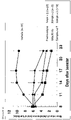
- the compound of the present invention and Tofacitinib were continuously administered to the mice at a dose of 50 mg/kg (50 mpk), twice a day, via oral administration, for 15 days from 8 days after the implementation day of the booster (which is defined as Day 0), whereas Prednisolone was continuously administered to the mice at a dose of 0.3 mg/kg (3 mpk), once a day, via oral administration, for 15 days from 8 days after the implementation day of the booster.
- the clinical symptoms of arthritis were scored by observation with naked eyes, and the action of the compound of the present invention was then confirmed.
- the clinical symptoms for each limb were scored (0: not changed, 1: one finger swelled, 2: two or more fingers swelled, 3: instep swelled, 4: all fingers swelled and also wrist or ankle swelled), and a total score from the four limbs was defined as a score for an individual mouse (the highest score: 16).
- the compound of the present invention showed an excellent therapeutic effect on rheumatoid arthritis.
- mice which are a mouse experimental model for multiple sclerosis.
- Eight-week-old male SJL/J mice (Charles River Laboratories Japan, Inc.) were administered with a mixed solution (emulsion), which had been obtained by mixing a normal saline aqueous solution (1 mg/ mL) of a peptide (Toray Research Center, Inc.) corresponding to 139-151 residues of a proteolipid protein with a Freund's complete adjuvant (DIFCO) comprising 4 mg/ mL killed Mycobacterium tuberculosis (H37Ra) in equal amounts, via intradermal injection in an amount of 100 ⁇ L each into two sites of the dorsal portion of each mouse, so as to induce encephalomyelitis.
- DIFCO Freund's complete adjuvant
- the compound of the present invention was continuously administered to the mice for 4 weeks via oral administration of twice a day.
- Day 0, Day 2, Day 5, and Days 7 to 35 the clinical symptoms of encephalomyelitis were observed with naked eyes, and the action of the compound of the present invention was then confirmed.
- the observed clinical symptoms were scored (0: no symptoms, 1: weakened tail, 1.5: complete ptosis of tail, 2: ataxia, 3: light paralysis of hindlimbs, 3.5: paralysis of hindlimbs, 4. complete paralysis of hindlimbs, 4.5: paralysis of four limbs, dying, 5: death).
- the compound of the present invention showed an excellent therapeutic effect on multiple sclerosis.
Landscapes
- Health & Medical Sciences (AREA)
- Chemical & Material Sciences (AREA)
- Organic Chemistry (AREA)
- Public Health (AREA)
- Pharmacology & Pharmacy (AREA)
- Veterinary Medicine (AREA)
- General Health & Medical Sciences (AREA)
- Medicinal Chemistry (AREA)
- Animal Behavior & Ethology (AREA)
- Life Sciences & Earth Sciences (AREA)
- Nuclear Medicine, Radiotherapy & Molecular Imaging (AREA)
- General Chemical & Material Sciences (AREA)
- Chemical Kinetics & Catalysis (AREA)
- Bioinformatics & Cheminformatics (AREA)
- Engineering & Computer Science (AREA)
- Immunology (AREA)
- Rheumatology (AREA)
- Epidemiology (AREA)
- Pain & Pain Management (AREA)
- Biomedical Technology (AREA)
- Neurosurgery (AREA)
- Neurology (AREA)
- Transplantation (AREA)
- Orthopedic Medicine & Surgery (AREA)
- Physical Education & Sports Medicine (AREA)
- Inorganic Chemistry (AREA)
- Psychiatry (AREA)
- Hospice & Palliative Care (AREA)
- Dermatology (AREA)
- Pharmaceuticals Containing Other Organic And Inorganic Compounds (AREA)
- Nitrogen Condensed Heterocyclic Rings (AREA)
Applications Claiming Priority (2)
| Application Number | Priority Date | Filing Date | Title |
|---|---|---|---|
| JP2015152123 | 2015-07-31 | ||
| PCT/JP2016/072258 WO2017022648A1 (ja) | 2015-07-31 | 2016-07-29 | ピロロ[2,3-d]ピリミジン化合物又はその塩 |
Publications (3)
| Publication Number | Publication Date |
|---|---|
| EP3330271A1 EP3330271A1 (en) | 2018-06-06 |
| EP3330271A4 EP3330271A4 (en) | 2019-05-01 |
| EP3330271B1 true EP3330271B1 (en) | 2022-09-07 |
Family
ID=57943140
Family Applications (1)
| Application Number | Title | Priority Date | Filing Date |
|---|---|---|---|
| EP16832927.4A Active EP3330271B1 (en) | 2015-07-31 | 2016-07-29 | PYRROLO[2,3-d]PYRIMIDINE COMPOUND OR SALT THEREOF |
Country Status (17)
| Country | Link |
|---|---|
| US (1) | US10421760B2 (pl) |
| EP (1) | EP3330271B1 (pl) |
| JP (1) | JP6438585B2 (pl) |
| KR (1) | KR102086999B1 (pl) |
| CN (1) | CN107849052B (pl) |
| AU (1) | AU2016302302B2 (pl) |
| CA (1) | CA2989989C (pl) |
| DK (1) | DK3330271T3 (pl) |
| ES (1) | ES2927324T3 (pl) |
| HU (1) | HUE060733T2 (pl) |
| MA (1) | MA42544A (pl) |
| MX (1) | MX387656B (pl) |
| PL (1) | PL3330271T3 (pl) |
| PT (1) | PT3330271T (pl) |
| RU (1) | RU2712269C2 (pl) |
| TW (1) | TWI716427B (pl) |
| WO (1) | WO2017022648A1 (pl) |
Families Citing this family (1)
| Publication number | Priority date | Publication date | Assignee | Title |
|---|---|---|---|---|
| WO2018210661A1 (en) * | 2017-05-15 | 2018-11-22 | Basf Se | Heteroaryl compounds as agrochemical fungicides |
Family Cites Families (7)
| Publication number | Priority date | Publication date | Assignee | Title |
|---|---|---|---|---|
| PA8474101A1 (es) | 1998-06-19 | 2000-09-29 | Pfizer Prod Inc | Compuestos de pirrolo [2,3-d] pirimidina |
| KR20070104641A (ko) | 2005-02-03 | 2007-10-26 | 버텍스 파마슈티칼스 인코포레이티드 | 단백질 키나제의 억제제로 유용한 피롤로피리미딘 |
| US8993756B2 (en) | 2011-12-06 | 2015-03-31 | Merck Sharp & Dohme Corp. | Pyrrolopyrimidines as janus kinase inhibitors |
| JO3805B1 (ar) | 2013-10-10 | 2021-01-31 | Araxes Pharma Llc | مثبطات كراس جي12سي |
| EP3636639A1 (en) * | 2013-10-10 | 2020-04-15 | Araxes Pharma LLC | Inhibitors of kras g12c |
| AU2015215582B2 (en) * | 2014-02-04 | 2016-10-13 | Taiho Pharmaceutical Co., Ltd. | Azaindole derivative |
| CN105732636B (zh) * | 2014-12-30 | 2020-04-21 | 广东东阳光药业有限公司 | 杂芳化合物及其在药物中的应用 |
-
2016
- 2016-07-29 ES ES16832927T patent/ES2927324T3/es active Active
- 2016-07-29 RU RU2018103360A patent/RU2712269C2/ru active
- 2016-07-29 TW TW105124172A patent/TWI716427B/zh active
- 2016-07-29 PL PL16832927.4T patent/PL3330271T3/pl unknown
- 2016-07-29 CA CA2989989A patent/CA2989989C/en active Active
- 2016-07-29 MX MX2018001307A patent/MX387656B/es unknown
- 2016-07-29 MA MA042544A patent/MA42544A/fr unknown
- 2016-07-29 KR KR1020187002320A patent/KR102086999B1/ko active Active
- 2016-07-29 DK DK16832927.4T patent/DK3330271T3/da active
- 2016-07-29 PT PT168329274T patent/PT3330271T/pt unknown
- 2016-07-29 CN CN201680045029.9A patent/CN107849052B/zh active Active
- 2016-07-29 JP JP2017532562A patent/JP6438585B2/ja active Active
- 2016-07-29 AU AU2016302302A patent/AU2016302302B2/en active Active
- 2016-07-29 HU HUE16832927A patent/HUE060733T2/hu unknown
- 2016-07-29 WO PCT/JP2016/072258 patent/WO2017022648A1/ja not_active Ceased
- 2016-07-29 EP EP16832927.4A patent/EP3330271B1/en active Active
- 2016-07-29 US US15/746,208 patent/US10421760B2/en active Active
Also Published As
| Publication number | Publication date |
|---|---|
| US10421760B2 (en) | 2019-09-24 |
| MX2018001307A (es) | 2018-05-22 |
| BR112018001695A2 (pt) | 2018-09-18 |
| MX387656B (es) | 2025-03-18 |
| CN107849052A (zh) | 2018-03-27 |
| PL3330271T3 (pl) | 2022-12-19 |
| HK1251232A1 (zh) | 2019-01-25 |
| EP3330271A1 (en) | 2018-06-06 |
| CN107849052B (zh) | 2020-05-12 |
| US20180208598A1 (en) | 2018-07-26 |
| ES2927324T3 (es) | 2022-11-04 |
| CA2989989A1 (en) | 2017-02-09 |
| RU2018103360A (ru) | 2019-08-29 |
| KR20180030848A (ko) | 2018-03-26 |
| JPWO2017022648A1 (ja) | 2018-03-01 |
| TW201713664A (zh) | 2017-04-16 |
| AU2016302302A1 (en) | 2018-01-18 |
| JP6438585B2 (ja) | 2018-12-19 |
| HUE060733T2 (hu) | 2023-04-28 |
| MA42544A (fr) | 2018-06-06 |
| CA2989989C (en) | 2021-07-20 |
| AU2016302302B2 (en) | 2019-12-19 |
| RU2712269C2 (ru) | 2020-01-28 |
| RU2018103360A3 (pl) | 2019-09-04 |
| WO2017022648A1 (ja) | 2017-02-09 |
| DK3330271T3 (da) | 2022-11-14 |
| PT3330271T (pt) | 2022-09-29 |
| KR102086999B1 (ko) | 2020-03-10 |
| EP3330271A4 (en) | 2019-05-01 |
| TWI716427B (zh) | 2021-01-21 |
Similar Documents
| Publication | Publication Date | Title |
|---|---|---|
| US11629148B2 (en) | Substituted pyrrolo[3,4-d]imidazoles as JAK inhibitors | |
| EP3583105B1 (en) | Pyrrolo [1,2-b]pyridazine derivatives | |
| EP3733673B1 (en) | Oxy-fluoropiperidine derivative as kinase inhibitor | |
| ES2923682T3 (es) | Derivado de amino-fluoropiperidina como inhibidor de cinasa | |
| AU2018394996B2 (en) | Amino-methyl piperidine derivative as kinase inhibitor | |
| EP3330271B1 (en) | PYRROLO[2,3-d]PYRIMIDINE COMPOUND OR SALT THEREOF | |
| US9782392B2 (en) | Azaindole derivative | |
| BR112018001695B1 (pt) | COMPOSTO PIRROLO[2,3-d]PIRIMIDINA, INIBIDOR DE JAK3, COMPOSIÇÃO FARMACÊUTICA, AGENTE, USOS DO DITO COMPOSTO E MÉTODO PRA PRODUÇÃO DO MESMO | |
| HK1251232B (zh) | 吡咯并[2,3-d] 嘧啶化合物或其盐 | |
| HK40025066B (en) | Amino-fluoropiperidine derivative as kinase inhibitor | |
| HK40025066A (en) | Amino-fluoropiperidine derivative as kinase inhibitor |
Legal Events
| Date | Code | Title | Description |
|---|---|---|---|
| STAA | Information on the status of an ep patent application or granted ep patent |
Free format text: STATUS: THE INTERNATIONAL PUBLICATION HAS BEEN MADE |
|
| PUAI | Public reference made under article 153(3) epc to a published international application that has entered the european phase |
Free format text: ORIGINAL CODE: 0009012 |
|
| STAA | Information on the status of an ep patent application or granted ep patent |
Free format text: STATUS: REQUEST FOR EXAMINATION WAS MADE |
|
| 17P | Request for examination filed |
Effective date: 20180118 |
|
| AK | Designated contracting states |
Kind code of ref document: A1 Designated state(s): AL AT BE BG CH CY CZ DE DK EE ES FI FR GB GR HR HU IE IS IT LI LT LU LV MC MK MT NL NO PL PT RO RS SE SI SK SM TR |
|
| AX | Request for extension of the european patent |
Extension state: BA ME |
|
| A4 | Supplementary search report drawn up and despatched |
Effective date: 20190403 |
|
| RIC1 | Information provided on ipc code assigned before grant |
Ipc: A61P 25/00 20060101ALI20190328BHEP Ipc: A61P 37/06 20060101ALI20190328BHEP Ipc: A61K 31/519 20060101ALI20190328BHEP Ipc: C07D 487/04 20060101AFI20190328BHEP Ipc: A61P 29/00 20060101ALI20190328BHEP Ipc: A61P 19/02 20060101ALI20190328BHEP |
|
| STAA | Information on the status of an ep patent application or granted ep patent |
Free format text: STATUS: EXAMINATION IS IN PROGRESS |
|
| 17Q | First examination report despatched |
Effective date: 20210624 |
|
| REG | Reference to a national code |
Ref country code: DE Ref legal event code: R079 Ref document number: 602016074884 Country of ref document: DE Free format text: PREVIOUS MAIN CLASS: C07D0487040000 Ipc: C07D0207300000 |
|
| GRAP | Despatch of communication of intention to grant a patent |
Free format text: ORIGINAL CODE: EPIDOSNIGR1 |
|
| STAA | Information on the status of an ep patent application or granted ep patent |
Free format text: STATUS: GRANT OF PATENT IS INTENDED |
|
| RIC1 | Information provided on ipc code assigned before grant |
Ipc: C07D 307/34 20060101ALI20220201BHEP Ipc: C07D 207/30 20060101AFI20220201BHEP |
|
| INTG | Intention to grant announced |
Effective date: 20220225 |
|
| GRAS | Grant fee paid |
Free format text: ORIGINAL CODE: EPIDOSNIGR3 |
|
| GRAA | (expected) grant |
Free format text: ORIGINAL CODE: 0009210 |
|
| STAA | Information on the status of an ep patent application or granted ep patent |
Free format text: STATUS: THE PATENT HAS BEEN GRANTED |
|
| AK | Designated contracting states |
Kind code of ref document: B1 Designated state(s): AL AT BE BG CH CY CZ DE DK EE ES FI FR GB GR HR HU IE IS IT LI LT LU LV MC MK MT NL NO PL PT RO RS SE SI SK SM TR |
|
| REG | Reference to a national code |
Ref country code: GB Ref legal event code: FG4D |
|
| REG | Reference to a national code |
Ref country code: CH Ref legal event code: EP Ref country code: AT Ref legal event code: REF Ref document number: 1516952 Country of ref document: AT Kind code of ref document: T Effective date: 20220915 |
|
| REG | Reference to a national code |
Ref country code: IE Ref legal event code: FG4D |
|
| REG | Reference to a national code |
Ref country code: PT Ref legal event code: SC4A Ref document number: 3330271 Country of ref document: PT Date of ref document: 20220929 Kind code of ref document: T Free format text: AVAILABILITY OF NATIONAL TRANSLATION Effective date: 20220923 Ref country code: DE Ref legal event code: R096 Ref document number: 602016074884 Country of ref document: DE |
|
| REG | Reference to a national code |
Ref country code: RO Ref legal event code: EPE |
|
| REG | Reference to a national code |
Ref country code: NL Ref legal event code: FP |
|
| REG | Reference to a national code |
Ref country code: ES Ref legal event code: FG2A Ref document number: 2927324 Country of ref document: ES Kind code of ref document: T3 Effective date: 20221104 |
|
| REG | Reference to a national code |
Ref country code: DK Ref legal event code: T3 Effective date: 20221108 |
|
| REG | Reference to a national code |
Ref country code: NO Ref legal event code: T2 Effective date: 20220907 |
|
| REG | Reference to a national code |
Ref country code: SE Ref legal event code: TRGR |
|
| REG | Reference to a national code |
Ref country code: LT Ref legal event code: MG9D |
|
| REG | Reference to a national code |
Ref country code: GR Ref legal event code: EP Ref document number: 20220402114 Country of ref document: GR Effective date: 20221212 |
|
| PG25 | Lapsed in a contracting state [announced via postgrant information from national office to epo] |
Ref country code: RS Free format text: LAPSE BECAUSE OF FAILURE TO SUBMIT A TRANSLATION OF THE DESCRIPTION OR TO PAY THE FEE WITHIN THE PRESCRIBED TIME-LIMIT Effective date: 20220907 Ref country code: LV Free format text: LAPSE BECAUSE OF FAILURE TO SUBMIT A TRANSLATION OF THE DESCRIPTION OR TO PAY THE FEE WITHIN THE PRESCRIBED TIME-LIMIT Effective date: 20220907 Ref country code: LT Free format text: LAPSE BECAUSE OF FAILURE TO SUBMIT A TRANSLATION OF THE DESCRIPTION OR TO PAY THE FEE WITHIN THE PRESCRIBED TIME-LIMIT Effective date: 20220907 |
|
| PG25 | Lapsed in a contracting state [announced via postgrant information from national office to epo] |
Ref country code: HR Free format text: LAPSE BECAUSE OF FAILURE TO SUBMIT A TRANSLATION OF THE DESCRIPTION OR TO PAY THE FEE WITHIN THE PRESCRIBED TIME-LIMIT Effective date: 20220907 |
|
| PG25 | Lapsed in a contracting state [announced via postgrant information from national office to epo] |
Ref country code: SM Free format text: LAPSE BECAUSE OF FAILURE TO SUBMIT A TRANSLATION OF THE DESCRIPTION OR TO PAY THE FEE WITHIN THE PRESCRIBED TIME-LIMIT Effective date: 20220907 |
|
| REG | Reference to a national code |
Ref country code: HU Ref legal event code: AG4A Ref document number: E060733 Country of ref document: HU |
|
| VS25 | Lapsed in a validation state [announced via postgrant information from nat. office to epo] |
Ref country code: MD Free format text: LAPSE BECAUSE OF FAILURE TO SUBMIT A TRANSLATION OF THE DESCRIPTION OR TO PAY THE FEE WITHIN THE PRESCRIBED TIME-LIMIT Effective date: 20220907 |
|
| PG25 | Lapsed in a contracting state [announced via postgrant information from national office to epo] |
Ref country code: SK Free format text: LAPSE BECAUSE OF FAILURE TO SUBMIT A TRANSLATION OF THE DESCRIPTION OR TO PAY THE FEE WITHIN THE PRESCRIBED TIME-LIMIT Effective date: 20220907 Ref country code: IS Free format text: LAPSE BECAUSE OF FAILURE TO SUBMIT A TRANSLATION OF THE DESCRIPTION OR TO PAY THE FEE WITHIN THE PRESCRIBED TIME-LIMIT Effective date: 20230107 Ref country code: EE Free format text: LAPSE BECAUSE OF FAILURE TO SUBMIT A TRANSLATION OF THE DESCRIPTION OR TO PAY THE FEE WITHIN THE PRESCRIBED TIME-LIMIT Effective date: 20220907 |
|
| REG | Reference to a national code |
Ref country code: DE Ref legal event code: R097 Ref document number: 602016074884 Country of ref document: DE |
|
| PG25 | Lapsed in a contracting state [announced via postgrant information from national office to epo] |
Ref country code: AL Free format text: LAPSE BECAUSE OF FAILURE TO SUBMIT A TRANSLATION OF THE DESCRIPTION OR TO PAY THE FEE WITHIN THE PRESCRIBED TIME-LIMIT Effective date: 20220907 |
|
| PLBE | No opposition filed within time limit |
Free format text: ORIGINAL CODE: 0009261 |
|
| STAA | Information on the status of an ep patent application or granted ep patent |
Free format text: STATUS: NO OPPOSITION FILED WITHIN TIME LIMIT |
|
| 26N | No opposition filed |
Effective date: 20230608 |
|
| PG25 | Lapsed in a contracting state [announced via postgrant information from national office to epo] |
Ref country code: SI Free format text: LAPSE BECAUSE OF FAILURE TO SUBMIT A TRANSLATION OF THE DESCRIPTION OR TO PAY THE FEE WITHIN THE PRESCRIBED TIME-LIMIT Effective date: 20220907 |
|
| PG25 | Lapsed in a contracting state [announced via postgrant information from national office to epo] |
Ref country code: MC Free format text: LAPSE BECAUSE OF FAILURE TO SUBMIT A TRANSLATION OF THE DESCRIPTION OR TO PAY THE FEE WITHIN THE PRESCRIBED TIME-LIMIT Effective date: 20220907 |
|
| PG25 | Lapsed in a contracting state [announced via postgrant information from national office to epo] |
Ref country code: MC Free format text: LAPSE BECAUSE OF FAILURE TO SUBMIT A TRANSLATION OF THE DESCRIPTION OR TO PAY THE FEE WITHIN THE PRESCRIBED TIME-LIMIT Effective date: 20220907 |
|
| PG25 | Lapsed in a contracting state [announced via postgrant information from national office to epo] |
Ref country code: LU Free format text: LAPSE BECAUSE OF NON-PAYMENT OF DUE FEES Effective date: 20230729 |
|
| PG25 | Lapsed in a contracting state [announced via postgrant information from national office to epo] |
Ref country code: LU Free format text: LAPSE BECAUSE OF NON-PAYMENT OF DUE FEES Effective date: 20230729 |
|
| PG25 | Lapsed in a contracting state [announced via postgrant information from national office to epo] |
Ref country code: BG Free format text: LAPSE BECAUSE OF FAILURE TO SUBMIT A TRANSLATION OF THE DESCRIPTION OR TO PAY THE FEE WITHIN THE PRESCRIBED TIME-LIMIT Effective date: 20220907 |
|
| PG25 | Lapsed in a contracting state [announced via postgrant information from national office to epo] |
Ref country code: BG Free format text: LAPSE BECAUSE OF FAILURE TO SUBMIT A TRANSLATION OF THE DESCRIPTION OR TO PAY THE FEE WITHIN THE PRESCRIBED TIME-LIMIT Effective date: 20220907 |
|
| PGFP | Annual fee paid to national office [announced via postgrant information from national office to epo] |
Ref country code: PL Payment date: 20250529 Year of fee payment: 10 |
|
| PGFP | Annual fee paid to national office [announced via postgrant information from national office to epo] |
Ref country code: GB Payment date: 20250605 Year of fee payment: 10 |
|
| PGFP | Annual fee paid to national office [announced via postgrant information from national office to epo] |
Ref country code: BE Payment date: 20250619 Year of fee payment: 10 Ref country code: NL Payment date: 20250613 Year of fee payment: 10 |
|
| PGFP | Annual fee paid to national office [announced via postgrant information from national office to epo] |
Ref country code: PT Payment date: 20250630 Year of fee payment: 10 |
|
| PGFP | Annual fee paid to national office [announced via postgrant information from national office to epo] |
Ref country code: FR Payment date: 20250610 Year of fee payment: 10 |
|
| PGFP | Annual fee paid to national office [announced via postgrant information from national office to epo] |
Ref country code: GR Payment date: 20250618 Year of fee payment: 10 |
|
| PGFP | Annual fee paid to national office [announced via postgrant information from national office to epo] |
Ref country code: RO Payment date: 20250619 Year of fee payment: 10 |
|
| PG25 | Lapsed in a contracting state [announced via postgrant information from national office to epo] |
Ref country code: CY Free format text: LAPSE BECAUSE OF FAILURE TO SUBMIT A TRANSLATION OF THE DESCRIPTION OR TO PAY THE FEE WITHIN THE PRESCRIBED TIME-LIMIT; INVALID AB INITIO Effective date: 20160729 |
|
| PGFP | Annual fee paid to national office [announced via postgrant information from national office to epo] |
Ref country code: IE Payment date: 20250610 Year of fee payment: 10 |
|
| PGFP | Annual fee paid to national office [announced via postgrant information from national office to epo] |
Ref country code: SE Payment date: 20250610 Year of fee payment: 10 |
|
| PGFP | Annual fee paid to national office [announced via postgrant information from national office to epo] |
Ref country code: HU Payment date: 20250630 Year of fee payment: 10 |
|
| PGFP | Annual fee paid to national office [announced via postgrant information from national office to epo] |
Ref country code: FI Payment date: 20250715 Year of fee payment: 10 Ref country code: ES Payment date: 20250801 Year of fee payment: 10 |
|
| PGFP | Annual fee paid to national office [announced via postgrant information from national office to epo] |
Ref country code: DK Payment date: 20250714 Year of fee payment: 10 Ref country code: DE Payment date: 20250604 Year of fee payment: 10 |
|
| PGFP | Annual fee paid to national office [announced via postgrant information from national office to epo] |
Ref country code: NO Payment date: 20250709 Year of fee payment: 10 |
|
| PGFP | Annual fee paid to national office [announced via postgrant information from national office to epo] |
Ref country code: TR Payment date: 20250711 Year of fee payment: 10 Ref country code: IT Payment date: 20250623 Year of fee payment: 10 |
|
| REG | Reference to a national code |
Ref country code: AT Ref legal event code: UEP Ref document number: 1516952 Country of ref document: AT Kind code of ref document: T Effective date: 20220907 |
|
| PGFP | Annual fee paid to national office [announced via postgrant information from national office to epo] |
Ref country code: AT Payment date: 20250625 Year of fee payment: 10 |
|
| PGFP | Annual fee paid to national office [announced via postgrant information from national office to epo] |
Ref country code: CH Payment date: 20250801 Year of fee payment: 10 |
|
| PGFP | Annual fee paid to national office [announced via postgrant information from national office to epo] |
Ref country code: CZ Payment date: 20250718 Year of fee payment: 10 |
|
| VS25 | Lapsed in a validation state [announced via postgrant information from nat. office to epo] |
Ref country code: MA Free format text: FAILURE TO ELECT DOMICILE IN THE NATIONAL COUNTRY Effective date: 20221208 |