EP3321303A1 - Optical material composition and optical material - Google Patents
Optical material composition and optical material Download PDFInfo
- Publication number
- EP3321303A1 EP3321303A1 EP16821388.2A EP16821388A EP3321303A1 EP 3321303 A1 EP3321303 A1 EP 3321303A1 EP 16821388 A EP16821388 A EP 16821388A EP 3321303 A1 EP3321303 A1 EP 3321303A1
- Authority
- EP
- European Patent Office
- Prior art keywords
- compound
- composition
- formula
- optical materials
- mass
- Prior art date
- Legal status (The legal status is an assumption and is not a legal conclusion. Google has not performed a legal analysis and makes no representation as to the accuracy of the status listed.)
- Granted
Links
Classifications
-
- C—CHEMISTRY; METALLURGY
- C08—ORGANIC MACROMOLECULAR COMPOUNDS; THEIR PREPARATION OR CHEMICAL WORKING-UP; COMPOSITIONS BASED THEREON
- C08G—MACROMOLECULAR COMPOUNDS OBTAINED OTHERWISE THAN BY REACTIONS ONLY INVOLVING UNSATURATED CARBON-TO-CARBON BONDS
- C08G75/00—Macromolecular compounds obtained by reactions forming a linkage containing sulfur with or without nitrogen, oxygen, or carbon in the main chain of the macromolecule
- C08G75/02—Polythioethers
- C08G75/06—Polythioethers from cyclic thioethers
- C08G75/08—Polythioethers from cyclic thioethers from thiiranes
-
- C—CHEMISTRY; METALLURGY
- C08—ORGANIC MACROMOLECULAR COMPOUNDS; THEIR PREPARATION OR CHEMICAL WORKING-UP; COMPOSITIONS BASED THEREON
- C08K—Use of inorganic or non-macromolecular organic substances as compounding ingredients
- C08K5/00—Use of organic ingredients
- C08K5/36—Sulfur-, selenium-, or tellurium-containing compounds
- C08K5/37—Thiols
-
- C—CHEMISTRY; METALLURGY
- C08—ORGANIC MACROMOLECULAR COMPOUNDS; THEIR PREPARATION OR CHEMICAL WORKING-UP; COMPOSITIONS BASED THEREON
- C08L—COMPOSITIONS OF MACROMOLECULAR COMPOUNDS
- C08L81/00—Compositions of macromolecular compounds obtained by reactions forming in the main chain of the macromolecule a linkage containing sulfur with or without nitrogen, oxygen or carbon only; Compositions of polysulfones; Compositions of derivatives of such polymers
- C08L81/02—Polythioethers; Polythioether-ethers
-
- C—CHEMISTRY; METALLURGY
- C09—DYES; PAINTS; POLISHES; NATURAL RESINS; ADHESIVES; COMPOSITIONS NOT OTHERWISE PROVIDED FOR; APPLICATIONS OF MATERIALS NOT OTHERWISE PROVIDED FOR
- C09K—MATERIALS FOR MISCELLANEOUS APPLICATIONS, NOT PROVIDED FOR ELSEWHERE
- C09K9/00—Tenebrescent materials, i.e. materials for which the range of wavelengths for energy absorption is changed as a result of excitation by some form of energy
- C09K9/02—Organic tenebrescent materials
-
- G—PHYSICS
- G02—OPTICS
- G02B—OPTICAL ELEMENTS, SYSTEMS OR APPARATUS
- G02B1/00—Optical elements characterised by the material of which they are made; Optical coatings for optical elements
- G02B1/04—Optical elements characterised by the material of which they are made; Optical coatings for optical elements made of organic materials, e.g. plastics
-
- C—CHEMISTRY; METALLURGY
- C09—DYES; PAINTS; POLISHES; NATURAL RESINS; ADHESIVES; COMPOSITIONS NOT OTHERWISE PROVIDED FOR; APPLICATIONS OF MATERIALS NOT OTHERWISE PROVIDED FOR
- C09K—MATERIALS FOR MISCELLANEOUS APPLICATIONS, NOT PROVIDED FOR ELSEWHERE
- C09K2211/00—Chemical nature of organic luminescent or tenebrescent compounds
- C09K2211/10—Non-macromolecular compounds
- C09K2211/1003—Carbocyclic compounds
- C09K2211/1007—Non-condensed systems
-
- C—CHEMISTRY; METALLURGY
- C09—DYES; PAINTS; POLISHES; NATURAL RESINS; ADHESIVES; COMPOSITIONS NOT OTHERWISE PROVIDED FOR; APPLICATIONS OF MATERIALS NOT OTHERWISE PROVIDED FOR
- C09K—MATERIALS FOR MISCELLANEOUS APPLICATIONS, NOT PROVIDED FOR ELSEWHERE
- C09K2211/00—Chemical nature of organic luminescent or tenebrescent compounds
- C09K2211/10—Non-macromolecular compounds
- C09K2211/1018—Heterocyclic compounds
- C09K2211/1025—Heterocyclic compounds characterised by ligands
- C09K2211/1029—Heterocyclic compounds characterised by ligands containing one nitrogen atom as the heteroatom
- C09K2211/1033—Heterocyclic compounds characterised by ligands containing one nitrogen atom as the heteroatom with oxygen
-
- C—CHEMISTRY; METALLURGY
- C09—DYES; PAINTS; POLISHES; NATURAL RESINS; ADHESIVES; COMPOSITIONS NOT OTHERWISE PROVIDED FOR; APPLICATIONS OF MATERIALS NOT OTHERWISE PROVIDED FOR
- C09K—MATERIALS FOR MISCELLANEOUS APPLICATIONS, NOT PROVIDED FOR ELSEWHERE
- C09K2211/00—Chemical nature of organic luminescent or tenebrescent compounds
- C09K2211/10—Non-macromolecular compounds
- C09K2211/1018—Heterocyclic compounds
- C09K2211/1025—Heterocyclic compounds characterised by ligands
- C09K2211/1088—Heterocyclic compounds characterised by ligands containing oxygen as the only heteroatom
Definitions
- the present invention relates to a composition for optical materials, etc., and particularly relates to a composition for optical materials, etc. suitable for an optical material for a plastic lens, a prism, an optical fiber, an information recording substrate, a filter or the like, in particular for a plastic lens.
- Plastic materials are lightweight, highly tough and easy to be dyed, and therefore are widely used recently for various types of optical materials, particularly eyeglass lenses.
- Optical materials, particularly eyeglass lenses are specifically required to have, as physical properties, low specific gravity, high transparency and low yellowness, high heat resistance, high strength and the like, and as optical properties, high refractive index and high Abbe number.
- a high refractive index allows a lens to be thinner, and a high Abbe number reduces the chromatic aberration of a lens.
- the refractive index is increased, the Abbe number is decreased. Therefore, it has been studied to improve both of the refractive index and the Abbe number.
- the most representative method is a method using an episulfide compound (see Patent Document 1).
- the manufacturing process is complicated, the yield may be reduced, and peeling may be caused during use, and regarding the mixing technique, since the photochromic compound reacts with a monomer of isocyanate or the like, the mixing technique has been successfully applied only to lens materials having a low refractive index.
- the problem to be solved by the present invention is to provide an optical material having photochromic function and having a high refractive index without using a coating technique.
- an optical material obtained by using a composition for optical materials containing an episulfide compound (A), a polythiol compound (B) and a photochromic compound (C) has a high refractive index and photochromic performance, and thus the present invention was achieved.
- the present invention is as follows:
- composition for optical materials of the present invention contains an episulfide compound (A), a polythiol compound (B) and a photochromic compound (C).
- the episulfide compound (A), the polythiol compound (B) and the photochromic compound (C) that are raw materials to be used in the present invention will be described.
- the episulfide compound (A) to be used in the present invention includes all episulfide compounds.
- episulfide compound (A) is classified into a compound having a chain aliphatic skeleton, a compound having an aliphatic cyclic skeleton and a compound having an aromatic skeleton and listed below, but the episulfide compound (A) is not limited thereto.
- Examples of the compound having a chain aliphatic skeleton include a compound represented by formula (1) below.
- m represents an integer of 0 to 4
- n represents an integer of 0 to 2.
- Examples of the compound having an aliphatic cyclic skeleton include a compound represented by formula (2) or (3) below. (p and q each independently represent an integer of 0 to 4.)
- Examples of the compound having an aromatic skeleton include a compound represented by formula (4) below. (p and q each independently represent an integer of 0 to 4.)
- the method for obtaining the episulfide compound (A) is not particularly limited.
- a commercially-available product may be used as the episulfide compound (A).
- the episulfide compound (A) may be synthesized according to a publicly-known method.
- the ratio of the episulfide compound (A) in the composition for optical materials is usually 65 to 99% by mass, preferably 70 to 90% by mass, more preferably 75 to 85% by mass, and particularly preferably 75 to 80% by mass. This is because, when the ratio is within the above-described range, it is possible to obtain an optical material having a high refractive index.
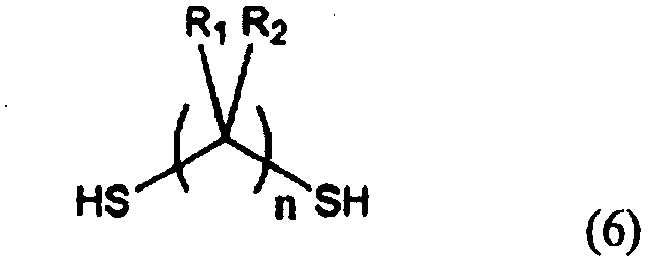
- polythiol compound (B) to be used in the present invention a polythiol compound in which the carbon number of the main chain is 4 to 20 is preferred, and a polythiol compound represented by formula (5) below and a polythiol compound represented by formula (6) below are more preferred.
- X represents an alkylene group having at least one selected from the group consisting of -S-, -O- and -CO- in the main chain, wherein the carbon number of the main chain is 4 to 20.
- X preferably has -S- in the main chain, and the carbon number of the main chain is more preferably 5 to 20, and particularly preferably 6 to 10.
- X may have SH, a C 1-10 alkyl group, a C 1-10 alkylthiol group or a C 1-10 mercaptoalkylcarbonyloxy group in the side chain, but formula (5) preferably represents a linear polythiol not having a side chain because good photochromic performance is obtained thereby.
- n represents an integer of 4 to 20, preferably an integer of 5 to 20, and particularly preferably an integer of 6 to 10.
- R 1 and R 2 may be the same or different and represent H, SH, a C 1-10 alkyl group or a C 1-10 alkylthiol group, and preferably represent H.
- polythiol compound (B) Specific examples of the polythiol compound (B) are described below, but the polythiol compound (B) is not limited thereto.
- polythiol compound (B) examples include 1,4-dimercaptobutane, 1,5-dimercaptopentane, 1,6-dimercaptohexane, 1,7-dimercaptoheptane, 1,8-dimercaptooctane, 1,9-dimercaptononane, 1,10-dimercaptodecane, bis(2-mercaptoethyl)sulfide, 1,2-bis(2-mercaptoethylthio)ethane, 1,5-dimercapto-3-oxapentane, 1,8-dimercapto-3,6-dioxaoctane, 1,2-dimercapto-3,4-dimethoxybutane, 2-mercaptomethyl-1,4-dimercaptobutane, 2-(2-mercaptoethylthio)-1 ,3-dimercaptopropane, 1 ,2-bis(2-mercaptoethylthio
- a linear dithiol not having a side chain specifically, a compound represented by formula (7) below is preferred because good photochromic performance is obtained thereby.
- n represents an integer of 4 to 20, preferably an integer of 5 to 20, and particularly preferably an integer of 6 to 10.
- 1,10-dimercaptodecane 1,9-dimercaptononane, 1,8-dimercaptooctane, 1,7-dimercaptoheptane and 1,6-dimercaptohexane, which are dithiols, wherein the carbon number of the main chain is 6 to 20.
- the method for obtaining the polythiol compound (B) is not particularly limited.
- a commercially-available product may be used as the polythiol compound (B).
- the polythiol compound (B) may be synthesized according to a publicly-known method. For example, 1,10-dimercaptodecane, 1,8-dimercaptooctane and 1,6-dimercaptohexane can be easily obtained as reagent products.
- the ratio of the polythiol compound (B) in the composition for optical materials is usually 0.9 to 35% by mass, preferably 5 to 30% by mass, and particularly preferably 10 to 25% by mass.
- the photochromic compound (C) to be used in the present invention is a compound exhibiting a characteristic, wherein optical transparency is changed by absorption of ultraviolet light or visible light and recovered when a light source is blocked.
- the photochromic compound (C) is not particularly limited as long as it is a compound having this characteristic, and can be arbitrarily selected and used.
- Examples thereof include a spiropyran-based compound, a spirooxazine-based compound, a spiroperimidine-based compound, a benzopyran-based compound, a fulgide-based compound, a naphthopyran-based compound, a diarylethene-based compound and an azobenzene-based compound. These compounds may be used solely, or two or more of them may be used as a mixture.
- spiropyran-based compound examples include
- spirooxazine-based compound examples include 1,3,3-trimethylindolinonaphthospirooxazine.
- spiroperimidine-based compound examples include 2,3-dihydro-2-spiro-4'-[8'-aminonaphthalen-1'(4H)-one]perimidine and 2,3-dihydro-2-spiro-7'-[8'-imino-7',8'-dihydronaphthalen-1'-amine]perimidine.
- benzopyran-based compound examples include 4-[3-phenyl-3-(4-piperidin-1-yl-phenyl)-3H-benzo[f]chromen-6-yl]morpholine.
- fulgide-based compound examples include N-cyanomethyl-6,7-dihydro-4-methyl-2-phenylspiro(5,6-benzo[b]thiophenedicarboxyi mide-7,2'-tricyclo[3.3.1.1 3,7 ]decane), N-cyanomethyl-6,7-dihydro-2-(p-methoxyphenyl)-4-methylspiro(5,6-benzo[b]thiophen edicarboxyimide-7,2'-tricyclo[3.3.1.1 3,7 ]decane), 6,7-dihydro-N-methoxycarbonylmethyl-4-methyl-2-phenylspiro(5,6-benzo[b]thiophene dicarboxyimide-7,2'-tricyclo[3.3.1.1 3,7 ]decane), 6,7-dihydro-4-methyl-2-(p-methylphenyl)-N-nitromethylspiro(5,6-benzo[b]thiophenedi carb
- naphthopyran-based compound examples include 3,3-diphenyl-3H-naphtho[2,1-b]pyran, spiro[norbornane-2,2'-2H-benzo[h]chromene], spiro[bicyclo[3.3.1]nonane-9,2'-2H-benzo[h]chromene], 7'-methoxyspiro[bicyclo[3.3.1]nonane-9,2'-2H-benzo[h]chromene], 7'-methoxyspiro[norbornane-2,2'-2H-benzo[f]chromene], 2,2-dimethyl-7 -octoxy-2H-benzo[h]chromene], spiro[2-bicyclo[3.3.1]nonene-9,2'-2H-benzo[h]chromene], spiro[2-bicyclo[3.3.1]nonene-9,2'-2H-benzo[h]chromene], s
- diarylethene-based compound examples include 2,3-bis(2,4,5-trimethyl-3-thienyl)maleic anhydride, 2,3-bis(2,4,5-trimethyl-3-thienyl)maleimide, cis-1,2-dicyano-1,2-bis(2,4,5-trimethyl-3-thienyl)ethene, 1,2-bis[2-methylbenzo[b]thiophen-3-yl]-3,3,4,4,5,5-hexafluoro-1-cyclopentene and 1,2-bis(2,4-dimethyl-5-phenyl-3-thienyl)-3,3 ,4,4,5,5-hexafluoro-1-cyclopentene.
- azobenzene-based compound examples include azobenzene.
- the spiropyran-based compound the benzopyran-based compound, the fulgide-based compound and the diarylethene-based compound are preferred.
- the method for obtaining the photochromic compound (C) is not particularly limited.
- a commercially-available product may be used as the photochromic compound (C).
- the photochromic compound (C) may be synthesized according to a publicly-known method.
- the ratio of the photochromic compound (C) in the composition for optical materials is usually 0.001 to 10% by mass, preferably 0.01 to 1% by mass, and particularly preferably 0.01 to 0.5% by mass.
- sulfur can be added to the composition for optical materials of the present invention.
- sulfur it is preferred to preliminarily react sulfur with the episulfide compound (A) in advance.
- Conditions for this preliminary polymerization reaction are preferably -10°C to 120°C and 0.1 to 240 hours, more preferably 0 to 100°C and 0.1 to 120 hours, and particularly preferably 20 to 80°C and 0.1 to 60 hours.
- a catalyst for preliminary reaction can be used and it is effective.
- Examples of the catalyst for preliminary reaction include 2-mercapto-1-methylimidazole, triphenylphosphine, 3,5-dimethylpyrazole, N-cyclohexyl-2-benzothiazolylsulfinamide, dipentamethylene thiuramtetrasulfide, tetrabutyl thiuram disulfide, tetraethyl thiuram disulfide, 1,2,3-triphenylguanidine, 1,3-diphenylguanidine, 1,1,3,3-tetramethyleneguanidine, aminoguanidineurea, trimethylthiourea, tetraethylthiourea, dimethylethylthiourea, zinc dibutyldithiocarbamate, zinc dibenzyldithiocarbamate, zinc diethyldithiocarbamate, zinc dimethyldithiocarbamate and pipecorium pipecolyldithiocarbamate.
- the preliminary reaction may be performed in any atmosphere, for example, under inert gas such as air, nitrogen or the like, in a sealed state under normal pressure or raised or reduced pressure, or the like.
- inert gas such as air, nitrogen or the like
- liquid chromatography or a refractometer can be used.
- the amount thereof to be added is usually 0.01 to 40% by mass, preferably 0.1 to 30% by mass, and more preferably 0.5 to 25% by mass in the composition for optical materials.
- the amount is more than 40% by mass, the sulfur is not completely reacted, resulting in precipitation of the solid.
- a curing catalyst for the production of the optical material of the present invention, a curing catalyst, a modifier, an antioxidant, a blueing agent, an ultraviolet absorber, various performance-modifying additives, etc. can be further added to the composition for optical materials of the present invention according to need.
- the curing catalyst examples include amines, phosphines, quaternary ammonium salts, quaternary phosphonium salts, tertiary sulfonium salts, secondary iodonium salts, mineral acids, Lewis acids, organic acids, silicic acids, tetrafluoroborates, peroxides, azo-based compounds, a condensation product of aldehyde with an ammonia-based compound, guanidines, thioureas, thiazoles, sulfenamides, thiurams, dithiocarbamates, xanthogenates and acidic phosphoric acid esters.
- the adding amount of the curing catalyst to be used in the present invention is 0.0001 to 10.0 parts by mass, and preferably 0.0005 to 5.0 parts by mass relative to 100 parts by mass of the composition for optical materials before the addition of the curing catalyst.
- the amount of the polymerization catalyst to be added is more than 10 parts by mass, the refractive index and heat resistance of a cured product may be reduced and coloring may occur.
- the amount is less than 0.001 parts by mass, curing may be performed insufficiently and heat resistance may be insufficient.
- epoxy compounds or isocyanates can be added for the purpose of the improvement of various performances such as oxidation resistance, weather resistance, dyeability, strength and refractive index of the composition for optical materials.
- the adding amount of the modifier to be used in the present invention is determined within a range in which optical physical properties and mechanical physical properties are not impaired and cannot be determined unambiguously because of the chemical structure thereof, etc., but it is preferably 10 parts by mass or less relative to 100 parts by mass of the composition for optical materials before the addition of the modifier.
- the episulfide compound (A), the polythiol compound (B) and the photochromic compound (C), and according to need, sulfur and additives such as the curing catalyst, the antioxidant, the blueing agent, the ultraviolet absorber and various performance modifiers are homogeneously mixed to prepare the composition for optical materials. After that, it is injected into a mold made of glass or metal, a polymerization and curing reaction is promoted by heating, and then the obtained product is released from the mold.
- Conditions for the preliminary polymerization are preferably -10 to 120°C and 0.1 to 240 hours, and more preferably 0 to 100°C and 0.1 to 120 hours.
- the refractive index is preferably 1.67 or higher, more preferably 1.68 or higher, and particularly preferably 1.69 or higher.
- ⁇ Photochromic performance> The absorbance at 380 to 780 nm was measured using an absorbance measurement apparatus UV-2450 manufactured by Shimadzu Corporation.
- a resin flat plate having a thickness of 2 mm was irradiated with light at 365 nm using an UV irradiation apparatus SUPERCURE-204S manufactured by SAN-EI ELECTRIC CO., LTD., and irradiation was stopped when the absorbance reached the maximum value.
- R1 is an indication of the time required for color development
- R2 is an indication of the time required for decolorization. The shorter they are, the better the responsiveness is.
- R1 is preferably 40 seconds or less, more preferably 30 seconds or less, even more preferably 20 seconds or less, and particularly preferably 15 seconds or less.
- R2 is preferably 300 seconds or less, more preferably 200 seconds or less, and particularly preferably 100 seconds or less.
- T1 is preferably 30% or less, more preferably 25% or less, and particularly preferably 20% or less.
- T2 is preferably 50% or less, more preferably 40% or less, and particularly preferably 30% or less.
- a composition consisting of 85% by mass of bis(P-epithiopropyl)sulfide as the episulfide compound (A), 15% by mass of 1,10-dimercaptodecane as the polythiol compound (B) and 0.02% by mass of 4-[3-phenyl-3-(4-piperidin-1-yl-phenyl)-3H-benzo[f]chromen-6-yl]morpholine as the photochromic compound (C), 0.1 parts by mass of tetrabutylphosphonium bromide as the polymerization catalyst was added, and it was homogenously mixed at room temperature and then subjected to the deaeration treatment.
- a photochromic dye manufactured by Vivimed Labs was used as the photochromic compound, and the process was carried out in a manner similar to that in Example 1 using the composition shown in Table 2, thereby obtaining an optical material.
- Photochromic performance (R1, R2, T2) thereof is shown in Table 2.
Landscapes
- Chemical & Material Sciences (AREA)
- Organic Chemistry (AREA)
- Physics & Mathematics (AREA)
- Medicinal Chemistry (AREA)
- Health & Medical Sciences (AREA)
- Chemical Kinetics & Catalysis (AREA)
- Polymers & Plastics (AREA)
- Materials Engineering (AREA)
- Engineering & Computer Science (AREA)
- General Physics & Mathematics (AREA)
- Optics & Photonics (AREA)
- Polymers With Sulfur, Phosphorus Or Metals In The Main Chain (AREA)
- Eyeglasses (AREA)
Abstract

Description
- The present invention relates to a composition for optical materials, etc., and particularly relates to a composition for optical materials, etc. suitable for an optical material for a plastic lens, a prism, an optical fiber, an information recording substrate, a filter or the like, in particular for a plastic lens.
- Plastic materials are lightweight, highly tough and easy to be dyed, and therefore are widely used recently for various types of optical materials, particularly eyeglass lenses. Optical materials, particularly eyeglass lenses, are specifically required to have, as physical properties, low specific gravity, high transparency and low yellowness, high heat resistance, high strength and the like, and as optical properties, high refractive index and high Abbe number.
- A high refractive index allows a lens to be thinner, and a high Abbe number reduces the chromatic aberration of a lens. However, as the refractive index is increased, the Abbe number is decreased. Therefore, it has been studied to improve both of the refractive index and the Abbe number. Among methods which have been proposed, the most representative method is a method using an episulfide compound (see Patent Document 1).
- Meanwhile, it has been also studied to add a high value to plastic lenses by imparting various functions thereto, and in particular, many lenses to which photochromic function is imparted have been proposed to be used for spectacles. As techniques of imparting photochromic function, a technique of coating a lens surface with a composition containing a photochromic compound (hereinafter referred to as "the coating technique", see Patent Documents 2 and 3) and a technique of molding a lens, wherein a photochromic compound is mixed with a composition for optical materials (hereinafter referred to as "the mixing technique", see Patent Documents 4 and 5) have been mainly proposed.
- However, when using the coating technique, the manufacturing process is complicated, the yield may be reduced, and peeling may be caused during use, and regarding the mixing technique, since the photochromic compound reacts with a monomer of isocyanate or the like, the mixing technique has been successfully applied only to lens materials having a low refractive index.
- Application of the mixing technique to materials having a high refractive index has been also proposed, but the highest value of the refractive index obtained was 1.60 (see Patent Documents 6-8).
-
- Patent Document 1: Japanese Laid-Open Patent Publication No.
H09-110979 - Patent Document 2: Japanese Laid-Open Patent Publication No.
2005-023238 - Patent Document 3: Japanese Laid-Open Patent Publication No.
2008-030439 - Patent Document 4: Japanese Laid-Open Patent Publication No.
H08-272036 - Patent Document 5: Japanese Laid-Open Patent Publication No.
2004-078052 - Patent Document 6: International Publication
WO2014/002844 pamphlet - Patent Document 7: International Publication
WO2015/016363 pamphlet - Patent Document 8: International Publication
WO2015/016364 pamphlet - The problem to be solved by the present invention is to provide an optical material having photochromic function and having a high refractive index without using a coating technique.
- The present inventors diligently made researches in order to solve the problem, and found that an optical material obtained by using a composition for optical materials containing an episulfide compound (A), a polythiol compound (B) and a photochromic compound (C) has a high refractive index and photochromic performance, and thus the present invention was achieved. Specifically, the present invention is as follows:
- <1> A composition for optical materials, which comprises an episulfide compound (A), a polythiol compound (B) and a photochromic compound (C).
- <2> The composition for optical materials according to item <1>, wherein in the composition for optical materials, the ratio of the episulfide compound (A) is 65 to 99% by mass, the ratio of the polythiol compound (B) is 0.9 to 35% by mass and the ratio of the photochromic compound (C) is 0.001 to 10% by mass.
- <3> The composition for optical materials according to item <1> or <2>, wherein the episulfide compound (A) is a compound represented by formula (1):

- <4> The composition for optical materials according to any one of items <1> to <3>, wherein the polythiol compound (B) is a compound represented by formula (5):
HS -X- SH (5)
wherein: X represents an alkylene group having at least one selected from the group consisting of -S-, -O- and -CO- in the main chain, wherein the carbon number of the main chain is 4 to 20; and X may have SH, a C1-10 alkyl group, a C1-10 alkylthiol group or a C1-10 mercaptoalkylcarbonyloxy group in the side chain. - <5> The composition for optical materials according to any one of items <1> to <3>, wherein the polythiol compound (B) is a compound represented by formula (6):

- <6> The composition for optical materials according to item <5>, wherein the polythiol compound (B) is a compound represented by formula (7):

- <7> The composition for optical materials according to item <6>, wherein n in formula (7) represents an integer of 5 to 20.
- <8> The composition for optical materials according to any one of items <1> to <7>, wherein the photochromic compound (C) is selected from the group consisting of a spiropyran-based compound, a spirooxazine-based compound, a spiroperimidine-based compound, a benzopyran-based compound, a fulgide-based compound, a naphthopyran-based compound, a diarylethene-based compound and an azobenzene-based compound.
- <9> An optical material obtained by polymerizing and curing the composition for optical materials according to any one of items <1> to <8>.
- When using an optical material obtained by using the composition for optical materials of the present invention, it is possible to provide a high-performance optical material having sufficient photochromic function and a high refractive index without using a coating technique.
- Hereinafter, the present invention will be described in detail.
- The composition for optical materials of the present invention contains an episulfide compound (A), a polythiol compound (B) and a photochromic compound (C).
- Hereinafter, the episulfide compound (A), the polythiol compound (B) and the photochromic compound (C) that are raw materials to be used in the present invention will be described.
- The episulfide compound (A) to be used in the present invention includes all episulfide compounds.
- Hereinafter, specific examples of the episulfide compound (A) are classified into a compound having a chain aliphatic skeleton, a compound having an aliphatic cyclic skeleton and a compound having an aromatic skeleton and listed below, but the episulfide compound (A) is not limited thereto.
- Examples of the compound having a chain aliphatic skeleton include a compound represented by formula (1) below.

- Specific examples thereof include bis(β-epithiopropyl)sulfide (n = 0 in formula (1) above), bis(β-epithiopropyl)disulfide (m = 0 and n = 1 in formula (1) above), bis(β-epithiopropylthio)methane (m = 1 and n = 1 in formula (1) above), 1,2-bis(β-epithiopropylthio)ethane (m = 2 and n = 1 in formula (1) above), 1,3-bis(β-epithiopropylthio)propane (m = 3 and n = 1 in formula (1) above), 1,4-bis(β-epithiopropylthio)butane (m = 4 and n = 1 in formula (1) above) and bis(β-epithiopropylthioethyl)sulfide (m = 2 and n = 2 in formula (1) above).
- Examples of the compound having an aliphatic cyclic skeleton include a compound represented by formula (2) or (3) below.

- Specific examples of the compound represented by formula (2) include 1,3-and 1,4-bis(β-epithiopropylthio)cyclohexane (p = 0 and q = 0 in formula (2) above) and 1,3- and 1,4-bis(β-epithiopropylthiomethyl)cyclohexane (p = 1 and q = 1 in formula (2) above).

- Specific examples of the compound represented by formula (3) include 2,5-bis(β-epithiopropylthio)-1,4-dithiane (p = 0 and q = 0 in formula (3) above) and 2,5-bis(β-epithiopropylthioethylthiomethyl)-1,4-dithiane (p = 1 and q = 1 in formula (3) above).
- Examples of the compound having an aromatic skeleton include a compound represented by formula (4) below.

- Specific examples thereof include 1,3- and 1,4-bis(β-epithiopropylthio)benzene (p = 0 and q = 0 in formula (4) above) and 1,3- and 1,4-bis(β-epithioproplythiomethyl)benzene (p = 1 and q = 1 in formula (4) above).
- These substances may be used solely, or two or more of them may be used as a mixture.
- In terms of availability, the compound having a chain aliphatic skeleton represented by formula (1) above is preferred, bis(P-epithiopropyl)sulfide (n = 0 in formula (1) above) and bis(β-epithiopropyl)disulfide (m = 0 and n = 1 in formula (1) above) are particularly preferred, and bis(β-epithiopropyl)sulfide (n = 0 in formula (1) above) is most preferred.
- The method for obtaining the episulfide compound (A) is not particularly limited. A commercially-available product may be used as the episulfide compound (A). Alternatively, the episulfide compound (A) may be synthesized according to a publicly-known method.
- For example, bis(β-epithiopropyl)sulfide (n = 0 in formula (1) above) can be synthesized according to a publicly-known technique (Japanese Patent No.
3491660 - The ratio of the episulfide compound (A) in the composition for optical materials is usually 65 to 99% by mass, preferably 70 to 90% by mass, more preferably 75 to 85% by mass, and particularly preferably 75 to 80% by mass. This is because, when the ratio is within the above-described range, it is possible to obtain an optical material having a high refractive index.
- As the polythiol compound (B) to be used in the present invention, a polythiol compound in which the carbon number of the main chain is 4 to 20 is preferred, and a polythiol compound represented by formula (5) below and a polythiol compound represented by formula (6) below are more preferred.
HS-X-SH (5)
- In formula (5), X represents an alkylene group having at least one selected from the group consisting of -S-, -O- and -CO- in the main chain, wherein the carbon number of the main chain is 4 to 20. X preferably has -S- in the main chain, and the carbon number of the main chain is more preferably 5 to 20, and particularly preferably 6 to 10. X may have SH, a C1-10 alkyl group, a C1-10 alkylthiol group or a C1-10 mercaptoalkylcarbonyloxy group in the side chain, but formula (5) preferably represents a linear polythiol not having a side chain because good photochromic performance is obtained thereby.

- In formula (6), n represents an integer of 4 to 20, preferably an integer of 5 to 20, and particularly preferably an integer of 6 to 10. R1 and R2 may be the same or different and represent H, SH, a C1-10 alkyl group or a C1-10 alkylthiol group, and preferably represent H.
- Specific examples of the polythiol compound (B) are described below, but the polythiol compound (B) is not limited thereto.
- Specific examples of the polythiol compound (B) include 1,4-dimercaptobutane, 1,5-dimercaptopentane, 1,6-dimercaptohexane, 1,7-dimercaptoheptane, 1,8-dimercaptooctane, 1,9-dimercaptononane, 1,10-dimercaptodecane, bis(2-mercaptoethyl)sulfide, 1,2-bis(2-mercaptoethylthio)ethane, 1,5-dimercapto-3-oxapentane, 1,8-dimercapto-3,6-dioxaoctane, 1,2-dimercapto-3,4-dimethoxybutane, 2-mercaptomethyl-1,4-dimercaptobutane, 2-(2-mercaptoethylthio)-1 ,3-dimercaptopropane, 1 ,2-bis(2-mercaptoethylthio)-3-mercaptopropane, 1,1,1 -tris(mercaptomethyl)propane, 4,8-dimercaptomethyl-1,11-dimercapto-3,6,9-trithiaundecane, 4,7-dimercaptomethyl-1,11-dimercapto-3,6,9-trithiaundecane, 5,7-dimercaptomethyl-1,11-dimercapto-3,6,9-trithiaundecane, 1,1,3,3-tetrakis(mercaptomethylthio)propane, ethyleneglycolbis(2-mercaptoacetate), ethyleneglycolbis(3-mercaptopropionate), 1,4-butanediolbis(2-mercaptoacetate), 1,4-butanediolbis(3-mercaptopropionate), trimethylolpropanetris(2-mercaptoacetate), trimethylolpropanetris(3-mercaptopropionate), pentaerythritol tetrakis(2-mercaptoacetate), pentaerythritol tetrakis(3-mercaptopropionate), 1,1-dimercaptocyclohexane, 1,2-dimercaptocyclohexane, 1,3-dimercaptocyclohexane, 1,4-dimercaptocyclohexane, 1,3-bis(mercaptomethyl)cyclohexane, 1,4-bis(mercaptomethyl)cyclohexane, 2,5-bis(mercaptomethyl)-1,4-dithiane, 2,5-bis(mercaptoethyl)-1,4-dithiane, 1,2-bis(mercaptomethyl)benzene, 1,3-bis(mercaptomethyl)benzene, 1,4-bis(mercaptomethyl)benzene, bis(4-mercaptophenyl)sulfide, bis(4-mercaptophenyl)ether, 2,2-bis(4-mercaptophenyl)propane, bis(4-mercaptomethylphenyl)sulfide, bis(4-mercaptomethylphenyl)ether, 2,2-bis(4-mercaptomethylphenyl)propane, 3-thia-1,5-dimercaptopentane, 3,6-dioxa-1,8-dimercaptooctane and 3,7-dithia-1,9-dimercaptononane. These compounds may be used solely, or two or more of them may be used as a mixture.
- Among them, a linear dithiol not having a side chain, specifically, a compound represented by formula (7) below is preferred because good photochromic performance is obtained thereby.

- In formula (7), n represents an integer of 4 to 20, preferably an integer of 5 to 20, and particularly preferably an integer of 6 to 10.
- Particularly preferred are 1,10-dimercaptodecane, 1,9-dimercaptononane, 1,8-dimercaptooctane, 1,7-dimercaptoheptane and 1,6-dimercaptohexane, which are dithiols, wherein the carbon number of the main chain is 6 to 20.
- The method for obtaining the polythiol compound (B) is not particularly limited. A commercially-available product may be used as the polythiol compound (B). Alternatively, the polythiol compound (B) may be synthesized according to a publicly-known method. For example, 1,10-dimercaptodecane, 1,8-dimercaptooctane and 1,6-dimercaptohexane can be easily obtained as reagent products.
- The ratio of the polythiol compound (B) in the composition for optical materials is usually 0.9 to 35% by mass, preferably 5 to 30% by mass, and particularly preferably 10 to 25% by mass.
- This is because, when the amount of the polythiol compound to be added is small, sufficient photochromic performance cannot be obtained, and when the amount is too large, the reactivity with the episulfide compound is reduced.
- The photochromic compound (C) to be used in the present invention is a compound exhibiting a characteristic, wherein optical transparency is changed by absorption of ultraviolet light or visible light and recovered when a light source is blocked.
- The photochromic compound (C) is not particularly limited as long as it is a compound having this characteristic, and can be arbitrarily selected and used.
- Examples thereof include a spiropyran-based compound, a spirooxazine-based compound, a spiroperimidine-based compound, a benzopyran-based compound, a fulgide-based compound, a naphthopyran-based compound, a diarylethene-based compound and an azobenzene-based compound. These compounds may be used solely, or two or more of them may be used as a mixture.
- Specific examples of the spiropyran-based compound include
- 1-(2-hydroxyethyl)-3,3-dimethylindolino-6'-nitrobenzopyrylospiran,
- 1,3,3-trimethylindolinobenzopyrylospiran,
- 1,3,3-trimethylindolino-6' -nitrobenzopyrylospiran,
- 1,3,3-trimethylindolino-6'-bromobenzopyrylospiran,
- 1,3,3-trimethylindolino-8'-methoxybenzopyrylospiran and
- 1,3,3-trimethylindolino-β-naphthopyrylospiran.
- Specific examples of the spirooxazine-based compound include 1,3,3-trimethylindolinonaphthospirooxazine.
- Specific examples of the spiroperimidine-based compound include 2,3-dihydro-2-spiro-4'-[8'-aminonaphthalen-1'(4H)-one]perimidine and 2,3-dihydro-2-spiro-7'-[8'-imino-7',8'-dihydronaphthalen-1'-amine]perimidine.
- Specific examples of the benzopyran-based compound include 4-[3-phenyl-3-(4-piperidin-1-yl-phenyl)-3H-benzo[f]chromen-6-yl]morpholine.
- Specific examples of the fulgide-based compound include N-cyanomethyl-6,7-dihydro-4-methyl-2-phenylspiro(5,6-benzo[b]thiophenedicarboxyi mide-7,2'-tricyclo[3.3.1.13,7]decane), N-cyanomethyl-6,7-dihydro-2-(p-methoxyphenyl)-4-methylspiro(5,6-benzo[b]thiophen edicarboxyimide-7,2'-tricyclo[3.3.1.13,7]decane), 6,7-dihydro-N-methoxycarbonylmethyl-4-methyl-2-phenylspiro(5,6-benzo[b]thiophene dicarboxyimide-7,2'-tricyclo[3.3.1.13,7]decane), 6,7-dihydro-4-methyl-2-(p-methylphenyl)-N-nitromethylspiro(5,6-benzo[b]thiophenedi carboxyimide-7,2'-tricyclo[3.3.1.13,7]decane), N-cyanomethyl-6,7-dihydro-4-cyclopropyl-3-methylspiro(5,6-benzo[b]thiophenedicarb oxyimide-7,2'-tricyclo[3.3.1.13,7]decane), N-cyanomethyl-6,7-dihydro-4-cyclopropylspiro(5,6-benzo[b]thiophenedicarboxyimide-7,2'-tricyclo[3.3.1.13,7]decane) and N-cyanomethyl-6,7-dihydro-2-(p-methoxyphenyl)-4-cyclopropylspiro(5,6-benzo[b]thio phenedicarboxyimide-7,2'-tricyclo[3.3.1.13,7]decane).
- Specific examples of the naphthopyran-based compound include 3,3-diphenyl-3H-naphtho[2,1-b]pyran, spiro[norbornane-2,2'-2H-benzo[h]chromene], spiro[bicyclo[3.3.1]nonane-9,2'-2H-benzo[h]chromene], 7'-methoxyspiro[bicyclo[3.3.1]nonane-9,2'-2H-benzo[h]chromene], 7'-methoxyspiro[norbornane-2,2'-2H-benzo[f]chromene], 2,2-dimethyl-7 -octoxy-2H-benzo[h]chromene], spiro[2-bicyclo[3.3.1]nonene-9,2'-2H-benzo[h]chromene], spiro[2-bicyclo[3.3.1]nonene-9,2'-2H-benzo[f]chromene], 6-morpholino-3,3-bis(3-fluoro-4-methoxyphenyl)-3H-benzo[f]chromene and 5-isopropyl-2,2-diphenyl-2H-benzo[h]chromene.
- Specific examples of the diarylethene-based compound include 2,3-bis(2,4,5-trimethyl-3-thienyl)maleic anhydride, 2,3-bis(2,4,5-trimethyl-3-thienyl)maleimide, cis-1,2-dicyano-1,2-bis(2,4,5-trimethyl-3-thienyl)ethene, 1,2-bis[2-methylbenzo[b]thiophen-3-yl]-3,3,4,4,5,5-hexafluoro-1-cyclopentene and 1,2-bis(2,4-dimethyl-5-phenyl-3-thienyl)-3,3 ,4,4,5,5-hexafluoro-1-cyclopentene.
- Specific examples of the azobenzene-based compound include azobenzene.
- Among the above-described compounds, the spiropyran-based compound, the benzopyran-based compound, the fulgide-based compound and the diarylethene-based compound are preferred.
- The method for obtaining the photochromic compound (C) is not particularly limited. A commercially-available product may be used as the photochromic compound (C). Alternatively, the photochromic compound (C) may be synthesized according to a publicly-known method.
- The ratio of the photochromic compound (C) in the composition for optical materials is usually 0.001 to 10% by mass, preferably 0.01 to 1% by mass, and particularly preferably 0.01 to 0.5% by mass.
- This is because, when the ratio is less than 0.001% by mass, photochromic performance cannot be sufficiently exerted, and when the ratio is more than 10% by mass, an optical material tends to be cured insufficiently and light transmittance tends to be significantly reduced.
- Note that sulfur can be added to the composition for optical materials of the present invention. When using sulfur, it is preferred to preliminarily react sulfur with the episulfide compound (A) in advance.
- Conditions for this preliminary polymerization reaction are preferably -10°C to 120°C and 0.1 to 240 hours, more preferably 0 to 100°C and 0.1 to 120 hours, and particularly preferably 20 to 80°C and 0.1 to 60 hours.
- For promoting the preliminary reaction, a catalyst for preliminary reaction can be used and it is effective.
- Examples of the catalyst for preliminary reaction include 2-mercapto-1-methylimidazole, triphenylphosphine, 3,5-dimethylpyrazole, N-cyclohexyl-2-benzothiazolylsulfinamide, dipentamethylene thiuramtetrasulfide, tetrabutyl thiuram disulfide, tetraethyl thiuram disulfide, 1,2,3-triphenylguanidine, 1,3-diphenylguanidine, 1,1,3,3-tetramethyleneguanidine, aminoguanidineurea, trimethylthiourea, tetraethylthiourea, dimethylethylthiourea, zinc dibutyldithiocarbamate, zinc dibenzyldithiocarbamate, zinc diethyldithiocarbamate, zinc dimethyldithiocarbamate and pipecorium pipecolyldithiocarbamate.
- For suppressing precipitation of solid sulfur, it is preferred that 10% or more of the sulfur is consumed by this preliminary polymerization reaction (when the amount of the sulfur before the reaction is regarded as 100%), and it is more preferred that 20% or more of the sulfur is consumed thereby.
- The preliminary reaction may be performed in any atmosphere, for example, under inert gas such as air, nitrogen or the like, in a sealed state under normal pressure or raised or reduced pressure, or the like. In order to detect how much the preliminary reaction has proceeded, liquid chromatography or a refractometer can be used.
- When using the sulfur, the amount thereof to be added is usually 0.01 to 40% by mass, preferably 0.1 to 30% by mass, and more preferably 0.5 to 25% by mass in the composition for optical materials. When the amount is more than 40% by mass, the sulfur is not completely reacted, resulting in precipitation of the solid.
- For the production of the optical material of the present invention, a curing catalyst, a modifier, an antioxidant, a blueing agent, an ultraviolet absorber, various performance-modifying additives, etc. can be further added to the composition for optical materials of the present invention according to need.
- Examples of the curing catalyst include amines, phosphines, quaternary ammonium salts, quaternary phosphonium salts, tertiary sulfonium salts, secondary iodonium salts, mineral acids, Lewis acids, organic acids, silicic acids, tetrafluoroborates, peroxides, azo-based compounds, a condensation product of aldehyde with an ammonia-based compound, guanidines, thioureas, thiazoles, sulfenamides, thiurams, dithiocarbamates, xanthogenates and acidic phosphoric acid esters. Preferred are amines, phosphines, quaternary ammonium salts and quaternary phosphonium salts, and more preferred are quaternary ammonium salts and quaternary phosphonium salts.
- The adding amount of the curing catalyst to be used in the present invention is 0.0001 to 10.0 parts by mass, and preferably 0.0005 to 5.0 parts by mass relative to 100 parts by mass of the composition for optical materials before the addition of the curing catalyst. When the amount of the polymerization catalyst to be added is more than 10 parts by mass, the refractive index and heat resistance of a cured product may be reduced and coloring may occur. When the amount is less than 0.001 parts by mass, curing may be performed insufficiently and heat resistance may be insufficient.
- As the modifier, epoxy compounds or isocyanates can be added for the purpose of the improvement of various performances such as oxidation resistance, weather resistance, dyeability, strength and refractive index of the composition for optical materials. The adding amount of the modifier to be used in the present invention is determined within a range in which optical physical properties and mechanical physical properties are not impaired and cannot be determined unambiguously because of the chemical structure thereof, etc., but it is preferably 10 parts by mass or less relative to 100 parts by mass of the composition for optical materials before the addition of the modifier.
- Hereinafter, specific examples of the method for producing an optical material in the present invention will be described.
- The episulfide compound (A), the polythiol compound (B) and the photochromic compound (C), and according to need, sulfur and additives such as the curing catalyst, the antioxidant, the blueing agent, the ultraviolet absorber and various performance modifiers are homogeneously mixed to prepare the composition for optical materials. After that, it is injected into a mold made of glass or metal, a polymerization and curing reaction is promoted by heating, and then the obtained product is released from the mold.
- Note that it is also possible to preliminarily polymerize a part or all of components of the composition for optical materials at -100 to 160°C over 0.1 to 480 hours prior to cast molding in the presence or absence of a catalyst for preliminary reaction with or without stirring to subsequently prepare the composition for optical materials, followed by cast molding.
- Particularly when a solid content is contained in compounds in the composition for optical materials and this causes difficulty in handling, this preliminary polymerization is effective. Conditions for the preliminary polymerization are preferably -10 to 120°C and 0.1 to 240 hours, and more preferably 0 to 100°C and 0.1 to 120 hours.
- Hereinafter, the present invention will be specifically described by way of examples. However, the present invention is not limited thereto. Note that evaluation was carried out in manners described below.
<Refractive index>: The e-line was measured at 20°C using a refractometer KPR-2000 manufactured by Shimadzu Corporation. - In the present invention, the refractive index is preferably 1.67 or higher, more preferably 1.68 or higher, and particularly preferably 1.69 or higher.
<Photochromic performance>: The absorbance at 380 to 780 nm was measured using an absorbance measurement apparatus UV-2450 manufactured by Shimadzu Corporation. - In the test, a resin flat plate having a thickness of 2 mm was irradiated with light at 365 nm using an UV irradiation apparatus SUPERCURE-204S manufactured by SAN-EI ELECTRIC CO., LTD., and irradiation was stopped when the absorbance reached the maximum value.
- The time from when irradiation is started till when the absorbance reaches half the maximum value (R1), the visible transmittance obtained when the absorbance reaches the maximum value (T1), the transmittance at the maximum light absorption wavelength obtained when the absorbance reaches the maximum value (T2) and the time from when irradiation is stopped till when the absorbance reaches half the maximum value (R2) were evaluated.
- R1 is an indication of the time required for color development, and R2 is an indication of the time required for decolorization. The shorter they are, the better the responsiveness is. In the present invention, R1 is preferably 40 seconds or less, more preferably 30 seconds or less, even more preferably 20 seconds or less, and particularly preferably 15 seconds or less. R2 is preferably 300 seconds or less, more preferably 200 seconds or less, and particularly preferably 100 seconds or less.
- Further, the smaller T1 is, the better the photochromic efficiency is. In the present invention, T1 is preferably 30% or less, more preferably 25% or less, and particularly preferably 20% or less. T2 is preferably 50% or less, more preferably 40% or less, and particularly preferably 30% or less.
- To 100 parts by mass of a composition consisting of 85% by mass of bis(P-epithiopropyl)sulfide as the episulfide compound (A), 15% by mass of 1,10-dimercaptodecane as the polythiol compound (B) and 0.02% by mass of 4-[3-phenyl-3-(4-piperidin-1-yl-phenyl)-3H-benzo[f]chromen-6-yl]morpholine as the photochromic compound (C), 0.1 parts by mass of tetrabutylphosphonium bromide as the polymerization catalyst was added, and it was homogenously mixed at room temperature and then subjected to the deaeration treatment.
- After that, it was filtered with a PTFE filter of 1 µm, injected into a mold, and polymerized and cured with the temperature being elevated from 30°C to 100°C over 20 hours. After that, it was released from the mold and annealed at 100°C for 1 hour, thereby obtaining a plate optical material having a thickness of 2 mm. Photochromic performance thereof is shown in Table 1.
- The process was carried out in a manner similar to that in Example 1, except that the composition was as shown in Table 1, thereby obtaining an optical material. Photochromic performance (R1, R2, T1, T2) thereof is shown in Table 1.
- The process was carried out in a manner similar to that in Example 1, except that the composition was as shown in Table 1, thereby obtaining an optical material. Photochromic performance (R1, R2, T1, T2) thereof is shown in Table 1.
- A photochromic dye manufactured by Vivimed Labs was used as the photochromic compound, and the process was carried out in a manner similar to that in Example 1 using the composition shown in Table 2, thereby obtaining an optical material. Photochromic performance (R1, R2, T2) thereof is shown in Table 2.
- The process was carried out in a manner similar to that in Examples 6-28, except that the composition was as shown in Table 2, thereby obtaining an optical material. Photochromic performance (R1, R2, T2) thereof is shown in Table 2.
Table 1 Episulfide compound (A) (% by mass) Polythiol compound (B) (% by mass) Photochromic compound (C) (% by mass) Other components (% by mass) Refractive index R1 (sec) T1 (visible transmittance) (%) T2 (transmittance at maximum light obsorption wavelength (%) R2 (sec) Example 1 A-1 (85) B-1 (15) C-1 (0.02) Not used 1.683 7 23 19 55 Example 2 A-1 (79) B-1 (15) C-1 (0.11) Sulfur (6) 1.691 15 20 17 33 Example 3 A-1 (85) B-2 (15) C-1 (0.02) Not used 1.686 10 20 17 64 Example 4 A-1 (85) B-3 (15) C-1 (0-02) Not used 1.689 15 22 18 82 Example 5 A-2 (85) B-1 (15) C-1 (0.02) Not used 1.683 12 12 10 57 Comparative Example 1 A-1 (100) Not used C-1 (0.02) Not used 1.707 Photochromic function did not work Comparative Example 2 A-1 (94) Not used C-1 (0.02) Sulfur (6) 1.715 Photochromic function did not work A-1: bis(P-epithiopropyl)sulfide
A-2: 2,5-bis(β-epithiopropylthioethylthiomethyl)-1,4-dithiane
B-1: 1,10-dimercaptodecane (carbon number of main chain: 10)
B-2: 1,8-dimercaptooctane (carbon number of main chain: 8)
B-3: 1,6-dimercaptohexane (carbon number of main chain: 6)
C-1: 4-[3-phenyl-3-(4-piperidin-1-yl-phenyl)-3H-benzo[f]chromen-6-yl]morpholineTable 2 Episulfide compound (A) (% by mass) Polythiol compound (B) (% by mass) Photochromic compound (C) (% by mass) Other components (% by mass) Refractive index R1 (sec) T2 (transmittance at maximum light absorption wavelength) (%) R2 (sec) Example 6 A-1 (85) B-5 (15) C-2 (0.08) Not used 1.698 15 50 >300 Example 7 A-1 (80) B-5 (20) C-2 (0.08) Not used 1.700 28 6 171 Example 8 A-1 (75) B-5 (25) C-2 (0.08) Not used 1.701 8 8 19 Example 9 A-1 (75) B-6 (25) C-2 (0.08) Not used 1.670 32 50 >300 Example 10 A-1 (70) B-6 (30) C-2 (0.08) Not used 1.666 31 40 >300 Example 11 A-1 (60) B-6 (40) C-2 (0.08) Not used 1.656 8 5 54 Example 12 A-1 (90) B-1 (10) C-2 (0.08) Not used 1.686 26 4 248 Example 13 A-1 (85) B-1 (15) C-2 (0.08) Not used 1.683 12 2 77 Example 14 A-1 (80) B-1 (20) C-2 (0.08) Not used 1.678 10 2 56 Example 15 A-1 (75) B-1 (25) C-2 (0.08) Not used 1.674 8 2 46 Example 16 A-1 (70) B-1 (30) C-2 (0.08) Not used 1.671 8 2 43 Example 17 A-1 (85) B-1 (15) C-2 (0.02) Not used 1.683 10 5 70 Example 18 A-1 (85) B-1 (15) C-3 (0.08) Not used 1.683 19 1 90 Example 19 A-1 (85) B-1 (15) C-4 (0.08) Not used 1.683 12 13 20 Example 20 A-1 (85) B-2 (15) C-2 (0.08) Not used 1.686 14 3 105 Example 21 A-1 (85) B-3 (15) C-2 (0.08) Not used 1.690 17 3 136 Example 22 A-1 (85) B-4 (15) C-2 (0.08) Not used 1.693 22 6 149 Example 23 A-1 (85) B-7 (15) C-2 (0.08) Not used 1.684 38 25 >300 Example 24 A-1 (85) B-8 (15) C-2 (0.08) Not used 1.695 15 50 >300 Example 25 A-1 (79) B-1 (15) C-2 (0.08) Sulfur (6) 1.691 13 10 82 Example 26 A-1 (81) B-1 (15) C-2 (0.08) Sulfur (4) 1.686 11 5 66 Example 27 A-1 (83) B-1 (15) C-2 (0.08) Sulfur (2) 1.680 9 4 52 Example 28 A-1 (79) B-1 (15) C-2 (0.08) Sulfur (6) 1.691 13 20 33 Comparative Example 3 A-1 (100) Not used C-2 (0.08) Not used 1.707 Photochromic function did not work Comparative Example 4 A-1 (94) Not used C-2 (0.08) Sulfur (6) 1.715 Photochromic function did not work A-1: bis(β-epithiopropyl)sulfide
B-1: 1,10-dimercaptodecane (carbon number of main chain: 10)
B-2: 1,8-dimercaptooctane (carbon number of main chain: 8)
B-3: 1,6-dimercaptohexane (carbon number of main chain: 6)
B-4: 1,5-dimercaptopentane (carbon number of main chain: 5)
B-5: 3-thia-1,5-dimercaptopentane (carbon number of main chain: 4)
B-6: pentaerythritol tetrakis(3-mercaptopropionate) (carbon number of main chain: 9)
B-7: 3,6-dioxa-1,8-dimercaptooctane (carbon number of main chain: 6)
B-8: 3,7-dithia-1,9-dimercaptononane (carbon number of main chain: 7)
C-1: 4-[3-phenyl-3-(4-piperidin-1-yl-phenyl)-3H-benzo[f]chromen-6-yl]morpholine
C-2: photochromic dye "Mulberry" manufactured by Vivimed Labs
C-3: photochromic dye "Flame" manufactured by Vivimed Labs
C-4: photochromic dye "Rush" manufactured by Vivimed Labs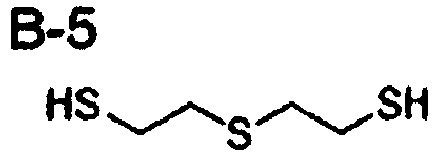


Claims (9)
- A composition for optical materials, which comprises an episulfide compound (A), a polythiol compound (B) and a photochromic compound (C).
- The composition for optical materials according to claim 1, wherein in the composition for optical materials, the ratio of the episulfide compound (A) is 65 to 99% by mass, the ratio of the polythiol compound (B) is 0.9 to 35% by mass and the ratio of the photochromic compound (C) is 0.001 to 10% by mass.
- The composition for optical materials according to claim 1 or 2, wherein the episulfide compound (A) is a compound represented by formula (1):

- The composition for optical materials according to any one of claims 1 to 3, wherein the polythiol compound (B) is a compound represented by formula (5):
HS-X-SH (5)
wherein: X represents an alkylene group having at least one selected from the group consisting of -S-, -O- and -CO- in the main chain, wherein the carbon number of the main chain is 4 to 20; and X may have SH, a C1-10 alkyl group, a C1-10 alkylthiol group or a C1-10 mercaptoalkylcarbonyloxy group in the side chain. - The composition for optical materials according to any one of claims 1 to 3, wherein the polythiol compound (B) is a compound represented by formula (6):

- The composition for optical materials according to claim 5, wherein the polythiol compound (B) is a compound represented by formula (7):

- The composition for optical materials according to claim 6, wherein n in formula (7) represents an integer of 5 to 20.
- The composition for optical materials according to any one of claims 1 to 7, wherein the photochromic compound (C) is selected from the group consisting of a spiropyran-based compound, a spirooxazine-based compound, a spiroperimidine-based compound, a benzopyran-based compound, a fulgide-based compound, a naphthopyran-based compound, a diarylethene-based compound and an azobenzene-based compound.
- An optical material obtained by polymerizing and curing the composition for optical materials according to any one of claims 1 to 8.
Applications Claiming Priority (2)
| Application Number | Priority Date | Filing Date | Title |
|---|---|---|---|
| JP2015137624 | 2015-07-09 | ||
| PCT/JP2016/069827 WO2017006919A1 (en) | 2015-07-09 | 2016-07-05 | Optical material composition and optical material |
Publications (3)
| Publication Number | Publication Date |
|---|---|
| EP3321303A1 true EP3321303A1 (en) | 2018-05-16 |
| EP3321303A4 EP3321303A4 (en) | 2019-01-02 |
| EP3321303B1 EP3321303B1 (en) | 2019-12-11 |
Family
ID=57685678
Family Applications (1)
| Application Number | Title | Priority Date | Filing Date |
|---|---|---|---|
| EP16821388.2A Active EP3321303B1 (en) | 2015-07-09 | 2016-07-05 | Optical material composition and optical material |
Country Status (7)
| Country | Link |
|---|---|
| US (1) | US10767015B2 (en) |
| EP (1) | EP3321303B1 (en) |
| JP (1) | JPWO2017006919A1 (en) |
| KR (1) | KR102516520B1 (en) |
| CN (1) | CN107709411B (en) |
| TW (1) | TWI736539B (en) |
| WO (1) | WO2017006919A1 (en) |
Family Cites Families (20)
| Publication number | Priority date | Publication date | Assignee | Title |
|---|---|---|---|---|
| JPH08272036A (en) | 1994-10-17 | 1996-10-18 | Seiko Epson Corp | Photochromic composition and photochromic resin using the same |
| US5683628A (en) | 1994-10-17 | 1997-11-04 | Seiko Epson Corp. | Photochromic composition and photochromic resin obtainable by using the same |
| US5807975A (en) | 1995-08-16 | 1998-09-15 | Mitsubishi Gas Chemical Company,Inc. | Alkyl sulfide type episulfide compound |
| JP3491660B2 (en) | 1995-08-16 | 2004-01-26 | 三菱瓦斯化学株式会社 | Novel linear alkyl sulfide type episulfide compound |
| US6631021B2 (en) * | 2000-03-20 | 2003-10-07 | Ppg Industries Ohio, Inc. | Polyfunctional thiirane compounds |
| US20010047043A1 (en) * | 2000-03-20 | 2001-11-29 | Okoroafor Michael O. | Method of preparing a polymerizate |
| US6592801B2 (en) | 2001-04-30 | 2003-07-15 | Essilor International Compagnie Generale D'optique | Photopolymerization of episulfides using metal complexes and its use for making ophthalmic lenses |
| JP2004078052A (en) | 2002-08-22 | 2004-03-11 | Nof Corp | Method for producing photochromic optical material |
| CN1312194C (en) * | 2002-12-20 | 2007-04-25 | Ppg工业俄亥俄公司 | Sulfur-containing polythiols |
| JP4859335B2 (en) | 2003-07-04 | 2012-01-25 | 株式会社トクヤマ | Coating agent |
| JP4298560B2 (en) * | 2004-03-30 | 2009-07-22 | Hoya株式会社 | Method for producing sulfur-containing prepolymer and method for producing plastic lens |
| US7553925B2 (en) | 2006-05-05 | 2009-06-30 | Ppg Industries Ohio, Inc. | Thioether functional oligomeric polythiols and articles prepared therefrom |
| CN101512395B (en) | 2006-06-30 | 2012-10-24 | Hoya株式会社 | Photochromic film, photochromic lens having same, and method for manufacturing photochromic lens |
| JP2008030439A (en) | 2006-06-30 | 2008-02-14 | Hoya Corp | Manufacturing method of photochromic lens |
| US8420718B2 (en) | 2008-07-24 | 2013-04-16 | Mitsui Chemicals, Inc. | Composition, polymerizable composition, resin, optical component, and method for producing the composition |
| JP2012061665A (en) | 2010-09-15 | 2012-03-29 | Nikon-Essilor Co Ltd | Production method for optical lens |
| TWI572641B (en) * | 2012-03-05 | 2017-03-01 | Mitsubishi Gas Chemical Co | Composition for optical materials |
| EP2866064B1 (en) | 2012-06-26 | 2017-08-09 | Mitsui Chemicals, Inc. | Polymerizable composition for optical material, optical material and plastic lens obtained from said composition |
| BR112016002090A2 (en) * | 2013-08-02 | 2017-08-01 | Mitsui Chemicals Inc | process for photochromic optical material production |
| WO2015056665A1 (en) | 2013-10-15 | 2015-04-23 | 三菱瓦斯化学株式会社 | Optical material composition and optical material using same |
-
2016
- 2016-07-05 JP JP2017527457A patent/JPWO2017006919A1/en active Pending
- 2016-07-05 KR KR1020177033374A patent/KR102516520B1/en active Active
- 2016-07-05 CN CN201680037310.8A patent/CN107709411B/en active Active
- 2016-07-05 US US15/575,532 patent/US10767015B2/en active Active
- 2016-07-05 EP EP16821388.2A patent/EP3321303B1/en active Active
- 2016-07-05 WO PCT/JP2016/069827 patent/WO2017006919A1/en not_active Ceased
- 2016-07-06 TW TW105121391A patent/TWI736539B/en active
Also Published As
| Publication number | Publication date |
|---|---|
| TWI736539B (en) | 2021-08-21 |
| CN107709411B (en) | 2020-05-12 |
| EP3321303A4 (en) | 2019-01-02 |
| US10767015B2 (en) | 2020-09-08 |
| CN107709411A (en) | 2018-02-16 |
| KR20180027416A (en) | 2018-03-14 |
| KR102516520B1 (en) | 2023-03-31 |
| US20180127550A1 (en) | 2018-05-10 |
| EP3321303B1 (en) | 2019-12-11 |
| JPWO2017006919A1 (en) | 2018-04-19 |
| WO2017006919A1 (en) | 2017-01-12 |
| TW201716470A (en) | 2017-05-16 |
Similar Documents
| Publication | Publication Date | Title |
|---|---|---|
| DE69925322T2 (en) | Polymerizable composition | |
| JP3315090B2 (en) | Polymerizable composition | |
| JP3712653B2 (en) | Polymerizable composition | |
| KR100680033B1 (en) | Resin formed by curing a polymerizable composition and a double-composite composition comprising a novel sulfur-containing cyclic compound | |
| JPWO2007148439A1 (en) | Polymerizable composition and resin, optical component and lens using the same | |
| KR20170101296A (en) | The polymerizable composition and the novel alkyne compound | |
| KR102483128B1 (en) | Polythiol composition and method for producing same | |
| JP4496121B2 (en) | Method for producing sulfur atom-containing transparent resin with excellent hue | |
| JP4291190B2 (en) | High refractive index / high weather resistance resin and production method thereof | |
| KR101464943B1 (en) | Method of Producing Polythiol Compound for Thioepoxy based Optical Material, and Copolymerizable Composition for Thioepoxy based Optical Material Comprising the Polythiol Compound | |
| EP3321303B1 (en) | Optical material composition and optical material | |
| JP2003026753A (en) | Manufacturing method of resin | |
| JP4124678B2 (en) | Method for producing thioepoxy polymerizable composition | |
| JP4111843B2 (en) | Method for producing resin comprising episulfide compound | |
| JP2005272778A (en) | High refractive index/high strength resin and its manufacturing method | |
| JP4599038B2 (en) | Method for improving the polymerizability of episulfide compositions | |
| JP3718189B2 (en) | Polymerizable composition containing novel episulfide compound, resin and lens comprising the polymerizable composition | |
| JP3821766B2 (en) | Method for producing cured resin | |
| JP4015338B2 (en) | Episulfide polymerizable composition and resin production method | |
| JP2012061665A (en) | Production method for optical lens |
Legal Events
| Date | Code | Title | Description |
|---|---|---|---|
| STAA | Information on the status of an ep patent application or granted ep patent |
Free format text: STATUS: THE INTERNATIONAL PUBLICATION HAS BEEN MADE |
|
| PUAI | Public reference made under article 153(3) epc to a published international application that has entered the european phase |
Free format text: ORIGINAL CODE: 0009012 |
|
| STAA | Information on the status of an ep patent application or granted ep patent |
Free format text: STATUS: REQUEST FOR EXAMINATION WAS MADE |
|
| 17P | Request for examination filed |
Effective date: 20171130 |
|
| AK | Designated contracting states |
Kind code of ref document: A1 Designated state(s): AL AT BE BG CH CY CZ DE DK EE ES FI FR GB GR HR HU IE IS IT LI LT LU LV MC MK MT NL NO PL PT RO RS SE SI SK SM TR |
|
| AX | Request for extension of the european patent |
Extension state: BA ME |
|
| DAV | Request for validation of the european patent (deleted) | ||
| DAX | Request for extension of the european patent (deleted) | ||
| A4 | Supplementary search report drawn up and despatched |
Effective date: 20181129 |
|
| RIC1 | Information provided on ipc code assigned before grant |
Ipc: C08G 75/08 20060101AFI20181123BHEP Ipc: G02B 1/04 20060101ALI20181123BHEP Ipc: C09K 9/02 20060101ALI20181123BHEP |
|
| STAA | Information on the status of an ep patent application or granted ep patent |
Free format text: STATUS: EXAMINATION IS IN PROGRESS |
|
| 17Q | First examination report despatched |
Effective date: 20190418 |
|
| GRAP | Despatch of communication of intention to grant a patent |
Free format text: ORIGINAL CODE: EPIDOSNIGR1 |
|
| STAA | Information on the status of an ep patent application or granted ep patent |
Free format text: STATUS: GRANT OF PATENT IS INTENDED |
|
| INTG | Intention to grant announced |
Effective date: 20190705 |
|
| GRAS | Grant fee paid |
Free format text: ORIGINAL CODE: EPIDOSNIGR3 |
|
| GRAA | (expected) grant |
Free format text: ORIGINAL CODE: 0009210 |
|
| STAA | Information on the status of an ep patent application or granted ep patent |
Free format text: STATUS: THE PATENT HAS BEEN GRANTED |
|
| AK | Designated contracting states |
Kind code of ref document: B1 Designated state(s): AL AT BE BG CH CY CZ DE DK EE ES FI FR GB GR HR HU IE IS IT LI LT LU LV MC MK MT NL NO PL PT RO RS SE SI SK SM TR |
|
| REG | Reference to a national code |
Ref country code: GB Ref legal event code: FG4D |
|
| REG | Reference to a national code |
Ref country code: CH Ref legal event code: EP |
|
| REG | Reference to a national code |
Ref country code: AT Ref legal event code: REF Ref document number: 1212125 Country of ref document: AT Kind code of ref document: T Effective date: 20191215 |
|
| REG | Reference to a national code |
Ref country code: DE Ref legal event code: R096 Ref document number: 602016026162 Country of ref document: DE |
|
| REG | Reference to a national code |
Ref country code: IE Ref legal event code: FG4D |
|
| REG | Reference to a national code |
Ref country code: NL Ref legal event code: MP Effective date: 20191211 |
|
| REG | Reference to a national code |
Ref country code: LT Ref legal event code: MG4D |
|
| PG25 | Lapsed in a contracting state [announced via postgrant information from national office to epo] |
Ref country code: LT Free format text: LAPSE BECAUSE OF FAILURE TO SUBMIT A TRANSLATION OF THE DESCRIPTION OR TO PAY THE FEE WITHIN THE PRESCRIBED TIME-LIMIT Effective date: 20191211 Ref country code: GR Free format text: LAPSE BECAUSE OF FAILURE TO SUBMIT A TRANSLATION OF THE DESCRIPTION OR TO PAY THE FEE WITHIN THE PRESCRIBED TIME-LIMIT Effective date: 20200312 Ref country code: SE Free format text: LAPSE BECAUSE OF FAILURE TO SUBMIT A TRANSLATION OF THE DESCRIPTION OR TO PAY THE FEE WITHIN THE PRESCRIBED TIME-LIMIT Effective date: 20191211 Ref country code: LV Free format text: LAPSE BECAUSE OF FAILURE TO SUBMIT A TRANSLATION OF THE DESCRIPTION OR TO PAY THE FEE WITHIN THE PRESCRIBED TIME-LIMIT Effective date: 20191211 Ref country code: NO Free format text: LAPSE BECAUSE OF FAILURE TO SUBMIT A TRANSLATION OF THE DESCRIPTION OR TO PAY THE FEE WITHIN THE PRESCRIBED TIME-LIMIT Effective date: 20200311 Ref country code: FI Free format text: LAPSE BECAUSE OF FAILURE TO SUBMIT A TRANSLATION OF THE DESCRIPTION OR TO PAY THE FEE WITHIN THE PRESCRIBED TIME-LIMIT Effective date: 20191211 Ref country code: BG Free format text: LAPSE BECAUSE OF FAILURE TO SUBMIT A TRANSLATION OF THE DESCRIPTION OR TO PAY THE FEE WITHIN THE PRESCRIBED TIME-LIMIT Effective date: 20200311 |
|
| PG25 | Lapsed in a contracting state [announced via postgrant information from national office to epo] |
Ref country code: RS Free format text: LAPSE BECAUSE OF FAILURE TO SUBMIT A TRANSLATION OF THE DESCRIPTION OR TO PAY THE FEE WITHIN THE PRESCRIBED TIME-LIMIT Effective date: 20191211 Ref country code: HR Free format text: LAPSE BECAUSE OF FAILURE TO SUBMIT A TRANSLATION OF THE DESCRIPTION OR TO PAY THE FEE WITHIN THE PRESCRIBED TIME-LIMIT Effective date: 20191211 |
|
| PG25 | Lapsed in a contracting state [announced via postgrant information from national office to epo] |
Ref country code: AL Free format text: LAPSE BECAUSE OF FAILURE TO SUBMIT A TRANSLATION OF THE DESCRIPTION OR TO PAY THE FEE WITHIN THE PRESCRIBED TIME-LIMIT Effective date: 20191211 |
|
| PG25 | Lapsed in a contracting state [announced via postgrant information from national office to epo] |
Ref country code: EE Free format text: LAPSE BECAUSE OF FAILURE TO SUBMIT A TRANSLATION OF THE DESCRIPTION OR TO PAY THE FEE WITHIN THE PRESCRIBED TIME-LIMIT Effective date: 20191211 Ref country code: PT Free format text: LAPSE BECAUSE OF FAILURE TO SUBMIT A TRANSLATION OF THE DESCRIPTION OR TO PAY THE FEE WITHIN THE PRESCRIBED TIME-LIMIT Effective date: 20200506 Ref country code: ES Free format text: LAPSE BECAUSE OF FAILURE TO SUBMIT A TRANSLATION OF THE DESCRIPTION OR TO PAY THE FEE WITHIN THE PRESCRIBED TIME-LIMIT Effective date: 20191211 Ref country code: CZ Free format text: LAPSE BECAUSE OF FAILURE TO SUBMIT A TRANSLATION OF THE DESCRIPTION OR TO PAY THE FEE WITHIN THE PRESCRIBED TIME-LIMIT Effective date: 20191211 Ref country code: NL Free format text: LAPSE BECAUSE OF FAILURE TO SUBMIT A TRANSLATION OF THE DESCRIPTION OR TO PAY THE FEE WITHIN THE PRESCRIBED TIME-LIMIT Effective date: 20191211 Ref country code: RO Free format text: LAPSE BECAUSE OF FAILURE TO SUBMIT A TRANSLATION OF THE DESCRIPTION OR TO PAY THE FEE WITHIN THE PRESCRIBED TIME-LIMIT Effective date: 20191211 |
|
| PG25 | Lapsed in a contracting state [announced via postgrant information from national office to epo] |
Ref country code: SM Free format text: LAPSE BECAUSE OF FAILURE TO SUBMIT A TRANSLATION OF THE DESCRIPTION OR TO PAY THE FEE WITHIN THE PRESCRIBED TIME-LIMIT Effective date: 20191211 Ref country code: SK Free format text: LAPSE BECAUSE OF FAILURE TO SUBMIT A TRANSLATION OF THE DESCRIPTION OR TO PAY THE FEE WITHIN THE PRESCRIBED TIME-LIMIT Effective date: 20191211 Ref country code: IS Free format text: LAPSE BECAUSE OF FAILURE TO SUBMIT A TRANSLATION OF THE DESCRIPTION OR TO PAY THE FEE WITHIN THE PRESCRIBED TIME-LIMIT Effective date: 20200411 |
|
| REG | Reference to a national code |
Ref country code: DE Ref legal event code: R097 Ref document number: 602016026162 Country of ref document: DE |
|
| REG | Reference to a national code |
Ref country code: AT Ref legal event code: MK05 Ref document number: 1212125 Country of ref document: AT Kind code of ref document: T Effective date: 20191211 |
|
| PLBE | No opposition filed within time limit |
Free format text: ORIGINAL CODE: 0009261 |
|
| STAA | Information on the status of an ep patent application or granted ep patent |
Free format text: STATUS: NO OPPOSITION FILED WITHIN TIME LIMIT |
|
| PG25 | Lapsed in a contracting state [announced via postgrant information from national office to epo] |
Ref country code: DK Free format text: LAPSE BECAUSE OF FAILURE TO SUBMIT A TRANSLATION OF THE DESCRIPTION OR TO PAY THE FEE WITHIN THE PRESCRIBED TIME-LIMIT Effective date: 20191211 |
|
| 26N | No opposition filed |
Effective date: 20200914 |
|
| PG25 | Lapsed in a contracting state [announced via postgrant information from national office to epo] |
Ref country code: SI Free format text: LAPSE BECAUSE OF FAILURE TO SUBMIT A TRANSLATION OF THE DESCRIPTION OR TO PAY THE FEE WITHIN THE PRESCRIBED TIME-LIMIT Effective date: 20191211 Ref country code: AT Free format text: LAPSE BECAUSE OF FAILURE TO SUBMIT A TRANSLATION OF THE DESCRIPTION OR TO PAY THE FEE WITHIN THE PRESCRIBED TIME-LIMIT Effective date: 20191211 |
|
| PG25 | Lapsed in a contracting state [announced via postgrant information from national office to epo] |
Ref country code: IT Free format text: LAPSE BECAUSE OF FAILURE TO SUBMIT A TRANSLATION OF THE DESCRIPTION OR TO PAY THE FEE WITHIN THE PRESCRIBED TIME-LIMIT Effective date: 20191211 |
|
| PG25 | Lapsed in a contracting state [announced via postgrant information from national office to epo] |
Ref country code: PL Free format text: LAPSE BECAUSE OF FAILURE TO SUBMIT A TRANSLATION OF THE DESCRIPTION OR TO PAY THE FEE WITHIN THE PRESCRIBED TIME-LIMIT Effective date: 20191211 Ref country code: MC Free format text: LAPSE BECAUSE OF FAILURE TO SUBMIT A TRANSLATION OF THE DESCRIPTION OR TO PAY THE FEE WITHIN THE PRESCRIBED TIME-LIMIT Effective date: 20191211 |
|
| REG | Reference to a national code |
Ref country code: CH Ref legal event code: PL |
|
| REG | Reference to a national code |
Ref country code: BE Ref legal event code: MM Effective date: 20200731 |
|
| PG25 | Lapsed in a contracting state [announced via postgrant information from national office to epo] |
Ref country code: IE Free format text: LAPSE BECAUSE OF NON-PAYMENT OF DUE FEES Effective date: 20200705 Ref country code: LI Free format text: LAPSE BECAUSE OF NON-PAYMENT OF DUE FEES Effective date: 20200731 Ref country code: LU Free format text: LAPSE BECAUSE OF NON-PAYMENT OF DUE FEES Effective date: 20200705 Ref country code: CH Free format text: LAPSE BECAUSE OF NON-PAYMENT OF DUE FEES Effective date: 20200731 |
|
| PG25 | Lapsed in a contracting state [announced via postgrant information from national office to epo] |
Ref country code: BE Free format text: LAPSE BECAUSE OF NON-PAYMENT OF DUE FEES Effective date: 20200731 |
|
| PG25 | Lapsed in a contracting state [announced via postgrant information from national office to epo] |
Ref country code: TR Free format text: LAPSE BECAUSE OF FAILURE TO SUBMIT A TRANSLATION OF THE DESCRIPTION OR TO PAY THE FEE WITHIN THE PRESCRIBED TIME-LIMIT Effective date: 20191211 Ref country code: MT Free format text: LAPSE BECAUSE OF FAILURE TO SUBMIT A TRANSLATION OF THE DESCRIPTION OR TO PAY THE FEE WITHIN THE PRESCRIBED TIME-LIMIT Effective date: 20191211 Ref country code: CY Free format text: LAPSE BECAUSE OF FAILURE TO SUBMIT A TRANSLATION OF THE DESCRIPTION OR TO PAY THE FEE WITHIN THE PRESCRIBED TIME-LIMIT Effective date: 20191211 |
|
| PG25 | Lapsed in a contracting state [announced via postgrant information from national office to epo] |
Ref country code: MK Free format text: LAPSE BECAUSE OF FAILURE TO SUBMIT A TRANSLATION OF THE DESCRIPTION OR TO PAY THE FEE WITHIN THE PRESCRIBED TIME-LIMIT Effective date: 20191211 |
|
| P01 | Opt-out of the competence of the unified patent court (upc) registered |
Effective date: 20230515 |
|
| PGFP | Annual fee paid to national office [announced via postgrant information from national office to epo] |
Ref country code: DE Payment date: 20250528 Year of fee payment: 10 |
|
| PGFP | Annual fee paid to national office [announced via postgrant information from national office to epo] |
Ref country code: GB Payment date: 20260601 Year of fee payment: 11 |
|
| PGFP | Annual fee paid to national office [announced via postgrant information from national office to epo] |
Ref country code: FR Payment date: 20260608 Year of fee payment: 11 |