EP3316693B1 - A process for treating milk - Google Patents
A process for treating milk Download PDFInfo
- Publication number
- EP3316693B1 EP3316693B1 EP16820564.9A EP16820564A EP3316693B1 EP 3316693 B1 EP3316693 B1 EP 3316693B1 EP 16820564 A EP16820564 A EP 16820564A EP 3316693 B1 EP3316693 B1 EP 3316693B1
- Authority
- EP
- European Patent Office
- Prior art keywords
- milk
- temperature
- high pressure
- processing step
- pressure processing
- Prior art date
- Legal status (The legal status is an assumption and is not a legal conclusion. Google has not performed a legal analysis and makes no representation as to the accuracy of the status listed.)
- Active
Links
Images
Classifications
-
- A—HUMAN NECESSITIES
- A23—FOODS OR FOODSTUFFS; TREATMENT THEREOF, NOT COVERED BY OTHER CLASSES
- A23B—PRESERVATION OF FOODS, FOODSTUFFS OR NON-ALCOHOLIC BEVERAGES; CHEMICAL RIPENING OF FRUIT OR VEGETABLES
- A23B11/00—Preservation of milk or dairy products
- A23B11/10—Preservation of milk or milk preparations
- A23B11/12—Preservation of milk or milk preparations by heating
- A23B11/13—Preservation of milk or milk preparations by heating the materials being loose unpacked
-
- A—HUMAN NECESSITIES
- A23—FOODS OR FOODSTUFFS; TREATMENT THEREOF, NOT COVERED BY OTHER CLASSES
- A23B—PRESERVATION OF FOODS, FOODSTUFFS OR NON-ALCOHOLIC BEVERAGES; CHEMICAL RIPENING OF FRUIT OR VEGETABLES
- A23B11/00—Preservation of milk or dairy products
- A23B11/10—Preservation of milk or milk preparations
- A23B11/12—Preservation of milk or milk preparations by heating
- A23B11/13—Preservation of milk or milk preparations by heating the materials being loose unpacked
- A23B11/1303—Apparatus through which the material is transported non progressively; Temperature-maintaining holding tanks or vats with discontinuous filling or discharge
-
- A—HUMAN NECESSITIES
- A23—FOODS OR FOODSTUFFS; TREATMENT THEREOF, NOT COVERED BY OTHER CLASSES
- A23B—PRESERVATION OF FOODS, FOODSTUFFS OR NON-ALCOHOLIC BEVERAGES; CHEMICAL RIPENING OF FRUIT OR VEGETABLES
- A23B2/00—Preservation of foods or foodstuffs, in general
- A23B2/10—Preservation of foods or foodstuffs, in general by treatment with pressure variation, shock, acceleration or shear stress
- A23B2/103—Preservation of foods or foodstuffs, in general by treatment with pressure variation, shock, acceleration or shear stress using sub- or super-atmospheric pressures, or pressure variations transmitted by a liquid or gas
-
- A—HUMAN NECESSITIES
- A23—FOODS OR FOODSTUFFS; TREATMENT THEREOF, NOT COVERED BY OTHER CLASSES
- A23C—DAIRY PRODUCTS, e.g. MILK, BUTTER OR CHEESE; MILK OR CHEESE SUBSTITUTES; PREPARATION THEREOF
- A23C2210/00—Physical treatment of dairy products
- A23C2210/15—High pressure treatment
-
- A—HUMAN NECESSITIES
- A23—FOODS OR FOODSTUFFS; TREATMENT THEREOF, NOT COVERED BY OTHER CLASSES
- A23V—INDEXING SCHEME RELATING TO FOODS, FOODSTUFFS OR NON-ALCOHOLIC BEVERAGES AND LACTIC OR PROPIONIC ACID BACTERIA USED IN FOODSTUFFS OR FOOD PREPARATION
- A23V2002/00—Food compositions, function of food ingredients or processes for food or foodstuffs
Definitions
- the present invention generally relates to a process to treat milk and a milk product that has been treated by the process.
- Raw milk typically contains microorganisms/pathogens which may be unsafe for human consumption.
- Processes are known to treat raw milk in order to produce milk with safe pathogenic levels for human consumption. These processes, termed pasteurization, involve exposing milk to elevated temperatures.
- the most common pasteurization process involves heating the milk to a temperature of about 72.5°C for about 15 seconds, producing milk with safe pathogenic levels for human consumption with a shelf life of approximately 14 days. Milk produced by this process is often simply referred to as pasteurized milk, fresh milk or fresh pasteurized milk.
- Ultra heat treatment (UHT) treatment of milk involves pasteurizing milk at a temperature in excess of 135°C for a period of about 4 seconds to produce a milk referred to as UHT milk, which has a relatively stable shelf life.
- ESL extended shelf life milk
- EP2409583 describes a continuous system and procedure of sterilization and physical stabilization of pumpable fluids, food, or other type of fluids, through ultra-high pressure homogenization (UHPH) comprising a first heat exchanger 1 which preheats the fluid at temperature Tp between 40 and 90 °C; an ultra-homogenizer 3 through which fluid at temperature Tp is introduced at a pressure Pu between 200 and 600MPa increasing its temperature up to a final value.
- UHPH ultra-high pressure homogenization
- the present invention seeks to provide a process and product with improved features and properties.
- the present invention provides process for treating milk including the steps of: a homogenization step wherein the milk is maintained at a temperature of below about 60°C; and, a high pressure processing step, wherein the milk is subjected to an elevated pressure above about 350 MPa wherein the elevated pressure of the high pressure processing step does not induce an increase in the temperature of the milk in excess of a limiting temperature of about 60°C during the high pressure processing step.
- the present invention provides the process according to the first aspect wherein the elevated pressure of the high pressure process step induces a temperature increase in the milk such that the temperature of the milk is increased to between about 50°C to about 55°C during the high pressure processing step.
- the present invention provides the process according to the first aspect wherein the milk is subjected to an elevated pressure of between about 500MPa to about 750MPa during the high pressure processing step.
- the present invention provides the process according to the first aspect wherein the milk is subjected to an elevated pressure of about 600MPa.
- the present invention provides the process according to the first aspect wherein the milk is subjected to the elevated pressure in the high pressure processing step for a period of time such that pathogen levels in the milk are reduced to substantially safe levels for human consumption.
- the present invention provides the process according to the first aspect wherein the milk is subjected to the elevated pressure in the high pressure processing step for about 3 minutes or less or about 4 minutes or less.
- the present invention provides the process according to the first aspect further including the step of chilling the milk to an initial temperature prior to the high pressure processing step, wherein the initial temperature is selected such that the temperature of the milk does not exceed 60°C during the high pressure processing step.
- the present invention provides the process according to the preceding aspect wherein the initial temperature is selected such that the temperature of the milk is increased to between the range of about 50°C to about 55°C during the high pressure processing step.
- the present invention provides the process according to the preceding aspect wherein the initial temperature is between about 33°C to about 37°C.
- the present invention provides the process according to the first aspect wherein the high pressure processing step is performed by packaging milk into sealed containers and immersing the sealed containers in a fluid, wherein the fluid is subsequently pressurized thereby subjecting the milk to the elevated pressure.
- the present invention provides the process according to the first aspect wherein the temperature of the fluid before pressurization is about the same temperature as the initial temperature.
- the present invention provides the process according to the first aspect further including the step of subjecting the milk to UV treatment and/or ozone treatment and/or bactofugation.
- the present invention provides the process according to the first aspect wherein the process is used to treat milk obtained from bovine animals, ovine animals, caprine animals, bubaline animals or camelus animals.
- the present invention provides the process according to the first aspect wherein the process further includes the step of cooling milk to a temperature of below about 4°C after the high pressure processing step.
- the present invention provides the process according to the first aspect wherein the process further includes the step of standardizing the milk to a certain fat content.
- the present invention provides the process according to the first aspect wherein the process is completed within about 72 hours from obtaining the milk from an animal or about 48 hours from obtaining the milk from an animal.
- a process for treating milk including the steps of (a) obtaining milk from an animal and storing the milk at a temperature of between about 0°C and about 4°C; and, (b) clarifying the milk; and, (c) homogenizing the milk at a temperature of between about 50°C and about 55°C; and, (d) packaging the milk into sealed containers; and, (e) cooling the milk to an initial temperature; and, (f) high pressure processing the homogenized milk wherein the packaged milk is immersed in a fluid subjected to elevated pressures of greater than about 500MPa; and, (g) cooling the packaged milk to a temperature of below about 4°C after the high pressure processing step, wherein the initial temperature is chosen such that the temperature of the milk is increased to between about 50°C to about 55°C during the high pressure processing step.
- the milk has a shelf life of about 60 days to about 90 days.
- the present invention provides a process for treating milk, wherein the process includes the following steps: a homogenization step; and, a high pressure processing step, wherein the milk is subject to an elevated pressure.
- the process of the above aspects may produce milk with reduced levels of pathogens whilst providing milk with improved nutritional values, organoleptic properties and shelf life compared to milk produced by conventional processes.
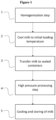
- Figure 1 illustrates a flowchart of the process according to the present invention.
- FIG. 1 depicted is a flowchart of a process to treat milk in accordance with an embodiment of the present invention.
- the process uses a high pressure to remove bacteria and other pathogens from milk.
- Using high pressures to treat milk allows the process to occur at lower temperatures than a typical pasteurization process, which may thereby avoid degradation of certain proteins and enzymes associated by high temperature processing of milk.
- the described process may also produce milk with a longer stable shelf life than pasteurized milk.
- the described process may also avoid certain organoleptic changes to milk which may otherwise occur due to pasteurization, particularly high temperature pasteurization used to produce UHT milk.
- the process of figure 1 includes the steps of homogenizing the milk 1, cooling the milk to an initial loading temperature 2, transferring the milk to sealed containers 3, subjecting the milk in the sealed containers to a high pressure processing step 4 and cooling the milk 5.
- certain optional steps may also be used by the process for treating milk as herein described.
- raw milk is typically obtained by milking animals on a farm and may be reduced in temperature to between about 0°C and about 4°C as soon as practicable after milking.
- the chilled milk may then be transported to a processing site where the milk may be stored in vats at a temperature of between about 0°C and about 4°C in anticipation of processing.
- the stored milk may then be passed through a clarifier in order to remove certain foreign materials and to help minimize any sedimentation effects that may otherwise occur when the milk is subsequently homogenized.
- Milk may then undergo a preheating step where the milk may be preheated to between about 45°C and about 60°C, and in a preferred range of between about 50°C and 55°C.
- the milk may then undergo a homogenization step 1 where the milk is homogenized whilst the temperature of the milk is maintained between about 45°C and 60°C, and in a preferred range of between about 50°C and 55°C. Homogenizing the milk at temperatures below about 45°C may induce deleterious effects in milk, such as premature rancidity and sedimentation of leucocytes and epithelial cells.
- the homogenization step 1 may be carried out when the milk is at a temperature above about 25°C (i.e. above ambient temperature) and below about 60°C. In certain preferred embodiments the homogenization step may be carried out with milk at a temperature of between about 45°C to about 55°C
- milk may be delivered to a temperature controlled balance tank 2.
- the balance tank is configured to reduce the temperature of milk below the 45°C to 60°C range or below the preferred range of about 50°C to about 55°C.
- the balance tank is also configured to maintain the temperature of the milk above the initial loading temperature of the downstream high pressure processing step.
- the milk may then be transferred to a filling head.
- the balance tank may be located at a higher elevation than the filling head such that the milk may flow to the transfer head under the influence of gravity.
- the filling head distributes the milk into individual packages 3 which may be subsequently sealed.
- the packages may be PET bottles, glass bottles, pouches or any other suitable package.
- the packaged milk may then undergo a high pressure processing step 4.
- the packaged milk is immersed in a fluid, such as for example water, within a high pressure processing chamber and exposed to elevated pressures.
- a fluid such as for example water
- the fluid evenly exerts a hydrostatic pressure to the packaged milk. It was found that subjecting the packaged milk to the elevated pressures for a defined period of time may deactivate certain pathogens in the milk, thereby producing milk with pathogen levels substantially safe for human consumption.
- High pressure processing of the milk was also found to lead to milk with a longer stable shelf life than pasteurized milk, allowing the milk to be transported to markets that are too distant for pasteurized milk to access before the shelf life expires.
- the elevated pressured applied to milk in the high pressure processing step may be in the order of about 350MPa to about 1500MPa, though other pressures may also be used. Higher pressures may require that milk is exposed to elevated pressures for a shorter period of time than lower pressures, leading to a higher throughput of milk through the process step. However, higher pressures may require more expensive equipment and involve a higher associated operating cost than lower pressures. Similarly, lower pressures may require that the milk is exposed to elevated pressures for a longer amount of time which in some circumstances may effect the commercial viability of the process. In one example embodiment, the high pressure processing step exposed the packaged milk to an elevated pressure of about 600MPa for approximately 3 minutes in order to cause the inactivation of certain pathogens within the milk.
- Performing the high pressure processing step may be beneficial in avoiding higher pressure that may complicate and add to the expense of the process. It was also found that this pressure produced a milk with pathogen levels substantially safe for human consumption in a time frame of about 3 minutes.
- the time frame of about 3 minutes is beneficial as longer time frames may reduce the commercial feasibility of the batch operated high pressure processing step compared with other sterilization methods, although in some embodiments treatment times of 4 minutes or about 5 minutes may be acceptable.
- the exact time required to reduce pathogen levels in the high pressure processing step may be a function of the properties of the milk undergoing treatment. For example, milk with a higher loading of pathogens may require a longer treatment time with high pressure processing to adequately reduce the pathogen levels.
- milk with a relatively lower loading to pathogens may require a shorter treatment time with high pressure processing to achieve adequate pathogen mortality, such that high pressure processing at a pressure of less than 600MPa may be used to achieve an adequate pathogen mortality within about 3 minutes or less.
- high pressure processing at a pressure of less than 600MPa may be used to achieve an adequate pathogen mortality within about 3 minutes or less.
- an elevated pressure of about 500MPa to about 750MPa in the high pressure processing step has been found to produce acceptable results in an acceptable time frame, although it is to be understood that certain parameters such as the initial pathogen loading of the milk and the types of pathogens present in the milk may effect the parameters at which the high pressure processing step is operated.
- the milk may be subjected to elevated pressures for a short time frame of about 2 minutes or less or about 1 minute or less or less than about 45 seconds.
- the initial loading temperature of the fluid in the high pressure processing step may be chosen to increase the mortality of certain pathogens in the milk to make the milk safer for human consumption.
- the loading temperature may also take into consideration the temperature rise in the high pressure processing chamber which may occur due to the elevated pressures. Without wishing to be bound by theory, a temperature rise of approximately 3°C to 4°C may be expected for about every 100MPa increase in the chamber. Therefore a loading temperature of about 33°C to about 37°C may be selected as the temperature within the chamber for high pressure processing at about 600MPa such that the temperature may rise from 33°C to 37°C to about 50°C to 55°C as the chamber is pressurized from atmospheric to 600MPa.
- Maintaining the temperature of the milk at about 50°C to 55°C will comfortably avoid the temperature of about 60°C or about 58°C at which certain nutritional components of the milk may begin to denature. It may be beneficial to perform high pressure processing at a relatively high temperature such as about 50°C to about 55°C to help facilitate the mortality of pathogens in the milk, particularly pathogens that may display some resistance to high pressures, while keeping the temperature below about 58°C or about 60°C to avoid degradation of certain nutritional and/or organoleptic properties of the milk.
- a relatively high temperature such as about 50°C to about 55°C to help facilitate the mortality of pathogens in the milk, particularly pathogens that may display some resistance to high pressures, while keeping the temperature below about 58°C or about 60°C to avoid degradation of certain nutritional and/or organoleptic properties of the milk.
- performing high pressure processing on milk at a temperature of about 45°C or lower may provide for acceptable results, however, lower temperatures may require that the high pressure processing step is performed for a longer time
- the combination of elevated pressures and elevated temperatures below about 60°C has been surprisingly found to produce milk with pathogen levels substantially safe for human consumption in a process that may be commercially viable compared to pasteurization.
- the milk produced by such a process may also have improved organoleptic and nutritional properties compared to pasteurized milk and may also have a longer shelf life.
- the temperature regime of the process to treat milk may assist in the germination of certain spore forming pathogens such as bacillus cereus, such that the germinated spores may be deactivated by the elevated pressures of the high pressure processing step.
- certain spore forming pathogens such as bacillus cereus
- the temperature regime of an initial loading temperature of about 33°C to 37°C leading to a milk temperature of about 50°C to about 55°C in the high pressure processing step operated at an elevated pressure of about 600MPa has been found to assist in the germination of certain spore forming pathogens such that the germinated spores may be more easily deactivated by the elevated pressures of the high pressure processing step.
- pressures are ramped up to the designated elevated pressure.
- These lower pressures at the initial stages of the ramp-up in pressure may further assist the germination of spore forming pathogens in conjunction with the temperature regime of the process, leading to easier pathogen kill at the elevated pressure.
- the temperature and pressure regime if the high pressure processing step may lead to increase mortality of certain spore forming pathogens such as bacillus cereus.
- homogenizing milk at a temperature between about 45°C and 60°C, preferably between about 50°C and 55°C, and subsequently subjecting the homogenized milk to the high pressure processing step, that the resultant milk may display substantially reduced pathogen levels, as well as improved nutritional value, shelf life and organoleptic properties when compared to milk produced by a pasteurization process.
- the temperature of the fluid used to pressurize the chamber of the high pressure processing step may be pre-heated to the same or similar temperature as the initial loading temperature of the milk in the high pressure processing step.
- preheating the fluid the effect of the elevated pressure will increase the temperature of the fluid to about the same degree as the elevated pressure will increase the temperature of the packaged milk. In this manner, heat transfer between the fluid and the packed milk will be minimized, thereby simplifying the process in controlling the temperature of the packed milk to between about 45°C to about 60°C, or between about 50°C to about 55°C for the reasons noted above.
- the packaged milk is at a relatively high temperature, for example about 50°C to 55°C, such that cooling 5 may be required for subsequent storage and shipping.
- Cooling may be achieved by any suitable cooling method step such as for example by spraying chilled water over and around the packaged milk in order to reduce the temperature of the milk to below 4°C.
- An alternative cooling method step may be a flash cooling step wherein the packaged milk is subjected to a reduced pressure environment which thereby reduces the temperature of the packaged milk. Cooling the milk by these methods may cause rapid temperature reduction, limiting the time that the milk is exposed to high temperatures, which may lead to an extension in the shelf life of the milk.
- the milk Once the internal temperature of the milk has been brought below about 4°C, the milk may be transferred to a cold room for storage at below 4°C until the milk is subsequently distributed to the market.
- Milk treated by the high pressure processing step for a sufficient amount of time may display substantially reduced pathogen levels.
- the pathogen levels may be at levels safe for human consumption or at levels approaching safe for human consumption.
- the pathogen levels may be the same or similar to the pathogen levels of milk treated by a pasteurization process.
- further treatment in addition to the high pressure processing step may be required to reduce the pathogen levels in the milk.
- UV treatment or ozone treatment of the milk may be performed to further reduce the pathogen levels of the milk if required.
- a bactofugation step may also be performed to reduce the pathogen loading of milk before the high pressure processing step in some embodiments. For example, when treating milk with a particularly high initial loading of pathogens it may be advantageous to use one of these additional processing steps before the high pressure processing step.
- the process as herein described may be used to treat milk that has been standardized to produce a treated milk with various fat and SNF levels, for example skim milk.
- milk refers to the liquid produced by the mammary glands of mammals. Milk is an emulsion or colloid of butterfat globules within a water-based fluid that contains dissolved carbohydrates and protein aggregates with minerals.
- the process as herein described may be used to treat milk from any animal, including: bovine, ovine, caprine, bubaline and camelus animals. It is preferred that the milk treatment process herein described is completed within 72 hours or preferably 48 hours from the time of obtaining the milk from these animals. Milk treated in such a time frame may display improved organoleptic properties and may further display increased shelf life.
- Milk produced by the process for treating milk as herein described may have certain advantages over milk treated by other processes, such as pasteurized or ESL milk in terms of preserving nutritional components of the milk and producing milk with improved organoleptic properties.
- milk treated be the process for treating milk as herein described may display a long shelf life of greater than about 45 days, or between about 60 to 90 days or more, thus surpassing the shelf life of pasteurized milk.
- Such an extended shelf life may allow the milk to be transported to distant markets by economical methods, such as ocean freight, such that milk with good nutritional and organoleptic properties may accessible to distant markets at an economical cost.
Landscapes
- Life Sciences & Earth Sciences (AREA)
- Engineering & Computer Science (AREA)
- Wood Science & Technology (AREA)
- Zoology (AREA)
- Chemical & Material Sciences (AREA)
- Food Science & Technology (AREA)
- Polymers & Plastics (AREA)
- Dairy Products (AREA)
- Food Preservation Except Freezing, Refrigeration, And Drying (AREA)
- Cold Air Circulating Systems And Constructional Details In Refrigerators (AREA)
- Apparatus For Disinfection Or Sterilisation (AREA)
Applications Claiming Priority (2)
| Application Number | Priority Date | Filing Date | Title |
|---|---|---|---|
| AU2015902620A AU2015902620A0 (en) | 2015-07-03 | A process for treating milk | |
| PCT/AU2016/050579 WO2017004668A1 (en) | 2015-07-03 | 2016-07-01 | A process for treating milk |
Publications (4)
| Publication Number | Publication Date |
|---|---|
| EP3316693A1 EP3316693A1 (en) | 2018-05-09 |
| EP3316693A4 EP3316693A4 (en) | 2018-12-26 |
| EP3316693C0 EP3316693C0 (en) | 2024-09-11 |
| EP3316693B1 true EP3316693B1 (en) | 2024-09-11 |
Family
ID=57684677
Family Applications (1)
| Application Number | Title | Priority Date | Filing Date |
|---|---|---|---|
| EP16820564.9A Active EP3316693B1 (en) | 2015-07-03 | 2016-07-01 | A process for treating milk |
Country Status (14)
| Country | Link |
|---|---|
| US (1) | US11484039B2 (enExample) |
| EP (1) | EP3316693B1 (enExample) |
| JP (1) | JP7032791B2 (enExample) |
| CN (2) | CN121242084A (enExample) |
| AU (1) | AU2016291298B2 (enExample) |
| BR (1) | BR112018000119B1 (enExample) |
| CA (1) | CA2991071C (enExample) |
| CL (1) | CL2018000009A1 (enExample) |
| CO (1) | CO2018001027A2 (enExample) |
| EA (1) | EA035491B1 (enExample) |
| MX (1) | MX2018000275A (enExample) |
| PL (1) | PL3316693T3 (enExample) |
| UA (1) | UA125016C2 (enExample) |
| WO (1) | WO2017004668A1 (enExample) |
Families Citing this family (7)
| Publication number | Priority date | Publication date | Assignee | Title |
|---|---|---|---|---|
| US10750758B2 (en) * | 2016-08-31 | 2020-08-25 | Srikumar MISRA | Curcumin infused milk beverage and a process for the preparation thereof |
| CN112913917A (zh) * | 2019-12-05 | 2021-06-08 | 内蒙古蒙牛乳业(集团)股份有限公司 | 一种液体奶及其制备方法 |
| CN112913916A (zh) * | 2019-12-05 | 2021-06-08 | 内蒙古蒙牛乳业(集团)股份有限公司 | 一种鲜奶及其制备工艺 |
| ES2922560B2 (es) | 2021-03-05 | 2023-03-06 | Hiperbaric S A U | Contenedor para procesado por alta presion a temperaturas moderadas |
| CN116762857B (zh) * | 2022-03-07 | 2025-11-07 | 蒙牛鲜乳制品(天津)有限公司 | 一种延长鲜奶保质期的方法 |
| CN115836725B (zh) * | 2022-11-17 | 2024-07-16 | 佛山市海天(高明)调味食品有限公司 | 降低含酱油的调味品产气的方法 |
| PL447629A1 (pl) * | 2024-01-29 | 2025-08-04 | Politechnika Gdańska | Sposób utrwalania mleka kobiecego |
Family Cites Families (22)
| Publication number | Priority date | Publication date | Assignee | Title |
|---|---|---|---|---|
| US2072417A (en) * | 1934-01-19 | 1937-03-02 | R U V Engineering Corp | Method of irradiating substances with active rays |
| JPS5599168A (en) * | 1979-01-23 | 1980-07-28 | Kikkoman Corp | Method of heating soybean milk |
| JPH03258260A (ja) * | 1990-03-09 | 1991-11-18 | Dainippon Printing Co Ltd | 高圧殺菌方法 |
| JPH05227925A (ja) * | 1991-09-20 | 1993-09-07 | Snow Brand Milk Prod Co Ltd | 殺菌方法 |
| IN180380B (enExample) * | 1995-05-26 | 1998-01-24 | Nr Dev Ltd | |
| US6086936A (en) * | 1995-12-14 | 2000-07-11 | Kal Kan Foods, Inc. | High temperature/ultra-high pressure sterilization of foods |
| DE19700810A1 (de) | 1997-01-13 | 1998-07-16 | Bayer Ag | Verfahren und Vorrichtung zum Homogenisieren von Milch |
| CA2259761C (en) | 1998-01-21 | 2008-03-11 | Paul Paquin | A continuous process of dynamic high-pressure homogenization for the denaturation of proteins |
| AU4906200A (en) | 1999-05-28 | 2000-12-18 | Universite Laval | Inactivation of food spoilage and pathogenic microorganisms by dynamic high pressure |
| EP1355543A1 (en) * | 2000-12-04 | 2003-10-29 | Ato B.V. | Method for high-pressure preservation |
| US20030228406A1 (en) * | 2002-06-07 | 2003-12-11 | Van Miller | Recombination cream formulation for frozen cream-based sweet confections |
| NZ521836A (en) | 2002-10-08 | 2005-07-29 | New Zealand Dairy Board | High pressure treatment to reduce microbial spoilage in cultured dairy foods, cooked meats, vegetables and the like |
| US20050112252A1 (en) * | 2003-11-20 | 2005-05-26 | Gaurav Tewari | Method to extend the shelf-life of food products using hydrostatic high-pressure processing |
| AR052595A1 (es) | 2005-03-08 | 2007-03-21 | Fonterra Ip Ltd | Procesamiento a alta presion de composiciones bioactivas |
| CN101467559A (zh) * | 2007-12-28 | 2009-07-01 | 天津市华泰森淼生物工程技术有限公司 | 液态牛初乳 |
| CN101690515A (zh) | 2009-09-21 | 2010-04-07 | 西南交通大学 | 液态奶低温超高压连续灭菌方法 |
| EP2409583B1 (en) | 2010-07-21 | 2015-04-22 | Universidad Autònoma de Barcelona | Continuous system and procedure of sterilization and physical stabilization of pumpable fluids by means of ultra-high pressure homogenization |
| WO2012139632A1 (en) | 2011-04-12 | 2012-10-18 | Danone, S.A. | Method for obtaining a fermented dairy product |
| CN202800030U (zh) | 2012-05-08 | 2013-03-20 | 雷鉴源 | 一种超高压牛鲜乳灭菌工艺装置 |
| CN102763724B (zh) * | 2012-07-17 | 2016-03-09 | 光明乳业股份有限公司 | 一种超高压杀菌牛奶的生产方法 |
| CN103300143A (zh) * | 2013-05-20 | 2013-09-18 | 北京三元食品股份有限公司 | 一种液态乳的制备方法 |
| CN103704338B (zh) | 2013-12-25 | 2015-06-24 | 光明乳业股份有限公司 | 一种超高压均质杀菌牛乳的生产方法 |
-
2016
- 2016-07-01 CN CN202511738033.0A patent/CN121242084A/zh active Pending
- 2016-07-01 EP EP16820564.9A patent/EP3316693B1/en active Active
- 2016-07-01 CA CA2991071A patent/CA2991071C/en active Active
- 2016-07-01 BR BR112018000119-8A patent/BR112018000119B1/pt active IP Right Grant
- 2016-07-01 EA EA201890118A patent/EA035491B1/ru not_active IP Right Cessation
- 2016-07-01 JP JP2017568367A patent/JP7032791B2/ja active Active
- 2016-07-01 PL PL16820564.9T patent/PL3316693T3/pl unknown
- 2016-07-01 US US15/741,491 patent/US11484039B2/en active Active
- 2016-07-01 MX MX2018000275A patent/MX2018000275A/es unknown
- 2016-07-01 AU AU2016291298A patent/AU2016291298B2/en active Active
- 2016-07-01 WO PCT/AU2016/050579 patent/WO2017004668A1/en not_active Ceased
- 2016-07-01 CN CN201680039283.8A patent/CN108289464A/zh active Pending
- 2016-07-01 UA UAA201800526A patent/UA125016C2/uk unknown
-
2018
- 2018-01-03 CL CL2018000009A patent/CL2018000009A1/es unknown
- 2018-01-31 CO CONC2018/0001027A patent/CO2018001027A2/es unknown
Also Published As
| Publication number | Publication date |
|---|---|
| CO2018001027A2 (es) | 2018-06-20 |
| PL3316693T3 (pl) | 2025-03-24 |
| EP3316693A1 (en) | 2018-05-09 |
| NZ739245A (en) | 2021-07-30 |
| CA2991071C (en) | 2023-08-15 |
| EP3316693A4 (en) | 2018-12-26 |
| JP7032791B2 (ja) | 2022-03-09 |
| CN121242084A (zh) | 2026-01-02 |
| CA2991071A1 (en) | 2017-01-12 |
| BR112018000119A2 (pt) | 2018-09-04 |
| UA125016C2 (uk) | 2021-12-29 |
| AU2016291298B2 (en) | 2020-05-21 |
| US11484039B2 (en) | 2022-11-01 |
| WO2017004668A1 (en) | 2017-01-12 |
| MX2018000275A (es) | 2018-05-22 |
| EP3316693C0 (en) | 2024-09-11 |
| JP2018518981A (ja) | 2018-07-19 |
| EA201890118A1 (ru) | 2018-07-31 |
| EA035491B1 (ru) | 2020-06-24 |
| CL2018000009A1 (es) | 2018-08-24 |
| BR112018000119B1 (pt) | 2022-11-16 |
| US20180184677A1 (en) | 2018-07-05 |
| CN108289464A (zh) | 2018-07-17 |
| AU2016291298A1 (en) | 2018-02-15 |
Similar Documents
| Publication | Publication Date | Title |
|---|---|---|
| US11484039B2 (en) | Process for treating milk | |
| Chawla et al. | High hydrostatic pressure technology in dairy processing: A review | |
| Barraquio | Which milk is fresh | |
| KR20140005126A (ko) | 초고압 균질화에 의해 펌핑가능한 유체의 살균 및 물리적 안정화를 위한 연속 시스템 및 방법 | |
| Dhineshkumar et al. | High pressure processing technology in dairy processing: A review. | |
| Voigt et al. | High‐pressure processing of milk and dairy products | |
| Gedam et al. | The study on UHT processing of milk: A versatile option for rural sector | |
| US20170258103A1 (en) | Processes for producing treated milk products | |
| AU2016281296B2 (en) | Method to transport liquid milk | |
| JP4567737B2 (ja) | 酸乳製品の製造法、そのための乳の処理方法、酸乳製造ライン、該ラインにおける乳の処理装置 | |
| AU2017101661A4 (en) | A process for treating milk | |
| NZ739389A (en) | Terminal device, device provided with prose function, communication method for terminal device, and communication method for device provided with prose function | |
| NZ739389B2 (en) | Terminal device, device provided with prose function, communication method for terminal device, and communication method for device provided with prose function | |
| US12052999B2 (en) | Process for producing milk and milk-related products with extended shelf life | |
| Kaptan et al. | Non-thermal processes used in milk treatment | |
| Kishor Gedam et al. | The study on UHT processing of milk: a versatile option for rural sector. | |
| NZ738391B2 (en) | Method to transport liquid milk | |
| MXPA99008400A (en) | A method of producing uht milk with improved flavour qualities |
Legal Events
| Date | Code | Title | Description |
|---|---|---|---|
| STAA | Information on the status of an ep patent application or granted ep patent |
Free format text: STATUS: THE INTERNATIONAL PUBLICATION HAS BEEN MADE |
|
| PUAI | Public reference made under article 153(3) epc to a published international application that has entered the european phase |
Free format text: ORIGINAL CODE: 0009012 |
|
| STAA | Information on the status of an ep patent application or granted ep patent |
Free format text: STATUS: REQUEST FOR EXAMINATION WAS MADE |
|
| 17P | Request for examination filed |
Effective date: 20180201 |
|
| AK | Designated contracting states |
Kind code of ref document: A1 Designated state(s): AL AT BE BG CH CY CZ DE DK EE ES FI FR GB GR HR HU IE IS IT LI LT LU LV MC MK MT NL NO PL PT RO RS SE SI SK SM TR |
|
| AX | Request for extension of the european patent |
Extension state: BA ME |
|
| DAV | Request for validation of the european patent (deleted) | ||
| A4 | Supplementary search report drawn up and despatched |
Effective date: 20181126 |
|
| RIC1 | Information provided on ipc code assigned before grant |
Ipc: A23L 3/00 20060101ALI20181116BHEP Ipc: A23C 3/00 20060101AFI20181116BHEP |
|
| STAA | Information on the status of an ep patent application or granted ep patent |
Free format text: STATUS: EXAMINATION IS IN PROGRESS |
|
| 17Q | First examination report despatched |
Effective date: 20201009 |
|
| GRAP | Despatch of communication of intention to grant a patent |
Free format text: ORIGINAL CODE: EPIDOSNIGR1 |
|
| STAA | Information on the status of an ep patent application or granted ep patent |
Free format text: STATUS: GRANT OF PATENT IS INTENDED |
|
| INTG | Intention to grant announced |
Effective date: 20240403 |
|
| GRAS | Grant fee paid |
Free format text: ORIGINAL CODE: EPIDOSNIGR3 |
|
| GRAA | (expected) grant |
Free format text: ORIGINAL CODE: 0009210 |
|
| STAA | Information on the status of an ep patent application or granted ep patent |
Free format text: STATUS: THE PATENT HAS BEEN GRANTED |
|
| AK | Designated contracting states |
Kind code of ref document: B1 Designated state(s): AL AT BE BG CH CY CZ DE DK EE ES FI FR GB GR HR HU IE IS IT LI LT LU LV MC MK MT NL NO PL PT RO RS SE SI SK SM TR |
|
| REG | Reference to a national code |
Ref country code: GB Ref legal event code: FG4D |
|
| REG | Reference to a national code |
Ref country code: CH Ref legal event code: EP |
|
| REG | Reference to a national code |
Ref country code: DE Ref legal event code: R096 Ref document number: 602016089376 Country of ref document: DE |
|
| REG | Reference to a national code |
Ref country code: IE Ref legal event code: FG4D |
|
| U01 | Request for unitary effect filed |
Effective date: 20241008 |
|
| U07 | Unitary effect registered |
Designated state(s): AT BE BG DE DK EE FI FR IT LT LU LV MT NL PT RO SE SI Effective date: 20241028 |
|
| PG25 | Lapsed in a contracting state [announced via postgrant information from national office to epo] |
Ref country code: NO Free format text: LAPSE BECAUSE OF FAILURE TO SUBMIT A TRANSLATION OF THE DESCRIPTION OR TO PAY THE FEE WITHIN THE PRESCRIBED TIME-LIMIT Effective date: 20241211 |
|
| PG25 | Lapsed in a contracting state [announced via postgrant information from national office to epo] |
Ref country code: GR Free format text: LAPSE BECAUSE OF FAILURE TO SUBMIT A TRANSLATION OF THE DESCRIPTION OR TO PAY THE FEE WITHIN THE PRESCRIBED TIME-LIMIT Effective date: 20241212 |
|
| PG25 | Lapsed in a contracting state [announced via postgrant information from national office to epo] |
Ref country code: HR Free format text: LAPSE BECAUSE OF FAILURE TO SUBMIT A TRANSLATION OF THE DESCRIPTION OR TO PAY THE FEE WITHIN THE PRESCRIBED TIME-LIMIT Effective date: 20240911 |
|
| PG25 | Lapsed in a contracting state [announced via postgrant information from national office to epo] |
Ref country code: ES Free format text: LAPSE BECAUSE OF FAILURE TO SUBMIT A TRANSLATION OF THE DESCRIPTION OR TO PAY THE FEE WITHIN THE PRESCRIBED TIME-LIMIT Effective date: 20240911 Ref country code: RS Free format text: LAPSE BECAUSE OF FAILURE TO SUBMIT A TRANSLATION OF THE DESCRIPTION OR TO PAY THE FEE WITHIN THE PRESCRIBED TIME-LIMIT Effective date: 20241211 |
|
| PG25 | Lapsed in a contracting state [announced via postgrant information from national office to epo] |
Ref country code: RS Free format text: LAPSE BECAUSE OF FAILURE TO SUBMIT A TRANSLATION OF THE DESCRIPTION OR TO PAY THE FEE WITHIN THE PRESCRIBED TIME-LIMIT Effective date: 20241211 Ref country code: NO Free format text: LAPSE BECAUSE OF FAILURE TO SUBMIT A TRANSLATION OF THE DESCRIPTION OR TO PAY THE FEE WITHIN THE PRESCRIBED TIME-LIMIT Effective date: 20241211 Ref country code: HR Free format text: LAPSE BECAUSE OF FAILURE TO SUBMIT A TRANSLATION OF THE DESCRIPTION OR TO PAY THE FEE WITHIN THE PRESCRIBED TIME-LIMIT Effective date: 20240911 Ref country code: GR Free format text: LAPSE BECAUSE OF FAILURE TO SUBMIT A TRANSLATION OF THE DESCRIPTION OR TO PAY THE FEE WITHIN THE PRESCRIBED TIME-LIMIT Effective date: 20241212 Ref country code: ES Free format text: LAPSE BECAUSE OF FAILURE TO SUBMIT A TRANSLATION OF THE DESCRIPTION OR TO PAY THE FEE WITHIN THE PRESCRIBED TIME-LIMIT Effective date: 20240911 |
|
| PG25 | Lapsed in a contracting state [announced via postgrant information from national office to epo] |
Ref country code: IS Free format text: LAPSE BECAUSE OF FAILURE TO SUBMIT A TRANSLATION OF THE DESCRIPTION OR TO PAY THE FEE WITHIN THE PRESCRIBED TIME-LIMIT Effective date: 20250111 |
|
| PG25 | Lapsed in a contracting state [announced via postgrant information from national office to epo] |
Ref country code: SM Free format text: LAPSE BECAUSE OF FAILURE TO SUBMIT A TRANSLATION OF THE DESCRIPTION OR TO PAY THE FEE WITHIN THE PRESCRIBED TIME-LIMIT Effective date: 20240911 |
|
| PG25 | Lapsed in a contracting state [announced via postgrant information from national office to epo] |
Ref country code: CZ Free format text: LAPSE BECAUSE OF FAILURE TO SUBMIT A TRANSLATION OF THE DESCRIPTION OR TO PAY THE FEE WITHIN THE PRESCRIBED TIME-LIMIT Effective date: 20240911 |
|
| PG25 | Lapsed in a contracting state [announced via postgrant information from national office to epo] |
Ref country code: SK Free format text: LAPSE BECAUSE OF FAILURE TO SUBMIT A TRANSLATION OF THE DESCRIPTION OR TO PAY THE FEE WITHIN THE PRESCRIBED TIME-LIMIT Effective date: 20240911 |
|
| PLBE | No opposition filed within time limit |
Free format text: ORIGINAL CODE: 0009261 |
|
| STAA | Information on the status of an ep patent application or granted ep patent |
Free format text: STATUS: NO OPPOSITION FILED WITHIN TIME LIMIT |
|
| 26N | No opposition filed |
Effective date: 20250612 |
|
| U20 | Renewal fee for the european patent with unitary effect paid |
Year of fee payment: 10 Effective date: 20250728 |
|
| PGFP | Annual fee paid to national office [announced via postgrant information from national office to epo] |
Ref country code: GB Payment date: 20250722 Year of fee payment: 10 |
|
| PGFP | Annual fee paid to national office [announced via postgrant information from national office to epo] |
Ref country code: IE Payment date: 20250723 Year of fee payment: 10 |
|
| REG | Reference to a national code |
Ref country code: CH Ref legal event code: H13 Free format text: ST27 STATUS EVENT CODE: U-0-0-H10-H13 (AS PROVIDED BY THE NATIONAL OFFICE) Effective date: 20260224 |
|
| PG25 | Lapsed in a contracting state [announced via postgrant information from national office to epo] |
Ref country code: CH Free format text: LAPSE BECAUSE OF NON-PAYMENT OF DUE FEES Effective date: 20250731 |
|
| U1N | Appointed representative for the unitary patent procedure changed after the registration of the unitary effect |
Representative=s name: MARKS & CLERK LLP; GB |
|
| PGFP | Annual fee paid to national office [announced via postgrant information from national office to epo] |
Ref country code: PL Payment date: 20260618 Year of fee payment: 11 |
|
| PG25 | Lapsed in a contracting state [announced via postgrant information from national office to epo] |
Ref country code: MC Free format text: LAPSE BECAUSE OF FAILURE TO SUBMIT A TRANSLATION OF THE DESCRIPTION OR TO PAY THE FEE WITHIN THE PRESCRIBED TIME-LIMIT Effective date: 20240911 |
|
| PGFP | Annual fee paid to national office [announced via postgrant information from national office to epo] |
Ref country code: TR Payment date: 20260625 Year of fee payment: 11 |
|
| PG25 | Lapsed in a contracting state [announced via postgrant information from national office to epo] |
Ref country code: CY Free format text: LAPSE BECAUSE OF FAILURE TO SUBMIT A TRANSLATION OF THE DESCRIPTION OR TO PAY THE FEE WITHIN THE PRESCRIBED TIME-LIMIT Effective date: 20240911 |