EP3310770B1 - Verfahren und verbindungen zur synthese von verschmolzenen thiophenen - Google Patents
Verfahren und verbindungen zur synthese von verschmolzenen thiophenen Download PDFInfo
- Publication number
- EP3310770B1 EP3310770B1 EP16719709.4A EP16719709A EP3310770B1 EP 3310770 B1 EP3310770 B1 EP 3310770B1 EP 16719709 A EP16719709 A EP 16719709A EP 3310770 B1 EP3310770 B1 EP 3310770B1
- Authority
- EP
- European Patent Office
- Prior art keywords
- compound
- chosen
- formula
- halogen
- groups
- Prior art date
- Legal status (The legal status is an assumption and is not a legal conclusion. Google has not performed a legal analysis and makes no representation as to the accuracy of the status listed.)
- Not-in-force
Links
- 0 *c1c[s]c2c1[s]c1c2[s]c2c1[s]c1c2[s]c2c1[s]c1c2[s]c2c1[s]c1c2[s]cc1* Chemical compound *c1c[s]c2c1[s]c1c2[s]c2c1[s]c1c2[s]c2c1[s]c1c2[s]c2c1[s]c1c2[s]cc1* 0.000 description 6
Images


Classifications
-
- C—CHEMISTRY; METALLURGY
- C07—ORGANIC CHEMISTRY
- C07D—HETEROCYCLIC COMPOUNDS
- C07D333/00—Heterocyclic compounds containing five-membered rings having one sulfur atom as the only ring hetero atom
- C07D333/02—Heterocyclic compounds containing five-membered rings having one sulfur atom as the only ring hetero atom not condensed with other rings
- C07D333/04—Heterocyclic compounds containing five-membered rings having one sulfur atom as the only ring hetero atom not condensed with other rings not substituted on the ring sulphur atom
- C07D333/26—Heterocyclic compounds containing five-membered rings having one sulfur atom as the only ring hetero atom not condensed with other rings not substituted on the ring sulphur atom with hetero atoms or with carbon atoms having three bonds to hetero atoms with at the most one bond to halogen, e.g. ester or nitrile radicals, directly attached to ring carbon atoms
- C07D333/30—Hetero atoms other than halogen
- C07D333/34—Sulfur atoms
-
- C—CHEMISTRY; METALLURGY
- C07—ORGANIC CHEMISTRY
- C07D—HETEROCYCLIC COMPOUNDS
- C07D333/00—Heterocyclic compounds containing five-membered rings having one sulfur atom as the only ring hetero atom
- C07D333/02—Heterocyclic compounds containing five-membered rings having one sulfur atom as the only ring hetero atom not condensed with other rings
- C07D333/04—Heterocyclic compounds containing five-membered rings having one sulfur atom as the only ring hetero atom not condensed with other rings not substituted on the ring sulphur atom
- C07D333/06—Heterocyclic compounds containing five-membered rings having one sulfur atom as the only ring hetero atom not condensed with other rings not substituted on the ring sulphur atom with only hydrogen atoms, hydrocarbon or substituted hydrocarbon radicals, directly attached to the ring carbon atoms
- C07D333/22—Radicals substituted by doubly bound hetero atoms, or by two hetero atoms other than halogen singly bound to the same carbon atom
-
- C—CHEMISTRY; METALLURGY
- C07—ORGANIC CHEMISTRY
- C07D—HETEROCYCLIC COMPOUNDS
- C07D495/00—Heterocyclic compounds containing in the condensed system at least one hetero ring having sulfur atoms as the only ring hetero atoms
- C07D495/02—Heterocyclic compounds containing in the condensed system at least one hetero ring having sulfur atoms as the only ring hetero atoms in which the condensed system contains two hetero rings
- C07D495/04—Ortho-condensed systems
-
- C—CHEMISTRY; METALLURGY
- C07—ORGANIC CHEMISTRY
- C07D—HETEROCYCLIC COMPOUNDS
- C07D495/00—Heterocyclic compounds containing in the condensed system at least one hetero ring having sulfur atoms as the only ring hetero atoms
- C07D495/22—Heterocyclic compounds containing in the condensed system at least one hetero ring having sulfur atoms as the only ring hetero atoms in which the condensed system contains four or more hetero rings
-
- C—CHEMISTRY; METALLURGY
- C07—ORGANIC CHEMISTRY
- C07F—ACYCLIC, CARBOCYCLIC OR HETEROCYCLIC COMPOUNDS CONTAINING ELEMENTS OTHER THAN CARBON, HYDROGEN, HALOGEN, OXYGEN, NITROGEN, SULFUR, SELENIUM OR TELLURIUM
- C07F9/00—Compounds containing elements of Groups 5 or 15 of the Periodic Table
- C07F9/02—Phosphorus compounds
- C07F9/547—Heterocyclic compounds, e.g. containing phosphorus as a ring hetero atom
- C07F9/6553—Heterocyclic compounds, e.g. containing phosphorus as a ring hetero atom having sulfur atoms, with or without selenium or tellurium atoms, as the only ring hetero atoms
- C07F9/655345—Heterocyclic compounds, e.g. containing phosphorus as a ring hetero atom having sulfur atoms, with or without selenium or tellurium atoms, as the only ring hetero atoms the sulfur atom being part of a five-membered ring
-
- C—CHEMISTRY; METALLURGY
- C07—ORGANIC CHEMISTRY
- C07F—ACYCLIC, CARBOCYCLIC OR HETEROCYCLIC COMPOUNDS CONTAINING ELEMENTS OTHER THAN CARBON, HYDROGEN, HALOGEN, OXYGEN, NITROGEN, SULFUR, SELENIUM OR TELLURIUM
- C07F9/00—Compounds containing elements of Groups 5 or 15 of the Periodic Table
- C07F9/02—Phosphorus compounds
- C07F9/547—Heterocyclic compounds, e.g. containing phosphorus as a ring hetero atom
- C07F9/6561—Heterocyclic compounds, e.g. containing phosphorus as a ring hetero atom containing systems of two or more relevant hetero rings condensed among themselves or condensed with a common carbocyclic ring or ring system, with or without other non-condensed hetero rings
-
- H—ELECTRICITY
- H10—SEMICONDUCTOR DEVICES; ELECTRIC SOLID-STATE DEVICES NOT OTHERWISE PROVIDED FOR
- H10K—ORGANIC ELECTRIC SOLID-STATE DEVICES
- H10K85/00—Organic materials used in the body or electrodes of devices covered by this subclass
- H10K85/10—Organic polymers or oligomers
- H10K85/111—Organic polymers or oligomers comprising aromatic, heteroaromatic, or aryl chains, e.g. polyaniline, polyphenylene or polyphenylene vinylene
- H10K85/113—Heteroaromatic compounds comprising sulfur or selene, e.g. polythiophene
-
- H—ELECTRICITY
- H10—SEMICONDUCTOR DEVICES; ELECTRIC SOLID-STATE DEVICES NOT OTHERWISE PROVIDED FOR
- H10K—ORGANIC ELECTRIC SOLID-STATE DEVICES
- H10K85/00—Organic materials used in the body or electrodes of devices covered by this subclass
- H10K85/60—Organic compounds having low molecular weight
- H10K85/649—Aromatic compounds comprising a hetero atom
- H10K85/657—Polycyclic condensed heteroaromatic hydrocarbons
Definitions
- the disclosure relates generally to methods and compounds for making fused thiophene compounds, and more particularly to intermediate thiophene compounds, methods for making such compounds, and their use in forming ⁇ -R-substituted fused thiophene compounds.
- Highly conjugated organic materials have been the focus of great research activity, chiefly due to their interesting electronic and optoelectronic properties. They have been investigated for use in a variety of applications, including field effect transistors (FETs), thin-film transistors (TFTs), organic light-emitting diodes (OLEDs), electro-optic (EO) applications, as conductive materials, as two photon mixing materials, as organic semiconductors, and as non-linear optical (NLO) materials.
- FETs field effect transistors
- TFTs thin-film transistors
- OLEDs organic light-emitting diodes
- EO electro-optic
- Highly conjugated organic materials may find utility in devices such as RFID tags, electroluminescent devices in flat panel displays, and in photovoltaic and sensor devices.
- Organic semiconductors may substantially reduce production costs as compared to inorganic materials such as silicon, as they can be deposited from solution, which can enable fast, large-area fabrication routes such as spin-coating, ink-jet printing, gravure printing, or transfer printing, to name a few.
- the performance of an organic transistor can be evaluated by several parameters such as carrier mobility, current on/off ratio, threshold voltage, and/or on/off current magnitude.
- Materials such as pentacene, poly(thiophene), poly(thiophene-co-vinylene), poly(p-phenylene-co-vinylene) and oligo(3-hexylthiophene) have been studied for use in various electronic and optoelectronic applications. More recently, fused thiophene compounds have been found to have advantageous properties.
- Oligomers and polymers of fused thiophenes such as oligo- or poly(thieno[3,2-b]thiophene (2) and oligo- or poly(dithieno[3,2-b:2'-3'-d]thiophene) (1) have also been suggested for use in electronic and optoelectronic devices, and have been shown to have acceptable conductivities and non-linear optical properties.
- fused thiophene-based materials tend to suffer from low solubility, marginal processability and oxidative instability.
- fused thiophene-based materials having improved solubility, processability and/or oxidative stability.
- fused thiophene compounds may be produced according to the methods herein using far fewer steps as compared to prior art methods and, thus, the disclosed methods may exhibit higher yields and/or faster production times. Methods for producing fused thiophene compounds disclosed herein may also be easier to scale up for commercial production.
- the disclosure relates, in various embodiments, to thiophene compounds of formulae (I), (I'), (II), (II'), (II"), and (II"'), and their use in methods for synthesizing fused thiophene compounds.
- Methods for making such compounds are also disclosed herein, as well as methods for making ⁇ -R-substituted fused thiophene compounds by coupling such compounds.
- ⁇ -R-substituted fused thiophene compounds made according to the disclosed methods and compounds or compositions comprising them may exhibit improved solubility, processability and/or oxidative stability.
- the synthesis methods disclosed herein may be shorter and/or less complex and/or costly than prior art methods for preparing ⁇ -R-substituted fused thiophene compounds.
- alkyl as used herein (e.g., alkyl group, etc.), is intended to denote a linear or branched saturated hydrocarbon.
- the alkyl can, for example, comprise from 1 to 48 carbon atoms, such as methyl, ethyl, n-propyl, isopropyl, n-butyl, isobutyl, t-butyl, pentyl, hexyl, heptyl, octyl, decyl, or tetradecyl, and the like.
- unsubstituted alkyl is intended to denote a group composed of carbon and hydrogen.
- substituted alkyl is intended to denote a group in which one or more of the hydrogen atoms is substituted with a different group, such as, for example, an aryl, cycloalkyl, aralkyl, alkenyl, alkynyl, ether, hydroxyl, alkoxy, thiol, thioalkyl, or halide group.
- Alkyl groups can also include "heteroalkyl” groups which can be interrupted by one or more heteroatoms, such as oxygen, nitrogen, sulfur, or phosphorous, e.g., at least one of the carbon atoms in the group can be substituted with a heteroatom.
- alkyl can also include cycloalkyl groups.
- cycloalkyl as used herein is intended to denote a non-aromatic carbon-based ring composed of at least three carbon atoms. Examples of cycloalkyl groups include, but are not limited to, cyclopropyl, cyclobutyl, cyclopentyl, and cyclohexyl, to name a few. Cycloalkyl groups can also include heterocycloalkyl groups, where at least one of the carbon atoms of the ring is substituted with a heteroatom such as nitrogen, oxygen, sulfur, or phosphorus.
- aryl group as used herein is intended to denote any carbon-based aromatic group including, but not limited to, benzene, naphthalene, and the like.
- Aryl groups can also include heteroaryl groups, where at least one heteroatom is incorporated within the ring of the aromatic group. Examples of heteroatoms include, but are not limited to, nitrogen, oxygen, sulfur, and phosphorus.
- the aryl group can be substituted or unsubstituted.
- the aryl group can, for instance, be substituted with one or more groups including, but not limited to, alkyl, alkynyl, alkenyl, aryl, halide, ether, hydroxy, or alkoxy groups.
- alkenyl as used herein is intended to denote a linear or branched hydrocarbon group with a structural formula containing at least one carbon-carbon double bond.
- alkynyl as used herein is intended to denote a linear or branched hydrocarbon group with a structural formula containing at least one carbon-carbon triple bond.
- Alkenyl and alkynyl groups can comprise, for example, from 2 to 48 carbon atoms.
- each of the combinations A-E, A-F, B-D, B-E, B-F, C-D, C-E, and C-F are contemplated and should be considered as part of the disclosure.
- any subset or combination of these is also specifically contemplated and disclosed. This concept applies to all aspects of this disclosure including, but not limited to, method steps for making the disclosed compositions.
- steps for making the disclosed compositions are a variety of additional steps that can be performed it is understood that each of these additional steps can be performed with any specific embodiment or combination of embodiments of the disclosed methods, and that each such combination is specifically contemplated and should be considered as part of the disclosure.
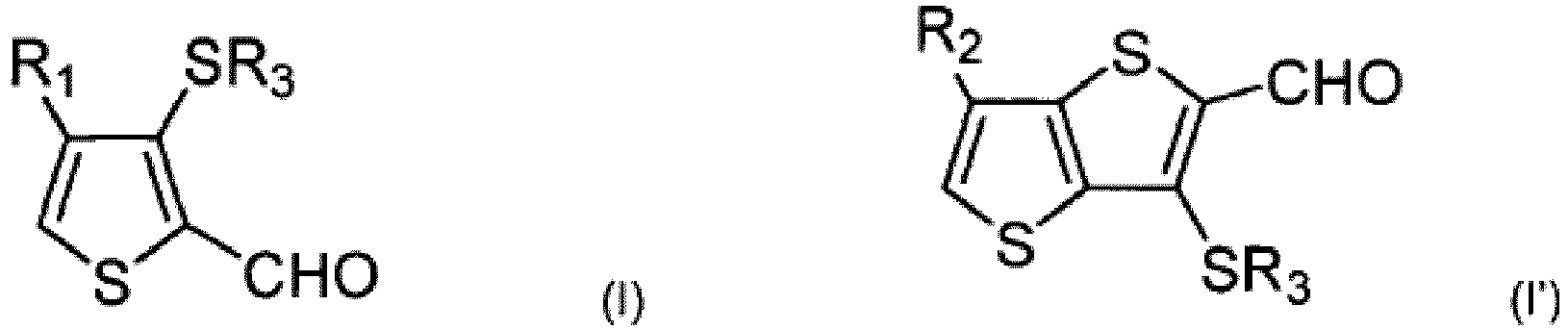
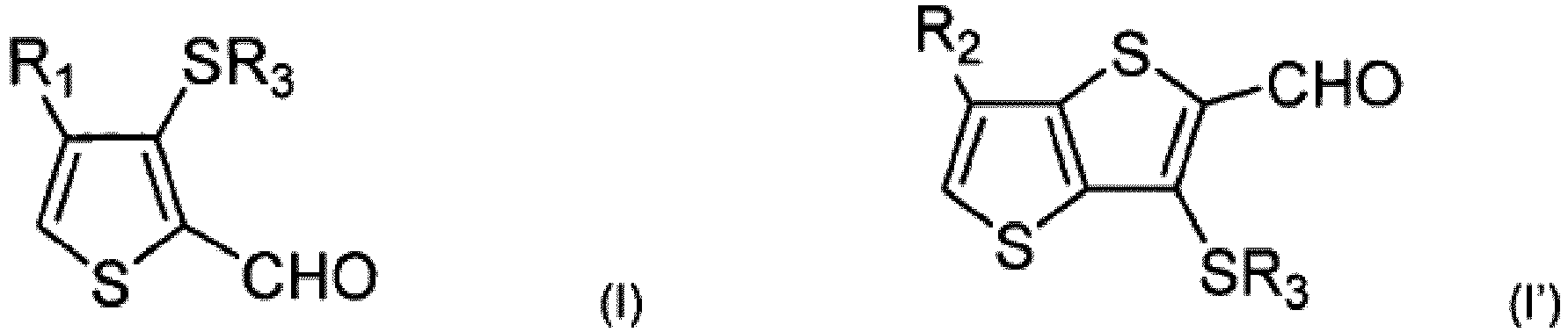
- thiophene compounds of formulae (I) and (I') which can, in some embodiments, be used to form ⁇ -R-substituted fused thiophene compounds: wherein R 1 and R 2 are independently chosen from alkyl, alkenyl, alkynyl, aryl, cycloalkyl, or aralkyl groups, which can be substituted or unsubstituted, linear or branched, and optionally interrupted by at least one heteroatom; and R 3 is chosen from C 1 -C 6 linear alkyl radicals.
- R 3 is chosen from C 1 -C 6 linear alkyl radicals
- Y is chosen from butyl and phenyl groups
- X - is chosen from halogen ions, such as bromine, chlorine, and iodine ions.
- R 1 ' and R 2 ' are independently chosen from alkyl, alkenyl, alkynyl, aryl, cycloalkyl, or aralkyl groups, which can be substituted or unsubstituted, linear or branched, and optionally interrupted by at least one heteroatom;
- R 3 is chosen from C 1 -C 6 linear alkyl radicals;
- Y is chosen from butyl and phenyl groups;
- X - is chosen from halogen ions, such as bromine, chlorine, and iodine ions.
- R 1 and R 2 can be independently chosen from alkyl, alkenyl, alkynyl, aryl, cycloalkyl, or aralkyl groups, which can be substituted or unsubstituted, linear or branched, and optionally interrupted by at least one heteroatom.
- R 1 or R 2 can comprise from 1 to 48 carbon atoms, such as from 2 to 40 carbon atoms, from 3 to 36 carbon atoms, from 4 to 30 carbon atoms, from 6 to 24 carbon atoms, from 8 to 20 carbon atoms, or from 12 to 16 carbon atoms, including all ranges and subranges therebetween.
- R 1 and R 2 can be groups comprising at least 4 carbon atoms.
- R 1 and R 2 can be chosen from C 1 -C 36 linear alkyl groups or C 3 -C 48 branched alkyl groups, which can be unsubstituted or substituted (substituted alkyl), and optionally interrupted by at least one heteroatom (heteroalkyl).
- R 1 and R 2 can be chosen from linear or branched alkyl groups comprising at least 4 carbon atoms.
- R 1 or R 2 When R 1 or R 2 is substituted, suitable substituents can be chosen, for example, from alkyl, alkenyl, alkynyl, aryl, cycloalkyl, aralkyl, ether, hydroxyl, alkoxy, thiol, thioalkyl, or halide, groups.
- R 1 or R 2 is interrupted (hetero group)
- suitable heteroatoms can be chosen, for instance, from oxygen, nitrogen, sulfur, and phosphorous.
- the substituents can similarly be substituted or interrupted wit heteroatoms as described above.
- R 3 can be chosen, for example, from alkyl groups, such as C 1 -C 6 linear alkyl groups (e.g., C 1 , C 2 , C 3 , C 4 , C 5 , or C 6 linear alkyl radicals).
- the alkyl group R 3 is an ethyl or methyl group.
- R 3 is a methyl group.
- Y can be a butyl group and X' can be a bromine ion.
- fused thiophene moieties described herein can have any number of fused rings.
- the fused thiophene moieties can be tetracyclic (FT4), pentacyclic (FT5), hexacyclic (FT6), heptacyclic (FT7), octacyclic (FT8), nonacyclic (FT9), decacyclic (FT10), or higher, e.g., up to sixteen rings (FT16) or more.
- an ⁇ position refers to a non-fused carbon center that is directly adjacent to the sulfur of the thiophene, while a ⁇ position refers to a non-fused carbon center that is separated from the sulfur by an ⁇ position.
- formulae (IV), (IV'), (IV"), (IV"'), (VI), (VI'), (VIII), (VIII'), (VIII"), and (VIII"') below, which depict exemplary fused thiophene compounds the ⁇ positions are unsubstituted, while the ⁇ positions are R-substituted.
- R 1 , R 1 ', R 2 , and R 2 ' in the above formulae can be identical or different and can be independently chosen from any groups described with respect to the R 1 , R 1 ', R 2 , and R 2 ' substituents of compounds (I), (I'), (II"), and (II"') above.
- at least one of R 1 , R 1 ', R 2 , or R 2 ' can be an unsubstituted alkyl group.
- the unsubstituted alkyl group can be a linear alkyl group (e.g., methyl, ethyl, propyl, butyl, pentyl, hexyl, heptyl, ocytl, nonyl, decyl, undecyl, dodecyl, hexadecyl, and so forth), a branched alky group (e.g., sec-butyl, neo-pentyl, 4-methylpentyl, etc.), or a substituted or unsubstituted cycloalkyl group (e.g., cyclopentyl, cyclohexyl, and the like).
- a linear alkyl group e.g., methyl, ethyl, propyl, butyl, pentyl, hexyl, heptyl, ocytl, nonyl, decyl, undecyl,
- R 1 , R 1 ', R 2 , or R 2 ' comprises at least four carbon atoms and is substituted or unsubstituted, and optionally interrupted with at least one heteroatom.
- R 1 , R 1 ', R 2 , and/or R 2 ' can be substituted with at least one group chosen from alkyl, alkenyl, alkynyl, aryl, cycloalkyl, aralkyl, ether, hydroxyl, alkoxy, thiol, thioalkyl, or halide groups.
- substituted alkyl groups can include, for example, 6-hydroxyhexyl and 3-phenylbutyl, to name a few.
- the methods disclosed herein can be used to form ⁇ -R-substituted fused thiophene compounds having a wide variety of R groups, and the selection of these R groups (whether identical or different) can depend on the desired end use of the compound.
- the fused thiophene compounds disclosed herein are substituted at both ⁇ positions. In other words, there are no ⁇ -hydrogens on the ring system.
- neither R group (R 1 , R 1 ', R 2 , or R 2 ') in formulae (IV), (IV'), (IV") (IV"'), (VI), (VI'), (VIII), (VIII'), (VIII"), or (VIII"') are hydrogen.
- Such fused thiophenes may have increased oxidative stability and may be incorporated into more complex compounds having substantially no ⁇ -hydrogen content.
- the fused thiophene compounds disclosed herein can exist as monomeric fused thiophenes or can be incorporated into more complex compounds, such as oligomers or polymers.
- any of the sulfur atoms of the ⁇ -R-substituted fused thiophene compounds can be oxidized to produce SO 2 .
- the oxidized fused thiophene compounds can be prepared by oxidation, for example, with meta-chloroperoxybenzoic acid (MCPBA). Oxidation can be selective at the centralmost ring of the polycyclic structure; however, it is possible to oxidize any of the sulfur atoms in fused ring structure.
- MCPBA meta-chloroperoxybenzoic acid
- Oxidation can be selective at the centralmost ring of the polycyclic structure; however, it is possible to oxidize any of the sulfur atoms in fused ring structure.
- the oxidized fused thiophene compounds can be incorporated into conjugated fused thiophene polymers or oligomers.
- the oxidized fused thiophene compounds can also be incorporated into a polymer comprising a polyester, a polyurethane, a polyamide, a polyketone, a polyacrylate, a polymethacrylate, or a poly(vinyl)ether to name a few.
- the fused thiophene compounds prepared according to the methods disclosed herein can be incorporated into compositions for electronic or optoelectronic applications.
- compositions comprising the fused thiophene compounds can comprise a total concentration of at least 1% by weight of fused thiophene, such as at least 2%, at least 3%, at least 5%, or at least 10% by weight of fused thiophene, including all ranges and subranges therebetween.
- the composition can have higher fused thiophene concentrations, such as up to about 20%, 30%, 40%, or 50% by weight of fused thiophene, including all ranges and subranges therebetween.
- the fused thiophene compounds can have improved solubility in various solvents and can be used to produce compositions of relatively high concentration.
- Such compositions can be used to make a wide variety of devices, such as electronic, optoelectronic, or nonlinear optical devices.
- the compositions can be used, for example, in field effect transistors (FETs), thin film transistors (TFTs), organic light-emitting diodes (OLEDs), electro-optic (EO) applications, RFID tags, electroluminescent devices in flat panel displays, and photovoltaic and sensor devices, or as conductive materials, as two photon mixing materials, as organic semiconductors (OSs), or as non-linear optical (NLO) materials.
- FETs field effect transistors
- TFTs thin film transistors
- OLEDs organic light-emitting diodes
- EO electro-optic
- RFID tags electroluminescent devices in flat panel displays
- photovoltaic and sensor devices or as conductive materials, as two photon mixing materials, as organic
- a method for making a ⁇ -R-substituted fused thiophene compound can comprise the steps of:
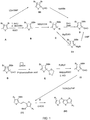
- FIG. 1 depicts an exemplary reaction scheme for making a ⁇ -R-substituted fused thiophene compound.
- the reaction scheme depicted in FIG. 1 comprises the steps of forming a thiophene compound of formula (I) and coupling two compounds of formula (I) to form a ⁇ -R-substituted fused thiophene compound comprising four fused rings (FT4).
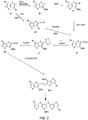
- FIG. 2 depicts an exemplary reaction scheme for making a ⁇ -R-substituted fused thiophene compound.
- FIG. 1 depicts an exemplary reaction scheme for making a ⁇ -R-substituted fused thiophene compound.
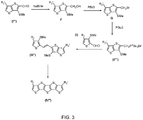
- FIG. 3 illustrates an exemplary embodiment in which a compound of formula (I) and a compound of formula (I') can be coupled to form a ⁇ -R-substituted fused thiophene compound comprising five fused rings (FT5).
- FIGS. 1-3 illustrate specific substituents and reagents solely for the purposes of illustration and such components are not intended to be limiting on the disclosure or appended claims.
- FIGS. 1-2 illustrate complete reaction schemes comprising steps for making compounds of formulae (I) and (I') and subsequently coupling such compounds
- the appended claims are not so limited and may include one or more portions of the illustrated reaction schemes.
- FIG. 3 illustrates a partial reaction scheme comprising steps for coupling compounds of formulae (I) and (I'), it is to be understood that the appended claims are not so limited and may further include steps for making compounds of formulae (I) and (I').
- a substitution can be carried out, e.g., using butyl lithium (BuLi) and dimethylsulfide (MeSSMe) in the presence of diethyl ether (Et 2 O) according to a reaction described in Baurle et al. "Synthesis and Properties of a Series of Methyltio Oligothiophenes," Liebigs Ann., pp. 279-284 (1996 ).
- a selective halogenation reaction can be carried out, e.g., selective bromination using n-bromosuccinimide (NBS) and carbon tetrachloride (CCl 4 ).
- NBS n-bromosuccinimide
- CCl 4 carbon tetrachloride
- the ⁇ ' (or ⁇ ") halogen of compound (C) can then be substituted with an aldehyde group (-C(O)H) using any suitable reaction.
- a formylation reaction can be carried out using BuLi and dimethylformamide (DMF) to give compound (D).
- compound (C) can be reacted with magnesium (Mg) in the presence of Et 2 O to form a Grignard reagent (C1), which can then be reacted with DMF in a Grignard reaction to give compound (D).
- the ⁇ ' (or ⁇ ") aldehyde function can be protected by reaction with ethylene glycol and p-toluenesulfonic acid to produce compound (E).
- Compound (A) can be converted to Compound (D) via a two-step reaction through Compound (B1).
- the first reaction step comprises reacting lithium diisopropylamide (or an alternative strong base) in DMF with Compound (A) to form the ⁇ ' (or ⁇ ") aldehyde substituted compound, Compound (B1).
- the second step involves reacting Compound (B1) with a sodium alkylsulfide (shown as NaSMe) to produce Compound (D).
- Two compounds of formula (I) can then be coupled together using any suitable reaction.
- a McMurry coupling can be carried out using titanium tetrachloride (TiCl 4 ), zinc (Zn), and tetrahydrofuran (THF) to yield a compound of formula (III).
- TiCl 4 titanium tetrachloride
- Zn zinc
- THF tetrahydrofuran
- a Wittig coupling reaction can also be used, as described in more detail with respect to FIG. 3 .
- Compound (III) can then be cyclized to yield the ⁇ -R-substituted fused thiophene compound of formula (IV) comprising four fused rings (FT4).
- Cyclization can be carried out, for example, via an iodine (I2)-mediated cyclization reaction in the presence of chloroform (CHCl 3 ).
- McMurry coupling according to the scheme illustrated in FIG. 1 can be used to create symmetrical fused thiophene compounds (e.g., compounds with identical R 1 groups).
- BuLi butyl lithium
- MeSSMe dimethylsulfide
- a selective halogenation reaction can be carried out, e.g., selective bromination using n-bromosuccinimide (NBS) and carbon tetrachloride (CCl 4 ).
- NBS n-bromosuccinimide
- CCl 4 carbon tetrachloride
- the ⁇ ' (or ⁇ ") halogen of compound (C') can then be substituted with an aldehyde group (-C(O)H) using any suitable reaction.
- a formylation reaction can be carried out using BuLi and dimethylformamide (DMF) to give compound (D').
- the ⁇ ' (or ⁇ ") aldehyde function can be protected by reaction with ethylene glycol and p-toluenesulfonic acid to produce compound (E').
- Compound (E') can then be reacted with a Grignard reagent (R 2 ZnX illustrated) to exchange the halogen for an R 2 group via a metathesis reaction to give the compound of formula (I').
- Compound (A') can be converted to Compound (D') via a two-step reaction through Compound (B1').
- the first reaction step comprises reacting lithium diisopropylamide (or an alternative strong base) in DMF with Compound (A') to form the ⁇ ' (or ⁇ ") aldehyde substituted compound, Compound (B1').
- the second step involves reacting Compound (B1') with a sodium alkylsulfide (shown as NaSMe) to produce Compound (D').
- Two compounds of formula (I') can then be coupled together using any suitable reaction.
- a McMurry coupling can be carried out using titanium tetrachloride (TiCl 4 ), zinc (Zn), and tetrahydrofuran (THF) to yield a compound of formula (III').
- TiCl 4 titanium tetrachloride
- Zn zinc
- THF tetrahydrofuran
- a Wittig coupling reaction can be used to couple the compounds of formula (I'), as described in more detail with respect to FIG. 3 .
- Compound (III') can then be cyclized to yield the ⁇ -R-substituted fused thiophene compound of formula (IV') comprising six fused rings (FT6). Cyclization can be carried out, for example, via an iodine (I2)-mediated cyclization reaction in the presence of chloroform (CHCl 3 ).
- McMurry coupling according to the scheme illustrated in FIG. 2 can be used to create symmetrical fused thiophene compounds (e.g., compounds with identical R 2 groups).
- compounds (I) and (I') can also be modified and coupled together via a Wittig coupling reaction.
- the aldehyde function of compound (I') can be replaced with a phosphine function (-CH 2 P + Bu 3 Br - illustrated) and the compound thus modified can react with compound (I) to produce a compound of formula (III").
- Reaction of compound (G) with tributylphosphine (PBu 3 ) (illustrated) or triphenyl phosphine (PPh 3 ) can then yield a phosphine-modified compound (II"'), which can react with compound (I) to yield the compound of formula (III").
- Compound (III") can then be cyclized to yield the ⁇ -R-substituted fused thiophene compound of formula (IV") comprising five fused rings (FT5), in which R 1 and R 2 ' can be identical or different.
- Wittig coupling according to the scheme illustrated in FIG. 3 can be used to create symmetrical or asymmetrical fused thiophene compounds (e.g., compounds with identical or different R 1 and R 2 ' groups).
- the Wittig coupling reaction can be used to form compounds of formula (V) (illustrated) and (V') (not illustrated) by reacting a phosphine-modified compound (II") with an unmodified compound (I) (illustrated), or a phosphine-modified compound (II"') with an unmodified compound (I') (not illustrated), respectively.
- Compound (V) can be cyclized to form compounds of formula (VI) in which R 1 and R 1 ' are identical or different.
- compound (V') (not illustrated) can be cyclized to form compounds of formula (VI') (not illustrated), in which R 2 and R 2 ' are identical or different.
- Wittig coupling according to the scheme illustrated in FIG. 4 can be used to create symmetrical or asymmetrical fused thiophene compounds (e.g., compounds with identical or different R 1 and R 1 ' groups or compounds with identical or different R 1 ' and R 2 groups).
- R 1 , R 1 ', R 2 , and R 2 ' can be chosen from the same groups according to some embodiments (alkyl, alkenyl, alkynyl, aryl, cycloalkyl, or aralkyl groups, which can be substituted or unsubstituted, linear or branched, and optionally interrupted by at least one heteroatom), each of these substituents can be "independently” chosen from this list, which is intended to denote that each radical R 1 can be different from any other R 1 ', R 2 , or R 2 ' radical in the same compound, and vice versa.
- fused thiophene compounds disclosed herein can comprise identical R substituents, such as identical R 1 , R 1 ', R 2 , R 2 ' or even R 3 substituents.
- methods for making ⁇ -R-substituted fused thiophene compounds comprising:
- compounds (I) and (I') can also be coupled with compounds of formulae (II) and (II') to produce ⁇ -R-substituted fused thiophene compounds.
- Such methods can comprise, for example, the steps of:
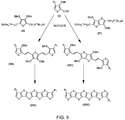
- FIG. 5 An exemplary reaction scheme for coupling compounds of formula (I) with compounds of formulae (II) or (II') is illustrated in FIG. 5 .
- FIG. 5 An exemplary reaction scheme for coupling compounds of formula (I) with compounds of formulae (II) or (II') is illustrated in FIG. 5 .
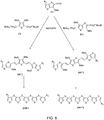
- FIGS. 5-6 depict an exemplary reaction scheme for coupling compounds of formula (I') with compounds of formulae (II) or (II').
- Wittig coupling according to the scheme illustrated in FIGS. 5-6 can be used to create symmetrical fused thiophene compounds (e.g., compounds with identical R 1 or compounds with identical R 2 groups).
- FIG. 7A depicts an exemplary reaction scheme for making a compound of formula (II).
- Compound (A) can then be substituted with an alkylthio group (-SCH 3 illustrated) at the ⁇ ' and ⁇ " positions.
- Such a substitution can be carried out, e.g., using butyl lithium (BuLi) and dimethylsulfide (MeSSMe) in the presence of diethyl ether (Et 2 O) according to a reaction described in Baurle et al.
- a halogenation reaction can be carried out, e.g., bromination using n-bromosuccinimide (NBS) and carbon tetrachloride (CCl 4 ).
- NBS n-bromosuccinimide
- CCl 4 carbon tetrachloride
- the ⁇ ' and ⁇ " halogens of compound (K) can then be substituted with an aldehyde group (-C(O)H) using any suitable reaction.
- a formylation reaction can be carried out using BuLi and dimethylformamide (DMF) to give compound (L).
- the ⁇ ' and ⁇ " aldehyde groups can then be reduced to alcohol (methanol) groups using any suitable reaction.
- Reaction of compound (N) with tributylphosphine (PBu 3 ) (illustrated) or triphenyl phosphine (PPh 3 ) can then yield the compound of formula (II).
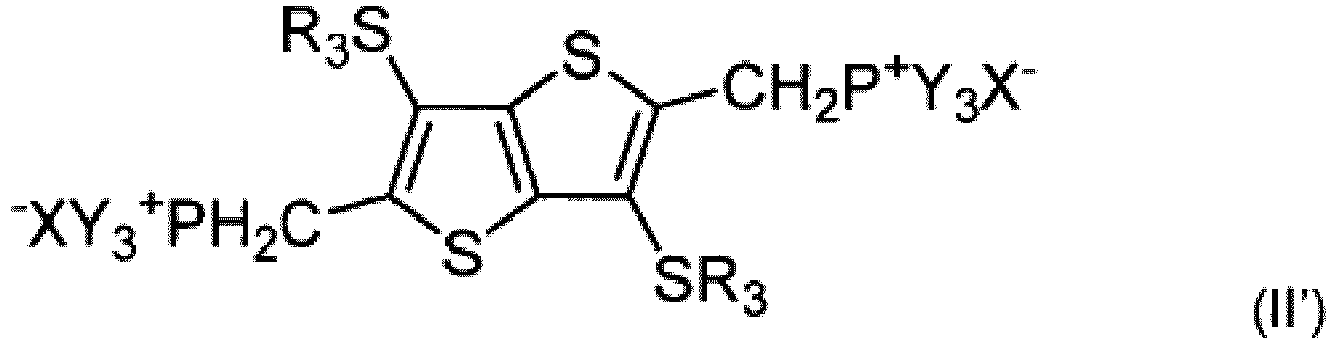
- FIG. 7B depicts an exemplary reaction scheme for making a compound of formula (II').
- Compound (A') can then be substituted with an alkylthio group (-SCH 3 illustrated) at the ⁇ ' and ⁇ " positions.
- Such a substitution can be carried out, e.g., using butyl lithium (BuLi) and dimethylsulfide (MeSSMe) in the presence of diethyl ether (Et 2 O) according to a reaction described in Baurle et al.
- a halogenation reaction can be carried out, e.g., bromination using n-bromosuccinimide (NBS) and carbon tetrachloride (CCl 4 ).
- NBS n-bromosuccinimide
- CCl 4 carbon tetrachloride
- the ⁇ ' and ⁇ " halogens of compound (K') can then be substituted with an aldehyde group (-C(O)H) using any suitable reaction.
- a formylation reaction can be carried out using BuLi and dimethylformamide (DMF) to give compound (L').
- the ⁇ ' and ⁇ " aldehyde groups can then be reduced to alcohol (methanol) groups using any suitable reaction.
- Reaction of compound (N') with tributylphosphine (PBu 3 ) (illustrated) or triphenyl phosphine (PPh 3 ) can then yield the compound of formula (II').
- Ranges can be expressed herein as from “about” one particular value, and/or to “about” another particular value. When such a range is expressed, examples include from the one particular value and/or to the other particular value. Similarly, when values are expressed as approximations, by use of the antecedent "about,” it will be understood that the particular value forms another aspect. It will be further understood that the endpoints of each of the ranges are significant both in relation to the other endpoint, and independently of the other endpoint.
Landscapes
- Chemical & Material Sciences (AREA)
- Organic Chemistry (AREA)
- Health & Medical Sciences (AREA)
- Life Sciences & Earth Sciences (AREA)
- Biochemistry (AREA)
- General Health & Medical Sciences (AREA)
- Molecular Biology (AREA)
- Engineering & Computer Science (AREA)
- Materials Engineering (AREA)
- Physics & Mathematics (AREA)
- Spectroscopy & Molecular Physics (AREA)
- Heterocyclic Carbon Compounds Containing A Hetero Ring Having Oxygen Or Sulfur (AREA)
Claims (15)
- Thiophenverbindung der Formel (I), (I'), (II), (II'), (II") oder (II"') :


- Verfahren zum Herstellen der Thiophenverbindung der Formel (I) nach Anspruch 1, umfassend:(i) Bereitstellen einer β'-β"-halogensubstituierten Thiophenkomponente der Formel (A), worin das Halogen (X) unabhängig aus Br, Cl und I ausgewählt ist;
 (ii) Substituieren eines ersten β'- oder β"-Halogens (X) durch eine Alkylthiogruppe (-SR3);(iii) Halogenieren der Thiophenkomponente an einer Position α' oder α" angrenzend an die Alkylthiogruppe mit einem Halogen (X'), das aus Br, Cl und I ausgewählt ist;(iv) Substituieren des α'- oder α"-Halogens (X') durch eine Aldehydgruppe (-C(O)H); und(v) Substituieren eines zweiten β'- oder β"-Halogens (X) durch eine R1-Gruppe.
 - Verfahren zum Herstellen der Thiophenverbindung der Formel (I') nach Anspruch 1, umfassend:(i) Bereitstellen einer β'-β"-halogensubstituierten Thiophenkomponente der Formel (A'), worin das Halogen (X) unabhängig aus Br, Cl und I ausgewählt ist;
 (ii) Substituieren eines ersten β'- oder β"-Halogens (X) durch eine Alkylthiogruppe (-SR3);(iii) Halogenieren der Thiophenkomponente an einer Position α' oder α" angrenzend an die Alkylthiogruppe mit einem Halogen (X'), das aus Br, Cl und I ausgewählt ist;(iv) Substituieren des α'- oder α"-Halogens (X') durch eine Aldehydgruppe (-C(O)H); und(v) Substituieren eines zweiten β'- oder β"-Halogens (X) durch eine R2-Gruppe.
 - Verfahren zum Herstellen der Thiophenverbindung der Formel (II) nach Anspruch 1, umfassend:(i) Bereitstellen einer β'-β"-halogensubstituierten Thiophenkomponente der Formel (A), worin das Halogen (X) unabhängig aus Br, Cl und I ausgewählt ist;
 (ii) Substituieren der β'- und β"-Halogene (X) durch Alkylthiogruppen (-SR3);(iii) Halogenieren der Thiophenkomponente an den Positionen α' oder α" mit einem Halogen (X'), das unabhängig aus Br, Cl und I ausgewählt ist;(iv) Substituieren der α'- und α"-Halogene (X') durch Aldehydgruppen (-C(O)H);(v) Reduzieren der α'- und α"-Aldehydgruppen (-C(O)H) zu Alkoholgruppen (-CH2OH);(vi) Substituieren der Hydroxylgruppe (-OH) der α'- und α"-Alkoholgruppen durch ein Halogen (X"), das aus Br, Cl und I ausgewählt ist; und(vii) Bewirken einer Reaktion der im Schritt (vi) ausgebildeten Verbindung mit Tributylphosphin (PBu3) oder Triphenylphosphin (PPh3).
 - Verfahren zum Herstellen der Thiophenverbindung der Formel (II') nach Anspruch 1, umfassend:(i) Bereitstellen einer β'-β"-halogensubstituierten Thiophenkomponente der Formel (A'), worin das Halogen (X) unabhängig aus Br, Cl und I ausgewählt ist;
 (ii) Substituieren der β'- und β"-Halogene (X) durch Alkylthiogruppen (-SR3);(iii) Halogenieren der Thiophenkomponente an den Positionen α' oder α" mit einem Halogen (X'), das unabhängig aus Br, Cl und I ausgewählt ist;(iv) Substituieren der α'- und α"-Halogene (X') durch Aldehydgruppen (-C(O)H);(v) Reduzieren der α'- und α"-Aldehydgruppen (-C(O)H) zu Alkoholgruppen (-CH2OH);(vi) Substituieren der Hydroxylgruppe (-OH) der α'- und α"-Alkoholgruppen durch ein Halogen (X"), das aus Br, Cl und I ausgewählt ist; und(vii) Bewirken einer Reaktion der im Schritt (vi) ausgebildeten Verbindung mit Tributylphosphin (PBu3) oder Triphenylphosphin (PPh3).
 - Verfahren zum Herstellen der Thiophenverbindung der Formel (II'') nach Anspruch 1, umfassend:(i) Bereitstellen einer Verbindung der Formel (I*) :
 (ii) Reduzieren der Aldehydgruppe (-C(O)H) zu einer Alkoholgruppe (-CH2OH) ;(iii) Substituieren der Hydroxylgruppe (-OH) der Alkoholgruppe durch ein Halogen (X), das aus Br, Cl und I ausgewählt ist; und(iv) Bewirken einer Reaktion der im Schritt (vi) ausgebildeten Verbindung mit Tributylphosphin (PBu3) oder Triphenylphosphin (PPh3).
 - Verfahren zum Herstellen der Thiophenverbindung der Formel (II''') nach Anspruch 1, umfassend:(i) Bereitstellen einer Verbindung der Formel (I'*) :
 (ii) Reduzieren der Aldehydgruppe (-C(O)H) zu einer Alkoholgruppe (-CH2OH) ;(iii) Substituieren der Hydroxylgruppe (-OH) der Alkoholgruppe durch ein Halogen (X), das aus Br, Cl und I ausgewählt ist; und(iv) Bewirken einer Reaktion der im Schritt (vi) ausgebildeten Verbindung mit Tributylphosphin (PBu3) oder Triphenylphosphin (PPh3).
 - Verfahren zum Herstellen einer β-R-substituierten, vereinigten Thiophenverbindung, umfassend:(i) Verbinden zweier Verbindungen der Formel (I) oder zweier Verbindungen der Formel (I'):

 (ii) Zyklisieren der Verbindung der Formel (III) oder (III'), um eine Verbindung der Formel (IV) oder (IV') zu bilden:
- Verfahren zum Herstellen einer β-R-substituierten, vereinigten Thiophenverbindung, umfassend:(i) Verbinden einer ersten Verbindung, die aus Verbindungen der Formeln (I) und (I') ausgewählt ist:


 (ii) Zyklisieren der Verbindung der Formel (III''), (III'''), (V) oder (V'), um eine Verbindung der Formel (IV''), (IV"'), (VI) oder (VI') zu bilden:
- Verfahren zum Herstellen einer β-R-substituierten, vereinigten Thiophenverbindung, umfassend:(i) Verbinden einer ersten Verbindung, die aus Verbindungen der Formeln (I) und (I') ausgewählt ist:


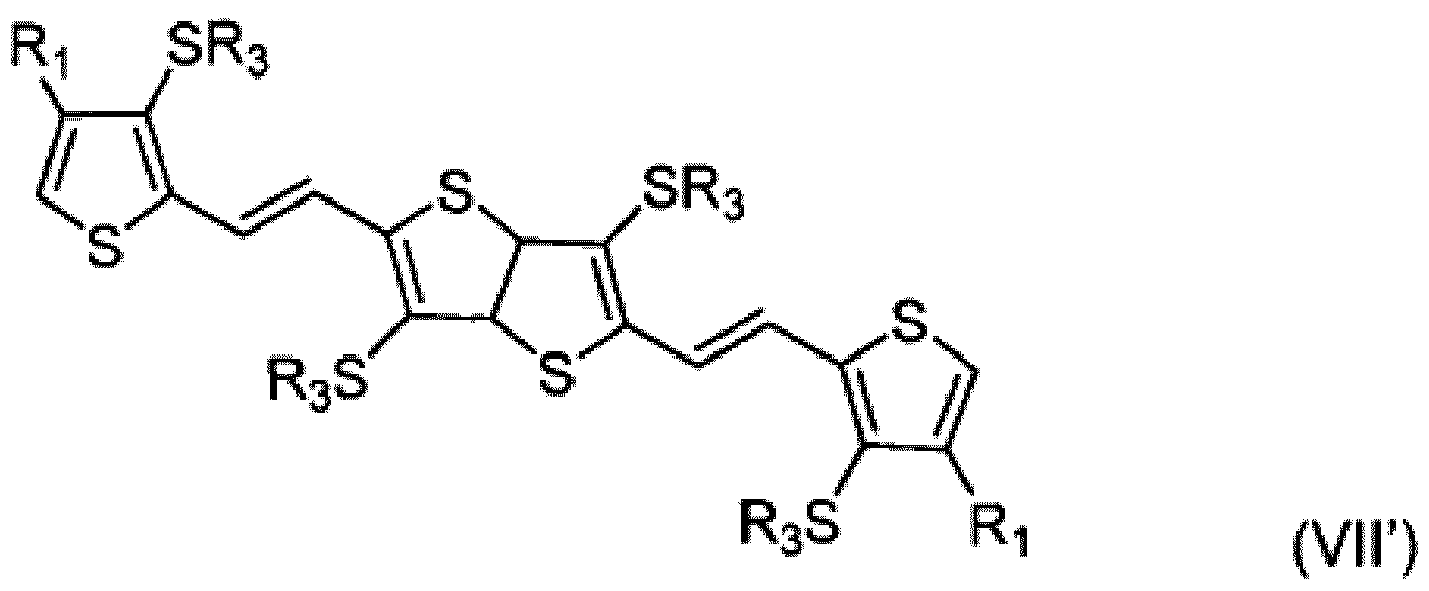

 (ii) Zyklisieren der Verbindung der Formel (VII), (VII'), (VII'') oder (VII'''), um eine Verbindung der Formel (VIII), (VIII'), (VIII") oder (VIII"') zu bilden:


- Verfahren nach einem der Ansprüche 2 bis 10, wobei R1 und R2 mindestens vier Kohlenstoffatome umfassen.
- Verfahren nach einem der Ansprüche 2 bis 10, wobei R1 und R2 unabhängig aus linearen C1-C36-Alkylgruppen und verzweigten C3-C48-Alkylgruppen ausgewählt sind und R3 optional eine Methylgruppe ist.
- Verfahren nach einem der Ansprüche 2 bis 12, wobei R1 und R2 durch mindestens eine Gruppe substituiert werden, die aus Alkyl-, Alkenyl-, Alkynyl-, Aryl-, Cycloalkyl-, Aralkyl-, Ether-, Hydroxyl-, Alkoxy-, Thiol-, Thioalkyl- und Halogenidgruppen ausgewählt ist.
- Verfahren nach einem der Ansprüche 2 bis 13, wobei R1 und R2 durch mindestens ein Heteroatom unterbrochen werden, das aus Sauerstoff, Stickstoff, Schwefel und Phosphor ausgewählt ist.
- Verfahren nach einem der Ansprüche 2 bis 14, wobei es sich bei Y um eine Butylgruppe und bei X- um ein Bromion handelt.
Applications Claiming Priority (2)
| Application Number | Priority Date | Filing Date | Title |
|---|---|---|---|
| US201562154329P | 2015-04-29 | 2015-04-29 | |
| PCT/US2016/028733 WO2016176112A1 (en) | 2015-04-29 | 2016-04-22 | Methods and compounds for synthesizing fused thiophenes |
Publications (2)
| Publication Number | Publication Date |
|---|---|
| EP3310770A1 EP3310770A1 (de) | 2018-04-25 |
| EP3310770B1 true EP3310770B1 (de) | 2018-11-07 |
Family
ID=55861273
Family Applications (1)
| Application Number | Title | Priority Date | Filing Date |
|---|---|---|---|
| EP16719709.4A Not-in-force EP3310770B1 (de) | 2015-04-29 | 2016-04-22 | Verfahren und verbindungen zur synthese von verschmolzenen thiophenen |
Country Status (6)
| Country | Link |
|---|---|
| US (1) | US9643978B2 (de) |
| EP (1) | EP3310770B1 (de) |
| KR (1) | KR101919272B1 (de) |
| CN (1) | CN107531726A (de) |
| TW (1) | TW201704222A (de) |
| WO (1) | WO2016176112A1 (de) |
Family Cites Families (10)
| Publication number | Priority date | Publication date | Assignee | Title |
|---|---|---|---|---|
| DE602005017384D1 (de) | 2004-05-18 | 2009-12-10 | Merck Patent Gmbh | Mono-, oligo- und polythienoä3,2-büthiophene |
| KR101206202B1 (ko) * | 2004-09-14 | 2012-11-29 | 코닝 인코포레이티드 | 융합 티오펜, 융합 티오펜의 제조방법 및 그 용도 |
| US20130085256A1 (en) | 2004-09-14 | 2013-04-04 | Mingqian He | Fused thiophenes, methods of making fused thiophenes, and uses thereof |
| US7838623B2 (en) | 2004-09-14 | 2010-11-23 | Corning Incorporated | Fused thiophenes, methods for making fused thiophenes, and uses thereof |
| US7893191B2 (en) | 2007-02-28 | 2011-02-22 | Corning Incorporated | Fused thiophenes, methods for making fused thiophenes, and uses thereof |
| EP2274310B1 (de) | 2008-03-31 | 2016-05-25 | Corning Inc. | Kondensierte thiophene und verfahren zu deren herstellung und anwendung |
| US7919634B2 (en) | 2009-05-28 | 2011-04-05 | Corning Incorporated | Fused thiophenes, articles, and methods thereof |
| US8217183B2 (en) * | 2010-05-18 | 2012-07-10 | Corning Incorporated | Methods of making fused thiophenes |
| US8278346B2 (en) | 2010-08-06 | 2012-10-02 | Corning Incorporated | Di-tin fused thiophene compounds and polymers and methods of making |
| US8846855B2 (en) * | 2011-10-31 | 2014-09-30 | Corning Incorporated | Conjugated fused thiophenes, methods of making conjugated fused thiophenes, and uses thereof |
-
2016
- 2016-04-20 US US15/133,668 patent/US9643978B2/en not_active Expired - Fee Related
- 2016-04-22 KR KR1020177032513A patent/KR101919272B1/ko not_active Expired - Fee Related
- 2016-04-22 CN CN201680025718.3A patent/CN107531726A/zh active Pending
- 2016-04-22 EP EP16719709.4A patent/EP3310770B1/de not_active Not-in-force
- 2016-04-22 WO PCT/US2016/028733 patent/WO2016176112A1/en not_active Ceased
- 2016-04-29 TW TW105113393A patent/TW201704222A/zh unknown
Non-Patent Citations (1)
| Title |
|---|
| None * |
Also Published As
| Publication number | Publication date |
|---|---|
| US20160318949A1 (en) | 2016-11-03 |
| WO2016176112A1 (en) | 2016-11-03 |
| EP3310770A1 (de) | 2018-04-25 |
| CN107531726A (zh) | 2018-01-02 |
| KR101919272B1 (ko) | 2018-11-15 |
| KR20170137818A (ko) | 2017-12-13 |
| US9643978B2 (en) | 2017-05-09 |
| TW201704222A (zh) | 2017-02-01 |
Similar Documents
| Publication | Publication Date | Title |
|---|---|---|
| EP2773646B1 (de) | Konjugierte kondensierte thiophene, verfahren zur herstellung konjugierter kondensierte thiophene und ihre verwendung | |
| EP2129678B1 (de) | Kondensierte thiophene, verfahren zur herstellung kondensierter thiophene und verwendungsmöglichkeiten dafür | |
| EP2308882B1 (de) | Kondensierte Thiophene und deren Verwendung | |
| US20130085256A1 (en) | Fused thiophenes, methods of making fused thiophenes, and uses thereof | |
| US8349998B2 (en) | Fused thiophenes, methods for making fused thiophenes, and uses thereof | |
| EP2773687A1 (de) | Kondensierte thiophene, verfahren zur herstellung kondensierter thiophene und verwendungsmöglichkeiten dafür | |
| CN104812795A (zh) | 含有稠环的单体、低聚和聚合半导体以及它们的器件 | |
| CN104114599A (zh) | 有机半导体聚合物 | |
| CN103068811B (zh) | 蒽并[2,3-b:7,6-b’]二噻吩衍生物及其作为有机半导体的用途 | |
| US11289663B2 (en) | Organic semiconducting compounds | |
| EP3310770B1 (de) | Verfahren und verbindungen zur synthese von verschmolzenen thiophenen | |
| WO2019161748A1 (en) | Organic semiconducting compounds | |
| WO2015035012A1 (en) | Fused thiophene ditin monomers | |
| EP2738175B1 (de) | Verfahren zur Herstellung von Benzothiophen-Derivaten | |
| US8853425B2 (en) | Process for the preparation of benzodithiophene compounds | |
| JP2018174266A (ja) | 有機半導体及びその製造方法 | |
| JP2018174265A (ja) | 膜状成形体の製造方法 | |
| TW201841922A (zh) | 有機半導體及其製造方法 |
Legal Events
| Date | Code | Title | Description |
|---|---|---|---|
| STAA | Information on the status of an ep patent application or granted ep patent |
Free format text: STATUS: THE INTERNATIONAL PUBLICATION HAS BEEN MADE |
|
| PUAI | Public reference made under article 153(3) epc to a published international application that has entered the european phase |
Free format text: ORIGINAL CODE: 0009012 |
|
| STAA | Information on the status of an ep patent application or granted ep patent |
Free format text: STATUS: REQUEST FOR EXAMINATION WAS MADE |
|
| 17P | Request for examination filed |
Effective date: 20171030 |
|
| AK | Designated contracting states |
Kind code of ref document: A1 Designated state(s): AL AT BE BG CH CY CZ DE DK EE ES FI FR GB GR HR HU IE IS IT LI LT LU LV MC MK MT NL NO PL PT RO RS SE SI SK SM TR |
|
| AX | Request for extension of the european patent |
Extension state: BA ME |
|
| GRAP | Despatch of communication of intention to grant a patent |
Free format text: ORIGINAL CODE: EPIDOSNIGR1 |
|
| STAA | Information on the status of an ep patent application or granted ep patent |
Free format text: STATUS: GRANT OF PATENT IS INTENDED |
|
| RIC1 | Information provided on ipc code assigned before grant |
Ipc: C07D 495/04 20060101ALI20180412BHEP Ipc: C07D 495/22 20060101ALI20180412BHEP Ipc: C07D 333/22 20060101AFI20180412BHEP Ipc: C07D 333/34 20060101ALI20180412BHEP Ipc: C07F 9/54 20060101ALI20180412BHEP |
|
| DAV | Request for validation of the european patent (deleted) | ||
| DAX | Request for extension of the european patent (deleted) | ||
| INTG | Intention to grant announced |
Effective date: 20180511 |
|
| GRAS | Grant fee paid |
Free format text: ORIGINAL CODE: EPIDOSNIGR3 |
|
| GRAA | (expected) grant |
Free format text: ORIGINAL CODE: 0009210 |
|
| STAA | Information on the status of an ep patent application or granted ep patent |
Free format text: STATUS: THE PATENT HAS BEEN GRANTED |
|
| AK | Designated contracting states |
Kind code of ref document: B1 Designated state(s): AL AT BE BG CH CY CZ DE DK EE ES FI FR GB GR HR HU IE IS IT LI LT LU LV MC MK MT NL NO PL PT RO RS SE SI SK SM TR |
|
| REG | Reference to a national code |
Ref country code: GB Ref legal event code: FG4D |
|
| REG | Reference to a national code |
Ref country code: CH Ref legal event code: EP Ref country code: AT Ref legal event code: REF Ref document number: 1061910 Country of ref document: AT Kind code of ref document: T Effective date: 20181115 |
|
| REG | Reference to a national code |
Ref country code: DE Ref legal event code: R096 Ref document number: 602016007013 Country of ref document: DE |
|
| REG | Reference to a national code |
Ref country code: IE Ref legal event code: FG4D |
|
| REG | Reference to a national code |
Ref country code: NL Ref legal event code: MP Effective date: 20181107 |
|
| REG | Reference to a national code |
Ref country code: LT Ref legal event code: MG4D |
|
| REG | Reference to a national code |
Ref country code: AT Ref legal event code: MK05 Ref document number: 1061910 Country of ref document: AT Kind code of ref document: T Effective date: 20181107 |
|
| PG25 | Lapsed in a contracting state [announced via postgrant information from national office to epo] |
Ref country code: FI Free format text: LAPSE BECAUSE OF FAILURE TO SUBMIT A TRANSLATION OF THE DESCRIPTION OR TO PAY THE FEE WITHIN THE PRESCRIBED TIME-LIMIT Effective date: 20181107 Ref country code: LV Free format text: LAPSE BECAUSE OF FAILURE TO SUBMIT A TRANSLATION OF THE DESCRIPTION OR TO PAY THE FEE WITHIN THE PRESCRIBED TIME-LIMIT Effective date: 20181107 Ref country code: HR Free format text: LAPSE BECAUSE OF FAILURE TO SUBMIT A TRANSLATION OF THE DESCRIPTION OR TO PAY THE FEE WITHIN THE PRESCRIBED TIME-LIMIT Effective date: 20181107 Ref country code: AT Free format text: LAPSE BECAUSE OF FAILURE TO SUBMIT A TRANSLATION OF THE DESCRIPTION OR TO PAY THE FEE WITHIN THE PRESCRIBED TIME-LIMIT Effective date: 20181107 Ref country code: BG Free format text: LAPSE BECAUSE OF FAILURE TO SUBMIT A TRANSLATION OF THE DESCRIPTION OR TO PAY THE FEE WITHIN THE PRESCRIBED TIME-LIMIT Effective date: 20190207 Ref country code: NO Free format text: LAPSE BECAUSE OF FAILURE TO SUBMIT A TRANSLATION OF THE DESCRIPTION OR TO PAY THE FEE WITHIN THE PRESCRIBED TIME-LIMIT Effective date: 20190207 Ref country code: ES Free format text: LAPSE BECAUSE OF FAILURE TO SUBMIT A TRANSLATION OF THE DESCRIPTION OR TO PAY THE FEE WITHIN THE PRESCRIBED TIME-LIMIT Effective date: 20181107 Ref country code: IS Free format text: LAPSE BECAUSE OF FAILURE TO SUBMIT A TRANSLATION OF THE DESCRIPTION OR TO PAY THE FEE WITHIN THE PRESCRIBED TIME-LIMIT Effective date: 20190307 Ref country code: LT Free format text: LAPSE BECAUSE OF FAILURE TO SUBMIT A TRANSLATION OF THE DESCRIPTION OR TO PAY THE FEE WITHIN THE PRESCRIBED TIME-LIMIT Effective date: 20181107 |
|
| PG25 | Lapsed in a contracting state [announced via postgrant information from national office to epo] |
Ref country code: PT Free format text: LAPSE BECAUSE OF FAILURE TO SUBMIT A TRANSLATION OF THE DESCRIPTION OR TO PAY THE FEE WITHIN THE PRESCRIBED TIME-LIMIT Effective date: 20190307 Ref country code: NL Free format text: LAPSE BECAUSE OF FAILURE TO SUBMIT A TRANSLATION OF THE DESCRIPTION OR TO PAY THE FEE WITHIN THE PRESCRIBED TIME-LIMIT Effective date: 20181107 Ref country code: GR Free format text: LAPSE BECAUSE OF FAILURE TO SUBMIT A TRANSLATION OF THE DESCRIPTION OR TO PAY THE FEE WITHIN THE PRESCRIBED TIME-LIMIT Effective date: 20190208 Ref country code: SE Free format text: LAPSE BECAUSE OF FAILURE TO SUBMIT A TRANSLATION OF THE DESCRIPTION OR TO PAY THE FEE WITHIN THE PRESCRIBED TIME-LIMIT Effective date: 20181107 Ref country code: RS Free format text: LAPSE BECAUSE OF FAILURE TO SUBMIT A TRANSLATION OF THE DESCRIPTION OR TO PAY THE FEE WITHIN THE PRESCRIBED TIME-LIMIT Effective date: 20181107 Ref country code: AL Free format text: LAPSE BECAUSE OF FAILURE TO SUBMIT A TRANSLATION OF THE DESCRIPTION OR TO PAY THE FEE WITHIN THE PRESCRIBED TIME-LIMIT Effective date: 20181107 |
|
| PG25 | Lapsed in a contracting state [announced via postgrant information from national office to epo] |
Ref country code: IT Free format text: LAPSE BECAUSE OF FAILURE TO SUBMIT A TRANSLATION OF THE DESCRIPTION OR TO PAY THE FEE WITHIN THE PRESCRIBED TIME-LIMIT Effective date: 20181107 Ref country code: CZ Free format text: LAPSE BECAUSE OF FAILURE TO SUBMIT A TRANSLATION OF THE DESCRIPTION OR TO PAY THE FEE WITHIN THE PRESCRIBED TIME-LIMIT Effective date: 20181107 Ref country code: DK Free format text: LAPSE BECAUSE OF FAILURE TO SUBMIT A TRANSLATION OF THE DESCRIPTION OR TO PAY THE FEE WITHIN THE PRESCRIBED TIME-LIMIT Effective date: 20181107 Ref country code: PL Free format text: LAPSE BECAUSE OF FAILURE TO SUBMIT A TRANSLATION OF THE DESCRIPTION OR TO PAY THE FEE WITHIN THE PRESCRIBED TIME-LIMIT Effective date: 20181107 |
|
| REG | Reference to a national code |
Ref country code: DE Ref legal event code: R097 Ref document number: 602016007013 Country of ref document: DE |
|
| PG25 | Lapsed in a contracting state [announced via postgrant information from national office to epo] |
Ref country code: SM Free format text: LAPSE BECAUSE OF FAILURE TO SUBMIT A TRANSLATION OF THE DESCRIPTION OR TO PAY THE FEE WITHIN THE PRESCRIBED TIME-LIMIT Effective date: 20181107 Ref country code: EE Free format text: LAPSE BECAUSE OF FAILURE TO SUBMIT A TRANSLATION OF THE DESCRIPTION OR TO PAY THE FEE WITHIN THE PRESCRIBED TIME-LIMIT Effective date: 20181107 Ref country code: RO Free format text: LAPSE BECAUSE OF FAILURE TO SUBMIT A TRANSLATION OF THE DESCRIPTION OR TO PAY THE FEE WITHIN THE PRESCRIBED TIME-LIMIT Effective date: 20181107 Ref country code: SK Free format text: LAPSE BECAUSE OF FAILURE TO SUBMIT A TRANSLATION OF THE DESCRIPTION OR TO PAY THE FEE WITHIN THE PRESCRIBED TIME-LIMIT Effective date: 20181107 |
|
| PLBE | No opposition filed within time limit |
Free format text: ORIGINAL CODE: 0009261 |
|
| STAA | Information on the status of an ep patent application or granted ep patent |
Free format text: STATUS: NO OPPOSITION FILED WITHIN TIME LIMIT |
|
| 26N | No opposition filed |
Effective date: 20190808 |
|
| REG | Reference to a national code |
Ref country code: CH Ref legal event code: PL |
|
| REG | Reference to a national code |
Ref country code: BE Ref legal event code: MM Effective date: 20190430 |
|
| PG25 | Lapsed in a contracting state [announced via postgrant information from national office to epo] |
Ref country code: LU Free format text: LAPSE BECAUSE OF NON-PAYMENT OF DUE FEES Effective date: 20190422 Ref country code: MC Free format text: LAPSE BECAUSE OF FAILURE TO SUBMIT A TRANSLATION OF THE DESCRIPTION OR TO PAY THE FEE WITHIN THE PRESCRIBED TIME-LIMIT Effective date: 20181107 |
|
| PG25 | Lapsed in a contracting state [announced via postgrant information from national office to epo] |
Ref country code: LI Free format text: LAPSE BECAUSE OF NON-PAYMENT OF DUE FEES Effective date: 20190430 Ref country code: CH Free format text: LAPSE BECAUSE OF NON-PAYMENT OF DUE FEES Effective date: 20190430 |
|
| PG25 | Lapsed in a contracting state [announced via postgrant information from national office to epo] |
Ref country code: BE Free format text: LAPSE BECAUSE OF NON-PAYMENT OF DUE FEES Effective date: 20190430 |
|
| PG25 | Lapsed in a contracting state [announced via postgrant information from national office to epo] |
Ref country code: TR Free format text: LAPSE BECAUSE OF FAILURE TO SUBMIT A TRANSLATION OF THE DESCRIPTION OR TO PAY THE FEE WITHIN THE PRESCRIBED TIME-LIMIT Effective date: 20181107 |
|
| PG25 | Lapsed in a contracting state [announced via postgrant information from national office to epo] |
Ref country code: IE Free format text: LAPSE BECAUSE OF NON-PAYMENT OF DUE FEES Effective date: 20190422 |
|
| PGFP | Annual fee paid to national office [announced via postgrant information from national office to epo] |
Ref country code: FR Payment date: 20200320 Year of fee payment: 5 |
|
| PGFP | Annual fee paid to national office [announced via postgrant information from national office to epo] |
Ref country code: DE Payment date: 20200317 Year of fee payment: 5 |
|
| GBPC | Gb: european patent ceased through non-payment of renewal fee |
Effective date: 20200422 |
|
| PG25 | Lapsed in a contracting state [announced via postgrant information from national office to epo] |
Ref country code: GB Free format text: LAPSE BECAUSE OF NON-PAYMENT OF DUE FEES Effective date: 20200422 |
|
| PG25 | Lapsed in a contracting state [announced via postgrant information from national office to epo] |
Ref country code: CY Free format text: LAPSE BECAUSE OF FAILURE TO SUBMIT A TRANSLATION OF THE DESCRIPTION OR TO PAY THE FEE WITHIN THE PRESCRIBED TIME-LIMIT Effective date: 20181107 |
|
| PG25 | Lapsed in a contracting state [announced via postgrant information from national office to epo] |
Ref country code: HU Free format text: LAPSE BECAUSE OF FAILURE TO SUBMIT A TRANSLATION OF THE DESCRIPTION OR TO PAY THE FEE WITHIN THE PRESCRIBED TIME-LIMIT; INVALID AB INITIO Effective date: 20160422 Ref country code: MT Free format text: LAPSE BECAUSE OF FAILURE TO SUBMIT A TRANSLATION OF THE DESCRIPTION OR TO PAY THE FEE WITHIN THE PRESCRIBED TIME-LIMIT Effective date: 20181107 |
|
| PG25 | Lapsed in a contracting state [announced via postgrant information from national office to epo] |
Ref country code: SI Free format text: LAPSE BECAUSE OF FAILURE TO SUBMIT A TRANSLATION OF THE DESCRIPTION OR TO PAY THE FEE WITHIN THE PRESCRIBED TIME-LIMIT Effective date: 20181107 |
|
| REG | Reference to a national code |
Ref country code: DE Ref legal event code: R119 Ref document number: 602016007013 Country of ref document: DE |
|
| PG25 | Lapsed in a contracting state [announced via postgrant information from national office to epo] |
Ref country code: DE Free format text: LAPSE BECAUSE OF NON-PAYMENT OF DUE FEES Effective date: 20211103 Ref country code: FR Free format text: LAPSE BECAUSE OF NON-PAYMENT OF DUE FEES Effective date: 20210430 |
|
| PG25 | Lapsed in a contracting state [announced via postgrant information from national office to epo] |
Ref country code: MK Free format text: LAPSE BECAUSE OF FAILURE TO SUBMIT A TRANSLATION OF THE DESCRIPTION OR TO PAY THE FEE WITHIN THE PRESCRIBED TIME-LIMIT Effective date: 20181107 |