EP3307921B1 - Acier à haute résistance et procédé de fabrication - Google Patents
Acier à haute résistance et procédé de fabrication Download PDFInfo
- Publication number
- EP3307921B1 EP3307921B1 EP16806952.4A EP16806952A EP3307921B1 EP 3307921 B1 EP3307921 B1 EP 3307921B1 EP 16806952 A EP16806952 A EP 16806952A EP 3307921 B1 EP3307921 B1 EP 3307921B1
- Authority
- EP
- European Patent Office
- Prior art keywords
- temperature
- sheet
- martensite
- less
- rolled
- Prior art date
- Legal status (The legal status is an assumption and is not a legal conclusion. Google has not performed a legal analysis and makes no representation as to the accuracy of the status listed.)
- Active
Links
Images
Classifications
-
- C—CHEMISTRY; METALLURGY
- C21—METALLURGY OF IRON
- C21D—MODIFYING THE PHYSICAL STRUCTURE OF FERROUS METALS; GENERAL DEVICES FOR HEAT TREATMENT OF FERROUS OR NON-FERROUS METALS OR ALLOYS; MAKING METAL MALLEABLE, e.g. BY DECARBURISATION OR TEMPERING
- C21D6/00—Heat treatment of ferrous alloys
-
- B—PERFORMING OPERATIONS; TRANSPORTING
- B32—LAYERED PRODUCTS
- B32B—LAYERED PRODUCTS, i.e. PRODUCTS BUILT-UP OF STRATA OF FLAT OR NON-FLAT, e.g. CELLULAR OR HONEYCOMB, FORM
- B32B15/00—Layered products comprising a layer of metal
- B32B15/01—Layered products comprising a layer of metal all layers being exclusively metallic
- B32B15/013—Layered products comprising a layer of metal all layers being exclusively metallic one layer being formed of an iron alloy or steel, another layer being formed of a metal other than iron or aluminium
-
- C—CHEMISTRY; METALLURGY
- C21—METALLURGY OF IRON
- C21D—MODIFYING THE PHYSICAL STRUCTURE OF FERROUS METALS; GENERAL DEVICES FOR HEAT TREATMENT OF FERROUS OR NON-FERROUS METALS OR ALLOYS; MAKING METAL MALLEABLE, e.g. BY DECARBURISATION OR TEMPERING
- C21D8/00—Modifying the physical properties of ferrous metals or ferrous alloys by deformation combined with, or followed by, heat treatment
- C21D8/02—Modifying the physical properties of ferrous metals or ferrous alloys by deformation combined with, or followed by, heat treatment during manufacturing of plates or strips
-
- C—CHEMISTRY; METALLURGY
- C21—METALLURGY OF IRON
- C21D—MODIFYING THE PHYSICAL STRUCTURE OF FERROUS METALS; GENERAL DEVICES FOR HEAT TREATMENT OF FERROUS OR NON-FERROUS METALS OR ALLOYS; MAKING METAL MALLEABLE, e.g. BY DECARBURISATION OR TEMPERING
- C21D8/00—Modifying the physical properties of ferrous metals or ferrous alloys by deformation combined with, or followed by, heat treatment
- C21D8/02—Modifying the physical properties of ferrous metals or ferrous alloys by deformation combined with, or followed by, heat treatment during manufacturing of plates or strips
- C21D8/0221—Modifying the physical properties of ferrous metals or ferrous alloys by deformation combined with, or followed by, heat treatment during manufacturing of plates or strips characterised by the working steps
- C21D8/0226—Hot rolling
-
- C—CHEMISTRY; METALLURGY
- C21—METALLURGY OF IRON
- C21D—MODIFYING THE PHYSICAL STRUCTURE OF FERROUS METALS; GENERAL DEVICES FOR HEAT TREATMENT OF FERROUS OR NON-FERROUS METALS OR ALLOYS; MAKING METAL MALLEABLE, e.g. BY DECARBURISATION OR TEMPERING
- C21D8/00—Modifying the physical properties of ferrous metals or ferrous alloys by deformation combined with, or followed by, heat treatment
- C21D8/02—Modifying the physical properties of ferrous metals or ferrous alloys by deformation combined with, or followed by, heat treatment during manufacturing of plates or strips
- C21D8/0221—Modifying the physical properties of ferrous metals or ferrous alloys by deformation combined with, or followed by, heat treatment during manufacturing of plates or strips characterised by the working steps
- C21D8/0236—Cold rolling
-
- C—CHEMISTRY; METALLURGY
- C21—METALLURGY OF IRON
- C21D—MODIFYING THE PHYSICAL STRUCTURE OF FERROUS METALS; GENERAL DEVICES FOR HEAT TREATMENT OF FERROUS OR NON-FERROUS METALS OR ALLOYS; MAKING METAL MALLEABLE, e.g. BY DECARBURISATION OR TEMPERING
- C21D8/00—Modifying the physical properties of ferrous metals or ferrous alloys by deformation combined with, or followed by, heat treatment
- C21D8/02—Modifying the physical properties of ferrous metals or ferrous alloys by deformation combined with, or followed by, heat treatment during manufacturing of plates or strips
- C21D8/0247—Modifying the physical properties of ferrous metals or ferrous alloys by deformation combined with, or followed by, heat treatment during manufacturing of plates or strips characterised by the heat treatment
-
- C—CHEMISTRY; METALLURGY
- C21—METALLURGY OF IRON
- C21D—MODIFYING THE PHYSICAL STRUCTURE OF FERROUS METALS; GENERAL DEVICES FOR HEAT TREATMENT OF FERROUS OR NON-FERROUS METALS OR ALLOYS; MAKING METAL MALLEABLE, e.g. BY DECARBURISATION OR TEMPERING
- C21D8/00—Modifying the physical properties of ferrous metals or ferrous alloys by deformation combined with, or followed by, heat treatment
- C21D8/02—Modifying the physical properties of ferrous metals or ferrous alloys by deformation combined with, or followed by, heat treatment during manufacturing of plates or strips
- C21D8/0247—Modifying the physical properties of ferrous metals or ferrous alloys by deformation combined with, or followed by, heat treatment during manufacturing of plates or strips characterised by the heat treatment
- C21D8/0273—Final recrystallisation annealing
-
- C—CHEMISTRY; METALLURGY
- C21—METALLURGY OF IRON
- C21D—MODIFYING THE PHYSICAL STRUCTURE OF FERROUS METALS; GENERAL DEVICES FOR HEAT TREATMENT OF FERROUS OR NON-FERROUS METALS OR ALLOYS; MAKING METAL MALLEABLE, e.g. BY DECARBURISATION OR TEMPERING
- C21D8/00—Modifying the physical properties of ferrous metals or ferrous alloys by deformation combined with, or followed by, heat treatment
- C21D8/02—Modifying the physical properties of ferrous metals or ferrous alloys by deformation combined with, or followed by, heat treatment during manufacturing of plates or strips
- C21D8/04—Modifying the physical properties of ferrous metals or ferrous alloys by deformation combined with, or followed by, heat treatment during manufacturing of plates or strips to produce plates or strips for drawing, e.g. for deep-drawing
- C21D8/0421—Modifying the physical properties of ferrous metals or ferrous alloys by deformation combined with, or followed by, heat treatment during manufacturing of plates or strips to produce plates or strips for drawing, e.g. for deep-drawing characterised by the working steps
- C21D8/0426—Hot rolling
-
- C—CHEMISTRY; METALLURGY
- C21—METALLURGY OF IRON
- C21D—MODIFYING THE PHYSICAL STRUCTURE OF FERROUS METALS; GENERAL DEVICES FOR HEAT TREATMENT OF FERROUS OR NON-FERROUS METALS OR ALLOYS; MAKING METAL MALLEABLE, e.g. BY DECARBURISATION OR TEMPERING
- C21D8/00—Modifying the physical properties of ferrous metals or ferrous alloys by deformation combined with, or followed by, heat treatment
- C21D8/02—Modifying the physical properties of ferrous metals or ferrous alloys by deformation combined with, or followed by, heat treatment during manufacturing of plates or strips
- C21D8/04—Modifying the physical properties of ferrous metals or ferrous alloys by deformation combined with, or followed by, heat treatment during manufacturing of plates or strips to produce plates or strips for drawing, e.g. for deep-drawing
- C21D8/0421—Modifying the physical properties of ferrous metals or ferrous alloys by deformation combined with, or followed by, heat treatment during manufacturing of plates or strips to produce plates or strips for drawing, e.g. for deep-drawing characterised by the working steps
- C21D8/0436—Cold rolling
-
- C—CHEMISTRY; METALLURGY
- C21—METALLURGY OF IRON
- C21D—MODIFYING THE PHYSICAL STRUCTURE OF FERROUS METALS; GENERAL DEVICES FOR HEAT TREATMENT OF FERROUS OR NON-FERROUS METALS OR ALLOYS; MAKING METAL MALLEABLE, e.g. BY DECARBURISATION OR TEMPERING
- C21D8/00—Modifying the physical properties of ferrous metals or ferrous alloys by deformation combined with, or followed by, heat treatment
- C21D8/02—Modifying the physical properties of ferrous metals or ferrous alloys by deformation combined with, or followed by, heat treatment during manufacturing of plates or strips
- C21D8/04—Modifying the physical properties of ferrous metals or ferrous alloys by deformation combined with, or followed by, heat treatment during manufacturing of plates or strips to produce plates or strips for drawing, e.g. for deep-drawing
- C21D8/0447—Modifying the physical properties of ferrous metals or ferrous alloys by deformation combined with, or followed by, heat treatment during manufacturing of plates or strips to produce plates or strips for drawing, e.g. for deep-drawing characterised by the heat treatment
-
- C—CHEMISTRY; METALLURGY
- C21—METALLURGY OF IRON
- C21D—MODIFYING THE PHYSICAL STRUCTURE OF FERROUS METALS; GENERAL DEVICES FOR HEAT TREATMENT OF FERROUS OR NON-FERROUS METALS OR ALLOYS; MAKING METAL MALLEABLE, e.g. BY DECARBURISATION OR TEMPERING
- C21D8/00—Modifying the physical properties of ferrous metals or ferrous alloys by deformation combined with, or followed by, heat treatment
- C21D8/02—Modifying the physical properties of ferrous metals or ferrous alloys by deformation combined with, or followed by, heat treatment during manufacturing of plates or strips
- C21D8/04—Modifying the physical properties of ferrous metals or ferrous alloys by deformation combined with, or followed by, heat treatment during manufacturing of plates or strips to produce plates or strips for drawing, e.g. for deep-drawing
- C21D8/0447—Modifying the physical properties of ferrous metals or ferrous alloys by deformation combined with, or followed by, heat treatment during manufacturing of plates or strips to produce plates or strips for drawing, e.g. for deep-drawing characterised by the heat treatment
- C21D8/0473—Final recrystallisation annealing
-
- C—CHEMISTRY; METALLURGY
- C22—METALLURGY; FERROUS OR NON-FERROUS ALLOYS; TREATMENT OF ALLOYS OR NON-FERROUS METALS
- C22C—ALLOYS
- C22C38/00—Ferrous alloys, e.g. steel alloys
-
- C—CHEMISTRY; METALLURGY
- C22—METALLURGY; FERROUS OR NON-FERROUS ALLOYS; TREATMENT OF ALLOYS OR NON-FERROUS METALS
- C22C—ALLOYS
- C22C38/00—Ferrous alloys, e.g. steel alloys
- C22C38/001—Ferrous alloys, e.g. steel alloys containing N
-
- C—CHEMISTRY; METALLURGY
- C22—METALLURGY; FERROUS OR NON-FERROUS ALLOYS; TREATMENT OF ALLOYS OR NON-FERROUS METALS
- C22C—ALLOYS
- C22C38/00—Ferrous alloys, e.g. steel alloys
- C22C38/002—Ferrous alloys, e.g. steel alloys containing In, Mg, or other elements not provided for in one single group C22C38/001 - C22C38/60
-
- C—CHEMISTRY; METALLURGY
- C22—METALLURGY; FERROUS OR NON-FERROUS ALLOYS; TREATMENT OF ALLOYS OR NON-FERROUS METALS
- C22C—ALLOYS
- C22C38/00—Ferrous alloys, e.g. steel alloys
- C22C38/02—Ferrous alloys, e.g. steel alloys containing silicon
-
- C—CHEMISTRY; METALLURGY
- C22—METALLURGY; FERROUS OR NON-FERROUS ALLOYS; TREATMENT OF ALLOYS OR NON-FERROUS METALS
- C22C—ALLOYS
- C22C38/00—Ferrous alloys, e.g. steel alloys
- C22C38/06—Ferrous alloys, e.g. steel alloys containing aluminium
-
- C—CHEMISTRY; METALLURGY
- C22—METALLURGY; FERROUS OR NON-FERROUS ALLOYS; TREATMENT OF ALLOYS OR NON-FERROUS METALS
- C22C—ALLOYS
- C22C38/00—Ferrous alloys, e.g. steel alloys
- C22C38/18—Ferrous alloys, e.g. steel alloys containing chromium
- C22C38/22—Ferrous alloys, e.g. steel alloys containing chromium with molybdenum or tungsten
-
- C—CHEMISTRY; METALLURGY
- C22—METALLURGY; FERROUS OR NON-FERROUS ALLOYS; TREATMENT OF ALLOYS OR NON-FERROUS METALS
- C22C—ALLOYS
- C22C38/00—Ferrous alloys, e.g. steel alloys
- C22C38/18—Ferrous alloys, e.g. steel alloys containing chromium
- C22C38/26—Ferrous alloys, e.g. steel alloys containing chromium with niobium or tantalum
-
- C—CHEMISTRY; METALLURGY
- C22—METALLURGY; FERROUS OR NON-FERROUS ALLOYS; TREATMENT OF ALLOYS OR NON-FERROUS METALS
- C22C—ALLOYS
- C22C38/00—Ferrous alloys, e.g. steel alloys
- C22C38/18—Ferrous alloys, e.g. steel alloys containing chromium
- C22C38/28—Ferrous alloys, e.g. steel alloys containing chromium with titanium or zirconium
-
- C—CHEMISTRY; METALLURGY
- C22—METALLURGY; FERROUS OR NON-FERROUS ALLOYS; TREATMENT OF ALLOYS OR NON-FERROUS METALS
- C22C—ALLOYS
- C22C38/00—Ferrous alloys, e.g. steel alloys
- C22C38/18—Ferrous alloys, e.g. steel alloys containing chromium
- C22C38/32—Ferrous alloys, e.g. steel alloys containing chromium with boron
-
- C—CHEMISTRY; METALLURGY
- C22—METALLURGY; FERROUS OR NON-FERROUS ALLOYS; TREATMENT OF ALLOYS OR NON-FERROUS METALS
- C22C—ALLOYS
- C22C38/00—Ferrous alloys, e.g. steel alloys
- C22C38/18—Ferrous alloys, e.g. steel alloys containing chromium
- C22C38/38—Ferrous alloys, e.g. steel alloys containing chromium with more than 1.5% by weight of manganese
-
- C—CHEMISTRY; METALLURGY
- C23—COATING METALLIC MATERIAL; COATING MATERIAL WITH METALLIC MATERIAL; CHEMICAL SURFACE TREATMENT; DIFFUSION TREATMENT OF METALLIC MATERIAL; COATING BY VACUUM EVAPORATION, BY SPUTTERING, BY ION IMPLANTATION OR BY CHEMICAL VAPOUR DEPOSITION, IN GENERAL; INHIBITING CORROSION OF METALLIC MATERIAL OR INCRUSTATION IN GENERAL
- C23C—COATING METALLIC MATERIAL; COATING MATERIAL WITH METALLIC MATERIAL; SURFACE TREATMENT OF METALLIC MATERIAL BY DIFFUSION INTO THE SURFACE, BY CHEMICAL CONVERSION OR SUBSTITUTION; COATING BY VACUUM EVAPORATION, BY SPUTTERING, BY ION IMPLANTATION OR BY CHEMICAL VAPOUR DEPOSITION, IN GENERAL
- C23C14/00—Coating by vacuum evaporation, by sputtering or by ion implantation of the coating forming material
- C23C14/02—Pretreatment of the material to be coated
-
- C—CHEMISTRY; METALLURGY
- C23—COATING METALLIC MATERIAL; COATING MATERIAL WITH METALLIC MATERIAL; CHEMICAL SURFACE TREATMENT; DIFFUSION TREATMENT OF METALLIC MATERIAL; COATING BY VACUUM EVAPORATION, BY SPUTTERING, BY ION IMPLANTATION OR BY CHEMICAL VAPOUR DEPOSITION, IN GENERAL; INHIBITING CORROSION OF METALLIC MATERIAL OR INCRUSTATION IN GENERAL
- C23C—COATING METALLIC MATERIAL; COATING MATERIAL WITH METALLIC MATERIAL; SURFACE TREATMENT OF METALLIC MATERIAL BY DIFFUSION INTO THE SURFACE, BY CHEMICAL CONVERSION OR SUBSTITUTION; COATING BY VACUUM EVAPORATION, BY SPUTTERING, BY ION IMPLANTATION OR BY CHEMICAL VAPOUR DEPOSITION, IN GENERAL
- C23C2/00—Hot-dipping or immersion processes for applying the coating material in the molten state without affecting the shape; Apparatus therefor
- C23C2/02—Pretreatment of the material to be coated, e.g. for coating on selected surface areas
-
- C—CHEMISTRY; METALLURGY
- C23—COATING METALLIC MATERIAL; COATING MATERIAL WITH METALLIC MATERIAL; CHEMICAL SURFACE TREATMENT; DIFFUSION TREATMENT OF METALLIC MATERIAL; COATING BY VACUUM EVAPORATION, BY SPUTTERING, BY ION IMPLANTATION OR BY CHEMICAL VAPOUR DEPOSITION, IN GENERAL; INHIBITING CORROSION OF METALLIC MATERIAL OR INCRUSTATION IN GENERAL
- C23C—COATING METALLIC MATERIAL; COATING MATERIAL WITH METALLIC MATERIAL; SURFACE TREATMENT OF METALLIC MATERIAL BY DIFFUSION INTO THE SURFACE, BY CHEMICAL CONVERSION OR SUBSTITUTION; COATING BY VACUUM EVAPORATION, BY SPUTTERING, BY ION IMPLANTATION OR BY CHEMICAL VAPOUR DEPOSITION, IN GENERAL
- C23C2/00—Hot-dipping or immersion processes for applying the coating material in the molten state without affecting the shape; Apparatus therefor
- C23C2/02—Pretreatment of the material to be coated, e.g. for coating on selected surface areas
- C23C2/022—Pretreatment of the material to be coated, e.g. for coating on selected surface areas by heating
- C23C2/0224—Two or more thermal pretreatments
-
- C—CHEMISTRY; METALLURGY
- C23—COATING METALLIC MATERIAL; COATING MATERIAL WITH METALLIC MATERIAL; CHEMICAL SURFACE TREATMENT; DIFFUSION TREATMENT OF METALLIC MATERIAL; COATING BY VACUUM EVAPORATION, BY SPUTTERING, BY ION IMPLANTATION OR BY CHEMICAL VAPOUR DEPOSITION, IN GENERAL; INHIBITING CORROSION OF METALLIC MATERIAL OR INCRUSTATION IN GENERAL
- C23C—COATING METALLIC MATERIAL; COATING MATERIAL WITH METALLIC MATERIAL; SURFACE TREATMENT OF METALLIC MATERIAL BY DIFFUSION INTO THE SURFACE, BY CHEMICAL CONVERSION OR SUBSTITUTION; COATING BY VACUUM EVAPORATION, BY SPUTTERING, BY ION IMPLANTATION OR BY CHEMICAL VAPOUR DEPOSITION, IN GENERAL
- C23C2/00—Hot-dipping or immersion processes for applying the coating material in the molten state without affecting the shape; Apparatus therefor
- C23C2/02—Pretreatment of the material to be coated, e.g. for coating on selected surface areas
- C23C2/024—Pretreatment of the material to be coated, e.g. for coating on selected surface areas by cleaning or etching
-
- C—CHEMISTRY; METALLURGY
- C23—COATING METALLIC MATERIAL; COATING MATERIAL WITH METALLIC MATERIAL; CHEMICAL SURFACE TREATMENT; DIFFUSION TREATMENT OF METALLIC MATERIAL; COATING BY VACUUM EVAPORATION, BY SPUTTERING, BY ION IMPLANTATION OR BY CHEMICAL VAPOUR DEPOSITION, IN GENERAL; INHIBITING CORROSION OF METALLIC MATERIAL OR INCRUSTATION IN GENERAL
- C23C—COATING METALLIC MATERIAL; COATING MATERIAL WITH METALLIC MATERIAL; SURFACE TREATMENT OF METALLIC MATERIAL BY DIFFUSION INTO THE SURFACE, BY CHEMICAL CONVERSION OR SUBSTITUTION; COATING BY VACUUM EVAPORATION, BY SPUTTERING, BY ION IMPLANTATION OR BY CHEMICAL VAPOUR DEPOSITION, IN GENERAL
- C23C2/00—Hot-dipping or immersion processes for applying the coating material in the molten state without affecting the shape; Apparatus therefor
- C23C2/04—Hot-dipping or immersion processes for applying the coating material in the molten state without affecting the shape; Apparatus therefor characterised by the coating material
- C23C2/06—Zinc or cadmium or alloys based thereon
-
- C—CHEMISTRY; METALLURGY
- C23—COATING METALLIC MATERIAL; COATING MATERIAL WITH METALLIC MATERIAL; CHEMICAL SURFACE TREATMENT; DIFFUSION TREATMENT OF METALLIC MATERIAL; COATING BY VACUUM EVAPORATION, BY SPUTTERING, BY ION IMPLANTATION OR BY CHEMICAL VAPOUR DEPOSITION, IN GENERAL; INHIBITING CORROSION OF METALLIC MATERIAL OR INCRUSTATION IN GENERAL
- C23C—COATING METALLIC MATERIAL; COATING MATERIAL WITH METALLIC MATERIAL; SURFACE TREATMENT OF METALLIC MATERIAL BY DIFFUSION INTO THE SURFACE, BY CHEMICAL CONVERSION OR SUBSTITUTION; COATING BY VACUUM EVAPORATION, BY SPUTTERING, BY ION IMPLANTATION OR BY CHEMICAL VAPOUR DEPOSITION, IN GENERAL
- C23C2/00—Hot-dipping or immersion processes for applying the coating material in the molten state without affecting the shape; Apparatus therefor
- C23C2/26—After-treatment
- C23C2/28—Thermal after-treatment, e.g. treatment in oil bath
-
- C—CHEMISTRY; METALLURGY
- C23—COATING METALLIC MATERIAL; COATING MATERIAL WITH METALLIC MATERIAL; CHEMICAL SURFACE TREATMENT; DIFFUSION TREATMENT OF METALLIC MATERIAL; COATING BY VACUUM EVAPORATION, BY SPUTTERING, BY ION IMPLANTATION OR BY CHEMICAL VAPOUR DEPOSITION, IN GENERAL; INHIBITING CORROSION OF METALLIC MATERIAL OR INCRUSTATION IN GENERAL
- C23C—COATING METALLIC MATERIAL; COATING MATERIAL WITH METALLIC MATERIAL; SURFACE TREATMENT OF METALLIC MATERIAL BY DIFFUSION INTO THE SURFACE, BY CHEMICAL CONVERSION OR SUBSTITUTION; COATING BY VACUUM EVAPORATION, BY SPUTTERING, BY ION IMPLANTATION OR BY CHEMICAL VAPOUR DEPOSITION, IN GENERAL
- C23C2/00—Hot-dipping or immersion processes for applying the coating material in the molten state without affecting the shape; Apparatus therefor
- C23C2/34—Hot-dipping or immersion processes for applying the coating material in the molten state without affecting the shape; Apparatus therefor characterised by the shape of the material to be treated
- C23C2/36—Elongated material
- C23C2/40—Plates; Strips
-
- C—CHEMISTRY; METALLURGY
- C21—METALLURGY OF IRON
- C21D—MODIFYING THE PHYSICAL STRUCTURE OF FERROUS METALS; GENERAL DEVICES FOR HEAT TREATMENT OF FERROUS OR NON-FERROUS METALS OR ALLOYS; MAKING METAL MALLEABLE, e.g. BY DECARBURISATION OR TEMPERING
- C21D2211/00—Microstructure comprising significant phases
- C21D2211/002—Bainite
-
- C—CHEMISTRY; METALLURGY
- C21—METALLURGY OF IRON
- C21D—MODIFYING THE PHYSICAL STRUCTURE OF FERROUS METALS; GENERAL DEVICES FOR HEAT TREATMENT OF FERROUS OR NON-FERROUS METALS OR ALLOYS; MAKING METAL MALLEABLE, e.g. BY DECARBURISATION OR TEMPERING
- C21D2211/00—Microstructure comprising significant phases
- C21D2211/005—Ferrite
-
- C—CHEMISTRY; METALLURGY
- C21—METALLURGY OF IRON
- C21D—MODIFYING THE PHYSICAL STRUCTURE OF FERROUS METALS; GENERAL DEVICES FOR HEAT TREATMENT OF FERROUS OR NON-FERROUS METALS OR ALLOYS; MAKING METAL MALLEABLE, e.g. BY DECARBURISATION OR TEMPERING
- C21D2211/00—Microstructure comprising significant phases
- C21D2211/008—Martensite
-
- C—CHEMISTRY; METALLURGY
- C21—METALLURGY OF IRON
- C21D—MODIFYING THE PHYSICAL STRUCTURE OF FERROUS METALS; GENERAL DEVICES FOR HEAT TREATMENT OF FERROUS OR NON-FERROUS METALS OR ALLOYS; MAKING METAL MALLEABLE, e.g. BY DECARBURISATION OR TEMPERING
- C21D9/00—Heat treatment, e.g. annealing, hardening, quenching or tempering, adapted for particular articles; Furnaces therefor
- C21D9/46—Heat treatment, e.g. annealing, hardening, quenching or tempering, adapted for particular articles; Furnaces therefor for sheet metals
-
- C—CHEMISTRY; METALLURGY
- C21—METALLURGY OF IRON
- C21D—MODIFYING THE PHYSICAL STRUCTURE OF FERROUS METALS; GENERAL DEVICES FOR HEAT TREATMENT OF FERROUS OR NON-FERROUS METALS OR ALLOYS; MAKING METAL MALLEABLE, e.g. BY DECARBURISATION OR TEMPERING
- C21D9/00—Heat treatment, e.g. annealing, hardening, quenching or tempering, adapted for particular articles; Furnaces therefor
- C21D9/46—Heat treatment, e.g. annealing, hardening, quenching or tempering, adapted for particular articles; Furnaces therefor for sheet metals
- C21D9/48—Heat treatment, e.g. annealing, hardening, quenching or tempering, adapted for particular articles; Furnaces therefor for sheet metals deep-drawing sheets
Definitions
- the present invention relates to a cold-rolled and annealed steel sheet having very high mechanical strength and deformation capacity for the manufacture of parts by shaping, in particular in the automotive industry, for the manufacture of structural elements of automobile bodies, and the manufacture of such a sheet.
- steels whose structure includes martensite, possibly bainite, within a ferritic matrix, have undergone great development because they combine high resistance with significant deformation possibilities.
- these steels must have good ductility, good weldability and good coating suitability, in particular good suitability for continuous hot-dip galvanizing.
- These steels must also have a high yield strength and elongation at break as well as good formability.
- Some automotive parts are manufactured by forming operations combining different deformation modes. Some microstructural characteristics of the steel may be well suited to one deformation mode, but unfavorable to another mode. Some parts of the parts must have high resistance to elongation and/or good bending ability and/or good ability to form a cut edge, particularly when forming with embossed edges.
- This formability of a cut edge is assessed by determining a hole expansion ratio, denoted Ac%. This ratio measures the steel's ability to undergo expansion during cold stamping and therefore provides an assessment of the formability in this deformation mode.
- the hole expansion ratio can be evaluated as follows: after making a hole by cutting in a sheet metal, a truncated cone-shaped tool is used to expand the edges of the hole. It is during this operation that early damage can be observed near the edges of the hole during expansion, this damage initiating on second-phase particles or at the interfaces between the different microstructural constituents in the steel.
- EP2426230 is a document which has high strength galvanized steel sheet exhibiting excellent forming, welding and fatigue resistance properties, with a composition consisting of C: 0.05% to ⁇ 0.12%, Si: 0.35% to ⁇ 0.80%, Mn: 2.0 to 3.5%, P: 0.001 to 0.040%, S: 0.0001 to 0.0050%, Al: 0.005 to 0.1%, N: 0.0001 to 0.0060%, Cr: 0.01% to 0.5%, Ti: 0.10 to 0.080%, Nb: 0.010 to 0.080%, B: 0.0001 to 0.0030%, optionally Mo: 0.01 to 0.15%, Ca: 0.0001 to 0.0050%, rare earths: 0.0001 to 0.1%, Sb: 0.0001 to 0.1%, and possibly V: less than 0.05%, Zr: less than 0.0200%, Mg: less than 0.0200%, Cu: less than 0.4%, and Ni: less than 0.4%, always in mass percentage, the remainder being Fe and unavoidable impurities;
- EP2578718 is a document which has high strength galvanized steel sheet having excellent bending and welding properties, made, in which a surface layer of the steel sheet, which constitutes a portion of the steel sheet up to a depth of 10 mm measured from each surface of the steel sheet, has a structure containing more than 70% ferrite phase by volume fraction, an inner layer portion of the steel sheet, on the side further inward than the depth of 10 mm measured from each surface, has a structure consisting of 20 to 70% by volume fraction of ferrite phase with an average crystal grain size of 5 mm or less; 30 to 80% bainite phase and/or martensite phase by volume fraction, with an average crystal grain size of 5 mm or less; and a residual austenite phase and/or a pearlite phase less than or equal to 5% (0% inclusive) in volume fraction as the remainder, the steel sheet has a tensile strength greater than or equal to 980 MPa and the steel sheet has a galvanized layer on one of its surfaces.
- EP2123786 is an invention relating to a cold-rolled and annealed Dual Phase steel sheet with a strength of between 980 and 1100 MPa, with an elongation at break of greater than 9%, the composition of which comprises, the contents being expressed by weight: 0.055% ⁇ C ⁇ 0.095%, 2% ⁇ Mn ⁇ 2.6%, 0.005% ⁇ Si ⁇ 0.35%, S ⁇ 0.005%, P ⁇ 0.050%, 0.1 ⁇ Al ⁇ 0.3%, 0.05%:5Mo ⁇ 0.25%, 0.2% ⁇ Cr ⁇ 0.5%, it being understood that Cr+2Mo ⁇ 0.6%, Ni ⁇ 0.1%, 0.010 ⁇ Nb ⁇ 0.040%, 0.010 ⁇ Ti ⁇ 0.050%, 0.0005 ⁇ B ⁇ 0.0025%, 0.002% ⁇ N ⁇ 0.007%, the remainder of the composition being made up of iron and unavoidable impurities resulting from the production.
- an aim of the invention is to provide a steel sheet having a high mechanical strength, in particular between 1180 and 1320 MPa, together with a high elastic limit, in particular between 750 and 970 MPa, this value being determined before any skin-pass operation on the sheet, good formability, in particular a hole expansion ratio Ac% greater than or equal to 20%, a bending angle, for a sheet with a thickness of between 0.7 mm and 2 mm, greater than or equal to 40°, and an elongation at break greater than 7%.
- the invention relates to a cold-rolled and annealed steel sheet with a thickness of between 0.7 mm and 2 mm, with a mechanical strength of between 1180 MPa and 1320 MPa, the hole expansion ratio Ac% of which is greater than 20% and the bending angle greater than or equal to 40°, the chemical composition of which comprises, the contents being expressed by weight: 0.09 ⁇ C ⁇ 0.11%, 2.6 ⁇ Mn ⁇ 2.8%, 0.20 ⁇ Si ⁇ 0.55%, 0.25 ⁇ Cr ⁇ 0.5%, 0.025 ⁇ Ti ⁇ 0.040%, 0.0015 ⁇ B ⁇ 0.0025%, 0.005 ⁇ Al ⁇ 0.18%, 0.08 ⁇ Mo ⁇ 0.15%, 0.020 ⁇ Nb ⁇ 0.040%, 0.002 ⁇ N ⁇ 0.007%, 0.0005% ⁇ S ⁇ 0.005%, 0.001% ⁇ P ⁇ 0.020%, Ca ⁇ 0.003%, the remainder consisting of iron and unavoidable impurities from the production
- Ar3 will denote the temperature at which the austenite transformation begins upon cooling.
- Ms will denote the temperature at which martensitic transformation begins.
- the microstructure of the sheet according to the invention comprises martensite. This results from a diffusion-free transformation of ⁇ austenite below the martensitic transformation start temperature Ms upon cooling.
- Martensite occurs as thin, elongated laths in one direction, oriented within each initial austenite grain.
- the term martensite includes both fresh and self-tempered martensite. Self-tempered martensite will subsequently be distinguished from fresh, i.e., untempered and non-self-tempered martensite.
- self-tempered martensite occurs in the form of thin laths comprising iron carbides dispersed in these laths, in the form of rods oriented along the ⁇ 111> directions of the ⁇ ' lattice of the laths.
- This self-tempered martensite is formed by precipitation of iron carbides below the martensitic transformation temperature Ms when cooling is not slow enough to produce fresh martensite.
- fresh martensite does not comprise carbides.
- Bainite formed during cooling from the austenitic region above the martensitic transformation onset temperature Ms, occurs as an aggregate of ferrite laths and cementite particles. Its formation involves short-range diffusion.
- Lower bainite is formed, during cooling, in a range of temperatures immediately above the martensitic transformation temperature Ms. It occurs in the form of thin laths and includes carbides dispersed in these laths.
- low carbide bainite is defined as bainite containing less than 100 carbides per 100 square micrometers of surface area. Low carbide bainite is formed during cooling between 550°C and 450°C. Unlike low carbide bainite, lower bainite always contains more than 100 carbides per 100 square micrometers of surface area.
- carbon plays a role in the formation of the microstructure and in the mechanical properties.
- the carbon content by weight is between 0.09% and 0.11%. This carbon content range contributes to simultaneously obtaining a mechanical strength greater than 1180 MPa, an elongation at break greater than 7%, and a satisfactory hole expansion ratio Ac%, greater than or equal to 20%. In particular, a carbon content lower than 0.09% does not allow sufficient mechanical strength to be achieved. For a higher carbon content, greater than 0.11%, the weldability tends to decrease and the Ms temperature is lowered, so that the fraction of fresh martensite in the microstructure tends to increase and thus degrade the hole expansion ratio.
- the manganese content by weight is between 2.6% and 2.8%.
- Manganese is a gammagenic element that lowers the Ac3 temperature and the Ms temperature at which martensite begins to form.
- the low carbon content of the steel could lead to a high Ac3 temperature, above 860°C.
- a manganese content above 2.6% allows, by lowering the Ac3 temperature value, to obtain complete austenization of the steel between approximately 840°C and 855°C, after maintaining it at this temperature for at least 30s.
- Manganese also allows the formation of self-tempered martensite and therefore contributes to obtaining a hole expansion ratio Ac% greater than or equal to 20%.
- the manganese content by weight is limited to 2.8% in order to limit the formation of banded structures, and preferably between 2.6 and 2.7%.
- Silicon is an element involved in solid solution hardening, the content of which in the steel is between 0.20% and 0.55% by weight, preferably between 0.30% and 0.5%.
- a content of at least 0.30% allows sufficient hardening of ferrite and/or bainite to be achieved.
- the silicon content by weight is limited to 0.55% to ensure a hole expansion ratio Ac% greater than or equal to 20%, limiting the formation of higher bainite.
- an increase in the silicon content degrades the coating ability of steel by promoting the formation of oxides adhering to the surface of the sheet.
- a silicon content of less than 0.55% also helps ensure good weldability.
- Silicon is an alphagenic element and helps raise the Ac3 temperature and promote the formation of low-carbide bainite.
- a silicon content of less than 0.55% thus helps prevent the formation of too much low-carbide bainite.
- the composition of the steel sheet also includes chromium in an amount greater than or equal to 0.25% by weight, so as to improve the hardenability of the steel, and to increase its hardness as well as its mechanical resistance.
- the chromium content must be less than 0.5%, so as to maintain a satisfactory elongation at break and to limit manufacturing costs.
- Titanium is present in steel in quantities between 0.025% and 0.040% by weight. In quantities between 0.025 and 0.040%, titanium combines in particular with nitrogen and carbon to precipitate in the form of nitrides and/or carbonitrides. Below 0.025%, there is a risk that the mechanical strength of 1180 MPa will not be achieved.
- Titanium also ensures that the nitrogen is fully combined in the form of a hardening precipitation, so that the boron is in free form and can play an effective role in hardenability. Titanium is in a superstoichiometric quantity compared to nitrogen, so that the ratio: Ti/N is greater than 3.42.
- the boron content by weight is between 0.0015% and 0.0025%.
- boron makes it possible to control and limit diffusive phase transformations (ferritic or pearlitic transformation during cooling) and to form hardening phases (bainite or martensite) necessary to obtain high mechanical strength characteristics.
- the addition of boron also makes it possible to limit the addition of hardening elements such as Mn, Mo, Cr and to reduce the analytical cost of the steel grade.
- the minimum boron content to ensure effective hardenability is 0.0015%. Above 0.0025%, the effect on hardenability is saturated and a detrimental effect on coatability and ductility is observed.
- the composition of the steel sheet also includes molybdenum, in an amount between 0.08 and 0.15% by weight. Molybdenum, like chromium, plays an effective role in hardenability, in a content greater than 0.08%.
- a molybdenum content greater than 0.15% delays the recrystallization of ferrite.
- the mechanical strength Rm is then too high, greater than 1320 MPa, which jointly results in a reduction in ductility.
- an addition under the conditions of the invention makes it possible to obtain, in combination with titanium and niobium, a nanometric precipitation of molybdenum, titanium and Niobium carbonitrides (Ti, Nb, Mo)(C,N) which contributes to hardening and makes it possible to obtain a resistance Rm greater than or equal to 1180 MPa after annealing.
- the chemical composition of hot-rolled steel sheet includes niobium, with a weight content between 0.020 and 0.040%. In quantities greater than 0.020%, niobium allows an increase in the strength Rm. Above a weight content of 0.040%, the recrystallization of austenite is delayed. The structure then contains a significant fraction of elongated grains, which no longer allows the desired hole expansion ratio Ac% to be achieved.
- the nitrogen content by weight is between 0.002% and 0.007%.
- the nitrogen content In order to form a sufficient amount of nitrides and carbonitrides, the nitrogen content must be greater than 0.002%.
- the nitrogen content must be less than 0.007% in order to avoid precipitation of boron nitrides, which would decrease the amount of free boron.
- An aluminum content by weight of between 0.005% and 0.18% ensures the deoxidation of the steel during its manufacture.
- An aluminum content must be less than 0.18%, or even less than 0.030% to avoid an increase in the Ac3 temperature and avoid the formation of ferrite during cooling.
- the sulfur content must be less than 0.005%. Beyond this content, ductility is reduced due to the excessive presence of sulfides such as MnS which reduce the deformation ability, in particular the hole expansion ratio Ac%. Obtaining extremely low sulfur contents, less than 0.0005%, is however very expensive, without significant advantage in terms of manufacturing costs. From a practical point of view, a sulfur content not lower than 0.0005% can therefore be retained.
- the phosphorus content should be less than 0.020%. This is because phosphorus is an element that imparts solid solution hardening but reduces spot weldability and hot ductility, particularly due to its ability to segregate at grain boundaries or co-segregate with manganese.
- the sum of the surface proportions of martensite and lower bainite is between 40 and 70%.
- the microstructure also contains, in surface proportion, from 15 to 45% of bainite with a low quantity of carbides, from 5 to less than 20% of ferrite, and less than 5% of residual austenite in the form of islands.
- the surface fraction of non-recrystallized ferrite relative to the total ferrite fraction is less than 15%, which makes it possible to simultaneously obtain a resistance Rm of between 1180 and 1320 MPa, an elongation greater than 7% and a hole expansion ratio greater than or equal to 20%.
- the martensite is formed in particular from self-tempered martensite, the surface percentage of the sum of the self-tempered martensite and the lower bainite representing at least 5% of the entire microstructure, this proportion being able to go up to 50%.
- Self-tempered martensite and lower bainite occur as thin laths, and include carbides dispersed within these laths.
- self-tempered martensite and lower bainite include iron carbides Fe 2 C and Fe 3 C in the form of rods oriented in the ⁇ 111> directions of the lattice of the martensitic and bainitic laths.
- the percentages of self-tempered martensite and lower bainite are specified jointly because self-tempered martensite and lower bainite have essentially the same role on the use properties of the steel.
- these two constituents, present in the form of thin laths cannot be individually identified from each other during scanning electron microscopy observations. Only transmission electron microscopy examinations can distinguish these two constituents.
- a surface percentage of the sum of self-tempered martensite and lower bainite of between 40% and 70% helps to promote the formability of the steel, in particular its bendability and its ability to form a cut edge.
- a percentage of self-tempered martensite and lower bainite of at least 40% thus contributes to obtaining a satisfactory bending angle, in particular a bending angle for sheets with a thickness of between 0.7 mm and 2 mm, of at least 40°, and a hole expansion ratio Ac% greater than or equal to 20%.
- the percentage of the sum of self-tempered martensite and lower bainite in the microstructure must be less than 70% in order to maintain a sufficient percentage of bainite with a low quantity of carbides, allowing an elongation at break of at least 7% to be obtained.
- Martensite may also include fresh martensite in a surface percentage of between 15 and 45% of the entire microstructure.
- the surface percentage of fresh martensite must be less than 45%, in particular to avoid reducing the ductility of the steel and to ensure a good hole expansion ratio.
- the microstructure also comprises, in surface proportion, 15 to 45% bainite with a low quantity of carbides. This is formed during cooling after annealing at temperature Tm, and during maintenance between 550°C and 450°C. Its formation is favored in particular by the addition of silicon which tends to delay the precipitation of carbides, together with a small quantity of quenching elements such as carbon or manganese.
- Low carbide bainite increases the elongation at break.
- a low carbide bainite surface percentage of at least 15% allows an elongation at break of at least 7% to be obtained.
- the low carbide bainite surface percentage must be limited to 45% to ensure a hole expansion ratio greater than or equal to 20% and a mechanical strength greater than or equal to 1180 MPa.
- the microstructure also contains 5 to less than 20% ferrite in surface proportion. If the ferrite content is less than 5%, there is a risk of obtaining too much self-tempered martensite combined with too low an elastic limit. If the ferrite content exceeds 20%, there is a risk that the resistance Rm will be less than 1320 MPa.
- the microstructure may also contain up to 5%, in surface proportion, of residual austenite in the form of islands, notably forming platelets between the laths of self-tempered martensite and lower bainite.
- the inventors have also highlighted the importance of controlling the size of the austenitic grains created during the annealing of the cold-rolled sheet, i.e. existing at high temperature after the annealing, before subsequent cooling.
- These austenitic grains are referred to as "old austenitic grains", because these grains are replaced by other constituents during the allotropic transformations during cooling.
- the size of these old austenitic grains can nevertheless be demonstrated by different methods, on the final product.
- the fraction of old austenitic grains whose size is less than one micrometer represents between 40 and 60% of the total population of these old austenitic grains
- the fraction of old austenitic grains whose size is less than one micrometer is for example determined by means of a suitable reagent, the attack speed of which depends on certain local segregations at the old joints, such as for example the Béchet-Beaujard reagent, known in itself.
- a sample of steel in the final state that is to say at the end of the manufacturing process according to the invention, is attacked by a suitable reagent, in particular a reagent composed of a saturated aqueous solution of picric acid with the addition of at least 0.5% of sodium alkylsulfonate, for a period of between a few minutes and one hour.
- a micrographic examination of the sample makes it possible to visualize the joints of the old austenitic grains, and to produce a histogram of the distribution of the size of these old austenitic grains, in particular to determine the fraction of old austenitic grains whose size is less than one micrometer.
- the size of the old austenitic grains can be determined by interrupted quenching during cooling after annealing, adopting initial cooling conditions so as to induce intergranular ferritic nucleation and then interrupting this by quenching.
- the inventors have demonstrated that the size of these old austenite grains conditions the kinetics of phase transformation during cooling following the annealing.
- small austenitic grains less than one micrometer, contribute to lowering the Ms temperature value and thus increasing the formation of fresh martensite.
- microstructural characteristics presented above are determined for example by observing the microstructure by Scanning Electron Microscopy using a field effect gun (SEM-FEG technique) at a magnification greater than 1200x, coupled with an EBSD detector (Electron Backscatter Diffraction).
- SEM-FEG technique field effect gun
- EBSD detector Electro Backscatter Diffraction
- the cold-rolled and annealed steel sheet according to the invention may be produced bare, without coating, but it may also be coated.
- a coating may be formed from zinc or a zinc alloy, in particular a galvanized-alloy coating comprising from 7 to 12% by weight of iron.
- such a steel sheet is well suited to the deposition of a metallic coating, in particular by dip galvanizing using conventional processes.
- the composition and mechanical characteristics of the steel are compatible with the stresses and thermal cycles of continuous dip zinc coating processes.
- the coating process used depends on the intended application.
- the coating can be obtained by dipping, by a vacuum deposition technique such as JVD (Jet Vapor Deposition), or by cationic electrodeposition.
- a steel sheet according to the invention has a mechanical strength of between 1180 and 1320 MPa, together with an elastic limit of between 750 and 970 MPa, before any skin-pass operation, an elongation at break of at least 7%, in particular greater than 8%, and a hole expansion ratio Ac% greater than or equal to 20%.
- a yield strength of between 800 and 970 MPa is obtained while maintaining a mechanical strength of less than 1320 MPa.
- such sheet metal has a high bending angle.
- the bending angle is at least 40°.
- the implementation of the method for manufacturing a rolled sheet according to the invention comprises the following successive steps: A steel of the composition according to the invention is supplied, and a semi-finished product is cast from this steel. This casting can be carried out in ingots or continuously in the form of slabs with a thickness of around 200 mm.
- the cast semi-finished products are first brought to a temperature T R above 1250°C, in order to homogenize the steel and completely dissolve the precipitates.
- the semi-finished product is hot rolled in a temperature range where the structure of the steel is completely austenitic, i.e. at a temperature T FL higher than the Ar3 temperature at which the austenite transformation begins on cooling. If the temperature T FL is lower than the Ar3 temperature, the ferrite grains are work-hardened by rolling and the ductility is reduced. Preferably, an end-of-rolling temperature higher than 875°C will be chosen.
- the hot-rolled sheet is cooled at a rate exceeding 30°C/s to prevent the formation of ferrite and pearlite, and then the hot-rolled sheet is coiled at a temperature T Bob between 500°C and 580°C.
- the coiling temperature must be below 580°C to prevent oxidation during coiling. Too low a coiling temperature, i.e. below 500°C, leads to an increase in the hardness of the steel, which increases the forces required during subsequent cold rolling.
- the coiling temperature range also prevents the formation of pearlite.
- the sheet metal is then stripped, using one of the processes known in themselves.
- Cold rolling is then carried out, with a reduction rate of, for example, between 40% and 70% so as to introduce a quantity of deformation allowing subsequent recrystallization.
- the cold-rolled sheet is then heated, preferably in a continuous annealing installation, with an average heating rate V C of between 1°C/s and 20°C/s between 600°C and the temperature Ac1 (temperature at which allotropic transformation into austenite begins upon heating).
- the temperature Ac1 is expressed in degrees Celsius, and the elemental contents of the composition are expressed in percentages by weight.
- an average heating rate V C lower than 1°C/s would lead to too long a heating time between 600°C and Ac1, therefore to too much ferrite formation and too low a mechanical resistance.
- the inventors have demonstrated that the size of the ferritic grains obtained after heating between 600°C and Ac1 has an influence on the size of the austenite grains after austenization. Insufficient growth of the ferritic grains in fact leads to the formation of too large a fraction of small austenite grains, and therefore insufficient formation of self-tempered martensite after annealing, i.e. less than 40%, due to the lowering of the temperature value M S .
- the cold-rolled sheet is then heated from temperature Ac1 to an annealing temperature T m between 780°C and (Ac3-25°C)
- the temperature Ac3 is expressed in degrees Celsius, and the elemental contents of the composition are expressed in percentages by weight.
- the cold-rolled sheet is maintained at temperature T m for a duration Dm of between 30 and 150 seconds.
- the duration Dm is chosen so that the fraction of austenitic grains whose size is less than one micrometer represents 40 to 60% of the total population of austenitic grains. A holding time Dm of less than 30s would lead to the formation of too large a proportion of ferrite at the end of the process.
- the size of the austenitic grains determines the kinetics of phase transformation during cooling following annealing. In particular, small austenitic grains, less than one micrometer, contribute to lowering the value of the temperature Ms and thus to reducing the formation of self-tempered martensite.
- Heating the cold-rolled sheet at an average heating rate V C of between 1°C/s and 20°C/s between 600°C and temperature Ac1, followed by heating the cold-rolled sheet between Ac1 and T m and maintaining the cold-rolled sheet at temperature Tm for a duration Dm of between 50 and 100 seconds thus makes it possible to control the size of the austenite grains formed, and more particularly to control the fraction of these grains whose size is less than one micrometer.
- the steel sheet is cooled at a rate V R2 of between 10 and 100°C/s to a temperature Te of between 400°C and 490°C.
- Cooling can be carried out from the temperature Tm , in one or more stages and can involve in the latter case different cooling modes such as cold or boiling water baths, water or gas jets.
- the sheet is then maintained at temperature Te for a duration De of between 5 and 150 seconds.
- a partial transformation of austenite into bainite with a low quantity of carbides occurs at this stage.
- the maintenance at Te must be less than 150s in order to limit the surface proportion of bainite and thus obtain a sufficient proportion of martensite.
- the following process steps differ depending on whether a continuously galvanized steel sheet, particularly a galvanized-alloyed one, is being produced, or an uncoated one.
- the sheet is coated by continuous immersion in a zinc or zinc alloy bath at a temperature TZn of between 450°C and 480°C, for a few seconds.
- the temperatures Te and TZn are such that 0°C ⁇ (Te-TZn) ⁇ 10°C.
- the galvanized product is then cooled to room temperature, transforming a large fraction of the remaining austenite into fresh martensite and/or lower bainite.
- the galvanized product is heated immediately upon leaving the zinc or zinc alloy bath to a temperature T G of between 490 and 550°C for a duration t G of between 10 and 40s. This causes the interdiffusion of iron and the thin layer of zinc or zinc alloy deposited during immersion, which makes it possible to obtain a galvanized-alloyed sheet.
- the galvanized-alloyed sheet is then cooled to room temperature, transforming a large fraction of the remaining austenite into fresh martensite and/or lower bainite.
- a cold-rolled and annealed steel sheet is thus obtained containing, in surface proportion, a sum of 40 to 70% of martensite and lower bainite, 15 to 45% of bainite with a low quantity of carbides, 5 to less than 20% of ferrite, and less than 5% of residual austenite in the form of islands.
- the inventors have demonstrated that the implementation of this process makes it possible to obtain a steel sheet having a mechanical resistance of between 1180 and 1320 MPa, together with an elastic limit of between 750 and 970 MPa (before any skin-pass operation), an elongation at break of at least 7%, or even 8%, of which the hole expansion ratio Ac% is greater than or equal to 20%.
- the implementation of this process makes it possible to ensure that the sheet has a bending angle of at least 40° when the sheet has a thickness between 0.7 mm and 2 mm.
- the sheet obtained has good welding properties using standard assembly processes such as resistance spot welding.
- steels I1 to I3 used for the manufacture of sheets according to the invention the composition of steels R1 to R5 used for the manufacture of reference sheets has been indicated for comparison purposes.
- Cast semi-finished products corresponding to the above compositions were reheated to a temperature T R above 1250°C, then hot rolled, the end of rolling temperature being equal to 850°C, higher than Ar3 for all these steels.
- the hot-rolled sheets were cooled to avoid the formation of ferrite and pearlite, and then coiled at a temperature of 545°C.
- the sheets were then cold-rolled to a thickness of 1.4 mm.
- I1 sheets were then heated with a heating rate V C , between 600°C and Ac1, Ac1 designating the temperature at which austenitic transformation begins upon heating, then from Ac1 to a temperature Tm and maintained at temperature Tm for a duration Dm.
- V C heating rate
- Ac1 designating the temperature at which austenitic transformation begins upon heating
- the sheets were cooled at a rate V R1 to a temperature Te, then maintained at the temperature Te for a duration De.
- sheet I1 was heated to 810°C, maintained for 120s at this temperature, then cooled by water quenching with a speed greater than 100°C/s to room temperature, i.e. without a temperature maintenance step Te.
- grades R1-R5 were treated according to conditions defined in Table 3.
- the mechanical characteristics of the sheets thus obtained, resulting from the steel composition and the heat treatment, were determined.
- the sheets were identified by associating the name of the chemical composition and the heat treatment: thus I1A designates the sheet obtained from composition 11 to which the conditions of heat treatment A were applied.
- the elastic limit Re By means of tensile tests, the elastic limit Re, the breaking strength Rm and the total elongation At of the sheets obtained by these different methods were determined. manufacturing methods. The bending ability of these sheets was also determined by determining the maximum angle before breaking.
- This angle is determined by applying a punch to the sheets in order to bend them.
- the force required to achieve the bend increases until it breaks. Measuring the force applied during bending thus makes it possible to detect the initiation of the sheet breaking, and to measure the maximum bending angle when this break occurs.
- the hole expansion ratio Ac% of each sheet was also determined by cutting a 10 mm diameter hole in the sheet and then expanding the edges of the hole using a truncated tool. As described in ISO 16630:2009, the initial hole diameter Di before stamping was measured, followed by the final hole diameter Df after stamping, at the point where through-cracks in the sheet thickness were observed at the edges of the hole.
- the microstructural characteristics of the steels were also determined.
- the surface fractions of martensite (including self-tempered and fresh martensite) and lower bainite (jointly), self-tempered martensite and lower bainite (jointly), and low-carbide bainite were quantified on polished sections subjected to sodium bisulfite etching.
- the surface fraction of fresh martensite was quantified after etching with a NaOH-NaNO3 reagent.
- the surface fraction of ferrite was also determined using optical and scanning electron microscopy observations, where the ferritic phase was identified.
- the mechanical properties of the sheets are shown in Table 5 below.
- Table 5 Mechanical properties of the sheets obtained Re (MPa) Rm (MPa) At (%) Bending angle (°) Ac% I1A 793 1210 7.5 57 20 I1B 803 1166 8 nd 25 I1C 803 1253 9.5 60 nd I1D 621 1063 9.2 nd 25 I1E 636 1069 9.2 nd 25 I1F 1054 1370 6.7 nd 37 I1G 756 1237 10.1 nd 18 I1H 856 1327 7.5 nd 15.
- the steel sheets according to the invention have a composition and a microstructure which make it possible to obtain a mechanical strength, an elastic limit, an elongation, a bending angle and a hole expansion ratio which satisfy the target values.
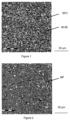
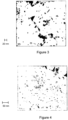
- FIGS. 1 and 2 illustrate the microstructure of example I1A.
- the Figure 1 shows the result of an attack on the sheet by sodium bisulfite, while the Figure 2 illustrates the result of the attack of the sheet by the reagent NaOH-NaNO3.
- the Figure 1 reveals self-tempered martensite and lower bainite (M+Bl), as well as low carbide bainite (LCI).
- Figure 2 reveals, in the form of darker zones, fresh martensite (MF).
- the holding time Dm at temperature Tm of treatment G is too short so that the sheet produced according to condition I1G has a ferrite recrystallization rate of less than 15%. This generates a banded structure which leads to a low hole expansion value.
- the too low annealing temperature leads to too high a density of small precipitates: the TEM observations ( Figure 4 ) show an average size of 5 nm in quantity greater than 10000 precipitates/ ⁇ m 3 so that the mechanical resistance exceeds 1320 MPa.
- the low annealing temperature Tm does not allow a ferrite recrystallization rate greater than 15% to be reached, which leads to a hole expansion value that is too low.
- the sheet according to example R1B has too high C, Cr, Ti and B contents, so that its mechanical strength Rm is too high despite too low a quantity of Mo. Thus, although a satisfactory yield strength Re is obtained, this yield strength is obtained in conjunction with too high a mechanical strength Rm.
- the sheets according to tests R2B, R3B and R3C contain too low C, Mn and Mo contents, and thus do not have satisfactory mechanical strength although the quantities of B and Cr are very high.
- Example R5 has too low a Mn content, which leads to too much bainite formation with low carbide content according to treatments B and C.
- the steel sheets according to the invention will be used profitably for the manufacture of structural or safety parts in the automotive industry.
Landscapes
- Chemical & Material Sciences (AREA)
- Engineering & Computer Science (AREA)
- Organic Chemistry (AREA)
- Materials Engineering (AREA)
- Mechanical Engineering (AREA)
- Metallurgy (AREA)
- Physics & Mathematics (AREA)
- Thermal Sciences (AREA)
- Chemical Kinetics & Catalysis (AREA)
- Crystallography & Structural Chemistry (AREA)
- Oil, Petroleum & Natural Gas (AREA)
- Heat Treatment Of Sheet Steel (AREA)
- Heat Treatment Of Steel (AREA)
Description
- La présente invention concerne une tôle d'acier laminée à froid et recuite présentant une très haute résistance mécanique et une aptitude à la déformation pour la fabrication de pièces par mise en forme, en particulier dans l'industrie automobile, pour la fabrication d'éléments de structure de caisse d'automobile, et la fabrication d'une telle tôle.
- On a développé des aciers ayant un rapport limite d'élasticité/résistance très favorable lors des opérations de formage.
- Leur capacité de consolidation est très grande, ce qui permet une bonne répartition des déformations dans le cas d'une collision et l'obtention d'une limite d'élasticité nettement plus importante sur pièce après formage. On peut réaliser ainsi des pièces aussi complexes qu'avec des aciers conventionnels, mais avec des propriétés mécaniques plus élevées, ce qui autorise une diminution d'épaisseur pour tenir un cahier des charges fonctionnel identique. De la sorte, ces aciers sont une réponse efficace aux exigences d'allègement et de sécurité des véhicules.
- Notamment, des aciers dont la structure comprend de la martensite, éventuellement de la bainite, au sein d'une matrice ferritique, ont connu un grand développement car ils allient une résistance élevée à des possibilités importantes de déformation.
- Les exigences récentes d'allègement et de réduction de la consommation d'énergie ont conduit à une demande accrue d'aciers à très haute résistance, dont la résistance mécanique Rm est supérieure à 1180 MPa.
- Outre ce niveau de résistance, ces aciers doivent présenter une bonne ductilité, une bonne soudabilité et une bonne aptitude au revêtement, notamment une bonne aptitude à la galvanisation en continu au trempé.
- Ces aciers doivent également présenter une limite d'élasticité et un allongement à la rupture élevés ainsi qu'une bonne aptitude à la mise en forme.
- En effet, certaines pièces automobiles sont fabriquées par des opérations de mise en forme combinant différents modes de déformation. Certaines caractéristiques microstructurales de l'acier peuvent se révéler bien adaptées à un mode de déformation, mais peu favorables vis-à-vis d'un autre mode. Certaines parties des pièces doivent présenter une haute résistance à l'allongement et/ou une bonne aptitude au pliage et/ou une bonne aptitude à la mise en forme d'un bord découpé, notamment lors d'une mise en forme avec bords repoussés.
- Cette aptitude à la mise en forme d'un bord découpé est évaluée par détermination d'un rapport d'expansion de trou, noté Ac%. Ce rapport mesure l'aptitude de l'acier à subir une expansion lors d'un emboutissage à froid et fournit donc une évaluation de l'aptitude à la mise en forme dans ce mode de déformation.
- Le rapport d'expansion de trou peut être évalué de la façon suivante : après réalisation d'un trou par découpe dans une tôle, on utilise un outil tronconique de façon à réaliser une expansion au niveau des bords de ce trou. C'est au cours de cette opération que l'on peut observer un endommagement précoce au voisinage des bords du trou lors de l'expansion, cet endommagement s'amorçant sur des particules de seconde phase ou aux interfaces entre les différents constituants microstructuraux dans l'acier.
- D'après les documents
US 2012/0312433 A1 etUS 2012/132327 A1 , on connaît des aciers dont la résistance mécanique Rm est supérieure à 1180 MPa. Néanmoins, cette résistance mécanique est obtenue au détriment de l'aptitude à la mise en forme et de la soudabilité. - Par ailleurs, d'après les documents
US 2013/0209833 A1 ,US 2011/0048589 A1 ,US 2011/01683000 A1 WO 2013/144376 A1 , on connaît des aciers ayant une résistance mécanique élevée pouvant dépasser 1000 MPa, mais ne présentant pas simultanément une aptitude à la mise en forme et une soudabilité satisfaisants. -
EP2426230 est une document qui avez tôle d'acier galvanisé à haute résistance présentant d'excellentes propriétés de formage, de soudage et de résistance à la fatigue, avec une composition consistant en C : 0,05 % à <0,12 %, Si : 0,35 % à <0,80 %, Mn : 2,0 à 3,5 %, P : 0,001 à 0,040 %, S : 0,0001 à 0,0050 %, Al : 0,005 à 0,1 %, N : 0,0001 à 0,0060 %, Cr : 0, 01 % à 0,5 %, Ti : 0,10 à 0, 080 %, Nb : 0,010 à 0,080 %, B : 0,0001 à 0,0030 %, facultativement Mo : 0,01 à 0,15 %, Ca : 0,0001 à 0,0050 %, terres rares : 0,0001 à 0,1 %, Sb : 0,0001 à 0,1 %, et éventuellement V : inférieur à 0,05 %, Zr : inférieur à 0,0200 %, Mg : inférieur à 0,0200 %, Cu : inférieur à 0,4 %, et Ni : inférieur à 0,4 %, toujours en pourcentage massique, le reste étant constitué de Fe et des impuretés inévitables ; une microstructure consistant en 20 % à 70 % en volume d'une phase ferrite avec un diamètre de grain moyen inférieur ou égal à 5 mm, 30 % à 80 % en volume de bainite et/ou de martensite avec un diamètre de grain moyen inférieur ou égal à 5 mm ; des teneurs d'austénite résiduelle et de perlite inférieures ou égales à 5 % en volume et une résistance à la traction supérieure ou égale à 980 MPa ; et une couche galvanisée sur une surface de la tôle avec un poids de revêtement (par côté) de 20 g/m2 à 150 g/m2. - Par ailleurs,
EP2578718 est une document qui avez tôle d'acier galvanisée de haute résistance ayant une excellente aptitude au pliage et au soudage, constituée, dans laquelle une couche de surface de la tôle d'acier, qui constitue une partie de la tôle d'acier jusqu'à une profondeur de 10 mm mesurée à partir de chaque surface de la tôle d'acier, a une structure contenant plus de 70 % de phase ferrite en fraction volumique, une partie de couche interne de la tôle d'acier, sur le côté plus à intérieur que la profondeur de 10 mm mesurée à partir de chaque surface, a une structure constituée de 20 à 70 % en fraction volumique de phase ferrite avec une taille moyenne de grain cristallin inférieure ou égale à 5 mm ; 30 à 80 % de phase bainite et/ou de phase martensite en fraction volumique, avec une taille moyenne de grain cristallin inférieure ou égale à 5 mm ; et une phase austénite résiduelle et/ou une phase perlite inférieure ou égale à 5 % (0 % inclus) en fraction volumique comme reste, la tôle d'acier a une résistance à la traction supérieure ou égale à 980 MPa et la tôle d'acier a une couche galvanisée sur l'une de ses surfaces. - Par ailleurs,
EP2123786 est une invention concerne une tôle d'acier Dual Phase laminée à froid et recuite de résistance comprise entre 980 et 1100MPa, d'allongement à rupture supérieur à 9 %, dont la composition comprend, les teneurs étant exprimées en poids : 0,055% ≤C ≤ 0,095%, 2% ≤Mn ≤2,6%, 0,005% ≤ Si≤ 0,35%, S≤0,005%, P ≤0,050%, 0,1 ≤Al ≤ 0,3%, 0,05%:5Mo ≤0,25%, 0,2%≤Cr≤0,5%, étant entendu que Cr+2Mo≤0,6%, Ni≤ 0,1%, 0,010≤Nb ≤0,040%, 0,010≤Ti ≤0.050%, 0,0005 ≤B ≤0,0025%, 0,002%≤N≤0,007%, le reste de la composition étant constitué de fer et d'impuretés inévitables résultant de l'élaboration. - Dans ces conditions, un but de l'invention consiste à mettre à disposition une tôle d'acier présentant une résistance mécanique élevée, notamment comprise entre 1180 et 1320 MPa, conjointement avec une limite d'élasticité élevée, notamment comprise entre 750 et 970 MPa, cette valeur étant déterminée avant toute opération de skin-pass sur la tôle, une bonne aptitude à la mise en forme, notamment un rapport d'expansion de trou Ac% supérieur ou égal à 20%, un angle de pliage, pour une tôle d'épaisseur comprise entre 0,7 mm et 2mm, supérieur ou égal à 40°, et un allongement à rupture supérieur à 7%.
- A cet effet, l'invention a pour objet une tôle d'acier laminée à froid et recuite d'épaisseur comprise entre 0,7 mm et 2mm, de résistance mécanique comprise entre 1180 MPa et 1320 MPa, dont le rapport d'expansion de trou Ac% est supérieur à 20% et l'angle de pliage supérieur ou égal à 40°, dont la composition chimique comprend, les teneurs étant exprimées en poids :0,09 ≤ C ≤ 0,11 %, 2,6 ≤ Mn ≤ 2,8%, 0, 20 ≤ Si ≤ 0,55%, 0, 25 ≤ Cr < 0,5 %, 0,025 ≤ Ti ≤ 0,040 %, 0,0015 ≤ B ≤ 0,0025 %, 0,005 ≤ Al ≤ 0,18 %, 0,08 ≤ Mo ≤ 0,15 %, 0,020 ≤ Nb ≤ 0,040%, 0,002 ≤ N ≤ 0,007 %, 0,0005% ≤ S ≤ 0,005%, 0,001% < P < 0,020%, Ca <0,003%, le reste étant constitué de fer et d'impuretés inévitables provenant de l'élaboration, la tôle ayant une microstructure constituée de martensite et/ou de bainite inférieure, ladite martensite comprenant de la martensite fraîche et/ou de la martensite auto-revenue, la somme des proportions surfaciques de martensite et de bainite inférieure étant comprise entre 40 à 70%, de 15 à 45% en proportion surfacique de bainite à faible quantité de carbures, de 5 à moins de 20% en proportion surfacique de ferrite, la fraction de ferrite non recristallisée par rapport à la fraction de ferrite totale, étant inférieure à 15%, et de moins de 5% en proportion surfacique d'austénite résiduelle sous forme d'îlots, la fraction des anciens grains austénitiques dont la taille est inférieure à moins de un micromètre représentant de 40 à 60% de la population totale desdits anciens grains austénitiques.
- Dans des modes de réalisation, la tôle suivant l'invention comporte en outre une ou plusieurs des caractéristiques suivantes :
- la microstructure comprend, en proportion surfacique, de 15 à 45% de martensite fraîche.
- la microstructure comprend, en proportion surfacique, de 5 à 50% de somme de martensite auto-revenue et de bainite inférieure.
- la martensite auto-revenue et ladite bainite inférieure contiennent des carbures sous forme de bâtonnets orientés dans les directions <111> des lattes martensitiques et bainitiques.
- la bainite à faible quantité de carbures contient moins de 100 carbures par unité de surface de 100 micromètres carrés.
- la tôle d'acier contient des précipités du type (Ti, Nb, Mo)(C,N) de taille inférieure à 5 nanomètres, présents en quantité inférieure à 10 000 précipités/µm3
- la composition chimique comprend, la teneur étant exprimée en poids : 2,6 ≤ Mn ≤ 2,7%.
- la composition chimique comprend préférentiellement, la teneur étant exprimée en poids : 0,30 ≤ Si ≤ 0,5%.
- selon un mode préférentiel, la composition chimique comprend, la teneur étant exprimée en poids : 0,005 ≤ Al ≤ 0,030%.
- la tôle peut comporter un revêtement de zinc ou d'alliage de zinc, obtenu au trempé.
- le revêtement de zinc ou d'alliage de zinc peut être un revêtement galvanisé-allié, le revêtement de zinc ou d'alliage de zinc comprenant de 7 à 12% en poids de fer.
- la tôle d'acier peut comporter un revêtement de zinc ou d'alliage de zinc, obtenu par dépôt sous vide.
- L'invention a également pour objet un procédé de fabrication d'une tôle laminée à froid et recuite, revêtue de zinc ou d'un alliage de zinc, selon l'une quelconque des caractéristiques ci-dessus, comprenant les étapes successives suivantes :
- on approvisionne un demi-produit dont la composition chimique comprend, les teneurs étant exprimées en poids :0,09 ≤ C ≤ 0,11 %, 2,6 ≤ Mn ≤ 2,8%, 0, 20 ≤ Si ≤ 0,55%, 0, 25 ≤ Cr < 0,5 %, 0,025 ≤ Ti ≤ 0,040 %, 0,0015 ≤ B ≤ 0,0025 %, 0,005 ≤ Al ≤ 0,18 %, 0,08 ≤ Mo ≤ 0,15 %, 0,020 ≤ Nb ≤ 0,040%, 0,002 ≤ N ≤ 0,007 %, 0,0005 ≤ S ≤ 0,005%, 0,001 ≤ P ≤ 0,020%, Ca ≤ 0,003%, le reste étant constitué de fer et d'impuretés inévitables provenant de l'élaboration, puis
- on chauffe le demi-produit à une température Tr supérieure ou égale à 1250°C,
- puis on lamine à chaud le demi-produit, la température de fin de laminage étant supérieure à la température Ar3 de début de transformation de l'austénite au refroidissement, pour obtenir une tôle laminée à chaud, puis
- on refroidit la tôle laminée à chaud à une vitesse supérieure à 30°C/s pour éviter la formation de ferrite et de perlite, puis
- on bobine la tôle laminée à chaud à une température comprise entre 580° et 500°C, puis
- on lamine à froid la tôle laminée à chaud pour obtenir une tôle laminée à froid, puis
- on réchauffe la tôle laminée à froid entre 600°C et Ac1, Ac1 désignant la température de début de transformation austénitique au chauffage, avec une vitesse de réchauffage VC comprise entre 1 et 20°C/s,
- on porte la tôle laminée à froid jusqu'à une température Tm comprise entre 780°C et (Ac3-25°C), et on maintient à la température Tm la tôle laminée à froid pendant une durée Dm comprise entre 30 et 150 secondes, étant entendu que Ac3 désigne la température de fin de transformation austénitique au chauffage, puis
- on refroidit la tôle à une vitesse VR1 comprise entre 10 et 150°C/s jusqu'à une température Te comprise entre 400 et 490°C, puis
- on maintient la tôle à la température Te pendant une durée De comprise entre 5 et 150 secondes, puis
- on revêt la tôle par passage en continu en immersion dans un bain de zinc ou en alliage de zinc à une température TZn comprise entre 450°C et 480°C, lesdites températures Te et TZn étant telles que 0°C≤ (Te-TZn) ≤10°C, de façon à obtenir une tôle revêtue, puis
- on réchauffe optionnellement la tôle revêtue à une température TG comprise entre 490°C et 550°C pendant une durée tG comprise entre 10 s et 40 s.
- D'autres caractéristiques et avantages de l'invention apparaîtront au cours de la description ci-dessous, donnée à titre d'exemple et faite en référence aux figures annexées ci-jointes parmi lesquelles :
- la
Figure 1 présente la microstructure d'une tôle d'acier selon l'invention, mise en évidence par un premier type d'attaque métallographique. - la
Figure 2 présente la microstructure de la tôle d'acier de laFigure 1 , mise en évidence par un deuxième type d'attaque métallographique. - La
figure 3 présente un exemple de précipitation de carbonitrures de (Ti , Nb, Mo)(C, N) dans une tôle selon l'invention, observée en microscopie électronique à transmission. - La
figure 4 présente un exemple de précipitation de carbonitrures de (Ti , Nb, Mo)(C,N) ne correspondant pas à l'invention, observée en microscopie électronique à transmission. - On désignera par ailleurs par Ac1 la température de début de transformation allotropique au chauffage de l'acier.
- On désignera par Ac3 la température de fin de transformation austénitique au chauffage.
- On désignera par Ar3 la température de début de transformation de l'austénite au refroidissement.
- On désignera par Ms la température de début de transformation martensitique.
- La microstructure de la tôle selon l'invention comprend de la martensite. Celle-ci est issue d'une transformation sans diffusion de l'austénite γ en dessous de la température de début de transformation martensitique Ms au refroidissement.
- La martensite se présente sous la forme de fines lattes allongées dans une direction, et orientées à l'intérieur de chaque grain initial d'austénite. Sous le terme martensite, on inclut à la fois la martensite fraîche et la martensite auto-revenue. On distinguera par la suite la martensite auto-revenue de la martensite fraîche, c'est-à-dire non revenue et non auto-revenue.
- Notamment, la martensite auto-revenue se présente sous la forme de fines lattes comprenant des carbures de fer dispersés dans ces lattes, sous forme de bâtonnets orientés selon les directions <111> de la maille α' des lattes. Cette martensite auto-revenue est formée par précipitation des carbures de fer en-dessous de la température de transformation martensitique Ms lorsque le refroidissement n'est pas suffisamment lent pour produire de la martensite fraîche. Au contraire, la martensite fraîche ne comprend pas de carbures.
- La bainite, formée lors d'un refroidissement depuis le domaine austénitique, au-dessus de la température de début de transformation martensitique Ms, se présente sous la forme d'un agrégat de lattes de ferrite et de particules de cémentite. Sa formation fait intervenir une diffusion à courte distance.
- On distinguera par la suite la bainite inférieure de la bainite à faible quantité de carbures. La bainite inférieure est formée, lors du refroidissement, dans une gamme de températures immédiatement au dessus de la température de transformation martensitique Ms. Elle se présente sous forme de fines lattes et comprend des carbures dispersés dans ces lattes.
- Par ailleurs, on appellera bainite à faible quantité de carbures, de la bainite contenant moins de 100 carbures par unité de surface de 100 micromètres carrés. La bainite à faible quantité de carbures est formée, lors du refroidissement, entre 550°C et 450°C. Au contraire de la bainite à faible quantité de carbures, la bainite inférieure contient toujours plus de 100 carbures par unité de surface de 100 micromètres carrés.
- Dans la composition chimique de l'acier de l'invention, le carbone joue un rôle sur la formation de la microstructure et sur les propriétés mécaniques.
- La teneur en poids en carbone est comprise entre 0,09% et 0,11 %. Cette gamme de teneur en carbone contribue à obtenir simultanément une résistance mécanique supérieure à 1180 MPa, un allongement à la rupture supérieur à 7%, et un rapport d'expansion de trou Ac% satisfaisant, supérieur ou égal à 20%. Notamment, une teneur en carbone inférieure à 0,09% ne permet pas d'atteindre une résistance mécanique suffisante. Pour une teneur en carbone plus élevée, supérieure à 0,11%, l'aptitude au soudage tend à diminuer et la température Ms est abaissée, de telle sorte que la fraction de martensite fraîche dans la microstructure, tend à augmenter et ainsi à dégrader le rapport d'expansion de trou.
- La teneur en poids en manganèse est comprise entre 2,6% et 2,8%. Le manganèse est un élément gammagène qui abaisse la température Ac3 et la température Ms de début de formation de la martensite. La faible teneur en carbone de l'acier pourrait conduire à une température Ac3 élevée, supérieure à 860°C. Une teneur en manganèse supérieure à 2,6% permet, en abaissant la valeur de la température Ac3, d'obtenir une austénisation complète de l'acier entre 840°C et 855°C environ, après un maintien à cette température pendant une durée d'au moins 30s. Le manganèse permet par ailleurs la formation de martensite auto-revenue et contribue donc à obtenir un rapport d'expansion de trou Ac% supérieur ou égal à 20%. La teneur en poids en manganèse est limitée à 2,8% afin de limiter la formation de structures en bandes, et préférentiellement comprise entre 2,6 et 2,7%.
- Le silicium est un élément participant au durcissement en solution solide, dont la teneur en poids dans l'acier est comprise entre 0,20% et 0,55% en poids, de préférence entre 0,30% et 0,5%. Une teneur d'au moins 0,30% permet d'obtenir un durcissement suffisant de la ferrite et/ou de la bainite. La teneur en poids en silicium est limitée à 0,55% pour garantir un rapport d'expansion de trou Ac% supérieur ou égal à 20%, en limitant la formation de bainite supérieure. En outre, une augmentation de la teneur en silicium dégrade l'aptitude au revêtement de l'acier en favorisant la formation d'oxydes adhérents à la surface de la tôle. Une teneur en silicium inférieure à 0,55% contribue également à assurer une bonne aptitude au soudage.
- Le silicium est un élément alphagène et contribue à élever la température Ac3 et à favoriser la formation de bainite à faible quantité de carbures. Une teneur en silicium inférieure à 0,55% contribue ainsi à éviter la formation d'une quantité trop importante de bainite à faible quantité de carbures.
- La composition de la tôle en acier comporte par ailleurs du chrome en quantité supérieure ou égale à 0,25 % en poids, de façon à améliorer la trempabilité de l'acier, et à augmenter sa dureté ainsi que sa résistance mécanique. La teneur en chrome doit être inférieure à 0,5%, de façon à conserver un allongement à la rupture satisfaisant et à limiter les coûts de fabrication.
- Le titane est présent dans l'acier en quantité comprise entre 0,025% et 0,040% en poids. En quantité comprise entre 0,025 et 0,040%, le titane se combine notamment à l'azote et au carbone pour précipiter sous forme de nitrures et/ou de carbonitrures. En deçà de 0,025%, il existe un risque que la résistance mécanique de 1180 MPa ne soit pas atteinte.
- Au-delà d'une teneur en titane de 0,040%, il existe un risque de former des nitrures de titane grossiers précipités dès l'état liquide, qui tendent à réduire la ductilité, et à conduire à un endommagement précoce lors de l'expansion de trou. En effet, lorsque des nitrures de taille supérieure à 6 micromètres sont présents, on constate que ceux-ci sont majoritairement à l'origine des décohésions avec la matrice lors des étapes de découpe et d'emboutissage. Le titane permet par ailleurs de faire en sorte que l'azote soit entièrement combiné sous forme d'une précipitation durcissante, si bien que le bore se trouve sous forme libre et peut jouer un rôle efficace sur la trempabilité. Le titane est en quantité surstoechiométrique par rapport à l'azote, si bien que le rapport : Ti/N est supérieur à 3,42.
- La teneur en poids en bore est comprise entre 0,0015% et 0,0025%. En limitant l'activité du carbone, le bore permet en effet de contrôler et de limiter les transformations de phase diffusives (transformation ferritique ou perlitique lors du refroidissement) et de former des phases durcissantes (bainite ou martensite) nécessaires à l'obtention de hautes caractéristiques de résistance mécanique. L'ajout de bore permet par ailleurs de limiter l'addition d'éléments trempants tels que Mn, Mo, Cr et de réduire le coût analytique de la nuance d'acier. Selon l'invention, la teneur minimale en bore pour assurer une trempabilité efficace est de 0,0015%. Au delà de 0,0025%, l'effet sur la trempabilité est saturé et on constate un effet néfaste sur la revêtabilité et sur la ductilité.
- La composition de la tôle en acier comporte également du molybdène, en quantité comprise entre 0,08 et 0,15% en poids. Le molybdène joue, comme le chrome, un rôle efficace sur la trempabilité, en teneur supérieure à 0,08%.
- Une teneur supérieure à 0,15% de molybdène retarde la recristallisation de la ferrite. La résistance mécanique Rm est alors trop élevée, supérieure à 1320 MPa, ce qui se traduit conjointement par une baisse de ductilité.
- Lorsque la température de recuit est inférieure à (Ac3-25°C), une addition dans les conditions de l'invention permet d'obtenir, en combinaison avec le titane et le niobium, une précipitation nanométrique de carbonitrures de molybdène, titane et Niobium (Ti, Nb, Mo)(C,N) qui contribue au durcissement et permet d'obtenir une résistance Rm supérieure ou égale à 1180 MPa après recuit.
- Mais une précipitation trop dense de composés de petite taille conduit à un durcissement excessif : lorsque la densité de précipités de taille inférieure à 5 nanomètres excède 10 000 précipités/µm3, la résistance Rm peut excéder 1320 MPa et l'aptitude à la déformation à froid devient insuffisante.
- Une addition de molybdène en quantité prévue par l'invention, permet d'obtenir une tôle d'acier moins sensible à des fluctuations éventuelles dans les étapes qui suivent le recuit à la température Tm. En effet, bien que la vitesse de refroidissement VR et la température Te soient contrôlées dans des conditions industrielles de façon continue en fonction de points de consigne définis, une fluctuation légère de ces paramètres peut intervenir parfois de façon transitoire. Il importe que ces fluctuations n'aient pas d'incidence sur les caractéristiques du produit final. Dans la gamme définie par l'invention, des fluctuations modérées de VR ou de Te, par exemple de 7%, conduisent à une variation de résistance mécanique Rm inférieure à 7%.
- La composition chimique de la tôle d'acier laminée à chaud comporte du niobium, avec une teneur en poids comprise entre 0,020 et 0,040%. En quantité supérieure à 0,020%, le niobium permet d'obtenir une augmentation de la résistance Rm. Au delà d'une teneur en poids de 0,040%, la recristallisation de l'austénite est retardée. La structure contient alors une fraction significative de grains allongés, ce qui ne permet plus d'atteindre le rapport d'expansion de trou Ac% visé.
- En outre, la teneur en poids de l'azote est comprise entre 0,002% et 0,007%. Afin de former une quantité suffisante de nitrures et de carbonitrures, la teneur en azote doit être supérieure à 0,002%. La teneur en azote doit être inférieure à 0,007% dans le but d'éviter une précipitation de nitrures de bore, ce qui diminuerait la quantité de bore libre.
- Une teneur en poids en aluminium comprise entre 0,005% et 0,18 % permet d'assurer la désoxydation de l'acier pendant sa fabrication. Une teneur en aluminium doit être inférieure à 0,18%, voire inférieure à 0,030% pour éviter une élévation de la température Ac3 et éviter la formation de ferrite lors du refroidissement.
- La teneur en soufre doit être inférieure à 0,005%. Au-delà de cette teneur, la ductilité est réduite en raison de la présence excessive de sulfures tels que MnS qui diminuent l'aptitude à la déformation, en particulier le rapport d'expansion de trou Ac%. L'obtention de teneur en soufre extrêmement réduite, inférieure à 0,0005%, est cependant très coûteuse, sans avantage significatif au regard aux coûts de fabrication. D'un point de vue pratique, une teneur en soufre non inférieure à 0,0005% peut donc être retenue.
- La teneur en phosphore doit être inférieure à 0,020%. En effet, le phosphore est un élément qui confère un durcissement par solution solide mais qui diminue la soudabilité par points et la ductilité à chaud, particulièrement en raison de son aptitude à la ségrégation aux joints de grains ou à la co-ségrégation avec le manganèse.
- L'obtention de teneur en phosphore extrêmement réduite, inférieure à 0,001%, est cependant très coûteuse, sans avantage significatif au regard aux coûts de fabrication. D'un point de vue pratique, une teneur en phosphore non inférieure à 0,001% peut donc être retenue.
- En quantité inférieure à 0,003%, le calcium permet d'éviter la présence d'inclusions allongées, notamment de sulfures, qui influencent défavorablement la ductilité.
- Dans la microstructure de la tôle d'acier selon l'invention, la somme des proportions surfaciques de martensite et de bainite inférieure est comprise entre 40 à 70% La microstructure contient également, en proportion surfacique, de 15 à 45% de bainite à faible quantité de carbures, de 5 à moins de 20% de ferrite, et moins de 5% d'austénite résiduelle sous forme d'îlots. La fraction surfacique de ferrite non recristallisée par rapport à la fraction de ferrite totale, est inférieure à 15%, ce qui permet d'obtenir simultanément une résistance Rm compris entre 1180 et 1320 MPa, un allongement supérieur à 7% et un rapport d'expansion de trou supérieur ou égal à 20%.
- Comme on l'a indiqué précédemment, on distingue la martensite auto-revenue de la martensite fraîche , c'est-à-dire non revenue et non auto-revenue.
- Selon un mode de réalisation, la martensite est formée notamment de martensite auto-revenue, le pourcentage surfacique de la somme de la martensite auto-revenue et de la bainite inférieure représentant au moins 5% de l'ensemble de la microstructure, cette proportion pouvant aller jusqu'à 50%.
- La martensite auto-revenue et la bainite inférieure sont présentes sous la forme de fines lattes, et comprennent des carbures dispersés dans ces lattes. En particulier, la martensite auto-revenue et la bainite inférieure comprennent des carbures de fer Fe2C et Fe3C sous forme de bâtonnets orientés dans les directions <111> de la maille des lattes martensitiques et bainitiques. Les pourcentages de martensite auto-revenue et de bainite inférieure sont spécifiés conjointement car la martensite auto-revenue et la bainite inférieure ont sensiblement le même rôle sur les propriétés d'usage de l'acier. De plus, ces deux constituants, présents sous forme de fines lattes, ne peuvent être identifiés individuellement l'un de l'autre lors d'observations en microscopie électronique à balayage. Seuls des examens en microscopie électronique à transmission permettent de distinguer ces deux constituants.
- Un pourcentage surfacique de la somme de martensite auto-revenue et de bainite inférieure compris entre 40% et 70% permet de favoriser l'aptitude à la mise en forme de l'acier, notamment son aptitude au pliage et son aptitude à la mise en forme d'un bord découpé. Un pourcentage de martensite auto-revenue et de bainite inférieure d'au moins 40% contribue ainsi à obtenir un angle de pliage satisfaisant, notamment un angle de pliage pour des tôles d'épaisseur comprise entre 0,7 mm et 2 mm, d'au moins 40°, et un rapport d'expansion de trou Ac% supérieur ou égal à 20%.
- Le pourcentage de la somme de martensite auto-revenue et de bainite inférieure dans la microstructure doit être inférieur à 70% afin de conserver un pourcentage suffisant de bainite à faible quantité de carbures, permettant d'obtenir un allongement à la rupture d'au moins 7%.
- La martensite peut par ailleurs comprendre en partie de la martensite fraîche dans un pourcentage surfacique compris entre 15 et 45% de l'ensemble de la microstructure.Le pourcentage surfacique de martensite fraîche doit être inférieur à 45%, en particulier pour ne pas diminuer la ductilité de l'acier et pour assurer un bon rapport d'expansion de trou.
- La microstructure comprend en outre, en proportion surfacique, de 15 à 45% de bainite à faible quantité de carbures. Celle-ci est formée lors du refroidissement après le recuit à la température Tm, et lors du maintien entre 550°C et 450°C. Sa formation est favorisée notamment grâce à l'addition de silicium qui tend à retarder la précipitation des carbures, conjointement avec une faible quantité d'éléments trempants tels que le carbone ou le manganèse.
- La bainite à faible quantité de carbures permet d'augmenter l'allongement à la rupture. En particulier, un pourcentage surfacique de bainite à faible quantité de carbures d'au moins 15% permet d'obtenir un allongement à la rupture d'au moins 7%. Le pourcentage surfacique de bainite à faible quantité de carbures doit être limité à 45% afin de garantir un rapport d'expansion de trou supérieur ou égal à 20% et une résistance mécanique supérieure ou égale à 1180 MPa.
- La microstructure comprend par ailleurs de 5 à moins de 20 % de ferrite en proportion surfacique. Si la teneur en ferrite est inférieure à 5%, il existe un risque d'obtenir conjointement trop de martensite autorevenue associée à une limite d'élasticité trop faible. Si la teneur en ferrite excède 20%, il existe un risque que la résistance Rm soit inférieure à 1320 MPa.
- La microstructure peut également contenir jusqu'à 5%, en proportion surfacique, d'austénite résiduelle sous la forme d'îlots, formant notamment des plaquettes entre les lattes de martensite auto-revenue et de bainite inférieure.
- Par ailleurs, les inventeurs ont également mis en évidence l'importance du contrôle de la taille des grains austénitiques créés lors du recuit de la tôle laminée à froid, c'est-à-dire existant à haute température à l'issue du maintien de recuit, avant le refroidissement ultérieur. Ces grains austénitiques sont qualifiés « d'anciens grains austénitiques », car ces grains sont remplacés par d'autres constituants lors des transformations allotropiques au refroidissement. Comme on va l'expliquer, la taille de ces anciens grains austénitiques peut néanmoins être mise en évidence par différentes méthodes, sur le produit final. Selon l'invention, la fraction des anciens grains austénitiques dont la taille est inférieure à un micromètre, représente entre 40 et 60% de la population totale de ces anciens grains austénitiques
- La fraction des anciens grains austénitiques dont la taille est inférieure à un micromètre est par exemple déterminée au moyen d'un réactif approprié, dont la vitesse d'attaque dépend de certaines ségrégations locales aux anciens joints, tel que par exemple le réactif Béchet-Beaujard, connu en lui-même. A cet effet, un échantillon d'acier à l'état final, c'est-à-dire à l'issue du procédé de fabrication selon l'invention, est attaqué par un réactif approprié, notamment un réactif composé d'une solution aqueuse saturée d'acide picrique additionnée d'au moins 0,5% d'alkylsulfonate de sodium, pendant une durée comprise entre quelques minutes et une heure.
- A l'issue de cette attaque, un examen micrographique de l'échantillon permet de visualiser les joints des anciens grains austénitiques, et de réaliser un histogramme de distribution de la taille de ces anciens grains austénitiques, notamment de déterminer la fraction des anciens grains austénitiques dont la taille est inférieure à un micromètre.
- Alternativement, la taille des anciens grains austénitiques peut être déterminée au moyen d'une trempe interrompue lors du refroidissement après recuit, en adoptant des conditions de refroidissement initial de façon à provoquer une germination ferritique intergranulaire, puis à interrompre celle-ci par trempe.
- Les inventeurs ont mis en évidence que la taille de ces anciens grains d'austénite conditionne la cinétique de transformation de phases lors du refroidissement suivant le recuit. Notamment, les grains austénitiques de faible taille, inférieure à un micromètre, contribuent à abaisser la valeur de la température Ms et ainsi à augmenter la formation de martensite fraîche.
- A l'inverse, la présence de gros grains austénitiques diminue la formation de bainite à faible quantité de carbures.
- Une fraction d'anciens grains austénitiques dont la taille est inférieure à un micromètre, comprise entre 40 et 60% de la population totale des grains austénitiques contribue à abaisser la température Ms de transformation martensitique, à éviter la formation d'une proportion trop importante de martensite auto-revenue et de bainite inférieure, ce qui diminuerait l'allongement et la limite d'élasticité.
- Les caractéristiques microstructurales présentées ci-dessus sont déterminées par exemple en observant la microstructure par Microscopie Electronique à Balayage au moyen d'un canon à effet de champ (technique « MEB-FEG ») à un grandissement supérieur à 1200x, couplé à un détecteur EBSD (« Electron Backscatter Diffraction »). Les morphologies des lattes et des grains sont ensuite déterminées par analyse d'images au moyen de logiciels connus en eux-mêmes, par exemple le logiciel Aphelion®.
- La tôle d'acier laminée à froid et recuite selon l'invention peut être produite nue, sans revêtement, mais elle peut également être revêtue. Par exemple, un tel revêtement peut être formé de zinc ou d'alliage de zinc, notamment un revêtement galvanisé-allié comprenant de 7 à 12% en poids de fer.
- Notamment, une telle tôle d'acier est bien adaptée au dépôt d'un revêtement métallique, en particulier par galvanisation au trempé selon les procédés usuels. En particulier, la composition et les caractéristiques mécaniques de l'acier sont compatibles avec les contraintes et les cycles thermiques des procédés de revêtement de zinc au trempé en continu.
- Le procédé de revêtement utilisé dépend de l'application visée. Notamment, le revêtement peut être obtenu au trempé, par une technique de dépôt sous vide telle que JVD (« Jet Vapour Deposition »), ou bien par électrodéposition cationique.
- Les inventeurs ont mis en évidence le fait qu'une tôle d'acier selon l'invention présente une résistance mécanique comprise entre 1180 et 1320 MPa, conjointement avec une limite d'élasticité comprise entre 750 et 970 MPa, avant toute opération de skin-pass, un allongement à la rupture d'au moins 7%, notamment supérieur à 8%, et un rapport d'expansion de trou Ac% supérieur ou égal à 20%.
- En particulier, une limite d'élasticité comprise entre 800 et 970 MPa est obtenue tout en conservant une résistance mécanique inférieure à 1320 MPa. En outre, une telle tôle présente un angle de pliage élevé. En particulier, lorsque la tôle a une épaisseur comprise entre 0,7 mm et 2 mm, l'angle de pliage est d'au moins 40°.
- La mise en œuvre du procédé de fabrication d'une tôle laminée selon l'invention comporte les étapes successives suivantes :
On approvisionne un acier de composition selon l'invention, et on procède à la coulée d'un demi-produit à partir de cet acier. Cette coulée peut être réalisée en lingots ou en continu sous forme de brames d'épaisseur de l'ordre de 200mm. - Les demi-produits coulés sont tout d'abord portés à une température TR supérieure à 1250 °C, afin d'homogénéiser l'acier et de dissoudre complètement les précipités.
- Puis, on lamine à chaud le demi-produit dans un domaine de température où la structure de l'acier est totalement austénitique, c'est-à-dire à une température TFL supérieure à la température Ar3 de début de transformation de l'austénite au refroidissement. Si la température TFL est inférieure à la température Ar3, les grains de ferrite sont écrouis par le laminage et la ductilité est réduite. Préférentiellement, on choisira une température de fin de laminage supérieure à 875°C.
- La tôle laminée à chaud est refroidie à une vitesse supérieure à 30°C/s pour éviter la formation de ferrite et de perlite, puis la tôle laminée à chaud est bobinée à une température TBob comprise entre 500°C et 580°C. La température de bobinage doit être inférieure à 580°C pour éviter une oxydation lors du bobinage. Une température de bobinage trop basse, c'est-à-dire inférieure à 500°C, conduit à une augmentation de la dureté de l'acier, ce qui augmente les efforts nécessaires lors du laminage à froid ultérieur. La gamme de température de bobinage permet également d'éviter la formation de perlite.
- La tôle est ensuite décapée, par un des procédés connus en eux-mêmes.
- On effectue ensuite un laminage à froid, avec un taux de réduction par exemple compris entre 40% et 70% de façon à introduire une quantité de déformation permettant une recristallisation ultérieure.
- On chauffe ensuite la tôle laminée à froid, préférentiellement au sein d'une installation de recuit continu, avec une vitesse moyenne de chauffage VC comprise entre 1°C/s et 20°C/s entre 600°C et la température Ac1 (température de début de transformation allotropique en austénite au chauffage).
- La température Ac1 peut être mesurée par dilatométrie, ou évaluée au moyen de la formule suivante publiée dans « Darstellung der Umwandlungen für technische Anwendungen und Möglichkeiten ihrer Beeinflussung », H.P. Hougardy, Werkstoffkunde Stahl Band 1,198-231, Verlag Stahleisen, Düsseldorf, 1984 :

- Dans cette formule, la température Ac1 est exprimée en degrés Celsius, et les teneurs élémentaires de la composition sont exprimées en pourcentages en poids.
- Lors du chauffage de l'acier entre 600°C et Ac1, il se produit un début de recristallisation et il se forme des précipités de (TiNbMo)(CN), qui permettent de contrôler la distribution de la taille des grains austénitiques formés à partir de Ac1. D'une manière surprenante, les inventeurs ont mis en évidence le fait que le contrôle de la vitesse moyenne de chauffage VC entre 600°C et Ac1 et ainsi du temps de chauffage entre 600°C et Ac1, qui correspond au temps entre le début de recristallisation et le début de la transformation de phases, est déterminant pour les cinétiques des transformations de phases ultérieures, notamment lors de l'étape de maintien ultérieure à la température de recuit Tm. Les inventeurs ont ainsi mis en évidence, de manière inattendue, que le choix d'une vitesse moyenne de chauffage VC entre 600°C et Ac1 comprise entre 1°C/s et 20°C/s permet, à l'issue du procédé de fabrication, d'obtenir un acier dont la microstructure est constituée, en proportion surfacique, de 40 à 70% en somme de martensite et de bainite inférieure, de 15 à 45% de bainite à faible quantité de carbures, de 5 à moins de 20 % de ferrite, et de moins de 5% d'austénite résiduelle sous forme d'îlots.
- Notamment, une vitesse moyenne de chauffage VC inférieure à 1°C/s conduirait à une durée trop longue du chauffage entre 600°C et Ac1, donc à une formation trop importante de ferrite et à une résistance mécanique trop faible.
- Au contraire, une vitesse moyenne de chauffage VC supérieure à 20°C/s conduirait à un temps de chauffe entre 600°C et Ac1 trop faible, et à une croissance insuffisante des grains ferritiques lors du chauffage entre 600°C et Ac1.
- Or, les inventeurs ont mis en évidence que la taille des grains ferritiques obtenus à l'issue du chauffage entre 600°C et Ac1 a une influence sur la taille des grains d'austénite à l'issue de l'austénisation. Une croissance insuffisante des grains ferritiques entraîne en effet une formation d'une fraction trop importante de petits grains d'austénite, donc une formation insuffisante de martensite auto-revenue à l'issue du recuit, c'est à dire inférieure à 40%, en raison de l'abaissement de la valeur de la température MS.
- On chauffe ensuite la tôle laminée à froid depuis la température Ac1 jusqu'à une température de recuit Tm comprise entre 780°C et (Ac3-25°C)
La température Ac3 peut être mesurée par dilatométrie ou calculée selon la formule : Ac3= 912 - 370- 27,4 Mn +27,3Si -6,35 Cr -32,7 Ni +95,2 V +190Ti +72 Al +64,5 Nb +5,57 W +332 S +276 P+ 485 N -900B +16,2 C Mn +32,3 C Si +15,4 C Cr+ 48 C Ni +4,32 Si Cr - 17,3 Si Mo -18,6 Si Ni +4,8 Mn Ni +40,5 Mo V+ 174 C2+ 2,46 Mn2 -6,86 Si2 +0,322 Cr2+ 9,9 Mo2 +1,24 Ni2 -60,2 V2. - Dans cette formule, la température Ac3 est exprimée en degrés Celsius, et les teneurs élémentaires de la composition sont exprimées en pourcentages en poids.
- Lorsque la température Tm est inférieure à 780°C, la densité de précipités de (Ti, Nb, Mo)(CN) est telle que le durcissement peut induire une augmentation de Rm au delà de la valeur de 1320 MPa et à une moindre aptitude au formage.
- Lorsque la température Tm est supérieure à (Ac3-25°C), la taille de grain austénitique croît de façon de trop importante si bien que l'on forme une quantité excessive de bainite inférieure et de martensite autorevenue, au détriment de la martensite fraiche et qu'il n'est plus possible d'atteindre une résistance Rm de 1180 MPa.
- On maintient la tôle laminée à froid à la température Tm pendant une durée Dm comprise entre 30 et 150 secondes.
- La durée Dm est choisie de telle sorte que la fraction des grains austénitiques dont la taille est inférieure à un micromètre représente de 40 à 60% de la population totale des grains austénitiques. Une durée de maintien Dm inférieure à 30s conduirait à la formation à l'issue du procédé d'une proportion trop importante de ferrite. La taille des grains austénitiques conditionne la cinétique de transformation de phase lors du refroidissement suivant le recuit. Notamment, les grains austénitiques de faible taille, inférieure à un micromètre, contribuent à abaisser la valeur de la température Ms et ainsi à diminuer la formation de martensite auto-revenue.
- Le chauffage de la tôle laminée à froid à une vitesse moyenne de chauffage VC comprise entre 1°C/s et 20°C/s entre 600°C et la température Ac1, suivi du chauffage de la tôle laminée à froid entre Ac1 et Tm et du maintien de la tôle laminée à froid à la température Tm pendant la durée Dm comprise entre 50 et 100 secondes permet ainsi de contrôler la taille des grains d'austénite formés, et plus particulièrement de contrôler la fraction de ces grains dont la taille est inférieure à un micromètre.
- Ces paramètres de chauffage permettent d'obtenir la microstructure selon l'invention à l'issue du recuit et contribuent ainsi à l'obtention des caractéristiques mécaniques désirées.
- Dans le cas d'une tôle destinée à être galvanisée ultérieurement, la tôle d'acier est ensuite refroidie à une vitesse VR1 comprise entre 10 et 150°C/s jusqu'à une température Te comprise entre 400°C et 490°C. La vitesse de refroidissement doit être supérieure à 10°C/s afin de former moins de 5% de ferrite et de ne pas former trop de bainite à faible quantité de carbures.
- Dans le cas de la fabrication d'une tôle nue, la tôle d'acier est refroidie à une vitesse VR2 comprise entre 10 et 100°C/s jusqu'à une température Te comprise entre 400°C et 490°C.
- Le refroidissement peut être effectué à partir de la température Tm, en une seule ou en plusieurs étapes et peut faire intervenir dans ce dernier cas différents modes de refroidissement tels que des bains d'eau froide ou bouillante, des jets d'eau ou de gaz.
- On maintient alors la tôle à la température Te pendant une durée De comprise entre 5 et 150 secondes.
- Une transformation partielle de l'austénite en bainite à faible quantité de carbures intervient à ce stade. Le maintien à Te doit être inférieur à 150s de façon à limiter la proportion surfacique de bainite et obtenir ainsi une proportion suffisante de martensite.
- Les étapes suivantes du procédé diffèrent selon que l'on fabrique une tôle d'acier galvanisée en continu, notamment galvanisée-alliée, ou non revêtue.
- Selon un premier mode de réalisation, correspondant à la fabrication d'une tôle d'acier galvanisée en continu, on revêt la tôle par passage en continu en immersion dans un bain de zinc ou en alliage de zinc à une température TZn comprise entre 450°C et 480°C, pendant quelques secondes. Les températures Te et TZn sont telles que 0°C ≤ (Te-TZn) ≤10°C.
- On refroidit ensuite le produit galvanisé jusqu'à la température ambiante en transformant une grande fraction de l'austénite restante en martensite fraîche et/ou en bainite inférieure.
- Dans le cas où l'on souhaite fabriquer une tôle d'acier laminée à froid, recuite et galvanisée-alliée (« galvannealed »), on chauffe le produit galvanisé immédiatement à la sortie du bain de zinc ou d'alliage de zinc à une température TG comprise entre 490 et 550°C pendant une durée tG comprise entre 10 et 40s. On provoque ainsi l'interdiffusion du fer et de la fine couche de zinc ou d'alliage de zinc déposée lors de l'immersion, ce qui permet d'obtenir une tôle galvanisée-alliée.
- On refroidit ensuite la tôle galvanisée-alliée jusqu'à la température ambiante en transformant une grande fraction de l'austénite restante en martensite fraîche et/ou en bainite inférieure.
- Dans tous les modes de réalisation décrits ci-dessus, on obtient de la sorte une tôle d'acier laminée à froid et recuite contenant en proportion surfacique, une somme de 40 à 70% de martensite et de bainite inférieure, de 15 à 45% de bainite à faible quantité de carbures, de 5 à moins de 20% de ferrite, et moins de 5% d'austénite résiduelle sous forme d'îlots.
- Les inventeurs ont mis en évidence que la mise en œuvre de ce procédé permet d'obtenir une tôle d'acier présentant une résistance mécanique comprise entre 1180 et 1320 MPa, conjointement avec une limite d'élasticité comprise entre 750 et 970 MPa (avant toute opération de skin-pass), un allongement à rupture d'au moins 7%, voire 8%, dont le rapport d'expansion de trou Ac% est supérieur ou égal à 20%.
- En outre, la mise en œuvre de ce procédé permet d'assurer à la tôle un angle de pliage d'au moins 40° lorsque la tôle a une épaisseur comprise entre 0,7 mm et 2mm.
- Par ailleurs, la tôle obtenue présente une bonne aptitude au soudage au moyen des procédés d'assemblage usuels tels que le soudage par résistance par points.
- A titre d'exemple non limitatif, les résultats suivants vont montrer les caractéristiques avantageuses conférées par l'invention.
- On a approvisionné des demi-produits d'acier dont les compositions, exprimées en teneurs pondérales (%) sont présentées dans le tableau 1 ci-dessous.
- Outre les aciers I1 à I3 ayant servi à la fabrication de tôles selon l'invention, on a indiqué à titre de comparaison la composition d'aciers R1 à R5 ayant servi à la fabrication de tôles de référence.
- On a mesuré par dilatométrie, ou calculé la température Ac3 au moyen de la formule mentionnée ci-dessus et rapporté ces valeurs dans le tableau 1.
Tableau 1- Compositions d'aciers- Température Ac3 C % Mn % Si % Cr % Ti % B % Al % Mo % Nb % N % S % P % Ca % Ac3 (°C) I1 0,099 2,67 0,384 0,294 0,031 0,0018 0,127 0,088 0,024 0,004 0,003 0,015 <0,003 853 I2 0,09 2,69 0,313 0,3 0,028 0,002 0,153 0,09 0,024 0,004 0,003 0,010 <0,003 855 I3 0,107 2,69 0,338 0,3 0,035 0,002 0,133 0,09 0,025 0,007 0,003 0,015 <0,003 844 R1 0,134 2,515 0,536 0,574 0,043 0,0045 0,017 0,002 0,031 0,006 0,003 0,015 <0,003 838 R2 0,086 2,492 0,309 0,519 0,040 0,0039 0,028 0,003 0,028 0,005 0,003 0,015 <0,003 830 R3 0,087 2,584 0,310 0,520 0,039 0,0038 0,025 0,003 0,034 0,005 0,003 0,015 <0,003 830 R4 0,079 2,52 0,251 0,310 0,022 0,002 0,150 0,09 0,024 0,004 0,003 0,010 <0,003 853 R5 0,117 2,245 0,507 0,515 0,029 0,0035 0,029 0,002 0,018 0,005 0,003 0,015 <0,003 830 Valeurs soulignées : non-conformes à l'invention. - Des demi-produits coulés correspondant aux compositions ci-dessus ont été réchauffés à une température TR supérieure à 1250°C, puis laminés à chaud, la température de fin de laminage étant égale à 850°C, supérieure à Ar3 pour tous ces aciers.
- Les tôles laminées à chaud ont été refroidies en évitant la formation de ferrite et de perlite, puis bobinées à une température de 545°C. Les tôles ont ensuite été laminées à froid jusqu'à une épaisseur de 1,4 mm.
- Dans un premier ensemble d'essais, des tôles I1 ont été ensuite chauffées avec une vitesse de chauffage VC, entre 600°C et Ac1, Ac1 désignant la température de début de transformation austénitique au chauffage, puis ensuite de Ac1 jusqu'à une température Tm et maintenues à la température Tm pendant une durée Dm.
- Les tôles ont été refroidies à une vitesse VR1 jusqu'à une température Te, puis maintenues à la température Te pendant une durée De.
- Lors d'un essai particulier (I1F), la tôle I1 a été réchauffée jusqu'à 810°C, maintenue pendant 120s à cette température, puis refroidie par trempe à l'eau avec une vitesse supérieure à 100°C/s jusqu'à la température ambiante, c'est-à-dire sans étape de maintien à la température Te.
- Ces essais ont été réalisés selon différentes conditions de traitement (A à H), indiquées dans le tableau 2. Dans ce tableau, « n.a. » signifie : non applicable. En effet, selon le traitement F, aucun maintien à une température Te n'est effectué si bien qu'on ne peut donc définir un temps de maintien De pertinent.
- Selon un second ensemble d'essais, les nuances R1-R5 ont été traitées selon des conditions définies au tableau 3.
- Les tôles fabriquées dans toutes les conditions ci-dessus ont été ensuite revêtues par revêtement au trempé en continu dans un bain de zinc à 460°C puis chauffées immédiatement à 510°C de façon à obtenir un revêtement galvanisé-allié.
Tableau 2 : Conditions d'essais réalisées sur la nuance I1 Traitement VC entre 600 et Ac1 (°C/s) Tm (°C) Dm (s) VR1 (°C/s) Te (°C) De (s) A 2 810 120 30 460 130 B 2 830 120 30 460 130 C 6 820 60 26 470 33 D 0,2 810 2 26 460 33 E 0,2 810 60 26 460 33 F 2 810 120 >100°C/s 20 n.a. G 2 780 2 26°C/s 460 33 H 2 760 120 18 470 100 Tableau 3 : Conditions d'essais réalisées sur les nuances I2, I3 et R1 à R5 Traitement VC entre 600 et Ac1 (°C/s) Tm (°C) Dm (s) VR1 (°C/s) Te (°C) De (s) A 2 810 120 30 460 130 B 2 830 120 30 460 130 C 6 820 60 26 470 33 I 8 805 50 30 470 40 J 2 780 140 18 460 120 - On a déterminé les caractéristiques mécaniques des tôles ainsi obtenues, résultant de la composition d'acier et du traitement thermique. Par convention, les tôles ont été repérées en associant la dénomination de la composition chimique et du traitement thermique : ainsi I1A désigne la tôle obtenue à partir de la composition 11 sur laquelle on a appliqué les conditions du traitement thermique A.
- Au moyen d'essais de traction, on a déterminé la limite d'élasticité Re, la résistance à la rupture Rm et l'allongement total At des tôles obtenues par ces différents modes de fabrication. On a également déterminé l'aptitude au pliage de ces tôles en déterminant l'angle maximal avant rupture.
- Cet angle est déterminé en appliquant un poinçon sur les tôles de manière à plier celles-ci. La force à appliquer pour réaliser le pliage croît jusqu'à la rupture. La mesure de la force appliquée lors du pliage permet ainsi de détecter l'amorçage de la rupture de la tôle, et de mesurer l'angle maximal de pliage lorsque cette rupture intervient.
- On a par ailleurs déterminé le rapport d'expansion de trou Ac% de chaque tôle en effectuant un trou de 10 mm de diamètre par découpe dans la tôle, puis au moyen d'un outil tronconique en réalisant une expansion au niveau des bords de ce trou. Comme décrit dans la norme ISO 16630:2009, on a mesuré le diamètre initial Di du trou avant emboutissage, puis le diamètre final Df du trou après emboutissage, au moment où l'on observe des fissures traversantes dans l'épaisseur de la tôle sur les bords du trou. On a déterminé l'aptitude à l'expansion de trou Ac% selon la formule suivante :

- On a également déterminé les caractéristiques de la microstructure des aciers. Les fractions surfaciques de martensite (incluant la martensite auto-revenue et la martensite fraîche) et de bainite inférieure (conjointement), de martensite auto-revenue et de bainite inférieure (conjointement), et de bainite à faible quantité de carbures ont été quantifiées sur des coupes polies soumises à une attaque au bisulfite de sodium. La fraction surfacique de martensite fraîche a été quantifiée après attaque par un réactif NaOH-NaNO3.
- On a également déterminé la fraction surfacique de ferrite grâce à des observations en microscopie optique et électronique à balayage où l'on a identifié la phase ferritique.
- On a également observé la nature, la taille et la densité des précipités sur lame mince en microscopie électronique à transmission.
- Les détails concernant les microstructures des tôles ont été portés au tableau 4 ci-dessous.
Tableau 4 - Caractéristiques microstructurales des tôles obtenues (Martensite +bainite inférieure) (%) (Martensite auto-revenue + bainite inférieure) (%) Martensite fraîche (%) Bainite à faible quantité de carbures (%) Austénite (%) Ferrite (%) Fraction de grains austénitique s dont la taille est <1 micron densité de (Ti,Nb,Mo)(C N)de taille<5 nm< <10000/µ3? I1A 50 5 45 43 0 7 50 Oui I1B 40 10 30 57 0 3 15 Oui I1C 60 45 15 25 0 15 n.d. Oui I1D 22 2 20 38 0 40 10 Oui I1E 25 5 20 35 0 40 10 Oui I1F 93 78 15 0 2 5 50 Oui I1G 40 3 37 35 0 25 70 Oui I1H 40 0 40 25 2 33 80 Non I2J 40 5 35 45 0 15 60 Oui I3I 70 30 40 15 0 15 55 Oui R1B 95 81 14 3 0 2 5 Oui R2B 60 30 30 40 0 0 10 Oui R3B 75 45 30 25 0 0 10 Oui R3C 60 30 30 38 0 2 15 Oui R4J 25 0 25 40 0 35 60 Oui R5B 50 25 25 50 0 0 5 Oui R5C 45 23 22 47 0 8 7 Oui
n.d. : non déterminé - Les propriétés mécaniques des tôles ont été portées au tableau 5 ci-dessous.
Tableau 5 - Propriétés mécaniques des tôles obtenues Re (MPa) Rm (MPa) At (%) Angle de pliage (°) Ac% I1A 793 1210 7,5 57 20 I1B 803 1166 8 n.d. 25 I1C 803 1253 9,5 60 n.d. I1D 621 1063 9,2 n.d. 25 I1E 636 1069 9,2 n.d. 25 I1F 1054 1370 6,7 n.d. 37 I1G 756 1237 10,1 n.d. 18 I1H 856 1327 7,5 n.d. 15. I2J 763 1206 11 25 22 I3 I 770 1270 8,1 44 21 R1B 930 1353 7,3 56 43,9 R2B 800 1116 8 71 n.d. R3B 821 1131 7,6 56 n.d. R3C 798 1165 8,6 n.d. 37 R4J 669 1095 13,4 63 28 R5B 790 1151 6,7 63 n.d. R5C 720 1137 10,4 n.d. 30 - On met ainsi en évidence les relations entre les compositions des aciers, leur microstructure et leurs propriétés mécaniques.
- Les tôles d'acier selon l'invention présentent une composition et une microstructure qui permettent d'obtenir une résistance mécanique, une limite d'élasticité, un allongement, un angle de pliage et un rapport d'expansion de trou qui satisfont aux valeurs visées.
- Les
Figures 1 et 2 illustrent la microstructure de l'exemple I1A. LaFigure 1 montre le résultat d'une attaque de la tôle par bisulfite de sodium, tandis que laFigure 2 illustre le résultat de l'attaque de la tôle par le réactif NaOH-NaNO3. LaFigure 1 fait apparaître la martensite auto-revenue et la bainite inférieure (M+Bl), ainsi que la bainite à faible quantité de carbures (BFC). LaFigure 2 fait apparaître, sous forme de zones plus sombres, la martensite fraîche (MF). - Dans l'essai I1A, les observations en MET (
figure 3 ) révèlent la présence de carbonitrures (Ti, Nb, Mo)(CN) d'une taille moyenne de 7 nm, en quantité inférieure à 10000 précipités/µm3, si bien que l'ensemble des propriétés mécaniques désirées est atteint. Ces observations mettent également en évidence la présence de carbures sous forme de bâtonnets orientés dans les directions <111> dans les lattes de martensite auto-revenue et de bainite inférieure. La bainite à faible quantité de carbures contient moins de 100 carbures par unité de surface de 100 micromètres carrés. - Dans l'essai I1B, la température de recuit Tm est trop proche de AC3, ce qui conduit à une faible quantité de carbone dans l'austénite. Il se forme trop de bainite à faible quantité de carbures pendant le refroidissement et le maintien à la température Te. Ceci se traduit par une résistance mécanique trop faible.
- Dans les essais I1D et I1E, la vitesse de chauffage Vc est trop faible. Ainsi, on observe une croissance trop importante des grains de ferrite. Il subsiste ainsi dans l'acier une quantité trop importante de ferrite et il n'y a pas assez de martensite ou de bainite inférieure. La résistance mécanique Rm n'est donc pas atteinte même pour des temps de maintien Dm de 60s comme c'est le cas pour l'exemple I1E.
- Dans l'essai I1F la vitesse de refroidissement VR est trop élevée. Ainsi, il se forme trop de martensite et de bainite inférieure, et pas assez de bainite à faible quantité de carbures et de martensite fraîche. La résistance mécanique et la limite d'élasticité sont donc bien au-delà de celles visées tandis que l'allongement est trop faible.
- Le temps de maintien Dm à température Tm du traitement G est trop court si bien que la tôle produite suivant la condition I1G présente un taux de recristallisation de la ferrite inférieur à 15%. Ceci génère une structure en bandes qui conduit à une faible valeur d'expansion de trou.
- Dans l'essai I1H, la température de recuit trop faible conduit à une trop grande densité de précipités de petite taille : les observations en MET (
figure 4 ) font apparaître une taille moyenne de 5 nm en quantité supérieure à 10000 précipités/µm3 si bien que la résistance mécanique excède 1320 MPa. De plus la faible température de recuit Tm ne permet pas d'atteindre un taux de recristallisation de la ferrite supérieur à 15% ce qui conduit à une valeur d'expansion de trou trop basse. - Dans le cas des essais I1G et I1H, la fraction de grains austénitiques dont la taille est inférieure à 1 µm est trop importante, ce qui induit une température Ms trop basse, et donc la formation d'une quantité de bainite inférieure plus martensite auto-revenue trop faible. Ceci contribue à diminuer l'expansion de trou qui est trop faible pour ces deux essais.
- La tôle selon l'exemple R1B présente des teneurs en C, Cr, Ti et B trop élevées, de telle sorte que sa résistance mécanique Rm est trop élevée malgré une quantité de Mo trop faible. Ainsi, bien que l'on obtienne une limite d'élasticité Re satisfaisante, celle-ci d'élasticité est obtenue conjointement avec une résistance mécanique Rm trop élevée. Les tôles selon les essais R2B, R3B et R3C contiennent des teneurs en C et Mn et Mo trop faibles, et ne présentent ainsi pas une résistance mécanique satisfaisante bien que les quantités de B et Cr soient très élevées.
- L'exemple R5 présente une teneur en Mn trop faible, ce qui conduit à une formation trop importante de bainite à faible quantité de carbures selon les traitements B et C.
- Les tôles d'aciers selon l'invention seront utilisées avec profit pour la fabrication de pièces de structures ou de sécurité dans l'industrie automobile.
Claims (11)
- Tôle d'acier laminée à froid et recuite d'épaisseur comprise entre 0,7 mm et 2mm, de résistance mécanique comprise entre 1180 MPa et 1320 MPa, dont le rapport d'expansion de trou Ac% est supérieur à 20% et l'angle de pliage supérieur ou égal à 40°, dont la composition chimique comprend, les teneurs étant exprimées en poids :





 le reste étant constitué de fer et d'impuretés inévitables provenant de l'élaboration, la tôle ayant une microstructure constituée de martensite et/ou de bainite inférieure, ladite martensite comprenant de la martensite fraîche et/ou de la martensite auto-revenue, la somme des proportions surfaciques, mesurées comme défini dans la description, de martensite etde bainite inférieure étant comprise entre 40 à 70%, de 15 à 45% en proportion surfacique de bainite à faible quantité de carbures, de 5 à moins de 20% en proportion surfacique de ferrite, la fraction de ferrite non recristallisée par rapport à la fraction de ferrite totale, étant inférieure à 15%, et de moins de 5% en proportion surfacique d'austénite résiduelle sous forme d'îlots, la fraction des anciens grains austénitiques dont la taille est inférieure à moins de un micromètre représentant de 40 à 60% de la population totale desdits anciens grains austénitiques.
 - Tôle d'acier selon la revendication 1, caractérisée en ce que ladite microstructure comprend en proportion surfacique de 15 à 45% de martensite fraîche.
- Tôle d'acier selon la revendication 1, caractérisée ce que ladite microstructure comprend en proportion surfacique de 5 à 50% de somme de martensite auto-revenue et de bainite inférieure
- Tôle d'acier selon la revendication 3, caractérisée en ce que ladite martensite auto-revenue et ladite bainite inférieure contiennent des carbures sous forme de bâtonnets orientés dans les directions <111> des lattes martensitiques et bainitiques comme mesurés et identifiés selon la description.
- Tôle d'acier selon l'une quelconque des revendications 1 à 4, caractérisée en ce que ladite bainite à faible quantité de carbures contient moins de 100 carbures par unité de surface de 100 micromètres carrés, mesurés comme défini dans la description.
- Tôle d'acier selon l'une quelconque des caractéristiques 1 à 5, caractérisée en ce qu'elle contient des précipités du type (Ti, Nb, Mo)(C,N) de taille inférieure à 5 nanomètres, présents en quantité inférieure à 10 000 précipités / µm3.
- Tôle d'acier selon l'une quelconque des revendications 1 à 6, caractérisée en ce que la composition chimique comprend, la teneur étant exprimée en poids :

- Tôle d'acier selon l'une quelconque des revendications 1 à 7, caractérisée en ce que la composition chimique comprend, la teneur étant exprimée en poids :

- Tôle d'acier selon l'une quelconque des revendications 1 à 8, caractérisée en ce que la composition chimique comprend, la teneur étant exprimée en poids :

- Procédé de fabrication d'une tôle laminée à froid et recuite selon l'une quelconque des revendications 1 à 9, comprenant les étapes successives suivantes : - on approvisionne un demi-produit dont la composition chimique comprend, les teneurs étant exprimées en poids :





 - on chauffe ledit demi-produit à une température Tr supérieure ou égale à 1250°C, puis- on lamine à chaud ledit demi-produit, la température de fin de laminage étant supérieure à la température Ar3 de début de transformation de l'austénite au refroidissement, pour obtenir une tôle laminée à chaud, puis- on refroidit ladite tôle laminée à chaud à une vitesse supérieure à 30°C/s pour éviter la formation de ferrite et de perlite, puis- on bobine ladite tôle laminée à chaud à une température comprise entre 580° et 500°C, puis- on lamine à froid ladite tôle laminée à chaud pour obtenir une tôle laminée à froid, puis- on réchauffe ladite tôle laminée à froid entre 600°C et Ac1, Ac1 désignant la température de début de transformation austénitique au chauffage, avec une vitesse de réchauffage Vc comprise entre 1 et 20°C/s, puis- on porte ladite tôle laminée à froid jusqu'à une température Tm comprise entre 780°C et (Ac3-25°C), et on maintient à ladite température Tm ladite tôle laminée à froid pendant une durée Dm comprise entre 30 et 150 secondes, étant entendu que Ac3 désigne la température de fin de transformation austénitique au chauffage, puis - on refroidit la tôle à une vitesse VR1 comprise entre 10 et 150°C/s jusqu'à une température Te comprise entre 400 et 490°C, puis- on maintient la tôle à la température Te pendant une durée De comprise entre 5 et 150 secondes, puis- on revêt la tôle par passage en continu en immersion dans un bain de zinc ou en alliage de zinc à une température TZn comprise entre 450°C et 480°C, lesdites températures Te et TZn étant telles que 0< (Te-TZn)≤10°C, de façon à obtenir une tôle revêtue, puis- on réchauffe optionnellement ladite tôle revêtue à une température TG comprise entre 490°C et 550°C pendant une durée tG comprise entre 10 s et 40 s.
 - Utilisation d'une tôle d'acier selon l'une quelconque des revendications 1 à 9, ou fabriquée par un procédé selon la revendication 10, pour la fabrication de pièces de structures ou de sécurité pour véhicules automobiles.
Priority Applications (1)
| Application Number | Priority Date | Filing Date | Title |
|---|---|---|---|
| MA42495A MA42495B1 (fr) | 2015-06-10 | 2016-06-09 | Acier à haute résistance et procédé de fabrication |
Applications Claiming Priority (2)
| Application Number | Priority Date | Filing Date | Title |
|---|---|---|---|
| PCT/IB2015/000891 WO2016198906A1 (fr) | 2015-06-10 | 2015-06-10 | Acier a haute résistance et procédé de fabrication |
| PCT/IB2016/000780 WO2016198940A2 (fr) | 2015-06-10 | 2016-06-09 | Acier à haute résistance et procédé de fabrication |
Publications (2)
| Publication Number | Publication Date |
|---|---|
| EP3307921A2 EP3307921A2 (fr) | 2018-04-18 |
| EP3307921B1 true EP3307921B1 (fr) | 2025-03-19 |
Family
ID=53762217
Family Applications (1)
| Application Number | Title | Priority Date | Filing Date |
|---|---|---|---|
| EP16806952.4A Active EP3307921B1 (fr) | 2015-06-10 | 2016-06-09 | Acier à haute résistance et procédé de fabrication |
Country Status (16)
| Country | Link |
|---|---|
| US (1) | US10697052B2 (fr) |
| EP (1) | EP3307921B1 (fr) |
| JP (1) | JP6971856B2 (fr) |
| KR (1) | KR102140928B1 (fr) |
| CN (1) | CN107614732B (fr) |
| BR (1) | BR112017025366B1 (fr) |
| CA (1) | CA2987691C (fr) |
| ES (1) | ES3027647T3 (fr) |
| FI (1) | FI3307921T3 (fr) |
| HU (1) | HUE070872T2 (fr) |
| MA (1) | MA42495B1 (fr) |
| MX (1) | MX2017015841A (fr) |
| PL (1) | PL3307921T3 (fr) |
| RU (1) | RU2689826C1 (fr) |
| UA (1) | UA118420C2 (fr) |
| WO (2) | WO2016198906A1 (fr) |
Families Citing this family (29)
| Publication number | Priority date | Publication date | Assignee | Title |
|---|---|---|---|---|
| WO2016198906A1 (fr) * | 2015-06-10 | 2016-12-15 | Arcelormittal | Acier a haute résistance et procédé de fabrication |
| CA3003077A1 (fr) * | 2015-10-30 | 2017-05-04 | King's College London | Expansion de lymphocytes t gamma-delta non-hemopoietiques residants dans le tissu et utilisations desdits lymphocytes |
| WO2019092482A1 (fr) * | 2017-11-10 | 2019-05-16 | Arcelormittal | Tôle d'acier laminée à froid traitée thermiquement et son procédé de fabrication |
| WO2019130713A1 (fr) | 2017-12-27 | 2019-07-04 | Jfeスチール株式会社 | Tôle d'acier à haute résistance et son procédé de production |
| KR102415150B1 (ko) | 2018-02-05 | 2022-06-29 | 주식회사 엘지에너지솔루션 | 배터리 모듈, 이를 포함하는 배터리 팩 및 자동차 |
| US20210189517A1 (en) * | 2018-05-22 | 2021-06-24 | Thyssenkrupp Steel Europe Ag | Sheet Metal Part Formed from a Steel Having a High Tensile Strength and Method for Manufacturing Said Sheet Metal Part |
| CN109100378B (zh) * | 2018-07-24 | 2021-01-01 | 华北理工大学 | 一种低碳贝氏体钢中残余奥氏体的分析方法 |
| DE102018122901A1 (de) * | 2018-09-18 | 2020-03-19 | Voestalpine Stahl Gmbh | Verfahren zur Herstellung ultrahochfester Stahlbleche und Stahlblech hierfür |
| WO2020096555A2 (fr) * | 2018-11-08 | 2020-05-14 | Coşkunöz Kalip Maki̇na Sanayi̇ Ve Ti̇caret Anoni̇m Şi̇rketi̇ | Procédé de production d'acier permettant une absorption d'énergie élevée avec un partitionnement mn et un chauffage rapide |
| CN112930409B (zh) | 2018-11-30 | 2023-01-31 | 安赛乐米塔尔公司 | 具有高扩孔率的冷轧退火钢板及其制造方法 |
| US12241137B2 (en) | 2019-01-09 | 2025-03-04 | Jfe Steel Corporation | High-strength cold-rolled steel sheet and production method for same |
| US12410491B2 (en) * | 2019-01-30 | 2025-09-09 | Jfe Steel Corporation | High-strength steel sheet and method for producing the same |
| WO2020250009A1 (fr) * | 2019-06-12 | 2020-12-17 | Arcelormittal | Acier martensitique laminé à froid et procédé d'acier martensitique s'y rapportant |
| EP3981891B1 (fr) * | 2019-07-31 | 2024-02-21 | JFE Steel Corporation | Tôle d'acier à haute résistance, élément à haute résistance et procédés de fabrication de celui-ci |
| EP3981892B1 (fr) * | 2019-07-31 | 2024-06-19 | JFE Steel Corporation | Tôle d'acier à haute résistance, élément à haute résistance et procédés de fabrication de celui-ci |
| WO2021026437A1 (fr) * | 2019-08-07 | 2021-02-11 | United States Steel Corporation | Produits en tôle d'acier zinguée à ductilité élevée |
| WO2021116741A1 (fr) * | 2019-12-13 | 2021-06-17 | Arcelormittal | Tôle d'acier laminée à froid et traitée thermiquement et procédé de fabrication de celle-ci |
| CA3164036C (fr) * | 2019-12-18 | 2024-06-18 | Arcelormittal | Tole d'acier laminee a froid et recuite et son procede de fabrication |
| WO2021123881A1 (fr) | 2019-12-18 | 2021-06-24 | Arcelormittal | Cadre de renforcement pour bloc-batterie d'un véhicule électrique ou hybride, bloc-batterie renforcé et procédé d'assemblage dudit bloc-batterie |
| FI4082068T3 (fi) | 2019-12-24 | 2024-03-18 | Arcelormittal | Vahvistettu alustaväline akkuyksikköä varten ja prosessi vahvistetun akkuyksikön kokoonpanoa varten |
| WO2021130523A1 (fr) | 2019-12-24 | 2021-07-01 | Arcelormittal | Élément de protection pour bloc-batterie d'un véhicule hybride ou électrique et procédé d'assemblage d'un bloc-batterie renforcé |
| WO2022008949A1 (fr) * | 2020-07-06 | 2022-01-13 | Arcelormittal | Tôle d'acier laminée à froid et traitée thermiquement et procédé de fabrication de celle-ci |
| CN112899577B (zh) * | 2021-01-18 | 2021-12-24 | 北京科技大学 | 一种Fe-Mn系高强度高阻尼合金的制备方法 |
| CN115181895B (zh) * | 2021-04-02 | 2023-09-12 | 宝山钢铁股份有限公司 | 1180MPa级别低碳低合金热镀锌Q&P钢及快速热处理热镀锌制造方法 |
| WO2022234320A1 (fr) * | 2021-05-04 | 2022-11-10 | Arcelormittal | Tôle d'acier et pièce en acier trempé sous presse à haute résistance et leur procédé de fabrication |
| WO2022234319A1 (fr) * | 2021-05-04 | 2022-11-10 | Arcelormittal | Tôle d'acier et pièce en acier trempé sous presse à haute résistance et leur procédé de fabrication |
| WO2023067371A1 (fr) * | 2021-10-19 | 2023-04-27 | Arcelormittal | Préparation de surface pour jvd |
| CN115652218B (zh) * | 2022-11-17 | 2023-06-06 | 育材堂(苏州)材料科技有限公司 | 一种低碳的高韧性热冲压成形构件及钢板 |
| CN116463540B (zh) * | 2022-12-05 | 2025-07-11 | 中南大学 | 一种孪晶马氏体和纳米奥氏体超塑性异质钢的制备方法 |
Family Cites Families (22)
| Publication number | Priority date | Publication date | Assignee | Title |
|---|---|---|---|---|
| US6159312A (en) | 1997-12-19 | 2000-12-12 | Exxonmobil Upstream Research Company | Ultra-high strength triple phase steels with excellent cryogenic temperature toughness |
| DE10146791A1 (de) * | 2001-09-20 | 2003-04-10 | Sms Demag Ag | Verfahren und Vorrichtung zum Beschichten der Oberfläche von strangförmigem metallischem Gut |
| JP2003253385A (ja) | 2002-02-28 | 2003-09-10 | Jfe Steel Kk | 高速変形特性および曲げ特性に優れた冷延鋼板およびその製造方法 |
| JP4788291B2 (ja) | 2005-10-27 | 2011-10-05 | Jfeスチール株式会社 | 伸びフランジ成形性に優れた高強度溶融亜鉛めっき鋼板の製造方法 |
| JP4772497B2 (ja) * | 2005-12-27 | 2011-09-14 | 新日本製鐵株式会社 | 穴拡げ性に優れた高強度冷延薄鋼板及びその製造方法 |
| KR101133870B1 (ko) | 2006-05-10 | 2012-04-06 | 수미도모 메탈 인더스트리즈, 리미티드 | 열간 프레스 성형 강판 부재 및 그 제조 방법 |
| DE102006047060A1 (de) * | 2006-05-18 | 2007-11-22 | Thyssenkrupp Steel Ag | Mit einem Korrosionsschutzsystem versehenes Stahlblech und Verfahren zum Beschichten eines Stahlblechs mit einem solchen Korrosionsschutzsystem |
| JP5365216B2 (ja) | 2008-01-31 | 2013-12-11 | Jfeスチール株式会社 | 高強度鋼板とその製造方法 |
| EP2123786A1 (fr) * | 2008-05-21 | 2009-11-25 | ArcelorMittal France | Procédé de fabrication de tôles d'aciers dual phase laminées à froid à trés haute résistance et tôles ainsi produites |
| EP2309014B1 (fr) | 2008-07-31 | 2013-12-25 | JFE Steel Corporation | Tôles d'acier épaisses laminées à chaud présentant une résistance élevée à la traction et une excellente résistance à basse température, et procédé de production de celles-ci |
| JP4924730B2 (ja) * | 2009-04-28 | 2012-04-25 | Jfeスチール株式会社 | 加工性、溶接性および疲労特性に優れる高強度溶融亜鉛めっき鋼板およびその製造方法 |
| FI20095528A7 (fi) | 2009-05-11 | 2010-11-12 | Rautaruukki Oyj | Menetelmä kuumavalssatun nauhaterästuotteen valmistamiseksi sekä kuumavalssattu nauhaterästuote |
| JP5412182B2 (ja) | 2009-05-29 | 2014-02-12 | 株式会社神戸製鋼所 | 耐水素脆化特性に優れた高強度鋼板 |
| JP5434960B2 (ja) * | 2010-05-31 | 2014-03-05 | Jfeスチール株式会社 | 曲げ性および溶接性に優れる高強度溶融亜鉛めっき鋼板およびその製造方法 |
| WO2012052626A1 (fr) | 2010-10-21 | 2012-04-26 | Arcelormittal Investigacion Y Desarrollo, S.L. | Tole d'acier laminee a chaud ou a froid, don procede de fabrication et son utilisation dans l'industrie automobile |
| MX361690B (es) | 2011-05-25 | 2018-12-13 | Nippon Steel & Sumitomo Metal Corp | Láminas de acero laminadas en frío y proceso para la producción de las mismas. |
| US9745639B2 (en) | 2011-06-13 | 2017-08-29 | Kobe Steel, Ltd. | High-strength steel sheet excellent in workability and cold brittleness resistance, and manufacturing method thereof |
| KR102060534B1 (ko) | 2012-03-30 | 2019-12-30 | 뵈스트알파인 스탈 게엠베하 | 고강도 냉연 강판 및 그의 제조 방법 |
| WO2015088523A1 (fr) | 2013-12-11 | 2015-06-18 | ArcelorMittal Investigación y Desarrollo, S.L. | Tôle en acier laminée à froid et recuite |
| JP5858032B2 (ja) * | 2013-12-18 | 2016-02-10 | Jfeスチール株式会社 | 高強度鋼板およびその製造方法 |
| WO2015185956A1 (fr) * | 2014-06-06 | 2015-12-10 | ArcelorMittal Investigación y Desarrollo, S.L. | Tôle d'acier galvanisée polyphasique à résistance élevée, procédé de production et utilisation |
| WO2016198906A1 (fr) * | 2015-06-10 | 2016-12-15 | Arcelormittal | Acier a haute résistance et procédé de fabrication |
-
2015
- 2015-06-10 WO PCT/IB2015/000891 patent/WO2016198906A1/fr not_active Ceased
-
2016
- 2016-06-09 ES ES16806952T patent/ES3027647T3/es active Active
- 2016-06-09 BR BR112017025366-6A patent/BR112017025366B1/pt active IP Right Grant
- 2016-06-09 WO PCT/IB2016/000780 patent/WO2016198940A2/fr not_active Ceased
- 2016-06-09 PL PL16806952.4T patent/PL3307921T3/pl unknown
- 2016-06-09 FI FIEP16806952.4T patent/FI3307921T3/fi active
- 2016-06-09 CA CA2987691A patent/CA2987691C/fr active Active
- 2016-06-09 HU HUE16806952A patent/HUE070872T2/hu unknown
- 2016-06-09 MX MX2017015841A patent/MX2017015841A/es unknown
- 2016-06-09 RU RU2017142888A patent/RU2689826C1/ru active
- 2016-06-09 JP JP2017563933A patent/JP6971856B2/ja active Active
- 2016-06-09 EP EP16806952.4A patent/EP3307921B1/fr active Active
- 2016-06-09 UA UAA201800294A patent/UA118420C2/uk unknown
- 2016-06-09 KR KR1020177037885A patent/KR102140928B1/ko active Active
- 2016-06-09 CN CN201680033583.5A patent/CN107614732B/zh active Active
- 2016-06-09 US US15/735,337 patent/US10697052B2/en active Active
- 2016-06-09 MA MA42495A patent/MA42495B1/fr unknown
Also Published As
| Publication number | Publication date |
|---|---|
| FI3307921T3 (fi) | 2025-05-23 |
| WO2016198906A1 (fr) | 2016-12-15 |
| MX2017015841A (es) | 2018-06-06 |
| CN107614732B (zh) | 2020-07-10 |
| WO2016198940A2 (fr) | 2016-12-15 |
| CA2987691A1 (fr) | 2016-12-15 |
| RU2689826C1 (ru) | 2019-05-29 |
| HUE070872T2 (hu) | 2025-07-28 |
| CN107614732A (zh) | 2018-01-19 |
| US10697052B2 (en) | 2020-06-30 |
| BR112017025366A2 (pt) | 2018-08-07 |
| CA2987691C (fr) | 2021-05-25 |
| BR112017025366B1 (pt) | 2024-01-30 |
| WO2016198940A3 (fr) | 2017-10-19 |
| MA42495A (fr) | 2018-05-30 |
| PL3307921T3 (pl) | 2025-05-12 |
| KR20180014093A (ko) | 2018-02-07 |
| KR102140928B1 (ko) | 2020-08-05 |
| ES3027647T3 (en) | 2025-06-16 |
| EP3307921A2 (fr) | 2018-04-18 |
| MA42495B1 (fr) | 2025-04-30 |
| JP6971856B2 (ja) | 2021-11-24 |
| US20180171459A1 (en) | 2018-06-21 |
| JP2018521222A (ja) | 2018-08-02 |
| UA118420C2 (uk) | 2019-01-10 |
Similar Documents
| Publication | Publication Date | Title |
|---|---|---|
| EP3084014B1 (fr) | Acier à haute résistance et procédé de fabrication | |
| WO2016198940A2 (fr) | Acier à haute résistance et procédé de fabrication | |
| EP1913169B1 (fr) | Procede de fabrication de tôles d'acier presentant une haute resistance et une excellente ductilite, et tôles ainsi produites | |
| EP2718469B1 (fr) | Tôle d'acier laminée à froid et revêtue de zinc ou d'alliage de zinc, procede de fabrication et utilisation d'une telle tôle | |
| EP2155915B2 (fr) | Procédé de fabrication de tôles d'acier laminées à froid et recuites à très haute résistance, et tôles ainsi produites | |
| EP2855725B1 (fr) | Acier lamine a chaud ou a froid a faible densite, son procede de mise en oeuvre et son utilisation | |
| EP2689045B1 (fr) | Tôle d'acier laminée à chaud et procédé de fabrication associé | |
| EP2291547B1 (fr) | Procede de fabrication de toles d'aciers dual phase laminees a froid a tres haute resistance et toles ainsi produites | |
| CA3065036C (fr) | Procede de fabrication de pieces d'acier a haute resistance mecanique et ductilite amelioree, et pieces obtenues par ce procede | |
| EP2155916B2 (fr) | Acier a faible densite presentant une bonne aptitude a l'emboutissage | |
| EP3146083B1 (fr) | Tôle d'acier doublement recuite a hautes caracteristiques mecaniques de resistance et de ductilite, procede de fabrication et utilisation de telles tôles | |
| FR2878257A1 (fr) | Procede de fabrication de toles d'acier austenitique, fer-carbone-manganese a tres hautes caracteristiques de resistance et d'allongement, et excellente homogeneite | |
| WO2017138384A1 (fr) | Tôle en acier galvanisée hautement résistante, et procédé de fabrication de celle-ci | |
| FR2881144A1 (fr) | Procede de fabrication de toles d'acier austenitique fer-carbone-manganese a haute resistance a la fissuration differee, et toles ainsi produites | |
| WO2012153013A1 (fr) | Procede de fabrication d'acier martensitique a tres haute limite elastique tole ou piece ainsi obtenue. | |
| FR2833617A1 (fr) | Procede de fabrication de toles laminees a froid a tres haute resistance d'aciers dual phase micro-allies |
Legal Events
| Date | Code | Title | Description |
|---|---|---|---|
| STAA | Information on the status of an ep patent application or granted ep patent |
Free format text: STATUS: THE INTERNATIONAL PUBLICATION HAS BEEN MADE |
|
| PUAI | Public reference made under article 153(3) epc to a published international application that has entered the european phase |
Free format text: ORIGINAL CODE: 0009012 |
|
| STAA | Information on the status of an ep patent application or granted ep patent |
Free format text: STATUS: THE APPLICATION HAS BEEN PUBLISHED |
|
| AK | Designated contracting states |
Kind code of ref document: A2 Designated state(s): AL AT BE BG CH CY CZ DE DK EE ES FI FR GB GR HR HU IE IS IT LI LT LU LV MC MK MT NL NO PL PT RO RS SE SI SK SM TR |
|
| AX | Request for extension of the european patent |
Extension state: BA ME |
|
| STAA | Information on the status of an ep patent application or granted ep patent |
Free format text: STATUS: REQUEST FOR EXAMINATION WAS MADE |
|
| 17P | Request for examination filed |
Effective date: 20180419 |
|
| RAV | Requested validation state of the european patent: fee paid |
Extension state: MA Effective date: 20180419 |
|
| RBV | Designated contracting states (corrected) |
Designated state(s): AL AT BE BG CH CY CZ DE DK EE ES FI FR GB GR HR HU IE IS IT LI LT LU LV MC MK MT NL NO PL PT RO RS SE SI SK SM TR |
|
| DAX | Request for extension of the european patent (deleted) | ||
| RAV | Requested validation state of the european patent: fee paid |
Extension state: MA Effective date: 20180419 |
|
| STAA | Information on the status of an ep patent application or granted ep patent |
Free format text: STATUS: EXAMINATION IS IN PROGRESS |
|
| 17Q | First examination report despatched |
Effective date: 20190315 |
|
| REG | Reference to a national code |
Ref legal event code: R079 Ipc: C22C0038380000 Ref country code: DE Ref legal event code: R079 Ref document number: 602016091622 Country of ref document: DE Free format text: PREVIOUS MAIN CLASS: C23C0002020000 Ipc: C22C0038380000 |
|
| RIC1 | Information provided on ipc code assigned before grant |
Ipc: C23C 2/40 20060101ALI20240829BHEP Ipc: C23C 2/28 20060101ALI20240829BHEP Ipc: C23C 2/06 20060101ALI20240829BHEP Ipc: C23C 2/02 20060101ALI20240829BHEP Ipc: C21D 8/04 20060101ALI20240829BHEP Ipc: C21D 8/02 20060101ALI20240829BHEP Ipc: C21D 9/46 20060101ALI20240829BHEP Ipc: C21D 9/48 20060101ALI20240829BHEP Ipc: C23C 14/02 20060101ALI20240829BHEP Ipc: C23C 14/06 20060101ALI20240829BHEP Ipc: C22C 38/04 20060101ALI20240829BHEP Ipc: C22C 38/06 20060101ALI20240829BHEP Ipc: C22C 38/12 20060101ALI20240829BHEP Ipc: C22C 38/14 20060101ALI20240829BHEP Ipc: C22C 38/18 20060101ALI20240829BHEP Ipc: C22C 38/22 20060101ALI20240829BHEP Ipc: C22C 38/26 20060101ALI20240829BHEP Ipc: C22C 38/28 20060101ALI20240829BHEP Ipc: C22C 38/32 20060101ALI20240829BHEP Ipc: C22C 38/38 20060101AFI20240829BHEP |
|
| GRAP | Despatch of communication of intention to grant a patent |
Free format text: ORIGINAL CODE: EPIDOSNIGR1 |
|
| STAA | Information on the status of an ep patent application or granted ep patent |
Free format text: STATUS: GRANT OF PATENT IS INTENDED |
|
| INTG | Intention to grant announced |
Effective date: 20241008 |
|
| GRAS | Grant fee paid |
Free format text: ORIGINAL CODE: EPIDOSNIGR3 |
|
| GRAA | (expected) grant |
Free format text: ORIGINAL CODE: 0009210 |
|
| STAA | Information on the status of an ep patent application or granted ep patent |
Free format text: STATUS: THE PATENT HAS BEEN GRANTED |
|
| P01 | Opt-out of the competence of the unified patent court (upc) registered |
Free format text: CASE NUMBER: APP_4119/2025 Effective date: 20250125 |
|
| AK | Designated contracting states |
Kind code of ref document: B1 Designated state(s): AL AT BE BG CH CY CZ DE DK EE ES FI FR GB GR HR HU IE IS IT LI LT LU LV MC MK MT NL NO PL PT RO RS SE SI SK SM TR |
|
| REG | Reference to a national code |
Ref country code: GB Ref legal event code: FG4D Free format text: NOT ENGLISH |
|
| REG | Reference to a national code |
Ref country code: CH Ref legal event code: EP |
|
| REG | Reference to a national code |
Ref country code: IE Ref legal event code: FG4D Free format text: LANGUAGE OF EP DOCUMENT: FRENCH |
|
| REG | Reference to a national code |
Ref country code: DE Ref legal event code: R096 Ref document number: 602016091622 Country of ref document: DE |
|
| REG | Reference to a national code |
Ref country code: NL Ref legal event code: FP |
|
| REG | Reference to a national code |
Ref country code: MA Ref legal event code: VAGR Ref document number: 42495 Country of ref document: MA Kind code of ref document: B1 |
|
| REG | Reference to a national code |
Ref country code: FI Ref legal event code: FGE |
|
| REG | Reference to a national code |
Ref country code: SE Ref legal event code: TRGR |
|
| REG | Reference to a national code |
Ref country code: ES Ref legal event code: FG2A Ref document number: 3027647 Country of ref document: ES Kind code of ref document: T3 Effective date: 20250616 |
|
| PGFP | Annual fee paid to national office [announced via postgrant information from national office to epo] |
Ref country code: NL Payment date: 20250520 Year of fee payment: 10 |
|
| PG25 | Lapsed in a contracting state [announced via postgrant information from national office to epo] |
Ref country code: RS Free format text: LAPSE BECAUSE OF FAILURE TO SUBMIT A TRANSLATION OF THE DESCRIPTION OR TO PAY THE FEE WITHIN THE PRESCRIBED TIME-LIMIT Effective date: 20250619 |
|
| PGFP | Annual fee paid to national office [announced via postgrant information from national office to epo] |
Ref country code: FI Payment date: 20250520 Year of fee payment: 10 |
|
| PGFP | Annual fee paid to national office [announced via postgrant information from national office to epo] |
Ref country code: PL Payment date: 20250521 Year of fee payment: 10 Ref country code: DE Payment date: 20250520 Year of fee payment: 10 |
|
| PGFP | Annual fee paid to national office [announced via postgrant information from national office to epo] |
Ref country code: GB Payment date: 20250520 Year of fee payment: 10 |
|
| REG | Reference to a national code |
Ref country code: LT Ref legal event code: MG9D |
|
| PG25 | Lapsed in a contracting state [announced via postgrant information from national office to epo] |
Ref country code: NO Free format text: LAPSE BECAUSE OF FAILURE TO SUBMIT A TRANSLATION OF THE DESCRIPTION OR TO PAY THE FEE WITHIN THE PRESCRIBED TIME-LIMIT Effective date: 20250619 |
|
| PGFP | Annual fee paid to national office [announced via postgrant information from national office to epo] |
Ref country code: BE Payment date: 20250520 Year of fee payment: 10 Ref country code: IT Payment date: 20250520 Year of fee payment: 10 |
|
| PG25 | Lapsed in a contracting state [announced via postgrant information from national office to epo] |
Ref country code: HR Free format text: LAPSE BECAUSE OF FAILURE TO SUBMIT A TRANSLATION OF THE DESCRIPTION OR TO PAY THE FEE WITHIN THE PRESCRIBED TIME-LIMIT Effective date: 20250319 |
|
| PG25 | Lapsed in a contracting state [announced via postgrant information from national office to epo] |
Ref country code: LV Free format text: LAPSE BECAUSE OF FAILURE TO SUBMIT A TRANSLATION OF THE DESCRIPTION OR TO PAY THE FEE WITHIN THE PRESCRIBED TIME-LIMIT Effective date: 20250319 |
|
| PGFP | Annual fee paid to national office [announced via postgrant information from national office to epo] |
Ref country code: HU Payment date: 20250613 Year of fee payment: 10 Ref country code: FR Payment date: 20250520 Year of fee payment: 10 |
|
| PG25 | Lapsed in a contracting state [announced via postgrant information from national office to epo] |
Ref country code: GR Free format text: LAPSE BECAUSE OF FAILURE TO SUBMIT A TRANSLATION OF THE DESCRIPTION OR TO PAY THE FEE WITHIN THE PRESCRIBED TIME-LIMIT Effective date: 20250620 Ref country code: BG Free format text: LAPSE BECAUSE OF FAILURE TO SUBMIT A TRANSLATION OF THE DESCRIPTION OR TO PAY THE FEE WITHIN THE PRESCRIBED TIME-LIMIT Effective date: 20250319 |
|
| PGFP | Annual fee paid to national office [announced via postgrant information from national office to epo] |
Ref country code: RO Payment date: 20250602 Year of fee payment: 10 Ref country code: AT Payment date: 20250522 Year of fee payment: 10 |
|
| PGFP | Annual fee paid to national office [announced via postgrant information from national office to epo] |
Ref country code: TR Payment date: 20250527 Year of fee payment: 10 Ref country code: SK Payment date: 20250526 Year of fee payment: 10 |
|
| PGFP | Annual fee paid to national office [announced via postgrant information from national office to epo] |
Ref country code: CZ Payment date: 20250528 Year of fee payment: 10 |
|
| REG | Reference to a national code |
Ref country code: HU Ref legal event code: AG4A Ref document number: E070872 Country of ref document: HU |
|
| PGFP | Annual fee paid to national office [announced via postgrant information from national office to epo] |
Ref country code: SE Payment date: 20250520 Year of fee payment: 10 |
|
| REG | Reference to a national code |
Ref country code: SK Ref legal event code: T3 Ref document number: E 46502 Country of ref document: SK |
|
| PG25 | Lapsed in a contracting state [announced via postgrant information from national office to epo] |
Ref country code: SM Free format text: LAPSE BECAUSE OF FAILURE TO SUBMIT A TRANSLATION OF THE DESCRIPTION OR TO PAY THE FEE WITHIN THE PRESCRIBED TIME-LIMIT Effective date: 20250319 |
|
| PG25 | Lapsed in a contracting state [announced via postgrant information from national office to epo] |
Ref country code: PT Free format text: LAPSE BECAUSE OF FAILURE TO SUBMIT A TRANSLATION OF THE DESCRIPTION OR TO PAY THE FEE WITHIN THE PRESCRIBED TIME-LIMIT Effective date: 20250721 |
|
| PGFP | Annual fee paid to national office [announced via postgrant information from national office to epo] |
Ref country code: ES Payment date: 20250701 Year of fee payment: 10 |
|
| PG25 | Lapsed in a contracting state [announced via postgrant information from national office to epo] |
Ref country code: EE Free format text: LAPSE BECAUSE OF FAILURE TO SUBMIT A TRANSLATION OF THE DESCRIPTION OR TO PAY THE FEE WITHIN THE PRESCRIBED TIME-LIMIT Effective date: 20250319 |
|
| PG25 | Lapsed in a contracting state [announced via postgrant information from national office to epo] |
Ref country code: IS Free format text: LAPSE BECAUSE OF FAILURE TO SUBMIT A TRANSLATION OF THE DESCRIPTION OR TO PAY THE FEE WITHIN THE PRESCRIBED TIME-LIMIT Effective date: 20250719 |
|
| VSFP | Annual fee paid to validation state [announced via postgrant information from national office to epo] |
Ref country code: MA Payment date: 20250606 Year of fee payment: 10 |
|
| REG | Reference to a national code |
Ref country code: DE Ref legal event code: R097 Ref document number: 602016091622 Country of ref document: DE |
|
| PG25 | Lapsed in a contracting state [announced via postgrant information from national office to epo] |
Ref country code: DK Free format text: LAPSE BECAUSE OF FAILURE TO SUBMIT A TRANSLATION OF THE DESCRIPTION OR TO PAY THE FEE WITHIN THE PRESCRIBED TIME-LIMIT Effective date: 20250319 |
|
| PLBE | No opposition filed within time limit |
Free format text: ORIGINAL CODE: 0009261 |
|
| STAA | Information on the status of an ep patent application or granted ep patent |
Free format text: STATUS: NO OPPOSITION FILED WITHIN TIME LIMIT |
|
| REG | Reference to a national code |
Ref country code: CH Ref legal event code: H13 Free format text: ST27 STATUS EVENT CODE: U-0-0-H10-H13 (AS PROVIDED BY THE NATIONAL OFFICE) Effective date: 20260127 |
|
| REG | Reference to a national code |
Ref country code: CH Ref legal event code: L10 Free format text: ST27 STATUS EVENT CODE: U-0-0-L10-L00 (AS PROVIDED BY THE NATIONAL OFFICE) Effective date: 20260128 |
|
| PG25 | Lapsed in a contracting state [announced via postgrant information from national office to epo] |
Ref country code: MC Free format text: LAPSE BECAUSE OF FAILURE TO SUBMIT A TRANSLATION OF THE DESCRIPTION OR TO PAY THE FEE WITHIN THE PRESCRIBED TIME-LIMIT Effective date: 20250319 |
|
| PG25 | Lapsed in a contracting state [announced via postgrant information from national office to epo] |
Ref country code: LU Free format text: LAPSE BECAUSE OF NON-PAYMENT OF DUE FEES Effective date: 20250609 |
|
| 26N | No opposition filed |
Effective date: 20251222 |
|
| PG25 | Lapsed in a contracting state [announced via postgrant information from national office to epo] |
Ref country code: IE Free format text: LAPSE BECAUSE OF NON-PAYMENT OF DUE FEES Effective date: 20250609 |
|
| PG25 | Lapsed in a contracting state [announced via postgrant information from national office to epo] |
Ref country code: CH Free format text: LAPSE BECAUSE OF NON-PAYMENT OF DUE FEES Effective date: 20250630 |