EP3307397B1 - Selbstbremsende riemenscheibe - Google Patents
Selbstbremsende riemenscheibe Download PDFInfo
- Publication number
- EP3307397B1 EP3307397B1 EP16736000.7A EP16736000A EP3307397B1 EP 3307397 B1 EP3307397 B1 EP 3307397B1 EP 16736000 A EP16736000 A EP 16736000A EP 3307397 B1 EP3307397 B1 EP 3307397B1
- Authority
- EP
- European Patent Office
- Prior art keywords
- spool
- pawl
- pulley
- braking
- rotation
- Prior art date
- Legal status (The legal status is an assumption and is not a legal conclusion. Google has not performed a legal analysis and makes no representation as to the accuracy of the status listed.)
- Active
Links
Images


Classifications
-
- A—HUMAN NECESSITIES
- A62—LIFE-SAVING; FIRE-FIGHTING
- A62B—DEVICES, APPARATUS OR METHODS FOR LIFE-SAVING
- A62B35/00—Safety belts or body harnesses; Similar equipment for limiting displacement of the human body, especially in case of sudden changes of motion
- A62B35/0093—Fall arrest reel devices
-
- A—HUMAN NECESSITIES
- A62—LIFE-SAVING; FIRE-FIGHTING
- A62B—DEVICES, APPARATUS OR METHODS FOR LIFE-SAVING
- A62B1/00—Devices for lowering persons from buildings or the like
- A62B1/06—Devices for lowering persons from buildings or the like by making use of rope-lowering devices
- A62B1/08—Devices for lowering persons from buildings or the like by making use of rope-lowering devices with brake mechanisms for the winches or pulleys
- A62B1/10—Devices for lowering persons from buildings or the like by making use of rope-lowering devices with brake mechanisms for the winches or pulleys mechanically operated
-
- A—HUMAN NECESSITIES
- A62—LIFE-SAVING; FIRE-FIGHTING
- A62B—DEVICES, APPARATUS OR METHODS FOR LIFE-SAVING
- A62B35/00—Safety belts or body harnesses; Similar equipment for limiting displacement of the human body, especially in case of sudden changes of motion
- A62B35/04—Safety belts or body harnesses; Similar equipment for limiting displacement of the human body, especially in case of sudden changes of motion incorporating energy absorbing means
Definitions
- the present invention relates to a self-braking pulley.
- US2010/224448 A1 also discloses such a device, having a brake assembly comprising a shoe plate and brake shoes with brake pads and which is activated by a pawl mechanism.
- a self-braking pulley for controlling a rate of extraction of a tether coupled with the pulley, the pulley comprising: a spool for receiving a tether, the spool being arranged to rotate about an axle of the pulley as the tether is removed therefrom;
- the braking assembly is arranged to limit the rate of rotation of the spool and thus the rate of descent of a user, thereby minimising any sudden jolts and prolonged periods where the user may otherwise be held suspended above a floor, for example.
- the pawl may be arranged to pivot in a plane in which the wheel extends
- the pulley further comprises an elastic member which is coupled at one end to the spool and at the other end to the distal end of the pawl, for controlling the rotation of the pawl about the pivot.
- an elastic member which is coupled at one end to the spool and at the other end to the distal end of the pawl, for controlling the rotation of the pawl about the pivot.
- the elastic members are arranged to limit the rotation of each shoe about the respective hinged coupling to control the area of the brake pad which is arranged to contact the drum, in dependence of a rate of rotation of the plate.
- the self-braking pulley further comprises a housing for housing the spool, drive assembly, engagement member and braking assembly.
- the pulley axle and the axle of the braking assembly are preferably supported by the housing.
- the pulley further comprises at least one tether guide for guiding the tether to and from the spool.
- a self-braking pulley 100 for controlling a rate of extraction of a tether (not shown) wound upon the pulley 100. It is envisaged that this pulley 100 may be used for rapid descent from a height, such as when escaping from a building or a platform (not shown), or equally for arresting a fall of a person working at height.
- the controlled rate of descent offered by the pulley 100 further minimises any trauma which may otherwise be created following a prolonged suspension within a harness, for example.
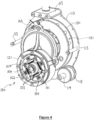
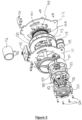
- the self-braking pulley 100 comprises a housing having a first housing portion 110 which is arranged to house a spool 130 and drive assembly 140, and a second housing portion 120 which is arranged to house a braking assembly 150.
- the first housing portion 110 comprises a front and rear wall 111, 112 which are held in spaced relation by struts 113 which extend between the walls 111, 112 and which are secured to the walls 111, 112 by fasteners 114, such as a screw and bolts.
- the struts 113 are separated along a periphery of the first and second wall 111, 112.
- an anchor plate 115 which similarly extends between the front and rear wall 111, 112 thereof, and which is arranged to support an anchoring member 116, such as an eyelet, for enabling the pulley 100 to be secured to a suitable support (not shown).
- the second housing portion 120 is disposed at a front of the first housing portion 110 and comprises a substantially cylindrical drum 121, which is closed at a rear thereof by the front wall 111 of the first housing portion 110, and at the front thereof by a drum cover 122.
- the second housing portion 120 may further comprise a gasket or seal 123 (as illustrated in figure 5 of the drawings) which is arranged to extend between the cover 122 and the drum 121 to minimise any debris from passing into the drum 121.
- the drum 121 is secured to the front wall 111 of the first housing portion 110 and the cover is secured to the drum by a plurality of fasteners 124, such as screws and bolts.
- the spool 130 disposed within the first housing portion 110 is arranged to rotate about an axle 117 which extends between the front and rear wall 111, 112 of the first housing portion 110.
- the spool 130 is arranged to receive a tether, such as a rope (not shown), which may be wound upon the spool 130 and rotationally coupled therewith, such as by rigidly coupling one end of the tether to the spool 130.
- the other end of the tether is arranged to extend out from the first housing portion 110, such as at a lower region thereof, and is preferably guided out from the housing 110 by a guide spool 118 which is arranged to rotate about a guide axle 119 that extends between the front and rear walls 111, 112, at the lower region thereof.
- the spool 130 comprises a circumferentially extending groove 131 which extends radially inwardly of the spool.
- the groove 131 is defined by side walls 132 which converge in a direction which is radially inwardly of the spool 130 so that the tether becomes gripped by the spool 130 and thus rotationally coupled to the spool 130.
- the tether may be simply arranged to pass over the spool 130 (as opposed to being wound completely around the spool) such that the free ends of the tether extend out from the pulley 100 at opposite sides of the spool 130, and guided by a respective guide spool 118 (only one of which is illustrated in the drawings) disposed at the lower region of the first housing portion 110.
- the drive assembly 140 comprises a wheel 141 which is arranged to rotate about the axle 117 and comprises a plurality of serrations 142 disposed along a periphery thereof.
- the serrations 142 are asymmetric and separately comprise a long face 142a and a short face 142b which meet at an apex 142c, such that short face 142b forms a larger angle with a tangent to the wheel 141 than the long face 142a.
- the drive assembly 140 further comprises a pawl 143 which is pivotally coupled to a side of the spool 130, such that the pawl 143 is arranged to pivot in a plane which comprises the wheel 141.
- the pawl 143 comprises proximal end 143a which is disposed closer to the pivot 144 than the distal end 143b, and as such the centre of mass of the pawl 143 is disposed toward the side of the pivot 144 which extends toward the distal end 143b.
- the pawl 143 is further coupled to the spool 130 by an elastic member 145, such as a spring, which is coupled at one end to the distal end 143b of the pawl 143 and at the other end to the side of the spool 130.
- the pawl 143 is arranged to couple with the wheel 141 in dependence of the rotational speed of the spool 130, and thus the pawl 143 and wheel 141 collectively form a ratchet, as illustrated in figure 3 of the drawings.
- the drive assembly 140 further comprises a drive gear 146 disposed upon the axle 117, which is rotationally coupled with the wheel 141, such that the drive gear 146 rotates about the axle 117 in accordance with a rotation of the wheel 141.
- the braking assembly 150 of the pulley 100 comprises a shoe plate 151 which is arranged to rotate with an axle 152 that extends through the second housing portion 120.
- the axle 152 is supported in a bearing assembly (not shown) separately mounted within a cover 122 of the drum 121, a front wall 111 of the first housing portion 110 and the rear wall 112 of the first housing portion 110.
- the shoe plate 151 comprises a plurality of brake shoes 153 hingedly coupled thereto, along a periphery thereof.
- the brake shoes 153 are angularly separated around the plate 151 and are arranged to pivot about the respective hinge in a plane comprising the shoe plate 151.
- the brake shoes 153 separately comprise a bridging member 153a which extend over an outer perimeter of a portion of the shoe plate 151, and a pair of side walls 153b which extend radially inwardly of the shoe plate 151 from either side of the respective bridging member 153a.
- the bridging member 153a is arranged to support a brake pad 154 thereon, which faces radially outwardly of the shoe plate 151.
- Each brake shoe 153 is hingedly coupled at one end thereof to the shoe plate 151 via a pin 155 which extends between the side walls 153b through the plate 151.
- Each brake shoe 153 is hingedly coupled at the end of the shoe 153 which is the leading end of the shoe 153 as the plate 151 rotates within the drum 121 as the tether (not shown) is unwound from the spool 130.
- the braking assembly 150 further comprises a plurality of elastic members 156, such as springs, for controlling the rotation of the brake shoes 153 about the respective hinge, namely the pin 155.
- the springs 156 are coupled at one end to a trailing end of one brake shoe 153 and at the other end to the trailing end of an adjacent brake shoe 153. In this respect, the springs 156 ensure that the brake shoes 153 pivot about the respective pin 155 only once a minimum rate of rotation of the plate 151 is reached.
- the braking assembly 150 further comprises a brake lining 157 which is disposed along an inner side of the drum 121. In this respect, the drum 121 and lining 157 effectively form a brake drum to which the brake shoes 153 can contact to retard the rotation of the plate 151.
- the drive assembly 140 is coupled to the braking assembly 150 by a follower gear 160 which is rotationally coupled to the axle 152 of the braking assembly 150.
- the follower gear 160 is meshed with the drive gear 146 and as such the drive gear 146 and follower gear 160 are arranged to rotate together. Accordingly, in use, with the pulley 100 suitably anchored to a support (not shown) via the anchor member 116 and with a tether (not shown) wound upon the spool 130, a user desiring to exploit the self-braking facility of the pulley 100 would first secure the free end of the tether (not shown) to their harness (not shown) for example.
- the pawl 143 With the pulley 100 in this rest condition, the pawl 143 is arranged in the neutral condition, whereby the proximal end 143a of the pawl 143 is held separated from the serrations 142 on the wheel 141 by virtue of the weight of the pawl 143 being displaced to the one side of the pivot 144 and the restoring force of the spring 145.
- the tether (not shown) will begin to unwind from the spool 130 with an increasing rotational rate. As the rate of spool rotation increases, the pawl 143 will begin to rotate.
- the "heavy" distal end of the pawl 143 will rotate about the pivot 144 to a radially outer position of the spool 130 under the centrifugal force, thereby causing the proximal end 143a to rotate toward the serrations 142 on the wheel 141.
- a threshold will be reached whereby the proximal end 143a of the pawl 143 will locate with a short face 142b of a serration 142 on the wheel 141 and thus cause the wheel 141 to rotate with the spool 130, owing to the rotational coupling.
- the drive gear 146 will be rotate which subsequently causes the follower gear 160 to rotate.
- the driving of the follower gear 160 causes the shoe plate 151 to rotate within the brake drum 121. Accordingly, in a similar manner to the pawl 143, the brake shoes 153 pivot about the respective pin 155 under the centrifugal force created, thereby causing a leading edge of the brake pad 154 to contact the brake lining 157. As the rotational speed of the spool 130 and thus the shoe plate 151 increases, the brake shoes 153 will rotate further thereby bringing more surface area of the brake pad 154 into contact with the brake lining 157. This contact is arranged to limit the rotation of the spool 130 and thus the rate of extraction of the tether (not shown) therefrom to offer a controlled rate of decent of the user from their position of height.
- the ratchet formed within the drive assembly 140 only engages the braking assembly 150 when the spool 130 rotates in a particular direction.
- the spool 130 can thus be freely rotated in the opposite direction and as such in an alternative embodiment in which the free ends of the tether (not shown) extend out from the pulley 100, as opposed to one end of the tether being coupled to the spool 130, the pulley 100 can be used to lift a user or an item in a particular direction and control a rate of descent of the user or item in the opposite direction, owing to the rotational coupling of the tether to the spool 130 by the groove 131.
- the pulley 100 may comprise a separate drive assembly 140 and braking assembly 140 on opposite sides of the spool 130 for controlling the rate of rotation of the spool 130 in both rotational directions.
Landscapes
- Health & Medical Sciences (AREA)
- General Health & Medical Sciences (AREA)
- Business, Economics & Management (AREA)
- Emergency Management (AREA)
- Engineering & Computer Science (AREA)
- Mechanical Engineering (AREA)
- Braking Arrangements (AREA)
Claims (5)
- Selbstbremsende Scheibe (100) zum Steuern einer Rate einer Extraktion eines Haltegurts, der mit der Scheibe gekoppelt ist, wobei die Scheibe umfasst:eine Spule (130) zum Aufnehmen eines Haltegurts, wobei die Spule so angeordnet ist, dass sie sich um eine Achse (117) der Scheibe dreht, wenn der Haltegurt von ihr entfernt wird;eine Bremsanordnung (150) zum Aufbringen einer Bremskraft auf die Spule (130), wobei die Bremsanordnung eine Backenplatte (151), ein Folgezahnrad (160) und eine Achse (152) umfasst, wobei die Backenplatte und das Folgezahnrad drehbar mit der Achse (152) der Bremsanordnung gekoppelt sind, so dass eine Drehung des Folgezahnrads eine Drehung der Backenplatte bewirkt, wobei die Bremsanordnung ferner eine Vielzahl von Bremsklötzen (154) umfasst, die so angeordnet sind, dass sie eine Bremstrommel (121) in Abhängigkeit von einer Drehgeschwindigkeit der Spule um die Scheibenachse (117) kontaktieren, jeder Bremsklotz separat auf einer jeweiligen Bremsbacke (153) angeordnet ist, wobei jede Backe an ihrem vorderen Ende während einer Drehung der Platte innerhalb der Trommel (121), wenn der Haltegurt von der Spule abgewickelt wird, an der Backenplatte an winkelmäßig getrennten Positionen um deren Umfang herum angelenkt gekoppelt ist, so dass der Kontaktbereich der Bremsklötze mit der Trommel in Abhängigkeit von einer Drehgeschwindigkeit der Platte variiert, wobei ein hinteres Ende jeder Backe über ein elastisches Element (156) mit dem hinteren Ende der drehbar benachbarten Backe gekoppelt ist; undeine Antriebsanordnung (140), wobei die Antriebsanordnung ein Rad (141) mit einer Vielzahl von Verzahnungen (142), die entlang eines äußeren Umfangs desselben angeordnet sind, und ein Antriebszahnrad (146) umfasst, das drehbar mit dem Rad gekoppelt ist, wobei das Rad und das Antriebszahnrad so eingerichtet sind, dass sie sich um die Scheibenachse (117) drehen, so dass die Drehung des Rads eine Drehung des Antriebszahnrads bewirkt, wobei das Antriebszahnrad ferner drehbar mit dem Folgezahnrad (160) gekoppelt ist, so dass die Drehung des Antriebszahnrads eine Drehung des Folgezahnrads bewirkt, wobei die Antriebsanordnung mit der Spule über ein Eingriffselement in Eingriff bringbar ist, das eine Sperrklinke (143) umfasst, die schwenkbar mit der Spule um einen Drehzapfen (144) gekoppelt ist, wobei die Sperrklinke einen Massenschwerpunkt aufweist, der auf einer Seite des Drehzapfens angeordnet ist, so dass sich ein proximales Ende (143a) der Sperrklinke näher zu dem Drehzapfen erstreckt als ein distales Ende (143b) der Sperrklinke, wobei die Sperrklinke von einer neutralen Konfiguration, in der sich das proximale Ende der Sperrklinke von dem Rad weg erstreckt, in eine Antriebskonfiguration rekonfigurierbar ist, in der das proximale Ende der Sperrklinke an den Verzahnungen auf dem Rad anliegt, um die Spule mit der Antriebsanordnung drehbar zu koppeln, um die Bremsanordnung in Abhängigkeit von einer Drehgeschwindigkeit der Spule um die Scheibenachse anzutreiben.
- Selbstbremsende Scheibe nach Anspruch 1, wobei die Sperrklinke so eingerichtet ist, dass sie in einer Ebene schwenkt, in der sich das Rad erstreckt.
- Selbstbremsende Scheibe nach einem der Ansprüche 1 oder 2, ferner umfassend ein elastisches Element (145), das an einem Ende mit der Spule und an dem anderen Ende mit dem distalen Ende der Sperrklinke gekoppelt ist, um die Drehung der Sperrklinke um den Drehzapfen zu steuern.
- Selbstbremsende Scheibe nach einem der vorstehenden Ansprüche, ferner umfassend ein Gehäuse zum Unterbringen der Spule, der Antriebsanordnung, des Eingriffselements und der Bremsanordnung.
- Selbstbremsende Scheibe nach Anspruch 4, wobei die Scheibenachse und die Achse der Bremsanordnung von dem Gehäuse getragen werden.
Applications Claiming Priority (2)
| Application Number | Priority Date | Filing Date | Title |
|---|---|---|---|
| GB1510458.1A GB2539418B (en) | 2015-06-15 | 2015-06-15 | Self-braking pulley |
| PCT/EP2016/063808 WO2016202891A1 (en) | 2015-06-15 | 2016-06-15 | Self-braking pulley |
Publications (3)
| Publication Number | Publication Date |
|---|---|
| EP3307397A1 EP3307397A1 (de) | 2018-04-18 |
| EP3307397C0 EP3307397C0 (de) | 2024-04-17 |
| EP3307397B1 true EP3307397B1 (de) | 2024-04-17 |
Family
ID=53784731
Family Applications (1)
| Application Number | Title | Priority Date | Filing Date |
|---|---|---|---|
| EP16736000.7A Active EP3307397B1 (de) | 2015-06-15 | 2016-06-15 | Selbstbremsende riemenscheibe |
Country Status (5)
| Country | Link |
|---|---|
| US (1) | US10661103B2 (de) |
| EP (1) | EP3307397B1 (de) |
| AU (1) | AU2016278880B2 (de) |
| GB (1) | GB2539418B (de) |
| WO (1) | WO2016202891A1 (de) |
Families Citing this family (6)
| Publication number | Priority date | Publication date | Assignee | Title |
|---|---|---|---|---|
| GB2588927B (en) | 2019-11-14 | 2024-04-17 | Latchways Plc | Settable length fall arrest device |
| US11534634B2 (en) | 2020-04-03 | 2022-12-27 | Honeywell International Inc. | Brake assembly for fall arrest system |
| US12076594B2 (en) * | 2020-11-23 | 2024-09-03 | Yoke Industrial Corp. | Fall arrester |
| US20220249888A1 (en) * | 2021-02-11 | 2022-08-11 | The Boeing Company | Multiple Self-Retracting Lanyard, Single Brake Fall Protection Systems and Methods |
| TWI762326B (zh) * | 2021-05-21 | 2022-04-21 | 貝加工業有限公司 | 鼓式煞車防墜器 |
| TWI860061B (zh) * | 2023-08-25 | 2024-10-21 | 陳晉弘 | 防墜器 |
Citations (3)
| Publication number | Priority date | Publication date | Assignee | Title |
|---|---|---|---|---|
| GB999552A (en) * | 1962-03-30 | 1965-07-28 | Joseph Trouin | Safety apparatus |
| US4591029A (en) * | 1984-08-17 | 1986-05-27 | Da Foe John P | Load actuating braking apparatus |
| US20100224448A1 (en) * | 2009-03-09 | 2010-09-09 | D B Industries, Inc. | Safety Device with Fall Arrest and Descending Modes |
Family Cites Families (18)
| Publication number | Priority date | Publication date | Assignee | Title |
|---|---|---|---|---|
| DE894354C (de) * | 1938-04-02 | 1953-10-22 | Joseph Trouin | Vorrichtung zum Schutz gegen Abstuerzen |
| AT240509B (de) | 1963-01-17 | 1965-06-10 | Hoerbiger Ventilwerke Ag | Plattenventil |
| US4589523A (en) * | 1984-02-10 | 1986-05-20 | Rose Manufacturing Company | Fall arrester and emergency retrieval apparatus and anchor apparatus therefor |
| GB9027783D0 (en) * | 1990-12-21 | 1991-02-13 | Barrow Hepburn Sala Ltd | Safety anchorages for controlling pay-out of a safety line |
| GB2256414A (en) * | 1991-05-23 | 1992-12-09 | Invetek Plc | Fall arrest device. |
| GB2306107A (en) * | 1995-10-14 | 1997-04-30 | Stephen Griffiths | Safety device |
| US6446936B1 (en) * | 1997-10-23 | 2002-09-10 | Meyer Ostrobrod | Safety apparatus for horizontal lifeline |
| US20040098944A1 (en) * | 2000-07-28 | 2004-05-27 | Hoffend, Donald A. | Batten for lift assembly |
| US7281620B2 (en) * | 2003-09-05 | 2007-10-16 | D B Industries, Inc. | Self-retracting lifeline |
| US8245817B2 (en) * | 2008-08-04 | 2012-08-21 | D B Industries, Inc. | Self-rescue safety device |
| US9764172B2 (en) * | 2009-03-09 | 2017-09-19 | D B Industries, Llc | Safety device with fall arrest and descending modes |
| SG181479A1 (en) * | 2009-12-23 | 2012-07-30 | Db Ind Inc | Fall protection safety device with a braking mechanism |
| US9199103B2 (en) * | 2010-05-12 | 2015-12-01 | Msa Technology, Llc | Fall protection arrangement |
| US8256574B2 (en) * | 2010-06-23 | 2012-09-04 | 3M Innovative Properties Company | Centrifugally-operated apparatus |
| US20140048758A1 (en) * | 2012-08-17 | 2014-02-20 | Ryan Kristian Oland | Fence Stretcher |
| US10981760B2 (en) * | 2014-10-07 | 2021-04-20 | Skysaver Rescue Ltd. | Centrifugal brake mechanism |
| GB2548879B (en) * | 2016-03-31 | 2018-09-05 | Zwart Klaas | An abseiling device |
| GB2554049A (en) * | 2016-06-21 | 2018-03-28 | Ayd Ltd | Self-braking pulley |
-
2015
- 2015-06-15 GB GB1510458.1A patent/GB2539418B/en active Active
-
2016
- 2016-06-15 EP EP16736000.7A patent/EP3307397B1/de active Active
- 2016-06-15 WO PCT/EP2016/063808 patent/WO2016202891A1/en not_active Ceased
- 2016-06-15 US US15/737,022 patent/US10661103B2/en active Active
- 2016-06-15 AU AU2016278880A patent/AU2016278880B2/en active Active
Patent Citations (3)
| Publication number | Priority date | Publication date | Assignee | Title |
|---|---|---|---|---|
| GB999552A (en) * | 1962-03-30 | 1965-07-28 | Joseph Trouin | Safety apparatus |
| US4591029A (en) * | 1984-08-17 | 1986-05-27 | Da Foe John P | Load actuating braking apparatus |
| US20100224448A1 (en) * | 2009-03-09 | 2010-09-09 | D B Industries, Inc. | Safety Device with Fall Arrest and Descending Modes |
Also Published As
| Publication number | Publication date |
|---|---|
| EP3307397A1 (de) | 2018-04-18 |
| GB201510458D0 (en) | 2015-07-29 |
| AU2016278880B2 (en) | 2021-04-01 |
| US10661103B2 (en) | 2020-05-26 |
| WO2016202891A1 (en) | 2016-12-22 |
| GB2539418A (en) | 2016-12-21 |
| EP3307397C0 (de) | 2024-04-17 |
| US20180169446A1 (en) | 2018-06-21 |
| AU2016278880A1 (en) | 2018-01-18 |
| GB2539418B (en) | 2019-10-02 |
Similar Documents
| Publication | Publication Date | Title |
|---|---|---|
| AU2016278880B2 (en) | Self-braking pulley | |
| CN110022945B (zh) | 具有可控回缩速度的防坠落设备 | |
| ES2655249T3 (es) | Dispositivo para evacuación de individuos | |
| KR101311643B1 (ko) | 이중 브레이크 완강기 | |
| KR20170077150A (ko) | 원심 브레이크 메커니즘 | |
| CN109310892A (zh) | 借助绳索下降的装置 | |
| CN102039008B (zh) | 一种高空缓降器 | |
| CN102553093B (zh) | 缓降器 | |
| CN106390311A (zh) | 可用于悬挂模式和顶绳模式的绳索悬挂装置 | |
| US7963370B2 (en) | System and apparatus for personal high altitude rappel escape safety device | |
| KR101685463B1 (ko) | 완강장치 | |
| CN201727854U (zh) | 一种绳索制停下降器 | |
| CN101934117B (zh) | 一种高空载人匀速下降救生器 | |
| KR20140105921A (ko) | 자전거 브레이크 및 이를 포함하는 자전거 | |
| CN107866008B (zh) | 与救援下降装置一起使用的包括安全绳索卷轴的下降系统 | |
| CN202459883U (zh) | 缓降器 | |
| CN204815414U (zh) | 一种带有救援功能的逃生装置 | |
| US20150307197A1 (en) | Multi-Use Emergency Descent Device | |
| KR20080038984A (ko) | 완강기 | |
| EP4178687B1 (de) | Sturzsicherungsvorrichtung | |
| KR20190086153A (ko) | 완강기 | |
| KR200360572Y1 (ko) | 완강기 | |
| CN207384616U (zh) | 摩擦块安装结构 | |
| CN104069592A (zh) | 一种高楼安全逃生装置 | |
| HK1222365B (en) | Device for evacuating individuals |
Legal Events
| Date | Code | Title | Description |
|---|---|---|---|
| STAA | Information on the status of an ep patent application or granted ep patent |
Free format text: STATUS: THE INTERNATIONAL PUBLICATION HAS BEEN MADE |
|
| PUAI | Public reference made under article 153(3) epc to a published international application that has entered the european phase |
Free format text: ORIGINAL CODE: 0009012 |
|
| STAA | Information on the status of an ep patent application or granted ep patent |
Free format text: STATUS: REQUEST FOR EXAMINATION WAS MADE |
|
| 17P | Request for examination filed |
Effective date: 20171219 |
|
| AK | Designated contracting states |
Kind code of ref document: A1 Designated state(s): AL AT BE BG CH CY CZ DE DK EE ES FI FR GB GR HR HU IE IS IT LI LT LU LV MC MK MT NL NO PL PT RO RS SE SI SK SM TR |
|
| AX | Request for extension of the european patent |
Extension state: BA ME |
|
| DAV | Request for validation of the european patent (deleted) | ||
| DAX | Request for extension of the european patent (deleted) | ||
| STAA | Information on the status of an ep patent application or granted ep patent |
Free format text: STATUS: EXAMINATION IS IN PROGRESS |
|
| 17Q | First examination report despatched |
Effective date: 20211223 |
|
| GRAP | Despatch of communication of intention to grant a patent |
Free format text: ORIGINAL CODE: EPIDOSNIGR1 |
|
| STAA | Information on the status of an ep patent application or granted ep patent |
Free format text: STATUS: GRANT OF PATENT IS INTENDED |
|
| INTG | Intention to grant announced |
Effective date: 20231113 |
|
| GRAS | Grant fee paid |
Free format text: ORIGINAL CODE: EPIDOSNIGR3 |
|
| GRAA | (expected) grant |
Free format text: ORIGINAL CODE: 0009210 |
|
| STAA | Information on the status of an ep patent application or granted ep patent |
Free format text: STATUS: THE PATENT HAS BEEN GRANTED |
|
| AK | Designated contracting states |
Kind code of ref document: B1 Designated state(s): AL AT BE BG CH CY CZ DE DK EE ES FI FR GB GR HR HU IE IS IT LI LT LU LV MC MK MT NL NO PL PT RO RS SE SI SK SM TR |
|
| REG | Reference to a national code |
Ref country code: GB Ref legal event code: FG4D |
|
| REG | Reference to a national code |
Ref country code: CH Ref legal event code: EP |
|
| REG | Reference to a national code |
Ref country code: DE Ref legal event code: R096 Ref document number: 602016086970 Country of ref document: DE |
|
| REG | Reference to a national code |
Ref country code: IE Ref legal event code: FG4D |
|
| U01 | Request for unitary effect filed |
Effective date: 20240423 |
|
| U07 | Unitary effect registered |
Designated state(s): AT BE BG DE DK EE FI FR IT LT LU LV MT NL PT SE SI Effective date: 20240430 |
|
| U20 | Renewal fee for the european patent with unitary effect paid |
Year of fee payment: 9 Effective date: 20240520 |
|
| PG25 | Lapsed in a contracting state [announced via postgrant information from national office to epo] |
Ref country code: IS Free format text: LAPSE BECAUSE OF FAILURE TO SUBMIT A TRANSLATION OF THE DESCRIPTION OR TO PAY THE FEE WITHIN THE PRESCRIBED TIME-LIMIT Effective date: 20240817 |
|
| PG25 | Lapsed in a contracting state [announced via postgrant information from national office to epo] |
Ref country code: HR Free format text: LAPSE BECAUSE OF FAILURE TO SUBMIT A TRANSLATION OF THE DESCRIPTION OR TO PAY THE FEE WITHIN THE PRESCRIBED TIME-LIMIT Effective date: 20240417 |
|
| PG25 | Lapsed in a contracting state [announced via postgrant information from national office to epo] |
Ref country code: GR Free format text: LAPSE BECAUSE OF FAILURE TO SUBMIT A TRANSLATION OF THE DESCRIPTION OR TO PAY THE FEE WITHIN THE PRESCRIBED TIME-LIMIT Effective date: 20240718 |
|
| PG25 | Lapsed in a contracting state [announced via postgrant information from national office to epo] |
Ref country code: ES Free format text: LAPSE BECAUSE OF FAILURE TO SUBMIT A TRANSLATION OF THE DESCRIPTION OR TO PAY THE FEE WITHIN THE PRESCRIBED TIME-LIMIT Effective date: 20240417 |
|
| PG25 | Lapsed in a contracting state [announced via postgrant information from national office to epo] |
Ref country code: PL Free format text: LAPSE BECAUSE OF FAILURE TO SUBMIT A TRANSLATION OF THE DESCRIPTION OR TO PAY THE FEE WITHIN THE PRESCRIBED TIME-LIMIT Effective date: 20240417 |
|
| PG25 | Lapsed in a contracting state [announced via postgrant information from national office to epo] |
Ref country code: PL Free format text: LAPSE BECAUSE OF FAILURE TO SUBMIT A TRANSLATION OF THE DESCRIPTION OR TO PAY THE FEE WITHIN THE PRESCRIBED TIME-LIMIT Effective date: 20240417 Ref country code: NO Free format text: LAPSE BECAUSE OF FAILURE TO SUBMIT A TRANSLATION OF THE DESCRIPTION OR TO PAY THE FEE WITHIN THE PRESCRIBED TIME-LIMIT Effective date: 20240717 Ref country code: IS Free format text: LAPSE BECAUSE OF FAILURE TO SUBMIT A TRANSLATION OF THE DESCRIPTION OR TO PAY THE FEE WITHIN THE PRESCRIBED TIME-LIMIT Effective date: 20240817 Ref country code: HR Free format text: LAPSE BECAUSE OF FAILURE TO SUBMIT A TRANSLATION OF THE DESCRIPTION OR TO PAY THE FEE WITHIN THE PRESCRIBED TIME-LIMIT Effective date: 20240417 Ref country code: GR Free format text: LAPSE BECAUSE OF FAILURE TO SUBMIT A TRANSLATION OF THE DESCRIPTION OR TO PAY THE FEE WITHIN THE PRESCRIBED TIME-LIMIT Effective date: 20240718 Ref country code: ES Free format text: LAPSE BECAUSE OF FAILURE TO SUBMIT A TRANSLATION OF THE DESCRIPTION OR TO PAY THE FEE WITHIN THE PRESCRIBED TIME-LIMIT Effective date: 20240417 Ref country code: RS Free format text: LAPSE BECAUSE OF FAILURE TO SUBMIT A TRANSLATION OF THE DESCRIPTION OR TO PAY THE FEE WITHIN THE PRESCRIBED TIME-LIMIT Effective date: 20240717 |
|
| REG | Reference to a national code |
Ref country code: DE Ref legal event code: R097 Ref document number: 602016086970 Country of ref document: DE |
|
| PG25 | Lapsed in a contracting state [announced via postgrant information from national office to epo] |
Ref country code: CZ Free format text: LAPSE BECAUSE OF FAILURE TO SUBMIT A TRANSLATION OF THE DESCRIPTION OR TO PAY THE FEE WITHIN THE PRESCRIBED TIME-LIMIT Effective date: 20240417 |
|
| PG25 | Lapsed in a contracting state [announced via postgrant information from national office to epo] |
Ref country code: SK Free format text: LAPSE BECAUSE OF FAILURE TO SUBMIT A TRANSLATION OF THE DESCRIPTION OR TO PAY THE FEE WITHIN THE PRESCRIBED TIME-LIMIT Effective date: 20240417 Ref country code: RO Free format text: LAPSE BECAUSE OF FAILURE TO SUBMIT A TRANSLATION OF THE DESCRIPTION OR TO PAY THE FEE WITHIN THE PRESCRIBED TIME-LIMIT Effective date: 20240417 |
|
| PG25 | Lapsed in a contracting state [announced via postgrant information from national office to epo] |
Ref country code: SM Free format text: LAPSE BECAUSE OF FAILURE TO SUBMIT A TRANSLATION OF THE DESCRIPTION OR TO PAY THE FEE WITHIN THE PRESCRIBED TIME-LIMIT Effective date: 20240417 |
|
| PG25 | Lapsed in a contracting state [announced via postgrant information from national office to epo] |
Ref country code: SM Free format text: LAPSE BECAUSE OF FAILURE TO SUBMIT A TRANSLATION OF THE DESCRIPTION OR TO PAY THE FEE WITHIN THE PRESCRIBED TIME-LIMIT Effective date: 20240417 Ref country code: SK Free format text: LAPSE BECAUSE OF FAILURE TO SUBMIT A TRANSLATION OF THE DESCRIPTION OR TO PAY THE FEE WITHIN THE PRESCRIBED TIME-LIMIT Effective date: 20240417 Ref country code: RO Free format text: LAPSE BECAUSE OF FAILURE TO SUBMIT A TRANSLATION OF THE DESCRIPTION OR TO PAY THE FEE WITHIN THE PRESCRIBED TIME-LIMIT Effective date: 20240417 Ref country code: CZ Free format text: LAPSE BECAUSE OF FAILURE TO SUBMIT A TRANSLATION OF THE DESCRIPTION OR TO PAY THE FEE WITHIN THE PRESCRIBED TIME-LIMIT Effective date: 20240417 Ref country code: MC Free format text: LAPSE BECAUSE OF FAILURE TO SUBMIT A TRANSLATION OF THE DESCRIPTION OR TO PAY THE FEE WITHIN THE PRESCRIBED TIME-LIMIT Effective date: 20240417 |
|
| REG | Reference to a national code |
Ref country code: CH Ref legal event code: PL |
|
| PLBE | No opposition filed within time limit |
Free format text: ORIGINAL CODE: 0009261 |
|
| STAA | Information on the status of an ep patent application or granted ep patent |
Free format text: STATUS: NO OPPOSITION FILED WITHIN TIME LIMIT |
|
| 26N | No opposition filed |
Effective date: 20250120 |
|
| GBPC | Gb: european patent ceased through non-payment of renewal fee |
Effective date: 20240717 |
|
| PG25 | Lapsed in a contracting state [announced via postgrant information from national office to epo] |
Ref country code: IE Free format text: LAPSE BECAUSE OF NON-PAYMENT OF DUE FEES Effective date: 20240615 |
|
| PG25 | Lapsed in a contracting state [announced via postgrant information from national office to epo] |
Ref country code: CH Free format text: LAPSE BECAUSE OF NON-PAYMENT OF DUE FEES Effective date: 20240630 |
|
| PG25 | Lapsed in a contracting state [announced via postgrant information from national office to epo] |
Ref country code: GB Free format text: LAPSE BECAUSE OF NON-PAYMENT OF DUE FEES Effective date: 20240717 |
|
| U20 | Renewal fee for the european patent with unitary effect paid |
Year of fee payment: 10 Effective date: 20250512 |
|
| PG25 | Lapsed in a contracting state [announced via postgrant information from national office to epo] |
Ref country code: CY Free format text: LAPSE BECAUSE OF FAILURE TO SUBMIT A TRANSLATION OF THE DESCRIPTION OR TO PAY THE FEE WITHIN THE PRESCRIBED TIME-LIMIT; INVALID AB INITIO Effective date: 20160615 |
|
| PG25 | Lapsed in a contracting state [announced via postgrant information from national office to epo] |
Ref country code: HU Free format text: LAPSE BECAUSE OF FAILURE TO SUBMIT A TRANSLATION OF THE DESCRIPTION OR TO PAY THE FEE WITHIN THE PRESCRIBED TIME-LIMIT; INVALID AB INITIO Effective date: 20160615 |
|
| PG25 | Lapsed in a contracting state [announced via postgrant information from national office to epo] |
Ref country code: TR Free format text: LAPSE BECAUSE OF FAILURE TO SUBMIT A TRANSLATION OF THE DESCRIPTION OR TO PAY THE FEE WITHIN THE PRESCRIBED TIME-LIMIT Effective date: 20240417 |
|
| U20 | Renewal fee for the european patent with unitary effect paid |
Year of fee payment: 11 Effective date: 20260505 |