EP3306282A1 - Aufnahmebehälter zur gravimetrischen kalibrierung von pipetten - Google Patents
Aufnahmebehälter zur gravimetrischen kalibrierung von pipetten Download PDFInfo
- Publication number
- EP3306282A1 EP3306282A1 EP16192804.9A EP16192804A EP3306282A1 EP 3306282 A1 EP3306282 A1 EP 3306282A1 EP 16192804 A EP16192804 A EP 16192804A EP 3306282 A1 EP3306282 A1 EP 3306282A1
- Authority
- EP
- European Patent Office
- Prior art keywords
- receiving vessel
- receiving
- load receiver
- evaporation
- lid
- Prior art date
- Legal status (The legal status is an assumption and is not a legal conclusion. Google has not performed a legal analysis and makes no representation as to the accuracy of the status listed.)
- Withdrawn
Links
Images


Classifications
-
- G—PHYSICS
- G01—MEASURING; TESTING
- G01F—MEASURING VOLUME, VOLUME FLOW, MASS FLOW OR LIQUID LEVEL; METERING BY VOLUME
- G01F25/00—Testing or calibration of apparatus for measuring volume, volume flow or liquid level or for metering by volume
- G01F25/0092—Testing or calibration of apparatus for measuring volume, volume flow or liquid level or for metering by volume for metering by volume
-
- G—PHYSICS
- G01—MEASURING; TESTING
- G01F—MEASURING VOLUME, VOLUME FLOW, MASS FLOW OR LIQUID LEVEL; METERING BY VOLUME
- G01F25/00—Testing or calibration of apparatus for measuring volume, volume flow or liquid level or for metering by volume
- G01F25/0084—Testing or calibration of apparatus for measuring volume, volume flow or liquid level or for metering by volume for measuring volume
-
- B—PERFORMING OPERATIONS; TRANSPORTING
- B01—PHYSICAL OR CHEMICAL PROCESSES OR APPARATUS IN GENERAL
- B01L—CHEMICAL OR PHYSICAL LABORATORY APPARATUS FOR GENERAL USE
- B01L3/00—Containers or dishes for laboratory use, e.g. laboratory glassware; Droppers
- B01L3/02—Burettes; Pipettes
- B01L3/021—Pipettes, i.e. with only one conduit for withdrawing and redistributing liquids
-
- B—PERFORMING OPERATIONS; TRANSPORTING
- B01—PHYSICAL OR CHEMICAL PROCESSES OR APPARATUS IN GENERAL
- B01L—CHEMICAL OR PHYSICAL LABORATORY APPARATUS FOR GENERAL USE
- B01L3/00—Containers or dishes for laboratory use, e.g. laboratory glassware; Droppers
- B01L3/50—Containers for the purpose of retaining a material to be analysed, e.g. test tubes
- B01L3/508—Rigid containers without fluid transport within
-
- G—PHYSICS
- G01—MEASURING; TESTING
- G01G—WEIGHING
- G01G17/00—Apparatus for or methods of weighing material of special form or property
- G01G17/04—Apparatus for or methods of weighing material of special form or property for weighing fluids, e.g. gases, pastes
-
- G—PHYSICS
- G01—MEASURING; TESTING
- G01G—WEIGHING
- G01G21/00—Details of weighing apparatus
- G01G21/22—Weigh pans or other weighing receptacles; Weighing platforms
-
- B—PERFORMING OPERATIONS; TRANSPORTING
- B01—PHYSICAL OR CHEMICAL PROCESSES OR APPARATUS IN GENERAL
- B01L—CHEMICAL OR PHYSICAL LABORATORY APPARATUS FOR GENERAL USE
- B01L2200/00—Solutions for specific problems relating to chemical or physical laboratory apparatus
- B01L2200/02—Adapting objects or devices to another
- B01L2200/025—Align devices or objects to ensure defined positions relative to each other
-
- B—PERFORMING OPERATIONS; TRANSPORTING
- B01—PHYSICAL OR CHEMICAL PROCESSES OR APPARATUS IN GENERAL
- B01L—CHEMICAL OR PHYSICAL LABORATORY APPARATUS FOR GENERAL USE
- B01L2200/00—Solutions for specific problems relating to chemical or physical laboratory apparatus
- B01L2200/06—Fluid handling related problems
- B01L2200/0684—Venting, avoiding backpressure, avoid gas bubbles
-
- B—PERFORMING OPERATIONS; TRANSPORTING
- B01—PHYSICAL OR CHEMICAL PROCESSES OR APPARATUS IN GENERAL
- B01L—CHEMICAL OR PHYSICAL LABORATORY APPARATUS FOR GENERAL USE
- B01L2200/00—Solutions for specific problems relating to chemical or physical laboratory apparatus
- B01L2200/06—Fluid handling related problems
- B01L2200/0689—Sealing
-
- B—PERFORMING OPERATIONS; TRANSPORTING
- B01—PHYSICAL OR CHEMICAL PROCESSES OR APPARATUS IN GENERAL
- B01L—CHEMICAL OR PHYSICAL LABORATORY APPARATUS FOR GENERAL USE
- B01L2200/00—Solutions for specific problems relating to chemical or physical laboratory apparatus
- B01L2200/14—Process control and prevention of errors
- B01L2200/148—Specific details about calibrations
-
- B—PERFORMING OPERATIONS; TRANSPORTING
- B01—PHYSICAL OR CHEMICAL PROCESSES OR APPARATUS IN GENERAL
- B01L—CHEMICAL OR PHYSICAL LABORATORY APPARATUS FOR GENERAL USE
- B01L2300/00—Additional constructional details
- B01L2300/04—Closures and closing means
- B01L2300/046—Function or devices integrated in the closure
-
- B—PERFORMING OPERATIONS; TRANSPORTING
- B01—PHYSICAL OR CHEMICAL PROCESSES OR APPARATUS IN GENERAL
- B01L—CHEMICAL OR PHYSICAL LABORATORY APPARATUS FOR GENERAL USE
- B01L2300/00—Additional constructional details
- B01L2300/08—Geometry, shape and general structure
- B01L2300/0832—Geometry, shape and general structure cylindrical, tube shaped
-
- B—PERFORMING OPERATIONS; TRANSPORTING
- B01—PHYSICAL OR CHEMICAL PROCESSES OR APPARATUS IN GENERAL
- B01L—CHEMICAL OR PHYSICAL LABORATORY APPARATUS FOR GENERAL USE
- B01L2300/00—Additional constructional details
- B01L2300/12—Specific details about materials
Definitions
- a pipette is a laboratory tool commonly used in chemistry, biology and medicine to pick up, transport and dispense a measured volume of liquid.
- Pipettes come in several designs for various purposes with differing levels of accuracy and precision, from single-piece glass pipettes to more complex adjustable or electronic pipettes.
- distilled water of a controlled temperature is aspirated (suctioned) from a supply beaker into a holding chamber of the pipette, such as for example the space contained in the tip of a piston pipette, and then immediately discharged into a receiving vessel which is seated on the weighing pan of an analytical balance.
- the volume of the amount of dispensed water can be calculated, and the relationship between the dispensed volume and a graduation mark or other volume indicator on the pipette can be calibrated or verified.
- the foregoing sequence of steps is usually repeated a prescribed number of times for the same pipette, and the result is stated in terms of a mean value and standard deviation.
- Pipettes especially those used in regulated areas, are at least calibrated once a year, mostly according to the international standard ISO 8655, "Piston-Operated Volumetric Apparatus". Especially for pipettes that handle very small volumes of liquid, the calibration tolerances set by this standard are very demanding, requiring the use of a high-accuracy analytical balance and detailed, reproducible procedures. For example, the finest micropipette covered by the tolerance specifications of ISO 8655 has a nominal volume of 1 microliter ( ⁇ l), a maximum permissible systematic error of 0.05 ⁇ l and a maximum permissible random error of 0.05 ⁇ l.
- the corresponding nominal weight for the distilled water is 1 milligram (mg), with a maximum permissible systematic error of 0.05 mg (50 ⁇ g) and a maximum permissible random error of 0.05 mg (50 ⁇ g). These tolerances dictate the degree of accuracy that is required of the equipment and procedures used for the calibration and verification of pipettes.
- a critical factor affecting the accuracy of a pipette calibration or verification is the amount of evaporation from the water in the receiving vessel that occurs between the weighings of the receiving vessel before and after receiving the distilled water discharged from the pipette.
- the loss of weight due to evaporation will cause a negative error in the result.
- the amount of this error is not negligible and, furthermore, it varies depending on the time elapsed between the two weighings and depending on the temperature and relative humidity of the atmosphere surrounding the receiving vessel.
- the evaporation error in pipette calibrations is minimized by a procedural measure, wherein the operating cycle of weighing the receiving vessel, discharging the distilled water from the pipette, and reweighing the receiving vessel is strictly timed , so that the amount of evaporation will be the same for every operating cycle.
- the actual quantity of water that evaporates during each cycle is estimated by intermittently carrying out a so-called "simulated" measurement cycle which is exactly identical to an actual calibration cycle except that no water is discharged from the pipette into the receiving vessel.
- the result of the simulated cycle represents the amount of the evaporation loss, which is then added as a correction to the raw calibration results.
- the present invention is specifically focused on an apparatus-oriented physical feature that has the purpose of minimizing the amount of evaporation from the surface of the distilled water inside the receiving vessel.
- an analytical balance used for pipette calibrations can be equipped with a so-called evaporation trap, an accessory kit for analytical balances which is commercially available from major laboratory instrument manufacturers including the assignee of the present invention.
- an evaporation trap for the gravimetric calibration of pipettes is an enclosed chamber that is installed inside the draft shield compartment of the balance and surrounds the load receiver on which a receiving vessel is seated.
- the enclosure has an opening on top through which the distilled water contained in the pipette being calibrated is discharged into the receiving vessel.
- a ring-shaped open tub is formed which can be filled with tap water.
- the evaporation from this tap water supply in the ring-shaped open tub creates and maintains a high relative humidity (i.e. a near-saturated H 2 O vapor pressure) inside the evaporation trap chamber, whereby the rate of evaporation from the surface of the distilled water in the receiving vessel is minimized.
- a high relative humidity i.e. a near-saturated H 2 O vapor pressure
- converting an analytical balance into a dedicated workstation for pipette calibration involves the steps of: a) exchanging the standard weighing pan of the balance against a special load receiver for the receiving vessel, b) seating the receiving vessel of the evaporation trap kit in the special load receiver, c) putting the evaporation trap enclosure in place over the special load receiver and the receiving vessel, and d) filling the ring-shaped open tub of the evaporation trap enclosure with tap water.
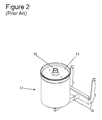
- one of the models manufactured by the assignee of the present invention includes a receiving vessel that is designed to keep at least part of the evaporation trapped inside the receiving vessel (see Figure 2 ).
- this specific type of receiving vessel was found to be so effective in reducing the rate of evaporation that the evaporation enclosure could be left off without compromising the accuracy of the pipette calibration process.
- a receiving vessel for the gravimetric calibration and verification of pipettes whose purpose is to be placed on a load receiver of a balance and to receive and hold test liquid discharged from pipettes that are being calibrated or verified, is configured as an evaporation-trapping device with a beaker, a lid with a passage opening, and a receiving tube that is held in place in the passage opening, passing through the latter into the interior of the beaker.
- the evaporation-trapping receiving vessel includes position-securing means which are designed to enter into a mechanical engagement with the weighing pan or load receiver of the balance when the receiving vessel is set on the weighing pan or load receiver, in order to ensure a secure placement of the receiving vessel in a defined, reproducible position on the standard weighing pan or load receiver.
- the position-securing means are configured as projections such as ridges or posts formed at the base of the receiving vessel and designed to engage the interstices of a grate-shaped load receiver of an analytical balance.
- the defined reproducible placement of the receiving vessel on the load receiver is essential in the process of gravimetric pipette calibration, because a position change of the receiving vessel on the load receiver between the two weighings before and after discharging the test fluid from a pipette into the receiving vessel could introduce a significant error into the calculation of the relatively small difference between the two weighings.
- such a position shift of the receiving vessel on the load receiver could be caused for example by wiping the tip of a pipette against the inside of the receiving tube and thereby pushing the receiving vessel out of place.
- the beaker and/or the lid of the receiving vessel are preferably made of an electrically conductive material to avoid the accumulation of electrostatic charges which could cause weighing errors.
- the overall weight of the entire receiving vessel filled with test liquid needs to be less than the load capacity of the analytical balance on which the pipette calibrations are to be performed.
- the beaker and/or the lid are of thin-walled aluminum construction or made of a conductive or at least antistatic plastic material.
- a receiving vessel according to the invention preferably includes a liner insert for the beaker.
- the purpose of this replaceable beaker liner is to prevent corrosion of the aluminum beaker by test liquid, particularly if test liquid is left sitting in the beaker over extended time periods.
- the receiving tube is designed and arranged to descend far enough inside the receiving vessel so that the lower end of the receiving tube held inside the receiving vessel.
- the receiving tube is directly exposed to the ambient atmosphere, whereby the amount of evaporation escaping into the ambient atmosphere is minimized.
- the evaporation from the ring-shaped surface area delimited by the outside wall of the receiving tube and the inside wall of the beaker is trapped in the enclosed space under the lid, and the weight of the trapped evaporation is therefore included in the weight that is registered by the balance.
- the lid of the receiving vessel includes at least one small vent opening allowing the escape of air that has been displaced by test liquid during a pipette calibration.
- the receiving tube may be an integral piece of the lid, solidly joined to the lid, or releasably connected to the lid.
- the lid has a collar flange surrounding the passage opening and the receiving tube is tightly held and sealed in the collar flange by means of a seal ring.
- the receiving tube is made of a transparent material, preferably glass.
- a transparent receiving tube has the advantage that the tip of a pipette being discharged into the receiving tube remains fully visible to the operator.
- the major advantage of the evaporation-trapping device of the present invention over the state of the art is its simplicity and ease of use, which makes it particularly suitable for laboratories where an analytical balance is not dedicated full-time to the process of performing pipette calibrations but has to be shared for other applications.
- an analytical balance is not dedicated full-time to the process of performing pipette calibrations but has to be shared for other applications.
- the evaporation-trapping enclosure is made redundant and can therefore be dispensed with, which removes the spatial constraints that such an enclosure puts on the weighing pan. Consequently, there is no need to exchange the standard weighing pan against a special load receiver.
- To perform the task of pipette calibration one only has to place the receiving vessel of the present invention on the standard weighing pan of the laboratory balance.
- the evaporation-trapping receiving vessel of the present invention was found to be at least on a par with the aforementioned evaporation trap of the prior art.
- the rate of weight loss due to evaporation was tested with a) an open beaker without lid, b) an evaporation-trapping device of the prior art with an evaporation-trapping enclosure, and c) an evaporation-trapping receiving vessel of the present invention.
- the evaporation-trapping receiving vessel of the present invention proved equally effective as the prior-art device in reducing the rate of weight loss due to evaporation by an order of magnitude in comparison to an open beaker without a lid.
- the improvement in simplicity and ease of use of the evaporation-trapping receiving vessel of the present invention is gained without compromising its functional performance in comparison to a state-of-the-art evaporation trap.
- FIG. 1 A state-of-the-art evaporation-trapping device 1 for the gravimetric calibration and verification of laboratory pipettes is illustrated schematically in Figure 1 .
- This type of evaporation-trapping device which is available commercially as an accessory kit to an analytical balance, includes a receiving vessel 7, a special load receiver 9 to support the receiving vessel 7, and an evaporation-trapping enclosure 2 with a ring-shaped, open tub 5, a lid 3 and a centering ring or support base 10.
- the standard weighing pan and weighing pan carrier of the balance are uninstalled and replaced by the special load receiver 9.
- the support base or centering ring 10 is installed on the weighing compartment floor 11 of the balance.
- the evaporation-trapping enclosure 2 is set in place on the support base 10, the ring-shaped, open tub 5 is filled with water 6, the receiving vessel 7 is seated on the load receiver 9, and the lid 3 is placed on top of the evaporation-trapping enclosure 2.
- the reverse procedure is followed to convert the balance back to general weighing duty.
- the assignee of the present invention manufactures an evaporation trap kit of the same principal type and with all of the components shown in Figure 1 , but with the further improvement that the receiving vessel 17 (see Figure 2 ) is designed to keep at least part of the evaporation trapped inside the receiving vessel 17 which in this case includes a lid 13 and a receiving tube 18 passing through an opening in the lid 13 into the interior of the receiving vessel 17.
- the receiving vessel 17 is connected to the balance through a special load receiver 19 which is included in the evaporation trap kit.
- this specific type of receiving vessel 17 was found to be so effective in reducing the rate of evaporation that the evaporation enclosure could be left off (and is therefore not shown in Figure 2 ) without compromising the accuracy of the pipette calibration process.
- the steps of putting the evaporation trap enclosure in place over the receiving vessel 17 and filling the ring-shaped open tub of the evaporation trap enclosure with tap water can thus be dispensed with, but the exchange of the standard weighing pan against a special load receiver 19 for the receiving vessel is still cumbersome and undesirable for the user.
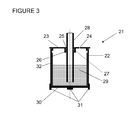
- FIG 3 shows the principal concept and Figures 4 to 6 show a typical practical embodiment of an evaporation-trapping device of the present invention.
- the evaporation-trapping device of the present invention 1 is simply embodied in the receiving vessel 21 with a beaker 22 and a lid 23.
- the lid 23 incorporates a receiving tube 28, which may be formed integrally of one piece with the lid 23 or be firmly connected to the latter.
- the receiving tube 28 is seated in the collar flange 26 of the lid 23 with a tight friction fit by means of a seal ring 27.
- the receiving tube 28 is preferably transparent and extends far enough upward from the lid 23 that the tip of a pipette being discharged into the receiving tube remains fully visible to the operator. At the same time, the receiving tube 28 should descend far enough downward into the beaker 22 that the lower end of the receiving tube 28 is immersed in the test liquid 29 inside the receiving vessel 21.
- the evaporation-trapping receiving vessel 21 of Figure 3 is designed so that it can be securely seated on a standard grate-shaped load receiver 33 (see Figures 4 , 5c , 6 ) of an analytical balance 40.
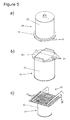
- Position-securing means 31 in the form of downward-projecting posts or ridges which are formed at the base 30 of the beaker 22 serve to engage the interstices of a grate-shaped load receiver 33 of an analytical balance 40 and to thereby ensure a secure placement of the receiving vessel 21 in a defined, reproducible position on the weighing pan or load receiver 33.
- the reproducible positioning of the receiving vessel 21 on the load receiver is of critical importance to prevent so-called eccentric load errors which could be caused by shifting the position of the receiving vessel 21 on the load receiver 33 during a pipette calibration.
- the beaker 22 is preferably made of a metal, for example aluminum, and is lined with a disposable or at least replaceable beaker insert 32 which protects the beaker 22 from being corroded by the test liquid 29, normally distilled water.
- Figure 4 shows a practically realized embodiment of the evaporation-trapping device 21 of Figure 3 in an exploded view.
- the position-securing, downward-projecting ridges 31 at the base 30 of the beaker 22 are designed to fit into the gaps between the rods of a standard grate-shaped weighing load receiver 33 of an analytical balance of a type made by the assignee of the present invention.
- Figure 5 shows perspective views of the inventive evaporation-trapping receiving vessel 21 in the assembled state, (a) in upright orientation, (b) turned upside-down with posts and ridges 31 at the base 30 of the beaker 22 facing the viewer, and (c) turned upside-down with the posts and ridges 31 engaged in the interstices between the rods of of the aforementioned grate-shaped weighing load receiver 33.
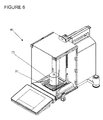
- Figure 6 illustrates how a standard analytical balance 40 is made into a pipette calibration work station by placing an evaporation-trapping receiving vessel 21 of the present invention on the load receiver 33.
Landscapes
- Physics & Mathematics (AREA)
- General Physics & Mathematics (AREA)
- Health & Medical Sciences (AREA)
- Chemical & Material Sciences (AREA)
- Clinical Laboratory Science (AREA)
- Chemical Kinetics & Catalysis (AREA)
- Fluid Mechanics (AREA)
- Analytical Chemistry (AREA)
- General Health & Medical Sciences (AREA)
- Hematology (AREA)
- Sampling And Sample Adjustment (AREA)
- Devices For Use In Laboratory Experiments (AREA)
Priority Applications (4)
| Application Number | Priority Date | Filing Date | Title |
|---|---|---|---|
| EP16192804.9A EP3306282A1 (de) | 2016-10-07 | 2016-10-07 | Aufnahmebehälter zur gravimetrischen kalibrierung von pipetten |
| US15/724,716 US10823602B2 (en) | 2016-10-07 | 2017-10-04 | Receiving vessel for the gravimetric calibration of pipettes |
| JP2017195854A JP2018081085A (ja) | 2016-10-07 | 2017-10-06 | ピペットの重量法的校正のための受入容器 |
| CN201710930155.9A CN107917746A (zh) | 2016-10-07 | 2017-10-09 | 用于移液管的重量校准的接收容器 |
Applications Claiming Priority (1)
| Application Number | Priority Date | Filing Date | Title |
|---|---|---|---|
| EP16192804.9A EP3306282A1 (de) | 2016-10-07 | 2016-10-07 | Aufnahmebehälter zur gravimetrischen kalibrierung von pipetten |
Publications (1)
| Publication Number | Publication Date |
|---|---|
| EP3306282A1 true EP3306282A1 (de) | 2018-04-11 |
Family
ID=57153292
Family Applications (1)
| Application Number | Title | Priority Date | Filing Date |
|---|---|---|---|
| EP16192804.9A Withdrawn EP3306282A1 (de) | 2016-10-07 | 2016-10-07 | Aufnahmebehälter zur gravimetrischen kalibrierung von pipetten |
Country Status (4)
| Country | Link |
|---|---|
| US (1) | US10823602B2 (de) |
| EP (1) | EP3306282A1 (de) |
| JP (1) | JP2018081085A (de) |
| CN (1) | CN107917746A (de) |
Families Citing this family (7)
| Publication number | Priority date | Publication date | Assignee | Title |
|---|---|---|---|---|
| JP7019303B2 (ja) * | 2017-03-24 | 2022-02-15 | 東芝テック株式会社 | 液滴分注装置 |
| CN109297574B (zh) * | 2018-11-15 | 2024-01-26 | 天津富勤科技股份有限公司 | 一种蒸汽发热体的水蒸气收集称量装置 |
| EP3708976A1 (de) * | 2019-03-11 | 2020-09-16 | Mettler-Toledo GmbH | Verfahren zur verifikation von pipetten |
| CN110470364B (zh) * | 2019-08-16 | 2020-12-01 | 北京航天计量测试技术研究所 | 一种pVTt法标准容器容积标定的装置及方法 |
| CN111595419A (zh) * | 2020-06-24 | 2020-08-28 | 山东特检计量检测有限公司 | 一种移液器容量检定用减少蒸发误差装置 |
| CN116878620B (zh) * | 2023-09-07 | 2023-11-28 | 中国测试技术研究院 | 一种体积型痕量仪校准装置及其校准方法 |
| WO2025171377A1 (en) * | 2024-02-09 | 2025-08-14 | Weil David Stephan | Evaporation trap for single and multi-channel pipettes |
Citations (1)
| Publication number | Priority date | Publication date | Assignee | Title |
|---|---|---|---|---|
| DE202011108230U1 (de) * | 2011-11-24 | 2013-02-25 | Malte Ulrich | Wägevorrichtung |
Family Cites Families (4)
| Publication number | Priority date | Publication date | Assignee | Title |
|---|---|---|---|---|
| US20110094319A1 (en) * | 2005-07-28 | 2011-04-28 | Infinite Medical Technology Corp. | Needle-free, safety biological sample collection system |
| EP1975577A1 (de) * | 2007-03-30 | 2008-10-01 | F.Hoffmann-La Roche Ag | Vorrichtung und Verfahren zur Bestimmung des gravimetrischen Volumens von Flüssigkeitsvolumen und Analysatorsystem mit einer derartigen Vorrichtung |
| EP2166322B1 (de) * | 2008-09-19 | 2019-01-09 | F.Hoffmann-La Roche Ag | Verfahren zur Bestimmung des gravimetrischen Volumens |
| US9687844B2 (en) * | 2013-11-18 | 2017-06-27 | Ellen Meng | Liquid specimen cup including movable caddy and translucent adulteration panel |
-
2016
- 2016-10-07 EP EP16192804.9A patent/EP3306282A1/de not_active Withdrawn
-
2017
- 2017-10-04 US US15/724,716 patent/US10823602B2/en active Active
- 2017-10-06 JP JP2017195854A patent/JP2018081085A/ja active Pending
- 2017-10-09 CN CN201710930155.9A patent/CN107917746A/zh active Pending
Patent Citations (1)
| Publication number | Priority date | Publication date | Assignee | Title |
|---|---|---|---|---|
| DE202011108230U1 (de) * | 2011-11-24 | 2013-02-25 | Malte Ulrich | Wägevorrichtung |
Also Published As
| Publication number | Publication date |
|---|---|
| JP2018081085A (ja) | 2018-05-24 |
| US20180100757A1 (en) | 2018-04-12 |
| US10823602B2 (en) | 2020-11-03 |
| CN107917746A (zh) | 2018-04-17 |
Similar Documents
| Publication | Publication Date | Title |
|---|---|---|
| US10823602B2 (en) | Receiving vessel for the gravimetric calibration of pipettes | |
| US7829800B2 (en) | Device and method for the gravimetric determination of liquid volumes and analyzer system comprising such a device | |
| US5895838A (en) | Method for correcting a liquid dispensing error, and a liquid dispensing device | |
| US5061639A (en) | Liquid dispenser accuracy verification method | |
| CN111750959A (zh) | 用于校准滴管的称量器 | |
| JP5400541B2 (ja) | 重量体積測定法 | |
| US7861581B2 (en) | Fluidic volume dispense verification tool | |
| EP3520896B1 (de) | Automatisierte volumetrische vorrichtung | |
| CN107036764A (zh) | 一种高精度自动手持式移液器计量装置及其计量方法 | |
| CN113532585A (zh) | 泵输送体积的自动的验证和再校准 | |
| US7114368B2 (en) | Apparatus and method for verifying the volume of liquid dispensed by a liquid-dispensing mechanism | |
| KR101864156B1 (ko) | 유리제 피펫의 부피 자동 측정장치 | |
| JP6786974B2 (ja) | 液体試料容器保持機構 | |
| CN104956205A (zh) | 垂直和水平波束混合吸液管校准系统 | |
| CN219474721U (zh) | 一种恒容容器 | |
| Batista et al. | A study of factors that influence micropipette calibrations | |
| KR20110044868A (ko) | 특성화 방법 및 그 특성화 방법을 실행하기 위한 키트 | |
| Almeida et al. | Performance studies in micropipette calibration | |
| Rodrigues et al. | Instrument performance verification: micropipettes | |
| Liang et al. | Novel gravimetric calibration method for nano liter liquid handling devices | |
| Blues et al. | The calibration and use of piston pipettes. | |
| RU2028580C1 (ru) | Взвешивающее устройство | |
| CN118518424A (zh) | 移液方法、装置、设备、系统和计算可读存储介质 | |
| Tiwari et al. | An Electronic Analytical Balance: A Key Instrument in the Laboratory | |
| CN116474852A (zh) | 一种用于减少移液器检定误差的辅助装置及方法 |
Legal Events
| Date | Code | Title | Description |
|---|---|---|---|
| PUAI | Public reference made under article 153(3) epc to a published international application that has entered the european phase |
Free format text: ORIGINAL CODE: 0009012 |
|
| STAA | Information on the status of an ep patent application or granted ep patent |
Free format text: STATUS: THE APPLICATION HAS BEEN PUBLISHED |
|
| AK | Designated contracting states |
Kind code of ref document: A1 Designated state(s): AL AT BE BG CH CY CZ DE DK EE ES FI FR GB GR HR HU IE IS IT LI LT LU LV MC MK MT NL NO PL PT RO RS SE SI SK SM TR |
|
| AX | Request for extension of the european patent |
Extension state: BA ME |
|
| STAA | Information on the status of an ep patent application or granted ep patent |
Free format text: STATUS: REQUEST FOR EXAMINATION WAS MADE |
|
| 17P | Request for examination filed |
Effective date: 20181004 |
|
| RBV | Designated contracting states (corrected) |
Designated state(s): AL AT BE BG CH CY CZ DE DK EE ES FI FR GB GR HR HU IE IS IT LI LT LU LV MC MK MT NL NO PL PT RO RS SE SI SK SM TR |
|
| STAA | Information on the status of an ep patent application or granted ep patent |
Free format text: STATUS: EXAMINATION IS IN PROGRESS |
|
| 17Q | First examination report despatched |
Effective date: 20200320 |
|
| STAA | Information on the status of an ep patent application or granted ep patent |
Free format text: STATUS: THE APPLICATION IS DEEMED TO BE WITHDRAWN |
|
| 18D | Application deemed to be withdrawn |
Effective date: 20201001 |