EP3303359B1 - Nukleotide zur behandlung von krebs - Google Patents
Nukleotide zur behandlung von krebs Download PDFInfo
- Publication number
- EP3303359B1 EP3303359B1 EP16724066.2A EP16724066A EP3303359B1 EP 3303359 B1 EP3303359 B1 EP 3303359B1 EP 16724066 A EP16724066 A EP 16724066A EP 3303359 B1 EP3303359 B1 EP 3303359B1
- Authority
- EP
- European Patent Office
- Prior art keywords
- cancer
- compound
- certain embodiments
- leukemia
- alkyl
- Prior art date
- Legal status (The legal status is an assumption and is not a legal conclusion. Google has not performed a legal analysis and makes no representation as to the accuracy of the status listed.)
- Active
Links
Classifications
-
- C—CHEMISTRY; METALLURGY
- C07—ORGANIC CHEMISTRY
- C07H—SUGARS; DERIVATIVES THEREOF; NUCLEOSIDES; NUCLEOTIDES; NUCLEIC ACIDS
- C07H19/00—Compounds containing a hetero ring sharing one ring hetero atom with a saccharide radical; Nucleosides; Mononucleotides; Anhydro-derivatives thereof
- C07H19/02—Compounds containing a hetero ring sharing one ring hetero atom with a saccharide radical; Nucleosides; Mononucleotides; Anhydro-derivatives thereof sharing nitrogen
- C07H19/04—Heterocyclic radicals containing only nitrogen atoms as ring hetero atom
- C07H19/06—Pyrimidine radicals
- C07H19/10—Pyrimidine radicals with the saccharide radical esterified by phosphoric or polyphosphoric acids
- C07H19/11—Pyrimidine radicals with the saccharide radical esterified by phosphoric or polyphosphoric acids containing cyclic phosphate
-
- A—HUMAN NECESSITIES
- A61—MEDICAL OR VETERINARY SCIENCE; HYGIENE
- A61P—SPECIFIC THERAPEUTIC ACTIVITY OF CHEMICAL COMPOUNDS OR MEDICINAL PREPARATIONS
- A61P35/00—Antineoplastic agents
-
- C—CHEMISTRY; METALLURGY
- C07—ORGANIC CHEMISTRY
- C07H—SUGARS; DERIVATIVES THEREOF; NUCLEOSIDES; NUCLEOTIDES; NUCLEIC ACIDS
- C07H19/00—Compounds containing a hetero ring sharing one ring hetero atom with a saccharide radical; Nucleosides; Mononucleotides; Anhydro-derivatives thereof
- C07H19/02—Compounds containing a hetero ring sharing one ring hetero atom with a saccharide radical; Nucleosides; Mononucleotides; Anhydro-derivatives thereof sharing nitrogen
- C07H19/04—Heterocyclic radicals containing only nitrogen atoms as ring hetero atom
- C07H19/06—Pyrimidine radicals
- C07H19/10—Pyrimidine radicals with the saccharide radical esterified by phosphoric or polyphosphoric acids
Definitions
- nucleoside derivatives Provided herein are nucleoside derivatives, pharmaceutical compositions comprising the compounds, processes of preparation thereof, and methods of use thereof for treating cancer.
- nucleoside and nucleotide compounds and prodrugs are provided which can display remarkable efficacy and bioavailability for the treatment of, for example, liver cancers in a human.
- Liver cancers which can be treated include primary and secondary liver cancers.
- the liver cancer is hepatocellular carcinoma, cholangiocarcinoma, or biliary tract cancer.
- the liver cancer is a metastasis in the liver originated from other cancers (such as colon cancer, pancreatic cancer, etc.).
- the compounds described herein can be used to treat cancers such as breast cancer, ovarian cancer, lung cancer, pancreatic cancer and leukemic cancer.
- Cancer is a disease characterized primarily by an uncontrolled division of abnormal cells derived from a given normal tissue and the invasion of adjacent tissues by these malignant cells. Blood or lymphatic transportation can spread cancer cells to other parts of the body leading to regional lymph nodes and to distant sites (metastasis). Cancer is a complex, multistep process that begins with minor preneoplastic changes, which may under certain conditions progress to neoplasia. There are more than 100 different types of cancer, which can be grouped into broader categories. The main categories include: carcinoma, sarcoma, leukemia, lymphoma and myeloma, and central nervous system cancers. The incidence of cancer continues to climb as the general population ages, as new cancers develop, and as susceptible populations ( e.g. , people infected with AIDS or excessively exposed to sunlight) grow. A tremendous demand therefore exists for new methods and compositions that can be used to treat patients with cancer.
- Hematologic or hematopoietic malignancies are cancers of the blood or bone marrow, including leukemia and lymphoma.
- Leukemia is a type of cancer of the blood characterized by abnormal accumulation of immature white blood cells.
- leukemia There are four types of leukemia: acute lymphocytic leukemia (ALL), acute myelogenous leukemia (AML), chronic lymphocytic leukemia (CLL), and chronic myelogenous leukemia (CML).
- ALL acute lymphocytic leukemia
- AML acute myelogenous leukemia
- CLL chronic lymphocytic leukemia
- CML chronic myelogenous leukemia
- Acute leukemia is a rapidly progressing disease that results in the accumulation of immature, functionless cells in the marrow and blood. The marrow often stops producing enough normal red cells, white cells and platelets.
- chronic leukemia progresses more slowly and allows greater numbers of more mature, functional cells
- Leukemia can affect people at any age. The cause of most cases of leukemia is not known. Extraordinary doses of radiation and certain cancer therapies are possible causes. About 90% of leukemia are diagnosed in adults. ICases of Chronic leukemia account for 4.5 percent more cases than acute leukemia. The most common types of leukemia in adults are acute myelogenous leukemia (AML), with estimated 14,590 new cases in 2013, and chronic lymphocytic leukemia (CLL), with about 15,680 new cases in 2013. Chronic myelogenous leukemia (CML) was estimated to affect about 5,920 persons in 2013 (data from the Leukemia and Lymphoma Society, Facts 2013, August 2013 ).
- AML acute myelogenous leukemia
- CLL chronic lymphocytic leukemia
- CML chronic myelogenous leukemia
- Hepatocellular carcinoma also known as malignant hepatoma
- Hepatocellular carcinoma occurs mostly in men and patients that suffer from cirrhosis. It has been the third leading cause of cancer deaths worldwide ( Block T M et al., 2003, Oncogene 22:5093-5107 ).
- Many patients with hepatocellular carcinoma remain asymptomatic until the disease is in its advanced stages, resulting in ineffective treatment and poor prognosis; the majority of unresectable hepatocellular carcinoma patients die within one year.
- Treatment options for hepatocellular carcinoma have been limited, especially in the case of advanced or recurrent hepatocellular carcinoma.
- Surgery and radiation therapy are options for early stage liver cancer, but not very effective for advanced or recurrent hepatocellular carcinoma.
- Systematic chemotherapies have not been particularly effective, and there are a very limited number of drugs available for use.
- the recently approved kinase inhibitor sorafenib has been shown to be effective in treating hepatocellular carcinoma. However, it can slow or stop advanced liver cancer from progressing for only a few months longer than without treatment.
- Phosphoramidate derivative of nucleosides are described in WO2013/177219 , WO2006/063149 , and WO2005/012327 .
- WO2012/045999 describes phosphoramidite derivatives of gemcitabine for use in the treatment of cancer.
- Slusarczyk et al., 2014: Journal of Medicinal Chemistry 2014, 57, 4, 1531-1542 describes application of ProTide technology to gemcitabine.
- US 3804827 describes 1-Beta-D-Arabinofuranosylcytosine-3'-5'-cyclic phosphate and derivatives thereof.
- references in the description to methods of treatment refer to the compounds, pharmaceutical compositions and medicaments of the present invention for use in a method for treatment of the human (or animal) body by therapy (or for diagnosis).
- the present invention provides a compound according to Formula I: or a pharmaceutically acceptable salt thereof, wherein:
- the invention also provides a compound selected from the following: and and pharmaceutically acceptable salts thereof.
- the compounds are nucleoside and nucleotide analogs linked to a prodrug moiety.
- the nucleoside and nucleotide analogs linked to a prodrug moiety can display remarkable efficacy or bioavailability, or both, for the treatment of cancer, for example, liver cancer in a human.
- Liver cancers which can be treated include primary and secondary liver cancers.
- the liver cancer is hepatocellular carcinoma, cholangiocarcinoma, or biliary tract cancer.
- the liver cancer is a metastasis in the liver originated from other cancers (such as colon cancer, pancreatic cancer, etc. ) .
- the compounds described herein can be used to treat cancers such as breast cancer, ovarian cancer, lung cancer, pancreatic cancer and leukemic cancer.
- the compounds provided herein are useful in the prevention and treatment of cancer, for example liver cancer such as hepatocellular carcinoma, cholangiocarcinoma, or biliary tract cancer. These compounds or formulations can also be used prophylactically to prevent or retard the progression of clinical illness in individuals who have symptoms of cancer, for example liver cancer such as hepatocellular carcinoma, cholangiocarcinoma, or biliary tract cancer.
- liver cancer such as hepatocellular carcinoma, cholangiocarcinoma, or biliary tract cancer.
- the compounds or formulations described herein can be used to treat cancers such as breast cancer, ovarian cancer, lung cancer, pancreatic cancer and leukemic cancer.
- a method for the treatment of a cancer for example liver cancer such as hepatocellular carcinoma, cholangiocarcinoma, or biliary tract cancer, or metastasis in the liver originated from other cancers (such as colon cancer, pancreatic cancer, etc. ) , in a subject, such as a human, is also provided that includes administering an effective amount of a compound provided herein, administered either alone or in combination or alternation with another anti-cancer agent, optionally in a pharmaceutically acceptable carrier.
- the cancer is selected from breast cancer, ovarian cancer, lung cancer, pancreatic cancer and leukemic cancer.
- the compounds provided herein are provided or administered in combination with a second therapeutic agent, such as one useful for the treatment or prevention of cancer.
- a second therapeutic agent such as one useful for the treatment or prevention of cancer.
- Exemplary second therapeutic agents are provided in detail elsewhere herein.
- compositions, single unit dosage forms, and kits suitable for use in treating or preventing disorders such as cancer, for example liver cancer which comprise a therapeutically or prophylactically effective amount of a compound provided herein, and a therapeutically or prophylactically effective amount of a second therapeutic agent such as one useful for the treatment or prevention of cancer, for example liver cancer.
- the cancer is selected from breast cancer, ovarian cancer, lung cancer, pancreatic cancer and leukemic cancer.
- a method of treatment of a liver disorder comprising administering to an individual in need thereof a treatment effective amount of a compound described herein.
- Liver cancers which can be treated include primary and secondary liver cancers.
- the liver cancer is hepatocellular carcinoma, cholangiocarcinoma, or biliary tract cancer.
- the cancer is selected from liver cancer, breast cancer, ovarian cancer, lung cancer, pancreatic cancer and leukemic cancer.
- alkyl refers to a saturated straight or branched hydrocarbon.
- the alkyl group is a primary, secondary, or tertiary hydrocarbon.
- the alkyl group includes one to ten carbon atoms, i.e., C 1 to C 10 alkyl.
- alkyl group includes one to six carbon atoms, i.e., C 1 to C 6 alkyl.
- the alkyl group is methyl, ethyl, propyl, isopropyl, butyl, isobutyl, secbutyl, t -butyl, pentyl, isopentyl, neopentyl, hexyl, isohexyl, 3-methylpentyl, 2,2-dimethylbutyl, or 2,3-dimethylbutyl.
- cycloalkyl refers to a saturated cyclic hydrocarbon.
- the cycloalkyl group may be a saturated, and/or bridged, and/or non-bridged, and/or a fused bicyclic group.
- the cycloalkyl group includes three to ten carbon atoms, i.e., C 3 to C 10 cycloalkyl.
- the cycloalkyl has from 3 to 15 (C 3-15 ), from 3 to 10 (C 3-10 ), or from 3 to 7 (C 3-7 ) carbon atoms.
- the cycloalkyl group is cyclopropyl, cyclobutyl, cyclopentyl, cyclohexyl, cyclohexylmethyl, cycloheptyl, bicyclo[2.1.1]hexyl, bicyclo[2.2.1]heptyl, decalinyl or adamantyl.
- alkenyl refers to monovalent olefinically unsaturated hydrocarbon groups, having two to 11 carbon atoms, including from 2 to 8 carbon atoms, or from 2 to 6 carbon atoms, which can be straight-chained or branched and having at least 1, including from 1 to 2, site of olefinic unsaturation.
- alkynyl refers to acetylenically unsaturated hydrocarbon groups, having two to 11 carbon atoms or from 2 to 6 carbon atoms which can be straight-chained or branched and having at least 1 or from 1 to 2 sites of alkynyl unsaturation.
- alkynyl groups include acetylenic, ethynyl (-C ⁇ CH), propargyl (-CH 2 C ⁇ CH), and the like.
- aryl refers to a substituent derived from an aromatic ring.
- an aryl group is a C 6 -C 12 aryl group.
- an aryl group is phenyl, biphenyl or naphthyl.
- aryl is phenyl.
- aralkyl or "arylalkyl” refers to an alkyl group with an aryl substituent, wherein aryl and alkyl are as defined herein.
- Alkylaryl refers to an aryl group with an alkyl substituent where alkyl and aryl are as defined herein.
- C 1-10 alkoxy and C 1-10 alkoxyl refer to the group -OR' where R' is alkyl as defined herein.
- the alkoxyl or alkoxy group is -OR', wherein R' is alkyl, and wherein alkyl is C 1 to C 10 alkyl.
- Alkoxy and alkoxyl groups include, by way of example, methoxy, ethoxy, n-propoxy, isopropoxy, n-butoxy, tert-butoxy, sec-butoxy, n-pentoxy, n-hexoxy, 1,2-dimethylbutoxy, and the like.
- C 3-10 cycloalkoxy and “C 3-10 cycloalkoxyl” refer to the group -OR' where R' is cycloalkyl as defined herein.
- the alkoxyl or alkoxy group is -OR', wherein R' is cycloalkyl, and wherein cycloalkyl is C 3 to C 10 cycloalkyl.
- Alkylcarbonyloxy refers to a radical -O-C(O)-alkyl, wherein alkyl is as defined herein.
- Cycloalkylcarbonyloxy refers to a radical -O-C(O)-cycloalkyl, wherein cycloalkyl is as defined herein.
- Aryloxy refers to a radical -O-aryl, wherein aryl is as defined herein.
- Alkylcarbonyl refers to a radical -C(O)-alkyl where alkyl is as defined herein.
- Alkoxycarbonyl refers to a radical -C(O)-alkoxy where alkoxy is as defined herein.
- Alkoxycarbonylalkyl refers to a radical -alkyl-C(O)-alkoxy where alkoxy and alkyl are as defined herein.
- Cycloalkoxycarbony refers to a radical -C(O)-cycloalkoxy where cycloalkoxy is as defined herein.
- Aryloxycarbonyl refers to a radical -C(O)-O- aryl where aryl is as defined herein.
- Alkoxycarbonylalkoxy refers to a radical -alkoxy-C(O)-alkoxy where alkoxy and alkyl are as defined herein.
- alkylcarbonyloxyalkyl refers to a radical -alkyl-O-C(O)-alkyl, where alkyl is as defined herein.
- alkyldisulfidealkyl refers to a radical -alkyl-S-S-alkyl, where alkyl is as defined herein.
- alkylcarbonylthioalkyl refers to a radical -alkyl-S-C(O)-alkyl, where alkyl is as defined herein.
- Carboxyl or “carboxy” refers to the radical -C(O)OH.
- Carbonyl refers to the radical -C(O).
- Halogen or halo refers to chloro, bromo, fluoro, or iodo.
- Amino refers to the group -NR 1' R 2' or -NR 1' -, wherein R 1' and R 2' are independently hydrogen, alkyl, alkenyl, alkynyl, cycloalkyl, heterocycle, aryl, or heteroaryl, each of which is as defined herein. In an embodiment each of R 1' and R 2' is independently hydrogen or alkyl. In an embodiment each of R 1' and R 2' is hydrogen.
- heterocycle refers to a monovalent monocyclic non-aromatic ring system and/or multicyclic ring system that contains at least one non-aromatic ring, wherein one or more of the non-aromatic ring atoms are heteroatoms independently selected from O, S, or N; and the remaining ring atoms are carbon atoms.
- the heterocycle or heterocyclic group has from 3 to 20, from 3 to 15, from 3 to 10, from 3 to 8, from 4 to 7, or from 5 to 6 ring atoms.
- Heterocycle groups are bonded to the rest of the molecule through the non-aromatic ring.
- the heterocycle is a monocyclic, bicyclic, tricyclic, or tetracyclic ring system, which may include a fused or bridged ring system, and in which the nitrogen or sulfur atoms may be optionally oxidized, the nitrogen atoms may be optionally quaternized, and some rings may be partially or fully saturated, or aromatic.
- the heterocycle may be attached to the main structure at any heteroatom or carbon atom which results in the creation of a stable compound.
- heterocyclic radicals include, but are not limited to, azepinyl, benzodioxanyl, benzodioxolyl, benzofuranonyl, benzopyranonyl, benzopyranyl, benzotetrahydrofuranyl, benzotetrahydrothienyl, benzothiopyranyl, benzoxazinyl, ⁇ -carbolinyl, chromanyl, chromonyl, cinnolinyl, coumarinyl, decahydroisoquinolinyl, dihydrobenzisothiazinyl, dihydrobenzisoxazinyl, dihydrofuryl, dihydroisoindolyl, dihydropyranyl, dihydropyrazolyl, dihydropyrazinyl, dihydropyridinyl, dihydropyrimidinyl, dihydropyrrolyl, dioxolanyl, 1,4-dithiany
- heteroaryl refers to a monovalent monocyclic aromatic group and/or multicyclic aromatic group that contain at least one aromatic ring, wherein at least one aromatic ring contains one or more heteroatoms independently selected from O, S and N in the ring. Heteroaryl groups are bonded to the rest of the molecule through the aromatic ring.
- Each ring of a heteroaryl group can contain one or two O atoms, one or two S atoms, and/or one to four N atoms, provided that the total number of heteroatoms in each ring is four or less and each ring contains at least one carbon atom.
- the heteroaryl has from 5 to 20, from 5 to 15, or from 5 to 10 ring atoms.
- heteroaryl has 5 ring atoms.
- monocyclic heteroaryl groups include, but are not limited to, furanyl, imidazolyl, isothiazolyl, isoxazolyl, oxadiazolyl, oxazolyl, pyrazinyl, pyrazolyl, pyridazinyl, pyridyl, pyrimidinyl, pyrrolyl, thiadiazolyl, thiazolyl, thienyl, tetrazolyl, triazinyl and triazolyl.
- bicyclic heteroaryl groups include, but are not limited to, benzofuranyl, benzimidazolyl, benzoisoxazolyl, benzopyranyl, benzothiadiazolyl, benzothiazolyl, benzothienyl, benzotriazolyl, benzoxazolyl, furopyridyl, imidazopyridinyl, imidazothiazolyl, indolizinyl, indolyl, indazolyl, isobenzofuranyl, isobenzothienyl, isoindolyl, isoquinolinyl, isothiazolyl, naphthyridinyl, oxazolopyridinyl, phthalazinyl, pteridinyl, purinyl, pyridopyridyl, pyrrolopyridyl, quinolinyl, quinoxalinyl, quinazolinyl, thiadiazolopyrimi
- tricyclic heteroaryl groups include, but are not limited to, acridinyl, benzindolyl, carbazolyl, dibenzofuranyl, perimidinyl, phenanthrolinyl, phenanthridinyl, phenarsazinyl, phenazinyl, phenothiazinyl, phenoxazinyl and xanthenyl.
- heteroaryl is selected from imidazoly, thiazolyl, thienyl and furyl.
- heteroaryl is N-methylimidazolyl.
- heteroaryl may also be optionally substituted as described herein.
- heteroaryl is substituted with one nitro group and one methyl group.
- heteroaryl is substituted with one nitro group.
- heteroarylalkyl refers to an alkyl group with a heteroaryl substituent.
- alkylheteroaryl refers to a heteroaryl group with an alkyl substituent.
- protecting group refers to a group that is added to an oxygen, nitrogen or phosphorus atom to prevent its further reaction or for other purposes.
- oxygen and nitrogen protecting groups are known to those skilled in the art of organic synthesis.
- “Pharmaceutically acceptable salt” refers to any salt of a compound provided herein which retains its biological properties and which is not toxic or otherwise undesirable for pharmaceutical use. Such salts may be derived from a variety of organic and inorganic counterions well known in the art.
- Such salts include, but are not limited to: (1) acid addition salts formed with organic or inorganic acids such as hydrochloric, hydrobromic, sulfuric, nitric, phosphoric, sulfamic, acetic, trifluoroacetic, trichloroacetic, propionic, hexanoic, cyclopentylpropionic, glycolic, glutaric, pyruvic, lactic, malonic, succinic, sorbic, ascorbic, malic, maleic, fumaric, tartaric, citric, benzoic, 3-(4-hydroxybenzoyl)benzoic, picric, cinnamic, mandelic, phthalic, lauric, methanesulfonic, ethanesulfonic, 1,2-ethane-disulfonic, 2-hydroxyethanesulfonic, benzenesulfonic, 4-chlorobenzenesulfonic, 2-naphthalenesulfonic, 4-to
- Pharmaceutically acceptable salts further include, by way of example only and without limitation, sodium, potassium, calcium, magnesium, ammonium, tetraalkylammonium and the like, and when the compound contains a basic functionality, salts of non-toxic organic or inorganic acids, such as hydrohalides, e.g.
- a “stable” compound is a compound which can be prepared and isolated and whose structure and properties remain or can be caused to remain essentially unchanged for a period of time sufficient to allow use of the compound for the purposes described herein ( e.g ., therapeutic or prophylactic administration to a subject).
- nucleoside composition that includes at least 85% or 90% by weight, in certain embodiments, 95%, 98%, 99%, or 100% by weight, of the designated article.
- nucleoside composition that includes at least 85% or 90% by weight, in certain embodiments, 95%, 98%, 99%, or 100% by weight, of the designated stereoisomer of that nucleoside.
- the compounds are substantially free of undesignated stereoisomers or other compounds.
- the term “substantially free of' or “substantially in the absence of” with respect to a solid form can refer to a solid form that includes at least 85% or 90% by weight, in certain embodiments, 95%, 98%, 99%, or 100% by weight, of the designated solid form.
- the solid form is substantially free of other solid forms.
- nucleoside composition refers to a nucleoside composition that includes at least 85%, 90%, 95%, 98%, or 99% to 100% by weight, of the nucleoside, the remainder comprising other chemical species or stereoisomers.
- isolated with respect to a solid form of a compound refers to a solid that includes at least 85%, 90%, 95%, 98%, or 99% to 100% by weight, of such solid form of the compound, the remainder comprising other solid forms of the compound, other compounds, solvents, and/or other impurities.
- Solvate refers to a compound provided herein or a salt thereof, that further includes a stoichiometric or non-stoichiometric amount of solvent bound by non-covalent intermolecular forces. Where the solvent is water, the solvate is a hydrate.
- Isotopic composition refers to the amount of each isotope present for a given atom
- naturally occurring isotopic composition refers to the naturally occurring isotopic composition or abundance for a given atom.
- Atoms containing their natural isotopic composition may also be referred to herein as "non-enriched" atoms. Unless otherwise designated, the atoms of the compounds recited herein are meant to represent any stable isotope of that atom. For example, unless otherwise stated, when a position is designated specifically as “H” or “hydrogen,” the position is understood to have hydrogen at its natural isotopic composition.
- Isotopic enrichment refers to the percentage of incorporation of an amount of a specific isotope at a given atom in a molecule in the place of that atom's natural isotopic abundance. For example, deuterium enrichment of 1% at a given position means that 1% of the molecules in a given sample contain deuterium at the specified position. Because the naturally occurring distribution of deuterium is about 0.0156%, deuterium enrichment at any position in a compound synthesized using non-enriched starting materials is about 0.0156%.
- the isotopic enrichment of the compounds provided herein can be determined using conventional analytical methods known to one of ordinary skill in the art, including mass spectrometry and nuclear magnetic resonance spectroscopy.
- “Isotopically enriched” refers to an atom having an isotopic composition other than the natural isotopic composition of that atom. “Isotopically enriched” may also refer to a compound containing at least one atom having an isotopic composition other than the natural isotopic composition of that atom.
- alkyl As used herein, terms including “alkyl,” “cycloalkyl,” “alkenyl,” “alkynyl,” “aryl,” “arylalkyl,” “alkoxy,” “aryloxy,” “alkylcarbonyloxy,” “alkoxycarbonyl,” “alkoxyalkylcarbonyl,” “alkoxycarbonylalkyl,” “alkoxycarbonylalkoxy,” “alkylcarbonyloxyalkyl” “alkyldisulfidealkyl” “alkylcarbonylthioalkyl” “carboxyl,” “carbonyl,” “heteroaryl,” “heteroarylalkyl,” and “amino acid” groups optionally comprise deuterium at one or more positions where hydrogen atoms are present, and wherein the deuterium composition of the atom or atoms is other than the natural isotopic composition.
- alkyl As used herein, terms including “alkyl,” “cycloalkyl,” “alkenyl,” “alkynyl,” “aryl,” “arylalkyl,” “alkoxy,” “aryloxy,” “alkylcarbonyloxy,” “alkoxycarbonyl,” “alkoxyalkylcarbonyl,” “alkoxycarbonylalkyl,” “alkoxycarbonylalkoxy,” “alkylcarbonyloxyalkyl” “alkyldisulfidealkyl” “alkylcarbonylthioalkyl” “carboxyl,” “carbonyl,” “heteroaryl,” “heteroarylalkyl,” and “amino acid” groups optionally comprise carbon-13 at an amount other than the natural isotopic composition.
- EC 50 refers to a dosage, concentration or amount of a particular test compound that elicits a dose-dependent response at 50% of maximal expression of a particular response that is induced, provoked or potentiated by the particular test compound.
- the IC 50 refers to an amount, concentration or dosage of a particular test compound that achieves a 50% inhibition of a maximal response in an assay that measures such response.
- the term "host,” as used herein, refers to any unicellular or multicellular organism, including cell lines and animals, and in certain embodiments, a human. Alternatively, the host can be carrying a part of the Flaviviridae viral genome, whose replication or function can be altered by the compounds of the present invention.
- the term host specifically includes infected cells, cells transfected with all or part of the Flaviviridae genome and animals, in particular, primates (including chimpanzees) and humans. In most animal applications of the present invention, the host is a human patient. Veterinary applications, in certain indications, however, are clearly anticipated by the present invention (such as chimpanzees).
- the terms “subject” and “patient” are used interchangeably herein.
- the terms “subject” and “subjects” refer to an animal, such as a mammal including a non-primate (e.g., a cow, pig, horse, cat, dog, rat, and mouse) and a primate (e.g ., a monkey such as a cynomolgous monkey, a chimpanzee and a human), and for example, a human.
- the subject is a farm animal (e.g., a horse, a cow, a pig, etc.) or a pet ( e.g., a dog or a cat).
- the subject is a human.
- terapéutica agent refers to any agent(s) which can be used in the treatment or prevention of a disorder or one or more symptoms thereof.
- therapeutic agent includes a compound provided herein.
- a therapeutic agent is an agent which is known to be useful for, or has been or is currently being used for the treatment or prevention of a disorder or one or more symptoms thereof.
- “Therapeutically effective amount” refers to an amount of a compound or composition that, when administered to a subject for treating a disease, is sufficient to effect such treatment for the disease.
- a “therapeutically effective amount” can vary depending on, inter alia, the compound, the disease and its severity, and the age, weight, etc., of the subject to be treated.
- Treating” or “treatment” of any disease or disorder refers, in certain embodiments, to ameliorating a disease or disorder that exists in a subject.
- “treating” or “treatment” includes ameliorating at least one physical parameter, which may be indiscernible by the subject.
- “treating” or “treatment” includes modulating the disease or disorder, either physically ( e.g ., stabilization of a discernible symptom) or physiologically ( e.g., stabilization of a physical parameter) or both.
- “treating” or “treatment” includes delaying the onset of the disease or disorder.
- prophylactic agent and “prophylactic agents” as used refer to any agent(s) which can be used in the prevention of a disorder or one or more symptoms thereof.
- the term “prophylactic agent” includes a compound provided herein.
- the term “prophylactic agent” does not refer a compound provided herein.
- a prophylactic agent is an agent which is known to be useful for, or has been or is currently being used to prevent or impede the onset, development, progression and/or severity of a disorder.
- prophylactically effective amount refers to the amount of a therapy (e.g. , prophylactic agent) which is sufficient to result in the prevention or reduction of the development, recurrence or onset of one or more symptoms associated with a disorder, or to enhance or improve the prophylactic effect(s) of another therapy (e.g ., another prophylactic agent).
- a therapy e.g. , prophylactic agent
- another therapy e.g., another prophylactic agent
- nucleoside compounds useful for the treatment of cancers for example liver cancers such as hepatocellular carcinoma, cholangiocarcinoma, or biliary tract cancer.
- the nucleoside compounds can be formed as described herein and used for the treatment of cancers, for example liver cancers such as hepatocellular carcinoma, cholangiocarcinoma, or biliary tract cancer.
- the cancer is selected from breast cancer, ovarian cancer, lung cancer, pancreatic cancer and leukemic cancer.
- references to compounds or pharmaceutically salts thereof would include compounds in present form as well as in different forms, such as polymorphs and solvates (including hydrates), as applicable.
- Formula I includes a chiral amino acid residue linked to a 5'-phosphoramidate group.
- the amino acid residue has R stereochemistry at the carbon bonded to R 10 ; i.e., that it is a D-amino acid residue.
- D-amino acid phosphoramidate prodrugs can provide superior human pharmacokinetics including superior accumulation of active nucleoside and nucleotide analogs in target cells, such as liver cells.
- the compounds provided herein are D-amino acid, R P phosphoramidate compounds.
- the compounds provided herein are D-amino acid, S P phosphoramidate compounds. Any compound provided herein is preferably in the form of a composition that is substantially free of other stereoisomers of the compound, as described herein.
- the compounds described herein are prodrugs of the compound Gemcitabine.
- V is hydrogen and each of Z 1 and Z 2 is fluoro.
- X is O
- V is hydrogen
- each of Z 1 and Z 2 is fluoro
- R 9 is C 1-10 alkyl, preferably C 1-6 alkyl.
- R 9 is methyl, ethyl or propyl, for example isopropyl.
- R 10 is C 1-6 alkyl.
- R 10 is methyl or propyl, for example isopropyl.
- R 10 is methyl
- R 10 is (S)-isopropyl.
- R 10 is (R)-isopropyl.
- R 10 is (S)-methyl.
- R 10 is (R)-methyl.
- R 9 is ethyl
- R 9 is isopropyl.
- Base is wherein
- Base is N-(2-aminoethyl)-2-aminoethyl-N-(2-aminoethyl)-2-aminoethyl-N-(2-aminoethyl)-2-aminoethyl-N-(2-aminoethyl)-2-aminoethyl-N-(2-aminoethyl)-2-aminoethyl-N-phenyl
- Base is N-(2-aminoethyl)-2-aminoethyl-N-(2-aminoethyl)-2-aminoethyl-N-(2-aminoethyl)-2-aminoethyl-N-(2-aminoethyl)-2-aminoethyl-N-(2-aminoethyl)-2-aminoethyl-N-phenyl
- Base is N-(2-aminoethyl)-2-aminoethyl-N-(2-aminoethyl)-2-aminoethyl-N-(2-aminoethyl)-2-aminoethyl-N-(2-aminoethyl)-2-aminoethyl-N-(2-aminoethyl)-2-aminoethyl-N-phenyl
- R 13 is -NR b R c .
- R 13 is -NR b R c , and each of R b and R c is independently hydrogen, C 1-10 alkyl or C 1-10 alkylcarbonyl.
- R 13 is -NR b R c , and each of R b and R c is hydrogen.
- R 13 is -NR b R c , and one of R b and R c is hydrogen and the other C 1-10 alkylcarbonyl.
- R 14 is hydrogen
- each of R b and R c is hydrogen, C 1-10 alkyl or C 1-10 alkylcarbonyl.
- each of R b and R c is hydrogen.
- Z 1 is fluoro
- Z 2 is fluoro
- each of Z 1 and Z 2 is fluoro.
- X is O.
- V is hydrogen
- provided herein are any of the following compounds: and pharmaceutically acceptable salts thereof.
- provided herein are any of the following compounds: and pharmaceutically acceptable salts thereof.
- provided herein are any of the following compounds: and pharmaceutically acceptable salts thereof.
- provided herein are:
- the compounds described herein may have one or more chiral (asymmetric) centers.
- the present disclosure encompasses all stereoisomeric forms of the compounds described herein. Centers of asymmetry that are present in the compounds described herein, can all independently of one another have ( R ) or ( S ) configuration.
- bonds to a chiral atom such as carbon or phosphorus
- bonds to a chiral atom are depicted as straight lines in the structural formulas of the compounds described herein, or when a compound name is recited without an ( R ) or ( S ) chiral designation for a chiral atom, it is understood that both the ( R ) and ( S ) configurations of each such chiral atoms, and hence each enantiomer or diastereomer and mixtures thereof, are embraced within the structural formula or by the name.
- the production of specific stereoisomers or mixtures thereof may be identified in the Examples where such stereoisomers or mixtures were obtained, but this in no way limits the inclusion of all stereoisomers and mixtures thereof from being within the scope of the present disclosure.
- the 1' and 4' carbons of a nucleoside are chiral, their non-hydrogen substituents (the base and the CHOR groups, respectively) can be either cis (on the same side) or trans (on opposite sides) with respect to the sugar ring system.
- the four optical isomers therefore are represented by the following configurations (when orienting the sugar moiety in a horizontal plane such that the oxygen atom is in the back): cis (with both groups “up”, which corresponds to the configuration of naturally occurring B-D nucleosides), cis (with both groups “down”, which is a non-naturally occurring B-L configuration), trans (with the C2' substituent "up” and the C4' substituent "down”), and trans (with the C2' substituent "down” and the C4' substituent "up”).
- the "D-nucleosides” are cis nucleosides in a natural configuration and the "L-nucleosides” are cis nucleosides in the non-naturally occurring configuration.
- optically active materials examples include at least the following.
- composition that comprises a substantially pure designated enantiomer of a compound described herein.
- the compounds are substantially free of other enantiomers.
- a composition includes a compound that is at least 85%, 90%, 95%, 98%, 99% or 100% by weight, of the compound, the remainder comprising other chemical species or enantiomers.
- enantiomers are a subject of the invention in enantiomerically pure form, both as levorotatory and as dextrorotatory antipodes, in the form of racemates and in the form of mixtures of the two enantiomers in all ratios.
- the invention includes both the cis form and the trans form as well as mixtures of these forms in all ratios.
- the preparation of individual stereoisomers can be carried out, if desired, by separation of a mixture by customary methods, for example by chromatography or crystallization, by the use of stereochemically uniform starting materials for the synthesis or by stereoselective synthesis.
- a derivatization can be carried out before a separation of stereoisomers.
- the separation of a mixture of stereoisomers can be carried out at an intermediate step during the synthesis of a compound described herein, e.g ., a compound of any of Formulas I-VI, or it can be done on a final racemic product.
- Absolute stereochemistry may be determined by X-ray crystallography of crystalline products or crystalline intermediates which are derivatized, if necessary, with a reagent containing a stereogenic center of known configuration.
- absolute stereochemistry may be determined by Vibrational Circular Dichroism (VCD) spectroscopic analysis.
- VCD Vibrational Circular Dichroism
- the present invention includes all such isomers, as well as salts, solvates (which includes hydrates) and solvated salts of such racemates, enantiomers, diastereomers and tautomers and mixtures thereof.
- isotopically enriched compounds including but not limited to isotopically enriched 5'-D-amino acid phosphoramidate compounds.
- Isotopic enrichment of a drug can be used, for example, to (1) reduce or eliminate unwanted metabolites, (2) increase the half-life of the parent drug, (3) decrease the number of doses needed to achieve a desired effect, (4) decrease the amount of a dose necessary to achieve a desired effect, (5) increase the formation of active metabolites, if any are formed, and/or (6) decrees the production of deleterious metabolites in specific tissues and/or create a more effective drug and/or a safer drug for combination therapy, whether the combination therapy is intentional or not.
- KIE Kinetic Isotope Effect
- DKIE Deuterium Kinetic Isotope Effect
- the magnitude of the DKIE can be expressed as the ratio between the rates of a given reaction in which a C-H bond is broken, and the same reaction where deuterium is substituted for hydrogen.
- the DKIE can range from about 1 (no isotope effect) to very large numbers, such as 50 or more, meaning that the reaction can be fifty, or more, times slower when deuterium is substituted for hydrogen.
- High DKIE values may be due in part to a phenomenon known as tunneling, which is a consequence of the uncertainty principle. Tunneling is ascribed to the small mass of a hydrogen atom, and occurs because transition states involving a proton can sometimes form in the absence of the required activation energy. Because deuterium has more mass than hydrogen, it statistically has a much lower probability of undergoing this phenomenon.
- substitution of tritium ("T") for hydrogen results in yet a stronger bond than deuterium and gives numerically larger isotope effects.
- substitution of isotopes for other elements including, but not limited to, 13 C or 14 C for carbon, 33 S, 34 S, or 36 S for sulfur, 15 N for nitrogen, and 17 O or 18 O for oxygen, may lead to a similar kinetic isotope effect.
- the DKIE was used to decrease the hepatotoxicity of halothane by presumably limiting the production of reactive species such as trifluoroacetyl chloride.
- this method may not be applicable to all drug classes.
- deuterium incorporation can lead to metabolic switching.
- the concept of metabolic switching asserts that xenogens, when sequestered by Phase I enzymes, may bind transiently and re-bind in a variety of conformations prior to the chemical reaction (e.g., oxidation). This hypothesis is supported by the relatively vast size of binding pockets in many Phase I enzymes and the promiscuous nature of many metabolic reactions. Metabolic switching can potentially lead to different proportions of known metabolites as well as altogether new metabolites. This new metabolic profile may impart more or less toxicity.
- the animal body expresses a variety of enzymes for the purpose of eliminating foreign substances, such as therapeutic agents, from its circulation system.
- enzymes include the cytochrome P450 enzymes ("CYPs"), esterases, proteases, reductases, dehydrogenases, and monoamine oxidases, to react with and convert these foreign substances to more polar intermediates or metabolites for renal excretion.
- CYPs cytochrome P450 enzymes
- esterases esterases
- proteases proteases
- reductases reductases
- dehydrogenases dehydrogenases
- monoamine oxidases monoamine oxidases
- the resultant metabolites may be stable or unstable under physiological conditions, and can have substantially different pharmacokinetic, pharmacodynamic, and acute and long-term toxicity profiles relative to the parent compounds. For many drugs, such oxidations are rapid. These drugs therefore often require the administration of multiple or high daily doses.
- isotopic enrichment at certain positions of a compound provided herein will produce a detectable KIE that will affect the pharmacokinetic, pharmacologic, and/or toxicological profiles of a compound provided herein in comparison with a similar compound having a natural isotopic composition.
- Compounds described herein can be formulated into pharmaceutical compositions using methods available in the art and those disclosed herein. Any of the compounds disclosed herein can be provided in the appropriate pharmaceutical composition and be administered by a suitable route of administration.
- compositions containing at least one compound as described herein including a compound of general Formula I, if appropriate in the salt form, either used alone or in the form of a combination with one or more compatible and pharmaceutically acceptable carriers, such as diluents or adjuvants, or with another anti-cancer agent.
- the second agent can be formulated or packaged with the compound provided herein.
- the second agent will only be formulated with the compound provided herein when, according to the judgment of those of skill in the art, such co-formulation should not interfere with the activity of either agent or the method of administration.
- the compound provided herein and the second agent are formulated separately. They can be packaged together, or packaged separately, for the convenience of the practitioner of skill in the art.
- the active agents provided herein may be administered by any conventional route, in particular orally, parenterally, rectally or by inhalation (e.g . in the form of aerosols).
- the compound provided herein is administered orally.
- compositions for oral administration of tablets, pills, hard gelatin capsules, powders or granules.
- the active product is mixed with one or more inert diluents or adjuvants, such as sucrose, lactose or starch.
- compositions can comprise substances other than diluents, for example a lubricant, such as magnesium stearate, or a coating intended for controlled release.
- a lubricant such as magnesium stearate
- compositions for oral administration of solutions which are pharmaceutically acceptable, suspensions, emulsions, syrups and elixirs containing inert diluents, such as water or liquid paraffin.
- solutions which are pharmaceutically acceptable, suspensions, emulsions, syrups and elixirs containing inert diluents, such as water or liquid paraffin.
- inert diluents such as water or liquid paraffin.
- These compositions can also comprise substances other than diluents, for example wetting, sweetening or flavoring products.
- compositions for parenteral administration can be emulsions or sterile solutions. Use may be made, as solvent or vehicle, of propylene glycol, a polyethylene glycol, vegetable oils, in particular olive oil, or injectable organic esters, for example ethyl oleate. These compositions can also contain adjuvants, in particular wetting, isotonizing, emulsifying, dispersing and stabilizing agents. Sterilization can be carried out in several ways, for example using a bacteriological filter, by radiation or by heating. They can also be prepared in the form of sterile solid compositions which can be dissolved at the time of use in sterile water or any other injectable sterile medium.
- compositions for rectal administration are suppositories or rectal capsules which contain, in addition to the active principle, excipients such as cocoa butter, semi-synthetic glycerides or polyethylene glycols.
- compositions can also be aerosols.
- the compositions can be stable sterile solutions or solid compositions dissolved at the time of use in apyrogenic sterile water, in saline or any other pharmaceutically acceptable vehicle.
- the active principle is finely divided and combined with a water-soluble solid diluent or vehicle, for example dextran, mannitol or lactose.
- compositions provided herein is a pharmaceutical composition or a single unit dosage form.
- Pharmaceutical compositions and single unit dosage forms provided herein comprise a prophylactically or therapeutically effective amount of one or more prophylactic or therapeutic agents (e.g ., a compound provided herein, or other prophylactic or therapeutic agent), and a typically one or more pharmaceutically acceptable carriers or excipients.
- prophylactic or therapeutic agents e.g ., a compound provided herein, or other prophylactic or therapeutic agent
- carriers or excipients e.g., a typically one or more pharmaceutically acceptable carriers or excipients.
- pharmaceutically acceptable means approved by a regulatory agency of the Federal or a state government or listed in the U.S. Pharmacopeia or other generally recognized pharmacopeia for use in animals, and more particularly in humans.
- carrier includes a diluent, adjuvant (e.g.
- Such pharmaceutical carriers can be sterile liquids, such as water and oils, including those of petroleum, animal, vegetable or synthetic origin, such as peanut oil, soybean oil, mineral oil, sesame oil and the like. Water can be used as a carrier when the pharmaceutical composition is administered intravenously. Saline solutions and aqueous dextrose and glycerol solutions can also be employed as liquid carriers, particularly for injectable solutions. Examples of suitable pharmaceutical carriers are described in "Remington's Pharmaceutical Sciences" by E.W. Martin.
- Typical pharmaceutical compositions and dosage forms comprise one or more excipients.
- Suitable excipients are well-known to those skilled in the art of pharmacy, and non-limiting examples of suitable excipients include starch, glucose, lactose, sucrose, gelatin, malt, rice, flour, chalk, silica gel, sodium stearate, glycerol monostearate, talc, sodium chloride, dried skim milk, glycerol, propylene, glycol, water, ethanol and the like.
- a particular excipient is suitable for incorporation into a pharmaceutical composition or dosage form depends on a variety of factors well known in the art including, but not limited to, the way in which the dosage form will be administered to a subject and the specific active ingredients in the dosage form.
- the composition or single unit dosage form if desired, can also contain minor amounts of wetting or emulsifying agents, or pH buffering agents.
- Lactose free compositions can comprise excipients that are well known in the art and are listed, for example, in the U.S. Pharmocopia (USP) SP (XXI)/NF (XVI).
- USP U.S. Pharmocopia
- XXI U.S. Pharmocopia
- NF NF
- lactose free compositions comprise an active ingredient, a binder/filler, and a lubricant in pharmaceutically compatible and pharmaceutically acceptable amounts.
- Exemplary lactose free dosage forms comprise an active ingredient, microcrystalline cellulose, pre gelatinized starch, and magnesium stearate.
- anhydrous pharmaceutical compositions and dosage forms comprising active ingredients, since water can facilitate the degradation of some compounds.
- water e.g ., 5%
- water is widely accepted in the pharmaceutical arts as a means of simulating long term storage in order to determine characteristics such as shelf life or the stability of formulations over time. See, e.g., Jens T. Carstensen, Drug Stability: Principles & Practice, 2d. Ed., Marcel Dekker, New York, 1995, pp. 379 80 .
- water and heat accelerate the decomposition of some compounds.
- the effect of water on a formulation can be of great significance since moisture and/or humidity are commonly encountered during manufacture, handling, packaging, storage, shipment, and use of formulations.
- Anhydrous pharmaceutical compositions and dosage forms provided herein can be prepared using anhydrous or low moisture containing ingredients and low moisture or low humidity conditions.
- Pharmaceutical compositions and dosage forms that comprise lactose and at least one active ingredient that comprises a primary or secondary amine can be anhydrous if substantial contact with moisture and/or humidity during manufacturing, packaging, and/or storage is expected.
- anhydrous pharmaceutical composition should be prepared and stored such that its anhydrous nature is maintained. Accordingly, anhydrous compositions can be packaged using materials known to prevent exposure to water such that they can be included in suitable formulary kits. Examples of suitable packaging include, but are not limited to, hermetically sealed foils, plastics, unit dose containers (e.g ., vials), blister packs, and strip packs.
- compositions and dosage forms that comprise one or more compounds that reduce the rate by which an active ingredient will decompose.
- compounds which are referred to herein as “stabilizers,” include, but are not limited to, antioxidants such as ascorbic acid, pH buffers, or salt buffers.
- compositions and single unit dosage forms can take the form of solutions, suspensions, emulsion, tablets, pills, capsules, powders, sustained-release formulations and the like.
- Oral formulation can include standard carriers such as pharmaceutical grades of mannitol, lactose, starch, magnesium stearate, sodium saccharine, cellulose, magnesium carbonate, etc.
- Such compositions and dosage forms will contain a prophylactically or therapeutically effective amount of a prophylactic or therapeutic agent, in certain embodiments, in purified form, together with a suitable amount of carrier so as to provide the form for proper administration to the subject.
- the formulation should suit the mode of administration.
- the pharmaceutical compositions or single unit dosage forms are sterile and in suitable form for administration to a subject, for example, an animal subject, such as a mammalian subject, for example, a human subject.
- a pharmaceutical composition is formulated to be compatible with its intended route of administration.
- routes of administration include, but are not limited to, parenteral, e.g. , intravenous, intradermal, subcutaneous, intramuscular, subcutaneous, oral, buccal, sublingual, inhalation, intranasal, transdermal, topical, transmucosal, intra-tumoral, intra-synovial and rectal administration.
- the composition is formulated in accordance with routine procedures as a pharmaceutical composition adapted for intravenous, subcutaneous, intramuscular, oral, intranasal or topical administration to human beings.
- a pharmaceutical composition is formulated in accordance with routine procedures for subcutaneous administration to human beings.
- compositions for intravenous administration are solutions in sterile isotonic aqueous buffer.
- the composition may also include a solubilizing agent and a local anesthetic such as lignocamne to ease pain at the site of the injection.
- dosage forms include, but are not limited to: tablets; caplets; capsules, such as soft elastic gelatin capsules; cachets; troches; lozenges; dispersions; suppositories; ointments; cataplasms (poultices); pastes; powders; dressings; creams; plasters; solutions; patches; aerosols ( e.g.
- liquid dosage forms suitable for oral or mucosal administration to a subject including suspensions (e.g., aqueous or non-aqueous liquid suspensions, oil in water emulsions, or a water in oil liquid emulsions), solutions, and elixirs; liquid dosage forms suitable for parenteral administration to a subject; and sterile solids (e.g., crystalline or amorphous solids) that can be reconstituted to provide liquid dosage forms suitable for parenteral administration to a subject.
- suspensions e.g., aqueous or non-aqueous liquid suspensions, oil in water emulsions, or a water in oil liquid emulsions), solutions, and elixirs
- liquid dosage forms suitable for parenteral administration to a subject e.g., sterile solids (e.g., crystalline or amorphous solids) that can be reconstituted to provide liquid dosage forms suitable for parenteral administration to a subject.
- compositions, shape, and type of dosage forms provided herein will typically vary depending on their use.
- a dosage form used in the initial treatment of liver cancer may contain larger amounts of one or more of the active ingredients it comprises than a dosage form used in the maintenance treatment of the same cancer.
- a parenteral dosage form may contain smaller amounts of one or more of the active ingredients it comprises than an oral dosage form used to treat the same disease or disorder.
- compositions are supplied either separately or mixed together in unit dosage form, for example, as a dry lyophilized powder or water free concentrate in a hermetically sealed container such as an ampoule or sachette indicating the quantity of active agent.
- a hermetically sealed container such as an ampoule or sachette indicating the quantity of active agent.
- the composition is to be administered by infusion, it can be dispensed with an infusion bottle containing sterile pharmaceutical grade water or saline.
- an ampoule of sterile water for injection or saline can be provided so that the ingredients may be mixed prior to administration.
- Typical dosage forms comprise a compound provided herein, or a pharmaceutically acceptable salt, solvate or hydrate thereof lie within the range of from about 0.1 mg to about 1000 mg per day, given as a single once-a-day dose in the morning or as divided doses throughout the day taken with food.
- Particular dosage forms can have about 0.1, 0.2, 0.3, 0.4, 0.5, 1.0, 2.0, 2.5, 5.0, 10.0, 15.0, 20.0, 25.0, 50.0, 100, 200, 250, 500 or 1000 mg of the active compound.
- other doses can be used as described in British Journal of Cancer, 2002, 86, 1297-1302 .
- compositions that are suitable for oral administration can be presented as discrete dosage forms, such as, but are not limited to, tablets (e.g ., chewable tablets), caplets, capsules, and liquids (e.g ., flavored syrups).
- dosage forms contain predetermined amounts of active ingredients, and may be prepared by methods of pharmacy well known to those skilled in the art. See generally, Remington's Pharmaceutical Sciences, 20th ed., Mack Publishing, Easton PA (2000 ).
- the oral dosage forms are solid and prepared under anhydrous conditions with anhydrous ingredients, as described in detail herein.
- anhydrous ingredients as described in detail herein.
- the scope of the compositions provided herein extends beyond anhydrous, solid oral dosage forms. As such, further forms are described herein.
- Typical oral dosage forms are prepared by combining the active ingredient(s) in an intimate admixture with at least one excipient according to conventional pharmaceutical compounding techniques.
- Excipients can take a wide variety of forms depending on the form of preparation desired for administration.
- excipients suitable for use in oral liquid or aerosol dosage forms include, but are not limited to, water, glycols, oils, alcohols, flavoring agents, preservatives, and coloring agents.
- excipients suitable for use in solid oral dosage forms e .
- powders, tablets, capsules, and caplets include, but are not limited to, starches, sugars, micro crystalline cellulose, diluents, granulating agents, lubricants, binders, and disintegrating agents.
- tablets and capsules represent the most advantageous oral dosage unit forms, in which case solid excipients are employed. If desired, tablets can be coated by standard aqueous or non-aqueous techniques. Such dosage forms can be prepared by any of the methods of pharmacy. In general, pharmaceutical compositions and dosage forms are prepared by uniformly and intimately admixing the active ingredients with liquid carriers, finely divided solid carriers, or both, and then shaping the product into the desired presentation if necessary.
- a tablet can be prepared by compression or molding.
- Compressed tablets can be prepared by compressing in a suitable machine the active ingredients in a free flowing form such as powder or granules, optionally mixed with an excipient.
- Molded tablets can be made by molding in a suitable machine a mixture of the powdered compound moistened with an inert liquid diluent.
- excipients that can be used in oral dosage forms include, but are not limited to, binders, fillers, disintegrants, and lubricants.
- Binders suitable for use in pharmaceutical compositions and dosage forms include, but are not limited to, corn starch, potato starch, or other starches, gelatin, natural and synthetic gums such as acacia, sodium alginate, alginic acid, other alginates, powdered tragacanth, guar gum, cellulose and its derivatives ( e.g., ethyl cellulose, cellulose acetate, carboxymethyl cellulose calcium, sodium carboxymethyl cellulose), polyvinyl pyrrolidone, methyl cellulose, pre gelatinized starch, hydroxypropyl methyl cellulose, ( e.g. , Nos. 2208, 2906, 2910), microcrystalline cellulose, and mixtures thereof.
- fillers suitable for use in the pharmaceutical compositions and dosage forms disclosed herein include, but are not limited to, talc, calcium carbonate (e.g. , granules or powder), microcrystalline cellulose, powdered cellulose, dextrates, kaolin, mannitol, silicic acid, sorbitol, starch, pre gelatinized starch, and mixtures thereof.
- the binder or filler in pharmaceutical compositions is typically present in from about 50 to about 99 weight percent of the pharmaceutical composition or dosage form.
- Suitable forms of microcrystalline cellulose include, but are not limited to, the materials sold as AVICEL PH 101, AVICEL PH 103 AVICEL RC 581, AVICEL PH 105 (available from FMC Corporation, American Viscose Division, Avicel Sales, Marcus Hook, PA), and mixtures thereof.
- a specific binder is a mixture of microcrystalline cellulose and sodium carboxymethyl cellulose sold as AVICEL RC 581.
- Suitable anhydrous or low moisture excipients or additives include AVICEL PH 103 TM and Starch 1500 LM.
- Disintegrants are used in the compositions to provide tablets that disintegrate when exposed to an aqueous environment. Tablets that contain too much disintegrant may disintegrate in storage, while those that contain too little may not disintegrate at a desired rate or under the desired conditions. Thus, a sufficient amount of disintegrant that is neither too much nor too little to detrimentally alter the release of the active ingredients should be used to form solid oral dosage forms.
- the amount of disintegrant used varies based upon the type of formulation, and is readily discernible to those of ordinary skill in the art.
- Typical pharmaceutical compositions comprise from about 0.5 to about 15 weight percent of disintegrant, specifically from about 1 to about 5 weight percent of disintegrant.
- Disintegrants that can be used in pharmaceutical compositions and dosage forms include, but are not limited to, agar, alginic acid, calcium carbonate, microcrystalline cellulose, croscarmellose sodium, crospovidone, polacrilin potassium, sodium starch glycolate, potato or tapioca starch, pre gelatinized starch, other starches, clays, other algins, other celluloses, gums, and mixtures thereof.
- Lubricants that can be used in pharmaceutical compositions and dosage forms include, but are not limited to, calcium stearate, magnesium stearate, mineral oil, light mineral oil, glycerin, sorbitol, mannitol, polyethylene glycol, other glycols, stearic acid, sodium lauryl sulfate, talc, hydrogenated vegetable oil (e.g. , peanut oil, cottonseed oil, sunflower oil, sesame oil, olive oil, corn oil, and soybean oil), zinc stearate, ethyl oleate, ethyl laureate, agar, and mixtures thereof.
- Additional lubricants include, for example, a syloid silica gel (AEROSIL 200, manufactured by W.R. Grace Co. of Baltimore, MD), a coagulated aerosol of synthetic silica (marketed by Degussa Co. of Plano, TX), CAB O SIL (a pyrogenic silicon dioxide product sold by Cabot Co. of Boston, MA), and mixtures thereof. If used at all, lubricants are typically used in an amount of less than about 1 weight percent of the pharmaceutical compositions or dosage forms into which they are incorporated.
- AEROSIL 200 a syloid silica gel
- a coagulated aerosol of synthetic silica marketed by Degussa Co. of Plano, TX
- CAB O SIL a pyrogenic silicon dioxide product sold by Cabot Co. of Boston, MA
- lubricants are typically used in an amount of less than about 1 weight percent of the pharmaceutical compositions or dosage forms into which they are incorporated.
- Active ingredients such as the compounds provided herein can be administered by controlled release means or by delivery devices that are well known to those of ordinary skill in the art. Examples include, but are not limited to, those described in U.S. Patent Nos.: 3,845,770 ; 3,916,899 ; 3,536,809 ; 3,598,123 ; and 4,008,719 ; 5,674,533 ; 5,059,595 ; 5,591,767 ; 5,120,548 ; 5,073,543 ; 5,639,476 ; 5,354,556 ; 5,639,480 ; 5,733,566 ; 5,739,108 ; 5,891,474 ; 5,922,356 ; 5,972,891 ; 5,980,945 ; 5,993,855 ; 6,045,830 ; 6,087,324 ; 6,113,943 ; 6,197,350 ; 6,248,363 ; 6,264,970 ; 6,267,981 ; 6,376,461 ; 6,4
- Such dosage forms can be used to provide slow or controlled release of one or more active ingredients using, for example, hydropropylmethyl cellulose, other polymer matrices, gels, permeable membranes, osmotic systems, multilayer coatings, microparticles, liposomes, microspheres, or a combination thereof to provide the desired release profile in varying proportions.
- Suitable controlled release formulations known to those of ordinary skill in the art, including those described herein, can be readily selected for use with the active ingredients provided herein.
- single unit dosage forms suitable for oral administration such as, but not limited to, tablets, capsules, gelcaps, and caplets that are adapted for controlled release.
- controlled release pharmaceutical products have a common goal of improving drug therapy over that achieved by their non-controlled counterparts.
- the use of an optimally designed controlled release preparation in medical treatment is characterized by a minimum of drug substance being employed to cure or control the condition in a minimum amount of time.
- Advantages of controlled release formulations include extended activity of the drug, reduced dosage frequency, and increased subject compliance.
- controlled release formulations can be used to affect the time of onset of action or other characteristics, such as blood levels of the drug, and can thus affect the occurrence of side ( e . g., adverse) effects.
- the drug may be administered using intravenous infusion, an implantable osmotic pump, a transdermal patch, liposomes, or other modes of administration.
- a pump may be used (see, Sefton, CRC Crit. Ref. Biomed. Eng. 14:201 (1987 ); Buchwald et al., Surgery 88:507 (1980 ); Saudek et al., N. Engl. J. Med. 321:574 (1989 )).
- polymeric materials can be used.
- a controlled release system can be placed in a subject at an appropriate site determined by a practitioner of skill, i.e., thus requiring only a fraction of the systemic dose (see, e.g., Goodson, Medical Applications of Controlled Release, vol. 2, pp. 115-138 (1984 )). Other controlled release systems are discussed in the review by Langer (Science 249:1527-1533 (1990 )).
- the active ingredient can be dispersed in a solid inner matrix, e.g ., polymethylmethacrylate, polybutylmethacrylate, plasticized or unplasticized polyvinylchloride, plasticized nylon, plasticized polyethyleneterephthalate, natural rubber, polyisoprene, polyisobutylene, polybutadiene, polyethylene, ethylene-vinylacetate copolymers, silicone rubbers, polydimethylsiloxanes, silicone carbonate copolymers, hydrophilic polymers such as hydrogels of esters of acrylic and methacrylic acid, collagen, cross-linked polyvinylalcohol and cross-linked partially hydrolyzed polyvinyl acetate, that is surrounded by an outer polymeric membrane, e.g ., polyethylene, polypropylene, ethylene/propylene copolymers, ethylene/ethyl acrylate copolymers, ethylene/vinylacetate copolymers, silicone rubbers, polydimethyl siloxanes,
- Suitable vehicles that can be used to provide parenteral dosage forms are well known to those skilled in the art. Examples include, but are not limited to: Water for Injection USP; aqueous vehicles such as, but not limited to, Sodium Chloride Injection, Ringer's Injection, Dextrose Injection, Dextrose and Sodium Chloride Injection, and Lactated Ringer's Injection; water miscible vehicles such as, but not limited to, ethyl alcohol, polyethylene glycol, and polypropylene glycol; and non-aqueous vehicles such as, but not limited to, corn oil, cottonseed oil, peanut oil, sesame oil, ethyl oleate, isopropyl myristate, and benzyl benzoate.
- aqueous vehicles such as, but not limited to, Sodium Chloride Injection, Ringer's Injection, Dextrose Injection, Dextrose and Sodium Chloride Injection, and Lactated Ringer's Injection
- Transdermal, topical, and mucosal dosage forms include, but are not limited to, ophthalmic solutions, sprays, aerosols, creams, lotions, ointments, gels, solutions, emulsions, suspensions, or other forms known to one of skill in the art. See, e.g. , Remington's Pharmaceutical Sciences, 16th, 18th and 20th eds., Mack Publishing, Easton PA (1980, 1990 & 2000 ); and Introduction to Pharmaceutical Dosage Forms, 4th ed., Lea & Febiger, Philadelphia (1985 ).
- transdermal dosage forms suitable for treating mucosal tissues within the oral cavity can be formulated as mouthwashes or as oral gels.
- transdermal dosage forms include "reservoir type” or “matrix type” patches, which can be applied to the skin and worn for a specific period of time to permit the penetration of a desired amount of active ingredients.
- Suitable excipients e.g., carriers and diluents
- other materials that can be used to provide transdermal, topical, and mucosal dosage forms encompassed herein are well known to those skilled in the pharmaceutical arts, and depend on the particular tissue to which a given pharmaceutical composition or dosage form will be applied.
- typical excipients include, but are not limited to, water, acetone, ethanol, ethylene glycol, propylene glycol, butane 1,3 diol, isopropyl myristate, isopropyl palmitate, mineral oil, and mixtures thereof to form lotions, tinctures, creams, emulsions, gels or ointments, which are nontoxic and pharmaceutically acceptable.
- Moisturizers or humectants can also be added to pharmaceutical compositions and dosage forms if desired. Examples of such additional ingredients are well known in the art. See, e.g. , Remington's Pharmaceutical Sciences, 16th, 18th and 20th eds., Mack Publishing, Easton PA (1980, 1990 & 2000 ).
- penetration enhancers can be used to assist in delivering the active ingredients to the tissue.
- Suitable penetration enhancers include, but are not limited to: acetone; various alcohols such as ethanol, oleyl, and tetrahydrofuryl; alkyl sulfoxides such as dimethyl sulfoxide; dimethyl acetamide; dimethyl formamide; polyethylene glycol; pyrrolidones such as polyvinylpyrrolidone; Kollidon grades (Povidone, Polyvidone); urea; and various water soluble or insoluble sugar esters such as Tween 80 (polysorbate 80) and Span 60 (sorbitan monostearate).
- the pH of a pharmaceutical composition or dosage form, or of the tissue to which the pharmaceutical composition or dosage form is applied may also be adjusted to improve delivery of one or more active ingredients.
- the polarity of a solvent carrier, its ionic strength, or tonicity can be adjusted to improve delivery.
- Compounds such as stearates can also be added to pharmaceutical compositions or dosage forms to advantageously alter the hydrophilicity or lipophilicity of one or more active ingredients so as to improve delivery.
- stearates can serve as a lipid vehicle for the formulation, as an emulsifying agent or surfactant, and as a delivery enhancing or penetration enhancing agent.
- Different salts, hydrates or solvates of the active ingredients can be used to further adjust the properties of the resulting composition.
- doses are from about 1 to about 1000 mg per day for an adult, or from about 5 to about 250 mg per day or from about 10 to 50 mg per day for an adult. In certain embodiments, doses are from about 5 to about 400 mg per day or 25 to 200 mg per day per adult. In certain embodiments, dose rates of from about 50 to about 500 mg per day are also contemplated.
- kits for treating or preventing a liver cancer in a subject by administering, to a subject in need thereof, an effective amount of a compound provided herein, or a pharmaceutically acceptable salt thereof.
- the amount of the compound or composition which will be effective in the prevention or treatment of a disorder or one or more symptoms thereof will vary with the nature and severity of the disease or condition, and the route by which the active ingredient is administered.
- the frequency and dosage will also vary according to factors specific for each subject depending on the specific therapy (e.g., therapeutic or prophylactic agents) administered, the severity of the disorder, disease, or condition, the route of administration, as well as age, body, weight, response, and the past medical history of the subject.
- Effective doses may be extrapolated from dose-response curves derived from in vitro or animal model test systems.
- exemplary doses of a composition include milligram or microgram amounts of the active compound per kilogram of subject or sample weight (e.g., about 10 micrograms per kilogram to about 50 milligrams per kilogram, about 100 micrograms per kilogram to about 25 milligrams per kilogram, or about 100 microgram per kilogram to about 10 milligrams per kilogram).
- the dosage administered to a subject is 0.140 mg/kg to 3 mg/kg of the subject's body weight, based on weight of the active compound.
- the dosage administered to a subject is between 0.20 mg/kg and 2.00 mg/kg, or between 0.30 mg/kg and 1.50 mg/kg of the subject's body weight.
- the recommended daily dose range of a composition provided herein for the conditions described herein lie within the range of from about 0.1 mg to about 1000 mg per day, given as a single once-a-day dose or as divided doses throughout a day.
- the daily dose is administered twice daily in equally divided doses.
- a daily dose range should be from about 10 mg to about 200 mg per day, in other embodiments, between about 10 mg and about 150 mg per day, in further embodiments, between about 25 and about 100 mg per day. It may be necessary to use dosages of the active ingredient outside the ranges disclosed herein in some cases, as will be apparent to those of ordinary skill in the art.
- the clinician or treating physician will know how and when to interrupt, adjust, or terminate therapy in conjunction with subject response.
- compositions provided herein are also encompassed by the herein described dosage amounts and dose frequency schedules.
- dosage amounts and dose frequency schedules are also encompassed by the herein described dosage amounts and dose frequency schedules.
- the dosage administered to the subject may be increased to improve the prophylactic or therapeutic effect of the composition or it may be decreased to reduce one or more side effects that a particular subject is experiencing.
- the dosage of the composition provided herein, based on weight of the active compound, administered to prevent, treat, manage, or ameliorate a disorder, or one or more symptoms thereof in a subject is 0.1 mg/kg, 1 mg/kg, 2 mg/kg, 3 mg/kg, 4 mg/kg, 5 mg/kg, 6 mg/kg, 10 mg/kg, or 15 mg/kg or more of a subject's body weight.
- the dosage of the composition or a composition provided herein administered to prevent, treat, manage, or ameliorate a disorder, or one or more symptoms thereof in a subject is a unit dose of 0.1 mg to 200 mg, 0.1 mg to 100 mg, 0.1 mg to 50 mg, 0.1 mg to 25 mg, 0.1 mg to 20 mg, 0.1 mg to 15 mg, 0.1 mg to 10 mg, 0.1 mg to 7.5 mg, 0.1 mg to 5 mg, 0.1 to 2.5 mg, 0.25 mg to 20 mg, 0.25 to 15 mg, 0.25 to 12 mg, 0.25 to 10 mg, 0.25 mg to 7.5 mg, 0.25 mg to 5 mg, 0.5 mg to 2.5 mg, 1 mg to 20 mg, 1 mg to 15 mg, 1 mg to 12 mg, 1 mg to 10 mg, 1 mg to 7.5 mg, 1 mg to 5 mg, or 1 mg to 2.5 mg.
- treatment or prevention can be initiated with one or more loading doses of a compound or composition provided herein followed by one or more maintenance doses.
- the loading dose can be, for instance, about 60 to about 400 mg per day, or about 100 to about 200 mg per day for one day to five weeks.
- the loading dose can be followed by one or more maintenance doses.
- each maintenance does is, independently, about from about 10 mg to about 200 mg per day, between about 25 mg and about 150 mg per day, or between about 25 and about 80 mg per day.
- Maintenance doses can be administered daily and can be administered as single doses, or as divided doses.
- a dose of a compound or composition provided herein can be administered to achieve a steady-state concentration of the active ingredient in blood or serum of the subject.
- the steady-state concentration can be determined by measurement according to techniques available to those of skill or can be based on the physical characteristics of the subject such as height, weight and age.
- a sufficient amount of a compound or composition provided herein is administered to achieve a steady-state concentration in blood or serum of the subject of from about 300 to about 4000 ng/mL, from about 400 to about 1600 ng/mL, or from about 600 to about 1200 ng/mL.
- loading doses can be administered to achieve steady-state blood or serum concentrations of about 1200 to about 8000 ng/mL, or about 2000 to about 4000 ng/mL for one to five days.
- maintenance doses can be administered to achieve a steady-state concentration in blood or serum of the subject of from about 300 to about 4000 ng/mL, from about 400 to about 1600 ng/mL, or from about 600 to about 1200 ng/mL.
- administration of the same composition may be repeated and the administrations may be separated by at least 1 day, 2 days, 3 days, 5 days, 10 days, 15 days, 30 days, 45 days, 2 months, 75 days, 3 months, or 6 months.
- administration of the same prophylactic or therapeutic agent may be repeated and the administration may be separated by at least at least 1 day, 2 days, 3 days, 5 days, 10 days, 15 days, 30 days, 45 days, 2 months, 75 days, 3 months, or 6 months.
- unit dosages comprising a compound, or a pharmaceutically acceptable salt thereof, in a form suitable for administration. Such forms are described in detail herein.
- the unit dosage comprises 1 to 1000 mg, 5 to 250 mg or 10 to 50 mg active ingredient.
- the unit dosages comprise about 1, 5, 10, 25, 50, 100, 125, 250, 500 or 1000 mg active ingredient.
- Such unit dosages can be prepared according to techniques familiar to those of skill in the art.
- the dosages of the second agents are to be used in the combination therapies provided herein. In certain embodiments, dosages lower than those which have been or are currently being used to prevent or treat liver cancer are used in the combination therapies provided herein.
- the recommended dosages of second agents can be obtained from the knowledge of those of skill. For those second agents that are approved for clinical use, recommended dosages are described in, for example, Hardman et al., eds., 1996, Goodman & Gilman's The Pharmacological Basis Of Basis Of Therapeutics 9th Ed, Mc-Graw-Hill, New York ; Physician's Desk Reference (PDR) 57th Ed., 2003, Medical Economics Co., Inc., Montvale, NJ .
- the therapies are administered less than 5 minutes apart, less than 30 minutes apart, 1 hour apart, at about 1 hour apart, at about 1 to about 2 hours apart, at about 2 hours to about 3 hours apart, at about 3 hours to about 4 hours apart, at about 4 hours to about 5 hours apart, at about 5 hours to about 6 hours apart, at about 6 hours to about 7 hours apart, at about 7 hours to about 8 hours apart, at about 8 hours to about 9 hours apart, at about 9 hours to about 10 hours apart, at about 10 hours to about 11 hours apart, at about 11 hours to about 12 hours apart, at about 12 hours to 18 hours apart, 18 hours to 24 hours apart, 24 hours to 36 hours apart, 36 hours to 48 hours apart, 48 hours to 52 hours apart, 52 hours to 60 hours apart, 60 hours to 72 hours apart, 72 hours to 84 hours apart, 84 hours to 96 hours apart, or 96 hours to 120 hours apart.
- the therapies are administered no more than 24 hours apart or no more than
- the compound provided herein and the second agent are administered at about 2 to 4 days apart, at about 4 to 6 days apart, at about 1 week part, at about 1 to 2 weeks apart, or more than 2 weeks apart.
- administration of the same agent may be repeated and the administrations may be separated by at least 1 day, 2 days, 3 days, 5 days, 10 days, 15 days, 30 days, 45 days, 2 months, 75 days, 3 months, or 6 months. In other embodiments, administration of the same agent may be repeated and the administration may be separated by at least at least 1 day, 2 days, 3 days, 5 days, 10 days, 15 days, 30 days, 45 days, 2 months, 75 days, 3 months, or 6 months.
- a compound provided herein and a second agent are administered to a patient, for example, a mammal, such as a human, in a sequence and within a time interval such that the compound provided herein can act together with the other agent to provide an increased benefit than if they were administered otherwise.
- the second active agent can be administered at the same time or sequentially in any order at different points in time; however, if not administered at the same time, they should be administered sufficiently close in time so as to provide the desired therapeutic or prophylactic effect.
- the compound provided herein and the second active agent exert their effect at times which overlap.
- Each second active agent can be administered separately, in any appropriate form and by any suitable route.
- the compound provided herein is administered before, concurrently or after administration of the second active agent.
- the compound provided herein and the second agent are cyclically administered to a patient.
- Cycling therapy involves the administration of a first agent (e.g ., a first prophylactic or therapeutic agents) for a period of time, followed by the administration of a second agent and/or third agent (e.g. , a second and/or third prophylactic or therapeutic agents) for a period of time and repeating this sequential administration. Cycling therapy can reduce the development of resistance to one or more of the therapies, avoid or reduce the side effects of one of the therapies, and/or improve the efficacy of the treatment.
- a first agent e.g ., a first prophylactic or therapeutic agents
- third agent e.g. , a second and/or third prophylactic or therapeutic agents
- the compound provided herein and the second active agent are administered in a cycle of less than about 3 weeks, about once every two weeks, about once every 10 days or about once every week.
- One cycle can comprise the administration of a compound provided herein and the second agent by infusion over about 90 minutes every cycle, about 1 hour every cycle, about 45 minutes every cycle.
- Each cycle can comprise at least 1 week of rest, at least 2 weeks of rest, at least 3 weeks of rest.
- the number of cycles administered is from about 1 to about 12 cycles, more typically from about 2 to about 10 cycles, and more typically from about 2 to about 8 cycles.
- courses of treatment are administered concurrently to a patient, i.e ., individual doses of the second agent are administered separately yet within a time interval such that the compound provided herein can work together with the second active agent.
- one component can be administered once per week in combination with the other components that can be administered once every two weeks or once every three weeks.
- the dosing regimens are carried out concurrently even if the therapeutics are not administered simultaneously or during the same day.
- the second agent can act additively or synergistically with the compound provided herein.
- the compound provided herein is administered concurrently with one or more second agents in the same pharmaceutical composition.
- a compound provided herein is administered concurrently with one or more second agents in separate pharmaceutical compositions.
- a compound provided herein is administered prior to or subsequent to administration of a second agent.
- administration of a compound provided herein and a second agent by the same or different routes of administration, e.g ., oral and parenteral.
- the second active agent when the compound provided herein is administered concurrently with a second agent that potentially produces adverse side effects including, but not limited to, toxicity, can advantageously be administered at a dose that falls below the threshold that the adverse side effect is elicited.
- kits for use in methods of treatment of a cancer for example liver cancer, breast cancer, ovarian cancer, lung cancer, pancreatic cancer or leukemic cancer such as hepatocellular carcinoma, cholangiocarcinoma, or biliary tract cancer.
- the cancer is breast cancer, ovarian cancer, lung cancer, pancreatic cancer or leukemic cancer.
- the kits can include a compound or composition provided herein, a second agent or composition, and instructions providing information to a health care provider regarding usage for treating the disorder. Instructions may be provided in printed form or in the form of an electronic medium such as a floppy disc, CD, or DVD, or in the form of a website address where such instructions may be obtained.
- a unit dose of a compound or composition provided herein, or a second agent or composition can include a dosage such that when administered to a subject, a therapeutically or prophylactically effective plasma level of the compound or composition can be maintained in the subject for at least 1 days.
- a compound or composition can be included as a sterile aqueous pharmaceutical composition or dry powder ( e.g., lyophilized) composition.
- Suitable packaging may be provided.
- "packaging” includes a solid matrix or material customarily used in a system and capable of holding within fixed limits a compound provided herein and/or a second agent suitable for administration to a subject.
- materials include glass and plastic (e.g ., polyethylene, polypropylene, and polycarbonate) bottles, vials, paper, plastic, and plastic-foil laminated envelopes and the like. If e-beam sterilization techniques are employed, the packaging should have sufficiently low density to permit sterilization of the contents.
- In one embodiment is a compound or a pharmaceutically acceptable salt, for use in therapy.
- a method for treating cancer in a subject which comprises contacting the subject with a therapeutically effective amount of a nucleotide analog disclosed herein, including a single enantiomer, a mixture of an enantiomeric pair, an individual diastereomer, a mixture of diastereomers, or a tautomeric form thereof; or a pharmaceutically acceptable salt thereof.
- the cancer is selected from liver cancer, breast cancer, ovarian cancer, lung cancer, pancreatic cancer or leukemic cancer.
- the cancer is liver cancer.
- Liver cancers which can be treated include primary and secondary liver cancers.
- the liver cancer is hepatocellular carcinoma, cholangiocarcinoma, or biliary tract cancer.
- the liver cancer is a metastasis in the liver originated from other cancers (such as colon cancer, pancreatic cancer, etc.).
- a method for inhibiting the growth of a cancer cell which comprises contacting the cell with a therapeutically effective amount of a compound disclosed herein, including a single enantiomer, a mixture of an enantiomeric pair, an individual diastereomer, a mixture of diastereomers, or a tautomeric form thereof; or a pharmaceutically acceptable salt thereof.
- the cancer is selected from liver cancer, breast cancer, ovarian cancer, lung cancer, pancreatic cancer or leukemic cancer.
- the cancer is liver cancer.
- the liver cancer is hepatocellular carcinoma, cholangiocarcinoma, or biliary tract cancer.
- the cancer is hepatocellular carcinoma.
- a method for inhibiting replication of a cancer cell which comprises contacting the cell with a therapeutically effective amount of a compound disclosed herein, including a single enantiomer, a mixture of an enantiomeric pair, an individual diastereomer, a mixture of diastereomers, or a tautomeric form thereof; or a pharmaceutically acceptable saltthereof.
- the cancer is selected from liver cancer, breast cancer, ovarian cancer, lung cancer, pancreatic cancer or leukemic cancer.
- the cancer is liver cancer.
- the liver cancer is hepatocellular carcinoma, cholangiocarcinoma, or biliary tract cancer.
- the cancer is hepatocellular carcinoma.
- the tumor is selected from a liver tumor, breast tumor, ovarian tumor, lung tumor, pancreatic tumor or leukemic tumor.
- the tumor is liver tumor.
- the liver tumor is hepatocellular carcinoma, cholangiocarcinoma, or biliary tract cancer.
- the tumor is hepatocellular carcinoma.
- a nucleoside compound disclosed herein including a single enantiomer, a mixture of an enantiomeric pair, an individual diastereomer, a mixture of diastereomers, or a tautomeric form thereof; or a pharmaceutically acceptable salt thereof.
- the cancer is selected from liver cancer, breast cancer, ovarian cancer, lung cancer, pancreatic cancer or leukemic cancer.
- the cancer is liver cancer.
- the liver cancer is hepatocellular carcinoma, cholangiocarcinoma, or biliary tract cancer.
- the cancer is hepatocellular carcinoma.
- the methods encompass the step of administering to the subject in need thereof an amount of a compound effective for the treatment or prevention of a cancer in combination with a second agent effective for the treatment or prevention of the cancer.
- the compound can be any compound as described herein, and the second agent can be any second agent described in the art or herein.
- the compound is in the form of a pharmaceutical composition or dosage form, as described elsewhere herein.
- the cancer is selected from liver cancer, breast cancer, ovarian cancer, lung cancer, pancreatic cancer or leukemic cancer.
- the cancer is liver cancer.
- the liver cancer is hepatocellular carcinoma, cholangiocarcinoma, or biliary tract cancer.
- the cancer is hepatocellular carcinoma.
- provided herein are methods for the treatment and/or prophylaxis of a subject with cancer that includes the administration of an effective amount of a compounds provided herein, or a pharmaceutically acceptable salt thereof.
- methods for treating a cancer in a subject encompass the step of administering to the subject in need thereof an amount of a compound effective for the treatment or prevention of a cancer in combination with a second agent effective for the treatment or prevention of the cancer.
- the compound can be any compound as described herein, and the second agent can be any second agent described in the art or herein.
- the compound is in the form of a pharmaceutical composition or dosage form, as described elsewhere herein.
- the cancer is selected from liver cancer, breast cancer, ovarian cancer, lung cancer, pancreatic cancer or leukemic cancer.
- the cancer is liver cancer.
- the liver cancer is hepatocellular carcinoma, cholangiocarcinoma, or biliary tract cancer.
- the cancer is hepatocellular carcinoma.
- the cancers which can be treated by the compounds described herein include, but are not limited to, Acute Lymphoblastic Leukemia; Acute Myeloid Leukemia; Adrenocortical Carcinoma; AIDS-Related Lymphoma; AIDS-Related Malignancies; Anal Cancer; Astrocytoma; Bile Duct Cancer; Bladder Cancer; Bone Cancer, Osteosarcoma/Malignant Fibrous Histiocytoma; Brain Stem Glioma; Brain Tumor, Cerebellar Astrocytoma; Brain Tumor, Cerebral Astrocytoma/Malignant Glioma; Brain Tumor, Ependymoma; Brain Tumor, Medulloblastoma; Brain Tumor, Supratentorial Primitive Neuroectodermal Tumors; Brain Tumor, Visual Pathway and Hypothalamic Glioma; Breast Cancer; Bronchial Adenomas/Carcinoids; Carcinoid
- a cancer potentially associated with mutant IDH enzyme activity is brain cancer, such as an astrocytic tumor (e.g., pilocytic astrocytoma, subependymal giant-cell astrocytoma, diffuse astrocytoma, pleomorphic xanthoastrocytoma, anaplastic astrocytoma, astrocytoma, giant cell glioblastoma, glioblastoma, secondary glioblastoma, primary adult glioblastoma, and primary pediatric glioblastoma); oligodendroglial tumor (e.g., oligodendroglioma, and anaplastic oligodendroglioma); oligoastrocytic tumor (e.g., oligoastrocytoma, and anaplastic oligoastrocytoma); ependymoma (e.g., myxopapillary ependymoma),
- a cancer potentially associated with mutant IDH enzyme activity is leukemia, such as acute myeloid leukemia (AML), myelodysplastic syndrome (MDS), chronic myelogenous leukemia (CML), myeloproliferative neoplasm (MPN), post-MPN AML, post-MDS AML, del(5q)-associated high risk MDS or AML, blast-phase chronic myelogenous leukemia, angioimmunoblastic lymphoma and acute lymphoblastic leukemia.
- AML acute myeloid leukemia
- MDS myelodysplastic syndrome
- CML chronic myelogenous leukemia
- MPN myeloproliferative neoplasm
- post-MPN AML post-MPN AML
- post-MDS AML post-MDS AML
- del(5q)-associated high risk MDS or AML blast-phase chronic myelogenous leukemia, angioimmunoblastic lymphom
- a cancer potentially associated with mutant IDH enzyme activity is skin cancer, including melanoma.
- a cancer potentially associated with mutant IDH enzyme activity is prostate cancer, breast cancer, thyroid cancer, colon cancer, or lung cancer.
- a cancer potentially associated with mutant IDH enzyme activity is sarcoma, including central chondrosarcoma, central and periosteal chondroma, and fibrosarcoma.
- a cancer potentially associated with mutant IDH enzyme activity is cholangiocarcinoma.
- the compounds described herein can be used to treat a proliferative disease, for example a carcinoma, including, but not limited to, Kit-mediated carcinomas, adenocarcinoma, squamous cell carcinoma, adenosquamous carcinoma, teratocarcinoma, head and neck cancer, brain cancer, intracranial carcinoma, glioblastoma (including PDGFR-mediated glioblastoma), glioblastoma multiforme (including PDGFR-mediated glioblastoma multiforme), neuroblastoma, cancer of the larynx, multiple endocrine neoplasias 2A and 2B (MENS 2A and MENS 2B) (including RET-mediated MENS), thyroid cancer (including sporadic and familial medullary thyroid carcinoma), papillary thyroid carcinoma, parathyroid carcinoma (including any RET-mediated thyroid carcinoma), follicular thyroid cancer, anaplastic thyroid cancer, bronchial carcinoid, o
- the proliferative disease is sarcomas, including, but not limited to, PDGFR-mediated sarcomas, osteosarcoma, osteogenic sarcoma, bone cancer, glioma (including PDGFR-mediated and/or CSF-1R-mediated glioma), astrocytoma, vascular tumors (including VEGFR-mediated vascular tumors), Kaposi's sarcoma, carcinosarcoma, hemangiosarcomas (including VEGFR3-mediated hemangiosarcomas), and lymphangiosarcoma (including VEGFR3-mediated lymphangiosarcoma).
- PDGFR-mediated sarcomas including PDGFR-mediated and/or CSF-1R-mediated glioma
- astrocytoma including vascular tumors (including VEGFR-mediated vascular tumors), Kaposi's sarcoma, carcinosarcoma, hemangiosarcomas (including
- the proliferative disease is a hematologic malignancy. In certain embodiments, the proliferative disease is a relapsed hematologic malignancy. In certain embodiments, the proliferative disease is a refractory hematologic malignancy. In certain embodiments, the proliferative disease is a drug-resistant hematologic malignancy. In certain embodiments, the proliferative disease is a multidrug-resistant hematologic malignancy. In certain embodiments, the proliferative disease is a Bcr-Abl kinase inhibitor-resistant hematologic malignancy. In certain embodiments, the proliferative disease is an imatinib-resistant hematologic malignancy.
- the proliferative disease is a dasatinib-resistant hematologic malignancy. In certain embodiments, the proliferative disease is a nilatinib-resistant hematologic malignancy. In certain embodiments, the proliferative disease is a bosutinib-resistant hematologic malignancy. In certain embodiments, the proliferative disease is a cytarabine-resistant hematologic malignancy.
- the hematologic malignancy is myeloma, leukemia, myeloproliferative diseases, acute myeloid leukemia (AML) (including FLT3 mediated and/or KIT-mediated and/or CSF1R-mediated acute myeloid leukemia), chronic myeloid leukemias (CML) (including FLT3-mediated and/or PDGFR-mediated chronic myeloid leukemia), myelodysplastic leukemias (including FLT3-mediated myelodysplastic leukemia), myelodysplastic syndrome (including FLT3 mediated and/or Kit-mediated myelodysplastic syndrome), idiopathic hypereosinophilic syndrome (HES) (including PDGFR-mediated HES), chronic eosinophilic leukemia (CEL) (including PDGFR-mediated CEL), chronic myelomonocytic leukemia (CMML), mast cell leukemia (including Kit-mediated mast cell leukemia), or systemic mast
- AML
- the hematologic malignancy is lymphoma, lymphoproliferative diseases, acute lymphoblastic leukemia (ALL), B-cell acute lymphoblastic leukemias, T-cell acute lymphoblastic leukemias, chronic lymphocytic leukemia (CLL), natural killer (NK) cell leukemia, B-cell lymphoma, T-cell lymphoma, or natural killer (NK) cell lymphoma.
- ALL acute lymphoblastic leukemia
- B-cell acute lymphoblastic leukemias B-cell acute lymphoblastic leukemias
- T-cell acute lymphoblastic leukemias T-cell acute lymphoblastic leukemias
- CLL chronic lymphocytic leukemia
- NK natural killer
- the hematologic malignancy is myelodysplastic syndrome (MDS).
- MDS myelodysplastic syndrome
- the hematologic malignancy is Langerhans cell histiocytosis (including CSF-1R-mediated and/or FLT3-mediated Langerhans cell histiocytosis), mast cell tumors, or mastocytosis.
- the hematologic malignancy is leukemia. In certain embodiments, the hematologic malignancy is relapsed leukemia. In certain embodiments, the hematologic malignancy is refractory leukemia. In certain embodiments, the hematologic malignancy is drug-resistant leukemia. In certain embodiments, the hematologic malignancy is multidrug-resistant leukemia. In certain embodiments, the hematologic malignancy is a Bcr-Abl kinase inhibitor-resistant leukemia. In certain embodiments, the hematologic malignancy is imatinib-resistant leukemia. In certain embodiments, the hematologic malignancy is dasatinib-resistant leukemia. In certain embodiments, the hematologic malignancy is nilatinib-resistant leukemia. In certain embodiments, the hematologic malignancy is bosutinib-resistant leukemia.
- the hematologic malignancy is cytarabine-resistant leukemia.
- the leukemia is acute leukemia. In certain embodiments, the leukemia is relapsed acute leukemia. In certain embodiments, the leukemia is refractory acute leukemia. In certain embodiments, the leukemia is drug-resistant acute leukemia. In certain embodiments, the leukemia is multidrug-resistant acute leukemia. In certain embodiments, the leukemia is a Bcr-Abl kinase inhibitor-resistant acute leukemia. In certain embodiments, the leukemia is imatinib-resistant acute leukemia. In certain embodiments, the leukemia is dasatinib-resistant acute leukemia. In certain embodiments, the leukemia is nilatinib-resistant acute leukemia.
- the leukemia is bosutinib-resistant acute leukemia. In certain embodiments, the leukemia is cytarabine-resistant acute leukemia. In certain embodiments, the leukemia is a hereditary leukemia. In certain embodiments, the hereditary leukemia is severe congenital neutropenia (SCN). In certain embodiments, the hereditary leukemia is familial platelet disorder with acute myelogenous leukemia (FDP/AML). In certain embodiments, the leukemia is caused by LEF1. In certain embodiments, the leukemia is mediated by LEF1. In certain embodiments, the leukemia is caused by GSK3.
- the leukemia is ALL. In certain embodiments, the leukemia is relapsed ALL. In certain embodiments, the leukemia is refractory ALL. In certain embodiments, the leukemia is drug-resistant ALL. In certain embodiments, the leukemia is multidrug-resistant ALL. In certain embodiments, the leukemia is a Bcr-Abl kinase inhibitor-resistant ALL. In certain embodiments, the leukemia is imatinib-resistant ALL. In certain embodiments, the leukemia is dasatinib-resistant ALL. In certain embodiments, the leukemia is nilatinib-resistant ALL. In certain embodiments, the leukemia is bosutinib-resistant ALL. In certain embodiments, the leukemia is cytarabine-resistant ALL.
- ALL is leukemia that originates in the blast cells of the bone marrow (B-cells), thymus (T-cells), or lymph nodes.
- ALL is categorized according to the French-American-British (FAB) Morphological Classification Scheme as L1 - mature-appearing lymphoblasts (T-cells or pre-B-cells), L2 - immature and pleomorphic (variously shaped) lymphoblasts (T-cells or pre-B-cells), and L3 - lymphoblasts (B-cells; Burkitt's cells).
- ALL originates in the blast cells of the bone marrow (B-cells).
- ALL originates in the thymus (T-cells). In yet another embodiment, ALL originates in the lymph nodes. In yet another embodiment, ALL is L1 type characterized by mature-appearing lymphoblasts (T-cells or pre-B-cells). In yet another embodiment, ALL is L2 type characterized by immature and pleomorphic (variously shaped) lymphoblasts (T-cells or pre-B-cells). In still another embodiment, ALL is L3 type characterized by lymphoblasts (B-cells; Burkitt's cells).
- the leukemia is AML. In certain embodiments, the leukemia is relapsed AML. In certain embodiments, the leukemia is refractory AML. In certain embodiments, the leukemia is drug-resistant AML. In certain embodiments, the leukemia is multidrug-resistant AML. In certain embodiments, the leukemia is a Bcr-Abl kinase inhibitor-resistant AML. In certain embodiments, the leukemia is imatinib-resistant AML. In certain embodiments, the leukemia is dasatinib-resistant AML. In certain embodiments, the leukemia is nilatinib-resistant AML.
- the leukemia is bosutinib-resistant AML. In certain embodiments, the leukemia is cytarabine-resistant AML. In certain embodiments, AML has a RAS mutation. In certain embodiments, the RAS mutation is NRAS, KRAS, or HRAS. In certain embodiments, the RAS mutation is NRAS. In certain embodiments, the RAS mutation is KRAS. In certain embodiments, the RAS mutation is HRAS.
- AML is undifferentiated AML (M0), myeloblastic leukemia (M1), myeloblastic leukemia (M2), promyelocytic leukemia (M3 or M3 variant [M3V]), myelomonocytic leukemia (M4 or M4 variant with eosinophilia [M4E]), monocytic leukemia (M5), erythroleukemia (M6), or megakaryoblastic leukemia (M7).
- AML is undifferentiated AML (M0).
- AML is myeloblastic leukemia (M1).
- AML is myeloblastic leukemia (M2).
- AML is promyelocytic leukemia (M3 or M3 variant [M3V]). In yet another embodiment, AML is myelomonocytic leukemia (M4 or M4 variant with eosinophilia [M4E]). In yet another embodiment, AML is monocytic leukemia (M5). In yet another embodiment, AML is erythroleukemia (M6). In still another embodiment, AML is megakaryoblastic leukemia (M7). In certain embodiments, the leukemia is chronic leukemia. In certain embodiments, the leukemia is relapsed chronic leukemia. In certain embodiments, the leukemia is refractory chronic leukemia.
- the leukemia is drug-resistant chronic leukemia. In certain embodiments, the leukemia is multidrug-resistant chronic leukemia. In certain embodiments, the leukemia is a Bcr-Abl kinase inhibitor-resistant chronic leukemia. In certain embodiments, the leukemia is imatinib-resistant chronic leukemia. In certain embodiments, the leukemia is dasatinib-resistant chronic leukemia. In certain embodiments, the leukemia is nilatinib-resistant chronic leukemia. In certain embodiments, the leukemia is bosutinib-resistant chronic leukemia. In certain embodiments, the leukemia is cytarabine-resistant chronic leukemia.
- the leukemia is CLL. In certain embodiments, the leukemia is relapsed CLL. In certain embodiments, the leukemia is refractory CLL. In certain embodiments, the leukemia is drug-resistant CLL. In certain embodiments, the leukemia is multidrug-resistant CLL. In certain embodiments, the leukemia is a Bcr-Abl kinase inhibitor-resistant CLL. In certain embodiments, the leukemia is imatinib-resistant CLL. In certain embodiments, the leukemia is dasatinib-resistant CLL. In certain embodiments, the leukemia is nilatinib-resistant CLL. In certain embodiments, the leukemia is bosutinib-resistant CLL. In certain embodiments, the leukemia is cytarabine-resistant CLL.
- the leukemia is CML. In certain embodiments, the leukemia is relapsed CML. In certain embodiments, the leukemia is refractory CML. In certain embodiments, the leukemia is drug-resistant CML. In certain embodiments, the leukemia is multidrug-resistant CML. In certain embodiments, the leukemia is a Bcr-Abl kinase inhibitor-resistant CML. In certain embodiments, the leukemia is imatinib-resistant CML. In certain embodiments, the leukemia is dasatinib-resistant CML. In certain embodiments, the leukemia is nilatinib-resistant CML.
- the leukemia is bosutinib-resistant CML. In certain embodiments, the leukemia is cytarabine-resistant CML. In certain embodiments, the leukemia is juvenile CML. In certain embodiments, the leukemia is juvenile CML with one or more NF-1 mutations.
- the leukemia is T-cell leukemia.
- the T-cell leukemia is peripheral T-cell leukemia, T-cell lymphoblastic leukemia, cutaneous T-cell leukemia, and adult T-cell leukemia.
- the T-cell leukemia is peripheral T-cell leukemia.
- the T-cell leukemia is T-cell lymphoblastic leukemia.
- the T-cell leukemia is cutaneous T-cell leukemia.
- the T-cell leukemia is adult T-cell leukemia.
- the leukemia is Philadelphia positive.
- the Philadelphia positive leukemia is Philadelphia positive AML, including, but not limited to, undifferentiated AML (M0), myeloblastic leukemia (M1), myeloblastic leukemia (M2), promyelocytic leukemia (M3 or M3 variant [M3V]), myelomonocytic leukemia (M4 or M4 variant with eosinophilia [M4E]), monocytic leukemia (M5), erythroleukemia (M6), or megakaryoblastic leukemia (M7).
- the Philadelphia positive leukemia is Philadelphia positive ALL.
- the proliferative disease is cancer, including, but not limited to, head and neck cancer (originating lip, oral cavity, oropharynx, hypopharynx, larynx, nasopharynx, nasal cavity, paranasal sinuses, or salivary glands), lung cancer (including small cell lung cancer and non-small cell lung cancer), gastrointestinal tract cancers (including esophageal cancer), gastric cancer, colorectal cancer, anal cancer, pancreatic cancer, liver cancer, gallbladder cancer, extrahepatic bile duct cancer, cancer of the ampulla of vater, breast cancer, gynecologic cancers (including cancer of uterine cervix), cancer of the uterine body, vaginal cancer, vulvar cancer, ovarian cancer, gestational trophoblastic cancer neoplasia, testicular cancer, urinary tract cancers (including renal cancer), urinary blader cancer, prostate cancer, penile cancer, urethral cancer, neurodecane,
- cancers are basal cell carcinoma, squamous cell carcinoma, chondrosarcoma (a cancer arising in cartilage cells), mesenchymal-chondrosarcoma, soft tissue sarcomas (including malignant tumors that may arise in any of the mesodermal tissues (muscles, tendons, vessels that carry blood or lymph, joints and fat)), soft tissue sarcomas (include alveolar soft-part sarcoma), angiosarcoma, fibrosarcoma, leiomyosarcoma, liposarcoma, malignant fibrous histiocytoma, hemangiopericytoma, mesenchymoma, schwannoma, peripheral neuroectodermal tumours, rhabdomyosarcoma, synovial sarcoma, gestational trophoblastic tumor (malignancy in which the tissues formed in the uterus following conception become cancerous), Hodgkin's lymphoma, and
- the proliferative disease is a nonmalignant proliferation disease, including, but not limited to, atherosclerosis (including PDGFR-mediated atherosclerosis), restenosis following vascular angioplasty (including PDGFR-mediated restenosis), and fibroproliferative disorders (including obliterative bronchiolitis and idiopathic myelofibrosis).
- atherosclerosis including PDGFR-mediated atherosclerosis
- restenosis following vascular angioplasty including PDGFR-mediated restenosis
- fibroproliferative disorders including obliterative bronchiolitis and idiopathic myelofibrosis.
- the proliferative disease is an inflammatory disease or disorder related to immune dysfunction, immunodeficiency, or immunomodulation, including, but not limited to, autoimmune diseases, tissue transplant rejection, graft-versus-host disease, wound healing, kidney disease, multiple sclerosis, thyroiditis, type 1 diabetes, sarcoidosis, allergic rhinitis, inflammatory bowel diseases (including Crohn's disease and ulcerative colitis (UC)), systemic lupus erythematosis (SLE), arthritis, osteoarthritis, rheumatoid arthritis, osteoporosis, asthma, and chronic obstructive pulmonary disease (COPD).
- autoimmune diseases tissue transplant rejection, graft-versus-host disease, wound healing, kidney disease, multiple sclerosis, thyroiditis, type 1 diabetes, sarcoidosis, allergic rhinitis, inflammatory bowel diseases (including Crohn's disease and ulcerative colitis (UC)), systemic lupus erythematosis (SLE), arthritis,
- the proliferative disease is an infectious disease.
- the infectious disease is fungal infection.
- the infectious disease is a superficial mycose ( e.g ., Tinea versicolor).
- the infectious disease is a cutaneous mycose ( e.g ., epidermis).
- the infectious disease is a subcutaneous mycose.
- the infectious disease is a systemic mycose.
- the proliferative disease is leukemia, adult T-cell leukemia, promyelocytic leukemia, pre-B cell leukemia, lymphoma, Mantle cell lymphoma, breast cancer, pancreatic cancer, prostate cancer, head and neck cancer, ovarian cancer, melanoma, giloma, liver cancer, renal cancer, colorectal cancer, rhabdomyosarcoma, tongue cancer, stomach cancer, multiple myeloma, bladder cancer, thyroid cancer, epidermoid carcinoma, lung cancer, NSC lung cancer, or large cell lung cancer.
- the proliferative disease is adult T-cell leukemia, promyelocytic leukemia, pre-B cell leukemia, lymphoma, mantle cell lymphoma, pancreatic cancer, prostate cancer, head and neck cancer, ovarian cancer, melanoma, giloma, liver cancer, renal cancer, colorectal cancer, rhabdomyosarcoma, tongue cancer, stomach cancer, multiple myeloma, bladder cancer, thyroid cancer, epidermoid carcinoma, NSC lung cancer, or large cell lung cancer.
- the proliferative disease is leukemia, adult T-cell leukemia, promyelocytic leukemia, pre-B cell leukemia, lymphoma, mantle cell lymphoma, breast cancer, head and neck cancer, ovarian cancer, colorectal cancer, tongue cancer, multiple myeloma, or large cell lung cancer.
- Compounds can be assayed for liver cancer activity according to any assay known to those of skill in the art.
- compounds can be assayed for accumulation in liver cells of a subject according to any assay known to those of skill in the art.
- a compound can be administered to the subject, and a liver cell of the subject can be assayed for the compound or a derivative thereof, e.g. a nucleoside, nucleoside phosphate or nucleoside triphosphate derivative thereof.
- a nucleoside compound is administered to cells, such as liver cells, in vivo or in vitro, and the nucleoside triphosphate levels delivered intracellularly are measured, to indicate delivery of the compound and triphosphorylation in the cell.
- the levels of intracellular nucleoside triphosphate can be measured using analytical techniques known in the art. Methods of detecting ddATP are described herein below by way of example, but other nucleoside triphosphates can be readily detected using the appropriate controls, calibration samples and assay techniques.
- ddATP concentrations are measured in a sample by comparison to calibration standards made from control samples.
- the ddATP concentrations in a sample can be measured using an analytical method such as HPLC LC MS.
- a test sample is compared to a calibration curve created with known concentrations of ddATP to thereby obtain the concentration of that sample.
- the samples are manipulated to remove impurities such as salts (Na + , K + , etc.) before analysis.
- the lower limit of quantitation is about ⁇ 0.2 pmol / mL for hepatocyte cellular extracts particularly where reduced salt is present.
- the method allows successfully measuring triphosphate nucleotides formed at levels of 1 - 10,000 pmol per million cells in e.g. cultured hepatocytes and HepG2 cells
- In one embodiment is a combination comprising a compounds as described herein, or pharmaceutically acceptable salt thereof, and one, two, three or more other therapeutic agents, e.g. anti-cancer agents.
- the compounds and compositions provided herein are useful in methods of treatment of a liver cancer, that comprise further administration of a second agent effective for the treatment of the liver cancer in a subject in need thereof.
- the second agent can be any agent known to those of skill in the art to be effective for the treatment of the liver cancer, including those currently approved by the FDA.
- a compound provided herein is administered in combination with one second agent. In further embodiments, a compound provided herein is administered in combination with two second agents. In still further embodiments, a compound provided herein is administered in combination with two or more second agents.
- the term "in combination” includes the use of more than one therapy (e.g., one or more prophylactic and/or therapeutic agents).
- the use of the term “in combination” does not restrict the order in which therapies (e.g ., prophylactic and/or therapeutic agents) are administered to a subject with a disorder.
- a first therapy e.g ., a prophylactic or therapeutic agent such as a compound provided herein
- a prophylactic or therapeutic agent such as a compound provided herein
- can be administered prior to e.g ., 5 minutes, 15 minutes, 30 minutes, 45 minutes, 1 hour, 2 hours, 4 hours, 6 hours, 12 hours, 24 hours, 48 hours, 72 hours, 96 hours, 1 week, 2 weeks, 3 weeks, 4 weeks, 5 weeks, 6 weeks, 8 weeks, or 12 weeks before
- a second therapy e.g ., a prophylactic or therapeutic agent
- the term "synergistic” includes a combination of a compound provided herein and another therapy (e.g ., a prophylactic or therapeutic agent) which has been or is currently being used to prevent, manage or treat a disorder, which is more effective than the additive effects of the therapies.
- a synergistic effect of a combination of therapies e.g ., a combination of prophylactic or therapeutic agents permits the use of lower dosages of one or more of the therapies and/or less frequent administration of said therapies to a subject with a disorder.
- a therapy e.g ., a prophylactic or therapeutic agent
- a synergistic effect can result in improved efficacy of agents in the prevention or treatment of a disorder.
- a synergistic effect of a combination of therapies e.g ., a combination of prophylactic or therapeutic agents
- the active compounds provided herein can be administered in combination or alternation with another therapeutic agent, in particular an anti-cancer agent.
- combination therapy effective dosages of two or more agents are administered together, whereas in alternation or sequential-step therapy, an effective dosage of each agent is administered serially or sequentially.
- the dosages given will depend on absorption, inactivation and excretion rates of the drug as well as other factors known to those of skill in the art. It is to be noted that dosage values will also vary with the severity of the condition to be alleviated. It is to be further understood that for any particular subject, specific dosage regimens and schedules should be adjusted over time according to the individual need and the professional judgment of the person administering or supervising the administration of the compositions.
- the second agent is selected from the group consisting of sorafenib tosylate (Nexavar), radiation therapy, selective internal radiation therapy (e.g., SIR-Spheres and TheraSphere), ethiodized oil (Lipidol), pexastimogene devacirepvec (Pexa-Vec, JX-594, Jennarex), Quinacrine (Clevelane BioLabs), CC-223 (Celgene), CF102 (Can-Fite), SGI-110 (Astex), and G-202 (Genspera).
- sorafenib tosylate Nexavar
- radiation therapy selective internal radiation therapy
- selective internal radiation therapy e.g., SIR-Spheres and TheraSphere
- ethiodized oil Lipidol
- pexastimogene devacirepvec Pexa-Vec, JX-594, Jennarex
- Quinacrine Clevelane BioLab
- the other anticancer agent is selected from the group consisting of vascular endothelial growth factor (VEGF) receptor inhibitors, topoisomerase II inhibitors, smoothen inhibitors, alkylating agents, anti-tumor antibiotics, anti-metabolites, retinoids, immunomodulatory agents including but not limited to anti-cancer vaccines, CTLA-4, LAG-3, PD-1 antagonists and BET bromodomain inhibitors.
- VEGF vascular endothelial growth factor
- vascular endothelial growth factor (VEGF) receptor inhibitors include, but are not limited to, bevacizumab (sold under the trademark AVASTIN by Genentech/Roche), axitinib, (N-methyl-2-[[3-[([pound])-2-pyridin-2-ylethenyl]-1 H-indazol-6-yl]sulfanyl]benzamide, also known as AG013736, and described in PCT Publication No.
- topoisomerase II inhibitors include but are not limited to, etoposide (also known as VP-16 and Etoposide phosphate, sold under the tradenames TOPOSAR, VEPESID and ETOPOPHOS), and teniposide (also known as VM-26, sold under the tradename VUMON).
- etoposide also known as VP-16 and Etoposide phosphate, sold under the tradenames TOPOSAR, VEPESID and ETOPOPHOS
- teniposide also known as VM-26, sold under the tradename VUMON.
- alkylating agents include but are not limited to, 5-azacytidine (sold under the trade name VIDAZA), decitabine (sold under the trade name of DECOGEN), temozolomide (sold under the trade names TEMODAR and TEMODAL by Schering-Plough/Merck), dactinomycin (also known as actinomycin-D and sold under the tradename COSMEGEN), melphalan (also known as L-PAM, L-sarcolysin, and phenylalanine mustard, sold under the tradename ALKERAN), altretamine (also known as hexamethylmelamine (HMM), sold under the tradename HEXALEN), carmustine (sold under the tradename BCNU), bendamustine (sold under the tradename TREANDA), busulfan (sold under the tradenames Busulfex(R) and Myleran(R)), carboplatin (sold under the tradename Paraplatin(R)), lomustine (also known
- anti-tumor antibiotics include, but are not limited to, doxorubicin (sold under the tradenames Adriamycin(R) and Rubex(R)), bleomycin (sold under the tradename lenoxane(R)), daunorubicin (also known as dauorubicin hydrochloride, daunomycin, and rubidomycin hydrochloride, sold under the tradename Cerubidine(R)), daunorubicin liposomal (daunorubicin citrate liposome, sold under the tradename DaunoXome(R)), mitoxantrone (also known as DHAD, sold under the tradename Novantrone(R)), epirubicin (sold under the tradename Ellence(TM)), idarubicin (sold under the tradenames Idamycin(R), Idamycin PFS(R)), and mitomycin C (sold under the tradename Mutamycin(R)).
- doxorubicin sold under the tradename
- anti-metabolites include, but are not limited to, claribine (2-chlorodeoxyadenosine, sold under the tradename leustatin(R)), 5-fluorouracil (sold under the tradename Adrucil(R)), 6-thioguanine (sold under the tradename Purinethol(R)), pemetrexed (sold under the tradename Alimta(R)), cytarabine (also known as arabinosylcytosine (Ara-C), sold under the tradename Cytosar-U(R)), cytarabine liposomal (also known as Liposomal Ara-C, sold under the tradename DepoCyt(TM)), decitabine (sold under the tradename Dacogen(R)), hydroxyurea (sold under the tradenames Hydrea(R), Droxia(TM) and Mylocel(TM)), fludarabine (sold under the tradename Fludara(R)), floxuridine (
- retinoids examples include, but are not limited to, alitretinoin (sold under the tradename Panretin(R)), tretinoin (all-trans retinoic acid, also known as ATRA, sold under the tradename Vesanoid(R)), Isotretinoin (13-c/s-retinoic acid, sold under the tradenames Accutane(R), Amnesteem(R), Claravis(R), Clarus(R), Decutan(R), Isotane(R), Izotech(R), Oratane(R), Isotret(R), and Sotret(R)), and bexarotene (sold under the tradename Targretin(R)).
- PD-1 antagonist means any chemical compound or biological molecule that blocks binding of PD-L1 expressed on a cancer cell to PD-1 expressed on an immune cell (T cell, B cell or NKT cell) and preferably also blocks binding of PD-L2 expressed on a cancer cell to the immune-cell expressed PD-1.
- Alternative names or synonyms for PD-1 and its ligands include: PDCD1, PD1, CD279 and SLEB2 for PD-1; PDCD1L1, PDL1, B7H1, B7-4, CD274 and B7-H for PD-L1; and PDCD1L2, PDL2, B7-DC, Btdc and CD273 for PD-L2.
- the PD-1 antagonist blocks binding of human PD-L1 to human PD-1, and preferably blocks binding of both human PD-L1 and PD-L2 to human PD-1.
- Human PD-1 amino acid sequences can be found in NCBI Locus No.: NP_005009.
- Human PD-L1 and PD-L2 amino acid sequences can be found in NCBI Locus No.: NP_054862 and NP_079515, respectively.
- PD-1 antagonists useful in any of the treatment method, medicaments and uses of the present invention include a monoclonal antibody (mAb), or antigen binding fragment thereof, which specifically binds to PD-1 or PD-L1, and preferably specifically binds to human PD-1 or human PD-L1.
- the mAb may be a human antibody, a humanized antibody or a chimeric antibody, and may include a human constant region.
- the human constant region is selected from the group consisting of IgG1, IgG2, IgG3 and IgG4 constant regions, and in preferred embodiments, the human constant region is an IgG1 or IgG4 constant region.
- the antigen binding fragment is selected from the group consisting of Fab, Fab'-SH, F(ab') 2 , scFv and Fv fragments.
- mAbs that bind to human PD-1 are described in US7488802 , US7521051 , US8008449 , US8354509 , US8168757 , WO2004/004771 , WO2004/072286 , WO2004/056875 , and US2011/0271358 .
- mAbs that bind to human PD-L1 are described in WO2013/019906 , WO2010/077634 A1 and US8383796 .
- Specific anti-human PD-L1 mAbs useful as the PD-1 antagonist in the treatment method, medicaments and uses of the present invention include MPDL3280A, BMS-936559, MEDI4736, MSB0010718C and an antibody which comprises the heavy chain and light chain variable regions of SEQ ID NO:24 and SEQ ID NO:21, respectively, of WO2013/019906 .
- PD-1 antagonists useful in any of the treatment method, medicaments and uses of the present invention include an immunoadhesin that specifically binds to PD-1 or PD-L1, and preferably specifically binds to human PD-1 or human PD-L1, e.g., a fusion protein containing the extracellular or PD-1 binding portion of PD-L1 or PD-L2 fused to a constant region such as an Fc region of an immunoglobulin molecule.
- immunoadhesion molecules that specifically bind to PD-1 are described in WO2010/027827 and WO2011/066342 .
- Specific fusion proteins useful as the PD-1 antagonist in the treatment method, medicaments and uses of the present invention include AMP-224 (also known as B7-DCIg), which is a PD-L2-FC fusion protein and binds to human PD-1.
- cytotoxic agents include, but are not limited to, arsenic trioxide (sold under the tradename Trisenox(R)), asparaginase (also known as L-asparaginase, and Erwinia L-asparaginase, sold under the tradenames Elspar(R) and Kidrolase(R)).
- Trisenox(R) arsenic trioxide
- asparaginase also known as L-asparaginase, and Erwinia L-asparaginase, sold under the tradenames Elspar(R) and Kidrolase(R)
- the other anticancer agent is a BET bromodomain inhibitor.
- BET bromodomain inhibitor include the compounds described in U.S. Patent No. 5712274 , WO1994006802 , U.S. Patent No. 8476260 and WO2009/084693 .
- Step 1 To a solution of compound A1 (43.79 mmol) in DCM (5.5mL/mmol) was added triethylamine (174.7 mmol). The reaction mixture was cooled to -20°C and then, isopropyl phosphorodichloridate B2 (87.6 mmol) was added dropwise at -20°C. The reaction mixture was stirred for 15 minutes at -20°C and then 1-Methylimidazole (174.7 mmol) was added dropwise. The temperature was then slowly raised to room temperature and the reaction mixture was stirred for 15 hours. The reaction mixture was then concentrated under reduced pressure. The crude residue was purified by flash chromatography on silica gel (DCM/ethyl acetate: 50 to 100%) to afford the expected compound C2 as a solid.
- DCM/ethyl acetate 50 to 100%
- Step 2 according to step 2 of general procedure A.
- Step 1 To a stirred solution of compound A1 (3.54mmol) in DCM (10mL/mmol) at 0°C were added triethylamine (14.14mmol) and reagent B4 (5.30mmol). The reaction mixture was stirred at 0°C for 15minutes and then was added N-methylimidazole (7.07mmol). The reaction mixture was stirred at room temperature overnight, then diluted with DCM, washed with water, brine and NH 4 Cl solution. The organic layer was dried and concentrated under reduced pressure. The crude residue was purified by flash chromatography on silica gel (DCM/methanol: 0 to 10%) to afford the expected intermediate.
- Step 2 according to step 2 of general procedure A.
- step 1 Compounds 106 were synthesized from reagent B6 according to scheme 1 and to the general procedure B. In this case, the diastereoisomers were isolated on step 1, and step 2 was done according to the following procedure: To a solution of pure diastereisomer of compound C6 (0.66mmol) in water (3.5mL/mmol) was added formic acid (14mL/mmol). The reaction mixture was stirred at room temperature for 1 hour, and concentrated under reduced pressure.
- Step 1 To a solution of compound A1 (2.00mmol) in THF (10mL/mmol) at 0°C was added a solution of tert-butylmagnesium chloride, 1M in THF (4.20mmol). The reaction mixture was stirred for 1 hour at room temperature, then cooled to 0°C To this reaction mixture was added a solution of the appropriate reagent D1-6 (2.20mmol) in THF (10mL/mmol). The reaction mixture was stirred for 1 hour at 0°C and at room temperature overnight. The reaction mixture was diluted with ethyl acetate and washed with a saturated NH 4 Cl solution (or a saturated NaHCO 3 solution), water and brine. The organic layer was dried, filtered and concentrated under reduced pressure. The crude residue was purified by flash chromatography on silica gel (DCM/ethanol: 0 to 20%) to afford the expected intermediate as a mixture of diastereoisomers;
- Step 2 according to step 2 of general procedure A.
- Compound 110 was synthesized from compound A1 and reagent D4 according to scheme 3 and to the general procedure E.
- Compound 111 was synthesized from compound A1 and reagent D5 according to scheme 3 and to the general procedure E.
- Method 1 from compound A1 and reagent D6 according to scheme 3 and to the general procedure E.
- Step 1 To a stirred solution of compound G1 (5.76mmol) and di- tert -butyldicarbonate (6.34 mmol) in 1,4-dioxane (120 mL) was added a solution of sodium carbonate (28.80mmol) in water (30 mL). 1,4-dioxane (150 mL) was added to the reaction mixture. The reaction mixture was stirred at room temperature overnight and at 40°C for 8 hours and at room temperature for a further 2 days. The reaction was monitored by LC/MS. Di- tert -butyldicarbonate (5.76 mmol) was added and the reaction mixture was stirred at 80°C for 2 hours.
- Step 2 To a solution of compound G2 (3.41mmol) in THF cooled to -12°C was added dropwise phosphorus oxychloride (5.12 mmol). The reaction mixture was stirred at -12°C for 40minutes and then, proton sponge (13.64mmol) was added. The reaction mixture was stirred at -12°C overnight. To this stirred reaction mixture was added a solution of benzylamine (3.75mmol) and triethylamine (17.05mmol) in acetonitrile (7mL).The reaction mixture was then allowed to warm to -5°C. The reaction mixture was stirred for 5 hours. The reaction was monitored by LC/MS.
- Step 3 A solution of compound G3 was dissolved in an ammonia solution (7M in methanol, 15mL) and was stirred in pressure tube for 3 days at room temperature. The reaction mixture was concentrated under reduced pressure. The crude residue was purified by flash chromatography on silica gel (DCM/methanol: 0 to 10%) to afford the expected compound 112.
- Step 1 To a stirred solution of proton sponge (29.68mmol) and compound E1, 1-((2R,4R,5R)-3,3-difluoro-5-(hydroxymethyl)-4-((4-methoxyphenyl)diphenyl-methoxy)tetrahydrofuran-2-yl)-4-(((4-methoxyphenyl)diphenyl-methyl)amino)pyrimidin-2(1 H )-one (7.42mmol) in THF (100 mL) cooled to -10°C was added phosphorus oxychloride (35.62mmol). The reaction mixture was stirred at -10°C for 4 hours. The reaction was monitored by LC/MS.
- the reaction mixture was divided into two. Half the mixture was cooled to -10°C and was reacted with a mixture of (5-nitrofuran-2-yl)methanol (11.14mmol) and triethylamine (11.14mmol) in THF (15 mL), under nitrogen. The reaction mixture was stirred for 15 minutes at -10°C, and then 4-(dimethylamino)pyridine (11.14mmol) was added to the reaction mixture . The reaction mixture was stirred overnight, and then concentrated under reduced pressure. The crude residue was partitioned between water and ethyl acetate. The aqueous layer was re-extracted with ethyl acetate.
- Step 2 A solution of trifluoroacetic acid (105.6 mmol) in DCM (50 mL) was added dropwise to a cold solution of compound E2 (1.76 mmol) and triethylsilane (52.70 mmol) in DCM (100 mL) at 0°C. The reaction mixture was stirred at room temperature for 3 hours. The reaction mixture was concentrated under reduced pressure and the crude residue was purified by flash chromatography on silica gel (DCM/methanol: Oto 10%) to afford the expected compound as a solid.
- Step 2 To a suspension of palladium on carbon (3.30 g, 31.00 mmol) in isopropyl acetate (50 mL) was added a solution of isopropyl (R)-4-(benzyloxy)-2-methylbutanoate (16.50 g, 66.00 mmol) in isopropyl acetate (500 mL). The reaction mixture was degassed few times with nitrogen. Then the flask was filled with hydrogen and it was stirred under an atmosphere of hydrogen overnight. The reaction mixture was filtered through a pad of celite. The filtrates were concentrated under reduced pressure (water bath: 30°C) and the resulting product was dried in vacuum oven for 4h to afford the expected intermediate.
- Step 1 To a solution of intermediate J2 in DCM (25 mL) was added dropwise over a period of 1.5h a solution of 4-((bis(4-methoxyphenyl)(phenyl)methyl)amino)-1-((2R,4R,5R)-3,3-difluoro-4-hydroxy-5-(hydroxymethyl)tetrahydrofuran-2-yl)pyrimidin-2(1 H )-one (6.00 g, 10.60 mmol) and triethylamine (5.1 mL, 36.50 mmol) in anhydrous DCM (25 mL). The reaction mixture was stirred for 15 min. and 1-methylimidazole (5.72 mL, 71.70 mmol) was added.
- Step 2 A solution of isopropyl (2R)-4-(((4aR,6R,7aR)-6-(4-((bis(4-methoxyphenyl)(phenyl)methyl)amino)-2-oxopyrimidin-1(2 H -yl)-7,7-difluoro-2-oxidotetrahydro-4 H -furo[3,2-d][1,3,2]dioxaphosphinin-2-yl) oxy)-2-methylbutanoate (1.75 g, 2.27 mmol) and triethylsilane (2.5 mL, 16.13 mmol) in anhydrous DCM (35 mL) was cooled to 0°C.
- Trifluoroacetic acid (1.3 mL, 16.98 mmol) was added dropwise to the reaction mixture over a period of 25 min. After the addition, the reaction mixture was warmed to RT, stirred for 2h, and then concentrated under reduced pressure (water bath: 30°C). The crude residue was azeotroped with toluene (x2), THF (x2), acetonitrile and chloroform, and then dried in the vacuum oven overnight. The crude compound was purified via silica gel flash column chromatography (DCM/methanol 1-5%) to afford the 2 expected isomers Sp and Rp.
- Step 2 To a suspension of palladium on carbon (4.90 g, 46.04 mmol) in isopropyl acetate (700 mL) was added a solution of isopropyl (S)-4-(benzyloxy)-2-methylbutanoate (29.00 g, 115.84 mmol) in isopropyl acetate (200 mL). The reaction mixture was degassed few times with nitrogen. Then the flask was filled with hydrogen and it was stirred under an atmosphere of hydrogen for 2h. The reaction mixture was filtered through a pad of celite. The filtrates were concentrated under reduced pressure (water bath: 30°C) and the resulting product was dried in vacuum oven overnight to afford the expected intermediate.
- Step 1 A solution of intermediate K2 in anhydrous DCM (150 mL) was cooled to 0°C. A solution of 1-((2R,4R,5R)-3,3-difluoro-4-hydroxy-5-(hydroxymethyl)tetrahydrofuran-2-yl)-4-(((4-methoxyphenyl)diphenylmethyl)amino)pyrimidin-2(1 H )-one (38.50 g, 71.70 mmol) and triethylamine (32 mL, 0.23 mol) in anhydrous DCM (200 mL) was added dropwise over a period of 2h to this solution, followed by the addition of 1-methylimidazole (5.72 mL, 71.70 mmol).
- the reaction mixture was warmed to RT and was followed by LCMS. After 4h stirring at RT, solvent was removed under reduced pressure and the residue was partitioned between ethyl acetate (1L) and water (500 mL). The aqueous layer was further extracted with ethyl acetate (500 mL). The combined organic layers were washed with water and brine, dried over sodium sulfate, filtered and concentrated under reduced pressure. The crude compound was purified via silica gel flash column chromatography (DCM/methanol 0-1%) to afford the expected compound as a Sp/Rp mixture.
- Step 2 A solution of isopropyl (2S)-4-(((4aR,6R,7aR)-7,7-difluoro-6-(4-(((4-methoxyphenyl)diphenylmethyl) amino)-2-oxopyrimidin-1(2 H )-yl)-2-oxidotetrahydro-4 H- furo[3,2-d][1,3,2]dioxaphosphinin-2-yl)oxy)-2-methylbutanoate (19.50 g, 26.40 mmol) and triethylsilane (27.9 mL, 0.18 mol) in anhydrous DCM (350 mL) was cooled to 0°C.
- Trifluoroacetic acid (24 mL, 313.40 mmol) was then added dropwise over a period of 1h.
- the reaction mixture was warmed to RT, stirred for 3h, and concentrated under reduced pressure (water bath: 30°C).
- the residue was azeotroped with toluene (x3), acetonitrile, THF and DCM, and then,dried in the vacuum oven at 40°C overnight.
- the crude compound was purified via silica gel flash column chromatography (DCM/methanol: 0-5%) to afford the 2 expected isomers Sp and Rp.
- a mixture of Sp/Rp isomers was further purified using 30% DCM in MeCN and then MeCN as a chromatography system to afford the Sp isomer and the Rp isomer.
- Step 2 To a suspension of palladium on carbon (1.40 g, 13.15 mmol) in isopropyl acetate (350 mL) was added a solution of ethyl (S)-4-(benzyloxy)-2-methylbutanoate (14.2 g, 60.94 mmol) in isopropyl acetate (50 mL). The reaction mixture was degassed few times with nitrogen. Then the flask was filled with hydrogen and it was stirred under an atmosphere of hydrogen for 7h. The reaction mixture was filtered through a pad of celite. The filtrates were concentrated under reduced pressure to afford the expected intermediate.
- Step 1 To a solution of intermediate L2 in DCM (70 mL) was added dropwise a solution of 1-((2R,4R,SR)-3,3-difluoro-4-hydroxy-5-(hydroxymethyl)tetrahydrofuran-2-yl)-4-(((4-methoxyphenyl)diphenylmethyl)amino)pyrimidin-2(1H)-one (22.06 g, 41.18 mmol) and triethylamine (19.6 mL, 141.13 mmol) in anhydrous DCM (64 mL). The reaction mixture was stirred for 30 min, and then, 1-methylimidazole (3.3 mL, 41.18 mmol) was added.
- the reaction mixture was stirred at RT for 4hours and concentrated under reduced pressure.
- the crude residue was partitioned in ethyl acetate and water (350 mL).
- the aqueous layer was further extracted with ethyl acetate (x2).
- the combined organic layers were washed with brine, dried over sodium sulfate, filtered and concentrated under reduced pressure.
- the crude compound was purified via silica gel flash column chromatography (DCM/ethanol 2-3%) to afford the expected compound as a Sp/Rp mixture.
- Step 2 To a solution of ethyl (2S)-4-(((4aR,6R,7aR)-7,7-difluoro-6-(4-(((4-methoxyphenyl)diphenyl-methyl)amino)-2-oxopyrimidin-1(2 H -yl)-2-oxidotetrahydro-4 H- furo[3,2-d][1,3,2]dioxaphosphinin-2-yl)oxy)-2-methylbutanoate (8.60 g, 11.86 mmol) in anhydrous DCM (250 mL) at 0°C was added triethylsilane (9.5 mL, 61.03 mmol).
- Step 2 To a suspension of palladium on carbon (1.64 g, 15.41 mmol) in isopropyl acetate (400 mL) was added a solution of ethyl (R)-4-(benzyloxy)-2-methylbutanoate (15.34 g, 65.00 mmol) in isopropyl acetate (50 mL). The reaction mixture was degassed few times with nitrogen.
- Step 1 To a solution of 4-((bis(4-methoxyphenyl)(phenyl) methyl)amino)-1-((2R,4R,5R)-3,3-difluoro-4-hydroxy-5-(hydroxymethyl)tetrahydrofuran-2-yl)pyrimidin-2(1 H )-one (20.00 g, 35.40 mmol) and triethylamine (14.11 g, 139.73 mmol) in anhydrous DCM (65 mL) was added a solution of intermediate L2 in DCM (80 mL). The reaction mixture was stirred for 30 min at RT, and then, 1-methylimidazole (2.82 mL, 35.40 mmol) was added.
- Step 2 To a solution of ethyl (2R)-4-(((4aR,6R,7aR)-6-(4-((bis(4-methoxyphenyl)(phenyl)methyl)amino)-2-oxopyrimidin-1(2 H )-yl)-7,7-difluoro-2-oxidotetra-hydro-4 H -furo[3,2-d][1,3,2]dioxaphosphinin-2-yl)oxy)-2-methylbutanoate (7.50 g, 9.92 mmol) in anhydrous dichloromethane (200 mL) at 0°C was added triethylsilane (8.25 mL, 53.23 mmol).
- Trifluoroacetic acid (4.5 mL, 58.76 mmol) was added dropwise to the reaction mixture over a period of 1h.
- the reaction mixture was stirred at 0°C for 10 min and at RT for 1.5h.
- Solvent was removed under reduced pressure and the residue was azeotroped with toluene (x2).
- the crude residue was purified via silica gel flash column chromatography (DCM/EtOH 4-10%) to afford the 2 expected isomers Sp and Rp.
- Compound 124 Dia 1 was synthesized from 1-((2R,4R,5R)-3,3-difluoro-4-hydroxy-5-(hydroxymethyl)tetrahydrofuran-2-yl)pyrimidine-2,4(1H,3H)-dione and intermediate M2 according to a similar method described in scheme 10 and to the procedure described for compound 123.
- Cells were grown in RPMI-1640 supplemented with L-Glutamine and 10% FBS of the following cell lines: CCRF-CEM; HL-60; KG-1;CFPAC-1; MiaPACA-2; BxPC-3; HepG2; MDA-MB-231; HCT-116; A498; and NCI-H69
- the compounds were added to cells and medium already on the plate to give desired final concentrations. 50 ⁇ L media were added to cell control wells, and 50 ⁇ L of mix added to vehicle control wells. 10 ⁇ M Doxorubicin was added to appropriate wells as control. Cells exposed to test compound were incubated at 37°C for 72 hr followed by a CTG assay.
- HuH-1 cells were purchased from JCRB and tested with the following method:
- MTT 3-[4.5-dimethylthiazol-2-yl]-2.5-diphenyltetrazolium bromide
- MTT reaction is stopped and homogenized by adding 100 ⁇ l/well of SDS 10%, 0.01M HCl and incubated for 2h at 37°C.
- the in vivo mouse PK of compound 101 (diastereomers 1 and 2) (prodrugs of gemcitabine) was compared to Gemcitabine after IP injection.
- Compound 102 Diastereoisomer 1 was also tested in Mouse CD-1: IV (treatment) Dose: 126 mg/kg (Compound 102 dia 1); 90 mg/kg (Gemcitabine); Dose Volume: 5ml/kg Formulation: 25.2mg/ml of the tested drug in 60% PEG200/40% D5W (SOLUTION) Fasted, mouse CD-1, female MOUSE CD-1 Compound 102 (diastereomer 1) Gemcitabine Liver AUC(0-24h) GemC-TP ⁇ M*hour 28075 43 AUC(0-24h) GemU-TP ⁇ M*hour 1445 38
Landscapes
- Chemical & Material Sciences (AREA)
- Organic Chemistry (AREA)
- Health & Medical Sciences (AREA)
- General Health & Medical Sciences (AREA)
- Life Sciences & Earth Sciences (AREA)
- Molecular Biology (AREA)
- Genetics & Genomics (AREA)
- Biotechnology (AREA)
- Biochemistry (AREA)
- Engineering & Computer Science (AREA)
- Medicinal Chemistry (AREA)
- Public Health (AREA)
- Veterinary Medicine (AREA)
- Animal Behavior & Ethology (AREA)
- Pharmacology & Pharmacy (AREA)
- Nuclear Medicine, Radiotherapy & Molecular Imaging (AREA)
- General Chemical & Material Sciences (AREA)
- Chemical Kinetics & Catalysis (AREA)
- Pharmaceuticals Containing Other Organic And Inorganic Compounds (AREA)
Claims (10)
- Eine Verbindung gemäß Formel I:
 Base eine Nukleobase ist,X O oder S ist,V Wasserstoff, Halogen oder Amino ist,Z1 Halogen ist,Z2 Halogen ist,R1 und R2 zusammen mit den zwei Sauerstoffatomen, an die sie gebunden sind, den Ring:
 R9 C1-10-Alkyl, C3-10-Cycloalkyl, Aryl oder Aryl-C1-6-alkyl ist,R10 C1-10-Alkyl oder COOR9 ist,R11 C1-10-Alkylcarbonyloxy-C1-10-alkyl, C3-10-Cycloalkylcarbonyloxy, Aryl, Aryloxy, C1-10-Alkylaryl, Aryl-C1-10-alkyl, Heteroaryl, Heteroaryl-C1-10-alkyl oder C1-10-Alkylheteroaryl ist,Rz C2-11-Alkenyl, C2-11-Alkinyl, C1-10-Alkoxycarbonyl-C1-10-alkyl, C1-10-Alkylcarbonylthio-C1-10-alkyl, C1-10-Alkyldisulfid-C1-6-alkyl, Aryl oder Heteroaryl-C1-10-alkyl ist, wobei Alkyl gegebenenfalls substituiert ist durch einen, zwei oder drei Substituenten, unabhängig ausgewählt aus Halogen und Hydroxy, und Heteroaryl substituiert ist durch einen oder zwei Substituenten, ausgewählt aus C1-10-Alkyl und Nitro, undW O oder S ist.
 - Eine Verbindung nach Anspruch 1, wobei WO ist.
- Eine Verbindung nach Anspruch 1 oder 2, wobei Base
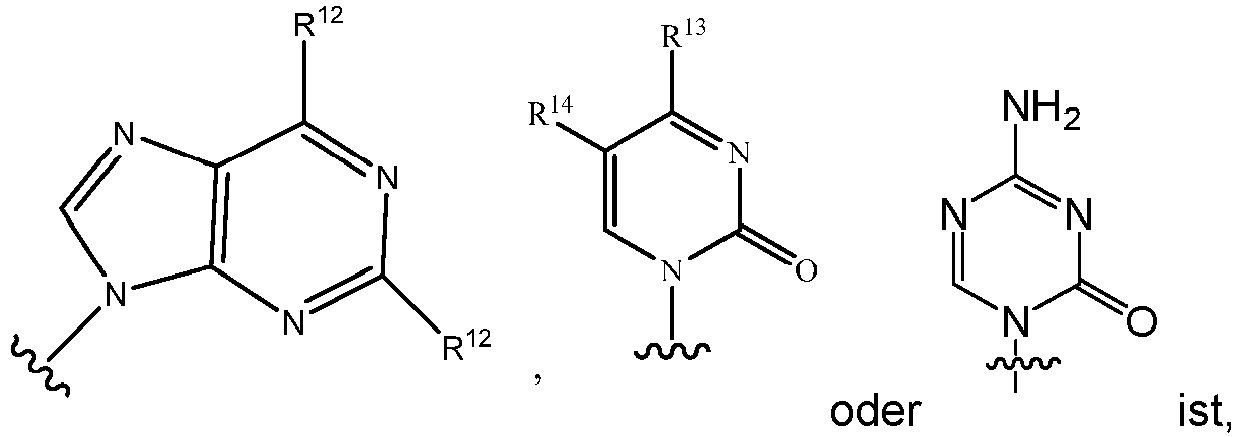 R12 unabhängig Wasserstoff, Hydroxy, ORa, Chlor, Brom, Fluor, Iod, Sulfanyl, -NRbRc oder -C1-10-Alkyl-NRbRc ist,R13 Wasserstoff, Hydroxy, -NRbRc, Azido, Oxo oder -ORa ist,R14 Wasserstoff, Methyl, Hydroxy, Chlor, Brom, Fluor, lod oder-NRbRc ist,Ra unabhängig C1-10-Alkyl oder C3-10-Cycloalkyl ist, undjeder der Reste Rb und Rc unabhängig Wasserstoff, C1-10-Alkyl, C1-10-Alkylcarbonyl, C2-10-Alkenyl, C2-10-Alkinyl, C3-10-Cycloalkyl, Aryl, Heterocyclus oder Heteroaryl ist.
 - Eine Verbindung nach einem vorhergehenden Anspruch, wobei Base

- Eine Verbindung, ausgewählt aus den folgenden Verbindungen:


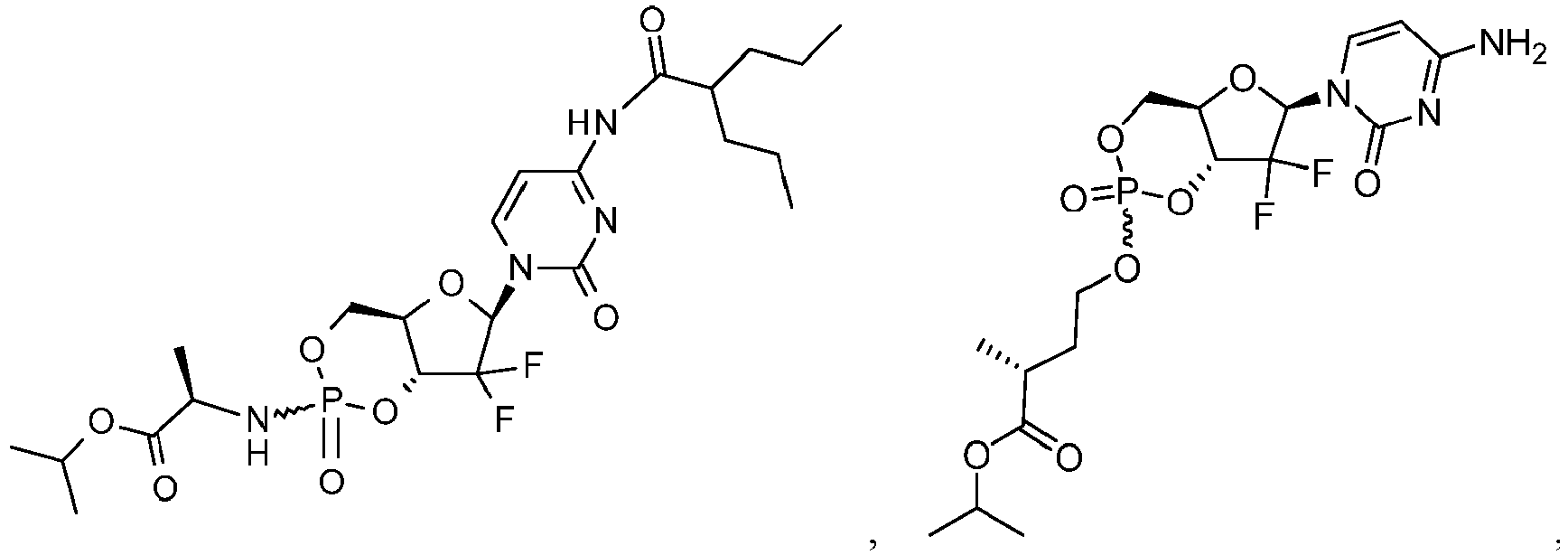


- Eine pharmazeutische Zusammensetzung, die eine Verbindung nach einem vorhergehenden Anspruch oder ein pharmazeutisch annehmbares Salz davon zusammen mit einem pharmazeutisch annehmbaren Träger oder Verdünnungsmittel umfasst.
- Eine Verbindung nach einem der Ansprüche 1 bis 5 oder ein pharmazeutisches Salz davon zur Verwendung in der Therapie.
- Eine Verbindung nach einem der Ansprüche 1 bis 5 oder ein pharmazeutisches Salz davon zur Verwendung bei der Behandlung oder Prävention von Krebs.
- Eine Kombination, die eine Verbindung nach einem der Ansprüche 1-5 oder ein pharmazeutisch annehmbares Salz davon und ein, zwei, drei oder mehr andere therapeutische Mittel umfasst.
- Eine Kombination nach Anspruch 9 zur Verwendung bei der Behandlung von Krebs.
Applications Claiming Priority (2)
| Application Number | Priority Date | Filing Date | Title |
|---|---|---|---|
| EP15305802 | 2015-05-27 | ||
| PCT/EP2016/061549 WO2016188943A1 (en) | 2015-05-27 | 2016-05-23 | Nucleotides for the treatment of cancer |
Publications (2)
| Publication Number | Publication Date |
|---|---|
| EP3303359A1 EP3303359A1 (de) | 2018-04-11 |
| EP3303359B1 true EP3303359B1 (de) | 2024-11-06 |
Family
ID=53298296
Family Applications (1)
| Application Number | Title | Priority Date | Filing Date |
|---|---|---|---|
| EP16724066.2A Active EP3303359B1 (de) | 2015-05-27 | 2016-05-23 | Nukleotide zur behandlung von krebs |
Country Status (4)
| Country | Link |
|---|---|
| US (1) | US10766917B2 (de) |
| EP (1) | EP3303359B1 (de) |
| TW (1) | TW201700492A (de) |
| WO (1) | WO2016188943A1 (de) |
Families Citing this family (14)
| Publication number | Priority date | Publication date | Assignee | Title |
|---|---|---|---|---|
| WO2016078163A1 (zh) * | 2014-11-17 | 2016-05-26 | 常州方圆制药有限公司 | 新型胞苷衍生物二聚体及其应用 |
| EP3471738A4 (de) * | 2016-06-20 | 2020-01-01 | Merck Sharp & Dohme Corp. | Cyclische phosphonatsubstituierte nukleosidderivate und verfahren zur verwendung davon zur behandlung von viruserkrankungen |
| US10202412B2 (en) | 2016-07-08 | 2019-02-12 | Atea Pharmaceuticals, Inc. | β-D-2′-deoxy-2′-substituted-4′-substituted-2-substituted-N6-substituted-6-aminopurinenucleotides for the treatment of paramyxovirus and orthomyxovirus infections |
| US20190365788A1 (en) * | 2016-11-21 | 2019-12-05 | Idenix Pharmaceuticals Llc | Cyclic phosphate substituted nucleoside derivatives for the treatment of liver diseases |
| EP3661513A4 (de) * | 2017-07-31 | 2021-07-14 | January Therapeutics, Inc. | Organophosphat-derivate |
| US20210038628A1 (en) * | 2018-03-02 | 2021-02-11 | January Therapeutics, Inc. | Nanoparticle compositions |
| WO2020041050A1 (en) * | 2018-08-20 | 2020-02-27 | Cure Biopharma Inc. | Gemcitabine prodrugs |
| CN113164773B (zh) * | 2018-10-17 | 2025-03-21 | 廖细斌 | 6-巯基嘌呤核苷类似物 |
| CN109651468A (zh) * | 2018-12-20 | 2019-04-19 | 刘洪海 | 具有抑制病毒复制活性的核苷氨基磷酸酯类似物、制备方法及其药物用途 |
| US11708637B2 (en) * | 2019-08-13 | 2023-07-25 | The Regents Of The University Of California | Methods of supporting a graphene sheet disposed on a frame support |
| CN115819483B (zh) * | 2021-09-17 | 2026-04-28 | 南京知和医药科技有限公司 | 用于治疗癌症的核苷类衍生物及其用途 |
| CN114349816B (zh) * | 2021-11-30 | 2024-08-30 | 潍坊博创国际生物医药研究院 | 一种基于氨肽酶n/cd13的小分子偶联分子及其制备方法和应用 |
| CN114031657B (zh) * | 2021-12-06 | 2023-08-15 | 中国海洋大学 | 一种吉西他滨环磷酸酯前药及其制备方法和应用 |
| CN119143827B (zh) * | 2024-11-14 | 2025-03-11 | 上海柯君医药科技有限公司 | 一种抗肿瘤药物及其用途 |
Citations (3)
| Publication number | Priority date | Publication date | Assignee | Title |
|---|---|---|---|---|
| WO2012088155A1 (en) * | 2010-12-22 | 2012-06-28 | Alios Biopharma, Inc. | Cyclic nucleotide analogs |
| WO2015081297A1 (en) * | 2013-11-27 | 2015-06-04 | Idenix Pharmaceuticals, Inc. | 2'-dichloro and 2'-fluoro-2'-chloro nucleoside analogues for hcv infection |
| WO2015134334A1 (en) * | 2014-03-03 | 2015-09-11 | Suo Zucai | Gemcitabine analogs |
Family Cites Families (12)
| Publication number | Priority date | Publication date | Assignee | Title |
|---|---|---|---|---|
| US3804827A (en) | 1972-02-28 | 1974-04-16 | Icn Pharmaceuticals | 1-beta-d-arabinofuranosylcytosine-3',5'-cyclic phosphate and derivatives thereof |
| ES2401285T3 (es) | 2004-12-16 | 2013-04-18 | The Regents Of The University Of California | Fármacos con el pulmón como diana |
| US20090060866A1 (en) | 2007-08-31 | 2009-03-05 | Idenix Pharmaceuticals, Inc. | Phosphadiazine hcv polymerase inhibitors i and ii |
| US8173621B2 (en) * | 2008-06-11 | 2012-05-08 | Gilead Pharmasset Llc | Nucleoside cyclicphosphates |
| JP5690286B2 (ja) | 2009-03-04 | 2015-03-25 | イデニク プハルマセウティカルス,インコーポレイテッド | ホスホチオフェン及びホスホチアゾールhcvポリメラーゼ阻害剤 |
| WO2012040126A1 (en) | 2010-09-22 | 2012-03-29 | Alios Biopharma, Inc. | Substituted nucleotide analogs |
| GB201016855D0 (en) | 2010-10-06 | 2010-11-17 | Nucana Biomed Ltd | Chemical compounds |
| KR101231925B1 (ko) | 2010-10-27 | 2013-02-08 | 씨제이제일제당 (주) | 젬시타빈의 전구약물 및 이의 제조방법 |
| US9156874B2 (en) | 2011-01-03 | 2015-10-13 | Nanjing Molecular Research, Inc. | Double-liver-targeting phosphoramidate and phosphonoamidate prodrugs |
| US20130131008A1 (en) | 2011-10-25 | 2013-05-23 | Board Of Regents, The University Of Texas System | Lipophilic monophosphorylated derivatives and nanoparticles |
| CN105934438A (zh) | 2013-11-27 | 2016-09-07 | 艾登尼克斯药业有限公司 | 用于治疗肝癌的核苷酸 |
| KR20170005492A (ko) | 2014-05-28 | 2017-01-13 | 아이데닉스 파마슈티칼스 엘엘씨 | 암의 치료를 위한 뉴클레오시드 유도체 |
-
2016
- 2016-05-23 EP EP16724066.2A patent/EP3303359B1/de active Active
- 2016-05-23 US US15/576,948 patent/US10766917B2/en active Active
- 2016-05-23 WO PCT/EP2016/061549 patent/WO2016188943A1/en not_active Ceased
- 2016-05-26 TW TW105116518A patent/TW201700492A/zh unknown
Patent Citations (3)
| Publication number | Priority date | Publication date | Assignee | Title |
|---|---|---|---|---|
| WO2012088155A1 (en) * | 2010-12-22 | 2012-06-28 | Alios Biopharma, Inc. | Cyclic nucleotide analogs |
| WO2015081297A1 (en) * | 2013-11-27 | 2015-06-04 | Idenix Pharmaceuticals, Inc. | 2'-dichloro and 2'-fluoro-2'-chloro nucleoside analogues for hcv infection |
| WO2015134334A1 (en) * | 2014-03-03 | 2015-09-11 | Suo Zucai | Gemcitabine analogs |
Also Published As
| Publication number | Publication date |
|---|---|
| US20180155385A1 (en) | 2018-06-07 |
| EP3303359A1 (de) | 2018-04-11 |
| TW201700492A (zh) | 2017-01-01 |
| WO2016188943A1 (en) | 2016-12-01 |
| US10766917B2 (en) | 2020-09-08 |
Similar Documents
| Publication | Publication Date | Title |
|---|---|---|
| EP3303359B1 (de) | Nukleotide zur behandlung von krebs | |
| CA3220447C (en) | SOLID FORMS OF A THIENOPYRIMIDINEDIONE ACC INHIBITOR AND THEIR PRODUCTION PROCESSES | |
| KR20230051252A (ko) | 통증의 치료를 위한 nav 1.7의 비수화 케톤 억제제 | |
| JP2017504572A (ja) | 肝臓癌治療のためのヌクレオチド類 | |
| JP2017516779A (ja) | 癌治療のためのヌクレオシド誘導体 | |
| EP3541825B1 (de) | Cyclische phosphatsubstituierte nukleosidderivate zur behandlung von lebererkrankungen | |
| US10815264B2 (en) | Nucleotides for the treatment of cancer | |
| CA2944549A1 (en) | 10',11'-modified saxitoxin useful for the treatment of pain | |
| KR20150086325A (ko) | 바이러스성 질환을 치료하기 위한 2''-알키닐 치환된 뉴클레오시드 유도체 | |
| EP3149017B1 (de) | Nukleosidderivate zur behandlung von krebs | |
| EP3471737B1 (de) | Cyclische phosphonatsubstituierte nukleosidverbindung und verfahren zur verwendung davon für die behandlung von viruserkrankungen | |
| US20200179428A1 (en) | Cyclic phosphate substituted nucleoside derivatives and methods of use thereof for the treatment of viral diseases |
Legal Events
| Date | Code | Title | Description |
|---|---|---|---|
| STAA | Information on the status of an ep patent application or granted ep patent |
Free format text: STATUS: THE INTERNATIONAL PUBLICATION HAS BEEN MADE |
|
| PUAI | Public reference made under article 153(3) epc to a published international application that has entered the european phase |
Free format text: ORIGINAL CODE: 0009012 |
|
| STAA | Information on the status of an ep patent application or granted ep patent |
Free format text: STATUS: REQUEST FOR EXAMINATION WAS MADE |
|
| 17P | Request for examination filed |
Effective date: 20180102 |
|
| AK | Designated contracting states |
Kind code of ref document: A1 Designated state(s): AL AT BE BG CH CY CZ DE DK EE ES FI FR GB GR HR HU IE IS IT LI LT LU LV MC MK MT NL NO PL PT RO RS SE SI SK SM TR |
|
| AX | Request for extension of the european patent |
Extension state: BA ME |
|
| DAV | Request for validation of the european patent (deleted) | ||
| DAX | Request for extension of the european patent (deleted) | ||
| STAA | Information on the status of an ep patent application or granted ep patent |
Free format text: STATUS: EXAMINATION IS IN PROGRESS |
|
| 17Q | First examination report despatched |
Effective date: 20200129 |
|
| GRAP | Despatch of communication of intention to grant a patent |
Free format text: ORIGINAL CODE: EPIDOSNIGR1 |
|
| STAA | Information on the status of an ep patent application or granted ep patent |
Free format text: STATUS: GRANT OF PATENT IS INTENDED |
|
| INTG | Intention to grant announced |
Effective date: 20240527 |
|
| GRAS | Grant fee paid |
Free format text: ORIGINAL CODE: EPIDOSNIGR3 |
|
| GRAA | (expected) grant |
Free format text: ORIGINAL CODE: 0009210 |
|
| STAA | Information on the status of an ep patent application or granted ep patent |
Free format text: STATUS: THE PATENT HAS BEEN GRANTED |
|
| AK | Designated contracting states |
Kind code of ref document: B1 Designated state(s): AL AT BE BG CH CY CZ DE DK EE ES FI FR GB GR HR HU IE IS IT LI LT LU LV MC MK MT NL NO PL PT RO RS SE SI SK SM TR |
|
| REG | Reference to a national code |
Ref country code: GB Ref legal event code: FG4D |
|
| REG | Reference to a national code |
Ref country code: CH Ref legal event code: EP |
|
| REG | Reference to a national code |
Ref country code: DE Ref legal event code: R096 Ref document number: 602016090122 Country of ref document: DE |
|
| REG | Reference to a national code |
Ref country code: IE Ref legal event code: FG4D |
|
| REG | Reference to a national code |
Ref country code: LT Ref legal event code: MG9D |
|
| REG | Reference to a national code |
Ref country code: NL Ref legal event code: MP Effective date: 20241106 |
|
| PG25 | Lapsed in a contracting state [announced via postgrant information from national office to epo] |
Ref country code: HR Free format text: LAPSE BECAUSE OF FAILURE TO SUBMIT A TRANSLATION OF THE DESCRIPTION OR TO PAY THE FEE WITHIN THE PRESCRIBED TIME-LIMIT Effective date: 20241106 Ref country code: PT Free format text: LAPSE BECAUSE OF FAILURE TO SUBMIT A TRANSLATION OF THE DESCRIPTION OR TO PAY THE FEE WITHIN THE PRESCRIBED TIME-LIMIT Effective date: 20250306 Ref country code: IS Free format text: LAPSE BECAUSE OF FAILURE TO SUBMIT A TRANSLATION OF THE DESCRIPTION OR TO PAY THE FEE WITHIN THE PRESCRIBED TIME-LIMIT Effective date: 20250306 |
|
| PG25 | Lapsed in a contracting state [announced via postgrant information from national office to epo] |
Ref country code: NL Free format text: LAPSE BECAUSE OF FAILURE TO SUBMIT A TRANSLATION OF THE DESCRIPTION OR TO PAY THE FEE WITHIN THE PRESCRIBED TIME-LIMIT Effective date: 20241106 Ref country code: FI Free format text: LAPSE BECAUSE OF FAILURE TO SUBMIT A TRANSLATION OF THE DESCRIPTION OR TO PAY THE FEE WITHIN THE PRESCRIBED TIME-LIMIT Effective date: 20241106 |
|
| REG | Reference to a national code |
Ref country code: AT Ref legal event code: MK05 Ref document number: 1739267 Country of ref document: AT Kind code of ref document: T Effective date: 20241106 |
|
| PG25 | Lapsed in a contracting state [announced via postgrant information from national office to epo] |
Ref country code: BG Free format text: LAPSE BECAUSE OF FAILURE TO SUBMIT A TRANSLATION OF THE DESCRIPTION OR TO PAY THE FEE WITHIN THE PRESCRIBED TIME-LIMIT Effective date: 20241106 |
|
| PG25 | Lapsed in a contracting state [announced via postgrant information from national office to epo] |
Ref country code: ES Free format text: LAPSE BECAUSE OF FAILURE TO SUBMIT A TRANSLATION OF THE DESCRIPTION OR TO PAY THE FEE WITHIN THE PRESCRIBED TIME-LIMIT Effective date: 20241106 |
|
| PG25 | Lapsed in a contracting state [announced via postgrant information from national office to epo] |
Ref country code: NO Free format text: LAPSE BECAUSE OF FAILURE TO SUBMIT A TRANSLATION OF THE DESCRIPTION OR TO PAY THE FEE WITHIN THE PRESCRIBED TIME-LIMIT Effective date: 20250206 |
|
| PG25 | Lapsed in a contracting state [announced via postgrant information from national office to epo] |
Ref country code: LV Free format text: LAPSE BECAUSE OF FAILURE TO SUBMIT A TRANSLATION OF THE DESCRIPTION OR TO PAY THE FEE WITHIN THE PRESCRIBED TIME-LIMIT Effective date: 20241106 Ref country code: GR Free format text: LAPSE BECAUSE OF FAILURE TO SUBMIT A TRANSLATION OF THE DESCRIPTION OR TO PAY THE FEE WITHIN THE PRESCRIBED TIME-LIMIT Effective date: 20250207 Ref country code: AT Free format text: LAPSE BECAUSE OF FAILURE TO SUBMIT A TRANSLATION OF THE DESCRIPTION OR TO PAY THE FEE WITHIN THE PRESCRIBED TIME-LIMIT Effective date: 20241106 |
|
| PG25 | Lapsed in a contracting state [announced via postgrant information from national office to epo] |
Ref country code: PL Free format text: LAPSE BECAUSE OF FAILURE TO SUBMIT A TRANSLATION OF THE DESCRIPTION OR TO PAY THE FEE WITHIN THE PRESCRIBED TIME-LIMIT Effective date: 20241106 |
|
| PG25 | Lapsed in a contracting state [announced via postgrant information from national office to epo] |
Ref country code: RS Free format text: LAPSE BECAUSE OF FAILURE TO SUBMIT A TRANSLATION OF THE DESCRIPTION OR TO PAY THE FEE WITHIN THE PRESCRIBED TIME-LIMIT Effective date: 20250206 |
|
| PG25 | Lapsed in a contracting state [announced via postgrant information from national office to epo] |
Ref country code: SM Free format text: LAPSE BECAUSE OF FAILURE TO SUBMIT A TRANSLATION OF THE DESCRIPTION OR TO PAY THE FEE WITHIN THE PRESCRIBED TIME-LIMIT Effective date: 20241106 |
|
| PGFP | Annual fee paid to national office [announced via postgrant information from national office to epo] |
Ref country code: DE Payment date: 20250409 Year of fee payment: 10 |
|
| PG25 | Lapsed in a contracting state [announced via postgrant information from national office to epo] |
Ref country code: DK Free format text: LAPSE BECAUSE OF FAILURE TO SUBMIT A TRANSLATION OF THE DESCRIPTION OR TO PAY THE FEE WITHIN THE PRESCRIBED TIME-LIMIT Effective date: 20241106 |
|
| PG25 | Lapsed in a contracting state [announced via postgrant information from national office to epo] |
Ref country code: EE Free format text: LAPSE BECAUSE OF FAILURE TO SUBMIT A TRANSLATION OF THE DESCRIPTION OR TO PAY THE FEE WITHIN THE PRESCRIBED TIME-LIMIT Effective date: 20241106 |
|
| PGFP | Annual fee paid to national office [announced via postgrant information from national office to epo] |
Ref country code: FR Payment date: 20250409 Year of fee payment: 10 |
|
| PG25 | Lapsed in a contracting state [announced via postgrant information from national office to epo] |
Ref country code: RO Free format text: LAPSE BECAUSE OF FAILURE TO SUBMIT A TRANSLATION OF THE DESCRIPTION OR TO PAY THE FEE WITHIN THE PRESCRIBED TIME-LIMIT Effective date: 20241106 |
|
| PG25 | Lapsed in a contracting state [announced via postgrant information from national office to epo] |
Ref country code: SK Free format text: LAPSE BECAUSE OF FAILURE TO SUBMIT A TRANSLATION OF THE DESCRIPTION OR TO PAY THE FEE WITHIN THE PRESCRIBED TIME-LIMIT Effective date: 20241106 |
|
| PG25 | Lapsed in a contracting state [announced via postgrant information from national office to epo] |
Ref country code: CZ Free format text: LAPSE BECAUSE OF FAILURE TO SUBMIT A TRANSLATION OF THE DESCRIPTION OR TO PAY THE FEE WITHIN THE PRESCRIBED TIME-LIMIT Effective date: 20241106 |
|
| PG25 | Lapsed in a contracting state [announced via postgrant information from national office to epo] |
Ref country code: IT Free format text: LAPSE BECAUSE OF FAILURE TO SUBMIT A TRANSLATION OF THE DESCRIPTION OR TO PAY THE FEE WITHIN THE PRESCRIBED TIME-LIMIT Effective date: 20241106 |
|
| REG | Reference to a national code |
Ref country code: DE Ref legal event code: R097 Ref document number: 602016090122 Country of ref document: DE |
|
| PG25 | Lapsed in a contracting state [announced via postgrant information from national office to epo] |
Ref country code: SE Free format text: LAPSE BECAUSE OF FAILURE TO SUBMIT A TRANSLATION OF THE DESCRIPTION OR TO PAY THE FEE WITHIN THE PRESCRIBED TIME-LIMIT Effective date: 20241106 |
|
| PLBE | No opposition filed within time limit |
Free format text: ORIGINAL CODE: 0009261 |
|
| STAA | Information on the status of an ep patent application or granted ep patent |
Free format text: STATUS: NO OPPOSITION FILED WITHIN TIME LIMIT |
|
| 26N | No opposition filed |
Effective date: 20250807 |
|
| REG | Reference to a national code |
Ref country code: CH Ref legal event code: H13 Free format text: ST27 STATUS EVENT CODE: U-0-0-H10-H13 (AS PROVIDED BY THE NATIONAL OFFICE) Effective date: 20251223 |
|
| PG25 | Lapsed in a contracting state [announced via postgrant information from national office to epo] |
Ref country code: LU Free format text: LAPSE BECAUSE OF NON-PAYMENT OF DUE FEES Effective date: 20250523 |
|
| PG25 | Lapsed in a contracting state [announced via postgrant information from national office to epo] |
Ref country code: CH Free format text: LAPSE BECAUSE OF NON-PAYMENT OF DUE FEES Effective date: 20250531 |
|
| REG | Reference to a national code |
Ref country code: BE Ref legal event code: MM Effective date: 20250531 |
|
| PG25 | Lapsed in a contracting state [announced via postgrant information from national office to epo] |
Ref country code: MC Free format text: LAPSE BECAUSE OF FAILURE TO SUBMIT A TRANSLATION OF THE DESCRIPTION OR TO PAY THE FEE WITHIN THE PRESCRIBED TIME-LIMIT Effective date: 20241106 |
|
| PGFP | Annual fee paid to national office [announced via postgrant information from national office to epo] |
Ref country code: GB Payment date: 20260320 Year of fee payment: 11 |
|
| PG25 | Lapsed in a contracting state [announced via postgrant information from national office to epo] |
Ref country code: IE Free format text: LAPSE BECAUSE OF NON-PAYMENT OF DUE FEES Effective date: 20250523 |
|
| PG25 | Lapsed in a contracting state [announced via postgrant information from national office to epo] |
Ref country code: BE Free format text: LAPSE BECAUSE OF NON-PAYMENT OF DUE FEES Effective date: 20250531 |