EP3299413A1 - Rubber composition for a tire tread - Google Patents
Rubber composition for a tire tread Download PDFInfo
- Publication number
- EP3299413A1 EP3299413A1 EP17172741.5A EP17172741A EP3299413A1 EP 3299413 A1 EP3299413 A1 EP 3299413A1 EP 17172741 A EP17172741 A EP 17172741A EP 3299413 A1 EP3299413 A1 EP 3299413A1
- Authority
- EP
- European Patent Office
- Prior art keywords
- rubber
- weight
- parts
- performance
- tire
- Prior art date
- Legal status (The legal status is an assumption and is not a legal conclusion. Google has not performed a legal analysis and makes no representation as to the accuracy of the status listed.)
- Granted
Links
Classifications
-
- C—CHEMISTRY; METALLURGY
- C08—ORGANIC MACROMOLECULAR COMPOUNDS; THEIR PREPARATION OR CHEMICAL WORKING-UP; COMPOSITIONS BASED THEREON
- C08L—COMPOSITIONS OF MACROMOLECULAR COMPOUNDS
- C08L21/00—Compositions of unspecified rubbers
-
- C—CHEMISTRY; METALLURGY
- C08—ORGANIC MACROMOLECULAR COMPOUNDS; THEIR PREPARATION OR CHEMICAL WORKING-UP; COMPOSITIONS BASED THEREON
- C08L—COMPOSITIONS OF MACROMOLECULAR COMPOUNDS
- C08L9/00—Compositions of homopolymers or copolymers of conjugated diene hydrocarbons
-
- B—PERFORMING OPERATIONS; TRANSPORTING
- B60—VEHICLES IN GENERAL
- B60C—VEHICLE TYRES; TYRE INFLATION; TYRE CHANGING; CONNECTING VALVES TO INFLATABLE ELASTIC BODIES IN GENERAL; DEVICES OR ARRANGEMENTS RELATED TO TYRES
- B60C1/00—Tyres characterised by the chemical composition or the physical arrangement or mixture of the composition
- B60C1/0016—Compositions of the tread
-
- C—CHEMISTRY; METALLURGY
- C08—ORGANIC MACROMOLECULAR COMPOUNDS; THEIR PREPARATION OR CHEMICAL WORKING-UP; COMPOSITIONS BASED THEREON
- C08K—Use of inorganic or non-macromolecular organic substances as compounding ingredients
- C08K5/00—Use of organic ingredients
- C08K5/54—Silicon-containing compounds
- C08K5/541—Silicon-containing compounds containing oxygen
- C08K5/5415—Silicon-containing compounds containing oxygen containing at least one Si—O bond
-
- C—CHEMISTRY; METALLURGY
- C08—ORGANIC MACROMOLECULAR COMPOUNDS; THEIR PREPARATION OR CHEMICAL WORKING-UP; COMPOSITIONS BASED THEREON
- C08K—Use of inorganic or non-macromolecular organic substances as compounding ingredients
- C08K5/00—Use of organic ingredients
- C08K5/54—Silicon-containing compounds
- C08K5/548—Silicon-containing compounds containing sulfur
-
- C—CHEMISTRY; METALLURGY
- C08—ORGANIC MACROMOLECULAR COMPOUNDS; THEIR PREPARATION OR CHEMICAL WORKING-UP; COMPOSITIONS BASED THEREON
- C08L—COMPOSITIONS OF MACROMOLECULAR COMPOUNDS
- C08L7/00—Compositions of natural rubber
-
- C—CHEMISTRY; METALLURGY
- C08—ORGANIC MACROMOLECULAR COMPOUNDS; THEIR PREPARATION OR CHEMICAL WORKING-UP; COMPOSITIONS BASED THEREON
- C08L—COMPOSITIONS OF MACROMOLECULAR COMPOUNDS
- C08L9/00—Compositions of homopolymers or copolymers of conjugated diene hydrocarbons
- C08L9/06—Copolymers with styrene
-
- C—CHEMISTRY; METALLURGY
- C08—ORGANIC MACROMOLECULAR COMPOUNDS; THEIR PREPARATION OR CHEMICAL WORKING-UP; COMPOSITIONS BASED THEREON
- C08L—COMPOSITIONS OF MACROMOLECULAR COMPOUNDS
- C08L93/00—Compositions of natural resins; Compositions of derivatives thereof
-
- C—CHEMISTRY; METALLURGY
- C08—ORGANIC MACROMOLECULAR COMPOUNDS; THEIR PREPARATION OR CHEMICAL WORKING-UP; COMPOSITIONS BASED THEREON
- C08K—Use of inorganic or non-macromolecular organic substances as compounding ingredients
- C08K3/00—Use of inorganic substances as compounding ingredients
- C08K3/02—Elements
- C08K3/04—Carbon
-
- C—CHEMISTRY; METALLURGY
- C08—ORGANIC MACROMOLECULAR COMPOUNDS; THEIR PREPARATION OR CHEMICAL WORKING-UP; COMPOSITIONS BASED THEREON
- C08K—Use of inorganic or non-macromolecular organic substances as compounding ingredients
- C08K3/00—Use of inorganic substances as compounding ingredients
- C08K3/34—Silicon-containing compounds
- C08K3/36—Silica
-
- C—CHEMISTRY; METALLURGY
- C08—ORGANIC MACROMOLECULAR COMPOUNDS; THEIR PREPARATION OR CHEMICAL WORKING-UP; COMPOSITIONS BASED THEREON
- C08L—COMPOSITIONS OF MACROMOLECULAR COMPOUNDS
- C08L2205/00—Polymer mixtures characterised by other features
- C08L2205/02—Polymer mixtures characterised by other features containing two or more polymers of the same C08L -group
-
- C—CHEMISTRY; METALLURGY
- C08—ORGANIC MACROMOLECULAR COMPOUNDS; THEIR PREPARATION OR CHEMICAL WORKING-UP; COMPOSITIONS BASED THEREON
- C08L—COMPOSITIONS OF MACROMOLECULAR COMPOUNDS
- C08L2205/00—Polymer mixtures characterised by other features
- C08L2205/02—Polymer mixtures characterised by other features containing two or more polymers of the same C08L -group
- C08L2205/025—Polymer mixtures characterised by other features containing two or more polymers of the same C08L -group containing two or more polymers of the same hierarchy C08L, and differing only in parameters such as density, comonomer content, molecular weight, structure
-
- C—CHEMISTRY; METALLURGY
- C08—ORGANIC MACROMOLECULAR COMPOUNDS; THEIR PREPARATION OR CHEMICAL WORKING-UP; COMPOSITIONS BASED THEREON
- C08L—COMPOSITIONS OF MACROMOLECULAR COMPOUNDS
- C08L2205/00—Polymer mixtures characterised by other features
- C08L2205/03—Polymer mixtures characterised by other features containing three or more polymers in a blend
-
- C—CHEMISTRY; METALLURGY
- C08—ORGANIC MACROMOLECULAR COMPOUNDS; THEIR PREPARATION OR CHEMICAL WORKING-UP; COMPOSITIONS BASED THEREON
- C08L—COMPOSITIONS OF MACROMOLECULAR COMPOUNDS
- C08L2205/00—Polymer mixtures characterised by other features
- C08L2205/03—Polymer mixtures characterised by other features containing three or more polymers in a blend
- C08L2205/035—Polymer mixtures characterised by other features containing three or more polymers in a blend containing four or more polymers in a blend
Definitions
- the present invention relates to a rubber composition for a tire, and more particularly, to a rubber composition for a tire tread, which comprises 6 to 20 parts by weight ('wt. part') of a silane coupling agent having a mercapto group and a SiO bond; and 1 to 20 wt. parts of terpene resin having a softening point (determined acc. to ASTM 6090-12) of 130 °C or more and a weight average molecular weight of 1,000 or more, to 100 wt. parts of raw rubber.
- a tire should maintain stable running ability, braking performance and low fuel consumption (that is, high fuel efficiency) in various environments such as ice roads, wet surfaces, snow surfaces, etc.
- braking performance that is, high fuel efficiency
- RR rolling resistance
- Tg glass transition temperature
- snow grip performance is inversely proportional to the Tg.
- the tire should maintain stable running ability and braking performance under diverse environments, that is, ice roads, wet surfaces, snow surfaces, and the like, and in order to satisfy different tire labeling regulations in all countries of the world, maintaining and promoting the wet grip and RR performances to at least a predetermined level for sale have been required.
- Korean Patent Laid-Open Publication No. 10-2015-0132607 discloses a rubber composition which comprises 50 to 80 wt. parts of an inorganic filler containing silica and carbon black and further 1 to 20 wt. parts of an aromatic modified terpene resin having a softening point of 100 °C or more, to 100 wt. parts of diene rubber, wherein the diene rubber comprises 50 to 80% by weight ('wt.%) of end modified styrene-butadiene rubber and wherein the modified styrene-butadiene rubber has 40 wt.% or more of vinyl units and 20 to 50 wt.% of butadiene units.
- the rubber composition for a tire according to the above patent publication No. 10-2015-0132607 involves a problem of not attaining snow performance although rolling-resistant ability, wet grip performance and abrasion-resistance are improved.
- Korean Patent Laid-Open Publication No. 10-2015-0052144 discloses a rubber composition for a tire tread, which may improve rolling-resistant ability and wet grip performance to known levels or more while maintaining and enhancing extrusion processibility, and is characterized in that: the rubber composition comprises 60 to 130 wt. parts of silica to 100 wt.
- diene rubber wherein the diene rubber comprises at least 50 wt.% of hydroxyl group-containing modified styrene-butadiene rubber; a weight ratio of oil to a silica-containing filler of 0.25 or less; a silane coupling agent having a mercapto group and Si-O bond is comprised in an amount of 4 to 15 wt.% to a total amount of silica; and diethyleneglycol is mixed in an amount of 1 to 6 wt.% to the total amount of silica.
- the rubber composition for a tire tread according to the above patent publication No. 10-2015-0052144 involves problems of not securing desired snow performance and abrasion resistance although rolling-resistant ability and wet grip performance are improved.
- a rubber composition for a tire tread comprising: 6 to 20 parts by weight of a silane coupling agent having a mercapto group and a SiO bond; and 1 to 20 parts by weight of a terpene resin having a softening point (determined acc. to ASTM 6090-12) of 130 °C or more and a weight average molecular weight of 1,000 or more (determined by gel permeation chromatography (GPC)), to 100 parts by weight of raw rubber.
- a softening point determined acc. to ASTM 6090-12
- GPC gel permeation chromatography
- the rubber composition for a tire tread of the present invention comprises a silane coupling agent having a mercapto group and SiO bond in order to improve trade-off performances, that is, wet grip performance and snow grip performance, thus to improve processibility, especially mixing processibility, abrasion resistance, RR performance and wet grip performance. Additionally, the rubber composition for a tire tread of the present invention comprises a terpene resin having a softening point (determined acc. to ASTM 6090-12) of 130 °C or more and a molecular weight of 1,000 or more, in order to improve the wet grip performance and snow grip performance while maintaining the enhanced abrasion resistance and RR performance.
- the present invention provides a rubber composition for a tire tread, which comprises: 6 to 20 wt. parts of a silane coupling agent having a mercapto group and SiO bond; and 1 to 20 wt. parts of terpene resin having a softening point (determined acc. to ASTM 6090-12) of 130 °C or more and a weight average molecular weight of 1,000 or more, to 100 wt. parts of raw rubber.
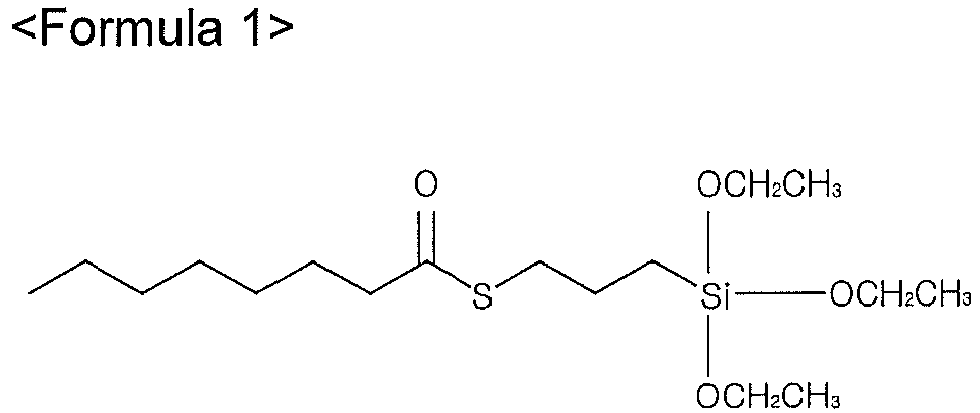
- the silane coupling agent having a mercapto group and SiO bond may comprise 3-(octanoylthio)propyl triethoxysilane represented by Formula 1 below:
- the terpene resin preferably has a softening point (determined acc. to ASTM 6090-12) of 130 to 180 C°, and a weight average molecular weight of 1,000 to 2,000.
- the silane coupling agent is comprised in an amount of less than 6 wt. parts to 100 wt. parts of the raw rubber, the tensile strength is reduced and causes a problem in processibility. If the silane coupling agent is comprised in an amount of exceeding 20 wt. parts, tension properties are reduced and a problem entailed in extrusion processibility may occur.
- the terpene resin is comprised in an amount of less than 1 wt. part to 100 wt. parts of the raw rubber, the desired purpose of improving the wet grip which goes along with the addition of the terpene resin may not be achieved since the content of the terpene resin is too small. On the other hand, if the terpene resin is comprised in an amount of exceeding 20 wt. parts, problems entailed in the uniformity of the tire building during the manufacturing process may occur.
- the raw rubber may be natural rubber, synthetic rubber or a mixture thereof.
- the types of the synthetic rubber are not particularly limited and may comprise, for example, styrene-butadiene rubber, butadiene rubber, butyl rubber, emulsion-polymerized styrene-butadiene rubber (E-SBR), solution-polymerized styrene-butadiene rubber (S-SBR), epichlorohydrin rubber, nitrile rubber, hydrogenated nitrile rubber, brominated polyisobutyl isoprene-co-paramethyl styrene (BIMS) rubber, urethane rubber, fluorine rubber, silicone rubber, styrene ethylene butadiene styrene copolymer rubber, ethylene propylene rubber, ethylene propylene diene monomer rubber, Hypalon rubber, chloroprene rubber, ethylene vinyl acetate rubber, acryl rubber, and the like.
- E-SBR emulsion-polymerized styrene-buta
- the raw rubber may be a diene rubber comprising:
- the end modified styrene-butadiene rubber may be a Sn end modified styrene-butadiene rubber (SSBR). Moreover, the end modified styrene-butadiene rubber preferably exhibits a low Tg (low Tg SSBR).
- SSBR Sn end modified styrene-butadiene rubber
- Sn end modified styrene-butadiene rubber exhibits affinity properties to both silica and carbon, thereby improving the abrasion resistance of the rubber, compared to non end modified SBR.
- the glass transition temperature Tg (determined by DSC at 10°K/min) in the low Tg Sn modified SBR is as low as -70 to -50 °C, preferably -65 to -55 °C.
- the Tg of Sn modified SBR is controlled by the content of micro-structure (Styrene, Vinyl), which in turn is closely related to the braking performance. The higher the content of micro-structure (Styrene, Vinyl), the better the braking performance. This means that the snow/wear performance can be improved with a lowering of the Tg. However, when the Tg is below -70 °C, the micro-structure (Styrene, Vinyl) content is too low and the braking performance is poor.
- the preferred low Tg SSBR has the above defined micro-structure (styrene: 20 wt.% or less, vinyl: 30 wt. % or less) which results in an improved snow grip performance. This means that wet grip and dry grip performances may be enhanced while at the same time the abrasion resistance and the snow grip is maintained at a good level.
- the rubber composition for a tire of the present invention may further comprise carbon black and silica.
- the carbon black is used as particles having a specific surface area (BET according to DIN-ISO 9277) of 140 m 2 /g or less to improve dispersion of the carbon black in the rubber and abrasion (wear performance) of the tire.
- BET specific surface area
- the silica may be used in a form having a nitrogen adsorption specific surface area (BET according to DIN-ISO 9277) of 90 to 230 m 2 /g.
- BET nitrogen adsorption specific surface area
- the silica may be comprised in an amounts of exceeding 60 wt. parts but less than 120 wt. parts, and preferably, 70 to 110 wt. parts to 100 wt. parts of the raw rubber.
- silica is comprised in an amount of 60 wt. parts or less to 100 wt. parts of the raw rubber, wet grip performance is deteriorated. If the silica is comprised in an amount of 120 wt. parts or more, there are problems of considerably reducing mixing processibility, abrasion resistance, and low fuel consumption.
- the rubber composition for a tire of the present invention may further comprise a vulcanizing agent.
- the vulcanizing agent used herein may comprise organic peroxide or sulfur vulcanizing agents.
- the organic peroxide may comprise, for example, benzoyl peroxide, dicumyl peroxide, di-t-butyl peroxide, t-butylcumyl peroxide, methylethylketone peroxide, cumene hydroperoxide, 2,5-dimethyl-2,5-di(t-butylperoxy)hexane, 2,5-dimethyl-2,5-di(benzoylperoxy)hexane, 2,5-dimethyl-2,5-di(t-butylperoxy)hexyne-3 or 1,3-bis(t-butylperoxypropyl)benzene, di-t-butylperoxydiisopropylbenzene, t-butylperoxybenzene, 2,4-dichlorobenzoyl peroxide, 1,1-di-t-butylperoxy-3,3,5-tri-methylsiloxane, n-butyl-4,4-
- dicumyl peroxide, t-butyl peroxybenzene and di-t-butylperoxydiisopropylbenzene are preferably used.
- sulfur vulcanizing agent for example sulfur, morpholine disulfide, etc. may be used herein.
- sulfur is preferably used.
- the vulcanizing agent may be used alone or in combination of two or more thereof.
- the rubber composition for a tire of the present invention may further comprise typical additives for a rubber composition, for example, zinc oxide, stearic acid, an anti-ageing agent, an adhesive, or the like.
- typical additives for a rubber composition for example, zinc oxide, stearic acid, an anti-ageing agent, an adhesive, or the like.
- the content of these additives - if present - may be adjusted depending upon the desired physical properties.
- the method for manufacturing the rubber composition for a tire of the present invention may comprise, mixing the above raw rubber, carbon black, silica, processing oil, such as TDAE/paraffin oil, etc., and an additive such as a silane coupling agent together in a Banbury mixer at a temperature of 80 to 150 C° by any conventional method; then, vulcanizing the mixture at 155 to 165 C° for 10 to 20 minutes.
- the manufacturing method needs not be described in detail since the skilled person is familiar with this process.
- the present invention provides a tire comprising the above rubber composition.
- the tire of the present invention may be a tire comprising the rubber composition in the tread part.
- the tire of the present invention may be manufactured using the above rubber composition for a tire. More particularly, the inventive tire may be manufactured by any conventional method without particular limitation thereof, so long as the tire manufacturing method is commonly known in the art and the rubber composition described above is used.
- Table 1 shows the predictive factors and the measurement methods for predicting the processibility (viscosity), handling performance, snow grip performance, wet grip performance, RR performance, and abrasion resistance according to the property of the rubber. The results thereof are shown in Table 2 below.
- Table 2 numerical values of the handling performance, snow grip and wet grip performances, RR performance, abrasion resistance and processibility are represented by relative indexes to 100 as a standard value defined by Comparative Example 1.
- Table 1 Classification Test Method/Comments
- Snow grip performance (tan ⁇ @-20 C°) ASTM D4065, ASTM4473, viscoelasticity tester [Comment]:Reading tan ⁇ -20C° by substitutional characteristic index. The better the actual data, the better the hysteresis and snow grip performance.
- Wet grip performance (tan ⁇ @0 C°) ASTM D4065, ASTM4473, viscoelasticity tester [Comment]:Reading Tan ⁇ 0C° value by substitutional characteristic index. The higher the actual data, the better the hysteresis and the better the wet grip performance.
- RR performance (tan ⁇ @60 C°) ASTM D4065, ASTM4473, viscoelasticity tester [Comment]:Reading Tan ⁇ 60 C° value by substitutional characteristic index.
- Abrasion resistance (DIN loss of weight [gr]) DIN 53516, DIN abrasion test [Comment]:The smaller the loss in weight in grams, the better the abrasion resistance.
- Processibility (Viscosity) ASTM D1646, Viscometer tester [Comment]: The viscosity of the blended unvulcanized rubber was measured. The processibility is evaluated for the purpose of setting compounding rubber formulation and working conditions. The lower the actual data, the better the processibility. [Table 2] Item C.- Ex. 1 C.- Ex. 2 C.-Ex. 3 C.-Ex. 4 C.-Ex. 5 C.-Ex. 6 C.-Ex. 7 C.-Ex.
- Table 2 above shows that with the low Tg Sn modified SBR1 wet grip and dry grip performances are enhanced while abrasion resistance and snow grip performance is maintained at a good level.
- SBR1 styrene-butadiene rubber
- BR butadiene rubber
- NR natural rubber
- the silica used herein had a nitrogen adsorption specific surface area of 200 ⁇ 5 m 2 /g as a BET (according to DIN-ISO 9277) measurement value, while the carbon black used herein was ASTM Grade 300.
- silane coupling agent 1 used herein was bis-(triethoxysilyl-propyl)-tetrasulfide (Si-69), while the silane coupling agent 2 used herein was NXT represented by Formula 1 above, which is manufactured by Momentive Co.
- the terpene resin used herein was T160 (softening point (determined acc. to ASTM 6090-12): 160 °C, weight average molecular weight: 1,127) manufactured by Yasuhara Chemical Co., which is a terpene-based natural resin.
- Snow grip performance refers to a snow grip performance alternative index, which has a value of tan ⁇ at -20 °C (tan ⁇ @-20 °C) based on DMA standard. The higher this value, the better the snow grip performance.
- abrasion resistance was indicated by an index of DIN (Ueshima Seisakusho Co.) value measured by an abrasion test apparatus. The lower this value, the lower the loss in rubber weight, thus to demonstrate excellent performance.
- wet grip performance was indicated by an index of tan ⁇ @0 °C value. The higher this index, the better the wet grip performance.
- the RR performance was indicated by an index of tan ⁇ @60 °C value. The higher this index, the better the RR performance. Further, processibility is improved since the viscosity at 100 °C is decreased, which is demonstrated by the relative indexes to 100 as a standard value defined by Comparative Example 1.
- the raw rubber used herein contains 10 to 30 wt.% of end modified styrene-butadiene rubber (Low Tg Sn modified SBR). If this end modified styrene-butadiene rubber is contained in an amount of less than 10 wt.%, improvement of snow grip performance is insignificant (see Comparative Example 2). On the other hand, it could be seen that, if the end modified styrene-butadiene rubber is contained in an amount of exceeding 30 wt.%, wet grip performance as a trade-off performance is deteriorated (see Comparative Example 3).
- silane coupling agent 2 is comprised in an amount of less than 6 wt.% to 100 wt. parts of the raw rubber, the tensile strength is considerably decreased to cause a problem in vulcanization processibility (see Comparative Example 8), while handling performance (hardness) may be reduced if the second (2) silane coupling agent is comprised in an amount of exceeding 20 wt.% (see Comparative Example 9).
- silane coupling agent 2 silane coupling agent 2
- silane coupling agent 2 silane coupling agent 2
- terpene resin having a softening point of 130 °C or more and a molecular weight of 1,000 or more is comprised in an amount of 1 to 20 wt. parts, wet grip performance is improved while maintaining abrasion resistance and RR performance.
- a rubber composition for a tire tread and a tire comprising the same, in which a silane coupling agent having a mercapto group and SiO bond is comprised to improve mixing processibility, abrasion resistance, RR performance and wet grip performance; and also, a terpene resin having a softening point of 130 °C or more and a molecular weight of 1,000 or more is comprised to improve wet grip performance and snow grip performance while maintaining abrasion resistance and RR performance. Consequently, the present invention may be usefully applied to a technical field to which the present invention pertains.
Landscapes
- Chemical & Material Sciences (AREA)
- Health & Medical Sciences (AREA)
- Chemical Kinetics & Catalysis (AREA)
- Medicinal Chemistry (AREA)
- Polymers & Plastics (AREA)
- Organic Chemistry (AREA)
- Engineering & Computer Science (AREA)
- Mechanical Engineering (AREA)
- Tires In General (AREA)
- Compositions Of Macromolecular Compounds (AREA)
Abstract
Description
- This application claims priority to Korean Patent Application No.
10-2016-0121275, filed on September 22, 2016 - The present invention relates to a rubber composition for a tire, and more particularly, to a rubber composition for a tire tread, which comprises 6 to 20 parts by weight ('wt. part') of a silane coupling agent having a mercapto group and a SiO bond; and 1 to 20 wt. parts of terpene resin having a softening point (determined acc. to ASTM 6090-12) of 130 °C or more and a weight average molecular weight of 1,000 or more, to 100 wt. parts of raw rubber.
- A tire should maintain stable running ability, braking performance and low fuel consumption (that is, high fuel efficiency) in various environments such as ice roads, wet surfaces, snow surfaces, etc. In order to satisfy tire labeling regulations in all countries of the world, it is necessary to maintain at least a predetermined level in terms of wet grip and rolling resistance (RR) performances. In particular, with regard to overcoming trade-off of individual performances, there are some technical problems, for example, such that the wet grip performance is proportional to a glass transition temperature Tg, whereas snow grip performance is inversely proportional to the Tg. In order to overcome the above problems, an approach to the development of a novel compounding has been required.
- Briefly, the tire should maintain stable running ability and braking performance under diverse environments, that is, ice roads, wet surfaces, snow surfaces, and the like, and in order to satisfy different tire labeling regulations in all countries of the world, maintaining and promoting the wet grip and RR performances to at least a predetermined level for sale have been required.
- For example, Korean Patent Laid-Open Publication No.
10-2015-0132607 - However, the rubber composition for a tire according to the above patent publication No. 10-2015-0132607 involves a problem of not attaining snow performance although rolling-resistant ability, wet grip performance and abrasion-resistance are improved.
- Further, Korean Patent Laid-Open Publication No.
10-2015-0052144 - However, the rubber composition for a tire tread according to the above patent publication No.
10-2015-0052144 - In consideration of the above-described problems in the prior art, it is an object of the present invention to provide a rubber composition for a tire tread, which is capable of improving rolling-resistant ability, wet grip performance, abrasion resistance, snow grip and ice grip performances, simultaneously.
- In order to accomplish the above object, there is provided a rubber composition for a tire tread, comprising: 6 to 20 parts by weight of a silane coupling agent having a mercapto group and a SiO bond; and 1 to 20 parts by weight of a terpene resin having a softening point (determined acc. to ASTM 6090-12) of 130 °C or more and a weight average molecular weight of 1,000 or more (determined by gel permeation chromatography (GPC)), to 100 parts by weight of raw rubber.
- In addition, according to another aspect of the present invention, there is provided a tire comprising the above rubber composition.
- The rubber composition for a tire tread of the present invention comprises a silane coupling agent having a mercapto group and SiO bond in order to improve trade-off performances, that is, wet grip performance and snow grip performance, thus to improve processibility, especially mixing processibility, abrasion resistance, RR performance and wet grip performance. Additionally, the rubber composition for a tire tread of the present invention comprises a terpene resin having a softening point (determined acc. to ASTM 6090-12) of 130 °C or more and a molecular weight of 1,000 or more, in order to improve the wet grip performance and snow grip performance while maintaining the enhanced abrasion resistance and RR performance.
- The present invention provides a rubber composition for a tire tread, which comprises: 6 to 20 wt. parts of a silane coupling agent having a mercapto group and SiO bond; and 1 to 20 wt. parts of terpene resin having a softening point (determined acc. to ASTM 6090-12) of 130 °C or more and a weight average molecular weight of 1,000 or more, to 100 wt. parts of raw rubber.
- In the rubber composition for a tire of the present invention, the silane coupling agent having a mercapto group and SiO bond may comprise 3-(octanoylthio)propyl triethoxysilane represented by Formula 1 below:

- In the rubber composition for a tire of the present invention, the terpene resin preferably has a softening point (determined acc. to ASTM 6090-12) of 130 to 180 C°, and a weight average molecular weight of 1,000 to 2,000.
- If the silane coupling agent is comprised in an amount of less than 6 wt. parts to 100 wt. parts of the raw rubber, the tensile strength is reduced and causes a problem in processibility. If the silane coupling agent is comprised in an amount of exceeding 20 wt. parts, tension properties are reduced and a problem entailed in extrusion processibility may occur.
- If the terpene resin is comprised in an amount of less than 1 wt. part to 100 wt. parts of the raw rubber, the desired purpose of improving the wet grip which goes along with the addition of the terpene resin may not be achieved since the content of the terpene resin is too small. On the other hand, if the terpene resin is comprised in an amount of exceeding 20 wt. parts, problems entailed in the uniformity of the tire building during the manufacturing process may occur.
- In the rubber composition for a tire of the present invention, the raw rubber may be natural rubber, synthetic rubber or a mixture thereof.
- In the rubber composition for a tire of the present invention, the types of the synthetic rubber are not particularly limited and may comprise, for example, styrene-butadiene rubber, butadiene rubber, butyl rubber, emulsion-polymerized styrene-butadiene rubber (E-SBR), solution-polymerized styrene-butadiene rubber (S-SBR), epichlorohydrin rubber, nitrile rubber, hydrogenated nitrile rubber, brominated polyisobutyl isoprene-co-paramethyl styrene (BIMS) rubber, urethane rubber, fluorine rubber, silicone rubber, styrene ethylene butadiene styrene copolymer rubber, ethylene propylene rubber, ethylene propylene diene monomer rubber, Hypalon rubber, chloroprene rubber, ethylene vinyl acetate rubber, acryl rubber, and the like.
- In the rubber composition for a tire of the present invention, the raw rubber may be a diene rubber comprising:
- 10 to 30 wt.% - of end modified styrene-butadiene rubber wherein
- the styrene unit content is 20 wt.% or less, and preferably, 15 to 20 wt.%, and
- the vinyl unit content is 30 wt.% or less, and preferably, 25 to 30 wt.%.;
- 30 to 50 wt.% - of styrene-butadiene rubber; and
- 20 to 60 wt.% - of butadiene rubber or natural rubber.
- In the rubber composition for a tire of the present invention, the end modified styrene-butadiene rubber may be a Sn end modified styrene-butadiene rubber (SSBR). Moreover, the end modified styrene-butadiene rubber preferably exhibits a low Tg (low Tg SSBR).
- The styrene-butadiene rubber has reactive bi-end functional groups which can be bound to Sn (= Sn end modified). Such a Sn end modified styrene-butadiene rubber exhibits affinity properties to both silica and carbon, thereby improving the abrasion resistance of the rubber, compared to non end modified SBR.
- The glass transition temperature Tg (determined by DSC at 10°K/min) in the low Tg Sn modified SBR is as low as -70 to -50 °C, preferably -65 to -55 °C. The Tg of Sn modified SBR is controlled by the content of micro-structure (Styrene, Vinyl), which in turn is closely related to the braking performance. The higher the content of micro-structure (Styrene, Vinyl), the better the braking performance. This means that the snow/wear performance can be improved with a lowering of the Tg. However, when the Tg is below -70 °C, the micro-structure (Styrene, Vinyl) content is too low and the braking performance is poor. If the Tg is above -50 °C, the characteristics of the modified SBR are not sufficiently different from the normal Tg SBR and, accordingly, the snow/wear performance becomes poor. The preferred low Tg SSBR has the above defined micro-structure (styrene: 20 wt.% or less, vinyl: 30 wt. % or less) which results in an improved snow grip performance. This means that wet grip and dry grip performances may be enhanced while at the same time the abrasion resistance and the snow grip is maintained at a good level.
- The rubber composition for a tire of the present invention may further comprise carbon black and silica.
- In the rubber composition for a tire of the present invention, it is preferred that the carbon black is used as particles having a specific surface area (BET according to DIN-ISO 9277) of 140 m2/g or less to improve dispersion of the carbon black in the rubber and abrasion (wear performance) of the tire.
- In the rubber composition for a tire of the present invention, the silica may be used in a form having a nitrogen adsorption specific surface area (BET according to DIN-ISO 9277) of 90 to 230 m2/g.
- In the rubber composition for a tire of the present invention, the silica may be comprised in an amounts of exceeding 60 wt. parts but less than 120 wt. parts, and preferably, 70 to 110 wt. parts to 100 wt. parts of the raw rubber.
- If the silica is comprised in an amount of 60 wt. parts or less to 100 wt. parts of the raw rubber, wet grip performance is deteriorated. If the silica is comprised in an amount of 120 wt. parts or more, there are problems of considerably reducing mixing processibility, abrasion resistance, and low fuel consumption.
- The rubber composition for a tire of the present invention may further comprise a vulcanizing agent. The vulcanizing agent used herein may comprise organic peroxide or sulfur vulcanizing agents.
- The organic peroxide may comprise, for example, benzoyl peroxide, dicumyl peroxide, di-t-butyl peroxide, t-butylcumyl peroxide, methylethylketone peroxide, cumene hydroperoxide, 2,5-dimethyl-2,5-di(t-butylperoxy)hexane, 2,5-dimethyl-2,5-di(benzoylperoxy)hexane, 2,5-dimethyl-2,5-di(t-butylperoxy)hexyne-3 or 1,3-bis(t-butylperoxypropyl)benzene, di-t-butylperoxydiisopropylbenzene, t-butylperoxybenzene, 2,4-dichlorobenzoyl peroxide, 1,1-di-t-butylperoxy-3,3,5-tri-methylsiloxane, n-butyl-4,4-di-t-butylperoxy valerate, and the like.
- Among these, dicumyl peroxide, t-butyl peroxybenzene and di-t-butylperoxydiisopropylbenzene are preferably used.
- As a sulfur vulcanizing agent for example sulfur, morpholine disulfide, etc. may be used herein.
- Among these, sulfur is preferably used.
- The vulcanizing agent may be used alone or in combination of two or more thereof.
- The rubber composition for a tire of the present invention may further comprise typical additives for a rubber composition, for example, zinc oxide, stearic acid, an anti-ageing agent, an adhesive, or the like. The content of these additives - if present - may be adjusted depending upon the desired physical properties.
- The method for manufacturing the rubber composition for a tire of the present invention may comprise, mixing the above raw rubber, carbon black, silica, processing oil, such as TDAE/paraffin oil, etc., and an additive such as a silane coupling agent together in a Banbury mixer at a temperature of 80 to 150 C° by any conventional method; then, vulcanizing the mixture at 155 to 165 C° for 10 to 20 minutes. The manufacturing method needs not be described in detail since the skilled person is familiar with this process.
- Further, the present invention provides a tire comprising the above rubber composition.
- The tire of the present invention may be a tire comprising the rubber composition in the tread part.
- The tire of the present invention may be manufactured using the above rubber composition for a tire. More particularly, the inventive tire may be manufactured by any conventional method without particular limitation thereof, so long as the tire manufacturing method is commonly known in the art and the rubber composition described above is used.
- The present invention will now be described in more detail with reference to the following examples. These examples are proposed for illustrative purpose only.
- Preparation of rubber specimen and measurement of physical properties thereof.
- After adding components with constitutional compositions and contents listed in Table 2 below (unit: parts by weight) to a Banbury mixer, these components were mixed at 140 C°, thereby preparing a mixture.
- Then, sulfur was added to the mixture as a vulcanizing agent, followed by vulcanization at 160 C° for 15 minutes, thereby obtaining a rubber specimen.
- Table 1 shows the predictive factors and the measurement methods for predicting the processibility (viscosity), handling performance, snow grip performance, wet grip performance, RR performance, and abrasion resistance according to the property of the rubber. The results thereof are shown in Table 2 below.
- In Table 2 below, numerical values of the handling performance, snow grip and wet grip performances, RR performance, abrasion resistance and processibility are represented by relative indexes to 100 as a standard value defined by Comparative Example 1.
Table 1 Classification Test Method/Comments Tensile strength (Kg/m3) ASTM D412, tensile testing machine Handling performance (Hardness) ASTM D2240-05, hardness tester (Shore A) [Comment]:The glass hardness is expressed (In terms of a reference index of 100 set for C.-Ex. 1) The higher the value, the better the handling performance. Snow grip performance (tanδ@-20 C°) ASTM D4065, ASTM4473, viscoelasticity tester [Comment]:Reading tan δ-20C° by substitutional characteristic index. The better the actual data, the better the hysteresis and snow grip performance. Wet grip performance (tanδ@0 C°) ASTM D4065, ASTM4473, viscoelasticity tester [Comment]:Reading Tanδ 0C° value by substitutional characteristic index. The higher the actual data, the better the hysteresis and the better the wet grip performance. RR performance (tanδ@60 C°) ASTM D4065, ASTM4473, viscoelasticity tester [Comment]:Reading Tanδ 60 C° value by substitutional characteristic index. The lower the actual data, the lower the energy loss and the better the RR performance. Abrasion resistance (DIN loss of weight [gr]) DIN 53516, DIN abrasion test [Comment]:The smaller the loss in weight in grams, the better the abrasion resistance. Processibility (Viscosity) ASTM D1646, Viscometer tester [Comment]: The viscosity of the blended unvulcanized rubber was measured. The processibility is evaluated for the purpose of setting compounding rubber formulation and working conditions. The lower the actual data, the better the processibility. [Table 2] Item C.- Ex. 1 C.- Ex. 2 C.-Ex. 3 C.-Ex. 4 C.-Ex. 5 C.-Ex. 6 C.-Ex. 7 C.-Ex. 8 C.-Ex. 9 C.-Ex. 10 C.-Ex. 11 Ex. 1 Ex. 2 Ex. 3 Ex. 4 Low Tg Sn modified SBR1 5 40 20 20 20 20 20 20 20 20 10 20 30 30 SBR1 60 55 20 65 15 40 40 40 40 40 40 30 40 40 30 BR 40 40 40 15 65 40 40 40 40 40 40 60 40 30 NR 40 Silica 85 85 85 85 85 60 120 85 85 85 85 85 85 85 85 Carbon black 5 5 5 5 5 5 5 5 5 5 5 5 5 5 5 Silane coupling agent 1 4 4 4 4 4 4 4 Silane coupling agent 2 5 25 10 10 20 6 10 10 Terpene resin 0 30 20 10 10 10 Tensile strength (Kg/m3) 170 174 164 189 158 171 184 154 185 180 180 175 170 185 192 Handling performance (Hardness) 100 100 106 110 100 95 116 102 95 100 100 103 103 102 100 Snow grip performance (tanδ-20 C°) 100 100 122 80 118 98 98 102 102 105 96 102 104 105 104 Wet grip performance (tanδ0 C°) 100 99 85 118 84 88 113 100 114 100 117 113 115 117 110 RR performance (tanδ60 C°) 100 102 109 88 94 109 83 94 118 115 79 107 112 115 114 Abrasion resistance (DIN loss of weight) 100 101 118 82 123 105 86 96 105 105 98 105 105 110 107 Processibility (Viscosity) 100 100 103 99 105 133 40 99 125 114 121 114 118 118 121 - Table 2 above shows that with the low Tg Sn modified SBR1 wet grip and dry grip performances are enhanced while abrasion resistance and snow grip performance is maintained at a good level.
- The styrene-butadiene rubber (SBR1) used herein was S-SBR manufactured by KKPC Co., the butadiene rubber (BR) used herein was KBR01 manufactured by KKPC Co., and the natural rubber (NR) used herein was STR20 manufactured by Von Bundit Co., Ltd..
- The silica used herein had a nitrogen adsorption specific surface area of 200±5 m2/g as a BET (according to DIN-ISO 9277) measurement value, while the carbon black used herein was ASTM Grade 300.
- The silane coupling agent 1 used herein was bis-(triethoxysilyl-propyl)-tetrasulfide (Si-69), while the silane coupling agent 2 used herein was NXT represented by Formula 1 above, which is manufactured by Momentive Co.
- Further, the terpene resin used herein was T160 (softening point (determined acc. to ASTM 6090-12): 160 °C, weight average molecular weight: 1,127) manufactured by Yasuhara Chemical Co., which is a terpene-based natural resin.
- Snow grip performance refers to a snow grip performance alternative index, which has a value of tanδ at -20 °C (tanδ@-20 °C) based on DMA standard. The higher this value, the better the snow grip performance.
- Further, abrasion resistance was indicated by an index of DIN (Ueshima Seisakusho Co.) value measured by an abrasion test apparatus. The lower this value, the lower the loss in rubber weight, thus to demonstrate excellent performance. Alternatively, wet grip performance was indicated by an index of tanδ@0 °C value. The higher this index, the better the wet grip performance.
- The RR performance was indicated by an index of tanδ@60 °C value. The higher this index, the better the RR performance. Further, processibility is improved since the viscosity at 100 °C is decreased, which is demonstrated by the relative indexes to 100 as a standard value defined by Comparative Example 1.
- As shown in the results of Table 2 above, it is preferred that the raw rubber used herein contains 10 to 30 wt.% of end modified styrene-butadiene rubber (Low Tg Sn modified SBR). If this end modified styrene-butadiene rubber is contained in an amount of less than 10 wt.%, improvement of snow grip performance is insignificant (see Comparative Example 2). On the other hand, it could be seen that, if the end modified styrene-butadiene rubber is contained in an amount of exceeding 30 wt.%, wet grip performance as a trade-off performance is deteriorated (see Comparative Example 3).
- It was demonstrated that, if the butadiene rubber or natural rubber is comprised in an amount of less than 20 wt.%, abrasion resistance and snow grip performance are deteriorated (see Comparative Example 4), while wet grip performance is deteriorated if the above rubber is comprised in an amount of exceeding 60 wt.% (see Comparative Example 5).
- Further, it was demonstrated that, if the silica is comprised in an amount of 60 wt. parts or less to 100 wt. parts of the raw rubber, wet grip performance is deteriorated (see Comparative Example 6), while mixing processibility, abrasion resistance and low fuel consumption are considerably reduced if the silica is comprised in an amount of 120 wt. parts or more (see Comparative Example 7).
- Further, it was demonstrated that, if the silane coupling agent having a mercapto group and SiO bond (silane coupling agent 2) is comprised in an amount of less than 6 wt.% to 100 wt. parts of the raw rubber, the tensile strength is considerably decreased to cause a problem in vulcanization processibility (see Comparative Example 8), while handling performance (hardness) may be reduced if the second (2) silane coupling agent is comprised in an amount of exceeding 20 wt.% (see Comparative Example 9).
- Further, it was demonstrated that, if the terpene resin is comprised in an amount of 30 wt. parts or more to 100 wt. parts of the raw rubber, problems in snow grip and RR performances may occur (see Comparative Example 11).
- On the other hand, as shown in Examples 1 to 4, inclusion of the end modified styrene-butadiene rubber may improve snow grip performance while maintaining wet grip performance as a trade-off performance. Further, it could be seen that, when the silica is comprised in an amount of exceeding 60 wt. parts but less than 120 wt. parts, wet grip performance may be improved.
- Further, when a silane coupling agent having a mercapto group and SiO bond (silane coupling agent 2) is added in an amount of 6 to 20 wt. parts to 100 wt. parts of the raw rubber, mixing processibility, abrasion resistance, RR performance and wet grip performance are improved. Further, it could also be seen that, when the terpene resin having a softening point of 130 °C or more and a molecular weight of 1,000 or more is comprised in an amount of 1 to 20 wt. parts, wet grip performance is improved while maintaining abrasion resistance and RR performance.
- According to the present invention, in order to improve trade-off performances such as wet grip performance and snow grip performance, there is provided a rubber composition for a tire tread and a tire comprising the same, in which a silane coupling agent having a mercapto group and SiO bond is comprised to improve mixing processibility, abrasion resistance, RR performance and wet grip performance; and also, a terpene resin having a softening point of 130 °C or more and a molecular weight of 1,000 or more is comprised to improve wet grip performance and snow grip performance while maintaining abrasion resistance and RR performance. Consequently, the present invention may be usefully applied to a technical field to which the present invention pertains.
Claims (5)
- A rubber composition for a tire tread, comprising: 6 to 20 parts by weight of a silane coupling agent having a mercapto group and SiO bond; and 1 to 20 parts by weight of terpene resin having a softening point (determined acc. to ASTM 6090-12) of 130 °C or more and a weight average molecular weight of 1,000 or more, to 100 parts by weight of raw rubber.
- The composition according to claim 1, wherein the silane coupling agent is 3-(octanoylthio)propyl triethoxysilane represented by Formula 1 below:
- The composition according to claim 1 or 2, wherein the raw rubber is natural rubber, synthetic rubber or a mixture thereof.
- The composition according to claim 1, 2 or 3, wherein the raw rubber comprises: 10 to 30% by weight of end modified styrene-butadiene rubber wherein a styrene unit content is 20% by weight or less and a vinyl unit content is 30% by weight or less; 30 to 50% by weight of styrene-butadiene rubber; and 20 to 60% by weight of butadiene rubber or natural rubber.
- A tire comprising the rubber composition according to any one of claims 1 to 4.
Applications Claiming Priority (1)
| Application Number | Priority Date | Filing Date | Title |
|---|---|---|---|
| KR1020160121275A KR101878260B1 (en) | 2016-09-22 | 2016-09-22 | Rubber composition for tire tread |
Publications (2)
| Publication Number | Publication Date |
|---|---|
| EP3299413A1 true EP3299413A1 (en) | 2018-03-28 |
| EP3299413B1 EP3299413B1 (en) | 2020-06-17 |
Family
ID=58772754
Family Applications (1)
| Application Number | Title | Priority Date | Filing Date |
|---|---|---|---|
| EP17172741.5A Active EP3299413B1 (en) | 2016-09-22 | 2017-05-24 | Rubber composition for a tire tread |
Country Status (5)
| Country | Link |
|---|---|
| US (1) | US10214636B2 (en) |
| EP (1) | EP3299413B1 (en) |
| JP (1) | JP6340095B2 (en) |
| KR (1) | KR101878260B1 (en) |
| CN (1) | CN107868293B (en) |
Cited By (9)
| Publication number | Priority date | Publication date | Assignee | Title |
|---|---|---|---|---|
| EP3647352A1 (en) * | 2018-10-29 | 2020-05-06 | Hankook Tire & Technology Co., Ltd | Rubber composition for tire tread and tire manufactured by using same |
| WO2020243308A1 (en) * | 2019-05-29 | 2020-12-03 | Bridgestone Americas Tire Operations, Llc | Tire tread rubber composition and related methods |
| EP3580071A4 (en) * | 2017-02-13 | 2021-01-13 | Cooper Tire & Rubber Company | Tire tread compound |
| US12103334B2 (en) | 2018-05-04 | 2024-10-01 | Bridgestone Americas Tire Operations, Llc | Tire tread rubber composition |
| US12215231B2 (en) | 2018-05-04 | 2025-02-04 | Bridgestone Americas Tire Operations, Llc | Tire tread rubber composition |
| US12251965B2 (en) | 2018-05-04 | 2025-03-18 | Bridgestone Americas Tire Operations, Llc | Tire tread rubber composition |
| US12365787B2 (en) | 2019-05-29 | 2025-07-22 | Bridgestone Americas Tire Operations, Llc | Tire tread rubber composition and related methods |
| US12370830B2 (en) | 2018-05-04 | 2025-07-29 | Bridgestone Americas Tire Operations, Llc | Tire tread rubber composition |
| US12371552B2 (en) | 2019-05-29 | 2025-07-29 | Bridgestone Americas Tire Operations, Llc | Tire tread rubber composition and related methods |
Families Citing this family (7)
| Publication number | Priority date | Publication date | Assignee | Title |
|---|---|---|---|---|
| JP6838599B2 (en) * | 2018-12-17 | 2021-03-03 | 横浜ゴム株式会社 | Pneumatic tires |
| KR102212887B1 (en) * | 2019-09-25 | 2021-02-08 | 금호타이어 주식회사 | Tread rubber composition for tires with improved wet braking force while maintaining snow braking force |
| WO2021069514A1 (en) * | 2019-10-08 | 2021-04-15 | Apollo Tyres Global R&D B.V. | Rubber composition for tyres with low rolling resistance and good winter properties |
| KR102289643B1 (en) * | 2020-05-15 | 2021-08-12 | 금호타이어 주식회사 | Rubber composition for tire tread |
| US20220169835A1 (en) * | 2020-12-02 | 2022-06-02 | The Goodyear Tire & Rubber Company | Pneumatic tire and rubber composition including carbon dioxide-generated carbon reinforcing filler |
| KR102546469B1 (en) * | 2021-05-12 | 2023-06-22 | 금호타이어 주식회사 | Pneumatic tire with excellent durability and wear-resistance |
| KR102771598B1 (en) * | 2022-09-02 | 2025-02-25 | 금호타이어 주식회사 | Rubber composition for tire and tire manufactured therefrom |
Citations (13)
| Publication number | Priority date | Publication date | Assignee | Title |
|---|---|---|---|---|
| EP2103650A1 (en) * | 2007-01-11 | 2009-09-23 | Bridgestone Corporation | Rubber composition and tire using the same |
| US20110184084A1 (en) * | 2008-04-07 | 2011-07-28 | Bridgestone Corporation | Rubber composition for tire and tire |
| EP2799480A1 (en) * | 2013-04-30 | 2014-11-05 | Sumitomo Rubber Industries, Ltd. | Rubber composition for tire and pneumatic tire |
| KR20150052144A (en) | 2012-08-30 | 2015-05-13 | 요코하마 고무 가부시키가이샤 | Rubber composition for tire treads |
| WO2015104955A1 (en) * | 2014-01-07 | 2015-07-16 | 住友ゴム工業株式会社 | Pneumatic tire |
| EP2944669A1 (en) * | 2014-05-15 | 2015-11-18 | Sumitomo Rubber Industries, Ltd. | Rubber composition and pneumatic tire |
| US20150329696A1 (en) * | 2014-05-15 | 2015-11-19 | Sumitomo Rubber Industries Ltd. | Rubber composition and pneumatic tire |
| KR20150132607A (en) | 2013-05-02 | 2015-11-25 | 요코하마 고무 가부시키가이샤 | Rubber composition for tire |
| WO2015190346A1 (en) * | 2014-06-13 | 2015-12-17 | 横浜ゴム株式会社 | Rubber composition and pneumatic tire using same |
| EP2960289A1 (en) * | 2013-02-25 | 2015-12-30 | The Yokohama Rubber Co., Ltd. | Rubber composition for tires, and pneumatic tire using same |
| EP2960288A1 (en) * | 2013-02-25 | 2015-12-30 | The Yokohama Rubber Co., Ltd. | Rubber composition for tire tread, and pneumatic tire |
| EP2960287A1 (en) * | 2013-02-25 | 2015-12-30 | The Yokohama Rubber Co., Ltd. | Rubber composition for tire tread, and pneumatic tire using same |
| EP2974884A1 (en) * | 2014-07-14 | 2016-01-20 | Sumitomo Rubber Industries, Ltd. | Rubber composition for tire and pneumatic tire |
Family Cites Families (33)
| Publication number | Priority date | Publication date | Assignee | Title |
|---|---|---|---|---|
| CA2168697A1 (en) * | 1995-09-22 | 1997-03-23 | Jean-Paul Lambotte | Tire with tread having silica reinforcement |
| CN1681876B (en) * | 2002-07-09 | 2012-05-30 | 莫门蒂夫性能材料股份有限公司 | Silica-rubber compound with improved hardness |
| FR2857972B1 (en) * | 2003-07-21 | 2006-02-03 | Michelin Soc Tech | TIRE TREAD FOR PNEUMATIC. |
| FR2861736B1 (en) * | 2003-10-30 | 2006-01-06 | Michelin Soc Tech | TIRE TREAD FOR TIRES |
| ATE361846T1 (en) * | 2003-10-30 | 2007-06-15 | Michelin Soc Tech | TREAD WITH PROFILE ELEMENTS COVERED BY A SPECIFIC MIXTURE |
| JP2006131714A (en) * | 2004-11-04 | 2006-05-25 | Yokohama Rubber Co Ltd:The | Rubber composition for tire tread |
| FR2880893B1 (en) * | 2005-01-19 | 2007-10-26 | Michelin Soc Tech | TIRE TREAD FOR TIRES |
| EP1913075B1 (en) * | 2005-08-09 | 2014-12-17 | Arizona Chemical Company | Rubber compositions containing improved tackifiers |
| EP2141199B1 (en) * | 2006-07-06 | 2011-11-02 | Sumitomo Rubber Industries, Ltd. | Rubber composition and tire using same |
| US7714051B2 (en) * | 2006-08-07 | 2010-05-11 | The Goodyear Tire & Rubber Company | Rubber compounds containing polyoxyalkylene amines |
| JP5189296B2 (en) * | 2007-01-11 | 2013-04-24 | 株式会社ブリヂストン | Rubber composition and pneumatic tire using the same |
| ATE522372T1 (en) * | 2008-06-30 | 2011-09-15 | Yokohama Rubber Co Ltd | RUBBER COMPOSITION FOR TIRES |
| FR2940301B1 (en) * | 2008-12-22 | 2012-07-27 | Michelin Soc Tech | RUBBER COMPOSITION COMPRISING A BLOCKED MERCAPTOSILANE COUPLING AGENT |
| JP2010221914A (en) * | 2009-03-24 | 2010-10-07 | Bridgestone Corp | Run-flat tire |
| FR2945815B1 (en) * | 2009-05-20 | 2011-07-01 | Michelin Soc Tech | RUBBER COMPOSITION COMPRISING AN ORGANOSILANE COUPLING AGENT |
| JP2011148935A (en) * | 2010-01-22 | 2011-08-04 | Bridgestone Corp | Tire |
| JP5499769B2 (en) * | 2010-02-26 | 2014-05-21 | 横浜ゴム株式会社 | Rubber composition for tire tread and pneumatic tire using the same |
| EP2366557B1 (en) * | 2010-03-16 | 2012-05-23 | Sumitomo Rubber Industries, Ltd. | Tire rubber composition and pneumatic tire |
| JP4835769B2 (en) * | 2010-05-26 | 2011-12-14 | 横浜ゴム株式会社 | Rubber composition for tire tread |
| JP5048881B1 (en) * | 2011-05-13 | 2012-10-17 | 住友ゴム工業株式会社 | Pneumatic tire |
| JP5873558B2 (en) * | 2011-09-14 | 2016-03-01 | コンパニー ゼネラール デ エタブリッスマン ミシュラン | Tire tread |
| JP5429255B2 (en) * | 2011-09-30 | 2014-02-26 | 横浜ゴム株式会社 | Rubber composition for tire tread and pneumatic tire using the same |
| JP2013147617A (en) * | 2012-01-23 | 2013-08-01 | Bridgestone Corp | Rubber composition and pneumatic tire using the same |
| JP5376027B2 (en) * | 2012-03-08 | 2013-12-25 | 横浜ゴム株式会社 | Rubber composition for tire |
| WO2014178232A1 (en) * | 2013-04-30 | 2014-11-06 | 住友ゴム工業株式会社 | Tire rubber composition and pneumatic tire |
| US9657161B2 (en) * | 2013-05-03 | 2017-05-23 | Compagnie Generale Des Etablissements Michelin | Tire tread with improved wear |
| JP6245033B2 (en) * | 2014-03-28 | 2017-12-13 | 横浜ゴム株式会社 | Rubber composition and pneumatic tire using the same |
| JP2015232110A (en) * | 2014-05-13 | 2015-12-24 | 住友ゴム工業株式会社 | Rubber composition and tire |
| JP6349999B2 (en) * | 2014-06-19 | 2018-07-04 | 横浜ゴム株式会社 | Rubber composition and pneumatic tire using the same |
| JP6352748B2 (en) * | 2014-09-25 | 2018-07-04 | 住友ゴム工業株式会社 | tire |
| JP5999167B2 (en) * | 2014-12-05 | 2016-09-28 | 横浜ゴム株式会社 | Rubber composition for tire tread |
| JP6072979B2 (en) * | 2014-12-24 | 2017-02-01 | 住友ゴム工業株式会社 | Pneumatic tire |
| US20170037225A1 (en) * | 2015-08-05 | 2017-02-09 | The Goodyear Tire & Rubber Company | Pneumatic tire |
-
2016
- 2016-09-22 KR KR1020160121275A patent/KR101878260B1/en active Active
-
2017
- 2017-01-16 JP JP2017004907A patent/JP6340095B2/en active Active
- 2017-02-13 US US15/431,348 patent/US10214636B2/en active Active
- 2017-02-22 CN CN201710095397.0A patent/CN107868293B/en active Active
- 2017-05-24 EP EP17172741.5A patent/EP3299413B1/en active Active
Patent Citations (15)
| Publication number | Priority date | Publication date | Assignee | Title |
|---|---|---|---|---|
| EP2103650A1 (en) * | 2007-01-11 | 2009-09-23 | Bridgestone Corporation | Rubber composition and tire using the same |
| US20110184084A1 (en) * | 2008-04-07 | 2011-07-28 | Bridgestone Corporation | Rubber composition for tire and tire |
| KR20150052144A (en) | 2012-08-30 | 2015-05-13 | 요코하마 고무 가부시키가이샤 | Rubber composition for tire treads |
| EP2960289A1 (en) * | 2013-02-25 | 2015-12-30 | The Yokohama Rubber Co., Ltd. | Rubber composition for tires, and pneumatic tire using same |
| EP2960288A1 (en) * | 2013-02-25 | 2015-12-30 | The Yokohama Rubber Co., Ltd. | Rubber composition for tire tread, and pneumatic tire |
| EP2960287A1 (en) * | 2013-02-25 | 2015-12-30 | The Yokohama Rubber Co., Ltd. | Rubber composition for tire tread, and pneumatic tire using same |
| EP2799480A1 (en) * | 2013-04-30 | 2014-11-05 | Sumitomo Rubber Industries, Ltd. | Rubber composition for tire and pneumatic tire |
| KR20150132607A (en) | 2013-05-02 | 2015-11-25 | 요코하마 고무 가부시키가이샤 | Rubber composition for tire |
| WO2015104955A1 (en) * | 2014-01-07 | 2015-07-16 | 住友ゴム工業株式会社 | Pneumatic tire |
| EP3081587A1 (en) * | 2014-01-07 | 2016-10-19 | Sumitomo Rubber Industries, Ltd. | Pneumatic tire |
| EP2944669A1 (en) * | 2014-05-15 | 2015-11-18 | Sumitomo Rubber Industries, Ltd. | Rubber composition and pneumatic tire |
| US20150329696A1 (en) * | 2014-05-15 | 2015-11-19 | Sumitomo Rubber Industries Ltd. | Rubber composition and pneumatic tire |
| WO2015190346A1 (en) * | 2014-06-13 | 2015-12-17 | 横浜ゴム株式会社 | Rubber composition and pneumatic tire using same |
| EP3156444A1 (en) * | 2014-06-13 | 2017-04-19 | The Yokohama Rubber Co., Ltd. | Rubber composition and pneumatic tire using same |
| EP2974884A1 (en) * | 2014-07-14 | 2016-01-20 | Sumitomo Rubber Industries, Ltd. | Rubber composition for tire and pneumatic tire |
Cited By (13)
| Publication number | Priority date | Publication date | Assignee | Title |
|---|---|---|---|---|
| EP3580071A4 (en) * | 2017-02-13 | 2021-01-13 | Cooper Tire & Rubber Company | Tire tread compound |
| US12370831B2 (en) | 2018-05-04 | 2025-07-29 | Bridgestone Americas Tire Operations, Llc | Tire tread rubber composition |
| US12103334B2 (en) | 2018-05-04 | 2024-10-01 | Bridgestone Americas Tire Operations, Llc | Tire tread rubber composition |
| US12215231B2 (en) | 2018-05-04 | 2025-02-04 | Bridgestone Americas Tire Operations, Llc | Tire tread rubber composition |
| US12251965B2 (en) | 2018-05-04 | 2025-03-18 | Bridgestone Americas Tire Operations, Llc | Tire tread rubber composition |
| US12365202B2 (en) | 2018-05-04 | 2025-07-22 | Bridgestone Americas Tire Operations, Llc | Tire tread rubber composition |
| US12370830B2 (en) | 2018-05-04 | 2025-07-29 | Bridgestone Americas Tire Operations, Llc | Tire tread rubber composition |
| US12466214B2 (en) | 2018-05-04 | 2025-11-11 | Bridgestone Americas Tire Operations, Llc | Tire tread rubber composition |
| EP3647352A1 (en) * | 2018-10-29 | 2020-05-06 | Hankook Tire & Technology Co., Ltd | Rubber composition for tire tread and tire manufactured by using same |
| WO2020243308A1 (en) * | 2019-05-29 | 2020-12-03 | Bridgestone Americas Tire Operations, Llc | Tire tread rubber composition and related methods |
| US12325797B2 (en) | 2019-05-29 | 2025-06-10 | Bridgestone Americas Tire Operations, Llc | Tire tread rubber composition and related methods |
| US12365787B2 (en) | 2019-05-29 | 2025-07-22 | Bridgestone Americas Tire Operations, Llc | Tire tread rubber composition and related methods |
| US12371552B2 (en) | 2019-05-29 | 2025-07-29 | Bridgestone Americas Tire Operations, Llc | Tire tread rubber composition and related methods |
Also Published As
| Publication number | Publication date |
|---|---|
| KR20180032292A (en) | 2018-03-30 |
| CN107868293B (en) | 2020-06-26 |
| EP3299413B1 (en) | 2020-06-17 |
| KR101878260B1 (en) | 2018-07-13 |
| US20180079894A1 (en) | 2018-03-22 |
| US10214636B2 (en) | 2019-02-26 |
| CN107868293A (en) | 2018-04-03 |
| JP6340095B2 (en) | 2018-06-06 |
| JP2018048294A (en) | 2018-03-29 |
Similar Documents
| Publication | Publication Date | Title |
|---|---|---|
| EP3299413B1 (en) | Rubber composition for a tire tread | |
| CN104245817B (en) | Rubber composition for tire, pneumatic tyre | |
| JP5904233B2 (en) | Rubber composition for tire tread | |
| JP7172165B2 (en) | Rubber composition and tire | |
| JP7009768B2 (en) | Rubber composition and tires | |
| WO2013161288A1 (en) | Rubber composition for construction vehicle tire and pneumatic tire for construction vehicle using same | |
| JP2016003274A (en) | Rubber composition and pneumatic tire using the same | |
| KR102208967B1 (en) | Composition for tire tread comprising resin alternative to process oil | |
| JP5333897B2 (en) | Rubber composition for tread, tread and tire using the same | |
| JP7172061B2 (en) | Rubber composition and tire | |
| JP2008019334A (en) | Rubber composition for tire tread | |
| KR101854614B1 (en) | Rubber composition for tire tread comprising styrenic oil | |
| JP2013144815A (en) | Rubber composition for tread, tread and tire using the same | |
| JP5415813B2 (en) | Rubber composition and pneumatic tire using the same | |
| JP4405874B2 (en) | Rubber composition and tire using the same | |
| JP5344662B2 (en) | Rubber composition and pneumatic tire using the same | |
| JP3720016B2 (en) | Rubber composition | |
| KR101111576B1 (en) | Tire tread rubber composition comprising modified starch | |
| KR100635613B1 (en) | Tire tread rubber composition with improved wear resistance | |
| KR102526787B1 (en) | Rubber composition for tire-tread and tire using it | |
| KR102460721B1 (en) | Tyre tread rubber and tire by using it | |
| JP5361270B2 (en) | Rubber composition and tire using the same | |
| KR101674452B1 (en) | Tire-rubber composite with excellent tensile strength and appearance | |
| KR20160120240A (en) | Composition for tire of tread and tire using the same of | |
| KR100693451B1 (en) | Tire tread rubber composition with improved wear resistance |
Legal Events
| Date | Code | Title | Description |
|---|---|---|---|
| PUAI | Public reference made under article 153(3) epc to a published international application that has entered the european phase |
Free format text: ORIGINAL CODE: 0009012 |
|
| STAA | Information on the status of an ep patent application or granted ep patent |
Free format text: STATUS: THE APPLICATION HAS BEEN PUBLISHED |
|
| AK | Designated contracting states |
Kind code of ref document: A1 Designated state(s): AL AT BE BG CH CY CZ DE DK EE ES FI FR GB GR HR HU IE IS IT LI LT LU LV MC MK MT NL NO PL PT RO RS SE SI SK SM TR |
|
| AX | Request for extension of the european patent |
Extension state: BA ME |
|
| STAA | Information on the status of an ep patent application or granted ep patent |
Free format text: STATUS: REQUEST FOR EXAMINATION WAS MADE |
|
| 17P | Request for examination filed |
Effective date: 20180928 |
|
| RBV | Designated contracting states (corrected) |
Designated state(s): AL AT BE BG CH CY CZ DE DK EE ES FI FR GB GR HR HU IE IS IT LI LT LU LV MC MK MT NL NO PL PT RO RS SE SI SK SM TR |
|
| STAA | Information on the status of an ep patent application or granted ep patent |
Free format text: STATUS: EXAMINATION IS IN PROGRESS |
|
| 17Q | First examination report despatched |
Effective date: 20190828 |
|
| GRAP | Despatch of communication of intention to grant a patent |
Free format text: ORIGINAL CODE: EPIDOSNIGR1 |
|
| STAA | Information on the status of an ep patent application or granted ep patent |
Free format text: STATUS: GRANT OF PATENT IS INTENDED |
|
| RIC1 | Information provided on ipc code assigned before grant |
Ipc: C08K 3/36 20060101ALI20200115BHEP Ipc: B60C 1/00 20060101ALI20200115BHEP Ipc: C08L 93/00 20060101ALI20200115BHEP Ipc: C08L 9/06 20060101ALI20200115BHEP Ipc: C08L 9/00 20060101ALI20200115BHEP Ipc: C08L 21/00 20060101AFI20200115BHEP Ipc: C08K 5/548 20060101ALI20200115BHEP Ipc: C08K 3/04 20060101ALI20200115BHEP |
|
| INTG | Intention to grant announced |
Effective date: 20200204 |
|
| GRAS | Grant fee paid |
Free format text: ORIGINAL CODE: EPIDOSNIGR3 |
|
| GRAA | (expected) grant |
Free format text: ORIGINAL CODE: 0009210 |
|
| STAA | Information on the status of an ep patent application or granted ep patent |
Free format text: STATUS: THE PATENT HAS BEEN GRANTED |
|
| AK | Designated contracting states |
Kind code of ref document: B1 Designated state(s): AL AT BE BG CH CY CZ DE DK EE ES FI FR GB GR HR HU IE IS IT LI LT LU LV MC MK MT NL NO PL PT RO RS SE SI SK SM TR |
|
| REG | Reference to a national code |
Ref country code: GB Ref legal event code: FG4D |
|
| REG | Reference to a national code |
Ref country code: CH Ref legal event code: EP |
|
| REG | Reference to a national code |
Ref country code: IE Ref legal event code: FG4D |
|
| REG | Reference to a national code |
Ref country code: DE Ref legal event code: R096 Ref document number: 602017018166 Country of ref document: DE |
|
| REG | Reference to a national code |
Ref country code: AT Ref legal event code: REF Ref document number: 1281238 Country of ref document: AT Kind code of ref document: T Effective date: 20200715 |
|
| PG25 | Lapsed in a contracting state [announced via postgrant information from national office to epo] |
Ref country code: SE Free format text: LAPSE BECAUSE OF FAILURE TO SUBMIT A TRANSLATION OF THE DESCRIPTION OR TO PAY THE FEE WITHIN THE PRESCRIBED TIME-LIMIT Effective date: 20200617 Ref country code: NO Free format text: LAPSE BECAUSE OF FAILURE TO SUBMIT A TRANSLATION OF THE DESCRIPTION OR TO PAY THE FEE WITHIN THE PRESCRIBED TIME-LIMIT Effective date: 20200917 Ref country code: GR Free format text: LAPSE BECAUSE OF FAILURE TO SUBMIT A TRANSLATION OF THE DESCRIPTION OR TO PAY THE FEE WITHIN THE PRESCRIBED TIME-LIMIT Effective date: 20200918 Ref country code: LT Free format text: LAPSE BECAUSE OF FAILURE TO SUBMIT A TRANSLATION OF THE DESCRIPTION OR TO PAY THE FEE WITHIN THE PRESCRIBED TIME-LIMIT Effective date: 20200617 Ref country code: FI Free format text: LAPSE BECAUSE OF FAILURE TO SUBMIT A TRANSLATION OF THE DESCRIPTION OR TO PAY THE FEE WITHIN THE PRESCRIBED TIME-LIMIT Effective date: 20200617 |
|
| REG | Reference to a national code |
Ref country code: LT Ref legal event code: MG4D |
|
| REG | Reference to a national code |
Ref country code: NL Ref legal event code: MP Effective date: 20200617 |
|
| PG25 | Lapsed in a contracting state [announced via postgrant information from national office to epo] |
Ref country code: LV Free format text: LAPSE BECAUSE OF FAILURE TO SUBMIT A TRANSLATION OF THE DESCRIPTION OR TO PAY THE FEE WITHIN THE PRESCRIBED TIME-LIMIT Effective date: 20200617 Ref country code: HR Free format text: LAPSE BECAUSE OF FAILURE TO SUBMIT A TRANSLATION OF THE DESCRIPTION OR TO PAY THE FEE WITHIN THE PRESCRIBED TIME-LIMIT Effective date: 20200617 Ref country code: RS Free format text: LAPSE BECAUSE OF FAILURE TO SUBMIT A TRANSLATION OF THE DESCRIPTION OR TO PAY THE FEE WITHIN THE PRESCRIBED TIME-LIMIT Effective date: 20200617 Ref country code: BG Free format text: LAPSE BECAUSE OF FAILURE TO SUBMIT A TRANSLATION OF THE DESCRIPTION OR TO PAY THE FEE WITHIN THE PRESCRIBED TIME-LIMIT Effective date: 20200917 |
|
| REG | Reference to a national code |
Ref country code: AT Ref legal event code: MK05 Ref document number: 1281238 Country of ref document: AT Kind code of ref document: T Effective date: 20200617 |
|
| PG25 | Lapsed in a contracting state [announced via postgrant information from national office to epo] |
Ref country code: NL Free format text: LAPSE BECAUSE OF FAILURE TO SUBMIT A TRANSLATION OF THE DESCRIPTION OR TO PAY THE FEE WITHIN THE PRESCRIBED TIME-LIMIT Effective date: 20200617 Ref country code: AL Free format text: LAPSE BECAUSE OF FAILURE TO SUBMIT A TRANSLATION OF THE DESCRIPTION OR TO PAY THE FEE WITHIN THE PRESCRIBED TIME-LIMIT Effective date: 20200617 |
|
| PG25 | Lapsed in a contracting state [announced via postgrant information from national office to epo] |
Ref country code: SM Free format text: LAPSE BECAUSE OF FAILURE TO SUBMIT A TRANSLATION OF THE DESCRIPTION OR TO PAY THE FEE WITHIN THE PRESCRIBED TIME-LIMIT Effective date: 20200617 Ref country code: PT Free format text: LAPSE BECAUSE OF FAILURE TO SUBMIT A TRANSLATION OF THE DESCRIPTION OR TO PAY THE FEE WITHIN THE PRESCRIBED TIME-LIMIT Effective date: 20201019 Ref country code: ES Free format text: LAPSE BECAUSE OF FAILURE TO SUBMIT A TRANSLATION OF THE DESCRIPTION OR TO PAY THE FEE WITHIN THE PRESCRIBED TIME-LIMIT Effective date: 20200617 Ref country code: CZ Free format text: LAPSE BECAUSE OF FAILURE TO SUBMIT A TRANSLATION OF THE DESCRIPTION OR TO PAY THE FEE WITHIN THE PRESCRIBED TIME-LIMIT Effective date: 20200617 Ref country code: RO Free format text: LAPSE BECAUSE OF FAILURE TO SUBMIT A TRANSLATION OF THE DESCRIPTION OR TO PAY THE FEE WITHIN THE PRESCRIBED TIME-LIMIT Effective date: 20200617 Ref country code: IT Free format text: LAPSE BECAUSE OF FAILURE TO SUBMIT A TRANSLATION OF THE DESCRIPTION OR TO PAY THE FEE WITHIN THE PRESCRIBED TIME-LIMIT Effective date: 20200617 Ref country code: EE Free format text: LAPSE BECAUSE OF FAILURE TO SUBMIT A TRANSLATION OF THE DESCRIPTION OR TO PAY THE FEE WITHIN THE PRESCRIBED TIME-LIMIT Effective date: 20200617 Ref country code: AT Free format text: LAPSE BECAUSE OF FAILURE TO SUBMIT A TRANSLATION OF THE DESCRIPTION OR TO PAY THE FEE WITHIN THE PRESCRIBED TIME-LIMIT Effective date: 20200617 |
|
| PG25 | Lapsed in a contracting state [announced via postgrant information from national office to epo] |
Ref country code: PL Free format text: LAPSE BECAUSE OF FAILURE TO SUBMIT A TRANSLATION OF THE DESCRIPTION OR TO PAY THE FEE WITHIN THE PRESCRIBED TIME-LIMIT Effective date: 20200617 Ref country code: SK Free format text: LAPSE BECAUSE OF FAILURE TO SUBMIT A TRANSLATION OF THE DESCRIPTION OR TO PAY THE FEE WITHIN THE PRESCRIBED TIME-LIMIT Effective date: 20200617 Ref country code: IS Free format text: LAPSE BECAUSE OF FAILURE TO SUBMIT A TRANSLATION OF THE DESCRIPTION OR TO PAY THE FEE WITHIN THE PRESCRIBED TIME-LIMIT Effective date: 20201017 |
|
| REG | Reference to a national code |
Ref country code: DE Ref legal event code: R097 Ref document number: 602017018166 Country of ref document: DE |
|
| PLBE | No opposition filed within time limit |
Free format text: ORIGINAL CODE: 0009261 |
|
| STAA | Information on the status of an ep patent application or granted ep patent |
Free format text: STATUS: NO OPPOSITION FILED WITHIN TIME LIMIT |
|
| PG25 | Lapsed in a contracting state [announced via postgrant information from national office to epo] |
Ref country code: DK Free format text: LAPSE BECAUSE OF FAILURE TO SUBMIT A TRANSLATION OF THE DESCRIPTION OR TO PAY THE FEE WITHIN THE PRESCRIBED TIME-LIMIT Effective date: 20200617 |
|
| 26N | No opposition filed |
Effective date: 20210318 |
|
| PG25 | Lapsed in a contracting state [announced via postgrant information from national office to epo] |
Ref country code: SI Free format text: LAPSE BECAUSE OF FAILURE TO SUBMIT A TRANSLATION OF THE DESCRIPTION OR TO PAY THE FEE WITHIN THE PRESCRIBED TIME-LIMIT Effective date: 20200617 |
|
| REG | Reference to a national code |
Ref country code: CH Ref legal event code: PL |
|
| PG25 | Lapsed in a contracting state [announced via postgrant information from national office to epo] |
Ref country code: CH Free format text: LAPSE BECAUSE OF NON-PAYMENT OF DUE FEES Effective date: 20210531 Ref country code: MC Free format text: LAPSE BECAUSE OF FAILURE TO SUBMIT A TRANSLATION OF THE DESCRIPTION OR TO PAY THE FEE WITHIN THE PRESCRIBED TIME-LIMIT Effective date: 20200617 Ref country code: LI Free format text: LAPSE BECAUSE OF NON-PAYMENT OF DUE FEES Effective date: 20210531 Ref country code: LU Free format text: LAPSE BECAUSE OF NON-PAYMENT OF DUE FEES Effective date: 20210524 |
|
| REG | Reference to a national code |
Ref country code: BE Ref legal event code: MM Effective date: 20210531 |
|
| PG25 | Lapsed in a contracting state [announced via postgrant information from national office to epo] |
Ref country code: IE Free format text: LAPSE BECAUSE OF NON-PAYMENT OF DUE FEES Effective date: 20210524 |
|
| PG25 | Lapsed in a contracting state [announced via postgrant information from national office to epo] |
Ref country code: BE Free format text: LAPSE BECAUSE OF NON-PAYMENT OF DUE FEES Effective date: 20210531 |
|
| PG25 | Lapsed in a contracting state [announced via postgrant information from national office to epo] |
Ref country code: HU Free format text: LAPSE BECAUSE OF FAILURE TO SUBMIT A TRANSLATION OF THE DESCRIPTION OR TO PAY THE FEE WITHIN THE PRESCRIBED TIME-LIMIT; INVALID AB INITIO Effective date: 20170524 |
|
| PG25 | Lapsed in a contracting state [announced via postgrant information from national office to epo] |
Ref country code: CY Free format text: LAPSE BECAUSE OF FAILURE TO SUBMIT A TRANSLATION OF THE DESCRIPTION OR TO PAY THE FEE WITHIN THE PRESCRIBED TIME-LIMIT Effective date: 20200617 |
|
| PG25 | Lapsed in a contracting state [announced via postgrant information from national office to epo] |
Ref country code: MK Free format text: LAPSE BECAUSE OF FAILURE TO SUBMIT A TRANSLATION OF THE DESCRIPTION OR TO PAY THE FEE WITHIN THE PRESCRIBED TIME-LIMIT Effective date: 20200617 |
|
| PG25 | Lapsed in a contracting state [announced via postgrant information from national office to epo] |
Ref country code: MT Free format text: LAPSE BECAUSE OF FAILURE TO SUBMIT A TRANSLATION OF THE DESCRIPTION OR TO PAY THE FEE WITHIN THE PRESCRIBED TIME-LIMIT Effective date: 20200617 |
|
| PGFP | Annual fee paid to national office [announced via postgrant information from national office to epo] |
Ref country code: DE Payment date: 20250531 Year of fee payment: 9 |
|
| PGFP | Annual fee paid to national office [announced via postgrant information from national office to epo] |
Ref country code: GB Payment date: 20250527 Year of fee payment: 9 |
|
| PGFP | Annual fee paid to national office [announced via postgrant information from national office to epo] |
Ref country code: FR Payment date: 20250528 Year of fee payment: 9 |
|
| REG | Reference to a national code |
Ref country code: DE Ref legal event code: R082 Ref document number: 602017018166 Country of ref document: DE Representative=s name: DR. MUELLER PATENTANWAELTE, DE |
|
| PG25 | Lapsed in a contracting state [announced via postgrant information from national office to epo] |
Ref country code: TR Free format text: LAPSE BECAUSE OF FAILURE TO SUBMIT A TRANSLATION OF THE DESCRIPTION OR TO PAY THE FEE WITHIN THE PRESCRIBED TIME-LIMIT Effective date: 20200617 |