EP3299402A1 - Two-component composition based on compounds with at least two exo-vinylene cyclic carbonate units - Google Patents
Two-component composition based on compounds with at least two exo-vinylene cyclic carbonate units Download PDFInfo
- Publication number
- EP3299402A1 EP3299402A1 EP16189908.3A EP16189908A EP3299402A1 EP 3299402 A1 EP3299402 A1 EP 3299402A1 EP 16189908 A EP16189908 A EP 16189908A EP 3299402 A1 EP3299402 A1 EP 3299402A1
- Authority
- EP
- European Patent Office
- Prior art keywords
- groups
- group
- exo
- component composition
- component
- Prior art date
- Legal status (The legal status is an assumption and is not a legal conclusion. Google has not performed a legal analysis and makes no representation as to the accuracy of the status listed.)
- Granted
Links
- 239000000203 mixture Substances 0.000 title claims abstract description 152
- 150000001875 compounds Chemical class 0.000 title claims abstract description 97
- 239000004848 polyfunctional curative Substances 0.000 claims abstract description 86
- 125000000524 functional group Chemical group 0.000 claims abstract description 52
- 125000005647 linker group Chemical group 0.000 claims abstract description 51
- 125000002887 hydroxy group Chemical group [H]O* 0.000 claims abstract description 42
- 125000004036 acetal group Chemical group 0.000 claims abstract description 24
- 239000000853 adhesive Substances 0.000 claims abstract description 23
- 230000001070 adhesive effect Effects 0.000 claims abstract description 23
- NIXOWILDQLNWCW-UHFFFAOYSA-N acrylic acid group Chemical group C(C=C)(=O)O NIXOWILDQLNWCW-UHFFFAOYSA-N 0.000 claims abstract description 19
- 239000000178 monomer Substances 0.000 claims abstract description 19
- 238000006116 polymerization reaction Methods 0.000 claims abstract description 18
- 239000000565 sealant Substances 0.000 claims abstract description 16
- 125000002924 primary amino group Chemical group [H]N([H])* 0.000 claims abstract description 15
- 125000000467 secondary amino group Chemical group [H]N([*:1])[*:2] 0.000 claims abstract description 15
- ABLZXFCXXLZCGV-UHFFFAOYSA-N Phosphorous acid Chemical group OP(O)=O ABLZXFCXXLZCGV-UHFFFAOYSA-N 0.000 claims abstract description 9
- LSDPWZHWYPCBBB-UHFFFAOYSA-N Methanethiol Chemical group SC LSDPWZHWYPCBBB-UHFFFAOYSA-N 0.000 claims abstract description 8
- XYFCBTPGUUZFHI-UHFFFAOYSA-N phosphine group Chemical group P XYFCBTPGUUZFHI-UHFFFAOYSA-N 0.000 claims abstract description 7
- LYCAIKOWRPUZTN-UHFFFAOYSA-N Ethylene glycol Chemical compound OCCO LYCAIKOWRPUZTN-UHFFFAOYSA-N 0.000 claims description 42
- 125000001931 aliphatic group Chemical group 0.000 claims description 42
- 229920005862 polyol Polymers 0.000 claims description 41
- 150000003077 polyols Chemical class 0.000 claims description 41
- PEDCQBHIVMGVHV-UHFFFAOYSA-N Glycerine Chemical compound OCC(O)CO PEDCQBHIVMGVHV-UHFFFAOYSA-N 0.000 claims description 27
- MTHSVFCYNBDYFN-UHFFFAOYSA-N diethylene glycol Chemical compound OCCOCCO MTHSVFCYNBDYFN-UHFFFAOYSA-N 0.000 claims description 27
- 229910052739 hydrogen Inorganic materials 0.000 claims description 25
- 239000001257 hydrogen Substances 0.000 claims description 25
- 150000001412 amines Chemical class 0.000 claims description 22
- 239000003054 catalyst Substances 0.000 claims description 21
- 150000005676 cyclic carbonates Chemical group 0.000 claims description 19
- UFHFLCQGNIYNRP-UHFFFAOYSA-N Hydrogen Chemical compound [H][H] UFHFLCQGNIYNRP-UHFFFAOYSA-N 0.000 claims description 18
- WERYXYBDKMZEQL-UHFFFAOYSA-N butane-1,4-diol Chemical compound OCCCCO WERYXYBDKMZEQL-UHFFFAOYSA-N 0.000 claims description 18
- 229920000570 polyether Polymers 0.000 claims description 15
- XLYOFNOQVPJJNP-UHFFFAOYSA-N water Substances O XLYOFNOQVPJJNP-UHFFFAOYSA-N 0.000 claims description 15
- 150000001298 alcohols Chemical class 0.000 claims description 14
- 239000004721 Polyphenylene oxide Substances 0.000 claims description 13
- 238000000034 method Methods 0.000 claims description 12
- 239000000758 substrate Substances 0.000 claims description 12
- 229920005906 polyester polyol Polymers 0.000 claims description 11
- 239000004417 polycarbonate Substances 0.000 claims description 10
- 150000005846 sugar alcohols Chemical class 0.000 claims description 10
- YPFDHNVEDLHUCE-UHFFFAOYSA-N 1,3-propanediol Substances OCCCO YPFDHNVEDLHUCE-UHFFFAOYSA-N 0.000 claims description 9
- ALQSHHUCVQOPAS-UHFFFAOYSA-N Pentane-1,5-diol Chemical compound OCCCCCO ALQSHHUCVQOPAS-UHFFFAOYSA-N 0.000 claims description 9
- SLCVBVWXLSEKPL-UHFFFAOYSA-N neopentyl glycol Chemical compound OCC(C)(C)CO SLCVBVWXLSEKPL-UHFFFAOYSA-N 0.000 claims description 9
- WXZMFSXDPGVJKK-UHFFFAOYSA-N pentaerythritol Chemical compound OCC(CO)(CO)CO WXZMFSXDPGVJKK-UHFFFAOYSA-N 0.000 claims description 9
- ZIBGPFATKBEMQZ-UHFFFAOYSA-N triethylene glycol Chemical compound OCCOCCOCCO ZIBGPFATKBEMQZ-UHFFFAOYSA-N 0.000 claims description 9
- XXMIOPMDWAUFGU-UHFFFAOYSA-N hexane-1,6-diol Chemical compound OCCCCCCO XXMIOPMDWAUFGU-UHFFFAOYSA-N 0.000 claims description 8
- DNIAPMSPPWPWGF-VKHMYHEASA-N (+)-propylene glycol Chemical compound C[C@H](O)CO DNIAPMSPPWPWGF-VKHMYHEASA-N 0.000 claims description 7
- TXBCBTDQIULDIA-UHFFFAOYSA-N 2-[[3-hydroxy-2,2-bis(hydroxymethyl)propoxy]methyl]-2-(hydroxymethyl)propane-1,3-diol Chemical compound OCC(CO)(CO)COCC(CO)(CO)CO TXBCBTDQIULDIA-UHFFFAOYSA-N 0.000 claims description 7
- FBPFZTCFMRRESA-FSIIMWSLSA-N D-Glucitol Natural products OC[C@H](O)[C@H](O)[C@@H](O)[C@H](O)CO FBPFZTCFMRRESA-FSIIMWSLSA-N 0.000 claims description 7
- FBPFZTCFMRRESA-JGWLITMVSA-N D-glucitol Chemical compound OC[C@H](O)[C@@H](O)[C@H](O)[C@H](O)CO FBPFZTCFMRRESA-JGWLITMVSA-N 0.000 claims description 7
- GPLRAVKSCUXZTP-UHFFFAOYSA-N diglycerol Chemical compound OCC(O)COCC(O)CO GPLRAVKSCUXZTP-UHFFFAOYSA-N 0.000 claims description 7
- 150000002431 hydrogen Chemical group 0.000 claims description 7
- 229920000166 polytrimethylene carbonate Polymers 0.000 claims description 7
- 239000000600 sorbitol Substances 0.000 claims description 7
- FBPFZTCFMRRESA-KVTDHHQDSA-N D-Mannitol Chemical compound OC[C@@H](O)[C@@H](O)[C@H](O)[C@H](O)CO FBPFZTCFMRRESA-KVTDHHQDSA-N 0.000 claims description 6
- 229930195725 Mannitol Natural products 0.000 claims description 6
- 150000004984 aromatic diamines Chemical class 0.000 claims description 6
- 239000000594 mannitol Substances 0.000 claims description 6
- 235000010355 mannitol Nutrition 0.000 claims description 6
- 229920000058 polyacrylate Polymers 0.000 claims description 6
- 229920000515 polycarbonate Polymers 0.000 claims description 6
- 239000002131 composite material Substances 0.000 claims description 5
- 229920002451 polyvinyl alcohol Polymers 0.000 claims description 5
- 235000019422 polyvinyl alcohol Nutrition 0.000 claims description 5
- -1 aromatic isocyanate Chemical class 0.000 description 44
- WYURNTSHIVDZCO-UHFFFAOYSA-N Tetrahydrofuran Chemical compound C1CCOC1 WYURNTSHIVDZCO-UHFFFAOYSA-N 0.000 description 25
- 239000000047 product Substances 0.000 description 22
- 239000002904 solvent Substances 0.000 description 21
- 125000004432 carbon atom Chemical group C* 0.000 description 20
- 229920000642 polymer Polymers 0.000 description 20
- 125000004435 hydrogen atom Chemical group [H]* 0.000 description 19
- RNLHGQLZWXBQNY-UHFFFAOYSA-N 3-(aminomethyl)-3,5,5-trimethylcyclohexan-1-amine Chemical compound CC1(C)CC(N)CC(C)(CN)C1 RNLHGQLZWXBQNY-UHFFFAOYSA-N 0.000 description 17
- 238000006243 chemical reaction Methods 0.000 description 16
- WEVYAHXRMPXWCK-UHFFFAOYSA-N Acetonitrile Chemical compound CC#N WEVYAHXRMPXWCK-UHFFFAOYSA-N 0.000 description 15
- 229920000768 polyamine Polymers 0.000 description 15
- 125000002496 methyl group Chemical group [H]C([H])([H])* 0.000 description 14
- 125000000217 alkyl group Chemical group 0.000 description 13
- 230000015572 biosynthetic process Effects 0.000 description 13
- 125000000008 (C1-C10) alkyl group Chemical group 0.000 description 12
- 239000002253 acid Substances 0.000 description 12
- 239000004676 acrylonitrile butadiene styrene Substances 0.000 description 12
- 230000001476 alcoholic effect Effects 0.000 description 12
- 239000000463 material Substances 0.000 description 12
- 125000000962 organic group Chemical group 0.000 description 12
- 229920001451 polypropylene glycol Polymers 0.000 description 12
- 238000003420 transacetalization reaction Methods 0.000 description 12
- GOOHAUXETOMSMM-UHFFFAOYSA-N Propylene oxide Chemical compound CC1CO1 GOOHAUXETOMSMM-UHFFFAOYSA-N 0.000 description 11
- 229920000122 acrylonitrile butadiene styrene Polymers 0.000 description 11
- 239000007788 liquid Substances 0.000 description 11
- 229910052751 metal Inorganic materials 0.000 description 11
- 239000002184 metal Substances 0.000 description 11
- 239000002023 wood Substances 0.000 description 11
- 238000012360 testing method Methods 0.000 description 10
- YLQBMQCUIZJEEH-UHFFFAOYSA-N tetrahydrofuran Natural products C=1C=COC=1 YLQBMQCUIZJEEH-UHFFFAOYSA-N 0.000 description 10
- 150000002009 diols Chemical class 0.000 description 9
- 239000003960 organic solvent Substances 0.000 description 9
- GQHTUMJGOHRCHB-UHFFFAOYSA-N 2,3,4,6,7,8,9,10-octahydropyrimido[1,2-a]azepine Chemical compound C1CCCCN2CCCN=C21 GQHTUMJGOHRCHB-UHFFFAOYSA-N 0.000 description 8
- CURLTUGMZLYLDI-UHFFFAOYSA-N Carbon dioxide Chemical compound O=C=O CURLTUGMZLYLDI-UHFFFAOYSA-N 0.000 description 8
- YMWUJEATGCHHMB-UHFFFAOYSA-N Dichloromethane Chemical compound ClCCl YMWUJEATGCHHMB-UHFFFAOYSA-N 0.000 description 8
- LFQSCWFLJHTTHZ-UHFFFAOYSA-N Ethanol Chemical compound CCO LFQSCWFLJHTTHZ-UHFFFAOYSA-N 0.000 description 8
- CSNNHWWHGAXBCP-UHFFFAOYSA-L Magnesium sulfate Chemical compound [Mg+2].[O-][S+2]([O-])([O-])[O-] CSNNHWWHGAXBCP-UHFFFAOYSA-L 0.000 description 8
- 239000002202 Polyethylene glycol Substances 0.000 description 8
- 150000002430 hydrocarbons Chemical group 0.000 description 8
- 229920000728 polyester Chemical group 0.000 description 8
- 229920001223 polyethylene glycol Polymers 0.000 description 8
- 229920000909 polytetrahydrofuran Polymers 0.000 description 8
- 150000003839 salts Chemical class 0.000 description 8
- 238000007789 sealing Methods 0.000 description 8
- 239000007858 starting material Substances 0.000 description 8
- JOXIMZWYDAKGHI-UHFFFAOYSA-N toluene-4-sulfonic acid Chemical compound CC1=CC=C(S(O)(=O)=O)C=C1 JOXIMZWYDAKGHI-UHFFFAOYSA-N 0.000 description 8
- RTZKZFJDLAIYFH-UHFFFAOYSA-N Diethyl ether Chemical compound CCOCC RTZKZFJDLAIYFH-UHFFFAOYSA-N 0.000 description 7
- 125000002947 alkylene group Chemical group 0.000 description 7
- 239000002585 base Substances 0.000 description 7
- 239000011230 binding agent Substances 0.000 description 7
- 239000003795 chemical substances by application Substances 0.000 description 7
- 150000004985 diamines Chemical class 0.000 description 7
- 125000004185 ester group Chemical group 0.000 description 7
- 239000010408 film Substances 0.000 description 7
- 238000009472 formulation Methods 0.000 description 7
- 150000002596 lactones Chemical class 0.000 description 7
- 229910052615 phyllosilicate Inorganic materials 0.000 description 7
- 238000003786 synthesis reaction Methods 0.000 description 7
- 125000004169 (C1-C6) alkyl group Chemical group 0.000 description 6
- BZLVMXJERCGZMT-UHFFFAOYSA-N Methyl tert-butyl ether Chemical compound COC(C)(C)C BZLVMXJERCGZMT-UHFFFAOYSA-N 0.000 description 6
- 229930182556 Polyacetal Chemical group 0.000 description 6
- YXFVVABEGXRONW-UHFFFAOYSA-N Toluene Chemical compound CC1=CC=CC=C1 YXFVVABEGXRONW-UHFFFAOYSA-N 0.000 description 6
- 150000007513 acids Chemical class 0.000 description 6
- 238000005576 amination reaction Methods 0.000 description 6
- 238000000576 coating method Methods 0.000 description 6
- 125000001033 ether group Chemical group 0.000 description 6
- 239000012948 isocyanate Substances 0.000 description 6
- VLKZOEOYAKHREP-UHFFFAOYSA-N n-Hexane Chemical compound CCCCCC VLKZOEOYAKHREP-UHFFFAOYSA-N 0.000 description 6
- OEIJHBUUFURJLI-UHFFFAOYSA-N octane-1,8-diol Chemical compound OCCCCCCCCO OEIJHBUUFURJLI-UHFFFAOYSA-N 0.000 description 6
- 229920003229 poly(methyl methacrylate) Polymers 0.000 description 6
- 239000004926 polymethyl methacrylate Substances 0.000 description 6
- 229920006324 polyoxymethylene Chemical group 0.000 description 6
- 229920002635 polyurethane Polymers 0.000 description 6
- 239000004814 polyurethane Substances 0.000 description 6
- 239000000126 substance Substances 0.000 description 6
- SXFJDZNJHVPHPH-UHFFFAOYSA-N 3-methylpentane-1,5-diol Chemical compound OCCC(C)CCO SXFJDZNJHVPHPH-UHFFFAOYSA-N 0.000 description 5
- 239000004952 Polyamide Chemical group 0.000 description 5
- 229910000831 Steel Inorganic materials 0.000 description 5
- 239000003377 acid catalyst Substances 0.000 description 5
- 229910002092 carbon dioxide Inorganic materials 0.000 description 5
- 229920001577 copolymer Polymers 0.000 description 5
- BVGZJYIQWKFYTQ-UHFFFAOYSA-N ethyl n-oxocarbamate Chemical compound CCOC(=O)N=O BVGZJYIQWKFYTQ-UHFFFAOYSA-N 0.000 description 5
- WGCNASOHLSPBMP-UHFFFAOYSA-N hydroxyacetaldehyde Natural products OCC=O WGCNASOHLSPBMP-UHFFFAOYSA-N 0.000 description 5
- 150000002513 isocyanates Chemical class 0.000 description 5
- 125000000325 methylidene group Chemical group [H]C([H])=* 0.000 description 5
- UKODFQOELJFMII-UHFFFAOYSA-N pentamethyldiethylenetriamine Chemical compound CN(C)CCN(C)CCN(C)C UKODFQOELJFMII-UHFFFAOYSA-N 0.000 description 5
- 229920002647 polyamide Chemical group 0.000 description 5
- 125000006239 protecting group Chemical group 0.000 description 5
- 239000011541 reaction mixture Substances 0.000 description 5
- 239000010959 steel Substances 0.000 description 5
- JOYRKODLDBILNP-UHFFFAOYSA-N urethane group Chemical group NC(=O)OCC JOYRKODLDBILNP-UHFFFAOYSA-N 0.000 description 5
- SGUVLZREKBPKCE-UHFFFAOYSA-N 1,5-diazabicyclo[4.3.0]-non-5-ene Chemical compound C1CCN=C2CCCN21 SGUVLZREKBPKCE-UHFFFAOYSA-N 0.000 description 4
- 0 CCC(C)(C(C1)=C(C)*)OC1=O Chemical compound CCC(C)(C(C1)=C(C)*)OC1=O 0.000 description 4
- BVKZGUZCCUSVTD-UHFFFAOYSA-L Carbonate Chemical compound [O-]C([O-])=O BVKZGUZCCUSVTD-UHFFFAOYSA-L 0.000 description 4
- XDTMQSROBMDMFD-UHFFFAOYSA-N Cyclohexane Chemical compound C1CCCCC1 XDTMQSROBMDMFD-UHFFFAOYSA-N 0.000 description 4
- KMTRUDSVKNLOMY-UHFFFAOYSA-N Ethylene carbonate Chemical class O=C1OCCO1 KMTRUDSVKNLOMY-UHFFFAOYSA-N 0.000 description 4
- 229920002396 Polyurea Chemical group 0.000 description 4
- FDLQZKYLHJJBHD-UHFFFAOYSA-N [3-(aminomethyl)phenyl]methanamine Chemical compound NCC1=CC=CC(CN)=C1 FDLQZKYLHJJBHD-UHFFFAOYSA-N 0.000 description 4
- YIMQCDZDWXUDCA-UHFFFAOYSA-N [4-(hydroxymethyl)cyclohexyl]methanol Chemical compound OCC1CCC(CO)CC1 YIMQCDZDWXUDCA-UHFFFAOYSA-N 0.000 description 4
- 239000000654 additive Substances 0.000 description 4
- 125000003368 amide group Chemical group 0.000 description 4
- 125000003118 aryl group Chemical group 0.000 description 4
- 125000004122 cyclic group Chemical group 0.000 description 4
- 238000001035 drying Methods 0.000 description 4
- 238000005227 gel permeation chromatography Methods 0.000 description 4
- NAQMVNRVTILPCV-UHFFFAOYSA-N hexane-1,6-diamine Chemical compound NCCCCCCN NAQMVNRVTILPCV-UHFFFAOYSA-N 0.000 description 4
- 239000010410 layer Substances 0.000 description 4
- 229910052943 magnesium sulfate Inorganic materials 0.000 description 4
- 239000012074 organic phase Substances 0.000 description 4
- CQLFBEKRDQMJLZ-UHFFFAOYSA-M silver acetate Chemical compound [Ag+].CC([O-])=O CQLFBEKRDQMJLZ-UHFFFAOYSA-M 0.000 description 4
- 125000006850 spacer group Chemical group 0.000 description 4
- 239000007921 spray Substances 0.000 description 4
- RIOQSEWOXXDEQQ-UHFFFAOYSA-N triphenylphosphine Chemical compound C1=CC=CC=C1P(C=1C=CC=CC=1)C1=CC=CC=C1 RIOQSEWOXXDEQQ-UHFFFAOYSA-N 0.000 description 4
- XSQUKJJJFZCRTK-UHFFFAOYSA-N urea group Chemical group NC(=O)N XSQUKJJJFZCRTK-UHFFFAOYSA-N 0.000 description 4
- 238000010626 work up procedure Methods 0.000 description 4
- VILCJCGEZXAXTO-UHFFFAOYSA-N 2,2,2-tetramine Chemical compound NCCNCCNCCN VILCJCGEZXAXTO-UHFFFAOYSA-N 0.000 description 3
- ZWEHNKRNPOVVGH-UHFFFAOYSA-N 2-Butanone Chemical compound CCC(C)=O ZWEHNKRNPOVVGH-UHFFFAOYSA-N 0.000 description 3
- CNPURSDMOWDNOQ-UHFFFAOYSA-N 4-methoxy-7h-pyrrolo[2,3-d]pyrimidin-2-amine Chemical compound COC1=NC(N)=NC2=C1C=CN2 CNPURSDMOWDNOQ-UHFFFAOYSA-N 0.000 description 3
- MQJKPEGWNLWLTK-UHFFFAOYSA-N Dapsone Chemical compound C1=CC(N)=CC=C1S(=O)(=O)C1=CC=C(N)C=C1 MQJKPEGWNLWLTK-UHFFFAOYSA-N 0.000 description 3
- RPNUMPOLZDHAAY-UHFFFAOYSA-N Diethylenetriamine Chemical compound NCCNCCN RPNUMPOLZDHAAY-UHFFFAOYSA-N 0.000 description 3
- XEKOWRVHYACXOJ-UHFFFAOYSA-N Ethyl acetate Chemical compound CCOC(C)=O XEKOWRVHYACXOJ-UHFFFAOYSA-N 0.000 description 3
- WSFSSNUMVMOOMR-UHFFFAOYSA-N Formaldehyde Chemical compound O=C WSFSSNUMVMOOMR-UHFFFAOYSA-N 0.000 description 3
- OKKJLVBELUTLKV-UHFFFAOYSA-N Methanol Chemical compound OC OKKJLVBELUTLKV-UHFFFAOYSA-N 0.000 description 3
- QAOWNCQODCNURD-UHFFFAOYSA-N Sulfuric acid Chemical compound OS(O)(=O)=O QAOWNCQODCNURD-UHFFFAOYSA-N 0.000 description 3
- DHXVGJBLRPWPCS-UHFFFAOYSA-N Tetrahydropyran Chemical compound C1CCOCC1 DHXVGJBLRPWPCS-UHFFFAOYSA-N 0.000 description 3
- ZMANZCXQSJIPKH-UHFFFAOYSA-N Triethylamine Chemical compound CCN(CC)CC ZMANZCXQSJIPKH-UHFFFAOYSA-N 0.000 description 3
- ZJCCRDAZUWHFQH-UHFFFAOYSA-N Trimethylolpropane Chemical compound CCC(CO)(CO)CO ZJCCRDAZUWHFQH-UHFFFAOYSA-N 0.000 description 3
- XDODWINGEHBYRT-UHFFFAOYSA-N [2-(hydroxymethyl)cyclohexyl]methanol Chemical compound OCC1CCCCC1CO XDODWINGEHBYRT-UHFFFAOYSA-N 0.000 description 3
- 239000006096 absorbing agent Substances 0.000 description 3
- 230000002378 acidificating effect Effects 0.000 description 3
- 238000007259 addition reaction Methods 0.000 description 3
- 150000001335 aliphatic alkanes Chemical class 0.000 description 3
- 125000001118 alkylidene group Chemical group 0.000 description 3
- 125000003277 amino group Chemical group 0.000 description 3
- 239000003963 antioxidant agent Substances 0.000 description 3
- 239000007853 buffer solution Substances 0.000 description 3
- 239000001569 carbon dioxide Substances 0.000 description 3
- 150000001768 cations Chemical class 0.000 description 3
- 239000007795 chemical reaction product Substances 0.000 description 3
- 239000011248 coating agent Substances 0.000 description 3
- 238000001816 cooling Methods 0.000 description 3
- GUJOJGAPFQRJSV-UHFFFAOYSA-N dialuminum;dioxosilane;oxygen(2-);hydrate Chemical compound O.[O-2].[O-2].[O-2].[Al+3].[Al+3].O=[Si]=O.O=[Si]=O.O=[Si]=O.O=[Si]=O GUJOJGAPFQRJSV-UHFFFAOYSA-N 0.000 description 3
- 150000002148 esters Chemical class 0.000 description 3
- 239000000835 fiber Substances 0.000 description 3
- 239000007789 gas Substances 0.000 description 3
- 229910000271 hectorite Inorganic materials 0.000 description 3
- KWLMIXQRALPRBC-UHFFFAOYSA-L hectorite Chemical compound [Li+].[OH-].[OH-].[Na+].[Mg+2].O1[Si]2([O-])O[Si]1([O-])O[Si]([O-])(O1)O[Si]1([O-])O2 KWLMIXQRALPRBC-UHFFFAOYSA-L 0.000 description 3
- 238000000265 homogenisation Methods 0.000 description 3
- 125000002768 hydroxyalkyl group Chemical group 0.000 description 3
- 239000004615 ingredient Substances 0.000 description 3
- 239000011256 inorganic filler Substances 0.000 description 3
- 229910003475 inorganic filler Inorganic materials 0.000 description 3
- 239000004611 light stabiliser Substances 0.000 description 3
- 230000000670 limiting effect Effects 0.000 description 3
- 239000006078 metal deactivator Substances 0.000 description 3
- 238000002156 mixing Methods 0.000 description 3
- 229910052901 montmorillonite Inorganic materials 0.000 description 3
- 125000002524 organometallic group Chemical group 0.000 description 3
- 229920001290 polyvinyl ester Polymers 0.000 description 3
- 238000002360 preparation method Methods 0.000 description 3
- 230000002829 reductive effect Effects 0.000 description 3
- 238000006798 ring closing metathesis reaction Methods 0.000 description 3
- 239000003381 stabilizer Substances 0.000 description 3
- 125000001302 tertiary amino group Chemical group 0.000 description 3
- 238000005292 vacuum distillation Methods 0.000 description 3
- PUPZLCDOIYMWBV-UHFFFAOYSA-N (+/-)-1,3-Butanediol Chemical compound CC(O)CCO PUPZLCDOIYMWBV-UHFFFAOYSA-N 0.000 description 2
- MYRTYDVEIRVNKP-UHFFFAOYSA-N 1,2-Divinylbenzene Chemical compound C=CC1=CC=CC=C1C=C MYRTYDVEIRVNKP-UHFFFAOYSA-N 0.000 description 2
- WLDGDTPNAKWAIR-UHFFFAOYSA-N 1,4,7-trimethyl-1,4,7-triazonane Chemical compound CN1CCN(C)CCN(C)CC1 WLDGDTPNAKWAIR-UHFFFAOYSA-N 0.000 description 2
- DMYOHQBLOZMDLP-UHFFFAOYSA-N 1-[2-(2-hydroxy-3-piperidin-1-ylpropoxy)phenyl]-3-phenylpropan-1-one Chemical compound C1CCCCN1CC(O)COC1=CC=CC=C1C(=O)CCC1=CC=CC=C1 DMYOHQBLOZMDLP-UHFFFAOYSA-N 0.000 description 2
- IJZZYQTVHBGRHO-UHFFFAOYSA-N 1-[2-(2-propoxyethoxy)ethoxy]propane-1,3-diamine Chemical compound CCCOCCOCCOC(N)CCN IJZZYQTVHBGRHO-UHFFFAOYSA-N 0.000 description 2
- SMZOUWXMTYCWNB-UHFFFAOYSA-N 2-(2-methoxy-5-methylphenyl)ethanamine Chemical compound COC1=CC=C(C)C=C1CCN SMZOUWXMTYCWNB-UHFFFAOYSA-N 0.000 description 2
- HZAXFHJVJLSVMW-UHFFFAOYSA-N 2-Aminoethan-1-ol Chemical compound NCCO HZAXFHJVJLSVMW-UHFFFAOYSA-N 0.000 description 2
- HCZMHWVFVZAHCR-UHFFFAOYSA-N 2-[2-(2-sulfanylethoxy)ethoxy]ethanethiol Chemical compound SCCOCCOCCS HCZMHWVFVZAHCR-UHFFFAOYSA-N 0.000 description 2
- JCEZOHLWDIONSP-UHFFFAOYSA-N 3-[2-[2-(3-aminopropoxy)ethoxy]ethoxy]propan-1-amine Chemical compound NCCCOCCOCCOCCCN JCEZOHLWDIONSP-UHFFFAOYSA-N 0.000 description 2
- YOOSAIJKYCBPFW-UHFFFAOYSA-N 3-[4-(3-aminopropoxy)butoxy]propan-1-amine Chemical compound NCCCOCCCCOCCCN YOOSAIJKYCBPFW-UHFFFAOYSA-N 0.000 description 2
- YBRVSVVVWCFQMG-UHFFFAOYSA-N 4,4'-diaminodiphenylmethane Chemical compound C1=CC(N)=CC=C1CC1=CC=C(N)C=C1 YBRVSVVVWCFQMG-UHFFFAOYSA-N 0.000 description 2
- KOGSPLLRMRSADR-UHFFFAOYSA-N 4-(2-aminopropan-2-yl)-1-methylcyclohexan-1-amine Chemical compound CC(C)(N)C1CCC(C)(N)CC1 KOGSPLLRMRSADR-UHFFFAOYSA-N 0.000 description 2
- YEJRWHAVMIAJKC-UHFFFAOYSA-N 4-Butyrolactone Chemical compound O=C1CCCO1 YEJRWHAVMIAJKC-UHFFFAOYSA-N 0.000 description 2
- DZIHTWJGPDVSGE-UHFFFAOYSA-N 4-[(4-aminocyclohexyl)methyl]cyclohexan-1-amine Chemical compound C1CC(N)CCC1CC1CCC(N)CC1 DZIHTWJGPDVSGE-UHFFFAOYSA-N 0.000 description 2
- XKRFYHLGVUSROY-UHFFFAOYSA-N Argon Chemical compound [Ar] XKRFYHLGVUSROY-UHFFFAOYSA-N 0.000 description 2
- 125000006539 C12 alkyl group Chemical group [H]C([H])([H])C([H])([H])C([H])([H])C([H])([H])C([H])([H])C([H])([H])C([H])([H])C([H])([H])C([H])([H])C([H])([H])C([H])([H])C([H])([H])* 0.000 description 2
- VTYYLEPIZMXCLO-UHFFFAOYSA-L Calcium carbonate Chemical compound [Ca+2].[O-]C([O-])=O VTYYLEPIZMXCLO-UHFFFAOYSA-L 0.000 description 2
- BRLQWZUYTZBJKN-UHFFFAOYSA-N Epichlorohydrin Chemical compound ClCC1CO1 BRLQWZUYTZBJKN-UHFFFAOYSA-N 0.000 description 2
- PIICEJLVQHRZGT-UHFFFAOYSA-N Ethylenediamine Chemical compound NCCN PIICEJLVQHRZGT-UHFFFAOYSA-N 0.000 description 2
- VZCYOOQTPOCHFL-OWOJBTEDSA-N Fumaric acid Chemical compound OC(=O)\C=C\C(O)=O VZCYOOQTPOCHFL-OWOJBTEDSA-N 0.000 description 2
- KFZMGEQAYNKOFK-UHFFFAOYSA-N Isopropanol Chemical compound CC(C)O KFZMGEQAYNKOFK-UHFFFAOYSA-N 0.000 description 2
- 229920005692 JONCRYL® Polymers 0.000 description 2
- CERQOIWHTDAKMF-UHFFFAOYSA-N Methacrylic acid Chemical compound CC(=C)C(O)=O CERQOIWHTDAKMF-UHFFFAOYSA-N 0.000 description 2
- AFVFQIVMOAPDHO-UHFFFAOYSA-N Methanesulfonic acid Chemical compound CS(O)(=O)=O AFVFQIVMOAPDHO-UHFFFAOYSA-N 0.000 description 2
- KWYHDKDOAIKMQN-UHFFFAOYSA-N N,N,N',N'-tetramethylethylenediamine Chemical compound CN(C)CCN(C)C KWYHDKDOAIKMQN-UHFFFAOYSA-N 0.000 description 2
- LRHPLDYGYMQRHN-UHFFFAOYSA-N N-Butanol Chemical compound CCCCO LRHPLDYGYMQRHN-UHFFFAOYSA-N 0.000 description 2
- MZRVEZGGRBJDDB-UHFFFAOYSA-N N-Butyllithium Chemical compound [Li]CCCC MZRVEZGGRBJDDB-UHFFFAOYSA-N 0.000 description 2
- IMNFDUFMRHMDMM-UHFFFAOYSA-N N-Heptane Chemical compound CCCCCCC IMNFDUFMRHMDMM-UHFFFAOYSA-N 0.000 description 2
- ISWSIDIOOBJBQZ-UHFFFAOYSA-N Phenol Chemical compound OC1=CC=CC=C1 ISWSIDIOOBJBQZ-UHFFFAOYSA-N 0.000 description 2
- NBIIXXVUZAFLBC-UHFFFAOYSA-N Phosphoric acid Chemical compound OP(O)(O)=O NBIIXXVUZAFLBC-UHFFFAOYSA-N 0.000 description 2
- GLUUGHFHXGJENI-UHFFFAOYSA-N Piperazine Chemical compound C1CNCCN1 GLUUGHFHXGJENI-UHFFFAOYSA-N 0.000 description 2
- DNIAPMSPPWPWGF-UHFFFAOYSA-N Propylene glycol Chemical compound CC(O)CO DNIAPMSPPWPWGF-UHFFFAOYSA-N 0.000 description 2
- 229920001079 Thiokol (polymer) Polymers 0.000 description 2
- GWEVSGVZZGPLCZ-UHFFFAOYSA-N Titan oxide Chemical compound O=[Ti]=O GWEVSGVZZGPLCZ-UHFFFAOYSA-N 0.000 description 2
- DTQVDTLACAAQTR-UHFFFAOYSA-N Trifluoroacetic acid Chemical compound OC(=O)C(F)(F)F DTQVDTLACAAQTR-UHFFFAOYSA-N 0.000 description 2
- OXIKYYJDTWKERT-UHFFFAOYSA-N [4-(aminomethyl)cyclohexyl]methanamine Chemical compound NCC1CCC(CN)CC1 OXIKYYJDTWKERT-UHFFFAOYSA-N 0.000 description 2
- UKLDJPRMSDWDSL-UHFFFAOYSA-L [dibutyl(dodecanoyloxy)stannyl] dodecanoate Chemical compound CCCCCCCCCCCC(=O)O[Sn](CCCC)(CCCC)OC(=O)CCCCCCCCCCC UKLDJPRMSDWDSL-UHFFFAOYSA-L 0.000 description 2
- 150000008065 acid anhydrides Chemical class 0.000 description 2
- XECAHXYUAAWDEL-UHFFFAOYSA-N acrylonitrile butadiene styrene Chemical compound C=CC=C.C=CC#N.C=CC1=CC=CC=C1 XECAHXYUAAWDEL-UHFFFAOYSA-N 0.000 description 2
- 125000003545 alkoxy group Chemical group 0.000 description 2
- 125000005907 alkyl ester group Chemical group 0.000 description 2
- 150000004982 aromatic amines Chemical class 0.000 description 2
- PXKLMJQFEQBVLD-UHFFFAOYSA-N bisphenol F Chemical compound C1=CC(O)=CC=C1CC1=CC=C(O)C=C1 PXKLMJQFEQBVLD-UHFFFAOYSA-N 0.000 description 2
- 238000009835 boiling Methods 0.000 description 2
- 239000004566 building material Substances 0.000 description 2
- 229910052799 carbon Inorganic materials 0.000 description 2
- 125000002915 carbonyl group Chemical group [*:2]C([*:1])=O 0.000 description 2
- 150000007942 carboxylates Chemical class 0.000 description 2
- 238000007334 copolymerization reaction Methods 0.000 description 2
- 150000001879 copper Chemical class 0.000 description 2
- ORTQZVOHEJQUHG-UHFFFAOYSA-L copper(II) chloride Chemical compound Cl[Cu]Cl ORTQZVOHEJQUHG-UHFFFAOYSA-L 0.000 description 2
- 239000013078 crystal Substances 0.000 description 2
- 238000002425 crystallisation Methods 0.000 description 2
- 230000008025 crystallization Effects 0.000 description 2
- 125000000582 cycloheptyl group Chemical group [H]C1([H])C([H])([H])C([H])([H])C([H])([H])C([H])(*)C([H])([H])C1([H])[H] 0.000 description 2
- JHIVVAPYMSGYDF-UHFFFAOYSA-N cyclohexanone Chemical compound O=C1CCCCC1 JHIVVAPYMSGYDF-UHFFFAOYSA-N 0.000 description 2
- 125000001511 cyclopentyl group Chemical group [H]C1([H])C([H])([H])C([H])([H])C([H])(*)C1([H])[H] 0.000 description 2
- 230000006378 damage Effects 0.000 description 2
- JGFBRKRYDCGYKD-UHFFFAOYSA-N dibutyl(oxo)tin Chemical compound CCCC[Sn](=O)CCCC JGFBRKRYDCGYKD-UHFFFAOYSA-N 0.000 description 2
- 239000012975 dibutyltin dilaurate Substances 0.000 description 2
- 235000014113 dietary fatty acids Nutrition 0.000 description 2
- 239000003085 diluting agent Substances 0.000 description 2
- KPUWHANPEXNPJT-UHFFFAOYSA-N disiloxane Chemical class [SiH3]O[SiH3] KPUWHANPEXNPJT-UHFFFAOYSA-N 0.000 description 2
- 238000004821 distillation Methods 0.000 description 2
- 238000002474 experimental method Methods 0.000 description 2
- 238000000605 extraction Methods 0.000 description 2
- 239000000194 fatty acid Substances 0.000 description 2
- 229930195729 fatty acid Natural products 0.000 description 2
- 150000004665 fatty acids Chemical class 0.000 description 2
- 239000000945 filler Substances 0.000 description 2
- 238000001914 filtration Methods 0.000 description 2
- GJRQTCIYDGXPES-UHFFFAOYSA-N iso-butyl acetate Natural products CC(C)COC(C)=O GJRQTCIYDGXPES-UHFFFAOYSA-N 0.000 description 2
- FGKJLKRYENPLQH-UHFFFAOYSA-M isocaproate Chemical compound CC(C)CCC([O-])=O FGKJLKRYENPLQH-UHFFFAOYSA-M 0.000 description 2
- 125000001972 isopentyl group Chemical group [H]C([H])([H])C([H])(C([H])([H])[H])C([H])([H])C([H])([H])* 0.000 description 2
- QQVIHTHCMHWDBS-UHFFFAOYSA-N isophthalic acid Chemical compound OC(=O)C1=CC=CC(C(O)=O)=C1 QQVIHTHCMHWDBS-UHFFFAOYSA-N 0.000 description 2
- OQAGVSWESNCJJT-UHFFFAOYSA-N isovaleric acid methyl ester Natural products COC(=O)CC(C)C OQAGVSWESNCJJT-UHFFFAOYSA-N 0.000 description 2
- 150000002576 ketones Chemical class 0.000 description 2
- 238000004519 manufacturing process Methods 0.000 description 2
- 239000010445 mica Substances 0.000 description 2
- 229910052618 mica group Inorganic materials 0.000 description 2
- ITZPOSYADVYECJ-UHFFFAOYSA-N n'-cyclohexylpropane-1,3-diamine Chemical compound NCCCNC1CCCCC1 ITZPOSYADVYECJ-UHFFFAOYSA-N 0.000 description 2
- BDJRBEYXGGNYIS-UHFFFAOYSA-N nonanedioic acid Chemical compound OC(=O)CCCCCCCC(O)=O BDJRBEYXGGNYIS-UHFFFAOYSA-N 0.000 description 2
- 150000007524 organic acids Chemical class 0.000 description 2
- 150000002892 organic cations Chemical class 0.000 description 2
- 150000002894 organic compounds Chemical class 0.000 description 2
- VPPWQRIBARKZNY-UHFFFAOYSA-N oxo(diphenyl)tin Chemical compound C=1C=CC=CC=1[Sn](=O)C1=CC=CC=C1 VPPWQRIBARKZNY-UHFFFAOYSA-N 0.000 description 2
- 229910052625 palygorskite Inorganic materials 0.000 description 2
- FDPIMTJIUBPUKL-UHFFFAOYSA-N pentan-3-one Chemical compound CCC(=O)CC FDPIMTJIUBPUKL-UHFFFAOYSA-N 0.000 description 2
- 239000012071 phase Substances 0.000 description 2
- 150000003003 phosphines Chemical class 0.000 description 2
- XNGIFLGASWRNHJ-UHFFFAOYSA-N phthalic acid Chemical compound OC(=O)C1=CC=CC=C1C(O)=O XNGIFLGASWRNHJ-UHFFFAOYSA-N 0.000 description 2
- 229920003023 plastic Polymers 0.000 description 2
- 239000004033 plastic Substances 0.000 description 2
- 229920000962 poly(amidoamine) Polymers 0.000 description 2
- 229920001748 polybutylene Polymers 0.000 description 2
- 229920001021 polysulfide Polymers 0.000 description 2
- 229920001343 polytetrafluoroethylene Polymers 0.000 description 2
- 239000004810 polytetrafluoroethylene Substances 0.000 description 2
- 150000003138 primary alcohols Chemical class 0.000 description 2
- BDERNNFJNOPAEC-UHFFFAOYSA-N propan-1-ol Chemical compound CCCO BDERNNFJNOPAEC-UHFFFAOYSA-N 0.000 description 2
- ZDYVRSLAEXCVBX-UHFFFAOYSA-N pyridinium p-toluenesulfonate Chemical compound C1=CC=[NH+]C=C1.CC1=CC=C(S([O-])(=O)=O)C=C1 ZDYVRSLAEXCVBX-UHFFFAOYSA-N 0.000 description 2
- 150000003254 radicals Chemical group 0.000 description 2
- 239000002994 raw material Substances 0.000 description 2
- GHMLBKRAJCXXBS-UHFFFAOYSA-N resorcinol Chemical compound OC1=CC=CC(O)=C1 GHMLBKRAJCXXBS-UHFFFAOYSA-N 0.000 description 2
- 229940071536 silver acetate Drugs 0.000 description 2
- 239000000243 solution Substances 0.000 description 2
- TYFQFVWCELRYAO-UHFFFAOYSA-N suberic acid Chemical compound OC(=O)CCCCCCC(O)=O TYFQFVWCELRYAO-UHFFFAOYSA-N 0.000 description 2
- 125000001424 substituent group Chemical group 0.000 description 2
- 125000000542 sulfonic acid group Chemical group 0.000 description 2
- 238000009864 tensile test Methods 0.000 description 2
- 150000003566 thiocarboxylic acids Chemical class 0.000 description 2
- CWERGRDVMFNCDR-UHFFFAOYSA-N thioglycolic acid Chemical compound OC(=O)CS CWERGRDVMFNCDR-UHFFFAOYSA-N 0.000 description 2
- VZCYOOQTPOCHFL-UHFFFAOYSA-N trans-butenedioic acid Natural products OC(=O)C=CC(O)=O VZCYOOQTPOCHFL-UHFFFAOYSA-N 0.000 description 2
- XFNJVJPLKCPIBV-UHFFFAOYSA-N trimethylenediamine Chemical compound NCCCN XFNJVJPLKCPIBV-UHFFFAOYSA-N 0.000 description 2
- PAPBSGBWRJIAAV-UHFFFAOYSA-N ε-Caprolactone Chemical compound O=C1CCCCCO1 PAPBSGBWRJIAAV-UHFFFAOYSA-N 0.000 description 2
- HJIAMFHSAAEUKR-UHFFFAOYSA-N (2-hydroxyphenyl)-phenylmethanone Chemical class OC1=CC=CC=C1C(=O)C1=CC=CC=C1 HJIAMFHSAAEUKR-UHFFFAOYSA-N 0.000 description 1
- MUTGBJKUEZFXGO-OLQVQODUSA-N (3as,7ar)-3a,4,5,6,7,7a-hexahydro-2-benzofuran-1,3-dione Chemical compound C1CCC[C@@H]2C(=O)OC(=O)[C@@H]21 MUTGBJKUEZFXGO-OLQVQODUSA-N 0.000 description 1
- KMOUUZVZFBCRAM-OLQVQODUSA-N (3as,7ar)-3a,4,7,7a-tetrahydro-2-benzofuran-1,3-dione Chemical compound C1C=CC[C@@H]2C(=O)OC(=O)[C@@H]21 KMOUUZVZFBCRAM-OLQVQODUSA-N 0.000 description 1
- 125000003837 (C1-C20) alkyl group Chemical group 0.000 description 1
- 229920002818 (Hydroxyethyl)methacrylate Polymers 0.000 description 1
- DNIAPMSPPWPWGF-GSVOUGTGSA-N (R)-(-)-Propylene glycol Chemical compound C[C@@H](O)CO DNIAPMSPPWPWGF-GSVOUGTGSA-N 0.000 description 1
- OZCRKDNRAAKDAN-HNQUOIGGSA-N (e)-but-1-ene-1,4-diol Chemical compound OCC\C=C\O OZCRKDNRAAKDAN-HNQUOIGGSA-N 0.000 description 1
- YKPAABNCNAGAAJ-UHFFFAOYSA-N 1,1-Bis(4-hydroxyphenyl)propane Chemical compound C=1C=C(O)C=CC=1C(CC)C1=CC=C(O)C=C1 YKPAABNCNAGAAJ-UHFFFAOYSA-N 0.000 description 1
- DHBXNPKRAUYBTH-UHFFFAOYSA-N 1,1-ethanedithiol Chemical compound CC(S)S DHBXNPKRAUYBTH-UHFFFAOYSA-N 0.000 description 1
- WZRRRFSJFQTGGB-UHFFFAOYSA-N 1,3,5-triazinane-2,4,6-trithione Chemical compound S=C1NC(=S)NC(=S)N1 WZRRRFSJFQTGGB-UHFFFAOYSA-N 0.000 description 1
- RYHBNJHYFVUHQT-UHFFFAOYSA-N 1,4-Dioxane Chemical compound C1COCCO1 RYHBNJHYFVUHQT-UHFFFAOYSA-N 0.000 description 1
- OCJBOOLMMGQPQU-UHFFFAOYSA-N 1,4-dichlorobenzene Chemical compound ClC1=CC=C(Cl)C=C1 OCJBOOLMMGQPQU-UHFFFAOYSA-N 0.000 description 1
- PWGJDPKCLMLPJW-UHFFFAOYSA-N 1,8-diaminooctane Chemical compound NCCCCCCCCN PWGJDPKCLMLPJW-UHFFFAOYSA-N 0.000 description 1
- AEUVIXACNOXTBX-UHFFFAOYSA-N 1-sulfanylpropan-1-ol Chemical compound CCC(O)S AEUVIXACNOXTBX-UHFFFAOYSA-N 0.000 description 1
- 238000001644 13C nuclear magnetic resonance spectroscopy Methods 0.000 description 1
- 238000005160 1H NMR spectroscopy Methods 0.000 description 1
- DDHUNHGZUHZNKB-UHFFFAOYSA-N 2,2-dimethylpropane-1,3-diamine Chemical compound NCC(C)(C)CN DDHUNHGZUHZNKB-UHFFFAOYSA-N 0.000 description 1
- DPQHRXRAZHNGRU-UHFFFAOYSA-N 2,4,4-trimethylhexane-1,6-diamine Chemical compound NCC(C)CC(C)(C)CCN DPQHRXRAZHNGRU-UHFFFAOYSA-N 0.000 description 1
- PSYGHMBJXWRQFD-UHFFFAOYSA-N 2-(2-sulfanylacetyl)oxyethyl 2-sulfanylacetate Chemical compound SCC(=O)OCCOC(=O)CS PSYGHMBJXWRQFD-UHFFFAOYSA-N 0.000 description 1
- PTTPXKJBFFKCEK-UHFFFAOYSA-N 2-Methyl-4-heptanone Chemical compound CC(C)CC(=O)CC(C)C PTTPXKJBFFKCEK-UHFFFAOYSA-N 0.000 description 1
- JTXMVXSTHSMVQF-UHFFFAOYSA-N 2-acetyloxyethyl acetate Chemical compound CC(=O)OCCOC(C)=O JTXMVXSTHSMVQF-UHFFFAOYSA-N 0.000 description 1
- NQBXSWAWVZHKBZ-UHFFFAOYSA-N 2-butoxyethyl acetate Chemical compound CCCCOCCOC(C)=O NQBXSWAWVZHKBZ-UHFFFAOYSA-N 0.000 description 1
- FZZMTSNZRBFGGU-UHFFFAOYSA-N 2-chloro-7-fluoroquinazolin-4-amine Chemical compound FC1=CC=C2C(N)=NC(Cl)=NC2=C1 FZZMTSNZRBFGGU-UHFFFAOYSA-N 0.000 description 1
- NTYQWXQLHWROSQ-UHFFFAOYSA-N 2-ethyl-2-(hydroxymethyl)propane-1,3-diol;2,2,2-tris(sulfanyl)acetic acid Chemical compound OC(=O)C(S)(S)S.CCC(CO)(CO)CO NTYQWXQLHWROSQ-UHFFFAOYSA-N 0.000 description 1
- BOZRCGLDOHDZBP-UHFFFAOYSA-N 2-ethylhexanoic acid;tin Chemical compound [Sn].CCCCC(CC)C(O)=O BOZRCGLDOHDZBP-UHFFFAOYSA-N 0.000 description 1
- WOYWLLHHWAMFCB-UHFFFAOYSA-N 2-ethylhexyl acetate Chemical compound CCCCC(CC)COC(C)=O WOYWLLHHWAMFCB-UHFFFAOYSA-N 0.000 description 1
- IEVADDDOVGMCSI-UHFFFAOYSA-N 2-hydroxybutyl 2-methylprop-2-enoate Chemical compound CCC(O)COC(=O)C(C)=C IEVADDDOVGMCSI-UHFFFAOYSA-N 0.000 description 1
- OMIGHNLMNHATMP-UHFFFAOYSA-N 2-hydroxyethyl prop-2-enoate Chemical compound OCCOC(=O)C=C OMIGHNLMNHATMP-UHFFFAOYSA-N 0.000 description 1
- IYBOGQYZTIIPNI-UHFFFAOYSA-N 2-methylhexano-6-lactone Chemical compound CC1CCCCOC1=O IYBOGQYZTIIPNI-UHFFFAOYSA-N 0.000 description 1
- 125000003229 2-methylhexyl group Chemical group [H]C([H])([H])C([H])([H])C([H])([H])C([H])([H])C([H])(C([H])([H])[H])C([H])([H])* 0.000 description 1
- QWGRWMMWNDWRQN-UHFFFAOYSA-N 2-methylpropane-1,3-diol Chemical compound OCC(C)CO QWGRWMMWNDWRQN-UHFFFAOYSA-N 0.000 description 1
- RXELBMYKBFKHSM-UHFFFAOYSA-N 2-phenyl-1,3,5-triazine Chemical class C1=CC=CC=C1C1=NC=NC=N1 RXELBMYKBFKHSM-UHFFFAOYSA-N 0.000 description 1
- POTQBGGWSWSMCX-UHFFFAOYSA-N 3-[2-(3-aminopropoxy)ethoxy]propan-1-amine Chemical compound NCCCOCCOCCCN POTQBGGWSWSMCX-UHFFFAOYSA-N 0.000 description 1
- GNSFRPWPOGYVLO-UHFFFAOYSA-N 3-hydroxypropyl 2-methylprop-2-enoate Chemical compound CC(=C)C(=O)OCCCO GNSFRPWPOGYVLO-UHFFFAOYSA-N 0.000 description 1
- QZPSOSOOLFHYRR-UHFFFAOYSA-N 3-hydroxypropyl prop-2-enoate Chemical compound OCCCOC(=O)C=C QZPSOSOOLFHYRR-UHFFFAOYSA-N 0.000 description 1
- DKIDEFUBRARXTE-UHFFFAOYSA-N 3-mercaptopropanoic acid Chemical compound OC(=O)CCS DKIDEFUBRARXTE-UHFFFAOYSA-N 0.000 description 1
- 125000003542 3-methylbutan-2-yl group Chemical group [H]C([H])([H])C([H])(*)C([H])(C([H])([H])[H])C([H])([H])[H] 0.000 description 1
- ACZGCWSMSTYWDQ-UHFFFAOYSA-N 3h-1-benzofuran-2-one Chemical class C1=CC=C2OC(=O)CC2=C1 ACZGCWSMSTYWDQ-UHFFFAOYSA-N 0.000 description 1
- PJCCSZUMZMCWSX-UHFFFAOYSA-N 4,4-Dimethoxy-2-butanone Chemical compound COC(OC)CC(C)=O PJCCSZUMZMCWSX-UHFFFAOYSA-N 0.000 description 1
- JHCBFGGESJQAIQ-UHFFFAOYSA-N 4-[(4-amino-3,5-dimethylcyclohexyl)methyl]-2,6-dimethylcyclohexan-1-amine Chemical compound C1C(C)C(N)C(C)CC1CC1CC(C)C(N)C(C)C1 JHCBFGGESJQAIQ-UHFFFAOYSA-N 0.000 description 1
- IGSBHTZEJMPDSZ-UHFFFAOYSA-N 4-[(4-amino-3-methylcyclohexyl)methyl]-2-methylcyclohexan-1-amine Chemical compound C1CC(N)C(C)CC1CC1CC(C)C(N)CC1 IGSBHTZEJMPDSZ-UHFFFAOYSA-N 0.000 description 1
- DZAUJYISWHNNMG-UHFFFAOYSA-N 4-ethyl-4-n-methyloctane-1,4-diamine Chemical compound CCCCC(CC)(NC)CCCN DZAUJYISWHNNMG-UHFFFAOYSA-N 0.000 description 1
- NDWUBGAGUCISDV-UHFFFAOYSA-N 4-hydroxybutyl prop-2-enoate Chemical compound OCCCCOC(=O)C=C NDWUBGAGUCISDV-UHFFFAOYSA-N 0.000 description 1
- QTKDDPSHNLZGRO-UHFFFAOYSA-N 4-methylcyclohexane-1,3-diamine Chemical compound CC1CCC(N)CC1N QTKDDPSHNLZGRO-UHFFFAOYSA-N 0.000 description 1
- QHPQWRBYOIRBIT-UHFFFAOYSA-N 4-tert-butylphenol Chemical compound CC(C)(C)C1=CC=C(O)C=C1 QHPQWRBYOIRBIT-UHFFFAOYSA-N 0.000 description 1
- RREANTFLPGEWEN-MBLPBCRHSA-N 7-[4-[[(3z)-3-[4-amino-5-[(3,4,5-trimethoxyphenyl)methyl]pyrimidin-2-yl]imino-5-fluoro-2-oxoindol-1-yl]methyl]piperazin-1-yl]-1-cyclopropyl-6-fluoro-4-oxoquinoline-3-carboxylic acid Chemical compound COC1=C(OC)C(OC)=CC(CC=2C(=NC(\N=C/3C4=CC(F)=CC=C4N(CN4CCN(CC4)C=4C(=CC=5C(=O)C(C(O)=O)=CN(C=5C=4)C4CC4)F)C\3=O)=NC=2)N)=C1 RREANTFLPGEWEN-MBLPBCRHSA-N 0.000 description 1
- KNDQHSIWLOJIGP-UHFFFAOYSA-N 826-62-0 Chemical compound C1C2C3C(=O)OC(=O)C3C1C=C2 KNDQHSIWLOJIGP-UHFFFAOYSA-N 0.000 description 1
- NIXOWILDQLNWCW-UHFFFAOYSA-M Acrylate Chemical compound [O-]C(=O)C=C NIXOWILDQLNWCW-UHFFFAOYSA-M 0.000 description 1
- 239000004475 Arginine Substances 0.000 description 1
- DCXYFEDJOCDNAF-UHFFFAOYSA-N Asparagine Natural products OC(=O)C(N)CC(N)=O DCXYFEDJOCDNAF-UHFFFAOYSA-N 0.000 description 1
- 239000004358 Butane-1, 3-diol Substances 0.000 description 1
- DKPFZGUDAPQIHT-UHFFFAOYSA-N Butyl acetate Natural products CCCCOC(C)=O DKPFZGUDAPQIHT-UHFFFAOYSA-N 0.000 description 1
- VWMPPBKMCCZLKE-UHFFFAOYSA-N CC(CC(OC)OC)(C(O1)=C)OC1=O Chemical compound CC(CC(OC)OC)(C(O1)=C)OC1=O VWMPPBKMCCZLKE-UHFFFAOYSA-N 0.000 description 1
- 229910021589 Copper(I) bromide Inorganic materials 0.000 description 1
- 229910021591 Copper(I) chloride Inorganic materials 0.000 description 1
- 229910021592 Copper(II) chloride Inorganic materials 0.000 description 1
- 229920001651 Cyanoacrylate Polymers 0.000 description 1
- 239000009261 D 400 Substances 0.000 description 1
- BUDQDWGNQVEFAC-UHFFFAOYSA-N Dihydropyran Chemical compound C1COC=CC1 BUDQDWGNQVEFAC-UHFFFAOYSA-N 0.000 description 1
- LXXNWCFBZHKFPT-UHFFFAOYSA-N Ethyl 2-mercaptopropionate Chemical compound CCOC(=O)C(C)S LXXNWCFBZHKFPT-UHFFFAOYSA-N 0.000 description 1
- IAYPIBMASNFSPL-UHFFFAOYSA-N Ethylene oxide Chemical compound C1CO1 IAYPIBMASNFSPL-UHFFFAOYSA-N 0.000 description 1
- WOBHKFSMXKNTIM-UHFFFAOYSA-N Hydroxyethyl methacrylate Chemical compound CC(=C)C(=O)OCCO WOBHKFSMXKNTIM-UHFFFAOYSA-N 0.000 description 1
- DGAQECJNVWCQMB-PUAWFVPOSA-M Ilexoside XXIX Chemical compound C[C@@H]1CC[C@@]2(CC[C@@]3(C(=CC[C@H]4[C@]3(CC[C@@H]5[C@@]4(CC[C@@H](C5(C)C)OS(=O)(=O)[O-])C)C)[C@@H]2[C@]1(C)O)C)C(=O)O[C@H]6[C@@H]([C@H]([C@@H]([C@H](O6)CO)O)O)O.[Na+] DGAQECJNVWCQMB-PUAWFVPOSA-M 0.000 description 1
- 239000004609 Impact Modifier Substances 0.000 description 1
- NHTMVDHEPJAVLT-UHFFFAOYSA-N Isooctane Chemical compound CC(C)CC(C)(C)C NHTMVDHEPJAVLT-UHFFFAOYSA-N 0.000 description 1
- ODKSFYDXXFIFQN-BYPYZUCNSA-P L-argininium(2+) Chemical compound NC(=[NH2+])NCCC[C@H]([NH3+])C(O)=O ODKSFYDXXFIFQN-BYPYZUCNSA-P 0.000 description 1
- DCXYFEDJOCDNAF-REOHCLBHSA-N L-asparagine Chemical compound OC(=O)[C@@H](N)CC(N)=O DCXYFEDJOCDNAF-REOHCLBHSA-N 0.000 description 1
- ZDXPYRJPNDTMRX-VKHMYHEASA-N L-glutamine Chemical compound OC(=O)[C@@H](N)CCC(N)=O ZDXPYRJPNDTMRX-VKHMYHEASA-N 0.000 description 1
- KDXKERNSBIXSRK-YFKPBYRVSA-N L-lysine Chemical compound NCCCC[C@H](N)C(O)=O KDXKERNSBIXSRK-YFKPBYRVSA-N 0.000 description 1
- 239000002841 Lewis acid Substances 0.000 description 1
- OYHQOLUKZRVURQ-HZJYTTRNSA-N Linoleic acid Chemical compound CCCCC\C=C/C\C=C/CCCCCCCC(O)=O OYHQOLUKZRVURQ-HZJYTTRNSA-N 0.000 description 1
- KDXKERNSBIXSRK-UHFFFAOYSA-N Lysine Natural products NCCCCC(N)C(O)=O KDXKERNSBIXSRK-UHFFFAOYSA-N 0.000 description 1
- 239000004472 Lysine Substances 0.000 description 1
- NTIZESTWPVYFNL-UHFFFAOYSA-N Methyl isobutyl ketone Chemical compound CC(C)CC(C)=O NTIZESTWPVYFNL-UHFFFAOYSA-N 0.000 description 1
- UIHCLUNTQKBZGK-UHFFFAOYSA-N Methyl isobutyl ketone Natural products CCC(C)C(C)=O UIHCLUNTQKBZGK-UHFFFAOYSA-N 0.000 description 1
- CTQNGGLPUBDAKN-UHFFFAOYSA-N O-Xylene Chemical compound CC1=CC=CC=C1C CTQNGGLPUBDAKN-UHFFFAOYSA-N 0.000 description 1
- 235000019502 Orange oil Nutrition 0.000 description 1
- YIKSCQDJHCMVMK-UHFFFAOYSA-N Oxamide Chemical class NC(=O)C(N)=O YIKSCQDJHCMVMK-UHFFFAOYSA-N 0.000 description 1
- 101100272976 Panax ginseng CYP716A53v2 gene Proteins 0.000 description 1
- CYTYCFOTNPOANT-UHFFFAOYSA-N Perchloroethylene Chemical group ClC(Cl)=C(Cl)Cl CYTYCFOTNPOANT-UHFFFAOYSA-N 0.000 description 1
- YGYAWVDWMABLBF-UHFFFAOYSA-N Phosgene Chemical compound ClC(Cl)=O YGYAWVDWMABLBF-UHFFFAOYSA-N 0.000 description 1
- LGRFSURHDFAFJT-UHFFFAOYSA-N Phthalic anhydride Natural products C1=CC=C2C(=O)OC(=O)C2=C1 LGRFSURHDFAFJT-UHFFFAOYSA-N 0.000 description 1
- 239000004793 Polystyrene Substances 0.000 description 1
- 239000004146 Propane-1,2-diol Substances 0.000 description 1
- OFOBLEOULBTSOW-UHFFFAOYSA-N Propanedioic acid Natural products OC(=O)CC(O)=O OFOBLEOULBTSOW-UHFFFAOYSA-N 0.000 description 1
- JUJWROOIHBZHMG-UHFFFAOYSA-N Pyridine Chemical group C1=CC=NC=C1 JUJWROOIHBZHMG-UHFFFAOYSA-N 0.000 description 1
- 239000004113 Sepiolite Substances 0.000 description 1
- VYPSYNLAJGMNEJ-UHFFFAOYSA-N Silicium dioxide Chemical compound O=[Si]=O VYPSYNLAJGMNEJ-UHFFFAOYSA-N 0.000 description 1
- FAPWRFPIFSIZLT-UHFFFAOYSA-M Sodium chloride Chemical class [Na+].[Cl-] FAPWRFPIFSIZLT-UHFFFAOYSA-M 0.000 description 1
- AWMVMTVKBNGEAK-UHFFFAOYSA-N Styrene oxide Chemical compound C1OC1C1=CC=CC=C1 AWMVMTVKBNGEAK-UHFFFAOYSA-N 0.000 description 1
- KDYFGRWQOYBRFD-UHFFFAOYSA-N Succinic acid Natural products OC(=O)CCC(O)=O KDYFGRWQOYBRFD-UHFFFAOYSA-N 0.000 description 1
- CZMRCDWAGMRECN-UGDNZRGBSA-N Sucrose Chemical compound O[C@H]1[C@H](O)[C@@H](CO)O[C@@]1(CO)O[C@@H]1[C@H](O)[C@@H](O)[C@H](O)[C@@H](CO)O1 CZMRCDWAGMRECN-UGDNZRGBSA-N 0.000 description 1
- 229930006000 Sucrose Natural products 0.000 description 1
- NINIDFKCEFEMDL-UHFFFAOYSA-N Sulfur Chemical group [S] NINIDFKCEFEMDL-UHFFFAOYSA-N 0.000 description 1
- DKGAVHZHDRPRBM-UHFFFAOYSA-N Tert-Butanol Chemical compound CC(C)(C)O DKGAVHZHDRPRBM-UHFFFAOYSA-N 0.000 description 1
- UWHCKJMYHZGTIT-UHFFFAOYSA-N Tetraethylene glycol, Natural products OCCOCCOCCOCCO UWHCKJMYHZGTIT-UHFFFAOYSA-N 0.000 description 1
- XSTXAVWGXDQKEL-UHFFFAOYSA-N Trichloroethylene Chemical group ClC=C(Cl)Cl XSTXAVWGXDQKEL-UHFFFAOYSA-N 0.000 description 1
- 238000006887 Ullmann reaction Methods 0.000 description 1
- 229910021536 Zeolite Inorganic materials 0.000 description 1
- ORLQHILJRHBSAY-UHFFFAOYSA-N [1-(hydroxymethyl)cyclohexyl]methanol Chemical class OCC1(CO)CCCCC1 ORLQHILJRHBSAY-UHFFFAOYSA-N 0.000 description 1
- GKXVJHDEWHKBFH-UHFFFAOYSA-N [2-(aminomethyl)phenyl]methanamine Chemical compound NCC1=CC=CC=C1CN GKXVJHDEWHKBFH-UHFFFAOYSA-N 0.000 description 1
- JOBBTVPTPXRUBP-UHFFFAOYSA-N [3-(3-sulfanylpropanoyloxy)-2,2-bis(3-sulfanylpropanoyloxymethyl)propyl] 3-sulfanylpropanoate Chemical compound SCCC(=O)OCC(COC(=O)CCS)(COC(=O)CCS)COC(=O)CCS JOBBTVPTPXRUBP-UHFFFAOYSA-N 0.000 description 1
- ISKQADXMHQSTHK-UHFFFAOYSA-N [4-(aminomethyl)phenyl]methanamine Chemical compound NCC1=CC=C(CN)C=C1 ISKQADXMHQSTHK-UHFFFAOYSA-N 0.000 description 1
- CQQXCSFSYHAZOO-UHFFFAOYSA-L [acetyloxy(dioctyl)stannyl] acetate Chemical compound CCCCCCCC[Sn](OC(C)=O)(OC(C)=O)CCCCCCCC CQQXCSFSYHAZOO-UHFFFAOYSA-L 0.000 description 1
- SPEUIVXLLWOEMJ-UHFFFAOYSA-N acetaldehyde dimethyl acetal Natural products COC(C)OC SPEUIVXLLWOEMJ-UHFFFAOYSA-N 0.000 description 1
- IPTNXMGXEGQYSY-UHFFFAOYSA-N acetic acid;1-methoxybutan-1-ol Chemical compound CC(O)=O.CCCC(O)OC IPTNXMGXEGQYSY-UHFFFAOYSA-N 0.000 description 1
- 230000004913 activation Effects 0.000 description 1
- 238000004026 adhesive bonding Methods 0.000 description 1
- 150000001299 aldehydes Chemical class 0.000 description 1
- 125000002723 alicyclic group Chemical group 0.000 description 1
- 229910052783 alkali metal Inorganic materials 0.000 description 1
- 150000001336 alkenes Chemical class 0.000 description 1
- 125000003342 alkenyl group Chemical group 0.000 description 1
- 230000002009 allergenic effect Effects 0.000 description 1
- HSFWRNGVRCDJHI-UHFFFAOYSA-N alpha-acetylene Natural products C#C HSFWRNGVRCDJHI-UHFFFAOYSA-N 0.000 description 1
- 229940037003 alum Drugs 0.000 description 1
- AZDRQVAHHNSJOQ-UHFFFAOYSA-N alumane Chemical class [AlH3] AZDRQVAHHNSJOQ-UHFFFAOYSA-N 0.000 description 1
- 229910000147 aluminium phosphate Inorganic materials 0.000 description 1
- 229940009868 aluminum magnesium silicate Drugs 0.000 description 1
- WMGSQTMJHBYJMQ-UHFFFAOYSA-N aluminum;magnesium;silicate Chemical compound [Mg+2].[Al+3].[O-][Si]([O-])([O-])[O-] WMGSQTMJHBYJMQ-UHFFFAOYSA-N 0.000 description 1
- HPTYUNKZVDYXLP-UHFFFAOYSA-N aluminum;trihydroxy(trihydroxysilyloxy)silane;hydrate Chemical compound O.[Al].[Al].O[Si](O)(O)O[Si](O)(O)O HPTYUNKZVDYXLP-UHFFFAOYSA-N 0.000 description 1
- 150000001409 amidines Chemical class 0.000 description 1
- 229940024606 amino acid Drugs 0.000 description 1
- 235000001014 amino acid Nutrition 0.000 description 1
- 150000001413 amino acids Chemical class 0.000 description 1
- 229920003180 amino resin Polymers 0.000 description 1
- IMUDHTPIFIBORV-UHFFFAOYSA-N aminoethylpiperazine Chemical compound NCCN1CCNCC1 IMUDHTPIFIBORV-UHFFFAOYSA-N 0.000 description 1
- 229940072049 amyl acetate Drugs 0.000 description 1
- 238000004458 analytical method Methods 0.000 description 1
- PGMYKACGEOXYJE-UHFFFAOYSA-N anhydrous amyl acetate Natural products CCCCCOC(C)=O PGMYKACGEOXYJE-UHFFFAOYSA-N 0.000 description 1
- 150000001450 anions Chemical class 0.000 description 1
- 239000002216 antistatic agent Substances 0.000 description 1
- 239000000010 aprotic solvent Substances 0.000 description 1
- 239000011260 aqueous acid Substances 0.000 description 1
- ODKSFYDXXFIFQN-UHFFFAOYSA-N arginine Natural products OC(=O)C(N)CCCNC(N)=N ODKSFYDXXFIFQN-UHFFFAOYSA-N 0.000 description 1
- 229910052786 argon Inorganic materials 0.000 description 1
- 125000002029 aromatic hydrocarbon group Chemical group 0.000 description 1
- 150000004945 aromatic hydrocarbons Chemical class 0.000 description 1
- 229960001230 asparagine Drugs 0.000 description 1
- 235000009582 asparagine Nutrition 0.000 description 1
- 239000010426 asphalt Substances 0.000 description 1
- QVGXLLKOCUKJST-UHFFFAOYSA-N atomic oxygen Chemical compound [O] QVGXLLKOCUKJST-UHFFFAOYSA-N 0.000 description 1
- 229960000892 attapulgite Drugs 0.000 description 1
- 230000004888 barrier function Effects 0.000 description 1
- 239000000440 bentonite Substances 0.000 description 1
- 229910000278 bentonite Inorganic materials 0.000 description 1
- SVPXDRXYRYOSEX-UHFFFAOYSA-N bentoquatam Chemical compound O.O=[Si]=O.O=[Al]O[Al]=O SVPXDRXYRYOSEX-UHFFFAOYSA-N 0.000 description 1
- 125000003354 benzotriazolyl group Chemical class N1N=NC2=C1C=CC=C2* 0.000 description 1
- VEZXCJBBBCKRPI-UHFFFAOYSA-N beta-propiolactone Chemical compound O=C1CCO1 VEZXCJBBBCKRPI-UHFFFAOYSA-N 0.000 description 1
- 125000002619 bicyclic group Chemical group 0.000 description 1
- XMSVKICKONKVNM-UHFFFAOYSA-N bicyclo[2.2.1]heptane-3,4-diamine Chemical compound C1CC2(N)C(N)CC1C2 XMSVKICKONKVNM-UHFFFAOYSA-N 0.000 description 1
- 239000003139 biocide Substances 0.000 description 1
- 239000004305 biphenyl Substances 0.000 description 1
- 235000010290 biphenyl Nutrition 0.000 description 1
- IISBACLAFKSPIT-UHFFFAOYSA-N bisphenol A Chemical compound C=1C=C(O)C=CC=1C(C)(C)C1=CC=C(O)C=C1 IISBACLAFKSPIT-UHFFFAOYSA-N 0.000 description 1
- 238000006664 bond formation reaction Methods 0.000 description 1
- 210000000988 bone and bone Anatomy 0.000 description 1
- 230000001680 brushing effect Effects 0.000 description 1
- 239000000872 buffer Substances 0.000 description 1
- JSPXPZKDILSYNN-UHFFFAOYSA-N but-1-yne-1,4-diol Chemical compound OCCC#CO JSPXPZKDILSYNN-UHFFFAOYSA-N 0.000 description 1
- CDQSJQSWAWPGKG-UHFFFAOYSA-N butane-1,1-diol Chemical compound CCCC(O)O CDQSJQSWAWPGKG-UHFFFAOYSA-N 0.000 description 1
- 235000019437 butane-1,3-diol Nutrition 0.000 description 1
- KDYFGRWQOYBRFD-NUQCWPJISA-N butanedioic acid Chemical compound O[14C](=O)CC[14C](O)=O KDYFGRWQOYBRFD-NUQCWPJISA-N 0.000 description 1
- JHIWVOJDXOSYLW-UHFFFAOYSA-N butyl 2,2-difluorocyclopropane-1-carboxylate Chemical compound CCCCOC(=O)C1CC1(F)F JHIWVOJDXOSYLW-UHFFFAOYSA-N 0.000 description 1
- 229910000019 calcium carbonate Inorganic materials 0.000 description 1
- VNSBYDPZHCQWNB-UHFFFAOYSA-N calcium;aluminum;dioxido(oxo)silane;sodium;hydrate Chemical compound O.[Na].[Al].[Ca+2].[O-][Si]([O-])=O VNSBYDPZHCQWNB-UHFFFAOYSA-N 0.000 description 1
- 230000000711 cancerogenic effect Effects 0.000 description 1
- 239000006229 carbon black Substances 0.000 description 1
- 125000005587 carbonate group Chemical group 0.000 description 1
- BVKZGUZCCUSVTD-UHFFFAOYSA-N carbonic acid Chemical class OC(O)=O BVKZGUZCCUSVTD-UHFFFAOYSA-N 0.000 description 1
- 150000004650 carbonic acid diesters Chemical class 0.000 description 1
- 125000003178 carboxy group Chemical group [H]OC(*)=O 0.000 description 1
- 150000001732 carboxylic acid derivatives Chemical class 0.000 description 1
- 150000001735 carboxylic acids Chemical class 0.000 description 1
- 231100000315 carcinogenic Toxicity 0.000 description 1
- 238000006555 catalytic reaction Methods 0.000 description 1
- 150000001767 cationic compounds Chemical class 0.000 description 1
- 125000002091 cationic group Chemical group 0.000 description 1
- 239000004568 cement Substances 0.000 description 1
- 239000003153 chemical reaction reagent Substances 0.000 description 1
- 239000011093 chipboard Substances 0.000 description 1
- 150000001805 chlorine compounds Chemical class 0.000 description 1
- 150000001851 cinnamic acid derivatives Chemical class 0.000 description 1
- 239000000084 colloidal system Substances 0.000 description 1
- 239000012230 colorless oil Substances 0.000 description 1
- 239000004567 concrete Substances 0.000 description 1
- 238000009833 condensation Methods 0.000 description 1
- 230000005494 condensation Effects 0.000 description 1
- 239000000356 contaminant Substances 0.000 description 1
- 238000007796 conventional method Methods 0.000 description 1
- 229910052802 copper Inorganic materials 0.000 description 1
- 239000010949 copper Substances 0.000 description 1
- OXBLHERUFWYNTN-UHFFFAOYSA-M copper(I) chloride Chemical compound [Cu]Cl OXBLHERUFWYNTN-UHFFFAOYSA-M 0.000 description 1
- ARUVKPQLZAKDPS-UHFFFAOYSA-L copper(II) sulfate Chemical compound [Cu+2].[O-][S+2]([O-])([O-])[O-] ARUVKPQLZAKDPS-UHFFFAOYSA-L 0.000 description 1
- 229910000366 copper(II) sulfate Inorganic materials 0.000 description 1
- NKNDPYCGAZPOFS-UHFFFAOYSA-M copper(i) bromide Chemical compound Br[Cu] NKNDPYCGAZPOFS-UHFFFAOYSA-M 0.000 description 1
- OPQARKPSCNTWTJ-UHFFFAOYSA-L copper(ii) acetate Chemical compound [Cu+2].CC([O-])=O.CC([O-])=O OPQARKPSCNTWTJ-UHFFFAOYSA-L 0.000 description 1
- 150000001896 cresols Chemical class 0.000 description 1
- 229920006037 cross link polymer Polymers 0.000 description 1
- 238000004132 cross linking Methods 0.000 description 1
- 238000005520 cutting process Methods 0.000 description 1
- 125000000753 cycloalkyl group Chemical group 0.000 description 1
- 125000001995 cyclobutyl group Chemical group [H]C1([H])C([H])([H])C([H])(*)C1([H])[H] 0.000 description 1
- SSJXIUAHEKJCMH-UHFFFAOYSA-N cyclohexane-1,2-diamine Chemical compound NC1CCCCC1N SSJXIUAHEKJCMH-UHFFFAOYSA-N 0.000 description 1
- 125000000113 cyclohexyl group Chemical group [H]C1([H])C([H])([H])C([H])([H])C([H])(*)C([H])([H])C1([H])[H] 0.000 description 1
- 125000006547 cyclononyl group Chemical group [H]C1([H])C([H])([H])C([H])([H])C([H])([H])C([H])([H])C([H])(*)C([H])([H])C([H])([H])C1([H])[H] 0.000 description 1
- 125000000640 cyclooctyl group Chemical group [H]C1([H])C([H])([H])C([H])([H])C([H])([H])C([H])(*)C([H])([H])C([H])([H])C1([H])[H] 0.000 description 1
- 125000001559 cyclopropyl group Chemical group [H]C1([H])C([H])([H])C1([H])* 0.000 description 1
- 229960000860 dapsone Drugs 0.000 description 1
- MXIRHCBUSWBUKI-UHFFFAOYSA-N decane Chemical compound CCCCCCCCC[CH2+] MXIRHCBUSWBUKI-UHFFFAOYSA-N 0.000 description 1
- YQLZOAVZWJBZSY-UHFFFAOYSA-N decane-1,10-diamine Chemical compound NCCCCCCCCCCN YQLZOAVZWJBZSY-UHFFFAOYSA-N 0.000 description 1
- 230000006735 deficit Effects 0.000 description 1
- 230000001419 dependent effect Effects 0.000 description 1
- 239000002274 desiccant Substances 0.000 description 1
- JQZRVMZHTADUSY-UHFFFAOYSA-L di(octanoyloxy)tin Chemical compound [Sn+2].CCCCCCCC([O-])=O.CCCCCCCC([O-])=O JQZRVMZHTADUSY-UHFFFAOYSA-L 0.000 description 1
- BUACSMWVFUNQET-UHFFFAOYSA-H dialuminum;trisulfate;hydrate Chemical compound O.[Al+3].[Al+3].[O-]S([O-])(=O)=O.[O-]S([O-])(=O)=O.[O-]S([O-])(=O)=O BUACSMWVFUNQET-UHFFFAOYSA-H 0.000 description 1
- RJGHQTVXGKYATR-UHFFFAOYSA-L dibutyl(dichloro)stannane Chemical compound CCCC[Sn](Cl)(Cl)CCCC RJGHQTVXGKYATR-UHFFFAOYSA-L 0.000 description 1
- WCRDXYSYPCEIAK-UHFFFAOYSA-N dibutylstannane Chemical compound CCCC[SnH2]CCCC WCRDXYSYPCEIAK-UHFFFAOYSA-N 0.000 description 1
- 229940117389 dichlorobenzene Drugs 0.000 description 1
- IPGANOYOHAODGA-UHFFFAOYSA-N dilithium;dimagnesium;dioxido(oxo)silane Chemical compound [Li+].[Li+].[Mg+2].[Mg+2].[O-][Si]([O-])=O.[O-][Si]([O-])=O.[O-][Si]([O-])=O IPGANOYOHAODGA-UHFFFAOYSA-N 0.000 description 1
- JVSWJIKNEAIKJW-UHFFFAOYSA-N dimethyl-hexane Natural products CCCCCC(C)C JVSWJIKNEAIKJW-UHFFFAOYSA-N 0.000 description 1
- HNPSIPDUKPIQMN-UHFFFAOYSA-N dioxosilane;oxo(oxoalumanyloxy)alumane Chemical compound O=[Si]=O.O=[Al]O[Al]=O HNPSIPDUKPIQMN-UHFFFAOYSA-N 0.000 description 1
- YGANSGVIUGARFR-UHFFFAOYSA-N dipotassium dioxosilane oxo(oxoalumanyloxy)alumane oxygen(2-) Chemical compound [O--].[K+].[K+].O=[Si]=O.O=[Al]O[Al]=O YGANSGVIUGARFR-UHFFFAOYSA-N 0.000 description 1
- SZXQTJUDPRGNJN-UHFFFAOYSA-N dipropylene glycol Chemical compound OCCCOCCCO SZXQTJUDPRGNJN-UHFFFAOYSA-N 0.000 description 1
- QFTYSVGGYOXFRQ-UHFFFAOYSA-N dodecane-1,12-diamine Chemical compound NCCCCCCCCCCCCN QFTYSVGGYOXFRQ-UHFFFAOYSA-N 0.000 description 1
- GHLKSLMMWAKNBM-UHFFFAOYSA-N dodecane-1,12-diol Chemical compound OCCCCCCCCCCCCO GHLKSLMMWAKNBM-UHFFFAOYSA-N 0.000 description 1
- PYBNTRWJKQJDRE-UHFFFAOYSA-L dodecanoate;tin(2+) Chemical compound [Sn+2].CCCCCCCCCCCC([O-])=O.CCCCCCCCCCCC([O-])=O PYBNTRWJKQJDRE-UHFFFAOYSA-L 0.000 description 1
- 239000000975 dye Substances 0.000 description 1
- 230000000694 effects Effects 0.000 description 1
- 229920001971 elastomer Polymers 0.000 description 1
- 239000000806 elastomer Substances 0.000 description 1
- 239000003480 eluent Substances 0.000 description 1
- 239000003995 emulsifying agent Substances 0.000 description 1
- 125000003700 epoxy group Chemical group 0.000 description 1
- 239000003822 epoxy resin Substances 0.000 description 1
- 230000032050 esterification Effects 0.000 description 1
- 238000005886 esterification reaction Methods 0.000 description 1
- IFDFMWBBLAUYIW-UHFFFAOYSA-N ethane-1,2-diol;ethyl acetate Chemical compound OCCO.CCOC(C)=O IFDFMWBBLAUYIW-UHFFFAOYSA-N 0.000 description 1
- 125000005678 ethenylene group Chemical group [H]C([*:1])=C([H])[*:2] 0.000 description 1
- 125000002573 ethenylidene group Chemical group [*]=C=C([H])[H] 0.000 description 1
- 150000002170 ethers Chemical class 0.000 description 1
- 125000001495 ethyl group Chemical group [H]C([H])([H])C([H])([H])* 0.000 description 1
- DNJIEGIFACGWOD-UHFFFAOYSA-N ethyl mercaptane Natural products CCS DNJIEGIFACGWOD-UHFFFAOYSA-N 0.000 description 1
- IWBOPFCKHIJFMS-UHFFFAOYSA-N ethylene glycol bis(2-aminoethyl) ether Chemical compound NCCOCCOCCN IWBOPFCKHIJFMS-UHFFFAOYSA-N 0.000 description 1
- 238000011156 evaluation Methods 0.000 description 1
- 238000001704 evaporation Methods 0.000 description 1
- 230000008020 evaporation Effects 0.000 description 1
- 239000011094 fiberboard Substances 0.000 description 1
- 239000000706 filtrate Substances 0.000 description 1
- 239000003063 flame retardant Substances 0.000 description 1
- 239000012530 fluid Substances 0.000 description 1
- 239000006260 foam Substances 0.000 description 1
- 239000001530 fumaric acid Substances 0.000 description 1
- 238000004817 gas chromatography Methods 0.000 description 1
- 239000011521 glass Substances 0.000 description 1
- ZDXPYRJPNDTMRX-UHFFFAOYSA-N glutamine Natural products OC(=O)C(N)CCC(N)=O ZDXPYRJPNDTMRX-UHFFFAOYSA-N 0.000 description 1
- VANNPISTIUFMLH-UHFFFAOYSA-N glutaric anhydride Chemical compound O=C1CCCC(=O)O1 VANNPISTIUFMLH-UHFFFAOYSA-N 0.000 description 1
- 150000002334 glycols Chemical class 0.000 description 1
- 239000010440 gypsum Substances 0.000 description 1
- 229910052602 gypsum Inorganic materials 0.000 description 1
- 229910052621 halloysite Inorganic materials 0.000 description 1
- 150000008282 halocarbons Chemical class 0.000 description 1
- 125000005843 halogen group Chemical group 0.000 description 1
- MNWFXJYAOYHMED-UHFFFAOYSA-M heptanoate Chemical compound CCCCCCC([O-])=O MNWFXJYAOYHMED-UHFFFAOYSA-M 0.000 description 1
- 125000005842 heteroatom Chemical group 0.000 description 1
- 125000000623 heterocyclic group Chemical group 0.000 description 1
- ZSIAUFGUXNUGDI-UHFFFAOYSA-N hexan-1-ol Chemical compound CCCCCCO ZSIAUFGUXNUGDI-UHFFFAOYSA-N 0.000 description 1
- SAMYCKUDTNLASP-UHFFFAOYSA-N hexane-2,2-diol Chemical class CCCCC(C)(O)O SAMYCKUDTNLASP-UHFFFAOYSA-N 0.000 description 1
- FUZZWVXGSFPDMH-UHFFFAOYSA-M hexanoate Chemical compound CCCCCC([O-])=O FUZZWVXGSFPDMH-UHFFFAOYSA-M 0.000 description 1
- 231100000086 high toxicity Toxicity 0.000 description 1
- 230000002209 hydrophobic effect Effects 0.000 description 1
- 150000002440 hydroxy compounds Chemical class 0.000 description 1
- 150000002443 hydroxylamines Chemical class 0.000 description 1
- 229910052900 illite Inorganic materials 0.000 description 1
- JYGFTBXVXVMTGB-UHFFFAOYSA-N indolin-2-one Chemical class C1=CC=C2NC(=O)CC2=C1 JYGFTBXVXVMTGB-UHFFFAOYSA-N 0.000 description 1
- 230000006698 induction Effects 0.000 description 1
- 239000011261 inert gas Substances 0.000 description 1
- 239000012442 inert solvent Substances 0.000 description 1
- 239000000976 ink Substances 0.000 description 1
- 229910001411 inorganic cation Inorganic materials 0.000 description 1
- 229910052500 inorganic mineral Inorganic materials 0.000 description 1
- 150000002500 ions Chemical class 0.000 description 1
- 125000000959 isobutyl group Chemical group [H]C([H])([H])C([H])(C([H])([H])[H])C([H])([H])* 0.000 description 1
- 125000004491 isohexyl group Chemical group C(CCC(C)C)* 0.000 description 1
- JMMWKPVZQRWMSS-UHFFFAOYSA-N isopropanol acetate Natural products CC(C)OC(C)=O JMMWKPVZQRWMSS-UHFFFAOYSA-N 0.000 description 1
- 229940011051 isopropyl acetate Drugs 0.000 description 1
- 125000001449 isopropyl group Chemical group [H]C([H])([H])C([H])(*)C([H])([H])[H] 0.000 description 1
- GWYFCOCPABKNJV-UHFFFAOYSA-M isovalerate Chemical compound CC(C)CC([O-])=O GWYFCOCPABKNJV-UHFFFAOYSA-M 0.000 description 1
- 229910052622 kaolinite Inorganic materials 0.000 description 1
- CYPPCCJJKNISFK-UHFFFAOYSA-J kaolinite Chemical compound [OH-].[OH-].[OH-].[OH-].[Al+3].[Al+3].[O-][Si](=O)O[Si]([O-])=O CYPPCCJJKNISFK-UHFFFAOYSA-J 0.000 description 1
- 238000003475 lamination Methods 0.000 description 1
- 239000010985 leather Substances 0.000 description 1
- 150000007517 lewis acids Chemical class 0.000 description 1
- 235000020778 linoleic acid Nutrition 0.000 description 1
- OYHQOLUKZRVURQ-IXWMQOLASA-N linoleic acid Natural products CCCCC\C=C/C\C=C\CCCCCCCC(O)=O OYHQOLUKZRVURQ-IXWMQOLASA-N 0.000 description 1
- 239000000314 lubricant Substances 0.000 description 1
- 125000000040 m-tolyl group Chemical group [H]C1=C([H])C(*)=C([H])C(=C1[H])C([H])([H])[H] 0.000 description 1
- 235000019341 magnesium sulphate Nutrition 0.000 description 1
- VZCYOOQTPOCHFL-UPHRSURJSA-N maleic acid Chemical compound OC(=O)\C=C/C(O)=O VZCYOOQTPOCHFL-UPHRSURJSA-N 0.000 description 1
- 239000011976 maleic acid Substances 0.000 description 1
- FPYJFEHAWHCUMM-UHFFFAOYSA-N maleic anhydride Chemical compound O=C1OC(=O)C=C1 FPYJFEHAWHCUMM-UHFFFAOYSA-N 0.000 description 1
- 239000007769 metal material Substances 0.000 description 1
- 229940098779 methanesulfonic acid Drugs 0.000 description 1
- 230000005012 migration Effects 0.000 description 1
- 238000013508 migration Methods 0.000 description 1
- 239000011707 mineral Substances 0.000 description 1
- 235000010755 mineral Nutrition 0.000 description 1
- 150000007522 mineralic acids Chemical class 0.000 description 1
- 230000004048 modification Effects 0.000 description 1
- 238000012986 modification Methods 0.000 description 1
- 239000002808 molecular sieve Substances 0.000 description 1
- 229910052627 muscovite Inorganic materials 0.000 description 1
- ZETYUTMSJWMKNQ-UHFFFAOYSA-N n,n',n'-trimethylhexane-1,6-diamine Chemical compound CNCCCCCCN(C)C ZETYUTMSJWMKNQ-UHFFFAOYSA-N 0.000 description 1
- 125000004108 n-butyl group Chemical group [H]C([H])([H])C([H])([H])C([H])([H])C([H])([H])* 0.000 description 1
- DIOQZVSQGTUSAI-UHFFFAOYSA-N n-butylhexane Natural products CCCCCCCCCC DIOQZVSQGTUSAI-UHFFFAOYSA-N 0.000 description 1
- 125000003136 n-heptyl group Chemical group [H]C([H])([H])C([H])([H])C([H])([H])C([H])([H])C([H])([H])C([H])([H])C([H])([H])* 0.000 description 1
- 125000001280 n-hexyl group Chemical group C(CCCCC)* 0.000 description 1
- 125000000740 n-pentyl group Chemical group [H]C([H])([H])C([H])([H])C([H])([H])C([H])([H])C([H])([H])* 0.000 description 1
- 125000004123 n-propyl group Chemical group [H]C([H])([H])C([H])([H])C([H])([H])* 0.000 description 1
- 125000001624 naphthyl group Chemical group 0.000 description 1
- 125000001971 neopentyl group Chemical group [H]C([*])([H])C(C([H])([H])[H])(C([H])([H])[H])C([H])([H])[H] 0.000 description 1
- 150000002816 nickel compounds Chemical class 0.000 description 1
- 229910052757 nitrogen Inorganic materials 0.000 description 1
- IJGRMHOSHXDMSA-UHFFFAOYSA-N nitrogen Substances N#N IJGRMHOSHXDMSA-UHFFFAOYSA-N 0.000 description 1
- 239000012299 nitrogen atmosphere Substances 0.000 description 1
- QJGQUHMNIGDVPM-UHFFFAOYSA-N nitrogen group Chemical group [N] QJGQUHMNIGDVPM-UHFFFAOYSA-N 0.000 description 1
- VGIBGUSAECPPNB-UHFFFAOYSA-L nonaaluminum;magnesium;tripotassium;1,3-dioxido-2,4,5-trioxa-1,3-disilabicyclo[1.1.1]pentane;iron(2+);oxygen(2-);fluoride;hydroxide Chemical compound [OH-].[O-2].[O-2].[O-2].[O-2].[O-2].[F-].[Mg+2].[Al+3].[Al+3].[Al+3].[Al+3].[Al+3].[Al+3].[Al+3].[Al+3].[Al+3].[K+].[K+].[K+].[Fe+2].O1[Si]2([O-])O[Si]1([O-])O2.O1[Si]2([O-])O[Si]1([O-])O2.O1[Si]2([O-])O[Si]1([O-])O2.O1[Si]2([O-])O[Si]1([O-])O2.O1[Si]2([O-])O[Si]1([O-])O2.O1[Si]2([O-])O[Si]1([O-])O2.O1[Si]2([O-])O[Si]1([O-])O2 VGIBGUSAECPPNB-UHFFFAOYSA-L 0.000 description 1
- SXJVFQLYZSNZBT-UHFFFAOYSA-N nonane-1,9-diamine Chemical compound NCCCCCCCCCN SXJVFQLYZSNZBT-UHFFFAOYSA-N 0.000 description 1
- 229910000273 nontronite Inorganic materials 0.000 description 1
- 239000002667 nucleating agent Substances 0.000 description 1
- 125000003261 o-tolyl group Chemical group [H]C1=C([H])C(*)=C(C([H])=C1[H])C([H])([H])[H] 0.000 description 1
- 230000003287 optical effect Effects 0.000 description 1
- 239000010502 orange oil Substances 0.000 description 1
- 239000012044 organic layer Substances 0.000 description 1
- 230000003534 oscillatory effect Effects 0.000 description 1
- 150000002924 oxiranes Chemical class 0.000 description 1
- TWNQGVIAIRXVLR-UHFFFAOYSA-N oxo(oxoalumanyloxy)alumane Chemical compound O=[Al]O[Al]=O TWNQGVIAIRXVLR-UHFFFAOYSA-N 0.000 description 1
- 239000001301 oxygen Substances 0.000 description 1
- 229910052760 oxygen Inorganic materials 0.000 description 1
- 125000001037 p-tolyl group Chemical group [H]C1=C([H])C(=C([H])C([H])=C1*)C([H])([H])[H] 0.000 description 1
- 238000004806 packaging method and process Methods 0.000 description 1
- 239000000123 paper Substances 0.000 description 1
- 230000036961 partial effect Effects 0.000 description 1
- 239000002245 particle Substances 0.000 description 1
- 238000005192 partition Methods 0.000 description 1
- 150000002989 phenols Chemical class 0.000 description 1
- 125000001997 phenyl group Chemical group [H]C1=C([H])C([H])=C(*)C([H])=C1[H] 0.000 description 1
- ZUOUZKKEUPVFJK-UHFFFAOYSA-N phenylbenzene Natural products C1=CC=CC=C1C1=CC=CC=C1 ZUOUZKKEUPVFJK-UHFFFAOYSA-N 0.000 description 1
- 229910000064 phosphane Inorganic materials 0.000 description 1
- 150000003002 phosphanes Chemical class 0.000 description 1
- 125000002467 phosphate group Chemical group [H]OP(=O)(O[H])O[*] 0.000 description 1
- ACVYVLVWPXVTIT-UHFFFAOYSA-N phosphinic acid Chemical compound O[PH2]=O ACVYVLVWPXVTIT-UHFFFAOYSA-N 0.000 description 1
- AQSJGOWTSHOLKH-UHFFFAOYSA-N phosphite(3-) Chemical class [O-]P([O-])[O-] AQSJGOWTSHOLKH-UHFFFAOYSA-N 0.000 description 1
- 125000005496 phosphonium group Chemical group 0.000 description 1
- XRBCRPZXSCBRTK-UHFFFAOYSA-N phosphonous acid Chemical class OPO XRBCRPZXSCBRTK-UHFFFAOYSA-N 0.000 description 1
- 239000000049 pigment Substances 0.000 description 1
- 239000004014 plasticizer Substances 0.000 description 1
- 239000003495 polar organic solvent Substances 0.000 description 1
- 239000002798 polar solvent Substances 0.000 description 1
- 229920006289 polycarbonate film Polymers 0.000 description 1
- 238000006068 polycondensation reaction Methods 0.000 description 1
- 229920005547 polycyclic aromatic hydrocarbon Polymers 0.000 description 1
- 229920000647 polyepoxide Polymers 0.000 description 1
- 229920000098 polyolefin Polymers 0.000 description 1
- 229920002223 polystyrene Polymers 0.000 description 1
- 229920005990 polystyrene resin Polymers 0.000 description 1
- 229920002689 polyvinyl acetate Polymers 0.000 description 1
- 239000011118 polyvinyl acetate Substances 0.000 description 1
- LPNYRYFBWFDTMA-UHFFFAOYSA-N potassium tert-butoxide Chemical compound [K+].CC(C)(C)[O-] LPNYRYFBWFDTMA-UHFFFAOYSA-N 0.000 description 1
- WQKGAJDYBZOFSR-UHFFFAOYSA-N potassium;propan-2-olate Chemical compound [K+].CC(C)[O-] WQKGAJDYBZOFSR-UHFFFAOYSA-N 0.000 description 1
- 238000001556 precipitation Methods 0.000 description 1
- 239000002243 precursor Substances 0.000 description 1
- 150000003141 primary amines Chemical group 0.000 description 1
- 238000012545 processing Methods 0.000 description 1
- NPANDVNCRMZSFT-UHFFFAOYSA-N propane-1,2-diol;propane-1,3-diol Chemical compound CC(O)CO.OCCCO NPANDVNCRMZSFT-UHFFFAOYSA-N 0.000 description 1
- 239000003380 propellant Substances 0.000 description 1
- 229960000380 propiolactone Drugs 0.000 description 1
- 229960004063 propylene glycol Drugs 0.000 description 1
- 235000013772 propylene glycol Nutrition 0.000 description 1
- 230000001681 protective effect Effects 0.000 description 1
- 238000000746 purification Methods 0.000 description 1
- 230000001698 pyrogenic effect Effects 0.000 description 1
- 125000001453 quaternary ammonium group Chemical group 0.000 description 1
- 230000009257 reactivity Effects 0.000 description 1
- 230000009467 reduction Effects 0.000 description 1
- 230000001105 regulatory effect Effects 0.000 description 1
- LMHHRCOWPQNFTF-UHFFFAOYSA-N s-propan-2-yl azepane-1-carbothioate Chemical compound CC(C)SC(=O)N1CCCCCC1 LMHHRCOWPQNFTF-UHFFFAOYSA-N 0.000 description 1
- 238000007127 saponification reaction Methods 0.000 description 1
- 229910000275 saponite Inorganic materials 0.000 description 1
- 229920006395 saturated elastomer Polymers 0.000 description 1
- 229910000276 sauconite Inorganic materials 0.000 description 1
- 125000002914 sec-butyl group Chemical group [H]C([H])([H])C([H])([H])C([H])(*)C([H])([H])[H] 0.000 description 1
- 125000003548 sec-pentyl group Chemical group [H]C([H])([H])C([H])([H])C([H])([H])C([H])(*)C([H])([H])[H] 0.000 description 1
- 150000003333 secondary alcohols Chemical group 0.000 description 1
- 150000003335 secondary amines Chemical group 0.000 description 1
- 229910052624 sepiolite Inorganic materials 0.000 description 1
- 235000019355 sepiolite Nutrition 0.000 description 1
- 238000010008 shearing Methods 0.000 description 1
- 230000035939 shock Effects 0.000 description 1
- 239000000741 silica gel Substances 0.000 description 1
- 229910002027 silica gel Inorganic materials 0.000 description 1
- 125000005373 siloxane group Chemical group [SiH2](O*)* 0.000 description 1
- 229910052709 silver Inorganic materials 0.000 description 1
- 229910021647 smectite Inorganic materials 0.000 description 1
- 239000011734 sodium Substances 0.000 description 1
- 229910052708 sodium Inorganic materials 0.000 description 1
- URGAHOPLAPQHLN-UHFFFAOYSA-N sodium aluminosilicate Chemical compound [Na+].[Al+3].[O-][Si]([O-])=O.[O-][Si]([O-])=O URGAHOPLAPQHLN-UHFFFAOYSA-N 0.000 description 1
- WBHQBSYUUJJSRZ-UHFFFAOYSA-M sodium bisulfate Chemical compound [Na+].OS([O-])(=O)=O WBHQBSYUUJJSRZ-UHFFFAOYSA-M 0.000 description 1
- 229910000342 sodium bisulfate Inorganic materials 0.000 description 1
- HYHCSLBZRBJJCH-UHFFFAOYSA-M sodium hydrosulfide Chemical compound [Na+].[SH-] HYHCSLBZRBJJCH-UHFFFAOYSA-M 0.000 description 1
- MFRIHAYPQRLWNB-UHFFFAOYSA-N sodium tert-butoxide Chemical compound [Na+].CC(C)(C)[O-] MFRIHAYPQRLWNB-UHFFFAOYSA-N 0.000 description 1
- HPALAKNZSZLMCH-UHFFFAOYSA-M sodium;chloride;hydrate Chemical class O.[Na+].[Cl-] HPALAKNZSZLMCH-UHFFFAOYSA-M 0.000 description 1
- 239000007787 solid Substances 0.000 description 1
- 238000012358 sourcing Methods 0.000 description 1
- 238000005507 spraying Methods 0.000 description 1
- 230000003068 static effect Effects 0.000 description 1
- 238000003756 stirring Methods 0.000 description 1
- 239000005720 sucrose Substances 0.000 description 1
- QAOWNCQODCNURD-UHFFFAOYSA-L sulfate group Chemical group S(=O)(=O)([O-])[O-] QAOWNCQODCNURD-UHFFFAOYSA-L 0.000 description 1
- 150000003460 sulfonic acids Chemical class 0.000 description 1
- 239000011593 sulfur Chemical group 0.000 description 1
- 229910052717 sulfur Chemical group 0.000 description 1
- 150000003467 sulfuric acid derivatives Chemical class 0.000 description 1
- 125000000999 tert-butyl group Chemical group [H]C([H])([H])C(*)(C([H])([H])[H])C([H])([H])[H] 0.000 description 1
- YBRBMKDOPFTVDT-UHFFFAOYSA-N tert-butylamine Chemical compound CC(C)(C)N YBRBMKDOPFTVDT-UHFFFAOYSA-N 0.000 description 1
- 229950011008 tetrachloroethylene Drugs 0.000 description 1
- AUHHYELHRWCWEZ-UHFFFAOYSA-N tetrachlorophthalic anhydride Chemical compound ClC1=C(Cl)C(Cl)=C2C(=O)OC(=O)C2=C1Cl AUHHYELHRWCWEZ-UHFFFAOYSA-N 0.000 description 1
- FAGUFWYHJQFNRV-UHFFFAOYSA-N tetraethylenepentamine Chemical compound NCCNCCNCCNCCN FAGUFWYHJQFNRV-UHFFFAOYSA-N 0.000 description 1
- 239000004753 textile Substances 0.000 description 1
- 239000002562 thickening agent Substances 0.000 description 1
- 239000010409 thin film Substances 0.000 description 1
- 125000003396 thiol group Chemical group [H]S* 0.000 description 1
- 230000009974 thixotropic effect Effects 0.000 description 1
- 239000010936 titanium Substances 0.000 description 1
- 239000004408 titanium dioxide Substances 0.000 description 1
- 230000002110 toxicologic effect Effects 0.000 description 1
- 231100000027 toxicology Toxicity 0.000 description 1
- 238000005809 transesterification reaction Methods 0.000 description 1
- TUQOTMZNTHZOKS-UHFFFAOYSA-N tributylphosphine Chemical compound CCCCP(CCCC)CCCC TUQOTMZNTHZOKS-UHFFFAOYSA-N 0.000 description 1
- UBOXGVDOUJQMTN-UHFFFAOYSA-N trichloroethylene Natural products ClCC(Cl)Cl UBOXGVDOUJQMTN-UHFFFAOYSA-N 0.000 description 1
- 125000000026 trimethylsilyl group Chemical group [H]C([H])([H])[Si]([*])(C([H])([H])[H])C([H])([H])[H] 0.000 description 1
- CWMFRHBXRUITQE-UHFFFAOYSA-N trimethylsilylacetylene Chemical group C[Si](C)(C)C#C CWMFRHBXRUITQE-UHFFFAOYSA-N 0.000 description 1
- 150000004072 triols Chemical class 0.000 description 1
- 150000003673 urethanes Chemical class 0.000 description 1
- 239000002966 varnish Substances 0.000 description 1
- 229910052902 vermiculite Inorganic materials 0.000 description 1
- 239000010455 vermiculite Substances 0.000 description 1
- 235000019354 vermiculite Nutrition 0.000 description 1
- 238000005406 washing Methods 0.000 description 1
- 239000000080 wetting agent Substances 0.000 description 1
- 239000008096 xylene Substances 0.000 description 1
- 150000003739 xylenols Chemical class 0.000 description 1
- 125000005023 xylyl group Chemical group 0.000 description 1
- 239000010457 zeolite Substances 0.000 description 1
- DGVVWUTYPXICAM-UHFFFAOYSA-N β‐Mercaptoethanol Chemical compound OCCS DGVVWUTYPXICAM-UHFFFAOYSA-N 0.000 description 1
Classifications
-
- C—CHEMISTRY; METALLURGY
- C08—ORGANIC MACROMOLECULAR COMPOUNDS; THEIR PREPARATION OR CHEMICAL WORKING-UP; COMPOSITIONS BASED THEREON
- C08F—MACROMOLECULAR COMPOUNDS OBTAINED BY REACTIONS ONLY INVOLVING CARBON-TO-CARBON UNSATURATED BONDS
- C08F220/00—Copolymers of compounds having one or more unsaturated aliphatic radicals, each having only one carbon-to-carbon double bond, and only one being terminated by only one carboxyl radical or a salt, anhydride ester, amide, imide or nitrile thereof
- C08F220/02—Monocarboxylic acids having less than ten carbon atoms; Derivatives thereof
- C08F220/08—Anhydrides
-
- C—CHEMISTRY; METALLURGY
- C08—ORGANIC MACROMOLECULAR COMPOUNDS; THEIR PREPARATION OR CHEMICAL WORKING-UP; COMPOSITIONS BASED THEREON
- C08F—MACROMOLECULAR COMPOUNDS OBTAINED BY REACTIONS ONLY INVOLVING CARBON-TO-CARBON UNSATURATED BONDS
- C08F8/00—Chemical modification by after-treatment
- C08F8/30—Introducing nitrogen atoms or nitrogen-containing groups
- C08F8/32—Introducing nitrogen atoms or nitrogen-containing groups by reaction with amines
-
- C—CHEMISTRY; METALLURGY
- C08—ORGANIC MACROMOLECULAR COMPOUNDS; THEIR PREPARATION OR CHEMICAL WORKING-UP; COMPOSITIONS BASED THEREON
- C08G—MACROMOLECULAR COMPOUNDS OBTAINED OTHERWISE THAN BY REACTIONS ONLY INVOLVING UNSATURATED CARBON-TO-CARBON BONDS
- C08G4/00—Condensation polymers of aldehydes or ketones with polyalcohols; Addition polymers of heterocyclic oxygen compounds containing in the ring at least once the grouping —O—C—O—
-
- C—CHEMISTRY; METALLURGY
- C08—ORGANIC MACROMOLECULAR COMPOUNDS; THEIR PREPARATION OR CHEMICAL WORKING-UP; COMPOSITIONS BASED THEREON
- C08G—MACROMOLECULAR COMPOUNDS OBTAINED OTHERWISE THAN BY REACTIONS ONLY INVOLVING UNSATURATED CARBON-TO-CARBON BONDS
- C08G65/00—Macromolecular compounds obtained by reactions forming an ether link in the main chain of the macromolecule
- C08G65/34—Macromolecular compounds obtained by reactions forming an ether link in the main chain of the macromolecule from hydroxy compounds or their metallic derivatives
-
- C—CHEMISTRY; METALLURGY
- C08—ORGANIC MACROMOLECULAR COMPOUNDS; THEIR PREPARATION OR CHEMICAL WORKING-UP; COMPOSITIONS BASED THEREON
- C08G—MACROMOLECULAR COMPOUNDS OBTAINED OTHERWISE THAN BY REACTIONS ONLY INVOLVING UNSATURATED CARBON-TO-CARBON BONDS
- C08G71/00—Macromolecular compounds obtained by reactions forming a ureide or urethane link, otherwise, than from isocyanate radicals in the main chain of the macromolecule
- C08G71/04—Polyurethanes
-
- C—CHEMISTRY; METALLURGY
- C08—ORGANIC MACROMOLECULAR COMPOUNDS; THEIR PREPARATION OR CHEMICAL WORKING-UP; COMPOSITIONS BASED THEREON
- C08K—Use of inorganic or non-macromolecular organic substances as compounding ingredients
- C08K5/00—Use of organic ingredients
- C08K5/0008—Organic ingredients according to more than one of the "one dot" groups of C08K5/01 - C08K5/59
- C08K5/0025—Crosslinking or vulcanising agents; including accelerators
-
- C—CHEMISTRY; METALLURGY
- C08—ORGANIC MACROMOLECULAR COMPOUNDS; THEIR PREPARATION OR CHEMICAL WORKING-UP; COMPOSITIONS BASED THEREON
- C08K—Use of inorganic or non-macromolecular organic substances as compounding ingredients
- C08K5/00—Use of organic ingredients
- C08K5/04—Oxygen-containing compounds
- C08K5/05—Alcohols; Metal alcoholates
- C08K5/053—Polyhydroxylic alcohols
-
- C—CHEMISTRY; METALLURGY
- C08—ORGANIC MACROMOLECULAR COMPOUNDS; THEIR PREPARATION OR CHEMICAL WORKING-UP; COMPOSITIONS BASED THEREON
- C08K—Use of inorganic or non-macromolecular organic substances as compounding ingredients
- C08K5/00—Use of organic ingredients
- C08K5/04—Oxygen-containing compounds
- C08K5/06—Ethers; Acetals; Ketals; Ortho-esters
-
- C—CHEMISTRY; METALLURGY
- C08—ORGANIC MACROMOLECULAR COMPOUNDS; THEIR PREPARATION OR CHEMICAL WORKING-UP; COMPOSITIONS BASED THEREON
- C08K—Use of inorganic or non-macromolecular organic substances as compounding ingredients
- C08K5/00—Use of organic ingredients
- C08K5/16—Nitrogen-containing compounds
- C08K5/17—Amines; Quaternary ammonium compounds
-
- C—CHEMISTRY; METALLURGY
- C08—ORGANIC MACROMOLECULAR COMPOUNDS; THEIR PREPARATION OR CHEMICAL WORKING-UP; COMPOSITIONS BASED THEREON
- C08L—COMPOSITIONS OF MACROMOLECULAR COMPOUNDS
- C08L59/00—Compositions of polyacetals; Compositions of derivatives of polyacetals
-
- C—CHEMISTRY; METALLURGY
- C08—ORGANIC MACROMOLECULAR COMPOUNDS; THEIR PREPARATION OR CHEMICAL WORKING-UP; COMPOSITIONS BASED THEREON
- C08L—COMPOSITIONS OF MACROMOLECULAR COMPOUNDS
- C08L71/00—Compositions of polyethers obtained by reactions forming an ether link in the main chain; Compositions of derivatives of such polymers
- C08L71/08—Polyethers derived from hydroxy compounds or from their metallic derivatives
- C08L71/10—Polyethers derived from hydroxy compounds or from their metallic derivatives from phenols
- C08L71/12—Polyphenylene oxides
-
- C—CHEMISTRY; METALLURGY
- C09—DYES; PAINTS; POLISHES; NATURAL RESINS; ADHESIVES; COMPOSITIONS NOT OTHERWISE PROVIDED FOR; APPLICATIONS OF MATERIALS NOT OTHERWISE PROVIDED FOR
- C09J—ADHESIVES; NON-MECHANICAL ASPECTS OF ADHESIVE PROCESSES IN GENERAL; ADHESIVE PROCESSES NOT PROVIDED FOR ELSEWHERE; USE OF MATERIALS AS ADHESIVES
- C09J11/00—Features of adhesives not provided for in group C09J9/00, e.g. additives
- C09J11/02—Non-macromolecular additives
- C09J11/06—Non-macromolecular additives organic
-
- C—CHEMISTRY; METALLURGY
- C09—DYES; PAINTS; POLISHES; NATURAL RESINS; ADHESIVES; COMPOSITIONS NOT OTHERWISE PROVIDED FOR; APPLICATIONS OF MATERIALS NOT OTHERWISE PROVIDED FOR
- C09J—ADHESIVES; NON-MECHANICAL ASPECTS OF ADHESIVE PROCESSES IN GENERAL; ADHESIVE PROCESSES NOT PROVIDED FOR ELSEWHERE; USE OF MATERIALS AS ADHESIVES
- C09J11/00—Features of adhesives not provided for in group C09J9/00, e.g. additives
- C09J11/08—Macromolecular additives
-
- C—CHEMISTRY; METALLURGY
- C09—DYES; PAINTS; POLISHES; NATURAL RESINS; ADHESIVES; COMPOSITIONS NOT OTHERWISE PROVIDED FOR; APPLICATIONS OF MATERIALS NOT OTHERWISE PROVIDED FOR
- C09J—ADHESIVES; NON-MECHANICAL ASPECTS OF ADHESIVE PROCESSES IN GENERAL; ADHESIVE PROCESSES NOT PROVIDED FOR ELSEWHERE; USE OF MATERIALS AS ADHESIVES
- C09J135/00—Adhesives based on homopolymers or copolymers of compounds having one or more unsaturated aliphatic radicals, each having only one carbon-to-carbon double bond, and at least one being terminated by a carboxyl radical, and containing at least another carboxyl radical in the molecule, or of salts, anhydrides, esters, amides, imides or nitriles thereof; Adhesives based on derivatives of such polymers
-
- C—CHEMISTRY; METALLURGY
- C09—DYES; PAINTS; POLISHES; NATURAL RESINS; ADHESIVES; COMPOSITIONS NOT OTHERWISE PROVIDED FOR; APPLICATIONS OF MATERIALS NOT OTHERWISE PROVIDED FOR
- C09J—ADHESIVES; NON-MECHANICAL ASPECTS OF ADHESIVE PROCESSES IN GENERAL; ADHESIVE PROCESSES NOT PROVIDED FOR ELSEWHERE; USE OF MATERIALS AS ADHESIVES
- C09J159/00—Adhesives based on polyacetals; Adhesives based on derivatives of polyacetals
-
- C—CHEMISTRY; METALLURGY
- C09—DYES; PAINTS; POLISHES; NATURAL RESINS; ADHESIVES; COMPOSITIONS NOT OTHERWISE PROVIDED FOR; APPLICATIONS OF MATERIALS NOT OTHERWISE PROVIDED FOR
- C09J—ADHESIVES; NON-MECHANICAL ASPECTS OF ADHESIVE PROCESSES IN GENERAL; ADHESIVE PROCESSES NOT PROVIDED FOR ELSEWHERE; USE OF MATERIALS AS ADHESIVES
- C09J201/00—Adhesives based on unspecified macromolecular compounds
- C09J201/02—Adhesives based on unspecified macromolecular compounds characterised by the presence of specified groups, e.g. terminal or pendant functional groups
- C09J201/06—Adhesives based on unspecified macromolecular compounds characterised by the presence of specified groups, e.g. terminal or pendant functional groups containing oxygen atoms
-
- C—CHEMISTRY; METALLURGY
- C09—DYES; PAINTS; POLISHES; NATURAL RESINS; ADHESIVES; COMPOSITIONS NOT OTHERWISE PROVIDED FOR; APPLICATIONS OF MATERIALS NOT OTHERWISE PROVIDED FOR
- C09K—MATERIALS FOR MISCELLANEOUS APPLICATIONS, NOT PROVIDED FOR ELSEWHERE
- C09K3/00—Materials not provided for elsewhere
- C09K3/10—Materials in mouldable or extrudable form for sealing or packing joints or covers
- C09K3/1006—Materials in mouldable or extrudable form for sealing or packing joints or covers characterised by the chemical nature of one of its constituents
-
- C—CHEMISTRY; METALLURGY
- C08—ORGANIC MACROMOLECULAR COMPOUNDS; THEIR PREPARATION OR CHEMICAL WORKING-UP; COMPOSITIONS BASED THEREON
- C08G—MACROMOLECULAR COMPOUNDS OBTAINED OTHERWISE THAN BY REACTIONS ONLY INVOLVING UNSATURATED CARBON-TO-CARBON BONDS
- C08G2650/00—Macromolecular compounds obtained by reactions forming an ether link in the main chain of the macromolecule
- C08G2650/28—Macromolecular compounds obtained by reactions forming an ether link in the main chain of the macromolecule characterised by the polymer type
- C08G2650/38—Macromolecular compounds obtained by reactions forming an ether link in the main chain of the macromolecule characterised by the polymer type containing oxygen in addition to the ether group
- C08G2650/44—Macromolecular compounds obtained by reactions forming an ether link in the main chain of the macromolecule characterised by the polymer type containing oxygen in addition to the ether group containing acetal or formal groups
-
- C—CHEMISTRY; METALLURGY
- C08—ORGANIC MACROMOLECULAR COMPOUNDS; THEIR PREPARATION OR CHEMICAL WORKING-UP; COMPOSITIONS BASED THEREON
- C08G—MACROMOLECULAR COMPOUNDS OBTAINED OTHERWISE THAN BY REACTIONS ONLY INVOLVING UNSATURATED CARBON-TO-CARBON BONDS
- C08G2650/00—Macromolecular compounds obtained by reactions forming an ether link in the main chain of the macromolecule
- C08G2650/28—Macromolecular compounds obtained by reactions forming an ether link in the main chain of the macromolecule characterised by the polymer type
- C08G2650/50—Macromolecular compounds obtained by reactions forming an ether link in the main chain of the macromolecule characterised by the polymer type containing nitrogen, e.g. polyetheramines or Jeffamines(r)
Definitions
- This application is directed to two-component compositions of which the first component comprises one or more compounds having two or more exo-vinylene cyclic carbonate units and of which the second component comprises a hardener. More particularly, the application is directed to two-component compositions, having utility as adhesives or sealants, of which the first component comprises one or more compounds having two or more exo-vinylene cyclic carbonate units, the exo-vinylene cyclic carbonate units being linked to one another by at least one organic, siloxane-free linking group, which is not bound directly to the exo-vinylene double bonds, and wherein linking groups formed by the polymerization of (meth)acrylic monomers are excluded.
- Two-component systems in which isocyanate components are reacted with polyol components to form a high-molecular-weight polyurethane polymer, are often used as sealants or adhesives. These systems are applied either as solvent-free and anhydrous reactive 100% systems or as sealants and adhesives containing an organic solvent.
- the sealants and adhesives are applied by means of a suitable application system to a first substrate and then optionally hardened after evaporation of the solvent.
- the isocyanates present in such conventional sealants or adhesives represent a toxicological risk. This relates, on the one hand, to the processing of these sealants or adhesives during their use, because the isocyanates normally have a high toxicity and a high allergenic potential. On the other hand, there is the risk that, in flexible substrates, incompletely reacted aromatic isocyanate migrates through the substrate and is there hydrolyzed by moisture or water-containing components to carcinogenic aromatic amines.
- Isocyanate-free two-component systems for hardenable sealant or adhesive compositions which have good hardening properties, ideally even at room temperature, are therefore desirable.
- exo-vinylene cyclic carbonates which can react with amines to form urethanes at room temperature, could represent an important alternative to polyurethane formation by the aforementioned isocyanate / polyol reactions.
- WO 2011/157671 discloses a cyclic carbonate compound with a double bond directly in the ring system, which is also called an exo-vinylene cyclic carbonate. No compounds with two or more exo-vinylene cyclic carbonate compounds are described in this citation.
- Coating material compositions are described in WO 2015/039807 (BASF Coatings GMBH) which contain inter alia an oligomeric or polymeric compound having at least two alkylidene-1,3-dioxolan-2-one groups: specifically the linking of the dioxolanones in this case occurs via the alkylidene groups.
- WO 2015/164703 and WO 2015/164692 both Valspar Sourcing Inc. disclose polycyclocarbonate compounds and polymers made from such compounds. Enabling disclosures are only presented for compounds with two polycyclocarbonate groups.
- Acrylate monomers which contain an exo-vinylene cyclic carbonate group, are described in the presently unpublished European Patent Application No.15164 849.0 .
- Multifunctional derivatives (copolymers) from these monomers are described in the presently unpublished European Patent Application No. 15 172 703.9 . Nevertheless, these derivatives and monomers must be synthesized using a number of steps with a considerable loss of yield.
- the object of the invention is to synthesize from the simplest possible precursors a compound that contains more than one exo-vinylene cyclic carbonate group and to utilize the same as a reactive structural unit for isocyanate-free two-component (2K) compositions, which compositions can harden at low temperature and ideally even at room temperature.
- composition having two separate, reactive components that when mixed together form a reactive mixture that undergoes curing or hardening, said two-component composition comprising:
- the compound (VCC) the exo-vinylene cyclic carbonate units are desirably 5-alkylidene-1,3-dioxolan-2-one units of general formula (I): wherein:
- the total amount of multifunctional hardener present in the second component is selected so that the molar ratio of functional alkylidene-1,3-dioxolan-2-one groups of said first component to the functional groups (F) in the hardener is in the range of from 1:10 to 10:1, preferably in the range of from 1:2 to 2:1.
- the total amount of multifunctional hardener in the second component of the composition may also be defined as being from 0.1 to 50 wt.%, preferably from 1 to 30 wt.%, based on the combined total amount of exo-vinylene cyclic carbonate compounds and said multifunctional hardeners.
- the functional groups (F) of the multifunctional hardener are aliphatic groups and, in particular, that the functional groups (F) of the hardener are selected from the group consisting of: aliphatic hydroxyl groups; aliphatic primary amino groups; aliphatic secondary amino groups; and, mixtures thereof.
- the multifunctional hardener comprises at least one of a multifunctional polyetheramine and a difunctional amine selected from the group consisting of aliphatic, cycloaliphatic and aromatic diamines.
- the multifunctional hardener comprises one or more alcohols selected from the group consisting of: 1,4-butanediol; ethylene glycol; diethylene glycol; triethylene glycol; neopentyl glycol; 1,3-propanediol; 1,5-pentanediol; 1,6-hexanediol; glycerol; diglycerol; pentaerythritol; dipentaerythritol; and, sugar alcohols, such as sorbitol and mannitol.
- the multifunctional hardener comprises one or more polymeric polyols selected from the group consisting of polyester polyols, polycarbonate polyols, polyether polyols, polyacrylate polyols and polyvinyl alcohols, wherein said polymeric polyol hardeners are characterized by one or more of the following properties: i) an average OH functionality of at least 1.5 mol; ii) a number average molecular weight (Mn) of from 250 to 50,000 g/mol; and, iii) at least 50 mole % of the hydroxyl groups contained in the polymeric polyol being primary hydroxyl groups. It is noted for completeness, that the polymeric polyol hardeners may possess one, two or three of the stated characteristics (i) to iii).
- the two-component composition comprises less than 0.1 wt.%, based on the weight of the two-component composition, of water. Further, it is also preferred that the two-component composition comprises less than 0.1 wt.%, based on the weight of the two-component composition, of NCO groups.
- a method of forming a composite article comprising the steps of: a) providing first and second substrates; b) applying the two-component composition as defined in any one of claims 1 to 20 to at least one of said substrates; and, c) assembling said first and second substrates.
- the present invention also encompasses composite articles obtained by such method.
- the invention in particular relates to:
- the molecular weights given in the present text refer to number average molecular weights (Mn), unless otherwise stipulated. All molecular weight data refer to values obtained by gel permeation chromatography (GPC) according to DIN 55672-1:2016-03 with tetrahydrofuran (THF) as eluent, unless otherwise stipulated.
- GPC gel permeation chromatography
- the zero-shear viscosity mentioned in this application means the limiting value of the viscosity function at infinitely low shear rates. It is determined herein using an Anton Paar Rheometer MCR 100 (US 200 Evaluation Software) in plate-plate geometry. The samples are measured in oscillatory shearing under: low shear amplitudes of 10%; a temperature of 23°C; angular frequency ramp log 100-0.1 1/s; a measuring gap of 0.5 mm; evaluation according to Carreau-Gahleitner I; and, a punch diameter of 25 mm.
- room temperature is 23°C plus or minus 2°C.
- the term “equivalent ( eq. ”) relates, as is usual in chemical notation, to the relative number of reactive groups present in the reaction; the term “ milliequivalent " ( meq ) is one thousandth (10 -3 ) of a chemical equivalent.
- compositions in the context of the present invention are understood to be compositions in which the component comprising said compound (VCC) and the multifunctional hardener component must be stored in separate vessels because of their (high) reactivity.
- the two components are mixed only shortly before application and then react, typically without additional activation, with bond formation and thereby formation of a polymeric network.
- catalysts may also be employed or higher temperatures applied in order to accelerate the cross-linking reaction.
- aliphatic group means a saturated or unsaturated linear (i.e., straight-chain), branched, cyclic (including bicyclic) organic group: the term “aliphatic group” thus encompasses “ alicyclic group", the latter being a cyclic hydrocarbon group having properties resembling those of an aliphatic group.
- aromatic group means a mono- or polynuclear aromatic hydrocarbon group.
- exo-vinylene cyclic carbonate is a well-known term of art.
- exo- vinylene cyclic carbonates may also be referred to as alkylidene cyclic carbonates and, in particular, ⁇ -alkylidene cyclic carbonates.
- alkyl group refers to a monovalent group that is a radical of an alkane and includes straight-chain and branched organic groups, which groups may be substituted or unsubstituted.
- alkylene group refers to a divalent group that is a radical of an alkane and includes linear and branched organic groups, which groups may be substituted or substituted.
- a primary amine group is an atomic grouping of the type "-NH 2 " (R-H);
- a secondary amine group is an atomic grouping of the type "-NHR”; and, c) an amino group is understood to mean an atomic grouping of the type "-NH 2 ".
- essentially free is intended to mean herein that the applicable group, compound, mixture or component constitutes less than 0.1 wt.%, based on the weight of the two-component composition.
- the two-component composition of the present invention is preferably essentially free of NCO groups.
- the present invention provides a two-component sealant and/or adhesive composition comprising:
- exo-vinylene cyclic carbonate units of the compound (VCC) are preferably 5-alkylidene-1,3-dioxolan-2-one units of the general formula (I): wherein the at least one organic, siloxane-free linking group is located between the 4-positions of the 5-alkylidene-1,3-dioxolan-2-one units and wherein R 1 to R 3 independently of one another denote hydrogen or an organic group.
- R 1 and R 2 independently of one another preferably stand for a C1 to C10 alkyl group, a C1 to C6 alkyl group, a C1 to C3 alkyl group, a methyl group, or particularly preferably for an H atom.
- R 3 preferably stands for a C1 to C10 alkyl group, a C1 to C6 alkyl group, a C1 to C3 alkyl group, or for an H atom, particularly preferably for a methyl group.
- R 1 , R 2 , and R 3 particularly preferably stand for hydrogen or R 1 and R 2 stand for hydrogen and R 3 stands for a methyl group.
- Suitable compounds (VCC) of the invention are, for example, those of the formula (II) wherein:
- -A in Formula (II) has the meaning -B-Q, wherein:
- R 1 to R 3 preferably have the same meaning as in formula (I).
- R 5 and R 6 preferably have the same meaning as R 1 and R 2
- R 4 preferably has the same meaning as R 3 .
- A is a siloxane-free, organic linking group, with the exception of a linking group formed by the polymerization of (meth)acrylic monomers.
- -A- has the meaning -B-Q-B-, wherein:
- R 1 , R 2 , R 5 , and R 6 independently of one another preferably stand for a C1 to C10 alkyl group, a C1 to C6 alkyl group, a C1 to C3 alkyl group, or particularly preferably for an H atom.
- R 3 and R 4 independently of one another preferably stand for a C1 to C10 alkyl group, a C1 to C6 alkyl group, a C1 to C3 alkyl group, or for an H atom, particularly preferably for a methyl group.
- R 1 , R 2 , R 5 , and R 6 particularly preferably independently of one another each stand for an H atom; R 3 and R 4 independently of one another for methyl or for an H atom; and R 7 , R 8 and A independently of one another for groups of polyhydric alcohols having 2 to 12 carbon atoms, which may also be interrupted by -O-, -S-, or -NR 2 - groups, where R stands for H or C1 to C12 alkyl.
- the linking group A in the compounds of the formulas (II) to (V) and the group Q in the compounds (II), (III), (IVa), and (Va) have at least one acetal group.
- “A” preferably stands for an organic group having a total of at most 24 carbon atoms, in particular at most 18 carbon atoms, and particularly preferably at most 14 carbon atoms.
- R 1 can contain, apart from oxygen, further heteroatoms such as nitrogen or sulfur.
- -A- in compounds of the formula (III) stands for a structural element of the formula Wherein:
- Preferred compounds are those of the formula (Vb) wherein:
- Suitable as polyol-derived groups (Q) are, in particular, the groups derived from the alcoholic hardeners, specified hereinbelow, that is from polyols preferably selected from ethylene glycol, 1,3-propanediol, 1,4-butanediol, diethylene glycol, triethylene glycol, neopentyl glycol, 1,5-pentanediol, 1,6-hexanediol, 1,8-octanediol, 3-methyl-1,5-pentanediol, 1,4-bis(hydroxymethyl)cyclohexane, 1,6-bis(hydroxymethyl)cyclohexane, glycerol, diglycerol, polyethylene glycol, polypropylene glycol, PolyTHF, pentaerythritol, dipentaerythritol, and, sugar alcohols such as sorbitol and mannitol.
- polyols preferably selected from ethylene glycol
- Preferred compounds are also those of the formula (Vc): wherein B, Q, and n have the same meaning as in formula (Vb).
- Preferred compounds are also those of the formula (IVb): wherein:
- Preferred compounds are also those of the formula (VI): wherein:
- -O-Q-O- in formulas VIa, IVc, Vd, and Ve in each case stands for the group of a dihydric alcohol, preferably selected from ethylene glycol, 1,3-propanediol, 1,4-butanediol, diethylene glycol, triethylene glycol, neopentyl glycol, 1,5-pentanediol, 1,6-hexanediol, 1,8-octanediol, 3-methyl-1,5-pentanediol, 1,4-bis(hydroxymethyl)cyclohexane, 1,6-bis(hydroxymethyl)cyclohexane, glycerol, diglycerol, polyethylene glycol, polypropylene glycol, PolyTHF, pentaerythritol, dipentaerythritol and sugar alcohols such as sorbitol and mannitol.
- a dihydric alcohol preferably selected from ethylene glycol, 1,3-prop
- R 1 to R 3 preferably have the same meaning as in formula (I).
- R 9 preferably stands for a C1 to C10 alkyl group, a C1 to C6 alkyl group, a C1 to C3 alkyl group, a methyl group, or particularly preferably for an H atom.
- R 10 and R 11 preferably stand for a C1 to C10 alkyl group, a C1 to C6 alkyl group, or a C1 to C3 alkyl group, particularly preferably for a methyl group.
- B preferably stands for an alkylene group having 1 to 4 carbon atoms.
- R 1 and R 2 in compounds of the formula (VII) each stand for a H atom; R 3 and R 9 independently of one another for methyl or for a H atom; R 10 and R 11 independently of one another for hydrocarbon groups, in particular for C1 to C10 alkyl groups or alkyl groups having 1 to 4 carbon atoms, particularly preferably for methyl groups; and, B stands for an alkylene group having 1 to 4 carbon atoms, in particular for methylene.
- a compound of the formula (VIIa) below is particularly preferred as the reagent to be subjected to transacetalization:
- exo-vinylene cyclic carbonates suitable for a transacetalization can be prepared by a method in which:
- This reaction step is an addition, known perse, of triple bonds to a carbonyl group.
- Suitable compounds with a terminal triple bond are in particular compounds of the formula (VIII): Y-CH ⁇ CH (VIII) where Y stands for an H atom, a hydrocarbon group having from 1 to 10 carbon atoms, e.g., an alkyl or aryl group, or a protective group having a maximum of 10 carbon atoms.
- Y is not a protective group, the substituents of the Y-substituted C atom determine the subsequent groups R 1 , R 2 , R 5 , and R 6 in formulas (I) to (V).
- one of the R 1 or R 2 groups or one of the R 5 or R 6 groups in Formulas (I) to (V) is an H atom and the other respective group is Y.
- the preferred meanings of Y therefore correspond to the above preferred meanings of R 1 , R 2 , R 5 , and R 6 .
- Y can also stand for a protective group, however.
- Protective groups are cleaved off again during or after the synthesis, so that in this case the subsequent R 1 and R 2 or R 5 and R 6 groups in formulas (I) to (V) and (VII) each stand for an H atom.
- a suitable protective group is, e.g., the trimethylsilyl group (abbreviated as TMS).
- alkanones or alkanals contain an acetal group.
- Preferred alkanones or alkanals with an acetal group are those of the formula IX: wherein:
- the group stands for the acetal group, where R 10 and R 11 stand for hydrocarbon groups, in particular for C 1 to C 10 alkyl groups or alkyl groups having 1 to 4 carbon atoms, particularly preferably for methyl groups.
- R 3 corresponds to R 3 or R 4 in formulas I to V and VII and has the corresponding meanings and preferred meanings; R 3 is a methyl group in a preferred embodiment.
- the starting compounds are preferably reacted in the presence of a strong base such as a metal alcoholate: this is preferably a metal salt of an aliphatic alcohol, in particular a metal salt of a C1 to C8, or C2 to C6 alcohol, such as ethanol, n-propanol, isopropanol, n-butanol or tertiary butanol; the metal cation of the metal alcoholate is preferably an alkali metal cation with Na + and K + being preferred.
- a strong base such as a metal alcoholate: this is preferably a metal salt of an aliphatic alcohol, in particular a metal salt of a C1 to C8, or C2 to C6 alcohol, such as ethanol, n-propanol, isopropanol, n-butanol or tertiary butanol; the metal cation of the metal alcoholate is preferably an alkali metal cation with Na + and K + being preferred.
- the addition reaction is preferably carried out in the presence of a solvent.
- Inert solvents are preferred as solvents; these contain no reactive groups that react with the starting compounds.
- Inert, polar, aprotic solvents are particularly preferred. Named as such are, e.g., cyclic ether compounds, in particular tetrahydrofuran (THF).
- the addition reaction is generally exothermic and therefore cooling preferably takes place during the reaction.
- the temperature of the reaction mixture is preferably a maximum of 50°C, in particular a maximum of 25°C; it is preferably between 0°C and 25°C.
- Water, optionally acid, and optionally a non-polar organic solvent can be added to work up the obtained product mixture.
- the organic solvent can be omitted.
- Two phases form of which the organic phase contains the product of the 1 st step (addition product).
- the organic phase can be dried to remove water.
- Solvent can be easily removed by distillation.
- the product can be obtained in pure form by vacuum distillation.
- the workup can also occur using the conventional methods of crystallization or extraction, particularly if the product from the 1 st step has a very high boiling point.
- the ring closure with carbon dioxide - is a compound with a cyclic carbonate group and an acetal group.
- carbon dioxide optionally in admixture with an inert gas, is brought into contact with the starting compound (step i) product) preferably as a gas or in the supercritical state under pressure.
- the reaction is preferably catalyzed using either a base as a catalyst or a catalyst system comprising both a base and a metal salt.
- Bases of this kind are known per se and usually have a molar mass less than 500 g/mol, in particular less than 300 g/mol.
- TMTACN N,N',N"-trimethyl-1,4,7-triazacyclononane
- PMDETA penentamethyldiethylenetriamine
- TMEDA tetramethylethylenediamine
- DBU 1,8-diazabicyclo[5.4.0]undec-7-ene
- DBN 1,5-diazabicyclo[4.3.0]non-5-ene
- the aforementioned metal salt of the catalyst system is preferably a salt with monovalent to trivalent cations, in particular cations of Cu, Ag, or Au.
- the anion of the metal salts is preferably a carboxylate, in particular a C1 to C6 carboxylate. Silver acetate or copper acetate are mentioned as preferred metal salts.
- phosphanes - in particular trialkyl- or triarylphosphanes - may be used either alone or in combination with a metal salt.
- the step ii) reaction is preferably carried out at a pressure of from 1 to 100 bar, in particular 5 to 70 bar.
- the temperature of the reaction mixture is typically from 10°C to 100°C and preferably from 10°C to 80°C.
- the progress of the reaction can be monitored by an appropriate method, such as by gas chromatography.
- the obtained product of step ii) can be worked up after cooling and pressure release.
- An organic solvent - preferably an inert, hydrophobic organic solvent, such as dichloromethane or toluene - and an aqueous acid, such as aqueous HCl, can be added to the product so that two phases form.
- the desired product partitions into the organic phase from which water can be removed by drying.
- the product can be purified and solvents removed by distillation, preferably in a thin-film evaporator equipped with a wiper system.
- a workup and purification by crystallization or extraction may be used if the product from step ii) has a high boiling point.
- the transacetalization, e.g., of the reaction products from step ii) can be carried out with alcohols under catalysis using Lewis acids or protonic acids, the latter affording better yields.
- the acid catalysts may be homogeneous, heterogeneous or supported and may be acid inorganic, organometallic or organic catalysts or mixtures thereof. It is noted that stronger acids tend to discolor the reaction products, and weaker acids require higher reaction temperatures.
- inorganic acid catalysts may be mentioned: sulfuric acid; sulfates and hydrogen sulfates, such as sodium hydrogen sulfate; phosphoric acid; phosphonic acid; hypophosphorous acid; aluminum sulfate hydrate; alum; acidic silica gel (pH ⁇ 6, in particular ⁇ 5); and, acidic aluminum oxide.
- aluminum compounds of the general formula Al(OR 1 ) 3 and titanates of the general formula Ti(OR 1 ) 4 can be used as acid inorganic catalysts, where the R 1 groups can each be identical or different and be selected independently of one another from C 1 -C 20 alkyl groups, for example, methyl, ethyl, n-propyl, isopropyl, n-butyl, isobutyl, sec-butyl, tert-butyl, n-pentyl, isopentyl, sec-pentyl, neopentyl, 1,2-dimethylpropyl, isoamyl, n-hexyl, isohexyl, sec-hexyl, n-heptyl, isoheptyl, n-octyl, 2-ethylhexyl, n-nonyl, n-decyl, n-dodecyl, n-hexade
- Preferred organometallic acid catalysts are selected from dialkyltin oxides R 1 2 SnO or dialkyltin esters R 1 2 Sn(OR 2 ) 2 wherein: R 1 is defined as above and can be identical or different; and, R 2 can have the same meanings as R 1 and can in addition be a C 6 -C 12 aryl, for example, phenyl, o-, m- or p-tolyl, xylyl, or naphthyl. R 2 can be identical or different in each case.
- organotin catalysts are tin(II) n-octanoate, tin(II) 2-ethylhexanoate, tin(II) laurate, dibutyltin oxide, diphenyltin oxide, dibutyltin dichloride, dibutyltin diacetate, dibutyltin dilaurate, dibutyltin dimaleate, or dioctyltin diacetate.
- acid organometallic catalysts are dibutyltin oxide, diphenyltin oxide, and dibutyltin dilaurate.
- Preferred organic acid catalysts are organic compounds possessing phosphate groups, sulfonic acid groups, sulfate groups or phosphonic acid groups.
- acidic ion exchangers can also be used as organic acid catalysts, examples of which are sulfonic acid group-containing polystyrene resins which are crosslinked with about 2 mole % of divinylbenzene.
- Particularly preferred are sulfonic acids such as, for example, p-toluenesulfonic acid or methanesulfonic acid, as well as trifluoroacetic acid.
- the alcohols used in the transacetalization reaction can be primary, secondary or tertiary, with primary alcohols being preferred.
- Diols are particularly preferred because they lead to linear oligomers and the molecular weight of the most suitable diols is from 62 to 5000 g/mol, preferably from 90 to 2000 g/mol.
- monools can be used in combination therewith for regulating the molecular weight and branching of the products. Mixtures of alcohols are likewise possible.
- the ratio of OR groups of the acetal groups to the OH groups in the transacetalization reaction is typically from 4:1 to 1:4, preferably from 2:1 to 1:2, and more preferably from 1.5:1 to 1:1.5.
- the transacetalization reaction can be carried out in various solvents; polar solvents, such as acetonitrile, are preferred. Reaction temperatures lie between room temperature and 100°C, but are preferably ⁇ 80°C and particularly preferably ⁇ 60°C.
- the reaction is carried out especially preferably under vacuum for the effective removal of methanol from the equilibrium. It is moreover particularly preferable to this end, if the reaction is carried out without solvent for long stretches. Therefore, for better homogenization the reaction mixture can first be used in solution and the solvent can then be removed under vacuum and, optionally, recovered and reused.
- reaction products of the transacetalization reaction invention can occur by simple washing out of the catalyst. If said catalyst is supported, it only needs to be filtered. Higher purities result from shaking out with water, buffers or very weak bases and subsequently drying with drying agents. Precipitations in water and non-solvents are also possible, care being taken that the acetal groups are not hydrolyzed.
- the exo-vinylene cyclic carbonates of the present invention typically have weight average molecular weights (Mw) between 500 and 50,000 g/mol, particularly preferably between 1000 and 10,000 g/mol, as measured by gel permeation chromatography (GPC) in tetrahydrofuran using a polystyrene standard.
- Mw weight average molecular weights
- the viscosity of the exo-vinylene cyclic carbonates is typically from 0.5 to 5000 Pa ⁇ s (measured as zero-shear viscosity).
- exo-vinylene cyclic carbonates useful in the first component of the present invention can be chain-extended with isocyanates, acid chlorides and / or acid anhydrides without destruction of the exo-vinylene carbonate ring.
- the second component of the composition of the present invention comprises at least one multifunctional hardener that has at least two functional groups (F) selected from the group consisting of: primary amino groups; secondary amino groups; hydroxy groups; phosphine groups; phosphonate groups; and, mercaptan groups.
- F functional groups
- the multifunctional hardener can be a low-molecular-weight substance - that is its molecular weight is less than 500 g/mol - or an oligomeric or polymeric substance that has a number average molecular weight (Mn) above 500 g/mol.
- mixtures of hardeners - for instance mixtures of alcoholic and amine hardeners - may be used in the second component.
- the total amount of hardener present in the second component is preferably selected so that the molar ratio of functional alkylidene-1,3-dioxolan-2-one groups of said first component to the functional groups (F) in the hardener is in the range of from 1:10 to 10:1, for example from 5:1 to 1:5, and is preferably in the range of from 1:2 to 2:1.
- the total amount of hardeners in the second component thereof is suitably from 0.1 to 50 wt.%, preferably from 0.5 to 40 wt.% and more preferably 1 to 30 wt.%, based on the combined total amount of exo-vinylene cyclic carbonate compounds and the employed hardeners.
- the functional groups (F) of the hardener are selected from the group consisting of: aliphatic hydroxyl groups; aliphatic primary amino groups; aliphatic secondary amino groups; aliphatic phosphine groups; aliphatic phosphonate groups; aliphatic mercaptan groups; and, mixtures thereof.
- the hardener of the second component comprises or consists of an amine (or aminic) or an alcoholic hardener and, more particularly, the functional groups (F) of the hardener are selected from the group consisting of: aliphatic hydroxyl groups; aliphatic primary amino groups; aliphatic secondary amino groups; and, combinations thereof.
- Aminic hardeners also called amine or polyamine hardeners below, include, without intention to limit: aliphatic polyamines; cycloaliphatic polyamines; aromatic polyamine; araliphatic polyamines; and, polymeric amines such as aminoplasts and polyamidoamines.
- Amine hardeners crosslink polymers with 1,3-dioxolan-2-one groups, also called carbonate polymers below, by reacting the primary or secondary amino functions of the polyamines with the 1,3-dioxolan-2-one groups of the carbonate polymers with the formation of urethane functions.
- Preferred polyamine hardeners have on average at least two primary or secondary amino groups per molecule, for example two, three or four primary or secondary amino groups per molecule. They can also contain in addition one or more tertiary amino groups.
- suitable polyamines which may be used individually or in combination, include:
- polyamine hardeners may be mentioned a mixture comprising: a polyetheramine; and, a difunctional amine selected from the group consisting of aliphatic, cycloaliphatic, and aromatic diamines.
- a plurality of suitable polyetheramine hardeners - which may be used individually or in combination with each other or with the aforementioned aliphatic, cycloaliphatic, and aromatic amines - are known in the art and / or commercially. These include: 4,7,10-trioxatridecane-1,3-diamine; 4,7,10-trioxatridecane-1,13-diamine; 1,8-diamino-3,6-dioxaoctane (XTJ-504, available from Huntsman); 1,10-diamino-4,7-dioxadecane (XTJ-590, available from Huntsman); 1,12-diamino-4,9-dioxadodecane (available from BASF SE); 1,3-diamino-4,7,10-trioxatridecane (available from BASF SE); primary polyetheramines based on polypropylene glycol with an average molar mass of
- aliphatic polyamines in particular 2,2-dimethylpropylenediamine
- aromatic diamines in particular m-xylylenediamine (MXDA)
- cycloaliphatic diamines in particular isophorone diamine (IPDA), N-cyclohexylpropylene-1,3-diamine and 4,4'-diaminodicyclohexylmethane (Dicykan); and, difunctional or trifunctional primary polyetheramines, based on polypropylene glycol, such as Jeffamine ® D 230 or Jeffamine ® T 403.
- polyamines in which a high mobility and low steric hindrance around the amino groups predominate for instance 4,9-dioxadodecane-1,12-diamine, 4,7,10-trioxatridecane-1,13-diamine and PolyTHF Amine 350 (available from BASF SE).
- Alcoholic hardeners crosslink to form carbonate polymers by reaction of the primary or secondary alcohol functions with the 1,3-dioxolan-2-one groups with the formation of carbonic acid diesters.
- preferred alcoholic hardeners for use in the present invention have on average at least two primary or secondary hydroxy groups per molecule; alcoholic hardeners having two, three or four primary or secondary hydroxy groups per molecule might be mentioned in this regard.
- the alcoholic hardeners may primarily be selected from low-molecular-weight and higher-molecular-weight aliphatic and cycloaliphatic alcohols.
- Suitable low-molecular-weight alcoholic hardeners include but are not limited to: 1,4-butanediol; ethylene glycol; diethylene glycol; triethylene glycol; neopentyl glycol; 1,3-propanediol; 1,5-pentanediol; 1,6-hexanediol; glycerol; diglycerol; pentaerythritol; dipentaerythritol; and, sugar alcohols such as sorbitol and mannitol.
- Suitable higher-molecular-weight polymeric polyols include but are not limited to: polyester polyols; polycarbonate polyols; polyether polyols; polyacrylate polyols; and, polyvinyl alcohols.
- These polymeric polyol hardeners should typically be characterized by one or more of the following properties: i) an average OH functionality of at least 1.5 mol and preferably at least 1.8, for instance an OH functionality in the range from 1.5 to 10 or 1.8 to 4, wherein said average OH functionality is understood to be the average number of OH groups per polymer chain; ii) a number average molecular weight (Mn) of from 250 to 50,000 g/mol, preferably from 500 to 10,000 g/mol; and, iii) having at least 50 mole % of the hydroxyl groups contained in the polymeric polyol component being primary hydroxyl groups.
- Mn number average molecular weight
- polyester polyols are linear or branched polymeric compounds with ester groups in the polymer backbone, which have free hydroxyl groups at the ends of the polymer chain.
- these are polyesters that are obtained by polycondensation of dihydric alcohols with divalent carboxylic acids, optionally in the presence of polyhydric alcohols (e.g. 3, 4, 5, or 6-hydric alcohols) and / or polyvalent polycarboxylic acids.
- the corresponding di- or polycarboxylic acid anhydrides or the corresponding di- or polycarboxylic acid esters of lower alcohols or mixtures thereof can be used instead of the free di- or polycarboxylic acids in preparing polyester polyols.
- the di- or polycarboxylic acids can be aliphatic, cycloaliphatic, araliphatic, aromatic or heterocyclic, preferably have 2 to 50 and in particular 4 to 20 carbon atoms, and optionally can be substituted, for instance by halogen atoms, and/or be unsaturated.
- ком ⁇ онент suberic acid, azelaic acid, phthalic acid, isophthalic acid, phthalic anhydride, tetrahydrophthalic anhydride, hexahydrophthalic anhydride, tetrachlorophthalic anhydride, endomethylenetetrahydrophthalic anhydride, glutaric anhydride, maleic acid, maleic anhydride, alkenyl succinic acid, fumaric acid, and dimeric fatty acids.
- Suitable diols for preparing said polyester polyols include in particular aliphatic and cycloaliphatic diols having from 2 to 40 and in particular from 2 to 20 carbon atoms, of which diols ethylene glycol, propane-1,2-diol, propane-1,3-diol, butane-1,3-diol, butane-1,4-diol, butene-1,4-diol, butyne-1,4-diol, pentane-1,5-diol, neopentyl glycol, bis(hydroxymethyl)cyclohexanes such as 1,4-bis(hydroxymethyl)cyclohexane, 2-methylpropane-1,3-diol, methylpentane diols, diethylene glycol, triethylene glycol, tetraethylene glycol, polyethylene glycol, dipropylene glycol, polypropylene glycol, dibutylene glycol, and polybutylene
- alcohols of the general formula HO-(CH 2 ) x -OH where x is a number from 2 to 20, preferably an even number from 2 to 12; examples thereof are ethylene glycol, butane-1,4-diol, hexane-1,6-diol, octane-1,8-diol, and dodecane-1,12-diol.
- Preferred furthermore are neopentyl glycol and pentane-1,5-diol.
- lactone-based polyester polyols may find utility as alcoholic hardeners in the present invention; these species are homo- or copolymers of lactones, preferably terminal hydroxyl group-containing adducts of lactones to suitable difunctional starter molecules.
- Lactones that may be used are preferably those derived from compounds of the general formula HO-(CH 2 ) z -COOH, where z is a number from 1 to 20 and wherein an H atom of a methylene unit can optionally be substituted by a C 1 to C 4 alkyl group.
- Examples therefore which may be used individually or in admixture, are ⁇ -caprolactone, ⁇ -propiolactone, ⁇ -butyrolactone and methyl- ⁇ -caprolactone; a preference for ⁇ -caprolactone might be mentioned.
- Suitable starter molecules include the low-molecular-weight alcohols mentioned above as structural components for the polyester polyols and lower polyester diols or polyether diols can also be used as starters for preparing lactone polymers.
- lactone polymers instead of lactone polymers, the corresponding, chemically equivalent polycondensates of hydroxycarboxylic acids corresponding to the lactones may also be used.
- polyester polyols may be found in Ullmanns Enzyklopädie der Technischen Chemie 4th edition, Volume 19, pages 62 to 65 .
- Polycarbonate polyols for use herein may be obtainable by reacting phosgene with an excess of those low-molecular-weight alcohols specified as structural components for the polyester polyols.
- Suitable polyether polyols for use as hardeners herein may be prepared by polymerization of ethylene oxide, propylene oxide, butylene oxide, tetrahydrofuran, styrene oxide, or epichlorohydrin with itself, for instance in the presence of BF 3 , or by addition of these compounds, optionally in a mixture or one after the other, to bi- or polyfunctional starter components having reactive hydrogen atoms.
- Suitable starter compounds thereby include polyols or polyfunctional amines and non-limiting examples of such compounds are: water; ethylene glycol; propane-1,2-diol; propane-1,3-diol; 1,1-bis(4-hydroxyphenyl)propane; trimethylolpropane; glycerol; sorbitol; ethanolamine; ethylenediamine; sucrose polyethers, as disclosed in DE 1176358 (Pittsburgh Plate Glass Company) and DE 1064938 (Dow Chemical Company); and formitol-orformose-started polyethers, as disclosed in DE 2639083 (Bayer AG) and DE 2737951 (Bayer AG).
- polyhydroxyolefins preferably those with 2 terminal hydroxyl groups, such as ⁇ , ⁇ -dihydroxypolybutadiene.
- polyhydroxypolyacrylates in which the hydroxyl groups can be arranged laterally or terminally.
- examples thereof are ⁇ , ⁇ -dihydroxypoly(meth)acrylic esters, which are obtainable by homo- or copolymerization of alkyl esters of acrylic acid and/or methacrylic acid in the presence of OH group-containing regulators - such as mercaptoethanol or mercaptopropanol - and subsequent transesterification with a low-molecular-weight polyol, for example an alkylene glycol such as butanediol.
- OH group-containing regulators such as mercaptoethanol or mercaptopropanol
- Such polymers are known, for example, from EP-A 622 378 (Goldschmidt AG).
- Supplementary examples thereof are polymers obtainable by copolymerization of alkyl esters of acrylic acid and / or methacrylic acid with hydroxyalkyl esters of ethylenically unsaturated carboxylic acid, such as hydroxyethyl acrylate, hydroxypropyl acrylate, hydroxybutyl acrylate, hydroxyethyl methacrylate, hydroxypropyl methacrylate or hydroxybutyl methacrylate.
- Polyvinyl alcohols may further be mentioned as a suitable class of alcoholic hardeners, said compounds being preferably obtained by the complete or partial saponification of polyvinyl esters, in particular polyvinyl acetate. If the polyvinyl esters are present partially saponified, preferably at most 50 to 95% of the ester groups are present saponified as hydroxyl groups. If the polyvinyl esters are present completely saponified, generally more than 95% up to 100% of the ester groups are present saponified as hydroxyl groups.
- polyacrylate polyols and in particular those polyacrylate polyols obtainable under the trade name Joncryl ® of the company BASF SE, e.g., Joncryl ® 945.
- the multifunctional hardener may comprise mercaptan groups.
- suitable hardeners in this regard include: liquid mercaptan-terminated polysulfide polymers, known by the trade name Thiokol® (available from Morton Thiokol) and in particular the types LP-3, LP-33, LP-980, LP-23, LP-55, LP-56, LP-12, LP-31, LP-32 and LP-2; liquid mercaptan-terminated polysulfide polymers known by the trade name Thioplast® (available from Akzo Nobel) and in particular the types G10, G112, G131, G1, G12, G21, G22, G44 and G4; mercaptan-terminated polyoxyalkylene ethers obtainable, for example, by reacting polyoxyalkylendiols and -triols with either epichlorohydrin or with an alkyleneoxide, followed by sodium hydrogen sulfide; mercaptan-terminated poly
- amino acids - such as lysine, arginine, glutamine, and asparagine, as well as stereoisomers thereof and mixtures thereof - may also act as suitable hardeners.
- Such compounds may, in particular, be useful secondary curing agents: they may for instance be used in the hardener component in admixture with one or more alcoholic hardener or alternatively or additionally, one or more amine hardener.
- the two-component composition may comprise additives and adjunct ingredients which may be disposed in one or both of the first and second components.
- Suitable additives and adjunct ingredients include: catalysts; antioxidants; UV absorbers/light stabilizers; metal deactivators; antistatic agents; reinforcers; fillers; antifogging agents; propellants; biocides; plasticizers; lubricants; emulsifiers; dyes; pigments; rheological agents; impact modifiers; adhesion regulators; optical brighteners; flame retardants; anti-drip agents; nucleating agents; wetting agents; thickeners; protective colloids; defoamers; tackifiers; solvents; reactive diluents; and, mixtures thereof.
- suitable conventional additives for the composition of the invention depends on the specific intended use of the two-component composition and can be determined in the individual case by the skilled artisan.
- no catalysts will be required to catalyze the reaction of the exo-vinylene cyclic carbonate groups with the functional groups (F) of the hardener: this may typically be the case where primary and secondary amino groups are present as the functional groups (F).
- a catalyst may be required: suitable catalysts for the hardening will then be determined in a known manner dependent upon the type of the reactive functional groups (F).
- the catalysts when desired, are used in an amount of from 0.01 to 10 wt.%, preferably from 0.01 to 5 wt.%, based on the total weight of the two-component composition.
- Basic catalysts and in particular organic amines and organic phosphines, represent an important class of catalysts in the present invention.
- organic amines are: amidine bases, such as 1,8-diazabicyclo[5.4.0]undec-7-ene (DBU) and 1,5-diazabicyclo[4.3.0]non-5-ene (DBN); mono-C 1 -C 6 -alkylamines; di-C 1 -C 6 -alkylamines; and, tri-C 1 -C 6 -alkylamines, in particular triethylamine and tert-butylamine.
- DBU 1,8-diazabicyclo[5.4.0]undec-7-ene
- DBN 1,5-diazabicyclo[4.3.0]non-5-ene
- mono-C 1 -C 6 -alkylamines di-C 1 -C 6 -alkylamines
- organic phosphines are: trialkylphosphines, such as tri-n-butylphosphine; and, triarylphosphines such as triphenylphosphine.
- such basic catalysts can also be used as mixtures, optionally in combination with tri-C 1 -C 6 -alkylammonium halides and copper salts; as an example, the combination of triphenylphosphine with a tri-C 1 -C 6 -alkylammonium halide and a copper salt - such as copper(I) chloride, copper(I) bromide, copper(II) chloride, or copper(II) sulfate - may be mentioned.
- Fillers included in the two-component composition can be organic or inorganic in nature.
- Inorganic fillers such as carbon black, calcium carbonate, titanium dioxide and may find utility where the two-component composition is used as a sealant.
- highly dispersed silicas especially pyrogenic silicas or precipitated silicas, may find particular utility as inorganic fillers due to their thixotropic effect.
- inorganic fillers are present in the form of platelets, which can be aligned to form layers with an intensified barrier effect in regard to fluids and gases.
- Phyllosilicates such as montmorillonite and hectorite, provide examples thereof and are described inter alia in WO 2011/089089 (Bayer Material Science AG), WO 2012/175427 (Bayer IP GMBH) and WO 2012/175431 (Bayer IP GMBH). Most preferred are phyllosilicates that have a layer thickness of from 0.5 to 5 nm, for example from 0.5 to 1.5 nm and an aspect ratio of at least 50, at least 400, at least 1000 or even at least 10,000.
- the phyllosilicates can be of natural or synthetic origin. Suitable phyllosilicates are include but are not limited to montmorillonite, bentonite, kaolinite, mica, hectorite, fluorohectorite, saponite, beidellite, nontronite, stevensite, vermiculite, fluorovermiculite, halloysite, volkonskoite, suconite, magadiite, sauconite, stibensite, stipulgite, attapulgite, illite, kenyaite, smectite, allevardite, muscovite, palygorskite, sepiolite, silinaite, grumantite, revdite, zeolite, Fuller's earth, natural or synthetic talk or mica, or permutite.
- montmorillonite aluminum magnesium silicate
- hectorite magnesium lithium silicate
- synthetic fluorohectorite and exfoliated, organically modified smectites.
- the phyllosilicates can be modified or unmodified, in the latter case cationically modified phyllosilicates being preferred.
- Cationically modified means that inorganic cations of the phyllosilicate are exchanged at least in part by organic cations, said organic cations being organic compounds that possess at least one cationic group, such as a quaternary ammonium group, phosphonium group, pyridinium group or the like.
- light stabilizers / UV absorbers, antioxidants and metal deactivators should preferably have a high migration stability and temperature resistance. They may suitable be selected, for example, from the groups a) to t) listed herein below, of which the compounds of groups a) to g) and i) represent light stabilizers/UV absorbers and compounds j) to t) act as stabilizers: a) 4,4-Diarylbutadienes; b) cinnamic acid esters; c) benzotriazoles; d) hydroxybenzophenones; e) diphenyl cyanoacrylates; f) oxamides; g) 2-phenyl-1,3,5-triazines; h) antioxidants; i) nickel compounds; j) sterically hindered amines; k) metal deactivators; I) phosphites and phosphonites; m) hydroxylamines; n) nitrones; o) amine oxides; p
- the two-component composition should comprise less than 5 wt.% of water, based on the weight of the composition, and is most preferably an anhydrous composition that is essentially free of water. These embodiments do not preclude the composition from either comprising organic solvent or being essentially free of organic solvent.
- the two-component composition may be characterized by comprising in total less than 5 wt.%, preferably less than 2 wt.%, based on the weight of the two-component composition of water and organic solvent.
- organic solvents known to the person skilled in the art can be used as a solvent but it is preferred that said organic solvents are selected from the group consisting of: esters; ketones; halogenated hydrocarbons; alkanes; alkenes; and, aromatic hydrocarbons.
- Exemplary solvents are methylene chloride, trichloroethylene, toluene, xylene, butyl acetate, amyl acetate, isobutyl acetate, methyl isobutyl ketone, methoxybutyl acetate, cyclohexane, cyclohexanone, dichlorobenzene, diethyl ketone, diisobutyl ketone, dioxane, ethyl acetate, ethylene glycol monobutyl ether acetate, ethylene glycol monoethyl acetate, 2-ethylhexyl acetate, glycol diacetate, heptane, hexane, isobutyl acetate, isooctane, isopropyl acetate, methyl ethyl ketone, tetrahydrofuran or tetrachloroethylene or mixtures of two or more of the recited solvent
- the first and second components are brought together and mixed in such a manner as to induce the hardening of the binder.
- the binder and hardener components may be mixed by hand or by machine in pre-determined amounts.
- the preferred packaging for the two-component compositions will be side-by-side double cartridges or coaxial cartridges, in which two tubular chambers are arranged alongside one another or inside one another and are sealed with pistons: the driving of these pistons allows the components to be extruded from the cartridge, advantageously through a closely mounted static or dynamic mixer.
- the two components of the composition may advantageously be stored in drums or pails: in this case the two components are extruded via hydraulic presses, in particular by way of follower plates, and are supplied via pipelines to a mixing apparatus which can ensure fine and highly homogeneous mixing of the hardener and binder components.
- a mixing apparatus which can ensure fine and highly homogeneous mixing of the hardener and binder components.
- the binder component be disposed with an airtight and moisture-tight seal, so that both components can be stored for a long time, ideally for 12 months or longer.
- the hardening of the binder compositions of the invention typically occurs at temperatures in the range of from -10°C to 150°C, preferably from 0°C to 100°C, and in particular from 10°C to 70°C.
- the temperature that is suitable depends on the specific hardeners and the desired hardening rate and can be determined in the individual case by the skilled artisan, using simple preliminary tests if necessary.
- hardening at temperatures of from 5°C to 35°C or from 20°C to 30°C is especially advantageous as it obviates the requirement to substantially heat or cool the mixture from the usually prevailing ambient temperature.
- the temperature of the mixture of binder and hardener may be raised above the mixing temperature using conventional means, including microwave induction.
- compositions according to the invention may find utility inter alia in: varnishes; inks; elastomers; foams; binding agents for fibers and / or particles; the bonding and sealing of glass; the bonding and sealing of mineral building materials, such as lime- and / or cement-bonded plasters, gypsum-containing surfaces, fiber cement building materials and concrete; the bonding and sealing of wood and wooden materials, such as chipboard, fiber board and paper; the bonding and sealing of metallic surfaces; the bonding and sealing of asphalt- and bitumen-containing pavements; the bonding and sealing of various plastic surfaces; and, the bonding and sealing of leather and textiles.
- compositions of the present invention are suitable as pourable sealing compounds for electrical building components such as cables, fiber optics, cover strips or plugs.
- the sealants may serve to protect those components against the ingress of water and other contaminants, against heat exposure, temperature fluctuation and thermal shock, and against mechanical damage.
- the two-component compositions of the present invention are capable of creating a high binding strength in a short time, often at room temperature - particularly where amine hardeners are employed - the compositions are optimally used for forming composite structures by surface-to-surface bonding of the same or different materials to one another.
- the binding together of wood and wooden materials and the binding together of metallic materials may be mentioned as exemplary adhesive applications of the present compositions.
- the two-component compositions are used as solvent-free or solvent-containing lamination adhesives for gluing plastic and polymeric films, such as polyolefin films, poly(methylmethacrylate) films, polycarbonate films and Acrylonitrile Butadiene Styrene (ABS) films.
- polymeric films such as polyolefin films, poly(methylmethacrylate) films, polycarbonate films and Acrylonitrile Butadiene Styrene (ABS) films.
- the compositions may applied by conventional application methods such as: brushing; roll coating using, for example, a 4-application roll equipment where the composition is solvent-free or a 2-application roll equipment for solvent-containing compositions; doctor-blade application; printing methods; and, spraying methods, including but not limited to air-atomized spray, air-assisted spray, airless spray and high-volume low-pressure spray.
- spraying methods including but not limited to air-atomized spray, air-assisted spray, airless spray and high-volume low-pressure spray.
- the application of thinner layers within this range is more economical and provides for a reduced likelihood of thick cured regions that may - for adhesive applications - require sanding.
- great control must be exercised in applying thinner coatings or layers so as to avoid the formation of discontinuous cured films.
- Trimethylsilylacetylene (982 g, 10 mol) is charged in THF (17 L, dried over a molecular sieve) under argon and cooled to -68°C.
- n -Butyllithium (2.5 M in hexane, 4 L) is added dropwise at -68°C with stirring over 1 hour and stirred for another 1 hour.
- the ketone (1.319 kg, 10 mol) is then added dropwise, at a temperature from -68°C to -54°C, over 30 minutes: the mixture is subsequently stirred for another 15 minutes.
- the mixture is heated to 9°C and water (2.9 L) is added in one portion. In so doing, the temperature rises to about 17°C.
- the reaction mixture is carefully concentrated at 45°C / 8 torr (10.7 mbar). It is ascertained by gas chromatographic (GC) analysis that a TMS-protected product is no longer present.
- the residue is suspended in diethyl ether (750 mL) and filtered, and the filtration residue is again washed with diethyl ether. The filtrate is concentrated under vacuum. About 1.2 kg of the raw material remains as a brown liquid. About 1.1 kg (7 mol, 70%) of the ethinylated product is obtained as a colorless oil therefrom by vacuum distillation (5 mbar) at 64°C to 68°C. The so-obtained product had a purity of > 96% (GC area %).
- the acetylene alcohol (1233 g; 7.79 mol) obtained in Step 1 is charged in acetonitrile (1.2 L) and mixed with PMDETA (138.9 g; 0.8 mol) and AgOAc (12.9 g; 0.078 mol) in a stirred autoclave. A pressure of 50 bar CO 2 is applied and the mixture is stirred for 2.5 hours. The temperature increases to 75°C. After cooling to room temperature, the reaction mixture pressure is reduced to normal pressure, and the mixture is filtered and concentrated at 100°C / 5 mbar. About 1.5 kg of the raw material remains as a brown liquid.
- Example 1 Material properties of hybrid ketourethane / ketocarbonate polymer from SE2 and Jeffamine D-205
- SE2 was mixed with Jeffamine D-205 at room temperature. Each obtained formulation was cast into a 2 mm thick sheet,with the help of Polytetrafluoroethylene (PTFE) mold, and allowed to cure at room temperature. After the absence of the infrared (IR) cyclic carbonate band (c. 1830 cm -1 ) indicated full cure, tensile testing specimens S2 ("dog bones” or “paddles”) according to DIN 53504 (ISO 37) for each formulation were cut and tensile testing performed accordingly at 23°C ⁇ 2°C.
- IR infrared
- Table 1 The results given in Table 1 below represent the averaged stress and strain values from a minimum of 5 samples for every formulation.
- Table 1 Tensile Material Properties of SE2 Cured with Different Amine Amounts Formulation Eq.% of Jeffamine D-205 Amount of SE2 (g) Amount of Jeffamine D-205 (g) Max. stress (sigma max) [MPa] Max. strain (elongation at break) [%] 1 25 16.0 1.3 0.9 15.3 2 50 16.0 2.5 1.4 16.4 3 100 13.0 4.1 0.6 25.5
- Example 2 Lap Shear Testing of hybrid ketourethane / ketocarbonate polymers derived from each of SE2, SE4 and SE5 and Jeffamine D-205
- each of SE2, SE4 and SE5 are mixed at room temperature with Jeffamine D-205 at 50% equivalence of said diamine.
- 2.0 g (5.38 meq) of SE2 was mixed with 0.31 g (2.69 meq) of Jeffamine D-205; 2.0 g of SE4 (5.94 meq) was mixed with 0.35 g of Jeffamine D-205 (2.97 meq); and, 2.0 g of SE5 (5.60 meq) was mixed with 0.325 g of Jeffamine D-205 (2.80 meq).
- each formulation obtained was used to prepare lap shear specimens for each of the following compound combinations: wood-wood; steel-steel; and, ABS-ABS.
- the samples, together with leftover adhesive mixture, were stored at 50°C, until the absence of the infrared (IR) band at c. 1830 cm -1 indicated the complete consumption of the cyclic carbonates in the leftover mixture.
- Lap shear testing was performed according to the aforementioned norm.
- Example 3 Lap Shear Testing of hybrid ketourethane / ketocarbonate polymers derived from SE2 and IPDA
- Example 4 Lap Shear Testing of hybrid ketourethane / ketocarbonate polymers derived from SE3 and IPDA (100 eq%)
- Example 5 Lap shear testing of hybrid ketourethane / ketocarbonate polymers derived from SE3 and both IPDA (50 eq.%) and Jeffamine D-230 (50 eq.%)
Landscapes
- Chemical & Material Sciences (AREA)
- Organic Chemistry (AREA)
- Health & Medical Sciences (AREA)
- Chemical Kinetics & Catalysis (AREA)
- Medicinal Chemistry (AREA)
- Polymers & Plastics (AREA)
- Engineering & Computer Science (AREA)
- Materials Engineering (AREA)
- General Chemical & Material Sciences (AREA)
- Sealing Material Composition (AREA)
- Adhesives Or Adhesive Processes (AREA)
Abstract
i) in a first component, at least one compound (VCC) having two or more exo-vinylene cyclic carbonate units, wherein said exo-vinylene cyclic carbonate units are bonded to one another by means of at least one organic, siloxane-free linking group, wherein said linking group is not directly bonded to the exo-vinylene double bonds and linking groups formed by polymerization of (meth)acrylic monomers are excluded; and,
ii) in a second component, at least one multifunctional hardener that has at least two functional groups (F) selected from the group consisting of primary amino groups, secondary amino groups, hydroxy groups, phosphine groups, phosphonate groups, and mercaptan groups,
wherein the compound (VCC) of said first component is characterized in that it has at least one acetal group in the linking group in the case that the compound has exactly two exo-vinylene cyclic carbonate units.
Description
- This application is directed to two-component compositions of which the first component comprises one or more compounds having two or more exo-vinylene cyclic carbonate units and of which the second component comprises a hardener. More particularly, the application is directed to two-component compositions, having utility as adhesives or sealants, of which the first component comprises one or more compounds having two or more exo-vinylene cyclic carbonate units, the exo-vinylene cyclic carbonate units being linked to one another by at least one organic, siloxane-free linking group, which is not bound directly to the exo-vinylene double bonds, and wherein linking groups formed by the polymerization of (meth)acrylic monomers are excluded.
- Two-component systems, in which isocyanate components are reacted with polyol components to form a high-molecular-weight polyurethane polymer, are often used as sealants or adhesives. These systems are applied either as solvent-free and anhydrous reactive 100% systems or as sealants and adhesives containing an organic solvent. The sealants and adhesives are applied by means of a suitable application system to a first substrate and then optionally hardened after evaporation of the solvent.
- The isocyanates present in such conventional sealants or adhesives represent a toxicological risk. This relates, on the one hand, to the processing of these sealants or adhesives during their use, because the isocyanates normally have a high toxicity and a high allergenic potential. On the other hand, there is the risk that, in flexible substrates, incompletely reacted aromatic isocyanate migrates through the substrate and is there hydrolyzed by moisture or water-containing components to carcinogenic aromatic amines.
- Isocyanate-free two-component systems for hardenable sealant or adhesive compositions which have good hardening properties, ideally even at room temperature, are therefore desirable. And it has already been recognized in the art that exo-vinylene cyclic carbonates, which can react with amines to form urethanes at room temperature, could represent an important alternative to polyurethane formation by the aforementioned isocyanate / polyol reactions.
-
WO 2011/157671 (BASF SE) discloses a cyclic carbonate compound with a double bond directly in the ring system, which is also called an exo-vinylene cyclic carbonate. No compounds with two or more exo-vinylene cyclic carbonate compounds are described in this citation. - Compounds with two exo-vinylene cyclic carbonate groups, which are linked to one another by a direct bond between the vinylene groups, are described in
US Patent No. 3,541,087 (Air Reduction Co. Inc). Coating materials containing a compound with at least two cyclic exo-vinylene carbonate groups linked to one another by a siloxane group are described inWO 2015/010924 (BASF SE). Polymerizable alkylidene-1,3-dioxolan-2-ones are described inWO 2013/144299 (BASF SE), the polymerization occurring via an ethylenically unsaturated group which is located as a substituent via a spacer on the alkylidene group. Coating material compositions are described inWO 2015/039807 (BASF Coatings GMBH) which contain inter alia an oligomeric or polymeric compound having at least two alkylidene-1,3-dioxolan-2-one groups: specifically the linking of the dioxolanones in this case occurs via the alkylidene groups. -
WO 2015/164703 andWO 2015/164692 (both Valspar Sourcing Inc.) disclose polycyclocarbonate compounds and polymers made from such compounds. Enabling disclosures are only presented for compounds with two polycyclocarbonate groups. - Acrylate monomers, which contain an exo-vinylene cyclic carbonate group, are described in the presently unpublished
European Patent Application No.15164 849.0 European Patent Application No. 15 172 703.9 - The object of the invention is to synthesize from the simplest possible precursors a compound that contains more than one exo-vinylene cyclic carbonate group and to utilize the same as a reactive structural unit for isocyanate-free two-component (2K) compositions, which compositions can harden at low temperature and ideally even at room temperature.
- In accordance with a first aspect of the present invention there is provided a composition, as defined in the appended claims, having two separate, reactive components that when mixed together form a reactive mixture that undergoes curing or hardening, said two-component composition comprising:
- i) in a first component, at least one compound (VCC) having two or more exo-vinylene cyclic carbonate units, wherein said exo-vinylene cyclic carbonate units are bonded to one another by means of at least one organic, siloxane-free linking group, wherein said linking group is not directly bonded to the exo-vinylene double bonds and linking groups formed by polymerization of (meth)acrylic monomers are excluded; and,
- ii) in a second component, at least one multifunctional hardener that has at least two functional groups (F) selected from the group consisting of primary amino groups, secondary amino groups, hydroxy groups, phosphine groups, phosphonate groups, and mercaptan groups,
- In the first component, the compound (VCC) the exo-vinylene cyclic carbonate units are desirably 5-alkylidene-1,3-dioxolan-2-one units of general formula (I):

- the at least one organic, siloxane-free linking group is located between the 4 positions of the 5-alkylidene-1,3-dioxolan-2-one units; and,
- R1 to R3 are, independently of one another, hydrogen or an organic functional group. Moreover, it is preferred that the linking group of said compound (VCC) has at least one acetal group.
- Typically, the total amount of multifunctional hardener present in the second component is selected so that the molar ratio of functional alkylidene-1,3-dioxolan-2-one groups of said first component to the functional groups (F) in the hardener is in the range of from 1:10 to 10:1, preferably in the range of from 1:2 to 2:1. The total amount of multifunctional hardener in the second component of the composition may also be defined as being from 0.1 to 50 wt.%, preferably from 1 to 30 wt.%, based on the combined total amount of exo-vinylene cyclic carbonate compounds and said multifunctional hardeners.
- In the second component, it is preferred that the functional groups (F) of the multifunctional hardener are aliphatic groups and, in particular, that the functional groups (F) of the hardener are selected from the group consisting of: aliphatic hydroxyl groups; aliphatic primary amino groups; aliphatic secondary amino groups; and, mixtures thereof.
- In a first important embodiment, the multifunctional hardener comprises at least one of a multifunctional polyetheramine and a difunctional amine selected from the group consisting of aliphatic, cycloaliphatic and aromatic diamines. In an independent but not mutually exclusive embodiment, the multifunctional hardener comprises one or more alcohols selected from the group consisting of: 1,4-butanediol; ethylene glycol; diethylene glycol; triethylene glycol; neopentyl glycol; 1,3-propanediol; 1,5-pentanediol; 1,6-hexanediol; glycerol; diglycerol; pentaerythritol; dipentaerythritol; and, sugar alcohols, such as sorbitol and mannitol. And in a further embodiment - which is again not intended to be mutually exclusive of alternative hardener compositions - the multifunctional hardener comprises one or more polymeric polyols selected from the group consisting of polyester polyols, polycarbonate polyols, polyether polyols, polyacrylate polyols and polyvinyl alcohols, wherein said polymeric polyol hardeners are characterized by one or more of the following properties: i) an average OH functionality of at least 1.5 mol; ii) a number average molecular weight (Mn) of from 250 to 50,000 g/mol; and, iii) at least 50 mole % of the hydroxyl groups contained in the polymeric polyol being primary hydroxyl groups. It is noted for completeness, that the polymeric polyol hardeners may possess one, two or three of the stated characteristics (i) to iii).
- It is preferred that the two-component composition comprises less than 0.1 wt.%, based on the weight of the two-component composition, of water. Further, it is also preferred that the two-component composition comprises less than 0.1 wt.%, based on the weight of the two-component composition, of NCO groups.
- In accordance with the second aspect of the present invention, there is provided the use of the above defined two-component composition in sealants or adhesives.
- In accordance with a third aspect of the invention, there is provided a method of forming a composite article comprising the steps of: a) providing first and second substrates; b) applying the two-component composition as defined in any one of claims 1 to 20 to at least one of said substrates; and, c) assembling said first and second substrates. The present invention also encompasses composite articles obtained by such method.
- The invention in particular relates to:
- 1. A two-component sealant and/or adhesive composition comprising:
- i) in a first component, at least one compound (VCC) having two or more exo-vinylene cyclic carbonate units, wherein said exo-vinylene cyclic carbonate units are bonded to one another by means of at least one organic, siloxane-free linking group, wherein said linking group is not directly bonded to the exo-vinylene double bonds and linking groups formed by polymerization of (meth)acrylic monomers are excluded; and,
- ii) in a second component, at least one multifunctional hardener that has at least two functional groups (F) selected from the group consisting of primary amino groups, secondary amino groups, hydroxy groups, phosphine groups, phosphonate groups, and mercaptan groups,
- 2. The two-component composition according item 1, wherein in said compound (VCC) the exo-vinylene cyclic carbonate units are 5-alkylidene-1,3-dioxolan-2-one units of general formula (I):
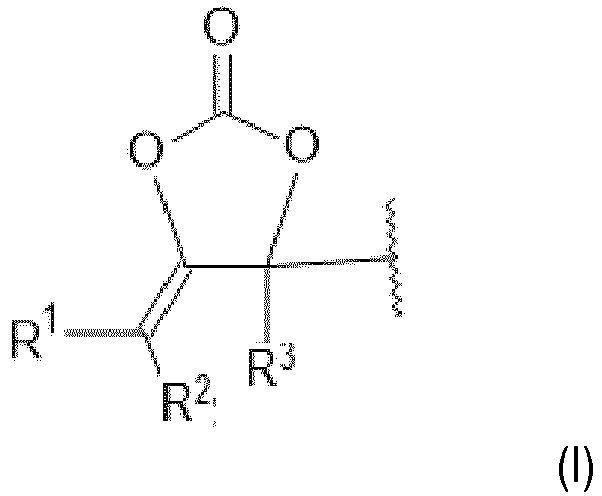
- the at least one organic, siloxane-free linking group is located between the 4 positions of the 5-alkylidene-1,3-dioxolan-2-one units; and,
- R1 to R3 are, independently of one another, hydrogen or an organic functional group.
- 3. The two-component composition according to item 1 or 2, wherein the linking group of said compound (VCC) has at least one acetal group.
- 4. The two-component composition according to any one of items 1 to 3, wherein the compound (VCC) meets either:
- i) Formula (II):

- R1 to R3 are, independently of one another, hydrogen or an organic functional group;
- n is a number that is greater than or equal to 2, preferably from 2 to 10; and,
- A is a siloxane-free organic linking group, with the exception of a linking group formed by polymerization of (meth)acrylic monomers;
- ii) Formula (III):

- R1 to R6 are, independently of one another, hydrogen or an organic functional group; and,
- A is a siloxane-free organic linking group, with the exception of a linking group formed by polymerization of (meth)acrylic monomers;
- iii) Formula (IV):

- R1 to R6 are, independently of one another, hydrogen or an organic functional group;
- R7 is hydrogen, an OH group or an organic functional group;
- A is a siloxane-free organic linking group, with the exception of a linking group formed by polymerization of (meth)acrylic monomers; and,
- n is a number that is greater than or equal to 1, preferably from 1 to 10;
or,
- iv) Formula (V),

- R1 to R3 are, independently of one another, hydrogen or an organic functional group;
- R7 and R8 are, independently of one another, hydrogen, an OH group or an organic functional group, and R7 and/or R8 can contain an exo-vinylene cyclic carbonate group;
- A is a siloxane-free organic linking group, with the exception of a linking group formed by polymerization of (meth)acrylic monomers; and
- n is a number that is greater than or equal to 1 if at least one of the functional groups R7 and R8 contains at least one exo-vinylene cyclic carbonate group, and n is a number that is greater than or equal to 2, preferably from 2 to 10, if neither of the functional groups R7 and R8 contains an exo-vinylene cyclic carbonate group.
- i) Formula (II):
- 5. The two-component composition according to item 4, wherein -A in said Formulas (II), (III), (IV) and (V) has at least one acetal group.
- 6. The two-component composition according to item 4 or item 5, wherein -A in said Formula (II) means -B-Q and wherein -A in said Formula (III) means -B-Q-B-, in which formulae:
- B is a divalent hydrocarbon group; and,
- Q is an organic functional group that contains at least one functional group selected from ether groups, polyether groups, ester groups, polyester groups, amide groups, polyamide groups, urethane groups, polyurethane groups, urea groups, polyurea groups, acetal groups and polyacetal groups.
- 7. The two-component composition according to item 4 or item 5, wherein the compound (VCC) meets either:
- i) Formula (IVa):

- ii) Formula (Va):

- R1 to R6 are, independently of one another, hydrogen or an organic functional group;
- R7 and R8 are, independently of one another, hydrogen, an OH group or an organic functional group;
- B is a divalent hydrocarbon group in each case;
- Q is an organic functional group in each case that preferably contains at least one functional group selected from ether groups, polyether groups, ester groups, polyester groups, amide groups, polyamide groups, urethane groups, polyurethane groups, urea groups, polyurea groups, acetal groups and polyacetal groups;
- n in Formula (IVa) is a number that is greater than or equal to 1, preferably from 1 to 10;
and, - n in Formula (Va) is a number that is greater than or equal to 1 if at least one of the functional groups R7 and R8 contains at least one exo-vinylene cyclic carbonate group, and n is a number that is greater than or equal to 2, preferably from 2 to 10, if neither of the functional groups R7 and R8 contains an exo-vinylene cyclic carbonate group.
- i) Formula (IVa):
- 8. The two-component composition according to one of items 4 to 7, wherein:
- R1, R2, R5 and R6 represent, independently of one another, a C1 to C10 alkyl group or preferably an H atom; and
- R3 and R4 represent, independently of one another, a C1 to C10 alkyl group or an H atom, preferably a methyl group.
- 9. The two-component composition according to one of items 4 to 8, wherein the compound (VCC) meets either:
- i) Formula (Vb):

- ii) Formula (Vc):

- iii) Formula (IVb):

- iv) Formula (VI):

- B is an alkylene group preferably having from 1 to 6 carbon atoms;
- Q is a group derived from a polyol, a polyol being an alcohol having at least two hydroxyl groups;
- n in formulae (Vb) and (Vc) is a number that is greater than or equal to 2, preferably from 2 to 10;
- n in formula (IVb) is a number that is greater than or equal to 1, preferably from 1 to 10; and,
- n in formula (VI) is a number that is greater than or equal to 0, preferably from 0 to 10.
- i) Formula (Vb):
- 10. The two-component composition according to one of items 4 to 9, wherein the compound (VCC) meets either:
- i) Formula (VIa):

- ii) Formula (IVc):

- iii) Formula (Vd):

- iv) Formula (Ve):

- -O-Q-O- represents the functional group of a divalent alcohol, preferably selected from ethylene glycol, 1,3-propanediol, 1,4-butanediol, diethylene glycol, triethylene glycol, neopentyl glycol, 1,5-pentanediol, 1,6-hexanediol, 1,8-octanediol, 3-methyl-1,5-pentanediol, 1,4-bis(hydroxymethyl)cyclohexane, 1,6-bis(hydroxymethyl)cyclohexane, glycerol, diglycerol, polyethylene glycol, polypropylene glycol, PolyTHF, pentaerythritol, dipentaerythritol and sugar alcohols;
- n in formula (IVc) is 1, 2 or 3; and,
- n in formulae (Vd) and (Ve) is a number that is greater than or equal to 2, preferably 2 or 3.
- i) Formula (VIa):
- 11. The two-component composition according to any one of items 4 to 10, wherein:
- R1, R2, R5 and R6 each represent an H atom;
- R3 and R4 represent, independently of one another, methyl or an H atom;
- R7, R8 and A represent, independently of one another, functional groups of polyhydric alcohols having from 2 to 12 carbon atoms that can also be interrupted by -O-, -S- or -NR2-groups, R representing H or a C1 to C12 alkyl.
- 12. The two-component composition according to any one of items 1 to 11, wherein the total amount of multifunctional hardener present in the second component is selected so that the molar ratio of functional alkylidene-1,3-dioxolan-2-one groups of said first component to the functional groups (F) in the hardener is in the range of from 1:10 to 10:1, preferably in the range of from 1:2 to 2:1.
- 13. The two-component composition according to any one of items 1 to 12, wherein the total amount of multifunctional hardener present in the second component is from 0.1 to 50 wt.%, preferably from 1 to 30 wt.%, based on the combined total amount of exo-vinylene cyclic carbonate compounds and said multifunctional hardeners.
- 14. The two-component composition according to any one of items 1 to 13, wherein the functional groups (F) of the hardener are selected from the group consisting of: aliphatic hydroxyl groups; aliphatic primary amino groups; aliphatic secondary amino groups; and, mixtures thereof.
- 15. The two-component composition according to any one of items 1 to 14, wherein the multifunctional hardener comprises at least one of a multifunctional polyetheramine and a difunctional amine selected from the group consisting of aliphatic, cycloaliphatic and aromatic diamines.
- 16. The two-component composition according to any one of items 1 to 15, wherein the multifunctional hardener comprises one or more alcohols selected from the groups consisting of: 1,4-butanediol; ethylene glycol; diethylene glycol; triethylene glycol; neopentyl glycol; 1,3-propanediol; 1,5-pentanediol; 1,6-hexanediol; glycerol; diglycerol; pentaerythritol; dipentaerythritol; and, sugar alcohols, such as sorbitol and mannitol.
- 17. The two-component composition according to any one of items 1 to 16, wherein:
- the multifunctional hardener comprises one or more polymeric polyols selected from the group consisting of polyester polyols, polycarbonate polyols, polyether polyols, polyacrylate polyols and polyvinyl alcohols; and,
- said polymeric polyol hardeners are characterized by one or more of the following properties:
- i) an average OH functionality of at least 1.5 mol;
- ii) a number average molecular weight (Mn) of from 250 to 50,000 g/mol; and,
- iii) at least 50 mole % of the hydroxyl groups contained in the polymeric polyol being primary hydroxyl groups.
- 18. The two-component composition according to any one of items 1 to 17 further comprising a catalyst in an amount of from 0.01 to 10 wt.%, preferably from 0.01 to 5 wt.%, based on the total weight of the two-component composition.
- 19. The two-component composition according to any one of items 1 to 18 comprising less than 0.1 wt.%, based on the weight of the two-component composition, of water.
- 20. The two-component composition according to any one of items 1 to 19 comprising less than 0.1 wt.%, based on the weight of the two-component composition, of NCO groups.
- 21. The use of the two-component composition as defined in any one of items 1 to 20 in sealants and/or adhesives.
- 22. A method of forming a composite article comprising the steps of:
- a) providing first and second substrates;
- b) applying the two component composition as defined in any one of items 1 to 20 to at least one of said substrates; and,
- c) assembling said first and second substrates.
- As used herein, the singular forms "a", "an" and "the" include plural referents unless the context clearly dictates otherwise.
- The terms "comprising", "comprises" and "comprised of" as used herein are synonymous with "including", "includes", "containing" or "contains", and are inclusive or open-ended and do not exclude additional, non-recited members, elements or method steps.
- When amounts, concentrations, dimensions and other parameters are expressed in the form of a range, a preferable range, an upper limit value, a lower limit value or preferable upper and limit values, it should be understood that any ranges obtainable by combining any upper limit or preferable value with any lower limit or preferable value are also specifically disclosed, irrespective of whether the obtained ranges are clearly mentioned in the context.
- The words "preferred" and "preferably" are used frequently herein to refer to embodiments of the disclosure that may afford particular benefits, under certain circumstances. However, the recitation of one or more preferable or preferred embodiments does not imply that other embodiments are not useful and is not intended to exclude those other embodiments from the scope of the disclosure.
- The molecular weights given in the present text refer to number average molecular weights (Mn), unless otherwise stipulated. All molecular weight data refer to values obtained by gel permeation chromatography (GPC) according to DIN 55672-1:2016-03 with tetrahydrofuran (THF) as eluent, unless otherwise stipulated.
- The zero-shear viscosity mentioned in this application means the limiting value of the viscosity function at infinitely low shear rates. It is determined herein using an Anton Paar Rheometer MCR 100 (US 200 Evaluation Software) in plate-plate geometry. The samples are measured in oscillatory shearing under: low shear amplitudes of 10%; a temperature of 23°C; angular frequency ramp log 100-0.1 1/s; a measuring gap of 0.5 mm; evaluation according to Carreau-Gahleitner I; and, a punch diameter of 25 mm.
- As used herein, room temperature is 23°C plus or minus 2°C.
- As used herein, the term "equivalent (eq.") relates, as is usual in chemical notation, to the relative number of reactive groups present in the reaction; the term "milliequivalent" (meq) is one thousandth (10-3) of a chemical equivalent.
- Two-component compositions in the context of the present invention are understood to be compositions in which the component comprising said compound (VCC) and the multifunctional hardener component must be stored in separate vessels because of their (high) reactivity. The two components are mixed only shortly before application and then react, typically without additional activation, with bond formation and thereby formation of a polymeric network. However, catalysts may also be employed or higher temperatures applied in order to accelerate the cross-linking reaction.
- As used herein, "aliphatic group" means a saturated or unsaturated linear (i.e., straight-chain), branched, cyclic (including bicyclic) organic group: the term "aliphatic group" thus encompasses "alicyclic group", the latter being a cyclic hydrocarbon group having properties resembling those of an aliphatic group. The term "aromatic group" means a mono- or polynuclear aromatic hydrocarbon group.
- The aforementioned citations mentioned as background art attest to the fact that the term "exo-vinylene cyclic carbonate" is a well-known term of art. However, for completeness, it is noted that such "exo-vinylene cyclic carbonates" may also be referred to as alkylidene cyclic carbonates and, in particular, α-alkylidene cyclic carbonates. The terms "exo", "vinylidene" and "alkylidene group" are being used in accordance with their standard definitions in the art as found in: http://goldbook.iupac.org/E02094.html; http://goldbook.iupac.org/V06623.html; and, http://goldbook.iupac.org/A00232.html respectively.
- As used herein, "alkyl group" refers to a monovalent group that is a radical of an alkane and includes straight-chain and branched organic groups, which groups may be substituted or unsubstituted. The term "alkylene group" refers to a divalent group that is a radical of an alkane and includes linear and branched organic groups, which groups may be substituted or substituted.
- As used herein, in particular with respect to the multifunctional hardener: a) a primary amine group is an atomic grouping of the type "-NH2" (R-H); (b) a secondary amine group is an atomic grouping of the type "-NHR"; and, c) an amino group is understood to mean an atomic grouping of the type "-NH2".
- The term "essentially free" is intended to mean herein that the applicable group, compound, mixture or component constitutes less than 0.1 wt.%, based on the weight of the two-component composition. In particular, the two-component composition of the present invention is preferably essentially free of NCO groups.
- As described herein before, the present invention provides a two-component sealant and/or adhesive composition comprising:
- i) in a first component, at least one compound (VCC) having two or more exo-vinylene cyclic carbonate units, wherein said exo-vinylene cyclic carbonate units are bonded to one another by means of at least one organic, siloxane-free linking group, wherein said linking group is not directly bonded to the exo-vinylene double bonds and linking groups formed by polymerization of (meth)acrylic monomers are excluded; and,
- ii) in a second component, at least one multifunctional hardener that has at least two functional groups selected from the group consisting of primary amino groups, secondary amino groups, hydroxy groups, phosphine groups, phosphonate groups, and mercaptan groups,
- The exo-vinylene cyclic carbonate units of the compound (VCC) are preferably 5-alkylidene-1,3-dioxolan-2-one units of the general formula (I):

- R1 and R2 independently of one another preferably stand for a C1 to C10 alkyl group, a C1 to C6 alkyl group, a C1 to C3 alkyl group, a methyl group, or particularly preferably for an H atom. R3 preferably stands for a C1 to C10 alkyl group, a C1 to C6 alkyl group, a C1 to C3 alkyl group, or for an H atom, particularly preferably for a methyl group. R1, R2, and R3 particularly preferably stand for hydrogen or R1 and R2 stand for hydrogen and R3 stands for a methyl group.
- Suitable compounds (VCC) of the invention are, for example, those of the formula (II)

- R1 to R3 have the same meaning as in formula (I) above;
- n is a number greater than or equal to 2, preferably from 2 to 10 or from 3 to 10; and,
- A denotes a siloxane-free, organic linking group, with the exception of a linking group formed by the polymerization of (meth)acrylic monomers.
- Preferably, -A in Formula (II) has the meaning -B-Q, wherein:
- B denotes a spacer group, for example, a divalent hydrocarbon group, in particular an alkylene group preferably having 1 to 6 carbon atoms, e.g., butylene, propylene, ethylene, or particularly preferably methylene; and,
- Q is an organic group that contains at least one functional group selected from ether groups, polyether groups, ester groups, polyester groups, amide groups, polyamide groups, urethane groups, polyurethane groups, urea groups, polyurea groups, acetal groups, and polyacetal groups, where ether groups, polyether groups, acetal groups, and polyacetal groups are particularly preferred.
- Suitable, for example, are compounds of the formula (III)

- R1 to R6 independently of one another each denote hydrogen or an organic group.
- In said Formula (III) R1 to R3 preferably have the same meaning as in formula (I). R5 and R6 preferably have the same meaning as R1 and R2, and R4 preferably has the same meaning as R3.
- Further, in said Formula (III) A is a siloxane-free, organic linking group, with the exception of a linking group formed by the polymerization of (meth)acrylic monomers. Preferably, -A- has the meaning -B-Q-B-, wherein:
- B denotes a spacer group, for example, a divalent hydrocarbon group, in particular an alkylene group preferably having 1 to 6 carbon atoms, e.g., butylene, propylene, ethylene, or particularly preferably methylene; and,
- Q is an organic group, which contains at least one functional group selected from ether groups, polyether groups, ester groups, polyester groups, amide groups, polyamide groups, urethane groups, polyurethane groups, urea groups, polyurea groups, acetal groups, and polyacetal groups, where ether groups, polyether groups, acetal groups, and polyacetal groups are particularly preferred.
- Also suitable, for example, are compounds of the formula (IV)
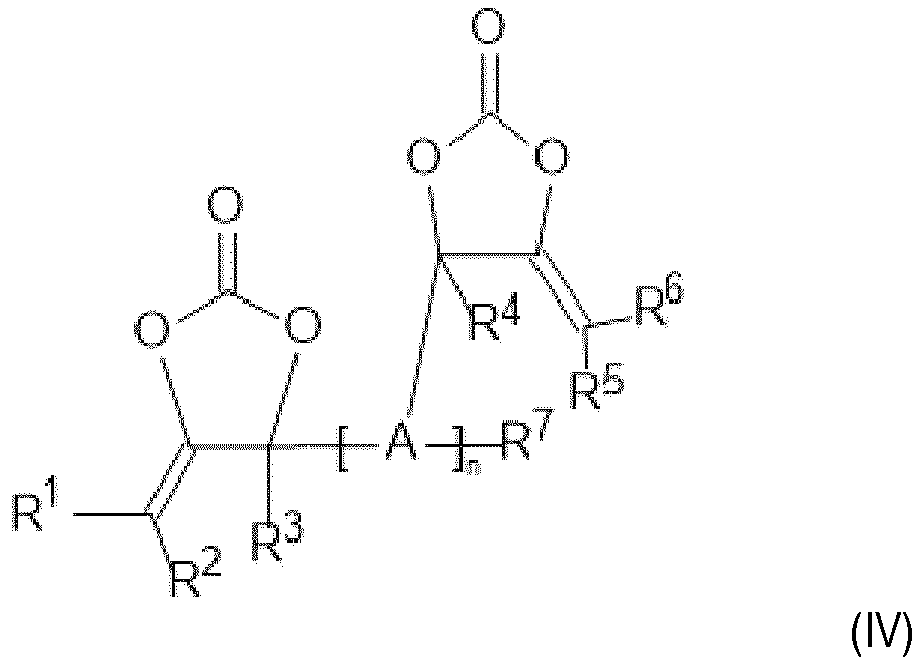

- R1 to R6, A, B, and Q have the same meaning as in Formula (III);
- R7 denotes hydrogen, an OH group, or an organic group, e.g., an alkyl, alkoxy, or hydroxyalkyl group having, for example, 1 to 10 carbon atoms; and,
- n denotes a number greater than or equal to 1, preferably from 1 to 10 or from 2 to 10.
- Also suitable, for example, are compounds of the formula (V)


- R1 to R3, A, B, and Q have the same meaning as in formula (III);
- R7 and R8 independently of one another denote hydrogen, an OH group, or an organic group, e.g., an alkyl, alkoxy, or hydroxyalkyl group having, for example, 1 to 10 carbon atoms, and where R7 and / or R8 can contain an exo-vinylene group; and,
- n denotes a number greater than or equal to 1, if at least one of the R7 and R8 groups contains at least one exo-vinylene group, and n denotes a number greater than or equal to 2, preferably from 2 to 10 or from 3 to 10, if neither of the R7 and R8 groups contains an exo-vinylene group.
- In the compounds of the formulas (II) to (V), (IVa), and (Va), R1, R2, R5, and R6 independently of one another preferably stand for a C1 to C10 alkyl group, a C1 to C6 alkyl group, a C1 to C3 alkyl group, or particularly preferably for an H atom. R3 and R4 independently of one another preferably stand for a C1 to C10 alkyl group, a C1 to C6 alkyl group, a C1 to C3 alkyl group, or for an H atom, particularly preferably for a methyl group.
- In the compounds of the formulas (II) to (V), (IVa), and (Va), R1, R2, R5, and R6 particularly preferably independently of one another each stand for an H atom; R3 and R4 independently of one another for methyl or for an H atom; and R7, R8 and A independently of one another for groups of polyhydric alcohols having 2 to 12 carbon atoms, which may also be interrupted by -O-, -S-, or -NR2- groups, where R stands for H or C1 to C12 alkyl.
- Preferably, the linking group A in the compounds of the formulas (II) to (V) and the group Q in the compounds (II), (III), (IVa), and (Va) have at least one acetal group. "A" preferably stands for an organic group having a total of at most 24 carbon atoms, in particular at most 18 carbon atoms, and particularly preferably at most 14 carbon atoms. R1 can contain, apart from oxygen, further heteroatoms such as nitrogen or sulfur.
- Preferably, -A- in compounds of the formula (III) stands for a structural element of the formula

- R stands for a hydrocarbon group, e.g., a C1 to C10 alkyl group or preferably for hydrogen; and,
- m, n, p, and q stand for numbers from 1 to 10, where m and q are preferably 1 and n and p preferably denote numbers from 4 to 10.
- Preferred compounds are those of the formula (Vb)

- B denotes an alkylene group preferably having 1 to 6 carbon atoms, e.g., butylene, propylene, ethylene, or particularly preferably methylene;
- Q denotes a group derived from a polyol, a polyol being an alcohol with at least two hydroxy groups; and,
- n is a number greater than or equal to 2, preferably from 2 to 10 or from 3 to 10.
- Suitable as polyol-derived groups (Q) are, in particular, the groups derived from the alcoholic hardeners, specified hereinbelow, that is from polyols preferably selected from ethylene glycol, 1,3-propanediol, 1,4-butanediol, diethylene glycol, triethylene glycol, neopentyl glycol, 1,5-pentanediol, 1,6-hexanediol, 1,8-octanediol, 3-methyl-1,5-pentanediol, 1,4-bis(hydroxymethyl)cyclohexane, 1,6-bis(hydroxymethyl)cyclohexane, glycerol, diglycerol, polyethylene glycol, polypropylene glycol, PolyTHF, pentaerythritol, dipentaerythritol, and, sugar alcohols such as sorbitol and mannitol.
- Preferred compounds are also those of the formula (Vc):

- Preferred compounds are also those of the formula (IVb):

- B and Q have the same meaning as in formula (Vb); and,
- n is a number greater than or equal to 1, preferably from 1 to 10 or from 2 to 10.
- Preferred compounds are also those of the formula (VI):

- B and Q have the same meaning as in formula (Vb); and,
- n is a number greater than or equal to 0, preferably from 0 to 10 or from 1 to 5.
- The following preferred compounds are cited as examples of the compounds for use in the first component of the composition of the present invention:
- a) Compound of the formula (VIa):

- b) Compound of the formula (IVc):

- c) Compound of the formula (Vd):

- d) compound of the formula (Ve):

- Here, -O-Q-O- in formulas VIa, IVc, Vd, and Ve in each case stands for the group of a dihydric alcohol, preferably selected from ethylene glycol, 1,3-propanediol, 1,4-butanediol, diethylene glycol, triethylene glycol, neopentyl glycol, 1,5-pentanediol, 1,6-hexanediol, 1,8-octanediol, 3-methyl-1,5-pentanediol, 1,4-bis(hydroxymethyl)cyclohexane, 1,6-bis(hydroxymethyl)cyclohexane, glycerol, diglycerol, polyethylene glycol, polypropylene glycol, PolyTHF, pentaerythritol, dipentaerythritol and sugar alcohols such as sorbitol and mannitol.
- The above described compounds (VCC) for use in the first component of the composition of the present invention can be prepared, for example, by transacetalization of an exo-vinylene cyclic carbonate of the formula (VII):

- R1 to R3 and R9 independently of one another denote hydrogen or an organic group;
- R10 and R11 independently of one another denote an organic group; and,
- B denotes an organic linking group (spacer).
- R1 to R3 preferably have the same meaning as in formula (I). R9 preferably stands for a C1 to C10 alkyl group, a C1 to C6 alkyl group, a C1 to C3 alkyl group, a methyl group, or particularly preferably for an H atom. R10 and R11 preferably stand for a C1 to C10 alkyl group, a C1 to C6 alkyl group, or a C1 to C3 alkyl group, particularly preferably for a methyl group. B preferably stands for an alkylene group having 1 to 4 carbon atoms.
- In an important embodiment, R1 and R2 in compounds of the formula (VII) each stand for a H atom; R3 and R9 independently of one another for methyl or for a H atom; R10 and R11 independently of one another for hydrocarbon groups, in particular for C1 to C10 alkyl groups or alkyl groups having 1 to 4 carbon atoms, particularly preferably for methyl groups; and, B stands for an alkylene group having 1 to 4 carbon atoms, in particular for methylene.
- A compound of the formula (VIIa) below is particularly preferred as the reagent to be subjected to transacetalization:

- Without intention to limit the present invention, the exo-vinylene cyclic carbonates suitable for a transacetalization can be prepared by a method in which:
- i) in a first step, a compound with a terminal triple bond is reacted with an alkanone or alkanal, which contains an acetal group, the triple bond being added to the carbonyl group of the alkanone or alkanal with the formation of a hydroxy compound; and,
- ii) in a second step, the ring closure to form the carbonate group takes place with carbon dioxide.
- This reaction step is an addition, known perse, of triple bonds to a carbonyl group. Suitable compounds with a terminal triple bond are in particular compounds of the formula (VIII):
Y-CH≡CH (VIII)
where Y stands for an H atom, a hydrocarbon group having from 1 to 10 carbon atoms, e.g., an alkyl or aryl group, or a protective group having a maximum of 10 carbon atoms. Provided Y is not a protective group, the substituents of the Y-substituted C atom determine the subsequent groups R1, R2, R5, and R6 in formulas (I) to (V). Proceeding from Formula (VIII), therefore, one of the R1 or R2 groups or one of the R5 or R6 groups in Formulas (I) to (V) is an H atom and the other respective group is Y. The preferred meanings of Y therefore correspond to the above preferred meanings of R1, R2, R5, and R6. - It is noted that Y can also stand for a protective group, however. Protective groups are cleaved off again during or after the synthesis, so that in this case the subsequent R1 and R2 or R5 and R6 groups in formulas (I) to (V) and (VII) each stand for an H atom. A suitable protective group is, e.g., the trimethylsilyl group (abbreviated as TMS).
- The employed alkanones or alkanals contain an acetal group. Preferred alkanones or alkanals with an acetal group are those of the formula IX:

- R3 stands for an H atom or a C1 to C10 alkyl group; and,
- m stands for 0 or an integer from 1 to 10, preferably an integer from 1 to 6 and more preferably m stands for 1.
- The group

- Various methods are known for carrying out the addition reaction of this first synthesis step. The starting compounds are preferably reacted in the presence of a strong base such as a metal alcoholate: this is preferably a metal salt of an aliphatic alcohol, in particular a metal salt of a C1 to C8, or C2 to C6 alcohol, such as ethanol, n-propanol, isopropanol, n-butanol or tertiary butanol; the metal cation of the metal alcoholate is preferably an alkali metal cation with Na+ and K+ being preferred. Mentioned as preferred metal alcoholates are potassium-tert-butylate, sodium-tert-butylate, potassium isopropylate, and sodium isopropylate.
- The addition reaction is preferably carried out in the presence of a solvent. Inert solvents are preferred as solvents; these contain no reactive groups that react with the starting compounds. Inert, polar, aprotic solvents are particularly preferred. Named as such are, e.g., cyclic ether compounds, in particular tetrahydrofuran (THF).
- The addition reaction is generally exothermic and therefore cooling preferably takes place during the reaction. The temperature of the reaction mixture is preferably a maximum of 50°C, in particular a maximum of 25°C; it is preferably between 0°C and 25°C.
- Water, optionally acid, and optionally a non-polar organic solvent can be added to work up the obtained product mixture. In that circumstance where the product of value from the 1st step already forms an independent organic phase, the organic solvent can be omitted. Two phases form of which the organic phase contains the product of the 1st step (addition product). The organic phase can be dried to remove water. Solvent can be easily removed by distillation. The product can be obtained in pure form by vacuum distillation. Alternatively, the workup can also occur using the conventional methods of crystallization or extraction, particularly if the product from the 1st step has a very high boiling point.
- Having regard to said second step of the disclosed method - the ring closure with carbon dioxide - the product thereof is a compound with a cyclic carbonate group and an acetal group. In an autoclave or other suitable reaction vessel, carbon dioxide, optionally in admixture with an inert gas, is brought into contact with the starting compound (step i) product) preferably as a gas or in the supercritical state under pressure. The reaction is preferably catalyzed using either a base as a catalyst or a catalyst system comprising both a base and a metal salt.
- Compounds with at least one tertiary amino group, e.g., with one to three tertiary amino groups, are preferred as bases in this context. Bases of this kind are known per se and usually have a molar mass less than 500 g/mol, in particular less than 300 g/mol. These are in particular aliphatic or cycloaliphatic compounds and, as examples thereof might be mentioned: TMTACN (N,N',N"-trimethyl-1,4,7-triazacyclononane); PMDETA (pentamethyldiethylenetriamine); TMEDA (tetramethylethylenediamine); DBU (1,8-diazabicyclo[5.4.0]undec-7-ene); and, DBN (1,5-diazabicyclo[4.3.0]non-5-ene).
- The aforementioned metal salt of the catalyst system is preferably a salt with monovalent to trivalent cations, in particular cations of Cu, Ag, or Au. The anion of the metal salts is preferably a carboxylate, in particular a C1 to C6 carboxylate. Silver acetate or copper acetate are mentioned as preferred metal salts.
- In an alternative catalyst system for said second step, phosphanes - in particular trialkyl- or triarylphosphanes - may be used either alone or in combination with a metal salt.
- The step ii) reaction is preferably carried out at a pressure of from 1 to 100 bar, in particular 5 to 70 bar. The temperature of the reaction mixture is typically from 10°C to 100°C and preferably from 10°C to 80°C. As is known in the art, the progress of the reaction can be monitored by an appropriate method, such as by gas chromatography.
- The obtained product of step ii) can be worked up after cooling and pressure release. An organic solvent - preferably an inert, hydrophobic organic solvent, such as dichloromethane or toluene - and an aqueous acid, such as aqueous HCl, can be added to the product so that two phases form. The desired product partitions into the organic phase from which water can be removed by drying. The product can be purified and solvents removed by distillation, preferably in a thin-film evaporator equipped with a wiper system. Alternatively, a workup and purification by crystallization or extraction may be used if the product from step ii) has a high boiling point.
- The transacetalization, e.g., of the reaction products from step ii) can be carried out with alcohols under catalysis using Lewis acids or protonic acids, the latter affording better yields. The acid catalysts may be homogeneous, heterogeneous or supported and may be acid inorganic, organometallic or organic catalysts or mixtures thereof. It is noted that stronger acids tend to discolor the reaction products, and weaker acids require higher reaction temperatures.
- As suitable inorganic acid catalysts may be mentioned: sulfuric acid; sulfates and hydrogen sulfates, such as sodium hydrogen sulfate; phosphoric acid; phosphonic acid; hypophosphorous acid; aluminum sulfate hydrate; alum; acidic silica gel (pH ≤ 6, in particular ≤ 5); and, acidic aluminum oxide. Furthermore, aluminum compounds of the general formula Al(OR1)3 and titanates of the general formula Ti(OR1)4 can be used as acid inorganic catalysts, where the R1 groups can each be identical or different and be selected independently of one another from C1-C20 alkyl groups, for example, methyl, ethyl, n-propyl, isopropyl, n-butyl, isobutyl, sec-butyl, tert-butyl, n-pentyl, isopentyl, sec-pentyl, neopentyl, 1,2-dimethylpropyl, isoamyl, n-hexyl, isohexyl, sec-hexyl, n-heptyl, isoheptyl, n-octyl, 2-ethylhexyl, n-nonyl, n-decyl, n-dodecyl, n-hexadecyl, or n-octadecyl; C3-C12 cycloalkyl groups, for example, cyclopropyl, cyclobutyl, cyclopentyl, cyclohexyl, cycloheptyl, cyclooctyl, cyclononyl, cyclodecyl, cycloundecyl, and cyclododecyl; cyclopentyl, cyclohexane, and cycloheptyl are preferred.
- Preferred organometallic acid catalysts are selected from dialkyltin oxides R1 2SnO or dialkyltin esters R1 2Sn(OR2)2 wherein: R1 is defined as above and can be identical or different; and, R2 can have the same meanings as R1 and can in addition be a C6-C12 aryl, for example, phenyl, o-, m- or p-tolyl, xylyl, or naphthyl. R2 can be identical or different in each case. Specific examples of organotin catalysts are tin(II) n-octanoate, tin(II) 2-ethylhexanoate, tin(II) laurate, dibutyltin oxide, diphenyltin oxide, dibutyltin dichloride, dibutyltin diacetate, dibutyltin dilaurate, dibutyltin dimaleate, or dioctyltin diacetate. Particularly preferred representatives of acid organometallic catalysts are dibutyltin oxide, diphenyltin oxide, and dibutyltin dilaurate.
- Preferred organic acid catalysts are organic compounds possessing phosphate groups, sulfonic acid groups, sulfate groups or phosphonic acid groups. Furthermore, acidic ion exchangers can also be used as organic acid catalysts, examples of which are sulfonic acid group-containing polystyrene resins which are crosslinked with about 2 mole % of divinylbenzene. Particularly preferred are sulfonic acids such as, for example, p-toluenesulfonic acid or methanesulfonic acid, as well as trifluoroacetic acid.
- The alcohols used in the transacetalization reaction can be primary, secondary or tertiary, with primary alcohols being preferred. Diols are particularly preferred because they lead to linear oligomers and the molecular weight of the most suitable diols is from 62 to 5000 g/mol, preferably from 90 to 2000 g/mol. Where polyols with three or more hydroxy groups are used, monools can be used in combination therewith for regulating the molecular weight and branching of the products. Mixtures of alcohols are likewise possible.
- The ratio of OR groups of the acetal groups to the OH groups in the transacetalization reaction is typically from 4:1 to 1:4, preferably from 2:1 to 1:2, and more preferably from 1.5:1 to 1:1.5.
- The transacetalization reaction can be carried out in various solvents; polar solvents, such as acetonitrile, are preferred. Reaction temperatures lie between room temperature and 100°C, but are preferably < 80°C and particularly preferably < 60°C. The reaction is carried out especially preferably under vacuum for the effective removal of methanol from the equilibrium. It is moreover particularly preferable to this end, if the reaction is carried out without solvent for long stretches. Therefore, for better homogenization the reaction mixture can first be used in solution and the solvent can then be removed under vacuum and, optionally, recovered and reused.
- The workup of the reaction products of the transacetalization reaction invention (oligomeric exo-vinylene cyclic carbonate acetals) can occur by simple washing out of the catalyst. If said catalyst is supported, it only needs to be filtered. Higher purities result from shaking out with water, buffers or very weak bases and subsequently drying with drying agents. Precipitations in water and non-solvents are also possible, care being taken that the acetal groups are not hydrolyzed.
- The exo-vinylene cyclic carbonates of the present invention typically have weight average molecular weights (Mw) between 500 and 50,000 g/mol, particularly preferably between 1000 and 10,000 g/mol, as measured by gel permeation chromatography (GPC) in tetrahydrofuran using a polystyrene standard. The viscosity of the exo-vinylene cyclic carbonates is typically from 0.5 to 5000 Pa·s (measured as zero-shear viscosity).
- It is envisaged that the exo-vinylene cyclic carbonates useful in the first component of the present invention can be chain-extended with isocyanates, acid chlorides and / or acid anhydrides without destruction of the exo-vinylene carbonate ring.
- As mentioned hereinbefore the second component of the composition of the present invention comprises at least one multifunctional hardener that has at least two functional groups (F) selected from the group consisting of: primary amino groups; secondary amino groups; hydroxy groups; phosphine groups; phosphonate groups; and, mercaptan groups. No particular limitation is imposed on the number of functional groups (F) possessed by the hardener: compounds having 2, 3, 4, 5, 6, 7, 8, 9 or 10 functional groups may be used, for instance. Moreover, the multifunctional hardener can be a low-molecular-weight substance - that is its molecular weight is less than 500 g/mol - or an oligomeric or polymeric substance that has a number average molecular weight (Mn) above 500 g/mol. And, of course, mixtures of hardeners - for instance mixtures of alcoholic and amine hardeners - may be used in the second component.
- The total amount of hardener present in the second component is preferably selected so that the molar ratio of functional alkylidene-1,3-dioxolan-2-one groups of said first component to the functional groups (F) in the hardener is in the range of from 1:10 to 10:1, for example from 5:1 to 1:5, and is preferably in the range of from 1:2 to 2:1.
- In an alternative expression of the two-component composition, the total amount of hardeners in the second component thereof is suitably from 0.1 to 50 wt.%, preferably from 0.5 to 40 wt.% and more preferably 1 to 30 wt.%, based on the combined total amount of exo-vinylene cyclic carbonate compounds and the employed hardeners.
- In an important embodiment, the functional groups (F) of the hardener are selected from the group consisting of: aliphatic hydroxyl groups; aliphatic primary amino groups; aliphatic secondary amino groups; aliphatic phosphine groups; aliphatic phosphonate groups; aliphatic mercaptan groups; and, mixtures thereof.
- In a preferred embodiment, the hardener of the second component comprises or consists of an amine (or aminic) or an alcoholic hardener and, more particularly, the functional groups (F) of the hardener are selected from the group consisting of: aliphatic hydroxyl groups; aliphatic primary amino groups; aliphatic secondary amino groups; and, combinations thereof.
- Aminic hardeners, also called amine or polyamine hardeners below, include, without intention to limit: aliphatic polyamines; cycloaliphatic polyamines; aromatic polyamine; araliphatic polyamines; and, polymeric amines such as aminoplasts and polyamidoamines. Amine hardeners crosslink polymers with 1,3-dioxolan-2-one groups, also called carbonate polymers below, by reacting the primary or secondary amino functions of the polyamines with the 1,3-dioxolan-2-one groups of the carbonate polymers with the formation of urethane functions.
- Preferred polyamine hardeners have on average at least two primary or secondary amino groups per molecule, for example two, three or four primary or secondary amino groups per molecule. They can also contain in addition one or more tertiary amino groups.
- Without intention to limit the present invention, suitable polyamines which may be used individually or in combination, include:
- a) aliphatic polyamines, such as ethylenediamine, 1,2- and 1,3-propanediamine, neopentanediamine, hexamethylenediamine, octamethylenediamine, 1,10-diaminodecane, 1,12-diaminododecane, diethylenetriamine, triethylenetetramine, tetraethylenepentamine, 2,2-dimethylpropylenediamine, trimethylhexamethylenediamine, 1-(3-aminopropyl)-3-aminopropane, 1,3-bis(3-aminopropyl)propane, and 4-ethyl-4-methylamino-1-octylamine;
- b) cycloaliphatic diamines such as 1,2-diaminocyclohexane, 1,2-, 1,3- and 1,4-bis(amino-methyl)cyclohexane, 1-methyl-2,4-diaminocyclohexane, N-cyclohexylpropylene-1,3-diamine, 4-(2-aminopropan-2-yl)-1-methylcyclohexan-1-amine, isophorone diamine, 4,4'-diaminodicyclohexylmethane (Dicykan), 3,3'-dimethyl-4,4'-diaminodicyclohexylmethane, 3,3',5,5'-tetramethyl-4,4'-diaminodicyclohexylmethane, 4,8-diaminotricyclo[5.2.1.0]decane, norbornane diamine, menthanediamine and menthenediamine;
- c) aromatic diamines such as toluylenediamine, xylylenediamine, in particular meta-xylylenediamine (MXDA), bis(4-aminophenyl)methane (MDA or methylenedianiline), and bis(4-amino-phenyl)sulfone (also known as DADS, DDS, or Dapsone);
- d) cyclic polyamines such as piperazine and N-aminoethylpiperazine;
- e) polyetheramines, in particular difunctional and trifunctional primary polyetheramines based on polypropylene glycol, polyethylene glycol, polybutylene oxide, poly(1,4-butanediol), polytetrahydrofuran (PolyTHF) or polypentylene oxide;
- f) polyamidoamines (amidopolyamines) which can be obtained by reacting dimeric fatty acids (e.g., dimeric linoleic acid) with low-molecular-weight polyamines such as diethylenetriamine, 1-(3-aminopropyl)-3-aminopropane or triethylenetetramine, or with other diamines, such as the aforementioned aliphatic or cycloaliphatic diamines;
- g) adducts obtainable by reacting amines, in particular diamines, with a deficit of epoxy resin or reactive diluent, preferably such adducts being used where about 5 to 20% of the epoxy groups have been reacted with amines, in particular diamines;
- h) phenalkamines, as are known from epoxide chemistry; and,
- i) Mannich bases which may typically be prepared by condensation of polyamines, preferably diethylenetriamine, triethylenetetramine, isophorone diamine, 2,2,4- or 2,4,4-trimethylhexamethylenediamine, 1,3- and 1,4-bis(aminomethyl)cyclohexane with aldehydes, preferably formaldehyde and mono- or polyhydric phenols having at least one aldehyde-reactive core site, e.g., the various cresols and xylenols, p-tert-butylphenol, resorcinol, 4,4'-dihydroxydiphenylmethane, 4,4'-dihydroxydiphenyl-2,2-propane, but preferably phenol.
- As an exemplary mixture of polyamine hardeners may be mentioned a mixture comprising: a polyetheramine; and, a difunctional amine selected from the group consisting of aliphatic, cycloaliphatic, and aromatic diamines.
- A plurality of suitable polyetheramine hardeners - which may be used individually or in combination with each other or with the aforementioned aliphatic, cycloaliphatic, and aromatic amines - are known in the art and / or commercially. These include: 4,7,10-trioxatridecane-1,3-diamine; 4,7,10-trioxatridecane-1,13-diamine; 1,8-diamino-3,6-dioxaoctane (XTJ-504, available from Huntsman); 1,10-diamino-4,7-dioxadecane (XTJ-590, available from Huntsman); 1,12-diamino-4,9-dioxadodecane (available from BASF SE); 1,3-diamino-4,7,10-trioxatridecane (available from BASF SE); primary polyetheramines based on polypropylene glycol with an average molar mass of 230 and including Polyetheramines D 230 (available from BASF SE) and Jeffamine® D 230 (available from Huntsman); difunctional, primary polyetheramines based on polypropylene glycol with an average molar mass of 400, such as Polyetheramines D 400 (available from BASF SE) and Jeffamine® XTJ 582 (available from Huntsman); difunctional, primary polyetheramines based on polypropylene glycol with an average molar mass of 2000, such as Polyetheramines D 2000 (available from BASF SE), Jeffamine® D2000 and or Jeffamine® XTJ 578 (each available from Huntsman); difunctional, primary polyetheramines based on propylene oxide with an average molar mass of 4000 such as Polyetheramine D 4000 (available from BASF SE); trifunctional, primary polyetheramines prepared by reacting propylene oxide with trimethylolpropane, followed by amination of the terminal OH groups with an average molar mass of 403, such as Polyetheramines T 403 (available from BASF SE) and Jeffamine® T 403 (available from Huntsman); trifunctional, primary polyetheramine, prepared by reacting propylene oxide with glycerol, followed by amination of the terminal OH groups with an average molar mass of 5000, Polyetheramines T 5000 (available from BASF SE) and Jeffamine® T 5000 (available from Huntsman); aliphatic polyetheramines which are made up of a polyethylene glycol, grafted with propylene oxide, and have an average molar mass of 600, such as Jeffamine® ED-600 or Jeffamine® XTJ-501 (each available from Huntsman); aliphatic polyetheramines which are made up of a polyethylene glycol, grafted with propylene oxide, and have an average molar mass of 900, such as Jeffamine® ED-900 (available from Huntsman); aliphatic polyetheramines which are made up of a polyethylene glycol, grafted with propylene oxide, and have an average molar mass of 2000, such as Jeffamine® ED-2003 (available from Huntsman); difunctional, primary polyetheramine prepared by amination of a diethylene glycol, grafted with propylene oxide, and having an average molar mass of 220, such as Jeffamine® HK-511 (available from Huntsman); aliphatic polyetheramines based on a copolymer of poly(tetramethylene ether glycol) and polypropylene glycol, with an average molar mass of 1000, such as Jeffamine® XTJ-542 (available from Huntsman); aliphatic polyetheramines, based on a copolymer of poly(tetramethylene ether glycol) and polypropylene glycol, with an average molar mass of 1900 such as Jeffamine® XTJ-548 (available from Huntsman); aliphatic polyetheramines based on a copolymer of poly(tetramethylene ether glycol) and polypropylene glycol, with an average molar mass of 1400, such as Jeffamine® XTJ-559 (available from Huntsman); polyether triamines based on an at least trihydric alcohol grafted with butylene oxide, with an average molar mass of 400 such as Jeffamine® XTJ-566 (available from Huntsman); aliphatic polyetheramines prepared by amination of alcohols, grafted with butylene oxide, with an average molar mass of 219 such as Jeffamine® XTJ-568 (available from Huntsman); polyetheramines based on pentaerythritol and propylene oxide, with an average molar mass of 600, such as Jeffamine® XTJ-616 (available from Huntsman); polyetheramines based on triethylene glycol, with an average molar mass of 148, such as Jeffamine® EDR-148 (available from Huntsman); difunctional, primary polyetheramines, prepared by amination of an ethylene glycol, grafted with propylene oxide, with an average molar mass of 176, such as Jeffamine® EDR-176 (available from Huntsman); and, polyetheramines prepared by amination of polytetrahydrofuran (PolyTHF), with an average molar mass of 250, such as PolyTHF-Amine 350 (available from BASF SE).
- Good results have been obtained in using, as amine hardeners, one or more of: aliphatic polyamines, in particular 2,2-dimethylpropylenediamine; aromatic diamines, in particular m-xylylenediamine (MXDA); cycloaliphatic diamines, in particular isophorone diamine (IPDA), N-cyclohexylpropylene-1,3-diamine and 4,4'-diaminodicyclohexylmethane (Dicykan); and, difunctional or trifunctional primary polyetheramines, based on polypropylene glycol, such as Jeffamine® D 230 or Jeffamine® T 403. Also particularly preferred for use in the present invention are polyamines in which a high mobility and low steric hindrance around the amino groups predominate, for instance 4,9-dioxadodecane-1,12-diamine, 4,7,10-trioxatridecane-1,13-diamine and PolyTHF Amine 350 (available from BASF SE).
- Alcoholic hardeners crosslink to form carbonate polymers by reaction of the primary or secondary alcohol functions with the 1,3-dioxolan-2-one groups with the formation of carbonic acid diesters. As such, preferred alcoholic hardeners for use in the present invention have on average at least two primary or secondary hydroxy groups per molecule; alcoholic hardeners having two, three or four primary or secondary hydroxy groups per molecule might be mentioned in this regard.
- Broadly, the alcoholic hardeners may primarily be selected from low-molecular-weight and higher-molecular-weight aliphatic and cycloaliphatic alcohols.
- Suitable low-molecular-weight alcoholic hardeners include but are not limited to: 1,4-butanediol; ethylene glycol; diethylene glycol; triethylene glycol; neopentyl glycol; 1,3-propanediol; 1,5-pentanediol; 1,6-hexanediol; glycerol; diglycerol; pentaerythritol; dipentaerythritol; and, sugar alcohols such as sorbitol and mannitol.
- Suitable higher-molecular-weight polymeric polyols include but are not limited to: polyester polyols; polycarbonate polyols; polyether polyols; polyacrylate polyols; and, polyvinyl alcohols. These polymeric polyol hardeners should typically be characterized by one or more of the following properties: i) an average OH functionality of at least 1.5 mol and preferably at least 1.8, for instance an OH functionality in the range from 1.5 to 10 or 1.8 to 4, wherein said average OH functionality is understood to be the average number of OH groups per polymer chain; ii) a number average molecular weight (Mn) of from 250 to 50,000 g/mol, preferably from 500 to 10,000 g/mol; and, iii) having at least 50 mole % of the hydroxyl groups contained in the polymeric polyol component being primary hydroxyl groups.
- More suitable polyester polyols are linear or branched polymeric compounds with ester groups in the polymer backbone, which have free hydroxyl groups at the ends of the polymer chain. Preferably, these are polyesters that are obtained by polycondensation of dihydric alcohols with divalent carboxylic acids, optionally in the presence of polyhydric alcohols (e.g. 3, 4, 5, or 6-hydric alcohols) and / or polyvalent polycarboxylic acids.
- As is known in the art, the corresponding di- or polycarboxylic acid anhydrides or the corresponding di- or polycarboxylic acid esters of lower alcohols or mixtures thereof can be used instead of the free di- or polycarboxylic acids in preparing polyester polyols. That aside, the di- or polycarboxylic acids can be aliphatic, cycloaliphatic, araliphatic, aromatic or heterocyclic, preferably have 2 to 50 and in particular 4 to 20 carbon atoms, and optionally can be substituted, for instance by halogen atoms, and/or be unsaturated. Mentioned as examples thereof are: suberic acid, azelaic acid, phthalic acid, isophthalic acid, phthalic anhydride, tetrahydrophthalic anhydride, hexahydrophthalic anhydride, tetrachlorophthalic anhydride, endomethylenetetrahydrophthalic anhydride, glutaric anhydride, maleic acid, maleic anhydride, alkenyl succinic acid, fumaric acid, and dimeric fatty acids.
- Suitable diols for preparing said polyester polyols include in particular aliphatic and cycloaliphatic diols having from 2 to 40 and in particular from 2 to 20 carbon atoms, of which diols ethylene glycol, propane-1,2-diol, propane-1,3-diol, butane-1,3-diol, butane-1,4-diol, butene-1,4-diol, butyne-1,4-diol, pentane-1,5-diol, neopentyl glycol, bis(hydroxymethyl)cyclohexanes such as 1,4-bis(hydroxymethyl)cyclohexane, 2-methylpropane-1,3-diol, methylpentane diols, diethylene glycol, triethylene glycol, tetraethylene glycol, polyethylene glycol, dipropylene glycol, polypropylene glycol, dibutylene glycol, and polybutylene glycols may mentioned as examples. Preferred are alcohols of the general formula HO-(CH2)x-OH, where x is a number from 2 to 20, preferably an even number from 2 to 12; examples thereof are ethylene glycol, butane-1,4-diol, hexane-1,6-diol, octane-1,8-diol, and dodecane-1,12-diol. Preferred furthermore are neopentyl glycol and pentane-1,5-diol.
- It is also noted that lactone-based polyester polyols may find utility as alcoholic hardeners in the present invention; these species are homo- or copolymers of lactones, preferably terminal hydroxyl group-containing adducts of lactones to suitable difunctional starter molecules. Lactones that may be used are preferably those derived from compounds of the general formula HO-(CH2)z-COOH, where z is a number from 1 to 20 and wherein an H atom of a methylene unit can optionally be substituted by a C1 to C4 alkyl group. Examples therefore, which may be used individually or in admixture, are ε-caprolactone, β-propiolactone, γ-butyrolactone and methyl-ε-caprolactone; a preference for ε-caprolactone might be mentioned. Suitable starter molecules include the low-molecular-weight alcohols mentioned above as structural components for the polyester polyols and lower polyester diols or polyether diols can also be used as starters for preparing lactone polymers.
- Instead of lactone polymers, the corresponding, chemically equivalent polycondensates of hydroxycarboxylic acids corresponding to the lactones may also be used.
- Further examples of suitable polyester polyols may be found in Ullmanns Enzyklopädie der Technischen Chemie 4th edition, Volume 19, pages 62 to 65.
- Polycarbonate polyols for use herein may be obtainable by reacting phosgene with an excess of those low-molecular-weight alcohols specified as structural components for the polyester polyols.
- Suitable polyether polyols for use as hardeners herein may be prepared by polymerization of ethylene oxide, propylene oxide, butylene oxide, tetrahydrofuran, styrene oxide, or epichlorohydrin with itself, for instance in the presence of BF3, or by addition of these compounds, optionally in a mixture or one after the other, to bi- or polyfunctional starter components having reactive hydrogen atoms. Suitable starter compounds thereby include polyols or polyfunctional amines and non-limiting examples of such compounds are: water; ethylene glycol; propane-1,2-diol; propane-1,3-diol; 1,1-bis(4-hydroxyphenyl)propane; trimethylolpropane; glycerol; sorbitol; ethanolamine; ethylenediamine; sucrose polyethers, as disclosed in
DE 1176358 (Pittsburgh Plate Glass Company) andDE 1064938 (Dow Chemical Company); and formitol-orformose-started polyethers, as disclosed inDE 2639083 (Bayer AG) andDE 2737951 (Bayer AG). - Likewise suitable are polyhydroxyolefins, preferably those with 2 terminal hydroxyl groups, such as α,ω-dihydroxypolybutadiene.
- Also suitable for use herein as hardeners are polyhydroxypolyacrylates in which the hydroxyl groups can be arranged laterally or terminally. Examples thereof are α,ω-dihydroxypoly(meth)acrylic esters, which are obtainable by homo- or copolymerization of alkyl esters of acrylic acid and/or methacrylic acid in the presence of OH group-containing regulators - such as mercaptoethanol or mercaptopropanol - and subsequent transesterification with a low-molecular-weight polyol, for example an alkylene glycol such as butanediol. Such polymers are known, for example, from
EP-A 622 378 - Polyvinyl alcohols may further be mentioned as a suitable class of alcoholic hardeners, said compounds being preferably obtained by the complete or partial saponification of polyvinyl esters, in particular polyvinyl acetate. If the polyvinyl esters are present partially saponified, preferably at most 50 to 95% of the ester groups are present saponified as hydroxyl groups. If the polyvinyl esters are present completely saponified, generally more than 95% up to 100% of the ester groups are present saponified as hydroxyl groups.
- Having regard to the use of higher-molecular-weight polymeric polyols as hardeners herein, good results have been obtained with polyacrylate polyols and in particular those polyacrylate polyols obtainable under the trade name Joncryl® of the company BASF SE, e.g., Joncryl® 945.
- As noted above, the multifunctional hardener may comprise mercaptan groups. Non-limiting examples of suitable hardeners in this regard include: liquid mercaptan-terminated polysulfide polymers, known by the trade name Thiokol® (available from Morton Thiokol) and in particular the types LP-3, LP-33, LP-980, LP-23, LP-55, LP-56, LP-12, LP-31, LP-32 and LP-2; liquid mercaptan-terminated polysulfide polymers known by the trade name Thioplast® (available from Akzo Nobel) and in particular the types G10, G112, G131, G1, G12, G21, G22, G44 and G4; mercaptan-terminated polyoxyalkylene ethers obtainable, for example, by reacting polyoxyalkylendiols and -triols with either epichlorohydrin or with an alkyleneoxide, followed by sodium hydrogen sulfide; mercaptan-terminated compounds in the form of polyoxyalkylene derivatives, known by the trade name Capcure® (from Cognis), in particular the types WR-8, LOF and 3-800; polyesters of thiocarboxylic acids, such as pentaerythritol tetramercaptoacetate, trimethylolpropane trimercaptoacetate, glycol dimercaptoacetate, pentaerythritoltetra-(3-mercaptopropionate), trimethylolpropantri-(3-mercaptopropionate) and glycoldi-(3-mercaptopropionate), as well as the esterification products of polyoxyalkylene diols and triols, ethoxylated trimethylolpropane and polyester diols with thiocarboxylic acids such as thioglycolic acid and 2- or 3-mercaptopropionic acid; and, further compounds comprising mercapto groups, such as in particular 2,4,6-trimercapto-1,3,5-triazine, 2,2'-(ethylenedioxy)-diethanethiol (triethyleneglycol-dimercaptan) and ethanedithiol.
- It is envisaged that amino acids - such as lysine, arginine, glutamine, and asparagine, as well as stereoisomers thereof and mixtures thereof - may also act as suitable hardeners. Such compounds may, in particular, be useful secondary curing agents: they may for instance be used in the hardener component in admixture with one or more alcoholic hardener or alternatively or additionally, one or more amine hardener.
- As is standard in the art, the two-component composition may comprise additives and adjunct ingredients which may be disposed in one or both of the first and second components. Suitable additives and adjunct ingredients include: catalysts; antioxidants; UV absorbers/light stabilizers; metal deactivators; antistatic agents; reinforcers; fillers; antifogging agents; propellants; biocides; plasticizers; lubricants; emulsifiers; dyes; pigments; rheological agents; impact modifiers; adhesion regulators; optical brighteners; flame retardants; anti-drip agents; nucleating agents; wetting agents; thickeners; protective colloids; defoamers; tackifiers; solvents; reactive diluents; and, mixtures thereof. The selection of suitable conventional additives for the composition of the invention depends on the specific intended use of the two-component composition and can be determined in the individual case by the skilled artisan.
- In certain embodiments of the invention, no catalysts will be required to catalyze the reaction of the exo-vinylene cyclic carbonate groups with the functional groups (F) of the hardener: this may typically be the case where primary and secondary amino groups are present as the functional groups (F). However, in other cases and preferably where the hardener has reactive groups F that are different from amino groups, a catalyst may be required: suitable catalysts for the hardening will then be determined in a known manner dependent upon the type of the reactive functional groups (F). The catalysts, when desired, are used in an amount of from 0.01 to 10 wt.%, preferably from 0.01 to 5 wt.%, based on the total weight of the two-component composition.
- Basic catalysts, and in particular organic amines and organic phosphines, represent an important class of catalysts in the present invention. Preferred among the organic amines are: amidine bases, such as 1,8-diazabicyclo[5.4.0]undec-7-ene (DBU) and 1,5-diazabicyclo[4.3.0]non-5-ene (DBN); mono-C1-C6-alkylamines; di-C1-C6-alkylamines; and, tri-C1-C6-alkylamines, in particular triethylamine and tert-butylamine. Preferred among the organic phosphines are: trialkylphosphines, such as tri-n-butylphosphine; and, triarylphosphines such as triphenylphosphine. Of course, such basic catalysts can also be used as mixtures, optionally in combination with tri-C1-C6-alkylammonium halides and copper salts; as an example, the combination of triphenylphosphine with a tri-C1-C6-alkylammonium halide and a copper salt - such as copper(I) chloride, copper(I) bromide, copper(II) chloride, or copper(II) sulfate - may be mentioned.
- Fillers included in the two-component composition can be organic or inorganic in nature. Inorganic fillers, such as carbon black, calcium carbonate, titanium dioxide and may find utility where the two-component composition is used as a sealant. Further, highly dispersed silicas, especially pyrogenic silicas or precipitated silicas, may find particular utility as inorganic fillers due to their thixotropic effect. These examples aside, it is preferred that inorganic fillers are present in the form of platelets, which can be aligned to form layers with an intensified barrier effect in regard to fluids and gases. Phyllosilicates such as montmorillonite and hectorite, provide examples thereof and are described inter alia in
WO 2011/089089 (Bayer Material Science AG),WO 2012/175427 (Bayer IP GMBH) andWO 2012/175431 (Bayer IP GMBH). Most preferred are phyllosilicates that have a layer thickness of from 0.5 to 5 nm, for example from 0.5 to 1.5 nm and an aspect ratio of at least 50, at least 400, at least 1000 or even at least 10,000. - The phyllosilicates can be of natural or synthetic origin. Suitable phyllosilicates are include but are not limited to montmorillonite, bentonite, kaolinite, mica, hectorite, fluorohectorite, saponite, beidellite, nontronite, stevensite, vermiculite, fluorovermiculite, halloysite, volkonskoite, suconite, magadiite, sauconite, stibensite, stipulgite, attapulgite, illite, kenyaite, smectite, allevardite, muscovite, palygorskite, sepiolite, silinaite, grumantite, revdite, zeolite, Fuller's earth, natural or synthetic talk or mica, or permutite. Particularly preferred are montmorillonite (aluminum magnesium silicate), hectorite (magnesium lithium silicate), synthetic fluorohectorite and exfoliated, organically modified smectites. The phyllosilicates can be modified or unmodified, in the latter case cationically modified phyllosilicates being preferred. Cationically modified means that inorganic cations of the phyllosilicate are exchanged at least in part by organic cations, said organic cations being organic compounds that possess at least one cationic group, such as a quaternary ammonium group, phosphonium group, pyridinium group or the like.
- Where employed, light stabilizers / UV absorbers, antioxidants and metal deactivators should preferably have a high migration stability and temperature resistance. They may suitable be selected, for example, from the groups a) to t) listed herein below, of which the compounds of groups a) to g) and i) represent light stabilizers/UV absorbers and compounds j) to t) act as stabilizers: a) 4,4-Diarylbutadienes; b) cinnamic acid esters; c) benzotriazoles; d) hydroxybenzophenones; e) diphenyl cyanoacrylates; f) oxamides; g) 2-phenyl-1,3,5-triazines; h) antioxidants; i) nickel compounds; j) sterically hindered amines; k) metal deactivators; I) phosphites and phosphonites; m) hydroxylamines; n) nitrones; o) amine oxides; p) benzofuranones and indolinones; q) thiosynergists; r) peroxide-destroying compounds; s) polyamide stabilizers; and t) basic co-stabilizers.
- The two-component composition should comprise less than 5 wt.% of water, based on the weight of the composition, and is most preferably an anhydrous composition that is essentially free of water. These embodiments do not preclude the composition from either comprising organic solvent or being essentially free of organic solvent. In an interesting embodiment, the two-component composition may be characterized by comprising in total less than 5 wt.%, preferably less than 2 wt.%, based on the weight of the two-component composition of water and organic solvent.
- Broadly, all organic solvents known to the person skilled in the art can be used as a solvent but it is preferred that said organic solvents are selected from the group consisting of: esters; ketones; halogenated hydrocarbons; alkanes; alkenes; and, aromatic hydrocarbons. Exemplary solvents are methylene chloride, trichloroethylene, toluene, xylene, butyl acetate, amyl acetate, isobutyl acetate, methyl isobutyl ketone, methoxybutyl acetate, cyclohexane, cyclohexanone, dichlorobenzene, diethyl ketone, diisobutyl ketone, dioxane, ethyl acetate, ethylene glycol monobutyl ether acetate, ethylene glycol monoethyl acetate, 2-ethylhexyl acetate, glycol diacetate, heptane, hexane, isobutyl acetate, isooctane, isopropyl acetate, methyl ethyl ketone, tetrahydrofuran or tetrachloroethylene or mixtures of two or more of the recited solvents.
- To form an adhesive or sealant composition, the first and second components are brought together and mixed in such a manner as to induce the hardening of the binder. For certain coatings applications, the binder and hardener components may be mixed by hand or by machine in pre-determined amounts. For instance, for small-scale applications in which volumes of less than 1 liter will generally be used, the preferred packaging for the two-component compositions will be side-by-side double cartridges or coaxial cartridges, in which two tubular chambers are arranged alongside one another or inside one another and are sealed with pistons: the driving of these pistons allows the components to be extruded from the cartridge, advantageously through a closely mounted static or dynamic mixer. For larger applications, particularly for applications in industrial manufacture, the two components of the composition may advantageously be stored in drums or pails: in this case the two components are extruded via hydraulic presses, in particular by way of follower plates, and are supplied via pipelines to a mixing apparatus which can ensure fine and highly homogeneous mixing of the hardener and binder components. In any event, for any package it is important that the binder component be disposed with an airtight and moisture-tight seal, so that both components can be stored for a long time, ideally for 12 months or longer.
- The hardening of the binder compositions of the invention typically occurs at temperatures in the range of from -10°C to 150°C, preferably from 0°C to 100°C, and in particular from 10°C to 70°C. The temperature that is suitable depends on the specific hardeners and the desired hardening rate and can be determined in the individual case by the skilled artisan, using simple preliminary tests if necessary. Of course, hardening at temperatures of from 5°C to 35°C or from 20°C to 30°C is especially advantageous as it obviates the requirement to substantially heat or cool the mixture from the usually prevailing ambient temperature. Where applicable, however, the temperature of the mixture of binder and hardener may be raised above the mixing temperature using conventional means, including microwave induction.
- The compositions according to the invention may find utility inter alia in: varnishes; inks; elastomers; foams; binding agents for fibers and / or particles; the bonding and sealing of glass; the bonding and sealing of mineral building materials, such as lime- and / or cement-bonded plasters, gypsum-containing surfaces, fiber cement building materials and concrete; the bonding and sealing of wood and wooden materials, such as chipboard, fiber board and paper; the bonding and sealing of metallic surfaces; the bonding and sealing of asphalt- and bitumen-containing pavements; the bonding and sealing of various plastic surfaces; and, the bonding and sealing of leather and textiles.
- It is also considered that the compositions of the present invention are suitable as pourable sealing compounds for electrical building components such as cables, fiber optics, cover strips or plugs. The sealants may serve to protect those components against the ingress of water and other contaminants, against heat exposure, temperature fluctuation and thermal shock, and against mechanical damage.
- By virtue of the fact that the two-component compositions of the present invention are capable of creating a high binding strength in a short time, often at room temperature - particularly where amine hardeners are employed - the compositions are optimally used for forming composite structures by surface-to-surface bonding of the same or different materials to one another. The binding together of wood and wooden materials and the binding together of metallic materials may be mentioned as exemplary adhesive applications of the present compositions.
- In a particularly preferred embodiment of the invention, the two-component compositions are used as solvent-free or solvent-containing lamination adhesives for gluing plastic and polymeric films, such as polyolefin films, poly(methylmethacrylate) films, polycarbonate films and Acrylonitrile Butadiene Styrene (ABS) films.
- In each of the above described applications, the compositions may applied by conventional application methods such as: brushing; roll coating using, for example, a 4-application roll equipment where the composition is solvent-free or a 2-application roll equipment for solvent-containing compositions; doctor-blade application; printing methods; and, spraying methods, including but not limited to air-atomized spray, air-assisted spray, airless spray and high-volume low-pressure spray. For adhesive applications, it is recommended that the compositions be applied to a wet film thickness of from 10 to 500 µm. The application of thinner layers within this range is more economical and provides for a reduced likelihood of thick cured regions that may - for adhesive applications - require sanding. However, great control must be exercised in applying thinner coatings or layers so as to avoid the formation of discontinuous cured films.
- Various features and embodiments of the disclosure are described in the following examples, which are intended to be representative and not limiting.
- The following details and / or notations are given for specific chemicals used in the Examples:
- IPDA:
- Isophorone diamine
- TMS:
- Trimethylsilyl
- THF:
- Tetrahydrofuran
- PMDETA:
- Pentamethyldiethylenetriamine
- AgOAc:
- Silver acetate
- THP:
- Tetrahydropyran
- Jeffamine D-205:
- Polyetherdiamine available from Huntsman Performance Products (Everberg, BE)
- Jeffamine D-230:
- Polyetherdiamine based on oxypropylene available from Huntsman Performance Products (Everberg, BE)
- ABS:
- Acrylonitrile Butadiene Styrene polymer
- PC:
- Polycarbonate
- PMMA:
- Poly(methyl methacrylate)
- The preparation occurs in two steps as depicted herein below:

- Trimethylsilylacetylene (982 g, 10 mol) is charged in THF (17 L, dried over a molecular sieve) under argon and cooled to -68°C. n-Butyllithium (2.5 M in hexane, 4 L) is added dropwise at -68°C with stirring over 1 hour and stirred for another 1 hour. The ketone (1.319 kg, 10 mol) is then added dropwise, at a temperature from -68°C to -54°C, over 30 minutes: the mixture is subsequently stirred for another 15 minutes. Next, the mixture is heated to 9°C and water (2.9 L) is added in one portion. In so doing, the temperature rises to about 17°C. The reaction mixture is carefully concentrated at 45°C / 8 torr (10.7 mbar). It is ascertained by gas chromatographic (GC) analysis that a TMS-protected product is no longer present. The residue is suspended in diethyl ether (750 mL) and filtered, and the filtration residue is again washed with diethyl ether. The filtrate is concentrated under vacuum. About 1.2 kg of the raw material remains as a brown liquid. About 1.1 kg (7 mol, 70%) of the ethinylated product is obtained as a colorless oil therefrom by vacuum distillation (5 mbar) at 64°C to 68°C. The so-obtained product had a purity of > 96% (GC area %).
- The acetylene alcohol (1233 g; 7.79 mol) obtained in Step 1 is charged in acetonitrile (1.2 L) and mixed with PMDETA (138.9 g; 0.8 mol) and AgOAc (12.9 g; 0.078 mol) in a stirred autoclave. A pressure of 50 bar CO2 is applied and the mixture is stirred for 2.5 hours. The temperature increases to 75°C. After cooling to room temperature, the reaction mixture pressure is reduced to normal pressure, and the mixture is filtered and concentrated at 100°C / 5 mbar. About 1.5 kg of the raw material remains as a brown liquid. About 1.39 kg of the carbonate is obtained therefrom as an orange oil, which crystallizes completely overnight (optionally after addition of some seed crystals), by vacuum distillation at 5 mbar at 114°C to 115°C. The crystal mass is mixed with cyclohexane (1.34 L) and filtered with suction, and the residue is washed again with cyclohexane (0.45 L). After drying under vacuum, 1.29 kg (6.38 mol, 64%) of a nearly colorless solid is obtained. The so-obtained product (hereinafter SE1) had a purity of > 99% (GC area %).
- In a 3-neck flask equipped with a stirrer, thermometer and vacuum connection, 300 g of the compound SE1, 282 g of 1,8-octanediol and 2.5 g of p-toluenesulfonic acid were suspended in 410 g of acetonitrile and heated to an external temperature of 55°C. A vacuum was drawn and the solvent distilled off: the internal temperature was not permitted to fall below 50°C over a period of 8 hours. Vacuum was then drawn for 15 hours at room temperature and the mixture was again degassed for 8 hours at an external temperature of 50°C. The mixture was then taken up in 400 g of methyl-tert-butyl ether, washed 3 times with 150 mL of a buffer solution (pH 7), dried with MgSO4, and filtered: the solvent was rotary evaporated. About 457 g of a reddish-brown, viscous liquid (hereinafter SE2) was thus obtained, said liquid having an zero-shear viscosity of 14 Pa·s as determined at 23°C.
- 49.97 g of SE2 (OH value 124 mg KOH/g, 10.45 meq OH, 100 eq.%) and 13.94g of 3,4-Dihydro-2H-pyrane (DHP, 15.0 mL, 165.68 meq, 150 eq.%) were dissolved in CH2Cl2 at room temperature under nitrogen atmosphere. Pyridinium-para-toluenesulfonate (PPTS, 2.78 g, 11.05 meq, 10 eq%) was added in one portion and the mixture was stirred at room temperature for 16 h. Et2O (100 mL) and half-saturated brine solution (100 mL) were added, and the derived organic layer was washed with half-saturated NaCl (50 mL). Drying over MgSO4, filtering and concentration under reduced pressure yielded the desired product (hereinafter SE3) as a yellow low viscosity liquid (54.46 g, 92%). Conversion was confirmed by 1H and 13C NMR. OH value determination according to DGF C-V 17a (53) gave a value of 0.5 mg KOH/g.
- In a 3-neck flask equipped with a stirrer, thermometer, and vacuum connection, 50 g of the compound SE1, 38 g of 3-methyl-1,5-pentanediol and 0.85 g of p-toluenesulfonic acid were suspended in 50 g of acetonitrile and heated to 45°C. A vacuum was drawn, the solvent was distilled off and the mixture was distilled overall for 8 hours at 45°C and for 12 hours at room temperature. The mixture was then taken up in 100 g of methyl-tert-butyl ether, washed 3 times with 50 mL of a buffer solution (pH 7), dried with MgSO4, and filtered, and the solvent was rotary evaporated. 50.5 g of a yellow, viscous liquid (hereinafter SE4) was obtained, said liquid having a zero-shear viscosity of 40 Pa.s as determined at 23°C.
- In a 3-neck flask equipped with a stirrer, thermometer, and vacuum connection, 20 g of SE1, 18.5 g of cyclohexyl-1,4-dimethanol, and 0.34 g of p-toluenesulfonic acid were suspended in 20 g of acetonitrile and heated to 45°C. A vacuum was drawn, the solvent was distilled off, and the mixture was distilled overall for 8 hours at 45°C and for 12 hours at room temperature. The mixture was then taken up in 100 g of methyl-tert-butyl ether, washed 3 times with 50 mL of a buffer solution (pH 7), dried with MgSO4, and filtered, and the solvent was rotary evaporated. 27g of a yellow, highly viscous liquid (hereinafter SE5) was obtained, said liquid having a zero-shear viscosity of 425 Pa.s as determined at 23°C.
- The above described synthesized compounds (SE2 - SE5) were utilized in two-component (2K) compositions in accordance with the following Examples.
- At various equivalencies, SE2 was mixed with Jeffamine D-205 at room temperature. Each obtained formulation was cast into a 2 mm thick sheet,with the help of Polytetrafluoroethylene (PTFE) mold, and allowed to cure at room temperature. After the absence of the infrared (IR) cyclic carbonate band (c. 1830 cm-1) indicated full cure, tensile testing specimens S2 ("dog bones" or "paddles") according to DIN 53504 (ISO 37) for each formulation were cut and tensile testing performed accordingly at 23°C ± 2°C.
- The results given in Table 1 below represent the averaged stress and strain values from a minimum of 5 samples for every formulation.
Table 1. Tensile Material Properties of SE2 Cured with Different Amine Amounts Formulation Eq.% of Jeffamine D-205 Amount of SE2 (g) Amount of Jeffamine D-205 (g) Max. stress (sigma max) [MPa] Max. strain (elongation at break) [%] 1 25 16.0 1.3 0.9 15.3 2 50 16.0 2.5 1.4 16.4 3 100 13.0 4.1 0.6 25.5 - Independently, each of SE2, SE4 and SE5 are mixed at room temperature with Jeffamine D-205 at 50% equivalence of said diamine. For completeness: 2.0 g (5.38 meq) of SE2 was mixed with 0.31 g (2.69 meq) of Jeffamine D-205; 2.0 g of SE4 (5.94 meq) was mixed with 0.35 g of Jeffamine D-205 (2.97 meq); and, 2.0 g of SE5 (5.60 meq) was mixed with 0.325 g of Jeffamine D-205 (2.80 meq).
- In accordance with DIN EN 1465, each formulation obtained was used to prepare lap shear specimens for each of the following compound combinations: wood-wood; steel-steel; and, ABS-ABS. The samples, together with leftover adhesive mixture, were stored at 50°C, until the absence of the infrared (IR) band at c. 1830 cm-1 indicated the complete consumption of the cyclic carbonates in the leftover mixture. Lap shear testing was performed according to the aforementioned norm.
- The results given in Table 2 below represent the averaged lap shear strength values (MPa) of at least 5 tested samples for every formulation and material combination.
Table 2. Lap Shear Strengths of VCC Compounds Cured with Jeffamine D-205 (50 eq.%). VCC Compound Lap Shear Strength (MPa) Wood-Wood Steel-Steel ABS-ABS SE2 3.7 2.8 1.1 SE4 5.5 3.9 1.1 SE5 8.0 6.5 0.9 - 1.8 g of SE2 (4.84 meq) was mixed with 0.2 g of IPDA (2.42 meq) at room temperature. In accordance with DIN EN 1465, the formulation obtained was quickly used to prepare lap shear specimens for each of the following compound combinations: wood-wood; steel-steel; and, ABS-ABS. The samples, together with leftover adhesive mixture, were stored at room temperature, until the absence of the infrared (IR) band at c. 1830 cm-1 indicated the complete consumption of the cyclic carbonates in the leftover mixture. Lap shear testing was performed according to the aforementioned norm.
- The results given in Table 3 below represent the averaged lap shear strength values (MPa) of at least 5 tested samples for each material combination.
Table 3. Lap Shear Strengths of SE2 cured with IPDA (50 eq.%) VCC Compound Lap Shear Strength (MPa) Wood-Wood Steel-Steel ABS-ABS SE2 8.6 6.0 1.1 - To 2.0g of the protected VCC compound, SE3 (4.48 meq) was added 0.4g of IPDA (4.48 meq, 100 eq.%) at room temperature. After a quick homogenization, lap shear specimen were prepared for each of the following compound combinations, according to DIN EN 1465: wood-wood; steel-steel and, ABS-ABS. The samples, together with leftover adhesive mixture, were stored at room temperature until the absence of the infrared (IR) band at c. 1830 cm-1 indicated the complete consumption of the cyclic carbonates in the leftover mixture. Lap shear testing was performed according to the aforementioned norm.
- The results given in Table 4 below represent the averaged lap shear strength values (MPa) of at least 5 tested samples for each material combination.
Table 4. Lap Shear Strengths of SE3 cured with IPDA (100 eq.%). VCC Compound Lap Shear Strength (MPa) Wood-Wood Steel-Steel ABS-ABS SE3 8.0 8.0 1.3 - In a similar experiment, 0.5g (2.42 meq) of state-of-the-art siloxane tethered exo-vinylene carbonate (SiVCC) was melted at 90°C. 0.215g of IPDA (2.42 meq) was added quickly and the mixture homogenized. The mixture almost instantaneously formed a film, before the production of lap shears was possible.
- To 2.00 g of the protected VCC compound, SE3 (4.48 meq) was added 0.27 g of Jeffamine D-230 (2.24 meq, 50 eq.%) followed by 0.19g of IPDA (2.24 meq. 50 eq.%) at room temperature. After a quick homogenization, lap shear specimen were prepared for each of the following compound combinations, according to DIN EN 1465: wood-wood; steel-steel; ABS-ABS; PC-PC; and, PMMA-PMMA. The samples, together with leftover adhesive mixture, were stored at room temperature until the absence of the infrared (IR) band at c. 1830 cm-1 indicated the complete consumption of the cyclic carbonates in the leftover mixture. Lap shear testing was performed according to the aforementioned norm.
- In a similar experiment, 2.00g state-of-the-art siloxane tethered exo-vinylene carbonate (SiVCC, 9.65 meq) was melted at 90 °C. A preheated (90°C) mixture of 0.41 g of IPDA (4.82 meq, 50 eq.%) and 0.58 g of Jeffamine D-230 (4.82 meq, 50 eq.%) was added quickly and the mixture homogenized. Under these conditions, lap shears could be prepared for each of the following compound combinations, according to DIN EN 1465: wood-wood; steel-steel; ABS-ABS; PC-PC; and, PMMA-PMMA. The samples, together with leftover adhesive mixture, were stored at room temperature until the absence of the infrared (IR) band at c. 1830 cm-1 indicated the complete consumption of the cyclic carbonates in the leftover mixture. Lap shear testing was performed according to the aforementioned norm.
- The results given in Table 5 below represent the averaged lap shear strength values (MPa) of at least 5 tested samples for each material combination.
Table 5. Lap Shear Strengths of SE3 cured with IPDA (50 eq.%) and Jeffamine D-230 (50 eq.%) VCC Compound Lap Shear Strength (MPa) Wood-Wood Steel-Steel ABS-ABS PC PMMA SE3 1.4 1.9 0.8 1.1 1.1 SiVCC 2.2 2.1 0.9 0.4 0.9 - In view of the foregoing description and examples, it will be apparent to those skilled in the art that equivalent modifications thereof can be made without departing from the scope of the claims.
Claims (15)
- A two-component sealant and/or adhesive composition comprising:i) in a first component, at least one compound (VCC) having two or more exo-vinylene cyclic carbonate units, wherein said exo-vinylene cyclic carbonate units are bonded to one another by means of at least one organic, siloxane-free linking group, wherein said linking group is not directly bonded to the exo-vinylene double bonds and linking groups formed by polymerization of (meth)acrylic monomers are excluded; and,ii) in a second component, at least one multifunctional hardener that has at least two functional groups (F) selected from the group consisting of primary amino groups, secondary amino groups, hydroxy groups, phosphine groups, phosphonate groups, and mercaptan groups,wherein the compound (VCC) of said first component is characterized in that it has at least one acetal group in the linking group in the case that the compound has exactly two exo-vinylene cyclic carbonate units.
- The two-component composition according claim 1, wherein in said compound (VCC) the exo-vinylene cyclic carbonate units are 5-alkylidene-1,3-dioxolan-2-one units of general formula (I):
 the at least one organic, siloxane-free linking group is located between the 4 positions of the 5-alkylidene-1,3-dioxolan-2-one units; and,R1 to R3 are, independently of one another, hydrogen or an organic functional group.
 - The two-component composition according to claim 1 or 2, wherein the linking group of said compound (VCC) has at least one acetal group.
- The two-component composition according to any one of claims 1 to 3, wherein the compound (VCC) meets either:i) Formula (II):
 R1 to R3 are, independently of one another, hydrogen or an organic functional group;n is a number that is greater than or equal to 2, preferably from 2 to 10; and,A is a siloxane-free organic linking group, with the exception of a linking group formed by polymerization of (meth)acrylic monomers;ii) Formula (III):
 R1 to R6 are, independently of one another, hydrogen or an organic functional group; and,A is a siloxane-free organic linking group, with the exception of a linking group formed by polymerization of (meth)acrylic monomers;iii) Formula (IV):
 R1 to R6 are, independently of one another, hydrogen or an organic functional group;R7 is hydrogen, an OH group or an organic functional group;A is a siloxane-free organic linking group, with the exception of a linking group formed by polymerization of (meth)acrylic monomers; and,n is a number that is greater than or equal to 1, preferably from 1 to 10; or,iv) Formula (V),
 R1 to R3 are, independently of one another, hydrogen or an organic functional group;R7 and R8 are, independently of one another, hydrogen, an OH group or an organic functional group, and R7 and/or R8 can contain an exo-vinylene cyclic carbonate group;A is a siloxane-free organic linking group, with the exception of a linking group formed by polymerization of (meth)acrylic monomers; andn is a number that is greater than or equal to 1 if at least one of the functional groups R7 and R8 contains at least one exo-vinylene cyclic carbonate group, and n is a number that is greater than or equal to 2, preferably from 2 to 10, if neither of the functional groups R7 and R8 contains an exo-vinylene cyclic carbonate group.
 - The two-component composition according to claim 4, wherein -A in said Formulas (II), (III), (IV) and (V) has at least one acetal group.
- The two-component composition according to any one of claims 1 to 5, wherein the total amount of multifunctional hardener present in the second component is selected so that the molar ratio of functional alkylidene-1,3-dioxolan-2-one groups of said first component to the functional groups (F) in the hardener is in the range of from 1:10 to 10:1, preferably in the range of from 1:2 to 2:1.
- The two-component composition according to any one of claims 1 to 6, wherein the total amount of multifunctional hardener present in the second component is from 0.1 to 50 wt.%, preferably from 1 to 30 wt.%, based on the combined total amount of exo-vinylene cyclic carbonate compounds and said multifunctional hardeners.
- The two-component composition according to any one of claims 1 to 7, wherein the functional groups (F) of the hardener are selected from the group consisting of: aliphatic hydroxyl groups; aliphatic primary amino groups; aliphatic secondary amino groups; and, mixtures thereof.
- The two-component composition according to any one of claims 1 to 8, wherein the multifunctional hardener comprises at least one of a multifunctional polyetheramine and a difunctional amine selected from the group consisting of aliphatic, cycloaliphatic and aromatic diamines.
- The two-component composition according to any one of claims 1 to 9, wherein the multifunctional hardener comprises one or more alcohols selected from the groups consisting of: 1,4-butanediol; ethylene glycol; diethylene glycol; triethylene glycol; neopentyl glycol; 1,3-propanediol; 1,5-pentanediol; 1,6-hexanediol; glycerol; diglycerol; pentaerythritol; dipentaerythritol; and, sugar alcohols, such as sorbitol and mannitol.
- The two-component composition according to any one of claims 1 to 10, wherein:the multifunctional hardener comprises one or more polymeric polyols selected from the group consisting of polyester polyols, polycarbonate polyols, polyether polyols, polyacrylate polyols and polyvinyl alcohols; and,said polymeric polyol hardeners are characterized by one or more of the following properties:i) an average OH functionality of at least 1.5 mol;ii) a number average molecular weight (Mn) of from 250 to 50,000 g/mol; and,iii) at least 50 mole % of the hydroxyl groups contained in the polymeric polyol being primary hydroxyl groups.
- The two-component composition according to any one of claims 1 to 11 further comprising a catalyst in an amount of from 0.01 to 10 wt.%, preferably from 0.01 to 5 wt.%, based on the total weight of the two-component composition.
- The two-component composition according to any one of claims 1 to 12 comprising less than 0.1 wt.%, based on the weight of the two-component composition, of water.
- The two-component composition according to any one of claims 1 to 13 comprising less than 0.1 wt.%, based on the weight of the two-component composition, of NCO groups.
- A method of forming a composite article comprising the steps of:a) providing first and second substrates;b) applying the two component composition as defined in any one of claims 1 to 20 to at least one of said substrates; and,c) assembling said first and second substrates.
Priority Applications (8)
| Application Number | Priority Date | Filing Date | Title |
|---|---|---|---|
| EP16189908.3A EP3299402B1 (en) | 2016-09-21 | 2016-09-21 | Two-component composition based on compounds with at least two exo-vinylene cyclic carbonate units |
| ES16189908T ES2731076T3 (en) | 2016-09-21 | 2016-09-21 | Two-component composition based on compounds with at least two exovinylene cyclic carbonate units |
| PCT/EP2017/070661 WO2018054609A1 (en) | 2016-09-21 | 2017-08-15 | Two-component composition based on compounds with at least two exo-vinylene cyclic carbonate units |
| RU2019111661A RU2019111661A (en) | 2016-09-21 | 2017-08-15 | TWO-COMPONENT COMPOSITION BASED ON COMPOUNDS, IN LESS THAN TWO EXO-VINYLENE CYCLIC CARBONATE LINKS |
| JP2019536643A JP2019534933A (en) | 2016-09-21 | 2017-08-15 | Two-part composition based on a compound having at least two exovinylene cyclic carbonate units |
| CN201780057798.5A CN109715688A (en) | 2016-09-21 | 2017-08-15 | Two-component compositions based on compounds having at least two exovinylidene cyclic carbonate units |
| KR1020197011093A KR20190057092A (en) | 2016-09-21 | 2017-08-15 | A two-component composition based on a compound having at least two exo-vinylene carbonate carbonate units |
| US16/357,781 US20190211238A1 (en) | 2016-09-21 | 2019-03-19 | Two-Component Composition Based on Compounds With At Least Two Exo-Vinylene Cyclic Carbonate Units |
Applications Claiming Priority (1)
| Application Number | Priority Date | Filing Date | Title |
|---|---|---|---|
| EP16189908.3A EP3299402B1 (en) | 2016-09-21 | 2016-09-21 | Two-component composition based on compounds with at least two exo-vinylene cyclic carbonate units |
Publications (2)
| Publication Number | Publication Date |
|---|---|
| EP3299402A1 true EP3299402A1 (en) | 2018-03-28 |
| EP3299402B1 EP3299402B1 (en) | 2019-04-03 |
Family
ID=56979471
Family Applications (1)
| Application Number | Title | Priority Date | Filing Date |
|---|---|---|---|
| EP16189908.3A Not-in-force EP3299402B1 (en) | 2016-09-21 | 2016-09-21 | Two-component composition based on compounds with at least two exo-vinylene cyclic carbonate units |
Country Status (8)
| Country | Link |
|---|---|
| US (1) | US20190211238A1 (en) |
| EP (1) | EP3299402B1 (en) |
| JP (1) | JP2019534933A (en) |
| KR (1) | KR20190057092A (en) |
| CN (1) | CN109715688A (en) |
| ES (1) | ES2731076T3 (en) |
| RU (1) | RU2019111661A (en) |
| WO (1) | WO2018054609A1 (en) |
Cited By (1)
| Publication number | Priority date | Publication date | Assignee | Title |
|---|---|---|---|---|
| CN114854024A (en) * | 2022-05-26 | 2022-08-05 | 东华大学 | Modified carbamate silicone oil emulsion, preparation method thereof and method for preparing polyacrylonitrile carbon fiber |
Families Citing this family (4)
| Publication number | Priority date | Publication date | Assignee | Title |
|---|---|---|---|---|
| EP3569597A1 (en) | 2018-05-18 | 2019-11-20 | Basf Se | Monomers comprising at least one 4-(2-oxyethylidene)-1,3-dioxolan-2-one unit and use thereof |
| DK3844207T3 (en) | 2018-08-28 | 2025-01-20 | Basf Se | POLYMERS OF A COMPOUND CONTAINING A MONOTHIOCARBONATE GROUP AND AN ETHYLENICALLY UNSATURATED GROUP |
| KR102776100B1 (en) * | 2019-02-08 | 2025-03-07 | 바스프 에스이 | Preparation of cured polymers containing urethane groups and silicon atoms |
| CN112169012B (en) * | 2020-09-29 | 2021-09-07 | 江南大学 | A kind of self-healing hot-melt biomedical adhesive and preparation method thereof |
Citations (16)
| Publication number | Priority date | Publication date | Assignee | Title |
|---|---|---|---|---|
| DE1064938B (en) | 1956-12-24 | 1959-09-10 | Dow Chemical Co | Process for the oxypropylation of polyhydric alcohols |
| DE1176358B (en) | 1959-08-12 | 1964-08-20 | Pittsburgh Plate Glass Co | Process for the production of optionally foamed polyurethanes |
| US3541087A (en) | 1967-06-29 | 1970-11-17 | Air Reduction | Preparation of cyclic carbonates from acetylenic glycols |
| DE2639083A1 (en) | 1976-08-31 | 1978-03-02 | Bayer Ag | POLYAETHERPOLYOLS |
| DE2737951A1 (en) | 1977-08-23 | 1979-03-08 | Bayer Ag | PROCESS FOR THE PRODUCTION OF POLYAETHERPOLYOLS |
| EP0622378A1 (en) | 1993-04-29 | 1994-11-02 | Th. Goldschmidt AG | Alpha, omega-polymethacrylatediols, process for their preparation and their use for preparing polymers, in particular polyurethanes and polyesters |
| WO2011089089A1 (en) | 2010-01-20 | 2011-07-28 | Bayer Materialscience Ag | Method for producing phyllosilicate discs having a high aspect ratio |
| WO2011157671A1 (en) | 2010-06-15 | 2011-12-22 | Basf Se | Use of cyclic carbonates in epoxy resin compositions |
| WO2012175431A2 (en) | 2011-06-20 | 2012-12-27 | Bayer Intellectual Property Gmbh | Production of films having flexible barrier coatings containing phyllosilicates |
| WO2012175427A2 (en) | 2011-06-20 | 2012-12-27 | Bayer Intellectual Property Gmbh | Production of films having flexible barrier coatings containing phyllosilicates |
| WO2013144299A1 (en) | 2012-03-29 | 2013-10-03 | Basf Se | Polymerizable alkylidene-1,3-dioxolan-2-ones and use thereof |
| WO2015010924A1 (en) | 2013-07-22 | 2015-01-29 | Basf Se | Coating materials containing a compound having at least two cyclic carbonate groups and a siloxane group |
| WO2015039807A1 (en) | 2013-09-23 | 2015-03-26 | Basf Coatings Gmbh | Coating material compositions, coatings produced therefrom and curable at low temperatures, and use thereof |
| WO2015164703A1 (en) | 2014-04-25 | 2015-10-29 | Valspar Sourcing, Inc. | Polycyclocarbonate compounds and polymers and compositions formed therefrom |
| WO2015164692A1 (en) | 2014-04-25 | 2015-10-29 | Valspar Sourcing, Inc. | Polycyclocarbonate compounds and polymers formed therefrom |
| US20150315310A1 (en) * | 2012-12-14 | 2015-11-05 | Bostik Sa | Hydrocarbon-based polymers comprising two end groups with 2-oxo-1,3-dioxolan-4-yl endings, preparation thereof and use thereof |
Family Cites Families (1)
| Publication number | Priority date | Publication date | Assignee | Title |
|---|---|---|---|---|
| EP2301977A1 (en) * | 2009-09-25 | 2011-03-30 | Construction Research & Technology GmbH | Water dispersible, cyclocarbonate functionalised vinyl copolymer system |
-
2016
- 2016-09-21 ES ES16189908T patent/ES2731076T3/en active Active
- 2016-09-21 EP EP16189908.3A patent/EP3299402B1/en not_active Not-in-force
-
2017
- 2017-08-15 CN CN201780057798.5A patent/CN109715688A/en active Pending
- 2017-08-15 WO PCT/EP2017/070661 patent/WO2018054609A1/en not_active Ceased
- 2017-08-15 RU RU2019111661A patent/RU2019111661A/en not_active Application Discontinuation
- 2017-08-15 JP JP2019536643A patent/JP2019534933A/en active Pending
- 2017-08-15 KR KR1020197011093A patent/KR20190057092A/en not_active Withdrawn
-
2019
- 2019-03-19 US US16/357,781 patent/US20190211238A1/en not_active Abandoned
Patent Citations (17)
| Publication number | Priority date | Publication date | Assignee | Title |
|---|---|---|---|---|
| DE1064938B (en) | 1956-12-24 | 1959-09-10 | Dow Chemical Co | Process for the oxypropylation of polyhydric alcohols |
| DE1176358B (en) | 1959-08-12 | 1964-08-20 | Pittsburgh Plate Glass Co | Process for the production of optionally foamed polyurethanes |
| US3541087A (en) | 1967-06-29 | 1970-11-17 | Air Reduction | Preparation of cyclic carbonates from acetylenic glycols |
| DE2639083A1 (en) | 1976-08-31 | 1978-03-02 | Bayer Ag | POLYAETHERPOLYOLS |
| DE2737951A1 (en) | 1977-08-23 | 1979-03-08 | Bayer Ag | PROCESS FOR THE PRODUCTION OF POLYAETHERPOLYOLS |
| EP0622378A1 (en) | 1993-04-29 | 1994-11-02 | Th. Goldschmidt AG | Alpha, omega-polymethacrylatediols, process for their preparation and their use for preparing polymers, in particular polyurethanes and polyesters |
| WO2011089089A1 (en) | 2010-01-20 | 2011-07-28 | Bayer Materialscience Ag | Method for producing phyllosilicate discs having a high aspect ratio |
| WO2011157671A1 (en) | 2010-06-15 | 2011-12-22 | Basf Se | Use of cyclic carbonates in epoxy resin compositions |
| WO2012175431A2 (en) | 2011-06-20 | 2012-12-27 | Bayer Intellectual Property Gmbh | Production of films having flexible barrier coatings containing phyllosilicates |
| WO2012175427A2 (en) | 2011-06-20 | 2012-12-27 | Bayer Intellectual Property Gmbh | Production of films having flexible barrier coatings containing phyllosilicates |
| WO2013144299A1 (en) | 2012-03-29 | 2013-10-03 | Basf Se | Polymerizable alkylidene-1,3-dioxolan-2-ones and use thereof |
| US20150315310A1 (en) * | 2012-12-14 | 2015-11-05 | Bostik Sa | Hydrocarbon-based polymers comprising two end groups with 2-oxo-1,3-dioxolan-4-yl endings, preparation thereof and use thereof |
| WO2015010924A1 (en) | 2013-07-22 | 2015-01-29 | Basf Se | Coating materials containing a compound having at least two cyclic carbonate groups and a siloxane group |
| US20160186008A1 (en) * | 2013-07-22 | 2016-06-30 | Basf Se | Coating compositions comprising a compound with at least two cyclic carbonate groups and a siloxane group |
| WO2015039807A1 (en) | 2013-09-23 | 2015-03-26 | Basf Coatings Gmbh | Coating material compositions, coatings produced therefrom and curable at low temperatures, and use thereof |
| WO2015164703A1 (en) | 2014-04-25 | 2015-10-29 | Valspar Sourcing, Inc. | Polycyclocarbonate compounds and polymers and compositions formed therefrom |
| WO2015164692A1 (en) | 2014-04-25 | 2015-10-29 | Valspar Sourcing, Inc. | Polycyclocarbonate compounds and polymers formed therefrom |
Non-Patent Citations (1)
| Title |
|---|
| ULLMANNS: "Enzyklopadie der Technischen Chemie", vol. 19, pages: 62 - 65 |
Cited By (1)
| Publication number | Priority date | Publication date | Assignee | Title |
|---|---|---|---|---|
| CN114854024A (en) * | 2022-05-26 | 2022-08-05 | 东华大学 | Modified carbamate silicone oil emulsion, preparation method thereof and method for preparing polyacrylonitrile carbon fiber |
Also Published As
| Publication number | Publication date |
|---|---|
| US20190211238A1 (en) | 2019-07-11 |
| KR20190057092A (en) | 2019-05-27 |
| CN109715688A (en) | 2019-05-03 |
| EP3299402B1 (en) | 2019-04-03 |
| JP2019534933A (en) | 2019-12-05 |
| ES2731076T3 (en) | 2019-11-13 |
| RU2019111661A (en) | 2020-10-22 |
| WO2018054609A1 (en) | 2018-03-29 |
Similar Documents
| Publication | Publication Date | Title |
|---|---|---|
| CN108699218B (en) | Curable composition | |
| US20190211238A1 (en) | Two-Component Composition Based on Compounds With At Least Two Exo-Vinylene Cyclic Carbonate Units | |
| KR102889990B1 (en) | Two-component composition with high strength | |
| KR102652122B1 (en) | Method for producing polymers with urethane groups | |
| JP2017536440A (en) | Combination of two agents | |
| JP2019512026A (en) | Low-emission liquid film for building sealing | |
| US10385152B2 (en) | Copolymer made from cyclic exo-vinyl carbonate acrylates | |
| JP7566740B2 (en) | Coating composition or sealant containing a compound having a five-membered ring monothiocarbonate group | |
| US9394399B2 (en) | Hardeners for epoxy resins, which comprise pyridinyl groups | |
| KR20210126639A (en) | Preparation of cured polymers comprising urethane groups and silicon atoms | |
| CN109715611B (en) | Compounds containing two or more exovinylidene cyclic carbonate units | |
| JP2025501875A (en) | One-component moisture curable composition | |
| WO2018162205A1 (en) | One component composition based on compounds with at least two exo-vinylene cyclic carbonate units |
Legal Events
| Date | Code | Title | Description |
|---|---|---|---|
| PUAI | Public reference made under article 153(3) epc to a published international application that has entered the european phase |
Free format text: ORIGINAL CODE: 0009012 |
|
| STAA | Information on the status of an ep patent application or granted ep patent |
Free format text: STATUS: THE APPLICATION HAS BEEN PUBLISHED |
|
| AK | Designated contracting states |
Kind code of ref document: A1 Designated state(s): AL AT BE BG CH CY CZ DE DK EE ES FI FR GB GR HR HU IE IS IT LI LT LU LV MC MK MT NL NO PL PT RO RS SE SI SK SM TR |
|
| AX | Request for extension of the european patent |
Extension state: BA ME |
|
| STAA | Information on the status of an ep patent application or granted ep patent |
Free format text: STATUS: REQUEST FOR EXAMINATION WAS MADE |
|
| 17P | Request for examination filed |
Effective date: 20180709 |
|
| RBV | Designated contracting states (corrected) |
Designated state(s): AL AT BE BG CH CY CZ DE DK EE ES FI FR GB GR HR HU IE IS IT LI LT LU LV MC MK MT NL NO PL PT RO RS SE SI SK SM TR |
|
| GRAP | Despatch of communication of intention to grant a patent |
Free format text: ORIGINAL CODE: EPIDOSNIGR1 |
|
| STAA | Information on the status of an ep patent application or granted ep patent |
Free format text: STATUS: GRANT OF PATENT IS INTENDED |
|
| INTG | Intention to grant announced |
Effective date: 20181109 |
|
| GRAS | Grant fee paid |
Free format text: ORIGINAL CODE: EPIDOSNIGR3 |
|
| GRAA | (expected) grant |
Free format text: ORIGINAL CODE: 0009210 |
|
| STAA | Information on the status of an ep patent application or granted ep patent |
Free format text: STATUS: THE PATENT HAS BEEN GRANTED |
|
| AK | Designated contracting states |
Kind code of ref document: B1 Designated state(s): AL AT BE BG CH CY CZ DE DK EE ES FI FR GB GR HR HU IE IS IT LI LT LU LV MC MK MT NL NO PL PT RO RS SE SI SK SM TR |
|
| REG | Reference to a national code |
Ref country code: GB Ref legal event code: FG4D |
|
| REG | Reference to a national code |
Ref country code: CH Ref legal event code: EP Ref country code: AT Ref legal event code: REF Ref document number: 1115636 Country of ref document: AT Kind code of ref document: T Effective date: 20190415 |
|
| REG | Reference to a national code |
Ref country code: DE Ref legal event code: R096 Ref document number: 602016011803 Country of ref document: DE |
|
| REG | Reference to a national code |
Ref country code: IE Ref legal event code: FG4D |
|
| REG | Reference to a national code |
Ref country code: NL Ref legal event code: MP Effective date: 20190403 |
|
| REG | Reference to a national code |
Ref country code: LT Ref legal event code: MG4D |
|
| REG | Reference to a national code |
Ref country code: AT Ref legal event code: MK05 Ref document number: 1115636 Country of ref document: AT Kind code of ref document: T Effective date: 20190403 |
|
| PG25 | Lapsed in a contracting state [announced via postgrant information from national office to epo] |
Ref country code: NL Free format text: LAPSE BECAUSE OF FAILURE TO SUBMIT A TRANSLATION OF THE DESCRIPTION OR TO PAY THE FEE WITHIN THE PRESCRIBED TIME-LIMIT Effective date: 20190403 |
|
| PG25 | Lapsed in a contracting state [announced via postgrant information from national office to epo] |
Ref country code: CZ Free format text: LAPSE BECAUSE OF FAILURE TO SUBMIT A TRANSLATION OF THE DESCRIPTION OR TO PAY THE FEE WITHIN THE PRESCRIBED TIME-LIMIT Effective date: 20190403 Ref country code: AL Free format text: LAPSE BECAUSE OF FAILURE TO SUBMIT A TRANSLATION OF THE DESCRIPTION OR TO PAY THE FEE WITHIN THE PRESCRIBED TIME-LIMIT Effective date: 20190403 Ref country code: FI Free format text: LAPSE BECAUSE OF FAILURE TO SUBMIT A TRANSLATION OF THE DESCRIPTION OR TO PAY THE FEE WITHIN THE PRESCRIBED TIME-LIMIT Effective date: 20190403 Ref country code: HR Free format text: LAPSE BECAUSE OF FAILURE TO SUBMIT A TRANSLATION OF THE DESCRIPTION OR TO PAY THE FEE WITHIN THE PRESCRIBED TIME-LIMIT Effective date: 20190403 Ref country code: LT Free format text: LAPSE BECAUSE OF FAILURE TO SUBMIT A TRANSLATION OF THE DESCRIPTION OR TO PAY THE FEE WITHIN THE PRESCRIBED TIME-LIMIT Effective date: 20190403 Ref country code: SE Free format text: LAPSE BECAUSE OF FAILURE TO SUBMIT A TRANSLATION OF THE DESCRIPTION OR TO PAY THE FEE WITHIN THE PRESCRIBED TIME-LIMIT Effective date: 20190403 Ref country code: PT Free format text: LAPSE BECAUSE OF FAILURE TO SUBMIT A TRANSLATION OF THE DESCRIPTION OR TO PAY THE FEE WITHIN THE PRESCRIBED TIME-LIMIT Effective date: 20190803 Ref country code: NO Free format text: LAPSE BECAUSE OF FAILURE TO SUBMIT A TRANSLATION OF THE DESCRIPTION OR TO PAY THE FEE WITHIN THE PRESCRIBED TIME-LIMIT Effective date: 20190703 |
|
| PGFP | Annual fee paid to national office [announced via postgrant information from national office to epo] |
Ref country code: DE Payment date: 20190918 Year of fee payment: 4 Ref country code: FR Payment date: 20190927 Year of fee payment: 4 Ref country code: IT Payment date: 20190930 Year of fee payment: 4 |
|
| REG | Reference to a national code |
Ref country code: ES Ref legal event code: FG2A Ref document number: 2731076 Country of ref document: ES Kind code of ref document: T3 Effective date: 20191113 |
|
| PG25 | Lapsed in a contracting state [announced via postgrant information from national office to epo] |
Ref country code: BG Free format text: LAPSE BECAUSE OF FAILURE TO SUBMIT A TRANSLATION OF THE DESCRIPTION OR TO PAY THE FEE WITHIN THE PRESCRIBED TIME-LIMIT Effective date: 20190703 Ref country code: GR Free format text: LAPSE BECAUSE OF FAILURE TO SUBMIT A TRANSLATION OF THE DESCRIPTION OR TO PAY THE FEE WITHIN THE PRESCRIBED TIME-LIMIT Effective date: 20190704 Ref country code: PL Free format text: LAPSE BECAUSE OF FAILURE TO SUBMIT A TRANSLATION OF THE DESCRIPTION OR TO PAY THE FEE WITHIN THE PRESCRIBED TIME-LIMIT Effective date: 20190403 Ref country code: RS Free format text: LAPSE BECAUSE OF FAILURE TO SUBMIT A TRANSLATION OF THE DESCRIPTION OR TO PAY THE FEE WITHIN THE PRESCRIBED TIME-LIMIT Effective date: 20190403 Ref country code: LV Free format text: LAPSE BECAUSE OF FAILURE TO SUBMIT A TRANSLATION OF THE DESCRIPTION OR TO PAY THE FEE WITHIN THE PRESCRIBED TIME-LIMIT Effective date: 20190403 |
|
| PG25 | Lapsed in a contracting state [announced via postgrant information from national office to epo] |
Ref country code: IS Free format text: LAPSE BECAUSE OF FAILURE TO SUBMIT A TRANSLATION OF THE DESCRIPTION OR TO PAY THE FEE WITHIN THE PRESCRIBED TIME-LIMIT Effective date: 20190803 Ref country code: AT Free format text: LAPSE BECAUSE OF FAILURE TO SUBMIT A TRANSLATION OF THE DESCRIPTION OR TO PAY THE FEE WITHIN THE PRESCRIBED TIME-LIMIT Effective date: 20190403 |
|
| REG | Reference to a national code |
Ref country code: DE Ref legal event code: R097 Ref document number: 602016011803 Country of ref document: DE |
|
| PG25 | Lapsed in a contracting state [announced via postgrant information from national office to epo] |
Ref country code: RO Free format text: LAPSE BECAUSE OF FAILURE TO SUBMIT A TRANSLATION OF THE DESCRIPTION OR TO PAY THE FEE WITHIN THE PRESCRIBED TIME-LIMIT Effective date: 20190403 Ref country code: EE Free format text: LAPSE BECAUSE OF FAILURE TO SUBMIT A TRANSLATION OF THE DESCRIPTION OR TO PAY THE FEE WITHIN THE PRESCRIBED TIME-LIMIT Effective date: 20190403 Ref country code: DK Free format text: LAPSE BECAUSE OF FAILURE TO SUBMIT A TRANSLATION OF THE DESCRIPTION OR TO PAY THE FEE WITHIN THE PRESCRIBED TIME-LIMIT Effective date: 20190403 Ref country code: SK Free format text: LAPSE BECAUSE OF FAILURE TO SUBMIT A TRANSLATION OF THE DESCRIPTION OR TO PAY THE FEE WITHIN THE PRESCRIBED TIME-LIMIT Effective date: 20190403 |
|
| PLBE | No opposition filed within time limit |
Free format text: ORIGINAL CODE: 0009261 |
|
| STAA | Information on the status of an ep patent application or granted ep patent |
Free format text: STATUS: NO OPPOSITION FILED WITHIN TIME LIMIT |
|
| PG25 | Lapsed in a contracting state [announced via postgrant information from national office to epo] |
Ref country code: SM Free format text: LAPSE BECAUSE OF FAILURE TO SUBMIT A TRANSLATION OF THE DESCRIPTION OR TO PAY THE FEE WITHIN THE PRESCRIBED TIME-LIMIT Effective date: 20190403 |
|
| 26N | No opposition filed |
Effective date: 20200106 |
|
| PG25 | Lapsed in a contracting state [announced via postgrant information from national office to epo] |
Ref country code: TR Free format text: LAPSE BECAUSE OF FAILURE TO SUBMIT A TRANSLATION OF THE DESCRIPTION OR TO PAY THE FEE WITHIN THE PRESCRIBED TIME-LIMIT Effective date: 20190403 |
|
| PG25 | Lapsed in a contracting state [announced via postgrant information from national office to epo] |
Ref country code: SI Free format text: LAPSE BECAUSE OF FAILURE TO SUBMIT A TRANSLATION OF THE DESCRIPTION OR TO PAY THE FEE WITHIN THE PRESCRIBED TIME-LIMIT Effective date: 20190403 Ref country code: MC Free format text: LAPSE BECAUSE OF FAILURE TO SUBMIT A TRANSLATION OF THE DESCRIPTION OR TO PAY THE FEE WITHIN THE PRESCRIBED TIME-LIMIT Effective date: 20190403 |
|
| REG | Reference to a national code |
Ref country code: CH Ref legal event code: PL |
|
| PG25 | Lapsed in a contracting state [announced via postgrant information from national office to epo] |
Ref country code: CH Free format text: LAPSE BECAUSE OF NON-PAYMENT OF DUE FEES Effective date: 20190930 Ref country code: IE Free format text: LAPSE BECAUSE OF NON-PAYMENT OF DUE FEES Effective date: 20190921 Ref country code: LU Free format text: LAPSE BECAUSE OF NON-PAYMENT OF DUE FEES Effective date: 20190921 Ref country code: LI Free format text: LAPSE BECAUSE OF NON-PAYMENT OF DUE FEES Effective date: 20190930 |
|
| REG | Reference to a national code |
Ref country code: BE Ref legal event code: MM Effective date: 20190930 |
|
| PG25 | Lapsed in a contracting state [announced via postgrant information from national office to epo] |
Ref country code: BE Free format text: LAPSE BECAUSE OF NON-PAYMENT OF DUE FEES Effective date: 20190930 |
|
| REG | Reference to a national code |
Ref country code: ES Ref legal event code: FD2A Effective date: 20210127 |
|
| REG | Reference to a national code |
Ref country code: DE Ref legal event code: R119 Ref document number: 602016011803 Country of ref document: DE |
|
| GBPC | Gb: european patent ceased through non-payment of renewal fee |
Effective date: 20200921 |
|
| PG25 | Lapsed in a contracting state [announced via postgrant information from national office to epo] |
Ref country code: ES Free format text: LAPSE BECAUSE OF NON-PAYMENT OF DUE FEES Effective date: 20190922 Ref country code: CY Free format text: LAPSE BECAUSE OF FAILURE TO SUBMIT A TRANSLATION OF THE DESCRIPTION OR TO PAY THE FEE WITHIN THE PRESCRIBED TIME-LIMIT Effective date: 20190403 |
|
| PG25 | Lapsed in a contracting state [announced via postgrant information from national office to epo] |
Ref country code: MT Free format text: LAPSE BECAUSE OF FAILURE TO SUBMIT A TRANSLATION OF THE DESCRIPTION OR TO PAY THE FEE WITHIN THE PRESCRIBED TIME-LIMIT Effective date: 20190403 Ref country code: DE Free format text: LAPSE BECAUSE OF NON-PAYMENT OF DUE FEES Effective date: 20210401 Ref country code: HU Free format text: LAPSE BECAUSE OF FAILURE TO SUBMIT A TRANSLATION OF THE DESCRIPTION OR TO PAY THE FEE WITHIN THE PRESCRIBED TIME-LIMIT; INVALID AB INITIO Effective date: 20160921 Ref country code: FR Free format text: LAPSE BECAUSE OF NON-PAYMENT OF DUE FEES Effective date: 20200930 |
|
| PG25 | Lapsed in a contracting state [announced via postgrant information from national office to epo] |
Ref country code: GB Free format text: LAPSE BECAUSE OF NON-PAYMENT OF DUE FEES Effective date: 20200921 |
|
| PG25 | Lapsed in a contracting state [announced via postgrant information from national office to epo] |
Ref country code: IT Free format text: LAPSE BECAUSE OF NON-PAYMENT OF DUE FEES Effective date: 20200921 |
|
| PG25 | Lapsed in a contracting state [announced via postgrant information from national office to epo] |
Ref country code: MK Free format text: LAPSE BECAUSE OF FAILURE TO SUBMIT A TRANSLATION OF THE DESCRIPTION OR TO PAY THE FEE WITHIN THE PRESCRIBED TIME-LIMIT Effective date: 20190403 |