EP3292485B1 - System und verfahren zur datensynchronisierung - Google Patents
System und verfahren zur datensynchronisierung Download PDFInfo
- Publication number
- EP3292485B1 EP3292485B1 EP16790162.8A EP16790162A EP3292485B1 EP 3292485 B1 EP3292485 B1 EP 3292485B1 EP 16790162 A EP16790162 A EP 16790162A EP 3292485 B1 EP3292485 B1 EP 3292485B1
- Authority
- EP
- European Patent Office
- Prior art keywords
- client
- data
- notification
- synchronization
- real
- Prior art date
- Legal status (The legal status is an assumption and is not a legal conclusion. Google has not performed a legal analysis and makes no representation as to the accuracy of the status listed.)
- Active
Links
Images



Classifications
-
- H—ELECTRICITY
- H04—ELECTRIC COMMUNICATION TECHNIQUE
- H04L—TRANSMISSION OF DIGITAL INFORMATION, e.g. TELEGRAPHIC COMMUNICATION
- H04L67/00—Network arrangements or protocols for supporting network services or applications
- H04L67/01—Protocols
- H04L67/10—Protocols in which an application is distributed across nodes in the network
- H04L67/1095—Replication or mirroring of data, e.g. scheduling or transport for data synchronisation between network nodes
-
- G—PHYSICS
- G06—COMPUTING OR CALCULATING; COUNTING
- G06F—ELECTRIC DIGITAL DATA PROCESSING
- G06F16/00—Information retrieval; Database structures therefor; File system structures therefor
- G06F16/20—Information retrieval; Database structures therefor; File system structures therefor of structured data, e.g. relational data
- G06F16/23—Updating
- G06F16/2358—Change logging, detection, and notification
-
- H—ELECTRICITY
- H04—ELECTRIC COMMUNICATION TECHNIQUE
- H04L—TRANSMISSION OF DIGITAL INFORMATION, e.g. TELEGRAPHIC COMMUNICATION
- H04L51/00—User-to-user messaging in packet-switching networks, transmitted according to store-and-forward or real-time protocols, e.g. e-mail
- H04L51/21—Monitoring or handling of messages
- H04L51/224—Monitoring or handling of messages providing notification on incoming messages, e.g. pushed notifications of received messages
-
- H—ELECTRICITY
- H04—ELECTRIC COMMUNICATION TECHNIQUE
- H04L—TRANSMISSION OF DIGITAL INFORMATION, e.g. TELEGRAPHIC COMMUNICATION
- H04L51/00—User-to-user messaging in packet-switching networks, transmitted according to store-and-forward or real-time protocols, e.g. e-mail
- H04L51/42—Mailbox-related aspects, e.g. synchronisation of mailboxes
-
- H—ELECTRICITY
- H04—ELECTRIC COMMUNICATION TECHNIQUE
- H04W—WIRELESS COMMUNICATION NETWORKS
- H04W4/00—Services specially adapted for wireless communication networks; Facilities therefor
- H04W4/06—Selective distribution of broadcast services, e.g. multimedia broadcast multicast service [MBMS]; Services to user groups; One-way selective calling services
- H04W4/08—User group management
-
- H—ELECTRICITY
- H04—ELECTRIC COMMUNICATION TECHNIQUE
- H04L—TRANSMISSION OF DIGITAL INFORMATION, e.g. TELEGRAPHIC COMMUNICATION
- H04L67/00—Network arrangements or protocols for supporting network services or applications
- H04L67/50—Network services
- H04L67/54—Presence management, e.g. monitoring or registration for receipt of user log-on information, or the connection status of the users
Definitions
- the present invention relates generally to communications over a telecommunications network, and in particular embodiments, to techniques and mechanisms for a system and method for data synchronization.
- US7024214 describes methods for flexible synchronization for mobile devices using multiple synchronization mechanisms.
- US2014/0222757 describes two possible data synchronization methods that are selected according to whether an application is running in the foreground or the background.
- Database synchronization technologies may be used by mobile applications (e.g., applications on a client device) to allow a user to create and/or modify data locally on the client device even when the client device is not connected to a network.
- Mobile database synchronization mechanisms are used to synchronize user data with a backend database when a network connection between the client device and the backend database is available.
- Mobile database synchronization mechanisms may also be used to provide the client data on multiple interfaces (e.g., multiple client devices), to back-up (e.g., create redundant copies) the client data, and the like.
- the user-friendliness of mobile database synchronization mechanisms is leading to its increasing adoption.
- mobile database synchronization mechanisms may rely on long polling based logic or active notification based logic.
- long polling methods involve a mobile application periodically polling a server to detect changes in the client data and trigger synchronization.
- long polling methods may be inefficient for managing data that changes infrequently.
- active notification based synchronization methods involve the mobile application maintaining a connection with the server to receive notifications of a change in client data. Furthermore, notifications may be delivered even when the mobile application is not in active use.
- a method includes receiving, by a client on a client device, a data change notification.
- the data change notification indicates a change in data relating to the client at a client data store.
- the method further includes determining, by the client, a type of the data relating to the client changed at the client data store and determining, by the client, a data synchronization mechanism in accordance with the type of the data relating to the client changed at the client data store. Determining the data synchronization mechanism includes determining when to attempt, by the client, a data synchronization to synchronize data on the client device with the data relating to the client changed at the client data store.
- a method includes receiving, by a notification server in a telecommunications services platform, a data change notification.
- the data change notification indicates a change to data relating to a client at a client data store by one or more services provided by the telecommunications services platform.
- the method further includes maintaining, by the notification server, a data change notification queue for the client, determining, by the notification server, a state of the data change notification queue, and determining, by the notification server, whether to transmit the data change notification to the client in accordance with the state of the data change notification queue.
- a telecommunications services platform includes a client data store storing data relating to a push-to-talk (PTT) client on a client device, one or more processors, and a computer readable storage medium storing programming for execution by the one or more processors.
- the programming includes instructions to provide one or more PTT services to the PTT client and provide a notification server.
- the notification server is configured to receive a data change notification indicating a change to the data relating to the PTT client by the one or more PTT services, transmit the data change notification to the PTT client when the notification server determines no data change notifications have been transmitted to the PTT client since a most recent time the PTT client successfully synchronized data with the client data store, and not transmit the data change notification to the PTT client when the notification server determines a previous data change notification has been transmitted to the PTT client since the most recent time the PTT client successfully synchronized data with the client data store.
- Various embodiments as described below provide real-time and non-real-time data synchronization for data across one or more client devices and a backend client data store.
- Various embodiments allow for the flexibility of receiving data in real-time as well as providing network resource savings when using an asynchronous data synchronization mechanism.
- FIG. 1 illustrates a communications system 100, which provides an architecture for supporting a telecommunications solution (e.g., a push-to-talk (PTT) communications solution) in accordance with some embodiments.
- Communications system 100 includes client devices 102, a communications network 104, and a telecommunications services platform 106.
- client device refers to any component (or collection of components) capable of establishing a connection with a communications network, such as a user equipment (UE), a mobile station (STA), a cellular phone, a tablet, a laptop, and other wired/wirelessly enabled devices.
- Applications (referred to hereinafter as "clients") reside on client devices 102 for accessing various functions, such as PTT functions, provided by the telecommunications solution.
- Client devices 102 may communicate with telecommunications services platform 106 over network 104, which may be accessed by client devices 102 through a cellular network deployed by a carrier, a WiFi network, a radio access network (RAN), other wireless networks, a wired internet protocol (IP) network, combinations thereof, or the like.
- Network 104 may include one or more components configured to provide wireless or wired network access, such as an enhanced base station (eNB), a macro-cell, a femtocell, a Wi-Fi access point (AP), combinations thereof, or the like.
- eNB enhanced base station
- AP Wi-Fi access point
- network 104 may operate in accordance with one or more wireless communication protocols, e.g., open mobile alliance (OMA), long term evolution (LTE), LTE advanced (LTE-A), High Speed Packet Access (HSPA), Wi-Fi 802.11a/b/g/n/ac, etc.
- OMA open mobile alliance
- LTE long term evolution
- LTE-A LTE advanced
- HSPA High Speed Packet Access
- Wi-Fi 802.11a/b/g/n/ac etc.
- network 104 may comprise various other devices, such as relays, low power nodes, etc.
- Network 104 may further include backhaul network components, such as various gateways, routers, controllers, schedulers, and the like.
- telecommunications services platform 106 is a PTT-over-Cellular (PoC) platform
- subscribers to a PTT solution may be provisioned onto system 100 via interfaces to carriers (e.g., cellular carriers).
- carriers e.g., cellular carriers
- PTT customers e.g., enterprises
- the PTT solution may interface with the carrier, for example, by including connectivity to the carrier's core network, billing interfaces, provisioning interfaces, lawful intercept interfaces, customer care interfaces, and the like.
- the PTT platform may provide a plurality of PTT functions to client devices 102 through the PTT clients on client devices 102 as described in greater detail below.
- telecommunications services platform 106 uses container technology for virtualization of a telecommunications system architecture, such as, the virtualization of provided PTT services.
- Example container technologies may include Docker, Rocket, LXD, and the like although the architecture is not limited to a specific container technology.
- Virtualization using container technology may allow telecommunications services platform 106 to adopt a micro-services model in which service clusters are considered the building blocks of the system architecture. For example, each function provided by telecommunications services platform 106 may be virtualized in a unique service cluster, and each service cluster may perform a different function in telecommunications services platform 106.
- Service clusters are hosted on virtual machines of an embodiment cloud network.
- An embodiment cloud network may include a plurality of geographically diverse deployment sites (e.g., data centers) where various virtual machines are physically deployed. Decomposition of the system into a set of services allows each service (e.g., each function provided by the telecommunications services platform) to be independently deployed and managed. Thus, system resilience may be improved as failures are localized to individual services. Furthermore, rapid and agile deployment of services may also be achieved.
- telecommunications services platform 106 incorporates distributed databases, clustering technologies, data analytics tools, and messaging middleware to provide a robust, scalable platform.
- Telecommunications services platform 106 may use fully virtualized components with a layered approach to service orchestration, which allows telecommunications services platform 106 to be integrated into various cloud environments, such as a carrier's private cloud infrastructure, a dedicated PTT cloud infrastructure, combinations thereof, and the like.
- cloud environments such as a carrier's private cloud infrastructure, a dedicated PTT cloud infrastructure, combinations thereof, and the like.
- a more detailed description of an embodiment telecommunications services platform may be found in commonly-assigned U.S. Patent Application No. 14/994,757 filed on January 13, 2016 , entitled "System and Method for Elastic Scaling using a Container-Based Platform," which is hereby incorporated by reference.
- Other telecommunication services platforms, including other PTT platforms may be used in other embodiments.
- real-time synchronization refers to a synchronization mechanism where a client on a client device attempts to synchronize data when a data change notification is received regardless of whether the client is operating passively in the background of the client device or actively in the foreground of the client device.
- non-real-time synchronization refers to when a client on a client device waits to become active in the foreground of a client device before attempting to synchronize data when a data change notification is received.
- non-real-time synchronization mechanism may include specific instances of real-time synchronization. For example, when a client receives a data change notification while the client is active in the foreground of the client device, the client may synchronize data in real-time even for types of data using a non-real-time synchronization mechanism.
- the type of synchronization is determined by a user experience desired for a particular service, and the type of synchronization type for a particular service may be configured differently for different types of users. For example, presence and location updates notifications may be delivered in non-real time mode for users at a construction site or a school campus whereas the same information may be delivered in real time for users in the logistics industry.
- the types of data synchronization mechanisms for types of data may be configured by a user, a group administrator, a network administrator, a service operator, a standard, combinations thereof, or the like. Different types of data may also result in different types of notification mechanisms for indicating a change in data. For example, a non-real-time synchronization mechanism may or may not require real-time data change notifications depending on the type of data as explained in greater detail below.
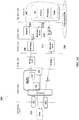
- Figure 2A illustrate different types of notification mechanisms in an embodiment PTT platform 106.
- a service 202 provided by the telecommunications services platform 106 creates or modifies data on behalf of a client
- a data change notification and/or the data may be transmitted to a client 204 (e.g., a client on a client device 102).
- the data change notification indicates a change to data relating to client 204 was made at the client data store.
- services 202 includes a calling service, a presence service, a messaging service, an extensible markup language (XML) data management (XDM) service, a location service, combinations thereof, or the like.
- Other embodiments may include other services in addition to or in lieu of the illustrated services.
- PTT platform 106 may include different notification channels, such as, real-time notification channel 206 and non-real-time notification channel 208.
- Real-time notification channel 206 may be provided through a notification service 210, for example, as described in U.S. Patent Application No. 15/013,718 filed on February 2, 2016 , entitled "Session Management and Notification Mechanisms for Push-to-Talk (PTT)," which is hereby incorporated by reference.
- Other real-time notification mechanisms may be used in other embodiments.
- Non-real-time notification channel 208 may be provided through a data synchronization server 212, which may provide notification-triggered synchronization mechanisms as described in greater detail with respect to Figures 3 through 5 below.
- An embodiment non-real-time notification method is described below in greater detail with regards to Figure 2B .
- Other non-real-time notification mechanisms may be used as well.
- different types of data changes by different types of services may result in different types of data synchronization mechanisms as detailed in Table 1. Different types of data changes may further result in different types of notifications and/or different contents in the corresponding notification.
- Table 1 below provides some example types of data and corresponding types of notifications and data synchronization mechanisms in a PTT platform.
- the types of data changes may result in other types of notifications/data synchronization mechanisms, and other types of data changes with corresponding types of notifications/data synchronization mechanisms may also exist in other embodiments.
- the types of notifications corresponding to different types of notifications/data synchronization mechanisms may be configured by a user, a group administrator, a network administrator, a service operator, a standard, combinations thereof, or the like. Table 1.
- Types of Data Changes and Corresponding Notification Types Type of Data Change Real- Time Notification Required? Contents in Notification (e.g., data change notification) Client Synchronization Immediately on Notification? Expected Synchronization Invocation on Client Device?
- MMS multimedia messaging service
- Meta content is synchronized when the client comes to the foreground.
- Attachment/multimedia contents synchronized when the client/user requests content download.
- Location tracking (e.g., Monitoring device locations of other client devices, such as, client devices of contacts and/or groups of client 204) Not applicable Not applicable Devices reporting location or tracking the location continuously are synchronized continuously with a location server (e.g., watcher). Devices that publish locations periodically synchronizes location data periodically (or using other criteria) with other watcher devices. Continuous synchronization when location service is active in client.
- a location server e.g., watcher
- some notifications may include at least a portion of the contents of the changed data (e.g., text message contents, meta content, PTT IPA, PTT call status data, and the like) along with a pending change indication for certain types of data.
- the contents are received in the notification and further synchronized as described above for archival purposes.
- the data change notification may include a pending change indication as well as contents of the text messages.
- the notification alerts a user of the existence and contents of a new text message.
- the client may also store the text message as part of text message history (e.g., an archive to allow a user to access threaded message history, to search past text messages, and the like).
- a master of copy of archive may be maintained by a server (e.g., a client data store).
- the client will synchronize archival text message history with the server when the client comes to the foreground when the data change notification for text messages is received.
- the data change notification may include a pending change indication as well as meta contents (e.g., sender information, recipient(s) information, subject lines, thumbnails of a MMS attachment, and the like) of the MMS message.
- the notification alerts a user of the existence and meta contents of the MMS message.
- the client may also store the meta contents of the MMS message history (e.g., an archive to allow a user to access threaded message history, to search past MMS messages, and the like).
- a master of copy of archive may be maintained by a server (e.g., a client data store).
- the client will synchronize archival text message history with the server when the client comes to the foreground when the data change notification for MMS messages is received.
- the attachment of the MMS message may be synchronized based on client configuration. For example, when the client is configured to automatically download MMS message attachments, data synchronization is done immediately (e.g., in real-time upon receipt of the notification). Otherwise, the data synchronization for the attachment is invoked when the user requests download of the attachment.
- the above two examples of synchronizing archival data may further be applied for other types of data, such as, IPAs, call history data (e.g., call received data, call sent data, call duration data, and the like), combinations thereof, and the like.
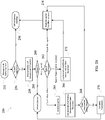
- FIG. 2B illustrates a flow chart 250 for notification delivery in an embodiment platform.
- the steps in flow chart 250 may be performed by a notification service 210 (e.g., for real-time notifications) in combination with a data synchronization server 212 (e.g., for offline delivery handling).
- a message is received for delivery to a client (e.g., client 204) on a client device (e.g., client device 102).
- a determination is made regarding whether the client is registered. If the client is not registered, the message is transferred for offline delivery handling in step 256.
- data in offline delivery handling is synchronized with the client when the client comes online.
- step 258 an attempt to deliver the message over a session initiation protocol (SIP) session (or other real-time delivery mechanism) is made in step 258.
- step 260 a determination is made as to whether the message was delivered successfully. If the message was delivered successfully, the process ends in step 280.
- SIP session initiation protocol
- Type 1 notifications require real-time delivery.
- the transaction is held in step 262 and a secondary notification service is used to trigger the client to reconnect with the primary real-time delivery channel in step 266. If the client successfully reconnects within a timeout period, the message is delivered to the client in step 270 and the process ends.
- the message is sent to offline delivery handing (step 256) after tracking the message delivery failure for identifying temporarily unreachable (TU) devices (e.g., devices that are temporarily disconnected from the network and/or the server) and/or offline purposes (step 274).
- TU temporarily unreachable
- Type 2 notifications simply trigger clients to reconnect.
- the server uses a secondary notification channel to notify the client to reconnect with the primary real-time notification channel in step 272.
- the message is sent to offline delivery handing (step 256) after tracking the message delivery failure for TU/offline purpose (step 274).
- Type 3 notifications are for non-urgent notifications. For delivery failure of Type 3 notifications, the message is sent to offline delivery handing (step 256) after tracking the message delivery failure for TU/offline purpose (step 274) without using the secondary notification channel.
- network resources may be wasted on data synchronization of certain types of data when a client is running as a background process.
- network resources may be wasted if the client performs a data synchronization check (e.g., check for data changes) every time the client is brought to foreground.
- Resources used to poll a server for data changes may be especially wasteful for types of data that do not change frequently. For example, configuration change notifications, group list updates, contact list updates, presence statuses for some types of users, and the like may be examples types of data that do not change frequently. Other types of data may also change infrequently.
- a notification server (e.g., as part of data synchronization server 212 and/or notification service 210) notifies the client when there is a change to data. Subsequently, the notification server may not send any further notifications to the client regarding non-real-time synchronization type data until the client successfully synchronizes data with a backend client data store even when there are additional changes to data relating to the client. In such embodiments, the notification server may or may not transmit subsequent notifications for real-time synchronization type data between an initial notification and when a client successfully synchronizes data with a backend client data store.
- network resources may be saved by transmitting a single notification, which indicates to the client that there are data changes at the client data store and triggers the client to synchronize its data with the network. Additional network resources to transmit additional notifications (e.g., for additional changes in data) between a data change notification and data synchronization may be saved.
- the notification server may transmit another notification to the client when a subsequent data change occurs.
- Various notifications from the notification server may further be throttled to reduce network resource congestion (e.g., RAN resource congestion) as explained in greater detail below.
- a client may only perform data synchronization when the user brings the client to the foreground (e.g., when the user opens the client for use). Data synchronization may not be triggered each time the client is brought to the foreground. Rather, the client determines if a data change notification was received since a most recent successful data synchronization to trigger a subsequent data synchronization.
- the client may not actively poll the server for changes and relies on data change notifications to determine when a change in data has occurred.
- the client may further synchronize data with the platform when the client regains network connectivity with the platform after the client was offline. In this way, missed data change notifications (e.g., while the client was offline) does not result in a delay or loss in synchronizing data.
- network resources for polling the server for data change can be saved.
- Figure 3 illustrates a portion of telecommunications services platform 106, which may be used to provide a notification-triggered data synchronization mechanism, which allows real-time and non-real-time data synchronization for a client 204 on a client device (e.g., client device 102 in Figure 1 ).
- Client 204 may use a data synchronization enabled backend client data store 306 (e.g., an electronic database, such as a cloud storage system, or the like) to manage data pertaining to one or more services 202 provided by telecommunications services platform 106.
- client data store 306 may be part of data synchronization server 212 or a separate entity from data synchronization server 212.
- Data stored in client data store 306 may be created and/or modified by client 204 directly. Any changes initiated by a user (e.g., an operator of the corresponding client device) may be synchronized with client data store 306 when a network connection between client 204 and client data store 306 is available.
- Backend services 202 may also create and/or modify data in client data store 306 on behalf of client 204. Changes to client data performed in the backend (e.g., performed by services 202) are synchronized to the client through a real-time synchronization mechanism and/or a notification-triggered data synchronization mechanism for non-real-time synchronization depending on the type of data changed.
- a mobile datasync gateway (GW) 316 facilitates access to client data store 306 by client 204.
- mobile datasync GW 316 may be part of data synchronization server 212 or a separate entity from data synchronization server 212.
- client 204 may back-up data and synchronize changes to data performed by other devices (e.g., services 202 and/or other client devices operated by the user) through mobile datasync GW 316.
- client 204 uses various services 202, and data used for the operation of these services is stored in client data store 306.
- services 202 may include PTT call servers (e.g., for providing PTT calls), presence servers (e.g., for tracking availability and status of contacts and/or groups), messaging servers (e.g., for text messages, multimedia messages, and/or the like), XDM servers (e.g., for contact data and/or group management data), location services, and the like.
- Services 202 may transmit client data changes to client data store 306.
- notification server 308 may be part of notification service 210 or a separate entity (e.g., part of data synchronization server 212).
- Notification server 308 delivers data change notifications sent by services 202 to client 204.
- Data change notifications for non-real-time data synchronization types of data may or may not be delivered to a client depending on whether a previous data change notification was delivered and whether a client has completed data synchronization after the previous data change notification and the type of data changed.
- notification server 308 does not deliver the subsequent data change notification to client 204.
- notification server 308 does deliver the data change notification to client 204.
- a user or other operator may designate certain types of data for real-time notifications, and a data change notification may be transmitted for these types of data each time a change occurs regardless of whether a previous notification was sent since a most recent successful synchronization.
- notification server 308 may further interact with location server 310 and analytics system 312 to determine network resource (e.g., RAN resource) congestion status at the location of client 204 (e.g., the location of the client device on which client 204 resides). Notification server 308 may determine whether to throttle messages (e.g., notifications) when delivering the data change notifications to client 204 in accordance with interactions with location server 310 and analytics system 312.
- network resource e.g., RAN resource
- Notification server 308 may determine whether to throttle messages (e.g., notifications) when delivering the data change notifications to client 204 in accordance with interactions with location server 310 and analytics system 312.
- Location server 310 tracks the RAN location for active clients (e.g., client 204) in the telecommunications services platform. For example, location server 310 may track which cells (e.g., base stations, macro-cells, femtocells, Wi-Fi APs, combinations thereof, and the like) serve clients (e.g., client 204) in the telecommunications services platform. Location information is collected through location updates sent by clients (e.g., client 204). In some embodiments, the client transmits location updates piggy-backed on other messages between the client and the various components of the telecommunications services platform. For example, location updates may be piggy-backed on service requests sent by various clients when accessing services 202.
- cells e.g., base stations, macro-cells, femtocells, Wi-Fi APs, combinations thereof, and the like
- Location information is collected through location updates sent by clients (e.g., client 204).
- the client transmits location updates piggy-backed on other messages between the client
- Various services 202 report user activity to analytics system 312.
- This user activity data is used by analytics system 312 to create a system wide network resource utilization map (e.g., a RAN utilization map).
- the network resource utilization map may continuously track and monitor what network resources are being used by different cells in a network.
- Notification server 308 may use the network resource utilization map and the location information to determine whether to throttle delivery of data change notifications to clients in congested areas. For example, notification server 308 may ensure that the number of notifications delivered by any cell in the network is below a maximum threshold within a certain time period. For example, notification server 308 allows delivery of data change notifications to clients served by a first cell within a first time period until a maximum number of notifications threshold is reached.
- the maximum number of notifications threshold and/or time periods may be configurable and set by the telecommunications system operator, a standard, a combination thereof, or the like. Once the maximum number of notifications threshold is reached, notification server 308 may hold additional notifications for delivery by the first cell until the next time period. Thus, network resources are not overwhelmed by notification delivery.
- Various embodiments include real-time and non-real-time data synchronization mechanisms, which advantageously provide data synchronization with improved efficiency in network resource utilization.
- a client e.g., a client 204 on client device 102 waits to receive a data change notification from a telecommunications services platform to determine when data change(s) has occurred instead of periodically polling a client data store to detect data changes.
- the client is not required to keep an active connection with the telecommunications services platform to receive pushed data changes in real-time.
- types of data changes configured for real-time notifications may be pushed to the client when a network connection is available, and the real-time notifications may be queued for delivery while the client is offline.
- the client may immediately synchronize with a client data store (e.g., sometimes referred to as real-time synchronization) or wait until the client is brought to the foreground of the client device by the user (e.g., non-real-time synchronization).
- a client data store e.g., sometimes referred to as real-time synchronization
- the data change notification indicates the type of data changed
- the client determines whether to perform real-time or non-real-time synchronization may be in accordance with the type of data changed (e.g., as configured by a user operating the client device).
- PTT service as described in Table 1, presence changes, contact data changes, group management data changes, push-to-X text message notifications, push-to-X multimedia message service notifications, PoC IPAs, call-related notifications (e.g., changes to a PTT call in progress notification, a PTT call completed notification, and the like), combinations thereof, or the like may be synchronized using a non-real-time synchronization mechanism while location tracking data changes (e.g., location tracking of a client's contacts and/or groups) may use real-time synchronization.
- call-related notifications e.g., changes to a PTT call in progress notification, a PTT call completed notification, and the like
- location tracking data changes e.g., location tracking of a client's contacts and/or groups
- any of the above example types of data may be synchronized using real-time or non-real-time data synchronization mechanisms as configured by a user, a group administrator, a network administrator, a service operator, a standard, combinations thereof, and the like.
- the client may not automatically trigger data synchronization. For example, the client may initiate data synchronization if at least one data change notification was received while the client was in the background. As another example, the client may initiate data synchronization if the client temporarily lost network connectivity for at least a configurable interval of time to catch missed data change notifications during the lost network connectivity.
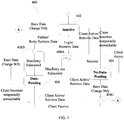
- Figure 4 illustrates a logic flow 400 of a client (e.g., client 204) on a client device (e.g., client device 102) implementing an embodiment non-real-time data synchronization mechanism.
- Figure 4 may illustrate interactions between the client, a notification server (e.g., notification server 308), and a data synchronization server (e.g., data synchronization server 212).
- Logic flow 400 may be used by the client on the client device to determine whether to attempt data synchronization with a backend server (e.g., data synchronization server 212).
- a client implementing logic flow 400 may be one of the following three states: inactive state 402, no-data-pending state 404, or data-pending state 406.
- the client may enter inactive state 402 on startup of the client device and when client loses network connectivity/becomes temporarily unavailable.
- inactive state 402 the client attempts to synchronize client data on the client device with data on the client data store (step 408A) as a result of a login attempt (e.g., attempt to re-connect with the client data store) and/or when the client is brought to the foreground (e.g., when the client switches from a background process to an active process).
- a login attempt e.g., attempt to re-connect with the client data store
- the client transitions to no-data-pending state 404.
- the attempt to synchronize data is unsuccessful, the client determines whether to retry data synchronization (step 408B).
- the client may retry the attempt to synchronize data until a maximum number of retries (designated MaxRetry) is exhausted.
- the maximum number of retries may be a configurable number set by the telecommunications services platform, the user, a standard, a combination thereof, or the like.
- the client may enter data-pending state 406.
- the client receives a data change notification (e.g., from a notification server) while in inactive state 402
- the client determines whether it is running active in the foreground of the client device or passively in the background of the client device (step 408D). For example, the client determines whether it is actively running on the client device or running as a background process of the client device.
- client attempts data synchronization (step 408A). Success or failure of the data synchronization procedure may result in transitioning into no-data-pending state 404, data synchronization procedure retries, and/or transitioning into data pending state 406 as discussed above.
- the client application is passive in the background of the client device, the client transitions to data-pending state 406 upon receiving the data change notification in inactive state 402.
- the client enters no-data-pending state 404 when the client successfully completes data synchronization.
- the client determines whether it is active in the foreground of the client device or passive in the background (step 408C). For example, the client determines whether it is actively running on the client device or running as a background process of the client device.
- client attempts data synchronization with the server (step 408A).
- the client application is passive in the background of the client device, the client transitions to data-pending state 406 upon receiving the data change notification in no-data-pending state 404.
- Success or failure of the data synchronization procedure may result in staying in no-data-pending state 404, data synchronization procedure retries, and/or transitioning into data pending state 406 as discussed above.
- the client upon successfully synchronizing data in no-data-pending state 404, the client remains in no-data-pending state 404. If data synchronization fails in no-data-pending state 404, client retries data synchronization until a maximum number of retry attempts is exhausted. When the maximum number of retry attempts is exhausted, the client enters data-pending state 406. If the client loses network connectivity (e.g., becomes temporarily unavailable to the server) when the client is in no-data-pending state 404, then client transitions to inactive state 402.
- network connectivity e.g., becomes temporarily unavailable to the server
- the client enters data-pending state 406 when the client has received a data change notification from the server while the client application is passive in the background.
- the client may further enter data-pending state 406 when attempts at data synchronization have failed more than the maximum number of retry attempts.
- data-pending state 406 the client ignores all subsequent data change notifications received from the notification server. Furthermore, in data-pending state 406, when the client loses network connectivity (e.g., becomes temporarily unavailable to the telecommunications services platform), the client may remain in data-pending state 406.
- the client When the client becomes active (e.g., brought to the foreground by a user or the client device's operating system), the client attempts data synchronization (step 408A) with a data synchronization server. Success or failure of the data synchronization procedure may result in transitioning into no-data-pending state 404, data synchronization procedure retries, and/or remaining into data-pending state 406 as discussed above. For example, upon successfully synchronizing data in data-pending state 406, the client transitions to no-data-pending state 404. If the data synchronization attempt fails in data-pending state 406, the client retries data synchronization until a maximum number of retry attempts is exhausted. When the maximum number of retry attempts is exhausted, the client remains in data-pending state 406.
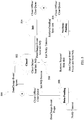
- Figure 5 illustrates a logic flow 500 of notification server logic for non-real-time data synchronization.
- the notification server sends a data change notification to a client on a client device.
- the notification server may not send subsequent notifications to the client for subsequent data changes until the client successfully synchronizes data with the client data store.
- the server may further use location information and real-time service usage data determine network resource (e.g., RAN resource) capacity utilization status.
- the notification server may determine whether to throttle data change notifications (e.g., to reduce RAN congestion) in accordance with the network resource capacity utilization status as described above.
- the notification server maintains a data change notification queue for each mobile client served by the notification server, such as, each client relying on the notification server to deliver notifications.
- Figure 5 illustrate various states of a data change notification queue maintained by notification server for a client device.
- the data change notification queue may be in any one of the following states: closed state 502, init state 504, no-data-pending state 506, and data-pending state 508.
- Data change notification queue is in closed state 502 when the client is offline.
- the notification server ignores data changes notifications by the client data store and/or the various services provided by the platform. For example, the notification server may discard all data change notifications relating to the client received while the data change notification queue is in closed state 502.
- the notification server attempts to transmit an initial data change notification to the client. This notification may be sent regardless of whether any data changes occurred while the client was offline. If the initial data change notification is delivered successfully to the client, the notification server transitions the data change notification queue to data-pending state 508. The initial data change notification triggers the client to attempt data synchronization. If the initial data change notification is not delivered successfully, the notification server transitions the data change notification queue to init state 504.
- the notification server may retry sending the initial data change notification to the client one or more times.
- the data change notification queue stays in init state 504 until the initial data change notification is delivered to the client successfully or the client successfully completes a data synchronization attempt.
- the state of the data change notification queue is transitioned to no-data-pending state 506.
- the state of the data change notification queue is transitioned to no-data-pending state 506. If the client goes offline when the data change notification queue is in init state 504, the state of the data change notification queue is transitioned to closed state 502. Transitioning to closed state 502 may further include clearing the data change notification queue.
- the data change notification queue enters data-pending state 508 after at least one data change notification has been delivered to the client. This can occur when the initial data change notification is delivered to the client; at the time of client login; or when a data change notification is received by the notification server while the data change notification queue is in no-data-pending state 506.
- the notification server enqueues subsequent data change events until the client successfully completes data synchronization with a client data store.
- the subsequent data change events are determined by the notification server from subsequent data change notifications transmitted to the notification server by the client data store and/or various services in the platform.
- the notification server may further determine when a client successfully completes data synchronization from a notification transmitted by, for example, a data synchronization server (e.g., data synchronization server 212).
- the notification server may optionally transmit data change notifications while in data-pending state 508 for certain types of data (e.g., data where real-time notifications are desired).
- the data change notification queue is transitioned to no-data-pending state 506 and the enqueued data change events may be cleared.
- the data change notification queue enters no-data-pending state 506 when the client successfully synchronizes data with the client data store.
- the notification server waits for a data change event to occur (e.g., as reported by a service) and sends a data change notification to the mobile client when the data change event occurs.
- data change notification queue state is transitioned to data-pending state 508. If the client goes offline when the data change notification queue is in no-data-pending state 506, the state of the data change notification queue is transitioned to closed state 502. Transitioning to closed state 502 may further include clearing the data change notification queue.
- the notification server may also throttle data change notifications based on client location and network resource utilization at the client location.
- a client reports its location information to a location server as part of its login and login session refresh procedures.
- the location information may also be piggy-backed in service requests sent by the client.
- This location information is processed by an analytics system in real-time and a network resource utilization map is generated and maintained by the analytics system.
- the network resource utilization map may be maintained and updated continuously in real-time to track network resource utilization and/or capacity at various locations in the network.
- the notification server may use of the network resource utilization map to throttle the notifications and not exceed a maximum configured threshold for the network utilization level at any given network location (e.g., any cell).
- Figure 6 illustrates a block diagram of an embodiment processing system 600 for performing methods described herein, which may be installed in a host device.
- the processing system 600 includes a processor 604, a memory 606, and interfaces 610-614, which may (or may not) be arranged as shown in Figure 6 .
- the processor 604 may be any component or collection of components adapted to perform computations and/or other processing related tasks
- the memory 606 may be any component or collection of components adapted to store programming and/or instructions for execution by the processor 604.
- the memory 606 includes a non-transitory computer readable medium.
- the interfaces 610, 612, 614 may be any component or collection of components that allow the processing system 600 to communicate with other devices/components and/or a user.
- one or more of the interfaces 610, 612, 614 may be adapted to communicate data, control, or management messages from the processor 604 to applications installed on the host device and/or a remote device.
- one or more of the interfaces 610, 612, 614 may be adapted to allow a user or user device (e.g., personal computer (PC), etc.) to interact/communicate with the processing system 600.
- the processing system 600 may include additional components not depicted in Figure 6 , such as long term storage (e.g., non-volatile memory, etc.).
- the processing system 600 is included in a network device that is accessing, or part otherwise of, a telecommunications network.
- the processing system 600 is in a network-side device in a wireless or wireline telecommunications network, such as a base station, a relay station, a scheduler, a controller, a gateway, a router, an applications server, or any other device in the telecommunications network.
- the processing system 600 is in a user-side device accessing a wireless or wireline telecommunications network, such as a mobile station, a user equipment (UE), a personal computer (PC), a tablet, a wearable communications device (e.g., a smartwatch, etc.), or any other device adapted to access a telecommunications network.
- a wireless or wireline telecommunications network such as a mobile station, a user equipment (UE), a personal computer (PC), a tablet, a wearable communications device (e.g., a smartwatch, etc.), or any other device adapted to access a telecommunications network.
- one or more of the interfaces 610, 612, 614 connects the processing system 600 to a transceiver adapted to transmit and receive signaling over the telecommunications network.
- Figure 7 illustrates a block diagram of a transceiver 700 adapted to transmit and receive signaling over a telecommunications network.
- the transceiver 700 may be installed in a host device. As shown, the transceiver 700 comprises a network-side interface 702, a coupler 704, a transmitter 706, a receiver 708, a signal processor 710, and a device-side interface 712.
- the network-side interface 702 may include any component or collection of components adapted to transmit or receive signaling over a wireless or wireline telecommunications network.
- the coupler 704 may include any component or collection of components adapted to facilitate bidirectional communication over the network-side interface 702.
- the transmitter 706 may include any component or collection of components (e.g., up-converter, power amplifier, etc.) adapted to convert a baseband signal into a modulated carrier signal suitable for transmission over the network-side interface 702.
- the receiver 708 may include any component or collection of components (e.g., down-converter, low noise amplifier, etc.) adapted to convert a carrier signal received over the network-side interface 702 into a baseband signal.
- the signal processor 710 may include any component or collection of components adapted to convert a baseband signal into a data signal suitable for communication over the device-side interface(s) 712, or vice-versa.
- the device-side interface(s) 712 may include any component or collection of components adapted to communicate data-signals between the signal processor 710 and components within the host device (e.g., the processing system 600, local area network (LAN) ports, etc
- the transceiver 700 may transmit and receive signaling over any type of communications medium.
- the transceiver 700 transmits and receives signaling over a wireless medium.
- the transceiver 700 may be a wireless transceiver adapted to communicate in accordance with a wireless telecommunications protocol, such as a cellular protocol (e.g., long-term evolution (LTE), etc.), a wireless local area network (WLAN) protocol (e.g., Wi-Fi, etc.), or any other type of wireless protocol (e.g., Bluetooth, near field communication (NFC), etc.).
- a wireless telecommunications protocol such as a cellular protocol (e.g., long-term evolution (LTE), etc.), a wireless local area network (WLAN) protocol (e.g., Wi-Fi, etc.), or any other type of wireless protocol (e.g., Bluetooth, near field communication (NFC), etc.).
- the network-side interface 702 comprises one or more antenna/radiating elements.
- the network-side interface 702 may include a single antenna, multiple separate antennas, or a multi-antenna array configured for multi-layer communication, e.g., single input multiple output (SIMO), multiple input single output (MISO), multiple input multiple output (MIMO), etc.
- the transceiver 700 transmits and receives signaling over a wireline medium, e.g., twisted-pair cable, coaxial cable, optical fiber, etc.
- Specific processing systems and/or transceivers may utilize all of the components shown, or only a subset of the components, and levels of integration may vary from device to device.
Landscapes
- Engineering & Computer Science (AREA)
- Computer Networks & Wireless Communication (AREA)
- Signal Processing (AREA)
- Theoretical Computer Science (AREA)
- Multimedia (AREA)
- Data Mining & Analysis (AREA)
- Databases & Information Systems (AREA)
- Physics & Mathematics (AREA)
- General Engineering & Computer Science (AREA)
- General Physics & Mathematics (AREA)
- Telephonic Communication Services (AREA)
- Information Retrieval, Db Structures And Fs Structures Therefor (AREA)
Claims (5)
- Verfahren umfassend:das Empfangen, durch einen Client (204) auf einem Clientgerät (102), einer Datenänderungsbenachrichtigung, wobei die Datenänderungsbenachrichtigung eine Änderung von Daten betreffend den Client (204) bei einem Clientdatenspeicher anzeigt;das Bestimmen, durch den Client (204), eines Typs der Daten betreffend den Client, die bei dem Clientdatenspeicher geändert wurden, wobei der Typ der Daten betreffend den Client, die bei dem Clientdatenspeicher geändert wurden, Präsenzdaten des Push-to-Talk (PTT) über das Mobilfunknetz (PoC), PTT-Kontaktdaten, PTT-Gruppenmanagementdaten, eine Push-to-X-Textnachrichtbenachrichtigung, eine Push-to-X-Multimedianachrichtendienstbenachrichtigung, einen PTT-Instant-Personal-Alarm, PTT-Standort-Trackingdaten, Änderungen zur PTT-Benachrichtigung, dass ein Ruf in Bearbeitung ist, eine PTT-Benachrichtigung, dass ein Ruf abgeschlossen ist, oder eine Kombination davon ist; unddas Bestimmen, durch den Client (204), eines Datensynchronisierungsmechanismus gemäß dem Typ der Daten betreffend den Client, die in dem Clientdatenspeicher geändert wurden, wobei das Bestimmen des Datensynchronisierungsmechanismus das Bestimmen umfasst, wann, durch den Client, eine Datensynchronisation zum Synchronisieren der Daten auf dem Clientgerät mit den Daten betreffend den Client, die in dem Clientdatenspeicher geändert wurden, versucht werden soll, wobei der Datensynchronisierungsmechanismus ein Nicht-Echtzeitdatensynchronisierungsmecha-nismus ist, und wobei der Nicht-Echtzeitdatensynchronisierungsmechanismus umfasst:das Bestimmen, durch den Client, ob der Client in einem Vordergrund des Clientgeräts (102) läuft oder in einem Hintergrund des Clientgeräts läuft; unddas Versuchen, durch den Client, die Daten auf dem Clientgerät (102) mit den Daten betreffend den Client, die in dem Clientdatenspeicher geändert wurden zu synchronisieren, wenn der Client im Vordergrund des Clientgeräts läuft, wobei der Nicht-Echtzeitdatensynchronisierungsmechanismus ferner umfasst, das Warten, durch den Client (204), bis der Client im Vordergrund läuft, um das Synchronisieren der Daten auf dem Clientgerät (102) mit den Daten betreffend den Client, die in dem Clientdatenspeicher geändert wurden, zu synchronisieren, wenn der Client im Hintergrund des Clientgeräts läuft.
- Verfahren gemäß Anspruch 1, wobei der Datensynchronisierungsmechanismus ein Echtzeitdatensynchronisierungsmechanismus ist, und wobei der Echtzeitdatensynchronisierungsmechanismus das Versuchen umfasst, durch den Client (204), die Daten auf dem Clientgerät (102) mit den Daten betreffend den Client, die in dem Clientdatenspeicher geändert wurden, zu synchronisieren, nachdem die Datenänderungsbenachrichtigung empfangen wird, unabhängig davon, ob der Client in einem Vordergrund des Clientgeräts läuft oder in einem Hintergrund des Clientgeräts läuft.
- Verfahren gemäß Anspruch 1, ferner umfassend:das Bestimmen, durch das Clientgerät (102), ob die Datenänderungsbenachrichtigung empfangen wurde nach einer letzten erfolgreichen Datensynchronisierung auf dem Clientgerät, wenn der Client (204) vom Laufen in einem Hintergrund des Clientgeräts zum Laufen in einem Vordergrund des Clientgeräts wechselt; unddas Versuchen, durch den Client (204), die Daten des Clientgeräts (102) mit den Daten betreffend den Client, die in dem Clientdatenspeicher geändert wurden, zu synchronisieren, wenn die Datenänderungsbenachrichtigung nach der letzten erfolgreichen Datensynchronisierung auf dem Clientgerät empfangen wurde.
- Verfahren gemäß Anspruch 1, wobei der Client (204) den Clientdatenspeicher für Änderungen der Daten betreffend den Client nicht abfragt, und wobei es für den Client nicht erforderlich ist, zum Empfangen von Änderungen der Daten betreffend den Client eine aktive Verbindung mit dem Clientdatenspeicher aufrechtzuerhalten.
- Verfahren gemäß Anspruch 1, wobei die Datenänderungsbenachrichtigung wenigstens einen Teil der Daten betreffend den Client (204) beinhaltet, die in dem Clientdatenspeicher geändert wurden, wobei der Client ein erstes Archiv von Daten für den Typ von Daten betreffend den Client, die in dem Clientdatenspeicher geändert wurden, verwaltet, wobei der Clientdatenspeicher ein zweites Archiv von Daten für den Typ der Daten betreffend den Client, die in dem Clientdatenspeicher geändert wurden, verwaltet, und wobei der Datensynchronisationsmechanismus verwendet wird, durch den Client, um das erste Archiv von Daten mit dem zweiten Archiv von Daten zu synchronisieren.
Applications Claiming Priority (2)
| Application Number | Priority Date | Filing Date | Title |
|---|---|---|---|
| US201562158384P | 2015-05-07 | 2015-05-07 | |
| PCT/US2016/031231 WO2016179502A1 (en) | 2015-05-07 | 2016-05-06 | System and method for data synchronization |
Publications (3)
| Publication Number | Publication Date |
|---|---|
| EP3292485A1 EP3292485A1 (de) | 2018-03-14 |
| EP3292485A4 EP3292485A4 (de) | 2019-02-13 |
| EP3292485B1 true EP3292485B1 (de) | 2021-02-17 |
Family
ID=57217814
Family Applications (1)
| Application Number | Title | Priority Date | Filing Date |
|---|---|---|---|
| EP16790162.8A Active EP3292485B1 (de) | 2015-05-07 | 2016-05-06 | System und verfahren zur datensynchronisierung |
Country Status (5)
| Country | Link |
|---|---|
| US (1) | US10609138B2 (de) |
| EP (1) | EP3292485B1 (de) |
| CA (1) | CA2971107C (de) |
| MX (1) | MX374337B (de) |
| WO (1) | WO2016179502A1 (de) |
Families Citing this family (14)
| Publication number | Priority date | Publication date | Assignee | Title |
|---|---|---|---|---|
| US20180004829A1 (en) * | 2016-06-30 | 2018-01-04 | Facebook, Inc. | Techniques for database replication between client devices |
| US10706069B2 (en) * | 2016-06-30 | 2020-07-07 | Facebook, Inc. | Techniques for replication of a client database to remote devices |
| DE112016006825T5 (de) * | 2016-07-01 | 2019-01-17 | Intel Corporation | Adaptive synchronisierung |
| US10742732B1 (en) * | 2017-03-02 | 2020-08-11 | Apple Inc. | Cloud storage and synchronization of messages |
| US11010485B1 (en) | 2017-03-02 | 2021-05-18 | Apple Inc. | Cloud messaging system |
| US10733173B2 (en) | 2017-10-09 | 2020-08-04 | Citrix Systems, Inc. | Detecting and reporting changes in data values |
| US11418603B2 (en) * | 2018-08-02 | 2022-08-16 | International Business Machines Corporation | Dynamic backoff and retry attempts based on incoming request |
| US10757602B2 (en) * | 2018-12-07 | 2020-08-25 | Ford Global Technologies, Llc | Connection history-based retry throttling |
| US12034692B2 (en) * | 2019-01-04 | 2024-07-09 | Microsoft Technology Licensing, Llc | Automatic notification of data changes |
| US10904938B2 (en) | 2019-03-12 | 2021-01-26 | Ford Global Technologies, Llc | Circuit-switched domain response to packet-switched domain failure |
| CN110225119B (zh) * | 2019-06-13 | 2022-09-16 | 平安科技(深圳)有限公司 | 数据同步方法及相关设备 |
| CN110708372A (zh) * | 2019-09-29 | 2020-01-17 | 广州餐道信息科技有限公司 | 点餐软件统一对接系统 |
| US12189801B2 (en) * | 2022-05-06 | 2025-01-07 | Sap Se | Cross-landscape package replication |
| US12001878B2 (en) * | 2022-06-03 | 2024-06-04 | Snap Inc. | Auto-recovery for AR wearable devices |
Family Cites Families (176)
| Publication number | Priority date | Publication date | Assignee | Title |
|---|---|---|---|---|
| US3912874A (en) | 1974-06-04 | 1975-10-14 | American Telephone & Telegraph | Conference arrangement |
| US4796293A (en) | 1987-12-18 | 1989-01-03 | Communications Network Enhancement Inc. | Enhanced dedicated teleconferencing system |
| HU213595B (en) | 1991-11-21 | 1997-08-28 | Motorola Inc | Method of assigning a voice/data signal channel as a temporary control channel in radio communication systems |
| FI98183C (fi) | 1992-02-14 | 1997-04-25 | Nokia Mobile Phones Ltd | Järjestely data-adapterin kytkemiseksi GSM-solukkopuhelimeen |
| ATE355714T1 (de) | 1993-06-15 | 2006-03-15 | British Tech Group Int | Telekommunikationssystem |
| US5483587A (en) | 1994-06-08 | 1996-01-09 | Linkusa Corporation | System and method for call conferencing |
| FI98973C (fi) | 1994-11-22 | 1997-09-10 | Nokia Telecommunications Oy | Menetelmä ryhmätietojen ylläpitämiseksi matkaviestinjärjestelmässä ja matkaviestinjärjestelmä |
| GB9604625D0 (en) | 1996-03-04 | 1996-05-01 | Intellprop Ltd | Telephone conferencing systems |
| US5711011A (en) | 1996-06-04 | 1998-01-20 | Motorola, Inc. | Method for providing voice mail service in a dispatch radio communication system and corresponding dispatch system |
| US5987318A (en) | 1996-07-31 | 1999-11-16 | Ericsson Inc. | Call conference within a home zone |
| US6021326A (en) | 1996-11-04 | 2000-02-01 | Uniden America Corporation | Trunked multi-site dispatch network for trunking radios |
| US5987331A (en) | 1996-11-20 | 1999-11-16 | Motorola, Inc. | Communication system to communication system gateway method and apparatus |
| US6026087A (en) | 1997-03-14 | 2000-02-15 | Efusion, Inc. | Method and apparatus for establishing a voice call to a PSTN extension for a networked client computer |
| FI110401B (fi) | 1997-08-11 | 2003-01-15 | Nokia Corp | Suljetun tilaajaryhmän puhepostipalvelu matkaviestinjärjestelmässä |
| FI105872B (fi) | 1997-08-28 | 2000-10-13 | Nokia Mobile Phones Ltd | Menetelmä ja järjestelmä sanomien välittämiseksi |
| US7227837B1 (en) | 1998-04-30 | 2007-06-05 | At&T Labs, Inc. | Fault tolerant virtual tandem switch |
| GB2383723B (en) | 1998-06-03 | 2003-09-10 | Orange Personal Comm Serv Ltd | Mobile communications |
| US6397054B1 (en) | 1998-07-30 | 2002-05-28 | Ericsson Inc. | Features for emergency calling and short messaging system |
| FI109756B (fi) | 1998-09-21 | 2002-09-30 | Nokia Corp | Menetelmä tiedonsiirtojärjestelmässä paikallisten resurssien hyödyntämiseksi, tiedonsiirtojärjestelmä ja langaton viestin |
| US6856676B1 (en) | 1998-10-15 | 2005-02-15 | Alcatel | System and method of controlling and managing voice and data services in a telecommunications network |
| FI982490A0 (fi) | 1998-11-18 | 1998-11-18 | Nokia Corp | Menetelmä ja järjestelmä viestintää varten |
| US6606305B1 (en) | 1998-11-25 | 2003-08-12 | Lucent Technologies Inc. | Apparatus, method and system for automatic telecommunication conferencing and broadcasting |
| US6577874B1 (en) | 1999-05-10 | 2003-06-10 | Ericsson Inc. | Methods and systems for providing temporary identification numbers for mobile terminals |
| US6449491B1 (en) | 1999-05-10 | 2002-09-10 | Ericsson Inc. | Apparatus and methods for conducting group calls in wireless communications systems |
| US6405030B1 (en) | 1999-05-20 | 2002-06-11 | Peter Suprunov | System for interception of digital cellular phone communication |
| US6751468B1 (en) | 1999-05-26 | 2004-06-15 | Bellsouth Intellectual Property Corporation | Systems and methods for providing push to talk feature for wireless communication systems |
| US6141556A (en) | 1999-05-27 | 2000-10-31 | Qwest Communications International Inc. | Telecommunications system with multi-extension services |
| US6304558B1 (en) | 1999-05-28 | 2001-10-16 | Motorola, Inc. | Network dispatch manager, dispatch gateway, and a method for providing dispatch service to dispatch clients via a packet-switched network |
| US6473501B1 (en) | 1999-06-11 | 2002-10-29 | Telefonaktiebolaget L M Ericsson (Publ) | Concurrent hunt group searching methods and arrangements |
| AU5096400A (en) | 1999-06-21 | 2001-01-09 | Nokia Networks Oy | Gateway, system and method for supporting roaming |
| US6404746B1 (en) | 1999-07-13 | 2002-06-11 | Intervoice Limited Partnership | System and method for packet network media redirection |
| DE59911569D1 (de) | 1999-08-30 | 2005-03-10 | Swisscom Mobile Ag | Notrufsystem innerhalb eines telekommunikationsnetzes |
| HK1045414A1 (zh) | 1999-09-14 | 2002-11-22 | Stratos Global Limited | 電話訊息發放系統 |
| US6477366B1 (en) | 1999-09-22 | 2002-11-05 | Ericsson Inc. | System and method for virtual citizen's band radio in a cellular network |
| US6411815B1 (en) | 1999-09-28 | 2002-06-25 | Motorola, Inc. | Communication system and method for arbitrating service requests |
| US6801762B1 (en) | 1999-09-29 | 2004-10-05 | Nokia Corporation | Apparatus, and associated method, for placing an emergency call in a radio communication system |
| US6477387B1 (en) | 1999-10-08 | 2002-11-05 | Motorola, Inc. | Method and apparatus for automatically grouping communication units in a communication system |
| US6138011A (en) | 1999-10-15 | 2000-10-24 | Motorola, Inc. | Method and apparatus for providing dispatch service to an existing telephone network |
| FI19992593A7 (fi) | 1999-12-02 | 2001-06-03 | Nokia Networks Oy | Puheluiden reititys tietoliikennejärjestelmässä |
| CN1247036C (zh) | 2000-03-03 | 2006-03-22 | 高通股份有限公司 | 在现有的通信系统中参与小组通信服务的方法和设备 |
| US6539232B2 (en) | 2000-06-10 | 2003-03-25 | Telcontar | Method and system for connecting mobile users based on degree of separation |
| DE10030189A1 (de) | 2000-06-20 | 2002-01-03 | Siemens Ag | WAP-Group-Call |
| US7085260B2 (en) | 2000-08-22 | 2006-08-01 | Lucent Technologies Inc. | Internet protocol based wireless call processing |
| FI110560B (fi) | 2000-12-27 | 2003-02-14 | Nokia Corp | Ryhmän muodostaminen langattomille kommunikaatiopäätelaitteille |
| US20020102989A1 (en) | 2001-01-26 | 2002-08-01 | Calvert Brian Edward | Method and apparatus for accurately locating a communication device in a wireless communication system |
| US7170863B1 (en) | 2001-02-12 | 2007-01-30 | Nortel Networks Limited | Push-to-talk wireless telecommunications system utilizing a voice-over-IP network |
| CA2641610C (en) | 2001-03-09 | 2010-09-14 | Research In Motion Limited | Advanced voice and data operations in a mobile data communication device |
| US7945592B2 (en) | 2001-03-20 | 2011-05-17 | Verizon Business Global Llc | XML based transaction detail records |
| WO2002087272A1 (en) | 2001-04-25 | 2002-10-31 | Nokia Corporation | Authentication in a communication system |
| US20030148779A1 (en) | 2001-04-30 | 2003-08-07 | Winphoria Networks, Inc. | System and method of expediting call establishment in mobile communications |
| US6996414B2 (en) | 2001-04-30 | 2006-02-07 | Motorola, Inc. | System and method of group calling in mobile communications |
| US6725053B2 (en) | 2001-05-15 | 2004-04-20 | Qualcomm Incorporated | Method and apparatus for reducing latency in waking up a group of dormant communication devices |
| FI114180B (fi) | 2001-06-12 | 2004-08-31 | Nokia Corp | Parannettu menetelmä ja laitejärjestely tietojen siirron salaamiseksi radioverkon päätelaitteen sisältämässä rajapinnassa sekä radioverkon päätelaite |
| US20020187750A1 (en) | 2001-06-12 | 2002-12-12 | Majumdar Kalyan Sankar | Method and apparatus for service management, delegation and personalization |
| US7099291B2 (en) | 2001-06-22 | 2006-08-29 | Motorola, Inc. | Dispatch call origination and set up in a CDMA mobile communication system |
| US6982961B2 (en) | 2001-07-19 | 2006-01-03 | Telefonaktiebolaget Lm Ericsson (Publ) | Push-to-talk and push-to-conference in a CDMA wireless communications system |
| US7085364B1 (en) | 2001-08-20 | 2006-08-01 | 3Com Corporation | Advanced conference drop |
| US7127238B2 (en) | 2001-08-31 | 2006-10-24 | Openwave Systems Inc. | Method and apparatus for using Caller ID information in a browser of a mobile communication device |
| US20030078064A1 (en) | 2001-10-22 | 2003-04-24 | Chan Victor H. | System and method for queuing talk requests in wireless dispatch system |
| US6970712B1 (en) | 2001-12-13 | 2005-11-29 | At&T Corp | Real time replay service for communications network |
| US20030119540A1 (en) | 2001-12-21 | 2003-06-26 | Mathis James Earl | Contact list-based group call |
| US7043266B2 (en) | 2002-02-04 | 2006-05-09 | Sprint Spectrum L.P. | Method and system for selectively reducing call-setup latency through management of paging frequency |
| US6865398B2 (en) | 2002-02-04 | 2005-03-08 | Sprint Spectrum L.P. | Method and system for selectively reducing call-setup latency through management of paging frequency and buffering of user speech in a wireless mobile station |
| US7634568B2 (en) | 2002-02-07 | 2009-12-15 | Sprint Spectrum L.P. | Method and system for facilitating services in a communication network through data-publication by a signaling server |
| US20030153343A1 (en) | 2002-02-14 | 2003-08-14 | Crockett Douglas M. | Communication device for initiating a group call in a group communication network |
| US6898436B2 (en) | 2002-02-14 | 2005-05-24 | Qualcomm Incorporated | Communication device for joining a user to a group call in a group communication network |
| US7236580B1 (en) | 2002-02-20 | 2007-06-26 | Cisco Technology, Inc. | Method and system for conducting a conference call |
| US6993355B1 (en) | 2002-02-22 | 2006-01-31 | Verizon Services Corp. | Methods and apparatus for connecting family members |
| US7024214B2 (en) * | 2002-02-26 | 2006-04-04 | Microsoft Corporation | Synchronizing over a number of synchronization mechanisms using flexible rules |
| US6895254B2 (en) | 2002-04-15 | 2005-05-17 | Motorola, Inc. | Method and apparatus for providing a dispatch call |
| DE10222156A1 (de) | 2002-05-17 | 2003-11-27 | Siemens Ag | Verfahren zur übertragungseffizienten Aufbereitung von Multimedianachrichten |
| US7764950B2 (en) | 2002-05-24 | 2010-07-27 | Kodiak Networks, Inc. | Advanced voice services architecture framework |
| US7529557B2 (en) | 2002-05-24 | 2009-05-05 | Kodiak Networks, Inc. | Press-to-connect for wireless communications systems |
| WO2005009006A2 (en) | 2003-05-23 | 2005-01-27 | Kodiak Networks, Inc. | Premium voice services for wireless communications systems |
| US7738896B2 (en) | 2002-05-24 | 2010-06-15 | Kodiak Networks, Inc. | Subscriber identity module (SIM) enabling advanced voice services (AVS) including push-to-talk, push-to-conference and push-to-message on wireless handsets and networks |
| US7738892B2 (en) | 2002-05-24 | 2010-06-15 | Kodiak Networks, Inc. | Architecture, client specification and application programming interface (API) for supporting advanced voice services (AVS) including push to talk on wireless handsets and networks |
| AU2003237236A1 (en) | 2002-05-24 | 2003-12-12 | Kodiak Networks, Inc. | Dispatch service architecture framework |
| US7403775B2 (en) | 2002-05-24 | 2008-07-22 | Kodiak Networks, Inc. | Roaming gateway for support of advanced voice services while roaming in wireless communications systems |
| US20040152441A1 (en) | 2002-07-10 | 2004-08-05 | Wong Wai-See Candy | Wireless handset emergency location provisioning system (wireless HELPS) |
| US7026926B1 (en) | 2002-08-15 | 2006-04-11 | Walker Iii Ethan A | System and method for wireless transmission of security alarms to selected groups |
| US7453837B2 (en) | 2002-08-15 | 2008-11-18 | Zteit Usa, Inc. | Trunking system for CDMA wireless communication |
| US20040032843A1 (en) | 2002-08-15 | 2004-02-19 | Schaefer Bradley R. | Push-to-talk/cellular networking system |
| US8411594B2 (en) | 2002-09-20 | 2013-04-02 | Qualcomm Incorporated | Communication manager for providing multimedia in a group communication network |
| US7212506B2 (en) | 2002-11-18 | 2007-05-01 | Lucent Technologies Inc. | System for the secure distribution of priority call access codes to provide guaranteed wireless communication service to priority wireless communication subscribers |
| US7319879B2 (en) | 2002-12-31 | 2008-01-15 | Mototola, Inc. | Method and apparatus for providing dispatch-type services in a cellular communication system |
| US6990353B2 (en) | 2003-02-19 | 2006-01-24 | Lucent Technologies Inc. | Communication to one mobile station of update of call participation availability status of another mobile station |
| SE0300555D0 (sv) | 2003-02-24 | 2003-02-24 | Ericsson Telefon Ab L M | Improvements in or relating to push-to-talk services |
| US7260087B2 (en) | 2003-04-02 | 2007-08-21 | Cellco Partnership | Implementation methodology for client initiated parameter negotiation for PTT/VoIP type services |
| US7107017B2 (en) | 2003-05-07 | 2006-09-12 | Nokia Corporation | System and method for providing support services in push to talk communication platforms |
| US20040228292A1 (en) | 2003-05-12 | 2004-11-18 | Edwards David W. | Method and apparatus for providing full duplex dispatch |
| US7330540B2 (en) | 2003-05-21 | 2008-02-12 | Qwest Communications International Inc. | Systems and methods for providing conference communication |
| US7171228B2 (en) | 2003-06-20 | 2007-01-30 | Lucent Technologies Inc. | Application server component notification to one or more communication devices of one or more open communication sessions |
| FI20030944A0 (fi) | 2003-06-25 | 2003-06-25 | Nokia Corp | Ryhmäpuhelu viestintäjärjestelmässä |
| EP1649706A4 (de) | 2003-07-18 | 2011-05-11 | Kodiak Networks Inc | Premium-voice-dienste für drahtlose kommunikationssysteme |
| US20050047362A1 (en) | 2003-08-25 | 2005-03-03 | Motorola, Inc. | System and method for transmitting caller information from a source to a destination |
| KR100584369B1 (ko) | 2003-11-06 | 2006-05-26 | 삼성전자주식회사 | 이동 통신 시스템에서 이동통신단말기의 상태 정보 제공방법 및 그 이동통신단말기 |
| US7106714B2 (en) | 2003-11-25 | 2006-09-12 | Motorola, Inc. | Method and apparatus for transmission of control data in a packet data communication system |
| DE60318951T2 (de) | 2003-12-02 | 2009-04-09 | Alcatel Lucent | Bereitstellung von standortabhängigen Diensten an mobilen Telefongeräten in einem drahtlosen Netzwerk |
| CA2451954C (en) | 2003-12-03 | 2013-05-28 | Research In Motion Limited | Push-to-talk handling in a dual processor environment |
| JP2007513592A (ja) | 2003-12-08 | 2007-05-24 | キョウセラ ワイヤレス コープ. | コンタクト管理のためのプッシュツートークユーザインターフェース |
| US7460861B2 (en) | 2003-12-17 | 2008-12-02 | Redknee Inc. | Real-time mobile conferencing solution |
| US7613480B2 (en) | 2003-12-31 | 2009-11-03 | At&T Mobility Ii Llc | Multiple subscription subscriber identity module (SIM) card |
| US7711382B2 (en) | 2004-02-27 | 2010-05-04 | Motorola, Inc. | Method for dynamic group call |
| FR2866825B1 (fr) | 2004-03-01 | 2007-04-20 | Air Liquide | Electrode enrobee a faible emission de fumees et bas chrome hexavalent pour le soudage des aciers inoxydables |
| US20050216524A1 (en) * | 2004-03-23 | 2005-09-29 | Integrated Data Corporation | Smart and selective synchronization between databases in a document management system |
| US20050232241A1 (en) | 2004-03-31 | 2005-10-20 | Geng Wu | Method and apparatus for push-to-talk communications |
| US7366535B2 (en) | 2004-04-21 | 2008-04-29 | Nokia Corporation | Push-to-talk mobile communication terminals |
| WO2005112494A1 (en) | 2004-05-11 | 2005-11-24 | Kodiak Networks, Inc. | Architecture, client specification and application programming interface (api) for supporting advanced voice services (avs) including push to talk on wireless handsets and networks |
| ES2315874T3 (es) | 2004-05-14 | 2009-04-01 | Kodiak Networks, Inc. | Sistema y metodo para proporcionar servicios de voz de grupo en una red inalambrica. |
| WO2005117474A1 (en) | 2004-05-24 | 2005-12-08 | Kodiak Networks, Inc. | Subscriber identity module (sim) enabling advanced voice services (avs) including push-to-talk, push-to-conference and push-to-message on wireless handsets and networks |
| CN101006681B (zh) | 2004-06-08 | 2010-10-27 | 艾利森电话股份有限公司 | 用于ip多媒体业务的灵活计费机制 |
| US7738861B2 (en) | 2004-06-29 | 2010-06-15 | Sony Ericsson Mobile Communications Ab | Caller identification using push-to-talk protocol for wireless communications devices |
| US7729303B2 (en) | 2004-06-30 | 2010-06-01 | Zteit Usa, Inc. | Global open trunking system for CDMA wireless communication |
| US7398079B2 (en) | 2004-06-30 | 2008-07-08 | Research In Motion Limited | Methods and apparatus for automatically recording push-to-talk (PTT) voice communications for replay |
| US20060030347A1 (en) | 2004-07-16 | 2006-02-09 | Deepankar Biswaas | Virtual push to talk (PTT) and push to share (PTS) for wireless communications systems |
| US7187759B2 (en) | 2004-08-06 | 2007-03-06 | Pramodkumar Patel | Mobile voice mail screening method |
| US20060067499A1 (en) | 2004-09-30 | 2006-03-30 | Marcelo Oliveira | Method and apparatus for querying a list of participants in a conference |
| US8036692B2 (en) | 2005-08-08 | 2011-10-11 | Kodiaks Networks, Inc. | Brew platform enabling advanced voice services (AVS) including push-to-talk, push-to-conference and push-to-message on wireless handsets and networks |
| US8676189B2 (en) | 2008-01-24 | 2014-03-18 | Kodiak Networks, Inc. | Converged mobile-web communications solution |
| US7813722B2 (en) | 2005-02-18 | 2010-10-12 | Kodiak Networks, Inc. | Enhanced features in an advanced voice services (AVS) framework for wireless communications systems |
| US8498660B2 (en) | 2009-03-30 | 2013-07-30 | Kodiak Networks, Inc. | Enhanced group calling features for connected portfolio services in a wireless communications network |
| US8369829B2 (en) | 2010-03-03 | 2013-02-05 | Kodiak Networks, Inc. | Prepaid billing solutions for push-to-talk in a wireless communications network |
| US9913300B2 (en) | 2011-12-14 | 2018-03-06 | Kodiak Networks, Inc. | Push-to-talk-over-cellular (PoC) |
| US7853279B2 (en) | 2006-04-26 | 2010-12-14 | Kodiak Networks, Inc. | Advanced features on a real-time exchange system |
| US7689238B2 (en) | 2005-08-03 | 2010-03-30 | Kodiak Networks, Inc. | Architecture and implementation of closed user groups and limiting mobility in wireless networks |
| US9137646B2 (en) | 2004-11-23 | 2015-09-15 | Kodiak Networks, Inc. | Method and framework to detect service users in an insufficient wireless radio coverage network and to improve a service delivery experience by guaranteed presence |
| US8670760B2 (en) | 2008-01-24 | 2014-03-11 | Kodiak Networks, Inc. | Converged mobile-web communications solution |
| US20070190984A1 (en) | 2005-12-05 | 2007-08-16 | Ravi Ayyasamy | Instant messaging interworking in an advanced voice services (avs) framework for wireless communications systems |
| WO2006057897A2 (en) | 2004-11-24 | 2006-06-01 | Sonim Technologies Inc | Push-to-talk apparatus and method for communication between an application server and media resource function processor |
| EP1684490A1 (de) | 2005-01-21 | 2006-07-26 | Hewlett-Packard Development Company, L.P. | Verfahren zur Aktivierung eines Netz-gegründeten Services in einem Kommunikationsnetz, Apparat, Vorrichtung und Netz dafür |
| US20060178138A1 (en) | 2005-02-09 | 2006-08-10 | Dan Ostroff | Access gateway, softswitch and telephone for push-to-talk telephony |
| US7254137B2 (en) | 2005-03-04 | 2007-08-07 | Argela Technologies | SIP2 Mobile gateway |
| US8135362B2 (en) | 2005-03-07 | 2012-03-13 | Symstream Technology Holdings Pty Ltd | Symbol stream virtual radio organism method and apparatus |
| WO2006105287A2 (en) | 2005-03-30 | 2006-10-05 | Kodiak Networks, Inc. | Advanced voice services using an ussd interface |
| US20060291452A1 (en) | 2005-06-24 | 2006-12-28 | Motorola, Inc. | Method and apparatus for providing reliable communications over an unreliable communications channel |
| US7646755B2 (en) * | 2005-06-30 | 2010-01-12 | Microsoft Corporation | Seamless integration of portable computing devices and desktop computers |
| EP1908176A4 (de) | 2005-07-25 | 2012-03-07 | Bridgeport Networks Inc | Mobile und paketbasierte anrufkontrolle |
| US20070037562A1 (en) | 2005-08-11 | 2007-02-15 | Smith-Kerker Penny L | Method and system for call management within a cellular telephone group subscription |
| US7970425B2 (en) | 2005-08-30 | 2011-06-28 | Alcatel-Lucent Usa Inc. | Push-to-talk group call system using CDMA 1x-EVDO cellular network |
| US7457609B2 (en) | 2005-10-28 | 2008-11-25 | Lucent Technologies Inc. | Methods and systems for controlling services provided to shared plan subscribers |
| DK1781053T3 (da) * | 2005-10-28 | 2012-08-13 | Ericsson Telefon Ab L M | Fremgangsmåder og apparat til tjeneste af typen push-to-talk |
| US7751348B2 (en) | 2005-11-04 | 2010-07-06 | Cisco Technology, Inc. | Method and system for providing a push-to-talk communication session |
| EP1952619B1 (de) | 2005-11-07 | 2018-02-28 | Telecom Italia S.p.A. | Verfahren zur verwaltung einer konferenzverbindung in einem telefonnetz |
| US7813482B2 (en) | 2005-12-12 | 2010-10-12 | International Business Machines Corporation | Internet telephone voice mail management |
| US7729488B2 (en) | 2005-12-29 | 2010-06-01 | At&T Intellectual Property I, L.P. | Celler identification of recipient that answered a simultaneous or routed communication |
| US8718253B2 (en) | 2006-02-01 | 2014-05-06 | Siemens Enterprise Communications, Inc. | Automatic voice conference actions driven by potential conferee presence |
| US8043091B2 (en) | 2006-02-15 | 2011-10-25 | Voxelogix Corporation | Computer machined dental tooth system and method |
| US8706144B2 (en) | 2006-02-22 | 2014-04-22 | Qualcomm Incorporated | 1x and 1xEV-DO hybrid call setup |
| US20070204039A1 (en) | 2006-02-24 | 2007-08-30 | Prasanna Inamdar | System and method of downloading restricted applications to wireless devices |
| US20070218885A1 (en) | 2006-03-16 | 2007-09-20 | Lucent Technologies Inc. | Method and apparatus for remote generation of a conference call using SMS or email messages |
| JP2007251714A (ja) | 2006-03-17 | 2007-09-27 | Nec Corp | 電話機状態通知システム、状態管理装置、電話機、電話機状態通知方法、そのプログラムおよび記録媒体 |
| WO2008021203A2 (en) | 2006-08-09 | 2008-02-21 | Kodiak Networks, Inc. | Emergency group calling across multiple wireless networks |
| US20080147671A1 (en) | 2006-12-18 | 2008-06-19 | Lampdesk Corporation | System for Running Web Applications Offline and Providing Access to Native Services |
| WO2008088913A2 (en) | 2007-01-19 | 2008-07-24 | Roamware, Inc. | Method and system for providing roaming services to prepaid roamers of a home network |
| US7797010B1 (en) | 2007-02-15 | 2010-09-14 | Nextel Communications Inc. | Systems and methods for talk group distribution |
| US20080299953A1 (en) | 2007-05-30 | 2008-12-04 | Bindu Rama Rao | Mobile web system providing interchangable service with a mobile device |
| US20090037523A1 (en) * | 2007-07-31 | 2009-02-05 | Kolke Daniel J | System and Method for Synchronizing an Offline Web-Based Application with an Online Web-Based Application |
| US20090083441A1 (en) * | 2007-09-24 | 2009-03-26 | Microsoft Corporation | Synchronization of web service endpoints in a multi-master synchronization environment |
| WO2009055808A1 (en) | 2007-10-25 | 2009-04-30 | Kodiak Networks, Inc. | Connected portfolio services for a wireless communications network |
| US20090119678A1 (en) | 2007-11-02 | 2009-05-07 | Jimmy Shih | Systems and methods for supporting downloadable applications on a portable client device |
| US8572161B2 (en) | 2008-03-12 | 2013-10-29 | Oracle International Corporation | Simplifying synchronization of copies of same data used by multiple applications |
| WO2010048217A1 (en) | 2008-10-20 | 2010-04-29 | Kodiak Networks, Inc. | Hybrid push-to-talk for mobile phone networks |
| WO2011069165A1 (en) | 2009-12-04 | 2011-06-09 | Kodiak Networks, Inc. | Community group client and community auto discovery solutions in a wireless communications network |
| US8406798B2 (en) | 2009-12-22 | 2013-03-26 | Motorola Solutions, Inc. | Method and apparatus for bridging calls between two disparate push-to-talk systems |
| US8340651B1 (en) * | 2010-03-26 | 2012-12-25 | Sprint Communications Company L.P. | Reconciling contact information between users |
| US8406800B2 (en) | 2010-04-08 | 2013-03-26 | Motorola Solutions, Inc. | Method and device for establishing an inter-radio frequency subsystem interface (ISSI) unit-to-unit call |
| WO2011146205A1 (en) | 2010-05-21 | 2011-11-24 | Kodiak Networks, Inc. | Predictive wakeup for push-to-talk-over-cellular (poc) call setup optimizations |
| US9449016B2 (en) * | 2011-09-09 | 2016-09-20 | Microsoft Technology Licensing, Llc | Data synchronization policies |
| CA2804368C (en) | 2012-02-01 | 2018-03-13 | Kodiak Networks, Inc. | Wifi interworking solutions for push-to-talk-over-cellular (poc) |
| WO2013188704A1 (en) | 2012-06-13 | 2013-12-19 | Kodiak Networks, Inc. | Ruggedized case or sleeve for providing push-to-talk (ptt) functions |
| EP2763372B1 (de) * | 2013-02-01 | 2017-05-10 | HTC Corporation | Elektronische Vorrichtung, computerlesbares Medium und Datensynchronisationsverfahren |
| WO2014133489A1 (en) * | 2013-02-27 | 2014-09-04 | Hewlett-Packard Development Company, L.P. | Data synchronization |
| US9047321B2 (en) * | 2013-03-21 | 2015-06-02 | Nexbit Systems Inc. | Prioritizing downloading of image files |
| WO2015013449A1 (en) * | 2013-07-23 | 2015-01-29 | Kodiak Networks, Inc. | Radio access network aware service push-to-talk-over-cellular networks |
| US9692878B1 (en) * | 2014-03-31 | 2017-06-27 | Saul Rosenthal | Device management system |
| US9753816B2 (en) * | 2014-12-05 | 2017-09-05 | Commvault Systems, Inc. | Synchronization based on filtered browsing |
-
2016
- 2016-05-06 EP EP16790162.8A patent/EP3292485B1/de active Active
- 2016-05-06 CA CA2971107A patent/CA2971107C/en active Active
- 2016-05-06 MX MX2017014026A patent/MX374337B/es active IP Right Grant
- 2016-05-06 US US15/148,633 patent/US10609138B2/en active Active
- 2016-05-06 WO PCT/US2016/031231 patent/WO2016179502A1/en not_active Ceased
Non-Patent Citations (1)
| Title |
|---|
| None * |
Also Published As
| Publication number | Publication date |
|---|---|
| MX2017014026A (es) | 2018-03-01 |
| US20160330279A1 (en) | 2016-11-10 |
| WO2016179502A1 (en) | 2016-11-10 |
| EP3292485A4 (de) | 2019-02-13 |
| CA2971107A1 (en) | 2016-11-10 |
| US10609138B2 (en) | 2020-03-31 |
| CA2971107C (en) | 2020-10-20 |
| EP3292485A1 (de) | 2018-03-14 |
| MX374337B (es) | 2025-03-06 |
Similar Documents
| Publication | Publication Date | Title |
|---|---|---|
| EP3292485B1 (de) | System und verfahren zur datensynchronisierung | |
| US11228951B2 (en) | Session handling method and related device | |
| EP4186256B1 (de) | Adi-hoc-netzwerk-slice-übergreifende kommunikation | |
| EP3266257B1 (de) | System und verfahren für mobile kerndatendienste | |
| EP3788829B1 (de) | Auswahl und verwaltung von netzwerkslices | |
| CN112514324B (zh) | 网络边缘计算设备上的应用服务器的动态管理 | |
| US10630529B2 (en) | System and method for push-to-talk (PTT) in mobile edge computing (MEC) | |
| US9154911B2 (en) | Selective delivery of presence messages for wireless communication devices | |
| US10630742B2 (en) | System and method for content messaging | |
| EP3459291B1 (de) | System und verfahren für funkruf in einem kommunikationssystem | |
| EP3562259B1 (de) | Kontextfreigabeverfahren und vorrichtungen | |
| US12538103B2 (en) | Mute notification control procedure | |
| WO2023179365A1 (zh) | 一种通信方法和通信装置 | |
| WO2014070198A1 (en) | Transferring an calls to an active device within a home cloud | |
| US12519843B2 (en) | Text message notification for multimedia session availability in wireless communication networks | |
| US20260067845A1 (en) | Network function de-registration and re-registration | |
| CN112889300B (zh) | 具有多媒体广播多播服务mbms的隔离式e-utran公共安全操作iops感知 | |
| KR20230115220A (ko) | 무선 통신 시스템에서 네트워크 슬라이스 변경을 지원하기 위한 방법 및 장치 | |
| KR20170031451A (ko) | 이동성관리장치의 장애발생 시의 착신호 처리장치, 서빙 게이트웨이 및 그 착신호 처리방법 | |
| KR20230115206A (ko) | 무선 통신 시스템에서 네트워크 슬라이스 변경을 지원하기 위한 방법 및 장치 | |
| CN119544453A (zh) | 一种故障确定方法、装置、电子设备及存储介质 | |
| WO2022019816A1 (en) | Procedure for transferring an active group communication session between group communication servers | |
| JP2017169235A (ja) | 情報配信装置、プッシュ通知送信方法、及び、コンピュータプログラム |
Legal Events
| Date | Code | Title | Description |
|---|---|---|---|
| STAA | Information on the status of an ep patent application or granted ep patent |
Free format text: STATUS: THE INTERNATIONAL PUBLICATION HAS BEEN MADE |
|
| PUAI | Public reference made under article 153(3) epc to a published international application that has entered the european phase |
Free format text: ORIGINAL CODE: 0009012 |
|
| STAA | Information on the status of an ep patent application or granted ep patent |
Free format text: STATUS: REQUEST FOR EXAMINATION WAS MADE |
|
| 17P | Request for examination filed |
Effective date: 20170628 |
|
| AK | Designated contracting states |
Kind code of ref document: A1 Designated state(s): AL AT BE BG CH CY CZ DE DK EE ES FI FR GB GR HR HU IE IS IT LI LT LU LV MC MK MT NL NO PL PT RO RS SE SI SK SM TR |
|
| AX | Request for extension of the european patent |
Extension state: BA ME |
|
| RIN1 | Information on inventor provided before grant (corrected) |
Inventor name: NEGALAGULI, HARISHA MAHABALESHWARA Inventor name: AYYASAMY, RAVI Inventor name: PATEL, KRISHNAKANT M. Inventor name: VEMPATI, BRAHMANANDA R. Inventor name: SETTI NAGASWAMY SRINIVASAN, BHARAT RAM Inventor name: KANDULA, RAMU |
|
| DAV | Request for validation of the european patent (deleted) | ||
| DAX | Request for extension of the european patent (deleted) | ||
| RIC1 | Information provided on ipc code assigned before grant |
Ipc: H04L 12/58 20060101ALI20180926BHEP Ipc: H04W 4/10 20090101ALI20180926BHEP Ipc: G06F 17/30 20060101AFI20180926BHEP Ipc: H04L 29/08 20060101ALI20180926BHEP Ipc: H04W 76/00 20180101ALI20180926BHEP Ipc: H04L 29/00 20060101ALI20180926BHEP Ipc: H04W 4/08 20090101ALI20180926BHEP |
|
| A4 | Supplementary search report drawn up and despatched |
Effective date: 20190114 |
|
| STAA | Information on the status of an ep patent application or granted ep patent |
Free format text: STATUS: EXAMINATION IS IN PROGRESS |
|
| 17Q | First examination report despatched |
Effective date: 20200203 |
|
| REG | Reference to a national code |
Ref country code: DE Ref legal event code: R079 Ref document number: 602016052669 Country of ref document: DE Free format text: PREVIOUS MAIN CLASS: G06F0017300000 Ipc: H04L0029080000 |
|
| GRAP | Despatch of communication of intention to grant a patent |
Free format text: ORIGINAL CODE: EPIDOSNIGR1 |
|
| STAA | Information on the status of an ep patent application or granted ep patent |
Free format text: STATUS: GRANT OF PATENT IS INTENDED |
|
| RIC1 | Information provided on ipc code assigned before grant |
Ipc: H04L 12/58 20060101ALI20200611BHEP Ipc: G06F 16/23 20190101ALI20200611BHEP Ipc: H04W 4/08 20090101ALI20200611BHEP Ipc: H04L 29/08 20060101AFI20200611BHEP |
|
| INTG | Intention to grant announced |
Effective date: 20200706 |
|
| GRAJ | Information related to disapproval of communication of intention to grant by the applicant or resumption of examination proceedings by the epo deleted |
Free format text: ORIGINAL CODE: EPIDOSDIGR1 |
|
| STAA | Information on the status of an ep patent application or granted ep patent |
Free format text: STATUS: EXAMINATION IS IN PROGRESS |
|
| INTC | Intention to grant announced (deleted) | ||
| GRAP | Despatch of communication of intention to grant a patent |
Free format text: ORIGINAL CODE: EPIDOSNIGR1 |
|
| STAA | Information on the status of an ep patent application or granted ep patent |
Free format text: STATUS: GRANT OF PATENT IS INTENDED |
|
| INTG | Intention to grant announced |
Effective date: 20201027 |
|
| GRAS | Grant fee paid |
Free format text: ORIGINAL CODE: EPIDOSNIGR3 |
|
| GRAA | (expected) grant |
Free format text: ORIGINAL CODE: 0009210 |
|
| STAA | Information on the status of an ep patent application or granted ep patent |
Free format text: STATUS: THE PATENT HAS BEEN GRANTED |
|
| AK | Designated contracting states |
Kind code of ref document: B1 Designated state(s): AL AT BE BG CH CY CZ DE DK EE ES FI FR GB GR HR HU IE IS IT LI LT LU LV MC MK MT NL NO PL PT RO RS SE SI SK SM TR |
|
| REG | Reference to a national code |
Ref country code: GB Ref legal event code: FG4D |
|
| REG | Reference to a national code |
Ref country code: CH Ref legal event code: EP |
|
| REG | Reference to a national code |
Ref country code: DE Ref legal event code: R096 Ref document number: 602016052669 Country of ref document: DE |
|
| REG | Reference to a national code |
Ref country code: AT Ref legal event code: REF Ref document number: 1363016 Country of ref document: AT Kind code of ref document: T Effective date: 20210315 |
|
| REG | Reference to a national code |
Ref country code: IE Ref legal event code: FG4D |
|
| REG | Reference to a national code |
Ref country code: LT Ref legal event code: MG9D |
|
| REG | Reference to a national code |
Ref country code: NL Ref legal event code: MP Effective date: 20210217 |
|
| PG25 | Lapsed in a contracting state [announced via postgrant information from national office to epo] |
Ref country code: LT Free format text: LAPSE BECAUSE OF FAILURE TO SUBMIT A TRANSLATION OF THE DESCRIPTION OR TO PAY THE FEE WITHIN THE PRESCRIBED TIME-LIMIT Effective date: 20210217 Ref country code: BG Free format text: LAPSE BECAUSE OF FAILURE TO SUBMIT A TRANSLATION OF THE DESCRIPTION OR TO PAY THE FEE WITHIN THE PRESCRIBED TIME-LIMIT Effective date: 20210517 Ref country code: PT Free format text: LAPSE BECAUSE OF FAILURE TO SUBMIT A TRANSLATION OF THE DESCRIPTION OR TO PAY THE FEE WITHIN THE PRESCRIBED TIME-LIMIT Effective date: 20210617 Ref country code: NO Free format text: LAPSE BECAUSE OF FAILURE TO SUBMIT A TRANSLATION OF THE DESCRIPTION OR TO PAY THE FEE WITHIN THE PRESCRIBED TIME-LIMIT Effective date: 20210517 Ref country code: GR Free format text: LAPSE BECAUSE OF FAILURE TO SUBMIT A TRANSLATION OF THE DESCRIPTION OR TO PAY THE FEE WITHIN THE PRESCRIBED TIME-LIMIT Effective date: 20210518 Ref country code: FI Free format text: LAPSE BECAUSE OF FAILURE TO SUBMIT A TRANSLATION OF THE DESCRIPTION OR TO PAY THE FEE WITHIN THE PRESCRIBED TIME-LIMIT Effective date: 20210217 Ref country code: HR Free format text: LAPSE BECAUSE OF FAILURE TO SUBMIT A TRANSLATION OF THE DESCRIPTION OR TO PAY THE FEE WITHIN THE PRESCRIBED TIME-LIMIT Effective date: 20210217 |
|
| REG | Reference to a national code |
Ref country code: AT Ref legal event code: MK05 Ref document number: 1363016 Country of ref document: AT Kind code of ref document: T Effective date: 20210217 |
|
| PG25 | Lapsed in a contracting state [announced via postgrant information from national office to epo] |
Ref country code: SE Free format text: LAPSE BECAUSE OF FAILURE TO SUBMIT A TRANSLATION OF THE DESCRIPTION OR TO PAY THE FEE WITHIN THE PRESCRIBED TIME-LIMIT Effective date: 20210217 Ref country code: NL Free format text: LAPSE BECAUSE OF FAILURE TO SUBMIT A TRANSLATION OF THE DESCRIPTION OR TO PAY THE FEE WITHIN THE PRESCRIBED TIME-LIMIT Effective date: 20210217 Ref country code: PL Free format text: LAPSE BECAUSE OF FAILURE TO SUBMIT A TRANSLATION OF THE DESCRIPTION OR TO PAY THE FEE WITHIN THE PRESCRIBED TIME-LIMIT Effective date: 20210217 Ref country code: LV Free format text: LAPSE BECAUSE OF FAILURE TO SUBMIT A TRANSLATION OF THE DESCRIPTION OR TO PAY THE FEE WITHIN THE PRESCRIBED TIME-LIMIT Effective date: 20210217 Ref country code: RS Free format text: LAPSE BECAUSE OF FAILURE TO SUBMIT A TRANSLATION OF THE DESCRIPTION OR TO PAY THE FEE WITHIN THE PRESCRIBED TIME-LIMIT Effective date: 20210217 |
|
| PG25 | Lapsed in a contracting state [announced via postgrant information from national office to epo] |
Ref country code: IS Free format text: LAPSE BECAUSE OF FAILURE TO SUBMIT A TRANSLATION OF THE DESCRIPTION OR TO PAY THE FEE WITHIN THE PRESCRIBED TIME-LIMIT Effective date: 20210617 |
|
| PG25 | Lapsed in a contracting state [announced via postgrant information from national office to epo] |
Ref country code: SM Free format text: LAPSE BECAUSE OF FAILURE TO SUBMIT A TRANSLATION OF THE DESCRIPTION OR TO PAY THE FEE WITHIN THE PRESCRIBED TIME-LIMIT Effective date: 20210217 Ref country code: AT Free format text: LAPSE BECAUSE OF FAILURE TO SUBMIT A TRANSLATION OF THE DESCRIPTION OR TO PAY THE FEE WITHIN THE PRESCRIBED TIME-LIMIT Effective date: 20210217 Ref country code: EE Free format text: LAPSE BECAUSE OF FAILURE TO SUBMIT A TRANSLATION OF THE DESCRIPTION OR TO PAY THE FEE WITHIN THE PRESCRIBED TIME-LIMIT Effective date: 20210217 Ref country code: CZ Free format text: LAPSE BECAUSE OF FAILURE TO SUBMIT A TRANSLATION OF THE DESCRIPTION OR TO PAY THE FEE WITHIN THE PRESCRIBED TIME-LIMIT Effective date: 20210217 |
|
| REG | Reference to a national code |
Ref country code: DE Ref legal event code: R097 Ref document number: 602016052669 Country of ref document: DE |
|
| REG | Reference to a national code |
Ref country code: DE Ref legal event code: R079 Ref document number: 602016052669 Country of ref document: DE Free format text: PREVIOUS MAIN CLASS: H04L0029080000 Ipc: H04L0065000000 |
|
| PG25 | Lapsed in a contracting state [announced via postgrant information from national office to epo] |
Ref country code: SK Free format text: LAPSE BECAUSE OF FAILURE TO SUBMIT A TRANSLATION OF THE DESCRIPTION OR TO PAY THE FEE WITHIN THE PRESCRIBED TIME-LIMIT Effective date: 20210217 Ref country code: RO Free format text: LAPSE BECAUSE OF FAILURE TO SUBMIT A TRANSLATION OF THE DESCRIPTION OR TO PAY THE FEE WITHIN THE PRESCRIBED TIME-LIMIT Effective date: 20210217 Ref country code: DK Free format text: LAPSE BECAUSE OF FAILURE TO SUBMIT A TRANSLATION OF THE DESCRIPTION OR TO PAY THE FEE WITHIN THE PRESCRIBED TIME-LIMIT Effective date: 20210217 |
|
| PLBE | No opposition filed within time limit |
Free format text: ORIGINAL CODE: 0009261 |
|
| STAA | Information on the status of an ep patent application or granted ep patent |
Free format text: STATUS: NO OPPOSITION FILED WITHIN TIME LIMIT |
|
| REG | Reference to a national code |
Ref country code: CH Ref legal event code: PL |
|
| 26N | No opposition filed |
Effective date: 20211118 |
|
| PG25 | Lapsed in a contracting state [announced via postgrant information from national office to epo] |
Ref country code: ES Free format text: LAPSE BECAUSE OF FAILURE TO SUBMIT A TRANSLATION OF THE DESCRIPTION OR TO PAY THE FEE WITHIN THE PRESCRIBED TIME-LIMIT Effective date: 20210217 Ref country code: LI Free format text: LAPSE BECAUSE OF NON-PAYMENT OF DUE FEES Effective date: 20210531 Ref country code: LU Free format text: LAPSE BECAUSE OF NON-PAYMENT OF DUE FEES Effective date: 20210506 Ref country code: MC Free format text: LAPSE BECAUSE OF FAILURE TO SUBMIT A TRANSLATION OF THE DESCRIPTION OR TO PAY THE FEE WITHIN THE PRESCRIBED TIME-LIMIT Effective date: 20210217 Ref country code: CH Free format text: LAPSE BECAUSE OF NON-PAYMENT OF DUE FEES Effective date: 20210531 Ref country code: AL Free format text: LAPSE BECAUSE OF FAILURE TO SUBMIT A TRANSLATION OF THE DESCRIPTION OR TO PAY THE FEE WITHIN THE PRESCRIBED TIME-LIMIT Effective date: 20210217 |
|
| REG | Reference to a national code |
Ref country code: BE Ref legal event code: MM Effective date: 20210531 |
|
| PG25 | Lapsed in a contracting state [announced via postgrant information from national office to epo] |
Ref country code: SI Free format text: LAPSE BECAUSE OF FAILURE TO SUBMIT A TRANSLATION OF THE DESCRIPTION OR TO PAY THE FEE WITHIN THE PRESCRIBED TIME-LIMIT Effective date: 20210217 |
|
| PG25 | Lapsed in a contracting state [announced via postgrant information from national office to epo] |
Ref country code: IT Free format text: LAPSE BECAUSE OF FAILURE TO SUBMIT A TRANSLATION OF THE DESCRIPTION OR TO PAY THE FEE WITHIN THE PRESCRIBED TIME-LIMIT Effective date: 20210217 Ref country code: IE Free format text: LAPSE BECAUSE OF NON-PAYMENT OF DUE FEES Effective date: 20210506 |
|
| PG25 | Lapsed in a contracting state [announced via postgrant information from national office to epo] |
Ref country code: IS Free format text: LAPSE BECAUSE OF FAILURE TO SUBMIT A TRANSLATION OF THE DESCRIPTION OR TO PAY THE FEE WITHIN THE PRESCRIBED TIME-LIMIT Effective date: 20210617 Ref country code: FR Free format text: LAPSE BECAUSE OF NON-PAYMENT OF DUE FEES Effective date: 20210531 |
|
| PG25 | Lapsed in a contracting state [announced via postgrant information from national office to epo] |
Ref country code: BE Free format text: LAPSE BECAUSE OF NON-PAYMENT OF DUE FEES Effective date: 20210531 |
|
| PG25 | Lapsed in a contracting state [announced via postgrant information from national office to epo] |
Ref country code: HU Free format text: LAPSE BECAUSE OF FAILURE TO SUBMIT A TRANSLATION OF THE DESCRIPTION OR TO PAY THE FEE WITHIN THE PRESCRIBED TIME-LIMIT; INVALID AB INITIO Effective date: 20160506 |
|
| PG25 | Lapsed in a contracting state [announced via postgrant information from national office to epo] |
Ref country code: CY Free format text: LAPSE BECAUSE OF FAILURE TO SUBMIT A TRANSLATION OF THE DESCRIPTION OR TO PAY THE FEE WITHIN THE PRESCRIBED TIME-LIMIT Effective date: 20210217 |
|
| P01 | Opt-out of the competence of the unified patent court (upc) registered |
Effective date: 20230529 |
|
| PG25 | Lapsed in a contracting state [announced via postgrant information from national office to epo] |
Ref country code: MK Free format text: LAPSE BECAUSE OF FAILURE TO SUBMIT A TRANSLATION OF THE DESCRIPTION OR TO PAY THE FEE WITHIN THE PRESCRIBED TIME-LIMIT Effective date: 20210217 |
|
| PG25 | Lapsed in a contracting state [announced via postgrant information from national office to epo] |
Ref country code: MT Free format text: LAPSE BECAUSE OF FAILURE TO SUBMIT A TRANSLATION OF THE DESCRIPTION OR TO PAY THE FEE WITHIN THE PRESCRIBED TIME-LIMIT Effective date: 20210217 |
|
| PGFP | Annual fee paid to national office [announced via postgrant information from national office to epo] |
Ref country code: DE Payment date: 20250423 Year of fee payment: 10 |
|
| PGFP | Annual fee paid to national office [announced via postgrant information from national office to epo] |
Ref country code: GB Payment date: 20250423 Year of fee payment: 10 |
|
| PG25 | Lapsed in a contracting state [announced via postgrant information from national office to epo] |
Ref country code: TR Free format text: LAPSE BECAUSE OF FAILURE TO SUBMIT A TRANSLATION OF THE DESCRIPTION OR TO PAY THE FEE WITHIN THE PRESCRIBED TIME-LIMIT Effective date: 20210217 |
|
| REG | Reference to a national code |
Ref country code: DE Ref legal event code: R082 Ref document number: 602016052669 Country of ref document: DE Representative=s name: PUSCHMANN BORCHERT KAISER KLETTNER PATENTANWAE, DE Ref country code: DE Ref legal event code: R082 Ref document number: 602016052669 Country of ref document: DE Representative=s name: PATCARE PATENTANWAELTE PARTNERSCHAFT MBB, DE |