EP3291713B1 - Elektrisch betriebener getränkebereiter (vorzugsweise: kaffeemaschine) mit dynamischer wartungsplangenerierung - Google Patents
Elektrisch betriebener getränkebereiter (vorzugsweise: kaffeemaschine) mit dynamischer wartungsplangenerierung Download PDFInfo
- Publication number
- EP3291713B1 EP3291713B1 EP16720413.0A EP16720413A EP3291713B1 EP 3291713 B1 EP3291713 B1 EP 3291713B1 EP 16720413 A EP16720413 A EP 16720413A EP 3291713 B1 EP3291713 B1 EP 3291713B1
- Authority
- EP
- European Patent Office
- Prior art keywords
- maintenance
- beverage maker
- relevant component
- component
- parameter
- Prior art date
- Legal status (The legal status is an assumption and is not a legal conclusion. Google has not performed a legal analysis and makes no representation as to the accuracy of the status listed.)
- Active
Links
Images




Classifications
-
- A—HUMAN NECESSITIES
- A47—FURNITURE; DOMESTIC ARTICLES OR APPLIANCES; COFFEE MILLS; SPICE MILLS; SUCTION CLEANERS IN GENERAL
- A47J—KITCHEN EQUIPMENT; COFFEE MILLS; SPICE MILLS; APPARATUS FOR MAKING BEVERAGES
- A47J31/00—Apparatus for making beverages
- A47J31/44—Parts or details or accessories of beverage-making apparatus
- A47J31/46—Dispensing spouts, pumps, drain valves or like liquid transporting devices
- A47J31/461—Valves, e.g. drain valves
-
- A—HUMAN NECESSITIES
- A47—FURNITURE; DOMESTIC ARTICLES OR APPLIANCES; COFFEE MILLS; SPICE MILLS; SUCTION CLEANERS IN GENERAL
- A47J—KITCHEN EQUIPMENT; COFFEE MILLS; SPICE MILLS; APPARATUS FOR MAKING BEVERAGES
- A47J31/00—Apparatus for making beverages
- A47J31/42—Beverage-making apparatus with incorporated grinding or roasting means for coffee
-
- A—HUMAN NECESSITIES
- A47—FURNITURE; DOMESTIC ARTICLES OR APPLIANCES; COFFEE MILLS; SPICE MILLS; SUCTION CLEANERS IN GENERAL
- A47J—KITCHEN EQUIPMENT; COFFEE MILLS; SPICE MILLS; APPARATUS FOR MAKING BEVERAGES
- A47J31/00—Apparatus for making beverages
- A47J31/44—Parts or details or accessories of beverage-making apparatus
-
- A—HUMAN NECESSITIES
- A47—FURNITURE; DOMESTIC ARTICLES OR APPLIANCES; COFFEE MILLS; SPICE MILLS; SUCTION CLEANERS IN GENERAL
- A47J—KITCHEN EQUIPMENT; COFFEE MILLS; SPICE MILLS; APPARATUS FOR MAKING BEVERAGES
- A47J31/00—Apparatus for making beverages
- A47J31/44—Parts or details or accessories of beverage-making apparatus
- A47J31/46—Dispensing spouts, pumps, drain valves or like liquid transporting devices
- A47J31/468—Pumping means
-
- A—HUMAN NECESSITIES
- A47—FURNITURE; DOMESTIC ARTICLES OR APPLIANCES; COFFEE MILLS; SPICE MILLS; SUCTION CLEANERS IN GENERAL
- A47J—KITCHEN EQUIPMENT; COFFEE MILLS; SPICE MILLS; APPARATUS FOR MAKING BEVERAGES
- A47J31/00—Apparatus for making beverages
- A47J31/44—Parts or details or accessories of beverage-making apparatus
- A47J31/52—Alarm-clock-controlled mechanisms for coffee- or tea-making apparatus ; Timers for coffee- or tea-making apparatus; Electronic control devices for coffee- or tea-making apparatus
-
- A—HUMAN NECESSITIES
- A47—FURNITURE; DOMESTIC ARTICLES OR APPLIANCES; COFFEE MILLS; SPICE MILLS; SUCTION CLEANERS IN GENERAL
- A47J—KITCHEN EQUIPMENT; COFFEE MILLS; SPICE MILLS; APPARATUS FOR MAKING BEVERAGES
- A47J31/00—Apparatus for making beverages
- A47J31/44—Parts or details or accessories of beverage-making apparatus
- A47J31/52—Alarm-clock-controlled mechanisms for coffee- or tea-making apparatus ; Timers for coffee- or tea-making apparatus; Electronic control devices for coffee- or tea-making apparatus
- A47J31/521—Alarm-clock-controlled mechanisms for coffee- or tea-making apparatus ; Timers for coffee- or tea-making apparatus; Electronic control devices for coffee- or tea-making apparatus the electronic control being performed over a network, e.g. by means of a computer or a handheld device
-
- A—HUMAN NECESSITIES
- A47—FURNITURE; DOMESTIC ARTICLES OR APPLIANCES; COFFEE MILLS; SPICE MILLS; SUCTION CLEANERS IN GENERAL
- A47J—KITCHEN EQUIPMENT; COFFEE MILLS; SPICE MILLS; APPARATUS FOR MAKING BEVERAGES
- A47J31/00—Apparatus for making beverages
- A47J31/44—Parts or details or accessories of beverage-making apparatus
- A47J31/52—Alarm-clock-controlled mechanisms for coffee- or tea-making apparatus ; Timers for coffee- or tea-making apparatus; Electronic control devices for coffee- or tea-making apparatus
- A47J31/525—Alarm-clock-controlled mechanisms for coffee- or tea-making apparatus ; Timers for coffee- or tea-making apparatus; Electronic control devices for coffee- or tea-making apparatus the electronic control being based on monitoring of specific process parameters
-
- A—HUMAN NECESSITIES
- A47—FURNITURE; DOMESTIC ARTICLES OR APPLIANCES; COFFEE MILLS; SPICE MILLS; SUCTION CLEANERS IN GENERAL
- A47J—KITCHEN EQUIPMENT; COFFEE MILLS; SPICE MILLS; APPARATUS FOR MAKING BEVERAGES
- A47J31/00—Apparatus for making beverages
- A47J31/44—Parts or details or accessories of beverage-making apparatus
- A47J31/52—Alarm-clock-controlled mechanisms for coffee- or tea-making apparatus ; Timers for coffee- or tea-making apparatus; Electronic control devices for coffee- or tea-making apparatus
- A47J31/525—Alarm-clock-controlled mechanisms for coffee- or tea-making apparatus ; Timers for coffee- or tea-making apparatus; Electronic control devices for coffee- or tea-making apparatus the electronic control being based on monitoring of specific process parameters
- A47J31/5251—Alarm-clock-controlled mechanisms for coffee- or tea-making apparatus ; Timers for coffee- or tea-making apparatus; Electronic control devices for coffee- or tea-making apparatus the electronic control being based on monitoring of specific process parameters of pressure
-
- A—HUMAN NECESSITIES
- A47—FURNITURE; DOMESTIC ARTICLES OR APPLIANCES; COFFEE MILLS; SPICE MILLS; SUCTION CLEANERS IN GENERAL
- A47J—KITCHEN EQUIPMENT; COFFEE MILLS; SPICE MILLS; APPARATUS FOR MAKING BEVERAGES
- A47J31/00—Apparatus for making beverages
- A47J31/44—Parts or details or accessories of beverage-making apparatus
- A47J31/52—Alarm-clock-controlled mechanisms for coffee- or tea-making apparatus ; Timers for coffee- or tea-making apparatus; Electronic control devices for coffee- or tea-making apparatus
- A47J31/525—Alarm-clock-controlled mechanisms for coffee- or tea-making apparatus ; Timers for coffee- or tea-making apparatus; Electronic control devices for coffee- or tea-making apparatus the electronic control being based on monitoring of specific process parameters
- A47J31/5253—Alarm-clock-controlled mechanisms for coffee- or tea-making apparatus ; Timers for coffee- or tea-making apparatus; Electronic control devices for coffee- or tea-making apparatus the electronic control being based on monitoring of specific process parameters of temperature
-
- A—HUMAN NECESSITIES
- A47—FURNITURE; DOMESTIC ARTICLES OR APPLIANCES; COFFEE MILLS; SPICE MILLS; SUCTION CLEANERS IN GENERAL
- A47J—KITCHEN EQUIPMENT; COFFEE MILLS; SPICE MILLS; APPARATUS FOR MAKING BEVERAGES
- A47J31/00—Apparatus for making beverages
- A47J31/44—Parts or details or accessories of beverage-making apparatus
- A47J31/60—Cleaning devices
- A47J31/605—Water filters
Definitions
- the present invention relates to an electrically operated beverage maker, which is an electrically operated coffee machine, according to the preamble of claim 1.
- the invention further relates to a method for operating such an electrically operated beverage maker.
- maintenance-relevant parts or components of beverage makers are replaced after a specific operating time or number of cycles (the latter, for example, expressed in the number of brewing processes already completed by the respective component in the case of a coffee machine as a beverage maker).
- maintenance appointments can be scheduled so that, while taking into account a reasonable amount of effort, the beverage maker (hereinafter also generally referred to as the machine) is subject to the highest possible reliability.
- Typical operating times can be based on field evaluations or endurance data and defined based on a typical failure rate depending on cycles or running time (for example, 2%). These cycles or running times of components are counted on the machine, and at a certain point in time, a necessary maintenance is indicated.
- Smart machines often allow a certain amount of time to "overrun” the indicator that maintenance of a specific component is necessary. This means, for example, that a certain number of cycles or a certain running time are still possible, even though a maintenance indicator has already been issued, before this component is then blocked by the system itself and/or a mandatory component replacement is requested.
- the documents DE 10 2013 101875 A1 and US 2012/245732 reveal devices that can determine maintenance dates for maintenance-relevant components.
- the object of the present invention is to more flexibly assess the maintenance requirements of components of the beverage maker. Furthermore, the object is to calculate or predict optimal maintenance dates for the components based on such a more flexible assessment.
- the starting point for the consideration of the present invention is that the relatively rigid system known from the prior art often does not take into account that components of the beverage maker are exposed to different actual loads depending on the location and/or operating conditions of the beverage maker, meaning that components could potentially be in operation for longer than their running time or number of cycles alone would indicate (or a customer might be willing to accept certain quality losses in order to save on maintenance costs).
- the known rigid systems it is difficult to assess whether another component might possibly last until the next maintenance.
- the present invention is therefore also based on the idea that the best quality does not necessarily have to be the goal of maintenance, but that the goal of maintenance can also be to reliably ensure sufficient quality at optimized costs.
- load characteristic is alternatively referred to below as "load factor.”
- load factor This can be a single characteristic, but the load characteristic of a component can also comprise several individual characteristic numbers describing different aspects of the actual wear of the component in question (e.g., the wear due to the temperature profile and the wear due to the pressure profile to which a seal of the coffee machine is exposed over the course of the machine's operating life) or of different components (e.g., several sealing parts for each of which such a temperature and/or pressure profile is recorded over time).
- the load characteristic(s) of the maintenance-relevant component(s) can be determined based on one or more operating parameters recorded by the beverage maker and/or based on one or more sensors of the beverage maker.
- the load characteristic can be determined in the form of one or more curves and/or characteristic values derived therefrom (for example, the current consumption and the voltage consumption over a defined period of time as two curves in order to determine the actual electrical work performed by the motor as a load characteristic or load factor of a motor of the grinder of a coffee machine from these curves using a microcontroller designed central control unit of the machine).
- a component according to claim 1 is generally a component of the beverage maker, but it can also be a component of a unit external to the beverage maker, which is connected to the beverage maker and cooperates with it to produce a desired beverage.
- the reliability parameter is also referred to below as the "reliability or quality level.”
- the reliability parameter is a parameter (in the form of a single key figure or a single numerical value, an n-tuple of numerical values, or in the form of one or more curves) that allows a statement to be made about the current reliability and/or the current quality of the component (or components thereof) and/or about a predicted future reliability and/or quality of the component.
- the reliability parameter can thus describe the condition of a component with regard to its service life.
- the reliability parameter or the reliability or quality level can also be divided into a plurality of phases (e.g., 1 to x).
- the reliability parameter can also be represented as a numerical value, for example, the currently given failure probability per time interval (or the failure probability up to a calculated point in time, e.g., a point in time at which maintenance is indicated).
- the reliability parameter can also take the form of a failure probability curve over time (in particular: how a (predicted) failure probability per unit of time changes over time, i.e., increases).
- the reliability parameter can also take the form of a trend curve that characterizes a maintenance effort that increases over time (expressed, for example, in the number of components of a component that need to be replaced).
- the reliability parameter can also contain several individual key figures.
- the calculation of the reliability parameter of a maintenance-relevant component may also include one or more specific load parameters of one or more other maintenance-relevant components.
- further parameters related to the need for maintenance of the affected component can then be determined.
- An example of this is determining the time for urgent maintenance of said component when the failure probability per time interval for this component exceeds a first predefined value, or the time for recommended maintenance of said component when the failure probability per time unit of this component exceeds a second predefined value (where the first predefined value is greater than the second predefined value). See also the following examples.
- maintenance relevance is understood according to the invention to mean that the corresponding component (usually after it has been dismantled or removed from the machine) is to be repaired or replaced with a new part of the corresponding component in order to restore the full functionality or at least a certain minimum functionality of the beverage maker.
- the beverage maker can have a microprocessor-based, central control unit by means of which the load characteristics and reliability characteristics of the maintenance-relevant components can be calculated.
- Maintenance relevance also includes maintenance work that can be performed by the operator to maintain the machine, such as system cleaning or cleaning of individual components. Maintenance or maintenance relevance is therefore understood according to the invention to mean everything that is necessary or helpful to restore or maintain the correct function of the corresponding component.
- the actual operating time (hereinafter alternatively referred to as running time) is understood to be the accumulated period of time that indicates how long the component in question was actually in operation (e.g. the period of time over which a motor was actually in operation, regardless of its actual current and voltage consumption during operation, or the time for which pressure was applied to a seal, regardless of the actual level of the applied pressure).
- An operating time indicator can be understood, for example, as the number of brewing cycles of an electric coffee machine as a beverage maker (this number is also referred to below as the number of cycles) that the component of the machine in question has actually completed to date.
- the operating time or the operating time index or the running time or the number of cycles do not indicate the actual wear of such a component, but only the period of time over which the said component was actually in operation (so that only a simplified, rough estimate of the actual wear of the said component would be possible).
- the predefined properties can, in particular, be measurable technical properties, e.g., mechanical, electrical, or electronic. Examples include the quality of grinding discs in a coffee machine grinder, expressed, for example, in the grinding disc material used and/or the hardness of the grinding discs. Such predefined properties can also be fixed, but non-measurable technical properties, such as a quality level of a seal used or a type (type or functional principle) of a water filter, etc.
- Operating parameters can be parameters that are determined during machine operation (and, for example, recorded with their time-dependent course in a machine's data memory). Examples of this are the current consumption and voltage consumption of a motor in the grinder of a coffee machine: From this, as already described, the actual electrical work performed by the motor can be calculated and used to calculate the reliability parameter of this motor.
- a photosensor can be used to detect the (current) brightness of a beverage maker's display, allowing the degree of wear (e.g., due to dirt and/or a decrease in brightness) of the display's backlight to be determined.
- Pressure or force sensors can detect mechanical loads (or load profiles over time) on components or parts of the same, allowing their actual degree of wear to be determined, for example, in the form of an increasing probability of breakage over time.
- a maintenance instruction can be (or include) a maintenance time, a maintenance recommendation, and/or a maintenance command directed to the beverage maker itself.
- a maintenance time can be, in particular, a time at which the reliability parameter calculated as a predicted failure probability curve for the component will assume a predefined value or exceed or fall below it.
- a command such as "Lock the beverage maker [or the affected component] after another ... [predefined number of still permitted beverages]” can be generated or coded as a maintenance command, which can also be displayed as a maintenance recommendation:
- the number of remaining beverage cycles is counted and, once this number is reached, the machine (or the affected component) is automatically locked until the corresponding component has been replaced, repaired, maintained, or cleaned.
- Warning times can also be calculated as maintenance times and corresponding maintenance recommendations can be displayed at these times (e.g., "Component ... [affected component] will soon be used up") without generating or codifying specific maintenance commands.
- This allows the component to be overrun, meaning it can continue to be used for a certain period of time or number of cycles, even though it is actually already used up.
- the longer a component has been overrun the lower the reliability and quality (and thus the higher the probability of failure).
- the term “need for maintenance” can be understood as a defined condition in which a reliability parameter or a reliability or quality level of this component is no longer achieved.
- Maintenance-relevant components can, in particular, be components, individual parts, or functional groups of the beverage maker that require regular maintenance to ensure the reliability and quality of the beverage maker. Examples include water filters, grinders, pumps, fans, seals, display elements, operating elements, outlets, etc. According to the invention, maintenance can be understood as an intervention by a service technician (or even an operator) to maintain machine safety and quality.
- Ambient conditions are parameters that characterize the actual or planned installation location of the beverage maker. These can be physical parameters (e.g., humidity or temperature, which can be included in the calculation of a reliability parameter for the seals, valves, fans, or dispensers, or the ambient brightness, which can be included in a minimum display brightness as a reliability parameter that the machine's display must still have) or chemical parameters (e.g., use of the machine in commercial kitchens or canteens where a greasy and humid atmosphere environment or use of the machine in areas with low-mineral water, which is very aggressive and can attack seals and other materials).
- physical parameters e.g., humidity or temperature, which can be included in the calculation of a reliability parameter for the seals, valves, fans, or dispensers, or the ambient brightness, which can be included in a minimum display brightness as a reliability parameter that the machine's display must still have
- chemical parameters e.g., use of the machine in commercial kitchens or canteens where a greasy and humid atmosphere environment or use of the machine in areas
- the beverage maker can have appropriate sensors to record such parameters (e.g. ambient temperature sensor or pressure sensor).
- sensors e.g. ambient temperature sensor or pressure sensor.
- the external computing device is alternatively referred to below as an outsourced system, (external) computer, or (external) server. Further advantageously implementable features can be found in claim 5.
- a load characteristic and the calculation of a reliability characteristic are carried out for each of the maintenance-relevant components mentioned in this claim (a coffee machine as a beverage maker).
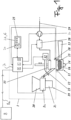
- FIG. 1 shows the structure of a coffee machine 1 according to the invention in a simplified diagram.
- the basic elements of the coffee machine 1 according to the invention, not relating to the present invention, are shown on pages 9 to 11 inclusive of WO 2013/117362 A1 described, so that these three description pages with their entire disclosure content are included in the embodiment of the present application.
- the wear-resistant parts according to the present invention, Maintenance-relevant components considered in the present embodiment are the grinder 2a (corresponds to the grinder 21 in WO 2013/117362 A1 ), the drive motor 2b of the grinder 2a (reference numeral 22 in WO 2013/117362 A1 ), the pump 2c (corresponding to reference numeral 31 in the WO 2013/117362 A1 ) to the boiler 28 of the coffee machine 1, the optical display 2d (corresponds to the display 27 in WO 2013/117362 A1 ) and the control unit with push buttons 2e of the coffee machine 1 (corresponds to the control unit 26 in WO 2013/117362 A1 ).
- the maintenance-relevant component 2d or the display is provided here with the reference numeral 6, since it is itself a maintenance-relevant component, but also serves to output maintenance instructions for all maintenance-relevant components 2a to 2e.
- the unit consisting of the display 2d or 6 and the control unit 2e is designated with the reference numeral 25.
- the components not relevant to the present invention are as follows: portafilter 11, portafilter holder 12, handle 13 of the portafilter 11, outlet opening 14 of the portafilter 11, brewing chamber 15, ground coffee 16 (in the portafilter 11), portafilter lock 18, bean container 20, coffee grinder 19 (comprising grinder 2a, drive motor 2b thereof and bean container 20), chute 23 from the grinder 2a into the portafilter 11, distributor sieve element in the manner of a piston 33, drive unit 32 of the element 33, hot water heater 28 and cold water connection of the machine 1 with reference number 29.
- the features 3 to 7 of the coffee machine 1, which are described below, as well as the coffee machine-external computing device 8 and the bidirectional data line 8a, which connects this external computing device 8 to the central control unit 7 of the coffee machine 1 (the connection can be made via the Internet), are crucial.
- the central control unit 7 corresponds to the central control unit 24 from the WO 2013/117362 A1 .
- Reference numeral 3 denotes the load parameters characterizing the actual wear of the components 2a to 2e.
- Reference numeral 4 denotes the load parameters, taking into account the respective Load parameters 3 of the maintenance-relevant components 2a to 2e are reliability parameters of the components 2a to 2e calculated by the control unit 7.
- Reference numeral 5 denotes the actual running times of the maintenance-relevant components 2a to 2e (characterizing operating time parameters 5 of the components 2a to 2e expressed in the respective running time of the component under consideration).
- the load parameters 3, reliability parameters 4, and operating time parameters 5 are recorded or calculated by the control unit 7 and stored in a data memory (not shown) of the control unit 7.
- the actual electrical work performed by the motor 2b calculated from the actual current consumption and the actual voltage consumption over the operating time of the motor 2b, is used as load characteristic 3 of the drive motor 2b.
- the current consumption and the voltage consumption are used as operating data continuously recorded in the memory of the control unit 7 during the operation of the machine 1.
- the electrical work is then calculated from the motor running time, the current consumption during this running time, and the voltage consumption during this running time.
- the reliability characteristic 4 of the motor 2b the (time-dependent) failure probability per unit of time of the motor 2b is continuously calculated from the aforementioned load characteristic 3 of the motor 2b over the running time of the motor 2b using the control unit 7.
- a corresponding warning can be displayed on the display 6 (e.g., "Drive motor of the grinder worn out. Please contact maintenance service.”).
- the display 2d which decreases in brightness over time.
- the luminosity of the backlight of the display 2d is measured using a photodiode (not shown) as load parameter 3 of the display 2d.
- this luminosity can also be calculated from the switch-on time and the brightness value set by the user.
- This load parameter characterizes the aging process of the display 2d.
- the load parameter 3 of the display 2d can be used directly as the reliability parameter 4 of the display 2d: In general, therefore, for a maintenance-relevant component, the reliability parameter 4 can also be be identical to load characteristic 3 of the maintenance-relevant component under consideration. As soon as said load characteristic 3 or reliability characteristic 4 of display 2d falls below a predefined value (minimum brightness), the maintenance recommendation "Display unit worn out, please replace component" can be displayed on display 2d or 6, respectively.
- the wear conditions of the buttons on the control unit 2e e.g., with a noise sensor
- the pump 2c e.g., with a pressure sensor
- suitable load parameters 3 for these components 2c, 2e from which suitable reliability parameters 4 for these two components 2c, 2e can then be calculated.
- the grinder 2a which can be measured, for example, with regard to the condition of its grinding discs using an optical sensor (not shown).
- the quality e.g., material quality
- the brewing pressure and brewing time can be measured: If these increase, the fine dust content of the coffee grounds has increased, which is an indicator of wear on the grinding discs.
- Figure 2 shows how in the machine according to Figure 1
- maintenance plans, failure forecasts, quality levels for identifying the current component quality, etc. can be drawn up on the basis of the determined load parameters 3 and the reliability parameters 4 of the maintenance-relevant components 2a to 2e calculated therefrom ( Figure 2 , middle column).
- the actual operating times or actually completed work cycles of the individual components can also be included in the preparation of the maintenance plans, forecasts and/or quality levels (via corresponding counter readings recorded in the control unit 7) (dashed arrow in Figure 2 ).
- Figure 2 It would also be possible, in a simplified manner, to take into account only the actual operating time of a component when drawing up a maintenance plan ( Figure 2 , left column): This corresponds to what is already known from the state of the art.
- an electric beverage maker is thus made possible which capable of planning and forecasting maintenance appointments or of carrying out a procedure for planning and forecasting maintenance appointments.
- All calculations e.g. of the load parameters 3 and the reliability parameters 4, also taking into account the operating time parameters 5 of the components 2a to 2e
- All calculations can be carried out in the control unit 7 of the machine 1 itself.
- the machine 1 itself to only record basic data and send it via the bidirectional data line 8a (e.g. via the Internet) to an outsourced system (central server) 8.
- the corresponding calculations are then carried out in the system 8, and the calculation results, in particular the maintenance instructions determined from the calculated reliability parameters, can be transmitted back to the machine 1 via the bidirectional data line 8a for display on its display 6.
- the maintenance requirement of components 2a to 2e can thus be calculated based on their respective actual load, e.g., in the form of wear functions.
- the maintenance requirement of a maintenance-relevant component can be individually planned using one or more reliability parameters assigned to the component.
- Maintenance scopes and/or maintenance frequencies can be determined by target specifications for maintenance costs and/or reliability requirements (e.g., cumulative reliability or quality levels of machine 1). Suitable curve functions can be used to calculate reliability parameters of components.
- the calculation of failure forecasts and/or maintenance times is possible on the machine 1 itself or with the aid of an external system 8.
- Calculated maintenance times and maintenance scopes can be used to plan service intervals and for the planning of a service network for sold coffee machines 1.
- Past operating data can also be included in future maintenance planning via interpolation. Changes in usage behavior can also be taken into account when creating a forecast (e.g., different operation of coffee machines in the summer and winter months).
- Different maintenance instructions can be generated based on the calculated reliability parameters of different maintenance-relevant components: For example, a different maintenance instruction can be generated for a control unit of a coffee machine installed inside a building than for a coffee machine installed outside.
- Calculations of reliability parameters or reliability or quality levels of different components can be carried out for an assumed maintenance scheduling.
- sensors e.g., noise sensors, pressure sensors, etc.
- sensors can be used to record the actual wear and tear on maintenance-relevant components.
- maintenance of the grinder 2a can be carried out taking into account the actual load on this grinder (which may be different from that on other components of the machine 1):
- the load on a grinder or its mill depends on how often the grinder is used (often several grinders 2a are installed in the machine 1, which then have different running times depending on the beverage distribution), but also on the actual power (current consumption x voltage consumption) with which the grinder is operated and for what time (specified, for example, in Wh).
- Another key figure that can be taken into account in the load characteristic of the grinder is, for example, the type of bean used (hard, foreign matter content, bean quality), since this also influences grinding disc wear.
- load parameters that characterize the actual wear of maintenance-relevant components are taken into account when calculating the reliability parameters of the components (e.g., quality level). For example, a seal ages significantly faster with increasing temperature. Using the (measured or indirectly determined) temperature profile at the seal over time, this factor or load parameter can be taken into account when calculating the reliability parameter of the seal as a maintenance-relevant component. As a further factor that is included in the load parameter of the seal, the actual pressure prevailing at the seal over time can be taken into account when calculating the reliability parameter. Alkalis or acids (e.g., during cleaning) also damage a seal.
- Taking the duration and frequency of cleaning into account as an additional factor of the load parameter of the seal can also be included in the calculation of the reliability parameter of the seal.
- a motor e.g., of the grinder 2a
- current and voltage monitoring are useful according to the invention: This allows conclusions to be drawn about the actual electrical work performed by the motor.
- the motor's starting current can also be included as a further factor in the calculation of the motor's reliability parameter, for example, in order to optimally evaluate the motor condition.
- Such factors of load parameters or the load parameters can often be read out from the operating data of the machine 1 (e.g. from a suitable data memory of the central control unit 7) and can in particular also refer to measured values (example: mill running time multiplied by current and voltage).
- various factors of the component's load characteristic(s) can be included in the calculation formula for the reliability characteristic of a component.
- the load characteristic for the grinding discs of a grinder 2a can take into account not only the number of operating cycles 5 that the grinding discs have actually completed during brewing, but also the proportion (grinder running time) per beverage, the type of bean (hard/soft/contaminated with foreign matter), and the quality of the grinding discs (cheap, high-quality).
- Load characteristics or factors thereof, as well as curve functions (time profiles) of load characteristics or factors thereof, can be flexibly adapted according to the latest findings: It is advantageous to carry out the data processing on the external server 8 (e.g., to calculate the reliability characteristics from the load characteristics on the server 8) and then to display the conclusions drawn from the calculated reliability characteristics (in particular: corresponding maintenance instructions) on the display 6 of the machine 1.
- the conditions or reliability parameters of components can be divided into several phases to assess the need for maintenance.
- the criterion for when a component must be replaced can be selected differently.
- reliable mechanical function may be paramount (e.g., seals), so that only a small failure rate or probability of failure per unit of time can be accepted.
- Other components can gradually influence the beverage quality through signs of wear (e.g., grinding discs in grinder 2a), which, with a certain tolerance of the quality, does not initially represent a hard failure criterion.
- Other components e.g., water filters
- the ordinate (reliability parameter) over the abscissa (time), i.e. the reliability parameter curve for a component, can be divided into phases that can define different replacement criteria for the component. See the failure probability curve per time unit over time in Figure 4 with the corresponding phase division in Figure 3 (phase A, which is present in the time interval from 0 to z 1 , goes into phase B and finally into phase C). For example, at time z 1 during the expiration of phase A for a seal (line 3 in Fig. 3 ) an initial warning may be output as a maintenance recommendation on display 6 ("Seal is beginning to wear out.”).
- a more urgent maintenance recommendation could be output on display 6 ("Seal shows noticeable wear. Please replace.”).
- the machine may be automatically blocked due to seal wear that is no longer tolerable: A corresponding maintenance command may be generated in control unit 7, which blocks the function of machine 1, and the following maintenance "recommendation" may then be output on display 6 at the same time: "Seal worn out. Seal must be replaced before the machine can be put back into operation.”
- FIG. 3 shows a classification proposal for various phases with examples of maintenance-relevant components (left column from line 3).
- a cost-optimized maintenance plan (which comprises a few service appointments per time unit) can be generated. This can be done by extrapolating a date when the first of the maintenance-relevant components enters phase C. A suggestion for the next date (for example, one year) can then be made. From this, it is now shown for such cost-optimized maintenance which components will enter phase B and which phase they would reach. Upon reaching phase C, the respective component is replaced; the components still in phase B can remain.
- a maintenance plan with reliability-optimized maintenance can also be generated. This can extrapolate the date when the first maintenance-relevant component reaches Phase B. A suggested follow-up date (for example, one year) can then be made. This then shows which components will enter Phase B for reliability-optimized maintenance. Unlike with cost-optimized maintenance, these components are also replaced.
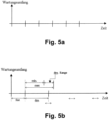
- Figure 5a shows an example of fixed maintenance intervals: The time interval between the individual maintenance appointments is fixed, and the scope of maintenance is calculated according to the invention.
- Figure 5b shows another example in which the initial maintenance is fixed, and the subsequent maintenance dates or intervals are dynamically calculated according to the invention. After evaluating the first (fixed) maintenance interval, the scope and timing of the next maintenance are calculated. See also the example in Figure 5c Accordingly, after evaluating the second maintenance interval ("dynamic" in Figure 5b ) the scope and the next maintenance time are calculated, etc.
- Figure 5d shows a maintenance plan generation of the present invention, in which all maintenance intervals are set dynamically. At the start of use, a continuous projection can be made to determine the next maintenance time and the next maintenance scope.
- Figure 6 shows that a suitable curve function adapted to the component can be included in the calculation of the reliability parameter of a component (optimization for actual conditions).
- the background here is that not every maintenance-relevant component behaves linearly with regard to its quality (e.g. expressed as failure probability per unit time on the ordinate).
- a differently shaped curve function can be included in the calculation of the reliability parameter of a maintenance-relevant component. All factors already described, load parameter, operating data, operating time and sensors, can be part of the curve function.
- multidimensional curve functions of dimension ⁇ 3 can also be taken into account.
- Figure 6 shows examples of typical curve functions for various maintenance-relevant components of the coffee machine 1.
- the calculation of the reliability parameters can be carried out not only in the processor of the central control unit 7 of the machine 1, but also externally (Connection via data line 8a) in an external, outsourced system 8.
- the determination steps for the load parameters 3 of a method according to the invention can be carried out by means of the control unit 7 of the machine 1, while the calculation steps for the reliability parameters 4 and the generation steps for the maintenance instructions can be carried out on the external system 8.
- the generated maintenance instructions such as maintenance times, maintenance recommendations to be displayed, or maintenance commands directed at the machine, can then be transmitted from the external system 8 to the central control unit 7 via the data line 8a.
- the system 8 can thus communicate with the machine 1 via suitable interfaces.
- the essential steps of a method according to the invention can be implemented as an application on the central server 8, which is assigned to the maintenance of the machine 1 or several machines 1.
- Data from the machine(s) 1 can be transferred to the server 8 via an RDA module, Ethernet, or via other common network communication interfaces.
- Failure data, operating parameters, load characteristics, recorded wear data, etc. during maintenance of replaced components can be stored for a specific machine 1 (or a machine population comprising several such machines) in an external database on the server 8 and also statistically evaluated. This can serve to optimize and update data for future calculations (evaluations) of maintenance data for individual components. Planning and forecasting maintenance appointments can require certain knowledge of the usage behavior of a machine 1.
- Such past data recorded for components can be collected for each component to determine the actual wear and tear of maintenance-relevant components (e.g., in a database on the server 8) and extrapolated into the future under the assumption that future loads on the machine 1 or its components 2a to 2e will also follow the past pattern.
- maintenance-relevant components e.g., in a database on the server 8
- Extrapolated parameters e.g. expected brewing cycles per month, coffee bean usage per month, etc.
- Extrapolated parameters can be manipulated or adjusted according to the expected change in load and taken into account when calculating the expected wear and tear of various components (future load) or the expected future load can be calculated accordingly.
- each maintenance-relevant component is assigned a meaningful basic indicator.
- An example of the assignment of such basic indicators is shown Figure 7a
- Base indicators can advantageously be: operating days, brewing cycles, water consumption.
- the base indicators can be linearly related to each other, see the example in Figure 7b .
- an extrapolation of the reliability parameters of all components of machine 1 can be made, since the various basic indicators of the different components are in a known relationship.
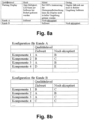
- a first owner (Customer A) with a location in a very bright environment may require a much higher quality level in terms of display brightness than a second owner (Customer B) who operates machine 1 in a dark discotheque. Compare Figure 8a .
- Desired reliability parameters (or quality levels) for each component can be assigned device-specifically in a customer-specific table. See example in Figure 8b .
- a reliability or quality level of each individual component (and thus also a reliability parameter of the entire machine 1) in the future can be determined by interpolating data.
- wear indicators can determine the actual load on maintenance-relevant components or contribute to the calculation of component reliability parameters. For example, measuring the display brightness can be used to determine the actual status of the display's backlight. Force sensors can determine the load on components (example: strain gauges applied to components subject to bending loads).
Landscapes
- Engineering & Computer Science (AREA)
- Food Science & Technology (AREA)
- General Engineering & Computer Science (AREA)
- Apparatus For Making Beverages (AREA)
Applications Claiming Priority (2)
| Application Number | Priority Date | Filing Date | Title |
|---|---|---|---|
| DE102015208375.6A DE102015208375A1 (de) | 2015-05-06 | 2015-05-06 | Elektrisch betriebener Getränkebereiter (vorzugsweise: Kaffeemaschine) mit dynamischer Wartungsplangenerierung |
| PCT/EP2016/059836 WO2016177697A1 (de) | 2015-05-06 | 2016-05-03 | Elektrisch betriebener getränkebereiter (vorzugsweise: kaffeemaschine) mit dynamischer wartungsplangenerierung |
Publications (2)
| Publication Number | Publication Date |
|---|---|
| EP3291713A1 EP3291713A1 (de) | 2018-03-14 |
| EP3291713B1 true EP3291713B1 (de) | 2025-03-26 |
Family
ID=55910959
Family Applications (1)
| Application Number | Title | Priority Date | Filing Date |
|---|---|---|---|
| EP16720413.0A Active EP3291713B1 (de) | 2015-05-06 | 2016-05-03 | Elektrisch betriebener getränkebereiter (vorzugsweise: kaffeemaschine) mit dynamischer wartungsplangenerierung |
Country Status (5)
| Country | Link |
|---|---|
| US (1) | US11006778B2 (cg-RX-API-DMAC7.html) |
| EP (1) | EP3291713B1 (cg-RX-API-DMAC7.html) |
| JP (2) | JP2018518228A (cg-RX-API-DMAC7.html) |
| DE (1) | DE102015208375A1 (cg-RX-API-DMAC7.html) |
| WO (1) | WO2016177697A1 (cg-RX-API-DMAC7.html) |
Families Citing this family (10)
| Publication number | Priority date | Publication date | Assignee | Title |
|---|---|---|---|---|
| US11576524B2 (en) * | 2012-08-16 | 2023-02-14 | Duvall Espresso Ip Enforcement, Llc | Device and system for brewing infused beverages |
| EP3370585B1 (en) * | 2015-11-06 | 2021-02-17 | Société des Produits Nestlé S.A. | Beverage preparation machine comprising location system |
| IT201700032502A1 (it) * | 2017-03-24 | 2018-09-24 | La Marzocco Srl | Macchina per caffè espresso con sistema perfezionato di regolazione della temperatura dell’acqua e metodo di regolazione della temperatura dell’acqua di una macchina per caffè espresso |
| IT201900004765A1 (it) * | 2019-03-29 | 2020-09-29 | Jfd Sarl | Sistema di macchine da caffè professionali, macchine da caffè appartenenti a tale sistema e loro procedimento di pulizia |
| US11337548B2 (en) * | 2019-06-06 | 2022-05-24 | B/E Aerospace, Inc. | Pressure sensor overflow interlock system for beverage maker |
| US11529015B2 (en) | 2019-06-06 | 2022-12-20 | B/E Aerospace, Inc. | Beverage maker platen overflow sensing system |
| US11540663B2 (en) * | 2019-06-06 | 2023-01-03 | B/E Aerospace, Inc. | Differential pressure flow meter for beverage maker |
| IT201900024847A1 (it) * | 2019-12-19 | 2021-06-19 | Delonghi Appliances Srl | Erogatore di prodotto sfuso |
| KR102283052B1 (ko) * | 2020-08-14 | 2021-07-29 | 윤수정 | 무인 카페 운영 시스템 및 방법 |
| CN116887724A (zh) * | 2021-02-15 | 2023-10-13 | 德龙电器有限责任公司 | 用于研磨咖啡豆的装置和相关控制方法 |
Family Cites Families (8)
| Publication number | Priority date | Publication date | Assignee | Title |
|---|---|---|---|---|
| WO2005005013A1 (de) | 2003-07-10 | 2005-01-20 | Aquis Wasser-Luft-Systeme Gmbh, Lindau Zweigniederlassung Rebstein | Filterpatrone |
| JP2005245970A (ja) * | 2004-03-08 | 2005-09-15 | Shizuoka Seiki Co Ltd | 飲料冷却装置 |
| EP1676509A1 (en) * | 2004-12-30 | 2006-07-05 | Rhea Vendors S.p.A. | Process and apparatus for controlling the preparation of brewed beverages |
| WO2008017182A1 (fr) | 2006-08-08 | 2008-02-14 | Domteknika S.A. | Procede et dispositif de controle de la qualite d'une cartouche filtrante et recipient equipe d'un tel dispositif |
| US20110095010A1 (en) * | 2009-10-23 | 2011-04-28 | Bondarowicz Frank A | Water tank heater with predictive heater failure feature |
| EP4129128A1 (en) * | 2009-12-02 | 2023-02-08 | Société des Produits Nestlé S.A. | Beverage preparation machine supporting a remote service functionality |
| CH706100A1 (de) | 2012-02-08 | 2013-08-15 | Wmf Wuerttemberg Metallwaren | Kaffeemaschine mit Mahlwerk und abnehmbarem Siebträger sowie Verfahren zum Betrieb einer solchen Kaffeemaschine. |
| DE102013101875A1 (de) * | 2013-02-26 | 2014-08-28 | Miele & Cie. Kg | Überwachungseinrichtung für eine elektrische Last und elektrisches Gerät mit einer Überwachungseinrichtung |
-
2015
- 2015-05-06 DE DE102015208375.6A patent/DE102015208375A1/de active Pending
-
2016
- 2016-05-03 WO PCT/EP2016/059836 patent/WO2016177697A1/de not_active Ceased
- 2016-05-03 US US15/571,779 patent/US11006778B2/en active Active
- 2016-05-03 JP JP2017557992A patent/JP2018518228A/ja active Pending
- 2016-05-03 EP EP16720413.0A patent/EP3291713B1/de active Active
-
2021
- 2021-02-10 JP JP2021019450A patent/JP7261249B2/ja active Active
Also Published As
| Publication number | Publication date |
|---|---|
| JP2021073014A (ja) | 2021-05-13 |
| US11006778B2 (en) | 2021-05-18 |
| JP2018518228A (ja) | 2018-07-12 |
| DE102015208375A1 (de) | 2016-11-10 |
| US20190125123A1 (en) | 2019-05-02 |
| EP3291713A1 (de) | 2018-03-14 |
| WO2016177697A1 (de) | 2016-11-10 |
| JP7261249B2 (ja) | 2023-04-19 |
Similar Documents
| Publication | Publication Date | Title |
|---|---|---|
| EP3291713B1 (de) | Elektrisch betriebener getränkebereiter (vorzugsweise: kaffeemaschine) mit dynamischer wartungsplangenerierung | |
| DE102016014915A1 (de) | Wartungszeit-Vorhersagesystem und Wartungszeit-Vorhersagevorrichtung | |
| DE10310116A1 (de) | Risikominimierung und Wartungsoptimierung durch Ermittlung von Schädigungsanteilen aus Betriebsdaten | |
| EP3403245B1 (de) | Schienenfahrzeugbauteilgruppe und verfahren zum erzeugen eines lebenslaufs einer maschinenkomponente sowie serviceverfahren zur wartung | |
| DE10157143A1 (de) | Wartungsintervallanzeige für Pumpen | |
| EP2650739A1 (de) | Verfahren und Vorrichtung zur Optimierung eines Produktionsprozesses | |
| DE102018213996A1 (de) | Vorrichtung zum Ausgeben eines zukünftigen Zustands eines Schmiersystems | |
| EP2923837B2 (de) | Verfahren zu Reduzierung der Spitzenlast in einer Druckmaschine | |
| DE10156927B4 (de) | Pumpencontroller mit Teileidentifikation | |
| DE102009038351A1 (de) | Verfahren zur automatischen Erkennung und Darstellung des Betriebs, und der Arbeits- und Funktionsweise von gebäudetechnischen und/oder produktionstechnischen Anlagen im Hinblick auf deren Energieeffizienz | |
| DE102020212506A1 (de) | Zustandsbestimmung für ein Hausgerät | |
| EP3151072B1 (de) | Verfahren und system zur fehlererkennung und überwachung bei einem elektronisch geregelten oder gesteuerten maschinenteil | |
| DE10029634A1 (de) | Kontrollverfahren für die Wartung eines Kraftfahrzeuges | |
| EP3599583A1 (de) | Bestimmung des verbrauchs an heiz- oder kühlenergie einer baulichen untereinheit | |
| WO2018178196A1 (de) | Verfahren zur bestimmung einer schädigungsmassunsicherheit eines kraftfahrzeugs | |
| DE102005048532A1 (de) | Verfahren und Anordnung zum Überwachen einer mechanischen Komponente eines Fahrzeugs | |
| DE102009055670A1 (de) | Verfahren zur Analyse der Wärmemengenverteilung in einem Heizsystem und Vorrichtung zur Durchführung des Verfahrens | |
| EP2162810A1 (de) | Verfahren zum ermitteln der lebensdauer einer kraftwerkskomponente | |
| EP2120118A1 (de) | Verfahren zum Betrieb einer verfahrenstechnischen Anlage | |
| EP3919997B1 (de) | Zustandsbestimmung für ein hausgerät | |
| DE102005051452A1 (de) | Verfahren und Vorrichtung zur automatischen Ermittlung von Wartungszeitpunkten | |
| DE102017108281B4 (de) | Brennkraftmaschine und Verfahren zum Überwachen der Brennkraftmaschine | |
| WO2019233737A1 (de) | Verfahren zur automatischen erzeugung gelabelter signaturen | |
| DE102005048533A1 (de) | Verfahren und Anordnung zum Überwachen einer mechanischen Komponente, insbesondere eines Getriebes eines Fahrzeugs | |
| WO2021234083A1 (de) | Verfahren zum erfassen und darstellen von messdaten |
Legal Events
| Date | Code | Title | Description |
|---|---|---|---|
| STAA | Information on the status of an ep patent application or granted ep patent |
Free format text: STATUS: THE INTERNATIONAL PUBLICATION HAS BEEN MADE |
|
| PUAI | Public reference made under article 153(3) epc to a published international application that has entered the european phase |
Free format text: ORIGINAL CODE: 0009012 |
|
| STAA | Information on the status of an ep patent application or granted ep patent |
Free format text: STATUS: REQUEST FOR EXAMINATION WAS MADE |
|
| 17P | Request for examination filed |
Effective date: 20171106 |
|
| AK | Designated contracting states |
Kind code of ref document: A1 Designated state(s): AL AT BE BG CH CY CZ DE DK EE ES FI FR GB GR HR HU IE IS IT LI LT LU LV MC MK MT NL NO PL PT RO RS SE SI SK SM TR |
|
| AX | Request for extension of the european patent |
Extension state: BA ME |
|
| DAV | Request for validation of the european patent (deleted) | ||
| DAX | Request for extension of the european patent (deleted) | ||
| STAA | Information on the status of an ep patent application or granted ep patent |
Free format text: STATUS: EXAMINATION IS IN PROGRESS |
|
| 17Q | First examination report despatched |
Effective date: 20210528 |
|
| RAP3 | Party data changed (applicant data changed or rights of an application transferred) |
Owner name: WMF GMBH |
|
| P01 | Opt-out of the competence of the unified patent court (upc) registered |
Effective date: 20230525 |
|
| GRAP | Despatch of communication of intention to grant a patent |
Free format text: ORIGINAL CODE: EPIDOSNIGR1 |
|
| STAA | Information on the status of an ep patent application or granted ep patent |
Free format text: STATUS: GRANT OF PATENT IS INTENDED |
|
| INTG | Intention to grant announced |
Effective date: 20241218 |
|
| GRAS | Grant fee paid |
Free format text: ORIGINAL CODE: EPIDOSNIGR3 |
|
| GRAA | (expected) grant |
Free format text: ORIGINAL CODE: 0009210 |
|
| STAA | Information on the status of an ep patent application or granted ep patent |
Free format text: STATUS: THE PATENT HAS BEEN GRANTED |
|
| AK | Designated contracting states |
Kind code of ref document: B1 Designated state(s): AL AT BE BG CH CY CZ DE DK EE ES FI FR GB GR HR HU IE IS IT LI LT LU LV MC MK MT NL NO PL PT RO RS SE SI SK SM TR |
|
| REG | Reference to a national code |
Ref country code: GB Ref legal event code: FG4D Free format text: NOT ENGLISH |
|
| REG | Reference to a national code |
Ref country code: CH Ref legal event code: EP |
|
| REG | Reference to a national code |
Ref country code: DE Ref legal event code: R096 Ref document number: 502016016923 Country of ref document: DE |
|
| REG | Reference to a national code |
Ref country code: IE Ref legal event code: FG4D Free format text: LANGUAGE OF EP DOCUMENT: GERMAN |
|
| REG | Reference to a national code |
Ref country code: NL Ref legal event code: FP |
|
| PGFP | Annual fee paid to national office [announced via postgrant information from national office to epo] |
Ref country code: NL Payment date: 20250429 Year of fee payment: 10 |
|
| PG25 | Lapsed in a contracting state [announced via postgrant information from national office to epo] |
Ref country code: RS Free format text: LAPSE BECAUSE OF FAILURE TO SUBMIT A TRANSLATION OF THE DESCRIPTION OR TO PAY THE FEE WITHIN THE PRESCRIBED TIME-LIMIT Effective date: 20250626 |
|
| PG25 | Lapsed in a contracting state [announced via postgrant information from national office to epo] |
Ref country code: FI Free format text: LAPSE BECAUSE OF FAILURE TO SUBMIT A TRANSLATION OF THE DESCRIPTION OR TO PAY THE FEE WITHIN THE PRESCRIBED TIME-LIMIT Effective date: 20250326 |
|
| PGFP | Annual fee paid to national office [announced via postgrant information from national office to epo] |
Ref country code: DE Payment date: 20250513 Year of fee payment: 10 |
|
| REG | Reference to a national code |
Ref country code: LT Ref legal event code: MG9D |
|
| PG25 | Lapsed in a contracting state [announced via postgrant information from national office to epo] |
Ref country code: NO Free format text: LAPSE BECAUSE OF FAILURE TO SUBMIT A TRANSLATION OF THE DESCRIPTION OR TO PAY THE FEE WITHIN THE PRESCRIBED TIME-LIMIT Effective date: 20250626 |
|
| PGFP | Annual fee paid to national office [announced via postgrant information from national office to epo] |
Ref country code: IT Payment date: 20250508 Year of fee payment: 10 |
|
| PG25 | Lapsed in a contracting state [announced via postgrant information from national office to epo] |
Ref country code: HR Free format text: LAPSE BECAUSE OF FAILURE TO SUBMIT A TRANSLATION OF THE DESCRIPTION OR TO PAY THE FEE WITHIN THE PRESCRIBED TIME-LIMIT Effective date: 20250326 |
|
| PG25 | Lapsed in a contracting state [announced via postgrant information from national office to epo] |
Ref country code: LV Free format text: LAPSE BECAUSE OF FAILURE TO SUBMIT A TRANSLATION OF THE DESCRIPTION OR TO PAY THE FEE WITHIN THE PRESCRIBED TIME-LIMIT Effective date: 20250326 |
|
| PG25 | Lapsed in a contracting state [announced via postgrant information from national office to epo] |
Ref country code: BG Free format text: LAPSE BECAUSE OF FAILURE TO SUBMIT A TRANSLATION OF THE DESCRIPTION OR TO PAY THE FEE WITHIN THE PRESCRIBED TIME-LIMIT Effective date: 20250326 Ref country code: GR Free format text: LAPSE BECAUSE OF FAILURE TO SUBMIT A TRANSLATION OF THE DESCRIPTION OR TO PAY THE FEE WITHIN THE PRESCRIBED TIME-LIMIT Effective date: 20250627 |
|
| PGFP | Annual fee paid to national office [announced via postgrant information from national office to epo] |
Ref country code: CH Payment date: 20250601 Year of fee payment: 10 |
|
| PG25 | Lapsed in a contracting state [announced via postgrant information from national office to epo] |
Ref country code: SE Free format text: LAPSE BECAUSE OF FAILURE TO SUBMIT A TRANSLATION OF THE DESCRIPTION OR TO PAY THE FEE WITHIN THE PRESCRIBED TIME-LIMIT Effective date: 20250326 |
|
| PG25 | Lapsed in a contracting state [announced via postgrant information from national office to epo] |
Ref country code: SM Free format text: LAPSE BECAUSE OF FAILURE TO SUBMIT A TRANSLATION OF THE DESCRIPTION OR TO PAY THE FEE WITHIN THE PRESCRIBED TIME-LIMIT Effective date: 20250326 |
|
| PG25 | Lapsed in a contracting state [announced via postgrant information from national office to epo] |
Ref country code: PT Free format text: LAPSE BECAUSE OF FAILURE TO SUBMIT A TRANSLATION OF THE DESCRIPTION OR TO PAY THE FEE WITHIN THE PRESCRIBED TIME-LIMIT Effective date: 20250728 Ref country code: ES Free format text: LAPSE BECAUSE OF FAILURE TO SUBMIT A TRANSLATION OF THE DESCRIPTION OR TO PAY THE FEE WITHIN THE PRESCRIBED TIME-LIMIT Effective date: 20250326 |
|
| PG25 | Lapsed in a contracting state [announced via postgrant information from national office to epo] |
Ref country code: PL Free format text: LAPSE BECAUSE OF FAILURE TO SUBMIT A TRANSLATION OF THE DESCRIPTION OR TO PAY THE FEE WITHIN THE PRESCRIBED TIME-LIMIT Effective date: 20250326 |
|
| PG25 | Lapsed in a contracting state [announced via postgrant information from national office to epo] |
Ref country code: EE Free format text: LAPSE BECAUSE OF FAILURE TO SUBMIT A TRANSLATION OF THE DESCRIPTION OR TO PAY THE FEE WITHIN THE PRESCRIBED TIME-LIMIT Effective date: 20250326 |
|
| PG25 | Lapsed in a contracting state [announced via postgrant information from national office to epo] |
Ref country code: RO Free format text: LAPSE BECAUSE OF FAILURE TO SUBMIT A TRANSLATION OF THE DESCRIPTION OR TO PAY THE FEE WITHIN THE PRESCRIBED TIME-LIMIT Effective date: 20250326 |
|
| PG25 | Lapsed in a contracting state [announced via postgrant information from national office to epo] |
Ref country code: SK Free format text: LAPSE BECAUSE OF FAILURE TO SUBMIT A TRANSLATION OF THE DESCRIPTION OR TO PAY THE FEE WITHIN THE PRESCRIBED TIME-LIMIT Effective date: 20250326 |
|
| PG25 | Lapsed in a contracting state [announced via postgrant information from national office to epo] |
Ref country code: IS Free format text: LAPSE BECAUSE OF FAILURE TO SUBMIT A TRANSLATION OF THE DESCRIPTION OR TO PAY THE FEE WITHIN THE PRESCRIBED TIME-LIMIT Effective date: 20250726 |