EP3290527B1 - Procédé de détection de micro-organismes dans un échantillon - Google Patents
Procédé de détection de micro-organismes dans un échantillon Download PDFInfo
- Publication number
- EP3290527B1 EP3290527B1 EP16186104.2A EP16186104A EP3290527B1 EP 3290527 B1 EP3290527 B1 EP 3290527B1 EP 16186104 A EP16186104 A EP 16186104A EP 3290527 B1 EP3290527 B1 EP 3290527B1
- Authority
- EP
- European Patent Office
- Prior art keywords
- nucleic acid
- acid sequence
- sample
- sequence
- probe
- Prior art date
- Legal status (The legal status is an assumption and is not a legal conclusion. Google has not performed a legal analysis and makes no representation as to the accuracy of the status listed.)
- Not-in-force
Links
- 238000000034 method Methods 0.000 title claims description 48
- 244000005700 microbiome Species 0.000 title claims description 36
- 239000000523 sample Substances 0.000 claims description 123
- 150000007523 nucleic acids Chemical group 0.000 claims description 64
- 108091028043 Nucleic acid sequence Proteins 0.000 claims description 56
- 238000009396 hybridization Methods 0.000 claims description 14
- 238000001816 cooling Methods 0.000 claims description 13
- 238000010438 heat treatment Methods 0.000 claims description 11
- 238000004458 analytical method Methods 0.000 claims description 10
- 108020004707 nucleic acids Proteins 0.000 claims description 8
- 102000039446 nucleic acids Human genes 0.000 claims description 8
- 238000000338 in vitro Methods 0.000 claims description 7
- 230000003247 decreasing effect Effects 0.000 claims description 5
- 238000005259 measurement Methods 0.000 claims description 5
- 102000004190 Enzymes Human genes 0.000 claims description 4
- 108090000790 Enzymes Proteins 0.000 claims description 4
- 239000007850 fluorescent dye Substances 0.000 claims description 3
- 230000002934 lysing effect Effects 0.000 claims description 3
- 102000002260 Alkaline Phosphatase Human genes 0.000 claims description 2
- 108020004774 Alkaline Phosphatase Proteins 0.000 claims description 2
- WQZGKKKJIJFFOK-GASJEMHNSA-N Glucose Natural products OC[C@H]1OC(O)[C@H](O)[C@@H](O)[C@@H]1O WQZGKKKJIJFFOK-GASJEMHNSA-N 0.000 claims description 2
- UYTPUPDQBNUYGX-UHFFFAOYSA-N Guanine Natural products O=C1NC(N)=NC2=C1N=CN2 UYTPUPDQBNUYGX-UHFFFAOYSA-N 0.000 claims description 2
- 102000004316 Oxidoreductases Human genes 0.000 claims description 2
- 108090000854 Oxidoreductases Proteins 0.000 claims description 2
- 102000003992 Peroxidases Human genes 0.000 claims description 2
- 108010027912 Sulfite Oxidase Proteins 0.000 claims description 2
- 102000043440 Sulfite oxidase Human genes 0.000 claims description 2
- 102000003425 Tyrosinase Human genes 0.000 claims description 2
- 108060008724 Tyrosinase Proteins 0.000 claims description 2
- 239000008103 glucose Substances 0.000 claims description 2
- 108040007629 peroxidase activity proteins Proteins 0.000 claims description 2
- 241000194031 Enterococcus faecium Species 0.000 description 17
- 241000588724 Escherichia coli Species 0.000 description 16
- 108091034117 Oligonucleotide Proteins 0.000 description 9
- 239000000203 mixture Substances 0.000 description 9
- 238000012360 testing method Methods 0.000 description 8
- 238000001514 detection method Methods 0.000 description 7
- 238000009640 blood culture Methods 0.000 description 6
- 230000009089 cytolysis Effects 0.000 description 6
- 241000894006 Bacteria Species 0.000 description 5
- 206010036790 Productive cough Diseases 0.000 description 5
- 244000052769 pathogen Species 0.000 description 5
- 230000000241 respiratory effect Effects 0.000 description 5
- 210000003802 sputum Anatomy 0.000 description 5
- 208000024794 sputum Diseases 0.000 description 5
- 206010035664 Pneumonia Diseases 0.000 description 4
- 230000001580 bacterial effect Effects 0.000 description 4
- 239000013641 positive control Substances 0.000 description 4
- 230000035945 sensitivity Effects 0.000 description 4
- 208000035473 Communicable disease Diseases 0.000 description 3
- 230000003321 amplification Effects 0.000 description 3
- 239000008280 blood Substances 0.000 description 3
- 210000004369 blood Anatomy 0.000 description 3
- 239000003153 chemical reaction reagent Substances 0.000 description 3
- 230000000295 complement effect Effects 0.000 description 3
- 239000012636 effector Substances 0.000 description 3
- 238000005516 engineering process Methods 0.000 description 3
- 229940088598 enzyme Drugs 0.000 description 3
- 238000011534 incubation Methods 0.000 description 3
- 239000000463 material Substances 0.000 description 3
- 238000003199 nucleic acid amplification method Methods 0.000 description 3
- 230000001717 pathogenic effect Effects 0.000 description 3
- 230000028327 secretion Effects 0.000 description 3
- 239000000243 solution Substances 0.000 description 3
- -1 ATTO (ATTO-TEC GmbH Chemical class 0.000 description 2
- ZHNUHDYFZUAESO-UHFFFAOYSA-N Formamide Chemical compound NC=O ZHNUHDYFZUAESO-UHFFFAOYSA-N 0.000 description 2
- 230000005526 G1 to G0 transition Effects 0.000 description 2
- 241000712431 Influenza A virus Species 0.000 description 2
- 241000725643 Respiratory syncytial virus Species 0.000 description 2
- FAPWRFPIFSIZLT-UHFFFAOYSA-M Sodium chloride Chemical compound [Na+].[Cl-] FAPWRFPIFSIZLT-UHFFFAOYSA-M 0.000 description 2
- DBMJMQXJHONAFJ-UHFFFAOYSA-M Sodium laurylsulphate Chemical compound [Na+].CCCCCCCCCCCCOS([O-])(=O)=O DBMJMQXJHONAFJ-UHFFFAOYSA-M 0.000 description 2
- 241000193998 Streptococcus pneumoniae Species 0.000 description 2
- 235000013361 beverage Nutrition 0.000 description 2
- 239000000872 buffer Substances 0.000 description 2
- 239000003795 chemical substances by application Substances 0.000 description 2
- 238000002405 diagnostic procedure Methods 0.000 description 2
- 230000002255 enzymatic effect Effects 0.000 description 2
- 238000002474 experimental method Methods 0.000 description 2
- GNBHRKFJIUUOQI-UHFFFAOYSA-N fluorescein Chemical compound O1C(=O)C2=CC=CC=C2C21C1=CC=C(O)C=C1OC1=CC(O)=CC=C21 GNBHRKFJIUUOQI-UHFFFAOYSA-N 0.000 description 2
- 238000007901 in situ hybridization Methods 0.000 description 2
- 208000015181 infectious disease Diseases 0.000 description 2
- 239000003112 inhibitor Substances 0.000 description 2
- 239000002773 nucleotide Substances 0.000 description 2
- 125000003729 nucleotide group Chemical group 0.000 description 2
- 150000002894 organic compounds Chemical class 0.000 description 2
- 102000004169 proteins and genes Human genes 0.000 description 2
- 108090000623 proteins and genes Proteins 0.000 description 2
- 229940031000 streptococcus pneumoniae Drugs 0.000 description 2
- 239000000126 substance Substances 0.000 description 2
- 241000701161 unidentified adenovirus Species 0.000 description 2
- XLYOFNOQVPJJNP-UHFFFAOYSA-N water Substances O XLYOFNOQVPJJNP-UHFFFAOYSA-N 0.000 description 2
- CVOFKRWYWCSDMA-UHFFFAOYSA-N 2-chloro-n-(2,6-diethylphenyl)-n-(methoxymethyl)acetamide;2,6-dinitro-n,n-dipropyl-4-(trifluoromethyl)aniline Chemical compound CCC1=CC=CC(CC)=C1N(COC)C(=O)CCl.CCCN(CCC)C1=C([N+]([O-])=O)C=C(C(F)(F)F)C=C1[N+]([O-])=O CVOFKRWYWCSDMA-UHFFFAOYSA-N 0.000 description 1
- 208000035143 Bacterial infection Diseases 0.000 description 1
- 241001289635 Curetis Species 0.000 description 1
- 101000925662 Enterobacteria phage PRD1 Endolysin Proteins 0.000 description 1
- 208000008745 Healthcare-Associated Pneumonia Diseases 0.000 description 1
- 241000588747 Klebsiella pneumoniae Species 0.000 description 1
- 108010014251 Muramidase Proteins 0.000 description 1
- 102000016943 Muramidase Human genes 0.000 description 1
- 241000202934 Mycoplasma pneumoniae Species 0.000 description 1
- 108010062010 N-Acetylmuramoyl-L-alanine Amidase Proteins 0.000 description 1
- 238000013459 approach Methods 0.000 description 1
- 239000012062 aqueous buffer Substances 0.000 description 1
- 239000007864 aqueous solution Substances 0.000 description 1
- 239000007900 aqueous suspension Substances 0.000 description 1
- 208000022362 bacterial infectious disease Diseases 0.000 description 1
- 244000052616 bacterial pathogen Species 0.000 description 1
- 230000003115 biocidal effect Effects 0.000 description 1
- 239000012472 biological sample Substances 0.000 description 1
- 239000012928 buffer substance Substances 0.000 description 1
- 230000001332 colony forming effect Effects 0.000 description 1
- 238000012790 confirmation Methods 0.000 description 1
- 238000013461 design Methods 0.000 description 1
- 230000014670 detection of bacterium Effects 0.000 description 1
- 238000003745 diagnosis Methods 0.000 description 1
- 238000007865 diluting Methods 0.000 description 1
- 238000010790 dilution Methods 0.000 description 1
- 239000012895 dilution Substances 0.000 description 1
- 231100000676 disease causative agent Toxicity 0.000 description 1
- 239000003623 enhancer Substances 0.000 description 1
- 238000001917 fluorescence detection Methods 0.000 description 1
- PCHJSUWPFVWCPO-UHFFFAOYSA-N gold Chemical compound [Au] PCHJSUWPFVWCPO-UHFFFAOYSA-N 0.000 description 1
- 238000009776 industrial production Methods 0.000 description 1
- 239000012139 lysis buffer Substances 0.000 description 1
- 229960000274 lysozyme Drugs 0.000 description 1
- 235000010335 lysozyme Nutrition 0.000 description 1
- 239000004325 lysozyme Substances 0.000 description 1
- 238000012544 monitoring process Methods 0.000 description 1
- 239000013642 negative control Substances 0.000 description 1
- 238000002360 preparation method Methods 0.000 description 1
- 238000011002 quantification Methods 0.000 description 1
- 150000003839 salts Chemical class 0.000 description 1
- 239000011780 sodium chloride Substances 0.000 description 1
- 229910000162 sodium phosphate Inorganic materials 0.000 description 1
- 239000004094 surface-active agent Substances 0.000 description 1
- 238000010998 test method Methods 0.000 description 1
- 238000012549 training Methods 0.000 description 1
- 244000052613 viral pathogen Species 0.000 description 1
- 238000005406 washing Methods 0.000 description 1
Images



Classifications
-
- C—CHEMISTRY; METALLURGY
- C12—BIOCHEMISTRY; BEER; SPIRITS; WINE; VINEGAR; MICROBIOLOGY; ENZYMOLOGY; MUTATION OR GENETIC ENGINEERING
- C12Q—MEASURING OR TESTING PROCESSES INVOLVING ENZYMES, NUCLEIC ACIDS OR MICROORGANISMS; COMPOSITIONS OR TEST PAPERS THEREFOR; PROCESSES OF PREPARING SUCH COMPOSITIONS; CONDITION-RESPONSIVE CONTROL IN MICROBIOLOGICAL OR ENZYMOLOGICAL PROCESSES
- C12Q1/00—Measuring or testing processes involving enzymes, nucleic acids or microorganisms; Compositions therefor; Processes of preparing such compositions
- C12Q1/68—Measuring or testing processes involving enzymes, nucleic acids or microorganisms; Compositions therefor; Processes of preparing such compositions involving nucleic acids
- C12Q1/6876—Nucleic acid products used in the analysis of nucleic acids, e.g. primers or probes
- C12Q1/6888—Nucleic acid products used in the analysis of nucleic acids, e.g. primers or probes for detection or identification of organisms
- C12Q1/689—Nucleic acid products used in the analysis of nucleic acids, e.g. primers or probes for detection or identification of organisms for bacteria
-
- C—CHEMISTRY; METALLURGY
- C12—BIOCHEMISTRY; BEER; SPIRITS; WINE; VINEGAR; MICROBIOLOGY; ENZYMOLOGY; MUTATION OR GENETIC ENGINEERING
- C12Q—MEASURING OR TESTING PROCESSES INVOLVING ENZYMES, NUCLEIC ACIDS OR MICROORGANISMS; COMPOSITIONS OR TEST PAPERS THEREFOR; PROCESSES OF PREPARING SUCH COMPOSITIONS; CONDITION-RESPONSIVE CONTROL IN MICROBIOLOGICAL OR ENZYMOLOGICAL PROCESSES
- C12Q1/00—Measuring or testing processes involving enzymes, nucleic acids or microorganisms; Compositions therefor; Processes of preparing such compositions
- C12Q1/68—Measuring or testing processes involving enzymes, nucleic acids or microorganisms; Compositions therefor; Processes of preparing such compositions involving nucleic acids
- C12Q1/6813—Hybridisation assays
- C12Q1/6841—In situ hybridisation
Definitions
- the invention relates to a method for detecting at least one specific microorganism in a sample, wherein at least one probe nucleic acid sequence is capable of hybridizing with at least one target nucleic acid sequence of said microorganism, said probe nucleic acid sequence comprising at least one detectable label which is capable of emitting at least one detectable signal, wherein the detectable signal takes a first value when the probe sequence is not bound to the target sequence and a second value when the probe sequence is bound to the target sequence, wherein the second value of the detectable signal is decreased, increased or changed compared to the first value of the detectable signal.
- CAP community-acquired pneumonia
- Streptococcus pneumoniae, Mycoplasma pneumoniae, influenza A virus (InfA), respiratory syncytial virus (RSV), and adenoviruses (AdV) amongst others are recognized as important causes of CAP.
- InfA influenza A virus
- RSV respiratory syncytial virus
- AdV adenoviruses
- POC Point-of-Care diagnostic device
- the gold standard is culture, which does not show very good sensitivity and is time consuming. It is desirable to get an accurate, up-to-date picture of the actual situation of the patient, especially in intensive care units. It is known that the problem causing bacterium can shift rather rapidly and treatment decisions have to be made based on the current situation of the patient.
- Sakarikou et al 2014, BMC Microbiology, vol.14, p.99 ) described rapid identification of pathogens in blood cultures using beacon-based FISH technology.
- the object is achieved by a method as initially specified, comprising:
- the method according to the invention provides an advantageous solution that can non-invasively detect and identify specific microorganisms directly in samples (i.e. a defined volume of an aqueous solution or suspension), for example respiratory samples, without the need for amplification or cultivation.
- samples i.e. a defined volume of an aqueous solution or suspension
- the method according to the invention cannot only differentiate and identify a plurality of bacterial strains in one simple multiplexed test, but also exclude a bacterial infection by the use of a universal probe which acts as a positive control.
- the method according to the invention is simple and cost effective, and does not require highly skilled personnel. Moreover, the method according to the invention may open up the possibility to perform semi-quantification of the bacterial load, at least at the higher end of the detection limit, of a plurality (e.g. up to 20) different bacterial strains allowing the monitoring of patients at the point of care.
- a plurality e.g. up to 20
- the in-vitro hybridization in step c) may be performed at a temperature between about 30°C and about 65°C, in particular between about 35°C and about 59°C. Especially, the temperature may be about 52°C.
- Heating or "raising the temperature of the sample to a temperature above room temperature” as used herein refers to a process wherein thermal energy is transferred to the sample so as to increase its temperature from about 20-25°C (room or ambient temperature) to a temperature above 30°C. Such process can be accomplished, for example, using a heating device (e.g., a radiator block) that is capable of transferring heat to a container including the sample.
- a heating device e.g., a radiator block
- the incubation time of the in-vitro hybridization in step c) may be between about 1 and about 30 minutes, in particular up to 15 minutes or up to 10 minutes, especially about 15 minutes or about 10 minutes.
- the preferred length of incubation is between about 2 and about 6 minutes. It is more preferred to incubate about 4 minutes.
- Both the measurement of the value of the detectable signal in the sample in step d) and the analysis of the measured value in step e) are accomplished continuously, wherein the measurement may be stopped once the analysis in step e) indicates that the sample contains the microorganism. Detection of the microorganism may be indicated, for example, at some point during the course of the analyzed signal-generating reaction or at the end of the analyzed reaction. In any case, continuous measurement as used herein refers to a real-time determination of the value of the detectable label at a plurality of measuring points along the course of the analyzed signal-generating reaction.
- the method according to the invention is suitable to be accomplished by an automated reader system such as, for example, the ESEQuant Tube Scanner (Qiagen, Hilden, Germany) or the AXXIN T 16-ISO fluorescence detection system (AXXIN, Fairfield, Australia). Accordingly, the method according to the invention is well-suited for automation and can be performed without highly skilled personnel. Automation makes the diagnostic method not only easy but also very fast.
- readout of the results from the automated reader system can be accomplished within only 15 minutes. Accordingly, detection and identification of specific microorganisms can be performed very fast at the point of care so that effective treatment of the patient can be initiated in an early stage of infection.
- the temperature is kept constant after step c) for a predetermined period of time (incubation period) so as to ascertain that as many probe nucleic acid sequences as possible are ready to hybridize with the target nucleic acid sequence.
- at least one value of the detectable signal in the sample may be measured while the temperature is kept constant.
- Keeping the temperature constant refers to a process of controlling the temperature of the sample such that its temperature does not vary more than about 1°C or 2°C within a certain period of time.
- Accuracy and reliability of the analysis are increased by measuring the signal during or after the cooling period since signals emitted from unbound probes are eliminated or at least decreased at lower temperatures, at least when molecular beacon probes are used.
- Cooling refers to a process wherein thermal energy is withdrawn from the sample so as to decrease its temperature from a temperature above 30°C to a lower temperature, in particular about 20-25°C. Such process can be accomplished, for example, using a cooling device (e.g., a radiator block) that is capable of withdrawing heat from a container including the sample.
- a cooling device e.g., a radiator block
- measuring one value of the detectable signal at any point in time during the entire process should be sufficient to obtain a reliable result.
- measuring continuously the detectable signal in the sample further enhances accuracy of the method.
- this makes it possible to stop measuring before the analyzed signal-generating reaction has been finished completely.
- the probe nucleic acid sequence may be a linear nucleic acid or a molecular beacon.
- the probe nucleic acid sequence may in particular be an oligonucleotide capable of specifically hybridizing with the target nucleic acid sequence in the micro-organism under in-vitro conditions.
- the skilled person knows suitable conditions under which the probe nucleic acid sequence selectively hybridizes with the target sequence.
- the oligonucleotide may have a length of up to 50 nucleotides, for example from 10 to 50 nucleotides.
- the oligonucleotide may be a linear oligonucleotide.
- the oligonucleotide may be a molecular beacon, as for example described in WO 2008/043543 A2 .
- Suitable conditions for hybridization of molecular beacons are exemplarily described in WO 2008/043543 A2 as well.
- a molecular beacon can be a nucleic acid capable of forming a hybrid with the target nucleic acid sequence and capable of forming a stem-loop structure if no hybrid is formed with the target sequence, said nucleic acid may comprise:
- a molecular beacon can also be termed as “beacon”, “hairpin”, or “hairpin loop”, wherein the "open” form (no stem is formed) as well as the “closed” form (the beacon forms a stem) are included.
- the open form includes a beacon not forming a hybrid with a target sequence and a beacon forming a hybrid with the target sequence. Details of molecular beacons are disclosed in WO 2008/043543 A2 .
- the target nucleic acid sequence is a DNA sequence or an RNA sequence, in particular an rRNA sequence.
- RNA sequence in particular an rRNA sequence.
- step c) At least one first control nucleic acid sequence is added to the sample in step c), values of a detectable signal for the first control nucleic acid sequence being measured at the measuring points in step d), and the analysis in step e) comprises a comparison of the measured values of the detectable signal of the probe nucleic acid sequence with the measured values of the detectable signal of the first control nucleic acid sequence, wherein it is indicated that the sample contains the microorganism if the value measured for the probe nucleic acid sequence at any measuring point is different from the respective value measured for the first control nucleic acid sequence and the difference between the compared values exceeds a predetermined threshold.
- the first control sequence is a nucleic acid sequence which is not complementary and thus cannot bind to any potential nucleic acid target sequence of microorganisms.
- the use of a first control nucleic acid sequence that does bind to any target sequence of the microorganism as a reference for the analysis of the signal's value further enhances accuracy and reliability of the method according to the invention.
- the first control nucleic acid sequence can be, for example, a sequence that does not bind to any nucleic acid sequence.
- Such nonsense sequence represents a suitable negative control for validating the test results, i.e. no signal is expected for this control sequence.
- At least one second control nucleic acid sequence that binds to nucleic acid sequences of all microorganisms can be additionally added to the sample in step c).
- Such universal sequence represents a suitable positive control for validating the test results, with which a known signal can be expected.
- positive control may also be used to exclude that the patient is infected with a microorganism at all.
- the sample is liquefied and/or diluted after step a) and/or during step b).
- the sample is a viscous respiratory sample (e.g. sputum)
- a dilution ratio between 1.0:0.5 and 1.0:5.0, in particular 1:1 or 1:2 can be suitable for whole blood samples or sputum samples.
- the sample is liquefied by addition of a specific aqueous buffer solution at a ratio of 1:1.
- the microorganisms can be perforated or lysed, for example, by enzymatic, mechanical, ultrasonic and/or chemical treatment, in order to obtain reproducible and reliable results.
- enzymatic lysis is often the most effective option, even because enzymes usually do not impair the following hybridization process.
- it is particularly important that the cells are either perforated enough so that the probes can enter the cells for the hybridization reaction or that the cells are lysed and the rRNA is released.
- the detectable label is a luminescent label, in particular a fluorescent label.
- the method according to the invention may be based on the well-known fluorescence in-situ hybridization (FISH) technology.
- the probe nucleic acid sequence may be coupled with a suitable fluorophore, for example, non-protein organic compounds such as ATTO (ATTO-TEC GmbH, Siegen, Germany), FAMTM (fluorescein), or HEXTM.
- FISH fluorescence in-situ hybridization
- the probe nucleic acid sequence may be coupled with a suitable fluorophore, for example, non-protein organic compounds such as ATTO (ATTO-TEC GmbH, Siegen, Germany), FAMTM (fluorescein), or HEXTM.
- FISH fluorescence in-situ hybridization
- the probe nucleic acid sequence may be coupled with a suitable fluorophore, for example, non-protein organic compounds such as ATTO (ATTO-TEC GmbH, Siegen, Germany), FAMTM (fluor
- 96-well or 384-well plates can be used as well to accomplish the method according to the invention. In most cases this is sufficient due to the fact that the sample material is known, and therefore the number of clinically relevant bacteria is limited. All tests can be designed to detect at least 90% of relevant bacteria.
- the detectable label is a reporter enzyme, preferably selected from the group consisting of tyrosinase, peroxidase, sulfite oxidase, alkaline phosphatase, glucose oxydase, guanine oxidase.
- the sample is at least one sample selected from the group consisting of whole blood, blood culture, liquor, sputum and other secretions, human and/or veterinarian clinical samples, and industrial samples such as food, beverages, and water. Accordingly, the method according to the invention is useful in several applications such as diagnostics for most critical infectious diseases in hospitals and laboratories, testing of food and beverages in industrial production, water testing, or veterinarian testing.
- compositions for detecting at least one specific microorganism in a sample comprising:
- the perforation or lysis reagent should include a component that enables (complete) lysis or at least perforation of the microorganisms in the sample, for example, a lytic enzyme such as lysozyme.
- a common hybridization buffer may be used, which can comprise, e.g., a suitable buffer substance such as NaH 2 P0 4 , formamide, a surfactant such as sodium dodecyl sulfate (SDS) and/or at least one salt such as NaCl.
- a suitable buffer substance such as NaH 2 P0 4 , formamide
- a surfactant such as sodium dodecyl sulfate (SDS) and/or at least one salt such as NaCl.
- the probe nucleic acid sequence should be coupled with a suitable label such as a fluorescent group that can be easily detected.
- composition can additionally comprise a control nucleic acid sequence which is coupled with a detectable label that can be easily distinguished from the label of the probe sequence.
- the probe nucleic acid sequence may be a linear nucleic acid or a molecular beacon.
- the probe nucleic acid sequence may in particular be an oligonucleotide capable of specifically hybridising with a target nucleic acid sequence in the micro-organism under in-vitro conditions.
- the oligonucleotide may be a linear oligonucleotide or a molecular beacon such as the one described in WO 2008/043543 A2 .
- the detectable label which is coupled to the oligonucleotide is a luminescent label, in particular a fluorescent label.
- the probe nucleic acid sequence may be coupled with a suitable fluorophore, for example, a non-protein organic compound such as ATTO (ATTO-TEC GmbH, Siegen, Germany), FAMTM (fluorescein), or HEXTM.
- the lysis reagent in the composition may be an enzyme which ensures (complete) lysis or at least perforation of the cells and does not impair hybridization of the probe sequence with the target sequence.
- kit for conducting the method according to the invention as described above wherein said kit comprises the composition as described above.
- kits for detecting at least one specific microorganism in a sample in the method according to the invention are further described in detail with reference to the figures.
- the method according to the invention can be based, for example, on the well-known fluorescence in-situ hybridization (FISH) technology, which is improved by e.g. eliminating error-prone washing steps or reducing hybridization times dramatically down to less than 10 minutes. These improvements are achieved, among other factors, by using molecular beacons and a newly developed way to design the probe sequences used (as described in WO 2008/043543 A2 ).
- FISH fluorescence in-situ hybridization
- FIG. 1 Sample read-outs taken with a fluorescent microscope using 1000x magnification are shown in Figure 1 .
- the stained bacteria show a high and robust strong signal to noise ratio, regardless whether the material is taken from culture ( Figure 1A ), positive blood culture bottles ( Figure 1B ) or directly from respiratory secretions ( Figure 1C ).
- the intensity and clarity of the signal allows an automated read-out, even in the case of respiratory samples.
- Qiagen's ESEQuant tube scanner can be used as a tool for automation of the method according to the invention.
- This device is a small easy-to-use fluorescent measurement system that is extremely sensitive, robust and cost effective.
- the ESEQuant TS2 System was used to perform the method according to the invention. The conditions of the respective experiments are shown in Tables 1 and 2.
- the opening and closing of the beacon itself was monitored and a low intensity at room temperature was expected since the beacon is in its closed conformation not emitting a signal.
- the beacon opens up, quencher and fluorophore are separated and light is emitted.
- the beacon returned to its closed confirmation, which can be seen by a decreasing fluorescent signal.
- the sensitivity of the tube scanner was set to its minimum and a standard beacon concentration was used. An increase in sensitivity of the scanner and beacon concentration should also increase the signal intensity for later applications. It is also shown that there is a clear difference between presence and absence of the probe-specific target: In case the specific target is present, the signal stays at a higher level. Without any target present, the signal comes back to the ground line.
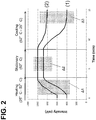
- Figure 2 shows that, in the absence of target molecules, beacons open up during the heating phase and emit a fluorescent signal.
- beacons are in an equilibrium of open and closed conformation "looking" for their targets. The fluorescent signal remains constant in this phase. Upon cooling, the beacons return to their original closed conformation and the fluorescent signal ceases.
- Figure 2 (signal (2), probe with target) further shows that, already during the heating phase, probes open up rapidly in the presence of target molecules ( ⁇ 1).
- ⁇ 1 During the stationary phase equilibrium is shifted. That is, large amounts of probes are bound to target sequences while the remainder of probes is still in a 50% equilibrium ( ⁇ 2). After cooling, probes bound to target molecules remain open and still emit light ( ⁇ 3).
- Figure 2 shows that there is a clear and robust difference between a probe sequence that hybridizes with a target sequence (signal (2)) and a control sequence which does not bind to any target (signal (1)).
- the value of the detectable signal (2) is higher than the value of the control signal (1).
- the most significant difference can be observed at the end of the cooling phase ( ⁇ 3) so that measuring and analyzing the detectable signal (2) during this period provides the most reliable result.
- additional measuring points in other phases ⁇ 1 and/or ⁇ 2 can be set in order to verify the result and provide more certainty and reliability in respect of the final conclusion.
- the threshold for determining whether a microorganism is present may be either a certain value of the probe signal (e.g., fluorescence intensity) or a predetermined difference between the signals of the probe sequence and a suitable control sequence.
- the method according to the invention allows for fast and reliable detection of microorganisms in a sample.
- Figure 3 again shows that beacon probes without target open during heating and close during cooling (Tubes 1 and 4). Addition of target sequences keeps the probe sequences open (Tubes 2 and 3), wherein more target (higher target concentration) increases the detectable signal (Tube 2) compared to samples with lower target concentration (Tube 3).
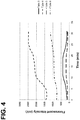
- Figure 4 shows that the detectable signal with samples including target sequences runs as a flat curve (Tubes 3 and 5), while a clear detectable signal with higher intensity can be observed with samples including target sequences (Tubes 4 and 6).
- Figure 5 shows that probe sequences labeled with a different fluorophore (HEX instead of FAM) are clearly detectable as well (Tubes 11 and 12).
Landscapes
- Chemical & Material Sciences (AREA)
- Life Sciences & Earth Sciences (AREA)
- Organic Chemistry (AREA)
- Proteomics, Peptides & Aminoacids (AREA)
- Analytical Chemistry (AREA)
- Zoology (AREA)
- Wood Science & Technology (AREA)
- Health & Medical Sciences (AREA)
- Engineering & Computer Science (AREA)
- Microbiology (AREA)
- Immunology (AREA)
- Molecular Biology (AREA)
- Biotechnology (AREA)
- Biophysics (AREA)
- Physics & Mathematics (AREA)
- Biochemistry (AREA)
- Bioinformatics & Cheminformatics (AREA)
- General Engineering & Computer Science (AREA)
- General Health & Medical Sciences (AREA)
- Genetics & Genomics (AREA)
- Measuring Or Testing Involving Enzymes Or Micro-Organisms (AREA)
Claims (11)
- Procédé de détection d'au moins un micro-organisme spécifique dans un échantillon, dans lequel au moins une séquence sonde d'acides nucléiques est capable de s'hybrider avec au moins une séquence cible d'acides nucléiques dudit micro-organisme, ladite séquence sonde d'acides nucléiques comprenant au moins un marqueur pouvant être détecté qui est capable d'émettre au moins un signal pouvant être détecté, dans lequel le signal pouvant être détecté prend une première valeur lorsque la séquence sonde n'est pas liée à la séquence cible et une seconde valeur lorsque la séquence sonde est liée à la séquence, dans lequel la seconde valeur du signal pouvant être détecté diminue, augmente ou change par rapport à la première valeur du signal pouvant être détecté, ledit procédé comprenant:a) dans un échantillon fourni supposé inclure le micro-organisme ;b) perforer ou lyser les micro-organismes situés à l'intérieur de l'échantillon ;c) ajouter la séquence sonde d'acides nucléiques à l'échantillon dans des conditions qui permettent une hybridation in vitro de la séquence sonde avec la séquence cible, dans lequel lesdites conditions comprennent le chauffage de l'échantillon au moins de manière temporaire à une température prédéterminée au-dessus de la température ambiante et ensuite le refroidissement de l'échantillon à une température inférieure ;d) mesurer de manière continue les valeurs du signal pouvant être détecté pour la séquence sonde d'acides nucléiques dans l'échantillon au niveau d'une pluralité de points de mesure dans le temps pendant le cours de la réaction produisant un signal, comprenant des valeurs de mesure du signal pouvant être détecté pendant et/ou après le chauffage et pendant et/ou après le refroidissement ; ete) analyser de manière continue les valeurs mesurées du signal pouvant être détecté de la séquence d'acides nucléiques, dans lequel il est indiqué que l'échantillon contient le micro-organisme si les valeurs mesurées correspondent à la seconde valeur du signal pouvant être détecté.
- Procédé selon la revendication 1, dans lequel la mesure est arrêtée une fois que l'analyse dans l'étape e) indique que l'échantillon contient le micro-organisme.
- Procédé selon la revendication 1 ou la revendication 2, dans lequel les étapes d) et e) sont au moins effectuées de manière automatique, et les valeurs mesurées sont lues de manière électronique et traitées de manière digitale.
- Procédé selon l'une quelconque des revendications 1 à 3, dans lequel après l'étape c), on maintient la température constante pendant une période de temps prédéterminée.
- Procédé selon la revendication 4, dans lequel une valeur du signal pouvant être détecté dans l'échantillon est au moins mesurée pendant qu'on maintient la température constante.
- Procédé selon l'une quelconque des revendications 1 à 5, dans lequel la séquence sonde d'acides nucléiques est un acide nucléique linéaire ou une balise moléculaire.
- Procédé selon l'une quelconque des revendications 1 à 6, dans lequel la séquence cible d'acides nucléiques est une séquence d'ADN ou une séquence d'ARN, en particulier une séquence d'ARNr.
- Procédé selon l'une quelconque des revendications 1 à 7, dans lequel dans l'étape c) une première séquence d'acides nucléiques de contrôle est de plus au moins ajoutée à l'échantillon, les valeurs d'un signal pouvant être détecté pour la première séquence d'acides nucléiques de contrôle étant mesurées aux points de mesure dans l'étape d), et dans lequel l'analyse dans l'étape e) comprend une comparaison des valeurs mesurées du signal pouvant être détecté de la séquence sonde d'acides nucléiques avec les valeurs mesurées du signal pouvant être détecté de la première séquence d'acides nucléiques de contrôle, dans lequel il est indiqué que l'échantillon contient le micro-organisme si la valeur mesurée pour la séquence sonde d'acides nucléiques à n'importe quel point de mesure est différente de la valeur mesurée respective pour la première séquence d'acides nucléiques de contrôle et la différence entre les valeurs comparées dépasse un seuil prédéterminé.
- Procédé selon la revendication 8, dans lequel la première séquence d'acides nucléiques de contrôle est une séquence qui ne se lie à aucune séquence d'acides nucléiques.
- Procédé selon l'une quelconque des revendications 1 à 9, dans lequel une seconde séquence d'acides nucléiques de contrôle qui se lie à des séquences d'acides nucléiques de tous les micro-organismes est de plus en outre ajoutée à l'échantillon dans l'étape c).
- Procédé selon l'une quelconque des revendications 1 à 10, dans lequel le marqueur pouvant être détecté est un marqueur luminescent, en particulier un marqueur fluorescent, ou dans lequel le marqueur pouvant être détecté est une enzyme rapporteur, de préférence choisie dans le groupe constitué de la tyrosinase, de la peroxydase, de la sulfite oxydase, de la phosphatase alcaline, de la glucose oxydase et de la guanine oxydase.
Priority Applications (4)
| Application Number | Priority Date | Filing Date | Title |
|---|---|---|---|
| EP16186104.2A EP3290527B1 (fr) | 2016-08-29 | 2016-08-29 | Procédé de détection de micro-organismes dans un échantillon |
| CN201780053321.XA CN109790588A (zh) | 2016-08-29 | 2017-08-29 | 用于检测样品中微生物的方法 |
| US16/328,039 US20190218596A1 (en) | 2016-08-29 | 2017-08-29 | Method for detecting microorganisms in a sample |
| PCT/EP2017/071658 WO2018041828A1 (fr) | 2016-08-29 | 2017-08-29 | Procédé permettant de détecter des micro-organismes dans un échantillon |
Applications Claiming Priority (1)
| Application Number | Priority Date | Filing Date | Title |
|---|---|---|---|
| EP16186104.2A EP3290527B1 (fr) | 2016-08-29 | 2016-08-29 | Procédé de détection de micro-organismes dans un échantillon |
Publications (2)
| Publication Number | Publication Date |
|---|---|
| EP3290527A1 EP3290527A1 (fr) | 2018-03-07 |
| EP3290527B1 true EP3290527B1 (fr) | 2019-06-19 |
Family
ID=56842697
Family Applications (1)
| Application Number | Title | Priority Date | Filing Date |
|---|---|---|---|
| EP16186104.2A Not-in-force EP3290527B1 (fr) | 2016-08-29 | 2016-08-29 | Procédé de détection de micro-organismes dans un échantillon |
Country Status (4)
| Country | Link |
|---|---|
| US (1) | US20190218596A1 (fr) |
| EP (1) | EP3290527B1 (fr) |
| CN (1) | CN109790588A (fr) |
| WO (1) | WO2018041828A1 (fr) |
Family Cites Families (5)
| Publication number | Priority date | Publication date | Assignee | Title |
|---|---|---|---|---|
| CA2667631C (fr) | 2006-10-10 | 2017-11-07 | Miacom Diagnostics Gmbh | Marqueurs d' acide nucleique pour technologie applicable a l'hybridation et aux puces cellulaires a fluorescence in situ |
| GB0621864D0 (en) * | 2006-11-02 | 2006-12-13 | Univ Manchester | Assay for fungal infection |
| WO2011163425A1 (fr) * | 2010-06-22 | 2011-12-29 | University Of Hawaii | Surveillance en temps réel spécifique de séquence d'amplification isotherme à médiation par boucle (lamp) |
| EP2428582B1 (fr) * | 2010-09-14 | 2013-09-04 | miacom Diagnostics GmbH | Tampon de marge |
| US8524061B2 (en) * | 2010-11-29 | 2013-09-03 | The Board Of Trustees Of The Leland Stanford Junior University | On-chip hybridization coupled with ITP based purification for fast sequence specific identification |
-
2016
- 2016-08-29 EP EP16186104.2A patent/EP3290527B1/fr not_active Not-in-force
-
2017
- 2017-08-29 US US16/328,039 patent/US20190218596A1/en not_active Abandoned
- 2017-08-29 WO PCT/EP2017/071658 patent/WO2018041828A1/fr not_active Ceased
- 2017-08-29 CN CN201780053321.XA patent/CN109790588A/zh active Pending
Non-Patent Citations (1)
| Title |
|---|
| None * |
Also Published As
| Publication number | Publication date |
|---|---|
| CN109790588A (zh) | 2019-05-21 |
| EP3290527A1 (fr) | 2018-03-07 |
| WO2018041828A1 (fr) | 2018-03-08 |
| US20190218596A1 (en) | 2019-07-18 |
Similar Documents
| Publication | Publication Date | Title |
|---|---|---|
| US8206923B2 (en) | Method for detection and multiple, simultaneous quantification of pathogens by means of real-time polymerase chain reaction | |
| US9593381B2 (en) | Method and kit for detecting carbapenemase genes | |
| Shaio et al. | Colorimetric one-tube nested PCR for detection of Trichomonas vaginalis in vaginal discharge | |
| JP4092201B2 (ja) | 病原微生物の検出方法 | |
| Kumar et al. | Closed-tube field-deployable loop-mediated isothermal amplification (LAMP) assay based on spore wall protein (SWP) for the visual detection of Enterocytozoon hepatopenaei (EHP) | |
| BR112016006312B1 (pt) | Método e kit para determinar a presença ou ausência de staphylococcus aureus resistente à meticilina em uma amostra biológica | |
| Butcher et al. | Reduced-cost Chlamydia trachomatis-specific multiplex real-time PCR diagnostic assay evaluated for ocular swabs and use by trachoma research programmes | |
| US20250115968A1 (en) | Constant temperature nucleic acid amplification raa primer probe combination for detecting candida auris and use thereof | |
| JP4377378B2 (ja) | 細菌性病原体の定量的試験 | |
| EP3902929B1 (fr) | Système de détection microfluidique rapide et portable en tant qu'alternative au procédé de culture classique de salmonella | |
| EP4591867A2 (fr) | Procédés de détection de bordetella | |
| Shunmugam et al. | ipaH-Targeted electrochemical genosensor: A fast and reliable diagnostic approach for simultaneous detection Shigella species and enteroinvasive Escherichia coli | |
| Hanazawa et al. | In-situ detection of Aspergillus fumigatus | |
| KR102467600B1 (ko) | 독소작용제 검출용 프라이머 세트 및 이를 이용한 독소작용제의 검출방법 | |
| KR20220073327A (ko) | 형광 프로브를 이용한 칸디다 알비칸, 칸디다 아우리스, 및 칸디다 글라브라타를 감별하여 검출할 수 있는 동시다중 등온증폭반응 프라이머 세트 | |
| KR20230016230A (ko) | 표적 물질의 검출용 키트 및 이를 이용하여 표적 물질을 검출하는 방법 | |
| De Felice et al. | Latest trends in biosensors powered by nucleic acid isothermal amplification for the diagnosis of joint infections: From sampling to identification towards the point-of-care | |
| Ağel et al. | Optimization of isothermal amplification method for Mycobacterium tuberculosis detection and visualization method for fieldwork | |
| CN105695584B (zh) | 检测实验动物金黄色葡萄球菌的gyrB引物组合 | |
| EP3290527A1 (fr) | Procédé de détection de micro-organismes dans un échantillon | |
| JP4176134B2 (ja) | 病原微生物の検出方法 | |
| US10640833B2 (en) | Rapid detection of infectious agents | |
| DE602004013413T2 (de) | Nachweis von Streptococcus aus der B-Gruppe | |
| HK40007850A (en) | Method for detecting microorganisms in a sample | |
| KR102833010B1 (ko) | B군 연쇄상구균 검출을 위한 고리매개 등온증폭반응 프라이머 세트 |
Legal Events
| Date | Code | Title | Description |
|---|---|---|---|
| PUAI | Public reference made under article 153(3) epc to a published international application that has entered the european phase |
Free format text: ORIGINAL CODE: 0009012 |
|
| STAA | Information on the status of an ep patent application or granted ep patent |
Free format text: STATUS: THE APPLICATION HAS BEEN PUBLISHED |
|
| STAA | Information on the status of an ep patent application or granted ep patent |
Free format text: STATUS: REQUEST FOR EXAMINATION WAS MADE |
|
| AK | Designated contracting states |
Kind code of ref document: A1 Designated state(s): AL AT BE BG CH CY CZ DE DK EE ES FI FR GB GR HR HU IE IS IT LI LT LU LV MC MK MT NL NO PL PT RO RS SE SI SK SM TR |
|
| AX | Request for extension of the european patent |
Extension state: BA ME |
|
| 17P | Request for examination filed |
Effective date: 20180214 |
|
| RBV | Designated contracting states (corrected) |
Designated state(s): AL AT BE BG CH CY CZ DE DK EE ES FI FR GB GR HR HU IE IS IT LI LT LU LV MC MK MT NL NO PL PT RO RS SE SI SK SM TR |
|
| STAA | Information on the status of an ep patent application or granted ep patent |
Free format text: STATUS: EXAMINATION IS IN PROGRESS |
|
| 17Q | First examination report despatched |
Effective date: 20180511 |
|
| RAP1 | Party data changed (applicant data changed or rights of an application transferred) |
Owner name: METASYSTEMS INDIGO GMBH |
|
| REG | Reference to a national code |
Ref country code: DE Ref legal event code: R079 Ref document number: 602016015437 Country of ref document: DE Free format text: PREVIOUS MAIN CLASS: C12Q0001680000 Ipc: C12Q0001684100 |
|
| GRAP | Despatch of communication of intention to grant a patent |
Free format text: ORIGINAL CODE: EPIDOSNIGR1 |
|
| STAA | Information on the status of an ep patent application or granted ep patent |
Free format text: STATUS: GRANT OF PATENT IS INTENDED |
|
| RIC1 | Information provided on ipc code assigned before grant |
Ipc: C12Q 1/689 20180101ALI20181213BHEP Ipc: C12Q 1/6841 20180101AFI20181213BHEP |
|
| INTG | Intention to grant announced |
Effective date: 20190109 |
|
| GRAS | Grant fee paid |
Free format text: ORIGINAL CODE: EPIDOSNIGR3 |
|
| GRAA | (expected) grant |
Free format text: ORIGINAL CODE: 0009210 |
|
| STAA | Information on the status of an ep patent application or granted ep patent |
Free format text: STATUS: THE PATENT HAS BEEN GRANTED |
|
| AK | Designated contracting states |
Kind code of ref document: B1 Designated state(s): AL AT BE BG CH CY CZ DE DK EE ES FI FR GB GR HR HU IE IS IT LI LT LU LV MC MK MT NL NO PL PT RO RS SE SI SK SM TR |
|
| REG | Reference to a national code |
Ref country code: GB Ref legal event code: FG4D |
|
| REG | Reference to a national code |
Ref country code: CH Ref legal event code: EP |
|
| REG | Reference to a national code |
Ref country code: IE Ref legal event code: FG4D |
|
| REG | Reference to a national code |
Ref country code: DE Ref legal event code: R096 Ref document number: 602016015437 Country of ref document: DE |
|
| REG | Reference to a national code |
Ref country code: AT Ref legal event code: REF Ref document number: 1145584 Country of ref document: AT Kind code of ref document: T Effective date: 20190715 |
|
| REG | Reference to a national code |
Ref country code: NL Ref legal event code: MP Effective date: 20190619 |
|
| PG25 | Lapsed in a contracting state [announced via postgrant information from national office to epo] |
Ref country code: AL Free format text: LAPSE BECAUSE OF FAILURE TO SUBMIT A TRANSLATION OF THE DESCRIPTION OR TO PAY THE FEE WITHIN THE PRESCRIBED TIME-LIMIT Effective date: 20190619 Ref country code: SE Free format text: LAPSE BECAUSE OF FAILURE TO SUBMIT A TRANSLATION OF THE DESCRIPTION OR TO PAY THE FEE WITHIN THE PRESCRIBED TIME-LIMIT Effective date: 20190619 Ref country code: HR Free format text: LAPSE BECAUSE OF FAILURE TO SUBMIT A TRANSLATION OF THE DESCRIPTION OR TO PAY THE FEE WITHIN THE PRESCRIBED TIME-LIMIT Effective date: 20190619 Ref country code: LT Free format text: LAPSE BECAUSE OF FAILURE TO SUBMIT A TRANSLATION OF THE DESCRIPTION OR TO PAY THE FEE WITHIN THE PRESCRIBED TIME-LIMIT Effective date: 20190619 Ref country code: FI Free format text: LAPSE BECAUSE OF FAILURE TO SUBMIT A TRANSLATION OF THE DESCRIPTION OR TO PAY THE FEE WITHIN THE PRESCRIBED TIME-LIMIT Effective date: 20190619 Ref country code: NO Free format text: LAPSE BECAUSE OF FAILURE TO SUBMIT A TRANSLATION OF THE DESCRIPTION OR TO PAY THE FEE WITHIN THE PRESCRIBED TIME-LIMIT Effective date: 20190919 |
|
| REG | Reference to a national code |
Ref country code: LT Ref legal event code: MG4D |
|
| PG25 | Lapsed in a contracting state [announced via postgrant information from national office to epo] |
Ref country code: LV Free format text: LAPSE BECAUSE OF FAILURE TO SUBMIT A TRANSLATION OF THE DESCRIPTION OR TO PAY THE FEE WITHIN THE PRESCRIBED TIME-LIMIT Effective date: 20190619 Ref country code: RS Free format text: LAPSE BECAUSE OF FAILURE TO SUBMIT A TRANSLATION OF THE DESCRIPTION OR TO PAY THE FEE WITHIN THE PRESCRIBED TIME-LIMIT Effective date: 20190619 Ref country code: BG Free format text: LAPSE BECAUSE OF FAILURE TO SUBMIT A TRANSLATION OF THE DESCRIPTION OR TO PAY THE FEE WITHIN THE PRESCRIBED TIME-LIMIT Effective date: 20190919 Ref country code: GR Free format text: LAPSE BECAUSE OF FAILURE TO SUBMIT A TRANSLATION OF THE DESCRIPTION OR TO PAY THE FEE WITHIN THE PRESCRIBED TIME-LIMIT Effective date: 20190920 |
|
| REG | Reference to a national code |
Ref country code: AT Ref legal event code: MK05 Ref document number: 1145584 Country of ref document: AT Kind code of ref document: T Effective date: 20190619 |
|
| PG25 | Lapsed in a contracting state [announced via postgrant information from national office to epo] |
Ref country code: SK Free format text: LAPSE BECAUSE OF FAILURE TO SUBMIT A TRANSLATION OF THE DESCRIPTION OR TO PAY THE FEE WITHIN THE PRESCRIBED TIME-LIMIT Effective date: 20190619 Ref country code: PT Free format text: LAPSE BECAUSE OF FAILURE TO SUBMIT A TRANSLATION OF THE DESCRIPTION OR TO PAY THE FEE WITHIN THE PRESCRIBED TIME-LIMIT Effective date: 20191021 Ref country code: NL Free format text: LAPSE BECAUSE OF FAILURE TO SUBMIT A TRANSLATION OF THE DESCRIPTION OR TO PAY THE FEE WITHIN THE PRESCRIBED TIME-LIMIT Effective date: 20190619 Ref country code: RO Free format text: LAPSE BECAUSE OF FAILURE TO SUBMIT A TRANSLATION OF THE DESCRIPTION OR TO PAY THE FEE WITHIN THE PRESCRIBED TIME-LIMIT Effective date: 20190619 Ref country code: AT Free format text: LAPSE BECAUSE OF FAILURE TO SUBMIT A TRANSLATION OF THE DESCRIPTION OR TO PAY THE FEE WITHIN THE PRESCRIBED TIME-LIMIT Effective date: 20190619 Ref country code: CZ Free format text: LAPSE BECAUSE OF FAILURE TO SUBMIT A TRANSLATION OF THE DESCRIPTION OR TO PAY THE FEE WITHIN THE PRESCRIBED TIME-LIMIT Effective date: 20190619 Ref country code: EE Free format text: LAPSE BECAUSE OF FAILURE TO SUBMIT A TRANSLATION OF THE DESCRIPTION OR TO PAY THE FEE WITHIN THE PRESCRIBED TIME-LIMIT Effective date: 20190619 |
|
| PG25 | Lapsed in a contracting state [announced via postgrant information from national office to epo] |
Ref country code: ES Free format text: LAPSE BECAUSE OF FAILURE TO SUBMIT A TRANSLATION OF THE DESCRIPTION OR TO PAY THE FEE WITHIN THE PRESCRIBED TIME-LIMIT Effective date: 20190619 Ref country code: SM Free format text: LAPSE BECAUSE OF FAILURE TO SUBMIT A TRANSLATION OF THE DESCRIPTION OR TO PAY THE FEE WITHIN THE PRESCRIBED TIME-LIMIT Effective date: 20190619 Ref country code: IS Free format text: LAPSE BECAUSE OF FAILURE TO SUBMIT A TRANSLATION OF THE DESCRIPTION OR TO PAY THE FEE WITHIN THE PRESCRIBED TIME-LIMIT Effective date: 20191019 Ref country code: IT Free format text: LAPSE BECAUSE OF FAILURE TO SUBMIT A TRANSLATION OF THE DESCRIPTION OR TO PAY THE FEE WITHIN THE PRESCRIBED TIME-LIMIT Effective date: 20190619 |
|
| PG25 | Lapsed in a contracting state [announced via postgrant information from national office to epo] |
Ref country code: TR Free format text: LAPSE BECAUSE OF FAILURE TO SUBMIT A TRANSLATION OF THE DESCRIPTION OR TO PAY THE FEE WITHIN THE PRESCRIBED TIME-LIMIT Effective date: 20190619 |
|
| PG25 | Lapsed in a contracting state [announced via postgrant information from national office to epo] |
Ref country code: PL Free format text: LAPSE BECAUSE OF FAILURE TO SUBMIT A TRANSLATION OF THE DESCRIPTION OR TO PAY THE FEE WITHIN THE PRESCRIBED TIME-LIMIT Effective date: 20190619 Ref country code: DK Free format text: LAPSE BECAUSE OF FAILURE TO SUBMIT A TRANSLATION OF THE DESCRIPTION OR TO PAY THE FEE WITHIN THE PRESCRIBED TIME-LIMIT Effective date: 20190619 |
|
| PG25 | Lapsed in a contracting state [announced via postgrant information from national office to epo] |
Ref country code: MC Free format text: LAPSE BECAUSE OF FAILURE TO SUBMIT A TRANSLATION OF THE DESCRIPTION OR TO PAY THE FEE WITHIN THE PRESCRIBED TIME-LIMIT Effective date: 20190619 Ref country code: LU Free format text: LAPSE BECAUSE OF NON-PAYMENT OF DUE FEES Effective date: 20190829 Ref country code: IS Free format text: LAPSE BECAUSE OF FAILURE TO SUBMIT A TRANSLATION OF THE DESCRIPTION OR TO PAY THE FEE WITHIN THE PRESCRIBED TIME-LIMIT Effective date: 20200224 |
|
| REG | Reference to a national code |
Ref country code: BE Ref legal event code: MM Effective date: 20190831 |
|
| REG | Reference to a national code |
Ref country code: DE Ref legal event code: R097 Ref document number: 602016015437 Country of ref document: DE |
|
| PLBE | No opposition filed within time limit |
Free format text: ORIGINAL CODE: 0009261 |
|
| STAA | Information on the status of an ep patent application or granted ep patent |
Free format text: STATUS: NO OPPOSITION FILED WITHIN TIME LIMIT |
|
| PG2D | Information on lapse in contracting state deleted |
Ref country code: IS |
|
| PG25 | Lapsed in a contracting state [announced via postgrant information from national office to epo] |
Ref country code: IE Free format text: LAPSE BECAUSE OF NON-PAYMENT OF DUE FEES Effective date: 20190829 |
|
| 26N | No opposition filed |
Effective date: 20200603 |
|
| PG25 | Lapsed in a contracting state [announced via postgrant information from national office to epo] |
Ref country code: BE Free format text: LAPSE BECAUSE OF NON-PAYMENT OF DUE FEES Effective date: 20190831 Ref country code: SI Free format text: LAPSE BECAUSE OF FAILURE TO SUBMIT A TRANSLATION OF THE DESCRIPTION OR TO PAY THE FEE WITHIN THE PRESCRIBED TIME-LIMIT Effective date: 20190619 |
|
| PG25 | Lapsed in a contracting state [announced via postgrant information from national office to epo] |
Ref country code: CY Free format text: LAPSE BECAUSE OF FAILURE TO SUBMIT A TRANSLATION OF THE DESCRIPTION OR TO PAY THE FEE WITHIN THE PRESCRIBED TIME-LIMIT Effective date: 20190619 |
|
| PG25 | Lapsed in a contracting state [announced via postgrant information from national office to epo] |
Ref country code: MT Free format text: LAPSE BECAUSE OF FAILURE TO SUBMIT A TRANSLATION OF THE DESCRIPTION OR TO PAY THE FEE WITHIN THE PRESCRIBED TIME-LIMIT Effective date: 20190619 Ref country code: HU Free format text: LAPSE BECAUSE OF FAILURE TO SUBMIT A TRANSLATION OF THE DESCRIPTION OR TO PAY THE FEE WITHIN THE PRESCRIBED TIME-LIMIT; INVALID AB INITIO Effective date: 20160829 |
|
| PGFP | Annual fee paid to national office [announced via postgrant information from national office to epo] |
Ref country code: FR Payment date: 20210823 Year of fee payment: 6 |
|
| PGFP | Annual fee paid to national office [announced via postgrant information from national office to epo] |
Ref country code: DE Payment date: 20210819 Year of fee payment: 6 Ref country code: CH Payment date: 20210824 Year of fee payment: 6 Ref country code: GB Payment date: 20210824 Year of fee payment: 6 |
|
| PG25 | Lapsed in a contracting state [announced via postgrant information from national office to epo] |
Ref country code: MK Free format text: LAPSE BECAUSE OF FAILURE TO SUBMIT A TRANSLATION OF THE DESCRIPTION OR TO PAY THE FEE WITHIN THE PRESCRIBED TIME-LIMIT Effective date: 20190619 |
|
| REG | Reference to a national code |
Ref country code: DE Ref legal event code: R119 Ref document number: 602016015437 Country of ref document: DE |
|
| REG | Reference to a national code |
Ref country code: CH Ref legal event code: PL |
|
| GBPC | Gb: european patent ceased through non-payment of renewal fee |
Effective date: 20220829 |
|
| PG25 | Lapsed in a contracting state [announced via postgrant information from national office to epo] |
Ref country code: LI Free format text: LAPSE BECAUSE OF NON-PAYMENT OF DUE FEES Effective date: 20220831 Ref country code: CH Free format text: LAPSE BECAUSE OF NON-PAYMENT OF DUE FEES Effective date: 20220831 |
|
| PG25 | Lapsed in a contracting state [announced via postgrant information from national office to epo] |
Ref country code: FR Free format text: LAPSE BECAUSE OF NON-PAYMENT OF DUE FEES Effective date: 20220831 Ref country code: DE Free format text: LAPSE BECAUSE OF NON-PAYMENT OF DUE FEES Effective date: 20230301 |
|
| PG25 | Lapsed in a contracting state [announced via postgrant information from national office to epo] |
Ref country code: GB Free format text: LAPSE BECAUSE OF NON-PAYMENT OF DUE FEES Effective date: 20220829 |