EP3285099A1 - Dye-type polarizing element, and polarizing plate and liquid crystal display device using same - Google Patents
Dye-type polarizing element, and polarizing plate and liquid crystal display device using same Download PDFInfo
- Publication number
- EP3285099A1 EP3285099A1 EP16796576.3A EP16796576A EP3285099A1 EP 3285099 A1 EP3285099 A1 EP 3285099A1 EP 16796576 A EP16796576 A EP 16796576A EP 3285099 A1 EP3285099 A1 EP 3285099A1
- Authority
- EP
- European Patent Office
- Prior art keywords
- group
- formula
- azo compound
- compound
- polarizer
- Prior art date
- Legal status (The legal status is an assumption and is not a legal conclusion. Google has not performed a legal analysis and makes no representation as to the accuracy of the status listed.)
- Granted
Links
- 239000004973 liquid crystal related substance Substances 0.000 title claims abstract description 23
- -1 azo compound Chemical class 0.000 claims abstract description 731
- 150000001875 compounds Chemical class 0.000 claims abstract description 337
- 229940126062 Compound A Drugs 0.000 claims abstract description 43
- NLDMNSXOCDLTTB-UHFFFAOYSA-N Heterophylliin A Natural products O1C2COC(=O)C3=CC(O)=C(O)C(O)=C3C3=C(O)C(O)=C(O)C=C3C(=O)OC2C(OC(=O)C=2C=C(O)C(O)=C(O)C=2)C(O)C1OC(=O)C1=CC(O)=C(O)C(O)=C1 NLDMNSXOCDLTTB-UHFFFAOYSA-N 0.000 claims abstract description 43
- 150000003839 salts Chemical class 0.000 claims abstract description 23
- 125000000020 sulfo group Chemical group O=S(=O)([*])O[H] 0.000 claims description 200
- 125000001424 substituent group Chemical group 0.000 claims description 169
- 125000003545 alkoxy group Chemical group 0.000 claims description 147
- 125000003277 amino group Chemical group 0.000 claims description 129
- 125000000217 alkyl group Chemical group 0.000 claims description 78
- 125000003178 carboxy group Chemical group [H]OC(*)=O 0.000 claims description 64
- 229920005989 resin Polymers 0.000 claims description 62
- 239000011347 resin Substances 0.000 claims description 62
- 125000001997 phenyl group Chemical group [H]C1=C([H])C([H])=C(*)C([H])=C1[H] 0.000 claims description 53
- 125000002887 hydroxy group Chemical group [H]O* 0.000 claims description 47
- 125000001624 naphthyl group Chemical group 0.000 claims description 43
- 125000004435 hydrogen atom Chemical group [H]* 0.000 claims description 36
- 125000002490 anilino group Chemical group [H]N(*)C1=C([H])C([H])=C([H])C([H])=C1[H] 0.000 claims description 31
- 125000000043 benzamido group Chemical group [H]N([*])C(=O)C1=C([H])C([H])=C([H])C([H])=C1[H] 0.000 claims description 29
- YTZPUTADNGREHA-UHFFFAOYSA-N 2h-benzo[e]benzotriazole Chemical group C1=CC2=CC=CC=C2C2=NNN=C21 YTZPUTADNGREHA-UHFFFAOYSA-N 0.000 claims description 24
- 239000004372 Polyvinyl alcohol Substances 0.000 claims description 23
- 229920002451 polyvinyl alcohol Polymers 0.000 claims description 23
- 125000000449 nitro group Chemical group [O-][N+](*)=O 0.000 claims description 16
- 125000003236 benzoyl group Chemical group [H]C1=C([H])C([H])=C(C([H])=C1[H])C(*)=O 0.000 claims description 14
- LVTJOONKWUXEFR-FZRMHRINSA-N protoneodioscin Natural products O(C[C@@H](CC[C@]1(O)[C@H](C)[C@@H]2[C@]3(C)[C@H]([C@H]4[C@@H]([C@]5(C)C(=CC4)C[C@@H](O[C@@H]4[C@H](O[C@H]6[C@@H](O)[C@@H](O)[C@@H](O)[C@H](C)O6)[C@@H](O)[C@H](O[C@H]6[C@@H](O)[C@@H](O)[C@@H](O)[C@H](C)O6)[C@H](CO)O4)CC5)CC3)C[C@@H]2O1)C)[C@H]1[C@H](O)[C@H](O)[C@H](O)[C@@H](CO)O1 LVTJOONKWUXEFR-FZRMHRINSA-N 0.000 claims description 14
- 125000003282 alkyl amino group Chemical group 0.000 claims description 10
- 230000010287 polarization Effects 0.000 abstract description 79
- 238000005259 measurement Methods 0.000 description 125
- 238000004519 manufacturing process Methods 0.000 description 112
- 230000000052 comparative effect Effects 0.000 description 77
- 238000002834 transmittance Methods 0.000 description 64
- 239000000975 dye Substances 0.000 description 63
- XLYOFNOQVPJJNP-UHFFFAOYSA-N water Substances O XLYOFNOQVPJJNP-UHFFFAOYSA-N 0.000 description 55
- 239000007864 aqueous solution Substances 0.000 description 39
- 125000000956 methoxy group Chemical group [H]C([H])([H])O* 0.000 description 37
- 230000015572 biosynthetic process Effects 0.000 description 35
- 206010042674 Swelling Diseases 0.000 description 34
- 230000008961 swelling Effects 0.000 description 34
- 238000003786 synthesis reaction Methods 0.000 description 34
- 239000002585 base Substances 0.000 description 33
- 238000000034 method Methods 0.000 description 33
- 238000005406 washing Methods 0.000 description 32
- 239000000243 solution Substances 0.000 description 29
- 125000002496 methyl group Chemical group [H]C([H])([H])* 0.000 description 28
- PMZURENOXWZQFD-UHFFFAOYSA-L Sodium Sulfate Chemical compound [Na+].[Na+].[O-]S([O-])(=O)=O PMZURENOXWZQFD-UHFFFAOYSA-L 0.000 description 26
- 235000019832 sodium triphosphate Nutrition 0.000 description 25
- 238000006467 substitution reaction Methods 0.000 description 24
- KZEVSDGEBAJOTK-UHFFFAOYSA-N 1-(2,4,6,7-tetrahydrotriazolo[4,5-c]pyridin-5-yl)-2-[5-[2-[[3-(trifluoromethoxy)phenyl]methylamino]pyrimidin-5-yl]-1,3,4-oxadiazol-2-yl]ethanone Chemical compound N1N=NC=2CN(CCC=21)C(CC=1OC(=NN=1)C=1C=NC(=NC=1)NCC1=CC(=CC=C1)OC(F)(F)F)=O KZEVSDGEBAJOTK-UHFFFAOYSA-N 0.000 description 21
- 235000002639 sodium chloride Nutrition 0.000 description 21
- 239000010410 layer Substances 0.000 description 20
- 239000003431 cross linking reagent Substances 0.000 description 19
- 239000003795 chemical substances by application Substances 0.000 description 18
- 238000004043 dyeing Methods 0.000 description 18
- ZCYVEMRRCGMTRW-UHFFFAOYSA-N 7553-56-2 Chemical compound [I] ZCYVEMRRCGMTRW-UHFFFAOYSA-N 0.000 description 16
- 0 CCC(C)(N)NC#C*C(C)CC(C=*)C(C)=CC(*)=C Chemical compound CCC(C)(N)NC#C*C(C)CC(C=*)C(C)=CC(*)=C 0.000 description 16
- 239000000853 adhesive Substances 0.000 description 16
- 230000001070 adhesive effect Effects 0.000 description 16
- 235000013675 iodine Nutrition 0.000 description 16
- 239000011630 iodine Substances 0.000 description 15
- 229910052740 iodine Inorganic materials 0.000 description 15
- 150000007945 N-acyl ureas Chemical group 0.000 description 13
- 125000001301 ethoxy group Chemical group [H]C([H])([H])C([H])([H])O* 0.000 description 12
- 239000002994 raw material Substances 0.000 description 10
- 125000001495 ethyl group Chemical group [H]C([H])([H])C([H])([H])* 0.000 description 9
- 238000001035 drying Methods 0.000 description 8
- 239000007788 liquid Substances 0.000 description 8
- 239000000049 pigment Substances 0.000 description 8
- 229920002284 Cellulose triacetate Polymers 0.000 description 7
- NNLVGZFZQQXQNW-ADJNRHBOSA-N [(2r,3r,4s,5r,6s)-4,5-diacetyloxy-3-[(2s,3r,4s,5r,6r)-3,4,5-triacetyloxy-6-(acetyloxymethyl)oxan-2-yl]oxy-6-[(2r,3r,4s,5r,6s)-4,5,6-triacetyloxy-2-(acetyloxymethyl)oxan-3-yl]oxyoxan-2-yl]methyl acetate Chemical compound O([C@@H]1O[C@@H]([C@H]([C@H](OC(C)=O)[C@H]1OC(C)=O)O[C@H]1[C@@H]([C@@H](OC(C)=O)[C@H](OC(C)=O)[C@@H](COC(C)=O)O1)OC(C)=O)COC(=O)C)[C@@H]1[C@@H](COC(C)=O)O[C@@H](OC(C)=O)[C@H](OC(C)=O)[C@H]1OC(C)=O NNLVGZFZQQXQNW-ADJNRHBOSA-N 0.000 description 7
- KGBXLFKZBHKPEV-UHFFFAOYSA-N boric acid Chemical compound OB(O)O KGBXLFKZBHKPEV-UHFFFAOYSA-N 0.000 description 7
- 239000004327 boric acid Substances 0.000 description 7
- 238000002156 mixing Methods 0.000 description 7
- CONKBQPVFMXDOV-QHCPKHFHSA-N 6-[(5S)-5-[[4-[2-(2,3-dihydro-1H-inden-2-ylamino)pyrimidin-5-yl]piperazin-1-yl]methyl]-2-oxo-1,3-oxazolidin-3-yl]-3H-1,3-benzoxazol-2-one Chemical compound C1C(CC2=CC=CC=C12)NC1=NC=C(C=N1)N1CCN(CC1)C[C@H]1CN(C(O1)=O)C1=CC2=C(NC(O2)=O)C=C1 CONKBQPVFMXDOV-QHCPKHFHSA-N 0.000 description 6
- LFQSCWFLJHTTHZ-UHFFFAOYSA-N Ethanol Chemical compound CCO LFQSCWFLJHTTHZ-UHFFFAOYSA-N 0.000 description 6
- LYCAIKOWRPUZTN-UHFFFAOYSA-N Ethylene glycol Chemical compound OCCO LYCAIKOWRPUZTN-UHFFFAOYSA-N 0.000 description 6
- OKKJLVBELUTLKV-UHFFFAOYSA-N Methanol Chemical compound OC OKKJLVBELUTLKV-UHFFFAOYSA-N 0.000 description 6
- DNIAPMSPPWPWGF-UHFFFAOYSA-N Propylene glycol Chemical compound CC(O)CO DNIAPMSPPWPWGF-UHFFFAOYSA-N 0.000 description 6
- YIQKLZYTHXTDDT-UHFFFAOYSA-H Sirius red F3B Chemical compound C1=CC(=CC=C1N=NC2=CC(=C(C=C2)N=NC3=C(C=C4C=C(C=CC4=C3[O-])NC(=O)NC5=CC6=CC(=C(C(=C6C=C5)[O-])N=NC7=C(C=C(C=C7)N=NC8=CC=C(C=C8)S(=O)(=O)[O-])S(=O)(=O)[O-])S(=O)(=O)O)S(=O)(=O)O)S(=O)(=O)[O-])S(=O)(=O)[O-].[Na+].[Na+].[Na+].[Na+].[Na+].[Na+] YIQKLZYTHXTDDT-UHFFFAOYSA-H 0.000 description 6
- 239000010949 copper Substances 0.000 description 6
- 239000000463 material Substances 0.000 description 6
- 230000007935 neutral effect Effects 0.000 description 6
- 238000010521 absorption reaction Methods 0.000 description 5
- 239000002253 acid Substances 0.000 description 5
- 239000012790 adhesive layer Substances 0.000 description 5
- 238000006243 chemical reaction Methods 0.000 description 5
- 238000007598 dipping method Methods 0.000 description 5
- 239000002904 solvent Substances 0.000 description 5
- 230000003595 spectral effect Effects 0.000 description 5
- YLZOPXRUQYQQID-UHFFFAOYSA-N 3-(2,4,6,7-tetrahydrotriazolo[4,5-c]pyridin-5-yl)-1-[4-[2-[[3-(trifluoromethoxy)phenyl]methylamino]pyrimidin-5-yl]piperazin-1-yl]propan-1-one Chemical compound N1N=NC=2CN(CCC=21)CCC(=O)N1CCN(CC1)C=1C=NC(=NC=1)NCC1=CC(=CC=C1)OC(F)(F)F YLZOPXRUQYQQID-UHFFFAOYSA-N 0.000 description 4
- PEDCQBHIVMGVHV-UHFFFAOYSA-N Glycerine Chemical compound OCC(O)CO PEDCQBHIVMGVHV-UHFFFAOYSA-N 0.000 description 4
- VEXZGXHMUGYJMC-UHFFFAOYSA-N Hydrochloric acid Chemical compound Cl VEXZGXHMUGYJMC-UHFFFAOYSA-N 0.000 description 4
- CDBYLPFSWZWCQE-UHFFFAOYSA-L Sodium Carbonate Chemical compound [Na+].[Na+].[O-]C([O-])=O CDBYLPFSWZWCQE-UHFFFAOYSA-L 0.000 description 4
- NIXOWILDQLNWCW-UHFFFAOYSA-N acrylic acid group Chemical group C(C=C)(=O)O NIXOWILDQLNWCW-UHFFFAOYSA-N 0.000 description 4
- 230000008878 coupling Effects 0.000 description 4
- 238000010168 coupling process Methods 0.000 description 4
- 238000005859 coupling reaction Methods 0.000 description 4
- 230000001747 exhibiting effect Effects 0.000 description 4
- 229920001477 hydrophilic polymer Polymers 0.000 description 4
- 230000001771 impaired effect Effects 0.000 description 4
- 239000002346 layers by function Substances 0.000 description 4
- 239000000178 monomer Substances 0.000 description 4
- 239000003960 organic solvent Substances 0.000 description 4
- 239000000725 suspension Substances 0.000 description 4
- 238000012360 testing method Methods 0.000 description 4
- YJLUBHOZZTYQIP-UHFFFAOYSA-N 2-[5-[2-(2,3-dihydro-1H-inden-2-ylamino)pyrimidin-5-yl]-1,3,4-oxadiazol-2-yl]-1-(2,4,6,7-tetrahydrotriazolo[4,5-c]pyridin-5-yl)ethanone Chemical compound C1C(CC2=CC=CC=C12)NC1=NC=C(C=N1)C1=NN=C(O1)CC(=O)N1CC2=C(CC1)NN=N2 YJLUBHOZZTYQIP-UHFFFAOYSA-N 0.000 description 3
- QTBSBXVTEAMEQO-UHFFFAOYSA-N Acetic acid Chemical compound CC(O)=O QTBSBXVTEAMEQO-UHFFFAOYSA-N 0.000 description 3
- RYGMFSIKBFXOCR-UHFFFAOYSA-N Copper Chemical compound [Cu] RYGMFSIKBFXOCR-UHFFFAOYSA-N 0.000 description 3
- JOYRKODLDBILNP-UHFFFAOYSA-N Ethyl urethane Chemical compound CCOC(N)=O JOYRKODLDBILNP-UHFFFAOYSA-N 0.000 description 3
- KFZMGEQAYNKOFK-UHFFFAOYSA-N Isopropanol Chemical compound CC(C)O KFZMGEQAYNKOFK-UHFFFAOYSA-N 0.000 description 3
- AFCARXCZXQIEQB-UHFFFAOYSA-N N-[3-oxo-3-(2,4,6,7-tetrahydrotriazolo[4,5-c]pyridin-5-yl)propyl]-2-[[3-(trifluoromethoxy)phenyl]methylamino]pyrimidine-5-carboxamide Chemical compound O=C(CCNC(=O)C=1C=NC(=NC=1)NCC1=CC(=CC=C1)OC(F)(F)F)N1CC2=C(CC1)NN=N2 AFCARXCZXQIEQB-UHFFFAOYSA-N 0.000 description 3
- XTXRWKRVRITETP-UHFFFAOYSA-N Vinyl acetate Chemical compound CC(=O)OC=C XTXRWKRVRITETP-UHFFFAOYSA-N 0.000 description 3
- 125000002915 carbonyl group Chemical group [*:2]C([*:1])=O 0.000 description 3
- 229920001577 copolymer Polymers 0.000 description 3
- 229910052802 copper Inorganic materials 0.000 description 3
- 238000004132 cross linking Methods 0.000 description 3
- 125000000664 diazo group Chemical group [N-]=[N+]=[*] 0.000 description 3
- 238000006193 diazotization reaction Methods 0.000 description 3
- MTHSVFCYNBDYFN-UHFFFAOYSA-N diethylene glycol Chemical compound OCCOCCO MTHSVFCYNBDYFN-UHFFFAOYSA-N 0.000 description 3
- JFNLZVQOOSMTJK-KNVOCYPGSA-N norbornene Chemical compound C1[C@@H]2CC[C@H]1C=C2 JFNLZVQOOSMTJK-KNVOCYPGSA-N 0.000 description 3
- 230000003287 optical effect Effects 0.000 description 3
- AHWALFGBDFAJAI-UHFFFAOYSA-N phenyl carbonochloridate Chemical compound ClC(=O)OC1=CC=CC=C1 AHWALFGBDFAJAI-UHFFFAOYSA-N 0.000 description 3
- 229920003023 plastic Polymers 0.000 description 3
- 239000004033 plastic Substances 0.000 description 3
- 238000006116 polymerization reaction Methods 0.000 description 3
- 229920005672 polyolefin resin Polymers 0.000 description 3
- 229920002689 polyvinyl acetate Polymers 0.000 description 3
- 239000011118 polyvinyl acetate Substances 0.000 description 3
- NLKNQRATVPKPDG-UHFFFAOYSA-M potassium iodide Chemical compound [K+].[I-] NLKNQRATVPKPDG-UHFFFAOYSA-M 0.000 description 3
- 238000005185 salting out Methods 0.000 description 3
- 239000000126 substance Substances 0.000 description 3
- 238000001308 synthesis method Methods 0.000 description 3
- 230000000007 visual effect Effects 0.000 description 3
- CSCPPACGZOOCGX-UHFFFAOYSA-N Acetone Chemical compound CC(C)=O CSCPPACGZOOCGX-UHFFFAOYSA-N 0.000 description 2
- NLXLAEXVIDQMFP-UHFFFAOYSA-N Ammonia chloride Chemical compound [NH4+].[Cl-] NLXLAEXVIDQMFP-UHFFFAOYSA-N 0.000 description 2
- PAYRUJLWNCNPSJ-UHFFFAOYSA-N Aniline Chemical compound NC1=CC=CC=C1 PAYRUJLWNCNPSJ-UHFFFAOYSA-N 0.000 description 2
- YXFVVABEGXRONW-UHFFFAOYSA-N Cc1ccccc1 Chemical compound Cc1ccccc1 YXFVVABEGXRONW-UHFFFAOYSA-N 0.000 description 2
- IAZDPXIOMUYVGZ-UHFFFAOYSA-N Dimethylsulphoxide Chemical compound CS(C)=O IAZDPXIOMUYVGZ-UHFFFAOYSA-N 0.000 description 2
- 239000004593 Epoxy Substances 0.000 description 2
- TWRXJAOTZQYOKJ-UHFFFAOYSA-L Magnesium chloride Chemical compound [Mg+2].[Cl-].[Cl-] TWRXJAOTZQYOKJ-UHFFFAOYSA-L 0.000 description 2
- IOVCWXUNBOPUCH-UHFFFAOYSA-M Nitrite anion Chemical compound [O-]N=O IOVCWXUNBOPUCH-UHFFFAOYSA-M 0.000 description 2
- 229920001744 Polyaldehyde Polymers 0.000 description 2
- UIIMBOGNXHQVGW-UHFFFAOYSA-M Sodium bicarbonate Chemical compound [Na+].OC([O-])=O UIIMBOGNXHQVGW-UHFFFAOYSA-M 0.000 description 2
- FAPWRFPIFSIZLT-UHFFFAOYSA-M Sodium chloride Chemical compound [Na+].[Cl-] FAPWRFPIFSIZLT-UHFFFAOYSA-M 0.000 description 2
- QAOWNCQODCNURD-UHFFFAOYSA-N Sulfuric acid Chemical compound OS(O)(=O)=O QAOWNCQODCNURD-UHFFFAOYSA-N 0.000 description 2
- 125000000738 acetamido group Chemical group [H]C([H])([H])C(=O)N([H])[*] 0.000 description 2
- 230000002378 acidificating effect Effects 0.000 description 2
- 239000000654 additive Substances 0.000 description 2
- 150000001298 alcohols Chemical class 0.000 description 2
- LEQAOMBKQFMDFZ-UHFFFAOYSA-N alpha-ketodiacetal Natural products O=CC=O LEQAOMBKQFMDFZ-UHFFFAOYSA-N 0.000 description 2
- 150000001412 amines Chemical class 0.000 description 2
- 150000001448 anilines Chemical class 0.000 description 2
- 229910052796 boron Inorganic materials 0.000 description 2
- 239000013078 crystal Substances 0.000 description 2
- 230000008021 deposition Effects 0.000 description 2
- 239000012954 diazonium Substances 0.000 description 2
- 150000001989 diazonium salts Chemical class 0.000 description 2
- 230000000694 effects Effects 0.000 description 2
- 238000005401 electroluminescence Methods 0.000 description 2
- 238000001914 filtration Methods 0.000 description 2
- 239000011521 glass Substances 0.000 description 2
- 235000011187 glycerol Nutrition 0.000 description 2
- 238000010438 heat treatment Methods 0.000 description 2
- 230000006872 improvement Effects 0.000 description 2
- 229910052500 inorganic mineral Inorganic materials 0.000 description 2
- 235000010755 mineral Nutrition 0.000 description 2
- 239000011707 mineral Substances 0.000 description 2
- SFMJNHNUOVADRW-UHFFFAOYSA-N n-[5-[9-[4-(methanesulfonamido)phenyl]-2-oxobenzo[h][1,6]naphthyridin-1-yl]-2-methylphenyl]prop-2-enamide Chemical compound C1=C(NC(=O)C=C)C(C)=CC=C1N1C(=O)C=CC2=C1C1=CC(C=3C=CC(NS(C)(=O)=O)=CC=3)=CC=C1N=C2 SFMJNHNUOVADRW-UHFFFAOYSA-N 0.000 description 2
- 239000004014 plasticizer Substances 0.000 description 2
- 229920001223 polyethylene glycol Polymers 0.000 description 2
- 238000000746 purification Methods 0.000 description 2
- 238000007127 saponification reaction Methods 0.000 description 2
- 229910000029 sodium carbonate Inorganic materials 0.000 description 2
- LPXPTNMVRIOKMN-UHFFFAOYSA-M sodium nitrite Chemical compound [Na+].[O-]N=O LPXPTNMVRIOKMN-UHFFFAOYSA-M 0.000 description 2
- 159000000000 sodium salts Chemical class 0.000 description 2
- 229920002554 vinyl polymer Polymers 0.000 description 2
- NAWXUBYGYWOOIX-SFHVURJKSA-N (2s)-2-[[4-[2-(2,4-diaminoquinazolin-6-yl)ethyl]benzoyl]amino]-4-methylidenepentanedioic acid Chemical compound C1=CC2=NC(N)=NC(N)=C2C=C1CCC1=CC=C(C(=O)N[C@@H](CC(=C)C(O)=O)C(O)=O)C=C1 NAWXUBYGYWOOIX-SFHVURJKSA-N 0.000 description 1
- UWFRVQVNYNPBEF-UHFFFAOYSA-N 1-(2,4-dimethylphenyl)propan-1-one Chemical compound CCC(=O)C1=CC=C(C)C=C1C UWFRVQVNYNPBEF-UHFFFAOYSA-N 0.000 description 1
- HMUNWXXNJPVALC-UHFFFAOYSA-N 1-[4-[2-(2,3-dihydro-1H-inden-2-ylamino)pyrimidin-5-yl]piperazin-1-yl]-2-(2,4,6,7-tetrahydrotriazolo[4,5-c]pyridin-5-yl)ethanone Chemical compound C1C(CC2=CC=CC=C12)NC1=NC=C(C=N1)N1CCN(CC1)C(CN1CC2=C(CC1)NN=N2)=O HMUNWXXNJPVALC-UHFFFAOYSA-N 0.000 description 1
- IVIDDMGBRCPGLJ-UHFFFAOYSA-N 2,3-bis(oxiran-2-ylmethoxy)propan-1-ol Chemical compound C1OC1COC(CO)COCC1CO1 IVIDDMGBRCPGLJ-UHFFFAOYSA-N 0.000 description 1
- WHQOKFZWSDOTQP-UHFFFAOYSA-N 2,3-dihydroxypropyl 4-aminobenzoate Chemical compound NC1=CC=C(C(=O)OCC(O)CO)C=C1 WHQOKFZWSDOTQP-UHFFFAOYSA-N 0.000 description 1
- CUGZWHZWSVUSBE-UHFFFAOYSA-N 2-(oxiran-2-ylmethoxy)ethanol Chemical compound OCCOCC1CO1 CUGZWHZWSVUSBE-UHFFFAOYSA-N 0.000 description 1
- XZXYQEHISUMZAT-UHFFFAOYSA-N 2-[(2-hydroxy-5-methylphenyl)methyl]-4-methylphenol Chemical compound CC1=CC=C(O)C(CC=2C(=CC=C(C)C=2)O)=C1 XZXYQEHISUMZAT-UHFFFAOYSA-N 0.000 description 1
- KMNCBSZOIQAUFX-UHFFFAOYSA-N 2-ethoxy-1,2-diphenylethanone Chemical compound C=1C=CC=CC=1C(OCC)C(=O)C1=CC=CC=C1 KMNCBSZOIQAUFX-UHFFFAOYSA-N 0.000 description 1
- AVERNFJXXRIVQN-XSDYUOFFSA-N 5-[(4-ethoxyphenyl)diazenyl]-2-[(e)-2-[4-[(4-ethoxyphenyl)diazenyl]-2-sulfophenyl]ethenyl]benzenesulfonic acid Chemical compound C1=CC(OCC)=CC=C1N=NC(C=C1S(O)(=O)=O)=CC=C1\C=C\C1=CC=C(N=NC=2C=CC(OCC)=CC=2)C=C1S(O)(=O)=O AVERNFJXXRIVQN-XSDYUOFFSA-N 0.000 description 1
- HNJRBCJUHORNHV-UHFFFAOYSA-N 5-[(4-hydroxyphenyl)diazenyl]-2-[2-[4-[(4-hydroxyphenyl)diazenyl]-2-sulfophenyl]ethenyl]benzenesulfonic acid Chemical compound C1=CC(O)=CC=C1N=NC(C=C1S(O)(=O)=O)=CC=C1C=CC1=CC=C(N=NC=2C=CC(O)=CC=2)C=C1S(O)(=O)=O HNJRBCJUHORNHV-UHFFFAOYSA-N 0.000 description 1
- QTBSBXVTEAMEQO-UHFFFAOYSA-M Acetate Chemical compound CC([O-])=O QTBSBXVTEAMEQO-UHFFFAOYSA-M 0.000 description 1
- 229920000856 Amylose Polymers 0.000 description 1
- OKTJSMMVPCPJKN-UHFFFAOYSA-N Carbon Chemical compound [C] OKTJSMMVPCPJKN-UHFFFAOYSA-N 0.000 description 1
- RPNUMPOLZDHAAY-UHFFFAOYSA-N Diethylenetriamine Chemical compound NCCNCCN RPNUMPOLZDHAAY-UHFFFAOYSA-N 0.000 description 1
- IMROMDMJAWUWLK-UHFFFAOYSA-N Ethenol Chemical compound OC=C IMROMDMJAWUWLK-UHFFFAOYSA-N 0.000 description 1
- PIICEJLVQHRZGT-UHFFFAOYSA-N Ethylenediamine Chemical compound NCCN PIICEJLVQHRZGT-UHFFFAOYSA-N 0.000 description 1
- 206010016759 Flat affect Diseases 0.000 description 1
- SXRSQZLOMIGNAQ-UHFFFAOYSA-N Glutaraldehyde Chemical compound O=CCCCC=O SXRSQZLOMIGNAQ-UHFFFAOYSA-N 0.000 description 1
- SECXISVLQFMRJM-UHFFFAOYSA-N N-Methylpyrrolidone Chemical compound CN1CCCC1=O SECXISVLQFMRJM-UHFFFAOYSA-N 0.000 description 1
- TUDCTYFISADRCN-CKDUANDZSA-N OS(c1cc(ccc(/N=N\c(cc2)ccc2/N=N/c(cc2)ccc2NC(Nc(cc2)ccc2/N=N\c(cc2)ccc2/N=N\c(cc2)cc(c(S(O)(=O)=O)c3)c2cc3S(O)(=O)=O)=O)c2)c2c(S(O)(=O)=O)c1)(=O)=O Chemical compound OS(c1cc(ccc(/N=N\c(cc2)ccc2/N=N/c(cc2)ccc2NC(Nc(cc2)ccc2/N=N\c(cc2)ccc2/N=N\c(cc2)cc(c(S(O)(=O)=O)c3)c2cc3S(O)(=O)=O)=O)c2)c2c(S(O)(=O)=O)c1)(=O)=O TUDCTYFISADRCN-CKDUANDZSA-N 0.000 description 1
- ZNXOZGPFUSEEHD-GLTNCGNLSA-N Oc1c(ccc(-[n](nc2cc3)nc2c2c3c(S(O)(=O)=O)cc(S(O)(=O)=O)c2)c2)c2cc(S(O)(=O)=O)c1/N=N\c(cc1)ccc1/N=N\c(cc1)ccc1S(O)(=O)=O Chemical compound Oc1c(ccc(-[n](nc2cc3)nc2c2c3c(S(O)(=O)=O)cc(S(O)(=O)=O)c2)c2)c2cc(S(O)(=O)=O)c1/N=N\c(cc1)ccc1/N=N\c(cc1)ccc1S(O)(=O)=O ZNXOZGPFUSEEHD-GLTNCGNLSA-N 0.000 description 1
- 239000004695 Polyether sulfone Substances 0.000 description 1
- 239000002202 Polyethylene glycol Substances 0.000 description 1
- 239000004642 Polyimide Substances 0.000 description 1
- 239000004820 Pressure-sensitive adhesive Substances 0.000 description 1
- 235000010842 Sarcandra glabra Nutrition 0.000 description 1
- 240000004274 Sarcandra glabra Species 0.000 description 1
- 229920002472 Starch Polymers 0.000 description 1
- RTAQQCXQSZGOHL-UHFFFAOYSA-N Titanium Chemical compound [Ti] RTAQQCXQSZGOHL-UHFFFAOYSA-N 0.000 description 1
- ZJCCRDAZUWHFQH-UHFFFAOYSA-N Trimethylolpropane Chemical compound CCC(CO)(CO)CO ZJCCRDAZUWHFQH-UHFFFAOYSA-N 0.000 description 1
- QYKIQEUNHZKYBP-UHFFFAOYSA-N Vinyl ether Chemical class C=COC=C QYKIQEUNHZKYBP-UHFFFAOYSA-N 0.000 description 1
- FHKPLLOSJHHKNU-INIZCTEOSA-N [(3S)-3-[8-(1-ethyl-5-methylpyrazol-4-yl)-9-methylpurin-6-yl]oxypyrrolidin-1-yl]-(oxan-4-yl)methanone Chemical compound C(C)N1N=CC(=C1C)C=1N(C2=NC=NC(=C2N=1)O[C@@H]1CN(CC1)C(=O)C1CCOCC1)C FHKPLLOSJHHKNU-INIZCTEOSA-N 0.000 description 1
- DHKHKXVYLBGOIT-UHFFFAOYSA-N acetaldehyde Diethyl Acetal Natural products CCOC(C)OCC DHKHKXVYLBGOIT-UHFFFAOYSA-N 0.000 description 1
- 150000001241 acetals Chemical class 0.000 description 1
- 125000002339 acetoacetyl group Chemical group O=C([*])C([H])([H])C(=O)C([H])([H])[H] 0.000 description 1
- 150000001299 aldehydes Chemical class 0.000 description 1
- 239000003513 alkali Substances 0.000 description 1
- 229910052783 alkali metal Inorganic materials 0.000 description 1
- 150000001336 alkenes Chemical class 0.000 description 1
- 235000019270 ammonium chloride Nutrition 0.000 description 1
- 229940107816 ammonium iodide Drugs 0.000 description 1
- ROOXNKNUYICQNP-UHFFFAOYSA-N ammonium peroxydisulfate Substances [NH4+].[NH4+].[O-]S(=O)(=O)OOS([O-])(=O)=O ROOXNKNUYICQNP-UHFFFAOYSA-N 0.000 description 1
- VAZSKTXWXKYQJF-UHFFFAOYSA-N ammonium persulfate Chemical compound [NH4+].[NH4+].[O-]S(=O)OOS([O-])=O VAZSKTXWXKYQJF-UHFFFAOYSA-N 0.000 description 1
- 229910001870 ammonium persulfate Inorganic materials 0.000 description 1
- 150000003863 ammonium salts Chemical class 0.000 description 1
- OHJMTUPIZMNBFR-UHFFFAOYSA-N biuret Chemical compound NC(=O)NC(N)=O OHJMTUPIZMNBFR-UHFFFAOYSA-N 0.000 description 1
- 238000000861 blow drying Methods 0.000 description 1
- 229910021538 borax Inorganic materials 0.000 description 1
- 150000001639 boron compounds Chemical class 0.000 description 1
- 125000004106 butoxy group Chemical group [*]OC([H])([H])C([H])([H])C(C([H])([H])[H])([H])[H] 0.000 description 1
- 229910052799 carbon Inorganic materials 0.000 description 1
- 150000001735 carboxylic acids Chemical class 0.000 description 1
- 229920002678 cellulose Polymers 0.000 description 1
- 239000001913 cellulose Substances 0.000 description 1
- 229920002301 cellulose acetate Polymers 0.000 description 1
- PGWPNHMAKPHTMA-UHFFFAOYSA-N chembl1091601 Chemical compound OS(=O)(=O)C1=CC(O)=C2C(N=NC3=CC=C(C=C3S(O)(=O)=O)NC(=O)NC3=CC=C(C(=C3)S(O)(=O)=O)N=NC3=C4C(O)=CC(=CC4=CC=C3N)S(O)(=O)=O)=C(N)C=CC2=C1 PGWPNHMAKPHTMA-UHFFFAOYSA-N 0.000 description 1
- 150000001805 chlorine compounds Chemical class 0.000 description 1
- 239000011248 coating agent Substances 0.000 description 1
- 238000000576 coating method Methods 0.000 description 1
- 238000004040 coloring Methods 0.000 description 1
- 230000006835 compression Effects 0.000 description 1
- 238000007906 compression Methods 0.000 description 1
- 125000004122 cyclic group Chemical group 0.000 description 1
- 238000011161 development Methods 0.000 description 1
- 238000009792 diffusion process Methods 0.000 description 1
- PBOIUUROGJVVNC-UHFFFAOYSA-L disodium 2-hydroxy-5-[[4-[[2-methoxy-4-[(3-sulfonatophenyl)diazenyl]phenyl]carbamoylamino]phenyl]diazenyl]benzoate Chemical compound [Na+].[Na+].COc1cc(ccc1NC(=O)Nc1ccc(cc1)N=Nc1ccc(O)c(c1)C([O-])=O)N=Nc1cccc(c1)S([O-])(=O)=O PBOIUUROGJVVNC-UHFFFAOYSA-L 0.000 description 1
- DSARWKALPGYFTA-UHFFFAOYSA-L disodium 4-hydroxy-7-[(5-hydroxy-6-phenyldiazenyl-7-sulfonatonaphthalen-2-yl)carbamoylamino]-3-phenyldiazenylnaphthalene-2-sulfonate Chemical compound [Na+].[Na+].[O-]S(=O)(=O)C1=CC2=CC(NC(=O)NC=3C=C4C=C(C(N=NC=5C=CC=CC=5)=C(O)C4=CC=3)S([O-])(=O)=O)=CC=C2C(O)=C1N=NC1=CC=CC=C1 DSARWKALPGYFTA-UHFFFAOYSA-L 0.000 description 1
- 238000009826 distribution Methods 0.000 description 1
- 230000002708 enhancing effect Effects 0.000 description 1
- 238000011156 evaluation Methods 0.000 description 1
- 239000000706 filtrate Substances 0.000 description 1
- 239000007789 gas Substances 0.000 description 1
- 229940015043 glyoxal Drugs 0.000 description 1
- 229920001519 homopolymer Polymers 0.000 description 1
- 238000005098 hot rolling Methods 0.000 description 1
- 150000004694 iodide salts Chemical class 0.000 description 1
- PNDPGZBMCMUPRI-UHFFFAOYSA-N iodine Chemical compound II PNDPGZBMCMUPRI-UHFFFAOYSA-N 0.000 description 1
- 239000012948 isocyanate Substances 0.000 description 1
- 150000002513 isocyanates Chemical class 0.000 description 1
- ZFSLODLOARCGLH-UHFFFAOYSA-N isocyanuric acid Chemical compound OC1=NC(O)=NC(O)=N1 ZFSLODLOARCGLH-UHFFFAOYSA-N 0.000 description 1
- 150000002576 ketones Chemical class 0.000 description 1
- 238000010030 laminating Methods 0.000 description 1
- 238000003475 lamination Methods 0.000 description 1
- SXQCTESRRZBPHJ-UHFFFAOYSA-M lissamine rhodamine Chemical compound [Na+].C=12C=CC(=[N+](CC)CC)C=C2OC2=CC(N(CC)CC)=CC=C2C=1C1=CC=C(S([O-])(=O)=O)C=C1S([O-])(=O)=O SXQCTESRRZBPHJ-UHFFFAOYSA-M 0.000 description 1
- 229910003002 lithium salt Inorganic materials 0.000 description 1
- 159000000002 lithium salts Chemical class 0.000 description 1
- 229910001629 magnesium chloride Inorganic materials 0.000 description 1
- 239000011259 mixed solution Substances 0.000 description 1
- 239000000203 mixture Substances 0.000 description 1
- 238000012986 modification Methods 0.000 description 1
- 230000004048 modification Effects 0.000 description 1
- DCKVFVYPWDKYDN-UHFFFAOYSA-L oxygen(2-);titanium(4+);sulfate Chemical compound [O-2].[Ti+4].[O-]S([O-])(=O)=O DCKVFVYPWDKYDN-UHFFFAOYSA-L 0.000 description 1
- 229920000058 polyacrylate Polymers 0.000 description 1
- 229920002647 polyamide Polymers 0.000 description 1
- 239000004417 polycarbonate Substances 0.000 description 1
- 229920000515 polycarbonate Polymers 0.000 description 1
- 125000003367 polycyclic group Chemical group 0.000 description 1
- 229920001225 polyester resin Polymers 0.000 description 1
- 229920006393 polyether sulfone Polymers 0.000 description 1
- 229920001721 polyimide Polymers 0.000 description 1
- 229920001228 polyisocyanate Polymers 0.000 description 1
- 239000005056 polyisocyanate Substances 0.000 description 1
- 229920000642 polymer Polymers 0.000 description 1
- 229920000098 polyolefin Polymers 0.000 description 1
- 229920001296 polysiloxane Polymers 0.000 description 1
- XAEFZNCEHLXOMS-UHFFFAOYSA-M potassium benzoate Chemical compound [K+].[O-]C(=O)C1=CC=CC=C1 XAEFZNCEHLXOMS-UHFFFAOYSA-M 0.000 description 1
- 238000002360 preparation method Methods 0.000 description 1
- 125000002924 primary amino group Chemical group [H]N([H])* 0.000 description 1
- BDERNNFJNOPAEC-UHFFFAOYSA-N propan-1-ol Chemical compound CCCO BDERNNFJNOPAEC-UHFFFAOYSA-N 0.000 description 1
- 239000010453 quartz Substances 0.000 description 1
- 230000000717 retained effect Effects 0.000 description 1
- 229910052594 sapphire Inorganic materials 0.000 description 1
- 239000010980 sapphire Substances 0.000 description 1
- VYPSYNLAJGMNEJ-UHFFFAOYSA-N silicon dioxide Inorganic materials O=[Si]=O VYPSYNLAJGMNEJ-UHFFFAOYSA-N 0.000 description 1
- 229910000030 sodium bicarbonate Inorganic materials 0.000 description 1
- 235000017557 sodium bicarbonate Nutrition 0.000 description 1
- 235000017550 sodium carbonate Nutrition 0.000 description 1
- 239000011780 sodium chloride Substances 0.000 description 1
- 235000010288 sodium nitrite Nutrition 0.000 description 1
- 229910052938 sodium sulfate Inorganic materials 0.000 description 1
- 235000011152 sodium sulphate Nutrition 0.000 description 1
- 239000004328 sodium tetraborate Substances 0.000 description 1
- 235000010339 sodium tetraborate Nutrition 0.000 description 1
- FIXVWFINKCQNFG-UHFFFAOYSA-M sodium;4-[(4-aminophenyl)diazenyl]benzenesulfonate Chemical compound [Na+].C1=CC(N)=CC=C1N=NC1=CC=C(S([O-])(=O)=O)C=C1 FIXVWFINKCQNFG-UHFFFAOYSA-M 0.000 description 1
- 238000001179 sorption measurement Methods 0.000 description 1
- 239000008107 starch Substances 0.000 description 1
- 235000019698 starch Nutrition 0.000 description 1
- PJANXHGTPQOBST-UHFFFAOYSA-N stilbene Chemical group C=1C=CC=CC=1C=CC1=CC=CC=C1 PJANXHGTPQOBST-UHFFFAOYSA-N 0.000 description 1
- 150000003460 sulfonic acids Chemical class 0.000 description 1
- UWHCKJMYHZGTIT-UHFFFAOYSA-N tetraethylene glycol Chemical compound OCCOCCOCCOCCO UWHCKJMYHZGTIT-UHFFFAOYSA-N 0.000 description 1
- WNQPPENQFWLADQ-UHFFFAOYSA-J tetrasodium;4-hydroxy-5-[[4-[[4-[(8-hydroxy-3,6-disulfonatonaphthalen-1-yl)diazenyl]-2-methoxy-5-methylphenyl]carbamoylamino]-5-methoxy-2-methylphenyl]diazenyl]naphthalene-2,7-disulfonate Chemical compound [Na+].[Na+].[Na+].[Na+].[O-]S(=O)(=O)C1=CC(O)=C2C(N=NC3=C(C)C=C(C(=C3)OC)NC(=O)NC3=CC(C)=C(N=NC=4C5=C(O)C=C(C=C5C=C(C=4)S([O-])(=O)=O)S([O-])(=O)=O)C=C3OC)=CC(S([O-])(=O)=O)=CC2=C1 WNQPPENQFWLADQ-UHFFFAOYSA-J 0.000 description 1
- 229920005992 thermoplastic resin Polymers 0.000 description 1
- 229920001187 thermosetting polymer Polymers 0.000 description 1
- 239000010936 titanium Substances 0.000 description 1
- 229910052719 titanium Inorganic materials 0.000 description 1
- 229910000349 titanium oxysulfate Inorganic materials 0.000 description 1
- WYXIGTJNYDDFFH-UHFFFAOYSA-Q triazanium;borate Chemical compound [NH4+].[NH4+].[NH4+].[O-]B([O-])[O-] WYXIGTJNYDDFFH-UHFFFAOYSA-Q 0.000 description 1
- ZIBGPFATKBEMQZ-UHFFFAOYSA-N triethylene glycol Chemical compound OCCOCCOCCO ZIBGPFATKBEMQZ-UHFFFAOYSA-N 0.000 description 1
- ATRALPSKQPQOTB-UHFFFAOYSA-K trisodium 4-hydroxy-7-[[5-hydroxy-6-[(2-methylphenyl)diazenyl]-7-sulfonatonaphthalen-2-yl]carbamoylamino]-3-[(6-sulfonatonaphthalen-2-yl)diazenyl]naphthalene-2-sulfonate Chemical compound [Na+].[Na+].[Na+].Cc1ccccc1N=Nc1c(O)c2ccc(NC(=O)Nc3ccc4c(O)c(N=Nc5ccc6cc(ccc6c5)S([O-])(=O)=O)c(cc4c3)S([O-])(=O)=O)cc2cc1S([O-])(=O)=O ATRALPSKQPQOTB-UHFFFAOYSA-K 0.000 description 1
- 150000003752 zinc compounds Chemical class 0.000 description 1
Classifications
-
- G—PHYSICS
- G02—OPTICS
- G02F—OPTICAL DEVICES OR ARRANGEMENTS FOR THE CONTROL OF LIGHT BY MODIFICATION OF THE OPTICAL PROPERTIES OF THE MEDIA OF THE ELEMENTS INVOLVED THEREIN; NON-LINEAR OPTICS; FREQUENCY-CHANGING OF LIGHT; OPTICAL LOGIC ELEMENTS; OPTICAL ANALOGUE/DIGITAL CONVERTERS
- G02F1/00—Devices or arrangements for the control of the intensity, colour, phase, polarisation or direction of light arriving from an independent light source, e.g. switching, gating or modulating; Non-linear optics
- G02F1/01—Devices or arrangements for the control of the intensity, colour, phase, polarisation or direction of light arriving from an independent light source, e.g. switching, gating or modulating; Non-linear optics for the control of the intensity, phase, polarisation or colour
- G02F1/13—Devices or arrangements for the control of the intensity, colour, phase, polarisation or direction of light arriving from an independent light source, e.g. switching, gating or modulating; Non-linear optics for the control of the intensity, phase, polarisation or colour based on liquid crystals, e.g. single liquid crystal display cells
- G02F1/133—Constructional arrangements; Operation of liquid crystal cells; Circuit arrangements
- G02F1/1333—Constructional arrangements; Manufacturing methods
- G02F1/1335—Structural association of cells with optical devices, e.g. polarisers or reflectors
- G02F1/133528—Polarisers
-
- G—PHYSICS
- G02—OPTICS
- G02B—OPTICAL ELEMENTS, SYSTEMS OR APPARATUS
- G02B5/00—Optical elements other than lenses
- G02B5/30—Polarising elements
-
- C—CHEMISTRY; METALLURGY
- C09—DYES; PAINTS; POLISHES; NATURAL RESINS; ADHESIVES; COMPOSITIONS NOT OTHERWISE PROVIDED FOR; APPLICATIONS OF MATERIALS NOT OTHERWISE PROVIDED FOR
- C09B—ORGANIC DYES OR CLOSELY-RELATED COMPOUNDS FOR PRODUCING DYES, e.g. PIGMENTS; MORDANTS; LAKES
- C09B31/00—Disazo and polyazo dyes of the type A->B->C, A->B->C->D, or the like, prepared by diazotising and coupling
- C09B31/30—Other polyazo dyes
-
- C—CHEMISTRY; METALLURGY
- C09—DYES; PAINTS; POLISHES; NATURAL RESINS; ADHESIVES; COMPOSITIONS NOT OTHERWISE PROVIDED FOR; APPLICATIONS OF MATERIALS NOT OTHERWISE PROVIDED FOR
- C09B—ORGANIC DYES OR CLOSELY-RELATED COMPOUNDS FOR PRODUCING DYES, e.g. PIGMENTS; MORDANTS; LAKES
- C09B43/00—Preparation of azo dyes from other azo compounds
- C09B43/12—Preparation of azo dyes from other azo compounds by acylation of amino groups
- C09B43/124—Preparation of azo dyes from other azo compounds by acylation of amino groups with monocarboxylic acids, carbamic esters or halides, mono- isocyanates, or haloformic acid esters
-
- C—CHEMISTRY; METALLURGY
- C09—DYES; PAINTS; POLISHES; NATURAL RESINS; ADHESIVES; COMPOSITIONS NOT OTHERWISE PROVIDED FOR; APPLICATIONS OF MATERIALS NOT OTHERWISE PROVIDED FOR
- C09B—ORGANIC DYES OR CLOSELY-RELATED COMPOUNDS FOR PRODUCING DYES, e.g. PIGMENTS; MORDANTS; LAKES
- C09B43/00—Preparation of azo dyes from other azo compounds
- C09B43/32—Preparation of azo dyes from other azo compounds by reacting carboxylic or sulfonic groups, or derivatives thereof, with amines; by reacting keto-groups with amines
-
- C—CHEMISTRY; METALLURGY
- C09—DYES; PAINTS; POLISHES; NATURAL RESINS; ADHESIVES; COMPOSITIONS NOT OTHERWISE PROVIDED FOR; APPLICATIONS OF MATERIALS NOT OTHERWISE PROVIDED FOR
- C09B—ORGANIC DYES OR CLOSELY-RELATED COMPOUNDS FOR PRODUCING DYES, e.g. PIGMENTS; MORDANTS; LAKES
- C09B67/00—Influencing the physical, e.g. the dyeing or printing properties of dyestuffs without chemical reactions, e.g. by treating with solvents grinding or grinding assistants, coating of pigments or dyes; Process features in the making of dyestuff preparations; Dyestuff preparations of a special physical nature, e.g. tablets, films
- C09B67/0033—Blends of pigments; Mixtured crystals; Solid solutions
- C09B67/0046—Mixtures of two or more azo dyes
-
- G—PHYSICS
- G02—OPTICS
- G02B—OPTICAL ELEMENTS, SYSTEMS OR APPARATUS
- G02B5/00—Optical elements other than lenses
- G02B5/30—Polarising elements
- G02B5/3025—Polarisers, i.e. arrangements capable of producing a definite output polarisation state from an unpolarised input state
-
- G—PHYSICS
- G02—OPTICS
- G02F—OPTICAL DEVICES OR ARRANGEMENTS FOR THE CONTROL OF LIGHT BY MODIFICATION OF THE OPTICAL PROPERTIES OF THE MEDIA OF THE ELEMENTS INVOLVED THEREIN; NON-LINEAR OPTICS; FREQUENCY-CHANGING OF LIGHT; OPTICAL LOGIC ELEMENTS; OPTICAL ANALOGUE/DIGITAL CONVERTERS
- G02F1/00—Devices or arrangements for the control of the intensity, colour, phase, polarisation or direction of light arriving from an independent light source, e.g. switching, gating or modulating; Non-linear optics
- G02F1/01—Devices or arrangements for the control of the intensity, colour, phase, polarisation or direction of light arriving from an independent light source, e.g. switching, gating or modulating; Non-linear optics for the control of the intensity, phase, polarisation or colour
- G02F1/13—Devices or arrangements for the control of the intensity, colour, phase, polarisation or direction of light arriving from an independent light source, e.g. switching, gating or modulating; Non-linear optics for the control of the intensity, phase, polarisation or colour based on liquid crystals, e.g. single liquid crystal display cells
- G02F1/133—Constructional arrangements; Operation of liquid crystal cells; Circuit arrangements
- G02F1/1333—Constructional arrangements; Manufacturing methods
- G02F1/1335—Structural association of cells with optical devices, e.g. polarisers or reflectors
-
- C—CHEMISTRY; METALLURGY
- C09—DYES; PAINTS; POLISHES; NATURAL RESINS; ADHESIVES; COMPOSITIONS NOT OTHERWISE PROVIDED FOR; APPLICATIONS OF MATERIALS NOT OTHERWISE PROVIDED FOR
- C09K—MATERIALS FOR MISCELLANEOUS APPLICATIONS, NOT PROVIDED FOR ELSEWHERE
- C09K2323/00—Functional layers of liquid crystal optical display excluding electroactive liquid crystal layer characterised by chemical composition
- C09K2323/03—Viewing layer characterised by chemical composition
- C09K2323/031—Polarizer or dye
Definitions
- the present invention relates to a dye-based polarizer having a high degree of polarization, high contrast and high durability, as well as a polarizing plate and a liquid crystal display device using the polarizer.
- a polarizer is generally produced by absorption orientation of iodine that is a dichroic pigment, or a dichroic dye on a polyvinyl alcohol-based resin film.
- a polarizing plate obtained by laminating a protection film of triacetyl cellulose or the like on the polarizer thorough an adhesive layer is used in a liquid crystal display device or the like.
- a polarizing plate using iodine as the dichroic pigment is designated as an iodine-based polarizing plate, and on the other hand, a polarizing plate using a dichroic dye such as a dichroic organic dye as the dichroic pigment is designated as a dye-based polarizing plate.
- the iodine-based polarizing plate is excellent in optical characteristics in general, but is poor in heat resistance. Therefore, the iodine-based polarizing plate has a disadvantage that it is difficult to use under an environment requiring high durability as in a liquid crystal display device.
- the dye-based polarizing plate has high heat resistance, high wet heat durability and high stability, and further has a characteristic of high color selectivity through pigment mixing, but has a problem that polarization performance and contrast are lower than those of the iodine-based polarizing plate. Therefore, there is a demand for a polarizer that retains high durability and has a wide range of color selectivity as well as has high contrast and a high polarization property.
- Patent Documents 1 to 3 disclose polarizers each obtained by absorption orientation of an azo compound, used as a dichroic dye, on a polyvinyl alcohol-based resin film. From the viewpoint of a polarization property, an absorption wavelength region, hue and the like, however, the polarizers containing the dichroic dyes described in Patent Documents 1 to 3 have polarization properties and contrast lower than those of an iodine-based polarizing plate, and hence do not sufficiently meet requirements for use in a recent high-definition display.
- Patent Documents 4 and 5 each disclose a polarizing film containing an azo compound having a ureide skeleton. Even the polarizing film containing such an azo compound, however, is not sufficient in the polarization property for use in a recent high-definition display, and is required to be further improved in the performance.
- an azo compound of a dichroic dye is generally mixed for color adjustment in consideration of luminous efficiency, but in some cases, the polarization performance may be largely varied by the azo compound thus mixed. Therefore, with respect to a polarizing plate for use in a display, it is very significant to select an optimal azo compound for producing a polarizing plate best in the polarization performance in consideration of luminous efficiency.
- a high-performance polarizer has excellent polarization performance and durability, that is free from color loss in a perpendicular position in a visual light region, particularly in a wavelength region of 400 to 700 nm, and that is improved in humidity resistance and heat resistance against heat and humidity, as well as to provide a polarizing plate and a liquid crystal display device using the polarizer.
- a polarizer improved in the polarization performance particularly, in the degree of polarization and contrast, and exhibiting high durability against heat and humidity, as well as a polarizing plate and a liquid crystal display device using polarizer can be obtained by mixing at least azo compounds having specific structures as dichroic dyes.
- a polarizer or a polarizing plate of the present invention exhibits a high degree of polarization and further remarkably high contrast. Therefore, a polarizer or a polarizing plate exhibiting excellent polarization property can be provided. Besides, the polarizer or the polarizing plate of the present invention exhibits remarkably high durability against heat and humidity. Therefore, a highly reliable and brighter liquid crystal display device that has high contrast for a long period of time can be provided by using the polarizer or the polarizing plate of the present invention.
- a range of numerical values expressed using “to” means a range including numerical values before and after “to”, respectively, as a lower limit value and an upper limit value.
- azo compounds represented by respective Formulas and azo compounds of compound examples described below are represented in the form of a free acid unless otherwise mentioned.
- an azo compound or a salt thereof is described, for convenience sake, as “an azo compound” inclusively meaning a salt of the azo compound unless otherwise mentioned.
- lower described in such as a lower alkyl group or a lower alkoxy group means that the number of carbon numbers is 1 to 4.
- a polarizer according to the present invention contains, in a base thereof, at least one of an azo compound represented by Formula (1) or a salt thereof (as compound A), and at least one of an azo compound represented by Formula (2-I), (2-II), (3), (4-1), (4-II), (5-1) or (5-II), or a salt thereof (as compound B).
- a high-performance polarizer exhibiting high transmittance and high contrast and further high durability can be obtained by both the azo compounds being contained in the base.
- the polarizer according to the present invention may further optionally contain at least one of an azo compound represented by Formula (6) or a salt thereof (as compound C), and preferably contains the compound A, the compound B and the compound C in the base thereof.
- the base used in the polarizer of the present invention contains the compound A and the compound B. Therefore, the base is preferably a film or the like obtained by filming a hydrophilic polymer capable of adsorbing a dichroic dye, particularly azo compound(s).
- the hydrophilic polymer is not especially limited, and examples include polyvinyl alcohol-based resins, amylose-based resins, starch-based resins, cellulose-based resins and polyacrylate-based resins. Among these resins, a polyvinyl alcohol-based resin or a derivative thereof is preferred from the viewpoint of the dyeability of a dichroic dye, workability and cross-linkability.
- the shape of the base is not especially limited, and for example, the base can be produced into an optional shapes including a film shape, a sheet shape, a plate shape, a curved plate shape and a semispherical shape.
- the thickness of the base can be appropriately designed in accordance with the use of the polarizer, and is preferably in a range of 5 ⁇ m to 150 ⁇ m, and more preferably in a range of 20 ⁇ m to 100 ⁇ m.
- the polarizer according to the present invention can be produced, for example, by forming the hydrophilic polymer used as the base into a film shape, subsequently causing an azo compound or a salt thereof to be contained in the film, and subjecting the resultant film to an orientation treatment such as stretching.
- the polarizer according to the present invention contains, in the base, at least one azo compound represented by the following Formula (1):
- An represents a phenyl group or a naphthyl group having at least one substituent of a sulfo group or a carboxy group; and Rr 1 to Rr 4 each independently represent a hydrogen atom, a lower alkyl group, a lower alkoxy group or a lower alkoxyl group having a sulfo group.
- the phenyl group preferably has at least one sulfo group or carboxy group as substituent. If the phenyl group has at least two substituents, at least one of the substituents is a sulfo group or a carboxy group, and the other substituent is preferably selected from the group consisting of a sulfo group, a carboxy group, a lower alkyl group, a lower alkoxy group, a lower alkoxy group having a sulfo group, a nitro group, an amino group, an acetylamino group and a lower alkylamino group-substituted amino group, and is more preferably selected from the group consisting of a sulfo group, a methyl group, an ethyl group, a methoxy group, an ethoxy group, a carboxy group, a nitro group and an amino group, and is particularly preferably selected from the
- the lower alkoxy group having a sulfo group is preferably a straight chain alkoxy group, and the substitution position of the sulfo group is preferably a terminal of the alkoxy group.
- Such a lower alkoxy group having a sulfo group is more preferably a 3-sulfopropoxy group or 4-sulfobutoxy group, and particularly preferably a 3-sulfopropoxy group.
- the number of sulfo groups is preferably one or two, and the substitution position of the sulfo group is not especially limited, but is preferably the 4-position of the phenyl group if the number of sulfo groups is one, and is preferably a combination of the 2- and 4-positions of the phenyl group or a combination of the 3- and 5-positions of the phenyl group if the number of sulfo groups is two.
- the naphthyl group preferably has at least one sulfo group as substituent. If the naphthyl group has at least two substituents, at least one of the substituents is a sulfo group, and the other substituent is preferably selected from the group consisting of a sulfo group, a hydroxyl group, a carboxy group and a lower alkoxy group having a sulfo group.
- the lower alkoxy group having a sulfo group is preferably a straight chain alkoxy group, and the substitution position of the sulfo group is preferably a terminal of the alkoxy group.
- Such a lower alkoxy group having a sulfo group is more preferably a 3-sulfopropoxy group or 4-sulfobutoxy group, and particularly preferably a 3-sulfopropoxy group.
- the substitution positions of the sulfo groups are preferably a combination of the 4- and 8-positions or a combination of the 6- and 8-positions of the naphthyl group, and is more preferably a combination of the 6-and 8-positions.
- the substitution positions of the sulfo groups are preferably a combination of the 1-, 3- and 6-positions.
- Rr 1 to Rr 4 each independently represent a hydrogen atom, a lower alkyl group, a lower alkoxy group or a lower alkoxyl group having a sulfo group.
- the lower alkoxy group having a sulfo group is preferably straight chain alkoxy, and the substitution position of the sulfo group is preferably a terminal of the alkoxy group.
- Rr 1 to Rr 4 each independently represent preferably a hydrogen atom, a methyl group, an ethyl group, a methoxy group, an ethoxy group, a 3-sulfopropoxy group or a 4-sulfobutoxy group, and particularly preferably a hydrogen atom, a methyl group, a methoxy group or a 3-sulfopropoxy group.
- substitution position of a phenyl group substituted in each of Rr 1 to Rr 4 is preferably the 2-position alone, the 5-position alone, a combination of the 2- and 6-positions, a combination of the 2- and 5-positions or a combination of the 3- and 5-positions of the phenyl group, and particularly preferably the 2-position alone, the 5-position alone or a combination of the 2-and 5-positions.
- substitution position being the 2-position alone or the 5-position alone means, with respect to the relationship between Rr 1 and Rr 2 and the relationship between Rr 3 and Rr 4 , that one of Rr 1 and Rr 2 or Rr 3 and Rr 4 has at least one substituent excluding a hydrogen atom in the 2- or 5-position alone, and the other has a hydrogen atom as the substituent.
- an azo compound represented by the following Formula (1') is preferred, and if such an azo compound is used, the polarization performance of the resultant polarizer can be further improved.
- Rr 1 to Rr 4 are the same as defined in Formula (1) above.
- the azo compound represented by Formula (1) can be synthesized, for example, by a method described in Japanese Laid-Open Patent Publication No. 2009-155364 or a similar method, but the production method is not limited to these.
- the azo compound represented by Formula (1) can be produced by reacting a base compound represented by Formula (v) described below with ureidization agent such as phenyl chlorocarbonate at 20 to 95°C.
- ureidization agent such as phenyl chlorocarbonate
- a method in which an amine compound is ureidized using a phosgene compound or the like is known.
- the azo compound having a ureide skeleton and represented by Formula (1) of the present invention can be obtained.
- R 1 and R 2 respectively have the same meaning as assigned to Rr 1 and Rr 2 of Formula (1) above.
- Ar has the same meaning as assigned to An of Formula (1) above, and R 1 and R 2 respectively have the same meaning as assigned to Rr 1 and Rr 2 of Formula (1) above.
- R 3 and R 4 respectively have the same meaning as assigned to Rr 3 and Rr 4 of Formula (1) above.
- Ar has the same meaning as assigned to An of Formula (1) above
- R 1 and R 2 respectively have the same meaning as assigned to Rr 1 and Rr 2 of Formula (1) above
- R 3 and R 4 respectively have the same meaning as assigned to Rr 3 and Rr 4 of Formula (1) above.
- the diazotization step of the reaction process described above is performed by a normal method in which a nitrite such as sodium nitrite is mixed in an aqueous solution or a suspension of a diazo component in a mineral acid such as hydrochloric acid or sulfuric acid, or a inverse method in which a nitrite is added to a neutral or weak alkaline aqueous solution of a diazo component, and the resultant is mixed with a mineral acid.
- a suitable temperature for the diazotization is -10 to 40°C.
- the coupling step to anilines is performed by mixing the above-described diazo solution with an acidic aqueous solution of hydrochloric acid, acetic acid or the like at a temperature of -10 to 40°C under an acidic condition of pH 2 to 7.
- the monoazo amino compound or the disazo amino compound obtained by the coupling step can be taken out by filtration as it is or after deposition with acid deposition or salting out, or alternatively can be subjected to another step still in the form of the solution or suspension. If a diazonium salt is slightly soluble and obtained as a suspension, the suspension is filtered to obtain a press cake, and the resultant filtered diazonium salt can be used in another coupling step.
- the disazo amino compound obtained through the above-described steps is then subjected to ureidization reaction with phenyl chlorocarbonate, and thus, the azo compound represented by Formula (1) is synthesized.
- the ureidization reaction is performed, for example, by the production method described in Japanese Laid-Open Patent Publication No. 2009-155364 at a temperature of 10 to 90°C under a neutral to alkaline condition of pH 7 to 11.
- the obtained azo compound is deposited by salting out, and the resultant is filtered. Besides, if purification is necessary, the salting out is repeated, or the obtained azo compound may be deposited from water using an organic solvent(s).
- organic solvent used for the purification examples include water-soluble organic solvents, for example, alcohols such as methanol and ethanol, and ketones such as acetone.
- water-soluble organic solvents for example, alcohols such as methanol and ethanol, and ketones such as acetone.
- azo compound represented by Formula (1) include the following compounds:
- One of these azo compounds represented by Formula (1) may be singly used, or two or more of these may be used together.
- the polarizer of the present invention contains, together with the azo compound represented by Formula (1) used as the compound A, at least one of azo compounds represented by Formulas (2-1), (2-II), (3), (4-1), (4-II), (5-1) and (5-II), different from Formula (I), as the compound B, in the base.
- the azo compound represented by Formula (2-1) or Formula (2-II) has the following structural Formula. It is noted that the azo compound represented by Formula (2-II) has the same structure as the azo compound represented by Formula (2-1) except that O of an -OCH 3 group and O of an -OH group are bonded to each other via copper (Cu).
- Ab 1 represents a phenyl group or a naphthyl group having at least one substituent of a sulfo group or a carboxy group
- Rb 1 to Rb 5 each independently represent a hydrogen atom, a lower alkyl group, a lower alkoxy group or a lower alkoxy group having a sulfo group
- Xb 1 represents an amino group, a phenylamino group, a phenylazo group, a naphthotriazole group or a benzoylamino group optionally having at least one substituent selected from the group consisting of a lower alkyl, a lower alkoxy group, a sulfo group, an amino group, a lower alkylamino group, a hydroxyl group, a carboxy group and a carboxyethyl amino group.
- the phenyl group preferably has at least one sulfo group or carboxy group as substituent. If the phenyl group has two substituents, at least one of the substituents is a sulfo group or a carboxy group, and the other substituent is preferably selected from the group consisting of a sulfo group, a carboxy group, a lower alkyl group, a lower alkoxy group, a lower alkoxy group having a sulfo group, a hydroxyl group, a nitro group, a benzoyl group, an amino group, an acetylamino group and a lower alkylamino group-substituted amino group, is more preferably selected from the group consisting of a sulfo group, a methyl group, an ethyl group, a methoxy group, an ethoxy group, a
- the lower alkoxy group having a sulfo group is preferably straight alkoxy like a 3-sulfopropoxy group or a 4-sulfobutoxy group, and the substitution position of the sulfo group is preferably a terminal of the alkoxy group.
- the number of sulfo groups is preferably one or two, and the substitution positions of the sulfo groups are not especially limited, and if the number of sulfo groups is one, the substitution position is preferably the 4-position of the phenyl group, and if the number of sulfo groups is two, the positions are preferably a combination of the 2- and 4-positions or the 3- and 5-positions of the phenyl group.
- the naphthyl group if Ab 1 is a naphthyl group, the naphthyl group preferably has at least one sulfo group as substituent. If the naphthyl group has at least two substituents, at least one of the substituents is a sulfo group, and the other substituent is preferably selected from the group consisting of a sulfo group, a hydroxyl group, a carboxy group and a lower alkoxy group having a sulfo group.
- the lower alkoxy group having a sulfo group is preferably straight chain alkoxy, and the substitution position of the sulfo group is preferably a terminal of the alkoxy group.
- Such a lower alkoxy group having a sulfo group is more preferably a 3-sulfopropoxy group or 4-sulfobutoxy group, and particularly preferably a 3-sulfopropoxy group.
- the substitution positions of the sulfo groups are preferably a combination of the 4- and 8-positions or a combination of the 6- and 8-positions of the naphthyl group, and is more preferably a combination of the 6- and 8-positions.
- the substitution positions of the sulfo groups are preferably a combination of the 3-, 6- and 8-positions.
- Rb 1 to Rb 5 each independently represent a hydrogen atom, a lower alkyl group, a lower alkoxy group or a lower alkoxy group having a sulfo group.
- the lower alkoxy group having a sulfo group is preferably straight chain alkoxy, and the substitution position of the sulfo group is preferably a terminal of the alkoxy group.
- Rb 1 to Rb 5 each independently represent preferably a hydrogen atom, a methyl group, an ethyl group, a methoxy group, an ethoxy group, a 3-sulfopropoxy group or a 4-sulfobutoxy group, and particularly preferably a sulfo group, a methyl group, a methoxy group, a carboxy group or a 3-sulfopropoxy group.
- Rb 5 is preferably a methoxy group because the polarization performance of the polarizer or the polarizing plate of the present invention is thus remarkably improved.
- Xb 1 represents an amino group, a phenylamino group, a phenylazo group, a naphthotriazole group or a benzoylamino group optionally having at least one substituent selected from the group consisting of a lower alkyl group, a lower alkoxy group, a sulfo group, an amino group, a lower alkylamino group, a hydroxyl group, a carboxy group and a carboxyethyl amino group.
- Xb 1 is the amino group optionally having at least one substituent
- the amino group is unsubstituted, or preferably has one or two substituents selected from the group consisting of a lower alkyl group, a lower alkoxyl group, a sulfo group, an amino group and a lower alkylamino group, and more preferably has one or two substituents selected from the group consisting of a methyl group, a methoxy group, a sulfo group, an amino group and a lower alkylamino group.
- Xb 1 is the phenylamino group optionally having at least one substituent
- the phenylamino group is unsubstituted, or preferably has one or two substituents selected from the group consisting of a lower alkyl group, a lower alkoxyl group, a sulfo group, an amino group and a lower alkylamino group, and more preferably has one or two substituents selected from the group consisting of a methyl group, a methoxy group, a sulfo group and an amino group.
- Xb 1 is the phenylazo group optionally having at least one substituent
- the phenylazo group is unsubstituted, or preferably has one to three substituents selected from the group consisting of a hydroxyl group, a lower alkyl group, a lower alkoxy group, an amino group and a carboxyethyl amino group, and more preferably has one to three substituents selected from the group consisting of a methyl group, a methoxy group, amino and a hydroxyl group.
- Xb 1 is the naphthotriazole group optionally having at least one substituent
- the naphthotriazole group is unsubstituted, or preferably has one or two substituents selected from the group consisting of a sulfo group, an amino group and a carboxy group, and more preferably has one or two sulfo groups as the substituent.
- Xb 1 is the benzoylamino group optionally having at least one substituent
- the benzoylamino group is unsubstituted, or preferably has one substituent selected from the group consisting of a hydroxyl group, an amino group and a carboxyethyl amino group, and more preferably has one or two hydroxyl groups or amino groups as the substituent.
- Xb 1 is a benzoylamino group or a phenylamino group optionally having at least one of the aforementioned substituents, and most preferably, Xb 1 is a phenylamino group optionally having the substituent.
- the position of the substituent is not especially limited, and in the phenylamino group, one of the substituents is preferably in the p-position to the amino group, and on the other hand, in the benzoylamino group, one of the substituents is preferably in the p-position to the carbonyl group.
- an azo compound represented by the following Formula (2') is preferred, and if such the azo compound is used, the polarization performance of the resultant polarizer can be further improved.
- an azo compound represented by the following Formula (2" is preferred, and if such an azo compound is used, the polarization performance of the resultant polarizer can be further more improved.
- the azo compound represented by Formula (2-1) or (2-II) can be produced by, for example, a method(s) described in International Publication No. WO2012/108169 , International Publication No. WO2012/108173 or the like, but the production method is not limited to these.
- azo compound represented by Formula (2-1) or (2-II) include the following azo compounds described in, for example, International Publication No. WO2012/108169 and International Publication No. WO2012/108173 .
- the azo compound represented by Formula (3) has the following structural Formula:
- Ab 2 represents a phenyl group or a naphthyl group having at least one substituent of a sulfo group or a carboxy group
- Xb 2 represents a phenylamino group, a phenylazo group, a naphthotriazole group or a benzoylamino group optionally having at least one substituent selected from the group consisting of a lower alkyl, a lower alkoxy group, a hydroxyl group, a carboxy group, a sulfo group, an amino group and a substituted amino group.
- Ab 2 represents a phenyl group or a naphthyl group having at least one substituent of a sulfo group or a carboxy group. If the phenyl group or the naphthyl group has at least two substituents, at least one of the substituents is a sulfo group or a carboxy group, and the other substituent is preferably selected from the group consisting of a sulfo group, a lower alkyl group, a lower alkoxy group, a lower alkoxy group having a sulfo group, a carboxy group, a nitro group, an amino group and a substituted amino group, and is more preferably selected from the group consisting of a sulfo group, a methyl group, an ethyl group, a methoxy group, an ethoxy group, a carboxy group, a nitro group and an amino group, and is particularly preferably selected from the group consisting of a
- the lower alkoxy group having a sulfo group is preferably a straight chain alkoxy group, and the substitution position of the sulfo group is preferably a terminal of the alkoxy group.
- Such a lower alkoxy group having a sulfo group is more preferably a 3-sulfopropoxy group or 4-sulfobutoxy group, and particularly preferably a 3-sulfopropoxy group.
- the number of substituents of the phenyl group is preferably one or two, and on the other hand, the number of substituents of the naphthyl group is preferably two or three.
- the positions of these substituents are not especially limited, and if the number of substituents of the phenyl group is one, the position is preferably the 4-position of the phenyl group, and if the number of substituents is two, the positions are preferably a combination of the 2- and 4-positions or a combination of the 3- and 5-positions of the phenyl group.
- the naphthyl group preferably has two or three sulfo groups as the substituents, and if the number of sulfo groups substituted in the naphthyl group is two, the substitution positions of the sulfo groups are preferably a combination of the 4- and 8-positions or a combination of the 6- and 8-positions of the naphthyl group, and is more preferably a combination of the 6- and 8-positions. If the number of sulfo groups substituted in the naphthyl group is three, the substitution positions of the sulfo groups are preferably a combination of the 3-, 6- and 8-positions.
- Xb 2 represents a phenylamino group, a phenylazo group, a naphthotriazole group or a benzoylamino group optionally having at least one substituent selected from the group consisting of a lower alkyl group, a lower alkoxy group, a hydroxyl group, a carboxy group, a sulfo group, an amino group and a substituted amino group.
- Xb 2 is the phenylamino group optionally having at least one substituent
- the phenylamino group is unsubstituted, or preferably has at least one substituent selected from the group consisting of a methyl group, a methoxy group, an amino group, a substituted amino group and sulfo group, and more preferably is unsubstituted or has a methoxy group as the substituent.
- the position of the substituent is not especially limited, and one of the substituents is preferably in the p-position to the amino group bonded to the phenyl group.
- Xb 2 is the benzoylamino group optionally having at least one substituent
- the benzoylamino group is unsubstituted, or preferably has at least one substituent selected from the group consisting of an amino group, a substituted amino group and a hydroxyl group, and more preferably has an amino group as the substituent.
- the benzoylamino group has the substituent, the position of the substituent is not especially limited, and one of the substituents is preferably in the p-position to the carbonyl group bonded to the phenyl group.
- Xb 2 is the phenylazo group optionally having at least one substituent
- the phenylazo group is unsubstituted, or preferably has at least one substituent selected from the group consisting of a hydroxyl group, an amino group, a methyl group, a methoxy group and a carboxy group, and more preferably has a hydroxyl group as the substituent.
- Xb 2 is the naphthotriazole group optionally having at least one substituent
- the naphthotriazole group is unsubstituted, or preferably has a sulfo group as the substituent.
- an azo compound represented by the following Formula (3') is preferred, and if such the azo compound is used, the polarization performance of the resultant polarizer can be further improved.
- the azo compound represented by Formula (3) can be produced by known diazotization and coupling as those described in, for example, Japanese Patent Publication No. 64-5623 , Japanese Patent No. 4033443 , Japanese Patent No. 2985408 , Japanese Patent No. 3378296 and International Publication No. WO2007/145210 , but the production method is not limited to these.
- azo compound represented by Formula (3) include the following azo compounds:
- the azo compound represented by Formula (4-1) or Formula (4-II) has the following structural Formula. It is noted that the azo compound represented by Formula (4-II) has the same structure as the azo compound represented by Formula (4-1) except that O of an -OCH 3 group and O of an -OH group are bonded to each other via copper (Cu).
- Ab 3 represents a phenyl group or a naphthyl group having at least one substituent of a sulfo group or a carboxy group
- Rb 6 to Rb 8 each independently represent a hydrogen atom, a lower alkyl group, a lower alkoxy group or a lower alkoxyl group having a sulfo group
- Xb 3 represents an amino group, a phenylamino group, a phenylazo group, a benzoyl group, a benzoylamino group or a naphthotriazole group optionally having at least one substituent selected from the group consisting of a lower alkyl group, a lower alkoxy group, a hydroxyl group, a carboxy group, a sulfo group, an amino group, a substituted amino group and an aminonaphthyl group.
- Ab 3 represents a phenyl group or a naphthyl group having at least one sulfo group or carboxy group. If the phenyl group or the naphthyl group has at least two substituents, at least one of the substituents is a sulfo group or a carboxy group, and the other substituent is preferably selected from the group consisting of a sulfo group, a lower alkyl group, a lower alkoxy group, a lower alkoxy group having a sulfo group, a carboxy group, a nitro group, an amino group and a substituted amino group, and is more preferably selected from the group consisting of a sulfo group, a methyl group, an ethyl group, a methoxy group, an ethoxy group, a carboxy group, a nitro group and an amino group, and is particularly preferably selected from the group consisting of
- the lower alkoxy group having a sulfo group is preferably a straight chain alkoxy, and the substitution position of the sulfo group is preferably a terminal of the alkoxy group.
- Such a lower alkoxy group having a sulfo group is more preferably a 3-sulfopropoxy group or 4-sulfobutoxy group, and particularly preferably a 3-sulfopropoxy group.
- the number of substituents of the phenyl group is preferably one or two, and on the other hand, the number of substituents of the naphthyl group is preferably two or three.
- the positions of these substituents are not especially limited, and if the number of substituents of the phenyl group is one, the position is preferably the 4-position of the phenyl group, and if the number of substituents is two, the positions are preferably a combination of the 2- and the 4-positions or a combination of the 3-and 5-positions of the phenyl group.
- the naphthyl group preferably has two or three sulfo groups as the substituents, and if the number of sulfo groups substituted in the naphthyl group is two, the substitution positions of the sulfo groups are preferably a combination of the 4- and 8-positions or a combination of the 6- and 8-positions of the naphthyl group, and is more preferably a combination of the 6- and 8-positions. If the number of sulfo groups substituted in the naphthyl group is three, the substitution positions of the sulfo groups are preferably a combination of the 3-, 6- and 8-positions.
- Rb 6 to Rb 8 each independently represent a hydrogen atom, a lower alkyl group, a lower alkoxy group or a lower alkoxy group having a sulfo group.
- the lower alkoxy group having a sulfo group is preferably a straight chain alkoxy such as an ethoxy group having a sulfo group, a propoxyl group having a sulfo group or a butoxy group having a sulfo group.
- each of Rb 6 to Rb 8 is preferably a hydrogen atom, a methyl group, a methoxy group or a 3-sulfopropoxy group, and is more preferably a hydrogen atom, a methyl group or a methoxy group.
- Rb 3 is further preferably a methyl group or a methoxy group, and particularly preferably a methoxy group.
- the substitution positions of the phenyl groups substituted for Rb 6 to Rb 8 are preferably a combination of the 2-and 5-positions or the 3- and 6-positions of the phenyl group.
- Rb 8 in terms of a relationship between OCH 3 and Rb 8 , they are respectively substituted in the 2- and 5-positions or the 3- and 6-positions of the phenyl group.
- Xb 3 represents an amino group, a phenylamino group, a phenylazo group, a benzoyl group, a benzoylamino group or a naphthotriazole group optionally having at least one substituent selected from the group consisting of a lower alkyl group, a lower alkoxy group, a hydroxyl group, a carboxy group, a sulfo group, an amino group, a substituted amino group and an aminonaphthyl group.
- Xb 3 is the amino group optionally having at least one substituent
- the amino group is unsubstituted, or preferably has at least one substituent selected from the group consisting of a lower alkyl group, a lower alkoxy group, a carboxy group, a sulfo group, a substituted amino group and an aminonaphthyl group, and more preferably has at least one substituent selected from the group consisting of a methyl group, an ethyl group, a methoxy group and an ethoxy group.
- Xb 3 is the phenylamino group optionally having at least one substituent
- the phenylamino group is unsubstituted, or preferably has at least one substituent selected from the group consisting of a methyl group, a methoxy group, an amino group, a substituted amino group and a sulfo group, more preferably has at least one substituent selected from the group consisting of a hydrogen atom, a methoxy group, a sulfo group and an amino group, and particularly preferably has a methoxy group as the substituent.
- the position of the substituent is not especially limited, and one of the substituents is preferably in the p-position to the amino group bonded to the phenyl group.
- Xb 3 is the phenylazo group optionally having at least one substituent
- the phenylazo group is unsubstituted, or preferably has at least one substituent selected from the group consisting of a hydroxyl group, an amino group, a methyl group, a methoxy group and a carboxy group, and particularly preferably has a hydroxyl group or an amino group as the substituent.
- Xb 3 is the benzoyl group or the benzoylamino group optionally having at least one substituent
- the benzoyl group or the benzoylamino group is unsubstituted, or preferably has at least one substituent selected from the group consisting of an amino group, a substituted amino group and a hydroxyl group, and particularly preferably has an amino group as the substituent.
- the position of the substituent is not especially limited, and one of the substituents is preferably in the p-position to the carbonyl group bonded to the phenyl group.
- Xb 3 is the naphthotriazole group optionally having at least one substituent
- the naphthotriazole group is unsubstituted, or preferably has one, two or three sulfo groups as the substituent.
- Formula (4-1) an azo compound represented by the following Formula (4') is preferred. If the azo compound represented by Formula (4') is used, the polarization performance of the resultant polarizer can be further improved.
- Formula (4') Ab 3 , Rb 6 , Rb 7 and Xb 3 are the same as defined in Formula (4-1) above.
- the azo compound represented by Formula (4-1) or Formula (4-II) can be produced by any of known methods described in, for example, Japanese Laid-Open Patent Publication No. 3-12606 , Japanese Laid-Open Patent Publication No. 5-295281 , Japanese Laid-Open Patent Publication No. 10-259311 , International Publication No. WO2007/145210 and the like, but the production method is not limited to these.
- azo compound represented by Formula (4-1) or Formula (4-II) include the following azo compounds:
- the azo compound represented by Formula (5-1) or Formula (5-II) has the following structural Formula. It is noted that the azo compound represented by Formula (5-II) has the same structure as the azo compound represented by Formula (5-1) except that O of a Rg 1 group and O of an -OH group are bonded to each other via copper (Cu).
- Ag 1 represents a nitro group or an amino group
- Xg 1 represents: an amino group optionally having at least one substituent selected from the group consisting of a lower alkyl group, a lower alkoxy group and a sulfo group; a benzoyl group or a benzoylamino group optionally having at least one substituent selected from the group consisting of a lower alkyl group, a lower alkoxy group, a sulfo group, an amino group and a substituted amino group; a phenylamino group optionally having at least one substituent selected from the group consisting of a lower alkyl group, a lower alkoxy group, a sulfo group, an amino group and a substituted amino group; a phenylazo group optionally having at least one substituent selected from the group consisting of a lower alkyl group, a lower alkoxy group, a sulfo group, a hydroxyl
- Rg 1 and Rg 2 each independently represent a hydrogen atom, a hydroxyl group, a lower alkyl group, a lower alkoxy group or a lower alkoxy group having a sulfo group
- Rg 2 represents a hydrogen atom, a hydroxyl group, a lower alkyl group, a lower alkoxy group or a lower alkoxy group having a sulfo group in the same manner as in Formula (5-I).
- the lower alkoxy group having a sulfo group is preferably a straight chain alkoxy, and the substitution position of the sulfo group is preferably a terminal of the alkoxy group.
- the lower alkoxy group having a sulfo group is preferably a 3-sulfopropoxy group or 4-sulfobutoxy group, and particularly preferably a 3-sulfopropoxy group.
- Ag 1 represents a nitro group or an amino group. Ag 1 is preferably a nitro group because the polarization performance is thus further improved.
- Xg 1 is the amino group optionally having at least one substituent
- the amino group is unsubstituted, or has at least one substituent selected from the group consisting of a lower alkyl group, a lower alkoxy group and a sulfo group.
- Xg 1 is the benzoyl group or the benzoylamino group optionally having at least one substituent
- the benzoyl group or the benzoylamino group is unsubstituted, or has at least one substituent selected from the group consisting of a lower alkyl group, a lower alkoxy group, a sulfo group, an amino group and a substituted amino group, and preferably has at least one substituent selected from the group consisting of an amino group, a methyl group and a methoxy group.
- Xg 1 is the phenylamino group optionally having at least one substituent
- the phenylamino group is unsubstituted, or has at least one substituent selected from the group consisting of a lower alkyl group, a lower alkoxy group, a sulfo group, an amino group and a substituted amino group, and preferably is unsubstituted or has at least one substituent selected from the group consisting of an amino group, a methyl group and a methoxy group.
- the position of the substituent is not especially limited, and one of the substituents is preferably in the p-position to the amino group bonded to the phenyl group.
- Xg 1 is the phenylazo group optionally having at least one substituent
- the phenylazo group is unsubstituted, or has at least one substituent selected from the group consisting of a lower alkyl group, a lower alkoxy group, a sulfo group, an amino group and a substituted amino group, and preferably has at least one substituent selected from the group consisting of an amino group, a methyl group and a methoxy group.
- Xg 1 is the naphthotriazole group optionally having at least one substituent
- the naphthotriazole group is unsubstituted, or has at least one substituent selected from the group consisting of a lower alkyl group, a lower alkoxy group, a sulfo group, an amino group and a substituted amino group, and preferably has a sulfo group as the substituent.
- an azo compound represented by the following Formula (5') is preferred. If the azo compound represented by Formula (5') is used, the polarization performance of the resultant polarizer can be further improved.
- Ag 1 , Rb 2 and Xg 1 are the same as defined in Formula (5-1) or Formula (5-II).
- Rg 2 is preferably a hydrogen atom, a methyl group, an ethyl group, a methoxy group or an ethoxy group in Formula (5').
- the azo compound represented by Formula (5-1) or Formula (5-II) can be produced by, for example, any of known methods described in, for example, Japanese Patent Publication No. 60-156759 , Japanese Laid-Open Patent Publication No. 2-61988 and the like, but the production method is not limited to these.
- azo compound represented by Formula (5-1) or Formula (5-II) include the following azo compounds:
- One of these azo compounds represented by Formulas (2-1), (2-II), (3), (4-I), (4-II), (5-1) and (5-II) may be singly used, or two or more of these may be used together.
- the polarizer of the present invention contains the compound A and the compound B, a polarizer or a polarizing plate that has a higher degree of polarization and higher contrast than a conventional dye-based polarizer or polarizing plate, and is excellent in the polarization performance can be realized, and in addition, it exhibits high durability against heat, humidity and light as compared with a conventional dye-based polarizer or polarizing plate.
- At least one of an azo compound represented by the following Formula (6) or a salt thereof (as compound C) is preferably contained.
- Ay 1 and Ay 2 each independently represent a sulfo group, a carboxy group, a hydroxyl group, a lower alkyl group or a lower alkoxyl group
- Ry 1 to Ry 8 each independently represent a hydrogen atom, a sulfo group, a lower alkyl group or a lower alkoxyl group
- p represents an integer of 1 to 3.
- Ay 1 and Ay 2 each independently represent a sulfo group, a carboxy group, a hydroxyl group, a lower alkyl group or a lower alkoxyl group, and is preferably a sulfo group, a carboxy group or a lower alkoxy group, and is more preferably a sulfo group, a carboxy group, a methoxy group or an ethoxy group, and is further more preferably a sulfo group or a carboxy group.
- Ry 1 to Ry 8 each independently represent a hydrogen atom, a sulfo group, a lower alkyl group or a lower alkoxyl group, and is preferably a hydrogen atom, a sulfo group, a methyl group, an ethyl group, a methoxy group or an ethoxy group, and is more preferably a hydrogen atom, a sulfo group, a methyl group or a methoxy group.
- the azo compound represented by Formula (6) affects transmittance at 400 to 500 nm.
- the transmittance on the short wavelength side of 400 to 500 nm and the degree of polarization (dichroism) particularly affect loss of blue color occurring in displaying black color or yellowness of white color occurring in displaying white color.
- the azo compound represented by Formula (6) does not lower the transmittance on the short wavelength side in a parallel position of the polarizer but can improve the polarization property (dichroism) at 400 to 500 nm and can further reduce the yellowness occurring in displaying white color and loss of blue color occurring in displaying black color.
- the polarizer of the present invention further contains the azo compound represented by Formula (6) in the base, a polarizer exhibiting more neutral hue and further improved degree of polarization can be obtained.
- the azo compound represented by Formula (6) or the salt thereof can be synthesized by, for example, a method(s) described in International Publication No. WO2007/138980 or the like, and alternatively, a commercially available compound can be used.
- Examples of the azo compound represented by Formula (6) include, but are not limited to, C.I. Direct Yellow 4, C.I. Direct Yellow 12, C.I. Direct Yellow 72, C.I. Direct Orange 39, Kayarus Supra Orange 39 and an azo compound having a stilbene structure described in International Publication No. WO2007/138980 or the like.
- azo compound represented by Formula (6) include the following: wherein n represents an integer of 1 or 3.
- One of these azo compounds represented by Formula (6) may be singly used, or two or more of these may be used together.
- the azo compound represented by Formula (5-1) or Formula (5-II) is used as the compound B in the polarizer of the present invention, at least one of an azo compound represented by the following Formula (7) or a salt thereof is preferably further contained in the base. If the azo compound represented by Formula (5-1) or Formula (5-II) is used together with the azo compound represented by Formula (7), the polarization property can be further improved. In other words, if the compound represented by Formula (1), the azo compound represented by Formula (5-1) or Formula (5-II), the azo compound represented by Formula (7), and optionally the azo compound represented by Formula (6) are used together, a higher performance polarizer can be produced.
- Ab 4 represents: a phenyl group having at least one substituent selected from the group consisting of a sulfo group, a carboxy group, a lower alkyl group, a lower alkoxy group, a hydroxyl group, a lower alkoxy group having a sulfo group, a sulfo-substituted naphthotriazole group, a nitro group, an amino group and a substituted amino group; or a naphthyl group having at least one substituent selected from the group consisting of a sulfo group, a hydroxyl group and a lower alkoxy group having a sulfo group, Rb 9 to Rb 14 each independently represent a hydrogen atom, a lower alkyl group, a lower alkoxy group or a lower alkoxy group having a sulfo group, Xb 4 represents: an amino group optionally having at least one substituent selected from the group consisting of a lower alkyl group,
- Ab 4 represents: a phenyl group having at least one substituent selected from the group consisting of a sulfo group, a carboxy group, a lower alkyl group, a lower alkoxy group, a hydroxyl group, a lower alkoxy group having a sulfo group, a sulfo-substituted naphthotriazole group, a nitro group, an amino group and a substituted amino group; or a naphthyl group having at least one substituent selected from the group consisting of a sulfo group, a hydroxyl group and a lower alkoxy group having a sulfo group.
- the phenyl group or the naphthyl group preferably has one or more of the above-described substituents, and more preferably, the phenyl group has one or more substituents of a sulfo group or a carboxy group, and the naphthyl group has one or more sulfo groups as the substituents.
- the phenyl group has two or more substituents selected from a sulfo group and a carboxy group and the naphthyl group has two or more sulfo groups, the durability can be further improved.
- Ab 4 is preferably a phenyl group having one or more substituents selected from a sulfo group and a carboxy group.
- the azo compound represented by Formula (7) is preferably an azo compound represented by the following Formula (7').
- the azo compound represented by Formula (2-1) or the azo compound represented by Formula (4-1) can be used as the azo compound represented by Formula (7).
- the azo compound represented by Formula (5-1) or Formula (5-II) and the azo compound represented by Formula (2-1) or the azo compound represented by Formula (4-1) can be used together as the compound B, and thus, the polarization performance of the polarizer of the present invention can be further improved.
- the azo compound represented by Formula (7) can be produced by any of known methods described in, for example, Japanese Laid-Open Patent Publication No. 5-295281 , Japanese Laid-Open Patent Publication No. 10-259311 , Japanese Patent No. 2622748 , Japanese Patent No. 3661238 , Japanese Patent No. 4452237 , Japanese Patent No. 4662853 , International Publication No. WO2007/148757 , International Publication No. WO2007/145210 , International Publication No. WO2012/108169 , International Publication No. WO2012/108173 and the like, but the production method is not limited to these.
- azo compound represented by Formula (7) examples include the following azo compounds:
- One of these azo compounds represented by Formula (7) may be singly used, or two or more of these may be used together.
- the polarizer of the present invention may optionally contain, in addition to the azo compounds represented by Formulas (1) to (7), at least one of azo compounds described in a commercial available color index (C.I.) such as C.I. Direct Yellow 28, C.I. Direct Yellow 44, C.I. Direction Orange 6 and C.I. Direct Orange 26 as another dichroic dye.
- C.I. commercial available color index
- One of such azo compounds may be singly used, or two or more of these may be used together.
- the polarizer of the present invention may optionally contain, in the base, iodine as a dichroic pigment as long as the desired durability is not impaired.
- the content of iodine in the base is not especially limited as long as the desired durability is not impaired, and may be appropriately adjusted.
- the azo compounds represented by Formulas (1) to (7), the azo compounds listed in the C.I., and the azo compounds mentioned as the compound examples above may be in the form of a free acid or in the form of a salt.
- the salt include alkali metal salts such as a lithium salt, a sodium salt and a potassium salt, and organic salts such as an ammonium salt and an amine salt, and a sodium salt is preferably used.
- the polarizer of the present invention contains, in the base, at least one azo compound represented by Formula (1) and at least one of the azo compounds represented by Formula (2-1) to Formula (5-II). Besides, the polarizer of the present invention may optionally further contain at least one azo compound represented by Formula (6). In addition, the polarizer of the present invention may also optionally further contain any of the dichroic dyes listed in the C.I. and/or the iodines as dichroic pigment. Besides, if the polarizer of the present invention uses the compound represented by Formula (5-1) or Formula (5-II), it may optionally further contain the azo compound represented by Formula (7) in the base. According to the polarizer of the present invention, performances such as single transmittance can be set in preferable ranges described below.
- a mixing ratio among the used azo compounds is suitably adjusted so as to cause the resultant transmittance to fall in the preferable range described below.
- the polarization performance of a polarizer is varied not only depending on the mixing ratio among the respective azo compounds used in the polarizer but also depending on various factors including the degree of swelling and a stretch ratio of the base to which the azo compounds are adsorbed, a dyeing time, a dyeing temperature, pH at the time of dyeing, the influence of a salt, and the like.
- the mixing ratio among the respective azo compounds can be determined in accordance with the degree of swelling of the base, the temperature, the time and pH at the time of dyeing, the type of the salt, the concentration of the salt, and the stretch ratio. Such adjustment of the mixing ratio can be appropriately performed based on description given below.
- the polarizer of the present invention preferably has specific transmittance.
- the transmittance at each wavelength is measured in accordance with JIS Z 8722:2009.
- a measurement sample for example, a polarizer or a polarizing plate
- spectral transmittance at intervals of 5 nm or 10 nm in a wavelength range of 400 to 700 nm is measured for spectral transmittance at intervals of 5 nm or 10 nm in a wavelength range of 400 to 700 nm, and the resultant spectral transmittance is corrected based on the luminous efficiency using a 2-degree visual field (illuminant C).
- the polarizer of the present invention preferably has single transmittance of 35% to 70%.
- the single transmittance is transmittance obtained from a single measurement sample (for example, a polarizer or a polarizing plate) as transmittance corrected based on the luminous efficiency in accordance with JIS Z 8722:2009.
- a single measurement sample for example, a polarizer or a polarizing plate
- the single transmittance exceeding 70% is not preferable because the degree of polarization may be greatly lowered in some cases.
- the single transmittance is more preferably 35% to 60%, further more preferably 37% to 55% and particularly preferably 39% to 50% from the viewpoint of balance with the degree of polarization.
- the degree of polarization of the polarizer here is preferably 50% to 100%, more preferably 80% to 100%, further more preferably 95% to 100% and particularly preferably 99% to 100%.
- a higher degree of polarization is preferred, but in the relationship between the degree of polarization and the transmittance, depending on whether the brightness is regarded more significant or the degree of polarization (or contrast) is regarded more significant, the transmittance and the degree of polarization can be suitably adjusted so that the polarizer can be applied to a display device or the like.
- production method for the polarizer will be concretely described on the assumption, for example, that a polarizer is produced by causing azo compounds to be adsorbed onto a base of, for example, a polyvinyl alcohol-based resin. It is noted that the production method for the polarizer of the present invention is not limited to the following production method.
- a raw material film to be used as a base for containing the azo compounds of the present invention is prepared.
- the raw material film can be produced by forming a polyvinyl alcohol-based resin into a film.
- the polyvinyl alcohol-based resin is not especially limited, and a commercially available resin may be used or a resin synthesized by a known method may be used.
- the polyvinyl alcohol-based resin can be obtained by, for example, saponificating a polyvinyl acetate-based resin.
- Examples of the polyvinyl acetate-based resin include polyvinyl acetate that is a homopolymer of vinyl acetate, and copolymers of vinyl acetate and other monomers copolymerizable with this.
- Examples of the other monomers to be copolymerized with vinyl acetate include unsaturated carboxylic acids, olefins, vinyl ethers and unsaturated sulfonic acids.
- the degree of saponification of the polyvinyl alcohol-based resin is preferably 85 to 100 mol% in general, and more preferably 95 mol% or more.
- the polyvinyl alcohol-based resin may be further modified, and for example, polyvinyl formal or polyvinyl acetal obtained by modification with aldehydes may be used.
- the degree of polymerization of the polyvinyl alcohol-based resin means a viscosity average degree of polymerization, can be obtained by a method(s) known in this technical field, and is preferably about 1,000 to 10,000 in general, and more preferably about 1,500 to 6,000.
- a method for forming the polyvinyl alcohol-based resin into a film is not especially limited, and the film formation can be practiced by any known method.
- a polyvinyl alcohol-based resin film obtained in this case may contain glycerin, ethylene glycol, propylene glycol, low molecular weight polyethylene glycol or the like as plasticizer.
- the content of the plasticizer is preferably 5 to 20% by mass and more preferably 8 to 15% by mass based on the whole film.
- the thickness of the raw material film is not especially limited, and is, for example, about 5 ⁇ m to 150 ⁇ m, and preferably about 10 ⁇ m to 100 ⁇ m.
- the raw material film obtained by the aforementioned step is subjected to a swelling treatment.
- the swelling treatment is preferably performed by dipping the raw material film in a solution of 20 to 50°C for 30 seconds to 10 minutes, and the solution is preferably water.
- the stretch ratio of the raw material film obtained through the swelling is preferably adjusted to 1.00 to 1.50 times, and more preferably 1.10 to 1.35 times. If the time necessary for producing the polarizer is desired to be shortened, the swelling treatment may be omitted because the raw material film is also swollen in a dyeing treatment described below.
- the azo compounds used in the present invention are adsorbed to and impregnated in the resin film obtained by subjecting the raw material film to the above-described swelling treatment. If the swelling step is omitted, the swelling treatment of the raw material film may be simultaneously performed in this dyeing step.
- a treatment for absorbing and impregnating the azo compounds corresponds to a step of coloring the resin film, and hence this step is designated as the dyeing step.
- a color(s) to be applied to the resin film may be adjusted, for example, by using any azo compounds corresponding to dichroic dyes exemplarily described in " Application of Functional Dyes", compiled under the supervision of Masahiro Irie, edition of the first copy, CMC Publishing Co., Ltd., June 2002, pp. 98-100 to the extent that the performance of the polarizer of the present invention is not impaired.
- the dyeing step is not especially limited as long as the azo compounds used as the dichroic dyes are adsorbed to and impregnated in the resin film, and for example, the resin film is preferably colored by dipping in a dye solution, or the resin film may be colored by applying a dye solution.
- a concentration of each azo compound in the dye solution is not especially limited as long as the resin film is sufficiently colored, and can be adjusted, for example, in a range of 0.05 g/litter to 100 g/litter.
- the temperature of the dye solution employed in the dyeing step is preferably 5 to 60°C, more preferably 20 to 50°C, and particularly preferably 35 to 50°C.
- the time for dipping the resin film in the dye solution can be appropriately adjusted, and is adjusted preferably in a range of 30 seconds to 20 minutes, and more preferably 1 to 10 minutes.
- the dye solution may further contain a dyeing auxiliary if necessary in addition to the azo compounds used in the present invention.
- the dyeing auxiliary include sodium carbonate, sodium hydrogen carbonate, sodium chloride, sodium sulfate, anhydrous sodium sulfate and sodium tripolyphosphate.
- the content of the dyeing auxiliary can be optionally adjusted depending on the dipping time and the temperature of the dye solution based on the dyeability of the used dye, and is preferably 0.01 to 5% by mass and more preferably 0.1 to 2% by mass in the dye solution.
- a washing step (hereinafter also referred to as the "washing step 1") may be performed for removing the dye solution adhering to the surface of the resin film in the dyeing step. If the washing step 1 is performed, a dye (dyes) remaining on the surface of the resin film can be inhibited from migrating into solution used for a next treatment.
- water is generally used as a washing liquid.
- the dyed resin film is preferably dipped in the washing liquid, and alternatively, the resin film can be washed by applying the washing liquid thereto.
- a washing time is not especially limited, and is preferably 1 to 300 seconds, and more preferably 1 to 60 seconds.
- a temperature of the washing liquid used in the washing step 1 needs to be a temperature at which the material of the resin film (such as a hydrophilic polymer, that is, the polyvinyl alcohol-based resin in this case) does not melt, and in general, a washing treatment is performed at 5 to 40°C.
- the washing step 1 may be omitted because the performance of the resultant polarizer is not particularly largely affected even if the washing step 1 is not performed.
- crosslinking agent and/or water resistance agent can be contained.
- the resin film is preferably dipped in a treatment solution containing the crosslinking agent and/or the water resistance agent, and alternatively, the treatment solution may be applied or coated onto the resin film.
- the treatment solution contains at least one crosslinking agent and/or water resistance agent, and a solvent.
- a temperature of the treatment solution is preferably 5 to 70°C, and more preferably 5 to 50°C.
- a treatment time in this step is preferably 30 seconds to 6 minutes, and more preferably 1 to 5 minutes.
- crosslinking agent for example, boric acid, a boron compound such as borax or ammonium borate, a polyaldehyde such as glyoxal or glutaraldehyde, a polyisocyanate-based compound such as biuret, isocyanurate or blocked isocyanate, or a titanium-based compound such as titanium oxysulfate can be used.
- ethylene glycol glycidyl ether, polyamide-epichlorohydrin or the like may be used.
- water resistance agent examples include peroxide succinate, ammonium persulfate, calcium perchlorate, benzoin ethyl ether, ethylene glycol diglycidyl ether, glycerin diglycidyl ether, ammonium chloride and magnesium chloride, and boric acid is preferably used.
- the solvent for the crosslinking agent and/or the water resistance agent is not especially limited, and water is preferably used.
- a concentration of the crosslinking agent and/or the water resistance agent in the treatment solution can be appropriately determined in accordance with the type of the agent, and for example, if boric acid is used, the concentration of boric acid in the treatment solution is preferably 0.1 to 6.0% by mass, and more preferably 1.0 to 4.0% by mass. Incidentally, if the time necessary for producing the polarizer is desired to be shortened, or if there is no need to perform a crosslinking treatment or water resistance treatment, this treatment step may be omitted.
- a stretching step is performed.
- the stretching step is performed by uniaxially stretching the resin film.
- a stretching method may be either a wet stretching method or a dry stretching method.
- a draw ratio is preferably 3 times or more, and more preferably 5 to 8 times.
- the resin film is stretched preferably with the temperature of the air medium set to normal temperature to 180°C. Besides, the stretching is performed preferably under a humidity environment of 20 to 95% RH.
- a heating method for the resin film include a roll zone stretching method, a roll heat stretching method, a hot rolling method and an infrared heat stretching method, but the method is not limited to these stretching methods.
- the dry stretching step may be performed as single-stage stretching or as multi-stage stretching including two or more stages.
- the resin film is stretched preferably in water, water-soluble organic solvent or a mixed solution thereof. More preferably, the stretching treatment is performed with the resin film dipped in a solution containing at least one crosslinking agent and/or water resistance agent.
- a solution containing at least one crosslinking agent and/or water resistance agent any of the crosslinking agents and the water resistance agents described above with respect to the step of causing the crosslinking agent and/or the water resistance agent to be contained can be used.
- a concentration of the crosslinking agent and/or the water resistance agent in the solution employed in the stretching step is preferably 0.5 to 15% by mass, and more preferably 2.0 to 8.0% by mass.
- Stretching temperature is preferably 40 to 60°C, and more preferably 45 to 58°C.
- Stretching time is generally 30 seconds to 20 minutes, and preferably 2 to 5 minutes.
- the wet stretching step may be performed as single-stage stretching or as multi-stage stretching including two or more stages.
- washing step 2 a washing step for washing the surface of the resin film
- Washing time is preferably 1 second to 5 minutes.
- the resin film is preferably dipped in washing liquid, and alternatively, the washing liquid may be applied to or coated on the resin film for washing.
- the washing liquid is preferably water.
- the washing treatment may be performed as a single-stage treatment, or as a multi-stage treatment including two or more stages.
- a temperature of the washing liquid is not especially limited, and is generally 5 to 50°C, and preferably 10 to 40°C.
- Examples of the treatment solution or the solvent thereof used in each of the aforementioned treatment steps include, in addition to water, dimethyl sulfoxide, N-methyl pyrrolidone, alcohols such as methanol, ethanol, propanol, isopropyl alcohol, glycerin, ethylene glycol, propylene glycol, diethylene glycol, triethylene glycol, tetraethylene glycol and trimethylol propane, and amines such as ethylenediamine and diethylenetriamine.
- the treatment solution or the solvent thereof is not limited to these, and is most preferably water. Besides, one of these treatment solutions and the solvents thereof may be singly used, or a mixture of two or more of these may be used.
- drying step for the resin film is performed.
- the drying step may be performed by natural drying, but in order to improve drying efficiency, it may be performed by roll compression, surface moisture removal using an air knife or a water-absorbing roll, or the like, and furthermore, blow drying may be also performed.
- a temperature of the drying treatment is preferably 20 to 100°C, and more preferably 60 to 100°C.
- a drying time is preferably 30 seconds to 20 minutes, and more preferably 5 to 10 minutes.
- the polarizer of the present invention containing the aforementioned azo compounds can be produced.
- Such a polarizer shows a higher degree of polarization and higher contrast than a conventional polarizer, and further has higher durability than a conventional dye-based polarizing plate.
- the polarizing plate of the present invention includes the above-described polarizer containing the azo compounds in the base thereof, and a transparent protection layer provided on one surface or both surfaces of the polarizer.
- the transparent protection layer is used for improving water resistance, handleability and the like of the polarizer.
- the transparent protection layer is a protection film made of a transparent substance.
- the protection film is a film in a layered shape capable of retaining the shape of the polarizer, and is preferably made of a plastic material or the like excellent in transparency, mechanical strength, thermal stability, a waterblocking property and the like, and alternatively, a protection film made of another material capable of showing functions equivalent to those of the plastic material may be used.
- plastic material constituting the protection film examples include films made of thermoplastic resins such as polyester-based resins, acetate-based resins, polyether sulfone-based resins, polycarbonate-based resins, polyamide-based resins, polyimide-based resins, polyolefin-based resins and acrylic-based resins, and acrylic-based, urethane-based, acrylic urethane-based, epoxy-based and silicone-based thermosetting resins or UV curable resins, and among these, examples of the polyolefin-based resins include amorphous polyolefin-based resins having a polymerization unit of cyclic polyolefin such as a norbornene-based monomer or a polycyclic norbornene-based monomer.
- thermoplastic resins such as polyester-based resins, acetate-based resins, polyether sulfone-based resins, polycarbonate-based resins, polyamide-based resins, polyimide-based resins, polyole
- a protection film not impairing the performance of the polarizer is preferably selected, and as such a protection film, triacetyl cellulose (TAC) of a cellulose acetate-based resin or norbornene is particularly preferred.
- TAC triacetyl cellulose
- the protection film may be subjected to a hard coat treatment or an antireflection treatment, or a treatment for preventing sticking or for diffusion, anti-glare or the like as long as the effects of the present invention are not impaired.
- a thickness of the transparent protection layer can be appropriately designed in accordance with use of the polarizer, is preferably 1 ⁇ m to 200 ⁇ m, more preferably 5 ⁇ m to 150 ⁇ m, and particularly preferably 10 ⁇ m to 100 ⁇ m.
- the polarizing plate preferably further includes, between the transparent protection layer and the polarizer, an adhesive layer for causing the transparent protection layer to adhere to the polarizer.
- An adhesive constituting the adhesive layer is not especially limited, and is preferably a polyvinyl alcohol-based adhesive.
- the polyvinyl alcohol-based adhesive include, but are not limited to, Gohsenol NH-26 (manufactured by Nippon Synthetic Chemical Industry Co., Ltd.) and Exceval RS-2117 (manufactured by Kuraray Co., Ltd.).
- a crosslinking agent and/or a water resistance agent can be added to the adhesive.
- a maleic anhydride-isobutylene copolymer is preferably used, and an adhesive mixedly containing a crosslinking agent may be used if necessary.
- the maleic anhydride-isobutylene copolymer include Isobam #18 (manufactured by Kuraray Co., Ltd.), Isobam #04 (manufactured by Kuraray Co., Ltd.), ammonia-modified Isobam #104 (manufactured by Kuraray Co., Ltd.), ammonia-modified Isobam #110 (manufactured by Kuraray Co., Ltd.), imidized Isobam #304 (manufactured by Kuraray Co., Ltd.) and imidized Isobam #310 (manufactured by Kuraray Co., Ltd.).
- a water-soluble polyepoxy compound can be used as the crosslinking agent.
- the water-soluble polyepoxy compound include Denacol EX-521 (manufactured by Nagase Chemtex Corporation) and TETRAD-C (manufactured by Mitsui Gas Chemical Company, Inc.).
- an adhesive excluding the polyvinyl alcohol-based resin any of known urethane-based, acrylic-based and epoxy-based adhesives can be used.
- acetoacetyl group-modified polyvinyl alcohol is preferably used, and polyaldehyde is preferably used as the crosslinking agent therefor.
- any of additives such as zinc compounds, chlorides and iodides can be singly or together contained in a concentration of about 0.1 to 10% by mass in the adhesive.
- the additives that can be contained in the adhesive are not especially limited and can be appropriately selected.
- the polarizing plate is laminated onto a display device such as a liquid crystal display or an organic electroluminescence (commonly known as an OLED or an OEL), various functional layer(s) for viewing angle improvement and/or contrast improvement, or a layer or a film having a brightness enhancing property can be provided on the surface of the protection layer or protection film not exposed after the lamination.
- the functional layer is, for example, a layer or a film controlling a phase difference.
- the polarizing plate is preferably laminated onto such a film or a display device with an adhesive.
- the polarizing plate may appropriately include, on an exposed surface of the protection layer or protection film, any of various known functional layer(s) such as an antireflection layer, an anti-glare layer and a hard coat layer. If such the layer having any of various functions is to be formed, a method for coating the exposed surface of the protection layer or protection film with a material having any of various functions is preferably employed, and alternatively, a layer or a film having such a function can be laminated onto the exposed surface of the protection layer or protection film with an adhesive or a pressure sensitive adhesive.
- any of various known functional layer(s) such as an antireflection layer, an anti-glare layer and a hard coat layer.
- the polarizing plate of the present invention is a highly durable polarizing plate that can realize achromaticity while having high transmittance and a high degree of polarization, can particularly express white color like that of high quality paper in displaying white color, and can express neutral black color in displaying black color.
- the polarizer or the polarizing plate of the present invention is provided, if necessary, with a protection layer and/or a functional layer, and further with a transparent support of glass, quartz, sapphire or the like, and is applied to a liquid crystal projector, a calculator, a watch, a notebook personal computer, a word processor, a liquid crystal television set, a polarizing lens, polarized glasses, a car navigation system, or indoor/outdoor measuring instrument or display.
- the polarizer or the polarizing plate of the present invention is suitably used in a liquid crystal display device such as a reflective liquid crystal display device, a transflective liquid crystal display device or an organic electroluminescence.
- a liquid crystal display device using the polarizer or the polarizing plate of the present invention can express white color like that of high quality paper and neutral black color.
- the liquid crystal display device using the polarizer or the polarizing plate of the present invention is a liquid crystal display device having high durability, high reliability and high contrast for a long period of time, and high color reproducibility.
- a polarizer containing, in a base thereof, an azo compound represented by Formula (1) as the compound A, an azo compound represented by Formula (2-1) or Formula (2-II) as the compound B, optionally an azo compound represented by Formula (6) as the compound C, and optionally another dichroic dye, and a polarizing plate using the polarizer were produced.
- a polyvinyl alcohol resin film (manufactured by Kuraray Co., Ltd., VF series) having a degree of saponification of 99% or more and a thickness of 40 ⁇ m was subjected to a swelling treatment by dipping in warm water at 40°C for 3 minutes.
- the thus swollen film was dipped in an aqueous solution containing 0.5 parts by mass of the azo compound corresponding to Compound Example 1-5 having the structure of (1) synthesized as described above, 1.1 parts by mass of an azo compound corresponding to Compound Example 2-6 having the structure of Formula (2-1), 1.5 parts by mass of sodium tripolyphosphate, 1.5 parts by mass of anhydrous sodium sulfate and 1500 parts by mass of water, at 45°C for 6 minutes, so as to cause the azo compounds to be contained therein.
- the film containing the azo compounds was washed with water, and after the washing, a crosslinking treatment with boric acid was performed for 1 minute by using an aqueous solution at 40°C containing 2% by mass of boric acid.
- the film resulting from the crosslinking treatment was subjected to a stretching treatment for 5 minutes in an aqueous solution at 58°C containing 3.0% by mass of boric acid while stretching the film by 5.0 times. While keeping the state of tension of the stretched film, the film was subjected to a washing treatment with water at normal temperature for 20 seconds. The thus treated film was immediately subjected to a drying treatment at 60°C for 5 minutes, and thus, a polarizer having a thickness of 15 ⁇ m was obtained.
- the polarizer according to the present invention containing the azo compound having the structure of Formula (1) and the azo compound having the structure of Formula (2-1) was produced.
- an alkali-treated triacetyl cellulose film manufactured by Fujifilm Corporation, TD-80U, hereinafter abbreviated as "TAC" having a thickness of 80 ⁇ m was stacked and then laminated with a polyvinyl alcohol adhesive, and thus, a polarizing plate of the present invention having a structure of TAC/adhesive layer/polarizer/adhesive layer/TAC was produced.
- TAC triacetyl cellulose film
- TD-80U TD-80U
- a polarizing plate of the present invention having a structure of TAC/adhesive layer/polarizer/adhesive layer/TAC was produced.
- the thus obtained polarizing plate retained optical performances, particularly single transmittance, hue, the degree of polarization and the like of the polarizer.
- This polarizing plate was used as a measurement sample of Example 1.
- a polarizer of the present invention containing an azo compound having the structure of Formula (1) and an azo compound having the structure of Formula (2-1), as well as a polarizing plate using the same were produced in the same manner as in Example 1 except that 12.0 parts by mass of the compound of Formula (8) was replaced with 11.6 parts by mass of a compound of Formula (9) obtained by a known method in the synthesis of Compound Example 1-5 so that an azo compound corresponding to Compound Example 1-2 having the structure of Formula (1) was synthesized, and this polarizing plate was used as a measurement sample of Example 2.
- a polarizer of the present invention containing an azo compound having the structure of Formula (1), an azo compound having the structure of Formula (2-1) and an azo compound having the structure of Formula (6), as well as a polarizing plate using the same were produced in the same manner as in Example 1 except that a film having been subjected to the swelling treatment in the production of the polarizer of Example 1 was dipped in an aqueous solution containing 0.55 parts by mass of the azo compound corresponding to Compound Example 1-5 having the structure of Formula (1) obtained by the synthesis, 1.1 parts by mass of the azo compound corresponding to Compound Example 2-6 having the structure of Formula (2-1), 0.15 parts by mass of an azo compound corresponding to Compound Example 6-2 having the structure of Formula (6), 1.5 parts by mass of sodium tripolyphosphate, 1.5 parts by mass of anhydrous sodium sulfate and 1500 parts by mass of water, at 45°C for 6 minutes for adsorption of the azo compounds, and this polarizing plate was used as a measurement sample of
- a polarizer containing an azo compound having the structure of Formula (1), an azo compound having the structure of Formula (2-1) and an azo compound having the structure of Formula (6), as well as a polarizing plate using the same were produced in the same manner as in Example 3 except that 0.55 parts by mass of the azo compound corresponding to Compound Example 1-5 having the structure of Formula (1) was replaced, in the production of the polarizer of Example 3, with 0.60 parts by mass of the azo compound corresponding to Compound Example 1-2 obtained by the synthesis in Example 2, and this polarizing plate was used as a measurement sample of Example 4.
- An azo compound corresponding to Compound Example 1-6 having the structure of Formula (1) was synthesized by replacing 12.0 parts by mass of the compound of Formula (8) with 11.6 parts by mass of a compound represented by Formula (10) in the synthesis of Compound Example 1-5 in Example 1.
- a polarizer containing an azo compound having the structure of Formula (1), an azo compound having the structure of Formula (2-1) and an azo compound having the structure of Formula (6), as well as a polarizing plate using the same were produced in the same manner as in Example 3 except that a film subjected to the swelling treatment as in the production of the polarizer and the polarizing plate of Example 3 was dipped in an aqueous solution containing 0.48 parts by mass of an azo compound corresponding to Compound Example 1-6 having the structure of Formula (1) obtained by synthesis, 1.1 parts by mass of an azo compound corresponding to Compound Example 2-6 having the structure of Formula (2-1), 0.15 parts by mass of an azo compound corresponding to Compound Example 6-2 having the structure of Formula (6), 1.5 parts by mass of sodium tripolyphosphate, 1.5 parts by mass of anhydrous sodium sulfate and 1500 parts by mass of water, at 45°C for 6 minutes for causing the azo compounds to be contained, and this polarizing plate was used as a
- An azo compound corresponding to Compound Example 1-7 having the structure of Formula (1) was synthesized by replacing 12.0 parts by mass of the compound of Formula (8) with 10.7 parts by mass of a compound represented by Formula (11) in the synthesis of Compound Example 1-5 of Example 1.
- a polarizer containing an azo compound having the structure of Formula (1), an azo compound having the structure of Formula (2-1) and an azo compound having the structure of Formula (6), as well as a polarizing plate using the same were produced in the same manner as in Example 3 except that a film subjected to the swelling treatment in the production of the polarizer and the polarizing plate of Example 3 was dipped in an aqueous solution containing 0.78 parts by mass of the azo compound corresponding to Compound Example 1-7 having the structure of Formula (1) obtained by the synthesis, 1.1 parts by mass of the azo compound corresponding to Compound Example 2-6 having the structure of Formula (2-1), 0.15 parts by mass of the azo compound corresponding to Compound Example 6-2 having the structure of Formula (6), 1.5 parts by mass of sodium tripolyphosphate, 1.5 parts by mass of anhydrous sodium sulfate and 1500 parts by mass of water, at 45°C for 6 minutes for causing the azo compounds to be contained, and this polarizing plate was used as a
- An azo compound corresponding to Compound Example 1-13 having the structure of Formula (1) was synthesized by replacing 12.0 parts by mass of the compound of Formula (8) with 12.7 parts by mass of a compound represented by Formula (12) in the synthesis of Compound Example 1-5 of Example 1.
- a polarizer containing an azo compound having the structure of Formula (1), an azo compound having the structure of Formula (2-1) and an azo compound having the structure of Formula (6), as well as a polarizing plate using the same were produced in the same manner as in Example 3 except that a film subjected to the swelling treatment in the production of the polarizer and the polarizing plate of Example 3 was dipped in an aqueous solution containing 0.78 parts by mass of the azo compound corresponding to Compound Example 1-13 having the structure of Formula (1) obtained by the synthesis, 1.1 parts by mass of the azo compound corresponding to Compound Example 2-6 having the structure of Formula (2-1), 0.15 parts by mass of the azo compound corresponding to Compound Example 6-2 having the structure of Formula (6), 1.5 parts by mass of sodium tripolyphosphate, 1.5 parts by mass of anhydrous sodium sulfate and 1500 parts by mass of water, at 45°C for 6 minutes for causing the azo compounds to be contained, and this polarizing plate was used as a
- a polarizer containing an azo compound having the structure of Formula (1), an azo compound having the structure of Formula (2-1) and an azo compound having the structure of Formula (6), as well as a polarizing plate using the same were produced in the same manner as in Example 3 except that a film subjected to the swelling treatment in the production of the polarizer and the polarizing plate of Example 3 was dipped in an aqueous solution containing 0.45 parts by mass of the azo compound corresponding to Compound Example 1-23 having the structure of Formula (1) obtained by the synthesis, 1.1 parts by mass of the azo compound corresponding to Compound Example 2-6 having the structure of Formula (2-1), 0.15 parts by mass of the azo compound corresponding to Compound Example 6-2 having the structure of Formula (6), 1.5 parts by mass of sodium tripolyphosphate, 1.5 parts by mass of anhydrous sodium sulfate and 1500 parts by mass of water, at 45°C for 6 minutes for causing the azo compounds to be contained, and this polarizing plate was used as a
- a polarizer containing an azo compound having the structure of Formula (1), an azo compound having the structure of Formula (2-1) and an azo compound having the structure of Formula (6), as well as a polarizing plate using the same were produced in the same manner as in Example 3 except that a film subjected to the swelling treatment in the production of the polarizer and the polarizing plate of Example 3 was dipped in an aqueous solution containing 0.51 parts by mass of the azo compound corresponding to Compound Example 1-22 having the structure of Formula (1) obtained by the synthesis, 1.1 parts by mass of the azo compound corresponding to Compound Example 2-6 having the structure of Formula (2-1), 0.15 parts by mass of the azo compound corresponding to Compound Example 6-2 having the structure of Formula (6), 1.5 parts by mass of sodium tripolyphosphate, 1.5 parts by mass of anhydrous sodium sulfate and 1500 parts by mass of water, at 45°C for 6 minutes for causing the azo compounds to be contained, and this polarizing plate was used as a
- a polarizer containing an azo compound having the structure of Formula (1), an azo compound having the structure of Formula (2-1) and an azo compound having the structure of Formula (6), as well as a polarizing plate using the same were produced in the same manner as in Example 3 except that a film subjected to the swelling treatment in the production of the polarizer and the polarizing plate of Example 3 was dipped in an aqueous solution containing 0.51 parts by mass of the azo compound corresponding to Compound Example 1-18 having the structure of Formula (1) obtained by the synthesis, 1.1 parts by mass of the azo compound corresponding to Compound Example 2-6 having the structure of Formula (2-1), 0.15 parts by mass of the azo compound corresponding to Compound Example 6-2 having the structure of Formula (6), 1.5 parts by mass of sodium tripolyphosphate, 1.5 parts by mass of anhydrous sodium sulfate and 1500 parts by mass of water, at 45°C for 6 minutes for causing the azo compounds to be contained, and this polarizing plate was used as a
- An azo compound corresponding to Compound Example 1-12 having the structure of Formula (1) was synthesized by replacing 12.0 parts by mass of the compound of Formula (8) with 15.3 parts by mass of a compound represented by Formula (16) in the synthesis of Compound Example 1-5 of Example 1.
- a polarizer containing an azo compound having the structure of Formula (1), an azo compound having the structure of Formula (2-1) and an azo compound having the structure of Formula (6) as well as a polarizing plate using the same were produced in the same manner as in Example 3 except that a film subjected to the swelling treatment in the production of the polarizer and the polarizing plate of Example 3 was dipped in an aqueous solution containing 0.82 parts by mass of the azo compound corresponding to Compound Example 1-12 having the structure of Formula (1) obtained by the synthesis, 1.1 parts by mass of the azo compound corresponding to Compound Example 2-6 having the structure of Formula (2-1), 0.15 parts by mass of the azo compound corresponding to Compound Example 6-2 having the structure of Formula (6), 1.5 parts by mass of sodium tripolyphosphate, 1.5 parts by mass of anhydrous sodium sulfate and 1500 parts by mass of water, at 45°C for 6 minutes for causing the azo compounds to be contained, and this polarizing plate was used as a measurement
- An azo compound corresponding to Compound Example 1-11 having the structure of Formula (1) was synthesized by replacing 12.0 parts by mass of the compound of Formula (8) with 16.3 parts by mass of a compound represented by Formula (17) in the synthesis of Compound Example 1-5 of Example 1.
- a polarizer containing an azo compound having the structure of Formula (1), an azo compound having the structure of Formula (2-1) and an azo compound having the structure of Formula (6), as well as a polarizing plate using the same were produced in the same manner as in Example 3 except that a film subjected to the swelling treatment in the production of the polarizer and the polarizing plate of Example 3 was dipped in an aqueous solution containing 1.0 part by mass of the azo compound corresponding to Compound Example 1-11 having the structure of Formula (1) obtained by the synthesis, 1.1 parts by mass of the azo compound corresponding to Compound Example 2-6 having the structure of Formula (2-1), 0.15 parts by mass of the azo compound corresponding to Compound Example 6-2 having the structure of Formula (6), 1.5 parts by mass of sodium tripolyphosphate, 1.5 parts by mass of anhydrous sodium sulfate and 1500 parts by mass of water, at 45°C for 6 minutes for causing the azo compounds to be contained, and this polarizing plate was used as a
- An azo compound corresponding to Compound Example 1-14 having the structure of Formula (1) was synthesized by replacing 12.0 parts by mass of the compound of Formula (8) with 15.0 parts by mass of a compound represented by Formula (18) in the synthesis of Compound Example 1-5 of Example 1.
- a polarizer containing an azo compound having the structure of Formula (1), an azo compound having the structure of Formula (2-1) and an azo compound having the structure of Formula (6), as well as a polarizing plate using the same were produced in the same manner as in Example 3 except that a film subjected to the swelling treatment in the production of the polarizer and the polarizing plate of Example 3 was dipped in an aqueous solution containing 0.96 parts by mass of the azo compound corresponding to Compound Example 1-14 having the structure of Formula (1) obtained by the synthesis, 1.1 parts by mass of the azo compound corresponding to Compound Example 2-6 having the structure of Formula (2-1), 0.15 parts by mass of the azo compound corresponding to Compound Example 6-2 having the structure of Formula (6), 1.5 parts by mass of sodium tripolyphosphate, 1.5 parts by mass of anhydrous sodium sulfate and 1500 parts by mass of water, at 45°C for 6 minutes for causing the azo compounds to be contained, and this polarizing plate was used as a
- a polarizer containing an azo compound having the structure of Formula (1), an azo compound having the structure of Formula (2-1) and an azo compound having the structure of Formula (6), as well as a polarizing plate using the same were produced in the same manner as in Example 3 except that a film subjected to the swelling treatment in the production of the polarizer and the polarizing plate of Example 3 was dipped in an aqueous solution containing 0.42 parts by mass of the azo compound corresponding to Compound Example 1-5 having the structure of Formula (1) obtained in Example 1, 1.1 parts by mass of an azo compound corresponding to Compound Example 2-2 having the structure of Formula (2-1), 0.15 parts by mass of the azo compound corresponding to Compound Example 6-2 having the structure of Formula (6), 1.5 parts by mass of sodium tripolyphosphate, 1.5 parts by mass of anhydrous sodium sulfate and 1500 parts by mass of water, at 45°C for 6 minutes for causing the azo compounds to be contained, and this polarizing plate was used as a measurement sample of Example 14.
- a polarizer containing an azo compound having the structure of Formula (1), an azo compound having the structure of Formula (2-1) and an azo compound having the structure of Formula (6), as well as a polarizing plate using the same were produced in the same manner as in Example 3 except that a film subjected to the swelling treatment in the production of the polarizer and the polarizing plate of Example 3 was dipped in an aqueous solution containing 0.42 parts by mass of the azo compound corresponding to Compound Example 1-5 having the structure of Formula (1) obtained by the synthesis in Example 1, 1.3 parts by mass of an azo compound corresponding to Compound Example 2-21 having the structure of Formula (2-1), 0.15 parts by mass of the azo compound corresponding to Compound Example 6-2 having the structure of Formula (6), 1.5 parts by mass of sodium tripolyphosphate, 1.5 parts by mass of anhydrous sodium sulfate and 1500 parts by mass of water, at 45°C for 6 minutes for causing the azo compounds to be contained, and this polarizing plate was used as a measurement
- a polarizer containing an azo compound having the structure of Formula (1), an azo compound having the structure of Formula (2-1) and an azo compound having the structure of Formula (6), as well as a polarizing plate using the same were produced in the same manner as in Example 3 except that a film subjected to the swelling treatment in the production of the polarizer and the polarizing plate of Example 3 was dipped in an aqueous solution, containing 0.48 parts by mass of the azo compound corresponding to Compound Example 1-5 having the structure of Formula (1) obtained by the synthesis, 1.5 parts by mass of an azo compound corresponding to Compound Example 2-27 having the structure of Formula (2-1), 0.15 parts by mass of the azo compound corresponding to Compound Example 6-2 having the structure of Formula (6), 1.5 parts by mass of sodium tripolyphosphate, 1.5 parts by mass of anhydrous sodium sulfate and 1500 parts by mass of water, at 45°C for 6 minutes for causing the azo compounds to be contained, and this polarizing plate was used as a measurement sample of
- a polarizer containing an azo compound having the structure of Formula (1), an azo compound having the structure of Formula (2-1) and an azo compound having the structure of Formula (6), as well as a polarizing plate using the same were produced in the same manner as in Example 3 except that a film subjected to the swelling treatment in the production of the polarizer and the polarizing plate of Example 3 was dipped in an aqueous solution containing 0.52 parts by mass of the azo compound corresponding to Compound Example 1-5 having the structure of Formula (1) obtained by the synthesis, 2.3 parts by mass of an azo compound corresponding to Compound Example 2-14 having the structure of Formula (2-1), 0.15 parts by mass of the azo compound corresponding to Compound Example 6-2 having the structure of Formula (6), 1.5 parts by mass of sodium tripolyphosphate, 1.5 parts by mass of anhydrous sodium sulfate and 1500 parts by mass of water, at 45°C for 6 minutes for causing the azo compounds to be contained, and this polarizing plate was used as a measurement sample of
- a polarizer containing an azo compound having the structure of Formula (1), an azo compound having the structure of Formula (2-1) and an azo compound having the structure of Formula (6), as well as a polarizing plate using the same were produced in the same manner as in Example 8 except that a film subjected to the swelling treatment in the production of the polarizer and the polarizing plate of Example 8 was dipped in an aqueous solution containing 0.34 parts by mass of the azo compound corresponding to Compound Example 1-23 having the structure of Formula (1) obtained by the synthesis, 2.0 parts by mass of an azo compound corresponding to Compound Example 2-8 having the structure of Formula (2-1), 0.14 parts by mass of the azo compound corresponding to Compound Example 6-2 having the structure of Formula (6), 1.5 parts by mass of sodium tripolyphosphate, 1.5 parts by mass of anhydrous sodium sulfate and 1500 parts by mass of water, at 45°C for 6 minutes for causing the azo compounds to be contained, and this polarizing plate was used as a measurement sample of Example
- a polarizer containing an azo compound having the structure of Formula (1), an azo compound having the structure of Formula (2-1) and an azo compound having the structure of Formula (6), as well as a polarizing plate using the same were produced in the same manner as in Example 3 except that a film subjected to the swelling treatment in the production of the polarizer of Example 3 was dipped in an aqueous solution containing 0.57 parts by mass of the azo compound corresponding to Compound Example 1-5 having the structure of Formula (1) obtained by the synthesis, 3.0 parts by mass of an azo compound corresponding to Compound Example 2-26 having the structure of Formula (2-1), 0.15 parts by mass of the azo compound corresponding to Compound Example 6-2 having the structure of Formula (6), 1.5 parts by mass of sodium tripolyphosphate, 1.5 parts by mass of anhydrous sodium sulfate and 1500 parts by mass of water, at 45°C for 6 minutes for causing the azo compounds to be contained, and this polarizing plate was used as a measurement sample of Example 19.
- a polarizer containing an azo compound having the structure of Formula (1), an azo compound having the structure of Formula (2-1) and an azo compound having the structure of Formula (6), as well as a polarizing plate using the same were produced in the same manner as in Example 3 except that a film subjected to the swelling treatment in the production of the polarizer of Example 3 was dipped in an aqueous solution containing 0.50 parts by mass of the azo compound corresponding to Compound Example 1-5 having the structure of Formula (1) obtained by the synthesis, 3.5 parts by mass of an azo compound corresponding to Compound Example 2-15 having the structure of Formula (2-1), 0.15 parts by mass of the azo compound corresponding to Compound Example 6-2 having the structure of Formula (6), 1.5 parts by mass of sodium tripolyphosphate, 1.5 parts by mass of anhydrous sodium sulfate and 1500 parts by mass of water, at 45°C for 6 minutes for causing the azo compounds to be contained, and this polarizing plate was used as a measurement sample of Example 20.
- a polarizer containing an azo compound having the structure of Formula (1), an azo compound having the structure of Formula (2-1) and an azo compound having the structure of Formula (6), as well as a polarizing plate using the same were produced in the same manner as in Example 3 except that a film subjected to the swelling treatment in the production of the polarizer of Example 3 was dipped in an aqueous solution containing 0.50 parts by mass of the azo compound corresponding to Compound Example 1-5 having the structure of Formula (1) obtained by the synthesis, 2.9 parts by mass of the azo compound corresponding to Compound Example 2-14 having the structure of Formula (2-1), 0.15 parts by mass of the azo compound corresponding to Compound Example 6-2 having the structure of Formula (6), 1.5 parts by mass of sodium tripolyphosphate, 1.5 parts by mass of anhydrous sodium sulfate and 1500 parts by mass of water, at 45°C for 6 minutes for causing the azo compounds to be contained, and this polarizing plate was used as a measurement sample of Example 21.
- a polarizer containing an azo compound having the structure of Formula (1), an azo compound having the structure of Formula (2-1) and an azo compound having the structure of Formula (6), as well as a polarizing plate using the same were produced in the same manner as in Example 3 except that a film subjected to the swelling treatment in the production of the polarizer of Example 3 was dipped in an aqueous solution containing 0.50 parts by mass of the azo compound corresponding to Compound Example 1-5 having the structure of Formula (1) obtained by the synthesis, 2.4 parts by mass of an azo compound corresponding to Compound Example 2-19 having the structure of Formula (2-1), 0.15 parts by mass of the azo compound corresponding to Compound Example 6-2 having the structure of Formula (6), 1.5 parts by mass of sodium tripolyphosphate, 1.5 parts by mass of anhydrous sodium sulfate and 1500 parts by mass of water, at 45°C for 6 minutes for causing the azo compounds to be contained, and this polarizing plate was used as a measurement sample of Example 22.
- a polarizer containing an azo compound having the structure of Formula (1), an azo compound having the structure of Formula (2-II) and an azo compound having the structure of Formula (6), as well as a polarizing plate using the same were produced in the same manner as in Example 3 except that a film subjected to the swelling treatment in the production of the polarizer of Example 3 was dipped in an aqueous solution containing 0.50 parts by mass of the azo compound corresponding to Compound Example 1-5 having the structure of Formula (1) obtained by the synthesis, 2.9 parts by mass of an azo compound corresponding to Compound Example 2-31 having the structure of Formula (2-II), 0.15 parts by mass of the azo compound corresponding to Compound Example 6-2 having the structure of Formula (6), 1.5 parts by mass of sodium tripolyphosphate, 1.5 parts by mass of anhydrous sodium sulfate and 1500 parts by mass of water, at 45°C for 6 minutes for causing the azo compounds to be contained, and this polarizing plate was used as a measurement sample of Example 23
- a polarizer containing an azo compound having the structure of Formula (1), an azo compound having the structure of Formula (2-II) and an azo compound having the structure of Formula (6), as well as a polarizing plate using the same were produced in the same manner as in Example 3 except that a film subjected to the swelling treatment in the production of the polarizer of Example 3 was dipped in an aqueous solution containing 0.45 parts by mass of the azo compound corresponding to Compound Example 1-5 having the structure of Formula (1) obtained by the synthesis, 2.5 parts by mass of an azo compound corresponding to Compound Example 2-47 having the structure of Formula (2-II), 0.15 parts by mass of the azo compound corresponding to Compound Example 6-2 having the structure of Formula (6), 1.5 parts by mass of sodium tripolyphosphate, 1.5 parts by mass of anhydrous sodium sulfate and 1500 parts by mass of water, at 45°C for 6 minutes for causing the azo compounds to be contained, and this polarizing plate was used as a measurement sample of Example 24.
- a polarizer containing an azo compound having the structure of Formula (1), an azo compound having the structure of Formula (2-1) and an azo compound having the structure of Formula (6), as well as a polarizing plate using the same were produced in the same manner as in Example 3 except that a film subjected to the swelling treatment in the production of the polarizer of Example 3 was dipped in an aqueous solution containing 0.50 parts by mass of the azo compound corresponding to Compound Example 1-5 having the structure of Formula (1) obtained by the synthesis, 1.1 parts by mass of the azo compound corresponding to Compound Example 2-6 having the structure of Formula (2-1), 0.13 parts by mass of an azo compound corresponding to Compound Example 6-1 having the structure of Formula (6), 1.5 parts by mass of sodium tripolyphosphate, 1.5 parts by mass of anhydrous sodium sulfate and 1500 parts by mass of water, at 45°C for 6 minutes for causing the azo compounds to be contained, and this polarizing plate was used as a measurement sample of Example 25.
- a polarizer containing an azo compound having the structure of Formula (1), an azo compound having the structure of Formula (2-1) and an azo compound having a structure of the following Formula (19) listed in the C.I., as well as a polarizing plate using the same were produced in the same manner as in Example 3 except that a film subjected to the swelling treatment in the production of the polarizer of Example 3 was dipped in an aqueous solution containing 0.55 parts by mass of the azo compound corresponding to Compound Example 1-5 having the structure of Formula (1) obtained by the synthesis, 1.1 parts by mass of the azo compound corresponding to Compound Example 2-6 having the structure of Formula (2-1), 0.3 parts by mass of an azo compound corresponding to C.I.
- Direct Yellow 28 having the structure of Formula (19), 1.5 parts by mass of sodium tripolyphosphate, 1.5 parts by mass of anhydrous sodium sulfate and 1500 parts by mass of water, at 45°C for 6 minutes for causing the azo compounds to be contained, and this polarizing plate was used as a measurement sample of Example 26.
- Example 1 The respective azo compounds used in Examples 1 to 26 and contents thereof are collectively shown in Table 1 below.
- Table 1 Compound A Compound B Compound C Another Dichroic Dye Compound Example Content (Parts) Compound Example Content (Parts) Compound Example Content (Parts) Compound Content (Parts)
- Example 1 1-5 0.5 2-6 1.1
- Example 2 1-2 0.5 2-6 1.1
- Example 3 1-5 0.55 2-6 1.1 6-2 0.15
- Example 4 1-2 0.6 2-6 1.1 6-2 0.15
- Example 5 1-6 0.48 2-6 1.1 6-2 0.15
- Example 6 1-7 0.78 2-6 1.1 6-2 0.15
- Example 7 1-13 0.78 2-6 1.1 6-2 0.15
- Example 8 1-23 0.45 2-6 1.1 6-2 0.15
- Example 9 1-22 0.51 2-6 1.1 6-2 0.15
- Example 10 1-18 0.51 2-6 1.1 6-2 0.15
- Example 11 1-12 0.82 2-6 1.1 6-2 0.15
- Example 12 1-11 1.0 2-6
- a polarizer containing, in a base thereof, an azo compound represented by Formula (1) as the compound A, an azo compound represented by Formula (3) as the compound B, optionally an azo compound represented by Formula (6) as the compound C, and optionally another dichroic dye, as well as a polarizing plate using the same were produced.
- a polarizer of the present invention containing an azo compound having the structure of Formula (1) and an azo compound having the structure of Formula (3), as well as a polarizing plate using the same were produced in the same manner as in Example 1 except that 0.76 parts by mass of an azo compound corresponding to Compound Example 3-13 having the structure of Formula (3) was used instead of 1.1 parts by mass of the azo compound corresponding to Compound Example 2-6 having the structure of Formula (2-1) in the production of the polarizer of Example 1, and this polarizing plate was used as a measurement sample of Example 27.
- a polarizer of the present invention containing an azo compound having the structure of Formula (1) and an azo compound having the structure of Formula (3), as well as a polarizing plate using the same were produced in the same manner as in Example 2 except that 0.76 parts by mass of the azo compound corresponding to Compound Example 3-13 having the structure of Formula (3) was used instead of 1.1 parts by mass of the azo compound corresponding to Compound Example 2-6 having the structure of Formula (2-1) in the production of the polarizer of Example 2, and this polarizing plate was used as a measurement sample of Example 28.
- a polarizer of the present invention containing an azo compound having the structure of Formula (1), an azo compound having the structure of Formula (3) and an azo compound having the structure of Formula (6), as well as a polarizing plate using the same were produced in the same manner as in Example 3 except that 0.76 parts by mass of the azo compound corresponding to Compound Example 3-13 having the structure of Formula (3) was used instead of 1.1 parts by mass of the azo compound corresponding to Compound Example 2-6 having the structure of Formula (2-1) in the production of the polarizer of Example 3, and this polarizing plate was used as a measurement sample of Example 29.
- a polarizer of the present invention containing an azo compound having the structure of Formula (1), an azo compound having the structure of Formula (3) and an azo compound having the structure of Formula (6), as well as a polarizing plate using the same were produced in the same manner as in Example 4 except that 0.76 parts by mass of the azo compound corresponding to Compound Example 3-13 having the structure of Formula (3) was used instead of 1.1 parts by mass of the azo compound corresponding to Compound Example 2-6 having the structure of Formula (2-1) in the production of the polarizer of Example 4, and this polarizing plate was used as a measurement sample of Example 30.
- a polarizer of the present invention containing an azo compound having the structure of Formula (1), an azo compound having the structure of Formula (3) and an azo compound having the structure of Formula (6), as well as a polarizing plate using the same were produced in the same manner as in Example 5 except that 0.76 parts by mass of the azo compound corresponding to Compound Example 3-13 having the structure of Formula (3) was used instead of 1.1 parts by mass of the azo compound corresponding to Compound Example 2-6 having the structure of Formula (2-1) in the production of the polarizer of Example 5, and this polarizing plate was used as a measurement sample of Example 31.
- a polarizer of the present invention containing an azo compound having the structure of Formula (1), an azo compound having the structure of Formula (3) and an azo compound having the structure of Formula (6), as well as a polarizing plate using the same were produced in the same manner as in Example 6 except that 0.76 parts by mass of the azo compound corresponding to Compound Example 3-13 having the structure of Formula (3) was used instead of 1.1 parts by mass of the azo compound corresponding to Compound Example 2-6 having the structure of Formula (2-1) in the production of the polarizer of Example 6, and this polarizing plate was used as a measurement sample of Example 32.
- a polarizer of the present invention containing an azo compound having the structure of Formula (1), an azo compound having the structure of Formula (3) and an azo compound having the structure of Formula (6), as well as a polarizing plate using the same were produced in the same manner as in Example 7 except that 0.76 parts by mass of the azo compound corresponding to Compound Example 3-13 having the structure of Formula (3) was used instead of 1.1 parts by mass of the azo compound corresponding to Compound Example 2-6 having the structure of Formula (2-1) in the production of the polarizer of Example 7, and this polarizing plate was used as a measurement sample of Example 33.
- a polarizer of the present invention containing an azo compound having the structure of Formula (1), an azo compound having the structure of Formula (3) and an azo compound having the structure of Formula (6), as well as a polarizing plate using the same were produced in the same manner as in Example 8 except that 0.76 parts by mass of the azo compound corresponding to Compound Example 3-13 having the structure of Formula (3) was used instead of 1.1 parts by mass of the azo compound corresponding to Compound Example 2-6 having the structure of Formula (2-1) in the production of the polarizer of Example 8, and this polarizing plate was used as a measurement sample of Example 34.
- a polarizer of the present invention containing an azo compound having the structure of Formula (1), an azo compound having the structure of Formula (3) and an azo compound having the structure of Formula (6), as well as a polarizing plate using the same were produced in the same manner as in Example 9 except that 0.76 parts by mass of the azo compound corresponding to Compound Example 3-13 having the structure of Formula (3) was used instead of 1.1 parts by mass of the azo compound corresponding to Compound Example 2-6 having the structure of Formula (2-1) in the production of the polarizer of Example 9, and this polarizing plate was used as a measurement sample of Example 35.
- a polarizer of the present invention containing an azo compound having the structure of Formula (1), an azo compound having the structure of Formula (3) and an azo compound having the structure of Formula (6), as well as a polarizing plate using the same were produced in the same manner as in Example 10 except that the content of the azo compound corresponding to Compound Example 1-18 having the structure of Formula (1) was changed to 0.75 parts by mass, and that 0.76 parts by mass of the azo compound corresponding to Compound Example 3-13 having the structure of Formula (3) was used instead of 1.1 parts by mass of the azo compound corresponding to Compound Example 2-6 having the structure of Formula (2-1) in the production of the polarizer of Example 10, and this polarizing plate was used as a measurement sample of Example 36.
- a polarizer of the present invention containing an azo compound having the structure of Formula (1), an azo compound having the structure of Formula (3) and an azo compound having the structure of Formula (6), as well as a polarizing plate using the same were produced in the same manner as in Example 11 except that the content of the azo compound corresponding to Compound Example 1-12 having the structure of Formula (1) was changed to 0.89 parts by mass, and that 0.76 parts by mass of the azo compound corresponding to Compound Example 3-13 having the structure of Formula (3) was used instead of 1.1 parts by mass of the azo compound corresponding to Compound Example 2-6 having the structure of Formula (2-1) in the production of the polarizer of Example 11, and this polarizing plate was used as a measurement sample of Example 37.
- a polarizer of the present invention containing an azo compound having the structure of Formula (1), an azo compound having the structure of Formula (3) and an azo compound having the structure of Formula (6), as well as a polarizing plate using the same were produced in the same manner as in Example 12 except that 0.76 parts by mass of the azo compound corresponding to Compound Example 3-13 having the structure of Formula (3) was used instead of 1.1 parts by mass of the azo compound corresponding to Compound Example 2-6 having the structure of Formula (2-1) in the production of the polarizer of Example 12, and this polarizing plate was used as a measurement sample of Example 38.
- a polarizer of the present invention containing an azo compound having the structure of Formula (1), an azo compound having the structure of Formula (3) and an azo compound having the structure of Formula (6), as well as a polarizing plate using the same were produced in the same manner as in Example 13 except that 0.76 parts by mass of the azo compound corresponding to Compound Example 3-13 having the structure of Formula (3) was used instead of 1.1 parts by mass of the azo compound corresponding to Compound Example 2-6 having the structure of Formula (2-1) in the production of the polarizer of Example 13, and this polarizing plate was used as a measurement sample of Example 39.
- a polarizer of the present invention containing an azo compound having the structure of Formula (1), an azo compound having the structure of Formula (3) and an azo compound having the structure of Formula (6), as well as a polarizing plate using the same were produced in the same manner as in Example 14 except that 0.71 parts by mass of an azo compound corresponding to Compound Example 3-12 having the structure of Formula (3) was used instead of 1.1 parts by mass of the azo compound corresponding to Compound Example 2-2 having the structure of Formula (2-1) in the production of the polarizer of Example 14, and this polarizing plate was used as a measurement sample of Example 40.
- a polarizer of the present invention containing an azo compound having the structure of Formula (1), an azo compound having the structure of Formula (3) and an azo compound having the structure of Formula (6), as well as a polarizing plate using the same were produced in the same manner as in Example 16 except that 0.85 parts by mass of an azo compound corresponding to Compound Example 3-1 having the structure of Formula (3) was used instead of 1.5 parts by mass of the azo compound corresponding to Compound Example 2-27 having the structure of Formula (2-1) in the production of the polarizer of Example 16, and this polarizing plate was used as a measurement sample of Example 41.
- a polarizer of the present invention containing an azo compound having the structure of Formula (1), an azo compound having the structure of Formula (3) and an azo compound having the structure of Formula (6), as well as a polarizing plate using the same were produced in the same manner as in Example 17 except that 0.91 parts by mass of an azo compound corresponding to Compound Example 3-8 having the structure of Formula (3) was used instead of 2.3 parts by mass of the azo compound corresponding to Compound Example 2-14 having the structure of Formula (2-1) in the production of the polarizer of Example 17, and this polarizing plate was used as a measurement sample of Example 42.
- a polarizer of the present invention containing an azo compound having the structure of Formula (1), an azo compound having the structure of Formula (3) and an azo compound having the structure of Formula (6), as well as a polarizing plate using the same were produced in the same manner as in Example 17 except that the content of the azo compound corresponding to Compound Example 1-5 having the structure of Formula (1) was changed to 0.54 parts by mass, and that 0.75 parts by mass of an azo compound corresponding to Compound Example 3-7 having the structure of Formula (3) was used instead of 2.3 parts by mass of the azo compound corresponding to Compound Example 2-14 having the structure of Formula (2-1) in the production of the polarizer of Example 17, and this polarizing plate was used as a measurement sample of Example 43.
- a polarizer of the present invention containing an azo compound having the structure of Formula (1), an azo compound having the structure of Formula (3) and an azo compound having the structure of Formula (6), as well as a polarizing plate using the same were produced in the same manner as in Example 19 except that the content of the azo compound corresponding to Compound Example 1-5 having the structure of Formula (1) was changed to 0.34 parts by mass, and that 2.1 parts by mass of an azo compound corresponding to Compound Example 3-15 having the structure of Formula (3) was used instead of 3.0 parts by mass of the azo compound corresponding to Compound Example 2-26 having the structure of Formula (2-1) in the production of the polarizer of Example 19, and this polarizing plate was used as a measurement sample of Example 44.
- a polarizer of the present invention containing an azo compound having the structure of Formula (1), an azo compound having the structure of Formula (3) and an azo compound having the structure of Formula (6), as well as a polarizing plate using the same were produced in the same manner as in Example 8 except that 0.88 parts by mass of the azo compound corresponding to Compound Example 3-8 having the structure of Formula (3) was used instead of 1.1 parts by mass of the azo compound corresponding to Compound Example 2-6 having the structure of Formula (2-1) in the production of the polarizer of Example 8, and this polarizing plate was used as a measurement sample of Example 45.
- a polarizer of the present invention containing an azo compound having the structure of Formula (1), an azo compound having the structure of Formula (3) and an azo compound having the structure of Formula (6), as well as a polarizing plate using the same were produced in the same manner as in Example 25 except that the content of the azo compound corresponding to Compound Example 6-1 having the structure of Formula (6) was changed to 0.2 parts by mass, and that 0.76 parts by mass of the azo compound corresponding to Compound Example 3-13 having the structure of Formula (3) was used instead of 1.1 parts by mass of the azo compound corresponding to Compound Example 2-6 having the structure of Formula (2-1) in the production of the polarizer of Example 25, and this polarizing plate was used as a measurement sample of Example 46.
- a polarizer of the present invention containing an azo compound having the structure of Formula (1), an azo compound having the structure of Formula (3) and an azo compound having the structure of Formula (19), as well as a polarizing plate using the same were produced in the same manner as in Example 26 except that the content of the azo compound corresponding to Compound Example 1-5 having the structure of Formula (1) was changed to 0.5 parts by mass, that the content of the azo compound corresponding to C.I.
- Direct Yellow 28 was changed to 0.2 parts by mass, and that 0.76 parts by mass of the azo compound corresponding to Compound Example 3-13 having the structure of Formula (3) was used instead of 1.1 parts by mass of the azo compound corresponding to Compound Example 2-6 having the structure of Formula (2-1) in the production of the polarizer of Example 26, and this polarizing plate was used as a measurement sample of Example 47.
- Example 27 1-5 0.5 3-13 0.76
- Example 28 1-2 0.5 3-13 0.76
- Example 29 1-5 0.55 3-13 0.76 6-2 0.15
- Example 30 1-2 0.6 3-13 0.76 6-2 0.15
- Example 31 1-6 0.48 3-13 0.76 6-2 0.15
- Example 32 1-7 0.78 3-13 0.76 6-2 0.15
- Example 33 1-13 0.78 3-13 0.76 6-2 0.15
- Example 34 1-23 0.45 3-13 0.76 6-2 0.15
- Example 35 1-22 0.51 3-13 0.76 6-2 0.15
- Example 36 1-18 0.75 3-13 0.76 6-2 0.15
- Example 37 1-12 0.89 3-13 0.76 6-2 0.15
- Example 38 1-11 1.0 3-13 0.76 6-2 0.15
- Example 39 1-14 0.96 3-13 0.76 6-2 0.15
- Example 40 1-5 0.42 3
- a polarizer containing, in a base thereof, an azo compound represented by Formula (1) as the compound A, an azo compound represented by Formula (4-1) or Formula (4-II) as the compound B, optionally an azo compound represented by Formula (6) as the compound C, and optionally another dichroic dye, as well as a polarizing plate using the same were produced.
- a polarizer of the present invention containing an azo compound having the structure of Formula (1) and an azo compound having the structure of Formula (4-II), as well as a polarizing plate using the same were produced in the same manner as in Example 1 except that 2.0 parts by mass of an azo compound corresponding to Compound Example 4-15 having the structure of Formula (4-II) was used instead of 1.1 parts by mass of the azo compound corresponding to Compound Example 2-6 having the structure of Formula (2-1) in the production of the polarizer of Example 1, and this polarizing plate was used as a measurement sample of Example 48.
- a polarizer of the present invention containing an azo compound having the structure of Formula (1) and an azo compound having the structure of Formula (4-II), as well as a polarizing plate using the same were produced in the same manner as in Example 2 except that 2.0 parts by mass of the azo compound corresponding to Compound Example 4-15 having the structure of Formula (4-II) was used instead of 1.1 parts by mass of the azo compound corresponding to Compound Example 2-6 having the structure of Formula (2-1) in the production of the polarizer of Example 2, and this polarizing plate was used as a measurement sample of Example 49.
- a polarizer of the present invention containing an azo compound having the structure of Formula (1), an azo compound having the structure of Formula (4-II) and an azo compound having the structure of Formula (6), as well as a polarizing plate using the same were produced in the same manner as in Example 3 except that 2.0 parts by mass of the azo compound corresponding to Compound Example 4-15 having the structure of Formula (4-II) was used instead of 1.1 parts by mass of the azo compound corresponding to Compound Example 2-6 having the structure of Formula (2-1) in the production of the polarizer of Example 3, and this polarizing plate was used as a measurement sample of Example 50.
- a polarizer of the present invention containing an azo compound having the structure of Formula (1), an azo compound having the structure of Formula (4-II) and an azo compound having the structure of Formula (6), as well as a polarizing plate using the same were produced in the same manner as in Example 4 except that 2.0 parts by mass of the azo compound corresponding to Compound Example 4-15 having the structure of Formula (4-II) was used instead of 1.1 parts by mass of the azo compound corresponding to Compound Example 2-6 having the structure of Formula (2-1) in the production of the polarizer of Example 4, and this polarizing plate was used as a measurement sample of Example 51.
- a polarizer of the present invention containing an azo compound having the structure of Formula (1), an azo compound having the structure of Formula (4-II) and an azo compound having the structure of Formula (6), as well as a polarizing plate using the same were produced in the same manner as in Example 5 except that 2.0 parts by mass of the azo compound corresponding to Compound Example 4-15 having the structure of Formula (4-II) was used instead of 1.1 parts by mass of the azo compound corresponding to Compound Example 2-6 having the structure of Formula (2-1) in the production of the polarizer of Example 5, and this polarizing plate was used as a measurement sample of Example 52.
- a polarizer of the present invention containing an azo compound having the structure of Formula (1), an azo compound having the structure of Formula (4-II) and an azo compound having the structure of Formula (6), as well as a polarizing plate using the same were produced in the same manner as in Example 6 except that 2.0 parts by mass of the azo compound corresponding to Compound Example 4-15 having the structure of Formula (4-II) was used instead of 1.1 parts by mass of the azo compound corresponding to Compound Example 2-6 having the structure of Formula (2-1) in the production of the polarizer of Example 6, and this polarizing plate was used as a measurement sample of Example 53.
- a polarizer of the present invention containing an azo compound having the structure of Formula (1), an azo compound having the structure of Formula (4-II) and an azo compound having the structure of Formula (6), as well as a polarizing plate using the same were produced in the same manner as in Example 7 except that 2.0 parts by mass of the azo compound corresponding to Compound Example 4-15 having the structure of Formula (4-II) was used instead of 1.1 parts by mass of the azo compound corresponding to Compound Example 2-6 having the structure of Formula (2-1) in the production of the polarizer of Example 7, and this polarizing plate was used as a measurement sample of Example 54.
- a polarizer of the present invention containing an azo compound having the structure of Formula (1), an azo compound having the structure of Formula (4-II) and an azo compound having the structure of Formula (6), as well as a polarizing plate using the same were produced in the same manner as in Example 8 except that 2.0 parts by mass of the azo compound corresponding to Compound Example 4-15 having the structure of Formula (4-II) was used instead of 1.1 parts by mass of the azo compound corresponding to Compound Example 2-6 having the structure of Formula (2-1) in the production of the polarizer of Example 8, and this polarizing plate was used as a measurement sample of Example 55.
- a polarizer of the present invention containing an azo compound having the structure of Formula (1), an azo compound having the structure of Formula (4-II) and an azo compound having the structure of Formula (6), as well as a polarizing plate using the same were produced in the same manner as in Example 9 except that 2.0 parts by mass of the azo compound corresponding to Compound Example 4-15 having the structure of Formula (4-II) was used instead of 1.1 parts by mass of the azo compound corresponding to Compound Example 2-6 having the structure of Formula (2-1) in the production of the polarizer of Example 9, and this polarizing plate was used as a measurement sample of Example 56.
- a polarizer of the present invention containing an azo compound having the structure of Formula (1), an azo compound having the structure of Formula (4-II) and an azo compound having the structure of Formula (6), as well as a polarizing plate using the same were produced in the same manner as in Example 10 except that the content of the azo compound corresponding to Compound Example 1-18 having the structure of Formula (1) was changed to 0.75 parts by mass, and that 2.0 parts by mass of the azo compound corresponding to Compound Example 4-15 having the structure of Formula (4-II) was used instead of 1.1 parts by mass of the azo compound corresponding to Compound Example 2-6 having the structure of Formula (2-1) in the production of the polarizer of Example 10, and this polarizing plate was used as a measurement sample of Example 57.
- a polarizer of the present invention containing an azo compound having the structure of Formula (1), an azo compound having the structure of Formula (4-II) and an azo compound having the structure of Formula (6), as well as a polarizing plate using the same were produced in the same manner as in Example 11 except that the content of the azo compound corresponding to Compound Example 1-12 having the structure of Formula (1) was changed to 0.89 parts by mass, and that 2.0 parts by mass of the azo compound corresponding to Compound Example 4-15 having the structure of Formula (4-II) was used instead of 1.1 parts by mass of the azo compound corresponding to Compound Example 2-6 having the structure of Formula (2-1) in the production of the polarizer of Example 11, and this polarizing plate was used as a measurement sample of Example 58.
- a polarizer of the present invention containing an azo compound having the structure of Formula (1), an azo compound having the structure of Formula (4-II) and an azo compound having the structure of Formula (6), as well as a polarizing plate using the same were produced in the same manner as in Example 12 except that 2.0 parts by mass of the azo compound corresponding to Compound Example 4-15 having the structure of Formula (4-II) was used instead of 1.1 parts by mass of the azo compound corresponding to Compound Example 2-6 having the structure of Formula (2-1) in the production of the polarizer of Example 12, and this polarizing plate was used as a measurement sample of Example 59.
- a polarizer of the present invention containing an azo compound having the structure of Formula (1), an azo compound having the structure of Formula (4-II) and an azo compound having the structure of Formula (6), as well as a polarizing plate using the same were produced in the same manner as in Example 13 except that 2.0 parts by mass of the azo compound corresponding to Compound Example 4-15 having the structure of Formula (4-II) was used instead of 1.1 parts by mass of the azo compound corresponding to Compound Example 2-6 having the structure of Formula (2-1) in the production of the polarizer of Example 13, and this polarizing plate was used as a measurement sample of Example 60.
- a polarizer of the present invention containing an azo compound having the structure of Formula (1), an azo compound having the structure of Formula (4-II) and an azo compound having the structure of Formula (6), as well as a polarizing plate using the same were produced in the same manner as in Example 14 except that 1.05 parts by mass of an azo compound corresponding to Compound Example 4-23 having the structure of Formula (4-II) was used instead of 1.1 parts by mass of the azo compound corresponding to Compound Example 2-2 having the structure of Formula (2-1) in the production of the polarizer of Example 14, and this polarizing plate was used as a measurement sample of Example 61.
- a polarizer of the present invention containing an azo compound having the structure of Formula (1), an azo compound having the structure of Formula (4-II) and an azo compound having the structure of Formula (6), as well as a polarizing plate using the same were produced in the same manner as in Example 16 except that 1.10 parts by mass of an azo compound corresponding to Compound Example 4-17 having the structure of Formula (4-II) was used instead of 1.5 parts by mass of the azo compound corresponding to Compound Example 2-27 having the structure of Formula (2-1) in the production of the polarizer of Example 16, and this polarizing plate was used as a measurement sample of Example 62.
- a polarizer of the present invention containing an azo compound having the structure of Formula (1), an azo compound having the structure of Formula (4-1) and an azo compound having the structure of Formula (6), as well as a polarizing plate using the same were produced in the same manner as in Example 17 except that 1.35 parts by mass of an azo compound corresponding to Compound Example 4-12 having the structure of Formula (4-1) was used instead of 2.3 parts by mass of the azo compound corresponding to Compound Example 2-14 having the structure of Formula (2-1) in the production of the polarizer of Example 17, and this polarizing plate was used as a measurement sample of Example 63.
- a polarizer of the present invention containing an azo compound having the structure of Formula (1), an azo compound having the structure of Formula (4-1) and an azo compound having the structure of Formula (6), as well as a polarizing plate using the same were produced in the same manner as in Example 17 except that the content of the azo compound corresponding to Compound Example 1-5 having the structure of Formula (1) was changed to 0.54 parts by mass, and that 0.95 parts by mass of an azo compound corresponding to Compound Example 4-9 having the structure of Formula (4-1) was used instead of 2.3 parts by mass of the azo compound corresponding to Compound Example 2-14 having the structure of Formula (2-1) in the production of the polarizer of Example 17, and this polarizing plate was used as a measurement sample of Example 64.
- a polarizer of the present invention containing an azo compound having the structure of Formula (1), an azo compound having the structure of Formula (4-1) and an azo compound having the structure of Formula (6), as well as a polarizing plate using the same were produced in the same manner as in Example 19 except that the content of the azo compound corresponding to Compound Example 1-23 having the structure of Formula (1) was changed to 0.57 parts by mass, and that 1.10 parts by mass of the azo compound corresponding to Compound Example 4-17 having the structure of Formula (4-1) was used instead of 1.1 parts by mass of the azo compound corresponding to Compound Example 2-6 having the structure of Formula (2-1) in the production of the polarizer of Example 8, and this polarizing plate was used as a measurement sample of Example 65.
- a polarizer of the present invention containing an azo compound having the structure of Formula (1), an azo compound having the structure of Formula (4-1) and an azo compound having the structure of Formula (6), as well as a polarizing plate using the same were produced in the same manner as in Example 8 except that 0.92 parts by mass of an azo compound corresponding to Compound Example 4-14 having the structure of Formula (4-1) was used instead of 1.1 parts by mass of the azo compound corresponding to Compound Example 2-6 having the structure of Formula (2-1) in the production of the polarizer of Example 8, and this polarizing plate was used as a measurement sample of Example 66.
- a polarizer of the present invention containing an azo compound having the structure of Formula (1), an azo compound having the structure of Formula (4-II) and an azo compound having the structure of Formula (6), as well as a polarizing plate using the same were produced in the same manner as in Example 8 except that 1.30 parts by mass of an azo compound corresponding to Compound Example 4-20 having the structure of Formula (4-II) was used instead of 1.1 parts by mass of the azo compound corresponding to Compound Example 2-6 having the structure of Formula (2-1) in the production of the polarizer of Example 8, and this polarizing plate was used as a measurement sample of Example 67.
- a polarizer of the present invention containing an azo compound having the structure of Formula (1), an azo compound having the structure of Formula (4-II) and an azo compound having the structure of Formula (6), as well as a polarizing plate using the same were produced in the same manner as in Example 25 except that 2.0 parts by mass of the azo compound corresponding to Compound Example 4-15 having the structure of Formula (4-II) was used instead of 1.1 parts by mass of the azo compound corresponding to Compound Example 2-6 having the structure of Formula (2-1) in the production of the polarizer of Example 25, and this polarizing plate was used as a measurement sample of Example 68.
- a polarizer of the present invention containing an azo compound having the structure of Formula (1), an azo compound having the structure of Formula (4-II) and an azo compound having the structure of Formula (19), as well as a polarizing plate using the same were produced in the same manner as in Example 26 except that the content of the azo compound corresponding to Compound Example 1-5 having the structure of Formula (1) was changed to 0.5 parts by mass, that the content of the azo compound corresponding to C.I.
- Direct Yellow 28 was changed to 0.2 parts by mass, and that 2.0 parts by mass of the azo compound corresponding to Compound Example 4-15 having the structure of Formula (4-II) was used instead of 1.1 parts by mass of the azo compound corresponding to Compound Example 2-6 having the structure of Formula (2-1) in the production of the polarizer of Example 26, and this polarizing plate was used as a measurement sample of Example 69.
- Example 48 1-5 0.5 4-15 2.0
- Example 49 1-2 0.5 4-15 2.0
- Example 50 1-5 0.55 4-15 2.0 6-2 0.15
- Example 51 1-2 0.6 4-15 2.0 6-2 0.15
- Example 52 1-6 0.48 4-15 2.0 6-2 0.15
- Example 53 1-7 0.78 4-15 2.0 6-2 0.15
- Example 54 1-13 0.78 4-15 2.0 6-2 0.15
- Example 55 1-23 0.45 4-15 2.0 6-2 0.15
- Example 56 1-22 0.51 4-15 2.0 6-2 0.15
- Example 57 1-18 0.75 4-15 2.0 6-2 0.15
- Example 58 1-12 0.89 4-15 2.0 6-2 0.15
- Example 59 1-11 1.0 4-15 2.0 6-2 0.15
- Example 60 14 0.96 4-15 2.0 6-2 0.15
- Example 61 1-5 0.42 4-23 1.05 6-2 0.15
- Example 61 1-5 0.42 4-23 1.05 6-2 0.15
- a polarizer containing, in a base thereof, an azo compound represented by Formula (1) as the compound A, an azo compound represented by Formula (5-1) or Formula (5-II) as the compound B, optionally an azo compound represented by Formula (6) as the compound C, optionally an azo compound represented by Formula (7), and optionally another dichroic dye, as well as a polarizing plate using the same were produced.
- a polarizer of the present invention containing an azo compound having the structure of Formula (1) and an azo compound having the structure of Formula (5-II), as well as a polarizing plate using the same were produced in the same manner as in Example 1 except that the content of the azo compound corresponding to Compound Example 1-5 having the structure of Formula (1) was changed to 0.65 parts by mass, and that 0.82 parts by mass of an azo compound corresponding to Compound Example 5-14 having the structure of Formula (5-II) was used instead of 1.1 parts by mass of the azo compound corresponding to Compound Example 2-6 having the structure of Formula (2-1) in the production of the polarizer of Example 1, and this polarizing plate was used as a measurement sample of Example 70.
- a polarizer of the present invention containing an azo compound having the structure of Formula (1) and an azo compound having the structure of Formula (5-II), as well as a polarizing plate using the same were produced in the same manner as in Example 2 except that the content of the azo compound corresponding to Compound Example 1-2 having the structure of Formula (1) was changed to 0.65 parts by mass, and that 0.82 parts by mass of the azo compound corresponding to Compound Example 5-14 having the structure of Formula (5-II) was used instead of 1.1 parts by mass of the azo compound corresponding to Compound Example 2-6 having the structure of Formula (2-1) in the production of the polarizer of Example 2, and this polarizing plate was used as a measurement sample of Example 71.
- a polarizer of the present invention containing an azo compound having the structure of Formula (1), an azo compound having the structure of Formula (5-II) and an azo compound having the structure of Formula (6), as well as a polarizing plate using the same were produced in the same manner as in Example 3 except that 0.82 parts by mass of the azo compound corresponding to Compound Example 5-14 having the structure of Formula (5-II) was used instead of 1.1 parts by mass of the azo compound corresponding to Compound Example 2-6 having the structure of Formula (2-1) in the production of the polarizer of Example 3, and this polarizing plate was used as a measurement sample of Example 72.
- a polarizer of the present invention containing an azo compound having the structure of Formula (1), an azo compound having the structure of Formula (5-II) and an azo compound having the structure of Formula (6), as well as a polarizing plate using the same were produced in the same manner as in Example 4 except that 0.82 parts by mass of the azo compound corresponding to Compound Example 5-14 having the structure of Formula (5-II) was used instead of 1.1 parts by mass of the azo compound corresponding to Compound Example 2-6 having the structure of Formula (2-1) in the production of the polarizer of Example 4, and this polarizing plate was used as a measurement sample of Example 73.
- a polarizer of the present invention containing an azo compound having the structure of Formula (1), an azo compound having the structure of Formula (5-II) and an azo compound having the structure of Formula (6), as well as a polarizing plate using the same were produced in the same manner as in Example 5 except that 0.82 parts by mass of the azo compound corresponding to Compound Example 5-14 having the structure of Formula (5-II) was used instead of 1.1 parts by mass of the azo compound corresponding to Compound Example 2-6 having the structure of Formula (2-1) in the production of the polarizer of Example 5, and this polarizing plate was used as a measurement sample of Example 74.
- a polarizer of the present invention containing an azo compound having the structure of Formula (1), an azo compound having the structure of Formula (5-II) and an azo compound having the structure of Formula (6), as well as a polarizing plate using the same were produced in the same manner as in Example 6 except that 0.82 parts by mass of the azo compound corresponding to Compound Example 5-14 having the structure of Formula (5-II) was used instead of 1.1 parts by mass of the azo compound corresponding to Compound Example 2-6 having the structure of Formula (2-1) in the production of the polarizer of Example 6, and this polarizing plate was used as a measurement sample of Example 75.
- a polarizer of the present invention containing an azo compound having the structure of Formula (1), an azo compound having the structure of Formula (5-II) and an azo compound having the structure of Formula (6), as well as a polarizing plate using the same were produced in the same manner as in Example 7 except that 0.82 parts by mass of the azo compound corresponding to Compound Example 5-14 having the structure of Formula (5-II) was used instead of 1.1 parts by mass of the azo compound corresponding to Compound Example 2-6 having the structure of Formula (2-1) in the production of the polarizer of Example 7, and this polarizing plate was used as a measurement sample of Example 76.
- a polarizer of the present invention containing an azo compound having the structure of Formula (1), an azo compound having the structure of Formula (5-II) and an azo compound having the structure of Formula (6), as well as a polarizing plate using the same were produced in the same manner as in Example 8 except that 0.82 parts by mass of the azo compound corresponding to Compound Example 5-14 having the structure of Formula (5-II) was used instead of 1.1 parts by mass of the azo compound corresponding to Compound Example 2-6 having the structure of Formula (2-1) in the production of the polarizer of Example 8, and this polarizing plate was used as a measurement sample of Example 77.
- a polarizer of the present invention containing an azo compound having the structure of Formula (1), an azo compound having the structure of Formula (5-II) and an azo compound having the structure of Formula (6), as well as a polarizing plate using the same were produced in the same manner as in Example 9 except that 0.82 parts by mass of the azo compound corresponding to Compound Example 5-14 having the structure of Formula (5-II) was used instead of 1.1 parts by mass of the azo compound corresponding to Compound Example 2-6 having the structure of Formula (2-1) in the production of the polarizer of Example 9, and this polarizing plate was used as a measurement sample of Example 78.
- a polarizer of the present invention containing an azo compound having the structure of Formula (1), an azo compound having the structure of Formula (5-II) and an azo compound having the structure of Formula (6), as well as a polarizing plate using the same were produced in the same manner as in Example 10 except that the content of the azo compound corresponding to Compound Example 1-18 having the structure of Formula (1) was changed to 0.75 parts by mass, and that 0.82 parts by mass of the azo compound corresponding to Compound Example 5-14 having the structure of Formula (5-II) was used instead of 1.1 parts by mass of the azo compound corresponding to Compound Example 2-6 having the structure of Formula (2-1) in the production of the polarizer of Example 10, and this polarizing plate was used as a measurement sample of Example 79.
- a polarizer of the present invention containing an azo compound having the structure of Formula (1), an azo compound having the structure of Formula (5-II) and an azo compound having the structure of Formula (6), as well as a polarizing plate using the same were produced in the same manner as in Example 11 except that the content of the azo compound corresponding to Compound Example 1-12 having the structure of Formula (1) was changed to 0.89 parts by mass, and that 0.82 parts by mass of the azo compound corresponding to Compound Example 5-14 having the structure of Formula (5-II) was used instead of 1.1 parts by mass of the azo compound corresponding to Compound Example 2-6 having the structure of Formula (2-1) in the production of the polarizer of Example 11, and this polarizing plate was used as a measurement sample of Example 80.
- a polarizer of the present invention containing an azo compound having the structure of Formula (1), an azo compound having the structure of Formula (5-II) and an azo compound having the structure of Formula (6), as well as a polarizing plate using the same were produced in the same manner as in Example 12 except that 0.82 parts by mass of the azo compound corresponding to Compound Example 5-14 having the structure of Formula (5-II) was used instead of 1.1 parts by mass of the azo compound corresponding to Compound Example 2-6 having the structure of Formula (2-1) in the production of the polarizer of Example 12, and this polarizing plate was used as a measurement sample of Example 81.
- a polarizer of the present invention containing an azo compound having the structure of Formula (1), an azo compound having the structure of Formula (5-II) and an azo compound having the structure of Formula (6), as well as a polarizing plate using the same were produced in the same manner as in Example 13 except that 0.82 parts by mass of the azo compound corresponding to Compound Example 5-14 having the structure of Formula (5-II) was used instead of 1.1 parts by mass of the azo compound corresponding to Compound Example 2-6 having the structure of Formula (2-1) in the production of the polarizer of Example 13, and this polarizing plate was used as a measurement sample of Example 82.
- a polarizer of the present invention containing an azo compound having the structure of Formula (1), an azo compound having the structure of Formula (5-1) and an azo compound having the structure of Formula (6), as well as a polarizing plate using the same were produced in the same manner as in Example 14 except that 0.75 parts by mass of an azo compound corresponding to Compound Example 5-1 having the structure of Formula (5-1) was used instead of 1.1 parts by mass of the azo compound corresponding to Compound Example 2-2 having the structure of Formula (2-1) in the production of the polarizer of Example 14, and this polarizing plate was used as a measurement sample of Example 83.
- a polarizer of the present invention containing an azo compound having the structure of Formula (1), an azo compound having the structure of Formula (5-II) and an azo compound having the structure of Formula (6), as well as a polarizing plate using the same were produced in the same manner as in Example 16 except that 1.05 parts by mass of an azo compound corresponding to Compound Example 5-18 having the structure of Formula (5-II) was used instead of 1.5 parts by mass of the azo compound corresponding to Compound Example 2-27 having the structure of Formula (2-1) in the production of the polarizer of Example 16, and this polarizing plate was used as a measurement sample of Example 84.
- a polarizer of the present invention containing an azo compound having the structure of Formula (1), an azo compound having the structure of Formula (5-1), an azo compound having the structure of Formula (6) and an azo compound having the structure of Formula (7), as well as a polarizing plate using the same were produced in the same manner as in Example 17 except that 0.96 parts by mass of the azo compound corresponding to Compound Example 5-1 having the structure of Formula (5-1) was used instead of 2.3 parts by mass of the azo compound corresponding to Compound Example 2-14 having the structure of Formula (2-1) and that 0.38 parts by mass of an azo compound corresponding to Compound Example 7-39 having the structure of Formula (7) was further used in the production of the polarizer of Example 17, and this polarizing plate was used as a measurement sample of Example 85.
- a polarizer of the present invention containing an azo compound having the structure of Formula (1), an azo compound having the structure of Formula (5-1), an azo compound having the structure of Formula (6) and an azo compound having the structure of Formula (7), as well as a polarizing plate using the same were produced in the same manner as in Example 17 except that 0.96 parts by mass of the azo compound corresponding to Compound Example 5-1 having the structure of Formula (5-1) was used instead of 2.3 parts by mass of the azo compound corresponding to Compound Example 2-14 having the structure of Formula (2-1) and that 0.52 parts by mass of an azo compound corresponding to Compound Example 7-91 having the structure of Formula (7) was further used in the production of the polarizer of Example 17, and this polarizing plate was used as a measurement sample of Example 86.
- a polarizer of the present invention containing an azo compound having the structure of Formula (1), an azo compound having the structure of Formula (5-1), an azo compound having the structure of Formula (6) and an azo compound having the structure of Formula (7), as well as a polarizing plate using the same were produced in the same manner as in Example 8 except that the content of the azo compound corresponding to Compound Example 1-23 having the structure of Formula (1) was changed to 0.65 parts by mass, that 0.75 parts by mass of the azo compound corresponding to Compound Example 5-1 having the structure of Formula (5-1) was used instead of 1.1 parts by mass of the azo compound corresponding to Compound Example 2-6 having the structure of Formula (2-1) and that 0.40 parts by mass of the azo compound corresponding to Compound Example 7-39 having the structure of Formula (7) was further used in the production of the polarizer of Example 8, and this polarizing plate was used as a measurement sample of Example 87.
- a polarizer of the present invention containing an azo compound having the structure of Formula (1), an azo compound having the structure of Formula (5-1) and an azo compound having the structure of Formula (6), as well as a polarizing plate using the same were produced in the same manner as in Example 25 except that the content of the azo compound corresponding to Compound Example 6-1 having the structure of Formula (6) was changed to 0.14 parts by mass, and that 0.96 parts by mass of the azo compound corresponding to Compound Example 5-1 having the structure of Formula (5-1) was used instead of 1.1 parts by mass of the azo compound corresponding to Compound Example 2-6 having the structure of Formula (2-1) in the production of the polarizer of Example 25, and this polarizing plate was used as a measurement sample of Example 88.
- a polarizer of the present invention containing an azo compound having the structure of Formula (1), an azo compound having the structure of Formula (5-1) and an azo compound having the structure of Formula (19), as well as a polarizing plate using the same were produced in the same manner as in Example 26 except that the content of the azo compound corresponding to Compound Example 1-5 having the structure of Formula (1) was changed to 0.52 parts by mass, that the content of the azo compound corresponding to C.I.
- Direct Yellow 28 was changed to 0.2 parts by mass, and that 0.96 parts by mass of the azo compound corresponding to Compound Example 5-1 having the structure of Formula (5-1) was used instead of 1.1 parts by mass of the azo compound corresponding to Compound Example 2-6 having the structure of Formula (2-1) in the production of the polarizer of Example 26, and this polarizing plate was used as a measurement sample of Example 89.
- a polarizer not containing the compound A of the present invention, as well as a polarizing plate using the same were produced in the same manner as in Example 1 except that a dye aqueous solution containing the same azo compounds as those described in Example 2 of Japanese Laid-Open Patent Publication No. 11-218611 was used as a dye aqueous solution for use in absorbing the azo compounds in the production of the polarizer in Example 1 to produce a polarizer having luminous efficiency-corrected single transmittance Ys of about 41%, and this polarizing plate was used as a measurement sample of Comparative Example 1.
- a polarizer not containing the compound A of the present invention, as well as a polarizing plate using the same were produced in the same manner as in Example 1 except that a dye aqueous solution containing the same azo compounds as those described in Example 3 of Japanese Patent No. 4162334 was used as a dye aqueous solution for use in absorbing the azo compounds in the production of the polarizer in Example 1 to produce a polarizer having luminous efficiency-corrected single transmittance Ys of about 41%, and this polarizing plate was used as a measurement sample of Comparative Example 2.
- a polarizer not containing the compound A of the present invention, as well as a polarizing plate using the same were produced in the same manner as in Example 1 except that a dye aqueous solution containing the same azo compounds as those described in Example 1 of Japanese Patent No. 4360100 was used as a dye aqueous solution for use in absorbing the azo compounds in the production of the polarizer in Example 1 to produce a polarizer having luminous efficiency-corrected single transmittance Ys of about 41%, and this polarizing plate was used as a measurement sample of Comparative Example 3.
- a polarizer not containing the compound A of the present invention, as well as a polarizing plate using the same were produced in the same manner as in Example 3 except that the azo compound corresponding to Compound Example 1-5 having the structure of Formula (1) was replaced with an azo compound corresponding to C.I. Direct Red 80 having the ureide skeleton in the production of the polarizer in Example 3, and this polarizing plate was used as a measurement sample of Comparative Example 4. It is noted that C.I. Direct Red 80 is an azo compound having the following structural Formula:
- a polarizer not containing the compound A of the present invention, as well as a polarizing plate using the same were produced in the same manner as in Example 3 except that the azo compound corresponding to Compound Example 1-5 having the structure of Formula (1) was replaced with an azo compound corresponding to C.I. Direct Red 84 having the ureide skeleton in the production of the polarizer in Example 3, and this polarizing plate was used as a measurement sample of Comparative Example 5. It is noted that C.I. Direct Red 84 is an azo compound having the following structural Formula:
- a polarizer not containing the compound A of the present invention, as well as a polarizing plate using the same were produced in the same manner as in Example 29 except that the azo compound corresponding to Compound Example 1-5 having the structure of Formula (1) was replaced with the azo compound corresponding to C.I. Direct Red 80 having the ureide skeleton in the production of the polarizer in Example 29, and this polarizing plate was used as a measurement sample of Comparative Example 6.
- a polarizer not containing the compound A of the present invention, as well as a polarizing plate using the same were produced in the same manner as in Example 29 except that the azo compound corresponding to Compound Example 1-5 having the structure of Formula (1) was replaced with the azo compound corresponding to C.I. Direct Red 84 having the ureide skeleton in the production of the polarizer in Example 29, and this polarizing plate was used as a measurement sample of Comparative Example 7.
- a polarizer not containing the compound A of the present invention, as well as a polarizing plate using the same were produced in the same manner as in Example 50 except that the azo compound corresponding to Compound Example 1-5 having the structure of Formula (1) was replaced with the azo compound corresponding to C.I. Direct Red 80 having the ureide skeleton in the production of the polarizer in Example 50, and this polarizing plate was used as a measurement sample of Comparative Example 8.
- a polarizer not containing the compound A of the present invention, as well as a polarizing plate using the same were produced in the same manner as in Example 50 except that the azo compound corresponding to Compound Example 1-5 having the structure of Formula (1) was replaced with the azo compound corresponding to C.I. Direct Red 84 having the ureide skeleton in the production of the polarizer in Example 50, and this polarizing plate was used as a measurement sample of Comparative Example 9.
- a polarizer not containing the compound A of the present invention, as well as a polarizing plate using the same were produced in the same manner as in Example 72 except that the azo compound corresponding to Compound Example 1-5 having the structure of Formula (1) was replaced with the azo compound corresponding to C.I. Direct Red 80 having the ureide skeleton in the production of the polarizer in Example 72, and this polarizing plate was used as a measurement sample of Comparative Example 10.
- a polarizer not containing the compound A of the present invention, as well as a polarizing plate using the same were produced in the same manner as in Example 72 except that the azo compound corresponding to Compound Example 1-5 having the structure of Formula (1) was replaced with the azo compound corresponding to C.I. Direct Red 84 having the ureide skeleton in the production of the polarizer in Example 72, and this polarizing plate was used as a measurement sample of Comparative Example 11.
- a polarizer not containing the compound B of the present invention, as well as a polarizing plate using the same were produced in the same manner as in Example 3 except that 1.1 parts by mass of the azo compound corresponding to Compound Example 2-6 having the structure of Formula (2-1) was replaced with 0.82 parts by mass of an azo compound described in Example 1 of Japanese Patent Publication No. 64-5623 , which similarly shows blue color, has the highest degree of polarization at substantially the same wavelength and has the following structural Formula, and this polarizing plate was used as a measurement sample of Comparative Example 12.
- a polarizer not containing the compound B of the present invention, as well as a polarizing plate using the same were produced in the same manner as in Example 3 except that 1.1 parts by mass the azo compound corresponding to Compound Example 2-6 having the structure of Formula (2-1) was replaced with 1.1 parts by mass of an azo compound represented by Formula (17) described in International Publication No. WO2012/108169 , which is similarly a tetrakis-azo compound and has the following structural Formula, and this polarizing plate was used as a measurement sample of Comparative Example 13.
- An iodine-based polarizer containing iodine instead of the compound A and the compound B of the present invention, as well as a polarizing plate using the same were produced in the same manner as in Example 1 except that an iodine-containing dye aqueous solution (a dye aqueous solution containing iodine, potassium iodide and ammonium iodide) described in Comparative Example 3 of Japanese Laid-Open Patent Publication No.
- 2006-276236 was used as a dye aqueous solution for use in absorbing the azo compounds in the production of the polarizer in Example 1 to produce an iodine-based polarizer having luminous efficiency-corrected single transmittance (Ys) of about 41%, and this polarizing plate was used as a measurement sample of Comparative Example 14.
- the single transmittance Ts, the parallel transmittance Tp and the cross transmittance Tc of each measurement sample were measured using a spectrophotometer ("U-4100" manufactured by Hitachi, Ltd.).
- the single transmittance Ts refers to transmittance at each wavelength measured using a single measurement sample.
- the parallel transmittance Tp refers to spectral transmittance at each wavelength measured with two measurement samples stacked with their absorption axes aligned in parallel to each other.
- the cross transmittance Tc refers to spectral transmittance measured with two measurement samples stacked with their absorption axes aligned to orthogonally cross each other.
- the measurement of each transmittance was performed in a wavelength region of 400 to 700 nm.
- Luminous efficiency-corrected single transmittance Ys, luminous efficiency-corrected parallel transmittance Yp and luminous efficiency-corrected cross transmittance Yc refer to transmittance obtained by respectively correcting the single transmittance Ts, the parallel transmittance Tp and the cross transmittance Tc, which were obtained in the wavelength region of 400 to 700 nm at a prescribed wavelength interval d ⁇ (herein, at intervals of 5 nm), based on the luminous efficiency in accordance with JIS Z 8722:2009. Specifically, they were calculated by substituting the single transmittance Ts, the parallel transmittance Tp and the cross transmittance Tc respectively in the following equations.
- P ⁇ represents a spectral distribution of standard light (illuminant C)
- y ⁇ represents a 2-degree visual field color matching function.
- Ys % ⁇ 400 700 P ⁇ ⁇ y ⁇ ⁇ Ts ⁇ d ⁇ ⁇ 400 700 P ⁇ ⁇ y ⁇ ⁇ d ⁇
- Yp % ⁇ 400 700 P ⁇ ⁇ y ⁇ ⁇ Tp ⁇ d ⁇ ⁇ 400 700 P ⁇ ⁇ y ⁇ ⁇ d ⁇
- Yc % ⁇ 400 700 P ⁇ ⁇ y ⁇ ⁇ Tc ⁇ d ⁇ ⁇ 400 700 P ⁇ ⁇ y ⁇ ⁇ d ⁇
- the degree of polarization ⁇ y of each measurement sample was obtained.
- the degree of polarization ⁇ y was calculated by substituting the luminous efficiency-corrected parallel transmittance Yp and the luminous efficiency cross transmittance Yc in the following equation.
- ⁇ y Y p ⁇ Y c / Y p + Y c 1 / 2 ⁇ 100
- a contrast CR was checked by calculating a ratio (Yp/Yc) between the luminous efficiency-corrected parallel transmittance Yp and the luminous efficiency-corrected cross transmittance Yc measured using two measurement samples of the same type.
- Example 1 40.76 33.16 0.0675 99.80 491
- Example 2 40.89 33.39 0.0461 99.86 724
- Example 3 40.98 33.56 0.0279 99.92 1202
- Example 4 40.98 33.56 0.0253 99.92 1327
- Example 5 41.11 33.78 0.0240 99.93 1407
- Example 6 41.13 33.80 0.0352 99.90 960
- Example 7 41.24 33.99 0.0221 99.94 1538
- Example 8 40.91 33.46 0.0087 99.97 3846
- Example 9 41.25 34.02 0.0156 99.95 2180
- Example 10 40.85 33.28 0.0905 99.73 368
- Example 11 40.93 33.48 0.0222 99.93 1508
- Example 12 40.96 33.53 0.0210 99.94 1597
- Example 13 41.09 33.
- each polarizing plate of the present invention containing both the azo compound represented by Formula (1) as the compound A and the azo compound represented by Formula (2-I) or Formula (2-II) as the compound B has a higher degree of polarization and remarkably improved contrast as compared with the dye-based polarizing plates of Comparative Examples 1 to 5 not containing the compound A and the dye-based polarizing plates of Comparative Examples 12 and 13 not containing the compound B.
- Table 6 shows results of the polarization performance of the measurement samples of Examples 27 to 47 and Comparative Examples 6 and 7. The results of Comparative Examples 1 to 3 and 12 to 14 are the same as those shown in Table 5.
- Table 6 Ys (%) Yp (%) Yc (%) ⁇ (%) CR
- Example 27 41.08 33.65 0.1008 99.70 334
- Example 28 41.02 33.58 0.0730 99.78 460
- Example 29 40.89 33.40 0.0409 99.88 817
- Example 30 40.76 33.19 0.0360 99.89 921
- Example 31 40.85 33.34 0.0373 99.89 893
- Example 32 40.96 33.49 0.0613 99.82 547
- Example 34 41.06 33.70 0.0157 99.95 2147
- Example 35 40.97 33.55 0.0234 99.93 1434
- Example 36 40.93 33.37 0.1358 99.59 246
- each polarizing plate of the present invention containing both the azo compound represented by Formula (1) as the compound A and the azo compound represented by Formula (3) as the compound B has a higher degree of polarization and remarkably improved contrast as compared with the dye-based polarizing plates of Comparative Examples 6 and 7 not containing the compound A.
- each polarizing plate of the present invention of Examples 27 to 47 also has a higher degree of polarization and remarkably improved contrast as compared with the dye-based polarizing plates of Comparative Examples 1 to 3, 12 and 13. Accordingly, when both the azo compound represented by Formula (1) and the azo compound represented by Formula (3) are used as the dichroic dyes, a polarizing plate excellent in the polarization performance, particularly a polarizing plate having a high degree of polarization and high contrast can be obtained.
- Table 7 shows the results of polarization performance of the respective measurement samples of Examples 48 to 69 and Comparative Examples 8 and 9. The results of Comparative Examples 1 to 3 and 12 to 14 are the same as those shown in Table 5.
- Table 7 Ys (%) Yp (%) Yc (%) ⁇ (%) CR
- Example 48 40.89 33.31 0.1250 99.63 267
- Example 49 40.92 33.37 0.1184 99.65 282
- Example 50 41.21 33.93 0.0401 99.88 846
- Example 51 41.03 33.64 0.0325 99.90 1035
- Example 52 41.01 33.59 0.0423 99.87 794
- Example 53 40.90 33.39 0.0707 99.79 472
- Example 54 40.97 33.52 0.0541 99.84 620
- Example 55 41.22 33.96 0.0204 99.94 1665
- Example 56 40.82 33.29 0.0309 99.91 1077
- Example 57 41.24 33.92 0.0902 99.73
- each polarizing plate of the present invention containing both the azo compound represented by Formula (1) as the compound A and the azo compound represented by Formula (4-1) or (4-II) as the compound B has a higher degree of polarization and remarkably improved contrast as compared with the dye-based polarizing plates of Comparative Examples 8 and 9 not containing the compound A.
- each polarizing plate of the present invention of Examples 48 to 69 also has a higher degree of polarization and remarkably improved contrast as compared with the dye-based polarizing plates to Comparative Examples 1 to 3, 12 and 13. Accordingly, when both the azo compound represented by Formula (1) and the azo compound represented by Formula (4-I) or (4-II) are used as the dichroic dyes, a polarizing plate excellent in the polarization performance, particularly a polarizing plate having a high degree of polarization and high contrast can be obtained.
- Table 8 shows the results of the polarization performance of the respective measurement samples of Examples 70 to 89 and Comparative Examples 10 and 11. The results of Comparative Examples 1 to 13 and 12 to 14 are the same as those shown in Table 5.
- [Table 8] Ys (%) Yp (%) Yc (%) ⁇ (%) CR
- Example 70 40.96 33.34 0.2154 99.36 155
- Example 71 40.97 33.42 0.1542 99.54 217
- Example 72 41.06 33.67 0.0512 99.85 658
- Example 75 40.90 33.38 0.0812 99.76 411
- Example 78 41.01 33.60 0.0392 99.88 857
- Example 79 41.09 33.68 0.
- each polarizing plate of the present invention containing both the azo compound represented by Formula (1) as the compound A and the azo compound represented by Formula (5-1) or (5-II) as the compound B has a higher degree of polarization and remarkably improved contrast as compared with the dye-based polarizing plates of Comparative Examples 10 and 11 not containing the compound A.
- each polarizing plate of the present invention of Examples 70 to 89 also has a higher degree of polarization and remarkably improved contrast as compared with the dye-based polarizing plates to Comparative Examples 1 to 3,12 and 13. Accordingly, when both the azo compound represented by Formula (1) and the azo compound represented by Formula (5-I) or (5-II) are used as the dichroic dyes, a polarizing plate excellent in the polarization performance, particularly a polarizing plate having a high degree of polarization and high contrast can be obtained.
- Example 3 40.98 99.92 39.58 99.99
- Example 18 41.02 99.99 40.19 99.99
- Example 29 40.89 99.88 40.71 99.92
- Example 50 41.21 99.88 40.81 99.94
- the polarizer or the polarizing plate of the present invention has a high degree of polarization, high contrast and high durability, and when such a polarizer or polarizing plate of the present invention is used in a liquid crystal display device, a highly reliable and brighter liquid crystal display device having high contrast for a long period of time can be provided.
Landscapes
- Physics & Mathematics (AREA)
- Chemical & Material Sciences (AREA)
- Organic Chemistry (AREA)
- General Physics & Mathematics (AREA)
- Optics & Photonics (AREA)
- Nonlinear Science (AREA)
- Mathematical Physics (AREA)
- Crystallography & Structural Chemistry (AREA)
- Chemical Kinetics & Catalysis (AREA)
- Polarising Elements (AREA)
- Liquid Crystal (AREA)
Abstract
Description
- The present invention relates to a dye-based polarizer having a high degree of polarization, high contrast and high durability, as well as a polarizing plate and a liquid crystal display device using the polarizer.
- A polarizer is generally produced by absorption orientation of iodine that is a dichroic pigment, or a dichroic dye on a polyvinyl alcohol-based resin film. A polarizing plate obtained by laminating a protection film of triacetyl cellulose or the like on the polarizer thorough an adhesive layer is used in a liquid crystal display device or the like. A polarizing plate using iodine as the dichroic pigment is designated as an iodine-based polarizing plate, and on the other hand, a polarizing plate using a dichroic dye such as a dichroic organic dye as the dichroic pigment is designated as a dye-based polarizing plate. Among of these polarizing plates, in general, the iodine-based polarizing plate is excellent in optical characteristics in general, but is poor in heat resistance. Therefore, the iodine-based polarizing plate has a disadvantage that it is difficult to use under an environment requiring high durability as in a liquid crystal display device. On the other hand, the dye-based polarizing plate has high heat resistance, high wet heat durability and high stability, and further has a characteristic of high color selectivity through pigment mixing, but has a problem that polarization performance and contrast are lower than those of the iodine-based polarizing plate. Therefore, there is a demand for a polarizer that retains high durability and has a wide range of color selectivity as well as has high contrast and a high polarization property.
-
- Patent Document 1: Japanese Laid-Open Patent Publication No.
11-218611 - Patent Document 2: Japanese Patent No.
4162334 - Patent Document 3: Japanese Patent No.
4360100 - Patent Document 4: Japanese Patent No.
4736424 - Patent Document 5: Japanese Patent No.
5017961 - Patent Documents 1 to 3 disclose polarizers each obtained by absorption orientation of an azo compound, used as a dichroic dye, on a polyvinyl alcohol-based resin film. From the viewpoint of a polarization property, an absorption wavelength region, hue and the like, however, the polarizers containing the dichroic dyes described in Patent Documents 1 to 3 have polarization properties and contrast lower than those of an iodine-based polarizing plate, and hence do not sufficiently meet requirements for use in a recent high-definition display. Besides, Patent Documents 4 and 5 each disclose a polarizing film containing an azo compound having a ureide skeleton. Even the polarizing film containing such an azo compound, however, is not sufficient in the polarization property for use in a recent high-definition display, and is required to be further improved in the performance.
- Besides, it is known that there are tetrakis-azo-based ureide pigments such as C.I. Direct Red 73, C.I. Direct Red 75, C.I. Direct Red 79, C.I. Direct Red 80, C.I. Direct Red 84, C.I. Direct Red 106 and C.I. Direct Red 113 as other examples of the azo compound having the ureide skeleton. If such a ureide pigment is applied to a polarizing plate, however, the degree of polarization is low, and therefore, such a polarizing plate is difficult to apply to a display. Besides, in a polarizing plate for use in a display, an azo compound of a dichroic dye is generally mixed for color adjustment in consideration of luminous efficiency, but in some cases, the polarization performance may be largely varied by the azo compound thus mixed. Therefore, with respect to a polarizing plate for use in a display, it is very significant to select an optimal azo compound for producing a polarizing plate best in the polarization performance in consideration of luminous efficiency. Furthermore, recently, in order that not only a liquid crystal display but also a touch panel or an organic EL display can be used in the field of vehicle use, there is a demand for development of a polarizing plate that not only has a high degree of polarization and high contrast but also is little changed in the degree of polarization even by heat or under a high-temperature high-humidity environment.
- It is an object of the present invention to provide a high-performance polarizer having a high degree of polarization, high contrast and high durability, as well as a polarizing plate and a liquid crystal display device using the polarizer. In particular, it is an object of the present invention to provide a high-performance polarizer, has excellent polarization performance and durability, that is free from color loss in a perpendicular position in a visual light region, particularly in a wavelength region of 400 to 700 nm, and that is improved in humidity resistance and heat resistance against heat and humidity, as well as to provide a polarizing plate and a liquid crystal display device using the polarizer.
- In order to solve the above-described problems, the inventors have carried out assiduous studies and reached the finding that a polarizer improved in the polarization performance, particularly, in the degree of polarization and contrast, and exhibiting high durability against heat and humidity, as well as a polarizing plate and a liquid crystal display device using polarizer can be obtained by mixing at least azo compounds having specific structures as dichroic dyes.
- Thus, the subject matters of the present invention are as follows:
- [1] A polarizer containing, in a base thereof,
at least one of an azo compound represented by the following Formula (1) or a salt thereof (as compound A); and
at least one of an azo compound represented by the following Formula (2-1), (2-II), (3), (4-1), (4-II), (5-1) or (5-II), or a salt thereof (as compound B):- the compound A:

- wherein An represents a phenyl group or a naphthyl group having at least one substituent of a sulfo group or a carboxy group; and
- Rr1 to Rr4 each independently represent a hydrogen atom, a lower alkyl group, a lower alkoxy group or a lower alkoxy group having a sulfo group,
- the compound B:
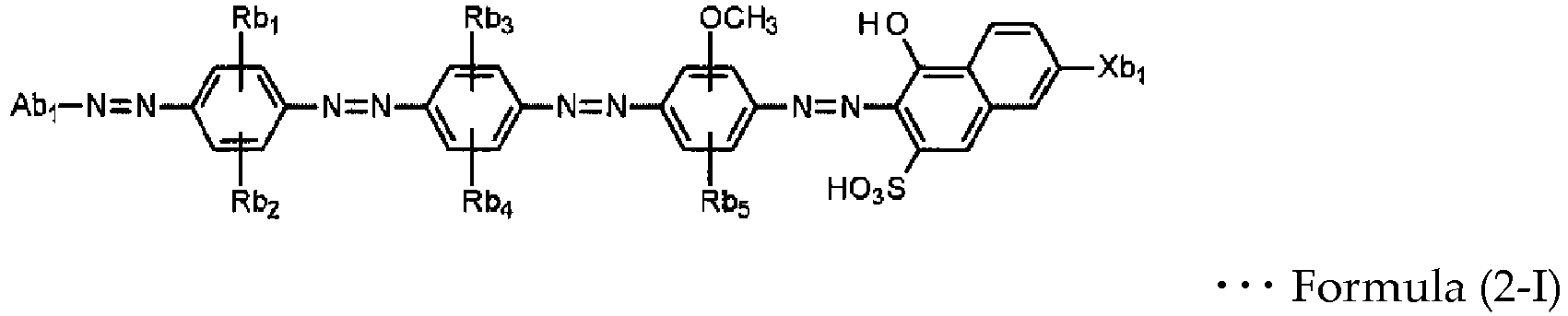

- wherein Ab1 represents a phenyl group or a naphthyl group having at least one substituent of a sulfo group or a carboxy group;
- Rb1 to Rb5 each independently represent a hydrogen atom, a lower alkyl group, a lower alkoxy group or a lower alkoxy group having a sulfo group; and
- Xb1 represents an amino group, a phenylamino group, a phenylazo group, a naphthotriazole group or a benzoylamino group optionally having at least one substituent selected from the group consisting of a lower alkyl group, a lower alkoxy group, a sulfo group, an amino group, a lower alkylamino group, a hydroxyl group, a carboxy group and a carboxyethyl amino group,

- wherein Ab2 represents a phenyl group or a naphthyl group having at least one substituent of a sulfo group or a carboxy group; and
- Xb2 represents a phenylamino group, a phenylazo group, a naphthotriazole group or a benzoylamino group optionally having at least one substituent selected from the group consisting of a lower alkyl group, a lower alkoxy group, a hydroxyl group, a carboxy group, a sulfo group, an amino group and a substituted amino group,


- wherein Ab3 represents a phenyl group or a naphthyl group having at least one substituent of a sulfo group or a carboxy group;
- Rb6 to Rb8 each independently represent a hydrogen atom, a lower alkyl group, a lower alkoxy group or a lower alkoxyl group having a sulfo group; and
- Xb3 represents an amino group, a phenylamino group, a phenylazo group, a benzoyl group, a benzoylamino group or a naphthotriazole group optionally having at least one substituent selected from the group consisting of a lower alkyl, a lower alkoxy group, a hydroxyl group, a carboxy group, a sulfo group, an amino group, a substituted amino group and an aminonaphthyl group, and


- wherein Ag1 represents a nitro group or an amino group,
- Xg1 represents: an amino group optionally having at least one substituent selected from the group consisting of a lower alkyl group, a lower alkoxy group and a sulfo group;
- a benzoyl group or a benzoylamino group optionally having at least one substituent selected from the group consisting of a lower alkyl group, a lower alkoxy group, a sulfo group, an amino group and a substituted amino group;
- a phenylamino group optionally having at least one substituent selected from the group consisting of a lower alkyl group, a lower alkoxy group, a sulfo group, an amino group and a substituted amino group;
- a phenylazo group optionally having at least one substituent selected from the group consisting of a lower alkyl group, a lower alkoxy group, a sulfo group, a hydroxyl group, an amino group and a substituted amino group; or
- a naphthotriazole group optionally having at least one substituent selected from the group consisting of a lower alkyl group, a lower alkoxy group, a sulfo group, an amino group and a substituted amino group,
- Rg1 and Rg2 of Formula (5-1) each independently represent a hydrogen atom, a hydroxyl group, a lower alkyl group, a lower alkoxy group or a lower alkoxy group having a sulfo group, and
- Rg2 of Formula (5-II) represents a hydrogen atom, a hydroxyl group, a lower alkyl group, a lower alkoxy group or a lower alkoxy group having a sulfo group.
- the compound A:
- [2] The polarizer according to [1] above, in which the compound represented by Formula (1) is represented by the following Formula (1'):

- [3] The polarizer according to [1] or [2] above, further containing, in the base, at least one of an azo compound represented by the following Formula (6) or a salt thereof (as compound C):

- wherein Ay1 and Ay2 each independently represent a sulfo group, a carboxy group, a hydroxyl group, a lower alkyl group or a lower alkoxyl group; Ry1 to Ry8 each independently represent a hydrogen atom, a sulfo group, a lower alkyl group or a lower alkoxyl group; and
- p represents an integer of 1 to 3.
- [4] The polarizer according to any one of [1] to [3] above, in which the base is a film made of a polyvinyl alcohol-based resin.
- [5] A polarizing plate comprising a transparent protection layer on at least one surface of the polarizer according to any one of [1] to [4] above.
- [6] A liquid crystal display device using the polarizer according to any one of [1] to [4] above or the polarizing plate according to [5] above.
- A polarizer or a polarizing plate of the present invention exhibits a high degree of polarization and further remarkably high contrast. Therefore, a polarizer or a polarizing plate exhibiting excellent polarization property can be provided. Besides, the polarizer or the polarizing plate of the present invention exhibits remarkably high durability against heat and humidity. Therefore, a highly reliable and brighter liquid crystal display device that has high contrast for a long period of time can be provided by using the polarizer or the polarizing plate of the present invention.
- Hereinafter, embodiments of the present invention are detailed explained. Herein, a range of numerical values expressed using "to" means a range including numerical values before and after "to", respectively, as a lower limit value and an upper limit value.
- Besides, azo compounds represented by respective Formulas and azo compounds of compound examples described below are represented in the form of a free acid unless otherwise mentioned. In the following description, for avoiding complication, "an azo compound or a salt thereof" is described, for convenience sake, as "an azo compound" inclusively meaning a salt of the azo compound unless otherwise mentioned.
- Besides, in the present invention, the term "lower" described in such as a lower alkyl group or a lower alkoxy group means that the number of carbon numbers is 1 to 4.
- A polarizer according to the present invention contains, in a base thereof, at least one of an azo compound represented by Formula (1) or a salt thereof (as compound A), and at least one of an azo compound represented by Formula (2-I), (2-II), (3), (4-1), (4-II), (5-1) or (5-II), or a salt thereof (as compound B). A high-performance polarizer exhibiting high transmittance and high contrast and further high durability can be obtained by both the azo compounds being contained in the base. Besides, the polarizer according to the present invention may further optionally contain at least one of an azo compound represented by Formula (6) or a salt thereof (as compound C), and preferably contains the compound A, the compound B and the compound C in the base thereof.
- The base used in the polarizer of the present invention contains the compound A and the compound B. Therefore, the base is preferably a film or the like obtained by filming a hydrophilic polymer capable of adsorbing a dichroic dye, particularly azo compound(s). The hydrophilic polymer is not especially limited, and examples include polyvinyl alcohol-based resins, amylose-based resins, starch-based resins, cellulose-based resins and polyacrylate-based resins. Among these resins, a polyvinyl alcohol-based resin or a derivative thereof is preferred from the viewpoint of the dyeability of a dichroic dye, workability and cross-linkability. The shape of the base is not especially limited, and for example, the base can be produced into an optional shapes including a film shape, a sheet shape, a plate shape, a curved plate shape and a semispherical shape. Besides, the thickness of the base can be appropriately designed in accordance with the use of the polarizer, and is preferably in a range of 5 µm to 150 µm, and more preferably in a range of 20 µm to 100 µm. The polarizer according to the present invention can be produced, for example, by forming the hydrophilic polymer used as the base into a film shape, subsequently causing an azo compound or a salt thereof to be contained in the film, and subjecting the resultant film to an orientation treatment such as stretching.
- Next, each azo compound contained in the base used in the present invention will be described. The polarizer according to the present invention contains, in the base, at least one azo compound represented by the following Formula (1):

- In Formula (1), An represents a phenyl group or a naphthyl group having at least one substituent of a sulfo group or a carboxy group; and
Rr1 to Rr4 each independently represent a hydrogen atom, a lower alkyl group, a lower alkoxy group or a lower alkoxyl group having a sulfo group. - In Formula (1), if An is a phenyl group, the phenyl group preferably has at least one sulfo group or carboxy group as substituent. If the phenyl group has at least two substituents, at least one of the substituents is a sulfo group or a carboxy group, and the other substituent is preferably selected from the group consisting of a sulfo group, a carboxy group, a lower alkyl group, a lower alkoxy group, a lower alkoxy group having a sulfo group, a nitro group, an amino group, an acetylamino group and a lower alkylamino group-substituted amino group, and is more preferably selected from the group consisting of a sulfo group, a methyl group, an ethyl group, a methoxy group, an ethoxy group, a carboxy group, a nitro group and an amino group, and is particularly preferably selected from the group consisting of a sulfo group, a methyl group, a methoxy group, an ethoxy group and a carboxy group. The lower alkoxy group having a sulfo group is preferably a straight chain alkoxy group, and the substitution position of the sulfo group is preferably a terminal of the alkoxy group. Such a lower alkoxy group having a sulfo group is more preferably a 3-sulfopropoxy group or 4-sulfobutoxy group, and particularly preferably a 3-sulfopropoxy group. If the phenyl group has a sulfo group as substituent, the number of sulfo groups is preferably one or two, and the substitution position of the sulfo group is not especially limited, but is preferably the 4-position of the phenyl group if the number of sulfo groups is one, and is preferably a combination of the 2- and 4-positions of the phenyl group or a combination of the 3- and 5-positions of the phenyl group if the number of sulfo groups is two.
- In Formula (1), if An is a naphthyl group, the naphthyl group preferably has at least one sulfo group as substituent. If the naphthyl group has at least two substituents, at least one of the substituents is a sulfo group, and the other substituent is preferably selected from the group consisting of a sulfo group, a hydroxyl group, a carboxy group and a lower alkoxy group having a sulfo group. The lower alkoxy group having a sulfo group is preferably a straight chain alkoxy group, and the substitution position of the sulfo group is preferably a terminal of the alkoxy group. Such a lower alkoxy group having a sulfo group is more preferably a 3-sulfopropoxy group or 4-sulfobutoxy group, and particularly preferably a 3-sulfopropoxy group. If the number of sulfo groups substituted in the naphthyl group is two, the substitution positions of the sulfo groups are preferably a combination of the 4- and 8-positions or a combination of the 6- and 8-positions of the naphthyl group, and is more preferably a combination of the 6-and 8-positions. If the number of sulfo groups substituted in the naphthyl group is three, the substitution positions of the sulfo groups are preferably a combination of the 1-, 3- and 6-positions.
- In Formula (1), Rr1 to Rr4 each independently represent a hydrogen atom, a lower alkyl group, a lower alkoxy group or a lower alkoxyl group having a sulfo group. The lower alkoxy group having a sulfo group is preferably straight chain alkoxy, and the substitution position of the sulfo group is preferably a terminal of the alkoxy group. Rr1 to Rr4 each independently represent preferably a hydrogen atom, a methyl group, an ethyl group, a methoxy group, an ethoxy group, a 3-sulfopropoxy group or a 4-sulfobutoxy group, and particularly preferably a hydrogen atom, a methyl group, a methoxy group or a 3-sulfopropoxy group. The substitution position of a phenyl group substituted in each of Rr1 to Rr4 is preferably the 2-position alone, the 5-position alone, a combination of the 2- and 6-positions, a combination of the 2- and 5-positions or a combination of the 3- and 5-positions of the phenyl group, and particularly preferably the 2-position alone, the 5-position alone or a combination of the 2-and 5-positions. Incidentally, the substitution position being the 2-position alone or the 5-position alone means, with respect to the relationship between Rr1 and Rr2 and the relationship between Rr3 and Rr4, that one of Rr1 and Rr2 or Rr3 and Rr4 has at least one substituent excluding a hydrogen atom in the 2- or 5-position alone, and the other has a hydrogen atom as the substituent.
- Among azo compounds represented by Formula (1), an azo compound represented by the following Formula (1') is preferred, and if such an azo compound is used, the polarization performance of the resultant polarizer can be further improved.

- In Formula (1'), An and Rr1 to Rr4 are the same as defined in Formula (1) above.
- The azo compound represented by Formula (1) can be synthesized, for example, by a method described in Japanese Laid-Open Patent Publication No.
2009-155364 - A specific synthesis method for the azo compound represented by Formula (1) will now be described. First, an amine having at least one substituent represented by the following Formula (i) is diazotized by a production method similar to a production method described in "Senryo Kagaku (Dye Chemistry)" written by Yutaka Hosoda, Gihodo Shuppan Co., Ltd., 1957, pp. 135-234, the resultant is coupled with anilines represented by the following Formula (ii), and thus, a monoazo amino compound represented by the following Formula (iii) is obtained.
Ar-NH2 ··· Formula (i)
- In Formula (i), Ar has the same meaning as assigned to An of Formula (1) above.

- In Formula (ii), R1 and R2 respectively have the same meaning as assigned to Rr1 and Rr2 of Formula (1) above.

- In Formula (iii), Ar has the same meaning as assigned to An of Formula (1) above, and R1 and R2 respectively have the same meaning as assigned to Rr1 and Rr2 of Formula (1) above.
- Subsequently, the monoazo amino compound represented by Formula (iii) is diazotized, the resultant is secondarily coupled to an aniline represented by the following Formula (iv), and thus, a disazo amino compound represented by the following Formula (v) is obtained.

- In Formula (iv), R3 and R4 respectively have the same meaning as assigned to Rr3 and Rr4 of Formula (1) above.

- In Formula (v), Ar has the same meaning as assigned to An of Formula (1) above, R1 and R2 respectively have the same meaning as assigned to Rr1 and Rr2 of Formula (1) above, and
R3 and R4 respectively have the same meaning as assigned to Rr3 and Rr4 of Formula (1) above. - The diazotization step of the reaction process described above is performed by a normal method in which a nitrite such as sodium nitrite is mixed in an aqueous solution or a suspension of a diazo component in a mineral acid such as hydrochloric acid or sulfuric acid, or a inverse method in which a nitrite is added to a neutral or weak alkaline aqueous solution of a diazo component, and the resultant is mixed with a mineral acid. A suitable temperature for the diazotization is -10 to 40°C. Besides, the coupling step to anilines is performed by mixing the above-described diazo solution with an acidic aqueous solution of hydrochloric acid, acetic acid or the like at a temperature of -10 to 40°C under an acidic condition of pH 2 to 7.
- The monoazo amino compound or the disazo amino compound obtained by the coupling step can be taken out by filtration as it is or after deposition with acid deposition or salting out, or alternatively can be subjected to another step still in the form of the solution or suspension. If a diazonium salt is slightly soluble and obtained as a suspension, the suspension is filtered to obtain a press cake, and the resultant filtered diazonium salt can be used in another coupling step.
- The disazo amino compound obtained through the above-described steps is then subjected to ureidization reaction with phenyl chlorocarbonate, and thus, the azo compound represented by Formula (1) is synthesized. The ureidization reaction is performed, for example, by the production method described in Japanese Laid-Open Patent Publication No.
2009-155364 - Specific examples of the azo compound represented by Formula (1) include the following compounds:


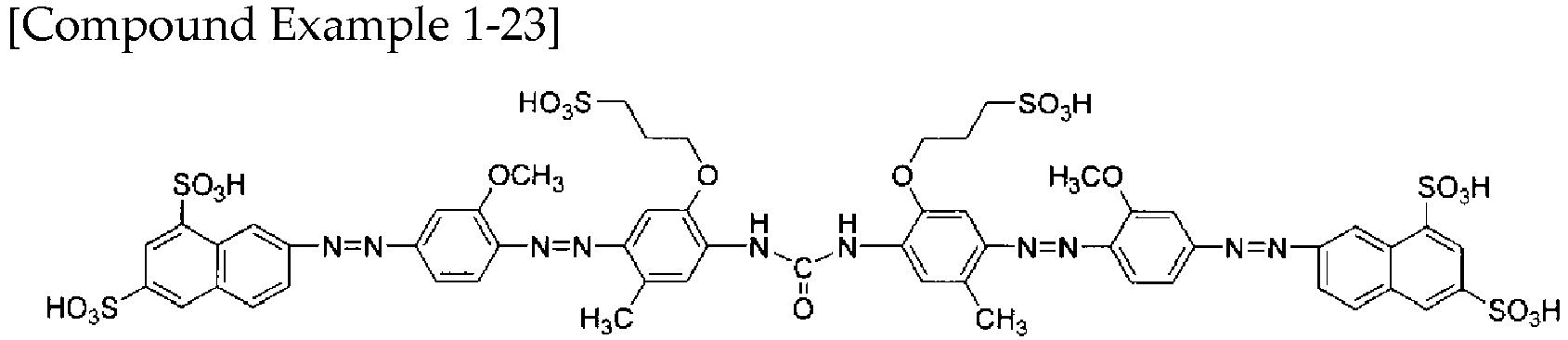


- One of these azo compounds represented by Formula (1) may be singly used, or two or more of these may be used together.
- Next, the azo compound represented by Formula (2-1) contained in the base of the polarizer according to the present invention will be described. The polarizer of the present invention contains, together with the azo compound represented by Formula (1) used as the compound A, at least one of azo compounds represented by Formulas (2-1), (2-II), (3), (4-1), (4-II), (5-1) and (5-II), different from Formula (I), as the compound B, in the base.
- The azo compound represented by Formula (2-1) or Formula (2-II) has the following structural Formula. It is noted that the azo compound represented by Formula (2-II) has the same structure as the azo compound represented by Formula (2-1) except that O of an -OCH3 group and O of an -OH group are bonded to each other via copper (Cu).


- In Formula (2-1) or (2-II), Ab1 represents a phenyl group or a naphthyl group having at least one substituent of a sulfo group or a carboxy group;
Rb1 to Rb5 each independently represent a hydrogen atom, a lower alkyl group, a lower alkoxy group or a lower alkoxy group having a sulfo group; and
Xb1 represents an amino group, a phenylamino group, a phenylazo group, a naphthotriazole group or a benzoylamino group optionally having at least one substituent selected from the group consisting of a lower alkyl, a lower alkoxy group, a sulfo group, an amino group, a lower alkylamino group, a hydroxyl group, a carboxy group and a carboxyethyl amino group. - In Formula (2-1) or Formula (2-II), if Ab1 is a phenyl group, the phenyl group preferably has at least one sulfo group or carboxy group as substituent. If the phenyl group has two substituents, at least one of the substituents is a sulfo group or a carboxy group, and the other substituent is preferably selected from the group consisting of a sulfo group, a carboxy group, a lower alkyl group, a lower alkoxy group, a lower alkoxy group having a sulfo group, a hydroxyl group, a nitro group, a benzoyl group, an amino group, an acetylamino group and a lower alkylamino group-substituted amino group, is more preferably selected from the group consisting of a sulfo group, a methyl group, an ethyl group, a methoxy group, an ethoxy group, a hydroxyl group, a carboxy group, a nitro group, an amino group, a 3-sulfopropoxy group and a 4-sulfobutoxy group, and is particularly preferably selected from the group consisting of a sulfo group, a methyl group, a methoxy group, a carboxy group and a 3-sulfopropoxy group. The lower alkoxy group having a sulfo group is preferably straight alkoxy like a 3-sulfopropoxy group or a 4-sulfobutoxy group, and the substitution position of the sulfo group is preferably a terminal of the alkoxy group. If the phenyl group has a sulfo group as the substituent, the number of sulfo groups is preferably one or two, and the substitution positions of the sulfo groups are not especially limited, and if the number of sulfo groups is one, the substitution position is preferably the 4-position of the phenyl group, and if the number of sulfo groups is two, the positions are preferably a combination of the 2- and 4-positions or the 3- and 5-positions of the phenyl group.
- In Formula (2-1) or Formula (2-II), if Ab1 is a naphthyl group, the naphthyl group preferably has at least one sulfo group as substituent. If the naphthyl group has at least two substituents, at least one of the substituents is a sulfo group, and the other substituent is preferably selected from the group consisting of a sulfo group, a hydroxyl group, a carboxy group and a lower alkoxy group having a sulfo group. The lower alkoxy group having a sulfo group is preferably straight chain alkoxy, and the substitution position of the sulfo group is preferably a terminal of the alkoxy group. Such a lower alkoxy group having a sulfo group is more preferably a 3-sulfopropoxy group or 4-sulfobutoxy group, and particularly preferably a 3-sulfopropoxy group. If the number of sulfo groups substituted in the naphthyl group is two, the substitution positions of the sulfo groups are preferably a combination of the 4- and 8-positions or a combination of the 6- and 8-positions of the naphthyl group, and is more preferably a combination of the 6- and 8-positions. If the number of sulfo groups substituted in the naphthyl group is three, the substitution positions of the sulfo groups are preferably a combination of the 3-, 6- and 8-positions.
- In Formula (2-1) or Formula (2-II), Rb1 to Rb5 each independently represent a hydrogen atom, a lower alkyl group, a lower alkoxy group or a lower alkoxy group having a sulfo group. The lower alkoxy group having a sulfo group is preferably straight chain alkoxy, and the substitution position of the sulfo group is preferably a terminal of the alkoxy group. Rb1 to Rb5 each independently represent preferably a hydrogen atom, a methyl group, an ethyl group, a methoxy group, an ethoxy group, a 3-sulfopropoxy group or a 4-sulfobutoxy group, and particularly preferably a sulfo group, a methyl group, a methoxy group, a carboxy group or a 3-sulfopropoxy group. In particular, Rb5 is preferably a methoxy group because the polarization performance of the polarizer or the polarizing plate of the present invention is thus remarkably improved.
- In Formula (2-1) or Formula (2-II), Xb1 represents an amino group, a phenylamino group, a phenylazo group, a naphthotriazole group or a benzoylamino group optionally having at least one substituent selected from the group consisting of a lower alkyl group, a lower alkoxy group, a sulfo group, an amino group, a lower alkylamino group, a hydroxyl group, a carboxy group and a carboxyethyl amino group.
- If Xb1 is the amino group optionally having at least one substituent, the amino group is unsubstituted, or preferably has one or two substituents selected from the group consisting of a lower alkyl group, a lower alkoxyl group, a sulfo group, an amino group and a lower alkylamino group, and more preferably has one or two substituents selected from the group consisting of a methyl group, a methoxy group, a sulfo group, an amino group and a lower alkylamino group.
- If Xb1 is the phenylamino group optionally having at least one substituent, the phenylamino group is unsubstituted, or preferably has one or two substituents selected from the group consisting of a lower alkyl group, a lower alkoxyl group, a sulfo group, an amino group and a lower alkylamino group, and more preferably has one or two substituents selected from the group consisting of a methyl group, a methoxy group, a sulfo group and an amino group.
- If Xb1 is the phenylazo group optionally having at least one substituent, the phenylazo group is unsubstituted, or preferably has one to three substituents selected from the group consisting of a hydroxyl group, a lower alkyl group, a lower alkoxy group, an amino group and a carboxyethyl amino group, and more preferably has one to three substituents selected from the group consisting of a methyl group, a methoxy group, amino and a hydroxyl group.
- If Xb1 is the naphthotriazole group optionally having at least one substituent, the naphthotriazole group is unsubstituted, or preferably has one or two substituents selected from the group consisting of a sulfo group, an amino group and a carboxy group, and more preferably has one or two sulfo groups as the substituent.
- If Xb1 is the benzoylamino group optionally having at least one substituent, the benzoylamino group is unsubstituted, or preferably has one substituent selected from the group consisting of a hydroxyl group, an amino group and a carboxyethyl amino group, and more preferably has one or two hydroxyl groups or amino groups as the substituent.
- Preferably, Xb1 is a benzoylamino group or a phenylamino group optionally having at least one of the aforementioned substituents, and most preferably, Xb1 is a phenylamino group optionally having the substituent. If the benzoylamino group or the phenylamino group has the substituent, the position of the substituent is not especially limited, and in the phenylamino group, one of the substituents is preferably in the p-position to the amino group, and on the other hand, in the benzoylamino group, one of the substituents is preferably in the p-position to the carbonyl group.
- Among azo compounds represented by Formula (2-1) and Formula (2-II), an azo compound represented by the following Formula (2') is preferred, and if such the azo compound is used, the polarization performance of the resultant polarizer can be further improved.

- In Formula (2'), Ab1, Rb1 to Rb4 and Xb1 are the same as defined in Formula (2-1) or Formula (2-II) above.
- Among azo compounds represented by Formula (2'), an azo compound represented by the following Formula (2") is preferred, and if such an azo compound is used, the polarization performance of the resultant polarizer can be further more improved.

- In Formula (2"), Ab1, Rb2, Rb4 and Xb1 are the same as defined in Formula (2-1) or Formula (2-II) above.
- The azo compound represented by Formula (2-1) or (2-II) can be produced by, for example, a method(s) described in International Publication No.
WO2012/108169 , International Publication No.WO2012/108173 or the like, but the production method is not limited to these. - Specific examples of the azo compound represented by Formula (2-1) or (2-II) include the following azo compounds described in, for example, International Publication No.
WO2012/108169 and International Publication No.WO2012/108173 .





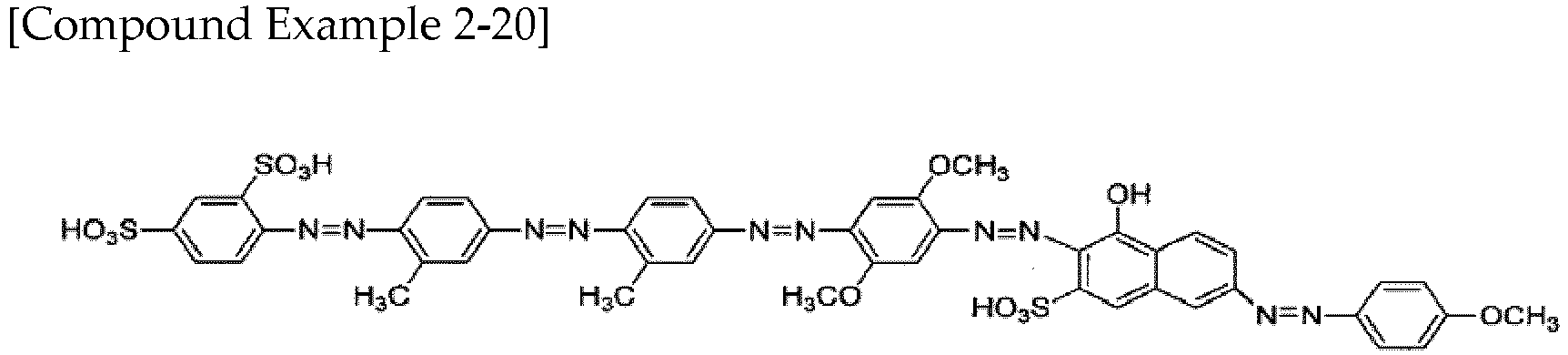


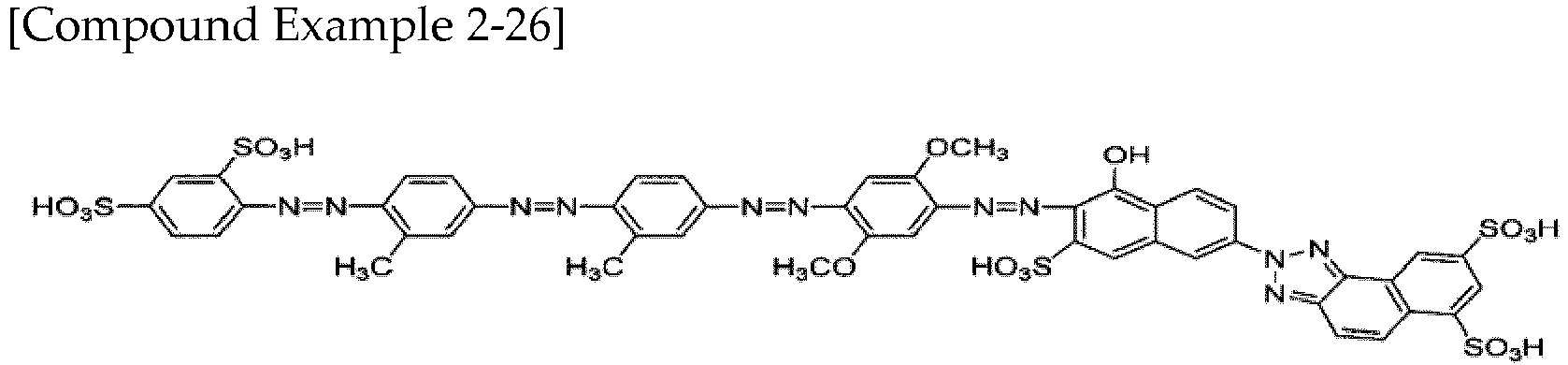


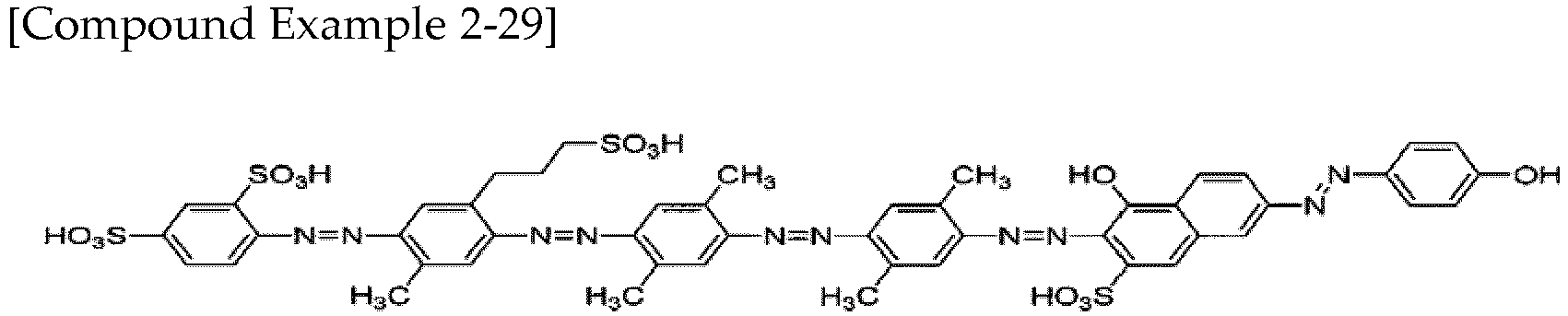


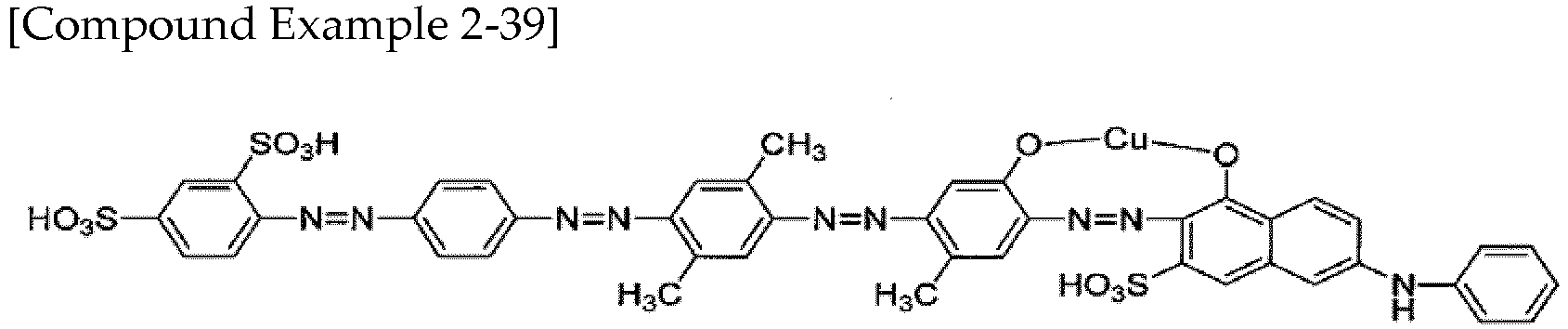


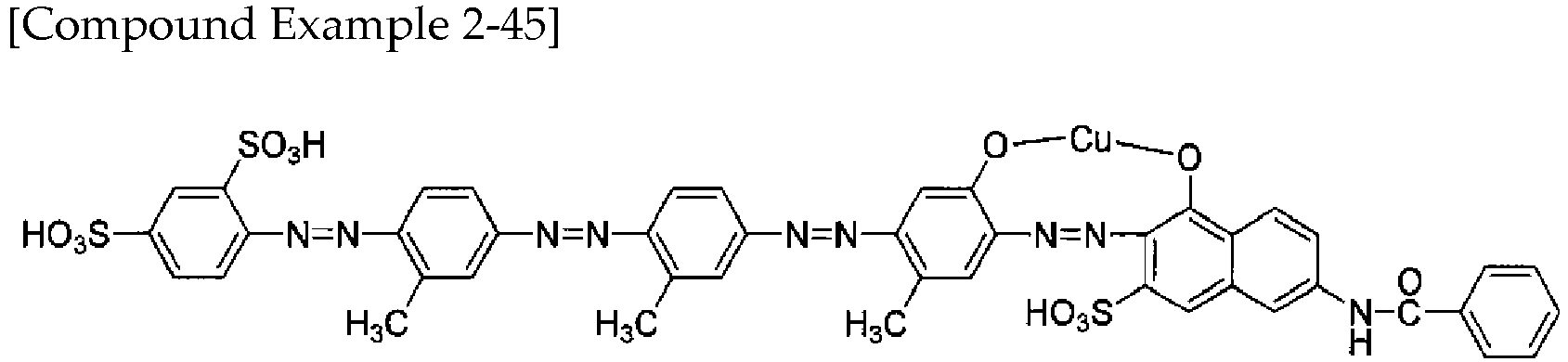


- Subsequently, an azo compound represented by Formula (3) will be described. The azo compound represented by Formula (3) has the following structural Formula:
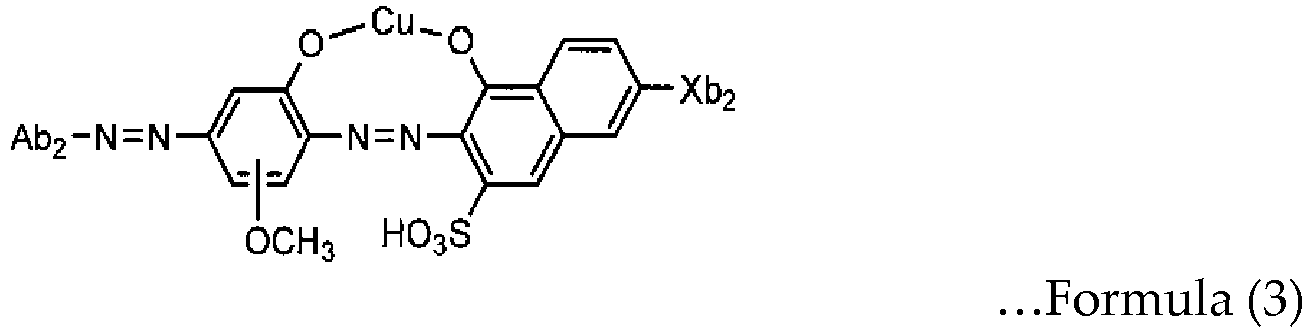
- In Formula (3), Ab2 represents a phenyl group or a naphthyl group having at least one substituent of a sulfo group or a carboxy group; and
Xb2 represents a phenylamino group, a phenylazo group, a naphthotriazole group or a benzoylamino group optionally having at least one substituent selected from the group consisting of a lower alkyl, a lower alkoxy group, a hydroxyl group, a carboxy group, a sulfo group, an amino group and a substituted amino group. - As described above, in Formula (3), Ab2 represents a phenyl group or a naphthyl group having at least one substituent of a sulfo group or a carboxy group. If the phenyl group or the naphthyl group has at least two substituents, at least one of the substituents is a sulfo group or a carboxy group, and the other substituent is preferably selected from the group consisting of a sulfo group, a lower alkyl group, a lower alkoxy group, a lower alkoxy group having a sulfo group, a carboxy group, a nitro group, an amino group and a substituted amino group, and is more preferably selected from the group consisting of a sulfo group, a methyl group, an ethyl group, a methoxy group, an ethoxy group, a carboxy group, a nitro group and an amino group, and is particularly preferably selected from the group consisting of a sulfo group, a carboxy group, a lower alkyl group and a lower alkoxy group. The lower alkoxy group having a sulfo group is preferably a straight chain alkoxy group, and the substitution position of the sulfo group is preferably a terminal of the alkoxy group. Such a lower alkoxy group having a sulfo group is more preferably a 3-sulfopropoxy group or 4-sulfobutoxy group, and particularly preferably a 3-sulfopropoxy group. The number of substituents of the phenyl group is preferably one or two, and on the other hand, the number of substituents of the naphthyl group is preferably two or three. The positions of these substituents are not especially limited, and if the number of substituents of the phenyl group is one, the position is preferably the 4-position of the phenyl group, and if the number of substituents is two, the positions are preferably a combination of the 2- and 4-positions or a combination of the 3- and 5-positions of the phenyl group. On the other hand, the naphthyl group preferably has two or three sulfo groups as the substituents, and if the number of sulfo groups substituted in the naphthyl group is two, the substitution positions of the sulfo groups are preferably a combination of the 4- and 8-positions or a combination of the 6- and 8-positions of the naphthyl group, and is more preferably a combination of the 6- and 8-positions. If the number of sulfo groups substituted in the naphthyl group is three, the substitution positions of the sulfo groups are preferably a combination of the 3-, 6- and 8-positions.
- In Formula (3), Xb2 represents a phenylamino group, a phenylazo group, a naphthotriazole group or a benzoylamino group optionally having at least one substituent selected from the group consisting of a lower alkyl group, a lower alkoxy group, a hydroxyl group, a carboxy group, a sulfo group, an amino group and a substituted amino group.
- If Xb2 is the phenylamino group optionally having at least one substituent, the phenylamino group is unsubstituted, or preferably has at least one substituent selected from the group consisting of a methyl group, a methoxy group, an amino group, a substituted amino group and sulfo group, and more preferably is unsubstituted or has a methoxy group as the substituent. If the phenylamino group has the substituent, the position of the substituent is not especially limited, and one of the substituents is preferably in the p-position to the amino group bonded to the phenyl group.
- If Xb2 is the benzoylamino group optionally having at least one substituent, the benzoylamino group is unsubstituted, or preferably has at least one substituent selected from the group consisting of an amino group, a substituted amino group and a hydroxyl group, and more preferably has an amino group as the substituent. If the benzoylamino group has the substituent, the position of the substituent is not especially limited, and one of the substituents is preferably in the p-position to the carbonyl group bonded to the phenyl group.
- If Xb2 is the phenylazo group optionally having at least one substituent, the phenylazo group is unsubstituted, or preferably has at least one substituent selected from the group consisting of a hydroxyl group, an amino group, a methyl group, a methoxy group and a carboxy group, and more preferably has a hydroxyl group as the substituent.
- If Xb2 is the naphthotriazole group optionally having at least one substituent, the naphthotriazole group is unsubstituted, or preferably has a sulfo group as the substituent.
- Among azo compounds represented by Formula (3), an azo compound represented by the following Formula (3') is preferred, and if such the azo compound is used, the polarization performance of the resultant polarizer can be further improved.

- In Formula (3'), Ab2 and Xb2 are the same as defined in Formula (3) above.
- The azo compound represented by Formula (3) can be produced by known diazotization and coupling as those described in, for example, Japanese Patent Publication No.
64-5623 4033443 2985408 3378296 WO2007/145210 , but the production method is not limited to these. - Specific examples of the azo compound represented by Formula (3) include the following azo compounds:





- Next, an azo compound represented by Formula (4-1) or Formula (4-II) will be described. The azo compound represented by Formula (4-1) or Formula (4-II) has the following structural Formula. It is noted that the azo compound represented by Formula (4-II) has the same structure as the azo compound represented by Formula (4-1) except that O of an -OCH3 group and O of an -OH group are bonded to each other via copper (Cu).


- In Formula (4-1) and Formula (4-II), Ab3 represents a phenyl group or a naphthyl group having at least one substituent of a sulfo group or a carboxy group;
Rb6 to Rb8 each independently represent a hydrogen atom, a lower alkyl group, a lower alkoxy group or a lower alkoxyl group having a sulfo group; and
Xb3 represents an amino group, a phenylamino group, a phenylazo group, a benzoyl group, a benzoylamino group or a naphthotriazole group optionally having at least one substituent selected from the group consisting of a lower alkyl group, a lower alkoxy group, a hydroxyl group, a carboxy group, a sulfo group, an amino group, a substituted amino group and an aminonaphthyl group. - As described above, in Formula (4-1) or Formula (4-II), Ab3 represents a phenyl group or a naphthyl group having at least one sulfo group or carboxy group. If the phenyl group or the naphthyl group has at least two substituents, at least one of the substituents is a sulfo group or a carboxy group, and the other substituent is preferably selected from the group consisting of a sulfo group, a lower alkyl group, a lower alkoxy group, a lower alkoxy group having a sulfo group, a carboxy group, a nitro group, an amino group and a substituted amino group, and is more preferably selected from the group consisting of a sulfo group, a methyl group, an ethyl group, a methoxy group, an ethoxy group, a carboxy group, a nitro group and an amino group, and is particularly preferably selected from the group consisting of a sulfo group, a carboxy group, a methyl group, a methoxy group and a nitro group. The lower alkoxy group having a sulfo group is preferably a straight chain alkoxy, and the substitution position of the sulfo group is preferably a terminal of the alkoxy group. Such a lower alkoxy group having a sulfo group is more preferably a 3-sulfopropoxy group or 4-sulfobutoxy group, and particularly preferably a 3-sulfopropoxy group. The number of substituents of the phenyl group is preferably one or two, and on the other hand, the number of substituents of the naphthyl group is preferably two or three. The positions of these substituents are not especially limited, and if the number of substituents of the phenyl group is one, the position is preferably the 4-position of the phenyl group, and if the number of substituents is two, the positions are preferably a combination of the 2- and the 4-positions or a combination of the 3-and 5-positions of the phenyl group. On the other hand, the naphthyl group preferably has two or three sulfo groups as the substituents, and if the number of sulfo groups substituted in the naphthyl group is two, the substitution positions of the sulfo groups are preferably a combination of the 4- and 8-positions or a combination of the 6- and 8-positions of the naphthyl group, and is more preferably a combination of the 6- and 8-positions. If the number of sulfo groups substituted in the naphthyl group is three, the substitution positions of the sulfo groups are preferably a combination of the 3-, 6- and 8-positions.
- In Formula (4-1) or Formula (4-II), Rb6 to Rb8 each independently represent a hydrogen atom, a lower alkyl group, a lower alkoxy group or a lower alkoxy group having a sulfo group. The lower alkoxy group having a sulfo group is preferably a straight chain alkoxy such as an ethoxy group having a sulfo group, a propoxyl group having a sulfo group or a butoxy group having a sulfo group. Besides, the substitution position of the sulfo group is preferably a terminal of the alkoxy group, and the lower alkoxy group having a sulfo group is preferably a 3-sulfopropoxy group or 4-sulfobutoxy group, and particularly preferably a 3-sulfopropoxy group. In order to further improve the polarization property, each of Rb6 to Rb8 is preferably a hydrogen atom, a methyl group, a methoxy group or a 3-sulfopropoxy group, and is more preferably a hydrogen atom, a methyl group or a methoxy group. In order to much more improve the polarization property, Rb3 is further preferably a methyl group or a methoxy group, and particularly preferably a methoxy group. The substitution positions of the phenyl groups substituted for Rb6 to Rb8 are preferably a combination of the 2-and 5-positions or the 3- and 6-positions of the phenyl group. Incidentally, with respect to Rb8, in terms of a relationship between OCH3 and Rb8, they are respectively substituted in the 2- and 5-positions or the 3- and 6-positions of the phenyl group.
- In Formula (4-1) or Formula (4-II), Xb3 represents an amino group, a phenylamino group, a phenylazo group, a benzoyl group, a benzoylamino group or a naphthotriazole group optionally having at least one substituent selected from the group consisting of a lower alkyl group, a lower alkoxy group, a hydroxyl group, a carboxy group, a sulfo group, an amino group, a substituted amino group and an aminonaphthyl group.
- If Xb3 is the amino group optionally having at least one substituent, the amino group is unsubstituted, or preferably has at least one substituent selected from the group consisting of a lower alkyl group, a lower alkoxy group, a carboxy group, a sulfo group, a substituted amino group and an aminonaphthyl group, and more preferably has at least one substituent selected from the group consisting of a methyl group, an ethyl group, a methoxy group and an ethoxy group.
- If Xb3 is the phenylamino group optionally having at least one substituent, the phenylamino group is unsubstituted, or preferably has at least one substituent selected from the group consisting of a methyl group, a methoxy group, an amino group, a substituted amino group and a sulfo group, more preferably has at least one substituent selected from the group consisting of a hydrogen atom, a methoxy group, a sulfo group and an amino group, and particularly preferably has a methoxy group as the substituent. If the phenylamino group has the substituent, the position of the substituent is not especially limited, and one of the substituents is preferably in the p-position to the amino group bonded to the phenyl group.
- If Xb3 is the phenylazo group optionally having at least one substituent, the phenylazo group is unsubstituted, or preferably has at least one substituent selected from the group consisting of a hydroxyl group, an amino group, a methyl group, a methoxy group and a carboxy group, and particularly preferably has a hydroxyl group or an amino group as the substituent.
- If Xb3 is the benzoyl group or the benzoylamino group optionally having at least one substituent, the benzoyl group or the benzoylamino group is unsubstituted, or preferably has at least one substituent selected from the group consisting of an amino group, a substituted amino group and a hydroxyl group, and particularly preferably has an amino group as the substituent. If the benzoyl group or the benzoylamino group has the substituent, the position of the substituent is not especially limited, and one of the substituents is preferably in the p-position to the carbonyl group bonded to the phenyl group.
- If Xb3 is the naphthotriazole group optionally having at least one substituent, the naphthotriazole group is unsubstituted, or preferably has one, two or three sulfo groups as the substituent.
- Among azo compounds represented by Formula (4-1), an azo compound represented by the following Formula (4') is preferred. If the azo compound represented by Formula (4') is used, the polarization performance of the resultant polarizer can be further improved.

- Among the azo compounds represented by Formula (4-1) or Formula (4-II), when the azo compound represented by Formula (4-II) in particular is used, the polarization performance can be further more improved.
- The azo compound represented by Formula (4-1) or Formula (4-II) can be produced by any of known methods described in, for example, Japanese Laid-Open Patent Publication No.
3-12606 5-295281 10-259311 WO2007/145210 and the like, but the production method is not limited to these. - Specific examples of the azo compound represented by Formula (4-1) or Formula (4-II) include the following azo compounds:


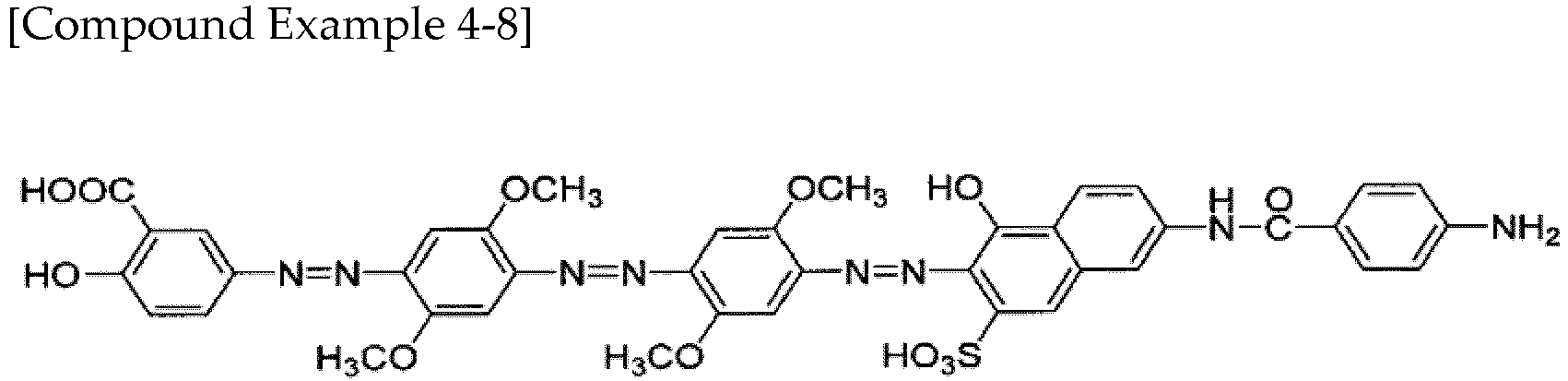


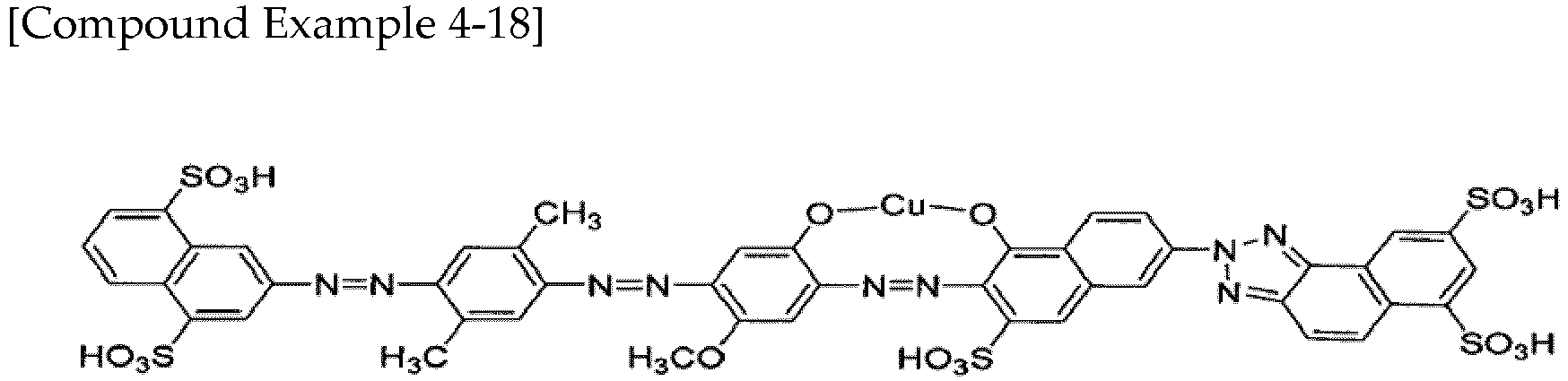


- Next, an azo compound represented by Formula (5-1) or Formula (5-II) will be described. The azo compound represented by Formula (5-1) or Formula (5-II) has the following structural Formula. It is noted that the azo compound represented by Formula (5-II) has the same structure as the azo compound represented by Formula (5-1) except that O of a Rg1 group and O of an -OH group are bonded to each other via copper (Cu).


- In Formula (5-1) or Formula (5-II), Ag1 represents a nitro group or an amino group,
Xg1 represents: an amino group optionally having at least one substituent selected from the group consisting of a lower alkyl group, a lower alkoxy group and a sulfo group;
a benzoyl group or a benzoylamino group optionally having at least one substituent selected from the group consisting of a lower alkyl group, a lower alkoxy group, a sulfo group, an amino group and a substituted amino group;
a phenylamino group optionally having at least one substituent selected from the group consisting of a lower alkyl group, a lower alkoxy group, a sulfo group, an amino group and a substituted amino group;
a phenylazo group optionally having at least one substituent selected from the group consisting of a lower alkyl group, a lower alkoxy group, a sulfo group, a hydroxyl group, an amino group and a substituted amino group; or
a naphthotriazole group optionally having at least one substituent selected from the group consisting of a lower alkyl group, a lower alkoxy group, a sulfo group, an amino group and a substituted amino group,
Rg1 and Rg2 of Formula (5-1) each independently represent a hydrogen atom, a hydroxyl group, a lower alkyl group, a lower alkoxy group or a lower alkoxy group having a sulfo group, and
Rg2 of Formula (5-II) represents a hydrogen atom, a hydroxyl group, a lower alkyl group, a lower alkoxy group or a lower alkoxy group having a sulfo group. - In Formula (5-1), Rg1 and Rg2 each independently represent a hydrogen atom, a hydroxyl group, a lower alkyl group, a lower alkoxy group or a lower alkoxy group having a sulfo group, and in Formula (5-II), Rg2 represents a hydrogen atom, a hydroxyl group, a lower alkyl group, a lower alkoxy group or a lower alkoxy group having a sulfo group in the same manner as in Formula (5-I). The lower alkoxy group having a sulfo group is preferably a straight chain alkoxy, and the substitution position of the sulfo group is preferably a terminal of the alkoxy group. The lower alkoxy group having a sulfo group is preferably a 3-sulfopropoxy group or 4-sulfobutoxy group, and particularly preferably a 3-sulfopropoxy group.
- In Formula (5-1) or Formula (5-II), Ag1 represents a nitro group or an amino group. Ag1 is preferably a nitro group because the polarization performance is thus further improved.
- In Formula (5-1) or Formula (5-II), if Xg1 is the amino group optionally having at least one substituent, the amino group is unsubstituted, or has at least one substituent selected from the group consisting of a lower alkyl group, a lower alkoxy group and a sulfo group.
- If Xg1 is the benzoyl group or the benzoylamino group optionally having at least one substituent, the benzoyl group or the benzoylamino group is unsubstituted, or has at least one substituent selected from the group consisting of a lower alkyl group, a lower alkoxy group, a sulfo group, an amino group and a substituted amino group, and preferably has at least one substituent selected from the group consisting of an amino group, a methyl group and a methoxy group.
- If Xg1 is the phenylamino group optionally having at least one substituent, the phenylamino group is unsubstituted, or has at least one substituent selected from the group consisting of a lower alkyl group, a lower alkoxy group, a sulfo group, an amino group and a substituted amino group, and preferably is unsubstituted or has at least one substituent selected from the group consisting of an amino group, a methyl group and a methoxy group. If the phenylamino group has the substituent, the position of the substituent is not especially limited, and one of the substituents is preferably in the p-position to the amino group bonded to the phenyl group.
- If Xg1 is the phenylazo group optionally having at least one substituent, the phenylazo group is unsubstituted, or has at least one substituent selected from the group consisting of a lower alkyl group, a lower alkoxy group, a sulfo group, an amino group and a substituted amino group, and preferably has at least one substituent selected from the group consisting of an amino group, a methyl group and a methoxy group.
- If Xg1 is the naphthotriazole group optionally having at least one substituent, the naphthotriazole group is unsubstituted, or has at least one substituent selected from the group consisting of a lower alkyl group, a lower alkoxy group, a sulfo group, an amino group and a substituted amino group, and preferably has a sulfo group as the substituent.
- Among compounds represented by Formula (5-1) or Formula (5-II), an azo compound represented by the following Formula (5') is preferred. If the azo compound represented by Formula (5') is used, the polarization performance of the resultant polarizer can be further improved.

- In Formula (5'), Ag1, Rb2 and Xg1 are the same as defined in Formula (5-1) or Formula (5-II).
- In order to further improve optical characteristics, Rg2 is preferably a hydrogen atom, a methyl group, an ethyl group, a methoxy group or an ethoxy group in Formula (5').
- The azo compound represented by Formula (5-1) or Formula (5-II) can be produced by, for example, any of known methods described in, for example, Japanese Patent Publication No.
60-156759 2-61988 - Specific examples of the azo compound represented by Formula (5-1) or Formula (5-II) include the following azo compounds:


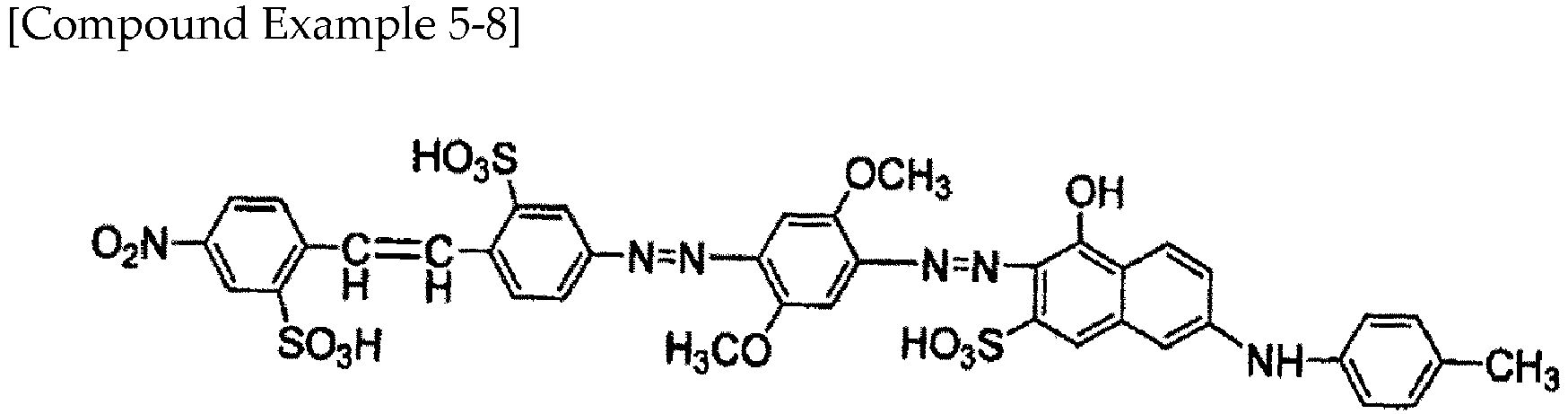


- One of these azo compounds represented by Formulas (2-1), (2-II), (3), (4-I), (4-II), (5-1) and (5-II) may be singly used, or two or more of these may be used together.
- Since the polarizer of the present invention contains the compound A and the compound B, a polarizer or a polarizing plate that has a higher degree of polarization and higher contrast than a conventional dye-based polarizer or polarizing plate, and is excellent in the polarization performance can be realized, and in addition, it exhibits high durability against heat, humidity and light as compared with a conventional dye-based polarizer or polarizing plate.
- In order to improve the polarization performance of the polarizer of the present invention, in addition to the compound A and the compound B, at least one of an azo compound represented by the following Formula (6) or a salt thereof (as compound C) is preferably contained.

- In Formula (6), Ay1 and Ay2 each independently represent a sulfo group, a carboxy group, a hydroxyl group, a lower alkyl group or a lower alkoxyl group; Ry1 to Ry8 each independently represent a hydrogen atom, a sulfo group, a lower alkyl group or a lower alkoxyl group; and
p represents an integer of 1 to 3. - In Formula (6), Ay1 and Ay2 each independently represent a sulfo group, a carboxy group, a hydroxyl group, a lower alkyl group or a lower alkoxyl group, and is preferably a sulfo group, a carboxy group or a lower alkoxy group, and is more preferably a sulfo group, a carboxy group, a methoxy group or an ethoxy group, and is further more preferably a sulfo group or a carboxy group.
- In Formula (6), Ry1 to Ry8 each independently represent a hydrogen atom, a sulfo group, a lower alkyl group or a lower alkoxyl group, and is preferably a hydrogen atom, a sulfo group, a methyl group, an ethyl group, a methoxy group or an ethoxy group, and is more preferably a hydrogen atom, a sulfo group, a methyl group or a methoxy group.
- The azo compound represented by Formula (6) affects transmittance at 400 to 500 nm. In a polarizer, the transmittance on the short wavelength side of 400 to 500 nm and the degree of polarization (dichroism) particularly affect loss of blue color occurring in displaying black color or yellowness of white color occurring in displaying white color. The azo compound represented by Formula (6) does not lower the transmittance on the short wavelength side in a parallel position of the polarizer but can improve the polarization property (dichroism) at 400 to 500 nm and can further reduce the yellowness occurring in displaying white color and loss of blue color occurring in displaying black color. If the polarizer of the present invention further contains the azo compound represented by Formula (6) in the base, a polarizer exhibiting more neutral hue and further improved degree of polarization can be obtained.
- The azo compound represented by Formula (6) or the salt thereof can be synthesized by, for example, a method(s) described in International Publication No.
WO2007/138980 or the like, and alternatively, a commercially available compound can be used. - Examples of the azo compound represented by Formula (6) include, but are not limited to, C.I. Direct Yellow 4, C.I. Direct Yellow 12, C.I. Direct Yellow 72, C.I. Direct Orange 39, Kayarus Supra Orange 39 and an azo compound having a stilbene structure described in International Publication No.
WO2007/138980 or the like. - Specific examples of the azo compound represented by Formula (6) include the following:


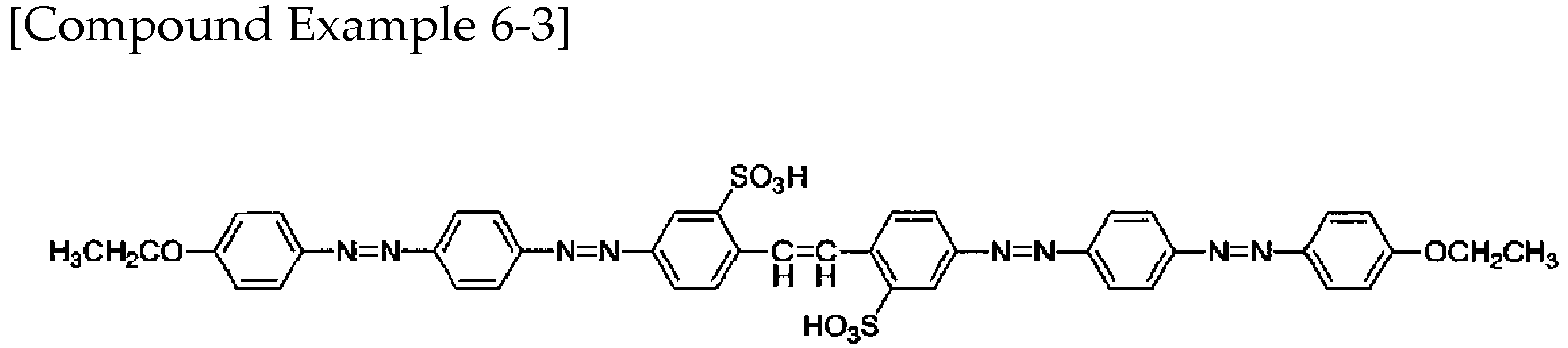


- One of these azo compounds represented by Formula (6) may be singly used, or two or more of these may be used together.
- Besides, if the azo compound represented by Formula (5-1) or Formula (5-II) is used as the compound B in the polarizer of the present invention, at least one of an azo compound represented by the following Formula (7) or a salt thereof is preferably further contained in the base. If the azo compound represented by Formula (5-1) or Formula (5-II) is used together with the azo compound represented by Formula (7), the polarization property can be further improved. In other words, if the compound represented by Formula (1), the azo compound represented by Formula (5-1) or Formula (5-II), the azo compound represented by Formula (7), and optionally the azo compound represented by Formula (6) are used together, a higher performance polarizer can be produced.

- In Formula (7), Ab4 represents: a phenyl group having at least one substituent selected from the group consisting of a sulfo group, a carboxy group, a lower alkyl group, a lower alkoxy group, a hydroxyl group, a lower alkoxy group having a sulfo group, a sulfo-substituted naphthotriazole group, a nitro group, an amino group and a substituted amino group; or
a naphthyl group having at least one substituent selected from the group consisting of a sulfo group, a hydroxyl group and a lower alkoxy group having a sulfo group,
Rb9 to Rb14 each independently represent a hydrogen atom, a lower alkyl group, a lower alkoxy group or a lower alkoxy group having a sulfo group,
Xb4 represents: an amino group optionally having at least one substituent selected from the group consisting of a lower alkyl group, a lower alkoxy group, a sulfo group, an amino group, a lower alkylamino group, a hydroxyl group, a carboxy group and a carboxyethyl amino group;
a benzoyl group or a benzoylamino group optionally having at least one substituent selected from the group consisting of a lower alkyl group, a lower alkoxy group, a sulfo group, an amino group and a substituted amino group;
a phenylamino group optionally having at least one substituent selected from the group consisting of a lower alkyl group, a lower alkoxy group, a sulfo group, an amino group and a substituted amino group;
a phenylazo group optionally having at least one substituent selected from the group consisting of a lower alkyl group, a lower alkoxy group, a sulfo group, a hydroxyl group, an amino group and a substituted amino group; or
a naphthotriazole group optionally having at least one substituent selected from the group consisting of a lower alkyl group, a lower alkoxy group, a sulfo group, an amino group and a substituted amino group, m represents an integer of 0 or 1, and
n represents an integer of 0 or 1. - As described above, in Formula (7), Ab4 represents: a phenyl group having at least one substituent selected from the group consisting of a sulfo group, a carboxy group, a lower alkyl group, a lower alkoxy group, a hydroxyl group, a lower alkoxy group having a sulfo group, a sulfo-substituted naphthotriazole group, a nitro group, an amino group and a substituted amino group; or
a naphthyl group having at least one substituent selected from the group consisting of a sulfo group, a hydroxyl group and a lower alkoxy group having a sulfo group. The phenyl group or the naphthyl group preferably has one or more of the above-described substituents, and more preferably, the phenyl group has one or more substituents of a sulfo group or a carboxy group, and the naphthyl group has one or more sulfo groups as the substituents. In particular, if the phenyl group has two or more substituents selected from a sulfo group and a carboxy group and the naphthyl group has two or more sulfo groups, the durability can be further improved. Besides, for producing a neutral color polarizer, Ab4 is preferably a phenyl group having one or more substituents selected from a sulfo group and a carboxy group. - The azo compound represented by Formula (7) is preferably an azo compound represented by the following Formula (7'). In other words, the azo compound represented by Formula (2-1) or the azo compound represented by Formula (4-1) can be used as the azo compound represented by Formula (7). Accordingly, in the polarizer of the present invention, the azo compound represented by Formula (5-1) or Formula (5-II) and the azo compound represented by Formula (2-1) or the azo compound represented by Formula (4-1) can be used together as the compound B, and thus, the polarization performance of the polarizer of the present invention can be further improved.
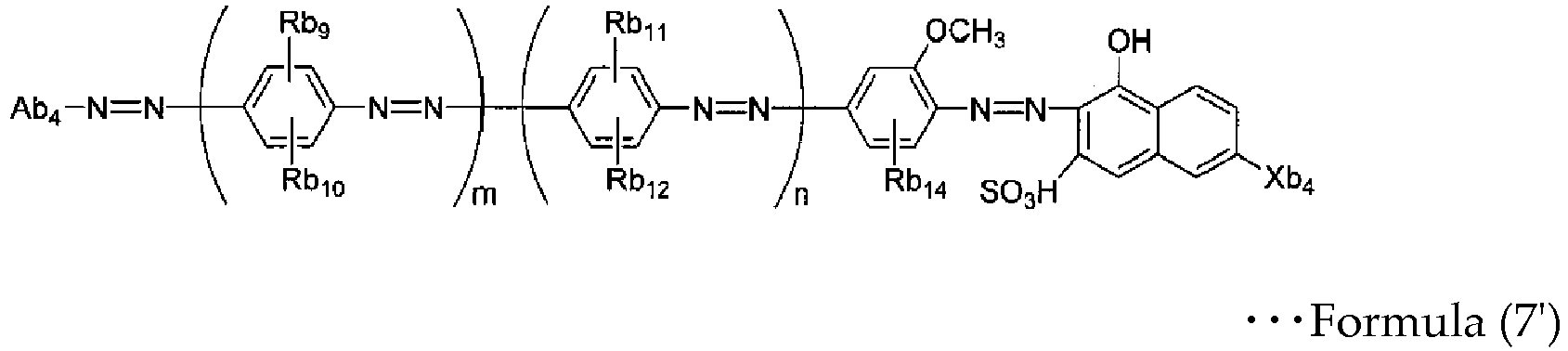
- In Formula (7'), Ab4, Rb9 to Rb12, Rb14 and Xb4 are the same as defined in Formula (7).
- The azo compound represented by Formula (7) can be produced by any of known methods described in, for example, Japanese Laid-Open Patent Publication No.
5-295281 10-259311 2622748 3661238 4452237 4662853 WO2007/148757 , International Publication No.WO2007/145210 , International Publication No.WO2012/108169 , International Publication No.WO2012/108173 and the like, but the production method is not limited to these. - Specific Examples of the azo compound represented by Formula (7) include the following azo compounds:


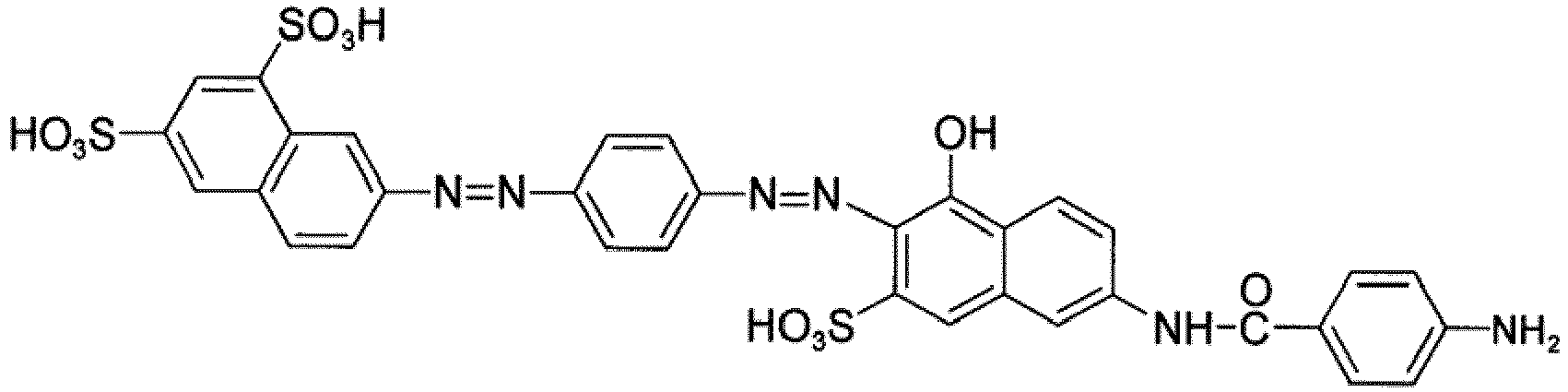

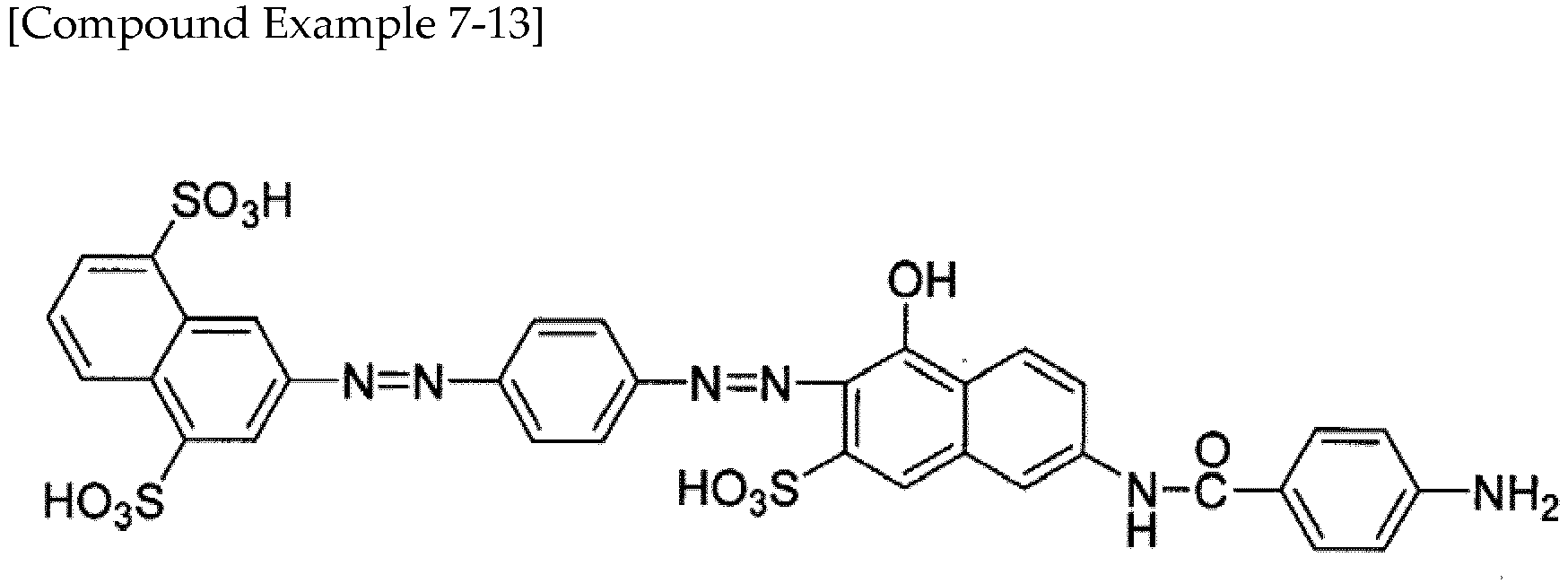





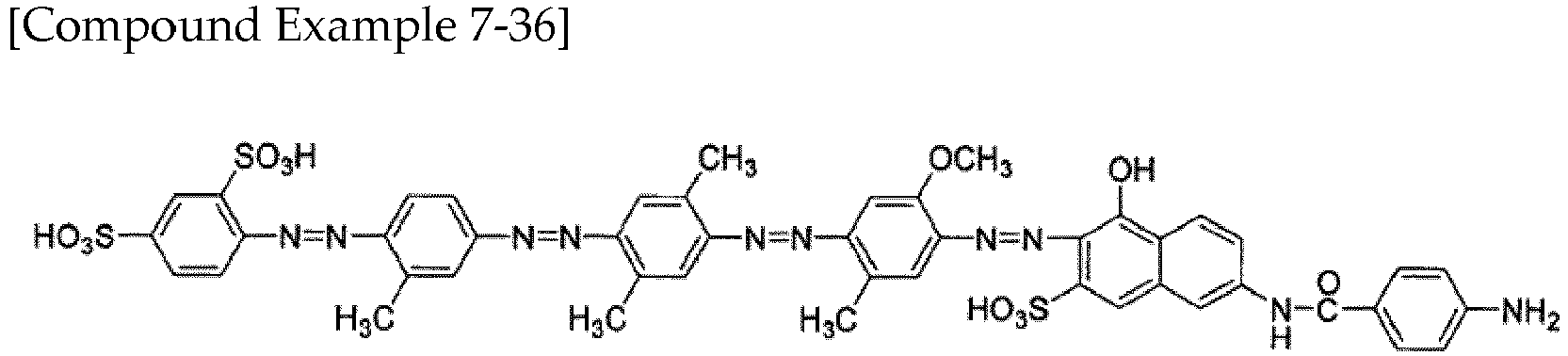


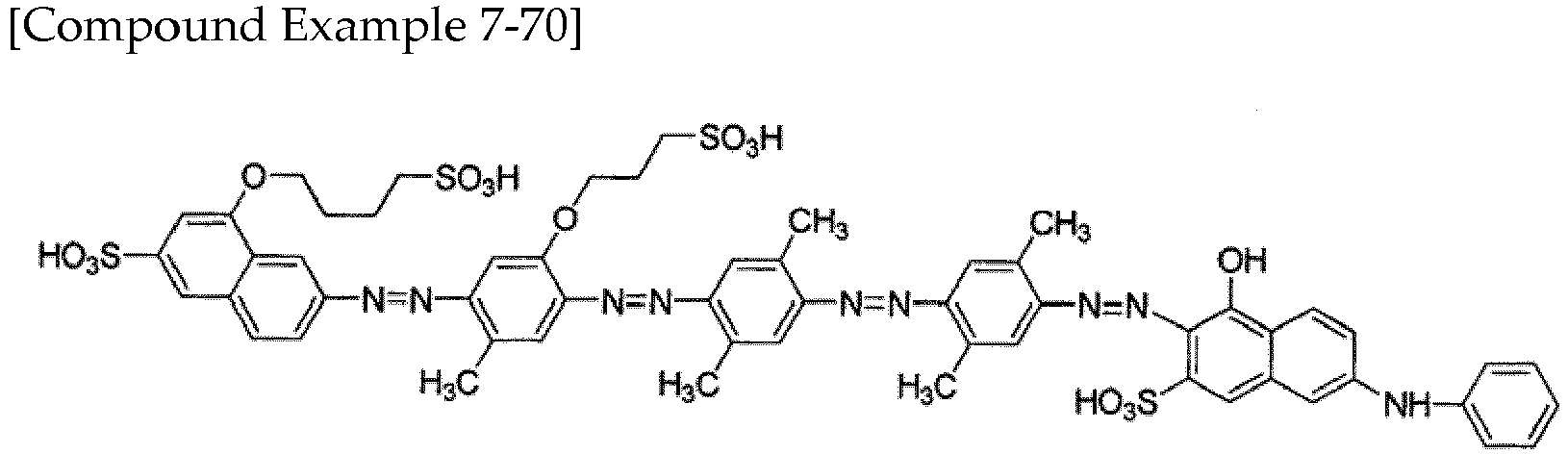


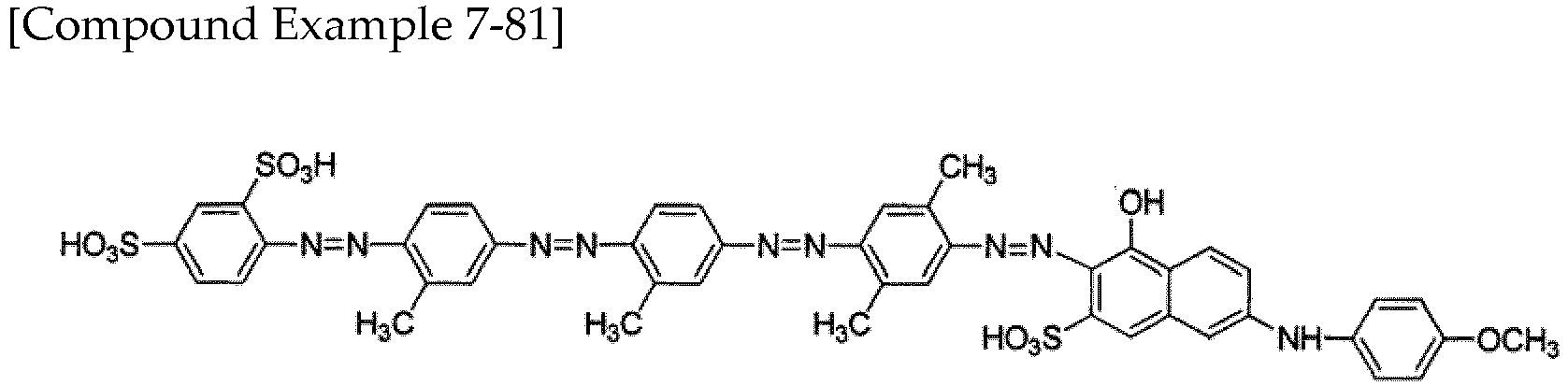

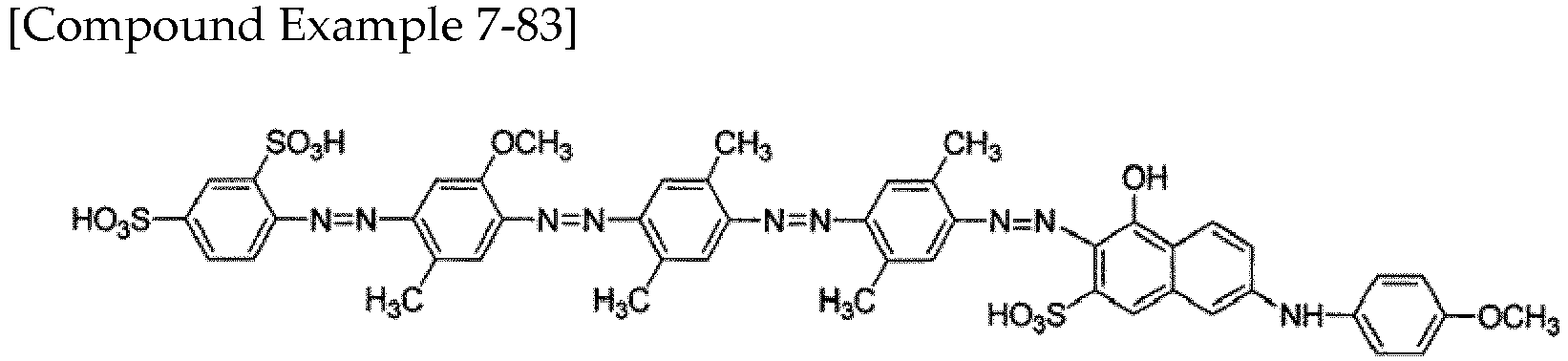




- One of these azo compounds represented by Formula (7) may be singly used, or two or more of these may be used together.
- Besides, the polarizer of the present invention may optionally contain, in addition to the azo compounds represented by Formulas (1) to (7), at least one of azo compounds described in a commercial available color index (C.I.) such as C.I. Direct Yellow 28, C.I. Direct Yellow 44, C.I. Direction Orange 6 and C.I. Direct Orange 26 as another dichroic dye. One of such azo compounds may be singly used, or two or more of these may be used together.
- Besides, the polarizer of the present invention may optionally contain, in the base, iodine as a dichroic pigment as long as the desired durability is not impaired. The content of iodine in the base is not especially limited as long as the desired durability is not impaired, and may be appropriately adjusted.
- In the present invention, the azo compounds represented by Formulas (1) to (7), the azo compounds listed in the C.I., and the azo compounds mentioned as the compound examples above may be in the form of a free acid or in the form of a salt. Examples of the salt include alkali metal salts such as a lithium salt, a sodium salt and a potassium salt, and organic salts such as an ammonium salt and an amine salt, and a sodium salt is preferably used.
- The polarizer of the present invention contains, in the base, at least one azo compound represented by Formula (1) and at least one of the azo compounds represented by Formula (2-1) to Formula (5-II). Besides, the polarizer of the present invention may optionally further contain at least one azo compound represented by Formula (6). In addition, the polarizer of the present invention may also optionally further contain any of the dichroic dyes listed in the C.I. and/or the iodines as dichroic pigment. Besides, if the polarizer of the present invention uses the compound represented by Formula (5-1) or Formula (5-II), it may optionally further contain the azo compound represented by Formula (7) in the base. According to the polarizer of the present invention, performances such as single transmittance can be set in preferable ranges described below.
- In the polarizer of the present invention, a mixing ratio among the used azo compounds is suitably adjusted so as to cause the resultant transmittance to fall in the preferable range described below. The polarization performance of a polarizer is varied not only depending on the mixing ratio among the respective azo compounds used in the polarizer but also depending on various factors including the degree of swelling and a stretch ratio of the base to which the azo compounds are adsorbed, a dyeing time, a dyeing temperature, pH at the time of dyeing, the influence of a salt, and the like. Therefore, the mixing ratio among the respective azo compounds can be determined in accordance with the degree of swelling of the base, the temperature, the time and pH at the time of dyeing, the type of the salt, the concentration of the salt, and the stretch ratio. Such adjustment of the mixing ratio can be appropriately performed based on description given below.
- The polarizer of the present invention preferably has specific transmittance. The transmittance at each wavelength is measured in accordance with JIS Z 8722:2009. For measuring the transmittance, a measurement sample (for example, a polarizer or a polarizing plate) is measured for spectral transmittance at intervals of 5 nm or 10 nm in a wavelength range of 400 to 700 nm, and the resultant spectral transmittance is corrected based on the luminous efficiency using a 2-degree visual field (illuminant C).
- The polarizer of the present invention preferably has single transmittance of 35% to 70%. The single transmittance is transmittance obtained from a single measurement sample (for example, a polarizer or a polarizing plate) as transmittance corrected based on the luminous efficiency in accordance with JIS Z 8722:2009. As the performance of a polarizing plate, higher transmittance is required, but if the single transmittance is 35% to 70%, brightness can be expressed without causing any problem when a polarizer having this single transmittance is used in a display device. The single transmittance exceeding 70% is not preferable because the degree of polarization may be greatly lowered in some cases. On the other hand, since there is a tendency that as the transmittance is higher, the degree of polarization is lower, the single transmittance is more preferably 35% to 60%, further more preferably 37% to 55% and particularly preferably 39% to 50% from the viewpoint of balance with the degree of polarization.
- The degree of polarization of the polarizer here is preferably 50% to 100%, more preferably 80% to 100%, further more preferably 95% to 100% and particularly preferably 99% to 100%. A higher degree of polarization is preferred, but in the relationship between the degree of polarization and the transmittance, depending on whether the brightness is regarded more significant or the degree of polarization (or contrast) is regarded more significant, the transmittance and the degree of polarization can be suitably adjusted so that the polarizer can be applied to a display device or the like.
- Next, production method for the polarizer will be concretely described on the assumption, for example, that a polarizer is produced by causing azo compounds to be adsorbed onto a base of, for example, a polyvinyl alcohol-based resin. It is noted that the production method for the polarizer of the present invention is not limited to the following production method.
- First, a raw material film to be used as a base for containing the azo compounds of the present invention is prepared. The raw material film can be produced by forming a polyvinyl alcohol-based resin into a film. The polyvinyl alcohol-based resin is not especially limited, and a commercially available resin may be used or a resin synthesized by a known method may be used. The polyvinyl alcohol-based resin can be obtained by, for example, saponificating a polyvinyl acetate-based resin. Examples of the polyvinyl acetate-based resin include polyvinyl acetate that is a homopolymer of vinyl acetate, and copolymers of vinyl acetate and other monomers copolymerizable with this. Examples of the other monomers to be copolymerized with vinyl acetate include unsaturated carboxylic acids, olefins, vinyl ethers and unsaturated sulfonic acids. The degree of saponification of the polyvinyl alcohol-based resin is preferably 85 to 100 mol% in general, and more preferably 95 mol% or more. The polyvinyl alcohol-based resin may be further modified, and for example, polyvinyl formal or polyvinyl acetal obtained by modification with aldehydes may be used. Besides, the degree of polymerization of the polyvinyl alcohol-based resin means a viscosity average degree of polymerization, can be obtained by a method(s) known in this technical field, and is preferably about 1,000 to 10,000 in general, and more preferably about 1,500 to 6,000.
- A method for forming the polyvinyl alcohol-based resin into a film is not especially limited, and the film formation can be practiced by any known method. A polyvinyl alcohol-based resin film obtained in this case may contain glycerin, ethylene glycol, propylene glycol, low molecular weight polyethylene glycol or the like as plasticizer. The content of the plasticizer is preferably 5 to 20% by mass and more preferably 8 to 15% by mass based on the whole film. The thickness of the raw material film is not especially limited, and is, for example, about 5 µm to 150 µm, and preferably about 10 µm to 100 µm.
- Next, the raw material film obtained by the aforementioned step is subjected to a swelling treatment. The swelling treatment is preferably performed by dipping the raw material film in a solution of 20 to 50°C for 30 seconds to 10 minutes, and the solution is preferably water. The stretch ratio of the raw material film obtained through the swelling is preferably adjusted to 1.00 to 1.50 times, and more preferably 1.10 to 1.35 times. If the time necessary for producing the polarizer is desired to be shortened, the swelling treatment may be omitted because the raw material film is also swollen in a dyeing treatment described below.
- Subsequently, the azo compounds used in the present invention are adsorbed to and impregnated in the resin film obtained by subjecting the raw material film to the above-described swelling treatment. If the swelling step is omitted, the swelling treatment of the raw material film may be simultaneously performed in this dyeing step. A treatment for absorbing and impregnating the azo compounds corresponds to a step of coloring the resin film, and hence this step is designated as the dyeing step. In the dyeing step, a color(s) to be applied to the resin film may be adjusted, for example, by using any azo compounds corresponding to dichroic dyes exemplarily described in "Application of Functional Dyes", compiled under the supervision of Masahiro Irie, edition of the first copy, CMC Publishing Co., Ltd., June 2002, pp. 98-100 to the extent that the performance of the polarizer of the present invention is not impaired.
- The dyeing step is not especially limited as long as the azo compounds used as the dichroic dyes are adsorbed to and impregnated in the resin film, and for example, the resin film is preferably colored by dipping in a dye solution, or the resin film may be colored by applying a dye solution. A concentration of each azo compound in the dye solution is not especially limited as long as the resin film is sufficiently colored, and can be adjusted, for example, in a range of 0.05 g/litter to 100 g/litter.
- The temperature of the dye solution employed in the dyeing step is preferably 5 to 60°C, more preferably 20 to 50°C, and particularly preferably 35 to 50°C. Besides, the time for dipping the resin film in the dye solution can be appropriately adjusted, and is adjusted preferably in a range of 30 seconds to 20 minutes, and more preferably 1 to 10 minutes.
- The dye solution may further contain a dyeing auxiliary if necessary in addition to the azo compounds used in the present invention. Examples of the dyeing auxiliary include sodium carbonate, sodium hydrogen carbonate, sodium chloride, sodium sulfate, anhydrous sodium sulfate and sodium tripolyphosphate. The content of the dyeing auxiliary can be optionally adjusted depending on the dipping time and the temperature of the dye solution based on the dyeability of the used dye, and is preferably 0.01 to 5% by mass and more preferably 0.1 to 2% by mass in the dye solution.
- After the dyeing step, a washing step (hereinafter also referred to as the "washing step 1") may be performed for removing the dye solution adhering to the surface of the resin film in the dyeing step. If the washing step 1 is performed, a dye (dyes) remaining on the surface of the resin film can be inhibited from migrating into solution used for a next treatment. In the washing step 1, water is generally used as a washing liquid. As a washing method, the dyed resin film is preferably dipped in the washing liquid, and alternatively, the resin film can be washed by applying the washing liquid thereto. A washing time is not especially limited, and is preferably 1 to 300 seconds, and more preferably 1 to 60 seconds. A temperature of the washing liquid used in the washing step 1 needs to be a temperature at which the material of the resin film (such as a hydrophilic polymer, that is, the polyvinyl alcohol-based resin in this case) does not melt, and in general, a washing treatment is performed at 5 to 40°C. However, the washing step 1 may be omitted because the performance of the resultant polarizer is not particularly largely affected even if the washing step 1 is not performed.
- After the dyeing step or the washing step 1, crosslinking agent and/or water resistance agent can be contained. As a method for causing the crosslinking agent and/or the water resistance agent to be contained in the resin film, the resin film is preferably dipped in a treatment solution containing the crosslinking agent and/or the water resistance agent, and alternatively, the treatment solution may be applied or coated onto the resin film. The treatment solution contains at least one crosslinking agent and/or water resistance agent, and a solvent. A temperature of the treatment solution is preferably 5 to 70°C, and more preferably 5 to 50°C. Besides, a treatment time in this step is preferably 30 seconds to 6 minutes, and more preferably 1 to 5 minutes.
- As the crosslinking agent, for example, boric acid, a boron compound such as borax or ammonium borate, a polyaldehyde such as glyoxal or glutaraldehyde, a polyisocyanate-based compound such as biuret, isocyanurate or blocked isocyanate, or a titanium-based compound such as titanium oxysulfate can be used. In addition, ethylene glycol glycidyl ether, polyamide-epichlorohydrin or the like may be used. Examples of the water resistance agent include peroxide succinate, ammonium persulfate, calcium perchlorate, benzoin ethyl ether, ethylene glycol diglycidyl ether, glycerin diglycidyl ether, ammonium chloride and magnesium chloride, and boric acid is preferably used. The solvent for the crosslinking agent and/or the water resistance agent is not especially limited, and water is preferably used. A concentration of the crosslinking agent and/or the water resistance agent in the treatment solution can be appropriately determined in accordance with the type of the agent, and for example, if boric acid is used, the concentration of boric acid in the treatment solution is preferably 0.1 to 6.0% by mass, and more preferably 1.0 to 4.0% by mass. Incidentally, if the time necessary for producing the polarizer is desired to be shortened, or if there is no need to perform a crosslinking treatment or water resistance treatment, this treatment step may be omitted.
- After performing the dyeing step, or optionally after performing the washing step 1 or the step of causing the crosslinking agent and/or the water resistance agent to be contained, a stretching step is performed. The stretching step is performed by uniaxially stretching the resin film. A stretching method may be either a wet stretching method or a dry stretching method. A draw ratio is preferably 3 times or more, and more preferably 5 to 8 times.
- In the dry stretching method, if stretching heating medium is an air medium, the resin film is stretched preferably with the temperature of the air medium set to normal temperature to 180°C. Besides, the stretching is performed preferably under a humidity environment of 20 to 95% RH. Examples of a heating method for the resin film include a roll zone stretching method, a roll heat stretching method, a hot rolling method and an infrared heat stretching method, but the method is not limited to these stretching methods. The dry stretching step may be performed as single-stage stretching or as multi-stage stretching including two or more stages.
- In the wet stretching method, the resin film is stretched preferably in water, water-soluble organic solvent or a mixed solution thereof. More preferably, the stretching treatment is performed with the resin film dipped in a solution containing at least one crosslinking agent and/or water resistance agent. As the crosslinking agent and the water resistance agent, any of the crosslinking agents and the water resistance agents described above with respect to the step of causing the crosslinking agent and/or the water resistance agent to be contained can be used. A concentration of the crosslinking agent and/or the water resistance agent in the solution employed in the stretching step is preferably 0.5 to 15% by mass, and more preferably 2.0 to 8.0% by mass. Stretching temperature is preferably 40 to 60°C, and more preferably 45 to 58°C. Stretching time is generally 30 seconds to 20 minutes, and preferably 2 to 5 minutes. The wet stretching step may be performed as single-stage stretching or as multi-stage stretching including two or more stages.
- After performing the stretching step, the crosslinking agent and/or the water resistance agent may be deposited on or foreign matters may adhere to the surface of the resin film, and therefore, a washing step for washing the surface of the resin film (hereinafter also referred to as the "washing step 2") may be optionally performed. Washing time is preferably 1 second to 5 minutes. As a washing method, the resin film is preferably dipped in washing liquid, and alternatively, the washing liquid may be applied to or coated on the resin film for washing. The washing liquid is preferably water. The washing treatment may be performed as a single-stage treatment, or as a multi-stage treatment including two or more stages. A temperature of the washing liquid is not especially limited, and is generally 5 to 50°C, and preferably 10 to 40°C.
- Examples of the treatment solution or the solvent thereof used in each of the aforementioned treatment steps include, in addition to water, dimethyl sulfoxide, N-methyl pyrrolidone, alcohols such as methanol, ethanol, propanol, isopropyl alcohol, glycerin, ethylene glycol, propylene glycol, diethylene glycol, triethylene glycol, tetraethylene glycol and trimethylol propane, and amines such as ethylenediamine and diethylenetriamine. The treatment solution or the solvent thereof is not limited to these, and is most preferably water. Besides, one of these treatment solutions and the solvents thereof may be singly used, or a mixture of two or more of these may be used.
- After the stretching step or the washing step 2, drying step for the resin film is performed. The drying step may be performed by natural drying, but in order to improve drying efficiency, it may be performed by roll compression, surface moisture removal using an air knife or a water-absorbing roll, or the like, and furthermore, blow drying may be also performed. A temperature of the drying treatment is preferably 20 to 100°C, and more preferably 60 to 100°C. A drying time is preferably 30 seconds to 20 minutes, and more preferably 5 to 10 minutes.
- Through the above-described method, the polarizer of the present invention containing the aforementioned azo compounds can be produced. Such a polarizer shows a higher degree of polarization and higher contrast than a conventional polarizer, and further has higher durability than a conventional dye-based polarizing plate.
- Next, a polarizing plate according to the present invention will be described. The polarizing plate of the present invention includes the above-described polarizer containing the azo compounds in the base thereof, and a transparent protection layer provided on one surface or both surfaces of the polarizer. The transparent protection layer is used for improving water resistance, handleability and the like of the polarizer.
- The transparent protection layer is a protection film made of a transparent substance. The protection film is a film in a layered shape capable of retaining the shape of the polarizer, and is preferably made of a plastic material or the like excellent in transparency, mechanical strength, thermal stability, a waterblocking property and the like, and alternatively, a protection film made of another material capable of showing functions equivalent to those of the plastic material may be used. Examples of the plastic material constituting the protection film include films made of thermoplastic resins such as polyester-based resins, acetate-based resins, polyether sulfone-based resins, polycarbonate-based resins, polyamide-based resins, polyimide-based resins, polyolefin-based resins and acrylic-based resins, and acrylic-based, urethane-based, acrylic urethane-based, epoxy-based and silicone-based thermosetting resins or UV curable resins, and among these, examples of the polyolefin-based resins include amorphous polyolefin-based resins having a polymerization unit of cyclic polyolefin such as a norbornene-based monomer or a polycyclic norbornene-based monomer. In general, a protection film not impairing the performance of the polarizer is preferably selected, and as such a protection film, triacetyl cellulose (TAC) of a cellulose acetate-based resin or norbornene is particularly preferred. Besides, the protection film may be subjected to a hard coat treatment or an antireflection treatment, or a treatment for preventing sticking or for diffusion, anti-glare or the like as long as the effects of the present invention are not impaired. A thickness of the transparent protection layer can be appropriately designed in accordance with use of the polarizer, is preferably 1 µm to 200 µm, more preferably 5 µm to 150 µm, and particularly preferably 10 µm to 100 µm.
- The polarizing plate preferably further includes, between the transparent protection layer and the polarizer, an adhesive layer for causing the transparent protection layer to adhere to the polarizer. An adhesive constituting the adhesive layer is not especially limited, and is preferably a polyvinyl alcohol-based adhesive. Examples of the polyvinyl alcohol-based adhesive include, but are not limited to, Gohsenol NH-26 (manufactured by Nippon Synthetic Chemical Industry Co., Ltd.) and Exceval RS-2117 (manufactured by Kuraray Co., Ltd.). Besides, a crosslinking agent and/or a water resistance agent can be added to the adhesive. As a polymer constituting the polyvinyl alcohol-based adhesive, a maleic anhydride-isobutylene copolymer is preferably used, and an adhesive mixedly containing a crosslinking agent may be used if necessary. Examples of the maleic anhydride-isobutylene copolymer include Isobam #18 (manufactured by Kuraray Co., Ltd.), Isobam #04 (manufactured by Kuraray Co., Ltd.), ammonia-modified Isobam #104 (manufactured by Kuraray Co., Ltd.), ammonia-modified Isobam #110 (manufactured by Kuraray Co., Ltd.), imidized Isobam #304 (manufactured by Kuraray Co., Ltd.) and imidized Isobam #310 (manufactured by Kuraray Co., Ltd.). As the crosslinking agent, a water-soluble polyepoxy compound can be used. Examples of the water-soluble polyepoxy compound include Denacol EX-521 (manufactured by Nagase Chemtex Corporation) and TETRAD-C (manufactured by Mitsui Gas Chemical Company, Inc.). Alternatively, as an adhesive excluding the polyvinyl alcohol-based resin, any of known urethane-based, acrylic-based and epoxy-based adhesives can be used. In particular, acetoacetyl group-modified polyvinyl alcohol is preferably used, and polyaldehyde is preferably used as the crosslinking agent therefor. Besides, from the viewpoint of improving adhesive strength of the adhesive or improving water resistance, any of additives such as zinc compounds, chlorides and iodides can be singly or together contained in a concentration of about 0.1 to 10% by mass in the adhesive. The additives that can be contained in the adhesive are not especially limited and can be appropriately selected. After causing the transparent protection layer and the polarizer to adhere to each other with the adhesive, the resultant is dried or heated at an appropriately temperature, and thus, the polarizing plate can be produced.
- If the polarizing plate is laminated onto a display device such as a liquid crystal display or an organic electroluminescence (commonly known as an OLED or an OEL), various functional layer(s) for viewing angle improvement and/or contrast improvement, or a layer or a film having a brightness enhancing property can be provided on the surface of the protection layer or protection film not exposed after the lamination. The functional layer is, for example, a layer or a film controlling a phase difference. The polarizing plate is preferably laminated onto such a film or a display device with an adhesive.
- Besides, the polarizing plate may appropriately include, on an exposed surface of the protection layer or protection film, any of various known functional layer(s) such as an antireflection layer, an anti-glare layer and a hard coat layer. If such the layer having any of various functions is to be formed, a method for coating the exposed surface of the protection layer or protection film with a material having any of various functions is preferably employed, and alternatively, a layer or a film having such a function can be laminated onto the exposed surface of the protection layer or protection film with an adhesive or a pressure sensitive adhesive.
- The polarizing plate of the present invention is a highly durable polarizing plate that can realize achromaticity while having high transmittance and a high degree of polarization, can particularly express white color like that of high quality paper in displaying white color, and can express neutral black color in displaying black color.
- The polarizer or the polarizing plate of the present invention is provided, if necessary, with a protection layer and/or a functional layer, and further with a transparent support of glass, quartz, sapphire or the like, and is applied to a liquid crystal projector, a calculator, a watch, a notebook personal computer, a word processor, a liquid crystal television set, a polarizing lens, polarized glasses, a car navigation system, or indoor/outdoor measuring instrument or display. In particular, the polarizer or the polarizing plate of the present invention is suitably used in a liquid crystal display device such as a reflective liquid crystal display device, a transflective liquid crystal display device or an organic electroluminescence. A liquid crystal display device using the polarizer or the polarizing plate of the present invention can express white color like that of high quality paper and neutral black color. Besides, the liquid crystal display device using the polarizer or the polarizing plate of the present invention is a liquid crystal display device having high durability, high reliability and high contrast for a long period of time, and high color reproducibility.
- The present invention will now be described in more details with reference to examples, and it is noted that the present invention is not limited to these aspects.
- In each of Examples 1 to 26 described below, a polarizer containing, in a base thereof, an azo compound represented by Formula (1) as the compound A, an azo compound represented by Formula (2-1) or Formula (2-II) as the compound B, optionally an azo compound represented by Formula (6) as the compound C, and optionally another dichroic dye, and a polarizing plate using the polarizer were produced.
- After dissolving 12.0 parts by mass of a compound of Formula (8) obtained by a known method in 500 parts by mass of water, a solution containing 2.0 parts by mass of phenyl chlorocarbonate was added to the resultant solution, in a dropwise manner at 50°C or less over 60 minutes while adjusting pH of the solution to 7 to 8 by adding a 15% sodium carbonate aqueous solution, and after the dropwise addition, the resultant solution was stirred for 120 hours to react the compound of Formula (8). After the reaction, an insoluble content was removed by filtration, ethanol was added to a filtrate to deposit crystal, the crystal was purified, and thus, Compound Example 1-5 having the structure of Formula (1) to be used in the present invention was obtained.

- A polyvinyl alcohol resin film (manufactured by Kuraray Co., Ltd., VF series) having a degree of saponification of 99% or more and a thickness of 40 µm was subjected to a swelling treatment by dipping in warm water at 40°C for 3 minutes. The thus swollen film was dipped in an aqueous solution containing 0.5 parts by mass of the azo compound corresponding to Compound Example 1-5 having the structure of (1) synthesized as described above, 1.1 parts by mass of an azo compound corresponding to Compound Example 2-6 having the structure of Formula (2-1), 1.5 parts by mass of sodium tripolyphosphate, 1.5 parts by mass of anhydrous sodium sulfate and 1500 parts by mass of water, at 45°C for 6 minutes, so as to cause the azo compounds to be contained therein. The film containing the azo compounds was washed with water, and after the washing, a crosslinking treatment with boric acid was performed for 1 minute by using an aqueous solution at 40°C containing 2% by mass of boric acid. The film resulting from the crosslinking treatment was subjected to a stretching treatment for 5 minutes in an aqueous solution at 58°C containing 3.0% by mass of boric acid while stretching the film by 5.0 times. While keeping the state of tension of the stretched film, the film was subjected to a washing treatment with water at normal temperature for 20 seconds. The thus treated film was immediately subjected to a drying treatment at 60°C for 5 minutes, and thus, a polarizer having a thickness of 15 µm was obtained. In the aforementioned manner, the polarizer according to the present invention containing the azo compound having the structure of Formula (1) and the azo compound having the structure of Formula (2-1) was produced. On each of both surfaces of the polarizer, an alkali-treated triacetyl cellulose film (manufactured by Fujifilm Corporation, TD-80U, hereinafter abbreviated as "TAC") having a thickness of 80 µm was stacked and then laminated with a polyvinyl alcohol adhesive, and thus, a polarizing plate of the present invention having a structure of TAC/adhesive layer/polarizer/adhesive layer/TAC was produced. The thus obtained polarizing plate retained optical performances, particularly single transmittance, hue, the degree of polarization and the like of the polarizer. This polarizing plate was used as a measurement sample of Example 1.
- A polarizer of the present invention containing an azo compound having the structure of Formula (1) and an azo compound having the structure of Formula (2-1), as well as a polarizing plate using the same were produced in the same manner as in Example 1 except that 12.0 parts by mass of the compound of Formula (8) was replaced with 11.6 parts by mass of a compound of Formula (9) obtained by a known method in the synthesis of Compound Example 1-5 so that an azo compound corresponding to Compound Example 1-2 having the structure of Formula (1) was synthesized, and this polarizing plate was used as a measurement sample of Example 2.
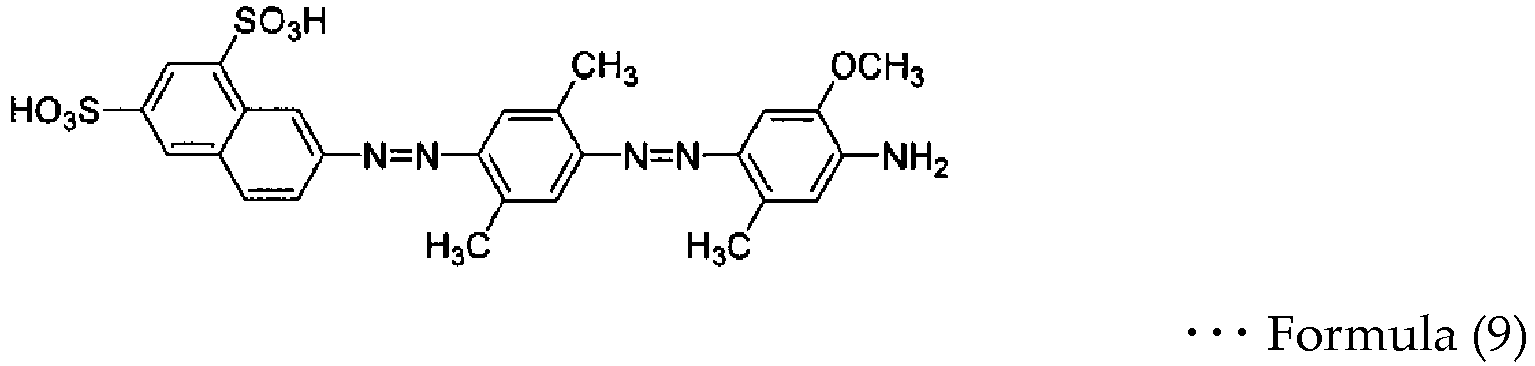
- A polarizer of the present invention containing an azo compound having the structure of Formula (1), an azo compound having the structure of Formula (2-1) and an azo compound having the structure of Formula (6), as well as a polarizing plate using the same were produced in the same manner as in Example 1 except that a film having been subjected to the swelling treatment in the production of the polarizer of Example 1 was dipped in an aqueous solution containing 0.55 parts by mass of the azo compound corresponding to Compound Example 1-5 having the structure of Formula (1) obtained by the synthesis, 1.1 parts by mass of the azo compound corresponding to Compound Example 2-6 having the structure of Formula (2-1), 0.15 parts by mass of an azo compound corresponding to Compound Example 6-2 having the structure of Formula (6), 1.5 parts by mass of sodium tripolyphosphate, 1.5 parts by mass of anhydrous sodium sulfate and 1500 parts by mass of water, at 45°C for 6 minutes for adsorption of the azo compounds, and this polarizing plate was used as a measurement sample of Example 3.
- A polarizer containing an azo compound having the structure of Formula (1), an azo compound having the structure of Formula (2-1) and an azo compound having the structure of Formula (6), as well asa polarizing plate using the same were produced in the same manner as in Example 3 except that 0.55 parts by mass of the azo compound corresponding to Compound Example 1-5 having the structure of Formula (1) was replaced, in the production of the polarizer of Example 3, with 0.60 parts by mass of the azo compound corresponding to Compound Example 1-2 obtained by the synthesis in Example 2, and this polarizing plate was used as a measurement sample of Example 4.
- An azo compound corresponding to Compound Example 1-6 having the structure of Formula (1) was synthesized by replacing 12.0 parts by mass of the compound of Formula (8) with 11.6 parts by mass of a compound represented by Formula (10) in the synthesis of Compound Example 1-5 in Example 1. Besides, a polarizer containing an azo compound having the structure of Formula (1), an azo compound having the structure of Formula (2-1) and an azo compound having the structure of Formula (6), as well as a polarizing plate using the same were produced in the same manner as in Example 3 except that a film subjected to the swelling treatment as in the production of the polarizer and the polarizing plate of Example 3 was dipped in an aqueous solution containing 0.48 parts by mass of an azo compound corresponding to Compound Example 1-6 having the structure of Formula (1) obtained by synthesis, 1.1 parts by mass of an azo compound corresponding to Compound Example 2-6 having the structure of Formula (2-1), 0.15 parts by mass of an azo compound corresponding to Compound Example 6-2 having the structure of Formula (6), 1.5 parts by mass of sodium tripolyphosphate, 1.5 parts by mass of anhydrous sodium sulfate and 1500 parts by mass of water, at 45°C for 6 minutes for causing the azo compounds to be contained, and this polarizing plate was used as a measurement sample of Example 5.

- An azo compound corresponding to Compound Example 1-7 having the structure of Formula (1) was synthesized by replacing 12.0 parts by mass of the compound of Formula (8) with 10.7 parts by mass of a compound represented by Formula (11) in the synthesis of Compound Example 1-5 of Example 1. Besides, a polarizer containing an azo compound having the structure of Formula (1), an azo compound having the structure of Formula (2-1) and an azo compound having the structure of Formula (6), as well as a polarizing plate using the same were produced in the same manner as in Example 3 except that a film subjected to the swelling treatment in the production of the polarizer and the polarizing plate of Example 3 was dipped in an aqueous solution containing 0.78 parts by mass of the azo compound corresponding to Compound Example 1-7 having the structure of Formula (1) obtained by the synthesis, 1.1 parts by mass of the azo compound corresponding to Compound Example 2-6 having the structure of Formula (2-1), 0.15 parts by mass of the azo compound corresponding to Compound Example 6-2 having the structure of Formula (6), 1.5 parts by mass of sodium tripolyphosphate, 1.5 parts by mass of anhydrous sodium sulfate and 1500 parts by mass of water, at 45°C for 6 minutes for causing the azo compounds to be contained, and this polarizing plate was used as a measurement sample of Example 6.

- An azo compound corresponding to Compound Example 1-13 having the structure of Formula (1) was synthesized by replacing 12.0 parts by mass of the compound of Formula (8) with 12.7 parts by mass of a compound represented by Formula (12) in the synthesis of Compound Example 1-5 of Example 1. Besides, a polarizer containing an azo compound having the structure of Formula (1), an azo compound having the structure of Formula (2-1) and an azo compound having the structure of Formula (6), as well as a polarizing plate using the same were produced in the same manner as in Example 3 except that a film subjected to the swelling treatment in the production of the polarizer and the polarizing plate of Example 3 was dipped in an aqueous solution containing 0.78 parts by mass of the azo compound corresponding to Compound Example 1-13 having the structure of Formula (1) obtained by the synthesis, 1.1 parts by mass of the azo compound corresponding to Compound Example 2-6 having the structure of Formula (2-1), 0.15 parts by mass of the azo compound corresponding to Compound Example 6-2 having the structure of Formula (6), 1.5 parts by mass of sodium tripolyphosphate, 1.5 parts by mass of anhydrous sodium sulfate and 1500 parts by mass of water, at 45°C for 6 minutes for causing the azo compounds to be contained, and this polarizing plate was used as a measurement sample of Example 7.

- An azo compound corresponding to Compound Example 1-23 having the structure of Formula (1) was synthesized by replacing 12.0 parts by mass of the compound of Formula (8) with 13.86 parts by mass of a compound represented by Formula (13) in the synthesis of Compound Example 1-5 of Example 1. Besides, a polarizer containing an azo compound having the structure of Formula (1), an azo compound having the structure of Formula (2-1) and an azo compound having the structure of Formula (6), as well as a polarizing plate using the same were produced in the same manner as in Example 3 except that a film subjected to the swelling treatment in the production of the polarizer and the polarizing plate of Example 3 was dipped in an aqueous solution containing 0.45 parts by mass of the azo compound corresponding to Compound Example 1-23 having the structure of Formula (1) obtained by the synthesis, 1.1 parts by mass of the azo compound corresponding to Compound Example 2-6 having the structure of Formula (2-1), 0.15 parts by mass of the azo compound corresponding to Compound Example 6-2 having the structure of Formula (6), 1.5 parts by mass of sodium tripolyphosphate, 1.5 parts by mass of anhydrous sodium sulfate and 1500 parts by mass of water, at 45°C for 6 minutes for causing the azo compounds to be contained, and this polarizing plate was used as a measurement sample of Example 8.

- An azo compound corresponding to Compound Example 1-22 having the structure of Formula (1) was synthesized by replacing 12.0 parts by mass of the compound of Formula (8) with 14.14 parts by mass of a compound represented by Formula (14) in the synthesis of Compound Example 1-5 of Example 1. Besides, a polarizer containing an azo compound having the structure of Formula (1), an azo compound having the structure of Formula (2-1) and an azo compound having the structure of Formula (6), as well as a polarizing plate using the same were produced in the same manner as in Example 3 except that a film subjected to the swelling treatment in the production of the polarizer and the polarizing plate of Example 3 was dipped in an aqueous solution containing 0.51 parts by mass of the azo compound corresponding to Compound Example 1-22 having the structure of Formula (1) obtained by the synthesis, 1.1 parts by mass of the azo compound corresponding to Compound Example 2-6 having the structure of Formula (2-1), 0.15 parts by mass of the azo compound corresponding to Compound Example 6-2 having the structure of Formula (6), 1.5 parts by mass of sodium tripolyphosphate, 1.5 parts by mass of anhydrous sodium sulfate and 1500 parts by mass of water, at 45°C for 6 minutes for causing the azo compounds to be contained, and this polarizing plate was used as a measurement sample of Example 9.

- An azo compound corresponding to Compound Example 1-18 having the structure of Formula (1) was synthesized by replacing 12.0 parts by mass of the compound of Formula (8) with 12.8 parts by mass of a compound represented by Formula (15) in the synthesis of Compound Example 1-5 of Example 1. Besides, a polarizer containing an azo compound having the structure of Formula (1), an azo compound having the structure of Formula (2-1) and an azo compound having the structure of Formula (6), as well as a polarizing plate using the same were produced in the same manner as in Example 3 except that a film subjected to the swelling treatment in the production of the polarizer and the polarizing plate of Example 3 was dipped in an aqueous solution containing 0.51 parts by mass of the azo compound corresponding to Compound Example 1-18 having the structure of Formula (1) obtained by the synthesis, 1.1 parts by mass of the azo compound corresponding to Compound Example 2-6 having the structure of Formula (2-1), 0.15 parts by mass of the azo compound corresponding to Compound Example 6-2 having the structure of Formula (6), 1.5 parts by mass of sodium tripolyphosphate, 1.5 parts by mass of anhydrous sodium sulfate and 1500 parts by mass of water, at 45°C for 6 minutes for causing the azo compounds to be contained, and this polarizing plate was used as a measurement sample of Example 10.

- An azo compound corresponding to Compound Example 1-12 having the structure of Formula (1) was synthesized by replacing 12.0 parts by mass of the compound of Formula (8) with 15.3 parts by mass of a compound represented by Formula (16) in the synthesis of Compound Example 1-5 of Example 1. Besides, a polarizer containing an azo compound having the structure of Formula (1), an azo compound having the structure of Formula (2-1) and an azo compound having the structure of Formula (6) as well as a polarizing plate using the same were produced in the same manner as in Example 3 except that a film subjected to the swelling treatment in the production of the polarizer and the polarizing plate of Example 3 was dipped in an aqueous solution containing 0.82 parts by mass of the azo compound corresponding to Compound Example 1-12 having the structure of Formula (1) obtained by the synthesis, 1.1 parts by mass of the azo compound corresponding to Compound Example 2-6 having the structure of Formula (2-1), 0.15 parts by mass of the azo compound corresponding to Compound Example 6-2 having the structure of Formula (6), 1.5 parts by mass of sodium tripolyphosphate, 1.5 parts by mass of anhydrous sodium sulfate and 1500 parts by mass of water, at 45°C for 6 minutes for causing the azo compounds to be contained, and this polarizing plate was used as a measurement sample of Example 11.

- An azo compound corresponding to Compound Example 1-11 having the structure of Formula (1) was synthesized by replacing 12.0 parts by mass of the compound of Formula (8) with 16.3 parts by mass of a compound represented by Formula (17) in the synthesis of Compound Example 1-5 of Example 1. Besides, a polarizer containing an azo compound having the structure of Formula (1), an azo compound having the structure of Formula (2-1) and an azo compound having the structure of Formula (6), as well as a polarizing plate using the same were produced in the same manner as in Example 3 except that a film subjected to the swelling treatment in the production of the polarizer and the polarizing plate of Example 3 was dipped in an aqueous solution containing 1.0 part by mass of the azo compound corresponding to Compound Example 1-11 having the structure of Formula (1) obtained by the synthesis, 1.1 parts by mass of the azo compound corresponding to Compound Example 2-6 having the structure of Formula (2-1), 0.15 parts by mass of the azo compound corresponding to Compound Example 6-2 having the structure of Formula (6), 1.5 parts by mass of sodium tripolyphosphate, 1.5 parts by mass of anhydrous sodium sulfate and 1500 parts by mass of water, at 45°C for 6 minutes for causing the azo compounds to be contained, and this polarizing plate was used as a measurement sample of Example 12.

- An azo compound corresponding to Compound Example 1-14 having the structure of Formula (1) was synthesized by replacing 12.0 parts by mass of the compound of Formula (8) with 15.0 parts by mass of a compound represented by Formula (18) in the synthesis of Compound Example 1-5 of Example 1. Besides, a polarizer containing an azo compound having the structure of Formula (1), an azo compound having the structure of Formula (2-1) and an azo compound having the structure of Formula (6), as well as a polarizing plate using the same were produced in the same manner as in Example 3 except that a film subjected to the swelling treatment in the production of the polarizer and the polarizing plate of Example 3 was dipped in an aqueous solution containing 0.96 parts by mass of the azo compound corresponding to Compound Example 1-14 having the structure of Formula (1) obtained by the synthesis, 1.1 parts by mass of the azo compound corresponding to Compound Example 2-6 having the structure of Formula (2-1), 0.15 parts by mass of the azo compound corresponding to Compound Example 6-2 having the structure of Formula (6), 1.5 parts by mass of sodium tripolyphosphate, 1.5 parts by mass of anhydrous sodium sulfate and 1500 parts by mass of water, at 45°C for 6 minutes for causing the azo compounds to be contained, and this polarizing plate was used as a measurement sample of Example 13.

- A polarizer containing an azo compound having the structure of Formula (1), an azo compound having the structure of Formula (2-1) and an azo compound having the structure of Formula (6), as well as a polarizing plate using the same were produced in the same manner as in Example 3 except that a film subjected to the swelling treatment in the production of the polarizer and the polarizing plate of Example 3 was dipped in an aqueous solution containing 0.42 parts by mass of the azo compound corresponding to Compound Example 1-5 having the structure of Formula (1) obtained in Example 1, 1.1 parts by mass of an azo compound corresponding to Compound Example 2-2 having the structure of Formula (2-1), 0.15 parts by mass of the azo compound corresponding to Compound Example 6-2 having the structure of Formula (6), 1.5 parts by mass of sodium tripolyphosphate, 1.5 parts by mass of anhydrous sodium sulfate and 1500 parts by mass of water, at 45°C for 6 minutes for causing the azo compounds to be contained, and this polarizing plate was used as a measurement sample of Example 14.
- A polarizer containing an azo compound having the structure of Formula (1), an azo compound having the structure of Formula (2-1) and an azo compound having the structure of Formula (6), as well as a polarizing plate using the same were produced in the same manner as in Example 3 except that a film subjected to the swelling treatment in the production of the polarizer and the polarizing plate of Example 3 was dipped in an aqueous solution containing 0.42 parts by mass of the azo compound corresponding to Compound Example 1-5 having the structure of Formula (1) obtained by the synthesis in Example 1, 1.3 parts by mass of an azo compound corresponding to Compound Example 2-21 having the structure of Formula (2-1), 0.15 parts by mass of the azo compound corresponding to Compound Example 6-2 having the structure of Formula (6), 1.5 parts by mass of sodium tripolyphosphate, 1.5 parts by mass of anhydrous sodium sulfate and 1500 parts by mass of water, at 45°C for 6 minutes for causing the azo compounds to be contained, and this polarizing plate was used as a measurement sample of Example 15.
- A polarizer containing an azo compound having the structure of Formula (1), an azo compound having the structure of Formula (2-1) and an azo compound having the structure of Formula (6), as well as a polarizing plate using the same were produced in the same manner as in Example 3 except that a film subjected to the swelling treatment in the production of the polarizer and the polarizing plate of Example 3 was dipped in an aqueous solution, containing 0.48 parts by mass of the azo compound corresponding to Compound Example 1-5 having the structure of Formula (1) obtained by the synthesis, 1.5 parts by mass of an azo compound corresponding to Compound Example 2-27 having the structure of Formula (2-1), 0.15 parts by mass of the azo compound corresponding to Compound Example 6-2 having the structure of Formula (6), 1.5 parts by mass of sodium tripolyphosphate, 1.5 parts by mass of anhydrous sodium sulfate and 1500 parts by mass of water, at 45°C for 6 minutes for causing the azo compounds to be contained, and this polarizing plate was used as a measurement sample of Example 16.
- A polarizer containing an azo compound having the structure of Formula (1), an azo compound having the structure of Formula (2-1) and an azo compound having the structure of Formula (6), as well as a polarizing plate using the same were produced in the same manner as in Example 3 except that a film subjected to the swelling treatment in the production of the polarizer and the polarizing plate of Example 3 was dipped in an aqueous solution containing 0.52 parts by mass of the azo compound corresponding to Compound Example 1-5 having the structure of Formula (1) obtained by the synthesis, 2.3 parts by mass of an azo compound corresponding to Compound Example 2-14 having the structure of Formula (2-1), 0.15 parts by mass of the azo compound corresponding to Compound Example 6-2 having the structure of Formula (6), 1.5 parts by mass of sodium tripolyphosphate, 1.5 parts by mass of anhydrous sodium sulfate and 1500 parts by mass of water, at 45°C for 6 minutes for causing the azo compounds to be contained, and this polarizing plate was used as a measurement sample of Example 17.
- A polarizer containing an azo compound having the structure of Formula (1), an azo compound having the structure of Formula (2-1) and an azo compound having the structure of Formula (6), as well as a polarizing plate using the same were produced in the same manner as in Example 8 except that a film subjected to the swelling treatment in the production of the polarizer and the polarizing plate of Example 8 was dipped in an aqueous solution containing 0.34 parts by mass of the azo compound corresponding to Compound Example 1-23 having the structure of Formula (1) obtained by the synthesis, 2.0 parts by mass of an azo compound corresponding to Compound Example 2-8 having the structure of Formula (2-1), 0.14 parts by mass of the azo compound corresponding to Compound Example 6-2 having the structure of Formula (6), 1.5 parts by mass of sodium tripolyphosphate, 1.5 parts by mass of anhydrous sodium sulfate and 1500 parts by mass of water, at 45°C for 6 minutes for causing the azo compounds to be contained, and this polarizing plate was used as a measurement sample of Example 18.
- A polarizer containing an azo compound having the structure of Formula (1), an azo compound having the structure of Formula (2-1) and an azo compound having the structure of Formula (6), as well as a polarizing plate using the same were produced in the same manner as in Example 3 except that a film subjected to the swelling treatment in the production of the polarizer of Example 3 was dipped in an aqueous solution containing 0.57 parts by mass of the azo compound corresponding to Compound Example 1-5 having the structure of Formula (1) obtained by the synthesis, 3.0 parts by mass of an azo compound corresponding to Compound Example 2-26 having the structure of Formula (2-1), 0.15 parts by mass of the azo compound corresponding to Compound Example 6-2 having the structure of Formula (6), 1.5 parts by mass of sodium tripolyphosphate, 1.5 parts by mass of anhydrous sodium sulfate and 1500 parts by mass of water, at 45°C for 6 minutes for causing the azo compounds to be contained, and this polarizing plate was used as a measurement sample of Example 19.
- A polarizer containing an azo compound having the structure of Formula (1), an azo compound having the structure of Formula (2-1) and an azo compound having the structure of Formula (6), as well as a polarizing plate using the same were produced in the same manner as in Example 3 except that a film subjected to the swelling treatment in the production of the polarizer of Example 3 was dipped in an aqueous solution containing 0.50 parts by mass of the azo compound corresponding to Compound Example 1-5 having the structure of Formula (1) obtained by the synthesis, 3.5 parts by mass of an azo compound corresponding to Compound Example 2-15 having the structure of Formula (2-1), 0.15 parts by mass of the azo compound corresponding to Compound Example 6-2 having the structure of Formula (6), 1.5 parts by mass of sodium tripolyphosphate, 1.5 parts by mass of anhydrous sodium sulfate and 1500 parts by mass of water, at 45°C for 6 minutes for causing the azo compounds to be contained, and this polarizing plate was used as a measurement sample of Example 20.
- A polarizer containing an azo compound having the structure of Formula (1), an azo compound having the structure of Formula (2-1) and an azo compound having the structure of Formula (6), as well as a polarizing plate using the same were produced in the same manner as in Example 3 except that a film subjected to the swelling treatment in the production of the polarizer of Example 3 was dipped in an aqueous solution containing 0.50 parts by mass of the azo compound corresponding to Compound Example 1-5 having the structure of Formula (1) obtained by the synthesis, 2.9 parts by mass of the azo compound corresponding to Compound Example 2-14 having the structure of Formula (2-1), 0.15 parts by mass of the azo compound corresponding to Compound Example 6-2 having the structure of Formula (6), 1.5 parts by mass of sodium tripolyphosphate, 1.5 parts by mass of anhydrous sodium sulfate and 1500 parts by mass of water, at 45°C for 6 minutes for causing the azo compounds to be contained, and this polarizing plate was used as a measurement sample of Example 21.
- A polarizer containing an azo compound having the structure of Formula (1), an azo compound having the structure of Formula (2-1) and an azo compound having the structure of Formula (6), as well as a polarizing plate using the same were produced in the same manner as in Example 3 except that a film subjected to the swelling treatment in the production of the polarizer of Example 3 was dipped in an aqueous solution containing 0.50 parts by mass of the azo compound corresponding to Compound Example 1-5 having the structure of Formula (1) obtained by the synthesis, 2.4 parts by mass of an azo compound corresponding to Compound Example 2-19 having the structure of Formula (2-1), 0.15 parts by mass of the azo compound corresponding to Compound Example 6-2 having the structure of Formula (6), 1.5 parts by mass of sodium tripolyphosphate, 1.5 parts by mass of anhydrous sodium sulfate and 1500 parts by mass of water, at 45°C for 6 minutes for causing the azo compounds to be contained, and this polarizing plate was used as a measurement sample of Example 22.
- A polarizer containing an azo compound having the structure of Formula (1), an azo compound having the structure of Formula (2-II) and an azo compound having the structure of Formula (6), as well as a polarizing plate using the same were produced in the same manner as in Example 3 except that a film subjected to the swelling treatment in the production of the polarizer of Example 3 was dipped in an aqueous solution containing 0.50 parts by mass of the azo compound corresponding to Compound Example 1-5 having the structure of Formula (1) obtained by the synthesis, 2.9 parts by mass of an azo compound corresponding to Compound Example 2-31 having the structure of Formula (2-II), 0.15 parts by mass of the azo compound corresponding to Compound Example 6-2 having the structure of Formula (6), 1.5 parts by mass of sodium tripolyphosphate, 1.5 parts by mass of anhydrous sodium sulfate and 1500 parts by mass of water, at 45°C for 6 minutes for causing the azo compounds to be contained, and this polarizing plate was used as a measurement sample of Example 23.
- A polarizer containing an azo compound having the structure of Formula (1), an azo compound having the structure of Formula (2-II) and an azo compound having the structure of Formula (6), as well as a polarizing plate using the same were produced in the same manner as in Example 3 except that a film subjected to the swelling treatment in the production of the polarizer of Example 3 was dipped in an aqueous solution containing 0.45 parts by mass of the azo compound corresponding to Compound Example 1-5 having the structure of Formula (1) obtained by the synthesis, 2.5 parts by mass of an azo compound corresponding to Compound Example 2-47 having the structure of Formula (2-II), 0.15 parts by mass of the azo compound corresponding to Compound Example 6-2 having the structure of Formula (6), 1.5 parts by mass of sodium tripolyphosphate, 1.5 parts by mass of anhydrous sodium sulfate and 1500 parts by mass of water, at 45°C for 6 minutes for causing the azo compounds to be contained, and this polarizing plate was used as a measurement sample of Example 24.
- A polarizer containing an azo compound having the structure of Formula (1), an azo compound having the structure of Formula (2-1) and an azo compound having the structure of Formula (6), as well as a polarizing plate using the same were produced in the same manner as in Example 3 except that a film subjected to the swelling treatment in the production of the polarizer of Example 3 was dipped in an aqueous solution containing 0.50 parts by mass of the azo compound corresponding to Compound Example 1-5 having the structure of Formula (1) obtained by the synthesis, 1.1 parts by mass of the azo compound corresponding to Compound Example 2-6 having the structure of Formula (2-1), 0.13 parts by mass of an azo compound corresponding to Compound Example 6-1 having the structure of Formula (6), 1.5 parts by mass of sodium tripolyphosphate, 1.5 parts by mass of anhydrous sodium sulfate and 1500 parts by mass of water, at 45°C for 6 minutes for causing the azo compounds to be contained, and this polarizing plate was used as a measurement sample of Example 25.
- A polarizer containing an azo compound having the structure of Formula (1), an azo compound having the structure of Formula (2-1) and an azo compound having a structure of the following Formula (19) listed in the C.I., as well as a polarizing plate using the same were produced in the same manner as in Example 3 except that a film subjected to the swelling treatment in the production of the polarizer of Example 3 was dipped in an aqueous solution containing 0.55 parts by mass of the azo compound corresponding to Compound Example 1-5 having the structure of Formula (1) obtained by the synthesis, 1.1 parts by mass of the azo compound corresponding to Compound Example 2-6 having the structure of Formula (2-1), 0.3 parts by mass of an azo compound corresponding to C.I. Direct Yellow 28 having the structure of Formula (19), 1.5 parts by mass of sodium tripolyphosphate, 1.5 parts by mass of anhydrous sodium sulfate and 1500 parts by mass of water, at 45°C for 6 minutes for causing the azo compounds to be contained, and this polarizing plate was used as a measurement sample of Example 26.

- The respective azo compounds used in Examples 1 to 26 and contents thereof are collectively shown in Table 1 below.
[Table 1] Compound A Compound B Compound C Another Dichroic Dye Compound Example Content (Parts) Compound Example Content (Parts) Compound Example Content (Parts) Compound Content (Parts) Example 1 1-5 0.5 2-6 1.1 Example 2 1-2 0.5 2-6 1.1 Example 3 1-5 0.55 2-6 1.1 6-2 0.15 Example 4 1-2 0.6 2-6 1.1 6-2 0.15 Example 5 1-6 0.48 2-6 1.1 6-2 0.15 Example 6 1-7 0.78 2-6 1.1 6-2 0.15 Example 7 1-13 0.78 2-6 1.1 6-2 0.15 Example 8 1-23 0.45 2-6 1.1 6-2 0.15 Example 9 1-22 0.51 2-6 1.1 6-2 0.15 Example 10 1-18 0.51 2-6 1.1 6-2 0.15 Example 11 1-12 0.82 2-6 1.1 6-2 0.15 Example 12 1-11 1.0 2-6 1.1 6-2 0.15 Example 13 1-14 0.96 2-6 1.1 6-2 0.15 Example 14 1-5 0.42 2-2 1.1 6-2 0.15 Example 15 1-5 0.42 2-21 1.3 6-2 0.15 Example 16 1-5 0.48 2-27 1.5 6-2 0.15 Example 17 1-5 0.52 2-14 2.3 6-2 0.15 Example 18 1-23 0.34 2-8 2.0 6-2 0.14 Example 19 1-5 0.57 2-26 3.0 6-2 0.15 Example 20 1-5 0.5 2-15 3.5 6-2 0.15 Example 21 1-5 0.5 2-14 2.9 6-2 0.15 Example 22 1-5 0.5 2-19 2.4 6-2 0.15 Example 23 1-5 0.5 2-31 2.9 6-2 0.15 Example 24 1-5 0.45 2-47 2.5 6-2 0.15 Example 25 1-5 0.5 2-6 1.1 6-1 0.13 Example 26 1-5 0.55 2-6 1.1 C.I. Direct Yellow 28 0.30 - In each of Examples 27 to 47 described below, a polarizer containing, in a base thereof, an azo compound represented by Formula (1) as the compound A, an azo compound represented by Formula (3) as the compound B, optionally an azo compound represented by Formula (6) as the compound C, and optionally another dichroic dye, as well as a polarizing plate using the same were produced.
- A polarizer of the present invention containing an azo compound having the structure of Formula (1) and an azo compound having the structure of Formula (3), as well as a polarizing plate using the same were produced in the same manner as in Example 1 except that 0.76 parts by mass of an azo compound corresponding to Compound Example 3-13 having the structure of Formula (3) was used instead of 1.1 parts by mass of the azo compound corresponding to Compound Example 2-6 having the structure of Formula (2-1) in the production of the polarizer of Example 1, and this polarizing plate was used as a measurement sample of Example 27.
- A polarizer of the present invention containing an azo compound having the structure of Formula (1) and an azo compound having the structure of Formula (3), as well as a polarizing plate using the same were produced in the same manner as in Example 2 except that 0.76 parts by mass of the azo compound corresponding to Compound Example 3-13 having the structure of Formula (3) was used instead of 1.1 parts by mass of the azo compound corresponding to Compound Example 2-6 having the structure of Formula (2-1) in the production of the polarizer of Example 2, and this polarizing plate was used as a measurement sample of Example 28.
- A polarizer of the present invention containing an azo compound having the structure of Formula (1), an azo compound having the structure of Formula (3) and an azo compound having the structure of Formula (6), as well as a polarizing plate using the same were produced in the same manner as in Example 3 except that 0.76 parts by mass of the azo compound corresponding to Compound Example 3-13 having the structure of Formula (3) was used instead of 1.1 parts by mass of the azo compound corresponding to Compound Example 2-6 having the structure of Formula (2-1) in the production of the polarizer of Example 3, and this polarizing plate was used as a measurement sample of Example 29.
- A polarizer of the present invention containing an azo compound having the structure of Formula (1), an azo compound having the structure of Formula (3) and an azo compound having the structure of Formula (6), as well as a polarizing plate using the same were produced in the same manner as in Example 4 except that 0.76 parts by mass of the azo compound corresponding to Compound Example 3-13 having the structure of Formula (3) was used instead of 1.1 parts by mass of the azo compound corresponding to Compound Example 2-6 having the structure of Formula (2-1) in the production of the polarizer of Example 4, and this polarizing plate was used as a measurement sample of Example 30.
- A polarizer of the present invention containing an azo compound having the structure of Formula (1), an azo compound having the structure of Formula (3) and an azo compound having the structure of Formula (6), as well as a polarizing plate using the same were produced in the same manner as in Example 5 except that 0.76 parts by mass of the azo compound corresponding to Compound Example 3-13 having the structure of Formula (3) was used instead of 1.1 parts by mass of the azo compound corresponding to Compound Example 2-6 having the structure of Formula (2-1) in the production of the polarizer of Example 5, and this polarizing plate was used as a measurement sample of Example 31.
- A polarizer of the present invention containing an azo compound having the structure of Formula (1), an azo compound having the structure of Formula (3) and an azo compound having the structure of Formula (6), as well as a polarizing plate using the same were produced in the same manner as in Example 6 except that 0.76 parts by mass of the azo compound corresponding to Compound Example 3-13 having the structure of Formula (3) was used instead of 1.1 parts by mass of the azo compound corresponding to Compound Example 2-6 having the structure of Formula (2-1) in the production of the polarizer of Example 6, and this polarizing plate was used as a measurement sample of Example 32.
- A polarizer of the present invention containing an azo compound having the structure of Formula (1), an azo compound having the structure of Formula (3) and an azo compound having the structure of Formula (6), as well as a polarizing plate using the same were produced in the same manner as in Example 7 except that 0.76 parts by mass of the azo compound corresponding to Compound Example 3-13 having the structure of Formula (3) was used instead of 1.1 parts by mass of the azo compound corresponding to Compound Example 2-6 having the structure of Formula (2-1) in the production of the polarizer of Example 7, and this polarizing plate was used as a measurement sample of Example 33.
- A polarizer of the present invention containing an azo compound having the structure of Formula (1), an azo compound having the structure of Formula (3) and an azo compound having the structure of Formula (6), as well as a polarizing plate using the same were produced in the same manner as in Example 8 except that 0.76 parts by mass of the azo compound corresponding to Compound Example 3-13 having the structure of Formula (3) was used instead of 1.1 parts by mass of the azo compound corresponding to Compound Example 2-6 having the structure of Formula (2-1) in the production of the polarizer of Example 8, and this polarizing plate was used as a measurement sample of Example 34.
- A polarizer of the present invention containing an azo compound having the structure of Formula (1), an azo compound having the structure of Formula (3) and an azo compound having the structure of Formula (6), as well as a polarizing plate using the same were produced in the same manner as in Example 9 except that 0.76 parts by mass of the azo compound corresponding to Compound Example 3-13 having the structure of Formula (3) was used instead of 1.1 parts by mass of the azo compound corresponding to Compound Example 2-6 having the structure of Formula (2-1) in the production of the polarizer of Example 9, and this polarizing plate was used as a measurement sample of Example 35.
- A polarizer of the present invention containing an azo compound having the structure of Formula (1), an azo compound having the structure of Formula (3) and an azo compound having the structure of Formula (6), as well as a polarizing plate using the same were produced in the same manner as in Example 10 except that the content of the azo compound corresponding to Compound Example 1-18 having the structure of Formula (1) was changed to 0.75 parts by mass, and that 0.76 parts by mass of the azo compound corresponding to Compound Example 3-13 having the structure of Formula (3) was used instead of 1.1 parts by mass of the azo compound corresponding to Compound Example 2-6 having the structure of Formula (2-1) in the production of the polarizer of Example 10, and this polarizing plate was used as a measurement sample of Example 36.
- A polarizer of the present invention containing an azo compound having the structure of Formula (1), an azo compound having the structure of Formula (3) and an azo compound having the structure of Formula (6), as well as a polarizing plate using the same were produced in the same manner as in Example 11 except that the content of the azo compound corresponding to Compound Example 1-12 having the structure of Formula (1) was changed to 0.89 parts by mass, and that 0.76 parts by mass of the azo compound corresponding to Compound Example 3-13 having the structure of Formula (3) was used instead of 1.1 parts by mass of the azo compound corresponding to Compound Example 2-6 having the structure of Formula (2-1) in the production of the polarizer of Example 11, and this polarizing plate was used as a measurement sample of Example 37.
- A polarizer of the present invention containing an azo compound having the structure of Formula (1), an azo compound having the structure of Formula (3) and an azo compound having the structure of Formula (6), as well as a polarizing plate using the same were produced in the same manner as in Example 12 except that 0.76 parts by mass of the azo compound corresponding to Compound Example 3-13 having the structure of Formula (3) was used instead of 1.1 parts by mass of the azo compound corresponding to Compound Example 2-6 having the structure of Formula (2-1) in the production of the polarizer of Example 12, and this polarizing plate was used as a measurement sample of Example 38.
- A polarizer of the present invention containing an azo compound having the structure of Formula (1), an azo compound having the structure of Formula (3) and an azo compound having the structure of Formula (6), as well as a polarizing plate using the same were produced in the same manner as in Example 13 except that 0.76 parts by mass of the azo compound corresponding to Compound Example 3-13 having the structure of Formula (3) was used instead of 1.1 parts by mass of the azo compound corresponding to Compound Example 2-6 having the structure of Formula (2-1) in the production of the polarizer of Example 13, and this polarizing plate was used as a measurement sample of Example 39.
- A polarizer of the present invention containing an azo compound having the structure of Formula (1), an azo compound having the structure of Formula (3) and an azo compound having the structure of Formula (6), as well as a polarizing plate using the same were produced in the same manner as in Example 14 except that 0.71 parts by mass of an azo compound corresponding to Compound Example 3-12 having the structure of Formula (3) was used instead of 1.1 parts by mass of the azo compound corresponding to Compound Example 2-2 having the structure of Formula (2-1) in the production of the polarizer of Example 14, and this polarizing plate was used as a measurement sample of Example 40.
- A polarizer of the present invention containing an azo compound having the structure of Formula (1), an azo compound having the structure of Formula (3) and an azo compound having the structure of Formula (6), as well as a polarizing plate using the same were produced in the same manner as in Example 16 except that 0.85 parts by mass of an azo compound corresponding to Compound Example 3-1 having the structure of Formula (3) was used instead of 1.5 parts by mass of the azo compound corresponding to Compound Example 2-27 having the structure of Formula (2-1) in the production of the polarizer of Example 16, and this polarizing plate was used as a measurement sample of Example 41.
- A polarizer of the present invention containing an azo compound having the structure of Formula (1), an azo compound having the structure of Formula (3) and an azo compound having the structure of Formula (6), as well as a polarizing plate using the same were produced in the same manner as in Example 17 except that 0.91 parts by mass of an azo compound corresponding to Compound Example 3-8 having the structure of Formula (3) was used instead of 2.3 parts by mass of the azo compound corresponding to Compound Example 2-14 having the structure of Formula (2-1) in the production of the polarizer of Example 17, and this polarizing plate was used as a measurement sample of Example 42.
- A polarizer of the present invention containing an azo compound having the structure of Formula (1), an azo compound having the structure of Formula (3) and an azo compound having the structure of Formula (6), as well as a polarizing plate using the same were produced in the same manner as in Example 17 except that the content of the azo compound corresponding to Compound Example 1-5 having the structure of Formula (1) was changed to 0.54 parts by mass, and that 0.75 parts by mass of an azo compound corresponding to Compound Example 3-7 having the structure of Formula (3) was used instead of 2.3 parts by mass of the azo compound corresponding to Compound Example 2-14 having the structure of Formula (2-1) in the production of the polarizer of Example 17, and this polarizing plate was used as a measurement sample of Example 43.
- A polarizer of the present invention containing an azo compound having the structure of Formula (1), an azo compound having the structure of Formula (3) and an azo compound having the structure of Formula (6), as well as a polarizing plate using the same were produced in the same manner as in Example 19 except that the content of the azo compound corresponding to Compound Example 1-5 having the structure of Formula (1) was changed to 0.34 parts by mass, and that 2.1 parts by mass of an azo compound corresponding to Compound Example 3-15 having the structure of Formula (3) was used instead of 3.0 parts by mass of the azo compound corresponding to Compound Example 2-26 having the structure of Formula (2-1) in the production of the polarizer of Example 19, and this polarizing plate was used as a measurement sample of Example 44.
- A polarizer of the present invention containing an azo compound having the structure of Formula (1), an azo compound having the structure of Formula (3) and an azo compound having the structure of Formula (6), as well as a polarizing plate using the same were produced in the same manner as in Example 8 except that 0.88 parts by mass of the azo compound corresponding to Compound Example 3-8 having the structure of Formula (3) was used instead of 1.1 parts by mass of the azo compound corresponding to Compound Example 2-6 having the structure of Formula (2-1) in the production of the polarizer of Example 8, and this polarizing plate was used as a measurement sample of Example 45.
- A polarizer of the present invention containing an azo compound having the structure of Formula (1), an azo compound having the structure of Formula (3) and an azo compound having the structure of Formula (6), as well as a polarizing plate using the same were produced in the same manner as in Example 25 except that the content of the azo compound corresponding to Compound Example 6-1 having the structure of Formula (6) was changed to 0.2 parts by mass, and that 0.76 parts by mass of the azo compound corresponding to Compound Example 3-13 having the structure of Formula (3) was used instead of 1.1 parts by mass of the azo compound corresponding to Compound Example 2-6 having the structure of Formula (2-1) in the production of the polarizer of Example 25, and this polarizing plate was used as a measurement sample of Example 46.
- A polarizer of the present invention containing an azo compound having the structure of Formula (1), an azo compound having the structure of Formula (3) and an azo compound having the structure of Formula (19), as well as a polarizing plate using the same were produced in the same manner as in Example 26 except that the content of the azo compound corresponding to Compound Example 1-5 having the structure of Formula (1) was changed to 0.5 parts by mass, that the content of the azo compound corresponding to C.I. Direct Yellow 28 was changed to 0.2 parts by mass, and that 0.76 parts by mass of the azo compound corresponding to Compound Example 3-13 having the structure of Formula (3) was used instead of 1.1 parts by mass of the azo compound corresponding to Compound Example 2-6 having the structure of Formula (2-1) in the production of the polarizer of Example 26, and this polarizing plate was used as a measurement sample of Example 47.
- The respective azo compounds used in Examples 27 to 47 and the contents thereof are collectively shown in Table 2 below.
[Table 2] Compound A Compound B Compound C Another Dichroic Dye Compound Example Content (Parts) Compound Example Content (Parts) Compound Example Content (Parts) Compound Content (Parts) Example 27 1-5 0.5 3-13 0.76 Example 28 1-2 0.5 3-13 0.76 Example 29 1-5 0.55 3-13 0.76 6-2 0.15 Example 30 1-2 0.6 3-13 0.76 6-2 0.15 Example 31 1-6 0.48 3-13 0.76 6-2 0.15 Example 32 1-7 0.78 3-13 0.76 6-2 0.15 Example 33 1-13 0.78 3-13 0.76 6-2 0.15 Example 34 1-23 0.45 3-13 0.76 6-2 0.15 Example 35 1-22 0.51 3-13 0.76 6-2 0.15 Example 36 1-18 0.75 3-13 0.76 6-2 0.15 Example 37 1-12 0.89 3-13 0.76 6-2 0.15 Example 38 1-11 1.0 3-13 0.76 6-2 0.15 Example 39 1-14 0.96 3-13 0.76 6-2 0.15 Example 40 1-5 0.42 3-12 0.71 6-2 0.15 Example 41 1-5 0.48 3-1 0.85 6-2 0.15 Example 42 1-5 0.52 3-8 0.91 6-2 0.15 Example 43 1-5 0.54 3-7 0.75 6-2 0.15 Example 44 1-5 0.34 3-15 2.1 6-2 0.15 Example 45 1-23 0.45 3-8 0.88 6-2 0.15 Example 46 1-5 0.5 3-13 0.76 6-1 0.2 Example 47 1-5 0.5 3-13 0.76 C.I. Direct Yellow 28 0.20 - In each of Examples 48 to 69 described below, a polarizer containing, in a base thereof, an azo compound represented by Formula (1) as the compound A, an azo compound represented by Formula (4-1) or Formula (4-II) as the compound B, optionally an azo compound represented by Formula (6) as the compound C, and optionally another dichroic dye, as well as a polarizing plate using the same were produced.
- A polarizer of the present invention containing an azo compound having the structure of Formula (1) and an azo compound having the structure of Formula (4-II), as well as a polarizing plate using the same were produced in the same manner as in Example 1 except that 2.0 parts by mass of an azo compound corresponding to Compound Example 4-15 having the structure of Formula (4-II) was used instead of 1.1 parts by mass of the azo compound corresponding to Compound Example 2-6 having the structure of Formula (2-1) in the production of the polarizer of Example 1, and this polarizing plate was used as a measurement sample of Example 48.
- A polarizer of the present invention containing an azo compound having the structure of Formula (1) and an azo compound having the structure of Formula (4-II), as well as a polarizing plate using the same were produced in the same manner as in Example 2 except that 2.0 parts by mass of the azo compound corresponding to Compound Example 4-15 having the structure of Formula (4-II) was used instead of 1.1 parts by mass of the azo compound corresponding to Compound Example 2-6 having the structure of Formula (2-1) in the production of the polarizer of Example 2, and this polarizing plate was used as a measurement sample of Example 49.
- A polarizer of the present invention containing an azo compound having the structure of Formula (1), an azo compound having the structure of Formula (4-II) and an azo compound having the structure of Formula (6), as well as a polarizing plate using the same were produced in the same manner as in Example 3 except that 2.0 parts by mass of the azo compound corresponding to Compound Example 4-15 having the structure of Formula (4-II) was used instead of 1.1 parts by mass of the azo compound corresponding to Compound Example 2-6 having the structure of Formula (2-1) in the production of the polarizer of Example 3, and this polarizing plate was used as a measurement sample of Example 50.
- A polarizer of the present invention containing an azo compound having the structure of Formula (1), an azo compound having the structure of Formula (4-II) and an azo compound having the structure of Formula (6), as well as a polarizing plate using the same were produced in the same manner as in Example 4 except that 2.0 parts by mass of the azo compound corresponding to Compound Example 4-15 having the structure of Formula (4-II) was used instead of 1.1 parts by mass of the azo compound corresponding to Compound Example 2-6 having the structure of Formula (2-1) in the production of the polarizer of Example 4, and this polarizing plate was used as a measurement sample of Example 51.
- A polarizer of the present invention containing an azo compound having the structure of Formula (1), an azo compound having the structure of Formula (4-II) and an azo compound having the structure of Formula (6), as well as a polarizing plate using the same were produced in the same manner as in Example 5 except that 2.0 parts by mass of the azo compound corresponding to Compound Example 4-15 having the structure of Formula (4-II) was used instead of 1.1 parts by mass of the azo compound corresponding to Compound Example 2-6 having the structure of Formula (2-1) in the production of the polarizer of Example 5, and this polarizing plate was used as a measurement sample of Example 52.
- A polarizer of the present invention containing an azo compound having the structure of Formula (1), an azo compound having the structure of Formula (4-II) and an azo compound having the structure of Formula (6), as well as a polarizing plate using the same were produced in the same manner as in Example 6 except that 2.0 parts by mass of the azo compound corresponding to Compound Example 4-15 having the structure of Formula (4-II) was used instead of 1.1 parts by mass of the azo compound corresponding to Compound Example 2-6 having the structure of Formula (2-1) in the production of the polarizer of Example 6, and this polarizing plate was used as a measurement sample of Example 53.
- A polarizer of the present invention containing an azo compound having the structure of Formula (1), an azo compound having the structure of Formula (4-II) and an azo compound having the structure of Formula (6), as well as a polarizing plate using the same were produced in the same manner as in Example 7 except that 2.0 parts by mass of the azo compound corresponding to Compound Example 4-15 having the structure of Formula (4-II) was used instead of 1.1 parts by mass of the azo compound corresponding to Compound Example 2-6 having the structure of Formula (2-1) in the production of the polarizer of Example 7, and this polarizing plate was used as a measurement sample of Example 54.
- A polarizer of the present invention containing an azo compound having the structure of Formula (1), an azo compound having the structure of Formula (4-II) and an azo compound having the structure of Formula (6), as well as a polarizing plate using the same were produced in the same manner as in Example 8 except that 2.0 parts by mass of the azo compound corresponding to Compound Example 4-15 having the structure of Formula (4-II) was used instead of 1.1 parts by mass of the azo compound corresponding to Compound Example 2-6 having the structure of Formula (2-1) in the production of the polarizer of Example 8, and this polarizing plate was used as a measurement sample of Example 55.
- A polarizer of the present invention containing an azo compound having the structure of Formula (1), an azo compound having the structure of Formula (4-II) and an azo compound having the structure of Formula (6), as well as a polarizing plate using the same were produced in the same manner as in Example 9 except that 2.0 parts by mass of the azo compound corresponding to Compound Example 4-15 having the structure of Formula (4-II) was used instead of 1.1 parts by mass of the azo compound corresponding to Compound Example 2-6 having the structure of Formula (2-1) in the production of the polarizer of Example 9, and this polarizing plate was used as a measurement sample of Example 56.
- A polarizer of the present invention containing an azo compound having the structure of Formula (1), an azo compound having the structure of Formula (4-II) and an azo compound having the structure of Formula (6), as well as a polarizing plate using the same were produced in the same manner as in Example 10 except that the content of the azo compound corresponding to Compound Example 1-18 having the structure of Formula (1) was changed to 0.75 parts by mass, and that 2.0 parts by mass of the azo compound corresponding to Compound Example 4-15 having the structure of Formula (4-II) was used instead of 1.1 parts by mass of the azo compound corresponding to Compound Example 2-6 having the structure of Formula (2-1) in the production of the polarizer of Example 10, and this polarizing plate was used as a measurement sample of Example 57.
- A polarizer of the present invention containing an azo compound having the structure of Formula (1), an azo compound having the structure of Formula (4-II) and an azo compound having the structure of Formula (6), as well as a polarizing plate using the same were produced in the same manner as in Example 11 except that the content of the azo compound corresponding to Compound Example 1-12 having the structure of Formula (1) was changed to 0.89 parts by mass, and that 2.0 parts by mass of the azo compound corresponding to Compound Example 4-15 having the structure of Formula (4-II) was used instead of 1.1 parts by mass of the azo compound corresponding to Compound Example 2-6 having the structure of Formula (2-1) in the production of the polarizer of Example 11, and this polarizing plate was used as a measurement sample of Example 58.
- A polarizer of the present invention containing an azo compound having the structure of Formula (1), an azo compound having the structure of Formula (4-II) and an azo compound having the structure of Formula (6), as well as a polarizing plate using the same were produced in the same manner as in Example 12 except that 2.0 parts by mass of the azo compound corresponding to Compound Example 4-15 having the structure of Formula (4-II) was used instead of 1.1 parts by mass of the azo compound corresponding to Compound Example 2-6 having the structure of Formula (2-1) in the production of the polarizer of Example 12, and this polarizing plate was used as a measurement sample of Example 59.
- A polarizer of the present invention containing an azo compound having the structure of Formula (1), an azo compound having the structure of Formula (4-II) and an azo compound having the structure of Formula (6), as well as a polarizing plate using the same were produced in the same manner as in Example 13 except that 2.0 parts by mass of the azo compound corresponding to Compound Example 4-15 having the structure of Formula (4-II) was used instead of 1.1 parts by mass of the azo compound corresponding to Compound Example 2-6 having the structure of Formula (2-1) in the production of the polarizer of Example 13, and this polarizing plate was used as a measurement sample of Example 60.
- A polarizer of the present invention containing an azo compound having the structure of Formula (1), an azo compound having the structure of Formula (4-II) and an azo compound having the structure of Formula (6), as well as a polarizing plate using the same were produced in the same manner as in Example 14 except that 1.05 parts by mass of an azo compound corresponding to Compound Example 4-23 having the structure of Formula (4-II) was used instead of 1.1 parts by mass of the azo compound corresponding to Compound Example 2-2 having the structure of Formula (2-1) in the production of the polarizer of Example 14, and this polarizing plate was used as a measurement sample of Example 61.
- A polarizer of the present invention containing an azo compound having the structure of Formula (1), an azo compound having the structure of Formula (4-II) and an azo compound having the structure of Formula (6), as well as a polarizing plate using the same were produced in the same manner as in Example 16 except that 1.10 parts by mass of an azo compound corresponding to Compound Example 4-17 having the structure of Formula (4-II) was used instead of 1.5 parts by mass of the azo compound corresponding to Compound Example 2-27 having the structure of Formula (2-1) in the production of the polarizer of Example 16, and this polarizing plate was used as a measurement sample of Example 62.
- A polarizer of the present invention containing an azo compound having the structure of Formula (1), an azo compound having the structure of Formula (4-1) and an azo compound having the structure of Formula (6), as well as a polarizing plate using the same were produced in the same manner as in Example 17 except that 1.35 parts by mass of an azo compound corresponding to Compound Example 4-12 having the structure of Formula (4-1) was used instead of 2.3 parts by mass of the azo compound corresponding to Compound Example 2-14 having the structure of Formula (2-1) in the production of the polarizer of Example 17, and this polarizing plate was used as a measurement sample of Example 63.
- A polarizer of the present invention containing an azo compound having the structure of Formula (1), an azo compound having the structure of Formula (4-1) and an azo compound having the structure of Formula (6), as well as a polarizing plate using the same were produced in the same manner as in Example 17 except that the content of the azo compound corresponding to Compound Example 1-5 having the structure of Formula (1) was changed to 0.54 parts by mass, and that 0.95 parts by mass of an azo compound corresponding to Compound Example 4-9 having the structure of Formula (4-1) was used instead of 2.3 parts by mass of the azo compound corresponding to Compound Example 2-14 having the structure of Formula (2-1) in the production of the polarizer of Example 17, and this polarizing plate was used as a measurement sample of Example 64.
- A polarizer of the present invention containing an azo compound having the structure of Formula (1), an azo compound having the structure of Formula (4-1) and an azo compound having the structure of Formula (6), as well as a polarizing plate using the same were produced in the same manner as in Example 19 except that the content of the azo compound corresponding to Compound Example 1-23 having the structure of Formula (1) was changed to 0.57 parts by mass, and that 1.10 parts by mass of the azo compound corresponding to Compound Example 4-17 having the structure of Formula (4-1) was used instead of 1.1 parts by mass of the azo compound corresponding to Compound Example 2-6 having the structure of Formula (2-1) in the production of the polarizer of Example 8, and this polarizing plate was used as a measurement sample of Example 65.
- A polarizer of the present invention containing an azo compound having the structure of Formula (1), an azo compound having the structure of Formula (4-1) and an azo compound having the structure of Formula (6), as well as a polarizing plate using the same were produced in the same manner as in Example 8 except that 0.92 parts by mass of an azo compound corresponding to Compound Example 4-14 having the structure of Formula (4-1) was used instead of 1.1 parts by mass of the azo compound corresponding to Compound Example 2-6 having the structure of Formula (2-1) in the production of the polarizer of Example 8, and this polarizing plate was used as a measurement sample of Example 66.
- A polarizer of the present invention containing an azo compound having the structure of Formula (1), an azo compound having the structure of Formula (4-II) and an azo compound having the structure of Formula (6), as well as a polarizing plate using the same were produced in the same manner as in Example 8 except that 1.30 parts by mass of an azo compound corresponding to Compound Example 4-20 having the structure of Formula (4-II) was used instead of 1.1 parts by mass of the azo compound corresponding to Compound Example 2-6 having the structure of Formula (2-1) in the production of the polarizer of Example 8, and this polarizing plate was used as a measurement sample of Example 67.
- A polarizer of the present invention containing an azo compound having the structure of Formula (1), an azo compound having the structure of Formula (4-II) and an azo compound having the structure of Formula (6), as well as a polarizing plate using the same were produced in the same manner as in Example 25 except that 2.0 parts by mass of the azo compound corresponding to Compound Example 4-15 having the structure of Formula (4-II) was used instead of 1.1 parts by mass of the azo compound corresponding to Compound Example 2-6 having the structure of Formula (2-1) in the production of the polarizer of Example 25, and this polarizing plate was used as a measurement sample of Example 68.
- A polarizer of the present invention containing an azo compound having the structure of Formula (1), an azo compound having the structure of Formula (4-II) and an azo compound having the structure of Formula (19), as well as a polarizing plate using the same were produced in the same manner as in Example 26 except that the content of the azo compound corresponding to Compound Example 1-5 having the structure of Formula (1) was changed to 0.5 parts by mass, that the content of the azo compound corresponding to C.I. Direct Yellow 28 was changed to 0.2 parts by mass, and that 2.0 parts by mass of the azo compound corresponding to Compound Example 4-15 having the structure of Formula (4-II) was used instead of 1.1 parts by mass of the azo compound corresponding to Compound Example 2-6 having the structure of Formula (2-1) in the production of the polarizer of Example 26, and this polarizing plate was used as a measurement sample of Example 69.
- The respective azo compounds used in Examples 48 to 69 and the contents thereof are collectively shown in Table 3 below.
[Table 3] Compound A Compound B Compound C Another Dichroic Dye Compound Example Content (Parts) Compound Example Content (Parts) Compound Example Content (Parts) Compound Content (Parts) Example 48 1-5 0.5 4-15 2.0 Example 49 1-2 0.5 4-15 2.0 Example 50 1-5 0.55 4-15 2.0 6-2 0.15 Example 51 1-2 0.6 4-15 2.0 6-2 0.15 Example 52 1-6 0.48 4-15 2.0 6-2 0.15 Example 53 1-7 0.78 4-15 2.0 6-2 0.15 Example 54 1-13 0.78 4-15 2.0 6-2 0.15 Example 55 1-23 0.45 4-15 2.0 6-2 0.15 Example 56 1-22 0.51 4-15 2.0 6-2 0.15 Example 57 1-18 0.75 4-15 2.0 6-2 0.15 Example 58 1-12 0.89 4-15 2.0 6-2 0.15 Example 59 1-11 1.0 4-15 2.0 6-2 0.15 Example 60 1-14 0.96 4-15 2.0 6-2 0.15 Example 61 1-5 0.42 4-23 1.05 6-2 0.15 Example 62 1-5 0.48 4-17 1.1 6-2 0.15 Example 63 1-5 0.52 4-12 1.35 6-2 0.15 Example 64 1-5 0.54 4-9 0.95 6-2 0.15 Example 65 1-23 0.57 4-17 1.1 6-2 0.15 Example 66 1-23 0.45 4-14 0.92 6-2 0.15 Example 67 1-23 0.45 4-20 1.3 6-2 0.15 Example 68 1-5 0.5 4-15 2.0 6-1 0.13 Example 69 1-5 0.5 4-15 2.0 C.I. Direct Yellow 28 0.20 - In each of Examples 70 to 89 described below, a polarizer containing, in a base thereof, an azo compound represented by Formula (1) as the compound A, an azo compound represented by Formula (5-1) or Formula (5-II) as the compound B, optionally an azo compound represented by Formula (6) as the compound C, optionally an azo compound represented by Formula (7), and optionally another dichroic dye, as well as a polarizing plate using the same were produced.
- A polarizer of the present invention containing an azo compound having the structure of Formula (1) and an azo compound having the structure of Formula (5-II), as well as a polarizing plate using the same were produced in the same manner as in Example 1 except that the content of the azo compound corresponding to Compound Example 1-5 having the structure of Formula (1) was changed to 0.65 parts by mass, and that 0.82 parts by mass of an azo compound corresponding to Compound Example 5-14 having the structure of Formula (5-II) was used instead of 1.1 parts by mass of the azo compound corresponding to Compound Example 2-6 having the structure of Formula (2-1) in the production of the polarizer of Example 1, and this polarizing plate was used as a measurement sample of Example 70.
- A polarizer of the present invention containing an azo compound having the structure of Formula (1) and an azo compound having the structure of Formula (5-II), as well as a polarizing plate using the same were produced in the same manner as in Example 2 except that the content of the azo compound corresponding to Compound Example 1-2 having the structure of Formula (1) was changed to 0.65 parts by mass, and that 0.82 parts by mass of the azo compound corresponding to Compound Example 5-14 having the structure of Formula (5-II) was used instead of 1.1 parts by mass of the azo compound corresponding to Compound Example 2-6 having the structure of Formula (2-1) in the production of the polarizer of Example 2, and this polarizing plate was used as a measurement sample of Example 71.
- A polarizer of the present invention containing an azo compound having the structure of Formula (1), an azo compound having the structure of Formula (5-II) and an azo compound having the structure of Formula (6), as well as a polarizing plate using the same were produced in the same manner as in Example 3 except that 0.82 parts by mass of the azo compound corresponding to Compound Example 5-14 having the structure of Formula (5-II) was used instead of 1.1 parts by mass of the azo compound corresponding to Compound Example 2-6 having the structure of Formula (2-1) in the production of the polarizer of Example 3, and this polarizing plate was used as a measurement sample of Example 72.
- A polarizer of the present invention containing an azo compound having the structure of Formula (1), an azo compound having the structure of Formula (5-II) and an azo compound having the structure of Formula (6), as well as a polarizing plate using the same were produced in the same manner as in Example 4 except that 0.82 parts by mass of the azo compound corresponding to Compound Example 5-14 having the structure of Formula (5-II) was used instead of 1.1 parts by mass of the azo compound corresponding to Compound Example 2-6 having the structure of Formula (2-1) in the production of the polarizer of Example 4, and this polarizing plate was used as a measurement sample of Example 73.
- A polarizer of the present invention containing an azo compound having the structure of Formula (1), an azo compound having the structure of Formula (5-II) and an azo compound having the structure of Formula (6), as well as a polarizing plate using the same were produced in the same manner as in Example 5 except that 0.82 parts by mass of the azo compound corresponding to Compound Example 5-14 having the structure of Formula (5-II) was used instead of 1.1 parts by mass of the azo compound corresponding to Compound Example 2-6 having the structure of Formula (2-1) in the production of the polarizer of Example 5, and this polarizing plate was used as a measurement sample of Example 74.
- A polarizer of the present invention containing an azo compound having the structure of Formula (1), an azo compound having the structure of Formula (5-II) and an azo compound having the structure of Formula (6), as well as a polarizing plate using the same were produced in the same manner as in Example 6 except that 0.82 parts by mass of the azo compound corresponding to Compound Example 5-14 having the structure of Formula (5-II) was used instead of 1.1 parts by mass of the azo compound corresponding to Compound Example 2-6 having the structure of Formula (2-1) in the production of the polarizer of Example 6, and this polarizing plate was used as a measurement sample of Example 75.
- A polarizer of the present invention containing an azo compound having the structure of Formula (1), an azo compound having the structure of Formula (5-II) and an azo compound having the structure of Formula (6), as well as a polarizing plate using the same were produced in the same manner as in Example 7 except that 0.82 parts by mass of the azo compound corresponding to Compound Example 5-14 having the structure of Formula (5-II) was used instead of 1.1 parts by mass of the azo compound corresponding to Compound Example 2-6 having the structure of Formula (2-1) in the production of the polarizer of Example 7, and this polarizing plate was used as a measurement sample of Example 76.
- A polarizer of the present invention containing an azo compound having the structure of Formula (1), an azo compound having the structure of Formula (5-II) and an azo compound having the structure of Formula (6), as well as a polarizing plate using the same were produced in the same manner as in Example 8 except that 0.82 parts by mass of the azo compound corresponding to Compound Example 5-14 having the structure of Formula (5-II) was used instead of 1.1 parts by mass of the azo compound corresponding to Compound Example 2-6 having the structure of Formula (2-1) in the production of the polarizer of Example 8, and this polarizing plate was used as a measurement sample of Example 77.
- A polarizer of the present invention containing an azo compound having the structure of Formula (1), an azo compound having the structure of Formula (5-II) and an azo compound having the structure of Formula (6), as well as a polarizing plate using the same were produced in the same manner as in Example 9 except that 0.82 parts by mass of the azo compound corresponding to Compound Example 5-14 having the structure of Formula (5-II) was used instead of 1.1 parts by mass of the azo compound corresponding to Compound Example 2-6 having the structure of Formula (2-1) in the production of the polarizer of Example 9, and this polarizing plate was used as a measurement sample of Example 78.
- A polarizer of the present invention containing an azo compound having the structure of Formula (1), an azo compound having the structure of Formula (5-II) and an azo compound having the structure of Formula (6), as well as a polarizing plate using the same were produced in the same manner as in Example 10 except that the content of the azo compound corresponding to Compound Example 1-18 having the structure of Formula (1) was changed to 0.75 parts by mass, and that 0.82 parts by mass of the azo compound corresponding to Compound Example 5-14 having the structure of Formula (5-II) was used instead of 1.1 parts by mass of the azo compound corresponding to Compound Example 2-6 having the structure of Formula (2-1) in the production of the polarizer of Example 10, and this polarizing plate was used as a measurement sample of Example 79.
- A polarizer of the present invention containing an azo compound having the structure of Formula (1), an azo compound having the structure of Formula (5-II) and an azo compound having the structure of Formula (6), as well as a polarizing plate using the same were produced in the same manner as in Example 11 except that the content of the azo compound corresponding to Compound Example 1-12 having the structure of Formula (1) was changed to 0.89 parts by mass, and that 0.82 parts by mass of the azo compound corresponding to Compound Example 5-14 having the structure of Formula (5-II) was used instead of 1.1 parts by mass of the azo compound corresponding to Compound Example 2-6 having the structure of Formula (2-1) in the production of the polarizer of Example 11, and this polarizing plate was used as a measurement sample of Example 80.
- A polarizer of the present invention containing an azo compound having the structure of Formula (1), an azo compound having the structure of Formula (5-II) and an azo compound having the structure of Formula (6), as well as a polarizing plate using the same were produced in the same manner as in Example 12 except that 0.82 parts by mass of the azo compound corresponding to Compound Example 5-14 having the structure of Formula (5-II) was used instead of 1.1 parts by mass of the azo compound corresponding to Compound Example 2-6 having the structure of Formula (2-1) in the production of the polarizer of Example 12, and this polarizing plate was used as a measurement sample of Example 81.
- A polarizer of the present invention containing an azo compound having the structure of Formula (1), an azo compound having the structure of Formula (5-II) and an azo compound having the structure of Formula (6), as well as a polarizing plate using the same were produced in the same manner as in Example 13 except that 0.82 parts by mass of the azo compound corresponding to Compound Example 5-14 having the structure of Formula (5-II) was used instead of 1.1 parts by mass of the azo compound corresponding to Compound Example 2-6 having the structure of Formula (2-1) in the production of the polarizer of Example 13, and this polarizing plate was used as a measurement sample of Example 82.
- A polarizer of the present invention containing an azo compound having the structure of Formula (1), an azo compound having the structure of Formula (5-1) and an azo compound having the structure of Formula (6), as well as a polarizing plate using the same were produced in the same manner as in Example 14 except that 0.75 parts by mass of an azo compound corresponding to Compound Example 5-1 having the structure of Formula (5-1) was used instead of 1.1 parts by mass of the azo compound corresponding to Compound Example 2-2 having the structure of Formula (2-1) in the production of the polarizer of Example 14, and this polarizing plate was used as a measurement sample of Example 83.
- A polarizer of the present invention containing an azo compound having the structure of Formula (1), an azo compound having the structure of Formula (5-II) and an azo compound having the structure of Formula (6), as well as a polarizing plate using the same were produced in the same manner as in Example 16 except that 1.05 parts by mass of an azo compound corresponding to Compound Example 5-18 having the structure of Formula (5-II) was used instead of 1.5 parts by mass of the azo compound corresponding to Compound Example 2-27 having the structure of Formula (2-1) in the production of the polarizer of Example 16, and this polarizing plate was used as a measurement sample of Example 84.
- A polarizer of the present invention containing an azo compound having the structure of Formula (1), an azo compound having the structure of Formula (5-1), an azo compound having the structure of Formula (6) and an azo compound having the structure of Formula (7), as well as a polarizing plate using the same were produced in the same manner as in Example 17 except that 0.96 parts by mass of the azo compound corresponding to Compound Example 5-1 having the structure of Formula (5-1) was used instead of 2.3 parts by mass of the azo compound corresponding to Compound Example 2-14 having the structure of Formula (2-1) and that 0.38 parts by mass of an azo compound corresponding to Compound Example 7-39 having the structure of Formula (7) was further used in the production of the polarizer of Example 17, and this polarizing plate was used as a measurement sample of Example 85.
- A polarizer of the present invention containing an azo compound having the structure of Formula (1), an azo compound having the structure of Formula (5-1), an azo compound having the structure of Formula (6) and an azo compound having the structure of Formula (7), as well as a polarizing plate using the same were produced in the same manner as in Example 17 except that 0.96 parts by mass of the azo compound corresponding to Compound Example 5-1 having the structure of Formula (5-1) was used instead of 2.3 parts by mass of the azo compound corresponding to Compound Example 2-14 having the structure of Formula (2-1) and that 0.52 parts by mass of an azo compound corresponding to Compound Example 7-91 having the structure of Formula (7) was further used in the production of the polarizer of Example 17, and this polarizing plate was used as a measurement sample of Example 86.
- A polarizer of the present invention containing an azo compound having the structure of Formula (1), an azo compound having the structure of Formula (5-1), an azo compound having the structure of Formula (6) and an azo compound having the structure of Formula (7), as well as a polarizing plate using the same were produced in the same manner as in Example 8 except that the content of the azo compound corresponding to Compound Example 1-23 having the structure of Formula (1) was changed to 0.65 parts by mass, that 0.75 parts by mass of the azo compound corresponding to Compound Example 5-1 having the structure of Formula (5-1) was used instead of 1.1 parts by mass of the azo compound corresponding to Compound Example 2-6 having the structure of Formula (2-1) and that 0.40 parts by mass of the azo compound corresponding to Compound Example 7-39 having the structure of Formula (7) was further used in the production of the polarizer of Example 8, and this polarizing plate was used as a measurement sample of Example 87.
- A polarizer of the present invention containing an azo compound having the structure of Formula (1), an azo compound having the structure of Formula (5-1) and an azo compound having the structure of Formula (6), as well as a polarizing plate using the same were produced in the same manner as in Example 25 except that the content of the azo compound corresponding to Compound Example 6-1 having the structure of Formula (6) was changed to 0.14 parts by mass, and that 0.96 parts by mass of the azo compound corresponding to Compound Example 5-1 having the structure of Formula (5-1) was used instead of 1.1 parts by mass of the azo compound corresponding to Compound Example 2-6 having the structure of Formula (2-1) in the production of the polarizer of Example 25, and this polarizing plate was used as a measurement sample of Example 88.
- A polarizer of the present invention containing an azo compound having the structure of Formula (1), an azo compound having the structure of Formula (5-1) and an azo compound having the structure of Formula (19), as well as a polarizing plate using the same were produced in the same manner as in Example 26 except that the content of the azo compound corresponding to Compound Example 1-5 having the structure of Formula (1) was changed to 0.52 parts by mass, that the content of the azo compound corresponding to C.I. Direct Yellow 28 was changed to 0.2 parts by mass, and that 0.96 parts by mass of the azo compound corresponding to Compound Example 5-1 having the structure of Formula (5-1) was used instead of 1.1 parts by mass of the azo compound corresponding to Compound Example 2-6 having the structure of Formula (2-1) in the production of the polarizer of Example 26, and this polarizing plate was used as a measurement sample of Example 89.
- The respective azo compounds used in Examples 70 to 89 and the contents thereof are collectively shown in Table 4 below.
[Table 4] Compound A Compound B Compound C azo compound by the formula (7) Another Dichroic Dye Compound Example Content (Parts) Compound Example Content (Parts) Compound Example Content (Parts) Compound Example Content (Parts) Compound Content (Parts) Example 70 1-5 0.65 5-14 0.82 Example 71 1-2 0.65 5-14 0.82 Example 72 1-5 0.55 5-14 0.82 6-2 0.15 Example 73 1-2 0.6 5-14 0.82 6-2 0.15 Example 74 1-6 0.48 5-14 0.82 6-2 0.15 Example 75 1-7 0.78 5-14 0.82 6-2 0.15 Example 76 1-13 0.78 5-14 0.82 6-2 0.15 Example 77 1-24 0.45 5-14 0.82 6-2 0.15 Example 78 1-23 0.51 5-14 0.82 6-2 0.15 Example 79 1-19 0.75 5-14 0.82 6-2 0.15 Example 80 1-12 0.89 5-14 0.82 6-2 0.15 Example 81 1-11 1.0 5-14 0.82 6-2 0.15 Example 82 1-14 0.96 5-14 0.82 6-2 0.15 Example 83 1-5 0.42 5-1 0.75 6-2 0.15 Example 84 1-5 0.48 5-18 1.05 6-2 0.15 Example 85 1-5 0.52 5-1 0.96 6-2 0.15 7-39 0.38 Example 86 1-5 0.52 5-1 0.96 6-2 0.15 7-91 0.52 Example 87 1-24 0.65 5-1 0.75 6-2 0.14 7-39 0.40 Example 88 1-5 0.52 5-1 0.96 6-1 0.14 Example 89 1-5 0.52 5-1 0.96 C.I. Direct Yellow 28 0.20 - A polarizer not containing the compound A of the present invention, as well as a polarizing plate using the same were produced in the same manner as in Example 1 except that a dye aqueous solution containing the same azo compounds as those described in Example 2 of Japanese Laid-Open Patent Publication No.
11-218611 - A polarizer not containing the compound A of the present invention, as well as a polarizing plate using the same were produced in the same manner as in Example 1 except that a dye aqueous solution containing the same azo compounds as those described in Example 3 of Japanese Patent No.
4162334 - A polarizer not containing the compound A of the present invention, as well as a polarizing plate using the same were produced in the same manner as in Example 1 except that a dye aqueous solution containing the same azo compounds as those described in Example 1 of Japanese Patent No.
4360100 - A polarizer not containing the compound A of the present invention, as well as a polarizing plate using the same were produced in the same manner as in Example 3 except that the azo compound corresponding to Compound Example 1-5 having the structure of Formula (1) was replaced with an azo compound corresponding to C.I. Direct Red 80 having the ureide skeleton in the production of the polarizer in Example 3, and this polarizing plate was used as a measurement sample of Comparative Example 4. It is noted that C.I. Direct Red 80 is an azo compound having the following structural Formula:
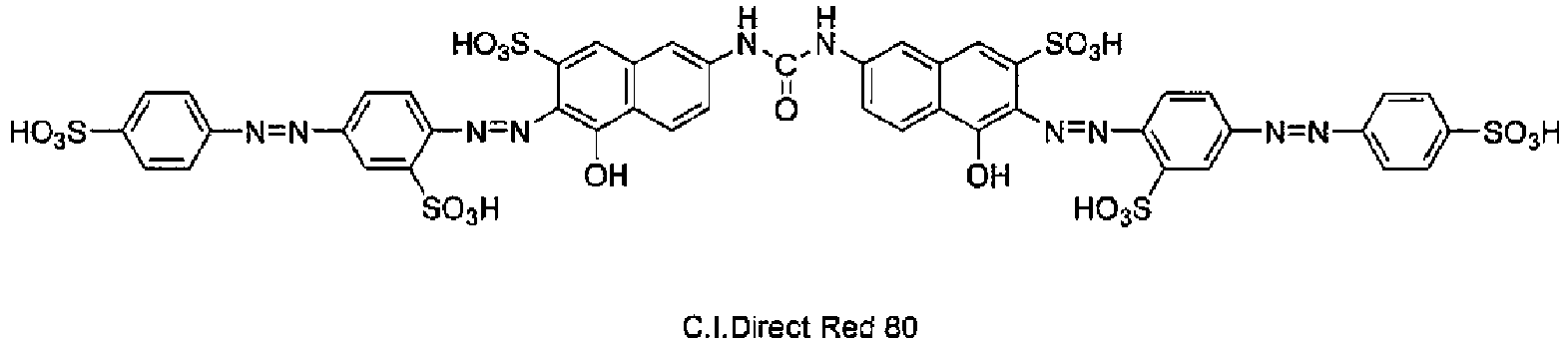
- A polarizer not containing the compound A of the present invention, as well as a polarizing plate using the same were produced in the same manner as in Example 3 except that the azo compound corresponding to Compound Example 1-5 having the structure of Formula (1) was replaced with an azo compound corresponding to C.I. Direct Red 84 having the ureide skeleton in the production of the polarizer in Example 3, and this polarizing plate was used as a measurement sample of Comparative Example 5. It is noted that C.I. Direct Red 84 is an azo compound having the following structural Formula:

- A polarizer not containing the compound A of the present invention, as well as a polarizing plate using the same were produced in the same manner as in Example 29 except that the azo compound corresponding to Compound Example 1-5 having the structure of Formula (1) was replaced with the azo compound corresponding to C.I. Direct Red 80 having the ureide skeleton in the production of the polarizer in Example 29, and this polarizing plate was used as a measurement sample of Comparative Example 6.
- A polarizer not containing the compound A of the present invention, as well as a polarizing plate using the same were produced in the same manner as in Example 29 except that the azo compound corresponding to Compound Example 1-5 having the structure of Formula (1) was replaced with the azo compound corresponding to C.I. Direct Red 84 having the ureide skeleton in the production of the polarizer in Example 29, and this polarizing plate was used as a measurement sample of Comparative Example 7.
- A polarizer not containing the compound A of the present invention, as well as a polarizing plate using the same were produced in the same manner as in Example 50 except that the azo compound corresponding to Compound Example 1-5 having the structure of Formula (1) was replaced with the azo compound corresponding to C.I. Direct Red 80 having the ureide skeleton in the production of the polarizer in Example 50, and this polarizing plate was used as a measurement sample of Comparative Example 8.
- A polarizer not containing the compound A of the present invention, as well as a polarizing plate using the same were produced in the same manner as in Example 50 except that the azo compound corresponding to Compound Example 1-5 having the structure of Formula (1) was replaced with the azo compound corresponding to C.I. Direct Red 84 having the ureide skeleton in the production of the polarizer in Example 50, and this polarizing plate was used as a measurement sample of Comparative Example 9.
- A polarizer not containing the compound A of the present invention, as well as a polarizing plate using the same were produced in the same manner as in Example 72 except that the azo compound corresponding to Compound Example 1-5 having the structure of Formula (1) was replaced with the azo compound corresponding to C.I. Direct Red 80 having the ureide skeleton in the production of the polarizer in Example 72, and this polarizing plate was used as a measurement sample of Comparative Example 10.
- A polarizer not containing the compound A of the present invention, as well as a polarizing plate using the same were produced in the same manner as in Example 72 except that the azo compound corresponding to Compound Example 1-5 having the structure of Formula (1) was replaced with the azo compound corresponding to C.I. Direct Red 84 having the ureide skeleton in the production of the polarizer in Example 72, and this polarizing plate was used as a measurement sample of Comparative Example 11.
- A polarizer not containing the compound B of the present invention, as well as a polarizing plate using the same were produced in the same manner as in Example 3 except that 1.1 parts by mass of the azo compound corresponding to Compound Example 2-6 having the structure of Formula (2-1) was replaced with 0.82 parts by mass of an azo compound described in Example 1 of Japanese Patent Publication No.
64-5623 
- A polarizer not containing the compound B of the present invention, as well as a polarizing plate using the same were produced in the same manner as in Example 3 except that 1.1 parts by mass the azo compound corresponding to Compound Example 2-6 having the structure of Formula (2-1) was replaced with 1.1 parts by mass of an azo compound represented by Formula (17) described in International Publication No.
WO2012/108169 , which is similarly a tetrakis-azo compound and has the following structural Formula, and this polarizing plate was used as a measurement sample of Comparative Example 13.
- An iodine-based polarizer containing iodine instead of the compound A and the compound B of the present invention, as well as a polarizing plate using the same were produced in the same manner as in Example 1 except that an iodine-containing dye aqueous solution (a dye aqueous solution containing iodine, potassium iodide and ammonium iodide) described in Comparative Example 3 of Japanese Laid-Open Patent Publication No.
2006-276236 - The measurement samples obtained in Examples 1 to 89 and Comparative Examples 1 to 14 were evaluated as follows.
- The single transmittance Ts, the parallel transmittance Tp and the cross transmittance Tc of each measurement sample were measured using a spectrophotometer ("U-4100" manufactured by Hitachi, Ltd.). Here, the single transmittance Ts refers to transmittance at each wavelength measured using a single measurement sample. The parallel transmittance Tp refers to spectral transmittance at each wavelength measured with two measurement samples stacked with their absorption axes aligned in parallel to each other. The cross transmittance Tc refers to spectral transmittance measured with two measurement samples stacked with their absorption axes aligned to orthogonally cross each other. The measurement of each transmittance was performed in a wavelength region of 400 to 700 nm.
- Luminous efficiency-corrected single transmittance Ys, luminous efficiency-corrected parallel transmittance Yp and luminous efficiency-corrected cross transmittance Yc refer to transmittance obtained by respectively correcting the single transmittance Ts, the parallel transmittance Tp and the cross transmittance Tc, which were obtained in the wavelength region of 400 to 700 nm at a prescribed wavelength interval dλ (herein, at intervals of 5 nm), based on the luminous efficiency in accordance with JIS Z 8722:2009. Specifically, they were calculated by substituting the single transmittance Ts, the parallel transmittance Tp and the cross transmittance Tc respectively in the following equations. In the following equations, Pλ represents a spectral distribution of standard light (illuminant C), and yλ represents a 2-degree visual field color matching function.


- The degree of polarization ρy of each measurement sample was obtained. The degree of polarization ρy was calculated by substituting the luminous efficiency-corrected parallel transmittance Yp and the luminous efficiency cross transmittance Yc in the following equation.

- A contrast CR was checked by calculating a ratio (Yp/Yc) between the luminous efficiency-corrected parallel transmittance Yp and the luminous efficiency-corrected cross transmittance Yc measured using two measurement samples of the same type.
- Table 5 below shows results of the polarization performance of the respective measurement samples of Example 1 to 26 and Comparative Examples 1 to 5 and 12 to 14.
[Table 5] Ys (%) Yp (%) Yc (%) ρ (%) CR Example 1 40.76 33.16 0.0675 99.80 491 Example 2 40.89 33.39 0.0461 99.86 724 Example 3 40.98 33.56 0.0279 99.92 1202 Example 4 40.98 33.56 0.0253 99.92 1327 Example 5 41.11 33.78 0.0240 99.93 1407 Example 6 41.13 33.80 0.0352 99.90 960 Example 7 41.24 33.99 0.0221 99.94 1538 Example 8 40.91 33.46 0.0087 99.97 3846 Example 9 41.25 34.02 0.0156 99.95 2180 Example 10 40.85 33.28 0.0905 99.73 368 Example 11 40.93 33.48 0.0222 99.93 1508 Example 12 40.96 33.53 0.0210 99.94 1597 Example 13 41.09 33.72 0.0464 99.86 726 Example 14 41.02 33.54 0.1107 99.67 303 Example 15 40.80 33.19 0.0983 99.70 338 Example 16 41.17 33.89 0.0091 99.97 3724 Example 17 41.05 33.69 0.0071 99.98 4746 Example 18 41.02 33.65 0.0033 99.99 10197 Example 19 41.18 33.87 0.0414 99.88 818 Example 20 40.95 33.51 0.0241 99.93 1391 Example 21 40.86 33.35 0.0360 99.89 927 Example 22 41.04 33.66 0.0291 99.91 1157 Example 23 41.13 33.80 0.0289 99.91 1170 Example 24 40.36 32.54 0.0391 99.88 832 Example 25 41.14 33.82 0.0293 99.91 1154 Example 26 41.13 33.78 0.0518 99.85 652 Comparative Example 1 40.28 31.02 1.4320 95.49 22 Comparative Example 2 41.32 33.16 0.9892 97.06 34 Comparative Example 3 41.31 33.40 0.7264 97.85 46 Comparative Example 4 40.79 31.17 2.1050 93.46 15 Comparative Example 5 40.88 30.28 3.1451 90.10 10 Comparative Example 12 40.72 30.74 2.4240 92.40 13 Comparative Example 13 40.95 32.76 0.7820 97.64 42 Comparative Example 14 41.43 34.33 0.0012 100.00 28606 - As is understood from Table 5, in comparison between Examples 1 to 26 and Comparative Examples 1 to 5,12 and 13, each polarizing plate of the present invention containing both the azo compound represented by Formula (1) as the compound A and the azo compound represented by Formula (2-I) or Formula (2-II) as the compound B has a higher degree of polarization and remarkably improved contrast as compared with the dye-based polarizing plates of Comparative Examples 1 to 5 not containing the compound A and the dye-based polarizing plates of Comparative Examples 12 and 13 not containing the compound B. Accordingly, when both the azo compound represented by Formula (1) and the azo compound represented by Formula (2-I) or (2-II) are used as the dichroic dyes, a polarizing plate excellent in the polarization performance, particularly a polarizing plate having a high degree of polarization and high contrast can be obtained.
- Table 6 below shows results of the polarization performance of the measurement samples of Examples 27 to 47 and Comparative Examples 6 and 7. The results of Comparative Examples 1 to 3 and 12 to 14 are the same as those shown in Table 5.
[Table 6] Ys (%) Yp (%) Yc (%) ρ (%) CR Example 27 41.08 33.65 0.1008 99.70 334 Example 28 41.02 33.58 0.0730 99.78 460 Example 29 40.89 33.40 0.0409 99.88 817 Example 30 40.76 33.19 0.0360 99.89 921 Example 31 40.85 33.34 0.0373 99.89 893 Example 32 40.96 33.49 0.0613 99.82 547 Example 33 40.83 33.31 0.0351 99.89 949 Example 34 41.06 33.70 0.0157 99.95 2147 Example 35 40.97 33.55 0.0234 99.93 1434 Example 36 40.93 33.37 0.1358 99.59 246 Example 37 40.97 33.54 0.0312 99.91 1077 Example 38 41.05 33.67 0.0355 99.89 948 Example 39 41.31 34.06 0.0717 99.79 475 Example 40 41.15 33.70 0.1691 99.50 199 Example 41 41.07 33.71 0.0297 99.91 1137 Example 42 40.90 33.43 0.0267 99.92 1254 Example 43 41.19 33.86 0.0741 99.78 457 Example 44 40.86 33.31 0.0758 99.77 440 Example 45 41.05 33.70 0.0050 99.99 6807 Example 46 41.06 33.67 0.0453 99.87 744 Example 47 40.95 33.47 0.0677 99.80 494 Comparative Example 6 41.09 23.53 10.2354 62.75 2 Comparative Example 7 40.75 24.77 8.4391 70.13 3 - As is understood from Table 6, in comparison between Examples 27 to 47 and Comparative Examples 6 and 7, each polarizing plate of the present invention containing both the azo compound represented by Formula (1) as the compound A and the azo compound represented by Formula (3) as the compound B has a higher degree of polarization and remarkably improved contrast as compared with the dye-based polarizing plates of Comparative Examples 6 and 7 not containing the compound A. Besides, since the polarization performance of the measurement samples of Comparative Examples 1 to 3 not containing the compound A and Comparative Examples 12 and 13 not containing the compound B is the same as that shown in Table 5, each polarizing plate of the present invention of Examples 27 to 47 also has a higher degree of polarization and remarkably improved contrast as compared with the dye-based polarizing plates of Comparative Examples 1 to 3, 12 and 13. Accordingly, when both the azo compound represented by Formula (1) and the azo compound represented by Formula (3) are used as the dichroic dyes, a polarizing plate excellent in the polarization performance, particularly a polarizing plate having a high degree of polarization and high contrast can be obtained.
- Table 7 below shows the results of polarization performance of the respective measurement samples of Examples 48 to 69 and Comparative Examples 8 and 9. The results of Comparative Examples 1 to 3 and 12 to 14 are the same as those shown in Table 5.
[Table 7] Ys (%) Yp (%) Yc (%) ρ (%) CR Example 48 40.89 33.31 0.1250 99.63 267 Example 49 40.92 33.37 0.1184 99.65 282 Example 50 41.21 33.93 0.0401 99.88 846 Example 51 41.03 33.64 0.0325 99.90 1035 Example 52 41.01 33.59 0.0423 99.87 794 Example 53 40.90 33.39 0.0707 99.79 472 Example 54 40.97 33.52 0.0541 99.84 620 Example 55 41.22 33.96 0.0204 99.94 1665 Example 56 40.82 33.29 0.0309 99.91 1077 Example 57 41.24 33.92 0.0902 99.73 376 Example 58 40.97 33.54 0.0297 99.91 1129 Example 59 41.05 33.67 0.0366 99.89 920 Example 60 41.07 33.67 0.0674 99.80 500 Example 61 41.11 33.75 0.0502 99.85 672 Example 62 41.07 33.71 0.0297 99.91 1137 Example 63 40.88 33.40 0.0251 99.92 1331 Example 64 41.15 33.84 0.0229 99.93 1478 Example 65 40.92 33.48 0.0114 99.97 2937 Example 66 41.10 33.77 0.0185 99.95 1825 Example 67 41.06 33.69 0.0263 99.92 1281 Example 68 41.08 33.70 0.0507 99.85 665 Example 69 40.98 33.50 0.0893 99.73 375 Comparative Example 8 41.03 31.15 2.5190 92.22 12 Comparative Example 9 40.91 30.32 3.1551 90.08 10 - As is understood from Table 7, in comparison between Examples 48 to 69 and Comparative Examples 8 and 9, each polarizing plate of the present invention containing both the azo compound represented by Formula (1) as the compound A and the azo compound represented by Formula (4-1) or (4-II) as the compound B has a higher degree of polarization and remarkably improved contrast as compared with the dye-based polarizing plates of Comparative Examples 8 and 9 not containing the compound A. Besides, since the polarization performance of the measurement samples of Comparative Examples 1 to 3 not containing the compound A and Comparative Examples 12 and 13 not containing the compound B is the same as that shown in Table 5, each polarizing plate of the present invention of Examples 48 to 69 also has a higher degree of polarization and remarkably improved contrast as compared with the dye-based polarizing plates to Comparative Examples 1 to 3, 12 and 13. Accordingly, when both the azo compound represented by Formula (1) and the azo compound represented by Formula (4-I) or (4-II) are used as the dichroic dyes, a polarizing plate excellent in the polarization performance, particularly a polarizing plate having a high degree of polarization and high contrast can be obtained.
- Table 8 shows the results of the polarization performance of the respective measurement samples of Examples 70 to 89 and Comparative Examples 10 and 11. The results of Comparative Examples 1 to 13 and 12 to 14 are the same as those shown in Table 5.
[Table 8] Ys (%) Yp (%) Yc (%) ρ (%) CR Example 70 40.96 33.34 0.2154 99.36 155 Example 71 40.97 33.42 0.1542 99.54 217 Example 72 41.06 33.67 0.0512 99.85 658 Example 73 40.92 33.43 0.0568 99.83 589 Example 74 41.12 33.76 0.0533 99.84 633 Example 75 40.90 33.38 0.0812 99.76 411 Example 76 40.88 33.38 0.0447 99.87 747 Example 77 40.94 33.49 0.0321 99.90 1043 Example 78 41.01 33.60 0.0392 99.88 857 Example 79 41.09 33.68 0.0917 99.73 367 Example 80 41.12 33.76 0.0555 99.84 608 Example 81 40.91 33.43 0.0391 99.88 855 Example 82 40.83 33.28 0.0586 99.82 568 Example 83 40.86 33.35 0.0415 99.88 804 Example 84 40.84 33.31 0.0458 99.86 727 Example 85 41.13 33.80 0.0292 99.91 1158 Example 86 40.95 33.51 0.0246 99.93 1362 Example 87 41.05 33.68 0.0215 99.94 1567 Example 88 41.11 33.75 0.0509 99.85 663 Example 89 41.20 33.86 0.0893 99.74 379 Comparative Example 10 41.09 23.94 9.8230 64.67 2 Comparative Example 11 40.75 29.96 3.2510 89.68 9 - As is understood from Table 8, in comparison between Examples 70 to 89 and Comparative Examples 10 and 11, each polarizing plate of the present invention containing both the azo compound represented by Formula (1) as the compound A and the azo compound represented by Formula (5-1) or (5-II) as the compound B has a higher degree of polarization and remarkably improved contrast as compared with the dye-based polarizing plates of Comparative Examples 10 and 11 not containing the compound A. Besides, since the polarization performance of the measurement samples of Comparative Examples 1 to 3 not containing the compound A and Comparative Examples 12 and 13 not containing the compound B is the same as that shown in Table 5, each polarizing plate of the present invention of Examples 70 to 89 also has a higher degree of polarization and remarkably improved contrast as compared with the dye-based polarizing plates to Comparative Examples 1 to 3,12 and 13. Accordingly, when both the azo compound represented by Formula (1) and the azo compound represented by Formula (5-I) or (5-II) are used as the dichroic dyes, a polarizing plate excellent in the polarization performance, particularly a polarizing plate having a high degree of polarization and high contrast can be obtained.
- Next, for performing a durability test of a polarizing plate of the present invention, each of the measurement samples of Examples 3, 18, 29, 50 and 72, Comparative Example 2 and Comparative Example 14 was applied under an environment of 85°C and relative humidity of 85%RH for 1000 hours. The results are shown in Table 9 below.
[Table 9] Initial After 1000 hrs. Ys (%) ρy (%) Ys (%) ρy (%) Example 3 40.98 99.92 39.58 99.99 Example 18 41.02 99.99 40.19 99.99 Example 29 40.89 99.88 40.71 99.92 Example 50 41.21 99.88 40.81 99.94 Example 72 41.06 99.85 40.75 99.97 Comparative Example 2 41.32 99.06 33.51 99.99 Comparative Example 14 41.46 99.99 78.23 7.22 - As is understood from Table 9, in comparison between Comparative Example 2 and Examples 3, 18, 29, 50 and 72, the luminous efficiency-corrected single transmittance Ys was lowered in the measurement sample of Comparative Example 2 but the luminous efficiency-corrected single transmittance Ys had substantially the same value as that obtained before the durability test in the measurement samples of Examples 3, 18, 29, 50 and 72. This reveals that the polarizing plate of the present invention is less deteriorated in the luminous efficiency-corrected single transmittance Ys through the durability test than the conventional dye-based polarizing plate, and hence has high durability. Besides, in comparison between Comparative Example 14 of the iodine-based polarizing plate and Examples 3, 18, 29, 50 and 72, a great lowering of the degree of polarization py was observed in the measurement sample of Comparative Example 14, but the lowering of the degree of polarization py was not observed at all in the measurement samples of Example 3, 18, 29, 50 and 72. This reveals that the polarizing plate of the present invention is obviously improved in the durability as compared with the conventional iodine-based polarizing plate. Accordingly, the polarizer or the polarizing plate of the present invention has a high degree of polarization, high contrast and high durability, and when such a polarizer or polarizing plate of the present invention is used in a liquid crystal display device, a highly reliable and brighter liquid crystal display device having high contrast for a long period of time can be provided.
Claims (6)
- A polarizer containing, in a base thereof,
at least one of an azo compound represented by the following Formula (1) or a salt thereof (as compound A); and
at least one of an azo compound represented by the following Formula (2-1), (2-II), (3), (4-I), (4-II), (5-1) or (5-II), or a salt thereof (as compound B):the compound A: wherein An represents a phenyl group or a naphthyl group having at least one substituent of a sulfo group or a carboxy group; andRr1 to Rr4 each independently represent a hydrogen atom, a lower alkyl group, a lower alkoxy group or a lower alkoxy group having a sulfo group,the compound B:
 wherein Ab1 represents a phenyl group or a naphthyl group having at least one substituent of a sulfo group or a carboxy group;Rb1 to Rb5 each independently represent a hydrogen atom, a lower alkyl group, a lower alkoxy group or a lower alkoxy group having a sulfo group; andXb1 represents an amino group, a phenylamino group, a phenylazo group, a naphthotriazole group or a benzoylamino group optionally having at least one substituent selected from the group consisting of a lower alkyl group, a lower alkoxy group, a sulfo group, an amino group, a lower alkylamino group, a hydroxyl group, a carboxy group and a carboxyethyl amino group,
 wherein Ab2 represents a phenyl group or a naphthyl group having at least one substituent of a sulfo group or a carboxy group; andXb2 represents a phenylamino group, a phenylazo group, a naphthotriazole group or a benzoylamino group optionally having at least one substituent selected from the group consisting of a lower alkyl, a lower alkoxy group, a hydroxyl group, a carboxy group, a sulfo group, an amino group and a substituted amino group,
 wherein Ab3 represents a phenyl group or a naphthyl group having at least one substituent of a sulfo group or a carboxy group;Rb6 to Rb8 each independently represent a hydrogen atom, a lower alkyl group, a lower alkoxy group or a lower alkoxyl group having a sulfo group; andXb3 represents an amino group, a phenylamino group, a phenylazo group, a benzoyl group, a benzoylamino group or a naphthotriazole group optionally having at least one substituent selected from the group consisting of a lower alkyl, a lower alkoxy group, a hydroxyl group, a carboxy group, a sulfo group, an amino group, a substituted amino group and an aminonaphthyl group, and
 wherein Ag1 represents a nitro group or an amino group,Xg1 represents: an amino group optionally having at least one substituent selected from the group consisting of a lower alkyl group, a lower alkoxy group and a sulfo group;a benzoyl group or a benzoylamino group optionally having at least one substituent selected from the group consisting of a lower alkyl group, a lower alkoxy group, a sulfo group, an amino group and a substituted amino group;a phenylamino group optionally having at least one substituent selected from the group consisting of a lower alkyl group, a lower alkoxy group, a sulfo group, an amino group and a substituted amino group;a phenylazo group optionally having at least one substituent selected from the group consisting of a lower alkyl group, a lower alkoxy group, a sulfo group, a hydroxyl group, an amino group and a substituted amino group; ora naphthotriazole group optionally having at least one substituent selected from the group consisting of a lower alkyl group, a lower alkoxy group, a sulfo group, an amino group and a substituted amino group,Rg1 and Rg2 of Formula (5-I) each independently represent a hydrogen atom, a hydroxyl group, a lower alkyl group, a lower alkoxy group or a lower alkoxy group having a sulfo group, andRg2 of Formula (5-II) represents a hydrogen atom, a hydroxyl group, a lower alkyl group, a lower alkoxy group or a lower alkoxy group having a sulfo group.
 - The polarizer according to claim 1, wherein the compound represented by Formula (1) is represented by the following Formula (1'):

- The polarizer according to claim 1 or 2, further containing, in the base, at least one of an azo compound represented by the following Formula (6) or a salt thereof (as compound C):

p represents an integer of 1 to 3. - The polarizer according to any one of claims 1 to 3, wherein the base is a film made of a polyvinyl alcohol-based resin.
- A polarizing plate comprising a transparent protection layer on at least one surface of the polarizer according to any one of claims 1 to 4.
- A liquid crystal display device using the polarizer according to any one of claims 1 to 4 or the polarizing plate according to claim 5.
Applications Claiming Priority (5)
| Application Number | Priority Date | Filing Date | Title |
|---|---|---|---|
| JP2015102408 | 2015-05-20 | ||
| JP2015102407 | 2015-05-20 | ||
| JP2016027632 | 2016-02-17 | ||
| JP2016027633 | 2016-02-17 | ||
| PCT/JP2016/064941 WO2016186183A1 (en) | 2015-05-20 | 2016-05-19 | Dye-type polarizing element, and polarizing plate and liquid crystal display device using same |
Publications (3)
| Publication Number | Publication Date |
|---|---|
| EP3285099A1 true EP3285099A1 (en) | 2018-02-21 |
| EP3285099A4 EP3285099A4 (en) | 2018-09-19 |
| EP3285099B1 EP3285099B1 (en) | 2019-10-23 |
Family
ID=57320387
Family Applications (1)
| Application Number | Title | Priority Date | Filing Date |
|---|---|---|---|
| EP16796576.3A Active EP3285099B1 (en) | 2015-05-20 | 2016-05-19 | Dye-type polarizing element, and polarizing plate and liquid crystal display device using same |
Country Status (7)
| Country | Link |
|---|---|
| US (1) | US10007142B2 (en) |
| EP (1) | EP3285099B1 (en) |
| JP (1) | JP6054588B1 (en) |
| KR (1) | KR101887465B1 (en) |
| CN (1) | CN107003466B (en) |
| TW (1) | TWI600719B (en) |
| WO (1) | WO2016186183A1 (en) |
Families Citing this family (10)
| Publication number | Priority date | Publication date | Assignee | Title |
|---|---|---|---|---|
| KR20180107150A (en) * | 2016-02-04 | 2018-10-01 | 닛뽄 가야쿠 가부시키가이샤 | Polarizer and polarizer and display using same |
| JP6862365B2 (en) * | 2016-02-04 | 2021-04-21 | 日本化薬株式会社 | Azo compounds, polarizing elements and polarizing plates using them, and display devices |
| CN110249008B (en) * | 2017-03-31 | 2021-06-11 | 日本化药株式会社 | Azo compound or salt thereof, and dye-based polarizing film, dye-based polarizing plate, and liquid crystal display device each containing the same |
| WO2019117123A1 (en) * | 2017-12-13 | 2019-06-20 | 日本化薬株式会社 | Polarizing element for visible region and infrared region, and polarizing plate |
| CN111433290B (en) * | 2017-12-22 | 2022-06-14 | 日本化药株式会社 | Azo compound or salt thereof, and polarizing element, polarizing plate and display device each comprising the same |
| JP7448477B2 (en) * | 2018-09-05 | 2024-03-12 | 日本化薬株式会社 | Polarizing elements, polarizing plates and optical members using the same, etc. |
| JP7214412B2 (en) * | 2018-09-07 | 2023-01-30 | 日本化薬株式会社 | Display device using polarizing layer |
| US12624212B2 (en) * | 2022-03-15 | 2026-05-12 | The Hong Kong University Of Science And Technology | Bis-azo dyes for thin film polarizers and synthesis method |
| WO2025205667A1 (en) * | 2024-03-27 | 2025-10-02 | 日本化薬株式会社 | Dye-based polarizing film, and polarizing plate and display device using same |
| JP2026066542A (en) * | 2024-10-07 | 2026-04-17 | 日東電工株式会社 | Polarizing film, optical laminate, and organic EL display device |
Family Cites Families (44)
| Publication number | Priority date | Publication date | Assignee | Title |
|---|---|---|---|---|
| US2519651A (en) * | 1945-07-26 | 1950-08-22 | Ciba Ltd | Polyazo dyestuffs |
| US4162334A (en) | 1977-04-27 | 1979-07-24 | Alfred University Research Foundation Inc. | Method for baking in terra sigillata coated pan |
| DE3003644C2 (en) | 1980-02-01 | 1991-06-13 | C. Keller GmbH u. Co KG, 4530 Ibbenbüren | Device for forming a set layer from bricks |
| JPS60156759A (en) | 1984-01-25 | 1985-08-16 | Nippon Kayaku Co Ltd | Water-soluble disazo compound |
| US4736424A (en) | 1986-09-22 | 1988-04-05 | Rockwell International Corporation | Data scrambling apparatus |
| JPH078376B2 (en) | 1987-06-26 | 1995-02-01 | 株式会社神戸製鋼所 | Extrusion press shearing device |
| DE3919593A1 (en) | 1988-06-29 | 1990-01-04 | Minolta Camera Kk | IMAGING DEVICE USING A LASER BEAM |
| JP2683375B2 (en) | 1988-08-26 | 1997-11-26 | 日本鋼管株式会社 | DC arc furnace power control method |
| JP2622748B2 (en) | 1989-06-12 | 1997-06-18 | 日本化薬株式会社 | Water-soluble azo dye and polarizing film containing the same |
| CA2076560A1 (en) | 1991-08-29 | 1993-03-01 | Kazuya Ogino | Dye-containing polarizing film |
| JP2985408B2 (en) | 1991-08-29 | 1999-11-29 | 住友化学工業株式会社 | Dye-based polarizing film |
| DE69228591T2 (en) | 1991-12-26 | 1999-07-01 | Mitsui Chemicals, Inc., Tokio/Tokyo | Water-soluble azo dyes and polarizing films containing these dyes |
| JP3205096B2 (en) | 1991-12-26 | 2001-09-04 | 三井化学株式会社 | Water-soluble azo dye and polarizing film using the dye |
| JP3378296B2 (en) | 1993-05-28 | 2003-02-17 | 住友化学工業株式会社 | Dye-based polarizing film |
| SG74532A1 (en) | 1994-09-16 | 2000-08-22 | Sumitomo Chemical Co | Tetrakisazo compound and a polarizing film containing the same |
| JP3661238B2 (en) | 1994-09-16 | 2005-06-15 | 住友化学株式会社 | Tetrakisazo compounds and their use in polarizing films |
| JPH08240715A (en) * | 1995-03-03 | 1996-09-17 | Sumitomo Chem Co Ltd | Polarizing film manufacturing method |
| US5667719A (en) * | 1995-06-02 | 1997-09-16 | Hoechst Celanese Corp. | High extinction polarizer films comprising liquid crystal polymeric moieties |
| JPH10259311A (en) | 1997-03-19 | 1998-09-29 | Sumitomo Chem Co Ltd | Azo compound and dye-based polarizing film containing the same |
| JPH11218611A (en) | 1998-01-30 | 1999-08-10 | Nippon Kayaku Co Ltd | Dye system polarizing film |
| JP3769140B2 (en) * | 1998-03-20 | 2006-04-19 | 住友化学株式会社 | Polarized film |
| US6522468B2 (en) * | 1999-03-18 | 2003-02-18 | Sumitomo Chemical Company, Limited | Light-polarizing film |
| KR100730227B1 (en) | 1999-07-14 | 2007-06-19 | 니폰 가야꾸 가부시끼가이샤 | Dye Polarizer |
| JP4162334B2 (en) * | 1999-07-26 | 2008-10-08 | 日本化薬株式会社 | Dye-type polarizing film |
| JP4033443B2 (en) | 2002-01-22 | 2008-01-16 | 日本化薬株式会社 | Dye-type polarizing film and polarizing plate |
| JP4360100B2 (en) * | 2003-02-18 | 2009-11-11 | 住友化学株式会社 | Dye-type polarizing film |
| US20040218118A1 (en) | 2003-02-18 | 2004-11-04 | Sumitomo Chemical Company, Limited | Dye type polarizing film and dye type polarizer |
| US7304147B2 (en) | 2003-04-16 | 2007-12-04 | Nippon Kayaku Kabushiki Kaisha | Azo compound and salt thereof |
| CN100528967C (en) | 2004-02-04 | 2009-08-19 | 日本化药株式会社 | Azo compound and polarizing film and polarizing plate each containing the same |
| JP5204944B2 (en) * | 2004-06-07 | 2013-06-05 | 富士フイルム株式会社 | Black ink composition and ink jet recording method. |
| JP4736424B2 (en) | 2004-12-27 | 2011-07-27 | 住友化学株式会社 | Azo compound or salt thereof, and polarizing film containing the compound or salt thereof |
| JP2006276236A (en) | 2005-03-28 | 2006-10-12 | Nippon Kayaku Co Ltd | Polarizing element film or polarizing plate |
| KR100544327B1 (en) * | 2005-08-02 | 2006-01-23 | 신화오플라주식회사 | Dye-based circular polarizer for organic light emitting diode display |
| JP5017961B2 (en) | 2005-08-22 | 2012-09-05 | 住友化学株式会社 | Azo compound and polarizing film containing the compound |
| EP2022828B1 (en) | 2006-06-01 | 2011-03-02 | Nippon Kayaku Kabushiki Kaisha | Azo compound and salt thereof, and dye-containing polarizing film comprising the compound or salt |
| JP5225839B2 (en) | 2006-06-13 | 2013-07-03 | 日本化薬株式会社 | Azo compounds and dye-based polarizing films containing them |
| EP2045296A4 (en) | 2006-06-22 | 2009-08-26 | Nippon Kayaku Kk | Azo compound and dye polarizing film containing the same |
| JP2009132764A (en) | 2007-11-29 | 2009-06-18 | Fujifilm Corp | Cellulose derivative, cellulose derivative film, and use thereof |
| JP2009155364A (en) * | 2007-12-25 | 2009-07-16 | Sumitomo Chemical Co Ltd | Azo compound and polarizing film containing the azo compound |
| JP5366947B2 (en) | 2008-06-17 | 2013-12-11 | 日本化薬株式会社 | Azo compound and salt thereof, and dye-based polarizing film and polarizing plate containing them |
| TWI477562B (en) * | 2010-12-17 | 2015-03-21 | Nippon Kayaku Kk | Ink composition, ink jet recording method and chromosome |
| WO2012108173A1 (en) | 2011-02-07 | 2012-08-16 | 日本化薬株式会社 | Azo compound, salt thereof, and dye-based polarizing film and polarizing plate containing same |
| JP5899122B2 (en) | 2011-02-07 | 2016-04-06 | 日本化薬株式会社 | Azo compound, dye-based polarizing film and polarizing plate |
| EP2990842A4 (en) * | 2013-04-03 | 2016-11-23 | Nippon Kayaku Kk | Achromatic dye-based polarization element, and polarization plate |
-
2016
- 2016-05-19 EP EP16796576.3A patent/EP3285099B1/en active Active
- 2016-05-19 WO PCT/JP2016/064941 patent/WO2016186183A1/en not_active Ceased
- 2016-05-19 CN CN201680004043.4A patent/CN107003466B/en active Active
- 2016-05-19 KR KR1020177028065A patent/KR101887465B1/en active Active
- 2016-05-19 JP JP2016555382A patent/JP6054588B1/en active Active
- 2016-05-20 TW TW105115801A patent/TWI600719B/en active
-
2017
- 2017-11-16 US US15/814,802 patent/US10007142B2/en not_active Expired - Fee Related
Also Published As
| Publication number | Publication date |
|---|---|
| KR101887465B1 (en) | 2018-08-10 |
| EP3285099B1 (en) | 2019-10-23 |
| WO2016186183A1 (en) | 2016-11-24 |
| KR20170122825A (en) | 2017-11-06 |
| TW201710406A (en) | 2017-03-16 |
| US20180074371A1 (en) | 2018-03-15 |
| CN107003466B (en) | 2018-12-14 |
| CN107003466A (en) | 2017-08-01 |
| TWI600719B (en) | 2017-10-01 |
| EP3285099A4 (en) | 2018-09-19 |
| US10007142B2 (en) | 2018-06-26 |
| JPWO2016186183A1 (en) | 2017-06-08 |
| JP6054588B1 (en) | 2016-12-27 |
Similar Documents
| Publication | Publication Date | Title |
|---|---|---|
| US10007142B2 (en) | Dye-based polarizer as well as polarizing plate and liquid crystal display device using the polarizer | |
| JP7509851B2 (en) | Azo compound or its salt, and polarizing element, polarizing plate, and display device containing the same | |
| JP7230079B2 (en) | AZO COMPOUND OR SALT THEREOF AND POLARIZING FILM CONTAINING THE SAME | |
| CN109690369B (en) | Polarizing element, and polarizing plate and liquid crystal display device using the same | |
| CN105190378A (en) | Achromatic dye-based highly-transmissive polarization element, and polarization plate | |
| TWI776000B (en) | Achromatic polarizing element, and achromatic polarizing plate and display using the same | |
| CN111448494B (en) | Polarizing element and polarizing plate for visible light region and infrared region | |
| TW201621357A (en) | Polarizing element, polarizing plate having said polarizing element, and liquid crystal display device having said polarizing element or said polarizing plate | |
| JP7681588B2 (en) | Polarizing element and polarizing plate for visible and infrared regions, and liquid crystal display device including the same | |
| TW202231792A (en) | Polarizing element, polarizing plate and display device including the same | |
| WO2020230647A1 (en) | Achromatic polarizer, achromatic polarizing plate using same, and display device | |
| HK1237039A1 (en) | Dye-type polarizing element, and polarizing plate and liquid crystal display device using same | |
| JP2024031583A (en) | Polarizing film, polarizing plate and display device using the same | |
| HK40001432A (en) | Polarizing element, polarizing plate using same and liquid crystal display device |
Legal Events
| Date | Code | Title | Description |
|---|---|---|---|
| STAA | Information on the status of an ep patent application or granted ep patent |
Free format text: STATUS: THE INTERNATIONAL PUBLICATION HAS BEEN MADE |
|
| PUAI | Public reference made under article 153(3) epc to a published international application that has entered the european phase |
Free format text: ORIGINAL CODE: 0009012 |
|
| STAA | Information on the status of an ep patent application or granted ep patent |
Free format text: STATUS: REQUEST FOR EXAMINATION WAS MADE |
|
| 17P | Request for examination filed |
Effective date: 20171115 |
|
| AK | Designated contracting states |
Kind code of ref document: A1 Designated state(s): AL AT BE BG CH CY CZ DE DK EE ES FI FR GB GR HR HU IE IS IT LI LT LU LV MC MK MT NL NO PL PT RO RS SE SI SK SM TR |
|
| AX | Request for extension of the european patent |
Extension state: BA ME |
|
| DAV | Request for validation of the european patent (deleted) | ||
| DAX | Request for extension of the european patent (deleted) | ||
| A4 | Supplementary search report drawn up and despatched |
Effective date: 20180817 |
|
| RIC1 | Information provided on ipc code assigned before grant |
Ipc: G02B 5/30 20060101AFI20180810BHEP Ipc: G02F 1/1335 20060101ALI20180810BHEP Ipc: C09B 31/30 20060101ALI20180810BHEP Ipc: C09B 67/22 20060101ALI20180810BHEP Ipc: C09B 43/124 20060101ALI20180810BHEP |
|
| GRAP | Despatch of communication of intention to grant a patent |
Free format text: ORIGINAL CODE: EPIDOSNIGR1 |
|
| STAA | Information on the status of an ep patent application or granted ep patent |
Free format text: STATUS: GRANT OF PATENT IS INTENDED |
|
| INTG | Intention to grant announced |
Effective date: 20190515 |
|
| GRAS | Grant fee paid |
Free format text: ORIGINAL CODE: EPIDOSNIGR3 |
|
| GRAA | (expected) grant |
Free format text: ORIGINAL CODE: 0009210 |
|
| STAA | Information on the status of an ep patent application or granted ep patent |
Free format text: STATUS: THE PATENT HAS BEEN GRANTED |
|
| AK | Designated contracting states |
Kind code of ref document: B1 Designated state(s): AL AT BE BG CH CY CZ DE DK EE ES FI FR GB GR HR HU IE IS IT LI LT LU LV MC MK MT NL NO PL PT RO RS SE SI SK SM TR |
|
| REG | Reference to a national code |
Ref country code: GB Ref legal event code: FG4D |
|
| REG | Reference to a national code |
Ref country code: CH Ref legal event code: EP |
|
| REG | Reference to a national code |
Ref country code: IE Ref legal event code: FG4D |
|
| REG | Reference to a national code |
Ref country code: DE Ref legal event code: R096 Ref document number: 602016023053 Country of ref document: DE |
|
| REG | Reference to a national code |
Ref country code: AT Ref legal event code: REF Ref document number: 1194295 Country of ref document: AT Kind code of ref document: T Effective date: 20191115 |
|
| REG | Reference to a national code |
Ref country code: NL Ref legal event code: MP Effective date: 20191023 |
|
| REG | Reference to a national code |
Ref country code: LT Ref legal event code: MG4D |
|
| PG25 | Lapsed in a contracting state [announced via postgrant information from national office to epo] |
Ref country code: PT Free format text: LAPSE BECAUSE OF FAILURE TO SUBMIT A TRANSLATION OF THE DESCRIPTION OR TO PAY THE FEE WITHIN THE PRESCRIBED TIME-LIMIT Effective date: 20200224 Ref country code: NL Free format text: LAPSE BECAUSE OF FAILURE TO SUBMIT A TRANSLATION OF THE DESCRIPTION OR TO PAY THE FEE WITHIN THE PRESCRIBED TIME-LIMIT Effective date: 20191023 Ref country code: PL Free format text: LAPSE BECAUSE OF FAILURE TO SUBMIT A TRANSLATION OF THE DESCRIPTION OR TO PAY THE FEE WITHIN THE PRESCRIBED TIME-LIMIT Effective date: 20191023 Ref country code: GR Free format text: LAPSE BECAUSE OF FAILURE TO SUBMIT A TRANSLATION OF THE DESCRIPTION OR TO PAY THE FEE WITHIN THE PRESCRIBED TIME-LIMIT Effective date: 20200124 Ref country code: LT Free format text: LAPSE BECAUSE OF FAILURE TO SUBMIT A TRANSLATION OF THE DESCRIPTION OR TO PAY THE FEE WITHIN THE PRESCRIBED TIME-LIMIT Effective date: 20191023 Ref country code: FI Free format text: LAPSE BECAUSE OF FAILURE TO SUBMIT A TRANSLATION OF THE DESCRIPTION OR TO PAY THE FEE WITHIN THE PRESCRIBED TIME-LIMIT Effective date: 20191023 Ref country code: BG Free format text: LAPSE BECAUSE OF FAILURE TO SUBMIT A TRANSLATION OF THE DESCRIPTION OR TO PAY THE FEE WITHIN THE PRESCRIBED TIME-LIMIT Effective date: 20200123 Ref country code: LV Free format text: LAPSE BECAUSE OF FAILURE TO SUBMIT A TRANSLATION OF THE DESCRIPTION OR TO PAY THE FEE WITHIN THE PRESCRIBED TIME-LIMIT Effective date: 20191023 Ref country code: SE Free format text: LAPSE BECAUSE OF FAILURE TO SUBMIT A TRANSLATION OF THE DESCRIPTION OR TO PAY THE FEE WITHIN THE PRESCRIBED TIME-LIMIT Effective date: 20191023 Ref country code: NO Free format text: LAPSE BECAUSE OF FAILURE TO SUBMIT A TRANSLATION OF THE DESCRIPTION OR TO PAY THE FEE WITHIN THE PRESCRIBED TIME-LIMIT Effective date: 20200123 |
|
| PG25 | Lapsed in a contracting state [announced via postgrant information from national office to epo] |
Ref country code: RS Free format text: LAPSE BECAUSE OF FAILURE TO SUBMIT A TRANSLATION OF THE DESCRIPTION OR TO PAY THE FEE WITHIN THE PRESCRIBED TIME-LIMIT Effective date: 20191023 Ref country code: IS Free format text: LAPSE BECAUSE OF FAILURE TO SUBMIT A TRANSLATION OF THE DESCRIPTION OR TO PAY THE FEE WITHIN THE PRESCRIBED TIME-LIMIT Effective date: 20200224 Ref country code: HR Free format text: LAPSE BECAUSE OF FAILURE TO SUBMIT A TRANSLATION OF THE DESCRIPTION OR TO PAY THE FEE WITHIN THE PRESCRIBED TIME-LIMIT Effective date: 20191023 |
|
| PG25 | Lapsed in a contracting state [announced via postgrant information from national office to epo] |
Ref country code: AL Free format text: LAPSE BECAUSE OF FAILURE TO SUBMIT A TRANSLATION OF THE DESCRIPTION OR TO PAY THE FEE WITHIN THE PRESCRIBED TIME-LIMIT Effective date: 20191023 |
|
| REG | Reference to a national code |
Ref country code: DE Ref legal event code: R097 Ref document number: 602016023053 Country of ref document: DE |
|
| PG2D | Information on lapse in contracting state deleted |
Ref country code: IS |
|
| PG25 | Lapsed in a contracting state [announced via postgrant information from national office to epo] |
Ref country code: EE Free format text: LAPSE BECAUSE OF FAILURE TO SUBMIT A TRANSLATION OF THE DESCRIPTION OR TO PAY THE FEE WITHIN THE PRESCRIBED TIME-LIMIT Effective date: 20191023 Ref country code: ES Free format text: LAPSE BECAUSE OF FAILURE TO SUBMIT A TRANSLATION OF THE DESCRIPTION OR TO PAY THE FEE WITHIN THE PRESCRIBED TIME-LIMIT Effective date: 20191023 Ref country code: RO Free format text: LAPSE BECAUSE OF FAILURE TO SUBMIT A TRANSLATION OF THE DESCRIPTION OR TO PAY THE FEE WITHIN THE PRESCRIBED TIME-LIMIT Effective date: 20191023 Ref country code: CZ Free format text: LAPSE BECAUSE OF FAILURE TO SUBMIT A TRANSLATION OF THE DESCRIPTION OR TO PAY THE FEE WITHIN THE PRESCRIBED TIME-LIMIT Effective date: 20191023 Ref country code: DK Free format text: LAPSE BECAUSE OF FAILURE TO SUBMIT A TRANSLATION OF THE DESCRIPTION OR TO PAY THE FEE WITHIN THE PRESCRIBED TIME-LIMIT Effective date: 20191023 Ref country code: IS Free format text: LAPSE BECAUSE OF FAILURE TO SUBMIT A TRANSLATION OF THE DESCRIPTION OR TO PAY THE FEE WITHIN THE PRESCRIBED TIME-LIMIT Effective date: 20200223 |
|
| PGFP | Annual fee paid to national office [announced via postgrant information from national office to epo] |
Ref country code: DE Payment date: 20200506 Year of fee payment: 5 |
|
| REG | Reference to a national code |
Ref country code: AT Ref legal event code: MK05 Ref document number: 1194295 Country of ref document: AT Kind code of ref document: T Effective date: 20191023 |
|
| PLBE | No opposition filed within time limit |
Free format text: ORIGINAL CODE: 0009261 |
|
| STAA | Information on the status of an ep patent application or granted ep patent |
Free format text: STATUS: NO OPPOSITION FILED WITHIN TIME LIMIT |
|
| PG25 | Lapsed in a contracting state [announced via postgrant information from national office to epo] |
Ref country code: SK Free format text: LAPSE BECAUSE OF FAILURE TO SUBMIT A TRANSLATION OF THE DESCRIPTION OR TO PAY THE FEE WITHIN THE PRESCRIBED TIME-LIMIT Effective date: 20191023 Ref country code: IT Free format text: LAPSE BECAUSE OF FAILURE TO SUBMIT A TRANSLATION OF THE DESCRIPTION OR TO PAY THE FEE WITHIN THE PRESCRIBED TIME-LIMIT Effective date: 20191023 Ref country code: SM Free format text: LAPSE BECAUSE OF FAILURE TO SUBMIT A TRANSLATION OF THE DESCRIPTION OR TO PAY THE FEE WITHIN THE PRESCRIBED TIME-LIMIT Effective date: 20191023 |
|
| 26N | No opposition filed |
Effective date: 20200724 |
|
| PG25 | Lapsed in a contracting state [announced via postgrant information from national office to epo] |
Ref country code: SI Free format text: LAPSE BECAUSE OF FAILURE TO SUBMIT A TRANSLATION OF THE DESCRIPTION OR TO PAY THE FEE WITHIN THE PRESCRIBED TIME-LIMIT Effective date: 20191023 Ref country code: AT Free format text: LAPSE BECAUSE OF FAILURE TO SUBMIT A TRANSLATION OF THE DESCRIPTION OR TO PAY THE FEE WITHIN THE PRESCRIBED TIME-LIMIT Effective date: 20191023 |
|
| PG25 | Lapsed in a contracting state [announced via postgrant information from national office to epo] |
Ref country code: MC Free format text: LAPSE BECAUSE OF FAILURE TO SUBMIT A TRANSLATION OF THE DESCRIPTION OR TO PAY THE FEE WITHIN THE PRESCRIBED TIME-LIMIT Effective date: 20191023 Ref country code: LI Free format text: LAPSE BECAUSE OF NON-PAYMENT OF DUE FEES Effective date: 20200531 Ref country code: CH Free format text: LAPSE BECAUSE OF NON-PAYMENT OF DUE FEES Effective date: 20200531 |
|
| REG | Reference to a national code |
Ref country code: BE Ref legal event code: MM Effective date: 20200531 |
|
| GBPC | Gb: european patent ceased through non-payment of renewal fee |
Effective date: 20200519 |
|
| PG25 | Lapsed in a contracting state [announced via postgrant information from national office to epo] |
Ref country code: LU Free format text: LAPSE BECAUSE OF NON-PAYMENT OF DUE FEES Effective date: 20200519 |
|
| PG25 | Lapsed in a contracting state [announced via postgrant information from national office to epo] |
Ref country code: IE Free format text: LAPSE BECAUSE OF NON-PAYMENT OF DUE FEES Effective date: 20200519 Ref country code: GB Free format text: LAPSE BECAUSE OF NON-PAYMENT OF DUE FEES Effective date: 20200519 Ref country code: FR Free format text: LAPSE BECAUSE OF NON-PAYMENT OF DUE FEES Effective date: 20200531 |
|
| PG25 | Lapsed in a contracting state [announced via postgrant information from national office to epo] |
Ref country code: BE Free format text: LAPSE BECAUSE OF NON-PAYMENT OF DUE FEES Effective date: 20200531 |
|
| REG | Reference to a national code |
Ref country code: DE Ref legal event code: R119 Ref document number: 602016023053 Country of ref document: DE |
|
| PG25 | Lapsed in a contracting state [announced via postgrant information from national office to epo] |
Ref country code: DE Free format text: LAPSE BECAUSE OF NON-PAYMENT OF DUE FEES Effective date: 20211201 |
|
| PG25 | Lapsed in a contracting state [announced via postgrant information from national office to epo] |
Ref country code: TR Free format text: LAPSE BECAUSE OF FAILURE TO SUBMIT A TRANSLATION OF THE DESCRIPTION OR TO PAY THE FEE WITHIN THE PRESCRIBED TIME-LIMIT Effective date: 20191023 Ref country code: MT Free format text: LAPSE BECAUSE OF FAILURE TO SUBMIT A TRANSLATION OF THE DESCRIPTION OR TO PAY THE FEE WITHIN THE PRESCRIBED TIME-LIMIT Effective date: 20191023 Ref country code: CY Free format text: LAPSE BECAUSE OF FAILURE TO SUBMIT A TRANSLATION OF THE DESCRIPTION OR TO PAY THE FEE WITHIN THE PRESCRIBED TIME-LIMIT Effective date: 20191023 |
|
| PG25 | Lapsed in a contracting state [announced via postgrant information from national office to epo] |
Ref country code: MK Free format text: LAPSE BECAUSE OF FAILURE TO SUBMIT A TRANSLATION OF THE DESCRIPTION OR TO PAY THE FEE WITHIN THE PRESCRIBED TIME-LIMIT Effective date: 20191023 |