EP3283136B2 - Revêtements hydrophiles et leurs procédés de formation - Google Patents
Revêtements hydrophiles et leurs procédés de formation Download PDFInfo
- Publication number
- EP3283136B2 EP3283136B2 EP16719632.8A EP16719632A EP3283136B2 EP 3283136 B2 EP3283136 B2 EP 3283136B2 EP 16719632 A EP16719632 A EP 16719632A EP 3283136 B2 EP3283136 B2 EP 3283136B2
- Authority
- EP
- European Patent Office
- Prior art keywords
- catheters
- base coat
- hydrophilic
- top coat
- sterilized
- Prior art date
- Legal status (The legal status is an assumption and is not a legal conclusion. Google has not performed a legal analysis and makes no representation as to the accuracy of the status listed.)
- Active
Links
Images



Classifications
-
- A—HUMAN NECESSITIES
- A61—MEDICAL OR VETERINARY SCIENCE; HYGIENE
- A61L—METHODS OR APPARATUS FOR STERILISING MATERIALS OR OBJECTS IN GENERAL; DISINFECTION, STERILISATION OR DEODORISATION OF AIR; CHEMICAL ASPECTS OF BANDAGES, DRESSINGS, ABSORBENT PADS OR SURGICAL ARTICLES; MATERIALS FOR BANDAGES, DRESSINGS, ABSORBENT PADS OR SURGICAL ARTICLES
- A61L27/00—Materials for grafts or prostheses or for coating grafts or prostheses
- A61L27/28—Materials for coating prostheses
- A61L27/34—Macromolecular materials
-
- A—HUMAN NECESSITIES
- A61—MEDICAL OR VETERINARY SCIENCE; HYGIENE
- A61L—METHODS OR APPARATUS FOR STERILISING MATERIALS OR OBJECTS IN GENERAL; DISINFECTION, STERILISATION OR DEODORISATION OF AIR; CHEMICAL ASPECTS OF BANDAGES, DRESSINGS, ABSORBENT PADS OR SURGICAL ARTICLES; MATERIALS FOR BANDAGES, DRESSINGS, ABSORBENT PADS OR SURGICAL ARTICLES
- A61L29/00—Materials for catheters, medical tubing, cannulae, or endoscopes or for coating catheters
- A61L29/08—Materials for coatings
- A61L29/085—Macromolecular materials
-
- C—CHEMISTRY; METALLURGY
- C08—ORGANIC MACROMOLECULAR COMPOUNDS; THEIR PREPARATION OR CHEMICAL WORKING-UP; COMPOSITIONS BASED THEREON
- C08J—WORKING-UP; GENERAL PROCESSES OF COMPOUNDING; AFTER-TREATMENT NOT COVERED BY SUBCLASSES C08B, C08C, C08F, C08G or C08H
- C08J7/00—Chemical treatment or coating of shaped articles made of macromolecular substances
- C08J7/04—Coating
- C08J7/042—Coating with two or more layers, where at least one layer of a composition contains a polymer binder
-
- C—CHEMISTRY; METALLURGY
- C08—ORGANIC MACROMOLECULAR COMPOUNDS; THEIR PREPARATION OR CHEMICAL WORKING-UP; COMPOSITIONS BASED THEREON
- C08J—WORKING-UP; GENERAL PROCESSES OF COMPOUNDING; AFTER-TREATMENT NOT COVERED BY SUBCLASSES C08B, C08C, C08F, C08G or C08H
- C08J7/00—Chemical treatment or coating of shaped articles made of macromolecular substances
- C08J7/04—Coating
- C08J7/056—Forming hydrophilic coatings
-
- C—CHEMISTRY; METALLURGY
- C08—ORGANIC MACROMOLECULAR COMPOUNDS; THEIR PREPARATION OR CHEMICAL WORKING-UP; COMPOSITIONS BASED THEREON
- C08L—COMPOSITIONS OF MACROMOLECULAR COMPOUNDS
- C08L39/00—Compositions of homopolymers or copolymers of compounds having one or more unsaturated aliphatic radicals, each having only one carbon-to-carbon double bond, and at least one being terminated by a single or double bond to nitrogen or by a heterocyclic ring containing nitrogen; Compositions of derivatives of such polymers
- C08L39/04—Homopolymers or copolymers of monomers containing heterocyclic rings having nitrogen as ring member
- C08L39/06—Homopolymers or copolymers of N-vinyl-pyrrolidones
-
- C—CHEMISTRY; METALLURGY
- C08—ORGANIC MACROMOLECULAR COMPOUNDS; THEIR PREPARATION OR CHEMICAL WORKING-UP; COMPOSITIONS BASED THEREON
- C08L—COMPOSITIONS OF MACROMOLECULAR COMPOUNDS
- C08L71/00—Compositions of polyethers obtained by reactions forming an ether link in the main chain; Compositions of derivatives of such polymers
- C08L71/02—Polyalkylene oxides
-
- C—CHEMISTRY; METALLURGY
- C09—DYES; PAINTS; POLISHES; NATURAL RESINS; ADHESIVES; COMPOSITIONS NOT OTHERWISE PROVIDED FOR; APPLICATIONS OF MATERIALS NOT OTHERWISE PROVIDED FOR
- C09D—COATING COMPOSITIONS, e.g. PAINTS, VARNISHES OR LACQUERS; FILLING PASTES; CHEMICAL PAINT OR INK REMOVERS; INKS; CORRECTING FLUIDS; WOODSTAINS; PASTES OR SOLIDS FOR COLOURING OR PRINTING; USE OF MATERIALS THEREFOR
- C09D171/00—Coating compositions based on polyethers obtained by reactions forming an ether link in the main chain; Coating compositions based on derivatives of such polymers
- C09D171/02—Polyalkylene oxides
-
- C—CHEMISTRY; METALLURGY
- C09—DYES; PAINTS; POLISHES; NATURAL RESINS; ADHESIVES; COMPOSITIONS NOT OTHERWISE PROVIDED FOR; APPLICATIONS OF MATERIALS NOT OTHERWISE PROVIDED FOR
- C09D—COATING COMPOSITIONS, e.g. PAINTS, VARNISHES OR LACQUERS; FILLING PASTES; CHEMICAL PAINT OR INK REMOVERS; INKS; CORRECTING FLUIDS; WOODSTAINS; PASTES OR SOLIDS FOR COLOURING OR PRINTING; USE OF MATERIALS THEREFOR
- C09D4/00—Coating compositions, e.g. paints, varnishes or lacquers, based on organic non-macromolecular compounds having at least one polymerisable carbon-to-carbon unsaturated bond ; Coating compositions, based on monomers of macromolecular compounds of groups C09D183/00 - C09D183/16
- C09D4/06—Organic non-macromolecular compounds having at least one polymerisable carbon-to-carbon unsaturated bond in combination with a macromolecular compound other than an unsaturated polymer of groups C09D159/00 - C09D187/00
-
- C—CHEMISTRY; METALLURGY
- C10—PETROLEUM, GAS OR COKE INDUSTRIES; TECHNICAL GASES CONTAINING CARBON MONOXIDE; FUELS; LUBRICANTS; PEAT
- C10M—LUBRICATING COMPOSITIONS; USE OF CHEMICAL SUBSTANCES EITHER ALONE OR AS LUBRICATING INGREDIENTS IN A LUBRICATING COMPOSITION
- C10M107/00—Lubricating compositions characterised by the base-material being a macromolecular compound
- C10M107/20—Lubricating compositions characterised by the base-material being a macromolecular compound containing oxygen
- C10M107/22—Macromolecular compounds obtained by reactions only involving carbon-to-carbon unsaturated bonds
-
- C—CHEMISTRY; METALLURGY
- C10—PETROLEUM, GAS OR COKE INDUSTRIES; TECHNICAL GASES CONTAINING CARBON MONOXIDE; FUELS; LUBRICANTS; PEAT
- C10M—LUBRICATING COMPOSITIONS; USE OF CHEMICAL SUBSTANCES EITHER ALONE OR AS LUBRICATING INGREDIENTS IN A LUBRICATING COMPOSITION
- C10M169/00—Lubricating compositions characterised by containing as components a mixture of at least two types of ingredient selected from base-materials, thickeners or additives, covered by the preceding groups, each of these compounds being essential
- C10M169/04—Mixtures of base-materials and additives
- C10M169/041—Mixtures of base-materials and additives the additives being macromolecular compounds only
-
- A—HUMAN NECESSITIES
- A61—MEDICAL OR VETERINARY SCIENCE; HYGIENE
- A61L—METHODS OR APPARATUS FOR STERILISING MATERIALS OR OBJECTS IN GENERAL; DISINFECTION, STERILISATION OR DEODORISATION OF AIR; CHEMICAL ASPECTS OF BANDAGES, DRESSINGS, ABSORBENT PADS OR SURGICAL ARTICLES; MATERIALS FOR BANDAGES, DRESSINGS, ABSORBENT PADS OR SURGICAL ARTICLES
- A61L2400/00—Materials characterised by their function or physical properties
- A61L2400/10—Materials for lubricating medical devices
-
- A—HUMAN NECESSITIES
- A61—MEDICAL OR VETERINARY SCIENCE; HYGIENE
- A61L—METHODS OR APPARATUS FOR STERILISING MATERIALS OR OBJECTS IN GENERAL; DISINFECTION, STERILISATION OR DEODORISATION OF AIR; CHEMICAL ASPECTS OF BANDAGES, DRESSINGS, ABSORBENT PADS OR SURGICAL ARTICLES; MATERIALS FOR BANDAGES, DRESSINGS, ABSORBENT PADS OR SURGICAL ARTICLES
- A61L2420/00—Materials or methods for coatings medical devices
- A61L2420/06—Coatings containing a mixture of two or more compounds
-
- A—HUMAN NECESSITIES
- A61—MEDICAL OR VETERINARY SCIENCE; HYGIENE
- A61L—METHODS OR APPARATUS FOR STERILISING MATERIALS OR OBJECTS IN GENERAL; DISINFECTION, STERILISATION OR DEODORISATION OF AIR; CHEMICAL ASPECTS OF BANDAGES, DRESSINGS, ABSORBENT PADS OR SURGICAL ARTICLES; MATERIALS FOR BANDAGES, DRESSINGS, ABSORBENT PADS OR SURGICAL ARTICLES
- A61L2420/00—Materials or methods for coatings medical devices
- A61L2420/08—Coatings comprising two or more layers
-
- C—CHEMISTRY; METALLURGY
- C08—ORGANIC MACROMOLECULAR COMPOUNDS; THEIR PREPARATION OR CHEMICAL WORKING-UP; COMPOSITIONS BASED THEREON
- C08J—WORKING-UP; GENERAL PROCESSES OF COMPOUNDING; AFTER-TREATMENT NOT COVERED BY SUBCLASSES C08B, C08C, C08F, C08G or C08H
- C08J2327/00—Characterised by the use of homopolymers or copolymers of compounds having one or more unsaturated aliphatic radicals, each having only one carbon-to-carbon double bond, and at least one being terminated by a halogen; Derivatives of such polymers
- C08J2327/02—Characterised by the use of homopolymers or copolymers of compounds having one or more unsaturated aliphatic radicals, each having only one carbon-to-carbon double bond, and at least one being terminated by a halogen; Derivatives of such polymers not modified by chemical after-treatment
- C08J2327/04—Characterised by the use of homopolymers or copolymers of compounds having one or more unsaturated aliphatic radicals, each having only one carbon-to-carbon double bond, and at least one being terminated by a halogen; Derivatives of such polymers not modified by chemical after-treatment containing chlorine atoms
- C08J2327/06—Homopolymers or copolymers of vinyl chloride
-
- C—CHEMISTRY; METALLURGY
- C08—ORGANIC MACROMOLECULAR COMPOUNDS; THEIR PREPARATION OR CHEMICAL WORKING-UP; COMPOSITIONS BASED THEREON
- C08J—WORKING-UP; GENERAL PROCESSES OF COMPOUNDING; AFTER-TREATMENT NOT COVERED BY SUBCLASSES C08B, C08C, C08F, C08G or C08H
- C08J2375/00—Characterised by the use of polyureas or polyurethanes; Derivatives of such polymers
- C08J2375/04—Polyurethanes
-
- C—CHEMISTRY; METALLURGY
- C08—ORGANIC MACROMOLECULAR COMPOUNDS; THEIR PREPARATION OR CHEMICAL WORKING-UP; COMPOSITIONS BASED THEREON
- C08J—WORKING-UP; GENERAL PROCESSES OF COMPOUNDING; AFTER-TREATMENT NOT COVERED BY SUBCLASSES C08B, C08C, C08F, C08G or C08H
- C08J2401/00—Characterised by the use of cellulose, modified cellulose or cellulose derivatives
- C08J2401/02—Cellulose; Modified cellulose
-
- C—CHEMISTRY; METALLURGY
- C08—ORGANIC MACROMOLECULAR COMPOUNDS; THEIR PREPARATION OR CHEMICAL WORKING-UP; COMPOSITIONS BASED THEREON
- C08J—WORKING-UP; GENERAL PROCESSES OF COMPOUNDING; AFTER-TREATMENT NOT COVERED BY SUBCLASSES C08B, C08C, C08F, C08G or C08H
- C08J2439/00—Characterised by the use of homopolymers or copolymers of compounds having one or more unsaturated aliphatic radicals, each having only one carbon-to-carbon double bond, and at least one being terminated by a single or double bond to nitrogen or by a heterocyclic ring containing nitrogen; Derivatives of such polymers
- C08J2439/04—Homopolymers or copolymers of monomers containing heterocyclic rings having nitrogen as ring member
- C08J2439/06—Homopolymers or copolymers of N-vinyl-pyrrolidones
-
- C—CHEMISTRY; METALLURGY
- C08—ORGANIC MACROMOLECULAR COMPOUNDS; THEIR PREPARATION OR CHEMICAL WORKING-UP; COMPOSITIONS BASED THEREON
- C08J—WORKING-UP; GENERAL PROCESSES OF COMPOUNDING; AFTER-TREATMENT NOT COVERED BY SUBCLASSES C08B, C08C, C08F, C08G or C08H
- C08J2471/00—Characterised by the use of polyethers obtained by reactions forming an ether link in the main chain; Derivatives of such polymers
- C08J2471/02—Polyalkylene oxides
-
- C—CHEMISTRY; METALLURGY
- C08—ORGANIC MACROMOLECULAR COMPOUNDS; THEIR PREPARATION OR CHEMICAL WORKING-UP; COMPOSITIONS BASED THEREON
- C08L—COMPOSITIONS OF MACROMOLECULAR COMPOUNDS
- C08L2203/00—Applications
- C08L2203/02—Applications for biomedical use
-
- C—CHEMISTRY; METALLURGY
- C10—PETROLEUM, GAS OR COKE INDUSTRIES; TECHNICAL GASES CONTAINING CARBON MONOXIDE; FUELS; LUBRICANTS; PEAT
- C10M—LUBRICATING COMPOSITIONS; USE OF CHEMICAL SUBSTANCES EITHER ALONE OR AS LUBRICATING INGREDIENTS IN A LUBRICATING COMPOSITION
- C10M2201/00—Inorganic compounds or elements as ingredients in lubricant compositions
- C10M2201/02—Water
-
- C—CHEMISTRY; METALLURGY
- C10—PETROLEUM, GAS OR COKE INDUSTRIES; TECHNICAL GASES CONTAINING CARBON MONOXIDE; FUELS; LUBRICANTS; PEAT
- C10M—LUBRICATING COMPOSITIONS; USE OF CHEMICAL SUBSTANCES EITHER ALONE OR AS LUBRICATING INGREDIENTS IN A LUBRICATING COMPOSITION
- C10M2207/00—Organic non-macromolecular hydrocarbon compounds containing hydrogen, carbon and oxygen as ingredients in lubricant compositions
- C10M2207/02—Hydroxy compounds
- C10M2207/021—Hydroxy compounds having hydroxy groups bound to acyclic or cycloaliphatic carbon atoms
-
- C—CHEMISTRY; METALLURGY
- C10—PETROLEUM, GAS OR COKE INDUSTRIES; TECHNICAL GASES CONTAINING CARBON MONOXIDE; FUELS; LUBRICANTS; PEAT
- C10M—LUBRICATING COMPOSITIONS; USE OF CHEMICAL SUBSTANCES EITHER ALONE OR AS LUBRICATING INGREDIENTS IN A LUBRICATING COMPOSITION
- C10M2207/00—Organic non-macromolecular hydrocarbon compounds containing hydrogen, carbon and oxygen as ingredients in lubricant compositions
- C10M2207/02—Hydroxy compounds
- C10M2207/021—Hydroxy compounds having hydroxy groups bound to acyclic or cycloaliphatic carbon atoms
- C10M2207/022—Hydroxy compounds having hydroxy groups bound to acyclic or cycloaliphatic carbon atoms containing at least two hydroxy groups
-
- C—CHEMISTRY; METALLURGY
- C10—PETROLEUM, GAS OR COKE INDUSTRIES; TECHNICAL GASES CONTAINING CARBON MONOXIDE; FUELS; LUBRICANTS; PEAT
- C10M—LUBRICATING COMPOSITIONS; USE OF CHEMICAL SUBSTANCES EITHER ALONE OR AS LUBRICATING INGREDIENTS IN A LUBRICATING COMPOSITION
- C10M2207/00—Organic non-macromolecular hydrocarbon compounds containing hydrogen, carbon and oxygen as ingredients in lubricant compositions
- C10M2207/02—Hydroxy compounds
- C10M2207/023—Hydroxy compounds having hydroxy groups bound to carbon atoms of six-membered aromatic rings
- C10M2207/026—Hydroxy compounds having hydroxy groups bound to carbon atoms of six-membered aromatic rings with tertiary alkyl groups
-
- C—CHEMISTRY; METALLURGY
- C10—PETROLEUM, GAS OR COKE INDUSTRIES; TECHNICAL GASES CONTAINING CARBON MONOXIDE; FUELS; LUBRICANTS; PEAT
- C10M—LUBRICATING COMPOSITIONS; USE OF CHEMICAL SUBSTANCES EITHER ALONE OR AS LUBRICATING INGREDIENTS IN A LUBRICATING COMPOSITION
- C10M2207/00—Organic non-macromolecular hydrocarbon compounds containing hydrogen, carbon and oxygen as ingredients in lubricant compositions
- C10M2207/08—Aldehydes; Ketones
-
- C—CHEMISTRY; METALLURGY
- C10—PETROLEUM, GAS OR COKE INDUSTRIES; TECHNICAL GASES CONTAINING CARBON MONOXIDE; FUELS; LUBRICANTS; PEAT
- C10M—LUBRICATING COMPOSITIONS; USE OF CHEMICAL SUBSTANCES EITHER ALONE OR AS LUBRICATING INGREDIENTS IN A LUBRICATING COMPOSITION
- C10M2209/00—Organic macromolecular compounds containing oxygen as ingredients in lubricant compositions
- C10M2209/10—Macromolecular compoundss obtained otherwise than by reactions only involving carbon-to-carbon unsaturated bonds
- C10M2209/103—Polyethers, i.e. containing di- or higher polyoxyalkylene groups
- C10M2209/104—Polyethers, i.e. containing di- or higher polyoxyalkylene groups of alkylene oxides containing two carbon atoms only
-
- C—CHEMISTRY; METALLURGY
- C10—PETROLEUM, GAS OR COKE INDUSTRIES; TECHNICAL GASES CONTAINING CARBON MONOXIDE; FUELS; LUBRICANTS; PEAT
- C10M—LUBRICATING COMPOSITIONS; USE OF CHEMICAL SUBSTANCES EITHER ALONE OR AS LUBRICATING INGREDIENTS IN A LUBRICATING COMPOSITION
- C10M2209/00—Organic macromolecular compounds containing oxygen as ingredients in lubricant compositions
- C10M2209/12—Polysaccharides, e.g. cellulose, biopolymers
-
- C—CHEMISTRY; METALLURGY
- C10—PETROLEUM, GAS OR COKE INDUSTRIES; TECHNICAL GASES CONTAINING CARBON MONOXIDE; FUELS; LUBRICANTS; PEAT
- C10M—LUBRICATING COMPOSITIONS; USE OF CHEMICAL SUBSTANCES EITHER ALONE OR AS LUBRICATING INGREDIENTS IN A LUBRICATING COMPOSITION
- C10M2217/00—Organic macromolecular compounds containing nitrogen as ingredients in lubricant compositions
- C10M2217/02—Macromolecular compounds obtained from nitrogen containing monomers by reactions only involving carbon-to-carbon unsaturated bonds
- C10M2217/024—Macromolecular compounds obtained from nitrogen containing monomers by reactions only involving carbon-to-carbon unsaturated bonds containing monomers having an unsaturated radical bound to an amido or imido group
-
- C—CHEMISTRY; METALLURGY
- C10—PETROLEUM, GAS OR COKE INDUSTRIES; TECHNICAL GASES CONTAINING CARBON MONOXIDE; FUELS; LUBRICANTS; PEAT
- C10N—INDEXING SCHEME ASSOCIATED WITH SUBCLASS C10M RELATING TO LUBRICATING COMPOSITIONS
- C10N2020/00—Specified physical or chemical properties or characteristics, i.e. function, of component of lubricating compositions
- C10N2020/01—Physico-chemical properties
- C10N2020/04—Molecular weight; Molecular weight distribution
-
- C—CHEMISTRY; METALLURGY
- C10—PETROLEUM, GAS OR COKE INDUSTRIES; TECHNICAL GASES CONTAINING CARBON MONOXIDE; FUELS; LUBRICANTS; PEAT
- C10N—INDEXING SCHEME ASSOCIATED WITH SUBCLASS C10M RELATING TO LUBRICATING COMPOSITIONS
- C10N2030/00—Specified physical or chemical properties which is improved by the additive characterising the lubricating composition, e.g. multifunctional additives
- C10N2030/06—Oiliness; Film-strength; Anti-wear; Resistance to extreme pressure
-
- C—CHEMISTRY; METALLURGY
- C10—PETROLEUM, GAS OR COKE INDUSTRIES; TECHNICAL GASES CONTAINING CARBON MONOXIDE; FUELS; LUBRICANTS; PEAT
- C10N—INDEXING SCHEME ASSOCIATED WITH SUBCLASS C10M RELATING TO LUBRICATING COMPOSITIONS
- C10N2040/00—Specified use or application for which the lubricating composition is intended
- C10N2040/50—Medical uses
-
- C—CHEMISTRY; METALLURGY
- C10—PETROLEUM, GAS OR COKE INDUSTRIES; TECHNICAL GASES CONTAINING CARBON MONOXIDE; FUELS; LUBRICANTS; PEAT
- C10N—INDEXING SCHEME ASSOCIATED WITH SUBCLASS C10M RELATING TO LUBRICATING COMPOSITIONS
- C10N2050/00—Form in which the lubricant is applied to the material being lubricated
- C10N2050/015—Dispersions of solid lubricants
- C10N2050/02—Dispersions of solid lubricants dissolved or suspended in a carrier which subsequently evaporates to leave a lubricant coating
-
- C—CHEMISTRY; METALLURGY
- C10—PETROLEUM, GAS OR COKE INDUSTRIES; TECHNICAL GASES CONTAINING CARBON MONOXIDE; FUELS; LUBRICANTS; PEAT
- C10N—INDEXING SCHEME ASSOCIATED WITH SUBCLASS C10M RELATING TO LUBRICATING COMPOSITIONS
- C10N2050/00—Form in which the lubricant is applied to the material being lubricated
- C10N2050/023—Multi-layer lubricant coatings
Definitions
- the present disclosure generally relates to hydrophilic coatings that include a hydrophilic polymer and a low molecular weight diacrylate. More particularly, the present disclosure relates to hydrophilic coatings that include a base coat layer and a top coat layer and to methods for forming such hydrophilic coatings. Furthermore, the present disclosure relates to medical devices, and in particular tubular medical devices, having hydrophilic coatings applied thereto and a method for providing such medical devices.
- Such medical devices may include, for example, urinary catheters, endoscopes, cardiovascular catheters, syringes, vascular stents, etc.
- Such medical devices may have a lubricant gel placed on the outer surface of the device or may have a hydrophilic coating or layer disposed on the outer surface of the device.
- Hydrophilic coatings are becoming the preferred method of providing a lubricious surface because of their high lubricity and ease of use. Hydrophilic coatings become slippery or lubricous when wetted with a wetting fluid, such as saline or water. The wetted lubricous hydrophilic coating eases insertion and removal of the device, minimizes soft tissue damage and reduces overall discomfort during use of the medical device.
- the hydrophilic coating is typically wetted for a certain period of time prior to use to activate the hydrophilic coating. For example, the user may immerse or otherwise contact the hydrophilic coating with a wetting fluid to wet or activate the coating.
- the medical device is packaged in a packaging that includes liquid or vapor water within the package that hydrates the coating while the device is in the package so that the device is ready to use right out of the package.
- Hydrophilic coatings are oftentimes applied to the surfaces of medical devices by a dip coating process that includes dipping the medical device into a base coat composition which typically includes a solvent, one or more polymers and additives and/or agents.
- the base coat composition is then cured to form a base coat layer.
- the medical device is then dipped into a top coat composition to apply the top coat composition over the base coat layer.
- the top coat composition oftentimes includes a solvent, one or more hydrophilic polymers, and other polymers, additives and/or agents.
- the top coat composition is then cured to form the hydrophilic coating, which becomes lubricious when wetted.
- the scope of this invention is defined by the claims. Any "embodiment” or “example” which is disclosed in the description but is not covered by the claims should be considered as presented for illustrative purpose only.
- the present disclosure provides formulations of base coat and top coat compositions that are particularly useful for forming hydrophilic coatings on surfaces of medical devices and in particular, urinary catheters.
- the present disclosure also discloses hydrophilic coatings that are formed from such top coat composition and/or base coat compositions.
- the base coat composition and the top coat composition that form the hydrophilic coating of the present disclosure include polyethylene glycol diacrylate (PEGDA) and a hydrophilic polymer.
- PEGDA polyethylene glycol diacrylate
- the base coat composition may also include other components, such as a curing agent and solvent.
- the top coat composition may also, optionally, include other components such as a curing agent, antioxidant, plasticizer, solvent and/or polyelectrolyte.
- a medical device comprising a urinary catheter: a hydrophilic coating disposed on a surface of the medical device, the hydrophilic coating formed from a blend comprising a hydrophilic polymer and polyethylene glycol diacrylate having a number average molecular weight of less than about 1000, and wherein the hydrophilic coating comprises about 80 wt% to about 99.5 wt% hydrophilic polymer and about 0.5 wt% to about 20 wt% polyethylene glycol diacrylate; wherein the hydrophilic polymer comprises polyvinylpyrrolidone, wherein the polyethylene glycol diacrylate is phase separated from the hydrophilic polymer, said hydrophilic coating comprising a phase separated morphology comprising a continuous phase of polyvinylpyrrolidone and a discontinuous phase of polyethylene glycol diacrylate.
- the hydrophilic coating disposed on a surface of the medical device may include a base coat layer disposed on the surface of the medical device and a top coat layer disposed on the base coat layer wherein the top coat layer is formed from a blend comprising a hydrophilic polymer comprising polyvinylpyrrolidone and polyethylene glycol diacrylate having a number average molecular weight of less than about 1000, and wherein the hydrophilic coating comprises about 80 wt% to about 99.5wt% hydrophilic polymer and about 0.5 wt% to about 20 wt% polyethylene glycol diacrylate.
- a method of forming a hydrophilic coating on a surface of a medical device comprising a urinary catheter includes applying a base coat composition to the surface of the medical device and curing the base coat composition to form a base coat layer.
- a top coat composition is applied to the base coat layer.
- the top coat composition includes a hydrophilic polymer and polyethylene diacrylate having a number average molecular weight of less than 1000.
- the top coat composition is then cured to form a top coat layer.
- the hydrophilic coating comprises about 80 wt% to about 99.5 wt% hydrophilic polymer and about 0.5 wt% to about wt% polyethylene glycol diacrylate.
- the urinary catheter including a hydrophilic coating disposed on a surface of the urinary catheter as set out in the claims may include a base coat layer disposed on the surface of the medical device wherein the base coat layer is formed from a blend comprising a hydrophilic polymer and polyethylene glycol diacrylate having a number average molecular weight of less than about 1000.
- the present disclosure discloses hydrophilic coatings that become lubricious when wetted with water or other suitable wetting agents wherein the coatings include a low molecular weight diacrylate compound, such as a diacrylate oligomer, and a hydrophilic polymer.
- the diacrylate compound is polyethylene glycol diacrylate (PEGDA) as set out in the claims.
- PEGDA polyethylene glycol diacrylate
- the present disclosure also discloses base coat and top coat compositions that may be used to form such hydrophilic coatings.
- the base coat and top coat compositions may be solutions or dispersions that are applied to the surface of a substrate, and then cured and/or dried to form the base coat and top coat layers of the hydrophilic coating.
- compositions and coatings formed therefrom are described relative to urinary catheters, the compositions and coatings may be used to coat virtually any medical device for which it is desired to provide a lubricous hydrophilic coating on the surface thereof.
- the coatings and compositions are particularly useful for medical devices that are intended to be inserted into and removed from the body, such as urinary catheters, endoscopes, drainage catheters, etc.
- the base coat compositions and top coat compositions disclosed herein may be used with one another to form lubricious hydrophilic coatings on a substrate. While the base coat and top coat compositions may be used with each other to form hydrophilic coatings, such base coat and top coat compositions are not required to be used with each other.
- the top coat compositions disclosed herein may not only be used with the base coat compositions disclosed herein but may also be used with other base coat compositions to form a hydrophilic coating on the surface of a medical device comprising a urinary catheter. Furthermore, the top coat compositions may be applied directly to the surface of the substrate to form a hydrophilic coating on the substrate.
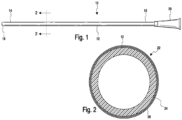
- a urinary catheter 10 having a catheter tube 12 including a proximal insertion end portion 14 and a distal drainage end portion 16.
- the proximal insertion end portion 14 includes an insertion tip 18 and the drainage end portion 16 optionally includes a drainage member, such as funnel 20.
- the insertion tip 18 also includes eyelets or drainage openings (not shown) for the passage of urine into the tube 12 when the insertion tip is inserted into the bladder.
- the catheter tube 12 includes a hydrophilic coating 22 disposed thereon from the insertion tip 18 to a location at or adjacent to the distal end portion 16.
- hydrophilic coating 22 includes a base coat or inner layer 24 disposed on the surface of catheter tube 12 and a top coat or outer layer 26 disposed on the base coat layer 24.
- the base coat layer 24 which covers the catheter tube 12 and serves as a tie or adhesive layer that adheres to both the surface of the catheter and the top coat layer 26.
- the top coat or outer layer 26 may be applied directly to the substrate without the use of a base coat layer.
- the base coat or inner layer 24 is formed from a blend including a hydrophilic polymer, and polyethylene glycol diacrylate having a number average molecular weight (Mn) of less than about 1000 or less than about 900, preferably less than 600, more preferably between about 200 and about 600, and even more preferably between about 400 and about 600.
- the base coat layer may be formed from a base coat composition that includes a hydrophilic polymer, and PEGDA oligomer dissolved or dispersed in a solvent.
- the PEGDA may have a Mn of less than about 1000 or less than about 900. In one embodiment, the PEGDA has Mn of less than about 600. In another embodiment, the PEGDA has Mn of between about 200 and about 600. In yet another embodiment, the PEGDA has a Mn of between about 400 and about 600.
- the hydrophilic polymer of the top coat comprises polyvinylpyrrolidone.
- Other hydrophilic polymers disclosed herein include polyethylene oxide, methyl cellulose, ethyl cellulose, polyethylene glycol, hydroxyl methylcellulose, hydroxypropyl cellulose, hydroxypropyl methylcellulose, carboxymethyl cellulose, polyvinyl alcohol, or mixtures thereof.
- the hydrophilic polymer is a polymer having a Mw above 500,000.
- PVP having a Mw of at least 500,000.
- the PVP may have a Mw of 1.3m as determined by light scattering.
- the base coat composition may also include a curing agent, such as a photoinitiator, which may be for example a type I photoinitiator, such as Irgacure 2959.
- a curing agent such as a photoinitiator, which may be for example a type I photoinitiator, such as Irgacure 2959.
- the base coat composition also includes a solvent, such as water, ethanol, methanol, isopropyl alcohol, propanol or mixtures thereof.
- the base coat composition may optionally include additives such as antioxidants or antimicrobials.
- the hydrophilic coating comprises about 80 wt% to about 99.5 wt% hydrophilic polymer and about 0.5 wt% to about 20 wt% polyethylene glycol diacrylate as set out in the claims.
- the solid components of the base coat composition in the dry state may include PEGDA in an amount of between about 5 wt% and about 90 wt% of the total solids and a hydrophilic polymer(s) in an amount of between about 10 wt% and about 95 wt% of the total solids.
- the base coat composition in the dry state may also include a curing agent in the amount of between about 0.1 wt% and about 5 wt% of the total solids.
- the solid components in the dry state may include PEGDA in an amount between about 15 wt% and about 25 wt% of the total solids and a hydrophilic polymer(s) in an amount between about 75 wt% and about 85 wt%.
- the composition may include PEGDA in an amount between about 0.1 wt% and about 5 wt% of the total composition, an amount hydrophilic polymer(s) of between about 0.5 wt% and about 10 wt%, an amount of solvent of between about 90 wt% and about 99 wt%, and an amount of curing agent of between about 0.01 wt% and about 1 wt%.
- the base coat composition may include: PEGDA 4.25 g PVP K90 0.75 g Irgacure 2959 0.2 g Ethanol 94.8 ml
- the base coat composition may include: PEGDA 4.25 g Ethyl Cellulose 10cP 0.75 g Irgacure 2959 0.2 g Ethanol 94.8 ml
- the base coat composition may include PEGDA 4.25 g PVP K90 0.50 g Ethyl Cellulose 10cP 0.25 g Irgacure 2959 0.2 g Ethanol 94.8 ml
- the base coat composition may include: PEGDA 4.25 g Ethyl Cellulose 10cP 0.50 g HPM Cellulose 0.25 g Irgacure 2959 0.2 g DI Water 20.0 ml Ethanol 74.8 ml
- the base coat layer may be formed on the surface of a medical device by applying the base coat composition to the surface and then curing and/or drying the base coat composition to form the base coat layer.
- the base coat compositions may be applied in any suitable manner, such as by dip coating or spraying.
- the base coat composition may be cured and dried by any suitable manner such as by exposure to UV light.
- the components of the base coat layer may be immiscible or partially immiscible.
- the PEGDA of the base coat layer comprises a discrete, continuous or bi-continuous phase within the coating layer.
- the base coat layer may include a phase separated morphology wherein the PEGDA forms one phase and the film forming polymer forms another phase. Referring to Fig. 11 , which discloses a two-phase morphology from the coating described below in Example 7, the PVP is in a continuous phase and PEGDA is in a discontinuous phase.
- top coat layer 28 is formed from a blend, such as a top coat composition, that may be applied over a base coat layer or is applied directly to the surface of the catheter tube 12 and then cured to form the top coat layer and the hydrophilic coating.
- a top coat composition such as a top coat composition
- the top coat composition includes a hydrophilic polymer comprising polyvinylpyrrolidone, and PEGDA having a number average molecular weight of less than about 1000. These components may be dissolved and/or dispersed in a solvent.
- the top coat composition may also, optionally, include one or more of curing agents, polyelectrolytes, humectants, plasticizers and/or antioxidants.
- the solvent may be any suitable solvent, such as ethanol, methanol, water, isopropyl alcohol or mixtures thereof.
- the PEGDA has a Mn of less than 1000, or less than 900 or less than 600, or between about 200 and about 600, or between about 400 and about 600.
- the polyelectrolytes When used in the top coat composition, the polyelectrolytes may be, for example, a copolymer with acrylic acid, preferably with acrylamide.
- the polyelectrolyte may be polyacrylic acid-co-acrylamide copolymer (PAAc), polyacrylamide-co-methacrylic acid, or polyacrylic acid.
- PAAc polyacrylic acid-co-acrylamide copolymer
- the polyelectrolyte composition may have less than 30% by weight of ionizable groups based on total weight of the copolymer.
- the humectants or plasticizing agents may be, for example, glycerol or polyethylene glycols or any suitable plasticizer that plasticizes or allows the coating to be more flexible.
- the curing agent may be a Norrish type I or preferably a Norrish type II photoinitiator, such as benzophenone.
- the antioxidant may be any suitable antioxidant, such as butyl hydroxytoluene-alcohol (BHT-alcohol).
- the hydrophilic coating comprises about 80 wt% to about 99.5 wt% hydrophilic polymer and about 0.5 wt% to about 20 wt% polyethylene glycol diacrylate as set out in the claims.
- the solid components of the top coat composition in the dry state may include PEGDA in an amount of between about 1 wt% and about 20 wt% of the total solids, a hydrophilic polymer(s) in an amount of between about 80 wt% and about 98 wt% wherein the hydrophilic polymer comprises PVP and a curing agent in an amount of about 0.05 wt% and about 0.5 wt%.
- the top coat composition in the dry state may also include an antioxidant in an amount of between about 0.05 wt% and about 0.5 wt% of the total solids, a plasticizer in an amount of between about 2 wt% and about 15 wt%, an polyelectrolyte in an amount of between about 1 wt% and about 10 wt%, and/or any other suitable additive.
- the solid components in the dry state may include PEGDA as set out in the claims in an amount between about 3 wt% and about 6 wt% of the total solids and a film forming polymer(s) in an amount between about 85 wt% and about 90 wt%, and optionally, an amount of antioxidant, plasticizer, polyelectrolyte and/or any other suitable additive up to 10 wt%.
- the top coat composition in the liquid state may include between about 2 wt% and about 10 wt% hydrophilic polymer, between about 0.1 wt% and about 0.6 wt% PEGDA, between about 0.005 wt% and about 0.1 wt% curing agent, and between about 89 wt% and about 97.5 wt% solvent.
- the top coat composition may, optionally, further include between about .005 wt% and about 0.1 wt% antioxidant, between about 0.1 wt% and about 1 wt% plasticizers and/or about 0.1 wt%, about 1 wt% polyelectrolyte and/or any other suitable additive.
- the top coat in the liquid state may include between 4 wt% and 7 wt% hydrophilic polymer, between 0.2 wt% and 0.4 wt% PEGDA between about 0.005 wt% and 0.015 wt% curing agent and about 90 wt% to 95 wt% solvent and optionally, an amount of antioxidant, plasticizer, polyelectrolyte and/or any other suitable additive.
- the top coat composition may be applied over the base coat layer or directly to the surface of the medical device in any suitable manner, such as by dip coating or spraying.
- the top coat composition may then be cured in any suitable manner to form the top coat layer and the hydrophilic coating.
- curing of the top coat composition may include curing by exposure to UV light.
- the dried and/or cured top coat layer formed from the composition includes about 80 wt% to about 95.5 wt% hydrophilic polymer and about 0.5 wt% to about 20 wt% PEGDA as set out in the claims.
- the top coat layer may optionally include about 1 wt% to about 10 wt% plasticizer and/or about 1 wt% to about 10 wt% polyelectrolyte.
- the top coat layer may include hydrophilic polymer in an amount between about 94 wt% to about 98 wt% hydrophilic polymer, PEGDA in an amount between about 2 wt% to about 6 wt% and, optionally, an amount of antioxidant, plasticizer, polyelectrolyte and/or any other suitable additive.
- the hydrophilic coating comprises a phase separated morphology comprising a continuous phase of polyvinylpyrrolidone and a discontinuous phase of polyethylene glycol diacrylate.
- the PEGDA may separate from the hydrophilic polymer phase during drying and curing.
- Fig. 9 shows a micrograph of the top coat formed from Example 6. As shown in the micrograph, separation of components during drying and curing is evident.
- the base coat composition when one is used, is applied to a surface of the urinary catheter, by for example, dip coating, spraying or any other suitable manner.
- the base coat is then cured and/or dried by, for example, UV lights or any other suitable manner.
- curing and drying the base coat composition results in a base coat layer having a multiple-phase morphology.
- the top coat composition is then applied over the base coat layer, when one is used, or applied directly to the surface of the urinary catheter by, for example, dip coating, spraying or any other suitable manner.
- the top coat composition is then cured and/or dried to form the top coat layer. Curing and/or drying can be done by, for example, exposure to UV light or any other suitable manner. Curing and/or drying of the top coat composition results in a top coat having phase separated components as set out in the claims.
- the urinary catheter When the coating is formed, the urinary catheter may be packaged in a dry or wet environment and optionally radiation sterilized by, for example, gamma or E-beam radiation.
- the urinary catheter When packaged in a dry environment, the urinary catheter, is placed and sealed in a package without adding any wetting fluid. If packaged and sterilized in a dry environment, a water burstable pouch may be included in the package. This water pouch may be burst after sterilization during manufacturing, or by the user just prior to use.
- the catheter If sterilized in a wet state, the catheter may be packaged with a wetting fluid in direct contact with the hydrophilic coating.
- the wetting fluid may optionally contain a hydrophilic polymer that protects the hydrophilic coating during radiation. Medical devices which have been coated with the hydrophilic coating disclosed herein may be packaged and radiation sterilized in a wet or dry environment.
- the lubricious hydrophilic coatings disclosed herein are coatings that become slippery when wetted with a wetting fluid, such as water.
- the coatings disclosed herein may a range of CoFs.
- the desired CoF or lubricity of a coating depends of the intended use of the device.
- the lubricious hydrophilic coating has a coefficient of friction of less than about 0.05 when measured by the procedure set forth in Example 1.
- the hydrophilic coatings may also have a CoF of less than 0.05 after being abraded or after drying-out for 10 minutes as described below in Example 1. Having a CoF of less than 0.05 may be desirable in the field of urinary catheterization. Higher CoF may still be suitable for use in catheterization, but lower CoFs are desirable for the comfort of the user. In other fields, however, a CoF greater than 0.05 may provide acceptable lubricity.
- the assembly is a ready-to-use catheter assembly that includes a packaged sterilized catheter wherein the catheter includes a hydrophilic coating and is packaged in a wet environment (liquid or vapor).
- the catheter also has a CoF of less than 0.05 immediately after it is removed from the package.
- All of the base coats disclosed herein may be used with all of the top coats disclosed herein to form a hydrophilic coating.
- the base coats, top coats and coating disclosed herein may be applied and used on a variety of substrates, including but not limited to, substrates at least partial formed from one or more of thermoplastic polyolefins, poly(vinyl chloride), thermoplastic elastomers, and thermoplastic polyurethanes.
- Hydrophilic coatings were formed on the outer surfaces of catheters made from polyvinyl chloride (PVC catheters).
- the catheters had a size of CH14 and a shore hardness of 82A.
- the hydrophilic coatings included a base coat layer formed on the outer surface of the catheter and a top coat layer formed over the base coat layer.
- the base coat composition was prepared as indicated below. The base coat composition was applied to the outer surface of each of the catheters and then cured and dried to form a base coat thereon.
- the base coat composition included the following components: Base Coat Component Amount Methanol 97.98% (w/w) Polyvinylpyrrolidone K90 (PVP) (Ashland) 1.61 % (w/w) Irgacure 2959 (BASF) 0.01 % (w/w) Polyethylene glycol diacrylate (PEG400DA) (SR344, Sartomer, inhibitor removed) 0.40% (w/w)
- the base coat composition was prepared by slowly adding the PVP to methanol while mixing until the PVP was dissolved. PEG400DA and Irgacure 2959 were then added and allowed to fully dissolve while the solution was stirred.
- top coat compositions also were prepared as indicated below, wherein each of the catheters had one of the four top coat compositions applied over the base coat layer.
- the top coat compositions were then cured and dried to form a hydrophilic coating on the outer surface of the catheter.
- the components of each of these top coat compositions were the same, except that each composition included a polyethylene glycol diacrylate of a different number average molecular weight (Mn).
- Each of the formulations of the four top coat compositions included one of the following PEGDAs: PEGDA Physical state PEGDA Mn250(Sigma Aldrich)) Low viscosity liquid PEGDA Mn700(Sigma Aldrich) Low viscosity liquid PEGDA Mn1000(Sigma Aldrich) Wax (will cold flow) PEGDA Mn6000(Sigma Aldrich) Heavy wax
- top coat compositions were prepared by adding PVP to the ethanol and water and mixing until dissolved.
- the remaining components glycerol, PEGDA, BHT-A and benzophenone
- the catheters were immersed in the base coat composition for a period of 10 seconds and then withdrawn at a rate of 0.7 cm/sec using a Harland PCX coating machine containing UV lamps.
- the base coat composition was then cured and dried under UV lamps for 45 seconds to form a base coat layer covering the outer surface of the catheter.
- the catheters were then immersed into one of the four top coat compositions for 10 seconds and withdrawn at a rate of 0.5 cm/sec.
- the top coat composition was then UV cured and dried under UV lamps for 10 minutes to form the top coat layer resulting in the formation of a hydrophilic coating on the catheter.
- each of the top coat formulations (1-1, 1-2, 1-3 and 1-4) were divided into two groups - those of which that were packaged and sterilized in a dry state ("dry sterilized") and those that were packaged and sterilized in a hydrated state (“wet sterilized”).
- the "dry sterilized” catheters were individually packaged and sealed in dry foil pouches (i.e., no water or wetting fluid added to the package). The "dry sterilized” catheters were then gamma sterilized in the package at 30-35 kGy. The "wet sterilized” catheters were immersed and force hydrated in water for 30 seconds and then individually packaged and sealed in a foil pack containing 8 mL of water in a gas permeable, liquid impermeable water reservoir. Once the catheter was placed inside of the foil pack, the foil pack was sealed. The liquid water remained in the gas permeable reservoir, such that the liquid water did not come into contact with the coating. The liquid water produced water vapor that formed a humid atmosphere in the package.
- Packages of this type are currently used for vapor hydrating catheters, such as in Hollister's VaPro ® vapor hydrated catheter products.
- the "wet sterilized" catheters were then gamma sterilized in the package at a dose of about 30-35 kGy.
- the initial, abraded and ten minute dry-out coefficients of friction (CoFs) of each of the catheters was measured with the hydrophilic coating in a hydrated state.
- CoFs dry-out coefficients of friction
- the CoF measurements are an indicator of lubricity and were measured using a Harland Friction Tester Model FTS5500.
- the CoFs of the catheters were determined by inserting a mandrel into 127 mm section of the coated catheter tube. The tube was then clamped between two pieces of silicone rubber at 100g load wherein the silicone rubber had a shore hardness of 60A. The catheter tube with the mandrel inserted therein was pulled through the two pieces of silicone rubber at a speed of 10 mm/s. The force required to pull about 80 mm of the catheter tube through the two pieces of silicone rubber was measured.
- the CoF value was calculated from the ratio of recorded to applied loads (i.e., the recorded load divided by the applied load) when steady state was reached.
- the CoF of each type of catheter was measured immediately after hydration for the "dry sterilized” catheters or after removal from the package for the "wet sterilized” catheters ("initial"), immediately after being abraded (“abraded”) and immediately after a ten-minute dry-out time (“dry-out”).
- the catheter In measuring the abraded CoFs, the catheter, with the hydrophilic coating in a hydrated state, was cycled back and forth 25 times through a hole in a 1 mm thick, silicone pad having a shore hardness of 60A. The hole was just smaller than the outer diameter of the catheter tube and the abrasion took place under water. Abrading the catheter in this fashion is designed to remove any portions of the coating that is not well adhered to the tubes. After abrasion, the CoF was measured as described above.
- the catheter In measuring the ten minute dry-out time CoF, the catheter, immediately after hydration for "dry sterilized” catheter or immediately after removal from the package for “wet sterilized” catheters, was placed in an atmosphere having a temperature of 23°C and a relative humidity of 50% for 10 minutes before measuring the CoF.
- Table 1 shows the average CoFs for the initial, abraded and dry-out tests for "dry sterilized” and "wet sterilized” catheters coated with top coats 1-1, 1-2, 1-3 and 1-4.
- Table 1 Dry Sterilized CoF Wet Sterilized CoF Top Coat Initial Avg. Abraded Avg. 10 Min Dry-out Avg. Initial Avg. Abraded Avg. 10 Min Dry-out Avg.
- Dye uptake tests were conducted on the catheters to assess the level of adhesion/non-adhesion between the hydrophilic coatings and catheters. After the CoFs of the abraded catheters were measured, the catheters were dried-out (dehydrate). The dried-out catheters were then immersed in a water soluble red dye for 2 minutes. The catheters were then visually inspected to determine if the dye had been uniformly taken up throughout the coating or if sections of the coated portion of the catheter were dye-free. A uniform dye uptake throughout the coated portion of the catheter indicates that the hydrophilic coating has good adhesion to the catheter. If the coated portion of the catheter has undyed sections, this is an indication that the hydrophilic coating or sections thereof have significantly thinned and/or separated from the catheter due to lack of adhesion to the catheter.
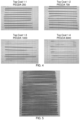
- Fig. 3 shows the results of dye test conducted on the abraded "dry sterilized” catheters having hydrophilic coatings formed from top coats 1-1, 1-2, 1-3 and 1-4
- Fig. 4 shows the results of dye tests conducted on the abraded "wet-sterilized” catheters having hydrophilic coatings formed from top coats 1-1, 1-2, 1-3, and 1-4.
- hydrophilic coatings were formed on the outer surfaces of PVC catheters having a size of CH14 and a shore hardness of 82A.
- the hydrophilic coatings were formed from a base coat layer and a top coat layer.
- the base coat composition was prepared as indicated below and was applied to each of the catheters to form a base coat layer on the outer surface of the catheter.
- the top coat composition was prepared as indicated below and applied over the base coat layer to form the hydrophilic coating on the catheter.
- the formulation of the base coat composition included the following components: Base Coat Component Amount (w/w) Methanol 97.98% (w/w) PVP K90 (Ashland) 1.61% (w/w) Irgacure 2959 (BASF) 0.01% (w/w) PEG400DA (SR344, Sartomer, inhibitor removed) 0.40% (w/w)
- the base coat composition was prepared by slowly adding PVP to methanol while mixing until the PVP was dissolved. PEG400DA and Irgacure 2959 were then added and allowed to fully dissolve while the composition was stirred.
- top Coat Component Amount (w/w) Ethanol (absolute) (Lennox) 78.99% (w/w) De-ionized water (Lennox) 14.00% (w/w) PVP K90 (Ashland) 5.95% (w/w) BHT-A (Sigma Aldrich) 0.01% (w/w) PEG400DA (SR344, Sartomer, inhibitor removed) 0.30% (w/w) Glycerol 0.74% (w/w) Benzophenone 0.01% (w/w)
- the top coat composition was prepared by adding PVP to the ethanol and water and mixing until dissolved. The remaining components (glycerol, PEG400DA, BHT-A, and benzophenone) were then added and allowed to fully dissolve under stirring.
- the catheters were immersed in the base coat composition for a period of 10 seconds and then withdrawn at a rate of 0.7 cm/sec using a Harland PCX coating machine containing UV lamps.
- the base coat composition was then cured and dried under UV lamps for 45 seconds to form a base coat layer on the outer surface of the catheter.
- the catheters were then immersed in the top coat composition for 10 seconds and withdrawn at a rate of 0.5cm/sec.
- the top coat composition was then UV cured and dried under UV lamps for 10 minutes to form the top coat layer, (resulting in the formation of the hydrophilic coating on the catheter.
- the catheters were individually packaged and sealed in a foil pack containing 8 mL of water in a gas permeable, liquid impermeable water reservoir, as described above in Example 1.
- Ten (10) days after packaging, the packaged catheters were gamma sterilized in the package at a dose of about 30-35 kGy.
- each catheter was removed from its package and immersed in water for 30 seconds.
- the initial, abraded and ten minute dry-out coefficients of friction of each of the catheters was measured in accordance with the procedures described above in Example 1.
- Table 2 shows the average CoFs for the initial, abraded and dry-out measurements. Table 2 Initial Avg. Abraded Avg. 10 Min Dry-out Avg. 0.010 0.012 0.027
- Dye tests were conducted on the abraded catheters of Example 2 in accordance with the methods described above in Example 1. The results of dye test are shown in Fig. 5 . As shown in this figure, the hydrophilic coating of Example 2 exhibited uniform dye uptake, which is an indication that the hydrophilic coating had strong adherence to the catheter and good cohesion.
- the hydrophilically coated catheters of Example 3 were coated with the same base and top coats as described in Example 2 and by the same coating procedures.
- the hydrophilic coated catheters were immersed in water for 30 seconds and then sealed in foil packages containing 10 ml of loose water.
- the catheters were E-beam sterilized in their packages at a dose of 40kGy.
- the packaged catheters were subjected to an accelerated aging process in which the catheters were stored in an oven at 40°C for seven weeks to simulate six months of real time aging.
- the initial, abraded and 10 minute dry-out CoFs were measured using the procedures as described above in Example 1.
- Table 3 shows the average CoF initial, abraded and dry-out measurements of the catheters of Example 3.
- Table 3 Initial Avg. Abraded Avg. 10 Min Dry-out Avg. 0.048 0.047 0.198
- the average initial and abraded CoF measurements were lower than the average ten minute dry-out measurement. It is believed that the higher CoFs of the ten minute dry-out samples were due to overcuring of the hydrophilic coating from the combination of the curing process and E-beam sterilization. It is believed that the curing process and E-beam sterilization can be adjusted to produce lower CoFs in the ten minute dry-out samples.
- Dye tests were conducted in accordance with the procedures described above in Example 1. These dye tests were conducted on the abraded catheters and the catheters subjected to the ten minute dry-out test. The results of dye test are shown in Fig. 6 . As shown in this figure, the hydrophilic coating of Example 3 exhibited uniform due uptake, which is an indication of good adhesion to the catheter and good cohesion of the sterilised coating.
- the hydrophilic coatings formed on the catheters of Example 4 were formed from the same top and base coat compositions using the same procedures described above in Example 2.
- the hydrophilic coated catheters were immersed in water for 30 seconds and then were sealed in foil packages containing 10 ml of loose water.
- the catheters were E-beam sterilized in their packages at a dose of 40kGy.
- Two days after sterilization, the catheters were removed from their packages and the initial, abraded and ten minute dry-out CoFs were measured using the procedures as described above in Example 1.
- Table 4 shows the average initial, abraded and dry-out CoF measurements of the catheters of Example 2.
- Table 4 Initial Avg. Abraded Avg. 10 Min Dry-out Avg. 0.028 0.059 0.239
- Dye tests in accordance with the procedures of Example 1, were conducted on the abraded and 10 minute dry-out samples. The results of the dye tests are shown in Fig. 7 . A visual inspection of the catheters showed uniform dye uptake which indicates that the coating had good adhesion to the catheter and good coating cohesion.
- hydrophilic coatings were formed on the outer surfaces of PVC catheters having a size of CH14 and a shore hardness of 82A.
- the hydrophilic coatings were formed from the same base coat layers as described in Example 2 and one of the below listed top coats layers.
- the base coat composition was prepared as described above in Example 2.
- top coat compositions were prepared as described below.
- Top Coat Top Coat 5-1 Top Coat 5-2
- Top Coat 5-3 Top Coat 5-4
- PVP K90 (Ashland) 5.71% (w/w) 5.71% (w/w) 6.51% (w/w) 651% (w/w)
- PEGDA Mn400 (SR344, Sartomer, inhibitor removed) 0.12% (w/w) 0.12% (w/w) 0.14% (w/w) 0.14% (w/w) 0.14% (w/w) Glycerol 0.59% (w/w) 0.59% (w/w) 0.68% (w/w) 0.68% (w/w) Benzophenone 0.01 % (w/w) 0.01 % (w/w) 0.01 % (w/w) 0.01% (w/w) BHT-A (Sigma Aldrich) 0.01 % (w/w) 0.01 % (w/w) 0.02% (w/w) 0.02%
- top coat compositions were prepared by adding PVP to the solvent(s) (ethanol, methanol and/or water) and mixing until dissolved.
- the remaining components glycerol, PEGDA, BHT-A, and benzophenone
- the dried coatings all contain the same general composition. That is, the amount of and ratio of the components of the top coat layers formed were generally the same. The main difference was the choice of solvent and the presence of water or not in the formulation.
- the catheters were immersed in the base coat composition for a period of 10 seconds and then withdrawn at a rate of 0.7 cm/sec using a Harland PCX coating machine containing UV lamps.
- the base coat composition was then cured and dried under UV lamps for 45 seconds to form a base coat layer covering the outer surface of the catheter.
- the catheters were then immersed in one of top coat compositions for 10 seconds and withdrawn at a rate of 0.5 cm/sec.
- the top coat composition was then UV cured and dried under UV lamps for 10 minutes to form the top coat layer, resulting in a hydrophilic coating on the catheter.
- coated catheters of each of the top coat formulations were divided into two groups - those of which that would be packaged and “dry sterilized” and those that would be packaged and “wet sterilized”.
- the catheters that were "dry sterilized” were individually packaged and sealed in dry foil pouches (i.e., no water or wetting fluid added to the package).
- the "dry sterilized” catheter were then gamma sterilized in the package at 30-35 kGy.
- the catheters that were "wet sterilized” were immersed in water for 30 seconds and then individually packaged and sealed in a foil pack containing 8 mL of water in a gas permeable, liquid impermeable water reservoir, as described above in Example 2.
- the wet sterilised catheters were then gamma sterilized in the package at a dose of about 30-35 kGy.
- the initial, abraded and ten minute dry-out coefficients of friction (CoFs) of each of the sterilized catheters was measured with the hydrophilic coating in a hydrated state.
- To measure the CoFs of the "dry sterilized” catheters the catheters were removed from their packages and were immersed in water for 30 seconds to achieve a hydrated state.
- the "wet sterilized” catheters were in a hydrated state upon removal from the package.
- the initial, abraded and ten minute CoFs were measured using the same procedures as described above in Example 1.
- Table 5 shows the average initial, abraded and dry-out CoF measurements for "dry sterilized” and "wet sterilized” catheters coated with top coats.
- Table 5 Dry Sterilized CoF Wet Sterilized CoF Top Coat Initial Avg. Abraded Avg. 10 Min Dry-out Avg. Initial Avg. Abraded Avg. 10 Min Dry-out Avg. 5-1 0.012 0.014 0.021 0.018 0.031 0.3 5-2 0.01 0.018 0.019 0.062 0.39 >0.8 5-3 - - - 0.054 >0.8 >0.8 5-4 - - - >0.8 >0.8 >0.8 >0.8
- top coat compositions 5-1 and 5-2 both of which included water
- top coat 5-1 also exhibited lower CoFs in the "wet sterilized” samples.
- hydrophilic coatings formed from the top coat formulations without water, 5-3 and 5-4 exhibited higher CoFs which fell outside the measurement range of the friction tester, or the coating did not adhere to the catheter, in which case the catheter could not be tested.
- Fig. 8 shows the results of dye test conducted on the abraded "dry sterilized” and “wet sterilized” catheters that included the hydrophilic coating formed from top coat composition 5-1. A visual inspection of the catheters showed uniform dye uptake which indicates that the coating had strong adhesion to the catheter and maintained good cohesion. Samples 5-3 and 5-4 had no dye retention indicating coating degradation in the hydrated sterilisation process.
- hydrophilic coatings were formed on the outer surfaces of PVC catheters.
- the hydrophilic coatings were formed from similar base coat compositions as described in Example 2 and one of the below listed top coat compositions.
- top Coats Top Coat 6-1
- Top Coat 6-2 PVP K90 (Ashland) 5.70% (w/w) 5.71% (w/w) PEG400DA (SR344, Sartomer, inhibitor removed) 0.23% (w/w) 0.09% (w/w) Glycerol 0.71% (w/w) 0.71% (w/w) Benzophenone 0.01% (w/w) 0.01 % (w/w) Ethanol (absolute) (Lennox) 84.58% (w/w) 93.49% (w/w) De-ionized water (Lennox) 8.77% (w/w) 0% (w/w)
- top coat compositions were prepared by adding PVP to the solvent (ethanol or ethanol/water) and mixing until dissolved. The remaining components (glycerol, PEG400DA, and benzophenone) were then added and allowed to fully dissolve.
- the substrates were immersed in the base coat composition for a period of 10 seconds and then withdrawn at a rate of 0.7 cm/sec using a Harland PCX coating machine containing UV lamps.
- the base coat composition was then cured and dried under UV lamps for 45 seconds to form a base coat layer covering the outer surface of the substrate.
- the substrates were then immersed in one of top coat compositions for 10 seconds and withdrawn at a rate of 0.5 cm/sec.
- the top coat composition was then UV cured and dried under UV lamps for 10 minutes to form the top coat layer, resulting in a hydrophilic coating on the substrate.
- the catheters were "wet sterilized” wherein they were immersed and force hydrated in water for 30 seconds and then individually packaged and sealed in a foil pack containing 8 mL of water in a gas permeable, liquid impermeable water reservoir. Once the catheter was placed inside of the foil pack, the foil pack was sealed. The liquid water remained in the gas permeable reservoir, such that the liquid water did not come into contact with the coating. The liquid water produced water vapor that formed a humid atmosphere in the package. Packages of this type are currently used for vapor hydrating catheters, such as in Hollister's VaPro ® vapor hydrated catheter products. The "wet sterilized" catheters were then gamma sterilized in the package at a dose of about 30-35 kGy.
- the catheters were removed from their packages and the initial, abraded and 10 minute dry-out CoFs were measured using the procedures described above in Example 1.
- Table 6 shows the average initial, abraded and dry-out CoF measurements for "dry sterilized” and "wet sterilized” catheters coated with top coats. Table 6 Wet Sterilized CoF Top Coat Initial Avg. Abraded Avg. 10 Min Dry-out Avg. 6-1 0.0093 0.0152 0.0102 6-2 0.0735 0.3905 0.7509
- top coat layer formed from top coat composition 6-1 has lower CoFs than those formed from top coat composition 6-2.
- Fig. 9 shows two micrographs of the outer surface of the hydrophilic coating formed from top coat 6-1 after the top coat layer has been cured and dried.
- the coating was slightly hazy.
- the coating displays phase separation of the components.
- PEGDA separated out from the PVP film former forming localised domains of PEGDA dispersed within the PVP matrix.
- Fig. 10 is a micrograph of the outer surface of the hydrophilic coating formed from top coat 6-2 after the top coat has been cured and dried. The coating was clear and as can be seen by this micrograph, the components of the coating do not display obvious separation during drying and curing.
- a coating including PVP and PEG400DA was prepared as indicated below and coated on a TPU substrate.
- the components of the coating composition were as follows: Coating Component Amount %(w/w) PVP K90 (Ashland) 1.61 PEG400DA(SR344, Sartomer, inhibitor removed) 0.40 Irgacure 2959 (BASF) 0.01 Methanol 97.98
- the coating composition was prepared by adding PVP to the methanol and mixing until dissolved. The remaining components (PEG400DA and Irgacure 2959) were then added and allowed to fully dissolve.
- the substrate were immersed in the base coat composition for a period of 10 seconds and then withdrawn at a rate of 0.7 cm/sec using a Harland PCX coating machine containing UV lamps.
- the base coat composition was then cured and dried under UV lamps for 45 seconds to form a base coat layer covering the outer surface of the substrate.
- the substrates were then immersed in one of top coat compositions for 10 seconds and withdrawn at a rate of 0.5 cm/sec.
- the top coat composition was then UV cured and dried under UV lamps for 10 minutes to form the top coat layer, resulting in a hydrophilic coating on the substrate.
- Fig. 11 is a micrograph of the surface of the coating.
- the coating was cloudy and as can be seen in the micrographs, the coating includes a multiple phase morphology wherein the PVP and PEGDA have separated into two distinct phases.
- PEGDA separated out from the PVP film former, resulting in a continuous phase of PVP and a discontinuous phase of dispersed domains of cured PEGDA.
- a coating including a blend of PVP and PEG400DA 400 was cast and cured and dried on a TPU surface.
- the coating solution was made by dissolving PVP and PEG400DA in ethanol wherein the weight percent between PEG400DA and PVP was 70% (w/w) PEG400DA and 30% (w/w) PVP.
- the solution was cast onto the surface of a substrate made from TPU and then cured and dried under UV lights.
- Fig. 12 is a micrograph of the outer surface of the coating.
- the coating was cloudy and as can be seen in the micrographs, the coating includes a multiple phase morphology wherein the PVP and PEGDA have separated into two phases. During dying and curing, PVP separated out from the PEGDA, resulting in a continuous phase of PEGDA and a discontinuous phase or domains of PVP.
- Hydrophilic coatings were formed on the outer surfaces of catheters made of thermoplastic elastomers (TPE) and catheters made from PVC.
- TPE catheters were supplied by Victoriaedic and the shore hardness of the catheters was one of 83A, 87A or 90A.
- the PVC catheters had a shore hardness of 82A.
- the hydrophilic coatings were formed from a base coat layer and a top coat layer.
- the base coat composition was prepared as indicated below and was applied to each of the catheters to form a base coat layer on the outer surface of the catheter.
- the top coat composition included the same components and was prepared in the same manner as described above in Example 2. The top coat composition was applied over the base coat layer to form the hydrophilic coating on the catheter.
- the formulation of the base coat composition included the following components: Base Coat Component Amount (w/w) Ethanol 93.50% PVP K90 0.94% Irgacure 2959 (BASF) 0.25% PEG400DA (SR344, Sartomer, inhibitor removed) 5.31%
- the base coat composition was prepared by slowly adding PVP to ethanol while mixing until the PVP was dissolved. PEG400DA and Irgacure 2959 were then added and allowed to fully dissolve while the solution was stirred.
- the catheters were immersed in the base coat composition for a period of 10 seconds and then withdrawn at a rate of 0.7 cm/sec using a Harland PCX coating machine containing UV lamps.
- the base coat composition was then cured and dried under UV lamps for 45 seconds to form a base coat layer covering the outer surface of the catheter.
- the catheters were then immersed in the top coat composition for 10 seconds and withdrawn at a rate of 0.5 cm/sec.
- the top coat composition was then UV cured and dried under UV lamps for 10 minutes to form the top coat layer, resulting in the formation of a hydrophilic coating on the catheter.
- the coated catheters of each catheter type were divided into two groups - non-sterilized catheters and sterilized catheters.
- the non-sterilized catheters were immersed in water for 30 seconds and the initial and abraded CoFs were measured immediately thereafter.
- the sterilized catheters were "dry sterilized” in that they were individually packaged and sealed in dry foil pouches (i.e., no water or wetting fluid added to the package), and then gamma sterilized in the package at 30-35 kGy.
- the dry sterilized catheters were removed from their packages and immersed in water for 30 seconds prior to measure the initial and abraded CoFs.
- the CoFs were measured in the same manner as described above in Example 1.
- Table 7 shows the initial and abraded CoFs for each of the different catheters having the hydrophilic coating thereon.
- Table 7 Non-Sterilized Sterilized Catheter CoF Initial Avg. CoF Abraded Avg. CoF Initial Avg. CoF Abraded Avg. TPE 83A 0.021 0.021 0.021 0.026 TPE 87A 0.031 0.024 0.027 0.030 TPE 90A 0.030 0.028 0.028 0.030 PVC 82A 0.030 0.024 0.014 0.025
- Hydrophilic coatings were formed on the outer surfaces of catheters made of thermoplastic elastomers (TPE) and catheters made from PVC.
- TPE catheters were supplied by Victoriaedic and the shore hardness of the catheters was one of 83A, 87A or 90A.
- the PVC catheters had a shore hardness of 82A.
- the hydrophilic coatings were formed from a base coat layer and a top coat layer.
- the base coat composition was prepared as indicated below and was applied to each of the catheters to form a base coat layer on the outer surface of the catheter.
- top coat composition included the same components and was prepared as described above in Example 2. The top coat composition was applied over the base coat layer to form the hydrophilic coating on the catheter.
- the formulation of the base coat composition included the following components: Base Coat Component Amount (w/w) Ethanol 96.64% PVP K90 Fluka 0.48% Irgacure 2959 (BASF) 0.13% PEG400DA (SR344, Sartomer, inhibitor removed) 2.75%
- the base coat composition was prepared by slowly adding PVP to ethanol while mixing until the PVP was dissolved. PEG400DA and Irgacure 2959 were then added and allowed to fully dissolve while the solution was stirred.
- the catheters were immersed in the base coat composition for a period of 10 seconds and then withdrawn at a rate of 0.7 cm/sec using a Harland PCX coating machine containing UV lamps.
- the base coat composition was then cured and dried under UV lamps for 45 seconds to form a base coat layer covering the outer surface of the catheter.
- the catheters were then immersed in the top coat composition for 10 seconds and withdrawn at a rate of 0.5 cm/sec.
- the top coat composition was then UV cured and dried under UV lamps for 10 minutes to form the top coat layer, resulting in the formation of a hydrophilic coating on the catheter.
- the coated catheters of each catheter type were divided into two groups - non-sterilized catheters and sterilized catheters.
- the non-sterilized catheters immersed in water for 30 seconds and then the initial and abraded CoFs were measured.
- the sterilized catheters were "dry sterilized” in that they were individually packaged and sealed in dry foil pouches (i.e., no water or wetting fluid added to the package), and then gamma sterilized in the package at 30-35 kGy.
- the dry sterilized catheters were removed from their packages and immersed in water for 30 seconds prior to measure the initial and abraded CoFs.
- the CoFs were measured in the same manner as described above in Example 1.
- Table 8 show the initial and abraded CoFs for each of the different catheters having the hydrophilic coating thereon.
- Table 8 Non-Sterilized Sterilized Catheter CoF Initial Avg. CoF Abraded Avg. CoF Initial Avg. CoF Abraded Avg. TPE 83A 0.028 0.023 0.022 0.025 TPE 87A 0.022 0.021 0.023 0.027 TPE 90A 0.020 0.022 0.020 0.020 PVC 82A 0.018 0.022 0.019 0.020
- Hydrophilic coatings were formed on the outer surfaces of catheters made of thermoplastic elastomers (TPE) and catheters made from PVC.
- TPE catheters were supplied by Victoriaedic and the shore hardness of the catheters was one of 83A, 87A or 90A.
- the PVC catheters had a shore hardness of 82A.
- the hydrophilic coatings were formed from a base coat layer and a top coat layer.
- the base coat composition was prepared as indicated below and was applied to each of the catheters to form a base coat layer on the outer surface of the catheter.
- the top coat composition included the same components and was prepared in the same manner as described above in Example 2. The top coat composition was applied over the base coat layer to form the hydrophilic coating on the catheter.
- the formulation of the base coat composition included the following components: Base Coat Component Amount (w/w) Ethanol 93.50% PVP K90 Fluka 0.63% Irgacure 2959 (BASF) 0.25% PEG400DA (SR344, Sartomer, inhibitor removed) 5.31% Ethyl Cellulose (Sigma Aldrich) 0.31%
- the base coat composition was prepared by slowly adding PVP to ethanol while mixing until the PVP was dissolved.
- PEG400DA, Ethyl Cellulose and Irgacure 2959 were then added and allowed to fully dissolve while the solution was stirred.
- the catheters were immersed in the base coat composition for a period of 10 seconds and then withdrawn at a rate of 0.7 cm/sec using a Harland PCX coating machine containing UV lamps.
- the base coat composition was then cured and dried under UV lamps for 45 seconds to form a base coat layer covering the outer surface of the catheter.
- the catheters were then immersed in the top coat composition for 10 seconds and withdrawn at a rate of 0.5 cm/sec.
- the top coat composition was then UV cured and dried under UV lamps for 10 minutes to form the top coat layer, resulting in the formation of a hydrophilic coating on the catheter.
- the coated catheters of each catheter type were divided into two groups - non-sterilized catheters and sterilized catheters.
- the non-sterilized catheters immersed in water for 30 seconds and then the initial and abraded CoFs were measured.
- the sterilized catheters were "dry sterilized” in that they were individually packaged and sealed in dry foil pouches (i.e., no water or wetting fluid added to the package), and then gamma sterilized in the package at 30-35 kGy.
- the dry sterilized catheters were removed from their packages and immersed in water for 30 seconds prior to measure the initial and abraded CoFs.
- the CoFs were measured in the same manner as described above in Example 1.
- Table 9 show the initial and abraded CoFs for each of the different catheters having the hydrophilic coating thereon.
- Table 9 Non-Sterilized Sterilized Catheter CoF Initial Avg. CoF Abraded Avg. CoF Initial Avg. CoF Abraded Avg. TPE 83A 0.020 0.020 0.039 0.048 TPE 87A 0.024 0.022 0.035 0.037 TPE 90A 0.054 0.021 0.025 0.028 PVC 82A 0.020 0.022 0.018 0.020
- Hydrophilic coatings were formed on the outer surfaces of catheters made of thermoplastic elastomers (TPE) and catheters made from PVC.
- TPE catheters were supplied by Victoriaedic and the shore hardness of the catheters was one of 83A, 87A or 90A.
- the PVC catheters had a shore hardness of 82A.
- the hydrophilic coatings were formed from a base coat layer and a top coat layer.
- the base coat composition was prepared as indicated below and was applied to each of the catheters to form a base coat layer on the outer surface of the catheter.
- the top coat composition included the same components and was prepared in the same manner as described above in Example 2. The top coat composition was applied over the base coat layer to form the hydrophilic coating on the catheter.
- the formulation of the base coat composition included the following components: Base Coat Component Amount (w/w) Ethanol 96.64% PVP K90 Fluka 0.32% Irgacure 2959 (BASF) 0.13% PEG400DA (SR344, Sartomer, inhibitor removed) 2.75% Ethyl Cellulose 0.16%
- the base coat composition was prepared by slowly adding PVP to ethanol while mixing until the PVP was dissolved.
- PEG400DA, Ethyl Cellulose and Irgacure 2959 were then added and allowed to fully dissolve while the solution was stirred.
- the catheters were immersed in the base coat composition for a period of 10 seconds and then withdrawn at a rate of 0.7 cm/sec using a Harland PCX coating machine containing UV lamps.
- the base coat composition was then cured and dried under UV lamps for 45 seconds to form a base coat layer covering the outer surface of the catheter.
- the catheters were then immersed in the top coat composition for 10 seconds and withdrawn at a rate of 0.5 cm/sec.
- the top coat composition was then UV cured and dried under UV lamps for 10 minutes to form the top coat layer, resulting in the formation of a hydrophilic coating on the catheter.
- the coated catheters of each catheter type were divided into two groups - non-sterilized catheters and sterilized catheters.
- the non-sterilized catheters immersed in water for 30 seconds and then the initial and abraded CoFs were measured.
- the sterilized catheters were "dry sterilized” in that they were individually packaged and sealed in dry foil pouches (i.e., no water or wetting fluid added to the package), and then gamma sterilized in the package at 30-35 kGy.
- the dry sterilized catheters were removed from their packages and immersed in water for 30 seconds prior to measure the initial and abraded CoFs.
- the CoFs were measured in the same manner as described above in Example 1.
- Table 10 shows the initial and abraded CoFs for each of the different catheters having the hydrophilic coating thereon.
- Table 10 Non-Sterilized Sterilized Catheter CoF Initial Avg. CoF Abraded Avg. CoF Initial Avg. CoF Abraded Avg. TPE 83A 0.039 0.048 0.025 0.011 TPE 87A 0.035 0.037 0.033 0.044 TPE 90A 0.025 0.28 0.026 0.052 PVC 82A 0.018 0.20 0.018 0.021
- Hydrophilic coatings were formed on the outer surfaces of catheters made of thermoplastic elastomers having a shore hardness of 87A and PVC catheters having a shore hardness of 82A.
- the hydrophilic coatings were formed from a base coat layer and a top coat layer.
- the below listed base coat composition was prepared as indicated below and was applied to each of the catheters to form a base coat layer on the outer surface of the catheter.
- the top coat composition included the same components and was prepared in the same manner as described above in Example 2. The top coat composition was applied over the base coat layer to form the hydrophilic coating on the catheter.
- the formulation of the base coat composition included the following components: Base Coat Component Amount (w/w) Ethanol 93.75% PVP K90 Fluka 3.72% Irgacure 2959 (BASF) 0.03% PEG400DA (SR344, Sartomer, inhibitor removed) 2.50%
- the base coat composition was prepared by slowly adding PVP to ethanol while mixing until the PVP was dissolved. PEG400DA and Irgacure 2959 were then added and allowed to fully dissolve while the solution was stirred.
- the catheters were immersed in the base coat composition for a period of 10 seconds and then withdrawn at a rate of 0.7 cm/sec using a Harland PCX coating machine containing UV lamps.
- the base coat composition was then cured and dried under UV lamps for 45 seconds to form a base coat layer covering the outer surface of the catheter.
- the catheters were then immersed in the top coat composition for 10 seconds and withdrawn at a rate of 0.5 cm/sec.
- the top coat composition was then UV cured and dried under UV lamps for 10 minutes to form the top coat layer, resulting in the formation of a hydrophilic coating on the catheter.
- the sterilized catheters were "dry sterilized” in that they were individually packaged and sealed in dry foil pouches (i.e., no water or wetting fluid added to the package), and then gamma sterilized in the package at 30-35 kGy.
- the dry sterilized catheters were removed from their packages and immersed in water for 30 seconds prior to measure the initial and abraded CoFs.
- the initial and abraded CoFs were measured in the same manner as described above in Example 1.
- Table 11 show the initial and abraded CoFs for each of the different catheters having the hydrophilic coating thereon.
- Table 11 Sterilized Catheter CoF Initial Avg. CoF Abraded Avg. TPE 87A 0.02 0.02 PVC 82A 0.02 0.01
- Hydrophilic coatings were formed on the outer surfaces of catheters made of thermoplastic elastomers having a shore hardness of 87A and PVC catheters having a shore hardness of 82A.
- the hydrophilic coatings were formed from a base coat layer and a top coat layer.
- the below listed base coat composition was prepared as indicated below and was applied to each of the catheters to form a base coat layer on the outer surface of the catheter.
- the top coat composition included the same components and was prepared in the same manner as described above in Example 2. The top coat composition was applied over the base coat layer to form the hydrophilic coating on the catheter.
- the formulation of the base coat composition included the following components: Base Coat Component Amount (w/w) Ethanol 95.81% PVP K90 (Fluka) 1.28% Irgacure 2959 (BASF) 0.03% PEG400DA (SR344, Sartomer, inhibitor removed) 2.56% Ethyl Cellulose 0.32%
- the base coat composition was prepared by slowly adding PVP to ethanol while mixing until the PVP was dissolved.
- PEG400DA, Ethyl Cellulose and Irgacure 2959 were then added and allowed to fully dissolve while the solution was stirred.
- the catheters were immersed in the base coat composition for a period of 10 seconds and then withdrawn at a rate of 0.7 cm/sec using a Harland PCX coating machine containing UV lamps.
- the base coat composition was then cured and dried under UV lamps for 45 seconds to form a base coat layer covering the outer surface of the catheter.
- the catheters were then immersed in the top coat composition for 10 seconds and withdrawn at a rate of 0.5 cm/sec.
- the top coat composition was then UV cured and dried under UV lamps for 10 minutes to form the top coat layer, resulting in the formation of a hydrophilic coating on the catheter.
- the sterilized catheters were "dry sterilized” in that they were individually packaged and sealed in dry foil pouches (i.e., no water or wetting fluid added to the package), and then gamma sterilized in the package at 30-35 kGy.
- the dry sterilized catheters were removed from their packages and immersed in water for 30 seconds prior to measure the initial and abraded CoFs.
- the initial and abraded CoFs were measured in the same manner as described above in Example 1.
- Table 12 show the initial and abraded CoFs for each of the different catheters having the hydrophilic coating thereon.
- Table 12 Sterilized Catheter CoF Initial Avg. CoF Abraded Avg. TPE 87A 0.03 0.02 PVC 82A 0.02 0.01
- hydrophilic coating compositions according to the present disclosure were made and applied to PVC catheters having a size of CH14 and a shore hardness of 82A to form hydrophilic coatings on the surface of the catheters.
- a base coat composition was prepared from the following components (in dry wt%): PVP K90 (Ashland) 1.3m mw 80 wt% PEG400DA (Sartomer, inhibitor removed) 20 wt% Irgacure 2959 photoinitiator (BASF) 0.15 wt%
- the base coat formulation was prepared by slowly adding PVP to methanol (solvent) while mixing until the PVP was dissolved. PEG400DA and Irgacure 2959 were then added and allowed to fully dissolve under stirring. The above solid components were 2 wt% of the solution.
- the base composition was applied by immersing the catheters in the composition solution.
- the catheters were immersed for a period of 10 seconds and then withdrawn at a rate of 0.7 cm/sec using a Harland PCX coating machine containing UV lamps.
- the base coat composition was then cured and dried under UV lamps for 45 seconds to form a base coat layer on the catheter.
- top coat composition A was prepared from the following components (in dry wt%): PVP K90 (Ashland) 1.3m mw 81.25 wt% Polyacrylic acid-co-acrylamide (PAAc)(Mn 520K, 80% acrylamide) 8.4 wt% Glycerol 8.4 wt% PEG400DA (Sartomer, inhibitor removed) 1.7 wt% BHT-alcohol 0.22 wt% Secondary antioxidant 0.2 wt% Benzophenone 0.15 wt%
- the PAAc was dissolved in a small amount of water until fully hydrated using an overhead stirrer.
- the ethanol and water (solvent) was then added slowly under mixing.
- PVP was then added slowly and mixed until dissolved.
- the remaining components glycerol, PEG400DA, BHT-alcohol, benzophenone
- the ethanol to water ratio was 80:20 and the above solids were 7 wt% - 8 wt% of the solution.
- top coat composition B A second top coat composition, designated top coat composition B, was prepared from the following components (in dry wt%): PVP K90 (Ashland) 1.3m mw 88.9 wt% Glycerol 8.15 wt% PEG400DA (Sartomer, inhibitor removed) 1.84 wt% BHT-alcohol 0.22 wt% Benzophenone 0.16 wt%
- PVP was added slowly to an ethanol/water blend of 80% by weight of ethanol and 20 wt% water and mixed until dissolved.
- the remaining ingredients glycerol, PEG400DA, BHT-alcohol, benzophenone
- the coating solids were 7% by weight of the solution.
- Catheters already coated with the base coat layer were then immersed into one of compositions of top coat A and top coat B using a Harland PCX coating machine.
- the coating process involved a 10 second immersion in the coating fluid followed by retraction from the fluid at a rate of 0.5 cm/sec.
- the coating was UV cured and dried under UV lamps for 10 minutes to form a hydrophilic coating on the catheter.
- the CoFs of the catheter samples were measured after the catheters were force hydrated by being immersed in water for 30 seconds.
- the initial, abraded and ten minute dry-out time CoFs of each type of catheter were measured as described above in Example 1.
- the catheters were non-sterilized, "dry sterilized” or “wet sterilized.”
- the “dry sterilized” catheters were individually packaged and sealed in dry foil pouches (i.e., no water or wetting fluid added to the package).
- the "dry sterilized” catheters were then gamma sterilized in the package at 30-35 kGy.
- the "wet sterilized" catheters were immersed and force hydrated in water for 60 seconds and then individually packaged and sealed in a foil pack containing 8 mL of water in a gas permeable, liquid impermeable water reservoir. Once the catheter was placed inside of the foil pack, the foil pack was sealed. The liquid water remained in the gas permeable reservoir, such that the liquid water did not come into contact with the coating. The liquid water produced water vapor that formed a humid atmosphere in the package. Packages of this type are currently used for vapor hydrating catheters, such as in Hollister's VaPro ® vapor hydrated catheter products. The "wet sterilized" catheters were then gamma sterilized in the package at a dose of about 30-35 kGy.
- Fig. 13 shows the results of the CoF measurements for non-sterilized catheters having a coating formed from the base coat and top coat A after initial wetting (NSi), abrading (NSa) and 10 minute dry-out (NS10).
- Fig. 1 also shows the results of the CoF measures for "dry sterilized" catheters having a coating formed from the base coat and top coat A after initial wetting (SDi), abrading (SDa) and 10 minute dry-out (SD10).
- Fig. 14 shows the results of the CoF measurements for "dry sterilized" catheters having a coating formed from the base coat and top coat A after initial wetting (Dry CoF I), abrading (Dry CoF Ab) and 10 minute dry-out (Dry CoF 10min).
- Fig. 14 also shows the results of the initial (7W S40C CoF I), abraded (7W S40C CoF Ab), and 10 minute dry-out (7W S40C CoF 10) CoF measurements for "dry sterilized” catheters that underwent an accelerated aging process wherein the packaged catheters were aged for 7 weeks at 40°C in a temperature controlled oven.
- Fig. 15 shows the results of the initial and abraded CoF measurements for non-sterilized, "dry sterilized” and “wet sterilized” catheters having a hydrophilic coating formed from the base coat and top coat B.
Landscapes
- Chemical & Material Sciences (AREA)
- Health & Medical Sciences (AREA)
- Organic Chemistry (AREA)
- Life Sciences & Earth Sciences (AREA)
- Chemical Kinetics & Catalysis (AREA)
- Medicinal Chemistry (AREA)
- General Health & Medical Sciences (AREA)
- Public Health (AREA)
- Veterinary Medicine (AREA)
- Animal Behavior & Ethology (AREA)
- Epidemiology (AREA)
- Polymers & Plastics (AREA)
- Dermatology (AREA)
- Oral & Maxillofacial Surgery (AREA)
- Transplantation (AREA)
- Oil, Petroleum & Natural Gas (AREA)
- Wood Science & Technology (AREA)
- Materials Engineering (AREA)
- General Chemical & Material Sciences (AREA)
- Engineering & Computer Science (AREA)
- Emergency Medicine (AREA)
- Materials For Medical Uses (AREA)
Claims (10)
- Dispositif médical comprenant un cathéter urinaire :un revêtement hydrophile étant disposé sur une surface du dispositif médical, le revêtement hydrophile étant formé à partir d'un mélange comprenant un polymère hydrophile et du diacrylate de polyéthylène-glycol ayant un poids moléculaire moyen en nombre inférieur à environ 1 000, etdans lequel le revêtement hydrophile comprend environ 80 % en poids à environ 99,5 % en poids de polymère hydrophile et environ 0,5 % en poids à environ 20 % en poids de diacrylate de polyéthylène-glycol;dans lequel le polymère hydrophile comprend de la polyvinylpyrrolidone,dans lequel le diacrylate de polyéthylène-glycol est séparé en phase du polymère hydrophile,ledit revêtement hydrophile comprend une morphologie séparée en phase comprenant une phase continue de polyvinylpyrrolidone et une phase discontinue de diacrylate de polyéthylène glycol.
- Dispositif médical selon l'une quelconque des revendications précédentes, dans lequel le poids moléculaire moyen en nombre du diacrylate de polyéthylène-glycol est inférieur à environ 600.
- Dispositif médical selon l'une quelconque des revendications précédentes, dans lequel le diacrylate de polyéthylène-glycol a un poids moléculaire moyen en nombre compris entre environ 200 et environ 600.
- Dispositif médical selon l'une quelconque des revendications précédentes, dans lequel le revêtement hydrophile comprend environ 94 % en poids à environ 98 % en poids de polymère hydrophile et environ 2 % en poids à environ 6 % en poids de diacrylate de polyéthylène-glycol.
- Dispositif médical selon l'une quelconque des revendications précédentes, dans lequel le revêtement hydrophile comprend un diacrylate de polyéthylène-glycol en tant que composant partiellement non miscible ou non miscible.
- Dispositif médical selon l'une quelconque des revendications précédentes, dans lequel le revêtement hydrophile comprend en outre une couche de revêtement de base étant disposée sur la surface du dispositif médical et une couche de revêtement supérieur étant disposée sur la couche de revêtement de base.
- Dispositif médical selon l'une quelconque des revendications précédentes, dans lequel le revêtement hydrophile comprend en outre un agent plastifiant, de préférence du glycérol.
- Dispositif médical selon l'une quelconque des revendications précédentes, dans lequel le revêtement hydrophile comprend en outre un agent de durcissement et/ou un antioxydant.
- Procédé de formation d'un revêtement hydrophile sur une surface d'un dispositif médical comprenant un cathéter urinaire, le procédé comprenant :l'application d'une composition de revêtement hydrophile à la surface du dispositif médical, la composition de revêtement hydrophile comprenant un mélange de polymère hydrophile et de diacrylate de polyéthylène-glycol ayant un poids moléculaire moyen en nombre inférieur à 1 000 ; etle séchage et le durcissement de la composition de revêtement hydrophile pour former un revêtement hydrophile comprenant environ 80 % en poids à environ 99,5 % en poids de polymère hydrophile et environ 0,5 % en poids à environ 20 % en poids de diacrylate de polyéthylène-glycol;dans lequel le polymère hydrophile comprend du polyvinylpyrrolidone,dans lequel le diacrylate de polyéthylène glycol est séparé en phase du polymère hydrophile,ledit revêtement hydrophile comprend une morphologie séparée en phase comprenant une phase continue de polyvinylpyrrolidone et une phase discontinue de diacrylate de polyéthylène-glycol.
- Procédé selon la revendication 9, dans lequel l'application de la composition de revêtement hydrophile comprend :l'application d'une composition de revêtement de base à la surface du dispositif médical et le séchage et le durcissement de la composition de revêtement de base pour former une couche de revêtement de base ;l'application d'une composition de revêtement supérieur à la couche de revêtement de base et le séchage et le durcissement de la composition de revêtement supérieur pour former une couche de revêtement supérieur ; etdans lequel la composition de revêtement supérieur comprend le polymère hydrophile et le diacrylate de polyéthylène-glycol.
Priority Applications (1)
| Application Number | Priority Date | Filing Date | Title |
|---|---|---|---|
| EP21170364.0A EP3878484A1 (fr) | 2015-04-16 | 2016-04-14 | Revêtements hydrophiles et leurs procédés de formation |
Applications Claiming Priority (2)
| Application Number | Priority Date | Filing Date | Title |
|---|---|---|---|
| US201562148473P | 2015-04-16 | 2015-04-16 | |
| PCT/US2016/027534 WO2016168461A1 (fr) | 2015-04-16 | 2016-04-14 | Revêtements hydrophiles et leurs procédés de formation |
Related Child Applications (2)
| Application Number | Title | Priority Date | Filing Date |
|---|---|---|---|
| EP21170364.0A Division-Into EP3878484A1 (fr) | 2015-04-16 | 2016-04-14 | Revêtements hydrophiles et leurs procédés de formation |
| EP21170364.0A Division EP3878484A1 (fr) | 2015-04-16 | 2016-04-14 | Revêtements hydrophiles et leurs procédés de formation |
Publications (3)
| Publication Number | Publication Date |
|---|---|
| EP3283136A1 EP3283136A1 (fr) | 2018-02-21 |
| EP3283136B1 EP3283136B1 (fr) | 2021-06-02 |
| EP3283136B2 true EP3283136B2 (fr) | 2024-12-04 |
Family
ID=55861198
Family Applications (2)
| Application Number | Title | Priority Date | Filing Date |
|---|---|---|---|
| EP21170364.0A Pending EP3878484A1 (fr) | 2015-04-16 | 2016-04-14 | Revêtements hydrophiles et leurs procédés de formation |
| EP16719632.8A Active EP3283136B2 (fr) | 2015-04-16 | 2016-04-14 | Revêtements hydrophiles et leurs procédés de formation |
Family Applications Before (1)
| Application Number | Title | Priority Date | Filing Date |
|---|---|---|---|
| EP21170364.0A Pending EP3878484A1 (fr) | 2015-04-16 | 2016-04-14 | Revêtements hydrophiles et leurs procédés de formation |
Country Status (10)
| Country | Link |
|---|---|
| US (3) | US10617789B2 (fr) |
| EP (2) | EP3878484A1 (fr) |
| CN (1) | CN107949403A (fr) |
| AU (2) | AU2016248234B2 (fr) |
| CA (1) | CA2982591C (fr) |
| DK (1) | DK3283136T4 (fr) |
| ES (1) | ES2877402T5 (fr) |
| HU (1) | HUE055389T2 (fr) |
| LT (1) | LT3283136T (fr) |
| WO (1) | WO2016168461A1 (fr) |
Families Citing this family (23)
| Publication number | Priority date | Publication date | Assignee | Title |
|---|---|---|---|---|
| DK3693032T3 (da) * | 2015-12-28 | 2022-05-16 | Dentsply Ih Ab | Hydrofil medicinsk indretning |
| CN106540336B (zh) * | 2016-11-29 | 2020-01-24 | 中国科学院兰州化学物理研究所 | 一种医用介入导管表面的亲水改性涂料 |
| EP4088749B1 (fr) * | 2017-01-20 | 2023-12-06 | Hollister Incorporated | Procédé de préparation d'un cathéter urinaire stérilisé |
| EP3570899B1 (fr) * | 2017-01-20 | 2021-03-10 | Hollister Incorporated | Procédés de stérilisation d'un dispositif médical à revêtement hydrophile |
| WO2018161079A1 (fr) | 2017-03-03 | 2018-09-07 | Harland Medical Systems, Inc. | Composition de revêtement comprenant un agent de réticulation hydrophile, un agent de réticulation hydrophobe et éventuellement un hydrogel et ses procédés de fabrication et d'utilisation |
| AU2018330339B2 (en) * | 2017-09-11 | 2024-02-29 | Hollister Incorporated | Hydrophilic medical device with removable moisture control/barrier layer |
| US10759957B2 (en) | 2017-09-22 | 2020-09-01 | Covidien Lp | Compliant hydrophilic coatings for medical devices |
| MX2020004744A (es) | 2017-11-09 | 2020-08-13 | 11 Health And Tech Limited | Sistema y metodo de monitoreo de ostomia. |
| KR20210016519A (ko) | 2018-04-12 | 2021-02-16 | 로켓 사이언스 헬스 코퍼레이션 | 비강 내 약물 전달 기구, 시스템 및 프로세스 |
| USD893514S1 (en) | 2018-11-08 | 2020-08-18 | 11 Health And Technologies Limited | Display screen or portion thereof with graphical user interface |
| EP3955863A4 (fr) | 2019-06-11 | 2022-06-22 | ConvaTec Technologies Inc. | Poches de recueil d'urine destinées à être utilisées avec des produits de cathéter, kits les intégrant et procédés associés |
| US12239764B2 (en) * | 2020-03-13 | 2025-03-04 | Hollister Incorporated | Urinary catheters with improved shape recovery and ease of use |
| GB202006055D0 (en) | 2020-04-24 | 2020-06-10 | Convatec Ltd | A wetting mechanism for a catheter |
| GB202006059D0 (en) | 2020-04-24 | 2020-06-10 | Convatec Ltd | A wetting mechanism for a catheter |
| ES2973055T3 (es) | 2020-04-24 | 2024-06-18 | Convatec Ltd | Mecanismo humectante para un catéter |
| GB202006056D0 (en) | 2020-04-24 | 2020-06-10 | Convatec Ltd | A catheter |
| WO2022011230A1 (fr) * | 2020-07-09 | 2022-01-13 | Dignity Health | Systèmes et procédés pour un système d'introduction de cathéter hydrophile |
| AU2021361238A1 (en) | 2020-10-15 | 2023-05-25 | Convatec Technologies Inc. | Ostomy systems and methods |
| US20220160970A1 (en) * | 2020-11-24 | 2022-05-26 | Carefusion 303, Inc. | Medical devices for anti-bubble medication delivery |
| GB202105822D0 (en) | 2021-04-23 | 2021-06-09 | Convatec Ltd | Intermittent catheter |
| EP4518922B1 (fr) | 2022-05-06 | 2025-12-03 | Hollister Incorporated | Produits de cathéter urinaire hydrophile avec des microcapsules d'agents antibactériens |
| WO2025014940A1 (fr) | 2023-07-10 | 2025-01-16 | Hollister Incorporated | Cathéter urinaire présentant des agents antimicrobiens |
| CN117339024A (zh) * | 2023-08-22 | 2024-01-05 | 浙江理工大学 | 一种亲水改性医用导管的制备方法 |
Citations (4)
| Publication number | Priority date | Publication date | Assignee | Title |
|---|---|---|---|---|
| EP1841807B1 (fr) † | 2005-01-25 | 2010-04-07 | 3M Innovative Properties Company | Materiaux hydrophiles reticulables elabores a partir de polymeres possedant des groupes pendants donneurs de michael |
| EP2191888A1 (fr) † | 2008-11-21 | 2010-06-02 | General Electric Company | Revêtements poreux hydrophiles permanents et leurs procédés de fabrication utilisant faisceau d'électrons |
| EP1827718B1 (fr) † | 2004-11-29 | 2011-06-29 | DSM IP Assets B.V. | Methode permettant de reduire la quantite de composants extractibles des revetements polymeres |
| CN104042295A (zh) † | 2014-06-23 | 2014-09-17 | 复旦大学附属眼耳鼻喉科医院 | 一种亲水润滑抗菌泪道管及其制备方法 |
Family Cites Families (102)
| Publication number | Priority date | Publication date | Assignee | Title |
|---|---|---|---|---|
| US1023883A (en) | 1907-04-01 | 1912-04-23 | Detroit Typomarker Company | Automatic pin-ticketing machine. |
| US1021352A (en) | 1910-07-16 | 1912-03-26 | Edward F Cords | Clamp. |
| US1009898A (en) | 1911-02-23 | 1911-11-28 | Christian J Donner | Tightener for drive-chains. |
| US1012408A (en) | 1911-06-29 | 1911-12-19 | Robert Milne | Change-speed mechanism. |
| PL125991B1 (en) | 1979-06-11 | 1983-06-30 | Inst Metallurgii Zeleza Imeni | Method of drawing polygonal products using blanks of circular cross-section |
| SE8504501D0 (sv) | 1985-09-30 | 1985-09-30 | Astra Meditec Ab | Method of forming an improved hydrophilic coating on a polymer surface |
| US5405366A (en) | 1991-11-12 | 1995-04-11 | Nepera, Inc. | Adhesive hydrogels having extended use lives and process for the preparation of same |
| JPH06506019A (ja) | 1991-12-18 | 1994-07-07 | シメッド ライフ システムズ インコーポレイテッド | 潤滑性ポリマーネットワーク |
| DK0604103T3 (da) | 1992-12-15 | 1999-09-27 | Johnson & Johnson Consumer | Hydrogellaminat, forbindinger og materialer samt fremgangsmåder til fremstilling deraf |
| DK7193B (da) | 1993-01-21 | 1994-07-22 | Coloplast As | Fremgangsmåde til fremstilling af en hydrofil belægning på en overflade og medicinsk artikel fremstillet ved fremgangsmåden |
| US6387080B1 (en) | 1993-01-21 | 2002-05-14 | Colorplast A/S | Method of forming a hydrophilic surface coating on a medical device and a medical device prepared according to this method |
| US5531715A (en) | 1993-05-12 | 1996-07-02 | Target Therapeutics, Inc. | Lubricious catheters |
| JPH08509900A (ja) | 1994-04-29 | 1996-10-22 | ターゲット セラピュウティクス,インコーポレイテッド | 潤滑性カテーテルの製造方法 |
| US5919570A (en) | 1995-02-01 | 1999-07-06 | Schneider Inc. | Slippery, tenaciously adhering hydrogel coatings containing a polyurethane-urea polymer hydrogel commingled with a poly(N-vinylpyrrolidone) polymer hydrogel, coated polymer and metal substrate materials, and coated medical devices |
| EP0963796B1 (fr) | 1995-02-01 | 2009-06-17 | Boston Scientific Scimed, Inc. | Dispositiv médical comprenant un substrat metallique traité chimiquement |
| US5576072A (en) | 1995-02-01 | 1996-11-19 | Schneider (Usa), Inc. | Process for producing slippery, tenaciously adhering hydrogel coatings containing a polyurethane-urea polymer hydrogel commingled with at least one other, dissimilar polymer hydrogel |
| US5702754A (en) | 1995-02-22 | 1997-12-30 | Meadox Medicals, Inc. | Method of providing a substrate with a hydrophilic coating and substrates, particularly medical devices, provided with such coatings |
| AU2259197A (en) | 1996-02-09 | 1997-08-28 | Surface Solutions Laboratories, Inc. | Water-based hydrophilic coating compositions and articles prepared therefrom |
| WO1998008884A1 (fr) | 1996-08-26 | 1998-03-05 | Tyndale Plains-Hunter, Ltd. | Polyether-polyurethannes hydrophiles et hydrophobes et utilisations correspondantes |
| US5993972A (en) | 1996-08-26 | 1999-11-30 | Tyndale Plains-Hunter, Ltd. | Hydrophilic and hydrophobic polyether polyurethanes and uses therefor |
| US5800412A (en) | 1996-10-10 | 1998-09-01 | Sts Biopolymers, Inc. | Hydrophilic coatings with hydrating agents |
| US5997517A (en) | 1997-01-27 | 1999-12-07 | Sts Biopolymers, Inc. | Bonding layers for medical device surface coatings |
| WO1998058989A1 (fr) | 1997-06-20 | 1998-12-30 | Coloplast A/S | Revetement hydrophile et procede de preparation dudit revetement |
| AU8011898A (en) | 1997-06-20 | 1999-01-04 | Coloplast A/S | A hydrophilic coating and a method for the preparation thereof |
| US6110483A (en) | 1997-06-23 | 2000-08-29 | Sts Biopolymers, Inc. | Adherent, flexible hydrogel and medicated coatings |
| US6221425B1 (en) | 1998-01-30 | 2001-04-24 | Advanced Cardiovascular Systems, Inc. | Lubricious hydrophilic coating for an intracorporeal medical device |
| US5993872A (en) | 1998-08-12 | 1999-11-30 | Reno Rolle | Deep fat fryer with ultrasonic rotational basket |
| US7820734B2 (en) | 1998-10-07 | 2010-10-26 | Tyco Healthcare Group Lp | Antimicrobial lubricious coating |
| ATE232750T1 (de) | 1998-11-20 | 2003-03-15 | Coloplast As | Verfahren zur sterilisation von medizinischen geräten mit hydrophiler beschichtung |
| US6986868B2 (en) | 1998-11-20 | 2006-01-17 | Coloplast A/S | Method for sterilizing a medical device having a hydrophilic coating |
| US6340465B1 (en) | 1999-04-12 | 2002-01-22 | Edwards Lifesciences Corp. | Lubricious coatings for medical devices |
| US6358557B1 (en) | 1999-09-10 | 2002-03-19 | Sts Biopolymers, Inc. | Graft polymerization of substrate surfaces |
| EP1104681A1 (fr) | 1999-12-03 | 2001-06-06 | Biomat B.V. | Tube, guide ou cathéter avec enduit hydrophile |
| CN1612804A (zh) | 2001-12-03 | 2005-05-04 | C·R·巴德公司 | 抗微生物医用器材、抗微生物聚合物涂层及其制备方法 |
| WO2003089506A1 (fr) * | 2002-04-22 | 2003-10-30 | Purdue Research Foundation | Hydrogels presentant des proprietes d'elasticite et de resistance mecanique ameliorees |
| US7008979B2 (en) | 2002-04-30 | 2006-03-07 | Hydromer, Inc. | Coating composition for multiple hydrophilic applications |
| ATE475435T1 (de) | 2002-08-13 | 2010-08-15 | Medtronic Inc | Medizinische vorrichtung mit verbesserter haftung zwischen einem polymeren berzug und einem substrat |
| US7264859B2 (en) | 2002-12-19 | 2007-09-04 | Kimberly-Clark Worldwide, Inc. | Lubricious coating for medical devices |
| US8728508B2 (en) | 2002-12-20 | 2014-05-20 | Coloplast A/S | Hydrophilic coating and a method for the preparation thereof |
| US20050054774A1 (en) * | 2003-09-09 | 2005-03-10 | Scimed Life Systems, Inc. | Lubricious coating |
| US7544381B2 (en) | 2003-09-09 | 2009-06-09 | Boston Scientific Scimed, Inc. | Lubricious coatings for medical device |
| SE0303525D0 (sv) | 2003-12-22 | 2003-12-22 | Astra Tech Ab | Catheter assembly with osmolality-increasing |
| JP2007516054A (ja) | 2003-12-23 | 2007-06-21 | アドバンスト メディカル オプティクス, インコーポレーテッド | 医療用デバイスのための滑性生体適合性被覆剤 |
| US7534495B2 (en) | 2004-01-29 | 2009-05-19 | Boston Scientific Scimed, Inc. | Lubricious composition |
| US7670616B2 (en) * | 2004-03-11 | 2010-03-02 | Cornell Research Foundation, Inc. | Hydrogel forming system comprising PEG derivative precursor |
| EP1740044A1 (fr) | 2004-04-30 | 2007-01-10 | Coloplast A/S | Revetement hydrophile compose d'une matrice hydrophile gonflable dans l'eau et d'un polymere antimicrobien |
| WO2006002628A1 (fr) | 2004-06-30 | 2006-01-12 | Coloplast A/S | Matrice reticulee gonflant a l'eau, a polymere hydrophile anti-microbien incorpore |
| JP2008515495A (ja) | 2004-10-07 | 2008-05-15 | コロプラスト アクティーゼルスカブ | 濡れた親水性塗膜を有する医療機器 |
| GB2422049B (en) | 2004-11-29 | 2011-04-13 | Thermo Finnigan Llc | Method of processing mass spectrometry data |
| US7833475B2 (en) | 2005-05-02 | 2010-11-16 | Coloplast A/S | Method for sterilising a medical device having a hydrophilic coating |
| EP1888660B1 (fr) | 2005-05-25 | 2017-05-17 | CIS Pharma AG | Polymeres et copolymeres biocompatibles et leurs utilisations |
| EP1893703B1 (fr) | 2005-06-02 | 2009-12-30 | SurModics, Inc. | Revetements polymeres hydrophiles pour articles medicaux |
| BRPI0619570B1 (pt) | 2005-12-09 | 2022-05-10 | Dsm Ip Assets B.V. | Formulação de revestimento hidrófilo, revestimento hidrófilo, revestimento lubrificante e método para formação de um revestimento hidrófilo sobre um substrato |
| US8110242B2 (en) | 2006-03-24 | 2012-02-07 | Zimmer, Inc. | Methods of preparing hydrogel coatings |
| CA2659039A1 (fr) | 2006-07-25 | 2008-01-31 | Coloplast A/S | Photo-durcissement de revetements thermoplastiques |
| EP2061526B1 (fr) | 2006-09-13 | 2015-07-29 | DSM IP Assets B.V. | Dispositifs médicaux revêtus |
| EP2394676B1 (fr) | 2006-12-15 | 2018-03-28 | Coloplast A/S | Revêtements préparés à partir de poly(oxyde d'éthylène) et d'échafaudages contenant un photo-initiateur |
| EP2125061A2 (fr) | 2007-02-28 | 2009-12-02 | DSM IP Assets B.V. | Revêtement hydrophile |
| EP2114477B1 (fr) | 2007-02-28 | 2012-05-30 | DSM IP Assets B.V. | Revêtement hydrophile |
| US20130123664A1 (en) | 2007-08-06 | 2013-05-16 | Abbott Cardiovascular Systems Inc. | Medical device having a lubricious coating with a hydrophilic compound in an interlocking network |
| US20090041923A1 (en) | 2007-08-06 | 2009-02-12 | Abbott Cardiovascular Systems Inc. | Medical device having a lubricious coating with a hydrophilic compound in an interlocking network |
| US8747940B2 (en) * | 2007-08-06 | 2014-06-10 | Abbott Cardiovascular Systems Inc. | Manufacturing processes for making medical devices having a coating gradient |
| US8378011B2 (en) | 2007-12-27 | 2013-02-19 | Boston Scientific Scimed, Inc. | Enhanced durability of hydrophilic coatings |
| EP2252661B1 (fr) | 2008-03-12 | 2016-10-05 | DSM IP Assets B.V. | Revêtement hydrophile |
| ES2608823T3 (es) | 2008-03-12 | 2017-04-17 | Dsm Ip Assets B.V. | Recubrimiento hidrófilo |
| EP2441478B1 (fr) | 2008-04-17 | 2019-04-03 | Dentsply IH AB | Dispositif médical amélioré doté d'un revêtement hydrophile |
| EP2177238B1 (fr) | 2008-10-14 | 2016-11-09 | Dentsply IH AB | Dispositif médical doté d'un agent antibactérien dont la libération peut être contrôlée |
| CN101455861B (zh) * | 2008-12-17 | 2013-01-02 | 东南大学 | 在医用导管高分子材料表面制备润滑性涂层的方法 |
| EP2198897B2 (fr) | 2008-12-19 | 2019-06-05 | Dentsply IH AB | Procédé de production d'un dispositif médical doté d'un revêtement hydrophile réticulé |
| EP2398522B1 (fr) * | 2009-02-20 | 2017-01-11 | Boston Scientific Scimed, Inc. | Revêtement hydrophile qui réduit le développement de particule sur un poly (ester-bloc-amide) à liaison ester |
| WO2010131554A1 (fr) | 2009-05-14 | 2010-11-18 | テルモ株式会社 | Procédé de fabrication de cathéter à ballonnet et cathéter à ballonnet |
| CN101612421A (zh) * | 2009-07-09 | 2009-12-30 | 东南大学 | 在医用聚氨酯表面制备具有强稳定性的润滑性涂层的方法 |
| US8287890B2 (en) | 2009-12-15 | 2012-10-16 | C.R. Bard, Inc. | Hydrophilic coating |
| EP2521448A1 (fr) * | 2010-01-08 | 2012-11-14 | President and Fellows of Harvard College | Procédés et revêtements pour le traitement de biofilms |
| US20130109262A1 (en) * | 2010-06-01 | 2013-05-02 | 3M Innovative Properties Company | Coated porous materials |
| EP2579904A4 (fr) * | 2010-06-09 | 2015-12-02 | Semprus Biosciences Corp | Compositions à greffons antisalissure, antimicrobiennes, anti-thrombotiques |
| US8957125B2 (en) | 2010-06-16 | 2015-02-17 | Dsm Ip Assets B.V. | Coating formulation for preparing a hydrophilic coating |
| PL216307B1 (pl) | 2010-09-06 | 2014-03-31 | Fundacja Rozwoju Kardiochirurgii Im Prof Zbigniewa Religi | Sposób otrzymywania wyrobów polimerowych pokrytych warstwą innego polimeru |
| US8541498B2 (en) | 2010-09-08 | 2013-09-24 | Biointeractions Ltd. | Lubricious coatings for medical devices |
| EP2468346B1 (fr) | 2010-12-22 | 2020-11-04 | Dentsply IH AB | Ensemble formant cathéter et procédé et système pour le produire |
| US10213529B2 (en) | 2011-05-20 | 2019-02-26 | Surmodics, Inc. | Delivery of coated hydrophobic active agent particles |
| US20140190846A1 (en) | 2011-07-29 | 2014-07-10 | Dsm Ip Assets B.V | Medical device comprising a wetted hydrophilic coating |
| US20140294958A1 (en) | 2011-11-10 | 2014-10-02 | Dsm Ip Assets B.V. | Lubricious coatings |
| MX2014007209A (es) | 2011-12-14 | 2015-04-14 | Semprus Biosciences Corp | Modificacion en la superficie para cateteres comprendidos de multiples materiales. |
| CN104185661B (zh) | 2012-01-18 | 2016-08-17 | 苏尔莫迪克斯公司 | 低微粒的润滑性医疗装置涂层 |
| US9050180B1 (en) * | 2012-05-22 | 2015-06-09 | The Board Of Trustees Of The University Of Illinois | Microvascular stamp for patterning of functional neovessels |
| CN102973987B (zh) * | 2012-12-10 | 2014-03-12 | 宁波保税区安杰脉德医疗器械有限公司 | 一种水体系的医用亲水润滑涂层及其制备方法 |
| EP2931328B1 (fr) | 2012-12-13 | 2018-02-21 | Istem Medikal Tibbi Cihaz ve Sanayi Limited Sirketi | Jeu de cathéters hydrophiles prêts à l'emploi dont l'efficacité lubrifiante reste intacte après immersion dans l'eau pendant une longue durée, aux caractéristiques lubrifiantes améliorées, et méthode de production de ce jeu de cathéters |
| CA2896107C (fr) | 2013-01-04 | 2021-11-23 | Surmodics, Inc. | Revetement lubrifiant a faible taux de matieres particulaires pourvu de couches contenant un polymere de vinyle pyrrolidone et d'acide acrylique |
| US9428668B2 (en) | 2013-03-15 | 2016-08-30 | Stewart J. Lustgarten | Hydrophilic polymer composition and method of forming a hydrophilic polycaprolactone |
| AU2014247580B2 (en) | 2013-04-01 | 2018-02-22 | Terumo Kabushiki Kaisha | Medical device and method for producing medical device |
| WO2014189835A2 (fr) * | 2013-05-20 | 2014-11-27 | Yale University | Greffons anti-thrombose |
| EP3021882B2 (fr) * | 2013-07-15 | 2021-01-27 | Boston Scientific Scimed, Inc. | Compositions de revêtement lubrifiant |
| US9446431B2 (en) | 2013-08-15 | 2016-09-20 | Cook Medical Technologies Llc | Hydrophilic coatings and methods for coating medical devices with hydrophilic coatings |
| NL2013115B1 (en) * | 2014-07-03 | 2016-06-14 | Wellinq Medical B V | Method for providing a hydrogel coating. |
| EP3185920B1 (fr) | 2014-08-26 | 2021-03-24 | Boston Scientific Scimed, Inc. | Revêtements hydrophiles lubrifiants en une pièce |
| US10124088B2 (en) | 2014-09-29 | 2018-11-13 | Surmodics, Inc. | Lubricious medical device elements |
| AU2015351547B2 (en) | 2014-11-26 | 2017-10-05 | Terumo Kabushiki Kaisha | Medical device, and method for producing medical device |
| JP6670325B2 (ja) | 2015-05-08 | 2020-03-18 | コーニンクレッカ フィリップス エヌ ヴェKoninklijke Philips N.V. | 導管内デバイスのための親水性コーティング |
| JP6317708B2 (ja) | 2015-06-12 | 2018-04-25 | 株式会社Subaru | 超音波探傷システム、超音波探傷方法及び航空機構造体 |
| CN105153924B (zh) | 2015-09-14 | 2017-10-24 | 上海维凯光电新材料有限公司 | 高亲水高耐磨有机/无机杂化光固化涂料组合物 |
| CA3015481C (fr) | 2016-02-23 | 2021-05-04 | Hollister Incorporated | Dispositif medical a revetement hydrophile |
-
2016
- 2016-04-14 CA CA2982591A patent/CA2982591C/fr active Active
- 2016-04-14 EP EP21170364.0A patent/EP3878484A1/fr active Pending
- 2016-04-14 DK DK16719632.8T patent/DK3283136T4/da active
- 2016-04-14 LT LTEPPCT/US2016/027534T patent/LT3283136T/lt unknown
- 2016-04-14 WO PCT/US2016/027534 patent/WO2016168461A1/fr not_active Ceased
- 2016-04-14 US US15/564,354 patent/US10617789B2/en active Active
- 2016-04-14 EP EP16719632.8A patent/EP3283136B2/fr active Active
- 2016-04-14 HU HUE16719632A patent/HUE055389T2/hu unknown
- 2016-04-14 ES ES16719632T patent/ES2877402T5/es active Active
- 2016-04-14 AU AU2016248234A patent/AU2016248234B2/en active Active
- 2016-04-14 CN CN201680021597.5A patent/CN107949403A/zh active Pending
-
2020
- 2020-03-25 US US16/830,069 patent/US11623020B2/en active Active
- 2020-09-17 AU AU2020233713A patent/AU2020233713B2/en active Active
-
2023
- 2023-03-20 US US18/186,654 patent/US12364789B2/en active Active
Patent Citations (4)
| Publication number | Priority date | Publication date | Assignee | Title |
|---|---|---|---|---|
| EP1827718B1 (fr) † | 2004-11-29 | 2011-06-29 | DSM IP Assets B.V. | Methode permettant de reduire la quantite de composants extractibles des revetements polymeres |
| EP1841807B1 (fr) † | 2005-01-25 | 2010-04-07 | 3M Innovative Properties Company | Materiaux hydrophiles reticulables elabores a partir de polymeres possedant des groupes pendants donneurs de michael |
| EP2191888A1 (fr) † | 2008-11-21 | 2010-06-02 | General Electric Company | Revêtements poreux hydrophiles permanents et leurs procédés de fabrication utilisant faisceau d'électrons |
| CN104042295A (zh) † | 2014-06-23 | 2014-09-17 | 复旦大学附属眼耳鼻喉科医院 | 一种亲水润滑抗菌泪道管及其制备方法 |
Also Published As
| Publication number | Publication date |
|---|---|
| EP3283136A1 (fr) | 2018-02-21 |
| ES2877402T3 (es) | 2021-11-16 |
| ES2877402T5 (es) | 2025-03-04 |
| US10617789B2 (en) | 2020-04-14 |
| US11623020B2 (en) | 2023-04-11 |
| HUE055389T2 (hu) | 2021-11-29 |
| EP3283136B1 (fr) | 2021-06-02 |
| AU2016248234B2 (en) | 2020-07-02 |
| CA2982591C (fr) | 2024-04-30 |
| DK3283136T3 (da) | 2021-06-28 |
| US12364789B2 (en) | 2025-07-22 |
| CN107949403A (zh) | 2018-04-20 |
| US20200222587A1 (en) | 2020-07-16 |
| LT3283136T (lt) | 2021-06-25 |
| CA2982591A1 (fr) | 2016-10-20 |
| US20230241288A1 (en) | 2023-08-03 |
| DK3283136T4 (da) | 2025-01-02 |
| AU2020233713B2 (en) | 2022-05-19 |
| AU2020233713A1 (en) | 2020-10-08 |
| US20180126035A1 (en) | 2018-05-10 |
| AU2016248234A1 (en) | 2017-10-26 |
| WO2016168461A1 (fr) | 2016-10-20 |
| EP3878484A1 (fr) | 2021-09-15 |
Similar Documents
| Publication | Publication Date | Title |
|---|---|---|
| US12364789B2 (en) | Hydrophilic coatings and methods of forming the same | |
| US11951219B2 (en) | Method for sterilizing a substrate having a hydrophilic coating and sterilized substrates | |
| US12318511B2 (en) | Hygienic medical devices having hydrophilic coatings and methods of forming the same | |
| US11524097B2 (en) | Medical device with hydrophilic coating |
Legal Events
| Date | Code | Title | Description |
|---|---|---|---|
| STAA | Information on the status of an ep patent application or granted ep patent |
Free format text: STATUS: THE INTERNATIONAL PUBLICATION HAS BEEN MADE |
|
| PUAI | Public reference made under article 153(3) epc to a published international application that has entered the european phase |
Free format text: ORIGINAL CODE: 0009012 |
|
| STAA | Information on the status of an ep patent application or granted ep patent |
Free format text: STATUS: REQUEST FOR EXAMINATION WAS MADE |
|
| 17P | Request for examination filed |
Effective date: 20171113 |
|
| AK | Designated contracting states |
Kind code of ref document: A1 Designated state(s): AL AT BE BG CH CY CZ DE DK EE ES FI FR GB GR HR HU IE IS IT LI LT LU LV MC MK MT NL NO PL PT RO RS SE SI SK SM TR |
|
| AX | Request for extension of the european patent |
Extension state: BA ME |
|
| DAV | Request for validation of the european patent (deleted) | ||
| DAX | Request for extension of the european patent (deleted) | ||
| STAA | Information on the status of an ep patent application or granted ep patent |
Free format text: STATUS: EXAMINATION IS IN PROGRESS |
|
| 17Q | First examination report despatched |
Effective date: 20190801 |
|
| GRAP | Despatch of communication of intention to grant a patent |
Free format text: ORIGINAL CODE: EPIDOSNIGR1 |
|
| STAA | Information on the status of an ep patent application or granted ep patent |
Free format text: STATUS: GRANT OF PATENT IS INTENDED |
|
| GRAS | Grant fee paid |
Free format text: ORIGINAL CODE: EPIDOSNIGR3 |
|
| INTG | Intention to grant announced |
Effective date: 20210222 |
|
| GRAA | (expected) grant |
Free format text: ORIGINAL CODE: 0009210 |
|
| STAA | Information on the status of an ep patent application or granted ep patent |
Free format text: STATUS: THE PATENT HAS BEEN GRANTED |
|
| REG | Reference to a national code |
Ref country code: CH Ref legal event code: EP |
|
| AK | Designated contracting states |
Kind code of ref document: B1 Designated state(s): AL AT BE BG CH CY CZ DE DK EE ES FI FR GB GR HR HU IE IS IT LI LT LU LV MC MK MT NL NO PL PT RO RS SE SI SK SM TR |
|
| REG | Reference to a national code |
Ref country code: GB Ref legal event code: FG4D |
|
| REG | Reference to a national code |
Ref country code: AT Ref legal event code: REF Ref document number: 1397821 Country of ref document: AT Kind code of ref document: T Effective date: 20210615 |
|
| REG | Reference to a national code |
Ref country code: IE Ref legal event code: FG4D |
|
| REG | Reference to a national code |
Ref country code: DE Ref legal event code: R096 Ref document number: 602016058788 Country of ref document: DE |
|
| REG | Reference to a national code |
Ref country code: DK Ref legal event code: T3 Effective date: 20210621 |
|
| REG | Reference to a national code |
Ref country code: NL Ref legal event code: FP |
|
| REG | Reference to a national code |
Ref country code: SE Ref legal event code: TRGR |
|
| PG25 | Lapsed in a contracting state [announced via postgrant information from national office to epo] |
Ref country code: HR Free format text: LAPSE BECAUSE OF FAILURE TO SUBMIT A TRANSLATION OF THE DESCRIPTION OR TO PAY THE FEE WITHIN THE PRESCRIBED TIME-LIMIT Effective date: 20210602 Ref country code: BG Free format text: LAPSE BECAUSE OF FAILURE TO SUBMIT A TRANSLATION OF THE DESCRIPTION OR TO PAY THE FEE WITHIN THE PRESCRIBED TIME-LIMIT Effective date: 20210902 Ref country code: FI Free format text: LAPSE BECAUSE OF FAILURE TO SUBMIT A TRANSLATION OF THE DESCRIPTION OR TO PAY THE FEE WITHIN THE PRESCRIBED TIME-LIMIT Effective date: 20210602 |
|
| REG | Reference to a national code |
Ref country code: AT Ref legal event code: MK05 Ref document number: 1397821 Country of ref document: AT Kind code of ref document: T Effective date: 20210602 |
|
| REG | Reference to a national code |
Ref country code: ES Ref legal event code: FG2A Ref document number: 2877402 Country of ref document: ES Kind code of ref document: T3 Effective date: 20211116 |
|
| REG | Reference to a national code |
Ref country code: HU Ref legal event code: AG4A Ref document number: E055389 Country of ref document: HU |
|
| PG25 | Lapsed in a contracting state [announced via postgrant information from national office to epo] |
Ref country code: GR Free format text: LAPSE BECAUSE OF FAILURE TO SUBMIT A TRANSLATION OF THE DESCRIPTION OR TO PAY THE FEE WITHIN THE PRESCRIBED TIME-LIMIT Effective date: 20210903 Ref country code: LV Free format text: LAPSE BECAUSE OF FAILURE TO SUBMIT A TRANSLATION OF THE DESCRIPTION OR TO PAY THE FEE WITHIN THE PRESCRIBED TIME-LIMIT Effective date: 20210602 Ref country code: NO Free format text: LAPSE BECAUSE OF FAILURE TO SUBMIT A TRANSLATION OF THE DESCRIPTION OR TO PAY THE FEE WITHIN THE PRESCRIBED TIME-LIMIT Effective date: 20210902 Ref country code: PL Free format text: LAPSE BECAUSE OF FAILURE TO SUBMIT A TRANSLATION OF THE DESCRIPTION OR TO PAY THE FEE WITHIN THE PRESCRIBED TIME-LIMIT Effective date: 20210602 Ref country code: RS Free format text: LAPSE BECAUSE OF FAILURE TO SUBMIT A TRANSLATION OF THE DESCRIPTION OR TO PAY THE FEE WITHIN THE PRESCRIBED TIME-LIMIT Effective date: 20210602 |
|
| PG25 | Lapsed in a contracting state [announced via postgrant information from national office to epo] |
Ref country code: SM Free format text: LAPSE BECAUSE OF FAILURE TO SUBMIT A TRANSLATION OF THE DESCRIPTION OR TO PAY THE FEE WITHIN THE PRESCRIBED TIME-LIMIT Effective date: 20210602 Ref country code: SK Free format text: LAPSE BECAUSE OF FAILURE TO SUBMIT A TRANSLATION OF THE DESCRIPTION OR TO PAY THE FEE WITHIN THE PRESCRIBED TIME-LIMIT Effective date: 20210602 Ref country code: CZ Free format text: LAPSE BECAUSE OF FAILURE TO SUBMIT A TRANSLATION OF THE DESCRIPTION OR TO PAY THE FEE WITHIN THE PRESCRIBED TIME-LIMIT Effective date: 20210602 Ref country code: EE Free format text: LAPSE BECAUSE OF FAILURE TO SUBMIT A TRANSLATION OF THE DESCRIPTION OR TO PAY THE FEE WITHIN THE PRESCRIBED TIME-LIMIT Effective date: 20210602 Ref country code: AT Free format text: LAPSE BECAUSE OF FAILURE TO SUBMIT A TRANSLATION OF THE DESCRIPTION OR TO PAY THE FEE WITHIN THE PRESCRIBED TIME-LIMIT Effective date: 20210602 Ref country code: RO Free format text: LAPSE BECAUSE OF FAILURE TO SUBMIT A TRANSLATION OF THE DESCRIPTION OR TO PAY THE FEE WITHIN THE PRESCRIBED TIME-LIMIT Effective date: 20210602 Ref country code: PT Free format text: LAPSE BECAUSE OF FAILURE TO SUBMIT A TRANSLATION OF THE DESCRIPTION OR TO PAY THE FEE WITHIN THE PRESCRIBED TIME-LIMIT Effective date: 20211004 |
|
| REG | Reference to a national code |
Ref country code: DE Ref legal event code: R026 Ref document number: 602016058788 Country of ref document: DE |
|
| PLBI | Opposition filed |
Free format text: ORIGINAL CODE: 0009260 |
|
| PLAX | Notice of opposition and request to file observation + time limit sent |
Free format text: ORIGINAL CODE: EPIDOSNOBS2 |
|
| 26 | Opposition filed |
Opponent name: CONVATEC LIMITED Effective date: 20220302 |
|
| REG | Reference to a national code |
Ref country code: FR Ref legal event code: PLFP Year of fee payment: 7 |
|
| PG25 | Lapsed in a contracting state [announced via postgrant information from national office to epo] |
Ref country code: AL Free format text: LAPSE BECAUSE OF FAILURE TO SUBMIT A TRANSLATION OF THE DESCRIPTION OR TO PAY THE FEE WITHIN THE PRESCRIBED TIME-LIMIT Effective date: 20210602 |
|
| PLBB | Reply of patent proprietor to notice(s) of opposition received |
Free format text: ORIGINAL CODE: EPIDOSNOBS3 |
|
| REG | Reference to a national code |
Ref country code: CH Ref legal event code: PL |
|
| REG | Reference to a national code |
Ref country code: BE Ref legal event code: MM Effective date: 20220430 |
|
| PG25 | Lapsed in a contracting state [announced via postgrant information from national office to epo] |
Ref country code: MC Free format text: LAPSE BECAUSE OF FAILURE TO SUBMIT A TRANSLATION OF THE DESCRIPTION OR TO PAY THE FEE WITHIN THE PRESCRIBED TIME-LIMIT Effective date: 20210602 Ref country code: LU Free format text: LAPSE BECAUSE OF NON-PAYMENT OF DUE FEES Effective date: 20220414 Ref country code: LI Free format text: LAPSE BECAUSE OF NON-PAYMENT OF DUE FEES Effective date: 20220430 Ref country code: CH Free format text: LAPSE BECAUSE OF NON-PAYMENT OF DUE FEES Effective date: 20220430 |
|
| PG25 | Lapsed in a contracting state [announced via postgrant information from national office to epo] |
Ref country code: BE Free format text: LAPSE BECAUSE OF NON-PAYMENT OF DUE FEES Effective date: 20220430 |
|
| P01 | Opt-out of the competence of the unified patent court (upc) registered |
Effective date: 20230520 |
|
| PLBP | Opposition withdrawn |
Free format text: ORIGINAL CODE: 0009264 |
|
| PLAY | Examination report in opposition despatched + time limit |
Free format text: ORIGINAL CODE: EPIDOSNORE2 |
|
| PLBC | Reply to examination report in opposition received |
Free format text: ORIGINAL CODE: EPIDOSNORE3 |
|
| PG25 | Lapsed in a contracting state [announced via postgrant information from national office to epo] |
Ref country code: MK Free format text: LAPSE BECAUSE OF FAILURE TO SUBMIT A TRANSLATION OF THE DESCRIPTION OR TO PAY THE FEE WITHIN THE PRESCRIBED TIME-LIMIT Effective date: 20210602 Ref country code: CY Free format text: LAPSE BECAUSE OF FAILURE TO SUBMIT A TRANSLATION OF THE DESCRIPTION OR TO PAY THE FEE WITHIN THE PRESCRIBED TIME-LIMIT Effective date: 20210602 |
|
| PG25 | Lapsed in a contracting state [announced via postgrant information from national office to epo] |
Ref country code: TR Free format text: LAPSE BECAUSE OF FAILURE TO SUBMIT A TRANSLATION OF THE DESCRIPTION OR TO PAY THE FEE WITHIN THE PRESCRIBED TIME-LIMIT Effective date: 20210602 |
|
| PG25 | Lapsed in a contracting state [announced via postgrant information from national office to epo] |
Ref country code: MT Free format text: LAPSE BECAUSE OF FAILURE TO SUBMIT A TRANSLATION OF THE DESCRIPTION OR TO PAY THE FEE WITHIN THE PRESCRIBED TIME-LIMIT Effective date: 20210602 |
|
| PUAH | Patent maintained in amended form |
Free format text: ORIGINAL CODE: 0009272 |
|
| STAA | Information on the status of an ep patent application or granted ep patent |
Free format text: STATUS: PATENT MAINTAINED AS AMENDED |
|
| 27A | Patent maintained in amended form |
Effective date: 20241204 |
|
| AK | Designated contracting states |
Kind code of ref document: B2 Designated state(s): AL AT BE BG CH CY CZ DE DK EE ES FI FR GB GR HR HU IE IS IT LI LT LU LV MC MK MT NL NO PL PT RO RS SE SI SK SM TR |
|
| REG | Reference to a national code |
Ref country code: DE Ref legal event code: R102 Ref document number: 602016058788 Country of ref document: DE |
|
| REG | Reference to a national code |
Ref country code: DK Ref legal event code: T4 Effective date: 20241220 |
|
| REG | Reference to a national code |
Ref country code: SE Ref legal event code: RPEO |
|
| REG | Reference to a national code |
Ref country code: NL Ref legal event code: FP |
|
| REG | Reference to a national code |
Ref country code: ES Ref legal event code: DC2A Ref document number: 2877402 Country of ref document: ES Kind code of ref document: T5 Effective date: 20250304 |
|
| PGFP | Annual fee paid to national office [announced via postgrant information from national office to epo] |
Ref country code: NL Payment date: 20250427 Year of fee payment: 10 |
|
| PGFP | Annual fee paid to national office [announced via postgrant information from national office to epo] |
Ref country code: DE Payment date: 20250429 Year of fee payment: 10 |
|
| PGFP | Annual fee paid to national office [announced via postgrant information from national office to epo] |
Ref country code: GB Payment date: 20250428 Year of fee payment: 10 Ref country code: ES Payment date: 20250505 Year of fee payment: 10 Ref country code: DK Payment date: 20250425 Year of fee payment: 10 |
|
| PGFP | Annual fee paid to national office [announced via postgrant information from national office to epo] |
Ref country code: LT Payment date: 20250422 Year of fee payment: 10 |
|
| PGFP | Annual fee paid to national office [announced via postgrant information from national office to epo] |
Ref country code: HU Payment date: 20250425 Year of fee payment: 10 |
|
| PGFP | Annual fee paid to national office [announced via postgrant information from national office to epo] |
Ref country code: IT Payment date: 20250422 Year of fee payment: 10 |
|
| PGFP | Annual fee paid to national office [announced via postgrant information from national office to epo] |
Ref country code: FR Payment date: 20250425 Year of fee payment: 10 |
|
| PGFP | Annual fee paid to national office [announced via postgrant information from national office to epo] |
Ref country code: IE Payment date: 20250428 Year of fee payment: 10 |
|
| PGFP | Annual fee paid to national office [announced via postgrant information from national office to epo] |
Ref country code: SE Payment date: 20250430 Year of fee payment: 10 |