EP3276943A1 - Informationsverarbeitungsvorrichtung, informationsverarbeitungsverfahren und programm - Google Patents
Informationsverarbeitungsvorrichtung, informationsverarbeitungsverfahren und programm Download PDFInfo
- Publication number
- EP3276943A1 EP3276943A1 EP16768537.9A EP16768537A EP3276943A1 EP 3276943 A1 EP3276943 A1 EP 3276943A1 EP 16768537 A EP16768537 A EP 16768537A EP 3276943 A1 EP3276943 A1 EP 3276943A1
- Authority
- EP
- European Patent Office
- Prior art keywords
- motion picture
- compositing
- subject
- performer
- imaged
- Prior art date
- Legal status (The legal status is an assumption and is not a legal conclusion. Google has not performed a legal analysis and makes no representation as to the accuracy of the status listed.)
- Withdrawn
Links
Images




Classifications
-
- G—PHYSICS
- G11—INFORMATION STORAGE
- G11B—INFORMATION STORAGE BASED ON RELATIVE MOVEMENT BETWEEN RECORD CARRIER AND TRANSDUCER
- G11B27/00—Editing; Indexing; Addressing; Timing or synchronising; Monitoring; Measuring tape travel
- G11B27/02—Editing, e.g. varying the order of information signals recorded on, or reproduced from, record carriers
- G11B27/031—Electronic editing of digitised analogue information signals, e.g. audio or video signals
- G11B27/036—Insert-editing
-
- H—ELECTRICITY
- H04—ELECTRIC COMMUNICATION TECHNIQUE
- H04N—PICTORIAL COMMUNICATION, e.g. TELEVISION
- H04N5/00—Details of television systems
- H04N5/222—Studio circuitry; Studio devices; Studio equipment
- H04N5/262—Studio circuits, e.g. for mixing, switching-over, change of character of image, other special effects ; Cameras specially adapted for the electronic generation of special effects
- H04N5/272—Means for inserting a foreground image in a background image, i.e. inlay, outlay
-
- G—PHYSICS
- G06—COMPUTING OR CALCULATING; COUNTING
- G06T—IMAGE DATA PROCESSING OR GENERATION, IN GENERAL
- G06T7/00—Image analysis
- G06T7/70—Determining position or orientation of objects or cameras
-
- G—PHYSICS
- G06—COMPUTING OR CALCULATING; COUNTING
- G06T—IMAGE DATA PROCESSING OR GENERATION, IN GENERAL
- G06T7/00—Image analysis
- G06T7/90—Determination of colour characteristics
-
- G—PHYSICS
- G11—INFORMATION STORAGE
- G11B—INFORMATION STORAGE BASED ON RELATIVE MOVEMENT BETWEEN RECORD CARRIER AND TRANSDUCER
- G11B27/00—Editing; Indexing; Addressing; Timing or synchronising; Monitoring; Measuring tape travel
- G11B27/10—Indexing; Addressing; Timing or synchronising; Measuring tape travel
- G11B27/19—Indexing; Addressing; Timing or synchronising; Measuring tape travel by using information detectable on the record carrier
- G11B27/28—Indexing; Addressing; Timing or synchronising; Measuring tape travel by using information detectable on the record carrier by using information signals recorded by the same method as the main recording
-
- H—ELECTRICITY
- H04—ELECTRIC COMMUNICATION TECHNIQUE
- H04N—PICTORIAL COMMUNICATION, e.g. TELEVISION
- H04N23/00—Cameras or camera modules comprising electronic image sensors; Control thereof
- H04N23/60—Control of cameras or camera modules
- H04N23/61—Control of cameras or camera modules based on recognised objects
- H04N23/611—Control of cameras or camera modules based on recognised objects where the recognised objects include parts of the human body
-
- H—ELECTRICITY
- H04—ELECTRIC COMMUNICATION TECHNIQUE
- H04N—PICTORIAL COMMUNICATION, e.g. TELEVISION
- H04N23/00—Cameras or camera modules comprising electronic image sensors; Control thereof
- H04N23/60—Control of cameras or camera modules
- H04N23/63—Control of cameras or camera modules by using electronic viewfinders
- H04N23/633—Control of cameras or camera modules by using electronic viewfinders for displaying additional information relating to control or operation of the camera
- H04N23/635—Region indicators; Field of view indicators
-
- H—ELECTRICITY
- H04—ELECTRIC COMMUNICATION TECHNIQUE
- H04N—PICTORIAL COMMUNICATION, e.g. TELEVISION
- H04N23/00—Cameras or camera modules comprising electronic image sensors; Control thereof
- H04N23/60—Control of cameras or camera modules
- H04N23/64—Computer-aided capture of images, e.g. transfer from script file into camera, check of taken image quality, advice or proposal for image composition or decision on when to take image
-
- H—ELECTRICITY
- H04—ELECTRIC COMMUNICATION TECHNIQUE
- H04N—PICTORIAL COMMUNICATION, e.g. TELEVISION
- H04N5/00—Details of television systems
- H04N5/222—Studio circuitry; Studio devices; Studio equipment
- H04N5/262—Studio circuits, e.g. for mixing, switching-over, change of character of image, other special effects ; Cameras specially adapted for the electronic generation of special effects
- H04N5/2628—Alteration of picture size, shape, position or orientation, e.g. zooming, rotation, rolling, perspective, translation
-
- H—ELECTRICITY
- H04—ELECTRIC COMMUNICATION TECHNIQUE
- H04N—PICTORIAL COMMUNICATION, e.g. TELEVISION
- H04N9/00—Details of colour television systems
- H04N9/64—Circuits for processing colour signals
- H04N9/643—Hue control means, e.g. flesh tone control
-
- G—PHYSICS
- G06—COMPUTING OR CALCULATING; COUNTING
- G06T—IMAGE DATA PROCESSING OR GENERATION, IN GENERAL
- G06T2207/00—Indexing scheme for image analysis or image enhancement
- G06T2207/10—Image acquisition modality
- G06T2207/10016—Video; Image sequence
-
- G—PHYSICS
- G06—COMPUTING OR CALCULATING; COUNTING
- G06T—IMAGE DATA PROCESSING OR GENERATION, IN GENERAL
- G06T2207/00—Indexing scheme for image analysis or image enhancement
- G06T2207/30—Subject of image; Context of image processing
- G06T2207/30168—Image quality inspection
-
- G—PHYSICS
- G06—COMPUTING OR CALCULATING; COUNTING
- G06T—IMAGE DATA PROCESSING OR GENERATION, IN GENERAL
- G06T2207/00—Indexing scheme for image analysis or image enhancement
- G06T2207/30—Subject of image; Context of image processing
- G06T2207/30196—Human being; Person
- G06T2207/30201—Face
Definitions
- the present disclosure relates to an information processing device, an information processing method, and a program, and more particularly relates to an information processing device, an information processing method, and a program that enable easy generation of a motion picture in which performers imaged at different locations have been composited in a balanced manner.
- a performer is imaged mainly using a green background or a blue background as a background. Then, after performing work of cutting out the performer from the imaged motion picture, an operation of compositing the performer using a separately prepared motion picture as a background and correcting or adjusting such that the performer becomes an appropriate size and is located at an appropriate position is performed.
- a structure of compositing-destination video and a structure of imaging the performer need to be matched.
- Patent Literature 1 discloses a compositing method of, on the basis of data that indicates an appropriate human compositing layout matched with contents of a motion picture to be a background, adjusting the position and size of a human portion cut out from an imaged motion picture in accordance with the contents of the motion picture to be a background.
- Patent Literature 1 JP 2004-328788A
- the present disclosure was made in view of such circumstances, and enables easy generation of a motion picture in which performers imaged at different locations have been composited in a balanced manner.
- An information processing device includes an adjusting unit configured to, on the basis of an analysis result obtained by at least one of an image analysis on an area in which a first subject appears included in a first motion picture and an image analysis on a second motion picture different from the first motion picture, adjust a compositing condition for compositing the first motion picture and the second motion picture.
- An information processing method or a program includes a step of, on the basis of an analysis result obtained by at least one of an image analysis on an area in which a first subject appears included in a first motion picture and an image analysis on a second motion picture different from the first motion picture, adjusting a compositing condition for compositing the first motion picture and the second motion picture.
- a compositing condition for compositing the first motion picture and the second motion picture is adjusted.
- a motion picture in which performers imaged at different locations have been composited in a balanced manner can be generated easily.
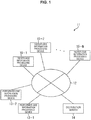
- FIG. 1 is a block diagram illustrating an exemplary configuration of an embodiment of a distribution system applying the present technology.
- a distribution system 11 includes performer-side information processing devices 13-1 and 13-2, a distribution server 14, and N viewer-side information processing devices 15-1 to 15-N, which are connected to each other via a network 12 such as the Internet.
- a motion picture imaged in the performer-side information processing device 13-1 or 13-2 is transmitted sequentially to the distribution server 14 via the network 12, and is distributed from the distribution server 14 to the viewer-side information processing devices 15-1 to 15-N via the network 12.
- This allows viewers of the viewer-side information processing devices 15-1 to 15-N to view the motion picture in which a user of the performer-side information processing device 13-1 or 13-2 is appearing as a performer.
- a composite motion picture in which a performer of the performer-side information processing device 13-1 and a performer of the performer-side information processing device 13-2 have been composited can be distributed.
- the performer-side information processing device 13-2 transmits a motion picture obtained by imaging the performer to the performer-side information processing device 13-1 via the distribution server 14.
- the performer-side information processing device 13-1 generates a composite motion picture in which the performer of the performer-side information processing device 13-1 has been composited so as to be aligned next to the performer appearing in the motion picture transmitted from the performer-side information processing device 13-2, for example, and transmits the composite motion picture to the distribution server 14.
- a composite motion picture in which performers imaged at different locations have been composited is distributed to the viewer-side information processing devices 15-1 to 15-N via the distribution server 14.
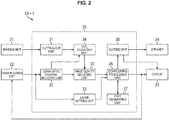
- FIG. 2 is a block diagram illustrating an exemplary configuration of the performer-side information processing device 13-1.
- the performer-side information processing device 13-1 includes an imaging unit 21, a communication unit 22, a display 23, a speaker 24, and an image processing unit 25.
- the imaging unit 21 includes an optical system and an imaging sensor, neither illustrated in the drawing, and supplies a motion picture in which the performer of the performer-side information processing device 13-1 has been imaged as a subject to the image processing unit 25.
- the communication unit 22 performs communication with the performer-side information processing device 13-2 and the distribution server 14 via the network 12. For example, the communication unit 22 receives a motion picture transmitted from the performer-side information processing device 13-2 to supply the motion picture to the image processing unit 25, and transmits a composite motion picture output from the image processing unit 25 to the distribution server 14.
- the display 23 displays a composite motion picture supplied from a compositing processing unit 36 of the image processing unit 25, and displays a guiding image supplied from a guiding unit 38 of the image processing unit 25.
- the speaker 24 outputs a guiding sound supplied from the guiding unit 38 of the image processing unit 25.
- the image processing unit 25 performs image processing of cutting out a performer from a motion picture imaged by the imaging unit 21 (hereinafter referred to as an imaged motion picture as necessary) and compositing the performer into a motion picture (hereinafter referred to as a compositing-destination motion picture as necessary) supplied from the communication unit 22. Then, the image processing unit 25 supplies a composite motion picture generated by performing the image processing to the communication unit 22 and the display 23.
- the image processing unit 25 includes a cutting-out unit 31, a composited position adjusting unit 32, a layer setting unit 33, a size adjusting unit 34, an image quality adjusting unit 35, the compositing processing unit 36, a part generating unit 37, and the guiding unit 38.
- the cutting-out unit 31 performs face detection processing and human detection processing on the imaged motion picture supplied from the imaging unit 21 to detect a performer appearing in the imaged motion picture (hereinafter referred to as an imaged performer as necessary). Then, the cutting-out unit 31 performs image processing of cutting out an area in which the imaged performer appears from the imaged motion picture, and generates a cut-out motion picture of the imaged performer formed along the contour of the imaged performer (a motion picture of an area in which the imaged performer appears, included in the imaged motion picture) to supply the cut-out motion picture to the size adjusting unit 34.
- the composited position adjusting unit 32 adjusts such that a composited position (compositing condition) when compositing the cut-out motion picture of the imaged performer generated by the cutting-out unit 31 into a compositing-destination motion picture is arranged appropriately, and sets the composited position in the compositing-destination motion picture. For example, as will be described later with reference to FIG. 3 , the composited position adjusting unit 32 performs an image analysis on a compositing-destination motion picture supplied from the communication unit 22 to recognize a performer appearing in the compositing-destination motion picture (hereinafter referred to as a compositing-destination performer as necessary).
- the composited position adjusting unit 32 This allows the composited position adjusting unit 32 to obtain the position of the compositing-destination performer appearing in the compositing-destination motion picture as an analysis result. Then, on the basis of the analysis result, the composited position adjusting unit 32 adjusts the composited position such that the imaged performer is arranged in a balanced manner with respect to the compositing-destination performer, considering the composition when the imaged performer and the compositing-destination performer are aligned.
- the layer setting unit 33 performs object detection processing on the compositing-destination motion picture supplied from the communication unit 22, and sets, in the compositing-destination motion picture, a layer showing an ahead or behind positional relationship of an object detected from the compositing-destination motion picture with the imaged performer, as will be described later with reference to FIG. 4 .
- the size adjusting unit 34 performs image processing of adjusting the size (compositing condition) when compositing a cut-out motion picture of the imaged performer supplied from the cutting-out unit 31 at the composited position in the compositing-destination motion picture, and supplies the cut-out motion picture of the imaged performer adjusted in size to the image quality adjusting unit 35. For example, considering the face size of the imaged performer and the face size of the compositing-destination performer, the size of the cut-out motion picture of the imaged performer is adjusted such that their sizes are substantially identical, as will be described later with reference to FIG. 5 .
- the size adjusting unit 34 performs an image analysis on the cut-out motion picture of the imaged performer and the compositing-destination motion picture to obtain, as an analysis result, the face size of the imaged performer in the cut-out motion picture of the imaged performer and the face size of the compositing-destination performer appearing in the compositing-destination motion picture, and adjusts the size of the cut-out motion picture of the imaged performer on the basis of the analysis result.
- the image quality adjusting unit 35 performs image processing of adjusting the image quality of the cut-out motion picture of the imaged performer when compositing into the compositing-destination motion picture (for example, compositing conditions, such as color characteristics including lightness, saturation, and hue, and resolution), in accordance with the image quality of the compositing-destination performer in the compositing-destination motion picture, and supplies the cut-out motion picture to the compositing processing unit 36.
- compositing conditions such as color characteristics including lightness, saturation, and hue, and resolution
- the image quality adjusting unit 35 performs image processing of increasing the brightness of the cut-out motion picture of the imaged performer considering the balance in brightness between the imaged performer and the compositing-destination performer, as will be described later with reference to FIG. 7 . That is, the image quality adjusting unit 35 performs an image analysis on the cut-out motion picture of the imaged performer and the compositing-destination motion picture to obtain the image qualities of the respective performers as an analysis result, and adjusts the image quality of the cut-out motion picture of the imaged performer on the basis of the analysis result.
- the compositing processing unit 36 performs compositing processing of superimposing and compositing the cut-out motion picture of the imaged performer on the compositing-destination motion picture to generate a composite motion picture. At this time, the compositing processing unit 36 composites the cut-out motion picture of the imaged performer of the image quality adjusted by the image quality adjusting unit 35 at the composited position set in the compositing-destination motion picture by the composited position adjusting unit 32 in the size adjusted by the size adjusting unit 34.
- the compositing processing unit 36 cuts out the object for which the layer has been set from the compositing-destination motion picture, and after compositing the cut-out motion picture of the imaged performer, superimposes the motion picture obtained by cutting out the object.
- the part generating unit 37 In a case where a portion of the body of the imaged performer composited into the compositing-destination motion picture is missing as a result of the compositing processing unit 36 performing a composition analysis on the composite motion picture, the part generating unit 37 generates a part (complementary image) for complementing the missing portion (missing part) and supplies the part to the compositing processing unit 36, as will be described later with reference to FIG. 5 . Accordingly, the compositing processing unit 36 performs compositing processing of compositing the part generated by the part generating unit 37 so as to hide the missing part of the imaged performer.
- the guiding unit 38 performs an image analysis on the composite motion picture generated by the compositing processing unit 36, and on the basis of the analysis result, outputs guidance that provides various instructions (presents instructions) for the imaged performer such that the imaged performer and the compositing-destination performer do not become unnatural, as will be described later with reference to FIG. 6 .
- the guiding unit 38 supplies a guiding image that instructs the orientation of the imaged performer, instructs the position at which the imaging unit 21 is to be arranged, or instructs the brightness of the surrounding environment in which the imaged performer is being imaged to the display 23 for display, or supplies a guiding sound to the speaker 24 for output.
- the performer-side information processing device 13-1 is configured as described above, and a composite motion picture in which the imaged performer and the compositing-destination performer have been composited in a balanced manner considering the balance in position, size, and the like between the imaged performer and the compositing-destination performer can be generated in the image processing unit 25.
- image processing in the image processing unit 25 is performed sequentially in accordance with the supply of an imaged motion picture obtained by the imaging unit 21 imaging the imaged performer to the image processing unit 25, and a composite motion picture can be output in real time with imaging of the imaged performer (including some time lag caused by the processing).
- the composite motion picture output from the image processing unit 25 is transmitted to the distribution server 14 via the communication unit 22, and is distributed to the viewer-side information processing devices 15-1 to 15-N via the network 12.
- FIG. 3 Shown on the left side of FIG. 3 are an imaged motion picture A1 imaged by the imaging unit 21 and a compositing-destination motion picture B1 transmitted from the performer-side information processing device 13-2, and shown on the right side of FIG. 3 is a composite motion picture C1 having been subjected to compositing processing by the compositing processing unit 36.
- the composited position adjusting unit 32 can perform an image analysis (for example, human detection processing, face detection processing, composition recognition, etc.) on the compositing-destination motion picture B1 to specify the position of the compositing-destination performer E1 appearing in the compositing-destination motion picture B1. Then, the composited position adjusting unit 32 can adjust the composited position of the imaged performer D1 so as to achieve an appropriate arrangement that avoids the imaged performer D1 from overlapping the compositing-destination performer E1. In the example of FIG. 3 , the composited position adjusting unit 32 sets an initial composited position in such an arrangement that aligns next to the compositing-destination performer E1, as indicated by a broken line in the compositing-destination motion picture B 1.
- an image analysis for example, human detection processing, face detection processing, composition recognition, etc.
- the composited position of the imaged performer D1 is set to achieve an appropriate arrangement automatically by the composited position adjusting unit 32, that is, without the need for the imaged performer D1 to adjust the standing position of his/her own.
- This allows the image processing unit 25 to easily generate the composite motion picture C1 in which the compositing-destination performer E1 and the imaged performer D1 have been arranged so as not to overlap each other.
- the composited position adjusting unit 32 can correctly recognize the position of the compositing-destination performer E1 by using that distance information, and can set the composited position more appropriately.
- the composited position adjusting unit 32 can also similarly adjust the composited position in such an appropriate arrangement that the respective performers do not overlap one another.
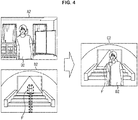
- FIG. 4 Shown on the left side of FIG. 4 are an imaged motion picture A2 imaged by the imaging unit 21 and a compositing-destination motion picture B2 transmitted from the performer-side information processing device 13-2, and shown on the right side of FIG. 4 is a composite motion picture C2 having been subjected to compositing processing by the compositing processing unit 36.
- the layer setting unit 33 performs object detection processing on the compositing-destination motion picture B2 to set a layer showing the ahead-behind relationship of the object F with the imaged performer D2 in the compositing-destination motion picture B2.
- the layer setting unit 33 causes the display 23 to display an area surrounding the object F (area illustrated by the broken line) detected from the compositing-destination motion picture B2 as an area for which the layer can be set.
- the layer setting unit 33 can cause the display 23 to display a graphical user interface for instructing whether to display the area ahead of or behind the imaged performer D2, and can set a layer in accordance with a user operation.
- the layer setting unit 33 can set a layer referring to the distance information. For example, the layer setting unit 33 sets a layer ahead of the imaged performer D2 if the distance to the object F is less than a predetermined value, and sets a layer behind the imaged performer D2 if the distance to the object F is more than or equal to the predetermined value.
- a layer is set by the layer setting unit 33 for the object F that should be displayed ahead of the imaged performer D1. This allows the image processing unit 25 to generate the composite motion picture C2 of an originally desirable composition in which the object F is arranged ahead of the imaged performer D1.
- size adjusting processing by the size adjusting unit 34 and part generation processing by the part generating unit 37 will be described.
- Shown on the left side of FIG. 5 are an imaged motion picture A3 imaged by the imaging unit 21 and a compositing-destination motion picture B3 transmitted from the performer-side information processing device 13-2. Moreover, shown at the center of FIG. 5 is a composite motion picture C3 having been subjected to the size adjusting processing by the size adjusting unit 34 and the compositing processing by the compositing processing unit 36, and shown on the right side of FIG. 5 is a composite motion picture C3' in which a part generated in the part generating unit 37 has been composited into the composite motion picture C3.
- an imaged performer D3 in the imaged motion picture A3 appears larger than the imaged performer D3 in the compositing-destination motion picture B3 will be described.
- the imaged performer D3 is cut out from the imaged motion picture A3 and composited as it is without performing a size adjustment, the imaged performer D3 will be extremely large with respect to a compositing-destination performer E3, and an unbalanced composite motion picture will be generated, although not illustrated in the drawing. Therefore, the imaged performer D3 is conventionally required to move to a standing position away from the imaging unit 21 so as to be a size similar to the compositing-destination performer E3.
- the face size of the compositing-destination performer E3 appearing in the compositing-destination motion picture B3 can be recognized when the composited position adjusting unit 32 sets a composited position, and can be notified to the size adjusting unit 34. Then, the size adjusting unit 34 performs image processing of performing a size adjustment (scale-up operation or scale-down operation) on the imaged performer D3 such that the face size of the imaged performer D3 (the circle indicated by the broken line) supplied from the cutting-out unit 31 becomes substantially identical to the face size of the compositing-destination performer E3 (the circle indicated by the broken line).
- a size adjustment scale-up operation or scale-down operation
- the size adjusting unit 34 may compare the face size of the imaged performer D3 and the size of the object G, and on the basis of the comparison result, may adjust the size of the imaged performer D3.
- a size comparison with a chair or a table besides the flower as illustrated in the drawing may be performed.
- the composite motion picture C3 in which the imaged performer D3 and the compositing-destination performer E3 have been composited in a balanced manner can be generated.
- the compositing processing unit 36 performs a skeleton estimate on the imaged performer D3 composited into the composite motion picture C3 to recognize the missing part (in the example of FIG. 5 , the lower portion with respect to the chest) of the imaged performer D3. Then, the compositing processing unit 36 requests the part generating unit 37 to generate a part that compensates for the recognized missing part of the imaged performer D3. For example, when performing image recognition on the composite motion picture C3 and recognizing the floor under the imaged performer D3, the compositing processing unit 36 requests the part generating unit 37 for a part to be arranged on the floor to hide the missing part of the imaged performer D3.
- the part generating unit 37 generates a part H (in the example of FIG. 5 , a podium) that meets the request from the compositing processing unit 36 by computer graphics, and supplies the part to the compositing processing unit 36. Then, the compositing processing unit 36 generates the composite motion picture C3' in which the part H generated by the part generating unit 37 has been composited to be arranged on the floor in the composite motion picture C3 to compensate for the missing part of the imaged performer D3.
- a part H in the example of FIG. 5 , a podium
- the compositing processing unit 36 generates the composite motion picture C3' in which the part H generated by the part generating unit 37 has been composited to be arranged on the floor in the composite motion picture C3 to compensate for the missing part of the imaged performer D3.
- a size adjustment of the imaged performer D3 is performed by the size adjusting unit 34, and the part H generated by the part generating unit 37 is composited so as to hide the missing part of the imaged performer D3.
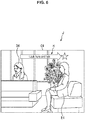
- FIG. 6 shows a displayed image J displayed on the display 23.
- the displayed image J in which a guiding image K output from the guiding unit 38 has been superimposed on a composite motion picture C4 output from the compositing processing unit 36 is displayed on the display 23.
- the guiding unit 38 performs guidance for providing various instructions for the imaged performer D4.
- the guiding unit 38 detects the faces of the imaged performer D4 and the compositing-destination performer E4 by analyzing the composite motion picture C4 supplied from the compositing processing unit 36, and recognizes the orientation of each face. Then, the guiding unit 38 outputs, to the display 23, the guiding image K including an arrow indicating the direction of the compositing-destination performer E4 and a message reading "Look here and talk" so as to achieve a composition in which a natural conversation is being performed. Note that the guiding image K is merely displayed on the display 23 overlapping the composite motion picture C4, and is not transmitted via the communication unit 22.
- the guiding unit 38 can perform guidance for the imaged performer D4 by means of the guiding image K so as to achieve such a composition in which the imaged performer D4 and the compositing-destination performer E4 are performing a conversation, for example.
- This allows the image processing unit 25 to generate the composite motion picture C4 of a less uncomfortable natural composition with respect to the imaged performer D4 and the compositing-destination performer E4.
- the guiding unit 38 can output such guidance that instructs installation of the imaging unit 21 to the imaged performer D4 of the performer-side information processing device 13-1, for example, in addition to instructing the face orientation of the imaged performer D4 and the compositing-destination performer E4 as illustrated in FIG. 6 .
- the guiding unit 38 can cause the display 23 to display or cause the speaker 24 to output a message reading "Raise the height of the camera", "Place the camera slightly to the right", “Move slightly away from the camera", or the like.
- the guiding unit 38 can analyze the white balance of the imaged performer D4, and in a case where it is detected that imaging is performed at an extremely dark place, can cause the display 23 to display or cause the speaker 24 to output guidance that points out the darkness of the room to brighten the room, for example, a message reading "Brighten the room.”
- FIG. 7 processing of compositing an imaged performer D5 cut out from an imaged motion picture and a compositing-destination performer E5 cut out from a compositing-destination motion picture into a background still image L to be their background will be described. Shown on the left side of FIG. 7 are the imaged performer D5, the compositing-destination performer E5, and the background still image L. Shown on the right side of FIG. 7 is a composite motion picture C5 in which the imaged performer D5 and the compositing-destination performer E5 have been composited by the compositing processing unit 36 using the background still image L as a background.
- the imaged performer D5 and the compositing-destination performer E5 may be different in brightness as illustrated in the drawing.
- the imaged performer D5 has been imaged in an environment against light to be a dark image as compared with the compositing-destination performer E5. If the imaged performer D5 and the compositing-destination performer E5 are composited as they are, an unnatural composite motion picture in which they are different in brightness will be generated, although not illustrated in the drawing.
- the image quality adjusting unit 35 adjusts the white balance of the imaged performer D5 such that the imaged performer D5 and the compositing-destination performer E5 have equivalent brightness. This allows the image processing unit 25 to generate the composite motion picture C5 in which the imaged performer D5 and the compositing-destination performer E5 have been composited into the background still image L at the equivalent brightness to solve unnaturalness. Moreover, the image quality adjusting unit 35 may perform an adjustment relatively such that the imaged performer D5 and the compositing-destination performer E5 have similar brightness. Furthermore, the image quality adjusting unit 35 can adjust such that the imaged performer D5 and the compositing-destination performer E5 become similar in terms of saturation, hue, and the like, besides brightness.
- FIG. 8 is a flowchart describing image processing by the image processing unit 25.
- the process is started when an operation on an operation unit not illustrated in the drawing is performed so as to composite a performer of the performer-side information processing device 13-1 into a compositing-destination motion picture.
- the cutting-out unit 31 performs image processing of cutting out an area in which an imaged performer appears from an imaged motion picture supplied from the imaging unit 21, and generates a cut-out motion picture of the imaged performer for supply to the size adjusting unit 34.
- step S12 the composited position adjusting unit 32 performs an image analysis on the compositing-destination motion picture supplied from the communication unit 22 to adjust such that a composited position when compositing the cut-out motion picture of the imaged performer into the compositing-destination motion picture becomes an appropriate position, and sets the composited position in the compositing-destination motion picture. Then, the composited position adjusting unit 32 supplies the compositing-destination motion picture in which the composited position has been set to the image quality adjusting unit 35.
- the composited position adjusting unit 32 recognizes the face size of a compositing-destination performer appearing in the compositing-destination motion picture, and notifies the face size of the compositing-destination performer to the size adjusting unit 34.
- step S13 the size adjusting unit 34 adjusts the size of the cut-out motion picture of the imaged performer supplied from the cutting-out unit 31 in step S11 such that the face size of the imaged performer becomes substantially identical to the face size of the compositing-destination performer, and supplies the cut-out motion picture to the image quality adjusting unit 35.
- step S14 the image quality adjusting unit 35 performs image processing of adjusting the image quality of the cut-out motion picture of the imaged performer supplied from the size adjusting unit 34 in step S13 in accordance with the image quality of the compositing-destination performer in the compositing-destination motion picture supplied from the composited position adjusting unit 32 in step S12, and supplies the cut-out motion picture to the compositing processing unit 36.
- step S15 the layer setting unit 33 performs object detection processing on the compositing-destination motion picture supplied from the communication unit 22, and sets, in the compositing-destination motion picture, a layer showing an ahead or behind positional relationship of an object detected from the compositing-destination motion picture with the imaged performer, and supplies the compositing-destination motion picture to the compositing processing unit 36.
- step S16 the compositing processing unit 36 performs compositing processing of compositing the cut-out motion picture of the imaged performer of the image quality adjusted by the image quality adjusting unit 35 in step S14 at the composited position set in the compositing-destination motion picture by the composited position adjusting unit 32 in step S12 in the size adjusted by the size adjusting unit 34 in step S13.
- the compositing processing unit 36 performs compositing processing of cutting out an object for which the layer has been set from the compositing-destination motion picture and compositing the cut-out motion picture of the imaged performer, and then superimposing an image obtained by cutting out the object. Then, the compositing processing unit 36 performs a composition analysis on a composite motion picture generated by such compositing processing.
- step S 17 the compositing processing unit 36 determines whether there is a missing part in the imaged performer composited into the compositing-destination motion picture as described with reference to FIG. 5 , on the basis of the result of performing the composition analysis on the composite motion picture in step S16.
- step S17 the process proceeds into step S18, and the compositing processing unit 36 requests the part generating unit 37 to generate a part that compensates for the missing part.
- the part generating unit 37 generates a part by computer graphics in accordance with the request from the compositing processing unit 36 and supplies the part to the compositing processing unit 36.
- the compositing processing unit 36 generates a composite motion picture in which the part generated by the part generating unit 37 has been composited into the compositing-destination motion picture so as to compensate for the missing part of the imaged performer.
- step S18 the process proceeds into step S19, and the compositing processing unit 36 outputs the composite motion picture to the display 23 for display. Moreover, the compositing processing unit 36 supplies the composite motion picture to the communication unit 22 for transmission to the distribution server 14 via the network 12.
- step S20 the guiding unit 38 analyzes the composite motion picture generated in the compositing processing unit 36, and determines whether it is necessary to output guidance.
- step S20 determines in step S20 that it is necessary to output guidance
- the process proceeds into step S21, and the guiding unit 38 causes the display 23 to display a guiding image or causes the speaker 24 to output a guiding sound.
- step S21 After the processing in step S21, or in a case where the guiding unit 38 determines in step S20 that it is not necessary to output guidance, the process returns to step S11, and then, a similar process is repeated.
- the image processing unit 25 can easily generate an image in which performers imaged at different locations have been composited in a balanced manner by adjusting the conditions when compositing the cut-out motion picture of the imaged performer into the compositing-destination motion picture considering such that the position, size, image quality, and the like of the imaged performer and the compositing-destination performer become appropriate.
- the performer-side information processing device 13-2 may perform an image analysis when imaging a compositing-destination motion picture, and may transmit the compositing-destination motion picture in which a composited position has been set.
- the performer-side information processing device 13-2 an object appearing in the compositing-destination motion picture may be detected using a distance-measuring technology, and layer setting may be performed.
- the performer-side information processing device 13-1 may transmit the cut-out motion picture of the imaged performer to the distribution server 14, and processing of compositing into a compositing-destination motion picture may be performed in the distribution server 14.
- image processing by the image processing unit 25 may be carried out in the distribution server 14. That is, the performer-side information processing devices 13-1 and 13-2 transmit motion pictures in which performers have been imaged respectively to the distribution server 14. Then, the distribution server 14 cuts out the performer from the motion picture from the performer-side information processing device 13-1, and performs compositing processing using the motion picture from the performer-side information processing device 13-2 as a compositing-destination motion picture. At this time, the layer setting processing, size adjusting processing, image quality adjusting processing, and part generation processing as described above can be performed in the distribution server 14.
- an area to be a missing part of the imaged performer may be trimmed, and a portion of the compositing-destination motion picture may be enlarged to composite the imaged performer.
- imaged motion pictures of performers imaged at different locations also include imaged motion pictures obtained by imaging respective performers by different imaging devices at some near distance (for example, in the same room), as well as imaged motion pictures obtained by imaging performers at locations at a physically long distance.
- imaged motion pictures imaged at different imaging times or imaging places even in a case of using an identical imaging device are also included.
- a compositing-destination motion picture can be imaged in advance and recorded (visually recorded) using an identical imaging device in the same room, and an imaged motion picture in which a performer appears can be composited into a reproduced compositing-destination motion picture during real-time distribution and can be distributed.
- an imaged motion picture and a compositing-destination motion picture are different, they are not limited to those imaged at different locations.
- a relative adjustment may be performed on a cut-out motion picture of an imaged performer and a compositing-destination motion picture, besides adjusting the size or image quality of the cut-out motion picture of the imaged performer so as to conform to the compositing-destination motion picture.
- each process described referring to the flowchart above includes a process that is not necessarily performed in a time series manner in the order described in the flowchart, but may be performed in a parallel or individual manner (for example, a paralleled process or a process by objects).
- the program may be processed by one CPU, or processed by a plurality of CPUs in a distributed manner.
- the above-described series of processing may be performed by hardware or may be performed by software.
- a program forming the software is installed into a computer that is incorporated in a dedicated hardware, or installed from a program storage medium on which programs are recorded into a general-purpose personal computer, for example, that can perform various types of functions by installing various types of programs.
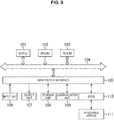
- FIG. 9 is a block diagram illustrating an exemplary hardware configuration of a computer that executes the foregoing series of operations according to a program.
- a central processing unit (CPU) 101 In the computer, a central processing unit (CPU) 101, read-only memory (ROM) 102, and random access memory (RAM) 103 are connected to each other by a bus 104.
- CPU central processing unit
- ROM read-only memory
- RAM random access memory
- an input/output interface 105 is connected to the bus 104.
- an input unit 106 that may include devices such as a keyboard, mouse, and microphone
- an output unit 107 that may include devices such as a display and one or more speakers
- a storage unit 108 that may include devices such as a hard disk and non-volatile memory
- a communication unit 109 that may include a device such as a network interface
- a drive 110 that drives a removable medium 111 such as a magnetic disk, optical disc, magneto-optical disc, or semiconductor memory.
- the foregoing series of operations are conducted due to the CPU 101 loading a program stored in the storage unit 108 into the RAM 103 via the input/output interface 105 and the bus 104, and executing the program, for example.
- the program executed by the computer (CPU 101) may be provided by being recorded onto the removable medium 111 as an instance of packaged media such as magnetic disks (including flexible disks), optical discs (including Compact Disc - Read-Only Memory (CD-ROM) and Digital Versatile Disc (DVD)), magneto-optical discs, or semiconductor memory.
- the program may be provided via a wired or wireless transmission medium such as a local area network, the Internet, or satellite broadcasting.
- the program may be installed to the storage unit 108 via the input/output interface 105 by inserting the removable medium 111 into the drive 110.
- the program may also be received by the communication unit 109 via a wired or wireless transmission medium, and installed to the storage unit 108. Otherwise, the program may be preinstalled in the ROM 102 or the storage unit 108.
- present technology may also be configured as below.
Landscapes
- Engineering & Computer Science (AREA)
- Multimedia (AREA)
- Signal Processing (AREA)
- Computer Vision & Pattern Recognition (AREA)
- Physics & Mathematics (AREA)
- General Physics & Mathematics (AREA)
- Theoretical Computer Science (AREA)
- Studio Devices (AREA)
- Studio Circuits (AREA)
- Two-Way Televisions, Distribution Of Moving Picture Or The Like (AREA)
Applications Claiming Priority (2)
| Application Number | Priority Date | Filing Date | Title |
|---|---|---|---|
| JP2015064805 | 2015-03-26 | ||
| PCT/JP2016/058066 WO2016152634A1 (ja) | 2015-03-26 | 2016-03-15 | 情報処理装置および情報処理方法、並びにプログラム |
Publications (2)
| Publication Number | Publication Date |
|---|---|
| EP3276943A1 true EP3276943A1 (de) | 2018-01-31 |
| EP3276943A4 EP3276943A4 (de) | 2018-11-21 |
Family
ID=56978263
Family Applications (1)
| Application Number | Title | Priority Date | Filing Date |
|---|---|---|---|
| EP16768537.9A Withdrawn EP3276943A4 (de) | 2015-03-26 | 2016-03-15 | Informationsverarbeitungsvorrichtung, informationsverarbeitungsverfahren und programm |
Country Status (4)
| Country | Link |
|---|---|
| US (1) | US10264194B2 (de) |
| EP (1) | EP3276943A4 (de) |
| JP (1) | JP6610659B2 (de) |
| WO (1) | WO2016152634A1 (de) |
Cited By (1)
| Publication number | Priority date | Publication date | Assignee | Title |
|---|---|---|---|---|
| US10609332B1 (en) | 2018-12-21 | 2020-03-31 | Microsoft Technology Licensing, Llc | Video conferencing supporting a composite video stream |
Families Citing this family (10)
| Publication number | Priority date | Publication date | Assignee | Title |
|---|---|---|---|---|
| JP6385543B1 (ja) * | 2017-09-29 | 2018-09-05 | 株式会社ドワンゴ | サーバ装置、配信システム、配信方法及びプログラム |
| JP7313847B2 (ja) * | 2019-03-11 | 2023-07-25 | 日本テレビ放送網株式会社 | 撮影システム、撮影装置、管理装置及び撮影方法 |
| CN111601033A (zh) | 2020-04-27 | 2020-08-28 | 北京小米松果电子有限公司 | 视频处理方法、装置及存储介质 |
| JP2021197633A (ja) * | 2020-06-15 | 2021-12-27 | 日本放送協会 | 映像変換装置及びプログラム |
| TWI746148B (zh) * | 2020-09-04 | 2021-11-11 | 宏碁股份有限公司 | 智能音箱、智能音箱運作系統與點陣圖案的動態調整方法 |
| CN114205512B (zh) * | 2020-09-17 | 2023-03-31 | 华为技术有限公司 | 拍摄方法和装置 |
| JP7769507B2 (ja) * | 2021-10-13 | 2025-11-13 | キヤノン株式会社 | 映像処理装置及びその制御方法及びプログラム |
| JP2023075024A (ja) * | 2021-11-18 | 2023-05-30 | パナソニックIpマネジメント株式会社 | 撮像装置および情報提示システム |
| JP7566847B2 (ja) * | 2022-01-04 | 2024-10-15 | キヤノン株式会社 | 画像処理装置、画像処理方法、及びコンピュータプログラム |
| EP4258638B1 (de) | 2022-01-04 | 2026-02-11 | Canon Kabushiki Kaisha | Bildverarbeitungsvorrichtung, bildverarbeitungsverfahren und speichermedium |
Family Cites Families (12)
| Publication number | Priority date | Publication date | Assignee | Title |
|---|---|---|---|---|
| JP2000172826A (ja) | 1998-12-02 | 2000-06-23 | Minolta Co Ltd | 画像合成装置 |
| JP2005094741A (ja) * | 2003-08-14 | 2005-04-07 | Fuji Photo Film Co Ltd | 撮像装置及び画像合成方法 |
| JP2004328788A (ja) | 2004-06-21 | 2004-11-18 | Daiichikosho Co Ltd | 記録済みの背景映像に別途撮影された人物映像を合成して表示出力する方法およびその方法を採用したカラオケ装置 |
| US8824861B2 (en) * | 2008-07-01 | 2014-09-02 | Yoostar Entertainment Group, Inc. | Interactive systems and methods for video compositing |
| JP2010130040A (ja) | 2008-11-25 | 2010-06-10 | Seiko Epson Corp | 画像処理装置並びに、この装置の制御用プログラムおよびこの制御用プログラムを記録したコンピュータ読取り可能な記録媒体 |
| JP5479149B2 (ja) | 2010-02-19 | 2014-04-23 | オリンパスイメージング株式会社 | 画像生成装置 |
| US20120002061A1 (en) * | 2010-07-01 | 2012-01-05 | Gay Michael F | Systems and methods to overlay remote and local video feeds |
| CN102737383B (zh) * | 2011-03-31 | 2014-12-17 | 富士通株式会社 | 视频中的摄像机运动分析方法及装置 |
| US8970704B2 (en) * | 2011-06-07 | 2015-03-03 | Verizon Patent And Licensing Inc. | Network synchronized camera settings |
| US8866943B2 (en) * | 2012-03-09 | 2014-10-21 | Apple Inc. | Video camera providing a composite video sequence |
| JP5906860B2 (ja) | 2012-03-21 | 2016-04-20 | カシオ計算機株式会社 | 画像処理装置、画像処理方法、及び、プログラム |
| CN103797812B (zh) * | 2012-07-20 | 2018-10-12 | 松下知识产权经营株式会社 | 带评论运动图像生成装置及带评论运动图像生成方法 |
-
2016
- 2016-03-15 EP EP16768537.9A patent/EP3276943A4/de not_active Withdrawn
- 2016-03-15 US US15/559,162 patent/US10264194B2/en active Active
- 2016-03-15 JP JP2017508250A patent/JP6610659B2/ja not_active Expired - Fee Related
- 2016-03-15 WO PCT/JP2016/058066 patent/WO2016152634A1/ja not_active Ceased
Cited By (2)
| Publication number | Priority date | Publication date | Assignee | Title |
|---|---|---|---|---|
| US10609332B1 (en) | 2018-12-21 | 2020-03-31 | Microsoft Technology Licensing, Llc | Video conferencing supporting a composite video stream |
| WO2020131177A1 (en) * | 2018-12-21 | 2020-06-25 | Microsoft Technology Licensing, Llc | Video conferencing supporting a composite video stream |
Also Published As
| Publication number | Publication date |
|---|---|
| JPWO2016152634A1 (ja) | 2018-01-18 |
| US10264194B2 (en) | 2019-04-16 |
| WO2016152634A1 (ja) | 2016-09-29 |
| US20180070025A1 (en) | 2018-03-08 |
| JP6610659B2 (ja) | 2019-11-27 |
| EP3276943A4 (de) | 2018-11-21 |
Similar Documents
| Publication | Publication Date | Title |
|---|---|---|
| US10264194B2 (en) | Information processing device, information processing method, and program | |
| US9679369B2 (en) | Depth key compositing for video and holographic projection | |
| US9049384B2 (en) | Video processing apparatus, camera apparatus, video processing method, and program | |
| JP4970302B2 (ja) | 画像処理装置,画像処理方法及び撮像装置 | |
| US10924718B2 (en) | Image processing device and method | |
| KR20070042104A (ko) | 화상 표시 장치 및 방법, 및 프로그램 | |
| WO2013008653A1 (ja) | オブジェクト表示装置、オブジェクト表示方法及びオブジェクト表示プログラム | |
| WO2018025474A1 (ja) | 情報処理装置、情報処理方法、及びプログラム | |
| JP7074056B2 (ja) | 画像処理装置、画像処理システム、および画像処理方法、並びにプログラム | |
| EP3679769B1 (de) | Beleuchtungsverfahren und system zur verbesserung der perspektivischen farbwahrnehmung eines von einem benutzer beobachteten bildes | |
| CN104980722B (zh) | 一种数据处理方法、装置以及电子设备 | |
| US10205940B1 (en) | Determining calibration settings for displaying content on a monitor | |
| US8386909B2 (en) | Capturing and presenting interactions with image-based media | |
| KR101819984B1 (ko) | 실시간 영상 합성 방법 | |
| KR102374665B1 (ko) | 개인방송을 위한 방송영상 생성방법 및 이를 위한 방송영상 생성시스템 | |
| JP7299165B2 (ja) | プラネタリウム制御装置、プラネタリウムシステムおよびプラネタリウム制御装置の制御プログラム | |
| US9247230B2 (en) | Image processing apparatus, image processing method, and program | |
| CN108632553A (zh) | 图像处理装置、投影仪、图像处理方法以及存储介质 | |
| WO2019039296A1 (ja) | 映像処理装置、映像処理方法、プログラム、および遠隔コミュニケーションシステム | |
| JP2008009877A (ja) | 画像処理装置,画像処理方法およびプログラム | |
| KR102711556B1 (ko) | 프로젝터 제어시스템 | |
| KR20190130380A (ko) | 영상 합성 방법 | |
| JP2001045269A (ja) | 画像合成装置 | |
| JP2019012179A (ja) | Hdr画像表示システム | |
| CN114868380A (zh) | 一种虚拟名片的发送方法、装置、系统及可读存储介质 |
Legal Events
| Date | Code | Title | Description |
|---|---|---|---|
| STAA | Information on the status of an ep patent application or granted ep patent |
Free format text: STATUS: THE INTERNATIONAL PUBLICATION HAS BEEN MADE |
|
| PUAI | Public reference made under article 153(3) epc to a published international application that has entered the european phase |
Free format text: ORIGINAL CODE: 0009012 |
|
| STAA | Information on the status of an ep patent application or granted ep patent |
Free format text: STATUS: REQUEST FOR EXAMINATION WAS MADE |
|
| 17P | Request for examination filed |
Effective date: 20171023 |
|
| AK | Designated contracting states |
Kind code of ref document: A1 Designated state(s): AL AT BE BG CH CY CZ DE DK EE ES FI FR GB GR HR HU IE IS IT LI LT LU LV MC MK MT NL NO PL PT RO RS SE SI SK SM TR |
|
| AX | Request for extension of the european patent |
Extension state: BA ME |
|
| DAV | Request for validation of the european patent (deleted) | ||
| DAX | Request for extension of the european patent (deleted) | ||
| A4 | Supplementary search report drawn up and despatched |
Effective date: 20181023 |
|
| RIC1 | Information provided on ipc code assigned before grant |
Ipc: G06T 7/90 20170101ALN20181016BHEP Ipc: H04N 5/232 20060101ALI20181016BHEP Ipc: G06T 7/70 20170101ALN20181016BHEP Ipc: G11B 27/036 20060101ALI20181016BHEP Ipc: H04N 5/262 20060101ALI20181016BHEP Ipc: H04N 5/272 20060101AFI20181016BHEP Ipc: G11B 27/28 20060101ALI20181016BHEP |
|
| RAP3 | Party data changed (applicant data changed or rights of an application transferred) |
Owner name: SONY GROUP CORPORATION |
|
| STAA | Information on the status of an ep patent application or granted ep patent |
Free format text: STATUS: EXAMINATION IS IN PROGRESS |
|
| 17Q | First examination report despatched |
Effective date: 20210816 |
|
| REG | Reference to a national code |
Ref country code: DE Ref legal event code: R079 Free format text: PREVIOUS MAIN CLASS: H04N0005272000 Ipc: G11B0027036000 |
|
| RIC1 | Information provided on ipc code assigned before grant |
Ipc: G06T 7/90 20170101ALN20230125BHEP Ipc: G06T 7/70 20170101ALN20230125BHEP Ipc: H04N 23/611 20230101ALI20230125BHEP Ipc: H04N 23/63 20230101ALI20230125BHEP Ipc: H04N 23/60 20230101ALI20230125BHEP Ipc: H04N 23/61 20230101ALI20230125BHEP Ipc: G11B 27/28 20060101ALI20230125BHEP Ipc: G11B 27/036 20060101AFI20230125BHEP |
|
| GRAP | Despatch of communication of intention to grant a patent |
Free format text: ORIGINAL CODE: EPIDOSNIGR1 |
|
| STAA | Information on the status of an ep patent application or granted ep patent |
Free format text: STATUS: GRANT OF PATENT IS INTENDED |
|
| INTG | Intention to grant announced |
Effective date: 20230320 |
|
| RIN1 | Information on inventor provided before grant (corrected) |
Inventor name: OKAMOTO, HIDEO Inventor name: YAMASAKI, RIO Inventor name: NAKAGAWA, TAKAAKI |
|
| STAA | Information on the status of an ep patent application or granted ep patent |
Free format text: STATUS: THE APPLICATION IS DEEMED TO BE WITHDRAWN |
|
| 18D | Application deemed to be withdrawn |
Effective date: 20230801 |