EP3271900B1 - Interaktive dimensionierung von parametrischen modellen - Google Patents
Interaktive dimensionierung von parametrischen modellen Download PDFInfo
- Publication number
- EP3271900B1 EP3271900B1 EP16765790.7A EP16765790A EP3271900B1 EP 3271900 B1 EP3271900 B1 EP 3271900B1 EP 16765790 A EP16765790 A EP 16765790A EP 3271900 B1 EP3271900 B1 EP 3271900B1
- Authority
- EP
- European Patent Office
- Prior art keywords
- lines
- dimension
- line
- model
- scope
- Prior art date
- Legal status (The legal status is an assumption and is not a legal conclusion. Google has not performed a legal analysis and makes no representation as to the accuracy of the status listed.)
- Active
Links
Images















Classifications
-
- G—PHYSICS
- G06—COMPUTING OR CALCULATING; COUNTING
- G06F—ELECTRIC DIGITAL DATA PROCESSING
- G06F30/00—Computer-aided design [CAD]
-
- G—PHYSICS
- G06—COMPUTING OR CALCULATING; COUNTING
- G06T—IMAGE DATA PROCESSING OR GENERATION, IN GENERAL
- G06T19/00—Manipulating three-dimensional [3D] models or images for computer graphics
-
- G—PHYSICS
- G06—COMPUTING OR CALCULATING; COUNTING
- G06F—ELECTRIC DIGITAL DATA PROCESSING
- G06F30/00—Computer-aided design [CAD]
- G06F30/10—Geometric CAD
- G06F30/13—Architectural design, e.g. computer-aided architectural design [CAAD] related to design of buildings, bridges, landscapes, production plants or roads
-
- G—PHYSICS
- G06—COMPUTING OR CALCULATING; COUNTING
- G06F—ELECTRIC DIGITAL DATA PROCESSING
- G06F30/00—Computer-aided design [CAD]
- G06F30/10—Geometric CAD
- G06F30/17—Mechanical parametric or variational design
-
- G—PHYSICS
- G06—COMPUTING OR CALCULATING; COUNTING
- G06T—IMAGE DATA PROCESSING OR GENERATION, IN GENERAL
- G06T2219/00—Indexing scheme for manipulating 3D models or images for computer graphics
- G06T2219/004—Annotating, labelling
-
- G—PHYSICS
- G06—COMPUTING OR CALCULATING; COUNTING
- G06T—IMAGE DATA PROCESSING OR GENERATION, IN GENERAL
- G06T2219/00—Indexing scheme for manipulating 3D models or images for computer graphics
- G06T2219/012—Dimensioning, tolerancing
Definitions
- dimensioning conventionally includes the placement of dimension text, dimension lines, and extension lines customized for a single view point.
- Dimension lines are line segments that indicate the extent of a feature, while extension lines visually connect the ends of a dimension line to the relevant feature in the model.
- dimensioning is the specification of the dimensions of a three-dimensional (3D) (world space) object via two-dimensional (2D) (screen space) drawings.
- 3D three-dimensional
- (2D) screen space
- dimensioning is supported by rigorous international standards (e.g., ISO 128-1).
- ISO 128-1 rigorous international standards
- dimensioning takes place on an orthographic or plan drawing.
- Some contemporary commercial systems provide for the manual positioning of world space dimensioning lines. For example, some systems allow the author to specify such a world-space dimension line by clicking twice on the model to specify end points, and once to give a offset location for the dimension line. Automatically positioning lines in 2D has been contemplated as well. For instance, knowledge-based automatic dimensioning introduces a rule-based system based on domain knowledge that is implemented in Prolog. Some developments have utilized both a rule-based expert system to dimension 3D objects on a 2D diagram, and techniques such as occluding forbidden zones to constrain dimension lines locations. Some popular contemporary software tools perform a similar role of positioning world space lines in 3D. However, these systems suffer from the fact that as the user rotates the viewpoint, the dimension lines are often occluded by the model or other dimension lines, i.e., they do not interactively adapt to the current viewpoint.
- Optimally positioning text and symbols on maps, documents, or illustrations in such a way that other labels and critical features are not occluded is typically a computationally expensive operation; typically these problems are NP-hard (Nondeterministic Polynomial-time hard, from computational complexity theory).
- NP-hard Nondeterministic Polynomial-time hard, from computational complexity theory.
- One study introduced a method for positioning a set of labels near the areas they refer to, thereby avoiding the silhouette of an object in screen space. That is, positioning screen space labels in screen space.
- Positioning world space geometry in screen space has been contemplated to position non-overlapping subassemblies that explain a machine's function.
- this system requires several minutes to pre-compute geometry; something that is not possible in an interactive (e.g., real-time) editing system.
- Other efforts have investigated placing labels by example, and positioning labels at interactive frame rates in static or dynamic scenes.
- the problem of editing with dimension lines is related to 3D manipulation widgets.
- a number of different widgets may allow the user to manipulate the current object, for example, scale in x, y, or z directions.
- Modern systems positioned such manipulators in world space and have remained in use to the present day.
- Domain-specific widgets attached to the sub-objects being edited are also a common subject in graphics, and are used to visualize available translations, deformations, or dimensions of an orientated plane.
- a parametric model takes a number of input parameters and uses these to create corresponding output geometry.
- Authors can create such models, and users edit the parameters to quickly generate geometry variations, avoiding the need for them to become familiar with the details of the modeling system.
- Typical examples are parameter-driven scene graphs of 3D packages and node/shape trees generated by procedural modeling systems, for example, CityEngine.
- the nodes of such hierarchical models all have a (possibly non-unique) name and an oriented bounding box.
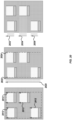
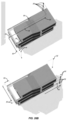
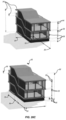
- Dimensioning has been incorporated into many contemporary 3D modeling packages. As discussed above, current methods are mainly suited to a static viewpoint and dimension lines are placed on a 2D drawing, or they are fixed in 3D world space such that if the view point changes, the dimension lines can occlude the model, or intersect other dimension lines. This problem is illustrated, for example, in FIGS. 1A and 1B. Better tools are needed to address this issue.
- systems and methods are introduced for interactive dimensioning of parametric and procedural models.
- the embodiments can be used in traditional modeling packages, or to create simplified intuitive 3D editing tools for novice users, among their many other uses. Editing with interactive dimensioning can be very fast and may only require a minimal understanding of the underlying parametric model.
- Applications can be found in entertainment, architecture, geography, rapid prototyping, 3D printing, or any suitable environment.
- dimensioning includes the placement of dimension text , dimension lines, and extension lines customized for a single view point.
- Dimension lines may be line segments that indicate the extent of a feature on a model, while extension lines visually connect the ends of a dimension line to the relevant feature in the model.
- Embodiments of the invention include a method to extend dimensioning to the interactive, perspective rendering of 3D models.
- a set of design principles for interactive dimensioning see FIG. 7 for examples of good and bad dimensioning
- FIGS. 3-4 An algorithm to position dimension lines in real-time is described, according to a current camera view, as illustrated in FIGS. 3-4 .
- techniques for using dimension lines to edit direct and indirect parameters are described, as shown in FIGS. 5-6 .
- certain embodiments of the invention relate to a system for the interactive positioning of dimension lines.
- a set of design principles for interactive dimensioning are described that provide an algorithmic framework incorporating these principles.
- an author can specify the interactive behavior of dimension lines.
- An algorithm as defined below, can use this description to select the final dimension line positions from among candidate positions.
- multiple extensions are possible, including chained dimension lines, indirect parameters, different handle types (e.g., boolean and rotational handles - discussed below), and the use of dimension lines for interactive editing.
- the framework described herein can provide interactive frame rates when editing models (e.g., architectural, botanical, mechanical models, etc.).
- FIGS. 3 and 4 show how a user can interactively inspect a model 300/400 while dimension lines are well positioned in a view-dependent manner, i.e., the dimension lines adapt and move to preferred locations when the camera moves, according to certain embodiments.
- An architectural structure is shown and rotated counter-clockwise about 180 degrees between FIGS. 3 and 4 .
- Some of the dimension lines are shown to illustrate the concept of preferred placement. Note that dimension lines 310-330 correspond to dimension lines 410-430, respectively.
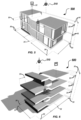
- FIGS. 5 and 6 show how dimension lines can be used for editing a parametric model 500/600, as well as extensions that allow the visualization and control of model parameters other than distances, according to certain embodiments.
- handle 510 can be manipulated by a user to alter the parametric model in certain dimensions.
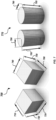
- dimension lines can be positioned in various ways on a 3D model. According to common design guidelines, there are good positions (dimension lines 710-730 for cubes 700, and dimension lines 780, 785 for the cylinders 770), and bad positions (dimension lines 740-760 for cubes 700 and dimension lines 790, 795 for cylinder 770), The reasons why the dimension lines may be characterized as good or bad positions is discussed below.
- embodiments of the invention include systems that do not require the author to manually position dimension lines. Instead, the author can assign a (e.g., numeric) parameter to one or more scopes in the parametric model, and specify the behavior of the resulting dimension line. The system can then interactively compute the best position for the dimension line, given the current camera view, according to the certain interactive design principles ( see Interactive Dimensioning Principles) and dimension line properties as further discussed below.
- a e.g., numeric
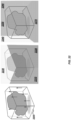
- FIG. 8 gives an overview of a real-time computation process for determining a preferred location for a dimension line corresponding to a feature 810 on a rotated parametric model 800, according to certain embodiments.
- the system evaluates the assigned scope (feature 810) in order to calculate the initial positions for the dimension lines, called base lines (820, 822, 824, 826), as shown in (A).
- the base lines are then offset to create candidate lines (830, 832, 834 - showing a subset of all candidate lines), one of which will be selected.
- candidate line 830 would be selected as a final dimension line given its location and adherence to the "Interactive Dimensioning Principles" and a corresponding scoring function that evaluates each candidate line.
- the final dimension line changes its location based on the orientation of the scope and other considerations (e.g., model 800 and interactive dimensioning principles).
- the author e.g., person or machine assigns a parameter to a scope 810, and, per-frame, the system then computes candidate lines (e.g., 830, 832, 834) and selects, using a scoring function, a final dimension line (e.g., 840, 850) for a given view direction (see (b) and (c)).
- candidate lines e.g., 830, 832, 834
- a scoring function e.g., 840, 850
- scope typically refers to a bounding box and its name.
- dimension lines arranged on an object is easy and intuitive comprehension.
- a designer makes subjective design choices based on view arrangement, size, function, contour, or spacing, by following certain general guidelines. Thereby, one typically follows common design guidelines and design principles for the interactive positioning of dimension lines.
- FIG. 9 illustrates the implementation and violation of certain guidelines and design principles for interactive positioning of dimension lines on a parametric model, according to certain embodiments.
- Examples of good b, i, m, n, o) and bad (a, c, d, e, f, g, h, j, k, 1) dimension lines are shown to illustrate the underlying design principles.
- the following list of interactive dimensioning principles may not be exhaustive.
- Other guidelines may be incorporated and, in some cases, may be preferable to the principles listed below.
- Scope The scope can identify a bounding box for applying the dimension line placement principles and positioning the parametric model's base lines.
- a name can identifies zero or more scopes in a parametric model. If multiple scopes have the same name, they may share all properties.
- the model itself can be the scope.
- the cube in FIG. 7 may be defined as the scope.
- a scope may be a portion of an overall object (parametric model).
- the rectangular cube 810 of FIG. 8 is the scope of model 800.
- a parametric model may be an image of a teapot (not shown).
- the scope (bounding box) of the teapot may be a cube surrounding it. That is, the scope can describe the space affected by the interactive dimensioning described herein.
- a user can define the scope.
- scope identification and/or selection can be automated or may be a combination of user/computer contribution.
- the type can define the position of the base line
- the type can be selected by the author, which may be a user or computer.
- FIG. 10 shows several different types of base lines for a scope including, but not limited to, a linear contour 1010, a linear center 1020, a diametric 1030, a radial 1060, a spherical diametric 1040 , and a spherical radial 1050.
- the type is selected based on the optimal representation. For example, cube 700 of FIG. 7 may be best represented by scope having the same dimensions with a linear contour type the scope includes linear baselines (e.g., a window in a building), a linear contour base line ( FIG. 10 , row 1010) may be optimal.
- cylinder 800 of FIG. 7 may be best represented by a scope of a diametric type 1030 or radial type 1060.
- the teapot example above may be best represented by a linear center type 1020.
- the scope may be a cube around the teapot, the dimension line defining a feature of the teapot (e.g., length) may be better represented by the center line.
- One of ordinary skill in the art with the benefit of this disclosure would understand how to select the type of base line based on the polygonal properties of the object of interest (i.e., the parametric 3D model).
- Orientation Each type can also have an orientation, either relative to the scope or the screen (i.e., point-of-view of the viewing angle).
- Linear contour (row 1010) and linear center (row 1020) can have one of six scope relative orientations.
- Diametric (row 1030) and radial (row 1060) have three scope relative orientations each, which are combined with the camera position to compute the base line locations.
- spherical diametric (1040) and spherical radial (1050) base positions are specified by the scope and one of two screen- relative directions.
- One of ordinary skill in the art with the benefit of this disclosure would understand how to select the orientation of the base line(s) based on the polygonal properties of the object of interest (i.e., the parametric 3D model).
- the direction mat the dimension lines move would not be best represented by the direction of the scope (e.g., cube-shaped bounding box).
- FIG. 13 shows several planes 1310-1340 found around object 1300 that can be used to determine dimension lines.
- One of ordinary skill in the art with the benefit of this disclosure would understand how to select the slip based on the polygonal properties of the object of interest (i.e., the parametric 3D model).
- Alignment Finally, the author can specify the preferred dimension line location: top, bottom, left, right, top-left, top-right, bottom-left, bottom-right, or no-preference. This permits the authoring of predictable layouts (e.g., a height dimension line that is on the screen-right of the model), and leads to more stable positioning during navigation.
- Another common use case is the billboard behavior applied to the types linear center, diametric or radial.
- all behaviors can be applied to any type and direction.
- the author can define type and orientation of the interactive dimension lines.
- Row 1010 The base lines for the linear contour type are placed on the edges of a scope (cube). This results in four distinct base lines depending on the specified orientation.
- Row 1020 One base line is placed in the middle of the scope for the type linear center.
- Rows 1030 and 1060 Diametric & radial types are most suited to cylindrical objects. To position these base lines, ellipses (1032) are located on scope faces identified by the orientation; the cross product of the view direction and ellipse normal (1034) is then projected onto the ellipse to find the base line orientation.
- each parameter in a parametric model may be processed to find a final dimension line.
- one parameter may give rise to 1-4 base lines for a single scope.
- Each base line can be associated with 1 or more planes, depending on the slip behavior.
- For each pair (base line, plane) we can create up to 2 candidate lines.
- One candidate line can be selected as the final line to be rendered.
- the system computes this position of each parameter's final line per frame.
- the system computes a dimension line for one or more parameter of the parametric model in real-time - computing and selecting a final line for every frame of the 3D representation.
- Each slip behavior can translate base lines in different directions to find candidate lines outside the silhouette.
- This slip direction can be defined by a partially bounded plane associated with each base line. If final lines have already been placed on the plane, it may be possible to position the candidate in a co-linear fashion to one of these lines. Otherwise, the base line "slips" along the plane, parallel to itself in world space, until it is outside the silhouette.
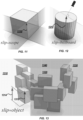
- planes There can be three options for defining planes: scope and billboard ( see FIGS. 11 and 12 ) create planes relative to the base line, while object (see FIG. 13 ) uses a global pre-computed plane set. As illustrated in FIGS. 7-8 , different models require the author to select different slip behaviors. If this process fails to find any candidate lines, the final line can be positioned inside the silhouette (object).
- getScopePlanes in Algorithm 1 aligns two scope aligned planes through base line 1110.
- getBBoardPlanes creates a single plane through base line 1210, oriented in the view direction.
- P object defines a set of global planes (1310-1340) aligned to the model's geometry. In such cases, the planes may not typically pass through the base line's scope.
- a base line 1312 finds a candidate position (1314) on a plane (1310).
- Algorithm 1 gives an overview of this process, according to certain embodiments. It describes how the final dimension line for a parameter p is computed for the viewpoint v (i.e. point-of-view, camera angle).
- the function gelDimensionLine is called for each parameter in an ordered list of parameters (e.g., for a parametric model).
- a dimension line is eliminated if all scopes lie outside the view frustum, or are obscured by the model (e.g., using hardware occlusion from the previously rendered frame), which corresponds to item (4) of the interactive dimensioning principles.
- the base line set, B can be set up according to the properties defined by the author.
- the set of planes P on which candidate lines will be positioned are computed.
- FIGS. 11-13 illustrate how planes are generated depending on the property slip. In case the latter is object, the set of object planes P object is used. P object can be pre-computed by clustering base lines, as described below with respect to object plane locations.
- dimension lines are grouped together (according to principle 8), if possible. Therefore, a per-frame global set of guide lines, i.e., positions to snap to: G snap , is maintained.
- These guide lines can correspond to dimension lines from previously processed parameters (see line 11).
- line 6 all the guides in G snap that lie on the planes in P may be found.
- the guides with available space to place our dimension line are selected. This process is illustrated in FIG. 14 .
- the base lines (line 9) can be a fallback position. This can result in a dimension line placed inside the object fallback behavior when the user has zoomed in and the silhouette is not visible.
- the best possible (i.e., preferred) line, d may be selected from the set of candidate lines, C, using a scoring function (see Finding the Final Dimension Line).
- the left image shows a final line (b) in G snap , and a baseline (a) which is being processed.
- the guide line (dashed line 1402) is on the same plane as (a), and is used to position the new candidate line (c).
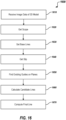
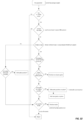
- FIG. 16 shows a simplified flow chart 1600 for generating a dimension line for a parametric model, according to certain embodiments.
- Method 1600 (as well as the methods depicted in FIGS. 32-33 discussed below) can be performed by processing logic that may comprise hardware (circuitry, dedicated logic, etc.), software operating on appropriate hardware (such as a general purpose computing system or a dedicated machine), firmware (embedded software), or any combination thereof.
- method 1600 can be performed by processor 2530 of FIG. 35 , multiple processors, or other suitable computing device, as discussed with respect to FIGS. 35 .
- Method 1600 can correspond to Algorithm 1 above, according to certain embodiments.
- method 1600 includes receiving image data corresponding to a three-dimensional parametric model.
- the parametric model can be any suitable size or shape. Any type of image data can be processed (e.g., CAD, .dwg, LIDAR, or other suitable 3D data).
- method 1600 includes receiving a selection of a scope of the 3D model. If the scope is obscured or is not visible, then method 1600 ends.
- method 1600 includes receiving one or more scopes of the parametric model.
- the scope may be selected by a user or the selection may be automated, as discussed above.
- method 1600 includes receiving the base lines for the scope. A single base line or multiple base lines may be selected. In addition to the base lines, the type and orientation of the base lines are selected, as further discussed above.
- method 1600 includes finding existing guides (e.g., existing candidate dimension lines) on planes.
- FIGS. 3-4 and 14 show aspects of finding existing guides for co-linear placement (as per interactive dimensioning principle 8) and storing their locations.
- method 1600 includes calculating candidate dimension lines based on the calculated planes, dimension line placement guidelines (interactive dimensioning principles), and the existing guidelines (if they exist). If no guides exist, then the candidate dimension lines may be computed using the silhouette (scope).
- method 1600 includes computing and selecting a final dimension line from the candidate dimension lines based on the dimension line placement rules and displaying the selected dimension line adjacent to the scope. In some cases, no suitable candidate lines may exist adjacent to the scope and the dimension line may be placed inside the scope adjacent to or on the corresponding base line.
- FIG. 16 provides a particular method 1600 of generating a dimension line for a parametric model, according to certain embodiments.
- Other sequences of steps may also be performed according to alternative embodiments.
- alternative embodiments may perform the steps outlined above in a different order.
- the individual steps illustrated in FIG. 16 may include multiple sub-steps that may be performed in various sequences as appropriate to the individual step.
- additional steps may be added or removed depending on the particular applications.
- One of ordinary skill in the art would recognize and appreciate many variations, modifications, and alternatives of the method 1600.
- This section describes an approach to computing offset candidate locations ( compute WithSilhouette in Algorithm 1), given a set of base lines, B , a set of planes, P, and camera viewpoint v, according to certain embodiments.
- We can indicate a software algorithm performing the step, a user providing input to the step (e.g., providing image data, identifying a scope, etc.), or any other actor, as would be understood by one of ordinary skill in the art.
- a detail of the minimal offset calculation is that, in the general case, extension lines that are parallel in world space are not parallel in screen space. Furthermore, the candidate lines may not be parallel to the base. These issues are illustrated in FIG. 17 , left, showing a scope's base line, b-t, and possible minimal offset lines, bc-tc, with different 2D orientations and lengths, due to perspective. These lines share a common vanishing point, v. A model in an orthographic projection does not have a vanishing point, but this case can be simulated by a virtual vanishing point at a large distance. In FIG. 17 , right, o gives the minimal offset as v-o lies to the left of all the clipped distance field, only touching at x .
- the minimal offset calculation can be accelerated using the GPU to reduce the performance penalty associated with the model's geometric complexity.
- the four distance fields may approximate the model silhouette.
- 1D distance fields are much faster to build and query than a 2D or 3D silhouette edge graph.
- Additional acceleration is provided by using a binary tree to query the distance fields; at each node in the binary tree we can store the minimum and maximum distances of each subtree. Rays can be cast through the binary tree to identify the boundaries of the clipped silhouette, and determine which maxima give the minimal offset. The smallest value from each of the four distance fields may give the global minimal offset. If no silhouette could be found in any direction (e.g., the silhouette intersects the viewport boundary), no candidate line is returned; this can cause Algorithm 1 to position the candidate line on the base line, according to certain embodiments of the invention.
- a goal is to compute the minimal translation of line (b) over the plane (p) so that the candidate lines can be placed without intersecting the model silhouette (gray shape).
- the final candidate lines ( ⁇ 1 and ⁇ 2 ) may be moved by an additional padding distance beyond the nearest intersection ( x 1 , x 2 ).
- 2D screen space offset calculations are shown.
- base lines can rotate and change length as they are offset in world space.
- offset computation using a distance field (dashed line 1702) clipped to the extension and base lines (solid line 1704) is shown.
- four distance fields to approximate the silhouette of the model can be computed.
- One distance field is computed for each of the four viewport boundaries. In the left image, the distance field from the left boundary is shown. In the right image, all four distance fields approximate the model's silhouette are shown.
- a goal of this algorithm step is to select a final dimension line from among the candidate lines computed in the previous subsection, according to certain embodiments of the invention.
- the scoring function may favor longer lines with the specified preferred alignment; the other terms may be irrelevant.
- Chained Dimension Lines can indicate that several measurements are collinear and contiguous in world space. In certain embodiments of our interactive system we do not demand that the chained lines are contiguous, but use the style to indicate repeated dimensions. The author specifies if a parameter is chained. The advantages of chained dimension lines are that they suggest to the user that one parameter can affect multiple scopes in a row or grid; such grids are typical on building facades. Another benefit is that we perform fewer computeWithSilhouette calls ( see Silhouette Line Placement), improving speed for large grids of scopes.
- the base lines within the cluster associated with the final chain line are then projected onto the final chain line (see FIG. 20 , right).
- For all base lines in the cluster associated with the winning candidate chain line we can project them onto the final chain line in world space. If the space is already occupied, the line can be rejected. In case of an intersection, the closest base line may have priority.
- chained dimension lines (2032-2036) align final lines from the same parameter.
- the alignment is implemented by finding several candidate chain base lines (2022-2024), and then finding the most suitable, the final chain line (2026). Final dimension lines are projected onto this final chain line.
- FIG. 21 a facade with 3 parameters dimensioned using chain lines are shown: windowsill height and window height/width.
- the width parameter is multiplied by a random value to obtain various window sizes, so an indirect chain dimension line is used, indicated by dashed gray dimension lines (top). Note how the snap guide on the left supports two parameters on a single line.
- complex models under extreme perspective may have created a "forest” of lines, that were widely spread, were untidy, and difficult to interpret.
- Certain embodiments of the invention pre-compute a smaller number of object planes from the base line positions. Placing the candidate lines on these planes can result in a significantly tidier layout.
- the set of object planes, P object, in Algorithm 1 is comprised of front and back facing partially-bounded planes that cover most of the screen.
- the planes we first may project all base lines onto the object's ground plane (i.e. the xz-plane of its OBB). Second, we may compute the 2D convex hull around the resulting points and lines on the ground plane. Third, as illustrated in FIG. 22 , the hull can be extruded to the height of the object and each face of the resulting geometry is converted into a plane.
- the forward facing planes may be preferred for dimension line placement ( see, e.g., Finding the Final Dimension Line).
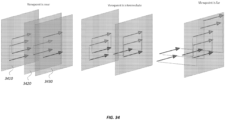
- FIG. 34 shows an alternative process for finding a set of object planes, according to certain embodiments.
- This process produces fewer planes as the viewpoint recedes, resulting in a tidier layout of the dimension lines.
- this algorithm recalculates P object per-frame.
- Plane clusters are found by grouping all the potential slip planes (from getScopPlanes in Algorithm 1) for all base lines on the model, using their normal direction. Each cluster can contain planes with a similar normal. For each viewpoint and base line, we select the plane cluster that is most parallel to the view-plane. Some, or all, of the planes can then be merged depending on the viewpoint distance.
- a single plane from the merged cluster is placed in P object : the next nearest to the view point from the base line.
- the planes are merged in the cluster.
- planes that are close to each other merge (above, middle), and P object contains the next nearest plane to the viewpoint.
- Parameter Order Design principle 6 ( see Interactive Dimensioning Principles) states that the nesting should be computed with longer dimension lines further away from the object than shorter ones. Therefore, in some cases we sort the parameters by the average length of their base lines in world space. A special case can be chain lines; for these we compute the average world space length of all the parameter's base lines. In general, this gives a shorter length than that of the entire chain. Given this sorted list of parameters, we position dimension lines starting with the shortest first. Sorting by world space, rather than screen space length allows i) frame-to-frame positioning decisions to be consistent, and ii) pre-computation of this order. One intuitive advantage of this ordering is that shorter dimension lines fill irregularities in the silhouette better that long ones. Further, there is a higher chance of extension lines intersecting dimension lines if longer dimension lines are placed closer to the model silhouette.
- Silhouette Updating As we iteratively add dimension lines to the current view, we update the silhouette of the model by modifying the distance fields, as shown in FIG. 23 . Further, we can store a boolean value with each distance in the distance fields to indicate if the distance was modified due to a dimension line. This can be used to encourage dimension lines to not cross earlier final dimension lines or extension lines, via the Intersect penalty term (see Finding the Final Dimension Line).
- the left image shows a left distance field (2320) for a model, and a base line (2310).
- the middle image shows the distance field after positioning the candidate line (2330).
- the winning line sets the boolean flag for the region it has updated (2335). As shown in the right image, this allows final dimension lines to avoid one another.
- the dynamic line placement can enable predictable and intuitive editing of parameters. It is natural for users to interactively edit models with dimension lines, as they are positioned close to the feature that they are manipulating without obscuring the model itself.
- the arrows terminating dimension lines can be treated as handles which can be dragged by the user.
- either one or both arrowheads are labelled H to indicate that they are a handle.
- Indirect Handles So far, the examples above have assumed that the value of the parameter is always equal to the length of the dimension line. There are situations, however, in which the relationship between the dimension line length and the parameter value is complex or indirect.
- a typical example is the parameter Number_of_Floors which controls the height of a house, as shown, for example, in FIGS. 5-6 .
- the number of floors is an integer, while the scope size it is attached to is measured in meters (and is a function of floor height, spacing between floors, and number of floors).
- Another example is a parameter that drives the total floor area of a building, when not all floors have the same area (see FIG. 24 ).
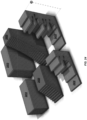
- the buildings are parameterized by total floor area. Positioning the dimension line as shown controls this parameter. In the case 2410 there is a linear relationship between the line and parameter value. In the 2430 and 2420 cases there is a non-linear relationship. Indirect handles provide an appropriate line length and editing behavior. Note the stippled dimension line, and author specified spherical decoration.
- a scope specifies the position, orientation, and length of a base line.
- Direct handles can change size without waiting for the delayed asynchronous recomputation of the model.
- the size of indirect handles changes when the model is recomputed.
- the model is regenerated, and the number of scopes, and their positions, may change; a typical case is when editing the parameter Floor Height using a dimension line in the center of the building.
- the scope with the same name, that is nearest to the position of the handle when the user started dragging, to position the dragged dimension line.
- the system includes other parameter types and representations.
- Rotational handles control a floating point value representing an angle, these are rendered as in FIG. 30 , with optional distance field queries to move them outside the model.
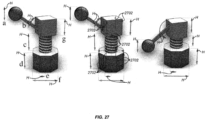
- Boolean handles represent a binary parameter. Range handles allow the user to specify one discrete option from several. Color handles allow users to specify a color parameter. Boolean, range ( FIG. 30 ) and color handles are placed similarly to dimension lines.
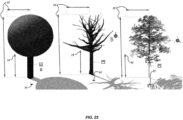
- the boolean handle (a) is used to switch between a schematic (left) and a realistic tree (middle & right).
- a range handle (middle, b) is shown, which can be used to change the tree type (right).
- Rendering Handles We use a number of techniques to improve the usability of the handles. Visibility: Typically dimension lines that are short in screen space represent less important features. The author can specify a minimum line screen length in pixels; below this length, lines and handles are not shown. Handles are also hidden if they are angled towards the view location. A modifier key shows all hidden handles. Hover behavior: If a user hovers over a handle, it displays its current value and increases in size to emphasize that it is editable. Animation: When several handles move from one location to another as the view rotates, it can be hard for a user to follow them. Therefore we animate between handle positions, visibility, and size. Animation also reduces jitter in handle locations.
- Extension Lines For each dimension line we can draw extension lines from the top and bottom of the handle to the corresponding base line, according to certain embodiments of the invention. If necessary the lines are bent at the associated plane, as shown in FIG. 21 . If both the top and bottom extension lines are collinear with an existing dimension line, they are offset slightly in a perpendicular direction for clarity, this effect is visible on the sail-width handle of FIG. 28 .
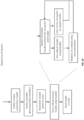
- FIG. 32 shows aspects of an alternative method for placing dimension lines on a parametric model, according to certain embodiments.
- FIG. 33 depicts an example of a typical use of the systems described herein, according to certain embodiments.
- the total number of final handles shown is typically the same as die number of parameters, with two caveats. Firstly, this counts repeated handles for the same parameter on a chain line only once. For example, the Candler building's Window _ Height parameter has 16 dimension lines on a single chain line. Secondly, the number ignores the effects of handles attached to occluded scopes and those handles whose scopes are not created in this particular parameterization. In the Boat model, for example, each mast has a Mast _ Height parameter; some of which are only visible on larger parameterizations of the Boat. TABLE 1: EVALUATING PARAMETRIC MODELS Name FIG.
- each model we include a number of statistics, including the total number of base lines, the number of those lines which are in a cluster, and the frames per second measured; separate timings for the CPU and GPU implementations are given.
- the system performance is always real time (66 to 495fps) when displaying handles.
- the GPU generated distance fields ensure that the number of base lines and distance queries, rather than the polygon count, determine the performance. To illustrate this, we implemented a CPU only solution that positioned the dimension lines by processing the object mesh; the results are shown in the right hand columns of Table. 1.
- the GPU computed distance fields give a speedup of up to 370x compared to the CPU algorithm, with the benefit increasing with model polygon count. Note that because of delayed buffer read-back, the GPU implementation timings do not include the time to create the distance fields.
- the chained lines ensure that even on large facades, the performance degradation was limited, with the byproduct of a superior user experience.
- scopes as the mechanism to position dimension lines and other handles proved very flexible. As a side effect of this decision we are able to use other properties of the scopes; the size of the scope is used for indirect handles, while the orientation frame is necessary to align rotational handles.
- the set of scopes abstraction is also very adaptable to a wide range of parametric systems; indeed any system capable of outputting a named, oriented cuboid can use our dimension lines.
- the scope name and behavior options are a text annotation next to each parameter definition.
- more than one subroutine can create scopes with a particular name, avoiding the rigid hierarchies of, for example, CGAShape.
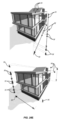
- parametric models illustrate a "Helix House.”
- the top view illustrates world space static dimension line positions
- the bottom view illustrates how embodiments of the invention create dimension lines that are visible, usable, and consistent with design principles at a wide range of angles and fields of view.
- FIG. 29 an "Omni Tree” is shown. When there are many dimension lines it is difficult to understand their behavior. Here 3 repeated sets of parameters from Figure 18 create 5 different trees.
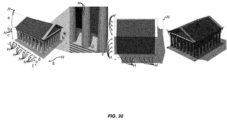
- FIG. 30 an image of Parthenon, Athens, Greece is shown.
- dimension lines d column spacing
- e column radius
- short lines with a minimum display length (i) become visible.
- three chained dimension lines (def) Near the right, an orthographic top view is shown. On the far right, base line positions are shown.
- FIG. 31 the "Candler Building, Georgia, USA” is shown.
- an orthographic top view is shown in the middle right.
- an orthographic side view is shown in the middle right.
- Embodiments of the invention relate to a system for the interactive positioning of dimension lines.
- An algorithm uses this description to select the final dimension line positions from among candidate positions.
- multiple extensions including chained dimension lines, indirect parameters, different handle types (e.g. boolean and rotational handles), and the use of dimension lines for interactive editing.
- our framework provides interactive frame rates when editing architectural, botanical, and mechanical models.
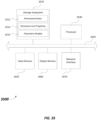
- FIG. 35 illustrates a computer system 3500 for performing interactive dimensioning of parametric models, according to certain embodiments of the invention.
- the image processing, algorithms, and methods described herein can be implemented within a computer system such as computer system 3500 shown here.
- Computer system 3500 can be implemented as any of various computing devices, including, e.g., server(s), a desktop or laptop computer, tablet computer, smart phone, personal digital assistant (PDA), or any other type of computing device, not limited to any particular form factor.
- Computer system 3500 can include processing unit(s) 3530, storage subsystem 3510, input devices 3550 (e.g. , keyboards, mice, touchscreens, etc.), output devices 3560 (e.g.
- input devices 3550 e.g. , keyboards, mice, touchscreens, etc.
- output devices 3560 e.g.
- network interface 3570 e.g. , RF, 4G, EDGE, WiFi, GPS, Ethernet, etc.
- bus 3505 to communicatively couple the various elements of system 3500 to one another.
- Processing unit(s) 3530 can include a single processor, multi-core processor, or multiple processors and may execute instructions in hardware, firmware, or software, such as instructions stored in storage subsystem 3510.
- the storage subsystem 3510 can include various memory units such as a system memory, a read only memory (ROM), and permanent storage device(s) (e.g. , magnetic, solid state, or optical media, flash memory, etc.).
- the ROM can store static data and instructions required by processing unit(s) 3530 and other modules of the system 3500.
- the system memory can store some or all of the instructions and data that the processor needs at runtime.
- storage subsystem 3510 can store one or more of data or software programs to be executed or controlled by processing unit(s) 3530, such as interactive dimensioning rules data 1512, dimension line properties data 3514, or parametric model data 3516, as further described above.
- software can refer to sequences of instructions that, when executed by processing unit(s) 3530, cause computer system 3500 to perform certain operations of the software programs.
- the instructions can be stored as firmware residing in read only memory and/or applications stored in media storage that can be read into memory for processing by processing unit(s) 3530.
- Software can be implemented as a single program or a collection of separate programs and can be stored in non-volatile storage and copied in whole or in part to volatile working memory during program execution. From storage subsystem 3510, processing unit(s) 3530 can retrieve program instructions to execute in order to execute various operations (e.g., interpolations) described herein.
- Computer system 3500 is illustrative and that variations and modifications are possible. Computer system 3500 can have other capabilities not specifically described here in detail (e.g. , GIS technologies). Further, while computer system 3500 is described with reference to particular blocks, it is to be understood that these blocks are defined for convenience of description and are not intended to imply a particular physical arrangement of component parts. Further, the blocks need not correspond to physically distinct components. Blocks can be configured to perform various operations, e.g. , by programming a processor or providing appropriate control circuitry, and various blocks might or might not be reconfigurable depending on how the initial configuration is obtained. Embodiments of the present invention can be realized in a variety of apparatus including electronic devices implemented using any combination of circuitry and software.
- system 3500 may be implemented in many different configurations.
- system 3500 may be configured as a distributed system where one or more components of system 3500 are distributed over one or more networks in the cloud (remote Internet servers).
- FIG. 36 depicts a simplified diagram of a distributed system 3600 for providing a system and method for interactive dimensioning of parametric models, according to certain embodiments of the invention.
- system 3600 is provided on a server 3602 that is communicatively coupled with one or more remote client devices 3610, 3620, 3630 via network 3606 (e.g., a cloud pipeline).
- network 3606 e.g., a cloud pipeline
- Network 3606 may include one or more communication networks, which could be the Internet (cloud), a local area network (LAN), a wide area network (WAN), a wireless or wired network, an Intranet, a private network, a public network, a switched network, or any other suitable communication network or combination thereof.
- Network 3606 may include many interconnected systems and communication links including but not restricted to hardwire links, optical links, satellite or other wireless communications links, wave propagation links, or any communication protocol.
- Various communication protocols may be used to facilitate communication of information via network 3606, including but not restricted to TCP/IP, HTTP protocols, extensible markup language (XML), wireless application protocol (WAP), protocols under development by industry standard organizations, vendor-specific protocols, customized protocols, and others as would be appreciated by one of ordinary skill in the art.
- server 3602 is remotely located from client devices 3610, 3620, 3630.
- server 3602 may perform the methods of determining (or interpolating) a population over a geographic area described herein.
- the services provided by server 3602 may be offered as web-based or cloud services or under a Software as a Service (SaaS) model, as would be appreciated by one of ordinary skill in the art.
- SaaS Software as a Service
- the cloud servers in one embodiment provide multiple instantiations of the processing program, or elements of the processing program, on one or more servers.
- the various embodiments further can be implemented in a wide variety of operating environments, which in some cases can include one or more user computers, computing devices or processing devices, which can be used to operate any of a number of applications.
- User or client devices can include any of a number of general purpose personal computers, such as desktop or laptop computers running a standard operating system, as well as cellular, wireless and handheld devices running mobile software and capable of supporting a number of networking and messaging protocols.
- Such a system also can include a number of workstations running any of a variety of commercially available operating systems and other known applications for purposes such as development and database management.
- These devices also can include other electronic devices, such as dummy terminals, thin-clients, gaming systems and other devices capable of communicating via a network.
- Most embodiments utilize at least one network that would be familiar to those skilled in the art for supporting communications using any of a variety of commercially available protocols, such as TCP/IP, UDP, OSI, FTP, UPnP, NFS, CIFS, and the like.
- the network can be, for example, a local area network, a wide-area network, a virtual private network, the Internet, an intranet, an extranet, a public switched telephone network, an infrared network, a wireless network, and any combination thereof.
- the network server can run any of a variety of server or mid-tier applications, including HTTP servers, FTP servers, CGI servers, data servers, Java servers, and business application servers.
- the server(s) also may be capable of executing programs or scripts in response to requests from user devices, such as by executing one or more applications that may be implemented as one or more scripts or programs written in any programming language, including but not limited to Java ® , C, C# or C++, or any scripting language, such as Perl, Python or TCL, as well as combinations thereof.
- the server(s) may also include database servers, including without limitation those commercially available from Oracle ® , Microsoft ® , Sybase ®, and IBM ® .
- the environment can include a variety of data stores and other memory and storage media as discussed above. These can reside in a variety of locations, such as on a storage medium local to (and/or resident in) one or more of the computers or remote from any or all of the computers across the network. In a particular set of embodiments, the information may reside in a storage-area network (SAN) familiar to those skilled in the art. Similarly, any necessary files for performing the functions attributed to the computers, servers or other network devices may be stored locally and/or remotely, as appropriate.
- SAN storage-area network
- each such device can include hardware elements that may be electrically coupled via a bus, the elements including, for example, at least one central processing unit (CPU), at least one input device (e.g., a mouse, keyboard, controller, touch screen or keypad), and at least one output device (e.g., a display device, printer or speaker).
- CPU central processing unit
- input device e.g., a mouse, keyboard, controller, touch screen or keypad
- output device e.g., a display device, printer or speaker
- Such a system may also include one or more storage devices, such as disk drives, optical storage devices, and solid-state storage devices such as RAM or ROM, as well as removable media devices, memory cards, flash cards, etc.
- Such devices can include a computer-readable storage media reader, a communications device (e.g., a modem, a network card (wireless or wired), an infrared communication device, etc.), and working memory as described above.
- the computer-readable storage media reader can be connected with, or configured to receive, a non-transitory computer-readable storage medium, representing remote, local, fixed, and/or removable storage devices as well as storage media for temporarily and/or more permanently containing, storing, transmitting, and retrieving computer-readable information.
- the system and various devices also typically will include a number of software applications, modules, services or other elements located within at least one working memory device, including an operating system and application programs, such as a client application or browser.
- Non-transitory storage media and computer-readable storage media for containing code, or portions of code can include any appropriate media known or used in the art such as, but not limited to, volatile and non-volatile, removable and non-removable media implemented in any method or technology for storage of information such as computer-readable instructions, data structures, program modules or other data, including RAM, ROM, Electrically Erasable Programmable Read-Only Memory (EEPROM), flash memory or other memory technology, CD-ROM, DVD or other optical storage, magnetic cassettes, magnetic tape, magnetic disk storage or other magnetic storage devices or any other medium which can be used to store the desired information and which can be accessed by a system device.
- RAM random access memory
- ROM read-only memory
- EEPROM Electrically Erasable Programmable Read-Only Memory
- flash memory or other memory technology
- CD-ROM Compact Disc
- DVD or other optical storage magnetic cassettes, magnetic tape, magnetic disk storage or other magnetic storage devices or any other medium which can be used to store the desired information and which can be accessed by
Landscapes
- Engineering & Computer Science (AREA)
- Physics & Mathematics (AREA)
- Theoretical Computer Science (AREA)
- General Physics & Mathematics (AREA)
- Geometry (AREA)
- Computer Hardware Design (AREA)
- General Engineering & Computer Science (AREA)
- Evolutionary Computation (AREA)
- Software Systems (AREA)
- Computer Graphics (AREA)
- Computational Mathematics (AREA)
- Mathematical Analysis (AREA)
- Mathematical Optimization (AREA)
- Pure & Applied Mathematics (AREA)
- Processing Or Creating Images (AREA)
- Architecture (AREA)
- Image Generation (AREA)
Claims (5)
- Computer-implementiertes Verfahren, beinhaltend:Empfangen, durch einen oder mehrere Prozessoren (3530), von einem parametrischen 3D-Modell, von Bilddaten;Empfangen, durch den einen oder die mehreren Prozessoren (3530), von einer Auswahl eines Umfangs (810) des parametrischen 3D-Modells, wobei der Umfang einem Begrenzungskasten (810) entspricht;Empfangen, durch den einen oder die mehreren Prozessoren (3530), von einer Auswahl von einer oder mehreren Basislinien (1110, 1210, 1312; 2012) für den Umfang, wobei die Basislinien (1110, 1210, 1312; 2012) Anfangspositionen für Dimensionslinien sind;Bestimmen, durch den einen oder die mehreren Prozessoren (3530), von einem Gleittyp für den Umfang, wobei der Gleittyp ein Verhalten des Verschiebens von Basislinien in verschiedenen Richtung definiert, um Kandidatenlinien (830, 832, 834; 2330) außerhalb einer Silhouette des parametrischen 3D-Modells zu finden;Berechnen, durch den einen oder die mehreren Prozessoren, Ebenen des Umfangs des parametrischen 3D-Modells,wobei die Ebenen die eine oder die mehrere Basislinien beinhalten und wobei der Gleittyp einer von Umfang und Tafel ist;Berechnen, durch den einen oder die mehreren Prozessoren, von Dimensionslinien, die sich in den berechneten Ebenen und innerhalb von Dimensionslinien-Platzierungs-Richtlinien befinden;Berechnen einer Dimensionslinien-Position außerhalb einer Silhouette des parametrischen 3D-Modells mittels eine Graphic Processing Unit, GPU (3530) zum Erhalten eindimensionaler Abstandswerte zwischen der Silhouette und Kanten eines Einblicks für jede Pixelreihe über der Höhe des Einblicks;Auswählen einer Dimensionslinie, worin die Dimensionslinie die Silhouette nicht durchsetzt und ein zusätzlicher Füll-Abstand jenseits der nächsten Durchschneidung mit der Silhouette ist; undAnzeigen der ausgewählten Dimensionslinie benachbart zum parametrischen 3D-Modell.
- Computer-implementiertes Verfahren nach Anspruch 1, wobei der Umfang ferner einen Typ beinhaltet, das Verfahren beinhaltend:Empfangen einer Auswahl des Typs des Umfangs, einschließlich eines von:einem Lineare-Kontur (1010)-Typ;einem Lineare-Mitte (1020)-Typ;einem diametrischen (1030) Typ;einem radialen (1060)Typ;einem sphärischen (1040) Typ; undeinem sphärisch-radialen (1050) Typ,wobei die Auswahl der einen oder mehreren Basislinien für das 3D-Modell auf dem Typ des Umfangs basiert.
- Computer-implementiertes Verfahren nach Anspruch 2, wobei der Typ eine Ausrichtung beinhaltet, und wobei die Auswahl der einen oder mehreren Basislinien für das 3D-Modell ferner auf der Ausrichtung des Typs basiert.
- Computer-implementiertes Verfahren nach Anspruch 1, wobei die Dimensionslinien-Platzierungs-Richtlinien eine oder mehrere der Folgenden beinhalten:außerhalb des 3D-Modells platzierte Dimensionslinien, wo möglich; Dimensionslinien behalten einen minimalen definierten Abstand vom 3D-Modell und von bestehenden Dimensionslinien;Dimensionslinien in Ebenen angeordnet, zu denen sie gehören, oder normal zu einer Blickrichtung des 3D-Modells;Dimensionslinien werden nur für sichtbare Merkmale gezeigt;vermeide Platzierung von sich schneidenden Dimensionslinien; undgruppiere kollineare Dimensionslinien wo möglich.
- Computer-implementiertes System mit:einem oder mehreren Prozessoren (3530); undeinem oder mehreren Computer-lesbaren Speichermedien (3510), die Anweisungen enthalten, die dazu ausgebildet sind, den einen oder die mehreren Prozessoren (3530) zu veranlassen, die in den Ansprüche 1 bis 4 beschriebenen Operationen auszuführen.
Applications Claiming Priority (2)
| Application Number | Priority Date | Filing Date | Title |
|---|---|---|---|
| US201562134485P | 2015-03-17 | 2015-03-17 | |
| PCT/US2016/022971 WO2016149554A2 (en) | 2015-03-17 | 2016-03-17 | Interactive dimensioning of parametric models |
Publications (3)
| Publication Number | Publication Date |
|---|---|
| EP3271900A2 EP3271900A2 (de) | 2018-01-24 |
| EP3271900A4 EP3271900A4 (de) | 2019-03-06 |
| EP3271900B1 true EP3271900B1 (de) | 2024-11-20 |
Family
ID=56919404
Family Applications (1)
| Application Number | Title | Priority Date | Filing Date |
|---|---|---|---|
| EP16765790.7A Active EP3271900B1 (de) | 2015-03-17 | 2016-03-17 | Interaktive dimensionierung von parametrischen modellen |
Country Status (3)
| Country | Link |
|---|---|
| US (1) | US10325035B2 (de) |
| EP (1) | EP3271900B1 (de) |
| WO (1) | WO2016149554A2 (de) |
Families Citing this family (32)
| Publication number | Priority date | Publication date | Assignee | Title |
|---|---|---|---|---|
| EP3271900B1 (de) | 2015-03-17 | 2024-11-20 | Environmental Systems Research Institute, Inc. | Interaktive dimensionierung von parametrischen modellen |
| JP6415495B2 (ja) * | 2016-08-09 | 2018-10-31 | 株式会社ミスミ | 設計支援装置、設計支援システム、サーバ及び設計支援方法 |
| CN106599448B (zh) * | 2016-12-12 | 2019-07-05 | 北京航空航天大学 | 一种基于动态可靠度的齿轮系统公差优化计算方法 |
| KR101803485B1 (ko) | 2017-02-17 | 2017-12-28 | 주식회사 마이다스아이티 | 인프라 구조물의 3차원모델 생성 시스템 및 방법 |
| CN108121863B (zh) * | 2017-12-13 | 2021-03-12 | 机械工业第六设计研究院有限公司 | 管道标签的创建方法、装置、设备及计算机可读存储介质 |
| US10719937B2 (en) * | 2017-12-22 | 2020-07-21 | ABYY Production LLC | Automated detection and trimming of an ambiguous contour of a document in an image |
| US10818082B2 (en) | 2018-03-05 | 2020-10-27 | Vivacity Inc. | Method and system for parametrically creating an optimal three dimensional building structure |
| CN109343842B (zh) * | 2018-10-09 | 2020-11-06 | 上海莉莉丝科技股份有限公司 | 在编辑器中显示物体的方法、系统、设备和介质 |
| EP3675059B1 (de) * | 2018-12-29 | 2022-09-14 | Dassault Systèmes | Extraktion eines merkmalsbaums aus einem mesh |
| US11100257B2 (en) | 2019-04-18 | 2021-08-24 | Applied Software Technology, Inc. | Spool run route finding in CAD systems |
| US11244084B2 (en) | 2019-04-18 | 2022-02-08 | Applied Software Technology, Inc. | Spool sheet generation |
| US10902580B2 (en) * | 2019-04-18 | 2021-01-26 | Applied Software Technology, Inc. | Auto-dimensioning REVIT models |
| US11287947B2 (en) | 2019-05-15 | 2022-03-29 | Microsoft Technology Licensing, Llc | Contextual input in a three-dimensional environment |
| US11087560B2 (en) * | 2019-05-15 | 2021-08-10 | Microsoft Technology Licensing, Llc | Normalization of objects for a 3D environment within an authoring application |
| US11164395B2 (en) | 2019-05-15 | 2021-11-02 | Microsoft Technology Licensing, Llc | Structure switching in a three-dimensional environment |
| US11039061B2 (en) | 2019-05-15 | 2021-06-15 | Microsoft Technology Licensing, Llc | Content assistance in a three-dimensional environment |
| CN110335360B (zh) * | 2019-05-24 | 2020-12-25 | 深圳大学 | 三维元素布局可视化方法和装置 |
| CN110254610B (zh) * | 2019-06-21 | 2021-11-30 | 中船黄埔文冲船舶有限公司 | 一种u型护舷结构的三维建模方法 |
| CN111046467B (zh) * | 2019-12-11 | 2023-03-24 | 万翼科技有限公司 | 一种户型参数化建模方法及相关设备 |
| US11308683B2 (en) * | 2020-06-29 | 2022-04-19 | Imagination Technologies Limited | Intersection testing in a ray tracing system using ray bundle vectors |
| US11295509B2 (en) | 2020-06-29 | 2022-04-05 | Imagination Technologies Limited | Intersection testing in a ray tracing system using multiple ray bundle intersection tests |
| CN112069572A (zh) * | 2020-08-18 | 2020-12-11 | 深圳市建筑设计研究总院有限公司 | 一种建筑设计数据生成系统、方法及设备 |
| CN112231803B (zh) * | 2020-09-25 | 2024-05-28 | 深圳市华阳国际工程设计股份有限公司 | 基于bim的尺寸界线的调整方法、装置以及计算机存储介质 |
| US12197822B2 (en) | 2020-12-18 | 2025-01-14 | Autodesk, Inc. | Techniques for automatically designing structural systems for buildings |
| US12430477B2 (en) | 2020-12-18 | 2025-09-30 | Autodesk, Inc. | Techniques for automatically designing structural systems for arbitrarily shaped buildings |
| US20220198082A1 (en) * | 2020-12-18 | 2022-06-23 | Autodesk, Inc. | Techniques for automatically generating frame grids for structural systems of buildings |
| US12282713B2 (en) | 2020-12-18 | 2025-04-22 | Autodesk, Inc. | Techniques for automatically designing structural systems for residential buildings |
| CA3181966A1 (en) * | 2021-02-18 | 2022-08-25 | Unity Building Technologies, Inc. | Digital positioning handles for a design platform |
| JP7676837B2 (ja) * | 2021-03-12 | 2025-05-15 | 富士フイルムビジネスイノベーション株式会社 | 情報処理装置及び情報処理プログラム |
| US11875446B2 (en) * | 2022-05-06 | 2024-01-16 | Adobe, Inc. | Procedural media generation |
| CN119294055B (zh) * | 2024-09-20 | 2025-11-21 | 中国铁路设计集团有限公司 | 一种隧道轨下结构横断面交互式设计方法 |
| CN121118196B (zh) * | 2025-08-29 | 2026-04-21 | 合肥量圳建筑科技有限公司 | 一种梁板的标注方法、设备及介质 |
Family Cites Families (17)
| Publication number | Priority date | Publication date | Assignee | Title |
|---|---|---|---|---|
| JPS6488881A (en) * | 1987-08-24 | 1989-04-03 | Ibm | Generation of assembling screen |
| US4855939A (en) * | 1987-09-11 | 1989-08-08 | International Business Machines Corp. | 3D Dimensioning in computer aided drafting |
| US5548706A (en) * | 1992-09-29 | 1996-08-20 | Fujitsu Limited | CAD system with parallel dimension-line editing function |
| US5999186A (en) * | 1997-05-23 | 1999-12-07 | 3-Design L.L.C. | Reference based parametric dimensioning method and system |
| US7039569B1 (en) * | 2000-06-09 | 2006-05-02 | Haws Richard R | Automatic adaptive dimensioning for CAD software |
| US6904392B1 (en) * | 2000-10-13 | 2005-06-07 | Dassault Systemes | Annotation management |
| US7119805B2 (en) | 2001-02-20 | 2006-10-10 | Canon Kabushiki Kaisha | Three-dimensional CAD attribute information presentation |
| US7110005B2 (en) * | 2002-09-06 | 2006-09-19 | Autodesk, Inc. | Object manipulators and functionality |
| US7233390B2 (en) | 2003-03-31 | 2007-06-19 | Therma-Wave, Inc. | Scatterometry for samples with non-uniform edges |
| JP4764663B2 (ja) * | 2005-05-30 | 2011-09-07 | 富士通株式会社 | 仮想3次元座標空間における幾何形状の自動認識方法、その3次元cadシステム及び3次元cadプログラム |
| JP4742831B2 (ja) * | 2005-11-24 | 2011-08-10 | 富士通株式会社 | 寸法線の追従を行うcadプログラム、cadプログラム記録媒体、cad装置およびcadシステム |
| US8284190B2 (en) * | 2008-06-25 | 2012-10-09 | Microsoft Corporation | Registration of street-level imagery to 3D building models |
| US8422825B1 (en) | 2008-11-05 | 2013-04-16 | Hover Inc. | Method and system for geometry extraction, 3D visualization and analysis using arbitrary oblique imagery |
| US8817028B2 (en) * | 2009-02-06 | 2014-08-26 | Dassault Systemes Solidworks Corporation | Creating dynamic sets to automatically arrange dimension annotations |
| US9418182B2 (en) | 2009-06-01 | 2016-08-16 | Paradigm Sciences Ltd. | Systems and methods for building axes, co-axes and paleo-geographic coordinates related to a stratified geological volume |
| US20140067333A1 (en) * | 2012-09-04 | 2014-03-06 | Belcan Corporation | CAD-Based System for Product Definition, Inspection and Validation |
| EP3271900B1 (de) | 2015-03-17 | 2024-11-20 | Environmental Systems Research Institute, Inc. | Interaktive dimensionierung von parametrischen modellen |
-
2016
- 2016-03-17 EP EP16765790.7A patent/EP3271900B1/de active Active
- 2016-03-17 US US15/073,557 patent/US10325035B2/en active Active
- 2016-03-17 WO PCT/US2016/022971 patent/WO2016149554A2/en not_active Ceased
Also Published As
| Publication number | Publication date |
|---|---|
| US20160275209A1 (en) | 2016-09-22 |
| EP3271900A4 (de) | 2019-03-06 |
| WO2016149554A2 (en) | 2016-09-22 |
| WO2016149554A3 (en) | 2017-01-05 |
| US10325035B2 (en) | 2019-06-18 |
| EP3271900A2 (de) | 2018-01-24 |
Similar Documents
| Publication | Publication Date | Title |
|---|---|---|
| EP3271900B1 (de) | Interaktive dimensionierung von parametrischen modellen | |
| CN111382778B (zh) | 形成用于推测实体cad特征的数据集 | |
| CN111382530B (zh) | 学习用于推测实体cad特征的神经网络 | |
| JP7735518B2 (ja) | メッシュ頂点位置についての求根および反復を用いて表面を近似するポリゴンメッシュを生成する方法およびシステム | |
| US11436800B2 (en) | Interactive system and method providing real-time virtual reality visualization of simulation data | |
| JP6356378B2 (ja) | 幾何学的三次元モデルオブジェクトを設計する方法 | |
| US10127720B2 (en) | Object modeling in multi-dimensional space | |
| US12437479B2 (en) | Method and system for generating polygon meshes approximating surfaces using iteration for mesh vertex positions | |
| Wu et al. | ViSizer: A visualization resizing framework | |
| EP3035291B1 (de) | Darstellungsbasierte Erzeugung von Okklusions-Culling-Modellen | |
| JP2022036024A (ja) | パラメータ化された3dモデルを出力するニューラルネットワーク | |
| JP2022036023A (ja) | 3dモデルを出力する変分オートエンコーダ | |
| EP2929512B1 (de) | Verfahren zur herstellung eines netzes mit einer optimierten polygonbasierten hülle | |
| CN106683199A (zh) | 3d图形渲染方法和设备 | |
| US20140198103A1 (en) | Method for polygon reduction | |
| US12141921B2 (en) | Method and system for generating polygon meshes approximating surfaces using root-finding and iteration for mesh vertex positions | |
| US8358311B1 (en) | Interpolation between model poses using inverse kinematics | |
| Kelly et al. | Interactive dimensioning of parametric models | |
| US11551409B2 (en) | Rendering portions of a three-dimensional environment with different sampling rates utilizing a user-defined focus frame | |
| WO2007106583A2 (en) | Controlled topology tweaking in solid models | |
| Li et al. | An automatic deformation approach for occlusion free egocentric data exploration | |
| Jung et al. | GeoMaTree: Geometric and Mathematical model based digital tree authoring system | |
| Ramos et al. | A partition approach to interpolate polygon sets for animation | |
| CN119937861A (zh) | 基于高斯点云模型的3d模型制作方法、装置及存储介质 | |
| CN121213752A (zh) | 一种显示、交互方法、装置、产品、电子设备及介质 |
Legal Events
| Date | Code | Title | Description |
|---|---|---|---|
| STAA | Information on the status of an ep patent application or granted ep patent |
Free format text: STATUS: THE INTERNATIONAL PUBLICATION HAS BEEN MADE |
|
| PUAI | Public reference made under article 153(3) epc to a published international application that has entered the european phase |
Free format text: ORIGINAL CODE: 0009012 |
|
| STAA | Information on the status of an ep patent application or granted ep patent |
Free format text: STATUS: REQUEST FOR EXAMINATION WAS MADE |
|
| 17P | Request for examination filed |
Effective date: 20171005 |
|
| AK | Designated contracting states |
Kind code of ref document: A2 Designated state(s): AL AT BE BG CH CY CZ DE DK EE ES FI FR GB GR HR HU IE IS IT LI LT LU LV MC MK MT NL NO PL PT RO RS SE SI SK SM TR |
|
| AX | Request for extension of the european patent |
Extension state: BA ME |
|
| DAV | Request for validation of the european patent (deleted) | ||
| DAX | Request for extension of the european patent (deleted) | ||
| RIC1 | Information provided on ipc code assigned before grant |
Ipc: G06F 17/50 20060101ALI20181022BHEP Ipc: G06T 7/00 20170101ALI20181022BHEP Ipc: G06T 19/00 20110101AFI20181022BHEP Ipc: G06T 15/00 20110101ALI20181022BHEP |
|
| A4 | Supplementary search report drawn up and despatched |
Effective date: 20190204 |
|
| RIC1 | Information provided on ipc code assigned before grant |
Ipc: G06T 15/00 20110101ALI20190129BHEP Ipc: G06T 7/00 20170101ALI20190129BHEP Ipc: G06T 19/00 20110101AFI20190129BHEP Ipc: G06F 17/50 20060101ALI20190129BHEP |
|
| STAA | Information on the status of an ep patent application or granted ep patent |
Free format text: STATUS: EXAMINATION IS IN PROGRESS |
|
| 17Q | First examination report despatched |
Effective date: 20210716 |
|
| REG | Reference to a national code |
Ref country code: DE Ref legal event code: R079 Free format text: PREVIOUS MAIN CLASS: G06T0019000000 Ipc: G06F0030000000 Ref document number: 602016090310 Country of ref document: DE |
|
| GRAP | Despatch of communication of intention to grant a patent |
Free format text: ORIGINAL CODE: EPIDOSNIGR1 |
|
| STAA | Information on the status of an ep patent application or granted ep patent |
Free format text: STATUS: GRANT OF PATENT IS INTENDED |
|
| RIC1 | Information provided on ipc code assigned before grant |
Ipc: G06F 30/17 20200101ALN20240604BHEP Ipc: G06F 30/13 20200101ALN20240604BHEP Ipc: G06F 30/00 20200101AFI20240604BHEP |
|
| INTG | Intention to grant announced |
Effective date: 20240625 |
|
| GRAS | Grant fee paid |
Free format text: ORIGINAL CODE: EPIDOSNIGR3 |
|
| GRAA | (expected) grant |
Free format text: ORIGINAL CODE: 0009210 |
|
| STAA | Information on the status of an ep patent application or granted ep patent |
Free format text: STATUS: THE PATENT HAS BEEN GRANTED |
|
| AK | Designated contracting states |
Kind code of ref document: B1 Designated state(s): AL AT BE BG CH CY CZ DE DK EE ES FI FR GB GR HR HU IE IS IT LI LT LU LV MC MK MT NL NO PL PT RO RS SE SI SK SM TR |
|
| REG | Reference to a national code |
Ref country code: GB Ref legal event code: FG4D |
|
| REG | Reference to a national code |
Ref country code: CH Ref legal event code: EP |
|
| P01 | Opt-out of the competence of the unified patent court (upc) registered |
Free format text: CASE NUMBER: APP_58548/2024 Effective date: 20241025 |
|
| REG | Reference to a national code |
Ref country code: DE Ref legal event code: R096 Ref document number: 602016090310 Country of ref document: DE |
|
| REG | Reference to a national code |
Ref country code: IE Ref legal event code: FG4D |
|
| REG | Reference to a national code |
Ref country code: LT Ref legal event code: MG9D |
|
| REG | Reference to a national code |
Ref country code: NL Ref legal event code: MP Effective date: 20241120 |
|
| PG25 | Lapsed in a contracting state [announced via postgrant information from national office to epo] |
Ref country code: IS Free format text: LAPSE BECAUSE OF FAILURE TO SUBMIT A TRANSLATION OF THE DESCRIPTION OR TO PAY THE FEE WITHIN THE PRESCRIBED TIME-LIMIT Effective date: 20250320 Ref country code: HR Free format text: LAPSE BECAUSE OF FAILURE TO SUBMIT A TRANSLATION OF THE DESCRIPTION OR TO PAY THE FEE WITHIN THE PRESCRIBED TIME-LIMIT Effective date: 20241120 Ref country code: PT Free format text: LAPSE BECAUSE OF FAILURE TO SUBMIT A TRANSLATION OF THE DESCRIPTION OR TO PAY THE FEE WITHIN THE PRESCRIBED TIME-LIMIT Effective date: 20250320 |
|
| PG25 | Lapsed in a contracting state [announced via postgrant information from national office to epo] |
Ref country code: FI Free format text: LAPSE BECAUSE OF FAILURE TO SUBMIT A TRANSLATION OF THE DESCRIPTION OR TO PAY THE FEE WITHIN THE PRESCRIBED TIME-LIMIT Effective date: 20241120 Ref country code: NL Free format text: LAPSE BECAUSE OF FAILURE TO SUBMIT A TRANSLATION OF THE DESCRIPTION OR TO PAY THE FEE WITHIN THE PRESCRIBED TIME-LIMIT Effective date: 20241120 |
|
| REG | Reference to a national code |
Ref country code: AT Ref legal event code: MK05 Ref document number: 1744228 Country of ref document: AT Kind code of ref document: T Effective date: 20241120 |
|
| PG25 | Lapsed in a contracting state [announced via postgrant information from national office to epo] |
Ref country code: BG Free format text: LAPSE BECAUSE OF FAILURE TO SUBMIT A TRANSLATION OF THE DESCRIPTION OR TO PAY THE FEE WITHIN THE PRESCRIBED TIME-LIMIT Effective date: 20241120 |
|
| PG25 | Lapsed in a contracting state [announced via postgrant information from national office to epo] |
Ref country code: ES Free format text: LAPSE BECAUSE OF FAILURE TO SUBMIT A TRANSLATION OF THE DESCRIPTION OR TO PAY THE FEE WITHIN THE PRESCRIBED TIME-LIMIT Effective date: 20241120 |
|
| PG25 | Lapsed in a contracting state [announced via postgrant information from national office to epo] |
Ref country code: NO Free format text: LAPSE BECAUSE OF FAILURE TO SUBMIT A TRANSLATION OF THE DESCRIPTION OR TO PAY THE FEE WITHIN THE PRESCRIBED TIME-LIMIT Effective date: 20250220 |
|
| PG25 | Lapsed in a contracting state [announced via postgrant information from national office to epo] |
Ref country code: LV Free format text: LAPSE BECAUSE OF FAILURE TO SUBMIT A TRANSLATION OF THE DESCRIPTION OR TO PAY THE FEE WITHIN THE PRESCRIBED TIME-LIMIT Effective date: 20241120 Ref country code: GR Free format text: LAPSE BECAUSE OF FAILURE TO SUBMIT A TRANSLATION OF THE DESCRIPTION OR TO PAY THE FEE WITHIN THE PRESCRIBED TIME-LIMIT Effective date: 20250221 Ref country code: AT Free format text: LAPSE BECAUSE OF FAILURE TO SUBMIT A TRANSLATION OF THE DESCRIPTION OR TO PAY THE FEE WITHIN THE PRESCRIBED TIME-LIMIT Effective date: 20241120 |
|
| PG25 | Lapsed in a contracting state [announced via postgrant information from national office to epo] |
Ref country code: PL Free format text: LAPSE BECAUSE OF FAILURE TO SUBMIT A TRANSLATION OF THE DESCRIPTION OR TO PAY THE FEE WITHIN THE PRESCRIBED TIME-LIMIT Effective date: 20241120 |
|
| PG25 | Lapsed in a contracting state [announced via postgrant information from national office to epo] |
Ref country code: RS Free format text: LAPSE BECAUSE OF FAILURE TO SUBMIT A TRANSLATION OF THE DESCRIPTION OR TO PAY THE FEE WITHIN THE PRESCRIBED TIME-LIMIT Effective date: 20250220 |
|
| PG25 | Lapsed in a contracting state [announced via postgrant information from national office to epo] |
Ref country code: SM Free format text: LAPSE BECAUSE OF FAILURE TO SUBMIT A TRANSLATION OF THE DESCRIPTION OR TO PAY THE FEE WITHIN THE PRESCRIBED TIME-LIMIT Effective date: 20241120 |
|
| PG25 | Lapsed in a contracting state [announced via postgrant information from national office to epo] |
Ref country code: DK Free format text: LAPSE BECAUSE OF FAILURE TO SUBMIT A TRANSLATION OF THE DESCRIPTION OR TO PAY THE FEE WITHIN THE PRESCRIBED TIME-LIMIT Effective date: 20241120 |
|
| PG25 | Lapsed in a contracting state [announced via postgrant information from national office to epo] |
Ref country code: EE Free format text: LAPSE BECAUSE OF FAILURE TO SUBMIT A TRANSLATION OF THE DESCRIPTION OR TO PAY THE FEE WITHIN THE PRESCRIBED TIME-LIMIT Effective date: 20241120 |
|
| PGFP | Annual fee paid to national office [announced via postgrant information from national office to epo] |
Ref country code: CH Payment date: 20250401 Year of fee payment: 10 |
|
| PG25 | Lapsed in a contracting state [announced via postgrant information from national office to epo] |
Ref country code: RO Free format text: LAPSE BECAUSE OF FAILURE TO SUBMIT A TRANSLATION OF THE DESCRIPTION OR TO PAY THE FEE WITHIN THE PRESCRIBED TIME-LIMIT Effective date: 20241120 |
|
| PG25 | Lapsed in a contracting state [announced via postgrant information from national office to epo] |
Ref country code: SK Free format text: LAPSE BECAUSE OF FAILURE TO SUBMIT A TRANSLATION OF THE DESCRIPTION OR TO PAY THE FEE WITHIN THE PRESCRIBED TIME-LIMIT Effective date: 20241120 |
|
| PG25 | Lapsed in a contracting state [announced via postgrant information from national office to epo] |
Ref country code: CZ Free format text: LAPSE BECAUSE OF FAILURE TO SUBMIT A TRANSLATION OF THE DESCRIPTION OR TO PAY THE FEE WITHIN THE PRESCRIBED TIME-LIMIT Effective date: 20241120 |
|
| PG25 | Lapsed in a contracting state [announced via postgrant information from national office to epo] |
Ref country code: IT Free format text: LAPSE BECAUSE OF FAILURE TO SUBMIT A TRANSLATION OF THE DESCRIPTION OR TO PAY THE FEE WITHIN THE PRESCRIBED TIME-LIMIT Effective date: 20241120 |
|
| REG | Reference to a national code |
Ref country code: DE Ref legal event code: R097 Ref document number: 602016090310 Country of ref document: DE |
|
| PG25 | Lapsed in a contracting state [announced via postgrant information from national office to epo] |
Ref country code: SE Free format text: LAPSE BECAUSE OF FAILURE TO SUBMIT A TRANSLATION OF THE DESCRIPTION OR TO PAY THE FEE WITHIN THE PRESCRIBED TIME-LIMIT Effective date: 20241120 |
|
| PLBE | No opposition filed within time limit |
Free format text: ORIGINAL CODE: 0009261 |
|
| STAA | Information on the status of an ep patent application or granted ep patent |
Free format text: STATUS: NO OPPOSITION FILED WITHIN TIME LIMIT |
|
| PG25 | Lapsed in a contracting state [announced via postgrant information from national office to epo] |
Ref country code: MC Free format text: LAPSE BECAUSE OF FAILURE TO SUBMIT A TRANSLATION OF THE DESCRIPTION OR TO PAY THE FEE WITHIN THE PRESCRIBED TIME-LIMIT Effective date: 20241120 |
|
| 26N | No opposition filed |
Effective date: 20250821 |
|
| PGFP | Annual fee paid to national office [announced via postgrant information from national office to epo] |
Ref country code: FR Payment date: 20251231 Year of fee payment: 11 |
|
| PGFP | Annual fee paid to national office [announced via postgrant information from national office to epo] |
Ref country code: LU Payment date: 20260227 Year of fee payment: 11 |
|
| REG | Reference to a national code |
Ref country code: CH Ref legal event code: U11 Free format text: ST27 STATUS EVENT CODE: U-0-0-U10-U11 (AS PROVIDED BY THE NATIONAL OFFICE) Effective date: 20260401 |
|
| PGFP | Annual fee paid to national office [announced via postgrant information from national office to epo] |
Ref country code: GB Payment date: 20260106 Year of fee payment: 11 |
|
| PGFP | Annual fee paid to national office [announced via postgrant information from national office to epo] |
Ref country code: DE Payment date: 20260102 Year of fee payment: 11 Ref country code: IE Payment date: 20260102 Year of fee payment: 11 |
|
| PGFP | Annual fee paid to national office [announced via postgrant information from national office to epo] |
Ref country code: BE Payment date: 20260105 Year of fee payment: 11 |