EP3263320B1 - Faltenminimierung in geformten verbundlaminaten - Google Patents
Faltenminimierung in geformten verbundlaminaten Download PDFInfo
- Publication number
- EP3263320B1 EP3263320B1 EP17163124.5A EP17163124A EP3263320B1 EP 3263320 B1 EP3263320 B1 EP 3263320B1 EP 17163124 A EP17163124 A EP 17163124A EP 3263320 B1 EP3263320 B1 EP 3263320B1
- Authority
- EP
- European Patent Office
- Prior art keywords
- plies
- stiffener
- angles
- composite laminate
- fiber
- Prior art date
- Legal status (The legal status is an assumption and is not a legal conclusion. Google has not performed a legal analysis and makes no representation as to the accuracy of the status listed.)
- Active
Links
Images





Classifications
-
- B—PERFORMING OPERATIONS; TRANSPORTING
- B29—WORKING OF PLASTICS; WORKING OF SUBSTANCES IN A PLASTIC STATE IN GENERAL
- B29C—SHAPING OR JOINING OF PLASTICS; SHAPING OF MATERIAL IN A PLASTIC STATE, NOT OTHERWISE PROVIDED FOR; AFTER-TREATMENT OF THE SHAPED PRODUCTS, e.g. REPAIRING
- B29C70/00—Shaping composites, i.e. plastics material comprising reinforcements, fillers or preformed parts, e.g. inserts
- B29C70/04—Shaping composites, i.e. plastics material comprising reinforcements, fillers or preformed parts, e.g. inserts comprising reinforcements only, e.g. self-reinforcing plastics
- B29C70/06—Fibrous reinforcements only
- B29C70/10—Fibrous reinforcements only characterised by the structure of fibrous reinforcements, e.g. hollow fibres
- B29C70/16—Fibrous reinforcements only characterised by the structure of fibrous reinforcements, e.g. hollow fibres using fibres of substantial or continuous length
- B29C70/20—Fibrous reinforcements only characterised by the structure of fibrous reinforcements, e.g. hollow fibres using fibres of substantial or continuous length oriented in a single direction, e.g. roofing or other parallel fibres
- B29C70/205—Fibrous reinforcements only characterised by the structure of fibrous reinforcements, e.g. hollow fibres using fibres of substantial or continuous length oriented in a single direction, e.g. roofing or other parallel fibres the structure being shaped to form a three-dimensional configuration
- B29C70/207—Fibrous reinforcements only characterised by the structure of fibrous reinforcements, e.g. hollow fibres using fibres of substantial or continuous length oriented in a single direction, e.g. roofing or other parallel fibres the structure being shaped to form a three-dimensional configuration arranged in parallel planes of fibres crossing at substantial angles
-
- B—PERFORMING OPERATIONS; TRANSPORTING
- B32—LAYERED PRODUCTS
- B32B—LAYERED PRODUCTS, i.e. PRODUCTS BUILT-UP OF STRATA OF FLAT OR NON-FLAT, e.g. CELLULAR OR HONEYCOMB, FORM
- B32B38/00—Ancillary operations in connection with laminating processes
- B32B38/18—Handling of layers or the laminate
-
- B—PERFORMING OPERATIONS; TRANSPORTING
- B29—WORKING OF PLASTICS; WORKING OF SUBSTANCES IN A PLASTIC STATE IN GENERAL
- B29C—SHAPING OR JOINING OF PLASTICS; SHAPING OF MATERIAL IN A PLASTIC STATE, NOT OTHERWISE PROVIDED FOR; AFTER-TREATMENT OF THE SHAPED PRODUCTS, e.g. REPAIRING
- B29C70/00—Shaping composites, i.e. plastics material comprising reinforcements, fillers or preformed parts, e.g. inserts
- B29C70/04—Shaping composites, i.e. plastics material comprising reinforcements, fillers or preformed parts, e.g. inserts comprising reinforcements only, e.g. self-reinforcing plastics
- B29C70/28—Shaping operations therefor
- B29C70/30—Shaping by lay-up, i.e. applying fibres, tape or broadsheet on a mould, former or core; Shaping by spray-up, i.e. spraying of fibres on a mould, former or core
- B29C70/34—Shaping by lay-up, i.e. applying fibres, tape or broadsheet on a mould, former or core; Shaping by spray-up, i.e. spraying of fibres on a mould, former or core and shaping or impregnating by compression, i.e. combined with compressing after the lay-up operation
-
- B—PERFORMING OPERATIONS; TRANSPORTING
- B29—WORKING OF PLASTICS; WORKING OF SUBSTANCES IN A PLASTIC STATE IN GENERAL
- B29D—PRODUCING PARTICULAR ARTICLES FROM PLASTICS OR FROM SUBSTANCES IN A PLASTIC STATE
- B29D99/00—Subject matter not provided for in other groups of this subclass
- B29D99/0003—Producing profiled members, e.g. beams
-
- B—PERFORMING OPERATIONS; TRANSPORTING
- B32—LAYERED PRODUCTS
- B32B—LAYERED PRODUCTS, i.e. PRODUCTS BUILT-UP OF STRATA OF FLAT OR NON-FLAT, e.g. CELLULAR OR HONEYCOMB, FORM
- B32B38/00—Ancillary operations in connection with laminating processes
- B32B38/18—Handling of layers or the laminate
- B32B38/1866—Handling of layers or the laminate conforming the layers or laminate to a convex or concave profile
-
- B—PERFORMING OPERATIONS; TRANSPORTING
- B32—LAYERED PRODUCTS
- B32B—LAYERED PRODUCTS, i.e. PRODUCTS BUILT-UP OF STRATA OF FLAT OR NON-FLAT, e.g. CELLULAR OR HONEYCOMB, FORM
- B32B41/00—Arrangements for controlling or monitoring lamination processes; Safety arrangements
-
- B—PERFORMING OPERATIONS; TRANSPORTING
- B32—LAYERED PRODUCTS
- B32B—LAYERED PRODUCTS, i.e. PRODUCTS BUILT-UP OF STRATA OF FLAT OR NON-FLAT, e.g. CELLULAR OR HONEYCOMB, FORM
- B32B5/00—Layered products characterised by the non- homogeneity or physical structure, i.e. comprising a fibrous, filamentary, particulate or foam layer; Layered products characterised by having a layer differing constitutionally or physically in different parts
- B32B5/22—Layered products characterised by the non- homogeneity or physical structure, i.e. comprising a fibrous, filamentary, particulate or foam layer; Layered products characterised by having a layer differing constitutionally or physically in different parts characterised by the presence of two or more layers which are next to each other and are fibrous, filamentary, formed of particles or foamed
- B32B5/24—Layered products characterised by the non- homogeneity or physical structure, i.e. comprising a fibrous, filamentary, particulate or foam layer; Layered products characterised by having a layer differing constitutionally or physically in different parts characterised by the presence of two or more layers which are next to each other and are fibrous, filamentary, formed of particles or foamed one layer being a fibrous or filamentary layer
- B32B5/26—Layered products characterised by the non- homogeneity or physical structure, i.e. comprising a fibrous, filamentary, particulate or foam layer; Layered products characterised by having a layer differing constitutionally or physically in different parts characterised by the presence of two or more layers which are next to each other and are fibrous, filamentary, formed of particles or foamed one layer being a fibrous or filamentary layer another layer next to it also being fibrous or filamentary
-
- B—PERFORMING OPERATIONS; TRANSPORTING
- B32—LAYERED PRODUCTS
- B32B—LAYERED PRODUCTS, i.e. PRODUCTS BUILT-UP OF STRATA OF FLAT OR NON-FLAT, e.g. CELLULAR OR HONEYCOMB, FORM
- B32B7/00—Layered products characterised by the relation between layers; Layered products characterised by the relative orientation of features between layers, or by the relative values of a measurable parameter between layers, i.e. products comprising layers having different physical, chemical or physicochemical properties; Layered products characterised by the interconnection of layers
- B32B7/03—Layered products characterised by the relation between layers; Layered products characterised by the relative orientation of features between layers, or by the relative values of a measurable parameter between layers, i.e. products comprising layers having different physical, chemical or physicochemical properties; Layered products characterised by the interconnection of layers with respect to the orientation of features
-
- G—PHYSICS
- G06—COMPUTING OR CALCULATING; COUNTING
- G06F—ELECTRIC DIGITAL DATA PROCESSING
- G06F30/00—Computer-aided design [CAD]
- G06F30/20—Design optimisation, verification or simulation
-
- B—PERFORMING OPERATIONS; TRANSPORTING
- B29—WORKING OF PLASTICS; WORKING OF SUBSTANCES IN A PLASTIC STATE IN GENERAL
- B29L—INDEXING SCHEME ASSOCIATED WITH SUBCLASS B29C, RELATING TO PARTICULAR ARTICLES
- B29L2031/00—Other particular articles
- B29L2031/001—Profiled members, e.g. beams, sections
-
- B—PERFORMING OPERATIONS; TRANSPORTING
- B32—LAYERED PRODUCTS
- B32B—LAYERED PRODUCTS, i.e. PRODUCTS BUILT-UP OF STRATA OF FLAT OR NON-FLAT, e.g. CELLULAR OR HONEYCOMB, FORM
- B32B38/00—Ancillary operations in connection with laminating processes
- B32B2038/0052—Other operations not otherwise provided for
- B32B2038/0072—Orienting fibers
-
- B—PERFORMING OPERATIONS; TRANSPORTING
- B32—LAYERED PRODUCTS
- B32B—LAYERED PRODUCTS, i.e. PRODUCTS BUILT-UP OF STRATA OF FLAT OR NON-FLAT, e.g. CELLULAR OR HONEYCOMB, FORM
- B32B2305/00—Condition, form or state of the layers or laminate
- B32B2305/08—Reinforcements
-
- B—PERFORMING OPERATIONS; TRANSPORTING
- B32—LAYERED PRODUCTS
- B32B—LAYERED PRODUCTS, i.e. PRODUCTS BUILT-UP OF STRATA OF FLAT OR NON-FLAT, e.g. CELLULAR OR HONEYCOMB, FORM
- B32B2307/00—Properties of the layers or laminate
- B32B2307/50—Properties of the layers or laminate having particular mechanical properties
- B32B2307/514—Oriented
-
- G—PHYSICS
- G06—COMPUTING OR CALCULATING; COUNTING
- G06F—ELECTRIC DIGITAL DATA PROCESSING
- G06F2113/00—Details relating to the application field
- G06F2113/24—Sheet material
-
- G—PHYSICS
- G06—COMPUTING OR CALCULATING; COUNTING
- G06F—ELECTRIC DIGITAL DATA PROCESSING
- G06F2113/00—Details relating to the application field
- G06F2113/26—Composites
Definitions
- the present disclosure generally relates to fabrication of contoured composite laminates, especially those having high aspect ratios, and deals more particularly with a method of reducing wrinkling of a laminate during forming to a desired contour.
- unidirectional prepreg plies are laid up, either by hand or using automated layup equipment, to form a flat laminate stack.
- a pair of matched dies punch form the flat stack into a straight part having a desired cross-sectional shape.
- the part is formed onto a contoured forming tool which imparts a desired contour to the part along its length. As a result of these two forming operations, the part has contours along two axes.
- parts can be reworked to reduce or eliminate ply wrinkling, however the rework adds to labor costs and may reduce production rate.
- One solution to the wrinkling problem involves cutting the 0° plies into segments however this may decrease load carrying ability.
- the reduced load carrying ability can be compensated by adding additional plies to the part, however this approach to the problem increases material costs and part weight.
- Document US 2013/0330503 A1 states a composite laminate having a primary axis of loading and comprises a plurality resin plies each reinforced with unidirectional fibers.
- the laminate includes cross-plies with fiber orientations optimized to resist bending and torsional loads along the primary axis of loading.
- Document US 2010/0121625 A1 states a method of designing a composite laminate, the laminate comprising a plurality of zones, each zone comprising a plurality of plies of composite material, each ply in each zone having a respective ply orientation angle.
- a global stacking sequence is determined for the laminate, the global stacking sequence comprising a sequence of stacking sequence elements.
- a local laminate thickness is determined for each zone.
- a local stacking sequence is then determined for each zone by extracting a subsequence of stacking sequence elements from the global stacking sequence.
- the global stacking sequence and the local laminate thicknesses are determined together in an optimization process in which multiple sub-ply selection variables are assigned to each stacking sequence element, each sub-ply selection variable representing the density or sub-ply thickness for a respective candidate ply orientation angle. Optimal values are determined for the sub-ply selection variables and the local laminate thicknesses. A single one of the sub-ply selection variables is assigned to each stacking sequence element thereby forcing a discrete choice of global ply orientation angle for each stacking sequence element.
- Document US 7 943 076 B1 states a curved composite element being laid up over a tool having first and second curved tool surfaces possessing differing radii of curvatures.
- a plurality of composite fiber ply Segments are arranged in substantially side-by-side relationship into a group.
- the ply segments are formed as a group onto the first curved tool surface, and the group is then formed from the first curved tool surface onto the second curved tool surface.
- Document US 2011/0045232 A1 states an aerospace vehicle including a plurality of composite stiffeners.
- Each stiffener of the plurality has a stack of plies of reinforcing fibers. At least some of the plies in the stack have reinforcing fibers oriented at ⁇ a with respect to an axis of primary loading, where a is between 2 and 12 degrees. At least some of the plies in the stack have reinforcing fibers oriented at ⁇ ß with respect to the axis of primary loading, where ß is between 50 and 85 degrees.
- a method of making a contoured composite laminate part having a high aspect ratio, a major axis of loading and a plurality of zones along its length respectively having desired stiffnesses comprising selecting a set of fiber angles (+ ⁇ 1 , + ⁇ 2 , ⁇ 3 ) for plies of unidirectional reinforcing fibers, wherein none of the fiber angles is 0° relative to the major axis of loading, wherein the set of fiber angles includes three fiber orientations at off-angles (+ ⁇ 1 , + ⁇ 2 , ⁇ 3 ) relative to the major axis of loading of ⁇ 1 , ⁇ 2 , ⁇ 3 , where 0 ⁇ ⁇ 1 ⁇ ⁇ 2 ⁇ ⁇ 3 ⁇ 90°, wherein ⁇ 2 - ⁇ 1 ⁇ 45°, and ⁇ 3 - ⁇ 2 ⁇ 45°; determining, for each of the fiber angles (+ ⁇ 1 , + ⁇ 2 , ⁇ 3 ) , a number of plies in each
- a composite laminate stiffener contoured along a major axis of loading comprising a plurality of laminated plies of unidirectional reinforcing fibers held in a plastic matrix, wherein all of the plies have fiber orientations at off-angles (+ ⁇ 1 , + ⁇ 2 , ⁇ 3 ) relative to the major axis of loading, wherein the plies have three fiber orientations relative to the major axis of loading of ⁇ 1 , ⁇ 2 , ⁇ 3 , and 0 ⁇ ⁇ 1 ⁇ ⁇ 2 ⁇ ⁇ 3 ⁇ 90°, wherein ⁇ 2 - ⁇ 1 ⁇ 45°, and ⁇ 3 - ⁇ 2 ⁇ 45°, wherein the composite laminate stiffener is devoid of 0° plies, wherein some of the plies are continuous and other of the plies are discontinuous along the major axis of loading, and wherein the off-angles (+ ⁇ 1 , + ⁇ 2 , ⁇ 3 ) include balanced pairs of
- One of the advantages of the fabrication method is the elimination of plies having 0° fiber orientations which have a tendency to wrinkle when formed to a contoured geometry.
- the plies having fiber orientations primarily intended to provide strength and stiffness along the longitudinal axis of the part are shorter in length, compared to 0° fibers which extend entire length of the laminate, and permit increased axial strain before being subject to buckling.
- the reduction in the length of these fibers reduces the amount of friction between the plies, allowing transverse slip to take place between them, which in turn reduces the compression of those fibers having the highest tendency to buckle.
- a further advantage of the fabrication method is that composite laminate parts with contoured geometries and high aspect ratios can be produced in which the plies having fiber orientations providing strength and stiffness along the longitudinal axis of the part are oriented such that they transition from a compressive state to a neutral and then a tensile state during forming, permitting these plies to relax rather than buckle.
- Still another advantage of the embodiments is that a highly contoured composite laminate part, such as a contoured stiffener, can be produced that provides adequate stiffness along a major axis of loading without the need for plies having a 0° orientation and without increasing the weight of the part.
- a composite laminate part 30 is contoured along its length L and has a radius of curvature R.
- the part 30 is a stringer 30, also referred to herein as a stiffener 30, used to transmit loads in a structure such as the airframe of an aircraft, however principles of the disclosed embodiments may be used in the fabrication of a wide range of other types of contoured composite parts, especially structural stiffeners, having various cross sectional shapes.
- contoured composite parts especially structural stiffeners, having various cross sectional shapes.
- “contour” and “contoured” are each used in its broadest sense, and includes but is not limited to curvatures in any portion, or throughout the length of the part 30.
- Contour and “contoured” also include curvatures or other geometric features having either a constant or a changing radius of curvature, as well as local changes in geometry such as, without limitation, joggles.
- the stiffener 30 has a hat section 32 defined by a cap 36 and a pair of webs 38. The webs 38 connect the cap 36 with a pair of flanges 34 that extend outwardly.
- the stiffener 30 has a length L that is significantly greater than its width W, and thus has a high aspect ratio.
- the stiffener 30 has a major axis of loading 40, which in the illustrated example, is aligned with the X axis in the coordinate system shown at 54.
- the stiffener 30 thus possesses double contour.
- the first contour is along the length of the stiffener 30 in the XZ plane
- the second contour defined by the hat section 32 is in the YZ plane.
- a hat stringer 30 is illustrated, principles of the disclosed embodiments are also applicable to other types of stiffeners, including but not limited to stiffeners having other cross-sectional shapes such as a Z-shape, a C-shape, a rounded hat shape, or a blade (an I-shape), etc.
- Principles of the disclosed embodiments are likewise applicable to other types of composite laminate structural members such as spars and floor beams that are contoured in one or more planes and/or have cross-sectional shapes that vary along the length of the member.
- the stiffener 30 shown in Figure 1 is fabricated by forming a flat stack 42 of composite plies 44 into a desired cross sectional shape and longitudinal contour.
- the plies 44 each comprising unidirectional fibers 48 held in a suitable plastic matrix 50.
- the fibers 48 may be any material suitable for the application including, but not limited to carbon, glass, aramids, ceramic or any combination thereof.
- the plastic matrix 50 may be a thermoset or a thermoplastic, or a hybrid material system that includes both a thermoset and a thermoplastic.
- prepreg plies are laid up to form the stack 42, however principles of the embodiments are also applicable to the layup of a stack of dry fibers which are subsequently infused with the plastic matrix 50.
- the ply 44 shown in Figure 2 is a full, continuous ply, however the flat stack 42 may include partial, or discontinuous plies (not shown).
- the fibers 48 in each of the plies 44 are oriented at various angles ⁇ relative to the major axis of loading 40, as will be discussed later in more detail.
- the plies 44 comprising the flat stack 42 are balanced.
- the plies 44 are arranged in pairs of equal positive and negative angular orientations. In other examples, however the plies 44 may be unbalanced.
- the flat stack 42 may be symmetric or unsymmetric. In a symmetric stack 42, the sequence of the plies on either side of a mid-plane 46 of the stack 42 are mirror images of each other.
- all of the plies 44 are oriented at off-angles ⁇ relative to the major axis of loading 40, thus, none of the fibers 48 have 0° fiber orientations.
- Figures 4 and 5 illustrate a die set 56 used to stamp form the flat stack 42 into a straight stiffener 30a having a desired cross-sectional shape, which in the illustrated example is a hat shape.
- the die set 56 comprises matching male and female dies 58, 60 respectively, that are placed in a press (not shown) or other machine which forces the dies 58, 60 together.
- the male die 58 includes a punch 64 and a pair of die flanges 66.
- the female die 60 includes a die cavity 62 having a cross sectional shape that matches that of the punch 64.
- the flat stack 42 is placed on upper surfaces 60a of the female die 60.
- the die set 56 is closed causing the punch 64 to force a portion of the flat stack 42 into the die cavity 62, while the die flanges 66 compress other portions of the stack 42 against the upper surfaces 60a of the female die 60.
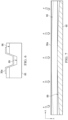
- Figures 6 and 7 illustrate a cure tool 65 that is used to form the straight stiffener 30a to a desired contour along its length, and maintain the shape of the fully formed stiffener 30 during curing.
- the cure tool 65 is provided with contoured tool surfaces 69 that match the shape of the contoured stiffener 30 shown in Figure 1 .
- the straight stiffener 30a is placed on the cure tool 65, and the assembly of the stiffener 30a and cure tool 65 is then vacuum bagged (not shown) and placed in an autoclave (not shown).
- the combination of heat and pressure P applied to the stiffener 30a in the autoclave form it down onto the contoured tool surfaces 69 and cure the stiffener 30.
- thermoset part 30 is formed of part 30 in the illustrated embodiment, other processes, including a single stage process may be employed in which all contours, both longitudinal and traverse, are formed of a single forming operation.
- the plastic matrix is a thermoplastic
- the flat stack can be heated to forming temperature and stamped formed to final shape in a consolidation press.
- thermal curing may be used where the plastic matrix is a thermoset, other curing methods may be employed, depending upon the particular material system being used, including but not limited to curing the formed thermoset part 30 at room temperature.
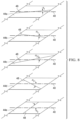
- Figure 8 illustrates several unidirectional plies 44a-44e of the stiffener 30 which comprises a balanced laminate that is devoid of 0° plies.
- the plies 44a-44e have fiber angles relative to the major axis of loading 40, of ⁇ 1 , ⁇ 2 and ⁇ 3 , where 0 ⁇ ⁇ 1 ⁇ ⁇ 2 ⁇ ⁇ 3 ⁇ 90 ° , ⁇ 2 ⁇ ⁇ 1 ⁇ 45 ° , and ⁇ 3 ⁇ ⁇ 2 ⁇ 45 ° .
- Plies 44a-44e are termed "off-angle" plies because the fibers 48 in these plies form angles with respect to the major axis of loading 40.
- + ⁇ 1 is within the ranges of approximately +5° up to approximately +30°
- - ⁇ 1 is within the ranges of approximately -5° up to approximately - 30°.
- the fibers 48 having orientations of ⁇ 1 provide the laminate stiffener 30 with primary axial or longitudinal stiffness
- the fibers 48 having ⁇ 2 fiber orientations provide the laminate with a lesser amount of axial stiffness, and some degree of transverse stiffness.
- primary axial stiffness means that the fibers 48 in the ply 44 primarily provide the part 30 with longitudinal or axial stiffness, rather than with traverse stiffness.
- Figures 9 and 10 illustrate the off-angle orientation of one of the fibers 48 providing the stiffener 30 with primary axial stiffness.
- the fiber 48 may form part of the ply 44 shown in Figure 8 that has an off-angle fiber orientation of + ⁇ 1 .
- the fiber 48 has a length L' that is less than the length L ( Figure 1 ) of the stiffener 30, and is thus shorter in length than fibers in a 0° ply (not shown) of a conventional laminate which would otherwise extend the entire length L of the stiffener 30.
- buckling 49 of the fiber 48 during forming of the straight stiffener 30a to a longitudinal contour is a function of the longitudinal strain ⁇ x on the fiber 48, the length L' over which the strain ⁇ x is applied and boundary conditions affecting the fiber 48.
- the tendency of the fiber 48 to buckle 49 can be reduced by reducing the longitudinal strain ⁇ x on the fiber 48.
- off-angle plies 44 are less likely to wrinkle than 0° plies when the straight stiffener 30a ( Figure 7 ) is formed to the desired longitudinal contour.
- the use of off-angle plies 44 reduces ply wrinkling for several reasons.
- off-angle plies 44 reduce the length L over which the individual fibers 48 are compressed 57 ( figures 9 and 9A ) during forming, and convert a portion of the stretching ( ⁇ x) into shear deformation 53 ( Figure 9A ).
- the off-angle plies 44 are allowed to relax 59 to some degree during forming because the fibers 48 having orientation angles of ⁇ 1 that provide the primary axial stiffness transition from a compressive state 57 at the caps 36 to a neutral state 61 at the webs 38, and then to a tensile state 63 at the flanges 34.
- This relaxation 59 of a portion of the length L of the fibers 48 reduces their tendency to buckle 49 during the forming process.
- the off-angle fibers 48 are shorter in length L (than 0° fibers), some degree of transverse slip 55 between the plies 44 ( Figure 9A ) takes place during forming, and this ply slippage resulting in a reduction of the compression 57 of the fibers 48.
- a laminate part 30 may be produced without the need for 0° plies which provides essentially the same stiffness and performance as an equivalent laminate of comparable weight that relies on 0° plies for axial stiffness.
- an existing stiffener design uses 0° plies may be redesigned using off-angle plies 44 in order to reduce ply wrinkling without sacrificing laminate stiffness or increasing the weight of the part 30.
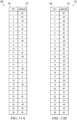
- FIG. 11A and 11B respectively show two possible layup sequences 68, 70 for a contoured laminate part, wherein the ply orientation angles 74 are shown for each of the plies 44 in the layup sequence.
- Figure 11A shows the sequencing of a 26 ply laminate part using a traditional combination of 0°, ⁇ 45° and 90° plies.
- Figure 11B shows a redesigned sequencing of the same 26 ply laminate part having the same laminate thickness which avoids the use of 0° plies in order to reduce ply wrinkling during forming.
- the layup sequence shown in Figure 11B uses a combination of ⁇ 20°, ⁇ 29°, ⁇ 64° and 90° plies, and results in a contoured laminate part that exhibits stiffness equivalent to the laminate part produced using the ply sequence shown in Figure 11A , and without increasing part weight.
- a contoured composite laminate part 30 may have different stiffness requirements in different areas of the part.
- the contoured composite stiffener 30 may have differing stiffness requirements in different zones 72 along its length. Different stiffness properties in the different zones 72 may be achieved by varying the ply orientations, and/or varying the number of plies of a given orientation in each of the zones 72.
- the stiffener 30 may have a thickness T 3 in zone 6 that is greater than the thickness T 2 in zone 5 but less than the thickness T 1 zone 4.
- Ply ramps 76 are used to transition between zones have differing thicknesses T.
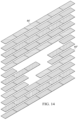
- a laminate part 30 having differing thicknesses along its length to provide individual zones of tailored stiffness properties may be achieved by laying up a combination of full plies 44' and partial plies 44" ( Figure 14 ) of selected fiber orientations in a predetermined sequence.
- Figure 15 illustrates the layup sequence for producing differing stiffnesses in each of zone 1-10.
- the laminate part 30 has differing ply thicknesses T ( Figure 13 ) in various ones of the zones 1-10 based on whether a full ply 44' or partial ply 44" ( Figure 14 ) stretches ( ⁇ x ) over that zone.
- the laminate part 30 represented by the layup sequence shown in Figures 14 and 15 includes a combination of full and partial plies having angular orientations of ⁇ 20°, ⁇ 54°, and 90° cross plies.
- the ⁇ 20° off-angle plies provide the primary axial stiffness.
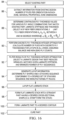
- Figure 16 broadly illustrates the overall steps of one method for producing a contoured composite laminate part 30 having reduced wrinkling and exhibiting differing stiffnesses along its length.
- the method is used to produce an existing part design that utilizes 0° plies with a new part design that avoids the use of 0° plies.
- the shapes of the plies are selected and optimized only after the ply orientations (fiber angles) and the number of plies per angle are determined for each zone 72 having particular stiffness requirements.
- an existing part 30 to be replaced is selected which has part specifications that are required to be met including but not limited to differing stiffness properties along its length.
- information is extracted from the existing part design such as, without limitation, the number of plies per orientation in each zone, material properties and zone dimensions.
- continuous ply thickness values t i j are determined for various ply angle combinations that match the existing part laminate stiffness and thickness. The determination made at 88 includes selecting the number of new fiber orientations ⁇ used for the part 30a, which includes limiting the laminate to three fiber orientations ⁇ 1 , ⁇ 2 , ⁇ 3 , between 90° and 0°, wherein 0 ⁇ ⁇ 1 ⁇ ⁇ 2 ⁇ ⁇ 3 ⁇ 90.
- fiber orientations are limited to integer numbers between 0 and 90°.
- the continuous solution is reduced to a solution with a discrete value or integer number of plies 44 that, based on the set of fiber angles selected from the possible combinations of angles, provides the desired stiffness within a zone.
- the ply thickness values T are refined by performing discrete ply thickness integer optimization.
- the discrete ply thickness integer optimization process is a mixed integer optimization problem with an objective of minimizing the difference between the resulting and optimum lamination parameters.
- the process performed at step 90 comprises calculating the number of plies 44 with discrete ply thicknesses for layups in all of the zones 72, thereby ensuring balance and nonzero ply counts.
- the completion of steps 88 and 90 results in multiple possible combinations of sets of fiber angles and ply thicknesses that may provide the desired stiffnesses in each zone. These possible combinations are subsequently refined and filtered in order to optimize lamination properties for each of the zones.
- the results of the ply thickness integer optimization performed at step 90 are filtered.
- Filtering the results at 92 determines the integer number of plies that will optimize the desired in-plane laminate properties, and results in multiple possible solutions.
- This filtering the results of step 90 i.e. the optimization process, involves filtering a number of possible optimized solutions based on an allowed deviation of effective laminate properties from a desired set of laminate properties, and results in multiple candidate fiber angle combinations and ply counts for each of the angle in each of the layup zones 1-10 ( Figure 12 ) of the part 30a.
- This filtering process results in the selection of a laminate design that best reduces wrinkles, matches given laminate stiffness, and minimizes the number of ply sequences.
- Steps 88, 90 and 92 result in multiple candidate fiber angle combinations and ply counts for each of these angles for each of the layup zones.
- layup information is generated, which may include determining the ply shapes and a stacking sequence that conform to a desired set of stacking sequence and manufacturability rules. Stacking sequence rules avoid undesirable laminate modes. The stacking sequence is chosen, at least in part to achieve substantially homogeneous bending stiffness properties in the laminate. When ply spices are required, naturally created splices are preferred which can be achieved by overlapping the ends of medium length plies. The use of natural splices improves layup efficiency by avoiding the need for short plies required to reinforce splices between long plies, while maintaining structural integrity.
- the plies should be continuous wherever possible in order to maximize the transfer loads from one zone to another, as well as to optimize layup efficiency.
- the flat stack of plies 44 is laid up based on the layup information generated at 94.
- the flat stack 42 is formed, as by stamp forming, into a straight part 30 having a desired cross-sectional shape, such a hat or other shape.
- the laminate part 30a is then formed to a desired contour along its major axis of loading. Finally, at 102 the fully formed laminate part 30a is cured.
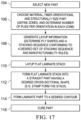
- Figure 17 broadly illustrates the steps of a method of producing a composite laminate part 30 of a new, rather than an existing design.
- the process for producing a newly designed laminate part 30 with reduced wrinkling is similar to that previously described with reference to Figure 16 but without the need for matching the stiffness of an existing part. Briefly, a determination is made of how many plies of each selected ply orientation are required to satisfy specifications for the new part, followed by an optimization of the ply shapes and stacking sequence.
- a new part is selected at 104, and at 106 the material, fiber orientations and structural size of the part are chosen.
- the zones 72 of the part 30 are defined, and the number of plies per orientation in each zone is determined.
- layup information is generated, which comprises determining the ply shapes and a stacking sequence that conforms to a desired set of stacking sequence and manufacturability rules.
- the flat laminate stack is laid up, following which at 112, the flat laminate stack is formed into a straight part having a desired cross-sectional shape, as by stamp forming or other processes previously described.
- laminate part is formed to the desired longitudinal contour and is thereafter cured at 116. As previously mentioned, steps 112 and 114 may be simultaneously performed where the forming is carried out in a single operation.
- Embodiments of the disclosure may find use in a variety of potential applications, particularly in the transportation industry, including for example, aerospace, marine, automotive applications and other application where contoured composite laminate structural members may be used.
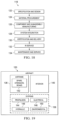
- embodiments of the disclosure may be used in the context of an aircraft manufacturing and service method 118 as shown in Figure 18 and an aircraft 120 as shown in Figure 19 .
- Aircraft applications of the disclosed embodiments may include, for example, without limitation, spars, stringers, beams and similar structural members that are contoured along a major axis of loading.
- exemplary method 118 may include specification and design 122 of the aircraft 120 and material procurement 124.
- component and subassembly manufacturing 126 and system integration 128of the aircraft 120 takes place. Thereafter, the aircraft 120 may go through certification and delivery 130 in order to be placed in service 132. While in service by a customer, the aircraft 120 is scheduled for routine maintenance and service 134, which may also include modification, reconfiguration, refurbishment, and so on.
- a system integrator may include without limitation any number of aircraft manufacturers and major system subcontractors; a third party may include without limitation any number of vendors, subcontractors, and suppliers; and an operator may be an airline, leasing company, military entity, service organization, and so on.
- the aircraft 120 produced by exemplary method 118 may include an airframe 136 with a plurality of systems 138 and an interior 1406.
- the airframe 136 may include spars, stringers, beams and similar structural members 142 having one or more contours.
- Examples of high-level systems 138 include one or more of a propulsion system 144 an electrical system 146 a hydraulic system 148 and an environmental system 150. Any number of other systems may be included.
- an aerospace example is shown, the principles of the disclosure may be applied to other industries, such as the marine and automotive industries.
- Systems and methods embodied herein may be employed during any one or more of the stages of the production and service method 118.
- components or subassemblies corresponding to production process 126 may be fabricated or manufactured in a manner similar to components or subassemblies produced while the aircraft 120 is in service.
- one or more apparatus embodiments, method embodiments, or a combination thereof may be utilized during the production stages 126 and 128, for example, by substantially expediting assembly of or reducing the cost of an aircraft 120.
- apparatus embodiments, method embodiments, or a combination thereof may be utilized while the aircraft 120 is in service, for example and without limitation, to maintenance and service 134.
- the phrase "at least one of”, when used with a list of items, means different combinations of one or more of the listed items may be used and only one of each item in the list may be needed.
- “at least one of item A, item B, and item C” may include, without limitation, item A, item A and item B, or item B. This example also may include item A, item B, and item C or item B and item C.
- the item may be a particular object, thing, or a category. In other words, at least one of means any combination items and number of items may be used from the list but not all of the items in the list are required.
Landscapes
- Engineering & Computer Science (AREA)
- Mechanical Engineering (AREA)
- Chemical & Material Sciences (AREA)
- Composite Materials (AREA)
- Physics & Mathematics (AREA)
- Theoretical Computer Science (AREA)
- Evolutionary Computation (AREA)
- Geometry (AREA)
- General Engineering & Computer Science (AREA)
- General Physics & Mathematics (AREA)
- Computer Hardware Design (AREA)
- Textile Engineering (AREA)
- Moulding By Coating Moulds (AREA)
- Manufacture Of Alloys Or Alloy Compounds (AREA)
Claims (14)
- Verfahren zum Herstellen eines konturierten Verbundwerkstoff-Laminatteils (30) mit einem hohen Seitenverhältnis, einer Hauptlastachse (40) und einer Mehrzahl von Zonen (72) entlang seiner Länge (L), die jeweils gewünschte Steifigkeiten aufweisen, aufweisend:Auswählen eines Satzes von Faserwinkeln (±θ1, ±θ2, ±θ3) für Lagen (44) aus unidirektionalen Verstärkungsfasern (48), wobei keiner der Faserwinkel 0° relativ zu der Hauptlastachse (40) beträgt, wobei der Satz von Faserwinkeln drei Faserorientierungen in schrägen Winkeln (±θ1, ±θ2, ±θ3) relativ zu der Hauptlastachse mit θ1, θ2, θ3 aufweist, wobei 0 < θ1 < θ2 < θ3 ≤ 90° gilt, θ2 - θ1 ≤ 45° ist und θ3 - θ2 ≤ 45° ist;Bestimmen, für jeden der Faserwinkel (±θ1, ±θ2, ±θ3), einer Anzahl von Lagen (44) in jeder der Zonen (72), die erforderlich ist, um eine gewünschte Menge an In-EbenenLaminateigenschaften in der Zone (72) bereitzustellen;Bestimmen einer Form und einer Stapelreihenfolge der Lagen (44), wobei einige der Lagen (44) kontinuierlich und andere der Lagen entlang der Hauptlastachse (40) diskontinuierlich sind, und wobei die schrägen Winkel (±θ1, ±θ2, ±θ3) ausgeglichene Paare von + und - Winkeln enthalten;Auflegen der Lagen (44) in einem flachen Stapel (42) unter Verwendung der Stapelreihenfolge; undFormen des flachen Stapels (42) in die Form des konturierten Verbundwerkstoff-Laminatteils (30).
- Verfahren nach Anspruch 1, wobei:Bestimmen der Faserwinkel (±θ1, ±θ2, ±θ3) das Auswählen einer Mehrzahl möglicher Kombinationen von Faserwinkeln aufweist, undBestimmen einer Anzahl von Lagen (44) in jeder der Zonen (72), die erforderlich ist, um eine gewünschte Menge an In-Ebenen-Laminateigenschaften in der Zone (72) bereitzustellen, für jede der möglichen Kombinationen von Winkeln (±θ1, ±θ2, ±θ3) durchgeführt wird.
- Verfahren nach Anspruch 1 oder 2, wobei:
Bestimmen der Faserwinkel (±θ1, ±θ2, ±θ3) das Eliminieren bestimmter möglicher Kombinationen von Faserwinkeln unter Verwendung eines Satzes von Designregeln für Verbundwerkstoff-Laminate aufweist. - Verfahren nach einem der Ansprüche 1 bis 3, wobei θ1 zwischen ungefähr 5° und 30° ausgewählt wird.
- Verfahren nach einem der Ansprüche 2 bis 4, wobei:
Bestimmen der Anzahl von Lagen (44) in jeder der Zonen (72) das Begrenzen der Anzahl von Lagen (44) auf einen diskreten Wert durch Ausführen einer diskreten Lagendicken-Ganzzahloptimierung aufweist. - Verfahren nach Anspruch 5, wobei das Bestimmen der Anzahl von Lagen (44) in jeder der Zonen (72) das Filtern der Ergebnisse der diskreten Lagendicken-Ganzzahloptimierung auf Basis einer zulässigen Abweichung der effektiven Laminateigenschaften von der gewünschten Menge an In-Ebenen-Laminateigenschaften aufweist.
- Konturierter Verbundwerkstoff-Versteifungselement (30) entlang einer Hauptlastachse (40), aufweisend:eine Mehrzahl von laminierten Lagen (44) aus unidirektionalen Verstärkungsfasern (48), die in einer Kunststoffmatrix (50) gehalten sind, wobei alle Lagen (44) Faserorientierungen in schrägen Winkeln (±θ1, ±θ2, ±θ3) relativ zu der Hauptlastachse (40) aufweisen, wobei die Lagen (44) drei Faserorientierungen relativ zu der Hauptlastachse mit θ1, θ2, θ3 aufweisen und 0 < θ1 < θ2 < θ3 ≤ 90° gilt, wobei θ2 - θ1 ≤ 45° ist und θ3 - θ2 ≤ 45° ist;wobei das konturierte Verbundwerkstoff-Versteifungselement (30) frei von 0°-Lagen ist,wobei einige der Lagen (44) kontinuierlich und andere der Lagen entlang der Hauptlastachse (40) diskontinuierlich sind, undwobei die schrägen Winkel (±θ1, ±θ2, ±θ3) ausgeglichene Paare von + und - Winkeln enthalten.
- Konturiertes Verbundwerkstoff-Versteifungselement (30) nach Anspruch 7, wobei θ1 zwischen ungefähr 5° und 30° liegt.
- Konturiertes Verbundwerkstoff-Versteifungselement (30) nach einem der Ansprüche 7 oder 8, wobei die Mehrzahl der Lagen (44) entlang der Hauptlastachse (40) in ihrer Anzahl variiert und Zonen (72) entlang des konturierten Verbundwerkstoff-Versteifungselements (30) definiert, die jeweils unterschiedliche Steifigkeitseigenschaften aufweisen.
- Konturiertes Verbundwerkstoff-Versteifungselement (30) nach einem der Ansprüche 7 bis 9, wobei das konturierte Verbundwerkstoff-Versteifungselement (30) ein Hutstringer oder ein Versteifungselement mit einem Querschnitt in Z-Form, C-Form, abgerundeter Hutform oder I-Form ist.
- Konturiertes Verbundwerkstoff-Versteifungselement (30) nach einem der Ansprüche 7 bis 9, wobei das konturierte Verbundwerkstoff-Versteifungselement (30) ein Holm oder ein Bodenträger ist.
- Konturiertes Verbundwerkstoff-Versteifungselement (30) nach einem der Ansprüche 7 bis 9, wobei das Versteifungselement (30) einen Hutabschnitt (32) aufweist, der durch eine Kappe (36) und ein Paar Stege (38) definiert ist.
- Konturiertes Verbundwerkstoff-Versteifungselement (30) nach Anspruch 12, wobei die Stege (38) die Kappe (36) mit einem Paar Flanschen (34) verbinden, die nach außen ragen.
- Konturiertes Verbundwerkstoff-Versteifungselement (30) nach Anspruch 13, wobei das Versteifungselement (30) eine Länge aufweist, die wesentlich größer ist als seine Breite, und somit ein hohes Seitenverhältnis besitzt.
Applications Claiming Priority (1)
| Application Number | Priority Date | Filing Date | Title |
|---|---|---|---|
| US15/194,986 US10449754B2 (en) | 2016-06-28 | 2016-06-28 | Wrinkle reduction in formed composite laminates |
Publications (2)
| Publication Number | Publication Date |
|---|---|
| EP3263320A1 EP3263320A1 (de) | 2018-01-03 |
| EP3263320B1 true EP3263320B1 (de) | 2025-02-19 |
Family
ID=58428208
Family Applications (1)
| Application Number | Title | Priority Date | Filing Date |
|---|---|---|---|
| EP17163124.5A Active EP3263320B1 (de) | 2016-06-28 | 2017-03-27 | Faltenminimierung in geformten verbundlaminaten |
Country Status (5)
| Country | Link |
|---|---|
| US (2) | US10449754B2 (de) |
| EP (1) | EP3263320B1 (de) |
| KR (1) | KR102340803B1 (de) |
| ES (1) | ES3024284T3 (de) |
| PT (1) | PT3263320T (de) |
Families Citing this family (11)
| Publication number | Priority date | Publication date | Assignee | Title |
|---|---|---|---|---|
| US11186049B2 (en) | 2018-08-23 | 2021-11-30 | The Boeing Company | Ply splicing for composite charges that are shaped to spanwise contours |
| CN110012238B (zh) * | 2019-03-19 | 2021-06-25 | 腾讯音乐娱乐科技(深圳)有限公司 | 多媒体拼接方法、装置、终端及存储介质 |
| CN110181713A (zh) * | 2019-04-24 | 2019-08-30 | 施洋 | 一种结合树脂对废弃碳纤维材料进行再加工成新型碳纤维复合材料及其加工方法 |
| US11285641B2 (en) * | 2020-02-26 | 2022-03-29 | The Boeing Company | Methods and systems for forming curved composite charges for stringers |
| US11584502B2 (en) | 2020-07-29 | 2023-02-21 | The Boeing Company | Composite fabric hat stringers having interleafed tape plies |
| CN113343445B (zh) * | 2021-05-24 | 2022-10-04 | 西南交通大学 | 一种复合材料夹芯板稳定性设计方法 |
| JP7779084B2 (ja) * | 2021-10-28 | 2025-12-03 | 東レ株式会社 | 複合部材 |
| JP7779085B2 (ja) * | 2021-10-28 | 2025-12-03 | 東レ株式会社 | 複合部材 |
| US11969953B2 (en) * | 2022-07-26 | 2024-04-30 | The Boeing Company | Prepreg charge optimized for forming contoured composite laminate structures |
| US12049048B2 (en) | 2022-07-26 | 2024-07-30 | The Boeing Company | Method for high rate production of composite laminate structures |
| KR102511226B1 (ko) | 2022-08-03 | 2023-03-20 | 주식회사 선우하이테크 | 원투 낚시채비 |
Citations (1)
| Publication number | Priority date | Publication date | Assignee | Title |
|---|---|---|---|---|
| US20110045232A1 (en) * | 2005-03-31 | 2011-02-24 | The Boeing Company | Composite stiffeners for aerospace vehicles |
Family Cites Families (12)
| Publication number | Priority date | Publication date | Assignee | Title |
|---|---|---|---|---|
| US5064439A (en) * | 1987-01-20 | 1991-11-12 | Richards Medical Company | Orthopedic device of biocompatible polymer with oriented fiber reinforcement |
| US20100012162A1 (en) * | 2001-09-06 | 2010-01-21 | John Cantrell | Pot and pan washing machine |
| US7249943B2 (en) * | 2003-08-01 | 2007-07-31 | Alliant Techsystems Inc. | Apparatus for forming composite stiffeners and reinforcing structures |
| US7243055B2 (en) | 2004-01-28 | 2007-07-10 | The Boeing Company | Composite stacking sequence optimization for multi-zoned composites |
| US7943076B1 (en) | 2005-05-03 | 2011-05-17 | The Boeing Company | Method of manufacturing curved composite structural elements |
| US9278484B2 (en) | 2008-04-17 | 2016-03-08 | The Boeing Company | Method and apparatus for producing contoured composite structures and structures produced thereby |
| GB0820800D0 (en) | 2008-11-13 | 2008-12-24 | Airbus Uk Ltd | Method of designing a composite laminate |
| GB201006257D0 (en) | 2010-04-15 | 2010-06-02 | Airbus Operations Ltd | Composite structure |
| JP5130320B2 (ja) * | 2010-04-28 | 2013-01-30 | トヨタ自動車株式会社 | 把持装置 |
| US8795567B2 (en) * | 2010-09-23 | 2014-08-05 | The Boeing Company | Method for fabricating highly contoured composite stiffeners with reduced wrinkling |
| US9289949B2 (en) | 2012-06-08 | 2016-03-22 | The Boeing Company | Optimized cross-ply orientation in composite laminates |
| US20160009368A1 (en) | 2013-02-28 | 2016-01-14 | The Boeing Company | Composite laminated plate having reduced crossply angle |
-
2016
- 2016-06-28 US US15/194,986 patent/US10449754B2/en active Active
-
2017
- 2017-03-27 PT PT171631245T patent/PT3263320T/pt unknown
- 2017-03-27 EP EP17163124.5A patent/EP3263320B1/de active Active
- 2017-03-27 ES ES17163124T patent/ES3024284T3/es active Active
- 2017-05-22 KR KR1020170062966A patent/KR102340803B1/ko active Active
-
2019
- 2019-08-28 US US16/554,333 patent/US20190381780A1/en not_active Abandoned
Patent Citations (1)
| Publication number | Priority date | Publication date | Assignee | Title |
|---|---|---|---|---|
| US20110045232A1 (en) * | 2005-03-31 | 2011-02-24 | The Boeing Company | Composite stiffeners for aerospace vehicles |
Also Published As
| Publication number | Publication date |
|---|---|
| US20170368815A1 (en) | 2017-12-28 |
| ES3024284T3 (en) | 2025-06-04 |
| EP3263320A1 (de) | 2018-01-03 |
| KR20180002017A (ko) | 2018-01-05 |
| US20190381780A1 (en) | 2019-12-19 |
| PT3263320T (pt) | 2025-03-06 |
| KR102340803B1 (ko) | 2021-12-17 |
| US10449754B2 (en) | 2019-10-22 |
Similar Documents
| Publication | Publication Date | Title |
|---|---|---|
| EP3263320B1 (de) | Faltenminimierung in geformten verbundlaminaten | |
| EP2128019B2 (de) | Modifizierteres Versteifungsblech und Herstellungsverfahren dafür | |
| EP3162544B1 (de) | Verfahren und vorrichtung zur herstellung von konturierten verbundlaminatversteifungen mit reduzierter knitterung | |
| KR102022130B1 (ko) | 경량 유연성 맨드렐 및 이를 제조하는 방법 | |
| EP2561979B1 (de) | Verfahren zur Formung von konturierten Kompositversteifungen | |
| EP2185346B1 (de) | Mit verbundstoff profilierte verbundstreben | |
| US9724891B2 (en) | Bead-stiffened composite parts | |
| EP2303557B1 (de) | Rampenförmige versteifung sowie vorrichtung und verfahren zu ihrer herstellung | |
| EP2602094B1 (de) | Verfahren zur Herstellung von Verbundstofflaminatstrukturen zur Ermöglichung der Lagenverschiebung während der Herstellung | |
| JP7629060B2 (ja) | 複合構造体のスプライス及びその方法 | |
| EP3000586B1 (de) | Verfahren zur Herstellung eines Verbundstoffmaterialteils mit einer Bahn und mindestens einem Flansch | |
| US9440401B1 (en) | Method for producing composite laminated parts with non-ruled surfaces | |
| EP3012099A1 (de) | Angepasster wärmeausdehnungskoeffizient von verbundlaminaten mit verwendung einer faserlenkung | |
| US20220033049A1 (en) | Composite Fabric Hat Stringers having Interleafed Tape Plies | |
| CN115723351A (zh) | 用于成型高轮廓复合结构的成型设备及相关方法 | |
| US20230182417A1 (en) | Wrinkle Mitigation in Contoured Composite Stiffeners | |
| US11987353B2 (en) | Thermoplastic skin panels, torque box and method | |
| US11969953B2 (en) | Prepreg charge optimized for forming contoured composite laminate structures |
Legal Events
| Date | Code | Title | Description |
|---|---|---|---|
| PUAI | Public reference made under article 153(3) epc to a published international application that has entered the european phase |
Free format text: ORIGINAL CODE: 0009012 |
|
| STAA | Information on the status of an ep patent application or granted ep patent |
Free format text: STATUS: REQUEST FOR EXAMINATION WAS MADE |
|
| 17P | Request for examination filed |
Effective date: 20170327 |
|
| AK | Designated contracting states |
Kind code of ref document: A1 Designated state(s): AL AT BE BG CH CY CZ DE DK EE ES FI FR GB GR HR HU IE IS IT LI LT LU LV MC MK MT NL NO PL PT RO RS SE SI SK SM TR |
|
| AX | Request for extension of the european patent |
Extension state: BA ME |
|
| STAA | Information on the status of an ep patent application or granted ep patent |
Free format text: STATUS: EXAMINATION IS IN PROGRESS |
|
| 17Q | First examination report despatched |
Effective date: 20210712 |
|
| RAP3 | Party data changed (applicant data changed or rights of an application transferred) |
Owner name: THE BOEING COMPANY |
|
| GRAP | Despatch of communication of intention to grant a patent |
Free format text: ORIGINAL CODE: EPIDOSNIGR1 |
|
| STAA | Information on the status of an ep patent application or granted ep patent |
Free format text: STATUS: GRANT OF PATENT IS INTENDED |
|
| RIC1 | Information provided on ipc code assigned before grant |
Ipc: B29L 31/00 20060101ALN20240927BHEP Ipc: B32B 7/03 20190101ALI20240927BHEP Ipc: G06F 30/20 20200101ALI20240927BHEP Ipc: B29C 70/20 20060101ALI20240927BHEP Ipc: B29D 99/00 20100101ALI20240927BHEP Ipc: B29C 70/34 20060101AFI20240927BHEP |
|
| INTG | Intention to grant announced |
Effective date: 20241014 |
|
| GRAS | Grant fee paid |
Free format text: ORIGINAL CODE: EPIDOSNIGR3 |
|
| GRAA | (expected) grant |
Free format text: ORIGINAL CODE: 0009210 |
|
| STAA | Information on the status of an ep patent application or granted ep patent |
Free format text: STATUS: THE PATENT HAS BEEN GRANTED |
|
| P01 | Opt-out of the competence of the unified patent court (upc) registered |
Free format text: CASE NUMBER: APP_66889/2024 Effective date: 20241218 |
|
| AK | Designated contracting states |
Kind code of ref document: B1 Designated state(s): AL AT BE BG CH CY CZ DE DK EE ES FI FR GB GR HR HU IE IS IT LI LT LU LV MC MK MT NL NO PL PT RO RS SE SI SK SM TR |
|
| REG | Reference to a national code |
Ref country code: GB Ref legal event code: FG4D |
|
| REG | Reference to a national code |
Ref country code: CH Ref legal event code: EP |
|
| REG | Reference to a national code |
Ref country code: PT Ref legal event code: SC4A Ref document number: 3263320 Country of ref document: PT Date of ref document: 20250306 Kind code of ref document: T Free format text: AVAILABILITY OF NATIONAL TRANSLATION Effective date: 20250226 Ref country code: DE Ref legal event code: R096 Ref document number: 602017087818 Country of ref document: DE |
|
| REG | Reference to a national code |
Ref country code: SE Ref legal event code: TRGR |
|
| REG | Reference to a national code |
Ref country code: IE Ref legal event code: FG4D |
|
| PGFP | Annual fee paid to national office [announced via postgrant information from national office to epo] |
Ref country code: SE Payment date: 20250312 Year of fee payment: 9 |
|
| PGFP | Annual fee paid to national office [announced via postgrant information from national office to epo] |
Ref country code: DE Payment date: 20250327 Year of fee payment: 9 Ref country code: PT Payment date: 20250310 Year of fee payment: 9 |
|
| PGFP | Annual fee paid to national office [announced via postgrant information from national office to epo] |
Ref country code: FR Payment date: 20250325 Year of fee payment: 9 |
|
| PGFP | Annual fee paid to national office [announced via postgrant information from national office to epo] |
Ref country code: IT Payment date: 20250319 Year of fee payment: 9 Ref country code: GB Payment date: 20250327 Year of fee payment: 9 |
|
| REG | Reference to a national code |
Ref country code: ES Ref legal event code: FG2A Ref document number: 3024284 Country of ref document: ES Kind code of ref document: T3 Effective date: 20250604 |
|
| REG | Reference to a national code |
Ref country code: NL Ref legal event code: MP Effective date: 20250219 |
|
| PG25 | Lapsed in a contracting state [announced via postgrant information from national office to epo] |
Ref country code: RS Free format text: LAPSE BECAUSE OF FAILURE TO SUBMIT A TRANSLATION OF THE DESCRIPTION OR TO PAY THE FEE WITHIN THE PRESCRIBED TIME-LIMIT Effective date: 20250519 |
|
| PG25 | Lapsed in a contracting state [announced via postgrant information from national office to epo] |
Ref country code: FI Free format text: LAPSE BECAUSE OF FAILURE TO SUBMIT A TRANSLATION OF THE DESCRIPTION OR TO PAY THE FEE WITHIN THE PRESCRIBED TIME-LIMIT Effective date: 20250219 |
|
| PG25 | Lapsed in a contracting state [announced via postgrant information from national office to epo] |
Ref country code: PL Free format text: LAPSE BECAUSE OF FAILURE TO SUBMIT A TRANSLATION OF THE DESCRIPTION OR TO PAY THE FEE WITHIN THE PRESCRIBED TIME-LIMIT Effective date: 20250219 |
|
| PGFP | Annual fee paid to national office [announced via postgrant information from national office to epo] |
Ref country code: ES Payment date: 20250401 Year of fee payment: 9 |
|
| REG | Reference to a national code |
Ref country code: LT Ref legal event code: MG9D |
|
| PG25 | Lapsed in a contracting state [announced via postgrant information from national office to epo] |
Ref country code: IS Free format text: LAPSE BECAUSE OF FAILURE TO SUBMIT A TRANSLATION OF THE DESCRIPTION OR TO PAY THE FEE WITHIN THE PRESCRIBED TIME-LIMIT Effective date: 20250619 Ref country code: NO Free format text: LAPSE BECAUSE OF FAILURE TO SUBMIT A TRANSLATION OF THE DESCRIPTION OR TO PAY THE FEE WITHIN THE PRESCRIBED TIME-LIMIT Effective date: 20250519 |
|
| PG25 | Lapsed in a contracting state [announced via postgrant information from national office to epo] |
Ref country code: NL Free format text: LAPSE BECAUSE OF FAILURE TO SUBMIT A TRANSLATION OF THE DESCRIPTION OR TO PAY THE FEE WITHIN THE PRESCRIBED TIME-LIMIT Effective date: 20250219 |
|
| PG25 | Lapsed in a contracting state [announced via postgrant information from national office to epo] |
Ref country code: HR Free format text: LAPSE BECAUSE OF FAILURE TO SUBMIT A TRANSLATION OF THE DESCRIPTION OR TO PAY THE FEE WITHIN THE PRESCRIBED TIME-LIMIT Effective date: 20250219 |
|
| PG25 | Lapsed in a contracting state [announced via postgrant information from national office to epo] |
Ref country code: LV Free format text: LAPSE BECAUSE OF FAILURE TO SUBMIT A TRANSLATION OF THE DESCRIPTION OR TO PAY THE FEE WITHIN THE PRESCRIBED TIME-LIMIT Effective date: 20250219 |
|
| PG25 | Lapsed in a contracting state [announced via postgrant information from national office to epo] |
Ref country code: GR Free format text: LAPSE BECAUSE OF FAILURE TO SUBMIT A TRANSLATION OF THE DESCRIPTION OR TO PAY THE FEE WITHIN THE PRESCRIBED TIME-LIMIT Effective date: 20250520 Ref country code: BG Free format text: LAPSE BECAUSE OF FAILURE TO SUBMIT A TRANSLATION OF THE DESCRIPTION OR TO PAY THE FEE WITHIN THE PRESCRIBED TIME-LIMIT Effective date: 20250219 |
|
| REG | Reference to a national code |
Ref country code: AT Ref legal event code: MK05 Ref document number: 1767912 Country of ref document: AT Kind code of ref document: T Effective date: 20250219 |
|
| PG25 | Lapsed in a contracting state [announced via postgrant information from national office to epo] |
Ref country code: SM Free format text: LAPSE BECAUSE OF FAILURE TO SUBMIT A TRANSLATION OF THE DESCRIPTION OR TO PAY THE FEE WITHIN THE PRESCRIBED TIME-LIMIT Effective date: 20250219 |
|
| PG25 | Lapsed in a contracting state [announced via postgrant information from national office to epo] |
Ref country code: DK Free format text: LAPSE BECAUSE OF FAILURE TO SUBMIT A TRANSLATION OF THE DESCRIPTION OR TO PAY THE FEE WITHIN THE PRESCRIBED TIME-LIMIT Effective date: 20250219 |
|
| PG25 | Lapsed in a contracting state [announced via postgrant information from national office to epo] |
Ref country code: AT Free format text: LAPSE BECAUSE OF FAILURE TO SUBMIT A TRANSLATION OF THE DESCRIPTION OR TO PAY THE FEE WITHIN THE PRESCRIBED TIME-LIMIT Effective date: 20250219 |
|
| PG25 | Lapsed in a contracting state [announced via postgrant information from national office to epo] |
Ref country code: CZ Free format text: LAPSE BECAUSE OF FAILURE TO SUBMIT A TRANSLATION OF THE DESCRIPTION OR TO PAY THE FEE WITHIN THE PRESCRIBED TIME-LIMIT Effective date: 20250219 Ref country code: EE Free format text: LAPSE BECAUSE OF FAILURE TO SUBMIT A TRANSLATION OF THE DESCRIPTION OR TO PAY THE FEE WITHIN THE PRESCRIBED TIME-LIMIT Effective date: 20250219 |
|
| REG | Reference to a national code |
Ref country code: CH Ref legal event code: H13 Free format text: ST27 STATUS EVENT CODE: U-0-0-H10-H13 (AS PROVIDED BY THE NATIONAL OFFICE) Effective date: 20251023 |
|
| PG25 | Lapsed in a contracting state [announced via postgrant information from national office to epo] |
Ref country code: RO Free format text: LAPSE BECAUSE OF FAILURE TO SUBMIT A TRANSLATION OF THE DESCRIPTION OR TO PAY THE FEE WITHIN THE PRESCRIBED TIME-LIMIT Effective date: 20250219 |
|
| PG25 | Lapsed in a contracting state [announced via postgrant information from national office to epo] |
Ref country code: SK Free format text: LAPSE BECAUSE OF FAILURE TO SUBMIT A TRANSLATION OF THE DESCRIPTION OR TO PAY THE FEE WITHIN THE PRESCRIBED TIME-LIMIT Effective date: 20250219 |
|
| PG25 | Lapsed in a contracting state [announced via postgrant information from national office to epo] |
Ref country code: LU Free format text: LAPSE BECAUSE OF NON-PAYMENT OF DUE FEES Effective date: 20250327 |
|
| REG | Reference to a national code |
Ref country code: DE Ref legal event code: R097 Ref document number: 602017087818 Country of ref document: DE |
|
| REG | Reference to a national code |
Ref country code: BE Ref legal event code: MM Effective date: 20250331 |
|
| PG25 | Lapsed in a contracting state [announced via postgrant information from national office to epo] |
Ref country code: MC Free format text: LAPSE BECAUSE OF FAILURE TO SUBMIT A TRANSLATION OF THE DESCRIPTION OR TO PAY THE FEE WITHIN THE PRESCRIBED TIME-LIMIT Effective date: 20250219 |
|
| PLBE | No opposition filed within time limit |
Free format text: ORIGINAL CODE: 0009261 |
|
| STAA | Information on the status of an ep patent application or granted ep patent |
Free format text: STATUS: NO OPPOSITION FILED WITHIN TIME LIMIT |
|
| PG25 | Lapsed in a contracting state [announced via postgrant information from national office to epo] |
Ref country code: BE Free format text: LAPSE BECAUSE OF NON-PAYMENT OF DUE FEES Effective date: 20250331 |
|
| PG25 | Lapsed in a contracting state [announced via postgrant information from national office to epo] |
Ref country code: CH Free format text: LAPSE BECAUSE OF NON-PAYMENT OF DUE FEES Effective date: 20250331 |
|
| PG25 | Lapsed in a contracting state [announced via postgrant information from national office to epo] |
Ref country code: IE Free format text: LAPSE BECAUSE OF NON-PAYMENT OF DUE FEES Effective date: 20250327 |
|
| 26N | No opposition filed |
Effective date: 20251120 |