EP3263239A1 - Verfahren zur herstellung von verkleidung oder fassadenglasfliesen aus abfallkathodenstrahlröhrenglas (crt) und eine crt glasfliese - Google Patents
Verfahren zur herstellung von verkleidung oder fassadenglasfliesen aus abfallkathodenstrahlröhrenglas (crt) und eine crt glasfliese Download PDFInfo
- Publication number
- EP3263239A1 EP3263239A1 EP17173641.6A EP17173641A EP3263239A1 EP 3263239 A1 EP3263239 A1 EP 3263239A1 EP 17173641 A EP17173641 A EP 17173641A EP 3263239 A1 EP3263239 A1 EP 3263239A1
- Authority
- EP
- European Patent Office
- Prior art keywords
- weight
- glass
- tiles
- crt
- tile
- Prior art date
- Legal status (The legal status is an assumption and is not a legal conclusion. Google has not performed a legal analysis and makes no representation as to the accuracy of the status listed.)
- Granted
Links
Images
Classifications
-
- B—PERFORMING OPERATIONS; TRANSPORTING
- B09—DISPOSAL OF SOLID WASTE; RECLAMATION OF CONTAMINATED SOIL
- B09B—DISPOSAL OF SOLID WASTE NOT OTHERWISE PROVIDED FOR
- B09B3/00—Destroying solid waste or transforming solid waste into something useful or harmless
- B09B3/20—Agglomeration, binding or encapsulation of solid waste
- B09B3/25—Agglomeration, binding or encapsulation of solid waste using mineral binders or matrix
-
- C—CHEMISTRY; METALLURGY
- C03—GLASS; MINERAL OR SLAG WOOL
- C03B—MANUFACTURE, SHAPING, OR SUPPLEMENTARY PROCESSES
- C03B19/00—Other methods of shaping glass
- C03B19/06—Other methods of shaping glass by sintering, e.g. by cold isostatic pressing of powders and subsequent sintering, by hot pressing of powders, by sintering slurries or dispersions not undergoing a liquid phase reaction
-
- C—CHEMISTRY; METALLURGY
- C03—GLASS; MINERAL OR SLAG WOOL
- C03B—MANUFACTURE, SHAPING, OR SUPPLEMENTARY PROCESSES
- C03B19/00—Other methods of shaping glass
- C03B19/09—Other methods of shaping glass by fusing powdered glass in a shaping mould
-
- C—CHEMISTRY; METALLURGY
- C03—GLASS; MINERAL OR SLAG WOOL
- C03B—MANUFACTURE, SHAPING, OR SUPPLEMENTARY PROCESSES
- C03B19/00—Other methods of shaping glass
- C03B19/10—Forming beads
- C03B19/108—Forming porous, sintered or foamed beads
-
- C—CHEMISTRY; METALLURGY
- C03—GLASS; MINERAL OR SLAG WOOL
- C03C—CHEMICAL COMPOSITION OF GLASSES, GLAZES OR VITREOUS ENAMELS; SURFACE TREATMENT OF GLASS; SURFACE TREATMENT OF FIBRES OR FILAMENTS MADE FROM GLASS, MINERALS OR SLAGS; JOINING GLASS TO GLASS OR OTHER MATERIALS
- C03C1/00—Ingredients generally applicable to manufacture of glasses, glazes, or vitreous enamels
- C03C1/002—Use of waste materials, e.g. slags
-
- C—CHEMISTRY; METALLURGY
- C03—GLASS; MINERAL OR SLAG WOOL
- C03C—CHEMICAL COMPOSITION OF GLASSES, GLAZES OR VITREOUS ENAMELS; SURFACE TREATMENT OF GLASS; SURFACE TREATMENT OF FIBRES OR FILAMENTS MADE FROM GLASS, MINERALS OR SLAGS; JOINING GLASS TO GLASS OR OTHER MATERIALS
- C03C3/00—Glass compositions
- C03C3/04—Glass compositions containing silica
- C03C3/076—Glass compositions containing silica with 40% to 90% silica, by weight
- C03C3/102—Glass compositions containing silica with 40% to 90% silica, by weight containing lead
- C03C3/108—Glass compositions containing silica with 40% to 90% silica, by weight containing lead containing boron
Definitions
- the object of the invention is a method for producing cladding or facade glass tiles from waste cathode ray tube glass (CRT) and a CRT glass tile.
- CRT cathode ray tube glass
- CRT glass comprises substantial amounts of toxic components, including in particular PbO and BaO. Most of PbO (usually above 21 % by weight) is present in CRT glass originating from cathode ray tube cone, while the glass originating from the screen part of the cathode ray tube shows in turn a relatively high (usually above 7.5 % by weight) BaO content.
- US 20160122232 A1 discloses a ceramic mixture comprising CRT glass used as a coating component for applying to ceramic tiles, as glaze as well as engobe (slipware) or an element of sub-glaze decoration. Ceramic tiles with an addition of CRT have been also described.
- the specified firing temperatures within a range of 1350-1450°C, or even close to 1050°C, in an unambiguous manner indicate the small content of CRT in the tile material composition, because in this temperature CRT glass melts completely.
- US 9321695 describes a mixture for producing a glass-ceramic composite in which the use of soda-lime glass is being considered, and subsequently - cullet obtained from glass used in pharmacy, CRT glass or borosilicate glass.
- the specified composition of CRT glass noticeably differs from a typical real composition, due to lack of any reference to oxides typical for CRT glass, such as lead (usually approx. 20 wt%), barium or strontium oxides. It has also been unambiguously indicated that the resulting products - in particular tiles formed in moulds - are characterised by a considerable content of crystalline phases.
- US 20150299032 discloses producing of a composite comprising waste materials, including i.a. CRT glass.
- the composite comprises at most 80% by weight of the glass component, at least 20% by weight of the mineral non-glass component and less than 5% by weight of synthetic binding agents.
- the mineral component listed include i.a. ceramics, ceramic glazes, rocks or waste from quarries, sanitary ceramic waste, brick shards.
- CN 104876541 discloses a ceramic tile produced from a raw material mixture comprising 40-60 parts by weight of kaoline, 40-60 parts by weight of aluminium oxide, 20-30 parts by weight of quartz sand, 15-25 parts by weight of feldspar, 5-10 parts by weight of residue of an electrolytic process for producing manganese, 5-10 parts by weight of CRT glass and 5-10 parts by weight of fly ash.
- CN 103395995 describes a process for producing glass-ceramic tiles using glass waste (including CRT glass amounting to 40-60% by weight of the mixture).
- the glass used comprises i.a. 1-5 wt% B 2 O 3 , 1-10 wt% ZnO and 5-25 wt% CaO. Crystallisation of the glass component used during formation of glass-ceramic tiles has also been clearly mentioned.
- WO 2011030366 describes a mixture for producing ceramic tiles comprising CRT glass in amount of 10-50% by weight.
- US 20140073830 discloses a method for processing hazardous waste glass (including CRT glass) to obtain ceramic products having respectively low concentration of hazardous substances.
- the glass waste in particular CRT, is mixed with a filler, such as aluminium oxide, magnesium silicate or bentonite, in the amount between 5 and 40% by weight, and - in one of the embodiments - with plastic material such as clay, it being then possible for such plastic material to constitute 5 to 40% by weight of the mixture.
- a filler such as aluminium oxide, magnesium silicate or bentonite
- waste CRT glass was used either as a glazing material for ceramic tiles, or as an additive for ceramic-glass composites.
- the tendency to increase the percentage of CRT glass waste in ceramic-glass products resulting from the need to increase the efficiency of recycling and decrease energy inputs by reducing the required firing temperature was quite noticeably hampered by the necessity for the resulting products, such as, e.g. ceramic-glass tiles comprising CRT glass, to show satisfying performance parameters, allowing to use them in areas reserved so far for ceramic tiles only.
- the known solutions reflect subsequent compromises between increasing the utilisation level of waste glass, including CRT glass, as well as reducing the energy consumption of the process for producing products such as tiles, and the requirements related to their performance parameters, such as average water absorption, bending strength, breaking strength, chemical resistance, hardness, and in case of outdoor uses also frost resistance.
- optimising solutions of this type requires adjusting a number of factors, such as quantitative and qualitative composition of individual raw materials and the whole mixture, as well as processing parameters such as particle size distribution, method for moulding products prior to firing, or firing temperature, there is a continuous demand for new solutions allowing to provide the best possible remedy for the above-mentioned contradictions, i.e. to ensure maximum level of CRT glass waste utilization and to reduce energy consumption of the product manufacturing process, with the final products fulfilling respective performance and aesthetic parameters at the same time.
- the object of the present solution was to overcome the above-mentioned problems associated with using known solutions, and in particular - to provide technology for producing a new product from CRT glass waste, having high utility value, allowing to considerably reduce the amount of this type of waste, while limiting energy consumption of the producing process allowing to manufacture products meeting the current standards related to performance parameters of products such as ceramic cladding and/or facade tiles.
- the object of the invention is a method for producing cladding or facade glass tiles from waste cathode ray tube glass (CRT), in which
- the glass used as waste cathode ray tube glass comprises: 53-63 wt% SiO 2 , 1-3.4 wt% Al 2 O 3 , 0.07-0.09 wt% Fe 2 O 3 , 0.050.50 wt% TiO 2 , 6-7.8 wt% Na 2 O, 7-8.3 wt% K 2 O, 0.05-0.07 wt% Li 2 O, 0.02-3.6 wt% CaO, 0.03-2.3 wt% MgO, 0.05-0.50 wt% ZnO, less than 0.001 wt% CuO, 0.2-21 wt% PbO, 1.1-8.6 wt% BaO, 0.5-9.0 wt% SrO, 0.95-1.9 wt% ZrO 2 , less than 0.003 wt% NiO, less than 0.002 wt% CdO, less than 0.21 wt% Sb 2 O 3 and less than 0.12
- the anti-sedimentation agent is used in the amount of 0.1 to 0.5 % by weight with respect to dry basic matter.
- magnesium chloride or adipic acid is used as the anti-sedimentation agent.
- poly(vinyl alcohol), methyl cellulose or poly(vinyl acetate) is used as the binding agent.
- a 4 % aqueous solution of the binding agent is used.
- At least one inorganic pigment is additionally added to the suspension.
- the inorganic pigment is added in the amount of 1 to 3 % by weight with respect to dry total weight of the tile matter components.
- the object of the invention is also a glass tile of waste cathode ray tube glass (CRT), characterised in that it comprises a basic matter and an anti-sedimentation agent, wherein the basic matter comprises at least 95 % by weight of waste cathode ray tube glass and no more than 5 % by weight of a mineral binder having illite content within a range of 22-38 % by weight, while amorphous phase constitutes over 98 % by weight of the tile material.
- CTR waste cathode ray tube glass
- the glass tile according to the invention comprises the glass comprising: 53-63 wt% SiO 2 , 1-3.4 wt% Al 2 O 3 , 0.07-0.09 wt% Fe 2 O 3 , 0.050.50 wt% TiO 2 , 6-7.8 wt% Na 2 O, 7-8.3 wt% K 2 O, 0.05-0.07 wt% Li 2 O, 0.02-3.6 wt% CaO, 0.03-2.3 wt% MgO, 0.05-0.50 wt% ZnO, less than 0.001 wt% CuO, 0.2-21 wt% PbO, 1.1-8.6 wt% BaO, 0.5-9.0 wt% SrO, 0.95-1.9 wt% ZrO 2 , less than 0.003 wt% NiO, less than 0.002 wt% CdO, less than 0.21 wt% Sb
- the glass tile according to the invention is an unglazed tile and shows the following parameters:
- such tile is a cladding tile.
- such tile is a facade tile and shows frost resistance, i.e. no fractured tiles per 100 cycles, determined according to PN-EN ISO 10545-12:1999.
- the main advantage of the solution according to the invention is above all the ability to utilise virtually the whole CRT glass waste, producing a new product capable of being used as an interior cladding tile and a facade tile.
- Glass tiles according to the invention show physicochemical parameters that comply with the European standards for ceramic tiles, both glazed and unglazed.
- the firing temperature for tiles according to the invention is 150 to 250°C lower compared to the firing temperature of traditional, ceramic wall tiles (in the case of unglazed tiles it usually falls within a range of 1220 -1250°C, to ensure that the final tiles meet the standards related to performance parameters), which in a noticeable manner reduces the energy consumption of the whole process, and as a consequence also the costs of producing these tiles.
- the method for producing glass tiles according to the invention comprises the following unit processes: grinding, granulation, pressing, firing.
- the technological parameters of these processes, except for the firing process, depend on the technical parameters of the devices by means of which intermediate products having precisely defined parameters are manufactured.
- a batch consisting of the basic matter and the anti-sedimentation agent is placed in a grinding device (e.g. a ball mill).
- the basic matter comprises at least 95% by weight of waste cathode ray tube glass and no more than 5% by weight of a mineral binder having illite content of 22-38% by weight.
- the set is subjected to a wet grinding process to obtain a particle size distribution, wherein the particle substitute diameter D(v,0.9) determined by laser grain size analysis is contained within the range of 24-32 ⁇ m and the particle substitute diameter D(v,0.5) is contained within the range of 5.26-8.30 ⁇ m.
- Laser grain size analysis is based on the fact that the laser diffraction angle is inversely proportional to the particle size.
- the particle substitute diameter D(v,0.1), D(v,0.5), D(v,0.9) are determined, which means that below the D value there is respectively 10%, 50%, and 90% of the particles.
- a specific particle size range is measured. The measurement is performed according to the producer's manual, appropriate for a given device.
- magnesium stearate in the amount of 0.27-0.30 % by weight with respect to dry basic matter and - optionally - a binding agent in the amount up to 0.25% by weight with respect dry to basic matter is added to the ground mixture, whereby the binding agent is used in form of an aqueous solution.
- the density of suspension produced in this manner is contained within the range of 1.52-1.6 g/cm 3 .
- At least one inorganic pigment is added to the suspension.
- inorganic pigments having the structure of spinels or zirconium silicate are used.
- the suspension prepared as described above is conveyed to a spray dryer.
- the drying parameters i.e. temperature at the inlet and outlet of the dryer, are selected depending on the dryer type, so that the average water content of the granules would be within the range of 0.4- 2.4%.
- Water content of the granulate is determined using a weighing method by drying a product sample to a constant mass and calculating the water content based on the mass difference.
- Choice of the device (disc dryer, nozzle dryer) and the specific model thereof having specified operating parameters such as, i.a. the temperature of inlet and outlet gases) is made depending on the specific composition of the material dried and the desired features of the granulate, such as particle size, bulk density.
- Granulate having specific water content is subjected to a dry pressing process in moulds defined by the tile size.
- the pressing force is determined depending on the type of moulded tiles, taking into account the parameters of the given type of press and the specific composition and particle size of the granulate to be pressed. For example, in the case of tiles 60 x 60 mm in size, the pressing force below 250 kg/cm 2 is used.
- the pressed tiles are fired in a gas or electric furnace. Depending on the furnace type, the firing process is run within a maximum temperature range of 780-900°C.
- Example 1-15 a CRT glass of composition presented in table 1 below was used as waste cathode ray tube glass.
- Table 1 composition of CRT glass used in Examples 1-15 component content [wt%] component content [wt%] SiO 2 53-63 CuO ⁇ 0.001 Al 2 O 3 1-3.4 PbO 0.2-21 Fe 2 O 3 0.07-0.09 BaO 1.1-8.6 TiO 2 0.05-0.50 SrO 0.5-9.0 Na 2 O 6-7.8 ZrO 2 0.95-1.9 K 2 O 7-8.3 NiO ⁇ 0.003 Li 2 O 0.05-0.07 CdO ⁇ 0.002 CaO 0.02-3.6 Sb 2 O 3 ⁇ 0.21 MgO 0.03-2.3 Cr 2 O 3 - ZnO 0.05-0.50 B 2 O 3 ⁇ 0.12
- Activity indices f 1 and f 2 constitute a basis for evaluation of natural radioactivity in the test sample.
- f 2 S Ra
- Table 2 Determination of natural radioactivity for samples of CRT glass used in Examples 1-15 Parameter Norway Poland Norway Bai Screen Cone Potassium concentration S K 2007.96 ⁇ 119.72 Bq/kg 1871.61 ⁇ 124.63 Bq/kg 2196.48 ⁇ 123.74 Bq/kg 213.77 ⁇ 33.31 Bq/kg Radium concentration S Ra 68.85 ⁇ 8.29 Bq/kg 85.18 ⁇ 11.59 Bq/kg 14.74 ⁇ 4.60 Bq/kg 0.00 ⁇ 5.25 Bq/kg Thorium concentration S Th 14.91 ⁇ 2.88 Bq/kg 36.50 ⁇ 4.96 Bq/kg 2.95 ⁇ 1.90 Bq/kg 0.00 ⁇ 2.37 Bq/kg f 1 test result 0.96 1.08 0.78 0.07 f 2 test result 68.85 85.18 14.74 15.25 Confidence level - 0.95 Total uncertainty Af 1 ⁇ 0.06 ⁇ 0.07 ⁇ 0.04 ⁇ 0.02 Total uncertainty Af 2 ⁇ 8.29 ⁇ 11.59 ⁇ 4.60 ⁇
- Examples 1-15 below a clay having the oxide composition presented in table 3 below was used as a mineral binder having the illite content within the range of 22-38% by weight.
- Table 3 composition of the clay used as a mineral binder in Examples 1-15 Chemical analysis SiO 2 wt% 54-56 Al 2 O 3 wt% 37-39 TiO 2 wt% ⁇ 1.0 Fe 2 O 3 wt% 2.2-2.7 CaO wt% ⁇ 0.4 MgO wt% ⁇ 0.6 Na 2 O + K 2 O wt% 1.5 - 2.1 Mineral composition Kaolinite wt% >72 Illite wt% ⁇ 23.0 Quartz wt% ⁇ 3.0
- magnesium chloride was used as an anti-sedimentation agent, the compound was used in its hexahydrate form, but the weight content is expressed as calculated for anhydrous MgCl 2 .
- the suspension is dried in a spray dryer producing granules having water content of 0.4%. Subsequently, the granules are moisturised to a water content of 5.4% and subjected to a dry pressing process.
- the pressed tiles are fired in an electric furnace for a period of 196 minutes, including keeping them for 13 minutes at a maximum temperature of 805 ⁇ 5°C.
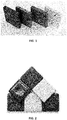
- a matt tile having distinct sharp edges is produced. Tiles produced according to this Example are shown in fig. 1 .
- the suspension is dried in a spray dryer producing granules having water content of 0.4%. Subsequently, the granules are moisturised to a water content of 5.4% and subjected to a dry pressing process.
- the pressed tiles are fired in a gas furnace for a period of 90 minutes, including keeping them for 13 minutes at a maximum temperature of 790 ⁇ 10°C. A matt tile having distinct sharp edges is produced.
- the suspension is dried in a spray dryer producing granules having water content of 0.4%. Subsequently, the granules are moisturised to a water content of 5.4% and subjected to a dry pressing process.
- the pressed tiles are fired in an electric furnace for a period of 196 minutes, including keeping them for 13 minutes at a maximum temperature of 900°C.
- a tile having a glossy surface and rounded edges is produced. Tiles produced according to this Example are shown in fig. 2 .
- the suspension is dried in a spray dryer producing granules having water content of 2.4%. Subsequently, the granules are moisturised to a water content of 5.4% and subjected to a dry pressing process.
- the pressed tiles are fired in an electric furnace for a period of 196 minutes, including keeping them for 13 minutes at a maximum temperature of 805 ⁇ 5°C. A matt tile having distinct sharp edges is produced.
- the suspension is dried in a spray dryer producing granules having water content of 0.8%. Subsequently, the granules are moisturised to a water content of 6.0% and subjected to a dry pressing process.
- the pressed tiles are fired in an electric furnace for a period of 196 minutes, including keeping them for 13 minutes at a maximum temperature of 805 ⁇ 5°C. A matt tile having distinct sharp edges is produced.
- the suspension is dried in a spray dryer producing granules having water content of 0.8%. Subsequently, the granules are moisturised to a water content of 6.0 % and subjected to a dry pressing process.
- the pressed tiles are fired in an electric furnace for a period of 196 minutes, including keeping them for 13 minutes in a maximum temperature of 900°C.
- a tile having a glossy surface and rounded edges is produced.
- the suspension is dried in a spray dryer producing granules having water content of 0.6%. Subsequently, the granules are moisturised to a water content of 5.8% and subjected to a dry pressing process.
- the pressed tiles are fired in an electric furnace for a period of 196 minutes, including keeping them for 13 minutes at a maximum temperature of 805 ⁇ 5°C. A matt tile having distinct sharp edges is produced.
- the suspension is dried in a spray dryer producing granules having water content of 0.6%. Subsequently, the granules are moisturised to a water content of 5.8% and subjected to a dry pressing process.
- the pressed tiles are fired in an electric furnace for a period of 196 minutes, including keeping them for 13 minutes at a maximum temperature of 900°C.
- a tile having a glossy surface and rounded edges is produced.
- the suspension is dried in a spray dryer producing granules having water content of 0.5%. Subsequently, the granules are moisturised to a water content of 5.8% and subjected to a dry pressing process.
- the pressed tiles are fired in an electric furnace for a period of 196 minutes, including keeping them for 13 minutes at a maximum temperature of 805 ⁇ 5°C. A matt tile having distinct sharp edges is produced.
- the suspension is dried in a spray dryer producing granules having water content of 0.5%. Subsequently, the granules are moisturised to a water content of 5.5% and subjected to a dry pressing process.
- the pressed tiles are fired in a gas furnace for a period of 90 minutes, including keeping them for 13 minutes at a maximum temperature of 800 ⁇ 10°C. A matt tile having distinct sharp edges is produced.
- the suspension is dried in a spray dryer producing granules having water content of 0.5%. Subsequently, the granules are moisturised to a water content of 5.4% and subjected to a dry pressing process.
- the pressed tiles are fired in an electric furnace for a period of 196 minutes, including keeping them for 13 minutes at a maximum temperature of 805 ⁇ 5°C. A matt tile having distinct sharp edges is produced.
- the suspension is dried in a spray dryer producing granules having water content of 0.5%. Subsequently, the granules are moisturised to a water content of 5.4% and subjected to a dry pressing process.
- the pressed tiles are fired in an electric furnace for a period of 196 minutes, including keeping them for 13 minutes at a maximum temperature of 900°C. A tile having a glossy surface and rounded edges is produced.
- the suspension is dried in a spray dryer producing granules having water content of 0.5%. Subsequently, the granules are moisturised to a water content of 5.4% and subjected to a dry pressing process.
- the pressed tiles are fired in an electric furnace for a period of 196 minutes, including keeping them for 13 minutes at a maximum temperature of 900°C. A coloured tile having a glossy surface and rounded edges is produced. Tiles produced according to this Example are shown in fig. 2 .
- the suspension is dried in a spray dryer producing granules having water content of 0.5%. Subsequently, the granules are moisturised to a water content of 5.4% and subjected to a dry pressing process.
- the pressed tiles are fired in an electric furnace for a period of 196 minutes, including keeping them for 13 minutes at a maximum temperature of 805 ⁇ 5°C. A coloured, matt tile having distinct sharp edges is produced. Tiles produced according to this Example are shown in fig. 1 .
- the glass tiles according to the invention have been examined according to quality standard PN-EN 14411 [Ceramic tiles - Definitions, classification, properties, compliance assessment and labelling], because there are no corresponding standards for glass tiles.
- Physicochemical parameters of glass tiles produced on a laboratory scale in the Examples 1-15 above are presented collectively in table 4 below.
- Table 4 collective results of the measurements of the physicochemical parameters of glass tiles of the Examples 1-15 No. Parameter Resulting average value Standard value Standard 1 Average water absorption [%] ⁇ 0.5 ⁇ 0.5 PN-EN ISO10545-3:1999 2 Bending strength [N/mm 2 ] ⁇ 46.00 Min.
- the glass tiles according to the invention comply with the requirements of the PN-EN 14411 standard, and thus are suitable for being used both as cladding tiles for indoor applications and, owing to their sufficient frost resistance, as facade tiles, i.e. wall tiles for outdoor applications.
- the tiles produced according to the invention are characterised by an amorphous phase content ⁇ 98.43%.
Landscapes
- Chemical & Material Sciences (AREA)
- Engineering & Computer Science (AREA)
- Materials Engineering (AREA)
- Organic Chemistry (AREA)
- Manufacturing & Machinery (AREA)
- Life Sciences & Earth Sciences (AREA)
- Chemical Kinetics & Catalysis (AREA)
- General Chemical & Material Sciences (AREA)
- Geochemistry & Mineralogy (AREA)
- Environmental & Geological Engineering (AREA)
- Dispersion Chemistry (AREA)
- Glass Compositions (AREA)
- Processing Of Solid Wastes (AREA)
- Curing Cements, Concrete, And Artificial Stone (AREA)
Applications Claiming Priority (1)
| Application Number | Priority Date | Filing Date | Title |
|---|---|---|---|
| PL417743A PL232207B1 (pl) | 2016-06-28 | 2016-06-28 | Sposób wytwarzania płytek szklanych okładzinowych lub elewacyjnych z odpadowego szkła kineskopowego (CRT) oraz płytka szklana z CRT |
Publications (2)
| Publication Number | Publication Date |
|---|---|
| EP3263239A1 true EP3263239A1 (de) | 2018-01-03 |
| EP3263239B1 EP3263239B1 (de) | 2019-04-03 |
Family
ID=59215444
Family Applications (1)
| Application Number | Title | Priority Date | Filing Date |
|---|---|---|---|
| EP17173641.6A Not-in-force EP3263239B1 (de) | 2016-06-28 | 2017-05-31 | Verfahren zur herstellung von verkleidung oder fassadenglasfliesen aus abfallkathodenstrahlröhrenglas (crt) und eine crt glasfliese |
Country Status (3)
| Country | Link |
|---|---|
| EP (1) | EP3263239B1 (de) |
| ES (1) | ES2729764T3 (de) |
| PL (1) | PL232207B1 (de) |
Cited By (5)
| Publication number | Priority date | Publication date | Assignee | Title |
|---|---|---|---|---|
| CN112408802A (zh) * | 2020-11-27 | 2021-02-26 | 昆明理工大学 | 一种利用crt锥玻璃制备微晶玻璃的方法 |
| WO2022010430A1 (en) * | 2020-07-08 | 2022-01-13 | Turkiye Sise Ve Cam Fabrikalari Anonim Sirketi | Household glassware product obtained from gullet and the production method thereof |
| EP3853183A4 (de) * | 2018-09-17 | 2022-06-22 | ZGrit Limited | Verfahren und vorrichtung zur erzeugung eines verbundstoffmaterials |
| RU2811015C1 (ru) * | 2020-07-08 | 2024-01-10 | Туркые Сысе Ве Джам Фабрыкалары Аноным Сыркеты | Бытовое стеклянное изделие, изготовленное из стеклобоя, и способ его изготовления |
| IT202400000765A1 (it) * | 2024-01-17 | 2025-07-17 | Rehub S R L | Metodo per la lavorazione del vetro |
Citations (4)
| Publication number | Priority date | Publication date | Assignee | Title |
|---|---|---|---|---|
| EP1484292A1 (de) * | 2002-01-23 | 2004-12-08 | Paramount Glass Manufacturing Co., Ltd. | Glaszusammensetzung zur herstellung von anorganischer faser, herstellugnsverfahren dafür und aus der anorganischen faser gebildetes produkt |
| WO2011030366A2 (en) * | 2009-09-11 | 2011-03-17 | Gruppo Concorde S.P.A. | Tile made with a ceramic mixture comprising crt glass |
| DE102011075190A1 (de) * | 2011-05-03 | 2012-11-08 | Griag Glasrecycling Ag | Keramikglasur mit Bildröhrenglas als Glasurfritte |
| US20160122232A1 (en) * | 2014-11-03 | 2016-05-05 | Nazim Muhammad | Ceramic frits incorporating crt glass |
-
2016
- 2016-06-28 PL PL417743A patent/PL232207B1/pl unknown
-
2017
- 2017-05-31 ES ES17173641T patent/ES2729764T3/es active Active
- 2017-05-31 EP EP17173641.6A patent/EP3263239B1/de not_active Not-in-force
Patent Citations (4)
| Publication number | Priority date | Publication date | Assignee | Title |
|---|---|---|---|---|
| EP1484292A1 (de) * | 2002-01-23 | 2004-12-08 | Paramount Glass Manufacturing Co., Ltd. | Glaszusammensetzung zur herstellung von anorganischer faser, herstellugnsverfahren dafür und aus der anorganischen faser gebildetes produkt |
| WO2011030366A2 (en) * | 2009-09-11 | 2011-03-17 | Gruppo Concorde S.P.A. | Tile made with a ceramic mixture comprising crt glass |
| DE102011075190A1 (de) * | 2011-05-03 | 2012-11-08 | Griag Glasrecycling Ag | Keramikglasur mit Bildröhrenglas als Glasurfritte |
| US20160122232A1 (en) * | 2014-11-03 | 2016-05-05 | Nazim Muhammad | Ceramic frits incorporating crt glass |
Non-Patent Citations (2)
| Title |
|---|
| ANDREOLA F ET AL: "Glass-ceramics obtained by the recycling of end of life cathode ray tubes glasses", WASTE MANAGEMENT, ELSEVIER, NEW YORK, NY, US, vol. 25, no. 2, 1 January 2005 (2005-01-01), pages 183 - 189, XP027619114, ISSN: 0956-053X, [retrieved on 20050101] * |
| ANDREOLA F ET AL: "Recycling of CRT panel glass as fluxing agent in the porcelain stoneware tile production", CERAMICS INTERNATIONAL, ELSEVIER, AMSTERDAM, NL, vol. 34, no. 5, 1 July 2008 (2008-07-01), pages 1289 - 1295, XP022666996, ISSN: 0272-8842, [retrieved on 20080515], DOI: 10.1016/J.CERAMINT.2007.03.013 * |
Cited By (5)
| Publication number | Priority date | Publication date | Assignee | Title |
|---|---|---|---|---|
| EP3853183A4 (de) * | 2018-09-17 | 2022-06-22 | ZGrit Limited | Verfahren und vorrichtung zur erzeugung eines verbundstoffmaterials |
| WO2022010430A1 (en) * | 2020-07-08 | 2022-01-13 | Turkiye Sise Ve Cam Fabrikalari Anonim Sirketi | Household glassware product obtained from gullet and the production method thereof |
| RU2811015C1 (ru) * | 2020-07-08 | 2024-01-10 | Туркые Сысе Ве Джам Фабрыкалары Аноным Сыркеты | Бытовое стеклянное изделие, изготовленное из стеклобоя, и способ его изготовления |
| CN112408802A (zh) * | 2020-11-27 | 2021-02-26 | 昆明理工大学 | 一种利用crt锥玻璃制备微晶玻璃的方法 |
| IT202400000765A1 (it) * | 2024-01-17 | 2025-07-17 | Rehub S R L | Metodo per la lavorazione del vetro |
Also Published As
| Publication number | Publication date |
|---|---|
| PL417743A1 (pl) | 2018-01-03 |
| ES2729764T3 (es) | 2019-11-06 |
| PL232207B1 (pl) | 2019-05-31 |
| EP3263239B1 (de) | 2019-04-03 |
Similar Documents
| Publication | Publication Date | Title |
|---|---|---|
| EP3263239B1 (de) | Verfahren zur herstellung von verkleidung oder fassadenglasfliesen aus abfallkathodenstrahlröhrenglas (crt) und eine crt glasfliese | |
| CN111807704B (zh) | 应用于卫生陶瓷的亚光釉及应用其的卫生陶瓷和制备方法 | |
| RU2421409C2 (ru) | Композиции глазури | |
| DE112011102404T5 (de) | Schaumglas mit niedrigem Wärmeausdehnungskoeffizienten und zugehörige Verfahren | |
| CN102219525A (zh) | 一种防静电瓷砖及其制备方法 | |
| DE69006270T2 (de) | Feuerfeste, monoklines Zirkon enthaltende Zusammensetzungen und daraus geformte Gegenstände, die mechanische Festigkeit bei erhöhter Temperatur und eine verbesserte Wärmeschockbeständigkeit aufweisen. | |
| CN108275878A (zh) | 一种陶瓷大板底釉及其制备方法 | |
| Bernardo et al. | Vitrification of wastes and preparation of chemically stable sintered glass-ceramic products | |
| CN116854373B (zh) | 一种低锆的卫生陶瓷乳浊釉、卫生陶瓷制品及其制备方法 | |
| EP3253721B1 (de) | Blähglasgranulat und verfahren zu dessen herstellung | |
| Romero et al. | Development of mica glass‐ceramic glazes | |
| CN112939470A (zh) | 一种铅锌矿尾渣微晶玻璃及其制备方法 | |
| EP2964588B1 (de) | Beschichtungssystem auf basis einer kombination von monoaluminiumphosphat mit magnesiumoxid | |
| EP4188887B1 (de) | Glaszusammensetzung, verfahren zur herstellung einer glaszusammensetzung und verwendungen einer glaszusammensetzung | |
| DE2632422A1 (de) | Feuerleichtsteine auf der basis von siliciumoxynitrid | |
| KR20090007232A (ko) | 전극 부착 유리 기판의 제조 방법 | |
| Kobelev et al. | Cold crucible vitrification of defense waste surrogate and vitrified product characterization | |
| CN105271749B (zh) | 磷灰石低锆复合熔块及其制备方法 | |
| CN107324654A (zh) | 一种无铅粉彩雪白颜料及其应用方法 | |
| WO2008007570A1 (en) | Lead-free glass composition | |
| Lay et al. | Formulation of specialty glasses and glazes employing marine mineral tailings | |
| CN101255014A (zh) | 无铅无镉钢化玻璃颜料熔剂 | |
| JP3114961B2 (ja) | 結晶化ガラス物品及びその製造方法 | |
| Bhushan et al. | Zircon opacifiers: Their preparation and performance in glazes | |
| Öztürk | Usage of colemanite in transparent wall tile glazes |
Legal Events
| Date | Code | Title | Description |
|---|---|---|---|
| PUAI | Public reference made under article 153(3) epc to a published international application that has entered the european phase |
Free format text: ORIGINAL CODE: 0009012 |
|
| STAA | Information on the status of an ep patent application or granted ep patent |
Free format text: STATUS: THE APPLICATION HAS BEEN PUBLISHED |
|
| AK | Designated contracting states |
Kind code of ref document: A1 Designated state(s): AL AT BE BG CH CY CZ DE DK EE ES FI FR GB GR HR HU IE IS IT LI LT LU LV MC MK MT NL NO PL PT RO RS SE SI SK SM TR |
|
| AX | Request for extension of the european patent |
Extension state: BA ME |
|
| STAA | Information on the status of an ep patent application or granted ep patent |
Free format text: STATUS: REQUEST FOR EXAMINATION WAS MADE |
|
| 17P | Request for examination filed |
Effective date: 20180627 |
|
| RBV | Designated contracting states (corrected) |
Designated state(s): AL AT BE BG CH CY CZ DE DK EE ES FI FR GB GR HR HU IE IS IT LI LT LU LV MC MK MT NL NO PL PT RO RS SE SI SK SM TR |
|
| GRAP | Despatch of communication of intention to grant a patent |
Free format text: ORIGINAL CODE: EPIDOSNIGR1 |
|
| STAA | Information on the status of an ep patent application or granted ep patent |
Free format text: STATUS: GRANT OF PATENT IS INTENDED |
|
| INTG | Intention to grant announced |
Effective date: 20180820 |
|
| GRAS | Grant fee paid |
Free format text: ORIGINAL CODE: EPIDOSNIGR3 |
|
| GRAJ | Information related to disapproval of communication of intention to grant by the applicant or resumption of examination proceedings by the epo deleted |
Free format text: ORIGINAL CODE: EPIDOSDIGR1 |
|
| GRAL | Information related to payment of fee for publishing/printing deleted |
Free format text: ORIGINAL CODE: EPIDOSDIGR3 |
|
| STAA | Information on the status of an ep patent application or granted ep patent |
Free format text: STATUS: REQUEST FOR EXAMINATION WAS MADE |
|
| REG | Reference to a national code |
Ref country code: DE Ref legal event code: R079 Ref document number: 602017003024 Country of ref document: DE Free format text: PREVIOUS MAIN CLASS: B09B0003000000 Ipc: C03C0003108000 |
|
| INTC | Intention to grant announced (deleted) | ||
| GRAP | Despatch of communication of intention to grant a patent |
Free format text: ORIGINAL CODE: EPIDOSNIGR1 |
|
| STAA | Information on the status of an ep patent application or granted ep patent |
Free format text: STATUS: GRANT OF PATENT IS INTENDED |
|
| RIC1 | Information provided on ipc code assigned before grant |
Ipc: C03B 19/10 20060101ALI20190110BHEP Ipc: C03B 19/09 20060101ALI20190110BHEP Ipc: C03C 3/108 20060101AFI20190110BHEP Ipc: C03B 19/06 20060101ALI20190110BHEP Ipc: C03C 1/00 20060101ALI20190110BHEP Ipc: B09B 3/00 20060101ALI20190110BHEP Ipc: B09B 5/00 20060101ALI20190110BHEP |
|
| GRAA | (expected) grant |
Free format text: ORIGINAL CODE: 0009210 |
|
| STAA | Information on the status of an ep patent application or granted ep patent |
Free format text: STATUS: THE PATENT HAS BEEN GRANTED |
|
| INTG | Intention to grant announced |
Effective date: 20190206 |
|
| AK | Designated contracting states |
Kind code of ref document: B1 Designated state(s): AL AT BE BG CH CY CZ DE DK EE ES FI FR GB GR HR HU IE IS IT LI LT LU LV MC MK MT NL NO PL PT RO RS SE SI SK SM TR |
|
| REG | Reference to a national code |
Ref country code: GB Ref legal event code: FG4D |
|
| REG | Reference to a national code |
Ref country code: CH Ref legal event code: EP Ref country code: AT Ref legal event code: REF Ref document number: 1115519 Country of ref document: AT Kind code of ref document: T Effective date: 20190415 |
|
| REG | Reference to a national code |
Ref country code: DE Ref legal event code: R096 Ref document number: 602017003024 Country of ref document: DE |
|
| REG | Reference to a national code |
Ref country code: IE Ref legal event code: FG4D |
|
| PGFP | Annual fee paid to national office [announced via postgrant information from national office to epo] |
Ref country code: CZ Payment date: 20190312 Year of fee payment: 3 Ref country code: ES Payment date: 20190604 Year of fee payment: 3 |
|
| REG | Reference to a national code |
Ref country code: NL Ref legal event code: MP Effective date: 20190403 |
|
| REG | Reference to a national code |
Ref country code: LT Ref legal event code: MG4D |
|
| REG | Reference to a national code |
Ref country code: AT Ref legal event code: MK05 Ref document number: 1115519 Country of ref document: AT Kind code of ref document: T Effective date: 20190403 |
|
| PG25 | Lapsed in a contracting state [announced via postgrant information from national office to epo] |
Ref country code: NL Free format text: LAPSE BECAUSE OF FAILURE TO SUBMIT A TRANSLATION OF THE DESCRIPTION OR TO PAY THE FEE WITHIN THE PRESCRIBED TIME-LIMIT Effective date: 20190403 |
|
| PG25 | Lapsed in a contracting state [announced via postgrant information from national office to epo] |
Ref country code: LT Free format text: LAPSE BECAUSE OF FAILURE TO SUBMIT A TRANSLATION OF THE DESCRIPTION OR TO PAY THE FEE WITHIN THE PRESCRIBED TIME-LIMIT Effective date: 20190403 Ref country code: NO Free format text: LAPSE BECAUSE OF FAILURE TO SUBMIT A TRANSLATION OF THE DESCRIPTION OR TO PAY THE FEE WITHIN THE PRESCRIBED TIME-LIMIT Effective date: 20190703 Ref country code: HR Free format text: LAPSE BECAUSE OF FAILURE TO SUBMIT A TRANSLATION OF THE DESCRIPTION OR TO PAY THE FEE WITHIN THE PRESCRIBED TIME-LIMIT Effective date: 20190403 Ref country code: SE Free format text: LAPSE BECAUSE OF FAILURE TO SUBMIT A TRANSLATION OF THE DESCRIPTION OR TO PAY THE FEE WITHIN THE PRESCRIBED TIME-LIMIT Effective date: 20190403 Ref country code: PT Free format text: LAPSE BECAUSE OF FAILURE TO SUBMIT A TRANSLATION OF THE DESCRIPTION OR TO PAY THE FEE WITHIN THE PRESCRIBED TIME-LIMIT Effective date: 20190803 Ref country code: AL Free format text: LAPSE BECAUSE OF FAILURE TO SUBMIT A TRANSLATION OF THE DESCRIPTION OR TO PAY THE FEE WITHIN THE PRESCRIBED TIME-LIMIT Effective date: 20190403 Ref country code: FI Free format text: LAPSE BECAUSE OF FAILURE TO SUBMIT A TRANSLATION OF THE DESCRIPTION OR TO PAY THE FEE WITHIN THE PRESCRIBED TIME-LIMIT Effective date: 20190403 |
|
| REG | Reference to a national code |
Ref country code: ES Ref legal event code: FG2A Ref document number: 2729764 Country of ref document: ES Kind code of ref document: T3 Effective date: 20191106 |
|
| PG25 | Lapsed in a contracting state [announced via postgrant information from national office to epo] |
Ref country code: BG Free format text: LAPSE BECAUSE OF FAILURE TO SUBMIT A TRANSLATION OF THE DESCRIPTION OR TO PAY THE FEE WITHIN THE PRESCRIBED TIME-LIMIT Effective date: 20190703 Ref country code: PL Free format text: LAPSE BECAUSE OF FAILURE TO SUBMIT A TRANSLATION OF THE DESCRIPTION OR TO PAY THE FEE WITHIN THE PRESCRIBED TIME-LIMIT Effective date: 20190403 Ref country code: GR Free format text: LAPSE BECAUSE OF FAILURE TO SUBMIT A TRANSLATION OF THE DESCRIPTION OR TO PAY THE FEE WITHIN THE PRESCRIBED TIME-LIMIT Effective date: 20190704 Ref country code: LV Free format text: LAPSE BECAUSE OF FAILURE TO SUBMIT A TRANSLATION OF THE DESCRIPTION OR TO PAY THE FEE WITHIN THE PRESCRIBED TIME-LIMIT Effective date: 20190403 Ref country code: RS Free format text: LAPSE BECAUSE OF FAILURE TO SUBMIT A TRANSLATION OF THE DESCRIPTION OR TO PAY THE FEE WITHIN THE PRESCRIBED TIME-LIMIT Effective date: 20190403 |
|
| REG | Reference to a national code |
Ref country code: DE Ref legal event code: R119 Ref document number: 602017003024 Country of ref document: DE |
|
| PG25 | Lapsed in a contracting state [announced via postgrant information from national office to epo] |
Ref country code: AT Free format text: LAPSE BECAUSE OF FAILURE TO SUBMIT A TRANSLATION OF THE DESCRIPTION OR TO PAY THE FEE WITHIN THE PRESCRIBED TIME-LIMIT Effective date: 20190403 Ref country code: IS Free format text: LAPSE BECAUSE OF FAILURE TO SUBMIT A TRANSLATION OF THE DESCRIPTION OR TO PAY THE FEE WITHIN THE PRESCRIBED TIME-LIMIT Effective date: 20190803 |
|
| PG25 | Lapsed in a contracting state [announced via postgrant information from national office to epo] |
Ref country code: SK Free format text: LAPSE BECAUSE OF FAILURE TO SUBMIT A TRANSLATION OF THE DESCRIPTION OR TO PAY THE FEE WITHIN THE PRESCRIBED TIME-LIMIT Effective date: 20190403 Ref country code: MC Free format text: LAPSE BECAUSE OF FAILURE TO SUBMIT A TRANSLATION OF THE DESCRIPTION OR TO PAY THE FEE WITHIN THE PRESCRIBED TIME-LIMIT Effective date: 20190403 Ref country code: RO Free format text: LAPSE BECAUSE OF FAILURE TO SUBMIT A TRANSLATION OF THE DESCRIPTION OR TO PAY THE FEE WITHIN THE PRESCRIBED TIME-LIMIT Effective date: 20190403 Ref country code: DK Free format text: LAPSE BECAUSE OF FAILURE TO SUBMIT A TRANSLATION OF THE DESCRIPTION OR TO PAY THE FEE WITHIN THE PRESCRIBED TIME-LIMIT Effective date: 20190403 Ref country code: EE Free format text: LAPSE BECAUSE OF FAILURE TO SUBMIT A TRANSLATION OF THE DESCRIPTION OR TO PAY THE FEE WITHIN THE PRESCRIBED TIME-LIMIT Effective date: 20190403 |
|
| REG | Reference to a national code |
Ref country code: BE Ref legal event code: MM Effective date: 20190531 |
|
| PLBE | No opposition filed within time limit |
Free format text: ORIGINAL CODE: 0009261 |
|
| STAA | Information on the status of an ep patent application or granted ep patent |
Free format text: STATUS: NO OPPOSITION FILED WITHIN TIME LIMIT |
|
| PG25 | Lapsed in a contracting state [announced via postgrant information from national office to epo] |
Ref country code: SM Free format text: LAPSE BECAUSE OF FAILURE TO SUBMIT A TRANSLATION OF THE DESCRIPTION OR TO PAY THE FEE WITHIN THE PRESCRIBED TIME-LIMIT Effective date: 20190403 Ref country code: LU Free format text: LAPSE BECAUSE OF NON-PAYMENT OF DUE FEES Effective date: 20190531 Ref country code: IT Free format text: LAPSE BECAUSE OF FAILURE TO SUBMIT A TRANSLATION OF THE DESCRIPTION OR TO PAY THE FEE WITHIN THE PRESCRIBED TIME-LIMIT Effective date: 20190403 |
|
| 26N | No opposition filed |
Effective date: 20200106 |
|
| PG25 | Lapsed in a contracting state [announced via postgrant information from national office to epo] |
Ref country code: TR Free format text: LAPSE BECAUSE OF FAILURE TO SUBMIT A TRANSLATION OF THE DESCRIPTION OR TO PAY THE FEE WITHIN THE PRESCRIBED TIME-LIMIT Effective date: 20190403 |
|
| PG25 | Lapsed in a contracting state [announced via postgrant information from national office to epo] |
Ref country code: IE Free format text: LAPSE BECAUSE OF NON-PAYMENT OF DUE FEES Effective date: 20190531 Ref country code: DE Free format text: LAPSE BECAUSE OF NON-PAYMENT OF DUE FEES Effective date: 20191203 |
|
| PG25 | Lapsed in a contracting state [announced via postgrant information from national office to epo] |
Ref country code: BE Free format text: LAPSE BECAUSE OF NON-PAYMENT OF DUE FEES Effective date: 20190531 Ref country code: SI Free format text: LAPSE BECAUSE OF FAILURE TO SUBMIT A TRANSLATION OF THE DESCRIPTION OR TO PAY THE FEE WITHIN THE PRESCRIBED TIME-LIMIT Effective date: 20190403 |
|
| PG25 | Lapsed in a contracting state [announced via postgrant information from national office to epo] |
Ref country code: FR Free format text: LAPSE BECAUSE OF NON-PAYMENT OF DUE FEES Effective date: 20190603 |
|
| PG25 | Lapsed in a contracting state [announced via postgrant information from national office to epo] |
Ref country code: CH Free format text: LAPSE BECAUSE OF NON-PAYMENT OF DUE FEES Effective date: 20200531 Ref country code: CZ Free format text: LAPSE BECAUSE OF NON-PAYMENT OF DUE FEES Effective date: 20200531 Ref country code: LI Free format text: LAPSE BECAUSE OF NON-PAYMENT OF DUE FEES Effective date: 20200531 |
|
| PG25 | Lapsed in a contracting state [announced via postgrant information from national office to epo] |
Ref country code: CY Free format text: LAPSE BECAUSE OF FAILURE TO SUBMIT A TRANSLATION OF THE DESCRIPTION OR TO PAY THE FEE WITHIN THE PRESCRIBED TIME-LIMIT Effective date: 20190403 |
|
| PG25 | Lapsed in a contracting state [announced via postgrant information from national office to epo] |
Ref country code: HU Free format text: LAPSE BECAUSE OF FAILURE TO SUBMIT A TRANSLATION OF THE DESCRIPTION OR TO PAY THE FEE WITHIN THE PRESCRIBED TIME-LIMIT; INVALID AB INITIO Effective date: 20170531 Ref country code: MT Free format text: LAPSE BECAUSE OF FAILURE TO SUBMIT A TRANSLATION OF THE DESCRIPTION OR TO PAY THE FEE WITHIN THE PRESCRIBED TIME-LIMIT Effective date: 20190403 |
|
| PG25 | Lapsed in a contracting state [announced via postgrant information from national office to epo] |
Ref country code: ES Free format text: LAPSE BECAUSE OF NON-PAYMENT OF DUE FEES Effective date: 20200601 |
|
| GBPC | Gb: european patent ceased through non-payment of renewal fee |
Effective date: 20210531 |
|
| PG25 | Lapsed in a contracting state [announced via postgrant information from national office to epo] |
Ref country code: GB Free format text: LAPSE BECAUSE OF NON-PAYMENT OF DUE FEES Effective date: 20210531 |
|
| PG25 | Lapsed in a contracting state [announced via postgrant information from national office to epo] |
Ref country code: MK Free format text: LAPSE BECAUSE OF FAILURE TO SUBMIT A TRANSLATION OF THE DESCRIPTION OR TO PAY THE FEE WITHIN THE PRESCRIBED TIME-LIMIT Effective date: 20190403 |