EP3259067B1 - Devices for biological sample collection and analysis and methods of use thereof - Google Patents
Devices for biological sample collection and analysis and methods of use thereof Download PDFInfo
- Publication number
- EP3259067B1 EP3259067B1 EP16751983.4A EP16751983A EP3259067B1 EP 3259067 B1 EP3259067 B1 EP 3259067B1 EP 16751983 A EP16751983 A EP 16751983A EP 3259067 B1 EP3259067 B1 EP 3259067B1
- Authority
- EP
- European Patent Office
- Prior art keywords
- reagent
- swab
- extraction
- analyte
- sample
- Prior art date
- Legal status (The legal status is an assumption and is not a legal conclusion. Google has not performed a legal analysis and makes no representation as to the accuracy of the status listed.)
- Active
Links
Images


Classifications
-
- B—PERFORMING OPERATIONS; TRANSPORTING
- B01—PHYSICAL OR CHEMICAL PROCESSES OR APPARATUS IN GENERAL
- B01L—CHEMICAL OR PHYSICAL LABORATORY APPARATUS FOR GENERAL USE
- B01L3/00—Containers or dishes for laboratory use, e.g. laboratory glassware; Droppers
- B01L3/50—Containers for the purpose of retaining a material to be analysed, e.g. test tubes
- B01L3/502—Containers for the purpose of retaining a material to be analysed, e.g. test tubes with fluid transport, e.g. in multi-compartment structures
- B01L3/5029—Containers for the purpose of retaining a material to be analysed, e.g. test tubes with fluid transport, e.g. in multi-compartment structures using swabs
-
- B—PERFORMING OPERATIONS; TRANSPORTING
- B01—PHYSICAL OR CHEMICAL PROCESSES OR APPARATUS IN GENERAL
- B01L—CHEMICAL OR PHYSICAL LABORATORY APPARATUS FOR GENERAL USE
- B01L3/00—Containers or dishes for laboratory use, e.g. laboratory glassware; Droppers
- B01L3/50—Containers for the purpose of retaining a material to be analysed, e.g. test tubes
- B01L3/502—Containers for the purpose of retaining a material to be analysed, e.g. test tubes with fluid transport, e.g. in multi-compartment structures
- B01L3/5023—Containers for the purpose of retaining a material to be analysed, e.g. test tubes with fluid transport, e.g. in multi-compartment structures with a sample being transported to, and subsequently stored in an absorbent for analysis
-
- C—CHEMISTRY; METALLURGY
- C12—BIOCHEMISTRY; BEER; SPIRITS; WINE; VINEGAR; MICROBIOLOGY; ENZYMOLOGY; MUTATION OR GENETIC ENGINEERING
- C12M—APPARATUS FOR ENZYMOLOGY OR MICROBIOLOGY; APPARATUS FOR CULTURING MICROORGANISMS FOR PRODUCING BIOMASS, FOR GROWING CELLS OR FOR OBTAINING FERMENTATION OR METABOLIC PRODUCTS, i.e. BIOREACTORS OR FERMENTERS
- C12M1/00—Apparatus for enzymology or microbiology
- C12M1/26—Inoculator or sampler
- C12M1/28—Inoculator or sampler being part of container
- C12M1/30—Sampler being a swab
-
- C—CHEMISTRY; METALLURGY
- C12—BIOCHEMISTRY; BEER; SPIRITS; WINE; VINEGAR; MICROBIOLOGY; ENZYMOLOGY; MUTATION OR GENETIC ENGINEERING
- C12Q—MEASURING OR TESTING PROCESSES INVOLVING ENZYMES, NUCLEIC ACIDS OR MICROORGANISMS; COMPOSITIONS OR TEST PAPERS THEREFOR; PROCESSES OF PREPARING SUCH COMPOSITIONS; CONDITION-RESPONSIVE CONTROL IN MICROBIOLOGICAL OR ENZYMOLOGICAL PROCESSES
- C12Q1/00—Measuring or testing processes involving enzymes, nucleic acids or microorganisms; Compositions therefor; Processes of preparing such compositions
- C12Q1/02—Measuring or testing processes involving enzymes, nucleic acids or microorganisms; Compositions therefor; Processes of preparing such compositions involving viable microorganisms
- C12Q1/04—Determining presence or kind of microorganism; Use of selective media for testing antibiotics or bacteriocides; Compositions containing a chemical indicator therefor
- C12Q1/14—Streptococcus; Staphylococcus
-
- G—PHYSICS
- G01—MEASURING; TESTING
- G01N—INVESTIGATING OR ANALYSING MATERIALS BY DETERMINING THEIR CHEMICAL OR PHYSICAL PROPERTIES
- G01N33/00—Investigating or analysing materials by specific methods not covered by groups G01N1/00 - G01N31/00
- G01N33/48—Biological material, e.g. blood, urine; Haemocytometers
- G01N33/50—Chemical analysis of biological material, e.g. blood, urine; Testing involving biospecific ligand binding methods; Immunological testing
- G01N33/53—Immunoassay; Biospecific binding assay; Materials therefor
- G01N33/5302—Apparatus specially adapted for immunological test procedures
-
- G—PHYSICS
- G01—MEASURING; TESTING
- G01N—INVESTIGATING OR ANALYSING MATERIALS BY DETERMINING THEIR CHEMICAL OR PHYSICAL PROPERTIES
- G01N33/00—Investigating or analysing materials by specific methods not covered by groups G01N1/00 - G01N31/00
- G01N33/48—Biological material, e.g. blood, urine; Haemocytometers
- G01N33/50—Chemical analysis of biological material, e.g. blood, urine; Testing involving biospecific ligand binding methods; Immunological testing
- G01N33/53—Immunoassay; Biospecific binding assay; Materials therefor
- G01N33/536—Immunoassay; Biospecific binding assay; Materials therefor with immune complex formed in liquid phase
- G01N33/537—Immunoassay; Biospecific binding assay; Materials therefor with immune complex formed in liquid phase with separation of immune complex from unbound antigen or antibody
- G01N33/538—Immunoassay; Biospecific binding assay; Materials therefor with immune complex formed in liquid phase with separation of immune complex from unbound antigen or antibody by sorbent column, particles or resin strip, i.e. sorbent materials
-
- G—PHYSICS
- G01—MEASURING; TESTING
- G01N—INVESTIGATING OR ANALYSING MATERIALS BY DETERMINING THEIR CHEMICAL OR PHYSICAL PROPERTIES
- G01N33/00—Investigating or analysing materials by specific methods not covered by groups G01N1/00 - G01N31/00
- G01N33/48—Biological material, e.g. blood, urine; Haemocytometers
- G01N33/50—Chemical analysis of biological material, e.g. blood, urine; Testing involving biospecific ligand binding methods; Immunological testing
- G01N33/53—Immunoassay; Biospecific binding assay; Materials therefor
- G01N33/543—Immunoassay; Biospecific binding assay; Materials therefor with an insoluble carrier for immobilising immunochemicals
-
- G—PHYSICS
- G01—MEASURING; TESTING
- G01N—INVESTIGATING OR ANALYSING MATERIALS BY DETERMINING THEIR CHEMICAL OR PHYSICAL PROPERTIES
- G01N33/00—Investigating or analysing materials by specific methods not covered by groups G01N1/00 - G01N31/00
- G01N33/48—Biological material, e.g. blood, urine; Haemocytometers
- G01N33/50—Chemical analysis of biological material, e.g. blood, urine; Testing involving biospecific ligand binding methods; Immunological testing
- G01N33/53—Immunoassay; Biospecific binding assay; Materials therefor
- G01N33/543—Immunoassay; Biospecific binding assay; Materials therefor with an insoluble carrier for immobilising immunochemicals
- G01N33/54366—Apparatus specially adapted for solid-phase testing
- G01N33/54386—Analytical elements
- G01N33/54387—Immunochromatographic test strips
- G01N33/54388—Immunochromatographic test strips based on lateral flow
-
- G—PHYSICS
- G01—MEASURING; TESTING
- G01N—INVESTIGATING OR ANALYSING MATERIALS BY DETERMINING THEIR CHEMICAL OR PHYSICAL PROPERTIES
- G01N33/00—Investigating or analysing materials by specific methods not covered by groups G01N1/00 - G01N31/00
- G01N33/48—Biological material, e.g. blood, urine; Haemocytometers
- G01N33/50—Chemical analysis of biological material, e.g. blood, urine; Testing involving biospecific ligand binding methods; Immunological testing
- G01N33/53—Immunoassay; Biospecific binding assay; Materials therefor
- G01N33/558—Immunoassay; Biospecific binding assay; Materials therefor using diffusion or migration of antigen or antibody
-
- G—PHYSICS
- G01—MEASURING; TESTING
- G01N—INVESTIGATING OR ANALYSING MATERIALS BY DETERMINING THEIR CHEMICAL OR PHYSICAL PROPERTIES
- G01N33/00—Investigating or analysing materials by specific methods not covered by groups G01N1/00 - G01N31/00
- G01N33/48—Biological material, e.g. blood, urine; Haemocytometers
- G01N33/50—Chemical analysis of biological material, e.g. blood, urine; Testing involving biospecific ligand binding methods; Immunological testing
- G01N33/53—Immunoassay; Biospecific binding assay; Materials therefor
- G01N33/569—Immunoassay; Biospecific binding assay; Materials therefor for microorganisms, e.g. protozoa, bacteria, viruses
- G01N33/56911—Bacteria
- G01N33/56944—Streptococcus
-
- B—PERFORMING OPERATIONS; TRANSPORTING
- B01—PHYSICAL OR CHEMICAL PROCESSES OR APPARATUS IN GENERAL
- B01L—CHEMICAL OR PHYSICAL LABORATORY APPARATUS FOR GENERAL USE
- B01L2300/00—Additional constructional details
- B01L2300/08—Geometry, shape and general structure
- B01L2300/0809—Geometry, shape and general structure rectangular shaped
- B01L2300/0825—Test strips
-
- B—PERFORMING OPERATIONS; TRANSPORTING
- B01—PHYSICAL OR CHEMICAL PROCESSES OR APPARATUS IN GENERAL
- B01L—CHEMICAL OR PHYSICAL LABORATORY APPARATUS FOR GENERAL USE
- B01L2300/00—Additional constructional details
- B01L2300/16—Surface properties and coatings
-
- B—PERFORMING OPERATIONS; TRANSPORTING
- B01—PHYSICAL OR CHEMICAL PROCESSES OR APPARATUS IN GENERAL
- B01L—CHEMICAL OR PHYSICAL LABORATORY APPARATUS FOR GENERAL USE
- B01L2300/00—Additional constructional details
- B01L2300/16—Surface properties and coatings
- B01L2300/161—Control and use of surface tension forces, e.g. hydrophobic, hydrophilic
-
- B—PERFORMING OPERATIONS; TRANSPORTING
- B01—PHYSICAL OR CHEMICAL PROCESSES OR APPARATUS IN GENERAL
- B01L—CHEMICAL OR PHYSICAL LABORATORY APPARATUS FOR GENERAL USE
- B01L2400/00—Moving or stopping fluids
- B01L2400/04—Moving fluids with specific forces or mechanical means
- B01L2400/0403—Moving fluids with specific forces or mechanical means specific forces
- B01L2400/0406—Moving fluids with specific forces or mechanical means specific forces capillary forces
Definitions
- the present instant invention is related to detection tests, which are diagnostic tests which can be used in assisting in the diagnosis of bacterial pharyngitis caused by group A streptococci (GAS) and methods of use thereof.
- detection tests which are diagnostic tests which can be used in assisting in the diagnosis of bacterial pharyngitis caused by group A streptococci (GAS) and methods of use thereof.
- GAS group A streptococci
- Group A Streptococcus typically causes acute upper respiratory tract infection. Early diagnosis and treatment of Group A Streptococcal pharyngitis is critical for reducing the severity of symptoms and complications, such as rheumatic fever and glomerulonephritis, and preventing the rare but possible occurrence of death - of the 9,000-11,500 cases of invasive disease (3.2 to 3.9/100,000 population) that occur each year in the United States alone, 10%-15% result in death. Typical diagnostic tests used for assaying Group A Streptococcus antigens require the mixing of equal to or more than two reagents and/or use laborious test-specific protocols.
- the testing device comprises a housing having an internal recess, a sample collection device and at least one insertable testing element.
- the housing is adapted to receive the sample collection device in the internal recess therein and to shield a sample collected on the sample collection device.
- the housing is configured to receive the at least one insertable testing element such that, on insertion of the testing element into the housing, the testing element is in liquid conductive communication with the sample collected on the sample collection device.
- the chromatographic assay comprises a base member and a chromatographic medium located in or on said base member.
- the base member is provided with a receptacle to receive an applicator having the sample applied thereto, wherein the applicator is movable when located in said receptacle between a first position in which the applicator is out of fluid contact with the chromatographic medium, and a second position in which the applicator is in fluid contact with the chromatographic medium so as to apply a sample on the applicator to the chromatographic medium.
- a method to determine the presence or absence of Streptococcus Group A antigen in a sample comprises extracting the antigen from the sample in an assay chamber with two or less extraction reagents, wherein the two reagents may be added to the assay chamber in no particular sequence.
- a lateral flow immunochromatographic assay device is introduced into the extraction reagents containing the extracted antigen without further addition of reagents or manipulation of the sample.
- an antigen-indicator labeling reagent complex is formed and the presence or absence of the antigen in the sample by the presence or absence of a signal formed by the binding of the antigen-indicator labeling reagent complex to an indicator capture reagent specific for said antigen-indicator labeling reagent complex is determined.
- the immuno-chromatographic device comprises an analyte extraction zone, wherein one or more mobile extraction solutions are impregnated.
- the at least one of said extraction solutions comprises an animal serum or a plasma component.
- a device for detecting the presence of Group A streptococcus in a sample comprises a matrix having a sample receiving zone for receiving a sample containing or suspected of containing a Group A streptococcus-specific antigen. Moreover, the device comprises a labeling zone containing an antibody for specifically labeling the antigen as it passes there through and a capture zone having means for specifically binding the labeled antigen thereon, wherein the sample receiving zone, the labeling zone and the capture zone are arranged on the matrix in a liquid flow path.
- a sample-bearing swab is inserted into a cylindrical portion of an extraction chamber through a bowl of the extraction chamber.
- An extraction solution is applied to the swab and an extracted sample flows through an exit port of the extraction chamber to a sample receiving zone.
- the sample flows laterally through a labelling zone and is captured in a capture zone with the excess sample being absorbed by an absorbent zone.
- the results are observed through an observation window when a distinct color change is seen through an end-of-assay window.
- the counting tube/sampling device combination comprises a counting tube having dried extraction reagent therein and a resealable cap.
- the counting tube/sampling device combination comprises a sampling device having a handle and an absorbent tip containing an immobilized luciferase/luciferin reagent, wherein the handle of the sampling device is attached to the cap.
- a "lateral flow test” refer to an immunochromatographic device intended to detect the presence (or absence) of a target analyte in sample (matrix) without the need for specialized and costly equipment. Typically, these tests are used for medical diagnostics either for home testing, point of care testing, or laboratory use.
- sample receiving portion or a “fluid receiving portion” refers to a portion of a test strip configured to accept a sample, usually a liquid/fluid sample, and permit the movement of any analyte in the liquid/fluid through the test strip via, e.g., but not limited to, capillary action.
- an "analyte-specific labeled reagent” or a “labeled analyte-specific indicator” are synonymous and refer to what is commonly known in the diagnostic literature as a “conjugate” - a dried form of bio-active particles in a salt-sugar matrix that contains everything to guarantee an optimized chemical reaction between the target molecule (e.g., the analyte) and its chemical partner (e.g., antibody) that has been immobilized on the particle's surface
- a “capture portion” or “capture zone” refers to a portion of a test strip where analyte-reagent complexes bind to a capture reagent (e.g., but not limited to, an analyte-specific antibody).
- sorptivity refers to a measure of the capacity of the medium to absorb or desorb liquid by capillarity.
- the device of the present invention is configured to measure the presence or absence of Streptococcus Group A antigen in a biological sample.
- the device comprises: (i) a swab (e.g., a throat swab) for use in collecting a biological sample, (ii) an extraction chamber containing an extraction reagent, and (iii) a test strip.
- the swab is comprised of a stem and tip (absorptive component), where the tip incorporates a non-volatile reagent configured to extract, or aid in extracting, at least one analyte.
- the extraction solution formed by the dissolution of the non-volatile reagent incorporated in the swab's tip in the extraction reagent serves to extract the analyte.
- the method of the present invention is comprised of: (i) collecting a biological sample by a swab; (ii) transferring it to a chamber containing an extraction reagent, where this extraction reagent is complemented by an additional/second reagent incorporated in the swab (e.g., but not limited to the tip of the swab), where the extraction reagent, when combined with the additional reagent incorporated in the swab, is configured to dissolve and/or react in-situ with the collected biological sample and extract the antigen/analyte from the biological sample; (iii) contacting the extraction solution containing the extracted analyte with a lateral flow immunochromatographic assay device containing a labeled analyte-specific indicator; and (iv) determining the presence or absence of the extracted analyte in the biological sample by measuring a signal (i.e., the presence or absence of the signal) generated by a binding of a label
- the present invention is a device for collecting and analyzing a biological or clinical sample, the device being comprised of (i) a swab, (ii) an extraction chamber containing an extraction reagent, and (iii) a test strip.
- the swab is comprised of: (i) a stem made of a plastic or other material, which may be solid or porous, which is configured to provide mechanical support for the swab tip and optionally also promote liquid transfer via capillary flow through the stem's porous core; (ii) a tip at one end of the stem made of fiber or foam of polymeric material or other absorbent material coated or spun or otherwise deposited on the stem's end (taken together, stem and tip are termed: "swab").
- the whole swab may be manufactured from the same foam or other porous material thereby simplifying its manufacturing process, and (iii) a non-volatile reagent that comprises an essential component of the solution used to extract, or aid in extracting, the sample being collected by the swab and is (a) coated onto the swab stem in the area underlying its tip or (b) incorporated within the swab's tip absorbent material.
- the extraction chamber comprises an elongated tube having, for example, but not limited to: (i) a rounded, v-shaped, or flat bottom geometry and (2) a 4-10mm inner diameter, where the extraction chamber is configured to allow substantially simultaneous accommodation of both swab tip and test strip.
- the test strip is a conventional, lateral flow, immunochromatograpic assay device.
- the non-volatile material is a water-soluble organic acid. In some embodiments, the non-volatile material is a water-soluble inorganic acid. In some embodiments, the non-volatile material is an insoluble acidic polymer.
- the amount of the non-volatile acidic material is in the range of 50 and 800 micromoles. In some embodiments, the amount of the non-volatile acidic material is in the range of 100 and 800 micromoles. In some embodiments, the amount of the non-volatile acidic material is in the range of 150 and 800 micromoles. In some embodiments, the amount of the non-volatile acidic material is in the range of 200 and 800 micromoles. In some embodiments, the amount of the non-volatile acidic material is in the range of 250 and 800 micromoles. In some embodiments, the amount of the non-volatile acidic material is in the range of 300 and 800 micromoles.
- the amount of the non-volatile acidic material is in the range of 350 and 800 micromoles. In some embodiments, the amount of the non-volatile acidic material is in the range of 400 and 800 micromoles. In some embodiments, the amount of the non-volatile acidic material is in the range of 450 and 800 micromoles. In some embodiments, the amount of the non-volatile acidic material is in the range of 500 and 800 micromoles. In some embodiments, the amount of the non-volatile acidic material is in the range of 550 and 800 micromoles. In some embodiments, the amount of the non-volatile acidic material is in the range of 600 and 800 micromoles.
- the amount of the non-volatile acidic material is in the range of 650 and 800 micromoles. In some embodiments, the amount of the non-volatile acidic material is in the range of 700 and 800 micromoles. In some embodiments, the amount of the non-volatile acidic material is in the range of 750 and 800 micromoles.
- the amount of the non-volatile acidic material is in the range of 2 and 750 micromoles. In some embodiments, the amount of the non-volatile acidic material is in the range of 2 and 700 micromoles. In some embodiments, the amount of the non-volatile acidic material is in the range of 2 and 650 micromoles. In some embodiments, the amount of the non-volatile acidic material is in the range of 2 and 600 micromoles. In some embodiments, the amount of the non-volatile acidic material is in the range of 2 and 550 micromoles. In some embodiments, the amount of the non-volatile acidic material is in the range of 2 and 500 micromoles.
- the amount of the non-volatile acidic material is in the range of 2 and 450 micromoles. In some embodiments, the amount of the non-volatile acidic material is in the range of 2 and 400 micromoles. In some embodiments, the amount of the non-volatile acidic material is in the range of 2 and 350 micromoles. In some embodiments, the amount of the non-volatile acidic material is in the range of 2 and 300 micromoles. In some embodiments, the amount of the non-volatile acidic material is in the range of 2 and 250 micromoles. In some embodiments, the amount of the non-volatile acidic material is in the range of 2 and 200 micromoles.
- the amount of the non-volatile acidic material is in the range of 2 and 150 micromoles. In some embodiments, the amount of the non-volatile acidic material is in the range of 2 and 100 micromoles. In some embodiments, the amount of the non-volatile acidic material is in the range of 2 and 50 micromoles. In some embodiments, the amount of the non-volatile acidic material is in the range of 2 and 10 micromoles. In some embodiments, the amount of the non-volatile acidic material is in the range of 5 and 10 micromoles. In some embodiments, the amount of the non-volatile acidic material is in the range of 3 and 5 micromoles.
- the amount of the non-volatile acidic material is in the range of 30 and 200 micromoles. In some embodiments, the amount of the non-volatile acidic material is in the range of 50 and 200 micromoles. In some embodiments, the amount of the non-volatile acidic material is in the range of 100 and 200 micromoles. In some embodiments, the amount of the non-volatile acidic material is in the range of 150 and 200 micromoles. In some embodiments, the amount of the non-volatile acidic material is in the range of 30 and 150 micromoles. In some embodiments, the amount of the non-volatile acidic material is in the range of 30 and 100 micromoles. In some embodiments, the amount of the non-volatile acidic material is in the range of 30 and 50 micromoles.
- the swab and test strip are integrated into a single device by contacting the back end of the swab tip (i.e., the absorptive component) to the sample pad of the test strip allowing for capillary liquid communication between both media.
- the present invention is a method for determining the presence or absence of an analyte in a sample, comprising the following steps: (a) collecting a biological sample using a swab incorporating an non-volatile compound that comprises a component of the sample extraction solution, (b) extracting the analyte from the sample in an assay chamber containing an extraction reagent, (c) interacting the extraction solution containing the extracted analyte with a lateral flow immunochromatographic assay test strip, by: (i) inserting this test strip into the extraction solution or (ii) transferring the extraction solution contents to the device by means of a valve, pipette or any other common means of fluid transfer; (d) allowing the formation of analyte-labeled reagent complexes by the reaction of the analyte flowing through the lateral flow device with the analyte-specific labeled reagent carried by the device; (e) determining the presence or absence of the analyte
- the extraction reagent is 1M to 5M nitrite salt solution. In some embodiments, the extraction reagent is 2M to 5M nitrite salt solution. In some embodiments, the extraction reagent is 3M to 5M nitrite salt solution. In some embodiments, the extraction reagent is 4M to 5M nitrite salt solution. In some embodiments, the extraction reagent is 0.2M to 4M nitrite salt solution. In some embodiments, the extraction reagent is 0.2M to 3M nitrite salt solution. In some embodiments, the extraction reagent is 0.2M to 2M nitrite salt solution. In some embodiments, the extraction reagent is 0.2M to 1 M nitrite salt solution.
- the extraction reagent is 1 M to 2M nitrite salt solution. In some embodiments, the extraction reagent is 1.5M to 2M nitrite salt solution. In some embodiments, the extraction reagent is 1 M to 1.5M nitrite salt solution. In some embodiments, the extraction reagent is 3M to 4M nitrite salt solution.
- the device of the present invention relates to immunoassays involving Streptococcus Group A carbohydrate antigen extraction prior to assay performance by individuals typically lacking extensive training in laboratory techniques.
- the device is configured to render transfer of the extracted sample to the immunoassay device for analysis unnecessary.
- the device of the present invention is configured to allow the use of a swab carrying at least one analyte extraction solution component.
- the at least one analyte extraction solution component is a non-volatile dry solid (e.g. citric acid), and is incorporated into the swab.
- the device is configured to simplify the steps of analyte extraction processing, by reducing the number of reagent solutions and assay steps.
- the amount of (a) non-volatile reagent immobilized on the swab and (b) extraction reagent in the extraction chamber are pre-aliquoted onto the device.
- the device of the present invention reduces errors due to incorrect reagent dispensing and sample transfer steps.
- device of the present invention is configured to detect the presence or absence of Streptococcus Group A antigen in swab samples, e.g., throat swab samples.
- the device and methods of the present invention allow for the detection of analytes in samples which need to be extracted or otherwise chemically manipulated prior to assay performance, while simplifying the sample extraction process and reducing sample manipulation.
- the device of the present invention is configured for collecting a biological or a clinical sample, the device being comprised of a stem made of plastic or similar supportive material and a tip, located at one end of the stem, made of fiber or foam or other absorbent material coated or spun or otherwise deposited on the stem's end (taken together, stem and tip constitute the "swab").
- deposited non-volatile material is either coated onto the swab stem in the area directly underlying its tip or incorporated within the stem tip's absorbent material.
- the non-volatile material is configured for use in extracting and/or treating the biological/clinical sample collected onto the swab.
- the present invention is a method for determining the presence or absence of Streptococcus Group A antigen in a sample, comprising the following steps: (a) collecting a biological sample using a throat swab incorporating a non-volatile acid; (b) extracting the antigen from the sample in an assay chamber containing a extraction reagent, where the extraction reagent is a nitrite salt aqueous solution, (c) interacting the extraction solution containing the extracted analyte (Strep A polysaccharide antigen) with a lateral flow immunochromatographic assay device, where the interaction is allowed by (i) insertion of a lateral flow test strip into the extraction solution or by (ii) transferring the extraction solution contents to the assay device by means of a valve, pipette, capillary forces, or any other known means of fluid transfer; (d) allowing the formation of analyte-labeled reagent complexes by the reaction of the analyt
- the present invention is a device, where the device is configured to allow conducting an immunoassay for extracted Streptococcus Group A carbohydrate antigens.
- the transfer of an extracted sample fluid to the immunoassay device for analysis is not required.
- contact between the extraction solution and the diagnostic strip is sufficient for assay performance.
- the lateral flow immunochromatographic assay methods of the present invention can be performed using commercially available test strips.
- the device of the present invention is configured to use swabs carrying at least one analyte extraction solution component(s), wherein the analyte extraction reagent component can be in the form of a non-volatile dry solid applied to the swab by means of incorporation.
- the device reduces analyte extraction process complexity and reduces the number of required reagents and assay steps.
- the device is configured to allow analyte extraction and analysis within a single chamber using a single, pre-filled extraction reagent.
- the device is configured to be used without the need for either swab or extraction solution removal from the extraction chamber for assay performance.
- Fig. 1 shows an embodiment of the device of the present invention, including a swab, comprised of a stem (1) and a rounded tip made of absorbent material (2) for clinical sample collection, with the tip incorporating a non-volatile reagent essential for efficient analyte extraction from the sample.
- Reagent incorporation (3) can be performed by coating the swab's stem ( Fig. 1A ) or on the back end of the swab's tip at the tip-stem boundary, away from the sample collection zone ( Fig. 1B ). It should be noted that other reagent incorporation schemes are possible and the current illustrations merely serve as examples, depicting preferred incorporation sites.
- Fig. 2 shows an embodiment of the device of the present invention, in which extraction of Strep A antigen is carried out by inserting the modified throat swab (1-2) carrying a clinical sample into an extraction chamber (4) containing a pre-aliquoted solution of nitrite salt (extraction reagent) (5).
- the acid incorporated within the swab tip (3) dissolves in and acidifies the nitrite salt solution, thereby creating a solution of nitrous acid (extraction solution). This process promotes extraction of the polysaccharide-based Strep A antigen, which is further enhanced by thoroughly mixing the swab tip (2) in the extraction solution (5).
- the swab may then be kept in the extraction chamber (4) while the extraction solution containing the extracted analyte is brought in contact with the lateral flow strip (6-9). This can be accomplished by dipping the sample pad of the test strip (8) in the extraction solution without removing the swab from the extraction chamber.
- the buffer optionally incorporated into the sample pad of the test strip acts to neutralize the analyte-carrying acidic extraction solution.
- the extracted analyte travels by capillary forces from the test strip's sample pad to the site on the strip where the analyte-specific labeled reagent has been incorporated (9), thereby solubilizing this reagent and forming labeled analyte-reagent complexes.
- the swab tip can serve three distinct functions: (i) collecting a biological or clinical sample, e.g., bacterial colonies from a patient's throat; (ii) incorporating swab tip-adsorbed non-volatile reagent; and (iii) co-transferring both the biological/clinical sample and swab-incorporated non-volatile reagent to the extraction reagent to effect efficient analyte extraction.
- a biological or clinical sample e.g., bacterial colonies from a patient's throat
- incorporating swab tip-adsorbed non-volatile reagent e.g., bacterial colonies from a patient's throat
- co-transferring both the biological/clinical sample and swab-incorporated non-volatile reagent e.g., co-transferring both the biological/clinical sample and swab-incorporated non-volatile reagent to the extraction reagent to effect efficient analyte
- the extraction chamber's dimensions, geometry and optical properties are selected to allow assay performance within the extraction chamber without transferring either the extraction fluid or the extracted swab from the extraction chamber.
- swab tip diameters and test strip widths commonly range around 4mm (e.g., but not limited to, 3mm - 6mm)
- an extraction chamber is configured to have an inner diameter of 4-10mm for the performance of both analyte extraction and immunochromatographic assay.
- commercial swab tip's length range is 10-30mm and the volume of the extraction fluid should therefore be adjusted accordingly to allow sufficient swab tip coverage by the extraction reagent to optimize analyte extraction.
- the minimal extraction solution volume can be 250uL allowing sufficient swab tip coverage for optimal analyte extraction.
- the device of the present invention can use a typical extraction fluid volume present in commercially-available Strep A tests of 250-500uL, which can be compatible with performing the extraction and assay steps within a single chamber.
- extraction chamber's geometry can be cylindrical, rectangular or any other shape that properly accommodates both the swab and the test strip.
- the device is comprised of materials including glass and inert plastics (e.g., but not limited to, polypropylene, polyethylene, polyethylene terephthalate, polystyrene, polycarbonate, etc., or any combination thereof) that exhibit minimal binding of the extracted analyte to be analyzed.
- optically-transparent materials are used for extraction chamber walls for test results visualization.
- extraction chamber length can be adjusted to allow the results reading area on the test strip to protrude out of the extraction chamber aperture to allow results visualization ( Fig. 2 ).
- the extraction chamber bottom can be rounded, v-shaped, flat or any other shape that is configured to accommodate both the swab tip and test strip, either alone or when present together.
- the use of rounded or v-shaped geometries reduces the volume required for optimal swab tip coverage.
- the use of rounded or v- shaped geometries improves co-accommodation of the test strip and the swab tip (see Fig. 2 ).
- the extraction chamber is capped allowing its pre-filling by an accurate amount of the extraction reagent, which assists in transport of the diagnostic kit to the site where the test is to be conducted, and uncapping the extraction chamber immediately prior to introduction of the swab carrying the biological sample.
- the fluid contents of the extraction chamber can be transferred for analysis to a test strip contained within a lateral flow device by means of a valve or any other common mean of gravitational or capillary fluid transfer.
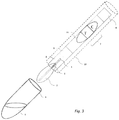
- Fig. 3 shows an embodiment of the present invention, where the swab carrying the incorporated non-volatile reagent (1-3) and the test strip (6-9) are integrated into a single device by connecting the back end of the swab tip (2) to the sample pad of the test strip (8) allowing for capillary liquid communication between both media.
- This integrated device unifies the swab and diagnostic strip allowing clinical sample collection and analysis in a single device.
- This configuration reduces the diagnostic procedure's complexity by removing the requirement for test strip addition to the extraction chamber following analyte extraction (as depicted in Fig. 2 ).
- introduction of the swab tip (2) into the extraction reagent (5) present in the extraction chamber (4) results in wicking of the extraction reagent into the swab tip.
- Extracted analyte then travels by capillary forces from the swab's tip into the test strip's sample pad (8), where it is optionally neutralized by a buffer incorporated into this area of the test strip.
- the extracted analyte continues to travel by capillary forces from the test strip's sample pad to the site on the strip where the analyte-specific labeled reagent has been incorporated (9), thereby solubilizing this reagent which reacts with the analyte forming labeled analyte-reagent complexes.
- the united swab-test strip is sheathed in a casing (10) that acts both as a handle, replacing the swab's stem for efficient clinical sample collection, and a cassette for the test strip.
- a window in this casing (11) which may be simply an opening or composed of, e.g., but not limited to, transparent plastic film, allows easy reading of test results.
- the casing (10) and the extraction chamber (4) are configured to match the casing outer diameter to the inner diameter of the extraction chamber, thereby allowing the casing to fit into and optionally cap the extraction chamber.
- Such capping can be affected by plugging the extraction chamber by the casing or by means of a screw joint or any other typical means of forming such junction.
- Such capping has the added advantage of sealing the extraction chamber and preventing spillage of the extraction reagent out of the extraction chamber. This also simplifies test disposal in one unit following results reading.
- the swab tip can serve four functions: (i) collecting a biological or clinical sample, e.g., bacterial colonies from a patient's throat; (ii) incorporating swab tip-adsorbed non-volatile reagent that aids in analyte extraction; (iii) co-transferring of both biological/clinical sample and swab-incorporated non-volatile reagent to the extraction reagent to form the extraction solution and effect efficient analyte extraction; and (iv) providing fluid conduit allowing efficient capillary wicking of the extracted analyte solution to the test strip's sample pad for analysis.
- a biological or clinical sample e.g., bacterial colonies from a patient's throat
- incorporating swab tip-adsorbed non-volatile reagent that aids in analyte extraction e.g., bacterial colonies from a patient's throat
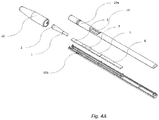
- Figure 4A shows one integrated device configuration that enables swab tip - diagnostic strip integration involving a casing made up of two matching, interlocking valves (10a,b).
- One such valve - the cover (10a) - is configured to clasp the swab tip (2) via its stem (1), while the other valve - the base (10b) - is configured to accommodate the test strip (6-9).
- These two interlocking valves are designed to bring the swab tip (2) and the test strip's sample pad (8) in physical contact upon joining these two valves.
- the results window (11) in the casing allows direct visualization of diagnostic test results.
- the casing cap (12) that protects the swab tip from mechanical damage is being removed to expose the swab's tip immediately prior to clinical sample collection.
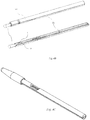
- Fig. 4B depicts further detail of the interaction between the casing cover (10a) and the swab stem (1), showing one possible clasping mechanism involving protrusions in the cover (13) that serve to firmly immobilize the swab stem within the casing cover.
- Fig. 4C depicts such fully assembled integrated device.
- the extraction reagent is made exclusively of solvent, e.g., but not limited to, water.
- the extraction reagent is an aqueous solution, having nitrite salt concentration in the range of 0.2-5 M.
- the extraction reagent may also contain any typically-used, non-ionic, detergent (e.g., but not limited to, NONIDET P- 40, Tween-20 Triton X-100, CHAPS, or any combination thereof), a pH buffering compound (e.g., but not limited to phosphate, Tris, HEPES, or any combination thereof), a chelating agent (e.g., but not limited to EDTA, EGTA, or any combination thereof), a preservative (e.g., but not limited to, thimerosal, chlorhexidine digluconate, sodium benzoate, potassium sorbate, sodium azide, sulfate salts of gentamicin, chloramphenicol and streptomycin, protease inhibitors or phenolic compounds, or any combination thereof), and a marker that changes the solution's color (e.g., but not limited to, from pink to light yellow) upon solubilization of the additional reagent incorporated in the swab
- analyte extraction from the sample is carried out by contacting the throat swab with 400uL of 1.2M sodium nitrite solution present in the extraction chamber.
- the swab tip is stirred in the extraction reagent by turning the swab against the side of the tube.
- extraction is allowed to proceed for between 10 seconds and 120 seconds, to allow for adequate polysaccharide antigen extraction.
- the extraction is allowed to proceed for between 10 seconds and 60 seconds, to allow for adequate polysaccharide antigen extraction.
- the extraction is allowed to proceed for between 10 seconds and 30 seconds.
- the extraction is allowed to proceed for between 30 seconds and 60 seconds. In some embodiments, the extraction is allowed to proceed for between 30 seconds and 120 seconds.
- the swab is left in the extraction chamber while the test strip is introduced to it ( Fig. 2 ). In another embodiment ( Fig. 3 ), the analyte is extracted in situ at the swab's tip by the incoming extraction reagent that becomes acidified by the non-volatile acid incorporated in the swab's tip.
- the configuration has the advantage of allowing additional contact time between the extraction reagent and the sample carried by the swab tip which optimizes antigen extraction.
- neutralization of the nitrous acid solution following extraction of the antigens is affected by a buffer material incorporated within the sample receiving portion (8) of the lateral flow immunochromatographic assay device (test strip).
- test strip a buffer material incorporated within the sample receiving portion (8) of the lateral flow immunochromatographic assay device
- analyte extraction and testing is performed within the same chamber without swab or fluid removal, introduction of the test strip into the extraction chamber following analyte extraction causes the buffer contained within the test strip to dissolve into the extraction solution thereby neutralizing the nitrous acid solution and allowing optimal lateral flow immunochromatographic assay performance.
- the amount of acid incorporated within the swab is between 2-800 micromoles.
- the amount of acid that needs to be incorporated in the swab tip to allow for effective Strep A antigen extraction depends on several factors, including (but not limited to): i) degree of acid acidity (pKa), ii) acid solubilization rate iii) volume and concentration of the extraction reagent that is to be acidified, iv) assay performance scheme and details (with or without swab removal, or by using an integrated device, etc.). Each combination of the above factors needs to be empirically tested to assure optimal Strep A antigen extraction.
- acid can be selected from edible or typically safe (GRAS) non-volatile organic acids, such as, but not limited to: citric, ascorbic, etc.
- GRAS typically safe non-volatile organic acids
- the acid allows the swab to be used directly in contact with the throat tissue.
- the swab can be configured to have a depositing or coating of non-volatile acid in a location that does not come in direct contact with the throat tissue, such as on the swab's stem in the area directly underlying its tip or incorporated within the stem tip's absorbent material away from the area that is configured to come into contact with the throat tissue ( Fig. 1 ).
- the non-volatile acid can be co-incorporated with other inert agents (e.g., dextrose) to improve acid dissolution into the extraction buffer.
- the non-volatile acid can be co-incorporated with other inert agents to improve taste (e.g., sweeteners, artificial flavors), or add coloring (e.g., food colorant).
- the non-volatile acid can be co-incorporated with a mucolytic agent, such as N-acetylcysteine, to reduce sample viscosity.
- the deposited non-volatile acid can be polymeric (e.g., but not limited to, polystyrene sulfonic acid, Nafion, etc.) and insoluble in the extraction reagent.
- an ionic exchange between the acidic polymer and the extraction reagent result in the acidification of the latter without dissolution of the acidic polymer.
- the present invention is a device including a swab used for biological sample collection, where the swab can comprise, e.g., but not limited to, a polyester fiber (or fiber of other polymeric material) coated swab, foam swab, comprising open-cell polyurethane (e.g., but not limited to, Becton Dickinson foam swabs) or a flocked swab (e.g., but not limited to, swabs made by Copan).
- swab tips are constructed to adsorb minimal amount of analyte and retain minimal fluid volume when coupled to a test strip's sample pad, thereby maximizing sample transfer to the test strip for analysis. In some embodiments, this is achieved by proper selection and optimization of the following parameters: swab tip's construction material (e.g., but not limited to, polyester fiber), tip fiber diameter (e.g., but not limited to, 5-20micron), fiber surface properties (e.g., but not limited to, hydrophilic coating), tip porosity (e.g., but not limited to, a porosity of 70-90%), tip length and diameter (typically, but not limited to 15- 20mm and 4-6mm, respectively), and tip sorptivity.
- swab tip's construction material e.g., but not limited to, polyester fiber
- tip fiber diameter e.g., but not limited to, 5-20micron
- fiber surface properties e.g., but not limited to, hydrophilic coating
- tip sorptivity can be chosen to allow rapid and quantitative capillary fluid transfer from the extraction solution to the swab tip and from the swab tip to the test strip's sample pad.
- capillary fluid transfer may or may not be counteracted by gravitational forces - i.e., the device incorporating the swab and test strip may operate in either the vertical or horizontal positions.
- the respective sorptivity and porosity of the swab tip, the test strip's sample pad, and the additional membranes that are used to construct the lateral flow-based test strip need to be selected and/or adjusted to allow efficient and continuous liquid flow from the swab tip to the sample pad of the test strip and from there to the rest of the test strip components to allow for optimal device operation.
- Such selection and/or adjustment of device component's porosity and sorptivity should take into account the intended use of the device in terms of its vertical vs. horizontal positioning, for example, but not limited to, increasing capillary forces acting within device components to counteract external gravitational forces in devices designed to operate in the upright position.
- the swab can be prepared with a non-volatile acid by dipping, spraying, or otherwise dispersing a solution of such acid in a volatile solvent, followed by solvent evaporation.
- one end of the swab stem (where the tip is to be constructed) can be pre-wrapped or coated with a membrane or film made of the acidic polymeric material prior to the application of the fiber (e.g., but not limited to, wool, cotton, polyester, or any other fibrous or otherwise absorbent material, e.g., but not limited to, a sponge) or foam matrix that is to create the tip ( Fig. 1 ).
- such configuration avoids direct physical contact between the acidic polymer carried by the swab and the throat tissue from which the biological sample is to be withdrawn for diagnosis.
- the present invention is a one-step immunochromatographic assay device configured to use commercially-available lateral-flow based test strips.
- the immunochromatographic assay device can contain a sample receiving region comprising a porous material, configured to allow lateral flow of a sample containing extracted analytes from the sample receiving region to the analyte detection region.
- the sample receiving region and the analyte detection region can be present on a single porous member, or may comprise at least two separate porous members in lateral flow contact.
- the sample receiving region can contain dry analyte-specific labeled reagents that are solubilized by the extraction reagent allowing analyte-labeled reagent complex formation.
- the labeled analyte- reagent complexes are configured to flow through the device by capillary forces until they reach the capture zone where they bind to the immobilized capture reagent, typically another analyte-specific antibody (i.e., a binding event).
- the binding event is detectable visually or by the use of a dedicated reader by the accumulation of the label at the capture zone, which is configure to provide an indication of the presence of the analyte in the sample.
Landscapes
- Health & Medical Sciences (AREA)
- Life Sciences & Earth Sciences (AREA)
- Immunology (AREA)
- Chemical & Material Sciences (AREA)
- Engineering & Computer Science (AREA)
- Hematology (AREA)
- Molecular Biology (AREA)
- Biomedical Technology (AREA)
- Urology & Nephrology (AREA)
- General Health & Medical Sciences (AREA)
- Analytical Chemistry (AREA)
- Biotechnology (AREA)
- Biochemistry (AREA)
- Microbiology (AREA)
- Physics & Mathematics (AREA)
- Medicinal Chemistry (AREA)
- General Physics & Mathematics (AREA)
- Food Science & Technology (AREA)
- Cell Biology (AREA)
- Pathology (AREA)
- Organic Chemistry (AREA)
- Zoology (AREA)
- Wood Science & Technology (AREA)
- Bioinformatics & Cheminformatics (AREA)
- Proteomics, Peptides & Aminoacids (AREA)
- Chemical Kinetics & Catalysis (AREA)
- Clinical Laboratory Science (AREA)
- Genetics & Genomics (AREA)
- General Engineering & Computer Science (AREA)
- Toxicology (AREA)
- Biophysics (AREA)
- Virology (AREA)
- Tropical Medicine & Parasitology (AREA)
- Sustainable Development (AREA)
- Investigating Or Analysing Biological Materials (AREA)
- Measuring Or Testing Involving Enzymes Or Micro-Organisms (AREA)
- Apparatus Associated With Microorganisms And Enzymes (AREA)
- Sampling And Sample Adjustment (AREA)
Priority Applications (1)
| Application Number | Priority Date | Filing Date | Title |
|---|---|---|---|
| EP20199394.6A EP3792629A1 (en) | 2015-02-17 | 2016-02-17 | Devices for biological sample collection and analysis and methods of use thereof |
Applications Claiming Priority (2)
| Application Number | Priority Date | Filing Date | Title |
|---|---|---|---|
| US201562117211P | 2015-02-17 | 2015-02-17 | |
| PCT/IB2016/000296 WO2016132223A1 (en) | 2015-02-17 | 2016-02-17 | Devices for biological sample collection and analysis and methods of use thereof |
Related Child Applications (1)
| Application Number | Title | Priority Date | Filing Date |
|---|---|---|---|
| EP20199394.6A Division EP3792629A1 (en) | 2015-02-17 | 2016-02-17 | Devices for biological sample collection and analysis and methods of use thereof |
Publications (3)
| Publication Number | Publication Date |
|---|---|
| EP3259067A1 EP3259067A1 (en) | 2017-12-27 |
| EP3259067A4 EP3259067A4 (en) | 2018-09-12 |
| EP3259067B1 true EP3259067B1 (en) | 2020-09-02 |
Family
ID=56692005
Family Applications (2)
| Application Number | Title | Priority Date | Filing Date |
|---|---|---|---|
| EP16751983.4A Active EP3259067B1 (en) | 2015-02-17 | 2016-02-17 | Devices for biological sample collection and analysis and methods of use thereof |
| EP20199394.6A Pending EP3792629A1 (en) | 2015-02-17 | 2016-02-17 | Devices for biological sample collection and analysis and methods of use thereof |
Family Applications After (1)
| Application Number | Title | Priority Date | Filing Date |
|---|---|---|---|
| EP20199394.6A Pending EP3792629A1 (en) | 2015-02-17 | 2016-02-17 | Devices for biological sample collection and analysis and methods of use thereof |
Country Status (7)
| Country | Link |
|---|---|
| US (4) | US10596573B2 (https=) |
| EP (2) | EP3259067B1 (https=) |
| JP (1) | JP6722699B2 (https=) |
| CN (1) | CN107530700B (https=) |
| ES (1) | ES2833077T3 (https=) |
| IL (1) | IL253860B (https=) |
| WO (1) | WO2016132223A1 (https=) |
Families Citing this family (31)
| Publication number | Priority date | Publication date | Assignee | Title |
|---|---|---|---|---|
| CN107850593A (zh) * | 2015-07-16 | 2018-03-27 | 田中贵金属工业株式会社 | 免疫测定方法、免疫层析试剂盒 |
| US20200246792A1 (en) * | 2017-09-28 | 2020-08-06 | Charm Sciences, Inc. | Single unit assay device, method, and assembly |
| WO2019152657A1 (en) | 2018-02-03 | 2019-08-08 | Simple Healthkit, Inc. | Reliable, comprehensive, and rapid sexual health assessment |
| EP3578972A1 (en) * | 2018-06-06 | 2019-12-11 | Blink AG | A device for fractionating a suspension sample |
| GB201902810D0 (en) * | 2019-03-01 | 2019-04-17 | Vidya Holdings Ltd | Disposition of reagents in assay device |
| EP3946547B1 (en) | 2019-03-26 | 2026-03-25 | Pinova Therapeutics Inc. | Devices and methods for delivering pharmaceutical compositions |
| CN110275020A (zh) * | 2019-08-01 | 2019-09-24 | 郑州迈迪迅医疗科技有限公司 | 一种转轮式层析检测装置 |
| USD917715S1 (en) * | 2020-01-13 | 2021-04-27 | Lee L. Nemeth | Basket end tip for vitrification stick |
| JP7208640B2 (ja) * | 2020-03-30 | 2023-01-19 | アドテック株式会社 | 溶媒含有物質検査キット |
| WO2021252810A1 (en) | 2020-06-10 | 2021-12-16 | Checkable Medical Incorporated | In vitro diagnostic device |
| WO2022018519A1 (en) * | 2020-07-20 | 2022-01-27 | Bio-Marketing-T, Ltd. (BMT) | Devices for lateral flow-based biological sample collection and diagnosis and methods of use thereof |
| WO2022040785A1 (en) * | 2020-08-28 | 2022-03-03 | Green Belting Industries Ltd. | Liquid soluble collection device for microorganism screening |
| US20220062890A1 (en) * | 2020-09-03 | 2022-03-03 | Daniel Larkin | Swab device with embedded test element |
| KR102580403B1 (ko) * | 2020-10-08 | 2023-09-20 | 주식회사 바이오노트 | 검출용 디바이스와 검체 채집도구가 일체화된 진단키트 |
| CN116348037A (zh) * | 2020-10-08 | 2023-06-27 | Sd生物传感器株式会社 | 检测装置和样本采集工具一体化的诊断试剂盒 |
| US20220137042A1 (en) * | 2020-11-04 | 2022-05-05 | Signature Science, Llc | Lateral Flow Assay Device And Sampling Methods |
| US11278709B1 (en) | 2021-03-12 | 2022-03-22 | Pocket Naloxone Corp. | Drug delivery device and methods for using same |
| CN113491363A (zh) * | 2021-04-25 | 2021-10-12 | 西北工业大学 | 用于收集和检测呼出气体中飞沫的口罩装置 |
| US12089823B2 (en) | 2021-06-14 | 2024-09-17 | Teal Health, Inc. | Devices, systems, and methods for self-collection of biological samples |
| JP7728134B2 (ja) * | 2021-09-21 | 2025-08-22 | 株式会社東亜産業 | 検査機器 |
| WO2023102382A1 (en) * | 2021-11-30 | 2023-06-08 | Emed Labs, Llc | Lateral flow test kits |
| JP1722557S (ja) * | 2022-01-07 | 2022-08-17 | 生体細胞凍結保存用具 | |
| USD1037483S1 (en) | 2022-03-15 | 2024-07-30 | Cue Health Inc. | Sample collection device |
| USD1037484S1 (en) | 2022-03-15 | 2024-07-30 | Cue Health Inc. | Sample collection device |
| CN114878806A (zh) * | 2022-05-11 | 2022-08-09 | 孙非 | 一体化抗原检测装置及其抗原检测过程质量控制方法 |
| USD1021130S1 (en) * | 2022-06-13 | 2024-04-02 | Teal Health, Inc. | Sample collection device |
| USD1042874S1 (en) * | 2022-07-25 | 2024-09-17 | Cue Health Inc. | Sample collection device |
| US11526990B1 (en) | 2022-08-10 | 2022-12-13 | Bio-Marketing-T, Ltd. (BMT) | Computer systems and computer-implemented methods for rapid diagnostic test result interpretation platform utilizing computer vision |
| USD1087801S1 (en) | 2022-11-30 | 2025-08-12 | Siro Diagnostics, Inc. | Sample collection device |
| US20250079025A1 (en) * | 2023-08-31 | 2025-03-06 | Samantha Froebe | Pathogen test device |
| CN119685164B (zh) * | 2024-08-28 | 2026-02-17 | 浙江工业大学 | 一种类球形生物聚集体内核的提取方法 |
Family Cites Families (42)
| Publication number | Priority date | Publication date | Assignee | Title |
|---|---|---|---|---|
| GB8701432D0 (en) * | 1987-01-22 | 1987-02-25 | Unilever Plc | Assays |
| US5415994A (en) | 1993-08-02 | 1995-05-16 | Quidel Corporation | Lateral flow medical diagnostic assay device with sample extraction means |
| US5494801A (en) * | 1993-12-03 | 1996-02-27 | Biostar, Inc. | Microorganism antigen extraction methods |
| US5739041A (en) * | 1995-05-02 | 1998-04-14 | Carter Wallace, Inc. | Diagnostic detection device |
| AUPO071396A0 (en) * | 1996-06-28 | 1996-07-25 | Chandler, Howard Milne | Chromatographic assay or test device |
| US6979576B1 (en) | 1997-07-25 | 2005-12-27 | Shu-Ching Cheng | Methods of use of one step immunochromatographic device for Streptococcus A antigen |
| US5916802A (en) | 1997-02-19 | 1999-06-29 | Fritz Berthold | Device for measuring ATP |
| DE69840657D1 (de) | 1997-07-16 | 2009-04-23 | Charm Sciences Inc | Verfahren zum Nachweis eines Restanalyts in einer Probe |
| AUPP915799A0 (en) * | 1999-03-11 | 1999-04-15 | Enterix Inc. | Sample collection and testing system |
| USD439985S1 (en) * | 1999-06-11 | 2001-04-03 | Connex Gesellschaft Zur Optimierung Von Forschung Und Entwicklung | Medical diagnostic and test device |
| USD470596S1 (en) * | 2001-12-17 | 2003-02-18 | Kimberly-Clark Worldwide, Inc. | Test kit specimen-handling tool |
| USD477669S1 (en) * | 2002-08-20 | 2003-07-22 | Alfa Scientific Design, Inc. | Specimen collection tube |
| JP2005030994A (ja) * | 2003-07-09 | 2005-02-03 | Asahi Kasei Corp | 微生物抗原回収方法 |
| WO2005072398A2 (en) * | 2004-01-28 | 2005-08-11 | Bamburgh Marrsh Llc | Specimen sample collection device and test system |
| GB0417601D0 (en) * | 2004-08-06 | 2004-09-08 | Inverness Medical Switzerland | Assay device & method |
| USD580785S1 (en) * | 2006-02-13 | 2008-11-18 | Medical Instill Technologies, Inc. | Dispenser |
| AU2007217765A1 (en) * | 2006-02-21 | 2007-08-30 | Nanogen, Inc. | Methods and compositions for analyte detection |
| JP5586842B2 (ja) * | 2006-10-19 | 2014-09-10 | デンカ生研株式会社 | 試料ろ過フィルターを用いる簡易メンブレンアッセイ方法及びキット |
| US8038965B2 (en) * | 2007-05-30 | 2011-10-18 | Alere Switzerland Gmbh | Diagnostic kit |
| USD595350S1 (en) * | 2008-02-06 | 2009-06-30 | Mauricio Ezequiel Paz | Dual-tipped writing device for use with ink and correction fluid |
| TWI393578B (zh) * | 2009-07-07 | 2013-04-21 | Shl Group Ab | 注射裝置 |
| CN103975241B (zh) * | 2011-08-03 | 2016-01-20 | 奎德尔公司 | 用于提高a型链球菌免疫测定法的特异性的n-乙酰基-d-葡糖胺 |
| USD691196S1 (en) * | 2011-12-31 | 2013-10-08 | Beifa Group Co., Ltd. | Pen |
| IL217569A0 (en) * | 2012-01-16 | 2012-03-29 | Novamed Ltd | Immunochromatographic assay with minimal reagent manipulation |
| USD694236S1 (en) * | 2012-08-28 | 2013-11-26 | Samsung Electronics Co., Ltd. | Pen for portable electronic device |
| USD740290S1 (en) * | 2012-10-08 | 2015-10-06 | Samsung Electronics Co., Ltd. | Pen for portable electronic device |
| USD682833S1 (en) * | 2012-10-31 | 2013-05-21 | Research In Motion Limited | Stylus |
| USD713878S1 (en) * | 2013-03-15 | 2014-09-23 | Hub Pen Company | Pen |
| CN103245783A (zh) * | 2013-04-27 | 2013-08-14 | 广东海大畜牧兽医研究院有限公司 | 一种猪2型细环病毒抗体胶体金快速诊断试纸及其制备方法 |
| USD765242S1 (en) * | 2014-08-14 | 2016-08-30 | Bryan Tapocik | Substance collection device with swab collector |
| USD758569S1 (en) * | 2015-01-07 | 2016-06-07 | Sanofi-Aventis Deutschland Gmbh | Autoinjector housing |
| USD800981S1 (en) * | 2015-10-01 | 2017-10-24 | Foamtec International Co., Ltd. | Cleaning device with tail swab |
| USD845504S1 (en) * | 2017-01-19 | 2019-04-09 | Magnisense Se | Reader for medical or nonmedical diagnostic use |
| USD823944S1 (en) * | 2017-05-23 | 2018-07-24 | stilform GmbH | Pen |
| USD899946S1 (en) * | 2018-07-24 | 2020-10-27 | E+E Elektronik Ges.M.B.H | Measuring instrument |
| USD921754S1 (en) * | 2019-06-20 | 2021-06-08 | Sanford, L.P. | Writing instrument |
| USD930184S1 (en) * | 2019-07-18 | 2021-09-07 | Spectrum Solutions L.L.C. | Sample collection device |
| USD962423S1 (en) * | 2020-11-05 | 2022-08-30 | Amgen Inc. | Handheld drug delivery device |
| USD971431S1 (en) * | 2021-03-23 | 2022-11-29 | Bayer Consumer Care Ag | Diagnostic device |
| USD964552S1 (en) * | 2021-04-02 | 2022-09-20 | Bayer Consumer Care Ag | Swab component of a diagnostic device |
| TWD220442S (zh) * | 2021-08-06 | 2022-08-11 | 金上達科技股份有限公司 | 紫外線滅菌裝置 |
| USD1021130S1 (en) * | 2022-06-13 | 2024-04-02 | Teal Health, Inc. | Sample collection device |
-
2016
- 2016-02-17 WO PCT/IB2016/000296 patent/WO2016132223A1/en not_active Ceased
- 2016-02-17 ES ES16751983T patent/ES2833077T3/es active Active
- 2016-02-17 CN CN201680022442.3A patent/CN107530700B/zh active Active
- 2016-02-17 EP EP16751983.4A patent/EP3259067B1/en active Active
- 2016-02-17 JP JP2017561047A patent/JP6722699B2/ja active Active
- 2016-02-17 US US15/548,971 patent/US10596573B2/en active Active
- 2016-02-17 EP EP20199394.6A patent/EP3792629A1/en active Pending
-
2017
- 2017-08-06 IL IL253860A patent/IL253860B/en active IP Right Grant
-
2020
- 2020-03-23 US US16/827,237 patent/US11602749B2/en active Active
-
2023
- 2023-02-22 US US29/870,189 patent/USD1059629S1/en active Active
- 2023-03-10 US US18/182,131 patent/US20230201838A1/en active Pending
Non-Patent Citations (1)
| Title |
|---|
| None * |
Also Published As
| Publication number | Publication date |
|---|---|
| IL253860B (en) | 2021-06-30 |
| US20180021771A1 (en) | 2018-01-25 |
| US11602749B2 (en) | 2023-03-14 |
| JP2018515785A (ja) | 2018-06-14 |
| CN107530700A (zh) | 2018-01-02 |
| US20230201838A1 (en) | 2023-06-29 |
| EP3792629A1 (en) | 2021-03-17 |
| EP3259067A1 (en) | 2017-12-27 |
| USD1059629S1 (en) | 2025-01-28 |
| US10596573B2 (en) | 2020-03-24 |
| JP6722699B2 (ja) | 2020-07-15 |
| WO2016132223A1 (en) | 2016-08-25 |
| IL253860A0 (en) | 2017-09-28 |
| EP3259067A4 (en) | 2018-09-12 |
| US20200261906A1 (en) | 2020-08-20 |
| ES2833077T3 (es) | 2021-06-14 |
| CN107530700B (zh) | 2020-04-21 |
Similar Documents
| Publication | Publication Date | Title |
|---|---|---|
| US20230201838A1 (en) | Devices for biological sample collection and analysis and methods of use thereof | |
| US6663831B2 (en) | “One-device” system for testing constituents in fluids | |
| US11026611B2 (en) | Rotatable disk-shaped fluid sample collection device | |
| US10041942B2 (en) | Rotatable fluid sample collection device | |
| US5869003A (en) | Self contained diagnostic test unit | |
| US7871568B2 (en) | Rapid test apparatus | |
| JP2019191188A (ja) | 拭い取りを受け取るための機器、システム、方法及びキット | |
| US8038965B2 (en) | Diagnostic kit | |
| US20190366326A1 (en) | Device for taking a sample and sample analysis system comprising such a device | |
| WO2008089198A1 (en) | Sample collector and tester | |
| CN110650689B (zh) | 用于鼻窦炎诊断的装置和方法 | |
| WO2013108250A1 (en) | Immunochromatographic assay with minimal reagent manipulation | |
| JP5942000B2 (ja) | カテーテルおよびカテーテルの作動方法 | |
| JP2005030994A (ja) | 微生物抗原回収方法 | |
| AU2002338364B2 (en) | A "one-device" system for testing constituents in fluids | |
| CN120778434A (zh) | 一种测试样本中被分析物质的装置 | |
| HK1224738B (zh) | 用於接收拭子的裝置、系統、方法和套件 | |
| AU2002338364A1 (en) | A "one-device" system for testing constituents in fluids |
Legal Events
| Date | Code | Title | Description |
|---|---|---|---|
| STAA | Information on the status of an ep patent application or granted ep patent |
Free format text: STATUS: THE INTERNATIONAL PUBLICATION HAS BEEN MADE |
|
| PUAI | Public reference made under article 153(3) epc to a published international application that has entered the european phase |
Free format text: ORIGINAL CODE: 0009012 |
|
| STAA | Information on the status of an ep patent application or granted ep patent |
Free format text: STATUS: REQUEST FOR EXAMINATION WAS MADE |
|
| 17P | Request for examination filed |
Effective date: 20170914 |
|
| AK | Designated contracting states |
Kind code of ref document: A1 Designated state(s): AL AT BE BG CH CY CZ DE DK EE ES FI FR GB GR HR HU IE IS IT LI LT LU LV MC MK MT NL NO PL PT RO RS SE SI SK SM TR |
|
| AX | Request for extension of the european patent |
Extension state: BA ME |
|
| DAV | Request for validation of the european patent (deleted) | ||
| DAX | Request for extension of the european patent (deleted) | ||
| REG | Reference to a national code |
Ref country code: DE Ref legal event code: R079 Ref document number: 602016043258 Country of ref document: DE Free format text: PREVIOUS MAIN CLASS: B01L0003000000 Ipc: G01N0033530000 |
|
| A4 | Supplementary search report drawn up and despatched |
Effective date: 20180813 |
|
| RIC1 | Information provided on ipc code assigned before grant |
Ipc: G01N 33/569 20060101ALI20180807BHEP Ipc: G01N 33/53 20060101AFI20180807BHEP Ipc: C12M 1/30 20060101ALI20180807BHEP Ipc: G01N 33/543 20060101ALI20180807BHEP Ipc: G01N 33/538 20060101ALI20180807BHEP Ipc: G01N 33/558 20060101ALI20180807BHEP Ipc: B01L 3/00 20060101ALI20180807BHEP Ipc: C12Q 1/14 20060101ALI20180807BHEP |
|
| STAA | Information on the status of an ep patent application or granted ep patent |
Free format text: STATUS: EXAMINATION IS IN PROGRESS |
|
| 17Q | First examination report despatched |
Effective date: 20190405 |
|
| GRAP | Despatch of communication of intention to grant a patent |
Free format text: ORIGINAL CODE: EPIDOSNIGR1 |
|
| STAA | Information on the status of an ep patent application or granted ep patent |
Free format text: STATUS: GRANT OF PATENT IS INTENDED |
|
| INTG | Intention to grant announced |
Effective date: 20200313 |
|
| GRAS | Grant fee paid |
Free format text: ORIGINAL CODE: EPIDOSNIGR3 |
|
| GRAA | (expected) grant |
Free format text: ORIGINAL CODE: 0009210 |
|
| STAA | Information on the status of an ep patent application or granted ep patent |
Free format text: STATUS: THE PATENT HAS BEEN GRANTED |
|
| AK | Designated contracting states |
Kind code of ref document: B1 Designated state(s): AL AT BE BG CH CY CZ DE DK EE ES FI FR GB GR HR HU IE IS IT LI LT LU LV MC MK MT NL NO PL PT RO RS SE SI SK SM TR |
|
| REG | Reference to a national code |
Ref country code: GB Ref legal event code: FG4D |
|
| REG | Reference to a national code |
Ref country code: AT Ref legal event code: REF Ref document number: 1309439 Country of ref document: AT Kind code of ref document: T Effective date: 20200915 Ref country code: CH Ref legal event code: EP |
|
| REG | Reference to a national code |
Ref country code: DE Ref legal event code: R096 Ref document number: 602016043258 Country of ref document: DE |
|
| REG | Reference to a national code |
Ref country code: IE Ref legal event code: FG4D |
|
| REG | Reference to a national code |
Ref country code: LT Ref legal event code: MG4D |
|
| PG25 | Lapsed in a contracting state [announced via postgrant information from national office to epo] |
Ref country code: FI Free format text: LAPSE BECAUSE OF FAILURE TO SUBMIT A TRANSLATION OF THE DESCRIPTION OR TO PAY THE FEE WITHIN THE PRESCRIBED TIME-LIMIT Effective date: 20200902 Ref country code: HR Free format text: LAPSE BECAUSE OF FAILURE TO SUBMIT A TRANSLATION OF THE DESCRIPTION OR TO PAY THE FEE WITHIN THE PRESCRIBED TIME-LIMIT Effective date: 20200902 Ref country code: SE Free format text: LAPSE BECAUSE OF FAILURE TO SUBMIT A TRANSLATION OF THE DESCRIPTION OR TO PAY THE FEE WITHIN THE PRESCRIBED TIME-LIMIT Effective date: 20200902 Ref country code: GR Free format text: LAPSE BECAUSE OF FAILURE TO SUBMIT A TRANSLATION OF THE DESCRIPTION OR TO PAY THE FEE WITHIN THE PRESCRIBED TIME-LIMIT Effective date: 20201203 Ref country code: NO Free format text: LAPSE BECAUSE OF FAILURE TO SUBMIT A TRANSLATION OF THE DESCRIPTION OR TO PAY THE FEE WITHIN THE PRESCRIBED TIME-LIMIT Effective date: 20201202 Ref country code: BG Free format text: LAPSE BECAUSE OF FAILURE TO SUBMIT A TRANSLATION OF THE DESCRIPTION OR TO PAY THE FEE WITHIN THE PRESCRIBED TIME-LIMIT Effective date: 20201202 Ref country code: LT Free format text: LAPSE BECAUSE OF FAILURE TO SUBMIT A TRANSLATION OF THE DESCRIPTION OR TO PAY THE FEE WITHIN THE PRESCRIBED TIME-LIMIT Effective date: 20200902 |
|
| REG | Reference to a national code |
Ref country code: NL Ref legal event code: MP Effective date: 20200902 |
|
| REG | Reference to a national code |
Ref country code: AT Ref legal event code: MK05 Ref document number: 1309439 Country of ref document: AT Kind code of ref document: T Effective date: 20200902 |
|
| PG25 | Lapsed in a contracting state [announced via postgrant information from national office to epo] |
Ref country code: PL Free format text: LAPSE BECAUSE OF FAILURE TO SUBMIT A TRANSLATION OF THE DESCRIPTION OR TO PAY THE FEE WITHIN THE PRESCRIBED TIME-LIMIT Effective date: 20200902 Ref country code: LV Free format text: LAPSE BECAUSE OF FAILURE TO SUBMIT A TRANSLATION OF THE DESCRIPTION OR TO PAY THE FEE WITHIN THE PRESCRIBED TIME-LIMIT Effective date: 20200902 Ref country code: RS Free format text: LAPSE BECAUSE OF FAILURE TO SUBMIT A TRANSLATION OF THE DESCRIPTION OR TO PAY THE FEE WITHIN THE PRESCRIBED TIME-LIMIT Effective date: 20200902 |
|
| PG25 | Lapsed in a contracting state [announced via postgrant information from national office to epo] |
Ref country code: SM Free format text: LAPSE BECAUSE OF FAILURE TO SUBMIT A TRANSLATION OF THE DESCRIPTION OR TO PAY THE FEE WITHIN THE PRESCRIBED TIME-LIMIT Effective date: 20200902 Ref country code: EE Free format text: LAPSE BECAUSE OF FAILURE TO SUBMIT A TRANSLATION OF THE DESCRIPTION OR TO PAY THE FEE WITHIN THE PRESCRIBED TIME-LIMIT Effective date: 20200902 Ref country code: CZ Free format text: LAPSE BECAUSE OF FAILURE TO SUBMIT A TRANSLATION OF THE DESCRIPTION OR TO PAY THE FEE WITHIN THE PRESCRIBED TIME-LIMIT Effective date: 20200902 Ref country code: RO Free format text: LAPSE BECAUSE OF FAILURE TO SUBMIT A TRANSLATION OF THE DESCRIPTION OR TO PAY THE FEE WITHIN THE PRESCRIBED TIME-LIMIT Effective date: 20200902 Ref country code: PT Free format text: LAPSE BECAUSE OF FAILURE TO SUBMIT A TRANSLATION OF THE DESCRIPTION OR TO PAY THE FEE WITHIN THE PRESCRIBED TIME-LIMIT Effective date: 20210104 |
|
| PG25 | Lapsed in a contracting state [announced via postgrant information from national office to epo] |
Ref country code: AL Free format text: LAPSE BECAUSE OF FAILURE TO SUBMIT A TRANSLATION OF THE DESCRIPTION OR TO PAY THE FEE WITHIN THE PRESCRIBED TIME-LIMIT Effective date: 20200902 Ref country code: AT Free format text: LAPSE BECAUSE OF FAILURE TO SUBMIT A TRANSLATION OF THE DESCRIPTION OR TO PAY THE FEE WITHIN THE PRESCRIBED TIME-LIMIT Effective date: 20200902 Ref country code: IS Free format text: LAPSE BECAUSE OF FAILURE TO SUBMIT A TRANSLATION OF THE DESCRIPTION OR TO PAY THE FEE WITHIN THE PRESCRIBED TIME-LIMIT Effective date: 20210102 |
|
| REG | Reference to a national code |
Ref country code: DE Ref legal event code: R097 Ref document number: 602016043258 Country of ref document: DE |
|
| REG | Reference to a national code |
Ref country code: ES Ref legal event code: FG2A Ref document number: 2833077 Country of ref document: ES Kind code of ref document: T3 Effective date: 20210614 |
|
| PG25 | Lapsed in a contracting state [announced via postgrant information from national office to epo] |
Ref country code: SK Free format text: LAPSE BECAUSE OF FAILURE TO SUBMIT A TRANSLATION OF THE DESCRIPTION OR TO PAY THE FEE WITHIN THE PRESCRIBED TIME-LIMIT Effective date: 20200902 |
|
| PLBE | No opposition filed within time limit |
Free format text: ORIGINAL CODE: 0009261 |
|
| STAA | Information on the status of an ep patent application or granted ep patent |
Free format text: STATUS: NO OPPOSITION FILED WITHIN TIME LIMIT |
|
| 26N | No opposition filed |
Effective date: 20210603 |
|
| PG25 | Lapsed in a contracting state [announced via postgrant information from national office to epo] |
Ref country code: SI Free format text: LAPSE BECAUSE OF FAILURE TO SUBMIT A TRANSLATION OF THE DESCRIPTION OR TO PAY THE FEE WITHIN THE PRESCRIBED TIME-LIMIT Effective date: 20200902 Ref country code: DK Free format text: LAPSE BECAUSE OF FAILURE TO SUBMIT A TRANSLATION OF THE DESCRIPTION OR TO PAY THE FEE WITHIN THE PRESCRIBED TIME-LIMIT Effective date: 20200902 |
|
| PG25 | Lapsed in a contracting state [announced via postgrant information from national office to epo] |
Ref country code: MC Free format text: LAPSE BECAUSE OF FAILURE TO SUBMIT A TRANSLATION OF THE DESCRIPTION OR TO PAY THE FEE WITHIN THE PRESCRIBED TIME-LIMIT Effective date: 20200902 |
|
| REG | Reference to a national code |
Ref country code: BE Ref legal event code: MM Effective date: 20210228 |
|
| PG25 | Lapsed in a contracting state [announced via postgrant information from national office to epo] |
Ref country code: LU Free format text: LAPSE BECAUSE OF NON-PAYMENT OF DUE FEES Effective date: 20210217 |
|
| PG25 | Lapsed in a contracting state [announced via postgrant information from national office to epo] |
Ref country code: BE Free format text: LAPSE BECAUSE OF NON-PAYMENT OF DUE FEES Effective date: 20210228 |
|
| PG25 | Lapsed in a contracting state [announced via postgrant information from national office to epo] |
Ref country code: NL Free format text: LAPSE BECAUSE OF NON-PAYMENT OF DUE FEES Effective date: 20200923 Ref country code: CY Free format text: LAPSE BECAUSE OF FAILURE TO SUBMIT A TRANSLATION OF THE DESCRIPTION OR TO PAY THE FEE WITHIN THE PRESCRIBED TIME-LIMIT Effective date: 20200902 |
|
| P01 | Opt-out of the competence of the unified patent court (upc) registered |
Effective date: 20230601 |
|
| PG25 | Lapsed in a contracting state [announced via postgrant information from national office to epo] |
Ref country code: HU Free format text: LAPSE BECAUSE OF FAILURE TO SUBMIT A TRANSLATION OF THE DESCRIPTION OR TO PAY THE FEE WITHIN THE PRESCRIBED TIME-LIMIT; INVALID AB INITIO Effective date: 20160217 |
|
| PG25 | Lapsed in a contracting state [announced via postgrant information from national office to epo] |
Ref country code: MK Free format text: LAPSE BECAUSE OF FAILURE TO SUBMIT A TRANSLATION OF THE DESCRIPTION OR TO PAY THE FEE WITHIN THE PRESCRIBED TIME-LIMIT Effective date: 20200902 |
|
| PG25 | Lapsed in a contracting state [announced via postgrant information from national office to epo] |
Ref country code: TR Free format text: LAPSE BECAUSE OF FAILURE TO SUBMIT A TRANSLATION OF THE DESCRIPTION OR TO PAY THE FEE WITHIN THE PRESCRIBED TIME-LIMIT Effective date: 20200902 |
|
| PG25 | Lapsed in a contracting state [announced via postgrant information from national office to epo] |
Ref country code: MT Free format text: LAPSE BECAUSE OF FAILURE TO SUBMIT A TRANSLATION OF THE DESCRIPTION OR TO PAY THE FEE WITHIN THE PRESCRIBED TIME-LIMIT Effective date: 20200902 |
|
| PGFP | Annual fee paid to national office [announced via postgrant information from national office to epo] |
Ref country code: CH Payment date: 20250301 Year of fee payment: 10 |
|
| REG | Reference to a national code |
Ref country code: CH Ref legal event code: U11 Free format text: ST27 STATUS EVENT CODE: U-0-0-U10-U11 (AS PROVIDED BY THE NATIONAL OFFICE) Effective date: 20260301 |
|
| PGFP | Annual fee paid to national office [announced via postgrant information from national office to epo] |
Ref country code: GB Payment date: 20260219 Year of fee payment: 11 |
|
| PGFP | Annual fee paid to national office [announced via postgrant information from national office to epo] |
Ref country code: ES Payment date: 20260309 Year of fee payment: 11 |
|
| PGFP | Annual fee paid to national office [announced via postgrant information from national office to epo] |
Ref country code: DE Payment date: 20260206 Year of fee payment: 11 Ref country code: IE Payment date: 20260121 Year of fee payment: 11 |
|
| PGFP | Annual fee paid to national office [announced via postgrant information from national office to epo] |
Ref country code: IT Payment date: 20260209 Year of fee payment: 11 |
|
| PGFP | Annual fee paid to national office [announced via postgrant information from national office to epo] |
Ref country code: FR Payment date: 20260227 Year of fee payment: 11 |