EP3258909B1 - 2,3,4,5-tetrahydroxyhexandisäureester aus dilactonen der 2,3,4,5-tetrahydroxyhexandisäure - Google Patents
2,3,4,5-tetrahydroxyhexandisäureester aus dilactonen der 2,3,4,5-tetrahydroxyhexandisäure Download PDFInfo
- Publication number
- EP3258909B1 EP3258909B1 EP16704562.4A EP16704562A EP3258909B1 EP 3258909 B1 EP3258909 B1 EP 3258909B1 EP 16704562 A EP16704562 A EP 16704562A EP 3258909 B1 EP3258909 B1 EP 3258909B1
- Authority
- EP
- European Patent Office
- Prior art keywords
- alkyl
- alkenyl
- compounds
- formula
- compound
- Prior art date
- Legal status (The legal status is an assumption and is not a legal conclusion. Google has not performed a legal analysis and makes no representation as to the accuracy of the status listed.)
- Active
Links
- 0 *OC(C(C(C(C1O)O)OC1=O)O)=O Chemical compound *OC(C(C(C(C1O)O)OC1=O)O)=O 0.000 description 1
Classifications
-
- C—CHEMISTRY; METALLURGY
- C07—ORGANIC CHEMISTRY
- C07C—ACYCLIC OR CARBOCYCLIC COMPOUNDS
- C07C69/00—Esters of carboxylic acids; Esters of carbonic or haloformic acids
- C07C69/66—Esters of carboxylic acids having esterified carboxylic groups bound to acyclic carbon atoms and having any of the groups OH, O—metal, —CHO, keto, ether, acyloxy, groups, groups, or in the acid moiety
- C07C69/67—Esters of carboxylic acids having esterified carboxylic groups bound to acyclic carbon atoms and having any of the groups OH, O—metal, —CHO, keto, ether, acyloxy, groups, groups, or in the acid moiety of saturated acids
- C07C69/675—Esters of carboxylic acids having esterified carboxylic groups bound to acyclic carbon atoms and having any of the groups OH, O—metal, —CHO, keto, ether, acyloxy, groups, groups, or in the acid moiety of saturated acids of saturated hydroxy-carboxylic acids
-
- A—HUMAN NECESSITIES
- A61—MEDICAL OR VETERINARY SCIENCE; HYGIENE
- A61K—PREPARATIONS FOR MEDICAL, DENTAL OR TOILETRY PURPOSES
- A61K8/00—Cosmetics or similar toiletry preparations
- A61K8/18—Cosmetics or similar toiletry preparations characterised by the composition
- A61K8/30—Cosmetics or similar toiletry preparations characterised by the composition containing organic compounds
- A61K8/33—Cosmetics or similar toiletry preparations characterised by the composition containing organic compounds containing oxygen
- A61K8/37—Esters of carboxylic acids
-
- A—HUMAN NECESSITIES
- A61—MEDICAL OR VETERINARY SCIENCE; HYGIENE
- A61Q—SPECIFIC USE OF COSMETICS OR SIMILAR TOILETRY PREPARATIONS
- A61Q19/00—Preparations for care of the skin
-
- C—CHEMISTRY; METALLURGY
- C07—ORGANIC CHEMISTRY
- C07C—ACYCLIC OR CARBOCYCLIC COMPOUNDS
- C07C67/00—Preparation of carboxylic acid esters
- C07C67/03—Preparation of carboxylic acid esters by reacting an ester group with a hydroxy group
-
- C—CHEMISTRY; METALLURGY
- C11—ANIMAL OR VEGETABLE OILS, FATS, FATTY SUBSTANCES OR WAXES; FATTY ACIDS THEREFROM; DETERGENTS; CANDLES
- C11D—DETERGENT COMPOSITIONS; USE OF SINGLE SUBSTANCES AS DETERGENTS; SOAP OR SOAP-MAKING; RESIN SOAPS; RECOVERY OF GLYCEROL
- C11D1/00—Detergent compositions based essentially on surface-active compounds; Use of these compounds as a detergent
- C11D1/66—Non-ionic compounds
- C11D1/667—Neutral esters, e.g. sorbitan esters
-
- C—CHEMISTRY; METALLURGY
- C11—ANIMAL OR VEGETABLE OILS, FATS, FATTY SUBSTANCES OR WAXES; FATTY ACIDS THEREFROM; DETERGENTS; CANDLES
- C11D—DETERGENT COMPOSITIONS; USE OF SINGLE SUBSTANCES AS DETERGENTS; SOAP OR SOAP-MAKING; RESIN SOAPS; RECOVERY OF GLYCEROL
- C11D3/00—Other compounding ingredients of detergent compositions covered in group C11D1/00
- C11D3/16—Organic compounds
- C11D3/20—Organic compounds containing oxygen
- C11D3/2093—Esters; Carbonates
-
- A—HUMAN NECESSITIES
- A61—MEDICAL OR VETERINARY SCIENCE; HYGIENE
- A61K—PREPARATIONS FOR MEDICAL, DENTAL OR TOILETRY PURPOSES
- A61K2800/00—Properties of cosmetic compositions or active ingredients thereof or formulation aids used therein and process related aspects
- A61K2800/10—General cosmetic use
Definitions
- the present invention relates to a process for preparing 2,3,4,5-tetrahydroxyhexanedioic acid esters by esterification of the corresponding dilactones of 2,3,4,5-tetrahydroxyhexanedioic acid with alcohols, the new 2,3,4,5-tetrahydroxyhexanedioic acid esters obtainable by this process. Tetrahydroxyhexandiklareester and their use as a surface-active compound.
- Surfactants are generally surface-active compounds which reduce the interfacial tension between two phases. Thus, they allow, for example, the better wetting of solid surfaces with a liquid by lowering the surface tension or the formation of dispersions. They are used very widely, for. B. as washing and cleaning active substances in detergents, detergents, cleaning agents and personal care products as well as solubilizers or wetting agents, eg. B. in cosmetics, pharmacy, food industry, material protection, crop protection, etc.
- emulsifiers are usually surfactant compounds that serve two immiscible liquids such. As water and an oil body to mix to an emulsion and stabilize them against segregation.
- sugar acids refers broadly polyhydroxycarboxylic acids that are formed by oxidation of simple sugars (monosaccharides).
- aldonic acids obtainable by oxidation of the aldehyde group only
- uronic acids obtainable by oxidation of the primary alcohol group
- the synthesis routes leading to the sugar acid esters should be simple and economical.
- sugar diacids having a suitable molecular structure can be cyclized to give mono- and optionally dilactones.
- WO 2006/005070 and WO 2006/005071 describe processes for the preparation of aldonolactones, aldarolactones and aldarodilactones. Possible uses for these lactones are quite generally the use as an intermediate for the synthesis, as a chiral starting material, as enzyme inhibitors and as monomers for the synthesis of polymers.
- the EP 526301 A1 describes the synthesis of galactaric diesters with C 1 -C 22 -alkyl or alkenyl radicals from the free diacids. Described is still the production of longer chain alkyl or alkenyl esters by transesterification of the corresponding lower alkyl esters. Depending on the reaction conditions also result in the 1,4-monolactones.
- D-glucaric acid The preparation of the D-glucaric acid is carried out, inter alia, in several stages starting from the D-glucarodiyl, which in turn is obtained by reacting Monokaliumglucarat with methanol in the presence of an acidic ion exchanger.
- glucaro- and mannaric diesters with free hydroxy groups in the sugar backbone are described, inter alia di-n-propyl glucarate, di-n-butyl glucarate, bis (2-methylpropyl) glucarate in Izvestiya Vysshikh Uchebnykh Zavedenii, Khimiya i Khimicheskaya Tekhnologiya 1980, 23 (11), 1409-1412 and di-n-hexyl glucarate in the US 2595636 ,
- the present invention has for its object to provide 2,3,4,5-Tetrahydroxyhexandiklareester by a simple synthesis route.
- the synthesis should proceed under mild conditions; Possible dangerous or complicated in their technical handling reaction components and the formation of undesirable by-products should be avoided.
- the new 2,3,4,5-Tetrahydroxyhexandiklareester should be particularly suitable to cover a complex range of requirements, as described above.
- Another object of the invention are compounds of general formula (1), which are preferably selected from
- Another object of the invention are washing, cleaning or dishwashing or rinse aid containing at least one compound of general formula (1) as defined in claim 9, and at least one different surfactant.
- the invention furthermore relates to cosmetic or pharmaceutical compositions comprising at least one compound of the general formula (1) as defined in claim 9 and at least one cosmetic or pharmaceutical active ingredient and / or adjuvant thereof.
- Another object of the invention is the use of at least one compound of general formula (1) as defined in claim 9 as a surface-active compound, preferably as a surfactant, emulsifier or foaming agent.
- Another object of the invention is the use of at least one compound of general formula (1) as defined in claim 9, as a surface-active compound in cosmetics, in pharmaceutical compositions, in detergents and cleaners, in dishwashing detergents and in rinse aids, in hygiene products, in crop protection products, in paints, coatings, adhesives, leather treatment or textile treatment agents, as well as in the development and / or exploitation of underground oil and / or natural gas deposits.
- the term "2,3,4,5-tetrahydroxyhexanedioic acid ester” denotes both diesters of aldaric acids of the general formula (1) and monoester monolactones of the general formula (1 ').
- the term "2,3,4,5-tetrahydroxyhexanedioic acid ester” denotes one or more compounds of the general formulas (1) and (1 ') and all the configuration isomers of the compounds (1) and (1'), such as Compounds (1a), (1b) and (1c). In addition, all stereoisomers are included.
- 2,3,4,5-tetrahydroxyhexanedioic diester denotes one or more compounds of the general formula (1) and all the configuration isomers of the compounds (1), such as the compounds (1a), (1b) and ( 1c). In addition, all stereoisomers are included.
- diolactone of 2,3,4,5-tetrahydroxyhexanedioic acid denotes one or more compounds of the general formula (2) and all the configuration isomers of the compounds (2), such as the compounds (2a), (2b) and (2c). In addition, all stereoisomers are included.
- rheology modifier and "rheological modification” are well understood in the context of the present invention.
- the correspondingly used compounds of the formula (1) and (1 ') are generally suitable for thickening the consistency of liquid compositions in a wide range.
- flow properties can usually be achieved from low viscosity to solid (in the sense of "no longer flowing”).
- modification of rheological properties therefore includes, inter alia, increasing the viscosity of liquids, improving the thixotropic properties of liquids and gels, solidifying gels and waxes, etc.
- the compounds of formula (1) and (1 ') are particularly suitable for modifying the rheological properties of aqueous compositions.
- Suitable C 1 -C 24 -alkyl groups, C 8 -C 24 -alkyl groups, C 8 -C 10 -alkyl groups, C 12 -C 14 -alkyl groups and C 16 -C 24 -alkyl groups are each linear and branched alkyl groups.
- Suitable C 2 -C 24 alkenyl groups, C 3 -C 24 alkenyl groups, C 8 -C 24 alkenyl groups, C 8 -C 10 alkenyl groups, C 12 -C 14 alkenyl groups and C 16 -C 24 alkenyl groups are each linear and branched alkenyl groups each having 1, 2, 3 or more than 3 CC double bonds, eg. B. 4, 5 or 6 double bonds.
- Suitable C 2 -C 10 -alkylene groups and C 1 -C 4 -alkylene groups are each linear and branched alkenyl groups.
- these are predominantly linear alkyl radicals, as are also present in natural or synthetic fatty alcohols and oxoalcohols, or predominantly linear alkenyl radicals, as also occur in natural or synthetic fatty alcohols and oxoalcohols which are monosubstituted, disubstituted or trisubstituted. fourfold, fivefold or sixfold unsaturated.
- radical R 1 is alkyl or alkenyl
- these radicals are preferably derived from natural raw materials, particularly preferably from a renewable raw material.
- the starting materials used for the preparation of the compounds of general formula (1) are derived at least in part from a renewable, natural and / or renewable source or their preparation is made from natural and / or renewable raw materials.
- renewable sources are understood as meaning natural (biogenic) and / or renewable sources and not fossil sources, such as crude oil, natural gas or coal.
- Renewable compounds naturally and / or renewable
- the compounds used in the inventive method the general formulas (2) and / or (3) thus have preferably a C 14-to-12 C isotope ratio in the range of 0.5 ⁇ 10 -12 to 5 x 10 - 12th
- R 1 are independently selected from C 1 -C 24 -alkyl, C 2 -C 24 -alkenyl having 1, 2, 3 or more than 3 CC double bonds and a group of the formula - (R 2 -O) n R 3 , wherein each R 2 is selected from C 2 -C 10 -alkylene, R 3 is C 1 -C 24 -alkyl or C 2 -C 24 -alkenyl having 1, 2, 3 or more than 3 CC double bonds and n is a natural number from 1 to 1000.
- radicals R 1 are preferably independently selected from linear or branched C 8 -C 24 -alkyl groups.
- the radicals R 1 are more preferably independently selected from linear or branched C 8 -C 10 -alkyl groups. These are advantageously suitable as rinse aid additives.
- radicals R 1 are independently selected from linear or branched C 12 -C 14 -alkyl groups. These are advantageously suitable as surfactants.
- the radicals R 1 are independently selected from linear or branched C 16 -C 24 -alkyl groups. These are advantageously suitable as thickeners and rheology modifiers.
- radicals R 1 independently of one another from linear or branched C 3 -C 24 -alkenyl groups having 1, 2, 3 or 4 C-C double bonds.
- radicals R 1 are independently selected from linear or branched C 8 -C 24 -alkenyl groups having 1, 2, 3 or 4 C-C double bonds.
- radicals R 1 are independently selected from linear or branched C 8 -C 10 -alkenyl groups having 1, 2, 3 or 4 C-C double bonds. These are advantageously suitable as rinse aid additives.
- radicals R 1 are independently selected from linear or branched C 12 -C 14 -alkenyl groups having 1, 2, 3 or 4 C-C double bonds. These are advantageously suitable as surfactants.
- the radicals R 1 are independently selected from linear or branched C 16 -C 24 -alkenyl groups having 1, 2, 3 or 4 C-C double bonds. These are advantageously suitable as thickeners and rheology modifiers.
- the radicals R 1 are furthermore, independently of one another, preferably chosen from a group of the formula - (R 2 -O) n -R 3 .
- R 2 is preferably selected from C 2 -C 4 -alkylene.
- R 3 is then preferably C 8 -C 24 -alkyl.
- n then preferably stands for natural number from 1 to 500.
- R 2 is selected from C 2 -C 4 -alkylene
- R 3 is C 8 -C 24 -alkyl or C 8 -C 24 -alkenyl having 1, 2, 3 or more than 3 CC double bonds and n for a natural number from 1 to 500.
- radicals R 1 are preferably independently selected from linear or branched C 8 -C 24 -alkyl groups.
- the radicals R 1 are more preferably independently selected from linear or branched C 8 -C 10 -alkyl groups. These are advantageously suitable as rinse aid additives.
- radicals R 1 are independently selected from linear or branched C 12 -C 14 -alkyl groups. These are advantageously suitable as surfactants.
- radicals R 1 are independently selected from linear or branched C 16 -C 24 -alkyl groups. These are advantageously suitable as thickeners and rheology modifiers,
- radicals R 1 are furthermore preferably selected, independently of one another, from linear or branched C 3 -C 24 -alkenyl groups having 1, 2, 3 or 4 C-C double bonds.
- radicals R 1 are independently selected from linear or branched C 8 -C 24 -alkenyl groups having 1, 2, 3 or 4 C-C double bonds.
- radicals R 1 are independently selected from linear or branched C 8 -C 10 -alkenyl groups having 1, 2, 3 or 4 C-C double bonds. These are advantageously suitable as rinse aid additives.
- radicals R 1 are independently selected from linear or branched C 12 -C 14 -alkenyl groups having 1, 2, 3 or 4 C-C double bonds. These are advantageously suitable as surfactants.
- the radicals R 1 are independently selected from linear or branched C 16 -C 24 -alkenyl groups having 1, 2, 3 or 4 C-C double bonds. These are advantageously suitable as thickeners and rheology modifiers.
- the radicals R 1 are furthermore, independently of one another, selected from a group of the formula - (R 2 -O) n -R 3 .
- R 2 is preferably selected from C 2 -C 4 -alkylene.
- R 3 is then preferably C 8 -C 24 -alkyl.
- n then preferably stands for natural number from 1 to 500.
- R 2 is selected from C 2 -C 4 -alkylene
- R 3 is C 8 -C 24 -alkyl or C 8 -C 24 -alkenyl having 1, 2, 3 or more than 3 CC double bonds and n is a natural number from 1 to 500
- R 1 is C 8 -C 10 alkyl, it is linear or branched and is preferably selected from n-octyl, 2-ethylhexyl, n-nonyl, n-decyl and their constitutional isomers.
- R 1 is C 12 -C 14 alkyl, it is linear or branched and is preferably selected from n-dodecyl, n-tridecyl, isotridecyl, n-tetradecyl and their constitutional isomers.
- R 1 is C 16 -C 24 alkyl it is linear or branched and is preferably selected from n-hexadecyl, n-heptadecyl, n-octadecyl, isostearyl, n-nonadecyl, arachinyl, behenyl, lignoceryl and their constitutional isomers ,
- R 1 is C 8 -C 24 alkyl, it is linear or branched and is preferably selected from the above-mentioned C 8 -C 10 -alkyl radicals, the above-mentioned C 12 -C 14 -alkyl radicals, the aforementioned C C 16 -C 24 -alkyl radicals and n-undecyl, n-pentadecyl and their constitution isomers.
- R 1 is C 1 -C 24 -alkyl
- this is linear or branched and is preferably selected from the above-mentioned C 8 -C 24 -alkyl radicals and also from methyl, ethyl, n-propyl, n-butyl, n- Pentyl, n-hexyl, n-heptyl and their constitution isomers.
- R 1 is C 8 -C 10 alkenyl it is linear or branched and is preferably selected from n-octenyl, n-octadienyl, n-octatrienyl, n-nonenyl, n-nonadienyl, n-nonatrienyl, n-octenyl Decenyl, n-decadienyl, n-decatrienyl and their constitution isomers.
- R 1 is C 12 -C 14 alkenyl it is linear or branched and is preferably selected from n-dodecenyl, n-dodecadienyl, n-dodecatrienyl, n-tridecenyl, n-tridecadienyl, n-tridecatrienyl, n-dodecenyl Tetradecenyl, n-tetradecadienyl n-tetradecatrienyl and their constitution isomers.
- R 1 is C 16 -C 24 -alkenyl, this is linear or branched and is preferably selected from n-hexadecenyl, n-hexadecadienyl, n-hexadecatrienyl, n-heptadecenyl, n-heptadecadienyl, n-heptadecatrienyl, n-hexadecadienyl Octadecenyl, n-octadecadienyl, n-octadecatrienyl, n-nonadecenyl, n-nonadecadienyl, n-nonadecatrienyl, n-eicosenyl, n-eicosadienyl, n-eicosatrienyl, n-heneicosenyl, n-heneicosadienyl, n-heneicosatrieny
- R 1 is C 8 -C 24 alkenyl, it is linear or branched and is preferably selected from the above-mentioned C 8 -C 10 alkenyl radicals, the C 12 -C 14 alkenyl radicals mentioned above, the aforementioned C C 16 -C 24 alkenyl radicals and n-undecenyl, n-undecadienyl, n-undecadienyl, n-pentadecenyl, n-pentadecadienyl, n-Pentadecatrienyl and their constitution isomers.
- R 1 is C 3 -C 24 -alkenyl, this is linear or branched and is preferably selected from the abovementioned C 8 -C 24 -alkenyl radicals and also n-propenyl, allyl, n-butenyl, n-butadienyl, n-pentenyl, n-pentadienyl, n-hexenyl, n-hexadienyl, n-heptenyl, n-heptadienyl and their constitution isomers.
- R 1 is C 2 -C 24 alkenyl it is linear or branched and is preferably selected from the above-mentioned C 3 -C 24 alkenyl radicals and also from ethenyl and vinyl.
- R 2 is C 2 -C 4 alkylene, this is linear or branched and is preferably selected from -CH 2 CH 2 -, -CH (CH 3 ) -, -CH 2 CH 2 CH 2 -, -CH ( CH 3 ) CH 2 -, -CH 2 CH 2 CH 2 CH 2 -, -CH 2 CH (CH 3 ) CH 2 -, -CH (CH 3 ) CH (CH 3 ) - and their constitutional isomers.
- R 2 is C 2 -C 10 -alkylene, this is linear or branched and is preferably selected from the above-mentioned C 2 -C 4 -alkylene radicals and also from -C 5 H 10 -, - C 6 H 12 - C 7 H 14 -, - C 8 H 16 -, - C 9 H 18 -, - C 10 H 20 - and their constitutional isomers.
- R 3 is C 8 -C 24 -alkyl, this is linear or branched and is preferably selected from the C 8 -C 24 -alkyl radicals previously enumerated for R 1 .
- R 3 is C 1 -C 24 -alkyl, this is linear or branched and is preferably selected from the C 1 -C 24 -alkyl radicals previously enumerated for R 1 .
- R 3 is C 8 -C 24 alkenyl it is linear or branched and is preferably selected from the C 8 -C 24 alkenyl radicals listed above for R 1 .
- R 3 is C 3 -C 24 alkenyl it is linear or branched and is preferably selected from the C 3 -C 24 alkenyl radicals listed above for R 1 .
- R 3 is C 2 -C 24 alkenyl it is linear or branched and is preferably selected from the C 2 -C 24 alkenyl radicals listed above for R 1 .
- the radicals R 1 which are C 1 -C 24 -alkyl, C 8 -C 24 -alkyl, C 8 -C 10 -alkyl, C 12 -C 14 -alkyl, C 16 -C 24 -alkyl, C 2 - C 24 alkenyl, C 3 -C 24 alkenyl, C 8 -C 24 alkenyl, C 8 -C 10 alkenyl, C 12 -C 14 alkenyl and C 16 -C 24 alkenyl may be derived from the derive corresponding alcohols of the general formula R 1 -OH by formal cleavage of the OH group.
- the radicals R 1 can be derived from pure alcohols or from alcohol mixtures.
- the radicals R 1 are then independently selected from predominantly linear alkyl, alkenyl, alkadienyl and Alkatrienylresten as they occur in natural or synthetic fatty alcohols.
- the radicals R 1 are independently derived from fatty alcohols based on technical fatty alcohol mixtures.
- the radicals R 1 are independently derived from naturally occurring fatty alcohols and fatty alcohol mixtures.
- Preferred compounds of the general formula (3) are 1-hexanol, 1-heptanol, 1-octanol, 1-nonanol, 1-decanol, 1-undecanol, 1-dodecanol (lauryl alcohol), 1-tridecanol, 1-tetradecanol (myristyl alcohol) , 1-pentadecanol, 1-hexadecanol (cetyl alcohol or palmityl alcohol), 1-heptadecanol (margaryl alcohol), 1-octadecanol (stearyl alcohol), isostearyl alcohol, 1-eicosanol (arachidyl alcohol), 1-docosanol (behenyl alcohol), 1-tetracosanol (lignoceryl alcohol) , Allyl alcohol, cis-9-hexadecen-1-ol, cis-9-octadecen-1-ol (oleyl alcohol), trans-9-octadecen-1
- a mixture of at least two different alcohols is used as component (3).
- an alcohol mixture available from natural sources or technical processes is then used.
- Particularly preferred component (3) used is a mixture of at least two different alcohols obtained from renewable raw materials.
- An alcohol mixture preferred as component (3) comprises 1-dodecanol and 1-tetradecanol. Such mixtures are available under the name Lorol® special from BASF SE.
- Another alcohol mixture preferred as component (3) is an alcohol mixture obtained from vegetable raw materials which contains oleyl alcohol as main component. Suitable is z. B.
- Such a mixture is available under the name HD Ocenol® 90/95 from BASF SE.
- R 1 is a group of the formula - (R 2 -O) n -R 3
- R 2 in each repeat unit independently of one another may be linear or branched C 2 -C 10 -alkylene
- R 3 is linear or branched C 1 C 24 alkyl or C 2 -C 24 alkenyl with 1, 2, 3 or more than 3 CC double bonds and n stand for a natural number of 1 to 1000.
- n is a natural number between 1 and 1000.
- n stands for a natural number between 1 and 500, particularly preferably for a natural number between 2 and 100 and very particularly preferably for a natural number between 4 and 20.
- the radicals R 2 of the individual repeat units may have the same or different meanings.
- the sequence of the alkylene oxide units (R 2 -O) is arbitrary.
- C 2 -C 10 -alkylene (or C 2 -C 10 -alkanediyl) denotes an alkyl radical having 2 to 10 carbon atoms, wherein a hydrogen atom at any position of the alkyl radical is replaced by a further binding site, so that a bivalent Group is formed. Suitable examples are mentioned above.
- C 2 -C 4 -alkylene (or C 2 -C 4 -alkanediyl) denotes an alkyl radical having 2 to 4 carbon atoms, wherein a hydrogen atom at any point of the alkyl radical is replaced by a further binding site, so that a bivalent Group is formed. Suitable examples are mentioned above.
- R 3 is methyl, ethyl, n-propyl, isopropyl, n-butyl, sec-butyl, n-pentyl, n-hexyl, n-heptyl, n-octyl, 1,1,3,3- Tetramethylbutyl, ethylhexyl, n-nonyl, n-decyl, n-undecyl, tridecyl, myristyl, pentadecyl, palmityl, heptadecyl, octadecyl, nonadecyl, arachinyl, behenyl, lignocerenyl, palmitoleinyl, oleyl, linolyl, linolenyl, stearyl or lauryl.
- the radical R 3 may also be a mixture of different radicals.
- R 3 may be cetearyl, ie a mixture of cetyl and stearyl.
- Suitable (poly) etherols HO- (R 2 -O) n -R 3 for the preparation of the compounds (1) or (1 ') can be easily prepared by reacting ethylene oxide, 1,2-propylene oxide, 1,2-butylene oxide, 2 , 3-Butylene oxide, THF and / or epichlorohydrin with a short-chain alcohol R 3 -OH are prepared as a starter molecule.
- the alkylene oxides can be used individually, alternately in succession or as a mixture.
- the 2,3,4,5-tetrahydroxyhexanedioic acid esters prepared additionally comprise at least one compound of the general formula (1 ') wherein R 1 has one of the meanings given above.
- the 2,3,4,5-tetrahydroxyhexanedioic acid esters obtained by the process according to the invention preferably contain the compounds of the general formula (1 ') in an amount of from 0 to 90% by weight, preferably from 0.01 to 75% by weight, particularly preferably from 0.1 to 67% by weight and particularly preferably from 1 to 55% by weight, based on the total weight of the compounds (1) and (1 ').
- the dilactone of 2,3,4,5-tetrahydroxyhexanedioic acid of the general formula (2) provided in step a) is selected from compounds of the formulas (2.a), (2.b) and (2.c) ,
- a particularly preferred embodiment is a process wherein the compound of general formula (2) provided in step a) is the compound of formula (2.a).
- the total amount of compounds of formula (3) based on the amount of compound (2) 0.5 to 100 molar equivalents, more preferably 0.5 to 50 molar equivalents, especially 1 to 10 molar equivalents and whole particularly preferably 1 to 4 molar equivalents.
- a thermal decomposition of the bis-lactones (2) and the resulting compounds (1) can advantageously be avoided, as is observed in the known from the prior art esterification in strongly acidic medium and at elevated temperature.
- step b) takes place in the presence of a catalyst.
- the reaction in step b) does not take place in the presence of a protic acid, ie not in the presence of H +.
- no mineral acid is used for the esterification in step b).
- the term mineral acid refers in the context of the invention, the strong inorganic acids hydrochloric acid (hydrochloric acid), sulfuric acid, phosphoric acid and nitric acid.
- no mineral acid is used for the esterification in step b).
- the dilactone in the presence of a strong mineral acid, especially in the presence of a strongly dehydrating mineral acid would split off water in a vigorous reaction and decompose without forming an ester with the alcohol.
- step b) in the presence of at least one Catalyst, which is selected from compounds which have at least one Lewis acidic, hard cation and / or at least one hard anion.
- borderline cations classified as borderline cases
- trifluoromethanesulfonates are classified as hard anions in JACS 1972, 94, 856. According to the invention, this also applies to other alkanesulfonates and fluorinated alkanesulfonates.
- the compounds used as catalyst preferably have at least one cation selected from Al 3+ , Ti 4+ , Cu 2+ , Li + , Na + , K + , Be 2+ , Mg 2+ , Ca 2+ , Sr 2+ , Mn 2+ , Sc 3+ , Ga 3+ , In 3+ , La 3+ , Cr 3+ , Cr 6+ , Co 3+ , Fe 3+ , As 3+ , Ir 3+ , Si 4+ , Zr 4+ , Ce 3+ , Hf 4+ , Ge 4+ VO 2+ , (CH 3 ) Sn 2+ , CH 3 Sn 3+ , Fe 2+ , Co 2+ , Ni 2+ , Zn 2+ , Pb 2+ , Sn 2+ , Sb 3+ , Ru 2+ , Os 2+ , Rh 3+ , Bi 3+ , Cl 3+ , Sn 4+ , Lu 3+ , MoO 3+ ,
- the compounds used as catalyst particularly preferably have at least one cation selected from Al 3+ , Ti 4+ , Cu 2+ , Li + , Na + , K + , Mg 2+ , Ca 2+ , Mn 2+ , Sc 3+ , Co 3+ , Fe 3+ , Si 4+ , Zr 4+ , Fe 2+ , Co 2+ , Ni 2+ , Zn 2+ , Sn 2+ , Bi 3+ , Sn 4+ .
- the compounds used as catalyst have at least one cation selected from Al 3+ , Ti 4+ , Cu 2+ .
- the compounds used as catalyst preferably have at least one anion which is selected from alkanesulfonates, partially fluorinated alkanesulfonates, fully fluorinated alkanesulfonates, arene sulfonates, arylsulfonates, acetate, perchlorate, nitrate, fluoride, sulfate, carbonate, azide, bromide, phosphate, nitrite, Sulfite, hydroxy, O 2- and alcoholates.
- the compounds used as catalyst particularly preferably have at least one anion which is selected from methanesulfonate, ethanesulfonate, propanesulfonate, Butanesulfonate, pentanesulfonate, hexanesulfonate, trifluoromethanesulfonate, pentafluoroethanesulfonate, heptafluoropropanesulfonate, benzenesulfonate, p-toluenesulfonate, methanolate, ethanolate, n-propoxide, isopropanolate, n-butoxide and tert-butoxide.
- anion is selected from methanesulfonate, ethanesulfonate, propanesulfonate, Butanesulfonate, pentanesulfonate, hexanesulfonate, trifluoromethanesulfonate, pentafluoroe
- the catalyst is selected from alkanesulfonic acids and their salts, fluorinated alkanesulfonic acids and their salts, arylsulfonic acids and their salts, alkyl salts, alcoholate salts, and combinations thereof.
- the cations of these salts are selected from Al 3+ , Ti 4+ , Cu 2+ , Li + , Na + , K + , Be 2+ , Mg 2+ , Ca 2+ , Sr 2+ , Mn 2+ , sc 3+, Ga 3+, In 3+, La 3+, Cr 3+, Cr 6+, Co 3+, Fe 3+, As 3+, Ir 3+, Si 4+, Zr 4+, Ce 3 + , Hf 4+ , Ge 4+ VO 2+ , (CH 3 ) Sn 2+ , CH 3 Sn 3+ , Fe 2+ , Co 2+ , Ni 2+ , Zn 2+ , Pb 2+ , Sn 2+ , Sb 3+ , Ru 2+ , Os 2+ , Rh 3+ , Bi 3+ , Cl 3+ , Sn 4+ , Lu 3+ , MoO 3+ , NO + and WO 4+ .
- the catalyst is particularly preferably selected from aluminum (III) methanesulfonate, aluminum (III) nonafluorobutanesulfonate, aluminum (III) para-toluenesulfonate, aluminum (III) trifluoromethanesulfonate, copper (I) methanesulfonate, copper (II) methanesulfonate, copper (I) trifluoromethanesulfonate , Copper (II) trifluoromethanesulfonate, silver methanesulfonate, silver trifluoromethanesulfonate and tetra (isopropyl) titanate.
- the catalyst is very particularly preferably selected from aluminum (III) methanesulfonate, aluminum (III) trifluoromethanesulfonate, copper (II) methanesulfonate, copper (II) trifluoromethanesulfonate and tetra (isopropyl) titanate.
- the at least one catalyst in step b) is added in an amount of from 0.0001% by weight to 10.0% by weight, preferably 0.001% by weight % to 5.0 wt .-%, particularly preferably 0.01 wt .-% to 3.5 wt .-% and very particularly preferably 0.1 to 2.0 wt .-%, based on the total amount used ,
- the at least one catalyst in step b) can also be used in an amount of less than 0.0001% by weight.
- the process in step b) is carried out without the addition of an external solvent.
- one of the starting materials for example, the compound of the general formula (1) or the compound of the general formula (3), preferably the alcohol component of the general formula (3), can be used as a solvent.
- the process in step b) is carried out in the presence of at least one of the compounds (2) and (3) different solvent.
- the reaction is then carried out in the presence of an inert organic solvent, which is preferably selected from aliphatic ethers, cyclic ethers, ketones, chlorinated hydrocarbons, aliphatic hydrocarbons, cycloaliphatic hydrocarbons, aromatics and mixtures thereof.
- the process for preparing 2,3,4,5-Tetrahydroxyhexandiklaestern in step b) is carried out without the addition of an external solvent.
- Suitable solvents are THF, dioxane, methyl tert-butyl ether, diethyl ether, acetone, methyl ethyl ketone, dichloromethane, trichloromethane, carbon tetrachloride, pentane, hexane, heptane, ligroin, petroleum ether, cyclohexane, benzene, toluene, xylene, chlorobenzene, dichlorobenzenes and mixtures thereof.
- the reaction is carried out in the presence of a substantially anhydrous organic solvent.
- the reaction in step b) can be carried out in the absence or in the presence of a gas which is inert under the reaction conditions, such as nitrogen or argon.
- a gas which is inert under the reaction conditions such as nitrogen or argon.
- the ratio of the resulting diesters of the general formula (1) to the monoesters of the formula (1 ') may be, for. B. be controlled via the stoichiometry of the reactants.
- reaction conversion can be by gas chromatography.
- the person skilled in the art is familiar with this measurement.
- the crude reaction mixtures obtained by the process according to the invention can be subjected to at least one work-up step (step c)).
- work-up step step c)
- work-up step step c
- steps c work-up step
- These include z. B. neutralization, purification and drying.
- a purification can be carried out by customary methods known to the person skilled in the art, for. B. by extraction and / or distillation.
- reaction products which contain mixtures of monoesters (1 ') and diesters (1) are obtained by the process described above.
- the production Enriched or pure diester (1) or enriched or pure monoester (1 ') succeeds from the reaction products by customary methods known to the person skilled in the art (step c)). These include, for example, the distillative separation of the reaction products.
- a typical reaction product obtained in step b) preferably contains from 100% by weight to 0% by weight, preferably from 99.99% by weight to 25% by weight, particularly preferably from 99.9% by weight to 33% by weight. -% and particularly preferably from 99 wt .-% to 45 wt .-% of compounds (1), based on the total weight of the compounds (1) and (1 ').
- a typical reaction product obtained in step b) preferably contains from 0% by weight to 90% by weight, preferably from 0.01% by weight to 75% by weight, particularly preferably from 0.1% by weight to 67% Wt .-% and particularly preferably from 1 wt .-% to 55 wt .-% of compounds (1 '), based on the total weight of the compounds (1) and (1').
- Preferred radicals R 1 in the compound of the formula (1.a) are selected from the abovementioned preferred radicals R 1 .
- the radicals R 1 are not both simultaneously C 18 -alkyl.
- Preferred radicals R 1 in the compound of the formula (1.b) are selected from the abovementioned preferred radicals R 1 .
- the radicals R 1 are not both simultaneously C 18 -alkyl.
- Preferred radicals R 1 in the compound of the formula (1.c) are selected from the abovementioned preferred radicals R 1 .
- the radicals R 1 are not both simultaneously C 18 -alkyl.
- the compounds of the general formula (1) are advantageously suitable as surface-active compounds. They are advantageously suitable as surfactants, emulsifiers and foaming agents.
- mixtures of at least one compound of the general formulas (1) and optionally at least one compound of the general formula (1 ') are advantageously suitable as surface-active compounds. They are advantageously suitable as surfactants, emulsifiers and foaming agents.
- the compounds of general formula (1) and mixtures of compounds of formulas (1) and (1) are particularly advantageous as thickener and rheology modifier, when the radicals R 1 are independently selected from C 16 -C 24 alkyl, C 16 C 24 alkenyl having 1, 2, 3 or more than 3 CC double bonds and a group of the formula - (R 2 -O) n -R 3 , wherein each R 2 is selected from C 2 -C 10 -alkylene, R 3 is C 16 -C 24 -alkyl or C 16 -C 24 -alkenyl having 1, 2, 3 or more than 3 CC double bonds and n is a natural number from 1 to 1000.
- R 2 is C 2 -C 4 alkylene and n is a natural number of 1 to 500, more preferably a natural number of 2 to 100, and most preferably a natural number of 4 to 20.
- the compounds of general formula (1) and mixtures of compounds of formulas (1) and (1) are particularly advantageous as surfactants, when the radicals R 1 are independently selected from C 12 -C 14 alkyl, C 12 -C 14 alkenyl having 1, 2, 3 or more than 3 CC double bonds and a group of the formula - (R 2 -O) n -R 3 , wherein each R 2 is selected from C 2 -C 10 alkylene, R 3 is C 12 -C 14 alkyl or C 12 -C 14 alkenyl having 1, 2, 3 or more than 3 CC double bonds and n is a natural number from 1 to 1000.
- R 2 is C 2 -C 4 alkylene and n is a natural number of 1 to 500, more preferably a natural number of 2 to 100, and most preferably a natural number of 4 to 20.
- the compounds of general formula (1) and mixtures of compounds of formulas (1) and (1) are particularly advantageous as rinse aid additives, when the radicals R 1 are independently selected from C 8 -C 10 alkyl, C 8 -C 10 alkenyl having 1, 2, 3 or more than 3 CC double bonds and a group of the formula - (R 2 -O) n -R 3 , wherein each R 2 is selected from C 2 -C 10 alkylene, R 3 is C 8 -C 10 alkyl or C 8 -C 10 alkenyl having 1, 2, 3 or more than 3 CC double bonds and n is a natural number from 1 to 1000.
- R 2 is C 2 -C 4 alkylene and n is a natural number of 1 to 500, more preferably a natural number of 2 to 100, and most preferably a natural number of 4 to 20.
- the aforementioned compounds (1) suitable as surfactants and their mixtures with (1 ') are also preferably suitable as foaming agents. They are characterized by a good foaming power, d. H. On the one hand, they can achieve a good height of the base foam, on the other hand, they also have a good foam resistance, especially in hard water. With regard to suitable and preferred foaming agents, reference is made in their entirety to the suitable and preferred surfactants.
- the compounds of the general formula (1) and mixtures additionally containing at least one compound of the general formula (1 ') are advantageously suitable for modifying the rheological properties of aqueous compositions.
- they may be, for example, cosmetic compositions, pharmaceutical compositions, hygiene products, paints, compositions for the paper industry and the textile industry.
- the compounds of the general formula (1) and mixtures which additionally contain at least one compound of the general formula (1 ') are preferably suitable for thickening the consistency of surfactant-containing aqueous compositions in a wide range. They act specifically as so-called “micellar thickeners", d. H. surfactant compounds used to increase the viscosity of surfactant-containing formulations. Depending on the basic consistency of the liquid compositions, depending on the amount of copolymer used, as a rule, flow properties can be achieved from low viscosity to solid (in the sense of "no longer flowing").
- Suitable rheology modifiers are preferably compounds of the general formula (1) and mixtures which additionally contain at least one compound of the general formula (1 ') in which the radicals R 1 are independently selected from C 16 -C 24 -alkyl, C 16 - C 24 alkenyl having 1, 2, 3 or more than 3 CC double bonds and a group of the formula - (R 2 -O) n -R 3 , wherein each R 2 is selected from C 2 -C 10 -alkylene, R 3 is C 16 -C 24 -alkyl or C 16 -C 24 -alkenyl having 1, 2, 3 or more than 3 CC double bonds and n is a natural number from 1 to 1000.
- R 2 is C 2 -C 4 alkylene and n is a natural number of 1 to 500, more preferably a natural number of 2 to 100, and most preferably a natural number of 4 to 20.
- the compounds of the general formula (1) and mixtures which additionally comprise at least one compound of the general formula (1 ') are particularly advantageously suitable for the preparation of formulations, especially cosmetic or pharmaceutical compositions and washing, cleaning or dishwashing agents which are at least a surfactant other than the compounds of the general formulas (1) and (1 ').
- these are aqueous formulations.
- the compounds (1) and their mixtures with (1 ') are distinguished in such formulations by at least one of the following properties: a good surface-active action, a good thickening effect even at low levels, and good compatibility with other surfactants.
- Suitable additional surfactants are anionic surfactants, nonionic surfactants, cationic surfactants, amphoteric surfactants, and mixtures thereof.
- anionic surfactants are soaps, alkyl sulfonates, alkyl benzene sulfonates, olefin sulfonates, alkyl ether sulfonates, glycerol ether sulfonates, methyl ester sulfonates, sulfo fatty acids, alkyl sulfates, ether sulfates, glycerol ether sulfates, fatty acid ether sulfates, Hydroxy mixed ether sulfates, monoglyceride (ether) sulfates, fatty acid amide (ether) sulfates, mono- and dialkyl sulfosuccinates, mono- and dialkyl sulfosuccinamates, sulfotriglycerides, amide soaps, ether carboxylic acids and their salts, fatty acid isethionates, fatty acid sarcosinates
- Suitable soaps are z.
- alkali, alkaline earth and ammonium salts of fatty acids such as potassium stearate.
- Preferred alkyl sulfates are sulfates of fatty alcohols of the general formula R 3 -O-SO 3 Y 1 , wherein R 3 is a linear or branched, saturated or unsaturated hydrocarbon radical having 6 to 22 carbon atoms and Y 1 is an alkali metal, the monovalent charge equivalent of an alkaline earth metal, Ammonium, mono-, di-, tri- or tetraalkylammonium, alkanolammonium or glucammonium.
- Suitable fatty alcohol sulfates will preferably be obtained by sulfation of native fatty alcohols or synthetic oxoalcohols and subsequent neutralization.
- fatty alcohol sulfates are the sulfation of Capronalkohols, Caprylalkohols, 2-Ethylhexylalkohols, capric alcohol, lauryl alcohol, isotridecyl alcohol, Myristylalkohols, cetyl alcohol, Palmoleylalkohols, stearyl alcohol, Isostearylalkohols, oleyl alcohol, Elaidylalkohols, Petroselinylalkohols, Linolylalkohols, Linolenylalkohols, behenyl alcohol and Elaeostearylalkohols and the salts and mixtures from that.
- Preferred salts of the fatty alcohol sulfates are the sodium and potassium salts, especially the sodium salts.
- Preferred mixtures of the fatty alcohol sulfates are based on technical alcohol mixtures, the z. B. incurred in the high-pressure hydrogenation of technical methyl esters based on fats and oils or in the hydrogenation of aldehydes from the oxo process or in the dimerization of unsaturated fatty alcohols.
- Typical examples include technical alcohol sulfates based on vegetable raw materials.
- a preferred class of anionic surfactants are the ether sulfates.
- Ether sulfates alkyl ether sulfates
- CSA chlorosulfonic acid
- fatty alcohol ether sulfates of the general formula R 6 O- (CH 2 CH 2 O) m SO 3 Y 2 in which R 6 is a linear or branched alkyl and / or alkenyl radical having 6 to 22 carbon atoms, m is a number of 1 to 10 and Y 2 is an alkali and / or alkaline earth metal, ammonium, alkylammonium, alkanolammonium or glucammonium.
- Typical examples are the sulfates of addition products of an average of 1 to 10 and especially 2 to 5 moles of ethylene oxide to caproic alcohol, caprylic alcohol, 2-ethylhexyl alcohol, capric alcohol, lauryl alcohol, isotridecyl alcohol, myristyl alcohol, cetyl alcohol, palmoleyl alcohol, stearyl alcohol, isostearyl alcohol, oleyl alcohol, elaidyl alcohol, petroselinyl alcohol, Arachyl alcohol, gadoleyl alcohol, behenyl alcohol, erucyl alcohol and brassidyl alcohol and their technical mixtures in the form of their sodium and / or magnesium salts.
- the ether sulfates may have both a conventional and a narrow homolog distribution. Particularly preferred is the use of ether sulfates based on adducts of an average of 2 to 3 moles of ethylene oxide to technical C 12/14 - or C 12/18 - Kokosfettalkoholfr hopeen in the form of their sodium and / or magnesium salts.
- a preferred class of nonionic surfactants are the sugar surfactants, especially alkyl (poly) glycosides.
- alkyl (poly) glycosides is used synonymously with alkyl (oligo) glycosides and is also designated by the abbreviation "APG”.
- Alkyl glycosides and / or alkyl polyglycosides include both alkyl and alkenyl (poly) glycosides and preferably have the formula R 11 O- [G] p wherein R 11 is an alkyl and / or alkenyl radical having 4 to 22 carbon atoms, G stands for a sugar residue with 5 or 6 carbon atoms and p stands for numbers from 1 to 10.
- the alkyl and / or alkenyl oligoglycosides can be derived from aldoses or ketoses having 5 or 6 carbon atoms, preferably glucose.
- the preferred alkyl and / or alkenyl oligoglycosides are thus alkyl and / or alkenyl oligoglucosides.
- the index number p indicates the degree of polymerization (DP), ie the distribution of monoglycerides and oligoglycosides, and stands for a number between 1 and 10.
- the value p is an analytically determined arithmetic size, which is usually a fractional number.
- Preference is given to using alkyl and / or alkenyl polyglycosides having an average degree of polymerization p of from 1.1 to 3.0. From an application point of view, those alkyl and / or alkenyl polyglycosides whose degree of polymerization is less than 1.7 and in particular between 1.2 and 1.4 are preferred.
- Suitable amphoteric surfactants are, for. Alkylbetaines, alkylamidopropylbetaines, alkylsulfobetaines, alkylglycinates, alkylcarboxyglycinates, alkylamphoacetates or -propionates, alkylamphodiacetates or dipropionates.
- Alkylbetaines alkylamidopropylbetaines
- alkylsulfobetaines alkylglycinates, alkylcarboxyglycinates, alkylamphoacetates or -propionates, alkylamphodiacetates or dipropionates.
- cocodimethylsulfopropylbetaine, laurylbetaine, cocamidopropylbetaine, sodium cocamphopropionate or tetradecyldimethylamine oxide can be used.
- the cationic surfactants include, for example, quaternized ammonium compounds, in particular alkyltrimethylammonium and dialkyldimethylammonium halides and alkylsulfates, and pyridine and imidazoline derivatives, in particular alkylpyridinium halides.
- behenyl or cetyltrimethylammonium chloride can be used.
- esterquats based on quaternary Triethanol-methyl-ammonium or quaternary diethanol-dimethyl-ammonium compounds with long hydrocarbon chains in the form of fatty acid esters. These include, for example, bis (acyloxyethyl) hydroxyethylammonium methosulfate.
- Dehyquart L 80 (INCI: dicocoylethyl hydroxyethylmonium methosulfate (and) propylene glycol).
- the compounds of the general formula (1) and mixtures which additionally comprise at least one compound of the general formula (1 ') are preferably suitable for the formulation of cosmetic and pharmaceutical compositions, especially of aqueous cosmetic and pharmaceutical compositions.
- Another object of the invention are cosmetic or pharmaceutical compositions containing at least one compound of general formula (1), optionally at least one compound (1 ') and at least one different cosmetic or pharmaceutical active ingredient and / or adjuvant.
- the cosmetic and pharmaceutical compositions according to the invention preferably contain the compounds of the general formula (1) and, if present (1 '), in a total amount of from 0.1 to 50% by weight, particularly preferably from 0.5 to 30% by weight. , based on the total weight of the agent.
- compositions according to the invention preferably comprise as excipient at least one cosmetically or pharmaceutically acceptable carrier.
- oils, fats and waxes are mineral and synthetic oils, such as.
- As paraffins and aliphatic hydrocarbons having more than 8 carbon atoms purcellin oil, perhydrosqualene, silicone oils, natural (animal or vegetable) oils and fats, such as. Sunflower oil, coconut oil, palm kernel oil, palm oil, soybean oil, avocado oil, olive oil, sweet almond oil, calophilum oil, castor oil, sesame oil, jojoba oil, karite oil, hoplostethus oil, lanolin and derivatives thereof (e.g., hydrogenated lanolin and acetylated lanolin), or waxes, fatty acids, fatty acid esters, such as. B.
- triglycerides of C 6 -C 30 fatty acids, wax esters, fatty alcohols, petrolatum, and mixtures thereof.
- Suitable waxes are z. Carnauba wax, candililla wax, beeswax, microcrystalline wax, ozokerite wax and Ca, Mg and Al oleates, myristates, linoleates and stearates.
- Such cosmetically acceptable oils, fats and waxes are used especially in skin cosmetic and dermatological compositions.
- compositions according to the invention may be skin-cosmetic, hair-cosmetic, dermatological, hygienic or pharmaceutical compositions.
- the compounds of general formula (1) and their mixtures with (1 ') are suitable for use in a variety of cosmetic or pharmaceutical compositions, due to the properties described above. They can be used as an active ingredient, as an adjuvant or as a component with a multiple effect.
- the compounds (1) and their mixtures with (1 ') z.
- good cleaning performance good rheological properties, d. H.
- the compositions are flowable but not too light or viscous to allow optimal application; the ability to provide fluid to the skin or to have a moisturizing effect.
- the compounds (1) and their mixtures with (1 ') are also preferably suitable as foaming agents in cosmetic compositions, in particular compositions for the care and / or cleaning of the hair.
- compositions according to the invention are a cleaning agent for the skin and / or the hair.
- These contain preferably at least one of the previously described compounds of formula (1) and optionally additional at least one compound of formula (1 ') having the suitability as surfactants.
- compositions according to the invention are an agent for the care and / or protection of the skin. These may then contain at least one of the previously described compounds of formula (1) and their mixtures with (1 '). These may furthermore contain at least one sparingly soluble active substance, eg. As a UV filter, and at least one of the compounds of formula (1) described above.
- compositions according to the invention are an agent for decorative cosmetics.
- Another specific embodiment are skin and hair conditioners which contain at least one compound of the formula (1) and, if desired, additionally at least one compound of the formula (1 ').
- the compounds of the formula (1) described above and their mixtures with (1 ') are particularly suitable as additives for hair and skin cosmetics.
- compositions of the invention are in the form of a cream, mousse, milk, lotion, mascara, theatrical paint, liquid to solid consistency soap, foam, gel, spray, stick, wash, shower or bath preparation of liquid to gel consistency, eyeshadow , Eyeliners, Rouges, Powders or Strips. If desired, liposomes or microspheres can also be used.
- the cosmetic compositions according to the invention may additionally contain cosmetically and / or dermatologically active active substances and effect substances as well as auxiliaries.
- the cosmetic compositions according to the invention preferably comprise at least one compound of the formula (1) as defined above, if desired additionally at least one compound of the formula (1 ') as defined above, at least one carrier c) as defined above and at least one constituent other than which is preferably selected from cosmetically active ingredients, emulsifiers, surfactants, preservatives, perfume oils, additional thickeners, hair polymers, hair and skin conditioners, graft polymers, water-soluble or dispersible silicone-containing polymers, light stabilizers, bleaching agents, gelling agents, care agents, tinting agents, tanning agents, dyes, pigments, bodying agents, moisturizers, restockers, collagen, protein hydrolysates, lipids, antioxidants, defoamers, antistatic agents, emollients and plasticizers.
- the cosmetic agents may contain at least one conventional thickening agent.
- these include z.
- polysaccharides and organic layer minerals such as xanthan Gum® (Kelzan® Fa. Kelco), Rhodopol® 23 (Rhone Poulenc) or Veegum® (R. T Vanderbilt) or Attaclay® (Engelhardt).
- Suitable thickening agents are also organic natural thickeners (agar-agar, carrageenan, tragacanth, gum arabic, alginates, pectins, polyoses, guar flour, locust bean gum, starch, dextrins, gelatin, casein) and inorganic thickeners (polysilicic acids, clay minerals such as montmorillonites, zeolites , Silicas).
- organic natural thickeners agar-agar, carrageenan, tragacanth, gum arabic, alginates, pectins, polyoses, guar flour, locust bean gum, starch, dextrins, gelatin, casein
- inorganic thickeners polysilicic acids, clay minerals such as montmorillonites, zeolites , Silicas.
- Suitable cosmetically and / or dermatologically active agents are, for.
- the cosmetic compositions according to the invention may contain as cosmetic active ingredient (as well as optionally as adjuvant) at least one cosmetically or pharmaceutically acceptable polymer.
- cosmetic active ingredient as well as optionally as adjuvant
- cosmetically or pharmaceutically acceptable polymer include, in general, anionic, cationic, amphoteric and neutral polymers.
- compositions of the invention are a skin cleanser.
- Preferred skin cleansing agents are soaps of liquid to gelatinous consistency, such as transparent soaps, luxury soaps, deep soaps, cream soaps, baby soaps, skin soaps, abrasive soaps and syndets, pasty soaps, greases and washing pastes, liquid detergents, shower and bath preparations such as washing lotions, shower baths and gels , Bubble baths, oil baths and scrub preparations, shaving foams, lotions and creams.
- compositions according to the invention are cosmetic compositions for the care and protection of the skin, nail care preparations or preparations for decorative cosmetics.
- Suitable skin cosmetic agents are, for.
- face lotions face masks, deodorants, and other cosmetic lotions.
- Means for use in decorative cosmetics include, for example, masking pens, theatrical paints, mascara and eye shadows, lipsticks, kohl pencils, eyeliners, rouges, powders, and eyebrow pencils.
- the skin care compositions according to the invention are in particular W / O or O / W skin creams, day and night creams, eye creams, face creams, antifade creams, moisturizing creams, bleaching creams, vitamin creams, skin lotions, skin lotions and moisturizing lotions.
- Skin cosmetic and dermatological compositions based on the compounds of the formula (1) described above and their mixtures with (1 ') show advantageous effects.
- the compounds of the formula (1) and their mixtures with (1 ') may, inter alia, contribute to the moisturization and conditioning of the skin and to the improvement of the feel on the skin.
- By adding the polymers of the invention can be achieved in certain formulations, a significant improvement in skin compatibility.
- Skin cosmetic and dermatological compositions preferably comprise at least one compound of the formula (1) and optionally additionally at least one compound of the formula (1 ') in a total amount of about 0.001 to 30% by weight, preferably 0.01 to 20% by weight, most preferably 0.1 to 12 wt .-%, based on the total weight of the composition.
- compositions of the invention may be in a form suitable for skin care, such. B. as cream, foam, gel, pen, mousse, milk, spray (pump spray or propellant spray) or lotion can be applied.
- the skin cosmetic compositions may contain other active ingredients and auxiliaries customary in skin cosmetics, as described above. These preferably include emulsifiers, preservatives, perfume oils, cosmetic active ingredients such as phytantriol, vitamins A, E and C, retinol, bisabolol, panthenol, light stabilizers, bleaching agents, suntanning agents, collagen, protein hydrolysates, stabilizers, pH regulators, Dyes, salts, thickeners, gelling agents, bodying agents, silicones, humectants, moisturizers and other common additives.
- active ingredients and auxiliaries customary in skin cosmetics as described above. These preferably include emulsifiers, preservatives, perfume oils, cosmetic active ingredients such as phytantriol, vitamins A, E and C, retinol, bisabolol, panthenol, light stabilizers, bleaching agents, suntanning agents, collagen, protein hydrolysates, stabilizers, pH regulators, Dyes, salts,
- the skin-cosmetic and dermatological compositions may additionally contain conditioning substances based on silicone compounds.
- Suitable silicone compounds are, for example, polyalkylsiloxanes, polyarylsiloxanes, polyarylalkylsiloxanes, polyethersiloxanes or silicone resins.
- compositions are carried out by customary methods known to the person skilled in the art.
- the agents according to the invention are a shower gel, a shampoo formulation or a bathing preparation.
- Such formulations contain at least one compound of general formula (1), optionally at least one compound of general formula (1 ') and also usually anionic surfactants as base surfactants and amphoteric and / or nonionic surfactants as cosurfactants.
- suitable active ingredients and / or adjuvants are generally selected from lipids, perfume oils, dyes, organic acids, preservatives and antioxidants, as well as thickeners / gelling agents, skin conditioners and humectants. Suitable surfactants are the aforementioned.
- the compounds of the general formula (1) and their mixtures with (1 ') are advantageously suitable for use in detergents and cleaners, in dishwashing detergents and in rinse aids.
- the compounds of the general formula (1) used according to the invention and their mixtures with (1 ') have both an action as surfactant and as co-builder. They are suitable for the production of dishwasher detergents, rinse aids and machine dishwashing detergents with rinsing function.
- the formulations for machine dishwashing are distinguished, in particular, by an outstanding deposit-inhibiting action when used in the rinse cycle of the automatic dishwashing machine (ie it acts as an incrustation inhibitor). They act both against inorganic and against organic deposits inhibiting. In addition, they prevent the formation of stains and drips.
- detergents containing the compounds of general formula (1) and their mixtures with (1 ') include detergents and cleaners, dishwashing detergents such as hand dishwashing detergents or machine dishwashing detergents, metal degreaser, glass cleaner, floor cleaner, all-purpose cleaner , High-pressure cleaners, neutral cleaners, alkaline cleaners, acid cleaners, syringe degreasers, dairy cleaners, large kitchen cleaners, apparatus cleaners in the industry, in particular the chemical industry, cleaners for car washes and also household all-purpose cleaners.
- dishwashing detergents such as hand dishwashing detergents or machine dishwashing detergents, metal degreaser, glass cleaner, floor cleaner, all-purpose cleaner , High-pressure cleaners, neutral cleaners, alkaline cleaners, acid cleaners, syringe degreasers, dairy cleaners, large kitchen cleaners, apparatus cleaners in the industry, in particular the chemical industry, cleaners for car washes and also household all-purpose cleaners.
- Another object of the invention are washing, cleaning, dishwashing or rinse aid containing at least one compound of general formula (1) and optionally at least one compound of general formula (1 ').
- the compound of the general formula (1) and mixtures thereof with (1 ') can be used both as a surface-active compound and as a rheology modifier.
- suitable and preferred compounds (1) and (1 ') for use as a surfactant compound and a rheology modifier are incorporated herein by reference.
- the percentages by weight relate to the total weight of the washing and cleaning agent.
- the compounds of the general formula (1) according to the invention and their mixtures with (1 ') can be used in all areas in which a thickening effect in combination with surface-active substances is necessary.
- the compounds of general formula (1) and their mixtures with (1 ') are suitable, the solubility of other components, for. B. other surface-active components, such as anionic surfactants to improve. They thus also contribute positively to the formation of clear surfactant-containing solutions.
- Active substances for cosmetics, pharmaceuticals, crop protection and material protection d.
- Substances that already have an effect even in low concentrations eg.
- a cosmetic effect a pharmacological effect in an organism, a physiological effect in a plant or a pest, etc.
- a formulation and administration in solid form e.g. B. as a powder or compact (tablet, etc.) possible, but the transport to the actual site of action, however, comprises the conversion into a liquid, especially aqueous, form.
- HD-Ocenol 90/95 V is a mixture containing oleyl alcohol with a C-chain distribution of 0-2.0% C14, 2.0-10.0% C16, 90.0-98.0% C18, 0- 3.0%> C18; HD-Ocenol is a registered trademark of BASF.
- Lorol Spezial is a blend containing lauryl alcohol and myristyl alcohol with a C-chain distribution of 0-2.0% C10, 70.0-75.0% C12, 24.0-30.0% C14, 0-2.0 % C16; Lorol is a registered trademark of BASF.
- Glucarodilactone (1.0 eq, 3.50 g, 20 mmol), 1-decanol (2.0 eq, 9.50 g, 60 mmol) and aluminum (III) methanesulfonate (in a 50 mL glass vial with magnetic stirrer bars) were 0.02 eq., 0.13 g, 0.4 mmol).
- the reaction mixture was slowly heated to 60 ° C with stirring, the dilactone went into solution. After 5 h at 60 ° C, the composition of the product mixture was determined by gas chromatography. Analysis of the crude product: 24.9% 1-decanol, 19.3% glucaric acid lactone monodecyl ester and 50.4% glucic acid didecyl ester.
Landscapes
- Chemical & Material Sciences (AREA)
- Organic Chemistry (AREA)
- Health & Medical Sciences (AREA)
- Life Sciences & Earth Sciences (AREA)
- General Health & Medical Sciences (AREA)
- Animal Behavior & Ethology (AREA)
- Emergency Medicine (AREA)
- Public Health (AREA)
- Veterinary Medicine (AREA)
- Engineering & Computer Science (AREA)
- Chemical Kinetics & Catalysis (AREA)
- Oil, Petroleum & Natural Gas (AREA)
- Wood Science & Technology (AREA)
- Birds (AREA)
- Epidemiology (AREA)
- Dermatology (AREA)
- Organic Low-Molecular-Weight Compounds And Preparation Thereof (AREA)
Description
- Die vorliegende Erfindung betrifft ein Verfahren zur Herstellung von 2,3,4,5-Tetrahydroxyhexandisäureestern durch Veresterung der entsprechenden Dilactone der 2,3,4,5-Tetrahydroxyhexandisäure mit Alkoholen, die nach diesem Verfahren erhältlichen neuen 2,3,4,5-Tetrahydroxyhexandisäureester sowie deren Verwendung als grenzflächenaktive Verbindung.
- Grenzflächenaktive Verbindungen (englisch surfactant = surface active agent) haben in der Technik äußerst breite Verwendung gefunden. Je nach ihrer chemischen Zusammensetzung und Anwendung werden grenzflächenaktive Substanzen als Tenside (Detergenzien, Seife), Emulgatoren oder Netzmittel bezeichnet, in der Medizin (Physiologie) auch als Surfactant. Bezüglich ihrer primären Wirkung werden grenzflächenaktive Verbindungen speziell im Bereich Personal care und Home care auch in Tenside, Emulgatoren und Schaumbildner unterschieden.
- Unter Tensiden versteht man in der Regel grenzflächenaktive Verbindungen, welche die Grenzflächenspannung zwischen zwei Phasen herabsetzen. Sie ermöglichen somit beispielsweise die bessere Benetzung von festen Oberflächen mit einer Flüssigkeit durch Herabsetzung der Oberflächenspannung oder die Bildung von Dispersionen. Sie werden sehr vielfältig eingesetzt, z. B. als wasch- und reinigungsaktive Substanzen in Waschmitteln, Spülmitteln, Reinigungsmitteln und Mitteln für die Körperpflege sowie als Solubilisatoren oder Netzmittel, z. B. in der Kosmetik, der Pharmazie, der Lebensmittelindustrie, dem Materialschutz, dem Pflanzenschutz, etc.
- Als Emulgatoren bezeichnet man in der Regel grenzflächenaktive Verbindungen, die dazu dienen, zwei nicht miteinander mischbare Flüssigkeiten, wie z. B. Wasser und einen Ölkörper, zu einer Emulsion zu vermischen und diese gegen Entmischung zu stabilisieren.
- Aufgrund der stetigen Entwicklung verschiedener neuer Produkte und Anwendungsbereiche gibt es einen ständigen Bedarf an neuen grenzflächenaktiven Verbindungen. Dabei wird eine Vielzahl von gleichzeitig zu erfüllenden Anforderungen an die neuen Verbindungen gestellt. Neben materialspezifischen Eigenschaften spielen immer öfter auch Fragen nach den Rohstoffquellen eine bedeutende Rolle. Hier wird von den Verbrauchern Produkten, die teilweise oder vollständig auf nachwachsenden Rohstoffen basieren, häufig der Vorzug gegeben. Gleichzeitig erfordert der Markt einfache und effiziente Synthesen sowie kostengünstige Ausgangsstoffe. Trotz dieser ökologischen und wirtschaftlichen Erfordernisse sollen die grenzflächenaktiven Verbindungen nach wie vor vorteilhafte Anwendungseigenschaften hinsichtlich einer Vielzahl von Eigenschaften zeigen.
- Sowohl Zucker bzw. Zuckersäuren als auch Alkohole aus biogenen Quellen sind grundsätzlich geeignete Ausgangsprodukte, um neue Ester aus nachwachsenden Rohstoffen bereitzustellen. Daher sind neue grenzflächenaktive Verbindungen aus diesen Komponenten von besonderem Interesse. Der Begriff Zuckersäuren bezeichnet dabei im breiten Sinne Polyhydroxycarbonsäuren, die durch Oxidation von einfachen Zuckern (Monosacchariden) entstehen. Dabei unterscheidet man die durch Oxidation nur der Aldehydgruppe erhältlichen Aldonsäuren, die durch Oxidation der primären Alkoholgruppe erhältlichen Uronsäuren und die bei energischerer Oxidation erhältlichen Aldarsäuren, die zwei Carboxygruppen tragen (= Zuckerdisäuren). Dabei sollen die zu den Zuckersäureestern führenden Syntheserouten einfach und wirtschaftlich sein.
- Es ist bekannt, dass sich bestimmte Zuckerdisäuren mit geeigneter Molekülstruktur zu Mono- und gegebenenfalls Dilactonen cyclisieren lassen.
- Die
WO 2006/005070 undWO 2006/005071 beschreiben Verfahren zur Herstellung von Aldonolactonen, Aldarolactonen und Aldarodilactonen. Als mögliche Einsatzbereiche für diese Lactone werden ganz pauschal die Verwendung als Zwischenprodukt für die Synthese, als chirales Ausgangsmaterial, als Enzyminhibitoren und als Monomere zur Synthese von Polymeren genannt. - Gehret, Chenault et al. beschreiben in J. Org. Chem. 2009, 74, 8373-8376 die Synthese von Glucarodilacton im Kilogramm-Maßstab. Dazu wird Calcium-D-glucarat in wässriger Acetonlösung angesäuert, Methylisobutylketon zugegeben und Aceton und Wasser durch azeotrope Destillation entfernt.
- Es sind schon einige Diester von C6-Zuckerdisäuren, insbesondere von 2,3,4,5-Tetrahydroxyhexandisäuren beschrieben.
- Die
EP 526301 A1 - Kiely et al. beschreiben im Journal of Carbohydrate Chemistry 2009, 28, 348-368 die Synthese von Poly(galactaramiden) aus gegebenenfalls substituierten Alkylendiammoniumgalactaraten. Die Diammoniumsalze werden mit methanolischer HCl in 1:1-Mischungen von Dimethylgalactarat und Alkylendiammoniumdichlorid überführt und dieses Diester/Disalz-Gemisch anschließend polymerisiert.
- Amslinger et al. beschreiben in Tetrahedron 2004, 60, 11565-11569 die Synthese von Dimethylgalactarat aus Galactarsäure durch Umsetzung mit Schwefelsäure in Methanol sowie die weitere Umsetzung des Diesters zum Schützen der freien Hydroxygruppen.
- Hirasaka und Umemoto beschreiben im Chem. Pharm. Bull. 1965, 13, 325-329 Untersuchungen zur Struktur des D-Glucarsäuredilactons. Die Herstellung des D-Glucarsäuredilactons erfolgt unter anderem in mehreren Stufen ausgehend vom D-Glucarsäuredimethylester, der seinerseits durch Umsetzung von Monokaliumglucarat mit Methanol in Gegenwart eines sauren Ionenaustauschers erhalten wird.
- Des Weiteren sind Glucar- und Mannarsäurediester mit freien Hydroxygruppen im Zuckergrundgerüst beschrieben, unter anderem Di-n-propylglucarat, Di-n-butylglucarat, Bis-(2-methylpropyl)glucarat in Izvestiya Vysshikh Uchebnykh Zavedenii, Khimiya i Khimicheskaya Tekhnologiya 1980, 23 (11), 1409-1412 und Di-n-hexylglucarat in der
US 2595636 . - Kiely et al. beschreiben in J. Am. Chem. Soc. 1994, 116, 571-578 die Synthese von hydroxylierten Polyamiden aus Estern der Glucarsäure. Die Herstellung des Dimethylesters und des Diethylesters der Glucarsäure erfolgt in einer zweistufigen Reaktion, wobei die freie Disäure zunächst unter Wasserentfernung durch Gefriertrocknen in ein Gemisch des 1,4-Monolactons und des 6,3-Monolactons überführt und dieses anschließend in alkoholischer HCl zum Diester umgesetzt wird. An anderer Stelle ist beschrieben, dass die Glucaromonomethylestermonolactone und Glucaromonoethylestermonolactone im Gleichgewicht mit dem Dilacton vorliegen können.
- Carpenter, Kiely et al. beschreiben in Carbohydrate Research, 2013, 376, 29-36 unter anderem die Synthese von Mannarodilacton durch Salpetersäure-Oxidation von Mannarsäure. Im Weiteren wird das Dilacton mit HCl-saurem Methanol und Acetylchlorid zum Monomethylester-Monolacton sowie zum Dimethylester der Mannarsäure umgesetzt.
- Die direkte Synthese von Dialkylestern von Zuckersäuren aus Dilactonen von Zuckersäuren war bisher lediglich für die Methylester der Mannarsäure beschrieben, wobei die entsprechende Reaktion mit HCl saurem Methanol durchgeführt wird. Diese Reaktion hat den gravierenden Nachteil, dass korrosives und giftiges HCl-Gas eingesetzt werden muss. Ein weiterer Nachteil liegt in der nicht ausreichenden Löslichkeit des HCl-Gases in höheren Alkoholen als Methanol und/oder Ethanol, wodurch Ester höherer Alkohole der 2,3,4,5- Tetrahydroxyhexansäure nicht auf diese Weise zugänglich sind.
- Der vorliegenden Erfindung liegt die Aufgabe zugrunde, 2,3,4,5-Tetrahydroxyhexandisäureester durch eine einfache Syntheseroute bereitzustellen. Die Synthese soll unter milden Bedingungen ablaufen; mögliche gefährliche oder in ihrer technischen Handhabung aufwändige Reaktionskomponenten sowie die Bildung unerwünschter Nebenprodukte sollen vermieden werden. Die neuen 2,3,4,5-Tetrahydroxyhexandisäureester sollen speziell geeignet sein, ein komplexes Anforderungsspektrum abzudecken, wie es eingangs beschrieben ist.
- Überraschenderweise wurde nun gefunden, dass diese Aufgabe durch die Synthese von 2,3,4,5-Tetrahydroxyhexandisäureestern aus Dilactonen von 2,3,4,5-Tetrahydroxyhexandisäure-haltigen Ausgangsstoffen durch Umsetzung mit Alkoholen gelöst wird. Dabei reagiert das Dilacton mit der Alkoholkomponente unter Ringöffnung zu Diestern und gegebenenfalls zusätzlich zu Monoestern der 2,3,4,5-Tetrahydroxyhexandisäure. Dabei ist es vorteilhafterweise nicht erforderlich, die Lactone der 2,3,4,5-Tetrahydroxyhexandisäure zunächst einer Ringöffnung in wässrigem Medium und anschließend einer klassischen Veresterung unter dehydratisierenden Bedingungen zu unterziehen. Es hat sich weiterhin als vorteilhaft erwiesen, die Umsetzung in Gegenwart eines Katalysators durchzuführen, wobei vorzugsweise keine Protonensäuren eingesetzt werden. Insbesondere wird für die Veresterung in Schritt b) keine Mineralsäure eingesetzt. Das Dilacton würde in Gegenwart mit einer starken Mineralsäure, die zudem noch entwässernd wirkt, in einer heftigen Reaktion Wasser abspalten und sich zersetzen, ohne mit dem Alkohol einen Ester zu bilden. Das erfindungsgemäße Verfahren ermöglicht eine Umsetzung bei milden Temperaturen, wodurch die thermische Zersetzung der Lactone der 2,3,4,5-Tetrahydroxyhexandisäure vermieden wird, wie sie bei Veresterungen aus dem Stand der Technik problematisch ist. Ein weiterer Vorteil gegenüber einer klassischen Veresterung aus freier Säure und Alkohol ist, dass bei der Ringöffnung des Dilactons kein Wasser entsteht. Des Weiteren zeichnet sich das erfindungsgemäße Verfahren durch seine hohe Atomeffizienz aus.
- Gegenstand der Erfindung ist ein Verfahren zur Herstellung von 2,3,4,5-Tetrahydroxyhexandisäureestern umfassend wenigstens eine Verbindung der allgemeinen Formel (1),

bei dem man - a) eine Verbindung der Formel (2)


- b) die in Schritt a) bereitgestellte Verbindung der Formel (2) mit wenigstens einer Verbindung der allgemeinen Formel (3),
R1-OH (3)
worin R1 die oben angegebene Bedeutung besitzt, - Ein weiterer Gegenstand der Erfindung sind Verbindungen der allgemeinen Formel (1), welche bevorzugt ausgewählt sind unter
- Verbindungen der Formel (1.a),

- worin einer der Reste R1 für C1-C24-Alkyl, C2-C24-Alkenyl mit 1, 2, 3 oder mehr als 3 C-C-Doppelbindungen, oder für eine Gruppe der Formel -(R2-O)n-R3 steht, worin jedes R2 ausgewählt ist unter C2-C10-Alkylen, R3 für C1-C24-Alkyl oder C2-C24-Alkenyl mit 1, 2, 3 oder mehr als 3 C-C-Doppelbindungen steht und n für eine natürliche Zahl von 1 bis 1000 steht,
- und der andere Rest R1 für C8-C24-Alkyl, C2-C24-Alkenyl mit 1, 2, 3 oder mehr als 3 C-C-Doppelbindungen, oder für eine Gruppe der Formel -(R2-O)n-R3 steht, worin jedes R2 ausgewählt ist unter C1-C10-Alkylen, R3 für C1-C24-Alkyl oder C2-C24-Alkenyl mit 1, 2, 3 oder mehr als 3 C-C-Doppelbindungen steht und n für eine natürliche Zahl von 1 bis 1000 steht;
- Verbindungen der Formel (1.b),

- worin einer der Reste R1 für C1-C24-Alkyl, C2-C24-Alkenyl mit 1, 2, 3 oder mehr als 3 C-C-Doppelbindungen, oder für eine Gruppe der Formel -(R2-O)n-R3 steht, worin jedes R2 ausgewählt ist unter C2-C10-Alkylen, R3 für C1-C24-Alkyl oder C2-C24-Alkenyl mit 1, 2, 3 oder mehr als 3 C-C-Doppelbindungen steht und n für eine natürliche Zahl von 1 bis 1000 steht,
- und der andere Rest R1 für C3-C24-Alkyl, C2-C24-Alkenyl mit 1, 2, 3 oder mehr als 3 C-C-Doppelbindungen, oder für eine Gruppe der Formel -(R2-O)n-R3 steht, worin jedes R2 ausgewählt ist unter C2-C10-Alkylen, R3 für C1-C24-Alkyl oder C2-C24-Alkenyl mit 1, 2, 3 oder mehr als 3 C-C-Doppelbindungen steht und n für eine natürliche Zahl von 1 bis 1000 steht; und
- Verbindungen der Formel (1.c),

- worin einer der Reste R1 für C1-C24-Alkyl, C2-C24-Alkenyl mit 1, 2, 3 oder mehr als 3 C-C-Doppelbindungen oder für eine Gruppe der Formel -(R2-O)n-R3 steht, worin jedes R2 ausgewählt ist unter C2-C10-Alkylen, R3 für C1-C24-Alkyl oder C2-C24-Alkenyl mit 1, 2, 3 oder mehr als 3 C-C-Doppelbindungen steht und n für eine natürliche Zahl von 1 bis 1000 steht,
- und der andere Rest R1 für C1-C24-Alkyl, C2-C24-Alkenyl mit 1, 2, 3 oder mehr als 3 C-C-Doppelbindungen oder für eine Gruppe der Formel -(R2-O)n-R3 steht, worin jedes R2 ausgewählt ist unter C2-C10-Alkylen, R3 für C1-C24-Alkyl oder C2-C24-Alkenyl mit 1, 2, 3 oder mehr als 3 C-C-Doppelbindungen steht und n für eine natürliche Zahl von 1 bis 1000 steht.
- Ein weiterer Gegenstand der Erfindung sind Wasch-, Reinigungs- oder Geschirrspülmittel oder Klarspüler, enthaltend wenigstens eine Verbindung der allgemeinen Formel (1), wie in Anspruch 9 definiert, und wenigstens ein davon verschiedenes Tensid.
- Ein weiterer Gegenstand der Erfindung sind kosmetische oder pharmazeutische Zusammensetzungen, enthaltend wenigstens eine Verbindung der allgemeinen Formel (1), wie in Anspruch 9 definiert, und wenigstens einen davon verschiedenen kosmetischen oder pharmazeutischen Wirkstoff und/oder Hilfsstoff.
- Ein weiterer Gegenstand der Erfindung ist die Verwendung wenigstens einer Verbindung der allgemeinen Formel (1), wie in Anspruch 9 definiert, als grenzflächenaktive Verbindung, bevorzugt als Tensid, Emulgator oder Schaumbildner.
- Ein weiterer Gegenstand der Erfindung ist die Verwendung wenigstens einer Verbindung der allgemeinen Formel (1), wie in Anspruch 9 definiert, als grenzflächenaktive Verbindung in kosmetischen Mitteln, in pharmazeutischen Mitteln, in Wasch- und Reinigungsmitteln, in Geschirrspülmitteln und in Klarspülern, in Hygieneprodukten, in Pflanzenschutzmitteln, in Lacken, Beschichtungsmitteln, Klebstoffen, Lederbehandlungs- oder Textilbehandlungsmitteln, sowie bei der Erschließung und/oder Ausbeutung unterirdischer Erdöl- und/oder Erdgaslagerstätten.
- Im Rahmen der Erfindung bezeichnet der Begriff "2,3,4,5-Tetrahydroxyhexandisäureester" sowohl Diester der Aldarsäuren der allgemeinen Formel (1) als auch Monoestermonolactone der allgemeinen Formel (1').
Im Rahmen der Erfindung bezeichnet der Begriff "2,3,4,5-Tetrahydroxyhexandisäureester" eine Verbindung oder mehrere Verbindungen der allgemeinen Formeln (1) und (1') sowie alle Konfigurationsisomere der Verbindungen (1) und (1'), wie die Verbindungen (1a), (1b) und (1c). Umfasst sind zusätzlich alle Stereoisomere. - Im Rahmen der Erfindung bezeichnet der Begriff "2,3,4,5-Tetrahydroxyhexandisäurediester" eine Verbindung oder mehrere Verbindungen der allgemeinen Formel (1) sowie alle Konfigurationsisomere der Verbindungen (1), wie die Verbindungen (1a), (1b) und (1c). Umfasst sind zusätzlich alle Stereoisomere.
- Im Rahmen der Erfindung bezeichnet der Begriff "Dilacton der 2,3,4,5-Tetrahydroxyhexandisäure" eine Verbindung oder mehrere Verbindungen der allgemeinen Formel (2) sowie alle Konfigurationsisomere der Verbindungen (2), wie die Verbindungen (2a), (2b) und (2c). Umfasst sind zusätzlich alle Stereoisomere.
- Die Begriffe "Rheologiemodifizierer" und "Modifizierung rheologischer Eigenschaften" werden im Rahmen der vorliegenden Erfindung weit verstanden. Die entsprechend eingesetzten Verbindungen der Formel (1) und (1') eignen sich im Allgemeinen zur Verdickung der Konsistenz von flüssigen Zusammensetzungen in einem weiten Bereich. Je nach Grundkonsistenz der flüssigen Zusammensetzungen können in Abhängigkeit von der Einsatzmenge der Verbindungen der allgemeinen Formel (1) und (1') in der Regel Fließeigenschaften von dünnflüssig bis hin zu fest (im Sinne von "nicht mehr fließend") erzielt werden. Unter "Modifizierung rheologischer Eigenschaften" wird daher unter anderem die Erhöhung der Viskosität von Flüssigkeiten, die Verbesserung der Thixotropie-Eigenschaften von Flüssigkeiten und Gelen, die Verfestigung von Gelen und Wachsen, etc. verstanden. Die Verbindungen der Formel (1) und (1') eignen sich speziell zur Modifizierung der rheologischen Eigenschaften wässriger Zusammensetzungen.
- Geeignete C1-C24-Alkylgruppen, C8-C24-Alkylgruppen, C8-C10-Alkylgruppen, C12-C14-Alkylgruppen und C16-C24-Alkylgruppen sind jeweils lineare und verzweigte Alkylgruppen.
- Geeignete C2-C24-Alkenylgruppen, C3-C24-Alkenylgruppen, C8-C24-Alkenylgruppen, C8-C10-Alkenylgruppen, C12-C14-Alkenylgruppen und C16-C24-Alkenylgruppen sind jeweils lineare und verzweigte Alkenylgruppen mit jeweils mit 1, 2, 3 oder mehr als 3 C-C-Doppelbindungen, z. B. 4, 5 oder 6 Doppelbindungen.
- Geeignete C2-C10-Alkylengruppen und C1-C4-Alkylengruppen sind jeweils lineare und verzweigte Alkenylgruppen.
In einer bevorzugten Ausführungsform handelt es sich um überwiegend lineare Alkylreste, wie sie auch in natürlichen oder synthetischen Fettalkoholen sowie Oxoalkoholen vorkommen, bzw. um überwiegend lineare Alkenylreste, wie sie auch in natürlichen oder synthetischen Fettalkoholen sowie Oxoalkoholen vorkommen, die einfach, zweifach, dreifach, vierfach, fünffach oder sechsfach ungesättigt sein können. - Wenn der Rest R1 für Alkyl oder Alkenyl steht, so stammen diese Reste vorzugsweise aus natürlichen Rohstoffen, besonders bevorzugt aus einem nachwachsenden Rohstoff.
- Weiterhin bevorzugt stammen die zur Herstellung der Verbindungen der allgemeinen Formel (1) eingesetzten Ausgangsmaterialien zumindest teilweise aus einer erneuerbaren, natürlichen und/oder nachwachsenden Quelle oder erfolgt deren Herstellung aus natürlichen und/oder nachwachsenden Rohstoffen.
- Unter erneuerbaren Quellen werden im Sinne der Erfindung natürliche (biogene) und/oder nachwachsende Quellen verstanden und nicht fossile Quellen, wie Erdöl, Erdgas oder Kohle. Aus erneuerbaren Quellen gewonnene Verbindungen (natürliche und/oder nachwachsende Rohstoffe) weisen ein anderes 14C-zu-12C-Isotopenverhältnis als aus fossilen Quellen, wie Erdöl, gewonnene Verbindungen auf. Die in dem erfindungsgemäßen Verfahren eingesetzten Verbindungen der allgemeinen Formeln (2) und/oder (3) weisen somit vorzugsweise ein 14C-zu-12C-Isotopenverhältnis im Bereich von 0,5×10⁻¹² bis 5×10-12 auf.
- Die Reste R1 sind unabhängig voneinander ausgewählt unter C1-C24-Alkyl, C2-C24-Alkenyl mit 1, 2, 3 oder mehr als 3 C-C-Doppelbindungen und einer Gruppe der Formel -(R2-O)n-R3, worin jedes R2 ausgewählt ist unter C2-C10-Alkylen, R3 für C1-C24-Alkyl oder C2-C24-Alkenyl mit 1, 2, 3 oder mehr als 3 C-C-Doppelbindungen steht und n für eine natürliche Zahl von 1 bis 1000 steht.
- Bevorzugt sind in den Verbindungen der Formel (1) die Reste R1 unabhängig voneinander ausgewählt unter linearen oder verzweigten C8-C24-Alkylgruppen.
- Besonders bevorzugt sind in den Verbindungen der Formel (1) die Reste R1 unabhängig voneinander ausgewählt unter linearen oder verzweigten C8-C10-Alkylgruppen. Diese eignen sich vorteilhaft als Klarspüladditive.
- Weiterhin besonders bevorzugt sind in den Verbindungen der Formel (1) die Reste R1 unabhängig voneinander ausgewählt unter linearen oder verzweigten C12-C14-Alkylgruppen. Diese eignen sich vorteilhaft als Tenside.
- Weiterhin besonders bevorzugt sind in den Verbindungen der Formel (1) die Reste R1 unabhängig voneinander ausgewählt unter linearen oder verzweigten C16-C24-Alkylgruppen. Diese eignen sich vorteilhaft als Verdicker und Rheologiemodifizierer.
- Weiterhin bevorzugt sind in den Verbindungen der Formel (1) die Reste R1 unabhängig voneinander ausgewählt unter linearen oder verzweigten C3-C24-Alkenylgruppen mit 1, 2, 3 oder 4 C-C-Doppelbindungen.
- Weiterhin besonders bevorzugt sind in den Verbindungen der Formel (1) die Reste R1 unabhängig voneinander ausgewählt unter linearen oder verzweigten C8-C24-Alkenylgruppen mit 1, 2, 3 oder 4 C-C-Doppelbindungen.
- Weiterhin ganz besonders bevorzugt sind in den Verbindungen der Formel (1) die Reste R1 unabhängig voneinander ausgewählt unter linearen oder verzweigten C8-C10-Alkenylgruppen mit 1, 2, 3 oder 4 C-C-Doppelbindungen. Diese eignen sich vorteilhaft als Klarspüladditive.
- Weiterhin ganz besonders bevorzugt sind in den Verbindungen der Formel (1) die Reste R1 unabhängig voneinander ausgewählt unter linearen oder verzweigten C12-C14-Alkenylgruppen mit 1, 2, 3 oder 4 C-C-Doppelbindungen. Diese eignen sich vorteilhaft als Tenside.
- Weiterhin ganz besonders bevorzugt sind in den Verbindungen der Formel (1) die Reste R1 unabhängig voneinander ausgewählt unter linearen oder verzweigten C16-C24-Alkenylgruppen mit 1, 2, 3 oder 4 C-C-Doppelbindungen. Diese eignen sich vorteilhaft als Verdicker und Rheologiemodifizierer.
- Weiterhin bevorzugt sind in den Verbindungen der Formel (1) die Reste R1 unabhängig voneinander ausgewählt unter einer Gruppe der Formel -(R2-O)n-R3.
- Dann ist R2 vorzugsweise ausgewählt unter C2-C4-Alkylen. R3 steht dann vorzugsweise für C8-C24-Alkyl. n steht dann vorzugsweise für natürliche Zahl von 1 bis 500.
- Insbesondere ist R2 ausgewählt ist unter C2-C4-Alkylen, R3 steht für C8-C24-Alkyl oder C8-C24-Alkenyl mit 1, 2, 3 oder mehr als 3 C-C-Doppelbindungen und n steht für eine natürliche Zahl von 1 bis 500.
- Bevorzugt sind in den Verbindungen der Formel (1') die Reste R1 unabhängig voneinander ausgewählt unter linearen oder verzweigten C8-C24-Alkylgruppen.
- Besonders bevorzugt sind in den Verbindungen der Formel (1') die Reste R1 unabhängig voneinander ausgewählt unter linearen oder verzweigten C8-C10-Alkylgruppen. Diese eignen sich vorteilhaft als Klarspüladditive.
- Weiterhin besonders bevorzugt sind in den Verbindungen der Formel (1') die Reste R1 unabhängig voneinander ausgewählt unter linearen oder verzweigten C12-C14-Alkylgruppen. Diese eignen sich vorteilhaft als Tenside.
- Weiterhin besonders bevorzugt sind in den Verbindungen der Formel (1') die Reste R1 unabhängig voneinander ausgewählt unter linearen oder verzweigten C16-C24-Alkylgruppen. Diese eignen sich vorteilhaft als Verdicker und Rheologiemodifizierer,
- Weiterhin bevorzugt sind in den Verbindungen der Formel (1') die Reste R1 unabhängig voneinander ausgewählt unter linearen oder verzweigten C3-C24-Alkenylgruppen mit 1, 2, 3 oder 4 C-C-Doppelbindungen.
- Weiterhin besonders bevorzugt sind in den Verbindungen der Formel (1') die Reste R1 unabhängig voneinander ausgewählt unter linearen oder verzweigten C8-C24-Alkenylgruppen mit 1, 2, 3 oder 4 C-C-Doppelbindungen.
- Weiterhin ganz besonders bevorzugt sind in den Verbindungen der Formel (1') die Reste R1 unabhängig voneinander ausgewählt unter linearen oder verzweigten C8-C10-Alkenylgruppen mit 1, 2, 3 oder 4 C-C-Doppelbindungen. Diese eignen sich vorteilhaft als Klarspüladditive.
- Weiterhin ganz besonders bevorzugt sind in den Verbindungen der Formel (1') die Reste R1 unabhängig voneinander ausgewählt unter linearen oder verzweigten C12-C14-Alkenylgruppen mit 1, 2, 3 oder 4 C-C-Doppelbindungen. Diese eignen sich vorteilhaft als Tenside.
- Weiterhin ganz besonders bevorzugt sind in den Verbindungen der Formel (1') die Reste R1 unabhängig voneinander ausgewählt unter linearen oder verzweigten C16-C24-Alkenylgruppen mit 1, 2, 3 oder 4 C-C-Doppelbindungen. Diese eignen sich vorteilhaft als Verdicker und Rheologiemodifizierer.
- Weiterhin bevorzugt sind in den Verbindungen der Formel (1') die Reste R1 unabhängig voneinander ausgewählt unter einer Gruppe der Formel -(R2-O)n-R3.
- Dann ist R2 vorzugsweise ausgewählt unter C2-C4-Alkylen. R3 steht dann vorzugsweise für C8-C24-Alkyl. n steht dann vorzugsweise für natürliche Zahl von 1 bis 500.
- Insbesondere ist R2 ausgewählt ist unter C2-C4-Alkylen, R3 steht für C8-C24-Alkyl oder C8-C24-Alkenyl mit 1, 2, 3 oder mehr als 3 C-C-Doppelbindungen und n steht für eine natürliche Zahl von 1 bis 500 steht.
- Wenn R1 für C8-C10-Alkyl steht, so ist dieses linear oder verzweigt und ist vorzugsweise ausgewählt unter n-Octyl, 2-Ethylhexyl, n-Nonyl, n-Decyl und deren Konstitutionsisomeren.
- Wenn R1 für C12-C14-Alkyl steht, so ist dieses linear oder verzweigt und ist vorzugsweise ausgewählt unter n-Dodecyl, n-Tridecyl, Isotridecyl, n-Tetradecyl und deren Konstitutionsisomeren.
- Wenn R1 für C16-C24-Alkyl steht, so ist dieses linear oder verzweigt und ist vorzugsweise ausgewählt unter n-Hexadecyl, n-Heptadecyl, n-Octadecyl, Isostearyl, n-Nonadecyl, Arachinyl, Behenyl, Lignoceryl und deren Konstitutionsisomeren.
- Wenn R1 für C8-C24-Alkyl steht, so ist dieses linear oder verzweigt und ist vorzugsweise ausgewählt unter den zuvor aufgeführten C8-C10-Alkylresten, den zuvor aufgeführten C12-C14-Alkylresten, den zuvor aufgeführten C16-C24-Alkylresten sowie unter n-Undecyl, n-Pentadecyl und deren Konstitutionsisomeren.
- Wenn R1 für C1-C24-Alkyl steht, so ist dieses linear oder verzweigt und ist vorzugsweise ausgewählt unter den zuvor aufgeführten C8-C24-Alkylresten sowie unter Methyl, Ethyl, n-Propyl, n-Butyl, n-Pentyl, n-Hexyl, n-Heptyl und deren Konstitutionsisomeren.
- Wenn R1 für C8-C10-Alkenyl steht, so ist dieses linear oder verzweigt und ist vorzugsweise ausgewählt unter n-Octenyl, n-Octadienyl, n-Octatrienyl, n-Nonenyl, n-Nonadienyl, n-Nonatrienyl, n-Decenyl, n-Decadienyl, n-Decatrienyl und deren Konstitutionsisomeren.
- Wenn R1 für C12-C14-Alkenyl steht, so ist dieses linear oder verzweigt und ist vorzugsweise ausgewählt unter n-Dodecenyl, n-Dodecadienyl, n-Dodecatrienyl, n-Tridecenyl, n-Tridecadienyl, n-Tridecatrienyl, n-Tetradecenyl, n-Tetradecadienyl n-Tetradecatrienyl und deren Konstitutionsisomeren.
- Wenn R1 für C16-C24-Alkenyl steht, so ist dieses linear oder verzweigt und ist vorzugsweise ausgewählt unter n-Hexadecenyl, n-Hexadecadienyl, n-Hexadecatrienyl, n-Heptadecenyl, n-Heptadecadienyl, n-Heptadecatrienyl, n-Octadecenyl, n-Octadecadienyl, n-Octadecatrienyl, n-Nonadecenyl, n-Nonadecadienyl, n-Nonadecatrienyl, n-Eicosenyl, n-Eicosadienyl, n-Eicosatrienyl, n-Heneicosenyl, n-Heneicosadienyl, n-Heneicosatrienyl, n-Docosenyl, n-Docosadienyl, n-Docosatrienyl, n-Tricosenyl, n-Tricosadienyl, n-Tricosatrienyl, n-Tetracosenyl, n-Tetracosadienyl, n-Tetracosatrienyl,Oleyl, Linolenyl und deren Konstitutionsisomeren.
- Wenn R1 für C8-C24-Alkenyl steht, so ist dieses linear oder verzweigt und ist vorzugsweise ausgewählt unter den zuvor aufgeführten C8-C10-Alkenylresten, den zuvor aufgeführten C12-C14-Alkenylresten, den zuvor aufgeführten C16-C24-Alkenylresten sowie unter n-Undecenyl, n-Undecadienyl, n-Undecatrienyl, n-Pentadecenyl, n-Pentadecadienyl, n-Pentadecatrienyl und deren Konstitutionsisomeren.
- Wenn R1 für C3-C24-Alkenyl steht, so ist dieses linear oder verzweigt und ist vorzugsweise ausgewählt unter den zuvor aufgeführten C8-C24-Alkenylresten sowie unter n-Propenyl, Allyl, n-Butenyl, n-Butadienyl, n-Pentenyl, n-Pentadienyl, n-Hexenyl, n-Hexadienyl, n-Heptenyl, n-Heptadienyl und deren Konstitutionsisomeren.
Wenn R1 für C2-C24-Alkenyl steht, so ist dieses linear oder verzweigt und ist vorzugsweise ausgewählt unter den zuvor aufgeführten C3-C24-Alkenylresten sowie unter Ethenyl und Vinyl. - Wenn R2 für C2-C4 Alkylen steht, so ist dieses linear oder verzweigt und ist vorzugsweise ausgewählt unter -CH2CH2-, -CH(CH3)-, -CH2CH2CH2-, -CH(CH3)CH2-, -CH2CH2CH2CH2-, -CH2CH(CH3)CH2-, -CH(CH3)CH(CH3)- und deren Konstitutionsisomeren.
- Wenn R2 für C2-C10 Alkylen steht, so ist dieses linear oder verzweigt und ist vorzugsweise ausgewählt unter den zuvor aufgeführten C2-C4-Alkylenresten sowie unter -C5H10-,-C6H12-,-C7H14-,-C8H16-,-C9H18-,-C10H20- und deren Konstitutionsisomeren.
- Wenn R3 für C8-C24-Alkyl steht, so ist dieses linear oder verzweigt und ist vorzugsweise ausgewählt unter den zuvor für R1 aufgezählten C8-C24-Alkylresten.
- Wenn R3 für C1-C24-Alkyl steht, so ist dieses linear oder verzweigt und ist vorzugsweise ausgewählt unter den zuvor für R1 aufgezählten C1-C24-Alkylresten.
- Wenn R3 für C8-C24-Alkenyl steht, so ist dieses linear oder verzweigt und ist vorzugsweise ausgewählt unter den zuvor für R1 aufgezählten C8-C24-Alkenylresten.
- Wenn R3 für C3-C24-Alkenyl steht, so ist dieses linear oder verzweigt und ist vorzugsweise ausgewählt unter den zuvor für R1 aufgezählten C3-C24-Alkenylresten.
- Wenn R3 für C2-C24-Alkenyl steht, so ist dieses linear oder verzweigt und ist vorzugsweise ausgewählt unter den zuvor für R1 aufgezählten C2-C24-Alkenylresten.
- Die Reste R1, die für C1-C24-Alkyl, C8-C24-Alkyl, C8-C10-Alkyl, C12-C14-Alkyl, C16-C24-Alkyl, C2-C24-Alkenyl, C3-C24-Alkenyl, C8-C24-Alkenyl, C8-C10-Alkenyl, C12-C14-Alkenyl und C16-C24-Alkenyl stehen, können sich von den entsprechenden Alkoholen der allgemeinen Formel R1-OH durch formale Abspaltung der OH-Gruppe ableiten. Die Reste R1 können sich von reinen Alkoholen oder von Alkoholgemischen ableiten. Bevorzugt handelt es sich um großtechnische verfügbare Alkohole oder Alkoholgemische. In einer bevorzugten Ausführungsform sind die Reste R1 dann unabhängig voneinander ausgewählt unter überwiegend linearen Alkyl-, Alkenyl-, Alkadienyl- und Alkatrienylresten, wie sie in natürlichen oder synthetischen Fettalkoholen vorkommen. In einer geeigneten Ausführungsform sind die Reste R1 unabhängig voneinander abgeleitet von Fettalkoholen, die auf technischen Fettalkoholmischungen basieren. Bevorzugt sind die Reste R1 unabhängig voneinander abgeleitet von natürlich vorkommenden Fettalkoholen und Fettalkoholgemischen.
- Bevorzugte Verbindungen der allgemeinen Formel (3) sind 1-Hexanol, 1-Heptanol, 1-Octanol, 1-Nonanol, 1-Decanol, 1-Undecanol, 1-Dodecanol (Laurylalkohol), 1-Tridecanol, 1-Tetradecanol (Myristylalkohol), 1-Pentadecanol, 1-Hexadecanol (Cetylalkohol oder Palmitylalkohol), 1-Heptadecanol (Margarylalkohol), 1-Octadecanol (Stearylalkohol), Isostearylalkohol, 1-Eicosanol (Arachidylalkohol), 1-Docosanol (Behenylalkohol), 1-Tetracosanol (Lignocerylalkohol), Allylalkohol, cis-9-Hexadecen-1-ol, cis-9-Octadecen-1-ol (Oleylalkohol), trans-9-Octadecen-1-ol (Elaidylalkohol), cis-11-Octadecen-1-ol und 6,9,12-Octadecatrien-1-ol (γ-Linolenylalkohol).
- In einer speziellen Ausführungsform wird als Komponente (3) eine Mischung aus wenigstens zwei verschiedenen Alkoholen eingesetzt. Bevorzugt wird dann eine aus natürlichen Quellen oder technischen Prozessen zur Verfügung stehende Alkoholmischung eingesetzt. Besonders bevorzugt wird als Komponente (3) eine aus nachwachsenden Rohstoffen erhaltene Mischung aus wenigstens zwei verschiedenen Alkoholen eingesetzt. Eine als Komponente (3) bevorzugte Alkoholmischung umfasst 1-Dodecanol und 1-Tetradecanol. Derartige Mischungen sind unter der Bezeichnung Lorol® spezial von der BASF SE erhältlich. Eine weitere als Komponente (3) bevorzugte Alkoholmischung ist ein aus pflanzlichen Rohstoffen erhaltenes Alkoholgemisch, welches als Hauptkomponente Oleylalkohol enthält. Geeignet ist z. B. ein Gemisch, enthaltend, jeweils bezogen auf das Gesamtgewicht der Alkoholmischung, 0 bis 2 Gew.-% C14-Alkohole, 2 bis 10 Gew.-% C16-Alkohole, 90 bis 98 Gew.-% Oleylalkohol und 0 bis 3 Gew.-% höhere Alkohole als C18-Alkohole. Eine derartige Mischung ist unter der Bezeichnung HD Ocenol® 90/95 von der BASF SE erhältlich.
- Wenn R1 für eine Gruppe der Formel -(R2-O)n-R3 steht, kann R2 in jeder Wiederholungseinheit unabhängig voneinander für lineares oder verzweigtes C2-C10-Alkylen stehen, R3 für lineares oder verzweigtes C1-C24-Alkyl oder C2-C24-Alkenyl mit 1, 2, 3 oder mehr als 3 C-C-Doppelbindungen stehen und n für eine natürliche Zahl von 1 bis 1000 stehen.
- Erfindungsgemäß steht n für eine natürliche Zahl zwischen 1 und 1000. Bevorzugt steht n für eine natürliche Zahl zwischen 1 und 500, besonders bevorzugt für eine natürliche Zahl zwischen 2 und 100 und ganz besonders bevorzugt für eine natürliche Zahl zwischen 4 und 20.
- Sofern in den Gruppen der Formel -(R2-O)n-R3 die Variable n für wenigstens 2 steht, können die Reste R2 der einzelnen Wiederholungseinheiten gleiche oder verschiedene Bedeutungen aufweisen. Grundsätzlich ist die Reihenfolge der Alkylenoxideinheiten (R2-O) beliebig.
- Der Ausdruck "C2-C10-Alkylen" (oder C2-C10-Alkandiyl) bezeichnet einen Alkylrest mit 2 bis 10 Kohlenstoffatomen, wobei ein Wasserstoffatom an einer beliebigen Stelle des Alkylrestes durch eine weitere Bindungsstelle ersetzt ist, so dass eine bivalente Gruppe gebildet wird. Geeignete Beispiele sind oben genannt.
- Der Ausdruck "C2-C4-Alkylen" (oder C2-C4-Alkandiyl) bezeichnet einen Alkylrest mit 2 bis 4 Kohlenstoffatomen, wobei ein Wasserstoffatom an einer beliebigen Stelle des Alkylrestes durch eine weitere Bindungsstelle ersetzt ist, so dass eine bivalente Gruppe gebildet wird. Geeignete Beispiele sind oben genannt.
- In einer Ausführungsform steht R3 für Methyl, Ethyl, n-Propyl, Isopropyl, n-Butyl, sec.-Butyl, n-Pentyl, n-Hexyl, n-Heptyl, n-Octyl, 1,1,3,3-Tetramethylbutyl, Ethylhexyl, n-Nonyl, n-Decyl, n-Undecyl, Tridecyl, Myristyl, Pentadecyl, Palmityl, Heptadecyl, Octadecyl, Nonadecyl, Arachinyl, Behenyl, Lignocerenyl, Palmitoleinyl, Oleyl, Linolyl, Linolenyl, Stearyl oder Lauryl.
- In einer geeigneten Ausführungsform kann in den Gruppen der Formel -(R2-O)n-R3 der Rest R3 auch für ein Gemisch verschiedener Reste stehen. Beispielsweise kann R3 für Cetearyl stehen, d. h. ein Gemisch aus Cetyl und Stearyl.
- Geeignete (Poly-)Etherole HO-(R2-O)n-R3 zur Herstellung der Verbindungen (1) oder (1') können leicht durch Umsetzung von Ethylenoxid, 1,2-Propylenoxid, 1,2-Butylenoxid, 2,3-Butylenoxid, THF und/oder Epichlorhydrin mit einem kurzkettigen Alkohol R3-OH als Startermolekül hergestellt werden. Die Alkylenoxide können einzeln, alternierend nacheinander oder als Mischung eingesetzt werden.
- Die Herstellung von Verbindungen der allgemeinen Formel (2) für den Einsatz in Schritt a) ist dem Fachmann bekannt, beispielsweise aus den eingangs genannten Dokumenten. Insbesondere sind in den Dokumenten
WO 06005070 A1 WO 06005071 A1 - In einer bevorzugten Ausführungsform des erfindungsgemäßen Verfahrens umfassen die hergestellten 2,3,4,5-Tetrahydroxyhexandisäureester zusätzlich wenigstens eine Verbindung der allgemeinen Formel (1')

- Bevorzugt enthalten die nach dem erfindungsgemäßen Verfahren erhaltenen 2,3,4,5-Tetrahydroxyhexandisäureester die Verbindungen der allgemeinen Formel (1') in einer Menge von 0 bis 90 Gew.-%, bevorzugt von 0,01 bis 75 Gew.-%, besonders bevorzugt von 0,1 bis 67 Gew.-% und insbesondere bevorzugt von 1 bis 55 Gew.-%, bezogen auf das Gesamtgewicht der Verbindungen (1) und (1').
- Nach dem erfindungsgemäßen Verfahren ist das in Schritt a) bereitgestellte Dilacton der 2,3,4,5-Tetrahydroxyhexandisäure der allgemeinen Formel (2) ausgewählt unter Verbindungen der Formeln (2.a), (2.b) und (2.c).


- Eine besonders bevorzugte Ausführungsform ist ein Verfahren, wobei die in Schritt a) bereitgestellte Verbindung der allgemeinen Formel (2) die Verbindung der Formel (2.a) ist.
- Vorzugsweise beträgt in Schritt b) des erfindungsgemäßen Verfahrens die Gesamtmenge an Verbindungen der Formel (3) bezogen auf die Menge der Verbindung (2) 0,5 bis 100 Moläquivalente, besonders bevorzugt 0,5 bis 50 Moläquivalente, insbesondere 1 bis 10 Moläquivalente und ganz besonders bevorzugt 1 bis 4 Moläquivalente.
- Vorzugsweise wird die Veresterung in Schritt b) bei einer Temperatur in einem Bereich von 10 bis 150 °C, besonders bevorzugt in einem Bereich von 15 bis 90 °C und insbesondere in einem Bereich von 20 bis 60 °C, durchgeführt. Bei diesen niedrigen Temperaturen kann vorteilhafterweise eine thermische Zersetzung der Bislactone (2) und der resultierenden Verbindungen (1) vermieden werden, wie sie bei den aus dem Stand der Technik bekannten Veresterungen im stark sauren Medium und bei erhöhter Temperatur beobachtet wird.
- Die Umsetzung in Schritt b) erfolgt in Gegenwart eines Katalysators.
- Speziell erfolgt die Umsetzung in Schritt b) nicht in Gegenwart einer Protonensäure, also nicht in Gegenwart von H+. Insbesondere wird für die Veresterung in Schritt b) keine Mineralsäure eingesetzt. Der Begriff Mineralsäure bezeichnet dabei im Rahmen der Erfindung die starken anorganischen Säuren Salzsäure (Chlorwasserstoffsäure), Schwefelsäure, Phosphorsäure und Salpetersäure. Insbesondere wird für die Veresterung in Schritt b) keine Mineralsäure eingesetzt. Das Dilacton würde in Gegenwart mit einer starken Mineralsäure, insbesondere in Gegenwart einer stark dehydrierenden Mineralsäure, in einer heftigen Reaktion Wasser abspalten und sich zersetzen, ohne mit dem Alkohol einen Ester zu bilden.
- In einer bevorzugten Ausführungsform wird das Verfahren zur Herstellung von 2,3,4,5-Tetrahydroxyhexandisäureestern in Schritt b) in Gegenwart wenigstens eines Katalysators umsetzt, welcher ausgewählt ist unter Verbindungen, die wenigstens ein Lewis-saures, hartes Kation und/oder wenigstens ein hartes Anion aufweisen.
- Die Begriffe "Verbindungen mit harten Kationen" und "harte Anionen" haben für den Fachmann einen klaren Begriffsinhalt. Dieser ergibt sich aus dem Konzept der harten und weichen Säuren und Basen (HSAB-Konzept nach Pearson) wie es beispielsweise in JACS 1963, 85, 3533 beschrieben ist sowie aus dem Konzept der Lewis Acidität, welches dem Fachmann bekannt ist.
- Im Rahmen der Erfindung gelten als Grenzfall eingestufte Kationen ("borderline") als harte Kationen.
- Die Trifluormethansulfonate sind als harte Anionen klassifiziert in JACS 1972, 94, 856. Dies gilt erfindungsgemäß auch für andere Alkansulfonate und fluorierte Alkansulfonate.
- Bevorzugt weisen die als Katalysator eingesetzten Verbindungen wenigstens ein Kation auf, das ausgewählt ist unter Al3+, Ti4+, Cu2+, Li+, Na+, K+, Be2+, Mg2+, Ca2+, Sr2+, Mn2+, Sc3+, Ga3+, In3+, La3+, Cr3+, Cr6+, Co3+, Fe3+, As3+, Ir3+, Si4+, Zr4+, Ce3+, Hf4+, Ge4+ VO2+, (CH3)Sn2+, CH3Sn3+, Fe2+, Co2+, Ni2+, Zn2+, Pb2+, Sn2+, Sb3+, Ru2+, Os2+, Rh3+, Bi3+, Cl3+, Sn4+,Lu3+, MoO3+, NO+ und WO4+.
- Besonders bevorzugt weisen die als Katalysator eingesetzten Verbindungen wenigstens ein Kation auf, das ausgewählt ist unter Al3+, Ti4+, Cu2+, Li+, Na+, K+, Mg2+, Ca2+, Mn2+, Sc3+, Co3+, Fe3+, Si4+, Zr4+, Fe2+, Co2+, Ni2+, Zn2+, Sn2+, Bi3+, Sn4+.
- Ganz besonders bevorzugt weisen die als Katalysator eingesetzten Verbindungen wenigstens ein Kation auf, das ausgewählt ist unter Al3+, Ti4+, Cu2+.
- Bevorzugt weisen die als Katalysator eingesetzten Verbindungen wenigstens ein Anion auf, das ausgewählt ist unter Alkansulfonaten, teilweise fluorierten Alkansulfonaten, vollständig fluorierten Alkansulfonaten, Arensulfonaten, Arylsulfonaten, Acetat, Perchlorat, Nitrat, Fluorid, Sulfat, Carbonat, Azid, Bromid, Phosphat, Nitrit, Sulfit, Hydroxy, O2- und Alkoholaten.
- Besonders bevorzugt weisen die als Katalysator eingesetzten Verbindungen wenigstens ein Anion auf, das ausgewählt ist unter Methansulfonat, Ethansulfonat, Propansulfonat, Butansulfonat, Pentansulfonat, Hexansulfonat, Trifluormethansulfonat, Pentafluorethansulfonat, Heptafluorpropansulfonat, Benzolsulfonat, p-Toluolsulfonat, Methanolat, Ethanolat, n-Propanolat, Isopropanolat, n-Butanolat und tert.-Butanolat.
- Vorzugsweise ist der Katalysator ausgewählt unter Alkansulfonsäuren und deren Salzen, fluorierten Alkansulfonsäuren und deren Salzen, Arylsulfonsäuren und deren Salzen, Alkyl-Salzen, Alkoholat-Salzen und Kombinationen davon.
Insbesondere vorzugsweise sind die Kationen dieser Salze ausgewählt unter Al3+, Ti4+, Cu2+, Li+, Na+, K+, Be2+, Mg2+, Ca2+, Sr2+, Mn2+, Sc3+, Ga3+, In3+, La3+, Cr3+, Cr6+, Co3+, Fe3+, As3+, Ir3+, Si4+, Zr4+, Ce3+, Hf4+, Ge4+ VO2+, (CH3)Sn2+, CH3Sn3+, Fe2+, Co2+, Ni2+, Zn2+, Pb2+, Sn2+, Sb3+, Ru2+, Os2+, Rh3+, Bi3+, Cl3+, Sn4+,Lu3+, MoO3+, NO+ und WO4+. - Besonders bevorzugt ist der Katalysator ausgewählt unter Aluminium(III)methansulfonat, Aluminium(III)nonafluorbutansulfonat, Aluminium(III)para-toluolsulfonat, Aluminium(III)trifluormethansulfonat, Kupfer(I)methansulfonat, Kupfer(II)methansulfonat, Kupfer(I)trifluormethansulfonat, Kupfer(II)trifluormethansulfonat, Silbermethansulfonat, Silbertrifluormethansulfonat und Tetra(isopropyl)titanat.
- Ganz besonders bevorzugt ist der Katalysator ausgewählt unter Aluminium(III)methansulfonat, Aluminium(III)trifluormethansulfonat, Kupfer(II)methansulfonat, Kupfer(II)trifluormethansulfonat und Tetra(isopropyl)titanat.
- In einer weiteren Ausführungsform des Verfahrens zur Herstellung von 2,3,4,5-Tetrahydroxyhexandisäureestern wird der wenigstens eine Katalysator in Schritt b) in einer Menge von 0,0001 Gew.-% bis 10,0 Gew.-%, bevorzugt 0,001 Gew.-% bis 5,0 Gew.-%, besonders bevorzugt 0,01 Gew.-% bis 3,5 Gew.-% und ganz besonders bevorzugt 0,1 bis 2,0 Gew.-%, bezogen auf den Gesamtansatz eingesetzt.
- In einer Ausführungsform des Verfahrens, in dem ein Alkohol der Formel (3) als Lösungsmittel eingesetzt wird, kann der wenigstens eine Katalysator in Schritt b) auch in einer Menge von weniger als 0,0001 Gew.-% eingesetzt werden.
- In einer bevorzugten Ausführungsform wird das Verfahren in Schritt b) ohne Zusatz eines externen Lösungsmittels durchgeführt. In diesem Falle kann eines der Edukte, beispielsweise die Verbindung der allgemeinen Formel (1) oder die Verbindung der allgemeinen Formel (3), vorzugsweise die Alkoholkomponente der allgemeinen Formel (3), als Lösungsmittel eingesetzt werden.
- In einer alternativen Ausführungsform wird das Verfahren in Schritt b) in Gegenwart wenigstens eines von den Verbindungen (2) und (3) verschiedenen Lösungsmittels durchgeführt. Bevorzugt wird die Reaktion dann in Gegenwart eines inerten organischen Lösungsmittels durchgeführt, das vorzugsweise ausgewählt ist unter aliphatischen Ethern, cyclischen Ethern, Ketonen, chlorierten Kohlenwasserstoffen, aliphatischen Kohlenwasserstoffen, cycloaliphatischen Kohlenwasserstoffen, Aromaten und Gemischen davon.
- In einer bevorzugten Ausführungsform wird das Verfahren zur Herstellung von 2,3,4,5-Tetrahydroxyhexandisäureestern in Schritt b) ohne Zusatz eines externen Lösungsmittels durchgeführt. Geeignete Lösungsmittel sind THF, Dioxan, Methyl-tert-butylether, Diethylether, Aceton, Methylethylketon, Dichlormethan, Trichlormethan, Tetrachlormethan, Pentan, Hexan, Heptan, Ligroin, Petrolether, Cyclohexan, Benzol, Toluol, Xylol, Chlorbenzol, Dichlorbenzole und Mischungen davon. Bevorzugt wird die Reaktion in Gegenwart eines im Wesentlichen wasserfreien organischen Lösungsmittels durchgeführt.
- Die Umsetzung in Schritt b) kann in Abwesenheit oder in Gegenwart eines unter den Reaktionsbedingungen inerten Gases, wie Stickstoff oder Argon, erfolgen.
- Das Verhältnis der entstehenden Diester der allgemeinen Formel (1) zu den Monoestern der Formel (1') kann z. B. über die Stöchiometrie der Reaktanden gesteuert werden.
- Vorteilhafterweise wird bei der ringöffnenden Umesterung nach dem erfindungsgemäßen Verfahren kein Reaktionswasser gebildet, welches zu einer Erschwerung der Verschiebung des Reaktionsgleichgewichts führen könnte. Auf die in konventionellen Veresterungen übliche Entfernung des bei der Reaktion gebildeten Wassers kann daher verzichtet werden.
- Eine Möglichkeit der Quantifizierung des Reaktionsumsatzes kann mittels Gaschromatographie erfolgen. Der Fachmann ist mit dieser Messung vertraut.
- Die nach dem erfindungsgemäßen Verfahren erhaltenen rohen Reaktionsgemische können wenigstens einem Aufarbeitungsschritt (Schritt c)) unterzogen werden. Dazu zählen z. B. Neutralisation, Aufreinigung und Trocknung. Eine Aufreinigung kann nach üblichen, dem Fachmann bekannten Methoden erfolgen, z. B. durch Extraktion und/oder Destillation.
- In der Regel werden nach dem zuvor beschriebenen Verfahren Reaktionsprodukte erhalten, die Gemische aus Monoestern (1') und Diestern (1) enthalten. Die Herstellung angereicherter oder reiner Diester (1) oder angereicherter oder reiner Monoester (1') gelingt aus den Reaktionsprodukten durch übliche, dem Fachmann bekannte Verfahren (Schritt c)). Dazu zählt beispielsweise die destillative Auftrennung der Reaktionsprodukte.
- Ein typisches in Schritt b) erhaltenes Reaktionsprodukt enthält vorzugsweise 100 Gew.-% bis 0 Gew.-%, bevorzugt von 99,99 Gew.-% bis 25 Gew.-%, besonders bevorzugt von 99.9 Gew.-% bis 33 Gew.-% und insbesondere bevorzugt von 99 Gew.-% bis 45 Gew.-% Verbindungen (1), bezogen auf das Gesamtgewicht der Verbindungen (1) und (1').
- Ein typisches in Schritt b) erhaltenes Reaktionsprodukt enthält vorzugsweise 0 Gew.-% bis 90 Gew.-%, bevorzugt von 0,01 Gew.-% bis 75 Gew.-%, besonders bevorzugt von 0,1 Gew.-% bis 67 Gew.-% und insbesondere bevorzugt von 1 Gew.-% bis 55 Gew.-% Verbindungen (1'), bezogen auf das Gesamtgewicht der Verbindungen (1) und (1').
- Ein weiterer Gegenstand der Erfindung sind Verbindungen der allgemeinen der Formel (1.a),
- worin einer der Reste R1 für C1-C24-Alkyl, C2-C24-Alkenyl mit 1, 2, 3 oder mehr als 3 C-C-Doppelbindungen, oder für eine Gruppe der Formel -(R2-O)n-R3 steht, worin jedes R2 ausgewählt ist unter C2-C10-Alkylen, R3 für C1-C24-Alkyl oder C2-C24-Alkenyl mit 1, 2, 3 oder mehr als 3 C-C-Doppelbindungen steht und n für eine natürliche Zahl von 1 bis 1000 steht,
- und der andere Rest R1 für C8-C24-Alkyl, C2-C24-Alkenyl mit 1, 2, 3 oder mehr als 3 C-C-Doppelbindungen, oder für eine Gruppe der Formel -(R2-O)n-R3 steht, worin jedes R2 ausgewählt ist unter C2-C10-Alkylen, R3 für C1-C24-Alkyl oder C2-C24-Alkenyl mit 1, 2, 3 oder mehr als 3 C-C-Doppelbindungen steht und n für eine natürliche Zahl von 1 bis 1000 steht.
- Bevorzugte sind die Reste R1 in der Verbindung der Formel (1.a) ausgewählt aus den oben genannten bevorzugten Resten R1.
- Weiterhin bevorzugt stehen in der Verbindung (1.a) die Reste R1 nicht beide gleichzeitig für C18-Alkyl.
- Ein weiterer Gegenstand der Erfindung sind Verbindungen der allgemeinen der Formel (1.b),
- worin einer der Reste R1 für C1-C24-Alkyl, C2-C24-Alkenyl mit 1, 2, 3 oder mehr als 3 C-C-Doppelbindungen, oder für eine Gruppe der Formel -(R2-O)n-R3 steht, worin jedes R2 ausgewählt ist unter C2-C10-Alkylen, R3 für C1-C24-Alkyl oder C2-C24-Alkenyl mit 1, 2, 3 oder mehr als 3 C-C-Doppelbindungen steht und n für eine natürliche Zahl von 1 bis 1000 steht,
- und der andere Rest R1 für C3-C24-Alkyl, C2-C24-Alkenyl mit 1, 2, 3 oder mehr als 3 C-C-Doppelbindungen, oder für eine Gruppe der Formel -(R2-O)n-R3 steht, worin jedes R2 ausgewählt ist unter C2-C10-Alkylen, R3 für C1-C24-Alkyl oder C2-C24-Alkenyl mit 1, 2, 3 oder mehr als 3 C-C-Doppelbindungen steht und n für eine natürliche Zahl von 1 bis 1000 steht.
- Bevorzugte sind die Reste R1 in der Verbindung der Formel (1.b) ausgewählt aus den oben genannten bevorzugten Resten R1.
- Weiterhin bevorzugt stehen in der Verbindung (1.b) die Reste R1 nicht beide gleichzeitig für C18-Alkyl.
- Ein weiterer Gegenstand der Erfindung sind Verbindungen der allgemeinen der Formel (1.c),
- worin einer der Reste R1 für C1-C24-Alkyl, C2-C24-Alkenyl mit 1, 2, 3 oder mehr als 3 C-C-Doppelbindungen oder für eine Gruppe der Formel -(R2-O)n-R3 steht, worin jedes R2 ausgewählt ist unter C2-C10-Alkylen, R3 für C1-C24-Alkyl oder C2-C24-Alkenyl mit 1, 2, 3 oder mehr als 3 C-C-Doppelbindungen steht und n für eine natürliche Zahl von 1 bis 1000 steht,
- und der andere Rest R1 für C1-C24-Alkyl, C2-C24-Alkenyl mit 1, 2, 3 oder mehr als 3 C-C-Doppelbindungen oder für eine Gruppe der Formel -(R2-O)n-R3 steht, worin jedes R2 ausgewählt ist unter C2-C10-Alkylen, R3 für C1-C24-Alkyl oder C2-C24-Alkenyl mit 1, 2, 3 oder mehr als 3 C-C-Doppelbindungen steht und n für eine natürliche Zahl von 1 bis 1000 steht.
- Bevorzugte sind die Reste R1 in der Verbindung der Formel (1.c) ausgewählt aus den oben genannten bevorzugten Resten R1.
- Weiterhin bevorzugt stehen in der Verbindung (1.c) die Reste R1 nicht beide gleichzeitig für C18-Alkyl.
- Die Verbindungen der allgemeinen Formel (1) eignen sich vorteilhaft als grenzflächenaktive Verbindungen. Sie eignen sich vorteilhaft als Tenside, Emulgatoren und Schaumbildner.
- Weiterhin eignen sich Gemische aus wenigstens einer Verbindung der allgemeinen Formeln (1) und gegebenenfalls wenigstens eine Verbindung der allgemeinen Formel (1') vorteilhaft als grenzflächenaktive Verbindungen. Sie eignen sich vorteilhaft als Tenside, Emulgatoren und Schaumbildner.
- Die Verbindungen der allgemeinen Formel (1) und Gemische aus Verbindungen der Formeln (1) und (1) eignen sich besonders vorteilhaft als Verdicker und Rheologiemodifizierer, wenn die Reste R1 unabhängig voneinander ausgewählt sind unter C16-C24-Alkyl, C16-C24-Alkenyl mit 1, 2, 3 oder mehr als 3 C-C-Doppelbindungen und einer Gruppe der Formel -(R2-O)n-R3, worin jedes R2 ausgewählt ist unter C2-C10-Alkylen, R3 für C16-C24-Alkyl oder C16-C24-Alkenyl mit 1, 2, 3 oder mehr als 3 C-C-Doppelbindungen steht und n für eine natürliche Zahl von 1 bis 1000 steht.
- Bevorzugt steht R2 für C2-C4-Alkylen und n für eine natürliche Zahl von 1 bis 500, besonders bevorzugt für eine natürliche Zahl von 2 bis 100 und ganz besonders bevorzugt für eine natürliche Zahl von 4 bis 20.
- Die Verbindungen der allgemeinen Formel (1) und Gemische aus Verbindungen der Formeln (1) und (1) eignen sich besonders vorteilhaft als Tenside, wenn die Reste R1 unabhängig voneinander ausgewählt sind unter C12-C14-Alkyl, C12-C14-Alkenyl mit 1, 2, 3 oder mehr als 3 C-C-Doppelbindungen und einer Gruppe der Formel -(R2-O)n-R3, worin jedes R2 ausgewählt ist unter C2-C10-Alkylen, R3 für C12-C14-Alkyl oder C12-C14-Alkenyl mit 1, 2, 3 oder mehr als 3 C-C-Doppelbindungen steht und n für eine natürliche Zahl von 1 bis 1000 steht.
- Bevorzugt steht R2 für C2-C4-Alkylen und n für eine natürliche Zahl von 1 bis 500, besonders bevorzugt für eine natürliche Zahl von 2 bis 100 und ganz besonders bevorzugt für eine natürliche Zahl von 4 bis 20.
- Die Verbindungen der allgemeinen Formel (1) und Gemische aus Verbindungen der Formeln (1) und (1) eignen sich besonders vorteilhaft als Klarspüladditive, wenn die Reste R1 unabhängig voneinander ausgewählt sind unter C8-C10-Alkyl, C8-C10-Alkenyl mit 1, 2, 3 oder mehr als 3 C-C-Doppelbindungen und einer Gruppe der Formel -(R2-O)n-R3 stehen, worin jedes R2 ausgewählt ist unter C2-C10-Alkylen, R3 für C8-C10-Alkyl oder C8-C10-Alkenyl mit 1, 2, 3 oder mehr als 3 C-C-Doppelbindungen steht und n für eine natürliche Zahl von 1 bis 1000 steht.
- Bevorzugt steht R2 für C2-C4-Alkylen und n für eine natürliche Zahl von 1 bis 500, besonders bevorzugt für eine natürliche Zahl von 2 bis 100 und ganz besonders bevorzugt für eine natürliche Zahl von 4 bis 20.
- Die zuvor genannten als Tenside geeigneten Verbindungen (1) und deren Gemische mit (1') eignen sich auch bevorzugt als Schaumbildner. Sie zeichnen sich durch ein gutes Schaumvermögen aus, d. h. mit ihnen lässt sich zum einen eine gute Höhe des Basisschaums erzielen, andererseits verfügen sie auch über eine gute Schaumbeständigkeit, insbesondere in hartem Wasser. Bezüglich geeigneter und bevorzugter Schaumbildner wird auf die geeigneten und bevorzugten Tenside in vollem Umfang Bezug genommen.
- Die Verbindungen der allgemeinen Formel (1) und Gemische, die zusätzlich wenigstens eine Verbindung der allgemeinen Formel (1') enthalten, eignen sich in vorteilhafter Weise zur Modifizierung der rheologischen Eigenschaften wässriger Zusammensetzungen. Es kann sich ganz allgemein beispielsweise um kosmetische Zusammensetzungen, pharmazeutische Zusammensetzungen, Hygieneprodukte, Anstrichmittel, Zusammensetzungen für die Papierindustrie sowie die Textilindustrie handeln.
- Die Verbindungen der allgemeinen Formel (1) und Gemische, die zusätzlich wenigstens eine Verbindung der allgemeinen Formel (1') enthalten, eignen sich bevorzugt zur Verdickung der Konsistenz von tensidhaltigen wässrigen Zusammensetzungen in einem weiten Bereich. Sie fungieren dabei speziell als sogenannte "mizellare Verdicker", d. h. grenzflächenaktive Verbindungen, die zur Erhöhung der Viskosität von tensidhaltigen Formulierungen eingesetzt werden. Je nach Grundkonsistenz der flüssigen Zusammensetzungen können in Abhängigkeit von der Einsatzmenge des Copolymers in der Regel Fließeigenschaften von dünnflüssig bis hin zu fest (im Sinne von "nicht mehr fließend") erzielt werden.
- Als Rheologiemodifizierer eignen sich bevorzugt Verbindungen der allgemeinen Formel (1) und Gemische, die zusätzlich wenigstens eine Verbindung der allgemeinen Formel (1') enthalten, worin die Reste R1 unabhängig voneinander ausgewählt sind unter C16-C24-Alkyl, C16-C24-Alkenyl mit 1, 2, 3 oder mehr als 3 C-C-Doppelbindungen und einer Gruppe der Formel -(R2-O)n-R3, worin jedes R2 ausgewählt ist unter C2-C10-Alkylen, R3 für C16-C24-Alkyl oder C16-C24-Alkenyl mit 1, 2, 3 oder mehr als 3 C-C-Doppelbindungen steht und n für eine natürliche Zahl von 1 bis 1000 steht. Bevorzugt steht R2 für C2-C4-Alkylen und n für eine natürliche Zahl von 1 bis 500, besonders bevorzugt für eine natürliche Zahl von 2 bis 100 und ganz besonders bevorzugt für eine natürliche Zahl von 4 bis 20.
- Die Verbindungen der allgemeinen Formel (1) und Gemische, die zusätzlich wenigstens eine Verbindung der allgemeinen Formel (1') enthalten, eignen sich besonders vorteilhaft zur Bereitstellung von Formulierungen, speziell kosmetischen oder pharmazeutischen Zusammensetzungen sowie Wasch-, Reinigungs- oder Geschirrspülmitteln, die wenigstens ein von den Verbindungen der allgemeinen Formeln (1) und (1') verschiedenes Tensid enthalten. Insbesondere handelt es sich dabei um wässrige Formulierungen. Die Verbindungen (1) und deren Gemische mit (1') zeichnen sich in derartigen Formulierungen durch wenigstens eine der folgenden Eigenschaften aus: eine gute oberflächenaktive Wirkung, eine gute Verdickungswirkung auch bei geringen Einsatzmengen, und eine gute Verträglichkeit mit weiteren Tensiden.
- Geeignete zusätzliche Tenside sind anionische Tenside, nichtionische Tenside, kationische Tenside, amphotere Tenside und Mischungen davon.
- Typische Beispiele für anionische Tenside sind Seifen, Alkylsulfonate, Alkylbenzolsulfonate, Olefinsulfonate, Alkylethersulfonate, Glycerinethersulfonate, Methylestersulfonate, Sulfofettsäuren, Alkylsulfate, Ethersulfate, Glycerinethersulfate, Fettsäureethersulfate, Hydroxymischethersulfate, Monoglycerid(ether)sulfate, Fettsäureamid(ether)sulfate, Mono- und Dialkylsulfosuccinate, Mono- und Dialkylsulfosuccinamate, Sulfotriglyceride, Amidseifen, Ethercarbonsäuren und deren Salze, Fettsäureisethionate, Fettsäuresarcosinate, Fettsäuretauride, N-Acylaminosäuren, wie beispielsweise Acylglutamate und Acylaspartate, sowie Acyllactylate, Acyltartrate, Alkyloligoglucosidsulfate, Alkylglucosecarboxylate, Proteinfettsäurekondensate und Alkyl(ether)phosphate.
- Geeignete Seifen sind z. B. Alkali-, Erdalkali- und Ammoniumsalze von Fettsäuren, wie Kaliumstearat.
- Bevorzugte Alkylsulfate sind Sulfate von Fettalkoholen der allgemeinen Formel R3-O-SO3Y1, worin R3 für einen linearen oder verzweigten, gesättigten oder ungesättigten Kohlenwasserstoffrest mit 6 bis 22 Kohlenstoffatomen und Y1 für ein Alkalimetall, das einwertige Ladungsäquivalent eines Erdalkalimetalls, Ammonium-, Mono-, Di-, Tri- oder Tetraalkylammonium, Alkanolammonium oder Glucammonium steht. Geeignete Fettalkoholsulfate werden vorzugsweise durch Sulfatierung von nativen Fettalkoholen oder synthetischen Oxoalkoholen und nachfolgender Neutralisation erhalten werden. Typische Beispiele für Fettalkoholsulfate sind die Sulfatierungsprodukte des Capronalkohols, Caprylalkohols, 2-Ethylhexylalkohols, Caprinalkohols, Laurylalkohols, Isotridecylalkohols, Myristylalkohols, Cetylalkohols, Palmoleylalkohols, Stearylalkohols, Isostearylalkohols, Oleylalkohols, Elaidylalkohols, Petroselinylalkohols, Linolylalkohols, Linolenylalkohols, Behenylalkohols und Elaeostearylalkohols sowie die Salze und Mischungen davon. Bevorzugte Salze der Fettalkoholsulfate sind die Natrium- und Kaliumsalze, insbesondere die Natriumsalze. Bevorzugte Mischungen der Fettalkoholsulfate basieren auf technischen Alkoholmischungen, die z. B. bei der Hochdruckhydrierung von technischen Methylestern auf Basis von Fetten und Ölen oder bei der Hydrierung von Aldehyden aus der Oxosynthese oder bei der Dimerisierung von ungesättigten Fettalkoholen anfallen. Vorzugsweise werden zur Herstellung von Alkylsulfaten Fettalkohole und Fettalkoholgemische mit 12 bis 18 Kohlenstoffatomen und insbesondere 16 bis 18 Kohlenstoffatomen eingesetzt. Typische Beispiele hierfür sind technische Alkoholsulfate auf Basis von pflanzlichen Rohstoffen.
- Eine bevorzugte Klasse anionischer Tenside sind die Ethersulfate. Ethersulfate (Alkylethersulfate) stellen bekannte anionische Tenside dar, die großtechnisch durch SO3- oder Chlorsulfonsäure (CSA)-Sulfatierung von Fettalkohol- oder Oxoalkoholpolyglycolethern und nachfolgende Neutralisation hergestellt werden können.
- Bevorzugt sind insbesondere Fettalkoholethersulfate der allgemeinen Formel R6O-(CH2CH2O)mSO3Y2, in der R6 für einen linearen oder verzweigten Alkyl- und/oder Alkenylrest mit 6 bis 22 Kohlenstoffatomen, m für Zahlen von 1 bis 10 und Y2 für ein Alkali- und/oder Erdalkalimetall, Ammonium, Alkylammonium, Alkanolammonium oder Glucammonium steht. Typische Beispiele sind die Sulfate von Anlagerungsprodukten von durchschnittlich 1 bis 10 und insbesondere 2 bis 5 Mol Ethylenoxid an Capronalkohol, Caprylalkohol, 2-Ethylhexylalkohol, Caprinalkohol, Laurylalkohol, Isotridecylalkohol, Myristylalkohol, Cetylalkohol, Palmoleylalkohol, Stearylalkohol, Isostearylalkohol, Oleylalkohol, Elaidylalkohol, Petroselinylalkohol, Arachylalkohol, Gadoleylalkohol, Behenylalkohol, Erucylalkohol und Brassidylalkohol sowie deren technische Mischungen in Form ihrer Natrium- und/oder Magnesiumsalze. Die Ethersulfate können dabei sowohl eine konventionelle als auch eine eingeengte Homologenverteilung aufweisen. Besonders bevorzugt ist der Einsatz von Ethersulfaten auf Basis von Addukten von durchschnittlich 2 bis 3 Mol Ethylenoxid an technische C12/14- bzw. C12/18- Kokosfettalkoholfraktionen in Form ihrer Natrium- und/oder Magnesiumsalze.
- Zu den nichtionischen Tensiden gehören beispielsweise:
- Fettalkoholpolyoxyalkylenester, beispielsweise Laurylalkoholpolyoxyethylenacetat,
- Alkylpolyoxyalkylenether, die sich von niedermolekularen C1-C6-Alkoholen oder von C7-C30-Fettalkoholen ableiten. Dabei kann die Etherkomponente aus Ethylenoxideinheiten, Propylenoxideinheiten, 1,2-Butylenoxideinheiten, 1,4-Butylenoxideinheiten und statistischen Copolymeren und Blockcopolymeren davon abgeleitet sein. Dazu zählen speziell Fettalkoholalkoxylate und Oxoalkoholalkoxylate, insbesondere vom Typ RO-(R8O)r(R9O)sR10 mit R8 und R9 unabhängig voneinander = C2H4, C3H6, C4H8 und R10 = H, oder C1-C12-Alkyl, R = C3-C30-Alkyl oder C6-C30-Alkenyl, r und s unabhängig voneinander 0 bis 50, wobei nicht beide für 0 stehen können, wie isoTridecylalkohol- und Oleylalkoholpolyoxyethylenether,
- Alkylarylalkohol-polyoxyethylenether, z. B. Octylphenol-polyoxyethylenether,
- Zuckertenside, bevorzugt Alkylpolyglycoside, Sorbitester, wie beispielsweise Sorbitanfettsäureester (Sorbitanmonooleat, Sorbitantristearat), Polyoxyethylensorbitanfettsäureester, N-Alkylgluconamide,
- alkoxylierte tierische und/oder pflanzliche Fette und/oder Öle, beispielsweise Maisölethoxylate, Rizinusölethoxylate, Talgfettethoxylate,
- Glycerinester, wie beispielsweise Glycerinmonostearat,
- Alkylphenolalkoxylate, wie beispielsweise ethoxyliertes iso-Octyl-, Octyl- oder Nonylphenol, Tributylphenolpolyoxyethylenether,
- Fettaminalkoxylate, Fettsäureamid- und Fettsäurediethanolamidalkoxylate, insbesondere deren Ethoxylate,
- Alkylmethylsulfoxide,
- Alkyldimethylphosphinoxide, wie beispielsweise Tetradecyldimethylphosphinoxid.
- Eine bevorzugte Klasse nichtionischer Tenside sind die Zuckertenside, speziell Alkyl-(poly)glycoside. Im Sinne der Erfindung wird der Begriff Alkyl(poly)glycoside synonym zu Alkyl(oligo)glycoside verwendet und auch mit der Abkürzung "APG" bezeichnet. Alkylglycoside und/oder Alkylpolyglycoside umfassen sowohl Alkyl- als auch Alkenyl(poly)-glycoside und haben bevorzugt die Formel R11O-[G]p, in der R11 für einen Alkyl- und/oder Alkenylrest mit 4 bis 22 Kohlenstoffatomen, G für einen Zuckerrest mit 5 oder 6 Kohlenstoffatomen und p für Zahlen von 1 bis 10 steht. Sie können nach den einschlägigen Verfahren der präparativen organischen Chemie erhalten werden. Die Alkyl- und/oder Alkenyloligoglykoside können sich von Aldosen bzw. Ketosen mit 5 oder 6 Kohlenstoffatomen, vorzugsweise der Glucose ableiten. Die bevorzugten Alkyl- und/oder Alkenyloligoglykoside sind somit Alkyl- und/oder Alkenyloligoglucoside. Die Indexzahl p gibt den Polymerisierungsgrad (DP), d. h. die Verteilung von Mono- und Oligoglykosiden an und steht für eine Zahl zwischen 1 und 10. Während p in einer gegebenen Verbindung stets ganzzahlig sein muss und hier vor allem die Werte p = 1 bis 6 annehmen kann, ist der Wert p für ein bestimmtes Alkylpolyglykosid eine analytisch ermittelte rechnerische Größe, die meistens eine gebrochene Zahl darstellt. Vorzugsweise werden Alkyl- und/oder Alkenylpolyglykoside mit einem mittleren Polymerisierungsgrad p von 1,1 bis 3,0 eingesetzt. Aus anwendungstechnischer Sicht sind solche Alkyl- und/oder Alkenylpolyglykoside bevorzugt, deren Polymerisierungsgrad kleiner als 1,7 ist und insbesondere zwischen 1,2 und 1,4 liegt.
- Geeignete amphotere Tenside sind z. B. Alkylbetaine, Alkylamidopropylbetaine, Alkylsulfobetaine, Alkylglycinate, Alkylcarboxyglycinate, Alkylamphoacetate oder -propionate, Alkylamphodiacetate oder-dipropionate. Beispielsweise können Cocodimethylsulfopropylbetain, Laurylbetain, Cocamidopropylbetain, Natriumcocamphopropionat oder Tetradecyldimethylaminoxid eingesetzt werden.
- Zu den kationischen Tensiden gehören beispielsweise quaternierte Ammoniumverbindungen, insbesondere Alkyltrimethylammonium- und Dialkyldimethylammonium-halogenide und -alkylsulfate sowie Pyridin- und Imidazolin-Derivate, insbesondere Alkylpyridinium-Halogenide. Beispielsweise können Behenyl oder Cetyltrimethylammoniumchlorid eingesetzt werden. Geeignet sind weiterhin sogenannte Esterquats, die auf quartären Triethanol-Methyl-Ammonium- oder quartären Diethanol-Dimethyl-Ammonium-Verbindungen mit langen Kohlenwasserstoffketten in Form von Fettsäureestern basieren. Dazu zählt beispielsweise Bis(acyloxyethyl)hydroxyethylammonium Methosulfat. Geeignet ist weiterhin Dehyquart L 80 (INCI: Dicocoylethyl Hydroxyethylmonium Methosulfate (and) Propylene Glycol).
- Die Verbindungen der allgemeinen Formel (1) und Gemische, die zusätzlich wenigstens eine Verbindung der allgemeinen Formel (1') enthalten, eignen sich vorzugsweise zur Formulierung von kosmetischen und pharmazeutischen Zusammensetzungen, speziell von wässrigen kosmetischen und pharmazeutischen Zusammensetzungen.
- Ein weiterer Gegenstand der Erfindung sind kosmetische oder pharmazeutische Zusammensetzungen, enthaltend wenigstens eine Verbindung der allgemeinen Formel (1), gegebenenfalls wenigstens eine Verbindung (1') und wenigstens einen davon verschiedenen kosmetischen oder pharmazeutischen Wirkstoff und/oder Hilfsstoff.
- Bevorzugt enthalten die erfindungsgemäßen kosmetischen und pharmazeutischen Zusammensetzungen die Verbindungen der allgemeinen Formel (1) und, falls vorhanden (1') in einer Gesamtmenge von 0,1 bis 50 Gew.-%, besonders bevorzugt von 0,5 bis 30 Gew.-%, bezogen auf das Gesamtgewicht des Mittels.
- Bevorzugt enthalten die erfindungsgemäßen kosmetischen und pharmazeutischen Zusammensetzungen als Hilfsstoff wenigstens einen kosmetisch oder pharmazeutisch akzeptablen Träger.
- Vorzugsweise ist der kosmetisch oder pharmazeutisch akzeptable Träger ausgewählt unter
- i) Wasser,
- ii) wassermischbaren organischen Lösungsmitteln, vorzugsweise C2-C4-Alkanolen, insbesondere Ethanol,
- iii) Ölen, Fetten, Wachsen,
- iv) von iii) verschiedenen Estern von C6-C30-Monocarbonsäuren mit ein-, zwei- oder dreiwertigen Alkoholen,
- v) gesättigten acyclischen und cyclischen Kohlenwasserstoffen,
- vi) Fettsäuren,
- vii) Fettalkoholen,
- viii) Treibgasen,
- Speziell geeignete kosmetisch verträgliche Öle, Fette und Wachse sind in Karl-Heinz Schrader, Grundlagen und Rezepturen der Kosmetika, 2. Auflage, Verlag Hüthig, Heidelberg, S. 319 - 355 (1989) beschrieben, worauf hier Bezug genommen wird.
- Bevorzugte Öle, Fette und Wachse sind mineralische und synthetische Öle, wie z. B. Paraffine und aliphatische Kohlenwasserstoffe mit mehr als 8 Kohlenstoffatomen, Purcellinöl, Perhydrosqualen, Siliconöle, natürliche (tierische oder pflanzliche) Öle und Fette, wie z. B. Sonnenblumenöl, Kokosöl, Palmkernöl, Palmöl, Sojaöl, Avocadoöl, Olivenöl, Süßmandelöl, Calophylumöl, Ricinusöl, Sesamöl, Jojobaöl, Karite-Öl, Hoplostethus-ÖI, Lanolin und Derivate davon (z. B. hydriertes Lanolin und acetyliertes Lanolin), oder Wachse, Fettsäuren, Fettsäureester, wie z. B. Triglyceride von C6-C30-Fettsäuren, Wachsester, Fettalkohole, Vaseline, sowie Mischungen davon. Geeignete Wachse sind z. B. Carnaubawachs, Candilillawachs, Bienenwachs, mikrokristallines Wachs, Ozokeritwachs und Ca-, Mg- und Al-Oleate, -Myristate, -Linoleate und -Stearate. Derartige kosmetisch verträgliche Öle, Fette und Wachse werden speziell in hautkosmetischen und dermatologischen Zusammensetzungen eingesetzt.
- Bei den erfindungsgemäßen Zusammensetzungen kann es sich um hautkosmetische, haarkosmetische, dermatologische, hygienische oder pharmazeutische Zusammensetzungen handeln. Vorteilhafterweise eignen sich die Verbindungen der allgemeinen Formel (1) und deren Gemische mit (1') aufgrund der zuvor beschriebenen Eigenschaften für den Einsatz in einer Vielzahl verschiedener kosmetischer oder pharmazeutischer Zusammensetzungen. Sie können dabei als Wirkstoff, als Hilfsstoff oder als Komponente mit einer Mehrfachwirkung zum Einsatz kommen. So eignen sich die Verbindungen (1) und deren Gemische mit (1') z. B. im Bereich der Reinigung von Haut und Haaren für Zusammensetzungen, die wenigstens eine der folgenden Eigenschaften aufweisen: eine gute Reinigungsleistung; gute rheologische Eigenschaften, d. h. die Zusammensetzungen sind zwar fließfähig, aber nicht zu leicht- oder zähflüssig, um eine optimale Applikation zu ermöglichen; die Fähigkeit, der Haut Flüssigkeit zuzuführen oder rückfettend zu wirken.
- Die Verbindungen (1) und deren Gemische mit (1') eignen sich auch bevorzugt als Schaumbildner in kosmetischen Zusammensetzungen, insbesondere Mitteln zur Pflege und/oder Reinigung der Haare.
- In einer speziellen Ausführungsform handelt es sich bei den erfindungsgemäßen Zusammensetzungen um ein Reinigungsmittel für die Haut und/oder die Haare. Diese enthalten vorzugsweise wenigstens eine der zuvor beschriebenen Verbindungen der Formel (1) und gegebenenfalls zusätzliche wenigstens eine Verbindung der Formel (1') mit der Eignung als Tenside.
- In einer weiteren speziellen Ausführungsform handelt es sich bei den erfindungsgemäßen Zusammensetzungen um ein Mittel zur Pflege und/oder zum Schutz der Haut. Diese können dann wenigstens eine der zuvor beschriebenen Verbindungen der Formel (1) und deren Gemische mit (1') enthalten. Diese können weiterhin wenigstens einen schwerlöslichen Wirkstoff, z. B. einen UV-Filter, und wenigstens eine der zuvor beschriebenen Verbindungen der Formel (1) enthalten.
- In einer weiteren speziellen Ausführungsform handelt es sich bei den erfindungsgemäßen Zusammensetzungen um ein Mittel für die dekorative Kosmetik. Eine weitere spezielle Ausführungsform sind Haut- und Haarconditioner, die wenigstens eine Verbindung der Formel (1) und gegebenenfalls zusätzlich wenigstens eine Verbindung der Formel (1') enthalten.
- Aufgrund ihrer verdickenden Eigenschaften eignen sich die zuvor beschriebenen Verbindungen der Formel (1) und deren Gemische mit (1') insbesondere auch als Zusatzstoffe für Haar- und Hautkosmetika.
- Vorzugsweise liegen die erfindungsgemäßen Zusammensetzungen in Form einer Creme, Mousse, Milch, Lotion, Mascara, Theaterfarbe, Seife von flüssiger bis fester Konsistenz, eines Schaums, Gels, Sprays, Stifts, Wasch-, Dusch- oder Badepräparats von flüssiger bis gelförmiger Konsistenz, Lidschattens, Eyeliners, Rouges, Puders oder Strips vor. Gewünschtenfalls können auch Liposomen oder Mikrosphären eingesetzt werden.
- Die erfindungsgemäßen kosmetischen Zusammensetzungen können zusätzlich kosmetisch und/oder dermatologisch aktive Wirk- und Effektstoffe sowie Hilfsstoffe enthalten. Vorzugsweise enthalten die erfindungsgemäßen kosmetischen Mittel wenigstens eine Verbindung der Formel (1), wie vorstehend definiert, gegebenenfalls zusätzlich wenigstens eine Verbindung der Formel (1'), wie vorstehend definiert, wenigstens einen wie vorstehend definierten Träger c) und wenigstens einen davon verschiedenen Bestandteil, der vorzugsweise ausgewählt ist unter kosmetisch aktiven Wirkstoffen, Emulgatoren, Tensiden, Konservierungsmitteln, Parfümölen, zusätzlichen Verdickern, Haarpolymeren, Haar- und Hautconditionern, Pfropfpolymeren, wasserlöslichen oder dispergierbaren silikonhaltigen Polymeren, Lichtschutzmitteln, Bleichmitteln, Gelbildnern, Pflegemitteln, Tönungsmitteln, Bräunungsmitteln, Farbstoffen, Pigmenten, Konsistenzgebern, Feuchthaltemitteln, Rückfettern, Collagen, Eiweißhydrolysaten, Lipiden, Antioxidantien, Entschäumern, Antistatika, Emollienzien und Weichmachern.
- Zusätzlich zu den Verbindungen der Formel (1) und gegebenenfalls (1') können die kosmetischen Mittel wenigstens ein konventionelles Verdickungsmittel enthalten. Dazu zählen z. B. Polysaccharide und organische Schichtmineralien wie Xanthan Gum® (Kelzan® der Fa. Kelco), Rhodopol® 23 (Rhone Poulenc) oder Veegum® (Firma R. T. Vanderbilt) oder Attaclay® (Firma Engelhardt). Geeignete Verdickungsmittel sind auch organische natürliche Verdickungsmittel (Agar-Agar, Carrageen, Tragant, Gummi arabicum, Alginate, Pektine, Polyosen, Guar-Mehl, Johannisbrotbaumkernmehl, Stärke, Dextrine, Gelatine, Casein) und anorganische Verdickungsmittel (Polykieselsäuren, Tonmineralien wie Montmorillonite, Zeolithe, Kieselsäuren).
- Geeignete kosmetisch und/oder dermatologisch aktive Wirkstoffe sind z. B. Haut- und Haarpigmentierungsmittel, Bräunungsmittel, Bleichmittel, Keratin-härtende Stoffe, antimikrobielle Wirkstoffe, Lichtfilterwirkstoffe, Repellentwirkstoffe, hyperemisierend wirkende Stoffe, keratolytisch und keratoplastisch wirkende Stoffe, Antischuppenwirkstoffe, Antiphlogistika, keratinisierend wirkende Stoffe, antioxidativ bzw. als Radikalfänger aktive Wirkstoffe, hautbefeuchtende oder -feuchthaltende Stoffe, rückfettende Wirkstoffe, desodorierende Wirkstoffe, sebostatische Wirkstoffe, Pflanzenextrakte, antierythimatös oder antiallergisch aktive Wirkstoffe und Mischungen davon.
- Die erfindungsgemäßen kosmetischen Zusammensetzungen können als kosmetischen Wirkstoff (wie auch gegebenenfalls als Hilfsstoff) wenigstens ein kosmetisch oder pharmazeutisch akzeptables Polymer enthalten. Dazu zählen ganz allgemein anionische, kationische, amphotere und neutrale Polymere.
- Nach einer bevorzugten Ausführungsform handelt es sich bei den erfindungsgemäßen Zusammensetzungen um ein Hautreinigungsmittel.
- Bevorzugte Hautreinigungsmittel sind Seifen von flüssiger bis gelförmiger Konsistenz, wie Transparentseifen, Luxusseifen, Deoseifen, Cremeseifen, Babyseifen, Hautschutzseifen, Abrasivseifen und Syndets, pasteuse Seifen, Schmierseifen und Waschpasten, flüssige Wasch-, Dusch- und Badepräparate, wie Waschlotionen, Duschbäder und -gele, Schaumbäder, Ölbäder und Scrub-Präparate, Rasierschäume, -lotionen und -cremes.
- Nach einer weiteren bevorzugten Ausführungsform handelt es sich bei den erfindungsgemäßen Zusammensetzungen um kosmetische Zusammensetzungen zur Pflege und zum Schutz der Haut, Nagelpflegemittel oder Zubereitungen für die dekorative Kosmetik.
- Geeignete hautkosmetische Mittel sind z. B. Gesichtswässer, Gesichtsmasken, Deodorantien und andere kosmetische Lotionen. Mittel für die Verwendung in der dekorativen Kosmetik umfassen beispielsweise Abdeckstifte, Theaterfarben, Mascara und Lidschatten, Lippenstifte, Kajalstifte, Eyeliner, Rouges, Puder und Augenbrauenstifte.
- Bei den erfindungsgemäßen Hautpflegemitteln handelt es sich insbesondere um W/O- oder O/W-Hautcremes, Tag- und Nachtcremes, Augencremes, Gesichtscremes, Antifa-Itencremes, Feuchthaltecremes, Bleichcremes, Vitamincremes, Hautlotionen, Pflegelotionen und Feuchthaltelotionen.
- Hautkosmetische und dermatologische Mittel auf Basis der zuvor beschriebenen Verbindungen der Formel (1) und deren Gemische mit (1') zeigen vorteilhafte Wirkungen. Die Verbindungen der Formel (1) und deren Gemische mit (1') können unter anderem zur Feuchthaltung und Konditionierung der Haut und zur Verbesserung des Hautgefühls beitragen. Durch Zusatz der erfindungsgemäßen Polymere kann in bestimmten Formulierungen eine erhebliche Verbesserung der Hautverträglichkeit erreicht werden.
- Hautkosmetische und dermatologische Zusammensetzungen enthalten vorzugsweise wenigstens eine Verbindungen der Formel (1) und gegebenenfalls zusätzlich wenigstens eine Verbindungen der Formel (1') in einer Gesamtmenge von etwa 0,001 bis 30 Gew.-%, vorzugsweise 0,01 bis 20 Gew.-%, ganz besonders bevorzugt 0,1 bis 12 Gew.-%, bezogen auf das Gesamtgewicht des Mittels.
- Je nach Anwendungsgebiet können die erfindungsgemäßen Zusammensetzungen in einer zur Hautpflege geeigneten Form, wie z. B. als Creme, Schaum, Gel, Stift, Mousse, Milch, Spray (Pumpspray oder treibmittelhaltiger Spray) oder Lotion appliziert werden.
- Die hautkosmetischen Zusammensetzungen können neben den Verbindungen der Formel (1) und deren Gemischen mit (1') sowie geeigneten Trägern noch weitere in der Hautkosmetik übliche Wirkstoffe und Hilfsstoffe, wie zuvor beschrieben, enthalten. Dazu zählen vorzugsweise Emulgatoren, Konservierungsmittel, Parfümöle, kosmetische Wirkstoffe wie Phytantriol, Vitamin A, E und C, Retinol, Bisabolol, Panthenol, Lichtschutzmittel, Bleichmittel, Bräunungsmittel, Collagen, Eiweißhydrolysate, Stabilisatoren, pH-Wert-Regulatoren, Farbstoffe, Salze, Verdicker, Gelbildner, Konsistenzgeber, Silicone, Feuchthaltemittel, Rückfetter und weitere übliche Additive.
- Zur Einstellung bestimmter Eigenschaften, wie z. B. Verbesserung des Anfassgefühls, des Spreitverhaltens, der Wasserresistenz und/oder der Bindung von Wirk- und Hilfsstoffen, wie Pigmenten, können die hautkosmetischen und dermatologischen Zusammensetzungen zusätzlich auch konditionierende Substanzen auf Basis von Siliconverbindungen enthalten. Geeignete Siliconverbindungen sind beispielsweise Polyalkylsiloxane, Polyarylsiloxane, Polyarylalkylsiloxane, Polyethersiloxane oder Siliconharze.
- Die Herstellung der kosmetischen oder dermatologischen Zusammensetzungen erfolgt nach üblichen, dem Fachmann bekannten Verfahren.
- Nach einer weiteren bevorzugten Ausführungsform handelt es sich bei den erfindungsgemäßen Mitteln um ein Duschgel, eine Shampoo-Formulierung oder ein Badepräparat. Solche Formulierungen enthalten wenigstens eine Verbindung der allgemeinen Formel (1), gegebenenfalls wenigstens eine Verbindung der allgemeinen Formel (1') sowie üblicherweise anionische Tenside als Basistenside und amphotere und/oder nichtionische Tenside als Cotenside. Weitere geeignete Wirkstoffe und/oder Hilfsstoffe sind im Allgemeinen ausgewählt unter Lipiden, Parfümölen, Farbstoffen, organischen Säuren, Konservierungsstoffen und Antioxidantien sowie Verdickern/Gelbildnern, Hautkonditioniermitteln und Feuchthaltemitteln. Geeignete Tenside sind die zuvor genannten.
- Die Verbindungen der allgemeinen Formel (1) und deren Gemische mit (1') eignen sich vorteilhaft für die Verwendung in Wasch- und Reinigungsmitteln, in Geschirrspülmittel und in Klarspülern.
- Sie eignen sich insbesondere in Klarspülformulierungen für die maschinelle Geschirrreinigung (adw = automatic dish washing). Die erfindungsgemäß verwendeten Verbindungen der allgemeinen Formel (1) und deren Gemische mit (1') haben sowohl eine Wirkung als Tensid als auch als Cobuilder. Sie eignen sich zur Herstellung von Maschinengeschirrspülmitteln, Klarspülmitteln und Maschinengeschirrspülmitteln mit Klarspülfunktion. Die Formulierungen für die maschinelle Geschirrreinigung zeichnen sich insbesondere durch eine hervorragende belagsinhibierende Wirkung beim Einsatz im Klarspülgang des maschinellen Geschirrspülers aus (d. h. sie wirkt als Inkrustierungsinhibitor). Sie wirken dabei sowohl gegenüber anorganischen als auch gegenüber organischen Belägen inhibierend. Zudem verhindern sie die Flecken- und Tropfenbildung.
- Beispiele für Reinigungsmittel, die die Verbindungen der allgemeinen Formel (1) und deren Gemische mit (1') enthalten, umfassen Wasch- und Reinigungsmittel, Geschirrspülmittel, wie Handgeschirrspülmittel oder Maschinengeschirrspülmittel (= Geschirrspülmittel für die Geschirrspülmaschine), Metallentfetter, Glasreiniger, Fußbodenreiniger, Allzweckreiniger, Hochdruckreiniger, Neutralreiniger, alkalische Reiniger, saure Reiniger, Spritzentfetter, Molkereireiniger, Großküchenreiniger, Apparatereiniger in der Industrie, insbesondere der chemischen Industrie, Reiniger für der Autowäsche und auch Haushalts-Allzweckreiniger.
- Ein weiterer Gegenstand der Erfindung sind Wasch-, Reinigungs-, Geschirrspülmittel oder Klarspüler die wenigstens eine Verbindung der allgemeinen Formel (1) und gegebenenfalls wenigstens eine Verbindung der allgemeinen Formel (1') enthalten.
- Dabei kann die Verbindung der allgemeinen Formel (1) und deren Gemische mit (1') sowohl als grenzflächenaktive Verbindung als auch als Rheologiemodifizierer eingesetzt werden. Auf die zuvor beschriebenen geeigneten und bevorzugten Verbindungen (1) und (1') für die Verwendung als grenzflächenaktive Verbindung und als Rheologiemodifizierer wird hier in vollem Umfang Bezug genommen.
- Das erfindungsgemäße Wasch-, Reinigungs- und Geschirrspülmittel umfasst vorzugsweise folgende Bestandteile:
- a) wenigstens eine Verbindung der allgemeinen Formel (1) und gegebenenfalls wenigstens eine Verbindung der allgemeinen Formel (1');
- b) wenigstens einen Builder (auch als Sequestrierungsmittel, Gerüststoff, Komplexbildner, Chelator, Chelatisierungsmittel oder Enthärter bezeichnet);
- c) gegebenenfalls wenigstens ein Enzym;
- d) gegebenenfalls wenigstens ein Bleichmittel; und
- e) gegebenenfalls wenigstens einen weiteren Zusatzstoff, der vorzugsweise ausgewählt ist unter von a) verschiedenen Tensiden, Basen, Korrosionsinhibitoren, Entschäumern, Farbstoffen, Duftstoffen, Füllstoffen, Tablettierhilfsmitteln, Desintegrationsmiteln, Verdickern, Löslichkeitsvermittlern, organischen Lösemitteln, Elektrolyten, pH-Stellmitteln, Parfümträgern, Fluoreszenzmitteln, Hydrotropen, Antiredepositionsmitteln, optischen Aufhellern, Vergrauungsinhibitoren, Einlaufverhinderern, Knitterschutzmitteln, Farbübertragungsinhibitoren, antimikrobiellen Wirkstoffen, Antioxidantien, Korrosionsinhibitoren, Antistatika, Bügelhilfsmitteln, Phobier- und Imprägniermitteln, Quell- und Schiebefestmitteln, UV-Absorbern und Wasser.
- Vorzugsweise enthalten die erfindungsgemäßen Wasch- und Reinigungsmittel:
- a) wenigstens eine Verbindung der allgemeinen Formel (1) und gegebenenfalls wenigstens eine Verbindung der allgemeinen Formel (1'): von 0,1 bis 20 Gew.-%;
- b) wenigstens ein Builder: von 5 bis 80 Gew.-%;
- c) wenigstens ein Enzym: von 0 bis 8 Gew.-%;
- d) wenigstens ein Bleichmittel: von 0 bis 30 Gew.-%; und
- e) wenigstens ein weiterer Zusatzstoff: 0 bis 50 Gew.-%.
- Die Gew.-%-Angaben beziehen sich dabei auf das Gesamtgewicht des Wasch- und Reinigungsmittels. Die Gewichtsmengen von a) bis e) ergänzen sich zu 100 Gew.-%.
- Eine erfindungsgemäße Geschirrreinigungszusammensetzung umfasst vorzugsweise folgende Bestandteile:
- a) wenigstens eine Verbindung der allgemeinen Formel (1) und gegebenenfalls wenigstens eine Verbindung der allgemeinen Formel (1'),
- b) wenigstens einen Builder (auch als Sequestrierungsmittel, Gerüststoff, Komplexbildner, Chelator, Chelatisierungsmittel oder Enthärter bezeichnet),
- c) gegebenenfalls wenigstens ein Enzym,
- d) gegebenenfalls wenigstens ein Bleichmittel,
- e1) Wasser,
- e2) gegebenenfalls wenigstens einen Verdicker, und
- e3) gegebenenfalls wenigstens einen weiteren Zusatzstoff, der vorzugsweise ausgewählt ist unter von a) verschiedenen Tensiden, Basen, Korrosionsinhibitoren, Entschäumern, Farbstoffen, Duftstoffen, Füllstoffen, Löslichkeitsvermittlern und organischen Lösungsmitteln.
- Die erfindungsgemäße Zusammensetzung für die Geschirrreinigung enthält, bezogen auf das Gesamtgewicht der Zusammensetzung, vorzugsweise:
- a) 0,1 bis 50 Gew.-% wenigstens einer erfindungsgemäßen Verbindung der Formel (1) und gegebenenfalls wenigstens eine Verbindung der allgemeinen Formel (1'),
- b) 5 bis 90 Gew.-% wenigstens eines Builders und/oder Cobuilders,
- c) 0 bis 8 Gew.-% wenigstens eines Enzyms,
- d) 0 bis 30 Gew.-% wenigstens eines Bleichmittels,
- e1) 0,1 bis 90 Gew.-% Wasser,
- e2) 0 bis 8 Gew.-% wenigstens eines Verdickers
- e3) 0 bis 25 Gew.-% wenigstens eines weiteren Zusatzstoffs,
- Allgemein können die erfindungsgemäßen Verbindungen der allgemeinen Formel (1) und deren Gemische mit (1') in allen Bereichen eingesetzt werden, in denen eine verdickende Wirkung in Kombination mit grenzflächenaktiven Stoffen notwendig ist.
- Weiterhin sind die Verbindungen der allgemeinen Formel (1) und deren Gemische mit (1') geeignet, die Löslichkeit anderer Komponenten, z. B. anderer oberflächenaktiver Komponenten, wie von anionischen Tensiden, zu verbessern. Sie tragen somit auch positiv zur Bildung klarer tensidhaltiger Lösungen bei.
- Wirkstoffe für die Kosmetik, Arzneimittel, den Pflanzenschutz und für den Materialschutz, d. h. Substanzen, die auch in geringer Konzentration bereits eine Wirkung entfalten, z. B. eine kosmetische Wirkung, eine pharmakologische Wirkung in einem Organismus, eine physiologische Wirkung in einer Pflanze oder einem Schadorganismus, etc., werden häufig in Form flüssiger, speziell wässriger, Zusammensetzungen formuliert und angewendet. Alternativ ist auch eine Formulierung und Verabreichung in fester Form, z. B. als Pulver oder Pressling (Tablette, etc.) möglich, wobei der Transport an den eigentlichen Wirkort jedoch die Umwandlung in eine flüssige, speziell wässrige, Form umfasst.
- Die Erfindung wird anhand der folgenden nicht einschränkenden Beispiele näher erläutert.
- Die folgenden Beispiele dienen der Verdeutlichung der Erfindung, ohne sie in irgendeiner Weise zu beschränken.
- Es wurden folgende Abkürzungen verwendet:
- Äq. für Äquivalent,
- MeOH für Methanol,
- MIBK für Methylisobutylketon,
- OAc für Acetat,
- OiPr für iso-Propylat,
- OMs für Methansulfonat,
- OTf für Trifluormethansulfonat,
- Temp. für Temperatur,
- THF für Tetrahydrofuran.
- HD-Ocenol 90/95 V ist ein Gemisch beinhaltend Oleylalkohol mit einer C-Ketten-Verteilung von 0-2,0 % C14, 2,0-10,0 % C16, 90,0-98,0 % C18, 0-3,0 % >C18; HD-Ocenol ist eine eingetragene Marke der Firma BASF.
- Lorol Spezial ist ein Gemisch beinhaltend Laurylalkohol und Myristylalkohol mit einer C-Ketten-Verteilung von 0-2,0 % C10, 70,0-75,0 % C12, 24,0-30,0 % C14, 0-2,0 % C16; Lorol ist eine eingetragene Marke der Firma BASF.
- In einem 50 mL Glasgefäß mit Magnetrührstäbchen wurden Glucarodilacton (1,0 Äq., 3,50 g, 20 mmol), 1-Decanol (2,0 Äq., 9,50 g, 60 mmol) und Aluminium(III)methansulfonat (0,02 Äq., 0,13 g, 0,4 mmol) vorgelegt. Die Reaktionsmischung wurde unter Rühren langsam auf 60 °C erwärmt, wobei das Dilacton in Lösung ging. Nach 5 h bei 60 °C wurde die Zusammensetzung der Produktmischung gaschromatographisch bestimmt. Analyse des Rohprodukts: 24,9 % 1-Decanol, 19,3 % Glucarsäurelacton-Monodecylester und 50,4 % Glucarsäure-Didecylester.
- Die in Tabelle 1, Eintrag 1 bis 21 beschriebenen Beispiele wurden analog der Versuchsbeschreibung aus Beispiel 1 durchgeführt.


Claims (14)
- Verfahren zur Herstellung von 2,3,4,5-Tetrahydroxyhexandisäureestern umfassend wenigstens eine Verbindung der allgemeinen Formel (1),

bei dem mana) eine Verbindung der Formel (2)


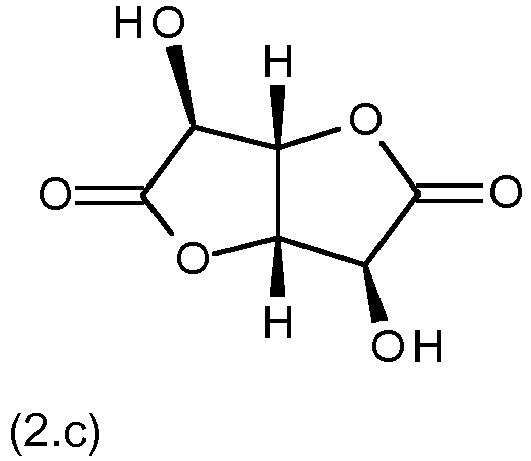 b) die in Schritt a) bereitgestellte Verbindung der Formel (2) mit wenigstens einer Verbindung der allgemeinen Formel (3),in Gegenwart wenigstens eines Katalysators umsetzt,
R1-OH (3)
worin R1 die oben angegebene Bedeutung besitzt,
welcher ausgewählt ist unter Verbindungen, die wenigstens ein Lewis-saures, hartes Kation und/oder wenigstens ein hartes Anion aufweisen. - Verfahren nach Anspruch 1, wobei die 2,3,4,5-Tetrahydroxyhexandisäureester zusätzlich wenigstens eine Verbindung der allgemeinen Formel (1') umfassen

- Verfahren nach einem der vorherigen Ansprüche, wobei in Schritt b) die Gesamtmenge an Verbindungen (3) bezogen auf die Gesamtmenge der Verbindung (2) 0,5 bis 100 Moläquivalente, bevorzugt 0,5 bis 50 Moläquivalente, besonders bevorzugt 1 bis 10 Moläquivalente und ganz besonders bevorzugt 1 bis 4 Moläquivalente beträgt.
- Verfahren nach einem der vorherigen Ansprüche, wobei die Umsetzung in Schritt b) bei einer Temperatur in einem Bereich von 10 bis 150 °C, bevorzugt in einem Bereich von 15 bis 90 °C und besonders bevorzugt in einem Bereich von 20 bis 70 °C, durchgeführt wird.
- Verfahren nach einem der vorherigen Ansprüche, wobei in Schritt b) der Katalysator ausgewählt ist unter Verbindungen, die wenigstens ein Kation enthalten, welches ausgewählt ist unter, Al3+, Ti4+, Cu2+, Li+, Na+, K+, Be2+, Mg2+, Ca2+, Sr2+, Mn2+, Sc3+, Ga3+, In3+, La3+, Cr3+, Cr6+, Co3+, Fe3+, As3+, Ir3+, Si4+, Zr4+, Ce3+, Hf4+, Ge4+ VO2+, (CH3)Sn2+, CH3Sn3+, Fe2+, Co2+, Ni2+, Zn2+, Pb2+, Sn2+, Sb3+, Ru2+, Os2+, Rh3+, Bi3+, Cl3+, Sn4+,Lu3+, MoO3+, NO+ und WO4+.
- Verfahren nach einem der vorherigen Ansprüche, wobei in Schritt b) der Katalysator ausgewählt ist unter Verbindungen, die wenigstens ein Anion enthalten, welches ausgewählt unter Alkansulfonaten, teilweise fluorierten Alkansulfonaten, vollständig fluorierten Alkansulfonaten, Arensulfonaten, Arylsulfonaten, Acetat, Perchlorat, Nitrat, Fluorid, Sulfat, Carbonat, Azid, Bromid, Phosphat, Nitrit, Sulfit, Hydroxy, O2- und Alkoholaten.
- Verfahren nach einem der vorherigen Ansprüche, wobei in Schritt b) der Katalysator ausgewählt ist unter Aluminium(III)methansulfonat, Aluminium(III)nonafluorbutansulfonat, Aluminium(III)para-toluolsulfonat, Aluminium(III)trifluormethansulfonat, Kupfer(I)methansulfonat, Kupfer(II)methansulfonat, Kupfer(I)trifluormethansulfonat, Kupfer(II)trifluormethansulfonat, Silbermethansulfonat, Silbertrifluormethansulfonat und Tetra(isopropyl)titanat.
- Verfahren nach einem der vorherigen Ansprüche, wobei die Umsetzung in Schritt b) ohne Zusatz eines externen Lösungsmittels oder in Gegenwart wenigstens eines von den Verbindungen R1-OH verschiedenen Lösungsmittel durchgeführt wird, das ausgewählt ist unter aliphatischen Ethern, cyclischen Ethern, Ketonen, chlorierten Kohlenwasserstoffen, aliphatischen Kohlenwasserstoffen, cycloaliphatischen Kohlenwasserstoffen, Aromaten und Gemischen davon.
- Verbindungen der allgemeinen Formel (1), ausgewählt unter
Verbindungen der Formel (1.a), worin einer der Reste R1 für C1-C24-Alkyl, C2-C24-Alkenyl mit 1, 2, 3 oder mehr als 3 C-C-Doppelbindungen, oder für eine Gruppe der Formel -(R2-O)n-R3 steht, worin jedes R2 ausgewählt ist unter C2-C10-Alkylen, R3 für C1-C24-Alkyl oder C2-C24-Alkenyl mit 1, 2, 3 oder mehr als 3 C-C-Doppelbindungen steht und n für eine natürliche Zahl von 1 bis 1000 steht,und der andere Rest R1 für C8-C24-Alkyl, C2-C24-Alkenyl mit 1, 2, 3 oder mehr als 3 C-C-Doppelbindungen, oder für eine Gruppe der Formel -(R2-O)n-R3 steht, worin jedes R2 ausgewählt ist unter C1-C10-Alkylen, R3 für C1-C24-Alkyl oder C2-C24-Alkenyl mit 1, 2, 3 oder mehr als 3 C-C-Doppelbindungen steht und n für eine natürliche Zahl von 1 bis 1000 steht;Verbindungen der Formel (1.b),
 worin einer der Reste R1 für C1-C24-Alkyl, C2-C24-Alkenyl mit 1, 2, 3 oder mehr als 3 C-C-Doppelbindungen, oder für eine Gruppe der Formel -(R2-O)n-R3 steht, worin jedes R2 ausgewählt ist unter C1-C10-Alkylen, R3 für C1-C24-Alkyl oder C2-C24-Alkenyl mit 1, 2, 3 oder mehr als 3 C-C-Doppelbindungen steht und n für eine natürliche Zahl von 1 bis 1000 steht,und der andere Rest R1 für C3-C24-Alkyl, C2-C24-Alkenyl mit 1, 2, 3 oder mehr als 3 C-C-Doppelbindungen, oder für eine Gruppe der Formel -(R2-O)n-R3 steht, worin jedes R2 ausgewählt ist unter C1-C10-Alkylen, R3 für C1-C24-Alkyl oder C2-C24-Alkenyl mit 1, 2, 3 oder mehr als 3 C-C-Doppelbindungen steht und n für eine natürliche Zahl von 1 bis 1000 steht; undVerbindungen der Formel (1.c),
 worin einer der Reste R1 für C1-C24-Alkyl, C2-C24-Alkenyl mit 1, 2, 3 oder mehr als 3 C-C-Doppelbindungen oder für eine Gruppe der Formel -(R2-O)n-R3 steht, worin jedes R2 ausgewählt ist unter C1-C10-Alkylen, R3 für C1-C24-Alkyl oder C2-C24-Alkenyl mit 1, 2, 3 oder mehr als 3 C-C-Doppelbindungen steht und n für eine natürliche Zahl von 1 bis 1000 steht,und der andere Rest R1 für C1-C24-Alkyl, C2-C24-Alkenyl mit 1, 2, 3 oder mehr als 3 C-C-Doppelbindungen oder für eine Gruppe der Formel -(R2-O)n-R3 steht, worin jedes R2 ausgewählt ist unter C1-C10-Alkylen, R3 für C1-C24-Alkyl oder C2-C24-Alkenyl mit 1, 2, 3 oder mehr als 3 C-C-Doppelbindungen steht I und n für eine natürliche Zahl von 1 bis 1000 steht.
 - Wasch-, Reinigungs- oder Geschirrspülmittel oder Klarspüler, enthaltend wenigstens eine Verbindung der allgemeinen Formel (1), wie in Anspruch 9 definiert, und wenigstens ein davon verschiedenes Tensid.
- Kosmetische oder pharmazeutische Zusammensetzung, enthaltend wenigstens eine Verbindung der allgemeinen Formel (1), wie in Anspruch 9 definiert, und wenigstens einen davon verschiedenen kosmetischen oder pharmazeutischen Wirkstoff und/oder Hilfsstoff.
- Kosmetische Zusammensetzung nach Anspruch 9 in Form einer Creme, Mousse, Milch, Lotion, Mascara, Theaterfarbe, Seife von flüssiger bis fester Konsistenz, eines Schaums, Gels, Sprays, Stifts, Wasch-, Dusch- oder Badepräparats von flüssiger bis gelförmiger Konsistenz, Lidschattens, Eyeliners, Rouges, Puders oder Strips.
- Verwendung wenigstens einer Verbindung der allgemeinen Formel (1), wie in Anspruch 9 definiert, als grenzflächenaktive Verbindung, bevorzugt als Tensid, Emulgator oder Schaumbildner.
- Verwendung wenigstens einer Verbindung der allgemeinen Formel (1), wie in Anspruch 9 definiert, als grenzflächenaktive Verbindung in kosmetischen Mitteln, in pharmazeutischen Mitteln, in Wasch- und Reinigungsmitteln, in Geschirrspülmitteln und in Klarspülern, in Hygieneprodukten, in Pflanzenschutzmitteln, in Lacken, Beschichtungsmitteln, Klebstoffen, Lederbehandlungs- oder Textilbehandlungsmitteln, sowie bei der Erschließung und/oder Ausbeutung unterirdischer Erdöl- und/oder Erdgaslagerstätten.
Applications Claiming Priority (2)
| Application Number | Priority Date | Filing Date | Title |
|---|---|---|---|
| EP15155806 | 2015-02-19 | ||
| PCT/EP2016/052678 WO2016131672A1 (de) | 2015-02-19 | 2016-02-09 | 2,3,4,5-tetrahydroxyhexandisäureester aus dilactonen der 2,3,4,5-tetrahydroxy-hexandisäure |
Publications (2)
| Publication Number | Publication Date |
|---|---|
| EP3258909A1 EP3258909A1 (de) | 2017-12-27 |
| EP3258909B1 true EP3258909B1 (de) | 2019-09-25 |
Family
ID=52630203
Family Applications (1)
| Application Number | Title | Priority Date | Filing Date |
|---|---|---|---|
| EP16704562.4A Active EP3258909B1 (de) | 2015-02-19 | 2016-02-09 | 2,3,4,5-tetrahydroxyhexandisäureester aus dilactonen der 2,3,4,5-tetrahydroxyhexandisäure |
Country Status (3)
| Country | Link |
|---|---|
| EP (1) | EP3258909B1 (de) |
| ES (1) | ES2762911T3 (de) |
| WO (1) | WO2016131672A1 (de) |
Families Citing this family (4)
| Publication number | Priority date | Publication date | Assignee | Title |
|---|---|---|---|---|
| US10774058B2 (en) | 2017-02-10 | 2020-09-15 | Basf Se | Process for preparing D-glucaro-6,3-lactone |
| EP3781551A1 (de) | 2018-04-18 | 2021-02-24 | Basf Se | D-glucaro-6,3-lacton-monoester und verfahren zur herstellung davon |
| KR102598533B1 (ko) * | 2018-08-24 | 2023-11-03 | 현대자동차주식회사 | 디-글루카로-1,4:6,3-다이락톤의 제조방법 |
| DE102024106897A1 (de) * | 2024-03-11 | 2025-09-11 | Technikum Laubholz Gmbh | Monophasige Gele von unpolaren Flüssigkeiten mit nicht-ionischen Tensiden |
Family Cites Families (1)
| Publication number | Priority date | Publication date | Assignee | Title |
|---|---|---|---|---|
| FR2679562B1 (fr) * | 1991-07-24 | 1995-06-09 | Ard Sa | Alcoyl galactarates, leurs procedes de preparation et leurs applications, notamment comme agents tensio-actifs. |
-
2016
- 2016-02-09 WO PCT/EP2016/052678 patent/WO2016131672A1/de not_active Ceased
- 2016-02-09 EP EP16704562.4A patent/EP3258909B1/de active Active
- 2016-02-09 ES ES16704562T patent/ES2762911T3/es active Active
Non-Patent Citations (1)
| Title |
|---|
| None * |
Also Published As
| Publication number | Publication date |
|---|---|
| EP3258909A1 (de) | 2017-12-27 |
| ES2762911T3 (es) | 2020-05-26 |
| WO2016131672A1 (de) | 2016-08-25 |
Similar Documents
| Publication | Publication Date | Title |
|---|---|---|
| EP2041064B1 (de) | Verfahren zur herstellung von alkyllactyllaktaten | |
| US10736832B2 (en) | Aqueous surfactant compositions | |
| CA2779644A1 (en) | Sulfomethylsuccinates, process for making same and compositions containing same | |
| EP3204365A1 (de) | Langkettige mono- und diester des 2,5-di(hydroxymethyl)tetrahydrofurans, deren herstellung und verwendung | |
| EP0499700B1 (de) | Polyglycerinfettsäureestergemisch | |
| WO2016131672A1 (de) | 2,3,4,5-tetrahydroxyhexandisäureester aus dilactonen der 2,3,4,5-tetrahydroxy-hexandisäure | |
| EP2810935B1 (de) | Sulfatierte Ester von Oligohydroxycarbonsäuren und deren Verwendung | |
| EP1436306A2 (de) | Verfahren zur herstellung von tensidgemischen | |
| DE4439091A1 (de) | Oberflächenaktive Mittel | |
| EP0793647A1 (de) | Amphiphile verbindungen mit mindestens zwei hydrophilen und mindestens zwei hydrophoben gruppen auf der basis von di-, oligo- oder polyolethern | |
| EP1656337A1 (de) | Citronens ureester | |
| EP1465582B1 (de) | Alkyl-und/oder alkylenoligoglycosid-betainesterquats | |
| WO1994029417A1 (de) | Ultramilde tensidmischungen | |
| EP0447778B1 (de) | Vinylpolyetheralkohole | |
| DE19728900A1 (de) | Hydrophile Glykoside | |
| EP3285732A1 (de) | Isosorbiddiester als perlglanzmittel und trübungsmittel | |
| DE19737497C2 (de) | Wäßrige Hautreinigungsmittel in Emulsionsform | |
| WO2017198527A1 (de) | Wässrige tensid-zusammensetzungen | |
| EP3645496A1 (de) | Alkoxylierung von hydroxysäuren | |
| DE19738623A1 (de) | Wässrige Hautreinigungsmittel in Emulsionsform | |
| EP1589022B1 (de) | Verfahren zur Herstellung eines Gemischs enthaltend Fettalkohole und APG- ethercarboxylat | |
| AU2007269005B2 (en) | Alkyl lactyllactates and processes of making the same | |
| DE10155058A1 (de) | Verfahren zur Herstellung von Polyolalkylethern | |
| DE19737682A1 (de) | Wäßrige Hautreinigungsmittel in Emulsionsform | |
| WO2004056741A1 (de) | Verfahren zur herstellung von hydroxycarbonsäureestern |
Legal Events
| Date | Code | Title | Description |
|---|---|---|---|
| STAA | Information on the status of an ep patent application or granted ep patent |
Free format text: STATUS: THE INTERNATIONAL PUBLICATION HAS BEEN MADE |
|
| PUAI | Public reference made under article 153(3) epc to a published international application that has entered the european phase |
Free format text: ORIGINAL CODE: 0009012 |
|
| STAA | Information on the status of an ep patent application or granted ep patent |
Free format text: STATUS: REQUEST FOR EXAMINATION WAS MADE |
|
| 17P | Request for examination filed |
Effective date: 20170919 |
|
| AK | Designated contracting states |
Kind code of ref document: A1 Designated state(s): AL AT BE BG CH CY CZ DE DK EE ES FI FR GB GR HR HU IE IS IT LI LT LU LV MC MK MT NL NO PL PT RO RS SE SI SK SM TR |
|
| AX | Request for extension of the european patent |
Extension state: BA ME |
|
| DAV | Request for validation of the european patent (deleted) | ||
| DAX | Request for extension of the european patent (deleted) | ||
| STAA | Information on the status of an ep patent application or granted ep patent |
Free format text: STATUS: EXAMINATION IS IN PROGRESS |
|
| 17Q | First examination report despatched |
Effective date: 20181001 |
|
| GRAP | Despatch of communication of intention to grant a patent |
Free format text: ORIGINAL CODE: EPIDOSNIGR1 |
|
| STAA | Information on the status of an ep patent application or granted ep patent |
Free format text: STATUS: GRANT OF PATENT IS INTENDED |
|
| INTG | Intention to grant announced |
Effective date: 20190626 |
|
| RAP1 | Party data changed (applicant data changed or rights of an application transferred) |
Owner name: BASF SE |
|
| GRAS | Grant fee paid |
Free format text: ORIGINAL CODE: EPIDOSNIGR3 |
|
| GRAA | (expected) grant |
Free format text: ORIGINAL CODE: 0009210 |
|
| STAA | Information on the status of an ep patent application or granted ep patent |
Free format text: STATUS: THE PATENT HAS BEEN GRANTED |
|
| AK | Designated contracting states |
Kind code of ref document: B1 Designated state(s): AL AT BE BG CH CY CZ DE DK EE ES FI FR GB GR HR HU IE IS IT LI LT LU LV MC MK MT NL NO PL PT RO RS SE SI SK SM TR |
|
| REG | Reference to a national code |
Ref country code: GB Ref legal event code: FG4D Free format text: NOT ENGLISH |
|
| REG | Reference to a national code |
Ref country code: CH Ref legal event code: EP |
|
| REG | Reference to a national code |
Ref country code: DE Ref legal event code: R096 Ref document number: 502016006787 Country of ref document: DE |
|
| REG | Reference to a national code |
Ref country code: AT Ref legal event code: REF Ref document number: 1183110 Country of ref document: AT Kind code of ref document: T Effective date: 20191015 |
|
| REG | Reference to a national code |
Ref country code: IE Ref legal event code: FG4D Free format text: LANGUAGE OF EP DOCUMENT: GERMAN |
|
| REG | Reference to a national code |
Ref country code: NL Ref legal event code: MP Effective date: 20190925 |
|
| PG25 | Lapsed in a contracting state [announced via postgrant information from national office to epo] |
Ref country code: NO Free format text: LAPSE BECAUSE OF FAILURE TO SUBMIT A TRANSLATION OF THE DESCRIPTION OR TO PAY THE FEE WITHIN THE PRESCRIBED TIME-LIMIT Effective date: 20191225 Ref country code: SE Free format text: LAPSE BECAUSE OF FAILURE TO SUBMIT A TRANSLATION OF THE DESCRIPTION OR TO PAY THE FEE WITHIN THE PRESCRIBED TIME-LIMIT Effective date: 20190925 Ref country code: BG Free format text: LAPSE BECAUSE OF FAILURE TO SUBMIT A TRANSLATION OF THE DESCRIPTION OR TO PAY THE FEE WITHIN THE PRESCRIBED TIME-LIMIT Effective date: 20191225 Ref country code: FI Free format text: LAPSE BECAUSE OF FAILURE TO SUBMIT A TRANSLATION OF THE DESCRIPTION OR TO PAY THE FEE WITHIN THE PRESCRIBED TIME-LIMIT Effective date: 20190925 Ref country code: HR Free format text: LAPSE BECAUSE OF FAILURE TO SUBMIT A TRANSLATION OF THE DESCRIPTION OR TO PAY THE FEE WITHIN THE PRESCRIBED TIME-LIMIT Effective date: 20190925 Ref country code: LT Free format text: LAPSE BECAUSE OF FAILURE TO SUBMIT A TRANSLATION OF THE DESCRIPTION OR TO PAY THE FEE WITHIN THE PRESCRIBED TIME-LIMIT Effective date: 20190925 |
|
| REG | Reference to a national code |
Ref country code: LT Ref legal event code: MG4D |
|
| PG25 | Lapsed in a contracting state [announced via postgrant information from national office to epo] |
Ref country code: LV Free format text: LAPSE BECAUSE OF FAILURE TO SUBMIT A TRANSLATION OF THE DESCRIPTION OR TO PAY THE FEE WITHIN THE PRESCRIBED TIME-LIMIT Effective date: 20190925 Ref country code: RS Free format text: LAPSE BECAUSE OF FAILURE TO SUBMIT A TRANSLATION OF THE DESCRIPTION OR TO PAY THE FEE WITHIN THE PRESCRIBED TIME-LIMIT Effective date: 20190925 Ref country code: GR Free format text: LAPSE BECAUSE OF FAILURE TO SUBMIT A TRANSLATION OF THE DESCRIPTION OR TO PAY THE FEE WITHIN THE PRESCRIBED TIME-LIMIT Effective date: 20191226 |
|
| PG25 | Lapsed in a contracting state [announced via postgrant information from national office to epo] |
Ref country code: PT Free format text: LAPSE BECAUSE OF FAILURE TO SUBMIT A TRANSLATION OF THE DESCRIPTION OR TO PAY THE FEE WITHIN THE PRESCRIBED TIME-LIMIT Effective date: 20200127 Ref country code: AL Free format text: LAPSE BECAUSE OF FAILURE TO SUBMIT A TRANSLATION OF THE DESCRIPTION OR TO PAY THE FEE WITHIN THE PRESCRIBED TIME-LIMIT Effective date: 20190925 Ref country code: EE Free format text: LAPSE BECAUSE OF FAILURE TO SUBMIT A TRANSLATION OF THE DESCRIPTION OR TO PAY THE FEE WITHIN THE PRESCRIBED TIME-LIMIT Effective date: 20190925 Ref country code: PL Free format text: LAPSE BECAUSE OF FAILURE TO SUBMIT A TRANSLATION OF THE DESCRIPTION OR TO PAY THE FEE WITHIN THE PRESCRIBED TIME-LIMIT Effective date: 20190925 Ref country code: NL Free format text: LAPSE BECAUSE OF FAILURE TO SUBMIT A TRANSLATION OF THE DESCRIPTION OR TO PAY THE FEE WITHIN THE PRESCRIBED TIME-LIMIT Effective date: 20190925 Ref country code: RO Free format text: LAPSE BECAUSE OF FAILURE TO SUBMIT A TRANSLATION OF THE DESCRIPTION OR TO PAY THE FEE WITHIN THE PRESCRIBED TIME-LIMIT Effective date: 20190925 |
|
| REG | Reference to a national code |
Ref country code: ES Ref legal event code: FG2A Ref document number: 2762911 Country of ref document: ES Kind code of ref document: T3 Effective date: 20200526 |
|
| PG25 | Lapsed in a contracting state [announced via postgrant information from national office to epo] |
Ref country code: IS Free format text: LAPSE BECAUSE OF FAILURE TO SUBMIT A TRANSLATION OF THE DESCRIPTION OR TO PAY THE FEE WITHIN THE PRESCRIBED TIME-LIMIT Effective date: 20200224 Ref country code: CZ Free format text: LAPSE BECAUSE OF FAILURE TO SUBMIT A TRANSLATION OF THE DESCRIPTION OR TO PAY THE FEE WITHIN THE PRESCRIBED TIME-LIMIT Effective date: 20190925 Ref country code: SK Free format text: LAPSE BECAUSE OF FAILURE TO SUBMIT A TRANSLATION OF THE DESCRIPTION OR TO PAY THE FEE WITHIN THE PRESCRIBED TIME-LIMIT Effective date: 20190925 Ref country code: SM Free format text: LAPSE BECAUSE OF FAILURE TO SUBMIT A TRANSLATION OF THE DESCRIPTION OR TO PAY THE FEE WITHIN THE PRESCRIBED TIME-LIMIT Effective date: 20190925 |
|
| REG | Reference to a national code |
Ref country code: DE Ref legal event code: R097 Ref document number: 502016006787 Country of ref document: DE |
|
| PG2D | Information on lapse in contracting state deleted |
Ref country code: IS |
|
| PG25 | Lapsed in a contracting state [announced via postgrant information from national office to epo] |
Ref country code: DK Free format text: LAPSE BECAUSE OF FAILURE TO SUBMIT A TRANSLATION OF THE DESCRIPTION OR TO PAY THE FEE WITHIN THE PRESCRIBED TIME-LIMIT Effective date: 20190925 Ref country code: IS Free format text: LAPSE BECAUSE OF FAILURE TO SUBMIT A TRANSLATION OF THE DESCRIPTION OR TO PAY THE FEE WITHIN THE PRESCRIBED TIME-LIMIT Effective date: 20200126 |
|
| PLBE | No opposition filed within time limit |
Free format text: ORIGINAL CODE: 0009261 |
|
| STAA | Information on the status of an ep patent application or granted ep patent |
Free format text: STATUS: NO OPPOSITION FILED WITHIN TIME LIMIT |
|
| 26N | No opposition filed |
Effective date: 20200626 |
|
| REG | Reference to a national code |
Ref country code: CH Ref legal event code: PL |
|
| REG | Reference to a national code |
Ref country code: BE Ref legal event code: MM Effective date: 20200229 |
|
| PG25 | Lapsed in a contracting state [announced via postgrant information from national office to epo] |
Ref country code: MC Free format text: LAPSE BECAUSE OF FAILURE TO SUBMIT A TRANSLATION OF THE DESCRIPTION OR TO PAY THE FEE WITHIN THE PRESCRIBED TIME-LIMIT Effective date: 20190925 Ref country code: LU Free format text: LAPSE BECAUSE OF NON-PAYMENT OF DUE FEES Effective date: 20200209 |
|
| PG25 | Lapsed in a contracting state [announced via postgrant information from national office to epo] |
Ref country code: LI Free format text: LAPSE BECAUSE OF NON-PAYMENT OF DUE FEES Effective date: 20200229 Ref country code: CH Free format text: LAPSE BECAUSE OF NON-PAYMENT OF DUE FEES Effective date: 20200229 Ref country code: SI Free format text: LAPSE BECAUSE OF FAILURE TO SUBMIT A TRANSLATION OF THE DESCRIPTION OR TO PAY THE FEE WITHIN THE PRESCRIBED TIME-LIMIT Effective date: 20190925 |
|
| PG25 | Lapsed in a contracting state [announced via postgrant information from national office to epo] |
Ref country code: IE Free format text: LAPSE BECAUSE OF NON-PAYMENT OF DUE FEES Effective date: 20200209 |
|
| PG25 | Lapsed in a contracting state [announced via postgrant information from national office to epo] |
Ref country code: BE Free format text: LAPSE BECAUSE OF NON-PAYMENT OF DUE FEES Effective date: 20200229 |
|
| REG | Reference to a national code |
Ref country code: AT Ref legal event code: MM01 Ref document number: 1183110 Country of ref document: AT Kind code of ref document: T Effective date: 20210209 |
|
| PG25 | Lapsed in a contracting state [announced via postgrant information from national office to epo] |
Ref country code: AT Free format text: LAPSE BECAUSE OF NON-PAYMENT OF DUE FEES Effective date: 20210209 |
|
| PG25 | Lapsed in a contracting state [announced via postgrant information from national office to epo] |
Ref country code: TR Free format text: LAPSE BECAUSE OF FAILURE TO SUBMIT A TRANSLATION OF THE DESCRIPTION OR TO PAY THE FEE WITHIN THE PRESCRIBED TIME-LIMIT Effective date: 20190925 Ref country code: MT Free format text: LAPSE BECAUSE OF FAILURE TO SUBMIT A TRANSLATION OF THE DESCRIPTION OR TO PAY THE FEE WITHIN THE PRESCRIBED TIME-LIMIT Effective date: 20190925 Ref country code: CY Free format text: LAPSE BECAUSE OF FAILURE TO SUBMIT A TRANSLATION OF THE DESCRIPTION OR TO PAY THE FEE WITHIN THE PRESCRIBED TIME-LIMIT Effective date: 20190925 |
|
| PG25 | Lapsed in a contracting state [announced via postgrant information from national office to epo] |
Ref country code: MK Free format text: LAPSE BECAUSE OF FAILURE TO SUBMIT A TRANSLATION OF THE DESCRIPTION OR TO PAY THE FEE WITHIN THE PRESCRIBED TIME-LIMIT Effective date: 20190925 |
|
| PGFP | Annual fee paid to national office [announced via postgrant information from national office to epo] |
Ref country code: GB Payment date: 20260223 Year of fee payment: 11 |
|
| PGFP | Annual fee paid to national office [announced via postgrant information from national office to epo] |
Ref country code: ES Payment date: 20260317 Year of fee payment: 11 |
|
| PGFP | Annual fee paid to national office [announced via postgrant information from national office to epo] |
Ref country code: DE Payment date: 20260220 Year of fee payment: 11 |
|
| PGFP | Annual fee paid to national office [announced via postgrant information from national office to epo] |
Ref country code: IT Payment date: 20260220 Year of fee payment: 11 |
|
| PGFP | Annual fee paid to national office [announced via postgrant information from national office to epo] |
Ref country code: FR Payment date: 20260227 Year of fee payment: 11 |