EP3256628B1 - Startverfahren für eine webmaschine - Google Patents
Startverfahren für eine webmaschine Download PDFInfo
- Publication number
- EP3256628B1 EP3256628B1 EP16703979.1A EP16703979A EP3256628B1 EP 3256628 B1 EP3256628 B1 EP 3256628B1 EP 16703979 A EP16703979 A EP 16703979A EP 3256628 B1 EP3256628 B1 EP 3256628B1
- Authority
- EP
- European Patent Office
- Prior art keywords
- machine
- shedding
- weaving
- time
- weaving machine
- Prior art date
- Legal status (The legal status is an assumption and is not a legal conclusion. Google has not performed a legal analysis and makes no representation as to the accuracy of the status listed.)
- Active
Links
Images

Classifications
-
- D—TEXTILES; PAPER
- D03—WEAVING
- D03D—WOVEN FABRICS; METHODS OF WEAVING; LOOMS
- D03D51/00—Driving, starting, or stopping arrangements; Automatic stop motions
-
- D—TEXTILES; PAPER
- D03—WEAVING
- D03D—WOVEN FABRICS; METHODS OF WEAVING; LOOMS
- D03D51/00—Driving, starting, or stopping arrangements; Automatic stop motions
- D03D51/007—Loom optimisation
-
- D—TEXTILES; PAPER
- D03—WEAVING
- D03D—WOVEN FABRICS; METHODS OF WEAVING; LOOMS
- D03D51/00—Driving, starting, or stopping arrangements; Automatic stop motions
- D03D51/002—Avoiding starting marks
-
- D—TEXTILES; PAPER
- D03—WEAVING
- D03D—WOVEN FABRICS; METHODS OF WEAVING; LOOMS
- D03D51/00—Driving, starting, or stopping arrangements; Automatic stop motions
- D03D51/005—Independent drive motors
Definitions
- the present invention relates to a method for the controlled start-up of a weaving and shedding machine, wherein the loom is driven by a main drive, while the shedding machine is driven by means of an electromotive auxiliary drive.
- weaving and shedding machines are known.
- the shedding machine on a separate drive, the central drive shaft, from which the movements of the shedding means are derived, is connected to an electric motor.
- These are those shedding machines in which the shedding means are decoupled from the movement of the central drive shaft, z. B. dobby type 2881 Stäubli or Jacquard machines type LX Stäubli or SI the company Bonas.
- the drive shaft of the weaving machine from which the further movements (reed, possibly mechanical weft insertion elements) are derived, is in turn connected to at least one directly driving them, also usually designed as an electric motor actuator.
- Such direct drives are very simple in their mechanical design, virtually maintenance-free and very precisely adjustable.
- the drives of the loom and the shedding machine are connected by means of a common DC voltage intermediate circuit, hereinafter referred to as inverter intermediate circuit, so that they can form an energy flow with each other.
- the DE 200 21 049 U1 As the closest prior art has for separate drives for weaving and shedding machine on the possibility out of the DE 100 53 079 C1 known early start of the shedding machine to make such that it supports the subsequent startup process of the loom by their kinetic energy. For this purpose, the shedding machine is accelerated to a speed above the end of the loom start to be reached working speed. Finally, while the weaving machine starts, the shedding machine gives by re-deceleration to their start support, ie during their start phase, kinetic energy from.
- the invention is therefore based on the object to reduce the peak power requirement of the weaving machine by better utilization of the kinetic energy recovery of the shedding machine, the process reliability should be ensured by maintaining the voltage limits in the converter intermediate circuit. Also, no deductions in the starting dynamics of the weaving machine must be taken into account.
- step 1 the method for starting up on the one hand, the startup of the shedding machine to a predetermined overspeed (hereinafter referred to as step 1) and on the other hand, the setting of the speed reduction of the shedding machine such that the gradient of the speed curve of the shedding machine in a later section of the start phase is negative than in one earlier section (hereafter referred to as step 2).
- step 1 is that the overspeed to which the shed-forming machine is accelerated with respect to the working speed at the first sheet stop is predetermined in its value and / or its upper limit, that is, exactly defined.
- the overspeed is calculated automatically at least on the basis of machine data, but preferably also based on process data. This will be discussed in more detail below.
- Step 2 provides for a time range t1 to t3, which advantageously completely includes or can coincide with the starting operation of t2 to t3 of the loom, for the speed of the shedding machine before a non-ramped course, ie one - starting with the overspeed Step 1 - non-constant gradient.
- the gradient curve is such that in a later period of the startup process the energy return is greater than in an earlier period of time. This means that the slowing down of the shedding machine does not take place uniformly (ramp-like) over the weaving machine start, but rather intensifies in a later section of the starting phase and preferably towards the end of the weaving machine start. As a result, the actual energy consumption of the weaving machine is taken into account, taking into account heat and other losses.
- the return of the energy or power is thus demand-adapted, d. H. especially when the demand from the starting weaving machine is strongest.
- the gradient of the speed curve of the shedding machine between the time t2 and a time t ' is less negative than the average time between the times t' and t3 in the time average.
- the gradient of the speed curve of the shedding machine is more negative at the end of the starting phase than in an earlier period of the starting phase. This means that at the end of the starting phase more energy is fed back from the shedding machine to the weaving machine than at the beginning of the starting phase.
- a similar advantageous speed curve provides that on averaged over time the gradient of the speed curve of the shedding machine between the time t2 and a time t 'has a lower absolute value than in the time average between the times t' and t3.
- the gradient of the speed curve of the shedding machine at the end of the starting phase is the most negative in the entire period of the starting phase.
- the energy recovery is therefore at the end of weaving machine start, at time t3, greatest.
- the speed curve for the starting loom is not ramped, but has a over the entire starting process (between the times t2 and t3) or at least towards the end decreasing gradient.
- the power consumption is made uniform, ie the peak power at the end of the weaving machine start is less pronounced, whereby the energetic jump start is facilitated by the shedding machine.
- the speed of the weaving machine in the present case is to be understood as the value which results arithmetically from its kinetic energy and the average energy moment of inertia (which is defined below).
- the said overspeed of the shedding machine is preferably calculated by means of a calculating unit using machine data.
- the speed curve of the shed forming machine for the entire start phase of the weaving machine is calculated by means of a computing unit using machine data, wherein the speed curve of the shedding machine is preferably oriented to the mathematically expected power requirement of the starting loom.
- Said machine data are preferably those which are used in part or all of the following group: the moments of inertia of the shedding machine and / or the weaving machine, the energetic mean moments of inertia of the shedding machine and / or loom, grid and feed-related data such.
- process data are used to increase the accuracy preferred in the calculation of the overspeed and the further speed curve of the shedding machine.
- process data are preferably based on calculated or estimated loom losses and advantageously also on shed machine losses.
- process data also include those which are based on the duration of said start phase of the weaving machine.
- the overspeed of the shedding machine is calculated.
- machine data are preferably at least at least the energetically average moments of inertia of weaving and shedding machine used.
- the energetic mean moment of inertia is the moment of inertia of an imaginary flywheel, which, rotating at the same operating speed as the working machine (weaving or shedding machine), has the same kinetic energy as the machine in question.
- a large dimensioning of the shingles drive is not desirable from a cost point of view, so that the above approach, the energy needs for the loom start completely from the It is not practicable to purchase a shed-forming machine.
- the calculation example shows that the energetically average moments of inertia are useful quantities for determining the speed profile or the trajectory of the shedding machine during weaving machine start.
- a further important factor is the network and feed conditions already mentioned above.
- the characteristics of the feed for the common converter intermediate circuit of the weaving and shedding machine are preferably taken into account.
- z. B. twice the rated power taken into account. It is also important if a Vortrafo, z. B. due to special networks, z. B. IT networks, in the weaving, is used. Here the power and the short-circuit voltage or the internal impedance of the pre-transformer play an important role.
- the stated in the above scope network and feed conditions are assigned to the machine data, as well as the technical characteristics of the drives of weaving and shedding machine, z. B. peak currents of the controller and / or peak torques of the actuators or motors.
- the expected losses of the weaving machine during the start process are relevant. These can be z. B. estimate from the temperatures of the gear oil or - if the weaving machine has already been run in advance - from their average power consumption taking into account life or turn the oil temperature and possibly a new operating speed.
- the losses of the shedding machine incl. ausmoresch (shafts, boards) are preferably included.
- the energetic mean moment of inertia of the shedding machine whose overspeed determined at the beginning of weaving machine start, so that when re-braking to the working speed, the necessary energy or power can be provided. If this were to take place with the assumption of a uniformly ramp-shaped re-deceleration of the shedding machine over time, this would give the lowest possible value that the overspeed of the shedding machine would have for energy recovery.
- Step 2 Due to the gradient of the shedding machine speed which is more negative during weaving-machine start in a later section of the starting phase, little or no energy is initially introduced into the converter intermediate circuit fed back, with increasing time and thus increasing power and energy requirements of the weaving machine according to more.
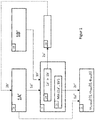
- FIG. 1 shows a calculation method which assumes to support the power demand of the weaving machine pro rata at each time of weaving machine start, whereby the proportion remains relatively (eg 40%).
- the loom start should be such that the from the kinetic Energy and the average energy moment of inertia calculated speed ramped over time up to the working speed increases.
- the expected power requirement of the weaving machine is thus covered with a percentage that remains constant, which is possible if the time t2, ie the starting time of the weaving machine, does not lie before the time t1 at which the shedding machine has reached its predetermined overspeed.
- the first maximum power requirement of the weaving machine is determined from the machine and process data 1A '.
- machine data in this example the working speed and the energetic mean moment of inertia of the loom are used.
- This maximum demand power is now in turn compared with those machine data that characterize the grid or feed conditions; This includes the characteristics of any pre-transformer (rated power, short-circuit voltage or internal impedance) as well as the characteristics of the supply unit for the converter DC link (passive or active mains supply, possibly boost converter function, peak power).
- the juxtaposition is an estimate. For example, it is stored in tables, At which peak power of the relevant Vortrafo or the feed unit concerned can expect what voltage drop. If the total expected voltage drop in the inverter DC link is so strong that either the voltage requirement at the motor terminals can no longer be covered and / or the undervoltage monitoring of the converter DC link is triggered and a startup interruption is caused, additional energy or power must be provided by the Tray machine be fed.
- This power component to be added by the shedding machine is output as the value 1a '(requirement) from the calculating step 1A.
- a calculation step 1B is carried out, in which the known peak torque of the shingraft drive is multiplied by its working speed. This gives the peak performance of the shingraft drive. Possibly. previously a loss torque is deducted from the peak torque. The thus calculated peak power of the shingder drive is output as the value 1b '(possibility) from the calculating step 1B.
- step 2 firstly 1a '(requirement) and 1b' (possibility) are compared. If the demand is greater than the possibility, problems of the aforementioned type can not be ruled out at the start of the intended working speed. Therefore, a reaction is triggered in step 2B. This may consist in a warning message to the operator, possibly connected with the request to select a lower operating speed and to start the machine as a test, s. Path 2b '. Thus, the estimates from step 1A can be corrected by an actually observed behavior of the converter DC link. Another possibility is to automatically reduce the working speed with a corresponding message to the operator. Here again, the relevant machine start can be used for verification and, if necessary, correction of the assumptions from step 1A. The reduced working speed should be calculated so that for them the demand 1a 'is just as high as the possibility 1b'.
- Another advantageous calculation method is the use of polynomials, the coefficients of which are determined in such a way that the speed or angle profile of the shed forming machine for the area of the weaving machine start is predefined as desired.
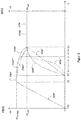
- FIG. 2 three exemplary profiles of the speeds of the shedding machine (FBM) and the weaving machine (WM) are shown as a function of time according to the invention.
- the shedding machine is started and moved to the predetermined, in particular calculated overspeed ⁇ Ü, FBM until time t1 (see above).
- the weaving machine is started and, in a starting phase which extends from the time t2 to a time t3, ramped up to a working speed ⁇ arb .
- energy is fed back from the shedding machine to the weaving machine in a defined manner, whereby a possible calculation method has been presented above.
- the gradient of the speed curve of the shedding machine in a later section of the starting phase of the weaving machine (which lies between the times t2 and t3) is more negative than in an earlier section.
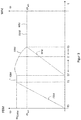
- the later section does not necessarily border on the time t3 and / or the earlier section on the time t2 (or t1 if t1 is later than t2, s. FIG. 4 ); rather, gradient curves within the period between times t2 (or t1, when t1 is later than t2) and t3 can be compared with each other.
- the gradient of the speed curve of the shedding machine (referred to herein as FBM ') shown at the end of the starting phase is even the most negative with respect to the entire period of the starting phase, ie that the curve at time t3 the largest negative slope in the range between t2 and t3.
- the gradient of the speed curve the shedding machine between the time t2 and one in the FIG. 2 example marked time t 'less negative than the time average between the times t' and t3.
- WM ' solid line speed curve of the loom
- FIG. 2 linearly ramped up, as assumed in the above calculation method.
- Dashed lines show an alternative speed curve for the weaving machine (here referred to as "WM"), in which the speed during start-up has a decreasing positive gradient between times t2 and t3. With such a curve, the power consumption is more uniform than with a linear start-up. since the power peak is less pronounced at the end of the loom start
- FBM exemplary corresponding speed curve of the shedding machine
- FIG. 2 drawn with dotted lines.
- the speed curve of the weaving machine (referred to here as WM '") has an S-shape, which is also found in the speed curve of the shedding machine (referred to here as FBM'").
- FBM' speed curve of the shedding machine
- the energy recovery from the shedding machine to the loom is - after each flatter Speed curves following the time t2 - during the strongest increase in the speed of the loom particularly large.
- FBM '"and WM' again from.
- the weaving machine at the beginning of the start phase does not benefit from support from the shedding machine, the weaving machine can already be started (at time t2), before the shedding machine reaches its calculated overspeed at time t1. Importantly, it is then ready to transfer energy to the weaving machine in the time interval from t1 to t3.
- the control of the main drive of the loom and the electronic power take-off of the shedding machine is taken over by a controller, which is prior art and therefore not described in detail here.
- the above calculations are performed with a computing unit connected to said controller.
Landscapes
- Engineering & Computer Science (AREA)
- Textile Engineering (AREA)
- Looms (AREA)
Applications Claiming Priority (2)
| Application Number | Priority Date | Filing Date | Title |
|---|---|---|---|
| DE102015102029.7A DE102015102029A1 (de) | 2015-02-12 | 2015-02-12 | Startverfahren für eine Webmaschine |
| PCT/EP2016/052923 WO2016128517A1 (de) | 2015-02-12 | 2016-02-11 | Startverfahren für eine webmaschine |
Publications (2)
| Publication Number | Publication Date |
|---|---|
| EP3256628A1 EP3256628A1 (de) | 2017-12-20 |
| EP3256628B1 true EP3256628B1 (de) | 2019-08-07 |
Family
ID=55349836
Family Applications (1)
| Application Number | Title | Priority Date | Filing Date |
|---|---|---|---|
| EP16703979.1A Active EP3256628B1 (de) | 2015-02-12 | 2016-02-11 | Startverfahren für eine webmaschine |
Country Status (7)
| Country | Link |
|---|---|
| US (1) | US20180023226A1 (enExample) |
| EP (1) | EP3256628B1 (enExample) |
| JP (1) | JP6510059B2 (enExample) |
| CN (1) | CN107208330B (enExample) |
| DE (1) | DE102015102029A1 (enExample) |
| RU (1) | RU2664381C1 (enExample) |
| WO (1) | WO2016128517A1 (enExample) |
Cited By (1)
| Publication number | Priority date | Publication date | Assignee | Title |
|---|---|---|---|---|
| DE102023209042B3 (de) | 2023-09-18 | 2024-08-29 | Lindauer Dornier Gesellschaft Mit Beschränkter Haftung | Verfahren zum betreiben einer webvorrichtung sowie webvorrichtung |
Families Citing this family (3)
| Publication number | Priority date | Publication date | Assignee | Title |
|---|---|---|---|---|
| DE102017221224B3 (de) | 2017-11-27 | 2019-01-17 | Lindauer Dornier Gesellschaft Mit Beschränkter Haftung | Einrichtung und Verfahren zum Herstellen von Gewebe mit einer Webmaschine und zwei Jacquardmaschinen |
| JP7365098B2 (ja) * | 2018-02-21 | 2023-10-19 | 津田駒工業株式会社 | 織機の駆動制御方法及び駆動制御装置 |
| CZ309248B6 (cs) * | 2019-06-13 | 2022-06-22 | VÚTS, a.sю | Způsob řízení průběhu zdvihových funkcí hlavních mechanismů tkacího stroje |
Family Cites Families (19)
| Publication number | Priority date | Publication date | Assignee | Title |
|---|---|---|---|---|
| US4131803A (en) * | 1975-11-05 | 1978-12-26 | Toyo Boseki Kabushiki Kaisha | Apparatus for detecting defects in sheet material |
| US4473096A (en) * | 1979-08-06 | 1984-09-25 | Leesona Corporation | Weft end reception system |
| CH641506A5 (de) * | 1980-01-23 | 1984-02-29 | Sulzer Ag | Webmaschine. |
| US4362189A (en) * | 1981-01-07 | 1982-12-07 | Leesona Corporation | Fluid weft insertion loom monitoring system |
| JPS5959946A (ja) * | 1982-09-24 | 1984-04-05 | 日産自動車株式会社 | 織機の経系送り出し装置における織機停止時の制御方法 |
| JPH0694614B2 (ja) * | 1983-02-25 | 1994-11-24 | 津田駒工業株式会社 | 織機の電動送り出し方法およびその装置 |
| EP0207470B1 (en) * | 1985-06-29 | 1992-05-13 | Nissan Motor Co., Ltd. | Mispicked weft yarn removing method and system therefor |
| DE3542650A1 (de) * | 1985-12-03 | 1987-06-04 | Stromag Maschf | Verfahren und vorrichtung zur steuerung und/oder regelung des anfahrvorganges einer webmaschine |
| JP2710046B2 (ja) * | 1986-12-04 | 1998-02-10 | 津田駒工業 株式会社 | パイル織機のたて糸張力制御方法 |
| JPH03161555A (ja) * | 1989-11-20 | 1991-07-11 | Toyota Autom Loom Works Ltd | 織機における経糸通し検出装置 |
| GB9605059D0 (en) * | 1996-03-09 | 1996-05-08 | Palmer Raymond L | Drive system |
| DE10053079C1 (de) | 2000-10-26 | 2002-05-29 | Dornier Gmbh Lindauer | Verfahren zum Betreiben einer Web- und Fachbildemaschine |
| DE10061717B4 (de) * | 2000-12-12 | 2006-01-26 | Lindauer Dornier Gmbh | Antriebsanordnung für eine Webmaschine und Fachbildemaschine |
| DE20021049U1 (de) | 2000-12-12 | 2001-03-29 | Lindauer Dornier Gmbh, 88131 Lindau | Antriebsanordnung für eine Webmaschine und Fachbildemaschine |
| DE10236095B3 (de) * | 2002-08-07 | 2004-02-05 | Lindauer Dornier Gesellschaft Mbh | Verfahren zum Betreiben einer Web- und einer Fachbildemaschine bei separaten Antrieben |
| SE0300809L (sv) * | 2003-03-25 | 2004-03-02 | Texo Ab | Anordning vid vävmaskin |
| DE102004017106B4 (de) * | 2004-04-02 | 2008-03-13 | Lindauer Dornier Gmbh | Verfahren zum Bestimmen der kinetischen Energie einer Webmaschine |
| DE102007043142B4 (de) * | 2007-09-11 | 2012-03-08 | Lindauer Dornier Gmbh | Verfahren zum Herunterfahren einer Webmaschine |
| DE102011006368B3 (de) * | 2011-03-29 | 2012-02-16 | Lindauer Dornier Gesellschaft Mit Beschränkter Haftung | Verfahren und Webmaschine zur Webfachbildung |
-
2015
- 2015-02-12 DE DE102015102029.7A patent/DE102015102029A1/de not_active Withdrawn
-
2016
- 2016-02-11 US US15/546,812 patent/US20180023226A1/en not_active Abandoned
- 2016-02-11 RU RU2017131641A patent/RU2664381C1/ru not_active IP Right Cessation
- 2016-02-11 EP EP16703979.1A patent/EP3256628B1/de active Active
- 2016-02-11 JP JP2017542027A patent/JP6510059B2/ja active Active
- 2016-02-11 WO PCT/EP2016/052923 patent/WO2016128517A1/de not_active Ceased
- 2016-02-11 CN CN201680010006.4A patent/CN107208330B/zh active Active
Non-Patent Citations (1)
| Title |
|---|
| None * |
Cited By (1)
| Publication number | Priority date | Publication date | Assignee | Title |
|---|---|---|---|---|
| DE102023209042B3 (de) | 2023-09-18 | 2024-08-29 | Lindauer Dornier Gesellschaft Mit Beschränkter Haftung | Verfahren zum betreiben einer webvorrichtung sowie webvorrichtung |
Also Published As
| Publication number | Publication date |
|---|---|
| WO2016128517A1 (de) | 2016-08-18 |
| CN107208330A (zh) | 2017-09-26 |
| CN107208330B (zh) | 2020-03-20 |
| RU2664381C1 (ru) | 2018-08-16 |
| JP2018508662A (ja) | 2018-03-29 |
| DE102015102029A1 (de) | 2016-08-18 |
| JP6510059B2 (ja) | 2019-05-08 |
| US20180023226A1 (en) | 2018-01-25 |
| EP3256628A1 (de) | 2017-12-20 |
Similar Documents
| Publication | Publication Date | Title |
|---|---|---|
| DE102008013864B4 (de) | Verfahren und Vorrichtung zum Drehen einer Komponente einer Windenergieanlage | |
| DE102009027981B4 (de) | Verfahren zum Betreiben einer an einem Stromnetz angeschlossenen Windturbine sowie zur Durchführung des Verfahrens geeignete Windturbine | |
| EP2556247B1 (de) | Dynamische trägheitsregelung | |
| EP2267302B1 (de) | Windpark und Verfahren zum Regeln eines Windparks | |
| DE102018102220A1 (de) | Verfahren zum Einspeisen elektrischer Leistung in ein elektrisches Versorgungsnetz | |
| EP3256628B1 (de) | Startverfahren für eine webmaschine | |
| DE102006007919B4 (de) | Verfahren zum Betreiben einer Windenergieanlage | |
| EP3749851B1 (de) | Verfahren zum steuern einer windenergieanlage und entsprechende windenergieanlage | |
| EP3444938B1 (de) | Verfahren zur steuerung einer windenergieanlage | |
| EP2935877B1 (de) | Windenergieanlage und verfahren zum regeln des elektrischen moments einer windenergieanlage bei einem netzfehler | |
| EP3292301B1 (de) | Verfahren zum betreiben einer windenergieanlage | |
| EP2562414B1 (de) | Verfahren zum Betreiben einer Windenergieanlage bei Auftreten eines Netzfehlers mit einem Spannungsrückgang sowie eine solche Windenergieanlage | |
| EP3444939A1 (de) | Verfahren zur steuerung einer windenergieanlage | |
| EP2009281B1 (de) | Verfahren zum Einlaufen einer Triebstrangkomponente einer Windenergieanlage und Windenergieanlage zur Ausführung dieses Verfahrens | |
| EP3804118B1 (de) | Optimierter betrieb einer maschine mit mehreren antrieben | |
| DE102006040970B4 (de) | Verfahren zum Betrieb einer Windenergieanlage | |
| DE102017221224B3 (de) | Einrichtung und Verfahren zum Herstellen von Gewebe mit einer Webmaschine und zwei Jacquardmaschinen | |
| DE102007020907B4 (de) | Verfahren und Vorrichtung zum Anfahren einer Webvorrichtung | |
| EP3570401B1 (de) | Windpark mit eigenbedarfskompensation | |
| EP3380314B1 (de) | Verfahren zum betrieb einer presse, insbesondere einer schmiedekurbelpresse | |
| DE102007033653B4 (de) | Anlage mit zwei lagesynchron geregelten Antrieben und Verfahren | |
| DE102019102881B4 (de) | Verfahren und Steuergerät zum Betreiben eines Antriebstrangs mit Haupt- und Zusatzantrieb und Überlagerungsgetriebe | |
| DE102013008028A1 (de) | System zum Antrieb einer Gondel einer Windkraftanlage | |
| DE102014108860A1 (de) | Verfahren zur Ansteuerung eines mittels Versorgungsstrom betriebenen Elektromotors für ein Hilfskraft-Lenksystem | |
| WO2016113039A1 (de) | Anordnung und verfahren zum regeln einer elektrischen ausgangsleistung einer energieerzeugungseinheit |
Legal Events
| Date | Code | Title | Description |
|---|---|---|---|
| STAA | Information on the status of an ep patent application or granted ep patent |
Free format text: STATUS: THE INTERNATIONAL PUBLICATION HAS BEEN MADE |
|
| PUAI | Public reference made under article 153(3) epc to a published international application that has entered the european phase |
Free format text: ORIGINAL CODE: 0009012 |
|
| STAA | Information on the status of an ep patent application or granted ep patent |
Free format text: STATUS: REQUEST FOR EXAMINATION WAS MADE |
|
| 17P | Request for examination filed |
Effective date: 20170814 |
|
| AK | Designated contracting states |
Kind code of ref document: A1 Designated state(s): AL AT BE BG CH CY CZ DE DK EE ES FI FR GB GR HR HU IE IS IT LI LT LU LV MC MK MT NL NO PL PT RO RS SE SI SK SM TR |
|
| AX | Request for extension of the european patent |
Extension state: BA ME |
|
| DAV | Request for validation of the european patent (deleted) | ||
| DAX | Request for extension of the european patent (deleted) | ||
| GRAP | Despatch of communication of intention to grant a patent |
Free format text: ORIGINAL CODE: EPIDOSNIGR1 |
|
| STAA | Information on the status of an ep patent application or granted ep patent |
Free format text: STATUS: GRANT OF PATENT IS INTENDED |
|
| INTG | Intention to grant announced |
Effective date: 20190214 |
|
| GRAJ | Information related to disapproval of communication of intention to grant by the applicant or resumption of examination proceedings by the epo deleted |
Free format text: ORIGINAL CODE: EPIDOSDIGR1 |
|
| STAA | Information on the status of an ep patent application or granted ep patent |
Free format text: STATUS: REQUEST FOR EXAMINATION WAS MADE |
|
| GRAJ | Information related to disapproval of communication of intention to grant by the applicant or resumption of examination proceedings by the epo deleted |
Free format text: ORIGINAL CODE: EPIDOSDIGR1 |
|
| GRAP | Despatch of communication of intention to grant a patent |
Free format text: ORIGINAL CODE: EPIDOSNIGR1 |
|
| GRAR | Information related to intention to grant a patent recorded |
Free format text: ORIGINAL CODE: EPIDOSNIGR71 |
|
| GRAS | Grant fee paid |
Free format text: ORIGINAL CODE: EPIDOSNIGR3 |
|
| STAA | Information on the status of an ep patent application or granted ep patent |
Free format text: STATUS: GRANT OF PATENT IS INTENDED |
|
| GRAA | (expected) grant |
Free format text: ORIGINAL CODE: 0009210 |
|
| GRAF | Information related to payment of grant fee modified |
Free format text: ORIGINAL CODE: EPIDOSCIGR3 |
|
| STAA | Information on the status of an ep patent application or granted ep patent |
Free format text: STATUS: THE PATENT HAS BEEN GRANTED |
|
| INTC | Intention to grant announced (deleted) | ||
| AK | Designated contracting states |
Kind code of ref document: B1 Designated state(s): AL AT BE BG CH CY CZ DE DK EE ES FI FR GB GR HR HU IE IS IT LI LT LU LV MC MK MT NL NO PL PT RO RS SE SI SK SM TR |
|
| INTG | Intention to grant announced |
Effective date: 20190628 |
|
| REG | Reference to a national code |
Ref country code: GB Ref legal event code: FG4D Free format text: NOT ENGLISH |
|
| REG | Reference to a national code |
Ref country code: CH Ref legal event code: EP Ref country code: AT Ref legal event code: REF Ref document number: 1164027 Country of ref document: AT Kind code of ref document: T Effective date: 20190815 |
|
| REG | Reference to a national code |
Ref country code: DE Ref legal event code: R096 Ref document number: 502016005922 Country of ref document: DE |
|
| REG | Reference to a national code |
Ref country code: IE Ref legal event code: FG4D Free format text: LANGUAGE OF EP DOCUMENT: GERMAN |
|
| REG | Reference to a national code |
Ref country code: NL Ref legal event code: MP Effective date: 20190807 |
|
| REG | Reference to a national code |
Ref country code: LT Ref legal event code: MG4D |
|
| PG25 | Lapsed in a contracting state [announced via postgrant information from national office to epo] |
Ref country code: HR Free format text: LAPSE BECAUSE OF FAILURE TO SUBMIT A TRANSLATION OF THE DESCRIPTION OR TO PAY THE FEE WITHIN THE PRESCRIBED TIME-LIMIT Effective date: 20190807 Ref country code: LT Free format text: LAPSE BECAUSE OF FAILURE TO SUBMIT A TRANSLATION OF THE DESCRIPTION OR TO PAY THE FEE WITHIN THE PRESCRIBED TIME-LIMIT Effective date: 20190807 Ref country code: BG Free format text: LAPSE BECAUSE OF FAILURE TO SUBMIT A TRANSLATION OF THE DESCRIPTION OR TO PAY THE FEE WITHIN THE PRESCRIBED TIME-LIMIT Effective date: 20191107 Ref country code: NL Free format text: LAPSE BECAUSE OF FAILURE TO SUBMIT A TRANSLATION OF THE DESCRIPTION OR TO PAY THE FEE WITHIN THE PRESCRIBED TIME-LIMIT Effective date: 20190807 Ref country code: PT Free format text: LAPSE BECAUSE OF FAILURE TO SUBMIT A TRANSLATION OF THE DESCRIPTION OR TO PAY THE FEE WITHIN THE PRESCRIBED TIME-LIMIT Effective date: 20191209 Ref country code: FI Free format text: LAPSE BECAUSE OF FAILURE TO SUBMIT A TRANSLATION OF THE DESCRIPTION OR TO PAY THE FEE WITHIN THE PRESCRIBED TIME-LIMIT Effective date: 20190807 Ref country code: NO Free format text: LAPSE BECAUSE OF FAILURE TO SUBMIT A TRANSLATION OF THE DESCRIPTION OR TO PAY THE FEE WITHIN THE PRESCRIBED TIME-LIMIT Effective date: 20191107 Ref country code: SE Free format text: LAPSE BECAUSE OF FAILURE TO SUBMIT A TRANSLATION OF THE DESCRIPTION OR TO PAY THE FEE WITHIN THE PRESCRIBED TIME-LIMIT Effective date: 20190807 |
|
| PG25 | Lapsed in a contracting state [announced via postgrant information from national office to epo] |
Ref country code: IS Free format text: LAPSE BECAUSE OF FAILURE TO SUBMIT A TRANSLATION OF THE DESCRIPTION OR TO PAY THE FEE WITHIN THE PRESCRIBED TIME-LIMIT Effective date: 20191207 Ref country code: RS Free format text: LAPSE BECAUSE OF FAILURE TO SUBMIT A TRANSLATION OF THE DESCRIPTION OR TO PAY THE FEE WITHIN THE PRESCRIBED TIME-LIMIT Effective date: 20190807 Ref country code: GR Free format text: LAPSE BECAUSE OF FAILURE TO SUBMIT A TRANSLATION OF THE DESCRIPTION OR TO PAY THE FEE WITHIN THE PRESCRIBED TIME-LIMIT Effective date: 20191108 Ref country code: ES Free format text: LAPSE BECAUSE OF FAILURE TO SUBMIT A TRANSLATION OF THE DESCRIPTION OR TO PAY THE FEE WITHIN THE PRESCRIBED TIME-LIMIT Effective date: 20190807 Ref country code: AL Free format text: LAPSE BECAUSE OF FAILURE TO SUBMIT A TRANSLATION OF THE DESCRIPTION OR TO PAY THE FEE WITHIN THE PRESCRIBED TIME-LIMIT Effective date: 20190807 Ref country code: LV Free format text: LAPSE BECAUSE OF FAILURE TO SUBMIT A TRANSLATION OF THE DESCRIPTION OR TO PAY THE FEE WITHIN THE PRESCRIBED TIME-LIMIT Effective date: 20190807 |
|
| PG25 | Lapsed in a contracting state [announced via postgrant information from national office to epo] |
Ref country code: TR Free format text: LAPSE BECAUSE OF FAILURE TO SUBMIT A TRANSLATION OF THE DESCRIPTION OR TO PAY THE FEE WITHIN THE PRESCRIBED TIME-LIMIT Effective date: 20190807 |
|
| PG25 | Lapsed in a contracting state [announced via postgrant information from national office to epo] |
Ref country code: EE Free format text: LAPSE BECAUSE OF FAILURE TO SUBMIT A TRANSLATION OF THE DESCRIPTION OR TO PAY THE FEE WITHIN THE PRESCRIBED TIME-LIMIT Effective date: 20190807 Ref country code: DK Free format text: LAPSE BECAUSE OF FAILURE TO SUBMIT A TRANSLATION OF THE DESCRIPTION OR TO PAY THE FEE WITHIN THE PRESCRIBED TIME-LIMIT Effective date: 20190807 Ref country code: RO Free format text: LAPSE BECAUSE OF FAILURE TO SUBMIT A TRANSLATION OF THE DESCRIPTION OR TO PAY THE FEE WITHIN THE PRESCRIBED TIME-LIMIT Effective date: 20190807 Ref country code: PL Free format text: LAPSE BECAUSE OF FAILURE TO SUBMIT A TRANSLATION OF THE DESCRIPTION OR TO PAY THE FEE WITHIN THE PRESCRIBED TIME-LIMIT Effective date: 20190807 |
|
| PG25 | Lapsed in a contracting state [announced via postgrant information from national office to epo] |
Ref country code: SK Free format text: LAPSE BECAUSE OF FAILURE TO SUBMIT A TRANSLATION OF THE DESCRIPTION OR TO PAY THE FEE WITHIN THE PRESCRIBED TIME-LIMIT Effective date: 20190807 Ref country code: CZ Free format text: LAPSE BECAUSE OF FAILURE TO SUBMIT A TRANSLATION OF THE DESCRIPTION OR TO PAY THE FEE WITHIN THE PRESCRIBED TIME-LIMIT Effective date: 20190807 Ref country code: SM Free format text: LAPSE BECAUSE OF FAILURE TO SUBMIT A TRANSLATION OF THE DESCRIPTION OR TO PAY THE FEE WITHIN THE PRESCRIBED TIME-LIMIT Effective date: 20190807 Ref country code: IS Free format text: LAPSE BECAUSE OF FAILURE TO SUBMIT A TRANSLATION OF THE DESCRIPTION OR TO PAY THE FEE WITHIN THE PRESCRIBED TIME-LIMIT Effective date: 20200224 |
|
| REG | Reference to a national code |
Ref country code: DE Ref legal event code: R097 Ref document number: 502016005922 Country of ref document: DE |
|
| PLBE | No opposition filed within time limit |
Free format text: ORIGINAL CODE: 0009261 |
|
| STAA | Information on the status of an ep patent application or granted ep patent |
Free format text: STATUS: NO OPPOSITION FILED WITHIN TIME LIMIT |
|
| PG2D | Information on lapse in contracting state deleted |
Ref country code: IS |
|
| 26N | No opposition filed |
Effective date: 20200603 |
|
| PG25 | Lapsed in a contracting state [announced via postgrant information from national office to epo] |
Ref country code: SI Free format text: LAPSE BECAUSE OF FAILURE TO SUBMIT A TRANSLATION OF THE DESCRIPTION OR TO PAY THE FEE WITHIN THE PRESCRIBED TIME-LIMIT Effective date: 20190807 |
|
| GBPC | Gb: european patent ceased through non-payment of renewal fee |
Effective date: 20200211 |
|
| PG25 | Lapsed in a contracting state [announced via postgrant information from national office to epo] |
Ref country code: LU Free format text: LAPSE BECAUSE OF NON-PAYMENT OF DUE FEES Effective date: 20200211 Ref country code: MC Free format text: LAPSE BECAUSE OF FAILURE TO SUBMIT A TRANSLATION OF THE DESCRIPTION OR TO PAY THE FEE WITHIN THE PRESCRIBED TIME-LIMIT Effective date: 20190807 |
|
| PG25 | Lapsed in a contracting state [announced via postgrant information from national office to epo] |
Ref country code: FR Free format text: LAPSE BECAUSE OF NON-PAYMENT OF DUE FEES Effective date: 20200229 Ref country code: GB Free format text: LAPSE BECAUSE OF NON-PAYMENT OF DUE FEES Effective date: 20200211 Ref country code: IE Free format text: LAPSE BECAUSE OF NON-PAYMENT OF DUE FEES Effective date: 20200211 |
|
| REG | Reference to a national code |
Ref country code: AT Ref legal event code: MM01 Ref document number: 1164027 Country of ref document: AT Kind code of ref document: T Effective date: 20210211 |
|
| PG25 | Lapsed in a contracting state [announced via postgrant information from national office to epo] |
Ref country code: AT Free format text: LAPSE BECAUSE OF NON-PAYMENT OF DUE FEES Effective date: 20210211 |
|
| PGFP | Annual fee paid to national office [announced via postgrant information from national office to epo] |
Ref country code: CH Payment date: 20220221 Year of fee payment: 7 |
|
| PG25 | Lapsed in a contracting state [announced via postgrant information from national office to epo] |
Ref country code: MT Free format text: LAPSE BECAUSE OF FAILURE TO SUBMIT A TRANSLATION OF THE DESCRIPTION OR TO PAY THE FEE WITHIN THE PRESCRIBED TIME-LIMIT Effective date: 20190807 Ref country code: CY Free format text: LAPSE BECAUSE OF FAILURE TO SUBMIT A TRANSLATION OF THE DESCRIPTION OR TO PAY THE FEE WITHIN THE PRESCRIBED TIME-LIMIT Effective date: 20190807 |
|
| PG25 | Lapsed in a contracting state [announced via postgrant information from national office to epo] |
Ref country code: MK Free format text: LAPSE BECAUSE OF FAILURE TO SUBMIT A TRANSLATION OF THE DESCRIPTION OR TO PAY THE FEE WITHIN THE PRESCRIBED TIME-LIMIT Effective date: 20190807 |
|
| P01 | Opt-out of the competence of the unified patent court (upc) registered |
Effective date: 20230512 |
|
| REG | Reference to a national code |
Ref country code: CH Ref legal event code: PL |
|
| PG25 | Lapsed in a contracting state [announced via postgrant information from national office to epo] |
Ref country code: LI Free format text: LAPSE BECAUSE OF NON-PAYMENT OF DUE FEES Effective date: 20230228 Ref country code: CH Free format text: LAPSE BECAUSE OF NON-PAYMENT OF DUE FEES Effective date: 20230228 |
|
| PGFP | Annual fee paid to national office [announced via postgrant information from national office to epo] |
Ref country code: DE Payment date: 20260218 Year of fee payment: 11 |
|
| PGFP | Annual fee paid to national office [announced via postgrant information from national office to epo] |
Ref country code: BE Payment date: 20260220 Year of fee payment: 11 Ref country code: IT Payment date: 20260219 Year of fee payment: 11 |