EP3247703B1 - Verbessertes verfahren zur herstellung eines statinvorläufers - Google Patents
Verbessertes verfahren zur herstellung eines statinvorläufers Download PDFInfo
- Publication number
- EP3247703B1 EP3247703B1 EP16701185.7A EP16701185A EP3247703B1 EP 3247703 B1 EP3247703 B1 EP 3247703B1 EP 16701185 A EP16701185 A EP 16701185A EP 3247703 B1 EP3247703 B1 EP 3247703B1
- Authority
- EP
- European Patent Office
- Prior art keywords
- mixture
- toluene
- compound
- formula
- reaction
- Prior art date
- Legal status (The legal status is an assumption and is not a legal conclusion. Google has not performed a legal analysis and makes no representation as to the accuracy of the status listed.)
- Active
Links
Classifications
-
- C—CHEMISTRY; METALLURGY
- C07—ORGANIC CHEMISTRY
- C07D—HETEROCYCLIC COMPOUNDS
- C07D239/00—Heterocyclic compounds containing 1,3-diazine or hydrogenated 1,3-diazine rings
- C07D239/02—Heterocyclic compounds containing 1,3-diazine or hydrogenated 1,3-diazine rings not condensed with other rings
- C07D239/24—Heterocyclic compounds containing 1,3-diazine or hydrogenated 1,3-diazine rings not condensed with other rings having three or more double bonds between ring members or between ring members and non-ring members
- C07D239/28—Heterocyclic compounds containing 1,3-diazine or hydrogenated 1,3-diazine rings not condensed with other rings having three or more double bonds between ring members or between ring members and non-ring members with hetero atoms or with carbon atoms having three bonds to hetero atoms with at the most one bond to halogen, directly attached to ring carbon atoms
- C07D239/32—One oxygen, sulfur or nitrogen atom
- C07D239/42—One nitrogen atom
Definitions
- the invention is directed to a process for preparing a rosuvastatin precursor.
- the invention is directed to a process for preparing N-(5-cyano-4-(4-fluorophenyl)-6-isopropylpyrimidin-2-yl)-N-methylmethanesulfonamide and optionally subjecting this compound to a reduction step to form N-(4-(4-fluorophenyl)-5-formyl-6-isopropylpyrimidin-2-yl)-N-methylmethanesulfonamide.
- Rosuvastatin in particular rosuvastatin calcium, is a well-known HMG-CoA reductase inhibitor which is used for the treatment of hypercholesterolemia and to prevent cardiovascular disease.
- the compound according to formula (I): is a well-known precursor for preparing rosuvastatin. Different processes are known to prepare the compound of formula (I).
- a disadvantage of the process of WO 2008/151510 is that each step is typically conducted in a separate solvent.
- Preferred solvents in the first step are methanol, ethanol and isopropanol.
- Preferred solvents in the second step are carboxylic acids, such as acetic acid, propionic acid and butyric acid.
- the most preferred solvents in the third step include ethyl acetate, butyl acetate and acetonitrile.
- Examples of solvents for the fourth step are benzene, toluene, xylene, dichloromethane, chloroform, tetrahydrofuran and dioxane.
- the use of different solvents in different reaction steps is generally not desirable in an industrial process, both in view of handling costs and recycling issues.
- An object of the invention is to provide a process for preparing the compound of formula (I), wherein the same solvent is used in at least two subsequent steps.
- the inventors found that the object could be met by using toluene as the solvent.
- the starting compound in step 3 herein also referred to as the hydroxy-pyrimidine-carbonitrile
- the hydroxy-pyrimidine-carbonitrile showed a low solubility in toluene, thus resulting in the reaction mixture being a suspension
- the inventors found that the presence of undissolved hydroxy-pyrimidine-carbonitrile did not hinder the reaction as much as would be expected. In fact, the reaction resulted in an acceptable yield.
- the invention is directed to a process for preparing a rosuvastatin precursor, comprising the steps of:
- the compound of formula (IV) obtained in the second reaction step may subsequently be subjected to a reduction step in toluene, typically using diisobutylaluminium hydride (DIBALH) as the reducing agent.
- DIBALH diisobutylaluminium hydride
- the reduction step uses the same solvent as the first and second reaction steps. Besides the advantages in solvent recycling, this also allows for the possibility of integrating such steps and/or skipping isolation steps of intermediates obtained in such steps, for example those obtained in the second reaction step.
- the inventors further found that when performing the step of reacting the hydroxy-pyrimidine-carbonitrile with an organic sulfonyl halide (first reaction step) and subsequently with N-methylmethane sulfonamide (second reaction step) in toluene, these reaction steps resulted in the formation of a dimer. Without wishing to be bound by any theory, the inventors expect that the following side-reaction takes place:
- the inventors realized that in order to obtain a good yield in toluene, formation of the dimer should be prevented, or at least reduced. They found that this could be achieved by conducting the reaction at relatively low temperatures, preferably below 110°C. Furthermore, they found that when using a specific dosing protocol for contacting the N-methylmethane sulfonamide with the intermediate mixture, the formation of the dimer could be prevented even further. According to this dosing protocol, the intermediate mixture is added to a mixture of N-methylmethane sulfonamide in toluene over a period of time of at least one hour. These measures to reduce dimerization are discussed in more detail further below.
- rosuvastatin precursor will generally refer to the compound of formula (I). However, in case the process of the invention is conducted without the reduction step, the rosuvastatin precursor may also refer to the compound of formula (IV).
- mixture typically refers to a solution (e.g. in case of the intermediate mixture and second reaction mixture). Exceptions are the starting mixture and the initial first reaction mixture, which are typically suspensions, as explicitly explained below. Furthermore, the term “mixture” as used herein typically refers to a mixture wherein the main solvent is toluene. This means that at least 95 wt.%, even more preferably at least 99 wt.%, even more preferably at least 99.9 wt.% of the solvent present in the mixture is toluene.
- the process of the invention is discussed in detail herein below.
- the process of the invention is primarily directed to three reaction steps.
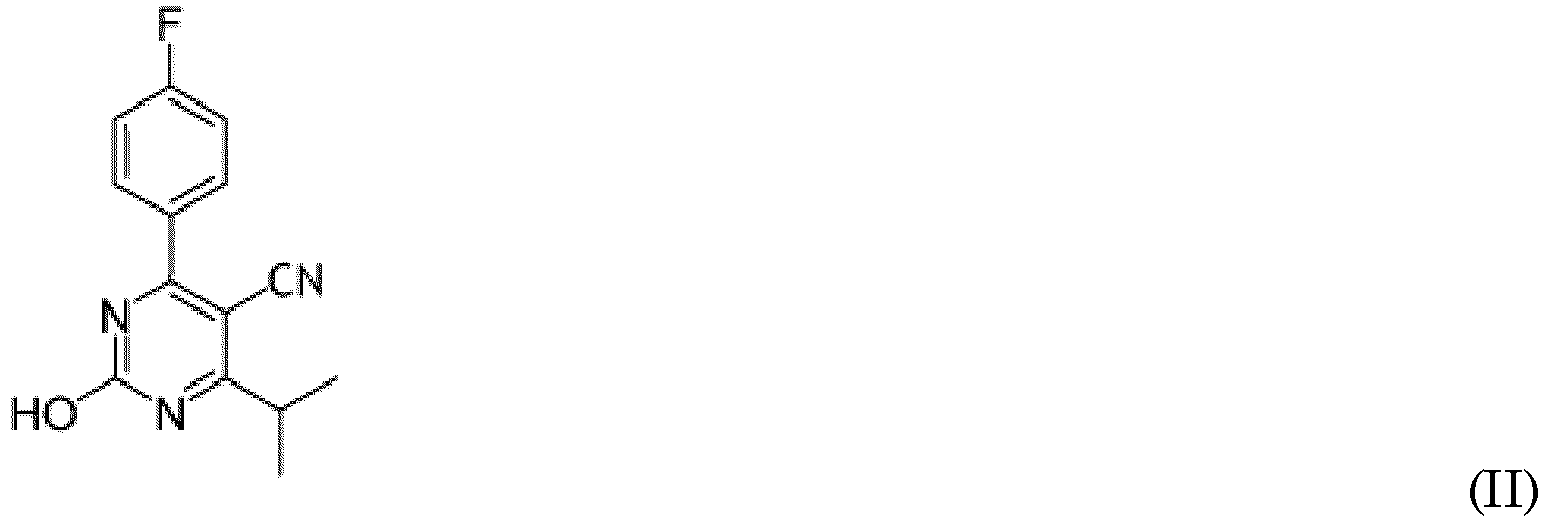
- the first reaction step the hydroxy-pyrimidine-carbonitrile of formula (II) is reacted with an organic sulfonyl halide to form the sulfonate-pyrimidine-carbonitrile of formula (III), generally in the presence of a base.
- the second reaction step the sulfonate-pyrimidine-carbonitrile is reacted with N-methylmethane sulfonamide to form the pyrimidinyl-sulfonamide of formula (IV).
- the third step (reduction step) the pyrimidinyl-sulfonamide of formula (IV) is reacted with a reducing agent to obtain the rosuvastatin precursor of formula (I).
- a starting mixture comprising the compound of formula (II).
- This compound is typically prepared by reacting p-fluorobenzaldehyde, 4-methyl-3-oxopentanenitrile and urea to form the compound of formula (V) and subsequently oxidizing this compound to form the compound of formula (II).
- These reactions may for example be conducted by following the process as described in WO2008/151510 .
- the compound of formula (II) Since the compound of formula (II) has a low solubility in toluene, the compound of formula (II) is typically suspended in the toluene in the starting mixture.
- the starting mixture is thus typically in the form of a suspension.
- At least 95 wt.%, preferably at least 99 wt.%, even more preferably at least 99.9 wt.% of the organic solvent present in the starting mixture is toluene.
- toluene Most preferably, toluene is the only solvent present in the starting mixture.
- the use of a single solvent is desirable in view of handling costs and recycling issues, as well as the integration with other reaction steps.
- the starting mixture may comprise 1-30 wt.%, for example 5-20 wt.% of the compound of formula (II), based on the total weight of toluene present in the mixture.
- the same weight percentages may also apply to the reaction mixture after having contacted the organic sulfonyl halide. Typically, no significant amount of toluene is added during contacting of this compound.
- an organic sulfonyl halide is a compound of the general formula R-SO 2 X, wherein X is a halide and R is an organic group, typically having 1 up to 15 carbon atoms.
- the halide may be chloride, bromide, fluoride or iodide.
- the organic group may be a substituted or unsubstituted aromatic hydrocarbon (preferably phenyl or naphthyl), alkane (preferably methyl, ethyl, propyl or butyl) or cycloalkane.
- the organic group may be substituted with one or more substituting groups, which are preferably selected from C1-C4 alkyl (preferably methyl), halide (e.g. Cl, Br, F, I) and nitro (NO 2 ).
- substituting groups which are preferably selected from C1-C4 alkyl (preferably methyl), halide (e.g. Cl, Br, F, I) and nitro (NO 2 ).
- halide e.g. Cl, Br, F, I
- NO 2 nitro
- the definition of the R group given above for the organic sulfonyl halide also applies to the R group of the compound of formula (III).
- organic sulfonyl halides examples include methanesulfonyl chloride, ethanesulfonyl chloride, trifluoromethanesulfonyl chloride, methanesulfonyl bromide, benzenesulfonyl chloride, benzenesulfonyl bromide, p-toluenesulfonyl chloride, p-toluenesulfonyl bromide, p-toluenesulfonyl fluoride, 4-chlorobenzenesulfonyl chloride, 2-chlorobenzenesulfonyl chloride, 2-nitrobenzenesulfonyl chloride, 2-naphtalenesulfonyl chloride and 2,4,6-trimethylbenzenesulfonyl chloride. Good results have been obtained using organic sulfonyl chlorides.
- the starting mixture comprising the compound of formula (II) is first contacted with the organic sulfonyl halide to form the reaction mixture. This can be done by adding the organic sulfonyl halide to the starting mixture, for example during a period of time of 1-60 minutes.
- the reaction mixture obtained after contacting is kept at a first temperature, thereby forming an intermediate mixture comprising the compound of formula (III).
- the first temperature is preferably a temperature of between 50 °C and 110 °C, more preferably between 60 °C and 100 °C, for example between 70 and 90 °C or between 75 and 85 °C.
- the reaction mixture may be kept at the first temperature for an appropriate duration, for example for at least 1 hour, preferably for at least 2 hours, for example at least 3 hours.
- the reaction between the compound of formula (II) and the organic sulfonyl halide is typically conducted in the presence of a base.
- the base may for example be selected from the group consisting of potassium carbonate, sodium carbonate, sodium hydroxide, potassium hydroxide, sodium methoxide, potassium methoxide, sodium tert-butoxide, potassium tert-butoxide, sodium tert amyl alcohol and potassium tert amyl alcohol. Good results have been achieved using an inorganic base.
- the base is potassium carbonate.
- the molar amount of base used in the reaction may be at least equal, for example 1-5 times the molar amount of the compound of formula (II) present in the mixture.
- the base is present in the starting mixture.
- the base may also be contacted with the starting mixture, e.g. during or after contacting the starting mixture with the organic sulfonyl halide. This is typically achieved by simply adding the base to the starting mixture. Accordingly, the first reaction mixture will comprise the base.
- the resulting intermediate mixture is subjected to the second reaction step.
- the compound of formula (III) is not isolated between the first and second reaction step. Rather, the compound of formula (III) is kept in solution in toluene in the intermediate mixture until it is reacted further in the second reaction step.
- the first and second reaction step may be conducted in the same reaction vessel.
- the compound of formula (III) is reacted with N-methylmethane sulfonamide to form the compound of formula (IV).
- the intermediate mixture comprising the compound of formula (III) is first contacted with N-methylmethane sulfonamide.
- the resulting reaction mixture (referred to as the 'second reaction mixture') is kept at a second temperature for an appropriate time to form a second mixture comprising the compound of formula (IV).
- N-methylmethane sulfonamide can be done by simply adding the N-methylmethane sulfonamide to the intermediate mixture, for example during a period of time of 1-180 minutes.
- the two reagents are preferably brought into contact with each other over a relatively long amount of time.
- the N-methylmethane sulfonamide may be added (typically drop wise) to the intermediate mixture during a period of time of at least 1 hour, preferably at least 1.5 hours.
- dimerization may in particular be avoided when using a specific dosing protocol, wherein the intermediate mixture is brought in contact with the N-methylmethane sulfonamide in a very specific manner.
- the intermediate mixture is added (typically drop wise) to a mixture comprising N-methylmethane sulfonamide, toluene and optionally a base (hereinafter referred to as the sulfonamide mixture).
- the sulfonamide mixture a mixture comprising N-methylmethane sulfonamide, toluene and optionally a base
- the intermediate mixture is preferably added slowly, over a relatively long period of time, in order to reduce the occurrence of dimerization.
- the intermediate mixture is added to the sulfonamide mixture over a period of time of at least 0.5 hour, preferably at least 1 hour, more preferably at least 2 hours, even more preferably at least 2.5 hours.
- the sulfonamide mixture may comprise 1-60 wt.%, preferably 10-50 wt.% N-methylmethane sulfonamide, relative to the total weight of toluene in the sulfonamide mixture.
- the sulfonamide mixture may have a temperature of between 50°C and 110°C, preferably between 60°C and 100°C, for example between 70°C and 90°C or between 75°C and 85°C during contacting.
- the intermediate mixture may have a temperature in this same range.
- the base that may be present in the sulfonamide mixture is typically the same type of base that is typically present in the reaction between the compound of formula (III) and N-methylmethane sulfonamide.
- the molar amount of N-methylmethane sulfonamide present in the sulfonamide mixture may be at least 0.9 times, preferably 1.0 to 1.3 times the molar amount of the compound of formula (III) present in the intermediate mixture
- the reaction mixture obtained after having contacted the different reagents is kept at a second temperature for an appropriate duration, preferably for at least 1 hour, more preferably at least 2 hours, for example at least 3 hours.
- the second temperature is preferably a temperature of between 50°C and 110°C, more preferably between 60°C and 100°C, for example between 70°C and 90°C or between 75°C and 85°C.
- a mixture is obtained comprising the compound of formula (IV), which mixture is herein referred to as the second mixture.
- the reaction between the compound of formula (III) and N-methylmethane sulfonamide is typically conducted in the presence of a base.
- the base may for example be selected from the group consisting of potassium carbonate, sodium carbonate, sodium hydroxide, potassium hydroxide, sodium methoxide, potassium methoxide, sodium tert-butoxide, potassium tert-butoxide, sodium tert amyl alcohol and potassium tert amyl alcohol. Good results have been obtained using an inorganic base.
- the base is potassium carbonate.
- the molar amount of base used in the reaction may be at least equal, for example 1-5 times the molar amount of the compound of formula (III) present in the mixture.
- This base may be the same or a different base than the one already present in the first reaction step.
- the base may already be present in the intermediate mixture.
- additional base may be added for the second reaction step.
- the intermediate mixture may be contacted with additional base, either before, during or after contacting with the organic sulfonyl halide.
- the additional base may for example be contacted with the intermediate mixture by simply adding the base to the intermediate mixture. This is typically done before contacting the intermediate mixture with the N-methylmethane sulfonamide.
- the base will preferably be present in the mixture of N-methylmethane sulfonamide and toluene.
- the second mixture may be washed with toluene and/or water.
- the compound of formula (IV) may then be isolated, for example by concentrating the second mixture and subsequently crystallizing the compound of formula (IV), e.g. by cooling the reaction mixture.
- the compound of formula (IV) is kept in dissolved form in the (optionally washed) second mixture.
- the compound of formula (IV) is reacted with a reducing agent to form the compound of formula (I).
- the reducing agent is preferably DIBALH. The inventors found that very good results could be obtained for the reduction in toluene using this specific reducing agent.
- the inventors further found that a relatively small amount of DIBALH is already sufficient to obtain an efficient and complete reduction.
- the molar amount of DIBALH used in the reaction may be 1.0 to 1.5 times, preferably 1.1 to 1.3 times the molar amount of the compound of formula (IV). In other words, only 1.0 to 1.5 molar equivalents, preferably 1.1 to 1.3 equivalents of DIBALH are preferably used per equivalent of the compound of formula (IV) for the reduction.
- the mixture of the compound of formula (IV) in toluene may comprise 5-50, preferably 10-40 wt.% of the compound of formula (IV), based on the total weight of toluene in the mixture.
- the mixture of the compound of formula (IV) in toluene may be the second mixture obtained in the second reaction step.
- the mixture may instead be prepared from dissolving the compound of formula (IV) isolated in the second reaction step in toluene. Due to the low solubility of the compound of formula (IV) in toluene, the mixture may be a suspension.
- the reduction reaction according to the process of the invention may be conducted by contacting a mixture of the compound of formula (IV) in toluene with a reducing agent, in particular with diisobutylaluminium hydride (DIBALH).
- DIBALH is preferably brought into contact with the mixture in the form of a solution in toluene. Good results were obtained using a DIBALH in toluene solution having a concentration of 10-40, preferably 20-30 wt.% DIBALH, based on the total weight of toluene in the solution.
- the mixture of the compound of formula (IV) in toluene and the DIBALH solution in toluene are preferably brought into contact with each other at a temperature below 20°C, preferably a temperature of -50 to 10°C, more preferably of -20 to 0°C. This is typically done by adding the solution (typically drop wise) to the mixture over an amount of time of at least 15 minutes, preferably at least 0.5 hours.
- the reaction mixture After contacting, the reaction mixture is kept at a temperature below 20 °C, preferably a temperature of -50 to 10 °C, more preferably of -20 to 0 °C for an appropriate amount of time, typically 10-120 minutes.
- the resulting product mixture comprises the compound of formula (I).
- the product mixture may be quenched, for example by adding it to hydrochloric acid while keeping the temperature below 20 °C.
- the thus quenched product mixture is then heated to a temperature of 50-100 °C, after which the layers organic (toluene) layer may be separated from the aqueous layer.
- the compound of formula (I) may be isolated from the organic layer by concentration and crystallization, e.g. by cooling crystallization.
- This Example shows the preparation of N-(5-cyano-4-(4-fluorophenyl)-6-isopropyl-pyrimidin-2-yl)-N-methylmethanesulfonamide from 4-(4-fluorophenyl)-2-hydroxy-6-iso-propylpyrimidine-5-carbonitrile in toluene.
- the reaction mechanism is as follows.
- a reactor is charged with toluene (90 mL), (4-fluorophenyl)-2-hydroxy-6-isopropyl pyrimidine-5-carbonitrile (10 g, 38.9 mmol) and K 2 CO 3 (17.2 g, 124.4 mmol). Then pTsCl (9.6 g, 50.5 mmol, para-toluene sulfonylchloride) is added under stirring in 30 min. The reaction mixture is heated to 100°C and kept at this temperature for 3 h. After cooling to 80°C, NMSA (6.4 g, 58.3 mmol, N-methylmethane sulfonamide) is added, followed by stirring at 80°C for 7 h.
- the reaction mixture contains approximately 10% of dimer during this step.
- Toluene 140 mL is added followed by careful addition of water (170 mL).
- the reaction mixture is heated to 90°C. After stirring for 30 min, the phases are separated. The organic layer is concentrated under reduced pressure until crystallization of the product starts. Then distillation is stopped and the slurry is heated to 100°C until a clear solution is obtained. If required a small amount of toluene is added.
- the reaction mixture is cooled in 6 h to 20°C and stirred for 16 h. The precipitated solid is isolated by filtration and washed with toluene (3 x 8 mL).
- N-(5-cyano-4-(4-fluorophenyl)-6-isopropylpyrimidin-2-yl)-N-methylmethane sulfonamide is obtained as a white solid (9.5 g, yield 70%).
- This Example shows the preparation of N-(5-cyano-4-(4-fluorophenyl)-6-isopropyl-pyrimidin-2-yl)-N-methylmethanesulfonamide from 4-(4-fluorophenyl)-2-hydroxy-6-iso-propylpyrimidine-5-carbonitrile in toluene, wherein a specific dosing protocol is used for adding the N-methylmethane sulfonamide.
- the reaction mechanism is as follows.
- a reactor is charged with toluene (40 mL), 4-(4-fluorophenyl)-2-hydroxy-6-isopropyl pyrimidine-5-carbonitrile (5.0 g, 19.4 mmol) and K 2 CO 3 (4.0 g, 29.2 mmol). Then pTsCl (4.8 g, 25.3 mmol, para-toluene sulfonylchloride) is added under stirring in 15 min. The reaction mixture is heated to 100°C and kept at this temperature for 2 h, then cooled to 80°C (step A).
- step B a mixture of NMSA (3.2 g, 29.1 mmol N-methylmethane sulfonamide), K 2 CO 3 (4.8 g, 33.1 mmol) in toluene (20 mL) was prepared and heated to 80°C (step B). The mass of step A is added 3 h at 80°C to the reaction mixture of step B. Thereafter, the total mass was stirred for another 4 h at 80°C. The reaction mixture contains approximately 5% of dimer during this step.
- NMSA 3.2 g, 29.1 mmol N-methylmethane sulfonamide
- K 2 CO 3 4.8 g, 33.1 mmol
- Example 4B It can be concluded from Examples 4A and 4B that dimer formation can be reduced by using a dosing protocol. Only half the amount of dimers was formed in Example 4B (dosing protocol) compared to Example 4A (no dosing protocol). As a result, the yield of the pyrimidine-sulfonamide was increased from 70% in Example 4A to 78% in Example 4B.
- Example 1C Pyrimidine-Sulfonamide Isolation via Direct Filtration
- This Example shows the preparation of N-(5-cyano-4-(4-fluorophenyl)-6-isopropyl-pyrimidin-2-yl)-N-methylmethanesulfonamide from 4-(4-fluorophenyl)-2-hydroxy-6-iso-propylpyrimidine-5-carbonitrile in toluene.
- the formed pyrimidine-sulfonamide was isolated directly from the reaction mixture using cooling filtration (as opposed to conducting an extraction step with water prior to filtration, as was done in Examples 1A and 1B).
- the reaction mechanism is as follows.
- a reactor is charged with toluene (75 mL), (4-fluorophenyl)-2-hydroxy-6-isopropyl pyrimidine-5-carbonitrile (10 g, 38.9 mmol) and K 2 CO 3 (6.4 g, 46.1 mmol). Then pTsCl is added (8.1 g, 42.5 mmol, para-toluenesulfonylchloride) under stirring in 30 min. The reaction mixture is heated to 110°C and kept at this temperature for 3 h. After cooling to 100°C, K 2 CO 3 (7.4 g, 53.3 mmol) and NMSA (5.5 g, 50.4 mmol, N-methylmethane sulfonamide) are added.
- the reaction mixture is heated to 110°C, kept at this temperature for 3h, and then cooled to 20°C.
- the solids are isolated by filtration and washed with toluene (2 x 10 mL). This solid was suspended in water (50 mL) and stirred for 1 h at 20°C. The solid is isolated by filtration, washed with water (2 x 20 mL). After drying, N-(5-cyano-4-(4-fluorophenyl)-6-isopropylpyrimidin-2-yl)-N-methylmethane sulfon amide is obtained as a white solid (9.5 g, yield 70%).
- This Example shows the preparation of N-(4-(4-fluorophenyl)-5-formyl-6-isopropyl-pyrimidin-2-yl)-N-methylmethanesulfonamide from N-(5-cyano-4-(4-fluorophenyl)-6-iso-propylpyrimidin-2-yl)-N-methylmethanesulfonamide using diisobutylaluminium hydride (DiBALH) as a reducing agent.
- DIBALH diisobutylaluminium hydride
- a reactor is charged with toluene (50 mL) and N-(5-cyano-4-(4-fluorophenyl)-6-isopropylpyrimidin-2-yl)-N-methylmethanesulfonamide (6.0 g, 17.2 mmol) and cooled to -5°C.
- To the stirred white suspension is dosed in 1 h a solution of DiBALH in toluene (15.1 mL of a 25 w/w% solution of diisobutylaluminum hydride in toluene, 22.2 mmol) keeping the temperature at --5°C. Stirring is continued for 1 h at -5°C.
- reaction mixture is added to 4M aqueous HCl (50 mL) keeping the temperature ⁇ 20°C.
- toluene (10 mL) is used to transfer the last part of the reaction mixture into the aqueous HCl.
- the quenched reaction mixture is heated to 85°C.
- the layers are separated.
- the organic layer is concentrated under vacuum until precipitation occurs.
- distillation is stopped and the toluene is heated to 110°C.
- the clear solution is cooled in 5 h to 20°C and stirred for 16 h.
- the precipitated solid is isolated by filtration, washed with toluene (3 x 6 mL).
- N-(4-(4-fluorophenyl)-5-formyl-6-isopropylpyrimidin-2-yl)-N-methylmethanesulfonamide is obtained as a white solid (4.9 g, yield 81%).
- 1 H NMR (300 MHz, CDCl 3 ) ⁇ 1.32 - 1.34 (d, 6H, J 7.0 Hz), 3.55 (s, 3H), 3.64 (s, 3H), 3.97 - 4.06 (m, 1H), 7.20 - 7.27 (m, 2H), 7.61 - 7.66 (m, 2H), 9.90 (s, 1H).
Landscapes
- Chemical & Material Sciences (AREA)
- Organic Chemistry (AREA)
- Organic Low-Molecular-Weight Compounds And Preparation Thereof (AREA)
- Pharmaceuticals Containing Other Organic And Inorganic Compounds (AREA)
- Plural Heterocyclic Compounds (AREA)
Claims (13)
- Verfahren zum Herstellen eines Statinvorläufers, umfassend die Schritte von:(a) Bereitstellen eines Ausgangsgemischs, umfassend die Verbindung der Formel (II) und Toluol,
 (b) einen ersten Reaktionsschritt, wobei das Ausgangsgemisch mit einem organischen Sulfonylhalogenid in Kontakt gebracht wird; und das resultierende erste Reaktionsgemisch bei einer ersten Temperatur von unter 110 °C gehalten wird, dadurch Bilden eines Zwischengemischs, umfassend die Verbindung der Formel (III),
 (c) einen zweiten Reaktionsschritt, wobei das Zwischengemisch mit N-Methylmethansulfonamid in Kontakt gebracht wird; und das resultierende zweite Reaktionsgemisch bei einer zweiten Temperatur gehalten wird, dadurch Bilden eines zweiten Gemischs, umfassend die Verbindung der Formel (IV),
- Verfahren nach Anspruch 1, ferner umfassend einen Reduktionsschritt, wobei die Verbindung von Formel (IV), erhalten in dem zweiten Reaktionsschritt, mit einem Reduktionsmittel in Toluol reagiert wird, um die Verbindung der Formel (I) zu bilden,

- Verfahren nach einem der vorhergehenden Ansprüche, wobei die erste und die zweite Temperatur unabhängig gewählt werden, um in dem Bereich von 50 bis 110 °C zu liegen.
- Verfahren nach einem der vorhergehenden Ansprüche, wobei das Zwischengemisch mit N-Methylmethansulfonamid durch Zugeben des Zwischengemischs zu einem Sulfonamidgemisch, umfassend N-Methylmethansulfonamid in Toluol, in Kontakt gebracht wird.
- Verfahren nach Anspruch 4, wobei das Zwischengemisch dem Gemisch, umfassend N-Methylmethansulfonamid, über einen Zeitraum von mindestens 1 Stunde zugegeben wird.
- Verfahren nach Anspruch 4 oder 5, wobei das Gemisch, umfassend N-Methylmethansulfonamid, weiterhin eine Base umfasst.
- Verfahren nach einem der Ansprüche 4 - 6, wobei das Sulfonamidgemisch 1-60 Gew.-% N-Methylmethansulfonamid umfasst, relativ zu dem Gesamtgewicht von Toluol in dem Sulfonamidgemisch.
- Verfahren nach einem der vorhergehenden Ansprüche, wobei das organische Sulfonylhalogenid ausgewählt ist aus der Gruppe bestehend aus Methansulfonylchlorid, Ethansulfonylchlorid, Trifluormethansulfonylchlorid, Methansulfonylbromid, Benzolsulfonylchlorid, Benzolsulfonylbromid, p-Toluolsulfonylchlorid, p-Toluolsulfonylbromid, p-Toluolsulfonylfluorid, 4-Chlorbenzolsulfonylchlorid, 2-Chlorbenzolsulfonylchlorid, 2-Nitrobenzolsulfonylchlorid, 2-Naphthalinsulfonylchlorid und 2,4,6-Trimethylbenzolsulfonylchlorid.
- Verfahren nach einem der vorhergehenden Ansprüche, wobei die erste und die zweite Reaktion in der Gegenwart einer Base durchgeführt werden, ausgewählt aus der Gruppe bestehend aus Kaliumcarbonat, Natriumcarbonat, Natriumhydroxid, Kaliumhydroxid, Natriummethoxid, Kaliummethoxid, Natrium-tert-butoxid, Kalium-tert-butoxid, Natrium-tert-amylalkohol und Kalium-tert-amylalkohol.
- Verfahren nach einem der vorhergehenden Ansprüche, wobei R ein aromatischer Kohlenwasserstoff, Alkan oder Cycloalkan ist, optional substituiert mit einem oder mehreren von C1-C4-Alkyl, Halogenid oder Nitro.
- Verfahren nach einem der vorhergehenden Ansprüche, wobei das Ausgangsgemisch eine Suspension der Verbindung von Formel (II) in Toluol ist.
- Verfahren nach einem der Ansprüche 2 - 11, wobei das Reduktionsmittel Diisobutylaluminiumhydrid ist.
- Verfahren nach Anspruch 12, wobei die Reduktionsreaktion durch Inkontaktbringen eines Gemischs der Verbindung von Formel (IV) in Toluol mit einer Lösung von DIBALH in Toluol bei einer Temperatur unter 20 °C und Halten des resultierenden Gemischs bei der Temperatur unter 20 °C für eine angemessene Zeitdauer durchgeführt wird.
Priority Applications (3)
| Application Number | Priority Date | Filing Date | Title |
|---|---|---|---|
| RS20250028A RS66394B1 (sr) | 2015-01-23 | 2016-01-22 | Poboljšani postupak za dobijanje prekursora statina |
| HRP20250039TT HRP20250039T1 (hr) | 2015-01-23 | 2016-01-22 | Poboljšani postupak za dobivanje prekursora statina |
| SI201631884T SI3247703T1 (sl) | 2015-01-23 | 2016-01-22 | Izboljšan postopek za pripravo prekursorja statina |
Applications Claiming Priority (2)
| Application Number | Priority Date | Filing Date | Title |
|---|---|---|---|
| EP15152299 | 2015-01-23 | ||
| PCT/EP2016/051312 WO2016116589A1 (en) | 2015-01-23 | 2016-01-22 | Improved process for preparing statin precursor |
Publications (2)
| Publication Number | Publication Date |
|---|---|
| EP3247703A1 EP3247703A1 (de) | 2017-11-29 |
| EP3247703B1 true EP3247703B1 (de) | 2024-10-16 |
Family
ID=52462797
Family Applications (1)
| Application Number | Title | Priority Date | Filing Date |
|---|---|---|---|
| EP16701185.7A Active EP3247703B1 (de) | 2015-01-23 | 2016-01-22 | Verbessertes verfahren zur herstellung eines statinvorläufers |
Country Status (13)
| Country | Link |
|---|---|
| US (1) | US10246423B2 (de) |
| EP (1) | EP3247703B1 (de) |
| CN (1) | CN107428703B (de) |
| ES (1) | ES3001988T3 (de) |
| HR (1) | HRP20250039T1 (de) |
| HU (1) | HUE069744T2 (de) |
| IL (1) | IL253331B (de) |
| MX (1) | MX368055B (de) |
| PL (1) | PL3247703T3 (de) |
| PT (1) | PT3247703T (de) |
| RS (1) | RS66394B1 (de) |
| SI (1) | SI3247703T1 (de) |
| WO (1) | WO2016116589A1 (de) |
Citations (1)
| Publication number | Priority date | Publication date | Assignee | Title |
|---|---|---|---|---|
| WO2008151510A1 (fr) * | 2007-06-11 | 2008-12-18 | Anhui Qingyun Pharmaceutical And Chemical Co., Ltd. | Préparation de 4-(fluorophenyl)-6-isopropyl-2-(n-methyl-n-methylsulfonylamino)- 5-formyl-pyrimidine |
Family Cites Families (3)
| Publication number | Priority date | Publication date | Assignee | Title |
|---|---|---|---|---|
| IL159741A0 (en) * | 2001-07-13 | 2004-06-20 | Astrazeneca Uk Ltd | Preparation of aminopyrimidine compounds |
| GB0428328D0 (en) * | 2004-12-24 | 2005-02-02 | Astrazeneca Uk Ltd | Chemical process |
| CN101948438A (zh) * | 2010-08-02 | 2011-01-19 | 刘璟凌 | 一种瑞舒伐他汀钙的制备新方法 |
-
2016
- 2016-01-22 US US15/545,682 patent/US10246423B2/en active Active
- 2016-01-22 EP EP16701185.7A patent/EP3247703B1/de active Active
- 2016-01-22 HU HUE16701185A patent/HUE069744T2/hu unknown
- 2016-01-22 WO PCT/EP2016/051312 patent/WO2016116589A1/en not_active Ceased
- 2016-01-22 ES ES16701185T patent/ES3001988T3/es active Active
- 2016-01-22 PL PL16701185.7T patent/PL3247703T3/pl unknown
- 2016-01-22 SI SI201631884T patent/SI3247703T1/sl unknown
- 2016-01-22 CN CN201680006784.6A patent/CN107428703B/zh active Active
- 2016-01-22 PT PT167011857T patent/PT3247703T/pt unknown
- 2016-01-22 RS RS20250028A patent/RS66394B1/sr unknown
- 2016-01-22 HR HRP20250039TT patent/HRP20250039T1/hr unknown
- 2016-01-22 MX MX2017009379A patent/MX368055B/es active IP Right Grant
-
2017
- 2017-07-05 IL IL25333117A patent/IL253331B/en active IP Right Grant
Patent Citations (1)
| Publication number | Priority date | Publication date | Assignee | Title |
|---|---|---|---|---|
| WO2008151510A1 (fr) * | 2007-06-11 | 2008-12-18 | Anhui Qingyun Pharmaceutical And Chemical Co., Ltd. | Préparation de 4-(fluorophenyl)-6-isopropyl-2-(n-methyl-n-methylsulfonylamino)- 5-formyl-pyrimidine |
Also Published As
| Publication number | Publication date |
|---|---|
| WO2016116589A1 (en) | 2016-07-28 |
| HUE069744T2 (hu) | 2025-04-28 |
| SI3247703T1 (sl) | 2025-03-31 |
| IL253331B (en) | 2019-11-28 |
| EP3247703A1 (de) | 2017-11-29 |
| US20180016241A1 (en) | 2018-01-18 |
| IL253331A0 (en) | 2017-09-28 |
| US10246423B2 (en) | 2019-04-02 |
| CN107428703B (zh) | 2021-01-12 |
| HRP20250039T1 (hr) | 2025-05-23 |
| PT3247703T (pt) | 2025-01-14 |
| CN107428703A (zh) | 2017-12-01 |
| MX368055B (es) | 2019-09-18 |
| MX2017009379A (es) | 2017-11-08 |
| ES3001988T3 (en) | 2025-03-06 |
| PL3247703T3 (pl) | 2025-03-31 |
| RS66394B1 (sr) | 2025-02-28 |
Similar Documents
| Publication | Publication Date | Title |
|---|---|---|
| CN104418678B (zh) | 一种合成n-烷基磺酰胺衍生物的方法 | |
| JP5583689B2 (ja) | ピペラジン誘導体の調製プロセス | |
| JP5461469B2 (ja) | アシルスルファモイルベンズアミドの製造方法 | |
| WO2010073706A1 (ja) | カルバペネム側鎖中間体の改良された製造方法 | |
| EP3247703B1 (de) | Verbessertes verfahren zur herstellung eines statinvorläufers | |
| CN101107228B (zh) | (z)-1-苯基-1-(n,n-二乙氨基羰基)-2-邻苯二甲酰亚氨甲基环丙烷的制造方法 | |
| KR102597449B1 (ko) | 1-(4-히드록시페닐)-4-(4-트리플루오로메톡시페녹시)피페리딘 또는 그 염의 제조방법 | |
| EP1829872B1 (de) | Verfahren zur herstellung von indolverbindungen | |
| US10954191B2 (en) | Process for the preparation of glycopyrrolate tosylate | |
| US6211379B1 (en) | Process for preparing heterocyclic compounds | |
| CN112047865B (zh) | 一种在水中合成n-烷基磺酰胺的方法 | |
| CN101044130B (zh) | 一种制备缩水甘油衍生物的方法 | |
| JP3868534B2 (ja) | スルホンアミド誘導体の製造法および中間体 | |
| JP4465674B2 (ja) | ベンジル(ジフルオロメチル)スルフィド化合物の製造方法 | |
| US20050085657A1 (en) | Method for the production of biphenyl-4-carbonitrile | |
| KR102365411B1 (ko) | 신규의 설폰아마이드 중간체 및 이를 사용한 실로도신의 제조방법 | |
| US10906866B2 (en) | Process for the preparation of phenoxybenzamine | |
| TWI631104B (zh) | 2-胺基菸鹼酸苄酯衍生物之製造方法 | |
| JP5400261B2 (ja) | インドール化合物の製造方法 | |
| WO2022238921A1 (en) | In-situ synthesis of 3-substituted pyridinium compounds | |
| KR20210104730A (ko) | 이소퀴놀린술포닐클로라이드 산부가염 및 그 제조 방법 | |
| HK40048107B (zh) | 异喹啉磺酰氯酸加成盐和其制造方法 | |
| WO2004094397A1 (ja) | スルホン酸グリシジル誘導体の製造法 | |
| JP2005506380A (ja) | 新規プロセス | |
| WO2006057261A1 (ja) | 5-フタランカルボニトリル及びシタロプラムの製造方法 |
Legal Events
| Date | Code | Title | Description |
|---|---|---|---|
| REG | Reference to a national code |
Ref country code: HR Ref legal event code: TUEP Ref document number: P20250039T Country of ref document: HR |
|
| STAA | Information on the status of an ep patent application or granted ep patent |
Free format text: STATUS: THE INTERNATIONAL PUBLICATION HAS BEEN MADE |
|
| PUAI | Public reference made under article 153(3) epc to a published international application that has entered the european phase |
Free format text: ORIGINAL CODE: 0009012 |
|
| STAA | Information on the status of an ep patent application or granted ep patent |
Free format text: STATUS: REQUEST FOR EXAMINATION WAS MADE |
|
| 17P | Request for examination filed |
Effective date: 20170706 |
|
| AK | Designated contracting states |
Kind code of ref document: A1 Designated state(s): AL AT BE BG CH CY CZ DE DK EE ES FI FR GB GR HR HU IE IS IT LI LT LU LV MC MK MT NL NO PL PT RO RS SE SI SK SM TR |
|
| AX | Request for extension of the european patent |
Extension state: BA ME |
|
| DAV | Request for validation of the european patent (deleted) | ||
| DAX | Request for extension of the european patent (deleted) | ||
| RAP1 | Party data changed (applicant data changed or rights of an application transferred) |
Owner name: CENTRIENT PHARMACEUTICALS NETHERLANDS B.V. |
|
| STAA | Information on the status of an ep patent application or granted ep patent |
Free format text: STATUS: EXAMINATION IS IN PROGRESS |
|
| 17Q | First examination report despatched |
Effective date: 20201202 |
|
| GRAP | Despatch of communication of intention to grant a patent |
Free format text: ORIGINAL CODE: EPIDOSNIGR1 |
|
| STAA | Information on the status of an ep patent application or granted ep patent |
Free format text: STATUS: GRANT OF PATENT IS INTENDED |
|
| INTG | Intention to grant announced |
Effective date: 20240506 |
|
| GRAS | Grant fee paid |
Free format text: ORIGINAL CODE: EPIDOSNIGR3 |
|
| GRAA | (expected) grant |
Free format text: ORIGINAL CODE: 0009210 |
|
| STAA | Information on the status of an ep patent application or granted ep patent |
Free format text: STATUS: THE PATENT HAS BEEN GRANTED |
|
| AK | Designated contracting states |
Kind code of ref document: B1 Designated state(s): AL AT BE BG CH CY CZ DE DK EE ES FI FR GB GR HR HU IE IS IT LI LT LU LV MC MK MT NL NO PL PT RO RS SE SI SK SM TR |
|
| REG | Reference to a national code |
Ref country code: GB Ref legal event code: FG4D |
|
| REG | Reference to a national code |
Ref country code: CH Ref legal event code: EP Ref country code: DE Ref legal event code: R096 Ref document number: 602016089841 Country of ref document: DE |
|
| REG | Reference to a national code |
Ref country code: IE Ref legal event code: FG4D |
|
| P01 | Opt-out of the competence of the unified patent court (upc) registered |
Free format text: CASE NUMBER: APP_58015/2024 Effective date: 20241024 |
|
| REG | Reference to a national code |
Ref country code: PT Ref legal event code: SC4A Ref document number: 3247703 Country of ref document: PT Date of ref document: 20250114 Kind code of ref document: T Free format text: AVAILABILITY OF NATIONAL TRANSLATION Effective date: 20250108 |
|
| REG | Reference to a national code |
Ref country code: NL Ref legal event code: FP |
|
| REG | Reference to a national code |
Ref country code: LT Ref legal event code: MG9D |
|
| REG | Reference to a national code |
Ref country code: HR Ref legal event code: ODRP Ref document number: P20250039T Country of ref document: HR Payment date: 20250117 Year of fee payment: 10 |
|
| REG | Reference to a national code |
Ref country code: ES Ref legal event code: FG2A Ref document number: 3001988 Country of ref document: ES Kind code of ref document: T3 Effective date: 20250306 Ref country code: GR Ref legal event code: EP Ref document number: 20250400093 Country of ref document: GR Effective date: 20250211 |
|
| PG25 | Lapsed in a contracting state [announced via postgrant information from national office to epo] |
Ref country code: IS Free format text: LAPSE BECAUSE OF FAILURE TO SUBMIT A TRANSLATION OF THE DESCRIPTION OR TO PAY THE FEE WITHIN THE PRESCRIBED TIME-LIMIT Effective date: 20250216 |
|
| PGFP | Annual fee paid to national office [announced via postgrant information from national office to epo] |
Ref country code: DE Payment date: 20250116 Year of fee payment: 10 Ref country code: HR Payment date: 20250117 Year of fee payment: 10 |
|
| PG25 | Lapsed in a contracting state [announced via postgrant information from national office to epo] |
Ref country code: FI Free format text: LAPSE BECAUSE OF FAILURE TO SUBMIT A TRANSLATION OF THE DESCRIPTION OR TO PAY THE FEE WITHIN THE PRESCRIBED TIME-LIMIT Effective date: 20241016 |
|
| PGFP | Annual fee paid to national office [announced via postgrant information from national office to epo] |
Ref country code: RO Payment date: 20241230 Year of fee payment: 10 |
|
| PGFP | Annual fee paid to national office [announced via postgrant information from national office to epo] |
Ref country code: ES Payment date: 20250213 Year of fee payment: 10 |
|
| PG25 | Lapsed in a contracting state [announced via postgrant information from national office to epo] |
Ref country code: NO Free format text: LAPSE BECAUSE OF FAILURE TO SUBMIT A TRANSLATION OF THE DESCRIPTION OR TO PAY THE FEE WITHIN THE PRESCRIBED TIME-LIMIT Effective date: 20250116 |
|
| PG25 | Lapsed in a contracting state [announced via postgrant information from national office to epo] |
Ref country code: LV Free format text: LAPSE BECAUSE OF FAILURE TO SUBMIT A TRANSLATION OF THE DESCRIPTION OR TO PAY THE FEE WITHIN THE PRESCRIBED TIME-LIMIT Effective date: 20241016 |
|
| PGFP | Annual fee paid to national office [announced via postgrant information from national office to epo] |
Ref country code: AT Payment date: 20241219 Year of fee payment: 10 Ref country code: CH Payment date: 20250201 Year of fee payment: 10 |
|
| PGFP | Annual fee paid to national office [announced via postgrant information from national office to epo] |
Ref country code: PL Payment date: 20241223 Year of fee payment: 10 Ref country code: CZ Payment date: 20250120 Year of fee payment: 10 Ref country code: FR Payment date: 20250130 Year of fee payment: 10 |
|
| PGFP | Annual fee paid to national office [announced via postgrant information from national office to epo] |
Ref country code: IT Payment date: 20250109 Year of fee payment: 10 |
|
| REG | Reference to a national code |
Ref country code: HU Ref legal event code: AG4A Ref document number: E069744 Country of ref document: HU |
|
| PGFP | Annual fee paid to national office [announced via postgrant information from national office to epo] |
Ref country code: TR Payment date: 20250120 Year of fee payment: 10 |
|
| REG | Reference to a national code |
Ref country code: HR Ref legal event code: T1PR Ref document number: P20250039 Country of ref document: HR |
|
| PG25 | Lapsed in a contracting state [announced via postgrant information from national office to epo] |
Ref country code: SM Free format text: LAPSE BECAUSE OF FAILURE TO SUBMIT A TRANSLATION OF THE DESCRIPTION OR TO PAY THE FEE WITHIN THE PRESCRIBED TIME-LIMIT Effective date: 20241016 |
|
| PG25 | Lapsed in a contracting state [announced via postgrant information from national office to epo] |
Ref country code: DK Free format text: LAPSE BECAUSE OF FAILURE TO SUBMIT A TRANSLATION OF THE DESCRIPTION OR TO PAY THE FEE WITHIN THE PRESCRIBED TIME-LIMIT Effective date: 20241016 |
|
| REG | Reference to a national code |
Ref country code: DE Ref legal event code: R097 Ref document number: 602016089841 Country of ref document: DE |
|
| PG25 | Lapsed in a contracting state [announced via postgrant information from national office to epo] |
Ref country code: EE Free format text: LAPSE BECAUSE OF FAILURE TO SUBMIT A TRANSLATION OF THE DESCRIPTION OR TO PAY THE FEE WITHIN THE PRESCRIBED TIME-LIMIT Effective date: 20241016 |
|
| PG25 | Lapsed in a contracting state [announced via postgrant information from national office to epo] |
Ref country code: SK Free format text: LAPSE BECAUSE OF FAILURE TO SUBMIT A TRANSLATION OF THE DESCRIPTION OR TO PAY THE FEE WITHIN THE PRESCRIBED TIME-LIMIT Effective date: 20241016 |
|
| PLBE | No opposition filed within time limit |
Free format text: ORIGINAL CODE: 0009261 |
|
| STAA | Information on the status of an ep patent application or granted ep patent |
Free format text: STATUS: NO OPPOSITION FILED WITHIN TIME LIMIT |
|
| PG25 | Lapsed in a contracting state [announced via postgrant information from national office to epo] |
Ref country code: SE Free format text: LAPSE BECAUSE OF FAILURE TO SUBMIT A TRANSLATION OF THE DESCRIPTION OR TO PAY THE FEE WITHIN THE PRESCRIBED TIME-LIMIT Effective date: 20241016 |
|
| PG25 | Lapsed in a contracting state [announced via postgrant information from national office to epo] |
Ref country code: MC Free format text: LAPSE BECAUSE OF FAILURE TO SUBMIT A TRANSLATION OF THE DESCRIPTION OR TO PAY THE FEE WITHIN THE PRESCRIBED TIME-LIMIT Effective date: 20241016 Ref country code: LU Free format text: LAPSE BECAUSE OF NON-PAYMENT OF DUE FEES Effective date: 20250122 |
|
| 26N | No opposition filed |
Effective date: 20250717 |
|
| GBPC | Gb: european patent ceased through non-payment of renewal fee |
Effective date: 20250122 |
|
| PG25 | Lapsed in a contracting state [announced via postgrant information from national office to epo] |
Ref country code: GB Free format text: LAPSE BECAUSE OF NON-PAYMENT OF DUE FEES Effective date: 20250122 Ref country code: BE Free format text: LAPSE BECAUSE OF NON-PAYMENT OF DUE FEES Effective date: 20250131 |
|
| REG | Reference to a national code |
Ref country code: BE Ref legal event code: MM Effective date: 20250131 |
|
| PGFP | Annual fee paid to national office [announced via postgrant information from national office to epo] |
Ref country code: PT Payment date: 20251218 Year of fee payment: 11 |
|
| PGFP | Annual fee paid to national office [announced via postgrant information from national office to epo] |
Ref country code: NL Payment date: 20251230 Year of fee payment: 11 |
|
| PGFP | Annual fee paid to national office [announced via postgrant information from national office to epo] |
Ref country code: GR Payment date: 20251219 Year of fee payment: 11 |
|
| PG25 | Lapsed in a contracting state [announced via postgrant information from national office to epo] |
Ref country code: IE Free format text: LAPSE BECAUSE OF NON-PAYMENT OF DUE FEES Effective date: 20250122 |
|
| PGFP | Annual fee paid to national office [announced via postgrant information from national office to epo] |
Ref country code: BG Payment date: 20251223 Year of fee payment: 11 |
|
| PGFP | Annual fee paid to national office [announced via postgrant information from national office to epo] |
Ref country code: RS Payment date: 20251230 Year of fee payment: 11 |
|
| PGFP | Annual fee paid to national office [announced via postgrant information from national office to epo] |
Ref country code: SI Payment date: 20251222 Year of fee payment: 11 |
|
| REG | Reference to a national code |
Ref country code: HR Ref legal event code: ODRP Ref document number: P20250039 Country of ref document: HR Payment date: 20260107 Year of fee payment: 11 |
|
| REG | Reference to a national code |
Ref country code: CH Ref legal event code: U11 Free format text: ST27 STATUS EVENT CODE: U-0-0-U10-U11 (AS PROVIDED BY THE NATIONAL OFFICE) Effective date: 20260201 |
|
| PGFP | Annual fee paid to national office [announced via postgrant information from national office to epo] |
Ref country code: HU Payment date: 20251223 Year of fee payment: 11 |
|
| REG | Reference to a national code |
Ref country code: AT Ref legal event code: UEP Ref document number: 1732835 Country of ref document: AT Kind code of ref document: T Effective date: 20241016 |