EP3245273B1 - Benzothienothiophen-isoindigo-polymere - Google Patents
Benzothienothiophen-isoindigo-polymere Download PDFInfo
- Publication number
- EP3245273B1 EP3245273B1 EP16700757.4A EP16700757A EP3245273B1 EP 3245273 B1 EP3245273 B1 EP 3245273B1 EP 16700757 A EP16700757 A EP 16700757A EP 3245273 B1 EP3245273 B1 EP 3245273B1
- Authority
- EP
- European Patent Office
- Prior art keywords
- alkyl
- alkenyl
- alkynyl
- group
- cycloalkyl
- Prior art date
- Legal status (The legal status is an assumption and is not a legal conclusion. Google has not performed a legal analysis and makes no representation as to the accuracy of the status listed.)
- Not-in-force
Links
- 0 *[n]1nncc1N Chemical compound *[n]1nncc1N 0.000 description 19
- WOFREYWZTBTAEB-UHFFFAOYSA-N Cc1nc([s]c(N)n2)c2[s]1 Chemical compound Cc1nc([s]c(N)n2)c2[s]1 WOFREYWZTBTAEB-UHFFFAOYSA-N 0.000 description 2
- PVGHNTXQMCYYGF-UHFFFAOYSA-N Nc1cnn[s]1 Chemical compound Nc1cnn[s]1 PVGHNTXQMCYYGF-UHFFFAOYSA-N 0.000 description 2
- LNEBKXUQTNLWRY-UHFFFAOYSA-N CC1N=C(C)N=CC1 Chemical compound CC1N=C(C)N=CC1 LNEBKXUQTNLWRY-UHFFFAOYSA-N 0.000 description 1
- RJZULSHMXAASSJ-UHFFFAOYSA-N CC1N=CN=C(C)C1 Chemical compound CC1N=CN=C(C)C1 RJZULSHMXAASSJ-UHFFFAOYSA-N 0.000 description 1
- KKRPPVXJVZKJON-UHFFFAOYSA-N C[Sn](C)(C)c([s]1)ccc1[Sn](C)(C)C Chemical compound C[Sn](C)(C)c([s]1)ccc1[Sn](C)(C)C KKRPPVXJVZKJON-UHFFFAOYSA-N 0.000 description 1
- WKUFJALRQMNTRW-UHFFFAOYSA-N Cc([s]1)cc2c1[s]c(C)c2 Chemical compound Cc([s]1)cc2c1[s]c(C)c2 WKUFJALRQMNTRW-UHFFFAOYSA-N 0.000 description 1
- ULDMDLJVBKDYMB-UHFFFAOYSA-N Cc([s]c1c2[s]c(N)cc2c2N3)cc1c2NC3=O Chemical compound Cc([s]c1c2[s]c(N)cc2c2N3)cc1c2NC3=O ULDMDLJVBKDYMB-UHFFFAOYSA-N 0.000 description 1
- WSXSIQXFVQCFLZ-UHFFFAOYSA-N Cc1c2OCCOc2c(C)[s]1 Chemical compound Cc1c2OCCOc2c(C)[s]1 WSXSIQXFVQCFLZ-UHFFFAOYSA-N 0.000 description 1
- XXZGSLOLCUDNRD-UHFFFAOYSA-N Cc1cc(C(c2c-3[s]cc2)=O)c-3[s]1 Chemical compound Cc1cc(C(c2c-3[s]cc2)=O)c-3[s]1 XXZGSLOLCUDNRD-UHFFFAOYSA-N 0.000 description 1
- VJJAPXONJIUHRJ-UHFFFAOYSA-N Cc1cc([s]c(N)c2)c2[nH]1 Chemical compound Cc1cc([s]c(N)c2)c2[nH]1 VJJAPXONJIUHRJ-UHFFFAOYSA-N 0.000 description 1
- DSDPZHVSJMMNLI-UHFFFAOYSA-N Cc1cc([s]c(c2c3)cc4c3[s]c3c4[s]cc3)c2[s]1 Chemical compound Cc1cc([s]c(c2c3)cc4c3[s]c3c4[s]cc3)c2[s]1 DSDPZHVSJMMNLI-UHFFFAOYSA-N 0.000 description 1
- OZBIHQANVLVZBE-UHFFFAOYSA-N Cc1cc([s]c2c3[s]c(C)c2)c3[s]1 Chemical compound Cc1cc([s]c2c3[s]c(C)c2)c3[s]1 OZBIHQANVLVZBE-UHFFFAOYSA-N 0.000 description 1
- VLICLKWLQMXIKG-UHFFFAOYSA-N Cc1cc([s]c2c3[s]c4c2[s]c2c4[s]cc2)c3[s]1 Chemical compound Cc1cc([s]c2c3[s]c4c2[s]c2c4[s]cc2)c3[s]1 VLICLKWLQMXIKG-UHFFFAOYSA-N 0.000 description 1
- WZCXQOCBGFHSHQ-UHFFFAOYSA-N Cc1cc(cc2[s]c(cc(cc[s]3)c3c3)c3c2c2)c2[s]1 Chemical compound Cc1cc(cc2[s]c(cc(cc[s]3)c3c3)c3c2c2)c2[s]1 WZCXQOCBGFHSHQ-UHFFFAOYSA-N 0.000 description 1
- XCHBJPCDPSOLMJ-UHFFFAOYSA-N Cc1cc2c(N)[s]cc2[s]1 Chemical compound Cc1cc2c(N)[s]cc2[s]1 XCHBJPCDPSOLMJ-UHFFFAOYSA-N 0.000 description 1
- XESPUPRCTSVVES-UHFFFAOYSA-N Cc1cc2cc([o]c(C)c3)c3cc2[o]1 Chemical compound Cc1cc2cc([o]c(C)c3)c3cc2[o]1 XESPUPRCTSVVES-UHFFFAOYSA-N 0.000 description 1
- GIWRBTCACIMQNZ-UHFFFAOYSA-N Nc1c(cc[s]2)c2c(N)[s]1 Chemical compound Nc1c(cc[s]2)c2c(N)[s]1 GIWRBTCACIMQNZ-UHFFFAOYSA-N 0.000 description 1
- WHLAXDUXKMECTM-UHFFFAOYSA-N Nc1c[o]nn1 Chemical compound Nc1c[o]nn1 WHLAXDUXKMECTM-UHFFFAOYSA-N 0.000 description 1
- OHOYNXLHYCQLPJ-UHFFFAOYSA-N Nc1cc(c2n[s]nc2c2c3[s]c(N)c2)c3[s]1 Chemical compound Nc1cc(c2n[s]nc2c2c3[s]c(N)c2)c3[s]1 OHOYNXLHYCQLPJ-UHFFFAOYSA-N 0.000 description 1
- MVBMZFGRIWECBQ-UHFFFAOYSA-N Nc1cc2c3NC=CNc3c(cc(N)[s]3)c3c2[s]1 Chemical compound Nc1cc2c3NC=CNc3c(cc(N)[s]3)c3c2[s]1 MVBMZFGRIWECBQ-UHFFFAOYSA-N 0.000 description 1
- AOYBLZGEIIBUTE-UHFFFAOYSA-N Nc1n[o]nc1 Chemical compound Nc1n[o]nc1 AOYBLZGEIIBUTE-UHFFFAOYSA-N 0.000 description 1
- XIWSFHMGJRJKJR-UHFFFAOYSA-N Nc1n[s]nc1 Chemical compound Nc1n[s]nc1 XIWSFHMGJRJKJR-UHFFFAOYSA-N 0.000 description 1
- WCPAKWJPBJAGKN-UHFFFAOYSA-N c1c[o]nn1 Chemical compound c1c[o]nn1 WCPAKWJPBJAGKN-UHFFFAOYSA-N 0.000 description 1
Classifications
-
- C—CHEMISTRY; METALLURGY
- C08—ORGANIC MACROMOLECULAR COMPOUNDS; THEIR PREPARATION OR CHEMICAL WORKING-UP; COMPOSITIONS BASED THEREON
- C08G—MACROMOLECULAR COMPOUNDS OBTAINED OTHERWISE THAN BY REACTIONS ONLY INVOLVING UNSATURATED CARBON-TO-CARBON BONDS
- C08G61/00—Macromolecular compounds obtained by reactions forming a carbon-to-carbon link in the main chain of the macromolecule
- C08G61/12—Macromolecular compounds containing atoms other than carbon in the main chain of the macromolecule
- C08G61/122—Macromolecular compounds containing atoms other than carbon in the main chain of the macromolecule derived from five- or six-membered heterocyclic compounds, other than imides
- C08G61/123—Macromolecular compounds containing atoms other than carbon in the main chain of the macromolecule derived from five- or six-membered heterocyclic compounds, other than imides derived from five-membered heterocyclic compounds
- C08G61/124—Macromolecular compounds containing atoms other than carbon in the main chain of the macromolecule derived from five- or six-membered heterocyclic compounds, other than imides derived from five-membered heterocyclic compounds with a five-membered ring containing one nitrogen atom in the ring
-
- C—CHEMISTRY; METALLURGY
- C08—ORGANIC MACROMOLECULAR COMPOUNDS; THEIR PREPARATION OR CHEMICAL WORKING-UP; COMPOSITIONS BASED THEREON
- C08G—MACROMOLECULAR COMPOUNDS OBTAINED OTHERWISE THAN BY REACTIONS ONLY INVOLVING UNSATURATED CARBON-TO-CARBON BONDS
- C08G61/00—Macromolecular compounds obtained by reactions forming a carbon-to-carbon link in the main chain of the macromolecule
- C08G61/12—Macromolecular compounds containing atoms other than carbon in the main chain of the macromolecule
- C08G61/122—Macromolecular compounds containing atoms other than carbon in the main chain of the macromolecule derived from five- or six-membered heterocyclic compounds, other than imides
- C08G61/123—Macromolecular compounds containing atoms other than carbon in the main chain of the macromolecule derived from five- or six-membered heterocyclic compounds, other than imides derived from five-membered heterocyclic compounds
- C08G61/126—Macromolecular compounds containing atoms other than carbon in the main chain of the macromolecule derived from five- or six-membered heterocyclic compounds, other than imides derived from five-membered heterocyclic compounds with a five-membered ring containing one sulfur atom in the ring
-
- C—CHEMISTRY; METALLURGY
- C09—DYES; PAINTS; POLISHES; NATURAL RESINS; ADHESIVES; COMPOSITIONS NOT OTHERWISE PROVIDED FOR; APPLICATIONS OF MATERIALS NOT OTHERWISE PROVIDED FOR
- C09K—MATERIALS FOR MISCELLANEOUS APPLICATIONS, NOT PROVIDED FOR ELSEWHERE
- C09K11/00—Luminescent materials, e.g. electroluminescent or chemiluminescent
- C09K11/06—Luminescent materials, e.g. electroluminescent or chemiluminescent containing organic luminescent materials
-
- H—ELECTRICITY
- H01—ELECTRIC ELEMENTS
- H01B—CABLES; CONDUCTORS; INSULATORS; SELECTION OF MATERIALS FOR THEIR CONDUCTIVE, INSULATING OR DIELECTRIC PROPERTIES
- H01B1/00—Conductors or conductive bodies characterised by the conductive materials; Selection of materials as conductors
- H01B1/06—Conductors or conductive bodies characterised by the conductive materials; Selection of materials as conductors mainly consisting of other non-metallic substances
- H01B1/12—Conductors or conductive bodies characterised by the conductive materials; Selection of materials as conductors mainly consisting of other non-metallic substances organic substances
- H01B1/124—Intrinsically conductive polymers
- H01B1/127—Intrinsically conductive polymers comprising five-membered aromatic rings in the main chain, e.g. polypyrroles, polythiophenes
-
- H—ELECTRICITY
- H01—ELECTRIC ELEMENTS
- H01B—CABLES; CONDUCTORS; INSULATORS; SELECTION OF MATERIALS FOR THEIR CONDUCTIVE, INSULATING OR DIELECTRIC PROPERTIES
- H01B1/00—Conductors or conductive bodies characterised by the conductive materials; Selection of materials as conductors
- H01B1/06—Conductors or conductive bodies characterised by the conductive materials; Selection of materials as conductors mainly consisting of other non-metallic substances
- H01B1/12—Conductors or conductive bodies characterised by the conductive materials; Selection of materials as conductors mainly consisting of other non-metallic substances organic substances
- H01B1/124—Intrinsically conductive polymers
- H01B1/128—Intrinsically conductive polymers comprising six-membered aromatic rings in the main chain, e.g. polyanilines, polyphenylenes
-
- H—ELECTRICITY
- H10—SEMICONDUCTOR DEVICES; ELECTRIC SOLID-STATE DEVICES NOT OTHERWISE PROVIDED FOR
- H10K—ORGANIC ELECTRIC SOLID-STATE DEVICES
- H10K10/00—Organic devices specially adapted for rectifying, amplifying, oscillating or switching; Organic capacitors or resistors having potential barriers
- H10K10/40—Organic transistors
- H10K10/46—Field-effect transistors, e.g. organic thin-film transistors [OTFT]
- H10K10/462—Insulated gate field-effect transistors [IGFETs]
- H10K10/484—Insulated gate field-effect transistors [IGFETs] characterised by the channel regions
-
- H—ELECTRICITY
- H10—SEMICONDUCTOR DEVICES; ELECTRIC SOLID-STATE DEVICES NOT OTHERWISE PROVIDED FOR
- H10K—ORGANIC ELECTRIC SOLID-STATE DEVICES
- H10K85/00—Organic materials used in the body or electrodes of devices covered by this subclass
- H10K85/10—Organic polymers or oligomers
- H10K85/111—Organic polymers or oligomers comprising aromatic, heteroaromatic, or aryl chains, e.g. polyaniline, polyphenylene or polyphenylene vinylene
- H10K85/113—Heteroaromatic compounds comprising sulfur or selene, e.g. polythiophene
-
- H—ELECTRICITY
- H10—SEMICONDUCTOR DEVICES; ELECTRIC SOLID-STATE DEVICES NOT OTHERWISE PROVIDED FOR
- H10K—ORGANIC ELECTRIC SOLID-STATE DEVICES
- H10K85/00—Organic materials used in the body or electrodes of devices covered by this subclass
- H10K85/60—Organic compounds having low molecular weight
- H10K85/649—Aromatic compounds comprising a hetero atom
- H10K85/657—Polycyclic condensed heteroaromatic hydrocarbons
-
- C—CHEMISTRY; METALLURGY
- C08—ORGANIC MACROMOLECULAR COMPOUNDS; THEIR PREPARATION OR CHEMICAL WORKING-UP; COMPOSITIONS BASED THEREON
- C08G—MACROMOLECULAR COMPOUNDS OBTAINED OTHERWISE THAN BY REACTIONS ONLY INVOLVING UNSATURATED CARBON-TO-CARBON BONDS
- C08G2261/00—Macromolecular compounds obtained by reactions forming a carbon-to-carbon link in the main chain of the macromolecule
- C08G2261/10—Definition of the polymer structure
- C08G2261/12—Copolymers
- C08G2261/124—Copolymers alternating
-
- C—CHEMISTRY; METALLURGY
- C08—ORGANIC MACROMOLECULAR COMPOUNDS; THEIR PREPARATION OR CHEMICAL WORKING-UP; COMPOSITIONS BASED THEREON
- C08G—MACROMOLECULAR COMPOUNDS OBTAINED OTHERWISE THAN BY REACTIONS ONLY INVOLVING UNSATURATED CARBON-TO-CARBON BONDS
- C08G2261/00—Macromolecular compounds obtained by reactions forming a carbon-to-carbon link in the main chain of the macromolecule
- C08G2261/10—Definition of the polymer structure
- C08G2261/14—Side-groups
- C08G2261/141—Side-chains having aliphatic units
- C08G2261/1412—Saturated aliphatic units
-
- C—CHEMISTRY; METALLURGY
- C08—ORGANIC MACROMOLECULAR COMPOUNDS; THEIR PREPARATION OR CHEMICAL WORKING-UP; COMPOSITIONS BASED THEREON
- C08G—MACROMOLECULAR COMPOUNDS OBTAINED OTHERWISE THAN BY REACTIONS ONLY INVOLVING UNSATURATED CARBON-TO-CARBON BONDS
- C08G2261/00—Macromolecular compounds obtained by reactions forming a carbon-to-carbon link in the main chain of the macromolecule
- C08G2261/30—Monomer units or repeat units incorporating structural elements in the main chain
- C08G2261/32—Monomer units or repeat units incorporating structural elements in the main chain incorporating heteroaromatic structural elements in the main chain
- C08G2261/322—Monomer units or repeat units incorporating structural elements in the main chain incorporating heteroaromatic structural elements in the main chain non-condensed
- C08G2261/3223—Monomer units or repeat units incorporating structural elements in the main chain incorporating heteroaromatic structural elements in the main chain non-condensed containing one or more sulfur atoms as the only heteroatom, e.g. thiophene
-
- C—CHEMISTRY; METALLURGY
- C08—ORGANIC MACROMOLECULAR COMPOUNDS; THEIR PREPARATION OR CHEMICAL WORKING-UP; COMPOSITIONS BASED THEREON
- C08G—MACROMOLECULAR COMPOUNDS OBTAINED OTHERWISE THAN BY REACTIONS ONLY INVOLVING UNSATURATED CARBON-TO-CARBON BONDS
- C08G2261/00—Macromolecular compounds obtained by reactions forming a carbon-to-carbon link in the main chain of the macromolecule
- C08G2261/30—Monomer units or repeat units incorporating structural elements in the main chain
- C08G2261/34—Monomer units or repeat units incorporating structural elements in the main chain incorporating partially-aromatic structural elements in the main chain
- C08G2261/344—Monomer units or repeat units incorporating structural elements in the main chain incorporating partially-aromatic structural elements in the main chain containing heteroatoms
-
- C—CHEMISTRY; METALLURGY
- C08—ORGANIC MACROMOLECULAR COMPOUNDS; THEIR PREPARATION OR CHEMICAL WORKING-UP; COMPOSITIONS BASED THEREON
- C08G—MACROMOLECULAR COMPOUNDS OBTAINED OTHERWISE THAN BY REACTIONS ONLY INVOLVING UNSATURATED CARBON-TO-CARBON BONDS
- C08G2261/00—Macromolecular compounds obtained by reactions forming a carbon-to-carbon link in the main chain of the macromolecule
- C08G2261/30—Monomer units or repeat units incorporating structural elements in the main chain
- C08G2261/36—Oligomers, i.e. comprising up to 10 repeat units
- C08G2261/364—Oligomers, i.e. comprising up to 10 repeat units containing hetero atoms
-
- C—CHEMISTRY; METALLURGY
- C08—ORGANIC MACROMOLECULAR COMPOUNDS; THEIR PREPARATION OR CHEMICAL WORKING-UP; COMPOSITIONS BASED THEREON
- C08G—MACROMOLECULAR COMPOUNDS OBTAINED OTHERWISE THAN BY REACTIONS ONLY INVOLVING UNSATURATED CARBON-TO-CARBON BONDS
- C08G2261/00—Macromolecular compounds obtained by reactions forming a carbon-to-carbon link in the main chain of the macromolecule
- C08G2261/40—Polymerisation processes
- C08G2261/41—Organometallic coupling reactions
- C08G2261/411—Suzuki reactions
-
- C—CHEMISTRY; METALLURGY
- C08—ORGANIC MACROMOLECULAR COMPOUNDS; THEIR PREPARATION OR CHEMICAL WORKING-UP; COMPOSITIONS BASED THEREON
- C08G—MACROMOLECULAR COMPOUNDS OBTAINED OTHERWISE THAN BY REACTIONS ONLY INVOLVING UNSATURATED CARBON-TO-CARBON BONDS
- C08G2261/00—Macromolecular compounds obtained by reactions forming a carbon-to-carbon link in the main chain of the macromolecule
- C08G2261/40—Polymerisation processes
- C08G2261/41—Organometallic coupling reactions
- C08G2261/414—Stille reactions
-
- C—CHEMISTRY; METALLURGY
- C08—ORGANIC MACROMOLECULAR COMPOUNDS; THEIR PREPARATION OR CHEMICAL WORKING-UP; COMPOSITIONS BASED THEREON
- C08G—MACROMOLECULAR COMPOUNDS OBTAINED OTHERWISE THAN BY REACTIONS ONLY INVOLVING UNSATURATED CARBON-TO-CARBON BONDS
- C08G2261/00—Macromolecular compounds obtained by reactions forming a carbon-to-carbon link in the main chain of the macromolecule
- C08G2261/50—Physical properties
- C08G2261/51—Charge transport
-
- C—CHEMISTRY; METALLURGY
- C08—ORGANIC MACROMOLECULAR COMPOUNDS; THEIR PREPARATION OR CHEMICAL WORKING-UP; COMPOSITIONS BASED THEREON
- C08G—MACROMOLECULAR COMPOUNDS OBTAINED OTHERWISE THAN BY REACTIONS ONLY INVOLVING UNSATURATED CARBON-TO-CARBON BONDS
- C08G2261/00—Macromolecular compounds obtained by reactions forming a carbon-to-carbon link in the main chain of the macromolecule
- C08G2261/90—Applications
- C08G2261/92—TFT applications
-
- C—CHEMISTRY; METALLURGY
- C09—DYES; PAINTS; POLISHES; NATURAL RESINS; ADHESIVES; COMPOSITIONS NOT OTHERWISE PROVIDED FOR; APPLICATIONS OF MATERIALS NOT OTHERWISE PROVIDED FOR
- C09K—MATERIALS FOR MISCELLANEOUS APPLICATIONS, NOT PROVIDED FOR ELSEWHERE
- C09K2211/00—Chemical nature of organic luminescent or tenebrescent compounds
- C09K2211/14—Macromolecular compounds
- C09K2211/1441—Heterocyclic
- C09K2211/1483—Heterocyclic containing nitrogen and sulfur as heteroatoms
Definitions
- the present invention relates to Benzothienothiophene isoindigo polymers, to a process for the preparation of these polymers, to intermediates, to electronic devices comprising these polymers, as well as to the use of these polymers as semiconducting material.
- Organic semiconducting materials can be used in electronic devices such as organic photovoltaic devices (OPVs), organic field-effect transistors (OFETs), organic light emitting diodes (OLEDs), organic photodiodes (OPDs) and organic electrochromic devices (ECDs).
- OLEDs organic photovoltaic devices
- OFETs organic field-effect transistors
- OLEDs organic light emitting diodes
- OPDs organic photodiodes
- ECDs organic electrochromic devices
- the organic semiconducting materials are compatible with liquid processing techniques such as spin coating as liquid processing techniques are convenient from the point of processability, and thus allow the production of low cost organic semiconducting material-based electronic devices.
- liquid processing techniques are also compatible with plastic substrates, and thus allow the production of light weight and mechanically flexible organic semiconducting material-based electronic devices.
- organic photovoltaic devices OLEDs
- organic field-effect transistors OFETs
- organic photodiodes OLEDs
- organic photovoltaic devices OLEDs
- OPDs organic photodiodes
- the organic semiconducting materials should also show a strong absorption of the visible light and of the near infra-red light.
- WO 2009/053291 describes semiconducting polymers comprising the following units and organic field effect transistors comprising these polymers.
- the polymers of the present invention comprise at least one unit of formula wherein
- Halogen can be F, Cl, Br and I.
- C 1-4 -alkyl, C 1-10 -alkyl, C 1-20 -alkyl, C 1-30 -alkyl, C 1-36 -alkyl, C 1-50 -alkyl, C 1-60 -alkyl and C 1-100 -alkyl can be branched or unbranched.
- Examples of C 1-4 -alkyl are methyl, ethyl, n -propyl, isopropyl, n- butyl, sec -butyl, isobutyl and tert-butyl.
- C 1-10 -alkyl examples include C 1-4 -alkyl, n -pentyl, neopentyl, isopentyl, n -(1-ethyl)propyl, n -hexyl, n -heptyl, n -octyl, n -(2-ethyl)hexyl, n -nonyl and n -decyl.
- C 1-20 -alkyl examples are C 1-10 -alkyl and n -undecyl, n -dodecyl, n -undecyl, n -dodecyl, n -tridecyl, n -tetradecyl, n -pentadecyl, n -hexadecyl, n -heptadecyl, n -octadecyl, n -nonadecyl and n- icosyl (C 20 ).
- C 1-30 -alkyl, C 1-36 -alkyl, C 1-50 -alkyl, C 1-60 -alkyl and C 1-100 -alkyl are C 1-20 -alkyl and n -docosyl (C22), n -tetracosyl (C24), n -hexacosyl (C26), n -octacosyl (C 28 ) and n -triacontyl (C 30 ).
- C 2-10 -alkenyl, C 2-20 -alkenyl, C 2-30 -alkenyl, C 2-60 -alkenyl and C 2-100 -alkenyl can be branched or unbranched.
- Examples of C 1-20 -alkenyl are vinyl, propenyl, cis -2-butenyl, trans -2-butenyl, 3-butenyl, cis -2-pentenyl, trans -2-pentenyl, cis -3-pentenyl, trans -3-pentenyl, 4-pentenyl, 2-methyl-3-butenyl, hexenyl, heptenyl, octenyl, nonenyl and docenyl.
- Examples of C 2-20 -alkenyl, C 2-60 -alkenyl and C 2-100 -alkenyl are C 2-10 -alkenyl and linoleyl (C 18 ), linolenyl (C 18 ), oleyl (C 18 ), and arachidonyl (C20).
- Examples of C 2-30 -alkenyl are C 2-20 -alkenyl and erucyl (C22).
- C 2-10 -alkynyl, C 2-20 -alkynyl, C 2-30 -alkynyl, C 2-60 -alkynyl and C 2-100 -alkynyl can be branched or unbranched.
- Examples of C 2-10 -alkynyl are ethynyl, 2-propynyl, 2-butynyl, 3-butynyl, pentynyl, hexynyl, heptynyl, octynyl, nonynyl and decynyl.
- C 2-20 -alkynyl, C 2-30 -alkenyl, C 2-60 -alkynyl and C 2-100 -alkynyl are undecynyl, dodecynyl, undecynyl, dodecynyl, tridecynyl, tetradecynyl, pentadecynyl, hexadecynyl, heptadecynyl, octadecynyl, nonadecynyl and icosynyl (C 20 ).
- C 5-6 -cycloalkyl examples are cyclopentyl and cyclohexyl.
- Examples of C 5-8 -cycloalkyl are C 5-6 -cycloalkyl and cycloheptyl and cyclooctyl.
- C 5-12 -cycloalkyl are C 5-8 -cycloalkyl and cyclononyl, cyclodecyl, cycloundecyl and cyclododecyl.
- C 6-10 -aryl examples include phenyl
- C 6-14 -aryl examples are C 6-10 -aryl and
- C 6-18 -aryl examples are C 6-14 -aryl and
- Examples of 5 to 14 membered heteroaryl are the examples given for the 5 to 10 membered heteroaryl and
- Examples of 5 to 20 membered heteroaryl are the examples given for the 5 to 14 membered heteroaryl and wherein R 100 and R 101 are independently and at each occurrence selected from the group consisting of H, C 1-20 -alkyl, C 2-20 -alkenyl, C 2-20 -alkynyl, C 5-8 -cycloalkyl, C 6-14 -aryl, and 5 to 14 membered heteroaryl, or R 100 and R 101 , if attached to the same atom, together with the atom, to which they are attached, form a 5 to 12 membered ring system, wherein
- C 6-18 -arylene examples include wherein R 102 and R 103 are independently and at each occurrence selected from the group consisting of H, C 1-20 -alkyl, C 2-20 -alkenyl, C 2-20 -alkynyl, C 5-8 -cycloalkyl, C 6-14 -aryl, and 5 to 14 membered heteroaryl, or R 102 and R 103 , if attached to the same atom, together with the atom, to which they are attached, form a 5 to 12 membered ring system, wherein
- Examples of 5 to 20 membered heteroarylene are wherein R 104 and R 105 are independently and at each occurrence selected from the group consisting of H, C 1-20 -alkyl, C 2-20 -alkenyl, C 2-20 -alkynyl, C 5-8 -cycloalkyl, C 6-14 -aryl, and 5 to 14 membered heteroaryl, or R 104 and R 105 , if attached to the same atom, together with the atom, to which they are attached, form a 5 to 12 membered ring system, wherein
- the 5 to 12 membered ring system can contain, in addition to the atom, to which R 100 and R 101 , respectively R 102 and R 103 , respectively R 104 and R 105 , are attached, ring members selected from the group consisting of CH 2 , O, S and NR u , werein R u is at each occurrence selected from the group consisting of H, C 1-10 -alkyl, C 2-10 -alkenyl and C 2-10 -alkynyl.
- the polymers of the present invention comprise at least 60% by weight of units of formula (I) based on the weight of the polymer.
- the polymers of the present invention comprise at least 80% by weight of units of formula (I) based on the weight of the polymer.
- the polymers of the present invention essentially consist of units of formula (I).
- R 1 is at each occurrence selected from the group consisting of H, C 1-100 -alkyl, C 2-100 -alkenyl, C 2-100 -alkynyl, C 5-12 -cycloalkyl, C 6-18 -aryl, and a 5 to 20 membered heteroaryl, wherein
- R 1 is at each occurrence selected from the group consisting of C 1-100 -alkyl, C 2-100 -alkenyl and C 2-100 -alkynyl, wherein C 1-100 -alkyl, C 2-100 -alkenyl and C 2-100 -alkynyl can be substituted with one to fourty substituents independently selected from the group consisting of C 5-8 -cycloalkyl, C 6-14 -aryl, 5 to 14 membered heteroaryl, OR a , OC(O)-R a , C(O)-OR a , C(O)-R a , NR a -C(O)R b , C(O)-NR a R b , SR a , Si(R Sia )(R Sib )(R Sic ), -O-Si(R Sia )(R Sib )(R Sic ), halogen, and CN; and at least two CH
- R 1 is at each occurrence selected from the group consisting of C 1-50 -alkyl, C 2-50 -alkenyl and C 2-50 -alkynyl, wherein
- R 1 is at each occurrence selected from the group consisting of C 1-36 -alkyl, C 2-36 -alkenyl and C 2-36 -alkynyl, wherein C 1-36 -alkyl, C 2-36 -alkenyl and C 2-36 -alkynyl can be substituted with one to twenty substituents independently selected from the group consisting of C 5-6 -cycloalkyl, C 6-10 -aryl, 5 to 10 membered heteroaryl, OR a , SR a , Si(R Sia )(R Sib )(R Sic ), -O-Si(R Sia )(R Sib )(R Sic ), halogen, and CN; and at least two CH 2 -groups, but not adjacent CH 2 -groups, of C 1-36 -alkyl, C 2-36 -alkenyl and C 2-36 -alkynyl can be replaced by O or S, wherein
- R 1 is at each occurrence unsubstituted C 1-36 -alkyl.
- R 2 is at each occurrence selected from the group consisting of hydrogen, C 1-30 -alkyl and halogen, wherein C 1-30 -alkyl can be substituted with one to ten substituents independently selected from the group consisting of C 5-8 -cycloalkyl, C 6-14 -aryl, 5 to 14 membered heteroaryl, OR e , OC(O)-R e , C(O)-OR e , C(O)-R e , NR e R f , NR e -C(O)R f , C(O)-NR e R f , N[C(O)R e ][C(O)R f ], SR e , halogen, CN, SiR Sis R Sit R Siu and NO 2 ; and at least two CH 2 -groups, but not adjacent CH 2 -groups, of C 1-30 -alkyl can be replaced by O or S, wherein
- R 2 is at each occurrence selected from the group consisting of hydrogen, unsubstituted C 1-30 -alkyl and halogen.
- R 2 is in each occurrence hydrogen.
- n is 0, 1 or 2. More preferably, n is 0 or 1. Most preferably, n is 0.
- m is 0, 1 or 2.
- L 1 and L 2 are independently from each other and at each occurrence selected from the group consisting of C 6-18 -arylene, 5 to 20 membered heteroarylene, and wherein C 6-18 -arylene and 5 to 20 membered heteroarylene can be substituted with one to six substituents R 3 at each occurrence selected from the group consisting of C 1-30 -alkyl, C 2-30 -alkenyl, C 2-30 -alkynyl, C 5-12 -cycloalkyl, C 6-18 -aryl and 5 to 20 membered heteroaryl, OR 31 , OC(O)-R 31 , C(O)-OR 31 , C(O)-R 31 , NR 31 R 32 , NR 31 -C(O)R 32 , C(O)-NR 31 R 32 , SR 31 , halogen, CN, SiR Siv R Siw R Six and OH, and wherein can be substituted with one or two substituents R 4 at each occurrence
- L 1 and L 2 are independently from each other and at each occurrence selected from the group consisting of 5 to 20 membered heteroarylene, and wherein 5 to 20 membered heteroarylene can be substituted with one to six substituents R 3 at each occurrence selected from the group consisting of C 1-30 -alkyl, C 2-30 -alkenyl, C 2-30 -alkynyl, C 5-12 -cycloalkyl, C 6-18 -aryl and 5 to 20 membered heteroaryl, OR 31 , OC(O)-R 31 , C(O)-OR 31 , C(O)-R 31 , NR 31 R 32 , NR 31 -C(O)R 32 , C(O)-NR 31 R 32 , SR 31 , halogen, CN, SiR Siv R Siw R Six and OH, and wherein can be substituted with one or two substituents R 4 at each occurrence selected from the group consisting of C 1-30 -alkyl,
- L 1 and L 2 are independently from each other and at each occurrence selected from the group consisting of 5 to 20 membered heteroarylene, and wherein 5 to 20 membered heteroarylene is selected from the group consisting of wherein
- L 1 and L 2 are independently from each other and at each occurrence 5 to 20 membered heteroarylene, wherein 5 to 20 membered heteroarylene is selected from the group consisting of and wherein
- L 1 and L 2 are independently from each other and at each occurrence 5 to 20 membered heteroarylene, wherein 5 to 20 membered heteroarylene is selected from the group consisting of wherein 5 to 20 membered heteroarylene is unsubstituted.
- n is 0, 1, 2 or 3
- m is 0, 1, 2 or 3
- L 1 and L 2 are independently from each other and at each occurrence selected from the group consisting of C 6-18 -arylene, 5 to 20 membered heteroarylene, and wherein C 6-18 -arylene and 5 to 20 membered heteroarylene can be substituted with one to six substituents R 3 at each occurrence selected from the group consisting of C 1-30 -alkyl, C 2-30 -alkenyl, C 2-30 -alkynyl, C 5-12 -cycloalkyl, C 6-18 -aryl and 5 to 20 membered heteroaryl, OR 31 , OC(O)-R 31 , C(O)-OR 31 , C(O)-R 31 , NR 31 R 32 , NR 31 -C(O)R 32 , C(O)-NR 31 R 32 , SR 31 , halogen, CN, SiR Siv R
- R 2 is at each occurrence selected from the group consisting of hydrogen, unsubstituted C 1-30 -alkyl and halogen
- L 1 and L 2 are independently from each other and at each occurrence selected from the group consisting of 5 to 20 membered heteroarylene
- 5 to 20 membered heteroarylene can be substituted with one to six substituents R 3 at each occurrence selected from the group consisting of C 1-30 -alkyl, C 2-30 -alkenyl, C 2-30 -alkynyl, C 5-12 -cycloalkyl, C 6-18 -aryl and 5 to 20 membered heteroaryl
- R 1 is at each occurrence selected from the group consisting of C 1-36 -alkyl, C 2-36 -alkenyl and C 2-36 -alkynyl, wherein
- R 1 is at each occurrence unsubstituted C 1-36 -alkyl
- R 2 is hydrogen
- n is 0, m is 0, 1 or 2
- L 1 and L 2 are independently from each other and at each occurrence 5 to 20 membered heteroarylene, wherein 5 to 20 membered heteroarylene is selected from the group consisting of wherein 5 to 20 membered heteroarylene is unsubstituted.
- Particular preferred polymers of the present invention comprise at least one unit of formula or
- the polymers of the present invention have preferably a weight average molecular weight (M w ) of 1 to 10000 kDa and a number average molecular weight (M n ) of 1 to 10000 kDa.
- the polymers of the present invention have more preferably a weight average molecular weight (M w ) of 1 to 1000 kDa and a number average molecular weight (M n ) of 1 to 100 kDa.
- the polymers of the present invention have most preferably a weight average molecular weight (M w ) of 10 to 100 kDa and a number average molecular weight (M n ) of 5 to 60 kDa.
- the weight average molecular weight (M w ) and the number average molecular weight (M n ) can be determined by gel permeation chromatography (GPC) at 80 °C using chlorobenzene as eluent and a polystyrene as standard.
- the polymers of the present invention can be prepared by methods known in the art.
- polymers of the present invention comprising at least one unit of formula (1), wherein n is 0 and which are of formula (1-I) wherein
- polymers of the present invention comprising at least one unit of formula (1), wherein n and m are 0 and which are of formula (1-II) wherein R 1 and R 2 are as defined above can be prepared by reacting a compound of formula (2) wherein Y is at each occurrence I, Br, Cl or O-S(O) 2 CF 3 , and R 1 and R 2 are as defined above, with a compound of formula (8) wherein
- Z a and Z b are independently selected from the group consisting of B(OZ 1 )(OZ 2 ), wherein Z 1 , Z 2 , Z 3 , Z 4 , Z 5 and Z 6 are independently from each other and at each occurrence H or C 1-4 -alkyl
- the reaction is usually performed in the presence of a catalyst, preferably a Pd catalyst such as Pd(P(Ph) 3 ) 4 , Pd(OAc) 2 and Pd 2 (dba) 3 , and a base such as K 3 PO 4 , Na 2 CO 3 , K 2 CO 3 , LiOH and NaOMe.
- a catalyst preferably a Pd catalyst such as Pd(P(Ph) 3 ) 4 , Pd(OAc) 2 and Pd 2 (dba) 3
- a base such as K 3 PO 4 , Na 2 CO 3 , K 2 CO 3 , LiOH and NaOMe.
- the reaction may also require the presence of a phosphine ligand such as P(Ph) 3 , P( o -tolyl) 3 and P( tert -Bu) 3 .
- a phosphine ligand such as P(Ph) 3 , P( o -tolyl) 3 and P( tert -Bu) 3 .
- the reaction is also usually performed at elevated temperatures, such as at temperatures in the range of 40 to 250 °C, preferably 60 to 200 °C.
- the reaction can be performed in the presence of a suitable solvent such as tetrahydrofuran, toluene or chlorobenzene.
- the reaction is usually performed under inert gas.
- the reaction is usually performed in the presence of a catalyst, preferably a Pd catalyst such as Pd(P(Ph) 3 ) 4 and Pd 2 (dba) 3 .
- a catalyst preferably a Pd catalyst such as Pd(P(Ph) 3 ) 4 and Pd 2 (dba) 3 .
- the reaction may also require the presence of a phosphine ligand such as P(Ph) 3 , P( o -tolyl) 3 and P( tert -Bu) 3 .
- the reaction is also usually performed at elevated temperatures, such as at temperatures in the range of 40 to 250 °C, preferably 60 to 200 °C.
- the reaction can be performed in the presence of a suitable solvent such as toluene or chlorobenzene.
- the reaction is usually performed under inert gas.
- the compound of formula (2) can be prepared by methods known in the art.
- compounds of formula (2) wherein wherein Y is I, Br, Cl or O-triflate, and R 1 is at each occurrence unsubstituted C 1-36 -alkyl, can be prepared by treating a compound of formula (2') wherein R 1 is at each occurrence unsubstituted C 1-36 -alkyl, with an Y-donor.
- the Y-donor can be N-bromosuccinimide.
- the reaction can be performed at 0 °C in the presence of CHCl 3 /acetic acid as solvent.
- a compound of formula (3), wherein R 1 is at each occurrence unsubstituted C 1-36 -alkyl can be prepared by treating a compound of formula (4) wherein R 1 is at each occurrence unsubstituted C 1-36 -alkyl, with Eaton's reagent.
- a compound of formula (4), wherein R 1 is at each occurrence unsubstituted C 1-36 -alkyl can be prepared by treating a compound of formula (5) wherein R 1 is at each occurrence unsubstituted C 1-36 -alkyl, with a compound of formula (6)
- the reaction is usually performed in a suitable solvent such as toluene and at a suitable temperature such as in the range of 0 to 140 °C.
- the compound of formula (5), wherein R 1 is at each occurrence unsubstituted C 1-36 -alkyl, can be prepared by treating a compound of formula (7) with bis(pinacolato)diboron.
- the reaction is usually performed in the presence of a catalyst, preferably a palladium catalyst.
- a catalyst preferably a palladium catalyst.
- the reaction is usually performed in a suitable solvent, such as anhydrous toluene, at elevated temperatures such as in the range of 40 to 160 °C.
- R 1 is at each occurrence selected from the group consisting of C 1-50 -alkyl, C 2-50 -alkenyl and C 2-50 -alkynyl, wherein
- R 1 is at each occurrence selected from the group consisting of C 1-36 -alkyl, C 2-36 -alkenyl and C 2-36 -alkynyl, wherein C 1-36 -alkyl, C 2-36 -alkenyl and C 2-36 -alkynyl can be substituted with one to twenty substituents independently selected from the group consisting of C 5-6 -cycloalkyl, C 6-10 -aryl, 5 to 10 membered heteroaryl, OR a , SR a , Si(R Sia )(R Sib )(R Sic ) , -O-Si(R Sia )(R Sib )(R Sic ), halogen, and CN; and at least two CH 2 -groups, but not adjacent CH 2 -groups, of C 1-36 -alkyl, C 2-36 -alkenyl and C 2-36 -alkynyl can be replaced by
- R 1 is at each occurrence unsubstituted C 1-36 -alkyl
- R 2 is hydrogen
- Y is at each occurence I, Br, Cl or O-S(O) 2 CF 3 .
- Y is at each occurence I, Br or O-S(O) 2 CF 3 , and R 1 is at each occurrence unsubstituted C 1-36 -alkyl and R 2 is hydrogen.
- Also part of the invention is an electronic device comprising the polymer of the present invention.
- the electronic device can be an organic photovoltaic device (OPVs), an organic field-effect transistor (OFETs), an organic light emitting diode (OLEDs) or an organic photodiode (OPDs).
- OLEDs organic photovoltaic device
- OPDs organic photodiode
- the electronic device is an organic photovoltaic device (OPVs), an organic field-effect transistor (OFETs) or an organic photodiode (OPDs).
- OCVs organic photovoltaic device
- OFETs organic field-effect transistor
- OPDs organic photodiode
- the electronic device is an organic field effect transistor (OFET).
- OFET organic field effect transistor
- an organic field effect transistor comprises a dielectric layer, a semiconducting layer and a substrate.
- an organic field effect transistor usually comprises a gate electrode and source/drain electrodes.
- the semiconducting layer comprises the polymer of the present invention.
- the semiconducting layer can have a thickness of 5 to 500 nm, preferably of 10 to 100 nm, more preferably of 20 to 50 nm.
- the dielectric layer comprises a dielectric material.
- the dielectric material can be silicon dioxide or aluminium oxide, or, an organic polymer such as polystyrene (PS), poly(methylmethacrylate) (PMMA), poly(4-vinylphenol) (PVP), poly(vinyl alcohol) (PVA), benzocyclobutene (BCB), or polyimide (PI).
- PS polystyrene
- PMMA poly(methylmethacrylate)
- PVP poly(4-vinylphenol)
- PVA poly(vinyl alcohol)
- BCB benzocyclobutene
- PI polyimide
- the dielectric layer can have a thickness of 10 to 2000 nm, preferably of 50 to 1000 nm, more preferably of 100 to 800 nm.
- the dielectric layer can in addition to the dielectric material comprise a self-assembled monolayer of organic silane derivates or organic phosphoric acid derivatives.
- organic silane derivative is octyltrichlorosilane.
- organic phosphoric acid derivative is octyldecylphosphoric acid.
- the self-assembled monolayer comprised in the dielectric layer is usually in contact with the semiconducting layer.
- the source/drain electrodes can be made from any suitable organic or inorganic source/drain material.
- inorganic source/drain materials are gold (Au), silver (Ag) or copper (Cu), as well as alloys comprising at least one of these metals.
- the source/drain electrodes can have a thickness of 1 to 100 nm, preferably from 20 to 70 nm.
- the gate electrode can be made from any suitable gate material such as highly doped silicon, aluminium (Al), tungsten (W), indium tin oxide or gold (Au), or alloys comprising at least one of these metals.
- the gate electrode can have a thickness of 1 to 200 nm, preferably from 5 to 100 nm.
- the substrate can be any suitable substrate such as glass, or a plastic substrate such as polyethersulfone, polycarbonate, polysulfone, polyethylene terephthalate (PET) and polyethylene naphthalate (PEN).
- a plastic substrate such as polyethersulfone, polycarbonate, polysulfone, polyethylene terephthalate (PET) and polyethylene naphthalate (PEN).
- PET polyethylene terephthalate
- PEN polyethylene naphthalate
- the gate electrode for example highly doped silicon can also function as substrate.
- the organic field effect transistor can be prepared by methods known in the art.
- a bottom-gate top-contact organic field effect transistor can be prepared as follows:
- the dielectric material for example Al 2 O 3 or silicon dioxide, can be applied as a layer on a gate electrode such as highly doped silicon wafer, which also functions as substrate, by a suitable deposition method such as atom layer deposition or thermal evaporation.
- a self-assembled monolayer of an organic phosphoric acid derivative or an organic silane derivative can be applied to the layer of the dielectric material.
- the organic phosphoric acid derivative or the organic silane derivative can be applied from solution using solution-deposition techniques.
- the semiconducting layer can be formed by either solution deposition or thermal evaporation in vacuo of the polymer of the present invention on the self-assembled monolayer of the organic phosphoric acid derivative or the organic silane derivative.
- Source/drain electrodes can be formed by deposition of a suitable source/drain material, for example tantalum (Ta) and/or gold (Au), on the semiconducting layer through a shadow masks.
- a suitable source/drain material for example tantalum (Ta) and/or gold (Au)
- the channel width (W) is typically 10 to 1000 ⁇ m and the channel length (L) is typically 5 to 500 ⁇ m.
- a top-gate bottom-contact organic field effect transistor can be prepared as follows: Sorce/drain electrodes can be formed by evaporating a suitable source/drain material, for example gold (Au), on photo-lithographically defined electrodes on a suitable substrate, for example a glass substrate.
- the semiconducting layer can be formed by depositing a solution of the polymers of the present invention, for example by spin-coating, on the source/drain electrodes, followed by annealing the layer at elevated temperatures such as at a temperature in the range of 80 to 360 °C.
- a dielectric layer can be formed by applying, for example, by spin-coating, a solution of a suitable dielectric material such as poly(methylmethacryate), on the semiconducting layer.
- a suitable dielectric material such as poly(methylmethacryate)
- the gate electrode of a suitable gate material for example gold (Au)
- Au gold
- Also part of the invention is the use of the polymer of the present invention as semiconducting material.
- the polymers of the present invention show high charge carrier mobilities.
- the polymer of the present invention can show ambipolar properties with high hole and electron mobilities.
- the polymers of the present invention show a high stability, in particular a high thermal stability.
- the polymers of the present invention are compatible with liquid processing techniques.
- the polymers of the present invention show a strong absorption of the near infra-red light.
- 6,6'-di(3-methylsulfinylthiophene) isoindigo ( I-4 ) (800 mg, 0.65mmol) is stirred with Eaton's reagent (6 mL) at room temperature in the dark for 3 days.
- the mixture is poured into ice-water, extracted with chloroform and the organic phased is dried with MgSO4, the solvent is removed by reduced pressure and the crude product is dried in vacuum, which is followed to be redissolved in pyridine (10 mL) and then the mixture is refluxed overnight. After the mixture is cooled to room temperature, extracted with chloroform and diluted hydrochloride acid, the separated organic phase is dried over MgSO4, and solvent is removed by reduced pressure.
- NBS (65g, 0.36 mmol) is added in small portions to a solution of benzothienothiophene isoindigo (200g, 0.17 mmol) in CHCl 3 /AcOH (20 mL: 5 mL), the reaction mixture is stirred at reflux for about 5 h, which can be monitored by TLC.
- dibromoBTTIID I-6
- 2,5-bis(trimethylstannyl)thiophene 31.04 mg, 0.076 ⁇ mol, 1 equiv
- Pd2(dba)3 31.50 mg
- P(o-Tol) 3 1.84 mg
- the tube is sealed and flushed with Argon, and then degassed chlorobenzene (2 mL) is added. The mixture is thoroughly degassed under Argon, and then the argon inlet is removed.
- the tube is subjected to the following conditions in a microwave reactor: 100 °C for 5 min, 140 °C for 5 min, 160 °C for 30 min.
- the polymer is precipitated into methanol, and filtered through a Soxhlet thimble.
- the polymer is extracted using Soxhlet apparatus with methanol, acetone, hexane, dichloromethane, chloroform and chlorobenzene.
- the chlorobenzene solution is concentrated and precipitated into methanol.
- the precipitates are filtered and dried under vacuum to afford P1 as a dark blue solid (40 mg, 40 %).
- dibromo BTTIID I-6
- 2,5-bis(trimethylstannyl)selenophene 23.78 mg, 0.052 ⁇ mol, 1 equiv
- Pd2(dba)3 2 mg
- P(o-Tol)3 2.58 mg
- the tube is sealed and flushed with Argon, and then degassed chlorobenzene (1.0 mL) is added. The mixture is thoroughly degassed under Argon, and then the argon inlet is removed.
- the tube is subjected to the following conditions in a microwave reactor: 100 °C for 5 min, 140 °C for 5 min, 160 °C for 30 min.
- the polymer is precipitated into methanol, and filtered through a Soxhlet thimble.
- the polymer is extracted using Soxhlet apparatus with methanol, acetone, hexane, dichloromethane, chloroform and chlorobenzene.
- the chloroform and chlorobenzene solution is concentrated and precipitated into methanol.
- the precipitates are filtered and dried under vacuum to afford P2 as a dark blue solid (55 mg (chloroform) and 6 mg (chlorobenzene), 87.1 %).
- Polymer P6 is synthesized from I-8 in analogy to polymer P2
- OFET organic field-effect transistors
- Semiconducting compound I-x or polymer Px is dissolved at a concentration of 0,75wt% in or-thodichlorobenzene and subsequently coated onto a PET-substrate with lithographically prepatterned gold contacts, serving as Source and Drain contact of the FET.
- 100 ⁇ l of the formulation is coated by a standard blade coater at a coating speed of 20 mm/s, yielding a homogenous layer of the semiconductor over the entire substrate.
- the substrate is immediately transferred onto a preheated hotplate and heated for 30s at 90°C.
- the gate dielectric layer consisting of Cytop CTL-809M is spincoated on top of the organic semiconductor (1200 rpm, 30s).
- the substrate is again transferred to the hotplate and annealed for another 5 Min at 100°C.
- the thickness of the dielectric layer is 535nm measured by profilometer.
- 50 nm thick shadow-mask patterend gold gate electrodes are deposited by vacuum evaporation to complete FETs in the BGTC-configuration (See Figure 1a-h)
- the mobility ⁇ is calculated from the root representation of the transfer characteristic curve (solid grey curve) calculated in the saturation region.
- the slope m is determined from the dashed black line in Figure 1.
- the dashed black line in Figure 1 is fitted to a region of the root representation of the current characteristic ID such that a good correlation to the linear slope of the root representation is obtained.
- the threshold voltage U Th can be taken from the intersection of black dashed line in Fig. 1 with the X-axis portion (V GS ).
Landscapes
- Chemical & Material Sciences (AREA)
- Materials Engineering (AREA)
- Engineering & Computer Science (AREA)
- Organic Chemistry (AREA)
- Spectroscopy & Molecular Physics (AREA)
- Physics & Mathematics (AREA)
- Health & Medical Sciences (AREA)
- Chemical Kinetics & Catalysis (AREA)
- Medicinal Chemistry (AREA)
- Polymers & Plastics (AREA)
- Thin Film Transistor (AREA)
- Polyoxymethylene Polymers And Polymers With Carbon-To-Carbon Bonds (AREA)
- Photovoltaic Devices (AREA)
Claims (14)
- Polymere, umfassend mindestens eine Einheit der Formel
 R1 bei jedem Auftreten aus der Gruppe bestehend aus H, C1-100-Alkyl, C2-100-Alkenyl, C2-100-Alkinyl, C5-12-Cycloalkyl, C6-18-Aryl, einem 5- bis 20-gliedrigen Heteroaryl, C(O)-C1-100-Alkyl, C(O)-C5-12-Cycloalkyl und C(O)-OC1-100-Alkyl ausgewählt ist,
wobeiC1-100-Alkyl, C2-100-Alkenyl und C2-100-Alkinyl durch einen bis vierzig Substituenten, die unabhängig aus der Gruppe bestehend aus C5-8-Cycloalkyl, C6-14-Aryl, 5- bis 14-gliedrigem Heteroaryl, ORa, OC(O)-Ra, C(O)-ORa, C(O)-Ra, NRaRb, NRa-C(O)Rb, C(O)-NRaRb, N[C(O)Ra][C(O)Rb], SRa, Si(RSia)(RSib)(RSic), -O-Si(RSia)(RSib)(RSic), Halogen, CN und NO2 ausgewählt sind, substituiert sein können und mindestens zwei CH2-Gruppen, aber nicht benachbarte CH2-Gruppen, von C1-100-Alkyl, C2-100-Alkenyl und C2-100-Alkinyl durch 0 oder S ersetzt sein können,C5-12-Cycloalkyl durch einen bis sechs Substituenten, die unabhängig aus der Gruppe bestehend aus C1-60-Alkyl, C2-60-Alkenyl, C2-60-Alkinyl, C5-8-Cycloalkyl, C6-14-Aryl, 5- bis 14-gliedrigem Heteroaryl, ORa, OC(O)-Ra, C(O)-ORa, C(O)-Ra, NRaRb, NRa-C(O)Rb, C(O)-NRaRb, N[C(O)Ra][C(O)Rb] SRa, Si(RSia)(RSib)(RSic), -O-Si(RSia)(RSib)(RSic), Halogen, CN und NO2 ausgewählt sind, substituiert sein kann und mindestens zwei CH2-Gruppen, aber nicht benachbarte CH2-Gruppen, von C5-12-Cycloalkyl durch O, S, OC(O), CO, NRa oder NRa-CO ersetzt sein können,C6-18-Aryl und 5- bis 20-gliedriges Heteroaryl durch einen bis sechs Substituenten, die unabhängig aus der Gruppe bestehend aus C1-60-Alkyl, C2-60-Alkenyl, C2-60-Alkinyl, C5-8-Cycloalkyl, C6-14-Aryl, 5- bis 14-gliedrigem Heteroaryl, ORa, OC(O)-Ra, C(O)-ORa, C(O)-Ra, NRaRb, NRa-C(O)Rb, C(O)-NRaRb, N[C(O)Ra][C(O)Rb], SRa, Si(RSia)(RSib)(RSic), -O-Si(RSia)(RSib)(RSic), Halogen, CN und NO2 ausgewählt sind, substituiert sein können,
wobeiRa und Rb unabhängig voneinander aus der Gruppe bestehend aus H, C1-60-Alkyl, C2-60-Alkenyl, C2-60-Alkinyl, C5-8-Cycloalkyl, C6-14-Aryl und 5- bis 14-gliedrigem Heteroaryl ausgewählt sind,RSia, RSib und RSic unabhängig voneinander aus der Gruppe bestehend aus H, C1-60-Alkyl, C2-60-Alkenyl, C2-60-Alkinyl, C5-8-Cycloalkyl, C6-14-Aryl, 5- bis 14-gliedrigem Heteroaryl, O-C1-60-Alkyl, O-C2-60-Alkenyl, O-C2-60-Alkinyl, O-C5-8-Cycloalkyl, O-C6-14-Aryl, 0-5- bis 14-gliedrigem Heteroaryl, -[O-SiRSidRSie]o-RSif, NR5R6, Halogen und O-C(O)-R5 ausgewählt sind,
wobeio für eine ganze Zahl von 1 bis 50 steht,RSid, RSie und RSif unabhängig aus der Gruppe bestehend aus H, C1-60-Alkyl, C2-60-Alkenyl, C2-60-Alkinyl, C5-8-Cycloalkyl, C6-14-Aryl, 5-bis 14-gliedrigem Heteroaryl, O-C1-60-Alkyl, 0-C2-60-Alkenyl, O-C2-60-Alkinyl, O-C5-8-Cycloalkyl, O-C6-14-Aryl, 0-5- bis 14-gliedrigem Heteroaryl, - [O-SiRSigRSih]p-RSii, NR50R60, Halogen und O-C(O)-R50 ausgewählt sind,
wobei
p für eine ganze Zahl von 1 bis 50 steht, RSig, RSih und RSii unabhängig aus der Gruppe bestehend aus H, C1-30-Alkyl, C2-30-Alkenyl, C2-30-Alkinyl, C5-6-Cycloalkyl, C6-10-Aryl, 5-bis 10-gliedrigem Heteroaryl, O-C1-30-Alkyl, O-C2-30-Alkenyl, O-C2-30-Alkinyl, O-C5-6-Cycloalkyl, O-C6-10-Aryl, 0-5- bis 10-gliedrigem Heteroaryl, O-Si(CH3)3, NR500R600, Halogen und O-C(O)-R500 ausgewählt sind,R5, R6, R50, R60, R500 und R600 unabhängig aus der Gruppe bestehend aus H, C1-60-Alkyl, C2-60-Alkenyl, C2-60-Alkinyl, C5-8-Cycloalkyl, C6-14-Aryl und 5- bis 14-gliedrigem Heteroaryl ausgewählt sind,C1-60-Alkyl, C2-60-Alkenyl und C2-60-Alkinyl durch einen bis zwanzig Substituenten, die aus der Gruppe bestehend aus C5-6-Cycloalkyl, C6-10-Aryl, ORc, OC (0) -Rc, C(O)-ORc, C(O)-Rc, NRcRd, NRc-C(O)Rd, C(O)-NRcRd, N[C(O)Rc] [C(O)Rd], SRc, Si (RSij) (RSik) (RSil), -0-Si (RSij) (RSik) (RSil), Halogen, CN und NO2 ausgewählt sind, substituiert sein können und mindestens zwei CH2-Gruppen, aber nicht benachbarte CH2-Gruppen, von C1-60-Alkyl, C2-60-Alkenyl und C2-60-Alkinyl durch 0 oder S ersetzt sein können,C5-8-Cycloalkyl durch einen bis fünf Substituenten, die unabhängig aus der Gruppe bestehend aus C1-30-Alkyl, C2-30-Alkenyl, C2-30-Alkinyl, C5-6-Cycloalkyl, C6-10-Aryl, ORc, OC(O)-Rc, C(O)-ORc, C(O)-Rc, NRcRd, NRc-C(O)Rd, C(O)-NRcRd, N[C(O)Rc] [C(O)Rd], SRc, Si(RSij) (RSik)(RSil), -O-Si(RSij) (RSik)(RSil), Halogen, CN und NO2 ausgewählt sind, substituiert sein kann und mindestens zwei CH2-Gruppen, aber nicht benachbarte CH2-Gruppen, von C5-8-Cycloalkyl durch 0, S, OC(O), CO, NRc oder NRc-CO ersetzt sein können,C6-14-Aryl und 5- bis 14-gliedriges Heteroaryl durch einen bis fünf Substituenten, die unabhängig aus der Gruppe bestehend aus C1-30-Alkyl, C2-30-Alkenyl, C2-30-Alkinyl, C5-6-Cycloalkyl, C6-10-Aryl, ORc, OC(O)-R1, C(O)-ORc, C(O)-Rc, NRcRd, NRc-C(O)Rd, C(O)-NRcRd, N[C(O)Rc] [C(O)Rd], SRc, Si(RSij) (RSik) (RSil), -O-Si(RSij)(RSik)(RSil), Halogen, CN und NO2 ausgewählt sind, substituiert sein können;
wobeiRc und Rd unabhängig voneinander aus der Gruppe bestehend aus H, C1-30-Alkyl, C2-30-Alkenyl und C2-30-Alkinyl ausgewählt sind,RSij, RSik und RSil unabhängig voneinander aus der Gruppe bestehend aus H, C1-30-Alkyl, C2-30-Alkenyl, C2-30-Alkinyl, C5-6-Cycloalkyl, C6-10-Aryl, 5- bis 10-gliedrigem Heteroaryl, O-C1-30-Alkyl, O-C2-30-Alkenyl, O-C2-30-Alkinyl, O-C5-6-Cycloalkyl, O-C6-10-Aryl, O-5- bis 10-gliedrigem Heteroaryl, - [O-SiRSimRSin]q-RSio, NR7R8, Halogen und O-C(O)-R7 ausgewählt sind,
wobeiq für eine ganze Zahl von 1 bis 50 steht,RSim, RSin und RSio unabhängig aus der Gruppe bestehend aus H, C1-30-Alkyl, C2-30-Alkenyl, C2-30-Alkinyl, C5-6-Cycloalkyl, C6-10-Aryl, 5- bis 10-gliedrigem Heteroaryl, O-C1-30-Alkyl, O-C2-30-Alkenyl, O-C2-30-Alkinyl, O-C5-6-Cycloalkyl, O-C6-10-Aryl, 0-5- bis 10-gliedrigem Heteroaryl, - [O-SiRSipRSiq]r-RSir, NR70R80, Halogen und O-C(O)-R70 ausgewählt sind;
wobeir für eine ganze Zahl von 1 bis 50 steht,RSip, RSiq und RSir unabhängig aus der Gruppe bestehend aus H, C1-30-Alkyl, C2-30-Alkenyl, C2-30-Alkinyl, C5-6-Cycloalkyl, C6-10-Aryl, 5- bis 10-gliedrigem Heteroaryl, O-C1-30-Alkyl, O-C2-30-Alkenyl, O-C2-30-Alkinyl, O-C5-6-Cycloalkyl, O-C6-10-Aryl, 0-5- bis 10-gliedrigem Heteroaryl, O-Si(CH3)3, NR700R800, Halogen und O-C(O)-R700 ausgewählt sind,R7, R8, R70, R80, R700 und R800 unabhängig aus der Gruppe bestehend aus H, C1-30-Alkyl, C2-30-Alkenyl, C2-30-Alkinyl, C5-6-Cycloalkyl, C6-10-Aryl und 5- bis 10-gliedrigem Heteroaryl ausgewählt sind,C1-30-Alkyl, C2-30-Alkenyl und C2-30-Alkinyl durch einen bis zehn Substituenten, die aus der Gruppe bestehend aus Halogen, CN und NO2 ausgewählt sind, substituiert sein können,R2 bei jedem Auftreten aus der Gruppe bestehend aus Wasserstoff, C1-30-Alkyl, C2-30-Alkenyl, C2-30-Alkinyl, C5-12-Cycloalkyl, C6-18-Aryl, 5- bis 20-gliedrigem Heteroaryl, OR21, OC(O)-R21, C(O)-OR21, C(O)-R21, NR21R22, NR21-C(O)R22, C(O)-NR21R22, N[C(O)R21] [C(O)SR21, Halogen, CN, SiRSisRSitRSiu und OH ausgewählt ist,
wobeiR21 und R22 unabhängig aus der Gruppe bestehend aus H, C1-30-Alkyl, C2-30-Alkenyl, C2-30-Alkinyl, C5-12-Cycloalkyl, C6-18-Aryl und 5- bis 20-gliedrigem Heteroaryl ausgewählt sind undC1-30-Alkyl, C2-30-Alkenyl und C2-30-Alkinyl durch einen bis zehn Substituenten, die unabhängig aus der Gruppe bestehend aus C5-8-Cycloalkyl, C6-14-Aryl, 5- bis 14-gliedrigem Heteroaryl, ORe, OC(O)-Re, C(O)-ORe, C(O)-Re, NReRf, NRe-C(O)Rf, C(O)-NReRf, N[C(O)Re][C(O)Rf] SRe,Halogen,CN, SiRSisRSitRSiu und NO2 ausgewählt sind, substituiert sein können und mindestens zwei CH2-Gruppen, aber nicht benachbarte CH2-Gruppen, von C1-30-Alkyl, C2-30-Alkenyl und C2-30-Alkinyl durch 0 oder S ersetzt sein können,C5-12-Cycloalkyl durch einen bis sechs Substituenten, die unabhängig aus der Gruppe bestehend aus C1-20-Alkyl, C2-20-Alkenyl und C2-20-Alkinyl, C5-8-Cycloalkyl, C6-14-Aryl, 5-bis 14-gliedrigem Heteroaryl, ORe, OC(O)-Re, C(O)-ORe, C(O)-Re, NReRf, NRe-C(O)Rf, C(O)-NReRf, N[C(O)Re][C(O)Rf], SRe,Halogen, CN, SiRSisRSitRSiu und NO2 ausgewählt sind, substituiert sein kann und mindestens zwei CH2-Gruppen, aber nicht benachbarte CH2-Gruppen, von C5-12-Cycloalkyl durch 0, S, OC(O), CO, NRe oder NRe-CO ersetzt sein können,C6-18-Aryl und 5- bis 20-gliedriges Heteroaryl durch einen bis sechs Substituenten, die unabhängig aus der Gruppe bestehend aus C1-20-Alkyl, C2-20-Alkenyl, C2-20-Alkinyl, C5-8-Cycloalkyl, C6-14-Aryl, 5- bis 14-gliedrigem Heteroaryl, ORe, OC(O)-Re, C(O)-ORe, C(O)-Re, NReRf, NRe-C(O)Rf, C(O)-NReRf, N[C(O)Re][C(O)Rf], SRe,Halogen, CN, SiRSisRSitRSiu und NO2 ausgewählt sind, substituiert sein können,
wobeiRSis, RSit und RSiu unabhängig aus der Gruppe bestehend aus H, C1-20-Alkyl, C2-20-Alkenyl, C2-20-Alkinyl, C5-6-Cycloalkyl, Phenyl und 0-Si(CH3)3 ausgewählt sind,Re und Rf unabhängig aus der Gruppe bestehend aus H, C1-20-Alkyl, C2-20-Alkenyl, C2-20-Alkinyl, C5-8-Cycloalkyl, C6-14-Aryl und 5- bis 14-gliedrigem Heteroaryl ausgewählt sind,
wobeiC1-20-Alkyl, C2-20-Alkenyl und C2-20-Alkinyl durch einen bis fünf Substituenten, die unabhängig aus der Gruppe bestehend aus C5-6-Cycloalkyl, C6-10-Aryl, 5- bis 10-gliedrigem Heteroaryl, ORg, OC(O)-Rg, C(O)-ORg, C(O)-Rg, NRgRh, NRg-C(O)Rh, C(O)-NRgRh, N[C(O)Rg] [C(O)Rh], SRg, Halogen, CN und NO2 ausgewählt sind, substituiert sein können;C5-8-Cycloalkyl durch einen bis fünf Substituenten, die unabhängig aus der Gruppe bestehend aus C1-10-Alkyl, C2-10-Alkenyl, C2-10-Alkinyl, C5-6-Cycloalkyl, C6-10-Aryl, 5- bis 10-gliedrigem Heteroaryl, ORg, OC(O)-Rg, C(O)-ORg, C(O)-Rg, NRgRh, NRg-C(O)Rh, C(O)-NRgRh, N[C(O)Rg][C(O)Rh], SRg, Halogen, CN und NO2 ausgewählt sind, substituiert sein kann;C6-14-Aryl und 5- bis 14-gliedriges Heteroaryl durch einen bis fünf Substituenten, die unabhängig aus der Gruppe bestehend aus C1-10-Alkyl, C2-10-Alkenyl, C2-10-Alkinyl, C5-6-Cycloalkyl, C6-10-Aryl, 5- bis 10-gliedrigem Heteroaryl, ORg, OC(O)-Rg, C(O)-ORg, C(O)-Rg, NRgRh, NRg-C(O)Rh, C(O)-NRgRh, N[C(O)Rg] [C(O)Rh], SRg, Halogen, CN und NO2 ausgewählt sind, substituiert sein können,
wobei
Rg und Rh unabhängig aus der Gruppe bestehend aus H, C1-10-Alkyl, C2-10-Alkenyl und C2-10-Alkinyl ausgewählt sind,
wobei
C1-10-Alkyl, C2-10-Alkenyl und C2-10-Alkinyl durch einen bis fünf Substituenten, die aus der Gruppe bestehend aus Halogen, CN und NO2 ausgewählt sind, substituiert sein können,n für 0, 1, 2 oder 3 steht,m für 0, 1, 2 oder 3 steht,
undL1 und L2 unabhängig voneinander und bei jedem Auftreten aus der Gruppe bestehend aus C6-18-Arylen, 5- bis 20-gliedrigem Heteroarylen,
wobei
C6-18-Arylen und 5- bis 20-gliedriges Heteroarylen durch einen bis sechs Substituenten R3, die bei jedem Auftreten aus der Gruppe bestehend aus C1-30-Alkyl, C2-30-Alkenyl, C2-30-Alkinyl, C5-12-Cycloalkyl, C6-18-Aryl und 5- bis 20-gliedrigem Heteroaryl, OR31, OC(O)-R31, C(O)-OR31, C(O)-R31, NR31R32, NR31-C(O)R32, C(O)-NR31R32, N[C(O)R31] [C(O)R32], SR31, Halogen, CN, SiRSivRSiwRSix und OH ausgewählt sind, substituiert sein können und
wobei
wobeiR31, R32, R41 und R42 unabhängig voneinander bei jedem Auftreten aus der Gruppe bestehend aus H, C1-30-Alkyl, C2-30-Alkenyl, C2-30-Alkinyl, C5-12-Cycloalkyl, C6-18-Aryl und 5- bis 20-gliedrigem Heteroaryl ausgewählt sind und wobeiC1-30-Alkyl, C2-30-Alkenyl und C2-30-Alkinyl durch einen bis zehn Substituenten, die unabhängig aus der Gruppe bestehend aus C5-8-Cycloalkyl, C6-14-Aryl, 5- bis 14-gliedrigem Heteroaryl, ORi, OC(O)-Rj, C(O)-ORi, C(O)-Ri, NRiRj, NRi-C(O)RJ, C(O)-NRiRj, N[C(O)Ri][C(O)Rj] SRi,Halogen,CN, SiRSivRSiwRSix und NO2 ausgewählt sind, substituiert sein können und mindestens zwei CH2-Gruppen, aber nicht benachbarte CH2-Gruppen, von C1-30-Alkyl, C2-30-Alkenyl und C2-30-Alkinyl durch 0 oder S ersetzt sein können,C5-12-Cycloalkyl durch einen bis sechs Substituenten, die unabhängig aus der Gruppe bestehend aus C1-20-Alkyl, C2-20-Alkenyl und C2-20-Alkinyl, C5-8-Cycloalkyl, C6-14-Aryl, 5-bis 14-gliedrigem Heteroaryl, ORi, OC(O)-Rj, C(O)-ORi, C(O)-Ri, NRiRj, NRi-C(O)Rj, C(O)-NRiRj, N[C(O)Ri][C(O)Rj], SRi, Halogen, CN, SiRSivRSiwRSix und NO2 ausgewählt sind, substituiert sein kann und mindestens zwei CH2-Gruppen, aber nicht benachbarte CH2-Gruppen, von C5-12-Cycloalkyl durch 0, S, OC(O), CO, NRi oder NRi-CO ersetzt sein können,C6-18-Aryl und 5- bis 20-gliedriges Heteroaryl durch einen bis sechs Substituenten, die unabhängig aus der Gruppe bestehend aus C1-20-Alkyl, C2-20-Alkenyl, C2-20-Alkinyl, C5-8-Cycloalkyl, C6-14-Aryl, 5- bis 14-gliedrigem Heteroaryl, ORi, OC(O)-Rj, C(O)-ORi, C(O)-Ri, NRiRj, NRi-C(O)Rj, C(O)-NRiRj, N[C(O)Ri] [C(O)Rj], SRi, Halogen, CN, SiRSivRSiwRSix und NO2 ausgewählt sind, substituiert sein können,
wobeiSiRSivRSiwRSix unabhängig aus der Gruppe bestehend aus H, C1-20-Alkyl, C2-20-Alkenyl, C2-20-Alkinyl, C5-6-Cycloalkyl, Phenyl und 0-Si(CH3)3 ausgewählt sind,Ri und Rj unabhängig aus der Gruppe bestehend aus H, C1-20-Alkyl, C2-20-Alkenyl, C2-20-Alkinyl, C5-8-Cycloalkyl, C6-14-Aryl und 5- bis 14-gliedrigem Heteroaryl ausgewählt sind,
wobeiC1-20-Alkyl, C2-20-Alkenyl und C2-20-Alkinyl durch einen bis fünf Substituenten, die unabhängig aus der Gruppe bestehend aus C5-6-Cycloalkyl, C6-10-Aryl, 5- bis 10-gliedrigem Heteroaryl, ORk, OC (O)-Rl, C(O)-ORk, C(O)-Rk, NRkRl, NRk-C (O)Rl, C(O)-NRkRl, N[C(O)Rk] [C(O)Rl], SRk, Halogen, CN und NO2 ausgewählt sind, substituiert sein können;C5-8-Cycloalkyl durch einen bis fünf Substituenten, die unabhängig aus der Gruppe bestehend aus C1-10-Alkyl, C2-10-Alkenyl, C2-10-Alkinyl, C5-6-Cycloalkyl, C6-10-Aryl, 5- bis 10-gliedrigem Heteroaryl, ORk, OC(O)-Rl, C(O)-ORk, C(O)-Rk, NRkRl, NRk-C (O)Rl, C(O)-NRkRl, N[C(O)Rk] [C(O)Rl], SRk, Halogen, CN und NO2 ausgewählt sind, substituiert sein kann;C6-14-Aryl und 5- bis 14-gliedriges Heteroaryl durch einen bis fünf Substituenten, die unabhängig aus der Gruppe bestehend aus C1-10-Alkyl, C2-10-Alkenyl, C2-10-Alkinyl, C5-6-Cycloalkyl, C6-10-Aryl, 5- bis 10-gliedrigem Heteroaryl, ORk, OC(O)-Rl, C(O)-ORk, C(O)-Rk, NRkRl, NRk-C (O)Rl, C(O)-NRkRl, N[C(O)Rk] [C(O)Rl], SRk, Halogen, CN und NO2 ausgewählt sind, substituiert sein können,
wobei
Rk und Rl unabhängig aus der Gruppe bestehend aus H, C1-10-Alkyl, C2-10-Alkenyl und C2-10-Alkinyl ausgewählt sind,
wobei
C1-10-Alkyl, C2-10-Alkenyl und C2-10-Alkinyl durch einen bis fünf Substituenten, die aus der Gruppe bestehend aus Halogen, CN und NO2 ausgewählt sind, substituiert sein können. - Polymere nach Anspruch 1, wobei
R1 bei jedem Auftreten aus der Gruppe bestehend aus H, C1-100-Alkyl, C2-100-Alkenyl und C2-100-Alkinyl ausgewählt ist,
wobei
C1-100-Alkyl, C2-100-Alkenyl und C2-100-Alkinyl durch einen bis vierzig Substituenten, die unabhängig aus der Gruppe bestehend aus C5-8-Cycloalkyl, C6-14-Aryl, 5- bis 14-gliedrigem Heteroaryl, ORa, OC(O)-Ra, C(O)-ORa, C(O)-Ra, NRa-C(O)Rb, C(O)-NRaRb, SRa, Si(RSia)(RSib)(RSic), -O-Si(RSia)(RSib)(RSic), Halogen und CN ausgewählt sind, substituiert sein können und mindestens zwei CH2-Gruppen, aber nicht benachbarte CH2-Gruppen, von C1-100-Alkyl, C2-100-Alkenyl und C2-100-Alkinyl durch 0 oder S ersetzt sein können,
wobeiRa und Rb unabhängig voneinander aus der Gruppe bestehend aus H, C1-60-Alkyl, C2-60-Alkenyl, C2-60-Alkinyl, C5-8-Cycloalkyl, C6-14-Aryl und 5- bis 14-gliedrigem Heteroaryl ausgewählt sind,RSia, RSib und RSic unabhängig voneinander aus der Gruppe bestehend aus H, C1-60-Alkyl, C2-60-Alkenyl, C2-60-Alkinyl, C5-8-Cycloalkyl, C6-14-Aryl und - [O-SiRSidRSie]o-RSif ausgewählt sind,
wobeio für eine ganze Zahl von 1 bis 50 steht,RSid, RSie und RSif unabhängig aus der Gruppe bestehend aus H, C1-60-Alkyl, C2-60-Alkenyl, C2-60-Alkinyl, C5-8-Cycloalkyl, C6-14-Aryl und - [O-SiRSigRSih]p-RSii ausgewählt sind,
wobei
p für eine ganze Zahl von 1 bis 50 steht, RSig, RSih und RSii unabhängig aus der Gruppe bestehend aus H, C1-30-Alkyl, C2-30-Alkenyl, C2-30-Alkinyl, C5-6-Cycloalkyl, C6-10-Aryl und O-Si(CH3)3 ausgewählt sind,R5, R6, R50, R60, R500 und R600 unabhängig aus der Gruppe bestehend aus H, C1-60-Alkyl, C2-60-Alkenyl, C2-60-Alkinyl, C5-8-Cycloalkyl, C6-14-Aryl und 5- bis 14-gliedrigem Heteroaryl ausgewählt sind,C1-60-Alkyl, C2-60-Alkenyl und C2-60-Alkinyl durch einen bis zwanzig Substituenten, die aus der Gruppe bestehend aus C5-6-Cycloalkyl, C6-10-Aryl, ORc, OC (0) -Rc, C (0) -ORc, C (0) -Rc, NRc-C(O)Rd, C(O)-NRcRd, SRc, Si (RSij) (RSik) (RSil), -O-Si(RSij) (RSik) (RSil), Halogen und CN ausgewählt sind, substituiert sein können und mindestens zwei CH2-Gruppen, aber nicht benachbarte CH2-Gruppen, von C1-60-Alkyl, C2-60-Alkenyl und C2-60-Alkinyl durch 0 oder S ersetzt sein können,C5-8-Cycloalkyl durch einen bis fünf Substituenten, die unabhängig aus der Gruppe bestehend aus C1-30-Alkyl, C2-30-Alkenyl, C2-30-Alkinyl, C5-6-Cycloalkyl, C6-10-Aryl, ORc, OC (0) -Rc, C (0) -ORc, C (0) -Rc, NRc-C(O)Rd, C(O)-NRcRd, SRc, Si (RSij) (RSik) (RSil), -0-Si(RSij) (RSik) (RSil), Halogen und CN ausgewählt sind, substituiert sein kann und mindestens zwei CH2-Gruppen, aber nicht benachbarte CH2-Gruppen, von C5-8-Cycloalkyl durch 0, S, OC(O), CO, NRc oder NRc-CO ersetzt sein können,C6-14-Aryl und 5- bis 14-gliedriges Heteroaryl durch einen bis fünf Substituenten, die unabhängig aus der Gruppe bestehend aus C1-30-Alkyl, C2-30-Alkenyl, C2-30-Alkinyl, C5-6-Cycloalkyl, C6-10-Aryl, ORc, OC (O)-Rc, C (O)-ORc, C (0) -Rc, NRc-C (O)Rd, C (0) -NRcRd, SRc, Si(RSij) (RSik) (RSil), -O-Si(RSij) (RSik) (RSil), Halogen und CN ausgewählt sind, substituiert sein können;und L1, L2, n und m wie in Anspruch 1 definiert sind.
wobeiRc und Rd unabhängig voneinander aus der Gruppe bestehend aus H, C1-30-Alkyl, C2-30-Alkenyl und C2-30-Alkinyl ausgewählt sind,RSij, RSik und RSil unabhängig voneinander aus der Gruppe bestehend aus H, C1-30-Alkyl, C2-30-Alkenyl, C2-30-Alkinyl, C5-6-Cycloalkyl, C6-10-Aryl und - [O-SiRSimRSin]q-RSio ausgewählt sind,R2 bei jedem Auftreten aus der Gruppe bestehend aus Wasserstoff, C1-30-Alkyl und Halogen ausgewählt ist,
wobeiq für eine ganze Zahl von 1 bis 50 steht,RSim, RSin und RSio unabhängig aus der Gruppe bestehend aus H, C1-30-Alkyl, C2-30-Alkenyl, C2-30-Alkinyl, C5-6-Cycloalkyl, C6-10-Aryl und - [O-SiRSipRSiq]r-RSir ausgewählt sind;
wobeir für eine ganze Zahl von 1 bis 50 steht,RSip, RSiq und RSir unabhängig aus der Gruppe bestehend aus H, C1-30-Alkyl, C2-30-Alkenyl, C2-30-Alkinyl, C5-6-Cycloalkyl, C6-10-Aryl, O-Si(CH3)3 ausgewählt sind,C1-30-Alkyl, C2-30-Alkenyl und C2-30-Alkinyl durch einen bis zehn Substituenten, die aus der Gruppe bestehend aus Halogen und CN ausgewählt sind, substituiert sein können,
wobei
C1-30-Alkyl durch einen bis zehn Substituenten, die unabhängig aus der Gruppe bestehend aus C5-8-Cycloalkyl, C6-14-Aryl, 5- bis 14-gliedrigem Heteroaryl, ORe, OC(O)-Re, C(O)-ORe, C(O)-Re, NReRf, NRe-C(O)Rf, C (O)-NReRf, N[C(O)Re][C(O)Rf], SRe, Halogen, CN, SiRSisRSitRSiu und NO2 ausgewählt sind, substituiert sein kann und mindestens zwei CH2-Gruppen, aber nicht benachbarte CH2-Gruppen, von C1-30-Alkyl durch 0 oder S ersetzt sein können,
wobeiRSis, RSit und RSiu unabhängig aus der Gruppe bestehend aus H, C1-20-Alkyl, C2-20-Alkenyl, C2-20-Alkinyl, C5-6-Cycloalkyl, Phenyl und 0-Si(CH3)3 ausgewählt sind,Re und Rf unabhängig aus der Gruppe bestehend aus H, C1-20-Alkyl, C2-20-Alkenyl, C2-20-Alkinyl, C5-8-Cycloalkyl, C6-14-Aryl und 5- bis 14-gliedrigem Heteroaryl ausgewählt sind,
wobeiC1-20-Alkyl, C2-20-Alkenyl und C2-20-Alkinyl durch einen bis fünf Substituenten, die unabhängig aus der Gruppe bestehend aus C5-6-Cycloalkyl, C6-10-Aryl, 5- bis 10-gliedrigem Heteroaryl, ORg, OC (0) -Rg, C (0) -ORg, C (0) -Rg, NRgRh, NRg-C (O)Rh, C(O)-NRgRh, N[C(O)Rg] [C(O)Rh], SRg, Halogen, CN und NO2 ausgewählt sind, substituiert sein können;C5-8-Cycloalkyl durch einen bis fünf Substituenten, die unabhängig aus der Gruppe bestehend aus C1-10-Alkyl, C2-10-Alkenyl, C2-10-Alkinyl, C5-6-Cycloalkyl, C6-10-Aryl, 5- bis 10-gliedrigem Heteroaryl, ORg, OC(O)-Rg, C(O)-ORg, C(O)-Rg, NRgRh, NRg-C (O)Rh, C(O)-NRgRh, N[C(O)Rg] [C(O)Rh], SRg, Halogen, CN und NO2 ausgewählt sind, substituiert sein kann;C6-14-Aryl und 5- bis 14-gliedriges Heteroaryl durch einen bis fünf Substituenten, die unabhängig aus der Gruppe bestehend aus C1-10-Alkyl, C2-10-Alkenyl, C2-10-Alkinyl, C5-6-Cycloalkyl, C6-10-Aryl, 5- bis 10-gliedrigem Heteroaryl, ORg, OC(O)-Rg, C(O)-ORg, C(O)-Rg, NRgRh, NRg-C (O)Rh, C(O)-NRgRh, N[C(O)Rg] [C(O)Rh], SRg, Halogen, CN und NO2 ausgewählt sind, substituiert sein können,
wobei
Rg und Rh unabhängig aus der Gruppe bestehend aus H, C1-10-Alkyl, C2-10-Alkenyl und C2-10-Alkinyl ausgewählt sind,
wobei
C1-10-Alkyl, C2-10-Alkenyl und C2-10-Alkinyl durch einen bis fünf Substituenten, die aus der Gruppe bestehend aus Halogen, CN und NO2 ausgewählt sind, substituiert sein können, - Polymere nach Anspruch 1, wobei
R1 bei jedem Auftreten aus der Gruppe bestehend aus C1-100-Alkyl, C2-10-Alkenyl und C2-100-Alkinyl ausgewählt ist,
wobei
C1-100-Alkyl, C2-100-Alkenyl und C2-100-Alkinyl durch einen bis vierzig Substituenten, die unabhängig aus der Gruppe bestehend aus C5-8-Cycloalkyl, C6-14-Aryl, 5- bis 14-gliedrigem Heteroaryl, ORa, OC(O)-Ra, C(O)-ORa, C(O)-Ra, NRa-C(O)Rb, C(O)-NRaRb, SRa, Si(RSia)(RSib)(RSic), -O-Si(RSia)(RSib)(RSic), Halogen und CN ausgewählt sind, substituiert sein können und mindestens zwei CH2-Gruppen, aber nicht benachbarte CH2-Gruppen, von C1-100-Alkyl, C2-100-Alkenyl und C2-100-Alkinyl durch 0 oder S ersetzt sein können,
wobeiRa und Rb unabhängig voneinander aus der Gruppe bestehend aus H, C1-60-Alkyl, C2-60-Alkenyl, C2-60-Alkinyl, C5-8-Cycloalkyl, C6-14-Aryl und 5- bis 14-gliedrigem Heteroaryl ausgewählt sind,RSia, RSib und RSic unabhängig voneinander aus der Gruppe bestehend aus H, C1-60-Alkyl, C2-60-Alkenyl, C2-60-Alkinyl, C5-8-Cycloalkyl, C6-14-Aryl und - [O-SiRSidRSie] o-RSif ausgewählt sind,R2 bei jedem Auftreten aus der Gruppe bestehend aus Wasserstoff, C1-30-Alkyl und Halogen ausgewählt ist,
wobeio für eine ganze Zahl von 1 bis 50 steht,RSid, RSie und RSif unabhängig aus der Gruppe bestehend aus H, C1-60-Alkyl, C2-60-Alkenyl, C2-60-Alkinyl, C5-8-Cycloalkyl, C6-14-Aryl und - [O-SiRSigRSih] p-RSii ausgewählt sind,
wobei
p für eine ganze Zahl von 1 bis 50 steht, RSig, RSih und RSii unabhängig aus der Gruppe bestehend aus H, C1-30-Alkyl, C2-30-Alkenyl, C2-30-Alkinyl, C5-6-Cycloalkyl, C6-10-Aryl und O-Si(CH3)3 ausgewählt sind,C1-60-Alkyl, C2-60-Alkenyl und C2-60-Alkinyl durch einen bis zwanzig Substituenten, die aus der Gruppe bestehend aus C5-6-Cycloalkyl, C6-10-Aryl, ORc, OC (0) -Rc, C (0) -ORc, C (0) -Rc, NRc-C(O)Rd, C (O)-NRcRd, SRc, Si (RSij) (RSik) (RSil), -O-Si(RSij) (RSik) (RSil), Halogen und CN ausgewählt sind, substituiert sein können und mindestens zwei CH2-Gruppen, aber nicht benachbarte CH2-Gruppen, von C1-60-Alkyl, C2-60-Alkenyl und C2-60-Alkinyl durch 0 oder S ersetzt sein können,C5-8-Cycloalkyl durch einen bis fünf Substituenten, die unabhängig aus der Gruppe bestehend aus C1-30-Alkyl, C2-30-Alkenyl, C2-30-Alkinyl, C5-6-Cycloalkyl, C6-10-Aryl, ORc, OC (0) -Rc, C (0) -ORc, C (0) -Rc, NRc-C (O)Rd, C(O)-NRcRd, SRc, Si (RSij) (RSik) (RSil), -0-Si (RSij) (RSik) (RSil), Halogen und CN ausgewählt sind, substituiert sein kann und mindestens zwei CH2-Gruppen, aber nicht benachbarte CH2-Gruppen, von C5-8-Cycloalkyl durch 0, S, OC(O), CO, NRc oder NRc-CO ersetzt sein können,C6-14-Aryl und 5- bis 14-gliedriges Heteroaryl durch einen bis fünf Substituenten, die unabhängig aus der Gruppe bestehend aus C1-30-Alkyl, C2-30-Alkenyl, C2-30-Alkinyl, C5-6-Cycloalkyl, C6-10-Aryl, ORc, OC (O)-Rc, C (O)-ORc, C (0) -Rc, NRc-C (O)Rd, C (0) -NRcRd, SRc, Si(RSij) (RSik) (RSil), -O-Si(RSij) (RSik) (RSil), Halogen und CN ausgewählt sind, substituiert sein können;
wobeiRc und Rd unabhängig voneinander aus der Gruppe bestehend aus H, C1-30-Alkyl, C2-30-Alkenyl und C2-30-Alkinyl ausgewählt sind,RSij, RSik und RSil unabhängig voneinander aus der Gruppe bestehend aus H, C1-30-Alkyl, C2-30-Alkenyl, C2-30-Alkinyl, C5-6-Cycloalkyl, C6-10-Aryl und - [O-SiRSimRSin]q-RSio ausgewählt sind,
wobeiq für eine ganze Zahl von 1 bis 50 steht,RSim, RSin und RSio unabhängig aus der Gruppe bestehend aus H, C1-30-Alkyl, C2-30-Alkenyl, C2-30-Alkinyl, C5-6-Cycloalkyl, C6-10-Aryl und - [O-SiRSipRSiq]r-RSir ausgewählt sind;
wobeir für eine ganze Zahl von 1 bis 50 steht,RSip, RSiq und RSir unabhängig aus der Gruppe bestehend aus H, C1-30-Alkyl, C2-30-Alkenyl, C2-30-Alkinyl, C5-6-Cycloalkyl, C6-10-Aryl, O-Si(CH3)3 ausgewählt sind,C1-30-Alkyl, C2-30-Alkenyl und C2-30-Alkinyl durch einen bis zehn Substituenten, die aus der Gruppe bestehend aus Halogen und CN ausgewählt sind, substituiert sein können,
wobei
C1-30-Alkyl durch einen bis zehn Substituenten, die unabhängig aus der Gruppe bestehend aus C5-8-Cycloalkyl, C6-14-Aryl, 5- bis 14-gliedrigem Heteroaryl, ORe, OC(O)-Re, C(O)-ORe, C(O)-Re, NReRf, NRe-C(O)Rf, C (O)-NReRf, N[C(O)Re] [C(O)Rf], SRe, Halogen, CN, SiRSisRSitRSiu und NO2 ausgewählt sind, substituiert sein kann und mindestens zwei CH2-Gruppen, aber nicht benachbarte CH2-Gruppen, von C1-30-Alkyl durch 0 oder S ersetzt sein können,
wobeiRSis, RSit und RSiu unabhängig aus der Gruppe bestehend aus H, C1-20-Alkyl, C2-20-Alkenyl, C2-20-Alkinyl, C5-6-Cycloalkyl, Phenyl und 0-Si(CH3)3 ausgewählt sind,Re und Rf unabhängig aus der Gruppe bestehend aus H, C1-20-Alkyl, C2-20-Alkenyl, C2-20-Alkinyl, C5-8-Cycloalkyl, C6-14-Aryl und 5- bis 14-gliedrigem Heteroaryl ausgewählt sind,L1, L2, n und m wie in Anspruch 1 definiert sind.
wobeiC1-20-Alkyl, C2-20-Alkenyl und C2-20-Alkinyl durch einen bis fünf Substituenten, die unabhängig aus der Gruppe bestehend aus C5-6-Cycloalkyl, C6-10-Aryl, 5- bis 10-gliedrigem Heteroaryl, ORg, OC(O)-Rg, C(O)-ORg, C(O)-Rg, NRgRh, NRg-C (O)Rh, C(O)-NRgRh, N[C(O)Rg] [C(O)Rh], SRg, Halogen, CN und NO2 ausgewählt sind, substituiert sein können;C5-8-Cycloalkyl durch einen bis fünf Substituenten, die unabhängig aus der Gruppe bestehend aus C1-10-Alkyl, C2-10-Alkenyl, C2-10-Alkinyl, C5-6-Cycloalkyl, C6-10-Aryl, 5- bis 10-gliedrigem Heteroaryl, ORg, OC(O)-Rg, C(O)-ORg, C(O)-Rg, NRgRh, NRg-C (O)Rh, C(O)-NRgRh, N[C (O)Rg] [C(O)Rh], SRg, Halogen, CN und NO2 ausgewählt sind, substituiert sein kann;C6-14-Aryl und 5- bis 14-gliedriges Heteroaryl durch einen bis fünf Substituenten, die unabhängig aus der Gruppe bestehend aus C1-10-Alkyl, C2-10-Alkenyl, C2-10-Alkinyl, C5-6-Cycloalkyl, C6-10-Aryl, 5- bis 10-gliedrigem Heteroaryl, ORg, OC (O)-Rg, C (O)-ORg, C(O)-Rg, NRgRh, NRg-C (O)Rh, C(O)-NRgRh, N[C (O)Rg] [C(O)Rh], SRg, Halogen, CN und NO2 ausgewählt sind, substituiert sein können,
wobei
Rg und Rh unabhängig aus der Gruppe bestehend aus H, C1-10-Alkyl, C2-10-Alkenyl und C2-10-Alkinyl ausgewählt sind,
wobei
C1-10-Alkyl, C2-10-Alkenyl und C2-10-Alkinyl durch einen bis fünf Substituenten, die aus der Gruppe bestehend aus Halogen, CN und NO2 ausgewählt sind, substituiert sein können, und - Polymere nach Anspruch 1, wobei
R1 bei jedem Auftreten aus der Gruppe bestehend aus C1-36-Alkyl, C2-36-Alkenyl und C2-36-Alkinyl ausgewählt ist,
wobei
C1-36-Alkyl, C2-36-Alkenyl und C2-36-Alkinyl durch einen bis zwanzig Substituenten, die unabhängig aus der Gruppe bestehend aus C5-6-Cycloalkyl, C6-10-Aryl, 5- bis 10-gliedrigem Heteroaryl, ORa, SRa, Si(RSia)(RSib)(RSic), -O-Si(RSia)(RSib)(RSic), Halogen und CN ausgewählt sind, substituiert sein können und mindestens zwei CH2-Gruppen, aber nicht benachbarte CH2-Gruppen, von C1-36-Alkyl, C2-36-Alkenyl und C2-36-Alkinyl durch 0 oder S ersetzt sein können,
wobeiRa aus der Gruppe bestehend aus H, C1-20-Alkyl, C2-20-Alkenyl, C2-20-Alkinyl, C5-6-Cycloalkyl und C6-10-Aryl ausgewählt ist,RSia, RSib und RSic unabhängig voneinander aus der Gruppe bestehend aus H, C1-20-Alkyl, C2-20-Alkenyl, C2-20-Alkinyl, C5-6-Cycloalkyl, C6-10-Aryl und - [O-SiRSidRSie]o-RSif ausgewählt sind,R2 bei jedem Auftreten aus der Gruppe bestehend aus Wasserstoff, C1-30-Alkyl und Halogen ausgewählt ist und
wobeio für eine ganze Zahl von 1 bis 50 steht,RSid, RSie und RSif unabhängig aus der Gruppe bestehend aus H, C1-30-Alkyl, C2-20-Alkenyl, C2-20-Alkinyl, C5-6-Cycloalkyl, C6-10-Aryl und - [O-SiRSigRSih] p-RSii ausgewählt sind,
wobei
p für eine ganze Zahl von 1 bis 50 steht, RSig, RSih und RSii unabhängig aus der Gruppe bestehend aus H, C1-20-Alkyl, C2-20-Alkenyl, C2-20-Alkinyl, C5-6-Cycloalkyl, C6-10-Aryl und O-Si(CH3)3 ausgewählt sind,C1-20-Alkyl, C2-20-Alkenyl und C2-20-Alkinyl durch einen bis zehn Substituenten, die aus der Gruppe bestehend aus Halogen und CN ausgewählt sind, substituiert sein können,
L1, L2, n und m wie in Anspruch 1 definiert sind. - Polymere nach Anspruch 1, wobei
R1 bei jedem Auftreten für unsubstituiertes C1-36-Alkyl steht, R2 bei jedem Auftreten für Wasserstoff steht und
L1, L2, n und m wie in Anspruch 1 definiert sind. - Polymer nach den Ansprüchen 1-5, wobei
L1 und L2 unabhängig voneinander und bei jedem Auftreten aus der Gruppe bestehend aus 5- bis 20-gliedrigem Heteroarylen
und
wobei
5- bis 20-gliedriges Heteroarylen durch einen bis sechs Substituenten R3, die bei jedem Auftreten aus der Gruppe bestehend aus C1-30-Alkyl, C2-30-Alkenyl, C2-30-Alkinyl, C5-12-Cycloalkyl, C6-18-Aryl und 5- bis 20-gliedrigem Heteroaryl, OR31, OC(O)-R31, C(O)-OR31, C(O)-R31, NR31R32, NR31-C(O)R32, C(O)-NR31R32, SR31, Halogen, CN, SiRSivRSiwRSix und OH ausgewählt sind, substituiert sein können und
wobei
wobeiR31, R32, R41 und R42 unabhängig voneinander bei jedem Auftreten aus der Gruppe bestehend aus H, C1-30-Alkyl, C2-30-Alkenyl, C2-30-Alkinyl, C5-12-Cycloalkyl, C6-18-Aryl und 5- bis 20-gliedrigem Heteroaryl ausgewählt sind und wobeiC1-30-Alkyl, C2-30-Alkenyl und C2-30-Alkinyl durch einen bis zehn Substituenten, die unabhängig aus der Gruppe bestehend aus C5-8-Cycloalkyl, C6-14-Aryl, 5- bis 14-gliedrigem Heteroaryl, ORi, OC(O)-Rj, C(O)-ORi, C(O)-Ri, NRiRj, NRi-C(O)Rj, C(O)-NRiRj, N[C(O)Ri][C(O)Rj], SRi, Halogen, CN, SiRSivRSiwRSix und NO2 ausgewählt sind, substituiert sein können und mindestens zwei CH2-Gruppen, aber nicht benachbarte CH2-Gruppen, von C1-30-Alkyl, C2-30-Alkenyl und C2-30-Alkinyl durch 0 oder S ersetzt sein können,C5-12-Cycloalkyl durch einen bis sechs Substituenten, die unabhängig aus der Gruppe bestehend aus C1-20-Alkyl, C2-20-Alkenyl und C2-20-Alkinyl, C5-8-Cycloalkyl, C6-14-Aryl, 5-bis 14-gliedrigem Heteroaryl, ORi, OC(O)-Rj, C(O)-ORi, C(O)-Ri, NRiRj, NRi-C(O)Rj, C(O)-NRiRj, N[C(O)Ri][C(O)Rj], SRi, Halogen, CN, SiRSivRSiwRSix und NO2 ausgewählt sind, substituiert sein kann und mindestens zwei CH2-Gruppen, aber nicht benachbarte CH2-Gruppen, von C5-12-Cycloalkyl durch 0, S, OC(O), CO, NRi oder NRi-CO ersetzt sein können,C6-18-Aryl und 5- bis 20-gliedriges Heteroaryl durch einen bis sechs Substituenten, die unabhängig aus der Gruppe bestehend aus C1-20-Alkyl, C2-20-Alkenyl, C2-20-Alkinyl, C5-8-Cycloalkyl, C6-14-Aryl, 5- bis 14-gliedrigem Heteroaryl, ORi, OC(O)-Rj, C(O)-ORi, C(O)-Ri, NRiRj, NRi-C(O)Rj, C(O)-NRiRj, N[C(O)Ri][C(O)Rj], SRi, Halogen, CN, SiRSivRSiwRSix und NO2 ausgewählt sind, substituiert sein können,und n und m wie in Anspruch 1 definiert sind.
wobeiRSiv, RSiw und RSix unabhängig aus der Gruppe bestehend aus H, C1-20-Alkyl, C2-20-Alkenyl, C2-20-Alkinyl, C5-6-Cycloalkyl, Phenyl und 0-Si(CH3)3 ausgewählt sind,Ri und Rj unabhängig aus der Gruppe bestehend aus H, C1-20-Alkyl, C2-20-Alkenyl, C2-20-Alkinyl, C5-8-Cycloalkyl, C6-14-Aryl und 5- bis 14-gliedrigem Heteroaryl ausgewählt sind,
wobeiC1-20-Alkyl, C2-20-Alkenyl und C2-20-Alkinyl durch einen bis fünf Substituenten, die unabhängig aus der Gruppe bestehend aus C5-6-Cycloalkyl, C6-10-Aryl, 5- bis 10-gliedrigem Heteroaryl, ORk, OC(O)-Rl, C(O)-ORk, C(O)-Rk, NRkRl, NRk-C (O)Rl, C(O)-NRkR1, N[C(O)Rk] [C(O)Rl], SRk, Halogen, CN und NO2 ausgewählt sind, substituiert sein können;C5-8-Cycloalkyl durch einen bis fünf Substituenten, die unabhängig aus der Gruppe bestehend aus C1-10-Alkyl, C2-10-Alkenyl, C2-10-Alkinyl, C5-6-Cycloalkyl, C6-10-Aryl, 5- bis 10-gliedrigem Heteroaryl, ORk, OC(O)-Rl, C(O)-ORk, C(O)-Rk, NRkRl, NRk-C (O)Rl, C(O)-NRkRl, N[C(O)Rk] [C(O)Rl], SRk, Halogen, CN und NO2 ausgewählt sind, substituiert sein kann;C6-14-Aryl und 5- bis 14-gliedriges Heteroaryl durch einen bis fünf Substituenten, die unabhängig aus der Gruppe bestehend aus C1-10-Alkyl, C2-10-Alkenyl, C2-10-Alkinyl, C5-6-Cycloalkyl, C6-10-Aryl, 5- bis 10-gliedrigem Heteroaryl, ORk, OC(O)-Rl, C(O)-ORk, C(O)-Rk, NRkRl, NRk-C(O)Rl, C(O)-NRkRl, N[C(O)Rk][C(O)Rl], SRk, Halogen, CN und NO2 ausgewählt sind, substituiert sein können,
wobei
Rk und R1 unabhängig aus der Gruppe bestehend aus H, C1-10-Alkyl, C2-10-Alkenyl und C2-10-Alkinyl ausgewählt sind,
wobei
C1-10-Alkyl, C2-10-Alkenyl und C2-10-Alkinyl durch einen bis fünf Substituenten, die aus der Gruppe bestehend aus Halogen, CN und NO2 ausgewählt sind, substituiert sein können, - Polymer nach Anspruch 6, wobei
L1 und L2 unabhängig voneinander und bei jedem Auftreten aus der Gruppe bestehend aus 5- bis 20-gliedrigem Heteroarylen
und
wobei 5- bis 20-gliedriges Heteroarylen aus der Gruppe bestehend aus


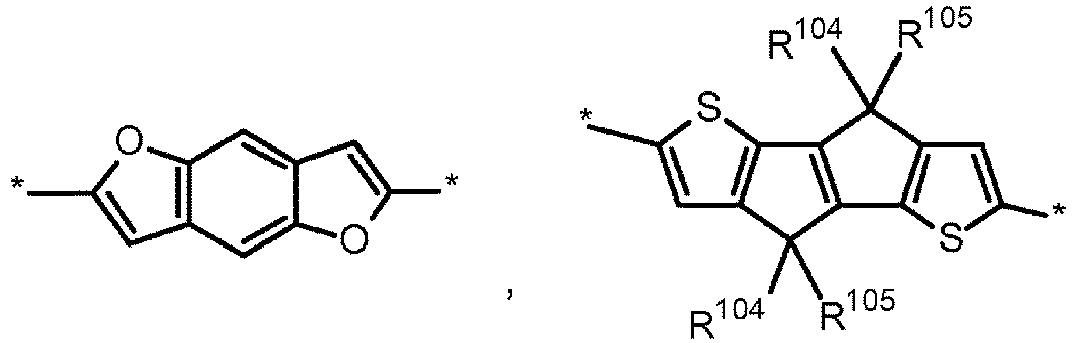

R104 und R105 unabhängig und bei jedem Auftreten aus der Gruppe bestehend aus H, C1-20-Alkyl, C2-20-Alkenyl, C2-20-Alkinyl, C5-8-Cycloalkyl, C6-14-Aryl und 5- bis 14-gliedrigem Heteroaryl ausgewählt sind oder R104 und R105 dann, wenn sie an dasselbe Atom gebunden sind, zusammen mit dem Atom, an das sie gebunden sind, ein 5- bis 12-gliedriges Ringsystem bilden,
wobeiC1-20-Alkyl, C2-20-Alkenyl und C2-20-Alkinyl durch einen bis fünf Substituenten, die aus der Gruppe bestehend aus C5-6-Cycloalkyl, C6-10-Aryl, 5- bis 10-gliedrigem Heteroaryl, ORs, OC(O)-Rt, C(O)-ORs, C(O)-Rs, NRsRt, NRs-C(O)Rt, C(O)-NRsRt, N[C(O)Rs] [C(O)Rt], SRs, Halogen, CN und NO2 ausgewählt sind, substituiert sein können;C5-8-Cycloalkyl durch einen bis fünf Substituenten, die unabhängig aus der Gruppe bestehend aus C1-10-Alkyl, C2-10-Alkenyl, C2-10-Alkinyl, C5-6-Cycloalkyl, C6-10-Aryl, 5- bis 10-gliedrigem Heteroaryl, ORs, OC(O)-Rt, C(O)-ORs, C(O)-Rs, NRsRt, NRs-C (O)Rt, C(O)-NRsRt, N[C(O)Rs][C(O)Rt], SRs, Halogen, CN und NO2 ausgewählt sind, substituiert sein kann;C6-14-Aryl und 5- bis 14-gliedriges Heteroaryl durch einen bis fünf Substituenten, die unabhängig aus der Gruppe bestehend aus C1-10-Alkyl, C2-10-Alkenyl, C2-10-Alkinyl, C5-6-Cycloalkyl, C6-10-Aryl, 5- bis 10-gliedrigem Heteroaryl, ORs, OC(O)-Rt, C(O)-ORs, C(O)-Rs, NRsRt, NRs-C(O)Rt, C(O)-NRsRt, N[C(O)Rs][C(O)Rt], SRs, Halogen, CN und NO2 ausgewählt sind, substituiert sein können,5- bis 12-gliedriges Ringsystem durch einen bis fünf Substituenten, die unabhängig aus der Gruppe bestehend aus C1-10-Alkyl, C2-10-Alkenyl, C2-10-Alkinyl, C5-6-Cycloalkyl, C6-10-Aryl, 5- bis 10-gliedrigem Heteroaryl, ORs, OC(O)-Rt, C(O)-ORs, C(O)-Rs, NRsRt, NRs-C(O)Rt, C(O)-NRsRt, N[C(O)Rs][C(O)Rt], SRs, Halogen, CN und NO2 ausgewählt sind, substituiert sein kann,
wobei
Rs und Rt unabhängig aus der Gruppe bestehend aus H, C1-10-Alkyl, C2-10-Alkenyl und C2-10-Alkinyl ausgewählt sind,
wobei
C1-10-Alkyl, C2-10-Alkenyl und C2-10-Alkinyl durch einen bis fünf Substituenten, die aus der Gruppe bestehend aus Halogen, CN und NO2 ausgewählt sind, substituiert sein können,
wobei5- bis 20-gliedriges Heteroarylen durch einen bis sechs Substituenten R3, die bei jedem Auftreten aus der Gruppe bestehend aus C1-30-Alkyl und Halogen ausgewählt sind, substituiert sein können undund n und m wie in Anspruch 1 definiert sind.
wobei
wobei
R41 bei jedem Auftreten für C1-30-Alkyl steht, - Polymer nach Anspruch 7, wobei L1 und L2 unabhängig voneinander und bei jedem Auftreten für 5- bis 20-gliedriges Heteroarylen stehen,
wobei 5- bis 20-gliedriges Heteroarylen aus der Gruppe bestehend aus
5- bis 20-gliedriges Heteroarylen unsubstituiert ist. - Polymer nach den Ansprüchen 1-8, wobei
n für 0, 1 oder 2 steht und
m für 0, 1 oder 2 steht. - Verfahren zur Herstellung der Polymere nach Anspruch 1, wobei n für 0 steht und die Einheiten der Formel (1-I)

wobei das Verfahren den Schritt des Umsetzens einer Verbindung der Formel (2)
mit einer Verbindung der Formel (3)
L2 wie für die Verbindung der Formel (1-I) definiert ist und
Za und Zb unabhängig aus der Gruppe bestehend aus B (OZ1) (OZ2) , SnZ1Z2Z3,
umfasst. - Zwischenprodukte der Formel (2) und (2')
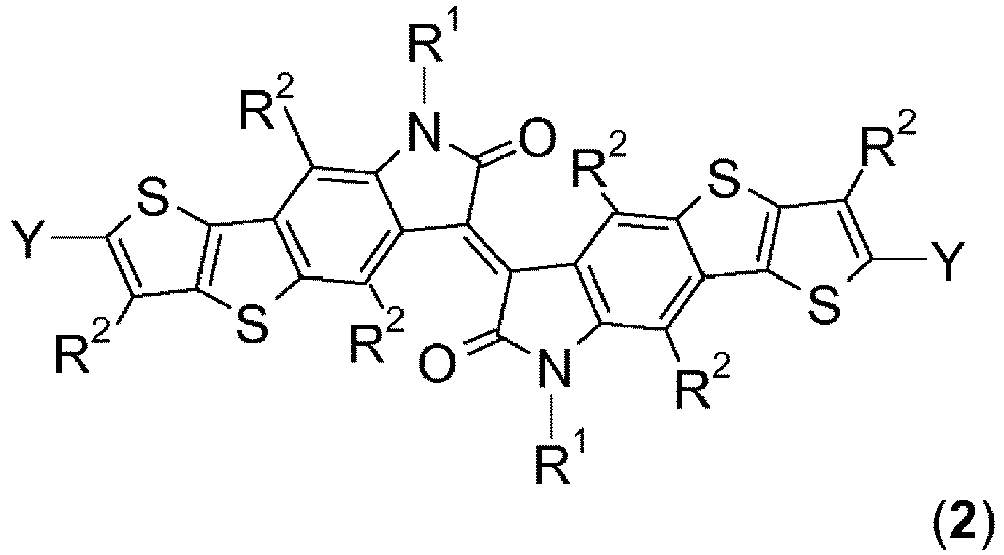
 R1 und R2 wie in Anspruch 1 definiert sind undY bei jedem Auftreten für I, Br, Cl oder O-S(O)2CF3 steht.
- Elektronische Vorrichtungen, umfassend ein Polymer nach einem der Ansprüche 1 bis 9.
- Elektronische Vorrichtung nach Anspruch 12, wobei es sich bei der elektronischen Vorrichtung um einen organischen Feldeffekttransistor handelt.
- Verwendung der Polymere nach einem der Ansprüche 1 bis 9 als halbleitendes Material.
Applications Claiming Priority (2)
| Application Number | Priority Date | Filing Date | Title |
|---|---|---|---|
| EP15151475 | 2015-01-16 | ||
| PCT/EP2016/050801 WO2016113403A1 (en) | 2015-01-16 | 2016-01-15 | Benzothienothiophene isoindigo polymers |
Publications (2)
| Publication Number | Publication Date |
|---|---|
| EP3245273A1 EP3245273A1 (de) | 2017-11-22 |
| EP3245273B1 true EP3245273B1 (de) | 2018-11-07 |
Family
ID=52345129
Family Applications (1)
| Application Number | Title | Priority Date | Filing Date |
|---|---|---|---|
| EP16700757.4A Not-in-force EP3245273B1 (de) | 2015-01-16 | 2016-01-15 | Benzothienothiophen-isoindigo-polymere |
Country Status (6)
| Country | Link |
|---|---|
| US (1) | US10669371B2 (de) |
| EP (1) | EP3245273B1 (de) |
| JP (1) | JP6713470B2 (de) |
| KR (1) | KR102410745B1 (de) |
| CN (1) | CN107109214B (de) |
| WO (1) | WO2016113403A1 (de) |
Families Citing this family (4)
| Publication number | Priority date | Publication date | Assignee | Title |
|---|---|---|---|---|
| EP3464415B1 (de) | 2016-05-25 | 2020-08-19 | Basf Se | Halbleiter |
| EP3551635B1 (de) * | 2016-12-06 | 2021-04-28 | Basf Se | Thieno-indeno-monomere und -polymere |
| CN110317210B (zh) * | 2018-03-30 | 2021-06-01 | 中国科学院化学研究所 | 平面茚并茚—二噻吩类光伏受体材料、其制备方法及应用 |
| CN112079996B (zh) * | 2020-09-18 | 2022-07-19 | 徐州工程学院 | 一种高平面n-型聚合物及其制备方法和用途 |
Family Cites Families (6)
| Publication number | Priority date | Publication date | Assignee | Title |
|---|---|---|---|---|
| DE3025771A1 (de) * | 1980-07-08 | 1982-02-04 | Basf Ag, 6700 Ludwigshafen | Verfahren zur herstellung elektrisch leitfaehiger loeslicher heteropolyphenylene und deren verwendung in der elektrotechnik und zur antistatischen ausruestung von kunststoffen |
| JP5460603B2 (ja) * | 2007-10-25 | 2014-04-02 | ビーエーエスエフ ソシエタス・ヨーロピア | 有機半導体としてのケトピロール類 |
| US8889825B2 (en) * | 2010-11-25 | 2014-11-18 | Ocean's King Lighting Science & Technology, Co., Ltd. | Conjugated polymer containing isoindigo units, preparation method and use thereof |
| US8613870B2 (en) * | 2012-01-27 | 2013-12-24 | Xerox Corporation | Isothioindigo-based polymers |
| EP2834284B1 (de) | 2012-04-02 | 2017-05-10 | Basf Se | Phenanthro[9,10-b]furanpolymere und kleine moleküle für elektronische anwendungen |
| CN106103436B (zh) * | 2014-03-17 | 2019-07-09 | 默克专利股份有限公司 | 有机半导体化合物 |
-
2016
- 2016-01-15 EP EP16700757.4A patent/EP3245273B1/de not_active Not-in-force
- 2016-01-15 US US15/543,637 patent/US10669371B2/en active Active
- 2016-01-15 WO PCT/EP2016/050801 patent/WO2016113403A1/en not_active Ceased
- 2016-01-15 JP JP2017537371A patent/JP6713470B2/ja not_active Expired - Fee Related
- 2016-01-15 CN CN201680005668.2A patent/CN107109214B/zh not_active Expired - Fee Related
- 2016-01-15 KR KR1020177022344A patent/KR102410745B1/ko not_active Expired - Fee Related
Non-Patent Citations (1)
| Title |
|---|
| None * |
Also Published As
| Publication number | Publication date |
|---|---|
| US10669371B2 (en) | 2020-06-02 |
| CN107109214A (zh) | 2017-08-29 |
| KR102410745B1 (ko) | 2022-06-20 |
| JP6713470B2 (ja) | 2020-06-24 |
| EP3245273A1 (de) | 2017-11-22 |
| CN107109214B (zh) | 2020-05-08 |
| KR20170106991A (ko) | 2017-09-22 |
| WO2016113403A1 (en) | 2016-07-21 |
| US20180009936A1 (en) | 2018-01-11 |
| JP2018504492A (ja) | 2018-02-15 |
Similar Documents
| Publication | Publication Date | Title |
|---|---|---|
| US10056551B2 (en) | Polycyclic aromatic hydrocarbon polymers and their use as organic semiconductors | |
| TWI551604B (zh) | 有機半導體組成物、有機薄膜及具備該有機薄膜之有機薄膜電晶體 | |
| EP3386989B1 (de) | Naphthoindacenodithiophene und polymere | |
| US11667650B2 (en) | Thieno-indeno-monomers and polymers | |
| US10669371B2 (en) | Benzothienothiophene isoindigo polymers | |
| EP3198614B1 (de) | Etherbasierte polymere als photovernetzbare dielektrika | |
| EP3166949B1 (de) | Thienothiophen-isoindigo | |
| Ie et al. | Perfluoroalkyl-annelated conjugated systems toward n-type organic semiconductors | |
| Lee et al. | Dicyanomethylene-quinoid vs. dicyanovinyl-benzenoid organic semiconductors: Understanding structure-property correlations in mesomerism-like forms | |
| US20100121004A1 (en) | Purification process for semiconducting monomers | |
| KR101046278B1 (ko) | 유기 반도체 물질 및 이를 포함하는 전자 소자 | |
| Lim et al. | Well-defined alternative polymer semiconductor using large size regioregular building blocks as monomers: electrical and electrochemical properties | |
| KR102568845B1 (ko) | 유기 반도체로서의 인다세노 유도체 |
Legal Events
| Date | Code | Title | Description |
|---|---|---|---|
| STAA | Information on the status of an ep patent application or granted ep patent |
Free format text: STATUS: THE INTERNATIONAL PUBLICATION HAS BEEN MADE |
|
| PUAI | Public reference made under article 153(3) epc to a published international application that has entered the european phase |
Free format text: ORIGINAL CODE: 0009012 |
|
| STAA | Information on the status of an ep patent application or granted ep patent |
Free format text: STATUS: REQUEST FOR EXAMINATION WAS MADE |
|
| 17P | Request for examination filed |
Effective date: 20170816 |
|
| AK | Designated contracting states |
Kind code of ref document: A1 Designated state(s): AL AT BE BG CH CY CZ DE DK EE ES FI FR GB GR HR HU IE IS IT LI LT LU LV MC MK MT NL NO PL PT RO RS SE SI SK SM TR |
|
| AX | Request for extension of the european patent |
Extension state: BA ME |
|
| DAV | Request for validation of the european patent (deleted) | ||
| DAX | Request for extension of the european patent (deleted) | ||
| GRAP | Despatch of communication of intention to grant a patent |
Free format text: ORIGINAL CODE: EPIDOSNIGR1 |
|
| STAA | Information on the status of an ep patent application or granted ep patent |
Free format text: STATUS: GRANT OF PATENT IS INTENDED |
|
| RIN1 | Information on inventor provided before grant (corrected) |
Inventor name: MCCULLOCH, IAIN Inventor name: HAYOZ, PASCAL Inventor name: KAELBLEIN, DANIEL Inventor name: YUE, WAN |
|
| INTG | Intention to grant announced |
Effective date: 20180612 |
|
| GRAS | Grant fee paid |
Free format text: ORIGINAL CODE: EPIDOSNIGR3 |
|
| GRAA | (expected) grant |
Free format text: ORIGINAL CODE: 0009210 |
|
| STAA | Information on the status of an ep patent application or granted ep patent |
Free format text: STATUS: THE PATENT HAS BEEN GRANTED |
|
| AK | Designated contracting states |
Kind code of ref document: B1 Designated state(s): AL AT BE BG CH CY CZ DE DK EE ES FI FR GB GR HR HU IE IS IT LI LT LU LV MC MK MT NL NO PL PT RO RS SE SI SK SM TR |
|
| REG | Reference to a national code |
Ref country code: GB Ref legal event code: FG4D |
|
| REG | Reference to a national code |
Ref country code: CH Ref legal event code: EP Ref country code: AT Ref legal event code: REF Ref document number: 1062052 Country of ref document: AT Kind code of ref document: T Effective date: 20181115 |
|
| REG | Reference to a national code |
Ref country code: DE Ref legal event code: R096 Ref document number: 602016006991 Country of ref document: DE |
|
| REG | Reference to a national code |
Ref country code: IE Ref legal event code: FG4D |
|
| REG | Reference to a national code |
Ref country code: NL Ref legal event code: MP Effective date: 20181107 |
|
| REG | Reference to a national code |
Ref country code: LT Ref legal event code: MG4D |
|
| REG | Reference to a national code |
Ref country code: AT Ref legal event code: MK05 Ref document number: 1062052 Country of ref document: AT Kind code of ref document: T Effective date: 20181107 |
|
| PG25 | Lapsed in a contracting state [announced via postgrant information from national office to epo] |
Ref country code: ES Free format text: LAPSE BECAUSE OF FAILURE TO SUBMIT A TRANSLATION OF THE DESCRIPTION OR TO PAY THE FEE WITHIN THE PRESCRIBED TIME-LIMIT Effective date: 20181107 Ref country code: IS Free format text: LAPSE BECAUSE OF FAILURE TO SUBMIT A TRANSLATION OF THE DESCRIPTION OR TO PAY THE FEE WITHIN THE PRESCRIBED TIME-LIMIT Effective date: 20190307 Ref country code: NO Free format text: LAPSE BECAUSE OF FAILURE TO SUBMIT A TRANSLATION OF THE DESCRIPTION OR TO PAY THE FEE WITHIN THE PRESCRIBED TIME-LIMIT Effective date: 20190207 Ref country code: AT Free format text: LAPSE BECAUSE OF FAILURE TO SUBMIT A TRANSLATION OF THE DESCRIPTION OR TO PAY THE FEE WITHIN THE PRESCRIBED TIME-LIMIT Effective date: 20181107 Ref country code: HR Free format text: LAPSE BECAUSE OF FAILURE TO SUBMIT A TRANSLATION OF THE DESCRIPTION OR TO PAY THE FEE WITHIN THE PRESCRIBED TIME-LIMIT Effective date: 20181107 Ref country code: LT Free format text: LAPSE BECAUSE OF FAILURE TO SUBMIT A TRANSLATION OF THE DESCRIPTION OR TO PAY THE FEE WITHIN THE PRESCRIBED TIME-LIMIT Effective date: 20181107 Ref country code: BG Free format text: LAPSE BECAUSE OF FAILURE TO SUBMIT A TRANSLATION OF THE DESCRIPTION OR TO PAY THE FEE WITHIN THE PRESCRIBED TIME-LIMIT Effective date: 20190207 Ref country code: FI Free format text: LAPSE BECAUSE OF FAILURE TO SUBMIT A TRANSLATION OF THE DESCRIPTION OR TO PAY THE FEE WITHIN THE PRESCRIBED TIME-LIMIT Effective date: 20181107 Ref country code: LV Free format text: LAPSE BECAUSE OF FAILURE TO SUBMIT A TRANSLATION OF THE DESCRIPTION OR TO PAY THE FEE WITHIN THE PRESCRIBED TIME-LIMIT Effective date: 20181107 |
|
| PG25 | Lapsed in a contracting state [announced via postgrant information from national office to epo] |
Ref country code: AL Free format text: LAPSE BECAUSE OF FAILURE TO SUBMIT A TRANSLATION OF THE DESCRIPTION OR TO PAY THE FEE WITHIN THE PRESCRIBED TIME-LIMIT Effective date: 20181107 Ref country code: SE Free format text: LAPSE BECAUSE OF FAILURE TO SUBMIT A TRANSLATION OF THE DESCRIPTION OR TO PAY THE FEE WITHIN THE PRESCRIBED TIME-LIMIT Effective date: 20181107 Ref country code: RS Free format text: LAPSE BECAUSE OF FAILURE TO SUBMIT A TRANSLATION OF THE DESCRIPTION OR TO PAY THE FEE WITHIN THE PRESCRIBED TIME-LIMIT Effective date: 20181107 Ref country code: NL Free format text: LAPSE BECAUSE OF FAILURE TO SUBMIT A TRANSLATION OF THE DESCRIPTION OR TO PAY THE FEE WITHIN THE PRESCRIBED TIME-LIMIT Effective date: 20181107 Ref country code: GR Free format text: LAPSE BECAUSE OF FAILURE TO SUBMIT A TRANSLATION OF THE DESCRIPTION OR TO PAY THE FEE WITHIN THE PRESCRIBED TIME-LIMIT Effective date: 20190208 Ref country code: PT Free format text: LAPSE BECAUSE OF FAILURE TO SUBMIT A TRANSLATION OF THE DESCRIPTION OR TO PAY THE FEE WITHIN THE PRESCRIBED TIME-LIMIT Effective date: 20190307 |
|
| PG25 | Lapsed in a contracting state [announced via postgrant information from national office to epo] |
Ref country code: CZ Free format text: LAPSE BECAUSE OF FAILURE TO SUBMIT A TRANSLATION OF THE DESCRIPTION OR TO PAY THE FEE WITHIN THE PRESCRIBED TIME-LIMIT Effective date: 20181107 Ref country code: PL Free format text: LAPSE BECAUSE OF FAILURE TO SUBMIT A TRANSLATION OF THE DESCRIPTION OR TO PAY THE FEE WITHIN THE PRESCRIBED TIME-LIMIT Effective date: 20181107 Ref country code: DK Free format text: LAPSE BECAUSE OF FAILURE TO SUBMIT A TRANSLATION OF THE DESCRIPTION OR TO PAY THE FEE WITHIN THE PRESCRIBED TIME-LIMIT Effective date: 20181107 |
|
| REG | Reference to a national code |
Ref country code: DE Ref legal event code: R097 Ref document number: 602016006991 Country of ref document: DE |
|
| PG25 | Lapsed in a contracting state [announced via postgrant information from national office to epo] |
Ref country code: EE Free format text: LAPSE BECAUSE OF FAILURE TO SUBMIT A TRANSLATION OF THE DESCRIPTION OR TO PAY THE FEE WITHIN THE PRESCRIBED TIME-LIMIT Effective date: 20181107 Ref country code: SM Free format text: LAPSE BECAUSE OF FAILURE TO SUBMIT A TRANSLATION OF THE DESCRIPTION OR TO PAY THE FEE WITHIN THE PRESCRIBED TIME-LIMIT Effective date: 20181107 Ref country code: RO Free format text: LAPSE BECAUSE OF FAILURE TO SUBMIT A TRANSLATION OF THE DESCRIPTION OR TO PAY THE FEE WITHIN THE PRESCRIBED TIME-LIMIT Effective date: 20181107 Ref country code: MC Free format text: LAPSE BECAUSE OF FAILURE TO SUBMIT A TRANSLATION OF THE DESCRIPTION OR TO PAY THE FEE WITHIN THE PRESCRIBED TIME-LIMIT Effective date: 20181107 Ref country code: SK Free format text: LAPSE BECAUSE OF FAILURE TO SUBMIT A TRANSLATION OF THE DESCRIPTION OR TO PAY THE FEE WITHIN THE PRESCRIBED TIME-LIMIT Effective date: 20181107 |
|
| REG | Reference to a national code |
Ref country code: CH Ref legal event code: PL |
|
| PLBE | No opposition filed within time limit |
Free format text: ORIGINAL CODE: 0009261 |
|
| STAA | Information on the status of an ep patent application or granted ep patent |
Free format text: STATUS: NO OPPOSITION FILED WITHIN TIME LIMIT |
|
| PG25 | Lapsed in a contracting state [announced via postgrant information from national office to epo] |
Ref country code: LU Free format text: LAPSE BECAUSE OF NON-PAYMENT OF DUE FEES Effective date: 20190115 |
|
| 26N | No opposition filed |
Effective date: 20190808 |
|
| REG | Reference to a national code |
Ref country code: BE Ref legal event code: MM Effective date: 20190131 |
|
| REG | Reference to a national code |
Ref country code: IE Ref legal event code: MM4A |
|
| PG25 | Lapsed in a contracting state [announced via postgrant information from national office to epo] |
Ref country code: SI Free format text: LAPSE BECAUSE OF FAILURE TO SUBMIT A TRANSLATION OF THE DESCRIPTION OR TO PAY THE FEE WITHIN THE PRESCRIBED TIME-LIMIT Effective date: 20181107 |
|
| PG25 | Lapsed in a contracting state [announced via postgrant information from national office to epo] |
Ref country code: BE Free format text: LAPSE BECAUSE OF NON-PAYMENT OF DUE FEES Effective date: 20190131 |
|
| PG25 | Lapsed in a contracting state [announced via postgrant information from national office to epo] |
Ref country code: LI Free format text: LAPSE BECAUSE OF NON-PAYMENT OF DUE FEES Effective date: 20190131 Ref country code: CH Free format text: LAPSE BECAUSE OF NON-PAYMENT OF DUE FEES Effective date: 20190131 |
|
| PG25 | Lapsed in a contracting state [announced via postgrant information from national office to epo] |
Ref country code: IE Free format text: LAPSE BECAUSE OF NON-PAYMENT OF DUE FEES Effective date: 20190115 |
|
| PG25 | Lapsed in a contracting state [announced via postgrant information from national office to epo] |
Ref country code: TR Free format text: LAPSE BECAUSE OF FAILURE TO SUBMIT A TRANSLATION OF THE DESCRIPTION OR TO PAY THE FEE WITHIN THE PRESCRIBED TIME-LIMIT Effective date: 20181107 |
|
| PG25 | Lapsed in a contracting state [announced via postgrant information from national office to epo] |
Ref country code: MT Free format text: LAPSE BECAUSE OF NON-PAYMENT OF DUE FEES Effective date: 20190115 |
|
| REG | Reference to a national code |
Ref country code: DE Ref legal event code: R081 Ref document number: 602016006991 Country of ref document: DE Owner name: CLAP CO., LTD., KR Free format text: FORMER OWNER: BASF SE, 67063 LUDWIGSHAFEN, DE |
|
| REG | Reference to a national code |
Ref country code: GB Ref legal event code: 732E Free format text: REGISTERED BETWEEN 20210121 AND 20210127 |
|
| PG25 | Lapsed in a contracting state [announced via postgrant information from national office to epo] |
Ref country code: CY Free format text: LAPSE BECAUSE OF FAILURE TO SUBMIT A TRANSLATION OF THE DESCRIPTION OR TO PAY THE FEE WITHIN THE PRESCRIBED TIME-LIMIT Effective date: 20181107 |
|
| PG25 | Lapsed in a contracting state [announced via postgrant information from national office to epo] |
Ref country code: HU Free format text: LAPSE BECAUSE OF FAILURE TO SUBMIT A TRANSLATION OF THE DESCRIPTION OR TO PAY THE FEE WITHIN THE PRESCRIBED TIME-LIMIT; INVALID AB INITIO Effective date: 20160115 |
|
| PG25 | Lapsed in a contracting state [announced via postgrant information from national office to epo] |
Ref country code: MK Free format text: LAPSE BECAUSE OF FAILURE TO SUBMIT A TRANSLATION OF THE DESCRIPTION OR TO PAY THE FEE WITHIN THE PRESCRIBED TIME-LIMIT Effective date: 20181107 |
|
| PGFP | Annual fee paid to national office [announced via postgrant information from national office to epo] |
Ref country code: IT Payment date: 20230110 Year of fee payment: 8 |
|
| PGFP | Annual fee paid to national office [announced via postgrant information from national office to epo] |
Ref country code: FR Payment date: 20231229 Year of fee payment: 9 |
|
| PGFP | Annual fee paid to national office [announced via postgrant information from national office to epo] |
Ref country code: DE Payment date: 20231229 Year of fee payment: 9 Ref country code: GB Payment date: 20240108 Year of fee payment: 9 |
|
| PG25 | Lapsed in a contracting state [announced via postgrant information from national office to epo] |
Ref country code: IT Free format text: LAPSE BECAUSE OF NON-PAYMENT OF DUE FEES Effective date: 20240115 |
|
| REG | Reference to a national code |
Ref country code: DE Ref legal event code: R119 Ref document number: 602016006991 Country of ref document: DE |
|
| GBPC | Gb: european patent ceased through non-payment of renewal fee |
Effective date: 20250115 |
|
| PG25 | Lapsed in a contracting state [announced via postgrant information from national office to epo] |
Ref country code: DE Free format text: LAPSE BECAUSE OF NON-PAYMENT OF DUE FEES Effective date: 20250801 |
|
| PG25 | Lapsed in a contracting state [announced via postgrant information from national office to epo] |
Ref country code: GB Free format text: LAPSE BECAUSE OF NON-PAYMENT OF DUE FEES Effective date: 20250115 |
|
| PG25 | Lapsed in a contracting state [announced via postgrant information from national office to epo] |
Ref country code: FR Free format text: LAPSE BECAUSE OF NON-PAYMENT OF DUE FEES Effective date: 20250131 |