EP3243069B1 - Laser-basierte ir-spektroskopie für die messung von schwefeltrioxid im abgas von gaskraftwerken - Google Patents
Laser-basierte ir-spektroskopie für die messung von schwefeltrioxid im abgas von gaskraftwerken Download PDFInfo
- Publication number
- EP3243069B1 EP3243069B1 EP16706343.7A EP16706343A EP3243069B1 EP 3243069 B1 EP3243069 B1 EP 3243069B1 EP 16706343 A EP16706343 A EP 16706343A EP 3243069 B1 EP3243069 B1 EP 3243069B1
- Authority
- EP
- European Patent Office
- Prior art keywords
- sulfur trioxide
- gas
- absorption
- measurement
- measuring system
- Prior art date
- Legal status (The legal status is an assumption and is not a legal conclusion. Google has not performed a legal analysis and makes no representation as to the accuracy of the status listed.)
- Active
Links
- AKEJUJNQAAGONA-UHFFFAOYSA-N sulfur trioxide Chemical compound O=S(=O)=O AKEJUJNQAAGONA-UHFFFAOYSA-N 0.000 title claims description 150
- 238000004566 IR spectroscopy Methods 0.000 title 1
- 239000007789 gas Substances 0.000 claims description 95
- 238000010521 absorption reaction Methods 0.000 claims description 54
- 238000000034 method Methods 0.000 claims description 28
- 238000005259 measurement Methods 0.000 claims description 27
- QAOWNCQODCNURD-UHFFFAOYSA-N Sulfuric acid Chemical compound OS(O)(=O)=O QAOWNCQODCNURD-UHFFFAOYSA-N 0.000 claims description 26
- 238000011084 recovery Methods 0.000 claims description 24
- 238000001228 spectrum Methods 0.000 claims description 14
- 230000005540 biological transmission Effects 0.000 claims description 9
- 238000001514 detection method Methods 0.000 claims description 7
- 230000003595 spectral effect Effects 0.000 claims description 7
- 238000004611 spectroscopical analysis Methods 0.000 claims description 6
- 238000011156 evaluation Methods 0.000 claims description 5
- 239000002245 particle Substances 0.000 claims description 5
- 230000002452 interceptive effect Effects 0.000 claims description 3
- 241000218737 Mycobacterium phage Power Species 0.000 claims 1
- 230000009102 absorption Effects 0.000 description 47
- RAHZWNYVWXNFOC-UHFFFAOYSA-N Sulphur dioxide Chemical compound O=S=O RAHZWNYVWXNFOC-UHFFFAOYSA-N 0.000 description 41
- 239000000523 sample Substances 0.000 description 18
- 238000006243 chemical reaction Methods 0.000 description 6
- UGFAIRIUMAVXCW-UHFFFAOYSA-N Carbon monoxide Chemical compound [O+]#[C-] UGFAIRIUMAVXCW-UHFFFAOYSA-N 0.000 description 5
- 238000005260 corrosion Methods 0.000 description 5
- 230000007797 corrosion Effects 0.000 description 5
- NINIDFKCEFEMDL-UHFFFAOYSA-N Sulfur Chemical compound [S] NINIDFKCEFEMDL-UHFFFAOYSA-N 0.000 description 4
- 239000003546 flue gas Substances 0.000 description 4
- VNWKTOKETHGBQD-UHFFFAOYSA-N methane Chemical compound C VNWKTOKETHGBQD-UHFFFAOYSA-N 0.000 description 4
- 238000005070 sampling Methods 0.000 description 4
- 229910052717 sulfur Inorganic materials 0.000 description 4
- 239000011593 sulfur Substances 0.000 description 4
- XLYOFNOQVPJJNP-UHFFFAOYSA-N water Substances O XLYOFNOQVPJJNP-UHFFFAOYSA-N 0.000 description 4
- 239000002253 acid Substances 0.000 description 3
- 230000003993 interaction Effects 0.000 description 3
- 238000000691 measurement method Methods 0.000 description 3
- 230000001105 regulatory effect Effects 0.000 description 3
- VYPSYNLAJGMNEJ-UHFFFAOYSA-N Silicium dioxide Chemical compound O=[Si]=O VYPSYNLAJGMNEJ-UHFFFAOYSA-N 0.000 description 2
- 238000004364 calculation method Methods 0.000 description 2
- 239000003054 catalyst Substances 0.000 description 2
- 230000007423 decrease Effects 0.000 description 2
- 238000013461 design Methods 0.000 description 2
- 238000001983 electron spin resonance imaging Methods 0.000 description 2
- 238000005516 engineering process Methods 0.000 description 2
- 239000002737 fuel gas Substances 0.000 description 2
- 238000011065 in-situ storage Methods 0.000 description 2
- 238000001307 laser spectroscopy Methods 0.000 description 2
- 239000003345 natural gas Substances 0.000 description 2
- 239000011148 porous material Substances 0.000 description 2
- 238000000926 separation method Methods 0.000 description 2
- 238000004088 simulation Methods 0.000 description 2
- 239000002918 waste heat Substances 0.000 description 2
- 239000004809 Teflon Substances 0.000 description 1
- 229920006362 Teflon® Polymers 0.000 description 1
- 238000004458 analytical method Methods 0.000 description 1
- 238000013459 approach Methods 0.000 description 1
- QVGXLLKOCUKJST-UHFFFAOYSA-N atomic oxygen Chemical compound [O] QVGXLLKOCUKJST-UHFFFAOYSA-N 0.000 description 1
- 230000015572 biosynthetic process Effects 0.000 description 1
- 229910052799 carbon Inorganic materials 0.000 description 1
- 229910002091 carbon monoxide Inorganic materials 0.000 description 1
- 230000003197 catalytic effect Effects 0.000 description 1
- 238000006555 catalytic reaction Methods 0.000 description 1
- 239000007809 chemical reaction catalyst Substances 0.000 description 1
- 239000003245 coal Substances 0.000 description 1
- 239000011248 coating agent Substances 0.000 description 1
- 238000000576 coating method Methods 0.000 description 1
- 238000002485 combustion reaction Methods 0.000 description 1
- 238000009833 condensation Methods 0.000 description 1
- 230000005494 condensation Effects 0.000 description 1
- 230000003750 conditioning effect Effects 0.000 description 1
- 230000001276 controlling effect Effects 0.000 description 1
- 238000012937 correction Methods 0.000 description 1
- 238000001035 drying Methods 0.000 description 1
- 230000000694 effects Effects 0.000 description 1
- 238000011835 investigation Methods 0.000 description 1
- 239000000203 mixture Substances 0.000 description 1
- 229910052760 oxygen Inorganic materials 0.000 description 1
- 239000001301 oxygen Substances 0.000 description 1
- 229920001343 polytetrafluoroethylene Polymers 0.000 description 1
- 239000004810 polytetrafluoroethylene Substances 0.000 description 1
- 239000004065 semiconductor Substances 0.000 description 1
- 230000035945 sensitivity Effects 0.000 description 1
- 239000000377 silicon dioxide Substances 0.000 description 1
- 238000001179 sorption measurement Methods 0.000 description 1
- 229910001220 stainless steel Inorganic materials 0.000 description 1
- 239000010935 stainless steel Substances 0.000 description 1
- 239000000126 substance Substances 0.000 description 1
- 230000001629 suppression Effects 0.000 description 1
- 230000002123 temporal effect Effects 0.000 description 1
Images


Classifications
-
- G—PHYSICS
- G01—MEASURING; TESTING
- G01N—INVESTIGATING OR ANALYSING MATERIALS BY DETERMINING THEIR CHEMICAL OR PHYSICAL PROPERTIES
- G01N21/00—Investigating or analysing materials by the use of optical means, i.e. using sub-millimetre waves, infrared, visible or ultraviolet light
- G01N21/17—Systems in which incident light is modified in accordance with the properties of the material investigated
- G01N21/25—Colour; Spectral properties, i.e. comparison of effect of material on the light at two or more different wavelengths or wavelength bands
- G01N21/31—Investigating relative effect of material at wavelengths characteristic of specific elements or molecules, e.g. atomic absorption spectrometry
- G01N21/35—Investigating relative effect of material at wavelengths characteristic of specific elements or molecules, e.g. atomic absorption spectrometry using infrared light
- G01N21/3504—Investigating relative effect of material at wavelengths characteristic of specific elements or molecules, e.g. atomic absorption spectrometry using infrared light for analysing gases, e.g. multi-gas analysis
- G01N21/3518—Devices using gas filter correlation techniques; Devices using gas pressure modulation techniques
-
- G—PHYSICS
- G01—MEASURING; TESTING
- G01N—INVESTIGATING OR ANALYSING MATERIALS BY DETERMINING THEIR CHEMICAL OR PHYSICAL PROPERTIES
- G01N21/00—Investigating or analysing materials by the use of optical means, i.e. using sub-millimetre waves, infrared, visible or ultraviolet light
- G01N21/17—Systems in which incident light is modified in accordance with the properties of the material investigated
- G01N21/25—Colour; Spectral properties, i.e. comparison of effect of material on the light at two or more different wavelengths or wavelength bands
- G01N21/31—Investigating relative effect of material at wavelengths characteristic of specific elements or molecules, e.g. atomic absorption spectrometry
- G01N21/39—Investigating relative effect of material at wavelengths characteristic of specific elements or molecules, e.g. atomic absorption spectrometry using tunable lasers
-
- G—PHYSICS
- G01—MEASURING; TESTING
- G01N—INVESTIGATING OR ANALYSING MATERIALS BY DETERMINING THEIR CHEMICAL OR PHYSICAL PROPERTIES
- G01N21/00—Investigating or analysing materials by the use of optical means, i.e. using sub-millimetre waves, infrared, visible or ultraviolet light
- G01N21/01—Arrangements or apparatus for facilitating the optical investigation
- G01N21/03—Cuvette constructions
- G01N21/031—Multipass arrangements
-
- G—PHYSICS
- G01—MEASURING; TESTING
- G01N—INVESTIGATING OR ANALYSING MATERIALS BY DETERMINING THEIR CHEMICAL OR PHYSICAL PROPERTIES
- G01N21/00—Investigating or analysing materials by the use of optical means, i.e. using sub-millimetre waves, infrared, visible or ultraviolet light
- G01N21/17—Systems in which incident light is modified in accordance with the properties of the material investigated
- G01N21/25—Colour; Spectral properties, i.e. comparison of effect of material on the light at two or more different wavelengths or wavelength bands
- G01N21/31—Investigating relative effect of material at wavelengths characteristic of specific elements or molecules, e.g. atomic absorption spectrometry
- G01N21/35—Investigating relative effect of material at wavelengths characteristic of specific elements or molecules, e.g. atomic absorption spectrometry using infrared light
- G01N21/3504—Investigating relative effect of material at wavelengths characteristic of specific elements or molecules, e.g. atomic absorption spectrometry using infrared light for analysing gases, e.g. multi-gas analysis
-
- G—PHYSICS
- G01—MEASURING; TESTING
- G01N—INVESTIGATING OR ANALYSING MATERIALS BY DETERMINING THEIR CHEMICAL OR PHYSICAL PROPERTIES
- G01N33/00—Investigating or analysing materials by specific methods not covered by groups G01N1/00 - G01N31/00
- G01N33/0004—Gaseous mixtures, e.g. polluted air
- G01N33/0009—General constructional details of gas analysers, e.g. portable test equipment
- G01N33/0027—General constructional details of gas analysers, e.g. portable test equipment concerning the detector
- G01N33/0036—General constructional details of gas analysers, e.g. portable test equipment concerning the detector specially adapted to detect a particular component
- G01N33/0042—SO2 or SO3
-
- G—PHYSICS
- G01—MEASURING; TESTING
- G01N—INVESTIGATING OR ANALYSING MATERIALS BY DETERMINING THEIR CHEMICAL OR PHYSICAL PROPERTIES
- G01N21/00—Investigating or analysing materials by the use of optical means, i.e. using sub-millimetre waves, infrared, visible or ultraviolet light
- G01N21/17—Systems in which incident light is modified in accordance with the properties of the material investigated
- G01N21/25—Colour; Spectral properties, i.e. comparison of effect of material on the light at two or more different wavelengths or wavelength bands
- G01N21/31—Investigating relative effect of material at wavelengths characteristic of specific elements or molecules, e.g. atomic absorption spectrometry
- G01N21/39—Investigating relative effect of material at wavelengths characteristic of specific elements or molecules, e.g. atomic absorption spectrometry using tunable lasers
- G01N2021/391—Intracavity sample
-
- G—PHYSICS
- G01—MEASURING; TESTING
- G01N—INVESTIGATING OR ANALYSING MATERIALS BY DETERMINING THEIR CHEMICAL OR PHYSICAL PROPERTIES
- G01N21/00—Investigating or analysing materials by the use of optical means, i.e. using sub-millimetre waves, infrared, visible or ultraviolet light
- G01N21/17—Systems in which incident light is modified in accordance with the properties of the material investigated
- G01N21/25—Colour; Spectral properties, i.e. comparison of effect of material on the light at two or more different wavelengths or wavelength bands
- G01N21/31—Investigating relative effect of material at wavelengths characteristic of specific elements or molecules, e.g. atomic absorption spectrometry
- G01N21/39—Investigating relative effect of material at wavelengths characteristic of specific elements or molecules, e.g. atomic absorption spectrometry using tunable lasers
- G01N2021/396—Type of laser source
- G01N2021/399—Diode laser
Definitions
- the invention relates to a method for determining a sulfur trioxide content in a gas and to a method for operating a power plant with a gas turbine and with a heat recovery steam generator.
- the invention further relates to a measuring system for determining a sulfur trioxide content in a gas, as well as a power plant with a gas turbine to a heat recovery steam generator.
- sulfur dioxide is partly further converted to sulfur trioxide (SO 3 ): SO 2 + 1 / 2O 2 ⁇ SO 3 .
- SO 3 sulfur trioxide
- the resulting sulfur dioxide and sulfur trioxide concentrations in the exhaust gas are in any case at first comparatively small. Nevertheless, the sulfur trioxide concentration should be determined or at least estimated with respect to possible sulfuric acid formation and its negative effects on the cold end of a waste heat steam generator of a gas and steam turbine plant, since sulfur trioxide with water (H 2 O) to sulfuric acid (H 2 SO 4 ) reacts: SO 3 + H 2 O ⁇ H 2 SO 4
- the sulfuric acid condenses when falling below the sulfuric acid dew point and leads to corrosion.
- determination or estimation of the sulfur trioxide content is not very easy since the conversion rate is a function of various parameters.
- One measure to avoid sulfuric acid is to ensure that the temperature of the condensate preheater in the heat recovery steam generator is permanently above the sulfuric acid dew point.
- the temperature of the condensate preheater should be as low as possible.
- the minimum temperature of the flue gas in the heat recovery steam generator of a combined cycle power plant is chosen so high by appropriate design of the heat recovery steam generator and a correspondingly high condensate flow temperature that sufficient security is available to not fall below the acid dew point of sulfuric acid in any case (eg 10 K above the expected dew point). Due to the "safety margin", the exhaust gas in the heat recovery steam generator is not cooled as far as theoretically possible without the occurrence of sulfuric acid corrosion. As a result, if necessary heat in the range of several MW "given away", the efficiency of the combined cycle power plant decreases. It would therefore be desirable to be able to more accurately determine the sulfur trioxide content in the exhaust gas.
- the sulfur trioxide content or sulfuric acid content of the exhaust gas can be determined by sampling and chemical analysis in the laboratory. But such a process is slow, complex and expensive [Continuous Measurement Technologies for SO 3 and H 2 SO 4 in Coal-Fired Power Plants, EPRI, Palo Alto, CA: 2004. 1,009,812th].
- the sulfur content in coal in coal-fired power plants leads to sulfur trioxide concentrations in the exhaust gas of 1 to 100 ppm. For this concentration range, there are probes that determine the sulfuric acid content in situ by the process of controlled condensation 3 and H 2 SO [Continuous Measurement Technologies for SO 4 in Coal-Fired Power Plants, EPRI, Palo Alto, CA: 2004. 1,009,812th ].
- the sulfur trioxide concentrations expected in the exhaust gas of a gas-fired power plant are in the 10 to 1000 ppb range.
- the object of the invention is therefore to provide a method for determining a sulfur trioxide content in a gas, in particular in an exhaust gas of a gas turbine, so that the temperature at the cold end of a heat recovery steam generator can be kept as low as possible to increase the efficiency of a power plant.
- Another object of the invention is to provide a method for operating a power plant with a gas turbine and with a heat recovery steam generator.
- the object of the invention is also to provide a corresponding measuring system for determining a sulfur trioxide content in a gas or a corresponding power plant.
- the invention solves the problem directed to a method for determining a sulfur trioxide content in a gas by providing that in such a method in which a sample of the gas is withdrawn and a gas pressure of the sample is reduced and with a wavenumber tunable monochrome source of light on the sample is subjected to a wavenumber-resolved transmission measurement and from the measurement a sulfur trioxide content is derived, the measurement in the sulfur trioxide absorption band between 1360 and 1410 cm -1 , in a window around the sulfur trioxide absorption at 1365.49 cm -1 , utilizing this sulfur trioxide absorption.
- Spectroscopy is typically used with tunable semiconductor lasers.
- a wavenumber-resolved transmission measurement is performed.
- the transmitted light is picked up by a photodetector.
- the spectral measurement takes place in an extractive system, ie the gas is taken from a sample and fed to a measuring cell.
- the gas is kept at a reduced pressure in order to reduce the line width of the absorption lines and thus in the first place to enable the separation of the spectra of the individual gases.
- the water absorption overlaps most of the sulfur trioxide band, thus preventing selective measurement of sulfur trioxide concentration in the low concentration range.
- the absorption of sulfur trioxide in the target wavenumber window has at least a factor of 2 greater amplitude and a slimmer shape than that of the adjacent sulfur trioxide absorptions compared to the neighboring lines.
- the greater absorption facilitates the realization of a low detection limit
- the narrow line facilitates the selection against the potentially interfering absorptions of the other exhaust gas components.
- the remaining exhaust gas components in the existing concentration range lead only to a slight disturbance of the sulfur trioxide spectrum.
- wavelength modulation spectroscopy with detection of the second harmonic (or also higher harmonics), because this technique minimizes the influence of neighboring lines on the spectrum of the target gas.
- WMS wavelength modulation spectroscopy
- a partial overlay of the absorption line of sulfur trioxide with sulfur dioxide occurs.
- an absorption distance is a maximum of 15 m, preferably a maximum of 10 m, in particular a maximum of 5 m.
- an absorption at 1 ppm in the 1% range is achieved.
- concentrations of interfering gases in the model either as known values resulting from a second independent measurement method or as fit parameters are included.
- the object directed to a method for operating a power plant with a gas turbine and a heat recovery steam generator is achieved by determining a sulfur trioxide content in the exhaust gas of the gas turbine and adjusting an exhaust gas temperature in the heat recovery steam generator based on the sulfur trioxide content such that a sulfuric acid dew point in the Heat recovery steam generator is not undershot.
- the object directed to a measuring system for determining a sulfur trioxide content in a gas is achieved by a measuring system for determining a sulfur trioxide content in a gas, comprising a first gas line from a gas sampling point to a measuring cell, a pressure regulating device for the measuring cell, a wavenumber tunable monochromatic light source in the range of a sulfur trioxide absorption band, a controller for carrying out a transmission measurement in the measuring cell, and an evaluation unit for determining the sulfur trioxide content, wherein the light source is suitable, monochromatic light between 1360 and 1410 cm -1 , in a window to produce the sulfur trioxide absorption at 1365.49 cm -1 .
- the pressure regulating device comprises a pressure regulator and a vacuum pump, which are connected via a second gas line to the measuring cell.
- At least one of the two, first gas line and measuring cell can be heated.
- the line intensity can be increased over room temperature or at the branch point, and the accuracy of detection of sulfur trioxide can be improved.
- the measuring system comprises a particle filter connected in the first gas line.
- the measuring system expediently comprises a throttle device connected in the first gas line.
- the throttle device follows in the flow direction of the gas to the filter.
- the throttle device may be a simple throttle or, alternatively, a mass flow controller that provides the desired throughput under vacuum operation.
- the measuring cell is a Langwegzelle with a multiply folded beam path having an absorption distance of 5 to 15 m, preferably 7 to 12 m.
- a power plant with a gas turbine and a heat recovery steam generator also comprises such a measuring system.
- the measurement method is best suited for natural gas fired power plants where sulfur dioxide concentrations ⁇ 5 ppm only occur.
- the measurement method is also applicable to oil-fired power plants where sulfur dioxide concentrations ⁇ 50 ppm occur.
- the accuracy of the sulfur trioxide measurement will decrease as the correction of sulfur trioxide absorption with sulfur dioxide absorption becomes more difficult.
- the simulation of the absorption intensity with the data of the HITRAN database yields Room temperature has an absorption strength of 1%.
- the HITRAN database data do not allow the calculation of spectra at elevated temperature for sulfur trioxide.
- An estimate with the available data results in an increase of the absorption by a factor of 2 to 3 at 200 ° C. That is, the absorption strength between the absorption at 1365.49 cm -1 and the range around 1397 cm -1 differs by an order of magnitude, which affects the achievable detection sensitivity.
- the sulfur trioxide concentration in the flue gas is now measured directly and used for setting / regulating the condensate flow temperature.
- the flue gas in the heat recovery steam generator can now be cooled much further, whereby more steam can be generated.
- the efficiency of the combined cycle power plant is increasing.
- it is ensured by controlling the condensate flow temperature that the temperature of the exhaust gas is always above the acid dew point and acid corrosion can not occur. This means increased security compared to the previous procedure (As safety margins with very inaccurate estimation of sulfur trioxide concentration offer no guarantee that the surcharge was also high enough - for example, with temporal fluctuations in the sulfur content in the fuel gas of the gas turbine, which is the operator in general only guaranteed as a monthly average.
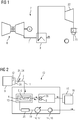
- FIG. 1 shows schematically and by way of example a power plant 7, in particular a gas and steam turbine plant.
- a power plant 7 in particular a gas and steam turbine plant.
- steam for the operation of the steam turbine 22 is generated in the gas turbine 8 downstream heat recovery steam generator.
- steam turbine 22 more relaxed Steam is condensed in the condenser 23 and fed to the waste heat steam generator 9 again.
- FIG. 2 shows a measuring system 10 according to the invention.
- the gas is removed from the heat recovery steam generator 9 at a suitable gas sampling point 12 (at the point where the lowest temperature is expected).
- the sample 2 ie the measuring gas
- the sample 2 first passes a particle filter 20 with a suitable pore size which withstands the operating conditions at the place of use.
- a particle filter 20 with a suitable pore size which withstands the operating conditions at the place of use.
- a PTFE filter which is temperature-stable up to 260 ° C and is supplied with different pore sizes.
- the filter 20 is followed by a throttle device 21, for example a simple throttle or alternatively a mass flow controller 24, which provides the desired throughput at low pressure operation.
- a first gas line 11 from the gas sampling point 12 to the measuring cell 13 should be flexible because of the thermal expansion of the heat recovery steam generator 9, heated to 200 ° C and as short as possible to keep the residence time of the sample 2 low.
- Inert surfaces further reduce the interactions. Teflon tubing is proven for transporting sample gases when concentrations in the sub-ppm range are to be measured.
- stainless steel surfaces can be provided with a silica coating which reduces the interaction with the surface. Since the spectroscopy does not require a drying of the sample 2, is dispensed to a gas conditioning.
- the sample 2 is passed into the similarly heated measuring cell 13.
- the required absorption path 6 (about 10 m) is provided by a long path cell 4 for a multiply folded beam path 5.
- the sample 2 in a gas cooler 25, in a second Gas line 19 is connected, cooled to temperatures that are compatible with the pressure regulator 17 of a pressure control device 14.
- the pressure regulator 17 keeps the pressure in the measuring cell 13 constant at low pressure (eg 100 hPa), the pressure at which the spectral line widths are so small that the individual absorption lines can be separated.
- a vacuum pump 18 generates the necessary for the operation of the pressure regulator 17 vacuum.
- a wavenumber-tunable monochrome light source 3 (laser), a photodiode 26, as well as a controller 15 for carrying out a transmission measurement and an evaluation unit 16 are required.
- FIG. 3 shows the method for determining a sulfur trioxide content in a gas, in which a sample 2 of the gas 1 is removed in a first step 31 and in a second step 32, a gas pressure of the sample 2 is reduced, and in a third step 33 with a wavenumber tunable monochromic light source 3 on sample 2, a wavenumber-resolved transmission measurement in the sulfur trioxide absorption band between 1360 and 1410 cm -1 , in a window around the sulfur trioxide absorption at 1365.49 cm -1 is performed and in a fourth step 34 from the measurement a sulfur trioxide content is derived.
- the FIG. 4 shows a wavelength modulation spectrum (2nd harmonic) of sulfur trioxide and sulfur dioxide around 1365.5 cm -1 .
- the wavelength modulation spectroscopy method virtually completely eliminates the influence of water absorption in the region of sulfur trioxide absorption.
Landscapes
- Physics & Mathematics (AREA)
- Chemical & Material Sciences (AREA)
- Health & Medical Sciences (AREA)
- Life Sciences & Earth Sciences (AREA)
- Spectroscopy & Molecular Physics (AREA)
- General Health & Medical Sciences (AREA)
- Analytical Chemistry (AREA)
- Biochemistry (AREA)
- General Physics & Mathematics (AREA)
- Immunology (AREA)
- Pathology (AREA)
- Engineering & Computer Science (AREA)
- Optics & Photonics (AREA)
- Combustion & Propulsion (AREA)
- Food Science & Technology (AREA)
- Medicinal Chemistry (AREA)
- Investigating Or Analysing Materials By Optical Means (AREA)
Description
- Die Erfindung betrifft ein Verfahren zur Bestimmung eines Schwefeltrioxid-Gehalts in einem Gas sowie ein Verfahren zum Betreiben einer Kraftwerksanlage mit einer Gasturbine und mit einem Abhitzedampferzeuger. Die Erfindung betrifft ferner ein Messsystem zur Bestimmung eines Schwefeltrioxid-Gehalts in einem Gas, sowie eine Kraftwerksanlage mit einer Gasturbine einem Abhitzedampferzeuger.
- Normalerweise enthält Erdgas lediglich sehr geringe Mengen an Schwefel (S). Man geht davon aus, dass der Schwefelanteil im Brenngas für eine Gasturbine beim Verbrennungsprozess mit Sauerstoff (O2) vollständig zu Schwefeldioxid (SO2) umgesetzt wird.
S + O2 → SO2
- Im Gasstrom des Abhitzedampferzeugers wird Schwefeldioxid zum Teil weiter zu Schwefeltrioxid (SO3) umgesetzt:
SO2 + 1/2O2 → SO3.
Die entstehenden Schwefeldioxid- und Schwefeltrioxid-Konzentrationen im Abgas sind jedenfalls zuerst einmal vergleichsweise klein. Trotzdem sollte die Schwefeltrioxid-Konzentration im Hinblick auf mögliche Schwefelsäurebildung und deren negative Auswirkungen auf das kalte Ende eines Abhitzedampferzeugers einer Gas-und-Dampfturbinen-Anlage bestimmt oder zumindest abgeschätzt werden, da Schwefeltrioxid mit Wasser (H2O) zu Schwefelsäure (H2SO4) reagiert:
SO3 + H2O → H2SO4
- Die Schwefelsäure kondensiert bei Unterschreiten des Schwefelsäuretaupunkts und führt zu Korrosion. Eine Bestimmung oder Schätzung des Schwefeltrioxid-Gehalts ist aber nicht ganz einfach, da die Konversionsrate eine Funktion verschiedener Parameter ist.
- Beispielsweise erhöht sich bei Einheiten mit Katalysatoren für die selektive katalytische Reaktion oder mit Katalysatoren für Kohlenmonoxid die Schwefeldioxidumsetzung an diesen Katalysatoren; die Schwefeltrioxid-Konzentration wird also erhöht.
- Ein weiterer zu berücksichtigender Faktor ist die Verweilzeit des Abgases im Abhitzedampferzeuger, welche in Abhängigkeit einer Gasturbinenlast schwankt. Je niedriger die Gasturbinenlast ist, desto länger ist auch die Verweilzeit des Abgases im Abhitzedampferzeuger und folglich steigt auch die Konversion von Schwefeldioxid zu Schwefeltrioxid.
- Eine Maßnahme zur Vermeidung von Schwefelsäure ist es, sicherzustellen, dass die Temperatur des Kondensatvorwärmers im Abhitzedampferzeuger dauerhaft über dem Schwefelsäuretaupunkt liegt.
- Im Interesse eines möglichst hohen Anlagen-Wirkungsgrads sollte die Temperatur des Kondensatvorwärmers jedoch so niedrig wie möglich sein.
- Es ist somit gang und gäbe für Gas-und-Dampfturbinen-Anlagen eine Schätzung der Schwefeldioxid-Konversionsrate durchzuführen, welche im Hinblick auf Korrosionsprobleme eher konservativ sein wird und zu Lasten des Wirkungsgrades geht. Hierzu wird die minimale Temperatur des Rauchgases im Abhitzedampferzeuger eines Gas-und-Dampfturbinen-Kraftwerkes durch entsprechendes Design des Abhitzedampferzeugers und einer entsprechend hohen Kondensatvorlauftemperatur so hoch gewählt, dass genügend Sicherheit vorhanden ist, um den Säuretaupunkt der Schwefelsäure auf jeden Fall nicht zu unterschreiten (z.B. 10 K über dem erwarteten Taupunkt). Durch den "Sicherheitsabstand" wird das Abgas im Abhitzedampferzeuger nicht soweit gekühlt, wie es theoretisch ohne Auftreten von Schwefelsäurekorrosion möglich wäre. Hierdurch wird ggf. Wärme im Bereich von mehreren MW "verschenkt", der Wirkungsgrad des Gas-und-Dampfturbinen-Kraftwerks sinkt. Es wäre daher wünschenswert, den Schwefeltrioxid-Gehalt im Abgas genauer bestimmen zu können.
- Der Schwefeltrioxid-Gehalt bzw. Schwefelsäure-Gehalt des Abgases kann durch Probenentnahme und chemische Analyse im Labor erfolgen. Ein solches Verfahren ist aber langsam, aufwändig und kostspielig [Continuous Measurement Technologies for SO3 and H2SO4 in Coal-Fired Power Plants, EPRI, Palo Alto, CA: 2004. 1009812.].
- Der Schwefelanteil in Kohle führt bei Kohlekraftwerken zu Schwefeltrioxid-Konzentrationen im Abgas vom 1 bis 100 ppm. Für diesen Konzentrationsbereich gibt es Sonden, die den Schwefelsäuregehalt in-situ nach dem Verfahren der kontrollierten Kondensation bestimmen [Continuous Measurement Technologies for SO3 and H2SO4 in Coal-Fired Power Plants, EPRI, Palo Alto, CA: 2004. 1009812.].
- Für den gleichen Konzentrationsbereich gibt auch einen Ansatz in-situ mit mittels Laserspektroskopie direkt im Abgas zu messen [http://practices.geosyntec.com/airquality/pdf/Geosyntec-SO3-Analyzer-Technical-Brief.pdf]. Extraktive Verfahren mit Laserspektroskopie sind auch bekannt. Die Verfahren sind jedoch bisher auf vergleichsweise hohe Schwefeltrioxid-Konzentrationen (0,5 ppm - 200 ppm) beschränkt [http://www.psicorp.com/pdf/library/sr-1210.pdf], [http://www.ayt.cl/files/articulos/WP_AQISO3_0810.pdf], [
US 8,368,896 B1 ]. - Die Schwefeltrioxid-Konzentrationen, die man im Abgas eines Gas-betriebenen Kraftwerkes erwartet, liegen im 10 bis 1000 ppb-Bereich.
- Aufgabe der Erfindung ist es daher, ein Verfahren zur Bestimmung eines Schwefeltrioxid-Gehalts in einem Gas, insbesondere in einem Abgas einer Gasturbine anzugeben, damit die Temperatur am kalten Ende eines Abhitzedampferzeugers möglichst niedrig gehalten werden kann, um den Wirkungsgrad einer Kraftwerksanlage zu steigern. Eine weitere Aufgabe der Erfindung ist die Angabe eines Verfahrens zum Betreiben einer Kraftwerksanlage mit einer Gasturbine und mit einem Abhitzedampferzeuger. Aufgabe der Erfindung ist es ferner, ein entsprechendes Messsystem zur Bestimmung eines Schwefeltrioxid-Gehalts in einem Gas bzw. eine entsprechende Kraftwerksanlage anzugeben.
- Die Erfindung löst die auf ein Verfahren zur Bestimmung eines Schwefeltrioxid-Gehalts in einem Gas gerichtete Aufgabe, indem sie vorsieht, dass bei einem derartigen Verfahren, bei dem eine Probe des Gases entnommen und ein Gasdruck der Probe verringert wird, und mit einer Wellenzahl-abstimmbaren monochromen Lichtquelle an der Probe eine Wellenzahl-aufgelöste Transmissionsmessung durchgeführt wird und aus der Messung ein Schwefeltrioxid-Gehalt abgeleitet wird, die Messung in der Schwefeltrioxid-Absorptionsbande zwischen 1360 und 1410 cm-1, in einem Fenster um die Schwefeltrioxid-Absorption bei 1365,49 cm-1, unter Nutzung dieser Schwefeltrioxid-Absorption erfolgt.
- Angewandt wird die Spektroskopie typischerweise mit abstimmbaren Halbleiterlasern. Mit der abstimmbaren Lichtquelle wird eine Wellenzahl-aufgelöste Transmissionsmessung durchgeführt. Das transmittierte Licht wird von einem Fotodetektor aufgefangen.
- Die spektrale Messung erfolgt in einem extraktiven System, d.h. dem Gas wird eine Probe entnommen und einer Messzelle zugeführt. In der Messzelle wird das Gas auf einem reduzierten Druck gehalten, um die Linienbreite der Absorptionslinien zu verkleinern und damit überhaupt erst die Trennung der Spektren der einzelnen Gase zu ermöglichen. Bei Normaldruck überlagert die Wasser-Absorption den größten Teil der Schwefeltrioxid-Bande und verhindert so eine selektive Messung der Schwefeltrioxid-Konzentration im niedrigen Konzentrationsbereich.
- Die Nutzung der Schwefeltrioxid-Absorption bei 1365,49 cm-1 in Verbindung mit einem reduzierten Druck in der Absorptionsmesszelle bietet eine Reihe von Vorteilen. Die Messung erfolgt in einer spektralen Lücke des Wasserspektrums, d.h. der Spektralbereich ist weitgehend transparent. In der Lücke treten die Absorption des Zielgases und weiterer Abgaskomponenten auf.
- Die Absorption von Schwefeltrioxid im Zielwellenzahlfenster weist im Vergleich zu den Nachbarlinien eine um mindestens den Faktor 2 größere Amplitude und eine schlankere Form auf als die der benachbarten Schwefeltrioxid-Absorptionen. Die größere Absorption erleichtert die Realisierung einer niedrigen Nachweisgrenze, die schmale Linie erleichtert die Selektion gegenüber den potentiell interferierenden Absorptionen der anderen Abgaskomponenten. Die übrigen Abgaskomponenten im vorkommenden Konzentrationsbereich führen nur zu einer geringen Störung des Schwefeltrioxid-Spektrums.
- Um die Linienbreite der Absorptionslinien zu verkleinern und damit überhaupt erst die Trennung der Spektren der einzelnen Gase zu ermöglichen, ist es erforderlich, das Gas in der Messzelle auf einem reduzierten Druck zu halten. Insbesondere ist es vorteilhaft, wenn die Probe auf einen Druck unter 100 hPa gebracht wird.
- Im Hinblick auf die durch die Boltzmann-Verteilung und die Zustandsdichte bestimmte Linienintensität und somit auch im Hinblick auf die Nachweisgrenze ist es im Fall der Schwefeltrioxid-Absorption bei 1365,49 cm-1 vorteilhaft, wenn eine Probentemperatur über dem Taupunkt von Schwefelsäure, beispielsweise bei 200°C, eingestellt wird.
- Es ist weiterhin vorteilhaft, wenn die Messung mittels Wellenlängenmodulationsspektroskopie (WMS) mit Detektion der 2. Harmonischen (oder auch höhere Harmonische) erfolgt, weil diese Technik den Einfluss von Nachbarlinien auf das Spektrum des Zielgases minimiert. Insbesondere tritt eine teilweise Überlagerung der Absorptionslinie von Schwefeltrioxid mit Schwefeldioxid tritt. Die Anwendung der Wellenlängenmodulationsspektroskopie bei optimaler Einstellung der Modulationsamplitude unterdrückt die Schwefeldioxid-Absorption zugunsten der Schwefeltrioxid-Linie.
- Dabei ist es zweckmäßig, wenn die spektrale Messung in einer Langwegzelle mit einem mehrfach gefalteten Strahlengang durchgeführt wird, insbesondere wenn eine Absorptionsstrecke maximal 15 m, vorzugsweise maximal 10 m, insbesondere maximal 5 m beträgt. Damit erreicht man mit der Ziel-Absorptionslinie bei 1365,49 cm-1 eine Absorption bei 1 ppm im 1 %-Bereich.
- Es ist weiterhin zweckmäßig, wenn ein gemessenes Spektrum in einer Kurvenanpassung mit einem Modellspektrum verglichen wird und die Konzentration von Schwefeltrioxid als Parameter in das Modellspektrum eingeht.
- Ferner ist es zweckmäßig, wenn neben der Konzentration von Schwefeltrioxid auch Konzentrationen interferierender Gase in das Modell entweder als bekannte Werte, die aus einer zweiten unabhängigen Messmethode hervorgehen, oder als Fitparameter eingehen.
- Die auf ein Verfahren zum Betreiben einer Kraftwerksanlage mit einer Gasturbine und einem Abhitzedampferzeuger gerichtete Aufgabe wird dadurch gelöst, dass ein Schwefeltrioxid-Gehalt im Abgas der Gasturbine bestimmt wird und eine Abgastemperatur im Abhitzedampferzeuger auf Grundlage des Schwefeltrioxid-Gehalts so angepasst wird, dass ein Schwefelsäuretaupunkt im Abhitzedampferzeuger nicht unterschritten wird.
- Die auf ein Messsystem zur Bestimmung eines Schwefeltrioxid-Gehalts in einem Gas gerichtete Aufgabe wird gelöst durch ein Messsystem zur Bestimmung eines Schwefeltrioxid-Gehalts in einem Gas, umfassend eine erste Gasleitung von einer Gasentnahmestelle zu einer Messzelle, eine Druckregeleinrichtung für die Messzelle, eine Wellenzahl-abstimmbare monochrome Lichtquelle im Bereich einer Schwefeltrioxid-Absorptionsbande, eine Steuerung für die Durchführung einer Transmissionsmessung in der Messzelle, sowie eine Auswerteeinheit zur Bestimmung des Schwefeltrioxid-Gehalts, wobei die Lichtquelle geeignet ist, monochromatisches Licht zwischen 1360 und 1410 cm-1, in einem Fenster um die Schwefeltrioxid-Absorption bei 1365,49 cm-1, zu erzeugen.
- In einer vorteilhaften Ausführungsform der Erfindung umfasst die Druckregeleinrichtung einen Druckregler und eine Vakuumpumpe, welche über eine zweite Gasleitung mit der Messzelle verbunden sind.
- In einer weiteren vorteilhaften Ausführungsform ist mindestens eines von beiden, erste Gasleitung und Messzelle, beheizbar. Somit kann bei der gewählten Wellenzahl die Linienintensität gegenüber Raumtemperatur bzw. der Temperatur an der Abzweigstelle gesteigert und die Nachweisgenauigkeit von Schwefeltrioxid verbessert werden.
- Um Partikel vom Messsystem fernzuhalten, ist es vorteilhaft, wenn das Messsystem einen in die erste Gasleitung geschalteten Partikelfilter umfasst.
- Zweckmäßigerweise umfasst das Messsystem eine in die erste Gasleitung geschaltete Drosseleinrichtung. Die Drosseleinrichtung folgt in Strömungsrichtung des Gases auf das Filter. Die Drosseleinrichtung kann eine einfache Drossel sein oder alternativ ein Massendurchflussregler, der den gewünschten Durchsatz bei Unterdruck-Betrieb bereitstellt.
- In einer vorteilhaften Ausführungsform der Erfindung ist die Messzelle eine Langwegzelle mit einem mehrfach gefalteten Strahlengang, der eine Absorptionsstrecke von 5 bis 15 m, vorzugsweise 7 bis 12 m aufweist.
- Gemäß der Erfindung umfasst eine Kraftwerksanlage mit einer Gasturbine und einem Abhitzedampferzeuger auch ein solches Messsystem.
- Im Gegensatz zum in der
US 8,368,896 B1 offenbarten Verfahren, welches die Absorption von Schwefeltrioxid bei 1397 cm-1 nutzt, die auch bei Schwefeldioxid-Konzentrationen > 100 ppm weitgehend unbeeinflusst von der Schefeldioxid-Konzentration ist, weist die Absorption bei 1365,49 cm-1 des erfindungsgemäßen Verfahrens eine teilweise Überlagerung mit der Schwefeldioxid-Absorption auf. D. h. es müssen beide Gaskomponenten in der Auswertung berücksichtigt werden, um den Quereinfluss zu kompensieren. Das bedeutet aber auch, dass man beide Komponenten in einer einzigen spektralen Messung erfassen und quantitativ auswerten kann. Die Aufgabe wird im Zielwellenzahlfenster dadurch erleichtert, dass eine weitere Schwefeldioxid-Absorption getrennt von der Schwefeltrioxid-Absorption auftritt (zwischen 1365,52 und 1365,54 cm-1) und damit eine unabhängige Schwefeldioxid-Messung ermöglicht wird, was die Auswertung erleichtert. - Wegen der Stärke der Schwefeldioxid-Absorption im Verhältnis zur Schwefeltrioxid-Absorption eignet sich die Messmethode am besten für Erdgas-befeuerte Kraftwerke bei denen nur Schwefeldioxid-Konzentrationen < 5 ppm auftreten. Die Messmethode ist auch anwendbar für Öl-befeuerte Kraftwerke, bei denen Schwefeldioxid-Konzentrationen < 50 ppm auftreten. Für Kohlebefeuerte Kraftwerke mit Schwefeldioxid-Konzentrationen > 100 ppm wird die Genauigkeit der Schwefeltrioxid-Messung abnehmen, weil die Korrektur der Schwefeltrioxid-Absorption mit der Schwefeldioxid-Absorption schwieriger wird.
- Von der Absorptionsstärke her ist die Absorption von Schwefeltrioxid bei 1365,49 cm-1 der Absorption von Schwefeltrioxid bei 1397 cm-1 überlegen, was für die Auswahl der 1365,49 cm-1-Absorption für Anwendungen mit einer Nachweisgrenze im ppb-Bereich spricht. Die
US 8,368,896 B1 offenbart eine Absorption der Linien bei einer Messzellenlänge von 12 m und 1 ppm Schwefeltrioxid bei 443 K im unteren Promille-Bereich. Die Simulation der Absorptionsstärke mit den Daten der HITRAN-Datenbasis (Abkürzung für "High Resolution Transmission", eine Sammlung spektroskopischer Parameter für die Simulation von Transmission und Emission, unterhalten vom Harvard-Smithsonian Center for Astrophysics, Cambridge MA, USA) ergibt für Raumtemperatur eine Absorptionsstärke um 1 %. Die Daten der HITRAN-Datenbasis erlauben für Schwefeltrioxid nicht die Berechnung der Spektren bei erhöhter Temperatur. Eine Abschätzung mit den vorhandenen Daten ergibt bei 200°C eine Steigerung der Absorption um einen Faktor 2 bis 3. D.h. die Absorptionsstärke zwischen der Absorption bei 1365,49 cm-1 und dem Bereich um 1397 cm-1 unterscheidet sich um eine Größenordnung, was sich in der erreichbaren Nachweisempfindlichkeit auswirkt. - Im Gegensatz zu bisherigen Berechnungen/Schätzungen des Schwefeltrioxid-Anteiles im Rauchgas und dem entsprechendem Design/Betrieb des Abhitzedampferzeugers mit erheblichen Sicherheitszuschlägen wird die Schwefeltrioxid-Konzentration im Rauchgas jetzt direkt gemessen und für die Einstellung/Regelung der Kondensatvorlauftemperatur genutzt.
- Durch den Einsatz der Messung für eine Regelung der Kondensatvorlauftemperatur kann das Rauchgas im Abhitzedampferzeuger nun wesentlich weiter gekühlt werden, wodurch mehr Dampf erzeugt werden kann. Der Wirkungsgrad des Gas-und-Dampfturbinen-Kraftwerkes steigt. Außerdem ist durch eine Regelung der Kondensatvorlauftemperatur sichergestellt, dass die Temperatur des Abgases immer über dem Säuretaupunkt liegt und Säurekorrosion so nicht auftreten kann. Dies bedeutet eine erhöhte Sicherheit gegenüber dem bisherigen Vorgehen (da Sicherheitszuschläge bei sehr ungenauer Schätzung der Schwefeltrioxid-Konzentration keine Garantie bieten, dass der Zuschlag auch hoch genug war - z.B. bei zeitlichen Schwankungen des Schwefelanteils im Brenngas der Gasturbine, wobei dieser dem Betreiber im Allg. nur als Monatsmittelwert garantiert wird.
- Eine minutengenaue Anpassung der Abgastemperatur wäre möglich und umso effektiver (hinsichtlich Korrosionssicherheit und Kraftwerkswirkungsgrad), da in neuerer Zeit verstärkt verschiedene/schwankende Gasqualitäten (Russland, Norwegen, Nordsee, USA, ...) zum Einsatz kommen.
- Die Flexibilität des Kraftwerkes erhöht sich, da man mit entsprechendem Wissen über die Schwefeltrioxid-Konzentration im Abgas (besonders bei Teillast ist die Umsetzungsrate SO2→SO3 schwer ohne Messung vorhersagbar) mit entsprechenden Maßnahmen in die Steuerung des Kraftwerkes eingreifen kann.
- Die Erfindung wird beispielhaft anhand der Zeichnungen näher erläutert. Es zeigen schematisch und nicht maßstäblich:
- Figur 1
- eine Gas- und Dampfturbinenanlage,
- Figur 2
- ein Messsystem nach der Erfindung,
- Figur 3
- das Verfahren zur Bestimmung eines Schwefeltrioxid-Gehalts in einem Gas nach der Erfindung und
- Figur 4
- ein WMS-Spektrum (2. Harmonische) von Schwefeltrioxid und Schwefeldioxid um 1365,5 cm-1.
- Die
Figur 1 zeigt schematisch und beispielhaft eine Kraftwerksanlage 7, insbesondere eine Gas- und Dampfturbinenanlage. Mit dem Abgas 1 der Gasturbine 8 wird im der Gasturbine 8 nachgeschalteten Abhitzedampferzeuger 9 Dampf für den Betrieb der Dampfturbine 22 erzeugt. In der Dampfturbine 22 entspannter Dampf wird im Kondensator 23 kondensiert und dem Abhitzedampferzeuger 9 erneut zugeführt. -
Figur 2 zeigt ein Messsystem 10 nach der Erfindung. Die Gasentnahme erfolgt am Abhitzedampferzeuger 9 an einer geeigneten Gasentnahmestelle 12 (an der Stelle, an der die niedrigste Temperatur zu erwarten ist). Um Partikel vom Messsystem 10 fernzuhalten, passiert die Probe 2 (d.h. das Messgas) zunächst ein Partikelfilter 20 mit angepasster Porengröße, das den Betriebsbedingungen am Einsatzort standhält. Eine Möglichkeit wäre ein PTFE-Filter, das bis 260 °C temperaturstabil ist und mit verschiedenen Porengrößen geliefert wird. Auf das Filter 20 folgt eine Drosseleinrichtung 21, beispielsweise eine einfache Drossel oder alternativ ein Massendurchflussregler 24, der den gewünschten Durchsatz bei Unterdruck-Betrieb bereitstellt. Eine erste Gasleitung 11 von der Gasentnahmestelle 12 zur Messzelle 13 sollte wegen der thermischen Ausdehnung des Abhitzedampferzeugers 9 flexibel, auf 200°C beheizbar und möglichst kurz ausgeführt werden, um die Verweilzeit der Probe 2 gering zu halten. Je größer das Verhältnis von Oberfläche zu Volumen der ersten Gasleitung 11 ist, desto größer ist die Gefahr, dass Wechselwirkung zwischen Probe 2 und Oberfläche wie Adsorption oder katalytische Umwandlungsprozesse in störendem Umfang stattfinden. Inerte Oberflächen reduzieren die Wechselwirkungen weiter. Teflonschläuche sind bewährt für den Transport von Messgasen, wenn Konzentrationen im sub-ppm Bereich zu messen sind. Alternativ kann man Edelstahloberflächen mit einer Siliziumdioxid-Beschichtung versehen lassen, was die Wechselwirkung mit der Oberfläche reduziert. Da die Spektroskopie eine Trocknung der Probe 2 nicht erfordert, wird auf eine Gaskonditionierung verzichtet. Damit ist eine weitere Quelle für eine Verfälschung der Gaszusammensetzung eliminiert. Aus der geheizten ersten Gasleitung 11 wird die Probe 2 in die ebenso geheizte Messzelle 13 geleitet. Die benötigte Absorptionsstrecke 6 (etwa 10 m) wird von einer Langwegzelle 4 für einen mehrfach gefalteten Strahlengang 5 bereitgestellt. Nach der Messzelle 13 wird die Probe 2 in einem Gaskühler 25, der in eine zweite Gasleitung 19 geschaltet ist, auf Temperaturen abgekühlt, die für den Druckregler 17 einer Druckregeleinrichtung 14 verträglich sind. Der Druckregler 17 hält den Druck in der Messzelle 13 konstant auf Niederdruck (z.B. 100 hPa), der Druck bei dem die spektralen Linienbreiten so gering sind, dass sich die einzelnen Absorptionslinien trennen lassen. Eine Vakuumpumpe 18 erzeugt den für den Betrieb des Druckreglers 17 nötigen Unterdruck. Für die Untersuchung der Probe 2 in der Messzelle 13 werden eine Wellenzahl-abstimmbare monochrome Lichtquelle 3 (Laser), eine Photodiode 26, sowie ferner eine Steuerung 15 für die Durchführung einer Transmissionsmessung und eine Auswerteeinheit 16 benötigt. -
Figur 3 zeigt das Verfahren zur Bestimmung eines Schwefeltrioxid-Gehalts in einem Gas, bei dem in einem ersten Schritt 31 eine Probe 2 des Gases 1 entnommen und in einem zweiten Schritt 32 ein Gasdruck der Probe 2 verringert wird, und in einem dritten Schritt 33 mit einer Wellenzahl-abstimmbaren monochromen Lichtquelle 3 an der Probe 2 eine Wellenzahl-aufgelöste Transmissionsmessung in der Schwefeltrioxid-Absorptionsbande zwischen 1360 und 1410 cm-1, in einem Fenster um die Schwefeltrioxid-Absorption bei 1365,49 cm-1 durchgeführt wird und in einem vierten Schritt 34 aus der Messung ein Schwefeltrioxid-Gehalt abgeleitet wird. - Die
Figur 4 zeigt ein Wellenlängenmodulationsspektrum (2. Harmonische) von Schwefeltrioxid und Schwefeldioxid um 1365,5 cm-1. Das Wellenlängenmodulationsspektroskopie-Verfahren eliminiert den Einfluss der Wasserabsorption im Bereich der Schwefeltrioxid Absorption praktisch vollständig.
Claims (16)
- Verfahren zur Bestimmung eines Schwefeltrioxid-Gehalts in einem Gas (1), bei dem eine Probe (2) des Gases (1) entnommen und ein Gasdruck der Probe (2) verringert wird, und mit einer Wellenzahl-abstimmbaren monochromen Lichtquelle (3) an der Probe (2) eine Wellenzahl-aufgelöste Transmissionsmessung durchgeführt wird und aus der Messung ein Schwefeltrioxid-Gehalt abgeleitet wird, dadurch gekennzeichnet, dass die Messung in der Schwefeltrioxid-Absorptionsbande zwischen 1360 und 1410 cm-1 erfolgt, dadurch gekennzeichnet, dass die Messung in einem Fenster um die Schwefeltrioxid-Absorption bei 1365,49 cm-1, unter Nutzung dieser Schwefeltrioxid-Absorption erfolgt.
- Verfahren nach Anspruch 1, wobei die Probe (2) auf einen Druck unter 100 hPa gebracht wird.
- Verfahren nach einem der Ansprüche 1 oder 2, wobei eine Probentemperatur über 200°C eingestellt wird.
- Verfahren nach einem der vorhergehenden Ansprüche, wobei die Messung mittels Wellenlängenmodulationsspektroskopie (WMS) mit Detektion der 2. Harmonischen (oder auch höhere Harmonische) erfolgt.
- Verfahren nach einem der vorhergehenden Ansprüche, wobei die spektrale Messung in einer Langwegzelle (4) mit einem mehrfach gefalteten Strahlengang (5) durchgeführt wird.
- Verfahren nach Anspruch 5, wobei eine Absorptionsstrecke (6) maximal 15 m, vorzugsweise maximal 10 m, insbesondere maximal 5 m beträgt.
- Verfahren nach einem der vorhergehenden Ansprüche, wobei ein gemessenes Spektrum in einer Kurvenanpassung mit einem Modellspektrum verglichen wird und die Konzentration von Schwefeltrioxid als Parameter in das Modellspektrum eingeht.
- Verfahren nach Anspruch 7, wobei neben der Konzentration von Schwefeltrioxid auch Konzentrationen interferierender Gase in das Modell entweder als bekannte Werte, die aus einer zweiten unabhängigen Messmethode hervorgehen, oder als Fitparameter eingehen.
- Verfahren zum Betreiben einer Kraftwerksanlage (7) mit einer Gasturbine (8) und mit einem Abhitzedampferzeuger (9), wobei ein Schwefeltrioxid-Gehalt im Abgas (1) der Gasturbine nach einem der vorhergehenden Ansprüche bestimmt wird und eine Abgastemperatur im Abhitzedampferzeuger (9) auf Grundlage des Schwefeltrioxid-Gehalts so angepasst wird, dass ein Schwefelsäuretaupunkt im Abhitzedampferzeuger (9) nicht unterschritten wird.
- Messsystem (10) zur Bestimmung eines Schwefeltrioxid-Gehalts in einem Gas (1), umfassend eine erste Gasleitung (11) von einer Gasentnahmestelle (12) zu einer Messzelle (13), eine Druckregeleinrichtung (14) für die Messzelle (13), eine Wellenzahl-abstimmbare monochrome Lichtquelle (3) im Bereich einer Schwefeltrioxid-Absorptionsbande, eine Steuerung (15) für die Durchführung einer Transmissionsmessung in der Messzelle (13), sowie eine Auswerteeinheit (16) zur Bestimmung des Schwefeltrioxid-Gehalts, wobei die Wellenzahl-abstimmbare monochrome Lichtquelle (3) geeignet ist, monochromatisches Licht zwischen 1360 und 1410 cm-1 zu erzeugen, dadurch gekennzeichnet, dass die Lichtquelle (3) geeignet ist, monochromatisches Licht in einem Fenster um die Schwefeltrioxid-Absorption bei 1365,49 cm-1, zu erzeugen.
- Messsystem (10) nach Anspruch 10, wobei die Druckregeleinrichtung (14) einen Druckregler (17) und eine Vakuumpumpe (18) umfasst, welche über eine zweite Gasleitung (19) mit der Messzelle (13) verbunden sind.
- Messsystem (10) nach einem der Ansprüche 10 oder 11, wobei mindestens eines von beiden, erste Gasleitung (11) und Messzelle (13), beheizbar ist.
- Messsystem (10) nach einem der Ansprüche 10 bis 12, weiter umfassend einen in die erste Gasleitung (11) geschalteten Partikelfilter (20).
- Messsystem (10) nach einem der Ansprüche 10 bis 13, weiter umfassend eine in die erste Gasleitung (11) geschaltete Drosseleinrichtung (21).
- Messsystem (10) nach einem der Ansprüche 10 bis 14, wobei die Messzelle (13) eine Langwegzelle (4) mit einem mehrfach gefalteten Strahlengang (5) ist, der eine Absorptionsstrecke (6) von 5 bis 15 m, vorzugsweise 7 bis 12 m aufweist.
- Kraftwerksanlage (7) mit einer Gasturbine (8), einem Abhitzedampferzeuger (9) und einem Messsystem (10) nach einem der Ansprüche 10 bis 15.
Priority Applications (1)
| Application Number | Priority Date | Filing Date | Title |
|---|---|---|---|
| PL16706343T PL3243069T3 (pl) | 2015-03-18 | 2016-02-23 | Laserowa spektroskopia IR do pomiaru tritlenku siarki w gazie odpadowym elektrowni gazowych |
Applications Claiming Priority (2)
| Application Number | Priority Date | Filing Date | Title |
|---|---|---|---|
| DE102015204883.7A DE102015204883A1 (de) | 2015-03-18 | 2015-03-18 | Laser-basierte IR-Spektroskopie für die Messung von Schwefeltrioxid im Abgas von Gaskraftwerken |
| PCT/EP2016/053773 WO2016146351A1 (de) | 2015-03-18 | 2016-02-23 | Laser-basierte ir-spektroskopie für die messung von schwefeltrioxid im abgas von gaskraftwerken |
Publications (2)
| Publication Number | Publication Date |
|---|---|
| EP3243069A1 EP3243069A1 (de) | 2017-11-15 |
| EP3243069B1 true EP3243069B1 (de) | 2019-07-31 |
Family
ID=55436089
Family Applications (1)
| Application Number | Title | Priority Date | Filing Date |
|---|---|---|---|
| EP16706343.7A Active EP3243069B1 (de) | 2015-03-18 | 2016-02-23 | Laser-basierte ir-spektroskopie für die messung von schwefeltrioxid im abgas von gaskraftwerken |
Country Status (8)
| Country | Link |
|---|---|
| US (1) | US10295460B2 (de) |
| EP (1) | EP3243069B1 (de) |
| JP (1) | JP6568950B2 (de) |
| KR (1) | KR102021686B1 (de) |
| CN (1) | CN107407636B (de) |
| DE (1) | DE102015204883A1 (de) |
| PL (1) | PL3243069T3 (de) |
| WO (1) | WO2016146351A1 (de) |
Families Citing this family (10)
| Publication number | Priority date | Publication date | Assignee | Title |
|---|---|---|---|---|
| US10557378B2 (en) * | 2016-03-07 | 2020-02-11 | General Electric Technology Gmbh | System and method for regulating condensation of flue gas in a steam generator |
| CN109060786B (zh) * | 2018-08-25 | 2023-12-05 | 成都凯天电子股份有限公司 | 测定工业废水硫酸浓度含量的检测方法 |
| DE102018221731A1 (de) | 2018-12-14 | 2020-06-18 | Siemens Aktiengesellschaft | Laser-basierte IR-Spektroskopie für die Messung der Konzentration von Schwefelsäure in einem Gasgemisch |
| JP7498545B2 (ja) * | 2019-05-09 | 2024-06-12 | 株式会社堀場エステック | 吸光分析システム、吸光分析システム用プログラム、吸光分析装置、及び、吸光度測定方法 |
| CN110806390A (zh) * | 2019-10-31 | 2020-02-18 | 中国石油化工股份有限公司 | 一种低浓度三氧化硫气体在线测量装置及方法 |
| CN110987839A (zh) * | 2019-12-27 | 2020-04-10 | 西安热工研究院有限公司 | 一种间歇式三氧化硫在线测量设备及方法 |
| CN111426646B (zh) * | 2020-05-25 | 2023-05-02 | 中煤科工集团重庆研究院有限公司 | 一种排放烟气中三氧化硫检测预处理方法 |
| CN111766341B (zh) * | 2020-07-07 | 2023-04-25 | 西安热工研究院有限公司 | 一种工业废气中三氧化硫浓度测试的修正方法 |
| KR20230112634A (ko) | 2020-12-01 | 2023-07-27 | 가부시키가이샤 호리바 에스텍 | 가스 분석 장치 및 가스 분석 방법 |
| CN112730309A (zh) * | 2021-01-11 | 2021-04-30 | 南京霍普斯科技有限公司 | 一种烟气监测装置及其控制方法 |
Family Cites Families (18)
| Publication number | Priority date | Publication date | Assignee | Title |
|---|---|---|---|---|
| JPS5987653U (ja) * | 1982-12-04 | 1984-06-13 | 富士電機株式会社 | ガス濃度測定装置 |
| SE446560B (sv) | 1983-02-15 | 1986-09-22 | Asea Atom Ab | Sett vid forbrenning av vatten och/eller vetehaltiga brenslen och utvinning av energi ur vid forbrenningen bildade rokgaser, rening av dessa samt anordning for genomforande av settet |
| US4976100A (en) | 1989-06-01 | 1990-12-11 | Westinghouse Electric Corp. | System and method for heat recovery in a combined cycle power plant |
| US5297432A (en) * | 1991-11-12 | 1994-03-29 | United Sciences, Inc. | Vacuum dilution extraction gas sampling method |
| US5567226A (en) * | 1992-10-09 | 1996-10-22 | Lookman; Aziz A. | Apparatus and method for enhancing the performance of a particulate collection device |
| JP2001188040A (ja) | 1999-12-28 | 2001-07-10 | Ishikawajima Harima Heavy Ind Co Ltd | So3濃度計 |
| JP2001348211A (ja) | 2000-06-02 | 2001-12-18 | Horiba Ltd | So3発生器およびフーリエ変換赤外分光計を用いたso3定量分析方法 |
| JP2003014637A (ja) * | 2001-06-29 | 2003-01-15 | Ishikawajima Harima Heavy Ind Co Ltd | So3濃度計測装置 |
| US6677765B2 (en) * | 2002-04-02 | 2004-01-13 | Esa Corrosion Solutions, Llc | Detection, measurement and control of ammonia in flue gas |
| JP4199766B2 (ja) * | 2005-12-16 | 2008-12-17 | トヨタ自動車株式会社 | 排ガス分析方法および排ガス分析装置 |
| US8256267B2 (en) * | 2008-08-14 | 2012-09-04 | Breen Energy Solutions | Method and apparatus for detection, measurement and control of sulfur-trioxide and other condensables in flue gas |
| US20110045422A1 (en) * | 2009-08-21 | 2011-02-24 | Alstom Technology Ltd | Optical flue gas monitor and control |
| US8021617B2 (en) * | 2009-10-27 | 2011-09-20 | Clean Air Engineering, Inc. | Flue gas monitoring and dynamic spiking for sulfur trioxide/sulfuric acid |
| US8368896B1 (en) | 2010-01-25 | 2013-02-05 | Thermo Fisher Scientific Inc. | Measurement of sulfur trioxide via spectroscopy |
| US8395777B2 (en) * | 2010-09-09 | 2013-03-12 | Adelphi University | Method and apparatus for trace gas detection using integrated wavelength modulated spectra across multiple lines |
| EP2437046B1 (de) | 2010-09-29 | 2014-08-13 | Sick Ag | Vorrichtung und Verfahren zum Messen von SO3 und H2SO4 Konzentrationen in Gasen |
| DK2681532T3 (en) | 2011-03-01 | 2015-07-20 | Trinean Nv | DNA and / or RNA determination from UV / VIS spectrophotometer data |
| JP2013061358A (ja) | 2013-01-09 | 2013-04-04 | Toyota Motor Corp | 排ガス分析装置および排ガス分析方法 |
-
2015
- 2015-03-18 DE DE102015204883.7A patent/DE102015204883A1/de not_active Ceased
-
2016
- 2016-02-23 JP JP2017548983A patent/JP6568950B2/ja not_active Expired - Fee Related
- 2016-02-23 PL PL16706343T patent/PL3243069T3/pl unknown
- 2016-02-23 WO PCT/EP2016/053773 patent/WO2016146351A1/de not_active Ceased
- 2016-02-23 US US15/556,741 patent/US10295460B2/en active Active
- 2016-02-23 CN CN201680016422.5A patent/CN107407636B/zh not_active Expired - Fee Related
- 2016-02-23 EP EP16706343.7A patent/EP3243069B1/de active Active
- 2016-02-23 KR KR1020177029431A patent/KR102021686B1/ko not_active Expired - Fee Related
Non-Patent Citations (1)
| Title |
|---|
| None * |
Also Published As
| Publication number | Publication date |
|---|---|
| US20180059013A1 (en) | 2018-03-01 |
| JP6568950B2 (ja) | 2019-08-28 |
| KR20170128488A (ko) | 2017-11-22 |
| CN107407636B (zh) | 2020-09-11 |
| WO2016146351A1 (de) | 2016-09-22 |
| KR102021686B1 (ko) | 2019-09-16 |
| CN107407636A (zh) | 2017-11-28 |
| EP3243069A1 (de) | 2017-11-15 |
| DE102015204883A1 (de) | 2016-09-22 |
| JP2018513968A (ja) | 2018-05-31 |
| PL3243069T3 (pl) | 2019-12-31 |
| US10295460B2 (en) | 2019-05-21 |
Similar Documents
| Publication | Publication Date | Title |
|---|---|---|
| DE102015204883A1 (de) | Laser-basierte IR-Spektroskopie für die Messung von Schwefeltrioxid im Abgas von Gaskraftwerken | |
| EP0318752B1 (de) | System zur Spuren- Gasanalyse | |
| DE3137658C2 (de) | Vorrichtung zur Messung der Konzentration eines IR-, NIR-, VIS- oder UV-Strahlung absorbierenden Gases in einer Gasmatrix | |
| DE2657617A1 (de) | Verfahren und vorrichtung zur eingaberegelung von stickstoffoxid-entfernungsmittel fuer ein stickstoffoxid-beseitigungsgeraet | |
| DE60106509T2 (de) | Regelverfahren eines Brenners | |
| DE102009009314A1 (de) | Verfahren und Vorrichtung zur Regelung oder Überwachung von Feuerungsanlagen sowie zur Überwachung von Gebäuden mit Gasbrennern | |
| DE2557405A1 (de) | Druck- und temperaturkompensiertes abgasanalysiersystem | |
| DE2803876A1 (de) | Verfahren und einrichtung zur ermittlung der zusammensetzung eines einer stickstoffoxid-abtrenneinheit zugeleiteten gasstromes | |
| DE102008037470A1 (de) | System und Verfahren zur Erfassung der Brennstoffbefeuchtung | |
| DE69909939T2 (de) | Analysegerät zur kontinuierlichen messung von h2s in einem gas und dessen verwendung in einer vorrichtung zur regelung der injizierten luftmenge in einen oxydationsreaktor zur umsetzung von h2s zu schwefel | |
| DE4342246C2 (de) | Charakteristische Absorption | |
| EP3104163A1 (de) | Prozess-gasanalysator und verfahren zur analyse eines prozessgases | |
| DE102016108545B4 (de) | NDIR-Gassensor und Verfahren zu dessen Kalibrierung | |
| EP2848918A1 (de) | Gasanalysator | |
| EP1091175B1 (de) | Verfahren und Vorrichtung zur Bestimmung sowie zur Regelung des Luftüberschusses bei einem Verbrennungsprozess | |
| DE19849105C1 (de) | Verfahren und Einrichtung zur methanfreien Kohlenwasserstoffmessung | |
| EP2899533A1 (de) | Verfahren zur Wellenlängenmodulationsspektroskopie mit einem Filter für das demodulierte Messsignal und das simulierte Signal | |
| DE3116344A1 (de) | Verfahren zum erhoehen der messgenauigkeit eines gasanalysators | |
| DE19525415C2 (de) | Verfahren und Vorrichtung zur Bestimmung der Wasserdampfkonzentration bzw. des Taupunktes | |
| WO2020120040A1 (de) | Laser-basierte ir-spektroskopie für die messung der konzentration von schwefelsäure in einem gasgemisch | |
| EP3364169B1 (de) | Prozess-gasanalysator | |
| DE3137660A1 (de) | Verfahren und vorrichtung zur messung des konzentrationsverhaeltnisses zweier ir-, nir-, vis- oder uv-strahlung absorbierender komponenten eines komponentengemischs | |
| EP2686666A1 (de) | Verfahren und messgerät zur bestimmung von atomen und molekülen in analyseproben | |
| DE19632607C2 (de) | Meßeinrichtung und Meßverfahren zur Bestimmung von Stöchiometrieverhältnissen bei der Verbrennung von Kohlenwasserstoffen und Verwendung der Meßeinrichtung | |
| EP3771900A1 (de) | Verfahren zur bestimmung einer gaskonzentration und messgerät |
Legal Events
| Date | Code | Title | Description |
|---|---|---|---|
| STAA | Information on the status of an ep patent application or granted ep patent |
Free format text: STATUS: THE INTERNATIONAL PUBLICATION HAS BEEN MADE |
|
| PUAI | Public reference made under article 153(3) epc to a published international application that has entered the european phase |
Free format text: ORIGINAL CODE: 0009012 |
|
| STAA | Information on the status of an ep patent application or granted ep patent |
Free format text: STATUS: REQUEST FOR EXAMINATION WAS MADE |
|
| 17P | Request for examination filed |
Effective date: 20170810 |
|
| AK | Designated contracting states |
Kind code of ref document: A1 Designated state(s): AL AT BE BG CH CY CZ DE DK EE ES FI FR GB GR HR HU IE IS IT LI LT LU LV MC MK MT NL NO PL PT RO RS SE SI SK SM TR |
|
| AX | Request for extension of the european patent |
Extension state: BA ME |
|
| DAV | Request for validation of the european patent (deleted) | ||
| DAX | Request for extension of the european patent (deleted) | ||
| GRAP | Despatch of communication of intention to grant a patent |
Free format text: ORIGINAL CODE: EPIDOSNIGR1 |
|
| STAA | Information on the status of an ep patent application or granted ep patent |
Free format text: STATUS: GRANT OF PATENT IS INTENDED |
|
| INTG | Intention to grant announced |
Effective date: 20190325 |
|
| GRAS | Grant fee paid |
Free format text: ORIGINAL CODE: EPIDOSNIGR3 |
|
| GRAA | (expected) grant |
Free format text: ORIGINAL CODE: 0009210 |
|
| STAA | Information on the status of an ep patent application or granted ep patent |
Free format text: STATUS: THE PATENT HAS BEEN GRANTED |
|
| AK | Designated contracting states |
Kind code of ref document: B1 Designated state(s): AL AT BE BG CH CY CZ DE DK EE ES FI FR GB GR HR HU IE IS IT LI LT LU LV MC MK MT NL NO PL PT RO RS SE SI SK SM TR |
|
| REG | Reference to a national code |
Ref country code: CH Ref legal event code: EP Ref country code: GB Ref legal event code: FG4D Free format text: NOT ENGLISH |
|
| REG | Reference to a national code |
Ref country code: AT Ref legal event code: REF Ref document number: 1161442 Country of ref document: AT Kind code of ref document: T Effective date: 20190815 |
|
| REG | Reference to a national code |
Ref country code: IE Ref legal event code: FG4D Free format text: LANGUAGE OF EP DOCUMENT: GERMAN |
|
| REG | Reference to a national code |
Ref country code: DE Ref legal event code: R096 Ref document number: 502016005798 Country of ref document: DE |
|
| REG | Reference to a national code |
Ref country code: NO Ref legal event code: T2 Effective date: 20190731 |
|
| REG | Reference to a national code |
Ref country code: NL Ref legal event code: MP Effective date: 20190731 |
|
| REG | Reference to a national code |
Ref country code: LT Ref legal event code: MG4D |
|
| PG25 | Lapsed in a contracting state [announced via postgrant information from national office to epo] |
Ref country code: NL Free format text: LAPSE BECAUSE OF FAILURE TO SUBMIT A TRANSLATION OF THE DESCRIPTION OR TO PAY THE FEE WITHIN THE PRESCRIBED TIME-LIMIT Effective date: 20190731 Ref country code: BG Free format text: LAPSE BECAUSE OF FAILURE TO SUBMIT A TRANSLATION OF THE DESCRIPTION OR TO PAY THE FEE WITHIN THE PRESCRIBED TIME-LIMIT Effective date: 20191031 Ref country code: HR Free format text: LAPSE BECAUSE OF FAILURE TO SUBMIT A TRANSLATION OF THE DESCRIPTION OR TO PAY THE FEE WITHIN THE PRESCRIBED TIME-LIMIT Effective date: 20190731 Ref country code: LT Free format text: LAPSE BECAUSE OF FAILURE TO SUBMIT A TRANSLATION OF THE DESCRIPTION OR TO PAY THE FEE WITHIN THE PRESCRIBED TIME-LIMIT Effective date: 20190731 Ref country code: PT Free format text: LAPSE BECAUSE OF FAILURE TO SUBMIT A TRANSLATION OF THE DESCRIPTION OR TO PAY THE FEE WITHIN THE PRESCRIBED TIME-LIMIT Effective date: 20191202 Ref country code: FI Free format text: LAPSE BECAUSE OF FAILURE TO SUBMIT A TRANSLATION OF THE DESCRIPTION OR TO PAY THE FEE WITHIN THE PRESCRIBED TIME-LIMIT Effective date: 20190731 Ref country code: SE Free format text: LAPSE BECAUSE OF FAILURE TO SUBMIT A TRANSLATION OF THE DESCRIPTION OR TO PAY THE FEE WITHIN THE PRESCRIBED TIME-LIMIT Effective date: 20190731 |
|
| PG25 | Lapsed in a contracting state [announced via postgrant information from national office to epo] |
Ref country code: LV Free format text: LAPSE BECAUSE OF FAILURE TO SUBMIT A TRANSLATION OF THE DESCRIPTION OR TO PAY THE FEE WITHIN THE PRESCRIBED TIME-LIMIT Effective date: 20190731 Ref country code: AL Free format text: LAPSE BECAUSE OF FAILURE TO SUBMIT A TRANSLATION OF THE DESCRIPTION OR TO PAY THE FEE WITHIN THE PRESCRIBED TIME-LIMIT Effective date: 20190731 Ref country code: RS Free format text: LAPSE BECAUSE OF FAILURE TO SUBMIT A TRANSLATION OF THE DESCRIPTION OR TO PAY THE FEE WITHIN THE PRESCRIBED TIME-LIMIT Effective date: 20190731 Ref country code: ES Free format text: LAPSE BECAUSE OF FAILURE TO SUBMIT A TRANSLATION OF THE DESCRIPTION OR TO PAY THE FEE WITHIN THE PRESCRIBED TIME-LIMIT Effective date: 20190731 Ref country code: GR Free format text: LAPSE BECAUSE OF FAILURE TO SUBMIT A TRANSLATION OF THE DESCRIPTION OR TO PAY THE FEE WITHIN THE PRESCRIBED TIME-LIMIT Effective date: 20191101 |
|
| PG25 | Lapsed in a contracting state [announced via postgrant information from national office to epo] |
Ref country code: TR Free format text: LAPSE BECAUSE OF FAILURE TO SUBMIT A TRANSLATION OF THE DESCRIPTION OR TO PAY THE FEE WITHIN THE PRESCRIBED TIME-LIMIT Effective date: 20190731 |
|
| PG25 | Lapsed in a contracting state [announced via postgrant information from national office to epo] |
Ref country code: EE Free format text: LAPSE BECAUSE OF FAILURE TO SUBMIT A TRANSLATION OF THE DESCRIPTION OR TO PAY THE FEE WITHIN THE PRESCRIBED TIME-LIMIT Effective date: 20190731 Ref country code: DK Free format text: LAPSE BECAUSE OF FAILURE TO SUBMIT A TRANSLATION OF THE DESCRIPTION OR TO PAY THE FEE WITHIN THE PRESCRIBED TIME-LIMIT Effective date: 20190731 Ref country code: IT Free format text: LAPSE BECAUSE OF FAILURE TO SUBMIT A TRANSLATION OF THE DESCRIPTION OR TO PAY THE FEE WITHIN THE PRESCRIBED TIME-LIMIT Effective date: 20190731 Ref country code: RO Free format text: LAPSE BECAUSE OF FAILURE TO SUBMIT A TRANSLATION OF THE DESCRIPTION OR TO PAY THE FEE WITHIN THE PRESCRIBED TIME-LIMIT Effective date: 20190731 |
|
| PG25 | Lapsed in a contracting state [announced via postgrant information from national office to epo] |
Ref country code: IS Free format text: LAPSE BECAUSE OF FAILURE TO SUBMIT A TRANSLATION OF THE DESCRIPTION OR TO PAY THE FEE WITHIN THE PRESCRIBED TIME-LIMIT Effective date: 20200224 Ref country code: SK Free format text: LAPSE BECAUSE OF FAILURE TO SUBMIT A TRANSLATION OF THE DESCRIPTION OR TO PAY THE FEE WITHIN THE PRESCRIBED TIME-LIMIT Effective date: 20190731 Ref country code: CZ Free format text: LAPSE BECAUSE OF FAILURE TO SUBMIT A TRANSLATION OF THE DESCRIPTION OR TO PAY THE FEE WITHIN THE PRESCRIBED TIME-LIMIT Effective date: 20190731 Ref country code: SM Free format text: LAPSE BECAUSE OF FAILURE TO SUBMIT A TRANSLATION OF THE DESCRIPTION OR TO PAY THE FEE WITHIN THE PRESCRIBED TIME-LIMIT Effective date: 20190731 |
|
| REG | Reference to a national code |
Ref country code: DE Ref legal event code: R097 Ref document number: 502016005798 Country of ref document: DE |
|
| PLBE | No opposition filed within time limit |
Free format text: ORIGINAL CODE: 0009261 |
|
| STAA | Information on the status of an ep patent application or granted ep patent |
Free format text: STATUS: NO OPPOSITION FILED WITHIN TIME LIMIT |
|
| PG2D | Information on lapse in contracting state deleted |
Ref country code: IS |
|
| PG25 | Lapsed in a contracting state [announced via postgrant information from national office to epo] |
Ref country code: IS Free format text: LAPSE BECAUSE OF FAILURE TO SUBMIT A TRANSLATION OF THE DESCRIPTION OR TO PAY THE FEE WITHIN THE PRESCRIBED TIME-LIMIT Effective date: 20191030 |
|
| 26N | No opposition filed |
Effective date: 20200603 |
|
| PG25 | Lapsed in a contracting state [announced via postgrant information from national office to epo] |
Ref country code: SI Free format text: LAPSE BECAUSE OF FAILURE TO SUBMIT A TRANSLATION OF THE DESCRIPTION OR TO PAY THE FEE WITHIN THE PRESCRIBED TIME-LIMIT Effective date: 20190731 |
|
| REG | Reference to a national code |
Ref country code: CH Ref legal event code: PL |
|
| REG | Reference to a national code |
Ref country code: BE Ref legal event code: MM Effective date: 20200229 |
|
| PG25 | Lapsed in a contracting state [announced via postgrant information from national office to epo] |
Ref country code: MC Free format text: LAPSE BECAUSE OF FAILURE TO SUBMIT A TRANSLATION OF THE DESCRIPTION OR TO PAY THE FEE WITHIN THE PRESCRIBED TIME-LIMIT Effective date: 20190731 Ref country code: LU Free format text: LAPSE BECAUSE OF NON-PAYMENT OF DUE FEES Effective date: 20200223 |
|
| PG25 | Lapsed in a contracting state [announced via postgrant information from national office to epo] |
Ref country code: LI Free format text: LAPSE BECAUSE OF NON-PAYMENT OF DUE FEES Effective date: 20200229 Ref country code: CH Free format text: LAPSE BECAUSE OF NON-PAYMENT OF DUE FEES Effective date: 20200229 |
|
| REG | Reference to a national code |
Ref country code: DE Ref legal event code: R081 Ref document number: 502016005798 Country of ref document: DE Owner name: SIEMENS ENERGY GLOBAL GMBH & CO. KG, DE Free format text: FORMER OWNER: SIEMENS AKTIENGESELLSCHAFT, 80333 MUENCHEN, DE |
|
| PG25 | Lapsed in a contracting state [announced via postgrant information from national office to epo] |
Ref country code: IE Free format text: LAPSE BECAUSE OF NON-PAYMENT OF DUE FEES Effective date: 20200223 |
|
| PG25 | Lapsed in a contracting state [announced via postgrant information from national office to epo] |
Ref country code: BE Free format text: LAPSE BECAUSE OF NON-PAYMENT OF DUE FEES Effective date: 20200229 |
|
| PG25 | Lapsed in a contracting state [announced via postgrant information from national office to epo] |
Ref country code: FR Free format text: LAPSE BECAUSE OF NON-PAYMENT OF DUE FEES Effective date: 20200302 |
|
| REG | Reference to a national code |
Ref country code: AT Ref legal event code: MM01 Ref document number: 1161442 Country of ref document: AT Kind code of ref document: T Effective date: 20210223 |
|
| PG25 | Lapsed in a contracting state [announced via postgrant information from national office to epo] |
Ref country code: AT Free format text: LAPSE BECAUSE OF NON-PAYMENT OF DUE FEES Effective date: 20210223 |
|
| PG25 | Lapsed in a contracting state [announced via postgrant information from national office to epo] |
Ref country code: MT Free format text: LAPSE BECAUSE OF FAILURE TO SUBMIT A TRANSLATION OF THE DESCRIPTION OR TO PAY THE FEE WITHIN THE PRESCRIBED TIME-LIMIT Effective date: 20190731 Ref country code: CY Free format text: LAPSE BECAUSE OF FAILURE TO SUBMIT A TRANSLATION OF THE DESCRIPTION OR TO PAY THE FEE WITHIN THE PRESCRIBED TIME-LIMIT Effective date: 20190731 |
|
| PGFP | Annual fee paid to national office [announced via postgrant information from national office to epo] |
Ref country code: NO Payment date: 20220210 Year of fee payment: 7 |
|
| PG25 | Lapsed in a contracting state [announced via postgrant information from national office to epo] |
Ref country code: MK Free format text: LAPSE BECAUSE OF FAILURE TO SUBMIT A TRANSLATION OF THE DESCRIPTION OR TO PAY THE FEE WITHIN THE PRESCRIBED TIME-LIMIT Effective date: 20190731 |
|
| REG | Reference to a national code |
Ref country code: GB Ref legal event code: 732E Free format text: REGISTERED BETWEEN 20220901 AND 20220907 |
|
| PGFP | Annual fee paid to national office [announced via postgrant information from national office to epo] |
Ref country code: PL Payment date: 20230210 Year of fee payment: 8 Ref country code: GB Payment date: 20230224 Year of fee payment: 8 Ref country code: DE Payment date: 20220617 Year of fee payment: 8 |
|
| REG | Reference to a national code |
Ref country code: NO Ref legal event code: MMEP |
|
| PG25 | Lapsed in a contracting state [announced via postgrant information from national office to epo] |
Ref country code: NO Free format text: LAPSE BECAUSE OF NON-PAYMENT OF DUE FEES Effective date: 20230228 |
|
| REG | Reference to a national code |
Ref country code: DE Ref legal event code: R119 Ref document number: 502016005798 Country of ref document: DE |
|
| GBPC | Gb: european patent ceased through non-payment of renewal fee |
Effective date: 20240223 |
|
| PG25 | Lapsed in a contracting state [announced via postgrant information from national office to epo] |
Ref country code: DE Free format text: LAPSE BECAUSE OF NON-PAYMENT OF DUE FEES Effective date: 20240903 |
|
| PG25 | Lapsed in a contracting state [announced via postgrant information from national office to epo] |
Ref country code: GB Free format text: LAPSE BECAUSE OF NON-PAYMENT OF DUE FEES Effective date: 20240223 |
|
| PG25 | Lapsed in a contracting state [announced via postgrant information from national office to epo] |
Ref country code: GB Free format text: LAPSE BECAUSE OF NON-PAYMENT OF DUE FEES Effective date: 20240223 Ref country code: DE Free format text: LAPSE BECAUSE OF NON-PAYMENT OF DUE FEES Effective date: 20240903 |
|
| PG25 | Lapsed in a contracting state [announced via postgrant information from national office to epo] |
Ref country code: PL Free format text: LAPSE BECAUSE OF NON-PAYMENT OF DUE FEES Effective date: 20240223 |