EP3236358B1 - Datensicherung und ladevorrichtung für kommunikationsvorrichtungen - Google Patents
Datensicherung und ladevorrichtung für kommunikationsvorrichtungen Download PDFInfo
- Publication number
- EP3236358B1 EP3236358B1 EP17156950.2A EP17156950A EP3236358B1 EP 3236358 B1 EP3236358 B1 EP 3236358B1 EP 17156950 A EP17156950 A EP 17156950A EP 3236358 B1 EP3236358 B1 EP 3236358B1
- Authority
- EP
- European Patent Office
- Prior art keywords
- data
- mobile communication
- communication device
- backup
- interface
- Prior art date
- Legal status (The legal status is an assumption and is not a legal conclusion. Google has not performed a legal analysis and makes no representation as to the accuracy of the status listed.)
- Active
Links
Images





Classifications
-
- G—PHYSICS
- G06—COMPUTING OR CALCULATING; COUNTING
- G06F—ELECTRIC DIGITAL DATA PROCESSING
- G06F11/00—Error detection; Error correction; Monitoring
- G06F11/07—Responding to the occurrence of a fault, e.g. fault tolerance
- G06F11/14—Error detection or correction of the data by redundancy in operations
- G06F11/1446—Point-in-time backing up or restoration of persistent data
- G06F11/1448—Management of the data involved in backup or backup restore
- G06F11/1451—Management of the data involved in backup or backup restore by selection of backup contents
-
- G—PHYSICS
- G06—COMPUTING OR CALCULATING; COUNTING
- G06F—ELECTRIC DIGITAL DATA PROCESSING
- G06F11/00—Error detection; Error correction; Monitoring
- G06F11/07—Responding to the occurrence of a fault, e.g. fault tolerance
- G06F11/14—Error detection or correction of the data by redundancy in operations
- G06F11/1402—Saving, restoring, recovering or retrying
- G06F11/1415—Saving, restoring, recovering or retrying at system level
-
- G—PHYSICS
- G06—COMPUTING OR CALCULATING; COUNTING
- G06F—ELECTRIC DIGITAL DATA PROCESSING
- G06F11/00—Error detection; Error correction; Monitoring
- G06F11/07—Responding to the occurrence of a fault, e.g. fault tolerance
- G06F11/14—Error detection or correction of the data by redundancy in operations
- G06F11/1446—Point-in-time backing up or restoration of persistent data
- G06F11/1458—Management of the backup or restore process
- G06F11/1461—Backup scheduling policy
-
- G—PHYSICS
- G06—COMPUTING OR CALCULATING; COUNTING
- G06F—ELECTRIC DIGITAL DATA PROCESSING
- G06F3/00—Input arrangements for transferring data to be processed into a form capable of being handled by the computer; Output arrangements for transferring data from processing unit to output unit, e.g. interface arrangements
- G06F3/06—Digital input from, or digital output to, record carriers, e.g. RAID, emulated record carriers or networked record carriers
- G06F3/0601—Interfaces specially adapted for storage systems
- G06F3/0602—Interfaces specially adapted for storage systems specifically adapted to achieve a particular effect
- G06F3/0604—Improving or facilitating administration, e.g. storage management
- G06F3/0605—Improving or facilitating administration, e.g. storage management by facilitating the interaction with a user or administrator
-
- G—PHYSICS
- G06—COMPUTING OR CALCULATING; COUNTING
- G06F—ELECTRIC DIGITAL DATA PROCESSING
- G06F3/00—Input arrangements for transferring data to be processed into a form capable of being handled by the computer; Output arrangements for transferring data from processing unit to output unit, e.g. interface arrangements
- G06F3/06—Digital input from, or digital output to, record carriers, e.g. RAID, emulated record carriers or networked record carriers
- G06F3/0601—Interfaces specially adapted for storage systems
- G06F3/0628—Interfaces specially adapted for storage systems making use of a particular technique
- G06F3/0646—Horizontal data movement in storage systems, i.e. moving data in between storage devices or systems
- G06F3/065—Replication mechanisms
-
- G—PHYSICS
- G06—COMPUTING OR CALCULATING; COUNTING
- G06F—ELECTRIC DIGITAL DATA PROCESSING
- G06F3/00—Input arrangements for transferring data to be processed into a form capable of being handled by the computer; Output arrangements for transferring data from processing unit to output unit, e.g. interface arrangements
- G06F3/06—Digital input from, or digital output to, record carriers, e.g. RAID, emulated record carriers or networked record carriers
- G06F3/0601—Interfaces specially adapted for storage systems
- G06F3/0668—Interfaces specially adapted for storage systems adopting a particular infrastructure
- G06F3/067—Distributed or networked storage systems, e.g. storage area networks [SAN], network attached storage [NAS]
-
- G—PHYSICS
- G06—COMPUTING OR CALCULATING; COUNTING
- G06F—ELECTRIC DIGITAL DATA PROCESSING
- G06F3/00—Input arrangements for transferring data to be processed into a form capable of being handled by the computer; Output arrangements for transferring data from processing unit to output unit, e.g. interface arrangements
- G06F3/06—Digital input from, or digital output to, record carriers, e.g. RAID, emulated record carriers or networked record carriers
- G06F3/0601—Interfaces specially adapted for storage systems
- G06F3/0668—Interfaces specially adapted for storage systems adopting a particular infrastructure
- G06F3/0671—In-line storage system
- G06F3/0683—Plurality of storage devices
- G06F3/0688—Non-volatile semiconductor memory arrays
-
- H—ELECTRICITY
- H02—GENERATION; CONVERSION OR DISTRIBUTION OF ELECTRIC POWER
- H02J—ELECTRIC POWER NETWORKS; CIRCUIT ARRANGEMENTS OR SYSTEMS FOR SUPPLYING OR DISTRIBUTING ELECTRIC POWER; SYSTEMS FOR STORING ELECTRIC ENERGY
- H02J7/00—Circuit arrangements for charging or discharging batteries or for supplying loads from batteries
- H02J7/70—Circuit arrangements for charging or discharging batteries or for supplying loads from batteries characterised by the mechanical construction
-
- H—ELECTRICITY
- H02—GENERATION; CONVERSION OR DISTRIBUTION OF ELECTRIC POWER
- H02J—ELECTRIC POWER NETWORKS; CIRCUIT ARRANGEMENTS OR SYSTEMS FOR SUPPLYING OR DISTRIBUTING ELECTRIC POWER; SYSTEMS FOR STORING ELECTRIC ENERGY
- H02J7/00—Circuit arrangements for charging or discharging batteries or for supplying loads from batteries
- H02J7/70—Circuit arrangements for charging or discharging batteries or for supplying loads from batteries characterised by the mechanical construction
- H02J7/751—Circuit arrangements for charging or discharging batteries or for supplying loads from batteries characterised by the mechanical construction concerning the insertion or the connection of the batteries
-
- H—ELECTRICITY
- H04—ELECTRIC COMMUNICATION TECHNIQUE
- H04B—TRANSMISSION
- H04B1/00—Details of transmission systems, not covered by a single one of groups H04B3/00 - H04B13/00; Details of transmission systems not characterised by the medium used for transmission
- H04B1/38—Transceivers, i.e. devices in which transmitter and receiver form a structural unit and in which at least one part is used for functions of transmitting and receiving
- H04B1/3827—Portable transceivers
- H04B1/3883—Arrangements for mounting batteries or battery chargers
-
- H—ELECTRICITY
- H04—ELECTRIC COMMUNICATION TECHNIQUE
- H04B—TRANSMISSION
- H04B3/00—Line transmission systems
- H04B3/54—Systems for transmission via power distribution lines
-
- H—ELECTRICITY
- H04—ELECTRIC COMMUNICATION TECHNIQUE
- H04B—TRANSMISSION
- H04B3/00—Line transmission systems
- H04B3/54—Systems for transmission via power distribution lines
- H04B3/542—Systems for transmission via power distribution lines the information being in digital form
-
- H—ELECTRICITY
- H04—ELECTRIC COMMUNICATION TECHNIQUE
- H04B—TRANSMISSION
- H04B3/00—Line transmission systems
- H04B3/54—Systems for transmission via power distribution lines
- H04B3/548—Systems for transmission via power distribution lines the power on the line being DC
-
- H—ELECTRICITY
- H04—ELECTRIC COMMUNICATION TECHNIQUE
- H04W—WIRELESS COMMUNICATION NETWORKS
- H04W12/00—Security arrangements; Authentication; Protecting privacy or anonymity
- H04W12/06—Authentication
-
- H—ELECTRICITY
- H04—ELECTRIC COMMUNICATION TECHNIQUE
- H04W—WIRELESS COMMUNICATION NETWORKS
- H04W8/00—Network data management
- H04W8/22—Processing or transfer of terminal data, e.g. status or physical capabilities
- H04W8/24—Transfer of terminal data
-
- H—ELECTRICITY
- H02—GENERATION; CONVERSION OR DISTRIBUTION OF ELECTRIC POWER
- H02J—ELECTRIC POWER NETWORKS; CIRCUIT ARRANGEMENTS OR SYSTEMS FOR SUPPLYING OR DISTRIBUTING ELECTRIC POWER; SYSTEMS FOR STORING ELECTRIC ENERGY
- H02J50/00—Circuit arrangements or systems for wireless supply or distribution of electric power
- H02J50/10—Circuit arrangements or systems for wireless supply or distribution of electric power using inductive coupling
-
- H—ELECTRICITY
- H02—GENERATION; CONVERSION OR DISTRIBUTION OF ELECTRIC POWER
- H02J—ELECTRIC POWER NETWORKS; CIRCUIT ARRANGEMENTS OR SYSTEMS FOR SUPPLYING OR DISTRIBUTING ELECTRIC POWER; SYSTEMS FOR STORING ELECTRIC ENERGY
- H02J7/00—Circuit arrangements for charging or discharging batteries or for supplying loads from batteries
- H02J7/40—Circuit arrangements for charging or discharging batteries or for supplying loads from batteries characterised by the exchange of charge or discharge related data
- H02J7/42—Circuit arrangements for charging or discharging batteries or for supplying loads from batteries characterised by the exchange of charge or discharge related data with electronic devices having internal batteries, e.g. mobile phones
-
- H—ELECTRICITY
- H02—GENERATION; CONVERSION OR DISTRIBUTION OF ELECTRIC POWER
- H02J—ELECTRIC POWER NETWORKS; CIRCUIT ARRANGEMENTS OR SYSTEMS FOR SUPPLYING OR DISTRIBUTING ELECTRIC POWER; SYSTEMS FOR STORING ELECTRIC ENERGY
- H02J7/00—Circuit arrangements for charging or discharging batteries or for supplying loads from batteries
- H02J7/80—Circuit arrangements for charging or discharging batteries or for supplying loads from batteries including monitoring or indicating arrangements
- H02J7/82—Control of state of charge [SOC]
-
- Y—GENERAL TAGGING OF NEW TECHNOLOGICAL DEVELOPMENTS; GENERAL TAGGING OF CROSS-SECTIONAL TECHNOLOGIES SPANNING OVER SEVERAL SECTIONS OF THE IPC; TECHNICAL SUBJECTS COVERED BY FORMER USPC CROSS-REFERENCE ART COLLECTIONS [XRACs] AND DIGESTS
- Y04—INFORMATION OR COMMUNICATION TECHNOLOGIES HAVING AN IMPACT ON OTHER TECHNOLOGY AREAS
- Y04S—SYSTEMS INTEGRATING TECHNOLOGIES RELATED TO POWER NETWORK OPERATION, COMMUNICATION OR INFORMATION TECHNOLOGIES FOR IMPROVING THE ELECTRICAL POWER GENERATION, TRANSMISSION, DISTRIBUTION, MANAGEMENT OR USAGE, i.e. SMART GRIDS
- Y04S40/00—Systems for electrical power generation, transmission, distribution or end-user application management characterised by the use of communication or information technologies, or communication or information technology specific aspects supporting them
- Y04S40/20—Information technology specific aspects, e.g. CAD, simulation, modelling, system security
Definitions
- the present invention relates to data backup and power chargers for mobile communication devices.
- Mobile communication devices with rechargeable batteries and data storage capabilities are used to store various forms of media and data, including, but not limited to, digital pictures, videos, music, e-mails, calendar items, and the like.
- the pervasive storage of data on such mobile communication devices, and the frequent upgrading and changing of mobile communication devices, are a source of motivation for users to perform data backup procedures.
- Such backup procedures may be performed by uploading data to a cloud server over a communication network, backing up data to a computer running specialized software for interfacing with the mobile communication device, and backing up data to external storage devices such as external hard drives or flash drives.
- Such mobile communication devices require frequent recharging of the rechargeable battery, typically via a cable for connecting the mobile communication device to a power source (e.g., a wall socket).
- a power source e.g., a wall socket.
- many users carry charging devices on their person to ensure extended battery life.
- users that wish to recharge their devices and perform data backup simultaneously are required to either carry separate accessories for charging and data backup, or are required to have access to a communication network for data backup purposes.
- the assembly includes a charger station having a memory.
- the charger station has a docking port section that is connected to an AC power plug via a cable.
- the electronic circuitry of the charger station is not fully integrated within a single device body, it does not include at least one rechargeable power supply and lacks an alternating current power plug having prongs integrated on a surface of the single device body.
- the present invention is a single device for performing data backup and recharging for a mobile communication device.
- a device for interfacing with a mobile communication device the mobile communication device including a processor and a storage medium having data retained thereon.
- the device comprises: a single device body; electronic circuitry fully integrated within the device body including at least one data storage element and at least one rechargeable power supply; an alternating current power plug having prongs integrated on a surface of the device body, the alternating current power plug for receiving alternating current voltage from a mains power supply, and the alternating current power plug operatively coupled to the at least one rechargeable power supply; and an interface having at least one portion integrated within a footprint of the device body, the interface operative to detachably and electronically couple the mobile communication device to the at least one data storage element and the alternating current power plug, and to provide direct current voltage, converted from the received alternating current voltage, to the mobile communication device.
- the device is configured as a slave device in which the at least one data storage element is operative to receive data transfer commands issued by the processor as input directly from the processor, the data transfer commands being initiated by a user of the mobile communication device and provided to the processor via a data management application executed on the mobile communication device, and the at least one data storage element is operative to receive a copy of a subset of the data retained on the storage medium in response to at least one of the commands issued by the processor when electronically coupled to the interface, the received copied subset of data being stored, in a protected format having at least one layer of protection generated by the mobile communications device, in the at least one data storage element, and the stored subset of data having a unique identifier assigned by the mobile communication device associating the stored subset of data with the mobile communication device.
- the at least one layer of protection includes encrypting at least a portion of the stored subset of data.
- the at least one layer of protection includes assigning a unique password to the stored subset of data.
- the data management application is installed on the mobile communication device prior to a first electronic coupling of the mobile communication device to the interface.
- the storing of the subset of data defines a storage event associating the device and the mobile communication device, and wherein, in response to electronic coupling of the mobile communication device to the interface prior to the occurrence of any storage events, the copied subset of the data includes substantially the entirety of the data retained on the storage medium, and the unique identifier is assigned based on an identification number of the mobile communication device.
- the copied subset of the data includes a subset of the data retained on the storage medium not stored on the at least one data storage element as a result of a preceding electronic coupling of the mobile communication device to the interface.
- the stored subset of data of the mobile communication device is copied to a storage medium of the second mobile communication device.
- the prongs of the alternating current power plug are deployed in a fixed position extending away from the surface of the device body.
- the interface is switchably coupled to the alternating current power plug and the at least one rechargeable power supply.
- the electronic circuitry includes a power controller electronically coupled to the rechargeable power supply, the alternating current power plug, and the interface, the power controller being operative to switch between a first state, in which direct current voltage converted from the received alternating current voltage is provided to at least one of the interface and the rechargeable power supply, and a second state, in which direct current voltage stored in the rechargeable power supply is provided to the interface.
- the device further comprises: at least one status indicator formed on a surface of the device body, the at least one status indicator providing an indication of at least one of: a charge status of the rechargeable power supply, a backup status of the subset of the data copied to the at least one data storage element, and a charge status of a rechargeable power supply of the mobile communication device
- the interface includes a female universal serial bus (USB) interface having a portion thereof exposed on a surface of the device body, the female USB interface for receiving a male USB connector.
- USB universal serial bus
- the present invention is a single device for performing data backup and recharging for a mobile communication device.
- mobile communication device and “mobile device” are used interchangeably. These terms generally refer to any device that can be used for sending, receiving, and storing data.
- mobile communication devices includes, but is not limited to, smartphones, tablets, cellular phones, laptop computers, electronic readers, and desktop computers.
- the present invention is applicable for use with any mobile communication device, and is of particular value when used with light-weight portable mobile communication devices, such as smartphones and tablets.
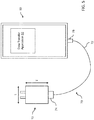
- FIGS. 1-3 and 5 show various views of a device, generally designated 10, for interfacing with a mobile communication device 50 having a rechargeable power supply and a data storage medium (i.e., memory), to perform data backup and recharging of the mobile communication device 50.
- the device 10 includes a device body 12, an alternating current (AC) input interface 16, an output interface 20, and electronics 30 fully integrated within the device body 12.
- the electronics 30 perform data backup and recharging functions, as will be discussed in more detail below with reference to FIG. 4 and FIGS. 6A-6D .
- the interfacing between the device 10 and the mobile communication device 50 is typically effectuated by a connector assembly 70.
- the connector assembly 70 includes, a first connector 74 for interfacing with the output interface 20, a second connector 76 for interfacing with a port of the mobile communication device 50, and a main body 72, typically implemented as a cable to which the connectors 74, 76 are attached at opposite ends.
- the device body 12 is preferably constructed from a waterproof and non-flammable material, such as, for example, fire-safe polymers.
- the device body 12 has a length (L), a width (W) and a thickness (T) dimension.
- the device body 12 is formed of multiple surfaces, including a front surface 14, a rear surface 18, a first side surface 22, a second side surface 26, a top surface 24, and a bottom surface 28.
- the front surface 14 and the rear surface 18 are oppositely disposed from each other in separate planes defined by the L and W dimensions, and are separated by a distance defined by the T dimension.
- top surface 24 and the bottom surface 28 are oppositely disposed from each other in separate planes defined by the L and T dimensions, and are separated by a distance defined by the W dimension.
- side surfaces 22 and 26 are oppositely disposed from each other in separate planes defined by the W and T dimensions, and are separated by a distance defined by the L dimension.
- the side surfaces 22 and 26, the top surface 24 and the bottom surface 28 may be forged from a single body so as to create a single integrally formed surface with an internal cavity, closed-off by the front surface 14 and rear surface 18.
- the connections between the surfaces of the device body 12 are preferably made permanent, such that the internal cavity of the device body 12 can only be accessed by the user of the device 10 by damaging the surfaces of the device body 12.
- the integrated positioning of the electronics 30 within the device body, coupled with waterproof and non-flammability of the device body 12, vastly increases the resistance of the device 12 to damage from water (and other liquids) and fire.
- the shape of the device body 12 is generally polygonal, such as that of a square or rectangle, in the plane defined by the L and W dimensions, and is generally square or rectangular in the plane defined by the W and T dimensions.
- the L and W dimensions of the device body 12 may each be less than the T dimension, and the L and W dimensions of the device body 12 may be approximately equal to each other.
- the L, W, and T dimensions are each less than 4 centimeters (cm). More preferably, the L dimension is in a range of 2-3 cm, the W dimension is in a range of 2-3 cm, and the T dimension is in a range of 2.5-3.5 cm.
- each of the above-mentioned surfaces may be formed of more than one surface, resulting in polygonal shapes of more than four sides, such as, for example, pentagonal or hexagonal shapes.
- the alternating current (AC) input interface 16 is positioned on one of the surfaces of the device body 12, and receives AC voltage from a mains voltage power supply by interfacing with, for example, a wall outlet, so as to come into operative cooperation with the mains voltage power supply.
- a mains voltage power in the United States typically supplies power in the range of 100-120 volts AC, while a mains voltage power supply in Europe typically supplies power in the range of 220-240 volts AC.
- Voltage adapters may be used to interface the AC plug with wall sockets for which the AC plug is not configured for insertion. For example, when the AC plug is suited for insertion into a wall socket connected to a United States mains voltage power supply, a voltage adapter may be used to interface the AC plug with a European mains voltage power supply.
- the AC input interface 16 is preferably implemented as an AC plug, depicted schematically in FIGS. 1-3 and 5 , and depicted as an electronic component block in FIG. 4 .
- the prongs of the AC plug are electrically coupled to components of the electronics 30, as will be discussed in further detail below.
- the prongs of the AC plug are preferably integrated on the front surface 14 of the device body 12. Accordingly, a first portion of the AC input interface 16, namely the prong ends, is deployed in a position external from the device body 12 and exposed to the environment, and a second portion of the AC input interface 16 is retained within the device body 12.
- the AC input interface 16 When implemented as an AC plug, the AC input interface 16 may be in a fixed extended position away from the device body 12, as shown in FIGS. 1 , 3 and 5 . Alternatively, the AC input interface 16 may be moveable between an extended position ( FIGS. 1 , 3 and 5 ) and a retracted position (not shown) in which the prong ends of the AC plug are approximately flush with the front surface 14.
- the output interface 20 is positioned on one of the surfaces of the device body 12, and provides an interface to the mobile communication device 50.
- the output interface 20 is preferably implemented as an output port, depicted schematically in FIG. 2 , and depicted as an electronic component block in FIG. 4 . Leads of the output port are electrically coupled to components of the electronics 30, as will be discussed in further detail below.
- the output port is preferably integrated in a footprint of the rear surface 18 of the device body 12. Accordingly, part of the output interface 20 is exposed to the environment external to the device body 12, and part of the output interface 20 is retained within the device body 12.
- the output interface 20 is preferably integrated within the rear surface 18, the output interface 20 may be integrated within any other surface of the device body 12, including the first side surface 22, the second side surface 26, the top surface 24, the bottom surface 28, or the front surface 14 on which the AC input interface 16 is integrated.
- the output interface 20 is implemented as a USB female type A port for receiving a male USB type A plug.
- the first connector 74 is implemented as a male USB type A plug.
- Each of the AC input interface 16 and output interface 20 are coupled to respective components of the electronics 30 in order to provide a flow of electric charge between the device 10 and the mobile communication device 50.
- the output interface 20 is coupled to components of the electronics 30 in order to provide a data link between the storage element 38 and the mobile communication device 50.
- the individual components of the electronics 30 include the AC input interface 16, an AC to direct current (DC) converter 32, a power controller 34, a rechargeable power supply 36, a storage element 38, the output interface 20, and a bank of status indicators 40.
- the electronics 30 also include a printed circuit board (PCB, not shown) to which each of the above-mentioned components of the electronics 30 is connected.
- the PCB provides an electrical connection between the pins (i.e., connection points) of the individual components of the electronics 30.
- the PCB and the individual components of the electronics 30, with the exception of the above mentioned exposed portions of the AC input interface 16 and the output interface 20, are fully integrated within the device body 12. Accordingly, the fully integrated PCB and individual components are inaccessible to, and non-removable by, the user of the device 10.
- the rechargeable power supply 36 may be implemented as one or more rechargeable batteries deployed to retain, and supply, DC voltage.
- the rechargeable power supply 36 preferably has a capacity in the range of 2500-3500 milliampere hours (mAh), and more preferably a capacity of approximately 3200 mAh.
- the output DC voltage supplied by the rechargeable power supply is preferably approximately 5 volts DC.
- the AC input interface 16 is electrically connected to the AC to DC converter 32 for converting AC voltage into DC voltage.
- the DC voltage from the AC to DC converter 32 is supplied, either directly or indirectly, to various other components of the electronics 30.
- the power controller 34 connected to the AC to DC Converter 32, controls the flow of electric charge to the various other components of the electronics 30.
- the power controller 34 provides the converted DC voltage from the AC to DC converter 32 to the rechargeable power supply 36 for recharging the rechargeable power supply 36.
- the control of flow of electric charge may be accomplished by a current sensor which may be interconnected between the AC to DC converter 32 and the power controller 34, or incorporated as a subcomponent of the power controller 34.
- the output interface 20 is connected to the storage element 38 and the power controller 34.
- the power controller 34 provides a flow of DC voltage, either from the AC to DC converter 32 or DC voltage stored in the rechargeable power supply 36, to the output interface 20.
- the DC voltage is then provided to the mobile communication device 50 from the output interface 20 via the connector assembly 70.
- the device 10 mainly operates in two power modes when interfaced with the mobile communication device 50, as will now be described.
- a first power mode the AC input interface 16 is interfaced with the mains power supply for receiving AC voltage.
- the received input AC voltage flows to the AC to DC converter 32, which converts the received AC voltage into DC voltage and provides that DC voltage to the power controller 34.
- the power controller 34 Based on input from a charge sensing component, such as, for example, a current sensor, the power controller 34 provides the DC voltage to the rechargeable power supply 36 and to the output interface 20.
- the device 10 can simultaneously provide DC voltage to the mobile communication device 50 for recharging, and recharge the internal rechargeable power supply 36 of the device 10.
- the storage element 38 may receive operational power from the AC to DC converter 32, which may be provided directly to the storage element 38 by the AC to DC converter 32 or indirectly via the power controller 34.
- the AC input interface 16 is disengaged from the mains power supply, and no AC voltage is provided to the device 10.
- the power controller 34 Based on input, or lack thereof, from a charge sensing component, such as, for example, a current sensor, the power controller 34 receives stored DC voltage from the rechargeable power supply 36 and provides the DC voltage to the output interface 20.
- the storage element 38 may receive operational power from the rechargeable power supply 36, which may be provided directly to the storage element 38 by the rechargeable power supply 36 or indirectly via the power controller 34.
- the power controller 34 controls the flow of electric charge to the various other components of the electronics 30.
- the power controller 34 may include an electronic switching arrangement, or a switching matrix, for effectuating the above described flow of electric charge between components of the electronics 30.
- the output interface 20 provides an interface for establishing a data link, for example via the connector assembly 70, between the storage element 38 and the mobile communication device 50.
- the storage element 38 is configured to receive copies of data stored on a memory of the mobile communication device 50, and store the copied data as backup data.
- the storage element 38 may be implemented as one or more readable and/or writeable data storage device, and is preferably implemented as one or more electronic solid-state non-volatile computer storage mediums, such as a flash memory.
- the storage capacity of the storage element 38 is preferably large enough in order to perform effective data backup for common mobile communication devices.
- a non-limiting and non-exhaustive list of exemplary storage capacities include 16 gigabyte (GB), 32 GB, 64 GB, 128 GB and 256 GB.
- the data stored on the storage element 38 may be compressed in order to save disk space, or may be stored in a non-compressed form.
- the backup data stored on the storage element 38 is stored in a multi-layered protected format, via encryption and password protection, and has an assigned identifier associating the backup data with the mobile communication device from which the backup data was copied.
- a data storage event associated with the backup data is generated and stored on the storage element 38, and optionally on a memory of the mobile communication device 50.
- the bank of status indicators 40 preferably includes multiple indicators with the rechargeable power supply 36, the storage element 38, and the output interface 20 being electrically connected, in some combination, to the individual indicators.
- the status indicators 40 are depicted schematically as an indicator panel formed on one of the surfaces of the device body, which in a non-limiting construction of the device 10 is shown in FIGS. 1 and 3 as the first side surface 22.
- the bank of status indicators 40 includes an internal charge indicator 40 a, an external charge indicator 40 b, and a backup indicator 40 c.
- the internal charge indicator is electrically connected to the rechargeable power supply 36 to provide a charge status of the rechargeable power supply 36.
- the external charge indicator 40 b is electrically connected to the output interface 20 to provide a charge status of the rechargeable power supply of the mobile communication device 50 when the mobile communication device 50 is interfaced with the device 10.
- the backup indicator 40 c is electrically connected to either or both of the output interface 20 and storage element 38 to provide a data backup status when the device 10 performs data backup functionality.
- the individual indicators may be implemented as multi-state indicators operable in multiple states. For example, a first state of operation of the internal charge indicator 40 a may indicate that the rechargeable power supply 36 is being charged, a second state of operation of the internal charge indicator 40 a may indicate that the rechargeable power supply 36 is providing charge to the mobile communication device 50, and a third state of operation of the internal charge indicator 40 a may indicate that the rechargeable power supply 36 is not being charged.
- each of the individual indicators is implemented as one or more LEDs.
- the first state may be indicated by illumination of a first LED (e.g., a red LED)
- the second state may be indicated by illumination of a second LED (e.g., a green LED)
- the third may be indicated by not illuminating any LEDs.
- Multi-state indicators such as one or more LEDs, may be used for the external charge indicator 40 b and the backup indicator 40 c, similar to as discussed above with reference to the internal charge indicator 40 a.
- the internal charge indicator 40 a may be implemented as a series of LEDs, which when illuminated in certain combinations provide an indication as to the charge retained in the rechargeable power supply 36 .
- a series of five LEDs may be used in such an implementation. Illumination of all five LEDs indicates a charge of 100% of the rechargeable power supply 36, illumination of four LEDs indicates a charge in the range of 80%-99% of the rechargeable power supply 36, illumination of three LEDs indicates a charge in the range of 60%-79% of the rechargeable power supply 36, illumination of two LEDs indicates a charge in the range of 40%-59% of the rechargeable power supply 36, illumination of one LED indicates a charge in the range of 20%-39% of the rechargeable power supply 36, and the lack of illumination of the LEDs indicates a charge of less than 20% of the rechargeable power supply 36.
- the electronics 30 may optionally include a locator module 42 for periodically emitting location information for receipt by the user of the mobile communication device 50.
- the locator module 42 allows the user of the mobile communication device 50 to locate the device 10 in cases of misplacement or theft.
- the locator module 42 may include a wireless transmitter that emits a signal that includes location information.
- the wireless transmitter may be implemented according to any wireless communication standard protocol, such as, for example, the IEEE 802.15.1 (“Bluetooth”) protocol and the IEEE 802.11 (“Wi-Fi”) protocol.
- the device 10 in addition to providing recharging functionality to mobile communication devices and having a rechargeable power supply integrated within the device body 12, the device 10 also performs data backup functionality.
- the device 10 is recognized by the mobile communication deice 50 as an external memory device, such as an external hard drive or flash drive.
- the device 10 is recognized by the mobile communication device 50 as a slave device, with the mobile communication device 50 being the master device. Further to this preferred master-slave configuration, the device 10 preferably does not include any processing hardware or circuitry for providing data backup functionality, and relies receiving instructions from the processing hardware and circuitry of the mobile communication device 50 to perform data backup.
- the data backup functionality allows the storage element 38 to store copies of the data retained on the storage medium of the mobile communication device 50. Note that the device 10 may still perform data backup in situations where the AC input interface 16 is disengaged from the mains power supply and the rechargeable power supply 36 is of insufficient charge to provide operational power to the storage element 38. In such situations, the storage element 38 may receive operational power from the mobile communication device 50, via the output interface 20, thereby allowing the device 10 to perform data backup functionality.
- the device 10 may be operable to interface with multiple mobile communication devices and perform the recharging and data backup functionality for each interfaced mobile communication device.
- the data backup is performed by running (i.e., executing) a data management application 52 on the mobile communication device 50 when the mobile communication device 50 is interfaced with the device 10.
- the data management application 52 operates as a command and communication interface between the device 10 and the mobile communication device 50, and allows one or more processors of the mobile communication device 50 to interact with the storage element 38, via the data link provided by the output interface 20.
- the combination of the device 10 in operation with the data management application 52 constitutes a data backup system.
- the data management application 52 may be implemented as a plurality of software instructions or computer readable program code executed on one or more processors of the mobile communication device 50.
- the data management application 52 may be pre-installed, via download, on the mobile communication device 50 prior to a first interfacing of the mobile communication device 50 with the device 10, or may be installed and subsequently executed upon a first interfacing of the mobile communication device 50 with the device 10. Note that the data management application 52 may be executed when the mobile communication device 50 is disconnected from the device 10, and is preferably automatically executed upon connecting the mobile communication device 50 with the device 10.
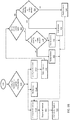
- FIGS. 6A-6D show flow diagrams detailing a process for performing data backup of a mobile communicating device.
- the types of data items of the mobile communication device that are stored (i.e., backed up) on the storage element 38 of the device 10 include, but are not limited to, digital pictures, videos, music, personal contacts, calendar items, email items, email attachments, and messages/data from network based messaging services and applications, such as, for example, short message service (SMS), multimedia messaging service (MMS), and WhatsApp Messenger).
- SMS short message service
- MMS multimedia messaging service
- WhatsApp Messenger WhatsApp Messenger
- the types of data items which are backed up by the device 10 are referred to, as a whole, as "personal data", so as to differentiate these types of data items from configuration and setting data items stored in mobile device memory, which are typically specific to the type of mobile device.
- the personal data is a subset of the total data stored on the mobile communication device.
- the backup indicator 40 c may be actuated differently for each of the different types of data backup being performed.
- a first LED illumination may correspond to data backup of the first type
- a second separate LED illumination may correspond to data backup of the second type.
- the first type of data backup is incremental data backup, in which a full backup is performed once (or at infrequent intervals) and serves as a reference point for an incremental backup set. After a full backup, incremental backups are made after successive time periods. Each incremental backup copies data items that have been created or changed since the most recent backup of any type (i.e., either full backup or incremental backup).
- incremental when applied to data backup can also refer to other comparator backup techniques, including, but not limited to, differential backup.
- the second type of data backup is a scheduled data backup.
- the scheduled data backup may copy data items that have been created or changed over a predefined time period.
- the scheduled data backup may be defined by a repetition rate and execution time.
- the scheduled data backup may be defined as a weekly backup occurring every Monday at 8 PM (i.e., weekly repetition rate, and execution time of Monday at 8 PM).
- each scheduled backup copies data items that have been created or changed from the last scheduled backup.
- the scheduled data backup may be configured to perform a full backup at the defined repetition rate and execution time.
- the process 600 begins at block 602, in which a mobile communication device (hereinafter referred to as mobile device A), operative in accordance with the description of the mobile communication device 50, is interfaced, via, for example, the connector assembly 70, with the device 10.
- mobile device A a mobile communication device
- the process moves to block 604 where mobile device A is queried for the presence of the data management application 52. If the data management application 52 is installed on mobile device A, the data management application 52 is launched (i.e., executed) and the process 600 moves to block 608. If the data management application 52 is not installed on mobile device A, the process 600 moves to block 606, where the data management application 52 is installed (e.g., manually downloaded by the user and deployed), and subsequently moves to block 608.
- the data management application 52 reviews management data to determine if mobile device A is a recognized mobile device. In other words, the data management application 52 checks for the presence of identifiers of mobile device A. If mobile device A is recognized by the data management application 52, the process 600 moves to block 634 where steps for data backup are executed, as will be discussed with reference to FIG. 6C in further detail below.
- the process 600 moves to block 610 ( FIG. 6B ), where the user of mobile device A configures the device 10 for current and future operation with mobile device A.
- Movement to block 610 is applicable to various situations. For example, movement to block 610 is applicable to situations in which a user may have an existing mobile communication device (e.g., an iPhone 5 from Apple of Cupertino, CA) and use the device 10 to backup data stored on the existing mobile communication device.
- an existing mobile communication device e.g., an iPhone 5 from Apple of Cupertino, CA
- Movement to block 610 is also applicable to situations, for example, in which a user acquires a new backup and charging device (operative in accordance with the description of the device 10 ) which has never been paired with mobile device A.
- the data management application 52 generally provides three configuration types if mobile device A is not recognized by the data management application 52.
- the user of mobile device A may select the configuration type according to personal preference, and change the configuration type at a later time via the data management application 52.
- the first configuration type is selected.
- the first configuration type is configuration for data backup, in which the device 10 is configured to operate with mobile device A as a backup data device.
- initial data backup parameters are configured.
- the backup parameters include unique identification information pertaining to mobile device A, which is used to associate mobile device A with the device 10.
- the unique identification information in the form of a unique identifier or identifiers, is logged by the data management application 52. All data from mobile device A that is backed up on the device 10 is tagged with the unique identifier, thereby associating the backup data on the device 10 with the mobile device from which the backup data was copied (e.g., mobile device A).
- the unique identifier is also used for determining if mobile device A is recognized by the data management application 52 in block 608.
- the unique identifier includes information derived from mobile communication device A, and is preferably based on a unique identification number associated with individual mobile communication devices, such as, for example, International Mobile Subscriber Identity (IMSI), International Mobile Equipment Identity (IMEI), and Mobile Equipment Identifier (MEID).
- IMSI International Mobile Subscriber Identity
- IMEI International Mobile Equipment Identity
- MEID Mobile Equipment Identifier
- the backup parameters include data protection information, which includes password information and may also include data encryption settings.
- the user of mobile device A is preferably prompted to create a password for all backup data from mobile device A stored on the device 10.
- the password may be entered via an alphanumeric keypad of mobile device A. Accessing and/or copying of data stored on the storage element 38 cannot be executed without proper password authentication. As such, the proper password provides users with the authority to move and copy data from the device 10 to other mobile communication devices, or other devices operative in accordance with the description of the device 10, as will be explained in more detail below.
- the data encryption settings may be configured by the user of mobile device A to select an encryption type, such as, for example, a Data Encryption Standard (DES) algorithm, Triple DES, Advanced Encryption Standard (AES), and the like.
- DES Data Encryption Standard
- AES Advanced Encryption Standard
- the user defined password may also be used to encrypt/decrypt the encryption/decryption key used for encrypting and decrypting the backup data.
- the backup parameters may also include backup scheduling for scheduled data backup, which will be discussed in more detail below with reference to FIG. 6C .
- the process moves to block 614, where information is displayed, via the display screen of mobile device A.
- the information displayed by execution of block 614 may include, but is not limited to, a listing of the mobile communication devices having data backed up on the device 10, the phone numbers of those mobile communication devices, the storage capacity of the storage element 38, the amount of used storage space on the storage element 38, the amount of available storage space on the storage element 38, and the recommended amount of required storage space for backing up mobile device A based on the type of mobile communication device.
- the process 600 then moves to block 616 in which a full data backup is executed.
- the full data backup may include configuration and setting data of mobile device A in addition to the personal data discussed above.
- the backup data is encrypted, according to encryption techniques/algorithms, for example, disk encryption techniques, such that at least a portion of each data item that is backed up is encrypted. As such, unauthorized attempts to extract data from the storage element 38 are prevented, securing the device 10 in the event of theft or loss.
- the backup data is password protected by the user password created in block 612a, and can be used to encrypt/decrypt the encryption/decryption key used for encrypting and decrypting the backup data.
- the backup data is also assigned a unique identifier, preferably based on a unique identification number associated with individual mobile communication devices, such as, for example, International Mobile Subscriber Identity (IMSI), International Mobile Equipment Identity (IMEI), and Mobile Equipment Identifier (MEID).
- IMSI International Mobile Subscriber Identity
- IMEI International Mobile Equipment Identity
- MEID Mobile Equipment Identifier
- the unique identifier may also include temporal information related to the storage event, such as, for example, a timestamp of the generation of the storage event.
- the data management application 52 may notify the user of mobile device A of the expected time required to complete the full backup.
- the backup indicator 40 c may also be actuated to notify the user of mobile device A that a data backup is being performed.
- the data management application 52 may interrogate the rechargeable power supply 36 to determine if the rechargeable power supply 36 holds enough charge to complete the full backup without plugging the AC input interface 16 into a wall socket, or if mobile device A holds enough charge to complete the full backup without being recharged.
- the data management application 52 may display to the user a recommendation of whether or not plug the device 10 into a wall socket, or the recommendation may be communicated to the user via the internal charge indicator 40 a or external charge indicator 40 b.
- the process 600 may move to block 612 b in which the second configuration type is selected.
- the second configuration type is configuration for restoring from a backup stored on the device 10. Movement to block 612 b is applicable to situations, for example, in which a user acquires a new mobile communication device and wishes to restore data from an older mobile communication device onto the newly acquired mobile communication device.
- a listing of the mobile communication devices having data backed up on the device 10 may be displayed to the user of mobile device A.
- This listing includes the types (i.e., make and model) of mobile communication devices having data backed up on the device 10, as well as the amount of memory occupied by each of those backups.
- the listing may include information pertaining to those two mobile communication devices.
- the two mobile communication devices may be: 1) an iPhone 6 occupying 58 GB of memory; and 2) a Nexus 6 (from Motorola) occupying 60 GB of memory.
- the process 600 then moves to block 618, where the user of mobile device A selects from which of the backups to restore mobile device A.
- the process 600 moves to block 620 where the type of mobile communication device selected from which to restore is compared with the device type of mobile device A.
- the mobile device type is included as part of the unique identification information used to associate backup data with the mobile communication device from which the backup data was copied.
- the data management application 52 may interrogate mobile device A to determine the device type of mobile device A. As such, the data management application 52 can compare the mobile device types. If the two mobile devices are of the same type (e.g., both iPhones), the process 600 moves to block 622.
- the available memory of mobile device A is compared with the amount of memory occupied by the selected backup. If the amount of available memory on mobile device A is greater than the amount of memory occupied by the selected backup, the process 600 moves to block 624, where a full restore is performed.
- the full restore performed in block 624 includes transferring all of the data items (i.e., personal data as well as configuration and setting data items) associated with the selected backup from the device 10 to mobile device A.
- the partial restore performed in block 626 may include transferring a subset of the data items associated with the selected backup from the device 10 to mobile device A.
- the subset may include some of the personal data and all of the configuration and setting data, or may include none of the configuration and setting data and all or most of the personal data, or any combination of subsets of personal data and subsets of configuration and setting data.
- the process 600 moves block 628.
- the functions performed in block 628 are similar to the functions performed in block 622 (i.e., the available memory of mobile device A is compared with the amount of memory occupied by the selected backup). If the amount of available memory on mobile device A is greater than the amount of memory occupied by the selected backup, the process 600 moves to block 630, where a partial restore is performed.
- the partial restore performed in block 630 includes transferring all of the data items, with the exception of mobile device specific data items, associated with the selected backup from the device 10 to mobile device A. In this way, operating system specific data items are not transferred to mobile devices running different operating systems. For example, Android OS specific data items are not transferred to mobile devices running iOS, and vice versa.
- the process 600 moves to block 632, where a partial restore is performed.
- the partial restore performed in block 632 differs from the partial restores performed in blocks 626 and 630, in that the partial restore performed in block 632 includes transferring only a subset of the personal data associated with the selected backup from the device 10 to mobile device A.
- non-limiting examples of differing memories are provided. For example, if the selected backup occupies 58 GB of memory and mobile device A has 61 GB of memory available, the process 600 moves from block 622 to block 624 (or from block 628 to block 630 ). Whereas if the selected backup occupies 63 GB of memory and mobile device A has 61 GB of memory available, the process 600 moves from block 622 to block 626 (or from block 628 to block 632 ).
- the user of mobile device A may control, via the data management application 52, which of the data items are to be transferred to mobile device A during the execution of blocks 624, 626, 630 and 632. For example, even if mobile device A has enough available memory to perform the restores executed in blocks 624 or 630, the user of mobile device A may wish to only restore a subset of the personal data items (e.g., pictures and videos, but not music), and may indicate that preference via the data management application 52.
- the personal data items e.g., pictures and videos, but not music
- the process 600 may optionally move to block 612a, in which mobile device A is subsequently configured for backup.
- the process 600 may also move to block 612 c in which the third configuration type is selected.
- the third configuration type is configuration for recharging only, in which the device 10 does not perform data backup when connected to mobile device A. If the user selects the third configuration type, the unique identifier of mobile device A is logged by the data management application 52 and flagged with an instruction not to perform data backup functionality upon subsequent interfaces between the device 10 and mobile device A.
- the process 600 may move to block 634 if mobile device A is recognized by the data management application 52.
- the data management application 52 interrogates the device 10 to determine the amount of available memory on the storage element 38, and to identify the block(s) of data stored on the storage element 38 corresponding to the last backup (of any kind) of mobile device A.
- the block(s) of data on the storage element 38 are assigned a unique identifier associating the stored data with the device from which the stored data was copied (e.g., mobile device A). In this way, the data management application 52 is able to identify the block(s) of data corresponding to the last backup.
- the process 600 then moves to block 636 where the data management application 52 compares the data items stored on mobile device A with the block(s) of data identified in block 634 to identify differences between the data stored on mobile device A and the storage element 38.
- the result of the execution of block 636 is the identification of data items stored on mobile device A and not stored on the storage element 38. Based on this identification, the data management application 52 determines the amount of memory required to perform an incremental backup.
- the process 600 then moves to block 638, where the available memory on the storage element 38 is compared with the memory required to perform an incremental backup determined in block 638. If the storage element 38 has enough available memory to accommodate the incremental backup, the process 600 moves to block 640 where the incremental backup is performed. If the storage element 38 does not have enough available memory to accommodate the incremental backup, the process 600 moves to block 650 ( FIG. 6D ), as will be discussed in further detail below.
- the process 600 moves to block 642, where the data management application 52 identifies the last scheduled backup and determines the amount of memory required to perform a scheduled backup.
- the process 600 then moves to block 644 where the data management application 52 checks whether a scheduled backup is scheduled to occur. If no scheduled backup is scheduled to occur, the process ends and no further data backups are performed. If a scheduled backup is scheduled to occur, the process 600 moves to block 646.
- the available memory on the storage element 38 is compared with the memory required to perform the scheduled backup as determined in block 642. If the storage element 38 has enough available memory to accommodate the scheduled backup, the process 600 moves to block 648 where the scheduled backup is either performed or an alert or reminder is issued to the user.
- the alert may be a notification displayed via the data management application 52 alerting the user that a scheduled backup is scheduled to occur and requesting user authorization to perform the scheduled backup.
- the reminder effectuated via the backup indicator 40 c, and may be implemented, for example, via illumination of one or more LEDs of the backup indicator 40 c. If the storage element 38 does not have enough available memory to accommodate with the scheduled backup, the process 600 moves to block 650.
- the process 600 moves to block 650 from blocks 638 or 646 if a determination is made that the storage element 38 does not have enough available memory to accommodate the requested backup.
- the data management application 52 determines whether blocks of backup data associated with mobile devices different from mobile device A are stored on the storage element 38. If such backups are stored on the storage element 38, the process 600 moves to block 652 where the data management application 52 provides a recommendation to the user of mobile device A to remove some or all of those backups from the storage element 38, to allow the device 10 to perform the requested backup for mobile device A.
- the data management application 52 may also alert the users of the mobile devices different from mobile device A, via SMS or other network based messaging service, of the memory availability issue.
- the process 600 may then optionally move to block 660 where removal of some or all of those backups, as determined in block 650, is executed in response to a command issued by the user of mobile device A.
- the process 600 may return (not shown) to block 640 or block 648 from block 660.
- the process 600 moves to block 654 where the data management application 52 determines whether there are any backups associated with mobile device A which can be removed.
- the criteria for removability may be based on the number and/or age of the backups. For example, if the data management application 52 identifies 10 backups (full or partial backups) spanning a period of two years, the data management application 52 may provide a recommendation to the user to remove the backups that are older than one year.
- the process 600 moves to block 656 where the data management application 52 provides a recommendation to the user of mobile device A to remove some or all of those backups from the storage element 38.
- the process 600 may then optionally move to block 662 where removal of some or all of those backups, as determined in block 654, is executed in response to a command issued by the user of mobile device A
- the user may then remove any or all of those backups, by providing the appropriate password associated with the backups of mobile device A. If the user of mobile device A removes enough backups determined by the data management application 52 to removable, and creates enough available memory to accommodate the initially requested backup, the process 600 may return (not shown) to block 640 or block 648 from block 662.
- the process moves to block 658.
- the data management application 52 notifies the user of mobile device A that there is not enough available memory on the device 10, and may provide a recommendation to the user to acquire a new device (operative in accordance with the description of the device 10 ) with a larger data storage capacity.
- the process 600 allows for automatic backup of data, from mobile device A to the device 10, if the device 10 has been properly configured by the user to operate with mobile device A, and if sufficient memory is available on the storage element 38 to accommodate the data backup.
- each mobile communication device for example mobile device A, is operative to interface with multiple backup and charging devices, each such backup and charging device being operative in accordance with the description of the device 10.
- mobile device A may be configured to operate with three backup and charging devices (device 1, device 2, and device 3), such that mobile device A is separately and simultaneously paired with device 1, device 2, and device 3.
- Execution of the data management application 52 on mobile device A provides the user of mobile device A with a listing of the three devices to which mobile device A is paired.
- This listing also preferably includes the configuration type 612 a- 612 c (i.e., configuration for backup, restore, or charging only) for each of the devices 1, 2 and 3.
- devices 1 and 3 may be configured to operate with mobile device A under configuration for backup (i.e., block 612 a), while device 2 may be configured to operate with mobile device under configuration for no backup (i.e., block 612 c).
- the user may also change the configuration type for each of the devices 1, 2 and 3, provided that the user supplies the correct password.
- the execution and configuration of the data management application 52 may be performed when mobile device A is decoupled from any other peripheral device in order to provide seamless configuration management of the devices operative in accordance with the description of the device 10.
- configuration of the data management application 52 may also be performed via a standard personal computer, such as a desktop or laptop.
- the data management application 52 may also be used to locate the device 10, based on information received from the locator module 42.
- the data backup application 52 is preferably configured to synchronize with designated remote data backup repositories, such as cloud based data repositories.
- designated remote data backup repositories such as cloud based data repositories.
- the user of a mobile communication device may provide the data management application 52 with cloud account information to facilitate data synchronization to ensure that the data stored on the cloud associated with the mobile communication device is synchronized with the data stored in the storage element 38 of the device 10.
- the data backup and charging device as described thus far has pertained to a preferred embodiment of data backup and charging performed via a wired connection between the device and a mobile communication device, other embodiments are possible in which data backup and/or charging are performed wirelessly.
- the electronics 30 may further include a wireless data module 44 coupled to the storage element 38 for facilitating wireless data backup functionality, and/or a wireless charging module 46 for facilitating wireless charging functionality.
- the wireless data module 44 receives data for back up from a corresponding wireless module deployed in the mobile communication device.
- the wireless data module 44 may utilize any standard wireless protocol, including, but not limited to, the "Bluetooth" protocol and the "Wi-Fi" protocol.
- the wireless data module 44 is preferably coupled to the power controller 34, and may receive operational power from the AC to DC converter 32, which may be provided directly to the wireless data module 44 by the AC to DC converter 32 or indirectly via the power controller 34.
- the wireless data module 44 may receive operational power from the rechargeable power supply 36, which may be provided directly to the wireless data module 44 by the rechargeable power supply 36 or indirectly via the power controller 34.
- the locator module 42 may use the wireless data module 44 to emit the location information bearing signal.
- the wireless charging module 46 is preferably coupled to the power controller 34 in order to provide charge sourced from the rechargeable power supply 36 or the AC input interface 16.
- the wireless charging module 46 may be implemented as an inductive charging module and utilize any inductive charging standard, such as, for example, the Qi standard. As is known in the art, inductive charging arrangements provide energy transfer through an inductive coupling to electrical devices.
- Implementation of the method and/or system of embodiments of the invention can involve performing or completing selected tasks manually, automatically, or a combination thereof. Moreover, according to actual instrumentation and equipment of embodiments of the method and/or system of the invention, several selected tasks could be implemented by hardware, by software or by firmware or by a combination thereof using an operating system.
- hardware for performing selected tasks according to embodiments of the invention could be implemented as a chip or a circuit.
- selected tasks according to embodiments of the invention could be implemented as a plurality of software instructions being executed by a computer using any suitable operating system.
- the data management application 52 may be implemented as a plurality of software instructions or computer readable program code executed on one or more processors of a mobile communication device.
- one or more tasks according to exemplary embodiments of method and/or system as described herein are performed by a data processor, such as a computing platform for executing a plurality of instructions.
- the data processor includes a volatile memory for storing instructions and/or data and/or a non-volatile storage, for example, non-transitory storage media such as a magnetic hard-disk and/or removable media, for storing instructions and/or data.
- a network connection is provided as well.
- a display and/or a user input device such as a keyboard or mouse are optionally provided as well.
- non-transitory computer readable (storage) medium may be utilized in accordance with the above-listed embodiments of the present invention.
- the non-transitory computer readable (storage) medium may be a computer readable signal medium or a computer readable storage medium.
- a computer readable storage medium may be, for example, but not limited to, an electronic, magnetic, optical, electromagnetic, infrared, or semiconductor system, apparatus, or device, or any suitable combination of the foregoing.
- a computer readable storage medium may be any tangible medium that can contain, or store a program for use by or in connection with an instruction execution system, apparatus, or device.
- a computer readable signal medium may include a propagated data signal with computer readable program code embodied therein, for example, in baseband or as part of a carrier wave. Such a propagated signal may take any of a variety of forms, including, but not limited to, electro-magnetic, optical, or any suitable combination thereof.
- a computer readable signal medium may be any computer readable medium that is not a computer readable storage medium and that can communicate, propagate, or transport a program for use by or in connection with an instruction execution system, apparatus, or device.
Landscapes
- Engineering & Computer Science (AREA)
- Theoretical Computer Science (AREA)
- Signal Processing (AREA)
- Computer Networks & Wireless Communication (AREA)
- Physics & Mathematics (AREA)
- General Engineering & Computer Science (AREA)
- General Physics & Mathematics (AREA)
- Power Engineering (AREA)
- Human Computer Interaction (AREA)
- Quality & Reliability (AREA)
- Computer Security & Cryptography (AREA)
- Databases & Information Systems (AREA)
- Telephone Function (AREA)
- Charge And Discharge Circuits For Batteries Or The Like (AREA)
Claims (12)
- Vorrichtung (10) zum Anschließen an eine mobile Kommunikationsvorrichtung (50), wobei die mobile Kommunikationsvorrichtung (50) einen Prozessor und ein Speichermedium beinhaltet, auf dem sich Daten befinden, wobei die Vorrichtung (10) umfasst:einen einzelnen Vorrichtungskörper (12);eine elektronische Schaltung (30), die zur Gänze in dem Vorrichtungskörper (12) integriert ist, die zumindest ein Datenspeicherelement (38) und zumindest eine wiederaufladbare Energieversorgung (36) beinhaltet;einen Wechselstrom-Netzstecker (16) mit Stiften, integriert auf einer Oberfläche (14) des Vorrichtungskörpers (12), wobei der Wechselstrom-Netzstecker (16) zum Empfangen von Wechselstromspannung von einem Stromversorgungsnetz vorgesehen ist und der Wechselstrom-Netzstecker (16) mit der zumindest einen wiederaufladbaren Energieversorgung (36) operativ verbunden ist; undeine Schnittstelle (20) mit zumindest einem Abschnitt, der in einer Grundfläche des Vorrichtungskörpers (12) integriert ist, wobei die Schnittstelle (20) betreibbar ist, um die mobile Kommunikationsvorrichtung (50) lösbar und elektronisch mit dem zumindest einen Datenspeicherelement (38) und dem Wechselstrom-Netzstecker (16) zu verbinden und um Gleichstromspannung, die aus der empfangenen Wechselstromspannung umgewandelt wird, an die mobile Kommunikationsvorrichtung (50) bereitzustellen,wobei die Vorrichtung (10) als Slave-Vorrichtung konfiguriert ist, wobei das zumindest eine Datenspeicherelement (38) betreibbar ist, um Datentransferbefehle, die von dem Prozessor ausgegeben werden, wie direkt von dem Prozessor eingegeben zu empfangen, wobei die Datentransferbefehle durch einen Benutzer der mobilen Kommunikationsvorrichtung (50) initiiert und über eine Datenverwaltungsanwendung (52), die auf der mobilen Kommunikationsvorrichtung (50) ausgeführt wird, an den Prozessor bereitgestellt werden, und das zumindest eine Datenspeicherelement (38) betreibbar ist, um eine Kopie einer Teilmenge der Daten, die sich auf dem Speichermedium befinden, in Reaktion auf zumindest einen der von dem Prozessor ausgegebenen Befehle zu empfangen, wenn die mobile Kommunikationsvorrichtung (50) elektronisch mit der Schnittstelle (20) verbunden ist, wobei die empfangene kopierte Datenteilmenge in einem geschützten Format, das von der mobilen Kommunikationsvorrichtung (50) erzeugt wird, das zumindest eine Schutzebene aufweist, in dem zumindest einen Datenspeicherelement (38) gespeichert wird, und wobei die gespeicherte Datenteilmenge eine eindeutige Kennung aufweist, die der mobilen Kommunikationsvorrichtung (50) zugeordnet ist, die die gespeicherte Datenteilmenge mit der mobilen Kommunikationsvorrichtung (50) assoziiert.
- Vorrichtung (10) nach Anspruch 1, wobei die zumindest eine Schutzebene das Verschlüsseln zumindest eines Teils der gespeicherten Datenteilmenge beinhaltet.
- Vorrichtung (10) nach Anspruch 1, wobei die zumindest eine Schutzebene das Zuordnen eines eindeutigen Kennworts zu der gespeicherten Datenteilmenge beinhaltet.
- Vorrichtung (10) nach Anspruch 1, wobei die Datenverwaltungsanwendung (52) auf der mobilen Kommunikationsvorrichtung (50) installiert wird, bevor die mobile Kommunikationsvorrichtung (50) zum ersten Mal mit der Schnittstelle (20) verbunden wird.
- Vorrichtung (10) nach Anspruch 1, wobei das Speichern der Datenteilmenge ein Speicherereignis definiert, das die Vorrichtung (10) und die mobile Kommunikationsvorrichtung (50) assoziiert, und wobei die kopierte Teilmenge der Daten in Reaktion auf das elektronische Verbinden der mobilen Kommunikationsvorrichtung (50) mit der Schnittstelle (20), bevor jedwede Speicherereignisse auftreten, im Wesentlichen die gesamten Daten, die auf dem Speichermedium vorhanden sind, beinhaltet und die eindeutige Kennung auf Basis einer Kennnummer der mobilen Kommunikationsvorrichtung (50) zugeordnet wird.
- Vorrichtung (10) nach Anspruch 5, wobei die kopierte Teilmenge der Daten in Reaktion auf das elektronische Verbinden der mobilen Kommunikationsvorrichtung (50) mit der Schnittstelle (20), nachdem zumindest ein Speicherereignis aufgetreten ist, eine Teilmenge der auf dem Speichermedium vorhandenen Daten beinhaltet, die infolge einer vorherigen elektronischen Verbindung der mobilen Kommunikationsvorrichtung (50) mit der Schnittstelle (20) nicht auf dem zumindest einen Datenspeicherelement (38) gespeichert wurden.
- Vorrichtung (10) nach Anspruch 1, wobei die gespeicherte Datenteilmenge der mobilen Kommunikationsvorrichtung (50) in Reaktion auf einen Befehl, der von einer zweiten mobilen Kommunikationsvorrichtung ausgegeben wird, die mit der Schnittstelle (20) elektronisch verbunden ist, auf ein Speichermedium der zweiten mobilen Kommunikationsvorrichtung kopiert wird.
- Vorrichtung (10) nach Anspruch 1, wobei die Stifte des Wechselstrom-Netzsteckers (16) in einer fixen Position bereitgestellt sind, die sich von der Oberfläche (14) des Vorrichtungskörpers (12) weg erstreckt.
- Vorrichtung (10) nach Anspruch 1, wobei die Schnittstelle (20) wechselbar mit dem Wechselstrom-Netzstecker (16) und der zumindest einen wiederaufladbaren Energieversorgung (36) verbunden wird.
- Vorrichtung (10) nach Anspruch 1, wobei die elektronische Schaltung (30) eine Energiesteuerung (34) beinhaltet, die mit der wiederaufladbaren Energieversorgung (36), dem Wechselstrom-Netzstecker (16) und der Schnittstelle (20) elektronisch verbunden ist, wobei die Energiesteuerung (34) betreibbar ist, um zwischen einem ersten Status, in dem aus der empfangenen Wechselstromspannung umgewandelte Gleichstromspannung zu zumindest einem der Schnittstelle und der wiederaufladbaren Energieversorgung (36) bereitgestellt wird, und einem zweiten Status, in dem in der wiederaufladbaren Energieversorgung (34) gespeicherte Direktstromspannung an die Schnittstelle bereitgestellt wird, zu wechseln.
- Vorrichtung nach Anspruch 1, die ferner umfasst:
zumindest einen Statusindikator (40, 40a, 40b, 40c), der auf einer Oberfläche (22) des Vorrichtungskörpers (12) gebildet ist, wobei der zumindest eine Statusindikator (40, 40a, 40b, 40c) eine Angabe zu zumindest einem bereitstellt aus: einem Ladestatus der wiederaufladbaren Energieversorgung (36), einem Backupstatus der Teilmenge der Daten, die auf das zumindest eine Datenspeicherelement (38) kopiert wurden, und einem Ladestatus einer wiederaufladbaren Energieversorgung der mobilen Kommunikationsvorrichtung (50). - Vorrichtung (10) nach Anspruch 1, wobei die Schnittstelle (20) eine Universal-Serial-Bus-(USB-)Buchsenschnittstelle beinhaltet, wobei ein Teil dieser auf einer Oberfläche (18) des Vorrichtungskörpers (12) freigelegt ist, wobei die USB-Buchsenschnittstelle zum Aufnehmen eines USB-Steckverbinders (74) vorgesehen ist.
Applications Claiming Priority (2)
| Application Number | Priority Date | Filing Date | Title |
|---|---|---|---|
| US201662325481P | 2016-04-21 | 2016-04-21 | |
| US201662330889P | 2016-05-03 | 2016-05-03 |
Publications (2)
| Publication Number | Publication Date |
|---|---|
| EP3236358A1 EP3236358A1 (de) | 2017-10-25 |
| EP3236358B1 true EP3236358B1 (de) | 2020-08-26 |
Family
ID=58108451
Family Applications (1)
| Application Number | Title | Priority Date | Filing Date |
|---|---|---|---|
| EP17156950.2A Active EP3236358B1 (de) | 2016-04-21 | 2017-02-20 | Datensicherung und ladevorrichtung für kommunikationsvorrichtungen |
Country Status (3)
| Country | Link |
|---|---|
| US (2) | US20170310362A1 (de) |
| EP (1) | EP3236358B1 (de) |
| WO (1) | WO2017182907A1 (de) |
Families Citing this family (31)
| Publication number | Priority date | Publication date | Assignee | Title |
|---|---|---|---|---|
| US8578120B2 (en) * | 2009-05-22 | 2013-11-05 | Commvault Systems, Inc. | Block-level single instancing |
| US9652376B2 (en) * | 2013-01-28 | 2017-05-16 | Radian Memory Systems, Inc. | Cooperative flash memory control |
| US9933980B2 (en) * | 2014-02-24 | 2018-04-03 | Toshiba Memory Corporation | NAND raid controller for connection between an SSD controller and multiple non-volatile storage units |
| US10101913B2 (en) * | 2015-09-02 | 2018-10-16 | Commvault Systems, Inc. | Migrating data to disk without interrupting running backup operations |
| AU2018244050A1 (en) * | 2017-03-30 | 2019-09-26 | Gs Yuasa International Ltd. | Power supply device, server, and power supply device management system |
| USD841582S1 (en) * | 2017-10-11 | 2019-02-26 | Shenzhen TXRICH technology Co., LTD | Charger |
| US10554796B2 (en) | 2017-11-01 | 2020-02-04 | Western Digital Technologies, Inc. | Memory station for automatically backing up data and charging mobile devices |
| JP6842678B2 (ja) * | 2018-05-14 | 2021-03-17 | 株式会社シー・オー・コンヴ | 端末貸出システム |
| CN114063883B (zh) * | 2020-07-31 | 2024-08-23 | 伊姆西Ip控股有限责任公司 | 存储数据方法、电子设备和计算机程序产品 |
| US11561722B2 (en) * | 2020-08-25 | 2023-01-24 | Micron Technology, Inc. | Multi-page parity data storage in a memory device |
| US11372579B2 (en) * | 2020-10-22 | 2022-06-28 | EMC IP Holding Company LLC | Techniques for generating data sets with specified compression and deduplication ratios |
| US12099742B2 (en) * | 2021-03-15 | 2024-09-24 | Pure Storage, Inc. | Utilizing programming page size granularity to optimize data segment storage in a storage system |
| WO2022239004A1 (en) * | 2021-05-11 | 2022-11-17 | B.G. Negev Technologies And Applications Ltd., At Ben-Gurion University | A computerized charging/interface device with malware detection and backup capabilities |
| US12346219B2 (en) * | 2021-06-21 | 2025-07-01 | Vinpower Inc. | Method for a charging unit that backs up data stored on a mobile device |
| US11789617B2 (en) * | 2021-06-29 | 2023-10-17 | Acronis International Gmbh | Integration of hashgraph and erasure coding for data integrity |
| CN113687773B (zh) * | 2021-07-16 | 2023-08-11 | 深圳智慧林网络科技有限公司 | 数据压缩模型训练方法及装置、存储介质 |
| US11816002B2 (en) * | 2021-09-14 | 2023-11-14 | Vinpower Inc. | Method for a data backup unit to intelligently charge a mobile device |
| US11922047B2 (en) * | 2021-09-16 | 2024-03-05 | EMC IP Holding Company LLC | Using RPO as an optimization target for DataDomain garbage collection |
| US20230136274A1 (en) * | 2021-11-04 | 2023-05-04 | Softiron Limited | Ceph Media Failure and Remediation |
| CN116166179A (zh) * | 2021-11-25 | 2023-05-26 | 华为技术有限公司 | 数据存储系统、智能网卡及计算节点 |
| US12019899B2 (en) * | 2022-03-03 | 2024-06-25 | Western Digital Technologies, Inc. | Data relocation with protection for open relocation destination blocks |
| US12346261B2 (en) * | 2022-11-01 | 2025-07-01 | SanDisk Technologies, Inc. | Write buffer linking for easy cache reads |
| US12242751B2 (en) * | 2023-03-03 | 2025-03-04 | SanDisk Technologies, Inc. | Data storage device and method for host-assisted efficient handling of multiple versions of data |
| KR20240138839A (ko) * | 2023-03-13 | 2024-09-20 | 삼성전자주식회사 | 메모리 장치, 메모리 장치의 동작방법 및 메모리 시스템 |
| US12282673B2 (en) * | 2023-03-23 | 2025-04-22 | International Business Machines Corporation | Limiting deduplication search domains |
| JP2024164659A (ja) * | 2023-05-15 | 2024-11-27 | トヨタ自動車株式会社 | 車両データの管理方法及び管理装置 |
| US20240402888A1 (en) * | 2023-06-04 | 2024-12-05 | Apple Inc. | User interfaces for dynamic recommendations |
| JP2025004393A (ja) * | 2023-06-26 | 2025-01-15 | カシオ計算機株式会社 | 画像管理装置、画像管理方法、プログラム |
| US20250060893A1 (en) * | 2023-08-15 | 2025-02-20 | Micron Technology, Inc. | Tracking latch upset events using block status data |
| US20250217061A1 (en) * | 2024-01-02 | 2025-07-03 | Rivian Ip Holdings, Llc | Electric vehicle data based storage control |
| US12468457B2 (en) * | 2024-01-24 | 2025-11-11 | Dell Products L.P. | Data maintenance and deletion with trustworthy energy awareness |
Family Cites Families (52)
| Publication number | Priority date | Publication date | Assignee | Title |
|---|---|---|---|---|
| US5138351A (en) * | 1991-05-10 | 1992-08-11 | Eastman Kodak Company | Battery charging apparatus with removable plug module |
| US20100208860A1 (en) * | 1997-10-15 | 2010-08-19 | Petrovich Svetzar B | GC QCMEHC nuclear power plants |
| JP2000031882A (ja) * | 1998-07-10 | 2000-01-28 | Mitsubishi Electric Corp | 携帯情報機器システム |
| US6016045A (en) * | 1999-02-03 | 2000-01-18 | Cummins Engine Company, Inc. | Real-time clock back-up battery |
| US7076270B2 (en) * | 2001-02-28 | 2006-07-11 | Dell Products L.P. | Docking station for wireless communication device |
| US6344727B1 (en) * | 2001-03-05 | 2002-02-05 | Motorola, Inc. | Charger having a data store and data link |
| JP2002312249A (ja) * | 2001-04-12 | 2002-10-25 | Yamaha Corp | コンテンツ再生装置のバックアップ方法およびバックアップ用記憶メディア |
| US6804538B2 (en) * | 2001-10-31 | 2004-10-12 | Siemens Information & Communication Mobile, Llc | System and method for interfacing a wireless telephone to a personal computer |
| US6664760B2 (en) * | 2001-11-23 | 2003-12-16 | God Co., Ltd. | Cellular phone charger with data backup function and cellular phone data backup device |
| US20040054827A1 (en) * | 2002-09-16 | 2004-03-18 | Wen-Tsung Liu | Large volume storage device with a memory card adapting interface |
| US20040063464A1 (en) * | 2002-09-30 | 2004-04-01 | Tahir Akram | High-speed data and power source interface cable for mobile devices |
| US20050195975A1 (en) * | 2003-01-21 | 2005-09-08 | Kevin Kawakita | Digital media distribution cryptography using media ticket smart cards |
| US6972688B2 (en) * | 2003-01-28 | 2005-12-06 | Gateway Inc. | Power supply with modular integrated networking |
| US20050097046A1 (en) * | 2003-10-30 | 2005-05-05 | Singfield Joy S. | Wireless electronic check deposit scanning and cashing machine with web-based online account cash management computer application system |
| US20050113704A1 (en) * | 2003-11-26 | 2005-05-26 | Lawson Corey J. | Patient monitoring system that incorporates memory into patient parameter cables |
| US7269673B2 (en) * | 2004-02-18 | 2007-09-11 | Silicon Image, Inc. | Cable with circuitry for asserting stored cable data or other information to an external device or user |
| EP1748361A1 (de) * | 2004-08-23 | 2007-01-31 | Sun Microsystems France S.A. | Verfahren und Vorrichtung zur Benutzung eines USB-Kabels als Quorum-Gerät in einem Cluster |
| US20060158154A1 (en) * | 2005-01-18 | 2006-07-20 | Maurilus Jean R | Method and apparatus for backing up data from cell phones and other hand-held devices |
| JP2006295382A (ja) * | 2005-04-07 | 2006-10-26 | Mitsumi Electric Co Ltd | データバックアップ機能付き携帯通信端末用充電システム及びデータバックアップ機能付き携帯通信端末用充電プログラム |
| US20070096685A1 (en) * | 2005-10-28 | 2007-05-03 | Q - Dog Ab, | Apparatus for charging handheld units |
| US8000755B2 (en) * | 2005-12-09 | 2011-08-16 | Panasonic Corporation | Information-communication terminal device and automatic backup system including the same |
| GB2437118A (en) | 2006-04-13 | 2007-10-17 | Nick Peek | Mobile phone charger and data backup device |
| US8725924B2 (en) * | 2006-06-01 | 2014-05-13 | Clevx, Llc | Information backup system with storing mechanism and method of operation thereof |
| US8166558B2 (en) * | 2007-03-23 | 2012-04-24 | Universal Electronics Inc. | System and method for upgrading the functionality of a controlling device in a secure manner |
| US7367846B1 (en) * | 2007-04-24 | 2008-05-06 | Hsien-Lin Yang | Multi-function power adaptor |
| US7697963B1 (en) * | 2007-05-02 | 2010-04-13 | David Pomery | Cellular phone docking station |
| US8676273B1 (en) * | 2007-08-24 | 2014-03-18 | Iwao Fujisaki | Communication device |
| US8639214B1 (en) * | 2007-10-26 | 2014-01-28 | Iwao Fujisaki | Communication device |
| HUE025830T2 (en) * | 2007-10-30 | 2016-04-28 | Meem Sl Ltd | Memory cable |
| US8312660B1 (en) * | 2008-05-09 | 2012-11-20 | Iwao Fujisaki | Firearm |
| GB0816721D0 (en) * | 2008-09-13 | 2008-10-22 | Daniel Simon R | Systems,devices and methods for electricity provision,usage monitoring,analysis and enabling improvements in efficiency |
| TW201019693A (en) * | 2008-11-14 | 2010-05-16 | Inventec Appliances Corp | Data backup system and method for data backup thereof |
| US20110050162A1 (en) * | 2009-08-28 | 2011-03-03 | Fallhowe Bruce | Fabric Power Panel Insert |
| US20110300906A1 (en) * | 2010-06-02 | 2011-12-08 | Colgan Joseph G | Multi-Function Cell Phone Charger Apparatus |
| US20120190412A1 (en) * | 2011-01-19 | 2012-07-26 | Spartak Buniatyan | Cellular phone charger with data back-up capabilities |
| US8584243B2 (en) * | 2011-11-09 | 2013-11-12 | Kaprica Security, Inc. | System and method for bidirectional trust between downloaded applications and mobile devices including a secure charger and malware scanner |
| US8841798B2 (en) * | 2011-12-02 | 2014-09-23 | Navteq B.V. | Method, apparatus for emergency power supply and device associated thereto |
| US8926520B2 (en) * | 2012-07-20 | 2015-01-06 | Endophys Holdings, Llc | Transducer interface system and method |
| EP2696306A1 (de) * | 2012-07-30 | 2014-02-12 | Eka A/S | System und Verfahren zur Authentifizierung eines Benutzers |
| US8541985B1 (en) | 2012-11-27 | 2013-09-24 | Gigastone America Corp | Multifunctional portable power bank |
| US8964406B2 (en) * | 2012-12-11 | 2015-02-24 | ESPi LLC | Battery backup cover system |
| US9385549B2 (en) | 2013-03-20 | 2016-07-05 | Halo2Cloud, LLC. | Portable power charger with power input and power output connection interfaces |
| CN110267237A (zh) * | 2013-04-17 | 2019-09-20 | 希斯泰克公司 | 用于利用双重蜂窝接口的机器对机器的通信的网关设备 |
| CN106165234A (zh) | 2013-11-24 | 2016-11-23 | S·阿夫托尔 | 用于移动电话的薄型充电器 |
| CN103840525B (zh) | 2014-03-13 | 2016-09-28 | 深圳市华宝新能源有限公司 | 移动存储电源 |
| TWM487568U (zh) | 2014-03-14 | 2014-10-01 | Samya Technology Co Ltd | 可攜式隨身碟行動電源 |
| TWM486890U (zh) * | 2014-04-03 | 2014-09-21 | 技嘉科技股份有限公司 | 整合網路之充電設備 |
| US20150134983A1 (en) | 2014-08-19 | 2015-05-14 | Leef Technology LTD | Providing power to a mobile device using a flash drive |
| US9977614B2 (en) * | 2014-12-30 | 2018-05-22 | Clevx, Llc | Automatic back-up system with verification key and method of operation thereof |
| CN204441917U (zh) | 2014-12-31 | 2015-07-01 | 北京国创富盛通信股份有限公司 | 多功能自助充电设备 |
| US20160217004A1 (en) * | 2015-01-27 | 2016-07-28 | Nextdrive Inc. | Control method for a portable electronic device coming with an external control module |
| KR101638940B1 (ko) * | 2015-03-27 | 2016-07-13 | (주)에스피에스 | 이중 결합구조를 갖는 초소형 영상입력장치 |
-
2017
- 2017-02-05 US US15/424,850 patent/US20170310362A1/en not_active Abandoned
- 2017-02-09 US US15/428,174 patent/US9800291B1/en active Active
- 2017-02-20 EP EP17156950.2A patent/EP3236358B1/de active Active
- 2017-04-09 WO PCT/IB2017/052044 patent/WO2017182907A1/en not_active Ceased
Non-Patent Citations (1)
| Title |
|---|
| None * |
Also Published As
| Publication number | Publication date |
|---|---|
| US9800291B1 (en) | 2017-10-24 |
| US20170310366A1 (en) | 2017-10-26 |
| EP3236358A1 (de) | 2017-10-25 |
| WO2017182907A1 (en) | 2017-10-26 |
| US20170310362A1 (en) | 2017-10-26 |
Similar Documents
| Publication | Publication Date | Title |
|---|---|---|
| EP3236358B1 (de) | Datensicherung und ladevorrichtung für kommunikationsvorrichtungen | |
| US20200059114A1 (en) | Stackable battery pack with wireless charging | |
| KR101961971B1 (ko) | 부수적인 기능들을 가진 휴대용 통신 장치 및 관련 방법 | |
| CN106532796B (zh) | 用于多功能便携式电源充电器的安全电路 | |
| US8898489B2 (en) | Information handling system wireless power docking station module with shared power source and wireless peripheral support | |
| US20130069583A1 (en) | Power module for portable devices | |
| CN109861351A (zh) | 适配器及便携式电源系统 | |
| CN110462915A (zh) | 无线电池管理装置和包括该装置的电池组 | |
| CN103376907A (zh) | 多主机无线输入设备 | |
| US20070278992A1 (en) | System and method for authenticating a battery | |
| JP2013529365A (ja) | ポータブルデバイス用の電力モジュール | |
| KR20170035977A (ko) | 디지털 피드백을 통한 빠른 배터리 충전 | |
| CN111149082B (zh) | 用于为移动装置自动备份数据和充电的存储器站点 | |
| TW201629673A (zh) | 使用快閃驅動器提供電源給行動裝置 | |
| US20170162929A1 (en) | Charging Cable | |
| CN104426186B (zh) | 一种充电控制方法及电子设备 | |
| US20120330888A1 (en) | Data backup device | |
| US20250392146A1 (en) | System and method for mobile device charging station | |
| US8981711B2 (en) | System for charging portable electronic devices having apparatus for suspending portable electronic devices from a power source | |
| CN107612104B (zh) | U盘充电宝充电时的控制方法及装置 | |
| WO2016024238A2 (en) | Charging device for computing appliances | |
| CN103219033A (zh) | 便携式存储器 | |
| CN203911552U (zh) | 一种移动电源装置 | |
| US20160195912A1 (en) | Electrical device with detachable storage module | |
| CN204089225U (zh) | 整合网络的充电设备 |
Legal Events
| Date | Code | Title | Description |
|---|---|---|---|
| PUAI | Public reference made under article 153(3) epc to a published international application that has entered the european phase |
Free format text: ORIGINAL CODE: 0009012 |
|
| STAA | Information on the status of an ep patent application or granted ep patent |
Free format text: STATUS: THE APPLICATION HAS BEEN PUBLISHED |
|
| AK | Designated contracting states |
Kind code of ref document: A1 Designated state(s): AL AT BE BG CH CY CZ DE DK EE ES FI FR GB GR HR HU IE IS IT LI LT LU LV MC MK MT NL NO PL PT RO RS SE SI SK SM TR |
|
| AX | Request for extension of the european patent |
Extension state: BA ME |
|
| STAA | Information on the status of an ep patent application or granted ep patent |
Free format text: STATUS: REQUEST FOR EXAMINATION WAS MADE |
|
| 17P | Request for examination filed |
Effective date: 20180315 |
|
| RBV | Designated contracting states (corrected) |
Designated state(s): AL AT BE BG CH CY CZ DE DK EE ES FI FR GB GR HR HU IE IS IT LI LT LU LV MC MK MT NL NO PL PT RO RS SE SI SK SM TR |
|
| GRAP | Despatch of communication of intention to grant a patent |
Free format text: ORIGINAL CODE: EPIDOSNIGR1 |
|
| STAA | Information on the status of an ep patent application or granted ep patent |
Free format text: STATUS: GRANT OF PATENT IS INTENDED |
|
| INTG | Intention to grant announced |
Effective date: 20191017 |
|
| GRAS | Grant fee paid |
Free format text: ORIGINAL CODE: EPIDOSNIGR3 |
|
| GRAA | (expected) grant |
Free format text: ORIGINAL CODE: 0009210 |
|
| STAA | Information on the status of an ep patent application or granted ep patent |
Free format text: STATUS: THE PATENT HAS BEEN GRANTED |
|
| AK | Designated contracting states |
Kind code of ref document: B1 Designated state(s): AL AT BE BG CH CY CZ DE DK EE ES FI FR GB GR HR HU IE IS IT LI LT LU LV MC MK MT NL NO PL PT RO RS SE SI SK SM TR |
|
| REG | Reference to a national code |
Ref country code: GB Ref legal event code: FG4D |
|
| REG | Reference to a national code |
Ref country code: CH Ref legal event code: EP |
|
| REG | Reference to a national code |
Ref country code: DE Ref legal event code: R096 Ref document number: 602017022212 Country of ref document: DE |
|
| REG | Reference to a national code |
Ref country code: AT Ref legal event code: REF Ref document number: 1307007 Country of ref document: AT Kind code of ref document: T Effective date: 20200915 |
|
| REG | Reference to a national code |
Ref country code: IE Ref legal event code: FG4D |
|
| REG | Reference to a national code |
Ref country code: LT Ref legal event code: MG4D |
|
| PG25 | Lapsed in a contracting state [announced via postgrant information from national office to epo] |
Ref country code: BG Free format text: LAPSE BECAUSE OF FAILURE TO SUBMIT A TRANSLATION OF THE DESCRIPTION OR TO PAY THE FEE WITHIN THE PRESCRIBED TIME-LIMIT Effective date: 20201126 Ref country code: PT Free format text: LAPSE BECAUSE OF FAILURE TO SUBMIT A TRANSLATION OF THE DESCRIPTION OR TO PAY THE FEE WITHIN THE PRESCRIBED TIME-LIMIT Effective date: 20201228 Ref country code: SE Free format text: LAPSE BECAUSE OF FAILURE TO SUBMIT A TRANSLATION OF THE DESCRIPTION OR TO PAY THE FEE WITHIN THE PRESCRIBED TIME-LIMIT Effective date: 20200826 Ref country code: GR Free format text: LAPSE BECAUSE OF FAILURE TO SUBMIT A TRANSLATION OF THE DESCRIPTION OR TO PAY THE FEE WITHIN THE PRESCRIBED TIME-LIMIT Effective date: 20201127 Ref country code: FI Free format text: LAPSE BECAUSE OF FAILURE TO SUBMIT A TRANSLATION OF THE DESCRIPTION OR TO PAY THE FEE WITHIN THE PRESCRIBED TIME-LIMIT Effective date: 20200826 Ref country code: NO Free format text: LAPSE BECAUSE OF FAILURE TO SUBMIT A TRANSLATION OF THE DESCRIPTION OR TO PAY THE FEE WITHIN THE PRESCRIBED TIME-LIMIT Effective date: 20201126 Ref country code: LT Free format text: LAPSE BECAUSE OF FAILURE TO SUBMIT A TRANSLATION OF THE DESCRIPTION OR TO PAY THE FEE WITHIN THE PRESCRIBED TIME-LIMIT Effective date: 20200826 Ref country code: HR Free format text: LAPSE BECAUSE OF FAILURE TO SUBMIT A TRANSLATION OF THE DESCRIPTION OR TO PAY THE FEE WITHIN THE PRESCRIBED TIME-LIMIT Effective date: 20200826 |
|
| REG | Reference to a national code |
Ref country code: NL Ref legal event code: MP Effective date: 20200826 |
|
| REG | Reference to a national code |
Ref country code: AT Ref legal event code: MK05 Ref document number: 1307007 Country of ref document: AT Kind code of ref document: T Effective date: 20200826 |
|
| PG25 | Lapsed in a contracting state [announced via postgrant information from national office to epo] |
Ref country code: IS Free format text: LAPSE BECAUSE OF FAILURE TO SUBMIT A TRANSLATION OF THE DESCRIPTION OR TO PAY THE FEE WITHIN THE PRESCRIBED TIME-LIMIT Effective date: 20201226 Ref country code: RS Free format text: LAPSE BECAUSE OF FAILURE TO SUBMIT A TRANSLATION OF THE DESCRIPTION OR TO PAY THE FEE WITHIN THE PRESCRIBED TIME-LIMIT Effective date: 20200826 Ref country code: LV Free format text: LAPSE BECAUSE OF FAILURE TO SUBMIT A TRANSLATION OF THE DESCRIPTION OR TO PAY THE FEE WITHIN THE PRESCRIBED TIME-LIMIT Effective date: 20200826 Ref country code: PL Free format text: LAPSE BECAUSE OF FAILURE TO SUBMIT A TRANSLATION OF THE DESCRIPTION OR TO PAY THE FEE WITHIN THE PRESCRIBED TIME-LIMIT Effective date: 20200826 Ref country code: NL Free format text: LAPSE BECAUSE OF FAILURE TO SUBMIT A TRANSLATION OF THE DESCRIPTION OR TO PAY THE FEE WITHIN THE PRESCRIBED TIME-LIMIT Effective date: 20200826 |
|
| PG25 | Lapsed in a contracting state [announced via postgrant information from national office to epo] |
Ref country code: EE Free format text: LAPSE BECAUSE OF FAILURE TO SUBMIT A TRANSLATION OF THE DESCRIPTION OR TO PAY THE FEE WITHIN THE PRESCRIBED TIME-LIMIT Effective date: 20200826 Ref country code: SM Free format text: LAPSE BECAUSE OF FAILURE TO SUBMIT A TRANSLATION OF THE DESCRIPTION OR TO PAY THE FEE WITHIN THE PRESCRIBED TIME-LIMIT Effective date: 20200826 Ref country code: RO Free format text: LAPSE BECAUSE OF FAILURE TO SUBMIT A TRANSLATION OF THE DESCRIPTION OR TO PAY THE FEE WITHIN THE PRESCRIBED TIME-LIMIT Effective date: 20200826 Ref country code: DK Free format text: LAPSE BECAUSE OF FAILURE TO SUBMIT A TRANSLATION OF THE DESCRIPTION OR TO PAY THE FEE WITHIN THE PRESCRIBED TIME-LIMIT Effective date: 20200826 Ref country code: CZ Free format text: LAPSE BECAUSE OF FAILURE TO SUBMIT A TRANSLATION OF THE DESCRIPTION OR TO PAY THE FEE WITHIN THE PRESCRIBED TIME-LIMIT Effective date: 20200826 |
|
| REG | Reference to a national code |
Ref country code: DE Ref legal event code: R097 Ref document number: 602017022212 Country of ref document: DE |
|
| PG25 | Lapsed in a contracting state [announced via postgrant information from national office to epo] |
Ref country code: AT Free format text: LAPSE BECAUSE OF FAILURE TO SUBMIT A TRANSLATION OF THE DESCRIPTION OR TO PAY THE FEE WITHIN THE PRESCRIBED TIME-LIMIT Effective date: 20200826 Ref country code: AL Free format text: LAPSE BECAUSE OF FAILURE TO SUBMIT A TRANSLATION OF THE DESCRIPTION OR TO PAY THE FEE WITHIN THE PRESCRIBED TIME-LIMIT Effective date: 20200826 Ref country code: ES Free format text: LAPSE BECAUSE OF FAILURE TO SUBMIT A TRANSLATION OF THE DESCRIPTION OR TO PAY THE FEE WITHIN THE PRESCRIBED TIME-LIMIT Effective date: 20200826 |
|
| PG25 | Lapsed in a contracting state [announced via postgrant information from national office to epo] |
Ref country code: SK Free format text: LAPSE BECAUSE OF FAILURE TO SUBMIT A TRANSLATION OF THE DESCRIPTION OR TO PAY THE FEE WITHIN THE PRESCRIBED TIME-LIMIT Effective date: 20200826 |
|
| PLBE | No opposition filed within time limit |
Free format text: ORIGINAL CODE: 0009261 |
|
| STAA | Information on the status of an ep patent application or granted ep patent |
Free format text: STATUS: NO OPPOSITION FILED WITHIN TIME LIMIT |
|
| PG25 | Lapsed in a contracting state [announced via postgrant information from national office to epo] |
Ref country code: IT Free format text: LAPSE BECAUSE OF FAILURE TO SUBMIT A TRANSLATION OF THE DESCRIPTION OR TO PAY THE FEE WITHIN THE PRESCRIBED TIME-LIMIT Effective date: 20200826 |
|
| 26N | No opposition filed |
Effective date: 20210527 |
|
| PG25 | Lapsed in a contracting state [announced via postgrant information from national office to epo] |
Ref country code: SI Free format text: LAPSE BECAUSE OF FAILURE TO SUBMIT A TRANSLATION OF THE DESCRIPTION OR TO PAY THE FEE WITHIN THE PRESCRIBED TIME-LIMIT Effective date: 20200826 |
|
| PG25 | Lapsed in a contracting state [announced via postgrant information from national office to epo] |
Ref country code: MC Free format text: LAPSE BECAUSE OF FAILURE TO SUBMIT A TRANSLATION OF THE DESCRIPTION OR TO PAY THE FEE WITHIN THE PRESCRIBED TIME-LIMIT Effective date: 20200826 |
|
| REG | Reference to a national code |
Ref country code: BE Ref legal event code: MM Effective date: 20210228 |
|
| PG25 | Lapsed in a contracting state [announced via postgrant information from national office to epo] |
Ref country code: CH Free format text: LAPSE BECAUSE OF NON-PAYMENT OF DUE FEES Effective date: 20210228 Ref country code: LI Free format text: LAPSE BECAUSE OF NON-PAYMENT OF DUE FEES Effective date: 20210228 Ref country code: LU Free format text: LAPSE BECAUSE OF NON-PAYMENT OF DUE FEES Effective date: 20210220 |
|
| PG25 | Lapsed in a contracting state [announced via postgrant information from national office to epo] |
Ref country code: FR Free format text: LAPSE BECAUSE OF NON-PAYMENT OF DUE FEES Effective date: 20210228 |
|
| PG25 | Lapsed in a contracting state [announced via postgrant information from national office to epo] |
Ref country code: BE Free format text: LAPSE BECAUSE OF NON-PAYMENT OF DUE FEES Effective date: 20210228 |
|
| PG25 | Lapsed in a contracting state [announced via postgrant information from national office to epo] |
Ref country code: HU Free format text: LAPSE BECAUSE OF FAILURE TO SUBMIT A TRANSLATION OF THE DESCRIPTION OR TO PAY THE FEE WITHIN THE PRESCRIBED TIME-LIMIT; INVALID AB INITIO Effective date: 20170220 |
|
| PG25 | Lapsed in a contracting state [announced via postgrant information from national office to epo] |
Ref country code: CY Free format text: LAPSE BECAUSE OF FAILURE TO SUBMIT A TRANSLATION OF THE DESCRIPTION OR TO PAY THE FEE WITHIN THE PRESCRIBED TIME-LIMIT Effective date: 20200826 |
|
| PG25 | Lapsed in a contracting state [announced via postgrant information from national office to epo] |
Ref country code: MK Free format text: LAPSE BECAUSE OF FAILURE TO SUBMIT A TRANSLATION OF THE DESCRIPTION OR TO PAY THE FEE WITHIN THE PRESCRIBED TIME-LIMIT Effective date: 20200826 |
|
| PG25 | Lapsed in a contracting state [announced via postgrant information from national office to epo] |
Ref country code: MT Free format text: LAPSE BECAUSE OF FAILURE TO SUBMIT A TRANSLATION OF THE DESCRIPTION OR TO PAY THE FEE WITHIN THE PRESCRIBED TIME-LIMIT Effective date: 20200826 |
|
| PG25 | Lapsed in a contracting state [announced via postgrant information from national office to epo] |
Ref country code: TR Free format text: LAPSE BECAUSE OF FAILURE TO SUBMIT A TRANSLATION OF THE DESCRIPTION OR TO PAY THE FEE WITHIN THE PRESCRIBED TIME-LIMIT Effective date: 20200826 |
|
| PGFP | Annual fee paid to national office [announced via postgrant information from national office to epo] |
Ref country code: GB Payment date: 20260123 Year of fee payment: 10 |
|
| PGFP | Annual fee paid to national office [announced via postgrant information from national office to epo] |
Ref country code: DE Payment date: 20260223 Year of fee payment: 10 Ref country code: IE Payment date: 20260123 Year of fee payment: 10 |