EP3233516B1 - Sicherheitselement mit farbkippeffekt und fluoreszierenden merkmalen - Google Patents
Sicherheitselement mit farbkippeffekt und fluoreszierenden merkmalen Download PDFInfo
- Publication number
- EP3233516B1 EP3233516B1 EP15812951.0A EP15812951A EP3233516B1 EP 3233516 B1 EP3233516 B1 EP 3233516B1 EP 15812951 A EP15812951 A EP 15812951A EP 3233516 B1 EP3233516 B1 EP 3233516B1
- Authority
- EP
- European Patent Office
- Prior art keywords
- security element
- layer
- element according
- shift effect
- color shift
- Prior art date
- Legal status (The legal status is an assumption and is not a legal conclusion. Google has not performed a legal analysis and makes no representation as to the accuracy of the status listed.)
- Active
Links
Images

Classifications
-
- B—PERFORMING OPERATIONS; TRANSPORTING
- B42—BOOKBINDING; ALBUMS; FILES; SPECIAL PRINTED MATTER
- B42D—BOOKS; BOOK COVERS; LOOSE LEAVES; PRINTED MATTER CHARACTERISED BY IDENTIFICATION OR SECURITY FEATURES; PRINTED MATTER OF SPECIAL FORMAT OR STYLE NOT OTHERWISE PROVIDED FOR; DEVICES FOR USE THEREWITH AND NOT OTHERWISE PROVIDED FOR; MOVABLE-STRIP WRITING OR READING APPARATUS
- B42D25/00—Information-bearing cards or sheet-like structures characterised by identification or security features; Manufacture thereof
- B42D25/30—Identification or security features, e.g. for preventing forgery
- B42D25/36—Identification or security features, e.g. for preventing forgery comprising special materials
- B42D25/378—Special inks
- B42D25/387—Special inks absorbing or reflecting ultraviolet light
-
- B—PERFORMING OPERATIONS; TRANSPORTING
- B42—BOOKBINDING; ALBUMS; FILES; SPECIAL PRINTED MATTER
- B42D—BOOKS; BOOK COVERS; LOOSE LEAVES; PRINTED MATTER CHARACTERISED BY IDENTIFICATION OR SECURITY FEATURES; PRINTED MATTER OF SPECIAL FORMAT OR STYLE NOT OTHERWISE PROVIDED FOR; DEVICES FOR USE THEREWITH AND NOT OTHERWISE PROVIDED FOR; MOVABLE-STRIP WRITING OR READING APPARATUS
- B42D25/00—Information-bearing cards or sheet-like structures characterised by identification or security features; Manufacture thereof
- B42D25/20—Information-bearing cards or sheet-like structures characterised by identification or security features; Manufacture thereof characterised by a particular use or purpose
- B42D25/29—Securities; Bank notes
-
- B—PERFORMING OPERATIONS; TRANSPORTING
- B42—BOOKBINDING; ALBUMS; FILES; SPECIAL PRINTED MATTER
- B42D—BOOKS; BOOK COVERS; LOOSE LEAVES; PRINTED MATTER CHARACTERISED BY IDENTIFICATION OR SECURITY FEATURES; PRINTED MATTER OF SPECIAL FORMAT OR STYLE NOT OTHERWISE PROVIDED FOR; DEVICES FOR USE THEREWITH AND NOT OTHERWISE PROVIDED FOR; MOVABLE-STRIP WRITING OR READING APPARATUS
- B42D25/00—Information-bearing cards or sheet-like structures characterised by identification or security features; Manufacture thereof
- B42D25/30—Identification or security features, e.g. for preventing forgery
-
- B—PERFORMING OPERATIONS; TRANSPORTING
- B42—BOOKBINDING; ALBUMS; FILES; SPECIAL PRINTED MATTER
- B42D—BOOKS; BOOK COVERS; LOOSE LEAVES; PRINTED MATTER CHARACTERISED BY IDENTIFICATION OR SECURITY FEATURES; PRINTED MATTER OF SPECIAL FORMAT OR STYLE NOT OTHERWISE PROVIDED FOR; DEVICES FOR USE THEREWITH AND NOT OTHERWISE PROVIDED FOR; MOVABLE-STRIP WRITING OR READING APPARATUS
- B42D25/00—Information-bearing cards or sheet-like structures characterised by identification or security features; Manufacture thereof
- B42D25/30—Identification or security features, e.g. for preventing forgery
- B42D25/328—Diffraction gratings; Holograms
-
- B—PERFORMING OPERATIONS; TRANSPORTING
- B42—BOOKBINDING; ALBUMS; FILES; SPECIAL PRINTED MATTER
- B42D—BOOKS; BOOK COVERS; LOOSE LEAVES; PRINTED MATTER CHARACTERISED BY IDENTIFICATION OR SECURITY FEATURES; PRINTED MATTER OF SPECIAL FORMAT OR STYLE NOT OTHERWISE PROVIDED FOR; DEVICES FOR USE THEREWITH AND NOT OTHERWISE PROVIDED FOR; MOVABLE-STRIP WRITING OR READING APPARATUS
- B42D25/00—Information-bearing cards or sheet-like structures characterised by identification or security features; Manufacture thereof
- B42D25/30—Identification or security features, e.g. for preventing forgery
- B42D25/346—Perforations
-
- B—PERFORMING OPERATIONS; TRANSPORTING
- B42—BOOKBINDING; ALBUMS; FILES; SPECIAL PRINTED MATTER
- B42D—BOOKS; BOOK COVERS; LOOSE LEAVES; PRINTED MATTER CHARACTERISED BY IDENTIFICATION OR SECURITY FEATURES; PRINTED MATTER OF SPECIAL FORMAT OR STYLE NOT OTHERWISE PROVIDED FOR; DEVICES FOR USE THEREWITH AND NOT OTHERWISE PROVIDED FOR; MOVABLE-STRIP WRITING OR READING APPARATUS
- B42D25/00—Information-bearing cards or sheet-like structures characterised by identification or security features; Manufacture thereof
- B42D25/30—Identification or security features, e.g. for preventing forgery
- B42D25/351—Translucent or partly translucent parts, e.g. windows
-
- B—PERFORMING OPERATIONS; TRANSPORTING
- B42—BOOKBINDING; ALBUMS; FILES; SPECIAL PRINTED MATTER
- B42D—BOOKS; BOOK COVERS; LOOSE LEAVES; PRINTED MATTER CHARACTERISED BY IDENTIFICATION OR SECURITY FEATURES; PRINTED MATTER OF SPECIAL FORMAT OR STYLE NOT OTHERWISE PROVIDED FOR; DEVICES FOR USE THEREWITH AND NOT OTHERWISE PROVIDED FOR; MOVABLE-STRIP WRITING OR READING APPARATUS
- B42D25/00—Information-bearing cards or sheet-like structures characterised by identification or security features; Manufacture thereof
- B42D25/30—Identification or security features, e.g. for preventing forgery
- B42D25/36—Identification or security features, e.g. for preventing forgery comprising special materials
- B42D25/364—Liquid crystals
-
- B—PERFORMING OPERATIONS; TRANSPORTING
- B42—BOOKBINDING; ALBUMS; FILES; SPECIAL PRINTED MATTER
- B42D—BOOKS; BOOK COVERS; LOOSE LEAVES; PRINTED MATTER CHARACTERISED BY IDENTIFICATION OR SECURITY FEATURES; PRINTED MATTER OF SPECIAL FORMAT OR STYLE NOT OTHERWISE PROVIDED FOR; DEVICES FOR USE THEREWITH AND NOT OTHERWISE PROVIDED FOR; MOVABLE-STRIP WRITING OR READING APPARATUS
- B42D25/00—Information-bearing cards or sheet-like structures characterised by identification or security features; Manufacture thereof
- B42D25/30—Identification or security features, e.g. for preventing forgery
- B42D25/36—Identification or security features, e.g. for preventing forgery comprising special materials
- B42D25/369—Magnetised or magnetisable materials
-
- B—PERFORMING OPERATIONS; TRANSPORTING
- B42—BOOKBINDING; ALBUMS; FILES; SPECIAL PRINTED MATTER
- B42D—BOOKS; BOOK COVERS; LOOSE LEAVES; PRINTED MATTER CHARACTERISED BY IDENTIFICATION OR SECURITY FEATURES; PRINTED MATTER OF SPECIAL FORMAT OR STYLE NOT OTHERWISE PROVIDED FOR; DEVICES FOR USE THEREWITH AND NOT OTHERWISE PROVIDED FOR; MOVABLE-STRIP WRITING OR READING APPARATUS
- B42D25/00—Information-bearing cards or sheet-like structures characterised by identification or security features; Manufacture thereof
- B42D25/30—Identification or security features, e.g. for preventing forgery
- B42D25/36—Identification or security features, e.g. for preventing forgery comprising special materials
- B42D25/373—Metallic materials
Definitions
- the invention relates to a security element which has a color-shift effect and which additionally has cutouts and fluorescent features which are recognizable in transmitted light.
- Color shift effects can be achieved by various measures, for example by thin-layer interference, such as by structures which have an electromagnetic wave-reflecting layer, a spacer layer and a layer formed from metallic clusters.
- Such security elements are for example in US 2005/042449 A or in EP 1 558 449 A described.
- Another possibility of providing a security element that has a color shift effect is to use a coating of liquid crystals, either in the form of a pigmented layer or a polymerized film.
- WO 00/50249 A discloses a security element which has an optically variable material, which can be, for example, a liquid-crystalline material, and at least one additional machine-readable feature substance in the same layer.
- the light-absorbing, preferably black background is clearly visible as a dark area on the back of a security element, such as a thread or strip, which is at least partially embedded in a document of value, such as a banknote or the like.
- This light-absorbing background must therefore be covered in order not to make the security element recognizable from the outset. This covering can be done, for example, by a metallic layer.
- a method for producing a substrate comprises the following steps: applying a masking lacquer to at least part of a metal layer on a first side of a transparent polymer film, removing metal from the regions not covered by the masking layer to form metal-free sections and applying another Layer for covering the covering lacquer and the metal-free sections, the further layer being a layer of liquid crystal polymer material, the covering lacquer being colored dark and masking the underlying metal areas and in the areas covered by the liquid crystal polymer material when viewed with reflection from the first side to one Color change effect leads and the contrast between the metallized and the metal-free areas can be clearly distinguished.
- security elements that have a color shift effect can be produced by layers with optically variable pigments.
- Such pigments are for example in US 2003/0207113 or US 5,171,363 known.
- These security elements can also have further security features, in particular also fluorescent features, which, however, are present on the side facing away from the side with the optically variable effect.
- Fluorescent colors are not used on the side on which the optically variable effect is visible, since their opacity significantly affects the visibility of the optically variable effect.
- the object of the invention was to provide a security element which has a material which has an optically variable effect, preferably a color shift effect, and cutouts which can be recognized in transmitted light, the security element being designed in such a way that it both optimally recognizes the optically variable effect allowed, and additionally as a further security feature one or more coatings with fluorescent colors on the side on which the optically variable effect can be recognized, which correspond to the optically security element which has an optically variable effect.
- the partial layer with recesses which can be recognized in transmitted light can be formed from an opaque coating which has light-absorbing properties on the side facing the coating made of the material, which has an optically variable effect, and on the side made of the material which has an optically variable effect, the side facing away has a metallic color, the partial opaque coating consisting of a light-absorbing metallic layer and a reflective metallic layer.
- the material which has a color shift effect can be a printing ink which contains pigments of liquid-crystalline material.
- pigments for example, there are Pigments from cholesteric or a mixture of nematic and cholesteric liquid crystals.
- Optically variable interference pigments can also be used. Such pigments are for example in US 2003/0207113 described.
- iridescent pigments for example Iriodine® pigments, can be used. Iriodine® are based on naturally occurring mineral mica platelets, which are coated with semi-transparent metal oxides.
- the material which has a color shift effect can consist of a liquid crystal polymer which is applied as a solution of the cholesteric monomers or the mixture of cholesteric and nematic monomers and then crosslinked.
- the crosslinking can take place thermally or by treatment with UV radiation or electron radiation.
- the cutouts when viewed in transmitted light, the cutouts can be seen as a clear contrast to the regions which have a light-absorbing and a reflecting metallic layer. Due to the reflective metallic layer, the security element, if it is embedded in a document of value, is not or hardly recognizable even in incident light from the back through the paper surface. However, the cutouts can be clearly seen from the back in transmitted light. The optically variable effect and the cut-outs in the reflected light are clearly visible from the front.
- Unstoichiometric aluminum oxide and stoichiometric or unstoichiometric copper oxide are preferably used as the light-absorbing metallic layer.
- the light-absorbing metallic layer is preferably dark to black in color. The stronger the absorption of the background in the visible spectral range (350 - 800 nm), the stronger the visible optically variable effect.
- Metals such as Al, Sn, Cu, Zn, Pt, Au, Ag, Cr, Ti, Mo, Fe, Pd, Ni, Co or a Cu / Al alloy are suitable as the reflective metallic layer.
- the light-absorbing metallic layer can consist of unstoichiometric aluminum oxide, preferably with an oxygen content of approximately 19-58 at%, and the reflective metallic layer can consist of aluminum.
- the cutouts in the light-absorbing metallic layer and the reflective metallic layer are completely congruent and can be in the form of characters, letters, numbers, images, symbols, lines, guilloches and the like. Combinations of these shapes are also possible.
- the cutouts can also be in negative form, that is to say that the area around a character, a letter and the like forms the cutout, for example.
- the layer structure having an optically variable effect can each consist of at least one layer reflecting electromagnetic waves, a polymeric spacer layer and a layer formed by metallic clusters.
- An electromagnetic wave reflecting layer is applied to a carrier substrate.
- This layer can preferably be made of metals such as aluminum, gold, chromium, silver, copper, tin, platinum, nickel or tantalum, semiconductors such as silicon and their alloys such as nickel / chromium, copper / aluminum and the like or one Printing ink with metal pigments exist.
- the electromagnetic wave-reflecting layer is covered over the entire surface or partially by known processes, such as spraying, vapor deposition, sputtering, or, for example, as a printing ink by known printing processes (gravure, flexographic, screen, digital printing), by painting, roller application processes, slot nozzle (slot) Eye), Dip (roll dip coating) or curtain coating (curtain coating) and the like applied.
- the subsequent polymeric spacer layer or the polymeric spacer layers can likewise be applied over the entire surface or preferably partially.
- the polymeric layers consist, for example, of conventional or radiation-curing, in particular UV-curing, color or coating systems based on nitrocellulose, epoxy, polyester, rosin, acrylate, alkyd, melamine, PVA, PVC, isocyanate. , Urethane or PS copolymer systems.
- a full-surface or partial layer, formed from metallic clusters, is then applied to the polymer layer.
- the metallic clusters can consist, for example, of aluminum, gold, palladium, platinum, chromium, silver, copper, nickel, tantalum, tin and the like or their alloys, such as Au / Pd, Cu / Ni or Cr / Ni.
- the fluorescent colors are highly transparent in visible light and thus do not impair the appearance of the optically variable element. When viewed under UV light, the fluorescent colors are clearly recognizable (above the optically active effect).
- the fluorescent colors are matched to the optically active effect. For example, with a color shift effect from gold-colored to green fluorescent colors in yellow and green, the fluorescent colors in red and blue can be present on the security element, analogously with a color shift effect from red to blue. However, it is also possible to choose contrasting or more than two different fluorescent colors for the color shift effect. If necessary, the fluorescent colors can also be arranged in the form of a so-called rainbow layout.
- the fluorescent colors can be present in a bar-shaped manner in an alternating sequence on the security element, the extent of the individual different fluorescent colors being able to correspond to the cutouts recognizable in transmitted light.
- the fluorescent coating is such that it appears completely transparent in visible light.
- transparent fluorescent dyes are used in a suitable solvent, for example diacetone alcohol, i-propyl alcohol, ethanol, ethoxypropanol, monoethylene glycol, methoxypropanol, methoxydipropanol, n-propanol, methoxybutanol, n-butanol, ethoxypropanol, butylglycol, hexane, cyclopentanone, acetone, Ethyl acetate, butyl acetate, cyclohexanone, i-propyl acetate, methyl ethyl ketone, methoxypropyl acetate, n-propyl acetate, special gasoline, toluene, water, xylene, methyl isobutyl ketone at elevated temperature, preferably dissolved to the boiling point of the solvent.
- a suitable solvent for example diacetone alcohol, i-propyl alcohol, ethanol, ethoxyprop
- Suitable transparent standard lacquer compositions are, for example, lacquers based on nitrocellulose, PE acrylate, PET acrylate, urethane acrylate, PVC, PMMA ethylene acrylate copolymers, styrene acrylates or epoxy acrylate, PET, PC.
- Organic fluorescent dyes are particularly suitable as transparent fluorescent dyes.
- Organic fluorescent dyes for example based on chelates, oxinates, derivatives of therphthalic acid, anthranilic acid, whether benzimidazole, benzthiazole, benzoxazinone, quinazolinone, or of thioxanthene, salicylic acid, organic complexes of rare earth metals, in particular pigments from the Lumilux® series, are particularly suitable (Honeywell), for example Lumilux® CD 335, Lumilux® CD 740, Lumilux® CD 340, Lumilux® Red CD 335, Lumilux® Red CD 332 (red fluorescence), optical brighteners such as Tinopal® OB, Lumilux® Blue CD 302, Lumilux® Blue CD 311, Lumilux® Blue 710, Lumilux® Blue CD 310 (blue fluorescence), Lumilux® CD 702, Lumilux® Green CD 302, Lumilux® Green CD 708, Lumilux® Green CD 308,
- Carrier substrates include, for example, carrier films, preferably transparent, flexible plastic films, for example made of PI, PP, MOPP, PE, PPS, PEEK, PEK, PEI, PSU, PAEK, LCP, PEN, PBT, PET, PA, PC, COC, POM, ABS, PVC, PTFE, ETFE (ethylene tetrafluoroethylene), PFA (tetrafluoroethylene-perfluoropropyl vinyl ether fluorocopolymer), MFA (tetrafluoromethylene-perfluoropropyl vinyl ether fluoropolymer), PTFE (polytetrafluoroethylene), PVF (polyvinyl fluoride), PVDF (polyvinylidene fluoride) hexylene, and EFEP (fluorophenylene) Fluoropolymer) in question.
- the carrier films preferably have a thickness of 5 to 700 ⁇ m, preferably 5 to 200 ⁇ m, particularly preferably
- the security element according to the invention can also have further security features which can be present in further layers.
- These security features for example, can have certain chemical, physical and also optical or optical active properties.
- paramagnetic, diamagnetic and also ferromagnetic substances such as Iron, nickel and cobalt or their compounds or salts (for example oxides or sulfides) can be used.
- Magnetic pigment paints with pigments based on Fe oxides, iron, nickel cobalt and their alloys, barium or cobalt ferrites, hard and soft magnetic iron and steel types in aqueous or solvent-containing dispersions are particularly suitable.
- suitable solvents are i-propanol, ethyl acetate, methyl ethyl ketone, methoxypropanol and mixtures thereof.
- the pigments are preferably incorporated in acrylate polymer dispersions with a molecular weight of 150,000 to 300,000, in nitrocellulose, acrylate-urethane dispersions, acrylate-styrene or PVC-containing dispersions or in solvent-containing dispersions of this type.
- the magnetic layer can also have a coding. Both magnetic materials of the same coercivity and / or remanence, as well as different coercivity and / or remanence can be used to form the coding.
- the reflective metallic layer itself can have magnetic properties. This is achieved, for example, by using a magnetic material such as Fe, Ni, Co.
- the optical properties of the layer can be influenced by visible dyes or pigments, heat-sensitive colors or pigments. These can be used individually or in all possible combinations.
- Optically active features are understood here to mean diffraction structures, diffraction gratings, kinegrams, holograms, DID® (microstructures of the 0th order in connection with thin layers).
- optically active features can be achieved, for example, using known UV embossing processes, as described, for example, in EP 1 310 381 A are described or produced by hot stamping processes
- This adhesive coating can either be in the form of a heat seal, cold seal or self-adhesive coating.
- the adhesive can also be pigmented, all known pigments or dyes, for example TiO 2 , ZnS, kaolin, ATO, FTO, aluminum, chromium and silicon oxides or, for example, organic pigments such as pthalocyanine blue, i-indolid yellow, dioxazine violet and the like being used as pigments can.
- luminescent dyes or pigments that fluoresce or phosphoresce in the visible, UV or IR range, heat-sensitive colors or pigments can be added. These can be used in all possible combinations.
- luminescent pigments can also be used alone or in combination with other dyes and / or pigments.
- the security element can also be protected by one or more protective lacquer layer (s), which can be pigmented or unpigmented, or further refined, for example, by lamination or the like.
- protective lacquer layer can be pigmented or unpigmented, or further refined, for example, by lamination or the like.
- the security element according to the invention is suitable for at least partial embedding in or application on identity cards, cards, banknotes or labels, seals and the like, but also as packaging material, for example in the pharmaceutical, electronics and / or food industry, for example in the form of blister films, folding boxes , Covers, foil packaging and the like.
- the substrates or film materials are preferably cut into strips, threads or patches, the width of the strips or threads preferably being 0.5-20 mm and the patches preferably having average widths or lengths of 0.3- 20 mm.
- the film material is preferably cut into strips, tapes, threads or patches, the width of the threads, strips or tapes preferably being 0.5-50 mm and the patches preferably having average widths and lengths of 2 - have 30 mm.
Landscapes
- Chemical & Material Sciences (AREA)
- Crystallography & Structural Chemistry (AREA)
- Business, Economics & Management (AREA)
- Accounting & Taxation (AREA)
- Finance (AREA)
- Credit Cards Or The Like (AREA)
- Laminated Bodies (AREA)
- Paints Or Removers (AREA)
- Inks, Pencil-Leads, Or Crayons (AREA)
Description
- Die Erfindung betrifft ein, einen Farbkippeffekt aufweisendes Sicherheitselement, das zusätzlich im Durchlicht erkennbare Aussparungen und fluoreszierende Merkmale aufweist.
- Sicherheitselemente, die einen Farbkippeffekt aufweisen sind bekannt. Farbkippeffekte können durch unterschiedliche Maßnahmen erzielt werden, beispielsweise durch Dünnschichtinterferenz, wie durch Aufbauten, die eine elektromagnetische Wellen reflektierende Schicht, eine Abstandsschicht und eine Schicht gebildet aus metallischen Clustern aufweisen. Derartige Sicherheitselemente sind beispielsweise in
US 2005/042449 A oder inEP 1 558 449 A beschrieben. - Eine weitere Möglichkeit ein Sicherheitselement bereitzustellen, das einen Farbkippeffekt aufweist, ist die Verwendung einer Beschichtung aus Flüssigkristallen, entweder in Form einer pigmentierten Schicht oder eines polymerisierten Films.
- Aus
EP 0 435 129 A ist ein Datenträger mit einem flüssigkristallinem Sicherheitselement bekannt, wobei das Material ein Flüssigkristallpolymer ist, das in orientierter Form und bei Raumtemperatur als Festkörper vorliegt. - In
WO 00/50249 A - Um den Farbkippeffekt optimal zu erkennen, ist es erforderlich einen lichtabsorbierenden, vorzugsweise schwarzen, Hintergrund bereitzustellen. Der lichtabsorbierende, vorzugsweise schwarze Hintergrund ist jedoch auf der Rückseite eines Sicherheitselements, wie beispielsweise eines Fadens oder Streifens, das zumindest teilweise in ein Wertdokument, wie eine Banknote oder dergleichen eingebettet ist, deutlich als dunkler Bereich sichtbar. Dieser lichtabsorbierende Hintergrund muss also, um das Sicherheitselement nicht von vornherein erkennbar zu machen, abgedeckt werden. Diese Abdeckung kann beispielsweise durch eine metallische Schicht erfolgen.
- Aus
EP 1 467 873 A ist ein Verfahren zur Herstellung eines Substrats bekannt, das folgende Schritte umfasst: Auftragen eines Abdecklacks auf wenigstens einem Teil einer Metallschicht auf einer ersten Seite eines transparenten Polymerfilms, Entfernen von Metall von den nicht durch die Abdeckschicht bedeckten Bereichen zur Bildung metallfreier Abschnitte und Auftragen einer weiteren Schicht zur Abdeckung des Abdecklacks und der metallfreien Abschnitte, wobei die weitere Schicht eine Schicht aus Flüssigkristallpolymermaterial ist, und der Abdecklack dunkel gefärbt ist und die darunter liegenden Metallbereiche maskiert und in den durch das Flüssigkristallpolymermaterial bedeckten Bereichen bei Betrachtung unter Reflexion von der ersten Seite zu einem Farbveränderungseffekt führt und wobei der Kontrast zwischen den metallisierten und den metallfreien Bereichen deutlich unterschieden werden kann. - Ferner können Sicherheitselemente, die einen Farbkippeffekt aufweisen durch Schichten mit optisch variablen Pigmenten hergestellt werden.
Derartige Pigmente sind beispielsweise inUS 2003/0207113 oderUS 5,171,363 bekannt. - Diese Sicherheitselemente können auch weitere Sicherheitsmerkmale aufweisen, insbesondere auch fluoreszierende Merkmale, die allerdings auf der der Seite mit dem optisch variablen Effekt abgewandten Seite vorhanden sind.
- Auf der Seite, auf der der optisch variable Effekt sichtbar ist, werden fluoreszierende Farben nicht eingesetzt, da diese durch ihre Opazität die Erkennbarkeit des optische variablen Effekts erheblich beeinträchtigen.
- Ferner sind aus
WO 2008/043981 A1 ,WO 2007/138255 A1 ,WO 03/061980 A1 WO 2010/003646 A1 gattungsgemäße Sicherheitselemente bekannt. - Aufgabe der Erfindung war es, ein Sicherheitselement, das ein Material aufweist, das einen optisch variablen Effekt, vorzugsweise einen Farbkippeffekt, und im Durchlicht erkennbare Aussparungen aufweist, bereitzustellen, wobei das Sicherheitselement derart ausgeführt ist, dass es sowohl eine optimale Erkennung des optisch variablen Effekts erlaubt, und zusätzlich als weiteres Sicherheitsmerkmal eine oder mehrere Beschichtungen mit fluoreszierenden Farben auf der Seite, auf der der optisch variable Effekt erkennbar ist, aufweist, die mit dem optisch Sicherheitselement, das einen optisch variablen Effekt aufweist, korrespondieren.
- Diese Aufgabe wird mit einem Sicherheitselement gemäß Anspruch 1 gelöst.
- In einer Ausführungsform kann die partielle Schicht mit im Durchlicht erkennbaren Aussparungen gebildet sein aus einer opaken Beschichtung, die auf der, der Beschichtung aus dem Material, das einen optisch variablen Effekt aufweist, zugewandten Seite lichtabsorbierende Eigenschaften aufweist und auf der, der Beschichtung aus dem Material das einen optisch variablen Effekt aufweist, abgewandten Seite eine metallische Färbung aufweist, wobei die partielle opake Beschichtung aus einer lichtabsorbierenden metallischen Schicht und einer reflektierenden metallischen Schicht besteht.
- Das Material, das einen Farbkippeffekt aufweist, kann eine Druckfarbe sein, die Pigmente aus flüssigkristallinem Material enthält. Insbesondere bestehen die Pigmente aus cholesterischen oder einer Mischung aus nematischen und cholesterischen Flüssigkristallen.
Ferner können optisch variable Interferenzpigmente (OVI-Pigmente) verwendet werden. Derartige Pigmente sind beispielsweise inUS 2003/0207113 beschrieben.
In einer weiteren Ausführungsform können irisierende Pigmente, beispielsweise Iriodine® Pigmente verwendet werden. Iriodine® basieren auf natürlich vorkommenden mineralischen Glimmerplättchen, die mit halbtransparenten Metalloxiden ummantelt sind.
Weiters kann das Material, das einen Farbkippeffekt aufweist, aus einem Flüssigkristallpolymer bestehen, das als Lösung der cholesterischen Monomere oder der Mischung aus cholesterischen und nematischen Monomeren aufgetragen und anschließend vernetzt wird. Die Vernetzung kann thermisch oder durch Behandlung mit UV- Strahlung oder Elektronenstrahlung erfolgen. - Bei einem derartigen Schichtaufbau sind bei der Betrachtung im Durchlicht die Aussparungen als deutlicher Kontrast gegenüber den Bereichen, die eine lichtabsorbierende und eine reflektierende metallische Schicht aufweisen, erkennbar. Durch die reflektierende metallische Schicht ist das Sicherheitselement, wenn es in ein Wertdokument eingebettet ist, auch im Auflicht von der Rückseite durch die Papieroberfläche nicht bzw. kaum erkennbar. Von der Rückseite sind im Durchlicht die Aussparungen aber deutlich erkennbar. Von der Vorderseite sind der optisch variable Effekt und die Aussparungen im Auflicht deutlich erkennbar.
- Als lichtabsorbierende metallische Schicht kommen vorzugsweise unstöchiometrisches Aluminiumoxid und stöchiometrisches oder unstöchiometrisches Kupferoxid in Frage. Die lichtabsorbierende metallische Schicht weist eine vorzugsweise dunkle bis schwarze Färbung auf. Je stärker die Absorption des Hintergrunds im sichtbaren Spektralbereich (350 - 800 nm), desto stärker der sichtbare optisch variable Effekt.
- Als reflektierende metallische Schicht kommen Metalle, wie Al, Sn, Cu, Zn, Pt, Au, Ag, Cr, Ti, Mo, Fe, Pd, Ni, Co oder eine Cu/Al Legierung in Frage.
- In einer besonderen Ausführungsform kann die lichtabsorbierende metallische Schicht aus unstöchiometrischem Aluminiumoxid, vorzugsweise mit einem Sauerstoffgehalt von etwa 19 - 58 at%, und die reflektierende metallische Schicht aus Aluminium bestehen.
- Die Aussparungen in der lichtabsorbierenden metallischen Schicht und der reflektierenden metallischen Schicht sind vollkommen deckungsgleich und können in Form von Zeichen, Buchstaben, Ziffern, Bildern, Symbolen, Linien, Guillochen und dergleichen vorliegen. Auch Kombinationen dieser Formen sind möglich.
Die Aussparungen können auch in negativer Form vorliegen, das heißt, dass beispielsweise der Bereich um ein Zeichen, einen Buchstaben und dergleichen die Aussparung bildet. - In einer weiteren Ausführungsform kann der einen optisch variablen Effekt aufweisende Schichtaufbau aus jeweils mindestens einer elektromagnetische Wellen reflektierenden Schicht, einer polymeren Abstandsschicht und einer Schicht gebildet von metallischen Clustern bestehen.
- Dabei wird eine elektromagnetische Wellen reflektierende Schicht auf ein Trägersubstrat aufgebracht. Diese Schicht kann vorzugsweise aus Metallen, wie beispielsweise Aluminium, Gold, Chrom, Silber, Kupfer, Zinn, Platin, Nickel oder Tantal, aus Halbleitern, wie beispielsweise Silizium, und deren Legierungen, beispielsweise Nickel/Chrom, Kupfer/Aluminium und dergleichen oder einer Druckfarbe mit Metallpigmenten bestehen.
Die elektromagnetische Wellen reflektierende Schicht wird vollflächig oder partiell durch bekannte Verfahren, wie Sprühen, Bedampfen, Sputtern, oder beispielsweise als Druckfarbe durch bekannte Druckverfahren (Tief-, Flexo-, Sieb-, Digitaldruck), durch Lackieren, Walzenauftragsverfahren, Schlitzdüsen-(Slot-Eye), Tauch- (roll dip coating) oder Vorhangauftragsverfahren (curtain coating) und dergleichen aufgebracht.
Die darauffolgende polymere Abstandschicht bzw. die polymeren Abstandsschichten können ebenfalls vollflächig oder vorzugsweise partiell aufgebracht werden.
Die polymeren Schichten bestehen beispielsweise aus konventionell oder strahlungshärtenden, insbesondere UV-härtenden, Farb- oder Lacksystemen auf Basis von Nitrocellulose, Epoxy-, Polyester-, Kolophonium-, Acrylat-, Alkyd-, Melamin-, PVA-, PVC-, Isocyanat-, Urethan- oder PS-Copolymersystemen . Auf die polymere Schicht wird anschließend eine vollflächige oder partielle Schicht, gebildet aus metallischen Clustern, aufgebracht. Die metallischen Cluster können beispielsweise aus Aluminium, Gold, Palladium, Platin, Chrom, Silber, Kupfer, Nickel, Tantal, Zinn und dergleichen oder deren Legierungen, wie beispielsweise Au/Pd, Cu/Ni oder Cr/Ni bestehen. - Die fluoreszierenden Farben weisen erfindungsgemäß im sichtbaren Licht eine hohe Transparenz auf und beeinträchtigen so das Erscheinungsbild des optisch variablen Elements nicht.
Bei Betrachtung unter UV-Licht sind die fluoreszierenden Farben dann deutlich (über dem optisch aktiven Effekt) erkennbar.
In einer bevorzugten Ausführungsform sind die fluoreszierenden Farben auf den optisch aktiven Effekt abgestimmt. So können beispielsweise bei einem Farbkippeffekt von goldfarben zu grün fluoreszierenden Farben in gelb und grün auf dem Sicherheitselement vorhanden sein, analog bei einem Farbkippeffekt von rot zu blau, Fluoreszenzfarben in rot und blau.
Es ist jedoch auch möglich zum Farbkippeffekt kontrastierende bzw. mehr als zwei unterschiedliche Fluoreszenzfarben zu wählen. Gegebenenfalls können die Fluoreszenzfarben auch in Form eines sogenannten Regenbogenlayouts angeordnet sein. - In einer weiteren bevorzugten Ausführungsform können die Fluoreszenzfarben balkenförmig in abwechselnder Abfolge auf dem Sicherheitselement vorhanden sein, wobei die Ausdehnung der einzelnen unterschiedlichen Fluoreszenzfarben mit den im Durchlicht erkennbaren Aussparungen korrespondieren kann.
- Die fluoreszierende Beschichtung ist erfindungsgemäß so beschaffen, dass sie im sichtbaren Licht vollkommen transparent erscheint.
- Zur Herstellung dieser Beschichtung werden transparente fluoreszierende Farbstoffe in einem geeigneten Lösungsmittel, beispielsweise Diacetonalkohol, i-Propylalkohol, Ethanol, Ethoxypropanol, Monoethylenglykol, Methoxypropanol, Methoxydipropanol, n-Propanol,Methoxybutanol, n-Butanol, Ethoxypropanol, Butylglykol, Hexan, Cyclopentanon, Aceton, Ethylacetat, Butylacetat, Cyclohexanon, I-Propylacetat, Metyhlethylketon, Methoxypropylacetat, n-Propylacetat, Spezialbenzin, Toluol, Wasser, Xylol, Methylisobutylketon bei erhöhter Temperatur, vorzugsweise bis zur Siedetemperatur des Lösungsmittels gelöst. Sobald der Farbstoff vollständig gelöst ist, wird das Gemisch in einen transparenten Standardlack eingerührt. Als transparente Standardlackzusammensetzungen kommen beispielsweise Lacke auf Basis von Nitrocellulose, PE-Acrylat, PET-Acrylat, Urethan-Acrylat, PVC, PMMA Ethylenacrylatcopolymeren, Styrolacrylaten oder Epoxyacrylat, PET, PC in Frage.
- Als transparente fluoreszierende Farbstoffe kommen vor allem organische fluoreszierende Farbstoffe in Frage. Besonders geeignet sind organische fluoreszierende Farbstoffe beispielsweise auf Basis von Chelaten, Oxinaten, Derivaten der Therphthalsäure, der Anthranilsäure, ob Benzimidazol, Benzthiazol, Benzoxazinon, Quinazolinon, oder von Thioxanthen, der Salicylsäure, organische Komplexe von Seltenerdmetallen, insbesondere Pigmente aus der Lumilux® - Serie (Honeywell), beispielsweise Lumilux® CD 335, Lumilux® CD 740, Lumilux® CD 340, Lumilux® Red CD 335, Lumilux® Red CD 332 (rote Fluoreszenz), optische Aufheller, wie Tinopal® OB, Lumilux® Blue CD 302, Lumilux® Blue CD 311, Lumilux® Blue 710, Lumilux® Blue CD 310 (blaue Fluoreszenz), Lumilux® CD 702, Lumilux® Green CD 302, Lumilux® Green CD 708, Lumilux® Green CD 308, Lumilux® Green CD 396 (grüne Fluoreszenz) oder Lumilux® CD 792, Lumilux® CD 797, Lumilux® CD 782, Lumilux® CD 382 (gelbgrüne Fluoreszenz).
Die Intensität der Fluoreszenz ist abhängig von der Konzentration an gelöstem Farbstoff im Lack. Die größte Intensität wird daher bei Erreichung der Löslichkeitsgrenze bei Siedetemperatur des verwendeten Lösungsmittels erzielt. Je nach Konzentration des Farbstoffs können beliebige Abstufungen der Intensität erreicht werden. - Als Trägersubstrate kommen beispielsweise Trägerfolien vorzugsweise transparente flexible Kunststofffolien, beispielsweise aus PI, PP, MOPP, PE, PPS, PEEK, PEK, PEI, PSU, PAEK, LCP, PEN, PBT, PET, PA, PC, COC, POM, ABS, PVC, PTFE, ETFE (Ethylentetrafluorethylen), PFA (Tetrafluorethylen-Perfluorpropylvinylether-Fluorcopolymer), MFA (Tetrafluormethylen-Perfluorpropylvinylether-Fluorcopolymer), PTFE (Polytetrafluorethylen), PVF (Polyvinylfluorid), PVDF (Polyvinylidenfluorid), und EFEP (Ethylen-Tetrafluorethylen-Hexafluorpropylen-Fluorterpolymer) in Frage.
Die Trägerfolien weisen vorzugsweise eine Dicke von 5 - 700 µm, bevorzugt 5 - 200 µm, besonders bevorzugt 5 - 50 µm auf. - Das erfindungsgemäße Sicherheitselement kann auch weitere Sicherheitsmerkmale aufweisen, die in weiteren Schichten vorliegen können. Diese Sicherheitsmerkmale beispielsweise können bestimmte chemische, physikalische und auch optische oder optische aktive Eigenschaften aufweisen.
- Zur Einstellung der magnetischen Eigenschaften einer Schicht können paramagnetische, diamagnetische und auch ferromagnetische Stoffe, wie Eisen, Nickel und Cobalt oder deren Verbindungen oder Salze (beispielsweise Oxide oder Sulfide) verwendet werden.
- Besonders geeignet sind Magnetpigmentfarben mit Pigmenten auf Basis von Fe-oxiden, Eisen, Nickel Cobalt und deren Legierungen, Barium oder Cobaltferrite, hart- und weich magnetische Eisen- und Stahlsorten in wässrigen bzw. lösungsmittelhaltigen Dispersionen. Als Lösungsmittel kommen beispielsweise i-Propanol, Ethylacetat, Methylethylketon, Methoxypropanol und deren Mischungen in Frage.
Vorzugsweise sind die Pigmente in Acrylat- Polymerdispersionen mit einem Molekulargewicht von 150.000 bis 300.000, in Nitrocellulose, Acrylat-Urethan-Dispersionen, Acrylat- Styrol oder PVC-haltigen Dispersionen oder in lösemittelhaltige derartige Dispersionen eingebracht. - Die magnetische Schicht kann auch eine Codierung aufweisen. Dabei können sowohl magnetische Materialien gleicher Koerzitivtät und/oder Remanenz, als auch unterschiedlicher Koerzitivität und/oder Remanenz zur Bildung der Codierung verwendet werden.
In einer weiteren Ausführungsform kann die reflektierende metallische Schciht selbst magnetische Eigenschaften aufweisen. Die wird beispielsweise durch die Verwendung eines magnetischen Materials, wie Fe, Ni, Co, erreicht. - Die optischen Eigenschaften der Schicht lassen sich durch sichtbare Farbstoffe bzw. Pigmente, wärmeempfindliche Farben bzw. Pigmente beeinflussen. Diese sind einzeln bzw. in allen möglichen Kombinationen einsetzbar.
- Unter optisch aktiven Merkmalen, werden hier Beugungsstrukturen, Beugungsgitter, Kinegramme, Hologramme, DID® (Mikrostrukturen 0. Ordnung in Verbindung mit Dünnschichten) verstanden.
- Diese optisch aktiven Merkmale können beispielsweise durch bekannte UV-Prägeverfahren, wie sie beispielsweise in
EP 1 310 381 A beschrieben sind oder durch Heißprägeverfahren hergestellt werden - Um das Sicherheitselement im oder am Wertdokument zu verankern, wird dieses üblicherweise ein- oder beidseitig mit einer Klebebeschichtung versehen. Diese Klebebeschichtung kann entweder in Form einer Heißsiegel-, Kaltsiegel- oder Selbstklebebeschichtung ausgeführt sein. Der Kleber kann auch pigmentiert sein, wobei als Pigmente alle bekannte Pigmente oder Farbstoffe, beispielsweise TiO2, ZnS, Kaolin, ATO, FTO, Aluminium, Chrom- und Siliziumoxide oder beispielsweise organische Pigmente wie Pthalocyaninblau, i-Indolidgelb, Dioxazinviolett und dergleichen verwendet werden können. Ferner können lumineszierende Farbstoffe bzw. Pigmente, die im sichtbaren, im UV-Bereich oder im IR-Bereich fluoreszieren bzw. phosphoreszieren, wärmeempfindliche Farben bzw. Pigmente zugegeben werden. Diese sind in allen möglichen Kombinationen einsetzbar. Zusätzlich können auch lumineszierende Pigmente allein oder in Kombination mit anderen Farbstoffen und/oder Pigmenten eingesetzt werden.
- Gegebenenfalls kann das Sicherheitselement auch noch durch eine oder mehrere Schutzlackschicht(en) geschützt werden, die pigmentiert oder unpigmentiert sein kann, oder beispielsweise durch Kaschieren oder dergleichen weiterveredelt werden.
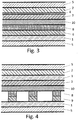
- In den
Figuren 1 bis 4 sind Ausführungsformen des erfindungsgemäßen Sicherheitselements dargestellt. -
- 1
- ein Trägersubstrat,
- 2
- eine fluoreszierende Schicht
- 3
- eine LC Schicht
- 4
- eine Haftvermittlerschicht
- 5
- eine Klebebeschichtung
- 6
- eine schwarze Metallisierung
- 7
- eine schwarze Druckschicht
- 8
- eine schwarze Ätzresistschicht
- 9
- eine metallische Schicht, beispielsweise eine Aluminiumschicht
- 10
- eine Kaschierkleberschicht.
- Das erfindungsgemäße Sicherheitselement ist für die zumindest teilweise Einbettung in oder Applikation auf Ausweisen, Karten, Banknoten oder Etiketten, Siegeln und dergleichen geeignet, aber auch als Verpackungsmaterial beispielsweise in der pharmazeutischen, der Elektronik- und/oder Lebensmittelindustrie, beispielsweise in Form von Blisterfolien, Faltschachteln, Abdeckungen, Folienverpackungen und dergleichen geeignet.
- Für die Anwendung als Sicherheitsmerkmale werden die Substrate bzw. Folienmaterialien bevorzugt in Streifen, Fäden oder Patches geschnitten, wobei die Breite der Streifen oder Fäden vorzugsweise 0,5 - 20 mm betragen kann und die Patches vorzugsweise mittlere Breiten bzw. Längen von 0,3 - 20 mm aufweisen.
- Für die Anwendung in oder auf Verpackungen wird das Folienmaterial bevorzugt in Streifen, Bänder, Fäden oder Patches geschnitten, wobei die Breite der der Fäden, Streifen bzw. Bänder vorzugsweise 0,5 - 50 mm beträgt und die Patches vorzugsweise mittlere Breiten und Längen von 2 - 30 mm aufweisen.
Claims (14)
- Sicherheitselement, aufweisend ein Trägersubstrat (1), das eine Beschichtung aus einem einen Farbkippeffekt hervorrufenden Material (3), eine partielle Schicht (6) mit im Durchlicht erkennbaren Aussparungen und ein fluoreszierendes Merkmal (2) aufweist, wobei von der Seite des Trägersubstrats aus betrachtet, auf der die Beschichtung aus einem einen Farbkippeffekt hervorrufenden Material angeordnet ist, die partielle Schicht (6) mit im Durchlicht erkennbaren Aussparungen unter der Beschichtung aus einem Material, das einen Farbkippeffekt hervorruft, situiert ist und das fluoreszierende Merkmal (2) aus einer partiellen Schicht mit im sichtbaren Licht transparenten und im UV-Licht fluoreszierenden Farben besteht und über der Beschichtung aus einem Material (3), das einen Farbkippeffekt hervorruft, situiert ist.
- Sicherheitselement nach Anspruch 1, dadurch gekennzeichnet, dass die partielle Schicht (6) mit im Durchlicht erkennbaren Aussparungen aus einer opaken Beschichtung, die auf der der Beschichtung aus dem Material (3), das einen Farbkippeffekt aufweist, zugewandten Seite lichtabsorbierende Eigenschaften aufweist und auf der der Beschichtung aus dem einen Farbkippeffekt hervorrufenden Material abgewandten Seite eine metallische Färbung aufweist, wobei die partielle opake Beschichtung (6) aus einer lichtabsorbierenden, metallischen Schicht und einer reflektierenden metallischen Schicht besteht.
- Sicherheitselement nach Anspruch 2, dadurch gekennzeichnet, dass das den Farbkippeffekt hervorrufende Material (3) eine Flüssigkristallpolymerschicht gebildet aus cholesterischen oder einer Mischung aus cholesterischen und nematischen Flüssigkristallen ist.
- Sicherheitselement nach Anspruch 2, dadurch gekennzeichnet, dass das den Farbkippeffekt aufweisende Material (3) eine Druckfarbe mit optisch variablen Pigmenten, ausgewählt aus cholesterischen oder einer Mischung aus nematischen und cholesterischen flüssigkristallinen Pigmenten, optisch variablen Interferenzpigmenten oder irisierenden Pigmenten ist.
- Sicherheitselement nach einem der Ansprüche 2 bis 4, dadurch gekennzeichnet, dass die lichtabsorbierende metallische Schicht aus unstöchiometrischem Aluminiumoxid oder stöchiometrischem oder unstöchiometrischem Kupferoxid besteht.
- Sicherheitselement nach einem der Ansprüche 2 bis 5, dadurch gekennzeichnet, dass die reflektierende metallische Schicht aus Al, Sn, Cu, Zn, Pt, Au, Ag, Cr, Ti, Mo, Fe, Pd, Ni, Co oder einer Cu/Al Legierung besteht.
- Sicherheitselement nach einem der Ansprüche 2 bis 6, dadurch gekennzeichnet, dass die im Durchlicht sichtbaren Aussparungen in Form von positiven oder negativen Zeichen, Buchstaben, Ziffern, Bildern, Symbolen, Linien, Guillochen, eines Punkt- oder Linienrasters oder eines Halbtonrasters vorliegen.
- Sicherheitselement nach Anspruch 1, dadurch gekennzeichnet, dass das den Farbkippeffekt hervorrufende Material (3), aus jeweils mindestens einer elektromagnetische Wellen reflektierenden Schicht, einer polymeren Abstandsschicht und einer Schicht gebildet von metallischen Clustern besteht.
- Sicherheitselement nach einem der Ansprüche 1 bis 6, dadurch gekennzeichnet, dass die fluoreszierenden Farben aus organischen fluoreszierenden Farbstoffen bestehen.
- Sicherheitselement nach einem der Ansprüche 1 bis 9, dadurch gekennzeichnet, dass das Sicherheitselement eine oder mehrere weitere partielle oder vollflächige Schichten mit optischen, optisch aktiven, elektrisch leitfähigen oder magnetischen Eigenschaften aufweist.
- Sicherheitselement nach Anspruch 10, dadurch gekennzeichnet, dass die magnetische Schicht eine codierte magnetische Schicht ist.
- Sicherheitselement nach Anspruch 10 oder 11, dadurch gekennzeichnet, dass die magnetische Schicht aus magnetischen Materialien mit gleicher oder unterschiedlicher Koerzivität und/oder Remanenz besteht.
- Sicherheitselement nach einem der Ansprüche 1 bis 12, dadurch gekennzeichnet, dass das Sicherheitselement ein- oder beidseitig mit einer oder mehreren pigmentierten oder unpigmentierten Schutzlackschicht(en) versehen ist.
- Sicherheitselement nach einem der Ansprüche 1 bis 13, dadurch gekennzeichnet, dass das Sicherheitselement ein- oder eidseitig mit einr pigmentierten oder unpigmentierten Heißsiegel-, Kaltsiegel- oder Selbstklebebeschichtung (5) versehen ist.
Applications Claiming Priority (2)
| Application Number | Priority Date | Filing Date | Title |
|---|---|---|---|
| ATA903/2014A AT516688A1 (de) | 2014-12-15 | 2014-12-15 | Sicherheitselement mit Farbkippeffekt und fluoreszierenden Merkmalen, Verfahren zu dessen Herstellung und dessen Verwendung |
| PCT/EP2015/002377 WO2016096086A1 (de) | 2014-12-15 | 2015-11-26 | Sicherheitselement mit farbkippeffekt und fluoreszierenden merkmalen, verfahren zu dessen herstellung und dessen verwendung |
Publications (2)
| Publication Number | Publication Date |
|---|---|
| EP3233516A1 EP3233516A1 (de) | 2017-10-25 |
| EP3233516B1 true EP3233516B1 (de) | 2020-06-03 |
Family
ID=54883975
Family Applications (1)
| Application Number | Title | Priority Date | Filing Date |
|---|---|---|---|
| EP15812951.0A Active EP3233516B1 (de) | 2014-12-15 | 2015-11-26 | Sicherheitselement mit farbkippeffekt und fluoreszierenden merkmalen |
Country Status (4)
| Country | Link |
|---|---|
| US (1) | US10214045B2 (de) |
| EP (1) | EP3233516B1 (de) |
| AT (1) | AT516688A1 (de) |
| WO (1) | WO2016096086A1 (de) |
Families Citing this family (9)
| Publication number | Priority date | Publication date | Assignee | Title |
|---|---|---|---|---|
| DE102016009024A1 (de) † | 2016-07-25 | 2018-01-25 | Giesecke+Devrient Currency Technology Gmbh | Sicherheitspapier, Sicherheitselement und Wertdokument |
| DE102018000343A1 (de) | 2018-01-17 | 2019-07-18 | Giesecke+Devrient Currency Technology Gmbh | Sicherheitselement mit Lumineszenz-Motivbereich |
| DE102018008147A1 (de) * | 2018-10-15 | 2020-04-16 | Giesecke+Devrient Currency Technology Gmbh | Sicherheitselement und mit dem Sicherheitselement ausgestatteter Datenträger |
| WO2021032518A1 (en) | 2019-08-19 | 2021-02-25 | Basf Se | A process for the production of fingerprint texture free liquid crystal films |
| EP3800060A1 (de) * | 2019-10-03 | 2021-04-07 | Hueck Folien Gesellschaft m.b.H. | Sicherheitselement mit zumindest einem ersten farbkippenden bereich |
| EP3800061A1 (de) | 2019-10-03 | 2021-04-07 | Hueck Folien Gesellschaft m.b.H. | Sicherheitselement mit einer optischen effektschicht |
| EP3800062A1 (de) * | 2019-10-03 | 2021-04-07 | Hueck Folien Gesellschaft m.b.H. | Sicherheitselement mit einer als dünnschichtelement ausgebildeten optischen effektschicht |
| EP3800063A1 (de) * | 2019-10-03 | 2021-04-07 | Hueck Folien Gesellschaft m.b.H. | Sicherheitselement für wertpapiere oder sicherheitspapiere |
| DE102022123531A1 (de) * | 2022-09-14 | 2024-03-14 | Bundesdruckerei Gmbh | Dokument mit einer Guilloche |
Citations (11)
| Publication number | Priority date | Publication date | Assignee | Title |
|---|---|---|---|---|
| WO2001003945A1 (en) | 1999-07-08 | 2001-01-18 | Flex Products, Inc. | Diffractive surfaces with color shifting backgrounds |
| WO2003061980A1 (en) | 2002-01-25 | 2003-07-31 | De La Rue International Limited | Improvements in methods of manufacturing substrates |
| US20050042449A1 (en) | 2003-07-14 | 2005-02-24 | Jds Uniphase Corporation, | Vacuum roll coated security thin film interference products with overt and/or covert patterned layers |
| WO2007138255A1 (en) | 2006-05-26 | 2007-12-06 | De La Rue International Limited | Improvements in forming security devices |
| WO2008017362A2 (de) | 2006-08-09 | 2008-02-14 | Ovd Kinegram Ag | Verfahren zur herstellung eines mehrschichtkörpers sowie mehrschichtkörper |
| WO2008043981A1 (en) | 2006-10-10 | 2008-04-17 | De La Rue International Limited | Improvements in security devices |
| EP2006116A1 (de) | 2007-06-21 | 2008-12-24 | Hueck Folien Ges.m.b.H. | Sicherheitselement mit Farbkippeffekt und visuell nicht erkennbaren Sicherheitsmerkmalen |
| WO2010003646A1 (de) | 2008-07-09 | 2010-01-14 | Giesecke & Devrient Gmbh | Sicherheitselement |
| WO2011032671A1 (de) | 2009-09-21 | 2011-03-24 | Giesecke & Devrient Gmbh | Langgestrecktes sicherheitselement mit maschinenlesbaren magnetischen bereichen |
| US20120068450A1 (en) | 2009-02-27 | 2012-03-22 | Fortress Optical Features Ltd. | Security device |
| EP1558449B1 (de) | 2002-08-06 | 2016-01-06 | Hueck Folien Ges.m.b.H | Verfahren zur herstellung von fälschungssicheren identifikationsmerkmalen |
Family Cites Families (1)
| Publication number | Priority date | Publication date | Assignee | Title |
|---|---|---|---|---|
| KR20130124494A (ko) * | 2010-09-29 | 2013-11-14 | 바스프 에스이 | 보안 부재 |
-
2014
- 2014-12-15 AT ATA903/2014A patent/AT516688A1/de not_active Application Discontinuation
-
2015
- 2015-11-26 WO PCT/EP2015/002377 patent/WO2016096086A1/de not_active Ceased
- 2015-11-26 US US15/535,475 patent/US10214045B2/en active Active
- 2015-11-26 EP EP15812951.0A patent/EP3233516B1/de active Active
Patent Citations (11)
| Publication number | Priority date | Publication date | Assignee | Title |
|---|---|---|---|---|
| WO2001003945A1 (en) | 1999-07-08 | 2001-01-18 | Flex Products, Inc. | Diffractive surfaces with color shifting backgrounds |
| WO2003061980A1 (en) | 2002-01-25 | 2003-07-31 | De La Rue International Limited | Improvements in methods of manufacturing substrates |
| EP1558449B1 (de) | 2002-08-06 | 2016-01-06 | Hueck Folien Ges.m.b.H | Verfahren zur herstellung von fälschungssicheren identifikationsmerkmalen |
| US20050042449A1 (en) | 2003-07-14 | 2005-02-24 | Jds Uniphase Corporation, | Vacuum roll coated security thin film interference products with overt and/or covert patterned layers |
| WO2007138255A1 (en) | 2006-05-26 | 2007-12-06 | De La Rue International Limited | Improvements in forming security devices |
| WO2008017362A2 (de) | 2006-08-09 | 2008-02-14 | Ovd Kinegram Ag | Verfahren zur herstellung eines mehrschichtkörpers sowie mehrschichtkörper |
| WO2008043981A1 (en) | 2006-10-10 | 2008-04-17 | De La Rue International Limited | Improvements in security devices |
| EP2006116A1 (de) | 2007-06-21 | 2008-12-24 | Hueck Folien Ges.m.b.H. | Sicherheitselement mit Farbkippeffekt und visuell nicht erkennbaren Sicherheitsmerkmalen |
| WO2010003646A1 (de) | 2008-07-09 | 2010-01-14 | Giesecke & Devrient Gmbh | Sicherheitselement |
| US20120068450A1 (en) | 2009-02-27 | 2012-03-22 | Fortress Optical Features Ltd. | Security device |
| WO2011032671A1 (de) | 2009-09-21 | 2011-03-24 | Giesecke & Devrient Gmbh | Langgestrecktes sicherheitselement mit maschinenlesbaren magnetischen bereichen |
Also Published As
| Publication number | Publication date |
|---|---|
| US10214045B2 (en) | 2019-02-26 |
| WO2016096086A1 (de) | 2016-06-23 |
| AT516688A1 (de) | 2016-07-15 |
| US20170334235A1 (en) | 2017-11-23 |
| EP3233516A1 (de) | 2017-10-25 |
Similar Documents
| Publication | Publication Date | Title |
|---|---|---|
| EP3233516B1 (de) | Sicherheitselement mit farbkippeffekt und fluoreszierenden merkmalen | |
| EP2578414B1 (de) | Sicherheitselement mit Farbkippeffekt, Verfahren zu dessen Herstellung und dessen Verwendung | |
| EP3752371B1 (de) | Sicherheitselement und verfahren zur herstellung eines sicherheitselements | |
| EP2310211B1 (de) | Sicherheitselement sowie verfahren zu seiner herstellung | |
| EP2851194B1 (de) | Sicherheitselement, insbesondere Sicherheitsetikett | |
| EP3738785B1 (de) | Sicherheitselement mit maschinell lesbaren merkmalen | |
| EP1356952B1 (de) | Beschichtetes Trägersubstrat mit beidseitig unterschiedlichen optischen und/oder fluoreszierenden Merkmalen | |
| AT501356A1 (de) | Sicherheitselemente und sicherheitsmerkmale mit farbeffekten | |
| EP2420391A2 (de) | Sicherheitselement mit einer optisch variablen Schicht | |
| AT501989B1 (de) | Sicherheitsmerkmal mit unter einem bestimmten betrachtungswinkel optisch erkennbaren merkmalen | |
| AT500871B1 (de) | Sicherheitselemente mit visuell erkennbaren und maschinenlesbaren merkmalen | |
| EP2196321B1 (de) | Transparentes Sicherheitsmerkmal | |
| EP2960068B1 (de) | Sicherheitselement mit modifiziertem farbkippeffekt | |
| EP3302996B1 (de) | Sicherheitselement mit farbkippeffekt | |
| EP3865312B1 (de) | Verfahren zur herstellung eines sicherheitselements | |
| AT504631B1 (de) | Folienmaterial insbesondere für sicherheitselemente | |
| EP2006116B1 (de) | Sicherheitselement mit Farbkippeffekt und visuell nicht erkennbaren Sicherheitsmerkmalen | |
| AT504572A1 (de) | Folienmaterial mit optischen merkmalen | |
| EP1500521A2 (de) | Sicherheitselemente mit maschinenlesbaren Merkmalen und Farbeffekten | |
| EP4691792A1 (de) | Sicherheitselement | |
| EP2311646B2 (de) | Wertdokument | |
| EP1559540A1 (de) | Transferierbares Folienmaterial |
Legal Events
| Date | Code | Title | Description |
|---|---|---|---|
| STAA | Information on the status of an ep patent application or granted ep patent |
Free format text: STATUS: THE INTERNATIONAL PUBLICATION HAS BEEN MADE |
|
| PUAI | Public reference made under article 153(3) epc to a published international application that has entered the european phase |
Free format text: ORIGINAL CODE: 0009012 |
|
| STAA | Information on the status of an ep patent application or granted ep patent |
Free format text: STATUS: REQUEST FOR EXAMINATION WAS MADE |
|
| 17P | Request for examination filed |
Effective date: 20170602 |
|
| AK | Designated contracting states |
Kind code of ref document: A1 Designated state(s): AL AT BE BG CH CY CZ DE DK EE ES FI FR GB GR HR HU IE IS IT LI LT LU LV MC MK MT NL NO PL PT RO RS SE SI SK SM TR |
|
| AX | Request for extension of the european patent |
Extension state: BA ME |
|
| DAV | Request for validation of the european patent (deleted) | ||
| DAX | Request for extension of the european patent (deleted) | ||
| STAA | Information on the status of an ep patent application or granted ep patent |
Free format text: STATUS: EXAMINATION IS IN PROGRESS |
|
| 17Q | First examination report despatched |
Effective date: 20190528 |
|
| RAP1 | Party data changed (applicant data changed or rights of an application transferred) |
Owner name: HUECK FOLIEN GESELLSCHAFT M.B.H. |
|
| GRAP | Despatch of communication of intention to grant a patent |
Free format text: ORIGINAL CODE: EPIDOSNIGR1 |
|
| STAA | Information on the status of an ep patent application or granted ep patent |
Free format text: STATUS: GRANT OF PATENT IS INTENDED |
|
| INTG | Intention to grant announced |
Effective date: 20200107 |
|
| GRAS | Grant fee paid |
Free format text: ORIGINAL CODE: EPIDOSNIGR3 |
|
| GRAA | (expected) grant |
Free format text: ORIGINAL CODE: 0009210 |
|
| STAA | Information on the status of an ep patent application or granted ep patent |
Free format text: STATUS: THE PATENT HAS BEEN GRANTED |
|
| AK | Designated contracting states |
Kind code of ref document: B1 Designated state(s): AL AT BE BG CH CY CZ DE DK EE ES FI FR GB GR HR HU IE IS IT LI LT LU LV MC MK MT NL NO PL PT RO RS SE SI SK SM TR |
|
| REG | Reference to a national code |
Ref country code: GB Ref legal event code: FG4D Free format text: NOT ENGLISH |
|
| REG | Reference to a national code |
Ref country code: CH Ref legal event code: EP Ref country code: AT Ref legal event code: REF Ref document number: 1276636 Country of ref document: AT Kind code of ref document: T Effective date: 20200615 |
|
| REG | Reference to a national code |
Ref country code: DE Ref legal event code: R096 Ref document number: 502015012739 Country of ref document: DE |
|
| REG | Reference to a national code |
Ref country code: CH Ref legal event code: NV Representative=s name: ABP PATENT NETWORK AG, CH |
|
| REG | Reference to a national code |
Ref country code: LT Ref legal event code: MG4D |
|
| PG25 | Lapsed in a contracting state [announced via postgrant information from national office to epo] |
Ref country code: LT Free format text: LAPSE BECAUSE OF FAILURE TO SUBMIT A TRANSLATION OF THE DESCRIPTION OR TO PAY THE FEE WITHIN THE PRESCRIBED TIME-LIMIT Effective date: 20200603 Ref country code: GR Free format text: LAPSE BECAUSE OF FAILURE TO SUBMIT A TRANSLATION OF THE DESCRIPTION OR TO PAY THE FEE WITHIN THE PRESCRIBED TIME-LIMIT Effective date: 20200904 Ref country code: SE Free format text: LAPSE BECAUSE OF FAILURE TO SUBMIT A TRANSLATION OF THE DESCRIPTION OR TO PAY THE FEE WITHIN THE PRESCRIBED TIME-LIMIT Effective date: 20200603 Ref country code: NO Free format text: LAPSE BECAUSE OF FAILURE TO SUBMIT A TRANSLATION OF THE DESCRIPTION OR TO PAY THE FEE WITHIN THE PRESCRIBED TIME-LIMIT Effective date: 20200903 Ref country code: FI Free format text: LAPSE BECAUSE OF FAILURE TO SUBMIT A TRANSLATION OF THE DESCRIPTION OR TO PAY THE FEE WITHIN THE PRESCRIBED TIME-LIMIT Effective date: 20200603 |
|
| REG | Reference to a national code |
Ref country code: NL Ref legal event code: MP Effective date: 20200603 |
|
| PG25 | Lapsed in a contracting state [announced via postgrant information from national office to epo] |
Ref country code: RS Free format text: LAPSE BECAUSE OF FAILURE TO SUBMIT A TRANSLATION OF THE DESCRIPTION OR TO PAY THE FEE WITHIN THE PRESCRIBED TIME-LIMIT Effective date: 20200603 Ref country code: HR Free format text: LAPSE BECAUSE OF FAILURE TO SUBMIT A TRANSLATION OF THE DESCRIPTION OR TO PAY THE FEE WITHIN THE PRESCRIBED TIME-LIMIT Effective date: 20200603 Ref country code: LV Free format text: LAPSE BECAUSE OF FAILURE TO SUBMIT A TRANSLATION OF THE DESCRIPTION OR TO PAY THE FEE WITHIN THE PRESCRIBED TIME-LIMIT Effective date: 20200603 Ref country code: BG Free format text: LAPSE BECAUSE OF FAILURE TO SUBMIT A TRANSLATION OF THE DESCRIPTION OR TO PAY THE FEE WITHIN THE PRESCRIBED TIME-LIMIT Effective date: 20200903 |
|
| PG25 | Lapsed in a contracting state [announced via postgrant information from national office to epo] |
Ref country code: AL Free format text: LAPSE BECAUSE OF FAILURE TO SUBMIT A TRANSLATION OF THE DESCRIPTION OR TO PAY THE FEE WITHIN THE PRESCRIBED TIME-LIMIT Effective date: 20200603 Ref country code: NL Free format text: LAPSE BECAUSE OF FAILURE TO SUBMIT A TRANSLATION OF THE DESCRIPTION OR TO PAY THE FEE WITHIN THE PRESCRIBED TIME-LIMIT Effective date: 20200603 |
|
| PG25 | Lapsed in a contracting state [announced via postgrant information from national office to epo] |
Ref country code: CZ Free format text: LAPSE BECAUSE OF FAILURE TO SUBMIT A TRANSLATION OF THE DESCRIPTION OR TO PAY THE FEE WITHIN THE PRESCRIBED TIME-LIMIT Effective date: 20200603 Ref country code: RO Free format text: LAPSE BECAUSE OF FAILURE TO SUBMIT A TRANSLATION OF THE DESCRIPTION OR TO PAY THE FEE WITHIN THE PRESCRIBED TIME-LIMIT Effective date: 20200603 Ref country code: PT Free format text: LAPSE BECAUSE OF FAILURE TO SUBMIT A TRANSLATION OF THE DESCRIPTION OR TO PAY THE FEE WITHIN THE PRESCRIBED TIME-LIMIT Effective date: 20201006 Ref country code: ES Free format text: LAPSE BECAUSE OF FAILURE TO SUBMIT A TRANSLATION OF THE DESCRIPTION OR TO PAY THE FEE WITHIN THE PRESCRIBED TIME-LIMIT Effective date: 20200603 Ref country code: EE Free format text: LAPSE BECAUSE OF FAILURE TO SUBMIT A TRANSLATION OF THE DESCRIPTION OR TO PAY THE FEE WITHIN THE PRESCRIBED TIME-LIMIT Effective date: 20200603 Ref country code: SM Free format text: LAPSE BECAUSE OF FAILURE TO SUBMIT A TRANSLATION OF THE DESCRIPTION OR TO PAY THE FEE WITHIN THE PRESCRIBED TIME-LIMIT Effective date: 20200603 |
|
| PG25 | Lapsed in a contracting state [announced via postgrant information from national office to epo] |
Ref country code: PL Free format text: LAPSE BECAUSE OF FAILURE TO SUBMIT A TRANSLATION OF THE DESCRIPTION OR TO PAY THE FEE WITHIN THE PRESCRIBED TIME-LIMIT Effective date: 20200603 Ref country code: SK Free format text: LAPSE BECAUSE OF FAILURE TO SUBMIT A TRANSLATION OF THE DESCRIPTION OR TO PAY THE FEE WITHIN THE PRESCRIBED TIME-LIMIT Effective date: 20200603 Ref country code: IS Free format text: LAPSE BECAUSE OF FAILURE TO SUBMIT A TRANSLATION OF THE DESCRIPTION OR TO PAY THE FEE WITHIN THE PRESCRIBED TIME-LIMIT Effective date: 20201003 |
|
| REG | Reference to a national code |
Ref country code: DE Ref legal event code: R026 Ref document number: 502015012739 Country of ref document: DE |
|
| PLBI | Opposition filed |
Free format text: ORIGINAL CODE: 0009260 |
|
| PLAX | Notice of opposition and request to file observation + time limit sent |
Free format text: ORIGINAL CODE: EPIDOSNOBS2 |
|
| 26 | Opposition filed |
Opponent name: OBERTHUR FIDUCIAIRE SAS / VHP SECURITY PAPER B.V. Effective date: 20210302 |
|
| PG25 | Lapsed in a contracting state [announced via postgrant information from national office to epo] |
Ref country code: DK Free format text: LAPSE BECAUSE OF FAILURE TO SUBMIT A TRANSLATION OF THE DESCRIPTION OR TO PAY THE FEE WITHIN THE PRESCRIBED TIME-LIMIT Effective date: 20200603 |
|
| PG25 | Lapsed in a contracting state [announced via postgrant information from national office to epo] |
Ref country code: SI Free format text: LAPSE BECAUSE OF FAILURE TO SUBMIT A TRANSLATION OF THE DESCRIPTION OR TO PAY THE FEE WITHIN THE PRESCRIBED TIME-LIMIT Effective date: 20200603 |
|
| PLBB | Reply of patent proprietor to notice(s) of opposition received |
Free format text: ORIGINAL CODE: EPIDOSNOBS3 |
|
| PG25 | Lapsed in a contracting state [announced via postgrant information from national office to epo] |
Ref country code: MC Free format text: LAPSE BECAUSE OF FAILURE TO SUBMIT A TRANSLATION OF THE DESCRIPTION OR TO PAY THE FEE WITHIN THE PRESCRIBED TIME-LIMIT Effective date: 20200603 |
|
| PG25 | Lapsed in a contracting state [announced via postgrant information from national office to epo] |
Ref country code: LU Free format text: LAPSE BECAUSE OF NON-PAYMENT OF DUE FEES Effective date: 20201126 |
|
| REG | Reference to a national code |
Ref country code: BE Ref legal event code: MM Effective date: 20201130 |
|
| PG25 | Lapsed in a contracting state [announced via postgrant information from national office to epo] |
Ref country code: IE Free format text: LAPSE BECAUSE OF NON-PAYMENT OF DUE FEES Effective date: 20201126 |
|
| PG25 | Lapsed in a contracting state [announced via postgrant information from national office to epo] |
Ref country code: TR Free format text: LAPSE BECAUSE OF FAILURE TO SUBMIT A TRANSLATION OF THE DESCRIPTION OR TO PAY THE FEE WITHIN THE PRESCRIBED TIME-LIMIT Effective date: 20200603 Ref country code: MT Free format text: LAPSE BECAUSE OF FAILURE TO SUBMIT A TRANSLATION OF THE DESCRIPTION OR TO PAY THE FEE WITHIN THE PRESCRIBED TIME-LIMIT Effective date: 20200603 Ref country code: CY Free format text: LAPSE BECAUSE OF FAILURE TO SUBMIT A TRANSLATION OF THE DESCRIPTION OR TO PAY THE FEE WITHIN THE PRESCRIBED TIME-LIMIT Effective date: 20200603 |
|
| PG25 | Lapsed in a contracting state [announced via postgrant information from national office to epo] |
Ref country code: MK Free format text: LAPSE BECAUSE OF FAILURE TO SUBMIT A TRANSLATION OF THE DESCRIPTION OR TO PAY THE FEE WITHIN THE PRESCRIBED TIME-LIMIT Effective date: 20200603 |
|
| PG25 | Lapsed in a contracting state [announced via postgrant information from national office to epo] |
Ref country code: BE Free format text: LAPSE BECAUSE OF NON-PAYMENT OF DUE FEES Effective date: 20201130 |
|
| PLCK | Communication despatched that opposition was rejected |
Free format text: ORIGINAL CODE: EPIDOSNREJ1 |
|
| APBM | Appeal reference recorded |
Free format text: ORIGINAL CODE: EPIDOSNREFNO |
|
| APBP | Date of receipt of notice of appeal recorded |
Free format text: ORIGINAL CODE: EPIDOSNNOA2O |
|
| APAH | Appeal reference modified |
Free format text: ORIGINAL CODE: EPIDOSCREFNO |
|
| REG | Reference to a national code |
Ref country code: DE Ref legal event code: R100 Ref document number: 502015012739 Country of ref document: DE |
|
| APBU | Appeal procedure closed |
Free format text: ORIGINAL CODE: EPIDOSNNOA9O |
|
| PLBN | Opposition rejected |
Free format text: ORIGINAL CODE: 0009273 |
|
| STAA | Information on the status of an ep patent application or granted ep patent |
Free format text: STATUS: OPPOSITION REJECTED |
|
| 27O | Opposition rejected |
Effective date: 20230504 |
|
| P01 | Opt-out of the competence of the unified patent court (upc) registered |
Effective date: 20230526 |
|
| PGFP | Annual fee paid to national office [announced via postgrant information from national office to epo] |
Ref country code: CH Payment date: 20231201 Year of fee payment: 9 |
|
| REG | Reference to a national code |
Ref country code: CH Ref legal event code: PL |
|
| REG | Reference to a national code |
Ref country code: CH Ref legal event code: PL |
|
| PG25 | Lapsed in a contracting state [announced via postgrant information from national office to epo] |
Ref country code: CH Free format text: LAPSE BECAUSE OF NON-PAYMENT OF DUE FEES Effective date: 20241130 |
|
| PGFP | Annual fee paid to national office [announced via postgrant information from national office to epo] |
Ref country code: DE Payment date: 20251118 Year of fee payment: 11 |
|
| PGFP | Annual fee paid to national office [announced via postgrant information from national office to epo] |
Ref country code: GB Payment date: 20251125 Year of fee payment: 11 |
|
| PGFP | Annual fee paid to national office [announced via postgrant information from national office to epo] |
Ref country code: AT Payment date: 20251119 Year of fee payment: 11 |
|
| PGFP | Annual fee paid to national office [announced via postgrant information from national office to epo] |
Ref country code: IT Payment date: 20251119 Year of fee payment: 11 |
|
| PGFP | Annual fee paid to national office [announced via postgrant information from national office to epo] |
Ref country code: FR Payment date: 20251126 Year of fee payment: 11 |