EP3229694B1 - Verfahren zur identifizierung der bewegung eines subjekts - Google Patents
Verfahren zur identifizierung der bewegung eines subjekts Download PDFInfo
- Publication number
- EP3229694B1 EP3229694B1 EP15867802.9A EP15867802A EP3229694B1 EP 3229694 B1 EP3229694 B1 EP 3229694B1 EP 15867802 A EP15867802 A EP 15867802A EP 3229694 B1 EP3229694 B1 EP 3229694B1
- Authority
- EP
- European Patent Office
- Prior art keywords
- subject
- frequency
- waveform
- khz
- peaks
- Prior art date
- Legal status (The legal status is an assumption and is not a legal conclusion. Google has not performed a legal analysis and makes no representation as to the accuracy of the status listed.)
- Active
Links
Images





Classifications
-
- A—HUMAN NECESSITIES
- A61—MEDICAL OR VETERINARY SCIENCE; HYGIENE
- A61B—DIAGNOSIS; SURGERY; IDENTIFICATION
- A61B5/00—Measuring for diagnostic purposes; Identification of persons
- A61B5/48—Other medical applications
- A61B5/4806—Sleep evaluation
- A61B5/4818—Sleep apnoea
-
- A—HUMAN NECESSITIES
- A61—MEDICAL OR VETERINARY SCIENCE; HYGIENE
- A61B—DIAGNOSIS; SURGERY; IDENTIFICATION
- A61B5/00—Measuring for diagnostic purposes; Identification of persons
- A61B5/08—Measuring devices for evaluating the respiratory organs
- A61B5/0816—Measuring devices for examining respiratory frequency
-
- A—HUMAN NECESSITIES
- A61—MEDICAL OR VETERINARY SCIENCE; HYGIENE
- A61B—DIAGNOSIS; SURGERY; IDENTIFICATION
- A61B5/00—Measuring for diagnostic purposes; Identification of persons
- A61B5/103—Measuring devices for testing the shape, pattern, colour, size or movement of the body or parts thereof, for diagnostic purposes
- A61B5/11—Measuring movement of the entire body or parts thereof, e.g. head or hand tremor or mobility of a limb
- A61B5/1126—Measuring movement of the entire body or parts thereof, e.g. head or hand tremor or mobility of a limb using a particular sensing technique
-
- A—HUMAN NECESSITIES
- A61—MEDICAL OR VETERINARY SCIENCE; HYGIENE
- A61B—DIAGNOSIS; SURGERY; IDENTIFICATION
- A61B5/00—Measuring for diagnostic purposes; Identification of persons
- A61B5/103—Measuring devices for testing the shape, pattern, colour, size or movement of the body or parts thereof, for diagnostic purposes
- A61B5/11—Measuring movement of the entire body or parts thereof, e.g. head or hand tremor or mobility of a limb
- A61B5/113—Measuring movement of the entire body or parts thereof, e.g. head or hand tremor or mobility of a limb occurring during breathing
- A61B5/1135—Measuring movement of the entire body or parts thereof, e.g. head or hand tremor or mobility of a limb occurring during breathing by monitoring thoracic expansion
-
- A—HUMAN NECESSITIES
- A61—MEDICAL OR VETERINARY SCIENCE; HYGIENE
- A61B—DIAGNOSIS; SURGERY; IDENTIFICATION
- A61B5/00—Measuring for diagnostic purposes; Identification of persons
- A61B5/74—Details of notification to user or communication with user or patient; User input means
- A61B5/742—Details of notification to user or communication with user or patient; User input means using visual displays
Definitions
- the present technology relates generally to identifying motion of a portion of a subject's body and associated methods and systems.
- several embodiments are directed to methods of tracking motion of a subject's body for use in identifying sleep apnea, although these or similar embodiments may be used in identifying chronic obstructive pulmonary disease (COPD), monitoring infant respiration and/or detecting other movements of the subject.
- COPD chronic obstructive pulmonary disease
- Sleep apnea is a common medical disorder that occurs when breathing is disrupted during sleep. Sleep apnea is estimated to affect nearly 1 in 20 American adults and is linked to attention deficit/hyperactivity disorder, high blood pressure, diabetes, heart attack, stroke and increased motor vehicle accidents. Sleep apnea is commonly diagnosed in a dedicated sleep clinic that administers polysomnography tests. In a polysomnography test, a trained technician attaches and monitors sensors on the subject for the duration of the subject's sleep over a single night. Polysomnography tests, however, can be expensive, time-consuming and labor-intensive, and subjects may have to wait several weeks to receive a polysomnography test due to long wait lists.
- a home sleep apnea test may be performed using a portable recording system in a subject's home, typically during a single night's sleep.
- the subject still typically wears several measurement instruments connected to the portable recording system.
- Such home tests can also be problematic. For example, improper attachment of one or more of the measurement instruments may affect the accuracy of a home sleep test.
- the present technology relates generally to identifying motion of a portion of a subject's body and associated methods and systems.
- the present invention discloses a method of operating an electronic device to identify sleep apnea events in a subject or to monitor movements of a subject according to any of claims 1 - 12.
- the invention further discloses a corresponding computer program product according to claim 13.
- FIG. 1 is a schematic diagram of a device 110 configured in accordance with embodiments of the present technology.
- the device 110 is positioned near a human subject 101 lying on a bed 104 such that the subject's abdomen 102 and chest 103 are approximately a distance D (e.g., 1 meter) from the device 110.
- a first transducer 115 e.g., a loudspeaker
- a second transducer 116 is configured to receive acoustic energy including reflected sound 106 received from the subject's body 102.
- a communication link 113 communicatively couples the device 110 to a communication network (e.g., the Internet, a cellular telecommunications network, a WiFi network).
- a user interface 118 is configured to receive input from the subject 101 and/or another user, and is further configured to provide visual output to the subject 101 and/or another user.
- the user interface 118 comprises a touchscreen display.
- the user interface 118 may include, for example, one or more keypads, touchpads, touchscreens, trackballs, mice and/or additional user interface devices or systems (e.g., a voice input/output system).
- one or more additional speakers 125 and one or more additional microphones 12.6 may optionally be positioned near the bed 104 separate from the device 110, and communicatively coupled to the device 110 via the communication link 113 and/or another communication link.
- the device 110 may include one or more additional speakers and/or microphones (not shown).
- the device 110 is a depicted as a mobile phone (e.g., a smartphone). In other embodiments, however, the device 110 may comprise any suitable electronic device such as, for example, a tablet, a personal display assistant, a laptop computer, a desktop computer, a set top box and/or another electronic device configured to transmit and receive sound. In certain embodiments, the device 110 may comprise a component of one or more systems and/or devices (e.g., a baby monitor, a security system, an automobile entertainment system, a stereo system, a home intercom system, a clock radio). Moreover, in the illustrated embodiment of FIG.
- the subject 101 e.g., a human adult, a human child, an animal
- the bed 104 e.g., a bed in the subject's bedroom, a bed in a medical facility, a bed in a sleep laboratory.
- the subject 101 may be awake and/or upright.
- the device 110 may be configured to emit the sound 105 toward and receive the reflected sound 106 from one or more additional subjects (not shown).
- the device 110 In operation, the device 110 generates audio signals-including, for example, frequency modulated continuous wave (FMCW) audio signals--that sweep from a first frequency (e.g., about 18 kHz) to a second frequency (e.g., about 20 kHz).
- the first transducer 115 transmits the generated audio signals as the sound 105 toward the subject 101.
- a portion of the sound 105 is reflected and/or backscattered by the subject's chest 103 and/or abdomen 102 toward the second transducer 116 as the reflected sound 106.
- the second transducer 116 receives the reflected sound 106 and converts it into one or more reflected audio signals.
- FMCW frequency modulated continuous wave
- the device 110 can be configured to detect peaks in the reflected audio signals that correspond to movements of the subject's chest 103 and/or abdomen 102. And as discussed in further detail below in reference to FIGS. 3 and 7--8C , the device 110 can be further configured to identify and/or disambiguate one or more apnea events (e.g., a central apnea event, an obstructive apnea event, a hypopnea event) in the subject based on the detected peaks. In some embodiments, the device 110 is also configured to identify movements of the subject's chest 103 and/or abdomen 102 that correspond to movements associated with chronic obstructive pulmonary disease (COPD) or infant respiration.
- COPD chronic obstructive pulmonary disease
- PSG clinical polysomnography
- the technician attaches a number of sensors to the subject including, for example, a chest and abdomen belt to measure breathing movements, a nasal pressure transducer and thermistor, a snore microphone, a pulse oximeter to measure oxygen saturation, a movement sensor on each leg to detect movements, a sensor to determine muscular tone of the chin, sensors to monitor eye movements and/or EEG sensors to measure brain activity.
- sensors are all connected using wires and the technician monitors the live data stream from the sensors throughout the sleep duration.
- AHI Apnea-Hypopnea Index
- Physicians can classify the sleep apnea level using AHI values. For example, AHI values ranging from 0 to 5 are typically classified as no-apnea; AHI values between 5 and 15 are typically classified as mild-apnea; AHI values between 15 and 30 are typically classified as moderate-apnea and AHIs of 30 or higher are typically classified as severe apnea.
- central apnea, hypopnea, and obstructive apnea correspond to the parameters that are tracked during a typical PSG study.
- the sensor data collected during the sleep period (typically 6-8 hours) is split into 30-second intervals called epochs.
- the scoring process of analyzing these epochs may involve two steps.
- a first step is staging, which identifies whether the subject is awake or asleep in each epoch and if asleep, what sleep stage is present. This is achieved by examining the brain activity obtained from the EEG sensors and the chin tone and eye movement sensor information.
- each epoch can be marked as being in either a wake or sleep stage.
- a second step involves identifying the number of central apnea, hypopnea, and obstructive apnea events, using American Academy of Sleep Medicine (AASM) guidelines.
- AASM American Academy of Sleep Medicine
- a central apnea event can occur when the subject holds her breath for a non-negligible duration.
- a hypopnea event can occur, for example, when the subject's chest motion drops by more than 30% with an accompanying 4% oxygen desaturation.
- a hypopnea may also be determined by presence of a 3% desaturation or an "arousal" (abrupt frequency change) on the EEG.
- An obstructive apnea event can occur, for example, when the subject makes an increased effort to pull air into the lungs but only a minimal amount of air reaches the lungs due to blockage.
- polysomnography procedures for sensor data collection and processing can be both labor and time intensive. For example, it may take about an hour for the technician to fit each subject with sensors typically employed in a PSG measurement. Further, throughout a sleep duration (e.g., an eight-hour sleep duration), the technician may continue to monitor the sensors and confirm the sensors remain properly attached to the subject's body. Sensor data is typically processed manually to tag every epoch with the sleep apnea events.
- HSAT HAV oximetry
- a subject's home the test still requires attaching sensors to the subject that include, for example, chest and abdomen belts, nasal pressure sensors, transducer and thermistors, EKG sensors, pulse oximetry sensors, and/or pulse arterial tonometry sensors.
- Home testing can have a high failure rate (e.g., 33%) due to signal loss resulting from detachment of wires and cables
- the disclosed technology is expected to be considerably less labor intensive and time consuming.
- the disclosed techniques for detecting movement of at least a portion of the subject's body use sound waves without sensors in contact with the subject.
- the disclosed technology accordingly eliminates the use of wires or cables that may cause test failure due to improper attachment and/or signal loss.
- the disclosed technology is also expected provide a benefit of identifying one or more medical conditions (e.g., sleep apnea, COPD) while the subject sleeps or rests in his or her own bed and uses a relatively inexpensive device (e.g., the subject's own smartphone or another personal electronic device, a computer, an off-the-shelf mobile device, etc.).
- the disclosed technology can reduce or eliminate the time and/or expenses associated with a technician monitoring the subject during an entire sleep duration.
- the disclosed technology is further expected to allow concurrent monitoring and movement detection of multiple subjects via a single device.
- the disclosed technology can also be utilized in the identification of a potential presence of COPD in a subject.
- COPD is a chronic inflammatory lung disease that causes obstructed airflow from the lungs. Symptoms of COPD can include breathing difficulty, coughing, sputum production and wheezing. COPD exacerbations can involve an acute worsening of the patient's condition and can be a major cause of morbidity and mortality associated with this disease. Increased respiratory frequency and reduced tidal volume are common physiological characteristics of COPD exacerbations.
- the disclosed technology can assess the frequency and depth of breathing in real time to identify COPD exacerbations in the early stages. Such early detections and corresponding treatment are expected to help prevent worsening of this condition.
- aspects of the technology are described in the general context of computer-executable instructions, such as routines executed by a general-purpose computer.
- aspects of the technology can be embodied in a special purpose computer or data processor that is specifically programmed, configured, or constructed to perform one or more of the computer-executable instructions explained in detail herein.
- aspects of the technology can also be practiced in distributed computing environments where tasks or modules are performed by remote processing devices, which are linked through a communication network (e.g., a wireless communication network, a wired communication network, a cellular communication network, the Internet, a short-range radio network (e.g., via Bluetooth)).
- program modules may be located in both local and remote memory storage devices.
- Computer-implemented instructions, data structures, screen displays, and other data under aspects of the technology may be stored or distributed on computer-readable storage media, including magnetically or optically readable computer disks, as microcode on semiconductor memory, nanotechnology memory, organic or optical memory, or other portable and/or non-transitory data storage media.
- aspects of the technology may be distributed over the Internet or over other networks (e.g. a Bluetooth network) on a propagated signal on a propagation medium (e.g., an electromagnetic wave(s), a sound wave) over a period of time, or may be provided on any analog of digital network (packet switched, circuit switched, or other scheme).
- FIG. 2 is a block diagram of a system 210 configured in accordance with embodiments of the present technology.
- the system 210 includes several components including memory 211 (e.g., one or more computer readable storage modules, components, devices).
- the memory 211 comprises one or more applications installed and/or operating on a computer and/or a mobile device (e.g., the device 110 of FIG. 1 , a tablet, a smartphone, a PDA, a portable media player, or other "off-the-shelf" mobile device).
- the memory 211 can also be configured to store information (e.g., audio data, subject information or profiles, environmental data, data collected from one or more sensors, media files).
- a processor 212 e.g., one or more processors or distributed processing elements
- a speaker 215 (e.g., the first transducer 115 and/or the speaker 125 of FIG. 1 ) operatively coupled to the processor is configured to receive audio signals from the processor 212 and/or one or more other components of the system 210 and output the audio signals as sound (e.g., the sound 105 of FIG. 1 ).
- the speaker 215 includes a conventional dynamic loudspeaker disposed in a mobile device (e.g., a smartphone or tablet).
- the speaker 215 includes an earphone transducer and/or a standalone loudspeaker.
- the speaker 215 includes a suitable transducer configured to output acoustic energy in at least a portion of the human audible frequency spectrum (e.g., between about 20 Hz and 20 kHz).
- a microphone 216 (e.g., the second transducer 116 and/or the microphone 126 of FIG. 1 ) operatively coupled to the processor is configured to receive sound, convert the sound into one or more electrical audio signals and transmit the electrical audio signals to the memory 211 and/or the processor 212.
- the microphone 216 includes a microphone disposed in a mobile device (e.g., a smartphone or tablet). In some embodiments, the microphone 216 is located on an earphone and/or along a cable connected to one or more earphones. In other embodiments, the microphone 216 includes another suitable transducer configured to receive acoustic energy in at least a portion of the human audible spectrum.
- the speaker 215 and the microphone 216 are spaced apart by a distance (e.g., 2 cm or greater, between about 2 cm and 10cm, between 4cm and 8cm, or at least about 6cm). In other embodiments, however, the speaker 215 is immediately adjacent the microphone 216.
- a single transducer can transmit sound energy and receive sound energy.
- the speaker 215 and/or the microphone 216 comprise one or more additional transducers to form one or more transducer array(s). The transducer array(s) can be configured to transmit and/or receive beamformed audio signals.
- Communication components 213 e.g., a wired communication link and/or a wireless communication link (e.g., Bluetooth, Wi-Fi, infrared and/or another wireless radio transmission network) communicatively couple the system 210 to one or more communications networks (e.g., a telecommunications network, the Internet, a WiFi network, a local area network, a wide area network, a Bluetooth network).
- a database 214 is configured to store data (e.g., audio signals and data acquired from a subject, equations, filters) used in the identification of movements of a subject.
- One or more sensors 217 are configured to provide additional data for use in motion detection and/or identification.
- the one or more sensors 217 may include, for example, one or more ECG sensors, blood pressure monitors, galvanometers, accelerometers, thermometers, hygrometers, blood pressure sensors, altimeters, gyroscopes, magnetometers, proximity sensors, barometers and/or hall effect sensors.
- One or more displays 218 provide video output and/or graphical representations of data acquired and processed by the system 210.
- a power supply 219a e.g., a power cable connected to a building power system, one or more batteries and/or capacitors
- the power supply 219a can be configured to recharge, for example, via a power cable, inductive charging, and/or another suitable recharging method.
- the system 210 optionally includes one or more other components 219b (e.g., one or more microphones, cameras, Global Positioning System (GPS) sensors, Near Field Communication (NFC) sensors).
- GPS Global Positioning System
- NFC Near Field Communication
- the system 210 is configured to transmit sound toward a subject and receive sound reflected by the subject.
- the transmitted and received sound can be used by the system 210 to detect movement of the subject and identify one or more medical conditions (e.g., sleep apnea, COPD) in the subject.
- the memory 211 includes instructions for generating audio signals (e.g., FMCW audio signals that sweep from about 18 kHz to about 20 kHz or higher) and providing the generated audio signals to the speaker 215.
- the speaker 215 transmits the audio signals as sound (e.g., acoustic energy comprising one or more waveforms) and directs at least a portion of the transmitted sound toward a subject (e.g., the subject 101 of FIG. 1 ) proximate the speaker 215. A portion of the sound is reflected or backscattered toward the microphone 216, which converts the sound into electrical audio signals.
- sound e.g., acoustic energy comprising one or more waveforms
- the memory 211 can further include instructions for processing the electrical audio signals to detect motion of the subject (e.g., movement of the subject's chest and/or abdomen), to disambiguate between periodic motion (e.g., respiratory motion) and non-periodic motion, and to identify one or more medical conditions (e.g., an apnea event, COPD) in the subject based on the detected motion of the subject.
- an indication of the identified medical condition can be output to the display 218 and/or can be transmitted via the communication component 213 to a medical professional (e.g., a nurse, a doctor).
- the system 210 can be configured to determine baseline breathing information (e.g., breathing frequency) about a subject and store the baseline breathing information. The baseline breathing information can be compared to subsequent breathing measurements to identify a respiratory disorder.
- baseline breathing information e.g., breathing frequency
- FIG. 3 is a flow diagram of a process 300 configured to detect an apnea event in accordance with an embodiment of the present technology.
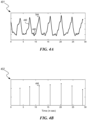
- FIG. 4A is a graph 401 depicting an example of a motion waveform acquired by the process 300 in accordance with an embodiment of the present technology.
- FIG. 4B is a graph 402 depicting peaks detected in the motion waveform of FIG. 4A in accordance with an embodiment of the present technology.
- the process 300 can comprise a set of instructions stored on memory (e.g., the memory 211 of FIG. 2 ) and executed by one or more processors (e.g., the processor 212 of FIG. 2 ).
- the process 300 comprises one or more smartphone applications stored on a device (e.g., the device 110 of FIG. 1 ).
- the process 300 begins at block 305 after the device and/or transducers are positioned proximate a subject (e.g., 1m away from the subject, between about 0.5m and 10m from the subject, between about 1m and 5m from the subject) anchor the subject's bed (e.g., the bed 104 of the subject 101 of FIG. 1 ).
- the process 300 monitors the subject to determine whether the subject is asleep.
- the process 300 may monitor movements of the subject to detect random, non-periodic motions that the process 300 determines are not associated with breathing motion of the subject. For example, if the process 300 detects a predetermined number of occurrences (e.g., two, three, four or higher) of non-periodic motion within a predetermined time period, (e.g., 5 minutes, 10 minutes, 20 minutes), the process 300 may determine that the subject is awake for the duration of the predetermined time period.
- a predetermined number of occurrences e.g., two, three, four or higher
- a predetermined time period e.g., 5 minutes, 10 minutes, 20 minutes
- the process 300 may determine that the subject is asleep during the entire predetermined time period.
- a sum of a plurality of predetermined time periods that do not include the predetermined number of occurrences of detected non-periodic motion may form the basis of an overall measurement of sleep time during a session or test. Such an overall measurement of sleep time may be used, for example, in the denominator of equation 1 discussed above.
- the process 300 is configured to wait a predetermined amount of time (e.g., one hour, two hours, four hours) before proceeding to the next step.
- the process 300 can detect an orientation of the device and, based on this detection, prompt a user to take corrective action. For example, the process 300 may provide more accurate detection if a predetermined side of a measurement device (e.g., a front facing portion of the device 110 shown in FIG. 1 ) is oriented at a predetermined orientation relative to the subject. In some embodiments, for example, it may be preferable to have a side of the measurement device on which the speaker is located or most closely positioned to be oriented toward the subject.
- a measurement device e.g., a front facing portion of the device 110 shown in FIG. 1
- the speaker and a microphone are not on the same side of the measurement device, however, it may be desirable to acquire audio from the subject if a side of the measurement device on which a microphone is positioned is facing upright and/or substantially oriented toward the subject.
- the process 300 can be configured to determine an orientation of the measurement device using, for example, one or more sensing mechanisms (e.g., one or more gyroscopes, accelerometers, compass sensors).
- the one or more sensing mechanisms include one or more of the sensors 217 discussed above with reference to FIG. 2 .
- the process 300 can generate one or more audible and/or visible indications instructing the subject and/or another user to take a corrective action based on the determined orientation.
- the corrective actions may include, for example, moving and/or orienting the measurement device toward the location of the subject.
- the process 300 may not proceed until one or more corrective actions are detected.
- the one or more audible and/or visible indications may persist while other blocks are executed in process 300.
- the process 300 can be configured to adjust detection thresholds based on a detected orientation.
- the process 300 generates one or more audio signals.
- the audio signals include FMCW signals having a sawtooth waveform that includes a plurality of sweep audio signals or "chirps" that linearly sweep from a first frequency to a second, higher frequency.
- the chirps sweep from a first audible frequency (e.g., about 18 kHz) to a second audible frequency (e.g., 20 kHz or higher).
- a first audible frequency e.g., about 18 kHz
- a second audible frequency e.g., 20 kHz or higher.
- the frequency spectrum of a typical human ear ranges from 20 Hz to about 20 kHz, and many transducers are configured for playback over this spectrum.
- the chirps sweep from a first audible frequency (e.g., 18 kHz) to a second inaudible frequency (e.g., a frequency greater than about 20 kHz and less than about 48 kHz, a frequency between about 22 kHz and about 44 kHz).
- the chirps sweep between two frequencies outside the human audible range (e.g., greater than about 20 kHz and less than about 48 kHz).
- the process 300 generates audio signals comprising FMCW signals having a sine waveform, a triangle waveform and/or a square waveform.
- the process 300 generates audio signals comprising pulse-modulated waveforms.
- the process 300 generates audio signals using another suitable modulation method.
- the process 300 provides the generated audio signals to a transducer (e.g., the first transducer 115 of FIG. 1 and/or the speaker 215 of FIG. 2 ) configured to convert the audio signals to acoustic energy (e.g., the sound 105 of FIG. 1 ) and further configured to direct at least a portion of the acoustic energy toward the subject.
- a transducer e.g., the first transducer 115 of FIG. 1 and/or the speaker 215 of FIG. 2
- the process 300 acquires echo data from a microphone (e.g., the second transducer 116 of FIG. 1 and/or the microphone 216 of FIG. 2 ) or another transducer.
- the acquired echo data includes data corresponding to a portion of the sound transmitted toward the subject and reflected or backscattered toward the microphone and converted by the microphone to electrical signals.
- the process 300 constructs a motion waveform using the echo data.
- the process 300 analyzes the generated audio signals and the received echo data and detects frequency shifts therebetween that are indicative of movement of a portion of the subject's body (e.g., the subject's chest and/or abdomen).
- the frequency shifts can be used to generate the motion waveform as a function of time.
- One example of a motion waveform constructed by the process 300 at block 340 is shown in the graph 401 of FIG. 4A .
- the graph 401 includes a motion waveform 440 having a plurality of peaks 444 and a plurality of valleys or nulls 446.
- the process 300 detects one or more of the peaks 444 in the waveform 440 of FIG. 4A .
- the graph 402 of FIG. 4B shows one example of the peaks 444 detected by the process 300. Additional aspects of construction of a motion waveform and detection of the peaks in the waveform are described below in reference to FIG. 6 .
- the process 300 analyzes the peaks (e.g., the peaks 444 of FIGS. 4A and 4B ) detected in the motion waveform (e.g., the waveform 440 of FIG. 4A ) to identify one or more sleep apnea events. For example, if an amplitude of a particular peak in the waveform is less than or equal to a predetermined threshold amplitude, the process 300 may determine that the particular peak corresponds to a hypopnea event in the subject. If, for example, successive peaks in the waveform are separated by a predetermined time (e.g., 10 seconds or greater), the process 300 may determine that the peak separation corresponds to a central apnea event. Further, if the process 300 detects a spike or a predetermined increase (e.g., 50%) in an amplitude between successive peaks, the process 300 may determine that the peak increase corresponds to an obstructive apnea event.
- a predetermined threshold amplitude e.
- the process 300 may compare a frequency of the detected peaks to a predetermined breathing frequency (e.g., a prior measurement of the patient's breathing frequency). The process 300 may further determine a possible presence of a COPD exacerbation in the subject if the frequency of the detected peaks is greater than equal to a predetermined percentage (e.g., between about 105% and about 125%, or about 115%) of the predetermined breathing frequency.
- the predetermined breathing frequency generally corresponds to a measured breathing frequency determined in a first portion or duration of a test, such as a predetermined period of time during a sleep measurement (e.g., an initial 30 minutes of the sleep measurement). The process 300 can use the measured breathing frequency as the subject's baseline breathing frequency.
- the process 300 may use other predetermined percentages (e.g., about 130% or higher) and/or other predetermined periods of time (e.g., between about 15 minutes and about 30 minutes, between about 30 minutes and about 60 minutes, between about 60 minutes and about 120 minutes).
- predetermined percentages e.g., about 130% or higher
- other predetermined periods of time e.g., between about 15 minutes and about 30 minutes, between about 30 minutes and about 60 minutes, between about 60 minutes and about 120 minutes.
- the process 300 outputs an indication of one or more of the apnea events.
- the process 300 may store one or more indications of apnea events in a memory or database (e.g., the memory 211 and/or the database 214 of FIG. 2 ).
- the process 300 may output an indication of one or more apnea events to a display (e.g., the user interface 118 of FIG. 1 and/or the display 218 of FIG. 2 ).
- FIG. 5A is a graph 501 depicting a conventional data acquisition approach in accordance with the prior art.
- FIG. 5B is a graph 502 depicting a method of acquiring data in accordance with an embodiment of the present technology.
- the graph 501 includes a plurality of transmit signals 548 and a plurality of corresponding received signals 549.
- a fast fourier transform (FFT) is computed for each transmit/receive cycle.
- the graph 502 includes a plurality of transmitted signals 550 (identified individually as a first transmitted signal 550a, a second transmitted signal 550b, and an nth transmitted signal 550n) and a plurality of corresponding reflected signals 552 (identified individually as a first reflected signal 552a, a second reflected signal 552b, and an nth reflected signal 552n).
- the plurality of transmitted signals 552 comprise FMCW signals that linearly sweep between a first frequency f 0 (e.g., 18 kHz) and a second, higher frequency f 1 (e.g., 20 kHz or higher) over a time T sweep (e.g., between about 5ms and about 15ms, between about 10ms and about 11ms or about 10.75ms).
- a first frequency f 0 e.g., 18 kHz
- f 1 e.g., 20 kHz or higher
- T sweep e.g., between about 5ms and about 15ms, between about 10ms and about 11ms or about 10.75ms.
- the individual transmitted signals 550 are emitted from a loudspeaker (e.g., the first transducer 115 of FIG. 1 ) and a corresponding one of the reflected signals is received at a microphone (e.g., the second transducer 116 of FIG. 2 ) a period of time.
- a loudspeaker e.g., the first transducer 115 of FIG. 1
- a microphone e.g., the second transducer 116 of FIG. 2
- An FMCW receiver can extract all these frequency shifts (or demodulate the reflected signals) by performing a Fourier transform over one or more chirp durations.
- the chirp duration, Tsweep is selected so that the reflections from all points within an operational distance (e.g., the distance D of FIG. 1 ) preferably start arriving before the chirp ends.
- the operational distance is approximately 1 meter, and a chirp duration of Tsweep 10.75 ms is selected.
- the act of breathing creates minute chest and abdomen motion that can be captured by monitoring a corresponding bin in the Fourier transform as a function of time.
- a 2 cm breathing displacement may result in an 11.7 Hz frequency shift.
- a 48 kHz sampling rate translates to a resolution of 0.71 cm per sample.
- a 10.7ms chirp duration corresponds to 512 samples.
- 18-20 kHz FMCW chirps each sample corresponds to a 3.9 Hz frequency shift.
- a displacement of 0.71cm can translate to a 3.9 Hz change in the frequency domain.
- a 2cm breathing movement can create an 11.7 Hz frequency shift.
- a frequency shift of 11.7 Hz can present a challenge because at a distance of 1m and with a chirp duration of 10.75ms, the width of each FFT bin is 93.75 Hz, which is much greater than the frequency shifts created due to breathing.
- an FFT is computed over an integer number of chirp durations as shown in FIG. 5B . This is in contrast to a traditional FMCW receiver that computes a Fourier transform over the duration of a single FMCW chirp as shown, for example in FIG. 5A .
- Computing an FFT over N chirps decreases a width of each FFT bin by a factor of N .
- an FFT computed over ten chirps results in an FFT bin width of 9.37 Hz, allowing the capture of the 11.7 Hz frequency shifts resulting from the breathing movements.
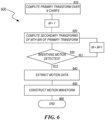
- FIG. 6 is a flow diagram of a process 600 configured to identify motion in accordance with an embodiment of the present technology.
- the process 600 begins at block 610 with monitoring a plurality of transmit/receive cycles as described above in reference to FIG. 5B .
- the process 600 receives a plurality of reflected signals (e.g., the reflected signals 552 of FIG. 5 ) and computes a plurality of primary frequency transforms over a predetermined number N (e.g., 5, 10, 20, 40, 50) of chirps or transmit/receive cycles.
- N e.g., 5, 10, 20, 40, 50
- a frequency transform converts and/or demodulates a signal from a first domain (e.g., a time domain) to a frequency domain.
- the primary transforms computed by the process 600 at block 610 represent frequency spectra of the reflected signals in a plurality of frequency bins. Each bin represents a discrete portion (e.g., about 1Hz to about 100 Hz, about 5 Hz to about 50 Hz, about 8 Hz to about 12 Hz, about 9 Hz to about 10 Hz) of the frequency spectrum of the reflected signals.
- the process 600 computes a plurality of 5120-point FFTs over every series of 10 reflected signals received by the process 600.
- each bin of the primary transforms has a bandwidth of approximately 9.37 Hz.
- the process 600 computes a secondary frequency transform (e.g., an FFT) of an individual bin of each the primary transforms computed at block 610 over a predetermined time duration (e.g., 5 s, 10s, 30s, 60s, 5 minutes, 10 minutes).
- a secondary frequency transform e.g., an FFT
- an index value m is set to 1. Accordingly, the process 600 performs an FFT of the 1 st bin of a plurality of the primary transforms as a function of time. In some embodiments, for example, the process 600 computes a 24,000-point FFT of the 1 st bins of a plurality of primary transforms over time duration of 30 seconds.
- the process 600 analyzes the secondary transform calculated at block 620 to determine whether the second transform includes one or more peaks associated with breathing frequencies. In some embodiments, for example, the process 600 analyzes the secondary transform from block 620 to determine if any peaks are detected between about 0.1 Hz or about 0.5 Hz (e.g., between about 0.2 Hz and about 0.3 Hz), which is a range that includes typical human breathing frequencies. If no peaks are detected at or near these frequency values, then the process 600 returns to block 620 and adds 1 to the index value m (i.e., m+1). The process 600 computes a new secondary transform at block 620 at the next bin m of the primary transforms over a predetermined period of time.
- m index value
- the process 600 continues to iteratively compute secondary transforms until the process 600 detects peaks corresponding to breathing frequencies and/or until a predetermined value of m (e.g., 58, 60, 100, 200) is reached. If the process 600 detects a peak between about 0.1 Hz and about 0.5 Hz, the process 600 stores the index m corresponding to the bin number in which the peak is detected as m peak , and proceeds to block 640.
- m e.g., 58, 60, 100, 200
- the process 600 extracts motion data from the reflected audio signals.
- the process 600 continues to compute a plurality of the primary transforms of the reflected audio and compute a secondary transform of bin m peak of the primary transforms as a function of time.
- the process 600 can also compute a distance D between a measurement device (e.g., the device 110 of FIG. 1 ) and the subject using the m peak index obtained by the process 600 at block 640. For example, if the bandwidth of each bin is approximately 9.37 Hz.
- bin index m psak obtained at block 630 is 58 (i.e., breathing motion detected in the 58 th bin of the primary transform of block 610), the resulting frequency shift caused by movement of the subject is approximately 1,087 Hz (9.37 Hz * 58 * 2).
- the time delay can be obtained as approximately 5.8 ms, which corresponds to a distance of about 1m from the subject.
- the process 600 constructs a motion waveform (e.g. the motion waveform 440 of FIG. 4A ) of movement of the subject's chest and/or abdomen as a function of time using the secondary transform computed at block 640.
- a motion waveform e.g. the motion waveform 440 of FIG. 4A
- the process 600 ends.
- FIG. 7 is a flow diagram of a process 700 configured to identify an apnea event in accordance with an embodiment of the present technology.
- the process analyzes peak in a motion waveform (e.g., the peaks 444 detected in the motion waveform 440 of FIG. 4A ).
- the process 700 is configured to determine a pose (e.g., supine, prone, non-prone, sitting up, lying down) of the subject corresponding to one or more of the detected peaks.
- the process 700 can be configured, for example, to monitor a distance (e.g., the distance D of FIG. 1 ) and/or an orientation between a measurement device (e.g., the device 110 of FIG. 1 ) and the subject.
- a distance e.g., the distance D of FIG. 1
- an orientation between a measurement device e.g., the device 110 of FIG. 1
- the process 700 can detect one or more aperiodic portions of the motion waveform.
- the process 700 can associate the one or more detected aperiodic portions of the subject's motion waveform with one or more non-breathing motions (e.g., rolling over, sitting up). If, for example, the subject rolls from one side of her body to another, the resulting motion waveform can arrive from a slightly different distance.
- the process 700 can determine an orientation of the subject
- the process 700 can be further configured to use the subject's orientation information to detect positional sleep apnea in the subject.
- the process 700 can be configured to distinguish between sleep apnea in, for example, a supine position (i.e., the subject lying with her face generally upward of away from a bed), a prone position (i.e., the subject lying with her face generally downward or toward the bed), and/or another position or pose.
- a supine position i.e., the subject lying with her face generally upward of away from a bed
- a prone position i.e., the subject lying with her face generally downward or toward the bed
- the positional information determined by the process 700 at block 710 can be used in subsequent blocks discussed below.
- the process 700 may determine a position or orientation of the subject relative to the measurement device at one or more other blocks of the process 700.
- the process 700 determines whether one or more peaks in the motion waveform are less than a predetermined threshold (e.g., an amplitude 30% less than other peaks in the motion waveform) over a predetermined time duration (e.g., between about 5s and 60s, or about 10s). If the process 700 determines that plurality of peaks are in the motion waveform are less than the predetermined threshold over the predetermined time, the process 700 outputs an indication of a hypopnea event at block 725. Otherwise, the process 700 proceeds to block 730.
- a predetermined threshold e.g., an amplitude 30% less than other peaks in the motion waveform
- a predetermined time duration e.g., between about 5s and 60s, or about 10s.
- the process 700 determines whether successive peaks in the motion waveform are separated by a time duration greater than a predetermined threshold time (e.g., 10 seconds). If the process 700 detects successive peaks in the motion waveform separated by the predetermined threshold time or greater, the process 700 outputs an indication of a central apnea event at block 735. Otherwise, the process 700 proceeds to block 740.
- a predetermined threshold time e.g. 10 seconds
- the process 700 determines whether successive peaks in the motion waveform include a first peak and a second, following peak in which the amplitude of the second peak is a predetermined percentage (e.g., 30%, 40%, 50%, 60%, 70%, 80%, 90%, 100% or higher) greater than an amplitude of the first peak. If the process detects successive peaks in the motion waveform in which the second peak has an amplitude greater than the predetermined percentage of the first peak, the process 700 outputs an indication of an obstructive apnea event at block 745.
- a predetermined percentage e.g. 30%, 40%, 50%, 60%, 70%, 80%, 90%, 100% or higher
- the process 700 may instead detect a first peak and a second, following peak in which the second peak is a predetermined percentage (e.g., 30%, 40%, 50%, 60%, 70%, 80%, 90%) less than the first peak.
- the process 700 determines whether there are additional peaks in the motion waveform. If there are additional peaks in the motion waveform, the process 700 returns to block 710. Otherwise, the process 700 ends at block 760.
- FIGS. 8A-8C show examples of apnea/hypopnea events that may be identified by the process 700 ( FIG. 7 ) in accordance with an embodiment of the present technology.
- FIG. 8A is a graph 801 depicting one example of a central apnea event described above with reference to block 730 of FIG. 7 .
- a chest motion waveform 840a includes a pair of successive peaks 844a and 844b separated by time T 1 (e.g., about 15s) greater than a predetermined central apnea threshold time (e.g., about 1 0s).
- FIG. 8B is a graph 802 depicting one example of hypopnea event described above with reference to block 720 of FIG. 7 .
- a motion waveform 840b includes a plurality of peaks, including a first peak 845a, a second peak 845b, and a third peak 845c.
- the first peak 845a and the second peak 845b comprise a plurality of peaks in the waveform 840b having amplitudes less than a predetermined threshold amplitude (e.g., 30% less than an amplitude of the peak 845c) during a predetermined time duration T 2 (e.g., about 35s).
- a predetermined threshold amplitude e.g. 30% less than an amplitude of the peak 845c
- FIG. 8C is a graph 803 depicting one example of an obstructive apnea event described above with reference to block 740 of FIG. 7 .
- a motion waveform 840c includes a plurality of peaks, including a first peak 846a and, a second peak 846b.
- the second peak 846b has an amplitude that is ⁇ L (e.g., 40%, 50%, 75%) greater than the first peak 846a or any other peaks in the waveform 840c preceding the second peak 846b by a time T 3 and/or following the second peak 846b by a time T 4 .
Landscapes
- Health & Medical Sciences (AREA)
- Life Sciences & Earth Sciences (AREA)
- Medical Informatics (AREA)
- Molecular Biology (AREA)
- Veterinary Medicine (AREA)
- Biophysics (AREA)
- Pathology (AREA)
- Engineering & Computer Science (AREA)
- Biomedical Technology (AREA)
- Heart & Thoracic Surgery (AREA)
- Public Health (AREA)
- Physics & Mathematics (AREA)
- Surgery (AREA)
- Animal Behavior & Ethology (AREA)
- General Health & Medical Sciences (AREA)
- Physiology (AREA)
- Pulmonology (AREA)
- Dentistry (AREA)
- Oral & Maxillofacial Surgery (AREA)
- Measurement Of The Respiration, Hearing Ability, Form, And Blood Characteristics Of Living Organisms (AREA)
- Ultra Sonic Daignosis Equipment (AREA)
Claims (13)
- Verfahren zum Betreiben einer elektronischen Vorrichtung (210) zum Identifizieren von Schlafapnoe-Ereignissen bei einem Subjekt oder zum Überwachen von Bewegungen eines Subjekts nahe der elektronischen Vorrichtung, wobei das Verfahren umfasst:Übertragen von Schallenergie hin zu dem Subjekt unter Verwendung eines ersten Wandlers (215) auf der elektronischen Vorrichtung, wobei das Übertragen der Schallenergie das Emittieren einer Vielzahl von Audio-Chirps aus dem ersten Wandler umfasst und wobei einzelne Audio-Chirps linear von einer ersten Frequenz zu einer zweiten, höheren Frequenz über eine vorbestimmte Zeitdauer wobbeln, wobei die erste Frequenz weniger als 20 kHz beträgt, wobei der erste Wandler ein Lautsprecher ist;Empfangen von Echos aus dem Subjekt, die der übertragenen Schallenergie entsprechen, unter Verwendung eines zweiten Wandlers (216) auf der elektronischen Vorrichtung, wobei der zweite Wandler dazu konfiguriert ist, elektrische Signale zu erzeugen, die den empfangenen Echos entsprechen;Erzeugen einer Wellenform unter Verwendung der elektrischen Signale, wobei der zweite Wandler ein Mikrofon ist;Detektieren einer Vielzahl von Peaks in der Wellenform, wobei einzelne Peaks eine entsprechende Amplitude aufweisen, und ferner, wobei einzelne Peaks indikativ sind für eine Atembewegung des Subjekts; undAusgeben einer Indikation eines Schlafapnoe-Ereignisses oder einer Bewegung für jedes Auftreten eines Zeitraums zwischen aufeinanderfolgenden einzelnen Peaks in der Wellenform, der eine vorbestimmte Schwellenzeit überschreitet.
- Verfahren nach Anspruch 1, wobei die erste Frequenz 10-18 kHz beträgt, vorzugsweise, wobei die erste Frequenz 10 kHz, 16 kHz oder 18 kHz beträgt.
- Verfahren nach Anspruch 1, wobei die erste Frequenz etwa 18 kHz beträgt und die zweite Frequenz 20 kHz oder mehr beträgt.
- Verfahren nach Anspruch 1, wobei mindestens ein Teil der Vielzahl von Audio-Chirps frequenzmodulierte Continous-Wave-Schallsignale umfasst, die aus dem ersten Wandler emittiert werden.
- Verfahren nach Anspruch 1, wobei das Erzeugen der Wellenform das Durchführen einer Fourier-Transformation der elektrischen Signale, die den empfangenen Echos entsprechen, über einen Zeitraum umfasst, der länger ist als die vorbestimmte Zeitdauer der einzelnen Chirps, vorzugsweise, wobei der Zeitraum ungefähr das 10-Fache der vorbestimmten Zeitdauer der einzelnen Chirps oder länger ist.
- Verfahren nach Anspruch 1, ferner umfassend das Wiederholen des Sendens und Empfangens für eine Vielzahl von Sende-/Empfangszyklen, wobei das Erzeugen der Wellenform ferner das Bestimmen einer Vielzahl von Frequenzverschiebungen zwischen der übertragenen Schallenergie und den entsprechenden empfangenen Echos für jeden der Vielzahl von Sende-/Empfangszyklen umfasst oder wobei das Erzeugen der Wellenform das Herausfiltern von Signalen mit einer Frequenz von weniger als etwa 18 kHz umfasst.
- Verfahren nach Anspruch 1, ferner umfassend das Ausgeben einer Indikation eines Schlafapnoe-Ereignisses für jedes Auftreten eines einzelnen Peaks in der Wellenform mit einer Amplitude, die kleiner oder gleich einer vorbestimmten Schwellenamplitude ist, vorzugsweise, ferner umfassend das Ausgeben einer Indikation eines Schlafapnoe-Ereignisses für jedes Auftreten einer Zunahme von 50 % oder mehr der Amplituden aufeinanderfolgender einzelner Peaks in der Wellenform, vorzugsweise, ferner umfassend das Ausgeben des Apnoe-Hypopnoe-Indexes des Subjekts, wobei das Ausgeben des Apnoe-Hypopnoe-Indexes des Subjekts das Bestimmen eines Verhältnisses einer Gesamtzahl von Schlafapnoe-Ereignissen während eines Schlafzyklus des Subjekts und einer Dauer des Schlafzykluses des Subjekts umfasst.
- Verfahren nach Anspruch 1, wobei das Übertragen von Schallenergie das Übertragen von Schallenergie mit einer Wellenlänge umfasst, die größer ist als die Hälfte eines Abstands zwischen dem ersten Wandler und dem zweiten Wandler.
- Verfahren nach Anspruch 1, wobei das Empfangen von Echos aus dem Subjekt das Erfassen von Audiodaten an dem Mikrofon umfasst, das operativ mit der elektronischen Vorrichtung gekoppelt ist, wobei die Audiodaten Echosignale umfassen, die einzelnen Audio-Wobbelsignalen entsprechen, die von dem Subjekt hin zu dem Mikrofon zurückgestreut werden;wobei das Erzeugen der Wellenform das Verarbeiten der erfassten Audiodaten umfasst, um eine Bewegungswellenform zu erzeugen; und wobei das Verfahren umfasstDetektieren eines oder mehrerer Peaks in der Bewegungswellenform, wobei einzelne Peaks indikativ sind für Bewegungen des Subjekts; undAusgeben einer Indikation einer Bewegung des Subjekts basierend auf einem oder mehreren der detektierten Peaks.
- Verfahren nach Anspruch 9, wobei die erste Frequenz etwa 18 kHz beträgt und die zweite Frequenz 20 kHz oder mehr beträgt, und ferner, wobei mindestens ein Teil der Vielzahl der Audio-Wobbelsignale frequenzmodulierte Continuous-Wave-Signale umfasst.
- Verfahren nach Anspruch 9, wobei das Verarbeiten ferner umfasst:Berechnen einer Vielzahl von Frequenzdomänendarstellungen der emittierten Audio-Wobbelsignale und der Echosignale, wobei die Frequenzdomänendarstellungen über einen Zeitraum berechnet werden, der ein vorbestimmtes Vielfaches der vorbestimmten Zeitdauer der einzelnen Audio-Wobbelsignale dauert; undBestimmen einer Frequenzverschiebung in den einzelnen Frequenzdomänendarstellungen relativ zu der ersten Frequenz.
- Verfahren nach Anspruch 9, wobei die einzelnen Peaks indikativ sind für eine Bewegung des Brustkorbs des Subjekts, wobei die einzelnen Peaks eine entsprechende Amplitude aufweisen und wobei das Ausgeben einer Indikation einer Bewegung des Subjekts ferner das Ausgeben einer Indikation eines Schlafapnoe-Ereignisses für jedes Auftreten eines Zeitraums zwischen aufeinanderfolgenden einzelnen Peaks in der Bewegungswellenform, der eine vorbestimmte Schwellenzeit überschreitet, umfasst, vorzugsweise, wobei das Ausgeben einer Indikation einer Bewegung des Subjekts ferner das Ausgeben einer Indikation eines Schlafapnoe-Ereignisses für jedes Auftreten eines einzelnen Peaks in der Wellenform mit einer Amplitude von kleiner oder gleich einer vorbestimmten Schwellenamplitude umfasst, oder wobei das Ausgeben einer Indikation einer Bewegung des Subjekts ferner das Ausgeben einer Indikation eines Schlafapnoe-Ereignisses für jedes Auftreten einer Zunahme von 50 % oder mehr der Amplituden aufeinanderfolgender einzelner Peaks in der Wellenform umfasst.
- Computerprogrammprodukt, umfassend ein nicht-transitorisches, computerlesbares Speichermedium, das computerverwendbaren Programmcode speichert, der ausführbar ist, um ein Verfahren zum Betreiben einer elektronischen Vorrichtung nach einem der Ansprüche 1-12 durchzuführen.
Applications Claiming Priority (3)
| Application Number | Priority Date | Filing Date | Title |
|---|---|---|---|
| US201462089130P | 2014-12-08 | 2014-12-08 | |
| US201562152519P | 2015-04-24 | 2015-04-24 | |
| PCT/US2015/053288 WO2016093927A2 (en) | 2014-12-08 | 2015-09-30 | Systems and methods of identifying motion of a subject |
Publications (3)
| Publication Number | Publication Date |
|---|---|
| EP3229694A2 EP3229694A2 (de) | 2017-10-18 |
| EP3229694A4 EP3229694A4 (de) | 2018-07-25 |
| EP3229694B1 true EP3229694B1 (de) | 2024-08-14 |
Family
ID=56108342
Family Applications (1)
| Application Number | Title | Priority Date | Filing Date |
|---|---|---|---|
| EP15867802.9A Active EP3229694B1 (de) | 2014-12-08 | 2015-09-30 | Verfahren zur identifizierung der bewegung eines subjekts |
Country Status (7)
| Country | Link |
|---|---|
| US (3) | US10638972B2 (de) |
| EP (1) | EP3229694B1 (de) |
| JP (1) | JP6564040B2 (de) |
| CN (2) | CN107205721A (de) |
| AU (1) | AU2015361171B2 (de) |
| NZ (1) | NZ732493A (de) |
| WO (1) | WO2016093927A2 (de) |
Families Citing this family (36)
| Publication number | Priority date | Publication date | Assignee | Title |
|---|---|---|---|---|
| WO2016093927A2 (en) | 2014-12-08 | 2016-06-16 | University Of Washington | Systems and methods of identifying motion of a subject |
| US10386482B2 (en) * | 2016-01-25 | 2019-08-20 | Board Of Regents, The University Of Texas System | Device-free tracking system that accurately tracks hand movement |
| US11324950B2 (en) | 2016-04-19 | 2022-05-10 | Inspire Medical Systems, Inc. | Accelerometer-based sensing for sleep disordered breathing (SDB) care |
| EP3474116B1 (de) * | 2016-06-17 | 2023-04-26 | Citizen Watch Co., Ltd. | Detektionsvorrichtung, informationseingabevorrichtung und ansichtssystem |
| EP3515290B1 (de) | 2016-09-19 | 2023-06-21 | ResMed Sensor Technologies Limited | Erfassung physiologischer bewegungen aus audio- und multimodalen signalen |
| EP3537961B1 (de) | 2016-11-10 | 2025-06-25 | The Research Foundation for The State University of New York | System, verfahren und biomarker für verstopfungen der atemwege |
| CN116898406A (zh) * | 2017-12-22 | 2023-10-20 | 瑞思迈传感器技术有限公司 | 用于运动感测的设备、系统和方法 |
| WO2019122412A1 (en) * | 2017-12-22 | 2019-06-27 | Resmed Sensor Technologies Limited | Apparatus, system, and method for health and medical sensing |
| JP7510346B2 (ja) * | 2017-12-22 | 2024-07-03 | レスメッド センサー テクノロジーズ リミテッド | 車両内生理学的感知のための装置、システムおよび方法 |
| CA3094421A1 (en) * | 2018-03-19 | 2019-09-26 | Onera Technologies B.V. | A method and a system for detecting a respiratory event of a subject and a method for forming a model for detecting a respiratory event |
| KR102068330B1 (ko) * | 2018-03-22 | 2020-01-20 | 서울대학교산학협력단 | 수면 무호흡 중증도 검사 장치 |
| JP2021523799A (ja) * | 2018-05-23 | 2021-09-09 | ユニバーシティ オブ ワシントンUniversity of Washington | 呼吸不全検知システムおよび関連する方法 |
| NL2021018B1 (en) * | 2018-05-30 | 2019-12-10 | Orange Castle Entpr B V | An electronic device for reduction of snoring of an individual |
| WO2019232367A1 (en) * | 2018-06-01 | 2019-12-05 | Florida Apnea Diagnostics | Sleep diagnostic system and method |
| US20210239831A1 (en) * | 2018-06-05 | 2021-08-05 | Google Llc | Systems and methods of ultrasonic sensing in smart devices |
| CN109009125B (zh) * | 2018-06-07 | 2019-05-28 | 上海交通大学 | 基于移动终端音频的驾驶员细粒度呼吸监测方法及系统 |
| CN109480783B (zh) * | 2018-12-20 | 2022-02-18 | 深圳和而泰智能控制股份有限公司 | 一种呼吸暂停检测方法、装置及计算设备 |
| US12257069B2 (en) | 2019-03-28 | 2025-03-25 | Sunrise Sa | System comprising a sensing unit and a device for processing data relating to disturbances that may occur during the sleep of a subject |
| CA3135090A1 (en) * | 2019-03-28 | 2020-10-01 | Sunrise Sa | System comprising a sensing unit and a device for processing data relating to disturbances that may occur during the sleep of a subject |
| CN110251095A (zh) * | 2019-05-14 | 2019-09-20 | 周常安 | 指戴式生理装置及系统 |
| US11738197B2 (en) | 2019-07-25 | 2023-08-29 | Inspire Medical Systems, Inc. | Systems and methods for operating an implantable medical device based upon sensed posture information |
| KR102091974B1 (ko) * | 2019-07-25 | 2020-03-24 | 정기섭 | Fmcw 레이더를 이용한 위치 추적 및 호흡(심박) 패턴 측정 방법 |
| CN114401665A (zh) | 2019-07-25 | 2022-04-26 | 启迪医疗仪器公司 | 呼吸检测 |
| US12440183B2 (en) * | 2019-08-06 | 2025-10-14 | Avent, Inc. | Apparatus, system, and method for detecting the distance between sensors using ultrasound |
| US20210190351A1 (en) * | 2019-12-18 | 2021-06-24 | Koninklijke Philips N.V. | System and method for alerting a caregiver based on the state of a person in need |
| EP3838137A1 (de) * | 2019-12-19 | 2021-06-23 | Koninklijke Philips N.V. | Automatisierter und objektiver symptomschweregradwert |
| CN115697194A (zh) * | 2020-03-31 | 2023-02-03 | 瑞思迈传感器技术有限公司 | 用于绘制气道阻塞的系统和方法 |
| WO2021220202A1 (en) * | 2020-04-30 | 2021-11-04 | Resmed Sensor Technologies Limited | Alertness service |
| US20230190140A1 (en) * | 2020-05-19 | 2023-06-22 | Resmed Sensor Technologies Limited | Methods and apparatus for detection and monitoring of health parameters |
| CN114098794A (zh) * | 2020-08-28 | 2022-03-01 | 华为技术有限公司 | 人体健康状况的检测方法及装置 |
| ES2975962T3 (es) | 2020-10-01 | 2024-07-18 | Sunrise Sa | Dispositivo ponible para disminuir el esfuerzo respiratorio de un sujeto dormido |
| CN114431891B (zh) * | 2020-10-30 | 2024-10-11 | 华为技术有限公司 | 监测睡眠的方法和相关电子设备 |
| US20220202358A1 (en) * | 2020-12-29 | 2022-06-30 | Industrial Technology Research Institute | Electronic device and method for detecting apnea |
| US20230218225A1 (en) * | 2022-01-11 | 2023-07-13 | Sleep Number Corporation | Centralized hub device for determining and displaying health-related metrics |
| CN116019422B (zh) * | 2022-12-29 | 2025-02-21 | 深圳市迈迪加科技发展有限公司 | 一种阻塞性呼吸暂停识别方法及相关设备 |
| CN116649759B (zh) * | 2023-06-01 | 2025-11-14 | 浙江大学 | 一种基于声学特性的睡眠姿势识别枕及识别方法 |
Family Cites Families (23)
| Publication number | Priority date | Publication date | Assignee | Title |
|---|---|---|---|---|
| JPS5826238A (ja) * | 1981-08-08 | 1983-02-16 | Fujitsu Ltd | 超音波による圧力測定方式 |
| US6375621B1 (en) * | 1987-03-06 | 2002-04-23 | Ocean Laboratories, Inc. | Passive apnea monitor |
| US4958638A (en) | 1988-06-30 | 1990-09-25 | Georgia Tech Research Corporation | Non-contact vital signs monitor |
| US6062216A (en) * | 1996-12-27 | 2000-05-16 | Children's Medical Center Corporation | Sleep apnea detector system |
| US6083173A (en) * | 1998-03-06 | 2000-07-04 | Research Foundation Of State University Of New York | Artificial neural network for predicting respiratory disturbances and method for developing the same |
| US6171258B1 (en) * | 1998-10-08 | 2001-01-09 | Sleep Solutions, Inc. | Multi-channel self-contained apparatus and method for diagnosis of sleep disorders |
| US20040044288A1 (en) | 2002-09-03 | 2004-03-04 | Miguel Gorenberg | Apparatus and method for non-invasive monitoring of cardiac output |
| US6988994B2 (en) * | 2003-08-14 | 2006-01-24 | New York University | Positive airway pressure system and method for treatment of sleeping disorder in patient |
| US7473228B2 (en) * | 2004-07-08 | 2009-01-06 | Delphi Technologies, Inc. | System and method for monitoring a respiration rate of an occupant of a predetermined volume |
| WO2007143535A2 (en) * | 2006-06-01 | 2007-12-13 | Biancamed Ltd. | Apparatus, system, and method for monitoring physiological signs |
| JP4137963B2 (ja) | 2006-09-08 | 2008-08-20 | 三菱鉛筆株式会社 | 筆記具 |
| US20110237948A1 (en) | 2009-01-30 | 2011-09-29 | Engineered Vigilance, Llc | Ultrasound probe for use with device performing non-contact respiratory monitoring |
| US9526429B2 (en) * | 2009-02-06 | 2016-12-27 | Resmed Sensor Technologies Limited | Apparatus, system and method for chronic disease monitoring |
| US8396537B2 (en) * | 2009-04-20 | 2013-03-12 | Mindray Ds Usa, Inc. | Method and system to measure ECG and respiration |
| US8905928B2 (en) * | 2009-07-17 | 2014-12-09 | Oregon Health & Science University | Method and apparatus for assessment of sleep disorders |
| US20110208060A1 (en) | 2010-02-24 | 2011-08-25 | Haase Wayne C | Non-contact Biometric Monitor |
| US8301232B2 (en) * | 2010-06-08 | 2012-10-30 | Alivecor, Inc. | Wireless, ultrasonic personal health monitoring system |
| EP2584966B1 (de) * | 2010-06-23 | 2021-05-26 | Oridion Medical 1987 Ltd. | Verfahren und system zur analyse von schlafstörungen |
| US20130155031A1 (en) * | 2010-06-29 | 2013-06-20 | Elliptic Laboratories As | User control of electronic devices |
| US10165959B2 (en) | 2010-10-20 | 2019-01-01 | Koninklijke Philips N.V. | Method and apparatus for diagnosing obstructive sleep apnea with an awake patient |
| EP2517621A1 (de) | 2011-04-29 | 2012-10-31 | Nederlandse Organisatie voor toegepast -natuurwetenschappelijk onderzoek TNO | Radarvorrichtung zur Erkennung mehrerer Lebenszeichen bei einem Patienten, Verfahren und Computerprogrammprodukt |
| JP2013072865A (ja) * | 2011-09-29 | 2013-04-22 | Oki Electric Ind Co Ltd | 検出装置、検出方法、およびプログラム |
| WO2016093927A2 (en) | 2014-12-08 | 2016-06-16 | University Of Washington | Systems and methods of identifying motion of a subject |
-
2015
- 2015-09-30 WO PCT/US2015/053288 patent/WO2016093927A2/en not_active Ceased
- 2015-09-30 JP JP2017530684A patent/JP6564040B2/ja active Active
- 2015-09-30 EP EP15867802.9A patent/EP3229694B1/de active Active
- 2015-09-30 CN CN201580075628.0A patent/CN107205721A/zh active Pending
- 2015-09-30 CN CN202111382416.0A patent/CN114224317A/zh active Pending
- 2015-09-30 US US15/532,981 patent/US10638972B2/en active Active
- 2015-09-30 AU AU2015361171A patent/AU2015361171B2/en active Active
- 2015-09-30 NZ NZ732493A patent/NZ732493A/en unknown
-
2020
- 2020-03-31 US US16/836,530 patent/US11660046B2/en active Active
-
2023
- 2023-04-18 US US18/302,725 patent/US12109039B2/en active Active
Also Published As
| Publication number | Publication date |
|---|---|
| US20240081733A1 (en) | 2024-03-14 |
| NZ732493A (en) | 2022-07-29 |
| CN107205721A (zh) | 2017-09-26 |
| US12109039B2 (en) | 2024-10-08 |
| US20200297273A1 (en) | 2020-09-24 |
| AU2015361171A1 (en) | 2017-06-22 |
| JP2018504166A (ja) | 2018-02-15 |
| WO2016093927A3 (en) | 2016-09-01 |
| EP3229694A4 (de) | 2018-07-25 |
| US11660046B2 (en) | 2023-05-30 |
| WO2016093927A2 (en) | 2016-06-16 |
| AU2015361171B2 (en) | 2020-07-02 |
| US20170347951A1 (en) | 2017-12-07 |
| JP6564040B2 (ja) | 2019-08-21 |
| EP3229694A2 (de) | 2017-10-18 |
| US10638972B2 (en) | 2020-05-05 |
| CN114224317A (zh) | 2022-03-25 |
Similar Documents
| Publication | Publication Date | Title |
|---|---|---|
| US12109039B2 (en) | Systems and methods of identifying motion of a subject | |
| US12525350B2 (en) | Systems, apparatus and methods for acquisition, storage, and analysis of health and environmental data | |
| US11690519B2 (en) | Apparatus, system, and method for monitoring physiological signs | |
| CN111867458B (zh) | 用于心血管健康监测的系统和方法 | |
| Nandakumar et al. | Contactless sleep apnea detection on smartphones | |
| JP6353194B2 (ja) | 身体情報測定装置 | |
| US20210121096A1 (en) | Respiratory failure detection systems and associated methods | |
| JP2012170528A (ja) | 睡眠時無呼吸判定装置 | |
| Liu et al. | Human biometric signals monitoring based on wifi channel state information using deep learning | |
| CN118078230B (zh) | 心血管疾病风险预测方法及装置 | |
| Wang et al. | Ultrasonic-based submillimeter ranging system for contactless respiration monitoring | |
| CN108207108A (zh) | 基于云端的脉搏血氧测量系统和方法及可选的头带组件 | |
| CN121963385A (zh) | 一种基于无线信号的人体活动检测方法及系统 |
Legal Events
| Date | Code | Title | Description |
|---|---|---|---|
| STAA | Information on the status of an ep patent application or granted ep patent |
Free format text: STATUS: THE INTERNATIONAL PUBLICATION HAS BEEN MADE |
|
| PUAI | Public reference made under article 153(3) epc to a published international application that has entered the european phase |
Free format text: ORIGINAL CODE: 0009012 |
|
| STAA | Information on the status of an ep patent application or granted ep patent |
Free format text: STATUS: REQUEST FOR EXAMINATION WAS MADE |
|
| 17P | Request for examination filed |
Effective date: 20170707 |
|
| AK | Designated contracting states |
Kind code of ref document: A2 Designated state(s): AL AT BE BG CH CY CZ DE DK EE ES FI FR GB GR HR HU IE IS IT LI LT LU LV MC MK MT NL NO PL PT RO RS SE SI SK SM TR |
|
| AX | Request for extension of the european patent |
Extension state: BA ME |
|
| DAV | Request for validation of the european patent (deleted) | ||
| DAX | Request for extension of the european patent (deleted) | ||
| A4 | Supplementary search report drawn up and despatched |
Effective date: 20180627 |
|
| RIC1 | Information provided on ipc code assigned before grant |
Ipc: A61B 5/08 20060101ALI20180621BHEP Ipc: A61B 5/00 20060101ALI20180621BHEP Ipc: A61B 5/11 20060101ALI20180621BHEP Ipc: A61B 5/113 20060101ALI20180621BHEP Ipc: A61B 8/00 20060101AFI20180621BHEP |
|
| STAA | Information on the status of an ep patent application or granted ep patent |
Free format text: STATUS: EXAMINATION IS IN PROGRESS |
|
| 17Q | First examination report despatched |
Effective date: 20210708 |
|
| P01 | Opt-out of the competence of the unified patent court (upc) registered |
Effective date: 20230524 |
|
| RAP3 | Party data changed (applicant data changed or rights of an application transferred) |
Owner name: UNIVERSITY OF WASHINGTON |
|
| RAP3 | Party data changed (applicant data changed or rights of an application transferred) |
Owner name: UNIVERSITY OF WASHINGTON |
|
| GRAP | Despatch of communication of intention to grant a patent |
Free format text: ORIGINAL CODE: EPIDOSNIGR1 |
|
| STAA | Information on the status of an ep patent application or granted ep patent |
Free format text: STATUS: GRANT OF PATENT IS INTENDED |
|
| INTG | Intention to grant announced |
Effective date: 20240320 |
|
| GRAS | Grant fee paid |
Free format text: ORIGINAL CODE: EPIDOSNIGR3 |
|
| GRAA | (expected) grant |
Free format text: ORIGINAL CODE: 0009210 |
|
| STAA | Information on the status of an ep patent application or granted ep patent |
Free format text: STATUS: THE PATENT HAS BEEN GRANTED |
|
| AK | Designated contracting states |
Kind code of ref document: B1 Designated state(s): AL AT BE BG CH CY CZ DE DK EE ES FI FR GB GR HR HU IE IS IT LI LT LU LV MC MK MT NL NO PL PT RO RS SE SI SK SM TR |
|
| REG | Reference to a national code |
Ref country code: GB Ref legal event code: FG4D |
|
| REG | Reference to a national code |
Ref country code: CH Ref legal event code: EP |
|
| REG | Reference to a national code |
Ref country code: DE Ref legal event code: R096 Ref document number: 602015089567 Country of ref document: DE |
|
| REG | Reference to a national code |
Ref country code: IE Ref legal event code: FG4D |
|
| REG | Reference to a national code |
Ref country code: LT Ref legal event code: MG9D |
|
| REG | Reference to a national code |
Ref country code: NL Ref legal event code: MP Effective date: 20240814 |
|
| PG25 | Lapsed in a contracting state [announced via postgrant information from national office to epo] |
Ref country code: NO Free format text: LAPSE BECAUSE OF FAILURE TO SUBMIT A TRANSLATION OF THE DESCRIPTION OR TO PAY THE FEE WITHIN THE PRESCRIBED TIME-LIMIT Effective date: 20241114 |
|
| REG | Reference to a national code |
Ref country code: AT Ref legal event code: MK05 Ref document number: 1712527 Country of ref document: AT Kind code of ref document: T Effective date: 20240814 |
|
| PG25 | Lapsed in a contracting state [announced via postgrant information from national office to epo] |
Ref country code: NL Free format text: LAPSE BECAUSE OF FAILURE TO SUBMIT A TRANSLATION OF THE DESCRIPTION OR TO PAY THE FEE WITHIN THE PRESCRIBED TIME-LIMIT Effective date: 20240814 Ref country code: FI Free format text: LAPSE BECAUSE OF FAILURE TO SUBMIT A TRANSLATION OF THE DESCRIPTION OR TO PAY THE FEE WITHIN THE PRESCRIBED TIME-LIMIT Effective date: 20240814 Ref country code: PT Free format text: LAPSE BECAUSE OF FAILURE TO SUBMIT A TRANSLATION OF THE DESCRIPTION OR TO PAY THE FEE WITHIN THE PRESCRIBED TIME-LIMIT Effective date: 20241216 Ref country code: PL Free format text: LAPSE BECAUSE OF FAILURE TO SUBMIT A TRANSLATION OF THE DESCRIPTION OR TO PAY THE FEE WITHIN THE PRESCRIBED TIME-LIMIT Effective date: 20240814 Ref country code: GR Free format text: LAPSE BECAUSE OF FAILURE TO SUBMIT A TRANSLATION OF THE DESCRIPTION OR TO PAY THE FEE WITHIN THE PRESCRIBED TIME-LIMIT Effective date: 20241115 |
|
| PG25 | Lapsed in a contracting state [announced via postgrant information from national office to epo] |
Ref country code: BG Free format text: LAPSE BECAUSE OF FAILURE TO SUBMIT A TRANSLATION OF THE DESCRIPTION OR TO PAY THE FEE WITHIN THE PRESCRIBED TIME-LIMIT Effective date: 20240814 |
|
| PG25 | Lapsed in a contracting state [announced via postgrant information from national office to epo] |
Ref country code: LV Free format text: LAPSE BECAUSE OF FAILURE TO SUBMIT A TRANSLATION OF THE DESCRIPTION OR TO PAY THE FEE WITHIN THE PRESCRIBED TIME-LIMIT Effective date: 20240814 |
|
| PG25 | Lapsed in a contracting state [announced via postgrant information from national office to epo] |
Ref country code: AT Free format text: LAPSE BECAUSE OF FAILURE TO SUBMIT A TRANSLATION OF THE DESCRIPTION OR TO PAY THE FEE WITHIN THE PRESCRIBED TIME-LIMIT Effective date: 20240814 Ref country code: IS Free format text: LAPSE BECAUSE OF FAILURE TO SUBMIT A TRANSLATION OF THE DESCRIPTION OR TO PAY THE FEE WITHIN THE PRESCRIBED TIME-LIMIT Effective date: 20241214 |
|
| PG25 | Lapsed in a contracting state [announced via postgrant information from national office to epo] |
Ref country code: HR Free format text: LAPSE BECAUSE OF FAILURE TO SUBMIT A TRANSLATION OF THE DESCRIPTION OR TO PAY THE FEE WITHIN THE PRESCRIBED TIME-LIMIT Effective date: 20240814 |
|
| PG25 | Lapsed in a contracting state [announced via postgrant information from national office to epo] |
Ref country code: RS Free format text: LAPSE BECAUSE OF FAILURE TO SUBMIT A TRANSLATION OF THE DESCRIPTION OR TO PAY THE FEE WITHIN THE PRESCRIBED TIME-LIMIT Effective date: 20241114 Ref country code: ES Free format text: LAPSE BECAUSE OF FAILURE TO SUBMIT A TRANSLATION OF THE DESCRIPTION OR TO PAY THE FEE WITHIN THE PRESCRIBED TIME-LIMIT Effective date: 20240814 |
|
| PG25 | Lapsed in a contracting state [announced via postgrant information from national office to epo] |
Ref country code: RS Free format text: LAPSE BECAUSE OF FAILURE TO SUBMIT A TRANSLATION OF THE DESCRIPTION OR TO PAY THE FEE WITHIN THE PRESCRIBED TIME-LIMIT Effective date: 20241114 Ref country code: PT Free format text: LAPSE BECAUSE OF FAILURE TO SUBMIT A TRANSLATION OF THE DESCRIPTION OR TO PAY THE FEE WITHIN THE PRESCRIBED TIME-LIMIT Effective date: 20241216 Ref country code: PL Free format text: LAPSE BECAUSE OF FAILURE TO SUBMIT A TRANSLATION OF THE DESCRIPTION OR TO PAY THE FEE WITHIN THE PRESCRIBED TIME-LIMIT Effective date: 20240814 Ref country code: NO Free format text: LAPSE BECAUSE OF FAILURE TO SUBMIT A TRANSLATION OF THE DESCRIPTION OR TO PAY THE FEE WITHIN THE PRESCRIBED TIME-LIMIT Effective date: 20241114 Ref country code: NL Free format text: LAPSE BECAUSE OF FAILURE TO SUBMIT A TRANSLATION OF THE DESCRIPTION OR TO PAY THE FEE WITHIN THE PRESCRIBED TIME-LIMIT Effective date: 20240814 Ref country code: LV Free format text: LAPSE BECAUSE OF FAILURE TO SUBMIT A TRANSLATION OF THE DESCRIPTION OR TO PAY THE FEE WITHIN THE PRESCRIBED TIME-LIMIT Effective date: 20240814 Ref country code: IS Free format text: LAPSE BECAUSE OF FAILURE TO SUBMIT A TRANSLATION OF THE DESCRIPTION OR TO PAY THE FEE WITHIN THE PRESCRIBED TIME-LIMIT Effective date: 20241214 Ref country code: HR Free format text: LAPSE BECAUSE OF FAILURE TO SUBMIT A TRANSLATION OF THE DESCRIPTION OR TO PAY THE FEE WITHIN THE PRESCRIBED TIME-LIMIT Effective date: 20240814 Ref country code: GR Free format text: LAPSE BECAUSE OF FAILURE TO SUBMIT A TRANSLATION OF THE DESCRIPTION OR TO PAY THE FEE WITHIN THE PRESCRIBED TIME-LIMIT Effective date: 20241115 Ref country code: FI Free format text: LAPSE BECAUSE OF FAILURE TO SUBMIT A TRANSLATION OF THE DESCRIPTION OR TO PAY THE FEE WITHIN THE PRESCRIBED TIME-LIMIT Effective date: 20240814 Ref country code: ES Free format text: LAPSE BECAUSE OF FAILURE TO SUBMIT A TRANSLATION OF THE DESCRIPTION OR TO PAY THE FEE WITHIN THE PRESCRIBED TIME-LIMIT Effective date: 20240814 Ref country code: BG Free format text: LAPSE BECAUSE OF FAILURE TO SUBMIT A TRANSLATION OF THE DESCRIPTION OR TO PAY THE FEE WITHIN THE PRESCRIBED TIME-LIMIT Effective date: 20240814 Ref country code: AT Free format text: LAPSE BECAUSE OF FAILURE TO SUBMIT A TRANSLATION OF THE DESCRIPTION OR TO PAY THE FEE WITHIN THE PRESCRIBED TIME-LIMIT Effective date: 20240814 |
|
| PG25 | Lapsed in a contracting state [announced via postgrant information from national office to epo] |
Ref country code: RO Free format text: LAPSE BECAUSE OF FAILURE TO SUBMIT A TRANSLATION OF THE DESCRIPTION OR TO PAY THE FEE WITHIN THE PRESCRIBED TIME-LIMIT Effective date: 20240814 Ref country code: DK Free format text: LAPSE BECAUSE OF FAILURE TO SUBMIT A TRANSLATION OF THE DESCRIPTION OR TO PAY THE FEE WITHIN THE PRESCRIBED TIME-LIMIT Effective date: 20240814 Ref country code: SM Free format text: LAPSE BECAUSE OF FAILURE TO SUBMIT A TRANSLATION OF THE DESCRIPTION OR TO PAY THE FEE WITHIN THE PRESCRIBED TIME-LIMIT Effective date: 20240814 |
|
| PG25 | Lapsed in a contracting state [announced via postgrant information from national office to epo] |
Ref country code: EE Free format text: LAPSE BECAUSE OF FAILURE TO SUBMIT A TRANSLATION OF THE DESCRIPTION OR TO PAY THE FEE WITHIN THE PRESCRIBED TIME-LIMIT Effective date: 20240814 |
|
| PG25 | Lapsed in a contracting state [announced via postgrant information from national office to epo] |
Ref country code: CZ Free format text: LAPSE BECAUSE OF FAILURE TO SUBMIT A TRANSLATION OF THE DESCRIPTION OR TO PAY THE FEE WITHIN THE PRESCRIBED TIME-LIMIT Effective date: 20240814 |
|
| PG25 | Lapsed in a contracting state [announced via postgrant information from national office to epo] |
Ref country code: SK Free format text: LAPSE BECAUSE OF FAILURE TO SUBMIT A TRANSLATION OF THE DESCRIPTION OR TO PAY THE FEE WITHIN THE PRESCRIBED TIME-LIMIT Effective date: 20240814 Ref country code: IT Free format text: LAPSE BECAUSE OF FAILURE TO SUBMIT A TRANSLATION OF THE DESCRIPTION OR TO PAY THE FEE WITHIN THE PRESCRIBED TIME-LIMIT Effective date: 20240814 |
|
| REG | Reference to a national code |
Ref country code: CH Ref legal event code: PL |
|
| REG | Reference to a national code |
Ref country code: DE Ref legal event code: R097 Ref document number: 602015089567 Country of ref document: DE |
|
| PG25 | Lapsed in a contracting state [announced via postgrant information from national office to epo] |
Ref country code: LU Free format text: LAPSE BECAUSE OF NON-PAYMENT OF DUE FEES Effective date: 20240930 |
|
| PLBE | No opposition filed within time limit |
Free format text: ORIGINAL CODE: 0009261 |
|
| STAA | Information on the status of an ep patent application or granted ep patent |
Free format text: STATUS: NO OPPOSITION FILED WITHIN TIME LIMIT |
|
| PG25 | Lapsed in a contracting state [announced via postgrant information from national office to epo] |
Ref country code: MC Free format text: LAPSE BECAUSE OF FAILURE TO SUBMIT A TRANSLATION OF THE DESCRIPTION OR TO PAY THE FEE WITHIN THE PRESCRIBED TIME-LIMIT Effective date: 20240814 |
|
| REG | Reference to a national code |
Ref country code: BE Ref legal event code: MM Effective date: 20240930 |
|
| PG25 | Lapsed in a contracting state [announced via postgrant information from national office to epo] |
Ref country code: BE Free format text: LAPSE BECAUSE OF NON-PAYMENT OF DUE FEES Effective date: 20240930 |
|
| 26N | No opposition filed |
Effective date: 20250515 |
|
| GBPC | Gb: european patent ceased through non-payment of renewal fee |
Effective date: 20241114 |
|
| PG25 | Lapsed in a contracting state [announced via postgrant information from national office to epo] |
Ref country code: CH Free format text: LAPSE BECAUSE OF NON-PAYMENT OF DUE FEES Effective date: 20240930 |
|
| PG25 | Lapsed in a contracting state [announced via postgrant information from national office to epo] |
Ref country code: IE Free format text: LAPSE BECAUSE OF NON-PAYMENT OF DUE FEES Effective date: 20240930 |
|
| PG25 | Lapsed in a contracting state [announced via postgrant information from national office to epo] |
Ref country code: SE Free format text: LAPSE BECAUSE OF FAILURE TO SUBMIT A TRANSLATION OF THE DESCRIPTION OR TO PAY THE FEE WITHIN THE PRESCRIBED TIME-LIMIT Effective date: 20240814 |
|
| PG25 | Lapsed in a contracting state [announced via postgrant information from national office to epo] |
Ref country code: GB Free format text: LAPSE BECAUSE OF NON-PAYMENT OF DUE FEES Effective date: 20241114 |
|
| PG25 | Lapsed in a contracting state [announced via postgrant information from national office to epo] |
Ref country code: CY Free format text: LAPSE BECAUSE OF FAILURE TO SUBMIT A TRANSLATION OF THE DESCRIPTION OR TO PAY THE FEE WITHIN THE PRESCRIBED TIME-LIMIT; INVALID AB INITIO Effective date: 20150930 |
|
| PG25 | Lapsed in a contracting state [announced via postgrant information from national office to epo] |
Ref country code: HU Free format text: LAPSE BECAUSE OF FAILURE TO SUBMIT A TRANSLATION OF THE DESCRIPTION OR TO PAY THE FEE WITHIN THE PRESCRIBED TIME-LIMIT; INVALID AB INITIO Effective date: 20150930 |
|
| PGFP | Annual fee paid to national office [announced via postgrant information from national office to epo] |
Ref country code: DE Payment date: 20260218 Year of fee payment: 11 |
|
| PGFP | Annual fee paid to national office [announced via postgrant information from national office to epo] |
Ref country code: FR Payment date: 20260225 Year of fee payment: 11 |