EP3228656A1 - Schäumungsprozess durch thermischen spritzen - Google Patents
Schäumungsprozess durch thermischen spritzen Download PDFInfo
- Publication number
- EP3228656A1 EP3228656A1 EP16163657.6A EP16163657A EP3228656A1 EP 3228656 A1 EP3228656 A1 EP 3228656A1 EP 16163657 A EP16163657 A EP 16163657A EP 3228656 A1 EP3228656 A1 EP 3228656A1
- Authority
- EP
- European Patent Office
- Prior art keywords
- composition
- range
- substrate
- process according
- nozzle
- Prior art date
- Legal status (The legal status is an assumption and is not a legal conclusion. Google has not performed a legal analysis and makes no representation as to the accuracy of the status listed.)
- Withdrawn
Links
- 238000000034 method Methods 0.000 title claims abstract description 39
- 230000008569 process Effects 0.000 title claims abstract description 38
- 238000005187 foaming Methods 0.000 title claims description 10
- 238000007751 thermal spraying Methods 0.000 title 1
- 239000000203 mixture Substances 0.000 claims abstract description 128
- 239000000758 substrate Substances 0.000 claims abstract description 60
- 229920000642 polymer Polymers 0.000 claims abstract description 56
- 239000012159 carrier gas Substances 0.000 claims abstract description 45
- 239000002245 particle Substances 0.000 claims abstract description 30
- 238000010438 heat treatment Methods 0.000 claims abstract description 11
- 238000005507 spraying Methods 0.000 claims abstract description 8
- 239000004604 Blowing Agent Substances 0.000 claims description 21
- 239000007789 gas Substances 0.000 claims description 19
- IJGRMHOSHXDMSA-UHFFFAOYSA-N Atomic nitrogen Chemical compound N#N IJGRMHOSHXDMSA-UHFFFAOYSA-N 0.000 claims description 8
- CURLTUGMZLYLDI-UHFFFAOYSA-N Carbon dioxide Chemical compound O=C=O CURLTUGMZLYLDI-UHFFFAOYSA-N 0.000 claims description 8
- XKRFYHLGVUSROY-UHFFFAOYSA-N Argon Chemical compound [Ar] XKRFYHLGVUSROY-UHFFFAOYSA-N 0.000 claims description 6
- QVGXLLKOCUKJST-UHFFFAOYSA-N atomic oxygen Chemical compound [O] QVGXLLKOCUKJST-UHFFFAOYSA-N 0.000 claims description 6
- 239000001301 oxygen Substances 0.000 claims description 6
- 229910052760 oxygen Inorganic materials 0.000 claims description 6
- QQONPFPTGQHPMA-UHFFFAOYSA-N propylene Natural products CC=C QQONPFPTGQHPMA-UHFFFAOYSA-N 0.000 claims description 6
- 125000004805 propylene group Chemical group [H]C([H])([H])C([H])([*:1])C([H])([H])[*:2] 0.000 claims description 6
- 229910002092 carbon dioxide Inorganic materials 0.000 claims description 4
- 239000001569 carbon dioxide Substances 0.000 claims description 4
- 229910052757 nitrogen Inorganic materials 0.000 claims description 4
- 229910052756 noble gas Inorganic materials 0.000 claims description 4
- 229910052786 argon Inorganic materials 0.000 claims description 3
- 239000001307 helium Substances 0.000 claims description 3
- 229910052734 helium Inorganic materials 0.000 claims description 3
- SWQJXJOGLNCZEY-UHFFFAOYSA-N helium atom Chemical compound [He] SWQJXJOGLNCZEY-UHFFFAOYSA-N 0.000 claims description 3
- 229910052754 neon Inorganic materials 0.000 claims description 3
- GKAOGPIIYCISHV-UHFFFAOYSA-N neon atom Chemical compound [Ne] GKAOGPIIYCISHV-UHFFFAOYSA-N 0.000 claims description 3
- 229910052799 carbon Inorganic materials 0.000 description 12
- 230000004913 activation Effects 0.000 description 11
- 239000003795 chemical substances by application Substances 0.000 description 7
- 239000006260 foam Substances 0.000 description 5
- 239000004156 Azodicarbonamide Substances 0.000 description 4
- XOZUGNYVDXMRKW-AATRIKPKSA-N azodicarbonamide Chemical compound NC(=O)\N=N\C(N)=O XOZUGNYVDXMRKW-AATRIKPKSA-N 0.000 description 4
- 235000019399 azodicarbonamide Nutrition 0.000 description 4
- 238000004132 cross linking Methods 0.000 description 4
- 150000002978 peroxides Chemical class 0.000 description 4
- 239000004342 Benzoyl peroxide Substances 0.000 description 3
- OMPJBNCRMGITSC-UHFFFAOYSA-N Benzoylperoxide Chemical compound C=1C=CC=CC=1C(=O)OOC(=O)C1=CC=CC=C1 OMPJBNCRMGITSC-UHFFFAOYSA-N 0.000 description 3
- 235000019400 benzoyl peroxide Nutrition 0.000 description 3
- 238000007664 blowing Methods 0.000 description 3
- QYMGIIIPAFAFRX-UHFFFAOYSA-N butyl prop-2-enoate;ethene Chemical compound C=C.CCCCOC(=O)C=C QYMGIIIPAFAFRX-UHFFFAOYSA-N 0.000 description 3
- 229920001577 copolymer Polymers 0.000 description 3
- 229920006245 ethylene-butyl acrylate Polymers 0.000 description 3
- 229920006225 ethylene-methyl acrylate Polymers 0.000 description 3
- 239000005043 ethylene-methyl acrylate Substances 0.000 description 3
- VOZRXNHHFUQHIL-UHFFFAOYSA-N glycidyl methacrylate Chemical compound CC(=C)C(=O)OCC1CO1 VOZRXNHHFUQHIL-UHFFFAOYSA-N 0.000 description 3
- 239000000463 material Substances 0.000 description 3
- 229920005989 resin Polymers 0.000 description 3
- 239000011347 resin Substances 0.000 description 3
- CZGWDPMDAIPURF-UHFFFAOYSA-N (4,6-dihydrazinyl-1,3,5-triazin-2-yl)hydrazine Chemical compound NNC1=NC(NN)=NC(NN)=N1 CZGWDPMDAIPURF-UHFFFAOYSA-N 0.000 description 2
- CQSQUYVFNGIECQ-UHFFFAOYSA-N 1-n,4-n-dimethyl-1-n,4-n-dinitrosobenzene-1,4-dicarboxamide Chemical compound O=NN(C)C(=O)C1=CC=C(C(=O)N(C)N=O)C=C1 CQSQUYVFNGIECQ-UHFFFAOYSA-N 0.000 description 2
- MWRWFPQBGSZWNV-UHFFFAOYSA-N Dinitrosopentamethylenetetramine Chemical compound C1N2CN(N=O)CN1CN(N=O)C2 MWRWFPQBGSZWNV-UHFFFAOYSA-N 0.000 description 2
- ISWSIDIOOBJBQZ-UHFFFAOYSA-N Phenol Chemical compound OC1=CC=CC=C1 ISWSIDIOOBJBQZ-UHFFFAOYSA-N 0.000 description 2
- 239000004952 Polyamide Substances 0.000 description 2
- 125000001931 aliphatic group Chemical group 0.000 description 2
- 239000002666 chemical blowing agent Substances 0.000 description 2
- 238000006243 chemical reaction Methods 0.000 description 2
- QGBSISYHAICWAH-UHFFFAOYSA-N dicyandiamide Chemical compound NC(N)=NC#N QGBSISYHAICWAH-UHFFFAOYSA-N 0.000 description 2
- 239000005038 ethylene vinyl acetate Substances 0.000 description 2
- 239000003999 initiator Substances 0.000 description 2
- 239000002184 metal Substances 0.000 description 2
- 229920001200 poly(ethylene-vinyl acetate) Polymers 0.000 description 2
- 229920002647 polyamide Polymers 0.000 description 2
- 229920001169 thermoplastic Polymers 0.000 description 2
- JOXIMZWYDAKGHI-UHFFFAOYSA-N toluene-4-sulfonic acid Chemical class CC1=CC=C(S(O)(=O)=O)C=C1 JOXIMZWYDAKGHI-UHFFFAOYSA-N 0.000 description 2
- VILCJCGEZXAXTO-UHFFFAOYSA-N 2,2,2-tetramine Chemical compound NCCNCCNCCN VILCJCGEZXAXTO-UHFFFAOYSA-N 0.000 description 1
- HRYBCFHSDUUIAS-UHFFFAOYSA-N 2-amino-6-(3-amino-2-sulfamoylphenoxy)benzenesulfonamide Chemical compound NC1=CC=CC(OC=2C(=C(N)C=CC=2)S(N)(=O)=O)=C1S(N)(=O)=O HRYBCFHSDUUIAS-UHFFFAOYSA-N 0.000 description 1
- QTWJRLJHJPIABL-UHFFFAOYSA-N 2-methylphenol;3-methylphenol;4-methylphenol Chemical compound CC1=CC=C(O)C=C1.CC1=CC=CC(O)=C1.CC1=CC=CC=C1O QTWJRLJHJPIABL-UHFFFAOYSA-N 0.000 description 1
- NIXOWILDQLNWCW-UHFFFAOYSA-M Acrylate Chemical compound [O-]C(=O)C=C NIXOWILDQLNWCW-UHFFFAOYSA-M 0.000 description 1
- 229920001665 Poly-4-vinylphenol Polymers 0.000 description 1
- 229910000831 Steel Inorganic materials 0.000 description 1
- NINIDFKCEFEMDL-UHFFFAOYSA-N Sulfur Chemical compound [S] NINIDFKCEFEMDL-UHFFFAOYSA-N 0.000 description 1
- 239000005864 Sulphur Substances 0.000 description 1
- 230000003213 activating effect Effects 0.000 description 1
- 150000001335 aliphatic alkanes Chemical class 0.000 description 1
- 150000001412 amines Chemical class 0.000 description 1
- 150000008064 anhydrides Chemical class 0.000 description 1
- 150000004982 aromatic amines Chemical class 0.000 description 1
- 125000003118 aryl group Chemical group 0.000 description 1
- 230000005540 biological transmission Effects 0.000 description 1
- 230000000903 blocking effect Effects 0.000 description 1
- DQXBYHZEEUGOBF-UHFFFAOYSA-N but-3-enoic acid;ethene Chemical compound C=C.OC(=O)CC=C DQXBYHZEEUGOBF-UHFFFAOYSA-N 0.000 description 1
- 239000004202 carbamide Substances 0.000 description 1
- 230000008859 change Effects 0.000 description 1
- 239000011248 coating agent Substances 0.000 description 1
- 238000000576 coating method Methods 0.000 description 1
- 239000002131 composite material Substances 0.000 description 1
- 238000007796 conventional method Methods 0.000 description 1
- 230000007797 corrosion Effects 0.000 description 1
- 238000005260 corrosion Methods 0.000 description 1
- 229930003836 cresol Natural products 0.000 description 1
- 239000003431 cross linking reagent Substances 0.000 description 1
- 239000008367 deionised water Substances 0.000 description 1
- 229910021641 deionized water Inorganic materials 0.000 description 1
- 230000008021 deposition Effects 0.000 description 1
- 238000009826 distribution Methods 0.000 description 1
- 238000005516 engineering process Methods 0.000 description 1
- HGVPOWOAHALJHA-UHFFFAOYSA-N ethene;methyl prop-2-enoate Chemical compound C=C.COC(=O)C=C HGVPOWOAHALJHA-UHFFFAOYSA-N 0.000 description 1
- 239000000945 filler Substances 0.000 description 1
- 238000009472 formulation Methods 0.000 description 1
- 229940042795 hydrazides for tuberculosis treatment Drugs 0.000 description 1
- 238000010191 image analysis Methods 0.000 description 1
- 239000012948 isocyanate Substances 0.000 description 1
- 150000002513 isocyanates Chemical class 0.000 description 1
- 238000004519 manufacturing process Methods 0.000 description 1
- 230000007246 mechanism Effects 0.000 description 1
- 238000002844 melting Methods 0.000 description 1
- 230000008018 melting Effects 0.000 description 1
- 229910044991 metal oxide Inorganic materials 0.000 description 1
- 239000012764 mineral filler Substances 0.000 description 1
- SWXPTWPWDSJGGK-UHFFFAOYSA-N n'-[2-[2-(2-aminoethylamino)ethylamino]ethyl]ethane-1,2-diamine;n'-(2-aminoethyl)ethane-1,2-diamine Chemical compound NCCNCCN.NCCNCCNCCNCCN SWXPTWPWDSJGGK-UHFFFAOYSA-N 0.000 description 1
- 229920003986 novolac Polymers 0.000 description 1
- 125000000962 organic group Chemical group 0.000 description 1
- -1 phenol terpene Chemical class 0.000 description 1
- 229920000768 polyamine Polymers 0.000 description 1
- 229920000728 polyester Polymers 0.000 description 1
- 239000000843 powder Substances 0.000 description 1
- 230000005855 radiation Effects 0.000 description 1
- 230000009467 reduction Effects 0.000 description 1
- 239000010959 steel Substances 0.000 description 1
- 235000007586 terpenes Nutrition 0.000 description 1
- 229920001897 terpolymer Polymers 0.000 description 1
- 229920001187 thermosetting polymer Polymers 0.000 description 1
- 239000004416 thermosoftening plastic Substances 0.000 description 1
- 150000003672 ureas Chemical class 0.000 description 1
- XLYOFNOQVPJJNP-UHFFFAOYSA-N water Chemical compound O XLYOFNOQVPJJNP-UHFFFAOYSA-N 0.000 description 1
Images

Classifications
-
- C—CHEMISTRY; METALLURGY
- C08—ORGANIC MACROMOLECULAR COMPOUNDS; THEIR PREPARATION OR CHEMICAL WORKING-UP; COMPOSITIONS BASED THEREON
- C08J—WORKING-UP; GENERAL PROCESSES OF COMPOUNDING; AFTER-TREATMENT NOT COVERED BY SUBCLASSES C08B, C08C, C08F, C08G or C08H
- C08J9/00—Working-up of macromolecular substances to porous or cellular articles or materials; After-treatment thereof
- C08J9/04—Working-up of macromolecular substances to porous or cellular articles or materials; After-treatment thereof using blowing gases generated by a previously added blowing agent
-
- B—PERFORMING OPERATIONS; TRANSPORTING
- B05—SPRAYING OR ATOMISING IN GENERAL; APPLYING FLUENT MATERIALS TO SURFACES, IN GENERAL
- B05B—SPRAYING APPARATUS; ATOMISING APPARATUS; NOZZLES
- B05B1/00—Nozzles, spray heads or other outlets, with or without auxiliary devices such as valves, heating means
- B05B1/02—Nozzles, spray heads or other outlets, with or without auxiliary devices such as valves, heating means designed to produce a jet, spray, or other discharge of particular shape or nature, e.g. in single drops, or having an outlet of particular shape
- B05B1/06—Nozzles, spray heads or other outlets, with or without auxiliary devices such as valves, heating means designed to produce a jet, spray, or other discharge of particular shape or nature, e.g. in single drops, or having an outlet of particular shape in annular, tubular or hollow conical form
-
- B—PERFORMING OPERATIONS; TRANSPORTING
- B05—SPRAYING OR ATOMISING IN GENERAL; APPLYING FLUENT MATERIALS TO SURFACES, IN GENERAL
- B05B—SPRAYING APPARATUS; ATOMISING APPARATUS; NOZZLES
- B05B7/00—Spraying apparatus for discharge of liquids or other fluent materials from two or more sources, e.g. of liquid and air, of powder and gas
- B05B7/0018—Spraying apparatus for discharge of liquids or other fluent materials from two or more sources, e.g. of liquid and air, of powder and gas with devices for making foam
-
- B—PERFORMING OPERATIONS; TRANSPORTING
- B05—SPRAYING OR ATOMISING IN GENERAL; APPLYING FLUENT MATERIALS TO SURFACES, IN GENERAL
- B05B—SPRAYING APPARATUS; ATOMISING APPARATUS; NOZZLES
- B05B7/00—Spraying apparatus for discharge of liquids or other fluent materials from two or more sources, e.g. of liquid and air, of powder and gas
- B05B7/16—Spraying apparatus for discharge of liquids or other fluent materials from two or more sources, e.g. of liquid and air, of powder and gas incorporating means for heating or cooling the material to be sprayed
- B05B7/20—Spraying apparatus for discharge of liquids or other fluent materials from two or more sources, e.g. of liquid and air, of powder and gas incorporating means for heating or cooling the material to be sprayed by flame or combustion
- B05B7/201—Spraying apparatus for discharge of liquids or other fluent materials from two or more sources, e.g. of liquid and air, of powder and gas incorporating means for heating or cooling the material to be sprayed by flame or combustion downstream of the nozzle
- B05B7/205—Spraying apparatus for discharge of liquids or other fluent materials from two or more sources, e.g. of liquid and air, of powder and gas incorporating means for heating or cooling the material to be sprayed by flame or combustion downstream of the nozzle the material to be sprayed being originally a particulate material
-
- B—PERFORMING OPERATIONS; TRANSPORTING
- B05—SPRAYING OR ATOMISING IN GENERAL; APPLYING FLUENT MATERIALS TO SURFACES, IN GENERAL
- B05D—PROCESSES FOR APPLYING FLUENT MATERIALS TO SURFACES, IN GENERAL
- B05D1/00—Processes for applying liquids or other fluent materials
- B05D1/02—Processes for applying liquids or other fluent materials performed by spraying
- B05D1/08—Flame spraying
- B05D1/10—Applying particulate materials
-
- C—CHEMISTRY; METALLURGY
- C08—ORGANIC MACROMOLECULAR COMPOUNDS; THEIR PREPARATION OR CHEMICAL WORKING-UP; COMPOSITIONS BASED THEREON
- C08J—WORKING-UP; GENERAL PROCESSES OF COMPOUNDING; AFTER-TREATMENT NOT COVERED BY SUBCLASSES C08B, C08C, C08F, C08G or C08H
- C08J9/00—Working-up of macromolecular substances to porous or cellular articles or materials; After-treatment thereof
- C08J9/0061—Working-up of macromolecular substances to porous or cellular articles or materials; After-treatment thereof characterized by the use of several polymeric components
-
- C—CHEMISTRY; METALLURGY
- C08—ORGANIC MACROMOLECULAR COMPOUNDS; THEIR PREPARATION OR CHEMICAL WORKING-UP; COMPOSITIONS BASED THEREON
- C08J—WORKING-UP; GENERAL PROCESSES OF COMPOUNDING; AFTER-TREATMENT NOT COVERED BY SUBCLASSES C08B, C08C, C08F, C08G or C08H
- C08J9/00—Working-up of macromolecular substances to porous or cellular articles or materials; After-treatment thereof
- C08J9/04—Working-up of macromolecular substances to porous or cellular articles or materials; After-treatment thereof using blowing gases generated by a previously added blowing agent
- C08J9/06—Working-up of macromolecular substances to porous or cellular articles or materials; After-treatment thereof using blowing gases generated by a previously added blowing agent by a chemical blowing agent
- C08J9/10—Working-up of macromolecular substances to porous or cellular articles or materials; After-treatment thereof using blowing gases generated by a previously added blowing agent by a chemical blowing agent developing nitrogen, the blowing agent being a compound containing a nitrogen-to-nitrogen bond
- C08J9/102—Azo-compounds
- C08J9/103—Azodicarbonamide
-
- C—CHEMISTRY; METALLURGY
- C08—ORGANIC MACROMOLECULAR COMPOUNDS; THEIR PREPARATION OR CHEMICAL WORKING-UP; COMPOSITIONS BASED THEREON
- C08J—WORKING-UP; GENERAL PROCESSES OF COMPOUNDING; AFTER-TREATMENT NOT COVERED BY SUBCLASSES C08B, C08C, C08F, C08G or C08H
- C08J9/00—Working-up of macromolecular substances to porous or cellular articles or materials; After-treatment thereof
- C08J9/16—Making expandable particles
-
- C—CHEMISTRY; METALLURGY
- C08—ORGANIC MACROMOLECULAR COMPOUNDS; THEIR PREPARATION OR CHEMICAL WORKING-UP; COMPOSITIONS BASED THEREON
- C08J—WORKING-UP; GENERAL PROCESSES OF COMPOUNDING; AFTER-TREATMENT NOT COVERED BY SUBCLASSES C08B, C08C, C08F, C08G or C08H
- C08J9/00—Working-up of macromolecular substances to porous or cellular articles or materials; After-treatment thereof
- C08J9/22—After-treatment of expandable particles; Forming foamed products
- C08J9/228—Forming foamed products
-
- B—PERFORMING OPERATIONS; TRANSPORTING
- B29—WORKING OF PLASTICS; WORKING OF SUBSTANCES IN A PLASTIC STATE IN GENERAL
- B29C—SHAPING OR JOINING OF PLASTICS; SHAPING OF MATERIAL IN A PLASTIC STATE, NOT OTHERWISE PROVIDED FOR; AFTER-TREATMENT OF THE SHAPED PRODUCTS, e.g. REPAIRING
- B29C44/00—Shaping by internal pressure generated in the material, e.g. swelling or foaming ; Producing porous or cellular expanded plastics articles
- B29C44/34—Auxiliary operations
- B29C44/36—Feeding the material to be shaped
- B29C44/367—Feeding the material to be shaped using spray nozzles
-
- B—PERFORMING OPERATIONS; TRANSPORTING
- B29—WORKING OF PLASTICS; WORKING OF SUBSTANCES IN A PLASTIC STATE IN GENERAL
- B29C—SHAPING OR JOINING OF PLASTICS; SHAPING OF MATERIAL IN A PLASTIC STATE, NOT OTHERWISE PROVIDED FOR; AFTER-TREATMENT OF THE SHAPED PRODUCTS, e.g. REPAIRING
- B29C44/00—Shaping by internal pressure generated in the material, e.g. swelling or foaming ; Producing porous or cellular expanded plastics articles
- B29C44/34—Auxiliary operations
- B29C44/36—Feeding the material to be shaped
- B29C44/38—Feeding the material to be shaped into a closed space, i.e. to make articles of definite length
- B29C44/44—Feeding the material to be shaped into a closed space, i.e. to make articles of definite length in solid form
-
- C—CHEMISTRY; METALLURGY
- C08—ORGANIC MACROMOLECULAR COMPOUNDS; THEIR PREPARATION OR CHEMICAL WORKING-UP; COMPOSITIONS BASED THEREON
- C08J—WORKING-UP; GENERAL PROCESSES OF COMPOUNDING; AFTER-TREATMENT NOT COVERED BY SUBCLASSES C08B, C08C, C08F, C08G or C08H
- C08J2201/00—Foams characterised by the foaming process
- C08J2201/02—Foams characterised by the foaming process characterised by mechanical pre- or post-treatments
- C08J2201/026—Crosslinking before of after foaming
-
- C—CHEMISTRY; METALLURGY
- C08—ORGANIC MACROMOLECULAR COMPOUNDS; THEIR PREPARATION OR CHEMICAL WORKING-UP; COMPOSITIONS BASED THEREON
- C08J—WORKING-UP; GENERAL PROCESSES OF COMPOUNDING; AFTER-TREATMENT NOT COVERED BY SUBCLASSES C08B, C08C, C08F, C08G or C08H
- C08J2323/00—Characterised by the use of homopolymers or copolymers of unsaturated aliphatic hydrocarbons having only one carbon-to-carbon double bond; Derivatives of such polymers
- C08J2323/02—Characterised by the use of homopolymers or copolymers of unsaturated aliphatic hydrocarbons having only one carbon-to-carbon double bond; Derivatives of such polymers not modified by chemical after treatment
- C08J2323/04—Homopolymers or copolymers of ethene
- C08J2323/08—Copolymers of ethene
-
- C—CHEMISTRY; METALLURGY
- C08—ORGANIC MACROMOLECULAR COMPOUNDS; THEIR PREPARATION OR CHEMICAL WORKING-UP; COMPOSITIONS BASED THEREON
- C08J—WORKING-UP; GENERAL PROCESSES OF COMPOUNDING; AFTER-TREATMENT NOT COVERED BY SUBCLASSES C08B, C08C, C08F, C08G or C08H
- C08J2423/00—Characterised by the use of homopolymers or copolymers of unsaturated aliphatic hydrocarbons having only one carbon-to-carbon double bond; Derivatives of such polymers
- C08J2423/02—Characterised by the use of homopolymers or copolymers of unsaturated aliphatic hydrocarbons having only one carbon-to-carbon double bond; Derivatives of such polymers not modified by chemical after treatment
- C08J2423/04—Homopolymers or copolymers of ethene
- C08J2423/08—Copolymers of ethene
Definitions
- the present invention relates to a process for the provision of a foamed layer of a polymer composition on the surface of a substrate.
- Foamed and cured polymer compositions are useful in many technical fields including automotive industry and aviation industry. Such foams assist in the reduction of vibration and noise.
- reinforced and vibrationally damped components can have increased stiffness which will reduce natural frequencies that resonate through the automotive chassis thereby reducing transmission, blocking or absorbing noise through the use of the conjunctive acoustic product.
- stiffness and rigidity of the components of a vehicle By increasing the stiffness and rigidity of the components of a vehicle, the amplitude and frequency of the overall noise, vibration or both that occurs from the operation of the vehicle and is transmitted through the vehicle can be reduced.
- foams may provide corrosion resistance and the like.
- foamed and cured polymer compositions are applied to substrates in two step processes.
- a first step the composition is applied in an unfoamed and uncured state to a substrate.
- a second step upon subsequent activation, typically by heat and/or irradiation, the compositions are activated, i.e. to foam and cure.
- the composition should be applicable by easy handling, e.g. by a hand held applicator, and should not require laborious processing and sophisticated technology.
- a process for the provision of a foamed layer of a polymer composition on the surface of a substrate comprising the steps of:
- a heat-foamable curable polymer composition wherein the composition is in form of particles having a particle size characterized by a D 50 value within the range of from 500 ⁇ m to 1500 ⁇ m.
- the composition is mixed with a carrier gas stream and sprayed from a nozzle on the surface of the substrate.
- the composition is heated during its flight form the nozzle to the surface of the substrate thereby activating the composition so that foaming and curing of the composition is initiated preferably after the composition has left the nozzle and before the composition hits the substrate.
- undesired activation of the composition inside the nozzle can be avoided while ensuring that activation is initiated before deposition of the composition on the substrate. It has been found that particles with a D 50 value in the given range are less susceptible to undesired clogging of the nozzle than particles with a smaller or larger D 50 values.
- the particles preferably have a narrow particle size distribution. Suitable methods to measure the particle size of a particulate composition are known to the skilled artisan and include laser diffraction and image analysis. Preferably, for the purpose of the specification, the "particle size" is expressed in terms of the D 50 value (median). In a preferred embodiment, the particle size is measured using a laser particle size meter, preferably with the powder dispersed in deionized water.
- the polymer composition is heat-foamable, i.e. after supply of sufficient heat foams. Foaming typically relies on one or more blowing agents that are contained in the composition, optionally in combination with one or more blowing accelerators.
- the polymer composition is curable, i.e. capable of cross-linking upon activation, preferably by heat and/or radiation, particularly heat.
- the composition is heat-curable and heating to the activation temperature preferably causes both, foaming and curing.
- the heat-foamable curable polymer composition comprises a blowing agent and the composition is heated to a temperature such that the blowing agent is activated and initiates foaming of the composition before it hits the surface of the substrate.
- the composition preferably contains a heat activatable blowing agent for example one that decomposes to produce gas at elevated temperatures, typically in the range of from about 150 °C to about 220 °C.
- the blowing agent may be selected to generate gasses for foaming at around the activation temperature of the cross linking agent.
- the composition is heated by a flame.
- the composition is sprayed towards the flame or through the flame so that the composition will not be heated before being ejected from the nozzle. Thereby clogging of the nozzle can be prevented.
- the flame is generated using a torch integrated into the nozzle and supplied with a combustible gas stream.
- the nozzle may fulfil two separate functions: On the one hand spraying the heat-foamable curable polymer composition using the carrier gas stream and on the other hand heating the heat-foamable curable polymer composition by the flame of the torch using the combustible gas stream.
- Two separate gas streams may be provided to the nozzle: the carrier gas stream and the combustible gas stream.
- the combustible gas stream comprises propylene and/or oxygen.
- the combustible gas stream is a mixture of propylene and oxygen.
- the ratio of propylene to oxygen is preferably in the range of 2/12 to 4/12, more preferably 3/12.
- the flame extends from the nozzle towards the substrate and the ratio of the length of the flame to the distance between the nozzle and the substrate is within the range of 0.5 to 0.9, preferably within the range of 0.6 to 0.9, more preferably within the range of 0.7 to 0.9, e.g. within the range of 0.8 ⁇ 0.05.
- the length of the flame typically needs to be shorter than the distance of the nozzle to the surface of the substrate in order to avoid burning or damage of the substrate.
- the composition is sprayed through a ring-shaped outlet of the nozzle.
- the ring-shaped outlet surrounds a heat source, in particular a torch, which is heating the composition when sprayed through the outlet.
- the a ring-shaped outlet has a width in the range of 0.3 cm - 0.6 cm, preferably in the range of 0.3 cm - 0.5 cm, more preferably in the range of 0.3 cm - 0.4 cm.
- the width of the ring-shaped outlet opening is preferably tailored to the particle size of the composition particles characterized by the D 50 value. It is preferred if the ration of the D 50 value to the width of the ring-shaped outlet opening is in the range of 0.125 to 0.5, more preferably in the rage of 0.15 to 0.375.
- the heat-foamable and curable polymer composition is heated with the carrier gas stream.
- the temperature of the carrier gas stream is at least about 100 °C, or at least about 200 °C, more preferably at least about 250 °C, or at least about 350 °C, still more preferably at least about 400 °C or at least about 500 °C.
- the temperature of the carrier gas stream prior to mixing with the heat-foamable and curable polymer composition is at most about 900 °C, or at most about 800 °C, more preferably at most about 750 °C, or at most about 650 °C, still more preferably at most about 600 °C, or at most about 500 °C.
- the carrier gas stream is provided with a pressure within the range of 150 kPa to 350 kPa, preferably within the range of 180 kPa to 220 kPa, more preferably within the range of 190 kPa to 210 kPa.
- the carrier gas stream is an inert carrier gas stream.
- the carrier gas has a very little tendency to participate in a chemical reaction with the heat-foamable curable polymer composition; in particular the carrier gas does not react with the composition at all.
- the carrier gas preferably comprises one of or a combination of nitrogen, carbon dioxide and a noble gas, e.g. helium, neon or argon.
- the heat-foamable and curable polymer composition when it hits the surface of the substrate has a velocity within the range of from about 50 m/s to about 1000 m/s, more preferably from about 100 m/s to about 1000 m/s.
- the velocity is within the range of from about 50 m/s to about 400 m/s, more preferably from about 50 m/s to about 300 m/s.
- Preferred velocities are within the range of about 100 ⁇ 50 m/s, or about 150 ⁇ 50 m/s, or about 200 ⁇ 50 m/s, or about 250 ⁇ 50 m/s, or about 300 ⁇ 50 m/s, or about 350 ⁇ 50 m/s, or about 400 ⁇ 50 m/s, or about 450 ⁇ 50 m/s, or about 500 ⁇ 50 m/s, or about 550 ⁇ 50 m/s, or about 600 ⁇ 50 m/s, or about 650 ⁇ 50 m/s, or about 700 ⁇ 50 m/s, or about 750 ⁇ 50 m/s, or about 800 ⁇ 50 m/s, or about 850 ⁇ 50 m/s, or about 900 ⁇ 50 m/s, or about 950 ⁇ 50 m/s, or about 1000 ⁇ 50 m/s.
- the distance between the nozzle and the surface of the substrate is in the range of 20 mm to 100 mm. More preferably the distance between the nozzle and the surface of the substrate is in the range of 40 mm to 80 mm, even more preferably in the range of 70 mm to 80 mm.
- the heat-foamable curable polymer composition comprises (i) 0.1 to 15 wt.-% of a blowing agent, relative to the total weight of the composition; (ii) 0.1 to 10 wt.-% of a curing component, relative to the total weight of the composition; and (iii) 20 to 95 wt.-% of a polymer component, relative to the total weight of the composition.
- the blowing agent comprises a physical blowing agent and/or a chemical blowing agent.
- Chemical blowing agents include but not limited to azodicarbonamide, dinitrosopentamethylenetetramine, hydrazides such as 4,4-oxy-bis-(benzenesulphonylhydrazide), trihydrazinotriazine and N,N'-dimethyl-N,N'-dini-trosoterephthalamide.
- azodicarbonamide dinitrosopentamethylenetetramine
- hydrazides such as 4,4-oxy-bis-(benzenesulphonylhydrazide)
- trihydrazinotriazine and N,N'-dimethyl-N,N'-dini-trosoterephthalamide.
- Physical blowing agents can comprise a volatile gas trapped in a thermoplastic shell which softens and lets the gas expand at the foaming temperature.
- the blowing component comprises one or more blowing agents independently selected from the group consisting of azodicarbonamide, dinitrosopentamethylenetetramine, 4,4'-oxy-bis-(benzenesulphonyl-hydrazide), trihydrazinotriazine and N,N'-dimethyl-N,N'-dinitrosoterephthalamide.
- the curing component comprises a latent curing agent, i.e. is not reactive under ambient conditions but is heat activatable.
- the curing component has an activation temperature above about 110 °C, more preferably in the range of from about 130 °C to about 220 °C, preferably about 150 °C to about 220 °C.
- the curing component comprises a peroxide and/or a curing agent.
- the curing component typically initiates cross-linking of the polymer component. This may be achieved by reacting the polymers of the polymer component with one another.
- a radical initiator preferably a peroxide, may be sufficient in order to achieve curing (cross-linking).
- any suitable radical initiators having the required activation temperature and crosslinking kinetics at the appropriate temperature may be used.
- suitable materials include sulphur cure systems, peroxides, resin cure systems and metallic oxide cure systems.
- the curing component has fast kinetics at low temperature (bake starts, for example a (half life) of less than 30 minutes at 100 °C.
- Benzoyl peroxide (half life at 100 °C of 23.4 minutes) is a preferred curing agent. It has been found that up to 0.1 wt % to 5 wt % of benzoyl peroxide based on the weight of the formulation is particularly useful. It may be used in a form that is absorbed on a mineral filler.
- the curing component is or comprises benzoyl peroxide.
- the curing component comprises one or more curing agents independently selected from the group consisting of aliphatic or aromatic amines or their respective adducts, amidoamines, polyamides, cycloaliphatic amines, anhydrides, polycarboxylic polyesters, isocyanates, phenol-based resins (e.g., phenol or cresol novolac resins, copolymers such as those of phenol terpene, polyvinyl phenol, or bisphenol-A formaldehyde copolymers, bishydroxyphenyl alkanes or the like), or mixtures thereof.
- phenol-based resins e.g., phenol or cresol novolac resins, copolymers such as those of phenol terpene, polyvinyl phenol, or bisphenol-A formaldehyde copolymers, bishydroxyphenyl alkanes or the like
- the curing agents may include modified and unmodified polyamines or polyamides such as triethylenetetramine, diethylenetriamine tetraethylenepentamine, cyanoguanidine, dicyandiamides and the like.
- the curing component is or comprises dicyandiamide
- the content of the polymer component is within the range of from 30 to 85 wt.-%, relative to the total weight of the composition, more preferably within the range of from 35 to 80 wt.-%, still more preferably within the range of from 40 to 75 wt.-%.
- the polymer component comprises a thermoplastic polymer and/or a thermoset polymer.
- the particles of the composition according to the invention have a particle size characterized by a D 50 value within the range of from 500 ⁇ m to 1500 ⁇ m.
- the D 50 value is within the range of from 550 ⁇ m to 1300 ⁇ m; more preferably within the range of from 600 ⁇ m to 1100 ⁇ m; still more preferably within the range of from 650 ⁇ m to 1000 ⁇ m.
- the D 50 value is within the range of 725 ⁇ 200 ⁇ m, more preferably 725 ⁇ 175 ⁇ m, still more preferably 725 ⁇ 150 ⁇ m, yet more preferably 725 ⁇ 125 ⁇ m, even more preferably 725 ⁇ 100 ⁇ m, most preferably 725 ⁇ 75 ⁇ m, and in particular 725 ⁇ 50 ⁇ m.
- the D 50 value is within the range of 775 ⁇ 200 ⁇ m, more preferably 775 ⁇ 175 ⁇ m, still more preferably 775 ⁇ 150 ⁇ m, yet more preferably 775 ⁇ 125 ⁇ m, even more preferably 775 ⁇ 100 ⁇ m, most preferably 775 ⁇ 75 ⁇ m, and in particular 775 ⁇ 50 ⁇ m.
- the D 50 value is within the range of 825 ⁇ 200 ⁇ m, more preferably 825 ⁇ 175 ⁇ m, still more preferably 825 ⁇ 150 ⁇ m, yet more preferably 825 ⁇ 125 ⁇ m, even more preferably 825 ⁇ 100 ⁇ m, most preferably 825 ⁇ 75 ⁇ m, and in particular 825 ⁇ 50 ⁇ m.
- the D 50 value is within the range of 875 ⁇ 200 ⁇ m, more preferably 875 ⁇ 175 ⁇ m, still more preferably 875 ⁇ 150 ⁇ m, yet more preferably 875 ⁇ 125 ⁇ m, even more preferably 875 ⁇ 100 ⁇ m, most preferably 875 ⁇ 75 ⁇ m, and in particular 875 ⁇ 50 ⁇ m.
- the D 50 value is within the range of 925 ⁇ 200 ⁇ m, more preferably 925 ⁇ 175 ⁇ m, still more preferably 925 ⁇ 150 ⁇ m, yet more preferably 925 ⁇ 125 ⁇ m, even more preferably 925 ⁇ 100 ⁇ m, most preferably 925 ⁇ 75 ⁇ m, and in particular 925 ⁇ 50 ⁇ m.
- the substrate is heated. In another preferred embodiment of the process according to the invention, the substrate is not heated.
- the nozzle and the substrate may be moveable relative to each other and the movement can be programmed to deliver the composition precisely in any desired pattern on the surface of the substrate.
- the substrate comprising metal and/or polymer.
- the substrate is an organo sheet or a composite material.
- the substrate is an automobile component.
- the substrate has a thickness within the range of from about 50 ⁇ m to about 2000 ⁇ m.
- a heat-foamable curable polymer composition in form of particles having a particle size characterized by a D 50 value within the range of from 500 ⁇ m to 1500 ⁇ m.
- the heat-foamable curable polymer composition comprises (i) 0.1 to 15 wt.-% of a blowing agent, relative to the total weight of the composition; (ii) 0.1 to 10 wt.-% of a curing component, relative to the total weight of the composition; and (iii) 20 to 95 wt.-% of a polymer component, relative to the total weight of the composition.
- a particularly preferred composition has been compiled in the table here below: polymer component 40-75 wt.% 15-25 wt.% EMA (Ethylene Methyl Acrylate) EBA (Ethylene Butyl Acrylate) 15-25 wt.-% EVA (Ethylene Vinyl Acetate 0-10 wt.% terpolymer EMA/EBA/GMA (GMA: Glycidyl Methacrylate 10-15 wt.-% C5/C9 aliphatic or aromatic resin
- - preferred acrylate amount 20% to 35% - melt flow index (190 °C, 2.16 kg, 10 min) from 3 to 300, preferably 10 to 80 - melting temperature 60 to 90 °C curing component 5 wt.-% peroxide, curing agent blowing agent 3-9 wt.-% azodicarbonamide (ADCA) blowing accelerator 0.1-3 wt.-% e.g. ZnO, substituted urea
- the D 50 value of the particles of the composition is within the range of from 550 ⁇ m to 1300 ⁇ m; preferably within the range of from 600 ⁇ m to 1100 ⁇ m; more preferably within the range of from 650 ⁇ m to 1000 ⁇ m; still more preferably within the range of 825 ⁇ 100 ⁇ m.
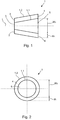
- Figs. 1 and 2 illustrate a first embodiment of a nozzle 1 for use in a first embodiment of the inventive process for the provision of a foamed layer 20 of a polymer composition on the surface 12 of a substrate 11.
- the nozzle 1 comprises an inner truncated cone 1.1 and an outer truncated cone 1.2, which are arranged concentrically along a longitudinal axis L. Both the inner truncated cone 1.1 and an outer truncated cone 1.2 are manufactured from a metal, i.e. steel.
- the nozzle 1 comprises a carrier gas inlet 2 for provision of a carrier gas stream mixed with the heat-foamable curable polymer composition.
- the carrier gas inlet 2 is arranged on a first side of the nozzle 1 and extends from the outer wall of the inner truncated cone 1.1 to the inner wall of the outer truncated cone 1.2.
- the carrier gas inlet 3 is ring-shaped.
- a combustible gas stream inlet 3 is arranged on the first side of the nozzle 1 for the provision of a combustible gas stream.
- the combustible gas stream inlet 3 is of circular shape. It extends in between the inner walls of the inner truncated cone 1.1.
- the nozzle On a second side of the nozzle 1, the second side being arranged opposite the first side, the nozzle has a ring-shaped carrier gas outlet 4 as well as a torch 5 in the form of a circular combustible gas outlet 5.
- the ring-shaped carrier gas outlet 4 surrounds the torch 5.
- the ring-shaped outlet 4 has a width W 1 in the range of 0,3 cm -0,6 cm, preferably in the range of 0,3 cm - 0,5 cm, more preferably in the range of 0,3 cm - 0,4 cm
- a heat-foamable curable polymer composition as described above is provided.
- the composition is in form of particles having a particle size characterized by a D 50 value within the range of from 500 ⁇ m to 1500 ⁇ m.
- the heat-foamable curable polymer composition is mixed with a carrier gas stream. Then the composition is sprayed on the surface 12 of the substrate 11 using the nozzle 1. Finally, the composition is heated during its flight from the nozzle 1 to the surface 12 of the substrate 11 so as to activate the composition.
- the heat-foamable curable polymer composition comprises a blowing agent. When heating the composition during flight, the composition is heated to a temperature such that the blowing agent is activated and initiates foaming of the composition before it hits the surface 12 of the substrate 11.
- the carrier gas stream is provided with a pressure within the range of 150 kPa to 350 kPa, preferably within the range of 180 kPa to 220 kPa, more preferably within the range of 190 kPa to 210 kPa.
- the carrier gas stream is an inert carrier gas stream comprising one of or a combination of nitrogen, carbon dioxide and a noble gas, e.g. helium, neon or argon.
- the carrier gas stream accelerates the heat-foamable and curable polymer composition such that it has a velocity within the range of from about 50 m/s to about 1000 m/s, more preferably from about 100 m/s to about 1000 m/s, when it hits the surface 12 of the substrate 11.
- the composition is heated by a heat source in the form of the torch 5.
- the torch 5 is supplied with the combustible gas stream and generates a flame 10.
- the combustible gas stream comprises a mixture of propylene and/or oxygen, preferably a mixture, wherein the ratio of propylene to oxygen is in the range of 2/12 to 4/12, more preferably around 3/12.
- the composition is sprayed through the flame 10 so that the composition will not be heated before being ejected from the nozzle 1.
- the flame 10 extends from the nozzle 1 towards the substrate 11 and the ratio of the length D 2 of the flame 10 to the distance D 1 between the nozzle 1 and the substrate 11 is within the range of 0.5 to 0.9, preferably within the range of 0.6 to 0.9, more preferably within the range of 0.7 to 0.9, e.g. within the range of 0.8 ⁇ 0.05.
- the nozzle 1 is moved along the substrate 11 so as to cover different regions of the surface 12 of the substrate 11 with the foamed layer 20.
- the substrate 11 is heated prior to spraying the composition onto the substrate 11.
- the substrate 11 may e.g. be heated to a temperature in the region of 80°C to 120°C. Heating may be carried out with the torch 5 of the nozzle 1 while supply of the carrier gas stream through carrier gas outlet 4 is shut off.
- a heat-foamable curable polymer composition is provided as described above, wherein the composition is in form of particles having a particle size characterized by a D 50 value within the range of from 500 ⁇ m to 1500 ⁇ m.
- the composition is mixed with a carrier gas stram and the mixture is supplied to an alternate nozzle 30.
- the composition is sprayed on the surface 12 of the substrate 11 using the alternate nozzle 30.
- the alternate nozzle 30 lacks an inlet for a combustible gas stream.
- the alternate nozzle 30 does not include a torch 5. Instead, the nozzle 30 is solely supplied with a carrier gas stream that has been mixed with the particles of the heat-foamable curable polymer composition.
- the heat-foamable curable polymer composition comprises a blowing agent and the composition is heated to a temperature such that the blowing agent is activated and initiates foaming of the composition before it hits the surface 12 of the substrate 11.
- heated carrier gas is employed as a heat source in order to activate the composition during flight.
- the carrier gas stream is an inert carrier gas stream, e.g. nitrogen, carbon dioxide, a noble gas, or a combination thereof.
- the carrier gas may be air.
- the temperature of the carrier gas stream is at least about 100 °C, or at least about 200 °C, more preferably at least about 250 °C, or at least about 350 °C, still more preferably at least about 400 °C or at least about 500 °C.
- the temperature of the carrier gas stream prior to mixing with the heat-foamable and curable polymer composition is at most about 900 °C, or at most about 800 °C, more preferably at most about 750 °C, or at most about 650 °C, still more preferably at most about 600 °C, or at most about 500 °C.
- a foamed layer of a polymer composition is provided on the surface 12 of a substrate 12.
- the processes comprise the steps of (i) providing a heat-foamable curable polymer composition, wherein the composition is in form of particles having a particle size characterized by a D 50 value within the range of from 500 ⁇ m to 1500 ⁇ m, (ii) mixing the heat-foamable curable polymer composition with a carrier gas stream, (iii) spraying the composition on the surface of the substrate using a nozzle 1, 30, and heating the composition during its flight from the nozzle 1, 30 to the surface 12 of the substrate 11.
- a foamed layer 20 of a polymer composition on the surface 12 of the substrate 11 is provided which does not require a separate activation step after application of the composition to the substrate 11.
Landscapes
- Chemical & Material Sciences (AREA)
- Engineering & Computer Science (AREA)
- Materials Engineering (AREA)
- Health & Medical Sciences (AREA)
- Chemical Kinetics & Catalysis (AREA)
- Medicinal Chemistry (AREA)
- Polymers & Plastics (AREA)
- Organic Chemistry (AREA)
- Combustion & Propulsion (AREA)
- General Chemical & Material Sciences (AREA)
- Application Of Or Painting With Fluid Materials (AREA)
- Manufacture Of Porous Articles, And Recovery And Treatment Of Waste Products (AREA)
Priority Applications (1)
| Application Number | Priority Date | Filing Date | Title |
|---|---|---|---|
| EP16163657.6A EP3228656A1 (de) | 2016-04-04 | 2016-04-04 | Schäumungsprozess durch thermischen spritzen |
Applications Claiming Priority (1)
| Application Number | Priority Date | Filing Date | Title |
|---|---|---|---|
| EP16163657.6A EP3228656A1 (de) | 2016-04-04 | 2016-04-04 | Schäumungsprozess durch thermischen spritzen |
Publications (1)
| Publication Number | Publication Date |
|---|---|
| EP3228656A1 true EP3228656A1 (de) | 2017-10-11 |
Family
ID=55910717
Family Applications (1)
| Application Number | Title | Priority Date | Filing Date |
|---|---|---|---|
| EP16163657.6A Withdrawn EP3228656A1 (de) | 2016-04-04 | 2016-04-04 | Schäumungsprozess durch thermischen spritzen |
Country Status (1)
| Country | Link |
|---|---|
| EP (1) | EP3228656A1 (de) |
Citations (1)
| Publication number | Priority date | Publication date | Assignee | Title |
|---|---|---|---|---|
| DE2106466A1 (en) * | 1971-02-11 | 1972-08-31 | Metallgesellschaft AG, 6000 Frank fürt | Polyolefin foam layers or strips - from mixt contg propellant and opt cross-linking agent sprayed on with flame gun |
-
2016
- 2016-04-04 EP EP16163657.6A patent/EP3228656A1/de not_active Withdrawn
Patent Citations (1)
| Publication number | Priority date | Publication date | Assignee | Title |
|---|---|---|---|---|
| DE2106466A1 (en) * | 1971-02-11 | 1972-08-31 | Metallgesellschaft AG, 6000 Frank fürt | Polyolefin foam layers or strips - from mixt contg propellant and opt cross-linking agent sprayed on with flame gun |
Similar Documents
| Publication | Publication Date | Title |
|---|---|---|
| KR20060021304A (ko) | 밀봉, 배플링 또는 강화를 위한 활성화가능한 물질 및 이의형성 방법 | |
| EP1940653B1 (de) | Plattenstruktur | |
| EP1430093B1 (de) | Homopolymerisiertes epoxy-basiertes vor ort zu verschäumendes material | |
| US20090269547A1 (en) | Repair of honeycomb structures | |
| US20040033344A1 (en) | Synthetic material and methods of forming and applying same | |
| EP1746119A1 (de) | Hitzehärtbarer verstärkte hitzeexpandierte Filmvorläufer und Film davon | |
| CN112105698B (zh) | 阻燃性改善的蜂窝芯拼接粘合剂 | |
| CN105829050B (zh) | 关于或涉及泡沫填充的蜂窝结构的改进 | |
| US20230082593A1 (en) | Application of adhesives | |
| EP3122831B1 (de) | Pulverförmige klebstoffe | |
| WO2012141291A1 (ja) | 充填封止用発泡組成物、充填封止発泡部材および充填封止用発泡体 | |
| JP2013504460A (ja) | キャビティ充填材の改良 | |
| JP2018532836A (ja) | 構造用接着のための柔軟な感圧接着テープ | |
| JP2008144133A (ja) | 多段階または単段階硬化接着剤材料およびその使用方法 | |
| JP2018532837A (ja) | 構造用接着のための柔軟で接着性の平坦な形成物 | |
| EP3228656A1 (de) | Schäumungsprozess durch thermischen spritzen | |
| WO2009112259A1 (en) | Edging system for panels having a cellular structure, particularly for honeycomb panels | |
| WO2016050691A1 (en) | Method to apply an adhesive coating to the surface of a work piece with a de laval-nozzle | |
| EP1391250A2 (de) | Synthetisches Material und Verfahren zu seiner Herstellung und Verwendung | |
| CN103492505A (zh) | 通过低频交流电的趋肤效应对粘合剂的活化 | |
| JP2003073526A (ja) | 加熱型発泡剤、およびそれを用いた発泡樹脂組成物と発泡樹脂シート、ならびに発泡樹脂シートの製造方法 | |
| CN110722980A (zh) | 用于燃料箱的结构增强件 | |
| JPH04343865A (ja) | 金属製バットおよびその製造方法 | |
| JP2026504776A (ja) | 低減されたvoc放出量を有する一成分系発泡性熱硬化性エポキシ組成物 | |
| EP3655493A1 (de) | Abgedichtete beschichtete vorrichtungen |
Legal Events
| Date | Code | Title | Description |
|---|---|---|---|
| PUAI | Public reference made under article 153(3) epc to a published international application that has entered the european phase |
Free format text: ORIGINAL CODE: 0009012 |
|
| AK | Designated contracting states |
Kind code of ref document: A1 Designated state(s): AL AT BE BG CH CY CZ DE DK EE ES FI FR GB GR HR HU IE IS IT LI LT LU LV MC MK MT NL NO PL PT RO RS SE SI SK SM TR |
|
| AX | Request for extension of the european patent |
Extension state: BA ME |
|
| STAA | Information on the status of an ep patent application or granted ep patent |
Free format text: STATUS: THE APPLICATION IS DEEMED TO BE WITHDRAWN |
|
| 18D | Application deemed to be withdrawn |
Effective date: 20180412 |